EP3804059B1 - Harnais electrique pour turbomachine - Google Patents
Harnais electrique pour turbomachine Download PDFInfo
- Publication number
- EP3804059B1 EP3804059B1 EP19744755.0A EP19744755A EP3804059B1 EP 3804059 B1 EP3804059 B1 EP 3804059B1 EP 19744755 A EP19744755 A EP 19744755A EP 3804059 B1 EP3804059 B1 EP 3804059B1
- Authority
- EP
- European Patent Office
- Prior art keywords
- braids
- shielding
- externally
- protective
- harness
- Prior art date
- Legal status (The legal status is an assumption and is not a legal conclusion. Google has not performed a legal analysis and makes no representation as to the accuracy of the status listed.)
- Active
Links
Images
Classifications
-
- H—ELECTRICITY
- H02—GENERATION; CONVERSION OR DISTRIBUTION OF ELECTRIC POWER
- H02G—INSTALLATION OF ELECTRIC CABLES OR LINES, OR OF COMBINED OPTICAL AND ELECTRIC CABLES OR LINES
- H02G3/00—Installations of electric cables or lines or protective tubing therefor in or on buildings, equivalent structures or vehicles
- H02G3/02—Details
- H02G3/06—Joints for connecting lengths of protective tubing or channels, to each other or to casings, e.g. to distribution boxes; Ensuring electrical continuity in the joint
-
- H—ELECTRICITY
- H01—ELECTRIC ELEMENTS
- H01R—ELECTRICALLY-CONDUCTIVE CONNECTIONS; STRUCTURAL ASSOCIATIONS OF A PLURALITY OF MUTUALLY-INSULATED ELECTRICAL CONNECTING ELEMENTS; COUPLING DEVICES; CURRENT COLLECTORS
- H01R4/00—Electrically-conductive connections between two or more conductive members in direct contact, i.e. touching one another; Means for effecting or maintaining such contact; Electrically-conductive connections having two or more spaced connecting locations for conductors and using contact members penetrating insulation
- H01R4/10—Electrically-conductive connections between two or more conductive members in direct contact, i.e. touching one another; Means for effecting or maintaining such contact; Electrically-conductive connections having two or more spaced connecting locations for conductors and using contact members penetrating insulation effected solely by twisting, wrapping, bending, crimping, or other permanent deformation
- H01R4/18—Electrically-conductive connections between two or more conductive members in direct contact, i.e. touching one another; Means for effecting or maintaining such contact; Electrically-conductive connections having two or more spaced connecting locations for conductors and using contact members penetrating insulation effected solely by twisting, wrapping, bending, crimping, or other permanent deformation by crimping
- H01R4/20—Electrically-conductive connections between two or more conductive members in direct contact, i.e. touching one another; Means for effecting or maintaining such contact; Electrically-conductive connections having two or more spaced connecting locations for conductors and using contact members penetrating insulation effected solely by twisting, wrapping, bending, crimping, or other permanent deformation by crimping using a crimping sleeve
-
- H—ELECTRICITY
- H01—ELECTRIC ELEMENTS
- H01R—ELECTRICALLY-CONDUCTIVE CONNECTIONS; STRUCTURAL ASSOCIATIONS OF A PLURALITY OF MUTUALLY-INSULATED ELECTRICAL CONNECTING ELEMENTS; COUPLING DEVICES; CURRENT COLLECTORS
- H01R4/00—Electrically-conductive connections between two or more conductive members in direct contact, i.e. touching one another; Means for effecting or maintaining such contact; Electrically-conductive connections having two or more spaced connecting locations for conductors and using contact members penetrating insulation
- H01R4/10—Electrically-conductive connections between two or more conductive members in direct contact, i.e. touching one another; Means for effecting or maintaining such contact; Electrically-conductive connections having two or more spaced connecting locations for conductors and using contact members penetrating insulation effected solely by twisting, wrapping, bending, crimping, or other permanent deformation
- H01R4/18—Electrically-conductive connections between two or more conductive members in direct contact, i.e. touching one another; Means for effecting or maintaining such contact; Electrically-conductive connections having two or more spaced connecting locations for conductors and using contact members penetrating insulation effected solely by twisting, wrapping, bending, crimping, or other permanent deformation by crimping
- H01R4/183—Electrically-conductive connections between two or more conductive members in direct contact, i.e. touching one another; Means for effecting or maintaining such contact; Electrically-conductive connections having two or more spaced connecting locations for conductors and using contact members penetrating insulation effected solely by twisting, wrapping, bending, crimping, or other permanent deformation by crimping for cylindrical elongated bodies, e.g. cables having circular cross-section
-
- H—ELECTRICITY
- H02—GENERATION; CONVERSION OR DISTRIBUTION OF ELECTRIC POWER
- H02G—INSTALLATION OF ELECTRIC CABLES OR LINES, OR OF COMBINED OPTICAL AND ELECTRIC CABLES OR LINES
- H02G3/00—Installations of electric cables or lines or protective tubing therefor in or on buildings, equivalent structures or vehicles
- H02G3/02—Details
- H02G3/04—Protective tubing or conduits, e.g. cable ladders or cable troughs
- H02G3/0462—Tubings, i.e. having a closed section
-
- B—PERFORMING OPERATIONS; TRANSPORTING
- B60—VEHICLES IN GENERAL
- B60R—VEHICLES, VEHICLE FITTINGS, OR VEHICLE PARTS, NOT OTHERWISE PROVIDED FOR
- B60R16/00—Electric or fluid circuits specially adapted for vehicles and not otherwise provided for; Arrangement of elements of electric or fluid circuits specially adapted for vehicles and not otherwise provided for
- B60R16/02—Electric or fluid circuits specially adapted for vehicles and not otherwise provided for; Arrangement of elements of electric or fluid circuits specially adapted for vehicles and not otherwise provided for electric constitutive elements
- B60R16/0207—Wire harnesses
- B60R16/0215—Protecting, fastening and routing means therefor
-
- B—PERFORMING OPERATIONS; TRANSPORTING
- B64—AIRCRAFT; AVIATION; COSMONAUTICS
- B64D—EQUIPMENT FOR FITTING IN OR TO AIRCRAFT; FLIGHT SUITS; PARACHUTES; ARRANGEMENT OR MOUNTING OF POWER PLANTS OR PROPULSION TRANSMISSIONS IN AIRCRAFT
- B64D27/00—Arrangement or mounting of power plants in aircraft; Aircraft characterised by the type or position of power plants
- B64D27/02—Aircraft characterised by the type or position of power plants
- B64D27/10—Aircraft characterised by the type or position of power plants of gas-turbine type
-
- B—PERFORMING OPERATIONS; TRANSPORTING
- B64—AIRCRAFT; AVIATION; COSMONAUTICS
- B64D—EQUIPMENT FOR FITTING IN OR TO AIRCRAFT; FLIGHT SUITS; PARACHUTES; ARRANGEMENT OR MOUNTING OF POWER PLANTS OR PROPULSION TRANSMISSIONS IN AIRCRAFT
- B64D27/00—Arrangement or mounting of power plants in aircraft; Aircraft characterised by the type or position of power plants
- B64D27/02—Aircraft characterised by the type or position of power plants
- B64D27/16—Aircraft characterised by the type or position of power plants of jet type
-
- H—ELECTRICITY
- H01—ELECTRIC ELEMENTS
- H01R—ELECTRICALLY-CONDUCTIVE CONNECTIONS; STRUCTURAL ASSOCIATIONS OF A PLURALITY OF MUTUALLY-INSULATED ELECTRICAL CONNECTING ELEMENTS; COUPLING DEVICES; CURRENT COLLECTORS
- H01R4/00—Electrically-conductive connections between two or more conductive members in direct contact, i.e. touching one another; Means for effecting or maintaining such contact; Electrically-conductive connections having two or more spaced connecting locations for conductors and using contact members penetrating insulation
- H01R4/58—Electrically-conductive connections between two or more conductive members in direct contact, i.e. touching one another; Means for effecting or maintaining such contact; Electrically-conductive connections having two or more spaced connecting locations for conductors and using contact members penetrating insulation characterised by the form or material of the contacting members
-
- H—ELECTRICITY
- H01—ELECTRIC ELEMENTS
- H01R—ELECTRICALLY-CONDUCTIVE CONNECTIONS; STRUCTURAL ASSOCIATIONS OF A PLURALITY OF MUTUALLY-INSULATED ELECTRICAL CONNECTING ELEMENTS; COUPLING DEVICES; CURRENT COLLECTORS
- H01R4/00—Electrically-conductive connections between two or more conductive members in direct contact, i.e. touching one another; Means for effecting or maintaining such contact; Electrically-conductive connections having two or more spaced connecting locations for conductors and using contact members penetrating insulation
- H01R4/70—Insulation of connections
- H01R4/72—Insulation of connections using a heat shrinking insulating sleeve
Definitions
- the present invention relates to an electrical harness, in particular for aeronautics and more particularly intended to be mounted in a turbomachine such as an aircraft turbojet or turboprop.
- turbomachines require finding electrical harness solutions whose dimensions and characteristics allow them to be mounted in restricted spaces.
- protective sheathing technologies based on lighter heat-shrinkable synthetic materials can be used in areas where thermal stresses are lower and within a given temperature range, for example below 210°C.
- transition between a stainless steel sheath and a synthetic material sheath may be provided in a zone of the harness comprising in particular a so-called transition part.
- the latter may also be used to ensure the attachment of the harness to a fixed part of the turbomachine. Such attachment is for example achieved by inserting said part into an elastic lyre.
- electrical harnesses generally have branch points, where a single cable strand is split into several cable strands. This can be achieved in an area of the harness comprising a so-called branch portion.
- the latter is distinct from the transition portion and is located downstream or upstream of the transition portion.
- Said branch portion can also comprise an area allowing the harness to be fixed to a fixed part of the turbomachine.
- the areas where the harness is attached to the fixed parts of the turbomachine may also have shape defects, due to their structure, these shape defects making their installation on the turbomachine more difficult.
- the cables and strands of electric cables are also surrounded externally by an electromagnetic shielding sheath.
- an electromagnetic shielding sheath In addition to the constraints mentioned above, it is necessary to ensure the continuity of such shielding at the transition and branch parts.
- EP1443620A1 discloses a system for modifying an overbraided electrical harness comprising at least one strand of conductive cables surrounded by an overbraiding braid.
- the modification system is characterized in that it comprises: at least one conductive modification element consisting of at least one conductive cable surrounded by a shielding braid; at least one portion of reserve sheath comprising a portion of flexible tube mounted partly in the braid of said harness in such a way that a first end of said tube opens beyond the end of said harness braid and that the second end of the tube is external to said harness braid by passing through it, at least said part of the portion of tube external to the harness braid being surrounded by an overbraiding braid.
- the invention aims to remedy all or part of the aforementioned drawbacks, in a simple and economical manner.
- the present invention relates to an electrical harness according to claim 1.
- the connecting sleeve allows the fixing function and the crimping function of the shielding braids to be combined into a single rigid monobloc element.
- the crimping part is therefore sufficiently rigid to allow the shielding braids to be crimped using the crimping member. Such crimping ensures the electrical continuity of the shielding.
- the shape of the fixing part can be fixed, for example cylindrical, so as to facilitate the assembly and angular positioning of the harness on the relevant part of the turbomachine.
- Shielding braids can be made of braided material, for example copper and nickel alloy.
- the connecting sleeve can be made of metal, for example.
- the harness may comprise a single first cable strand and several second cable strands, for example two or more second cable strands.
- the end of the second shielding braid is engaged in the connecting sleeve and can be folded back externally to the crimping part, making a 180° return, the end of the first shielding braid is engaged only externally to the crimping part.
- the end of the first shield braid does not pass through the connecting sleeve.
- Each cable strand may be surrounded externally, at least partially, by a first protective braid, the first protective braids being able to overlap in an overlap zone.
- the first protective braids can be textile sheaths.
- the first protective braids are, for example, made of meta-aramid.
- the first protective braids can be assembled to each other by sewing in the overlap area.
- Shielding braids can surround the first protective braids externally.
- Each cable strand may be surrounded externally, at least partially, by a second protective sheath.
- the second protective sheaths can be made of heat-shrinkable synthetic material, for example a material marketed under the brand name VITON ® by the company DuPont de Nemours. Heat-shrinkable synthetic materials are lightweight and can withstand temperatures of up to 210°C. The second protective sheaths can also be made of stainless materials, which can withstand temperatures of up to 260°C.
- the end of the second protective sheath of one of the cable strands may be mounted externally to the crimping portion and externally to the crimped ends of the shielding braids.
- Said end of the second protective sheath can be fixed by crimping externally to the crimping part, using the crimping member.
- the second protective sheaths may externally surround at least part of the shielding braids.
- the internal volume of the connecting socket is filled, at least in part, with a resin embedding the cables, the shielding braid and/or the protective sheaths.
- the invention also relates to a turbomachine such as an aircraft turbojet or turboprop, comprising at least one electrical harness of the aforementioned type.
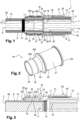
- the harness comprises a first cable strand 2 and two second cable strands 3, 4, these cables being intended for supplying components of the turbomachine from a source, or for transferring electrical signals between components.
- Each cable comprises at least one electrical conductor.
- Each electrical conductor 5, 6 of the first cable is branched into the second cable strands 3, 4 consisting of electrical conductors 7, 8.
- the first cable strand 2 and each second cable strand 3, 4 are surrounded externally by a first textile protective braid.
- the first protective braid 9 of the first cable strand 2 and the first protective braids 10, 11 of the second cable strands 3, 4 are sewn to each other in an overlapping region 12.
- the overlapping region 12 is located externally to the first cable strand 2.
- the first protective braids 9, 10, 11 are for example made of a synthetic material of the meta-aramid type.
- a first electromagnetic shielding braid 13 externally surrounds the first cable strand 2 and the first protective braid 9.
- each of the second cable strands 3, 4 and their respective first protective braids 10, 11 are externally surrounded by a second electromagnetic shielding braid 14, 15.
- the shielding braids 13, 14, 15 are braided sheaths made of a copper- and nickel-based alloy.
- a 16 connecting socket externally surrounds one end 17 of the first cable strand 2 and ends 18, 19 of the second cable strands 3, 4.
- the connecting sleeve 16 is rigid and comprises a cylindrical crimping part 20 and a cylindrical fixing part 21, of larger diameter than the crimping part.
- the crimping part 20 comprises two cylindrical zones 20a, 20b spaced from each other by a first annular rim 22 and comprises at its end a second annular rim 23.
- the fixing part comprises two annular rims 24, 25 located at its ends.
- the connecting sleeve 16 can be made of metal, for example stainless steel or titanium, or even of synthetic material, for example glass-filled resin.
- Ends 27, 26, 40 of the first 13 and second shielding braids 14, 15 are engaged externally to the crimping portion 20 of the connecting piece 16.
- the second shielding braids 14, 15 are engaged in the connecting sleeve 16 and are folded back externally to the crimping portion 20, making a 180° return.
- the second shielding braids 14, 15 pass through the connecting sleeve 16 and are curved such that ends 26, 40 of these shielding braids externally surround the outer surface of the crimping portion 20.
- the first shielding braid 13 does not pass through the sleeve 16 and its end 27 is engaged externally to the crimping portion 20.
- a second protective sheath 28, 29, 30 externally surrounds each cable strand, the first protective braids and the corresponding shielding braids.
- the second protective sheaths may be made, for example, of heat-shrinkable synthetic material, in particular a material marketed under the VITON® brand by the DuPont de Nemours company, or of braided stainless steel.
- One of the ends 31 of the second protective sheath 28 of the first cable strand 2 is mounted externally to the crimping portion 20 and externally to the corresponding ends 27, 26, 40 of the shielding braids. These ends 31, 26, 27, 40 are fixed by crimping externally to the crimping portion 20, which is rigid, using crimping collars 32.
- a crimping collar 32 is mounted at each zone 20a and 20b. The rigidity of the crimping portion 20 prevents it from deforming when the crimping collars 32 are tightened.
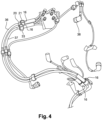
- the fixing part 21 is also intended to be engaged in a fixing member of the turbomachine, for example a fixing lyre 33 (visible in fig. 4 ).
- the rigidity of the fixing part 21 makes it possible to guarantee the shape of this part and thus facilitates positioning by an operator on the fixing member 33.
- the corresponding ends 34, 35 of the second protective sheaths 29, 30 of the second cable strands 3, 4 are mounted inside the fixing part 21.
- the internal volume of the fixing part 21 is filled with a resin 39, for example an epoxy resin, embedding the second protective sheaths 29, 30 of the second cable strands 3, 4.
- the connecting sleeve 16 thus makes it possible to ensure both the transition from a second stainless steel protective sheath to a second synthetic material protective sheath, but also the derivation of a cable strand into several cable strands.
- the use of a single sleeve 16 makes it possible to reduce the size of the electrical harness, thus facilitating the integration of such a harness in a small turbomachine.
- the arrangement of the shielding braids 13, 14, 15 also makes it possible to ensure the continuity of the electromagnetic shielding at the level of the connecting socket.
- FIG. 3 represents a part of an electrical harness according to another embodiment of the invention.
- the overlapping zone 12 where the first protective braids 9, 11 of the first 2 and second cable strands 3, 4 overlap and are sewn is located inside the fixing part 21 of the connecting sleeve 16.
- each harness comprises in particular several connecting sleeves 16 as described above.
- the fixing part of each connecting sleeve 16 is mounted by snap-fastening in a fixing member 33.
- each fixing member 33 has a lyre shape consisting of two elastically deformable branches, as is known per se.
- Each fixing member 33 can itself be fixed to a fixed part of the turbomachine.
- the fixing member 33 can also be a fixing collar with a silicone sheath.
- Each harness 36, 37 further comprises connectors 38 which can be connected to components of the turbomachine.
Landscapes
- Engineering & Computer Science (AREA)
- Architecture (AREA)
- Civil Engineering (AREA)
- Structural Engineering (AREA)
- Insulated Conductors (AREA)
- Installation Of Indoor Wiring (AREA)
- Structures Of Non-Positive Displacement Pumps (AREA)
Description
- La présente invention concerne un harnais électrique notamment pour l'aéronautique et plus particulièrement destiné à être monté dans une turbomachine telle qu'un turboréacteur ou un turbopropulseur d'avion.
- La réduction des dimensions des turbomachines nécessite de trouver des solutions d'harnais électriques dont les dimensions et les caractéristiques leur permettent d'être montés dans des espaces restreints.
- Il existe par ailleurs un besoin de développer des harnais électriques pouvant résister à des températures élevées, tout en présentant un encombrement et une masse réduits.
- Afin de réduire la masse des harnais électriques, des technologies de gaines de protection à base de matériaux synthétiques thermorétractables, plus légers, peuvent être utilisées dans les zones où les contraintes thermiques sont plus basses et comprises dans une plage de température donnée, par exemple inférieure à 210°C.
- Il est par ailleurs également connu d'utiliser des gaines tressées en aciers inoxydables, capables de résister à des températures élevées, supérieures notamment à 210°C.
- La transition entre une gaine en acier inoxydable et une gaine en matériau synthétique peut être prévue dans une zone du harnais comportant notamment une partie dite de transition. Cette dernière peut par ailleurs être utilisée pour assurer la fixation du harnais sur une partie fixe de la turbomachine. Une telle fixation est par exemple réalisée par insertion de ladite partie dans une lyre élastique.
- Par ailleurs, les harnais électriques possèdent en général des points de dérivation, où un toron de câbles unique est éclaté en plusieurs torons de câbles. Ceci peut être réalisé dans une zone du harnais comportant une partie dite de dérivation. Cette dernière est distincte de la partie de transition et est située en aval ou en amont de la partie de transition. Ladite partie de dérivation peut également comporter une zone permettant la fixation du harnais sur une partie fixe de la turbomachine.
- Les zones de fixation du harnais aux parties fixes de la turbomachine peuvent également présenter des défauts de forme, du fait de leur structure, ces défauts de forme rendant plus difficile leur installation sur la turbomachine.
- L'utilisation de deux douilles distinctes augmente l'encombrement et la masse du harnais, rendant difficile l'intégration d'un tel harnais dans une turbomachine de faibles dimensions.
- Les câbles et les torons de câbles électriques sont par ailleurs entourés extérieurement d'une gaine de blindage électromagnétique. En plus des contraintes précédemment citées, il convient d'assurer la continuité d'un tel blindage au niveau des parties de transition et de dérivation.
-
EP1443620A1 divulgue un système de modification d'un harnais électrique surtressé comprenant au moins un toron de câbles conducteurs entouré par une tresse de surtressage. Le système de modification se caractérise en ce qu'il comprend : au moins un élément conducteur de modification constitué par au moins un câble conducteur entouré par une tresse de blindage; au moins une portion de gaine de réserve comprenant une portion de tube souple montée en partie dans la tresse dudit harnais de telle manière qu'une première extrémité dudit tube débouche au-delà de l'extrémité de ladite tresse du harnais et que la deuxième extrémité du tube soit extérieure à ladite tresse du harnais en la traversant, au moins ladite partie de portion de tube extérieure à la tresse du harnais étant entourée par une tresse de surtressage. - L'invention vise à remédier en tout ou partie aux inconvénients précités, de façon simple et économique.
- A cet effet, la présente invention concerne un harnais électrique selon la revendication 1.
- La douille de liaison permet de regrouper la fonction de fixation et la fonction de sertissage des tresses de blindage en un seul élément monobloc rigide. La partie de sertissage est par conséquent suffisamment rigide pour permettre un sertissage des tresses de blindage à l'aide de l'organe de sertissage. Un tel sertissage permet de garantir la continuité électrique du blindage.
- Par ailleurs, la forme de la partie de fixation peut être figée, par exemple cylindrique, de manière à faciliter le montage et le positionnement angulaire du harnais sur la partie concernée de la turbomachine.
- Les tresses de blindage peuvent être réalisées en matériau tressé, par exemple en alliage à base de cuivre et de nickel.
- La douille de liaison peut être par exemple réalisée en métal.
- Le harnais peut comporter un seul premier toron de câbles et plusieurs seconds torons de câbles, par exemple deux ou plusieurs seconds torons de câbles.
- De plus, l'extrémité de la seconde tresse de blindage, est engagée dans la douille de liaison et peut être rabattue extérieurement à la partie de sertissage, faisant un retour à 180°, l'extrémité de la première tresse de blindage est engagée uniquement extérieurement à la partie de sertissage.
- En d'autres termes, l'extrémité de la première tresse de blindage, ne traverse pas la douille de liaison.
- Chaque toron de câbles peut être entouré extérieurement, au moins partiellement, d'une première tresse de protection, les premières tresses de protection pouvant se recouvrir dans une zone de recouvrement.
- Les premières tresses de protection peuvent être des gaines textiles.
- Les premières tresses de protection sont, par exemple, réalisées en méta-aramide.
- Les premières tresses de protection peuvent être assemblées l'une à l'autre par couture dans la zone de recouvrement.
- Les tresses de blindage peuvent entourer extérieurement les premières tresses de protection.
- Chaque toron de câbles peut être entouré extérieurement, au moins partiellement, d'une seconde gaine de protection.
- Les secondes gaines de protection peuvent être réalisées en matériau synthétique thermorétractable, par exemple un matériau commercialisé sous la marque VITON® par la société DuPont de Nemours. Les matériaux synthétiques thermorétractables sont légers et peuvent résister à des températures allant jusqu'à 210°C. Les secondes gaines de protection peuvent également être réalisées en matériaux inoxydables, qui résistent à des températures allant jusqu'à 260°C.
- L'extrémité de la seconde gaine de protection de l'un des torons de câbles peut être montée extérieurement à la partie de sertissage et extérieurement aux extrémités serties des tresses de blindage.
- Ladite extrémité de la seconde gaine de protection peut être fixée par sertissage extérieurement à la partie sertissage, à l'aide de l'organe de sertissage.
- Les secondes gaines de protection peuvent entourer extérieurement au moins en partie les tresses de blindage.
- Le volume interne de la douille de liaison est rempli, au moins en partie, d'une résine noyant les câbles, la tresse de blindage et/ou les gaines de protection.
- L'invention concerne également une turbomachine telle qu'un turboréacteur ou un turbopropulseur d'avion, comprenant au moins un harnais électrique du type précité.
- L'invention sera mieux comprise et d'autres détails, caractéristiques et avantages de l'invention apparaîtront à la lecture de la description suivante faite à titre d'exemple non limitatif en référence aux dessins annexés.
-
- la
figure 1 est une vue schématique en coupe d'un harnais électrique selon une forme de réalisation de l'invention ; - la
figure 2 est une vue schématique de la douille de liaison ; - la
figure 3 est une demi-vue schématique en coupe d'un harnais électrique selon une autre forme de réalisation de l'invention ; - la
figure 4 est une vue en perspective de parties de harnais selon l'invention, fixées à l'aide d'organes de fixation. - La
figure 1 représente une partie d'un harnais 1 selon une première forme de réalisation de l'invention. Le harnais comporte un premier toron de câbles 2 et deux seconds torons de câbles 3, 4, ces câbles étant destinés à l'alimentation de composants de la turbomachine à partir d'une source, ou au transfert de signaux électriques entre des composants. Chaque câble comporte au moins un conducteur électrique. Chaque conducteur électrique 5, 6 du premier câble est dérivé dans les seconds torons de câbles 3, 4 constitués de conducteurs électriques 7, 8. - Le premier toron de câbles 2 et chaque second toron de câbles 3, 4 sont entourés extérieurement d'une première tresse de protection textile. La première tresse de protection 9 du premier toron de câbles 2 et les premières tresses de protection 10, 11 des seconds torons de câbles 3, 4 sont cousues les unes aux autres dans une zone de recouvrement 12. La zone de recouvrement 12 est située extérieurement au premier toron de câbles 2.
- Les premières tresses de protection 9, 10, 11 sont par exemple réalisées en un matériau synthétique de type méta-aramide.
- Une première tresse de blindage électromagnétique 13 entoure extérieurement le premier toron de câbles 2 et la première tresse de protection 9. De même, chacun des seconds torons de câbles 3, 4 et leurs premières tresses de protection respectives 10, 11 sont entourés extérieurement d'une seconde tresse de blindage électromagnétique 14, 15. Les tresses de blindage 13, 14, 15 sont des gaines tressées en alliage à base de cuivre et de nickel.
- Une douille de liaison 16, mieux visible à la
figure 2 , entoure extérieurement une extrémité 17 du premier toron de câbles 2 et des extrémités 18, 19 des seconds torons de câbles 3, 4. - La douille de liaison 16 est rigide et comporte une partie de sertissage cylindrique 20 et une partie de fixation cylindrique 21, de plus grand diamètre que la partie de sertissage.
- La partie de sertissage 20 comporte deux zones cylindriques 20a, 20b espacées l'une de l'autre par un premier rebord annulaire 22 et comporte à son extrémité un second rebord annulaire 23. La partie de fixation comporte deux rebords annulaires 24, 25 situés à ses extrémités.
- La douille de liaison 16 peut être réalisée en métal par exemple en acier inoxydable ou en titane ou bien encore en matériau synthétique par exemple en résine chargée de verre.
- Des extrémités 27, 26, 40 des premières 13 et secondes tresses de blindage 14, 15 sont engagées extérieurement à la partie de sertissage 20 de la pièce de liaison 16. Les secondes tresses de blindage 14, 15 sont engagées dans la douille de liaison 16 et sont rabattues extérieurement à la partie de sertissage 20, faisant un retour à 180°. En d'autres termes, les secondes tresses de blindage 14, 15 traversent la douille de liaison 16 et sont recourbées telles que des extrémités 26, 40 de ces tresses de blindage entourent extérieurement la surface extérieure de la partie de sertissage 20. La première tresse de blindage 13 ne traverse pas la douille 16 et son extrémité 27 est engagée extérieurement à la partie de sertissage 20.
- Une seconde gaine de protection 28, 29, 30 entoure extérieurement chaque toron de câbles, les premières tresses de protection et les tresses de blindage correspondantes. Les secondes gaines de protection peuvent être réalisées par exemple en matériau synthétique thermorétractable, notamment un matériau commercialisé sous la marque VITON® par la société DuPont de Nemours, ou en acier inoxydable tressé.
- L'une des extrémités 31 de la seconde gaine de protection 28 du premier toron de câbles 2 est montée extérieurement à la partie de sertissage 20 et extérieurement aux extrémités 27, 26, 40 correspondantes des tresses de blindage. Ces extrémités 31, 26, 27, 40 sont fixées par sertissage extérieurement à la partie de sertissage 20, qui est rigide, à l'aide de colliers de sertissage 32. Un collier de sertissage 32 est monté au niveau de chaque zone 20a et 20b. La rigidité de la partie de sertissage 20 empêche sa déformation lors du serrage des colliers de sertissage 32.
- La partie de fixation 21 est par ailleurs destinée à être engagée dans un organe de fixation de la turbomachine, par exemple une lyre de fixation 33 (visible en
fig. 4 ). La rigidité de la partie de fixation 21 permet de garantir la forme de cette partie et facilite ainsi la mise en position par un opérateur sur l'organe de fixation 33. - Les extrémités 34, 35 correspondantes des secondes gaines de protection 29, 30 des seconds torons de câbles 3, 4 sont montées à l'intérieur de la partie de fixation 21. Le volume interne de la partie de fixation 21 est rempli d'une résine 39, par exemple une résine époxyde, noyant les secondes gaines de protection 29, 30 des seconds torons de câbles 3, 4.
- La douille de liaison 16 permet ainsi d'assurer à la fois la transition d'une seconde gaine de protection en acier inoxydable à une seconde gaine de protection en matériau synthétique, mais aussi la dérivation d'un toron de câbles en plusieurs torons de câbles. L'utilisation d'une douille 16 unique permet de réduire l'encombrement du harnais électrique, facilitant ainsi l'intégration d'un tel harnais dans une turbomachine de faibles dimensions.
- L'agencement des tresses de blindage 13, 14, 15 permet également d'assurer la continuité du blindage électromagnétique au niveau de la douille de liaison.
- La
figure 3 représente une partie d'un harnais électrique selon une autre forme de réalisation de l'invention. Dans ce mode particulier, la zone de recouvrement 12 où se recouvrent et sont cousues les premières tresses de protection 9, 11 du premier 2 et des seconds torons de câbles 3, 4 est située à l'intérieur de la partie de fixation 21 de la douille de liaison 16. - La
figure 4 représente le montage de deux harnais 36, 37 sur des organes de fixation 33. Chaque harnais comporte notamment plusieurs douilles de liaison 16 telles que décrites précédemment. La partie de fixation de chaque douille de liaison 16 est montée par encliquetage dans un organe de fixation 33. En particulier, chaque organe de fixation 33 présente une forme de lyre constituée de deux branches élastiquement déformables, comme cela est connu en soit. Chaque organe de fixation 33 peut être luimême fixé à une partie fixe de la turbomachine. L'organe de fixation 33 peut également être un collier de fixation avec une gaine de silicone. - Chaque harnais 36, 37 comprend en outre des connecteurs 38 pouvant être raccordés à des composants de la turbomachine.
Claims (9)
- Harnais électrique (1) pour turbomachine comportant au moins un premier toron de câbles (2) et au moins un second toron de câbles (3,4), entourés extérieurement respectivement au moins en partie d'une première tresse de blindage (13) et d'une seconde tresse de blindage (14, 15), et une douille de liaison (16) entourant extérieurement une extrémité du premier toron de câbles (17) et une extrémité du second toron de câbles (18, 19), la douille de liaison (16) comporte une partie de fixation (21) destinée à être engagée sur un organe de fixation (33) de la turbomachine, et une partie de sertissage (20), les extrémités (26, 27, 40) des première (13) et seconde tresses de blindage (14, 15) étant engagées extérieurement à la partie de sertissage (20), le harnais électrique (1) comportant au moins un organe de sertissage (32) venant maintenir lesdites extrémités (26, 27, 40) sur la partie de sertissage (20), l'extrémité (26, 27, 40) de la seconde tresse de blindage (14, 15), étant engagée dans la douille de liaison (16) et étant rabattue extérieurement à la partie de sertissage (20), faisant un retour à 180°, l'extrémité (26, 27, 40) de la première tresse de blindage (13) étant engagée uniquement extérieurement à la partie de sertissage (20), lesdites tresses de blindage étantr agencées de façon à assurer une continuité électrique entre lesdites tresses de blindage.
- Harnais électrique (1) selon la revendication 1, caractérisé en ce que chaque toron de câbles (2, 3, 4) est entouré extérieurement, au moins partiellement, d'une première tresse de protection (9, 10, 11), les premières tresses de protection (9, 10, 11) se recouvrant dans une zone de recouvrement (12).
- Harnais électrique (1) selon la revendication 2, caractérisé en ce que les premières tresses de protection (9, 10, 11) sont des gaines textiles.
- Harnais électrique (1) selon la revendication 3, caractérisé en ce que les premières tresses de protection (9, 10, 11) sont assemblées l'une à l'autre par couture dans la zone de recouvrement (12).
- Harnais électrique (1) selon l'une des revendications 2 à 4, caractérisé en ce que les tresses de blindage (13, 14, 15) entourent extérieurement les premières tresses de protection.
- Harnais électrique (1) selon l'une des revendications 2 à 5, caractérisé en ce que chaque toron de câbles (2, 3, 4) est entouré extérieurement, au moins partiellement, d'une seconde gaine de protection (28, 29, 30).
- Harnais électrique (1) selon la revendication 6, caractérisé en ce que l'extrémité de la seconde gaine de protection (28, 29, 30) de l'un des torons de câbles (2, 3, 4) est montée extérieurement à la partie de sertissage (20) et extérieurement aux extrémités (26, 27, 40) serties des tresses de blindage (13, 14, 15).
- Harnais électrique (1) selon la revendication 6 ou 7, caractérisé en ce que les secondes gaines de protection (28, 29, 30) entourent extérieurement au moins en partie les tresses de blindage (13, 14, 15).
- Harnais électrique (1) selon l'une des revendications 1 à 8, caractérisé en ce que le volume interne de la douille de liaison (16) est rempli, au moins en partie, d'une résine (39) noyant les torons de câbles (2, 3, 4), la tresse de blindage (13, 14, 15) et/ou les gaines de protection (9,10, 11, 28, 29, 30).
Applications Claiming Priority (2)
| Application Number | Priority Date | Filing Date | Title |
|---|---|---|---|
| FR1854464A FR3081622B1 (fr) | 2018-05-25 | 2018-05-25 | Harnais electrique pour turbomachine |
| PCT/FR2019/051210 WO2019224502A1 (fr) | 2018-05-25 | 2019-05-24 | Harnais electrique pour turbomachine |
Publications (2)
| Publication Number | Publication Date |
|---|---|
| EP3804059A1 EP3804059A1 (fr) | 2021-04-14 |
| EP3804059B1 true EP3804059B1 (fr) | 2024-11-06 |
Family
ID=63080121
Family Applications (1)
| Application Number | Title | Priority Date | Filing Date |
|---|---|---|---|
| EP19744755.0A Active EP3804059B1 (fr) | 2018-05-25 | 2019-05-24 | Harnais electrique pour turbomachine |
Country Status (5)
| Country | Link |
|---|---|
| US (1) | US11289827B2 (fr) |
| EP (1) | EP3804059B1 (fr) |
| CN (1) | CN112292791B (fr) |
| FR (1) | FR3081622B1 (fr) |
| WO (1) | WO2019224502A1 (fr) |
Families Citing this family (5)
| Publication number | Priority date | Publication date | Assignee | Title |
|---|---|---|---|---|
| FR3113937B1 (fr) * | 2020-09-10 | 2022-07-29 | Safran Aircraft Engines | Fixation d’une gaine tressée dans une turbomachine |
| US11784482B2 (en) * | 2020-10-20 | 2023-10-10 | Apple Inc. | Electrical connection monitoring using cable shielding |
| CN112967838A (zh) * | 2021-03-12 | 2021-06-15 | 长春捷翼汽车零部件有限公司 | 一种线缆组件和线缆组件的制备方法 |
| EP4432497A1 (fr) * | 2023-03-14 | 2024-09-18 | Abb Schweiz Ag | Adaptateur pour connecter et fixer différents systèmes de protection de harnais |
| FR3165744A1 (fr) * | 2024-08-23 | 2026-02-27 | Safran Aircraft Engines | Harnais electrique pour une turbomachine |
Family Cites Families (18)
| Publication number | Priority date | Publication date | Assignee | Title |
|---|---|---|---|---|
| GB1424068A (en) * | 1973-04-10 | 1976-02-04 | Standard Telephones Cables Ltd | Jointing arrangement for a coaxial core |
| US3801730A (en) * | 1973-05-23 | 1974-04-02 | Gen Electric | High voltage cable splice with provision for testing the insulation thereof and method of making same |
| DE3633208A1 (de) * | 1986-09-30 | 1988-04-07 | Spinner Gmbh Elektrotech | Abgedichteter kabelverbinder |
| FR2850485B1 (fr) * | 2003-01-29 | 2005-04-15 | Labinal | Systeme de modification de la structure d'un harnais electrique |
| JP2006156051A (ja) * | 2004-11-26 | 2006-06-15 | Yazaki Corp | 高圧用ワイヤーハーネス |
| FR2901423B1 (fr) * | 2006-05-19 | 2010-11-26 | Hispano Suiza Sa | Harnais electrique blinde,en particulier pour moteur d'avion |
| US7799997B2 (en) * | 2007-04-27 | 2010-09-21 | Milliken & Company | Innerduct structure having increased flexibility |
| FR2937471B1 (fr) * | 2008-10-16 | 2012-11-16 | Eurocopter France | Procede pour raccorder un faisceau electrique a un connecteur et harnais mettant en oeuvre ce procede |
| KR101713179B1 (ko) * | 2010-04-12 | 2017-03-07 | 타이코 일렉트로닉스 유케이 리미티드 | 동축 커넥터 및 이를 어셈블링하는 방법 |
| KR101152913B1 (ko) * | 2010-06-10 | 2012-06-05 | 주식회사 넥센테크 | 나사식 케이블 단부 차폐층 마감기구 |
| JP5740146B2 (ja) * | 2010-12-10 | 2015-06-24 | 矢崎総業株式会社 | ワイヤハーネス |
| JP6048328B2 (ja) * | 2013-07-04 | 2016-12-21 | 住友電装株式会社 | シールド導電体とその製造方法 |
| JP5728549B2 (ja) * | 2013-10-07 | 2015-06-03 | 株式会社七星科学研究所 | 電源ケーブルコネクタ |
| US9543747B2 (en) * | 2013-10-30 | 2017-01-10 | Delphi Technologies, Inc. | Method for splicing shielded wire cables |
| JP5971563B2 (ja) * | 2013-11-29 | 2016-08-17 | 住友電装株式会社 | 電線のシールド構造 |
| JP6256308B2 (ja) * | 2014-11-06 | 2018-01-10 | 住友電装株式会社 | ワイヤハーネスのシールド構造 |
| CN106911045B (zh) * | 2015-12-22 | 2021-06-22 | 矢崎(中国)投资有限公司 | 屏蔽连接结构 |
| JP6788802B2 (ja) * | 2017-05-26 | 2020-11-25 | 住友電装株式会社 | ワイヤハーネス |
-
2018
- 2018-05-25 FR FR1854464A patent/FR3081622B1/fr active Active
-
2019
- 2019-05-24 EP EP19744755.0A patent/EP3804059B1/fr active Active
- 2019-05-24 WO PCT/FR2019/051210 patent/WO2019224502A1/fr not_active Ceased
- 2019-05-24 US US17/058,971 patent/US11289827B2/en active Active
- 2019-05-24 CN CN201980041320.2A patent/CN112292791B/zh active Active
Also Published As
| Publication number | Publication date |
|---|---|
| US20210218159A1 (en) | 2021-07-15 |
| WO2019224502A1 (fr) | 2019-11-28 |
| FR3081622B1 (fr) | 2021-04-30 |
| CN112292791B (zh) | 2022-07-05 |
| FR3081622A1 (fr) | 2019-11-29 |
| CN112292791A (zh) | 2021-01-29 |
| EP3804059A1 (fr) | 2021-04-14 |
| US11289827B2 (en) | 2022-03-29 |
Similar Documents
| Publication | Publication Date | Title |
|---|---|---|
| EP3804059B1 (fr) | Harnais electrique pour turbomachine | |
| CA2588954C (fr) | Harnais electrique blinde, en particulier pour moteur d'avion | |
| EP1949515B1 (fr) | Raccord coude pour cable electrique multifils | |
| EP1837956B1 (fr) | Harnais électrique blindé à connecteur coudé et son procédé de fabrication | |
| FR3122531A1 (fr) | Ensemble de montage de couche de blindage de câble multiconducteur et dispositif de transmission de signaux | |
| EP3878061B1 (fr) | Raccord arrière avec protection électromagnétique | |
| FR2981210A1 (fr) | Dispositif de raccordement d'un cable blinde sur un boitier | |
| EP3949028B1 (fr) | Connexion entre un harnais surblindé et un composant electrique | |
| FR2990805A1 (fr) | Dispositif et procede de fixation | |
| EP0821835B1 (fr) | Dispositif de raccord arriere pour connecteur electrique pour cable blinde | |
| EP4217591B1 (fr) | Turbomachine comportant des moyens de support de harnais améliorés | |
| EP2541693B1 (fr) | Dispositif de blocage de faisceaux de conducteurs pour connecteur de raccordement | |
| FR3068526A1 (fr) | Harnais electrique | |
| WO2020183111A1 (fr) | Dispositif de raccordement d'un harnais électrique à l'arrière d'un connecteur électrique | |
| FR3081623A1 (fr) | Harnais electrique pour une turbomachine | |
| EP4037107A1 (fr) | Dispositif de connexion électrique à douille | |
| FR3081533A1 (fr) | Dispositif de fixation et de maintien d'au moins un harnais electrique dans une turbomachine | |
| FR3067177B1 (fr) | Blindage electromagnetique pour extremite de cables blindes | |
| CA3042313A1 (fr) | Dispositif de raccordement de conducteurs et ensemble de raccordement comprenant un tel dispositif | |
| FR3032307A1 (fr) | Raccord arriere pour connecteur electrique | |
| FR3125363A1 (fr) | Dispositif de protection d’un organe de connexion d’un catalyseur de véhicule automobile | |
| FR2981209A1 (fr) | Dispositif de raccordement d'une gaine de blindage de cable |
Legal Events
| Date | Code | Title | Description |
|---|---|---|---|
| STAA | Information on the status of an ep patent application or granted ep patent |
Free format text: STATUS: UNKNOWN |
|
| STAA | Information on the status of an ep patent application or granted ep patent |
Free format text: STATUS: THE INTERNATIONAL PUBLICATION HAS BEEN MADE |
|
| PUAI | Public reference made under article 153(3) epc to a published international application that has entered the european phase |
Free format text: ORIGINAL CODE: 0009012 |
|
| STAA | Information on the status of an ep patent application or granted ep patent |
Free format text: STATUS: REQUEST FOR EXAMINATION WAS MADE |
|
| 17P | Request for examination filed |
Effective date: 20201123 |
|
| AK | Designated contracting states |
Kind code of ref document: A1 Designated state(s): AL AT BE BG CH CY CZ DE DK EE ES FI FR GB GR HR HU IE IS IT LI LT LU LV MC MK MT NL NO PL PT RO RS SE SI SK SM TR |
|
| AX | Request for extension of the european patent |
Extension state: BA ME |
|
| DAV | Request for validation of the european patent (deleted) | ||
| DAX | Request for extension of the european patent (deleted) | ||
| STAA | Information on the status of an ep patent application or granted ep patent |
Free format text: STATUS: EXAMINATION IS IN PROGRESS |
|
| 17Q | First examination report despatched |
Effective date: 20221219 |
|
| GRAP | Despatch of communication of intention to grant a patent |
Free format text: ORIGINAL CODE: EPIDOSNIGR1 |
|
| STAA | Information on the status of an ep patent application or granted ep patent |
Free format text: STATUS: GRANT OF PATENT IS INTENDED |
|
| INTG | Intention to grant announced |
Effective date: 20240719 |
|
| GRAS | Grant fee paid |
Free format text: ORIGINAL CODE: EPIDOSNIGR3 |
|
| GRAA | (expected) grant |
Free format text: ORIGINAL CODE: 0009210 |
|
| STAA | Information on the status of an ep patent application or granted ep patent |
Free format text: STATUS: THE PATENT HAS BEEN GRANTED |
|
| AK | Designated contracting states |
Kind code of ref document: B1 Designated state(s): AL AT BE BG CH CY CZ DE DK EE ES FI FR GB GR HR HU IE IS IT LI LT LU LV MC MK MT NL NO PL PT RO RS SE SI SK SM TR |
|
| REG | Reference to a national code |
Ref country code: GB Ref legal event code: FG4D Free format text: NOT ENGLISH |
|
| REG | Reference to a national code |
Ref country code: CH Ref legal event code: EP |
|
| REG | Reference to a national code |
Ref country code: DE Ref legal event code: R096 Ref document number: 602019061502 Country of ref document: DE |
|
| REG | Reference to a national code |
Ref country code: IE Ref legal event code: FG4D Free format text: LANGUAGE OF EP DOCUMENT: FRENCH |
|
| REG | Reference to a national code |
Ref country code: LT Ref legal event code: MG9D |
|
| REG | Reference to a national code |
Ref country code: NL Ref legal event code: MP Effective date: 20241106 |
|
| PG25 | Lapsed in a contracting state [announced via postgrant information from national office to epo] |
Ref country code: IS Free format text: LAPSE BECAUSE OF FAILURE TO SUBMIT A TRANSLATION OF THE DESCRIPTION OR TO PAY THE FEE WITHIN THE PRESCRIBED TIME-LIMIT Effective date: 20250306 Ref country code: PT Free format text: LAPSE BECAUSE OF FAILURE TO SUBMIT A TRANSLATION OF THE DESCRIPTION OR TO PAY THE FEE WITHIN THE PRESCRIBED TIME-LIMIT Effective date: 20250306 Ref country code: HR Free format text: LAPSE BECAUSE OF FAILURE TO SUBMIT A TRANSLATION OF THE DESCRIPTION OR TO PAY THE FEE WITHIN THE PRESCRIBED TIME-LIMIT Effective date: 20241106 |
|
| PG25 | Lapsed in a contracting state [announced via postgrant information from national office to epo] |
Ref country code: FI Free format text: LAPSE BECAUSE OF FAILURE TO SUBMIT A TRANSLATION OF THE DESCRIPTION OR TO PAY THE FEE WITHIN THE PRESCRIBED TIME-LIMIT Effective date: 20241106 Ref country code: NL Free format text: LAPSE BECAUSE OF FAILURE TO SUBMIT A TRANSLATION OF THE DESCRIPTION OR TO PAY THE FEE WITHIN THE PRESCRIBED TIME-LIMIT Effective date: 20241106 |
|
| REG | Reference to a national code |
Ref country code: AT Ref legal event code: MK05 Ref document number: 1740451 Country of ref document: AT Kind code of ref document: T Effective date: 20241106 |
|
| PG25 | Lapsed in a contracting state [announced via postgrant information from national office to epo] |
Ref country code: BG Free format text: LAPSE BECAUSE OF FAILURE TO SUBMIT A TRANSLATION OF THE DESCRIPTION OR TO PAY THE FEE WITHIN THE PRESCRIBED TIME-LIMIT Effective date: 20241106 |
|
| PG25 | Lapsed in a contracting state [announced via postgrant information from national office to epo] |
Ref country code: ES Free format text: LAPSE BECAUSE OF FAILURE TO SUBMIT A TRANSLATION OF THE DESCRIPTION OR TO PAY THE FEE WITHIN THE PRESCRIBED TIME-LIMIT Effective date: 20241106 |
|
| PG25 | Lapsed in a contracting state [announced via postgrant information from national office to epo] |
Ref country code: NO Free format text: LAPSE BECAUSE OF FAILURE TO SUBMIT A TRANSLATION OF THE DESCRIPTION OR TO PAY THE FEE WITHIN THE PRESCRIBED TIME-LIMIT Effective date: 20250206 |
|
| PG25 | Lapsed in a contracting state [announced via postgrant information from national office to epo] |
Ref country code: LV Free format text: LAPSE BECAUSE OF FAILURE TO SUBMIT A TRANSLATION OF THE DESCRIPTION OR TO PAY THE FEE WITHIN THE PRESCRIBED TIME-LIMIT Effective date: 20241106 Ref country code: AT Free format text: LAPSE BECAUSE OF FAILURE TO SUBMIT A TRANSLATION OF THE DESCRIPTION OR TO PAY THE FEE WITHIN THE PRESCRIBED TIME-LIMIT Effective date: 20241106 Ref country code: GR Free format text: LAPSE BECAUSE OF FAILURE TO SUBMIT A TRANSLATION OF THE DESCRIPTION OR TO PAY THE FEE WITHIN THE PRESCRIBED TIME-LIMIT Effective date: 20250207 |
|
| PG25 | Lapsed in a contracting state [announced via postgrant information from national office to epo] |
Ref country code: PL Free format text: LAPSE BECAUSE OF FAILURE TO SUBMIT A TRANSLATION OF THE DESCRIPTION OR TO PAY THE FEE WITHIN THE PRESCRIBED TIME-LIMIT Effective date: 20241106 |
|
| PG25 | Lapsed in a contracting state [announced via postgrant information from national office to epo] |
Ref country code: RS Free format text: LAPSE BECAUSE OF FAILURE TO SUBMIT A TRANSLATION OF THE DESCRIPTION OR TO PAY THE FEE WITHIN THE PRESCRIBED TIME-LIMIT Effective date: 20250206 |
|
| PG25 | Lapsed in a contracting state [announced via postgrant information from national office to epo] |
Ref country code: SM Free format text: LAPSE BECAUSE OF FAILURE TO SUBMIT A TRANSLATION OF THE DESCRIPTION OR TO PAY THE FEE WITHIN THE PRESCRIBED TIME-LIMIT Effective date: 20241106 |
|
| PGFP | Annual fee paid to national office [announced via postgrant information from national office to epo] |
Ref country code: DE Payment date: 20250519 Year of fee payment: 7 |
|
| PG25 | Lapsed in a contracting state [announced via postgrant information from national office to epo] |
Ref country code: DK Free format text: LAPSE BECAUSE OF FAILURE TO SUBMIT A TRANSLATION OF THE DESCRIPTION OR TO PAY THE FEE WITHIN THE PRESCRIBED TIME-LIMIT Effective date: 20241106 |
|
| PGFP | Annual fee paid to national office [announced via postgrant information from national office to epo] |
Ref country code: GB Payment date: 20250527 Year of fee payment: 7 |
|
| PG25 | Lapsed in a contracting state [announced via postgrant information from national office to epo] |
Ref country code: EE Free format text: LAPSE BECAUSE OF FAILURE TO SUBMIT A TRANSLATION OF THE DESCRIPTION OR TO PAY THE FEE WITHIN THE PRESCRIBED TIME-LIMIT Effective date: 20241106 |
|
| PGFP | Annual fee paid to national office [announced via postgrant information from national office to epo] |
Ref country code: FR Payment date: 20250526 Year of fee payment: 7 |
|
| PG25 | Lapsed in a contracting state [announced via postgrant information from national office to epo] |
Ref country code: RO Free format text: LAPSE BECAUSE OF FAILURE TO SUBMIT A TRANSLATION OF THE DESCRIPTION OR TO PAY THE FEE WITHIN THE PRESCRIBED TIME-LIMIT Effective date: 20241106 |
|
| PG25 | Lapsed in a contracting state [announced via postgrant information from national office to epo] |
Ref country code: SK Free format text: LAPSE BECAUSE OF FAILURE TO SUBMIT A TRANSLATION OF THE DESCRIPTION OR TO PAY THE FEE WITHIN THE PRESCRIBED TIME-LIMIT Effective date: 20241106 |
|
| PG25 | Lapsed in a contracting state [announced via postgrant information from national office to epo] |
Ref country code: CZ Free format text: LAPSE BECAUSE OF FAILURE TO SUBMIT A TRANSLATION OF THE DESCRIPTION OR TO PAY THE FEE WITHIN THE PRESCRIBED TIME-LIMIT Effective date: 20241106 |
|
| PG25 | Lapsed in a contracting state [announced via postgrant information from national office to epo] |
Ref country code: IT Free format text: LAPSE BECAUSE OF FAILURE TO SUBMIT A TRANSLATION OF THE DESCRIPTION OR TO PAY THE FEE WITHIN THE PRESCRIBED TIME-LIMIT Effective date: 20241106 |
|
| REG | Reference to a national code |
Ref country code: DE Ref legal event code: R097 Ref document number: 602019061502 Country of ref document: DE |
|
| PG25 | Lapsed in a contracting state [announced via postgrant information from national office to epo] |
Ref country code: SE Free format text: LAPSE BECAUSE OF FAILURE TO SUBMIT A TRANSLATION OF THE DESCRIPTION OR TO PAY THE FEE WITHIN THE PRESCRIBED TIME-LIMIT Effective date: 20241106 |
|
| PLBE | No opposition filed within time limit |
Free format text: ORIGINAL CODE: 0009261 |
|
| STAA | Information on the status of an ep patent application or granted ep patent |
Free format text: STATUS: NO OPPOSITION FILED WITHIN TIME LIMIT |
|
| 26N | No opposition filed |
Effective date: 20250807 |
|
| REG | Reference to a national code |
Ref country code: CH Ref legal event code: H13 Free format text: ST27 STATUS EVENT CODE: U-0-0-H10-H13 (AS PROVIDED BY THE NATIONAL OFFICE) Effective date: 20251223 |
|
| PG25 | Lapsed in a contracting state [announced via postgrant information from national office to epo] |
Ref country code: LU Free format text: LAPSE BECAUSE OF NON-PAYMENT OF DUE FEES Effective date: 20250524 |
|
| PG25 | Lapsed in a contracting state [announced via postgrant information from national office to epo] |
Ref country code: CH Free format text: LAPSE BECAUSE OF NON-PAYMENT OF DUE FEES Effective date: 20250531 |
|
| REG | Reference to a national code |
Ref country code: BE Ref legal event code: MM Effective date: 20250531 |
|
| PG25 | Lapsed in a contracting state [announced via postgrant information from national office to epo] |
Ref country code: MC Free format text: LAPSE BECAUSE OF FAILURE TO SUBMIT A TRANSLATION OF THE DESCRIPTION OR TO PAY THE FEE WITHIN THE PRESCRIBED TIME-LIMIT Effective date: 20241106 |
|
| PG25 | Lapsed in a contracting state [announced via postgrant information from national office to epo] |
Ref country code: IE Free format text: LAPSE BECAUSE OF NON-PAYMENT OF DUE FEES Effective date: 20250524 |
|
| PG25 | Lapsed in a contracting state [announced via postgrant information from national office to epo] |
Ref country code: BE Free format text: LAPSE BECAUSE OF NON-PAYMENT OF DUE FEES Effective date: 20250531 |