EP3802095B1 - Procédé de fabrication d'emballages rigides à partir d'un substrat cartonné - Google Patents
Procédé de fabrication d'emballages rigides à partir d'un substrat cartonné Download PDFInfo
- Publication number
- EP3802095B1 EP3802095B1 EP19733856.9A EP19733856A EP3802095B1 EP 3802095 B1 EP3802095 B1 EP 3802095B1 EP 19733856 A EP19733856 A EP 19733856A EP 3802095 B1 EP3802095 B1 EP 3802095B1
- Authority
- EP
- European Patent Office
- Prior art keywords
- adhesive composition
- vitamin
- vinyl acetate
- substrate
- chosen
- Prior art date
- Legal status (The legal status is an assumption and is not a legal conclusion. Google has not performed a legal analysis and makes no representation as to the accuracy of the status listed.)
- Active
Links
Images
Classifications
-
- B—PERFORMING OPERATIONS; TRANSPORTING
- B31—MAKING ARTICLES OF PAPER, CARDBOARD OR MATERIAL WORKED IN A MANNER ANALOGOUS TO PAPER; WORKING PAPER, CARDBOARD OR MATERIAL WORKED IN A MANNER ANALOGOUS TO PAPER
- B31B—MAKING CONTAINERS OF PAPER, CARDBOARD OR MATERIAL WORKED IN A MANNER ANALOGOUS TO PAPER
- B31B50/00—Making rigid or semi-rigid containers, e.g. boxes or cartons
- B31B50/006—Controlling; Regulating; Measuring; Improving safety
-
- B—PERFORMING OPERATIONS; TRANSPORTING
- B31—MAKING ARTICLES OF PAPER, CARDBOARD OR MATERIAL WORKED IN A MANNER ANALOGOUS TO PAPER; WORKING PAPER, CARDBOARD OR MATERIAL WORKED IN A MANNER ANALOGOUS TO PAPER
- B31B—MAKING CONTAINERS OF PAPER, CARDBOARD OR MATERIAL WORKED IN A MANNER ANALOGOUS TO PAPER
- B31B50/00—Making rigid or semi-rigid containers, e.g. boxes or cartons
- B31B50/60—Uniting opposed surfaces or edges; Taping
- B31B50/62—Uniting opposed surfaces or edges; Taping by adhesives
- B31B50/624—Applying glue on blanks
-
- C—CHEMISTRY; METALLURGY
- C08—ORGANIC MACROMOLECULAR COMPOUNDS; THEIR PREPARATION OR CHEMICAL WORKING-UP; COMPOSITIONS BASED THEREON
- C08K—Use of inorganic or non-macromolecular organic substances as compounding ingredients
- C08K5/00—Use of organic ingredients
- C08K5/0008—Organic ingredients according to more than one of the "one dot" groups of C08K5/01 - C08K5/59
- C08K5/0041—Optical brightening agents, organic pigments
-
- C—CHEMISTRY; METALLURGY
- C09—DYES; PAINTS; POLISHES; NATURAL RESINS; ADHESIVES; COMPOSITIONS NOT OTHERWISE PROVIDED FOR; APPLICATIONS OF MATERIALS NOT OTHERWISE PROVIDED FOR
- C09J—ADHESIVES; NON-MECHANICAL ASPECTS OF ADHESIVE PROCESSES IN GENERAL; ADHESIVE PROCESSES NOT PROVIDED FOR ELSEWHERE; USE OF MATERIALS AS ADHESIVES
- C09J129/00—Adhesives based on homopolymers or copolymers of compounds having one or more unsaturated aliphatic radicals, each having only one carbon-to-carbon double bond, and at least one being terminated by an alcohol, ether, aldehydo, ketonic, acetal, or ketal radical; Adhesives based on hydrolysed polymers of esters of unsaturated alcohols with saturated carboxylic acids; Adhesives based on derivatives of such polymers
- C09J129/02—Homopolymers or copolymers of unsaturated alcohols
- C09J129/04—Polyvinyl alcohol; Partially hydrolysed homopolymers or copolymers of esters of unsaturated alcohols with saturated carboxylic acids
-
- C—CHEMISTRY; METALLURGY
- C09—DYES; PAINTS; POLISHES; NATURAL RESINS; ADHESIVES; COMPOSITIONS NOT OTHERWISE PROVIDED FOR; APPLICATIONS OF MATERIALS NOT OTHERWISE PROVIDED FOR
- C09J—ADHESIVES; NON-MECHANICAL ASPECTS OF ADHESIVE PROCESSES IN GENERAL; ADHESIVE PROCESSES NOT PROVIDED FOR ELSEWHERE; USE OF MATERIALS AS ADHESIVES
- C09J5/00—Adhesive processes in general; Adhesive processes not provided for elsewhere, e.g. relating to primers
-
- C—CHEMISTRY; METALLURGY
- C08—ORGANIC MACROMOLECULAR COMPOUNDS; THEIR PREPARATION OR CHEMICAL WORKING-UP; COMPOSITIONS BASED THEREON
- C08K—Use of inorganic or non-macromolecular organic substances as compounding ingredients
- C08K5/00—Use of organic ingredients
- C08K5/04—Oxygen-containing compounds
- C08K5/05—Alcohols; Metal alcoholates
-
- C—CHEMISTRY; METALLURGY
- C08—ORGANIC MACROMOLECULAR COMPOUNDS; THEIR PREPARATION OR CHEMICAL WORKING-UP; COMPOSITIONS BASED THEREON
- C08K—Use of inorganic or non-macromolecular organic substances as compounding ingredients
- C08K5/00—Use of organic ingredients
- C08K5/04—Oxygen-containing compounds
- C08K5/15—Heterocyclic compounds having oxygen in the ring
- C08K5/151—Heterocyclic compounds having oxygen in the ring having one oxygen atom in the ring
- C08K5/1545—Six-membered rings
-
- C—CHEMISTRY; METALLURGY
- C08—ORGANIC MACROMOLECULAR COMPOUNDS; THEIR PREPARATION OR CHEMICAL WORKING-UP; COMPOSITIONS BASED THEREON
- C08K—Use of inorganic or non-macromolecular organic substances as compounding ingredients
- C08K5/00—Use of organic ingredients
- C08K5/16—Nitrogen-containing compounds
- C08K5/34—Heterocyclic compounds having nitrogen in the ring
- C08K5/3442—Heterocyclic compounds having nitrogen in the ring having two nitrogen atoms in the ring
- C08K5/3462—Six-membered rings
- C08K5/3465—Six-membered rings condensed with carbocyclic rings
-
- C—CHEMISTRY; METALLURGY
- C08—ORGANIC MACROMOLECULAR COMPOUNDS; THEIR PREPARATION OR CHEMICAL WORKING-UP; COMPOSITIONS BASED THEREON
- C08K—Use of inorganic or non-macromolecular organic substances as compounding ingredients
- C08K5/00—Use of organic ingredients
- C08K5/36—Sulfur-, selenium-, or tellurium-containing compounds
- C08K5/41—Compounds containing sulfur bound to oxygen
- C08K5/42—Sulfonic acids; Derivatives thereof
-
- C—CHEMISTRY; METALLURGY
- C09—DYES; PAINTS; POLISHES; NATURAL RESINS; ADHESIVES; COMPOSITIONS NOT OTHERWISE PROVIDED FOR; APPLICATIONS OF MATERIALS NOT OTHERWISE PROVIDED FOR
- C09J—ADHESIVES; NON-MECHANICAL ASPECTS OF ADHESIVE PROCESSES IN GENERAL; ADHESIVE PROCESSES NOT PROVIDED FOR ELSEWHERE; USE OF MATERIALS AS ADHESIVES
- C09J2301/00—Additional features of adhesives in the form of films or foils
- C09J2301/40—Additional features of adhesives in the form of films or foils characterized by the presence of essential components
- C09J2301/414—Additional features of adhesives in the form of films or foils characterized by the presence of essential components presence of a copolymer
-
- C—CHEMISTRY; METALLURGY
- C09—DYES; PAINTS; POLISHES; NATURAL RESINS; ADHESIVES; COMPOSITIONS NOT OTHERWISE PROVIDED FOR; APPLICATIONS OF MATERIALS NOT OTHERWISE PROVIDED FOR
- C09J—ADHESIVES; NON-MECHANICAL ASPECTS OF ADHESIVE PROCESSES IN GENERAL; ADHESIVE PROCESSES NOT PROVIDED FOR ELSEWHERE; USE OF MATERIALS AS ADHESIVES
- C09J2400/00—Presence of inorganic and organic materials
- C09J2400/20—Presence of organic materials
- C09J2400/28—Presence of paper
- C09J2400/283—Presence of paper in the substrate
-
- C—CHEMISTRY; METALLURGY
- C09—DYES; PAINTS; POLISHES; NATURAL RESINS; ADHESIVES; COMPOSITIONS NOT OTHERWISE PROVIDED FOR; APPLICATIONS OF MATERIALS NOT OTHERWISE PROVIDED FOR
- C09J—ADHESIVES; NON-MECHANICAL ASPECTS OF ADHESIVE PROCESSES IN GENERAL; ADHESIVE PROCESSES NOT PROVIDED FOR ELSEWHERE; USE OF MATERIALS AS ADHESIVES
- C09J2423/00—Presence of polyolefin
- C09J2423/04—Presence of homo or copolymers of ethene
-
- C—CHEMISTRY; METALLURGY
- C09—DYES; PAINTS; POLISHES; NATURAL RESINS; ADHESIVES; COMPOSITIONS NOT OTHERWISE PROVIDED FOR; APPLICATIONS OF MATERIALS NOT OTHERWISE PROVIDED FOR
- C09J—ADHESIVES; NON-MECHANICAL ASPECTS OF ADHESIVE PROCESSES IN GENERAL; ADHESIVE PROCESSES NOT PROVIDED FOR ELSEWHERE; USE OF MATERIALS AS ADHESIVES
- C09J2431/00—Presence of polyvinyl acetate
Definitions
- the subject of the present invention is a process for manufacturing rigid packaging from a cardboard substrate containing at least one optical brightener. It also relates to an aqueous adhesive composition used in said process.
- Rigid cardboard packaging such as boxes, crates or cardboard cases, are well known and widely used for the packaging of the most diverse articles, and in particular food products.
- These packaging for example of parallelepiped shape, are generally manufactured on industrial lines, by a process of assembling a flat shape which has been previously grooved on the surface and cut from a cardboard substrate to the desired dimensions for the final packaging.
- This planar shape which includes the 6 faces of the parallelepiped, is provided with one or more side tabs (also called “flaps” and in English “side seams” or “flaps”) which are intended to be glued, then folded, according to the grooves made on the pattern, for assembly by gluing.
- Said flat shape is also designated in the trade by the terms "pattern” or "cutting shape”.
- the part of the pattern other than the side leg(s), which corresponds to the 6 faces of the parallelepiped is called “body”.
- This assembly operation by gluing is carried out industrially using a machine called a folder-gluer.
- the glue used is most often an aqueous adhesive composition which is generally applied at a temperature between 15 and 35°C.
- the glue can be applied to the substrate moving at a certain speed by means of a lip nozzle (called contact nozzle) or a disc, which deposits by contact on the lateral legs of lines of variable length and thickness between 1 mm and 1 cm.
- contact nozzle a lip nozzle
- disc a disc
- UV tracer Such a system is for example described in the international application WO 2003/021534 .
- a UV dye is often referred to in the art as a “UV tracer”.
- Optical brighteners are adjuvants which are introduced during the manufacture of paper pulp, and which are intended to give the illusion of very white cardboard. These products have the particularity of increasing the apparent whiteness by absorbing ultraviolet radiation then restoring it in the form of radiation perceptible to the eye.
- US 2003/138653 discloses transparent or partially transparent packaging materials that include colorants that have the same absorption spectrum as the colorants contained in the packaged food, or a similar absorption spectrum.
- the present invention aims to propose a method of manufacturing cardboard packaging from a cardboard substrate containing at least one optical brightener, for which the usual methods of detection and online verification of the application of the glue on said substrate can be conducted more reliably, due to improved contrast between the glue line or dot and said substrate.
- Another aim of the present invention is to propose a process for manufacturing cardboard packaging which has an improved capacity for packaging food products, due to the absence of toxicological risk linked to the glue used.
- An optical brightener is a molecule which absorbs ultraviolet radiation whose wavelength is between 300 and 400 nm, and then re-emits the corresponding energy by fluorescence in the part of the visible spectrum between 400 and 500 nm.
- Pyranine, riboflavin, vitamin E and vitamin A have also been found to absorb UV rays, and re-emit radiation with wavelengths greater than 500 nm.
- the wavelength of the radiation re-emitted by the pyranine is between 500 and 525 nm. It is 525 nm for riboflavin and vitamin E, and 510 nm for vitamin A.
- Pyranine which is the triple sodium salt of 8-Hydroxypyrene-1,3,6-trisulfonic acid, is a product available commercially, for example from the company Rhein Chemie which belongs to the LANXESS group.
- Riboflavin is a compound also known as vitamin B2.
- the actions of vitamin B2 are at the level of metabolism and assimilation of nutrients, as well as in the functioning of the eyes, skin and hair. It is present in many food sources such as milk, brewer's yeast, soy, offal, wheat germ and pork. Ribloflavin is available commercially from DSM and BASF.
- Vitamin E has a role as an antioxidant. It is present in most vegetable oils (wheat germ, sunflower, soy, peanut or olive oil). It is commercially available from BASF.
- Vitamin A is involved in bone growth and the synthesis of eye pigments. It is contained, among other things, in carrots, melons, apricots, yellow peach or mango. It is also available commercially from the company BASF.
- optical brightener is distributed homogeneously either in the mass of the cardboard substrate, by incorporation into the suspension of fibers during the preparation of the paper pulp, or in a surface coating of said substrate, intended to be in contact with the adhesive composition, by means known to those skilled in the art.
- optical brighteners examples include compounds belonging to the family of di- and tetra-sulfonated triazole-stilbenes, as well as di-sulfonated biphenyl-stilbene derivatives.
- the cardboard substrate from which the rigid packaging is manufactured is used in the form of a pattern.
- cardboard substrate we mean a cellulose substrate whose weight is generally between 160 and 600 g/m 2 .
- Rigid packaging is generally in the form of polyhedrons, and is made from a pattern which includes polygonal flat faces (joined by their edges) and side tabs intended to be glued, then folded, for packaging. assembly by gluing.
- the rigid packaging is in the form of a rectangular parallelepiped, and is manufactured from a pattern which comprises the 6 rectangular flat faces of said parallelepiped and the legs lateral.
- the adhesive composition is deposited on the side tabs of the pattern.
- the optical brightener is distributed homogeneously in a surface coating of the cardboard substrate, it is also possible that said coating is not present on certain areas of said substrate, in particular on certain side gluing tabs.
- the aqueous adhesive composition in addition to its deposition on the side tabs of the pattern which contain the optical brightener, can also be deposited on one or more side tabs free of optical brightener. Such a deposit also allows effective detection of the corresponding point or line, due to an excellent contrast with said tab.
- the adhesive composition is deposited by means of a contactless nozzle and in the form of lines and/or dots.
- the thickness of these lines and/or dots is variable and can be between 1 mm and 1 cm.
- the quantity of glue applied to the cardboard substrate in industrial folder-gluer machines is very variable, depending in particular on the nature of the substrate, the size of the pattern, and the gluing tabs. Under the conditions of industrial practice, this quantity is generally expressed relative to the linear meter of the substrate moving at a speed of up to 300 m/minute; it is of the order of 1 to 10 g/m.
- the method according to the invention also comprises, consecutively to step A), a step B) of detection, in the presence of a source of UV rays and by means of a photographic detector, of the position of the points and/or lines of adhesive composition on the substrate, in particular on the pattern, more particularly on the side tabs.
- Said detection step is advantageously made more efficient, thanks to the improved contrast between the glue line and the cardboard substrate containing the optical brightener. It is also made possible when a possible cardboard substrate free of optical brightener is also present in the substrate. This advantageous effect is obtained by means of the specific aqueous adhesive composition used, and in particular by the presence of compound T therein.
- the compound T included in the aqueous adhesive composition is chosen from riboflavin, vitamin E and vitamin A.
- the ingredients of the aqueous adhesive composition other than the compound T make it possible to confer on the latter, due to their toxicological safety, the suitability for food contact, the fact of also adding to said composition a molecule naturally present in the body such as riboflavin (or Vitamin B2) or vitamins E or A therefore advantageously does not entail any additional risk relating to said contact for the consumer of the food product packaged in the rigid packaging.
- the compound T is riboflavin.
- the amount of compound T included in the aqueous adhesive composition may vary from 0.001 to 1% by weight, preferably from 0.005 to 0.05%, based on the total weight of said composition.
- the aqueous adhesive composition used in the process according to the invention comprises, in addition to compound T, a polymer P chosen from a vinyl acetate homopolymer and an EVA copolymer of ethylene and vinyl acetate.
- Said adhesive composition may also comprise a mixture of said copolymer and homopolymer.
- the polymer P included in the adhesive composition is an EVA copolymer of ethylene and vinyl acetate.
- the copolymer of ethylene and vinyl acetate is preferably formed from a quantity greater than 50% of vinyl acetate, preferably greater than 75%, more preferably greater than 85%, said percentage being expressed in weight based on the total weight of the 2 comonomers.
- a copolymer is widely available commercially in the form of an aqueous dispersion.
- Mowilith ® LDM 1081 available from the company CELANESE
- the aqueous adhesive composition may also include, optionally, other additives such as a plasticizer, a biocide and an antifoam.
- aqueous adhesive composition which is the subject of the invention is as defined above in the description of the process for manufacturing rigid packaging which is the subject of the invention, and also presents the different embodiments which have been detailed in the description of said process. .
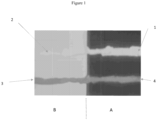
- FIG. 1 is a photographic print illustrating step A) of depositing an aqueous adhesive composition according to the invention on a substrate
- Example 1 (according to the invention): aqueous adhesive composition consisting of EVA copolymer, riboflavin and water
- a composition consisting of 45% (% weight, in dry extract equivalent) of Mowilith ® LDM 1081, 0.01% weight/weight of Riboflavin and 55% weight/weight of water is prepared by simple mixing.
- Example 2 (Reference) : aqueous adhesive composition consisting of EVA copolymer, Optiblanc NF and water
- Example 1 is repeated by replacing the riboflavin with Optiblanc NF, available from the company 3V Sigma, and which is often used as a detector of the presence of dots or lines of glue on a substrate (or tracer) in the presence of a source of UV rays.
- This compound is the tetrasodium salt of 4,4'-bis[[4-[bis(2-hydroxyethyl)amino]-6-(4-sulphoanilino)-1,3,5-triazin-2-yl] acid. amino]stilbene-2,2'-disulphonic] which can be excited by radiation of wavelength 350 nm, and re-emits radiation of wavelength 430 nm.
- Example 3 (Reference) : deposit on a substrate without optical brightener of the composition of Example 2
- a white absorbent laboratory paper which is free of optical brightener is used as a substrate, in the form of an A4 format sheet, corresponding to sheet A of the figure 1 .
- a line 1 of the adhesive composition of Example 2 with a thickness of approximately 1 cm, is applied by means of a pipette to said sheet placed horizontally, and parallel to its width. upper half of sheet A.
- Example 4 deposit on a substrate with optical brightener of the composition of reference example 2
- a sheet intended for laser printing with a weight of 80 g/m2, is used as a substrate with optical brightener.
- This sheet corresponding to sheet B of the figure 1 , is also placed horizontally in the dark room, and adjacent in length to sheet A.
- Example 5 depositing on a substrate with optical brightener the composition of Example 1 according to the invention
- Example 4 We repeat Example 4, applying to the lower half of sheet B the figure 1 , and parallel to its width, a line 3 of the adhesive composition of Example 1, of thickness substantially identical to said line 1.
- Example 6 (according to the invention) : deposit on a substrate free of optical brightener of the composition of Example 1 according to the invention
- Example 5 We repeat Example 5, applying to the lower half of sheet A the figure 1 , parallel to its width and in the extension of line 3, a line 4 of the adhesive composition of Example 1, of thickness substantially identical to said line 3.
Landscapes
- Chemical & Material Sciences (AREA)
- Organic Chemistry (AREA)
- Health & Medical Sciences (AREA)
- Chemical Kinetics & Catalysis (AREA)
- Medicinal Chemistry (AREA)
- Polymers & Plastics (AREA)
- Adhesives Or Adhesive Processes (AREA)
- Wrappers (AREA)
Description
- La présente invention a pour objet un procédé de fabrication d'emballages rigides à partir d'un substrat cartonné contenant au moins un azurant optique. Elle concerne également une composition adhésive aqueuse mise en oeuvre dans ledit procédé.
- Les emballages rigides cartonnés, comme par exemple les boîtes, les caisses ou les étuis cartonnés, sont bien connus et largement utilisés en vue de l'emballage des articles les plus divers, et notamment de produits alimentaires.
- Ces emballages, par exemple de forme parallélépipédique, sont généralement fabriqués dans des lignes industrielles, par un procédé d'assemblage d'une forme plane qui a été préalablement rainurée en surface et découpée dans un substrat cartonné aux dimensions souhaitées pour l'emballage final. Cette forme plane qui comprend les 6 faces du parallélépipède, est munie d'une ou plusieurs pattes latérales (également dénommées "rabats" et en anglais "side seams" ou "flaps") qui sont destinées à être encollées, puis pliées, selon les rainures aménagées sur le patron, en vue de l'assemblage par collage. Ladite forme plane est également désignée dans le métier par les termes de "patron" ou "forme de découpe". La partie du patron autre que la ou les pattes latérales, qui correspond aux 6 faces du parallélépipède est dénommée "corps".
- Cette opération d'assemblage par collage est réalisée industriellement au moyen d'une machine appelée plieuse-colleuse. La colle mise en oeuvre est le plus souvent une composition adhésive aqueuse qui est généralement appliquée à une température comprise entre 15 et 35°C.
- Après application de la colle, au niveau du poste d'encollage de la ligne industrielle, sur au moins une patte latérale de la forme de découpe, ladite patte est ensuite pliée par des moyens mécaniques adaptés, de telle sorte que les pattes latérales encollées sont pressées sur le corps du patron, au niveau d'une zone spécifique de celui-ci appelée "zone de réception de patte" (ou en anglais "landing zone"), de manière à former rapidement avec ladite zone un joint adhésif solide. Ainsi, la forme de découpe plane est assemblée en un parallélépipède constituant l'emballage cartonné rigide souhaité.
- Au niveau du poste d'encollage de la ligne industrielle, la colle peut être appliquée sur le substrat défilant à une certaine vitesse au moyen d'une buse à lèvre (dite buse contact) ou d'un disque, qui déposent par contact sur les pattes latérales des traits de longueur variable et d'épaisseur comprise entre 1 mm et 1 cm. Ces 2 techniques d'application sont très répandues industriellement et assez économiques. Cependant elles ne permettent pas d'obtenir des vitesses de ligne élevées et donc une productivité satisfaisante.
- On peut remédier à cet inconvénient grâce à la mise en oeuvre, dans le poste d'encollage, de buses qui ne sont pas en contact avec le substrat cartonné (dites "sans contact"). Ces buses permettent de déposer la colle non seulement sous la forme de traits, mais aussi de points, ce qui permet d'optimiser la quantité appliquée et donc de diminuer la consommation de colle. Les buses sans contact permettent d'atteindre une excellente productivité, découlant de vitesses de ligne très élevées, supérieures par exemple à 300 m/minute.
- Cependant, à de telles vitesses de ligne, se pose avec une acuité particulière le problème de la localisation précise des points (ou traits) de colle à déposer sur les pattes latérales du patron cartonné.
- Lors du passage du patron cartonné dans le poste d'encollage de la ligne, il est en effet impératif que lesdits points (ou traits) de colle soient parfaitement positionnés sur les pattes latérales, de telles sorte que celles-ci, lors du passage au poste de pliage, puissent adhérer fermement sur la zone de réception de patte prévue sur le corps du patron, et ainsi assurer la solidité de l'emballage rigide.
- S'il n'en est pas ainsi, des problèmes peuvent survenir. Par exemple, si le nombre de points (ou de traits) déposés sur une patte latérale n'est pas suffisant, alors ladite patte risque de ne pas adhérer convenablement à la zone de réception, et la cohésion de l'emballage final risque d'être compromise. Ou encore, si une quantité excessive de colle est appliquée, ou bien est appliquée sur une zone incorrecte, alors un excès de colle peut être exsudé au niveau du joint adhésif entre la patte latérale et la zone de réception correspondante, ce qui peut entraîner le collage indésirable des emballages cartonnés entre eux dans la ligne industrielle de production, et l'arrêt de celle-ci.
- Le risque de voir de tels problèmes survenir est renforcé du fait de la relative distance entre la buse sans contact et le patron cartonné, de la géométrie souvent complexe des patrons mis en oeuvre, et de la vitesse de défilement très élevée de ces derniers dans la ligne.
- Pour réduire ce risque, des systèmes de détection et de vérification en ligne de l'application de la colle sur les patrons cartonnés peuvent être mis en oeuvre, en temps réel, dans les lignes de production des industriels concernés.
- Un tel système est par exemple décrit dans la demande internationale
WO 2003/021534 . Cette demande mentionne la possibilité d'inclure un colorant UV dans la colle et, après éclairage du patron cartonné encollé au moyen d'une source lumineuse UV, d'utiliser un détecteur photoélectrique pour détecter la présence effective d'un trait de colle sur une certaine zone, à partir de la lumière réfléchie. Un tel colorant UV est souvent désigné dans le métier par les termes de "traceur UV". - La capacité effective d'un tel colorant UV à être inclus dans une colle, en tant que indicateur ou traceur de sa présence sur un article, nécessite toutefois que le système de détection qui met généralement en oeuvre un détecteur photographique (appareil photo ou caméra) soit capable, en raison d'un contraste suffisant, de détecter un point (ou un trait) de colle comprenant ledit traceur sur le substrat cartonné où il a été appliquée.
- Or, il a à présent été reconnu qu'une difficulté particulière existe dans le cas des substrats cartonnés contenant un azurant optique, pour lequel les traceurs UV usuels ne fonctionnent pas, en raison d'un contraste insuffisant.
- Les azurants optiques sont des adjuvants qui sont introduits lors de la fabrication de la pâte à papier, et qui sont destinés à donner l'illusion d'un carton très blanc. Ces produits ont la particularité d'augmenter la blancheur apparente en absorbant les rayonnements ultra-violets puis en les restituant sous forme de rayonnements perceptibles par l'oeil.
- La référence
WO 2003/021534 mentionne comme inconvénient de l'utilisation d'un colorant UV, la présence d'un revêtement blanc sur le patron, qui est susceptible de réfléchir une quantité significative de lumière et d'entraîner des erreurs de mesure. Cette référence ne mentionne toutefois nullement le cas d'un substrat cartonné contenant un azurant optique. -
US 2003/138653 divulgue des matériaux d'emballage transparents ou partiellement transparents qui comprennent des colorants qui ont le même spectre d'absorption que les colorants contenus dans les denrées emballées, ou un spectre d'absorption similaire. - La présente invention a pour but de proposer un procédé de fabrication d'emballages cartonnés à partir d'un substrat cartonné contenant au moins un azurant optique, pour lequel les procédés usuels de détection et de vérification en ligne de l'application de la colle sur ledit substrat peuvent être conduits de manière plus fiable, en raison d'un contraste amélioré entre le trait ou point de colle et ledit substrat.
- Un autre but de la présente invention est de proposer un procédé de fabrication d'emballages cartonnés qui présentent une capacité améliorée au conditionnement de produits alimentaires, en raison de l'absence de risque toxicologique lié à la colle mise en oeuvre.
- Il a à présent été trouvé que ces buts peuvent être atteints en totalité ou en partie au moyen du procédé objet de l'invention.
- La présente invention a donc pour objet un procédé de fabrication d'emballages rigides à partir d'un substrat cartonné contenant au moins un azurant optique, ledit procédé comprenant une étape A) de dépose sur ledit substrat d'une composition adhésive aqueuse comprenant :
- un polymère P choisi parmi un homopolymère d'acétate de vinyle et un copolymère EVA d'éthylène et d'acétate de vinyle ; et
- un composé T choisi parmi la pyranine, la riboflavine, la vitamine E et la vitamine A.
- Un azurant optique est une molécule qui absorbe les rayonnements ultra-violets dont la longueur d'onde est comprise entre 300 et 400 nm, et réémet ensuite l'énergie correspondante par fluorescence dans la partie du spectre visible comprise entre 400 et 500 nm. Il a été trouvé que la pyranine, la riboflavine, la vitamine E et la vitamine A absorbent également les rayons UV, et réémettent un rayonnement dont la longueur d'onde est supérieure à 500 nm. Ainsi la longueur d'onde du rayonnement réémis par la pyranine est comprise entre 500 et 525 nm. Elle est de 525 nm pour la riboflavine et la vitamine E, et de 510 nm pour la vitamine A.
- Ces longueurs d'onde étant situées en dehors du domaine de longueur d'onde du rayonnement réémis par l'azurant optique, il en résulte, lors de l'analyse des images prises par le détecteur photographique, un excellent contraste entre un point ou un trait de colle et ledit substrat cartonné, permettant une détection efficace d'un point ou trait de colle sur ledit substrat.
- La pyranine, qui est le sel triple de sodium de l'acide 8-Hydroxypyrene-1,3,6-trisulfonique est un produit disponible dans le commerce, par exemple auprès de la société Rhein Chemie qui appartient au groupe LANXESS.
- La riboflavine est un composé bien connu également sous la dénomination de vitamine B2. Les actions de la vitamine B2 se situent au niveau du métabolisme et de l'assimilation des nutriments, ainsi que dans le fonctionnement des yeux, de la peau et des cheveux. Elle est présente dans de nombreuses sources alimentaires comme le lait, la levure de bière, le soja, les abats, les germes de blé et la viande de porc. La ribloflavine est disponible commercialement auprès des sociétés DSM et BASF.
- La vitamine E a un rôle d'antioxydant. Elle est présente dans la plupart des huiles végétales (huile de germe de blé, de tournesol, de soja, d'arachide ou d'olive). Elle est disponible commercialement auprès de la société BASF.
- La vitamine A intervient dans la croissance des os et la synthèse de pigments de l'oeil. Elle est contenue, entre autre, dans la carotte, le melon, l'abricot, la pêche jaune ou la mangue. Elle est également disponible commercialement auprès de la société BASF.
- L'azurant optique est réparti de manière homogène soit dans la masse du substrat cartonné, par incorporation dans la suspension de fibres lors de la préparation de la pâte à papier, soit dans un revêtement de surface dudit substrat, destiné à être au contact de la composition adhésive, par des moyens connus de l'homme du métier.
- On peut citer comme exemples de tels azurants optiques des composés appartenant à la famille des triazole-stilbènes di et tétra sulfonés, ainsi que les dérivés de biphényl-stilbènes di-sulfonés.
- Selon un mode de réalisation préféré de l'invention, le substrat cartonné à partir duquel sont fabriqués les emballages rigides est mis en oeuvre sous la forme d'un patron. On entend par substrat cartonné un substrat cellulosique dont le grammage est généralement compris entre 160 et 600 g/m2.
- Les emballages rigides se présentent généralement sous la forme de polyèdres, et sont fabriqués à partir d'un patron qui comprend les faces planes polygonales (jointes par leurs arêtes) et des pattes latérales destinées à être encollées, puis pliées, en vue de l'assemblage par collage.
- Selon un mode de réalisation plus particulièrement préféré du procédé selon l'invention, les emballages rigides se présentent sous la forme d'un parallélépipède rectangle, et sont fabriqués à partir d'un patron qui comprend les 6 faces planes rectangulaires dudit parallélépipède et des pattes latérales.
- Selon un autre mode de réalisation préféré pour l'invention, la composition adhésive est déposée sur les pattes latérales du patron.
- Dans le cas où l'azurant optique est réparti de manière homogène dans un revêtement de surface du substrat cartonné, il est également possible que ledit revêtement ne soit pas présent sur certaines zones dudit substrat, notamment sur certaines pattes latérales de collage. Dans ce cas, et selon un mode de réalisation du procédé de l'invention, outre son dépôt sur les pattes latérales du patron qui contiennent l'azurant optique, la composition adhésive aqueuse peut également être déposée sur une ou des pattes latérales exemptes d'azurant optique. Un tel dépôt permet également une détection efficace du point ou trait correspondant, en raison d'un excellent contraste avec ladite patte.
- Selon encore un autre mode de réalisation de l'invention, la composition adhésive est déposée au moyen d'une buse sans contact et sous la forme de traits et/ou de points. L'épaisseur de ces traits et/ou points est variable et peut être comprise entre 1 mm et 1 cm. La quantité de colle appliquée sur le substrat cartonné dans les machines plieuses colleuses industrielles est très variable, dépendant notamment de la nature du substrat, de la taille du patron, et des pattes de collage. Dans les conditions de la pratique industrielle, cette quantité est généralement exprimée relativement au mètre linéaire du substrat défilant à une vitesse pouvant aller jusqu'à 300 m/minute ; elle est de l'ordre de 1 à 10 g/m.
- De préférence, le procédé selon l'invention comprend également, consécutivement à l'étape A), une étape B) de détection, en présence d'une source de rayons UV et au moyen d'un détecteur photographique, de la position des points et/ou traits de composition adhésive sur le substrat, notamment sur le patron, plus particulièrement sur les pattes latérales. Ladite étape de détection est avantageusement rendue plus efficace, grâce au contraste amélioré entre le trait de colle et le substrat cartonné contenant l'azurant optique. Elle est rendue également possible, lorsqu' un éventuel substrat cartonné exempt d'azurant optique est également présent dans le substrat. Cet effet avantageux est obtenu au moyen de la composition adhésive aqueuse spécifique mise en oeuvre, et notamment à la présence du composé T dans celle-ci.
- Selon une variante tout particulièrement préférée de l'invention, le composé T compris dans la composition adhésive aqueuse est choisi parmi la riboflavine, la vitamine E et la vitamine A. Dans le cas où les ingrédients de la composition adhésive aqueuse autres que le composé T permettent de conférer à cette dernière, en raison de leur innocuité toxicologique, l'aptitude au contact alimentaire, le fait d'ajouter en outre à ladite composition une molécule naturellement présente dans l'organisme comme la riboflavine (ou Vitamine B2) ou les vitamines E ou A n'entraîne donc, avantageusement, aucun risque additionnel relativement audit contact pour le consommateur du produit alimentaire conditionné dans l'emballage rigide.
- Selon une variante encore davantage préférée de l'invention, le composé T est la riboflavine.
- La quantité de composé T compris dans la composition adhésive aqueuse peut varier de 0,001 à 1 % en poids, de préférence de 0,005 à 0,05 %, sur la base du poids total de ladite composition.
- La composition adhésive aqueuse mise en oeuvre dans le procédé selon l'invention comprend, outre le composé T, un polymère P choisi parmi un homopolymère d'acétate de vinyle et un copolymère EVA d'éthylène et d'acétate de vinyle.
- La dite composition adhésive peut également comprendre un mélange desdits copolymère et homopolymère.
- Selon une variante préférée, le polymère P compris dans la composition adhésive est un copolymère EVA d'éthylène et d'acétate de vinyle.
- Le copolymère d'éthylène et d'acétate de vinyle est, de préférence, formé à partir d'une quantité supérieure à 50 % d'acétate de vinyle, de préférence supérieure à 75 %, plus préférentiellement supérieure à 85 %, ledit pourcentage étant exprimé en poids sur la base du poids total des 2 comonomères. Un tel copolymère est largement disponible dans le commerce sous la forme d'une dispersion aqueuse. On peut citer par exemple le Mowilith® LDM 1081 (disponible auprès de la société CELANESE) qui est une dispersion aqueuse à 54 % poids/poids, en extrait sec d'un copolymère constitué d'environ 80 % poids/poids de monomère acétate de vinyle et d'environ 20 % poids/poids de monomère éthylène.
- Outre les ingrédients cités ci-dessus, la composition adhésive aqueuse peut également comprendre, à titre optionnel, d'autres additifs tels qu'un plastifiant, un biocide et un antimousse.
- La présente invention a également pour objet la composition adhésive aqueuse comprenant :
- un polymère P choisi parmi un homopolymère d'acétate de vinyle, un copolymère EVA d'éthylène et d'acétate de vinyle ; et
- un composé T choisi parmi la pyranine, la riboflavine, la vitamine E et la vitamine A.
- La composition adhésive aqueuse objet de l'invention est telle que définie ci-dessus dans la description du procédé de fabrication d'emballages rigides objet de l'invention, et présente également les différents modes de réalisation qui ont été détaillés dans la description dudit procédé.
- La
figure 1 est un cliché photographique illustrant l'étape A) de dépose sur un substrat d'une composition adhésive aqueuse selon l'invention - Les exemples suivants illustrent l'invention, et ne sauraient être interprétés pour en limiter la portée. Dans les exemples 3 à 6, il est fait référence aux éléments répertoriés sur la
figure 1 . - On prépare par simple mélange une composition constituée de 45 % (% poids, en équivalent extrait sec) de Mowilith® LDM 1081, de 0,01 % poids/poids de Riboflavine et de 55% poids/poids d'eau.
- On répète l'exemple 1 en remplaçant la riboflavine par l'Optiblanc NF, disponible auprès de la société 3V Sigma, et qui est souvent utilisé comme détecteur de la présence de points ou traits de colle sur un substrat (ou traceur) en présence d'une source de rayons UV. Ce composé est le sel tétrasodique de l'acide 4,4'-bis[[4-[bis(2-hydroxyethyl)amino]-6-(4-sulphoanilino)-1,3,5-triazin-2-yl]amino]stilbene-2,2'-disulphonique] qui peut être excité par un rayonnement de longueur d'onde 350 nm, et réémet un rayonnement de longueur d'onde 430 nm.
- On utilise comme substrat un papier blanc absorbant de laboratoire qui est exempt d'azurant optique, sous la forme d'une feuille au format A4, correspondant à la feuille A de la
figure 1 . - Dans une chambre obscure, on applique au moyen d'une pipette sur ladite feuille placée horizontalement, et parallèlement à sa largeur, un trait 1 de la composition adhésive de l'exemple 2, d'épaisseur environ 1 cm, qui est situé dans la moitié supérieure de la feuille A.
- En présence d'une source UV, on procède à la prise d'un cliché photographique, représenté à la
figure 1 , qui fait apparaître un contraste élevé entre ledit trait 1, qui apparaît en clair, et le substrat, plus sombre, correspondant à la feuille A. - On utilise comme substrat avec azurant optique une feuille destinée à l'impression laser, de grammage 80 g/m2. Cette feuille, correspondant à la feuille B de la
figure 1 , est placée également horizontalement dans la chambre obscure, et adjacente par sa longueur à la feuille A. - On applique au moyen de la pipette, sur la moitié supérieure de la feuille B, parallèlement à sa largeur et dans le prolongement du trait 1, un trait 2 de la composition adhésive de l'exemple 2, d'épaisseur sensiblement identique audit trait 1.
- La prise du cliché photographique en présence de la source UV, ne permet pas de distinguer le trait 2, en raison d'un contraste insuffisant avec la feuille B à laquelle la présence de l'azurant optique confère un aspect aussi clair que ledit trait 2.
- On répète l'exemple 4, en appliquant sur la moitié inférieure de la feuille B de la
figure 1 , et parallèlement à sa largeur, un trait 3 de la composition adhésive de l'exemple 1, d'épaisseur sensiblement identique audit trait 1. - La prise du cliché photographique en présence de la source UV, permet de révéler très précisément ledit trait 3, qui présente un excellent contraste avec la feuille B.
- On répète l'exemple 5, en appliquant sur la moitié inférieure de la feuille A de la
figure 1 , parallèlement à sa largeur et dans le prolongement du trait 3, un trait 4 de la composition adhésive de l'exemple 1, d'épaisseur sensiblement identique audit trait 3. - La prise du cliché photographique en présence de la source UV, permet de révéler très précisément ledit trait 4, qui présente un excellent contraste avec la feuille A.
Claims (12)
- Procédé de fabrication d'emballages rigides à partir d'un substrat cartonné contenant au moins un azurant optique, ledit procédé comprenant une étape A) de dépose sur ledit substrat d'une composition adhésive aqueuse comprenant :- un polymère P choisi parmi un homopolymère d'acétate de vinyle et un copolymère EVA d'éthylène et d'acétate de vinyle ; et- un composé T choisi parmi la pyranine, la riboflavine, la vitamine E et la vitamine A.
- Procédé selon la revendication 1, caractérisé en ce que le substrat cartonné est mis en oeuvre sous la forme d'un patron.
- Procédé selon l'une des revendications 1 ou 2, caractérisé en ce que les emballages rigides se présentent sous la forme d'un parallélépipède rectangle, et sont fabriqués à partir d'un patron qui comprend les 6 faces planes rectangulaires dudit parallélépipède et des pattes latérales.
- Procédé selon la revendication 3, caractérisé en ce que la composition adhésive est déposée sur les pattes latérales du patron.
- Procédé selon la revendication 4, caractérisé en ce que la composition adhésive est également déposée sur une ou des pattes latérales exemptes d'azurant optique.
- Procédé selon l'une des revendications 1 à 5, caractérisé en ce que la composition adhésive est déposée au moyen d'une buse sans contact et sous la forme de traits et/ou de points.
- Procédé selon la revendication 6, caractérisé en ce qu'il comprend consécutivement à l'étape A), une étape B) de détection, en présence d'une source de rayons UV et au moyen d'un détecteur photographique, de la position des points et/ou traits de composition adhésive.
- Procédé selon l'une des revendications 1 à 7, caractérisé en ce que le composé T compris dans la composition adhésive aqueuse est choisi parmi la riboflavine, la vitamine E et la vitamine A.
- Procédé selon l'une des revendications 1 à 8, caractérisé en ce que la quantité de composé T compris dans la composition adhésive aqueuse varie de 0,001 à 1 % en poids, de préférence de 0,005 à 0,05 %, sur la base du poids total de ladite composition.
- Procédé selon l'une des revendications 1 à 8, caractérisé en ce que le polymère P compris dans la composition adhésive est un copolymère EVA d'éthylène et d'acétate de vinyle.
- Procédé selon l'une des revendications 1 à 9, caractérisé en ce que le copolymère d'éthylène et d'acétate de vinyle est formé à partir d'une quantité supérieure à 50 % d'acétate de vinyle, ledit pourcentage étant exprimé en poids sur la base du poids total des 2 comonomères.
- Composition adhésive aqueuse comprenant :- un polymère P choisi parmi un homopolymère d'acétate de vinyle, un copolymère EVA d'éthylène et d'acétate de vinyle ; et- un composé T choisi parmi la pyranine, la riboflavine, la vitamine E et la vitamine A.
Applications Claiming Priority (2)
| Application Number | Priority Date | Filing Date | Title |
|---|---|---|---|
| FR1854458A FR3081374B1 (fr) | 2018-05-25 | 2018-05-25 | Procede de fabrication d'emballages rigides a partir d'un substrat cartonne |
| PCT/FR2019/051151 WO2019224473A1 (fr) | 2018-05-25 | 2019-05-21 | Procede de fabrication d'emballages rigides a partir d'un substrat cartonne |
Publications (2)
| Publication Number | Publication Date |
|---|---|
| EP3802095A1 EP3802095A1 (fr) | 2021-04-14 |
| EP3802095B1 true EP3802095B1 (fr) | 2024-04-10 |
Family
ID=63080118
Family Applications (1)
| Application Number | Title | Priority Date | Filing Date |
|---|---|---|---|
| EP19733856.9A Active EP3802095B1 (fr) | 2018-05-25 | 2019-05-21 | Procédé de fabrication d'emballages rigides à partir d'un substrat cartonné |
Country Status (4)
| Country | Link |
|---|---|
| EP (1) | EP3802095B1 (fr) |
| ES (1) | ES2979157T3 (fr) |
| FR (1) | FR3081374B1 (fr) |
| WO (1) | WO2019224473A1 (fr) |
Family Cites Families (5)
| Publication number | Priority date | Publication date | Assignee | Title |
|---|---|---|---|---|
| US5375722A (en) * | 1992-03-11 | 1994-12-27 | W. H. Leary Co., Inc. | Carton monitoring system |
| DE10005783A1 (de) * | 2000-02-10 | 2001-09-20 | Fraunhofer Ges Forschung | Mit Farbstoffen gefärbte, transparente oder teiltransparente Packstoffe |
| AU2929702A (en) * | 2001-09-04 | 2003-03-06 | Murray Dicker | Monitoring and rejection system and apparatus |
| FR2966159B1 (fr) * | 2010-10-13 | 2013-10-18 | Bostik Sa | Colle aqueuse pour substrats cartonnes a prise amelioree |
| FR2998897B1 (fr) * | 2012-12-03 | 2014-12-19 | Bostik Sa | Composition adhesive aqueuse et son procede de mise en oeuvre |
-
2018
- 2018-05-25 FR FR1854458A patent/FR3081374B1/fr not_active Expired - Fee Related
-
2019
- 2019-05-21 EP EP19733856.9A patent/EP3802095B1/fr active Active
- 2019-05-21 WO PCT/FR2019/051151 patent/WO2019224473A1/fr not_active Ceased
- 2019-05-21 ES ES19733856T patent/ES2979157T3/es active Active
Also Published As
| Publication number | Publication date |
|---|---|
| ES2979157T3 (es) | 2024-09-24 |
| FR3081374A1 (fr) | 2019-11-29 |
| FR3081374B1 (fr) | 2020-05-15 |
| EP3802095A1 (fr) | 2021-04-14 |
| WO2019224473A1 (fr) | 2019-11-28 |
Similar Documents
| Publication | Publication Date | Title |
|---|---|---|
| CA2502930C (fr) | Composition adhesive aqueuse a base d'amidon de legumineuses | |
| Kim et al. | Effect of drying in antioxidant activity and changes of ascorbic acid and colour by different drying and storage in Korean red pepper (Capsicum annuum, L.) | |
| WO2019224473A1 (fr) | Procede de fabrication d'emballages rigides a partir d'un substrat cartonne | |
| FR2881749A1 (fr) | Composition adhesive aqueuse contenant un produit de melange a base d'amidon de legumineuses | |
| RU2436883C1 (ru) | Цветная бумага с регулируемым проникновением краски | |
| WO2014118466A1 (fr) | Procédé de marquage d'un papier | |
| EP1571258B1 (fr) | Emballage revêtu d'un vernis de protection vis-à-vis de la lumière | |
| FR2925390A1 (fr) | Procede de fabrication d'un materiau d'emballage, notamment pour recipient pour produit cosmetique ou de soin ou pour presentoir, procede de fabrication d'un etui et materiau d'emballage correspondant. | |
| EP2870286B1 (fr) | Sauces de couchage pour papier et carton contenant une dextrine a teneur elevee en amylopectine | |
| WO2008107617A2 (fr) | Feuille couchee blanche imprimable par offset et ayant un haut pouvoir de fluorescence et son procede de fabrication | |
| EP2627501B1 (fr) | Colle aqueuse pour substrats cartonnés a prise améliorée | |
| FR2696471A1 (fr) | Utilisation de la vanilline et de ses dérivés comme agents de protection anti-UV. | |
| EP4450053A1 (fr) | Composition à base de chitosan et de l'acide spiculisporique ou ses sels | |
| FR2808540A1 (fr) | Papier transparent et/ou translucide de couleur fluorescente | |
| EP2904146B1 (fr) | Procede de fabrication d'une emulsion stable d'anhydride alkenyle succinique (asa) dans une solution aqueuse de matiere amylacee cationique, emulsion obtenue et son utilisation | |
| WO2018001887A1 (fr) | Procédé de marquage de la cellulose nano et/ou micro-fibrillée semi-cristalline | |
| US20140127407A1 (en) | Method for Printing Designs On Sandpaper | |
| JP4844048B2 (ja) | インキ | |
| US20260096570A1 (en) | Edible coatings and methods for delaying greening in potatoes | |
| CN107829329A (zh) | 一种卷纸及其制作方法 | |
| WO2008074956A2 (fr) | Fluide correcteur avec indicateur de sechage | |
| EP4372145A1 (fr) | Support souple enduit à propriétés barrière et thermoscellant | |
| FR3018700A1 (fr) | Particules de melamine-uree-formaldehyde (muf) contenant un marqueur optique a effet chromatique modulable | |
| FR3010718A1 (fr) | Utilisation d'une combinaison amidon de pois / fecule de pomme de terre en tant qu'adjuvant de collage dans une composition adhesive pour carton ondule | |
| WO2023118323A1 (fr) | Procédé de révélation de pigment dans un microorganisme |
Legal Events
| Date | Code | Title | Description |
|---|---|---|---|
| STAA | Information on the status of an ep patent application or granted ep patent |
Free format text: STATUS: UNKNOWN |
|
| STAA | Information on the status of an ep patent application or granted ep patent |
Free format text: STATUS: THE INTERNATIONAL PUBLICATION HAS BEEN MADE |
|
| PUAI | Public reference made under article 153(3) epc to a published international application that has entered the european phase |
Free format text: ORIGINAL CODE: 0009012 |
|
| STAA | Information on the status of an ep patent application or granted ep patent |
Free format text: STATUS: REQUEST FOR EXAMINATION WAS MADE |
|
| 17P | Request for examination filed |
Effective date: 20201123 |
|
| AK | Designated contracting states |
Kind code of ref document: A1 Designated state(s): AL AT BE BG CH CY CZ DE DK EE ES FI FR GB GR HR HU IE IS IT LI LT LU LV MC MK MT NL NO PL PT RO RS SE SI SK SM TR |
|
| AX | Request for extension of the european patent |
Extension state: BA ME |
|
| DAV | Request for validation of the european patent (deleted) | ||
| DAX | Request for extension of the european patent (deleted) | ||
| GRAP | Despatch of communication of intention to grant a patent |
Free format text: ORIGINAL CODE: EPIDOSNIGR1 |
|
| STAA | Information on the status of an ep patent application or granted ep patent |
Free format text: STATUS: GRANT OF PATENT IS INTENDED |
|
| INTG | Intention to grant announced |
Effective date: 20230622 |
|
| GRAJ | Information related to disapproval of communication of intention to grant by the applicant or resumption of examination proceedings by the epo deleted |
Free format text: ORIGINAL CODE: EPIDOSDIGR1 |
|
| STAA | Information on the status of an ep patent application or granted ep patent |
Free format text: STATUS: REQUEST FOR EXAMINATION WAS MADE |
|
| GRAP | Despatch of communication of intention to grant a patent |
Free format text: ORIGINAL CODE: EPIDOSNIGR1 |
|
| STAA | Information on the status of an ep patent application or granted ep patent |
Free format text: STATUS: GRANT OF PATENT IS INTENDED |
|
| INTC | Intention to grant announced (deleted) | ||
| INTG | Intention to grant announced |
Effective date: 20231115 |
|
| GRAS | Grant fee paid |
Free format text: ORIGINAL CODE: EPIDOSNIGR3 |
|
| GRAA | (expected) grant |
Free format text: ORIGINAL CODE: 0009210 |
|
| STAA | Information on the status of an ep patent application or granted ep patent |
Free format text: STATUS: THE PATENT HAS BEEN GRANTED |
|
| AK | Designated contracting states |
Kind code of ref document: B1 Designated state(s): AL AT BE BG CH CY CZ DE DK EE ES FI FR GB GR HR HU IE IS IT LI LT LU LV MC MK MT NL NO PL PT RO RS SE SI SK SM TR |
|
| REG | Reference to a national code |
Ref country code: GB Ref legal event code: FG4D Free format text: NOT ENGLISH |
|
| REG | Reference to a national code |
Ref country code: CH Ref legal event code: EP |
|
| REG | Reference to a national code |
Ref country code: DE Ref legal event code: R096 Ref document number: 602019049993 Country of ref document: DE |
|
| REG | Reference to a national code |
Ref country code: IE Ref legal event code: FG4D Free format text: LANGUAGE OF EP DOCUMENT: FRENCH |
|
| REG | Reference to a national code |
Ref country code: LT Ref legal event code: MG9D |
|
| REG | Reference to a national code |
Ref country code: NL Ref legal event code: MP Effective date: 20240410 |
|
| REG | Reference to a national code |
Ref country code: AT Ref legal event code: MK05 Ref document number: 1674534 Country of ref document: AT Kind code of ref document: T Effective date: 20240410 |
|
| PG25 | Lapsed in a contracting state [announced via postgrant information from national office to epo] |
Ref country code: NL Free format text: LAPSE BECAUSE OF FAILURE TO SUBMIT A TRANSLATION OF THE DESCRIPTION OR TO PAY THE FEE WITHIN THE PRESCRIBED TIME-LIMIT Effective date: 20240410 |
|
| REG | Reference to a national code |
Ref country code: ES Ref legal event code: FG2A Ref document number: 2979157 Country of ref document: ES Kind code of ref document: T3 Effective date: 20240924 |
|
| PG25 | Lapsed in a contracting state [announced via postgrant information from national office to epo] |
Ref country code: NL Free format text: LAPSE BECAUSE OF FAILURE TO SUBMIT A TRANSLATION OF THE DESCRIPTION OR TO PAY THE FEE WITHIN THE PRESCRIBED TIME-LIMIT Effective date: 20240410 |
|
| PG25 | Lapsed in a contracting state [announced via postgrant information from national office to epo] |
Ref country code: IS Free format text: LAPSE BECAUSE OF FAILURE TO SUBMIT A TRANSLATION OF THE DESCRIPTION OR TO PAY THE FEE WITHIN THE PRESCRIBED TIME-LIMIT Effective date: 20240810 |
|
| PG25 | Lapsed in a contracting state [announced via postgrant information from national office to epo] |
Ref country code: BG Free format text: LAPSE BECAUSE OF FAILURE TO SUBMIT A TRANSLATION OF THE DESCRIPTION OR TO PAY THE FEE WITHIN THE PRESCRIBED TIME-LIMIT Effective date: 20240410 |
|
| PG25 | Lapsed in a contracting state [announced via postgrant information from national office to epo] |
Ref country code: FI Free format text: LAPSE BECAUSE OF FAILURE TO SUBMIT A TRANSLATION OF THE DESCRIPTION OR TO PAY THE FEE WITHIN THE PRESCRIBED TIME-LIMIT Effective date: 20240410 Ref country code: HR Free format text: LAPSE BECAUSE OF FAILURE TO SUBMIT A TRANSLATION OF THE DESCRIPTION OR TO PAY THE FEE WITHIN THE PRESCRIBED TIME-LIMIT Effective date: 20240410 |
|
| PG25 | Lapsed in a contracting state [announced via postgrant information from national office to epo] |
Ref country code: GR Free format text: LAPSE BECAUSE OF FAILURE TO SUBMIT A TRANSLATION OF THE DESCRIPTION OR TO PAY THE FEE WITHIN THE PRESCRIBED TIME-LIMIT Effective date: 20240711 |
|
| PG25 | Lapsed in a contracting state [announced via postgrant information from national office to epo] |
Ref country code: PT Free format text: LAPSE BECAUSE OF FAILURE TO SUBMIT A TRANSLATION OF THE DESCRIPTION OR TO PAY THE FEE WITHIN THE PRESCRIBED TIME-LIMIT Effective date: 20240812 |
|
| PG25 | Lapsed in a contracting state [announced via postgrant information from national office to epo] |
Ref country code: AT Free format text: LAPSE BECAUSE OF FAILURE TO SUBMIT A TRANSLATION OF THE DESCRIPTION OR TO PAY THE FEE WITHIN THE PRESCRIBED TIME-LIMIT Effective date: 20240410 |
|
| PG25 | Lapsed in a contracting state [announced via postgrant information from national office to epo] |
Ref country code: PL Free format text: LAPSE BECAUSE OF FAILURE TO SUBMIT A TRANSLATION OF THE DESCRIPTION OR TO PAY THE FEE WITHIN THE PRESCRIBED TIME-LIMIT Effective date: 20240410 |
|
| PG25 | Lapsed in a contracting state [announced via postgrant information from national office to epo] |
Ref country code: LV Free format text: LAPSE BECAUSE OF FAILURE TO SUBMIT A TRANSLATION OF THE DESCRIPTION OR TO PAY THE FEE WITHIN THE PRESCRIBED TIME-LIMIT Effective date: 20240410 |
|
| PG25 | Lapsed in a contracting state [announced via postgrant information from national office to epo] |
Ref country code: PT Free format text: LAPSE BECAUSE OF FAILURE TO SUBMIT A TRANSLATION OF THE DESCRIPTION OR TO PAY THE FEE WITHIN THE PRESCRIBED TIME-LIMIT Effective date: 20240812 Ref country code: PL Free format text: LAPSE BECAUSE OF FAILURE TO SUBMIT A TRANSLATION OF THE DESCRIPTION OR TO PAY THE FEE WITHIN THE PRESCRIBED TIME-LIMIT Effective date: 20240410 Ref country code: NO Free format text: LAPSE BECAUSE OF FAILURE TO SUBMIT A TRANSLATION OF THE DESCRIPTION OR TO PAY THE FEE WITHIN THE PRESCRIBED TIME-LIMIT Effective date: 20240710 Ref country code: LV Free format text: LAPSE BECAUSE OF FAILURE TO SUBMIT A TRANSLATION OF THE DESCRIPTION OR TO PAY THE FEE WITHIN THE PRESCRIBED TIME-LIMIT Effective date: 20240410 Ref country code: IS Free format text: LAPSE BECAUSE OF FAILURE TO SUBMIT A TRANSLATION OF THE DESCRIPTION OR TO PAY THE FEE WITHIN THE PRESCRIBED TIME-LIMIT Effective date: 20240810 Ref country code: HR Free format text: LAPSE BECAUSE OF FAILURE TO SUBMIT A TRANSLATION OF THE DESCRIPTION OR TO PAY THE FEE WITHIN THE PRESCRIBED TIME-LIMIT Effective date: 20240410 Ref country code: GR Free format text: LAPSE BECAUSE OF FAILURE TO SUBMIT A TRANSLATION OF THE DESCRIPTION OR TO PAY THE FEE WITHIN THE PRESCRIBED TIME-LIMIT Effective date: 20240711 Ref country code: FI Free format text: LAPSE BECAUSE OF FAILURE TO SUBMIT A TRANSLATION OF THE DESCRIPTION OR TO PAY THE FEE WITHIN THE PRESCRIBED TIME-LIMIT Effective date: 20240410 Ref country code: BG Free format text: LAPSE BECAUSE OF FAILURE TO SUBMIT A TRANSLATION OF THE DESCRIPTION OR TO PAY THE FEE WITHIN THE PRESCRIBED TIME-LIMIT Effective date: 20240410 Ref country code: AT Free format text: LAPSE BECAUSE OF FAILURE TO SUBMIT A TRANSLATION OF THE DESCRIPTION OR TO PAY THE FEE WITHIN THE PRESCRIBED TIME-LIMIT Effective date: 20240410 Ref country code: RS Free format text: LAPSE BECAUSE OF FAILURE TO SUBMIT A TRANSLATION OF THE DESCRIPTION OR TO PAY THE FEE WITHIN THE PRESCRIBED TIME-LIMIT Effective date: 20240710 |
|
| REG | Reference to a national code |
Ref country code: CH Ref legal event code: PL |
|
| REG | Reference to a national code |
Ref country code: DE Ref legal event code: R097 Ref document number: 602019049993 Country of ref document: DE |
|
| PG25 | Lapsed in a contracting state [announced via postgrant information from national office to epo] |
Ref country code: DK Free format text: LAPSE BECAUSE OF FAILURE TO SUBMIT A TRANSLATION OF THE DESCRIPTION OR TO PAY THE FEE WITHIN THE PRESCRIBED TIME-LIMIT Effective date: 20240410 |
|
| PG25 | Lapsed in a contracting state [announced via postgrant information from national office to epo] |
Ref country code: LU Free format text: LAPSE BECAUSE OF NON-PAYMENT OF DUE FEES Effective date: 20240521 |
|
| PG25 | Lapsed in a contracting state [announced via postgrant information from national office to epo] |
Ref country code: EE Free format text: LAPSE BECAUSE OF FAILURE TO SUBMIT A TRANSLATION OF THE DESCRIPTION OR TO PAY THE FEE WITHIN THE PRESCRIBED TIME-LIMIT Effective date: 20240410 |
|
| PG25 | Lapsed in a contracting state [announced via postgrant information from national office to epo] |
Ref country code: CZ Free format text: LAPSE BECAUSE OF FAILURE TO SUBMIT A TRANSLATION OF THE DESCRIPTION OR TO PAY THE FEE WITHIN THE PRESCRIBED TIME-LIMIT Effective date: 20240410 |
|
| PG25 | Lapsed in a contracting state [announced via postgrant information from national office to epo] |
Ref country code: RO Free format text: LAPSE BECAUSE OF FAILURE TO SUBMIT A TRANSLATION OF THE DESCRIPTION OR TO PAY THE FEE WITHIN THE PRESCRIBED TIME-LIMIT Effective date: 20240410 Ref country code: SK Free format text: LAPSE BECAUSE OF FAILURE TO SUBMIT A TRANSLATION OF THE DESCRIPTION OR TO PAY THE FEE WITHIN THE PRESCRIBED TIME-LIMIT Effective date: 20240410 |
|
| PG25 | Lapsed in a contracting state [announced via postgrant information from national office to epo] |
Ref country code: SM Free format text: LAPSE BECAUSE OF FAILURE TO SUBMIT A TRANSLATION OF THE DESCRIPTION OR TO PAY THE FEE WITHIN THE PRESCRIBED TIME-LIMIT Effective date: 20240410 |
|
| PG25 | Lapsed in a contracting state [announced via postgrant information from national office to epo] |
Ref country code: SM Free format text: LAPSE BECAUSE OF FAILURE TO SUBMIT A TRANSLATION OF THE DESCRIPTION OR TO PAY THE FEE WITHIN THE PRESCRIBED TIME-LIMIT Effective date: 20240410 Ref country code: SK Free format text: LAPSE BECAUSE OF FAILURE TO SUBMIT A TRANSLATION OF THE DESCRIPTION OR TO PAY THE FEE WITHIN THE PRESCRIBED TIME-LIMIT Effective date: 20240410 Ref country code: RO Free format text: LAPSE BECAUSE OF FAILURE TO SUBMIT A TRANSLATION OF THE DESCRIPTION OR TO PAY THE FEE WITHIN THE PRESCRIBED TIME-LIMIT Effective date: 20240410 Ref country code: LU Free format text: LAPSE BECAUSE OF NON-PAYMENT OF DUE FEES Effective date: 20240521 Ref country code: EE Free format text: LAPSE BECAUSE OF FAILURE TO SUBMIT A TRANSLATION OF THE DESCRIPTION OR TO PAY THE FEE WITHIN THE PRESCRIBED TIME-LIMIT Effective date: 20240410 Ref country code: DK Free format text: LAPSE BECAUSE OF FAILURE TO SUBMIT A TRANSLATION OF THE DESCRIPTION OR TO PAY THE FEE WITHIN THE PRESCRIBED TIME-LIMIT Effective date: 20240410 Ref country code: CZ Free format text: LAPSE BECAUSE OF FAILURE TO SUBMIT A TRANSLATION OF THE DESCRIPTION OR TO PAY THE FEE WITHIN THE PRESCRIBED TIME-LIMIT Effective date: 20240410 Ref country code: MC Free format text: LAPSE BECAUSE OF FAILURE TO SUBMIT A TRANSLATION OF THE DESCRIPTION OR TO PAY THE FEE WITHIN THE PRESCRIBED TIME-LIMIT Effective date: 20240410 Ref country code: CH Free format text: LAPSE BECAUSE OF NON-PAYMENT OF DUE FEES Effective date: 20240531 |
|
| PLBE | No opposition filed within time limit |
Free format text: ORIGINAL CODE: 0009261 |
|
| STAA | Information on the status of an ep patent application or granted ep patent |
Free format text: STATUS: NO OPPOSITION FILED WITHIN TIME LIMIT |
|
| REG | Reference to a national code |
Ref country code: BE Ref legal event code: MM Effective date: 20240531 |
|
| 26N | No opposition filed |
Effective date: 20250113 |
|
| PG25 | Lapsed in a contracting state [announced via postgrant information from national office to epo] |
Ref country code: IE Free format text: LAPSE BECAUSE OF NON-PAYMENT OF DUE FEES Effective date: 20240521 |
|
| PG25 | Lapsed in a contracting state [announced via postgrant information from national office to epo] |
Ref country code: SI Free format text: LAPSE BECAUSE OF FAILURE TO SUBMIT A TRANSLATION OF THE DESCRIPTION OR TO PAY THE FEE WITHIN THE PRESCRIBED TIME-LIMIT Effective date: 20240410 Ref country code: BE Free format text: LAPSE BECAUSE OF NON-PAYMENT OF DUE FEES Effective date: 20240531 |
|
| PGFP | Annual fee paid to national office [announced via postgrant information from national office to epo] |
Ref country code: DE Payment date: 20250402 Year of fee payment: 7 |
|
| PGFP | Annual fee paid to national office [announced via postgrant information from national office to epo] |
Ref country code: GB Payment date: 20250401 Year of fee payment: 7 Ref country code: ES Payment date: 20250603 Year of fee payment: 7 |
|
| PGFP | Annual fee paid to national office [announced via postgrant information from national office to epo] |
Ref country code: IT Payment date: 20250422 Year of fee payment: 7 |
|
| REG | Reference to a national code |
Ref country code: DE Ref legal event code: R081 Ref document number: 602019049993 Country of ref document: DE Owner name: BOSTIK SA, FR Free format text: FORMER OWNER: BOSTIK SA, COLOMBES, FR |
|
| PG25 | Lapsed in a contracting state [announced via postgrant information from national office to epo] |
Ref country code: CY Free format text: LAPSE BECAUSE OF FAILURE TO SUBMIT A TRANSLATION OF THE DESCRIPTION OR TO PAY THE FEE WITHIN THE PRESCRIBED TIME-LIMIT; INVALID AB INITIO Effective date: 20190521 |
|
| PG25 | Lapsed in a contracting state [announced via postgrant information from national office to epo] |
Ref country code: HU Free format text: LAPSE BECAUSE OF FAILURE TO SUBMIT A TRANSLATION OF THE DESCRIPTION OR TO PAY THE FEE WITHIN THE PRESCRIBED TIME-LIMIT; INVALID AB INITIO Effective date: 20190521 |
|
| PG25 | Lapsed in a contracting state [announced via postgrant information from national office to epo] |
Ref country code: SE Free format text: LAPSE BECAUSE OF FAILURE TO SUBMIT A TRANSLATION OF THE DESCRIPTION OR TO PAY THE FEE WITHIN THE PRESCRIBED TIME-LIMIT Effective date: 20240410 |
|
| PG25 | Lapsed in a contracting state [announced via postgrant information from national office to epo] |
Ref country code: TR Free format text: LAPSE BECAUSE OF FAILURE TO SUBMIT A TRANSLATION OF THE DESCRIPTION OR TO PAY THE FEE WITHIN THE PRESCRIBED TIME-LIMIT Effective date: 20240410 |
|
| PG25 | Lapsed in a contracting state [announced via postgrant information from national office to epo] |
Ref country code: LT Free format text: LAPSE BECAUSE OF FAILURE TO SUBMIT A TRANSLATION OF THE DESCRIPTION OR TO PAY THE FEE WITHIN THE PRESCRIBED TIME-LIMIT Effective date: 20240410 |
|
| PGFP | Annual fee paid to national office [announced via postgrant information from national office to epo] |
Ref country code: FR Payment date: 20260401 Year of fee payment: 8 |