EP3788112B1 - Wickel- und stanzbares klebeband zur selektiven uv-aktivierung - Google Patents
Wickel- und stanzbares klebeband zur selektiven uv-aktivierung Download PDFInfo
- Publication number
- EP3788112B1 EP3788112B1 EP18726733.1A EP18726733A EP3788112B1 EP 3788112 B1 EP3788112 B1 EP 3788112B1 EP 18726733 A EP18726733 A EP 18726733A EP 3788112 B1 EP3788112 B1 EP 3788112B1
- Authority
- EP
- European Patent Office
- Prior art keywords
- adhesive
- activatable
- adhesive compound
- adhesive tape
- carrier
- Prior art date
- Legal status (The legal status is an assumption and is not a legal conclusion. Google has not performed a legal analysis and makes no representation as to the accuracy of the status listed.)
- Active
Links
Images
Classifications
-
- C—CHEMISTRY; METALLURGY
- C09—DYES; PAINTS; POLISHES; NATURAL RESINS; ADHESIVES; COMPOSITIONS NOT OTHERWISE PROVIDED FOR; APPLICATIONS OF MATERIALS NOT OTHERWISE PROVIDED FOR
- C09J—ADHESIVES; NON-MECHANICAL ASPECTS OF ADHESIVE PROCESSES IN GENERAL; ADHESIVE PROCESSES NOT PROVIDED FOR ELSEWHERE; USE OF MATERIALS AS ADHESIVES
- C09J7/00—Adhesives in the form of films or foils
- C09J7/30—Adhesives in the form of films or foils characterised by the adhesive composition
- C09J7/38—Pressure-sensitive adhesives [PSA]
-
- C—CHEMISTRY; METALLURGY
- C09—DYES; PAINTS; POLISHES; NATURAL RESINS; ADHESIVES; COMPOSITIONS NOT OTHERWISE PROVIDED FOR; APPLICATIONS OF MATERIALS NOT OTHERWISE PROVIDED FOR
- C09J—ADHESIVES; NON-MECHANICAL ASPECTS OF ADHESIVE PROCESSES IN GENERAL; ADHESIVE PROCESSES NOT PROVIDED FOR ELSEWHERE; USE OF MATERIALS AS ADHESIVES
- C09J7/00—Adhesives in the form of films or foils
- C09J7/20—Adhesives in the form of films or foils characterised by their carriers
-
- C—CHEMISTRY; METALLURGY
- C09—DYES; PAINTS; POLISHES; NATURAL RESINS; ADHESIVES; COMPOSITIONS NOT OTHERWISE PROVIDED FOR; APPLICATIONS OF MATERIALS NOT OTHERWISE PROVIDED FOR
- C09J—ADHESIVES; NON-MECHANICAL ASPECTS OF ADHESIVE PROCESSES IN GENERAL; ADHESIVE PROCESSES NOT PROVIDED FOR ELSEWHERE; USE OF MATERIALS AS ADHESIVES
- C09J2301/00—Additional features of adhesives in the form of films or foils
- C09J2301/10—Additional features of adhesives in the form of films or foils characterized by the structural features of the adhesive tape or sheet
- C09J2301/12—Additional features of adhesives in the form of films or foils characterized by the structural features of the adhesive tape or sheet by the arrangement of layers
- C09J2301/124—Additional features of adhesives in the form of films or foils characterized by the structural features of the adhesive tape or sheet by the arrangement of layers the adhesive layer being present on both sides of the carrier, e.g. double-sided adhesive tape
-
- C—CHEMISTRY; METALLURGY
- C09—DYES; PAINTS; POLISHES; NATURAL RESINS; ADHESIVES; COMPOSITIONS NOT OTHERWISE PROVIDED FOR; APPLICATIONS OF MATERIALS NOT OTHERWISE PROVIDED FOR
- C09J—ADHESIVES; NON-MECHANICAL ASPECTS OF ADHESIVE PROCESSES IN GENERAL; ADHESIVE PROCESSES NOT PROVIDED FOR ELSEWHERE; USE OF MATERIALS AS ADHESIVES
- C09J2301/00—Additional features of adhesives in the form of films or foils
- C09J2301/10—Additional features of adhesives in the form of films or foils characterized by the structural features of the adhesive tape or sheet
- C09J2301/12—Additional features of adhesives in the form of films or foils characterized by the structural features of the adhesive tape or sheet by the arrangement of layers
- C09J2301/124—Additional features of adhesives in the form of films or foils characterized by the structural features of the adhesive tape or sheet by the arrangement of layers the adhesive layer being present on both sides of the carrier, e.g. double-sided adhesive tape
- C09J2301/1242—Additional features of adhesives in the form of films or foils characterized by the structural features of the adhesive tape or sheet by the arrangement of layers the adhesive layer being present on both sides of the carrier, e.g. double-sided adhesive tape the opposite adhesive layers being different
-
- C—CHEMISTRY; METALLURGY
- C09—DYES; PAINTS; POLISHES; NATURAL RESINS; ADHESIVES; COMPOSITIONS NOT OTHERWISE PROVIDED FOR; APPLICATIONS OF MATERIALS NOT OTHERWISE PROVIDED FOR
- C09J—ADHESIVES; NON-MECHANICAL ASPECTS OF ADHESIVE PROCESSES IN GENERAL; ADHESIVE PROCESSES NOT PROVIDED FOR ELSEWHERE; USE OF MATERIALS AS ADHESIVES
- C09J2301/00—Additional features of adhesives in the form of films or foils
- C09J2301/20—Additional features of adhesives in the form of films or foils characterized by the structural features of the adhesive itself
- C09J2301/208—Additional features of adhesives in the form of films or foils characterized by the structural features of the adhesive itself the adhesive layer being constituted by at least two or more adjacent or superposed adhesive layers, e.g. multilayer adhesive
-
- C—CHEMISTRY; METALLURGY
- C09—DYES; PAINTS; POLISHES; NATURAL RESINS; ADHESIVES; COMPOSITIONS NOT OTHERWISE PROVIDED FOR; APPLICATIONS OF MATERIALS NOT OTHERWISE PROVIDED FOR
- C09J—ADHESIVES; NON-MECHANICAL ASPECTS OF ADHESIVE PROCESSES IN GENERAL; ADHESIVE PROCESSES NOT PROVIDED FOR ELSEWHERE; USE OF MATERIALS AS ADHESIVES
- C09J2301/00—Additional features of adhesives in the form of films or foils
- C09J2301/40—Additional features of adhesives in the form of films or foils characterized by the presence of essential components
- C09J2301/416—Additional features of adhesives in the form of films or foils characterized by the presence of essential components use of irradiation
-
- C—CHEMISTRY; METALLURGY
- C09—DYES; PAINTS; POLISHES; NATURAL RESINS; ADHESIVES; COMPOSITIONS NOT OTHERWISE PROVIDED FOR; APPLICATIONS OF MATERIALS NOT OTHERWISE PROVIDED FOR
- C09J—ADHESIVES; NON-MECHANICAL ASPECTS OF ADHESIVE PROCESSES IN GENERAL; ADHESIVE PROCESSES NOT PROVIDED FOR ELSEWHERE; USE OF MATERIALS AS ADHESIVES
- C09J2463/00—Presence of epoxy resin
Definitions
- the present invention relates to a wrap-around and punchable adhesive tape for selective UV activation, which comprises at least a first UV-activatable adhesive based on epoxy and a carrier, and to a method for adhesively joining two parts to be joined by means of the wrap-around and punchable adhesive tape.
- adhesive film refers to any form of flat adhesive system, i.e. not just adhesive tapes in the narrower sense, but also adhesive films, adhesive strips, adhesive plates or adhesive stamped parts.
- Pressure-sensitive adhesive refers to adhesive bonds in which the two joining partners are connected to one another by an adhesive layer in between and under pressure. The bond is reversible in such a way that it can be removed again without damaging the two joining partners, because the adhesive seam is the weakest point in the joint.
- Structural adhesive bonds are those in which the joining partners are connected to one another in such a way that if they are separated, the bond is not necessarily released at the adhesive seam, but one of the joining partners may be the weakest point in the bond and is then damaged by the separation. Structural adhesive bonds therefore have high strengths.
- the strengths, measured in the quasi-static tensile shear test, are over 6 MPa for structural bonds.
- the usual values that are aimed for in structural adhesive bonds using epoxy adhesives are between 10 and 20 MPa.
- UV (ultraviolet) radiation is understood to mean “UVA” or “UVC” light.
- UVA radiation is in the wavelength range of approx. 380 to 315 nanometers (nm)
- UVC radiation is in the wavelength range of approx. 280 to 100 nm.
- both are electromagnetic radiation with wavelengths that are shorter than visible light.
- UVA light the energy input is approx. 3.26 to 3.95 electron volts (eV), with UVC light approx. 4.43 to 12.40 eV.
- Activation means that the adhesive begins to harden after exposure to UV light, i.e. the photoinitiators in the adhesive are activated by light exposure and initiate the hardening process by initiating the formation of polymer chains.
- UV-curing adhesives are usually The bonding partners are irradiated. This requires substrates that are sufficiently permeable for the UV radiation used. The bonding point is then irradiated until curing has progressed sufficiently. The disadvantage of this is that substrates that are not permeable cannot be bonded in this way and that the irradiation times are relatively long.
- Open time is the time between the application of the adhesive and the bonding. During the open time, for example, a liquid hot melt adhesive spreads over the surfaces to be bonded and ensures the necessary adhesion. Since the viscosity, i.e. the thickness of an adhesive, usually increases after application, the open time for adhesives is limited.
- the “curing time” is the period between the joining of the joining partners and the final strength of the connection.
- dark reaction refers to the fact that a curing reaction is initiated (triggered) by briefly irradiating the adhesive with UV light and then the complete curing takes place without further irradiation.
- the WO 2017/174303 A1 shows a radiation-activated pressure-sensitive adhesive tape with dark reaction and its use.
- the WO98/38262 A1 shows a radiation-activated pressure-sensitive adhesive tape with improved properties regarding handling at room temperature.
- the US 2011/0018127 A1 shows an adhesive film consisting of an upper, UV-activatable layer and a lower, non-UV-activatable layer.
- the WO 03/099953 A1 shows activatable adhesives which have three-dimensional shapes.
- all adhesives in the pressure-sensitive adhesive tapes are activated by irradiation with UV light.
- the application of the pressure-sensitive adhesive tapes is then limited to the open time that occurs with the UV light irradiation. This limits the areas of application and in particular the period in which the pressure-sensitive adhesive tapes can be applied, for example to join two parts together.
- a wrap-around and punchable adhesive tape for selective UV activation which comprises at least a first UV-activatable adhesive based on epoxy and a carrier.
- the carrier is UV-opaque in order to provide selective UV activation of the adhesive tape.
- the UV-opaque carrier allows the first UV-activatable adhesive to be activated in a targeted manner.
- the surface of the UV-opaque carrier facing away from the first adhesive is not affected by activation, i.e. UV irradiation of the first adhesive.
- the UV treatment of the first adhesive can thus be decoupled from a possible UV treatment of the surface of the UV-opaque carrier facing away from the first adhesive.
- the carrier has a first surface and a second surface, wherein the first UV-activatable adhesive is arranged on the side of the first surface of the carrier and a second adhesive is arranged on the side of the second surface of the carrier.
- the UV-opaque carrier allows curing to be carried out in a two-stage, decoupled process.
- a potential user can activate the adhesive tape on one side and apply it to a first part to be joined without activating the second adhesive.
- this can be activated and attached by the end user, including the pre-equipped first part to be joined, within the shelf life of the adhesive tape.
- the adhesive tape consists of a UV-opaque carrier (e.g. made of film, foam, paper or textile) coated on both sides.
- a UV-opaque carrier e.g. made of film, foam, paper or textile
- combinations of the above adhesive tapes with other adhesive layers such as pressure-sensitive adhesive or hot-melt adhesive layers, again with UV-opaque carriers, can also be provided.
- Release liners are also usually part of adhesive tapes. In principle, all well-known types of release liners can be used here.
- the adhesive can be processed and coated using a solvent or hot melt process. Processing and coating is also possible using the so-called syrup technology, in which the film-forming component is only built up from monomers or oligomers during the coating process.
- the adhesive tape is pressure-sensitive in the non-activated state and can therefore be treated like a "normal" pressure-sensitive adhesive tape during processing, i.e. it can be easily applied with adhesion and repositioned if necessary.
- Die-cut parts can be made from the adhesive tape, which can be activated by UV light before application to the respective parts to be bonded in order to create a (semi-)structural bond after cross-linking.
- the curing of the adhesive tapes and punched parts is finally activated by UVA or UVC light. Only then are the joining partners finally and structurally joined. Since the curing reaction takes place in several steps, there is still a certain period of time after activation during which the joining parts can be finally aligned and joined; further activation after the curing has been initiated by UV light is no longer necessary.
- the duration of the dark reaction depends heavily on various factors, e.g. the resin component used (cycloaliphatic or aromatic epoxy resin), the chain length, the initiator type, the irradiation time, the irradiation dose (UV wavelength) or the temperature.
- the curing time after irradiation can be between 10 seconds and 60 minutes depending on the factors mentioned and their interaction.
- the second adhesive is identical to the first UV-activatable adhesive. This is particularly advantageous when the joining partners are of the same type.
- the second adhesive is different from the first UV-activatable adhesive, whereby the second adhesive is UV-activatable. This makes it possible to meet the requirements of two joining partners with different properties. If, for example, a first joining partner has a particularly rough surface and a second joining partner has a particularly smooth surface, the first adhesive and the second adhesive can be selected depending on the surface of the corresponding joining partner.
- the carrier is a UV-opaque adhesive.
- a UV-opaque adhesive is used, for example, in the EN 10 2012 018 076 A1
- the adhesive mass can consist of a biocompatible solvent-based polyacrylate adhesive comprising a polyacrylate solution and a crosslinking solution.
- the wrap-around and punchable adhesive tape has an adhesive strength of between 6 and 20 MPa.
- the adhesive strength depends on formulation details, the UV radiation dose and the substrates to be bonded.
- the first UV-activatable adhesive comprises 2 - 40 wt.% film former, 10 - 70 wt.% aromatic epoxy resins, cycloaliphatic epoxy resins, where the cycloaliphatic epoxy resins do not exceed 35 wt.%, 0.5 - 7 wt.% cationic initiators, 0 - 50 wt.% epoxidized polyether compounds, and 0 - 20 wt.% polyol, where the proportions add up to 100%.
- Curing of the adhesive according to the above composition can be initiated by UV radiation in the open state.
- the adhesive can be joined after an open time of 10 seconds to 60 minutes and finally provide structural bond strength.
- the adhesive is stable under normal conditions. This means that it can be manufactured and handled under room light conditions without additional UV protection. When packaged with UV protection, the adhesive is stable at room temperature for several months.
- the second adhesive is different from the first UV-activatable adhesive, whereby the second adhesive is not UV-activatable. This allows the application of a second substrate on the non-UV-activatable adhesive. UV-activatable adhesive can be decoupled from the application of a first substrate on a first adhesive.
- a method for adhesively connecting two joining parts by means of the wrap-around and punchable adhesive tape comprises the following steps: UV activation of a first UV-activatable adhesive of the wrap-around and punchable adhesive tape, applying the wrap-around and punchable adhesive tape by means of the activated first adhesive to a first joining part within the open time of the first adhesive, storing or transporting the first joining part and the wrap-around and punchable adhesive tape, UV activation of a second UV-activatable adhesive of the wrap-around and punchable adhesive tape, applying the activated second adhesive to a second joining part within the open time of the second adhesive.
- the UV-opaque carrier allows curing to be carried out in a two-stage, decoupled process.
- a potential user can activate the adhesive tape on one side and apply it to a first part to be joined without activating the second adhesive.
- this can be activated and attached by the end user, including the pre-equipped first part to be joined, within the shelf life of the adhesive tape.
- only one UV-activatable adhesive is irradiated with UV radiation per application step. This makes it possible to initially activate only one adhesive of the adhesive tape.
- the joining parts comprise higher-energy surfaces, preferably metal surfaces, fiber composite material surfaces and/or glass surfaces.
- the joining parts comprise low-energy surfaces, preferably plastic surfaces.
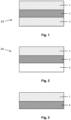
- FIG 1 A symmetrical structure of a double-sided adhesive tape 10 with a UV-opaque carrier 2 and UV-activatable adhesives 1, 1' is shown schematically.
- the UV-activatable adhesives 1, 1' can differ in their composition and in their mechanical properties. Any UV-opaque flat material can be used as the carrier 2.
- Figure 2 is a schematic representation of an asymmetrical structure of a double-sided adhesive tape 10 with a UV-opaque carrier 2 and a UV-activatable adhesive 1 as well as a non-UV-activatable adhesive 3.
- the non-UV-activatable adhesive 3 can be any pressure-sensitive adhesive, for example.
- FIG 3 A structure consisting of a UV-opaque adhesive 4 and a UV-activatable adhesive 1 is shown schematically.
- the adhesive tape can be used as a transfer film. Any pressure-sensitive adhesive with UV-opaque properties can be used for the UV-opaque adhesive 4.
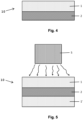
- FIG 4 The structure of a single-sided adhesive tape 10 consisting of a UV-opaque carrier 2 and a UV-activatable adhesive 1 is shown schematically.
- Figure 5 shows schematically the one-sided, ie selective UV activation of the symmetrical double-sided adhesive tape 10 from Figure 1 by means of a UV radiation source 5.
- the UV radiation source 5 is arranged in such a way that it only irradiates the adhesive 1.
- the UV-opaque carrier 2 prevents the UV rays from reaching the adhesive V.
- the adhesive 1' is thus not activated when the first adhesive is activated and can be activated separately at a later time.
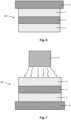
- Figure 6 is schematically the application of the first UV-activated adhesive 1 of the adhesive tape 10 from Figure 5 on a joining part 6.
- the joining takes place within the open time of the first UV-activated adhesive 1.
- the pre-prepared joining part 6 can then be stored or transported in the same way.
- FIG 7 shows schematically the adhesive tape 10 connected to the joining part 6 from Figure 6 .
- the state of UV activation of the second UV-activatable adhesive V is shown. Accordingly, the UV radiation source 5 is directed at the second UV-activatable adhesive 1'.
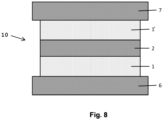
- Figure 8 shows schematically how the adhesive tape 10 from Figure 7 is applied to a second joining part 7.
- the second UV-activatable adhesive T is applied to the joining part 7.
- the joining of the adhesive 1' to the second joining part 7 takes place within the open time of the second UV-activatable adhesive 1'.
- the joining parts 6, 7 are connected by means of the adhesive tape 10.
- the first joining part 6 and the second joining part 7 can be of the same or different types.
- a solvent-based adhesive is applied to a siliconized polyester film (thickness 50 ⁇ m) using a doctor blade. This is followed by drying for 10 minutes at room temperature and then for 10 minutes at 80°C in a convection oven. The application quantity is adjusted so that after drying (removal of the solvent mixture) a layer thickness of 150 ⁇ m results.
- a pressure-sensitive adhesive (sticky) film with a thickness of approx. 150 ⁇ m is obtained.
- the coated adhesive film is then laminated onto a UV-opaque carrier or a UV-opaque second adhesive layer.
- the pressure-sensitive adhesive film is applied to a UV-opaque carrier or a UV-opaque second adhesive layer using light pressure. This can be done using a temperature of 30°C to 40°C (e.g. using heated rollers) to ensure better application and wetting of the pressure-sensitive UV-activatable carrier. Furthermore, physical surface pretreatment (plasma, corona, flame treatment, etc.) can improve adhesion to the UV-opaque carrier or the second UV-opaque adhesive layer.
- the adhesive film is activated by UV light irradiation:
- the activation of the UV-activatable pressure-sensitive adhesive film (adhesive mass) 1 by means of UV light takes place in the case of an adhesive tape 10 with a symmetrical structure according to Figure 1 or the one-sided adhesive tape 10 after Figure 4 only from one side, namely that of the open adhesive layer.
- the pressure-sensitive adhesive film in the test arrangement is then glued in a size of approx. 312 mm 2 (25 mm wide, 12.5 mm long) to the first substrate 6 (plate made of glass fiber reinforced plastic GRP, 100 mm long, 25 mm wide, 2 mm thick) within the open time.
- the irradiation of the second UV-activatable adhesive 1' is decoupled from the above process. For this reason, the irradiation can take place directly or within the storage time of the adhesive tape 10.
- the second substrate 7 is pressed onto the open adhesive film, i.e. the second adhesive 1', during the open time and outside the irradiation zone (the adhesive film is still tacky even after irradiation), so that the two substrates 6, 7 overlap and the bonding area is 25 mm x 12.5 mm.
- the two substrates 6, 7 are fixed with clamps and stored at room temperature. The measurement of the tensile shear strength is then carried out with this test specimen, unless otherwise stated, 24 hours after the second substrate 7 has been joined.
- the UV-activatable adhesive 1 is irradiated using UV light and applied to a first substrate within the open time.
- the application of a second substrate to the non-UV-activatable adhesive 3 or the UV-opaque adhesive 4 can also be carried out decoupled from this first process step.
- UV irradiation is carried out using the LED Spot Lamp 100 from Hönle.
- This lamp consists of a UV LED (wavelength 365 nm) and an irradiation chamber.
- the test specimens are irradiated for 15 seconds in the irradiation chamber.
- the irradiation dose measured with a UV Power Puck II from EIT Instrument Market Group, is 5000 mJ/cm 2 .
- Tests with a UV-C lamp are carried out using a Beltron UV laboratory system with a conveyor belt and UV-C emitter with a radiation maximum at 256 nm.
- the conveyor belt is operated at 2 m/min.
- the irradiation dose in the UV-C range measured with a UV Power Puck II from EIT Instrument Market Group, is 197 mJ/cm 2 .
- the adhesives can also be activated with the UV-LED system. Similar irradiation times are possible as with the UV-C system and the results in terms of open time and bond strength are in the same range.
- the open time is the maximum possible time between removal from the irradiation band (UV-C) or removal from the irradiation chamber (UV-A) and the time of joining with a second substrate.
- the parts to be joined can be joined during this time. It is defined in such a way that the adhesive layer is still tacky during this time.
- the open time is determined by checking the stickiness of the surface of the adhesive film with a finger after irradiation. Immediately after irradiation, the adhesive film is still tacky. After a certain time, a noticeable decrease in tackiness can be seen, which then quickly decreases until the surface is finally tack-free.
- the open time is determined at the time at which the tackiness noticeably decreases, so that there is no tack afterwards.
- tensile shear tests are carried out in accordance with DIN EN 1465 (2009) at 23°C ⁇ 2°C and 50% ⁇ 5% relative humidity at a test speed of 2 mm/min.
- the substrates are cleaned with isopropanol and then joined. Curing takes place by irradiation with UV light and the mechanical test is carried out 24 hours after activation.
- the results are given in MPa (N/mm 2 ). The mean value of five measurements including standard deviation is given in each case.
- the peel resistance of the cured adhesive tapes on glass is determined in accordance with DIN EN 1939 (1996) at 23°C ⁇ 2°C and 50% ⁇ 5% relative humidity with a test speed of 100 mm/min and a peel angle of 90°.
- the samples are cured using UV light and tested 24 hours after activation. The results are given in N/mm. The average tear resistance from five measurements including standard deviation is given in each case.
- tensile tests are carried out in accordance with DIN EN ISO 527 (2012) at 23°C ⁇ 2°C and 50% ⁇ 5% relative humidity at a test speed of 10 mm/min. For this purpose, strips with a width of 19 mm and a length of 100 mm are cut from cured adhesive films. The layer thickness in the results shown is 0.2 mm. The samples are cured using UV light and tested 24 hours after activation. The results are given in MPa (N/mm 2 ). The mean value of five measurements including standard deviation is given in each case.
- the adhesive films K1 and K2, as well as K3, K4 and V1 each have the same UV-activatable adhesives. Only the respective carrier was varied in order to show differences in the selection of the same.
- the adhesive films according to K1, K3 and V1 do not differ significantly within the standard deviation in terms of tensile shear strength and peel resistance.
- the influence of the carrier is not very dominant compared to a transfer film. The situation is different when comparing the tensile strength.
- the influence of the carrier dominates, so that in the examples according to K1 and K3, a significantly higher tensile strength could be measured compared to V1.
- the tensile shear strengths and peel resistances of examples K2 and K3 do not differ significantly within the standard deviation.
- the tensile strength of the examples mentioned is at the level of the transfer film according to V1.
- Carrier material 1 in examples K1 and K3 increases the tensile strength compared to reference V1, carrier material 2 in examples K2 and K4 significantly increases the peel resistance.
- the tensile shear strengths of the adhesive films according to K5 and K6 show no difference within the standard deviation. Thus, the effectiveness of the UV-opaque carrier and the process chain decoupled from it could be validated and verified.
Landscapes
- Chemical & Material Sciences (AREA)
- Organic Chemistry (AREA)
- Adhesive Tapes (AREA)
- Adhesives Or Adhesive Processes (AREA)
Priority Applications (1)
| Application Number | Priority Date | Filing Date | Title |
|---|---|---|---|
| PL18726733.1T PL3788112T3 (pl) | 2018-05-02 | 2018-05-02 | Taśma klejąca możliwa do nawijania oraz wykrawania do selektywnej aktywacji promieniami UV |
Applications Claiming Priority (1)
| Application Number | Priority Date | Filing Date | Title |
|---|---|---|---|
| PCT/EP2018/061236 WO2019210949A1 (de) | 2018-05-02 | 2018-05-02 | Wickel- und stanzbares klebeband zur selektiven uv-aktivierung |
Publications (2)
| Publication Number | Publication Date |
|---|---|
| EP3788112A1 EP3788112A1 (de) | 2021-03-10 |
| EP3788112B1 true EP3788112B1 (de) | 2024-07-17 |
Family
ID=62235918
Family Applications (1)
| Application Number | Title | Priority Date | Filing Date |
|---|---|---|---|
| EP18726733.1A Active EP3788112B1 (de) | 2018-05-02 | 2018-05-02 | Wickel- und stanzbares klebeband zur selektiven uv-aktivierung |
Country Status (6)
| Country | Link |
|---|---|
| US (1) | US20210230454A1 (pl) |
| EP (1) | EP3788112B1 (pl) |
| CN (1) | CN112074579A (pl) |
| ES (1) | ES2985961T3 (pl) |
| PL (1) | PL3788112T3 (pl) |
| WO (1) | WO2019210949A1 (pl) |
Families Citing this family (1)
| Publication number | Priority date | Publication date | Assignee | Title |
|---|---|---|---|---|
| US20210043997A1 (en) * | 2019-08-05 | 2021-02-11 | Agc Automotive Americas R&D, Inc. | Window assembly with solderless electrical connector |
Citations (2)
| Publication number | Priority date | Publication date | Assignee | Title |
|---|---|---|---|---|
| WO2003099953A1 (en) * | 2002-05-28 | 2003-12-04 | 3M Innovative Properties Company | Curable adhesive articles having topographical features therein |
| US20110018127A1 (en) * | 2008-03-31 | 2011-01-27 | Byoungchul Lee | Multilayer UV-Curable Adhesive Film |
Family Cites Families (9)
| Publication number | Priority date | Publication date | Assignee | Title |
|---|---|---|---|---|
| FR2746105A1 (fr) * | 1996-03-15 | 1997-09-19 | Plasto Sa | Film de masquage adhesif a deux lisieres adhesives differenciees |
| EP0963421B1 (en) * | 1997-02-28 | 2002-05-15 | Minnesota Mining And Manufacturing Company | Pressure-sensitive adhesive tape |
| DE102006042816A1 (de) * | 2006-09-08 | 2008-06-26 | Tesa Ag | Hitze-aktiviert verklebbares Stanzungsflächenelement |
| DE102013000995A1 (de) * | 2012-08-16 | 2014-02-20 | Lohmann Gmbh & Co. Kg | Klebemittel mit Klebstoffblend aus Acrylat und Styrol-Block-Copolymer |
| DE102012018076B4 (de) | 2012-09-13 | 2014-06-12 | Lohmann Gmbh & Co. Kg | Klebender Funktionsstreifen zur transkutanen Fluoreszenzmessung sowie zugehörige Herstellungsverfahren und Verwendungen |
| KR20150067219A (ko) * | 2012-09-29 | 2015-06-17 | 쓰리엠 이노베이티브 프로퍼티즈 컴파니 | 접착제 조성물 및 접착 테이프 |
| JP2015127356A (ja) * | 2013-12-27 | 2015-07-09 | 京セラケミカル株式会社 | 接着シート |
| DE102014223451A1 (de) * | 2014-11-18 | 2016-05-19 | Tesa Se | Modifizierte Schichtsilikate zur Steuerung der Abrollkraft von Haftklebemassen und Verbesserung der Barriereeigenschaften von Klebebändern |
| MX2018011923A (es) | 2016-04-04 | 2019-01-10 | Tesa Se | Cinta adhesiva sensible a la presion activable por radiacion que tiene reaccion oscura y uso de la misma. |
-
2018
- 2018-05-02 US US17/052,265 patent/US20210230454A1/en not_active Abandoned
- 2018-05-02 ES ES18726733T patent/ES2985961T3/es active Active
- 2018-05-02 WO PCT/EP2018/061236 patent/WO2019210949A1/de not_active Ceased
- 2018-05-02 EP EP18726733.1A patent/EP3788112B1/de active Active
- 2018-05-02 CN CN201880092988.5A patent/CN112074579A/zh active Pending
- 2018-05-02 PL PL18726733.1T patent/PL3788112T3/pl unknown
Patent Citations (2)
| Publication number | Priority date | Publication date | Assignee | Title |
|---|---|---|---|---|
| WO2003099953A1 (en) * | 2002-05-28 | 2003-12-04 | 3M Innovative Properties Company | Curable adhesive articles having topographical features therein |
| US20110018127A1 (en) * | 2008-03-31 | 2011-01-27 | Byoungchul Lee | Multilayer UV-Curable Adhesive Film |
Also Published As
| Publication number | Publication date |
|---|---|
| WO2019210949A1 (de) | 2019-11-07 |
| CN112074579A (zh) | 2020-12-11 |
| US20210230454A1 (en) | 2021-07-29 |
| ES2985961T3 (es) | 2024-11-07 |
| EP3788112A1 (de) | 2021-03-10 |
| PL3788112T3 (pl) | 2024-11-18 |
Similar Documents
| Publication | Publication Date | Title |
|---|---|---|
| EP3585853B1 (de) | Wickel- und stanzbarer klebender film | |
| DE60107720T2 (de) | Flüssigkristall-Transferkörper und Verfahren zum Transferieren des Flüssigkristall-Transferkörpers | |
| DE102009039029B4 (de) | Verfahren zum Fügen von mindestens zwei Bauteilen unter Verwendung einer dualhärtenden Klebstoffzusammensetzung | |
| EP1127096B1 (de) | Verfahren zum herstellen eines mehrschichtigen coextrudates und danach hergestelltes coextrudat | |
| EP1278632B1 (de) | Verfahren zum herstellen eines mehrschichtigen coextrudates | |
| EP3994227A1 (de) | Komprimierbarer, uv- oder thermisch aktivierbarer (semi-) struktureller klebefilm mit farbumschlag jeweils nach aktivierung und aushärtung | |
| EP3788112B1 (de) | Wickel- und stanzbares klebeband zur selektiven uv-aktivierung | |
| DE4441124C2 (de) | Verfahren zur Erzeugung eines haftfesten, feuchtigkeitsdichten Überzugs aus Kunststoff auf einer Unterlage und dessen Verwendung | |
| EP4225578B1 (de) | Geometrisch definierter haftklebriger klebefilm | |
| DE102016201565A1 (de) | Verklebung mit verbesserter Feucht-Wärme-Beständigkeit | |
| EP3894502A1 (de) | Wickel- und stanzbarer klebender film | |
| EP1347026B1 (de) | Haftklebeband und Verfahren zur Herstellung | |
| EP3830207B1 (de) | System mit einer mikrofluidischen kartusche und einer kartuschenabdeckvorrichtung zum versiegeln der mikrofluidischen kartusche und verfahren zu seiner herstellung | |
| DE60133157T2 (de) | Strahlungshärtbare, druckempfindliche klebstoffzusammensetzung und diese enthaltender klebefilm | |
| DE102019101582A1 (de) | Vorrichtung und Verfahren zur Herstellung von Haftklebebändern mit strahlungsinduzierter Polymerisation der Haftklebemasse | |
| EP1273642A2 (de) | Schutzfolie für den Transport von Fahrzeugen | |
| DE102020210893B4 (de) | Verfahren zur Herstellung von versiegelten Klebebändern mit aushärtbaren Klebemassen, versiegeltes Klebeband und Verwendung | |
| EP3680301A2 (de) | Verfahren zum herstellen eines klebstofffilaments und klebstofffilament | |
| DE102024112457A1 (de) | Verfahren zum Lackieren von Substraten und mehrlagiges Klebeelement für den Einsatz in diesem Verfahren | |
| EP1614528A1 (de) | Verfahren zur Herstellung eines Verpackungsmaterials | |
| DE102022113506A1 (de) | Verfahren zum Verbinden, Ablösen und Wiederverbinden von Substraten | |
| WO2022073608A1 (de) | Geometrisch definierter haftklebriger klebefilm | |
| WO2019081387A1 (de) | Dimensionsstabile klebebänder | |
| DE10231065A1 (de) | Haftklebeband und Verfahren zur Herstellung |
Legal Events
| Date | Code | Title | Description |
|---|---|---|---|
| STAA | Information on the status of an ep patent application or granted ep patent |
Free format text: STATUS: UNKNOWN |
|
| STAA | Information on the status of an ep patent application or granted ep patent |
Free format text: STATUS: THE INTERNATIONAL PUBLICATION HAS BEEN MADE |
|
| PUAI | Public reference made under article 153(3) epc to a published international application that has entered the european phase |
Free format text: ORIGINAL CODE: 0009012 |
|
| STAA | Information on the status of an ep patent application or granted ep patent |
Free format text: STATUS: REQUEST FOR EXAMINATION WAS MADE |
|
| 17P | Request for examination filed |
Effective date: 20201202 |
|
| AK | Designated contracting states |
Kind code of ref document: A1 Designated state(s): AL AT BE BG CH CY CZ DE DK EE ES FI FR GB GR HR HU IE IS IT LI LT LU LV MC MK MT NL NO PL PT RO RS SE SI SK SM TR |
|
| AX | Request for extension of the european patent |
Extension state: BA ME |
|
| RIN1 | Information on inventor provided before grant (corrected) |
Inventor name: KUEHL, OLIVER Inventor name: FRIEDLAND, RUBEN Inventor name: STAHL, JOHANNES Inventor name: SUNDRUM, CORNELIA |
|
| RIN1 | Information on inventor provided before grant (corrected) |
Inventor name: KUEHL, OLIVER Inventor name: FRIEDLAND, RUBEN Inventor name: STAHL, JOHANNES Inventor name: HOSS, CORNELIA |
|
| DAV | Request for validation of the european patent (deleted) | ||
| DAX | Request for extension of the european patent (deleted) | ||
| STAA | Information on the status of an ep patent application or granted ep patent |
Free format text: STATUS: EXAMINATION IS IN PROGRESS |
|
| 17Q | First examination report despatched |
Effective date: 20230406 |
|
| GRAP | Despatch of communication of intention to grant a patent |
Free format text: ORIGINAL CODE: EPIDOSNIGR1 |
|
| STAA | Information on the status of an ep patent application or granted ep patent |
Free format text: STATUS: GRANT OF PATENT IS INTENDED |
|
| INTG | Intention to grant announced |
Effective date: 20240326 |
|
| GRAS | Grant fee paid |
Free format text: ORIGINAL CODE: EPIDOSNIGR3 |
|
| GRAA | (expected) grant |
Free format text: ORIGINAL CODE: 0009210 |
|
| STAA | Information on the status of an ep patent application or granted ep patent |
Free format text: STATUS: THE PATENT HAS BEEN GRANTED |
|
| AK | Designated contracting states |
Kind code of ref document: B1 Designated state(s): AL AT BE BG CH CY CZ DE DK EE ES FI FR GB GR HR HU IE IS IT LI LT LU LV MC MK MT NL NO PL PT RO RS SE SI SK SM TR |
|
| REG | Reference to a national code |
Ref country code: CH Ref legal event code: EP |
|
| REG | Reference to a national code |
Ref country code: DE Ref legal event code: R096 Ref document number: 502018014873 Country of ref document: DE |
|
| REG | Reference to a national code |
Ref country code: IE Ref legal event code: FG4D Free format text: LANGUAGE OF EP DOCUMENT: GERMAN |
|
| REG | Reference to a national code |
Ref country code: ES Ref legal event code: FG2A Ref document number: 2985961 Country of ref document: ES Kind code of ref document: T3 Effective date: 20241107 |
|
| REG | Reference to a national code |
Ref country code: LT Ref legal event code: MG9D |
|
| REG | Reference to a national code |
Ref country code: NL Ref legal event code: MP Effective date: 20240717 Ref country code: SK Ref legal event code: T3 Ref document number: E 44992 Country of ref document: SK |
|
| PG25 | Lapsed in a contracting state [announced via postgrant information from national office to epo] |
Ref country code: PT Free format text: LAPSE BECAUSE OF FAILURE TO SUBMIT A TRANSLATION OF THE DESCRIPTION OR TO PAY THE FEE WITHIN THE PRESCRIBED TIME-LIMIT Effective date: 20241118 |
|
| PG25 | Lapsed in a contracting state [announced via postgrant information from national office to epo] |
Ref country code: NL Free format text: LAPSE BECAUSE OF FAILURE TO SUBMIT A TRANSLATION OF THE DESCRIPTION OR TO PAY THE FEE WITHIN THE PRESCRIBED TIME-LIMIT Effective date: 20240717 |
|
| PG25 | Lapsed in a contracting state [announced via postgrant information from national office to epo] |
Ref country code: PT Free format text: LAPSE BECAUSE OF FAILURE TO SUBMIT A TRANSLATION OF THE DESCRIPTION OR TO PAY THE FEE WITHIN THE PRESCRIBED TIME-LIMIT Effective date: 20241118 Ref country code: NL Free format text: LAPSE BECAUSE OF FAILURE TO SUBMIT A TRANSLATION OF THE DESCRIPTION OR TO PAY THE FEE WITHIN THE PRESCRIBED TIME-LIMIT Effective date: 20240717 |
|
| PG25 | Lapsed in a contracting state [announced via postgrant information from national office to epo] |
Ref country code: NO Free format text: LAPSE BECAUSE OF FAILURE TO SUBMIT A TRANSLATION OF THE DESCRIPTION OR TO PAY THE FEE WITHIN THE PRESCRIBED TIME-LIMIT Effective date: 20241017 |
|
| PG25 | Lapsed in a contracting state [announced via postgrant information from national office to epo] |
Ref country code: GR Free format text: LAPSE BECAUSE OF FAILURE TO SUBMIT A TRANSLATION OF THE DESCRIPTION OR TO PAY THE FEE WITHIN THE PRESCRIBED TIME-LIMIT Effective date: 20241018 Ref country code: FI Free format text: LAPSE BECAUSE OF FAILURE TO SUBMIT A TRANSLATION OF THE DESCRIPTION OR TO PAY THE FEE WITHIN THE PRESCRIBED TIME-LIMIT Effective date: 20240717 |
|
| PG25 | Lapsed in a contracting state [announced via postgrant information from national office to epo] |
Ref country code: BG Free format text: LAPSE BECAUSE OF FAILURE TO SUBMIT A TRANSLATION OF THE DESCRIPTION OR TO PAY THE FEE WITHIN THE PRESCRIBED TIME-LIMIT Effective date: 20240717 |
|
| PG25 | Lapsed in a contracting state [announced via postgrant information from national office to epo] |
Ref country code: LV Free format text: LAPSE BECAUSE OF FAILURE TO SUBMIT A TRANSLATION OF THE DESCRIPTION OR TO PAY THE FEE WITHIN THE PRESCRIBED TIME-LIMIT Effective date: 20240717 |
|
| PG25 | Lapsed in a contracting state [announced via postgrant information from national office to epo] |
Ref country code: IS Free format text: LAPSE BECAUSE OF FAILURE TO SUBMIT A TRANSLATION OF THE DESCRIPTION OR TO PAY THE FEE WITHIN THE PRESCRIBED TIME-LIMIT Effective date: 20241117 |
|
| PG25 | Lapsed in a contracting state [announced via postgrant information from national office to epo] |
Ref country code: HR Free format text: LAPSE BECAUSE OF FAILURE TO SUBMIT A TRANSLATION OF THE DESCRIPTION OR TO PAY THE FEE WITHIN THE PRESCRIBED TIME-LIMIT Effective date: 20240717 |
|
| PG25 | Lapsed in a contracting state [announced via postgrant information from national office to epo] |
Ref country code: RS Free format text: LAPSE BECAUSE OF FAILURE TO SUBMIT A TRANSLATION OF THE DESCRIPTION OR TO PAY THE FEE WITHIN THE PRESCRIBED TIME-LIMIT Effective date: 20241017 |
|
| PG25 | Lapsed in a contracting state [announced via postgrant information from national office to epo] |
Ref country code: RS Free format text: LAPSE BECAUSE OF FAILURE TO SUBMIT A TRANSLATION OF THE DESCRIPTION OR TO PAY THE FEE WITHIN THE PRESCRIBED TIME-LIMIT Effective date: 20241017 Ref country code: NO Free format text: LAPSE BECAUSE OF FAILURE TO SUBMIT A TRANSLATION OF THE DESCRIPTION OR TO PAY THE FEE WITHIN THE PRESCRIBED TIME-LIMIT Effective date: 20241017 Ref country code: LV Free format text: LAPSE BECAUSE OF FAILURE TO SUBMIT A TRANSLATION OF THE DESCRIPTION OR TO PAY THE FEE WITHIN THE PRESCRIBED TIME-LIMIT Effective date: 20240717 Ref country code: IS Free format text: LAPSE BECAUSE OF FAILURE TO SUBMIT A TRANSLATION OF THE DESCRIPTION OR TO PAY THE FEE WITHIN THE PRESCRIBED TIME-LIMIT Effective date: 20241117 Ref country code: HR Free format text: LAPSE BECAUSE OF FAILURE TO SUBMIT A TRANSLATION OF THE DESCRIPTION OR TO PAY THE FEE WITHIN THE PRESCRIBED TIME-LIMIT Effective date: 20240717 Ref country code: GR Free format text: LAPSE BECAUSE OF FAILURE TO SUBMIT A TRANSLATION OF THE DESCRIPTION OR TO PAY THE FEE WITHIN THE PRESCRIBED TIME-LIMIT Effective date: 20241018 Ref country code: FI Free format text: LAPSE BECAUSE OF FAILURE TO SUBMIT A TRANSLATION OF THE DESCRIPTION OR TO PAY THE FEE WITHIN THE PRESCRIBED TIME-LIMIT Effective date: 20240717 Ref country code: BG Free format text: LAPSE BECAUSE OF FAILURE TO SUBMIT A TRANSLATION OF THE DESCRIPTION OR TO PAY THE FEE WITHIN THE PRESCRIBED TIME-LIMIT Effective date: 20240717 |
|
| PG25 | Lapsed in a contracting state [announced via postgrant information from national office to epo] |
Ref country code: RO Free format text: LAPSE BECAUSE OF FAILURE TO SUBMIT A TRANSLATION OF THE DESCRIPTION OR TO PAY THE FEE WITHIN THE PRESCRIBED TIME-LIMIT Effective date: 20240717 Ref country code: DK Free format text: LAPSE BECAUSE OF FAILURE TO SUBMIT A TRANSLATION OF THE DESCRIPTION OR TO PAY THE FEE WITHIN THE PRESCRIBED TIME-LIMIT Effective date: 20240717 Ref country code: SM Free format text: LAPSE BECAUSE OF FAILURE TO SUBMIT A TRANSLATION OF THE DESCRIPTION OR TO PAY THE FEE WITHIN THE PRESCRIBED TIME-LIMIT Effective date: 20240717 |
|
| REG | Reference to a national code |
Ref country code: DE Ref legal event code: R097 Ref document number: 502018014873 Country of ref document: DE |
|
| PG25 | Lapsed in a contracting state [announced via postgrant information from national office to epo] |
Ref country code: EE Free format text: LAPSE BECAUSE OF FAILURE TO SUBMIT A TRANSLATION OF THE DESCRIPTION OR TO PAY THE FEE WITHIN THE PRESCRIBED TIME-LIMIT Effective date: 20240717 |
|
| PLBE | No opposition filed within time limit |
Free format text: ORIGINAL CODE: 0009261 |
|
| STAA | Information on the status of an ep patent application or granted ep patent |
Free format text: STATUS: NO OPPOSITION FILED WITHIN TIME LIMIT |
|
| 26N | No opposition filed |
Effective date: 20250422 |
|
| PGFP | Annual fee paid to national office [announced via postgrant information from national office to epo] |
Ref country code: PL Payment date: 20250425 Year of fee payment: 8 Ref country code: DE Payment date: 20250521 Year of fee payment: 8 |
|
| PGFP | Annual fee paid to national office [announced via postgrant information from national office to epo] |
Ref country code: GB Payment date: 20250527 Year of fee payment: 8 |
|
| PGFP | Annual fee paid to national office [announced via postgrant information from national office to epo] |
Ref country code: BE Payment date: 20250521 Year of fee payment: 8 |
|
| PGFP | Annual fee paid to national office [announced via postgrant information from national office to epo] |
Ref country code: FR Payment date: 20250528 Year of fee payment: 8 |
|
| PGFP | Annual fee paid to national office [announced via postgrant information from national office to epo] |
Ref country code: SK Payment date: 20250428 Year of fee payment: 8 |
|
| PGFP | Annual fee paid to national office [announced via postgrant information from national office to epo] |
Ref country code: CZ Payment date: 20250425 Year of fee payment: 8 |
|
| PG25 | Lapsed in a contracting state [announced via postgrant information from national office to epo] |
Ref country code: SE Free format text: LAPSE BECAUSE OF FAILURE TO SUBMIT A TRANSLATION OF THE DESCRIPTION OR TO PAY THE FEE WITHIN THE PRESCRIBED TIME-LIMIT Effective date: 20240717 |
|
| PGFP | Annual fee paid to national office [announced via postgrant information from national office to epo] |
Ref country code: ES Payment date: 20250630 Year of fee payment: 8 |
|
| REG | Reference to a national code |
Ref country code: CH Ref legal event code: H13 Free format text: ST27 STATUS EVENT CODE: U-0-0-H10-H13 (AS PROVIDED BY THE NATIONAL OFFICE) Effective date: 20251223 |
|
| PG25 | Lapsed in a contracting state [announced via postgrant information from national office to epo] |
Ref country code: LU Free format text: LAPSE BECAUSE OF NON-PAYMENT OF DUE FEES Effective date: 20250502 |
|
| PG25 | Lapsed in a contracting state [announced via postgrant information from national office to epo] |
Ref country code: CH Free format text: LAPSE BECAUSE OF NON-PAYMENT OF DUE FEES Effective date: 20250531 |
|
| PG25 | Lapsed in a contracting state [announced via postgrant information from national office to epo] |
Ref country code: MC Free format text: LAPSE BECAUSE OF FAILURE TO SUBMIT A TRANSLATION OF THE DESCRIPTION OR TO PAY THE FEE WITHIN THE PRESCRIBED TIME-LIMIT Effective date: 20240717 |
|
| PG25 | Lapsed in a contracting state [announced via postgrant information from national office to epo] |
Ref country code: IE Free format text: LAPSE BECAUSE OF NON-PAYMENT OF DUE FEES Effective date: 20250502 |
|
| PG25 | Lapsed in a contracting state [announced via postgrant information from national office to epo] |
Ref country code: IT Free format text: LAPSE BECAUSE OF NON-PAYMENT OF DUE FEES Effective date: 20250502 |