EP3782999B1 - Verfahren zur herstellung von 3-phenyl-2,8-dihydropyrano[2,3-f]-chromenderivat - Google Patents
Verfahren zur herstellung von 3-phenyl-2,8-dihydropyrano[2,3-f]-chromenderivat Download PDFInfo
- Publication number
- EP3782999B1 EP3782999B1 EP19782372.7A EP19782372A EP3782999B1 EP 3782999 B1 EP3782999 B1 EP 3782999B1 EP 19782372 A EP19782372 A EP 19782372A EP 3782999 B1 EP3782999 B1 EP 3782999B1
- Authority
- EP
- European Patent Office
- Prior art keywords
- group
- substituted
- unsubstituted
- branched
- nmr
- Prior art date
- Legal status (The legal status is an assumption and is not a legal conclusion. Google has not performed a legal analysis and makes no representation as to the accuracy of the status listed.)
- Active
Links
Classifications
-
- C—CHEMISTRY; METALLURGY
- C07—ORGANIC CHEMISTRY
- C07D—HETEROCYCLIC COMPOUNDS
- C07D493/00—Heterocyclic compounds containing oxygen atoms as the only ring hetero atoms in the condensed system
- C07D493/02—Heterocyclic compounds containing oxygen atoms as the only ring hetero atoms in the condensed system in which the condensed system contains two hetero rings
- C07D493/04—Ortho-condensed systems
-
- A—HUMAN NECESSITIES
- A61—MEDICAL OR VETERINARY SCIENCE; HYGIENE
- A61K—PREPARATIONS FOR MEDICAL, DENTAL OR TOILETRY PURPOSES
- A61K31/00—Medicinal preparations containing organic active ingredients
- A61K31/33—Heterocyclic compounds
- A61K31/335—Heterocyclic compounds having oxygen as the only ring hetero atom, e.g. fungichromin
- A61K31/35—Heterocyclic compounds having oxygen as the only ring hetero atom, e.g. fungichromin having six-membered rings with one oxygen as the only ring hetero atom
- A61K31/352—Heterocyclic compounds having oxygen as the only ring hetero atom, e.g. fungichromin having six-membered rings with one oxygen as the only ring hetero atom condensed with carbocyclic rings, e.g. methantheline
-
- A—HUMAN NECESSITIES
- A61—MEDICAL OR VETERINARY SCIENCE; HYGIENE
- A61P—SPECIFIC THERAPEUTIC ACTIVITY OF CHEMICAL COMPOUNDS OR MEDICINAL PREPARATIONS
- A61P3/00—Drugs for disorders of the metabolism
- A61P3/04—Anorexiants; Antiobesity agents
-
- A—HUMAN NECESSITIES
- A61—MEDICAL OR VETERINARY SCIENCE; HYGIENE
- A61P—SPECIFIC THERAPEUTIC ACTIVITY OF CHEMICAL COMPOUNDS OR MEDICINAL PREPARATIONS
- A61P3/00—Drugs for disorders of the metabolism
- A61P3/08—Drugs for disorders of the metabolism for glucose homeostasis
- A61P3/10—Drugs for disorders of the metabolism for glucose homeostasis for hyperglycaemia, e.g. antidiabetics
-
- Y—GENERAL TAGGING OF NEW TECHNOLOGICAL DEVELOPMENTS; GENERAL TAGGING OF CROSS-SECTIONAL TECHNOLOGIES SPANNING OVER SEVERAL SECTIONS OF THE IPC; TECHNICAL SUBJECTS COVERED BY FORMER USPC CROSS-REFERENCE ART COLLECTIONS [XRACs] AND DIGESTS
- Y02—TECHNOLOGIES OR APPLICATIONS FOR MITIGATION OR ADAPTATION AGAINST CLIMATE CHANGE
- Y02P—CLIMATE CHANGE MITIGATION TECHNOLOGIES IN THE PRODUCTION OR PROCESSING OF GOODS
- Y02P20/00—Technologies relating to chemical industry
- Y02P20/50—Improvements relating to the production of bulk chemicals
- Y02P20/55—Design of synthesis routes, e.g. reducing the use of auxiliary or protecting groups
Definitions
- the present invention relates to a method for synthesizing a 3-phenyl-2,8-dihydropyrano[2,3-f]chromene derivative, which may be usefully used for synthesizing a pyranochromenyl phenol derivative.
- adipocytes About 20 billion or more adipocytes are present in the human body, and when much more energy is supplied to the human body than the need for energy, energy is stored as triglyceride in adipocytes in the human body, and when energy is used up, the triglyceride is decomposed into free fatty acid and glucose and thus is used as an energy source.
- Obesity which about 30 to 40% of modern people suffer from, occurs when excessive energy is accumulated due to the imbalance of the procedure, and is shown as a phenomenon in which the size of adipocytes is increased or the number thereof is increased.
- the metabolic syndrome conceptualizes a clustering phenomenon of risk factors of various cardiovascular diseases and type 2 diabetes as one disease group.
- the metabolic syndrome is a concept which may comprehensively explain insulin resistance and complicated and various metabolic abnormalities and clinical aspects associated with insulin resistance, and refers to a syndrome in which risk factors such as obesity, diabetes, fatty liver, and hypertriglyceridemia are together increased. Accordingly, in the case of a metabolic syndrome, the risk of incidence of a cardiovascular disease or type 2 diabetes is increased.
- Insulin resistance refers to a phenomenon in which, even though insulin is normally secreted in the body, a supply of glucose into cells, which is performed by insulin, does not work properly. Since glucose in the blood cannot enter cells, hyperglycemia is exhibited, and cells cannot perform normal functions thereof due to a shortage of glucose, and as a result, metabolic syndrome symptoms are manifested.
- type 2 diabetes non-insulin-dependent diabetes mellitus: NIDDM
- type 1 diabetes insulin-dependent diabetes mellitus
- the most preferable method of treating type 2 diabetes is to induce insulin to be capable of performing normal functions thereof by alleviating insulin resistance. Nevertheless, a therapeutic agent of alleviating insulin resistance has hardly been developed up until now.
- type 2 diabetes therapeutic agents currently used or developed aim to increase the amount of insulin secreted in order to supplement the functions of insulin lost by insulin resistance.
- the amount of insulin secreted is increased in our bodies, not only obesity and inflammation are caused, but also various side effects such as an increase in cancer incidence rate are accompanied, so that unless the insulin resistance problem is fundamentally solved, it is possible to expect that blood sugar is only temporarily normalized, but the health deteriorates more and more. For this reason, there is a more desperate social need for a type 2 diabetes therapeutic agent capable of normalizing blood sugar by alleviating insulin resistance.
- Patent Document 1 discloses that a pyranochromenyl phenol derivative is effective for preventing and treating a metabolic syndrome including hyperlipidemia, fatty liver, sugar metabolic abnormality, diabetes, and obesity, and have effects such as antiinflammatory action and anticancer action.
- Non-Patent Document 1 a method for synthesizing ( ⁇ )-glabridin developed by the present inventors.
- Patent Document 2 relates to a method of synthesizing isoflavan and isoflavene derivatives which have a biological efficacy of antioxidation and protection against ultraviolet light.
- Patent Document 3 describes compounds derived from a naturally occurring substance, and their use in compositions for the prevention and/or treatment of metabolic syndrome and insulin resistance syndrome.
- Non-Patent Document 2 describes phenolics obtained from bioassay-guided fractionation of a EtOH extract of licorice ( Glycyrrhiza glabra roots), and their PPAR- ⁇ (peroxisome proliferator-activated receptor- ⁇ ) ligand-binding activity.
- PPAR- ⁇ is the predominant molecular target for insulin-sensitizing thiazolidinedione drugs which have been approved for use in the treatment of type 2 diabetes patients.
- the present invention has been made in an effort to provide a method for synthesizing a 3-phenyl-2,8-dihydropyrano[2,3- f ]chromene derivative, which may be usefully used for preparing a 3-phenyl-2,3,4,8,9,10-hexahydropyrano[2,3- f ]chromene derivative.
- An exemplary embodiment of the present invention provides a method for synthesizing a 3-phenyl-2,8-dihydropyrano[2,3- f ]chromene derivative of Formula (I), the method including:
- Another exemplary embodiment of the present invention provides a compound represented by the following Formula 4, a salt or solvate thereof: In the formula,
- Yet another exemplary embodiment of the present invention provides a compound represented by the following Formula 4-b, a salt or solvate thereof:
- R 1 to R 5 , P, and n are the same as those defined in Formula 4.
- Still another exemplary embodiment of the present invention provides a compound represented by the following Formula 5, a salt or solvate thereof: In the formula,
- a method for synthesizing a 3-phenyl-2,8-dihydropyrano[2,3- f ]chromene derivative of Formula (I) includes:
- selective double bond may mean a single bond or a double bond in some cases.
- the coupling reaction may be performed under basic conditions. Specifically, it is preferred that the coupling of the compound of Formula 1 with the compound of Formula 2 is performed under basic conditions, and it is further preferred that the coupling of the compound of Formula 1 with the compound of Formula 2 is performed by using a weak basic compound as a catalyst. In this case, an intramolecular aldol condensation reaction may prevent an undesired compound from being synthesized.
- the weak basic compound may be one or more selected from the group consisting of ammonia (NH 3 ), aluminum hydroxide (Al 2 (OH) 3 ), magnesium hydroxide (Mg(OH) 2 ), ammonium hydroxide (NH 3 ⁇ H 2 O), and potassium carbonate (K 2 CO 3 ), and is preferably potassium carbonate.
- the derivatives of Formula 1 may be synthesized by the method of [ Tetrahedron, 57 (2001), 5335-5338 ], and the derivatives of Formula 2 may be synthesized by allowing acetophenone derivatives, which may be synthesized by typical methods, to react with a bromination reagent such as tetrabutylammonium tribromide (Bu 4 NBr 3 ) and benzyltrimethylammonium tribromide (BnMe 3 NBr 3 ).
- a bromination reagent such as tetrabutylammonium tribromide (Bu 4 NBr 3 ) and benzyltrimethylammonium tribromide (BnMe 3 NBr 3 ).
- the compound of Formula 4 may be obtained by adding a salt to the compound of Formula 3 and performing a cyclization process through a benzoin condensation reaction.
- the salt may be a thiazolium salt, a triazolium salt, or a 6,7-dihydro-5 H -pyrrolo[2,1-c] [1,2,4]triazolium salt.
- the compound represented by Formula 5 may be obtained by reducing a carbonyl group in the compound of Formula 4 to a hydroxyl group. Further, after a carbon-to-carbon double bond of a dihydropyran ring in the compound of Formula 4 is reduced in some cases, the compound represented by Formula 5 may be obtained by reducing a carbonyl group in the compound of Formula 4 to a hydroxyl group.
- the 3-phenyl-2,8-dihydropyrano[2,3-f]chromene derivative of Formula (I) may be synthesized from the compound of Formula 5 through a reductive elimination reaction.
- the reductive elimination reaction is performed in the presence of low valent titanium (LVT).
- the low valent titanium means a zerovalent or monovalent titanium species produced when titanium tetrachloride (TiCl 4 ), titanium trichloride (TiCl 3 ) is allowed to first react with a sufficient equivalent (two to three equivalents) of zinc (Zn), magnesium (Mg), lithium (Li).
- the 3-phenyl-2,8-dihydropyrano[2,3-f]chromene derivative may be a compound represented by the following Formula (I-a) or a compound represented by the following Formula (I-b).
- R 1 to R 5 , P, and n are the same as those defined in Formula (I).
- An exemplary embodiment of the present invention provides a method for preparing a compound represented by Formula (I-a), the method including: a) preparing a compound of Formula 3 by coupling a compound represented by Formula 1 with a compound represented by Formula 2;
- Reaction Formula 2 the coupling reaction, the cyclization reaction, and the reductive elimination reaction are the same as the above-described reactions in Reaction Formula 1.
- the compound of Formula 5-a may be synthesized through a reaction of reducing a carbonyl group in the compound of Formula 4 to a hydroxyl group.
- the reduction reaction may be performed by adding lithium borohydride (LiBH 4 ) or sodium borohydride (NaBH 4 ).
- Step C) may include preparing a compound represented by the following Formula 4-b by selectively reducing a carbon-to-carbon double bond of a dihydropyran ring in the compound represented by Formula 4.
- R 1 to R 5 , P, and n are the same as those defined in Formula (I).
- an exemplary embodiment of the present invention provides a method for preparing a compound represented by Formula (I-b), the method including: a') preparing a compound of Formula 3 by coupling a compound represented by Formula 1 with a compound represented by Formula 2;
- Reaction Formula 3 the coupling reaction, the cyclization reaction, and the reductive elimination reaction are the same as the above-described reactions in Reaction Formula 1. Further, in Reaction Formula 3, the reaction of reducing a carbonyl group in the compound of Formula 4-b to a hydroxyl group is the same as the above-described reaction in Reaction Formula 2.
- the reaction of selectively reducing the carbon-to-carbon double bond of the dihydropyran ring in the compound of Formula 4 may be performed through a hydrogen addition reaction (H 2 , Pd/C).
- deprotection of a protecting group (P) in Formula 4 may be accompanied.
- an additional reaction of substituting the above-described protecting group may proceed at the position of a deprotected hydroxyl group.
- the compound of Formula (I-a) may be one or more of the following compounds:
- the compound of Formula (I-b) may corresponds to the respective Compounds I-a-1 to I-a-69, but be one or more of Compounds I-b-1 to I-b-69, which are compounds having no carbon-to-carbon double bond of a dihydropyran ring to which R4 and R5 are bonded.
- the 3-phenyl-2,3,4,8,9,10-hexahydropyrano[2,3- f ]chromene derivative of Formula (II) may be a compound represented by the following Formula (II-a), a compound represented by the following Formula (II-b), or a compound represented by the following Formula (II-c).
- the 3-phenyl-2,3,4,8,9,10-hexahydropyrano[2,3-f]chromene derivative of Formula (II-a) may be one or more of the following compounds:
- the compound of Formula (II-b) may correspond to the respective Compounds II-a-1 to II-a-54, but be one or more of Compounds II-b-1 to II-b-54, which have a fundamental skeleton of Formula (II-b).
- the compound of Formula (II-b) may include the following compounds.
- the compound of Formula (II-c) may correspond to the respective Compounds II-a-1 to II-a-54, but be one or more of Compounds II-c-1 to II-c-54, which have a fundamental skeleton of Formula (II-c).
- the compound of Formula (II-c) may include the following compounds.
- the reduction procedure of the double bond and the procedure of the deprotecting group may be simultaneously performed through a hydrogen addition reaction using palladium on carbon (Pd/C) as a catalyst.
- Pd/C palladium on carbon
- a pyranochromenyl phenol derivative in a state of having a protecting group may be synthesized, and the protecting group may be removed at an arbitrary time.
- an exemplary embodiment of the present invention provides a compound represented by the following Formula 4, a salt or solvate thereof:
- an exemplary embodiment of the present invention provides a compound represented by the following Formula 4-b, a salt or solvate thereof:
- R 1 to R 5 , P, and n are the same as those defined in Formula (I).
- an exemplary embodiment of the present invention provides a compound represented by the following Formula 5, a salt or solvate thereof:
- the dotted line means a selective double bond
- R 1 to R 5 , P, and n are the same as those defined in Formula (I).
- the compound represented by Formula 5 may be a compound represented by the following Formula 5-a or a compound represented by the following Formula 5-b.
- R 1 to R 5 , P, and n are the same as those defined in Formula (I).
- the compound of Formula 4, Formula 4-b, Formula 5-a, or Formula 5-b according to the present invention may include all solvates including all salts and hydrates, which may be prepared by typical methods.
- the compound of Formula 4, Formula 4-b, Formula 5-a, or Formula 5-b may be used as an intermediate in the synthesis method for preparing a compound of Formula (I).
- the concentrate was dissolved again in 20 ml of ethyl acetate (CH 3 COOC 2 H 5 ), the resulting solution was washed with saturated brine, and then the organic layer was separated and dried over magnesium sulfate (MgSO 4 ). Thereafter, magnesium sulfate was removed by filtering the organic solution layer after drying the organic solution layer, and then the solution was concentrated and then recrystallized with isopropyl alcohol (IPA), thereby obtaining 7.46 g (16.3 mmol) of 5-(2-(2-(benzyloxy)-4-methoxyphenyl)-2-oxoethoxy)-2,2-dimethyl-2 H -chromene-6-carbaldehyde (Yield: 81.4%).
- IPA isopropyl alcohol
- the aqueous layer was extracted once again by using 15 ml of THF, and then mixed with the organic mixture, and the resulting mixture was thoroughly dried over a sufficient amount of magnesium sulfate.
- the clear solution from which magnesium sulfate had been removed was distilled and concentrated to a volume of 15 ml under reduced pressure.
- the THF solution concentrated to an amount of 15 ml was slowly added to a low valent titanium reaction mixture ⁇ Ti(O) ⁇ , which was prepared by the method, at room temperature for 30 minutes, and then the resulting mixture was vigorously stirred for 5 hours. Thereafter, the reaction was terminated by slowly adding 50 ml of water to the reaction solution, and then 100 ml of the organic layer was extracted three times by using methylene chloride (CH 2 Cl 2 ). After the extracted organic layers were combined and then dried over a sufficient amount of magnesium sulfate, the clear solution from which magnesium chloride had been removed was distilled and concentrated under reduced pressure.
- methylene chloride CH 2 Cl 2
- Example 2-2 15.66 g (0.033 mol) of the 3-(2-(benzyloxy)-4-ethoxyphenyl)-3-hydroxy-8,8-dimethyl-2,3-dihydropyrano[2,3- f ]chromen-4(8 H )-one obtained in Example 2-2 was used in the same manner as in Example 1-3, thereby obtaining 9.05 g (0.020 mol) of 3-(2-(benzyloxy)-4-ethoxyphenyl)-8,8-dimethyl-2,8-dihydropyrano[2,3- f ]chromene (Yield 62%).
- H-NMR data and C-NMR data of the compounds represented by Formula (II-c) prepared by using the 3-phenyl-2,8-dihydropyrano[2,3- f ]chromene derivatives (compounds represented by Formula (I-b)) prepared in Examples 64 to 68 are shown in the following Table 9. [Table 9] No.
Landscapes
- Health & Medical Sciences (AREA)
- Chemical & Material Sciences (AREA)
- Organic Chemistry (AREA)
- Diabetes (AREA)
- Veterinary Medicine (AREA)
- Animal Behavior & Ethology (AREA)
- Public Health (AREA)
- General Health & Medical Sciences (AREA)
- Life Sciences & Earth Sciences (AREA)
- Pharmacology & Pharmacy (AREA)
- Medicinal Chemistry (AREA)
- Obesity (AREA)
- Nuclear Medicine, Radiotherapy & Molecular Imaging (AREA)
- General Chemical & Material Sciences (AREA)
- Chemical Kinetics & Catalysis (AREA)
- Hematology (AREA)
- Bioinformatics & Cheminformatics (AREA)
- Engineering & Computer Science (AREA)
- Child & Adolescent Psychology (AREA)
- Endocrinology (AREA)
- Emergency Medicine (AREA)
- Epidemiology (AREA)
- Nitrogen Condensed Heterocyclic Rings (AREA)
- Pharmaceuticals Containing Other Organic And Inorganic Compounds (AREA)
- Heterocyclic Carbon Compounds Containing A Hetero Ring Having Oxygen Or Sulfur (AREA)
- Plural Heterocyclic Compounds (AREA)
Claims (10)
- Verfahren zur Synthese eines 3-Phenyl-2,8-dihydro pyrano[2,3-f]chromen-Derivats, wobei das Verfahren Folgendes umfasst:A) Herstellen einer Verbindung der Formel 3 durch Kuppeln einer durch Formel 1 wiedergegebenen Verbindung mit einer durch Formel 2 wiedergegebenen Verbindung;B) Synthetisieren einer Verbindung der Formel 4 durch Cyclisieren der Verbindung der Formel 3;C) Herstellen einer Verbindung der Formel 5 durch Reduzieren der Verbindung der Formel 4 undD) Herstellen einer Verbindung der Formel (I) durch Durchführen einer reduktiven Eliminierung an der Verbindung der Formel 5:

 R1 und R2 jeweils unabhängig für ein Wasserstoffatom; eine substituierte oder unsubstituierte gerade oder verzweigte C1- bis C6-Alkylgruppe; ein Halogenatom; eine substituierte oder unsubstituierte gerade oder verzweigte C1- bis C6-Alkoxygruppe; eine substituierte oder unsubstituierte gerade oder verzweigte C1- bis C4-Thioalkylgruppe; eine substituierte oder unsubstituierte C6- bis C12-Arylgruppe; eine substituierte oder unsubstituierte Allyloxygruppe oder eine substituierte oder unsubstituierte C6- bis C12-Aryloxygruppe stehen;R3 für ein Wasserstoffatom, eine C1- bis C2-Alkylgruppe oder eine C1- bis C2-Alkoxygruppe steht; R4 und R5 jeweils unabhängig für ein Wasserstoffatom oder eine C1- bis C6-Alkylgruppe stehen;P eine Schutzgruppe bedeutet, bei der es sich um eine substituierte oder unsubstituierte Benzylgruppe oder Allylgruppe; eine tert-Butyldimethylsilyl(TBDMS)-Gruppe, eine tert-Butyldiphenylsilyl(TBDPS)-Gruppe; eine Methylphenylsilylgruppe; eine Trimethylphenylsilylgruppe; Methansulfonyl (MeSO2) oder p-Toluolsulfonyl (p-TsSO2) oder eine Trimethylphenylsulfonylgruppe handelt;eine gestrichelte Linie eine selektive Doppelbindung ist;n für eine ganze Zahl von 1 bis 3 steht;mehrere OP gleich oder voneinander verschieden sind undes sich im Fall der substituierten Alkylgruppe, der substituierten Alkoxygruppe, der substituierten Thioalkylgruppe, der substituierten Arylgruppe, der substituierten Allyloxygruppe, der substituierten Aryloxygruppe, der substituierten Benzylgruppe und der substituierten Allylgruppe bei dem Substituenten um ein Halogenatom, eine gerade oder verzweigte C1- bis C5-Alkylgruppe, eine gerade oder verzweigte C1- bis C5-Alkoxygruppe, eine gerade oder verzweigte C1- bis C3-Thioalkylgruppe oder eine Nitrogruppe handelt.
 - Verfahren nach Anspruch 1, wobei es sich bei dem 3-Phenyl-2,8-dihydropyrano[2,3-f]chromen-Derivat um eine durch die folgende Formel (I-a) wiedergegebene Verbindung oder eine durch die folgende Formel (I-b) wiedergegebene Verbindung handelt:


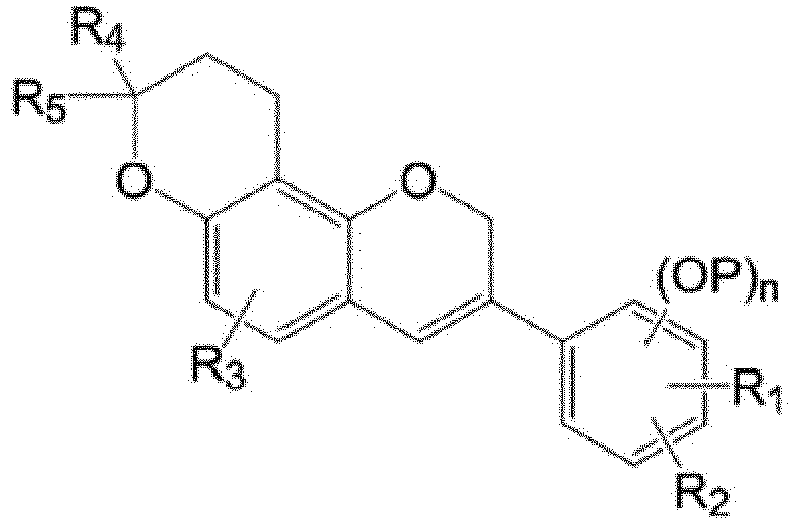 R1 und R2 jeweils unabhängig für ein Wasserstoffatom; eine substituierte oder unsubstituierte gerade oder verzweigte C1- bis C6-Alkylgruppe; ein Halogenatom; eine substituierte oder unsubstituierte gerade oder verzweigte C1- bis C6-Alkoxygruppe; eine substituierte oder unsubstituierte gerade oder verzweigte C1- bis C4-Thioalkylgruppe; eine substituierte oder unsubstituierte C6- bis C12-Arylgruppe; eine substituierte oder unsubstituierte Allyloxygruppe oder eine substituierte oder unsubstituierte C6- bis C12-Aryloxygruppe stehen;R3 für ein Wasserstoffatom, eine C1- bis C2-Alkylgruppe oder eine C1- bis C2-Alkoxygruppe steht; R4 und R5 jeweils unabhängig für ein Wasserstoffatom oder eine C1- bis C6-Alkylgruppe stehen;P eine Schutzgruppe bedeutet, bei der es sich um eine substituierte oder unsubstituierte Benzylgruppe oder Allylgruppe; eine tert-Butyldimethylsilyl(TBDMS)-Gruppe, eine tert-Butyldiphenylsilyl(TBDPS)-Gruppe; eine Methylphenylsilylgruppe; eine Trimethylphenylsilylgruppe; Methansulfonyl (MeSO2) oder p-Toluolsulfonyl (p-TsSO2) oder eine Trimethylphenylsulfonylgruppe handelt;n für eine ganze Zahl von 1 bis 3 steht;mehrere OP gleich oder voneinander verschieden sind undes sich im Fall der substituierten Alkylgruppe, der substituierten Alkoxygruppe, der substituierten Thioalkylgruppe, der substituierten Arylgruppe, der substituierten Allyloxygruppe, der substituierten Aryloxygruppe, der substituierten Benzylgruppe und der substituierten Allylgruppe bei dem Substituenten um ein Halogenatom, eine gerade oder verzweigte C1- bis C5-Alkylgruppe, eine gerade oder verzweigte C1- bis C5-Alkoxygruppe, eine gerade oder verzweigte C1- bis C3-Thioalkylgruppe oder eine Nitrogruppe handelt.
 - Verfahren nach Anspruch 2, wobei dann, wenn es sich bei dem 3-Phenyl-2,8-dihydropyrano[2,3-f]chromen-Derivat um die durch Formel (I-b) wiedergegebene Verbindung handelt,
Schritt C) das Herstellen einer durch die folgende Formel 4-b wiedergegebenen Verbindung durch selektives Reduzieren einer Kohlenstoff-Kohlenstoff-Doppelbindung eines Dihydropyranrings in der durch Formel 4 wiedergegebenen Verbindung umfasst: R1 und R2 jeweils unabhängig für ein Wasserstoffatom; eine substituierte oder unsubstituierte gerade oder verzweigte C1- bis C6-Alkylgruppe; ein Halogenatom; eine substituierte oder unsubstituierte gerade oder verzweigte C1- bis C6-Alkoxygruppe; eine substituierte oder unsubstituierte gerade oder verzweigte C1- bis C4-Thioalkylgruppe; eine substituierte oder unsubstituierte C6- bis C12-Arylgruppe; eine substituierte oder unsubstituierte Allyloxygruppe oder eine substituierte oder unsubstituierte C6- bis C12-Aryloxygruppe stehen;R3 für ein Wasserstoffatom, eine C1- bis C2-Alkylgruppe oder eine C1- bis C2-Alkoxygruppe steht;R4 und R5 jeweils unabhängig für ein Wasserstoffatom oder eine C1- bis C6-Alkylgruppe stehen;P eine Schutzgruppe bedeutet, bei der es sich um eine substituierte oder unsubstituierte Benzylgruppe oder Allylgruppe; eine tert-Butyldimethylsilyl(TBDMS)-Gruppe, eine tert-Butyl-diphenylsilyl(TBDPS)-Gruppe; eine Methylphenylsilylgruppe; eine Trimethylphenylsilylgruppe; Methansulfonyl (MeSO2) oder p-Toluolsulfonyl (p-TsSO2) oder eine Trimethylphenylsulfonylgruppe handelt;n für eine ganze Zahl von 1 bis 3 steht;mehrere OP gleich oder voneinander verschieden sind undes sich im Fall der substituierten Alkylgruppe, der substituierten Alkoxygruppe, der substituierten Thioalkylgruppe, der substituierten Arylgruppe, der substituierten Allyloxygruppe, der substituierten Aryloxygruppe, der substituierten Benzylgruppe und der substituierten Allylgruppe bei dem Substituenten um ein Halogenatom, eine gerade oder verzweigte C1- bis C5-Alkylgruppe, eine gerade oder verzweigte C1- bis C5-Alkoxygruppe, eine gerade oder verzweigte C1- bis C3-Thioalkylgruppe oder eine Nitrogruppe handelt.
 - Verfahren nach Anspruch 1, wobei die Kupplungsreaktion unter basischen Bedingungen durchgeführt wird.
- Verfahren nach Anspruch 4, wobei die basischen Bedingungen durch Zugabe einer oder mehrerer schwach basischer Verbindungen aus der Gruppe bestehend aus Ammoniak, Aluminiumhydroxid, Magnesiumhydroxid, Ammoniumhydroxid und Kaliumcarbonat erzeugt werden.
- Verfahren nach Anspruch 1, wobei die Cyclisierungsreaktion durch Verwendung eines Thiazoliumsalzes, eines Triazoliumsalzes oder eines 6,7-Dihydro-5H-pyrrolo[2,1-c][1,2,4]triazoliumsalzes als Katalysator durchgeführt wird.
- Verfahren nach Anspruch 1, wobei die reduktive Eliminierung in Gegenwart von niederwertigem Titan durchgeführt wird.
- Verbindung, die durch die folgende Formel 4 wiedergegeben wird, Salz oder Solvat davon:
 R1 und R2 jeweils unabhängig für ein Wasserstoffatom; eine substituierte oder unsubstituierte gerade oder verzweigte C1- bis C6-Alkylgruppe; ein Halogenatom; eine substituierte oder unsubstituierte gerade oder verzweigte C1- bis C6-Alkoxygruppe; eine substituierte oder unsubstituierte gerade oder verzweigte C1- bis C4-Thioalkylgruppe; eine substituierte oder unsubstituierte C6- bis C12-Arylgruppe; eine substituierte oder unsubstituierte Allyloxygruppe oder eine substituierte oder unsubstituierte C6- bis C12-Aryloxygruppe stehen;R3 für ein Wasserstoffatom, eine C1- bis C2-Alkylgruppe oder eine C1- bis C2-Alkoxygruppe steht;R4 und R5 jeweils unabhängig für ein Wasserstoffatom oder eine C1- bis C6-Alkylgruppe stehen;P eine Schutzgruppe bedeutet, bei der es sich um eine substituierte oder unsubstituierte Benzylgruppe oder Allylgruppe; eine tert-Butyldimethylsilyl(TBDMS)-Gruppe, eine tert-Butyldiphenylsilyl(TBDPS)-Gruppe; eine Methylphenylsilylgruppe; eine Trimethylphenylsilylgruppe;Methansulfonyl (MeSO2) oder p-Toluolsulfonyl (p-TsSO2) oder eine Trimethylphenylsulfonylgruppe handelt;n für eine ganze Zahl von 1 bis 3 steht;mehrere OP gleich oder voneinander verschieden sind undes sich im Fall der substituierten Alkylgruppe, der substituierten Alkoxygruppe, der substituierten Thioalkylgruppe, der substituierten Arylgruppe, der substituierten Allyloxygruppe, der substituierten Aryloxygruppe, der substituierten Benzylgruppe und der substituierten Allylgruppe bei dem Substituenten um ein Halogenatom, eine gerade oder verzweigte C1- bis C5-Alkylgruppe, eine gerade oder verzweigte C1- bis C5-Alkoxygruppe, eine gerade oder verzweigte C1- bis C3-Thioalkylgruppe oder eine Nitrogruppe handelt.
 - Verbindung, die durch die folgende Formel 4-b wiedergegeben wird, Salz oder Solvat davon:
 R1 und R2 jeweils unabhängig für ein Wasserstoffatom; eine substituierte oder unsubstituierte gerade oder verzweigte C1- bis C6-Alkylgruppe; ein Halogenatom; eine substituierte oder unsubstituierte gerade oder verzweigte C1- bis C6-Alkoxygruppe; eine substituierte oder unsubstituierte gerade oder verzweigte C1- bis C4-Thioalkylgruppe; eine substituierte oder unsubstituierte C6- bis C12-Arylgruppe; eine substituierte oder unsubstituierte Allyloxygruppe oder eine substituierte oder unsubstituierte C6- bis C12-Aryloxygruppe stehen;R3 für ein Wasserstoffatom, eine C1- bis C2-Alkylgruppe oder eine C1- bis C2-Alkoxygruppe steht; R4 und R5 jeweils unabhängig für ein Wasserstoffatom oder eine C1- bis C6-Alkylgruppe stehen;P eine Schutzgruppe bedeutet, bei der es sich um eine substituierte oder unsubstituierte Benzylgruppe oder Allylgruppe; eine tert-Butyldimethylsilyl(TBDMS)-Gruppe, eine tert-Butyldiphenylsilyl(TBDPS)-Gruppe; eine Methylphenylsilylgruppe; eine Trimethylphenylsilylgruppe; Methansulfonyl (MeSO2) oder p-Toluolsulfonyl (p-TsSO2) oder eine Trimethylphenylsulfonylgruppe handelt;n für eine ganze Zahl von 1 bis 3 steht;mehrere OP gleich oder voneinander verschieden sind undes sich im Fall der substituierten Alkylgruppe, der substituierten Alkoxygruppe, der substituierten Thioalkylgruppe, der substituierten Arylgruppe, der substituierten Allyloxygruppe, der substituierten Aryloxygruppe, der substituierten Benzylgruppe und der substituierten Allylgruppe bei dem Substituenten um ein Halogenatom, eine gerade oder verzweigte C1- bis C5-Alkylgruppe, eine gerade oder verzweigte C1- bis C5-Alkoxygruppe, eine gerade oder verzweigte C1- bis C3-Thioalkylgruppe oder eine Nitrogruppe handelt.
 - Verbindung, die durch die folgende Formel 5 wiedergegeben wird, Salz oder Solvat davon:

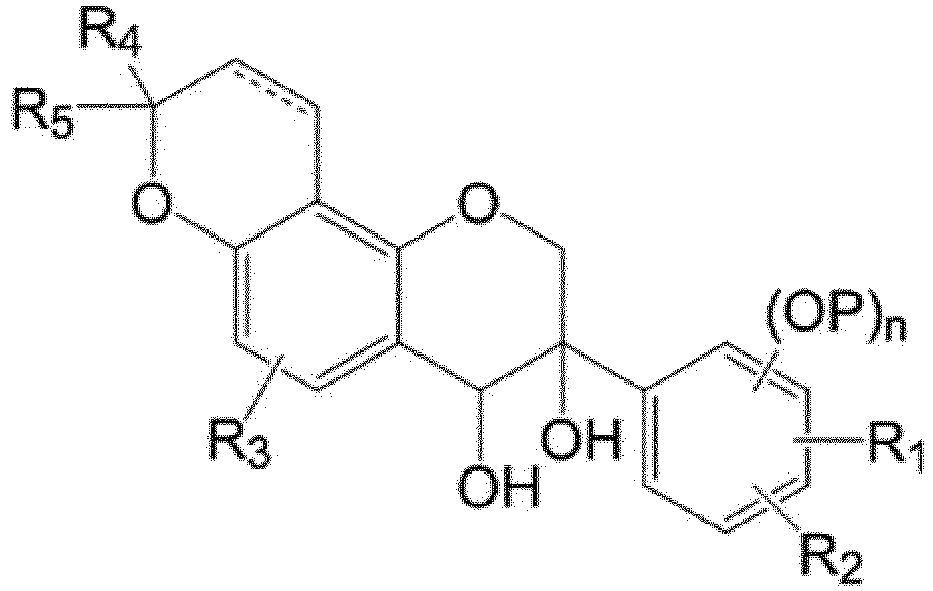 R1 und R2 jeweils unabhängig für ein Wasserstoffatom; eine substituierte oder unsubstituierte gerade oder verzweigte C1- bis C6-Alkylgruppe; ein Halogenatom; eine substituierte oder unsubstituierte gerade oder verzweigte C1- bis C6-Alkoxygruppe; eine substituierte oder unsubstituierte gerade oder verzweigte C1- bis C4-Thioalkylgruppe; eine substituierte oder unsubstituierte C6- bis C12-Arylgruppe; eine substituierte oder unsubstituierte Allyloxygruppe oder eine substituierte oder unsubstituierte C6- bis C12-Aryloxygruppe stehen;R3 für ein Wasserstoffatom, eine C1- bis C2-Alkylgruppe oder eine C1- bis C2-Alkoxygruppe steht;R4 und R5 jeweils unabhängig für ein Wasserstoffatom oder eine C1- bis C6-Alkylgruppe stehen;P eine Schutzgruppe bedeutet, bei der es sich um eine substituierte oder unsubstituierte Benzylgruppe oder Allylgruppe; eine tert-Butyldimethylsilyl(TBDMS)-Gruppe, eine tert-Butyl-diphenylsilyl(TBDPS)-Gruppe; eine Methylphenylsilylgruppe; eine Trimethylphenylsilylgruppe;Methansulfonyl (MeSO2) oder p-Toluolsulfonyl (p-TsSO2) oder eine Trimethylphenylsulfonylgruppe handelt;eine gestrichelte Linie eine selektive Doppelbindung ist;n für eine ganze Zahl von 1 bis 3 steht;mehrere OP gleich oder voneinander verschieden sind undes sich im Fall der substituierten Alkylgruppe, der substituierten Alkoxygruppe, der substituierten Thioalkylgruppe, der substituierten Arylgruppe, der substituierten Allyloxygruppe, der substituierten Aryloxygruppe, der substituierten Benzylgruppe und der substituierten Allylgruppe bei dem Substituenten um ein Halogenatom, eine gerade oder verzweigte C1- bis C5-Alkylgruppe, eine gerade oder verzweigte C1- bis C5-Alkoxygruppe, eine gerade oder verzweigte C1- bis C3-Thioalkylgruppe oder eine Nitrogruppe handelt.
Applications Claiming Priority (2)
| Application Number | Priority Date | Filing Date | Title |
|---|---|---|---|
| KR20180038894 | 2018-04-03 | ||
| PCT/KR2019/003958 WO2019194582A1 (ko) | 2018-04-03 | 2019-04-03 | 3-페닐-2,8-디히드로피라노[2,3-f]크로멘 유도체의 합성 방법 |
Publications (3)
| Publication Number | Publication Date |
|---|---|
| EP3782999A1 EP3782999A1 (de) | 2021-02-24 |
| EP3782999A4 EP3782999A4 (de) | 2021-12-22 |
| EP3782999B1 true EP3782999B1 (de) | 2023-05-10 |
Family
ID=68100957
Family Applications (1)
| Application Number | Title | Priority Date | Filing Date |
|---|---|---|---|
| EP19782372.7A Active EP3782999B1 (de) | 2018-04-03 | 2019-04-03 | Verfahren zur herstellung von 3-phenyl-2,8-dihydropyrano[2,3-f]-chromenderivat |
Country Status (12)
| Country | Link |
|---|---|
| US (1) | US11420978B2 (de) |
| EP (1) | EP3782999B1 (de) |
| JP (1) | JP7350771B2 (de) |
| KR (1) | KR102795511B1 (de) |
| CN (1) | CN111989330B (de) |
| AR (1) | AR121418A1 (de) |
| CA (1) | CA3094086A1 (de) |
| DK (1) | DK3782999T3 (de) |
| ES (1) | ES2948635T3 (de) |
| PL (1) | PL3782999T3 (de) |
| TW (1) | TWI804600B (de) |
| WO (1) | WO2019194582A1 (de) |
Families Citing this family (2)
| Publication number | Priority date | Publication date | Assignee | Title |
|---|---|---|---|---|
| WO2023200189A1 (ko) | 2022-04-12 | 2023-10-19 | 주식회사 글라세움 | 3-페닐-2,3,4,8,9,10-헥사히드로피라노[2,3-f]크로멘 유도체의 합성 방법 |
| CN119192191B (zh) * | 2024-11-25 | 2025-03-04 | 山东第一医科大学(山东省医学科学院) | 甲氧基化光甘草定类似物及其制备方法及应用 |
Family Cites Families (8)
| Publication number | Priority date | Publication date | Assignee | Title |
|---|---|---|---|---|
| KR100565423B1 (ko) * | 2003-10-20 | 2006-03-30 | 빅 바이오 주식회사 | 이소플라반 유도체 또는 이소플라벤 유도체의 제조방법 |
| JP2006008605A (ja) * | 2004-06-25 | 2006-01-12 | Kuraray Co Ltd | イソフラバノン誘導体の製造方法 |
| JP2006008604A (ja) * | 2004-06-25 | 2006-01-12 | Kuraray Co Ltd | イソフラバン誘導体の製造方法 |
| WO2006085562A1 (ja) * | 2005-02-09 | 2006-08-17 | Kaneka Corporation | メタボリックシンドローム及びインスリン抵抗性症候群の予防及び/又は処置用組成物 |
| CN103030647B (zh) * | 2013-01-16 | 2014-10-29 | 山东省分析测试中心 | 一种光甘草定的合成方法 |
| KR102344479B1 (ko) * | 2013-12-24 | 2021-12-29 | 주식회사 글라세움 | 피라노크로메닐페놀 유도체, 및 대사증후군 또는 염증 질환 치료용 약학 조성물 |
| HUE055701T2 (hu) * | 2016-10-04 | 2021-12-28 | Glaceum Inc | Eljárás 3-fenil-2,3,4,8,9,10-hexahidropirano[2,3-f]kromén származékok, azok optikai izomere elõállítására és az eljárás intermedierjei |
| KR20180038894A (ko) | 2016-10-07 | 2018-04-17 | 이은지 | 황금비율 이동식 테이블 |
-
2019
- 2019-04-01 TW TW108111503A patent/TWI804600B/zh active
- 2019-04-03 PL PL19782372.7T patent/PL3782999T3/pl unknown
- 2019-04-03 DK DK19782372.7T patent/DK3782999T3/da active
- 2019-04-03 CN CN201980023715.XA patent/CN111989330B/zh active Active
- 2019-04-03 JP JP2020554121A patent/JP7350771B2/ja active Active
- 2019-04-03 AR ARP190100869A patent/AR121418A1/es unknown
- 2019-04-03 CA CA3094086A patent/CA3094086A1/en active Pending
- 2019-04-03 US US17/044,481 patent/US11420978B2/en active Active
- 2019-04-03 ES ES19782372T patent/ES2948635T3/es active Active
- 2019-04-03 KR KR1020190038966A patent/KR102795511B1/ko active Active
- 2019-04-03 WO PCT/KR2019/003958 patent/WO2019194582A1/ko not_active Ceased
- 2019-04-03 EP EP19782372.7A patent/EP3782999B1/de active Active
Also Published As
| Publication number | Publication date |
|---|---|
| JP7350771B2 (ja) | 2023-09-26 |
| ES2948635T3 (es) | 2023-09-15 |
| EP3782999A1 (de) | 2021-02-24 |
| JP2021520361A (ja) | 2021-08-19 |
| US11420978B2 (en) | 2022-08-23 |
| US20210040106A1 (en) | 2021-02-11 |
| CA3094086A1 (en) | 2019-10-10 |
| KR20190116100A (ko) | 2019-10-14 |
| EP3782999A4 (de) | 2021-12-22 |
| KR102795511B1 (ko) | 2025-04-16 |
| CN111989330A (zh) | 2020-11-24 |
| PL3782999T3 (pl) | 2023-08-14 |
| TWI804600B (zh) | 2023-06-11 |
| TW202003523A (zh) | 2020-01-16 |
| AR121418A1 (es) | 2022-06-08 |
| WO2019194582A1 (ko) | 2019-10-10 |
| CN111989330B (zh) | 2023-07-25 |
| DK3782999T3 (da) | 2023-08-07 |
Similar Documents
| Publication | Publication Date | Title |
|---|---|---|
| US10947250B2 (en) | 3-phenyl-2,3,4,8,9,10-hexahydropyrano[2,3-f]chromene derivative and method for synthesizing optical isomer thereof | |
| JP5455636B2 (ja) | アリール化合物、その水和物、その溶媒化物、その立体異性体、または、その薬学的に許容される塩、アリール化合物の製造方法、及び、アリール化合物等の用途 | |
| RU2444518C2 (ru) | ПРОИЗВОДНОЕ ТИАЗОЛА КАК PPARδ ЛИГАНД И ФАРМАЦЕВТИЧЕСКИЙ, КОСМЕТИЧЕСКИЙ И ДИЕТИЧЕСКИЙ ПИЩЕВОЙ ПРОДУКТ, СОДЕРЖАЩИЙ ЕГО | |
| US11643405B2 (en) | Compound for treatment or prevention of liver diseases | |
| EP3214079B1 (de) | Benzoderivate mit sechsgliedrigem ring als dpp-4-inhibitor und verwendung davon | |
| Aitha et al. | Antioxidant activity of novel 4H-chromene tethered 1, 2, 3-triazole analogues: Synthesis and molecular docking studies | |
| EP3782999B1 (de) | Verfahren zur herstellung von 3-phenyl-2,8-dihydropyrano[2,3-f]-chromenderivat | |
| CN116157387A (zh) | 异喹啉化合物及其在治疗AhR失衡中的用途 | |
| JPH04210683A (ja) | チアゾリジン−2,4−ジオン誘導体およびこれを含有する糖尿病合併症治療薬 | |
| CN1106391C (zh) | 厚朴酚系列化合物及其合成方法和以该化合物为活性成分的药物组合物 | |
| WO2015102369A1 (ko) | 1,2 나프토퀴논 유도체 및 이의 제조방법 | |
| RU2510394C1 (ru) | Производное селеназола, имеющее лиганд, который активирует рецептор, активируемый пролифератором пероксисом ( ppar ), способ его получения и применение химических соединений | |
| CN1045443C (zh) | 新型嘌呤衍生物及其药学上允许的盐 | |
| HK40041204A (en) | Method for synthesizing 3-phenyl-2,8-dihydropyrano [2,3-f] chromene derivative | |
| HK40041204B (zh) | 用於合成3-苯基-2,8-二氢吡喃并[2,3-f]色烯衍生物的方法 | |
| CN114423775B (zh) | 一类芳基葡糖苷衍生物及其制备方法和应用 | |
| Ikhtiarudin et al. | Microwave-assisted synthesis and in vivo anti-diabetic activity of 5-(2-bromophenyl)-3-(naphthalen-1-yl)-4, 5-dihydro-1H-pyrazole | |
| CN113493374A (zh) | Sirt1受体激动剂及包含其的药物 | |
| HK40008740A (en) | 3-phenyl-2,3,4,8,9,10-hexahydropyrano[2,3-f]chromene derivative and method for synthesizing optical isomer thereof | |
| JP6272604B2 (ja) | 糖取り込み促進剤 | |
| HK40046565A (en) | Compounds for treatment or prevention of liver diseases | |
| TW202104204A (zh) | 用於肝病治療或預防的化合物 | |
| Aitha et al. | Results in Chemistry |
Legal Events
| Date | Code | Title | Description |
|---|---|---|---|
| STAA | Information on the status of an ep patent application or granted ep patent |
Free format text: STATUS: THE INTERNATIONAL PUBLICATION HAS BEEN MADE |
|
| PUAI | Public reference made under article 153(3) epc to a published international application that has entered the european phase |
Free format text: ORIGINAL CODE: 0009012 |
|
| STAA | Information on the status of an ep patent application or granted ep patent |
Free format text: STATUS: REQUEST FOR EXAMINATION WAS MADE |
|
| 17P | Request for examination filed |
Effective date: 20200929 |
|
| AK | Designated contracting states |
Kind code of ref document: A1 Designated state(s): AL AT BE BG CH CY CZ DE DK EE ES FI FR GB GR HR HU IE IS IT LI LT LU LV MC MK MT NL NO PL PT RO RS SE SI SK SM TR |
|
| AX | Request for extension of the european patent |
Extension state: BA ME |
|
| DAV | Request for validation of the european patent (deleted) | ||
| DAX | Request for extension of the european patent (deleted) | ||
| A4 | Supplementary search report drawn up and despatched |
Effective date: 20211118 |
|
| RIC1 | Information provided on ipc code assigned before grant |
Ipc: A61P 3/10 20060101ALI20211112BHEP Ipc: A61P 3/04 20060101ALI20211112BHEP Ipc: A61K 31/352 20060101ALI20211112BHEP Ipc: C07D 493/04 20060101AFI20211112BHEP |
|
| GRAP | Despatch of communication of intention to grant a patent |
Free format text: ORIGINAL CODE: EPIDOSNIGR1 |
|
| STAA | Information on the status of an ep patent application or granted ep patent |
Free format text: STATUS: GRANT OF PATENT IS INTENDED |
|
| INTG | Intention to grant announced |
Effective date: 20221107 |
|
| GRAS | Grant fee paid |
Free format text: ORIGINAL CODE: EPIDOSNIGR3 |
|
| GRAA | (expected) grant |
Free format text: ORIGINAL CODE: 0009210 |
|
| STAA | Information on the status of an ep patent application or granted ep patent |
Free format text: STATUS: THE PATENT HAS BEEN GRANTED |
|
| AK | Designated contracting states |
Kind code of ref document: B1 Designated state(s): AL AT BE BG CH CY CZ DE DK EE ES FI FR GB GR HR HU IE IS IT LI LT LU LV MC MK MT NL NO PL PT RO RS SE SI SK SM TR |
|
| REG | Reference to a national code |
Ref country code: GB Ref legal event code: FG4D |
|
| REG | Reference to a national code |
Ref country code: AT Ref legal event code: REF Ref document number: 1566575 Country of ref document: AT Kind code of ref document: T Effective date: 20230515 Ref country code: CH Ref legal event code: EP |
|
| REG | Reference to a national code |
Ref country code: DE Ref legal event code: R096 Ref document number: 602019028821 Country of ref document: DE |
|
| REG | Reference to a national code |
Ref country code: IE Ref legal event code: FG4D |
|
| REG | Reference to a national code |
Ref country code: DK Ref legal event code: T3 Effective date: 20230804 |
|
| REG | Reference to a national code |
Ref country code: NO Ref legal event code: T2 Effective date: 20230510 |
|
| REG | Reference to a national code |
Ref country code: SE Ref legal event code: TRGR |
|
| REG | Reference to a national code |
Ref country code: NL Ref legal event code: FP |
|
| REG | Reference to a national code |
Ref country code: LT Ref legal event code: MG9D |
|
| REG | Reference to a national code |
Ref country code: ES Ref legal event code: FG2A Ref document number: 2948635 Country of ref document: ES Kind code of ref document: T3 Effective date: 20230915 |
|
| REG | Reference to a national code |
Ref country code: AT Ref legal event code: MK05 Ref document number: 1566575 Country of ref document: AT Kind code of ref document: T Effective date: 20230510 |
|
| PG25 | Lapsed in a contracting state [announced via postgrant information from national office to epo] |
Ref country code: PT Free format text: LAPSE BECAUSE OF FAILURE TO SUBMIT A TRANSLATION OF THE DESCRIPTION OR TO PAY THE FEE WITHIN THE PRESCRIBED TIME-LIMIT Effective date: 20230911 Ref country code: AT Free format text: LAPSE BECAUSE OF FAILURE TO SUBMIT A TRANSLATION OF THE DESCRIPTION OR TO PAY THE FEE WITHIN THE PRESCRIBED TIME-LIMIT Effective date: 20230510 |
|
| PG25 | Lapsed in a contracting state [announced via postgrant information from national office to epo] |
Ref country code: RS Free format text: LAPSE BECAUSE OF FAILURE TO SUBMIT A TRANSLATION OF THE DESCRIPTION OR TO PAY THE FEE WITHIN THE PRESCRIBED TIME-LIMIT Effective date: 20230510 Ref country code: LV Free format text: LAPSE BECAUSE OF FAILURE TO SUBMIT A TRANSLATION OF THE DESCRIPTION OR TO PAY THE FEE WITHIN THE PRESCRIBED TIME-LIMIT Effective date: 20230510 Ref country code: LT Free format text: LAPSE BECAUSE OF FAILURE TO SUBMIT A TRANSLATION OF THE DESCRIPTION OR TO PAY THE FEE WITHIN THE PRESCRIBED TIME-LIMIT Effective date: 20230510 Ref country code: IS Free format text: LAPSE BECAUSE OF FAILURE TO SUBMIT A TRANSLATION OF THE DESCRIPTION OR TO PAY THE FEE WITHIN THE PRESCRIBED TIME-LIMIT Effective date: 20230910 Ref country code: HR Free format text: LAPSE BECAUSE OF FAILURE TO SUBMIT A TRANSLATION OF THE DESCRIPTION OR TO PAY THE FEE WITHIN THE PRESCRIBED TIME-LIMIT Effective date: 20230510 Ref country code: GR Free format text: LAPSE BECAUSE OF FAILURE TO SUBMIT A TRANSLATION OF THE DESCRIPTION OR TO PAY THE FEE WITHIN THE PRESCRIBED TIME-LIMIT Effective date: 20230811 |
|
| PG25 | Lapsed in a contracting state [announced via postgrant information from national office to epo] |
Ref country code: FI Free format text: LAPSE BECAUSE OF FAILURE TO SUBMIT A TRANSLATION OF THE DESCRIPTION OR TO PAY THE FEE WITHIN THE PRESCRIBED TIME-LIMIT Effective date: 20230510 |
|
| PG25 | Lapsed in a contracting state [announced via postgrant information from national office to epo] |
Ref country code: SK Free format text: LAPSE BECAUSE OF FAILURE TO SUBMIT A TRANSLATION OF THE DESCRIPTION OR TO PAY THE FEE WITHIN THE PRESCRIBED TIME-LIMIT Effective date: 20230510 |
|
| PG25 | Lapsed in a contracting state [announced via postgrant information from national office to epo] |
Ref country code: SM Free format text: LAPSE BECAUSE OF FAILURE TO SUBMIT A TRANSLATION OF THE DESCRIPTION OR TO PAY THE FEE WITHIN THE PRESCRIBED TIME-LIMIT Effective date: 20230510 Ref country code: SK Free format text: LAPSE BECAUSE OF FAILURE TO SUBMIT A TRANSLATION OF THE DESCRIPTION OR TO PAY THE FEE WITHIN THE PRESCRIBED TIME-LIMIT Effective date: 20230510 Ref country code: RO Free format text: LAPSE BECAUSE OF FAILURE TO SUBMIT A TRANSLATION OF THE DESCRIPTION OR TO PAY THE FEE WITHIN THE PRESCRIBED TIME-LIMIT Effective date: 20230510 Ref country code: EE Free format text: LAPSE BECAUSE OF FAILURE TO SUBMIT A TRANSLATION OF THE DESCRIPTION OR TO PAY THE FEE WITHIN THE PRESCRIBED TIME-LIMIT Effective date: 20230510 Ref country code: CZ Free format text: LAPSE BECAUSE OF FAILURE TO SUBMIT A TRANSLATION OF THE DESCRIPTION OR TO PAY THE FEE WITHIN THE PRESCRIBED TIME-LIMIT Effective date: 20230510 |
|
| REG | Reference to a national code |
Ref country code: DE Ref legal event code: R097 Ref document number: 602019028821 Country of ref document: DE |
|
| PLBE | No opposition filed within time limit |
Free format text: ORIGINAL CODE: 0009261 |
|
| STAA | Information on the status of an ep patent application or granted ep patent |
Free format text: STATUS: NO OPPOSITION FILED WITHIN TIME LIMIT |
|
| 26N | No opposition filed |
Effective date: 20240213 |
|
| PG25 | Lapsed in a contracting state [announced via postgrant information from national office to epo] |
Ref country code: SI Free format text: LAPSE BECAUSE OF FAILURE TO SUBMIT A TRANSLATION OF THE DESCRIPTION OR TO PAY THE FEE WITHIN THE PRESCRIBED TIME-LIMIT Effective date: 20230510 |
|
| PG25 | Lapsed in a contracting state [announced via postgrant information from national office to epo] |
Ref country code: SI Free format text: LAPSE BECAUSE OF FAILURE TO SUBMIT A TRANSLATION OF THE DESCRIPTION OR TO PAY THE FEE WITHIN THE PRESCRIBED TIME-LIMIT Effective date: 20230510 |
|
| PG25 | Lapsed in a contracting state [announced via postgrant information from national office to epo] |
Ref country code: BG Free format text: LAPSE BECAUSE OF FAILURE TO SUBMIT A TRANSLATION OF THE DESCRIPTION OR TO PAY THE FEE WITHIN THE PRESCRIBED TIME-LIMIT Effective date: 20230510 |
|
| PG25 | Lapsed in a contracting state [announced via postgrant information from national office to epo] |
Ref country code: MC Free format text: LAPSE BECAUSE OF FAILURE TO SUBMIT A TRANSLATION OF THE DESCRIPTION OR TO PAY THE FEE WITHIN THE PRESCRIBED TIME-LIMIT Effective date: 20230510 |
|
| PG25 | Lapsed in a contracting state [announced via postgrant information from national office to epo] |
Ref country code: MC Free format text: LAPSE BECAUSE OF FAILURE TO SUBMIT A TRANSLATION OF THE DESCRIPTION OR TO PAY THE FEE WITHIN THE PRESCRIBED TIME-LIMIT Effective date: 20230510 Ref country code: BG Free format text: LAPSE BECAUSE OF FAILURE TO SUBMIT A TRANSLATION OF THE DESCRIPTION OR TO PAY THE FEE WITHIN THE PRESCRIBED TIME-LIMIT Effective date: 20230510 |
|
| PG25 | Lapsed in a contracting state [announced via postgrant information from national office to epo] |
Ref country code: LU Free format text: LAPSE BECAUSE OF NON-PAYMENT OF DUE FEES Effective date: 20240403 |
|
| PG25 | Lapsed in a contracting state [announced via postgrant information from national office to epo] |
Ref country code: LU Free format text: LAPSE BECAUSE OF NON-PAYMENT OF DUE FEES Effective date: 20240403 |
|
| PGFP | Annual fee paid to national office [announced via postgrant information from national office to epo] |
Ref country code: SE Payment date: 20250324 Year of fee payment: 7 |
|
| PGFP | Annual fee paid to national office [announced via postgrant information from national office to epo] |
Ref country code: DK Payment date: 20250324 Year of fee payment: 7 |
|
| PGFP | Annual fee paid to national office [announced via postgrant information from national office to epo] |
Ref country code: IE Payment date: 20250324 Year of fee payment: 7 |
|
| PGFP | Annual fee paid to national office [announced via postgrant information from national office to epo] |
Ref country code: NO Payment date: 20250325 Year of fee payment: 7 |
|
| PGFP | Annual fee paid to national office [announced via postgrant information from national office to epo] |
Ref country code: BE Payment date: 20250324 Year of fee payment: 7 |
|
| PGFP | Annual fee paid to national office [announced via postgrant information from national office to epo] |
Ref country code: FR Payment date: 20250324 Year of fee payment: 7 Ref country code: PL Payment date: 20250325 Year of fee payment: 7 |
|
| PGFP | Annual fee paid to national office [announced via postgrant information from national office to epo] |
Ref country code: IT Payment date: 20250325 Year of fee payment: 7 Ref country code: GB Payment date: 20250324 Year of fee payment: 7 |
|
| PGFP | Annual fee paid to national office [announced via postgrant information from national office to epo] |
Ref country code: DE Payment date: 20250326 Year of fee payment: 7 |
|
| PGFP | Annual fee paid to national office [announced via postgrant information from national office to epo] |
Ref country code: ES Payment date: 20250501 Year of fee payment: 7 |
|
| PGFP | Annual fee paid to national office [announced via postgrant information from national office to epo] |
Ref country code: CH Payment date: 20250501 Year of fee payment: 7 |
|
| PG25 | Lapsed in a contracting state [announced via postgrant information from national office to epo] |
Ref country code: CY Free format text: LAPSE BECAUSE OF FAILURE TO SUBMIT A TRANSLATION OF THE DESCRIPTION OR TO PAY THE FEE WITHIN THE PRESCRIBED TIME-LIMIT; INVALID AB INITIO Effective date: 20190403 |
|
| PG25 | Lapsed in a contracting state [announced via postgrant information from national office to epo] |
Ref country code: HU Free format text: LAPSE BECAUSE OF FAILURE TO SUBMIT A TRANSLATION OF THE DESCRIPTION OR TO PAY THE FEE WITHIN THE PRESCRIBED TIME-LIMIT; INVALID AB INITIO Effective date: 20190403 |
|
| PG25 | Lapsed in a contracting state [announced via postgrant information from national office to epo] |
Ref country code: TR Free format text: LAPSE BECAUSE OF FAILURE TO SUBMIT A TRANSLATION OF THE DESCRIPTION OR TO PAY THE FEE WITHIN THE PRESCRIBED TIME-LIMIT Effective date: 20230510 |
|
| PGFP | Annual fee paid to national office [announced via postgrant information from national office to epo] |
Ref country code: NL Payment date: 20260213 Year of fee payment: 8 |