EP3781550B1 - Bicyclic carboxamides and methods of use thereof - Google Patents
Bicyclic carboxamides and methods of use thereof Download PDFInfo
- Publication number
- EP3781550B1 EP3781550B1 EP19725441.0A EP19725441A EP3781550B1 EP 3781550 B1 EP3781550 B1 EP 3781550B1 EP 19725441 A EP19725441 A EP 19725441A EP 3781550 B1 EP3781550 B1 EP 3781550B1
- Authority
- EP
- European Patent Office
- Prior art keywords
- carboxamido
- spiro
- heptane
- carboxylic acid
- fluoro
- Prior art date
- Legal status (The legal status is an assumption and is not a legal conclusion. Google has not performed a legal analysis and makes no representation as to the accuracy of the status listed.)
- Active
Links
Images


Classifications
-
- C—CHEMISTRY; METALLURGY
- C07—ORGANIC CHEMISTRY
- C07D—HETEROCYCLIC COMPOUNDS
- C07D209/00—Heterocyclic compounds containing five-membered rings, condensed with other rings, with one nitrogen atom as the only ring hetero atom
- C07D209/02—Heterocyclic compounds containing five-membered rings, condensed with other rings, with one nitrogen atom as the only ring hetero atom condensed with one carbocyclic ring
- C07D209/04—Indoles; Hydrogenated indoles
- C07D209/08—Indoles; Hydrogenated indoles with only hydrogen atoms or radicals containing only hydrogen and carbon atoms, directly attached to carbon atoms of the hetero ring
-
- A—HUMAN NECESSITIES
- A61—MEDICAL OR VETERINARY SCIENCE; HYGIENE
- A61K—PREPARATIONS FOR MEDICAL, DENTAL OR TOILETRY PURPOSES
- A61K31/00—Medicinal preparations containing organic active ingredients
- A61K31/33—Heterocyclic compounds
- A61K31/395—Heterocyclic compounds having nitrogen as a ring hetero atom, e.g. guanethidine or rifamycins
- A61K31/40—Heterocyclic compounds having nitrogen as a ring hetero atom, e.g. guanethidine or rifamycins having five-membered rings with one nitrogen as the only ring hetero atom, e.g. sulpiride, succinimide, tolmetin, buflomedil
- A61K31/403—Heterocyclic compounds having nitrogen as a ring hetero atom, e.g. guanethidine or rifamycins having five-membered rings with one nitrogen as the only ring hetero atom, e.g. sulpiride, succinimide, tolmetin, buflomedil condensed with carbocyclic rings, e.g. carbazole
- A61K31/404—Indoles, e.g. pindolol
- A61K31/4045—Indole-alkylamines; Amides thereof, e.g. serotonin, melatonin
-
- A—HUMAN NECESSITIES
- A61—MEDICAL OR VETERINARY SCIENCE; HYGIENE
- A61K—PREPARATIONS FOR MEDICAL, DENTAL OR TOILETRY PURPOSES
- A61K31/00—Medicinal preparations containing organic active ingredients
- A61K31/33—Heterocyclic compounds
- A61K31/395—Heterocyclic compounds having nitrogen as a ring hetero atom, e.g. guanethidine or rifamycins
- A61K31/41—Heterocyclic compounds having nitrogen as a ring hetero atom, e.g. guanethidine or rifamycins having five-membered rings with two or more ring hetero atoms, at least one of which being nitrogen, e.g. tetrazole
- A61K31/415—1,2-Diazoles
- A61K31/416—1,2-Diazoles condensed with carbocyclic ring systems, e.g. indazole
-
- A—HUMAN NECESSITIES
- A61—MEDICAL OR VETERINARY SCIENCE; HYGIENE
- A61K—PREPARATIONS FOR MEDICAL, DENTAL OR TOILETRY PURPOSES
- A61K31/00—Medicinal preparations containing organic active ingredients
- A61K31/33—Heterocyclic compounds
- A61K31/395—Heterocyclic compounds having nitrogen as a ring hetero atom, e.g. guanethidine or rifamycins
- A61K31/435—Heterocyclic compounds having nitrogen as a ring hetero atom, e.g. guanethidine or rifamycins having six-membered rings with one nitrogen as the only ring hetero atom
- A61K31/44—Non condensed pyridines; Hydrogenated derivatives thereof
- A61K31/4427—Non condensed pyridines; Hydrogenated derivatives thereof containing further heterocyclic ring systems
- A61K31/4439—Non condensed pyridines; Hydrogenated derivatives thereof containing further heterocyclic ring systems containing a five-membered ring with nitrogen as a ring hetero atom, e.g. omeprazole
-
- A—HUMAN NECESSITIES
- A61—MEDICAL OR VETERINARY SCIENCE; HYGIENE
- A61K—PREPARATIONS FOR MEDICAL, DENTAL OR TOILETRY PURPOSES
- A61K31/00—Medicinal preparations containing organic active ingredients
- A61K31/33—Heterocyclic compounds
- A61K31/395—Heterocyclic compounds having nitrogen as a ring hetero atom, e.g. guanethidine or rifamycins
- A61K31/495—Heterocyclic compounds having nitrogen as a ring hetero atom, e.g. guanethidine or rifamycins having six-membered rings with two or more nitrogen atoms as the only ring heteroatoms, e.g. piperazine or tetrazines
- A61K31/505—Pyrimidines; Hydrogenated pyrimidines, e.g. trimethoprim
- A61K31/506—Pyrimidines; Hydrogenated pyrimidines, e.g. trimethoprim not condensed and containing further heterocyclic rings
-
- A—HUMAN NECESSITIES
- A61—MEDICAL OR VETERINARY SCIENCE; HYGIENE
- A61K—PREPARATIONS FOR MEDICAL, DENTAL OR TOILETRY PURPOSES
- A61K31/00—Medicinal preparations containing organic active ingredients
- A61K31/33—Heterocyclic compounds
- A61K31/395—Heterocyclic compounds having nitrogen as a ring hetero atom, e.g. guanethidine or rifamycins
- A61K31/535—Heterocyclic compounds having nitrogen as a ring hetero atom, e.g. guanethidine or rifamycins having six-membered rings with at least one nitrogen and one oxygen as the ring hetero atoms, e.g. 1,2-oxazines
- A61K31/5375—1,4-Oxazines, e.g. morpholine
- A61K31/5377—1,4-Oxazines, e.g. morpholine not condensed and containing further heterocyclic rings, e.g. timolol
-
- A—HUMAN NECESSITIES
- A61—MEDICAL OR VETERINARY SCIENCE; HYGIENE
- A61P—SPECIFIC THERAPEUTIC ACTIVITY OF CHEMICAL COMPOUNDS OR MEDICINAL PREPARATIONS
- A61P29/00—Non-central analgesic, antipyretic or antiinflammatory agents, e.g. antirheumatic agents; Non-steroidal antiinflammatory drugs [NSAID]
-
- A—HUMAN NECESSITIES
- A61—MEDICAL OR VETERINARY SCIENCE; HYGIENE
- A61P—SPECIFIC THERAPEUTIC ACTIVITY OF CHEMICAL COMPOUNDS OR MEDICINAL PREPARATIONS
- A61P35/00—Antineoplastic agents
-
- C—CHEMISTRY; METALLURGY
- C07—ORGANIC CHEMISTRY
- C07D—HETEROCYCLIC COMPOUNDS
- C07D209/00—Heterocyclic compounds containing five-membered rings, condensed with other rings, with one nitrogen atom as the only ring hetero atom
- C07D209/02—Heterocyclic compounds containing five-membered rings, condensed with other rings, with one nitrogen atom as the only ring hetero atom condensed with one carbocyclic ring
- C07D209/04—Indoles; Hydrogenated indoles
- C07D209/30—Indoles; Hydrogenated indoles with hetero atoms or with carbon atoms having three bonds to hetero atoms with at the most one bond to halogen, directly attached to carbon atoms of the hetero ring
- C07D209/42—Carbon atoms having three bonds to hetero atoms with at the most one bond to halogen, e.g. ester or nitrile radicals
-
- C—CHEMISTRY; METALLURGY
- C07—ORGANIC CHEMISTRY
- C07D—HETEROCYCLIC COMPOUNDS
- C07D231/00—Heterocyclic compounds containing 1,2-diazole or hydrogenated 1,2-diazole rings
- C07D231/54—Heterocyclic compounds containing 1,2-diazole or hydrogenated 1,2-diazole rings condensed with carbocyclic rings or ring systems
- C07D231/56—Benzopyrazoles; Hydrogenated benzopyrazoles
-
- C—CHEMISTRY; METALLURGY
- C07—ORGANIC CHEMISTRY
- C07D—HETEROCYCLIC COMPOUNDS
- C07D401/00—Heterocyclic compounds containing two or more hetero rings, having nitrogen atoms as the only ring hetero atoms, at least one ring being a six-membered ring with only one nitrogen atom
- C07D401/02—Heterocyclic compounds containing two or more hetero rings, having nitrogen atoms as the only ring hetero atoms, at least one ring being a six-membered ring with only one nitrogen atom containing two hetero rings
- C07D401/10—Heterocyclic compounds containing two or more hetero rings, having nitrogen atoms as the only ring hetero atoms, at least one ring being a six-membered ring with only one nitrogen atom containing two hetero rings linked by a carbon chain containing aromatic rings
-
- C—CHEMISTRY; METALLURGY
- C07—ORGANIC CHEMISTRY
- C07D—HETEROCYCLIC COMPOUNDS
- C07D403/00—Heterocyclic compounds containing two or more hetero rings, having nitrogen atoms as the only ring hetero atoms, not provided for by group C07D401/00
- C07D403/02—Heterocyclic compounds containing two or more hetero rings, having nitrogen atoms as the only ring hetero atoms, not provided for by group C07D401/00 containing two hetero rings
- C07D403/10—Heterocyclic compounds containing two or more hetero rings, having nitrogen atoms as the only ring hetero atoms, not provided for by group C07D401/00 containing two hetero rings linked by a carbon chain containing aromatic rings
-
- C—CHEMISTRY; METALLURGY
- C07—ORGANIC CHEMISTRY
- C07D—HETEROCYCLIC COMPOUNDS
- C07D405/00—Heterocyclic compounds containing both one or more hetero rings having oxygen atoms as the only ring hetero atoms, and one or more rings having nitrogen as the only ring hetero atom
- C07D405/02—Heterocyclic compounds containing both one or more hetero rings having oxygen atoms as the only ring hetero atoms, and one or more rings having nitrogen as the only ring hetero atom containing two hetero rings
- C07D405/04—Heterocyclic compounds containing both one or more hetero rings having oxygen atoms as the only ring hetero atoms, and one or more rings having nitrogen as the only ring hetero atom containing two hetero rings directly linked by a ring-member-to-ring-member bond
-
- C—CHEMISTRY; METALLURGY
- C07—ORGANIC CHEMISTRY
- C07D—HETEROCYCLIC COMPOUNDS
- C07D405/00—Heterocyclic compounds containing both one or more hetero rings having oxygen atoms as the only ring hetero atoms, and one or more rings having nitrogen as the only ring hetero atom
- C07D405/02—Heterocyclic compounds containing both one or more hetero rings having oxygen atoms as the only ring hetero atoms, and one or more rings having nitrogen as the only ring hetero atom containing two hetero rings
- C07D405/12—Heterocyclic compounds containing both one or more hetero rings having oxygen atoms as the only ring hetero atoms, and one or more rings having nitrogen as the only ring hetero atom containing two hetero rings linked by a chain containing hetero atoms as chain links
-
- C—CHEMISTRY; METALLURGY
- C07—ORGANIC CHEMISTRY
- C07D—HETEROCYCLIC COMPOUNDS
- C07D413/00—Heterocyclic compounds containing two or more hetero rings, at least one ring having nitrogen and oxygen atoms as the only ring hetero atoms
- C07D413/02—Heterocyclic compounds containing two or more hetero rings, at least one ring having nitrogen and oxygen atoms as the only ring hetero atoms containing two hetero rings
- C07D413/10—Heterocyclic compounds containing two or more hetero rings, at least one ring having nitrogen and oxygen atoms as the only ring hetero atoms containing two hetero rings linked by a carbon chain containing aromatic rings
-
- C—CHEMISTRY; METALLURGY
- C07—ORGANIC CHEMISTRY
- C07D—HETEROCYCLIC COMPOUNDS
- C07D417/00—Heterocyclic compounds containing two or more hetero rings, at least one ring having nitrogen and sulfur atoms as the only ring hetero atoms, not provided for by group C07D415/00
- C07D417/02—Heterocyclic compounds containing two or more hetero rings, at least one ring having nitrogen and sulfur atoms as the only ring hetero atoms, not provided for by group C07D415/00 containing two hetero rings
- C07D417/10—Heterocyclic compounds containing two or more hetero rings, at least one ring having nitrogen and sulfur atoms as the only ring hetero atoms, not provided for by group C07D415/00 containing two hetero rings linked by a carbon chain containing aromatic rings
-
- C—CHEMISTRY; METALLURGY
- C07—ORGANIC CHEMISTRY
- C07D—HETEROCYCLIC COMPOUNDS
- C07D471/00—Heterocyclic compounds containing nitrogen atoms as the only ring hetero atoms in the condensed system, at least one ring being a six-membered ring with one nitrogen atom, not provided for by groups C07D451/00 - C07D463/00
- C07D471/02—Heterocyclic compounds containing nitrogen atoms as the only ring hetero atoms in the condensed system, at least one ring being a six-membered ring with one nitrogen atom, not provided for by groups C07D451/00 - C07D463/00 in which the condensed system contains two hetero rings
- C07D471/04—Ortho-condensed systems
Definitions
- Compounds, compositions and methods are provided for modulating the activity of EP 2 and EP 4 receptors, and for the treatment, prevention and amelioration of one or more symptoms of diseases or disorders mediated by the activity of EP 2 and EP 4 receptors.
- the compounds are antagonists of both the EP 2 and EP 4 receptors.
- references in the description to methods of treatment refer to the compounds, pharmaceutical compositions and medicaments of the present invention for use in a method of treatment of the human (or animal) body by therapy (or for diagnosis).
- Prostaglandin E 2 is an endogenous bioactive lipid that, through its activation of transmembrane G-protein-coupled receptors (GPCRs) EP 1 , EP 2 , EP 3 and/or EP 4 , can elicit a wide range of context-dependent biological responses ( Legler, D. F. et al., Int. J. Biochem. Cell Biol. 2010, 42, p. 198-201 ).
- GPCRs G-protein-coupled receptors
- PGE 2 acutely favors a pro-inflammatory immune response, persistent and sustained activation of EP receptors in the tumor microenvironment by PGE 2 (which is produced in significantly greater quantities by tumor cells ( Ochs et al., J. Neurochem. 2016, 136, p.
- TAMs type-2 tumor associated macrophages
- T reg cells Mahic, M. et al., J. Immunol. 2011, 177, p. 246-254
- MDSCs myeloid-derived suppressor cells
- PGE 2 has been reported to induce immune tolerance by inhibiting the accumulation of antigen-presenting dendritic cells (DCs) in tumors, as well as suppressing tumor-infiltrating DC activation ( Wang et al., Trends in Molecular Medicine 2016, 22, p. 1-3 ). All these PGE 2 -mediated immune cell repolarization would conspire to facilitate the escape of tumor cells from immune surveillance ( Adams et al., Nat Rev Drug Discov. 2015, 14, p. 603-622 ).
- DCs dendritic cells
- an immunosuppressive tumor microenvironment is the presence of a large amount of MDSCs and TAMs which, in turn, are significantly associated with poor overall survival in patients with gastric, ovarian, breast, bladder, hepatocellular carcinoma (HCC), head-and-neck, and other types of cancers ( Qian et al., Cell. 2010, 141, p. 39-51 ; Gabitass et al., Cancer Immunol. Immunother. 2011, 60, p. 1419-1430 ).
- IDO indoleamine 2,3-dioxygenase
- TDO tryptophan 2,3-deoxygenase
- IDO and TDO enzymes Since tryptophan; the substrate of the IDO and TDO enzymes, is essential for the proliferation and activation of cytotoxic T eff cells and kynurenine; the product of the IDO and TDO enzymes, is essential for the proliferation and activation of immunosuppressive T reg cells ( Dounay, A. B. et al., J. Med. Chem. 2015, 58, p. 8762-8782 ), inhibition of the IDO and/or TDO activity represents a promising avenue for the treatment of various cancers ( Jochems, C. et al., Oncotarget 2016, 7, p. 37762-37772 ).
- EP 2 -stimulation of EP 2 plays an important role in the regulation of maternal-fetal tolerance ( Matsumoto et al., Biology of Reproduction 2001, 64, p. 1557-1565 ; Hizaki et al., Proc. Natl. Acad. Sci. U.S.A. 1999, 96, p. 10501-10506 ) and EP 2 -selective antagonists are currently in development for use as an on-demand contraception ( Lindenthal, B. et al., US 9655887 ).
- EP 1 and EP 3 receptors are both coupled to inhibitory G proteins ( Hata, A. N. Breyer, R. M. Pharmacol. Ther. 2004, 103, p. 147-166 ).
- EP 1 has been reported to function as a metastasis suppressor and that loss of nuclear EP 1 expression in breast cancer patients is associated with poorer overall prognosis ( Ma, et al., Mol. Cancer Res. 2010, 8, p. 1310-1318 ).
- EP 3 expression is found to be decreased in mice and human colon and breast cancer when compared with normal healthy tissue ( Shoji, Y. et. al., Gut 2004, 53, p.
- EP 4 antagonists may be useful in the treatment of other diseases and disorders.
- EP 4 antagonists have been shown to be effective in relieving joint inflammation and pain in rodent models of rheumatoid arthritis and osteoarthritis ( Clark P. et al., J Pharmacol Exp Ther. 2008, 325, p. 425-434 ).
- EP 4 antagonists have also been shown to be efficacious in rodent models of autoimmune disease ( Chandrasekhar S. et al., Pharmacol Res Perspect. 2017, 5(3), p. e00316 ).
- EP 2 antagonists may show utility as a therapeutic agent for certain chronic inflammatory diseases, particularly inflammatory neurodegenerative diseases such as epilepsy, Alzheimer's disease (AD), Parkinson's disease (PD), amyotrophic lateral sclerosis (ALS) and traumatic brain injury (TBI) ( Jiang J. et al., Proc. Natl. Acad. Sci. U.S.A. 2012, 109, p. 3149-3154 ; Jiang J. et al., Proc. Natl. Acad. Sci. U.S.A. 2013, 110, p. 3591-3596 ).
- the EP 4 antagonist ONO-AE3-208 decreased amyloid- ⁇ and improved behavioral performance in a murine model of Alzheimer's disease ( Hoshino T. et al., JNeurochem. 2012, 120, p. 795-805 ).
- EP 2 and EP 4 are highly expressed in endometriosis and there is data that suggests that EP 2 /EP 4 inhibition may serve as nonsteroidal therapy for endometriosis ( Arosh J.A. et al., Proc. Natl. Acad. Sci. U.S.A. 2015, 112, p. 9716-9721 ).
- the EP 4 pathway is also implicated in vascular disease.
- the EP 4 antagonist ONO-AE3-208 was found to decrease vascular inflammation and to reduce the incidence and severity of abdominal aortic aneurism in the angiotensin II mouse model ( Cao R. et al., Am J Pathol 2012 181, p. 313-321 ).
- EP 4 overexpression has been associated with enhanced inflammatory reaction in atherosclerotic plaques and EP 4 antagonism has been suggested as a therapy for atherosclerosis and the prevention of acute ischemic syndromes ( Cipollone F. et al., Ateriosclerosis, Thrombosis, and Vascular Biology 2005, 25, p. 1925-1931 ).
- WO 2018/195123 A1 (Tempest Therapeutics; 25 October 2018 ) describes certain compounds of the following structural formula, which are EP4 receptor antagonists, useful in the treatment of diseases that may be ameliorated with the blockade of PGE2-mediate signaling, such as cancer: WO 2010/121382 A1 (Merck Frosst Canada Ltd.; 28 October 2010 ) describes a process for synthesizing the following amide derivative which is allegedly an EP4 antagonists useful in the treatment of prostaglandin E mediated diseases such as acute pain, chronic pain, osteoarthritis, and rheumatoid arthritis: WO 2007/143824 A1 (Merck Frosst Canada Ltd.; 21 December 2007 ) describes certain compounds of the following structural formula which allegedly are EP4 receptor ligands, antagonist
- the compounds are modulators of both the EP 2 and EP 4 receptors.
- the compounds are useful as potent and selective antagonists of both the EP 2 and EP 4 receptors, and in this regard, will confer therapeutic benefits associated with the selective blockade of PGE 2 -mediated signaling.
- a first aspect of the present invention is a compound having the Formula (I), or a pharmaceutically acceptable salt, solvate, solvate of the salt, hydrate, a single stereoisomer, a mixture of stereoisomers, or a racemic mixture of stereoisomers thereof wherein:
- the compound has the Formula (II): or a pharmaceutically acceptable salt, solvate, solvate of the salt, hydrate, a single stereoisomer, a mixture of stereoisomers, or a racemic mixture of stereoisomers thereof.
- one of R 3 , R 4 , and R 5 is halogen and the remainder of R 3 , R 4 , and R 5 , when present, are each hydrogen.
- one of R 3 and R 4 is halogen and the other of R 3 and R 4 , when present, is hydrogen and R 5 is hydrogen.
- R 7 is hydrogen or deuterium.
- q is 0 or 1.
- t is 1.
- the compound is a compound selected from the following compounds, or a pharmaceutically acceptable salt, solvate, solvate of the salt, or hydrate thereof:
- the compound is: or a pharmaceutically acceptable salt thereof.
- the compound is: or a pharmaceutically acceptable salt thereof.
- the compound is: or a pharmaceutically acceptable salt thereof.
- the compound is: or a pharmaceutically acceptable salt thereof.
- the compound is: or a pharmaceutically acceptable salt thereof.
- the compound is: or a pharmaceutically acceptable salt thereof.
- the compound is: or a pharmaceutically acceptable salt thereof.
- the compound is: or a pharmaceutically acceptable salt thereof.
- a second aspect of the invention is a pharmaceutical composition
- a pharmaceutical composition comprising a compound of the first aspect, or a pharmaceutically acceptable salt, solvate, solvate of the salt, hydrate, a single stereoisomer, a mixture of stereoisomers, or a racemic mixture of stereoisomers thereof, and a pharmaceutically acceptable carrier.
- a third aspect of the invention is a compound of the first aspect, or a pharmaceutically acceptable salt, solvate, solvate of the salt, hydrate, a single stereoisomer, a mixture of stereoisomers, or a racemic mixture of stereoisomers thereof, for use in the treatment of cancer.
- the compound provided herein is a compound of Formula (I). In one embodiment, the compound provided herein is a pharmaceutically acceptable salt of the compound of Formula (I). In one embodiment, provided herein is a solvate of the compound of Formula (I). In one embodiment, provided herein is a solvate of the pharmaceutically acceptable salt of the compound of Formula (I). In one embodiment, provided herein is a hydrate of the compound of Formula (I). In one embodiment, provided herein is an isotopic variant of the compound of Formula (I). In one embodiment, provided herein is a deuterated compound of Formula (I).
- compositions formulated for administration by an appropriate route and formulations comprising effective concentrations of one or more of the compounds provided herein, or pharmaceutically acceptable salts, solvates, solvates of pharmaceutically acceptable salts, and hydrates thereof and optionally comprising at least one pharmaceutically acceptable carrier.
- the compounds are useful for the treatment, prevention or amelioration of cancer, arthritis, pain, endometriosis, neurodegenerative disease, and cardiovascular disease.
- the cancer is selected from glioblastoma bone cancer, head and neck cancer, melanoma, basal cell carcinoma, squamous cell carcinoma, adenocarcinoma, oral cancer, esophageal cancer, gastric cancer, intestinal cancer, colon cancer, bladder cancer, hepatocellular carcinoma, renal cell carcinoma, pancreatic cancer, ovarian cancer, cervical cancer, lung cancer, breast cancer, and prostate cancer.
- the cancer is selected from colon cancer, bladder cancer, hepatocellular carcinoma, pancreatic cancer, ovarian cancer, cervical cancer, lung cancer, breast cancer and prostate cancer.
- the cancer is selected from glioblastoma bone cancer, head and neck cancer, melanoma, basal cell carcinoma, squamous cell carcinoma, adenocarcinoma, oral cancer, esophageal cancer, gastric cancer, intestinal cancer, colon cancer, bladder cancer, hepatocellular carcinoma, renal cell carcinoma, pancreatic cancer, ovarian cancer, cervical cancer, lung cancer, breast cancer, and prostate cancer.
- the cancer is selected from colon cancer, bladder cancer, hepatocellular carcinoma, pancreatic cancer, ovarian cancer, cervical cancer, lung cancer, breast cancer and prostate cancer.
- the neurodegenerative disease is selected from epilepsy, Alzheimer's disease (AD), Parkinson's disease (PD), amyotrophic lateral sclerosis (ALS) and traumatic brain injury (TBI).
- AD Alzheimer's disease
- PD Parkinson's disease
- ALS amyotrophic lateral sclerosis
- TBI traumatic brain injury
- Also described herein is a method of treating arthritis or inflammatory pain in a patient comprising administering to the patient a compound or pharmaceutical composition as described herein.
- the compounds are useful as pharmaceutically acceptable compositions and useful in the treatment of various diseases; in particular cancer, both alone or in combination with radiation, antibodies to cytotoxic t-lymphocyte antigen 4 (i.e. anti-CTLA4 agents such as ipilimumab, or the like), antibodies to programmed death-ligand 1 (i.e. anti-PD-L1 agents such as atezolizumab, avelumab, or the like), antibodies to programmed cell death protein 1 (i.e. anti-PD-1 agents such as nivolumab, pembrolizumab, or the like), activators of stimulator of interferon genes pathway (i.e.
- STING activators such as ADU-S100, MK-1454, or the like
- cytotoxic agents i.e. alkylating agents such as cisplatin, dacarbazine, chlorambucil, or the like; anti-metabolites such as methotrexate, fludarabine, gemcitabine, or the like; anti-microtubule agents such as vinblastine, paclitaxel, or the like; topoisomerase inhibitors such as topotecan, doxorubicin, or the like; and others).
- alkylating agents such as cisplatin, dacarbazine, chlorambucil, or the like
- anti-metabolites such as methotrexate, fludarabine, gemcitabine, or the like
- anti-microtubule agents such as vinblastine, paclitaxel, or the like
- topoisomerase inhibitors such as topotecan, doxorubicin, or the like; and others.
- compounds of Formula (I) that have activity as EP 2 and EP 4 receptor modulators, including as antagonists of both the EP 2 and EP 4 receptors. Also described herein are methods for modulating the activity of EP 2 and EP 4 receptors and for the treatment, prevention and amelioration of one or more symptoms of diseases or disorders that are modulated by the EP 2 and EP 4 receptors; and pharmaceutical compositions and dosage forms useful for such methods.
- the compounds, compositions and methods are described in detail in the sections below.
- references in the description to methods of treatment refer to the compounds, pharmaceutical compositions and medicaments of the present invention for use in a method of treatment of the human (or animal) body by therapy (or for diagnosis).
- patient includes mammals such as mice, rats, cows, sheep, pigs, rabbits, goats, horses, monkeys, dogs, cats, and humans, including neonatal, infant, juvenile, adolescent, adult or geriatric patients.
- halo refers to any radical of fluorine, chlorine, bromine or iodine.
- alkyl refers to a saturated hydrocarbon chain that may be a straight chain or branched chain, containing the indicated number of carbon atoms or otherwise having from one to ten, one to eight, one to six or one to four carbon atoms, and which is attached to the rest of the molecule by a single bond.
- the hydrocarbon chain is optionally deuterated.
- C 1 -C 6 alkyl indicates that the group may have from 1 to 6 (inclusive) carbon atoms in it.
- an alkyl is a C 1 -C 6 alkyl which represents a straight-chain or branched saturated hydrocarbon radical having 1 to 6 carbon atoms. Examples of alkyl include without limitation methyl, ethyl, n -propyl, isopropyl, n -butyl, isobutyl, sec -butyl, and tert -butyl.
- cycloalkyl refers to a monocyclic, bicyclic, tricyclic or other polycyclic hydrocarbon group having the indicated number of ring carbon atoms or otherwise having three to ten carbon atoms and which are fully saturated or partially unsaturated. Multicyclic cycloalkyl may be fused, bridged or spiro-ring systems.
- Cycloalkyl groups include, but are not limited to, cyclopropyl, cyclobutyl, cyclopentyl, cyclohexyl, cycloheptyl, cyclooctyl, norbornyl, and partially unsaturated hydrocarbon rings such as cyclobutylene, cyclopentene and cyclohexene.
- cycloalkyl is a monocyclic C 3 -C 8 cycloalkyl.
- haloalkyl refers to an alkyl group in which at least one hydrogen atom is replaced by a halogen. In some embodiments, more than one hydrogen atom (e.g., 2, 3, 4, 5 or 6) are replaced by halogens. In these embodiments, the hydrogen atoms can each be replaced by the same halogen (e.g., fluoro) or the hydrogen atoms can be replaced by a combination of different halogens (e.g., fluoro and chloro).
- Haloalkyl also includes alkyl moieties in which all hydrogens have been replaced by halogens (sometimes referred to herein as perhaloalkyl, e.g., perfluoroalkyl, such as trifluoromethyl).
- alkoxy refers to a group of formula -O-(alkyl).
- Alkoxy can be, for example, methoxy, ethoxy, n -propoxy, isopropoxy, n -butoxy, iso -butoxy, sec -butoxy, n -pentoxy, 2-pentoxy, 3-pentoxy, or hexyloxy.
- thioalkoxy refers to a group of formula -S-(alkyl).
- haloalkoxy and thiohaloalkoxy refer to -O-(haloalkyl) and -S-(haloalkyl), respectively.
- aralkyl refers to an alkyl moiety in which an alkyl hydrogen atom is replaced by an aryl group. One of the carbons of the alkyl moiety serves as the point of attachment of the aralkyl group to another moiety.
- aralkyl include benzyl, 2-phenylethyl, and 3-phenylpropyl groups.
- alkenyl refers to a straight or branched hydrocarbon chain containing the indicated number of carbon atoms or otherwise having from two to ten, two to eight or two to six carbon atoms, having one or more carbon-carbon double bonds and which is attached to the rest of the molecule by a single bond or a double bond.
- Alkenyl groups can include, e.g., vinyl, allyl, 1-butenyl, and 2-hexenyl.
- an alkenyl is a C 2 -C 6 alkenyl.
- alkynyl refers to a straight or branched hydrocarbon chain containing the indicated number of carbon atoms or otherwise having from two to ten, two to eight or two to six carbon atoms and having one or more carbon-carbon triple bonds.
- Alkynyl groups can include, e.g., ethynyl, propargyl, 1-butynyl, and 2-hexynyl.
- an alkynyl is a C 2 -C 6 alkynyl.
- cycloalkylalkyl refers to a monovalent alkyl group substituted with cycloalkyl.
- deuterium refers to the heavy isotope of hydrogen represented by the symbol D or 2 H.
- deuterated refers to the heavy isotope of hydrogen represented by the symbol D or 2 H.
- enantiomerically pure or “pure enantiomer” as used herein denotes that the compound comprises more than 75% by weight, more than 80% by weight, more than 85% by weight, more than 90% by weight, more than 91% by weight, more than 92% by weight, more than 93% by weight, more than 94% by weight, more than 95% by weight, more than 96% by weight, more than 97% by weight, more than 98% by weight, more than 98.5% by weight, more than 99% by weight, more than 99.2% by weight, more than 99.5% by weight, more than 99.6% by weight, more than 99.7% by weight, more than 99.8% by weight or more than 99.9% by weight, of a single enantiomer to the exclusion of its corresponding non-superimposable mirror image.
- heterocycle represents a stable 4-, 5-, 6- or 7-membered monocyclic- or a stable 6-, 7-, 8-, 9-, 10-, 11-, or 12-membered bicyclic heterocyclic ring system which comprises at least one non-aromatic (i.e.
- a heterocycle can be bonded via a ring carbon atom or, if available, via a ring nitrogen atom.
- Bicyclic heterocyclic ring systems may be fused, bridged, or spiro-bicyclic heterocyclic ring system(s).
- heterocyclyl is monocyclic having 4 to 7, preferably 4 to 6, ring atoms, of which 1 or 2 are heteroatoms independently selected from the group consisting of N, O and S.
- a heterocyclyl group is bicyclic, and in which case, the second ring may be an aromatic or a non-aromatic ring which consists of carbon atoms and from one to four, preferably up to three, heteroatoms independently selected from the group consisting of N, O and S, or the second ring may be a benzene ring, or a "cycloalkyl", or a "cycloalkenyl", as defined herein.
- heterocyclic groups include, but are not limited to azetidine, chroman, dihydrofuran, dihydropyran, dioxane, dioxolane, hexahydroazepine, imidazolidine, imidazoline, indoline, isochroman, isoindoline, isothiazoline, isothiazolidine, isoxazoline, isoxazolidine, morpholine, oxazoline, oxazolidine, oxetane, piperazine, piperidine, dihydropyridine, tetrahydropyridine, dihydropyridazine, pyran, pyrazolidine, pyrazoline, pyrrolidine, pyrroline, tetrahydrofuran, tetrahydropyran, thiamorpholine, tetrahydrothiophene, thiazoline, thiazolidine, thiomorpholine, thiet,
- heterocyclylalkyl refers to a monovalent alkyl group substituted with heterocyclyl.
- aryl as used herein and unless otherwise indicated, is intended to mean any stable monocyclic or bicyclic carbon ring of up to 6 members in each ring, wherein at least one ring is aromatic. Examples of aryl include phenyl, naphthyl, tetrahydronaphthyl, indanyl, or biphenyl.
- heteroaryl represents a stable 5-, 6- or 7-membered monocyclic- or stable 9- or 10-membered fused bicyclic ring system which comprises at least one aromatic ring, which consists of carbon atoms and from one to four, preferably up to three, heteroatoms selected from the group consisting of N, O and S wherein the nitrogen and sulfur heteroatoms may optionally be oxidized, and the nitrogen heteroatom may optionally be quaternized.
- the second ring need not be aromatic and need not comprise a heteroatom.
- bicyclic "heteroaryl” includes, for example, a stable 5- or 6-membered monocyclic aromatic ring consisting of carbon atoms and from one to four, preferably up to three, heteroatoms, as defined immediately above, fused to a benzene ring, or a second monocyclic "heteroaryl”, or a “heterocyclyl", a “cycloalkyl”, or a “cycloalkenyl", as defined above.
- heteroaryl groups include, but are not limited to, benzimidazole, benzopyrazole, benzisothiazole, benzisoxazole, benzofuran, isobenzofuran, benzothiazole, benzothiophene, benzotriazole, benzoxazole, furan, furazan, imidazole, indazole, indole, indolizine, isoquinoline, isothiazole, isoxazole, naphthyridine, oxadiazole, oxazole, phthalazine, pteridine, purine, pyrazine, pyrazole, pyridazine, pyridine, pyrimidine, pyrrole, quinazoline, quinoline, quinoxaline, tetrazole, thiadiazole, thiazole, thiophene, triazine, triazole, benzimidazole, benzothiadiazole, iso
- hydrate refers to a compound provided herein or a salt thereof, that further includes a stoichiometric or non-stoichiometric amount of water bound by non-covalent intermolecular forces.
- solvate refers to a solvate formed from the association of one or more solvent molecules to a compound provided herein.
- solvate includes hydrates (e.g., mono-hydrate, dehydrate, trihydrate, and the like).
- treating refers generally to controlling, alleviating, ameliorating, slowing the progress of or eliminating a named condition once the condition has been established.
- preventing also refers to delaying the onset of, or reducing the risk of developing a named condition or of a process that can lead to the condition, or the recurrence of symptoms of a condition.
- terapéuticaally effective amount or “effective amount” is an amount sufficient to effect beneficial or desired clinical results.
- An effective amount can be administered in one or more administrations.
- An effective amount is typically sufficient to palliate, ameliorate, stabilize, reverse, slow or delay the progression of the disease state.
- Described herein are compounds of Formula (I) that are antagonists of both the EP 2 and EP 4 receptors. These compounds, and compositions comprising these compounds, are useful for the treatment of cancer, arthritis, pain, endometriosis, neurodegenerative disease and cardiovascular disease.
- provided herein are compounds having the Formula (I), or a pharmaceutically acceptable salt, solvate, solvate of the salt, hydrate, a single stereoisomer, a mixture of stereoisomers, or a racemic mixture of stereoisomers thereof: wherein:
- provided herein are compounds of Formula (I) wherein t is 1. In certain embodiments, provided herein are compounds of Formula (I) wherein m is 0 and t is 1. In certain embodiments, provided herein are compounds of Formula (I) wherein m is 0, q is 0 and t is 1.
- provided herein are compounds of Formula (I) wherein R a is hydrogen or deuterium. In certain embodiments, provided herein are compounds of Formula (I) wherein R a is hydrogen.
- X 3 is CR 3 ;
- X 4 is N or CR 4 ;
- X 5 is N or CR 5 ;
- R 3 , R 4 , and R 5 are each independently hydrogen, alkyl, halogen, -OR 8 , -CN, cycloalkyl, or haloalkyl; and each R 8 is independently hydrogen, alkyl, haloalkyl, cycloalkyl, heterocyclyl, aryl, or heteroaryl, wherein cycloalkyl, heterocyclyl, aryl, and heteroaryl are optionally substituted with one, two, or three groups selected from halogen, alkyl, and haloalkyl.
- one of R 3 , R 4 and R 5 is alkyl, halogen, -OR 8 , -CN, cycloalkyl, or haloalkyl and the remainder of R 3 , R 4 , and R 5 , when present, is hydrogen; and R 8 is independently hydrogen, alkyl, deuterated alkyl, haloalkyl, cycloalkyl, heterocyclyl, aryl, or heteroaryl, wherein cycloalkyl, heterocyclyl, aryl, and heteroaryl are optionally substituted with one, two, or three groups selected from halogen, alkyl, and haloalkyl.
- one of R 3 , R 4 , and R 5 is halogen and the remainder of R 3 , R 4 , and R 5 , when present, is hydrogen.
- X 3 is CR 3 ;
- X 4 is N or CR 4 ;
- X 5 is N or CR 5 ;
- one of R 3 , R 4 and R 5 is halogen and the remainder of R 3 , R 4 and R 5 , when present, is each independently hydrogen, alkyl, halogen, -OR 8 , -CN, cycloalkyl, or haloalkyl; and each R 8 is independently hydrogen, alkyl, deuterated alkyl, haloalkyl, cycloalkyl, heterocyclyl, aryl, or heteroaryl, wherein the cycloalkyl, heterocyclyl, aryl, and heteroaryl are optionally substituted with one, two, or three groups selected from halogen, alkyl, and haloalkyl.
- X 3 is CR 3 ; X 4 is N or CR 4 ; X 5 is N or CR 5 ; and R 3 , R 4 , and R 5 are each independently hydrogen or halogen.
- one of R 3 and R 4 is halogen and the other of R 3 and R 4 , when present, is hydrogen, and R 5 , when present, is hydrogen.
- R 3 is halogen.
- R 4 is halogen.
- R 3 is halogen and R 4 , and R 5 are hydrogen.
- R 4 is halogen and R 3 and R 5 are hydrogen.
- X 1 is CH and no more than one of X 3 , X 4 and X 5 is N.
- X 1 is CH or N; one of X 3 , X 4 and X 5 is N and the remainder of X 3 , X 4 and X 5 is CH. In certain embodiments, X 1 is CH; one of X 3 , X 4 and X 5 is N and the remainder of X 3 , X 4 and X 5 is CH.
- one of R 3 , R 4 and R 5 is alkyl, halogen, -OR 8 , -CN, cycloalkyl, or haloalkyl and the remainder of R 3 , R 4 , and R 5 , when present, is hydrogen; and R 8 is independently hydrogen, alkyl, deuterated alkyl, haloalkyl, cycloalkyl, heterocyclyl, aryl, or heteroaryl, wherein cycloalkyl, heterocyclyl, aryl, and heteroaryl are optionally substituted with one, two, or three groups selected from halogen, alkyl, and haloalkyl.
- X 1 is CH or N;
- X 3 is CR 3 ;
- X 4 is CR 4 ;
- X 5 is CR 5 ;
- R 3 , R 4 , and R 5 are each independently hydrogen, alkyl, halogen, -OR 8 , -CN, cycloalkyl, or haloalkyl; and each R 8 is independently hydrogen, alkyl, haloalkyl, cycloalkyl, heterocyclyl, aryl, or heteroaryl, wherein cycloalkyl, heterocyclyl, aryl, and heteroaryl are optionally substituted with one, two, or three groups selected from halogen, alkyl, and haloalkyl.
- X 1 is CH; X 3 is CR 3 ; X 4 is CR 4 ; X 5 is CR 5 ; R 3 , R 4 , and R 5 are each independently hydrogen, alkyl, halogen, -OR 8 , -CN, cycloalkyl, or haloalkyl; and each R 8 is independently hydrogen, alkyl, haloalkyl, cycloalkyl, heterocyclyl, aryl, or heteroaryl, wherein cycloalkyl, heterocyclyl, aryl, and heteroaryl are optionally substituted with one, two, or three groups selected from halogen, alkyl, and haloalkyl.
- X 1 is CH or N;
- X 3 is CR 3 ;
- X 4 and X 5 are CH;
- R 3 is hydrogen, alkyl, halogen, -OR 8 , -CN, cycloalkyl, or haloalkyl;
- R 8 is hydrogen, alkyl, haloalkyl, cycloalkyl, heterocyclyl, aryl, or heteroaryl, wherein cycloalkyl, heterocyclyl, aryl, and heteroaryl are optionally substituted with one, two, or three groups selected from halogen, alkyl, and haloalkyl.
- X 1 is CH; X 3 is CR 3 ; X 4 and X 5 are CH; R 3 is hydrogen, alkyl, halogen, -OR 8 , -CN, cycloalkyl, or haloalkyl; and R 8 is hydrogen, alkyl, haloalkyl, cycloalkyl, heterocyclyl, aryl, or heteroaryl, wherein cycloalkyl, heterocyclyl, aryl, and heteroaryl are optionally substituted with one, two, or three groups selected from halogen, alkyl, and haloalkyl.
- X 1 is CH or N; one of X 3 , X 4 and X 5 is N and the remainder of X 3 , X 4 and X 5 is CH. In certain embodiments, X 1 is CH; one of X 3 , X 4 and X 5 is N and the remainder of X 3 , X 4 and X 5 is CH.
- each R 1 is independently heterocyclyl, aryl, heteroaryl, or -OR 8' , wherein heterocyclyl, aryl, and heteroaryl are each independently optionally substituted with one, two, or three R y ; each R y is independently alkyl, haloalkyl, cycloalkyl, cycloalkylalkyl, heterocyclyl, heterocyclylalkyl, halogen, -OR 8 , -NR 8 R 9 , -CN, -C(O)R 11 , - C(O)NR 8 R 9 , -NR 8 C(O)R 11 , -NR 8 C(O)OR 9 , -NR 10 C(O)NR 8 R 9 , -OC(O)NR 8 R 9 , -S(O) 2 R 11 , - S(O)R 11 , -SR 8 , -S(O) 2 NR 8 R 9 , -NR 8 S(O)
- each R 1 is independently cycloalkyl heterocyclyl, aryl, heteroaryl, or -OR 8' , wherein the cycloalkyl, heterocyclyl, aryl, and heteroaryl are each independently optionally substituted with one, two, or three R y ; each R 8' is independently hydrogen, alkyl, haloalkyl, cycloalkyl, heterocyclyl, aryl, or heteroaryl, wherein cycloalkyl, heterocyclyl, aryl, and heteroaryl are optionally substituted with one, two, or three groups selected from halogen, alkyl, and haloalkyl and each R y is independently alkyl, haloalkyl, cycloalkyl, cycloalkylalkyl, heterocyclyl, heterocyclylalkyl, halogen, -OR 8 , -NR 8 R 9 , -CN, - C(O)R 11 , -C(
- each R 1 is independently cycloalkyl heterocyclyl, aryl, heteroaryl, or -OR 8' , wherein the cycloalkyl, heterocyclyl, aryl, and heteroaryl are each independently optionally deuterated and optionally substituted with one, two, or three R y ; each R 8' is independently hydrogen, alkyl, haloalkyl, cycloalkyl, heterocyclyl, aryl, or heteroaryl, wherein cycloalkyl, heterocyclyl, aryl, and heteroaryl are optionally substituted with one, two, or three groups selected from halogen, alkyl, and haloalkyl and each R y is independently alkyl, haloalkyl, cycloalkyl, cycloalkylalkyl, heterocyclyl, heterocyclylalkyl, halogen, -OR 8 , -NR 8 R 9 , -CN, -C(O)R 11
- each R 1 is independently cycloalkyl heterocyclyl, aryl or heteroaryl wherein the cycloalkyl, heterocyclyl, aryl, and heteroaryl are each independently optionally substituted with one, two, or three R y ; each R y is independently alkyl, haloalkyl, cycloalkyl, cycloalkylalkyl, heterocyclyl, heterocyclylalkyl, halogen, -OR 8 , -NR 8 R 9 , -CN, -C(O)R 11 , - C(O)NR 8 R 9 , -NR 8 C(O)R 11 , -NR 8 C(O)OR 9 , -NR 10 C(O)NR 8 R 9 , -OC(O)NR 8 R 9 , -S(O) 2 R 11 , - S(O)R 11 , -SR 8 , -S(O) 2 NR 8 R 9 , -S
- each R 1 is independently cycloalkyl heterocyclyl, aryl or heteroaryl wherein the cycloalkyl, heterocyclyl, aryl, and heteroaryl are each independently optionally deuterated and optionally substituted with one, two, or three R y ; each R y is independently alkyl, haloalkyl, cycloalkyl, cycloalkylalkyl, heterocyclyl, heterocyclylalkyl, halogen, -OR 8 , - NR 8 R 9 , -CN, -C(O)R 11 , -C(O)NR 8 R 9 , -NR 8 C(O)R 11 , -NR 8 C(O)OR 9 , -NR 10 C(O)NR 8 R 9 , - OC(O)NR 8 R 9 , -S(O) 2 R 11 , -S(O)R 11 , -SR 8 , -S(O) 2 NR
- R 1 is aryl or heteroaryl optionally substituted with one, two, or three R y .
- R 1 is cycloalkyl or aryl optionally substituted with one, two or three R y .
- p is 1 and R 1 is alkoxy, haloalkoxy or aryl optionally substituted with one, two or three R y .
- p is 1 and R 1 is aryl optionally substituted with one, two or three R y .
- R 1 is aryl optionally substituted with one, two or three R y .
- R 1 is phenyl optionally substituted with one, two or three R y .
- Ring A is phenyl, p is 1 and R 1 is alkoxy, haloalkoxy orss phenyl optionally substituted with one, two or three R y . In certain embodiments, Ring A is phenyl, p is 1 and R 1 is phenyl optionally substituted with one, two or three R y .
- q is 0. In certain embodiments, q is 0 or 1. In certain embodiments, m is 0, q is 0, and t is 1.
- R 3 is hydrogen, halogen, cyano or methoxy. In certain embodiments, R 3 is hydrogen or halogen.
- G is -C(O)OH, -C(O)NHOH, -SO 3 H, -SO 2 NH 2 , - SO 2 NHR d , -SO 2 NHC(O)R d , -NHC(O)NHSO 2 R d , -1 H -tetrazolyl, -P(O)(OH) 2 , -1,2,4-oxadiazol-5(4 H )-one, -tetrazol-5(4 H )-one, or -C(O)NHSO 2 R d and R d is alkyl, haloalkyl, cycloalkyl, aryl, or heteroaryl.
- G is -COOH, -1 H -tetrazolyl, -1,2,4-oxadiazol-5(4 H )-one or -tetrazol-5(4 H )-one. In certain embodiments, G is -COOH or -177-tetrazolyl.
- R 7 is hydrogen, deuterium, halogen, alkyl or hydroxyl. In certain embodiments, R 7 is hydrogen, deuterium, halogen or alkyl. In certain embodiments, R 7 is hydrogen or deuterium.
- X 1 is CH and no more than one of X 3 , X 4 and X 5 is N.
- X 1 is CH or N; one of X 3 , X 4 and X 5 is N and the remainder of X 3 , X 4 and X 5 is CH.
- X 1 is CH; one of X 3 , X 4 and X 5 is N and the remainder of X 3 , X 4 and X 5 is CH.
- X 1 is CH or N
- X 3 is CR 3
- X 4 is CR 4
- X 5 is CR 5
- R 3 , R 4 , and R 5 are each independently hydrogen, alkyl, halogen, -OR 8 , -CN, cycloalkyl, or haloalkyl
- each R 8 is independently hydrogen, alkyl, haloalkyl, cycloalkyl, heterocyclyl, aryl, or heteroaryl, wherein cycloalkyl, heterocyclyl, aryl, and heteroaryl are optionally substituted with one, two, or three groups selected from halogen, alkyl, and haloalkyl.
- X 1 is CH or N
- X 3 is CR 3
- X 4 and X 5 are CH
- R 3 is hydrogen, alkyl, halogen, -OR 8 , - CN, cycloalkyl, or haloalkyl
- R 8 is hydrogen, alkyl, haloalkyl, cycloalkyl, heterocyclyl, aryl, or heteroaryl, wherein cycloalkyl, heterocyclyl, aryl, and heteroaryl are optionally substituted with one, two, or three groups selected from halogen, alkyl, and haloalkyl.
- X 1 is CH; X 3 is CR 3 ; X 4 and X 5 are CH; R 3 is hydrogen, alkyl, halogen, -OR 8 , -CN, cycloalkyl, or haloalkyl; and R 8 is hydrogen, alkyl, haloalkyl, cycloalkyl, heterocyclyl, aryl, or heteroaryl, wherein cycloalkyl, heterocyclyl, aryl, and heteroaryl are optionally substituted with one, two, or three groups selected from halogen, alkyl, and haloalkyl.
- X 1 is CH or N; X 3 is N; X 4 is CR 4 and X 5 is CR 5 ; R 4 and R 5 are each independently hydrogen, alkyl, halogen, -OR 8 , -CN, cycloalkyl, or haloalkyl; and each R 8 is independently hydrogen, alkyl, haloalkyl, cycloalkyl, heterocyclyl, aryl, or heteroaryl, wherein cycloalkyl, heterocyclyl, aryl, and heteroaryl are optionally substituted with one, two, or three groups selected from halogen, alkyl, and haloalkyl.
- X 1 is CH or N; X 3 is N; X 4 and X 5 are both CH.
- X 1 is CH or N
- X 3 is CR 3
- X 4 is CR 4
- X 5 is N
- R 3 and R 4 are each independently hydrogen, alkyl, halogen, -OR 8 , -CN, cycloalkyl, or haloalkyl
- each R 8 is independently hydrogen, alkyl, haloalkyl, cycloalkyl, heterocyclyl, aryl, or heteroaryl, wherein cycloalkyl, heterocyclyl, aryl, and heteroaryl are optionally substituted with one, two, or three groups selected from halogen, alkyl, and haloalkyl.
- X 1 is CH or N
- X 3 and X 4 are both CH and X 5 is N.
- R 1 is independently cycloalkyl, heterocyclyl, aryl, heteroaryl, or -OR 8' , wherein cycloalkyl, heterocyclyl, aryl, and heteroaryl are each independently optionally substituted with one, two, or three R y ;
- each R 1 is independently heterocyclyl, aryl, heteroaryl, or -OR 8' , wherein the heterocyclyl, aryl, and heteroaryl are each independently optionally substituted with one, two, or three R y ; each R 8' is independently hydrogen, alkyl, haloalkyl, cycloalkyl, heterocyclyl, aryl, or heteroaryl, wherein cycloalkyl, heterocyclyl, aryl, and heteroaryl are optionally substituted with one, two, or three groups selected from halogen, alkyl, and haloalkyl and each R y is independently alkyl, haloalkyl, cycloalkyl, cycloalkylalkyl, heterocyclyl, heterocyclylalkyl, halogen, -OR 8 , -NR 8 R 9 , -CN, -C(O)R 11 , -C(
- R 7 is hydrogen, deuterium, halogen, alkyl or hydroxyl. In certain embodiments, R 7 is hydrogen, deuterium, halogen or alkyl.
- provided herein are compounds of Formula (II) wherein q is 0. In certain embodiments, provided herein are compounds of Formula (II) wherein q is 0 or 1.
- t is 1. In certain embodiments, t is 1 and q is 0 or 1. In certain embodiments, t is 1 and q is 0.
- G is -C(O)OH, -C(O)NHOH, -SO 3 H, -SO 2 NH 2 , -SO 2 NHR d , -SO 2 NHC(O)R d , - NHC(O)NHSO 2 R d , -1 H -tetrazolyl, -P(O)(OH) 2 , -1,2,4-oxadiazol-5(4H)-one, -tetrazol-5(4H)-one, or -C(O)NHSO 2 R d and R d is alkyl, haloalkyl, cycloalkyl, aryl, or heteroaryl.
- G is -COOH, -1 H- tetrazolyl, -1,2,4-oxadiazol-5(4 H )-one or -tetrazol-5(4 H )-one.
- G is - COOH or -1 H -tetrazolyl.
- a compound of Formula (I), or a pharmaceutically acceptable salt, solvate, solvate of the salt, hydrate, a single stereoisomer, a mixture of stereoisomers, or a racemic mixture of stereoisomers thereof has the structure of Formula (IIa) or (IIb):
- a compound of Formula (I), or a pharmaceutically acceptable salt, solvate, solvate of the salt, hydrate, a single stereoisomer, a mixture of stereoisomers, a racemic mixture of stereoisomers, or an isotopic variant thereof has the structure of Formula (IIc): wherein the variables are as provided elsewhere herein for Formula (I) or (II).
- each R b is independently hydrogen, alkyl or haloalkyl and the remaining variables are as provided elsewhere herein for Formula (I) or (II).
- each R b is independently hydrogen, deuterium, optionally deuterated alkyl or haloalkyl.
- a compound of Formula (I), or a pharmaceutically acceptable salt, solvate, solvate of the salt, hydrate, a single stereoisomer, a mixture of stereoisomers, or a racemic mixture of stereoisomers thereof has the structure of Formula (III):
- a compound of Formula (I), or a pharmaceutically acceptable salt, solvate, solvate of the salt, hydrate, a single stereoisomer, a mixture of stereoisomers, or a racemic mixture of stereoisomers thereof has the structure of Formula (IIIa):
- a compound of Formula (I), or a pharmaceutically acceptable salt, solvate, solvate of the salt, hydrate, a single stereoisomer, a mixture of stereoisomers, a racemic mixture of stereoisomers, or isotopic variant thereof has the structure of Formula (IIIb):
- a compound of Formula (I), or a pharmaceutically acceptable salt, solvate, solvate of the salt, hydrate, a single stereoisomer, a mixture of stereoisomers, or a racemic mixture of stereoisomers thereof has the structure of Formula (IV):
- a compound of Formula (I), or a pharmaceutically acceptable salt, solvate, solvate of the salt, hydrate, a single stereoisomer, a mixture of stereoisomers, or a racemic mixture of stereoisomers thereof has the structure of Formula (IVa):
- a compound of Formula (I), or a pharmaceutically acceptable salt, solvate, solvate of the salt, hydrate, a single stereoisomer, a mixture of stereoisomers, or a racemic mixture of stereoisomers thereof has the structure of Formula (IV):
- a compound of Formula (I), or a pharmaceutically acceptable salt, solvate, solvate of the salt, hydrate, a single stereoisomer, a mixture of stereoisomers, or a racemic mixture of stereoisomers thereof has the structure of Formula (V):
- a compound of Formula (I), or a pharmaceutically acceptable salt, solvate, solvate of the salt, hydrate, a single stereoisomer, a mixture of stereoisomers, or a racemic mixture of stereoisomers thereof has the structure of Formula (Va):
- a compound of Formula (I), or a pharmaceutically acceptable salt, solvate, solvate of the salt, hydrate, a single stereoisomer, a mixture of stereoisomers, or a racemic mixture of stereoisomers thereof has the structure of Formula (Vb):
- the compounds of this disclosure may contain one or more stereogenic centers and thus occur as racemates and racemic mixtures, enantiomerically enriched mixtures, single enantiomers, individual diastereomers and diastereomeric mixtures.
- the compounds of the present disclosure may, either by nature of stereogenic centers or by restricted rotation, be present in the form of isomers (e.g., enantiomers, diastereomers).
- the compounds of the disclosure when two or more stereogenic centers are present in the compounds of the disclosure, several diastereomers and enantiomers of the exemplified structures will often be possible. It is intended that pure stereoisomers, pure diastereomers, pure enantiomers, and mixtures thereof, are within the scope of the disclosure.
- the compounds When compounds contain stereochemistry, the compounds are designated as '( racemic )' or " rac " if the stereoisomers have not been separated and '( R ) or ( S )' if the stereoisomers have been resolved.
- the compounds disclosed herein contain axial chirality, particularly in the case of the spirocyclic[3.3]heptane containing compounds. These have also been designed as either '( R a ) or ( S a )' when there is a single stereoisomer, where the 'a' denotes axial chirality.
- the compounds of the present disclosure include all cis, trans, syn, anti,
- E
- Z
- the compounds of the present disclosure may also be represented in multiple tautomeric forms, in such instances, the present disclosure expressly includes all tautomeric forms of the compounds described herein, even though only a single tautomeric form may be represented.
- a term used in the present disclosure encompasses a group that may tautomerize, all tautomeric forms are expressly included thereunder.
- hydroxy substituted heteroaryl includes 2-hydroxypyridine as well as 2-pyridone, 1-hydroxyisoquinoline as well as 1-oxo-1,2-dihydroisoquinoline, and the like. All such isomeric forms of such compounds are expressly included in the present disclosure.
- the compounds of the present disclosure include the compounds themselves, as well as their salts, solvate, and solvate of the salt, if applicable.
- Salts for the purposes of the present disclosure are preferably pharmaceutically acceptable salts of the compounds according to the present disclosure. Salts which are not themselves suitable for pharmaceutical uses but can be used, for example, for isolation or purification of the compounds according to the disclosure are also included.
- a salt for example, can be formed between an anion and a positively charged substituent (e.g., amino) on a compound described herein. Suitable anions include chloride, bromide, iodide, sulfate, nitrate, phosphate, citrate, methanesulfonate, trifluoroacetate, and acetate.
- a salt can also be formed between a cation and a negatively charged substituent (e.g., carboxylate) on a compound described herein.
- Suitable cations include sodium ion, potassium ion, magnesium ion, calcium ion, and an ammonium cation such as tetramethylammonium ion.
- pharmaceutically acceptable salts refer to derivatives wherein the parent compound is modified by making acid or base salts thereof.
- pharmaceutically acceptable salts include, but are not limited to, mineral or organic acid salts of basic residues such as amines; alkali or organic salts of acidic residues such as carboxylic acids; and the like.
- pharmaceutically acceptable salts include non-toxic salts or quaternary ammonium salts of the parent compound formed, for example, from non-toxic inorganic or organic acids.
- non-toxic salts include those derived from inorganic acids such as hydrochloric, hydrobromic, sulfonic, sulfuric, sulfamic, phosphoric, nitric and the like; and the salts prepared from organic acids such as acetic, propionic, succinic, glycolic, stearic, lactic, malic, tartaric, citric, ascorbic, maleic, hydroxymaleic, phenylacetic, glutamic, benzoic, salicylic, sulfanilic, 2-acetoxybenzoic, fumaric, benzenesulfonic, toluenesulfonic, naphthalenedisulfonic, methanesulfonic, ethanesulfonic, ethanedisulfonic, camphorsulfonic, gluconic, mandelic, mucic, pantothenic, oxalic, isethionic, and the like.
- inorganic acids such as hydrochloric, hydro
- salts may be prepared from pharmaceutically acceptable non-toxic bases, including inorganic and organic bases.
- Such salts that may be prepared include lithium salt, sodium salt, potassium salt, magnesium salt, calcium salt, dicyclohexylamine salt, N -methyl-D-glucamine salt, tris(hydroxymethyl)methylamine salt, arginine salt, lysine salt, and the like.
- Solvates in the context of the present disclosure are designated as those forms of the compounds according to the present disclosure which form a complex in the solid or liquid state by stoichiometric coordination with solvent molecules. Hydrates are a specific form of solvates, in which the coordination takes place with water. The formation of solvates is described in greater detail in " Solvents and Solvent Effects in Organic Chemistry”; Reichardt, C. and Welton T.; John Wiley & Sons, 2011 [ISBN: 978-3-527-32473-6 ].
- the present disclosure also encompasses all suitable isotopic variants of the compounds according to the present disclosure, whether radioactive or not.
- An isotopic variant of a compound according to the present disclosure is understood to mean a compound in which at least one atom within the compound according to the present disclosure has been exchanged for another atom of the same atomic number, but with a different atomic mass than the atomic mass which usually or predominantly occurs in nature.
- isotopes which can be incorporated into a compound according to the present disclosure are those of hydrogen, carbon, nitrogen, oxygen, fluorine, chlorine, bromine and iodine, such as 2 H (deuterium), 3 H (tritium), 13 C, 14 C, 15 N, 17 O, 18 O, 18 F, 36 Cl, 82 Br, 123 I, 124 I, 125 I, 129 I and 131 I.
- Particular isotopic variants of a compound according to the present disclosure especially those in which one or more radioactive isotopes have been incorporated, may be beneficial, for example, for the examination of the mechanism of action or of the active compound distribution in the body.
- Prodrugs which are not within the present scope, are generally drug precursors that, following administration to a subject are converted to an active, or a more active species via some process, such as conversion by chemical hydrolysis or a metabolic pathway.Procedures for the selection and preparation of suitable prodrug derivatives are described, for example, in " Design of Prodrugs," ed. H. Bundgaard, Elsevier, 1985 (Amsterdam, NL ). Examples of prodrugs include C 1 -C 6 alkyl esters of carboxylic acid group, which, upon administration to a subject, are capable of providing active compounds.
- compositions of the present disclosure encompass any composition made by admixing a compound of the present disclosure, or a pharmaceutically acceptable salt, or solvate or solvate of the salt thereof, and a pharmaceutically acceptable carrier.
- pharmaceutically acceptable carrier refers to a carrier or an adjuvant that may be administered to a patient, together with a compound of the present disclosure, or a pharmaceutically acceptable salt, solvate, or salt of the solvate thereof, and which does not destroy the pharmacological activity thereof and is nontoxic when administered in doses sufficient to deliver a therapeutic amount of the compound.
- the amount administered depends on the compound formulation, route of administration, etc. and is generally empirically determined, and variations will necessarily occur depending on the target, the host, and the route of administration, etc.
- the quantity of active compound in a unit dose of preparation may be varied or adjusted from about 1 milligram (mg) to about 100 mg or from about 1 mg to about 1000 mg, according to the particular application.
- the total daily dosage may be divided and administered in portions during the day.
- compositions of the present disclosure for injection comprise pharmaceutically acceptable sterile aqueous or non-aqueous solutions, dispersions, suspensions or emulsions as well as sterile powders for reconstitution into sterile injectable solutions or dispersions just prior to use.
- suitable aqueous and non-aqueous carriers, diluents, solvents or vehicles include water, ethanol, polyols (such as glycerol, propylene glycol, polyethylene glycol, and the like), and suitable mixtures thereof, vegetable oils (such as olive oil), and injectable organic esters such as ethyl oleate.
- Proper fluidity can be maintained, for example, by the use of coating materials such as lecithin, by the maintenance of the required particle size in the case of dispersions, and by the use of surfactants.
- compositions may also contain adjuvants such as preservative, wetting agents, emulsifying agents, and dispersing agents. Prevention of the action of micro-organisms may be ensured by the inclusion of various antibacterial and antifungal agents, for example, paraben, chlorobutanol, phenol sorbic acid, and the like. It may also be desirable to include isotonic agents such as sugars, sodium chloride, and the like. Prolonged absorption of the injectable pharmaceutical form may be brought about by the inclusion of agents that delay absorption such as aluminum monostearate and gelatin.
- the compounds can be incorporated into slow release or targeted delivery systems such as polymer matrices, liposomes, and microspheres. Such formulations may provide more effective distribution of the compounds.
- compositions that are injectable formulations can be sterilized, for example, by filtration through a bacterial-retaining filter, or by incorporating sterilizing agents in the form of sterile solid pharmaceutical compositions that can be dissolved or dispersed in sterile water or other sterile injectable medium prior to use.
- Solid dosage forms of the instant pharmaceutical compositions for oral administration include capsules, tablets, pills, powders, and granules.
- the active compound is mixed with at least one inert, pharmaceutically acceptable excipient or carrier such as sodium citrate or dicalcium phosphate and/or a) fillers or extenders such as starches, lactose, sucrose, glucose, mannitol, and silicic acid, b) binders such as, for example, carboxymethylcellulose, alginates, gelatin, polyvinylpyrrolidone, sucrose, and acacia, c) humectants such as glycerol, d) disintegrating agents such as agar-agar, calcium carbonate, potato or tapioca starch, alginic acid, certain silicates, and sodium carbonate, e) solution retarding agents such as paraffin, f) absorption accelerators such as quaternary ammonium compounds, g) wetting agents such as, for example, cety
- Solid pharmaceutical compositions of a similar type may also be employed as fillers in soft and hard-filled gelatin capsules using such excipients as lactose or milk sugar as well as high molecular weight polyethylene glycols and the like.
- the solid dosage forms of the instant pharmaceutical compositions of tablets, dragées, capsules, pills, and granules can be prepared with coatings and shells such as enteric coatings and other pharmaceutical coatings. They may optionally contain opacifying agents and can also be of a formulation that they release the active ingredient(s) only, or preferentially, in a certain part of the intestinal tract, optionally, in a delayed manner.
- coatings and shells such as enteric coatings and other pharmaceutical coatings. They may optionally contain opacifying agents and can also be of a formulation that they release the active ingredient(s) only, or preferentially, in a certain part of the intestinal tract, optionally, in a delayed manner.
- embedding pharmaceutical compositions which can be used include polymeric substances and waxes.
- the active compounds can also be in microencapsulated form, if appropriate, with one or more of the above-mentioned excipients.
- Liquid dosage forms of the instant pharmaceutical compositions for oral administration include pharmaceutically acceptable emulsions, solutions, suspensions, syrups and elixirs.
- the liquid dosage forms may contain inert diluents commonly used in the art such as, for example, water or other solvents, solubilizing agents and emulsifiers such as ethyl alcohol, isopropyl alcohol, ethyl carbonate, ethyl acetate, benzyl alcohol, benzyl benzoate, propylene glycol, 1,3-butylene glycol, dimethyl formamide, oils (in particular, cottonseed, groundnut, corn, germ, olive, castor, and sesame oils), glycerol, tetrahydrofurfuryl alcohol, polyethylene glycols and fatty acid esters of sorbitan, and mixtures thereof.
- inert diluents commonly used in the art such as, for example, water or other solvents, solubilizing agents and
- the oral pharmaceutical compositions can also include adjuvants such as wetting agents, emulsifying and suspending agents, sweetening, flavoring, and perfuming agents.
- adjuvants such as wetting agents, emulsifying and suspending agents, sweetening, flavoring, and perfuming agents.
- Suspensions of the instant compounds may contain suspending agents as, for example, ethoxylated isostearyl alcohols, polyoxyethylene sorbitol and sorbitan esters, microcrystalline cellulose, aluminum metahydroxide, bentonite, agar-agar, and tragacanth, and mixtures thereof.
- suspending agents as, for example, ethoxylated isostearyl alcohols, polyoxyethylene sorbitol and sorbitan esters, microcrystalline cellulose, aluminum metahydroxide, bentonite, agar-agar, and tragacanth, and mixtures thereof.
- compositions for rectal or vaginal administration are preferably suppositories which can be prepared by mixing the compounds with suitable nonirritating excipients or carriers such as cocoa butter, polyethylene glycol or a suppository wax which are solid at room temperature but liquid at body temperature and therefore melt in the rectum or vaginal cavity and release the active compound.
- suitable nonirritating excipients or carriers such as cocoa butter, polyethylene glycol or a suppository wax which are solid at room temperature but liquid at body temperature and therefore melt in the rectum or vaginal cavity and release the active compound.
- Dosage forms for topical administration of a compound or pharmaceutical composition of the present disclosure include powders, patches, sprays, ointments and inhalants.
- the active compound is mixed under sterile conditions with a pharmaceutically acceptable carrier and any preservatives, buffers, or propellants which may be required.
- the compounds and compositions described herein can, for example, be administered orally, parenterally (e.g., subcutaneously, intracutaneously, intravenously, intramuscularly, intraarticularly, intraarterially, intrasynovially, intrasternally, intrathecally, intralesionally, and by intracranial injection or infusion techniques), by inhalation spray, topically, rectally, nasally, buccally, vaginally, via an implanted reservoir, by injection, subdermally, intratumorally, intraperitoneally, transmucosally, or in an ophthalmic preparation, with a dosage ranging from about 0.01 milligrams per kilogram (mg/kg) to about 1000 mg/kg, (e.g., from about 0.01 to about 100 mg/kg, from about 0.1 to about 100 mg/kg) every 4 to 120 hours, or according to the requirements of the particular drug, dosage form, and/or route of administration.
- parenterally e.g., subcutaneously, intracutaneously, intra
- compositions are administered by oral administration or by injection.
- the methods described herein contemplate administration of an effective amount of compound or compound composition to achieve a desired or stated effect.
- the pharmaceutical compositions of the present disclosure will be administered from about 1 to about 6 times per day or alternatively, as a continuous infusion. Such administration can be used as a chronic or acute therapy.
- Dosage forms include from about 0.001 mg to about 2,000 mg (including, from about 0.001 mg to about 1,000 mg, from about 0.001 mg to about 500 mg, from about 0.01 mg to about 250 mg) of a compound of any of Formulas (I), (II), (IIa), (IIb), (III), (IIIa), (IV), (IVa), (V), and (Va) or a salt (e.g., a pharmaceutically acceptable salt) thereof as defined anywhere herein.
- the dosage forms can further include a pharmaceutically acceptable carrier and/or an additional therapeutic agent.
- Appropriate dosage levels may be determined by any suitable method.
- the active substance is administered at a frequency of 1 to 4 times per day for topical administration, or less often if a drug delivery system is used.
- actual dosage levels and time course of administration of the active ingredients in the pharmaceutical compositions of the present disclosure may be varied so as to obtain an amount of the active ingredient which is effective to achieve a desired therapeutic response for a particular patient, composition and mode of administration, without being intolerably toxic to the patient.
- dosages may deviate from the stated amounts, in particular as a function of age, gender, body weight, diet and general health status of the patient, route of administration, individual response to the active ingredient, nature of the preparation, and time or interval over which administration takes place.
- the compounds described herein may be co-administered with one or more additional agents used in the treatment of cancer.
- the additional agents include, but are not limited to: alkylating agents such as cyclophosphamide, chlorambucil, meclorethamine, ifosfamide, or melphalan; antimetabolites such as methotrexate, cytarabine, gemcitabine, fludarabine, 6-mercaptopurine, azathioprene, or 5-fluorouracil; antimitotic agents such as vincristine, vinblastine, vindesine, vinorelbine, paclitaxel, or docetaxel; platinum derivatives such as cisplatin, carboplatin or oxaliplatin; hormone therapeutics such as tamoxifen; aromatase inhibitors such as bicalutamide, anastrozole, exemestane or letrozole; signaling inhibitors such as imatinib (tyrosine kina
- CTLA4 antibody or “anti-CTLA4" refers to an antibody or antibodies directed towards cytotoxic t-lymphocyte antigen 4 (CTLA4).
- exemplary antibodies include, but are not limited to, antibodies that are CTLA4 antagonists or the CTLA4 antibodies as set forth in U.S. Patent Nos. 8,685,394 and 8,709,417 .
- Some embodiments of the antibody include ipilimumab (YERVOY ® , Bristol-Myers Squibb) and CP-675,206 (tremelimumab, Pfizer). In a particular embodiment, the antibody is ipilimumab.
- P-L1 antibody or “anti-PD-L1” refers to an antibody directed towards programmed death ligand 1 (PD-L1).
- exemplary antibodies include, but are not limited to, the antibodies set forth in U.S. Patent Nos. 8,217,149 , 8,383,796 , 8,552,154 and 8,617,546 .
- Some embodiments of the antibody include avelumab (Merck KGA/Pfizer), durvalumab (AstraZeneca) and atezolizumab (TECENTRIQ ® , Roche).
- the antibody is atezolizumab.
- PD-1 antibody or “anti-PD-1” refers to an antibody directed towards programmed death protein 1 (PD-1).
- exemplary antibodies include, but are not limited to, the antibodies set forth in U.S. Patent Nos. 7,029,674 , 7,488,802 , 7,521,051 , 8,008,449 , 8,354,509 , 8,617,546 and 8,709,417 .
- Particular embodiments of the antibody include nivolumab (OPDIVO ® , Bristol-Myers Squibb), and pembrolizumab (KEYTRUDA ® , Merck).
- antibody and “antibodies” as used herein is inclusive of all types of immunoglobulins, including IgG, IgM, IgA, IgD, and IgE, or fragments thereof, that may be appropriate for the medical uses disclosed herein.
- the antibodies may be monoclonal or polyclonal and may be of any species of origin, including, for example, mouse, rat, rabbit, horse, or human.
- Antibody fragments that retain specific binding to the protein or epitope, for example, CTLA4, PD-L1 or PD-1, bound by the antibody used in the present disclosure are included within the scope of the term "antibody.”
- the antibodies may be chimeric or humanized, particularly when they are used for therapeutic purposes. Antibodies and antibody fragments may be obtained or prepared using various methods.
- the additional agents may be administered separately from the compounds of the present disclosure as part of a multiple dose regimen (e.g., sequentially, or on different overlapping schedules with the administration of one or more compounds of Formulas (I), (II), (IIa), (IIb), (III), (IIIa), (IV), (IVa), (V), and (Va).
- these agents may be part of a single dosage form, mixed together with the compounds of the present disclosure in a single composition.
- these agents can be given as a separate dose that is administered at about the same time as one or more compounds of Formulas (I), (II), (IIa), (IIb), (III), (IIIa), (IV), (IVa), (V), and (Va) are administered (e.g., simultaneously with the administration of one or more compounds of any of Formulas (I), (II), (IIa), (IIb), (III), (IIIa), (IV), (IVa), (V), and (Va)).
- at least one of the therapeutic agents in the combination therapy is administered using the same dosage regimen (dose, frequency and duration of treatment) that is typically employed when the agent is used as monotherapy for treating the same cancer.
- the patient receives a lower total amount of at least one of the therapeutic agents in the combination therapy than when the agent is used as monotherapy, e.g., smaller doses, less frequent doses, and/or shorter treatment duration.
- compositions of the present disclosure include a combination of a compound of the formulae described herein and one or more additional agents
- both the compound and the additional agent can be present at dosage levels of between about 1 to 100%, and more preferably between about 5 to 95% of the dosage normally administered in a monotherapy regimen.
- In Vitro Assay The compounds in the present disclosure were tested in a functional calcium flux assay using stably transfected HEK293 cells.
- Cells transfected with EPi, EP 2 , EP 3 and EP 4 were purchased from Eurofins Discovery Services (St. Charles, Missouri).
- Each receptor subtype has an additional promiscuous G protein added in order to couple the aforementioned receptor to the calcium signaling pathway.
- the parental cell line used also expresses a novel variant of clytin, a calcium-activated photo-protein, to enable sensitive luminescent detection. Briefly, cells were plated at 50,000 cells-per-well in black, clear bottom 96-well plates.
- the plated cells were allowed to sit at room temperature for 30 min prior to transferring to a humidified, 37 °C, 5% CO 2 incubator for 18 to 24 h.
- Assay buffer HBSS with 20 mM HEPES
- loading buffer assay buffer plus 10 ⁇ M coelenterazine
- Assays were performed by aspirating media from the assay plate and washing once with assay buffer, then replacing with loading buffer and allowing the cells to incubate for 1.5 h at room temperature.
- Compounds were prepared in assay buffer at a 3x final concentration in non-binding plates. Compounds were added to the cell plates and incubated for 30 min at room temperature.
- the prostanoid receptor ligand PGE 2 was prepared at a 4x dilution ratio for a final concentration of 10 nM. Plates were run on a Flexstation TM using a 100 ms integration luminescence protocol for a total of 60 sec with ligand addition at 15 sec. Data were obtained from relative light units as measured by area under the curve. Table 1: Calcium Flux Data against EP 2 and EP 4 for Described Examples (The invention is set out in the appended claims. Those compounds listed hereinbelow which fall outside the scope of the appended claims are reference compounds, not forming part of the invention.
- EP 4 Ca 2+ -flux assay IC 50 (nM) 1 34 ⁇ 1 2 30 ⁇ 1 3 ⁇ 25 ⁇ 1 4 ⁇ 25 17 5 ⁇ 25 ⁇ 1 6
- 32 ⁇ 1 7 ⁇ 25 ⁇ 1 8 43 ⁇ 1 9 ⁇ 25 ⁇ 1 10 ⁇ 25 ⁇ 1 11 70 ⁇ 1 12 ⁇ 25 ⁇ 1 13
- 32 30 39 36 31 44 ⁇ 1 32 ⁇ 25 ⁇ 1 33 ⁇ 25 3 34 ⁇ 25 ⁇ 1 35 34 ⁇ 1 36 72 ⁇ 1 37 70 ⁇ 1 38 ⁇ 25 ⁇ 1
- the compounds provided herein have an EP 2 Ca 2+ -flux assay IC 50 of less than 50 nM and an EP 4 Ca 2+ -flux assay IC 50 of less than 10 nM. In certain embodiments, the compounds provided herein have an EP 2 Ca 2+ -flux assay IC 50 of less than 50 nM and an EP 4 Ca 2+ -flux assay IC 50 of less than 1 nM. In certain embodiments, the compounds provided herein have an EP 2 Ca 2+ -flux assay IC 50 of less than 25 nM and an EP 4 Ca 2+ -flux assay IC 50 of less than 10 nM. In certain embodiments, the compounds provided herein have an EP 2 Ca 2+ -flux assay IC 50 of less than 25 nM and an EP 4 Ca 2+ -flux assay IC 50 of less than 1 nM.
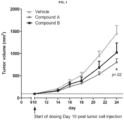
- a compound of Formula (I) designated Compound A was evaluated and compared to Compound B, an internal selective EP4 antagonist, for efficacy in the CT26 colon carcinoma mouse model.
- CT26 cells were obtained from American Type Tissue Culture (ATCC catalog # CRL-2638). Cells were thawed quickly at 37 °C and placed in RPMI-1640 with 10% FBS, and passaged every 3 days. Cells were expanded for a minimum of 3 passages and harvested 2 days after the last passage at 50% confluency for cell implantation. Cells were harvested for implantation, washed in DPBS, and re-suspended in DPBS at a concentration of 20E6 cells / ml and placed on ice.
- methylcellulose (cP 400; Sigma) was used as the vehicle and prepared at 0.5% weight / volume in sterile water.
- Compound A was prepared in 0.5% methyl cellulose at a concentration of 5mg/ml.
- Animals were dosed p.o., b.i.d with 10 ml/kg of vehicle,50 mg/kg of Compound A, or 30 mg/kg of Compound B. Mice were weighed every 3 days to account for adjustments in dosing volume. Dosing began on day 10 after implantation and continued for 14 days after which animals were sacrificed.
- Tumor Volume Measurements Beginning on day 10 tumors were measured every 2 -3 days for 14 days using calipers and volume calculated based on the formula: (width 2 * length)/2. Data was plotted in Prism (GraphPad). Study was terminated when tumors in vehicle treated group reached an average size of ⁇ 1500mm 3 and animals were moribund.
- Spider plots ( Figure 2A-C ) also demonstrate significant tumor growth inhibition in individual CT26 tumor bearing mice treated with Compound A for 14 days. After 14 days of dosing with vehicle Compound A, or Compound B, animals were sacrificed and tumors were weighed and percent tumor volume increase was calculated.
- mice treated with 50 mg/kg of Compound A for 14 days had a statistically significant (p ⁇ 0.05) 2-fold reduction in tumor weight and a statistically significant (p ⁇ 0.05) 1.8-fold decrease in percent tumor volume compared to CT26 tumor bearing mice treated with vehicle or Compound B. Data are presented as mean ⁇ SEM of n 10 animals/ group.
- Compound A-1 Another compound of Formula (I) designated Compound A-1 was also evaluated in the syngeneic CT26 colon carcinoma mouse model using the same procedure, except that the starting average tumor size was 163 mm 3 .
- Compound A-1 was prepared in 0.5% methyl cellulose at a concentration of 3mg/ml. Animals were dosed p.o., b.i.d with 10 ml/kg of vehicle,30 mg/kg of Compound A-1, or 30 mg/kg of Compound B.
- Spider plots ( Figure 4A-C ) also demonstrate significant tumor growth inhibition in individual CT26 tumor bearing mice treated with Compound A-1 for 14 days. After 14 days of dosing with vehicle Compound A-1, or Compound B, animals were sacrificed and tumors were weighed and percent tumor volume increase was calculated.
- mice treated with 30mg/kg of Compound A-1 for 14 days had a statistically significant (p ⁇ 0.03) 2.2-fold reduction and a 1.5-fold reduction in tumor weight compared to vehicle and Compound B, respectively. Percent tumor volume increase was also reduced significantly (p ⁇ 0.009, One-Way ANOVA) in Compound A-1 treated animals with a 2.57-fold and 1.5-fold decrease decrease in percent tumor volume compared to CT26 tumor bearing mice treated with vehicle or Compound B, respectively. Data are presented as mean ⁇ SEM of n 10 animals/ group.
- DC differentiation assay A compound of Formula (I) designated Compound A, was evaluated in a DC differentiation assay and compared against an internal selective EP4 antagonist, Compound B.
- PBMCs were isolated using a Ficoll gradient (VWR International; CAT#95021-205). Monocytes were isolated from PBMCs using CD14-beads (Miltenyi; CAT#130-050-201) as per the manufacturer's instructions.
- CD14+ cells were plated at 1.5 ⁇ 10 ⁇ 6 cells/well in a 12-well plate in 1.5 ml of media (RPMI 1640 medium (Gibco CAT#11875-093) supplemented with: 50 ⁇ M 2-mercaptoethanol (Sigma, CAT# M7522), 5 ml of HEPES, stock is 100X (1M) (Thermo Fisher CAT# 15630080), 5 ml of penicillin, streptomycin, L-glutamine, stock is 100x (Thermo Fisher CAT#10378016), and 10% FCS heat inactivated (Invitrogen; 10082-147)). At day 0 of culture DMSO only was added to the control well.
- media RPMI 1640 medium (Gibco CAT#11875-093) supplemented with: 50 ⁇ M 2-mercaptoethanol (Sigma, CAT# M7522), 5 ml of HEPES, stock is 100X (1M) (Thermo Fisher CAT# 15630080), 5
- Prostaglandin E 2 (PGE 2 ) only control was added at 30 nM final concentration (Sigma Aldrich, CAT#P6532) to a separate control well.
- the final concentration of DMSO in compound was 0.1% and 0.1% DMSO was used as vehicle control.
- DCs Immature dendritic cells
- DCs were collected and stained using the following antibodies all purchased from BD Biosciences: fluorescein isothiocyanate (FITC)-conjugated Isotype control (CAT# 555748); R-phycoerythrin (PE)-conjugated isotype control (CAT# 559320); CD1a-FITC (CAT# 555806); CD16-PE (CAT# 62293); CD163-PE (CAT# 556018).
- FITC fluorescein isothiocyanate
- PE R-phycoerythrin
- the cells were incubated with antibodies for 20 min on ice in the dark and washed 3 times with PBS/10% FCS using 2000 rpm 2 min. After the last wash cells were fixed using 2% PFA/PBS and analyzed by flow cytometry using the Accuri C6 (Accuri). Data was analyzed by using the CFlowPlus software (Accuri).
- PGE 2 caused a downregulation of CD1a + /CD16 - DCs and this level was set as 0%.
- the level in the absence of PGE 2 (with DMSO control) was set as 100%.
- CD163 is a marker for M2 macrophages, which is upregulated by PGE 2 .
- the level of the PGE 2 control cells was set at 100% and the DMSO control was set as 0%.
- DCs were generated and evaluated from 20 different donors.
- the EC 50 for restoration of the CD1a + /CD16 - DCs phenotype for Compound A is 511 nM ( FIG. 3 ) and the IC 50 for inhibition of the CD163 + macrophage phenotype is 367 nM.
- references in the description to methods of treatment refer to the compounds, pharmaceutical compositions and medicaments of the present invention for use in a method of treatment of the human (or animal) body by therapy (or for diagnosis).
- provided herein are methods of using a compound of any of Formulas (I), (II), (IIa), (IIb), (III), (IIIa), (IV), (IVa), (V), and (Va)for the treatment, prevention or amelioration of cancer, arthritis, pain, endometriosis, neurodegenerative disease and cardiovascular disease.
- Described herein is a method of treating cancer comprising administering to a patient in need thereof a therapeutically effective amount of a compound of any of Formulas (I), (II), (IIa), (IIb), (III), (IIIa), (IV), (IVa), (V), and (Va), or a pharmaceutically acceptable salt, solvate, or solvate of a salt thereof.
- the cancers include, but are not limited to: brain cancer including glioblastoma and medulloblastoma, bone cancer, sarcoma, head and neck cancer, retinoblastoma, thyroid cancer, leukemia including acute myeloid leukemia, skin cancer including melanoma, basal cell carcinoma, squamous cell carcinoma, adenocarcinoma, oral cancer, esophageal cancer, stomach cancer, gastric cancer, bile duct cancer, intestinal cancer, colon cancer, colorectal cancer, bladder cancer, liver cancer including hepatocellular carcinoma, renal cancer including renal cell carcinoma, pancreatic cancer, ovarian cancer, endometrial cancer, cervical cancer, uterine cancer, ureteral cancer, lung cancer, breast cancer, and prostate cancer.
- brain cancer including glioblastoma and medulloblastoma
- bone cancer including melanoma
- basal cell carcinoma squamous cell carcinoma
- adenocarcinoma oral cancer
- the cancer is glioblastoma, medulloblastoma, head and neck cancer, skin cancer including melanoma, basal cell carcinoma and squamous cell carcinoma, esophageal cancer, gastric cancer, colorectal cancer, liver cancer, pancreatic cancer, ovarian cancer, endometrial cancer, ureteral cancer, lung cancer, breast cancer, and prostate cancer.
- the cancer is esophageal cancer, gastric cancer, colorectal cancer, pancreatic cancer, breast cancer or ovarian cancer.
- AD Alzheimer's disease
- PD Parkinson's disease
- ALS amyotrophic lateral sclerosis
- TBI traumatic brain injury
- cardiovascular disease including coronary artery disease such as myocardial infarction and cerebrovascular disease such as stroke.
- the disclosure is directed to a method of preventing the onset of and/or recurrence of cancer.
- methods of preventing the onset and/or recurrence of neurodegenerative disease are provided herein.
- methods of preventing the onset and/or recurrence of arthritis are provided herein.
- methods for preventing the onset and/or recurrence of cardiovascular disease are provided herein.
- the starting materials used for the synthesis are either synthesized or obtained from commercial sources, such as, but not limited to, Sigma-Aldrich, Combi-Blocks, Fluka, Acros Organics, Alfa Aesar, Enamine, PharmaBlock, VWR Scientific, and the like.
- the reversed phase and normal phase chromatography columns were purchased from Teledyne ISCO, Inc. (NE). Nuclear Magnetic Resonance (NMR) analysis was conducted using a Bruker Fourier 300 MHz spectrometer or Bruker Avance DRX400 spectrometer with an appropriate deuterated solvent.
- LCMS spectra were obtained on either a Shimazu LCMS-2020 Series mass spectrometer using Electrospray Ionization (ESI) and a Luna C 18 5 ⁇ M, 2.0 ⁇ 50 mm column, eluting with 95:5 to 0:100 HzO:MeCN + 0.1% formic acid at a flow rate of 0.7 mL/min over 3.5 minutes, or a Waters Acquity UPLC with a QDA MS detector using a Waters C18 BEH 1.7 ⁇ M, 2.1 ⁇ 50 mm column, eluting with 95:5 to 0:100 HzO:MeCN + 0.1% formic acid at a flow rate of 0.6 mL/min over 3.5 minutes.
- ESI Electrospray Ionization
- the QDA MS detector was set up to scan under both positive and negative mode ions ranging from 100-1200 Daltons.
- General methods for the preparation of compounds can be modified by the use of appropriate reagents and conditions for the introduction of the various moieties found in the structures as provided herein.
- compounds described herein can be prepared as outlined in the following general synthetic schemes.
- the heterocyclic ester 1 can be N -alkylated with the alkylating agent 2 (wherein X is a leaving group such as iodide, bromide, chloride, mesylate or the like) in DMF at 0 - 22 °C using an appropriate base such as sodium tert-pentoxide, cesium carbonate or the like to provide 3 .
- This ester may be hydrolyzed using an agent such as lithium hydroxide, sodium hydroxide or the like in THF / MeOH to give the corresponding carboxylic acid 4 .
- This acid can be coupled to the aminoester 5 using standard amide coupling conditions such as HATU and Hünig's base in DMF to provide the ester 6 .
- the racemic ester 6 derived from the racemate of ester 5 may be hydrolyzed using lithium hydroxide, sodium hydroxide or the like to provide racemic carboxylic acid A .
- the ester 6 that is derived from a single enantiomer of 5 may be hydrolyzed using appropriate conditions (e.g. trimethyltin hydroxide in dichloroethane at 80 °C) to provide the carboxylic acid A without loss of enantiopurity.
- the racemic mixture of A may be resolved into both enantiomers using known methods such as chromatography using chiral columns such as ChiralPak OD, ChiralPak AD or the like.
- the target biaryl B can be formed from the palladium-catalyzed cross coupling between the aryl halide 7 and (hetero)aryl boronic acids or (hetero)aryl boronate esters.
- This reaction may utilize XPhos palladacycle Gen 3, Pd(dppf)Ch or any other suitable palladium ligand complexes.
- a base such as K 3 PO 4 , Na 2 CO 3 or the like, and can be heated at 100 to 150 °C for 10 - 40 minutes in a microwave reactor or for 2 - 18 hours in an oil bath.
- aryl halide 7 into the corresponding aryl pinacol boronate ester or boronic acid 8 , using, for example, borylation conditions (i.e. heating at 80 °C with a catalytic quantity of Pd(dppf)Cl 2 , potassium acetate, and bis(pinacolato)diboron in dioxane, or the like), to enable its subsequent cross coupling to an appropriately functionalized (hetero)aryl halide.
- a single enantiomer may be provided by standard methods, such as chromatography of B utilizing an appropriate chiral column such as ChiralPak OD, ChiralPak AD or the like.
- a single enantiomer may be obtained by utilizing a single enantiomer of 5 in the synthesis of 7 or 8 .
- other organometallic cross-coupling agents such as organotin, organosilicon, organozinc and organomagensium reagents are known to participate as suitable coupling reagents in the Scheme below.
- the arylamine C can be prepared by the palladium-catalyzed cross coupling reaction of the aryl halide 7 with an appropriately functionalized primary or secondary amine in the presence of bases such as sodium tert -pentoxide, sodium hexamethyldisilazide, or the like at 120 °C for 30 minutes in a microwave reactor or for 10 - 18 hours in an oil bath.
- bases such as sodium tert -pentoxide, sodium hexamethyldisilazide, or the like at 120 °C for 30 minutes in a microwave reactor or for 10 - 18 hours in an oil bath.
- a single enantiomer may be provided by chromatography of C utilizing an appropriate chiral column such as ChiralPak OD, ChiralPak AD or the like. Alternately, a single enantiomer of C may be obtained by utilizing a single enantiomer of 5 in the synthesis of 7.
- the arylether 10 can be prepared using the Mitsunobu reaction of phenol 9 with an alkyl alcohol under standard conditions (i.e. di- iso -propyl azodicarboxylate and triphenylphosphine, diethyl azodicarboxylate and tri- butyl -phosphine, or the like).
- the arylether D can then be readily accessed by hydrolysis of 10 using standard saponification conditions, such as aqueous lithium hydroxide in THF / MeOH, or the like.
- a single enantiomer may be provided by standard methods for chiral separation, including chromatography of D utilizing an appropriate chiral column such as ChiralPak OD, ChiralPak AD or the like. Alternately, a single enantiomer of D may be obtained by utilizing a single enantiomer of 5 in the synthesis of 9.
- the amine 5 can be reacted with a protecting group, such as Cbz-Cl in the presence of appropriate bases such as Hünig's base, triethylamine or the like, to provide the Cbz carbamate 11.
- a protecting group such as Cbz-Cl
- appropriate bases such as Hünig's base, triethylamine or the like
- the enantiomers of 11 can then be separated by chromatography on a suitable chiral column such as ChiralPak OD, ChiralPac AD or the like.
- Each of the enantiomers, 11A and 11B can then be deprotected to afford the primary amine, using suitable conditions for the particular protecting group.
- These enantiomers can also be independently treated with an acid such as HCl to provide the corresponding salts of 5A and 5B as solids for
- the ester 12 can be protected as the bisbenzylamine 13 by alkylation of the primary amine with benzyl bromide using potassium carbonate as the base.
- This ester can be deprotonated using lithium tetramethylpiperidide in THF and then quenched with R 7 -X (where X is a suitable leaving group) to provide compound 14 where R 7 can be deutero, alkyl, fluoro or hydroxyl.
- Primary amine 15 can then be readily revealed from ester 14 using, for example, palladium hydroxide as catalyst and hexafluoroisopropanol as solvent under a hydrogen atmosphere.
- X 3 , X 4 or X 5 in compound 16 is C-Br or C-I
- Such functional group conversion can be readily realized using metal-catalyzed reactions. Examples of such conversions include, but are not limited to, (a) cyanation using zinc cyanide as the coupling partner and tBuXPhos palladacycle Gen 3 as the catalyst; and (b) aliphatic alcohol as the coupling partner, cesium carbonate as the base, CuI as the metal catalyst and 3,4,7,8-tetramethyl-1,10-phenanthroline as the ligand.
- Step 1 Preparation of methyl 4-fluoro-1-(4-(trifluoromethoxy)benzyl)-1 H indole-7-carboxylate
- Step 1 Preparation of methyl 1-(4-bromobenzyl)-4-fluoro-1 H indole-7-carboxylate
- Step 1 Preparation of (racemic)-methyl 6-(1-(4-bromobenzyl)-4-fluoro-1 H indole-7-carboxamido)spiro[3.3]heptane-2-carboxylate
- Step 2 Preparation of ( racemic )-6-(1-(4-bromobenzyl)-4-fluoro-1 H -indole-7-carboxamido)spiro[3.3]heptane-2-carboxylic acid
- Step 1 Preparation of ( racemic )-methyl 6-(((benzyloxy)carbonyl)amino)-spiro[3.3]heptane-2-carboxylate
- Step 2 Chiral resolution of ( R a ) or ( S a )-methyl 6-(((benzyloxy)carbonyl)amino)-spiro[3.3]heptane-2-carboxylate
- the enantiomers were separated by supercritical fluid chiral chromatography on a 20 ⁇ m ChiralPac AD column (50 ⁇ 500 mm), eluting with 10% MeOH at a flow rate of 18 mL/min over 10 minutes, maintaining a column temperature of 35 °C.
- the first eluting peak had a retention time of 2.23 minutes and the second eluting enantiomer at 2.53 minutes.
- the first eluting enantiomer was determined to be the more active enantiomer.
- Step 3 Preparation of ( R a ) or ( S a )-methyl 6-aminospiro[3.3]heptane-2-carboxylate hydrochloride
- Step 3 Preparation of ( racemic )-methyl 6-amino-2-fluorospiro[3.3]heptane-2-carboxylate
- Step 2 Preparation of ( racemic )- tert -butyl (6-(hydroxymethyl)spiro[3.3]heptan-2-yl)carbamate
- Step 3 Preparation of ( racemic )-(6-(( tert -butoxycarbonyl)amino)spiro[3.3]heptan-2-yl)methyl methanesulfonate
- Step 4 Preparation of ( racemic )- tert -butyl (6-(cyanomethyl)spiro[3.3]heptan-2-yl)carbamate
- the crude product mixture thus obtained was purified by column chromatography through silica gel on the Teledyne ISCO Rf system (gradient elution, 0% to 50% EtOAc in hexanes). The product-containing fractions were combined, concentrated and dried under high vacuum to afford the title compound as a white solid.
- Step 5 Preparation of ( racemic )-2-(6-aminospiro[3.3]heptan-2-yl)acetonitrile hydrochloride
- Step 1 Preparation of S a )-benzyl (6-(hydroxymethyl)spiro[3.3]heptan-2-yl)carbamate
- Step 2 Preparation of ( S ⁇ )-(6-(((benzyloxy)carbonyl)amino)spiro[3.3]heptan-2-yl)methyl methanesulfonate
- Step 3 Preparation of ( S a )-benzyl (6-(cyanomethyl)spiro[3.3]heptan-2-yl)carbamate
- Step 4 Preparation of ( S a )-ethyl 2-(6-aminospiro[3.3]heptan-2-yl)acetate hydrochloride
- the reaction mixture was then cooled to 22 °C and poured into a separatory funnel containing water.
- the aqueous layer was separated and extracted further with dichloromethane (3 ⁇ ).
- the combined organic extracts were washed with brine (1 ⁇ ), dried over MgSO 4 , filtered and the filtrate concentrated in vacuo.
- the resulting residue was then triturated with ether and vacuum filtered.
- the solid thus obtained was washed further with cold ether and dried until constant weight to afford the title compound as a light yellow solid.
- Step 1 Preparation of ethyl 1-(4-bromobenzyl)-2-(2-ethoxy-2-oxoethyl)-1 H -pyrrole-3-carboxylate
- Step 2 Preparation of ethyl ( Z )-1-(4-bromobenzyl)-2-(3-ethoxy-1-hydroxy-3-oxoprop-1-en-2-yl)-1 H -pyrrole-3-carboxylate
- Step 3 Preparation of ethyl ( Z )-2-(1-amino-3-ethoxy-3-oxoprop-1-en-2-yl)-1-(4-bromobenzyl)-1 H -pyrrole-3-carboxylate
- Step 4 Preparation of ethyl 1-(4-bromobenzyl)-4-oxo-4,5-dihydro-1 H pyrrolo[3,2-c]pyridine-7-carboxylate
- Step 5 Preparation of ethyl 1-(4-bromobenzyl)-4-methoxy-1 H pyrrolo[3,2-c]pyridine-7-carboxylate
- Step 1 Preparation of methyl 4-chloro-1-(4-iodobenzyl)-1 H- indazole-7-carboxylate
- Step 2 Preparation of 4-chloro-1-(4-iodobenzyl)-1 H -indazole-7-carboxylic acid.
- Step 3 Preparation of ( S a )-methyl 6-(4-chloro-1-(4-iodobenzyl)-1 H- indazole-7-carboxamido)spiro[3.3]heptane-2-carboxylate.
- Step 4 Preparation of ( S a )-6-(4-chloro-1-(4-iodobenzyl)-1 H -indazole-7-carboxamido)spiro[3.3]heptane-2-carboxylic acid.
- Step 1 Preparation of methyl 1-([1,1'-biphenyl]-4-ylmethyl)-5-bromo-1H-indazole-7-carboxylate
- This compound was prepared in similar manner to the first step of Intermediate A, but utilizing the commercially available methyl 5-bromo-1H-indazole-7-carboxylate and 4-(bromomethyl)-1,1'-biphenyl.
- the desired product was obtained as a white solid after purification by column chromatography through silica gel on the Teledyne ISCO Rf (gradient elution with 10% to 70% EtOAc in hexanes).
- Step 2 Preparation of methyl 1-([1,1'-biphenyl]-4-ylmethyl)-5-(4,4,5,5-tetramethyl-1,3,2-dioxaborolan-2-yl)-1 H- indazole-7-carboxylate
- reaction mixture was loaded onto a silica gel pre-cartridge and dried and purified by column chromatography through silica gel on the Teledyne ISCO Rf (gradient elution with 10% to 70% EtOAc in hexanes). The product containing fractions were dried under vacuum to afford a white solid (86% yield).
- Step 3 Preparation of methyl 1-([1,1'-biphenyl]-4-ylmethyl)-5-(difluoromethoxy)-1 H- indazole-7-carboxylate
- Step 1 Preparation of 1-([1,1'-biphenyl]-4-yl)ethan-1-one-2,2,2- d 3
- Step 2 Preparation of 1-([1,1'-biphenyl]-4-yl)ethan-1,2,2,2- d 4 -1-ol
- Step 3 Preparation of methyl 1-(1-([1,1'-biphenyl]-4-yl)ethyl-1,2,2,2- d 4 )-4-chloro-1 H- indazole-7-carboxylate
- reaction mixture was loaded onto a silica gel pre-cartridge and dried. Purification by column chromatography through silica gel on the Teledyne ISCO Rf (gradient elution with 0% to 80% EtOAc in hexanes) afforded the desired product (68% yield).
- Step 1 Preparation of methyl 1-(1-([1,1'-biphenyl]-4-yl)ethyl-1,2,2,2- d 4 )-1 H- indazole-7-carboxylate
- reaction mixture was loaded onto a silica gel pre-cartridge and dried. Purification by column chromatography through silica gel on the Teledyne ISCO Rf (gradient elution with 0% to 60% EtOAc in hexanes) afforded the desired product (28% yield).
- Step 1 Preparation of Methyl 4-chloro-1-(3-fluoro-4-iodobenzyl)-1 H -indazole-7-carboxylate
- Step 1 Preparation of (racemic)-methyl 6-(4-fluoro-1-(4-(trifluoromethoxy)benzyl)-1 H- indole-7-carboxamido)spiro[3.3]heptane-2-carboxylate
- Step 2 Preparation of ( racemic )-6-(4-fluoro-1-(4-(trifluoromethoxy)benzyl)-1 H -indole-7-carboxamido)spiro[3.3]heptane-2-carboxylic acid
- Example 5 was prepared in a similar manner to Example 1, substituting 4-trifluoromethoxybenzyl bromide with Intermediate G.
- Example 2 ( racemic )-6-(1-(4-(tert-butyl)benzyl)-4-fluoro-1H indole-7-carboxamido)spiro[3.3]heptane-2-carboxylic acid 462.56 463 (M+1) +
- Example 3 ( racemic ) -6- (1 - ([1 , 1' - biphenyl]-4 - ylmethyl)-4-fluoro-1 H- indole-7-carboxamido)spiro[3.3]heptane-2-carboxylic acid 482.56 483 (M+1) +
- Example 4 ( racemic )-6-(4-fluoro-1-(naphthalen-2-ylmethyl)-1 H- indole-7-carboxamido)spiro[3.3]heptane-2-carboxylic acid 456.52 457 (M+1) +
- Example 5 ( racemic )-6
- Step 1 Preparation of methyl 1-(4-(tert-butyl)benzyl)-4-chloro-1H indole-7-carboxylate
- Step 2 Preparation of 1-(4-( tert -butyl)benzyl)-4-chloro-1H indole-7-carboxylic acid
- Step 3 Preparation of (racemic)-methyl 6-(1-(4-(tert-butyl)benzyl)-4-chloro-1 H -indole-7-carboxamido)spiro[3.3]heptane-2-carboxylate
- Step 4 Preparation of ( racemic )-6-(1-(4-( tert- butyl)benzyl)-4-chloro-1 H -indole-7-carboxamido)spiro[3.3]heptane-2-carboxylic acid
- Example 1 The compound Example 1 was resolved into both enantiomers using chiral SFC.
- the enantiomers were separated using a 5 ⁇ m ChiralPac IC column (10 ⁇ 250 mm), eluting with 30% i PrOH at a flow rate of 10 mL/min over 15 minutes, maintaining a column temperature of 35 °C.
- the first eluting peak had a retention time of 7.4 minutes and the second eluting enantiomer at 9.9 minutes.
- the second eluting enantiomer, Example 8 was determined to be the more active enantiomer.
- Step 1 Preparation of ( S a )-methyl 6-(4-fluoro-1-(4-(trifluoromethoxy)benzyl)-1 H -indole-7-carboxamido)spiro[3.3]heptane-2-carboxylate
- Step 2 Preparation of ( S a )-6-(4-fluoro-1-(4-(trifluoromethoxy)benzyl)-1 H- indole-7-carboxamido)spiro[3.3]heptane-2-carboxylic acid
- the racemic compound, Example 3 was resolved into both enantiomers using chiral SFC.
- the enantiomers were separated using a 5 ⁇ m ChiralPac OJ column (10 ⁇ 250 mm), eluting with 55% MeOH at a flow rate of 10 mL/min over 10 minutes, maintaining a column temperature of 35 °C.
- the first eluting peak had a retention time of 4.1 minutes and the second eluting enantiomer at 5.3 minutes.
- the second eluting enantiomer, Example 9 was determined to be the more active enantiomer.
- Steps 1-4 Preparation of ( racemic )-6-(1-(4-bromo-3-fluorobenzyl)-4-fluoro-1 H -indole-7-carboxamido)spiro[3.3]heptane-2-carboxylic acid
- Step 5 Preparation of ( racemic )-6-(4-fluoro-1-((2-fluoro-[1,1'-biphenyl]-4-yl)methyl)-1 H- indole-7-carboxamido)spiro[3.3]heptane-2-carboxylic acid
- the vial was heated in a microwave reactor at 100 °C for 30 minutes, cooled to room temperature and loaded directly onto a C18 silica gel pre-cartridge and dried under vacuum. Purification by reverse-phase column chromatography using a C18 cartridge on an automated Teledyne ISCO Rf machine, eluting with 5% to 80% acetonitrile in water + 0.1% formic acid as a gradient over 20 minutes. The desired fractions were combined, concentrated and dried under vacuum to afford the title compound as a white solid (26% yield).
- the resulting reaction mixture was allowed to cool to 22 °C and then directly subjected to purification by reverse-phase column chromatography using a C18 cartridge on an automated Teledyne ISCO Rf machine, eluting with 10% to 100% acetonitrile in water + 0.1% formic acid as a gradient. Fractions with the desired product were combined and lyophilized to afford the title compound as a white powder (26% yield).
- Example Structure and Name MW MS (ESI+)
- Example 12 ( racemic )-6-(4-fluoro-1-((4'-methoxy- [1,1'-biphenyl]-4-yl)methyl)-1 H -indole-7-carboxamido)spiro[3.3]heptane-2-carboxylic acid 512.21 535 (M+Na) +
- Example 13 ( racemic )-6-(1-((4'-cyano-[1,1'-biphenyl]-4-yl)methyl)-4-fluoro-1 H -indole-7-carboxamido)spiro[3.3]heptane-2-carboxylic acid 507.57 508 (M+1) +
- Example 14 ( racemic )-6-(4-fluoro-1-((3'-methoxy-[1,1'-biphenyl]-4-yl)methyl)-1 H -indole-7-carboxamido)
- the vial was heated to 130 °C for 20 min in a microwave reactor.
- the resulting reaction mixture was allowed to cool to 22 °C and then directly subjected to purification by reverse-phase column chromatography using a C18 cartridge on an automated Teledyne ISCO Rf machine, eluting with 10% to 100% acetonitrile in water + 0.1% formic acid as a gradient over 20 minutes. Fractions with the desired product were combined and lyophilized to afford the title compound as a white powder.
- Example 18 ( racemic )-6-(4-fluoro-1-((2'-methoxy-[1,1'-biphenyl]-4-yl)methyl)-1 H -indole-7-carboxamido)spiro[3.3]heptane-2-carboxylic acid 512.21 535 (M+Na) +
- Example 19 ( racemic )-6-(4-fluoro-1-((4'-fluoro-3'-methoxy-[1,1'-biphenyl]-4-yl)methyl)-1 H -indole-7-carboxamido)spiro[3.3]heptane-2-carboxylic acid 530.57 531 (M+1) +
- Example 20 ( racemic )-6-(1-((3'-cyano-5'-methoxy-[1,1'-biphenyl]-4-yl)methyl)-4-fluoro-1 H- in
- Step 2 Preparation of ( racemic )-6-(1-((3'-chloro-4'-(oxetan-3-yloxy)-[1,1'-biphenyl]-4-yl)methyl)-4-fluoro-1 H- indole-7-carboxamido)spiro[3.3]heptane-2-carboxylic acid
- the resulting reaction mixture was allowed to cool to 22 °C and then directly subjected to reverse-phase column chromatography using a C18 cartridge on an automated Teledyne ISCO Rf machine, eluting with 10% to 100% acetonitrile in water + 0.1% formic acid as a gradient over 20 minutes. Fractions with the desired product were combined and lyophilized to afford the title compound as a white powder.
- Example 21 Compounds in this table were made in a similar manner to Step 2, Example 21. Reactions were run using Intermediate E and the corresponding aryl halide at temperatures ranging from 100 - 130 °C for durations ranging from 10 - 30 min in a microwave reactor.
- Example 22 racemic )-6-(1-(4-(2-(dimethylamino)pyridin-4-yl)benzyl)-4-fluoro-1 H -indole-7-carboxamido)spiro[3.3]heptane-2-carboxylic acid 526.60 527 (M+1) +
- Example 21 To a solution of Example 21 (1.0 equiv) in MeOH (0.008 M) was added 10% Pd/C (10% wt/wt to compound). The vessel was evacuated and then stirred under an atmospheric pressure of H 2 at 22 °C for 1 hour. The resulting reaction mixture was directly subjected to reverse-phase column chromatography using a C18 cartridge on an automated Teledyne ISCO Rf machine, eluting with 10% to 100% acetonitrile in water + 0.1% formic acid as a gradient over 20 minutes. Fractions with the desired product were combined and lyophilized to afford the title compound as a white powder.
- Compound Example 11 was resolved into both enantiomers by chiral SFC using a ChiralPak AD column (4.6 ⁇ 150 mm) with a gradient of 5% to 55% MeOH + 0.1 mM ammonium formate in scCO 2 .
- the second eluting enantiomer, Example 24, was determined to be the more active enantiomer.
- Step 1 Preparation of 1-((3'-chloro-4'-methoxy-[1,1'-biphenyl]-4-yl)methyl)-4-fluoro-1 H- indole-7-carboxylic acid
- the resulting reaction mixture was allowed to cool to 22 °C and then directly subjected to purification by reverse-phase column chromatography using a C18 cartridge on an automated Teledyne ISCO Rf machine, eluting with 10% to 100% acetonitrile in water + 0.1% formic acid as a gradient over 20 minutes. Fractions with the desired product were combined and concentrated under vacuum to afford the title compound as an off-white powder.
- Step 2 Preparation of ( S a )-methyl 6-(1-((3'-chloro-4'-methoxy-[1,1'-biphenyl]-4-yl)methyl)-4-fluoro-1 H -indole-7-carboxamido)spiro[3.3]heptane-2-carboxylate
- Step 3 Preparation of ( S a )-6-(1-((3'-chloro-4'-methoxy-[1,1'-biphenyl]-4-yl)methyl)-4-fluoro-1 H- indole-7-carboxamido)spiro[3.3]heptane-2-carboxylic acid
- the organic layer was dried over MgSO 4 and then concentrated under vacuum to obtain a brown solid.
- the solid was subjected to purification by reverse-phase column chromatography using a C18 cartridge on an automated Teledyne ISCO Rf machine, eluting with 10% to 100% acetonitrile in water + 0.1% formic acid as a gradient over 20 minutes. Fractions with the desired product were lyophilized to afford the title compound as a white powder.
- Steps 1 and 2 Preparation of 4-fluoro-1-(naphthalen-2-ylmethyl)-1 H -indole-7-carboxylic acid
- Steps 3 and 4 Preparation of ( S a )-6-(4-fluoro-1-(naphthalen-2-ylmethyl)-1 H -indole-7-carboxamido)spiro[3.3]heptane-2-carboxylic acid
- Example 27 ( racemic )-6-(1-(4-( tert -Butyl)benzyl)-4-cyano-1 H -indole-7-carboxamido)spiro[3.3]heptane-2-carboxylic acid
- Step 1 Preparation of (racemic)-methyl 6-(1-(4-(tert-butyl)benzyl)-4-cyano-1 H -indole-7-carboxamido)spiro[3.3]heptane-2-carboxylate
- the mixture was acidified with formic acid and directly purified by reverse-phase column chromatography using a C 18 cartridge on an automated Teledyne ISCO Rf machine, eluting with 0% to 100% acetonitrile in water + 0.1% formic acid as a gradient over 20 minutes.
- the desired product fractions eluting at 95% ACN were combined and lyophilized to provide the title compound.
- Step 2 Preparation of ( racemic )-6-(1-(4-( tert -butyl)benzyl)-4-cyano-1 H -indole-7-carboxamido)spiro[3.3]heptane-2-carboxylic acid
- Step 1 to 3 Preparation of ( racemic )-methyl 6-(1-(4-(benzyloxy)benzyl)-4-fluoro-1 H -indole-7-carboxamido)spiro[3.3]heptane-2-carboxylate
- Step 4 Preparation of ( racemic )-methyl 6-(4-fluoro-1-(4-hydroxybenzyl)-1 H -indole-7-carboxamido)spiro[3.3]heptane-2-carboxylate
- Step 5 Preparation of ( racemic )-methyl 6-(1-(4-(cyclopentyloxy)benzyl)-4-fluoro-1 H- indole-7-carboxamido)spiro[3.3]heptane-2-carboxylate
- reaction mixture was directly pre-absorbed onto a silica gel pre-cartridge and then purified by column chromatography through silica gel on the Teledyne ISCO Rf eluting with 0% to 100% EtOAc in hexanes as a gradient. The fractions from the major peak were combined and concentrated under vacuum to provide the title compound as a white solid (80% yield).
- Step 6 Preparation of ( racemic )-6-(1-(4-(cyclopentyloxy)benzyl)-4-fluoro-1 H -indole-7-carboxamido)spiro[3.3]heptane-2-carboxylic acid
- Example 29 ( racemic )-6-(1-(4-(cyclohexyloxy)benzyl)-4-fluoro-1 H- indole-7-carboxamido)spiro[3.3]heptane-2-carboxylic acid 504.6 527 (M+Na) +
- Example 30 ( racemic )-6-(4-fluoro-1-(4-((tetrahydro-2 H -pyran-4-yl)oxy)benzyl)-1 H -indole-7-carboxamido)spiro[3.3]heptane-2-carboxylic acid 506.57 529 (M+Na) +
- Step 1 Preparation of methyl 1-(4-(trifluoromethoxy)benzyl)-1 H -indazole-7-carboxylate
- Step 2 Preparation of 1-(4-(trifluoromethoxy)benzyl)-1 H -indazole-7-carboxylic acid
- Step 3 Preparation of ( racemic )-methyl 6-(1-(4-(trifluoromethoxy)benzyl)-1 H -indazole-7-carboxamido)spiro[3.3]heptane-2-carboxylate
- Step 4 Preparation of ( racemic )-6-(1-(4-(trifluoromethoxy)benzyl)-1 H -indazole-7-carboxamido)spiro[3.3]heptane-2-carboxylic acid
- Example Structure and Name MW MS(ESI+) Example 33 ( racemic )-6-(1-([1,1'-biphenyl]-4-ylmethyl)-1 H -indazole-7-carboxamido)spiro[3.3]heptane-2-carboxylic acid 465.21 466 (M+1) + Example 34 ( racemic )-6-(1-([1,1'-biphenyl]-4-ylmethyl)-4-fluoro-1 H -indazole-7-carboxamido)spiro[3.3]heptane-2-carboxylic acid 483.54 485 (M+1) +
- Example 37 ( S a )-6-(4-fluoro-1-((6-fluoronaphthalen-2-yl)methyl)-1 H -indole-7-carboxamido)spiro[3.3]heptane-2-carboxylic acid 474.50 475 (M+1) +
- Example 38 ( S a )-6-(4-fluoro-1-((6-methoxynaphthalen-2-yl)methyl)-1 H -indole-7-carboxamido)spiro[3.3]heptane-2-carboxylic acid 486.54 487 (M+1) +
- Example 39 ( S a )-6-(4-fluoro-1-((5-methoxynaphthalen-2-yl)methyl)-1 H
- Example 46 ( S a )-6-(4-fluoro-1-((4'-fluoro-3'-methoxy-[1,1'-biphenyl]-4-yl)methyl)-1 H -indole-7-carboxamido)spiro[3.3]heptane-2-carboxylic acid 530.57 531 (M+1) +
- Example 47 S a )-6-(4-fluoro-1-((3'-fluoro-4'-methoxy-[1,1'-biphenyl]-4-yl)methyl)-1 H -indole-7-carboxamide)spiro[3.3]heptane-2-carboxylic acid 530.57 531 (M+1) +
- Example 48 ( S a )-6-(1-(4-(2-ethoxypyridin-4-yl)benzyl)-4-fluoro-1 H -indole-7-carbox
- Example Structure and Name MW MS (ESI+) Example 57 ( S a )-6-(4-fluoro-1-((3'-(oxetane-3-yloxy)-[1,1'-biphenyl]-4-yl)methyl)-1 H -indole-7-carboxamido)spiro[3.3]heptane-2-carboxylic acid 554.61 555 (M+1) + Example 58 ( S a )-6-(1-(4-(2-ethoxypyrimidin-4-yl)benzyl)-4-fluoro-1 H -indole-7-carboxamido)spiro[3.3]heptane-2-carboxylic acid 528.59 529 (M+1) + Example 59 ( S a )-6-(1-(4-(4-cyano-6-methoxypyridin-2-yl)benzyl)-4-fluoro-1 H -indole-7-carboxamido)
- Example 68 ( S a )-6-(1-([1,1'-biphenyl]-4-ylmethyl)-4-chloro-1 H -indole-7-carboxamido)spiro[3.3]heptane-2-carboxylic acid 499.00 499 (M+1) +
- Example 69 ( S a )-6-(4-chloro-1-(4-(2-methoxypyridin-4-yl)benzyl)-1 H -indole-7-carboxamido)spiro[3.3]heptane-2-carboxylic acid 530.02 530 (M+1) +
- Example 70 ( S a )-6-(4-chloro-1-(4-(2-ethoxypyridin-4-yl)benzyl)-1 H- indole-7-carboxamido)spiro[3.3]heptane-2-carboxylic acid 544.04 544
- Example 72 ( S a )-6-(1-(4-((1 R , 5 S )-3-azabicyclo[3.1.0]hexan-3-yl)benzyl)-4-chloro-1 H -indazole-7-carboxamido)spiro[3.3]heptane-2-carboxylic acid 505.01 505 (M+1) +
- Example 73 S a )-6-(1-(4-(1 H- pyrazol-1-yl)benzyl)-4-chloro-1 H -indazole-7-carboxamido)spiro[3.3]heptane-2-carboxylic acid 489.96 490 (M+1) +
- Example 74 ( S a )-6-(4-chloro-1-(4-(3,3-difluoropyrrolidin-1-yl)benzyl)-1 H -indazole-7-carboxamido)
- Example 79 ( S a )-6-(4-chloro-1-(4-(2-ethoxypyridin-4-yl)benzyl)-1 H -indazole-7-carboxamido)spiro[3.3]heptane-2-carboxylic acid 545.03 545 (M+1) +
- Example 80 ( S a )-6-(4-chloro-1-((3'-cyano-[1,1'-biphenyl]-4-yl)methyl)-1 H -indazole-7-carboxamido)spiro[3.3]heptane-2-carboxylic acid 525.00 525 (M+1) +
- Example 81 ( S a )-6-(4-chloro-1-((2-fluoro-2'3'4'5'-tetrahydro-[1,1'-biphenyl]-4-yl)methyl)-1 H -indazole-7-
- Example 84 ( S a )-6-(4-chloro-1-(4-(2-ethoxypyrimidin-6-yl)benzyl)-1 H -indazole-7-carboxamido)spiro[3.3]heptane-2-carboxylic acid 546.02 546 (M+1) +
- Example 85 ( S a )-6-(4-chloro-1-(4-(6-(methylcarbamoyl)pyridin-2-yl)benzyl)-1 H- indazole-7-carboxamido)spiro[3.3]heptane-2-carboxylic acid 558.03 558 (M+1) +
- Example 86 ( S a )-6-(4-chloro-1-(4-(6-(trifluoromethoxy)pyridin-2-yl)benzyl)-1 H- indazole-7-carboxamido)spiro[3.3]hept
- Example 89 S a )-6-(1-(4-(2-ethoxypyridin-4-yl)benzyl)-4-methoxy-1 H -pyrrolo[3,2- c ]pyridine-7-carboxamido)spiro[3.3]heptane-2-carboxylic acid 540.61 541 (M+1) +
- Example 90 S a )-6-(1-([1,1'-biphenyl]-4-ylmethyl)-4-ethoxy-1 H -pyrrolo[3,2-c]pyridine-7-carboxamido)spiro[3.3]heptane-2-carboxylic acid 509.60 510 (M+1) + Example 91 (S a )-6-(1-([1,1'-biphenyl]-4-ylmethyl)-4-ethoxy-1 H -pyrrolo[3,2-c]pyridine-7-carboxamido)spiro[3.3]heptane-2-carboxylic acid 509.
- Step 1 Preparation of methyl 1-([1,1'-biphenyl]-4-ylinethyl)-5-chloro-1 H -indazole-7-carboxylate
- Step 2 Preparation of 1-([1,1'-biphenyl]-4-ylmethyl)-5-chloro-1 H -indazole-7-carboxylic acid
- Step 3 Preparation of (S a )-methyl 6-(1-([1,1'-biphenyl]-4-ylmethyl)-5-chloro-1 H -indazole-7-carboxamido)spiro[3.3]heptane-2-carboxylate
- Step 4 Preparation of ( S a )-6-(1-([1,1'-biphenyl]-4-ylmethyl)-5-chloro-1 H -indazole-7-carboxamido)spiro[3.3]heptane-2-carboxylic acid
- Example 94 ( S a )-6-(1-([1,1'-biphenyl]-4-ylmethyl)-4-chloro-1 H -indazole-7-carboxamido)spiro[3.3]heptane-2-carboxylic acid 499.99 500 (M+1) +
- Example 95 ( S a )-6-(4-chloro-1-(4-(trifluoromethoxy)benzyl)-1 H -indazole-7-carboxamido)spiro[3.3]heptane-2-carboxylic acid 507.89 508 (M+1) +
- Example 96 ( S a )-6-(4-chloro-1-(naphthalen-2-yl
- Step 1 Preparation of methyl 1-([1,1'-biphenyl]-4-ylmethyl)-4-fluoro-1 H -indole-7-carboxylate
- Step 3 Preparation of (racemic)-methyl 6-(1-([1,1'-biphenyl]-4-ylmethyl)-4-fluoro-1 H- indole-7-carboxamido)-2-methylspiro[3.3]heptane-2-carboxylate
- Step 4 Preparation of ( racemic )-6-(1-([1,1'-biphenyl]-4-ylmethyl)-4-fluoro-1 H -indole-7-carboxamido)-2-methylspiro[3.3]heptane-2-carboxylic acid
- Example 101 ( racemic )-6-(1-([1,1'-biphenyl]-4-ylmethyl)-4-fluoro-1 H -indole-7-carboxamido)-2-deuterospiro[3.3]heptane-2-carboxylic acid 483.55 484 (M+1) +
- Example 102 ( racemic )-6-(4-chloro-1-(4-(2-(methylcarbamoyl)pyridin-4-yl)benzyl)-1 H- indazole-7-carboxamido)-2-fluorospiro[3.3]heptane-2-carboxylic acid 576.02 576 (M+1) +
- Example 103 ( S a )-2-(6-(1-([1,1'-biphenyl]-4-ylmethyl)-4-fluoro-1 H -
- the racemic compound, Example 101 was resolved into both enantiomers using chiral SFC.
- the enantiomers were separated using a 5 ⁇ m ChiralPac OJ column (10 ⁇ 250 mm), eluting on a gradient from 5% to 55% MeOH at a flow rate of 5 mL/min over 5 minutes, maintaining a column temperature of 35 °C.
- the first eluting peak had a retention time of 3.3 minutes and the second eluting enantiomer at 3.5 minutes.
- the second eluting enantiomer, Example 105 was determined to be the more active enantiomer.
- Step 1 Preparation of ( racemic )-1-([1,1'-biphenyl]-4-ylmethyl)- N -(6-(cyanomethyl)spiro[3.3]heptan-2yl)-4-fluoro-1 H -indole-7-carboxamide
- Step 2 Preparation of ( racemic )-2-(6-(1-([1,1'-biphenyl]-4-ylmethyl)-4-fluoro-1 H -indole-7-carboxamido)spiro[3.3]heptan-2-yl)acetic acid
- Example Structure and Name MW MS (ESI+) Example 107 ( racemic )-2-(6-(1-([1,1'-biphenyl]-4-ylmethyl)-5-fluoro-1 H -indazole-7-carboxamido)spiro[3.3]heptan-2-yl)acetic acid 497.56 498 (M+1) + Example 108 ( racemic )-2-(6-(1-([1,1'-biphenyl]-4-ylmethyl)-4-methoxy-1 H -pyrrolo[3,2- c ]pyridine-7-carboxamido)spiro[3.3]heptan-2-yl)acetic acid 509.60 510 (M+1) + Example 109 ( racemic )-2-(6-(1-([1,1')-5-fluoro-1 H -indazole-7-carboxamido)spiro[3.3]heptan-2-yl)acetic acid 509.60 510 (M+1) +
- Example 8 Into a reaction vial equipped with a magnetic stir and under N 2 was added Example 8 (1.0 equiv), HATU (1.5 equiv), methanesulfonamide (1.2 equiv) and DMF (0.11 M). The solution was stirred at 22 °C for 2 minutes and then treated with Hünig's base (4.5 equiv). The resulting solution was stirred at 22 °C for 16 hours. The reaction mixture was then quenched with 1 M aqueous HCl solution, diluted further with water and extracted with EtOAc (3 ⁇ ). The combined organic extracts were then washed with brine, dried over Na 2 SO 4 , filtered and the filtrate concentrated in vacuo.
- the crude product thus obtained was first purified by regular-phase column chromatography through silica gel on an automated Teledyne ISCO Rf machine, eluting with 5% to 100% EtOAc in Hexanes as a gradient. Further purification by reverse-phase column chromatography using a C18 cartridge, eluting with 20% to 100% acetonitrile in water + 0.1% formic acid as a gradient furnished the title compound.
- Example Structure and Name MW MS (ESI+)
- Example 113 ( S a )-6-(1-(( racemic ) - 1 - (3 '- methoxy - [1,1'-biphenyl]-4-yl)-ethyl)-1 H -indazole-7-carboxamido)spiro[3.3]heptane-2-carboxylic acid 509.60 510 (M+1) +
- Example 114 S a )-6-(1-(( racemic )-1-(3'-cyano-5'-methoxy-[1,1'-biphenyl]-4-yl)-ethyl)-1 H -indazole-7-carboxamido)spiro[3.3]heptane-2-carboxylic acid 534.61 535 (M+1) +
- Example 115 ( S a )-6-(1-(( racemic )-1-(4-(2-ethoxypyridin-4-yl
- the diastereomeric compound, Example 112 was resolved into both diastereomers using chiral SFC.
- the enantiomers were separated using a 5 ⁇ m ChiralPac IA column (10 ⁇ 250 mm), eluting on 55% isopropanol at a flow rate of 10 mL/min over 10 minutes, maintaining a column temperature of 35 °C.
- the first eluting peak had a retention time of 2.8 minutes and the second eluting peak at 6.2 minutes.
- the first eluting diastereomer, Example 125 was determined to be the more active diastereomer.
- Example Structure and Name MW MS (ESI+)
- Example 126 ( S a )-6-(1-(( R ) or (S)-1-(3'-cyano-5'-methoxy-[1,1'-biphenyl]-4-yl)-ethyl)-1 H- indazole-7-carboxamido)spiro[3.3]heptane-2-carboxylic acid 534.61 535 (M+1) +
- Example 127 ( S a )-6-(1-(( R ) or ( S )-1-([1,1'-biphenyl]-4-yl)-ethyl)-4-fluoro-1 H- indole-7-carboxamido)spiro[3.3]heptane-2-carboxylic acid 496.58 519 (M
- Example 134 (S a ) -6-(4-chloro-1-(( racemic )-1-(4-(6-ethoxypyridin-2-yl)phenyl)-ethyl)-1 H -indazole-7-carboxamido)spiro[3.3]heptane-2-carboxylic acid 559.06 559 (M+1) +
- Step 1 Preparation of methyl 5-chloro-1-(4-iodobenzyl)-1H indazole-7-carboxylate
- Step 2 Preparation of methyl 5-chloro-1-(4-(2-methoxypyridin-4-yl)benzyl)-1 H -indazole-7-carboxylate
- Step 3 Preparation of 5-chloro-1-(4-(2-methoxypyridin-4-yl)benzyl)-1 H -indazole-7-carboxylic acid
- Step 4 Preparation of ( S a )-methyl 6-(5-chloro-1-(4-(2-methoxypyridin-4-yl)benzyl)-1 H- indazole-7-carboxamido)spiro[3.3]heptane-2-carboxylate
- Step 5 Preparation of ( S a )-6-(5-chloro-1-(4-(2-methoxypyridin-4-yl)benzyl)-1 H -indazole-7-carboxamido)spiro[3.3]heptane-2-carboxylic acid
- Example 136 S a )-6-(5-chloro-1-(4-(2-ethoxypyridin-4-yl)benzyl)-1 H -indazole-7-carboxamido)spiro[3.3]heptane-2-carboxylic acid 545.03 545 (M+1) +
- Example Structure and Name MW MS (ESI+) Example 138 ( R a )-2-(6-(4-Fluoro-1-(4-(6-methoxypyridin-3- yl)benzyl)-1 H -indole-7-carboxamido)spiro[3.3]heptan-2-yl)acetic acid 527.59 528 (M+1) + Example 139 ( R a )-2-(6-(4-Fluoro-1-(4-(2-methoxypyridin-4-yl)benzyl)-1 H -indole-7-carboxamido)spiro[3.3]heptan-2-yl)acetic acid 527.59 528 (M+1) + Example 140 ( R a )-2-(6-(4-Fluoro-1-(4-(2-methoxypyridin-3- yl)benzyl)-1 H -indole-7-carboxamido)spiro[
- Example 142 ( R a )-2-(6-(1-([1,1'-Biphenyl]-4-ylmethyl)-4-chloro-1 H -indazole-7-carboxamido)spiro[3.3]heptan-2-yl)acetic acid 514.02 514 (M+1) +
- Example 143 ( R a )-2-(6-(4-Chloro-1-((2'-fluoro-[1,1'-biphenyl]-4-yl)methyl)-1 H -indazole-7-carboxamido)spiro[3.3]heptan-2-yl)acetic acid 532.01 532 (M+1) +
- Example 144 ( R a )-2-(6-(4-Chloro-1-((3'-cyano-[1,1'-)
- Example 152 ( S a )-2-(6-(5-Chloro-1-((2-fluoro-[1,1'-biphenyl]-4-yl)methyl)-1 H -indazole-7-carboxamido)spiro[3.3]heptan-2-yl)acetic acid 532.01 532 (M+1) +
- Example 153 ( S a )-6-(5-Chloro-1-((2fluoro-[1,1'-biphenyl]-4-yl)methyl)-1 H -indazole-7-carboxamido)spiro[3.3]heptane-2-carboxylic acid 517.98 518 (M+1) +
- Example 154 ( S a )-6-(5-Chloro-1-(3-fluoro-4-
- Example Structure and Name MW MS (ESI+)
- Example 159 ( S a )-6-(1-([1,1'-Biphenyl]-4-ylmethyl)-5-methoxy-1 H -indazole-7-carboxamido)spiro[3.3]heptane-2-carboxylic acid 495.6 496 (M+1) +
- Example 160 ( S a )-6-(1-([1,1'-Biphenyl]-4-ylmethyl)-5-methyl-1 H -indazole-7-carboxamido)spiro[3.3]heptane-2-carboxylic acid 479.6 480 (M+1) +
- Example 161 ( R a )-2-(6-(1-([1,1'-Biphenyl]-4-ylmethyl)-4-methoxy-1 H
- the title compound is a side product obtained during the hydrolysis in Step 2 of Example 170, from the incorporation of the methoxy group and displacement of chlorine during the synthesis of Example 170.
- Example 173 The racemic compound of Example 173 was resolved using chiral SFC in a similar manner to Example 125, to afford the title compound as the second eluting peak, which was determined to be the more active diastereomer.
- Step 1 Preparation of (2-chloroquinolin-6-yl)methanol.
- Step 2 Preparation of (2-methoxyquinolin-6-yl)methanol.
- Step 3 Preparation of (2-methoxyquinolin-6-yl)methyl methanesulfonate.
- Step 4 Preparation of methyl 4-chloro-1-((2-methoxyquinolin-6-yl)methyl)-1H-indazole-7-carboxylate.
- Step 5 Preparation of 4-chloro-1-((2-methoxyquinolin-6-yl)methyl)-1H-indazole-7-carboxylic acid.
- Step 6 Preparation of methyl 6-(4-chloro-1-((2-methoxyquinolin-6-yl)methyl)-1H-indazole-7-carboxamido)spiro[3.3]heptane-2-carboxylate.
- Step 7 Preparation of 6-(4-chloro-1-((2-methoxyquinolin-6-yl)methyl)-1H-indazole-7-carboxamido)spiro[3.3]heptane-2-carboxylic acid.
- Step 1 Preparation of methyl 1-(3-(4-bromophenyl)oxetan-3-yl)-4-chloro-1H-indazole-7-carboxylate.
- Step 2 Preparation of 1-(3-(4-bromophenyl)oxetan-3-yl)-4-chloro-1H-indazole-7-carboxylic acid.
- Step 3 Preparation of methyl 6-(1-(3-(4-bromophenyl)oxetan-3-yl)-4-chloro-1H-indazole-7-carboxamido)spiro[3.3]heptane-2-carboxylate.
- Step 4 Preparation of methyl 6-(1-(3-([1,1'-biphenyl]-4-yl)oxetan-3-yl)-4-chloro-1H-indazole-7-carboxamido)spiro[3.3]heptane-2-carboxylate.
- This mixture was applied to a silica precartridge and then purified by reverse phase column chromatography using a C18 Teledyne ISCO cartridge eluting with a 10-80% ACN/water gradient containing 0.1% HCO 2 H. The fractions from the main peak which eluted at 80% ACN were combined and concentrated under vacuum to provide the title compound.
- Step 5 Preparation of 6-(1-(3-([1,1'-biphenyl]-4-yl)oxetan-3-yl)-4-chloro-1H-indazole-7-carboxamido)spiro[3.3]heptane-2-carboxylic acid.
Landscapes
- Chemical & Material Sciences (AREA)
- Organic Chemistry (AREA)
- Health & Medical Sciences (AREA)
- General Health & Medical Sciences (AREA)
- Veterinary Medicine (AREA)
- Medicinal Chemistry (AREA)
- Public Health (AREA)
- Pharmacology & Pharmacy (AREA)
- Life Sciences & Earth Sciences (AREA)
- Animal Behavior & Ethology (AREA)
- Epidemiology (AREA)
- Chemical Kinetics & Catalysis (AREA)
- Nuclear Medicine, Radiotherapy & Molecular Imaging (AREA)
- General Chemical & Material Sciences (AREA)
- Pain & Pain Management (AREA)
- Rheumatology (AREA)
- Pharmaceuticals Containing Other Organic And Inorganic Compounds (AREA)
- Indole Compounds (AREA)
- Nitrogen Condensed Heterocyclic Rings (AREA)
- Plural Heterocyclic Compounds (AREA)
Applications Claiming Priority (3)
| Application Number | Priority Date | Filing Date | Title |
|---|---|---|---|
| US201862659068P | 2018-04-17 | 2018-04-17 | |
| US201862746843P | 2018-10-17 | 2018-10-17 | |
| PCT/US2019/027992 WO2019204523A1 (en) | 2018-04-17 | 2019-04-17 | Bicyclic carboxamides and methods of use thereof |
Publications (2)
| Publication Number | Publication Date |
|---|---|
| EP3781550A1 EP3781550A1 (en) | 2021-02-24 |
| EP3781550B1 true EP3781550B1 (en) | 2024-10-30 |
Family
ID=66625250
Family Applications (1)
| Application Number | Title | Priority Date | Filing Date |
|---|---|---|---|
| EP19725441.0A Active EP3781550B1 (en) | 2018-04-17 | 2019-04-17 | Bicyclic carboxamides and methods of use thereof |
Country Status (14)
| Country | Link |
|---|---|
| US (5) | US10968201B2 (https=) |
| EP (1) | EP3781550B1 (https=) |
| JP (1) | JP7361713B2 (https=) |
| KR (1) | KR102815312B1 (https=) |
| CN (1) | CN112313208B (https=) |
| AU (2) | AU2019255717B2 (https=) |
| BR (1) | BR112020021042A2 (https=) |
| CA (1) | CA3096894A1 (https=) |
| DK (1) | DK3781550T3 (https=) |
| ES (1) | ES3010282T3 (https=) |
| IL (1) | IL277963B2 (https=) |
| MX (1) | MX2020010879A (https=) |
| SG (1) | SG11202010153WA (https=) |
| WO (1) | WO2019204523A1 (https=) |
Families Citing this family (8)
| Publication number | Priority date | Publication date | Assignee | Title |
|---|---|---|---|---|
| US11066405B2 (en) | 2017-04-18 | 2021-07-20 | Tempest Therapeutics, Inc. | Bicyclic compounds and their use in the treatment of cancer |
| WO2018195123A1 (en) | 2017-04-18 | 2018-10-25 | Tempest Therapeutics, Inc. | Bicyclic compounds and their use in the treatment of cancer |
| US10968201B2 (en) * | 2018-04-17 | 2021-04-06 | Tempest Therapeutics, Inc. | Bicyclic carboxamides and methods of use thereof |
| WO2022257961A1 (zh) * | 2021-06-08 | 2022-12-15 | 武汉人福创新药物研发中心有限公司 | 用于治疗ep2、ep4受体介导的疾病的苯并杂环化合物 |
| WO2022257960A1 (zh) * | 2021-06-08 | 2022-12-15 | 武汉人福创新药物研发中心有限公司 | 用于治疗ep2、ep4受体介导的疾病的双环化合物 |
| CN114085167A (zh) * | 2021-12-13 | 2022-02-25 | 华中药业股份有限公司 | 一种杂质ts-3a的制备方法 |
| WO2024102968A1 (en) * | 2022-11-10 | 2024-05-16 | Tempest Therapeutics, Inc. | Uses of ep2/ep4 antagonist compounds for treating familial adenomatous polyposis (fap) |
| WO2024120512A1 (zh) * | 2022-12-08 | 2024-06-13 | 武汉人福创新药物研发中心有限公司 | 一种ep2、ep4受体拮抗剂 |
Family Cites Families (30)
| Publication number | Priority date | Publication date | Assignee | Title |
|---|---|---|---|---|
| AR036993A1 (es) | 2001-04-02 | 2004-10-20 | Wyeth Corp | Uso de agentes que modulan la interaccion entre pd-1 y sus ligandos en la submodulacion de respuestas inmunologicas |
| CN101899114A (zh) | 2002-12-23 | 2010-12-01 | 惠氏公司 | 抗pd-1抗体及其用途 |
| WO2005080367A1 (en) | 2004-02-12 | 2005-09-01 | Pharmagene Laboratories Limited | Ep2 receptor agonists |
| DK2439273T3 (da) | 2005-05-09 | 2019-06-03 | Ono Pharmaceutical Co | Humane monoklonale antistoffer til programmeret død-1(pd-1) og fremgangsmåder til behandling af cancer ved anvendelse af anti-pd-1- antistoffer alene eller i kombination med andre immunterapeutika |
| JP2007023028A (ja) * | 2005-06-16 | 2007-02-01 | Ono Pharmaceut Co Ltd | 内耳疾患治療剤 |
| PT1907424E (pt) | 2005-07-01 | 2015-10-09 | Squibb & Sons Llc | Anticorpos monoclonais humanos para o ligando 1 de morte programada (pd-l1) |
| WO2007143825A1 (en) | 2006-06-12 | 2007-12-21 | Merck Frosst Canada Ltd. | Indoline amide derivatives as ep4 receptor ligands |
| CA2679175C (en) | 2007-02-26 | 2015-01-13 | Merck Frosst Canada Ltd. | Indole and indoline cyclopropyl amide derivatives as ep4 receptor antagonists |
| BR122017025062B8 (pt) | 2007-06-18 | 2021-07-27 | Merck Sharp & Dohme | anticorpo monoclonal ou fragmento de anticorpo para o receptor de morte programada humano pd-1, polinucleotídeo e composição compreendendo o referido anticorpo ou fragmento |
| JP5408434B2 (ja) | 2007-07-03 | 2014-02-05 | アステラス製薬株式会社 | アミド化合物 |
| EP2565191B1 (en) | 2008-05-14 | 2014-10-08 | Astellas Pharma Inc. | 4-(Indol-7-ylcarbonylaminomethyl)cyclohexanecarboxylic acid derivatives as EP4 receptor antagonists useful for the treatment of chronic renal failure or diabetic nephropathy |
| WO2010014784A2 (en) | 2008-08-01 | 2010-02-04 | Bristol-Myers Squibb Company | Combination of anti-ctla4 antibody with diverse therapeutic regimens for the synergistic treatment of proliferative diseases |
| US8552154B2 (en) | 2008-09-26 | 2013-10-08 | Emory University | Anti-PD-L1 antibodies and uses therefor |
| KR101050829B1 (ko) | 2008-10-02 | 2011-07-20 | 서울대학교산학협력단 | 항 pd-1 항체 또는 항 pd-l1 항체를 포함하는 항암제 |
| EP3255060A1 (en) | 2008-12-09 | 2017-12-13 | F. Hoffmann-La Roche AG | Anti-pd-l1 antibodies and their use to enhance t-cell function |
| WO2010121382A1 (en) | 2009-04-21 | 2010-10-28 | Merck Frosst Canada Ltd. | Process for making indole cyclopropyl amide derivatives |
| KR101664517B1 (ko) | 2009-04-21 | 2016-10-11 | 애플 인크. | 다중 사용자-mimo 통신 네트워크에서의 채널 품질 지수를 결정하는 방법 및 장치 |
| EP2482849B1 (en) | 2009-09-30 | 2018-06-06 | Memorial Sloan-Kettering Cancer Center | Combination immunotherapy for the treatment of cancer |
| BR112013003600A2 (pt) * | 2010-08-17 | 2016-08-16 | Allergan Inc | agonistas ep2 ou ep4 para o tratamento de névoa da córnea |
| WO2013045413A1 (en) * | 2011-09-27 | 2013-04-04 | Sanofi | 6-(4-hydroxy-phenyl)-3-alkyl-1h-pyrazolo[3,4-b]pyridine-4-carboxylic acid amide derivatives as kinase inhibitors |
| EP2999469A1 (de) | 2013-05-23 | 2016-03-30 | Bayer Pharma Aktiengesellschaft | Pharmazeutische zusammensetzung und deren verwendung sowie anwendungsregime dieser pharmazeutischen zusammensetzung zur bedarfsweisen ( on-demand") kontrazeption |
| TWI695831B (zh) | 2014-09-13 | 2020-06-11 | 香港商南北兄弟藥業投資有限公司 | Crth2拮抗劑化合物及其用途 |
| CN108430992A (zh) | 2015-12-17 | 2018-08-21 | 阿斯特克斯医疗公司 | 作为h-pgds抑制剂的喹啉-3-甲酰胺 |
| AR107354A1 (es) * | 2016-01-13 | 2018-04-18 | Bristol Myers Squibb Co | Salicilamidas espiroheptanos y compuestos relacionados como inhibidores de rock |
| PT3482760T (pt) | 2016-07-07 | 2021-12-15 | Ono Pharmaceutical Co | Combinação compreendendo antagonista de ep4 e inibidor de ponto de verificação imunitário |
| WO2018195123A1 (en) * | 2017-04-18 | 2018-10-25 | Tempest Therapeutics, Inc. | Bicyclic compounds and their use in the treatment of cancer |
| US11066405B2 (en) | 2017-04-18 | 2021-07-20 | Tempest Therapeutics, Inc. | Bicyclic compounds and their use in the treatment of cancer |
| US10968201B2 (en) | 2018-04-17 | 2021-04-06 | Tempest Therapeutics, Inc. | Bicyclic carboxamides and methods of use thereof |
| WO2022257961A1 (zh) * | 2021-06-08 | 2022-12-15 | 武汉人福创新药物研发中心有限公司 | 用于治疗ep2、ep4受体介导的疾病的苯并杂环化合物 |
| CN119487006A (zh) * | 2022-02-24 | 2025-02-18 | 广东新契生物医药科技有限公司 | 作为pge2受体拮抗剂的酰胺化合物 |
-
2019
- 2019-04-17 US US16/387,294 patent/US10968201B2/en active Active
- 2019-04-17 DK DK19725441.0T patent/DK3781550T3/da active
- 2019-04-17 IL IL277963A patent/IL277963B2/en unknown
- 2019-04-17 CN CN201980040841.6A patent/CN112313208B/zh active Active
- 2019-04-17 CA CA3096894A patent/CA3096894A1/en active Pending
- 2019-04-17 SG SG11202010153WA patent/SG11202010153WA/en unknown
- 2019-04-17 AU AU2019255717A patent/AU2019255717B2/en active Active
- 2019-04-17 EP EP19725441.0A patent/EP3781550B1/en active Active
- 2019-04-17 MX MX2020010879A patent/MX2020010879A/es unknown
- 2019-04-17 JP JP2020555164A patent/JP7361713B2/ja active Active
- 2019-04-17 ES ES19725441T patent/ES3010282T3/es active Active
- 2019-04-17 BR BR112020021042-0A patent/BR112020021042A2/pt active IP Right Grant
- 2019-04-17 KR KR1020207032916A patent/KR102815312B1/ko active Active
- 2019-04-17 WO PCT/US2019/027992 patent/WO2019204523A1/en not_active Ceased
-
2020
- 2020-10-14 US US17/070,554 patent/US11472789B2/en active Active
-
2022
- 2022-06-23 US US17/847,811 patent/US11795156B2/en active Active
-
2023
- 2023-02-28 AU AU2023201228A patent/AU2023201228A1/en not_active Abandoned
- 2023-09-14 US US18/467,022 patent/US12215093B2/en active Active
-
2024
- 2024-12-19 US US18/988,376 patent/US20250353829A1/en active Pending
Also Published As
| Publication number | Publication date |
|---|---|
| KR102815312B1 (ko) | 2025-05-30 |
| KR20210003166A (ko) | 2021-01-11 |
| BR112020021042A2 (pt) | 2021-01-19 |
| EP3781550A1 (en) | 2021-02-24 |
| JP7361713B2 (ja) | 2023-10-16 |
| US20230045612A1 (en) | 2023-02-09 |
| DK3781550T3 (da) | 2025-01-27 |
| US10968201B2 (en) | 2021-04-06 |
| US20210024491A1 (en) | 2021-01-28 |
| JP2021521128A (ja) | 2021-08-26 |
| US20240150316A1 (en) | 2024-05-09 |
| US12215093B2 (en) | 2025-02-04 |
| WO2019204523A1 (en) | 2019-10-24 |
| AU2019255717B2 (en) | 2022-12-08 |
| CN112313208B (zh) | 2024-04-19 |
| AU2019255717A1 (en) | 2020-11-26 |
| IL277963A (en) | 2020-11-30 |
| AU2023201228A1 (en) | 2023-04-06 |
| ES3010282T3 (en) | 2025-04-02 |
| CA3096894A1 (en) | 2019-10-24 |
| US20190315712A1 (en) | 2019-10-17 |
| US11472789B2 (en) | 2022-10-18 |
| IL277963B1 (en) | 2024-05-01 |
| CN112313208A (zh) | 2021-02-02 |
| SG11202010153WA (en) | 2020-11-27 |
| US11795156B2 (en) | 2023-10-24 |
| US20250353829A1 (en) | 2025-11-20 |
| IL277963B2 (en) | 2024-09-01 |
| MX2020010879A (es) | 2020-11-09 |
Similar Documents
| Publication | Publication Date | Title |
|---|---|---|
| EP3781550B1 (en) | Bicyclic carboxamides and methods of use thereof | |
| US11638704B2 (en) | Bicyclic compounds and their use in the treatment of cancer | |
| US11066405B2 (en) | Bicyclic compounds and their use in the treatment of cancer | |
| HK40044931B (en) | Bicyclic carboxamides and methods of use thereof | |
| HK40044931A (en) | Bicyclic carboxamides and methods of use thereof | |
| EA044270B1 (ru) | Бициклические карбоксамиды и способы их применения | |
| HK40021223B (en) | Bicyclic compounds and their use in the treatment of cancer | |
| EA047389B1 (ru) | ИНГИБИТОРЫ ПИРАЗОЛО[3,4-b]ПИРАЗИН-ФОСФАТАЗЫ SHP2 | |
| HK1255833B (en) | Hpk1 inhibitors and methods of using same |
Legal Events
| Date | Code | Title | Description |
|---|---|---|---|
| STAA | Information on the status of an ep patent application or granted ep patent |
Free format text: STATUS: UNKNOWN |
|
| STAA | Information on the status of an ep patent application or granted ep patent |
Free format text: STATUS: THE INTERNATIONAL PUBLICATION HAS BEEN MADE |
|
| PUAI | Public reference made under article 153(3) epc to a published international application that has entered the european phase |
Free format text: ORIGINAL CODE: 0009012 |
|
| STAA | Information on the status of an ep patent application or granted ep patent |
Free format text: STATUS: REQUEST FOR EXAMINATION WAS MADE |
|
| 17P | Request for examination filed |
Effective date: 20201012 |
|
| AK | Designated contracting states |
Kind code of ref document: A1 Designated state(s): AL AT BE BG CH CY CZ DE DK EE ES FI FR GB GR HR HU IE IS IT LI LT LU LV MC MK MT NL NO PL PT RO RS SE SI SK SM TR |
|
| AX | Request for extension of the european patent |
Extension state: BA ME |
|
| DAV | Request for validation of the european patent (deleted) | ||
| DAX | Request for extension of the european patent (deleted) | ||
| REG | Reference to a national code |
Ref country code: HK Ref legal event code: DE Ref document number: 40044931 Country of ref document: HK |
|
| STAA | Information on the status of an ep patent application or granted ep patent |
Free format text: STATUS: EXAMINATION IS IN PROGRESS |
|
| 17Q | First examination report despatched |
Effective date: 20221212 |
|
| RAP3 | Party data changed (applicant data changed or rights of an application transferred) |
Owner name: TEMPEST THERAPEUTICS, INC. |
|
| P01 | Opt-out of the competence of the unified patent court (upc) registered |
Effective date: 20230513 |
|
| GRAP | Despatch of communication of intention to grant a patent |
Free format text: ORIGINAL CODE: EPIDOSNIGR1 |
|
| STAA | Information on the status of an ep patent application or granted ep patent |
Free format text: STATUS: GRANT OF PATENT IS INTENDED |
|
| INTG | Intention to grant announced |
Effective date: 20231004 |
|
| GRAJ | Information related to disapproval of communication of intention to grant by the applicant or resumption of examination proceedings by the epo deleted |
Free format text: ORIGINAL CODE: EPIDOSDIGR1 |
|
| STAA | Information on the status of an ep patent application or granted ep patent |
Free format text: STATUS: EXAMINATION IS IN PROGRESS |
|
| GRAP | Despatch of communication of intention to grant a patent |
Free format text: ORIGINAL CODE: EPIDOSNIGR1 |
|
| STAA | Information on the status of an ep patent application or granted ep patent |
Free format text: STATUS: GRANT OF PATENT IS INTENDED |
|
| INTC | Intention to grant announced (deleted) | ||
| INTG | Intention to grant announced |
Effective date: 20240304 |
|
| GRAS | Grant fee paid |
Free format text: ORIGINAL CODE: EPIDOSNIGR3 |
|
| GRAA | (expected) grant |
Free format text: ORIGINAL CODE: 0009210 |
|
| STAA | Information on the status of an ep patent application or granted ep patent |
Free format text: STATUS: THE PATENT HAS BEEN GRANTED |
|
| AK | Designated contracting states |
Kind code of ref document: B1 Designated state(s): AL AT BE BG CH CY CZ DE DK EE ES FI FR GB GR HR HU IE IS IT LI LT LU LV MC MK MT NL NO PL PT RO RS SE SI SK SM TR |
|
| REG | Reference to a national code |
Ref country code: GB Ref legal event code: FG4D |
|
| REG | Reference to a national code |
Ref country code: CH Ref legal event code: EP |
|
| REG | Reference to a national code |
Ref country code: IE Ref legal event code: FG4D |
|
| REG | Reference to a national code |
Ref country code: DE Ref legal event code: R096 Ref document number: 602019061106 Country of ref document: DE |
|
| REG | Reference to a national code |
Ref country code: DK Ref legal event code: T3 Effective date: 20250123 |
|
| REG | Reference to a national code |
Ref country code: NL Ref legal event code: FP |
|
| REG | Reference to a national code |
Ref country code: SE Ref legal event code: TRGR |
|
| REG | Reference to a national code |
Ref country code: LT Ref legal event code: MG9D |
|
| REG | Reference to a national code |
Ref country code: ES Ref legal event code: FG2A Ref document number: 3010282 Country of ref document: ES Kind code of ref document: T3 Effective date: 20250402 |
|
| PG25 | Lapsed in a contracting state [announced via postgrant information from national office to epo] |
Ref country code: IS Free format text: LAPSE BECAUSE OF FAILURE TO SUBMIT A TRANSLATION OF THE DESCRIPTION OR TO PAY THE FEE WITHIN THE PRESCRIBED TIME-LIMIT Effective date: 20250228 Ref country code: PT Free format text: LAPSE BECAUSE OF FAILURE TO SUBMIT A TRANSLATION OF THE DESCRIPTION OR TO PAY THE FEE WITHIN THE PRESCRIBED TIME-LIMIT Effective date: 20250228 Ref country code: HR Free format text: LAPSE BECAUSE OF FAILURE TO SUBMIT A TRANSLATION OF THE DESCRIPTION OR TO PAY THE FEE WITHIN THE PRESCRIBED TIME-LIMIT Effective date: 20241030 |
|
| PG25 | Lapsed in a contracting state [announced via postgrant information from national office to epo] |
Ref country code: FI Free format text: LAPSE BECAUSE OF FAILURE TO SUBMIT A TRANSLATION OF THE DESCRIPTION OR TO PAY THE FEE WITHIN THE PRESCRIBED TIME-LIMIT Effective date: 20241030 |
|
| REG | Reference to a national code |
Ref country code: AT Ref legal event code: MK05 Ref document number: 1736778 Country of ref document: AT Kind code of ref document: T Effective date: 20241030 |
|
| PG25 | Lapsed in a contracting state [announced via postgrant information from national office to epo] |
Ref country code: BG Free format text: LAPSE BECAUSE OF FAILURE TO SUBMIT A TRANSLATION OF THE DESCRIPTION OR TO PAY THE FEE WITHIN THE PRESCRIBED TIME-LIMIT Effective date: 20241030 |
|
| PG25 | Lapsed in a contracting state [announced via postgrant information from national office to epo] |
Ref country code: NO Free format text: LAPSE BECAUSE OF FAILURE TO SUBMIT A TRANSLATION OF THE DESCRIPTION OR TO PAY THE FEE WITHIN THE PRESCRIBED TIME-LIMIT Effective date: 20250130 |
|
| PG25 | Lapsed in a contracting state [announced via postgrant information from national office to epo] |
Ref country code: AT Free format text: LAPSE BECAUSE OF FAILURE TO SUBMIT A TRANSLATION OF THE DESCRIPTION OR TO PAY THE FEE WITHIN THE PRESCRIBED TIME-LIMIT Effective date: 20241030 Ref country code: GR Free format text: LAPSE BECAUSE OF FAILURE TO SUBMIT A TRANSLATION OF THE DESCRIPTION OR TO PAY THE FEE WITHIN THE PRESCRIBED TIME-LIMIT Effective date: 20250131 Ref country code: LV Free format text: LAPSE BECAUSE OF FAILURE TO SUBMIT A TRANSLATION OF THE DESCRIPTION OR TO PAY THE FEE WITHIN THE PRESCRIBED TIME-LIMIT Effective date: 20241030 |
|
| PG25 | Lapsed in a contracting state [announced via postgrant information from national office to epo] |
Ref country code: PL Free format text: LAPSE BECAUSE OF FAILURE TO SUBMIT A TRANSLATION OF THE DESCRIPTION OR TO PAY THE FEE WITHIN THE PRESCRIBED TIME-LIMIT Effective date: 20241030 |
|
| PG25 | Lapsed in a contracting state [announced via postgrant information from national office to epo] |
Ref country code: RS Free format text: LAPSE BECAUSE OF FAILURE TO SUBMIT A TRANSLATION OF THE DESCRIPTION OR TO PAY THE FEE WITHIN THE PRESCRIBED TIME-LIMIT Effective date: 20250130 |
|
| PGFP | Annual fee paid to national office [announced via postgrant information from national office to epo] |
Ref country code: NL Payment date: 20250427 Year of fee payment: 7 |
|
| PG25 | Lapsed in a contracting state [announced via postgrant information from national office to epo] |
Ref country code: SM Free format text: LAPSE BECAUSE OF FAILURE TO SUBMIT A TRANSLATION OF THE DESCRIPTION OR TO PAY THE FEE WITHIN THE PRESCRIBED TIME-LIMIT Effective date: 20241030 |
|
| PGFP | Annual fee paid to national office [announced via postgrant information from national office to epo] |
Ref country code: DE Payment date: 20250429 Year of fee payment: 7 |
|
| PGFP | Annual fee paid to national office [announced via postgrant information from national office to epo] |
Ref country code: GB Payment date: 20250428 Year of fee payment: 7 Ref country code: ES Payment date: 20250505 Year of fee payment: 7 Ref country code: DK Payment date: 20250425 Year of fee payment: 7 |
|
| PGFP | Annual fee paid to national office [announced via postgrant information from national office to epo] |
Ref country code: IT Payment date: 20250422 Year of fee payment: 7 Ref country code: BE Payment date: 20250428 Year of fee payment: 7 |
|
| PG25 | Lapsed in a contracting state [announced via postgrant information from national office to epo] |
Ref country code: EE Free format text: LAPSE BECAUSE OF FAILURE TO SUBMIT A TRANSLATION OF THE DESCRIPTION OR TO PAY THE FEE WITHIN THE PRESCRIBED TIME-LIMIT Effective date: 20241030 |
|
| PGFP | Annual fee paid to national office [announced via postgrant information from national office to epo] |
Ref country code: FR Payment date: 20250425 Year of fee payment: 7 |
|
| PGFP | Annual fee paid to national office [announced via postgrant information from national office to epo] |
Ref country code: CH Payment date: 20250501 Year of fee payment: 7 |
|
| PG25 | Lapsed in a contracting state [announced via postgrant information from national office to epo] |
Ref country code: RO Free format text: LAPSE BECAUSE OF FAILURE TO SUBMIT A TRANSLATION OF THE DESCRIPTION OR TO PAY THE FEE WITHIN THE PRESCRIBED TIME-LIMIT Effective date: 20241030 |
|
| PG25 | Lapsed in a contracting state [announced via postgrant information from national office to epo] |
Ref country code: SK Free format text: LAPSE BECAUSE OF FAILURE TO SUBMIT A TRANSLATION OF THE DESCRIPTION OR TO PAY THE FEE WITHIN THE PRESCRIBED TIME-LIMIT Effective date: 20241030 |
|
| PG25 | Lapsed in a contracting state [announced via postgrant information from national office to epo] |
Ref country code: CZ Free format text: LAPSE BECAUSE OF FAILURE TO SUBMIT A TRANSLATION OF THE DESCRIPTION OR TO PAY THE FEE WITHIN THE PRESCRIBED TIME-LIMIT Effective date: 20241030 |
|
| PGFP | Annual fee paid to national office [announced via postgrant information from national office to epo] |
Ref country code: IE Payment date: 20250428 Year of fee payment: 7 |
|
| PGFP | Annual fee paid to national office [announced via postgrant information from national office to epo] |
Ref country code: SE Payment date: 20250507 Year of fee payment: 7 |
|
| REG | Reference to a national code |
Ref country code: DE Ref legal event code: R097 Ref document number: 602019061106 Country of ref document: DE |
|
| PLBE | No opposition filed within time limit |
Free format text: ORIGINAL CODE: 0009261 |
|
| STAA | Information on the status of an ep patent application or granted ep patent |
Free format text: STATUS: NO OPPOSITION FILED WITHIN TIME LIMIT |
|
| 26N | No opposition filed |
Effective date: 20250731 |
|
| PG25 | Lapsed in a contracting state [announced via postgrant information from national office to epo] |
Ref country code: LU Free format text: LAPSE BECAUSE OF NON-PAYMENT OF DUE FEES Effective date: 20250417 |
|
| PG25 | Lapsed in a contracting state [announced via postgrant information from national office to epo] |
Ref country code: MC Free format text: LAPSE BECAUSE OF FAILURE TO SUBMIT A TRANSLATION OF THE DESCRIPTION OR TO PAY THE FEE WITHIN THE PRESCRIBED TIME-LIMIT Effective date: 20241030 |