EP3778293B1 - Fahrzeugsitz mit höhenverstelleinrichtung - Google Patents
Fahrzeugsitz mit höhenverstelleinrichtung Download PDFInfo
- Publication number
- EP3778293B1 EP3778293B1 EP20190397.8A EP20190397A EP3778293B1 EP 3778293 B1 EP3778293 B1 EP 3778293B1 EP 20190397 A EP20190397 A EP 20190397A EP 3778293 B1 EP3778293 B1 EP 3778293B1
- Authority
- EP
- European Patent Office
- Prior art keywords
- vehicle seat
- section
- switch
- movably mounted
- height adjustment
- Prior art date
- Legal status (The legal status is an assumption and is not a legal conclusion. Google has not performed a legal analysis and makes no representation as to the accuracy of the status listed.)
- Active
Links
Images



Classifications
-
- B—PERFORMING OPERATIONS; TRANSPORTING
- B60—VEHICLES IN GENERAL
- B60N—SEATS SPECIALLY ADAPTED FOR VEHICLES; VEHICLE PASSENGER ACCOMMODATION NOT OTHERWISE PROVIDED FOR
- B60N2/00—Seats specially adapted for vehicles; Arrangement or mounting of seats in vehicles
- B60N2/02—Seats specially adapted for vehicles; Arrangement or mounting of seats in vehicles the seat or part thereof being movable, e.g. adjustable
- B60N2/0224—Non-manual adjustments, e.g. with electrical operation
- B60N2/0226—User interfaces specially adapted for seat adjustment
- B60N2/0228—Hand-activated mechanical switches
-
- B—PERFORMING OPERATIONS; TRANSPORTING
- B60—VEHICLES IN GENERAL
- B60N—SEATS SPECIALLY ADAPTED FOR VEHICLES; VEHICLE PASSENGER ACCOMMODATION NOT OTHERWISE PROVIDED FOR
- B60N2/00—Seats specially adapted for vehicles; Arrangement or mounting of seats in vehicles
- B60N2/02—Seats specially adapted for vehicles; Arrangement or mounting of seats in vehicles the seat or part thereof being movable, e.g. adjustable
- B60N2/04—Seats specially adapted for vehicles; Arrangement or mounting of seats in vehicles the seat or part thereof being movable, e.g. adjustable the whole seat being movable
- B60N2/16—Seats specially adapted for vehicles; Arrangement or mounting of seats in vehicles the seat or part thereof being movable, e.g. adjustable the whole seat being movable height-adjustable
-
- B—PERFORMING OPERATIONS; TRANSPORTING
- B60—VEHICLES IN GENERAL
- B60N—SEATS SPECIALLY ADAPTED FOR VEHICLES; VEHICLE PASSENGER ACCOMMODATION NOT OTHERWISE PROVIDED FOR
- B60N2/00—Seats specially adapted for vehicles; Arrangement or mounting of seats in vehicles
- B60N2/50—Seat suspension devices
- B60N2/505—Adjustable suspension including height adjustment
-
- H—ELECTRICITY
- H01—ELECTRIC ELEMENTS
- H01H—ELECTRIC SWITCHES; RELAYS; SELECTORS; EMERGENCY PROTECTIVE DEVICES
- H01H9/00—Details of switching devices, not covered by groups H01H1/00 - H01H7/00
- H01H9/02—Bases, casings, or covers
- H01H9/04—Dustproof, splashproof, drip-proof, waterproof, or flameproof casings
-
- H—ELECTRICITY
- H01—ELECTRIC ELEMENTS
- H01H—ELECTRIC SWITCHES; RELAYS; SELECTORS; EMERGENCY PROTECTIVE DEVICES
- H01H3/00—Mechanisms for operating contacts
- H01H2003/007—Mechanisms for operating contacts the contacts being actuated by deformation of a flexible housing
-
- H—ELECTRICITY
- H01—ELECTRIC ELEMENTS
- H01H—ELECTRIC SWITCHES; RELAYS; SELECTORS; EMERGENCY PROTECTIVE DEVICES
- H01H9/00—Details of switching devices, not covered by groups H01H1/00 - H01H7/00
- H01H9/02—Bases, casings, or covers
- H01H9/04—Dustproof, splashproof, drip-proof, waterproof, or flameproof casings
- H01H2009/048—Dustproof, splashproof, drip-proof, waterproof, or flameproof casings using a sealing boot, e.g. the casing having separate elastic body surrounding the operating member and hermetically closing the opening for it
-
- H—ELECTRICITY
- H01—ELECTRIC ELEMENTS
- H01H—ELECTRIC SWITCHES; RELAYS; SELECTORS; EMERGENCY PROTECTIVE DEVICES
- H01H2300/00—Orthogonal indexing scheme relating to electric switches, relays, selectors or emergency protective devices covered by H01H
- H01H2300/008—Application power seats
Definitions
- the invention relates to a vehicle seat with an upper part, which is mounted so that it can be adjusted in relation to a lower part by means of a height adjustment device in the height direction of the vehicle seat, the height adjustment device having a first switch, which can be actuated to adjust the upper part upwards, and a second switch, which can be actuated to adjust the upper part is adjustable downwards, according to the preamble of claim 1.
- the actual seat part for example, is arranged on the upper part of the vehicle seat.
- the lower part of the vehicle seat is in turn usually firmly connected to a base of the vehicle cabin. So that a seat occupant and/or driver can easily reach the controls arranged in the driver's cab near the vehicle seat and have a good view of the area around the vehicle through the windshield, it is desirable that the height of the upper part in relation to the lower part can be adjusted according to the driver's wishes or size. This is particularly relevant for vehicle seats of relatively small vehicles such as forklifts or small tractors that are used, for example, to work in vineyards or densely planted orchards.
- Height adjustment devices for vehicle seats by means of which the upper part can be adjusted in height relative to the lower part, are known per se from the prior art.
- a scissor frame mechanism is provided here, which can be combined with a spring mechanism and/or a damping mechanism.
- the suspension device comprises, for example, an air spring arranged between the upper part and the lower part. Air can thus be supplied to the air spring in order to adjust the vehicle seat upwards, and air can be removed from the air spring in order to adjust the vehicle seat downwards.
- the air supply or air removal is controlled, for example, via valves and/or switches, which are controlled, for example, by the driver actuating an actuating element.
- DE 198 06 479 C1 shows a control device for the adjustment of seat parts, which essentially consists of a plate-shaped supporting body with several operating units.
- the hard and non-deformable core of the grip area is encased by a flexible actuating surface, with several signal transmitters being arranged between the encasement and the core, which signals a specific direction to be carried out of the seat adjustment.
- the core is designed in one piece and its contour is abstractly modeled on a seat.
- these height adjustment devices often include a complicated mechanism with numerous components that at least partially interact with one another and are arranged between the actuating element and the valves and/or switches.
- the disadvantage here is that every interaction, in particular every mechanical connection between two components, is generally accompanied by a certain shape and/or positional tolerance. These shape and/or positional tolerances can add up, so that in extreme cases the mechanical interaction no longer functions properly and the height adjustment of the upper part can no longer be carried out reliably.
- such a height adjustment device is error-prone and expensive due to the large number of components and the complicated assembly. Last but not least, this is accompanied by an increased space requirement, which can be problematic in the small vehicles mentioned at the beginning.
- a vehicle seat with an upper part, which is mounted adjustably relative to a lower part by means of a height adjustment device in the height direction of the vehicle seat, the height adjustment device having a first switch, by means of which actuation the upper part can be adjusted upwards, and a second switch, by means of which actuation the upper part can be adjusted downwards.
- a handle element of the height adjustment device is provided with a first, a second and a third section, the sections being connected to one another and to one another are movably mounted.
- a first state of deformation of the grip element can be achieved by shifting the sections relative to one another in a first direction
- a second state of deformation of the grip element can be achieved by displacing the sections relative to one another in a second direction opposite to the first direction.
- the first switch can be actuated by means of the grip element in the first state of deformation and the second switch can be actuated by means of the grip element in the second state of deformation.
- the grip element can only be deformed in the two directions mentioned. Due to the opposing arrangement of the two directions, a deformation in the first direction can only take place independently of a deformation in the second direction. The two deformations cannot therefore take place at the same time. This enables a clear and intuitive actuation of the handle element. Incorrect operation is virtually impossible.
- the basic state corresponds to a state of the grip element according to which the grip element is free of deformation at least outside of the points by which it is mounted.
- the deformation in the first or in the second direction can take place through the application of a force, for example the muscular strength of the driver.
- the gripping element is preferably designed to be elastic, so that when the force that triggers the deformation is no longer applied, it can automatically deform back into the basic state, starting from the first or second deformation state, and that the first and second switches are no longer in an actuated state.
- the return mechanism for returning the grip element to the basic state is not designed separately, but is configured by means of the grip element itself, which saves on additional components and costs.
- the displacement of the sections relative to one another in the first or second direction is simultaneously accompanied by a deformation of at least one section of the sections that are mounted such that they can move relative to one another.
- This deformation is preferably elastic and therefore reversible when the force that triggered the deformation is no longer present.
- the handle element is preferably arranged below a seat surface of the vehicle seat. If the handle element is arranged on the upper part, it is ensured that the distance between the grip element and the driver's hand, which actuates the grip element, is always the same, regardless of the set height of the upper part in relation to the lower part.
- the vehicle seat has a longitudinal adjustment device with two pairs of rails, each pair of rails having a lower guide rail and an upper slide rail.
- the grip element can be arranged in the width direction of the vehicle seat between the two pairs of rails and/or in the height direction of the vehicle seat at least in sections at the same height as these pairs of rails and/or in the longitudinal direction of the vehicle seat directly in front of a front end of the two slide rails.
- the handle element is arranged on the lower part.
- the first direction in which the gripping element can be deformed preferably corresponds to an upward height direction of the vehicle seat or has at least a portion in the height direction of the vehicle seat upwards.
- the second direction, in which the gripping element can be deformed preferably corresponds to a downward vertical direction of the vehicle seat or has at least a proportion downward in the vertical direction of the vehicle seat.
- a “displacement” is understood to mean a translational movement, a rotational movement or a combined movement, ie a movement in which one or more translational movements and/or one or more rotational movements are superimposed.
- the first and/or the third section preferably experience a rotational movement.
- the second section preferably experiences a combined movement of a rotational movement and a translational movement.
- the handle element is therefore designed to be deformable. At least some parts of the handle element preferably remain stationary during both deformations, ie do not deform as well.
- a preferred mechanical configuration of the handle element provides that the second movably mounted section at a first end by means of a first film hinge with the first movably mounted section and is connected at a second end by means of a second film hinge to the third movably mounted section.
- Hinges are generally bearings that allow a single rotational degree of freedom.
- a film hinge is known from the prior art and is a hinge that does not require mechanical components such as axles, levers, springs, etc. It is designed by means of a flexible, thin-walled joint groove between two parts to be connected. The two parts, which are connected by the film hinge, and the film hinge are therefore configured in one piece with one another.
- a cost-effective solution is thus provided by using two film hinges, since the hinge and the first, second and third sections can be formed from the same material.
- the sections as described an intuitive operation is possible.
- the first, second and third sections and the two film hinges thus preferably form a one-piece part with one another, which can be manufactured in a single manufacturing step.
- this one-piece part can be manufactured in an injection molding process.
- thermoplastic or a mixture of thermoplastics for example, made from one or more of the following materials: acrylonitrile butadiene styrene (ABS), polyamide (PA), polylactate (PLA), polymethyl methacrylate (PMMA), Polycarbonate (PC), polyethylene terephthalate (PET), polyethylene (PE), polypropylene (PP), polystyrene (PS), polyetheretherketone (PEEK) and polyvinyl chloride (PVC).
- ABS acrylonitrile butadiene styrene
- PA polyamide
- PLA polylactate
- PMMA polymethyl methacrylate
- PC Polycarbonate
- PET polyethylene terephthalate
- PE polyethylene
- PE polypropylene
- PS polystyrene
- PEEK polyetheretherketone
- PVVC polyvinyl chloride
- the first and/or the third section preferably essentially have the shape of a rectangle or a trapezium.
- the first section is preferably arranged without contact with the third section; this preferably applies to all states of the grip element, ie in particular to the basic state, the two states of deformation and every state in between.
- the second section preferably essentially has the shape of a rectangle. It can be advantageous if the second section has a reinforcement section which is designed in the form of a thickened material.
- the material thickening is designed in the form of an elongated bead or tab, which is arranged, for example, perpendicularly to the first and to the second direction and/or parallel to the width direction of the vehicle seat.
- the arrangement of the reinforcement section has the advantage that the driver only has to contact this reinforcement section of the second section in order to be able to carry out the deformation in the first or in the second direction.
- the material thickening can therefore be easily grasped by the driver's hand from above and below; For example, the driver can take the material thickening between thumb and forefinger and pull it up or press it down to finally trigger the height adjustment.
- direct contact is formed between the first switch and the first movably mounted section in the first deformation state and direct contact is formed between the second switch and the third movably mounted section in the second deformation state.
- Direct contact between a triggering element of the first switch and a portion of the first movably mounted section is preferably formed in the first deformation state and direct contact between a triggering element of the second switch and a portion of the third movably mounted section is formed in the second deformation state.
- a triggering element of a switch is understood to mean that part of the switch which has to be contacted in order to trigger a switching process, and therefore to actuate the switch.
- the switch is designed as a push button.
- both switches are preferably arranged without contact with the first and third sections and without contact with any other element.
- the same preferably also applies to both tripping elements of the switches.
- the direct contact is also advantageous since there are no elements connected between the sections and the switches, which, as explained above, increases the reliability of the mechanics.
- the second movably mounted section is arranged without contact to the first switch and to the second switch in the basic state, in the first state of deformation and in the second state of deformation of the grip element. This prevents the second section from accidentally contacting one of the two switches and triggering the height adjustment.
- switching lug portion of the first or third section that is intended to contact one of the two switches
- the first and the third section are preferably designed to be elastically deformable. They are preferably mounted at one end and connected to the second section at another end facing the second section. Thus, for example, a specific point of the first and/or third section, which is arranged as far away as possible from the respective bearing point, can serve as a switch lug. At the same time, the location should not be located too close to the second section to avoid unwanted contact between the second section and the switches.
- the second section is interposed between the first and the third section and/or performs a superimposed movement, then by means of this movement there is a less clear difference between the position of the second section in the three mentioned states possible. It is therefore advantageous if the second section assumes a connecting and not a switching function.
- the height adjustment device comprises a support element connected to the upper part or the lower part, which at a first end forms a first bearing seat for the first movably mounted section and a second bearing seat for the third movably mounted section.
- the advantage of this arrangement is that the first and the third section are supported by the same element. This minimizes positional deviations (positional tolerances) between the first and the third section, and the switching process can take place reliably and precisely.
- the first end of the carrier element is preferably arranged at the rear in the longitudinal direction of the seat.
- the first movably mounted section is connected to the first bearing seat by means of a fixed clamping.
- This storage is therefore intended to eliminate all degrees of freedom of the first movably mounted section at least at the bearing point.
- the fixed clamping is designed using a screw or rivet connection. Since the handle element is elastically deformable as described above, the first movably mounted section can still deform.
- the third movably mounted section is connected to the second bearing seat by means of a positive connection.
- the form-fitting connection is designed by means of a suspension, a plug-in connection or a snap connection.
- the carrier element forms a third bearing seat for the first switch and a fourth bearing seat for the second switch at a second end.
- the first and/or the second switch can be connected to the third or the fourth bearing seat, for example by means of a screw connection or a plug connection.
- the second end of the carrier element is preferably arranged at the front in the longitudinal direction of the seat.
- the carrier element is designed as a one-piece machined part or as a one-piece injection molded part; this ensures a high level of flexibility in the shaping of the carrier part and the design of the bearing seats.
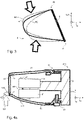
- FIG 3 shows a purely schematic representation, according to which the basic state A and the two states of deformation B1, B2 of the grip element 6 are shown superimposed.
- the figures 4a , 4b and 4c each show a cross section of a simplified model of the grip element 6, the sectional plane of the cross section being arranged parallel to the longitudinal direction 1x and to the height direction 1z of the driver's seat.
- a Cartesian coordinate system is added to the figures, which shows the vertical direction 1z of the vehicle seat 1 (and here even more precisely the vertical direction 1z1 of the vehicle seat 1 upwards and the vertical direction 1z2 of the vehicle seat 1 downwards), the longitudinal direction 1x of the vehicle seat 1 (from the front to the rear according to the direction of the arrow) and the width direction 1y of the vehicle seat 1 (from left to right according to the direction of the arrow).
- the present 1 shows a vehicle seat 1 with an upper part 2, which is mounted adjustable relative to a lower part 3 by means of a height adjustment device 4 in the vertical direction 1z of the vehicle seat 1.
- the present Figure 2a shows a side view of parts of the vehicle seat 1.
- the present Figure 2b shows a perspective view of parts of the vehicle seat 1, according to which the grip element 6 is clearly visible.
- the present Figure 2e shows a perspective view of parts of the height adjustment device 4, according to which the grip element 6 and the support element 8 can be seen clearly.
- the height adjustment device 4 comprises a first switch 51, by means of which the upper part 2 can be adjusted upwards 1z1, and a second switch 52, by means of which the upper part 2 can be adjusted downwards 1z2.
- a first switch 51 by means of which the upper part 2 can be adjusted upwards 1z1
- a second switch 52 by means of which the upper part 2 can be adjusted downwards 1z2.
- Figure 2f which are similar to the Figure 2d is designed; only the second switch 52 'of Figure 2f has an embodiment of the second switch 52 of Fig. 2d different embodiment.
- the actual seat part 10 is arranged on the upper part 2 of the vehicle seat 1 .
- the lower part 3 of the vehicle seat 1 is firmly connected to a base U of the vehicle cabin C indicated schematically.
- the height adjustment device 4 for the vehicle seat 1 in the present case comprises a scissor-type frame mechanism (hidden behind a bellows 9), which in the present case is combined with a springing device 40 and a damping device (not shown).
- the suspension device 40 comprises, for example, an air spring (not shown) arranged between the upper part and the lower part. Air can thus be supplied to the air spring in order to adjust the vehicle seat 1 upwards 1z1, and air can be removed from the air spring in order to adjust the vehicle seat 1 downwards 1z2. In this case, the air supply or the air extraction is controlled via the first 51 or the second switch 52.
- Fig. 2d shows a grip element (6) of the height adjustment device (4) with a plurality of sections 61, 62, 63 which are connected to one another and are movably mounted in relation to one another 3 as well as a comparison of figures 4a , 4b and 4c illustrate that, starting from a basic state A of the grip element 6, a first deformation state B1 of the grip element 6 can be achieved by shifting the sections 61, 62, 63 to one another in a first direction 1z1 and by shifting the sections 61, 62, 63 to one another in a first direction 1z1 opposite second direction 1z2 a second deformation state B2 of the grip element 6 can be achieved.
- the first switch 51 can be actuated by means of the grip element 6
- the second switch 52 can be actuated by means of the grip element 6 in the second state of deformation B2.
- the gripping element 6 can only be deformed in the two directions 1z1 and 1z2. Due to the opposing arrangement of the two directions 1z1 and 1z2, a deformation in the first direction 1z1 can only take place independently of a deformation in the second direction 1z2 in terms of time.
- the gripping element 6 is designed to be elastic, so that when the force that triggered the deformation is no longer applied, it can automatically deform back to the basic state A, starting from the first B1 or second deformation state B2, and that the first 51 and the second switch 52 can no longer be in an actuated state.
- the grip element 6 is arranged below a seat surface 101 of the seat part 10 of the vehicle seat 1 and at the same time on the upper part 2, so that it is ensured that the distance between the grip element 6 and the driver's hand, which actuates the grip element 6, is independent of the set height of the upper part 2 in relation to the lower part 3 is always the same.
- the vehicle seat 1 has a longitudinal adjustment device 30 with two pairs of rails 31 , each pair of rails 31 having a lower guide rail 32 and an upper slide rail 33 .
- the grip element 6 is arranged in the width direction 1y of the vehicle seat 1 between the two pairs of rails 31, in the vertical direction 1z of the vehicle seat 1 at least partially at the same height as these rail pairs 31 and in the longitudinal direction 1x of the vehicle seat 1 directly in front of a front end 301 of the two slide rails 32 .
- the first direction in which the grip element 6 can be deformed corresponds to the height direction upwards 1z1.
- the second direction, in which the grip element 6 can be deformed corresponds to the downward vertical direction 1z2.
- the driver In order to adjust the vehicle seat 1 upwards 1z1, the driver must also deform the handle element 6 upwards 1z1; analogously, the driver has to deform the handle element 6 downwards 1z2 in order to adjust the vehicle seat 1 downwards 1z2.
- the handle element 6 is therefore designed to be deformable. In the present case, at least some parts of the grip element 6 remain stationary during both deformations, ie do not deform as well.
- Figures 2d , 4a , 4b and 4c show that in the present case a first 61, a second 62 and a third 63 of the interconnected and movably mounted sections 61, 62, 63 are provided, with the second movably mounted section 62 being connected at a first end 621 by means of a first film hinge 71 to the first movable mounted section 61 and is connected at a second end 622 by means of a second film hinge 72 to the third movably mounted section 63 .
- the figures 4a and 4c show that the two sections 61 and 63 are each elastically deformed in the first state of deformation B1 and in the second state of deformation B2.
- the first 61, second 62 and third section 63 and the two film hinges 71, 72 together form a one-piece part that can be manufactured in a single injection molding process.
- the handle element is made of polypropylene (PP).
- the first 61 and the third section 63 essentially have the shape of a trapezium.
- the first section 61 is arranged without contact with the third section 63 .
- the second section 62 essentially has the shape of a rectangle. It is also shown that the second section 62 in the present case has a reinforcement section 623 which is designed in the form of a thickened material. In the present case, the material thickening is designed in the form of an elongated tab, which is arranged perpendicularly to the first direction 1z1 and to the second direction 1z2 and parallel to the width direction 1y of the vehicle seat 1 .
- both switches 51, 52 are arranged without contact with the first 61 and third section 63 and without contact with any other element.
- the second movably mounted section 62 in the basic state A of the grip element 6 (see Figure 4b ), in the first state of deformation B1 of the handle element 6 (see Figure 4a ) and in the second state of deformation B2 of the handle element 6 (see Figure 4c ) is arranged contactless to the first switch 51 and the second switch 52.
- the first 61 and the third section 63 are inherently designed to be elastically deformable.
- the marked points can thus serve as switching lugs 611, 631.
- the height adjustment device 4 comprises a carrier element 8 which is connected to the upper part 2 and is designed as a one-piece injection molded part, which forms a first bearing seat 81 for the first movably mounted section 61 and a second bearing seat 82 for the third movably mounted section 63 at a first end 801.
- the first end 801 of the carrier element 8 is arranged at the rear in the longitudinal direction of the seat 1x.
- the first movably mounted section 61 is connected to the first bearing seat 81 by means of a fixed clamping in the form of a screw connection.
- the third movably mounted section 63 is connected to the second bearing seat 82 by means of a positive connection in the form of a snap connection.
- the carrier element 8 forms a third bearing seat 83 for the first switch 51 and a fourth bearing seat 84 for the second switch 52 at a second end 802 .
- the second end 802 of the carrier element 8 is arranged at the front in the longitudinal direction of the seat 1x.
Landscapes
- Engineering & Computer Science (AREA)
- Aviation & Aerospace Engineering (AREA)
- Transportation (AREA)
- Mechanical Engineering (AREA)
- Human Computer Interaction (AREA)
- Seats For Vehicles (AREA)
Description
- Die Erfindung betrifft einen Fahrzeugsitz mit einem Oberteil, welches gegenüber einem Unterteil mittels einer Höhenverstelleinrichtung in Höhenrichtung des Fahrzeugsitzes verstellbar gelagert ist, wobei die Höhenverstelleinrichtung einen ersten Schalter, mittels dessen Betätigung das Oberteil nach oben verstellbar ist, und einen zweiten Schalter, mittels dessen Betätigung das Oberteil nach unten verstellbar ist, umfasst, gemäß dem Oberbegriff des Anspruchs 1.
- Am Oberteil des Fahrzeugsitzes ist beispielsweise das eigentliche Sitzteil angeordnet. Das Unterteil des Fahrzeugsitzes ist wiederum zumeist fest mit einem Untergrund der Fahrzeugkabine verbunden. Damit ein Sitzinsasse und/oder Fahrer, die in der Fahrerkabine in der Nähe des Fahrzeugsitzes angeordneten Bedienelemente gut erreichen und einen guten Blick auf die Umgebung des Fahrzeugs durch die Windschutzscheibe werfen kann, ist es erwünscht, dass sich die Höhe des Oberteils in Relation zum Unterteil je nach Wunsch oder Größe des Fahrers einstellen lässt. Dies ist vor allem relevant für Fahrzeugsitze verhältnismäßig kleiner Fahrzeuge wie Gabelstapler oder Kleintraktoren, die beispielsweise zur Arbeit in Weinbergen oder eng bepflanzten Obstplantagen verwendet werden.
- Höhenverstelleinrichtungen für Fahrzeugsitze, mittels welchen das Oberteil gegenüber dem Unterteil höhenverstellbar ist, sind aus dem Stand der Technik an sich bekannt. Beispielsweise ist hier eine Scherengestellmechanik bereitgestellt, welche mit einer Federungseinrichtung und/oder einer Dämpfungseinrichtung kombiniert werden kann. Die Federungseinrichtung umfasst beispielsweise eine zwischen dem Oberteil und dem Unterteil angeordnete Luftfeder. So kann der Luftfeder Luft zugeführt werden, um den Fahrzeugsitz nach oben zu verstellen, und der Luftfeder Luft entnommen werden, um den Fahrzeugsitz nach unten zu verstellen. Die Ansteuerung der Luftzufuhr oder der Luftentnahme erfolgt dabei beispielsweise über Ventile und/oder Schalter, deren Ansteuerung beispielsweise über die Betätigung eines Betätigungselements durch den Fahrer realisiert wird.
-
DE 198 06 479 C1 zeigt eine Steuereinrichtung für die Verstellung von Sitzteilen, die im Wesentlichen aus einem plattenförmigen Tragekörper mit mehreren Bedieneinheiten besteht. Der harte und unverformbare Kern des Griffbereiches ist ummantelt von einer flexiblen Betätigungsoberfläche, wobei zwischen der Ummantelung und dem Kern mehrere Signalgeber angeordnet sind, die eine bestimmte Richtung auszuführende Verstellung des Sitzes signalisiert. Der Kern ist dabei einstückig ausgebildet und in seiner Kontur einem Sitz abstrakt nachgebildet. - Oft umfassen diese Höhenverstelleinrichtungen allerdings eine komplizierte Mechanik mit zahlreichen und zumindest zum Teil miteinander wechselwirkenden Bauteilen, welche zwischen dem Betätigungselement und den Ventilen und/oder Schaltern angeordnet sind. Der Nachteil hierbei ist, dass jede Wechselwirkung, insbesondere jede mechanische Verbindung zweier Bauteile, generell mit einer gewissen Form- und/oder Lagetoleranz einhergeht. Diese Form- und/oder Lagetoleranzen können sich aufsummieren, so dass im Extremfall das mechanische Zusammenspiel nicht mehr einwandfrei funktioniert und die Höhenverstellung des Oberteils nicht mehr zuverlässig durchgeführt werden kann. Außerdem ist eine derartige Höhenverstelleinrichtung aufgrund der Vielzahl der Bauteile und der komplizierten Montage fehleranfällig und kostenintensiv. Nicht zuletzt geht dies mit einem erhöhten Platzbedarf einher, was bei den eingangs erwähnten kleinen Fahrzeugen problematisch sein kann.
- Es ist daher Aufgabe der vorliegenden Erfindung, ein Fahrzeugsitz mit einer Höhenverstelleinrichtung zu entwickeln, welche eine kompakte, einfache und dennoch zuverlässige Ausgestaltung darstellt.
- Die Aufgabe der Erfindung wird gelöst von einem Fahrzeugsitz mit einem Oberteil, welches gegenüber einem Unterteil mittels einer Höhenverstelleinrichtung in Höhenrichtung des Fahrzeugsitzes verstellbar gelagert ist, wobei die Höhenverstelleinrichtung einen ersten Schalter, mittels dessen Betätigung das Oberteil nach oben verstellbar ist, und einen zweiten Schalter, mittels dessen Betätigung das Oberteil nach unten verstellbar ist, umfasst. Erfindungsgemäß ist ein Griffelement der Höhenverstelleinrichtung mit einem ersten, einem zweiten und einem dritten Abschnitt vorgesehen, wobei die Abschnitte miteinander verbunden und zueinander beweglich gelagert sind. Ausgehend von einem Grundzustand des Griffelements ist mittels einer Verlagerung der Abschnitte zueinander in eine erste Richtung ein erster Verformungszustand des Griffelements und mittels einer Verlagerung der Abschnitte zueinander in eine zur ersten Richtung gegenläufige zweite Richtung ein zweiter Verformungszustand des Griffelements erzielbar. Dabei ist im ersten Verformungszustand mittels des Griffelements der erste Schalter und im zweiten Verformungszustand mittels des Griffelements der zweite Schalter betätigbar.
- Vorteilhaft ist das Griffelement lediglich in die zwei genannten Richtungen verformbar. Durch die gegenläufige Anordnung der beiden Richtungen kann eine Verformung in die erste Richtung nur zeitlich unabhängig von einer Verformung in die zweite Richtung stattfinden. Die beiden Verformungen können also nicht zeitgleich stattfinden. Damit ist eine eindeutige und intuitive Betätigung des Griffelements ermöglicht. Eine Fehlbedienung ist quasi ausgeschlossen.
- Vorteilhaft entspricht der Grundzustand einem Zustand des Griffelements, gemäß welchem das Griffelement zumindest außerhalb der Stellen, mittels welchen es gelagert ist, verformungsfrei ist.
- Die Verformung in die erste oder in die zweite Richtung kann durch die Applikation einer Kraft, beispielsweise der Muskelkraft des Fahrers, erfolgen. Bevorzugt ist das Griffelement elastisch ausgestaltet, so dass es, wenn die die Verformung auslösende Kraft nicht mehr anliegt, ausgehend vom ersten oder zweiten Verformungszustand wieder selbstständig in den Grundzustand rückverformbar ist und dass der erste und der zweite Schalter nicht mehr in einem betätigten Zustand vorliegen. Vorteilhaft ist also die Rückstellmechanik zur Rückstellung des Griffelements in den Grundzustand nicht separat ausgebildet, sondern mittels des Griffelements selbst ausgestaltet, was weitere Bauteile und Kosten spart.
- Ebenfalls kann es vorteilhaft sein, wenn mit der Verlagerung der Abschnitte zueinander in die erste oder zweite Richtung zeitgleich eine Verformung mindestens eines Abschnitts der zueinander beweglich gelagerten Abschnitte einhergeht. Bevorzugt ist diese Verformung elastisch ausgebildet und damit reversibel, wenn die die Verformung auslösende Kraft nicht mehr anliegt.
- Das Griffelement ist dabei bevorzugt unterhalb einer Sitzfläche des Fahrzeugsitzes angeordnet. Ist das Griffelement am Oberteil angeordnet, so ist dafür gesorgt, dass der Abstand zwischen dem Griffelement und der Hand des Fahrers, die das Griffelement betätigt, unabhängig von der eingestellten Höhe des Oberteils in Relation zum Unterteil stets gleich ist.
- Beispielsweise weist der Fahrzeugsitz eine Längsverstelleinrichtung mit zwei Schienenpaaren auf, wobei jedes Schienenpaar eine untere Führungsschiene und eine obere Gleitschiene aufweist. Beispielsweise kann das Griffelement in Breitenrichtung des Fahrzeugsitzes zwischen den beiden Schienenpaaren und/oder in Höhenrichtung des Fahrzeugsitzes zumindest abschnittsweise auf gleicher Höhe zu diesen Schienenpaaren und/oder in Längsrichtung des Fahrzeugsitzes unmittelbar vor einem vorderen Ende der beiden Gleitschienen angeordnet sein.
- Alternativ kann es vorgesehen sein, dass das Griffelement am Unterteil angeordnet ist.
- Bevorzugt entspricht die erste Richtung, in welche das Griffelement verformbar ist, einer Höhenrichtung des Fahrzeugsitzes nach oben oder weist zumindest einen Anteil in Höhenrichtung des Fahrzeugsitzes nach oben auf. Bevorzugt entspricht die zweite Richtung, in welche das Griffelement verformbar ist, einer Höhenrichtung des Fahrzeugsitzes nach unten oder weist zumindest einen Anteil in Höhenrichtung des Fahrzeugsitzes nach unten auf. Damit ist dem Fahrer eine Bedienlogik bereitgestellt, welche äußerst intuitiv ist. Zum Verstellen des Fahrzeugsitzes nach oben muss der Fahrer nämlich auch das Griffelement nach oben verformen; analog muss der Fahrer zum Verstellen des Fahrzeugsitzes nach unten das Griffelement nach unten verformen.
- Im Sinne der vorliegenden Erfindung wird unter einer "Verlagerung" eine Translationsbewegung, eine Rotationsbewegung oder eine kombinierte Bewegung, also eine Bewegung, bei welcher sich eine oder mehrere Translationsbewegungen und/oder eine oder mehrere Rotationsbewegungen überlagern, verstanden. Bevorzugt erfahren der erste und/oder der dritte Abschnitt eine Rotationsbewegung. Bevorzugt erfährt der zweite Abschnitt eine kombinierte Bewegung aus einer Rotationsbewegung und einer Translationsbewegung.
- Das Griffelement ist also in sich verformbar ausgestaltet. Bevorzugt bleiben zumindest einige Teile des Griffelements bei beiden Verformungen stationär, verformen sich also nicht mit.
- Eine bevorzugte mechanische Ausgestaltung des Griffelements sieht vor, dass der zweite beweglich gelagerte Abschnitt an einem ersten Ende mittels eines ersten Filmscharniers mit dem ersten beweglich gelagerten Abschnitt und an einem zweiten Ende mittels eines zweiten Filmscharniers mit dem dritten beweglich gelagerten Abschnitt verbunden ist.
- Scharniere sind generell Lager, welche einen einzelnen rotativen Freiheitsgrad ermöglichen. Ein Filmscharnier ist aus dem Stand der Technik bekannt und stellt ein Scharnier dar, welches ohne mechanische Bauelemente wie Achsen, Hebel, Federn etc. auskommt. Es ist mittels einer flexiblen, dünnwandigen Gelenkrille zwischen zwei zu verbindenden Teilen ausgestaltet. Die beiden Teile, welche durch das Filmscharnier verbunden sind, und das Filmscharnier sind also miteinander einstückig ausgestaltet.
- Es ist also mittels der Verwendung von zwei Filmscharnieren für eine kostengünstige Lösung gesorgt, da das Scharnier und der erste, zweite und dritte Abschnitt aus dem gleichen Material ausgebildet sein können. Durch Verbindung der Abschnitte wie beschrieben ist außerdem eine intuitive Betätigung möglich.
- Der erste, zweite und dritte Abschnitt und die beiden Filmscharniere bilden also miteinander bevorzugt ein einstückiges Teil, welches in einem einzigen Fertigungsschritt gefertigt werden kann. Beispielsweise kann dieses einstückige Teil in einem Spritzgussprozess gefertigt werden.
- Als bevorzugte Materialien für das Griffelement kommen beispielsweise ein Thermoplast oder Mischungen aus Thermoplasten in Frage, beispielsweise aus einem oder mehreren der folgenden Materialien: Acrylnitril-Butadien-Styrol (ABS), Polyamide (PA), Polylactat (PLA), Polymethylmethacrylat (PMMA), Polycarbonat (PC), Polyethylenterephthalat (PET), Polyethylen (PE), Polypropylen (PP), Polystyrol (PS), Polyetheretherketon (PEEK) und Polyvinylchlorid (PVC). Denkbar sind auch Materialien, die einen oder mehrere der oben genannten Kunststoffe aufweisen und zusätzlich mittels Glasfasern und/oder Carbonfasern faserverstärkt sind.
- Der erste und/oder der dritte Abschnitt weisen dabei bevorzugt im Wesentlichen die Form eines Rechtecks oder eines Trapezes auf. Der erste Abschnitt ist bevorzugt kontaktlos zum dritten Abschnitt angeordnet; bevorzugt gilt dies für sämtliche Zustände des Griffelements, also insbesondere für den Grundzustand, die beiden Verformungszustände und jeden Zustand dazwischen.
- Der zweite Abschnitt weist dabei bevorzugt im Wesentlichen die Form eines Rechtecks auf. Es kann vorteilhaft sein, wenn der zweite Abschnitt einen Verstärkungsabschnitt aufweist, welcher in Form einer Materialverdickung ausgestaltet ist. Beispielsweise ist die Materialverdickung in Form einer länglichen Wulst oder Lasche ausgestaltet, welche beispielsweise senkrecht zur ersten und zur zweiten Richtung und/oder parallel zur Breitenrichtung des Fahrzeugsitzes angeordnet ist. Die Anordnung des Verstärkungsabschnitts hat den Vorteil, dass der Fahrer nur diesen Verstärkungsabschnitt des zweiten Abschnitts kontaktieren muss, um die Verformung in die erste oder in die zweite Richtung durchführen zu können. Die Materialverdickung kann also durch die Hand des Fahrers von oben und von unten gut ergriffen werden; beispielsweise kann der Fahrer die Materialverdickung zwischen Daumen und Zeigefinger nehmen und nach oben ziehen oder nach unten drücken, um letztendlich die Höhenverstellung auszulösen.
- Es ist ferner bevorzugt, wenn im ersten Verformungszustand ein unmittelbarer Kontakt zwischen dem ersten Schalter und dem ersten beweglich gelagerten Abschnitt und im zweiten Verformungszustand ein unmittelbarer Kontakt zwischen dem zweiten Schalter und dem dritten beweglich gelagerten Abschnitt ausgebildet sind. Bevorzugt ist im ersten Verformungszustand ein unmittelbarer Kontakt zwischen einem Auslöseelement des ersten Schalters und einem Anteil des ersten beweglich gelagerten Abschnitts und im zweiten Verformungszustand ein unmittelbarer Kontakt zwischen einem Auslöseelement des zweiten Schalters und einem Anteil des dritten beweglich gelagerten Abschnitts ausgebildet.
- Unter einem Auslöseelement eines Schalters wird der Anteil des Schalters verstanden, welcher zum Auslösen eines Schaltvorgangs, mithin zum Betätigen des Schalters, kontaktiert werden muss. Beispielsweise ist der Schalter als Drucktaster ausgestaltet.
- Analog dazu sind im Grundzustand des Griffelements bevorzugt beide Schalter kontaktfrei zum ersten und zum dritten Abschnitt sowie kontaktfrei zu jeglichem anderen Element angeordnet. Das gleiche gilt bevorzugt auch für beide Auslöseelemente der Schalter.
- Der Vorteil liegt hier darin, dass jeweils ein separates Element des Griffelements nur eine der Auslösefunktionen übernimmt. Die Zuordnung der Abschnitte des Griffelements zu den gewünschten Schaltvorgängen ist also eindeutig.
- Der unmittelbare Kontakt ist außerdem vorteilhaft, da keine zwischen den Abschnitten und den Schaltern geschalteten Elemente vorgesehen sind, was wie oben erläutert die Zuverlässigkeit der Mechanik erhöht.
- Ist zudem die obige Anordnung gewährleistet, wonach der zweite Abschnitt zwischen dem ersten und dem dritten Abschnitt angeordnet ist, so ist gewährleistet, dass die beiden baulich voneinander getrennten Abschnitte, nämlich der erste und der dritte Abschnitt, die Auslösefunktionen übernehmen. Eine versehentliche Auslösung der Höhenverstelleinrichtung in eine unerwünschte Richtung ist damit so gut wie ausgeschlossen.
- Ebenfalls ist es bevorzugt, dass der zweite beweglich gelagerte Abschnitt im Grundzustand, im ersten Verformungszustand und im zweiten Verformungszustand des Griffelements kontaktlos zum ersten Schalter und zum zweiten Schalter angeordnet ist. Somit wird vermieden, dass der zweite Abschnitt versehentlich einen der beiden Schalter kontaktiert und die Höhenverstellung auslöst.
- Generell ist es vorteilhaft, wenn der Anteil des ersten oder dritten Abschnitts, der einen der beiden Schalter kontaktieren soll (im Nachfolgenden als "Schaltfahne" bezeichnet), hinsichtlich seiner jeweiligen Position gemäß dem Grundzustand, dem ersten Verformungszustand und/oder dem zweiten Verformungszustand jeweils einen deutlichen Unterschied aufweist, damit eindeutig zwischen einer Schaltposition und einer sonstigen Position unterschieden werden kann.
- Der erste und der dritte Abschnitt sind bevorzugt in sich elastisch verformbar ausgestaltet. Bevorzugt sind sie an einem Ende gelagert und an einem anderen, dem zweiten Abschnitt zugewandten Ende mit dem zweiten Abschnitt verbunden. Somit kann beispielsweise eine bestimmte Stelle des ersten und/oder dritten Abschnitts, welche möglichst weit von der jeweiligen Lagerstelle entfernt angeordnet sind, als Schaltfahne dienen. Gleichzeitig sollte die Stelle nicht zu nah am zweiten Abschnitt angeordnet sein, um einen unerwünschten Kontakt zwischen dem zweiten Abschnitt und den Schaltern zu vermeiden.
- Wenn der zweite Abschnitt zwischen den ersten und den dritten Abschnitt geschaltet ist und/oder eine überlagerte Bewegung durchführt, so ist mittels dieser Bewegung ein weniger eindeutiger Unterschied zwischen der Position des zweiten Abschnitts in den drei genannten Zuständen möglich. Es ist also vorteilhaft, wenn der zweite Abschnitt eine verbindende und keine schaltende Funktion übernimmt.
- Erfindungsgemäß umfasst die Höhenverstelleinrichtung ein mit dem Oberteil oder dem Unterteil verbundenes Trägerelement, welches an einem ersten Ende einen ersten Lagersitz für den ersten beweglich gelagerten Abschnitt und einen zweiten Lagersitz für den dritten beweglich gelagerten Abschnitt ausbildet.
- Der Vorteil dieser Anordnung ist, dass die Lagerung des ersten und des dritten Abschnitts über das gleiche Element realisiert ist. Damit sind Positionsabweichungen (Lagetoleranzen) zwischen dem ersten und dem dritten Abschnitt minimiert, und der Schaltvorgang kann zuverlässig und präzise stattfinden.
- Bevorzugt ist das erste Ende des Trägerelements in Sitzlängsrichtung hinten angeordnet.
- Dabei ist es vorteilhaft, wenn der erste beweglich gelagerte Abschnitt mittels einer festen Einspannung mit dem ersten Lagersitz verbunden ist. Diese Lagerung ist also dazu vorgesehen, sämtliche Freiheitsgrade des ersten beweglich gelagerten Abschnitts zumindest an der Lagerstelle zu eliminieren. Beispielsweise ist die feste Einspannung mittels einer Schraub- oder einer Nietverbindung ausgestaltet. Da das Griffelement wie oben beschrieben elastisch verformbar ist, kann sich der erste beweglich gelagerte Abschnitt dennoch verformen.
- Ebenfalls ist es vorteilhaft, wenn der dritte beweglich gelagerte Abschnitt mittels einer formschlüssigen Verbindung mit dem zweiten Lagersitz verbunden ist. Beispielsweise ist die formschlüssige Verbindung mittels einer Einhängung, einer Steck- oder einer Schnappverbindung ausgestaltet.
- Ferner hat es sich als vorteilhaft herausgestellt, wenn das Trägerelement an einem zweiten Ende einen dritten Lagersitz für den ersten Schalter und einen vierten Lagersitz für den zweiten Schalter ausbildet. Je nach Art des Schalters kann der erste und/oder der zweite Schalter beispielsweise mittels einer Schraub- oder einer Steckverbindung mit dem dritten oder dem vierten Lagersitz verbunden sein.
- Bevorzugt ist das zweite Ende des Trägerelements in Sitzlängsrichtung vorne angeordnet.
- Dadurch ist gewährleistet, dass ein einzelnes Element, nämlich das Trägerelement, die Lagersitze für die Schalter und für die Schaltfahnen bereitstellt. Damit sind Positionsabweichungen (Lagetoleranzen) zwischen beiden Schaltern, zwischen beiden Schaltfahnen sowie zwischen jeweils einem der Schalter und der dazugehörigen Schaltfahne minimiert; der Schaltvorgang kann zuverlässig stattfinden. Beispielsweise ist das Trägerelement als einstückiges Zerspanungsteil oder als einstückiges Spritzgussteil ausgestaltet; somit ist eine hohe Flexibilität bei der Formgebung des Trägerteils und der Ausgestaltung der Lagersitze gewährleistet.
- Weitere Vorteile, Ziele und Eigenschaften vorliegender Erfindung werden anhand anliegender Zeichnung und nachfolgender Beschreibung erläutert, in welchen ein Fahrzeugsitz beispielhaft mit unterschiedlich ausgestalteten Führungseinrichtungen dargestellt und beschrieben ist.
- In der Zeichnung zeigen:
- Figur 1
- eine perspektivische Ansicht eines erfindungsgemäßen Fahrzeugsitzes;
- Figur 2a
- eine Seitenansicht eines Ausschnitts des Fahrzeugsitzes gemäß der
Fig. 1 ; - Figur 2b
- eine perspektivische Ansicht eines weiteren Ausschnitts des Fahrzeugsitzes gemäß der
Fig. 1 ; - Figur 2c
- eine perspektivische Ansicht eines Teils der Höhenverstelleinrichtung ohne Griffelement;
- Figur 2d
- eine Explosionsdarstellung des Teils der Höhenverstelleinrichtung gemäß der
Fig. 2c ; - Figur 2e
- eine perspektivische Ansicht eines Teils der Höhenverstelleinrichtung mit Griffelement;
- Figur 2f
- eine Explosionsdarstellung eines Teils der Höhenverstelleinrichtung gemäß einer Variante;
- Figur 3
- eine Prinzipskizze der Verformung eines Griffelements;
- Figur 4a
- einen vereinfacht dargestellten Querschnitt durch die Höhenverstelleinrichtung gemäß einem ersten Verformungszustand des Griffelements;
- Figur 4b
- einen vereinfacht dargestellten Querschnitt durch die Höhenverstelleinrichtung gemäß einem Grundzustand des Griffelements;
- Figur 4c
- einen vereinfacht dargestellten Querschnitt durch die Höhenverstelleinrichtung gemäß einem zweiten Verformungszustand des Griffelements.
- Es sei vorliegend erwähnt, dass die
Figur 3 eine rein schematische Darstellung zeigt, gemäß welcher der Grundzustand A sowie die beiden Verformungszustände B1, B2 des Griffelements 6 überlagert dargestellt sind. - Die
Figuren 4a ,4b und 4c zeigen darüber hinaus jeweils einen Querschnitt eines vereinfachten Modells des Griffelements 6, wobei die Schnittebene des Querschnitts jeweils parallel zur Längsrichtung 1x und zur Höhenrichtung 1z des Fahrersitzes angeordnet ist. Dabei ist die Position der Schalter 51, 52 gemäß denFiguren 4a ,4b und 4c lediglich beispielhaft dargestellt und weicht von der dargestellten realen Position der Schalter 51, 52 gemäß denFiguren 2c ,2d und2f ab. - Um die Übersichtlichkeit zu verbessern, ist den Figuren ein kartesisches Koordinatensystem hinzugefügt, welches die Höhenrichtung 1z des Fahrzeugsitzes 1 (und hier noch genauer die Höhenrichtung 1z1 des Fahrzeugsitzes 1 nach oben sowie die Höhenrichtung 1z2 des Fahrzeugsitzes 1 nach unten), die Längsrichtung 1x des Fahrzeugsitzes 1 (entsprechend der Pfeilrichtung von vorne nach hinten) sowie die Breitenrichtung 1y des Fahrzeugsitzes 1 (entsprechend der Pfeilrichtung von links nach rechts) veranschaulicht.
- Die vorliegende
Fig. 1 zeigt einen Fahrzeugsitz 1 mit einem Oberteil 2, welches gegenüber einem Unterteil 3 mittels einer Höhenverstelleinrichtung 4 in Höhenrichtung 1z des Fahrzeugsitzes 1 verstellbar gelagert ist. Die vorliegendeFig. 2a zeigt eine seitliche Darstellung von Teilen des Fahrzeugsitzes 1. Die vorliegendeFig. 2b zeigt eine perspektivische Darstellung von Teilen des Fahrzeugsitzes 1, gemäß welcher das Griffelement 6 gut zu erkennen ist. Die vorliegendeFig. 2e zeigt eine perspektivische Darstellung von Teilen der Höhenverstelleinrichtung 4, gemäß welcher das Griffelement 6 und das Trägerelement 8 gut zu erkennen sind. - Insbesondere gemäß den
Figuren 2c und2d ist zu sehen, dass die Höhenverstelleinrichtung 4 einen ersten Schalter 51, mittels dessen Betätigung das Oberteil 2 nach oben 1z1 verstellbar ist, und einen zweiten Schalter 52, mittels dessen Betätigung das Oberteil 2 nach unten 1z2 verstellbar ist, umfasst. Ebenfalls zeigt dies dieFigur 2f , welche ähnlich zurFigur 2d ausgestaltet ist; lediglich der zweite Schalter 52' derFigur 2f weist eine zur Ausführungsform des zweiten Schalters 52 derFig. 2d abweichende Ausführungsform auf. - Am Oberteil 2 des Fahrzeugsitzes 1 ist vorliegend das eigentliche Sitzteil 10 angeordnet. Das Unterteil 3 des Fahrzeugsitzes 1 ist vorliegend fest mit einem Untergrund U der schematisch angedeuteten Fahrzeugkabine C verbunden.
- Die Höhenverstelleinrichtung 4 für den Fahrzeugsitz 1 umfasst vorliegend eine (hinter einem Faltenbalg 9 verborgene) Scherengestellmechanik, welche vorliegend mit einer Federungseinrichtung 40 und einer nicht gezeigten Dämpfungseinrichtung kombiniert ist. Die Federungseinrichtung 40 umfasst beispielsweise eine zwischen dem Oberteil und dem Unterteil angeordnete Luftfeder (nicht gezeigt). So kann der Luftfeder Luft zugeführt werden, um den Fahrzeugsitz 1 nach oben 1z1 zu verstellen, und der Luftfeder Luft entnommen werden, um den Fahrzeugsitz 1 nach unten 1z2 zu verstellen. Die Ansteuerung der Luftzufuhr oder der Luftentnahme erfolgt dabei vorliegend über den ersten 51 oder den zweiten Schalter 52.
- Insbesondere die
Fig. 2d zeigt dabei ein Griffelement (6) der Höhenverstelleinrichtung (4) mit mehreren miteinander verbundenen und zueinander beweglich gelagerten Abschnitten 61, 62, 63. DieFig. 3 sowie ein Vergleich derFiguren 4a ,4b und 4c veranschaulichen dabei, dass ausgehend von einem Grundzustand A des Griffelements 6 mittels einer Verlagerung der Abschnitte 61, 62, 63 zueinander in eine erste Richtung 1z1 ein erster Verformungszustand B1 des Griffelements 6 und mittels einer Verlagerung der Abschnitte 61, 62, 63 zueinander in eine zur ersten Richtung 1z1 gegenläufige zweite Richtung 1z2 ein zweiter Verformungszustand B2 des Griffelements 6 erzielbar sind. Dabei ist im ersten Verformungszustand B1 mittels des Griffelements 6 der erste Schalter 51 und im zweiten Verformungszustand B2 mittels des Griffelements 6 der zweite Schalter 52 betätigbar. - Vorliegend ist das Griffelement 6 lediglich in die zwei Richtungen 1z1 und 1z2 verformbar. Durch die gegenläufige Anordnung der beiden Richtungen 1z1 und 1z2 kann eine Verformung in die erste Richtung 1z1 nur zeitlich unabhängig von einer Verformung in die zweite Richtung 1z2 stattfinden.
- Vorliegend ist das Griffelement 6 elastisch ausgestaltet, so dass es, wenn die die Verformung auslösende Kraft nicht mehr anliegt, ausgehend vom ersten B1 oder zweiten Verformungszustand B2 wieder selbstständig in den Grundzustand A rückverformbar ist und dass der erste 51 und der zweite Schalter 52 nicht mehr in einem betätigten Zustand vorliegen.
- Das Griffelement 6 ist dabei vorliegend unterhalb einer Sitzfläche 101 des Sitzteils 10 des Fahrzeugsitzes 1 und gleichzeitig am Oberteil 2 angeordnet, so dass dafür gesorgt ist, dass der Abstand zwischen dem Griffelement 6 und der Hand des Fahrers, die das Griffelement 6 betätigt, unabhängig von der eingestellten Höhe des Oberteils 2 in Relation zum Unterteil 3 stets gleich ist.
- Vorliegend weist der Fahrzeugsitz 1 eine Längsverstelleinrichtung 30 mit zwei Schienenpaaren 31 auf, wobei jedes Schienenpaar 31 eine untere Führungsschiene 32 und eine obere Gleitschiene 33 aufweist. Vorliegend ist das Griffelement 6 in Breitenrichtung 1y des Fahrzeugsitzes 1 zwischen den beiden Schienenpaaren 31, in Höhenrichtung 1z des Fahrzeugsitzes 1 zumindest teilweise auf gleicher Höhe zu diesen Schienenpaaren 31 und in Längsrichtung 1x des Fahrzeugsitzes 1 unmittelbar vor einem vorderen Ende 301 der beiden Gleitschienen 32 angeordnet.
- Vorliegend entspricht die erste Richtung, in welche das Griffelement 6 verformbar ist, der Höhenrichtung nach oben 1z1. Vorliegend entspricht die zweite Richtung, in welche das Griffelement 6 verformbar ist, der Höhenrichtung nach unten 1z2. Zum Verstellen des Fahrzeugsitzes 1 nach oben 1z1 muss der Fahrer also auch das Griffelement 6 nach oben 1z1 verformen; analog muss der Fahrer zum Verstellen des Fahrzeugsitzes 1 nach unten 1z2 das Griffelement 6 nach unten 1z2 verformen.
- Das Griffelement 6 ist also in sich verformbar ausgestaltet. Vorliegend bleiben zumindest einige Teile des Griffelements 6 bei beiden Verformungen stationär, verformen sich also nicht mit.
- Insbesondere die
Figuren 2d ,4a ,4b und 4c zeigen, dass vorliegend ein erster 61, ein zweiter 62 und ein dritter 63 der miteinander verbundenen und zueinander beweglich gelagerten Abschnitte 61, 62, 63 vorgesehen sind, wobei der zweite beweglich gelagerte Abschnitt 62 an einem ersten Ende 621 mittels eines ersten Filmscharniers 71 mit dem ersten beweglich gelagerten Abschnitt 61 und an einem zweiten Ende 622 mittels eines zweiten Filmscharniers 72 mit dem dritten beweglich gelagerten Abschnitt 63 verbunden ist. DieFiguren 4a und4c zeigen, dass im ersten Verformungszustand B1 und im zweiten Verformungszustand B2 die beiden Abschnitte 61 und 63 jeweils elastisch verformt sind. - Der erste 61, zweite 62 und dritte Abschnitt 63 und die beiden Filmscharniere 71, 72 bilden also miteinander vorliegend ein einstückiges Teil, welches in einem einzigen Spritzgussprozess gefertigt werden kann.
- Vorliegend ist das Griffelement aus Polypropylen (PP) gefertigt.
- Der erste 61 und der dritte Abschnitt 63 weisen dabei vorliegend im Wesentlichen die Form eines Trapezes auf. Der erste Abschnitt 61 ist vorliegend kontaktlos zum dritten Abschnitt 63 angeordnet.
- Der zweite Abschnitt 62 weist vorliegend im Wesentlichen die Form eines Rechtecks auf. Ferner ist gezeigt, dass der zweite Abschnitt 62 vorliegend einen Verstärkungsabschnitt 623 aufweist, welcher in Form einer Materialverdickung ausgestaltet ist. Vorliegend ist die Materialverdickung in Form einer länglichen Lasche ausgestaltet, welche senkrecht zur ersten 1z1 und zur zweiten Richtung 1z2 und parallel zur Breitenrichtung 1y des Fahrzeugsitzes 1 angeordnet ist.
- Vorliegend ist im ersten Verformungszustand B1 des Griffelements 6 (siehe
Fig. 4a ) ein unmittelbarer Kontakt zwischen einem Auslöseelement 511 des ersten Schalters 51 und einem Anteil des ersten beweglich gelagerten Abschnitts 61 und im zweiten Verformungszustand B2 des Griffelements 6 (sieheFig. 4c ) ein unmittelbarer Kontakt zwischen einem Auslöseelement 521 des zweiten Schalters 52 und einem Anteil des dritten beweglich gelagerten Abschnitts 63 ausgebildet. Die Anteile des ersten 61 und des dritten Abschnitts 63 werden daher im Folgenden als Schaltfahne 611 und Schaltfahne 613 bezeichnet. - Analog dazu sind im Grundzustand A des Griffelements 6 (siehe
Fig. 4b ) vorliegend beide Schalter 51, 52 kontaktfrei zum ersten 61 und zum dritten Abschnitt 63 sowie kontaktfrei zu jeglichem anderen Element angeordnet. Das gleiche gilt vorliegend auch für beide Auslöseelemente 511, 521 der Schalter 51, 52. - Ebenfalls ist gezeigt, dass der zweite beweglich gelagerte Abschnitt 62 im Grundzustand A des Griffelements 6 (siehe
Fig. 4b ), im ersten Verformungszustand B1 des Griffelements 6 (sieheFig. 4a ) und im zweiten Verformungszustand B2 des Griffelements 6 (sieheFig. 4c ) kontaktlos zum ersten Schalter 51 und zum zweiten Schalter 52 angeordnet ist. - Der erste 61 und der dritte Abschnitt 63 sind vorliegend in sich elastisch verformbar ausgestaltet. Somit können die markierten Stellen als Schaltfahnen 611, 631 dienen.
- Vorliegend umfasst die Höhenverstelleinrichtung 4 ein mit dem Oberteil 2 verbundenes und als einstückiges Spritzgussteil ausgestaltetes Trägerelement 8, welches an einem ersten Ende 801 einen ersten Lagersitz 81 für den ersten beweglich gelagerten Abschnitt 61 und einen zweiten Lagersitz 82 für den dritten beweglich gelagerten Abschnitt 63 ausbildet. Vorliegend ist das erste Ende 801 des Trägerelements 8 in Sitzlängsrichtung 1x hinten angeordnet.
- Dabei ist vorliegend der erste beweglich gelagerte Abschnitt 61 mittels einer festen Einspannung in Form einer Schraubverbindung mit dem ersten Lagersitz 81 verbunden. Zudem ist vorliegend der dritte beweglich gelagerte Abschnitt 63 mittels einer formschlüssigen Verbindung in Form einer Schnappverbindung mit dem zweiten Lagersitz 82 verbunden.
- Ferner ist gezeigt, dass das Trägerelement 8 an einem zweiten Ende 802 einen dritten Lagersitz 83 für den ersten Schalter 51 und einen vierten Lagersitz 84 für den zweiten Schalter 52 ausbildet. Vorliegend ist das zweite Ende 802 des Trägerelements 8 in Sitzlängsrichtung 1x vorne angeordnet.
- Es versteht sich, dass es sich bei den vorstehend erläuterten Ausführungsbeispielen lediglich um eine erste Ausgestaltung des erfindungsgemäßen Fahrzeugsitzes handelt. Insofern beschränkt sich die Ausgestaltung der Erfindung nicht auf diese Ausführungsbeispiele.
-
- 1
- Fahrzeugsitz
- 1x
- Längsrichtung
- 1y
- Breitenrichtung
- 1z
- Höhenrichtung
- 1z1
- Höhenrichtung nach oben
- 1z2
- Höhenrichtung nach unten
- 2
- Oberteil
- 3
- Unterteil
- 4
- Höhenverstelleinrichtung
- 6
- Griffelement
- 8
- Trägerelement
- 9
- Faltenbalg
- 10
- Sitzteil
- 30
- Längsverstelleinrichtung
- 31
- Schienenpaar
- 32
- Führungsschiene
- 33
- Gleitschiene
- 40
- Federungseinrichtung
- 51, 52, 52'
- Schalter
- 61,62,63
- Abschnitt
- 71, 72
- Filmscharnier
- 81, 82, 83, 84
- Lagersitz
- 101
- Sitzfläche
- 301,621,622,801,802
- Ende
- 511, 521
- Auslöseelement
- 611, 631
- Schaltfahne
- 623
- Verstärkungsabschnitt
- A
- Grundzustand
- B1, B2
- Verformungszustand
- C
- Fahrzeugkabine
Claims (7)
- Fahrzeugsitz (1) mit einem Oberteil (2), welches gegenüber einem Unterteil (3) mittels einer Höhenverstelleinrichtung (4) in Höhenrichtung (1z) des Fahrzeugsitzes (1) verstellbar gelagert ist, wobei die Höhenverstelleinrichtung (4) einen ersten Schalter (51), mittels dessen Betätigung das Oberteil (2) nach oben (1z1) verstellbar ist, und einen zweiten Schalter (52), mittels dessen Betätigung das Oberteil (2) nach unten (1z2) verstellbar ist, umfasst,
dadurch gekennzeichnet, dass
ein Griffelement (6) der Höhenverstelleinrichtung (4) mit einem ersten (61), einem zweiten (62) und einem dritten (63) Abschnitt vorgesehen ist, wobei die Abschnitte (61, 62, 63) miteinander verbunden und zueinander beweglich gelagert sind, wobei ausgehend von einem Grundzustand (A) des Griffelements (6) mittels einer Verlagerung der Abschnitte (61, 62, 63) zueinander in eine erste Richtung (1z1) ein erster Verformungszustand (B1) des Griffelements (6) und mittels einer Verlagerung der Abschnitte (61, 62, 63) zueinander in eine zur ersten Richtung (1z1) gegenläufige zweite Richtung (1z2) ein zweiter Verformungszustand (B2) des Griffelements (6) erzielbar ist, wobei im ersten Verformungszustand (B1) mittels des Griffelements (6) der erste Schalter (51) und im zweiten Verformungszustand (B2) mittels des Griffelements (6) der zweite Schalter (52) betätigbar sind, wobei die Höhenverstelleinrichtung (4) ein mit dem Oberteil (2) oder dem Unterteil (3) verbundenes Trägerelement (8) umfasst, welches an einem ersten Ende (801) einen ersten Lagersitz (81) für den ersten beweglich gelagerten Abschnitt (61) und einen zweiten Lagersitz (82) für den dritten beweglich gelagerten Abschnitt (63) ausbildet. - Fahrzeugsitz (1) nach Anspruch 1,
dadurch gekennzeichnet, dass
der zweite beweglich gelagerte Abschnitt (62) an einem ersten Ende (621) mittels eines ersten Filmscharniers (71) mit dem ersten beweglich gelagerten Abschnitt (61) und an einem zweiten Ende (622) mittels eines zweiten Filmscharniers (72) mit dem dritten beweglich gelagerten Abschnitt (63) verbunden ist. - Fahrzeugsitz (1) nach Anspruch 1 oder 2,
dadurch gekennzeichnet, dass
im ersten Verformungszustand (B1) ein unmittelbarer Kontakt zwischen dem ersten Schalter (51) und dem ersten beweglich gelagerten Abschnitt (61) und im zweiten Verformungszustand (B2) ein unmittelbarer Kontakt zwischen dem zweiten Schalter (52) und dem dritten beweglich gelagerten Abschnitt (63) ausbildbar sind. - Fahrzeugsitz (1) nach einem der vorhergehenden Ansprüche,
dadurch gekennzeichnet, dass
der zweite beweglich gelagerte Abschnitt (62) im Grundzustand (A), im ersten Verformungszustand (B1) und im zweiten Verformungszustand (B2) des Griffelements (6) kontaktlos zum ersten Schalter (51) und zum zweiten Schalter (52) angeordnet ist. - Fahrzeugsitz (1) nach einem der vorhergehenden Ansprüche,
dadurch gekennzeichnet, dass
der erste beweglich gelagerte Abschnitt (61) mittels einer festen Einspannung mit dem ersten Lagersitz (81) verbunden ist. - Fahrzeugsitz (1) nach einem der vorhergehenden Ansprüche,
dadurch gekennzeichnet, dass
der dritte beweglich gelagerte Abschnitt (63) mittels einer formschlüssigen Verbindung mit dem zweiten Lagersitz (82) verbunden ist. - Fahrzeugsitz (1) nach einem der vorhergehenden Ansprüche,
dadurch gekennzeichnet, dass
das Trägerelement (8) an einem zweiten Ende (802) einen dritten Lagersitz (83) für den ersten Schalter (51) und einen vierten Lagersitz (84) für den zweiten Schalter (52) ausbildet.
Applications Claiming Priority (1)
| Application Number | Priority Date | Filing Date | Title |
|---|---|---|---|
| DE102019121812.8A DE102019121812B3 (de) | 2019-08-13 | 2019-08-13 | Fahrzeugsitz mit Höhenverstelleinrichtung |
Publications (2)
| Publication Number | Publication Date |
|---|---|
| EP3778293A1 EP3778293A1 (de) | 2021-02-17 |
| EP3778293B1 true EP3778293B1 (de) | 2022-10-19 |
Family
ID=72046706
Family Applications (1)
| Application Number | Title | Priority Date | Filing Date |
|---|---|---|---|
| EP20190397.8A Active EP3778293B1 (de) | 2019-08-13 | 2020-08-11 | Fahrzeugsitz mit höhenverstelleinrichtung |
Country Status (2)
| Country | Link |
|---|---|
| EP (1) | EP3778293B1 (de) |
| DE (1) | DE102019121812B3 (de) |
Family Cites Families (5)
| Publication number | Priority date | Publication date | Assignee | Title |
|---|---|---|---|---|
| US5380968A (en) * | 1993-09-29 | 1995-01-10 | A.P.M. Hexseal Corporation | Protective cover for switches |
| DE19806479C1 (de) * | 1998-02-16 | 1999-07-15 | Kostal Leopold Gmbh & Co Kg | Elektrische Steuereinrichtung |
| AU2001289460A1 (en) * | 2001-09-27 | 2002-01-21 | Phonak Ag | Electromechanical switch |
| US7268305B2 (en) * | 2005-02-10 | 2007-09-11 | Lear Corporation | Elastomeric vehicle control switch |
| DE102016124696B4 (de) * | 2016-12-16 | 2018-12-13 | Grammer Aktiengesellschaft | Fahrzeugkabine oder Fahrzeugsitz mit Höhenverstelleinrichtung |
-
2019
- 2019-08-13 DE DE102019121812.8A patent/DE102019121812B3/de active Active
-
2020
- 2020-08-11 EP EP20190397.8A patent/EP3778293B1/de active Active
Also Published As
| Publication number | Publication date |
|---|---|
| EP3778293A1 (de) | 2021-02-17 |
| DE102019121812B3 (de) | 2020-11-12 |
Similar Documents
| Publication | Publication Date | Title |
|---|---|---|
| EP2271514B1 (de) | Betätigungseinheit eines kraftfahrzeugsitzes | |
| EP2053623B1 (de) | Schaltvorrichtung | |
| DE10359191B4 (de) | Armlehne in der Türverkleidung eines Automobils | |
| EP3116751B1 (de) | Verbinderbauteil zur befestigung eines gassackmoduls an einem lenkrad, set mit einem solchen verbinderbauteil und einer positionierhülse sowie lenkrad, gassackmodul, lenkradbaugruppe und herstellungsverfahren hierfür | |
| DE102004002209A1 (de) | Kopfstützenvorrichtung für einen Fahrzeugsitz und Fahrzeugsitz mit einer solchen Vorrichtung | |
| DE202018100833U1 (de) | Selbstbewegende Anlage und deren Schlüsselstruktur | |
| WO2017191016A1 (de) | Anordnung mit einem deckel für ein fahrzeugdach, fahrzeugdach für ein kraftfahrzeug und verfahren zum bewegen eines deckels für ein fahrzeugdach | |
| EP3778293B1 (de) | Fahrzeugsitz mit höhenverstelleinrichtung | |
| EP2106984B1 (de) | Faltenbalg | |
| DE102007013080B4 (de) | Armlehne, insbesondere für Fahrzeuge | |
| EP1721770B1 (de) | Führungsschiene für ein Kfz-Schiebedachsystem | |
| DE102005057402B4 (de) | Öffnungs-Mechanismus zur Öffnung eines Deckels von zwei gegenüberliegenden Seiten | |
| WO2016071403A1 (de) | Sitzwannenvorrichtung mit einem verbundwerkstoff und verfahren zu deren herstellung | |
| EP3738825B1 (de) | Fahrzeugsitz mit verlagerbarem rückenlehnenoberteil | |
| EP3085577B1 (de) | Polsterintegriertes bedienelement | |
| DE10351658B4 (de) | Greifwerkzeug zur automatisierten Montage eines Sitzes | |
| EP3725588B1 (de) | Fahrzeugsitz für ein kraftfahrzeug | |
| DE102015106599A1 (de) | Windschildvorrichtung | |
| DE102010021897A1 (de) | Gestängeklappenanordnung für ein Cabriolet | |
| DE102021120816A1 (de) | Bedienelement für eine Betätigungswippe eines Schalters | |
| DE102018200216A1 (de) | Bedienvorrichtung zum Verstellen eines Kraftfahrzeugbauteils und Kraftfahrzeug mit wenigstens einer Bedienvorrichtung | |
| WO2018149437A1 (de) | Pedalkraftsimulationsvorrichtung mit ebenem federelement sowie betätigungssystem | |
| DE102019114076B4 (de) | Schwenkvorrichtung für ein fahrzeug | |
| DE10044437B4 (de) | Sitz | |
| DE102020102131A1 (de) | Verkleidungselement mit einem Abdeckelement für einen Innenraum einer Kraftfahrzeugkarosserie |
Legal Events
| Date | Code | Title | Description |
|---|---|---|---|
| PUAI | Public reference made under article 153(3) epc to a published international application that has entered the european phase |
Free format text: ORIGINAL CODE: 0009012 |
|
| STAA | Information on the status of an ep patent application or granted ep patent |
Free format text: STATUS: THE APPLICATION HAS BEEN PUBLISHED |
|
| AK | Designated contracting states |
Kind code of ref document: A1 Designated state(s): AL AT BE BG CH CY CZ DE DK EE ES FI FR GB GR HR HU IE IS IT LI LT LU LV MC MK MT NL NO PL PT RO RS SE SI SK SM TR |
|
| AX | Request for extension of the european patent |
Extension state: BA ME |
|
| STAA | Information on the status of an ep patent application or granted ep patent |
Free format text: STATUS: REQUEST FOR EXAMINATION WAS MADE |
|
| 17P | Request for examination filed |
Effective date: 20210507 |
|
| RBV | Designated contracting states (corrected) |
Designated state(s): AL AT BE BG CH CY CZ DE DK EE ES FI FR GB GR HR HU IE IS IT LI LT LU LV MC MK MT NL NO PL PT RO RS SE SI SK SM TR |
|
| GRAP | Despatch of communication of intention to grant a patent |
Free format text: ORIGINAL CODE: EPIDOSNIGR1 |
|
| STAA | Information on the status of an ep patent application or granted ep patent |
Free format text: STATUS: GRANT OF PATENT IS INTENDED |
|
| GRAJ | Information related to disapproval of communication of intention to grant by the applicant or resumption of examination proceedings by the epo deleted |
Free format text: ORIGINAL CODE: EPIDOSDIGR1 |
|
| STAA | Information on the status of an ep patent application or granted ep patent |
Free format text: STATUS: REQUEST FOR EXAMINATION WAS MADE |
|
| INTG | Intention to grant announced |
Effective date: 20220310 |
|
| INTC | Intention to grant announced (deleted) | ||
| GRAP | Despatch of communication of intention to grant a patent |
Free format text: ORIGINAL CODE: EPIDOSNIGR1 |
|
| STAA | Information on the status of an ep patent application or granted ep patent |
Free format text: STATUS: GRANT OF PATENT IS INTENDED |
|
| INTG | Intention to grant announced |
Effective date: 20220520 |
|
| GRAS | Grant fee paid |
Free format text: ORIGINAL CODE: EPIDOSNIGR3 |
|
| GRAA | (expected) grant |
Free format text: ORIGINAL CODE: 0009210 |
|
| STAA | Information on the status of an ep patent application or granted ep patent |
Free format text: STATUS: THE PATENT HAS BEEN GRANTED |
|
| AK | Designated contracting states |
Kind code of ref document: B1 Designated state(s): AL AT BE BG CH CY CZ DE DK EE ES FI FR GB GR HR HU IE IS IT LI LT LU LV MC MK MT NL NO PL PT RO RS SE SI SK SM TR |
|
| REG | Reference to a national code |
Ref country code: GB Ref legal event code: FG4D Free format text: NOT ENGLISH |
|
| REG | Reference to a national code |
Ref country code: CH Ref legal event code: EP |
|
| REG | Reference to a national code |
Ref country code: IE Ref legal event code: FG4D Free format text: LANGUAGE OF EP DOCUMENT: GERMAN |
|
| REG | Reference to a national code |
Ref country code: DE Ref legal event code: R096 Ref document number: 502020001859 Country of ref document: DE |
|
| REG | Reference to a national code |
Ref country code: AT Ref legal event code: REF Ref document number: 1525374 Country of ref document: AT Kind code of ref document: T Effective date: 20221115 |
|
| REG | Reference to a national code |
Ref country code: LT Ref legal event code: MG9D |
|
| REG | Reference to a national code |
Ref country code: NL Ref legal event code: MP Effective date: 20221019 |
|
| PG25 | Lapsed in a contracting state [announced via postgrant information from national office to epo] |
Ref country code: NL Free format text: LAPSE BECAUSE OF FAILURE TO SUBMIT A TRANSLATION OF THE DESCRIPTION OR TO PAY THE FEE WITHIN THE PRESCRIBED TIME-LIMIT Effective date: 20221019 |
|
| PG25 | Lapsed in a contracting state [announced via postgrant information from national office to epo] |
Ref country code: SE Free format text: LAPSE BECAUSE OF FAILURE TO SUBMIT A TRANSLATION OF THE DESCRIPTION OR TO PAY THE FEE WITHIN THE PRESCRIBED TIME-LIMIT Effective date: 20221019 Ref country code: PT Free format text: LAPSE BECAUSE OF FAILURE TO SUBMIT A TRANSLATION OF THE DESCRIPTION OR TO PAY THE FEE WITHIN THE PRESCRIBED TIME-LIMIT Effective date: 20230220 Ref country code: NO Free format text: LAPSE BECAUSE OF FAILURE TO SUBMIT A TRANSLATION OF THE DESCRIPTION OR TO PAY THE FEE WITHIN THE PRESCRIBED TIME-LIMIT Effective date: 20230119 Ref country code: LT Free format text: LAPSE BECAUSE OF FAILURE TO SUBMIT A TRANSLATION OF THE DESCRIPTION OR TO PAY THE FEE WITHIN THE PRESCRIBED TIME-LIMIT Effective date: 20221019 Ref country code: FI Free format text: LAPSE BECAUSE OF FAILURE TO SUBMIT A TRANSLATION OF THE DESCRIPTION OR TO PAY THE FEE WITHIN THE PRESCRIBED TIME-LIMIT Effective date: 20221019 Ref country code: ES Free format text: LAPSE BECAUSE OF FAILURE TO SUBMIT A TRANSLATION OF THE DESCRIPTION OR TO PAY THE FEE WITHIN THE PRESCRIBED TIME-LIMIT Effective date: 20221019 |
|
| PG25 | Lapsed in a contracting state [announced via postgrant information from national office to epo] |
Ref country code: RS Free format text: LAPSE BECAUSE OF FAILURE TO SUBMIT A TRANSLATION OF THE DESCRIPTION OR TO PAY THE FEE WITHIN THE PRESCRIBED TIME-LIMIT Effective date: 20221019 Ref country code: PL Free format text: LAPSE BECAUSE OF FAILURE TO SUBMIT A TRANSLATION OF THE DESCRIPTION OR TO PAY THE FEE WITHIN THE PRESCRIBED TIME-LIMIT Effective date: 20221019 Ref country code: LV Free format text: LAPSE BECAUSE OF FAILURE TO SUBMIT A TRANSLATION OF THE DESCRIPTION OR TO PAY THE FEE WITHIN THE PRESCRIBED TIME-LIMIT Effective date: 20221019 Ref country code: IS Free format text: LAPSE BECAUSE OF FAILURE TO SUBMIT A TRANSLATION OF THE DESCRIPTION OR TO PAY THE FEE WITHIN THE PRESCRIBED TIME-LIMIT Effective date: 20230219 Ref country code: HR Free format text: LAPSE BECAUSE OF FAILURE TO SUBMIT A TRANSLATION OF THE DESCRIPTION OR TO PAY THE FEE WITHIN THE PRESCRIBED TIME-LIMIT Effective date: 20221019 Ref country code: GR Free format text: LAPSE BECAUSE OF FAILURE TO SUBMIT A TRANSLATION OF THE DESCRIPTION OR TO PAY THE FEE WITHIN THE PRESCRIBED TIME-LIMIT Effective date: 20230120 |
|
| REG | Reference to a national code |
Ref country code: DE Ref legal event code: R097 Ref document number: 502020001859 Country of ref document: DE |
|
| PG25 | Lapsed in a contracting state [announced via postgrant information from national office to epo] |
Ref country code: SM Free format text: LAPSE BECAUSE OF FAILURE TO SUBMIT A TRANSLATION OF THE DESCRIPTION OR TO PAY THE FEE WITHIN THE PRESCRIBED TIME-LIMIT Effective date: 20221019 Ref country code: RO Free format text: LAPSE BECAUSE OF FAILURE TO SUBMIT A TRANSLATION OF THE DESCRIPTION OR TO PAY THE FEE WITHIN THE PRESCRIBED TIME-LIMIT Effective date: 20221019 Ref country code: EE Free format text: LAPSE BECAUSE OF FAILURE TO SUBMIT A TRANSLATION OF THE DESCRIPTION OR TO PAY THE FEE WITHIN THE PRESCRIBED TIME-LIMIT Effective date: 20221019 Ref country code: DK Free format text: LAPSE BECAUSE OF FAILURE TO SUBMIT A TRANSLATION OF THE DESCRIPTION OR TO PAY THE FEE WITHIN THE PRESCRIBED TIME-LIMIT Effective date: 20221019 Ref country code: CZ Free format text: LAPSE BECAUSE OF FAILURE TO SUBMIT A TRANSLATION OF THE DESCRIPTION OR TO PAY THE FEE WITHIN THE PRESCRIBED TIME-LIMIT Effective date: 20221019 |
|
| PLBE | No opposition filed within time limit |
Free format text: ORIGINAL CODE: 0009261 |
|
| STAA | Information on the status of an ep patent application or granted ep patent |
Free format text: STATUS: NO OPPOSITION FILED WITHIN TIME LIMIT |
|
| PG25 | Lapsed in a contracting state [announced via postgrant information from national office to epo] |
Ref country code: SK Free format text: LAPSE BECAUSE OF FAILURE TO SUBMIT A TRANSLATION OF THE DESCRIPTION OR TO PAY THE FEE WITHIN THE PRESCRIBED TIME-LIMIT Effective date: 20221019 Ref country code: AL Free format text: LAPSE BECAUSE OF FAILURE TO SUBMIT A TRANSLATION OF THE DESCRIPTION OR TO PAY THE FEE WITHIN THE PRESCRIBED TIME-LIMIT Effective date: 20221019 |
|
| 26N | No opposition filed |
Effective date: 20230720 |
|
| PG25 | Lapsed in a contracting state [announced via postgrant information from national office to epo] |
Ref country code: SI Free format text: LAPSE BECAUSE OF FAILURE TO SUBMIT A TRANSLATION OF THE DESCRIPTION OR TO PAY THE FEE WITHIN THE PRESCRIBED TIME-LIMIT Effective date: 20221019 |
|
| PG25 | Lapsed in a contracting state [announced via postgrant information from national office to epo] |
Ref country code: MC Free format text: LAPSE BECAUSE OF FAILURE TO SUBMIT A TRANSLATION OF THE DESCRIPTION OR TO PAY THE FEE WITHIN THE PRESCRIBED TIME-LIMIT Effective date: 20221019 |
|
| REG | Reference to a national code |
Ref country code: CH Ref legal event code: PL |
|
| PG25 | Lapsed in a contracting state [announced via postgrant information from national office to epo] |
Ref country code: MC Free format text: LAPSE BECAUSE OF FAILURE TO SUBMIT A TRANSLATION OF THE DESCRIPTION OR TO PAY THE FEE WITHIN THE PRESCRIBED TIME-LIMIT Effective date: 20221019 |
|
| PG25 | Lapsed in a contracting state [announced via postgrant information from national office to epo] |
Ref country code: LU Free format text: LAPSE BECAUSE OF NON-PAYMENT OF DUE FEES Effective date: 20230811 |
|
| PG25 | Lapsed in a contracting state [announced via postgrant information from national office to epo] |
Ref country code: LU Free format text: LAPSE BECAUSE OF NON-PAYMENT OF DUE FEES Effective date: 20230811 Ref country code: CH Free format text: LAPSE BECAUSE OF NON-PAYMENT OF DUE FEES Effective date: 20230831 |
|
| REG | Reference to a national code |
Ref country code: BE Ref legal event code: MM Effective date: 20230831 |
|
| REG | Reference to a national code |
Ref country code: IE Ref legal event code: MM4A |
|
| PG25 | Lapsed in a contracting state [announced via postgrant information from national office to epo] |
Ref country code: IE Free format text: LAPSE BECAUSE OF NON-PAYMENT OF DUE FEES Effective date: 20230811 |
|
| PG25 | Lapsed in a contracting state [announced via postgrant information from national office to epo] |
Ref country code: IE Free format text: LAPSE BECAUSE OF NON-PAYMENT OF DUE FEES Effective date: 20230811 Ref country code: FR Free format text: LAPSE BECAUSE OF NON-PAYMENT OF DUE FEES Effective date: 20230831 |
|
| PG25 | Lapsed in a contracting state [announced via postgrant information from national office to epo] |
Ref country code: BE Free format text: LAPSE BECAUSE OF NON-PAYMENT OF DUE FEES Effective date: 20230831 |
|
| PG25 | Lapsed in a contracting state [announced via postgrant information from national office to epo] |
Ref country code: BG Free format text: LAPSE BECAUSE OF FAILURE TO SUBMIT A TRANSLATION OF THE DESCRIPTION OR TO PAY THE FEE WITHIN THE PRESCRIBED TIME-LIMIT Effective date: 20221019 |
|
| PG25 | Lapsed in a contracting state [announced via postgrant information from national office to epo] |
Ref country code: BG Free format text: LAPSE BECAUSE OF FAILURE TO SUBMIT A TRANSLATION OF THE DESCRIPTION OR TO PAY THE FEE WITHIN THE PRESCRIBED TIME-LIMIT Effective date: 20221019 |
|
| GBPC | Gb: european patent ceased through non-payment of renewal fee |
Effective date: 20240811 |
|
| PG25 | Lapsed in a contracting state [announced via postgrant information from national office to epo] |
Ref country code: GB Free format text: LAPSE BECAUSE OF NON-PAYMENT OF DUE FEES Effective date: 20240811 |
|
| PG25 | Lapsed in a contracting state [announced via postgrant information from national office to epo] |
Ref country code: CY Free format text: LAPSE BECAUSE OF FAILURE TO SUBMIT A TRANSLATION OF THE DESCRIPTION OR TO PAY THE FEE WITHIN THE PRESCRIBED TIME-LIMIT; INVALID AB INITIO Effective date: 20200811 |
|
| PG25 | Lapsed in a contracting state [announced via postgrant information from national office to epo] |
Ref country code: HU Free format text: LAPSE BECAUSE OF FAILURE TO SUBMIT A TRANSLATION OF THE DESCRIPTION OR TO PAY THE FEE WITHIN THE PRESCRIBED TIME-LIMIT; INVALID AB INITIO Effective date: 20200811 |
|
| PGFP | Annual fee paid to national office [announced via postgrant information from national office to epo] |
Ref country code: DE Payment date: 20250819 Year of fee payment: 6 |
|
| PGFP | Annual fee paid to national office [announced via postgrant information from national office to epo] |
Ref country code: IT Payment date: 20250829 Year of fee payment: 6 |
|
| PGFP | Annual fee paid to national office [announced via postgrant information from national office to epo] |
Ref country code: AT Payment date: 20251020 Year of fee payment: 5 |
|
| PG25 | Lapsed in a contracting state [announced via postgrant information from national office to epo] |
Ref country code: TR Free format text: LAPSE BECAUSE OF FAILURE TO SUBMIT A TRANSLATION OF THE DESCRIPTION OR TO PAY THE FEE WITHIN THE PRESCRIBED TIME-LIMIT Effective date: 20221019 |