EP3777634B1 - Reinigungsblatt - Google Patents
Reinigungsblatt Download PDFInfo
- Publication number
- EP3777634B1 EP3777634B1 EP19785764.2A EP19785764A EP3777634B1 EP 3777634 B1 EP3777634 B1 EP 3777634B1 EP 19785764 A EP19785764 A EP 19785764A EP 3777634 B1 EP3777634 B1 EP 3777634B1
- Authority
- EP
- European Patent Office
- Prior art keywords
- cleaning
- brush portion
- brush
- sheet
- portions
- Prior art date
- Legal status (The legal status is an assumption and is not a legal conclusion. Google has not performed a legal analysis and makes no representation as to the accuracy of the status listed.)
- Active
Links
Images



Classifications
-
- A—HUMAN NECESSITIES
- A47—FURNITURE; DOMESTIC ARTICLES OR APPLIANCES; COFFEE MILLS; SPICE MILLS; SUCTION CLEANERS IN GENERAL
- A47L—DOMESTIC WASHING OR CLEANING; SUCTION CLEANERS IN GENERAL
- A47L13/00—Implements for cleaning floors, carpets, furniture, walls, or wall coverings
- A47L13/10—Scrubbing; Scouring; Cleaning; Polishing
- A47L13/16—Cloths; Pads; Sponges
-
- A—HUMAN NECESSITIES
- A47—FURNITURE; DOMESTIC ARTICLES OR APPLIANCES; COFFEE MILLS; SPICE MILLS; SUCTION CLEANERS IN GENERAL
- A47L—DOMESTIC WASHING OR CLEANING; SUCTION CLEANERS IN GENERAL
- A47L13/00—Implements for cleaning floors, carpets, furniture, walls, or wall coverings
- A47L13/10—Scrubbing; Scouring; Cleaning; Polishing
- A47L13/38—Other dusting implements
-
- B—PERFORMING OPERATIONS; TRANSPORTING
- B32—LAYERED PRODUCTS
- B32B—LAYERED PRODUCTS, i.e. PRODUCTS BUILT-UP OF STRATA OF FLAT OR NON-FLAT, e.g. CELLULAR OR HONEYCOMB, FORM
- B32B1/00—Layered products having a non-planar shape
- B32B1/08—Tubular products
-
- B—PERFORMING OPERATIONS; TRANSPORTING
- B32—LAYERED PRODUCTS
- B32B—LAYERED PRODUCTS, i.e. PRODUCTS BUILT-UP OF STRATA OF FLAT OR NON-FLAT, e.g. CELLULAR OR HONEYCOMB, FORM
- B32B3/00—Layered products comprising a layer with external or internal discontinuities or unevennesses, or a layer of non-planar shape; Layered products comprising a layer having particular features of form
- B32B3/26—Layered products comprising a layer with external or internal discontinuities or unevennesses, or a layer of non-planar shape; Layered products comprising a layer having particular features of form characterised by a particular shape of the outline of the cross-section of a continuous layer; characterised by a layer with cavities or internal voids ; characterised by an apertured layer
- B32B3/30—Layered products comprising a layer with external or internal discontinuities or unevennesses, or a layer of non-planar shape; Layered products comprising a layer having particular features of form characterised by a particular shape of the outline of the cross-section of a continuous layer; characterised by a layer with cavities or internal voids ; characterised by an apertured layer characterised by a layer formed with recesses or projections, e.g. hollows, grooves, protuberances, ribs
-
- B—PERFORMING OPERATIONS; TRANSPORTING
- B32—LAYERED PRODUCTS
- B32B—LAYERED PRODUCTS, i.e. PRODUCTS BUILT-UP OF STRATA OF FLAT OR NON-FLAT, e.g. CELLULAR OR HONEYCOMB, FORM
- B32B5/00—Layered products characterised by the non- homogeneity or physical structure, i.e. comprising a fibrous, filamentary, particulate or foam layer; Layered products characterised by having a layer differing constitutionally or physically in different parts
- B32B5/22—Layered products characterised by the non- homogeneity or physical structure, i.e. comprising a fibrous, filamentary, particulate or foam layer; Layered products characterised by having a layer differing constitutionally or physically in different parts characterised by the presence of two or more layers which are next to each other and are fibrous, filamentary, formed of particles or foamed
- B32B5/24—Layered products characterised by the non- homogeneity or physical structure, i.e. comprising a fibrous, filamentary, particulate or foam layer; Layered products characterised by having a layer differing constitutionally or physically in different parts characterised by the presence of two or more layers which are next to each other and are fibrous, filamentary, formed of particles or foamed one layer being a fibrous or filamentary layer
- B32B5/26—Layered products characterised by the non- homogeneity or physical structure, i.e. comprising a fibrous, filamentary, particulate or foam layer; Layered products characterised by having a layer differing constitutionally or physically in different parts characterised by the presence of two or more layers which are next to each other and are fibrous, filamentary, formed of particles or foamed one layer being a fibrous or filamentary layer another layer next to it also being fibrous or filamentary
- B32B5/265—Layered products characterised by the non- homogeneity or physical structure, i.e. comprising a fibrous, filamentary, particulate or foam layer; Layered products characterised by having a layer differing constitutionally or physically in different parts characterised by the presence of two or more layers which are next to each other and are fibrous, filamentary, formed of particles or foamed one layer being a fibrous or filamentary layer another layer next to it also being fibrous or filamentary characterised by one fibrous or filamentary layer being a non-woven fabric layer
- B32B5/266—Layered products characterised by the non- homogeneity or physical structure, i.e. comprising a fibrous, filamentary, particulate or foam layer; Layered products characterised by having a layer differing constitutionally or physically in different parts characterised by the presence of two or more layers which are next to each other and are fibrous, filamentary, formed of particles or foamed one layer being a fibrous or filamentary layer another layer next to it also being fibrous or filamentary characterised by one fibrous or filamentary layer being a non-woven fabric layer next to one or more non-woven fabric layers
-
- D—TEXTILES; PAPER
- D04—BRAIDING; LACE-MAKING; KNITTING; TRIMMINGS; NON-WOVEN FABRICS
- D04H—MAKING TEXTILE FABRICS, e.g. FROM FIBRES OR FILAMENTARY MATERIAL; FABRICS MADE BY SUCH PROCESSES OR APPARATUS, e.g. FELTS, NON-WOVEN FABRICS; COTTON-WOOL; WADDING ; NON-WOVEN FABRICS FROM STAPLE FIBRES, FILAMENTS OR YARNS, BONDED WITH AT LEAST ONE WEB-LIKE MATERIAL DURING THEIR CONSOLIDATION
- D04H1/00—Non-woven fabrics formed wholly or mainly of staple fibres or like relatively short fibres
- D04H1/04—Non-woven fabrics formed wholly or mainly of staple fibres or like relatively short fibres from fleeces or layers composed of fibres having existing or potential cohesive properties, e.g. natural fibres, prestretched or fibrillated artificial fibres
- D04H1/26—Wood pulp
-
- D—TEXTILES; PAPER
- D04—BRAIDING; LACE-MAKING; KNITTING; TRIMMINGS; NON-WOVEN FABRICS
- D04H—MAKING TEXTILE FABRICS, e.g. FROM FIBRES OR FILAMENTARY MATERIAL; FABRICS MADE BY SUCH PROCESSES OR APPARATUS, e.g. FELTS, NON-WOVEN FABRICS; COTTON-WOOL; WADDING ; NON-WOVEN FABRICS FROM STAPLE FIBRES, FILAMENTS OR YARNS, BONDED WITH AT LEAST ONE WEB-LIKE MATERIAL DURING THEIR CONSOLIDATION
- D04H1/00—Non-woven fabrics formed wholly or mainly of staple fibres or like relatively short fibres
- D04H1/40—Non-woven fabrics formed wholly or mainly of staple fibres or like relatively short fibres from fleeces or layers composed of fibres without existing or potential cohesive properties
- D04H1/54—Non-woven fabrics formed wholly or mainly of staple fibres or like relatively short fibres from fleeces or layers composed of fibres without existing or potential cohesive properties by welding together the fibres, e.g. by partially melting or dissolving
-
- D—TEXTILES; PAPER
- D04—BRAIDING; LACE-MAKING; KNITTING; TRIMMINGS; NON-WOVEN FABRICS
- D04H—MAKING TEXTILE FABRICS, e.g. FROM FIBRES OR FILAMENTARY MATERIAL; FABRICS MADE BY SUCH PROCESSES OR APPARATUS, e.g. FELTS, NON-WOVEN FABRICS; COTTON-WOOL; WADDING ; NON-WOVEN FABRICS FROM STAPLE FIBRES, FILAMENTS OR YARNS, BONDED WITH AT LEAST ONE WEB-LIKE MATERIAL DURING THEIR CONSOLIDATION
- D04H1/00—Non-woven fabrics formed wholly or mainly of staple fibres or like relatively short fibres
- D04H1/40—Non-woven fabrics formed wholly or mainly of staple fibres or like relatively short fibres from fleeces or layers composed of fibres without existing or potential cohesive properties
- D04H1/58—Non-woven fabrics formed wholly or mainly of staple fibres or like relatively short fibres from fleeces or layers composed of fibres without existing or potential cohesive properties by applying, incorporating or activating chemical or thermoplastic bonding agents, e.g. adhesives
-
- B—PERFORMING OPERATIONS; TRANSPORTING
- B32—LAYERED PRODUCTS
- B32B—LAYERED PRODUCTS, i.e. PRODUCTS BUILT-UP OF STRATA OF FLAT OR NON-FLAT, e.g. CELLULAR OR HONEYCOMB, FORM
- B32B2432/00—Cleaning articles, e.g. mops or wipes
Definitions
- the present invention relates to a cleaning sheet used for cleaning, and more particularly to a cleaning sheet suitable for cleaning a floor or a desk.
- cleaning tools for making cleaning target surfaces such as a wood floor, a tatami floor, and the surface of a table be in a clean state free from removal target objects such as dust by capturing foreign objects such as hairs, lint, and dust on the cleaning target surface.
- cleaning tools typically include a head portion to which a cleaning sheet for wiping the cleaning target surface is to be attached at one end of the handle gripped by the user. The user attaches and fixes a cleaning sheet to the head portion, and wipes the cleaning target surface by operating the handle to remove dust on the cleaning target surface.
- Patent Document 1 discloses a cleaning sheet in which a viscoelastic adhesive material is provided in the center part of the cleaning sheet to allow foreign objects that have not captured by the peripheral part of the cleaning sheet among foreign objects on the cleaning target surface to be captured by the center part.
- Patent Document 1 Japanese Laid-Open Patent Publication No. H11-137503 .
- EP 2 954 825 describes a cleaning tool comprising a cleaning sheet, and a holding tool, wherein the cleaning sheet is provided with a brush part, a base part and holding parts.
- the cleaning sheet disclosed in Patent Document 1 has a viscoelastic adhesive material. This makes it difficult to slide the cleaning sheet when the cleaning target surface is cleaned, and therefore it is difficult to smoothly clean the cleaning target surface.
- the adhesive material makes it easier to capture foreign objects, the captured foreign objects are strongly held by the adhesive material. Thus, when a foreign object that is rigid or a foreign object having a sharp part is captured, and the cleaning sheet is moved to wipe the cleaning target surface with the foreign object captured, the captured foreign object may damage the floor surface.
- the sizes and materials of dust that the cleaning sheet disclosed in Patent Document 1 can capture when wiping the cleaning target surface during cleaning tend to be limited, and therefore the cleaning sheet disclosed in Patent Document 1 has difficulty in completely capturing various types of dust existing on the cleaning target surface.
- the present invention has been made in view of above points, and its objective is to provide a cleaning sheet capable of reliably capturing dust without damaging a cleaning target surface regardless of the size and other properties of dust on the cleaning target surface.
- a cleaning sheet for cleaning a cleaning target object including a base material sheet; a first brush portion that is provided to the base material sheet and is formed of a fiber material; and a second brush portion that is provided to the base material sheet and is formed of crushed pulp materials that are layered, and wherein the first brush portion is formed by joining the base material sheet and a fibrous web in a plurality of joining portions, cutting the fibrous web in a predetermined position between the joining portions, and raising the fibrous web.
- the present disclosure provides a cleaning sheet that can capture all kinds of foreign objects having different sizes and materials because the first brush portion having fibers captures hairs, cotton dust, and the like while scraping them and the second brush portion having crushed pulp that is layered captures foreign objects smaller than cotton dust while scraping them.
- rigid dust is captured by the second brush portion and the captured dust is held in the second brush portion without protruding from the second brush portion.
- the cleaning target surface is not damaged by this kind of dust during wiping, and can be wiped securely.
- a cleaning sheet 1 of the present embodiment can be used for both a dry-type cleaning sheet and a wet-type cleaning sheet.
- a chemical liquid used for the wet-type cleaning sheet is not particularly limited.
- the object to be cleaned is not particularly limited.
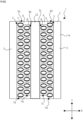
- the X direction and the Y direction with respect to the cleaning sheet are the directions indicated in FIG. 1 and FIG. 3 to FIG. 6 . That is, when the cleaning sheet 1 is attached to a cleaning tool 101 (see FIG. 6 ), the X direction in the drawing corresponds to the wiping direction in which a floor surface is wiped during cleaning.
- the conveying direction (a machine direction) in which the cleaning sheet 1 is conveyed is the Y direction.
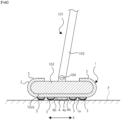
- the cleaning tool 101 includes a head portion 102, a handle 103, and a mounting component 104 that mounts and connects the handle 103 to the head portion 102.
- the cleaning sheet 1 is wrapped around the outer periphery of the head portion 102 of the cleaning tool 101, and side edge portions 5 of the cleaning sheet 1 are both fixed to respective sheet attaching portions (not illustrated) formed in the head portion 102.
- the structure of the sheet attaching portion for attaching the cleaning sheet 1 to the head portion 102 may be freely selected from conventional methods.
- grooves as the sheet attaching portions may be formed in predetermined locations of the head portion 102 in advance, and the cleaning sheet 1 may be attached to the head portion 102 by pushing the ends of the cleaning sheet 1 into the grooves.
- other methods may be employed.
- the cleaning sheet 1 has a cleaning surface 1a.
- the cleaning surface 1a is a surface to face a floor surface F when the cleaning sheet 1 is attached to the head portion 102.
- the cleaning sheet 1 in accordance with the present embodiment includes first brush portions 3 and a second brush portion 4, which are described later, on a base material sheet 2, and the first brush portions 3 and the second brush portion 4 face the floor surface F. Therefore, in the present embodiment, the cleaning surface 1a is the surface (the lower surface in FIG. 6 ) of the base material sheet 2 in the part where the base material sheet 2 faces the floor surface F, and is the surface (the lower surface in FIG. 6 ) of the first brush portion 3 in the part where the first brush portion 3 faces the floor surface F.
- FIG. 6 illustrates the embodiment where only the first brush portions 3 and the second brush portion 4 are in contact with the floor surface F, but this does not intend to suggest any limitation.
- the floor surface F may be cleaned using the base material sheet 2, the first brush portions 3, and the second brush portion 4. Alternatively, other embodiments may be employed.
- the cleaning sheet 1 includes the base material sheet 2, and the first brush portions 3 and the second brush portion 4 that are formed on the cleaning surface 1a.
- the first brush portions 3 are located in positions different from that of the second brush portion 4, and the first brush portions 3 are formed of a material different from that of the second brush portion 4.
- the following describes details of each portion constituting the cleaning sheet 1. Although some of cut portions 8 described later may be usually visually recognized even in FIG. 1 and FIG. 2 , for simplicity of the drawings, illustration of the cut portions 8 is omitted in FIG. 1 and FIG. 2 .
- the base material sheet 2 is a member to be a base of the cleaning sheet 1.
- the surface (the surface facing the floor surface F illustrated in FIG. 6 ) of the base material sheet 2 is the cleaning surface 1a, and the cleaning surface 1a includes a first joining region 21 in which the first brush portions 3 are provided by joining or the like, and a second joining region 22 in which the second brush portion 4 is provided by joining or the like.
- the first joining region 21 and the second joining region 22 may be collectively referred to as a cleaning region 23.
- the cleaning region 23 is a region for capturing removal target objects such as dust existing on the floor surface F and holding the captured removal target objects during cleaning.
- the side edge portions 5 are formed further out than the cleaning region 23 in the X direction.
- the side edge portions 5 are located higher than a bottom portion 102a of the head portion 102, and are attached and fixed to the head portion 102. That is, the cleaning sheet 1 has the cleaning region 23 and the regions where the side edge portions 5 are respectively formed in the base material sheet 2, and the side edge portions 5 are formed at both sides of the cleaning region 23 in the X direction.
- a sheet of paper, a sheet of synthetic fiber, a sheet of non-woven fabric, or the like may be used for the base material sheet 2.
- the present embodiment employs non-woven fabric.
- Various types of non-woven fabric including spun lace non-woven fabric, spunbond non-woven fabric, thermal bond non-woven fabric, and air-through non-woven fabric, can be used as the non-woven fabric.
- Fibers constituting the non-woven fabric may be natural fibers, synthetic fibers, or conjugated fibers.
- the dimensions of the base material sheet 2 are for example, approximately 200 mm to 300 mm in the X direction and approximately 250 mm to 350 mm in the Y direction, but are not limited to these dimensions.
- the basis weight of the non-woven fabric is preferably approximately 8 g/m 2 to 60 g/m 2 .
- the base material sheet 2 may be composed of a single sheet, or may be composed of two or more sheets that are layered. When the base material sheet 2 is formed by layering a plurality of sheets, sheets of the same kind may be layered or sheets of different kinds may be layered. The materials, colors, and thicknesses of the sheets to be layered may be identical or may be different. Furthermore, properties other than the above properties may be identical or may be different.
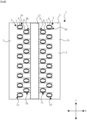
- FIG. 3 illustrates the cleaning sheet 1 in the middle of production, and illustrates the state before the second brush portion 4 is joined.
- the part located in the center in the X direction and surrounded by dotted lines is the part to which the second brush portion 4 is to be joined, and the region surrounded by the dotted lines is the second joining region 22.
- the first brush portion 3 is formed in two or more parts across the second brush portion 4.
- the first brush portion 3 includes a fibrous web 6, a joining portion 7, and a cut portion 8.
- the base material sheet 2 and the fibrous web 6 disposed at the surface side of the base material sheet 2 are joined in the joining portion 7.
- the first brush portion 3 is to be cut in a predetermined position between the joining portions 7 adjacent to each other after joining. That is, the first brush portion 3 is formed by joining the base material sheet 2 and the fibrous webs 6 in the joining portion 7 and then cutting the joined fibrous web 6 in a predetermined position.
- the first brush portion 3 is formed in two or more locations in each of the first joining regions 21 in the base material sheet 2. In other words, in the first joining region 21, a plurality of the first brush portions 3 is formed to form one group.
- a plurality of first brush portions 3 formed in a row in a manner such that the positions in the X direction are identical and the positions in the Y direction are sequentially shifted as illustrated in FIG. 3 is collectively referred to as a group of the first brush portions.
- a first group 3a of the first brush portions, a second group 3b of the first brush portions, a third group 3c of the first brush portions, and a fourth group 3d of the first brush portions are formed. These groups are arranged at predetermined intervals in the direction along the X direction in the base material sheet 2, and the second brush portion 4 is disposed between the second group 3b of the first brush portions and the third group 3c of the first brush portions.
- the first brush portions 3 are formed so as to form a row in the direction along the Y direction.
- the location of the second brush portion 4 is not limited to the location between the second group 3b of the first brush portions and the third group 3c of the first brush portions, and may be other locations.
- the second brush portion 4 may be disposed between the first group 3a of the first brush portions and the second group 3b of the first brush portions, or between the third group 3c of the first brush portions and the fourth group 3d of the first brush portions.
- the number of areas in which the second brush portion 4 is disposed is not limited to one, and the second brush portion 4 may be disposed in two or more areas.
- the second brush portion 4 may be disposed in all the areas between the first group 3a of the first brush portions and the second group 3b of the first brush portions, between the second group 3b of the first brush portions and the third group 3c of the first brush portions, and between the third group 3c of the first brush portions and the fourth group 3d of the first brush portions, or in two of these three areas.
- the location of the second brush portion 4 is not limited to the locations between two of the first to fourth groups 3a, 3b, 3c, and 3d of the first brush portions, and the second brush portion 4 may be disposed between the first brush portion 3 and another first brush portion 3 both constituting the first group 3a of the first brush portions, for example. In this case, the second brush portions 4 may be disposed in two or more areas.
- the positions in the Y direction where the first brush portions 3 constituting the first group 3a of the first brush portions are formed and the positions in the Y direction where the first brush portions 3 constituting the second group 3b of the first brush portions are formed are shifted from each other in the Y direction.
- the positions in the Y direction where the first brush portions 3 constituting the third group 3c of the first brush portions are formed and the positions in the Y direction where the first brush portions 3 constituting the fourth group 3d of the first brush portions are formed are shifted from each other in the Y direction.
- the first brush portions 3 constituting the second group 3b of the first brush portions are disposed in a manner such that each of the first brush portions 3 of the second group 3b is located between the first brush portion 3 and another first brush portion 3 constituting the first group 3a of the first brush portions.
- the first brush portions 3 constituting the fourth group 3d of the first brush portions are disposed in a manner such that each of the first brush portions 3 of the fourth group 3d is located between the first brush portion 3 and another first brush portion 3 constituting the third group 3c of the first brush portions.
- the positions in the Y direction where the first brush portions 3 constituting the first group 3a of the first brush portions are formed and the positions in the Y direction where the first brush portions 3 constituting the second group 3b of the first brush portions are formed are staggered, and the positions in the Y direction where the first brush portions 3 constituting the third group 3c of the first brush portions are formed and the positions in the Y direction where the first brush portions 3 constituting the fourth group 3d of the first brush portions are formed are staggered.
- the first brush portions 3 formed in a staggered manner allows removal target objects on the floor surface F to be captured more easily by the first brush portions 3 when the cleaning sheet 1 is moved in the X direction during wiping.
- the arrangement of the first brush portions 3 is not limited to a staggered arrangement, and other conventional arrangements may be freely selected.
- the present embodiment describes an exemplary case where the first brush portions 3 of the groups 3a, 3b, 3c, and 3d of the first brush portions are arranged in a staggered manner only in the Y direction, the first brush portions 3 of the groups 3a, 3b, 3c, and 3d of the first brush portions may be arranged in a manner such that the first brush portions 3 are staggered in the X direction and the Y direction.
- a plurality of the joining portions 7 constituting each group of the first brush portions i.e., the first group 3a of the first brush portions, the second group 3b of the first brush portions, the third group 3c of the first brush portions, and the fourth group 3d of the first brush portions, is referred to as a joining portion group. That is, in the present embodiment, as illustrated in FIG. 3 , four joining portion groups: a first joining portion group 7a, a second joining portion group 7b, a third joining portion group 7c, and a fourth joining portion group 7d are formed.
- the number of groups such as the first joining portion group 7a, the second joining portion group 7b, the third joining portion group 7c, and the fourth joining portion group 7d may be freely selected, and the number of the joining portions constituting one joining portion group may be freely selected.
- the conventionally known methods may be freely selected to arrange the first brush portions 3.
- the predetermined position in which the fibrous web 6 described above is cut may be freely selected.
- the fibrous web 6 may be cut at the midpoint between the joining portions 7 adjacent to each other, or may be cut in the position closer to one of the joining portions 7 than to the midpoint between the joining portions 7 adjacent to each other.
- the length of the fiber extending from one of the joining portions 7 adjacent to each other becomes equal to the length of the fiber extending from the other. Therefore, the lengths of the fibers can be adjusted to the length suitable for removal target objects to be captured, and the removal target objects can be thereby stably captured.
- the length of the fiber extending from one of the joining portions 7 adjacent to each other can be made to be different from the length of the fiber extending from the other. Therefore, a wide variety of removal target objects can be captured by making the lengths of the fibers different. For example, there are removal target objects that are more easily captured by short fibers and removal target objects that are more easily captured by long fibers. Thus, the ranges of removal target objects that the fibers can easily capture can be freely adjusted by making the lengths of the fibers different.
- a first guide path S1 and a second guide path S2 are formed between the joining portions 7.
- the first guide path S1 and the second guide path S2 guide removal target objects on the floor surface F to the first brush portion 3 or the second brush portion 4 when the cleaning sheet 1 is moved in, for example, the X direction during wiping.
- the first guide path S1 is formed between the first brush portion 3 and the second brush portion 4 to allow removal target objects to be easily captured by the first brush portion 3 or the second brush portion 4.
- the second guide path S2 is formed between the joining portions 7 adjacent to each other to allow removal target objects to be easily captured by the joining portion 7 of the first brush portion 3 or the side surface 4b of the second brush portion 4. Formation of the first guide path S1 and the second guide path S2 allows the removal target objects that are not completely captured by the first brush portion 3 to be easily captured by the second brush portion 4.
- used for the fibrous web 6 is natural fiber such as cotton or wool, synthetic fiber such as polyethylene, polypropylene, polyethylene terephthalate, nylon, or polyacrylic fiber, or conjugated fiber such as sheath-core fiber, sea-island fiber, or side-by-side type fiber.
- the fibers constituting the fibrous web 6 used for the first brush portion 3 are preferably thermoplastic fibers having a thermal adhesiveness with the base material sheet 2.
- sheath-core conjugated fiber of which the core is made of polypropylene and the sheath is made of polyethylene is more preferable because such a sheath-core conjugated fiber has excellent thermal adhesiveness due to polyethylene constituting the sheath and firmness due to polypropylene constituting the core.
- the fibers with a diameter of approximately 0.01 mm to 0.3 mm are used.
- the fibers may be composed of only one kind of fibers made of the same material and having the same diameter and the same color, or may be composed of two or more kinds of fibers having different properties.
- two fibrous webs 6 are illustrated in FIG. 3 , three or more fibrous webs 6 may be provided.
- the fibrous web 6 is formed in the part excluding the second brush portion 4 and the side edge portions 5.
- the base material sheet 2 has a dimension in the X direction of approximately 200 mm to 300 mm and a dimension in the Y direction of approximately 250 mm to 350 mm, approximately 3 g to 8 g of the fibrous web 6 is used.
- the joining portions 7 partially join the fibrous web 6 to the base material sheet 2 in a plurality of points.
- Various methods such as ultrasonic joining, adhesive joining, thermal fusion bonding, and sewing may be used alone or in combination to form the joining portions 7.
- the present embodiment describes an exemplary case where the fibrous web 6 is joined to the base material sheet 2 by ultrasonic joining.
- the joining portions 7 formed along the Y direction are formed in two rows respectively at both sides of the second brush portion 4 in the X direction as the above joining portion groups (the first joining portion group 7a, the second joining portion group 7b, the third joining portion group 7c, and the fourth joining portion group 7d).
- the joining portions 7 included in one of the rows next to each other in the X direction (for example, one of the first joining portion group 7a and the second joining portion group 7b, and one of the third joining portion group 7c and the fourth joining portion group 7d) and the joining portions 7 included in the other are arranged so as to be shifted from each other in the Y direction.
- the number of rows of the joining portions 7, the number of the joining portions 7, and the interval between the joining portions 7 may be freely selected.
- the joining portions 7 may be formed either on the base material sheet 2 or on the fibrous web 6.
- the present description describes an exemplary case where the joining portions 7 are provided to the base material sheet 2 or the fibrous web 6 as necessary, but the locations where the base material sheet 2 and the fibrous web 6 are joined are not limited to the above description.
- the cut portion 8 forms a cut in the X direction of the fibrous web 6. This cut is formed to raise the fibrous web 6 using compressed gas in the subsequent process as described later.
- the cut portion 8 is formed from one end of the fibrous web 6 to the joining portion 7, but this does not intend to suggest any limitation.
- the cut portion 8 may be formed from one end to the other end of the fibrous web 6 while avoiding the joining portion 7.
- the position where the joining portion 7 is formed may be shifted in the X direction, and the cut portions 8 may be formed at both sides of the joining portion 7.
- the number of the cut portions 8 and the cut depth of the cut portion 8 can be appropriately set, and the depth of the cut portion 8 may be a depth reaching the base material sheet 2.
- the first brush portion 3 is composed of fiber that is heat-sealable with the base material sheet 2
- the first brush portion 3 is formed by stacking the long-fibered fibrous web 6 on the base material sheet 2.
- the fibrous web 6 stacked on the base material sheet 2 is disposed in a manner such that the fibrous direction is along the Y direction in FIG. 3 , and the fibrous web 6 and the base material sheet 2 are joined by intermittent heat sealing.
- the first joining portion group 7a and the second joining portion group 7b are formed so as to be located in different positions in the Y direction. That is, as viewed only in the Y direction, each joining portion 7 constituting the second joining portion group 7b is disposed between the corresponding two joining portions 7 of the row constituting the first joining portion group 7a.
- the fibers can be joined by heat sealing in the direction different from the fibrous direction of the fibrous web 6.
- the method for joining the fibers may be freely selected from conventionally known methods. Conventionally known positions can be appropriately used for the positions where the fibers of the fibrous web 6 are joined.
- the cut portion 8 is formed from each joining portion 7 in the X direction.
- the cut portion 8 is formed toward the joining portion group next to the joining portion group including the joining portion 7 from which the cut portion 8 is formed.
- the cut portion 8 formed from the joining portion 7 included in the first joining portion group 7a extends in the X direction toward the side at which the joining portions 7 included in the second joining portion group 7b are formed (toward the right side in FIG. 3 ).
- the cut portion 8 extending from the joining portion 7 included in the first joining portion group 7a is formed so that the cut is formed between the corresponding two joining portions 7 included in the second joining portion group 7b.
- the cut portion 8 formed from the joining portion 7 included in the second joining portion group 7b extends in the X direction toward the side at which the joining portions 7 included in the first joining portion group 7a are formed (toward the left side in FIG. 3 ). As with the cut portion 8 described above, this cut portion 8 is also formed so that the cut is formed between the corresponding two joining portions 7 included in the first joining portion group 7a. The same applies to the cut portions 8 formed from the joining portions 7 included in the third joining portion group 7c and the fourth joining portion group 7d.
- the first brush portion 3 can be formed by cutting the fibers of the fibrous web 6 by providing a cut having a width approximately equal to or greater than the width of the joining portion 7 in the aforementioned location after the fibrous web 6 and the base material sheet 2 are joined.
- the joining portion 7 may be formed using an adhesive agent instead of heat sealing.
- the joining portion 7 may be formed using an adhesive agent.
- the fibers in the fibrous web 6 may be non-continuously joined by heat sealing, and the fibrous web 6 and the base material sheet 2 may be joined by adhesive joining.
- the fibers of the fibrous web 6 may be joined non-continuously by adhesive joining, and the fibrous web 6 and the base material sheet 2 may be joined by heat sealing.
- the fibers of the fibrous web 6 are preferably joined by heat sealing, and the fibrous web 6 and the base material sheet 2 are preferably joined by adhesive joining.
- the formation method of the joining portion 7 is not limited to the method combining heat sealing and adhesive joining. Even when the same method is used, the joining of the fibers in the fibrous web 6 and the joining between the fibrous web 6 and the base material sheet 2 may be performed separately. However, in this case, the positions where the fibers of the fibrous web 6 are non-continuously joined and the positions where the fibrous web 6 and the base material sheet 2 are non-continuously joined need to coincide.
- the joining portions 7 included in each of groups: the first joining portion group 7a, the second joining portion group 7b, the third joining portion group 7c, and the fourth joining portion group 7d may be arranged at regular intervals or at irregular intervals. In addition, the interval between the adjacent joining portions 7 included in the first joining portion group 7a and the interval between the joining portions 7 included in the second joining portion group 7b may be identical or different.
- the second brush portion 4 is located in a center part of the base material sheet 2 so as to be interposed between two first brush portions 3.
- an air-laid sheet made of an air-laid non-woven fabric formed by crushing pulp and layering crushed pulp.
- the air-laid sheet is formed by forming crushed pulp into a sheet by adding a binder to crushed pulp, and the binder may be a water-soluble binder such as carboxymethylcellulose (CMC) or ethylene-vinyl acetate copolymer (EVA).
- CMC carboxymethylcellulose
- EVA ethylene-vinyl acetate copolymer
- a solid binder such as a thermally adhesive (thermally fusible) plastic material (e.g., acrylic) or conjugated fiber (e.g., ES fiber) may be used, or a solid binder and a water-soluble binder may be used in combination.
- a thermally adhesive (thermally fusible) plastic material e.g., acrylic
- conjugated fiber e.g., ES fiber
- the basis weight of the air-laid sheet is preferably approximately 50 g/m 2 to 200 g/m 2 , more preferably approximately 75 g/m 2 to 150 g/m 2 . This is because the air-laid sheet having a basis weight less than the aforementioned lower limit exhibits low rigidity and low water absorption, and the scraping performance and the water absorption performance of the cleaning sheet 1 become therefore insufficient. On the other hand, when the basis weight is greater than the aforementioned upper limit, the production cost of the cleaning sheet 1 increases, and the dimension (the thickness) becomes excessively large.
- the additive amount of the water-soluble binder is preferably 2.0 weight% to 15 weight% with respect to the air-laid sheet, and the additive amount of the solid binder is preferably 3 weight% to 15 weight% of the basis weight of the air-laid sheet.
- the additive amount of the binder to the air-laid sheet may be increased.
- the air-laid sheet when used for the second brush portion 4, the air-laid sheet preferably includes naturally derived fiber materials and is non-hydrolyzable.
- the air-laid sheet is formed using the air-laid manufacturing method.
- the "air-laid manufacturing method” is the method for manufacturing the air-laid sheet by subjecting a fibrous accumulated body, which is obtained by accumulating crushed pulp or many fibers mainly made from crushed pulp along the air flow flowing downward, to various processing such as embossing.
- a naturally derived fiber material is preferably used as the material.
- a base sheet is preferably formed from pulp paper or a material mainly made from pulp, i.e., the material containing a cellulosic component.
- the proportion of pulp is preferably 30% or greater, more preferably 50% or greater.
- the proportion of pulp is further preferably 80% or greater. Such a proportion of pulp improves the overall flexibility of the air-laid sheet and further improves the production cost and the production efficiency.
- Crushed pulp refers to cotton-like pulp obtained by finely crushing raw material pulp, which is to be a raw material for paper materials, using a crusher or the like.
- the material for crushed pulp may be various types of raw material pulp.
- the crushed pulp is cotton-like pulp obtained by crushing a pulp material. Therefore, when cotton-like crushed pulp is sequentially accumulated, spaces are easily formed between fibers. Many spaces are formed among the fibers. Since the spaces are formed, the volume of the base sheet can be increased, and the permeability for a binder and a cross-linker described later is improved.
- the base sheet from the cotton-like crushed pulp using the air-laid manufacturing method, the spaces are formed among accumulated fibers, and the degree of freedom of movement of fibers is thereby increased. As a result, the flexibility of the base sheet is improved, and the production efficiency is also improved.
- pulp When pulp is used as the material for the air-laid sheet to be used for the second brush portion 4, various types of raw material pulp may be used as the pulp.
- the raw material pulp include wood pulp, synthetic pulp, waste paper pulp, and a toilet paper material.
- wood pulp pulp obtained by blending bleached softwood kraft pulp and bleached hardwood kraft pulp at predetermined ratios may be used.
- the bleached softwood kraft pulp can be obtained from softwood such as red pine, Ezo spruce, Todo fir, Douglas fir, hemlock, and spruce
- the bleached hardwood kraft pulp can be obtained from hardwood such as beech, Japanese oak, birch, eucalyptus, oak, and alder.
- raw material pulp made of bleached softwood kraft pulp is preferable in terms of manufacturing.
- natural fiber for example, kenaf fiber, bamboo fiber, straw, cotton, cocoon filament, or sugar cane is preferably used.
- the above materials are merely examples, and the materials are not limited to these examples.
- Crushed pulp or a material including crushed pulp as a main raw material is preferably used for the fibrous sheet in accordance with the present embodiment.
- the binder is for binding the naturally derived fiber materials constituting the base sheet. Any binder that is naturally degradable, has a predetermined adhesivity, and joins the above materials with a predetermined strength can be used.
- a binder include polysaccharide derivative, natural polysaccharide, synthetic polymer, protein, alginic acid, and chitosan.
- the polysaccharide derivative include carboxymethylcellulose (CMC), carboxyethyl cellulose, carboxymethylated starch, salts of carboxymethylated starch, starch, methylcellulose, and ethyl cellulose.
- Examples of the natural polysaccharide include guar gum, trantgum, xanthan gum, alginic acid sodium, carrageenan, gum arabic, gelatin, and casein.
- examples of the synthetic polymer include polyvinyl alcohol (PVA), ethylene-vinyl acetate copolymer resin (EVA), polyvinyl alcohol derivative, polymer or copolymer of unsaturated carboxylic acid, and its salts.
- Examples of the unsaturated carboxylic acid include acrylic acid, methacrylic acid, maleic anhydride, maleic acid, and fumaric acid. Among them, in particular, carboxymethylcellulose (CMC) and polyvinyl alcohol (PVA) are preferable.
- the binder used as the fibrous sheet of the present embodiment is preferably a naturally degradable binder including: biodegradable resin such as polycaprolactone, polyhydroxyalkanoate, polyhydroxybutyrate, polylactic acid, starch-based resin such as esterified starch, cellulose acetate, polyethylene succinate, polyvinyl alcohol, polyglycolic acid, chitosan/cellulose/starch, poly(hydroxybutyrate/hydroxyhexanoate) , poly(caprolactone/butylene succinate), polybutylene succinate, poly(butylene succinate/adipate), poly(butylene succinate/carbonate), poly(ethylene terephthalate/succinate), poly(butylene adipate/terephthalate), and poly(tetramethylene adipate/terephthalate); biodegradable resin mixture; or biodegradable biomass resin.
- biodegradable resin such as polycaprolactone, polyhydroxyalkanoate, polyhydroxybutyrate, polylactic
- CMC there are various types of CMC such as ammonium salt, sodium salt, and potassium salt.
- ammonium CMC has a so-called self-cross-linking property, which forms cross-link when heat is applied thereto.
- the impregnation amount of the cross-linker may be less than that in the case where other kinds of CMC are used as the binder, or impregnation with a cross-linker is unnecessary.
- PVAs there are PVA that needs a cross-linker and PVA that does not need a cross-linker. Thus, when the PVC that does not need a cross-linker is used, impregnation with a cross-linker is unnecessary.
- the cross-linker is chemicals that yield a cross-linking reaction with the binder to cause the binder to have a cross-linked structure.
- the cross-linker of the present embodiment is preferably naturally degradable.
- the binder having a carboxyl group such as carboxymethylcellulose (CMC)
- CMC carboxymethylcellulose
- polyvalent metal ion of which the valence is two or more is preferably used.
- this polyvalent metal ion include metal ions of magnesium, calcium, titanium, manganese, iron, cobalt, nickel, copper, zinc, aluminum, silver, tin, and the like.
- alum and copper sulfate are preferably used.
- the alum include sodium aluminum alum, potassium alum, ammonium alum, sodium chrome alum, potassium chrome alum, ammonium chrome, sodium iron alum, potassium iron alum, and ammonium iron alum.
- Colorless alum is preferable as the alum of the present embodiment.
- use of sodium aluminum alum, potassium alum, or ammonium alum is preferable.
- the concentration of the ammonium alum solution is preferably approximately 1% to 20%, and the temperature of the ammonium alum solution is preferably maintained at 10 °C to 60 °C to prevent crystallization.
- the air-laid sheet used for the second brush portion 4 is heat treated while being impregnated with the binder and the cross-linker. This heat treatment accelerates the cross-linking reaction of the binder that binds the materials constituting the air-laid sheet and the cross-linking reaction of the cross-linker for cross-linking the binders, increasing the binding between fibers, and improving the binding strength significantly.
- This heating use of air blow heating performed by circulating hot air within a chamber having predetermined dimensions is preferable.
- the heat-treated air-laid sheet is preferably impregnated with a softening agent.
- the air-laid sheet after heat treated or the air-laid sheet impregnated with a softening agent is preferably cleaned to obtain a softer air-laid sheet for the second brush portion 4.
- the air-laid sheet to be used for the second brush portion 4 is preferably washed with use of liquid such as water.
- the removal target object that cannot be captured by the first brush portion 3 can be reliably captured, and it becomes possible to efficiently clean the cleaning target surface such as the floor surface. Since the second brush portion 4 has the surface 4a and the side surfaces 4b, the floor surface F can be wiped using the surface 4a, and further, the removal target objects can be captured using the side surfaces 4b. Therefore, efficient cleaning becomes possible.
- a space Z for capturing the removal target object as a foreign object is formed between crushed pulp and crushed pulp. This structure allows the captured removal target object to be taken inside the space Z. Therefore, even when the removal target object that is likely to damage the floor surface F is captured, the cleaning can be continued without damaging the floor surface F, and worry-free cleaning becomes possible.
- patterns 9 are formed.
- the patterns 9 are formed using a pair of embossing rolls 18, and extend along the Y direction intersecting with the wiping direction (the X direction) in the present embodiment, but this does not intend to suggest any limitation.
- the patterns 9 may extend along the X direction, or the patterns 9 may extend in the X direction and the Y direction, or patterns may be inclined at, for example, 45° from the X direction.
- the shape of the pattern 9 is not limited to a linear shape, and may be a wavy curved shape.
- the pattern 9 is a linear pattern having a width of approximately 1 mm to 6 mm in the X direction, a length of approximately 5 mm to 50 mm in the Y direction, and a depth of approximately 0.3 mm to 3 mm.
- the dimensions are not limited to the above dimensions. Formation of the patterns 9 on the surface 4a of the second brush portion 4 enables to easily capture removal target objects, and also allows the space Z in the second brush portion 4 to easily hold the captured removal target object. Thus, the removal target object such as dust can be more easily captured, and the cleaning performance is further improved.
- the rigidity of the second brush portion 4 is greater than the rigidity of the first brush portion 3.
- the second brush portion 4 is excellent at scraping foreign objects. Since the second brush portion 4 is the air-laid sheet formed by layering crushed pulp, the spaces formed among crushed pulp can capture foreign objects such as bread crumbs and cookie crumbs smaller than cotton dust. Furthermore, even the patterns 9 can capture small foreign objects.
- the side edge portions 5 are portions to be attached to the cleaning tool 101, and are located in both ends in the X direction that is the wiping direction.
- the width in the X direction of each side edge portion 5 is approximately 45 mm.
- the total width in the X direction of the two first brush portions 3 and the second brush portion 4 is approximately 130 mm.
- the dimension in the X direction of one first brush portion 3 is approximately 40 mm to 50 mm
- the dimension in the X direction of the second brush portion 4 is approximately 30 mm to 50 mm.
- the total area of two first brush portions 3 is 35% to 45% of the area of the base material sheet 2
- the area of the second brush portion 4 is 13% to 23% of the area of the base material sheet 2
- the total area of the two side edge portions 5 is 35% to 45% of the area of the base material sheet 2.
- the first brush portions 3 capture hairs, cotton dust, and oil, while the second brush portion 4 scrapes foreign objects adhering to, for example, the floor surface, captures small foreign objects of foods such as bread crumbs and cookie crumbs, and absorbs liquid.
- the cleaning sheet 1 capturing and absorbing many foreign objects is achieved.
- the air-laid sheet of the second brush portion 4 absorbs a large amount of a chemical liquid, and therefore the floor area that the cleaning sheet 1 can clean can be increased.
- FIG. 5 illustrates an outline of a production line 100 of the cleaning sheet 1.
- the following describes a manufacturing method of the cleaning sheet 1 of the present embodiment formed as described above.
- the layout of the production line 100 illustrated in FIG. 5 is merely an example, and the arrangement of devices can be appropriately modified to the space of the factory.
- the base material sheet 2 wound around a first roll 10 is conveyed in the Y direction that is the machine direction (the conveying direction).
- the fibrous web 6 wound around a second roll 11 is conveyed toward the base material sheet 2.
- FIG. 5 Although only one second roll 11 is illustrated in FIG. 5 , another second roll 11 is present in a direction orthogonal to the page, and two fibrous webs 6 in total are conveyed.
- the base material sheet 2 and the fibrous webs 6 are pressed by a pressure roll 12, and are then joined using an ultrasonic joining device 13.
- the ultrasonic joining device 13 includes a horn 14 and an anvil 15.
- the horn 14 resonates with ultrasonic vibration to vibrate, and applies the vibration energy to the base material sheet 2 and the fibrous webs 6 to cause frictional heat to be generated.
- the anvil 15 determines the positions of the base material sheet 2 and the fibrous webs 6, and receives the vibration energy.
- a plurality of the cut portions 8 is formed in the base material sheet 2 and the fibrous webs 6, which have been joined by the ultrasonic joining device 13, by a cutter 16.
- the cutter 16 has a plurality of blades that can be replaced in accordance with the position and the length of the cut portion 8 illustrated in FIG. 3 and FIG. 4 .
- FIG. 3 and FIG. 4 illustrate the cleaning sheet in the middle of production, in which the forming of the cut portions 8 is completed.
- the second brush portion 4 wound around a third roll 17 is conveyed by a conveying roll 19 toward the base material sheet 2 and the fibrous webs 6 that are joined.
- the patterns 9 are formed in the second brush portion 4 by a pair of the embossing rolls 18 during the conveying. As described above, the shape and the dimensions of the pattern 9 can be set appropriately. At least one of a pair of the embossing rolls 18 is preferably heated within a range from 40 °C to 120 °C, and the material of the embossing rolls 18 may be a metal material or non-metal material.
- the second brush portion 4 having the patterns 9 formed therein and the base material sheet 2 and the fibrous webs 6 that are joined are pressed by a pressure roll 20, and the second brush portion 4 is then joined to the base material sheet 2 using an ultrasonic joining device 26.
- the ultrasonic joining device 26 includes a horn 27 and an anvil 28, and the structure and the functions thereof are the same as those of the ultrasonic joining device 13. Thus the description thereof is omitted.
- Two first brush portions 3 and one second brush portion 4 are joined to the base material sheet 2. When the basis weight of the air-laid sheet of the second brush portion 4 is 70 g/m 2 or greater, the height in the Z direction is higher than that of the first brush portion 3 before raised.
- the fibrous web 6 of the first brush portion 3 is raised using a raising device 24.
- the raising device 24 supplies compressed gas (e.g., air) toward the fibrous web 6. This raises the fibers of the fibrous web 6. If the fibrous web 6 is raised before the second brush portion 4 is joined to the base material sheet 2, the second brush portion 4 needs to be joined to the base material sheet 2 while avoiding the fibrous web 6. By contrast, in the present embodiment, the fibrous web 6 is raised after the second brush portion 4 is joined to the base material sheet 2. Therefore, the manufacturing of the cleaning sheet 1 can be simplified, the yield ratio of the cleaning sheet 1 is improved, and the production cost of the cleaning sheet 1 can be reduced.
- the method used to raise the fibrous web 6 is not limited to the method using compressed gas, and various types of raising methods can be applied.
- the base material sheet 2 to which the first brush portions 3 and the second brush portion 4 are joined is cut along the X direction by a cutting device 25, and the cleaning sheet 1 illustrated in FIG. 1 is obtained.
- the cleaning sheet 1 is not limited to the aforementioned embodiment, and can be modified in various ways.
- a plurality of the second brush portions 4 may be provided to the base material sheet 2, and the first brush portion 3 and the second brush portion 4 may be formed on both surfaces of the base material sheet 2.
- the stretchable sheet having a three-layered fibrous sheet and an elastic member disclosed in International Publication No. WO2018/003566 may be joined to the base material sheet 2 as a third brush portion, or at least one of the two first brush portions 3 may be replaced with this stretchable sheet.
- an elastic member may be provided to the air-laid sheet of the second brush portion 4 to allow stretchability in the second brush portion 4.
- the patterns 9 may be provided, or the patterns 9 may be omitted.
Landscapes
- Engineering & Computer Science (AREA)
- Textile Engineering (AREA)
- Life Sciences & Earth Sciences (AREA)
- Wood Science & Technology (AREA)
- Mechanical Engineering (AREA)
- Cleaning Implements For Floors, Carpets, Furniture, Walls, And The Like (AREA)
Claims (14)
- Reinigungstuch (1) zum Reinigen eines Reinigungszielobjekts (F), umfassend:ein Grundstofftuch (2);einen ersten Bürstenabschnitt (3), der dem Basismaterialtuch (2) bereitgestellt ist und aus einem Fasermaterial gebildet ist; undeinen zweiten Bürstenabschnitt (4), der dem Basismaterialtuch (2) bereitgestellt ist, dadurch gekennzeichnet, dass der zweite Bürstenabschnitt aus zerkleinerten Zellstoffmaterialien gebildet ist, die geschichtet sind, undwobei der erste Bürstenabschnitt (3) durch Verbinden des Basismaterialtuchs (2) und einer faserigen Bahn (6) in einer Vielzahl von Verbindungsabschnitten (7), Schneiden der faserigen Bahn (6) in einer vorbestimmten Position zwischen den Verbindungsabschnitten (7) und Anheben der faserigen Bahn (6) gebildet wird.
- Reinigungstuch nach Anspruch 1,wobei das Basismaterialtuch (2) einen Reinigungsbereich (23) zum Reinigen des Reinigungszielobjekts (F) aufweist,wobei der erste Bürstenabschnitt (3) und der zweite Bürstenabschnitt (4) in dem Reinigungsbereich (23) gebildet sind,wobei eine Oberfläche des Basismaterialtuchs (2), eine Oberfläche des ersten Bürstenabschnitts (3) und eine Oberfläche des zweiten Bürstenabschnitts (4) eine Reinigungsoberfläche (1a) zum Reinigen des Reinigungszielobjekts (F) bilden.
- Reinigungstuch nach Anspruch 1 oder 2, wobei der erste Bürstenabschnitt (3) und der zweite Bürstenabschnitt (4) in unterschiedlichen Positionen in dem Basismaterialtuch (2) gebildet sind.
- Reinigungstuch nach einem der Ansprüche 1 bis 3, wobei zwischen dem ersten Bürstenabschnitt (3) und dem zweiten Bürstenabschnitt (4) ein erster Führungspfad (S1) gebildet ist, der ein Entfernungszielobjekt zu dem ersten Bürstenabschnitt (3) oder dem zweiten Bürstenabschnitt (4) führt.
- Reinigungstuch nach einem der Ansprüche 1 bis 4, wobei der erste Bürstenabschnitt (3) mehrfach gebildet ist.
- Reinigungstuch nach Anspruch 5, wobei der zweite Bürstenabschnitt (4) zwischen den ersten Bürstenabschnitten (3) gebildet ist.
- Reinigungstuch nach Anspruch 5 oder 6, wobei zwischen den ersten Bürstenabschnitten (3) angrenzend aneinander ein zweiter Führungspfad (S2) gebildet ist, der das Entfernungszielobjekt zu dem ersten Bürstenabschnitt (3) oder dem zweiten Bürstenabschnitt (4) führt.
- Reinigungstuch nach einem der Ansprüche 1 bis 7, wobei der zweite Bürstenabschnitt (4) aus einem luftgelegten Vliesstoff gebildet ist.
- Reinigungstuch nach Anspruch 8, wobei der zweite Bürstenabschnitt aus dem luftgelegten Vliesstoff gebildet ist, der mehrfach geschichtet ist.
- Reinigungstuch nach einem der Ansprüche 1 bis 9, wobei eine Fläche eines gesamten des ersten Bürstenabschnitts (3) größer ist als eine Fläche des zweiten Bürstenabschnitts (4).
- Reinigungstuch nach einem der Ansprüche 1 bis 10,wobei der zweite Bürstenabschnitt (4) eine Reinigungsoberfläche (4a) aufweist,wobei ein vorbestimmtes Muster (9) auf der Reinigungsoberfläche (4a) gebildet wird.
- Reinigungstuch nach Anspruch 11,
wobei sich das Muster (9) entlang einer Richtung erstreckt, die sich von einer Wischrichtung des Reinigungstuchs unterscheidet. - Reinigungstuch nach einem der Ansprüche 1 bis 12, wobei der zweite Bürstenabschnitt (4) einen Raum (Z) zum Auffangen eines Fremdkörpers aufweist, der zwischen den zerkleinerten Zellstoffmaterialien gebildet ist.
- Reinigungstuch nach einem der Ansprüche 1 bis 13, wobei eine Steifigkeit einer Faser, die den zweiten Bürstenabschnitt (4) darstellt, größer ist als eine Steifigkeit einer Faser, die den ersten Bürstenabschnitt (3) darstellt.
Applications Claiming Priority (2)
| Application Number | Priority Date | Filing Date | Title |
|---|---|---|---|
| US201862655352P | 2018-04-10 | 2018-04-10 | |
| PCT/JP2019/015604 WO2019198750A1 (ja) | 2018-04-10 | 2019-04-10 | 清掃シート |
Publications (3)
| Publication Number | Publication Date |
|---|---|
| EP3777634A1 EP3777634A1 (de) | 2021-02-17 |
| EP3777634A4 EP3777634A4 (de) | 2021-06-02 |
| EP3777634B1 true EP3777634B1 (de) | 2024-06-05 |
Family
ID=68163113
Family Applications (1)
| Application Number | Title | Priority Date | Filing Date |
|---|---|---|---|
| EP19785764.2A Active EP3777634B1 (de) | 2018-04-10 | 2019-04-10 | Reinigungsblatt |
Country Status (6)
| Country | Link |
|---|---|
| US (1) | US12178374B2 (de) |
| EP (1) | EP3777634B1 (de) |
| JP (1) | JP7637463B2 (de) |
| CN (2) | CN121221012A (de) |
| ES (1) | ES2986762T3 (de) |
| WO (1) | WO2019198750A1 (de) |
Family Cites Families (21)
| Publication number | Priority date | Publication date | Assignee | Title |
|---|---|---|---|---|
| JP3544109B2 (ja) | 1997-11-07 | 2004-07-21 | ユニ・チャーム株式会社 | 粘弾性の粘着材を利用した清掃用シート |
| JP3400702B2 (ja) | 1997-12-26 | 2003-04-28 | ユニ・チャーム株式会社 | 不織布の製造方法 |
| JP4033645B2 (ja) * | 2001-07-12 | 2008-01-16 | 花王株式会社 | 清掃用シート |
| EP1212972B1 (de) | 2000-10-13 | 2015-12-09 | Kao Corporation | Reinigungstuch zum Reinigen einer samtigen Oberfläche |
| JP3961343B2 (ja) * | 2002-05-31 | 2007-08-22 | 株式会社クラレ | 清掃用不織布 |
| US20040121686A1 (en) | 2002-08-29 | 2004-06-24 | The Procter & Gamble Company | Low density, high loft nonwoven substrates |
| JP2007197848A (ja) * | 2006-01-24 | 2007-08-09 | Kinsei Seishi Kk | 洗浄用不織布クリーナー |
| US20120227203A1 (en) * | 2006-02-24 | 2012-09-13 | The Clorax Company | Textured wipes |
| JP5314432B2 (ja) | 2007-02-13 | 2013-10-16 | 大作 山田 | 清掃用シート |
| US8850649B2 (en) * | 2008-11-21 | 2014-10-07 | 3M Innovative Properties Company | Cleaning tool with upstanding stems and method of cleaning a surface |
| JP5498075B2 (ja) * | 2009-07-22 | 2014-05-21 | 大王製紙株式会社 | 清掃用シート |
| JP5464957B2 (ja) * | 2009-09-30 | 2014-04-09 | 大王製紙株式会社 | 清掃用シート |
| JP6126398B2 (ja) * | 2013-02-07 | 2017-05-10 | ユニ・チャーム株式会社 | 清掃具 |
| JP6208949B2 (ja) | 2013-02-07 | 2017-10-04 | ユニ・チャーム株式会社 | 清掃具 |
| JP6323981B2 (ja) * | 2013-02-07 | 2018-05-16 | ユニ・チャーム株式会社 | 清掃具 |
| JP6091600B2 (ja) * | 2013-03-11 | 2017-03-08 | 山田 菊夫 | 清掃用シート及びその製造方法 |
| EP3150371B1 (de) * | 2014-05-30 | 2019-12-04 | Kikuo Yamada | Faserbahn |
| EP3233468A1 (de) * | 2014-12-19 | 2017-10-25 | The Procter and Gamble Company | Stoppelige faserstrukturen |
| WO2016108290A1 (ja) * | 2014-12-29 | 2016-07-07 | 山田 菊夫 | 清浄用物品及び清浄用物品の製造方法 |
| WO2018003566A1 (ja) | 2016-06-30 | 2018-01-04 | 山田菊夫 | 清掃シート |
| US11622664B2 (en) * | 2016-12-08 | 2023-04-11 | The Procter & Gamble Company | Fibrous structures having a contact surface |
-
2019
- 2019-04-10 EP EP19785764.2A patent/EP3777634B1/de active Active
- 2019-04-10 CN CN202511701122.8A patent/CN121221012A/zh active Pending
- 2019-04-10 US US17/046,145 patent/US12178374B2/en active Active
- 2019-04-10 CN CN201980031817.6A patent/CN112105281A/zh active Pending
- 2019-04-10 WO PCT/JP2019/015604 patent/WO2019198750A1/ja not_active Ceased
- 2019-04-10 JP JP2020513425A patent/JP7637463B2/ja active Active
- 2019-04-10 ES ES19785764T patent/ES2986762T3/es active Active
Also Published As
| Publication number | Publication date |
|---|---|
| JPWO2019198750A1 (ja) | 2021-04-22 |
| CN112105281A (zh) | 2020-12-18 |
| EP3777634A1 (de) | 2021-02-17 |
| US12178374B2 (en) | 2024-12-31 |
| US20210030250A1 (en) | 2021-02-04 |
| EP3777634A4 (de) | 2021-06-02 |
| JP7637463B2 (ja) | 2025-02-28 |
| CN121221012A (zh) | 2025-12-30 |
| WO2019198750A1 (ja) | 2019-10-17 |
| ES2986762T3 (es) | 2024-11-12 |
Similar Documents
| Publication | Publication Date | Title |
|---|---|---|
| RU2713351C1 (ru) | Способ изготовления подвергнутых струйному скреплению слоистых полотен с полыми выступами и отверстиями | |
| AU2009237048B2 (en) | Cleaning sheet and process for producing the same | |
| CN104349703B (zh) | 清扫用片及其制造方法 | |
| JP5984889B2 (ja) | 吸収性物品用の吸収体を製造する方法 | |
| US20140308486A1 (en) | Method for making a fibrous structure comprising a plurality of discrete bond sites and fibrous structures made therewith | |
| AU2015307582B2 (en) | Absorbent and absorbent article including absorbent | |
| WO2016035767A1 (ja) | 吸水性物品の製造方法及びその製造方法で製造された吸収性物品 | |
| JP2008208501A (ja) | キッチンペーパー | |
| WO2008066099A1 (en) | Kitchen paper | |
| JP7742914B2 (ja) | 清掃用ウェットシート | |
| ES2928562T3 (es) | Sustrato de limpieza no tejido | |
| EP3777634B1 (de) | Reinigungsblatt | |
| JP4538031B2 (ja) | キッチンペーパー | |
| JP5313488B2 (ja) | ウェットワイパー用基材シート及びウェットワイパー | |
| TW202207861A (zh) | 清掃用薄片 | |
| JPH04288113A (ja) | 掃除用シート及びその製造方法 | |
| JP2011072392A (ja) | 産業用ワイプ | |
| WO2019239921A1 (ja) | ワイピングシート | |
| JP6173275B2 (ja) | 吸収体、及び当該吸収体を含む吸収性物品 | |
| EP3891327B1 (de) | Mikrofaserhaltige vliesstoffe | |
| WO2018003566A1 (ja) | 清掃シート | |
| JP2019093083A (ja) | 清掃シート | |
| JP2026068878A (ja) | 積層体及び積層体の製造方法 |
Legal Events
| Date | Code | Title | Description |
|---|---|---|---|
| STAA | Information on the status of an ep patent application or granted ep patent |
Free format text: STATUS: THE INTERNATIONAL PUBLICATION HAS BEEN MADE |
|
| PUAI | Public reference made under article 153(3) epc to a published international application that has entered the european phase |
Free format text: ORIGINAL CODE: 0009012 |
|
| STAA | Information on the status of an ep patent application or granted ep patent |
Free format text: STATUS: REQUEST FOR EXAMINATION WAS MADE |
|
| 17P | Request for examination filed |
Effective date: 20201009 |
|
| AK | Designated contracting states |
Kind code of ref document: A1 Designated state(s): AL AT BE BG CH CY CZ DE DK EE ES FI FR GB GR HR HU IE IS IT LI LT LU LV MC MK MT NL NO PL PT RO RS SE SI SK SM TR |
|
| AX | Request for extension of the european patent |
Extension state: BA ME |
|
| A4 | Supplementary search report drawn up and despatched |
Effective date: 20210503 |
|
| RIC1 | Information provided on ipc code assigned before grant |
Ipc: A47L 13/16 20060101AFI20210427BHEP Ipc: A47L 13/38 20060101ALI20210427BHEP |
|
| DAV | Request for validation of the european patent (deleted) | ||
| DAX | Request for extension of the european patent (deleted) | ||
| P01 | Opt-out of the competence of the unified patent court (upc) registered |
Effective date: 20230608 |
|
| GRAP | Despatch of communication of intention to grant a patent |
Free format text: ORIGINAL CODE: EPIDOSNIGR1 |
|
| STAA | Information on the status of an ep patent application or granted ep patent |
Free format text: STATUS: GRANT OF PATENT IS INTENDED |
|
| INTG | Intention to grant announced |
Effective date: 20240313 |
|
| GRAS | Grant fee paid |
Free format text: ORIGINAL CODE: EPIDOSNIGR3 |
|
| GRAA | (expected) grant |
Free format text: ORIGINAL CODE: 0009210 |
|
| STAA | Information on the status of an ep patent application or granted ep patent |
Free format text: STATUS: THE PATENT HAS BEEN GRANTED |
|
| AK | Designated contracting states |
Kind code of ref document: B1 Designated state(s): AL AT BE BG CH CY CZ DE DK EE ES FI FR GB GR HR HU IE IS IT LI LT LU LV MC MK MT NL NO PL PT RO RS SE SI SK SM TR |
|
| REG | Reference to a national code |
Ref country code: CH Ref legal event code: EP |
|
| REG | Reference to a national code |
Ref country code: DE Ref legal event code: R096 Ref document number: 602019053287 Country of ref document: DE |
|
| REG | Reference to a national code |
Ref country code: IE Ref legal event code: FG4D |
|
| REG | Reference to a national code |
Ref country code: LT Ref legal event code: MG9D |
|
| PG25 | Lapsed in a contracting state [announced via postgrant information from national office to epo] |
Ref country code: BG Free format text: LAPSE BECAUSE OF FAILURE TO SUBMIT A TRANSLATION OF THE DESCRIPTION OR TO PAY THE FEE WITHIN THE PRESCRIBED TIME-LIMIT Effective date: 20240605 |
|
| REG | Reference to a national code |
Ref country code: NL Ref legal event code: MP Effective date: 20240605 |
|
| PG25 | Lapsed in a contracting state [announced via postgrant information from national office to epo] |
Ref country code: FI Free format text: LAPSE BECAUSE OF FAILURE TO SUBMIT A TRANSLATION OF THE DESCRIPTION OR TO PAY THE FEE WITHIN THE PRESCRIBED TIME-LIMIT Effective date: 20240605 Ref country code: HR Free format text: LAPSE BECAUSE OF FAILURE TO SUBMIT A TRANSLATION OF THE DESCRIPTION OR TO PAY THE FEE WITHIN THE PRESCRIBED TIME-LIMIT Effective date: 20240605 |
|
| PG25 | Lapsed in a contracting state [announced via postgrant information from national office to epo] |
Ref country code: GR Free format text: LAPSE BECAUSE OF FAILURE TO SUBMIT A TRANSLATION OF THE DESCRIPTION OR TO PAY THE FEE WITHIN THE PRESCRIBED TIME-LIMIT Effective date: 20240906 |
|
| PG25 | Lapsed in a contracting state [announced via postgrant information from national office to epo] |
Ref country code: LV Free format text: LAPSE BECAUSE OF FAILURE TO SUBMIT A TRANSLATION OF THE DESCRIPTION OR TO PAY THE FEE WITHIN THE PRESCRIBED TIME-LIMIT Effective date: 20240605 |
|
| PG25 | Lapsed in a contracting state [announced via postgrant information from national office to epo] |
Ref country code: NO Free format text: LAPSE BECAUSE OF FAILURE TO SUBMIT A TRANSLATION OF THE DESCRIPTION OR TO PAY THE FEE WITHIN THE PRESCRIBED TIME-LIMIT Effective date: 20240905 Ref country code: LV Free format text: LAPSE BECAUSE OF FAILURE TO SUBMIT A TRANSLATION OF THE DESCRIPTION OR TO PAY THE FEE WITHIN THE PRESCRIBED TIME-LIMIT Effective date: 20240605 Ref country code: HR Free format text: LAPSE BECAUSE OF FAILURE TO SUBMIT A TRANSLATION OF THE DESCRIPTION OR TO PAY THE FEE WITHIN THE PRESCRIBED TIME-LIMIT Effective date: 20240605 Ref country code: GR Free format text: LAPSE BECAUSE OF FAILURE TO SUBMIT A TRANSLATION OF THE DESCRIPTION OR TO PAY THE FEE WITHIN THE PRESCRIBED TIME-LIMIT Effective date: 20240906 Ref country code: FI Free format text: LAPSE BECAUSE OF FAILURE TO SUBMIT A TRANSLATION OF THE DESCRIPTION OR TO PAY THE FEE WITHIN THE PRESCRIBED TIME-LIMIT Effective date: 20240605 Ref country code: BG Free format text: LAPSE BECAUSE OF FAILURE TO SUBMIT A TRANSLATION OF THE DESCRIPTION OR TO PAY THE FEE WITHIN THE PRESCRIBED TIME-LIMIT Effective date: 20240605 Ref country code: RS Free format text: LAPSE BECAUSE OF FAILURE TO SUBMIT A TRANSLATION OF THE DESCRIPTION OR TO PAY THE FEE WITHIN THE PRESCRIBED TIME-LIMIT Effective date: 20240905 |
|
| REG | Reference to a national code |
Ref country code: ES Ref legal event code: FG2A Ref document number: 2986762 Country of ref document: ES Kind code of ref document: T3 Effective date: 20241112 |
|
| PG25 | Lapsed in a contracting state [announced via postgrant information from national office to epo] |
Ref country code: NL Free format text: LAPSE BECAUSE OF FAILURE TO SUBMIT A TRANSLATION OF THE DESCRIPTION OR TO PAY THE FEE WITHIN THE PRESCRIBED TIME-LIMIT Effective date: 20240605 |
|
| REG | Reference to a national code |
Ref country code: AT Ref legal event code: MK05 Ref document number: 1691795 Country of ref document: AT Kind code of ref document: T Effective date: 20240605 |
|
| PG25 | Lapsed in a contracting state [announced via postgrant information from national office to epo] |
Ref country code: NL Free format text: LAPSE BECAUSE OF FAILURE TO SUBMIT A TRANSLATION OF THE DESCRIPTION OR TO PAY THE FEE WITHIN THE PRESCRIBED TIME-LIMIT Effective date: 20240605 |
|
| PG25 | Lapsed in a contracting state [announced via postgrant information from national office to epo] |
Ref country code: PT Free format text: LAPSE BECAUSE OF FAILURE TO SUBMIT A TRANSLATION OF THE DESCRIPTION OR TO PAY THE FEE WITHIN THE PRESCRIBED TIME-LIMIT Effective date: 20241007 |
|
| PG25 | Lapsed in a contracting state [announced via postgrant information from national office to epo] |
Ref country code: PT Free format text: LAPSE BECAUSE OF FAILURE TO SUBMIT A TRANSLATION OF THE DESCRIPTION OR TO PAY THE FEE WITHIN THE PRESCRIBED TIME-LIMIT Effective date: 20241007 |
|
| PG25 | Lapsed in a contracting state [announced via postgrant information from national office to epo] |
Ref country code: PL Free format text: LAPSE BECAUSE OF FAILURE TO SUBMIT A TRANSLATION OF THE DESCRIPTION OR TO PAY THE FEE WITHIN THE PRESCRIBED TIME-LIMIT Effective date: 20240605 |
|
| PG25 | Lapsed in a contracting state [announced via postgrant information from national office to epo] |
Ref country code: EE Free format text: LAPSE BECAUSE OF FAILURE TO SUBMIT A TRANSLATION OF THE DESCRIPTION OR TO PAY THE FEE WITHIN THE PRESCRIBED TIME-LIMIT Effective date: 20240605 |
|
| PG25 | Lapsed in a contracting state [announced via postgrant information from national office to epo] |
Ref country code: AT Free format text: LAPSE BECAUSE OF FAILURE TO SUBMIT A TRANSLATION OF THE DESCRIPTION OR TO PAY THE FEE WITHIN THE PRESCRIBED TIME-LIMIT Effective date: 20240605 Ref country code: IS Free format text: LAPSE BECAUSE OF FAILURE TO SUBMIT A TRANSLATION OF THE DESCRIPTION OR TO PAY THE FEE WITHIN THE PRESCRIBED TIME-LIMIT Effective date: 20241005 |
|
| PG25 | Lapsed in a contracting state [announced via postgrant information from national office to epo] |
Ref country code: CZ Free format text: LAPSE BECAUSE OF FAILURE TO SUBMIT A TRANSLATION OF THE DESCRIPTION OR TO PAY THE FEE WITHIN THE PRESCRIBED TIME-LIMIT Effective date: 20240605 |
|
| PG25 | Lapsed in a contracting state [announced via postgrant information from national office to epo] |
Ref country code: RO Free format text: LAPSE BECAUSE OF FAILURE TO SUBMIT A TRANSLATION OF THE DESCRIPTION OR TO PAY THE FEE WITHIN THE PRESCRIBED TIME-LIMIT Effective date: 20240605 Ref country code: SK Free format text: LAPSE BECAUSE OF FAILURE TO SUBMIT A TRANSLATION OF THE DESCRIPTION OR TO PAY THE FEE WITHIN THE PRESCRIBED TIME-LIMIT Effective date: 20240605 |
|
| PG25 | Lapsed in a contracting state [announced via postgrant information from national office to epo] |
Ref country code: SM Free format text: LAPSE BECAUSE OF FAILURE TO SUBMIT A TRANSLATION OF THE DESCRIPTION OR TO PAY THE FEE WITHIN THE PRESCRIBED TIME-LIMIT Effective date: 20240605 |
|
| PG25 | Lapsed in a contracting state [announced via postgrant information from national office to epo] |
Ref country code: SM Free format text: LAPSE BECAUSE OF FAILURE TO SUBMIT A TRANSLATION OF THE DESCRIPTION OR TO PAY THE FEE WITHIN THE PRESCRIBED TIME-LIMIT Effective date: 20240605 Ref country code: SK Free format text: LAPSE BECAUSE OF FAILURE TO SUBMIT A TRANSLATION OF THE DESCRIPTION OR TO PAY THE FEE WITHIN THE PRESCRIBED TIME-LIMIT Effective date: 20240605 Ref country code: RO Free format text: LAPSE BECAUSE OF FAILURE TO SUBMIT A TRANSLATION OF THE DESCRIPTION OR TO PAY THE FEE WITHIN THE PRESCRIBED TIME-LIMIT Effective date: 20240605 Ref country code: PL Free format text: LAPSE BECAUSE OF FAILURE TO SUBMIT A TRANSLATION OF THE DESCRIPTION OR TO PAY THE FEE WITHIN THE PRESCRIBED TIME-LIMIT Effective date: 20240605 Ref country code: IS Free format text: LAPSE BECAUSE OF FAILURE TO SUBMIT A TRANSLATION OF THE DESCRIPTION OR TO PAY THE FEE WITHIN THE PRESCRIBED TIME-LIMIT Effective date: 20241005 Ref country code: EE Free format text: LAPSE BECAUSE OF FAILURE TO SUBMIT A TRANSLATION OF THE DESCRIPTION OR TO PAY THE FEE WITHIN THE PRESCRIBED TIME-LIMIT Effective date: 20240605 Ref country code: CZ Free format text: LAPSE BECAUSE OF FAILURE TO SUBMIT A TRANSLATION OF THE DESCRIPTION OR TO PAY THE FEE WITHIN THE PRESCRIBED TIME-LIMIT Effective date: 20240605 Ref country code: AT Free format text: LAPSE BECAUSE OF FAILURE TO SUBMIT A TRANSLATION OF THE DESCRIPTION OR TO PAY THE FEE WITHIN THE PRESCRIBED TIME-LIMIT Effective date: 20240605 |
|
| REG | Reference to a national code |
Ref country code: DE Ref legal event code: R097 Ref document number: 602019053287 Country of ref document: DE |
|
| PLBE | No opposition filed within time limit |
Free format text: ORIGINAL CODE: 0009261 |
|
| STAA | Information on the status of an ep patent application or granted ep patent |
Free format text: STATUS: NO OPPOSITION FILED WITHIN TIME LIMIT |
|
| PG25 | Lapsed in a contracting state [announced via postgrant information from national office to epo] |
Ref country code: DK Free format text: LAPSE BECAUSE OF FAILURE TO SUBMIT A TRANSLATION OF THE DESCRIPTION OR TO PAY THE FEE WITHIN THE PRESCRIBED TIME-LIMIT Effective date: 20240605 |
|
| 26N | No opposition filed |
Effective date: 20250306 |
|
| PGFP | Annual fee paid to national office [announced via postgrant information from national office to epo] |
Ref country code: DE Payment date: 20250422 Year of fee payment: 7 |
|
| PGFP | Annual fee paid to national office [announced via postgrant information from national office to epo] |
Ref country code: GB Payment date: 20250423 Year of fee payment: 7 Ref country code: ES Payment date: 20250530 Year of fee payment: 7 |
|
| PGFP | Annual fee paid to national office [announced via postgrant information from national office to epo] |
Ref country code: IT Payment date: 20250424 Year of fee payment: 7 |
|
| PGFP | Annual fee paid to national office [announced via postgrant information from national office to epo] |
Ref country code: FR Payment date: 20250425 Year of fee payment: 7 |
|
| PG25 | Lapsed in a contracting state [announced via postgrant information from national office to epo] |
Ref country code: SE Free format text: LAPSE BECAUSE OF FAILURE TO SUBMIT A TRANSLATION OF THE DESCRIPTION OR TO PAY THE FEE WITHIN THE PRESCRIBED TIME-LIMIT Effective date: 20240605 |
|
| REG | Reference to a national code |
Ref country code: CH Ref legal event code: H13 Free format text: ST27 STATUS EVENT CODE: U-0-0-H10-H13 (AS PROVIDED BY THE NATIONAL OFFICE) Effective date: 20251125 |
|
| PG25 | Lapsed in a contracting state [announced via postgrant information from national office to epo] |
Ref country code: LU Free format text: LAPSE BECAUSE OF NON-PAYMENT OF DUE FEES Effective date: 20250410 |
|
| PG25 | Lapsed in a contracting state [announced via postgrant information from national office to epo] |
Ref country code: MC Free format text: LAPSE BECAUSE OF FAILURE TO SUBMIT A TRANSLATION OF THE DESCRIPTION OR TO PAY THE FEE WITHIN THE PRESCRIBED TIME-LIMIT Effective date: 20240605 |
|
| REG | Reference to a national code |
Ref country code: BE Ref legal event code: MM Effective date: 20250430 |
|
| PG25 | Lapsed in a contracting state [announced via postgrant information from national office to epo] |
Ref country code: BE Free format text: LAPSE BECAUSE OF NON-PAYMENT OF DUE FEES Effective date: 20250430 |
|
| PG25 | Lapsed in a contracting state [announced via postgrant information from national office to epo] |
Ref country code: CH Free format text: LAPSE BECAUSE OF NON-PAYMENT OF DUE FEES Effective date: 20250430 |
|
| PG25 | Lapsed in a contracting state [announced via postgrant information from national office to epo] |
Ref country code: IE Free format text: LAPSE BECAUSE OF NON-PAYMENT OF DUE FEES Effective date: 20250410 |