EP3766418A1 - System zur bestimmung der körperbewegung - Google Patents
System zur bestimmung der körperbewegung Download PDFInfo
- Publication number
- EP3766418A1 EP3766418A1 EP19767190.2A EP19767190A EP3766418A1 EP 3766418 A1 EP3766418 A1 EP 3766418A1 EP 19767190 A EP19767190 A EP 19767190A EP 3766418 A1 EP3766418 A1 EP 3766418A1
- Authority
- EP
- European Patent Office
- Prior art keywords
- body motion
- subject
- load
- amplitude
- threshold value
- Prior art date
- Legal status (The legal status is an assumption and is not a legal conclusion. Google has not performed a legal analysis and makes no representation as to the accuracy of the status listed.)
- Granted
Links
Images





Classifications
-
- A—HUMAN NECESSITIES
- A61—MEDICAL OR VETERINARY SCIENCE; HYGIENE
- A61B—DIAGNOSIS; SURGERY; IDENTIFICATION
- A61B5/00—Measuring for diagnostic purposes; Identification of persons
- A61B5/68—Arrangements of detecting, measuring or recording means, e.g. sensors, in relation to patient
- A61B5/6887—Arrangements of detecting, measuring or recording means, e.g. sensors, in relation to patient mounted on external non-worn devices, e.g. non-medical devices
- A61B5/6891—Furniture
-
- A—HUMAN NECESSITIES
- A61—MEDICAL OR VETERINARY SCIENCE; HYGIENE
- A61B—DIAGNOSIS; SURGERY; IDENTIFICATION
- A61B5/00—Measuring for diagnostic purposes; Identification of persons
- A61B5/08—Measuring devices for evaluating the respiratory organs
-
- A—HUMAN NECESSITIES
- A61—MEDICAL OR VETERINARY SCIENCE; HYGIENE
- A61B—DIAGNOSIS; SURGERY; IDENTIFICATION
- A61B5/00—Measuring for diagnostic purposes; Identification of persons
- A61B5/08—Measuring devices for evaluating the respiratory organs
- A61B5/0816—Measuring devices for examining respiratory frequency
-
- A—HUMAN NECESSITIES
- A61—MEDICAL OR VETERINARY SCIENCE; HYGIENE
- A61B—DIAGNOSIS; SURGERY; IDENTIFICATION
- A61B5/00—Measuring for diagnostic purposes; Identification of persons
- A61B5/103—Measuring devices for testing the shape, pattern, colour, size or movement of the body or parts thereof, for diagnostic purposes
- A61B5/1036—Measuring load distribution, e.g. podologic studies
-
- A—HUMAN NECESSITIES
- A61—MEDICAL OR VETERINARY SCIENCE; HYGIENE
- A61B—DIAGNOSIS; SURGERY; IDENTIFICATION
- A61B5/00—Measuring for diagnostic purposes; Identification of persons
- A61B5/103—Measuring devices for testing the shape, pattern, colour, size or movement of the body or parts thereof, for diagnostic purposes
- A61B5/11—Measuring movement of the entire body or parts thereof, e.g. head or hand tremor or mobility of a limb
- A61B5/1113—Local tracking of patients, e.g. in a hospital or private home
-
- A—HUMAN NECESSITIES
- A61—MEDICAL OR VETERINARY SCIENCE; HYGIENE
- A61B—DIAGNOSIS; SURGERY; IDENTIFICATION
- A61B5/00—Measuring for diagnostic purposes; Identification of persons
- A61B5/103—Measuring devices for testing the shape, pattern, colour, size or movement of the body or parts thereof, for diagnostic purposes
- A61B5/11—Measuring movement of the entire body or parts thereof, e.g. head or hand tremor or mobility of a limb
- A61B5/1113—Local tracking of patients, e.g. in a hospital or private home
- A61B5/1115—Monitoring leaving of a patient support, e.g. a bed or a wheelchair
-
- A—HUMAN NECESSITIES
- A61—MEDICAL OR VETERINARY SCIENCE; HYGIENE
- A61B—DIAGNOSIS; SURGERY; IDENTIFICATION
- A61B5/00—Measuring for diagnostic purposes; Identification of persons
- A61B5/103—Measuring devices for testing the shape, pattern, colour, size or movement of the body or parts thereof, for diagnostic purposes
- A61B5/11—Measuring movement of the entire body or parts thereof, e.g. head or hand tremor or mobility of a limb
- A61B5/113—Measuring movement of the entire body or parts thereof, e.g. head or hand tremor or mobility of a limb occurring during breathing
-
- A—HUMAN NECESSITIES
- A61—MEDICAL OR VETERINARY SCIENCE; HYGIENE
- A61B—DIAGNOSIS; SURGERY; IDENTIFICATION
- A61B5/00—Measuring for diagnostic purposes; Identification of persons
- A61B5/72—Signal processing specially adapted for physiological signals or for diagnostic purposes
- A61B5/7203—Signal processing specially adapted for physiological signals or for diagnostic purposes for noise prevention, reduction or removal
- A61B5/7207—Signal processing specially adapted for physiological signals or for diagnostic purposes for noise prevention, reduction or removal of noise induced by motion artifacts
- A61B5/721—Signal processing specially adapted for physiological signals or for diagnostic purposes for noise prevention, reduction or removal of noise induced by motion artifacts using a separate sensor to detect motion or using motion information derived from signals other than the physiological signal to be measured
-
- A—HUMAN NECESSITIES
- A61—MEDICAL OR VETERINARY SCIENCE; HYGIENE
- A61B—DIAGNOSIS; SURGERY; IDENTIFICATION
- A61B5/00—Measuring for diagnostic purposes; Identification of persons
- A61B5/72—Signal processing specially adapted for physiological signals or for diagnostic purposes
- A61B5/7271—Specific aspects of physiological measurement analysis
- A61B5/7285—Specific aspects of physiological measurement analysis for synchronizing or triggering a physiological measurement or image acquisition with a physiological event or waveform, e.g. an ECG signal
-
- A—HUMAN NECESSITIES
- A61—MEDICAL OR VETERINARY SCIENCE; HYGIENE
- A61B—DIAGNOSIS; SURGERY; IDENTIFICATION
- A61B2562/00—Details of sensors; Constructional details of sensor housings or probes; Accessories for sensors
- A61B2562/02—Details of sensors specially adapted for in-vivo measurements
- A61B2562/0252—Load cells
-
- A—HUMAN NECESSITIES
- A61—MEDICAL OR VETERINARY SCIENCE; HYGIENE
- A61B—DIAGNOSIS; SURGERY; IDENTIFICATION
- A61B5/00—Measuring for diagnostic purposes; Identification of persons
- A61B5/72—Signal processing specially adapted for physiological signals or for diagnostic purposes
- A61B5/7235—Details of waveform analysis
- A61B5/7246—Details of waveform analysis using correlation, e.g. template matching or determination of similarity
-
- A—HUMAN NECESSITIES
- A61—MEDICAL OR VETERINARY SCIENCE; HYGIENE
- A61B—DIAGNOSIS; SURGERY; IDENTIFICATION
- A61B5/00—Measuring for diagnostic purposes; Identification of persons
- A61B5/72—Signal processing specially adapted for physiological signals or for diagnostic purposes
- A61B5/7271—Specific aspects of physiological measurement analysis
- A61B5/7282—Event detection, e.g. detecting unique waveforms indicative of a medical condition
Definitions
- the present invention relates to a body motion determining (determination) system for determining whether or not there is a body motion in a (human) subject on a bed on the basis of a detection value of a load detector.
- a state of a subject on the basis of such a load of the subject on a bed as detected by load detectors.
- load detectors For the sites of medical treatment and caregiving service, it is proposed to determine whether or not the subject has a body motion on the basis of the detected load.
- Patent Literature 1 discloses a body motion level determining apparatus provided to determine a body motion level of a user on a bed in a step-up manner on the basis of detection values fed from load sensors arranged under the legs of the bed.
- Patent Literature 2 discloses a sleep determining apparatus and a turnover detecting apparatus which are capable of determining that there is a body motion in a person on a bed on the basis of detection results of load sensors arranged under the legs of the bed.
- An object of the present invention is to provide a body motion determining system capable of determining whether or not a subject on a bed has a body motion with higher precision on the basis of detection values of load detectors.
- a body motion determining system configured to determine whether or not a subject on a bed has a body motion, the system including:
- the body motion determining unit may be configured to compensate the standard deviation to be used in the comparison by a latest amplitude of the respiratory waveform, the latest amplitude being obtained based on a latest peak of the respiratory waveform which is the latest at a point of time of determining whether or not the subject has a body motion, and a peak directly preceding the latest peak.
- the body motion determining unit may be configured to compensate the standard deviation to be used in the comparison by an average value of the latest amplitude of the respiratory waveform and at least one amplitude of the respiratory waveform in a period directly preceding a point of time of obtaining the latest amplitude.
- the body motion determining unit may be configured to continue, after a determination that the subject has the body motion, to compensate the standard deviation using the latest amplitude at a point of time of the determination that the subject has the body motion.
- the compensating may be performed by dividing the standard deviation by the amplitude of the respiratory waveform.
- the plurality of load detectors may include a first load detector, a second load detector, a third load detector, and a fourth load detector; and the body motion determining unit may be configured to determine whether or not the subject has the body motion based on a comparison between the first threshold value and a simple average of ⁇ 1 /A AVn , ⁇ 2 /A AVn , ⁇ 3 /A AVn , and ⁇ 4 /A AVn , provided that ⁇ 1 is a first standard deviation of the temporal variation of the load of the subject detected by the first detector, ⁇ 2 is a second standard deviation of the temporal variation of the load of the subject detected by the second detector, ⁇ 3 is a third standard deviation of the temporal variation of the load of the subject detected by the third detector, ⁇ 4 is a fourth standard deviation of the temporal variation of the load of the subject detected by the fourth detector, and A AVn is the average value.
- the body motion determining unit may be configured to determine a period during which the standard deviation is equal to or lower than a predetermined value as a resting period in which the subject merely performs a respiration, and compensate the standard deviation to be used in the comparison by the amplitude of the respiratory waveform in the resting period.
- the body motion determining system may further include: a non-negative-valued average calculating unit configured to calculate a non-negative-valued average of a detection value of at least one of the load detectors; and a threshold value setting unit configured to set a second threshold value to be used to determine whether or not the subject has a body motion, based on the non-negative-valued average calculated in the resting period in which the subject merely performs the respiration, wherein the body motion determining unit may be configured to perform a determination to determine whether or not the subject has the body motion based on a comparison between the second threshold value and the standard deviation, and then, after determining that the subject has no body motion by the determination based on the comparison between the second threshold value and the standard deviation, perform a determination to determine whether or not the subject has the body motion based on the comparison between the first threshold value and the standard deviation; and the body motion determining unit may be configured to compensate the standard deviation to be used in the comparison with the first threshold value by the amplitude of the respiratory waveform obtained
- a bed system including:
- the body motion determining system of the present invention can determine whether or not the subject on the bed has a body motion with higher precision on the basis of the detection values of the load detectors.
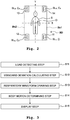
- a body motion determining system 100 according to an embodiment of the present invention ( Fig. 1 ), with an example of using the system together with a bed BD ( Fig. 2 ) to determine whether or not there is a body motion in a subject S on the bed BD.
- the body motion determining system 100 of this embodiment primarily has a load detecting unit 1, a control unit 3, and a storage unit 4.
- the load detecting unit 1 and the control unit 3 are connected via an A/D converting unit 2.
- the control unit 3 is further connected to a display unit 5, a notifying unit 6, and an input unit 7.
- the load detecting unit 1 includes four load detectors 11, 12, 13, and 14. Each of the load detectors 11, 12, 13, and 14 is a load detector for detecting a load by using, for example, a beam-type load cell. Such a load detector is disclosed, for example, in Japanese Patent No. 4829020 and Japanese Patent No. 4002905 . Each of the load detectors 11, 12, 13, and 14 is connected to the A/D converting unit 2 by way of wiring or wirelessly.
- the four load detectors 11 to 14 of the load detecting unit 1 are arranged respectively under casters C 1 , C 2 , C 3 , and C 4 fitted on the lower ends of legs BL 1 , BL 2 , BL 3 , and BL 4 at the four corners of the bed BD used by the subject S.
- the A/D converting unit 2 includes an A/D convertor to convert analog signals fed from the load detecting unit 1 to digital signals, and is connected respectively to the load detecting unit 1 and the control unit 3 by way of wiring or wirelessly.
- the control unit 3 is a dedicated or general-purpose computer inside which a standard deviation calculating unit 31, a respiratory waveform drawing unit 32 (respiratory waveform calculating unit; respiratory waveform obtaining unit), and a body motion determining unit 33 are constructed.
- the storage unit 4 is a storage device for storing data used in the body motion determining system 100 and, for example, a hard disk (magnetic disk) can be used for that purpose.
- a hard disk magnetic disk
- the display unit 5 is monitor such as a liquid crystal monitor or the like for displaying information outputted from the control unit 3 to users of the body motion determining system 100.
- the notifying unit 6 includes a device, such as a speaker, for example, to auditorily perform a predetermined notification on the basis of the information fed from the control unit 3.
- the input unit 7 is an interface for performing predetermined inputs for the control unit 3, which may be a keyboard and a mouse.
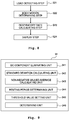
- the determining of whether or not there is a body motion of the subject performed by using the body motion determining system 100 includes a load detecting step S11 for detecting the load of a subject S, a standard deviation calculating step S12 for calculating a standard deviation showing the degree of variation of the detected load, a respiratory waveform drawing step S13 for drawing a respiratory waveform of the subject on the basis of the detected load, a body motion determining step S14 for determining the body motion of the subject by using the standard deviation found in the standard deviation calculating step S12, and the amplitude of the respiratory waveform drawn in the respiratory waveform drawing step S13, and a display step S15 for displaying the result of determining the body motion.
- the load detectors 11, 12, 13, and 14 are used to detect the load of the subject S on the bed BD.
- the load of the subject S on the bed BD is applied dispersively to the load detectors 11 to 14 arranged respectively under the legs BL 1 to BL 4 of the bed BD at the four corners.
- the load of the subject S is detected dispersively by the four load detectors.
- Each of the load detectors 11 to 14 detects the load (or variation of load), and outputs the detected load as an analog signal to the A/D converting unit 2.
- the A/D converting unit 2 converts the analog signal into a digital signal through at a sampling period (or cycle) of 5 milliseconds, for example, and then outputs the digital signal (to be referred to below as "load signal") to the control unit 3.
- load signals s 1 , s 2 , s 3 , and s 4 will be used to refer respectively to the load signals obtained in the A/D converting unit 2 by converting the analog signals outputted from the load detectors 11, 12, 13, and 14 into the digital format.
- the standard deviation calculating unit 31 calculates standard deviations ⁇ 1 , ⁇ 2 , ⁇ 3 , and ⁇ 4 (moving standard deviations) of a sampling value included in a predetermined sampling period (or time period) (5 seconds for example) for each of load signals s 1 , s 2 , s 3 , and s 4 .
- the calculation may be performed at any time (or continuously).
- the standard deviation denotes the magnitude of variation(dispersion) of the sampling value.
- the standard deviations ⁇ 1 to ⁇ 4 become small during a period Pi in which the subject S is resting on the bed BD and there is a small magnitude of variation in the load signals si to s 4 .
- the standard deviations ⁇ 1 to ⁇ 4 become large during a period P 2 in which the subject S is moving his/her body (in which there is a body motion arising in the subject S) and there is a large magnitude of variation in the load signals s 1 to s 4 .
- the standard deviations ⁇ 1 to ⁇ 4 have larger values in comparison to a period when there is no body motion arising in the subject S.
- body motion refers to any motion of the subject's head, torso (trunk, body-trunk), and/or four limbs.
- the body motion does not include motions of internal organs, blood vessels and the like along with the respirations, heartbeats, and the like.
- the body motion can be classified into a large body motion along with the motion of the subject S in the torso (trunk, body-trunk), and a small body motion along with the motion of the subject only in the four limbs, the head, and/or the like.
- One example of the large body motion is turn-over, sit-up or get-up, or the like
- one example of the small body motion is, a motion of the hands, the feet, the head or the like during sleep.
- the load signals s 1 to s 4 fed from the load detectors 11 to 14 vary accordingly.
- the magnitude of variation increases in the order of the variation due to the heartbeats of the subject S, the variation due to the respirations of the subject S, the variation due to the small body motion of the subject S, and the variation due to the large body motion of the subject S.
- the term “the subject only (merely) respires (or the subject merely performs a respiration)", the load values and the load signals "vary due only to the respiration(s)", and the like are used to mean that the subject has no body motion, and the load values and the load signals show no variation due to the body motion, but not to mean that the subject does not have heartbeats, the load values and the load signals do not include the variation due to the heartbeats, etc.
- the respiratory waveform drawing unit 32 (respiratory waveform calculating unit; respiratory waveform obtaining unit) draws a respiratory waveform of the subject S on the basis of the load signals s 1 to s 4 .
- the respiration of human is performed by moving the chest and the diaphragm to expand and shrink the lungs.
- the air is inhaled (or an inspiration is performed), i.e., when the lungs are expanded, the diaphragm is lowered downwardly, and the internal organs are also moved downwardly.
- the air is expired (or an expiration is performed), i.e., when the lungs are shrunk, the diaphragm is raised upwardly, and the internal organs are also moved upwardly.
- the center of gravity G (of the subject) moves slightly along with the movement of the internal organs, the moving direction thereof being approximately along the subject's backbone extending direction (body axis direction).
- the term "respiratory waveform” refers to a waveform showing an aspect of the oscillation of the subject's center of gravity oscillating in the subject's body axis direction due to the subject's respirations, by plotting the aspect on the temporal axis.
- One period of the respiratory waveform corresponds to one respiration of the subject (one inspiration and expiration).
- the amplitude of the respiratory waveform is affected by the subject's (physical) frame (build, physique) and/or respiratory depth.
- the amplitude becomes large
- the subject has a small frame or the subject performs a shallow respiration
- the respiratory waveform drawing unit 32 draws, in particular, the respiratory waveform in the following manner.
- the respiratory waveform drawing unit 32 calculates the position of the center of gravity G of the subject S at each sampling time on the basis of the load signals si to s 4 fed from the load detecting unit 1. As depicted in Fig. 5(a) , the center of gravity G of the subject S oscillates in the direction of the body axis SA of the subject S in accordance with or due to the respiration of the subject S.
- the respiratory waveform drawing unit 32 draws a respiratory waveform BW ( Fig. 5(b) ) by way of plotting, on the vertical axis of a graph, the distance between the positions obtained by projecting the position of the center of gravity G at each time on the body axis SA, and the oscillation center of oscillation of the center of gravity G according to the respiration.
- the direction of the vertical axis of the graph matches the direction of the body axis SA.
- the horizontal axis of the graph shows time.
- the body motion determining unit 33 uses the standard deviations ⁇ 1 to ⁇ 4 calculated in the standard deviation calculating step S12 and the amplitude of the respiratory waveform BW drawn in the respiratory waveform drawing step S13, to determine whether or not there is a body motion arising in the subject S.
- the determination is performed in the following manner in particular for example.
- the body motion determining unit 33 detects the peaks for the respiratory waveform BW drawn in the respiratory waveform drawing step S13, and calculates the difference between the minimum value over the period between the latest peak p n and the previous peak p n-1 , and the latest peak p n , as the latest amplitude A n of the respiratory waveform BW ( Fig. 5(b) ). Then, the body motion determining unit 33 finds an average amplitude A AVn which is a simple average (value) of the amplitude A n and the amplitudes A n-1 , A n-2 , ... which are calculated before the amplitude A n . While an arbitrary number of amplitudes A n can be used for calculating the average amplitude A AVn , as one example, the number may be such as obtained in a sampling period of 5 seconds or so.
- a comparison may be made between a threshold value ⁇ 0 and either a simple average ⁇ AV of the standard deviations ⁇ 1 to ⁇ 4 or any one of the standard deviations ⁇ 1 to ⁇ 4 .
- the threshold value ⁇ 0 is set at such a small value as able to reliably determine that there is no body motion arising in the subject S as long as the simple average ⁇ AV or any one of the standard deviations ⁇ 1 to ⁇ 4 is smaller than the small value (conversely, even if the simple average ⁇ AV or any one of the standard deviations ⁇ 1 to ⁇ 4 is not smaller than the small value, it is still possible that there is no body motion arising in the subject S).
- the body motion determining unit 33 finds normalized standard deviations ⁇ s 1 to ⁇ s 4 by the following (Formula 1).
- the body motion determining unit 33 finds a simple average ⁇ s AV of the calculated normalized standard deviations ⁇ s 1 to ⁇ s 4 and, based on a comparison between the simple average ⁇ s AV and a predetermined threshold value ⁇ s TH , determines whether or not there is a body motion arising in the subject S. In particular, for example, if the simple average ⁇ s AV is larger than or equal to the threshold value ⁇ s TH , then it is determined that there is a body motion arising in the subject S, whereas if the simple average ⁇ s AV is smaller than the threshold value ⁇ s TH , then it is determined that there is no body motion arising in the subject S.
- the body motion determining unit 33 calculates the latest amplitude A n for each one period of the respiratory waveform BW on the basis of the respiratory waveform BW obtained by the respiratory waveform drawing unit 32. Then, using the average amplitude A AVn calculated anew by using the value of the calculated latest amplitude A n , and the values of the standard deviations ⁇ 1 to ⁇ 4 calculated at each sampling time (as an example, every 5 milliseconds), the body motion determining unit 33 calculates, successively, the normalized standard deviations ⁇ s 1 to ⁇ s 4 by the Formula 1, and calculates the simple average ⁇ s AV .
- Determining whether or not there is a body motion arising in the subject S is performed by the successive comparisons between the predetermined threshold value ⁇ s TH and the simple average ⁇ s AV calculated successively in the above manner.
- the body motion determining unit 33 After it is determined as a result of the determination that there is a body motion arising in the subject S, the body motion determining unit 33 ceases to update the average amplitude A AVn and continues to calculate the simple average ⁇ s AV using the average amplitude A AVn having been calculated by this point. Then, based on a comparison between the calculated simple average ⁇ s AV and the threshold value ⁇ s TH , the body motion determining unit 33 continues to determine whether or not there is a body motion arising in the subject S.
- the body motion determining unit 33 calculates the value of the latest amplitude A n and, using the same, calculates the average amplitude A AVn anew. Then, the body motion determining unit 33 calculates the simple average ⁇ s AV using the latest average amplitude A AVn and, based on a comparison between the calculated simple average ⁇ s AV and the predetermined threshold value ⁇ s TH , the body motion determining unit 33 continues to determine whether or not there is a body motion arising in the subject S.
- the body motion determining unit 33 uses the average amplitude A AV1 which is the simple average of the amplitude A 1 and the amplitudes A 0 , A- 1 , ...
- the body motion determining unit 33 uses the average amplitude A AV2 calculated by using the amplitude A 2 , to successively calculate the normalized standard deviations ⁇ s 1 to ⁇ s 4 and the simple average ⁇ s AV (to be referred to here as ⁇ s AV (A AV2 )); and determines whether or not there is a body motion arising in the subject S, based on the comparison between the simple average ⁇ s AV (A AV2 ) and the threshold value ⁇ s TH .
- the body motion determining unit 33 determines that there is a body motion arising in the subject S on the basis of the simple average ⁇ s AV (A AV2 ) being equal to or larger than the threshold value ⁇ s TH . Then, after that, for the period when the simple average ⁇ s AV (A AV2 ) is equal to or larger than the threshold value ⁇ s TH , the body motion determining unit 33 continues to determine the body motion using the simple average ⁇ s AV (A AV2 ).
- the body motion determining unit 33 determines that there is no body motion arising in the subject S on the basis of the simple average ⁇ s AV (A AV2 ) being smaller than the threshold value ⁇ s TH . After that, the body motion determining unit 33 continues to determine the body motion using the simple average ⁇ s AV (A AV2 ) until the latest amplitude A n of the respiratory waveform BW is obtained and the latest average amplitude A AVn is calculated again.
- the body motion determining unit 33 uses the amplitude A n (average amplitude A AVn ) of the respiratory waveform to normalize the values of the standard deviations ⁇ 1 to ⁇ 4 .
- the reason therefor is as follows.
- the values of the standard deviations ⁇ 1 to ⁇ 4 become larger during a period when there is a body motion arising in the subject S. Therefore, it is conceivable to determine whether or not there is a body motion arising in the subject S by way of comparison between the values of the standard deviations ⁇ 1 to ⁇ 4 and a predetermined threshold value.
- the values of the standard deviations ⁇ 1 to ⁇ 4 may still be comparatively large even during a period of only performing respirations without the body motion because the movement of his/her internal organs due to the respirations is also large. Further, even for a subject who does not have a large frame, the values of the standard deviations ⁇ 1 to ⁇ 4 may still become large if, for example, the subject performs a deep respiration.
- the body motion determination is performed by comparing the values of the standard deviations ⁇ 1 to ⁇ 4 to a predetermined threshold value, in those cases, even though there is no body motion arising in the subject, a mistaken determination may be made to give the incorrect result that there is a body motion arising in the subject.
- the amplitude of the respiratory waveform is affected by the subject's frame and/or respiratory depth; therefore, if the subject has a large frame or the subject performs a deep respiration, then the amplitude becomes large, whereas if the subject has a small frame or the subject performs a shallow respiration, then the amplitude becomes small.
- the control unit 3 causes the display unit 5 to display the determination result of the body motion determining step S14.
- the notifying unit 6 may be used to perform a notification in addition to or instead of the display using the display unit 5. In this case, for example, when the subject S has a body motion, a notification sound may be emitted to notify the nurses, caregivers and/or others who are the users of the body motion determining system 100 that a body motion is arising.
- the body motion determining system 100 of this embodiment determines the body motion by using the simple average ⁇ s AV of the normalized standard deviations osi to ⁇ s 4 which are compensated (corrected) by normalizing the values of the standard deviations ⁇ 1 to ⁇ 4 by the average amplitude A AVn of the respiratory waveform BW. Therefore, there are reduced influences exerted by the change in the respiratory depth and/or the physical description of the subject S, on the values of the standard deviations ⁇ 1 to ⁇ 4 and, consequently, on the body motion determination. Hence, the determination is made with high precision.
- the body motion determining system 100 of this embodiment normalizes the values of the standard deviations ⁇ 1 to ⁇ 4 by using the average amplitude A AVn , of the respiratory waveform BW, calculated on the basis of the respirations performed by the subject S during the period right before the point of time of determining the body motion of the subject S. In this manner, because the values of the standard deviations ⁇ 1 to ⁇ 4 are normalized with high precision, having reflected the actual respiratory condition of the subject S, the body motion determination is also made with high precision.
- the normalization is performed by the average amplitude A AVn , even if any abnormal value arises in the amplitude A n of the respiratory waveform BW for some reason, the influence exerted by the abnormal value on the determination can still be reduced.
- the body motion determining system 100 uses the load detectors 11 to 14 arranged under the legs BL 1 to BL 4 of the bed BD to determine whether or not the subject S has a body motion. Therefore, it is not necessary to attach any measuring device to the body of the subject S so that the subject S will not feel discomfort and a sense of incongruity.
- the standard deviations ⁇ 1 to ⁇ 4 are normalized by dividing the standard deviations ⁇ 1 to ⁇ 4 by the average amplitude A AVn to reduce (compensate; correct) the influence on the values of the standard deviations ⁇ 1 to ⁇ 4 , exerted by the frame and/or respiratory depth of the subject S.
- the compensating (correcting) method by utilizing the amplitude of the respiratory waveform BW is not limited to that.
- the standard deviations ⁇ 1 to ⁇ 4 may be normalized by way of dividing the same by the latest amplitude A n of the respiratory waveform BW.
- the two methods mentioned above are practically equivalent and thus it is possible to appropriately select either the standard deviations or the threshold value used in the comparison for the compensation (correction) by the amplitude of the respiratory waveform.
- the expression "compensating the standard deviations by the amplitude of the respiratory waveform” is termed to include compensating the threshold value by the amplitude of the respiratory waveform.
- the body motion determination is performed by the comparison between the simple average ⁇ s AV of the normalized standard deviations ⁇ s 1 to ⁇ s 4 and the threshold value ⁇ s TH .
- it is also possible to determine the body motion by a comparison between at least one of the normalized standard deviations ⁇ s 1 to ⁇ s 4 and the threshold value, a comparison between simple average values of at least two or more of the normalized standard deviations ⁇ s 1 to ⁇ s 4 and the threshold value, a comparison between the total value of at least two or more of the normalized standard deviations ⁇ s 1 to ⁇ s 4 and the threshold value, or the like.
- the body motion determining system 100 of the above embodiment it is also possible to use a variance which is the squared standard deviation instead of the standard deviation. If the variance is normalized by the amplitude of the respiratory waveform, then the variance may be divided by the squared amplitude of the respiratory waveform. Therefore, in the present specification and in the present invention, the standard deviation is termed to include the variance.
- the body motion determining unit 33 may provide the threshold value used for the body motion determination with hysteresis. In particular, for example, with a first threshold value and a second threshold value larger than the first threshold value set in advance, under the condition that the subject S is determined as with no body motion arising therein, as far as the simple average ⁇ s AV is yet smaller than the second threshold value, the subject S is not determined as with a body motion arising therein.
- the subject S under the condition that the subject S is determined as with a body motion arising therein, even if the simple average ⁇ s AV is smaller than the second threshold value, the subject S is not determined as with no body motion arising therein, but is determined as with no body motion arising therein at the point of the simple average ⁇ s AV becoming smaller than the first threshold value.
- the axis X of the bed BD is defined as the axis extending in the breadthwise (widthwise) direction of the bed BD and passing through the center O
- the axis Y of the bed BD is defined as the axis extending in the lengthwise (longitudinal or up/down) direction of the bed BD and passing through the center O.
- the positive side of the axis X is the right side of the center O of the bed BD whereas the negative side of the axis X is the left side thereof, and the positive side of the axis Y is the upper side of the center O of the bed BD whereas the negative side of the axis Y is the lower side thereof.
- the subject S lies on the bed BD
- generally he or she lies along the axis Y and the head is placed on the positive side and the feet are placed on the negative side in the axis-Y direction.
- the biological state monitoring system 200 of this referential embodiment is configured to construct a body motion determining unit 34 and a respiratory rate calculating unit 35 inside the control unit 3, instead of the standard deviation calculating unit 31, the respiratory waveform drawing unit 32, and the body motion determining unit 33.
- the other configurations are all the same as those of the body motion determining system 100 of the above embodiment.
- the part excluding the respiratory rate calculating unit 35 of the control unit 3 corresponds to the body motion determining system of this referential embodiment.
- Monitoring the biological state of the subject by using the biological state monitoring system 200 includes: as depicted in the flow chart of Fig. 8 , a load detecting step S21 for detecting the (body weight) load of the subject; a body motion determining step S22 for determining whether or not there is a body motion in the subject on the basis of the detected load; a respiratory rate calculating step S23 for calculating the respiratory rate of the subject with reference to whether or not there is a body motion in the subject; and a display step S24 for displaying the determination result of the body motion determining step S22 and/or the calculation result of the respiratory rate calculating step S23.
- the contents of the load detecting step S21 are the same as the contents of the load detecting step S11 performed in the body motion determining system 100 of the above embodiment.
- the body motion determining unit 34 uses at least one of the load signals si to s 4 , to determine whether or not there is a body motion in subject S.
- the body motion determining unit 34 includes a DC (direct current) component eliminating unit 341, a standard deviation calculating unit 342, a non-negative-valued average calculating unit 343, a resting period determining unit 344, a threshold value setting unit 345, and a determining unit 346.
- DC direct current
- the body motion determining step S22 includes, as depicted in Fig. 10 , a DC component eliminating step S221, a resting period determining step S222, a threshold value setting step S223, and a determining step S224.
- the body motion determining unit 34 first carries out the DC component eliminating step S221 using the DC component eliminating unit 341 to eliminate the DC component from each of the load signals s 1 to s 4 .
- the DC components are eliminated, in particular for example, by finding a moving average over a predetermined period (15 seconds for example) for each of the load signals s 1 to s 4 , and then eliminating the found moving average from the sampling value of each of the load signals s 1 to s 4 .
- load signals s 1 to SC 4 the signals obtained after the DC components are eliminated from the load signals s 1 to s 4 will be referred to respectively as load signals sc 1 to SC 4 .
- the body motion determining unit 34 constantly or continuously calculates a standard deviation ⁇ with the standard deviation calculating unit 342, and constantly or continuously calculates a non-negative-valued average ⁇ with the non-negative-valued average calculating unit 343.
- the standard deviation calculating unit 342 constantly or continuously calculates standard deviations ⁇ 1 to ⁇ 4 of the sampling values included in a predetermined sampling period (time period) (5 seconds for example) for each of the load signals sc 1 to sc 4 obtained in the DC component eliminating step S221.
- the standard deviations ⁇ 1 to ⁇ 4 calculated in the standard deviation calculating unit 342 are used to determine a resting period (a period in which the subject only respires without body motion) in the resting period determining step S222, and to determine whether or not the subject S has a body motion in the determining step S224 (to be described in detail later on).
- the non-negative-valued average calculating unit 343 constantly or continuously calculates non-negative-valued averages ⁇ 1 to ⁇ 4 of sampling values W 11 to W 14 included respectively in the predetermined sampling period (time period) (5 seconds for example) for the respective load signals sc 1 to sc 4 obtained in the DC component eliminating step S221.
- the load signal sc 1 oscillates or vibrates due only to the respirations of the subject S in the resting period (as described earlier on, the oscillating component due to the heartbeats is also included therein but is neglected for its smallness).
- the non-negative-valued average calculating unit 343 first specifies the minimal sampling value W min (negative) which is the minimum value of the sampling value W 11 included in that sampling period. Then, the non-negative-valued operation is made by subtracting the specified minimal sampling value W min from each sampling value W 11 within the sampling period ( Fig. 11(b) ).
- the non-negative-valued average calculating unit 343 calculates an average value of the respective sampling values W 11 having been non-negative-valued to acquire (obtain) the non-negative-valued average ⁇ 1 .
- the non-negative-valued averages ⁇ 2 to ⁇ 4 are calculated in the same manner for the load signals sc 2 to sc 4 .
- the non-negative-valued averages ⁇ 1 to ⁇ 4 obtained in the resting period increase in value if the amplitude of load variation due to the respirations of the subject S increases, but decrease in value if the amplitude of load variation due to the respirations of the subject S decreases.
- the non-negative-valued averages ⁇ 1 to ⁇ 4 calculated by the non-negative-valued average calculating unit 343 are used for setting a threshold value ⁇ th in the threshold value setting step S223 (to be described in detail later on).
- the body motion determining unit 34 carries out the resting period determining step S222 with the resting period determining unit 344 when determining that a new subject S has arrived in the bed BD on the basis of an increase or the like of the load signals s 1 to s 4 (and/or the load signals sc 1 to sc 4 ), to determine that the subject S is situated in the resting period (the period when the subject only respires without body motion).
- This determination is carried out, in particular for example, by determining whether or not any of the standard deviations ⁇ 1 to ⁇ 4 calculated in the standard deviation calculating unit 342 is smaller than a predetermined threshold value ⁇ 0 (which may be identical to the threshold value used in the body motion determining system 100 of the above embodiment).
- the standard deviations ⁇ 1 to ⁇ 4 become small during the period when the load signals sc 1 to sc 4 vary little but become large during the period when the load signals sc 1 to sc 4 vary greatly. Therefore, any of the standard deviations ⁇ 1 to ⁇ 4 becomes small during a resting period (the period Pi of Fig. 4 , for example) when the subject S only respires without body motion.
- the threshold value ⁇ 0 is set to a sufficiently small value, then when any one of the standard deviations ⁇ 1 to ⁇ 4 reaches the threshold value ⁇ 0 , it is possible to determine that the subject S is (situated) in the resting period.
- the body motion determining unit 34 causes the threshold value setting unit 345 to perform the threshold value setting step S223.
- the threshold value setting unit 345 estimates the magnitude of a respiratory amplitude of the subject S and, based on the estimated magnitude of the respiratory amplitude, sets the threshold value ⁇ th to be used in the determining step S224.
- the respiratory amplitude of the subject S refers to the amplitude of oscillation of the center of gravity G of the subject S due to the respirations of the subject S. That is, the respiratory amplitude is equal to the amplitude A n of the respiratory waveform BW calculated in the body motion determining system 100 of the above embodiment.
- the threshold value setting unit 345 selects any one of the non-negative-valued averages ⁇ 1 to ⁇ 4 calculated by the non-negative-valued average calculating unit 343 in the resting period determined in the resting period determining step S222 and, according to the magnitude of the selected value, estimates the magnitude of the respiratory amplitude of the subject S. It can be said that if the non-negative-valued averages ⁇ 1 to ⁇ 4 in the resting period are large (or small), then the amplitudes of the oscillations of the load signals s 1 to s 4 and sc 1 to sc 4 due to the respirations of the subject S are large (or small), and thus, the respiratory amplitude of the subject S is also estimated as large (or small).
- the threshold value setting unit 345 sets the threshold value ⁇ th to be used in the determining step S224 on the basis of the estimated magnitude of the respiratory amplitude of the subject S.
- the threshold value ⁇ th is set to a first threshold value ⁇ th1
- the threshold value ⁇ th is set to a second threshold value ⁇ th2 ( ⁇ ⁇ th1 ).
- any one of the calculated non-negative-valued averages ⁇ 1 to ⁇ 4 may be compared with the threshold value ⁇ th . Then, if ⁇ s is larger than the threshold value ⁇ th , then the threshold value ⁇ th may be set to the first threshold value ⁇ th1 , whereas if ⁇ s is smaller than the threshold value ⁇ th , then the threshold value ⁇ th may be set to the second threshold value ⁇ th2 ( ⁇ ⁇ th1 ). In this case, practically, the threshold value ⁇ th is also set on the basis of the magnitude of the respiratory amplitude of the subject S.
- the body motion determining unit 34 uses the set threshold value ⁇ th to perform the determining step S224 with the determining unit 346, so as to determine whether or not the subject S has a body motion.
- the body motion determining unit 34 is supposed to continuously use the threshold value ⁇ th until the subject S leaves the bed BD and, thereafter, may perform the determining step S224 alone but not perform the resting period determining step S222 and the threshold value setting step S223.
- Whether or not the subject S has a body motion is determined, in particular for example, by comparing the threshold value ⁇ th set in the threshold value setting step S223 with any one of the standard deviations ⁇ 1 to ⁇ 4 (to be referred to below as "selected standard deviation ⁇ SE ”) of the load signals sc 1 to sc 4 calculated constantly or continuously by the standard deviation calculating unit 342.
- the variation of the load signals sc 1 to sc 4 increases in magnitude, so that the standard deviations ⁇ 1 to ⁇ 4 and, furthermore, the selected standard deviation ⁇ SE also increase (for example, during the period P 2 of Fig. 4 ). Therefore, the selected standard deviation ⁇ SE is compared with the set threshold value ⁇ th (that is, the ⁇ th1 or the ⁇ th2 ) to determine that the subject S has a body motion if the selected standard deviation ⁇ SE becomes larger than the threshold value ⁇ th .
- the load signals si to s 4 from the load detectors 11 to 14 vary according to the heartbeats, respirations and body motion of the subject S, and the magnitude of the oscillation changes according to the physical description of the subject S (such as the height, weight, body fat percentage, muscle mass, and the like). Then, according to the discovery and knowledge of the present inventors, there is a certain correlation between the magnitude of the load variation according to respirations (the magnitude of respiratory amplitude) and the magnitude of load variation according to the body motion.
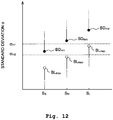
- Fig. 12 is a graph schematically depicting such an aspect.
- the open circles show the upper limit values (the respiratory variation upper limit BL max ) of the magnitude of load variation showable according to the respirations of the subject S (shown in Fig. 12 with the standard deviation), while the filled circles show the lower limit values (the body motion variation lower limit BL min ) of the magnitude of load variation showable according to the body motion (small body motion) of the subject.
- the respiratory variation upper limit BL max and the body motion variation lower limit BD min of a subject S s with a small respiratory amplitude are, respectively, smaller than the respiratory variation upper limit BL max and the body motion variation lower limit BD min of a subject S M with the average respiratory amplitude.
- the respiratory variation upper limit BL max and the body motion variation lower limit BD min of a subject S L with a large respiratory amplitude are, respectively, larger than the respiratory variation upper limit BL max and the body motion variation lower limit BD min of the subject S M with the average respiratory amplitude.
- the respiratory variation upper limit BL max of the subject S L with the large amplitude may become larger than the body motion variation lower limit BD min of the subject S s with the small respiratory amplitude. Therefore, it is difficult to use a single threshold value alone for determining the body motion of the subject S s with the small respiratory amplitude and for determining the body motion of the subject S L with the large respiratory amplitude, with high precision.
- ⁇ th1 ( Fig. 12 ) which is larger than the respiratory variation upper limit BL max of the subject S L but smaller than the body motion variation lower limit BD min of the subject S L so as to correctly determine the body motion of the subject S L with the large respiratory amplitude. Then, it is possible to correctly determine the body motion of the subject S L but, for the subject S s with the small respiratory amplitude, when the subject S s has a slight body motion, such a mistaken determination is liable to be made that there is no body motion in the subject S s .
- ⁇ th2 ( Fig. 12 ) which is larger than the respiratory variation upper limit BL max of the subject S s but smaller than the body motion variation lower limit BD min of the subject S s so as to correctly determine the body motion of the subject S s with the small respiratory amplitude. Then, it is possible to correctly determine the body motion of the subject S s but, for the subject S L with the larger respiratory amplitude, when the subject S L only respires, such a mistaken determination is liable to be made that there is a body motion in the subject S L .
- the threshold value ⁇ th is set according to a specific subject S, and the set threshold value ⁇ th is used to determine whether or not there is a body motion in the subject S.
- the respiratory rate calculating unit 35 calculates the respiratory rate of the subject S on the basis of at least one of the load signals s 1 to s 4 .
- the respiratory rate calculating unit 35 calculates the respiratory rate of the subject S by carrying out the Fourier analysis on at least one of the load signals s 1 to s 4 (or the load signals sc 1 to sc 4 ) so as to specify the peak frequency coming up in the frequency band corresponding to the respirations (from about 0.2 Hz to about 0.33 Hz because the human respiration is performed about 12 to 20 times per minute). With the specified peak frequency, it is possible to calculate (estimate) the respiratory rate of the subject S over that period.
- the load signals s 1 to s 4 and sc 1 to sc 4 oscillates at a different frequency from the that of the oscillation due to the respirations of the subject S (or no oscillation is exhibited). Therefore, even if the Fourier analysis is applied to the load signals s 1 to s 4 and sc 1 to sc 4 obtained in such period, it is difficult to correctly calculate the respiratory rate of the subject S.
- the respiratory rate calculating unit 35 of this referential embodiment ceases to calculate the respiratory rate for the period when the subject S has a body motion on the basis of the determination result of the body motion determining unit 34.
- an estimation value may be outputted on the basis of the respiratory rate of periods before and after that period, or a message may be outputted to indicate that the respiratory rate is unknown.
- the control unit 3 causes the display unit 5 to display the determination result of the body motion determining step S22 and/or the calculation result of the respiratory rate calculating step S23.
- the notifying unit 6 may be used to perform a notification in addition to or instead of the display using the display unit 5. In this case, for example, when the subject S has a body motion, a notification sound may be emitted to notify the nurses, caregivers and/or others who are the users of the biological state monitoring system 200 that a body motion is arising.
- the body motion determining unit 34 sets a suitable threshold value ⁇ th for each subject S on the basis of the respiratory amplitude of the subject S, and uses the same to determine whether or not the subject S has a body motion. Hence, it is possible to determine whether or not there is a body motion with high precision for each of a plurality of subjects S who differ in the magnitude of the respiratory amplitude.
- the respiratory rate calculating unit 35 excludes the periods difficult in calculating the respiratory rate of the subject S from the objects of calculating the respiratory rate. Therefore, there is a high reliability of the respiratory rate of the subject S calculated by the respiratory rate calculating unit 35.
- the body motion determining system and the biologocal state monitoring system 200 including the same use the load detectors 11 to 14 arranged under the legs BL 1 to BL 4 of the bed BD to monitor the biological state of the subject S. Therefore, it is not necessary to attach any measuring device to the body of the subject S so that the subject S will not feel discomfort and a sense of incongruity.
- the resting period determining step S222 and the threshold value setting step S223 may be performed again to reset the threshold value ⁇ th for the use in the determining step S224.
- the magnitude of the respiratory amplitude of the subject S depends basically on the physical description of the subject S, and thus it does not change greatly during the monitoring period. Therefore, generally speaking, as far as the subject S is not changed, it is possible to use the threshold value ⁇ th , which is once set in the threshold value setting step S23, continuously in the successive monitoring.
- the non-negative-valued average calculating unit 343 of the body motion determining unit 34 of the above referential embodiment may cease to calculate the non-negative-valued averages ⁇ 1 to ⁇ 4 after the threshold value ⁇ th is set if the threshold value ⁇ th once set is to be used continuously in the determining step S224.
- the non-negative-valued averages ⁇ 1 to ⁇ 4 may be calculated only in the case where the resting period determining unit 344 determines that the subject S is in the resting period in the resting period determining step S222.
- the standard deviation calculating unit 342 of the body motion determining unit 34 may calculate variances ⁇ 2 1 to ⁇ 2 4 instead of or in addition to the standard deviations ⁇ 1 to ⁇ 4 .
- a threshold value ⁇ 2 th is set according to the variances ⁇ 2 1 to ⁇ 2 4 .
- the determining step S224 whether or not the subject S has a body motion is determined by comparing the threshold value ⁇ 2 th to any one or the sum of any two or more of the variances ⁇ 2 1 to ⁇ 2 4 .
- the body motion determining unit 34 compares whether or not any one of the standard deviations ⁇ 1 to ⁇ 4 is smaller than the predetermined threshold value ⁇ 0 , to determine that the subject S is in the resting period.
- the body motion determining unit 34 may compare the sum of any two or more of the standard deviations ⁇ 1 to ⁇ 4 with the threshold value, to determine that the subject S is in the resting period.
- the body motion determining unit 34 selects any one of the non-negative-valued averages ⁇ 1 to ⁇ 4 and, based on that one, estimates the magnitude of the respiratory amplitude of the subject S.
- the body motion determining unit 34 may estimate the magnitude of the respiratory amplitude of the subject S on the basis of the sum of any two or more of the non-negative-valued averages ⁇ 1 to ⁇ 4 . For example, by using the summation of the non-negative-valued averages ⁇ 1 to ⁇ 4 , it is possible to estimate the magnitude of the respiratory amplitude of the subject S with high precision regardless of the position of the subject S on the bed BD.
- the body motion determining unit 34 sets the threshold value ⁇ th to either the first threshold value ⁇ th1 or the smaller second threshold value ⁇ th2 .
- the body motion determining unit 34 may set the threshold value ⁇ th in a more detailed manner according to the magnitude of the respiratory amplitude of the subject S estimated from the non-negative-valued averages ⁇ 1 to ⁇ 4 .
- the threshold value ⁇ th may be set to any of the first threshold value ⁇ th1 to an nth threshold value ⁇ thn (n is a natural number larger than two) which are different from one another.
- the body motion determining unit 34 compares the set threshold value ⁇ th to the selected standard deviation ⁇ SE which is any one of the standard deviations ⁇ 1 to ⁇ 4 , to determine whether or not the subject S has a body motion.
- the body motion determining unit 34 may determine whether or not the subject S has a body motion by comparing the threshold value ⁇ th with the sum of any two or more of the standard deviations ⁇ 1 to ⁇ 4 .
- the threshold value ⁇ th set in the threshold value setting step S223 is supposed to also accord to the contents of the standard deviations used in the determining step S224.
- the body motion determining unit 34 may include a center of gravity position calculating unit instead of or in addition to the standard deviation calculating unit 342.
- the center of gravity position calculating unit uses sampling values W 11 to W 14 of the load signals s 1 to s 4 (or the load signals sc 1 to sc 4 ) fed from the load detectors 11 to 14, to calculate the position (X, Y) of the center of gravity G of the subject S.
- the calculation of the position (X, Y) of the center of gravity G is performed in accordance with the following operation. Coordinates X-Y are set up for the bed BD as depicted in Fig. 2 , and the coordinates of the load detectors 11, 12, 13, and 14 are supposed to be: (X 11 , Y 11 ), (X 12 , Y 12 ), (X 13 , Y 13 ), and (X 14 , Y 14 ), respectively. Then, the position G (X, Y) of the load applied on the bed BD is calculated with the following formulas.
- the center of gravity position calculating unit finds a temporal variation of the position (X, Y) of the center of gravity G, i.e., a center of gravity locus GT while calculating the position (X, Y) of the center of gravity G at a predetermined sampling period T on the basis of the formulas 2 and 3 given above.
- the acquired center of gravity locus GT is stored, for example, in the storage unit 4.
- the movement of the center of gravity G of the subject S is characterized as follows.
- the center of gravity G of the subject S oscillates in the direction of the body axis SA of the subject S according to the respirations of the subject S ( Fig. 5(a) ). Further, the center of gravity G of the subject S moves according to that if the subject S has a small body motion or a large body motion. Then, the moving distance of the center of gravity G over a predetermined period increases in the ascending order of the period when the subject S only respires, the period when the subject S has a small body motion, and the subject S has a large body motion.
- the body motion determining unit 34 can determine whether or not the subject S has a body motion by comparing a predetermined threshold value with the moving distance of the center of gravity G over a predetermined period. In particular, for example, it is possible to determine that the subject S has a small body motion if the moving distance D of the center of gravity G over a predetermined period is longer than a threshold value D th .
- the body motion determining unit 34 causes the threshold value setting unit 345 to perform the threshold value setting step S223 to set the threshold value D th (for example, either a D th1 or a smaller D th2 ) according to the magnitude of the respiratory amplitude of the subject S.
- the respiratory rate calculating unit 35 calculates the respiratory rate of the subject S by performing the Fourier transform on at least one of the load signals s 1 to s 4 (or the load signals sc 1 to sc 4 ).
- the present invention is not limited to that.
- the body motion determining unit 34 has the center of gravity position calculating unit, then it is possible to draw a respiratory waveform BW of the subject S ( Fig. 5(b) ) from the calculated position of the center of gravity G.
- the respiratory rate calculating unit 35 can regard the oscillation rate of the respiratory waveform BW drawn in this manner as the respiratory rate of the subject S.
- control unit 3 may display the drawn respiratory waveform BW on the display unit 5.
- the body motion determining unit 34 first determines that the subject S is in the resting period in the resting period determining step S222, and then uses the non-negative-valued average ⁇ in that period to estimate the magnitude of the respiratory amplitude of the subject S.
- the present invention is not limited to that.
- the body motion determining unit 34 may estimate the magnitude of the respiratory amplitude of the subject S on the basis of the minimal value of the non-negative-valued average
- the magnitude of the respiratory amplitude of the subject S may be estimated anew and/or the threshold value ⁇ th be set anew as necessary.
- the body motion determining unit 34 can also find the respiratory amplitude of the subject S without using the non-negative-valued average ⁇ .
- the respiratory waveform BW it is possible to estimate (determine) the respiratory amplitude of the subject S from the amplitude of the respiratory waveform BW.
- the biological state monitoring system 200 of the above referential embodiment may further include a biological state determining unit to determine other biological states than whether or not the subject S has a body motion and the respiratory rate of the subject S.
- a biological state determining unit determines, for example, whether the subject S is present in or absent from the bed, asleep or awake, dead or alive, etc., on the basis of whether or not the subject S has a body motion, the respiratory rate of the subject S, etc.
- the biological state monitoring system 200 of the above referential embodiment can determine the body motion of the subject S and estimate the respiratory rate of the subject S with high precision
- the biological state monitoring system 200 of the modified embodiments based on the former can also determine whether the subject S is present in or absent from the bed, asleep or awake, dead or alive, etc., with high precision.
- the body motion determining system 100 of the above embodiment does not need to include all of the load detectors 11 to 14 but may include only any one of the four. For example, if there are three such load detectors, then it is still possible to detect the position of the center of gravity G of the subject S on the plane of the bed BD provided that the three load detectors are not arranged on a straight line. Further, the load detectors do not need to be arranged at the four corners of the bed but may be arranged in any positions as far as they can detect the load of the subject on the bed and the variation thereof. Further, the load detectors 11 to 14 are not limited to load sensors using beam-type load cells but, for example, force sensors are also usable.
- the load detectors 11 to 14 are arranged respectively on the undersides of the casters C attached to the lower ends of the legs of the bed BD.
- Each of the load detectors 11 to 14 may be provided respectively between one of the four legs of the bed BD and the board of the bed BD.
- each of the load detectors 11 to 14 may be provided between the upper leg and the lower leg.
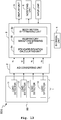
- the load detectors 11 to 14 may be formed integral with or removable from the bed BD to construct a bed system BDS comprising the bed BD, and the body motion determining system 100 of this embodiment ( Fig. 13 ).
- the load detecting unit 1 between the load detecting unit 1 and the A/D converting unit 2, it is possible to provide a signal amplifying unit to amplify the load signals fed from the load detecting unit 1, and a filtering unit to eliminate the noises from the load signals.
- the display unit 5 may include a printer for printing out the information indicating whether or not there is a body motion, a simplified visual display means such as lamps indicating whether or not there is a body motion, and/or the like, instead of the monitor or in addition to the monitor.
- the notifying unit 6 may include a vibration generating unit for performing the notification by way of vibration, instead of the speaker or in addition to the speaker.
- a body motion determining system by use of a combination of the body motion determining system 100 of the above embodiment and the body motion determining system of the above referential embodiment.
- Such body motion determining system determines the body motion with the body motion determining system of the above referential embodiment without depending on the respiratory waveform BW for periods after the system is started up in which it is not possible to reliably draw the respiratory waveform BW and to calculate the average amplitude A AVn . Then, when coming to the point of being able to reliably draw the respiratory waveform BW and calculate the average amplitude A AVn , the body motion determining system 100 of the above embodiment starts to determine the body motion.
- the body motion determining unit of such body motion determining system determines the body motion of the subject S in the same manner as the body motion determining unit 34 of the above referential embodiment, by using the threshold value ⁇ th (the second threshold value) set on the basis of the non-negative-valued averages ⁇ 1 to ⁇ 4 , in a period immediately after the system is started up.
- the system calculates the average amplitude A AVn of the respiratory waveform BW of the subject S and, thereafter, determines the body motion of the subject S on the basis of a comparison between the threshold value ⁇ s TH (the first threshold value) and the simple average ⁇ s AV of the normalized standard deviations ⁇ s 1 to ⁇ s 4 which are normalized by the average amplitude A AVn .
- the body motion determining system of the present invention it is possible to determine whether or not the subject has a body motion with high precision by reducing the influence of the subject's frame and respiratory depth. Therefore, by using the body motion determining system of the present invention, it is possible to provide high-quality medical treatments and caregiving services on the basis of those high-precision determinations.
Landscapes
- Health & Medical Sciences (AREA)
- Life Sciences & Earth Sciences (AREA)
- Engineering & Computer Science (AREA)
- General Health & Medical Sciences (AREA)
- Veterinary Medicine (AREA)
- Biophysics (AREA)
- Biomedical Technology (AREA)
- Heart & Thoracic Surgery (AREA)
- Medical Informatics (AREA)
- Molecular Biology (AREA)
- Surgery (AREA)
- Animal Behavior & Ethology (AREA)
- Physics & Mathematics (AREA)
- Public Health (AREA)
- Pathology (AREA)
- Physiology (AREA)
- Dentistry (AREA)
- Oral & Maxillofacial Surgery (AREA)
- Signal Processing (AREA)
- Artificial Intelligence (AREA)
- Computer Vision & Pattern Recognition (AREA)
- Psychiatry (AREA)
- Pulmonology (AREA)
- Measurement Of The Respiration, Hearing Ability, Form, And Blood Characteristics Of Living Organisms (AREA)
- Measuring And Recording Apparatus For Diagnosis (AREA)
Applications Claiming Priority (2)
| Application Number | Priority Date | Filing Date | Title |
|---|---|---|---|
| JP2018046885A JP6666940B2 (ja) | 2018-03-14 | 2018-03-14 | 体動判定システム及びベッドシステム |
| PCT/JP2019/010459 WO2019177080A1 (ja) | 2018-03-14 | 2019-03-14 | 体動判定システム |
Publications (3)
| Publication Number | Publication Date |
|---|---|
| EP3766418A1 true EP3766418A1 (de) | 2021-01-20 |
| EP3766418A4 EP3766418A4 (de) | 2021-11-17 |
| EP3766418B1 EP3766418B1 (de) | 2023-01-04 |
Family
ID=67906687
Family Applications (1)
| Application Number | Title | Priority Date | Filing Date |
|---|---|---|---|
| EP19767190.2A Active EP3766418B1 (de) | 2018-03-14 | 2019-03-14 | System zur bestimmung der körperbewegung |
Country Status (5)
| Country | Link |
|---|---|
| US (2) | US20210007629A1 (de) |
| EP (1) | EP3766418B1 (de) |
| JP (1) | JP6666940B2 (de) |
| CN (1) | CN111867468B (de) |
| WO (1) | WO2019177080A1 (de) |
Families Citing this family (2)
| Publication number | Priority date | Publication date | Assignee | Title |
|---|---|---|---|---|
| US11344228B2 (en) * | 2018-05-02 | 2022-05-31 | Wernher Ovalle | Patient monitoring device and system |
| WO2026070033A1 (ja) * | 2024-09-30 | 2026-04-02 | ミネベアミツミ株式会社 | 支持面移動装置、呼吸異常検知装置、支持機器、支持面移動方法、及び呼吸異常検知方法 |
Family Cites Families (17)
| Publication number | Priority date | Publication date | Assignee | Title |
|---|---|---|---|---|
| JPS4829020B1 (de) | 1969-10-18 | 1973-09-06 | ||
| JPS5318758A (en) | 1976-07-30 | 1978-02-21 | Asahi Denka Kogyo Kk | Production of nutty food |
| JP4002905B2 (ja) | 2004-04-13 | 2007-11-07 | 日本圧着端子製造株式会社 | 荷重スケール及びこれを用いた荷重スケールシステム |
| JP4582642B2 (ja) * | 2005-04-01 | 2010-11-17 | 株式会社タニタ | 睡眠段階判定装置 |
| JP5442318B2 (ja) * | 2009-05-15 | 2014-03-12 | Gac株式会社 | 荷重データを解析する装置、その装置の制御方法およびプログラム |
| WO2013054712A1 (ja) * | 2011-10-14 | 2013-04-18 | 株式会社タニタ | 睡眠評価システム及び睡眠評価装置 |
| JP5998559B2 (ja) | 2012-03-26 | 2016-09-28 | アイシン精機株式会社 | 睡眠判定装置、及び寝返り検出装置 |
| EP2897526B1 (de) * | 2012-09-19 | 2021-03-17 | ResMed Sensor Technologies Limited | System und verfahren zur bestimmung des schlafstadiums |
| JP6328884B2 (ja) | 2013-03-29 | 2018-05-23 | 昭和電工株式会社 | 体動レベル判定装置 |
| CN103263261B (zh) * | 2013-05-02 | 2016-09-07 | 宋军 | 无约束生理参数测量方法推定睡眠指标和睡眠阶段的系统 |
| JP6515670B2 (ja) * | 2015-05-11 | 2019-05-22 | 学校法人立命館 | 睡眠深度推定装置、睡眠深度推定方法、およびプログラム |
| JP6105703B1 (ja) * | 2015-09-29 | 2017-03-29 | ミネベアミツミ株式会社 | 生体情報モニタリングシステム |
| JP6716888B2 (ja) * | 2015-10-29 | 2020-07-01 | Tdk株式会社 | 呼吸解析装置、呼吸解析方法及びプログラム |
| KR102687254B1 (ko) * | 2016-02-15 | 2024-07-19 | 헬스 센싱 가부시키가이샤 | 수면 상태 측정장치 및 방법, 위상 코히어런스 산출 장치, 생체 진동신호 측정 장치, 스트레스 상태 측정 장치 및 수면 상태 측정 장치 및 심박 파형 추출 방법 |
| JP6845404B2 (ja) * | 2016-03-18 | 2021-03-17 | 国立大学法人電気通信大学 | 睡眠段階判定方法、睡眠段階判定装置、及び睡眠段階判定プログラム |
| JP6268219B2 (ja) * | 2016-05-17 | 2018-01-24 | ミネベアミツミ株式会社 | 呼吸波形描画システム及び生体情報モニタリングシステム |
| JP6570585B2 (ja) * | 2017-08-04 | 2019-09-04 | ミネベアミツミ株式会社 | 体動判定システム、生体状態モニタリングシステム、及びベッドシステム |
-
2018
- 2018-03-14 JP JP2018046885A patent/JP6666940B2/ja active Active
-
2019
- 2019-03-14 WO PCT/JP2019/010459 patent/WO2019177080A1/ja not_active Ceased
- 2019-03-14 CN CN201980019130.0A patent/CN111867468B/zh active Active
- 2019-03-14 EP EP19767190.2A patent/EP3766418B1/de active Active
- 2019-03-14 US US16/980,194 patent/US20210007629A1/en not_active Abandoned
-
2022
- 2022-11-23 US US18/058,323 patent/US20230157584A1/en active Pending
Also Published As
| Publication number | Publication date |
|---|---|
| US20210007629A1 (en) | 2021-01-14 |
| US20230157584A1 (en) | 2023-05-25 |
| JP6666940B2 (ja) | 2020-03-18 |
| EP3766418A4 (de) | 2021-11-17 |
| EP3766418B1 (de) | 2023-01-04 |
| JP2019154856A (ja) | 2019-09-19 |
| WO2019177080A1 (ja) | 2019-09-19 |
| CN111867468A (zh) | 2020-10-30 |
| CN111867468B (zh) | 2022-04-08 |
Similar Documents
| Publication | Publication Date | Title |
|---|---|---|
| US20230157584A1 (en) | Body motion determination system | |
| EP3766424B1 (de) | Schlaf/wach-bestimmungssystem | |
| US12226204B2 (en) | Body motion determination system and biological state monitoring system | |
| EP3659565A1 (de) | System zur überwachung der zustände in einem bett | |
| US11490860B2 (en) | Biological information monitoring system, bed system, and biological information monitoring method | |
| EP3459451A1 (de) | Vorrichtung zum zeichnen von atemkurven und verfahren zum zeichnen von atemkurven | |
| EP3459450A1 (de) | System zum zeichnen von atemkurven | |
| US11179067B2 (en) | Biological state monitoring system | |
| EP3785631B1 (de) | Überwachungssystem für den biologischen zustand | |
| JP7094916B2 (ja) | 生体情報モニタリングシステム、生体情報モニタリング方法、及びベッドシステム | |
| JP2017077273A (ja) | 脈波解析装置 |
Legal Events
| Date | Code | Title | Description |
|---|---|---|---|
| STAA | Information on the status of an ep patent application or granted ep patent |
Free format text: STATUS: THE INTERNATIONAL PUBLICATION HAS BEEN MADE |
|
| PUAI | Public reference made under article 153(3) epc to a published international application that has entered the european phase |
Free format text: ORIGINAL CODE: 0009012 |
|
| STAA | Information on the status of an ep patent application or granted ep patent |
Free format text: STATUS: REQUEST FOR EXAMINATION WAS MADE |
|
| 17P | Request for examination filed |
Effective date: 20200923 |
|
| AK | Designated contracting states |
Kind code of ref document: A1 Designated state(s): AL AT BE BG CH CY CZ DE DK EE ES FI FR GB GR HR HU IE IS IT LI LT LU LV MC MK MT NL NO PL PT RO RS SE SI SK SM TR |
|
| AX | Request for extension of the european patent |
Extension state: BA ME |
|
| DAV | Request for validation of the european patent (deleted) | ||
| DAX | Request for extension of the european patent (deleted) | ||
| A4 | Supplementary search report drawn up and despatched |
Effective date: 20211020 |
|
| RIC1 | Information provided on ipc code assigned before grant |
Ipc: A61B 5/113 20060101ALI20211014BHEP Ipc: A61B 5/11 20060101AFI20211014BHEP |
|
| GRAP | Despatch of communication of intention to grant a patent |
Free format text: ORIGINAL CODE: EPIDOSNIGR1 |
|
| STAA | Information on the status of an ep patent application or granted ep patent |
Free format text: STATUS: GRANT OF PATENT IS INTENDED |
|
| RIN1 | Information on inventor provided before grant (corrected) |
Inventor name: MASUDA, SHIGEMI Inventor name: TODOROKI, SHINSUKE |
|
| INTG | Intention to grant announced |
Effective date: 20220715 |
|
| GRAS | Grant fee paid |
Free format text: ORIGINAL CODE: EPIDOSNIGR3 |
|
| GRAA | (expected) grant |
Free format text: ORIGINAL CODE: 0009210 |
|
| STAA | Information on the status of an ep patent application or granted ep patent |
Free format text: STATUS: THE PATENT HAS BEEN GRANTED |
|
| AK | Designated contracting states |
Kind code of ref document: B1 Designated state(s): AL AT BE BG CH CY CZ DE DK EE ES FI FR GB GR HR HU IE IS IT LI LT LU LV MC MK MT NL NO PL PT RO RS SE SI SK SM TR |
|
| REG | Reference to a national code |
Ref country code: GB Ref legal event code: FG4D |
|
| REG | Reference to a national code |
Ref country code: CH Ref legal event code: EP |
|
| REG | Reference to a national code |
Ref country code: AT Ref legal event code: REF Ref document number: 1541376 Country of ref document: AT Kind code of ref document: T Effective date: 20230115 |
|
| REG | Reference to a national code |
Ref country code: DE Ref legal event code: R096 Ref document number: 602019024011 Country of ref document: DE |
|
| REG | Reference to a national code |
Ref country code: IE Ref legal event code: FG4D |
|
| REG | Reference to a national code |
Ref country code: LT Ref legal event code: MG9D |
|
| REG | Reference to a national code |
Ref country code: NL Ref legal event code: MP Effective date: 20230104 |
|
| REG | Reference to a national code |
Ref country code: AT Ref legal event code: MK05 Ref document number: 1541376 Country of ref document: AT Kind code of ref document: T Effective date: 20230104 |
|
| PG25 | Lapsed in a contracting state [announced via postgrant information from national office to epo] |
Ref country code: NL Free format text: LAPSE BECAUSE OF FAILURE TO SUBMIT A TRANSLATION OF THE DESCRIPTION OR TO PAY THE FEE WITHIN THE PRESCRIBED TIME-LIMIT Effective date: 20230104 |
|
| PG25 | Lapsed in a contracting state [announced via postgrant information from national office to epo] |
Ref country code: RS Free format text: LAPSE BECAUSE OF FAILURE TO SUBMIT A TRANSLATION OF THE DESCRIPTION OR TO PAY THE FEE WITHIN THE PRESCRIBED TIME-LIMIT Effective date: 20230104 Ref country code: PT Free format text: LAPSE BECAUSE OF FAILURE TO SUBMIT A TRANSLATION OF THE DESCRIPTION OR TO PAY THE FEE WITHIN THE PRESCRIBED TIME-LIMIT Effective date: 20230504 Ref country code: NO Free format text: LAPSE BECAUSE OF FAILURE TO SUBMIT A TRANSLATION OF THE DESCRIPTION OR TO PAY THE FEE WITHIN THE PRESCRIBED TIME-LIMIT Effective date: 20230404 Ref country code: LV Free format text: LAPSE BECAUSE OF FAILURE TO SUBMIT A TRANSLATION OF THE DESCRIPTION OR TO PAY THE FEE WITHIN THE PRESCRIBED TIME-LIMIT Effective date: 20230104 Ref country code: LT Free format text: LAPSE BECAUSE OF FAILURE TO SUBMIT A TRANSLATION OF THE DESCRIPTION OR TO PAY THE FEE WITHIN THE PRESCRIBED TIME-LIMIT Effective date: 20230104 Ref country code: HR Free format text: LAPSE BECAUSE OF FAILURE TO SUBMIT A TRANSLATION OF THE DESCRIPTION OR TO PAY THE FEE WITHIN THE PRESCRIBED TIME-LIMIT Effective date: 20230104 Ref country code: ES Free format text: LAPSE BECAUSE OF FAILURE TO SUBMIT A TRANSLATION OF THE DESCRIPTION OR TO PAY THE FEE WITHIN THE PRESCRIBED TIME-LIMIT Effective date: 20230104 Ref country code: AT Free format text: LAPSE BECAUSE OF FAILURE TO SUBMIT A TRANSLATION OF THE DESCRIPTION OR TO PAY THE FEE WITHIN THE PRESCRIBED TIME-LIMIT Effective date: 20230104 |
|
| PG25 | Lapsed in a contracting state [announced via postgrant information from national office to epo] |
Ref country code: SE Free format text: LAPSE BECAUSE OF FAILURE TO SUBMIT A TRANSLATION OF THE DESCRIPTION OR TO PAY THE FEE WITHIN THE PRESCRIBED TIME-LIMIT Effective date: 20230104 Ref country code: PL Free format text: LAPSE BECAUSE OF FAILURE TO SUBMIT A TRANSLATION OF THE DESCRIPTION OR TO PAY THE FEE WITHIN THE PRESCRIBED TIME-LIMIT Effective date: 20230104 Ref country code: IS Free format text: LAPSE BECAUSE OF FAILURE TO SUBMIT A TRANSLATION OF THE DESCRIPTION OR TO PAY THE FEE WITHIN THE PRESCRIBED TIME-LIMIT Effective date: 20230504 Ref country code: GR Free format text: LAPSE BECAUSE OF FAILURE TO SUBMIT A TRANSLATION OF THE DESCRIPTION OR TO PAY THE FEE WITHIN THE PRESCRIBED TIME-LIMIT Effective date: 20230405 Ref country code: FI Free format text: LAPSE BECAUSE OF FAILURE TO SUBMIT A TRANSLATION OF THE DESCRIPTION OR TO PAY THE FEE WITHIN THE PRESCRIBED TIME-LIMIT Effective date: 20230104 |
|
| REG | Reference to a national code |
Ref country code: DE Ref legal event code: R097 Ref document number: 602019024011 Country of ref document: DE |
|
| PG25 | Lapsed in a contracting state [announced via postgrant information from national office to epo] |
Ref country code: SM Free format text: LAPSE BECAUSE OF FAILURE TO SUBMIT A TRANSLATION OF THE DESCRIPTION OR TO PAY THE FEE WITHIN THE PRESCRIBED TIME-LIMIT Effective date: 20230104 Ref country code: RO Free format text: LAPSE BECAUSE OF FAILURE TO SUBMIT A TRANSLATION OF THE DESCRIPTION OR TO PAY THE FEE WITHIN THE PRESCRIBED TIME-LIMIT Effective date: 20230104 Ref country code: MC Free format text: LAPSE BECAUSE OF FAILURE TO SUBMIT A TRANSLATION OF THE DESCRIPTION OR TO PAY THE FEE WITHIN THE PRESCRIBED TIME-LIMIT Effective date: 20230104 Ref country code: EE Free format text: LAPSE BECAUSE OF FAILURE TO SUBMIT A TRANSLATION OF THE DESCRIPTION OR TO PAY THE FEE WITHIN THE PRESCRIBED TIME-LIMIT Effective date: 20230104 Ref country code: DK Free format text: LAPSE BECAUSE OF FAILURE TO SUBMIT A TRANSLATION OF THE DESCRIPTION OR TO PAY THE FEE WITHIN THE PRESCRIBED TIME-LIMIT Effective date: 20230104 Ref country code: CZ Free format text: LAPSE BECAUSE OF FAILURE TO SUBMIT A TRANSLATION OF THE DESCRIPTION OR TO PAY THE FEE WITHIN THE PRESCRIBED TIME-LIMIT Effective date: 20230104 |
|
| REG | Reference to a national code |
Ref country code: CH Ref legal event code: PL |
|
| PLBE | No opposition filed within time limit |
Free format text: ORIGINAL CODE: 0009261 |
|
| STAA | Information on the status of an ep patent application or granted ep patent |
Free format text: STATUS: NO OPPOSITION FILED WITHIN TIME LIMIT |
|
| PG25 | Lapsed in a contracting state [announced via postgrant information from national office to epo] |
Ref country code: SK Free format text: LAPSE BECAUSE OF FAILURE TO SUBMIT A TRANSLATION OF THE DESCRIPTION OR TO PAY THE FEE WITHIN THE PRESCRIBED TIME-LIMIT Effective date: 20230104 |
|
| REG | Reference to a national code |
Ref country code: BE Ref legal event code: MM Effective date: 20230331 |
|
| 26N | No opposition filed |
Effective date: 20231005 |
|
| PG25 | Lapsed in a contracting state [announced via postgrant information from national office to epo] |
Ref country code: LU Free format text: LAPSE BECAUSE OF NON-PAYMENT OF DUE FEES Effective date: 20230314 |
|
| REG | Reference to a national code |
Ref country code: IE Ref legal event code: MM4A |
|
| PG25 | Lapsed in a contracting state [announced via postgrant information from national office to epo] |
Ref country code: SI Free format text: LAPSE BECAUSE OF FAILURE TO SUBMIT A TRANSLATION OF THE DESCRIPTION OR TO PAY THE FEE WITHIN THE PRESCRIBED TIME-LIMIT Effective date: 20230104 Ref country code: LI Free format text: LAPSE BECAUSE OF NON-PAYMENT OF DUE FEES Effective date: 20230331 Ref country code: IE Free format text: LAPSE BECAUSE OF NON-PAYMENT OF DUE FEES Effective date: 20230314 Ref country code: FR Free format text: LAPSE BECAUSE OF NON-PAYMENT OF DUE FEES Effective date: 20230331 Ref country code: CH Free format text: LAPSE BECAUSE OF NON-PAYMENT OF DUE FEES Effective date: 20230331 |
|
| PG25 | Lapsed in a contracting state [announced via postgrant information from national office to epo] |
Ref country code: BE Free format text: LAPSE BECAUSE OF NON-PAYMENT OF DUE FEES Effective date: 20230331 |
|
| PG25 | Lapsed in a contracting state [announced via postgrant information from national office to epo] |
Ref country code: IT Free format text: LAPSE BECAUSE OF FAILURE TO SUBMIT A TRANSLATION OF THE DESCRIPTION OR TO PAY THE FEE WITHIN THE PRESCRIBED TIME-LIMIT Effective date: 20230104 |
|
| PG25 | Lapsed in a contracting state [announced via postgrant information from national office to epo] |
Ref country code: BG Free format text: LAPSE BECAUSE OF FAILURE TO SUBMIT A TRANSLATION OF THE DESCRIPTION OR TO PAY THE FEE WITHIN THE PRESCRIBED TIME-LIMIT Effective date: 20230104 |
|
| PG25 | Lapsed in a contracting state [announced via postgrant information from national office to epo] |
Ref country code: BG Free format text: LAPSE BECAUSE OF FAILURE TO SUBMIT A TRANSLATION OF THE DESCRIPTION OR TO PAY THE FEE WITHIN THE PRESCRIBED TIME-LIMIT Effective date: 20230104 |
|
| PG25 | Lapsed in a contracting state [announced via postgrant information from national office to epo] |
Ref country code: CY Free format text: LAPSE BECAUSE OF FAILURE TO SUBMIT A TRANSLATION OF THE DESCRIPTION OR TO PAY THE FEE WITHIN THE PRESCRIBED TIME-LIMIT; INVALID AB INITIO Effective date: 20190314 |
|
| PG25 | Lapsed in a contracting state [announced via postgrant information from national office to epo] |
Ref country code: HU Free format text: LAPSE BECAUSE OF FAILURE TO SUBMIT A TRANSLATION OF THE DESCRIPTION OR TO PAY THE FEE WITHIN THE PRESCRIBED TIME-LIMIT; INVALID AB INITIO Effective date: 20190314 |
|
| PG25 | Lapsed in a contracting state [announced via postgrant information from national office to epo] |
Ref country code: TR Free format text: LAPSE BECAUSE OF FAILURE TO SUBMIT A TRANSLATION OF THE DESCRIPTION OR TO PAY THE FEE WITHIN THE PRESCRIBED TIME-LIMIT Effective date: 20230104 |
|
| PGFP | Annual fee paid to national office [announced via postgrant information from national office to epo] |
Ref country code: GB Payment date: 20260324 Year of fee payment: 8 |
|
| PGFP | Annual fee paid to national office [announced via postgrant information from national office to epo] |
Ref country code: DE Payment date: 20260319 Year of fee payment: 8 |