EP3765591B1 - Festbettabtaster und zugehörige verfahren - Google Patents
Festbettabtaster und zugehörige verfahren Download PDFInfo
- Publication number
- EP3765591B1 EP3765591B1 EP19711905.0A EP19711905A EP3765591B1 EP 3765591 B1 EP3765591 B1 EP 3765591B1 EP 19711905 A EP19711905 A EP 19711905A EP 3765591 B1 EP3765591 B1 EP 3765591B1
- Authority
- EP
- European Patent Office
- Prior art keywords
- fixed bed
- bioreactor
- sample portion
- positioner
- layers
- Prior art date
- Legal status (The legal status is an assumption and is not a legal conclusion. Google has not performed a legal analysis and makes no representation as to the accuracy of the status listed.)
- Active
Links
Images













Classifications
-
- C—CHEMISTRY; METALLURGY
- C12—BIOCHEMISTRY; BEER; SPIRITS; WINE; VINEGAR; MICROBIOLOGY; ENZYMOLOGY; MUTATION OR GENETIC ENGINEERING
- C12M—APPARATUS FOR ENZYMOLOGY OR MICROBIOLOGY; APPARATUS FOR CULTURING MICROORGANISMS FOR PRODUCING BIOMASS, FOR GROWING CELLS OR FOR OBTAINING FERMENTATION OR METABOLIC PRODUCTS, i.e. BIOREACTORS OR FERMENTERS
- C12M25/00—Means for supporting, enclosing or fixing the microorganisms, e.g. immunocoatings
- C12M25/16—Particles; Beads; Granular material; Encapsulation
- C12M25/18—Fixed or packed bed
-
- C—CHEMISTRY; METALLURGY
- C12—BIOCHEMISTRY; BEER; SPIRITS; WINE; VINEGAR; MICROBIOLOGY; ENZYMOLOGY; MUTATION OR GENETIC ENGINEERING
- C12M—APPARATUS FOR ENZYMOLOGY OR MICROBIOLOGY; APPARATUS FOR CULTURING MICROORGANISMS FOR PRODUCING BIOMASS, FOR GROWING CELLS OR FOR OBTAINING FERMENTATION OR METABOLIC PRODUCTS, i.e. BIOREACTORS OR FERMENTERS
- C12M23/00—Constructional details, e.g. recesses, hinges
- C12M23/46—Means for fastening
-
- C—CHEMISTRY; METALLURGY
- C12—BIOCHEMISTRY; BEER; SPIRITS; WINE; VINEGAR; MICROBIOLOGY; ENZYMOLOGY; MUTATION OR GENETIC ENGINEERING
- C12M—APPARATUS FOR ENZYMOLOGY OR MICROBIOLOGY; APPARATUS FOR CULTURING MICROORGANISMS FOR PRODUCING BIOMASS, FOR GROWING CELLS OR FOR OBTAINING FERMENTATION OR METABOLIC PRODUCTS, i.e. BIOREACTORS OR FERMENTERS
- C12M25/00—Means for supporting, enclosing or fixing the microorganisms, e.g. immunocoatings
- C12M25/02—Membranes; Filters
-
- C—CHEMISTRY; METALLURGY
- C12—BIOCHEMISTRY; BEER; SPIRITS; WINE; VINEGAR; MICROBIOLOGY; ENZYMOLOGY; MUTATION OR GENETIC ENGINEERING
- C12M—APPARATUS FOR ENZYMOLOGY OR MICROBIOLOGY; APPARATUS FOR CULTURING MICROORGANISMS FOR PRODUCING BIOMASS, FOR GROWING CELLS OR FOR OBTAINING FERMENTATION OR METABOLIC PRODUCTS, i.e. BIOREACTORS OR FERMENTERS
- C12M33/00—Means for introduction, transport, positioning, extraction, harvesting, peeling or sampling of biological material in or from the apparatus
- C12M33/02—Means for introduction, transport, positioning, extraction, harvesting, peeling or sampling of biological material in or from the apparatus by impregnation, e.g. using swabs or loops
-
- C—CHEMISTRY; METALLURGY
- C12—BIOCHEMISTRY; BEER; SPIRITS; WINE; VINEGAR; MICROBIOLOGY; ENZYMOLOGY; MUTATION OR GENETIC ENGINEERING
- C12M—APPARATUS FOR ENZYMOLOGY OR MICROBIOLOGY; APPARATUS FOR CULTURING MICROORGANISMS FOR PRODUCING BIOMASS, FOR GROWING CELLS OR FOR OBTAINING FERMENTATION OR METABOLIC PRODUCTS, i.e. BIOREACTORS OR FERMENTERS
- C12M33/00—Means for introduction, transport, positioning, extraction, harvesting, peeling or sampling of biological material in or from the apparatus
- C12M33/18—Rollers
-
- C—CHEMISTRY; METALLURGY
- C12—BIOCHEMISTRY; BEER; SPIRITS; WINE; VINEGAR; MICROBIOLOGY; ENZYMOLOGY; MUTATION OR GENETIC ENGINEERING
- C12M—APPARATUS FOR ENZYMOLOGY OR MICROBIOLOGY; APPARATUS FOR CULTURING MICROORGANISMS FOR PRODUCING BIOMASS, FOR GROWING CELLS OR FOR OBTAINING FERMENTATION OR METABOLIC PRODUCTS, i.e. BIOREACTORS OR FERMENTERS
- C12M47/00—Means for after-treatment of the produced biomass or of the fermentation or metabolic products, e.g. storage of biomass
- C12M47/16—Sterilization
Definitions
- This document relates generally to the cell culturing arts and, more particularly, to a sampler for a structured fixed bed cell culturing device and related methods.
- Certain cell culturing devices such as bioreactors, use a "fixed bed" for the growth of cells that are entrapped thereon or for the growth of adherent cells which attach and grow thereon.
- These high cell density bioreactors suffer from the inherent inability of its users to easily take samples at any point before, during or after the culture process for various purposes (e.g., to take cell-associated measurements such as those relating to viability and density).
- One common way to take such an in-process sample from the fixed bed is to reach inside the bioreactor with a tool such as a tweezer during operation, and to manually extract a piece or portion of the bed. This operation is difficult as it requires careful dexterity.
- US2013071872 describes a sampling device and method for sampling a bioreactor.
- the bioreactor of US2013071872 is a packed bed bioreactor containing packed cell culture matrices.
- US2013071872 describes a basket containing pre-embedded cell culture matrices to provide additional matrices for the cells to grow on besides the cell culture matrices inside the bioreactor.
- the sampling device of US2013071872 cannot function adequately in combination with a structured fixed bed comprising at least two layers of material adjacent to each other, as the basket would severely disrupt the structured fixed bed due to the damage caused by the basket being inserted in the structured fixed bed.
- the bioreactor is typically located inside a containment unit such as a laminar flow cabinet or a biosafety cabinet where the freedom of movement and access of the operator for such a maneuver is limited. While a small scale bioreactor can be placed in such a containment unit, a large production-scale version cannot readily be placed in such cabinets to achieve this result. Additionally, sterility must be maintained during the whole operation, which means the operator collecting the sample has to follow precise aseptic operating procedures. This is challenging when having to introduce an extraction tool such as a tweezer.
- Biomass sensors have been proposed for assessing cell density.
- these sensors lack sufficiently robust technology, and do not allow for the actual direct examination of the cells as a sample. Indirect measurement of cell characteristics by the biomass sensor is far less accurate than direct examination of cells.
- a sterile liquid sensor in a fixed bed bioreactor yields only information from which an educated guess or estimate can be made regarding cell conditions based on detected byproducts (metabolites) of the growth process left in the fluid.
- current samplers and methods do not provide an accurate and timely tool for developing a reliable cell culture process for a fixed bed bioreactor.
- a need is identified for a device that provides the ability to take a reliable sample from the structured fixed bed comprising at least two layers of material adjacent to each other and the cells associated therewith.
- the device would allow for the sample to be obtained in an easy and inexpensive manner, while maintaining aseptic conditions so as to protect against contamination (both internal to the bioreactor and external to it) and to avoid creating deleterious disruptions of the structured fixed bed cell culture environment.
- An object of the invention is to provide a device that enables the taking of one or more samples from the cell culture in an easy, inexpensive, and reliable manner, while maintaining aseptic or sterile conditions, and also while avoiding creating deleterious disruptions of the structured fixed bed cell culture environment.
- a sampler for a structured fixed bed comprising at least two layers of material adjacent to each other in which cells are grown, such as a cell culturing device or bioreactor.
- the sampler is proposed in several formats: (1) one which allows the operator to take a sample in a non-sterile manner (such as when the bioreactor is present in a laminar flow cabinet or a biosafety cabinet); (2) one which allows the operator to take a sample in a sterile manner; and (3) another which allows a larger volume or portion of the fixed bed to be extracted, an operation desirable at an or the end of a cell culture process.
- the sterility of the sampling process itself ensures that the bioreactor is not constrained to being operated in a sterile environment, while ensuring protection both for the process and the environment.
- the sampler thereby improves the operability of the bioreactor by facilitating: (a) the operation required to take a sample from the structured fixed bed cell culture (manually, or possibly via partial or full automation) without deleterious disruption or effects, and (b) the containment and sterility constraints associated with fixed bed bioreactors, in such a way that it can be operated outside of a strictly sterile zone without risking contamination of the bioreactor itself or the sample by the environment, and the environment by the content of the bioreactor or the sample.
- a sampler that can be used in a situation where the cell culturing device (bioreactor) is operated in a sterile environment as well (e.g., a small size (e.g., ⁇ 600 m2 surface area) bioreactor that can be used in connection with an isolator, cabinet, or the like).
- a sampler that can be used in a situation where the cell culturing device (bioreactor) is operated in a sterile environment as well (e.g., a small size (e.g., ⁇ 600 m2 surface area) bioreactor that can be used in connection with an isolator, cabinet, or the like).
- an apparatus for use with a cell culture system such as for example a bioreactor, fermenter, or the like, is disclosed.
- the apparatus comprises a structured fixed bed comprising at least two layers of material adjacent to each other including a removable sample portion for recovering a sample of cells from the cell culture system, the removable sample portion being located at least partially between the at least two layers.
- the structured fixed bed comprises at least two layers of material adjacent to each other, the removable sample portion being located at least partially between the at least two layers.
- the at least two layers comprise: (1) cell immobilization layers, and the removable sample portion has a first side in contact with a first cell immobilization layer and a second side in contact with a second cell immobilization layer; or (2) one cell immobilization layer and one spacer layer.
- the removable sample portion comprises one or more fibers, and in some embodiments, removable sample portion comprise a non-woven material.
- the removable sample portion may comprise a sheet of material.
- the structured fixed bed comprises a cell immobilization layer, and the sheet of material forming the removable sample portion is in direct contact with the cell immobilization layer.
- the apparatus comprises a positioner mechanically connected to the removable sample portion by a connector.
- the structured fixed bed comprises a plurality of removable sample portions.
- the structured fixed bed comprises a roller or spiral bed, and in some embodiments the removable sample portion is adjacent to the structured fixed bed, and in some embodiments the removable sample portion is a perforated or pre-cut portion of the structured fixed bed.
- the apparatus of any disclosed embodiment may be applied to a bioreactor.
- the bioreactor comprises an outer chamber for receiving the structured fixed bed with an upward flow of fluid.
- An inner chamber is provided for returning fluid flow to a lower portion of the bioreactor including an agitator.
- an apparatus for use with a bioreactor for growing a cell culture comprises a structured fixed bed comprising at least two layers of material adjacent to each other and includes a removable sample portion comprising one or more fibers for recovering a sample of cells from the cell culture, the removable sample portion being located at least partially between the at least two layers.
- the fixed bed comprises a structured fixed bed comprising at least two layers of material adjacent to each other .
- the removable sample portion comprises a non-woven material.
- the removable sample portion is between two layers of the fixed bed, and in some embodiments, the removable sample portion is adjacent to the fixed bed (or both approaches are combined).
- the removable sample portion is a perforated or pre-cut portion of the structured fixed bed.
- the sample portion may be in contact with the fixed bed in a bioreactor and need not be inserted or positioned within it. In some embodiments the sample portion may be positioned adjacent to and in contact with a surface of the fixed bed, such as a side surface or an upper surface thereof, and connected to the positioner. In some embodiments the sample portion comprises a folded portion. In some embodiments, the sample portion comprises a folded portion and a welded portion.
- an apparatus for sampling a cell culture comprises a bioreactor comprising a structured fixed bed comprising at least two layers of material adjacent to each other including a removable sample portion.
- a sampler is associated with the bioreactor for recovering the removable sample portion from the structured fixed bed.
- the removable sample portion includes a positioner adapted for positioning the sample portion within the structured fixed bed, the positioner being accessible via a port in the bioreactor.
- a support is associated with the port by way of a releasable connection, such as a bayonet fitting including a slot on the support and a post on the port, a threaded connection, or a releasable latch, the support being connected to the positioner.
- the support is fixed to the positioner, or releasably connected to the positioner, such as by a flexible portion for releasably engaging a portion of the positioner for movement together in an axial direction, but allowing for the support to rotate without imparting rotation to the positioner.
- the support comprises a frangible connection for separating the support into multiple portions for removal of the removable sample portion.
- the sampler comprises a cutter for forming the removable sample portion of the structured fixed bed. In some embodiments, the sampler comprises a groove for engaging a locking pin associated with the port for guiding the sampler into position.
- a container for maintaining a sterile condition of the removable sample portion when removed from the bioreactor.
- the container connects to the bioreactor via an aseptic connection so as to maintain a sterile condition within a compartment defined by the container and including the sampler, and also a sterile condition of the bioreactor.
- the container comprises a septum for receiving a connector connected to the removable sample portion.
- the container comprises a flexible sleeve, which in some embodiments is connected to a rigid elbow.
- the removable sample portion includes a positioner connected to the removable sample portion, the positioner being associated with an actuator for withdrawing the removable sample portion from the structured fixed bed.
- the actuator comprises a stator and a rotor.
- the actuator is connected to a sleeve for receiving a positioner connected to the sample portion.
- the stator comprises a flexible bag surrounding the rotor.
- the stator comprises a cradle for cradling the rotor.
- a controller is provided for controlling the actuator. In some embodiments, the controller is adapted for receiving an output signal from at least one sensor associated with the bioreactor.
- the removable sample portion is connected to a positioner forming a releasable connection with a cap for a port of the bioreactor.
- the releasable connection comprises a magnetic coupling.
- the port includes a receiver for receiving a projection of the positioner in a manner that prevents relative rotate
- the structured fixed bed may comprises a roller or spiral bed.
- the removable sample portion is adjacent to the structured fixed bed.
- the removable sample portion is a perforated or pre-cut portion of the structured fixed bed.
- the disclosure pertains to an apparatus for sampling a cell culture.
- the apparatus comprises a bioreactor comprising a structured fixed bed comprising at least two layers of material adjacent to each other including a removable sample portion and a sampler associated with the bioreactor for recovering the removable sample portion from the bed.
- the sampler comprises a positioner releasably connected to the removable sample portion.
- the positioner is releasably connected to the removable sample portion by a clamp.
- the removable sample portion is within or adjacent to the structured fixed bed.
- the removable sample portion is a perforated or pre-cut portion of the structured fixed bed.
- Yet another aspect of the disclosure pertains to an apparatus for sampling a cell culture associated with a structured fixed bed comprising at least two layers of material adjacent to each other in a bioreactor having a port.
- the apparatus comprises a sampler associated with the bioreactor for recovering a sample portion of the bed via the port, the sampler including an actuator for withdrawing the sample portion from the bed.
- the actuator is connected to a container for receiving a positioner connected to the sample portion.
- the actuator comprises a stator and a rotor.
- the stator comprises a flexible bag surrounding the rotor.
- the stator comprises a cradle for cradling the rotor.
- a controller is provided for controlling the actuator.
- the controller is adapted for receiving an output signal from at least one sensor associated with the bioreactor.
- the bed comprises a structured fixed bed including at least two layers, and the sample portion comprises a sheet of material located between at least two layers.
- the removable sample portion is within or adjacent to the structured fixed bed.
- the removable sample portion is a perforated or pre-cut portion of the structured fixed bed.
- a further aspect of this disclosure pertains to a method of sampling a cell culture in cell culture system, such as a bioreactor having a structured fixed bed comprising at least two layers of material adjacent to each other.
- the method includes the step of recovering a removable sample portion from the structured fixed bed of the bioreactor.
- the structured fixed bed comprises at least two layers, and the method comprises positioning the removable sample portion at least partially between the at least two layers prior to the recovering step.
- the recovering step comprises withdrawing a positioner connected to the removable sample portion from the bioreactor until the removable sample portion is received in a container connected to the bioreactor by an aseptic connector.
- the withdrawing step comprises using an actuator controlled by a controller based on a sensed condition of the bioreactor. In some embodiments, any or all of the following steps are performed: (1) counting the cells removed on the removable sample portion; (2) coloration of the cells or (3) extracting intra-cell viruses from the cells removed on the removable sample portion.
- FIG. 1 illustrates a sampler 10 for a cell culture system, such as for example a bioreactor 12, fermenter or the like, according to one aspect of the disclosure.
- the bioreactor 12 is presumed to be in operation under external sterile conditions in a containment unit (such as a laminar flow cabinet, external isolator or the like).
- a containment unit such as a laminar flow cabinet, external isolator or the like.
- the sampler 10 may also be used in other environments.
- the sampler 10 may comprise a support portion for associating with an opening in the bioreactor 12 providing access to an interior compartment thereof.
- the support portion comprises a cover or cap 14 for sealing the opening in the bioreactor 12, and thus maintains the sterility of the interior compartment, even when not in a containment unit.
- the support portion may support a removable sample portion 16 for positioning within a fixed bed 18 in the interior compartment of the bioreactor 12.
- the sample portion 16 may comprise a substrate (such as, for example, a sheet of material, a sheet of flexible material, or the like, which sheet may be in the form of an elongated strip) which, like the fixed bed itself, is adapted to promote cell growth or cell immobilization/entrapment.
- the substrate may alternatively comprise one or more fibers, including those arranged as a piece of nonwoven material, as outlined further in the following description.
- the sample portion 16 may alternatively comprise a portion or part of the fixed bed 18 with perforations, tear away seams or other means for separating from the rest of the fixed bed.
- the sample portion 16 may be a separate structure for positioning within the fixed bed 18 during the process of assembling the bioreactor 12 (as outlined further in the following discussion).
- sample portion 16 may be adapted for detachment and removal from the rest of the fixed bed (such as by providing perforations or tear-away seams in the fixed bed, or pre-cutting the fixed bed or other means for separating samples to create one or more removable (detachable) portions).
- the sample portion 16 may be removably attached to a positioner 20 to facilitate holding the sample portion 16 in an appropriate position in the fixed bed 18 and also removing it from the fixed bed 18. Prepositioning of the sample portion 16 within the fixed bed 18 may be achieved by hand via the positioner 20, or by using a tool, such as tweezers (not shown) to pass the sample portion 16 into the fixed bed 18 through a port 22 in the lid 24 of the bioreactor 12 (or by removing the lid entirely). This may be done prior to the commencement of the bioprocessing operation, even during assembly of the bioreactor or manufacturing and assembly of the fixed bed.
- a tool such as tweezers
- the fixed bed 18 may comprise any substrate for achieving cell growth or cell immobilization, and consists of a structured fixed bed (which means that it is formed of an easily replicated, generally homogeneous, substantially fixed structure, and thus is not randomly oriented or unstructured, yet, as can be appreciated, could take a variety of sizes or shapes while meeting this qualification) comprising at least two layers of material adjacent to each other.
- the material of the fixed bed 18 may be woven, non-woven, a fiber matrix, or other forms, and may be formed of various polymer materials, including but not limited to polyethylene and polyethylene terephthalate.
- the structured fixed bed comprises a non-woven material 18a arranged in at least two layers on and within which cells grow.
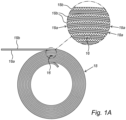
- the non-woven material 18a is arranged in a rolled or spiral fashion, with each of the two cell immobilization layers separated by spacer layers 18b, which promote culture and media flow between the various layers.
- the sample portion 16 may be a pre-defined portion of a cell immobilization layer. It may be a separate substrate positioned (as shown) between two of the layers of the bed 18 in rolled or spiral form, such as cell immobilization (or non-woven material) layers 18a. Alternatively, the sample portion may be located between a spacer layer and an adjacent cell immobilization layer.
- the fixed bed 18 may have only a single cell immobilization layer alternatively in roll or spiral with a single spacer layer.
- Figure 1B illustrates a non-structured fixed bed not being part of the invention, which may comprise a plurality of randomly oriented fibers 18c.
- the sample portion 16 may comprise one of the fibers 18c.
- This fiber 18c may be connected to the positioner 20, as indicated (or as a substrate of non-woven fibers).
- more than one fiber can be connected to the positioner 20 and act as the sample portion (such as a non-woven material, as noted previously).
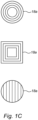
- Figure 1A illustrates a rolled, generally cylindrical arrangement for a structured fixed bed 18 with at least two layers (including a cell immobilization and spacer layers 18a, 18b), it should be appreciated that other forms may be used.
- the fixed bed 18 may comprise a plurality of concentric layers 18a that are continuous, and may be in any shape (e.g., circular, square). Alternatively, the layers 18a may be linear.
- spacer layers 18b may or may not be provided, and the sampler portion 16 may be located at any location (or locations) within the bed 18, without limitation, depending on the desired approach to sampling.
- an anchorage point such as a sidewall of the port 22 associated with the lid 24 of the bioreactor 12, may be adapted to form a seal with the cover or cap 14 to ensure that sterility is maintained.
- the cap 14 may be releasably connected to the port 22. This may be achieved by threading or other means of secure, but releasable connection (e.g, a bayonet fitting, as outlined further in the following description, or a door with a releasable latch (push-pull type of arrangement, or even a friction or interference fit)).
- the positioner 20 may extend a distance sufficient to ensure that the sample portion 16 is at least partially positioned within the fixed bed 18. As can be appreciated, this distance may vary depending on the size and shape of the bioreactor 12, as well as the desired location for the sampling to occur, the type of bed, or the type of culture.
- the positioner 20 may be connected to the cover or cap 14 serving as the support, but may also be separate therefrom (such that the cap 14 may be removed while the positioner 20 remains in position, and can then be withdrawn and the cap replaced).
- a structured fixed bed is suited for the latter version, since the sample portion 16 may be pre-positioned within the structured fixed bed layers and held therein, and the positioner 20 later associated with the cap 14 (if desired).
- the spacer layers and/or the cell immobilization layers which make up respectively the spacer section and the immobilization section in the matrix assembly are preferably made of a biocompatible polymer selected from polyester, polyethylene, polypropylene, polyamide, plasma treated polyethylene, plasma treated polyester, plasma treated polypropylene or plasma treated polyamide. Said layers can be hydrophilic or hydrophobic. The cell immobilization layers are preferably hydrophilic.
- Suitable material for the cell immobilization layer may be a woven or nonwoven material.
- a nonwoven material is used.
- a nonwoven, contrary to a woven material, is a fabric which is not created by weaving or knitting and does not require converting the fibers to yarn.
- Nonwovens are broadly defined as sheet or web structures bonded together by entangling fiber or filaments (and by perforating films) mechanically, thermally or chemically. The nature of the nonwoven material used in the current application may be of any origin, either comprising of natural fibers or synthetic fibers.
- the nonwoven is made of a polymer, such as polyester or polypropylene.
- the cell immobilization layers used in the current invention may be chosen from a polyethyleteterepthalate nonwoven.
- the nonwoven material may be plasma treated to enhance cell adherence and flow.
- the spacer layers may consist of a (biocompatible) polymer with mesh size as described above.
- the spacer layer is a synthetic woven fabric or structure.
- the spacer layer is a bearing structure. Such structure may be produced from a biopolymer (e.g. alginate). Other suitable material for this purpose is silica, polystyrene, agarose, styrene divinylbenzene, polyacrylonitrile or latex.
- the spacer layer may be gamma irradiated in order to reduce bioburden.
- the design of the matrix assembly can take many forms depending on the application and type of bioreactor.
- the immobilization section and spacer section are alternately positioned. Alternately positioned means that each spacer section is followed by a cell immobilization section which is itself followed by a spacer section.
- the alternately positioned sections may alternate in vertical position as shown in the figures (see further) or in a horizontal position according to the use of the matrix and/or to the bioreactor in which the matrix will be introduced.
- one or more layers of cell immobilization layers are superimposed on one or more spacer layers (or vice versa). This configuration may be repeated several times if deemed required in order creating a stack of several immobilization and spacer sections.
- the end configuration may comprise between 1 and 500alternations of the above described layering.
- the stacked layers may be positioned in a frame or cassette or sealed/connected at their circumference.
- the achieved stack can be rolled around an axis or core to achieve a spiral configuration.
- the number of layers used in both the immobilization section and spacer section can be chosen based on the application, characteristics of the layers (dimensions, size, etc.) and desired result. Hence, the number of layers within either immobilization section or spacer section may be between 1 and 20, more preferably between 1 and 10, even more preferably between 1 and 5.
- the presence of the spacer sections creates space inside the matrix through which the culture medium flows. This provides improved circulation of the culture medium through the matrix thereby reaching all cultured cells. This effect is even more enhanced in the embodiment wherein the spacer section comprises one spacer layer and the immobilization section comprises two immobilization layers.
- the culture medium flowing inside the matrix via the spacer sections is tangentially oriented with respect to the cell immobilization sections.
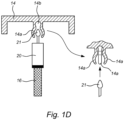
- FIGS 1C , 1D , and 1E Examples of releasable connections between the positioner 20 and the support for it (cap 14) are shown in Figures 1C , 1D , and 1E .
- the cap 14 includes flexible projections 14a forming a receiver 14b for receiving and retaining a portion 21 of the positioner 20 (which portion 21 may also form part of a separate structure, such as a sleeve).
- the portion 21 within the receiver 14b is retained against movement in an axial direction of the positioner 20 unless sufficient force is generated to separate the projections, yet allows for free rotation.
- the cap 14 may be rotated for removal (if a bayonet or threaded connection) without causing the positioner 20, and hence the sample portion 16, to rotate relative to the fixed bed 18, which might cause an undesirable disruption or result.
- the cap 14 can still be withdrawn in the vertical direction, though, including with the positioner 20 remaining attached, or separated therefrom (in which case it can be accessed and removed independently of the cap).
- the positioner 20 with the sample portion 16 may be positioned in the bioreactor 12, and the cap 14 then connected to the positioner 20.
- the arrangement could also be reversed, such that the projections are on the sleeve/positioner, and the portion for engagement is on the positioner.
- Figure 1D illustrates a version in which a removable part 14c includes the projections 14a forming the receiver 14b.
- Fasteners such as screws 14d, clips, or snaps, may be used to secure the part 14c to the cap 14.
- the part 14c may be released before the cap 14 is removed, and the cap 14 may be associated with part 14c once in place.
- Seals such as O-rings 14e, may also be provided for sealing the interface created with the exterior environment through the openings for the fasteners/screws 14d.
- Figure 1E illustrates another version in which the part 14c is adapted for passing through an opening O in the cap 14.
- An external fastener such as a threaded nut 14f may then be used to secure the detachable part 14c to the cap 14, such as by threading along a shank 14g thereof.
- the part 14c may be selectively associated with the cap 14 during placement or removal, and without disturbing the position of the positioner 20 and sample portion 16.
- cells may be cultured in the fixed bed 18, as well as on the sample portion 16 as a result of its positioning.
- the sample portion 16 may be removed from its location in the fixed bed 18. In one example, this may be achieved by removing the cap 14 from the port 22. This removal is shown in Figure 1 as involving rotation of the cap 14 in one direction (note arrow R) to release a connection (as discussed below), and then raising it in a vertical direction V.
- Port 22 could also be associated with a sidewall of the bioreactor 12 or any other part, in which case the movement would be primarily horizontal.
- the cap or cover 14 could also form a friction fit with an associated part of the bioreactor 12, such as the port 22 or another part of the lid 24 for providing access to the fixed bed 18, in which case only vertical movement may be used to remove the cover 14.
- the positioner 20 may be removed from bioreactor 12 as well to recover the sample portion 16 from the fixed bed 18, without requiring an enhanced level of coordination or dexterity, and without the need for using a tool that can disrupt the surrounding material of the fixed bed 18. Examination of the sample portion 16 may then be done external to the bioreactor 12 to evaluate the cells thereon, which would be directly representative of the corresponding cell growth in the fixed bed 18. Optionally, a second cover or cap 26 may then be used to seal port 22, and a new sample portion 16 may also be positioned within the fixed bed 18 via an associated positioner in case a desire exists to repeat the sampling operation.
- FIG. 2 a second embodiment of the sampler 100 is shown, for possible use in environments where the bioreactor 112 is internally sterile, but the external environment is not sterile (e.g., where the bioreactor 112 is of a large scale or size, making use of a conventional isolator or cabinet difficult, costly or impossible).
- the sample portion 116 (as well as the bioreactor 112) must be protected against contamination during removal and prior to inspection of the sample portion.
- the basic parts are essentially the same as above, but an additional partition or barrier, optionally in the form of a flexible sleeve 128, is provided.
- This sleeve 128 forms a sterile barrier between the anchorage point, such as port 122, and the cover or cap 114.
- This sleeve 128 may be formed of an elongated piece of flexible material, such as a thin, flexible polymer material, and may be arranged so as to not interfere with the connection between the cap 114 and the port 122.
- the cap 114 When it is desired to take a sample of the fixed bed 118 during the culturing process, the cap 114 is released and removed. Consequently, the sample portion 116 is withdrawn from the fixed bed 118 via positioner 120, but remains under sterile conditions as a result of the surrounding sleeve 128 and the seals established with cap and port. A portion of the sleeve 128 may then be sealed, either mechanically or by welding (e.g., using heat), as indicated by arrow S in Figure 2 , which also seals a remaining portion of the sleeve for covering the opening to the bioreactor 112 (e.g. port 122).
- sealing means in the form of an aseptic connection include the Quickseal or Clipster technologies distributed by Sartorius (see, e.g., U.S. Patent Application Publication Nos. 2012/0017733 and 2011/0155274 , the disclosures of which is incorporated herein by reference), or a mechanical seal between inner portions of the sleeve 128 could be provided, similar to a "Zip-Lock" style of resealable, flexible bag.
- the sample portion 116 remains under sterile conditions in a compartment thus formed as a result of the severing/sealing of the sleeve, yet can be transported for further examination or processing, and the contents of the bioreactor 112 also remain under sterile conditions with the cap or cover replaced.
- the sleeve 128 may be omitted, yet the same parts used to perform sampling in the desired manner.
- a third embodiment of the sampler 200 may receive and recover or extract a relatively larger sample portion 216a of the fixed bed 218 in order to more effectively harvest a larger number of cells.
- the sample portion 216 is connected to the cover or cap 214 associated with a port 222.
- the sampler 200 includes a cutter 230 at one end portion for engaging with a portion of the fixed bed 218 to sever or detach it and form the sample portion 216a.
- the distal end of the cutter 230 may be adapted for cutting the material of the fixed bed 218, and may have a pointed end, blade, or both, essentially like a needle, and the interior of the sampler 200 may be at least partially tubular or hollow for capturing the portion of the fixed bed 218 and removing it once detached.
- the cutter 230 may be held in a position at least partially within the bioreactor 212, but spaced from the fixed bed 218, such as by retainer in the form of a locking pin 234.
- the locking pin 234 may associate with a rail or channel 236 of the cutter 230 extending generally in a direction corresponding to the direction of relative movement with the bioreactor 212.
- the sample portion 216a may be used in a situation where the bioreactor 212 is in a sterile environment, but may otherwise include a sleeve 228 for maintaining such an environment in the space surrounding the cutter 230.
- the cutter 230 may be manipulated such that the locking pin 234 (shown at the home position) travels within the channel 236 until the cutter 230 at least partially plunged into the material of the fixed bed 218 (note down arrow D and rotational arrow R), thus capturing a "core" sample of the fixed bed in an interior hollow compartment of the cutter 230.
- the travel distance of the cutter 230 may be regulated by simply altering the dimensions and geometry of the channel or groove 236.
- the cutter 230 may then be withdrawn from the port 222 (up arrow U and opposite rotation arrow L, but again the movement could be up only in the event of a different connection, such as a friction fit), and the sleeve 228 severed/sealed in the manner described above to maintain the sterile condition (both with respect to the cutter 230 and the bioreactor 212).
- the sampler 200 may be pre-positioned within the fixed bed 218 (structured or otherwise).
- the sampler 200 may include a pre-cut or pre-assembled substrate or material (e.g., a nonwoven material) serving as a sample portion 216 for entrapping or growing cells, and thus the body 220 of the sampler may function as a positioner (similar to positioner 20 of sampler 10).
- the material forming the body 220 of the sampler 200 may include perforations P to allow for cell culture fluid to flow into the interior of the body and thus to any cells entrapped or grown on the material of the sample portion 216. Removal of the sample portion 216 from the fixed bed 218 may be done in the manner shown in Figure 3 , if maintaining sterility is required, or in any other manner shown herein.
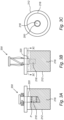
- Figure 3 version may be used without providing a cutter 230 on the sampler 200, as shown in the side and top views Figures 3B and 3C .
- a portion of the fixed bed 218 may be pre-positioned and adapted for removal as the sample portion 216 when received in the interior of the sampler 200.
- the interior of the body of the sampler 200 may include grippers, barbs or other engaging structures to engage and remove the sample portion 216
- sterile conditions may be maintained by using the sleeve 228 shown in Figure 3 .
- Figures 4-5 illustrate one exemplary embodiment of the cover or cap 14 (or 114, 214) for use in connection with the port 22 (or 122, 222).
- the cap 14 may include a labyrinth (e.g., L-shaped, X-shaped, S-shaped, or like serpentine) slot 15 for mating with a corresponding post 22a extending radially from an upstanding portion of the port 22, and thus form a releasable bayonet-style fitting.
- the cap 14 may also include a tab 17 to facilitate manual grasping for removal, and may be reusable/resealable.
- a plurality of these caps 14 may be provided on a single lid 24 to create a variety of sampling options at different locations within the fixed bed, as shown in Figure 6 .
- FIG. 7 an arrangement for a temporary support 240 associated with a port 222 in the bioreactor lid 224 is illustrated.
- the support 240 is arranged to receive the sampler 200, which includes an oversized head 200a for engaging the support 240.
- the sleeve 228 is connected between the bioreactor lid 224 and the sampler 200, such as along the underside surface of the oversized head 216a.
- the pin 234 and groove 236 from Figure 3 can also be seen, which correspond to the sampler 200 in the home or raised configuration.
- the support 240 may be removed to allow for the sampler 200 to advance. This may be achieved by cutting through the sidewall, but in one particular embodiment, a frangible connection is established by a pull 242 embedded in the sidewall that, when manipulated, breaks the corresponding connection between portions of the support 240 along a vertical line. This allows for the support 240 to be removed from the supporting position, and the sampler 200 may then be used as per the indication in Figure 2 , yet reliable support is provided for the sample portion prior to use and the sterile conditions are fully maintained.
- a pull 242 other forms of frangible connections may also be used, such as for example a perforated tear line, zipper, latch and hinge (living or otherwise), or other similar arrangements.
- Figure 8 shows an embodiment of the sample portion 16 of the Figure 1 embodiment, and the positioner 20, which is shown as being an elongated rod-like structure.
- the sample portion 16 may comprise the same or a similar material as the material of the fixed bed 18, such as a nonwoven fabric of one or more fibers.
- the sample portion 16 may be temporarily affixed to the positioner 20 using a fastener, such as a crimped piece of metal 40 (see, e.g. Figure 16 ) to form a secure connection.
- a fastener such as a crimped piece of metal 40 (see, e.g. Figure 16 ) to form a secure connection.
- the sample portion 16 in this or any embodiment may comprise any shape, thickness or dimension. This would permit cell association therewith in relation to the cell density of the entire fixed bed, without limitation.
- the positioner 20 may also be associated with the sleeve 128, which as described above may be connected to the port of the bioreactor (not shown).
- the sample portion 16 may be removably attached to the positioner 20 in a variety of ways, but which may be characterized as forming a clamp for clamping the two structures together.
- a distal end of the positioner 20 may comprise a removable portion 42 that may be fastened in place by fasteners F passing through the parts to sandwich a portion of the sample portion 16 therebetween.
- Figure 11 shows an embodiment in which a clip 44 is clipped over the sample portion (not shown) and an oversized distal end portion 20a of the positioner 20, which may be T-shaped.
- Figure 12 shows that the portion 42 may be secured to the positioner 20 by welding or adhering (e.g., gluing), rather than via removable fasteners.
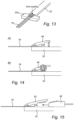
- Figure 13 shows that the sample portion 16 could be molded directly to a distal end of the positioner 20, such as by overmolding.
- a spring clamp 46 may also be used to clip the sample portion 16 to the positioner 20 as shown in Figure 14 , and the arrangement of Figure 15 uses a toothed wedge 48 and a pivotable clamp 50 to hold the sample portion 16 in place.
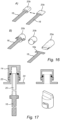
- Figure 16 shows that the positioner 20 may be provided with a clamp in the form of a malleable end 20b (e.g., formed of Aluminum or other soft material) and clamped onto the sample portion 16 (which may have an oversized head 16a to facilitate the connection).
- Figure 17 illustrates the manner in which a cap 14 may be connected to the positioner 20 after the installation of the bioreactor lid 24, with the positioner extending through a port 22 therein to engage with the cap 14, and thus facilitate removal of the sample portion 16.
- Figure 18 shows an arrangement wherein foldable wings 20c at the end of the connector may be folded into position over the sample portion 16 to temporarily hold it in place.
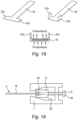
- the sample portion 16 may be held in position on the positioner 20 by positioning it in a bore 52 at the distal end of positioner 20, the bore including a flexible clamp 54, which is forced to a clamped position by an actuator 56, as shown in Figure 19 .
- Figure 20 shows a similar arrangement in which an outer part 58 is used to cause an inner part 60 (either of which may connect to positioner, not shown) to clamp down onto the sample portion 16 and thus retain it in position (and which arrangement can be reversed by flexing the inner part to release the connection).
- Figure 21 illustrates that a fastener 62 associated with the positioner 20 may be used to urge a holder 64 into a clamped position.
- the bioreactor 12 may be assembled by positioning the material of the structured fixed bed 18 in an interior compartment thereof.
- the sample portion 16 may be positioned in the bed, and attached to the positioner 20 before or thereafter.
- the lid 24 may be applied to the bioreactor 12 such that the positioner passes into or through port, and the cap 14 put in place (including by connecting it to the positioner 20, if desired).
- a further embodiment of a sampler 300 for a bioreactor 312 is illustrated.
- the sample portion 316 is positioned in the fixed bed 318, as per the other embodiments, and attached at a proximal end to a positioner 320 in the form of a flexible wire (which may be metal, plastic, or the like).
- a sleeve 328 may be sealed to a port 322 of the bioreactor 312 at one end, which guides the positioner 320 to connect with a sealed cap 340 for sealing with the proximal end of the sleeve 328.
- a coupling 350 may be formed by male and female parts 352, 354 for securing the cap 340 to the sleeve 328, and thus forming a seal that maintains the sterile condition of the bioreactor 312.
- the sample portion 316 may be withdrawn by disconnecting the cap 340, which may or may not be connected to the positioner 320. If connected, the cap 340 may be pulled to withdraw the sample portion 316 from the fixed bed 318, through the internal passage of sleeve 328, and eventually out the proximal end thereof for access by the operator (or one or both the ends of the sleeve 328 may be sealed with the sample portion 316 therein). If not connected, then the cap 340 may be removed, and the positioner 320 manually withdrawn from the sleeve 328 to withdraw the sample portion 316. In the event of the wholesale withdrawal of the sample portion 316, the cap 340 may then be replaced to maintain the sterile condition, or the cap 340 may be placed on the port 322 if the sleeve 328 is removed.
- the overhead space may in some circumstances be limited (such as when the bioreactor 312 is placed in a laminar flow cabinet), and so the sleeve 328 may be flexible and thus able to assume a depending position, as shown. This allows the operator to pull the positioner 320 for recovering the sample portion 316, without the need to access a space above the bioreactor 312.
- the sleeve may include one or more ends, such as flexible ends 328a, 328b, which may be connected to one or more rigid portions, such as intermediate portion 328c or "elbow.”
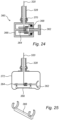
- the actuator 360 may comprise a handle 362 connected to a rotor 364, to which a proximal end of the positioner 320 is connected (such as by winding the wire forming it in this embodiment).
- a stator 366 may receive the rotor 364, and include a seal 368 for permitting relative rotation while maintaining the sterile condition.
- a connector, such as a hose barb 370, may also be provided on the stator 366 for coupling with the sleeve 328.
- Withdrawal of the sample portion 316 from the bed 318 is achieved by using the handle 362 to rotate the rotor 364, which may be manually done or automated.
- the flexible wire serving as positioner 320 is thus wrapped around the rotor 364, and the sample portion 316 withdrawn into the sleeve 328 (which, as noted above, may be sealed off distal of the location of the sample portion 316 therein to preserve sterility).
- this arrangement allows for the sterile condition to be maintained while the sample portion 316 is recovered.
- FIG. 25 An alternate version is shown in Figure 25 .
- the components are essentially the same, as indicated, but the "stator" 366 is connected (such as by welding) to a flexible bag 372, which surrounds the rotor 364 and maintains a sterile condition.
- the stator 366 may take the form of a cradle for rotatably supporting the rotor 364. Recovering the sample portion 316 may be accomplished by using handle 362 to rotate the rotor 364 through the flexible bag 372, which as in the earlier-described embodiment pulls the positioner 320 (by winding the wire on rotor 364).
- FIG. 26 A further embodiment of a sampler 400 for sampling a fixed bed 418 in a bioreactor 412 is shown with reference to Figure 26 .
- the sample portion 416 is connected to a positioner 420 (which could be any positioner shown herein).
- the positioner 420 is releasably connected to a cap 414 associated with a port 422 of the bioreactor 412 (such as by engaging trunnions 422a that form a bayonet-style fitting; see, e.g., Figures 4, 5, and 6 ).
- the releasable connection may be established by a magnetic coupling created by corresponding magnet 414a in the cap 414 and a magnetic material 420a (including possible a ferromagnetic material) on the adjacent surface of the positioner 420.
- the magnetic coupling is formed once the positioner 420 is in place in the bioreactor 412 and the cap 414 already in place, with the magnet 414a then introduced to the cap so as to avoid disrupting the positioner 420.
- the positioner 420 and the port 422 may have matching surfaces.
- the positioner 420 may include an outer projection 420b for aligning with a matching inner receiver 422b within the port 422, at a height corresponding to the formation of the magnetic coupling.
- the projection 420b and receiver 422b may be square in cross-section, and thus create an anti-rotation feature (but of course other shapes could also be used to achieve the same result).
- the cap 414 may be rotated for removal without rotating the positioner 420, which is retained by the engagement between the receiver 422b and projection 420b. Once the cap 414 is released, it may be removed from the port 422 to withdraw the positioner 420 and thus the sample portion 416 from the bioreactor 412.
- the bioreactor 512 includes one or more fixed beds, such as two vertically stacked fixed beds 518a, 518b in the illustrated example, which are arranged in an outer chamber 512a of the bioreactor 512 and may be the spiral beds shown in Figure 1A and otherwise described herein.
- An inner chamber 512b is also provided for circulating fluid to or from the fixed bed(s), which fluid may be caused to flow by an associated agitator, such as an impeller 521 located in a lower compartment 512c of the bioreactor 512.
- the flow may be in a vertical direction within the fixed bed(s), such as from top to bottom or bottom to top.
- the fixed bed(s) could also be provided in the inner chamber 512b, with the outer chamber 512a serving to deliver fluid to and from the fixed bed(s) in the inner chamber.
- sampling any portion of the bed will typically provide a good indication of the cell growth conditions present at any portion therein.
- the positioners 520 may be any of the embodiments described herein (including with sleeves, not shown), and the use before, during, and after bioprocessing may also be as described herein.
- the disclosed sampler provides a unique opportunity to facilitate any of the steps herein by automation.
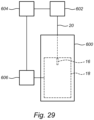
- a system including a bioreactor 600 and an actuator 602, such as a motor or robotic device, to move (raise or lower) the positioner 20 to withdraw the sample portion 16 from the fixed bed 18 for analysis.
- a controller 604 such as a programmable logic controller, computer, or the like, may also be used to control the actuator 602 to activate, which could be done based on any number of parameters, such as time since the commencement of a cell culturing operation.
- the controller 604 may also receive outputs from one or more sensors 606 associated with the bioreactor 600 for sensing one or more parameters, such as pH, cell density, or the like, which are indicative of the state of the cell culturing operation. When one or more of the parameters reaches a pre-determined level, the controller 604 may actuate the associated actuator 602 to cause the positioner to withdraw the sample portion.
- one or more of the parameters reaches a pre-determined level
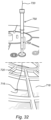
- the lid 724 of the bioreactor 702 includes a port 722, to which a partition or barrier is provided in the form of a container or vial 750.
- the vial 750 includes a septum 752 through which the positioner in the form of a flexible wire 720 may pass for connecting to the sampler portion 716 located in the fixed bed 718 (such as between two cell immobilization layers thereof).
- the septum may 752 form part of a removable cap or cover 754, which may be crimped on ( Figure 30 ) or threaded onto ( Figure 31 ) the vial 750.
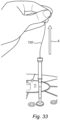
- the positioner or wire 720 may be drawn through a continuous passage formed by the vial 750 and the connection 756, as indicated by action arrow A in Figure 33 . While a manual operation is shown, it could instead be automated, as indicated previously. Also, whether manual or automated, the decision to retrieve the sampler 716 could be based on the output of one or more sensors associated with the bioreactor 700.
- the wire 720 may be advanced until the sampler portion 716 is drawn into the vial 750, as shown in Figure 34 .
- the aseptic connection 756 may be disconnected, which in the case of the Quickseal device involves the use of a cutter C to crimp and sever the connection, thus separating the vial 750, as indicated in Figure 36 (note connection portions 756a, 756b), while still maintaining sterile conditions.
- the remaining portion 756a of the now-separated connection 756 may then be removed ( Figures 37 and 38 ), such as by twisting (arrow T) and the vial 750 sealed using a cap 758, as indicated in Figures 39 and 40 , possibly after insertion of a reagent or the like.
- the vial 750 may then be used to study the growth of cells on the sampler portion 716, and thus give an accurate indication of the condition of the cell culture in the fixed bed 718 of the bioreactor 700.
- the study may involve counting the cells, coloration of the cells to evaluate some parameters (confluence, viability%), or extraction of intra-cell viruses.
- the vial 750 should of course have a volume that is greater than the volume of the sampler portion 716 it receives. It may in some cases be desirable to maintain a specific relationship between the volume of the vial 750 and the size of sampler portion 716 in terms of the surface area on which cells are grown.
- the volume of the vial 750 may range from 0.5-1.0 milliliters, and the sampler portion 716 may have a surface area of about 1 to about 1.3 cm 2 and, more specifically, about 1.23 cm 2 for optimal results based on the number of cells present/unit volume of the vial.
- the sample portion 16 may simply be in contact with the fixed bed 18 in a bioreactor (not shown), and need not be inserted or positioned within it.
- the sample portion 16 may be positioned adjacent to and in contact with a surface of the fixed bed 18, such as a side surface ( Figure 41 ) or an upper surface ( Figure 42 ) thereof, and connected to the positioner 20, which again may be a flexible wire.
- a plurality of sample portions 16 may be provided, and may be on the surface(s) of the fixed bed 18, between layers of it, or both.
- the attachment may be achieved by a connector, such as a frangible one (adhesive).
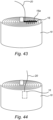
- Figure 43 further illustrates that a retainer 16a may be provided for retaining the sample portion 16 in place adjacent to the fixed bed 18.
- Figure 44 illustrates the above-mentioned situation where the sample portion 16 forms part of the fixed bed 18 and is pre-cut or provided with perforations for ease of detachment.
- the pre-cut sample portion may be located anywhere in the fixed bed and in the illustrated embodiment the pre-cut sample is located close to the top of the bed.
- the bed 18 could be provided with one or more receivers, markers, indentations, notches, openings, voids, receiving portions, indicators, markings, guides or the like to indicate placement of a separate sample portion 16.
- the positioner 20 is actuated (manually or automatically) to withdraw the sample portion from the bioreactor.
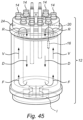
- Figure 45 shows a bioreactor 12 with a fixed bed 18 including a sample portion 16 connected to a positioner 20, which may be accessible via a cap 14 covering a port on the bioreactor lid 24.
- This figure illustrates in particular one exemplary flow patter through the bioreactor, which may be caused by an internal agitator, such as an impeller I.
- the flow arrangement may be such that fluid passes downwardly (arrow D) through an inner chamber, and then in a forward run (arrow F) to pass upwardly (arrow U) through the fixed bed 18 located outboard of the inner chamber. Flow is then returned (arrow R) via an internal column, where it may be exposed to a gas (air).
- a gas air
Landscapes
- Health & Medical Sciences (AREA)
- Life Sciences & Earth Sciences (AREA)
- Engineering & Computer Science (AREA)
- Wood Science & Technology (AREA)
- Organic Chemistry (AREA)
- Bioinformatics & Cheminformatics (AREA)
- Chemical & Material Sciences (AREA)
- Zoology (AREA)
- Biotechnology (AREA)
- Biomedical Technology (AREA)
- Sustainable Development (AREA)
- Microbiology (AREA)
- Biochemistry (AREA)
- General Engineering & Computer Science (AREA)
- General Health & Medical Sciences (AREA)
- Genetics & Genomics (AREA)
- Immunology (AREA)
- Molecular Biology (AREA)
- Clinical Laboratory Science (AREA)
- Apparatus Associated With Microorganisms And Enzymes (AREA)
Claims (15)
- Vorrichtung zur Verwendung mit einem Zellkultursystem, Folgendes umfassend:
ein Festbett, das einen entnehmbaren Probenabschnitt für das Einholen einer Zellprobe von dem Zellkultursystem beinhaltet, dadurch gekennzeichnet, dass das Festbett ein strukturiertes Festbett ist, das mindestens zwei aneinander angrenzende Materialschichten umfasst, wobei sich der entnehmbare Probenabschnitt zumindest teilweise zwischen den mindestens zwei Schichten befindet. - Vorrichtung nach Anspruch 1, wobei die mindestens zwei Schichten Folgendes umfassen: (1) Zellimmobilisierungsschichten und der entnehmbare Probenabschnitt weist eine erste Seite in Kontakt mit einer ersten Zellimmobilisierungsschicht und eine zweite Seite in Kontakt mit einer zweiten Zellimmobilisierungsschicht auf, oder (2) eine Zellimmobilisierungsschicht und eine Abstandshalterschicht.
- Vorrichtung nach einem der vorhergehenden Ansprüche, wobei der entnehmbare Probenabschnitt eine oder mehrere Fasern umfasst.
- Vorrichtung nach einem der vorhergehenden Ansprüche, wobei das strukturierte Festbett und der entnehmbare Probenabschnitt ein Vliesmaterial umfassen.
- Vorrichtung nach einem der vorhergehenden Ansprüche, wobei das strukturierte Festbett eine Zellimmobilisierungsschicht umfasst und wobei der entnehmbare Probenabschnitt eine Materialbahn umfasst, wobei die Bahn in direktem Kontakt mit der Zellimmobilisierungsschicht steht.
- Vorrichtung nach einem der vorhergehenden Ansprüche, ferner eine Positioniereinrichtung umfassend, die durch einen Verbinder mechanisch mit dem entnehmbaren Probenabschnitt verbunden ist.
- Vorrichtung nach einem der vorhergehenden Ansprüche, wobei das strukturierte Festbett mehrere entnehmbare Probenabschnitte umfasst.
- Vorrichtung nach einem der vorhergehenden Ansprüche, wobei das strukturierte Festbett ein Rollen- oder Spiralbett umfasst.
- Vorrichtung nach einem der vorhergehenden Ansprüche, wobei der entnehmbare Probenabschnitt an das strukturierte Festbett angrenzt.
- Bioreaktor, die Vorrichtung nach Anspruch 1 umfassend.
- Bioreaktor nach Anspruch 10, eine äußere Kammer zum Aufnehmen des strukturierten Festbetts mit einem aufwärts gerichteten Fluidstrom und eine innere Kammer zum Rückführen des Fluidstroms zu einem unteren Abschnitt des Bioreaktors, der eine Rührvorrichtung beinhaltet, umfassend.
- Vorrichtung zum Beproben einer Zellkultur, Folgendes umfassend:einen Bioreaktor, der ein Festbett umfasst, das einen entnehmbaren Probenabschnitt beinhaltet, undeinen Probennehmer, der dem Bioreaktor zugeordnet ist, für das Einholen des entnehmbaren Probenabschnitts von dem strukturierten Festbett, dadurch gekennzeichnet, dass das Festbett ein strukturiertes Festbett ist, das mindestens zwei aneinander angrenzende Materialschichten umfasst, wobei sich der entnehmbare Probenabschnitt zumindest teilweise zwischen den mindestens zwei Schichten befindet.
- Vorrichtung nach Anspruch 12, ferner einen Behälter zum Aufrechterhalten eines sterilen Zustandes des entnehmbaren Probenabschnitts, wenn dieser aus dem Bioreaktor entnommen ist, beinhaltend.
- Vorrichtung nach Anspruch 13, wobei der Behälter den Bioreaktor über eine aseptische Verbindung derart verbindet, dass in einem Fach, dass durch den Behälter definiert ist und das den Probennehmer beinhaltet, ein steriler Zustand und außerdem ein steriler Zustand des Bioreaktors aufrechterhalten werden.
- Verfahren zum Beproben einer Zellkultur in einem Bioreaktor, der ein Festbett aufweist, Folgendes umfassend:
Einholen eines entnehmbaren Probenabschnitts von dem strukturierten Festbett des Bioreaktors, dadurch gekennzeichnet, dass das Festbett ein strukturiertes Festbett ist, das mindestens zwei aneinander angrenzende Materialschichten umfasst, wobei sich der entnehmbare Probenabschnitt zumindest teilweise zwischen den mindestens zwei Schichten befindet.
Applications Claiming Priority (4)
| Application Number | Priority Date | Filing Date | Title |
|---|---|---|---|
| US201862644014P | 2018-03-16 | 2018-03-16 | |
| BE2018/5179A BE1026108B1 (fr) | 2018-03-16 | 2018-03-16 | Échantillonneur à lit fixe et procédés associés |
| US201862728405P | 2018-09-07 | 2018-09-07 | |
| PCT/EP2019/056732 WO2019175442A1 (en) | 2018-03-16 | 2019-03-18 | Fixed bed sampler and related methods |
Publications (3)
| Publication Number | Publication Date |
|---|---|
| EP3765591A1 EP3765591A1 (de) | 2021-01-20 |
| EP3765591C0 EP3765591C0 (de) | 2024-09-18 |
| EP3765591B1 true EP3765591B1 (de) | 2024-09-18 |
Family
ID=62567163
Family Applications (1)
| Application Number | Title | Priority Date | Filing Date |
|---|---|---|---|
| EP19711905.0A Active EP3765591B1 (de) | 2018-03-16 | 2019-03-18 | Festbettabtaster und zugehörige verfahren |
Country Status (12)
| Country | Link |
|---|---|
| US (2) | US11946032B2 (de) |
| EP (1) | EP3765591B1 (de) |
| JP (1) | JP7394795B2 (de) |
| KR (1) | KR102728932B1 (de) |
| CN (1) | CN112424332A (de) |
| AU (1) | AU2019233738A1 (de) |
| BE (1) | BE1026108B1 (de) |
| BR (1) | BR112020018574A2 (de) |
| CA (1) | CA3093997A1 (de) |
| MX (1) | MX2020009648A (de) |
| RU (1) | RU2020133632A (de) |
| SG (1) | SG11202008803WA (de) |
Families Citing this family (10)
| Publication number | Priority date | Publication date | Assignee | Title |
|---|---|---|---|---|
| BE1026108B1 (fr) * | 2018-03-16 | 2019-10-14 | Univercells S.A. | Échantillonneur à lit fixe et procédés associés |
| JP2023527447A (ja) * | 2020-05-29 | 2023-06-28 | ユニバーセルズ テクノロジーズ エス.エー. | 生体分子の産生システムおよび方法 |
| CN112080428B (zh) * | 2020-10-13 | 2025-08-29 | 河南大学 | 一种适用于疫苗及抗体生产的卷式固定床生物反应器 |
| US20240368516A1 (en) * | 2021-04-06 | 2024-11-07 | Corning Incorporated | Cell culture sampling substrate for fixed bed reactor |
| JP2024542605A (ja) * | 2021-11-30 | 2024-11-15 | コーニング インコーポレイテッド | 固定床反応器から細胞培養物を試料採取するための方法および装置 |
| WO2023144266A1 (en) | 2022-01-26 | 2023-08-03 | Univercells Technologies Sa | Biomass prediction/estimation system based on parameter sensing for fixed bed bioreactor and related methods |
| CN114410469A (zh) * | 2022-03-15 | 2022-04-29 | 同腾新创(苏州)科技有限公司 | 一种适用于病毒载体生产的可拆卸固定床生物反应器 |
| US20230313097A1 (en) * | 2022-03-31 | 2023-10-05 | Pall Life Sciences Belgium BV | Cell culture arrangement, device and method of use |
| WO2023249816A1 (en) * | 2022-06-22 | 2023-12-28 | Corning Incorporated | Fixed bed cell culture reactor vessel for substrate alignment and sampling |
| WO2024258894A1 (en) * | 2023-06-16 | 2024-12-19 | Cytiva Us Llc | Sampling retractor system and method of use |
Family Cites Families (27)
| Publication number | Priority date | Publication date | Assignee | Title |
|---|---|---|---|---|
| DE3516080A1 (de) * | 1985-05-04 | 1986-11-06 | Proton AG, Zug | Probeentnahmesonde |
| US5266476A (en) * | 1985-06-18 | 1993-11-30 | Yeda Research & Development Co., Ltd. | Fibrous matrix for in vitro cell cultivation |
| US4734373A (en) | 1986-06-24 | 1988-03-29 | Bartal Arie H | Apparatus for enhancing cell growth, preservation and transport |
| JPH0833474A (ja) * | 1994-07-25 | 1996-02-06 | Fuji Photo Film Co Ltd | 付着性動物細胞の培養基体 |
| JP4601746B2 (ja) * | 1999-10-25 | 2010-12-22 | エイブル株式会社 | 三次元動物細胞培養装置及び培養方法 |
| DE10335130A1 (de) | 2003-07-31 | 2005-02-24 | Blue Membranes Gmbh | Immobilisierung von Katalysatoren auf porösen Körpern auf Kohlenstoffbasis |
| CN2650105Y (zh) * | 2003-10-29 | 2004-10-20 | 中国科学院电工研究所 | 生物反应器的在线取样装置 |
| WO2010008396A2 (en) * | 2008-07-18 | 2010-01-21 | Allpure Technologies, Inc. | Detachable transfer conduit |
| US20100099127A1 (en) * | 2008-10-21 | 2010-04-22 | Statsure Diagnostic Systems, Inc. | System and method for acquiring and storing biological samples |
| FR2939348B1 (fr) * | 2008-12-10 | 2014-10-10 | Sartorius Stedim Biotech Sa | Sectionnement d'un tube souple destine a des applications biopharmaceutiques |
| US9399755B2 (en) * | 2010-05-11 | 2016-07-26 | Pall Artelis | Apparatus and methods for cell culture |
| WO2012140519A2 (en) * | 2011-04-15 | 2012-10-18 | Pluristem Ltd. | Methods and systems for harvesting cells |
| CN102994377B (zh) * | 2011-09-15 | 2015-05-13 | 赛宇细胞科技股份有限公司 | 一次性基质取样装置及其方法 |
| US9788820B2 (en) * | 2011-12-15 | 2017-10-17 | Femasys Inc | Methods and devices for cervical cell and tissue sampling |
| US9273278B2 (en) * | 2013-01-07 | 2016-03-01 | Cesco Bioengineering Co., Ltd. | Large scale cell harvesting method for pack-bed culture device |
| CN203403094U (zh) * | 2013-06-27 | 2014-01-22 | 上海日泰医药设备工程有限公司 | 一种生物反应器 |
| GB2520300A (en) * | 2013-11-15 | 2015-05-20 | Univ Loughborough | Cell Culture System |
| US20170362556A1 (en) * | 2014-12-09 | 2017-12-21 | Ge Healthcare Bio-Sciences Corp. | Systems and Methods for Aseptic Sampling |
| WO2017019514A1 (en) * | 2015-07-24 | 2017-02-02 | Bioreactor Sciences Llc | Horizontally rocked bioreactor system |
| CN205473765U (zh) * | 2016-03-14 | 2016-08-17 | 上海康岱生物医药技术股份有限公司 | 一种单向取样器 |
| US11261416B2 (en) * | 2016-04-14 | 2022-03-01 | Trizell Ltd. | Fixed-bed bioreactor with constant-flow pump / tubing system |
| WO2017180341A2 (en) * | 2016-04-14 | 2017-10-19 | Trizell Ltd. | Fixed-bed bioreactor with constant-flow pump/ tubing system |
| BE1024733B1 (fr) * | 2016-11-09 | 2018-06-14 | Univercells Sa | Matrice de croissance cellulaire |
| BR112020012574A2 (pt) * | 2017-12-20 | 2020-11-24 | Univercells Technologies S.A. | biorreator e métodos relacionados |
| BE1026108B1 (fr) * | 2018-03-16 | 2019-10-14 | Univercells S.A. | Échantillonneur à lit fixe et procédés associés |
| EP3867352A1 (de) * | 2018-10-19 | 2021-08-25 | Univercells Technologies S.A. | Verfahren zur dekontamination eines biomolekülherstellungssystems und zur dekontamination geeignetes system |
| US20240368516A1 (en) | 2021-04-06 | 2024-11-07 | Corning Incorporated | Cell culture sampling substrate for fixed bed reactor |
-
2018
- 2018-03-16 BE BE2018/5179A patent/BE1026108B1/fr active IP Right Grant
-
2019
- 2019-03-18 BR BR112020018574-4A patent/BR112020018574A2/pt not_active Application Discontinuation
- 2019-03-18 EP EP19711905.0A patent/EP3765591B1/de active Active
- 2019-03-18 US US16/981,333 patent/US11946032B2/en active Active
- 2019-03-18 RU RU2020133632A patent/RU2020133632A/ru unknown
- 2019-03-18 CN CN201980032745.7A patent/CN112424332A/zh active Pending
- 2019-03-18 SG SG11202008803WA patent/SG11202008803WA/en unknown
- 2019-03-18 KR KR1020207029446A patent/KR102728932B1/ko active Active
- 2019-03-18 JP JP2020572627A patent/JP7394795B2/ja active Active
- 2019-03-18 AU AU2019233738A patent/AU2019233738A1/en not_active Abandoned
- 2019-03-18 CA CA3093997A patent/CA3093997A1/en active Pending
- 2019-03-18 MX MX2020009648A patent/MX2020009648A/es unknown
-
2024
- 2024-03-01 US US18/592,690 patent/US12454670B2/en active Active
Also Published As
| Publication number | Publication date |
|---|---|
| JP7394795B2 (ja) | 2023-12-08 |
| US11946032B2 (en) | 2024-04-02 |
| KR102728932B1 (ko) | 2024-11-11 |
| US20240200010A1 (en) | 2024-06-20 |
| BE1026108A1 (fr) | 2019-10-09 |
| CA3093997A1 (en) | 2019-09-19 |
| US20210009933A1 (en) | 2021-01-14 |
| JP2021518156A (ja) | 2021-08-02 |
| AU2019233738A1 (en) | 2020-10-15 |
| KR20210010850A (ko) | 2021-01-28 |
| BE1026108B1 (fr) | 2019-10-14 |
| RU2020133632A (ru) | 2022-04-18 |
| US12454670B2 (en) | 2025-10-28 |
| BR112020018574A2 (pt) | 2020-12-29 |
| CN112424332A (zh) | 2021-02-26 |
| EP3765591C0 (de) | 2024-09-18 |
| MX2020009648A (es) | 2021-01-08 |
| SG11202008803WA (en) | 2020-10-29 |
| EP3765591A1 (de) | 2021-01-20 |
Similar Documents
| Publication | Publication Date | Title |
|---|---|---|
| EP3765591B1 (de) | Festbettabtaster und zugehörige verfahren | |
| WO2019175442A1 (en) | Fixed bed sampler and related methods | |
| US10314616B2 (en) | IVF egg collection chamber | |
| US20250043327A1 (en) | Cell culturing device | |
| EP2776550B1 (de) | Kassette für sterilitätstests | |
| EP2569413B1 (de) | Biologischer indikator mit integriertem trägerpaket | |
| CA3159072C (en) | Tissue holder assembly and components thereof | |
| AU2008255232A1 (en) | Culture dish and bioreactor system | |
| BR112013012311B1 (pt) | Recipiente para transferência seletiva de amostras de material biológico, kit para transferência seletiva de amostras de material biológico, uso do recipiente e método de transferência seletiva de amostras | |
| US20220033748A1 (en) | Multicompartment bag for cultivation of cells | |
| EP2476903A1 (de) | Peristaltische Pumpe und Filteranordnungssysteme zur Verwendung damit | |
| US20230146372A1 (en) | Sampling apparatus for cell culture bed and related methods | |
| JP4913732B2 (ja) | 分析サンプルを収容する容器に取り付けできる一体型分析装置 | |
| US20020164273A1 (en) | Evacuated tube and method for microscopy examination of urine sediment, chemistry and microbiological assays | |
| JP4212108B1 (ja) | 採血管用使い捨て開栓ブロックとそれを使用した開栓装置 | |
| CN213404659U (zh) | 适合细胞回输用的干细胞冻存袋 | |
| WO2024258894A1 (en) | Sampling retractor system and method of use | |
| WO2025054400A2 (en) | Sterility testing drain actuator base | |
| CN119789810A (zh) | 样品采集系统 | |
| KR101509221B1 (ko) | 생육 샘플 채취기 및 그 제조 방법 | |
| KR20160064926A (ko) | 생육 샘플 채취기 및 그 제조 방법 | |
| AU3130201A (en) | Assembly for collecting blood or other body fluids |
Legal Events
| Date | Code | Title | Description |
|---|---|---|---|
| STAA | Information on the status of an ep patent application or granted ep patent |
Free format text: STATUS: UNKNOWN |
|
| STAA | Information on the status of an ep patent application or granted ep patent |
Free format text: STATUS: THE INTERNATIONAL PUBLICATION HAS BEEN MADE |
|
| PUAI | Public reference made under article 153(3) epc to a published international application that has entered the european phase |
Free format text: ORIGINAL CODE: 0009012 |
|
| STAA | Information on the status of an ep patent application or granted ep patent |
Free format text: STATUS: REQUEST FOR EXAMINATION WAS MADE |
|
| 17P | Request for examination filed |
Effective date: 20201007 |
|
| AK | Designated contracting states |
Kind code of ref document: A1 Designated state(s): AL AT BE BG CH CY CZ DE DK EE ES FI FR GB GR HR HU IE IS IT LI LT LU LV MC MK MT NL NO PL PT RO RS SE SI SK SM TR |
|
| AX | Request for extension of the european patent |
Extension state: BA ME |
|
| DAV | Request for validation of the european patent (deleted) | ||
| DAX | Request for extension of the european patent (deleted) | ||
| STAA | Information on the status of an ep patent application or granted ep patent |
Free format text: STATUS: EXAMINATION IS IN PROGRESS |
|
| 17Q | First examination report despatched |
Effective date: 20230620 |
|
| GRAP | Despatch of communication of intention to grant a patent |
Free format text: ORIGINAL CODE: EPIDOSNIGR1 |
|
| STAA | Information on the status of an ep patent application or granted ep patent |
Free format text: STATUS: GRANT OF PATENT IS INTENDED |
|
| INTG | Intention to grant announced |
Effective date: 20240430 |
|
| GRAS | Grant fee paid |
Free format text: ORIGINAL CODE: EPIDOSNIGR3 |
|
| GRAA | (expected) grant |
Free format text: ORIGINAL CODE: 0009210 |
|
| STAA | Information on the status of an ep patent application or granted ep patent |
Free format text: STATUS: THE PATENT HAS BEEN GRANTED |
|
| AK | Designated contracting states |
Kind code of ref document: B1 Designated state(s): AL AT BE BG CH CY CZ DE DK EE ES FI FR GB GR HR HU IE IS IT LI LT LU LV MC MK MT NL NO PL PT RO RS SE SI SK SM TR |
|
| REG | Reference to a national code |
Ref country code: GB Ref legal event code: FG4D |
|
| REG | Reference to a national code |
Ref country code: CH Ref legal event code: EP |
|
| REG | Reference to a national code |
Ref country code: DE Ref legal event code: R096 Ref document number: 602019059046 Country of ref document: DE |
|
| REG | Reference to a national code |
Ref country code: IE Ref legal event code: FG4D |
|
| U01 | Request for unitary effect filed |
Effective date: 20241002 |
|
| U07 | Unitary effect registered |
Designated state(s): AT BE BG DE DK EE FI FR IT LT LU LV MT NL PT RO SE SI Effective date: 20241024 |
|
| PG25 | Lapsed in a contracting state [announced via postgrant information from national office to epo] |
Ref country code: NO Free format text: LAPSE BECAUSE OF FAILURE TO SUBMIT A TRANSLATION OF THE DESCRIPTION OR TO PAY THE FEE WITHIN THE PRESCRIBED TIME-LIMIT Effective date: 20241218 |
|
| PG25 | Lapsed in a contracting state [announced via postgrant information from national office to epo] |
Ref country code: GR Free format text: LAPSE BECAUSE OF FAILURE TO SUBMIT A TRANSLATION OF THE DESCRIPTION OR TO PAY THE FEE WITHIN THE PRESCRIBED TIME-LIMIT Effective date: 20241219 |
|
| PG25 | Lapsed in a contracting state [announced via postgrant information from national office to epo] |
Ref country code: HR Free format text: LAPSE BECAUSE OF FAILURE TO SUBMIT A TRANSLATION OF THE DESCRIPTION OR TO PAY THE FEE WITHIN THE PRESCRIBED TIME-LIMIT Effective date: 20240918 |
|
| PG25 | Lapsed in a contracting state [announced via postgrant information from national office to epo] |
Ref country code: RS Free format text: LAPSE BECAUSE OF FAILURE TO SUBMIT A TRANSLATION OF THE DESCRIPTION OR TO PAY THE FEE WITHIN THE PRESCRIBED TIME-LIMIT Effective date: 20241218 |
|
| PG25 | Lapsed in a contracting state [announced via postgrant information from national office to epo] |
Ref country code: RS Free format text: LAPSE BECAUSE OF FAILURE TO SUBMIT A TRANSLATION OF THE DESCRIPTION OR TO PAY THE FEE WITHIN THE PRESCRIBED TIME-LIMIT Effective date: 20241218 Ref country code: NO Free format text: LAPSE BECAUSE OF FAILURE TO SUBMIT A TRANSLATION OF THE DESCRIPTION OR TO PAY THE FEE WITHIN THE PRESCRIBED TIME-LIMIT Effective date: 20241218 Ref country code: HR Free format text: LAPSE BECAUSE OF FAILURE TO SUBMIT A TRANSLATION OF THE DESCRIPTION OR TO PAY THE FEE WITHIN THE PRESCRIBED TIME-LIMIT Effective date: 20240918 Ref country code: GR Free format text: LAPSE BECAUSE OF FAILURE TO SUBMIT A TRANSLATION OF THE DESCRIPTION OR TO PAY THE FEE WITHIN THE PRESCRIBED TIME-LIMIT Effective date: 20241219 |
|
| U20 | Renewal fee for the european patent with unitary effect paid |
Year of fee payment: 7 Effective date: 20250210 |
|
| PG25 | Lapsed in a contracting state [announced via postgrant information from national office to epo] |
Ref country code: IS Free format text: LAPSE BECAUSE OF FAILURE TO SUBMIT A TRANSLATION OF THE DESCRIPTION OR TO PAY THE FEE WITHIN THE PRESCRIBED TIME-LIMIT Effective date: 20250118 |
|
| PG25 | Lapsed in a contracting state [announced via postgrant information from national office to epo] |
Ref country code: SM Free format text: LAPSE BECAUSE OF FAILURE TO SUBMIT A TRANSLATION OF THE DESCRIPTION OR TO PAY THE FEE WITHIN THE PRESCRIBED TIME-LIMIT Effective date: 20240918 |
|
| PG25 | Lapsed in a contracting state [announced via postgrant information from national office to epo] |
Ref country code: ES Free format text: LAPSE BECAUSE OF FAILURE TO SUBMIT A TRANSLATION OF THE DESCRIPTION OR TO PAY THE FEE WITHIN THE PRESCRIBED TIME-LIMIT Effective date: 20240918 |
|
| PG25 | Lapsed in a contracting state [announced via postgrant information from national office to epo] |
Ref country code: PL Free format text: LAPSE BECAUSE OF FAILURE TO SUBMIT A TRANSLATION OF THE DESCRIPTION OR TO PAY THE FEE WITHIN THE PRESCRIBED TIME-LIMIT Effective date: 20240918 Ref country code: CZ Free format text: LAPSE BECAUSE OF FAILURE TO SUBMIT A TRANSLATION OF THE DESCRIPTION OR TO PAY THE FEE WITHIN THE PRESCRIBED TIME-LIMIT Effective date: 20240918 |
|
| PG25 | Lapsed in a contracting state [announced via postgrant information from national office to epo] |
Ref country code: SK Free format text: LAPSE BECAUSE OF FAILURE TO SUBMIT A TRANSLATION OF THE DESCRIPTION OR TO PAY THE FEE WITHIN THE PRESCRIBED TIME-LIMIT Effective date: 20240918 |
|
| PGFP | Annual fee paid to national office [announced via postgrant information from national office to epo] |
Ref country code: GB Payment date: 20250221 Year of fee payment: 7 |
|
| PLBE | No opposition filed within time limit |
Free format text: ORIGINAL CODE: 0009261 |
|
| STAA | Information on the status of an ep patent application or granted ep patent |
Free format text: STATUS: NO OPPOSITION FILED WITHIN TIME LIMIT |
|
| 26N | No opposition filed |
Effective date: 20250619 |
|
| PG25 | Lapsed in a contracting state [announced via postgrant information from national office to epo] |
Ref country code: MC Free format text: LAPSE BECAUSE OF FAILURE TO SUBMIT A TRANSLATION OF THE DESCRIPTION OR TO PAY THE FEE WITHIN THE PRESCRIBED TIME-LIMIT Effective date: 20240918 |
|
| REG | Reference to a national code |
Ref country code: CH Ref legal event code: H13 Free format text: ST27 STATUS EVENT CODE: U-0-0-H10-H13 (AS PROVIDED BY THE NATIONAL OFFICE) Effective date: 20251024 |
|
| PG25 | Lapsed in a contracting state [announced via postgrant information from national office to epo] |
Ref country code: CH Free format text: LAPSE BECAUSE OF NON-PAYMENT OF DUE FEES Effective date: 20250331 |
|
| PG25 | Lapsed in a contracting state [announced via postgrant information from national office to epo] |
Ref country code: IE Free format text: LAPSE BECAUSE OF NON-PAYMENT OF DUE FEES Effective date: 20250318 |