EP3763234B1 - Ableitfähiger handschuh und verfahren zur herstellung eines ableitfähigen handschuhs - Google Patents
Ableitfähiger handschuh und verfahren zur herstellung eines ableitfähigen handschuhs Download PDFInfo
- Publication number
- EP3763234B1 EP3763234B1 EP20163632.1A EP20163632A EP3763234B1 EP 3763234 B1 EP3763234 B1 EP 3763234B1 EP 20163632 A EP20163632 A EP 20163632A EP 3763234 B1 EP3763234 B1 EP 3763234B1
- Authority
- EP
- European Patent Office
- Prior art keywords
- glove
- outer layer
- electrically conductive
- particles
- oxide
- Prior art date
- Legal status (The legal status is an assumption and is not a legal conclusion. Google has not performed a legal analysis and makes no representation as to the accuracy of the status listed.)
- Active
Links
Images
Classifications
-
- A—HUMAN NECESSITIES
- A41—WEARING APPAREL
- A41D—OUTERWEAR; PROTECTIVE GARMENTS; ACCESSORIES
- A41D19/00—Gloves
- A41D19/0055—Plastic or rubber gloves
- A41D19/0058—Three-dimensional gloves
- A41D19/0065—Three-dimensional gloves with a textile layer underneath
-
- A—HUMAN NECESSITIES
- A41—WEARING APPAREL
- A41D—OUTERWEAR; PROTECTIVE GARMENTS; ACCESSORIES
- A41D19/00—Gloves
- A41D19/015—Protective gloves
-
- A—HUMAN NECESSITIES
- A41—WEARING APPAREL
- A41D—OUTERWEAR; PROTECTIVE GARMENTS; ACCESSORIES
- A41D31/00—Materials specially adapted for outerwear
- A41D31/04—Materials specially adapted for outerwear characterised by special function or use
- A41D31/26—Electrically protective, e.g. preventing static electricity or electric shock
-
- A—HUMAN NECESSITIES
- A41—WEARING APPAREL
- A41D—OUTERWEAR; PROTECTIVE GARMENTS; ACCESSORIES
- A41D2600/00—Uses of garments specially adapted for specific purposes
- A41D2600/20—Uses of garments specially adapted for specific purposes for working activities
Definitions
- the invention relates to a glove having a polymeric outer layer in at least one region, particularly in an inner hand region of the glove. Furthermore, the invention relates to a method for producing such a glove.
- Electrostatic Discharge Sensitive For the production of sensitive electronic (ESDS, Electrostatic Discharge Sensitive ) components, for example, for electromobility solutions, there is a particular need for conductive clothing. In particular , there is a need for clothing that prevents and/or reduces electrostatic charges (ESD clothing, Electrostatic Discharge clothing).
- dissipative clothing in particular ESD clothing
- a dissipative item of clothing, in particular a glove can be classified based on its volume resistance and/or its surface resistance, for example, measured in accordance with the EN 1149 or EN 61340 series of standards or one of the EN 16350 or EN 20345 standards and/or Chapters 2 and 7 of the Technical Rules for Hazardous Substances 727.
- a glove with a volume resistance between 10 0 ⁇ and 10 11 ⁇ can be classified as dissipative.
- a glove with a volume resistance between 10 5 ⁇ and 3.5 ⁇ 10 7 ⁇ can be classified as ESD-capable.
- W+R INDUSTRY GmbH markets an ESD protective glove with a seamless knitted liner called "ECOMASTER VELOX ESD.”
- the knitted liner incorporates a yarn with carbon fibers, making it conductive, particularly ESD-capable.
- the glove's palm is coated with a non-textile, polymeric outer layer.
- This outer layer is, among other things, oil-resistant and liquid-repellent, allowing the glove to meet the corresponding chemical requirements and, for example, be used for handling dry and moist, particularly oily, parts.
- the conductive knitted liner the glove is also, in principle, suitable for handling sensitive electronic components.
- the outer layer also determines the resulting electrical resistance of the glove, so the effective electrical conductivity of the glove has not yet been precisely defined.
- GB2307845A describes the preamble of claim 1.
- the object of the present invention is therefore to provide a generic glove with improved, in particular precisely adjustable, conductivity. Furthermore, the object is to provide a manufacturing method that enables particularly simple and cost-effective production of such a glove.
- the invention is described in the appended set of claims.
- a glove which has a non-textile, polymeric outer layer at least in one region, in particular in an inner hand region of the glove, wherein the outer layer has electrically conductive particles, in particular electrically conductive nanoparticles.
- the outer layer can also be electrically conductive.
- Such a glove can be touchscreen-capable.
- the glove can be configured to enable inputs on touch-sensitive screens, such as capacitive screens.
- the outer layer can extend to one or more fingertip areas of the glove.
- a nanoparticle can be understood as a particle with a maximum diameter of up to 100 nm.
- the electrically conductive particles can be loosely distributed in the outer layer. In particular, they can be homogeneously distributed in the outer layer.
- a material, in particular a particle can be considered conductive if its specific conductivity is at least 10 -11 S/m, preferably at least 10 -8 S/m.
- the glove can be designed as a ready-made and/or knitted glove.
- the glove has a textile base layer, in particular a knitted liner.
- the outer layer can then be formed as a coating on the base layer.
- the base layer, in particular the knitted liner, can be seamless.
- the base layer is electrically conductive.
- the base layer In order to make the base layer sufficiently conductive, it has a base carrier material and an electrically conductive yarn.
- the electrically conductive yarn can be knitted, twisted, and/or spun, in particular with the base carrier material.
- one or more electrically conductive yarns can be present.
- the base layer can further comprise several different base carrier materials.
- the glove can be tailored to particular mechanical, chemical, and/or physical requirements, for example, abrasion resistance, chemical resistance, or thermal conductivity.
- the base carrier material can be selected according to such requirements.
- the base carrier material can comprise a polymer, for example, polyamide, in particular aramid, para-aramid, and/or meta-aramid, polyester, polyvinyl chloride, polyurethane, and/or polyethylene, particularly preferably a high-performance polyethylene, wool, cotton, carbon fibers, glass fibers, and/or leather.
- the base carrier material can also be formed as synthetic leather and/or comprise such.
- the synthetic leather can be formed from polyurethane and/or Contains polyurethane.
- the electrically conductive yarn is made of an electrically conductive material, in particular copper, steel, carbon, in particular in the form of carbon fibers, silver and/or gold, and/or is coated with the electrically conductive material.
- the outer layer can be produced by dipping, printing, spraying, and/or as a trim.
- the outer layer can first be produced separately and then joined to the base layer, for example, by sewing it on.
- the outer layer can, in particular, have a homogeneous distribution of particles.
- the outer layer of such a glove can preferably comprise polyurethane, acrylonitrile butadiene rubber, latex and/or polyvinyl chloride.
- the particles act as conductivity mediators for the outer layer.
- they can be made of a material with a high specific electrical conductivity and/or contain such a material. Therefore, it has proven particularly effective for the particles to contain carbon, especially graphite and/or graphene, tungsten, stainless steel, indium tin oxide, fluorine-doped tin(IV) oxide, aluminum-doped zinc oxide, and/or antimony-doped tin(IV) oxide.
- the outer layer can contain particles in a proportion of up to 50 percent by volume, preferably up to 30 percent by volume.
- a proportion in the range of 0.5 to 3 percent by volume is particularly conceivable.
- Particles, especially nanoparticles, of indium tin oxide in a proportion of 0.5 to 1 percent have proven particularly useful. Volume percent.
- particles, in particular nanoparticles contain nanotubes, in particular carbon nanotubes, or that they are formed as such.
- the nanotubes, in particular the carbon nanotubes can be dispersed. They can be present in a proportion of 2 to 3 volume percent.
- Surface properties of the glove can be adjusted depending on the glove's intended use if the glove, in particular the outer layer, is surface-treated, in particular shot-blasted and/or sand-blasted. For example, the glove can be shot-blasted with copper shots.
- the outer layer can have a specific electrical conductivity of at least 10 -11 S/m, preferably of at least 10 -8 S/m. This can be achieved by selecting the material of the particles, their size and/or their distribution accordingly.
- the glove can be conductive, in particular ESD-capable. Such a conductive, in particular ESD-capable, glove can be particularly suitable for use when working in explosion-protection areas, in particular in zones 1, 2, 21 and/or 22. In order to ensure the volume resistance of the glove required for the respective category, the conductivity of at least one layer of the glove can be suitably adjusted. In particular, the conductivity of the outer layer can be adjusted by selecting the proportion of particles in the outer layer.
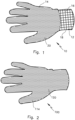
- Fig. 1 shows a glove 10.
- the glove 10 has a, in particular textile, knitted liner 12 , to which a non-textile, polymeric outer layer 14 is applied, in particular in the region of the palm of the glove 10.
- the glove 10 is thus multi-layered.
- the knit liner 12 is seamless.
- the knitted liner 12 is also conductive. It is knitted from a non-conductive yarn, such as a polyamide yarn, as the base carrier material 18 and a conductive yarn 16.
- the conductive yarn 16 can be spun from carbon fibers, for example.
- the outer layer 14 is made of polyurethane. It is homogeneously interspersed with conductive particles 20, one of which, for example, is provided with the reference numeral 20.
- the particles 20 are formed from indium tin oxide, in particular, the particles 20 are nanoparticles of indium tin oxide.
- the outer layer 14 is also electrically conductive.
- the outer layer 14 is applied to the knitted liner 12 by dipping.
- Fig. 2 shows a glove 100 designed as a disposable glove, which does not fall under the subject matter of the protection sought.
- the glove 100 has, in particular as the only layer, a non-textile, polymeric outer layer 114.
- a non-textile, polymeric outer layer 114 In contrast to the glove 10 ( Fig. 1 ) it has no textile base layer, in particular no knitted liner (12 of the Fig. 1 ). It is also formed by immersion bathing. For this purpose, a hand-shaped immersion mold was placed in an immersion bath.
- outer layer 114 is made of acrylonitrile butadiene rubber. Electrically conductive particles 120 are incorporated into this layer, one of which, as an example, is provided with the reference numeral 120. The particles 120 are homogeneously distributed in the outer layer 114.
- the conductive particles 120 are formed from indium tin oxide.
- the particles 120 are also formed as nanoparticles.
- the two gloves 10 ( Fig. 1 ) and 100 ( Fig. 2 ) have a volume resistance, measured according to EN 61340-5-1, between 10 5 ⁇ and 3.5 ⁇ 10 7 ⁇ . Both gloves 10 and 100 are therefore ESD-capable.
- the outer layers 14 and 114 have a proportion of approximately 1 volume percent of indium tin oxide in the form of particles 20 and 120, respectively.
- the outer layers 14 and 114 have approximately 2 to 3 volume percent of particles 20 and 120, respectively, formed as dispersed carbon nanotubes.
- the two outer layers 14, 114 cover the respective fingertips of the gloves 10 and 100.
- Both gloves 10, 100 are particularly touchscreen capable.
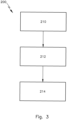
- Fig. 3 shows a flow chart of a method 200 for producing a glove, for example a glove corresponding to the gloves 10 ( Fig. 1 ) or 100 ( Fig. 2 ).
- a liquid phase of polyurethane (for glove 10) or of acrylonitrile butadiene rubber (for glove 100) as the respective starting mass is permeated with 0.5 volume percent of particles 20 or 120, respectively.
- the starting mass permeated with particles 20 or 120 is stirred until a homogeneous distribution of particles 20 or 120 is obtained.
- a glove 10 is coated or a glove 100 designed as a disposable glove is produced.
- a prefabricated knitted liner 12 provided with a suitable coagulant is dipped into the starting material permeated with the particles 20, so that the knitted liner 12 is coated with the outer layer 14 in the dipped area of the glove 10.
- the knitted liner 12 is dipped three-quarters.
- a dipping mold coated with a suitable coagulant is dipped into the starting material permeated with particles 120, so that the outer layer 114, and thus the disposable glove, forms on the dipping mold.
- a porcelain mold can be used as the dipping mold.
- these dipping processes can be repeated, in particular after the outer layer 14 or 114 has hardened.
- the glove 10 and 100 can be post-treated in an optional step 214.
- the surface of the glove 10 and 100 can be post-treated by shot peening until a desired surface roughness is achieved.
Landscapes
- Engineering & Computer Science (AREA)
- Textile Engineering (AREA)
- Gloves (AREA)
Description
- Die Erfindung betrifft einen Handschuh, der zumindest in einem Bereich, insbesondere in einem Innenhandbereich des Handschuhs, eine polymere Außenschicht aufweist. Des Weiteren betrifft die Erfindung ein Verfahren zur Herstellung eines solchen Handschuhs.
- Für die Herstellung empfindlicher elektronischer (ESDS, ElectroStatic Discharge Sensitive-) Bauelemente, beispielsweise für Elektromobilitäts-Lösungen, besteht ein besonderer Bedarf an ableitfähiger Kleidung. Insbesondere besteht ein Bedarf an Kleidung zur Vermeidung und/oder Reduktion elektrostatischer Aufladungen (ESD-Kleidung, ElectroStatic Discharge-Kleidung).
- Zum Schutz solcher Bauelemente sollte eine ableitfähige Kleidung, insbesondere eine ESD-Kleidung, eine durchgängige Ableitung einer etwaigen elektrostatischen Aufladung durch alle Kleidungsstücke der Arbeitsperson hindurch ermöglichen. Daher werden unter anderem ableitfähige, insbesondere ESD-fähige, Handschuhe benötigt. Die Klassifizierung eines ableitfähigen Kleidungsstücks, insbesondere eines Handschuhs, kann anhand seines Durchgangswiderstands und/oder anhand seines Oberflächenwiderstands, beispielsweise gemessen gemäß der Normenreihen EN 1149 oder EN 61340 oder gemäß einer der Normen EN 16350 oder EN 20345 und/oder gemäß den technischen Regeln für Gefahrstoffe 727 Kapitel 2 und 7, erfolgen. Insbesondere kann ein Handschuh mit einem Durchgangswiderstand zwischen 100 Ω und 1011 Ω als ableitfähig klassifiziert werden. Als ESD-fähig kann ein Handschuh klassifiziert werden, dessen Durchgangswiderstand zwischen 105 Ω und 3,5 × 10⁷ Ω liegt.
- Die Fa. W+R INDUSTRY GmbH, Metzingen, vertreibt unter der Bezeichnung "ECOMASTER VELOX ESD" einen ESD-Schutzhandschuh, der einen nahtlosen Strickliner aufweist. Im Strickliner ist ein Garn mit Carbonfasern eingearbeitet, durch die der Strickliner ableitfähig, insbesondere ESD-fähig, ist. Der Handschuh ist in seinem Innenhandbereich mit einer nichttextilen, polymeren Außenschicht beschichtet. Diese Außenschicht ist unter anderem ölbeständig und flüssigkeitsabweisend, sodass der Handschuh entsprechenden chemischen Anforderungen genügen und beispielsweise zur Handhabung trockener als auch feuchter, insbesondere beölter, Teile verwendet werden kann. Durch den ableitfähigen Strickliner ist der Handschuh prinzipiell auch zur Handhabung empfindlicher elektronischer Bauelemente geeignet. Jedoch bestimmt die Außenschicht den resultierenden Durchgangswiderstand des Handschuhs mit, sodass die effektive elektrische Leitfähigkeit des Handschuhs bislang nicht präzise definiert ist.
GB2307845A - Aufgabe der vorliegenden Erfindung ist es daher, einen gattungsgemäßen Handschuh mit verbesserter, insbesondere präzise einstellbarer, Ableitfähigkeit anzubieten. Ferner besteht die Aufgabe, ein Herstellverfahren anzubieten, das eine besonders einfache und kostengünstige Herstellung eines solchen Handschuhs ermöglicht. Die Erfindung ist im beigefügten Anspruchssatz beschrieben.
- Die Aufgabe wird gelöst durch einen Handschuh, der zumindest in einem Bereich, insbesondere in einem Innenhandbereich des Handschuhs, eine nichttextile, polymere Außenschicht aufweist, wobei die Außenschicht elektrisch leitfähige Partikel, insbesondere elektrisch leitfähige Nanopartikel, aufweist.
- Somit kann auch die Außenschicht elektrisch leitfähig sein.
- Elektrostatische Aufladungen, die sich beispielsweise bei der Handhabung eines empfindlichen elektronischen Bauelements bilden, können über die Außenschicht des Handschuhs abgeleitet werden. Dadurch kann das empfindliche elektronische Bauelement gegen elektrostatische Gefahren geschützt werden. Je nach in die Außenschicht eingebrachter Menge und Verteilung der leitfähigen Partikel lässt sich ferner die Ableitfähigkeit der Außenschicht und damit die des Handschuhs präzise einstellen.
- Ein solcher Handschuh kann Touchscreen-fähig sein. Insbesondere kann der Handschuh eingerichtet sein, Eingaben auf berührungsempfindlichen Bildschirmen, beispielsweise auf kapazitiv wirkenden Bildschirmen, zu ermöglichen. Dazu kann sich die Außenschicht auf ein oder mehrere Fingerkuppenbereiche des Handschuhs erstrecken.
- Unter einem Partikel kann ein dreidimensionales Kleinstteilchen verstanden werden, das insbesondere nicht in eine makroskopische Struktur, beispielsweise als Teil eines Fadens, Garns oder einer makroskopischen Faser, eingebunden sein kann.
- Unter einem Nanopartikel kann ein Partikel mit einem größten Durchmesser von bis zu 100 nm verstanden werden. Die elektrisch leitfähigen Partikel können in der Außenschicht lose verteilt sein. Sie können insbesondere homogen in der Außenschicht verteilt sein. Als leitfähig kann ein Material, insbesondere ein Partikel, angesehen werden, wenn seine spezifische Leitfähigkeit mindestens 10-11 S/m, bevorzugt mindestens 10-8 S/m beträgt.
- Der Handschuh ist mehrschichtig ausgebildet.
- Der Handschuh kann als konfektionierter und/oder gestrickter Handschuh ausgebildet sein. Dazu weist der Handschuh eine textile Basisschicht, insbesondere einen Strickliner, auf. Dann kann die Außenschicht als Beschichtung auf der Basisschicht ausgebildet sein. Die Basisschicht, insbesondere der Strickliner, kann nahtlos ausgebildet sein.
- Die Basisschicht ist elektrisch leitfähig.
- Um die Basisschicht hinreichend leitfähig auszubilden, weist sie ein Basis-Trägermaterial und ein elektrisch leitfähiges Garn auf.
- Vorzugsweise kann das elektrisch leitfähige Garn, insbesondere mit dem Basis-Trägermaterial, verstrickt, verzwirnt und/oder versponnen sein. Insbesondere können ein oder mehrere elektrisch leitfähige Garne vorhanden sein. Die Basisschicht kann ferner mehrere, unterschiedliche Basis-Trägermaterialien aufweisen. Somit lässt sich der Handschuh auf besondere mechanische, chemische und/oder physikalische Anforderungen, beispielsweise Abriebfestigkeit, chemische Beständigkeit oder thermische Leitfähigkeit, hin abstimmen. Insbesondere kann das Basis-Trägermaterial solchen Anforderungen entsprechend gewählt sein. Das Basis-Trägermaterial kann ein Polymer, beispielsweise Polyamid, insbesondere Aramid, Para-Aramid und/oder Meta-Aramid, Polyester, Polyvinylchlorid, Polyurethan und/oder Polyethylen, besonders bevorzugt ein Hochleistungspolyethylen, Wolle, Baumwolle, Kohlenstofffasern, Glasfasern und/oder Leder aufweisen. Das Basis-Trägermaterial kann auch als Kunstleder ausgebildet sein und/oder ein solches aufweisen. Das Kunstleder kann dazu aus Polyurethan ausgebildet sein und/oder Polyurethan enthalten.
- Das elektrisch leitfähige Garn ist aus einem elektrisch leitfähigen Material, insbesondere Kupfer, Stahl, Kohlenstoff, insbesondere in Form von Kohlenstofffasern, Silber und/oder Gold, ausgebildet und/oder mit dem elektrisch leitfähigen Material beschichtet sein.
- Bei einem solchen konfektionierten und/oder gestrickten Handschuh kann die Außenschicht durch Tauchbaden, Bedrucken, Sprühen und/oder als Besatz hergestellt sein. Um die Außenschicht als Besatz herzustellen, kann sie zunächst separat hergestellt werden und anschließend mit der Basisschicht verbunden, beispielsweise aufgenäht, werden. Die Außenschicht kann insbesondere eine homogene Verteilung der Partikel aufweisen.
- Die Außenschicht kann bei einem solchen Handschuh bevorzugt Polyurethan, Acrylnitril-Butadien-Kautschuk, Latex und/oder Polyvinylchlorid aufweisen.
- Die Partikel fungieren als Leitfähigkeitsvermittler für die Außenschicht. Dazu können sie aus einem Stoff mit einer hohen spezifischen elektrischen Leitfähigkeit gebildet sein und/oder einen solchen Stoff aufweisen. Besonders bewährt hat es sich daher, wenn die Partikel Kohlenstoff, insbesondere Graphit und/oder Graphen, Wolfram, Edelstahl, Indiumzinnoxid, Fluor-dotiertes Zinn(IV)-Oxid, Aluminium-dotiertes Zinkoxid und/oder Antimon-dotiertes Zinn(IV)-Oxid, aufweisen.
- Die Außenschicht kann die Partikel zu höchstens 50 Volumenprozent, bevorzugt höchstens 30 Volumenprozent, aufweisen. Denkbar ist insbesondere ein Anteil im Bereich von 0,5 bis 3 Volumenprozent. Besonders bewährt haben sich beispielsweise Partikel, insbesondere Nanopartikel, aus Indiumzinnoxid in einem Anteil von 0,5 bis 1 Volumenprozent. Denkbar ist auch, dass Partikel, insbesondere Nanopartikel, Nanoröhren, insbesondere Kohlenstoffnanoröhren, aufweisen oder dass sie als solche ausgebildet sind. Die Nanoröhren, insbesondere die Kohlenstoffnanoröhren, können dispergiert sein. Sie können in einem Anteil von 2 bis 3 Volumenprozent vorliegen. Oberflächeneigenschaften des Handschuhs können je nach Einsatzgebiet des Handschuhs eingerichtet sein, wenn der Handschuh, insbesondere die Außenschicht, Oberflächen-nachbehandelt, insbesondere kugel- und/oder sandgestrahlt, ist. Beispielsweise kann der Handschuh mit Kupferkugeln kugelbestrahlt sein.
- Die Außenschicht kann eine spezifische elektrische Leitfähigkeit von mindestens 10-11 S/m, bevorzugt von mindestens 10-8 S/m, aufweisen. Dies lässt sich erreichen, indem das Material der Partikel, ihre Größe und/oder ihre Verteilung entsprechend gewählt sind bzw. werden. Der Handschuh kann ableitfähig, insbesondere ESD-fähig, sein. Ein solcher ableitfähiger, insbesondere ESD-fähiger, Handschuh kann für den Einsatz bei Arbeiten in Explosionsschutz-Bereichen, insbesondere in den Zonen 1, 2, 21 und/oder 22, besonders geeignet sein. Um den für die jeweilige Kategorie erforderlichen Durchgangswiderstand des Handschuhs sicherzustellen, kann die Leitfähigkeit wenigstens einer Schicht des Handschuhs geeignet eingestellt sein. Insbesondere kann die Leitfähigkeit der Außenschicht durch Wahl des Anteils an Partikeln in der Außenschicht eingestellt sein.
- Weitere Merkmale und Vorteile der Erfindung ergeben sich aus der nachfolgenden detaillierten Beschreibung eines Ausführungsbeispiels der Erfindung anhand der Figuren der Zeichnung, die erfindungswesentliche Einzelheiten zeigen, sowie aus den Ansprüchen.
- Die einzelnen Merkmale können je einzeln für sich oder zu mehreren in beliebigen Kombinationen bei Varianten der Erfindung verwirklicht sein. In der schematischen Zeichnung sind Ausführungsbeispiele der Erfindung dargestellt, welche in der nachfolgenden Beschreibung näher erläutert werden.
- Es zeigen:
-
Fig. 1 einen Handschuh mit einem Strickliner; -
Fig. 2 einen Einmalhandschuh ,der nicht unter den Gegenstand des Schutzbegehrens fällt und -
Fig. 3 ein Ablaufdiagramm eines Verfahrens zur Herstellung eines Handschuhs. -
Fig. 1 zeigt einen Handschuh 10. Der Handschuh 10 weist einen, insbesondere textilen, Strickliner 12 auf, auf dem eine nichttextile, polymere Außenschicht 14, insbesondere im Bereich der Handinnenseite des Handschuhs 10, aufgebracht ist. Der Handschuh 10 ist somit mehrschichtig. - Der Strickliner 12 ist nahtlos ausgebildet.
- Der Strickliner 12 ist ferner ableitfähig. Er ist dazu aus einem nichtleitfähigen Garn, beispielsweise einem Polyamidgarn, als Basis-Trägermaterial 18 und einem leitfähigen Garn 16 gestrickt. Das leitfähige Garn 16 kann beispielsweise aus Kohlenstofffasern gesponnen sein.
- Die Außenschicht 14 ist aus Polyurethan ausgebildet. Sie ist von leitfähigen Partikeln 20, von denen beispielhaft ein Partikel mit dem Bezugszeichen 20 versehen ist, homogen durchsetzt. Die Partikel 20 sind aus Indiumzinnoxid gebildet, insbesondere sind die Partikel 20 Nanopartikel aus Indiumzinnoxid. Somit ist auch die Außenschicht 14 elektrisch leitfähig.
- Die Außenschicht 14 ist durch Tauchbaden auf den Strickliner 12 aufgebracht.
-
Fig. 2 zeigt einen als Einmalhandschuh ausgebildeten Handschuh 100, der nicht unter den Gegenstand des Schutzbegehrens fällt. - Der Handschuh 100 weist, insbesondere als einzige Schicht, eine nichttextile, polymere Außenschicht 114 auf. Im Gegensatz zum Handschuh 10 (
Fig. 1 ) weist er keine textile Basisschicht, insbesondere keinen Strickliner (12 derFig. 1 ), auf. Er ist ebenfalls durch Tauchbaden gebildet. Hierzu wurde eine handförmige Tauchform in ein Tauchbad eingebracht. - Seine Außenschicht 114 ist aus Acrylnitril-Butadien-Kautschuk ausgebildet. In diese sind elektrisch leitfähige Partikel 120 eingearbeitet, von denen wiederum beispielhaft ein Partikel mit dem Bezugszeichen 120 versehen ist. Die Partikel 120 sind in der Außenschicht 114 homogen verteilt.
- Die leitfähigen Partikel 120 sind aus Indiumzinnoxid gebildet. Auch die Partikel 120 sind als Nanopartikel ausgebildet.
- Die beiden Handschuhe 10 (
Fig. 1 ) und 100 (Fig. 2 ) weisen einen Durchgangswiderstand, gemessen nach Norm EN 61340-5-1, zwischen 105 Ω und 3,5 × 10⁷ Ω auf. Die beiden Handschuhe 10 und 100 sind somit ESD-fähig. - Dazu weisen die Außenschichten 14 bzw. 114 einen Anteil von etwa 1 Volumenprozent an Indiumzinnoxid in Form der Partikel 20 bzw. 120 auf. Alternativ oder ergänzend ist auch denkbar, dass die Außenschichten 14 bzw. 114 etwa 2 bis 3 Volumenprozent als dispergierte Kohlenstoffnanoröhren ausgebildete Partikel 20 bzw. 120 aufweisen.
- Die beiden Außenschichten 14, 114 decken die jeweiligen Fingerkuppen der Handschuhe 10 bzw. 100 ab.
- Beide Handschuhe 10, 100 sind insbesondere Touchscreen-fähig.
-
Fig. 3 zeigt ein Ablaufdiagramm eines Verfahrens 200 zur Herstellung eines Handschuhs, beispielsweise eines Handschuhs entsprechend den Handschuhen 10 (Fig. 1 ) oder 100 (Fig. 2 ). - Zur Erleichterung des Verständnisses des Verfahrens 200 werden die vorangehend eingeführten Bezugszeichen weiterverwendet.
- In einem ersten Schritt 210 wird eine flüssige Phase aus Polyurethan (für den Handschuh 10) bzw. aus Acrylnitril-Butadien-Kautschuk (für den Handschuh 100) als jeweilige Ausgangsmasse mit 0,5 Volumenprozent der Partikel 20 bzw. 120 durchsetzt. Die mit den Partikeln 20 bzw. 120 durchsetzte Ausgangsmasse wird verrührt, bis sich eine homogene Verteilung der Partikel 20 bzw. 120 ergibt.
- In einem weiteren Schritt 212 wird ein Handschuh 10 beschichtet bzw. ein als Einmalhandschuh ausgebildeter Handschuh 100 hergestellt.
- Zur Beschichtung des Handschuhs 10 wird ein vorab gefertigter Strickliner 12 mit einem geeigneten Koagulans versehen in die mit den Partikeln 20 durchsetzte Ausgangsmasse getaucht, sodass der Strickliner 12 mit der Außenschicht 14 im getauchten Bereich des Handschuhs 10 beschichtet wird. Beispielsweise wird der Strickliner 12 zu drei Vierteln getaucht.
- Zur Herstellung eines Einmalhandschuhs, beispielsweise dem Handschuh 100 entsprechend, wird eine mit einem geeigneten Koagulans beschichtete Tauchform in die mit den Partikeln 120 durchsetzte Ausgangsmasse getaucht, sodass sich die Außenschicht 114 und damit der Einmalhandschuh auf der Tauchform bildet. Als Tauchform kann dazu eine Porzellanform verwendet werden.
- Je nach Bedarf, beispielsweise je nach gewünschter Dicke der Außenschicht 14 bzw. 114, können diese Tauchvorgänge, insbesondere nach jeweiligem Aushärten der Außenschicht 14 bzw. 114, wiederholt werden.
- Abschließend, insbesondere nach Aushärten der Außenschichten 14 bzw. 114, kann in einem optionalen Schritt 214 eine Nachbehandlung des Handschuhs 10 bzw. 100 erfolgen. Beispielsweise kann die Oberfläche des Handschuhs 10 bzw. 100 durch Kugelstrahlen nachbehandelt werden, bis sich eine gewünschte Oberflächenrauheit ergibt.
-
- 10
- Handschuh
- 12
- Strickliner
- 14
- Außenschicht
- 16
- elektrisch leitfähiges Garn
- 18
- Basis-Trägermaterial
- 20
- Partikel
- 100
- Handschuh
- 114
- Außenschicht
- 120
- Partikel
- 200
- Verfahren
- 210
- Schritt
- 212
- Schritt
- 214
- Schritt
Claims (6)
- Handschuh (10, 100), der zumindest in einem Bereich, insbesondere in einem Innenhandbereich des Handschuhs (10, 100), eine nichttextile, polymere Außenschicht (14, 114) aufweist, wobei der Handschuh (10, 100) eine textile Basisschicht, insbesondere einen Strickliner (12), aufweist, wobei die Basisschicht elektrisch leitfähig ist, wobei die Basisschicht ein Basis-Trägermaterial (18) und ein elektrisch leitfähiges Garn (16) aufweist, wobei vorzugsweise das elektrisch leitfähige Garn (16), insbesondere mit dem Basis-Trägermaterial (18), verstrickt, verzwirnt und/oder versponnen ist,
dadurch gekennzeichnet, dassdas elektrisch leitfähige Garn (16) aus einem elektrisch leitfähigen Material, insbesondere Kupfer, Stahl, Kohlenstoff, insbesondere in Form von Kohlenstofffasern, Silber und/oder Gold, ausgebildet und/oder mit dem elektrisch leitfähigen Material beschichtet istund die Außenschicht (14, 114) elektrisch leitfähige Partikel (20, 120), insbesondere elektrisch leitfähige Nanopartikel, aufweist, wobei die Partikel (20, 120) Kohlenstoff, insbesondere Graphit und/oder Graphen, Wolfram, Edelstahl, Indiumzinnoxid, fluordotiertes Zinn(IV)-oxid, aluminiumdotiertes Zinkoxid und/oder antimondotiertes Zinn(IV)-oxid, aufweisen. - Handschuh nach Anspruch 1, dadurch gekennzeichnet, dass die Außenschicht (14, 114) durch Tauchbaden, Bedrucken, Sprühen und/oder als Besatz hergestellt ist.
- Handschuh nach einem der vorhergehenden Ansprüche, dadurch gekennzeichnet, dass die Außenschicht (14, 114) die Partikel (20, 120) zu höchstens 50 Volumenprozent, bevorzugt höchstens 30 Volumenprozent, aufweist.
- Handschuh nach einem der vorhergehenden Ansprüche, dadurch gekennzeichnet, dass der Handschuh (10, 100), insbesondere die Außenschicht (14, 114), Oberflächen-nachbehandelt, insbesondere kugel- und/oder sandgestrahlt, ist.
- Handschuh nach einem der vorhergehenden Ansprüche, dadurch gekennzeichnet, dass die Außenschicht (14, 114) eine spezifische elektrische Leitfähigkeit von mindestens 10-11 S/m, bevorzugt von mindestens 10-8 S/m, aufweist.
- Handschuh nach einem der vorhergehenden Ansprüche, dadurch gekennzeichnet, dass der Handschuh (10, 110) ableitfähig, insbesondere ESD-fähig, ist.
Applications Claiming Priority (1)
| Application Number | Priority Date | Filing Date | Title |
|---|---|---|---|
| DE102019118802.4A DE102019118802A1 (de) | 2019-07-11 | 2019-07-11 | Ableitfähiger Handschuh und Verfahren zur Herstellung eines ableitfähigen Handschuhs |
Publications (3)
| Publication Number | Publication Date |
|---|---|
| EP3763234A1 EP3763234A1 (de) | 2021-01-13 |
| EP3763234C0 EP3763234C0 (de) | 2025-04-30 |
| EP3763234B1 true EP3763234B1 (de) | 2025-04-30 |
Family
ID=69845203
Family Applications (1)
| Application Number | Title | Priority Date | Filing Date |
|---|---|---|---|
| EP20163632.1A Active EP3763234B1 (de) | 2019-07-11 | 2020-03-17 | Ableitfähiger handschuh und verfahren zur herstellung eines ableitfähigen handschuhs |
Country Status (2)
| Country | Link |
|---|---|
| EP (1) | EP3763234B1 (de) |
| DE (1) | DE102019118802A1 (de) |
Families Citing this family (1)
| Publication number | Priority date | Publication date | Assignee | Title |
|---|---|---|---|---|
| JP7129735B1 (ja) * | 2022-02-01 | 2022-09-02 | ショーワグローブ株式会社 | サポート型手袋の製造方法 |
Citations (4)
| Publication number | Priority date | Publication date | Assignee | Title |
|---|---|---|---|---|
| US20020002227A1 (en) * | 2000-05-16 | 2002-01-03 | Porter James R. | Polymeric films having anti-static properties |
| US20040051082A1 (en) * | 2002-09-16 | 2004-03-18 | Child Andrew D. | Static dissipative textile and method for producing the same |
| US20150079863A1 (en) * | 2013-08-09 | 2015-03-19 | Saint-Gobain Performance Plastics Corporation | Composite for and article of protective clothing |
| US20160183611A1 (en) * | 2013-08-12 | 2016-06-30 | Dipped Products Plc | A latex article with static dissipating property |
Family Cites Families (6)
| Publication number | Priority date | Publication date | Assignee | Title |
|---|---|---|---|---|
| GB2307845B (en) * | 1995-12-09 | 2000-03-08 | North & Sons Ltd James | Anti-static glove |
| US7582343B1 (en) * | 1999-06-15 | 2009-09-01 | Kimberly-Clark Worldwide, Inc. | Elastomeric article with fine colloidal silica surface treatment, and its preparation |
| KR20120109416A (ko) * | 2011-03-25 | 2012-10-08 | 이승엽 | 안티 스태틱 글로브 |
| US9707715B2 (en) * | 2011-10-31 | 2017-07-18 | Kimberly-Clark Worldwide, Inc. | Elastomeric articles having a welded seam made from a multi-layer film |
| CA2883279A1 (en) * | 2015-02-27 | 2016-08-27 | Tony T. Yu | Conductive liquid polymer for use in making touch-sensitive compatible gloves |
| CN107624042B (zh) * | 2015-07-02 | 2022-04-12 | 安塞尔有限公司 | 导热手套 |
-
2019
- 2019-07-11 DE DE102019118802.4A patent/DE102019118802A1/de active Pending
-
2020
- 2020-03-17 EP EP20163632.1A patent/EP3763234B1/de active Active
Patent Citations (4)
| Publication number | Priority date | Publication date | Assignee | Title |
|---|---|---|---|---|
| US20020002227A1 (en) * | 2000-05-16 | 2002-01-03 | Porter James R. | Polymeric films having anti-static properties |
| US20040051082A1 (en) * | 2002-09-16 | 2004-03-18 | Child Andrew D. | Static dissipative textile and method for producing the same |
| US20150079863A1 (en) * | 2013-08-09 | 2015-03-19 | Saint-Gobain Performance Plastics Corporation | Composite for and article of protective clothing |
| US20160183611A1 (en) * | 2013-08-12 | 2016-06-30 | Dipped Products Plc | A latex article with static dissipating property |
Also Published As
| Publication number | Publication date |
|---|---|
| EP3763234A1 (de) | 2021-01-13 |
| EP3763234C0 (de) | 2025-04-30 |
| DE102019118802A1 (de) | 2021-01-14 |
Similar Documents
| Publication | Publication Date | Title |
|---|---|---|
| EP2731774B1 (de) | Verfahren zum aufbringen einer polymerbeschichtung auf ein liner und entsprechendes produkt | |
| DE2746025C2 (de) | Schutzhandschuh und Verfahren zu seiner Herstellung | |
| EP2441337B1 (de) | Chemikalienbeständiger, mechanisch widerstandsfähiger, antistatischer Handschuh | |
| EP3267815B1 (de) | Gestützter handschuh mit einer abriebfesten nitrilbeschichtung | |
| DE102011114949A1 (de) | Elektrischer Leiter | |
| WO2008104141A1 (de) | Elektrischer leiter | |
| DE102012202625A1 (de) | Feder aus einem Kunststoff-Verbundmaterial für Fahrzeugaufhängungen sowie Vorrichtung und Verfahren zum Herstellen derselben | |
| DE112019006423T5 (de) | Integrierter aktor für erweiterten funktionalen stoff | |
| DE202017105966U1 (de) | Carbon-Aerogel-Verbund-Prepreg | |
| EP1985166B1 (de) | Abschirmgewebe | |
| KR20210041536A (ko) | 의복 재료 제작 방법 | |
| AT519037A2 (de) | Leder mit einer Elektronikschicht | |
| EP3763234A1 (de) | Ableitfähiger handschuh und verfahren zur herstellung eines ableitfähigen handschuhs | |
| WO2020239332A1 (de) | Elektrostatisch ableitfähiger schutzhandschuh | |
| DE102014104266A1 (de) | Multiaxiales textiles Gelege zur Herstellung eines elektrisch leitfähigen Faserverbundbauteils | |
| EP3215669B1 (de) | Schnittfester artikel | |
| DE102012214752B4 (de) | Fahrzeuglenkrad | |
| DE202011106363U1 (de) | Elektrischer Leiter | |
| DE102006056645A1 (de) | Schutzvorrichtung für Kabel und dergleichen | |
| JP3138841U (ja) | 静電気中和手袋 | |
| DE102011001899B4 (de) | Verfahren zur Herstellung eines Festigkeitsträgers für ein Elastomerprodukt, vorzugsweise für einen Fahrzeugluftreifen | |
| WO2019207074A1 (de) | Vorrichtung, verfahren und computerprogramm zur beschichtung zumindest einer faser | |
| EP2423358A1 (de) | Schnittfestes Textilmaterial und Verwendung eines bei Gleitschutzvorrichtungen für Fahrzeugreifen eingesetzten Textilmaterials als schnittfestes Textilmaterial | |
| US20260137144A1 (en) | Laminate and glove | |
| DE102005012078B4 (de) | Schnittfester Handschuh |
Legal Events
| Date | Code | Title | Description |
|---|---|---|---|
| PUAI | Public reference made under article 153(3) epc to a published international application that has entered the european phase |
Free format text: ORIGINAL CODE: 0009012 |
|
| STAA | Information on the status of an ep patent application or granted ep patent |
Free format text: STATUS: THE APPLICATION HAS BEEN PUBLISHED |
|
| AK | Designated contracting states |
Kind code of ref document: A1 Designated state(s): AL AT BE BG CH CY CZ DE DK EE ES FI FR GB GR HR HU IE IS IT LI LT LU LV MC MK MT NL NO PL PT RO RS SE SI SK SM TR |
|
| AX | Request for extension of the european patent |
Extension state: BA ME |
|
| STAA | Information on the status of an ep patent application or granted ep patent |
Free format text: STATUS: REQUEST FOR EXAMINATION WAS MADE |
|
| 17P | Request for examination filed |
Effective date: 20210617 |
|
| RBV | Designated contracting states (corrected) |
Designated state(s): AL AT BE BG CH CY CZ DE DK EE ES FI FR GB GR HR HU IE IS IT LI LT LU LV MC MK MT NL NO PL PT RO RS SE SI SK SM TR |
|
| STAA | Information on the status of an ep patent application or granted ep patent |
Free format text: STATUS: EXAMINATION IS IN PROGRESS |
|
| 17Q | First examination report despatched |
Effective date: 20230309 |
|
| GRAP | Despatch of communication of intention to grant a patent |
Free format text: ORIGINAL CODE: EPIDOSNIGR1 |
|
| STAA | Information on the status of an ep patent application or granted ep patent |
Free format text: STATUS: GRANT OF PATENT IS INTENDED |
|
| INTG | Intention to grant announced |
Effective date: 20241023 |
|
| GRAS | Grant fee paid |
Free format text: ORIGINAL CODE: EPIDOSNIGR3 |
|
| GRAA | (expected) grant |
Free format text: ORIGINAL CODE: 0009210 |
|
| STAA | Information on the status of an ep patent application or granted ep patent |
Free format text: STATUS: THE PATENT HAS BEEN GRANTED |
|
| AK | Designated contracting states |
Kind code of ref document: B1 Designated state(s): AL AT BE BG CH CY CZ DE DK EE ES FI FR GB GR HR HU IE IS IT LI LT LU LV MC MK MT NL NO PL PT RO RS SE SI SK SM TR |
|
| REG | Reference to a national code |
Ref country code: CH Ref legal event code: EP Ref country code: GB Ref legal event code: FG4D Free format text: NOT ENGLISH |
|
| REG | Reference to a national code |
Ref country code: IE Ref legal event code: FG4D Free format text: LANGUAGE OF EP DOCUMENT: GERMAN |
|
| REG | Reference to a national code |
Ref country code: DE Ref legal event code: R096 Ref document number: 502020010925 Country of ref document: DE |
|
| U01 | Request for unitary effect filed |
Effective date: 20250522 |
|
| U07 | Unitary effect registered |
Designated state(s): AT BE BG DE DK EE FI FR IT LT LU LV MT NL PT RO SE SI Effective date: 20250602 |
|
| PG25 | Lapsed in a contracting state [announced via postgrant information from national office to epo] |
Ref country code: ES Free format text: LAPSE BECAUSE OF FAILURE TO SUBMIT A TRANSLATION OF THE DESCRIPTION OR TO PAY THE FEE WITHIN THE PRESCRIBED TIME-LIMIT Effective date: 20250430 |
|
| PG25 | Lapsed in a contracting state [announced via postgrant information from national office to epo] |
Ref country code: NO Free format text: LAPSE BECAUSE OF FAILURE TO SUBMIT A TRANSLATION OF THE DESCRIPTION OR TO PAY THE FEE WITHIN THE PRESCRIBED TIME-LIMIT Effective date: 20250730 |
|
| PG25 | Lapsed in a contracting state [announced via postgrant information from national office to epo] |
Ref country code: PL Free format text: LAPSE BECAUSE OF FAILURE TO SUBMIT A TRANSLATION OF THE DESCRIPTION OR TO PAY THE FEE WITHIN THE PRESCRIBED TIME-LIMIT Effective date: 20250430 |
|
| PG25 | Lapsed in a contracting state [announced via postgrant information from national office to epo] |
Ref country code: HR Free format text: LAPSE BECAUSE OF FAILURE TO SUBMIT A TRANSLATION OF THE DESCRIPTION OR TO PAY THE FEE WITHIN THE PRESCRIBED TIME-LIMIT Effective date: 20250430 |
|
| PG25 | Lapsed in a contracting state [announced via postgrant information from national office to epo] |
Ref country code: RS Free format text: LAPSE BECAUSE OF FAILURE TO SUBMIT A TRANSLATION OF THE DESCRIPTION OR TO PAY THE FEE WITHIN THE PRESCRIBED TIME-LIMIT Effective date: 20250731 |
|
| PG25 | Lapsed in a contracting state [announced via postgrant information from national office to epo] |
Ref country code: IS Free format text: LAPSE BECAUSE OF FAILURE TO SUBMIT A TRANSLATION OF THE DESCRIPTION OR TO PAY THE FEE WITHIN THE PRESCRIBED TIME-LIMIT Effective date: 20250830 |
|
| PG25 | Lapsed in a contracting state [announced via postgrant information from national office to epo] |
Ref country code: SM Free format text: LAPSE BECAUSE OF FAILURE TO SUBMIT A TRANSLATION OF THE DESCRIPTION OR TO PAY THE FEE WITHIN THE PRESCRIBED TIME-LIMIT Effective date: 20250430 |
|
| PG25 | Lapsed in a contracting state [announced via postgrant information from national office to epo] |
Ref country code: CZ Free format text: LAPSE BECAUSE OF FAILURE TO SUBMIT A TRANSLATION OF THE DESCRIPTION OR TO PAY THE FEE WITHIN THE PRESCRIBED TIME-LIMIT Effective date: 20250430 |
|
| PG25 | Lapsed in a contracting state [announced via postgrant information from national office to epo] |
Ref country code: SK Free format text: LAPSE BECAUSE OF FAILURE TO SUBMIT A TRANSLATION OF THE DESCRIPTION OR TO PAY THE FEE WITHIN THE PRESCRIBED TIME-LIMIT Effective date: 20250430 |
|
| PLBE | No opposition filed within time limit |
Free format text: ORIGINAL CODE: 0009261 |
|
| STAA | Information on the status of an ep patent application or granted ep patent |
Free format text: STATUS: NO OPPOSITION FILED WITHIN TIME LIMIT |
|
| REG | Reference to a national code |
Ref country code: CH Ref legal event code: L10 Free format text: ST27 STATUS EVENT CODE: U-0-0-L10-L00 (AS PROVIDED BY THE NATIONAL OFFICE) Effective date: 20260311 |
|
| 26N | No opposition filed |
Effective date: 20260202 |
|
| U20 | Renewal fee for the european patent with unitary effect paid |
Year of fee payment: 7 Effective date: 20260325 |