EP3762365B1 - Methods and compositions of isoindoline-1,3-dione and isoindole prodrugs useful for treating cancer, ulcerative colitis and related inflammatory diseases - Google Patents
Methods and compositions of isoindoline-1,3-dione and isoindole prodrugs useful for treating cancer, ulcerative colitis and related inflammatory diseases Download PDFInfo
- Publication number
- EP3762365B1 EP3762365B1 EP19712695.6A EP19712695A EP3762365B1 EP 3762365 B1 EP3762365 B1 EP 3762365B1 EP 19712695 A EP19712695 A EP 19712695A EP 3762365 B1 EP3762365 B1 EP 3762365B1
- Authority
- EP
- European Patent Office
- Prior art keywords
- compound
- group
- acid
- radical
- refers
- Prior art date
- Legal status (The legal status is an assumption and is not a legal conclusion. Google has not performed a legal analysis and makes no representation as to the accuracy of the status listed.)
- Active
Links
Images




Classifications
-
- C—CHEMISTRY; METALLURGY
- C07—ORGANIC CHEMISTRY
- C07D—HETEROCYCLIC COMPOUNDS
- C07D209/00—Heterocyclic compounds containing five-membered rings, condensed with other rings, with one nitrogen atom as the only ring hetero atom
- C07D209/02—Heterocyclic compounds containing five-membered rings, condensed with other rings, with one nitrogen atom as the only ring hetero atom condensed with one carbocyclic ring
- C07D209/44—Iso-indoles; Hydrogenated iso-indoles
- C07D209/48—Iso-indoles; Hydrogenated iso-indoles with oxygen atoms in positions 1 and 3, e.g. phthalimide
-
- A—HUMAN NECESSITIES
- A61—MEDICAL OR VETERINARY SCIENCE; HYGIENE
- A61K—PREPARATIONS FOR MEDICAL, DENTAL OR TOILETRY PURPOSES
- A61K9/00—Medicinal preparations characterised by special physical form
- A61K9/0012—Galenical forms characterised by the site of application
- A61K9/0053—Mouth and digestive tract, i.e. intraoral and peroral administration
-
- A—HUMAN NECESSITIES
- A61—MEDICAL OR VETERINARY SCIENCE; HYGIENE
- A61P—SPECIFIC THERAPEUTIC ACTIVITY OF CHEMICAL COMPOUNDS OR MEDICINAL PREPARATIONS
- A61P1/00—Drugs for disorders of the alimentary tract or the digestive system
- A61P1/04—Drugs for disorders of the alimentary tract or the digestive system for ulcers, gastritis or reflux esophagitis, e.g. antacids, inhibitors of acid secretion, mucosal protectants
-
- A—HUMAN NECESSITIES
- A61—MEDICAL OR VETERINARY SCIENCE; HYGIENE
- A61P—SPECIFIC THERAPEUTIC ACTIVITY OF CHEMICAL COMPOUNDS OR MEDICINAL PREPARATIONS
- A61P1/00—Drugs for disorders of the alimentary tract or the digestive system
- A61P1/12—Antidiarrhoeals
-
- C—CHEMISTRY; METALLURGY
- C07—ORGANIC CHEMISTRY
- C07C—ACYCLIC OR CARBOCYCLIC COMPOUNDS
- C07C245/00—Compounds containing chains of at least two nitrogen atoms with at least one nitrogen-to-nitrogen multiple bond
- C07C245/02—Azo compounds, i.e. compounds having the free valencies of —N=N— groups attached to different atoms, e.g. diazohydroxides
- C07C245/06—Azo compounds, i.e. compounds having the free valencies of —N=N— groups attached to different atoms, e.g. diazohydroxides with nitrogen atoms of azo groups bound to carbon atoms of six-membered aromatic rings
-
- C—CHEMISTRY; METALLURGY
- C07—ORGANIC CHEMISTRY
- C07D—HETEROCYCLIC COMPOUNDS
- C07D401/00—Heterocyclic compounds containing two or more hetero rings, having nitrogen atoms as the only ring hetero atoms, at least one ring being a six-membered ring with only one nitrogen atom
- C07D401/02—Heterocyclic compounds containing two or more hetero rings, having nitrogen atoms as the only ring hetero atoms, at least one ring being a six-membered ring with only one nitrogen atom containing two hetero rings
- C07D401/04—Heterocyclic compounds containing two or more hetero rings, having nitrogen atoms as the only ring hetero atoms, at least one ring being a six-membered ring with only one nitrogen atom containing two hetero rings directly linked by a ring-member-to-ring-member bond
Definitions
- the present disclosure relates to a novel class of anti-inflammatory small-molecule prodrugs of a PDE4 benzophenone inhibitor of IL-1 ⁇ , and TNF- ⁇ .
- novel prodrugs are activated by colonic bacteria that reside in the large intestine thereby releasing both the small-molecule anti-inflammatory PDE4 inhibitor and 5-aminosalacyclic acid at the site of inflammatory disease, the lamina intestinal.
- the novel prodrugs and uses thereof provide an effective treatment modality for cancer, plaque psoriasis, psoriatic arthritis, inflammatory bowel disease, Crohn's disease, and ulcerative colitis.
- Ulcerative Colitis is a disease of the colon that includes characteristic ulcers or open sores, occurring in 35-100 people for every 100,000 people in the US. UC is characterized by chronic relapsing inflammation of the gastrointestinal tract that arises from inappropriate activation of the mucosal immune system. An imbalance between pro- and anti-inflammatory cyctokines that is present in UC leads to the destruction of normal tissue integrity ( Papadakis KA, Targan SR, "Role of cyctokines in the pathogenesis of inflammatory bowel disease”. Annual Rev. Med. 2000; 51: 289-98 ). Treatment of UC typically involves administration of anti-inflammatory drugs to arrest the underlying inflammation associated with the disease by inhibition of pro-inflammatory cyctokines.
- Drugs from four unique classes are generally employed, they are: aminosaliscylates, glucocorticoids, immunomodulators and anti-TNF biologics.
- 5-aminosalacyclic acid and its azo prodrugs are widely used and are positioned as first line treatment.
- An example of azo prodrugs include osalazine, balsalazide and sulfasalazine. All three of these prodrugs are approved to treat inflammation associated with ulcerative colitis (UC). ( Kruis, W.; Schreiber, I.; Theuer, D.; Brandes, J.
- balsalazide and sulfasalazine the inactive side products, 3-(4-amino-benzoylamino)-propionic acid and sulfapyridine, are also released, respectively.
- An additional benefit of sulfasalazine is that it passes unmodified through the upper gastrointestinal tract until it reaches the colon where it is metabolized. Sulfasalazine's main mode of action is therefore believed to be achieved by topical administration inside the intestine.
- Glucocorticoids whether systemic (prednisone) or topical (budesonide, Entocort) are currently used to suppress inflammation in UC and these drugs are very effective in treating the underlining inflammation.
- glucocorticoid therapy is fraught with serious side effects to include hypothalamic-pituitary-adrenal axis insufficiency, osteoporosis, diabetes, steroid myopathy and infectious and neuropsychiatric complications, thus limiting their broad use especially in elderly patients. Due to these serious side effects topical preparations via rectal administration (suppository) have been developed.
- Immunomodulators such as mercaptopurine, methotrexate, azathioprine and cyclosporine are usually reserved for patients with unresponsive disease and for maintaining remission. Thus, the immunomodulators are reserved as a second-line treatment option due to their severe immunosuppressive effects.
- Anti-TNF biologies such as Adalimumab (Humira), cerolizumab (Cimzia), golimumab (Simponi), and infliximab (Remicade) target specific components of the immune response, namely TNF ⁇ and its receptors.
- Biologics although effective in inducing and maintaining remission, are expensive and require parental administration. Additionally, these drugs suppress the immune system sufficiently to warrant concern for bacterial/viral infection of patients who receive this therapy.
- PDE4 The phosphodiesterase 4
- PDE4 is an important member of a large PDE family of enzymes.
- PDE4 is a specific cyclic adenosine monophosphatase (cAMP) which converts in the cell cAMP to AMP.
- cAMP cyclic adenosine monophosphatase
- inhibition of cAMP conversion to AMP raises intracellular levels of cAMP thereby influencing multiple intracellular signaling pathways ( Odingo, J. O. Inhibitors of PDE4: a review of recent patent literature. Exp. Opin. Ther. Pat. 2005, 15, 773-787 ).
- TNF-a tumor necrosis factor-a
- TNF-a tumor necrosis factor-a
- TNF-a Elevated levels of TNF-a have been associated with numerous inflammatory diseases including inflammatory bowel disease, specifically ulcerative colitis. Indeed, PDE4 inhibitors have demonstrated efficacy in animal models of UC ( Loher, et al., The specifictype-4phosphodiesterase inhibitor mesopram alleviates experimental colitis in mice. J. Pharmacol. Exp. Ther. 2003, 305, 549-556 ; Maeda, T. et al. Effects of intraveneous and oral administration of OPC-6535 in a rat model of 2,4,6-trinitro benzene sulfonic acid (TNBS)-induced colitis. Gut 41 (suppl. 3), A112, 1997 ; Puig,J. et al.
- TNBS 2,4,6-trinitro benzene sulfonic acid
- WO 2012/083153 A1 discloses conjugates containing various "apremilast moieties", the conjugates are polymeric/oligomeric conjugates ("POLY") covalently attached to the apremilast moiety through a spacer group ("X"), wherein the spacer is preferably hydrolytically stable, and is also preferably enzymatically stable.
- POLY polymeric/oligomeric conjugates
- X spacer group
- Harveer et al. "Synthesis, characterization and radical scavenging activity of aromatic amine conjugates of 5-aminoalicylic acid", 2014 , and Dhaneshwar Suneela et al.: "Azo Reductase-Activated Colon-Targeting Prodrugs of Aminosalicylates for Inflammatory Bowel Disease: Preparation, Pharmacokinetic and Pharmacodynamic Profile", 2013 , describe the use (naphthalene) derivatives of 5-ASA. US 2 472 965 A , EP 0 856 562 A1 , and Reichel I.; Balit A.: “Componenta de separare in sinteza colorantilor VII.
- a potential strategy to overcome this limitation would be to a) develop an oral therapeutic that delivers the PDE4 inhibitor directly to the colonic laminalitis avoiding or absorption into the portal circulation and b) design a PDE4 inhibitor therapeutic that when undergoes extensive first-pass metabolism.
- the compound is a compound of formula (I): or a pharmaceutically acceptable salt, tautomer, or stereoisomer thereof, wherein:
- the disclosure provides a compound of formula (II): or a pharmaceutically acceptable salt, tautomer or stereoisomer thereof, wherein:
- One objective of the present disclosure is to provide a non-absorbed azo prodrug of a PDE4 inhibitor that delivers two anti-inflammatory therapeutics to the colon, a PDE4 inhibitor and 5-aminosalacyclic acid (5-ASA):
- a second objective of the present disclosure is to develop a prodrug that remains in the GI tract by modification of the prodrug.
- azo prodrugs of the small-molecule isoindoline-1,3-diones and isoindoles anti-inflammatory inhibitors US 8,853,175 B2 , US 7,182,953 B2 , US 7,325,355 B2 , Hon-Wah Man et al. J. Medicinal Chemistry, 2009, 52, 1522-1524 and related references.
- novel prodrugs are administered orally to experimental animals (rats) in a model of colonic inflammation, the prodrugs are cleaved and release both the PDE4 inhibitor and 5-ASA.
- the in vivo efficacy demonstrated in the rat TNBS model of colonic inflammation is the result of the PDE4 inhibitor not 5-ASA.
- 5-aminosalacyclic acid (5-ASA) is inactive in the TNBS model.
- the PDE4 inhibitor released from the azo prodrug concentrates in the colonic tissue (lamina propria). Depending on the amount of drug administered, it is now possible to deliver two anti-inflammatory medications to the colon in one molecule.
- the compounds described herein can be configured by the person of ordinary skill in the art to meet the desired need.
- the disclosed compounds provide improvements in treatment of cancer, inflammatory bowel disease, Crohn's disease, plaque psoriasis, psoriatic arthritis, and ulcerative colitis.
- X O and R5 is hydrogen.
- a compound within the scope of formula I has the following tautomers A and B:
- R 5 is hydrogen, R 8 is methyl, R 9 is ethyl, and R 10 is methyl.
- R 5 is hydrogen, R 8 is methyl, R 9 is ethyl, and R 10 is methyl.
- R 5 is hydrogen, R 8 is methyl, R 9 is ethyl, and R 10 is methyl.
- R 5 is hydrogen, R 8 is methyl, R 9 is ethyl, and R 10 is methyl.
- a compound within the scope of formula I has the following tautomeric structures represented by A1 and B1:
- the compound is: or a pharmaceutically acceptable salt, tautomer or stereoisomer thereof.
- a compound within the scope of formula I has the following tautomers:
- the compound is: or a pharmaceutically acceptable salt, tautomer or stereoisomer thereof.
- a compound within the scope of formula I has the following tautomers:
- the compound is: or a pharmaceutically acceptable salt, tautomer or stereoisomer thereof.
- a compound within the scope of formula I has the following tautomers:
- composition comprising a compound as disclosed herein and pharmaceutically acceptable carrier.
- a compound as disclosed herein for use as a medicament.
- a compound as provided herein or a pharmaceutically acceptable salt or stereoisomer thereof is for use in a method to treat ulcerative colitis, wherein the method comprises administering 1-3000 mg of the compound once or twice daily by the oral route.
- a compound as provided herein or a pharmaceutically acceptable salt or stereoisomer thereof is for use in a method to treat plaque psoriasis, wherein the method comprises administering 1-3000 mg of the compound once or twice daily by the oral route.
- a compound as provided herein or a pharmaceutically acceptable salt or stereoisomer thereof is for use in a method to treat psoriatic arthritis, wherein the method comprises administering 1-3000 mg of the compound once or twice daily by the oral route.
- a compound as provided herein or a pharmaceutically acceptable salt or stereoisomer thereof is for use in a method to treat cancer, wherein the method comprises administering 1-3000 mg once or twice daily by the oral route.
- the cancer is colorectal cancer.
- a compound as provided herein or a pharmaceutically acceptable salt or stereoisomer thereof is for use in a method to treat inflammatory bowl disease, wherein the method comprises administering 1-3000 mg once or twice daily by the oral route.
- a compound as provided herein or a pharmaceutically acceptable salt or stereoisomer thereof is for use in a method to treat Crohn's disease, wherein the method comprises administering 1-3000 mg once or twice daily by the oral route.
- a compound as provided herein or a pharmaceutically acceptable salt or stereoisomer thereof is for use in a method to treat cancer, wherein the method comprises administering 1-3000 mg of the compound as a pharmaceutically acceptable salt.
- the cancer is colorectal cancer.
- a compound as provided herein or a pharmaceutically acceptable salt or stereoisomer thereof is for use in a method to treat ulcerative colitis, wherein the method comprises administering 1-3000 mg of the compound as a pharmaceutically acceptable salt.
- a compound as provided herein or a pharmaceutically acceptable salt or stereoisomer thereof is for use in a method to treat plaque psoriasis, wherein the method comprises, administering 1-3000 mg of the compound as a pharmaceutically acceptable salt.
- a compound as provided herein or a pharmaceutically acceptable salt or stereoisomer thereof is for use in a method to treat psoriatic arthritis, wherein the method comprises, administering 1-3000 mg of the compound as a pharmaceutically acceptable salt.
- a compound as provided herein or a pharmaceutically acceptable salt or stereoisomer thereof is for use in a method to treat inflammatory bowel disease, wherein the method comprises, administering 1-3000 mg of the compound as a pharmaceutically acceptable salt.
- a compound as provided herein or a pharmaceutically acceptable salt or stereoisomer thereof is for use in a method to treat Crohn's disease, wherein the method comprises, administering 1-3000 mg of the compound as a pharmaceutically acceptable salt.
- the method comprises administering the compound once daily by the oral route.
- the method comprises administering the compound at a dose of 20 mg/kg or 60 mg/kg once daily by the oral route.
- a “tautomer” refers to a proton shift from one atom of a molecule to another atom of the same molecule, for example, as shown for the structures above. Embodiments thus include tautomers of the disclosed compounds.
- the disclosure also provides methods for treating or ameliorating ulcerative colitis comprising administering to a subject therapeutically effective amounts of compounds of the present disclosure or pharmaceutically acceptable salts thereof.
- the compounds of the present disclosure are metabolized to produce aminosalicylic acid (5-ASA) and a PDE4 inhibitor, each of which is therapeutic in treating UC. Additionally, because the compounds of the present disclosure are believed to be primarily metabolized in the colon, the 5-ASA and PDE4 inhibitors are not administered systemically. Rather, they are delivered locally to the colon where treatment is needed, thereby limiting off-target affects and allowing for lower dosages and improved safety and efficacy.
- Words using the singular or plural number also include the plural and singular number, respectively. Additionally, the words "herein,” “above,” and “below” and words of similar import, when used in this application, shall refer to this application as a whole and not to any particular portions of the application.
- the term "subject”, “individual,” or “patient,” used interchangeably, refers to any animal, including mammals, such as mice, rats, other rodents, rabbits, dogs, cats, birds, swine, horses, livestock (e.g., pigs, sheep, goats, cattle), primates or humans.
- the subject is a human.
- the individual is a human.
- the patient is a human.
- a subject “in need thereof' refers to a subject that has the disorder or disease to be treated or is predisposed to or otherwise at risk of developing the disease or disorder.
- treatment means: inhibiting the progression the disease; prophylactic use for example, preventing or limiting development of a disease, condition or disorder in an individual who may be predisposed or otherwise at risk to the disease, condition or disorder but does not yet experience or display the pathology or symptomatology of the disease; inhibiting the disease; for example, inhibiting a disease, condition or disorder in an individual who is experiencing or displaying the pathology or symptomatology of the disease, condition or disorder; ameliorating the referenced disease state, for example, ameliorating a disease, condition or disorder in an individual who is experiencing or displaying the pathology or symptomatology of the disease, condition or disorder (i.e., reversing or improving the pathology and/or symptomatology) such as decreasing the severity of disease; or eliciting the referenced biological effect.
- prophylactic use for example, preventing or limiting development of a disease, condition or disorder in an individual who may be predisposed or otherwise at risk to the disease, condition or disorder but does not yet experience or display the pathology or symptomatology
- the phrase "therapeutically effective amount” refers to the amount of active compound or pharmaceutical agent that elicits the biological or medicinal response that is being sought in a tissue, system, animal, individual or human by a researcher, veterinarian, medical doctor or other clinician, which includes one or more of the following: (1) preventing the disease; for example, preventing a disease, condition or disorder in an individual who may be predisposed to the disease, condition or disorder but does not yet experience or display the pathology or symptomatology of the disease; (2) inhibiting the disease; for example, inhibiting a disease, condition or disorder in an individual who is experiencing or displaying the pathology or symptomatology of the disease, condition or disorder; and (3) ameliorating the disease; for example, ameliorating a disease, condition or disorder in an individual who is experiencing or displaying the pathology or symptomatology of the disease, condition or disorder (i.e., reversing the pathology and/or symptomatology) such as decreasing the severity of disease.
- preventing the disease for example, preventing a disease, condition or disorder in an
- compositions described herein generally comprise a combination of one or more of compounds described herein and a pharmaceutically acceptable carrier, diluent, or excipient.
- Such compositions are substantially free of non-pharmaceutically acceptable components, i.e., contain amounts of non-pharmaceutically acceptable components lower than permitted by US regulatory requirements at the time of filing this application.
- the composition further optionally comprises an additional pharmaceutically acceptable carrier, diluent, or excipient.
- the pharmaceutical compositions described herein are solid pharmaceutical compositions (e.g., tablet, capsules, etc.).
- compositions can be prepared in a manner well known in the pharmaceutical art, and can be administered by a variety of routes, depending upon whether local or systemic treatment is desired and upon the area to be treated. Administration may be topical (including ophthalmic and to mucous membranes including intranasal, vaginal and rectal delivery), pulmonary (e.g., by inhalation or insufflation of powders or aerosols, including by nebulizer; intra-tracheal, intranasal, epidermal and transdermal), ocular, oral or parenteral.
- topical including ophthalmic and to mucous membranes including intranasal, vaginal and rectal delivery
- pulmonary e.g., by inhalation or insufflation of powders or aerosols, including by nebulizer; intra-tracheal, intranasal, epidermal and transdermal
- ocular oral or parenteral.
- Methods for ocular delivery can include topical administration (eye drops), subconjunctival, periocular or intravitreal injection or introduction by balloon catheter or ophthalmic inserts surgically placed in the conjunctival sac.
- Parenteral administration includes intravenous, intra-arterial, subcutaneous, intraperitoneal or intramuscular injection or infusion; or intracranial, e.g., intrathecal or intraventricular, administration.
- Parenteral administration can be in the form of a single bolus dose, or may be, for example, by a continuous perfusion pump.
- Pharmaceutical compositions and formulations for topical administration may include transdermal patches, ointments, lotions, creams, gels, drops, suppositories, sprays, liquids and powders. Conventional pharmaceutical carriers, aqueous, powder or oily bases, thickeners and the like may be necessary or desirable.
- compositions can contain, as the active ingredient, one or more of the compounds described herein above in combination with one or more pharmaceutically acceptable carriers.
- the active ingredient is typically mixed with an excipient, diluted by an excipient or enclosed within such a carrier in the form of, for example, a capsule, sachet, paper, or other container.
- the excipient serves as a diluent, it can be a solid, semi-solid, or liquid material, which acts as a vehicle, carrier or medium for the active ingredient.
- compositions can be in the form of tablets, pills, powders, lozenges, sachets, cachets, elixirs, suspensions, emulsions, solutions, syrups, aerosols (as a solid or in a liquid medium), ointments containing, for example, up to 10% by weight of the active compound, soft and hard gelatin capsules, suppositories, sterile injectable solutions, and sterile packaged powders.
- the active compound can be milled to provide the appropriate particle size prior to combining with the other ingredients. If the active compound is substantially insoluble, it can be milled to a particle size of less than 200 mesh. If the active compound is substantially water soluble, the particle size can be adjusted by milling to provide a substantially uniform distribution in the formulation, e.g. about 40 mesh.
- excipients include lactose, dextrose, sucrose, sorbitol, mannitol, starches, gum acacia, calcium phosphate, alginates, tragacanth, gelatin, calcium silicate, microcrystalline cellulose, polyvinylpyrrolidone, cellulose, water, syrup, and methyl cellulose.
- the formulations can additionally include: lubricating agents such as talc, magnesium stearate, and mineral oil; wetting agents; emulsifying and suspending agents; preserving agents such as methyl and propylhydroxy benzoates; sweetening agents; and flavoring agents.
- the compositions described herein can be formulated so as to provide quick, sustained or delayed release of the active ingredient after administration to the patient by employing procedures known in the art.
- compositions can be formulated in a unit dosage form, each dosage containing from about 1 to about 3000 mg, or 5 to about 100 mg, or about 10 to about 30 mg, of the active ingredient.
- unit dosage forms refers to physically discrete units suitable as unitary dosages for human subjects and other mammals, each unit containing a predetermined quantity of active material calculated to produce the desired therapeutic effect, in association with a suitable pharmaceutical excipient.
- the active compound can be effective over a wide dosage range and is generally administered in a pharmaceutically effective amount.
- a compound as provided herein or a pharmaceutically acceptable salt or stereoisomer thereof is administered at a dose of 1-3000 mg.
- a compound as provided herein or a pharmaceutically acceptable salt or stereoisomer thereof is administered at a dose of 1-3000 mg.
- a compound as provided herein or a pharmaceutically acceptable salt or stereoisomer thereof is administered at a dose of 1-3000 mg once or twice daily by the oral route.
- a compound as provided herein or a pharmaceutically acceptable salt or stereoisomer thereof is administered at a dose of 5 mg/day, 10 mg/day, 15 mg/day, 20 mg/day, 25 mg/day, 30 mg/day, 35 mg/day, 40 mg/day, 45 mg/day, 50 mg/day, 55 mg/day, 60 mg/day, 65 mg/day, 70 mg/day, 75 mg/day, 80 mg/day, 85 mg/day, 90 mg/day, 95 mg/day, or 100 mg/day.
- the amount of the compound actually administered will usually be determined by a physician, according to the relevant circumstances, including the condition to be treated, the chosen route of administration, the actual compound administered, the age, weight, and response of the individual patient, the severity of the patient's symptoms, and the like.
- the principal active ingredient is mixed with a pharmaceutical excipient to form a solid pre-formulation composition containing a homogeneous mixture of a compound described herein.
- a solid pre-formulation composition containing a homogeneous mixture of a compound described herein.
- the active ingredient is typically dispersed evenly throughout the composition so that the composition can be readily subdivided into equally effective unit dosage forms such as tablets, pills and capsules.
- This solid pre-formulation is then subdivided into unit dosage forms of the type described above containing from, for example, 0.1 to about 500 mg of the active ingredient of a compound described herein.
- the tablets or pills can be coated or otherwise compounded to provide a dosage form affording the advantage of prolonged action.
- the tablet or pill can comprise an inner dosage and an outer dosage component, the latter being in the form of an envelope over the former.
- the two components can be separated by an enteric layer which serves to resist disintegration in the stomach and permit the inner component to pass intact into the duodenum or to be delayed in release.
- enteric layers or coatings such materials including a number of polymeric acids and mixtures of polymeric acids with such materials as shellac, cetyl alcohol, and cellulose acetate.
- liquid forms in which the compounds and compositions can be incorporated for administration orally or by injection include aqueous solutions, suitably flavored syrups, aqueous or oil suspensions, and flavored emulsions with edible oils such as cottonseed oil, sesame oil, coconut oil, or peanut oil, as well as elixirs and similar pharmaceutical vehicles.
- compositions can be administered to a patient already suffering from a disease in an amount sufficient to cure or at least partially arrest the symptoms of the disease and its complications. Effective doses will depend on the disease condition being treated as well as by the judgment of the attending clinician depending upon factors such as the severity of the disease, the age, weight and general condition of the patient, and the like.
- compositions administered to a patient can be in the form of pharmaceutical compositions described above. These compositions can be sterilized by conventional sterilization techniques, or may be sterile filtered. Aqueous solutions can be packaged for use as is, or lyophilized, the lyophilized preparation being combined with a sterile aqueous carrier prior to administration.
- the pH of the compound preparations typically will be between 3 and 11, more preferably from 5 to 9 and most preferably from 7 to 8. It will be understood that use of certain of the foregoing excipients, carriers, or stabilizers will result in the formation of pharmaceutical salts.
- the therapeutic dosage of the compounds can vary according to, for example, the particular use for which the treatment is made, the manner of administration of the compound, the health and condition of the patient, and the judgment of the prescribing physician.
- the proportion or concentration of a compound described herein in a pharmaceutical composition can vary depending upon a number of factors including dosage, chemical characteristics (e.g., hydrophobicity), and the route of administration.
- the compounds described herein can be provided in an aqueous physiological buffer solution containing about 0.1 to about 10% w/v of the compound for parenteral administration. Some typical dose ranges are from about 1 ⁇ g/kg to about 1 g/kg of body weight per day.
- the dose range is from about 0.01 mg/kg to about 100 mg/kg of body weight per day.
- the dosage is likely to depend on such variables as the type and extent of progression of the disease or disorder, the overall health status of the particular patient, the relative biological efficacy of the compound selected, formulation of the excipient, and its route of administration. Effective doses can be extrapolated from dose response curves derived from in vitro or animal model test systems.
- the compounds described herein can also be formulated in combination with one or more additional active ingredients which can include any pharmaceutical agent such as vitamin B2, antiviral agents, vaccines, antibodies, immune enhancers, immune suppressants, anti-inflammatory agents and the like.
- additional active ingredients can include any pharmaceutical agent such as vitamin B2, antiviral agents, vaccines, antibodies, immune enhancers, immune suppressants, anti-inflammatory agents and the like.
- Amino refers to the -NH 2 radical.
- aminolsulfone refers to the -S(O) 2 NH 2 radical.
- Carboxy or “carboxyl” refers to the -CO 2 H radical.
- Niro refers to the -NO 2 radical.
- Alkyl refers to a straight or branched hydrocarbon chain radical consisting solely of carbon and hydrogen atoms, which is saturated or unsaturated ( i.e., contains one or more double and/or triple bonds), having from one to twelve carbon atoms (C 1 -C 12 alkyl), preferably one to eight carbon atoms (Ci-Cs alkyl) or one to six carbon atoms (C 1 -C 6 alkyl), and which is attached to the rest of the molecule by a single bond, e.g ., methyl, ethyl, n -propyl, 1-methylethyl (iso-propyl), n -butyl, n -pentyl, 1,1-dimethylethyl ( t -butyl), 3-methylhexyl, 2-methylhexyl, ethenyl, prop-1-enyl, but-1-enyl, pent-1-enyl, penta-1,4
- Alkyl includes alkenyls (one or more carbon-carbon double bonds) and alkynyls (one or more carbon-carbon triple bonds such as ethynyl and the like).
- Aminylalkyl refers to an alkyl group comprising at least one amidinyl substituent.
- Guanidinylalkyl refers to an alkyl group comprising at least one guanidinyl substituent. Unless stated otherwise specifically in the specification, an alkyl, amidinylalkyl and/or guanidinylalkyl group is optionally substituted.
- Deuteroalkyl refers to an alkyl that is substituted by one or more deuterium atoms.
- Alkylene or “alkylene chain” refers to a straight or branched divalent hydrocarbon chain linking the rest of the molecule to a radical group, consisting solely of carbon and hydrogen, which is saturated or unsaturated ( i.e., contains one or more double and/or triple bonds), and having from one to twelve carbon atoms, e.g. , methylene, ethylene, propylene, n -butylene, ethenylene, propenylene, n -butenylene, propynylene, n -butynylene, and the like.
- the alkylene chain is attached to the rest of the molecule through a single or double bond and to the radical group through a single or double bond.
- the points of attachment of the alkylene chain to the rest of the molecule and to the radical group can be through one carbon or any two carbons within the chain. Unless stated otherwise specifically in the specification, an alkylene chain is optionally substituted.
- Alkylcycloalkyl refers to a radical of the formula -R b R d where R b is cycloalkyl as defined herein and R d is an alkyl radical as defined above. Unless stated otherwise specifically in the specification, an alkylcycloalkyl group is optionally substituted.
- Alkoxy refers to a radical of the formula -OR a where R a is an alkyl radical as defined above containing one to twelve carbon atoms.
- R a is an alkyl radical as defined above containing one to twelve carbon atoms.
- Aminylalkyloxy refers to an alkoxy group comprising at least one amidinyl substituent on the alkyl group.
- Guanidinylalkyloxy refers to an alkoxy group comprising at least one guanidinyl substituent on the alkyl group.
- Alkylcarbonylaminylalkyloxy refers to an alkoxy group comprising at least one alkylcarbonylaminyl substituent on the alkyl group.
- Heterocyclylalkyloxy refers to an alkoxy group comprising at least one heterocyclyl substituent on the alkyl group.
- Heteroarylalkyloxy refers to an alkoxy group comprising at least one heteroaryl substituent on the alkyl group.
- Amylalkyloxy refers to an alkoxy group comprising at least one substituent of the form - NR a R b , where R a and R b are each independently H or C 1 -C 6 alkyl, on the alkyl group.
- an alkoxy, amidinylalkyloxy, guanidinylalkyloxy, alkylcarbonylaminyl, heterocyclylalkyloxy, heteroarlyalkyloxy and/or aminylalkyloxy group is optionally substituted.
- Alkoxyalkyl refers to a radical of the formula -R b OR a where R a is an alkyl radical as defined above containing one to twelve carbon atoms and R b is an alkylene radical as defined above containing one to twelve carbon atoms. Unless stated otherwise specifically in the specification, an alkoxyalkyl group is optionally substituted.
- Aryloxy refers to a radical of the formula -OR a where R a is an aryl radical as defined herein. Unless stated otherwise specifically in the specification, an aryloxy group is optionally substituted.
- Alkylaminyl refers to a radical of the formula -NHR a or -NR a R a where each R a is, independently, an alkyl radical as defined above containing one to twelve carbon atoms.
- a "haloalkylaminyl” group is an alkylaminyl group comprising at least one halo substituent on the alkyl group.
- a "hydroxylalkylaminyl” group is an alkylaminyl group comprising at least one hydroxyl substituent on the alkyl group.
- An “amidinylalkylaminyl” group is an alkylaminyl group comprising at least one amidinyl substituent on the alkyl group.
- a “guanidinylalkylaminyl” group is an alkylaminyl group comprising at least one guanidinyl substituent on the alkyl group. Unless stated otherwise specifically in the specification, an alkylaminyl, haloalkylaminyl, hydroxylalkylaminyl, amidinylalkylaminyl and/or guanidinylalkylaminyl group is optionally substituted.
- Aminylalkyl refers to an alkyl group comprising at least one aminyl substituent (-NR a R b wherein R a and R b are each independently H or C 1 -C 6 alkyl).
- the aminyl substituent can be on a tertiary, secondary or primary carbon. Unless stated otherwise specifically in the specification, an aminylalkyl group is optionally substituted.
- Aminylalkylaminyl refers to a radical of the formula -NR a R b wherein R a is H or C 1 -C 6 alkyl and R b is aminylalkyl. Unless stated otherwise specifically in the specification, an aminylalkylaminyl group is optionally substituted.
- Aminylalkoxy refers to a radical of the formula -OR a NH 2 wherein R a is alkylene. Unless stated otherwise specifically in the specification, an aminylalkoxy group is optionally substituted.
- Alkylaminylalkoxy refers to a radical of the formula -OR a NR b R c wherein R a is alkylene and R b and R c are each independently H or C 1 -C 6 alkyl, provided one of R b or R c is C 1 -C 6 alkyl. Unless stated otherwise specifically in the specification, an alkylaminylalkoxy group is optionally substituted.
- An alkenylcarbonylaminyl is an alkylcarbonylaminyl containing at least one carbon-carbon double bond. An alkenylcarbonylaminyl group is optionally substituted.
- Alkylaminylalkyl refers to an alkyl group comprising at least one alkylaminyl substituent.
- the alkylaminyl substituent can be on a tertiary, secondary or primary carbon. Unless stated otherwise specifically in the specification, an alkylaminylalkyl group is optionally substituted.
- Aryl refers to a carbocyclic ring system radical comprising 3 to 18 carbon atoms and at least one aromatic ring.
- the aryl radical is a monocyclic, bicyclic, tricyclic or tetracyclic ring system, which may include fused or bridged ring systems.
- Aryl radicals include, but are not limited to, aryl radicals derived from aceanthrylene, acenaphthylene, acephenanthrylene, anthracene, azulene, benzene, chrysene, fluoranthene, fluorene, as-indacene, s-indacene, indane, indene, naphthalene, phenalene, phenanthrene, pleiadene, pyrene, and triphenylene.
- Aralkyl refers to a radical of the formula -R b -R c where R b is an alkylene chain as defined above and R c is one or more aryl radicals as defined above, for example, benzyl, diphenylmethyl and the like. Unless stated otherwise specifically in the specification, an aralkyl group is optionally substituted.
- Arylalkyloxy refers to a radical of the formula -OR b -R c where R b is an alkylene chain as defined above and R c is one or more aryl radicals as defined above, for example, benzyl, diphenylmethyl and the like. Unless stated otherwise specifically in the specification, an arylalkyloxy group is optionally substituted.
- Arylalkylaminyl refers to a radical of the formula -N(R a )R b -R c where R a is H or C 1 -C 6 alkyl, R b is an alkylene chain as defined above and R c is one or more aryl radicals as defined above, for example, benzyl, diphenylmethyl and the like. Unless stated otherwise specifically in the specification, an arylalkylaminyl group is optionally substituted.
- Carboxyalkyl refers to a radical of the formula -R b -R c where R b is an alkylene chain as defined above and R c is a carboxyl group as defined above. Unless stated otherwise specifically in the specification, carboxyalkyl group is optionally substituted.
- Cyanoalkyl refers to a radical of the formula -R b -R c where R b is an alkylene chain as defined above and R c is a cyano group as defined above. Unless stated otherwise specifically in the specification, a cyanoalkyl group is optionally substituted.
- Carbocyclic or “carbocycle” refers to a ring system, wherein each of the ring atoms are carbon.
- Cycloalkyl refers to a stable non-aromatic monocyclic or polycyclic carbocyclic radical consisting solely of carbon and hydrogen atoms, which may include fused or bridged ring systems, having from three to fifteen carbon atoms, preferably having from three to ten carbon atoms, and which is saturated or unsaturated and attached to the rest of the molecule by a single bond.
- Monocyclic radicals include, for example, cyclopropyl, cyclobutyl, cyclopentyl, cyclohexyl, cycloheptyl, and cyclooctyl.
- Polycyclic radicals include, for example, adamantyl, norbornyl, decalinyl, 7,7-dimethyl-bicyclo[2.2.1]heptanyl, and the like.
- a "cycloalkenyl” is a cycloalkyl comprising one or more carbon-carbon double bonds within the ring. Unless otherwise stated specifically in the specification, a cycloalkyl (or cycloalkenyl) group is optionally substituted.
- Cyanocycloalkyl refers to a radical of the formula -R b -R c where R b is cycloalkyl and R c is a cyano group as defined above. Unless stated otherwise specifically in the specification, a cyanocycloalkyl group is optionally substituted.
- Cycloalkylalkyl refers to a radical of the formula -R b R d where R b is an alkylene chain as defined above and R d is a cycloalkyl radical as defined above. Unless stated otherwise specifically in the specification, a cycloalkylalkyl group is optionally substituted.
- fused refers to any ring structure described herein which is fused to an existing ring structure in the compounds of the disclosure.
- the fused ring is a heterocyclyl ring or a heteroaryl ring, any carbon atom on the existing ring structure which becomes part of the fused heterocyclyl ring or the fused heteroaryl ring is replaced with a nitrogen atom.
- Halo or halogen refers to bromo, chloro, fluoro or iodo.
- Haloalkyl refers to an alkyl radical, as defined above, that is substituted by one or more halo radicals, as defined above, e.g., trifluoromethyl, difluoromethyl, trichloromethyl, 2,2,2-trifluoroethyl, 1,2-difluoroethyl, 3-bromo-2-fluoropropyl, 1,2-dibromoethyl, and the like.
- a "perhaloalkyl” is an alkyl radical, as defined above, wherein each H atom is replaced with a halogen. Unless stated otherwise specifically in the specification, a haloalkyl group is optionally substituted.
- Haloalkoxy refers to a radical of the formula -OR a where R a is a haloalkyl radical as defined herein containing one to twelve carbon atoms. Unless stated otherwise specifically in the specification, a haloalkoxy group is optionally substituted.
- Heterocyclyl or “heterocyclic ring” refers to a stable 3- to 18-membered non-aromatic ring radical having one to twelve ring carbon atoms ( e.g. , two to twelve) and from one to six ring heteroatoms selected from the group consisting of nitrogen, oxygen and sulfur.
- the heterocyclyl radical is a monocyclic, bicyclic, tricyclic or tetracyclic ring system, which may include fused, spirocyclic ("spiro-heterocyclyl”) and/or bridged ring systems; and the nitrogen, carbon or sulfur atoms in the heterocyclyl radical is optionally oxidized; the nitrogen atom is optionally quaternized; and the heterocyclyl radical is partially or fully saturated.
- heterocyclyl radicals include, but are not limited to, dioxolanyl, thienyl[1,3]dithianyl, decahydroisoquinolyl, imidazolinyl, imidazolidinyl, isothiazolidinyl, isoxazolidinyl, morpholinyl, octahydroindolyl, octahydroisoindolyl, 2-oxopiperazinyl, 2-oxopiperidinyl, 2-oxopyrrolidinyl, oxazolidinyl, piperidinyl, piperazinyl, 4-piperidonyl, pyrrolidinyl, pyrazolidinyl, quinuclidinyl, thiazolidinyl, tetrahydrofuryl, trithianyl, tetrahydropyranyl, thiomorpholinyl, thiamorpholinyl, 1-oxo-thio
- Heterocyclyloxy refers to a heterocyclyl group bound to the remainder of the molecule via an oxygen bond (-O-).
- Heterocyclylaminyl refers to a heterocyclyl group bound to the remainder of the molecule via a nitrogen bond (-NR a -, where R a is H or C 1 -C 6 alkyl). Unless stated otherwise specifically in the specification, a heterocyclyl, heterocyclyloxy and/or heterocyclylaminyl group is optionally substituted.
- N -heterocyclyl refers to a heterocyclyl radical as defined above containing at least one nitrogen and where the point of attachment of the heterocyclyl radical to the rest of the molecule is through a nitrogen atom in the heterocyclyl radical. Unless stated otherwise specifically in the specification, a N- heterocyclyl group is optionally substituted.
- Heterocyclylalkyl refers to a radical of the formula -R b R e where R b is an alkylene chain as defined above and R e is a heterocyclyl radical as defined above, and if the heterocyclyl is a nitrogen-containing heterocyclyl, the heterocyclyl is optionally attached to the alkyl radical at the nitrogen atom. Unless stated otherwise specifically in the specification, a heterocyclylalkyl group is optionally substituted.
- Heterocyclylalkyloxy refers to a radical of the formula -OR b R e where R b is an alkylene chain as defined above and R e is a heterocyclyl radical as defined above, and if the heterocyclyl is a nitrogen-containing heterocyclyl, the heterocyclyl is optionally attached to the alkyl radical at the nitrogen atom. Unless stated otherwise specifically in the specification, a heterocyclylalkyloxy group is optionally substituted.
- Heterocyclylalkylaminyl refers to a radical of the formula -N(R c )R b R e where R b is an alkylene chain as defined above and R e is a heterocyclyl radical as defined above, and if the heterocyclyl is a nitrogen-containing heterocyclyl, the heterocyclyl is optionally attached to the alkyl radical at the nitrogen atom, R c is H or C 1 -C 6 alkyl. Unless stated otherwise specifically in the specification, a heterocyclylalkyloxy group is optionally substituted.
- Heteroaryl refers to a 5- to 14-membered ring system radical comprising hydrogen atoms, one to thirteen ring carbon atoms, one to six ring heteroatoms selected from the group consisting of nitrogen, oxygen and sulfur, and at least one aromatic ring comprising a heteroatom.
- the heteroaryl radical may be a monocyclic, bicyclic, tricyclic or tetracyclic ring system, which may include fused or bridged ring systems; and the nitrogen, carbon or sulfur atoms in the heteroaryl radical may be optionally oxidized; the nitrogen atom may be optionally quaternized.
- Examples include, but are not limited to, azepinyl, acridinyl, benzimidazolyl, benzothiazolyl, benzindolyl, benzodioxolyl, benzofuranyl, benzooxazolyl, benzothiazolyl, benzothiadiazolyl, benzo[ b ][1,4]dioxepinyl, 1,4-benzodioxanyl, benzonaphthofuranyl, benzoxazolyl, benzodioxolyl, benzodioxinyl, benzopyranyl, benzopyranonyl, benzofuranyl, benzofuranonyl, benzothienyl (benzothiophenyl), benzotriazolyl, benzo[4,6]imidazo[1,2-a]pyridinyl, carbazolyl, cinnolinyl, dibenzofuranyl, dibenzothiophenyl,
- Heteroaryloxy refers to a heteroaryl group bound to the remainder of the molecule via an oxygen bond (-O-).
- Heteroarylaminyl refers to a heteroaryl group bound to the remainder of the molecule via a nitrogen bond (-NR a -, where R a is H or C 1 -C 6 alkyl). Unless stated otherwise specifically in the specification, a heteroaryl, heteroaryloxy and/or heteroarylaminyl group is optionally substituted.
- N -heteroaryl refers to a heteroaryl radical as defined above containing at least one nitrogen and where the point of attachment of the heteroaryl radical to the rest of the molecule is through a nitrogen atom in the heteroaryl radical. Unless stated otherwise specifically in the specification, an N -heteroaryl group is optionally substituted.
- Heteroarylalkyl refers to a radical of the formula -R b R f where R b is an alkylene chain as defined above and R f is a heteroaryl radical as defined above. Unless stated otherwise specifically in the specification, a heteroarylalkyl group is optionally substituted.
- Heteroarylalkyloxy refers to a radical of the formula -OR b R f where R b is an alkylene chain as defined above and R f is a heteroaryl radical as defined above, and if the heteroaryl is a nitrogen-containing heterocyclyl, the heterocyclyl is optionally attached to the alkyl radical at the nitrogen atom. Unless stated otherwise specifically in the specification, a heteroarylalkyloxy group is optionally substituted.
- Heteroarylalkylaminyl refers to a radical of the formula -NR c R b Rf where R b is an alkylene chain as defined above and R f is a heteroaryl radical as defined above, and if the heteroaryl is a nitrogen-containing heterocyclyl, the heterocyclyl is optionally attached to the alkyl radical at the nitrogen atom, and R c is H or C 1 -C 6 alkyl. Unless stated otherwise specifically in the specification, a heteroarylalkyloxy group is optionally substituted.
- “Hydroxylalkyl” refers to an alkyl group comprising at least one hydroxyl substituent.
- the -OH substituent may be on a primary, secondary or tertiary carbon. Unless stated otherwise specifically in the specification, a hydroxylalkyl group is optionally substituted.
- "Hydroxylalkylaminyl” is an alkylaminyl groups comprising at least one -OH substituent, which is on a primary, secondary or tertiary carbon. Unless stated otherwise specifically in the specification, a hydroxylalkylaminyl group is optionally substituted.
- Phosphoalkoxy refers to an alkoxy group, as defined herein, which is substituted with at least one phosphate group, as defined herein. Unless stated otherwise specifically in the specification, a phosphoalkoxy group is optionally substituted.
- Thioalkyl refers to a radical of the formula -SR a where R a is an alkyl radical as defined above containing one to twelve carbon atoms. Unless stated otherwise specifically in the specification, a thioalkyl group is optionally substituted.
- substituted means any of the above groups (e.g. , alkyl, alkylene, alkylcycloalkyl, alkoxy, alkylphosphoryl, alkylphosphorylaminyl, amidinylalkyloxy, guanidinylalkyloxy, alkylcarbonylaminylalkyloxy, heterocyclylalkyloxy, heteroarylalkyloxy, aminylalkyloxy, alkoxyalkyl, alkoxycarbonyl, haloalkylaminyl, hydroxylalkylaminyl, amidinylalkylaminyl, guanidinylalkylaminyl, aminylalkyl, aminylalkylaminyl, aminylalkoxy, alkylaminylalkoxy aryloxy, alkylaminyl, alkylcarbonylaminyl, alkylaminylalkyl, aminylcarbonylaminyl, alkylaminy
- Substituted also means any of the above groups in which one or more hydrogen atoms are replaced by a higher-order bond (e.g., a double- or triple-bond) to a heteroatom such as oxygen in oxo, carbonyl, carboxyl, and ester groups; and nitrogen in groups such as imines, oximes, hydrazones, and nitriles.
- a higher-order bond e.g., a double- or triple-bond
- nitrogen in groups such as imines, oximes, hydrazones, and nitriles.
- substituted includes any of the above groups in which one or more hydrogen atoms are replaced
- “Pharmaceutically acceptable salt” includes both acid and base addition salts.
- “Pharmaceutically acceptable acid addition salt” refers to those salts which retain the biological effectiveness and properties of the free bases, which are not biologically or otherwise undesirable, and which are formed with inorganic acids such as, but are not limited to, hydrochloric acid, hydrobromic acid, sulfuric acid, nitric acid, phosphoric acid and the like, and organic acids such as, but not limited to, acetic acid, 2,2-dichloroacetic acid, adipic acid, alginic acid, ascorbic acid, aspartic acid, benzenesulfonic acid, benzoic acid, 4-acetamidobenzoic acid, camphoric acid, camphor-10-sulfonic acid, capric acid, caproic acid, caprylic acid, carbonic acid, cinnamic acid, citric acid, cyclamic acid, dodecylsulfuric acid, ethane-1,2-disulfonic acid, ethanesulfonic acid, 2-hydroxyethanesulfonic
- “Pharmaceutically acceptable base addition salt” refers to those salts which retain the biological effectiveness and properties of the free acids, which are not biologically or otherwise undesirable. These salts are prepared from addition of an inorganic base or an organic base to the free acid. Salts derived from inorganic bases include, but are not limited to, the sodium, potassium, lithium, ammonium, calcium, magnesium, iron, zinc, copper, manganese, aluminum salts and the like. Preferred inorganic salts are the ammonium, sodium, potassium, calcium, and magnesium salts.
- Salts derived from organic bases include, but are not limited to, salts of primary, secondary, and tertiary amines, substituted amines including naturally occurring substituted amines, cyclic amines and basic ion exchange resins, such as ammonia, isopropylamine, trimethylamine, diethylamine, triethylamine, tripropylamine, diethanolamine, ethanolamine, deanol, 2-dimethylaminoethanol, 2-diethylaminoethanol, dicyclohexylamine, lysine, arginine, histidine, caffeine, procaine, hydrabamine, choline, betaine, benethamine, benzathine, ethylenediamine, glucosamine, methylglucamine, theobromine, triethanolamine, tromethamine, purines, piperazine, piperidine, N- ethylpiperidine, polyamine resins and the like.
- Particularly preferred organic bases are iso
- pharmaceutically acceptable salts include quaternary ammonium salts such as quaternary amine alkyl halide salts ( e.g. , methyl bromide).
- the side chain benzyl amine is attached to the diazobenzene via the cyclic anhydride formed by the reaction of the diacid 3 with dicyclohexyl carbodiimide (DCC) or a DCC equivalent. Ring closure and thus formation of the phthalimide is effected by heating the resulting ring-open amide in glacial acetic acid for several hours at reflux temperatures.
- DCC dicyclohexyl carbodiimide
- 3-nitrophthalic acid (12.0 g, 56.84 mmol) was dissolved in 43 ml of 13% aqueous sodium hydroxide (5.59 g of NaOH in 43 ml of water) and the pH of solution was adjusted to 8.2 with dilute acetic acid (5 ml glacial acetic acid in water 3.2 ml).
- platinum oxide 65 mg
- the catalyst was filtered off and the resulting 3-amino sodium phthalate solution was cooled in ice bath.
- tertiary butyl salicylate 2 , 11.0 g, 56.84 mmol
- 10% sodium hydroxide 75 ml
- a 0-5 °C solution of diazonium salt dropwise, 0-5 °C while maintaining the pH above 7.0 by adding additional 10% NaOH solution as needed.
- the pH was adjusted to 10.5 by adding a cold 10% sodium hydroxide (the total 10% sodium hydroxide added was 250 ml).
- the reddish clear reaction mixture was stirred at ice bath temperature for 3 hours and then allowed to warm room temperature. After 12 hr at room temperature, the solution was acidified with glacial acetic acid to pH 3.5, extracted with a solution of 5% methanol in dichloromethane (3x100 ml), washed with water (250 ml), dried over MgSO 4 , filtered and concentrated under reduced pressure to yield 13.5 g of crude product which also contained unreacted tertiary butyl salicylate. The desired product (compound 4) was purified over a silica gel column chromatography with dichloromethane to 5% methanol/dichloromethane to a yellowish orange solid, 7.6 g.
- Example 2 The azo compound prepared in Example 1 (3.85 g, 9.97 mmol) was dissolved in anhydrous CH 2 Cl 2 /acetonitrile (1:1, 70 ml) by gently warming to 50 °C with stirring for 10 minutes. The resulting orange solution was cooled in an ice bath 0-5 °C. To this cold solution was added portion wise (3 times) solid 1-Ethyl-3-(3-dimethylaminopropyl) carbodiimide hydrochloride (2.48 g, 12.96 mmol) and stirred. The HPLC analysis indicated that the reaction was complete in 1 hr.
- the deep red solution was concentrated under reduced pressure and the residue was dissolved in 5% methanol/dichloromethane (125 ml), and washed with saturated sodium chloride solution (100 ml), and dried over MgSO 4 , filtered and concentrated under reduced pressure. The residue was dissolved and heated (115-120 °C) with glacial acetic acid (50 ml) for 2 hr.
- reaction mixture was cooled to room temperature and poured into water (250 ml). An orange solid precipitated was filtered and washed with water (2x 100 ml). The orange filtered solid was purified on a silica gel column using 5% methanol/dichloromethane to yield the desired product.
- Sprague-Dawley rats (Harlan Sprague-Dawley, Inc. male, PO #599229, R #3450, 200-220 g) were received, individually examined and housed in nine cages of four rats each and one cage containing two rats. No clinical signs of disease or distress were observed.
- the rats were placed in quarantine with daily inspections.
- the rats were ear notched (SOP 800) for identification purposes, weighed (RESULTS), and sorted into four treatment groups of eight rats each based upon average body weight.
- the rats were individually examined and found to be free of any clinical signs of disease or distress. No deaths were recorded during the quarantine period.
- the rats were released to routine maintenance.
- the rats were individually examined and found to be free of any clinical signs of disease or distress. No deaths were recorded during the quarantine period.
- a 16 mg/ml TNBS solution was prepared be adding 2.729 ml picrylsulfonic acid solution (1 M, FLU KA, Cat. 92822, lot CDBB6609V) to 22.271 ml de-ionized water (dH20) and 25ml 100% ethanol (200 proof, Sigma, Cat. E7023, lot SHBH3633V).
- the rats were weighed (RESULTS), anesthetized (SOP1810) and Groups 1-4 were intra-rectally instilled with 4 ml/kg TNBS solution (64 mg/kg), the anus was pinched closed and the rat held inverted for one minute.
- the rats were weighed (RESULTS) and the animals were dosed as described above daily.
- WB301 and apremilast solutions were prepared fresh daily as described above.
- DAY 4 Diarrhea was observed in the cages of Group 2. Fecal pellets were observed in the cages of Group 4, indicative of normal colonic function.
- the rats were weighed (RESULTS) anesthetized, a midline incision was made in the abdomen and the colon was evaluated for adhesions and stricture (RESULTS). The colon was removed and the length recorded (RESULTS). A midline incision was made the entire length of the colon, the contents removed and the colon weight and colon wall thickness recorded (RESULTS). A section of the colon was preserved in 20 volumes of 10% neutral buffered formalin (Richard-Allan Scientific, Cat. 5701, lot 378532, exp07/2020). The carcasses were disposed of.
- FIG. 1 The effect of oral treatments on the rat weights is shown in FIG. 1 .
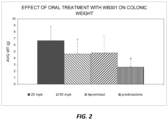
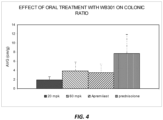
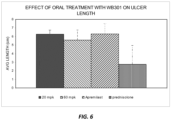
- FIG. 5 Effect of respective oral treatments on colonic parameters is shown in FIG. 5 .
- FIG. 7 Effect of respective oral treatments on colonic wall thickness is shown in FIG. 7 .
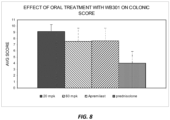
- FIG. 8 Effect of respective oral treatments on colonic score is shown in FIG. 8 .
Landscapes
- Chemical & Material Sciences (AREA)
- Organic Chemistry (AREA)
- Health & Medical Sciences (AREA)
- Life Sciences & Earth Sciences (AREA)
- Veterinary Medicine (AREA)
- Public Health (AREA)
- General Health & Medical Sciences (AREA)
- Medicinal Chemistry (AREA)
- Animal Behavior & Ethology (AREA)
- Pharmacology & Pharmacy (AREA)
- Chemical Kinetics & Catalysis (AREA)
- Nuclear Medicine, Radiotherapy & Molecular Imaging (AREA)
- General Chemical & Material Sciences (AREA)
- Bioinformatics & Cheminformatics (AREA)
- Engineering & Computer Science (AREA)
- Nutrition Science (AREA)
- Physiology (AREA)
- Epidemiology (AREA)
- Pharmaceuticals Containing Other Organic And Inorganic Compounds (AREA)
- Plural Heterocyclic Compounds (AREA)
- Indole Compounds (AREA)
Applications Claiming Priority (2)
| Application Number | Priority Date | Filing Date | Title |
|---|---|---|---|
| US201862639650P | 2018-03-07 | 2018-03-07 | |
| PCT/EP2019/055576 WO2019170750A1 (en) | 2018-03-07 | 2019-03-06 | Methods and compositions of isoindoline-1,3-dione and isoindole prodrugs useful for treating cancer, ulcerative colitis and related inflammatory diseases |
Publications (2)
| Publication Number | Publication Date |
|---|---|
| EP3762365A1 EP3762365A1 (en) | 2021-01-13 |
| EP3762365B1 true EP3762365B1 (en) | 2024-02-21 |
Family
ID=65894963
Family Applications (1)
| Application Number | Title | Priority Date | Filing Date |
|---|---|---|---|
| EP19712695.6A Active EP3762365B1 (en) | 2018-03-07 | 2019-03-06 | Methods and compositions of isoindoline-1,3-dione and isoindole prodrugs useful for treating cancer, ulcerative colitis and related inflammatory diseases |
Country Status (11)
| Country | Link |
|---|---|
| US (1) | US11639332B2 (https=) |
| EP (1) | EP3762365B1 (https=) |
| JP (1) | JP7396991B2 (https=) |
| AR (1) | AR114666A1 (https=) |
| AU (1) | AU2019229583B2 (https=) |
| CA (1) | CA3093196A1 (https=) |
| ES (1) | ES2987705T3 (https=) |
| MA (1) | MA52266A (https=) |
| MX (1) | MX2020009288A (https=) |
| TW (1) | TW202000646A (https=) |
| WO (1) | WO2019170750A1 (https=) |
Families Citing this family (1)
| Publication number | Priority date | Publication date | Assignee | Title |
|---|---|---|---|---|
| CN118370746A (zh) * | 2024-04-25 | 2024-07-23 | 江苏省中医院 | 马尿酸在制备溃疡性结肠炎治疗药物中的应用 |
Family Cites Families (10)
| Publication number | Priority date | Publication date | Assignee | Title |
|---|---|---|---|---|
| US2472965A (en) * | 1949-06-14 | Metallized tetrakisazo dyes | ||
| US3951943A (en) | 1974-03-18 | 1976-04-20 | Chemetron Corporation | Coupling process in the preparation of disazo diimides |
| EP0856562A1 (en) * | 1997-01-31 | 1998-08-05 | Hodogaya Chemical Co Ltd | Recording liquid and novel metal complex compound contained therein |
| US7182953B2 (en) | 1999-12-15 | 2007-02-27 | Celgene Corporation | Methods and compositions for the prevention and treatment of atherosclerosis restenosis and related disorders |
| WO2002001667A1 (en) * | 2000-06-29 | 2002-01-03 | Nippon Kayaku Kabushiki Kaisha | Dye-sensitized photoelectric transducer |
| US7842662B2 (en) * | 2006-11-10 | 2010-11-30 | Cara Therapeutics, Inc. | Synthetic peptide amide dimers |
| CA2691716A1 (en) | 2007-06-29 | 2009-01-08 | John Francis Gilmer | Targeting diazo prodrugs for the treatment of gastrointestinal diseases |
| EP2276483B1 (en) | 2008-03-27 | 2014-05-07 | Celgene Corporation | Solid forms comprising (+)-2-[1-(3-ethoxy-4-methoxyphenyl)-2-methylsulfonylethyl]-4-acetylaminoisoindoline-1,3-dione, compositions thereof, and uses thereof |
| WO2012083153A1 (en) * | 2010-12-16 | 2012-06-21 | Nektar Therapeutics | Oligomer-containing apremilast moiety compounds |
| EP2663549B1 (en) | 2011-01-10 | 2018-03-14 | Celgene Corporation | Phenethylsulfone isoindoline derivatives as inhibitors of pde 4 and/or cytokines |
-
2019
- 2019-03-06 TW TW108107510A patent/TW202000646A/zh unknown
- 2019-03-06 JP JP2020547036A patent/JP7396991B2/ja active Active
- 2019-03-06 MX MX2020009288A patent/MX2020009288A/es unknown
- 2019-03-06 CA CA3093196A patent/CA3093196A1/en active Pending
- 2019-03-06 WO PCT/EP2019/055576 patent/WO2019170750A1/en not_active Ceased
- 2019-03-06 EP EP19712695.6A patent/EP3762365B1/en active Active
- 2019-03-06 MA MA052266A patent/MA52266A/fr unknown
- 2019-03-06 AR ARP190100547A patent/AR114666A1/es unknown
- 2019-03-06 US US16/970,598 patent/US11639332B2/en active Active
- 2019-03-06 AU AU2019229583A patent/AU2019229583B2/en active Active
- 2019-03-06 ES ES19712695T patent/ES2987705T3/es active Active
Also Published As
| Publication number | Publication date |
|---|---|
| US20200392082A1 (en) | 2020-12-17 |
| JP2021517134A (ja) | 2021-07-15 |
| MX2020009288A (es) | 2020-09-28 |
| AU2019229583B2 (en) | 2024-06-13 |
| AR114666A1 (es) | 2020-09-30 |
| TW202000646A (zh) | 2020-01-01 |
| CA3093196A1 (en) | 2019-09-12 |
| JP7396991B2 (ja) | 2023-12-12 |
| AU2019229583A1 (en) | 2020-09-10 |
| WO2019170750A1 (en) | 2019-09-12 |
| MA52266A (fr) | 2021-01-13 |
| EP3762365A1 (en) | 2021-01-13 |
| US11639332B2 (en) | 2023-05-02 |
| ES2987705T3 (es) | 2024-11-15 |
Similar Documents
| Publication | Publication Date | Title |
|---|---|---|
| RU2661879C2 (ru) | ИНГИБИТОРЫ ЦИСТАТИОНИН-γ-ЛИАЗЫ (CSE) | |
| US9408845B2 (en) | Formulations containing pyridazine compounds | |
| CN109748881A (zh) | 胱硫醚-γ-裂合酶(CSE)抑制剂 | |
| US20260091051A1 (en) | Use of nmn for the prevention and/or treatment of pain, and corresponding compositions | |
| JP7143295B2 (ja) | ピペリジン-2,6-ジオン誘導体及びクローン病の治療 | |
| CN110612143A (zh) | 抗微生物化合物、组合物及其用途 | |
| JP2023512622A (ja) | ニタゾキサニド及びその活性型であるチゾキサニドのSARS-CoV-2感染症の治療への適用 | |
| ES2928666T3 (es) | Piridinetionas, sus composiciones farmacéuticas y su uso terapéutico para el tratamiento de enfermedades proliferativas, inflamatorias, neurodegenerativas o inmunomediadas | |
| CN101648922B (zh) | 苯甲酰胺类组蛋白去乙酰酶抑制剂及其用途 | |
| TWI735790B (zh) | N-取代之甘胺酸化合物的鋰鹽及其用途 | |
| EP3762365B1 (en) | Methods and compositions of isoindoline-1,3-dione and isoindole prodrugs useful for treating cancer, ulcerative colitis and related inflammatory diseases | |
| WO2023142729A1 (zh) | 呋喃核糖基吡啶衍生物用于预防或治疗癫痫或惊厥的用途 | |
| JP2011520934A (ja) | 筋ジストロフィー治療用化合物 | |
| CN113166073B (zh) | 苯并杂环化合物和含有其作为活性成分的用于预防或治疗癌症疾病的组合物 | |
| CN118496144A (zh) | 蟾蜍色胺衍生物及其在镇痛、抗抑郁药物中的应用 | |
| KR101460828B1 (ko) | 두개골 외상의 치료를 위한 4-시클로프로필메톡시-n-(3,5-디클로로-1-옥시도피리딘-4-일)-5-(메톡시)피리딘-2-카르복스아미드의 용도 | |
| CN119925347B (zh) | 化合物Pladienolide B作为抗蓖麻毒素保护剂的医药用途 | |
| CN119954867A (zh) | 一种含As(III)化合物及其制备方法与应用 | |
| CN121926934A (zh) | 一种青藤碱衍生物代谢产物在制备预防或治疗自身免疫性脱髓鞘疾病药物中的应用 | |
| HK40060969B (zh) | 抗微生物化合物、组合物及其用途 | |
| JPH0769895A (ja) | 炎症性腸疾患治療剤 | |
| WO2019160926A1 (en) | Compounds comprising short-chain fatty acid moieties and compositions and methods thereof | |
| CN104140422A (zh) | 具有快速皮肤穿透速度的带正电荷的水溶性的昔康及其相关化合物的前药 |
Legal Events
| Date | Code | Title | Description |
|---|---|---|---|
| STAA | Information on the status of an ep patent application or granted ep patent |
Free format text: STATUS: UNKNOWN |
|
| STAA | Information on the status of an ep patent application or granted ep patent |
Free format text: STATUS: THE INTERNATIONAL PUBLICATION HAS BEEN MADE |
|
| PUAI | Public reference made under article 153(3) epc to a published international application that has entered the european phase |
Free format text: ORIGINAL CODE: 0009012 |
|
| STAA | Information on the status of an ep patent application or granted ep patent |
Free format text: STATUS: REQUEST FOR EXAMINATION WAS MADE |
|
| 17P | Request for examination filed |
Effective date: 20201007 |
|
| AK | Designated contracting states |
Kind code of ref document: A1 Designated state(s): AL AT BE BG CH CY CZ DE DK EE ES FI FR GB GR HR HU IE IS IT LI LT LU LV MC MK MT NL NO PL PT RO RS SE SI SK SM TR |
|
| AX | Request for extension of the european patent |
Extension state: BA ME |
|
| STAA | Information on the status of an ep patent application or granted ep patent |
Free format text: STATUS: EXAMINATION IS IN PROGRESS |
|
| 17Q | First examination report despatched |
Effective date: 20211126 |
|
| P01 | Opt-out of the competence of the unified patent court (upc) registered |
Effective date: 20230523 |
|
| GRAP | Despatch of communication of intention to grant a patent |
Free format text: ORIGINAL CODE: EPIDOSNIGR1 |
|
| STAA | Information on the status of an ep patent application or granted ep patent |
Free format text: STATUS: GRANT OF PATENT IS INTENDED |
|
| INTG | Intention to grant announced |
Effective date: 20230915 |
|
| GRAS | Grant fee paid |
Free format text: ORIGINAL CODE: EPIDOSNIGR3 |
|
| GRAA | (expected) grant |
Free format text: ORIGINAL CODE: 0009210 |
|
| STAA | Information on the status of an ep patent application or granted ep patent |
Free format text: STATUS: THE PATENT HAS BEEN GRANTED |
|
| AK | Designated contracting states |
Kind code of ref document: B1 Designated state(s): AL AT BE BG CH CY CZ DE DK EE ES FI FR GB GR HR HU IE IS IT LI LT LU LV MC MK MT NL NO PL PT RO RS SE SI SK SM TR |
|
| REG | Reference to a national code |
Ref country code: GB Ref legal event code: FG4D |
|
| REG | Reference to a national code |
Ref country code: CH Ref legal event code: EP |
|
| REG | Reference to a national code |
Ref country code: IE Ref legal event code: FG4D |
|
| REG | Reference to a national code |
Ref country code: DE Ref legal event code: R096 Ref document number: 602019046871 Country of ref document: DE |
|
| REG | Reference to a national code |
Ref country code: LT Ref legal event code: MG9D |
|
| REG | Reference to a national code |
Ref country code: NL Ref legal event code: MP Effective date: 20240221 |
|
| PG25 | Lapsed in a contracting state [announced via postgrant information from national office to epo] |
Ref country code: IS Free format text: LAPSE BECAUSE OF FAILURE TO SUBMIT A TRANSLATION OF THE DESCRIPTION OR TO PAY THE FEE WITHIN THE PRESCRIBED TIME-LIMIT Effective date: 20240621 |
|
| PG25 | Lapsed in a contracting state [announced via postgrant information from national office to epo] |
Ref country code: LT Free format text: LAPSE BECAUSE OF FAILURE TO SUBMIT A TRANSLATION OF THE DESCRIPTION OR TO PAY THE FEE WITHIN THE PRESCRIBED TIME-LIMIT Effective date: 20240221 |
|
| PG25 | Lapsed in a contracting state [announced via postgrant information from national office to epo] |
Ref country code: GR Free format text: LAPSE BECAUSE OF FAILURE TO SUBMIT A TRANSLATION OF THE DESCRIPTION OR TO PAY THE FEE WITHIN THE PRESCRIBED TIME-LIMIT Effective date: 20240522 |
|
| REG | Reference to a national code |
Ref country code: AT Ref legal event code: MK05 Ref document number: 1659018 Country of ref document: AT Kind code of ref document: T Effective date: 20240221 |
|
| PG25 | Lapsed in a contracting state [announced via postgrant information from national office to epo] |
Ref country code: RS Free format text: LAPSE BECAUSE OF FAILURE TO SUBMIT A TRANSLATION OF THE DESCRIPTION OR TO PAY THE FEE WITHIN THE PRESCRIBED TIME-LIMIT Effective date: 20240521 Ref country code: HR Free format text: LAPSE BECAUSE OF FAILURE TO SUBMIT A TRANSLATION OF THE DESCRIPTION OR TO PAY THE FEE WITHIN THE PRESCRIBED TIME-LIMIT Effective date: 20240221 Ref country code: NL Free format text: LAPSE BECAUSE OF FAILURE TO SUBMIT A TRANSLATION OF THE DESCRIPTION OR TO PAY THE FEE WITHIN THE PRESCRIBED TIME-LIMIT Effective date: 20240221 |
|
| PG25 | Lapsed in a contracting state [announced via postgrant information from national office to epo] |
Ref country code: AT Free format text: LAPSE BECAUSE OF FAILURE TO SUBMIT A TRANSLATION OF THE DESCRIPTION OR TO PAY THE FEE WITHIN THE PRESCRIBED TIME-LIMIT Effective date: 20240221 |
|
| PG25 | Lapsed in a contracting state [announced via postgrant information from national office to epo] |
Ref country code: RS Free format text: LAPSE BECAUSE OF FAILURE TO SUBMIT A TRANSLATION OF THE DESCRIPTION OR TO PAY THE FEE WITHIN THE PRESCRIBED TIME-LIMIT Effective date: 20240521 Ref country code: NO Free format text: LAPSE BECAUSE OF FAILURE TO SUBMIT A TRANSLATION OF THE DESCRIPTION OR TO PAY THE FEE WITHIN THE PRESCRIBED TIME-LIMIT Effective date: 20240521 Ref country code: NL Free format text: LAPSE BECAUSE OF FAILURE TO SUBMIT A TRANSLATION OF THE DESCRIPTION OR TO PAY THE FEE WITHIN THE PRESCRIBED TIME-LIMIT Effective date: 20240221 Ref country code: LT Free format text: LAPSE BECAUSE OF FAILURE TO SUBMIT A TRANSLATION OF THE DESCRIPTION OR TO PAY THE FEE WITHIN THE PRESCRIBED TIME-LIMIT Effective date: 20240221 Ref country code: IS Free format text: LAPSE BECAUSE OF FAILURE TO SUBMIT A TRANSLATION OF THE DESCRIPTION OR TO PAY THE FEE WITHIN THE PRESCRIBED TIME-LIMIT Effective date: 20240621 Ref country code: HR Free format text: LAPSE BECAUSE OF FAILURE TO SUBMIT A TRANSLATION OF THE DESCRIPTION OR TO PAY THE FEE WITHIN THE PRESCRIBED TIME-LIMIT Effective date: 20240221 Ref country code: GR Free format text: LAPSE BECAUSE OF FAILURE TO SUBMIT A TRANSLATION OF THE DESCRIPTION OR TO PAY THE FEE WITHIN THE PRESCRIBED TIME-LIMIT Effective date: 20240522 Ref country code: FI Free format text: LAPSE BECAUSE OF FAILURE TO SUBMIT A TRANSLATION OF THE DESCRIPTION OR TO PAY THE FEE WITHIN THE PRESCRIBED TIME-LIMIT Effective date: 20240221 Ref country code: BG Free format text: LAPSE BECAUSE OF FAILURE TO SUBMIT A TRANSLATION OF THE DESCRIPTION OR TO PAY THE FEE WITHIN THE PRESCRIBED TIME-LIMIT Effective date: 20240221 Ref country code: AT Free format text: LAPSE BECAUSE OF FAILURE TO SUBMIT A TRANSLATION OF THE DESCRIPTION OR TO PAY THE FEE WITHIN THE PRESCRIBED TIME-LIMIT Effective date: 20240221 |
|
| PG25 | Lapsed in a contracting state [announced via postgrant information from national office to epo] |
Ref country code: PT Free format text: LAPSE BECAUSE OF FAILURE TO SUBMIT A TRANSLATION OF THE DESCRIPTION OR TO PAY THE FEE WITHIN THE PRESCRIBED TIME-LIMIT Effective date: 20240621 Ref country code: PL Free format text: LAPSE BECAUSE OF FAILURE TO SUBMIT A TRANSLATION OF THE DESCRIPTION OR TO PAY THE FEE WITHIN THE PRESCRIBED TIME-LIMIT Effective date: 20240221 |
|
| PG25 | Lapsed in a contracting state [announced via postgrant information from national office to epo] |
Ref country code: SE Free format text: LAPSE BECAUSE OF FAILURE TO SUBMIT A TRANSLATION OF THE DESCRIPTION OR TO PAY THE FEE WITHIN THE PRESCRIBED TIME-LIMIT Effective date: 20240221 Ref country code: PT Free format text: LAPSE BECAUSE OF FAILURE TO SUBMIT A TRANSLATION OF THE DESCRIPTION OR TO PAY THE FEE WITHIN THE PRESCRIBED TIME-LIMIT Effective date: 20240621 Ref country code: PL Free format text: LAPSE BECAUSE OF FAILURE TO SUBMIT A TRANSLATION OF THE DESCRIPTION OR TO PAY THE FEE WITHIN THE PRESCRIBED TIME-LIMIT Effective date: 20240221 Ref country code: LV Free format text: LAPSE BECAUSE OF FAILURE TO SUBMIT A TRANSLATION OF THE DESCRIPTION OR TO PAY THE FEE WITHIN THE PRESCRIBED TIME-LIMIT Effective date: 20240221 |
|
| PG25 | Lapsed in a contracting state [announced via postgrant information from national office to epo] |
Ref country code: DK Free format text: LAPSE BECAUSE OF FAILURE TO SUBMIT A TRANSLATION OF THE DESCRIPTION OR TO PAY THE FEE WITHIN THE PRESCRIBED TIME-LIMIT Effective date: 20240221 |
|
| VS25 | Lapsed in a validation state [announced via postgrant information from nat. office to epo] |
Ref country code: MD Free format text: LAPSE BECAUSE OF FAILURE TO SUBMIT A TRANSLATION OF THE DESCRIPTION OR TO PAY THE FEE WITHIN THE PRESCRIBED TIME-LIMIT Effective date: 20240221 |
|
| PG25 | Lapsed in a contracting state [announced via postgrant information from national office to epo] |
Ref country code: SM Free format text: LAPSE BECAUSE OF FAILURE TO SUBMIT A TRANSLATION OF THE DESCRIPTION OR TO PAY THE FEE WITHIN THE PRESCRIBED TIME-LIMIT Effective date: 20240221 |
|
| PG25 | Lapsed in a contracting state [announced via postgrant information from national office to epo] |
Ref country code: EE Free format text: LAPSE BECAUSE OF FAILURE TO SUBMIT A TRANSLATION OF THE DESCRIPTION OR TO PAY THE FEE WITHIN THE PRESCRIBED TIME-LIMIT Effective date: 20240221 Ref country code: CZ Free format text: LAPSE BECAUSE OF FAILURE TO SUBMIT A TRANSLATION OF THE DESCRIPTION OR TO PAY THE FEE WITHIN THE PRESCRIBED TIME-LIMIT Effective date: 20240221 |
|
| PG25 | Lapsed in a contracting state [announced via postgrant information from national office to epo] |
Ref country code: SK Free format text: LAPSE BECAUSE OF FAILURE TO SUBMIT A TRANSLATION OF THE DESCRIPTION OR TO PAY THE FEE WITHIN THE PRESCRIBED TIME-LIMIT Effective date: 20240221 |
|
| PG25 | Lapsed in a contracting state [announced via postgrant information from national office to epo] |
Ref country code: SM Free format text: LAPSE BECAUSE OF FAILURE TO SUBMIT A TRANSLATION OF THE DESCRIPTION OR TO PAY THE FEE WITHIN THE PRESCRIBED TIME-LIMIT Effective date: 20240221 Ref country code: SK Free format text: LAPSE BECAUSE OF FAILURE TO SUBMIT A TRANSLATION OF THE DESCRIPTION OR TO PAY THE FEE WITHIN THE PRESCRIBED TIME-LIMIT Effective date: 20240221 Ref country code: RO Free format text: LAPSE BECAUSE OF FAILURE TO SUBMIT A TRANSLATION OF THE DESCRIPTION OR TO PAY THE FEE WITHIN THE PRESCRIBED TIME-LIMIT Effective date: 20240221 Ref country code: EE Free format text: LAPSE BECAUSE OF FAILURE TO SUBMIT A TRANSLATION OF THE DESCRIPTION OR TO PAY THE FEE WITHIN THE PRESCRIBED TIME-LIMIT Effective date: 20240221 Ref country code: DK Free format text: LAPSE BECAUSE OF FAILURE TO SUBMIT A TRANSLATION OF THE DESCRIPTION OR TO PAY THE FEE WITHIN THE PRESCRIBED TIME-LIMIT Effective date: 20240221 Ref country code: CZ Free format text: LAPSE BECAUSE OF FAILURE TO SUBMIT A TRANSLATION OF THE DESCRIPTION OR TO PAY THE FEE WITHIN THE PRESCRIBED TIME-LIMIT Effective date: 20240221 |
|
| VS25 | Lapsed in a validation state [announced via postgrant information from nat. office to epo] |
Ref country code: MD Free format text: LAPSE BECAUSE OF FAILURE TO SUBMIT A TRANSLATION OF THE DESCRIPTION OR TO PAY THE FEE WITHIN THE PRESCRIBED TIME-LIMIT Effective date: 20240221 |
|
| REG | Reference to a national code |
Ref country code: ES Ref legal event code: FG2A Ref document number: 2987705 Country of ref document: ES Kind code of ref document: T3 Effective date: 20241115 |
|
| PG25 | Lapsed in a contracting state [announced via postgrant information from national office to epo] |
Ref country code: LU Free format text: LAPSE BECAUSE OF NON-PAYMENT OF DUE FEES Effective date: 20240306 |
|
| PG25 | Lapsed in a contracting state [announced via postgrant information from national office to epo] |
Ref country code: MC Free format text: LAPSE BECAUSE OF FAILURE TO SUBMIT A TRANSLATION OF THE DESCRIPTION OR TO PAY THE FEE WITHIN THE PRESCRIBED TIME-LIMIT Effective date: 20240221 |
|
| REG | Reference to a national code |
Ref country code: DE Ref legal event code: R097 Ref document number: 602019046871 Country of ref document: DE |
|
| PG25 | Lapsed in a contracting state [announced via postgrant information from national office to epo] |
Ref country code: MC Free format text: LAPSE BECAUSE OF FAILURE TO SUBMIT A TRANSLATION OF THE DESCRIPTION OR TO PAY THE FEE WITHIN THE PRESCRIBED TIME-LIMIT Effective date: 20240221 Ref country code: LU Free format text: LAPSE BECAUSE OF NON-PAYMENT OF DUE FEES Effective date: 20240306 |
|
| REG | Reference to a national code |
Ref country code: BE Ref legal event code: MM Effective date: 20240331 |
|
| PLBE | No opposition filed within time limit |
Free format text: ORIGINAL CODE: 0009261 |
|
| STAA | Information on the status of an ep patent application or granted ep patent |
Free format text: STATUS: NO OPPOSITION FILED WITHIN TIME LIMIT |
|
| PG25 | Lapsed in a contracting state [announced via postgrant information from national office to epo] |
Ref country code: BE Free format text: LAPSE BECAUSE OF NON-PAYMENT OF DUE FEES Effective date: 20240331 |
|
| PG25 | Lapsed in a contracting state [announced via postgrant information from national office to epo] |
Ref country code: IE Free format text: LAPSE BECAUSE OF NON-PAYMENT OF DUE FEES Effective date: 20240306 |
|
| 26N | No opposition filed |
Effective date: 20241122 |
|
| PG25 | Lapsed in a contracting state [announced via postgrant information from national office to epo] |
Ref country code: IE Free format text: LAPSE BECAUSE OF NON-PAYMENT OF DUE FEES Effective date: 20240306 Ref country code: BE Free format text: LAPSE BECAUSE OF NON-PAYMENT OF DUE FEES Effective date: 20240331 |
|
| PG25 | Lapsed in a contracting state [announced via postgrant information from national office to epo] |
Ref country code: SI Free format text: LAPSE BECAUSE OF FAILURE TO SUBMIT A TRANSLATION OF THE DESCRIPTION OR TO PAY THE FEE WITHIN THE PRESCRIBED TIME-LIMIT Effective date: 20240221 |
|
| PGFP | Annual fee paid to national office [announced via postgrant information from national office to epo] |
Ref country code: ES Payment date: 20250401 Year of fee payment: 7 |
|
| PGFP | Annual fee paid to national office [announced via postgrant information from national office to epo] |
Ref country code: CH Payment date: 20250401 Year of fee payment: 7 |
|
| PG25 | Lapsed in a contracting state [announced via postgrant information from national office to epo] |
Ref country code: CY Free format text: LAPSE BECAUSE OF FAILURE TO SUBMIT A TRANSLATION OF THE DESCRIPTION OR TO PAY THE FEE WITHIN THE PRESCRIBED TIME-LIMIT; INVALID AB INITIO Effective date: 20190306 |
|
| PG25 | Lapsed in a contracting state [announced via postgrant information from national office to epo] |
Ref country code: HU Free format text: LAPSE BECAUSE OF FAILURE TO SUBMIT A TRANSLATION OF THE DESCRIPTION OR TO PAY THE FEE WITHIN THE PRESCRIBED TIME-LIMIT; INVALID AB INITIO Effective date: 20190306 |
|
| VS25 | Lapsed in a validation state [announced via postgrant information from nat. office to epo] |
Ref country code: MA Free format text: FAILURE TO ELECT DOMICILE IN THE NATIONAL COUNTRY Effective date: 20240522 |
|
| PG25 | Lapsed in a contracting state [announced via postgrant information from national office to epo] |
Ref country code: TR Free format text: LAPSE BECAUSE OF FAILURE TO SUBMIT A TRANSLATION OF THE DESCRIPTION OR TO PAY THE FEE WITHIN THE PRESCRIBED TIME-LIMIT Effective date: 20240221 |
|
| VS25 | Lapsed in a validation state [announced via postgrant information from nat. office to epo] |
Ref country code: MA Free format text: LAPSE BECAUSE OF FAILURE TO SUBMIT A TRANSLATION OF THE DESCRIPTION OR TO PAY THE FEE WITHIN THE PRESCRIBED TIME-LIMIT Effective date: 20240221 |
|
| REG | Reference to a national code |
Ref country code: CH Ref legal event code: U11 Free format text: ST27 STATUS EVENT CODE: U-0-0-U10-U11 (AS PROVIDED BY THE NATIONAL OFFICE) Effective date: 20260401 |
|
| PGFP | Annual fee paid to national office [announced via postgrant information from national office to epo] |
Ref country code: GB Payment date: 20260220 Year of fee payment: 8 |
|
| PGFP | Annual fee paid to national office [announced via postgrant information from national office to epo] |
Ref country code: DE Payment date: 20260219 Year of fee payment: 8 |
|
| PGFP | Annual fee paid to national office [announced via postgrant information from national office to epo] |
Ref country code: IT Payment date: 20260219 Year of fee payment: 8 |
|
| PGFP | Annual fee paid to national office [announced via postgrant information from national office to epo] |
Ref country code: FR Payment date: 20260219 Year of fee payment: 8 |