EP3759155B1 - Aus polymermatrixverbundmaterial mit graphennanoplättchen hergestelltes, mehrschichtiges radarabsorbierendes laminat für flugzeug und verfahren zur herstellung davon - Google Patents
Aus polymermatrixverbundmaterial mit graphennanoplättchen hergestelltes, mehrschichtiges radarabsorbierendes laminat für flugzeug und verfahren zur herstellung davon Download PDFInfo
- Publication number
- EP3759155B1 EP3759155B1 EP19714480.1A EP19714480A EP3759155B1 EP 3759155 B1 EP3759155 B1 EP 3759155B1 EP 19714480 A EP19714480 A EP 19714480A EP 3759155 B1 EP3759155 B1 EP 3759155B1
- Authority
- EP
- European Patent Office
- Prior art keywords
- fiber
- graphene
- graphene nanoplatelets
- laminate according
- nanoplatelets
- Prior art date
- Legal status (The legal status is an assumption and is not a legal conclusion. Google has not performed a legal analysis and makes no representation as to the accuracy of the status listed.)
- Active
Links
Images


Classifications
-
- B—PERFORMING OPERATIONS; TRANSPORTING
- B32—LAYERED PRODUCTS
- B32B—LAYERED PRODUCTS, i.e. PRODUCTS BUILT-UP OF STRATA OF FLAT OR NON-FLAT, e.g. CELLULAR OR HONEYCOMB, FORM
- B32B27/00—Layered products comprising a layer of synthetic resin
- B32B27/12—Layered products comprising a layer of synthetic resin next to a fibrous or filamentary layer
-
- C—CHEMISTRY; METALLURGY
- C08—ORGANIC MACROMOLECULAR COMPOUNDS; THEIR PREPARATION OR CHEMICAL WORKING-UP; COMPOSITIONS BASED THEREON
- C08J—WORKING-UP; GENERAL PROCESSES OF COMPOUNDING; AFTER-TREATMENT NOT COVERED BY SUBCLASSES C08B, C08C, C08F, C08G or C08H
- C08J5/00—Manufacture of articles or shaped materials containing macromolecular substances
- C08J5/005—Reinforced macromolecular compounds with nanosized materials, e.g. nanoparticles, nanofibres, nanotubes, nanowires, nanorods or nanolayered materials
-
- B—PERFORMING OPERATIONS; TRANSPORTING
- B29—WORKING OF PLASTICS; WORKING OF SUBSTANCES IN A PLASTIC STATE IN GENERAL
- B29C—SHAPING OR JOINING OF PLASTICS; SHAPING OF MATERIAL IN A PLASTIC STATE, NOT OTHERWISE PROVIDED FOR; AFTER-TREATMENT OF THE SHAPED PRODUCTS, e.g. REPAIRING
- B29C70/00—Shaping composites, i.e. plastics material comprising reinforcements, fillers or preformed parts, e.g. inserts
- B29C70/02—Shaping composites, i.e. plastics material comprising reinforcements, fillers or preformed parts, e.g. inserts comprising combinations of reinforcements, e.g. non-specified reinforcements, fibrous reinforcing inserts and fillers, e.g. particulate fillers, incorporated in matrix material, forming one or more layers and with or without non-reinforced or non-filled layers
- B29C70/021—Combinations of fibrous reinforcement and non-fibrous material
- B29C70/025—Combinations of fibrous reinforcement and non-fibrous material with particular filler
-
- B—PERFORMING OPERATIONS; TRANSPORTING
- B29—WORKING OF PLASTICS; WORKING OF SUBSTANCES IN A PLASTIC STATE IN GENERAL
- B29C—SHAPING OR JOINING OF PLASTICS; SHAPING OF MATERIAL IN A PLASTIC STATE, NOT OTHERWISE PROVIDED FOR; AFTER-TREATMENT OF THE SHAPED PRODUCTS, e.g. REPAIRING
- B29C70/00—Shaping composites, i.e. plastics material comprising reinforcements, fillers or preformed parts, e.g. inserts
- B29C70/04—Shaping composites, i.e. plastics material comprising reinforcements, fillers or preformed parts, e.g. inserts comprising reinforcements only, e.g. self-reinforcing plastics
- B29C70/28—Shaping operations therefor
- B29C70/40—Shaping or impregnating by compression not applied
- B29C70/42—Shaping or impregnating by compression not applied for producing articles of definite length, i.e. discrete articles
- B29C70/44—Shaping or impregnating by compression not applied for producing articles of definite length, i.e. discrete articles using isostatic pressure, e.g. pressure difference-moulding, vacuum bag-moulding, autoclave-moulding or expanding rubber-moulding
- B29C70/443—Shaping or impregnating by compression not applied for producing articles of definite length, i.e. discrete articles using isostatic pressure, e.g. pressure difference-moulding, vacuum bag-moulding, autoclave-moulding or expanding rubber-moulding and impregnating by vacuum or injection
-
- B—PERFORMING OPERATIONS; TRANSPORTING
- B29—WORKING OF PLASTICS; WORKING OF SUBSTANCES IN A PLASTIC STATE IN GENERAL
- B29C—SHAPING OR JOINING OF PLASTICS; SHAPING OF MATERIAL IN A PLASTIC STATE, NOT OTHERWISE PROVIDED FOR; AFTER-TREATMENT OF THE SHAPED PRODUCTS, e.g. REPAIRING
- B29C70/00—Shaping composites, i.e. plastics material comprising reinforcements, fillers or preformed parts, e.g. inserts
- B29C70/88—Shaping composites, i.e. plastics material comprising reinforcements, fillers or preformed parts, e.g. inserts characterised primarily by possessing specific properties, e.g. electrically conductive or locally reinforced
- B29C70/882—Shaping composites, i.e. plastics material comprising reinforcements, fillers or preformed parts, e.g. inserts characterised primarily by possessing specific properties, e.g. electrically conductive or locally reinforced partly or totally electrically conductive, e.g. for EMI shielding
-
- B—PERFORMING OPERATIONS; TRANSPORTING
- B32—LAYERED PRODUCTS
- B32B—LAYERED PRODUCTS, i.e. PRODUCTS BUILT-UP OF STRATA OF FLAT OR NON-FLAT, e.g. CELLULAR OR HONEYCOMB, FORM
- B32B17/00—Layered products essentially comprising sheet glass, or glass, slag, or like fibres
- B32B17/02—Layered products essentially comprising sheet glass, or glass, slag, or like fibres in the form of fibres or filaments
- B32B17/04—Layered products essentially comprising sheet glass, or glass, slag, or like fibres in the form of fibres or filaments bonded with or embedded in a plastic substance
-
- C—CHEMISTRY; METALLURGY
- C08—ORGANIC MACROMOLECULAR COMPOUNDS; THEIR PREPARATION OR CHEMICAL WORKING-UP; COMPOSITIONS BASED THEREON
- C08J—WORKING-UP; GENERAL PROCESSES OF COMPOUNDING; AFTER-TREATMENT NOT COVERED BY SUBCLASSES C08B, C08C, C08F, C08G or C08H
- C08J5/00—Manufacture of articles or shaped materials containing macromolecular substances
- C08J5/04—Reinforcing macromolecular compounds with loose or coherent fibrous material
-
- C—CHEMISTRY; METALLURGY
- C08—ORGANIC MACROMOLECULAR COMPOUNDS; THEIR PREPARATION OR CHEMICAL WORKING-UP; COMPOSITIONS BASED THEREON
- C08J—WORKING-UP; GENERAL PROCESSES OF COMPOUNDING; AFTER-TREATMENT NOT COVERED BY SUBCLASSES C08B, C08C, C08F, C08G or C08H
- C08J5/00—Manufacture of articles or shaped materials containing macromolecular substances
- C08J5/04—Reinforcing macromolecular compounds with loose or coherent fibrous material
- C08J5/06—Reinforcing macromolecular compounds with loose or coherent fibrous material using pretreated fibrous materials
-
- C—CHEMISTRY; METALLURGY
- C08—ORGANIC MACROMOLECULAR COMPOUNDS; THEIR PREPARATION OR CHEMICAL WORKING-UP; COMPOSITIONS BASED THEREON
- C08J—WORKING-UP; GENERAL PROCESSES OF COMPOUNDING; AFTER-TREATMENT NOT COVERED BY SUBCLASSES C08B, C08C, C08F, C08G or C08H
- C08J5/00—Manufacture of articles or shaped materials containing macromolecular substances
- C08J5/04—Reinforcing macromolecular compounds with loose or coherent fibrous material
- C08J5/06—Reinforcing macromolecular compounds with loose or coherent fibrous material using pretreated fibrous materials
- C08J5/08—Reinforcing macromolecular compounds with loose or coherent fibrous material using pretreated fibrous materials glass fibres
-
- C—CHEMISTRY; METALLURGY
- C08—ORGANIC MACROMOLECULAR COMPOUNDS; THEIR PREPARATION OR CHEMICAL WORKING-UP; COMPOSITIONS BASED THEREON
- C08J—WORKING-UP; GENERAL PROCESSES OF COMPOUNDING; AFTER-TREATMENT NOT COVERED BY SUBCLASSES C08B, C08C, C08F, C08G or C08H
- C08J5/00—Manufacture of articles or shaped materials containing macromolecular substances
- C08J5/24—Impregnating materials with prepolymers which can be polymerised in situ, e.g. manufacture of prepregs
- C08J5/241—Impregnating materials with prepolymers which can be polymerised in situ, e.g. manufacture of prepregs using inorganic fibres
- C08J5/243—Impregnating materials with prepolymers which can be polymerised in situ, e.g. manufacture of prepregs using inorganic fibres using carbon fibres
-
- C—CHEMISTRY; METALLURGY
- C08—ORGANIC MACROMOLECULAR COMPOUNDS; THEIR PREPARATION OR CHEMICAL WORKING-UP; COMPOSITIONS BASED THEREON
- C08J—WORKING-UP; GENERAL PROCESSES OF COMPOUNDING; AFTER-TREATMENT NOT COVERED BY SUBCLASSES C08B, C08C, C08F, C08G or C08H
- C08J5/00—Manufacture of articles or shaped materials containing macromolecular substances
- C08J5/24—Impregnating materials with prepolymers which can be polymerised in situ, e.g. manufacture of prepregs
- C08J5/241—Impregnating materials with prepolymers which can be polymerised in situ, e.g. manufacture of prepregs using inorganic fibres
- C08J5/244—Impregnating materials with prepolymers which can be polymerised in situ, e.g. manufacture of prepregs using inorganic fibres using glass fibres
-
- C—CHEMISTRY; METALLURGY
- C08—ORGANIC MACROMOLECULAR COMPOUNDS; THEIR PREPARATION OR CHEMICAL WORKING-UP; COMPOSITIONS BASED THEREON
- C08J—WORKING-UP; GENERAL PROCESSES OF COMPOUNDING; AFTER-TREATMENT NOT COVERED BY SUBCLASSES C08B, C08C, C08F, C08G or C08H
- C08J5/00—Manufacture of articles or shaped materials containing macromolecular substances
- C08J5/24—Impregnating materials with prepolymers which can be polymerised in situ, e.g. manufacture of prepregs
- C08J5/249—Impregnating materials with prepolymers which can be polymerised in situ, e.g. manufacture of prepregs characterised by the additives used in the prepolymer mixture
-
- H—ELECTRICITY
- H01—ELECTRIC ELEMENTS
- H01Q—ANTENNAS, i.e. RADIO AERIALS
- H01Q17/00—Devices for absorbing waves radiated from an antenna; Combinations of such devices with active antenna elements or systems
-
- B—PERFORMING OPERATIONS; TRANSPORTING
- B32—LAYERED PRODUCTS
- B32B—LAYERED PRODUCTS, i.e. PRODUCTS BUILT-UP OF STRATA OF FLAT OR NON-FLAT, e.g. CELLULAR OR HONEYCOMB, FORM
- B32B2262/00—Composition or structural features of fibres which form a fibrous or filamentary layer or are present as additives
- B32B2262/10—Inorganic fibres
- B32B2262/106—Carbon fibres, e.g. graphite fibres
-
- B—PERFORMING OPERATIONS; TRANSPORTING
- B32—LAYERED PRODUCTS
- B32B—LAYERED PRODUCTS, i.e. PRODUCTS BUILT-UP OF STRATA OF FLAT OR NON-FLAT, e.g. CELLULAR OR HONEYCOMB, FORM
- B32B2264/00—Composition or properties of particles which form a particulate layer or are present as additives
- B32B2264/10—Inorganic particles
- B32B2264/107—Ceramic
- B32B2264/108—Carbon, e.g. graphite particles
-
- B—PERFORMING OPERATIONS; TRANSPORTING
- B32—LAYERED PRODUCTS
- B32B—LAYERED PRODUCTS, i.e. PRODUCTS BUILT-UP OF STRATA OF FLAT OR NON-FLAT, e.g. CELLULAR OR HONEYCOMB, FORM
- B32B2264/00—Composition or properties of particles which form a particulate layer or are present as additives
- B32B2264/20—Particles characterised by shape
- B32B2264/201—Flat or platelet-shaped particles, e.g. flakes
-
- B—PERFORMING OPERATIONS; TRANSPORTING
- B32—LAYERED PRODUCTS
- B32B—LAYERED PRODUCTS, i.e. PRODUCTS BUILT-UP OF STRATA OF FLAT OR NON-FLAT, e.g. CELLULAR OR HONEYCOMB, FORM
- B32B2264/00—Composition or properties of particles which form a particulate layer or are present as additives
- B32B2264/30—Particles characterised by physical dimension
- B32B2264/302—Average diameter in the range from 100 nm to 1000 nm
-
- B—PERFORMING OPERATIONS; TRANSPORTING
- B32—LAYERED PRODUCTS
- B32B—LAYERED PRODUCTS, i.e. PRODUCTS BUILT-UP OF STRATA OF FLAT OR NON-FLAT, e.g. CELLULAR OR HONEYCOMB, FORM
- B32B2307/00—Properties of the layers or laminate
- B32B2307/20—Properties of the layers or laminate having particular electrical or magnetic properties, e.g. piezoelectric
- B32B2307/202—Conductive
-
- B—PERFORMING OPERATIONS; TRANSPORTING
- B32—LAYERED PRODUCTS
- B32B—LAYERED PRODUCTS, i.e. PRODUCTS BUILT-UP OF STRATA OF FLAT OR NON-FLAT, e.g. CELLULAR OR HONEYCOMB, FORM
- B32B2307/00—Properties of the layers or laminate
- B32B2307/20—Properties of the layers or laminate having particular electrical or magnetic properties, e.g. piezoelectric
- B32B2307/212—Electromagnetic interference shielding
-
- B—PERFORMING OPERATIONS; TRANSPORTING
- B32—LAYERED PRODUCTS
- B32B—LAYERED PRODUCTS, i.e. PRODUCTS BUILT-UP OF STRATA OF FLAT OR NON-FLAT, e.g. CELLULAR OR HONEYCOMB, FORM
- B32B2605/00—Vehicles
- B32B2605/18—Aircraft
-
- B—PERFORMING OPERATIONS; TRANSPORTING
- B82—NANOTECHNOLOGY
- B82Y—SPECIFIC USES OR APPLICATIONS OF NANOSTRUCTURES; MEASUREMENT OR ANALYSIS OF NANOSTRUCTURES; MANUFACTURE OR TREATMENT OF NANOSTRUCTURES
- B82Y30/00—Nanotechnology for materials or surface science, e.g. nanocomposites
-
- B—PERFORMING OPERATIONS; TRANSPORTING
- B82—NANOTECHNOLOGY
- B82Y—SPECIFIC USES OR APPLICATIONS OF NANOSTRUCTURES; MEASUREMENT OR ANALYSIS OF NANOSTRUCTURES; MANUFACTURE OR TREATMENT OF NANOSTRUCTURES
- B82Y40/00—Manufacture or treatment of nanostructures
-
- C—CHEMISTRY; METALLURGY
- C08—ORGANIC MACROMOLECULAR COMPOUNDS; THEIR PREPARATION OR CHEMICAL WORKING-UP; COMPOSITIONS BASED THEREON
- C08J—WORKING-UP; GENERAL PROCESSES OF COMPOUNDING; AFTER-TREATMENT NOT COVERED BY SUBCLASSES C08B, C08C, C08F, C08G or C08H
- C08J2363/00—Characterised by the use of epoxy resins; Derivatives of epoxy resins
Definitions
- the present invention falls in the field of radar-absorbing aeronautical materials, i.e. materials with radio-frequency electromagnetic radiation absorption properties.
- the invention refers to radar-absorbing broadband multilayer laminates made of composite material laminated to a polymeric matrix containing graphene nanoplatelets.
- the multilayer laminates described here may be used to make components or parts of the aircraft typically most exposed to radar radiation in the frontal sector, such as wing leading edges, nacelles, pylons, air intakes, or the so-called RCS hot spots, as well as curved panels of the fuselage, panels of wingboxes and tail empennages.
- GNP Graphite/graphene nanoplatelets
- radar-absorbing materials are able to absorb the energy associated with an electromagnetic field, having a minimum reflection coefficient in well-defined frequency bands.
- the concentration and morphological and electrical properties of the filler are appropriately selected in order to optimize the electromagnetic properties of the composite material. More in particular, one tries to widen as much as possible the frequency band wherein the material is able to absorb the energy associated with the electromagnetic field, i.e. to widen the range of frequencies at which a certain component is not very observable to radar.
- a production process which comprises the lamination or deposition of sheets of carbon, glass or Kevlar fiber, already pre-impregnated with resin (a material called pre-preg) on a lamination tool or mold.
- LRI liquid resin infusion
- RTM resin transfer molding
- the air is evacuated from the porous preform before the resin is introduced.
- the resin is then introduced into the preform; the resin is forced to penetrate the preform due to the pressure difference between the atmospheric pressure, which acts on the resin, and the vacuum in the preform (for the LRI process); otherwise, the resin is injected under pressure into the mold (for the RTM process). Finally, a heat and pressure polymerization cycle is applied, which solidifies the resin.
- RASs radar absorbing materials
- EM electromagnetic
- GNPs graphene nanoplatelets
- GO graphene oxide
- the main difficulty of the process was to avoid formation of nanofiller agglomerates along the fiber texture.
- GNPs as reinforcement in glass fiber/epoxy composites were proposed in R. K. Prusty, S. K. Ghosh, D. K. Rathore, and B. C. Ray, "Reinforcement effect of graphene oxide in glass fiber/epoxy composites at in-situ elevated temperature environments: An emphasis on graphene oxide content," Compos. Part A Appl. Sci. Manuf., vol. 95, pp. 40-53, 2017 . GNPs were initially dispersed in isopropanol and then brushed over the glass fabric, which was then used to produce the laminate composite through vacuum-assisted resin transfer molding.
- patent publication EP 3050916 A1 describes a method for the production of a fiber- or nanofiber-reinforced polyamide film.
- the production process has not been designed to obtain a material with the simultaneous control of electromagnetic and mechanical properties, which is the purpose of the present invention.
- the process is limited to composites with a polyamide matrix, which is a thermoplastic polymer.
- the present invention focuses on composites with an epoxy matrix, which, as is well known, involves considerable problems when used as a matrix in composites containing graphene nanoplatelets, due to the formation of agglomerates, and therefore is particularly critical when used to obtain radar-absorbing composites.
- Patent publication EP 3235632 A1 concerns the production of a pre-impregnated composite sheet to obtain composite laminates with improved structural properties, and thus not a laminate composite with radar absorbency properties combined with the desired structural properties. It is well known that the dielectric permittivity properties of an uncured composite and cured composite are very different. It should also be noted that according to patent publication EP 3235632 , obtaining the pre-impregnated sheet for the manufacture of structural laminated composites is based on the combination of a composite sheet of nanomaterials, a sheet of reinforcing fibers and a resin system.
- the composite sheet of nanomaterials comprises: a support sheet and a nanomaterial structure linked thereto.
- This nanomaterial structure may be a network of nanomaterials comprising at least one carbon nanomaterial and one boron nanomaterial. This allows a pre-impregnated conductive sheet to be obtained for electromagnetic shielding applications. It is known, however, that the sheet resistance values required to obtain electromagnetic shielding properties are well below the sheet resistance values required to obtain radar absorbency properties, which in effect are not considered in the patent.
- Patent publication US 2004/0188890 A1 describes a process for the production of a composite laminate which comprises the pre-treatment of dry fibers with a coating of dispersed particles in an appropriate agent, the lamination of such treated fiber fabrics, the introduction of the polymer matrix (resin) and curing.
- the resulting composite has structural properties and electromagnetic shielding or electromagnetic absorption properties.
- the process described does not guarantee that the absorber will achieve broadband performance.
- US 2004/0188890 A1 specifies that non-conductive fiber thicknesses must be close to a quarter of a wavelength.
- Patent publication US 2011/0281034 A1 presents a method for reinforcing structural fiber composites by the dispersion between layers of carbon-based nanomaterials. According to such publication, the nanostructures are directly sprayed onto the dry fiber after appropriate dispersion only in solvent, without binding agent. This results in low mechanical and electromagnetic performance due to the resulting poor adhesion of the nanoplatelets to the dry fiber. The spraying is carried out in a vacuum.
- Patent publication US 2013/0034724 A1 concerns making an interlayer containing nanostructures for the mechanical/structural reinforcement of structural composites.
- the radar absorbency properties are not mentioned or taken into account, as they would not be achievable by applying the described process.
- Patent publication US 2015/0166743 A1 proposes, through the insertion of interlayers with conductive nanoparticles between one layer and another of a carbon fiber laminate, to obtain a final composite with structural properties and high conductivity in the plane orthogonal to the surface of the panel.
- the achievement of such performance is fundamental to producing composites with high electrical conductivity, which therefore withstand strong electromagnetic stresses, such as in the case of a direct lightning strike.
- the composites that may be obtained are not suitable for obtaining radar absorbency properties.
- Patent publication KR 2013 0010285 A describes a method for mechanically and structurally reinforcing carbon fiber- or other fiber-laminated composites for electromagnetic shielding applications, and not for obtaining radar-absorbing composites.
- the nanomaterials are used to coat the fibers after dispersion in methanol without the use of binding elements, possibly deposited by spraying in a vacuum.
- broadband radar-absorbing composite materials with improved mechanical properties, wherein the thickness of the electromagnetic active component, i.e. the component that gives the material the property of absorbing electromagnetic radiation, is thin or less than the wavelength associated with the central frequency of the band of interest.
- the present invention proposes an innovative methodology for the design and manufacture of a laminate structure in polymer matrix composite material containing graphene nanoplatelets with broadband radar radiation absorption properties and the desired mechanical or structural properties, comprising at least three basic blocks:
- the second and third blocks form the active electromagnetic part of the component.
- the coupling of the second and third blocks gives the component object of the invention the property of broadband radar absorbency and at the same time mechanical or structural properties not less than the mechanical or structural properties of the first block.
- the production process of the second "electromagnetic absorber" block comprises the following steps:
- the third block, the impedance adapter is made of a layer of non-dispersive material of appropriate thickness, determined in such a way as to widen the electromagnetic absorption band according to the design specifications by minimizing the reflection coefficient of the entire component.
- the third block is the one that, in the condition mounted on an aircraft, is in the most external or superficial and exposed position.
- the second block is intermediate.
- the first block is located in the innermost position of the aircraft.
- a lay-up of the three blocks is then made, which are solidified by means of a resin-infusion process, in which unpolymerized thermosetting synthetic resin is infused in the lay-up thus obtained. Finally, heat and possibly pressure are applied so as to cause the polymerization of the thermosetting resin, obtaining a single-piece component of an aircraft with radar-absorbing properties.
- the electromagnetic absorber layer Due to the method developed for the manufacture of the electromagnetic absorber layer, which uses limited quantities of nanofillers, it is possible to obtain conductive layers with optimal radar absorbency properties, and at the same time, the structural or mechanical properties of the component are not degraded.
- the manufacturing procedure is simple and economical and is based on standard methods for the production of aeronautical composite laminates, preceded by a stage of functionalization of the dry fibers by air spraying polymeric suspensions of graphene nanoplatelets.
- the second block creates a periodic stratification in which conductive layers containing graphene nanoplatelets alternate with subresonant non-conductive layers, since the distance between graphene nanoplatelets of two consecutive fiber sheets has a physical dimension of less than a quarter of the wavelength relative to the central frequency of the frequency band wherein the electromagnetic functioning of the multilayer laminate is envisaged.
- the multilayer laminate also has controlled mechanical properties suitable for use on aircraft.
- the multi-layer sub-resonant structure of the electromagnetic absorber block allows excellent electromagnetic properties to be combined with mechanical or structural ones due to the low content of nanoplatelets which is preferably between 0.5% and 2% by weight.
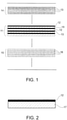
- the structure comprises a plurality of juxtaposed blocks, with a first electrically conductive block 15, a second electromagnetic absorber block 11, and a third block 14 made of electrically non-conductive material.
- the first "back-reflecting" block (indicated at 15 in FIG. 1 ), has high electrical conductivity, having an electromagnetic radiation reflection coefficient greater than -1 dB.
- the first block may, for example, be made from a thin metallic sheet or from an aeronautical carbon fiber laminate or from a structural metallic panel and is the part that gives the component the minimum desired mechanical or structural properties.
- the first back-reflecting block 15 may be formed from 1 to 24 sheets of fiber (16) that have no deposition of nanoplatelets and with a type of fiber with high electrical conductivity (e.g. CFC).
- a production process of the second block 11 "electromagnetic absorber" ( FIG. 1 ) preferably consists of the following steps.
- a plurality of dry fiber sheets is prepared, on which graphene nanoplatelets are deposited.
- the nanomaterial used is preferably composed of graphene nanoplatelets having a thickness in the range of 2 nm to 100 nm, but less than the diameter of the fabric fibers of the fiber sheets and the distance between the bundles of weft and warp fibers. Such distance is generally between 100 nm and 10 ⁇ m, so that graphene nanoplatelets may penetrate between the weft and warp fiber bundles of the reinforcement fabric for the desired thickness.
- the thickness penetrated by the graphene nanoplatelets is linked to obtaining the desired electromagnetic properties of the second block, and is between 5 and 150 ⁇ m.
- Graphene nanoplatelets may be produced with the desired dimensional geometrical properties by applying the procedure described for example in WO 2014/061048 A2 , or they may be of a commercial type.
- the sheets of reinforcing fibers may be made of glass and/or Kevlar, polyethylene or polyester fibers, in a matrix of artificial thermosetting resin, for example, epoxy resin.
- the filaments of the fiber sheets have an electrical resistance greater than 10 4 ohm ⁇ cm.
- the nanoplatelets may be dispersed in resin, preferably epoxy resin of the same type as that used for the subsequent infusion, diluted in solvent, such as acetone or MEK.
- resin preferably epoxy resin of the same type as that used for the subsequent infusion
- solvent such as acetone or MEK
- an epoxy resin with an optimized viscosity/temperature profile may be used to allow injection from 70°C (158°F) and the viscosity of which decreases as a result of injection below 20cP (centiPoise).
- the dispersion of the graphene nanoplatelets in a diluted polymeric mixture consisting of solvent and polymer is carried out in a concentration defined in such a way as to obtain the desired rheological properties of the mixture that guarantee the optimal dispersion of the graphene nanoplatelets while avoiding the formation of agglomerates.
- the polymer used is preferably epoxy resin of the same type as that used for the subsequent production process of the final component consisting of the three blocks.
- the solvent must be compatible with the resin used; in the case of epoxy resin it is, for example, acetone.
- the volume/volume concentration of the liquid/solvent polymer solution is preferably between 1% and 5% of resin relative to the total volume of solvent used in a subsequent spraying stage, wherein the polymeric mixture containing the graphene nanoplatelets is deposited on the fiber sheets.
- the dispersion of the graphene nanoplatelets in the polymeric mixture may preferably occur by sonication with pulsed cycle sonotrode.
- a tackifier-compatible resin If a tackifier-compatible resin is used, a mixing ratio of 1 to 3 by weight tackifier/solvent is preferable.
- a red dye compatible with the epoxy resin in order to improve the visibility of the sprinkling, it is possible to add to the mixture a red dye compatible with the epoxy resin in a proportion of 2 +/- 0.5 g per liter of mixture.
- the individual graphene nanoplatelets that are deposited may have a thickness between 30nm and 70nm and lateral dimensions between 5 ⁇ m and 20 ⁇ m.
- Depositions of nanoplatelets on fiber sheets may have weight values between 0.5g/m 2 and 10g/m 2 .
- the dry fiber sheets on which the graphene nanoplatelets are deposited are preferably between 150 ⁇ m and 300 ⁇ m thick.
- the filaments of the fiber sheets have an electrical resistance greater than 10 4 ohm ⁇ cm.
- the fibers may comprise, by way of non-limiting example, glass, Kevlar, polyethylene or polyester fiber.
- the deposition of the solution containing the graphene nanoplatelets may be carried out by means of an XY plotter equipped with an airbrush and operated by a servomotor. With this type of device, it is possible to adjust the speed of the plotter and the air pressure of the airbrush in order to properly calibrate the quantity of graphene sprayed (weight and/or thickness) per unit of surface of the fiber sheet, and the degree of surface coverage.
- the deposition of graphene nanoplatelets may occur evenly over the surface of the dry fiber fabric. More specifically, in some embodiments, deposited nanoplatelets may extend to form continuous layers, for example when an exclusively resistive surface layer is desired.
- the deposition of graphene nanoplatelets on the surface of dry fiber fabric takes place in accordance with predefined spraying patterns in order to obtain a selective frequency behavior, depending on the specific frequency band of the radiation subject to absorption and the expected performance of the radar-absorbing composite.
- the dry fiber sheets may be combined by stacking them and arranging them with crossed orientations [0°, +45°, 90°, -45°, 0°...].
- Other possible embodiments of the method include orientation of the fibers of the quasi-isotropic or non-isotropic type.
- the second "electromagnetic absorber" block indicated at 11 in FIG. 1 may be obtained by producing from 1 to 24 graphene depositions, indicated at 12 in FIG. 1 , with concentrations belonging to the ranges defined above, on sheets 13 of dry fiber with properties and thicknesses previously specified.
- the deposition by air spraying of the suspension may occur on one side or on both sides of the non-conductive dry fiber fabric, typically with a thickness between 150 ⁇ m and 300 ⁇ m.
- the spraying pressure, the distance of the fabric from the nozzle and the spraying cycle may be adjusted in such a way as to obtain:
- the sprayed sheets may be interspersed with one or more untreated (unsprayed) dry fiber fabrics.
- the number of untreated dry fiber fabrics to be inserted between the layers of fabric treated with graphene nanoplatelets is directly linked to the frequency band within which radar-absorbing performance is required and is inversely proportional to the value of the central frequency of the absorption band of interest.
- the third block 14 is made of a layer of non-dispersive material of appropriate thickness, determined in such a way as to widen the electromagnetic absorption band according to the design specifications by minimizing the reflection coefficient of the entire component.
- the three types of blocks made may be suitably combined according to the generalized lay-up diagram shown in figure 1 .
- the number of high conductivity fiber sheets e.g. CFC
- the desired number of low-conductivity, radar-absorbing fiber sheets may be laid with graphene depositions of the appropriate weight
- the desired number of low-conductivity fiber sheets may be laid without graphene depositions.
- a vacuum bag may be applied according to standard Liquid Resin Infusion methods and methods for the infusion of the resin ( FIG. 3 ) using technologies that are known per se.
- the standard injection/suction pressure values of the pump used in the process are preferably, by way of non-limiting example, between 0.3 bar and 0.9 bar, for infusion temperature values between 80° and 120°C.
- Figure 4 shows schematically in cross-section the penetration of the post-infusion graphene on a single sheet of dry glass fiber with a thickness of 250 ⁇ m.
- the surface layer of glass fiber impregnated with graphene is about 75 ⁇ m thick, and the underlying layer of glass fiber impregnated with only epoxy resin is about 175 ⁇ m thick.
- the process initially provides for the preparation of a layer of dry fiber, for example glass fiber (indicated at 17 in Figure 2 ) with a thickness of 250 ⁇ m.
- a surface layer (12) of the solution containing graphene nanoplatelets may then be deposited on the glass fiber layer (17).
- Depositions may be continuous or discrete, depending on the performance required from the material. This results in a dry preform. The procedure is repeated N times until the desired lay-up is obtained, of which a generalized version is shown in Figure 1 , preliminarily defined and optimized by means of an electromagnetic calculation code that defines the performance and thicknesses of the individual blocks making up the radar-absorbing composite.
- the dry preform is covered with a vacuum bag, which is sealed around the perimeter of the preform.
- the air is evacuated from the preform, and then the resin is introduced.
- the resin is forced to penetrate the preform because of the pressure difference between the atmospheric pressure acting on the resin and the vacuum level in the preform. Finally, a heat and pressure polymerization cycle is applied, which causes the resin to solidify.
- a component made of composite material having, for each fiber sheet constituting the elementary radar-absorbing block, a surface layer of between 50 and 150 ⁇ m of glass fiber impregnated with resin and graphene.
- the underlying layer is made of resin-impregnated glass fiber, undoped, i.e. without graphene.
- the depositions of the nanoplatelets, where provided are made directly on the low electrical conductivity fiber sheets already pre-impregnated.
- the graphene nanoparticles remain confined in the resin matrix within the thickness between two sheets of adjacent prepregs, with a limited integration of the graphene with the fibers relative to the first embodiment, as shown schematically in Figure 7 .
- the prepreg sheets are made downstream of the dispersion of the solution containing the nanoparticles on the dry fiber with the same specifications and methods described, ensuring the same range of depth of penetration into the fibers as detailed above.
- a "Jaumann Absorber” is essentially made with an impedance adapter wherein conductive layers (due to the penetration and uniform integration of graphene in the fiber and resin) and non-conductive layers (impregnated glass fiber) alternate.
- the proposed design is different from the standard version of the "Jaumann Absorber” known in the literature, through the insertion, according to an aspect of the present invention, of a suitably designed impedance adapter formed by a succession of layers of non-conductive and undoped fiber, and by the fact that the layers that make up the structure have sub-resonant thicknesses, thus creating a monodimensional metamaterial.
- Application example 1 Obtaining a radar-absorbing composite by means of "Liquid Resin Infusion"
- the specifications of a possible composite material are detailed, usable for the manufacture of an aircraft component, with inclusions of graphene nanoplatelets having an overall thickness of 5mm and which guarantees, relative to an equivalent thereof without nanoparticle insertions, a reflection coefficient of less than - 15dB in the frequency band between 8 and 14 GHz.
- the epoxy resin infusion method provided for in the Liquid Resin Infusion process was used and modified appropriately as described above.
- the electromagnetic attenuation of the product panel is measured by the Applicant according to the "NRL arch” setup.
- the attenuation performance obtained is shown in Figure 8 .
- the insertion of nanoplatelets does not involve an appreciable increase in production costs of the component and is easy to implement/integrate into the industrial processes currently used.
- the result is a component made of multifunctional composite with a negligible weight gain, having substantially the same mechanical properties as a corresponding graphene-free component.
- the present invention allows a remarkable flexibility of application to be achieved, concentrating the graphene nanoplatelets in the areas of the component where the effect of radar absorbency is effectively more necessary.
- the method further allows the dosage of graphene nanoplatelets to vary from area to area, depending on the electromagnetic design in order to obtain a component having predetermined features of low observability. For example, concentrations or percentages of decreasing weight may be applied with the depth, i.e. progressively less towards the inside of the component. There is the possibility of adjusting the thickness of the graphene layer, for example between 50 and 150 ⁇ m, between two consecutive layers of fibers.
- the doping material is applied on several layers of dry fibers of the reinforcement material through the use of an automatic spraying system made with an XY plotter and an airbrush driven by a servomotor.
- an automatic spraying system made with an XY plotter and an airbrush driven by a servomotor.
- the main advantage of the first embodiment based on the liquid resin infusion process is related to the possibility of doping the "dry" reinforcement fibers appropriately before the subsequent resin infusion. This allows a lay-up to be formed with a succession of reinforcement fibers with different doping weights, i.e. with a differentiated concentration of graphene in the thickness, allowing the optimization of the electromagnetic absorbency property of the final component.
- thermosetting synthetic resin that serves as a matrix
- the graphene nanoplatelets may be applied to individual prepreg sheets prior to the lamination thereof.
- the laminated and prepreg sheets may then be coated with a vacuum bag to remove the air, and then introduced into an autoclave, applying heat and pressure so as to cause the polymerization of the thermosetting resin matrix and give the laminated layers the desired shape.
- multilayer laminated composites with polymeric matrix according to the present invention acquire improved radar-absorbing properties but at the same time have mechanical or structural properties that are unchanged or improved compared to similar components made with known manufacturing processes.
- the present process allows aircraft components with very complex geometric shapes to be made, such as the leading edge and curved panels of the fuselage or nacelles, or panels of wingboxes and tail empennages.
Landscapes
- Chemical & Material Sciences (AREA)
- Engineering & Computer Science (AREA)
- Materials Engineering (AREA)
- Organic Chemistry (AREA)
- Health & Medical Sciences (AREA)
- Chemical Kinetics & Catalysis (AREA)
- Medicinal Chemistry (AREA)
- Polymers & Plastics (AREA)
- Manufacturing & Machinery (AREA)
- Composite Materials (AREA)
- Mechanical Engineering (AREA)
- Inorganic Chemistry (AREA)
- Nanotechnology (AREA)
- Laminated Bodies (AREA)
- Reinforced Plastic Materials (AREA)
- Compositions Of Macromolecular Compounds (AREA)
- Carbon And Carbon Compounds (AREA)
Claims (16)
- Radarabsorbierendes Mehrlagenlaminat, das geeignet ist zur Verwendung auf einem Luftfahrzeug, hergestellt aus Verbundmaterial mit einer Polymermatrix, die Graphen-Nanoplättchen enthält, wobei das Laminat mehrere aneinandergereihte Blöcke aufweist, mit- einem ersten elektrisch leitenden Block (15), der bei einer Verwendung in Richtung des Inneren des Luftfahrzeugs zu platzieren ist, mit einem Reflexionskoeffizienten für elektromagnetische Strahlung, der größer als -1 dB ist;- einem zweiten elektromagnetisch absorbierenden Zwischenblock (11) mit einem Stapel aus elektrisch nicht leitenden Faserschichten (13), wobei jede Faserschicht mindestens teilweise mit auf Graphen basierenden Nanoplättchen (12) durchdrungen ist, so dass eine periodische und elektromagnetisch unterresonante Lage erhalten wird, bei der sich leitende Lagen, die Graphen-Nanoplättchen enthalten, mit nicht leitenden Lagen abwechseln;- einem dritten Block (14) aus elektrisch nicht leitendem Material, der bei einer Verwendung in Richtung des Äußeren des Luftfahrzeugs anzuordnen ist und einen Teil der Außenfläche des Luftfahrzeugs bildet;bei dem der zweite Block (11) erhaltbar ist durch einen Prozess, der folgende Schritte aufweist:a) Bereitstellen von Graphen-Nanoplättchen mit einer Dicke zwischen 2 nm und 100 nm und lateralen Abmessungen zwischen 100 nm und 10 µm;b) Dispersion von Graphen-Nanoplättchen in einem verdünnten Polymergemisch, das aus einem Lösemittel und einem Polymer besteht, so dass eine Suspension von Graphen-Nanoplättchen in einem Polymergemisch erhalten wird;c) Abscheiden, durch Luftsprühen der Suspension auf eine oder beide gegenüberliegende Seiten der nicht leitenden trockenen Faserschichten, mit kontrolliertem Eindringen der Nanoplättchen in die jeweiligen Faserschichten;d) Ausbilden des zweiten Blocks (11) durch Überlappen mehrerer trockener Faserschichten, die mit der Suspension von Graphen-Nanoplättchen besprüht sind;und bei dem der Schritt zum Ausbilden des zweiten Blocks gefolgt wird von folgenden Schritten:e) Ausführung eines Verstärkungsmaterials mit dem ersten, dem zweiten und dem dritten Block;f) Infusion von nicht polymerisiertem Thermokunstharz in das so erhaltene Verstärkungsmaterial;g) Aufbringen von Wärme und, wenn notwendig, Druck, so dass die Polymerisierung des Thermoharzes und die homogene und gleichmäßige Verteilung der Nanoplättchen innerhalb eines Dickenabschnitts der Faserschichten mit dem zweiten Zwischenblock bewirkt werden.
- Mehrlagenlaminat nach Anspruch 1, bei dem während des Schritts zum Ausbilden des zweiten Blocks zwischen den Schichten aus trockenen Fasern, die mit der Suspension von Graphen-Nanoplättchen besprüht sind, eine oder mehrere Zwischenschichten aus elektrisch nicht leitenden trockenen Fasern, die nicht mit der Suspension besprüht sind, angeordnet werden.
- Mehrlangenlaminat nach Anspruch 1 oder 2, bei dem die Graphen-Nanoplättchen auf den Faserschichten gemäß Werten zwischen 0,5 g/m2 und 10 g/m2 pro Quadratmeter der Faserschicht verteilt sind.
- Mehrlagenlaminat nach einem der vorhergehenden Ansprüche, bei dem die Graphen-Nanoplättchen auf kontrollierte und gleichmäßige Weise zwischen die Fasern jeder Faserschicht eindringen, für eine Eindringdicke zwischen 5 und 150 µm, die die Hälfte der Dicke der trockenen Faserschicht nicht überschreitet.
- Mehrlagenlaminat nach einem der vorhergehenden Ansprüche, bei dem die Faserschichten jeweils eine Dicke zwischen 150 µm und 300 µm aufweisen.
- Mehrlagenlaminat nach einem der vorhergehenden Ansprüche, bei dem während des Aufsprühens die Suspension des Harz/Graphen-Nanoplättchenverbunds eine Beschichtung mit einer Dicke zwischen 10 und 200 µm auf der Oberfläche der Faserschicht ausbildet.
- Mehrlagenlaminat nach einem der vorhergehenden Ansprüche, bei dem die Filamente aus nicht leitenden trockenen Faserschichten einen elektrischen Widerstand aufweisen, der größer als 104 Ohm∗cm ist.
- Mehrlagenlaminat nach einem der vorhergehenden Ansprüche, bei dem die trockenen Faserschichten aus der Gruppe ausgewählt sind, die besteht aus: Glasfasern, Kevlarfasern, Polyesterfasern, Polyethylenfasern.
- Mehrlagenlaminat nach Anspruch 1 oder 2, bei dem das Volumen/die Volumenkonzentration der flüssigen/gelösten Polymerlösung zwischen 1% und 5% beträgt.
- Mehrlagenlaminat nach einem der vorhergehenden Ansprüche, bei dem die Dispersion der Graphen-Nanoplättchen in dem Polymergemisch durch Beschallung mit einer Pulszyklussonotrode auftritt.
- Mehrlagenlaminat nach einem der vorhergehenden Ansprüche, bei dem auf mindestens einer der Faserschichten die Graphen-Nanoplättchen innerhalb eines Teils der Dicke der Schicht gleichmäßig verteilt sind.
- Mehrlagenlaminat nach einem der vorhergehenden Ansprüche, bei dem auf mindestens einer selben Schicht von mindestens einer der mehreren Faserschichten die Graphen-Nanoplättchen gemäß einem vorbestimmten Muster oder Gradienten ungleichmäßig verteilt sind.
- Mehrschichtlaminat nach einem der vorhergehenden Ansprüche, bei dem das in dem Gemisch verwendete Polymer ein Kunstharz desselben Typs ist, der für den anschließenden Produktionsprozess der endgültigen Komponente, die aus den drei Blöcken besteht, verwendet wird.
- Mehrlagenlaminat nach einem der vorhergehenden Ansprüche, bei dem Graphen-Nanoplättchen mit höheren Konzentrationen auf die Faserschichten aufgebracht werden, die näher an einer Außenfläche der Komponente sein sollen, als auf die Faserschichten, die sich weiter entfernt von der Außenfläche befinden.
- Mehrlagenlaminat nach einem der vorherigen Ansprüche, bei dem der erste Block (15) aus einem der Folgenden besteht:
mindestens ein Metallblech; ein Kohlefaserlaminat; mindestens ein Strukturmetallpanel. - Mehrlagenlaminat nach einem der vorhergehenden Ansprüche, bei dem der dritte Block (14) ein nicht leitendes Faserverbundlaminat (13) aufweist, das kein Graphen enthält.
Applications Claiming Priority (2)
| Application Number | Priority Date | Filing Date | Title |
|---|---|---|---|
| IT102018000003182A IT201800003182A1 (it) | 2018-03-01 | 2018-03-01 | Procedimenti per la fabbricazione di componenti strutturali radar-assorbenti per velivoli in materiale composito con inserzione di nanoplacchette di grafene. |
| PCT/IB2019/051656 WO2019167009A1 (en) | 2018-03-01 | 2019-03-01 | Multilayer radar-absorbing laminate for aircraft made of polymer matrix composite material with graphene nanoplatelets, and method of manufacturing same |
Publications (2)
| Publication Number | Publication Date |
|---|---|
| EP3759155A1 EP3759155A1 (de) | 2021-01-06 |
| EP3759155B1 true EP3759155B1 (de) | 2022-03-16 |
Family
ID=62386696
Family Applications (1)
| Application Number | Title | Priority Date | Filing Date |
|---|---|---|---|
| EP19714480.1A Active EP3759155B1 (de) | 2018-03-01 | 2019-03-01 | Aus polymermatrixverbundmaterial mit graphennanoplättchen hergestelltes, mehrschichtiges radarabsorbierendes laminat für flugzeug und verfahren zur herstellung davon |
Country Status (7)
| Country | Link |
|---|---|
| US (1) | US11597192B2 (de) |
| EP (1) | EP3759155B1 (de) |
| CN (1) | CN111801371B (de) |
| ES (1) | ES2916073T3 (de) |
| IT (1) | IT201800003182A1 (de) |
| RU (1) | RU2020131973A (de) |
| WO (1) | WO2019167009A1 (de) |
Cited By (1)
| Publication number | Priority date | Publication date | Assignee | Title |
|---|---|---|---|---|
| EP3609951A1 (de) * | 2017-05-09 | 2020-02-19 | Applied Graphene Materials UK Limited | Verbundformmaterialien |
Families Citing this family (20)
| Publication number | Priority date | Publication date | Assignee | Title |
|---|---|---|---|---|
| JP2020150221A (ja) * | 2019-03-15 | 2020-09-17 | 日東電工株式会社 | 電波吸収体及び電波吸収体用キット |
| CN110927843B (zh) * | 2019-12-23 | 2021-11-26 | 中国人民解放军国防科技大学 | 基于石墨烯光子晶体结构的可调完美吸波体 |
| CN111171352B (zh) * | 2020-02-18 | 2022-11-08 | 佛山市盛创志远新材料有限公司 | 碳纳米管/石墨烯/聚偏氟乙烯多孔复合薄膜的制备方法 |
| CN111590916A (zh) * | 2020-04-24 | 2020-08-28 | 哈尔滨新科锐复合材料制造有限公司 | 警用碳纤维复合材料声波发生器内壳体 |
| CN112265292B (zh) * | 2020-08-21 | 2022-01-25 | 成都飞机工业(集团)有限责任公司 | 一种石墨烯吸波复合材料蒙皮成型方法 |
| DE102020005695B4 (de) | 2020-09-17 | 2025-12-04 | Bundesrepublik Deutschland, vertr. durch das Bundesministerium der Verteidigung, vertr. durch das Bundesamt für Ausrüstung, Informationstechnik und Nutzung der Bundeswehr | Radarabsorbierendes Verbundbauteil |
| JP7854778B2 (ja) * | 2020-09-29 | 2026-05-07 | 東レ株式会社 | レーダーユニット用積層シート |
| CN112292014B (zh) * | 2020-10-19 | 2022-07-12 | 哈尔滨工业大学 | 基于相变材料和石墨烯的微波透射通带可调高透光光窗 |
| DE102020214936A1 (de) | 2020-11-27 | 2022-06-02 | Ford Global Technologies, Llc | Faserverbundwerkstofflaminat und Verfahren zu dessen Herstellung |
| CN112723356B (zh) * | 2020-12-31 | 2022-08-12 | 哈尔滨工业大学(威海) | 一种层级结构SiOC透波材料、制备方法及其应用 |
| US12603440B2 (en) * | 2021-05-04 | 2026-04-14 | Tusas—Turk Havacilik Ve Uzay Sanayii Anonim Sirketi | Radar absorbing structure |
| CN114024883B (zh) * | 2021-11-05 | 2023-11-17 | 江西洪都航空工业集团有限责任公司 | 一种数据链多产品开环并行测试的方法、装置及系统 |
| CN114083845B (zh) * | 2021-11-18 | 2023-01-13 | 北京机电工程研究所 | 一种宽频隐身进气道及其制备方法 |
| CN114059682B (zh) * | 2021-11-19 | 2023-04-21 | 西南石油大学 | 一种水泥基泡沫吸波材料、吸波板及其制备方法 |
| CN114646923A (zh) * | 2022-01-04 | 2022-06-21 | 威海光威复合材料股份有限公司 | 一种内部外部结构导通的雷达部件 |
| CN114506131B (zh) * | 2022-03-10 | 2023-04-07 | 北京航空航天大学 | 一种三维石墨烯功能复合层压材料及其制备方法和应用 |
| WO2023244575A1 (en) * | 2022-06-14 | 2023-12-21 | University of Central Oklahoma | Metamaterial laminate based on polymer nanofibers and metallic nanofibers and metallic nanoparticles for sensor applications |
| CN115842249B (zh) * | 2022-11-29 | 2026-04-03 | 航天科工武汉磁电有限责任公司 | 基于多层电阻膜的宽带吸波结构及制备方法 |
| CN116968394B (zh) * | 2023-07-06 | 2025-09-16 | 山东国烯新材料创新中心有限公司 | 一种多层梯度吸波材料的制备方法 |
| CN119502535B (zh) * | 2024-12-10 | 2025-07-29 | 成都鲁晨新材料科技有限公司 | 一种高碳系吸波剂含量的吸波预浸料及其制备方法 |
Family Cites Families (15)
| Publication number | Priority date | Publication date | Assignee | Title |
|---|---|---|---|---|
| US7208115B2 (en) * | 2003-03-31 | 2007-04-24 | Lockheed Martin Corporation | Method of fabricating a polymer matrix composite electromagnetic shielding structure |
| US8574677B2 (en) * | 2010-05-12 | 2013-11-05 | James L. Lee | Layer-by-layer fabrication method of sprayed nanopaper |
| KR20130010285A (ko) * | 2011-07-18 | 2013-01-28 | 정호순 | 탄소나노소재가 코팅된 전자파차폐용 복합재 및 그 제조방법 |
| US9358756B2 (en) * | 2011-08-04 | 2016-06-07 | Henry Sodano | Interlaminer reinforced composite structures |
| US8772729B1 (en) * | 2011-09-23 | 2014-07-08 | Rockwell Collins, Inc. | APDs using nano-plasmonic metamaterials |
| CN103317734B (zh) * | 2012-03-20 | 2015-07-01 | 沈阳航空航天大学 | 一种基于碳纳米薄膜的雷达吸波复合材料制备方法 |
| ITRM20120495A1 (it) | 2012-10-16 | 2014-04-17 | Univ Roma | "nanocompositi polimerici a base di gnp per la riduzione di interferenze elettromagnetiche" |
| CN103724930A (zh) * | 2013-05-28 | 2014-04-16 | 太仓派欧技术咨询服务有限公司 | 一种含镍涂层碳纤维复合材料及其制备方法 |
| GB201322093D0 (en) * | 2013-12-13 | 2014-01-29 | Cytec Ind Inc | Compositive materials with electrically conductive and delamination resistant properties |
| US20160221275A1 (en) * | 2015-01-29 | 2016-08-04 | Rohr, Inc. | Method of manufacturing a polyimide film |
| US11362431B1 (en) * | 2015-06-16 | 2022-06-14 | Oceanit Laboratories, Inc. | Optically transparent radar absorbing material (RAM) |
| CN105040163B (zh) * | 2015-08-19 | 2017-08-08 | 四川大学 | 以胶原纤维为模板制备雷达波吸收材料的方法 |
| US10093041B2 (en) * | 2016-04-11 | 2018-10-09 | The Boeing Company | Conductive pre-impregnated composite sheet and method for making the same |
| CN106207486A (zh) * | 2016-07-13 | 2016-12-07 | 李寅辉 | 一种石墨烯打印吸波材料及其制备方法 |
| CN107189354B (zh) * | 2017-07-07 | 2019-08-16 | 齐鲁工业大学 | 一种石墨烯纳米片增强碳纤维复合材料的制备方法 |
-
2018
- 2018-03-01 IT IT102018000003182A patent/IT201800003182A1/it unknown
-
2019
- 2019-03-01 US US16/976,988 patent/US11597192B2/en active Active
- 2019-03-01 EP EP19714480.1A patent/EP3759155B1/de active Active
- 2019-03-01 WO PCT/IB2019/051656 patent/WO2019167009A1/en not_active Ceased
- 2019-03-01 ES ES19714480T patent/ES2916073T3/es active Active
- 2019-03-01 RU RU2020131973A patent/RU2020131973A/ru unknown
- 2019-03-01 CN CN201980015700.9A patent/CN111801371B/zh not_active Expired - Fee Related
Cited By (1)
| Publication number | Priority date | Publication date | Assignee | Title |
|---|---|---|---|---|
| EP3609951A1 (de) * | 2017-05-09 | 2020-02-19 | Applied Graphene Materials UK Limited | Verbundformmaterialien |
Also Published As
| Publication number | Publication date |
|---|---|
| RU2020131973A (ru) | 2022-04-01 |
| EP3759155A1 (de) | 2021-01-06 |
| US20210001610A1 (en) | 2021-01-07 |
| US11597192B2 (en) | 2023-03-07 |
| IT201800003182A1 (it) | 2019-09-01 |
| CN111801371A (zh) | 2020-10-20 |
| ES2916073T3 (es) | 2022-06-28 |
| CN111801371B (zh) | 2022-12-16 |
| WO2019167009A1 (en) | 2019-09-06 |
Similar Documents
| Publication | Publication Date | Title |
|---|---|---|
| US11597192B2 (en) | Multilayer radar-absorbing laminate for aircraft made of polymer matrix composite material with graphene nanoplatelets, and method of manufacturing same | |
| US10639826B2 (en) | Conductive pre-impregnated composite sheet and method for making the same | |
| Wang et al. | Radar stealth and mechanical properties of a broadband radar absorbing structure | |
| Lee et al. | Broadband all fiber-reinforced composite radar absorbing structure integrated by inductive frequency selective carbon fiber fabric and carbon-nanotube-loaded glass fabrics | |
| Jin et al. | Multi-slab hybrid radar absorbing structure containing short carbon fiber layer with controllable permittivity | |
| Zhou et al. | Effect of lay-up configuration on the microwave absorption properties of carbon fiber reinforced polymer composite materials | |
| Nam et al. | Thin and lightweight radar-absorbing structure containing glass fabric coated with silver by sputtering | |
| US20170158511A1 (en) | Carbon Nanomaterial Composite Sheet and Method for Making the Same | |
| Kim et al. | Salisbury screen absorbers of dielectric lossy sheets of carbon nanocomposite laminates | |
| Choi et al. | Radar-absorbing foam-based sandwich composite with electroless nickel-plated glass fabric | |
| Choi et al. | Radar-absorbing nickel-coated fabric composite for wing-shaped structure in the X-band | |
| CN106967276A (zh) | 纳米吸收剂‑碳化硅纤维多尺度增强体增强树脂基结构吸波材料及其制备方法 | |
| KR20150090695A (ko) | 단일 복합재료를 이용한 가변 전자기 특성을 갖는 맞춤형 전자파 흡수체의 제조방법과 그에 따른 전자파 흡수체 | |
| US11495889B2 (en) | Method of controlling dielectric constant of composite material by micro pattern printing | |
| KR101772088B1 (ko) | 전자기 손실재료의 코팅 및 다층화를 통한 전자기 소재특성 구현 방법 | |
| Hyun et al. | Electromagnetic characteristics of 3D-printed composites by free-space measurement | |
| CN118825634A (zh) | 超宽频吸波蜂窝夹层结构及其制备方法 | |
| Jang et al. | Semi-cylindrical radar absorbing structures using fiber-reinforced composites and conducting polymers in the X-band | |
| US20180139873A1 (en) | Electromagnetic Wave Absorbing Structures Including Metal-Coated Fabric Layer And Methods Of Manufacturing The Same | |
| KR102427938B1 (ko) | 레이더 흡수 복합재료 구조체 및 그 제조 방법 | |
| JP2020063334A (ja) | 炭素繊維プリプレグの製造方法、炭素繊維強化樹脂成形品の製造方法、及び、炭素繊維強化樹脂成形品 | |
| US10759140B1 (en) | Composite damage tolerance and through thickness conductivity by interleaving carbon fiber veil nanocomposites | |
| Pa | Additive manufacturing of electromagnetic multifunctional composites | |
| CN121159909A (zh) | 宽温域承载-屏蔽-雷击防护一体化复合材料、制法和应用 | |
| CN120840169A (zh) | 三维中空碳纤维复合材料及其制备方法 |
Legal Events
| Date | Code | Title | Description |
|---|---|---|---|
| STAA | Information on the status of an ep patent application or granted ep patent |
Free format text: STATUS: UNKNOWN |
|
| STAA | Information on the status of an ep patent application or granted ep patent |
Free format text: STATUS: THE INTERNATIONAL PUBLICATION HAS BEEN MADE |
|
| PUAI | Public reference made under article 153(3) epc to a published international application that has entered the european phase |
Free format text: ORIGINAL CODE: 0009012 |
|
| STAA | Information on the status of an ep patent application or granted ep patent |
Free format text: STATUS: REQUEST FOR EXAMINATION WAS MADE |
|
| 17P | Request for examination filed |
Effective date: 20200923 |
|
| AK | Designated contracting states |
Kind code of ref document: A1 Designated state(s): AL AT BE BG CH CY CZ DE DK EE ES FI FR GB GR HR HU IE IS IT LI LT LU LV MC MK MT NL NO PL PT RO RS SE SI SK SM TR |
|
| AX | Request for extension of the european patent |
Extension state: BA ME |
|
| DAV | Request for validation of the european patent (deleted) | ||
| DAX | Request for extension of the european patent (deleted) | ||
| RIC1 | Information provided on ipc code assigned before grant |
Ipc: H01Q 17/00 20060101ALI20210811BHEP Ipc: B29C 70/44 20060101ALI20210811BHEP Ipc: B29C 70/02 20060101ALI20210811BHEP Ipc: B29C 70/88 20060101ALI20210811BHEP Ipc: C08J 5/24 20060101ALI20210811BHEP Ipc: C08J 5/08 20060101ALI20210811BHEP Ipc: C08J 5/06 20060101ALI20210811BHEP Ipc: C08J 5/04 20060101AFI20210811BHEP |
|
| GRAP | Despatch of communication of intention to grant a patent |
Free format text: ORIGINAL CODE: EPIDOSNIGR1 |
|
| STAA | Information on the status of an ep patent application or granted ep patent |
Free format text: STATUS: GRANT OF PATENT IS INTENDED |
|
| INTG | Intention to grant announced |
Effective date: 20211006 |
|
| GRAS | Grant fee paid |
Free format text: ORIGINAL CODE: EPIDOSNIGR3 |
|
| GRAA | (expected) grant |
Free format text: ORIGINAL CODE: 0009210 |
|
| STAA | Information on the status of an ep patent application or granted ep patent |
Free format text: STATUS: THE PATENT HAS BEEN GRANTED |
|
| AK | Designated contracting states |
Kind code of ref document: B1 Designated state(s): AL AT BE BG CH CY CZ DE DK EE ES FI FR GB GR HR HU IE IS IT LI LT LU LV MC MK MT NL NO PL PT RO RS SE SI SK SM TR |
|
| REG | Reference to a national code |
Ref country code: GB Ref legal event code: FG4D |
|
| REG | Reference to a national code |
Ref country code: CH Ref legal event code: EP Ref country code: DE Ref legal event code: R096 Ref document number: 602019012613 Country of ref document: DE |
|
| REG | Reference to a national code |
Ref country code: IE Ref legal event code: FG4D |
|
| REG | Reference to a national code |
Ref country code: AT Ref legal event code: REF Ref document number: 1475844 Country of ref document: AT Kind code of ref document: T Effective date: 20220415 |
|
| REG | Reference to a national code |
Ref country code: SE Ref legal event code: TRGR |
|
| REG | Reference to a national code |
Ref country code: ES Ref legal event code: FG2A Ref document number: 2916073 Country of ref document: ES Kind code of ref document: T3 Effective date: 20220628 |
|
| REG | Reference to a national code |
Ref country code: LT Ref legal event code: MG9D |
|
| REG | Reference to a national code |
Ref country code: NL Ref legal event code: MP Effective date: 20220316 |
|
| PG25 | Lapsed in a contracting state [announced via postgrant information from national office to epo] |
Ref country code: RS Free format text: LAPSE BECAUSE OF FAILURE TO SUBMIT A TRANSLATION OF THE DESCRIPTION OR TO PAY THE FEE WITHIN THE PRESCRIBED TIME-LIMIT Effective date: 20220316 Ref country code: NO Free format text: LAPSE BECAUSE OF FAILURE TO SUBMIT A TRANSLATION OF THE DESCRIPTION OR TO PAY THE FEE WITHIN THE PRESCRIBED TIME-LIMIT Effective date: 20220616 Ref country code: LT Free format text: LAPSE BECAUSE OF FAILURE TO SUBMIT A TRANSLATION OF THE DESCRIPTION OR TO PAY THE FEE WITHIN THE PRESCRIBED TIME-LIMIT Effective date: 20220316 Ref country code: HR Free format text: LAPSE BECAUSE OF FAILURE TO SUBMIT A TRANSLATION OF THE DESCRIPTION OR TO PAY THE FEE WITHIN THE PRESCRIBED TIME-LIMIT Effective date: 20220316 Ref country code: BG Free format text: LAPSE BECAUSE OF FAILURE TO SUBMIT A TRANSLATION OF THE DESCRIPTION OR TO PAY THE FEE WITHIN THE PRESCRIBED TIME-LIMIT Effective date: 20220616 |
|
| REG | Reference to a national code |
Ref country code: AT Ref legal event code: MK05 Ref document number: 1475844 Country of ref document: AT Kind code of ref document: T Effective date: 20220316 |
|
| PG25 | Lapsed in a contracting state [announced via postgrant information from national office to epo] |
Ref country code: LV Free format text: LAPSE BECAUSE OF FAILURE TO SUBMIT A TRANSLATION OF THE DESCRIPTION OR TO PAY THE FEE WITHIN THE PRESCRIBED TIME-LIMIT Effective date: 20220316 Ref country code: GR Free format text: LAPSE BECAUSE OF FAILURE TO SUBMIT A TRANSLATION OF THE DESCRIPTION OR TO PAY THE FEE WITHIN THE PRESCRIBED TIME-LIMIT Effective date: 20220617 Ref country code: FI Free format text: LAPSE BECAUSE OF FAILURE TO SUBMIT A TRANSLATION OF THE DESCRIPTION OR TO PAY THE FEE WITHIN THE PRESCRIBED TIME-LIMIT Effective date: 20220316 |
|
| PG25 | Lapsed in a contracting state [announced via postgrant information from national office to epo] |
Ref country code: NL Free format text: LAPSE BECAUSE OF FAILURE TO SUBMIT A TRANSLATION OF THE DESCRIPTION OR TO PAY THE FEE WITHIN THE PRESCRIBED TIME-LIMIT Effective date: 20220316 |
|
| PG25 | Lapsed in a contracting state [announced via postgrant information from national office to epo] |
Ref country code: SM Free format text: LAPSE BECAUSE OF FAILURE TO SUBMIT A TRANSLATION OF THE DESCRIPTION OR TO PAY THE FEE WITHIN THE PRESCRIBED TIME-LIMIT Effective date: 20220316 Ref country code: SK Free format text: LAPSE BECAUSE OF FAILURE TO SUBMIT A TRANSLATION OF THE DESCRIPTION OR TO PAY THE FEE WITHIN THE PRESCRIBED TIME-LIMIT Effective date: 20220316 Ref country code: RO Free format text: LAPSE BECAUSE OF FAILURE TO SUBMIT A TRANSLATION OF THE DESCRIPTION OR TO PAY THE FEE WITHIN THE PRESCRIBED TIME-LIMIT Effective date: 20220316 Ref country code: PT Free format text: LAPSE BECAUSE OF FAILURE TO SUBMIT A TRANSLATION OF THE DESCRIPTION OR TO PAY THE FEE WITHIN THE PRESCRIBED TIME-LIMIT Effective date: 20220718 Ref country code: EE Free format text: LAPSE BECAUSE OF FAILURE TO SUBMIT A TRANSLATION OF THE DESCRIPTION OR TO PAY THE FEE WITHIN THE PRESCRIBED TIME-LIMIT Effective date: 20220316 Ref country code: CZ Free format text: LAPSE BECAUSE OF FAILURE TO SUBMIT A TRANSLATION OF THE DESCRIPTION OR TO PAY THE FEE WITHIN THE PRESCRIBED TIME-LIMIT Effective date: 20220316 Ref country code: AT Free format text: LAPSE BECAUSE OF FAILURE TO SUBMIT A TRANSLATION OF THE DESCRIPTION OR TO PAY THE FEE WITHIN THE PRESCRIBED TIME-LIMIT Effective date: 20220316 |
|
| PG25 | Lapsed in a contracting state [announced via postgrant information from national office to epo] |
Ref country code: PL Free format text: LAPSE BECAUSE OF FAILURE TO SUBMIT A TRANSLATION OF THE DESCRIPTION OR TO PAY THE FEE WITHIN THE PRESCRIBED TIME-LIMIT Effective date: 20220316 Ref country code: IS Free format text: LAPSE BECAUSE OF FAILURE TO SUBMIT A TRANSLATION OF THE DESCRIPTION OR TO PAY THE FEE WITHIN THE PRESCRIBED TIME-LIMIT Effective date: 20220716 Ref country code: AL Free format text: LAPSE BECAUSE OF FAILURE TO SUBMIT A TRANSLATION OF THE DESCRIPTION OR TO PAY THE FEE WITHIN THE PRESCRIBED TIME-LIMIT Effective date: 20220316 |
|
| REG | Reference to a national code |
Ref country code: DE Ref legal event code: R097 Ref document number: 602019012613 Country of ref document: DE |
|
| PLBE | No opposition filed within time limit |
Free format text: ORIGINAL CODE: 0009261 |
|
| STAA | Information on the status of an ep patent application or granted ep patent |
Free format text: STATUS: NO OPPOSITION FILED WITHIN TIME LIMIT |
|
| PG25 | Lapsed in a contracting state [announced via postgrant information from national office to epo] |
Ref country code: DK Free format text: LAPSE BECAUSE OF FAILURE TO SUBMIT A TRANSLATION OF THE DESCRIPTION OR TO PAY THE FEE WITHIN THE PRESCRIBED TIME-LIMIT Effective date: 20220316 |
|
| 26N | No opposition filed |
Effective date: 20221219 |
|
| PG25 | Lapsed in a contracting state [announced via postgrant information from national office to epo] |
Ref country code: SI Free format text: LAPSE BECAUSE OF FAILURE TO SUBMIT A TRANSLATION OF THE DESCRIPTION OR TO PAY THE FEE WITHIN THE PRESCRIBED TIME-LIMIT Effective date: 20220316 |
|
| REG | Reference to a national code |
Ref country code: DE Ref legal event code: R082 Ref document number: 602019012613 Country of ref document: DE Representative=s name: ALPSPITZ IP ALLGAYER UND PARTNER PATENTANWAELT, DE |
|
| PG25 | Lapsed in a contracting state [announced via postgrant information from national office to epo] |
Ref country code: MC Free format text: LAPSE BECAUSE OF FAILURE TO SUBMIT A TRANSLATION OF THE DESCRIPTION OR TO PAY THE FEE WITHIN THE PRESCRIBED TIME-LIMIT Effective date: 20220316 |
|
| REG | Reference to a national code |
Ref country code: CH Ref legal event code: PL |
|
| REG | Reference to a national code |
Ref country code: BE Ref legal event code: MM Effective date: 20230331 |
|
| PG25 | Lapsed in a contracting state [announced via postgrant information from national office to epo] |
Ref country code: LU Free format text: LAPSE BECAUSE OF NON-PAYMENT OF DUE FEES Effective date: 20230301 |
|
| REG | Reference to a national code |
Ref country code: IE Ref legal event code: MM4A |
|
| PG25 | Lapsed in a contracting state [announced via postgrant information from national office to epo] |
Ref country code: LI Free format text: LAPSE BECAUSE OF NON-PAYMENT OF DUE FEES Effective date: 20230331 Ref country code: IE Free format text: LAPSE BECAUSE OF NON-PAYMENT OF DUE FEES Effective date: 20230301 Ref country code: CH Free format text: LAPSE BECAUSE OF NON-PAYMENT OF DUE FEES Effective date: 20230331 |
|
| PG25 | Lapsed in a contracting state [announced via postgrant information from national office to epo] |
Ref country code: BE Free format text: LAPSE BECAUSE OF NON-PAYMENT OF DUE FEES Effective date: 20230331 |
|
| PGFP | Annual fee paid to national office [announced via postgrant information from national office to epo] |
Ref country code: ES Payment date: 20250402 Year of fee payment: 7 |
|
| PG25 | Lapsed in a contracting state [announced via postgrant information from national office to epo] |
Ref country code: CY Free format text: LAPSE BECAUSE OF FAILURE TO SUBMIT A TRANSLATION OF THE DESCRIPTION OR TO PAY THE FEE WITHIN THE PRESCRIBED TIME-LIMIT; INVALID AB INITIO Effective date: 20190301 |
|
| PG25 | Lapsed in a contracting state [announced via postgrant information from national office to epo] |
Ref country code: HU Free format text: LAPSE BECAUSE OF FAILURE TO SUBMIT A TRANSLATION OF THE DESCRIPTION OR TO PAY THE FEE WITHIN THE PRESCRIBED TIME-LIMIT; INVALID AB INITIO Effective date: 20190301 |
|
| PGFP | Annual fee paid to national office [announced via postgrant information from national office to epo] |
Ref country code: SE Payment date: 20260327 Year of fee payment: 8 |
|
| PGFP | Annual fee paid to national office [announced via postgrant information from national office to epo] |
Ref country code: GB Payment date: 20260327 Year of fee payment: 8 |
|
| PGFP | Annual fee paid to national office [announced via postgrant information from national office to epo] |
Ref country code: DE Payment date: 20260327 Year of fee payment: 8 |
|
| PGFP | Annual fee paid to national office [announced via postgrant information from national office to epo] |
Ref country code: IT Payment date: 20260319 Year of fee payment: 8 |
|
| PGFP | Annual fee paid to national office [announced via postgrant information from national office to epo] |
Ref country code: FR Payment date: 20260325 Year of fee payment: 8 |
|
| PGFP | Annual fee paid to national office [announced via postgrant information from national office to epo] |
Ref country code: TR Payment date: 20260220 Year of fee payment: 8 |