EP3758988B1 - Mehrkreisiges hydraulisch geschlossenes bremssystem - Google Patents
Mehrkreisiges hydraulisch geschlossenes bremssystem Download PDFInfo
- Publication number
- EP3758988B1 EP3758988B1 EP19700860.0A EP19700860A EP3758988B1 EP 3758988 B1 EP3758988 B1 EP 3758988B1 EP 19700860 A EP19700860 A EP 19700860A EP 3758988 B1 EP3758988 B1 EP 3758988B1
- Authority
- EP
- European Patent Office
- Prior art keywords
- pressure
- brake
- wheel
- circuit
- event
- Prior art date
- Legal status (The legal status is an assumption and is not a legal conclusion. Google has not performed a legal analysis and makes no representation as to the accuracy of the status listed.)
- Active
Links
Images

Classifications
-
- B—PERFORMING OPERATIONS; TRANSPORTING
- B60—VEHICLES IN GENERAL
- B60T—VEHICLE BRAKE CONTROL SYSTEMS OR PARTS THEREOF; BRAKE CONTROL SYSTEMS OR PARTS THEREOF, IN GENERAL; ARRANGEMENT OF BRAKING ELEMENTS ON VEHICLES IN GENERAL; PORTABLE DEVICES FOR PREVENTING UNWANTED MOVEMENT OF VEHICLES; VEHICLE MODIFICATIONS TO FACILITATE COOLING OF BRAKES
- B60T8/00—Arrangements for adjusting wheel-braking force to meet varying vehicular or ground-surface conditions, e.g. limiting or varying distribution of braking force
- B60T8/32—Arrangements for adjusting wheel-braking force to meet varying vehicular or ground-surface conditions, e.g. limiting or varying distribution of braking force responsive to a speed condition, e.g. acceleration or deceleration
- B60T8/321—Arrangements for adjusting wheel-braking force to meet varying vehicular or ground-surface conditions, e.g. limiting or varying distribution of braking force responsive to a speed condition, e.g. acceleration or deceleration deceleration
- B60T8/3255—Systems in which the braking action is dependent on brake pedal data
- B60T8/326—Hydraulic systems
-
- B—PERFORMING OPERATIONS; TRANSPORTING
- B60—VEHICLES IN GENERAL
- B60T—VEHICLE BRAKE CONTROL SYSTEMS OR PARTS THEREOF; BRAKE CONTROL SYSTEMS OR PARTS THEREOF, IN GENERAL; ARRANGEMENT OF BRAKING ELEMENTS ON VEHICLES IN GENERAL; PORTABLE DEVICES FOR PREVENTING UNWANTED MOVEMENT OF VEHICLES; VEHICLE MODIFICATIONS TO FACILITATE COOLING OF BRAKES
- B60T13/00—Transmitting braking action from initiating means to ultimate brake actuator with power assistance or drive; Brake systems incorporating such transmitting means, e.g. air-pressure brake systems
- B60T13/10—Transmitting braking action from initiating means to ultimate brake actuator with power assistance or drive; Brake systems incorporating such transmitting means, e.g. air-pressure brake systems with fluid assistance, drive, or release
- B60T13/66—Electrical control in fluid-pressure brake systems
- B60T13/662—Electrical control in fluid-pressure brake systems characterised by specified functions of the control system components
-
- B—PERFORMING OPERATIONS; TRANSPORTING
- B60—VEHICLES IN GENERAL
- B60T—VEHICLE BRAKE CONTROL SYSTEMS OR PARTS THEREOF; BRAKE CONTROL SYSTEMS OR PARTS THEREOF, IN GENERAL; ARRANGEMENT OF BRAKING ELEMENTS ON VEHICLES IN GENERAL; PORTABLE DEVICES FOR PREVENTING UNWANTED MOVEMENT OF VEHICLES; VEHICLE MODIFICATIONS TO FACILITATE COOLING OF BRAKES
- B60T13/00—Transmitting braking action from initiating means to ultimate brake actuator with power assistance or drive; Brake systems incorporating such transmitting means, e.g. air-pressure brake systems
- B60T13/10—Transmitting braking action from initiating means to ultimate brake actuator with power assistance or drive; Brake systems incorporating such transmitting means, e.g. air-pressure brake systems with fluid assistance, drive, or release
- B60T13/66—Electrical control in fluid-pressure brake systems
- B60T13/68—Electrical control in fluid-pressure brake systems by electrically-controlled valves
- B60T13/686—Electrical control in fluid-pressure brake systems by electrically-controlled valves in hydraulic systems or parts thereof
-
- B—PERFORMING OPERATIONS; TRANSPORTING
- B60—VEHICLES IN GENERAL
- B60T—VEHICLE BRAKE CONTROL SYSTEMS OR PARTS THEREOF; BRAKE CONTROL SYSTEMS OR PARTS THEREOF, IN GENERAL; ARRANGEMENT OF BRAKING ELEMENTS ON VEHICLES IN GENERAL; PORTABLE DEVICES FOR PREVENTING UNWANTED MOVEMENT OF VEHICLES; VEHICLE MODIFICATIONS TO FACILITATE COOLING OF BRAKES
- B60T13/00—Transmitting braking action from initiating means to ultimate brake actuator with power assistance or drive; Brake systems incorporating such transmitting means, e.g. air-pressure brake systems
- B60T13/74—Transmitting braking action from initiating means to ultimate brake actuator with power assistance or drive; Brake systems incorporating such transmitting means, e.g. air-pressure brake systems with electrical assistance or drive
-
- B—PERFORMING OPERATIONS; TRANSPORTING
- B60—VEHICLES IN GENERAL
- B60T—VEHICLE BRAKE CONTROL SYSTEMS OR PARTS THEREOF; BRAKE CONTROL SYSTEMS OR PARTS THEREOF, IN GENERAL; ARRANGEMENT OF BRAKING ELEMENTS ON VEHICLES IN GENERAL; PORTABLE DEVICES FOR PREVENTING UNWANTED MOVEMENT OF VEHICLES; VEHICLE MODIFICATIONS TO FACILITATE COOLING OF BRAKES
- B60T17/00—Component parts, details, or accessories of power brake systems not covered by groups B60T8/00, B60T13/00 or B60T15/00, or presenting other characteristic features
- B60T17/18—Safety devices; Monitoring
- B60T17/22—Devices for monitoring or checking brake systems; Signal devices
- B60T17/221—Procedure or apparatus for checking or keeping in a correct functioning condition of brake systems
-
- B—PERFORMING OPERATIONS; TRANSPORTING
- B60—VEHICLES IN GENERAL
- B60T—VEHICLE BRAKE CONTROL SYSTEMS OR PARTS THEREOF; BRAKE CONTROL SYSTEMS OR PARTS THEREOF, IN GENERAL; ARRANGEMENT OF BRAKING ELEMENTS ON VEHICLES IN GENERAL; PORTABLE DEVICES FOR PREVENTING UNWANTED MOVEMENT OF VEHICLES; VEHICLE MODIFICATIONS TO FACILITATE COOLING OF BRAKES
- B60T8/00—Arrangements for adjusting wheel-braking force to meet varying vehicular or ground-surface conditions, e.g. limiting or varying distribution of braking force
- B60T8/17—Using electrical or electronic regulation means to control braking
- B60T8/172—Determining control parameters used in the regulation, e.g. by calculations involving measured or detected parameters
-
- B—PERFORMING OPERATIONS; TRANSPORTING
- B60—VEHICLES IN GENERAL
- B60W—CONJOINT CONTROL OF VEHICLE SUB-UNITS OF DIFFERENT TYPE OR DIFFERENT FUNCTION; CONTROL SYSTEMS SPECIALLY ADAPTED FOR HYBRID VEHICLES; ROAD VEHICLE DRIVE CONTROL SYSTEMS FOR PURPOSES NOT RELATED TO THE CONTROL OF A PARTICULAR SUB-UNIT
- B60W10/00—Conjoint control of vehicle sub-units of different type or different function
- B60W10/18—Conjoint control of vehicle sub-units of different type or different function including control of braking systems
-
- B—PERFORMING OPERATIONS; TRANSPORTING
- B60—VEHICLES IN GENERAL
- B60W—CONJOINT CONTROL OF VEHICLE SUB-UNITS OF DIFFERENT TYPE OR DIFFERENT FUNCTION; CONTROL SYSTEMS SPECIALLY ADAPTED FOR HYBRID VEHICLES; ROAD VEHICLE DRIVE CONTROL SYSTEMS FOR PURPOSES NOT RELATED TO THE CONTROL OF A PARTICULAR SUB-UNIT
- B60W60/00—Drive control systems specially adapted for autonomous road vehicles
- B60W60/001—Planning or execution of driving tasks
- B60W60/0015—Planning or execution of driving tasks specially adapted for safety
-
- B—PERFORMING OPERATIONS; TRANSPORTING
- B60—VEHICLES IN GENERAL
- B60T—VEHICLE BRAKE CONTROL SYSTEMS OR PARTS THEREOF; BRAKE CONTROL SYSTEMS OR PARTS THEREOF, IN GENERAL; ARRANGEMENT OF BRAKING ELEMENTS ON VEHICLES IN GENERAL; PORTABLE DEVICES FOR PREVENTING UNWANTED MOVEMENT OF VEHICLES; VEHICLE MODIFICATIONS TO FACILITATE COOLING OF BRAKES
- B60T2270/00—Further aspects of brake control systems not otherwise provided for
- B60T2270/40—Failsafe aspects of brake control systems
- B60T2270/402—Back-up
-
- B—PERFORMING OPERATIONS; TRANSPORTING
- B60—VEHICLES IN GENERAL
- B60T—VEHICLE BRAKE CONTROL SYSTEMS OR PARTS THEREOF; BRAKE CONTROL SYSTEMS OR PARTS THEREOF, IN GENERAL; ARRANGEMENT OF BRAKING ELEMENTS ON VEHICLES IN GENERAL; PORTABLE DEVICES FOR PREVENTING UNWANTED MOVEMENT OF VEHICLES; VEHICLE MODIFICATIONS TO FACILITATE COOLING OF BRAKES
- B60T8/00—Arrangements for adjusting wheel-braking force to meet varying vehicular or ground-surface conditions, e.g. limiting or varying distribution of braking force
- B60T8/32—Arrangements for adjusting wheel-braking force to meet varying vehicular or ground-surface conditions, e.g. limiting or varying distribution of braking force responsive to a speed condition, e.g. acceleration or deceleration
- B60T8/34—Arrangements for adjusting wheel-braking force to meet varying vehicular or ground-surface conditions, e.g. limiting or varying distribution of braking force responsive to a speed condition, e.g. acceleration or deceleration having a fluid pressure regulator responsive to a speed condition
- B60T8/48—Arrangements for adjusting wheel-braking force to meet varying vehicular or ground-surface conditions, e.g. limiting or varying distribution of braking force responsive to a speed condition, e.g. acceleration or deceleration having a fluid pressure regulator responsive to a speed condition connecting the brake actuator to an alternative or additional source of fluid pressure, e.g. traction control systems
- B60T8/4809—Traction control, stability control, using both the wheel brakes and other automatic braking systems
- B60T8/4827—Traction control, stability control, using both the wheel brakes and other automatic braking systems in hydraulic brake systems
- B60T8/4863—Traction control, stability control, using both the wheel brakes and other automatic braking systems in hydraulic brake systems closed systems
- B60T8/4872—Traction control, stability control, using both the wheel brakes and other automatic braking systems in hydraulic brake systems closed systems pump-back systems
-
- B—PERFORMING OPERATIONS; TRANSPORTING
- B60—VEHICLES IN GENERAL
- B60Y—INDEXING SCHEME RELATING TO ASPECTS CROSS-CUTTING VEHICLE TECHNOLOGY
- B60Y2400/00—Special features of vehicle units
- B60Y2400/81—Braking systems
Definitions
- the invention is based on a multi-circuit, hydraulically closed brake system, in particular for a highly automated or autonomous vehicle, according to the generic type of independent patent claim 1.
- the present invention also relates to an operating method for such a multi-circuit, hydraulically closed brake system.
- Vehicles with at least one highly automated or autonomous driving function are known from the prior art, which can at least partially take over an actual driving task.
- This allows the vehicles to drive highly automated or autonomously, for example by the vehicles independently recognizing the course of the road, other road users or obstacles and calculating the corresponding control commands in the vehicle and forwarding them to the actuators in the vehicle, which correctly influences the vehicle's driving process.
- the driver is usually not involved in driving. Nevertheless, measures and means are provided which enable the driver to be able to intervene in the driving process himself at any time.
- brake systems for vehicles are known from the prior art, which are designed to be controlled by a vehicle driver with hydraulic penetration. This ensures that if the braking system fails, the driver can still apply sufficient braking force to the wheels of the vehicle by pressing the brake pedal.
- This design significantly influences the topology of today's brake systems. For example, the size of a tandem master brake cylinder can be reduced by maintaining a good performance in the fallback level.
- the braking systems can be designed as so-called coupled braking systems or power-assisted braking systems. However, these systems are also implemented in such a way that the driver can still intervene hydraulically as a fallback.
- Auxiliary power brake systems are unsuitable for highly automated or autonomous vehicles, since there is no longer a driver to assist during an autonomous driving function and the braking system has to build up the braking energy completely independently.
- the vehicle brake system includes an electromechanical brake booster and wheel slip control.
- the vehicle brake system is actuated with the brake booster in situations in which a brake pedal is not actuated, for example to limit a vehicle speed or to regulate the distance from a vehicle driving ahead or when parking.
- a generic multi-circuit hydraulically closed brake system for a motor vehicle which comprises a first brake arrangement and a second brake arrangement.
- a first hydraulic brake circuit is connected to the first brake assembly and a second hydraulic brake circuit is connected to the second brake assembly.
- a first control module is coupled to the first hydraulic brake circuit and the second hydraulic brake circuit.
- the first control module is configured to control fluid pressure within both the first hydraulic braking circuit and within the second hydraulic braking circuit.
- a second control module is also coupled to the first hydraulic brake circuit and to the second hydraulic brake circuit.
- the second control module is configured to control fluid pressure within both the first hydraulic brake circuit and the second hydraulic brake circuit independently of the first control module.
- the first control module is arranged in series with the second control module in the first and second hydraulic brake circuits.
- a virtual driver sends a request for deceleration to the first control module and the second control module.
- the first control module and the second control module determine a desired pressure based on the deceleration request.
- the first brake control module controls fluid pressure within both the first and second hydraulic brake circuits to implement the deceleration request.
- the second control module monitors a pressure downstream from the first control module and compares the monitored pressure to the desired pressure. To provide pressure, the first control module includes a first pump and the second control module includes a second pump.
- a generic method for operating a hydraulic brake system which comprises a first pressure-generating unit with a plunger system and a second pressure-generating unit with a pump system, wherein the first pressure-generating unit is connected to the second pressure-generating unit via first interrupting means in such a way that it cannot be bypassed in a hydraulically interruptible manner such that when the hydraulic connection between the first pressure-generating unit and the second pressure-generating unit is no longer possible due to the first interrupting means, wherein in a first operating mode the wheel brake pressure in the at least one wheel brake cylinder is generated solely by means of the first brake-pressure generating device and is routed via the first interrupting means.
- Wheel brake pressure modulation can be carried out on a wheel-specific basis by means of the second pressure generation unit. If the first pressure generation device fails, the brake pressure can be built up by means of the second brake pressure generation device.
- the multi-circuit hydraulically closed brake system in particular for a highly automated or autonomous vehicle, with the features of independent claim 1 and the corresponding operating method for such a multi-circuit hydraulically closed brake system with the features of independent patent claim 10 have the advantage that a simple, robust and inexpensive Braking system architecture provided without mechanical and/or hydraulic intervention by the driver which enables sufficient braking performance even in the event of a fault thanks to a suitable redundancy concept.
- Embodiments of the invention have fewer components than known braking systems because fewer valves, no pedal travel simulator, no mechanism to generate, amplify and transmit driver pressure are required, resulting in lower braking system costs.
- the system costs are lower because there is only one hydraulic connection on the wheel brakes and no alternative solutions with two connections in the brake caliper are required, which act on different pistons.
- the fluid reservoir has only one hydraulic connection per brake circuit and alternative solutions with multiple connections are superfluous.
- Embodiments of the present invention provide a multi-circuit hydraulically closed brake system, in particular for a highly automated or autonomous vehicle, with at least two wheel brakes, which are each assigned to a brake circuit, two multi-circuit pressure generators, which are hydraulically connected in series between a fluid container and the at least two wheel brakes, and a hydraulic unit for hydraulically connecting the pressure generators to the at least two wheel brakes and for individual brake pressure modulation in the at least two wheel brakes.
- a first pressure generator is designed as a plunger system and is assigned to a main system that includes a first energy supply and a first evaluation and control unit for controlling the first pressure generator.
- a second pressure generator is designed as a pump system and assigned to a secondary system, which includes a second energy supply that is independent of the first energy supply and a second evaluation and control unit.
- the hydraulic unit is assigned to the secondary system, so that the components of the hydraulic unit and the second pressure generator are controlled by the second evaluation and control unit and are supplied with energy from the second energy supply.
- an operating method for such a multi-circuit hydraulically closed brake system in particular for a highly automated or autonomous vehicle, is proposed.
- the main system uses the first pressure generator to increase or reduce or maintain the pressure in the brake circuits
- the secondary system uses the second pressure generator and the hydraulic unit to carry out the individual brake pressure modulation in the at least two wheel brakes. If the main system fails, the secondary system increases or reduces or maintains the pressure in the brake circuits by means of the second pressure generator and the hydraulic unit and carries out the individual brake pressure modulation in the at least two wheel brakes. If the secondary system fails, the main system increases or reduces or maintains the pressure in the brake circuits and in the at least two wheel brakes using the first pressure generator, and the individual brake pressure modulation in the at least two wheel brakes is omitted.
- a hydraulically closed brake system is understood to mean a brake system in which brake fluid drained from the wheel brakes during individual brake pressure modulation can be stored in the hydraulic unit and returned to the brake circuit via the pump system of the secondary system.
- control functions such as anti-lock control ABS, traction control ASR, driving dynamics control FDR or ESP can be implemented in an advantageous manner for longitudinal and lateral stabilization of the vehicle. Since these control functions are known per se, they will not be discussed in any more detail here.
- the full ESP functionality with longitudinal and transverse stabilization is advantageously still available in the event of a failure of the main system.
- the design of the first pressure generator as a plunger system results in good NVH performance in the overall system and simpler and/or more precise monitoring and improved regulation. This makes it possible for the position as well as volume and pressure build-up information in the main system to be recorded more easily and, in particular, more accurately than with other concepts (pump system). Designing the second pressure generator as a pump system results in even lower costs, installation space and weight compared to other concepts (plunger system).
- the evaluation and control unit can be understood to mean an electrical device, such as a control unit, which processes or evaluates detected sensor signals.
- the evaluation and control unit can have at least one interface, which can be in the form of hardware and/or software.
- the interfaces can be part of a so-called system ASIC, for example, which contains a wide variety of functions of the evaluation and control unit.
- the interfaces can be separate integrated circuits or to consist at least partially of discrete components.
- the interfaces can be software modules which are present, for example, on a microcontroller alongside other software modules.
- a computer program product with program code is also advantageous, which is stored on a machine-readable carrier such as a semiconductor memory, a hard disk memory or an optical memory and is used to carry out the evaluation when the program is executed by the evaluation and control unit.
- Sensor units are provided for detecting the sensor signals, which in the present case are assemblies that include at least one sensor element that directly or indirectly detects a physical variable or a change in a physical variable and preferably converts it into an electrical sensor signal. This can be done, for example, via the transmission and/or reception of sound waves and/or electromagnetic waves and/or via a magnetic field or the change in a magnetic field and/or the reception of satellite signals, for example a GPS signal.
- a sensor unit can include, for example, acceleration sensor elements that record acceleration-relevant information from the vehicle and/or sensor elements that determine objects and/or obstacles and/or other crash-relevant vehicle environment data and make it available for evaluation.
- Such sensor elements can be based, for example, on video and/or radar and/or lidar and/or PMD and/or ultrasound technologies.
- signals and information from an existing ABS sensor system and the variables derived in the control unit provided for this purpose can also be evaluated.
- GNSS Global Navigation Satellite System
- NAVSTAR GPS Global Positioning System
- GLONASS Global Navigation Satellite System
- Galileo of the European Union
- Beidou of the People's Republic of China
- a highly automated or autonomous vehicle is understood to mean a vehicle which has at least one highly automated or autonomous driving function which can at least partially take over an actual driving task. About this at least one highly automated or autonomous With the driving function, the vehicle automatically recognizes, for example, the course of the road, other road users or obstacles and calculates the corresponding control commands, which are forwarded to the actuators in the vehicle, whereby the vehicle's driving process is correctly influenced.
- the driver is usually not involved in driving. Nevertheless, measures and means are provided, for example in the form of electrical or electronic actuating elements, which enable the driver to be able to intervene in the driving process himself at any time. The braking request generated by the driver using the actuating elements is then forwarded to the main system and/or the secondary system via electrical signals. However, there is no mechanical and/or hydraulic intervention by the driver.
- the at least one driving function evaluates vehicle data recorded by internal sensor units for trajectory planning, such as ABS interventions, steering angle, position, direction, speed, acceleration, etc. and/or vehicle environment data, which is recorded, for example, via camera, radar, lidar and/or ultrasonic sensor units and controls the evaluation and control units of the main system and the secondary system accordingly in order to generate a desired brake pressure and/or to implement stabilization processes in the longitudinal and/or transverse direction through individual brake pressure modulation in the wheel brakes.
- trajectory planning such as ABS interventions, steering angle, position, direction, speed, acceleration, etc.
- vehicle environment data which is recorded, for example, via camera, radar, lidar and/or ultrasonic sensor units and controls the evaluation and control units of the main system and the secondary system accordingly in order to generate a desired brake pressure and/or to implement stabilization processes in the longitudinal and/or transverse direction through individual brake pressure modulation in the wheel brakes.
- the fluid container can comprise a first fluid chamber for supplying fluid to a first brake circuit and a second fluid chamber for supplying fluid to a second brake circuit.
- the plunger system can have a piston-cylinder unit with two pistons and two chambers and have a drive which can move the two pistons against the force of corresponding return springs to adjust the pressure in the chambers.
- a first chamber can be assigned to the first brake circuit and a second chamber to the second brake circuit, with the piston-cylinder unit being able to flow through when the first pressure generator is de-energized, so that brake fluid can be pumped from the fluid container through the first pressure generator to the second pressure generator.
- the pump system can have a first pump, which can be assigned to the first brake circuit, a second pump, which can be assigned to the second brake circuit, and a common drive, which drives the two pumps.
- the hydraulic unit can include an inlet valve and an outlet valve for each wheel brake and a pressure-maintaining and pressure-regulating valve for each brake circuit, a high-pressure switching valve and a low-pressure accumulator.
- the inlet valves and the pressure maintenance and pressure control valves can be designed, for example, as controllable, normally open solenoid valves.
- the outlet valves and the high-pressure switching valves can be designed, for example, as electromagnetic normally closed switching valves.
- a first wheel brake and a second wheel brake can be assigned to the first brake circuit and a third wheel brake and a fourth wheel brake can be assigned to the second brake circuit.
- both an X-division ie the wheel brake of the left front wheel and the wheel brake of the right rear wheel are assigned to the first brake circuit and the wheel brake of the right front wheel and the wheel brake of the left rear wheel are assigned to the second brake circuit, as well as an 11-division of the brake circuits possible, ie the wheel brake of the left front wheel and the wheel brake of the left rear wheel are assigned to the first brake circuit and the wheel brake of the right front wheel and the wheel brake of the right rear wheel are assigned to the second brake circuit.
- the pressure maintenance and pressure control valves in normal operation or in the event of a failure of the secondary system to increase or reduce the pressure in the brake circuits, can be switched to the normally open state and the drive of the plunger system can be activated in order to use the pistons to increase the pressure in the brake circuits to move in a first direction or to move in a second direction opposite to the first direction to reduce the pressure in the brake circuits.
- the pressure-maintaining and pressure-regulating valves can be switched to the normally open state, with the drive of the plunger system being able to hold the pistons in their current position.
- the pressure-retaining and pressure-regulating valves can be closed and the high-pressure switching valves can be opened, and the drive of the second pressure generator can be controlled in order to increase the pressure by means of the pumps.
- the pressure maintenance and pressure control valves can be opened.
- the pressure-maintaining and pressure-regulating valves can be closed.
- the associated inlet valve can be opened and the associated outlet valve can be closed in normal operation or in the event of failure of the main system for individual pressure increase in an associated wheel brake.
- the associated inlet valve and the associated outlet valve can be closed during normal operation or in the event of failure of the main system for individual pressure maintenance in an associated wheel brake.
- the associated inlet valve can be closed and the associated outlet valve can be opened.
- the associated inlet valve can be closed when a leak is detected in a wheel brake.
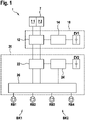
- the illustrated exemplary embodiment of a multi-circuit hydraulically closed brake system according to the invention, 1 in particular for a highly automated or autonomous vehicle, comprises at least two wheel brakes RB1, RB2, RB3, RB4, each of which is assigned to a brake circuit BK1, BK2, two multi-circuit pressure generators 12, 22 , which are hydraulically connected in series between a fluid tank 7 and the at least two wheel brakes RB1, RB2, RB3, RB4, and a hydraulic unit 26 for hydraulically connecting the pressure generators 12, 22 to the at least two wheel brakes RB1, RB2, RB3, RB4 and to individual brake pressure modulation in the at least two wheel brakes RB1, RB2, RB3, RB4.
- a first pressure generator 12 is designed as a plunger system 12A and is assigned to a main system 10, which includes a first energy supply EV1 and a first evaluation and control unit 14 for controlling the first pressure generator 12, as shown in FIG 1 is further evident.
- a second pressure generator 22 as Running pump system 22A and assigned to a secondary system 20, which comprises a second energy supply EV2 independent of the first energy supply EV1 and a second evaluation and control unit 24, as shown in FIG 1 is further evident.
- the hydraulic unit 26 is assigned to the secondary system 20, so that the components of the hydraulic unit 26 and the second pressure generator 22 are controlled by the second evaluation and control unit 24 and supplied with energy by the second energy supply EV2.
- the brake system 1 shown comprises two brake circuits BK1, BK2 and four wheel brakes RB1, RB2, RB3, RB4, with a first wheel brake RB1 and a second wheel brake RB2 in a first brake circuit BK1 and a third wheel brake RB3 and a fourth wheel brake RB4 in one second brake circuit are assigned.
- an X distribution of the wheel brakes RB1, RB2, RB3, RB4 to the two brake circuits BK1, BK2 is possible, ie the first wheel brake RB1 is on the left front wheel and the second wheel brake RB2 is on the right rear wheel and the third wheel brake RB2 is on the right Front wheel and the fourth wheel brake RB4 is arranged on the left rear wheel.
- the wheel brakes RB1, RB2, RB3, RB4 to the two brake circuits BK1, BK2 is possible, ie the first wheel brake RB1 is on the left front wheel and the second wheel brake RB2 is on the left rear wheel and the third wheel brake RB2 is on right front wheel and the fourth wheel brake RB4 is arranged on the right rear wheel.
- the fluid container 7 in the exemplary embodiment shown comprises a first fluid chamber 7.1 for supplying fluid to the first brake circuit BK1 and a second fluid chamber 7.2 for supplying fluid to the second brake circuit BK2.
- the plunger system 12A in the exemplary embodiment shown has a piston-cylinder unit with two pistons and two chambers 12.1, 12.2 and with a drive 12.3, which is designed as an electric motor and moves the two pistons against the force of corresponding return springs to set the pressure in the Chambers 12.1, 12.2 moved.
- a first chamber 12.1 is the first brake circuit BK1 and a second chamber 12.2 assigned to the second brake circuit BK2.
- the piston-cylinder unit is designed so that it can flow when the first pressure generator 12 is de-energized, so that brake fluid can be conveyed from the fluid container 7 through the first pressure generator 22 to the second pressure generator 22 .
- the pump system 22A in the exemplary embodiment shown has a first pump 22.1, which is assigned to the first brake circuit BK1, a second pump 22.2, which is assigned to the second brake circuit BK2, and a common drive 22.3, which is designed as an electric motor and drives the two pumps 22.1, 22.2.
- the hydraulic unit 26 in the exemplary embodiment shown comprises an inlet valve IV1, IV2, IV3, IV4 and an outlet valve OV1, OV2, OV3, OV4 for each wheel brake RB1, RB2, RB3, RB4, with a first inlet valve IV1 and a first outlet valve OV1 are assigned to the first wheel brake RB1.
- a second inlet valve IV2 and a second outlet valve OV2 are assigned to the second wheel brake RB2, a third inlet valve IV3 and a third outlet valve OV3 are assigned to the third wheel brake RB3, and a fourth inlet valve IV4 and a fourth outlet valve OV4 are assigned to the fourth wheel brake RB4.
- the hydraulic unit 26 for each brake circuit BK1 includes a pressure holding and pressure control valve PRV1, PRV2, a high-pressure switching valve HSV1, HSV2 and a low-pressure accumulator NS1, NS2.
- a first pressure-retaining and pressure-regulating valve PRV1 and a first high-pressure switching valve HSV1 and a first low-pressure accumulator NS1 are assigned to the first brake circuit BK1, and a second pressure-retaining and pressure-regulating valve PRV2 and a second high-pressure switching valve HSV2 and a second low-pressure accumulator NS2 are assigned to the second brake circuit BK2.
- the inlet valves IV1, IV2, IV3, IV4 and the pressure-maintaining and pressure-regulating valves PRV1, PRV2 are each designed as controllable, normally open solenoid valves.
- the outlet valves OV1, OV2, OV3, OV4 and the high-pressure switching valves HSV1, HSV2 are designed as electromagnetic normally-closed switching valves in the exemplary embodiment shown.
- brake fluid is drained from the wheel brakes RB1, RB2, RB3, RB4 via an associated outlet valve OV1, OV2, OV3, OV4 during individual brake pressure modulation in a wheel brake RB1, RB2, RB3, RB4 stored in the illustrated embodiment in an associated low-pressure accumulator NS1, NS2 and returned to the brake circuit BK1, BK2 via the associated pump 22.1, 22.2 of the pump system 22 above the inlet valves IV1, IV2, IV3, IV4.
- the brake fluid drained from the wheel brakes RB1, RB2 of the first brake circuit BK1 via the outlet valves OV1, OV2 is stored in the first low-pressure accumulator NS1 and fed back to the first brake circuit BK1 via the first pump 22.1 above the inlet valves IV1, IV2.
- the brake fluid drained from the wheel brakes RB3, RB4 of the second brake circuit BK2 via the outlet valves OV3, OV4 is stored in the second low-pressure accumulator NS2 and fed back to the second brake circuit BK2 via the second pump 22.2 above the inlet valves IV3, IV4.
- the main system 10 increases or reduces or maintains the pressure in the brake circuits BK1, BK2 in normal operation by means of the first pressure generator 12.
- the secondary system 20 performs the individual brake pressure modulation in the wheel brakes RB1 , RB2 , RB3 , RB4 in normal operation by means of the second pressure generator 22 and the hydraulic unit 26 .
- the secondary system 20 increases or reduces or maintains the pressure in the brake circuits BK1, BK2 by means of the second pressure generator 22 and the hydraulic unit 26 and carries out the individual brake pressure modulation in the at least two wheel brakes RB1, RB2, RB3, RB4. If the secondary system 20 fails, the main system 10 increases or reduces or maintains the pressure in the brake circuits BK1, BK2 and in the wheel brakes RB1, RB2, RB3, RB4 by means of the first pressure generator 12 and the individual brake pressure modulation in the wheel brakes RB1, RB2, RB3, RB4 omitted.
- the pressure holding and pressure control valves PRV1, PRV2 are switched to the normally open state and the drive 12.3 of the plunger system 12A is activated in order to use the pistons to increase the Pressure in the brake circuits BK1, BK2 to move in a first direction or to reduce the pressure in the brake circuits BK1, BK2 to move in a second direction opposite to the first direction.
- the pressure holding and pressure control valves PRV1, PRV2 are closed and the high-pressure switching valves HSV1, HSV2 are opened.
- the drive 22.3 of the second pressure generator 22 is activated in order to increase the pressure in the brake circuits BK1, BK2 by means of the pumps 22.1, 22.2.
- the pressure holding and pressure control valves PRV1, PRV2 are opened to reduce the pressure in the brake circuits BK1, BK2.
- the pressure holding and pressure control valves PRV1, PRV2 are closed if the main system 10 fails.
- the associated inlet valve IV1, IV2, IV3, IV4 is opened and the associated outlet valve OV1, OV2, OV3, OV4 is closed.
- the associated inlet valve IV1, IV2, IV3, IV4 and the associated outlet valve OV1, OV2, OV3, OV4 are closed during normal operation or if main system 10 fails.
- the associated inlet valve IV1, IV2, IV3, IV4 is closed and the associated outlet valve OV1, OV2, OV3, OV4 is opened during normal operation or in the event of a failure of the main system 10.
- This method can be implemented, for example, in software or hardware or in a mixed form of software and hardware, for example in a control unit (10).
- Embodiments of the present invention provide a multi-circuit, hydraulically closed brake system without mechanical and/or hydraulic intervention by the driver, in particular for a highly automated or autonomous vehicle, and a corresponding operating method, with the pressure generators used, which are arranged hydraulically in series, being hydraulically connected via the Hydraulic unit act on all wheel brakes of the vehicle.
Landscapes
- Engineering & Computer Science (AREA)
- Transportation (AREA)
- Mechanical Engineering (AREA)
- Chemical & Material Sciences (AREA)
- Combustion & Propulsion (AREA)
- Automation & Control Theory (AREA)
- Human Computer Interaction (AREA)
- Regulating Braking Force (AREA)
- Valves And Accessory Devices For Braking Systems (AREA)
- Braking Systems And Boosters (AREA)
Description
- Die Erfindung geht aus von einem mehrkreisigen hydraulisch geschlossenen Bremssystem, insbesondere für ein hochautomatisiertes oder autonomes Fahrzeug, nach der Gattung des unabhängigen Patentanspruchs 1. Gegenstand der vorliegenden Erfindung ist auch ein Betriebsverfahren für ein solches mehrkreisiges hydraulisch geschlossenes Bremssystem.
- Aus dem Stand der Technik sind Fahrzeuge mit mindestens einer hochautomatisierten oder autonomen Fahrfunktion bekannt, welche zumindest teilweise eine tatsächliche Fahraufgabe übernehmen können. Dadurch können die Fahrzeuge hochautomatisiert oder autonom fahren, indem die Fahrzeuge beispielsweise den Straßenverlauf, andere Verkehrsteilnehmer oder Hindernisse selbständig erkennen und die entsprechenden Ansteuerbefehle im Fahrzeug berechnen sowie diese an die Aktuatoren im Fahrzeug weiterleitet, wodurch der Fahrverlauf des Fahrzeugs korrekt beeinflusst wird. Der Fahrer ist bei einem solchen hochautomatisierten oder autonomen Fahrzeug in der Regel nicht am Fahrgeschehen beteiligt. Trotzdem sind Maßnahmen und Mittel vorgesehen, die es dem Fahrer ermöglichen, jederzeit selbst in das Fahrgeschehen eingreifen zu können.
- Zudem sind aus dem Stand der Technik Bremssysteme für Fahrzeuge bekannt, welche für eine Ansteuerung durch einen Fahrzeugführer mit einem hydraulischen Durchgriff ausgelegt sind. Dadurch ist bei Ausfall des Bremssystems gewährleistet, dass der Fahrer durch Betätigen des Bremspedals noch ausreichend Bremskraft auf die Räder des Fahrzeugs bringen kann. Diese Auslegung beeinflusst maßgeblich die Topologie heutiger Bremssysteme. So lässt sich beispielsweise die Größe eines Tandemhauptbremszylinders durch die Aufrechterhaltung einer guten Performance in der Rückfallebene begründen. Zudem können die Bremssysteme als sogenannte gekoppelte Bremssysteme oder Hilfskraftbremssysteme ausgeführt werden. Allerdings sind auch diese Systeme so realisiert, dass als Rückfallebene nach wie vor ein hydraulischer Durchgriff durch den Fahrer gegeben ist. Hilfskraftbremsanalagen sind für hochautomatisierte oder autonome Fahrzeuge ungeeignet, da dort während einer autonomen Fahrfunktion kein Fahrer mehr zum Verstärken da ist und das Bremssystem die Bremsenergie komplett selbstständig aufbauen muss.
- Aus der
DE 10 2009 001135 A1 ist ein Verfahren zur Betätigung einer hydraulisch geschlossenen Fahrzeugbremsanlage bekannt. Die Fahrzeugbremsanlage umfasst einen elektromechanischen Bremskraftverstärker und eine Radschlupfregelung. Hierbei wird die Fahrzeugbremsanlage mit dem Bremskraftverstärker in Situationen betätigt, bei denen ein Bremspedal nicht betätigt ist, beispielsweise zur Begrenzung einer Fahrzeuggeschwindigkeit oder einer Abstandsregelung zu einem vorausfahrenden Fahrzeug oder beim Einparken. - Aus der
DE 10 2016 201261 A1 ist ein gattungsgemäßes mehrkreisiges hydraulisch geschlossenes Bremssystem für ein Kraftfahrzeug bekannt, welches eine erste Bremsenanordnung und eine zweite Bremsenanordnung umfasst. Ein erster hydraulischer Bremskreislauf ist mit der ersten Bremsenanordnung verbunden, und ein zweiter hydraulischer Bremskreislauf ist mit der zweiten Bremsenanordnung verbunden. Weiterhin ist ein erstes Steuermodul mit dem ersten hydraulischen Bremskreislauf und dem zweiten hydraulischen Bremskreislauf gekoppelt. Das erste Steuermodul ist dazu ausgebildet, einen Fluiddruck sowohl innerhalb des ersten hydraulischen Bremskreislaufs als auch innerhalb des zweiten hydraulischen Bremskreislaufs zu steuern. Ein zweites Steuermodul ist außerdem mit dem ersten hydraulischen Bremskreislauf und mit dem zweiten hydraulischen Bremskreislauf gekoppelt. Das zweite Steuermodul ist dazu ausgebildet, einen Fluiddruck sowohl innerhalb des ersten hydraulischen Bremskreislaufs als auch innerhalb des zweiten hydraulischen Bremskreislaufs unabhängig von dem ersten Steuermodul zu steuern. Das erste Steuermodul ist in Reihe mit dem zweiten Steuermodul in dem ersten und dem zweiten hydraulischen Bremskreislauf angeordnet. Zusätzlich sendet ein virtueller Fahrer einen Verzögerungswunsch an das erste Steuermodul und das zweite Steuermodul. Das erste Steuermodul und das zweite Steuermodul bestimmen einen gewünschten Druck auf Grundlage des Verzögerungswunsches. Das erste Bremssteuermodul steuert einen Fluiddruck sowohl innerhalb des ersten als auch des zweiten hydraulischen Bremskreislaufs, um den Verzögerungswunsch auszuführen. Das zweite Steuermodul überwacht einen Druck stromabwärts von dem ersten Steuermodul und vergleicht den überwachten Druck mit dem gewünschten Druck. Zur Druckbereitstellung umfasst das erste Steuermodul eine erste Pumpe, und das zweite Steuermodul umfasst eine zweite Pumpe. - Aus der
DE 10 2013 227 066 A1 ist ein gattungsgemäßes Verfahren zum Betreiben eines hydraulischen Bremssystems bekannt, das eine erste Druckerzeugungseinheit mit einem Plungersystem sowie eine zweite Druckerzeugungseinheit mit einem Pumpensystem umfasst, wobei die erste Druckerzeugungseinheit mit der zweiten Druckerzeugungseinheit über erste Unterbrechungsmittel hydraulisch unterbrechbar unumfließbar derart verbunden ist, dass bei geschlossener Stellung des ersten Unterbrechungsmittels keine hydraulische Verbindung zwischen erster Druckerzeugungseinheit und zweiter Druckerzeugungseinheit mehr möglich ist, wobei in einer ersten Betriebsart der Radbremsdruck in dem wenigstens einen Radbremszylinder alleine mittels der ersten Bremsdruckerzeugungseinrichtung erzeugt wird und über die ersten Unterbrechungsmittel geleitet wird. Mittels der zweiten Druckerzeugungseinheit kann eine radindividuell Radbremsdruckmodulation durchgeführt werden. Bei Ausfall der ersten Druckerzeugungseinrichtung kann mittels der zweiten Bremsdruckerzeugungseinrichtung der Bremsdruck aufgebaut werden. - Das mehrkreisige hydraulisch geschlossene Bremssystem, insbesondere für ein hochautomatisiertes oder autonomes Fahrzeug, mit den Merkmalen des unabhängigen Patentanspruchs 1 und das korrespondierende Betriebsverfahren für ein solches mehrkreisiges hydraulisch geschlossenes Bremssystem mit den Merkmalen des unabhängigen Patentanspruchs 10 haben den Vorteil, dass eine einfache, robuste und kostengünstige Bremssystemarchitektur ohne mechanischen und/oder hydraulischen Durchgriff über den Fahrer zur Verfügung gestellt wird, welche auch im Fehlerfall durch ein geeignetes Redundanzkonzept eine ausreichende Bremsperformance ermöglicht.
- Ausführungsformen der Erfindung weisen weniger Komponenten als bekannte Bremssysteme auf, da weniger Ventile, kein Pedalwegsimulator, kein Mechanismus, um den Fahrerdruck zu erzeugen, zu verstärken und weiterzuleiten erforderlich sind, so dass geringere Bremssystemkosten entstehen. Zudem ergeben sich geringere Systemkosten, da an den Radbremsen nur ein hydraulischer Anschluss vorhanden ist und keine Alternativlösungen mit zwei Anschlüssen im Bremssattel erforderlich sind, die auf unterschiedliche Kolben wirken. Des Weiteren weist der Fluidbehälter nur einen hydraulischen Anschluss pro Bremskreis auf und Alternativlösungen mit mehreren Anschlüssen sind überflüssig.
- Außerdem ergeben sich geringere Integrationskosten beim Fahrzeughersteller, da die Ausführungsformen der Erfindung aufgrund der elektrischen Ansteuerung ohne mechanischen und/oder hydraulischen Durchgriff über den Fahrer einen einfachen Einbau, insbesondere für Rechts- und Linkslenker, ermöglichen und Einbauraum an der Spritzwand zwischen Motorraum und Fahrzeuginnenraum freigeben. Da keiner der Bremssystemaktuatoren an der Spritzwand montiert sein muss, können sich auch NVH-Vorteile (NVH: Noise, Vibration, Harshness "Geräusch, Vibration, Rauigkeit") ergeben. Aufgrund der kleineren Anzahl von Komponenten ergibt sich zudem ein geringeres Gewicht und Volumen im Vergleich zu bekannten Bremssystemen.
- Durch die Aufteilung in ein Hauptsystem und ein Sekundärsystem kann einfach ein modulares Konzept mit zwei Baugruppen umgesetzt werden.
- Ausführungsformen der vorliegenden Erfindung stellen ein mehrkreisiges hydraulisch geschlossenes Bremssystem, insbesondere für ein hochautomatisierte oder autonomes Fahrzeug, mit mindestens zwei Radbremsen, welche jeweils einem Bremskreis zugeordnet sind, zwei mehrkreisigen Druckerzeugern, welche zwischen einem Fluidbehälter und den mindestens zwei Radbremsen hydraulisch in Reihe geschaltet sind, und einer Hydraulikeinheit zur hydraulischen Verbindung der Druckerzeuger mit den mindestens zwei Radbremsen und zur individuellen Bremsdruckmodulation in den mindestens zwei Radbremsen zur Verfügung.
- Hierbei ist ein erster Druckerzeuger als Plungersystem ausgeführt und einem Hauptsystem zugeordnet, welches eine erste Energieversorgung und eine erste Auswerte- und Steuereinheit zur Ansteuerung des ersten Druckerzeugers umfasst. Ein zweiter Druckerzeuger ist als Pumpensystem ausgeführt und einem Sekundärsystem zugeordnet, welches eine von der ersten Energieversorgung unabhängige zweite Energieversorgung und eine zweite Auswerte- und Steuereinheit umfasst. Zudem ist die Hydraulikeinheit dem Sekundärsystem zugeordnet, so dass die Komponenten der Hydraulikeinheit und der zweite Druckerzeuger von der zweiten Auswerte- und Steuereinheit angesteuert und von der zweiten Energieversorgung mit Energie versorgt werden.
- Zudem wird ein Betriebsverfahren für ein solches mehrkreisiges hydraulisch geschlossenes Bremssystem, insbesondere für ein hochautomatisiertes oder autonomes Fahrzeug, vorgeschlagen. Hierbei erhöht oder reduziert oder hält im Normalbetrieb das Hauptsystem mittels des ersten Druckerzeugers den Druck in den Bremskreisen und das Sekundärsystem führt mittels des zweiten Druckerzeugers und der Hydraulikeinheit die individuelle Bremsdruckmodulation in den mindestens zwei Radbremsen aus. Bei Ausfall des Hauptsystems erhöht oder reduziert oder hält das Sekundärsystem mittels des zweiten Druckerzeugers und der Hydraulikeinheit den Druck in den Bremskreisen und führt die individuelle Bremsdruckmodulation in den mindestens zwei Radbremsen aus. Bei Ausfall des Sekundärsystems erhöht oder reduziert oder hält das Hauptsystem den Druck in den Bremskreisen und in den mindestens zwei Radbremsen mittels des ersten Druckerzeugers und die individuelle Bremsdruckmodulation in den mindestens zwei Radbremsen entfällt.
- Unter einem hydraulisch geschlossen Bremssystem, wird ein Bremssystem verstanden, bei welchem während einer individuellen Bremsdruckmodulation abgelassenes Bremsfluid aus den Radbremsen in der Hydraulikeinheit gespeichert und über das Pumpensystem des Sekundärsystems wieder in den Bremskreis zurückgeführt werden kann. Dadurch ist im Vergleich zu einem offenen Bremssystem in vorteilhafter Weise kein Nachsaugen von Bremsfluid aus dem Fluidbehälter erforderlich, so dass auf Druckhaltephasen während des Nachsaugevorgangs verzichtet werden kann.
- Durch die individuelle Bremsdruckmodulation in den einzelnen Radbremsen können in vorteilhafter Weise verschiedene Regelfunktionen, wie beispielsweise eine Blockierschutzregelung ABS, eine Antriebsschlupfregelung ASR, eine Fahrdynamikregelung FDR bzw. ESP zur Längs- und Querstabilisierung des Fahrzeugs umgesetzt werden. Da diese Regelfunktionen an sich bekannt sind wird hier nicht näher auf diese eingegangen.
- Durch Ausführungsformen der Erfindung ist in vorteilhafter Weise bei Ausfall des Hauptsystems weiterhin die volle ESP-Funktionalität mit Längs- und Querstabilisierung vorhanden. Durch die Ausführung des ersten Druckerzeugers als Plungersystem ergibt sich eine gute NVH-Performance im Gesamtsystem und ein einfacheres und/oder genaueres Monitoring und eine verbesserte Regelung. Dies ermöglicht, dass sowohl Lage als auch Volumen- und Druckaufbauinformationen im Hauptsystem in Vergleich zu anderen Konzepten (Pumpensystem) einfacher und insbesondere genauer erfasst werden können. Durch die Ausführung des zweiten Druckerzeugers als Pumpensystem ergeben sich noch geringere Kosten, Bauraum und Gewicht im Vergleich zu anderen Konzepten (Plungersystem).
- Unter der Auswerte- und Steuereinheit kann vorliegend ein elektrisches Gerät, wie beispielsweise ein Steuergerät verstanden werden, welches erfasste Sensorsignale verarbeitet bzw. auswertet. Die Auswerte- und Steuereinheit kann mindestens eine Schnittstelle aufweisen, die hard- und/oder softwaremäßig ausgebildet sein kann. Bei einer hardwaremäßigen Ausbildung können die Schnittstellen beispielsweise Teil eines sogenannten System-ASICs sein, der verschiedenste Funktionen der Auswerte- und Steuereinheit beinhaltet. Es ist jedoch auch möglich, dass die Schnittstellen eigene, integrierte Schaltkreise sind oder zumindest teilweise aus diskreten Bauelementen bestehen. Bei einer softwaremäßigen Ausbildung können die Schnittstellen Softwaremodule sein, die beispielsweise auf einem Mikrocontroller neben anderen Softwaremodulen vorhanden sind. Von Vorteil ist auch ein Computerprogrammprodukt mit Programmcode, der auf einem maschinenlesbaren Träger wie einem Halbleiterspeicher, einem Festplattenspeicher oder einem optischen Speicher gespeichert ist und zur Durchführung der Auswertung verwendet wird, wenn das Programm von der Auswerte- und Steuereinheit ausgeführt wird.
- Zur Erfassung der Sensorsignale sind Sensoreinheiten vorgesehen, unter welchen vorliegend Baugruppen verstanden werden, welche mindestens ein Sensorelement umfassen, welches eine physikalische Größe bzw. eine Änderung einer physikalischen Größe direkt oder indirekt erfasst und vorzugsweise in ein elektrisches Sensorsignal umwandelt. Dies kann beispielsweise über das Aussenden und/oder das Empfangen von Schallwellen und/oder elektromagnetischen Wellen und/oder über ein Magnetfeld bzw. die Änderung eines Magnetfelds und/oder das Empfangen von Satellitensignalen beispielsweise eines GPS-Signals erfolgen. Eine solche Sensoreinheit kann beispielsweise Beschleunigungssensorelemente, welche beschleunigungsrelevante Informationen des Fahrzeugs erfassen, und/oder Sensorelemente umfassen, welche Gegenstände und/oder Hindernisse und/oder andere crashrelevante Fahrzeugumfelddaten ermitteln und zur Auswertung zur Verfügung stellen. Solche Sensorelemente können beispielsweise auf Video- und/oder Radar- und/oder Lidar und/oder PMD- und/oder Ultraschall-Technologien basieren. Zudem können auch Signale und Informationen einer vorhandenen ABS-Sensorik und die im dafür vorgesehenen Steuergerät abgeleiteten Größen ausgewertet werden. Basierend auf den beschleunigungsrelevanten Informationen und/oder daraus ermittelten Größen können beispielsweise eine Fahrzeugbewegung und eine Fahrzeuglage im dreidimensionalen Raum geschätzt werden und zur Unfallerkennung ausgewertet werden.
- Zur Positionsbestimmung des Fahrzeugs können beispielsweise globale Navigationssatellitensysteme GNSS (GNSS: Global Navigation Satellite System) eingesetzt werden. Hierbei wird GNSS als Sammelbegriff für die Verwendung bestehender und künftiger globaler Satellitensysteme wie NAVSTAR GPS (Global Positioning System) der Vereinigten Staaten von Amerika, GLONASS (Global Navigation Satellite System) der Russischen Föderation, Galileo der Europäischen Union, Beidou der Volksrepublik China usw. eingesetzt.
- Unter einem hochautomatisierten oder autonomen Fahrzeug, wird ein Fahrzeug verstanden, welches mindestens eine hochautomatisierte oder autonome Fahrfunktion aufweist, welche zumindest teilweise eine tatsächliche Fahraufgabe übernehmen kann. Über diese mindestens eine hochautomatisierte oder autonome Fahrfunktion erkennt das Fahrzeug beispielsweise den Straßenverlauf, andere Verkehrsteilnehmer oder Hindernisse selbständig und berechnet die entsprechenden Ansteuerbefehle, welche an die Aktuatoren im Fahrzeug weiterleitet werden, wodurch der Fahrverlauf des Fahrzeugs korrekt beeinflusst wird. Der Fahrer ist bei einem solchen hochautomatisierten oder autonomen Fahrzeug in der Regel nicht am Fahrgeschehen beteiligt. Trotzdem sind Maßnahmen und Mittel, beispielsweise in Form von elektrischen oder elektronischen Betätigungselementen, vorgesehen, die es dem Fahrer ermöglichen, jederzeit selbst in das Fahrgeschehen eingreifen zu können. Der vom Fahrer mittels der Betätigungselemente erzeugte Bremswunsch wird dann über elektrische Signale an das Hauptsystem und/oder das Sekundärsystem weitergeleitet. Ein mechanischer und/oder hydraulischen Durchgriff durch den Fahrer ist jedoch nicht vorhanden.
- Die mindestens eine Fahrfunktion wertet zur Trajektorienplanung von internen Sensoreinheiten erfasste Fahrzeugdaten wie ABS-Eingriffe, Lenkwinkel, Position, Richtung, Geschwindigkeit, Beschleunigung usw. und/oder Fahrzeugumfelddaten aus, welche beispielsweise über Kamera-, Radar-, Lidar- und/oder Ultraschallsensoreinheiten erfasst werden, und steuert die Auswerte- und Steuereinheiten des Hauptsystems und des Sekundärsystems entsprechend an, um einen gewünschten Bremsdruck zu erzeugen und/oder Stabilisierungsvorgänge in Längs- und/oder Querrichtung durch individuelle Bremsdruckmodulation in den Radbremsen zu realisieren.
- Durch die in den abhängigen Ansprüchen aufgeführten Maßnahmen und Weiterbildungen sind vorteilhafte Verbesserungen des im unabhängigen Patentanspruch 1 angegebenen mehrkreisigen hydraulisch geschlossenen Bremssystems, insbesondere für ein hochautomatisiertes oder autonomes Fahrzeug, und des im unabhängigen Patentanspruch 10 angegebenen Betriebsverfahrens für ein solches mehrkreisiges hydraulisch geschlossenes Bremssystem, insbesondere für ein hochautomatisiertes oder autonomes Fahrzeug, möglich.
- Besonders vorteilhaft ist, dass der Fluidbehälter eine erste Fluidkammer zur Fluidversorgung eines ersten Bremskreises und eine zweite Fluidkammer zur Fluidversorgung eines zweiten Bremskreises umfassen kann. Zudem kann das Plungersystem eine Kolben-Zylindereinheit mit zwei Kolben und zwei Kammern und mit einem Antrieb aufweisen, welcher die beiden Kolben gegen die Kraft von korrespondierenden Rückstellfedern zur Druckeinstellung in den Kammern bewegen kann. Hierbei kann eine erste Kammer dem ersten Bremskreis und eine zweite Kammer dem zweiten Bremskreis zugeordnet werden, wobei die Kolben-Zylindereinheit im stromlosen Zustand des ersten Druckerzeugers durchfließbar ist, so dass Bremsfluid aus dem Fluidbehälter durch den ersten Druckerzeuger zum zweiten Druckerzeuger gefördert werden kann. Des Weiteren kann das Pumpensystem eine erste Pumpe, welche dem ersten Bremskreis zugeordnet werden kann, eine zweite Pumpe, welche dem zweiten Bremskreis zugeordnet werden kann, und einen gemeinsamen Antrieb aufweisen, welcher die beiden Pumpen antreiben. Dadurch kann in vorteilhafter Weise eine durchgängige Zweikreisigkeit vom Fluidbehälter bis zu den Radbremsen umgesetzt werden, so dass die Anforderungen an die Leckageüberwachung gesenkt werden können.
- In vorteilhafter Ausgestaltung des Bremssystems kann die Hydraulikeinheit für jede Radbremse jeweils ein Einlassventil und jeweils ein Auslassventil und für jeden Bremskreis jeweils ein Druckhalte- und Druckregelventil, jeweils ein Hochdruckschaltventil und jeweils einen Niederdruckspeicher umfassen. Die Einlassventile und die Druckhalte- und Druckregelventile können beispielsweise als regelbare stromlos offene Magnetventile ausgeführt werden. Die Auslassventile und die Hochdruckschaltventile können beispielsweise als elektromagnetische stromlos geschlossene Schaltventile ausgeführt werden. Durch diese Ausführung der Hydraulikeinheit ist es in vorteilhafter Weise möglich, bereits bekannte ESP-Systeme einzusetzen und über bereits existierenden Skaleneffekt (ESP wird millionenfach gebaut) sehr niedrige Gesamtsystemkosten zu erzielen. Des Weiteren kann eine erste Radbremse und eine zweite Radbremse dem ersten Bremskreis und eine dritte Radbremse und eine vierte Radbremse dem zweiten Bremskreis zugeordnet werden. Hierbei ist sowohl eine X-Aufteilung, d.h. die Radbremse des linken Vorderrads und die Radbremse des rechten Hinterrads sind dem ersten Bremskreis und die Radbremse des rechten Vorderrads und die Radbremse des linken Hinterrads sind dem zweiten Bremskreis zugeordnet, als auch eine 11-Aufteilung der Bremskreise möglich, d.h. die Radbremse des linken Vorderrads und die Radbremse des linken Hinterrads sind dem ersten Bremskreis und die Radbremse des rechten Vorderrads und die Radbremse des rechten Hinterrads sind dem zweiten Bremskreis zugeordnet.
- In vorteilhafter Ausgestaltung des Betriebsverfahrens können im Normalbetrieb oder bei Ausfall des Sekundärsystems zur Druckerhöhung oder zur Druckreduzierung in den Bremskreisen die Druckhalte- und Druckregelventile in den stromlos offenen Zustand überführt und der Antrieb des Plungersystems angesteuert werden, um die Kolben zur Erhöhung des Drucks in den Bremskreisen in eine erste Richtung zu bewegen oder zur Reduzierung des Drucks in den Bremskreisen in eine der ersten Richtung entgegengesetzte zweite Richtung zu bewegen. Zudem können im Normalbetrieb oder bei Ausfall des Sekundärsystems zum Druckhalten in den Bremskreisen die Druckhalte- und Druckregelventile in den stromlos offenen Zustand überführt werden, wobei der Antrieb des Plungersystems die Kolben in ihrer aktuellen Position halten kann.
- In weiterer vorteilhafter Ausgestaltung des Betriebsverfahrens können bei Ausfall des Hauptsystems zur Druckerhöhung in den Bremskreisen die Druckhalte- und Druckregelventile geschlossen und die Hochdruckschaltventile geöffnet werden und der Antrieb des zweiten Druckerzeugers kann angesteuert werden, um mittels der Pumpen den Druck zu erhöhen. Zudem können bei Ausfall des Hauptsystems zur Druckreduzierung in den Bremskreisen die Druckhalte- und Druckregelventile geöffnet werden. Des Weiteren können bei Ausfall des Hauptsystems zum Druckhalten in den Bremskreisen die Druckhalte- und Druckregelventile geschlossen werden.
- In weiterer vorteilhafter Ausgestaltung des Betriebsverfahrens kann im Normalbetrieb oder bei Ausfall des Hauptsystems zur individuellen Druckerhöhung in einer zugeordneten Radbremse das zugehörige Einlassventil geöffnet und das zugehörige Auslassventil geschlossen werden. Zudem kann im Normalbetrieb oder bei Ausfall des Hauptsystems zum individuellen Druckhalten in einer zugeordneten Radbremse das zugehörige Einlassventil und das zugehörige Auslassventil geschlossen werden. Des Weiteren kann im Normalbetrieb oder bei Ausfall des Hauptsystems zur individuellen Druckreduzierung in einer zugeordneten Radbremse das zugehörige Einlassventil geschlossen und das zugehörige Auslassventil geöffnet werden.
- In weiterer vorteilhafter Ausgestaltung des Betriebsverfahrens kann bei einem erkannten Leck in einer Radbremse das zugehörige Einlassventil geschlossen werden.
- Ein Ausführungsbeispiel der Erfindung ist in der Zeichnung dargestellt und wird in der nachfolgenden Beschreibung näher erläutert. In der Zeichnung bezeichnen gleiche Bezugszeichen Komponenten bzw. Elemente, die gleiche bzw. analoge Funktionen ausführen.
-
-
Fig. 1 zeigt ein schematisches Blockdiagramm eines Ausführungsbeispiels eines erfindungsgemäßen mehrkreisigen hydraulisch geschlossenen Bremssystems, insbesondere für ein hochautomatisiertes oder autonomes Fahrzeug. -
Fig. 2 zeigt ein schematisches hydraulisches Schaltbild des Bremssystems ausFig. 1 . - Wie aus
Fig. 1 und2 ersichtlich ist, umfasst das dargestellte Ausführungsbeispiel eines erfindungsgemäßen mehrkreisigen hydraulisch geschlossenen Bremssystems ,1 insbesondere für ein hochautomatisiertes oder autonomes Fahrzeug, mindestens zwei Radbremsen RB1, RB2, RB3, RB4, welche jeweils einem Bremskreis BK1, BK2 zugeordnet sind, zwei mehrkreisige Druckerzeugern 12, 22, welche zwischen einem Fluidbehälter 7 und den mindestens zwei Radbremsen RB1, RB2, RB3, RB4 hydraulisch in Reihe geschaltet sind, und eine Hydraulikeinheit 26 zur hydraulischen Verbindung der Druckerzeuger 12, 22 mit den mindestens zwei Radbremsen RB1, RB2, RB3, RB4 und zur individuellen Bremsdruckmodulation in den mindestens zwei Radbremsen RB1, RB2, RB3, RB4. Wie ausFig. 2 weiter ersichtlich ist, ist ein erster Druckerzeuger 12 als Plungersystem 12A ausgeführt und einem Hauptsystem 10 zugeordnet, welches eine erste Energieversorgung EV1 und eine erste Auswerte- und Steuereinheit 14 zur Ansteuerung des ersten Druckerzeugers 12 umfasst, wie ausFig. 1 weiter ersichtlich ist. Wie ausFig. 2 weiter ersichtlich ist, ist ein zweiter Druckerzeuger 22 als Pumpensystem 22A ausgeführt und einem Sekundärsystem 20 zugeordnet, welches eine von der ersten Energieversorgung EV1 unabhängige zweite Energieversorgung EV2 und eine zweite Auswerte- und Steuereinheit 24 umfasst, wie ausFig. 1 weiter ersichtlich ist. Hierbei ist die Hydraulikeinheit 26 dem Sekundärsystem 20 zugeordnet, so dass die Komponenten der Hydraulikeinheit 26 und der zweite Druckerzeuger 22 von der zweiten Auswerte- und Steuereinheit 24 angesteuert und von der zweiten Energieversorgung EV2 mit Energie versorgt werden. - Wie aus
Fig. 1 und2 weiter ersichtlich ist, umfasst das dargestellte Bremssystem 1 zwei Bremskreise BK1, BK2 und vier Radbremsen RB1, RB2, RB3, RB4, wobei eine erste Radbremse RB1 und eine zweite Radbremse RB2 einem ersten Bremskreis BK1 und eine dritte Radbremse RB3 und eine vierte Radbremse RB4 einem zweiten Bremskreis zugeordnet sind. Hierbei ist eine X-Aufteilung der Radbremsen RB1, RB2, RB3, RB4 auf die beiden Bremskreise BK1, BK2 möglich, d.h. die erste Radbremse RB1 ist am linken Vorderrad und die zweite Radbremse RB2 ist am rechten Hinterrad und die dritte Radbremse RB2 ist am rechten Vorderrad und die vierte Radbremse RB4 ist am linken Hinterrad angeordnet. Alternativ ist auch eine II-Aufteilung der Radbremsen RB1, RB2, RB3, RB4 auf die beiden Bremskreise BK1, BK2 möglich, d.h. die erste Radbremse RB1 ist am linken Vorderrad und die zweite Radbremse RB2 ist am linken Hinterrad und die dritte Radbremse RB2 ist am rechten Vorderrad und die vierte Radbremse RB4 ist am rechten Hinterrad angeordnet. - Wie aus
Fig. 1 und2 weiter ersichtlich ist, umfasst der Fluidbehälter 7 im dargestellten Ausführungsbeispiel eine erste Fluidkammer 7.1 zur Fluidversorgung des ersten Bremskreises BK1 und eine zweite Fluidkammer 7.2 zur Fluidversorgung des zweiten Bremskreises BK2. - Wie aus
Fig. 2 weiter ersichtlich ist, weist das Plungersystem 12A im dargestellten Ausführungsbeispiel eine Kolben-Zylindereinheit mit zwei Kolben und zwei Kammern 12.1, 12.2 und mit einem Antrieb 12.3 auf, welcher als Elektromotor ausgeführt ist und die beiden Kolben gegen die Kraft von korrespondierenden Rückstellfedern zur Druckeinstellung in den Kammern 12.1, 12.2 bewegt. Hierbei ist eine erste Kammer 12.1 dem ersten Bremskreis BK1 und eine zweite Kammer 12.2 dem zweiten Bremskreis BK2 zugeordnet. Zudem ist die Kolben-Zylindereinheit im stromlosen Zustand des ersten Druckerzeugers 12 durchfließbar ausgeführt, so dass Bremsfluid aus dem Fluidbehälter 7 durch den ersten Druckerzeuger 22 zum zweiten Druckerzeuger 22 gefördert werden kann. - Wie aus
Fig. 2 weiter ersichtlich ist, weist das Pumpensystem 22A im dargestellten Ausführungsbeispiel eine erste Pumpe 22.1, welche dem ersten Bremskreis BK1 zugeordnet ist, eine zweite Pumpe 22.2, welche dem zweiten Bremskreis BK2 zugeordnet ist, und einen gemeinsamen Antrieb 22.3 aufweist, welcher als Elektromotor ausgeführt ist und die beiden Pumpen 22.1, 22.2 antreibt. - Wie aus
Fig. 2 weiter ersichtlich ist, umfasst die Hydraulikeinheit 26 im dargestellten Ausführungsbeispiel für jede Radbremse RB1, RB2, RB3, RB4 jeweils ein Einlassventil IV1, IV2, IV3, IV4 und jeweils ein Auslassventil OV1, OV2, OV3, OV4, wobei ein erstes Einlassventil IV1 und ein erstes Auslassventil OV1 der ersten Radbremse RB1 zugeordnet sind. Ein zweites Einlassventil IV2 und ein zweites Auslassventil OV2 sind der zweiten Radbremse RB2 zugeordnet, Ein drittes Einlassventil IV3 und ein drittes Auslassventil OV3 sind der dritten Radbremse RB3 zugeordnet, und ein viertes Einlassventil IV4 und ein viertes Auslassventil OV4 sind der vierten Radbremse RB4 zugeordnet. Zudem umfasst die Hydraulikeinheit 26 für jeden Bremskreis BK1 jeweils ein Druckhalte- und Druckregelventil PRV1, PRV2, jeweils ein Hochdruckschaltventil HSV1, HSV2 und jeweils einen Niederdruckspeicher NS1, NS2. Hierbei sind ein erstes Druckhalteund Druckregelventil PRV1 und ein erstes Hochdruckschaltventil HSV1 und ein erster Niederdruckspeicher NS1 dem ersten Bremskreis BK1 zugeordnet, und ein zweites Druckhalte- und Druckregelventil PRV2 und ein zweites Hochdruckschaltventil HSV2 und ein zweiter Niederdruckspeicher NS2 sind dem zweiten Bremskreis BK2 zugeordnet. - Wie aus
Fig. 2 weiter ersichtlich ist, sind im dargestellten Ausführungsbeispiel die Einlassventile IV1, IV2, IV3, IV4 und die Druckhalte- und Druckregelventile PRV1, PRV2 jeweils als regelbare stromlos offene Magnetventile ausgeführt. Die Auslassventile OV1, OV2, OV3, OV4 und die Hochdruckschaltventile HSV1, HSV2 sind im dargestellten Ausführungsbeispiel als elektromagnetische stromlos geschlossene Schaltventile ausgeführt. - Da das erfindungsgemäße Bremssystem 1 als hydraulisch geschlossenes System ausgeführt ist, wird während einer individuellen Bremsdruckmodulation in einer Radbremse RB1, RB2, RB3, RB4 über ein zugeordnetes Auslassventil OV1, OV2, OV3, OV4 abgelassenes Bremsfluid aus den Radbremsen RB1, RB2, RB3, RB4 im dargestellten Ausführungsbespiel in einem zugeordneten Niederdruckspeicher NS1, NS2 gespeichert und über die zugeordnete Pumpe 22.1, 22.2 des Pumpensystems 22 oberhalb der Einlassventile IV1, IV2, IV3, IV4 wieder in den Bremskreis BK1, BK2 zurückgeführt. Im dargestellten Ausführungsbeispiel wird das aus den Radbremsen RB1, RB2 des ersten Bremskreises BK1 über die Auslassventile OV1, OV2 abgelassene Bremsfluid im ersten Niederdruckspeicher NS1 gespeichert und über die erste Pumpe 22.1 oberhalb der Einlassventile IV1, IV2 wieder dem ersten Bremskreis BK1 zugeführt. Das aus den Radbremsen RB3, RB4 des zweiten Bremskreises BK2 über die Auslassventile OV3, OV4 abgelassene Bremsfluid wird im zweiten Niederdruckspeicher NS2 gespeichert und über die zweite Pumpe 22.2 oberhalb der Einlassventile IV3, IV4 wieder dem zweiten Bremskreis BK2 zugeführt.
- Bei dem erfindungsgemäßen Betriebsverfahren für das oben beschriebene mehrkreisige hydraulisch geschlossene Bremssystem 1, insbesondere für ein hochautomatisiertes oder autonomes Fahrzeug, erhöht oder reduziert oder hält im Normalbetrieb das Hauptsystem 10 mittels des ersten Druckerzeugers 12 den Druck in den Bremskreisen BK1, BK2. Zudem führt das Sekundärsystem 20 im Normalbetrieb mittels des zweiten Druckerzeugers 22 und der Hydraulikeinheit 26 die individuelle Bremsdruckmodulation in den Radbremsen RB1, RB2, RB3, RB4 aus. Bei Ausfall des Hauptsystems 10 erhöht oder reduziert oder hält das Sekundärsystem 20 mittels des zweiten Druckerzeugers 22 und der Hydraulikeinheit 26 den Druck in den Bremskreisen BK1, BK2 und führt die individuelle Bremsdruckmodulation in den mindestens zwei Radbremsen RB1, RB2, RB3, RB4 aus. Bei Ausfall des Sekundärsystems 20 erhöht oder reduziert oder hält das Hauptsystem 10 den Druck in den Bremskreisen BK1, BK2 und in den Radbremsen RB1, RB2, RB3, RB4 mittels des ersten Druckerzeugers 12 und die individuelle Bremsdruckmodulation in den Radbremsen RB1, RB2, RB3, RB4 entfällt.
- Im Normalbetrieb oder bei Ausfall des Sekundärsystems 20 werden zur Druckerhöhung oder zur Druckreduzierung in den Bremskreisen BK1, BK2 die Druckhalte- und Druckregelventile PRV1, PRV2 in den stromlos offenen Zustand überführt und der Antrieb 12.3 des Plungersystems 12A wird angesteuert, um die Kolben zur Erhöhung des Drucks in den Bremskreisen BK1, BK2 in eine erste Richtung zu bewegen oder zur Reduzierung des Drucks in den Bremskreisen BK1, BK2 in eine der ersten Richtung entgegengesetzte zweite Richtung zu bewegen.
- Zudem werden im Normalbetrieb oder bei Ausfall des Sekundärsystems 20 zum Druckhalten in den Bremskreisen BK1, BK2 die Druckhalte- und Druckregelventile PRV1, PRV2 in den stromlos offenen Zustand überführt und der Antrieb 12.3 des Plungersystems 12A hält die Kolben in ihrer aktuellen Position.
- Des Weiteren werden bei Ausfall des Hauptsystems 10 zur Druckerhöhung in den Bremskreisen BK1, BK2 die Druckhalte- und Druckregelventile PRV1, PRV2 geschlossen und die Hochdruckschaltventile HSV1, HSV2 geöffnet. Zudem wird der Antrieb 22.3 des zweiten Druckerzeugers 22 angesteuert wird, um mittels der Pumpen 22.1, 22.2 den Druck in den Bremskreisen BK1, BK2 zu erhöhen. Außerdem werden bei Ausfall des Hauptsystems 10 zur Druckreduzierung in den Bremskreisen BK1, BK2 die Druckhalte- und Druckregelventile PRV1, PRV2 geöffnet. Zum Druckhalten in den Bremskreisen BK1, BK2 werden bei Ausfall des Hauptsystems 10 die Druckhalte- und Druckregelventile PRV1, PRV2 geschlossen.
- Des Weiterem werden im Normalbetrieb oder bei Ausfall des Hauptsystems 10 zur individuellen Druckerhöhung in einer zugeordneten Radbremse RB1, RB2, RB3, RB4 das zugehörige Einlassventil IV1, IV2, IV3, IV4 geöffnet, und das zugehörige Auslassventil OV1, OV2, OV3, OV4 geschlossen. Zum individuellen Druckhalten in einer zugeordneten Radbremse RB1, RB2, RB3, RB4 werden im Normalbetrieb oder bei Ausfall des Hauptsystems 10 das zugehörige Einlassventil IV1, IV2, IV3, IV4 und das zugehörige Auslassventil OV1, OV2, OV3, OV4 geschlossen. Zur individuellen Druckreduzierung in einer zugeordneten Radbremse RB1, RB2, RB3, RB4 werden im Normalbetrieb oder bei Ausfall des Hauptsystems 10 das zugehörige Einlassventil IV1, IV2, IV3, IV4 geschlossen und das zugehörige Auslassventil OV1, OV2, OV3, OV4 geöffnet.
- Außerdem wird bei einem erkannten Leck in einer Radbremse RB1, RB2, RB3, RB4 das zugehörige Einlassventil IV1, IV2, IV3, IV4 geschlossen.
- Dieses Verfahren kann beispielsweise in Software oder Hardware oder in einer Mischform aus Software und Hardware beispielsweise in einem Steuergerät (10) implementiert sein.
- Ausführungsformen der vorliegenden Erfindung stellen ein mehrkreisiges hydraulisch geschlossenes Bremssystem ohne mechanischen und/oder hydraulischen Durchgriff durch den Fahrer, insbesondere für ein hochautomatisiertes oder autonomes Fahrzeug, und ein korrespondierendes Betriebsverfahren zur Verfügung, wobei die eingesetzten hydraulisch in Reihe angeordneten Druckerzeuger durch die hydraulische Verschaltung über die Hydraulikeinheit auf alle Radbremsen des Fahrzeugs wirken.
Claims (19)
- Mehrkreisiges hydraulisch geschlossenes Bremssystem (1), insbesondere für ein hochautomatisiertes oder autonomes Fahrzeug, mit mindestens zwei Radbremsen (RB1, RB2, RB3, RB4), welche jeweils einem Bremskreis (BK1, BK2) zugeordnet sind, zwei mehrkreisigen Druckerzeugern (12, 22), welche zwischen einem Fluidbehälter (7) und den mindestens zwei Radbremsen (RB1, RB2, RB3, RB4) hydraulisch in Reihe geschaltet sind, und einer Hydraulikeinheit (26) zur hydraulischen Verbindung der Druckerzeuger (12, 22) mit den mindestens zwei Radbremsen (RB1, RB2, RB3, RB4) und zur individuellen Bremsdruckmodulation in den mindestens zwei Radbremsen (RB1, RB2, RB3, RB4), wobei ein erster Druckerzeuger (12) einem Hauptsystem (10) zugeordnet ist, welches eine erste Energieversorgung (EV1) und eine erste Auswerte- und Steuereinheit (14) zur Ansteuerung des ersten Druckerzeugers (12) umfasst, wobei ein zweiter Druckerzeuger (22) als Pumpensystem (22A) ausgeführt und einem Sekundärsystem (20) zugeordnet ist, welches eine von der ersten Energieversorgung (EV1) unabhängige zweite Energieversorgung (EV2) und eine zweite Auswerte- und Steuereinheit (24) umfasst, wobei die Hydraulikeinheit (26) dem Sekundärsystem (20) zugeordnet ist, so dass die Komponenten der Hydraulikeinheit (26) und der zweite Druckerzeuger (22) von der zweiten Auswerte- und Steuereinheit (24) angesteuert und von der zweiten Energieversorgung (EV2) mit Energie versorgt werden, dadurch gekennzeichnet, dass der erste Druckerzeuger (12) als Plungersystem (12A) ausgeführt ist, wobei das Hauptsystem (10) im Normalbetrieb mittels des ersten Druckerzeugers (12) den Druck in den Bremskreisen (BK1, BK2) erhöht oder reduziert oder hält und das Sekundärsystem (20) mittels des zweiten Druckerzeugers (22) und der Hydraulikeinheit (26) die individuelle Bremsdruckmodulation in den mindestens zwei Radbremsen (RB1, RB2, RB3, RB4) ausführt, wobei das Sekundärsystem (20) bei Ausfall des Hauptsystems (10) mittels des zweiten Druckerzeugers (22) und der Hydraulikeinheit (26) den Druck in den Bremskreisen (BK1, BK2) erhöht oder reduziert oder hält und die individuelle Bremsdruckmodulation in den mindestens zwei Radbremsen (RB1, RB2, RB3, RB4) ausführt, und wobei das Hauptsystem (10) bei Ausfall des Sekundärsystems (20) den Druck in den Bremskreisen (BK1, BK2) und in den mindestens zwei Radbremsen (RB1, RB2, RB3, RB4) mittels des ersten Druckerzeugers (12) erhöht oder reduziert oder hält und die individuelle Bremsdruckmodulation in den mindestens zwei Radbremsen (RB1, RB2, RB3, RB4) entfällt.
- Bremssystem (1) nach Anspruch 1, dadurch gekennzeichnet, dass der Fluidbehälter (7) eine erste Fluidkammer (7.1) zur Fluidversorgung eines ersten Bremskreises (BK1) und eine zweite Fluidkammer (7.2) zur Fluidversorgung eines zweiten Bremskreises (BK2) umfasst.
- Bremssystem (1) nach Anspruch 1 oder 2, dadurch gekennzeichnet, dass das Plungersystem (12A) eine Kolben-Zylindereinheit mit zwei Kolben und zwei Kammern (12.1, 12.2) und mit einem Antrieb (12.3) aufweist, welcher die beiden Kolben gegen die Kraft von korrespondierenden Rückstellfedern zur Druckeinstellung in den Kammern (12.1, 12.2) bewegt.
- Bremssystem (1) nach Anspruch 3, dadurch gekennzeichnet, dass eine erste Kammer (12.1) dem ersten Bremskreis (BK1) und eine zweite Kammer (12.2) dem zweiten Bremskreis (BK2) zugeordnet ist, wobei die Kolben-Zylindereinheit im stromlosen Zustand des ersten Druckerzeugers (12) durchfließbar ist, so dass Fluid aus dem Fluidbehälter (7) durch den ersten Druckerzeuger (22) zum zweiten Druckerzeuger (22) förderbar ist.
- Bremssystem (1) nach einem der Ansprüche 1 bis 4, dadurch gekennzeichnet, dass das Pumpensystem (22A) eine erste Pumpe (22.1), welche dem ersten Bremskreis (BK1) zugeordnet ist, eine zweite Pumpe (22.2), welche dem zweiten Bremskreis (BK2) zugeordnet ist, und einen gemeinsamen Antrieb (22.3) aufweist, welcher die beiden Pumpen (22.1, 22.2) antreibt.
- Bremssystem (1) nach einem der Ansprüche 1 bis 5, dadurch gekennzeichnet, dass die Hydraulikeinheit (26) für jede Radbremse (RB1, RB2, RB3, RB4) jeweils ein Einlassventil (IV1, IV2, IV3, IV4) und jeweils ein Auslassventil (OV1, OV2, OV3, OV4) und für jeden Bremskreis (BK1) jeweils ein Druckhalte- und Druckregelventil (PRV1, PRV2), jeweils ein Hochdruckschaltventil (HSV1, HSV2) und jeweils einen Niederdruckspeicher (NS1, NS2) umfasst.
- Bremssystem (1) nach Anspruch 6, dadurch gekennzeichnet, dass die Einlassventile (IV1, IV2, IV3, IV4) und die Druckhalte- und Druckregelventile (PRV1, PRV2) als regelbare stromlos offene Magnetventile ausgeführt sind.
- Bremssystem (1) nach Anspruch 6 oder 7, dadurch gekennzeichnet, dass die Auslassventile (OV1, OV2, OV3, OV4) und die Hochdruckschaltventile (HSV1, HSV2) als elektromagnetische stromlos geschlossene Schaltventile ausgeführt sind.
- Bremssystem (1) nach einem der Ansprüche 1 bis 8, dadurch gekennzeichnet, dass eine erste Radbremse (RB1) und eine zweite Radbremse (RB2) dem ersten Bremskreis (BK1) und eine dritte Radbremse (RB3) und eine vierte Radbremse (RB4) dem zweiten Bremskreis zugeordnet sind.
- Betriebsverfahren für ein mehrkreisiges hydraulisch geschlossenes Bremssystem (1), insbesondere für ein hochautomatisiertes oder autonomes Fahrzeug, welches nach zumindest einem der Ansprüche 1 bis 9 ausgeführt ist, wobei bei Ausfall des Hauptsystems (10) das Sekundärsystem (20) mittels des zweiten Druckerzeugers (22) und der Hydraulikeinheit (26) den Druck in den Bremskreisen (BK1, BK2) erhöht oder reduziert oder hält und die individuelle Bremsdruckmodulation in den mindestens zwei Radbremsen (RB1, RB2, RB3, RB4) ausführt, dadurch gekennzeichnet, dass im Normalbetrieb das Hauptsystem (10) mittels des ersten Druckerzeugers (12) den Druck in den Bremskreisen (BK1, BK2) erhöht oder reduziert oder hält und das Sekundärsystem (20) mittels des zweiten Druckerzeugers (22) und der Hydraulikeinheit (26) die individuelle Bremsdruckmodulation in den mindestens zwei Radbremsen (RB1, RB2, RB3, RB4) ausführt, und wobei bei Ausfall des Sekundärsystems (20) das Hauptsystem (10) den Druck in den Bremskreisen (BK1, BK2) und in den mindestens zwei Radbremsen (RB1, RB2, RB3, RB4) mittels des ersten Druckerzeugers (12) erhöht oder reduziert oder hält und die individuelle Bremsdruckmodulation in den mindestens zwei Radbremsen (RB1, RB2, RB3, RB4) entfällt.
- Betriebsverfahren nach Anspruch 10, dadurch gekennzeichnet, dass im Normalbetrieb oder bei Ausfall des Sekundärsystems (20) zur Druckerhöhung oder zur Druckreduzierung in den Bremskreisen (BK1, BK2) die Druckhalte- und Druckregelventile (PRV1, PRV2) in den stromlos offenen Zustand überführt werden und der Antrieb (12.3) des Plungersystems (12A) angesteuert wird, um die Kolben zur Erhöhung des Drucks in den Bremskreisen (BK1, BK2) in eine erste Richtung zu bewegen oder zur Reduzierung des Drucks in den Bremskreisen (BK1, BK2) in eine der ersten Richtung entgegengesetzte zweite Richtung zu bewegen.
- Betriebsverfahren nach Anspruch 10 oder 11, dadurch gekennzeichnet, dass im Normalbetrieb oder bei Ausfall des Sekundärsystems (20) zum Druckhalten in den Bremskreisen (BK1, BK2) die Druckhalte- und Druckregelventile (PRV1, PRV2) in den stromlos offenen Zustand überführt werden, wobei der Antrieb (12.3) des Plungersystems (12A) die Kolben in ihrer aktuellen Position hält.
- Betriebsverfahren nach einem der Ansprüche 10 bis 12, dadurch gekennzeichnet, dass bei Ausfall des Hauptsystems (10) zur Druckerhöhung in den Bremskreisen (BK1, BK2) die Druckhalte- und Druckregelventile (PRV1, PRV2) geschlossen und die Hochdruckschaltventile (HSV1, HSV2) geöffnet werden und der Antrieb (22.3) des zweiten Druckerzeugers (22) angesteuert wird, um mittels der Pumpen (22.1, 22.2) den Druck zu erhöhen.
- Betriebsverfahren nach einem der Ansprüche 10 bis 13, dadurch gekennzeichnet, dass bei Ausfall des Hauptsystems (10) zur Druckreduzierung in den Bremskreisen (BK1, BK2) die Druckhalte- und Druckregelventile (PRV1, PRV2) geöffnet werden.
- Betriebsverfahren nach einem der Ansprüche 10 bis 14, dadurch gekennzeichnet, dass bei Ausfall des Hauptsystems (10) zum Druckhalten in den Bremskreisen (BK1, BK2) die Druckhalte- und Druckregelventile (PRV1, PRV2) geschlossen werden.
- Betriebsverfahren nach einem der Ansprüche 10 bis 15, dadurch gekennzeichnet, dass im Normalbetrieb oder bei Ausfall des Hauptsystems (10) zur individuellen Druckerhöhung in einer zugeordneten Radbremse (RB1, RB2, RB3, RB4) das zugehörige Einlassventil (IV1, IV2, IV3, IV4) geöffnet und das zugehörige Auslassventil (OV1, OV2, OV3, OV4) geschlossen wird.
- Betriebsverfahren nach einem der Ansprüche 10 bis 16, dadurch gekennzeichnet, dass im Normalbetrieb oder bei Ausfall des Hauptsystems (10) zum individuellen Druckhalten in einer zugeordneten Radbremse (RB1, RB2, RB3, RB4) das zugehörige Einlassventil (IV1, IV2, IV3, IV4) und das zugehörige Auslassventil (OV1, OV2, OV3, OV4) geschlossen werden.
- Betriebsverfahren nach einem der Ansprüche 10 bis 17, dadurch gekennzeichnet, dass im Normalbetrieb oder bei Ausfall des Hauptsystems (10) zur individuellen Druckreduzierung in einer zugeordneten Radbremse (RB1, RB2, RB3, RB4) das zugehörige Einlassventil (IV1, IV2, IV3, IV4) geschlossen und das zugehörige Auslassventil (OV1, OV2, OV3, OV4) geöffnet werden.
- Betriebsverfahren nach einem der Ansprüche 10 bis 18, dadurch gekennzeichnet, dass bei einem erkannten Leck in einer Radbremse (RB1, RB2, RB3, RB4) das zugehörige Einlassventil (IV1, IV2, IV3, IV4) geschlossen wird.
Applications Claiming Priority (2)
| Application Number | Priority Date | Filing Date | Title |
|---|---|---|---|
| DE102018202887.7A DE102018202887A1 (de) | 2018-02-26 | 2018-02-26 | Mehrkreisiges hydraulisch geschlossenes Bremssystem, insbesondere für ein hochautomatisiertes oder autonomes Fahrzeug |
| PCT/EP2019/050234 WO2019161980A1 (de) | 2018-02-26 | 2019-01-07 | Mehrkreisiges hydraulisch geschlossenes bremssystem |
Publications (2)
| Publication Number | Publication Date |
|---|---|
| EP3758988A1 EP3758988A1 (de) | 2021-01-06 |
| EP3758988B1 true EP3758988B1 (de) | 2022-12-28 |
Family
ID=65036756
Family Applications (1)
| Application Number | Title | Priority Date | Filing Date |
|---|---|---|---|
| EP19700860.0A Active EP3758988B1 (de) | 2018-02-26 | 2019-01-07 | Mehrkreisiges hydraulisch geschlossenes bremssystem |
Country Status (7)
| Country | Link |
|---|---|
| US (1) | US11584346B2 (de) |
| EP (1) | EP3758988B1 (de) |
| JP (1) | JP7184912B2 (de) |
| KR (1) | KR102603355B1 (de) |
| CN (1) | CN111757828B (de) |
| DE (1) | DE102018202887A1 (de) |
| WO (1) | WO2019161980A1 (de) |
Families Citing this family (4)
| Publication number | Priority date | Publication date | Assignee | Title |
|---|---|---|---|---|
| JP7409252B2 (ja) * | 2020-07-31 | 2024-01-09 | 株式会社アドヴィックス | 車両用制動装置 |
| US12017623B2 (en) * | 2021-01-27 | 2024-06-25 | Advics Co., Ltd. | Series-connected brake actuators and automatic brake hold method employing same |
| DE102021211886A1 (de) * | 2021-10-21 | 2023-04-27 | Robert Bosch Gesellschaft mit beschränkter Haftung | Elektrohydraulische Fremdkraftbremsanlage |
| DE102022129424A1 (de) * | 2022-11-08 | 2024-05-08 | Audi Aktiengesellschaft | Verfahren zum Steuern eines Bremssystems, Bremssystem sowie Kraftfahrzeug |
Family Cites Families (14)
| Publication number | Priority date | Publication date | Assignee | Title |
|---|---|---|---|---|
| JP2008055992A (ja) * | 2006-08-30 | 2008-03-13 | Hitachi Ltd | ブレーキ制御装置 |
| CN100436214C (zh) * | 2006-09-30 | 2008-11-26 | 田青锋 | 单进多出式二级电磁增压制动总泵 |
| DE102009001135A1 (de) | 2009-02-25 | 2010-08-26 | Robert Bosch Gmbh | Verfahren zur Betätigung einer hydraulischen Fahrzeugbremsanlage |
| DE102012205862A1 (de) * | 2011-04-19 | 2012-10-25 | Continental Teves Ag & Co. Ohg | Bremsanlage für Kraftfahrzeuge sowie Verfahren zum Betrieb einer Bremsanlage |
| JP5409760B2 (ja) * | 2011-12-22 | 2014-02-05 | 日信工業株式会社 | 車両用ブレーキ液圧制御装置 |
| DE102013227065B4 (de) * | 2013-12-23 | 2016-02-18 | Robert Bosch Gmbh | Hydraulisches Bremssystem mit erstem und zweitem Bremsdruckerzeuger sowie Verfahren zum Betreiben eines Bremssystems |
| DE102013227066A1 (de) * | 2013-12-23 | 2015-06-25 | Robert Bosch Gmbh | Hydraulisches Bremssystem und Verfahren zum Betreiben eines hydraulischen Bremssystems |
| DE102015206572A1 (de) * | 2014-05-15 | 2015-11-19 | Continental Teves Ag & Co. Ohg | Bremsanlage für Kraftfahrzeuge |
| DE102014225958A1 (de) * | 2014-12-16 | 2016-06-16 | Continental Teves Ag & Co. Ohg | Bremsanlage für ein Kraftfahrzeug |
| US9776607B2 (en) * | 2015-01-28 | 2017-10-03 | Continental Automotive Systems, Inc. | Fault-tolerant redundant by-wire brake system |
| CN105035063A (zh) * | 2015-05-27 | 2015-11-11 | 南京理工大学 | 高可靠性的电液混合制动系统 |
| DE102018202885A1 (de) * | 2018-02-26 | 2019-08-29 | Robert Bosch Gmbh | Mehrkreisiges hydraulisch offenes Bremssystem, insbesondere für ein hochautomatisiertes oder autonomes Fahrzeug |
| DE102018206082A1 (de) * | 2018-04-20 | 2019-10-24 | Robert Bosch Gmbh | Mehrkreisiges hydraulisch offenes Bremssystem, insbesondere für ein hochautomatisiertes oder autonomes Fahrzeug |
| DE102018206079A1 (de) * | 2018-04-20 | 2019-10-24 | Robert Bosch Gmbh | Mehrkreisiges hydraulisch offenes Bremssystem, insbesondere für ein hochautomatisiertes oder autonomes Fahrzeug |
-
2018
- 2018-02-26 DE DE102018202887.7A patent/DE102018202887A1/de active Pending
-
2019
- 2019-01-07 WO PCT/EP2019/050234 patent/WO2019161980A1/de not_active Ceased
- 2019-01-07 EP EP19700860.0A patent/EP3758988B1/de active Active
- 2019-01-07 CN CN201980015084.7A patent/CN111757828B/zh active Active
- 2019-01-07 KR KR1020207024534A patent/KR102603355B1/ko active Active
- 2019-01-07 JP JP2020544748A patent/JP7184912B2/ja active Active
- 2019-01-07 US US16/975,295 patent/US11584346B2/en active Active
Also Published As
| Publication number | Publication date |
|---|---|
| JP2021514890A (ja) | 2021-06-17 |
| WO2019161980A1 (de) | 2019-08-29 |
| CN111757828B (zh) | 2022-10-11 |
| CN111757828A (zh) | 2020-10-09 |
| DE102018202887A1 (de) | 2019-08-29 |
| US11584346B2 (en) | 2023-02-21 |
| US20200398805A1 (en) | 2020-12-24 |
| KR102603355B1 (ko) | 2023-11-20 |
| KR20200123793A (ko) | 2020-10-30 |
| EP3758988A1 (de) | 2021-01-06 |
| JP7184912B2 (ja) | 2022-12-06 |
Similar Documents
| Publication | Publication Date | Title |
|---|---|---|
| EP3758989B1 (de) | Mehrkreisiges hydraulisch offenes bremssystem, insbesondere für ein hochautomatisiertes oder autonomes fahrzeug | |
| EP3781445B1 (de) | Mehrkreisiges hydraulisch offenes bremssystem, insbesondere für ein hochautomatisiertes oder autonomes fahrzeug | |
| DE102018206079A1 (de) | Mehrkreisiges hydraulisch offenes Bremssystem, insbesondere für ein hochautomatisiertes oder autonomes Fahrzeug | |
| EP3160807B1 (de) | Bremsanlage für ein kraftfahrzeug | |
| EP3684659B1 (de) | Bremsanlage für ein kraftfahrzeug sowie verfahren zu deren betrieb | |
| EP3568327B1 (de) | Bremsanlage für ein kraftfahrzeug und zwei verfahren zum betrieb der bremsanlage | |
| EP3094528B1 (de) | Bremsanlage für fahrzeuge | |
| EP3094529B1 (de) | Bremsensteuervorrichtung sowie bremsanlage für fahrzeuge | |
| EP4103434A1 (de) | Fahrdynamiksystem, e-fahrzeug mit zentraler steuerung | |
| EP3758988B1 (de) | Mehrkreisiges hydraulisch geschlossenes bremssystem | |
| DE102017222450A1 (de) | Bremsanlage für ein Kraftfahrzeug | |
| DE102017222440A1 (de) | Bremsanlage für ein Kraftfahrzeug sowie Verfahren zu deren Betrieb | |
| DE102017222435A1 (de) | Bremsanlage für ein Kraftfahrzeug sowie Verfahren zu deren Betrieb | |
| EP3814180B1 (de) | Hydraulisches bremssystem für ein fahrzeug mit mindestens zwei achsen | |
| DE112017001089B4 (de) | Bremsvorrichtung und Bremssteuerverfahren | |
| DE102018208108A1 (de) | Mehrkreisiges hydraulisch offenes Bremssystem, insbesondere für ein hochautomatisiertes oder autonomes Fahrzeug | |
| DE112018005141T5 (de) | Fahrzeugbremssteuervorrichtung, Fahrzeugbremssteuerverfahren und Fahrzeugbremssystem | |
| EP3814181B1 (de) | Hydraulisches bremssystem für ein fahrzeug mit mindestens zwei achsen | |
| DE102018200046A1 (de) | Verfahren zur Erzeugung eines haptischen Informationskanals für einen Fahrer eines Fahrzeugs | |
| DE102018206716A1 (de) | Zweikreisiger Druckerzeuger für ein mehrkreisiges hydraulisches Bremssystem | |
| WO2023274589A1 (de) | Verfahren zur steuerung eines hydraulischen volumens |
Legal Events
| Date | Code | Title | Description |
|---|---|---|---|
| STAA | Information on the status of an ep patent application or granted ep patent |
Free format text: STATUS: UNKNOWN |
|
| STAA | Information on the status of an ep patent application or granted ep patent |
Free format text: STATUS: THE INTERNATIONAL PUBLICATION HAS BEEN MADE |
|
| PUAI | Public reference made under article 153(3) epc to a published international application that has entered the european phase |
Free format text: ORIGINAL CODE: 0009012 |
|
| STAA | Information on the status of an ep patent application or granted ep patent |
Free format text: STATUS: REQUEST FOR EXAMINATION WAS MADE |
|
| 17P | Request for examination filed |
Effective date: 20200928 |
|
| AK | Designated contracting states |
Kind code of ref document: A1 Designated state(s): AL AT BE BG CH CY CZ DE DK EE ES FI FR GB GR HR HU IE IS IT LI LT LU LV MC MK MT NL NO PL PT RO RS SE SI SK SM TR |
|
| AX | Request for extension of the european patent |
Extension state: BA ME |
|
| DAV | Request for validation of the european patent (deleted) | ||
| DAX | Request for extension of the european patent (deleted) | ||
| GRAP | Despatch of communication of intention to grant a patent |
Free format text: ORIGINAL CODE: EPIDOSNIGR1 |
|
| STAA | Information on the status of an ep patent application or granted ep patent |
Free format text: STATUS: GRANT OF PATENT IS INTENDED |
|
| INTG | Intention to grant announced |
Effective date: 20221012 |
|
| GRAS | Grant fee paid |
Free format text: ORIGINAL CODE: EPIDOSNIGR3 |
|
| GRAA | (expected) grant |
Free format text: ORIGINAL CODE: 0009210 |
|
| STAA | Information on the status of an ep patent application or granted ep patent |
Free format text: STATUS: THE PATENT HAS BEEN GRANTED |
|
| AK | Designated contracting states |
Kind code of ref document: B1 Designated state(s): AL AT BE BG CH CY CZ DE DK EE ES FI FR GB GR HR HU IE IS IT LI LT LU LV MC MK MT NL NO PL PT RO RS SE SI SK SM TR |
|
| REG | Reference to a national code |
Ref country code: GB Ref legal event code: FG4D Free format text: NOT ENGLISH |
|
| REG | Reference to a national code |
Ref country code: CH Ref legal event code: EP |
|
| REG | Reference to a national code |
Ref country code: DE Ref legal event code: R096 Ref document number: 502019006629 Country of ref document: DE |
|
| REG | Reference to a national code |
Ref country code: AT Ref legal event code: REF Ref document number: 1540300 Country of ref document: AT Kind code of ref document: T Effective date: 20230115 |
|
| REG | Reference to a national code |
Ref country code: IE Ref legal event code: FG4D Free format text: LANGUAGE OF EP DOCUMENT: GERMAN |
|
| REG | Reference to a national code |
Ref country code: LT Ref legal event code: MG9D |
|
| PG25 | Lapsed in a contracting state [announced via postgrant information from national office to epo] |
Ref country code: SE Free format text: LAPSE BECAUSE OF FAILURE TO SUBMIT A TRANSLATION OF THE DESCRIPTION OR TO PAY THE FEE WITHIN THE PRESCRIBED TIME-LIMIT Effective date: 20221228 Ref country code: NO Free format text: LAPSE BECAUSE OF FAILURE TO SUBMIT A TRANSLATION OF THE DESCRIPTION OR TO PAY THE FEE WITHIN THE PRESCRIBED TIME-LIMIT Effective date: 20230328 Ref country code: LT Free format text: LAPSE BECAUSE OF FAILURE TO SUBMIT A TRANSLATION OF THE DESCRIPTION OR TO PAY THE FEE WITHIN THE PRESCRIBED TIME-LIMIT Effective date: 20221228 Ref country code: FI Free format text: LAPSE BECAUSE OF FAILURE TO SUBMIT A TRANSLATION OF THE DESCRIPTION OR TO PAY THE FEE WITHIN THE PRESCRIBED TIME-LIMIT Effective date: 20221228 |
|
| REG | Reference to a national code |
Ref country code: NL Ref legal event code: MP Effective date: 20221228 |
|
| PG25 | Lapsed in a contracting state [announced via postgrant information from national office to epo] |
Ref country code: RS Free format text: LAPSE BECAUSE OF FAILURE TO SUBMIT A TRANSLATION OF THE DESCRIPTION OR TO PAY THE FEE WITHIN THE PRESCRIBED TIME-LIMIT Effective date: 20221228 Ref country code: LV Free format text: LAPSE BECAUSE OF FAILURE TO SUBMIT A TRANSLATION OF THE DESCRIPTION OR TO PAY THE FEE WITHIN THE PRESCRIBED TIME-LIMIT Effective date: 20221228 Ref country code: HR Free format text: LAPSE BECAUSE OF FAILURE TO SUBMIT A TRANSLATION OF THE DESCRIPTION OR TO PAY THE FEE WITHIN THE PRESCRIBED TIME-LIMIT Effective date: 20221228 Ref country code: GR Free format text: LAPSE BECAUSE OF FAILURE TO SUBMIT A TRANSLATION OF THE DESCRIPTION OR TO PAY THE FEE WITHIN THE PRESCRIBED TIME-LIMIT Effective date: 20230329 |
|
| P01 | Opt-out of the competence of the unified patent court (upc) registered |
Effective date: 20230509 |
|
| PG25 | Lapsed in a contracting state [announced via postgrant information from national office to epo] |
Ref country code: NL Free format text: LAPSE BECAUSE OF FAILURE TO SUBMIT A TRANSLATION OF THE DESCRIPTION OR TO PAY THE FEE WITHIN THE PRESCRIBED TIME-LIMIT Effective date: 20221228 |
|
| PG25 | Lapsed in a contracting state [announced via postgrant information from national office to epo] |
Ref country code: SM Free format text: LAPSE BECAUSE OF FAILURE TO SUBMIT A TRANSLATION OF THE DESCRIPTION OR TO PAY THE FEE WITHIN THE PRESCRIBED TIME-LIMIT Effective date: 20221228 Ref country code: RO Free format text: LAPSE BECAUSE OF FAILURE TO SUBMIT A TRANSLATION OF THE DESCRIPTION OR TO PAY THE FEE WITHIN THE PRESCRIBED TIME-LIMIT Effective date: 20221228 Ref country code: PT Free format text: LAPSE BECAUSE OF FAILURE TO SUBMIT A TRANSLATION OF THE DESCRIPTION OR TO PAY THE FEE WITHIN THE PRESCRIBED TIME-LIMIT Effective date: 20230428 Ref country code: ES Free format text: LAPSE BECAUSE OF FAILURE TO SUBMIT A TRANSLATION OF THE DESCRIPTION OR TO PAY THE FEE WITHIN THE PRESCRIBED TIME-LIMIT Effective date: 20221228 Ref country code: EE Free format text: LAPSE BECAUSE OF FAILURE TO SUBMIT A TRANSLATION OF THE DESCRIPTION OR TO PAY THE FEE WITHIN THE PRESCRIBED TIME-LIMIT Effective date: 20221228 Ref country code: CZ Free format text: LAPSE BECAUSE OF FAILURE TO SUBMIT A TRANSLATION OF THE DESCRIPTION OR TO PAY THE FEE WITHIN THE PRESCRIBED TIME-LIMIT Effective date: 20221228 |
|
| PG25 | Lapsed in a contracting state [announced via postgrant information from national office to epo] |
Ref country code: SK Free format text: LAPSE BECAUSE OF FAILURE TO SUBMIT A TRANSLATION OF THE DESCRIPTION OR TO PAY THE FEE WITHIN THE PRESCRIBED TIME-LIMIT Effective date: 20221228 Ref country code: PL Free format text: LAPSE BECAUSE OF FAILURE TO SUBMIT A TRANSLATION OF THE DESCRIPTION OR TO PAY THE FEE WITHIN THE PRESCRIBED TIME-LIMIT Effective date: 20221228 Ref country code: IS Free format text: LAPSE BECAUSE OF FAILURE TO SUBMIT A TRANSLATION OF THE DESCRIPTION OR TO PAY THE FEE WITHIN THE PRESCRIBED TIME-LIMIT Effective date: 20230428 Ref country code: AL Free format text: LAPSE BECAUSE OF FAILURE TO SUBMIT A TRANSLATION OF THE DESCRIPTION OR TO PAY THE FEE WITHIN THE PRESCRIBED TIME-LIMIT Effective date: 20221228 |
|
| REG | Reference to a national code |
Ref country code: CH Ref legal event code: PL |
|
| PG25 | Lapsed in a contracting state [announced via postgrant information from national office to epo] |
Ref country code: MC Free format text: LAPSE BECAUSE OF FAILURE TO SUBMIT A TRANSLATION OF THE DESCRIPTION OR TO PAY THE FEE WITHIN THE PRESCRIBED TIME-LIMIT Effective date: 20221228 Ref country code: LU Free format text: LAPSE BECAUSE OF NON-PAYMENT OF DUE FEES Effective date: 20230107 |
|
| REG | Reference to a national code |
Ref country code: DE Ref legal event code: R097 Ref document number: 502019006629 Country of ref document: DE |
|
| REG | Reference to a national code |
Ref country code: BE Ref legal event code: MM Effective date: 20230131 |
|
| PG25 | Lapsed in a contracting state [announced via postgrant information from national office to epo] |
Ref country code: LI Free format text: LAPSE BECAUSE OF NON-PAYMENT OF DUE FEES Effective date: 20230131 Ref country code: DK Free format text: LAPSE BECAUSE OF FAILURE TO SUBMIT A TRANSLATION OF THE DESCRIPTION OR TO PAY THE FEE WITHIN THE PRESCRIBED TIME-LIMIT Effective date: 20221228 Ref country code: CH Free format text: LAPSE BECAUSE OF NON-PAYMENT OF DUE FEES Effective date: 20230131 |
|
| PLBE | No opposition filed within time limit |
Free format text: ORIGINAL CODE: 0009261 |
|
| STAA | Information on the status of an ep patent application or granted ep patent |
Free format text: STATUS: NO OPPOSITION FILED WITHIN TIME LIMIT |
|
| GBPC | Gb: european patent ceased through non-payment of renewal fee |
Effective date: 20230328 |
|
| PG25 | Lapsed in a contracting state [announced via postgrant information from national office to epo] |
Ref country code: BE Free format text: LAPSE BECAUSE OF NON-PAYMENT OF DUE FEES Effective date: 20230131 |
|
| 26N | No opposition filed |
Effective date: 20230929 |
|
| PG25 | Lapsed in a contracting state [announced via postgrant information from national office to epo] |
Ref country code: GB Free format text: LAPSE BECAUSE OF NON-PAYMENT OF DUE FEES Effective date: 20230328 |
|
| PG25 | Lapsed in a contracting state [announced via postgrant information from national office to epo] |
Ref country code: SI Free format text: LAPSE BECAUSE OF FAILURE TO SUBMIT A TRANSLATION OF THE DESCRIPTION OR TO PAY THE FEE WITHIN THE PRESCRIBED TIME-LIMIT Effective date: 20221228 Ref country code: IE Free format text: LAPSE BECAUSE OF NON-PAYMENT OF DUE FEES Effective date: 20230107 Ref country code: GB Free format text: LAPSE BECAUSE OF NON-PAYMENT OF DUE FEES Effective date: 20230328 |
|
| PG25 | Lapsed in a contracting state [announced via postgrant information from national office to epo] |
Ref country code: IT Free format text: LAPSE BECAUSE OF FAILURE TO SUBMIT A TRANSLATION OF THE DESCRIPTION OR TO PAY THE FEE WITHIN THE PRESCRIBED TIME-LIMIT Effective date: 20221228 |
|
| PG25 | Lapsed in a contracting state [announced via postgrant information from national office to epo] |
Ref country code: BG Free format text: LAPSE BECAUSE OF FAILURE TO SUBMIT A TRANSLATION OF THE DESCRIPTION OR TO PAY THE FEE WITHIN THE PRESCRIBED TIME-LIMIT Effective date: 20221228 |
|
| PG25 | Lapsed in a contracting state [announced via postgrant information from national office to epo] |
Ref country code: BG Free format text: LAPSE BECAUSE OF FAILURE TO SUBMIT A TRANSLATION OF THE DESCRIPTION OR TO PAY THE FEE WITHIN THE PRESCRIBED TIME-LIMIT Effective date: 20221228 |
|
| REG | Reference to a national code |
Ref country code: AT Ref legal event code: MM01 Ref document number: 1540300 Country of ref document: AT Kind code of ref document: T Effective date: 20240107 |
|
| PG25 | Lapsed in a contracting state [announced via postgrant information from national office to epo] |
Ref country code: AT Free format text: LAPSE BECAUSE OF NON-PAYMENT OF DUE FEES Effective date: 20240107 |
|
| PG25 | Lapsed in a contracting state [announced via postgrant information from national office to epo] |
Ref country code: CY Free format text: LAPSE BECAUSE OF FAILURE TO SUBMIT A TRANSLATION OF THE DESCRIPTION OR TO PAY THE FEE WITHIN THE PRESCRIBED TIME-LIMIT; INVALID AB INITIO Effective date: 20190107 |
|
| PG25 | Lapsed in a contracting state [announced via postgrant information from national office to epo] |
Ref country code: HU Free format text: LAPSE BECAUSE OF FAILURE TO SUBMIT A TRANSLATION OF THE DESCRIPTION OR TO PAY THE FEE WITHIN THE PRESCRIBED TIME-LIMIT; INVALID AB INITIO Effective date: 20190107 |
|
| PG25 | Lapsed in a contracting state [announced via postgrant information from national office to epo] |
Ref country code: TR Free format text: LAPSE BECAUSE OF FAILURE TO SUBMIT A TRANSLATION OF THE DESCRIPTION OR TO PAY THE FEE WITHIN THE PRESCRIBED TIME-LIMIT Effective date: 20221228 |
|
| PGFP | Annual fee paid to national office [announced via postgrant information from national office to epo] |
Ref country code: DE Payment date: 20260319 Year of fee payment: 8 |
|
| PGFP | Annual fee paid to national office [announced via postgrant information from national office to epo] |
Ref country code: AT Payment date: 20260410 Year of fee payment: 5 |
|
| PGFP | Annual fee paid to national office [announced via postgrant information from national office to epo] |
Ref country code: FR Payment date: 20260121 Year of fee payment: 8 |