EP3758092A1 - Carrier structure, cell contacting system and manufacturing method - Google Patents
Carrier structure, cell contacting system and manufacturing method Download PDFInfo
- Publication number
- EP3758092A1 EP3758092A1 EP20181471.2A EP20181471A EP3758092A1 EP 3758092 A1 EP3758092 A1 EP 3758092A1 EP 20181471 A EP20181471 A EP 20181471A EP 3758092 A1 EP3758092 A1 EP 3758092A1
- Authority
- EP
- European Patent Office
- Prior art keywords
- carrier structure
- electrically insulating
- electrically conductive
- insulating spacer
- spacer
- Prior art date
- Legal status (The legal status is an assumption and is not a legal conclusion. Google has not performed a legal analysis and makes no representation as to the accuracy of the status listed.)
- Pending
Links
- 238000004519 manufacturing process Methods 0.000 title claims description 6
- 125000006850 spacer group Chemical group 0.000 claims abstract description 71
- 239000000463 material Substances 0.000 claims abstract description 32
- 239000000945 filler Substances 0.000 claims abstract description 18
- 238000000926 separation method Methods 0.000 claims abstract description 18
- 239000011521 glass Substances 0.000 claims description 20
- 239000011324 bead Substances 0.000 claims description 13
- 239000002243 precursor Substances 0.000 claims description 12
- 239000000853 adhesive Substances 0.000 claims description 11
- 230000001070 adhesive effect Effects 0.000 claims description 11
- 230000009969 flowable effect Effects 0.000 claims description 11
- 238000003466 welding Methods 0.000 claims description 11
- 239000004830 Super Glue Substances 0.000 claims description 10
- FGBJXOREULPLGL-UHFFFAOYSA-N ethyl cyanoacrylate Chemical compound CCOC(=O)C(=C)C#N FGBJXOREULPLGL-UHFFFAOYSA-N 0.000 claims description 10
- 238000000034 method Methods 0.000 claims description 10
- 238000002604 ultrasonography Methods 0.000 claims description 8
- 239000000126 substance Substances 0.000 claims description 7
- NIXOWILDQLNWCW-UHFFFAOYSA-M Acrylate Chemical compound [O-]C(=O)C=C NIXOWILDQLNWCW-UHFFFAOYSA-M 0.000 claims description 5
- OKTJSMMVPCPJKN-UHFFFAOYSA-N Carbon Chemical compound [C] OKTJSMMVPCPJKN-UHFFFAOYSA-N 0.000 claims description 5
- 229910002804 graphite Inorganic materials 0.000 claims description 5
- 239000010439 graphite Substances 0.000 claims description 5
- 239000010453 quartz Substances 0.000 claims description 5
- VYPSYNLAJGMNEJ-UHFFFAOYSA-N silicon dioxide Inorganic materials O=[Si]=O VYPSYNLAJGMNEJ-UHFFFAOYSA-N 0.000 claims description 5
- 229920000877 Melamine resin Polymers 0.000 claims description 4
- 239000000203 mixture Substances 0.000 claims description 4
- 230000005855 radiation Effects 0.000 claims description 4
- JDSHMPZPIAZGSV-UHFFFAOYSA-N melamine Chemical compound NC1=NC(N)=NC(N)=N1 JDSHMPZPIAZGSV-UHFFFAOYSA-N 0.000 claims description 3
- 239000000919 ceramic Substances 0.000 claims description 2
- 238000013021 overheating Methods 0.000 description 7
- 238000009413 insulation Methods 0.000 description 6
- 239000004033 plastic Substances 0.000 description 6
- 229920003023 plastic Polymers 0.000 description 6
- 238000011161 development Methods 0.000 description 4
- 238000010292 electrical insulation Methods 0.000 description 4
- QVGXLLKOCUKJST-UHFFFAOYSA-N atomic oxygen Chemical compound [O] QVGXLLKOCUKJST-UHFFFAOYSA-N 0.000 description 3
- 229910010293 ceramic material Inorganic materials 0.000 description 3
- 239000001301 oxygen Substances 0.000 description 3
- 229910052760 oxygen Inorganic materials 0.000 description 3
- 239000002245 particle Substances 0.000 description 3
- 238000001723 curing Methods 0.000 description 2
- 239000006260 foam Substances 0.000 description 2
- 239000007789 gas Substances 0.000 description 2
- 238000002347 injection Methods 0.000 description 2
- 239000007924 injection Substances 0.000 description 2
- 229910010272 inorganic material Inorganic materials 0.000 description 2
- 239000011147 inorganic material Substances 0.000 description 2
- 238000009434 installation Methods 0.000 description 2
- 239000011810 insulating material Substances 0.000 description 2
- IQJVBAIESAQUKR-UHFFFAOYSA-N isocyanic acid;prop-2-enoic acid Chemical compound N=C=O.OC(=O)C=C IQJVBAIESAQUKR-UHFFFAOYSA-N 0.000 description 2
- 229910001416 lithium ion Inorganic materials 0.000 description 2
- 239000000243 solution Substances 0.000 description 2
- HCITUYXHCZGFEO-UHFFFAOYSA-N 1,3,5-triazine-2,4,6-triamine Chemical compound NC1=NC(N)=NC(N)=N1.N=C1NC(=N)NC(=N)N1 HCITUYXHCZGFEO-UHFFFAOYSA-N 0.000 description 1
- HBBGRARXTFLTSG-UHFFFAOYSA-N Lithium ion Chemical compound [Li+] HBBGRARXTFLTSG-UHFFFAOYSA-N 0.000 description 1
- 238000003848 UV Light-Curing Methods 0.000 description 1
- 238000013475 authorization Methods 0.000 description 1
- 239000012876 carrier material Substances 0.000 description 1
- 238000010276 construction Methods 0.000 description 1
- 230000003111 delayed effect Effects 0.000 description 1
- 230000001419 dependent effect Effects 0.000 description 1
- 230000002542 deteriorative effect Effects 0.000 description 1
- 230000000694 effects Effects 0.000 description 1
- 239000012777 electrically insulating material Substances 0.000 description 1
- 239000003063 flame retardant Substances 0.000 description 1
- 239000012530 fluid Substances 0.000 description 1
- 238000010438 heat treatment Methods 0.000 description 1
- 239000003779 heat-resistant material Substances 0.000 description 1
- 238000011835 investigation Methods 0.000 description 1
- 150000007974 melamines Chemical class 0.000 description 1
- 238000002844 melting Methods 0.000 description 1
- 230000008018 melting Effects 0.000 description 1
- 238000012544 monitoring process Methods 0.000 description 1
- 239000011368 organic material Substances 0.000 description 1
- XFZRQAZGUOTJCS-UHFFFAOYSA-N phosphoric acid;1,3,5-triazine-2,4,6-triamine Chemical class OP(O)(O)=O.NC1=NC(N)=NC(N)=N1 XFZRQAZGUOTJCS-UHFFFAOYSA-N 0.000 description 1
- 238000012360 testing method Methods 0.000 description 1
- 230000009974 thixotropic effect Effects 0.000 description 1
- 230000001960 triggered effect Effects 0.000 description 1
- 238000009281 ultraviolet germicidal irradiation Methods 0.000 description 1
Images




Classifications
-
- H—ELECTRICITY
- H05—ELECTRIC TECHNIQUES NOT OTHERWISE PROVIDED FOR
- H05K—PRINTED CIRCUITS; CASINGS OR CONSTRUCTIONAL DETAILS OF ELECTRIC APPARATUS; MANUFACTURE OF ASSEMBLAGES OF ELECTRICAL COMPONENTS
- H05K7/00—Constructional details common to different types of electric apparatus
- H05K7/02—Arrangements of circuit components or wiring on supporting structure
- H05K7/06—Arrangements of circuit components or wiring on supporting structure on insulating boards, e.g. wiring harnesses
-
- H—ELECTRICITY
- H01—ELECTRIC ELEMENTS
- H01M—PROCESSES OR MEANS, e.g. BATTERIES, FOR THE DIRECT CONVERSION OF CHEMICAL ENERGY INTO ELECTRICAL ENERGY
- H01M50/00—Constructional details or processes of manufacture of the non-active parts of electrochemical cells other than fuel cells, e.g. hybrid cells
- H01M50/50—Current conducting connections for cells or batteries
- H01M50/572—Means for preventing undesired use or discharge
- H01M50/584—Means for preventing undesired use or discharge for preventing incorrect connections inside or outside the batteries
- H01M50/59—Means for preventing undesired use or discharge for preventing incorrect connections inside or outside the batteries characterised by the protection means
- H01M50/593—Spacers; Insulating plates
-
- H—ELECTRICITY
- H01—ELECTRIC ELEMENTS
- H01M—PROCESSES OR MEANS, e.g. BATTERIES, FOR THE DIRECT CONVERSION OF CHEMICAL ENERGY INTO ELECTRICAL ENERGY
- H01M50/00—Constructional details or processes of manufacture of the non-active parts of electrochemical cells other than fuel cells, e.g. hybrid cells
- H01M50/50—Current conducting connections for cells or batteries
- H01M50/502—Interconnectors for connecting terminals of adjacent batteries; Interconnectors for connecting cells outside a battery casing
- H01M50/514—Methods for interconnecting adjacent batteries or cells
- H01M50/516—Methods for interconnecting adjacent batteries or cells by welding, soldering or brazing
-
- H—ELECTRICITY
- H01—ELECTRIC ELEMENTS
- H01M—PROCESSES OR MEANS, e.g. BATTERIES, FOR THE DIRECT CONVERSION OF CHEMICAL ENERGY INTO ELECTRICAL ENERGY
- H01M50/00—Constructional details or processes of manufacture of the non-active parts of electrochemical cells other than fuel cells, e.g. hybrid cells
- H01M50/50—Current conducting connections for cells or batteries
- H01M50/502—Interconnectors for connecting terminals of adjacent batteries; Interconnectors for connecting cells outside a battery casing
- H01M50/521—Interconnectors for connecting terminals of adjacent batteries; Interconnectors for connecting cells outside a battery casing characterised by the material
- H01M50/522—Inorganic material
-
- H—ELECTRICITY
- H01—ELECTRIC ELEMENTS
- H01M—PROCESSES OR MEANS, e.g. BATTERIES, FOR THE DIRECT CONVERSION OF CHEMICAL ENERGY INTO ELECTRICAL ENERGY
- H01M50/00—Constructional details or processes of manufacture of the non-active parts of electrochemical cells other than fuel cells, e.g. hybrid cells
- H01M50/50—Current conducting connections for cells or batteries
- H01M50/502—Interconnectors for connecting terminals of adjacent batteries; Interconnectors for connecting cells outside a battery casing
- H01M50/521—Interconnectors for connecting terminals of adjacent batteries; Interconnectors for connecting cells outside a battery casing characterised by the material
- H01M50/524—Organic material
-
- H—ELECTRICITY
- H01—ELECTRIC ELEMENTS
- H01M—PROCESSES OR MEANS, e.g. BATTERIES, FOR THE DIRECT CONVERSION OF CHEMICAL ENERGY INTO ELECTRICAL ENERGY
- H01M2220/00—Batteries for particular applications
- H01M2220/20—Batteries in motive systems, e.g. vehicle, ship, plane
-
- H—ELECTRICITY
- H01—ELECTRIC ELEMENTS
- H01M—PROCESSES OR MEANS, e.g. BATTERIES, FOR THE DIRECT CONVERSION OF CHEMICAL ENERGY INTO ELECTRICAL ENERGY
- H01M50/00—Constructional details or processes of manufacture of the non-active parts of electrochemical cells other than fuel cells, e.g. hybrid cells
- H01M50/20—Mountings; Secondary casings or frames; Racks, modules or packs; Suspension devices; Shock absorbers; Transport or carrying devices; Holders
- H01M50/204—Racks, modules or packs for multiple batteries or multiple cells
- H01M50/207—Racks, modules or packs for multiple batteries or multiple cells characterised by their shape
- H01M50/211—Racks, modules or packs for multiple batteries or multiple cells characterised by their shape adapted for pouch cells
-
- H—ELECTRICITY
- H01—ELECTRIC ELEMENTS
- H01M—PROCESSES OR MEANS, e.g. BATTERIES, FOR THE DIRECT CONVERSION OF CHEMICAL ENERGY INTO ELECTRICAL ENERGY
- H01M50/00—Constructional details or processes of manufacture of the non-active parts of electrochemical cells other than fuel cells, e.g. hybrid cells
- H01M50/20—Mountings; Secondary casings or frames; Racks, modules or packs; Suspension devices; Shock absorbers; Transport or carrying devices; Holders
- H01M50/249—Mountings; Secondary casings or frames; Racks, modules or packs; Suspension devices; Shock absorbers; Transport or carrying devices; Holders specially adapted for aircraft or vehicles, e.g. cars or trains
-
- Y—GENERAL TAGGING OF NEW TECHNOLOGICAL DEVELOPMENTS; GENERAL TAGGING OF CROSS-SECTIONAL TECHNOLOGIES SPANNING OVER SEVERAL SECTIONS OF THE IPC; TECHNICAL SUBJECTS COVERED BY FORMER USPC CROSS-REFERENCE ART COLLECTIONS [XRACs] AND DIGESTS
- Y02—TECHNOLOGIES OR APPLICATIONS FOR MITIGATION OR ADAPTATION AGAINST CLIMATE CHANGE
- Y02E—REDUCTION OF GREENHOUSE GAS [GHG] EMISSIONS, RELATED TO ENERGY GENERATION, TRANSMISSION OR DISTRIBUTION
- Y02E60/00—Enabling technologies; Technologies with a potential or indirect contribution to GHG emissions mitigation
- Y02E60/10—Energy storage using batteries
Definitions
- the present invention relates to carrier structures, which can be used in contact systems of batteries, e.g. in motor vehicles.
- the present invention furthermore relates to a cell contacting system, which has such a carrier structure, and to a manufacturing method.
- Electrically conductive busbars which are held on electrically insulating carrier structures are usually used for the electrical contacting of batteries. These carrier structures insulate such a busbar from further electrically conductive elements, such as, for example, other busbars and contacts, metallic attachment and grounding lugs and also electrically conductive grounding plates. It has been shown that, in the event of an unusual increase in temperature (e.g. when there is a short circuit), the electrically insulating region which separates the busbar from other electrically conductive components is often not stable enough and fails. The result is an insufficient spacing between the busbar and other electrically conductive components, such that a further short circuit and even a thermal runaway of the entire battery arrangement may occur.
- the present invention is based on the idea of providing, in at least part of an overlapping region between electrically conductive components, an electrically insulating spacer, which has an intumescent material or an inorganic high temperature-resistant filler.
- an electrically insulating spacer which has an intumescent material or an inorganic high temperature-resistant filler.
- a combination of the intumescent spacer with a filled insulating spacer is also possible.
- the electrically insulating spacer has an intumescent material, it changes its volume in the event of a temperature increase, which otherwise would lead to a softening of the housing material and thus to the failure of the insulation, and thus keeps the spacing between the electrically conductive components either the same or even enlarges it. As a result, it can be ensured that, in the event of a fault, there are no further short circuits. If the electrically insulating spacer is filled with a high temperature-resistant filler (such as glass, quartz or ceramic material), it remains dimensionally stable in the event of a fault and prevents the electrically conductive components from coming unacceptably close to one another.
- a high temperature-resistant filler such as glass, quartz or ceramic material
- a carrier structure for electrically insulating at least one first and one second electrically conductive part, comprises an electrically insulating base body, which has a first holding structure for holding the electrically conductive part and a second holding structure with contact to a second electrically conductive part, and an electrically insulating spacer, which is embedded in the base body in at least part of a separation region between the first and second electrically conductive parts, wherein the spacer has an intumescent material and/or an inorganic high temperature-resistant filler.
- the intumescent spacer, the insulating spacer filled with an inorganic high temperature-resistant material, or a combination of these spacers can be embedded in a base body in at least part of the separation region between the first and second electrically conductive parts.
- Expansion substances such as expandable graphite, anticatalytic melamines or melamine phosphates are suitable as intumescent materials.
- the intumescent material without additionally increasing the wall thickness in the overlapping region between the first and second electrically insulating parts, it can be ensured that in the event of strong heating, no additional short circuits occur because the carrier material gives way. In the event of a fire, the intumescent material expands, but does not burn up. Furthermore, the intumescent material has the advantage that, in the event of a fault, it closes air gaps, which can provide too low an electrical insulation, and moreover smothers flames as a result of a lack of oxygen.
- the intumescent spacer has a crosslinked cyanoacrylate adhesive, which is filled with the intumescent material.
- adhesives which are poured as a fluid precursor into the carrier structure and are subsequently cured by UV radiation, light, heat and/or ultrasound.
- a further embodiment of the invention provides a thermally and electrically insulating spacer, which draws on a crosslinked cyanoacrylate adhesive, for example, in order to reach a sufficiently high and temperature-resistant insulation in the electrically insulating base body via the addition of inorganic high temperature-resistant filler.
- the intumescent spacer (also without addition of acrylate adhesive) can have an at least partially intumescent piston element and a heat-resistant cylinder element, the piston element expanding inside the cylinder element under the action of heat.
- the cylinder element can have a ceramic material, for example, and preferably should not be electrically conductive. In this way, the intumescent spacer functions as an actuator, which moves the two conductive parts away from one another.
- the electrically insulating spacer has glass as the filler.
- the electrically insulating spacer remains intact and, as long as it additionally contains an intumescent material, dimensionally stable in the expanded state.
- the glass grains or glass beads furthermore form a thermal and electrical insulation and prevent oxygen from reaching the combustible components of the intumescent spacer, for example an adhesive, such that the burn-up thereof is prevented or at least delayed.
- suitable inorganic electrically insulating and high temperature-resistant fillers such as e.g. quartz or ceramic, can likewise be used.
- the electrically insulating spacer has hollow glass beads as the filler, which hollow glass beads are filled with air, for example, and thus offer an even better heat insulation.
- the spacer can be embedded as a lateral support element in a lattice structure of the carrier structure.
- the spacer can be arranged laterally between two busbars of a battery contacting system, so that in the event of overheating, air gaps and creepage paths between the busbars are maintained and filled or even the carrier structure is mechanically stabilised.
- the intumescent material leads to a relatively strong expansion of the volume of the spacer, it may be sufficient for a secure separation of the first and second electrically conductive parts that the intumescent spacer in the non-triggered state takes up less than 50% of the overlapping region. Thus, only a small amount of space and material is required for the spacer.
- the intumescent spacer is formed in such a way that it enlarges the spacing between the first and second electrically conductive parts by the action of heat. As a result, it can be achieved that, if required, deteriorating insulation characteristics of the housing material are compensated and in each case a short circuit between the first and second electrically conductive parts can be avoided.
- the insulating spacer remains intact in terms of its electrically and thermally insulating function even after strong action of heat.
- the first electrically conductive part is a voltage-conducting bar of a battery arrangement.
- a busbar is held separated, for example, from grounded electrically conductive parts such as a welding lug or a grounding plate.
- the separation from a further voltage-conducting busbar can also be provided.
- the present invention relates to a cell contacting system of a motor vehicle battery module, in particular of an electric or hybrid vehicle, wherein the cell contacting system has a carrier structure according to the present invention and a first multiplicity of separately formed contact elements for contacting in each case two neighbouring battery cells of the motor vehicle battery module, wherein the contact elements are arranged next to one another in a first row and in each case are attached to one side of the carrier structure, furthermore comprising a second multiplicity of separately formed contact elements, which are arranged next to one another in a second row and which are provided on a side of the carrier structure opposite the first row, so that contact elements for contacting in each case two neighbouring battery cells of the motor vehicle battery module are positioned on both sides of the carrier structure.
- the present invention moreover relates to a method for manufacturing a carrier structure according to the present invention, the method having the following steps:
- a particularly simple manufacture can be achieved by the electrically insulating spacer being introduced as a flowable precursor and subsequently the flowable precursor of the electrically insulating spacer being cured.
- the step of curing the flowable precursor comprises the introduction of ultrasound energy.
- ultrasound in this case has the advantage that the curing can be carried out easily even at difficult-to-access locations, particularly locations which cannot be reached by UV radiation or light.
- the flowable precursor has thixotropic behaviour and the ultrasound energy is used for the short-term increase in flowability during the treatment process.
- a particularly well established material is used if the flowable precursor has an acrylate-based one-component adhesive.
- the electrically insulating spacer comprises an expansion substance as the intumescent material, which expansion substance is selected from the group comprising expandable graphite, melamine or mixtures thereof, and/or that the intumescent spacer furthermore comprises a filler, which is selected from the group comprising quartz particles, glass grains, glass beads and hollow glass beads or mixtures thereof.
- Figure 1 shows, in a schematic sectional depiction, a carrier structure 100 according to the present invention, which is part of a cell contacting system.
- Cell contacting systems for lithium-ion batteries comprise cell connectors and a cell holder, into which the connectors are integrated as a robust laser-welded layer construction.
- the cell connectors can also be attached to the lithium-ion cells by means of ultrasound welding or electromagnetic pulse welding (EMPT welding). Therefore, so-called “pouch cells” can also be used.
- the individual battery cells are connected to one another both in series and parallel to one another via the cell connectors. They take care of conduction of current, absorb cell forces and contain sensors where appropriate.
- the system moreover, normally comprises a control interface with thermal and electrical monitoring.
- the carrier structure 100 comprises a base body 102, which is manufactured at least partially from an electrically insulating material, e.g. a plastic.
- a first electrically conductive part 104 is formed, for example, by a voltage-conducting busbar or a battery cell contact.
- a second electrically conductive part 106 furthermore comprises an electrically conductive welding tab 106A and/or a grounding plate 106B which is in contact with the base body 102 over a larger area.
- a second electrically conductive part 106 is shown in Fig. 1 , of course also only one second electrically conductive part or more than two can be present.
- the base body 102 has separation regions 108, which are arranged in an overlapping region between the first electrically conductive part 104 and the second electrically conductive part 106.
- Experimental investigations on the fire performance have shown, however, that the existing separation regions 108 do not remain sufficiently stable at temperatures above 500°C to safely prevent an electrical short circuit between the first and second electrically conductive parts.
- the plastic of the separation region 108 frequently burned or softened so significantly that a short circuit occurred.
- the present invention provides an additional electrically insulating spacer 110 in each case in the overlapping regions between the first electrically conductive part 104 and the second electrically conductive part 106.
- the spacers 110A, 110B comprise a high temperature-resistant insulating material or an intumescent material, or alternatively a combination of high temperature-resistant inorganic material and intumescent material, which remains electrically insulating and mechanically stable, or expands, under the action of heat. Glass-like or ceramic-like fillers, which have a physically heat-resistant and electrically insulating effect, are suitable as high temperature-resistant inorganic insulating materials.
- Expandable graphite and melamine (2,4,6-triamino-1,3,5-triazine) and its derivatives, for example, are suitable as the intumescent fillers.
- intumescent materials are understood to be substances which, upon exposure to flames for example, foam up to form a fire-retardant, heat-resistant and electrically insulating foam from organic and/or inorganic material.
- an acrylate adhesive which is mixed with the inorganic insulating and/or intumescent material is used as the base material.
- a commercially available, one-component, solvent-free isocyanate acrylate adhesive such as can be obtained under the trade name Vitralit ® DU 8050 from Panacol-Elosol GmbH, is proven to be a particularly cost-effective embodiment. Adhesives such as this cure under UV irradiation or over longer periods under the influence of moisture.
- the cyanoacrylate adhesive is mixed with spherical glass particles, in particular with gas-filled or vacuum-filled hollow glass beads.
- the mass can contain 60 to 90 percent by volume of glass beads.
- the glass beads form a thermal insulation and prevent oxygen from reaching the adhesive enclosed therein.
- the arrangement fulfils, for example, the test provided for authorisation in the People's Republic of China, in which safe operation must be maintained for 15 minutes at 500°C.
- the carrier structure 100 from Fig. 2 differs from the arrangement shown in Fig. 1 by way of the differently configured intumescent spacer 210.
- the intumescent spacer 210 has an actuator function, so that in the event of fire not only is the required distance maintained, but rather the spacing between the first electrically conductive part 104 and the second electrically conductive part 106A is even enlarged further.
- the spacer 210 has a reciprocating piston-like structure.
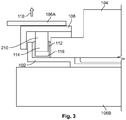
- a cylinder element 112 is arranged, in which a piston element 114 is located.
- the piston element 114 is supported on the separation region 108A of the base body 102, and can itself be intumescent or insulating. In the event of overheating, it expands and pushes the separation region 108A in the direction of the arrow 118, such that the spacing between the first electrically conductive part 104 and the second electrically conductive part 106A increases in size.
- the piston element itself need not be intumescent, but rather can lie on an intumescent material arranged in the floor region 116 of the cylinder element 112.
- the intumescent material in the region 116 pushes the piston element 114 in the direction of the arrow 118, if overheating occurs.
- the spacing between the first electrically conductive part 104 and the second electrically conductive part 106A thus increases in size, such that a short circuit between the first electrically conductive part 104 and the second electrically conductive part 106A can be avoided.
- FIG 4 shows a detail view of a further advantageous configuration of the carrier structure 400 according to the invention.
- the base body 402 of the carrier structure 400 has a floor element 420 and a cover element 422.
- the first electrically conductive part 404 specifically a battery contact here, is seated in the floor element 420.
- the cover element 422 has a receptacle 424, into which a welding lug, not depicted in this figure, is introduced as the second electrically conductive part.
- the welding lug and the battery contact 404 are electrically insulated from one another via the separation region 408.
- an insulating spacer 410A is arranged between the floor element 420 and the cover element 422 in such a way that the separation region 408 holds the welding lug in its position if the insulating spacer 410A is loaded with pressure.
- the direction of the arrow 418 here shows the active direction of the force via the welding lug.
- the insulating spacer 410 shown in Fig. 4 in this case can also consist of a ceramic material.
- an acrylate adhesive which is mixed with the intumescent material, is used as the base material for an intumescent spacer 410A.
- a commercially available, one-component, solvent-free isocyanate acrylate adhesive such as can be obtained under the trade name Vitralit ® DU 8050 from Panacol-Elosol GmbH, is proven to be a particularly cost-effective embodiment.
- the cyanoacrylate adhesive is mixed with spherical glass particles, in particular with gas-filled or vacuum-filled hollow glass beads.
- a further insulating or intumescent spacer 410B can be provided between the battery contact 404 and a second electrically conductive part, not shown here, which bears against the floor element 420.
- the insulating or intumescent spacer 410B is accommodated in a recess of the floor element 420 and, in the event of fire, stabilises the distance between the battery contact and the second electrically conductive part, for example a grounding plate.
- the insulating or intumescent spacer 410B again is preferably manufactured from a cyanoacrylate adhesive, which is filled with a glass-like or intumescent substance such as expandable graphite or melamine or a combination of both.
- cyanoacrylate adhesive as the base substance for the intumescent spacer in principle also has the advantage that the adhesion to the plastics material of the carrier structure is very good, such that an exceptionally good vibration resistance can be achieved.
- the second embodiment of the base body 402 as the floor element 420 and cover element 422 has the advantage that the cyanoacrylate adhesive is accessible for a UV curing before the arrangement is completely mounted.
- the base body 102, 402 is manufactured from a plastic, for example as an injection-moulded part.
- the base body is advantageously formed in two parts as a floor element 420 and cover element 422.
- a flowable precursor of the insulating or intumescent spacer 110, 410 is introduced into corresponding recesses, with the material being poured in through an injection nozzle, for example.
- a glass-bead-filled cyanoacrylate adhesive is used, problems with a lack of flowability can occur when doing this.
- the thixotropy of the cyanoacrylate adhesive can be utilised by applying ultrasound energy at this location.
- the material poured into the recesses is subsequently cured by means of UV radiation or ultrasound energy.
- Figure 6 shows a schematic plan view of the floor element 420 from Figure 5 .
- the electrically insulating spacer 410B is held in a corresponding flat receptacle 424 in the floor element 420.
- the spacer 410B can also be inserted as a prefabricated part into the receptacle 424 and held by a press-fit, for example.
- Fig. 7 shows a detail of a cell contacting system 700 for a motor vehicle battery, as a further possible application of the electrically insulating spacer according to the invention.
- the cell contacting system 700 has an electrically insulating base body which is configured as a frame 702.
- an electrically insulating spacer 710 is provided laterally.
- the electrically insulating spacer 710 is provided with an intumescent material and/or with an inorganic high heat-resistant material.
- the separation region 708 can be supported reliably and the necessary electrical insulation is preserved.
- air gaps and creepage paths between the busbars are held and filled.
- Reference numeral Description 100 400 carrier structure 102, 402 base body 104, 404, 704 first electrically conductive part 106, 406, 706 second electrically conductive part 108, 408, 708 separation region 110, 210 spacer 112 cylinder element 114 piston element 116 floor region of the cylinder element 118 direction arrow 420 floor element 422 cover element 424 receptacle 700 cell contacting system 702 frame
Landscapes
- Chemical & Material Sciences (AREA)
- Chemical Kinetics & Catalysis (AREA)
- Electrochemistry (AREA)
- General Chemical & Material Sciences (AREA)
- Inorganic Chemistry (AREA)
- Engineering & Computer Science (AREA)
- Microelectronics & Electronic Packaging (AREA)
- Battery Mounting, Suspending (AREA)
- Connection Of Batteries Or Terminals (AREA)
- Organic Insulating Materials (AREA)
- Insulating Bodies (AREA)
- Mechanical Engineering (AREA)
Abstract
Description
- The present invention relates to carrier structures, which can be used in contact systems of batteries, e.g. in motor vehicles. The present invention furthermore relates to a cell contacting system, which has such a carrier structure, and to a manufacturing method.
- Electrically conductive busbars which are held on electrically insulating carrier structures are usually used for the electrical contacting of batteries. These carrier structures insulate such a busbar from further electrically conductive elements, such as, for example, other busbars and contacts, metallic attachment and grounding lugs and also electrically conductive grounding plates. It has been shown that, in the event of an unusual increase in temperature (e.g. when there is a short circuit), the electrically insulating region which separates the busbar from other electrically conductive components is often not stable enough and fails. The result is an insufficient spacing between the busbar and other electrically conductive components, such that a further short circuit and even a thermal runaway of the entire battery arrangement may occur. Owing to the limited installation space and also owing to the high thermal loads when there is a fault, an increase in the wall thicknesses is often not a viable solution. Moreover, owing to the demands when there is a fault, a comparatively thick insulation made from most plastics would melt, since the melting points of conventional plastics lie in the range from 220°C to a maximum of 280°C. However, for safe electrical insulation in battery applications, for example, stability up to 500°C must be guaranteed.
- There is therefore a need for carrier structures which insulate safely and reliably between electrically conductive parts even at high temperatures, but which nevertheless are able to be manufactured inexpensively and compactly.
- This problem is solved by the subject-matter of the independent claims. Advantageous embodiments of the present invention are the subject of the dependent claims.
- In this case, the present invention is based on the idea of providing, in at least part of an overlapping region between electrically conductive components, an electrically insulating spacer, which has an intumescent material or an inorganic high temperature-resistant filler. Depending on the installation space, a combination of the intumescent spacer with a filled insulating spacer is also possible.
- If the electrically insulating spacer has an intumescent material, it changes its volume in the event of a temperature increase, which otherwise would lead to a softening of the housing material and thus to the failure of the insulation, and thus keeps the spacing between the electrically conductive components either the same or even enlarges it. As a result, it can be ensured that, in the event of a fault, there are no further short circuits. If the electrically insulating spacer is filled with a high temperature-resistant filler (such as glass, quartz or ceramic material), it remains dimensionally stable in the event of a fault and prevents the electrically conductive components from coming unacceptably close to one another.
- In particular, a carrier structure, for electrically insulating at least one first and one second electrically conductive part, comprises an electrically insulating base body, which has a first holding structure for holding the electrically conductive part and a second holding structure with contact to a second electrically conductive part, and an electrically insulating spacer, which is embedded in the base body in at least part of a separation region between the first and second electrically conductive parts, wherein the spacer has an intumescent material and/or an inorganic high temperature-resistant filler.
- In this case, the intumescent spacer, the insulating spacer filled with an inorganic high temperature-resistant material, or a combination of these spacers can be embedded in a base body in at least part of the separation region between the first and second electrically conductive parts.
- Expansion substances such as expandable graphite, anticatalytic melamines or melamine phosphates are suitable as intumescent materials.
- Advantageously therefore, without additionally increasing the wall thickness in the overlapping region between the first and second electrically insulating parts, it can be ensured that in the event of strong heating, no additional short circuits occur because the carrier material gives way. In the event of a fire, the intumescent material expands, but does not burn up. Furthermore, the intumescent material has the advantage that, in the event of a fault, it closes air gaps, which can provide too low an electrical insulation, and moreover smothers flames as a result of a lack of oxygen.
- According to an advantageous embodiment of the present invention, the intumescent spacer has a crosslinked cyanoacrylate adhesive, which is filled with the intumescent material. In this case, commercially available, inexpensive adhesives can be used, which are poured as a fluid precursor into the carrier structure and are subsequently cured by UV radiation, light, heat and/or ultrasound.
- A further embodiment of the invention provides a thermally and electrically insulating spacer, which draws on a crosslinked cyanoacrylate adhesive, for example, in order to reach a sufficiently high and temperature-resistant insulation in the electrically insulating base body via the addition of inorganic high temperature-resistant filler.
- In order to enlarge the spacing between the first and second electrically conductive parts in a targeted way in the overlapping region, if an excessive development of heat occurs, the intumescent spacer (also without addition of acrylate adhesive) can have an at least partially intumescent piston element and a heat-resistant cylinder element, the piston element expanding inside the cylinder element under the action of heat. The cylinder element can have a ceramic material, for example, and preferably should not be electrically conductive. In this way, the intumescent spacer functions as an actuator, which moves the two conductive parts away from one another.
- According to an advantageous development of the present invention, the electrically insulating spacer has glass as the filler. As a result, the electrically insulating spacer remains intact and, as long as it additionally contains an intumescent material, dimensionally stable in the expanded state. The glass grains or glass beads furthermore form a thermal and electrical insulation and prevent oxygen from reaching the combustible components of the intumescent spacer, for example an adhesive, such that the burn-up thereof is prevented or at least delayed. It is clear to a person skilled in the art that all other suitable inorganic electrically insulating and high temperature-resistant fillers, such as e.g. quartz or ceramic, can likewise be used.
- In a particularly advantageous way, the electrically insulating spacer has hollow glass beads as the filler, which hollow glass beads are filled with air, for example, and thus offer an even better heat insulation.
- For example, the spacer can be embedded as a lateral support element in a lattice structure of the carrier structure. In particular, the spacer can be arranged laterally between two busbars of a battery contacting system, so that in the event of overheating, air gaps and creepage paths between the busbars are maintained and filled or even the carrier structure is mechanically stabilised.
- Since the intumescent material leads to a relatively strong expansion of the volume of the spacer, it may be sufficient for a secure separation of the first and second electrically conductive parts that the intumescent spacer in the non-triggered state takes up less than 50% of the overlapping region. Thus, only a small amount of space and material is required for the spacer.
- According to an advantageous development of the present invention, the intumescent spacer is formed in such a way that it enlarges the spacing between the first and second electrically conductive parts by the action of heat. As a result, it can be achieved that, if required, deteriorating insulation characteristics of the housing material are compensated and in each case a short circuit between the first and second electrically conductive parts can be avoided.
- Normally, however, it may also suffice to safeguard the safety spacing, which is required in order to prevent the short circuit, via the electrically insulating spacer. In this case, the insulating spacer remains intact in terms of its electrically and thermally insulating function even after strong action of heat.
- According to an exemplary application environment, the first electrically conductive part is a voltage-conducting bar of a battery arrangement. By way of a spacer according to the invention, such a busbar is held separated, for example, from grounded electrically conductive parts such as a welding lug or a grounding plate. Alternatively, the separation from a further voltage-conducting busbar can also be provided.
- In particular, the present invention relates to a cell contacting system of a motor vehicle battery module, in particular of an electric or hybrid vehicle, wherein the cell contacting system has a carrier structure according to the present invention and a first multiplicity of separately formed contact elements for contacting in each case two neighbouring battery cells of the motor vehicle battery module, wherein the contact elements are arranged next to one another in a first row and in each case are attached to one side of the carrier structure, furthermore comprising a second multiplicity of separately formed contact elements, which are arranged next to one another in a second row and which are provided on a side of the carrier structure opposite the first row, so that contact elements for contacting in each case two neighbouring battery cells of the motor vehicle battery module are positioned on both sides of the carrier structure.
- The present invention moreover relates to a method for manufacturing a carrier structure according to the present invention, the method having the following steps:
- providing the carrier structure;
- introducing an electrically insulating spacer into a recess of the carrier structure, the spacer having an intumescent material and/or an inorganic high temperature-resistant filler.
- A particularly simple manufacture can be achieved by the electrically insulating spacer being introduced as a flowable precursor and subsequently the flowable precursor of the electrically insulating spacer being cured.
- For example, the step of curing the flowable precursor comprises the introduction of ultrasound energy. The use of ultrasound in this case has the advantage that the curing can be carried out easily even at difficult-to-access locations, particularly locations which cannot be reached by UV radiation or light. Furthermore, it can also be provided that the flowable precursor has thixotropic behaviour and the ultrasound energy is used for the short-term increase in flowability during the treatment process.
- A particularly well established material is used if the flowable precursor has an acrylate-based one-component adhesive.
- According to an advantageous development of the present invention, it can be provided that the electrically insulating spacer comprises an expansion substance as the intumescent material, which expansion substance is selected from the group comprising expandable graphite, melamine or mixtures thereof, and/or that the intumescent spacer furthermore comprises a filler, which is selected from the group comprising quartz particles, glass grains, glass beads and hollow glass beads or mixtures thereof.
- To better understand the present invention, it is explained in greater detail with the aid of the embodiments depicted in the following figures. In this case, identical parts are indicated with the same reference symbols and the same component names. Furthermore, some features or combinations of features from the different embodiments shown and described may also constitute solutions which are independent, inventive or in accordance with the invention in their own right. In the figures:
- Fig. 1
- shows a schematic sectional depiction of a carrier structure according to a first exemplary embodiment;
- Fig. 2
- shows a schematic sectional depiction of a carrier structure according to a second exemplary embodiment;
- Fig. 3
- shows a detail from
Fig. 2 ; - Fig. 4
- shows a schematic detail view of a carrier structure according to a further exemplary embodiment;
- Fig. 5
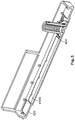
- shows a schematic perspective depiction of a carrier structure according to a further exemplary embodiment;
- Fig. 6
- shows a plan view of the carrier structure from
Fig. 5 ; - Fig. 7
- shows a schematic detail view of a carrier plate of a cell contacting system.
- The present invention is explained in greater detail hereafter with reference to the figures, and in particular firstly with reference to the schematic sectional depictions in
Figures 1 and 2 . It is pointed out that, in all the figures, the size ratios and in particular the layer thickness ratios are not necessarily reproduced true to scale. Furthermore, it is obviously clear to a person skilled in the art that the principles according to the invention can be used not only in the context of battery cell contacting systems, but also for other fields of application in which electrically conductive parts insulated from one another by carrier structures are to be separated from one another reliably in the event of overheating. -
Figure 1 shows, in a schematic sectional depiction, acarrier structure 100 according to the present invention, which is part of a cell contacting system. - Cell contacting systems for lithium-ion batteries comprise cell connectors and a cell holder, into which the connectors are integrated as a robust laser-welded layer construction. Alternatively, the cell connectors can also be attached to the lithium-ion cells by means of ultrasound welding or electromagnetic pulse welding (EMPT welding). Therefore, so-called "pouch cells" can also be used. The individual battery cells are connected to one another both in series and parallel to one another via the cell connectors. They take care of conduction of current, absorb cell forces and contain sensors where appropriate. The system, moreover, normally comprises a control interface with thermal and electrical monitoring.
- As depicted schematically in
Fig. 1 , thecarrier structure 100 comprises abase body 102, which is manufactured at least partially from an electrically insulating material, e.g. a plastic. A first electricallyconductive part 104 is formed, for example, by a voltage-conducting busbar or a battery cell contact. A second electricallyconductive part 106 furthermore comprises an electricallyconductive welding tab 106A and/or agrounding plate 106B which is in contact with thebase body 102 over a larger area. - Although two variants of a second electrically
conductive part 106 are shown inFig. 1 , of course also only one second electrically conductive part or more than two can be present. - In order to electrically insulate the first electrically
conductive part 104 and the second electricallyconductive part 106 from one another, thebase body 102 hasseparation regions 108, which are arranged in an overlapping region between the first electricallyconductive part 104 and the second electricallyconductive part 106. Experimental investigations on the fire performance have shown, however, that the existingseparation regions 108 do not remain sufficiently stable at temperatures above 500°C to safely prevent an electrical short circuit between the first and second electrically conductive parts. The plastic of theseparation region 108 frequently burned or softened so significantly that a short circuit occurred. - In order to solve this problem, the present invention provides an additional electrically insulating
spacer 110 in each case in the overlapping regions between the first electricallyconductive part 104 and the second electricallyconductive part 106. According to the invention, thespacers - According to the invention, an acrylate adhesive which is mixed with the inorganic insulating and/or intumescent material is used as the base material. A commercially available, one-component, solvent-free isocyanate acrylate adhesive, such as can be obtained under the trade name Vitralit ® DU 8050 from Panacol-Elosol GmbH, is proven to be a particularly cost-effective embodiment. Adhesives such as this cure under UV irradiation or over longer periods under the influence of moisture.
- In order to achieve an even further improved separation between the first electrically
conductive part 104 and the second electricallyconductive part 106, it can be provided that the cyanoacrylate adhesive is mixed with spherical glass particles, in particular with gas-filled or vacuum-filled hollow glass beads. For example, the mass can contain 60 to 90 percent by volume of glass beads. - In the event of fire, the glass beads form a thermal insulation and prevent oxygen from reaching the adhesive enclosed therein. In this way, it can be achieved that the arrangement fulfils, for example, the test provided for authorisation in the People's Republic of China, in which safe operation must be maintained for 15 minutes at 500°C.
- Referring to
Figures 2 and3 , a further advantageous embodiment of the present invention will now be explained in detail. - The
carrier structure 100 fromFig. 2 differs from the arrangement shown inFig. 1 by way of the differently configuredintumescent spacer 210. According to this alternative embodiment, theintumescent spacer 210 has an actuator function, so that in the event of fire not only is the required distance maintained, but rather the spacing between the first electricallyconductive part 104 and the second electricallyconductive part 106A is even enlarged further. - As can be seen in detail in
Figure 3 , thespacer 210 has a reciprocating piston-like structure. On thebase body 102 of thecarrier structure 100, acylinder element 112 is arranged, in which apiston element 114 is located. Thepiston element 114 is supported on the separation region 108A of thebase body 102, and can itself be intumescent or insulating. In the event of overheating, it expands and pushes the separation region 108A in the direction of thearrow 118, such that the spacing between the first electricallyconductive part 104 and the second electricallyconductive part 106A increases in size. - Alternatively, the piston element itself need not be intumescent, but rather can lie on an intumescent material arranged in the
floor region 116 of thecylinder element 112. In this case, the intumescent material in theregion 116 pushes thepiston element 114 in the direction of thearrow 118, if overheating occurs. In turn, the spacing between the first electricallyconductive part 104 and the second electricallyconductive part 106A thus increases in size, such that a short circuit between the first electricallyconductive part 104 and the second electricallyconductive part 106A can be avoided. -
Figure 4 shows a detail view of a further advantageous configuration of thecarrier structure 400 according to the invention. Thebase body 402 of thecarrier structure 400 has afloor element 420 and acover element 422. The first electricallyconductive part 404, specifically a battery contact here, is seated in thefloor element 420. Thecover element 422 has areceptacle 424, into which a welding lug, not depicted in this figure, is introduced as the second electrically conductive part. During normal operation, the welding lug and thebattery contact 404 are electrically insulated from one another via theseparation region 408. - In order to ensure that the welding lug cannot come dangerously close to the
battery contact 404 even in the event of overheating and fire, according to the invention an insulatingspacer 410A is arranged between thefloor element 420 and thecover element 422 in such a way that theseparation region 408 holds the welding lug in its position if the insulatingspacer 410A is loaded with pressure. The direction of thearrow 418 here shows the active direction of the force via the welding lug. The insulating spacer 410 shown inFig. 4 in this case can also consist of a ceramic material. - As in the above-described embodiments, an acrylate adhesive, which is mixed with the intumescent material, is used as the base material for an
intumescent spacer 410A. A commercially available, one-component, solvent-free isocyanate acrylate adhesive, such as can be obtained under the trade name Vitralit ® DU 8050 from Panacol-Elosol GmbH, is proven to be a particularly cost-effective embodiment. - In order to achieve an even further improved separation between the first electrically
conductive part 104 and the second electricallyconductive part 106, it can be provided that the cyanoacrylate adhesive is mixed with spherical glass particles, in particular with gas-filled or vacuum-filled hollow glass beads. - In this embodiment too (similarly to the arrangements from
Figures 1 and 2 ) a further insulating orintumescent spacer 410B can be provided between thebattery contact 404 and a second electrically conductive part, not shown here, which bears against thefloor element 420. The insulating orintumescent spacer 410B is accommodated in a recess of thefloor element 420 and, in the event of fire, stabilises the distance between the battery contact and the second electrically conductive part, for example a grounding plate. - The insulating or
intumescent spacer 410B again is preferably manufactured from a cyanoacrylate adhesive, which is filled with a glass-like or intumescent substance such as expandable graphite or melamine or a combination of both. - The use of cyanoacrylate adhesive as the base substance for the intumescent spacer in principle also has the advantage that the adhesion to the plastics material of the carrier structure is very good, such that an exceptionally good vibration resistance can be achieved.
- The second embodiment of the
base body 402 as thefloor element 420 andcover element 422 has the advantage that the cyanoacrylate adhesive is accessible for a UV curing before the arrangement is completely mounted. - The manufacture of the
carrier structure base body Figures 4 and5 , the base body is advantageously formed in two parts as afloor element 420 andcover element 422. - Before the
floor element 420 andcover element 422 are joined together, a flowable precursor of the insulating orintumescent spacer 110, 410 is introduced into corresponding recesses, with the material being poured in through an injection nozzle, for example. However, in particular, if a glass-bead-filled cyanoacrylate adhesive is used, problems with a lack of flowability can occur when doing this. In order to increase the flowability in the injection nozzle region, the thixotropy of the cyanoacrylate adhesive can be utilised by applying ultrasound energy at this location. - The material poured into the recesses is subsequently cured by means of UV radiation or ultrasound energy.
- Only then are the electrically conductive parts mounted and the entire arrangement assembled.
-
Figure 6 shows a schematic plan view of thefloor element 420 fromFigure 5 . The electrically insulatingspacer 410B is held in a correspondingflat receptacle 424 in thefloor element 420. Although, in the preceding description, a method was described in which the electrically insulatingspacer 410B is introduced in the form of a flowable precursor into thereceptacle 424 and subsequently cured, thespacer 410B can also be inserted as a prefabricated part into thereceptacle 424 and held by a press-fit, for example. -
Fig. 7 shows a detail of acell contacting system 700 for a motor vehicle battery, as a further possible application of the electrically insulating spacer according to the invention. Thecell contacting system 700 has an electrically insulating base body which is configured as aframe 702. A first electricallyconductive part 704 and a second electricallyconductive part 706, e.g. two busbars, are fitted on this frame next to one another in one plane. In order to prevent short circuits from being formed between the first electricallyconductive part 704 and the second electricallyconductive part 706 in the event of overheating, according to the invention an electrically insulatingspacer 710 is provided laterally. According to the invention, the electrically insulatingspacer 710 is provided with an intumescent material and/or with an inorganic high heat-resistant material. - In this way, in the event of overheating, the separation region 708 can be supported reliably and the necessary electrical insulation is preserved. In particular, in the case of an intumescent filler, air gaps and creepage paths between the busbars are held and filled.
-
Reference numeral Description 100, 400 carrier structure 102, 402 base body 104, 404, 704 first electrically conductive part 106, 406, 706 second electrically conductive part 108, 408, 708 separation region 110, 210 spacer 112 cylinder element 114 piston element 116 floor region of the cylinder element 118 direction arrow 420 floor element 422 cover element 424 receptacle 700 cell contacting system 702 frame
Claims (15)
- A carrier structure for electrically insulating at least one first and one second electrically conductive part, wherein the carrier structure (100, 400) comprises:an electrically insulating base body (102, 402), which has a first holding structure for holding the first electrically conductive part (104, 404) and a second holding structure for holding the second electrically conductive part (106), andan electrically insulating spacer (110, 210, 410), which is embedded in the base body in at least part of a separation region (108) between the first and second electrically conductive parts, wherein the spacer (110, 210, 410) has an intumescent material and/or an inorganic high temperature-resistant filler.
- The carrier structure according to Claim 1, wherein the electrically insulating spacer (110, 210, 410) has a crosslinked cyanoacrylate adhesive.
- The carrier structure according to Claim 1 or 2, wherein the electrically insulating spacer (110, 210, 410) has an at least partially intumescent piston element (114) and a heat-resistant cylinder element (116), and wherein the piston element expands inside the cylinder element under the action of heat.
- The carrier structure according to any one of the preceding claims, wherein the electrically insulating spacer (110, 210, 410) has glass, quartz and/or ceramic as the high temperature-resistant filler.
- The carrier structure according to Claim 4, wherein the electrically insulating spacer (110, 210, 410) has hollow glass beads as the filler.
- The carrier structure according to any one of the preceding claims, wherein the electrically insulating spacer (110, 210, 410) is embedded as a lateral support element in a lattice structure of the carrier structure.
- The carrier structure according to any one of the preceding claims, wherein the electrically insulating spacer takes up less than 50% of the separation region (108, 408).
- The carrier structure according to any one of the preceding claims, wherein the electrically insulating spacer (110, 210, 410) is formed in such a way that it enlarges the spacing between the first and second electrically conductive parts by the action of heat.
- The carrier structure according to any one of the preceding claims, wherein the first electrically conductive part (104, 404) is a voltage-conducting bar of a battery arrangement, and/or wherein the second electrically conductive part (106) is a welding lug or a grounding plate.
- A cell contacting system of a motor vehicle battery module, in particular of an electric or hybrid vehicle, wherein the cell contacting system has a carrier structure (100, 400) according to any one of Claims 1 to 9, and a first multiplicity of separately formed contact elements for contacting in each case two neighbouring battery cells of the motor vehicle battery module, wherein the contact elements are arranged next to one another in a first row and in each case are attached to one side of the carrier structure, furthermore comprising a second multiplicity of separately formed contact elements, which are arranged next to one another in a second row and which are provided on a side of the carrier structure opposite the first row, so that contact elements for contacting in each case two neighbouring battery cells of the motor vehicle battery module are positioned on both sides of the carrier structure.
- A method for manufacturing a carrier structure according to any one of the preceding claims, wherein the method has the steps of:providing the base body (102, 402) of the carrier structure (100, 400);introducing at least one electrically insulating spacer (110, 210, 410) into a recess of the carrier structure, wherein the spacer (110, 210, 410) has an intumescent material and/or an inorganic high temperature-resistant filler.
- The method according to Claim 11, wherein the electrically insulating spacer (110, 210, 410) is introduced as a flowable precursor and subsequently the flowable precursor of the electrically insulating spacer is cured.
- The method according to Claim 12, wherein the step of curing the flowable precursor comprises the introduction of UV radiation or ultrasound energy.
- The method according to Claim 12 or 13, wherein the flowable precursor has an acrylate-based one-component adhesive.
- The method according to either one of Claims 13 to 14, wherein the electrically insulating spacer (110, 210, 410) comprises an expansion substance, which is selected from the group comprising expandable graphite, melamine or mixtures thereof, and/or wherein the electrically insulating spacer furthermore comprises a filler, which is selected from the group comprising quartz, glass grains, glass beads and hollow glass beads or mixtures thereof.
Applications Claiming Priority (1)
| Application Number | Priority Date | Filing Date | Title |
|---|---|---|---|
| DE102019209252.7A DE102019209252A1 (en) | 2019-06-26 | 2019-06-26 | Carrier structure, cell contact system and manufacturing process |
Publications (1)
| Publication Number | Publication Date |
|---|---|
| EP3758092A1 true EP3758092A1 (en) | 2020-12-30 |
Family
ID=71130829
Family Applications (1)
| Application Number | Title | Priority Date | Filing Date |
|---|---|---|---|
| EP20181471.2A Pending EP3758092A1 (en) | 2019-06-26 | 2020-06-22 | Carrier structure, cell contacting system and manufacturing method |
Country Status (6)
| Country | Link |
|---|---|
| US (1) | US12027727B2 (en) |
| EP (1) | EP3758092A1 (en) |
| JP (1) | JP7582743B2 (en) |
| KR (1) | KR20210002007A (en) |
| CN (1) | CN112151729B (en) |
| DE (1) | DE102019209252A1 (en) |
Cited By (2)
| Publication number | Priority date | Publication date | Assignee | Title |
|---|---|---|---|---|
| WO2023215492A3 (en) * | 2022-05-04 | 2023-12-07 | Aspen Aerogels, Inc. | Protection of electrical components in battery systems |
| WO2025037790A1 (en) * | 2023-08-14 | 2025-02-20 | 주식회사 엘지에너지솔루션 | Busbar assembly and battery pack including same |
Families Citing this family (4)
| Publication number | Priority date | Publication date | Assignee | Title |
|---|---|---|---|---|
| DE102019209252A1 (en) * | 2019-06-26 | 2020-12-31 | Te Connectivity Germany Gmbh | Carrier structure, cell contact system and manufacturing process |
| DE102020112118A1 (en) | 2020-05-05 | 2021-11-11 | Elringklinger Ag | Temperature detection device and electrochemical system |
| CN113258177B (en) * | 2021-05-06 | 2022-07-26 | 风帆有限责任公司 | Vibration-resistant storage battery and manufacturing method thereof |
| KR20250082269A (en) * | 2023-11-30 | 2025-06-09 | 주식회사 엘지에너지솔루션 | Secondary battery |
Citations (5)
| Publication number | Priority date | Publication date | Assignee | Title |
|---|---|---|---|---|
| DE29617849U1 (en) * | 1996-10-14 | 1996-11-28 | Zimmermann, Karl, 51061 Köln | Cabel Canal |
| EP2538469A2 (en) * | 2011-06-23 | 2012-12-26 | Samsung SDI Co., Ltd. | Battery pack |
| US20150364281A1 (en) * | 2009-11-05 | 2015-12-17 | Phoenix Contact Gmbh & Co. Kg | Overvoltage protection element |
| US20160218401A1 (en) * | 2013-10-25 | 2016-07-28 | Quantumscape Corporation | Thermal and electrical management of battery packs |
| US20180287109A1 (en) * | 2015-10-22 | 2018-10-04 | Nissan Motor Co., Ltd. | Battery pack |
Family Cites Families (39)
| Publication number | Priority date | Publication date | Assignee | Title |
|---|---|---|---|---|
| DE3444163A1 (en) * | 1984-12-04 | 1986-06-05 | Bayer Ag, 5090 Leverkusen | Intumescent compositions |
| JP2569588B2 (en) | 1987-08-27 | 1997-01-08 | 三菱マテリアル株式会社 | Tungsten carbide based cemented carbide with excellent wear resistance and toughness |
| DE3811572A1 (en) * | 1988-03-31 | 1989-10-19 | System Elektronik Gmbh Berlin | Electrical component which is potted using a potting compound |
| JPH02144845A (en) * | 1988-11-26 | 1990-06-04 | Furukawa Battery Co Ltd:The | Battery container |
| DE4036302A1 (en) * | 1990-11-14 | 1992-05-21 | Reinhard Treudler | Support for electronic components - made of water setting gypsum or cement |
| JP4761727B2 (en) | 2004-04-30 | 2011-08-31 | 三洋電機株式会社 | Pack battery |
| JP4616234B2 (en) | 2006-10-31 | 2011-01-19 | 日本電信電話株式会社 | Code amount estimation method, frame rate estimation method, code amount estimation device, frame rate estimation device, code amount estimation program, frame rate estimation program, and computer-readable recording medium recording these programs |
| DE102009019484B4 (en) * | 2009-05-04 | 2015-12-17 | Airbus Defence and Space GmbH | Combination of the effects of expansion agents and chemical degradation reagents for releasable adhesive bonds |
| JP2011003294A (en) | 2009-06-16 | 2011-01-06 | Sony Corp | Battery pack, and method of manufacturing the same |
| JP2011210711A (en) | 2010-03-12 | 2011-10-20 | Autonetworks Technologies Ltd | Battery module |
| DE202010003982U1 (en) * | 2010-03-22 | 2010-08-05 | Holzbau Schmid Gmbh & Co. Kg | Fire protection door frame made of wood |
| DE102011102765A1 (en) | 2011-05-28 | 2012-11-29 | Audi Ag | Battery for a vehicle and method of manufacturing a battery |
| JP5776345B2 (en) * | 2011-06-09 | 2015-09-09 | ソニー株式会社 | Battery module, electronic device, power system and electric vehicle |
| DE102013219601A1 (en) | 2013-09-27 | 2015-04-02 | Siemens Aktiengesellschaft | Electrically driven vehicle with an insulated busbar |
| EP3069396A2 (en) | 2013-11-13 | 2016-09-21 | R. R. Donnelley & Sons Company | Battery |
| KR101925574B1 (en) | 2014-05-15 | 2018-12-05 | 엘지디스플레이 주식회사 | Organic light emitting device |
| DE102014219229A1 (en) | 2014-09-24 | 2016-03-24 | Robert Bosch Gmbh | Contact system with a circuit carrier and a riveted busbar |
| DE102014116662B4 (en) | 2014-11-14 | 2018-03-08 | Infineon Technologies Ag | ELECTRICAL CONNECTION ASSEMBLY, SEMICONDUCTOR MODULE AND METHOD FOR PRODUCING A SEMICONDUCTOR MODULE |
| DE102015007408A1 (en) * | 2015-06-10 | 2016-12-15 | Daimler Ag | Battery with at least one heat insulation in the thickness direction increasing thermal insulation element |
| US10573938B2 (en) * | 2015-06-25 | 2020-02-25 | Te Connectivity Corporation | Battery module with a temperature monitoring assembly |
| US20170003349A1 (en) * | 2015-07-02 | 2017-01-05 | GM Global Technology Operations LLC | Arc suppression and protection of integrated flex circuit fuses for high voltage applications under chemically harsh environments |
| DE102015221555A1 (en) | 2015-11-03 | 2017-05-04 | VW-VM Forschungsgesellschaft mbH & Co. KG | Sealing system for pole feedthrough |
| DE102016100223A1 (en) | 2016-01-07 | 2017-07-13 | Lisa Dräxlmaier GmbH | Electric vehicle component with heat-swellable fire protection material |
| CN108604718B (en) | 2016-03-14 | 2021-06-25 | 松下知识产权经营株式会社 | Composite sheet and battery pack using the same |
| KR101678178B1 (en) | 2016-04-08 | 2016-11-21 | 주식회사 일렉켐스 | Anisotropic conductive adhesive composition for accessing electric or electronic parts |
| DE102016120906B4 (en) | 2016-11-02 | 2018-07-12 | Preh Gmbh | Input device with an array of force sensors and partially hardened interlayer |
| US10326181B2 (en) * | 2016-11-04 | 2019-06-18 | Te Connectivity Corporation | Connector assembly for a battery system |
| JP6885791B2 (en) | 2017-06-05 | 2021-06-16 | 積水化学工業株式会社 | Thermal runaway prevention sheet |
| JP6859892B2 (en) | 2017-08-08 | 2021-04-14 | トヨタ自動車株式会社 | Fuel cell |
| DE102017121658A1 (en) * | 2017-09-19 | 2019-03-21 | Eichenauer Heizelemente Gmbh & Co. Kg | Actuating device with an expansion element and valve device |
| JP6950416B2 (en) | 2017-09-29 | 2021-10-13 | 株式会社Gsユアサ | Power storage module and power storage pack |
| JP6991839B2 (en) | 2017-11-20 | 2022-01-13 | タイガースポリマー株式会社 | Refractory laminate, tubular laminate using it, and battery isolation structure |
| US12080898B2 (en) * | 2017-12-22 | 2024-09-03 | Cummins Inc. | Thermal runaway mitigation system for high capacity energy cell |
| CN208483940U (en) | 2018-07-16 | 2019-02-12 | 无锡易玛卡机械科技有限公司 | A kind of full-automatic flexible material cutting apparatus frame head apparatus |
| CN208478394U (en) | 2018-08-13 | 2019-02-05 | 浙江衡远新能源科技有限公司 | A kind of cover plate assembly of battery high temperature-proof failure |
| WO2020180827A1 (en) * | 2019-03-01 | 2020-09-10 | Ted Thomas | Stackable battery bussing system |
| DE102019209252A1 (en) * | 2019-06-26 | 2020-12-31 | Te Connectivity Germany Gmbh | Carrier structure, cell contact system and manufacturing process |
| CN114982044A (en) * | 2020-01-15 | 2022-08-30 | 3M创新有限公司 | Thermal runaway barrier for rechargeable electrical energy storage system |
| US12482892B2 (en) * | 2022-02-08 | 2025-11-25 | Ford Global Technologies, Llc | Thermal barrier for busbar of traction battery |
-
2019
- 2019-06-26 DE DE102019209252.7A patent/DE102019209252A1/en active Pending
-
2020
- 2020-06-19 JP JP2020105716A patent/JP7582743B2/en active Active
- 2020-06-22 EP EP20181471.2A patent/EP3758092A1/en active Pending
- 2020-06-23 US US16/909,444 patent/US12027727B2/en active Active
- 2020-06-25 KR KR1020200077870A patent/KR20210002007A/en active Pending
- 2020-06-28 CN CN202010596221.5A patent/CN112151729B/en active Active
Patent Citations (5)
| Publication number | Priority date | Publication date | Assignee | Title |
|---|---|---|---|---|
| DE29617849U1 (en) * | 1996-10-14 | 1996-11-28 | Zimmermann, Karl, 51061 Köln | Cabel Canal |
| US20150364281A1 (en) * | 2009-11-05 | 2015-12-17 | Phoenix Contact Gmbh & Co. Kg | Overvoltage protection element |
| EP2538469A2 (en) * | 2011-06-23 | 2012-12-26 | Samsung SDI Co., Ltd. | Battery pack |
| US20160218401A1 (en) * | 2013-10-25 | 2016-07-28 | Quantumscape Corporation | Thermal and electrical management of battery packs |
| US20180287109A1 (en) * | 2015-10-22 | 2018-10-04 | Nissan Motor Co., Ltd. | Battery pack |
Cited By (2)
| Publication number | Priority date | Publication date | Assignee | Title |
|---|---|---|---|---|
| WO2023215492A3 (en) * | 2022-05-04 | 2023-12-07 | Aspen Aerogels, Inc. | Protection of electrical components in battery systems |
| WO2025037790A1 (en) * | 2023-08-14 | 2025-02-20 | 주식회사 엘지에너지솔루션 | Busbar assembly and battery pack including same |
Also Published As
| Publication number | Publication date |
|---|---|
| JP2021005552A (en) | 2021-01-14 |
| JP7582743B2 (en) | 2024-11-13 |
| CN112151729B (en) | 2024-03-08 |
| CN112151729A (en) | 2020-12-29 |
| DE102019209252A1 (en) | 2020-12-31 |
| KR20210002007A (en) | 2021-01-06 |
| US20200406843A1 (en) | 2020-12-31 |
| US12027727B2 (en) | 2024-07-02 |
Similar Documents
| Publication | Publication Date | Title |
|---|---|---|
| EP3758092A1 (en) | Carrier structure, cell contacting system and manufacturing method | |
| CN215869599U (en) | Battery module and battery pack including the same | |
| KR101310111B1 (en) | Heat-generating Element of a Heating Device | |
| KR100837333B1 (en) | Absence of heat generation in heating devices | |
| US20100136396A1 (en) | Cell Separator for Minimizing Thermal Runaway Propagation within a Battery Pack | |
| JP6775576B2 (en) | A cover element of a battery module housing, a battery module having such a cover element and a method for manufacturing the same, and a battery. | |
| US20180261804A1 (en) | Battery Assembly | |
| CN113745731B (en) | Battery module for a battery, motor vehicle comprising a battery, and method for operating a motor vehicle comprising a battery | |
| KR101037042B1 (en) | Pouch type secondary battery with improved safety | |
| BRPI0819537B1 (en) | ELECTRIC CHEMICAL STORAGE CELL AND BATTERY SYSTEM FOR A VEHICLE | |
| CN112005397A (en) | Vehicles with high voltage memory | |
| CN109845026A (en) | With the electricity accumulator that the coldplate between each unit for promptly cooling down is arranged in | |
| KR20230026954A (en) | Battery arrangement | |
| GB2545214A (en) | Apparatus for providing a barrier between battery modules | |
| KR20240058547A (en) | Fireproof busbar and battery pack hanving the same | |
| CN112042003A (en) | Protection unit for battery module of high-voltage battery, battery module and high-voltage battery | |
| CN121420411A (en) | High-voltage batteries used as traction batteries in motor vehicles | |
| US20230170558A1 (en) | Protective Device for Battery Cells | |
| CN115117506A (en) | Thermal interface material, battery device and motor vehicle | |
| JP7754575B2 (en) | Intermodule busbars containing fire extinguishing fluid | |
| JP4175055B2 (en) | Single cell, assembled battery and assembled battery module | |
| CN216597908U (en) | Self-fusing bus bar and battery module | |
| KR20170046608A (en) | Circuit board and method for mounting electronic component | |
| CN217788726U (en) | Coupling assembling, battery package and vehicle | |
| KR20240142980A (en) | Protective cover and connector assembly including the same and battery pack having the same |
Legal Events
| Date | Code | Title | Description |
|---|---|---|---|
| PUAI | Public reference made under article 153(3) epc to a published international application that has entered the european phase |
Free format text: ORIGINAL CODE: 0009012 |
|
| STAA | Information on the status of an ep patent application or granted ep patent |
Free format text: STATUS: THE APPLICATION HAS BEEN PUBLISHED |
|
| AK | Designated contracting states |
Kind code of ref document: A1 Designated state(s): AL AT BE BG CH CY CZ DE DK EE ES FI FR GB GR HR HU IE IS IT LI LT LU LV MC MK MT NL NO PL PT RO RS SE SI SK SM TR |
|
| AX | Request for extension of the european patent |
Extension state: BA ME |
|
| STAA | Information on the status of an ep patent application or granted ep patent |
Free format text: STATUS: REQUEST FOR EXAMINATION WAS MADE |
|
| 17P | Request for examination filed |
Effective date: 20210615 |
|
| RBV | Designated contracting states (corrected) |
Designated state(s): AL AT BE BG CH CY CZ DE DK EE ES FI FR GB GR HR HU IE IS IT LI LT LU LV MC MK MT NL NO PL PT RO RS SE SI SK SM TR |
|
| STAA | Information on the status of an ep patent application or granted ep patent |
Free format text: STATUS: EXAMINATION IS IN PROGRESS |
|
| 17Q | First examination report despatched |
Effective date: 20240311 |