EP3755883B1 - Rotierende thermodynamische vorrichtung - Google Patents
Rotierende thermodynamische vorrichtung Download PDFInfo
- Publication number
- EP3755883B1 EP3755883B1 EP19707078.2A EP19707078A EP3755883B1 EP 3755883 B1 EP3755883 B1 EP 3755883B1 EP 19707078 A EP19707078 A EP 19707078A EP 3755883 B1 EP3755883 B1 EP 3755883B1
- Authority
- EP
- European Patent Office
- Prior art keywords
- rotor
- guide feature
- magnetic guide
- chamber
- port
- Prior art date
- Legal status (The legal status is an assumption and is not a legal conclusion. Google has not performed a legal analysis and makes no representation as to the accuracy of the status listed.)
- Active
Links
Images





Classifications
-
- F—MECHANICAL ENGINEERING; LIGHTING; HEATING; WEAPONS; BLASTING
- F02—COMBUSTION ENGINES; HOT-GAS OR COMBUSTION-PRODUCT ENGINE PLANTS
- F02G—HOT GAS OR COMBUSTION-PRODUCT POSITIVE-DISPLACEMENT ENGINE PLANTS; USE OF WASTE HEAT OF COMBUSTION ENGINES; NOT OTHERWISE PROVIDED FOR
- F02G1/00—Hot gas positive-displacement engine plants
- F02G1/04—Hot gas positive-displacement engine plants of closed-cycle type
-
- F—MECHANICAL ENGINEERING; LIGHTING; HEATING; WEAPONS; BLASTING
- F01—MACHINES OR ENGINES IN GENERAL; ENGINE PLANTS IN GENERAL; STEAM ENGINES
- F01C—ROTARY-PISTON OR OSCILLATING-PISTON MACHINES OR ENGINES
- F01C9/00—Oscillating-piston machines or engines
- F01C9/005—Oscillating-piston machines or engines the piston oscillating in the space, e.g. around a fixed point
-
- F—MECHANICAL ENGINEERING; LIGHTING; HEATING; WEAPONS; BLASTING
- F01—MACHINES OR ENGINES IN GENERAL; ENGINE PLANTS IN GENERAL; STEAM ENGINES
- F01C—ROTARY-PISTON OR OSCILLATING-PISTON MACHINES OR ENGINES
- F01C11/00—Combinations of two or more machines or engines, each being of rotary-piston or oscillating-piston type
- F01C11/002—Combinations of two or more machines or engines, each being of rotary-piston or oscillating-piston type of similar working principle
-
- F—MECHANICAL ENGINEERING; LIGHTING; HEATING; WEAPONS; BLASTING
- F01—MACHINES OR ENGINES IN GENERAL; ENGINE PLANTS IN GENERAL; STEAM ENGINES
- F01C—ROTARY-PISTON OR OSCILLATING-PISTON MACHINES OR ENGINES
- F01C21/00—Component parts, details or accessories not provided for in groups F01C1/00 - F01C20/00
-
- F—MECHANICAL ENGINEERING; LIGHTING; HEATING; WEAPONS; BLASTING
- F01—MACHINES OR ENGINES IN GENERAL; ENGINE PLANTS IN GENERAL; STEAM ENGINES
- F01C—ROTARY-PISTON OR OSCILLATING-PISTON MACHINES OR ENGINES
- F01C21/00—Component parts, details or accessories not provided for in groups F01C1/00 - F01C20/00
- F01C21/008—Driving elements, brakes, couplings, transmissions specially adapted for rotary or oscillating-piston machines or engines
-
- F—MECHANICAL ENGINEERING; LIGHTING; HEATING; WEAPONS; BLASTING
- F01—MACHINES OR ENGINES IN GENERAL; ENGINE PLANTS IN GENERAL; STEAM ENGINES
- F01C—ROTARY-PISTON OR OSCILLATING-PISTON MACHINES OR ENGINES
- F01C21/00—Component parts, details or accessories not provided for in groups F01C1/00 - F01C20/00
- F01C21/08—Rotary pistons
-
- F—MECHANICAL ENGINEERING; LIGHTING; HEATING; WEAPONS; BLASTING
- F01—MACHINES OR ENGINES IN GENERAL; ENGINE PLANTS IN GENERAL; STEAM ENGINES
- F01C—ROTARY-PISTON OR OSCILLATING-PISTON MACHINES OR ENGINES
- F01C9/00—Oscillating-piston machines or engines
-
- F—MECHANICAL ENGINEERING; LIGHTING; HEATING; WEAPONS; BLASTING
- F25—REFRIGERATION OR COOLING; COMBINED HEATING AND REFRIGERATION SYSTEMS; HEAT PUMP SYSTEMS; MANUFACTURE OR STORAGE OF ICE; LIQUEFACTION SOLIDIFICATION OF GASES
- F25B—REFRIGERATION MACHINES, PLANTS OR SYSTEMS; COMBINED HEATING AND REFRIGERATION SYSTEMS; HEAT PUMP SYSTEMS
- F25B11/00—Compression machines, plants or systems, using turbines, e.g. gas turbines
- F25B11/02—Compression machines, plants or systems, using turbines, e.g. gas turbines as expanders
-
- F—MECHANICAL ENGINEERING; LIGHTING; HEATING; WEAPONS; BLASTING
- F01—MACHINES OR ENGINES IN GENERAL; ENGINE PLANTS IN GENERAL; STEAM ENGINES
- F01C—ROTARY-PISTON OR OSCILLATING-PISTON MACHINES OR ENGINES
- F01C21/00—Component parts, details or accessories not provided for in groups F01C1/00 - F01C20/00
- F01C21/02—Arrangements of bearings
Definitions
- the present disclosure relates to a roticulating thermodynamic apparatus.
- thermodynamic apparatus operable as a heat pump and/or heat engine.
- thermodynamic expanders tend to be of a rotational type (e.g. turbines) and are typically limited to a single stage expansion ratio of 3:1.
- the running speed of the turbine is generally higher than the running speed of the pump.
- the pump and turbine tend to be of different types and rotate independently of one another to allow them to run at different speeds.
- GB2544819A discloses a fluid compression apparatus for an internal combustion engine or a fluid pump.
- US1967167A discloses a fluid compression apparatus.
- an apparatus comprising: a shaft (18) which defines and is rotatable about a first rotational axis (30); an axle (20) defining a second rotational axis (32), the shaft (18) extending through the axle (20); a first piston member (22) provided on the shaft (18), the first piston member (22) extending from the axle (20) towards a distal end of the shaft (18); a rotor (16) carried on the axle (20); the rotor (16) comprising a first chamber (34a), the first piston member (22) extending across the first chamber (34a); a housing (12) having a wall (24) which defines a cavity (26), the rotor (16) being rotatable and pivotable within the cavity (26); a first magnetic guide feature (52) coupled to the rotor (16); a second magnetic guide feature (50) coupled to the housing (12); whereby : the rotor (16) and axle (20) are rotatable with the shaft (18) around the first rotational axis (30); the rotor (16)
- the magnet is an electro-magnet.
- the first chamber (34a) has a first opening (36); and the first piston member (22) extends from the axle (20) across the first chamber (34a) towards the first opening (36).
- the first piston member (22) extends from one side of the axle (20) along the shaft (18); and a second piston member (22) extends from the other side of the axle (20) along the shaft (18), the rotor (16) comprising a second chamber (34b) to permit relative pivoting motion between the rotor (16) and the second piston member (22) as the rotor (16) rotates about the first rotational axis (30).
- the second chamber (34b) has a second opening (36); and the second piston member (22) extends from the axle (20) across the second chamber (34b) towards the second opening (36).
- the second chamber (34b) has a second opening (36); and the second piston member (22) extends from the axle (20) across the second chamber (34b) towards the second opening (36).
- the shaft (18), axle (20) and piston member(s) (22) are fixed relative to one another.
- the magnetically coupling between the first magnetic guide feature (52) and second magnetic guide feature (50) drives the rotation of the shaft (18) about the first rotational axis (30).
- the first magnetic guide feature (52) comprises at least one permanent magnet.
- the first magnetic guide feature (52) comprises two diametrically opposed permanent magnets arranged on the rotor (16).
- the first magnetic guide feature comprises one or more clusters of permanent magnets arranged on the rotor.
- the first magnetic guide feature (52) is configured to be received in one or more recesses (53) in the rotor (16).
- the first magnetic guide feature (52) comprises: a slewing ring; and a plurality of permanent magnets arranged on an outside of the slewing ring, wherein the slewing ring is configured to be coupled to the rotor via an engagement fixture.
- the engagement fixture comprises a pivot pin to enable the first magnetic guide feature (52) to pivot relative to the rotor (16).
- the second magnetic guide feature (50) comprises a plurality of electro-magnets.
- the second magnetic guide feature (50) comprises a spacer ring and the plurality of electro-magnets are arranged on an inside surface of the spacer ring. In one example, the plurality of electro-magnets are arranged in an array on the inside of the housing.
- the apparatus comprises a controller to control the polarity of the plurality of electro-magnets of the second magnetic guide feature (50).
- the magnetic coupling of the second magnetic guide feature (50) and the first magnetic guide feature (52) is configured to provide a guide path around a first circumference of the rotor (16) or housing (12).
- the guide path comprises at least: a first inflexion which directs the guide path away from a first side of the first circumference and then back toward a second side of the first circumference; and a second inflexion which directs the guide path away from the second side of the first circumference and then back toward the first side of the first circumference.
- the first rotor (119) comprises the second chamber (134b); the first piston member (122a) extends from one side of the first axle (120) along the first shaft portion (118); and a second piston member (122b) extends from the other side of the first axle (120) along the first shaft portion (118), across the second chamber (134b) to permit the first rotor (119) to pivot relative to the second piston member (122b) as the first rotor (119) rotates about the first rotational axis (130); and the fourth port (116b) is in fluid communication with the first port (114a) via a second heat exchanger (306a).
- the apparatus also includes a second rotor (219) comprising the second chamber (234b), a second shaft portion (218) rotatable about the first rotational axis (130); and the second shaft portion (218) is coupled to the first shaft portion (118) such that the first shaft portion (118) and second shaft portion (218) are rotatable together around the first rotational axis (130); a second axle (220) defining a third rotational axis (232), the second shaft portion (218) extending through the second axle (220); a second piston member (222b) provided on the second shaft portion (218), the second piston member (222b) extending from the second axle (220) towards a distal end of the second shaft portion (218); the second rotor (219) carried on the second axle (220); the second piston member (222b) extending across the second chamber (234b); whereby : the second rotor (219) and second axle (220) are rotatable with the second shaft portion (218) around the first rotational
- the first rotor (119) comprises : a first rotor second chamber (134b), the first piston member (122a) extending from one side of the first axle (120) along the first shaft portion (118); and a second piston member (122b) extends from the other side of the first axle (120) along the first shaft portion (118), across the first rotor second chamber (134b) to permit the first rotor (119) to pivot relative to the second piston member (122b) as the first rotor (119) rotates about the first rotational axis (130); and the second rotor (219) comprises : a second rotor first chamber (234a) the second piston member (222b) extends from one side of the second axle (220) along the second shaft portion (218); and a second rotor first piston member (222a) extends from the other side of the second axle (220) along the second shaft portion (218), across the second rotor first chamber (234a) to permit the second rotor (219) to pivot relative to
- the eight port (116d) is in fluid communication with the fifth port (114c) via a second heat exchanger (306a).
- the fourth port (116b) is in fluid communication with the first port (114a) via the second heat exchanger (306a).
- the first heat exchanger (302a) is operable as a heat sink to remove heat energy from fluid passing through it.
- the first heat exchanger (302a) is operable as a heat source to add heat energy to fluid passing through it.
- the heat source comprises a substance passing through a duct (303) in the first heat exchanger (302a), wherein the apparatus (1000) provides cooling to the substance.
- the fluid comprises air.
- the apparatus comprises a motor (308) coupled to the first shaft portion (118) configured to drive the rotor (119) around the first rotational axis (130).
- the magnetic coupling between the first magnetic guide feature and the second magnetic guide feature is operable to rotate the first shaft portion in a either a first direction or a second direction such that when the magnetic coupling is configured to drive the rotor (119) around the first rotational axis (130) in a first direction, the first heat exchanger (302a) is operable to act as a heat source to transfer heat from the substance to the fluid, and wherein when the magnetic coupling is configured to drive the rotor (119) around the first rotational axis (130) in a second direction, opposite to the first direction, the first heat exchanger (302a) is operable to act as a heat sink to transfer heat from the fluid to the substance.
- an apparatus operable to displace and expand fluid which may be configured as heat pump to remove heat from a system (e.g. a refrigerator) or configured as a heat engine to extract work from a working fluid in order to provide a rotational output.
- the displacement section (e.g. pump) and expansion section (e.g. turbine) of the present device can sustain their optimal efficiency at near identical speeds and be subject to a single set of mechanical constraints by virtue of being housed within a common device.
- arrangements of the present disclosure may be substantially thermodynamically ideal.
- the apparatus may comprise a core element having linked displacement and expansion chambers which are defined by walls of a single common rotor.
- the rotor is pivotable relative to a rotatable piston.
- the core elements may be described as a 'roticulator' since the rotor of the present disclosure is operable to simultaneously 'rotate' and 'articulate', for example as described in PCT Application PCT/GB2016/052429 (Published as WO2017/089740 ) .
- heat engine or heat pump which comprises a 'roticulating apparatus'.
- Roticulation and the roticulating concept hence describe a device in which a single body (e.g. a rotor) rotates whilst simultaneously articulating, describing a 3D spatial movement which can be used to perform volumetric 'work' in conjunction and translation with rotation.
- a single body e.g. a rotor
- the apparatus offers absolute management and control of multiple volumetric chambers within a single order of mechanical constraints/losses. Given this high ratio of volumetric chambers over mechanical losses the efficiency of the device is of a high order when compared to conventional devices.
- this disclosure describes a device capable of both positive displacement and absolute evacuation of its working volumes, such is characteristic of an 'ideal' expander/compressor/pump, offering a high expansion/compression ratio many orders beyond conventional devices.
- the apparatus offers the highly desirable characteristic of a single device operable to simultaneously perform the action of expansion of a working fluid as well as compression and/or displacement of the same working fluid.
- a heat engine according to the present disclosure may operate with a lower heat differential, utilising lower quality heat than examples of the related art.
- first fluid flow section and second fluid flow sections are linked, a heat pump according to the present disclosure is inherently more efficient than an example of the related art as expansion of the fluid is utilised to drive the displacement/pump/compressing section, thereby requiring less external input from a motor.
- apparatus according to the present invention may efficiently operate over a wide range of conditions, thereby allowing the device to produce outputs with input conditions which would not provide sufficient energy for examples of the related art to operate.
- first magnetic guide feature and the second magnetic guide feature wherein at least one of the first magnetic guide feature and the second magnetic guide feature comprises a magnet enables the first magnetic guide feature and the second magnetic guide feature to be coupled together.
- This magnetic coupling enables the rotor to pivot thereby inducing the rotor to pivot about the axle relative to the first piston member.
- the magnetic coupling reduces friction in the apparatus as the relative position of the rotor and the first piston member can be controlled without the need for a mechanical guide path.
- the magnetic coupling between the first magnetic guide feature and the second magnetic guide feature may also act to drive the rotation of the shaft about a first rotational axis, thereby removing the requirement for a motor.
- the present invention is concerned with an apparatus comprising a roticulating thermodynamic apparatus configured to be driven by a magnetically coupled track.
- the apparatus is suitable for use as part of a fluid working apparatus operable as a heat pump and/or a heat engine.
- Core elements of the apparatus are described as well as non-limiting examples of applications in which the apparatus may be employed.
- fluid is intended to have its normal meaning, for example : a liquid, gas, vapour, or a combination of liquid, gas and/or vapour, or material behaving as a fluid.
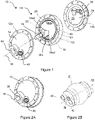
- Figure 1 shows a part exploded view of a core 10 part of an apparatus according to the present invention.
- the core comprises a housing 12 and rotor assembly 14.
- Figure 2A shows an example of a housing 12 when it is closed around the rotor assembly 14.
- Figure 2B shows an alternative example of a housing 12 when it is closed around the rotor assembly 14.
- the housing 12 is divided into three parts 12a, 12b, 12c which close around the rotor assembly 14.
- the housing comprises two parts 12a, 12b and a spacer ring 12c, which separates the two parts 12a, 12b.
- the housing may be fabricated from more than three parts, and/or split differently to that shown in Figure 1 .
- the housing 12 may be made from two parts.
- the rotor assembly 14 comprises a rotor 16, a shaft 18, an axle 20 and a piston member 22.
- the housing 12 has a wall 24 which defines a cavity 26, the rotor 16 being rotatable and pivotable within the cavity 26.
- the shaft 18 defines, and is rotatable about, a first rotational axis 30.
- the axle 20 extends around the shaft 18.
- the axle extends at an angle to the shaft 18.
- the axle defines a second rotational axis 32.
- the axle 20 defines the second rotational axis 32, and the shaft 18 extends through the axle 20 at an angle to the axle 20.
- the piston member 22 is provided on the shaft 18.
- the apparatus is provided with two piston members 22, i.e. a first and second piston member 22.
- the rotor 16 also defines two chambers 34a,b, one diametrically opposite the other on either side of the rotor 16.
- the first chamber 34a comprises two sub-chambers 34a1, 34a2.
- each chamber 34 may be provided as a compression chamber.
- each chamber 34 may be provided as a displacement chamber.
- each chamber 34 may be provided as an expansion or metering chamber.
- piston member 22 may in fact be one piece that extends all of the way through the rotor assembly 14, this arrangement effectively means each chamber 34 is provided with a piston member 22. That is to say, although the piston member 22 may comprise only one part, it may form two piston members sections 22, one on either side of the rotor assembly 14.
- a first piston member 22 extends from one side of the axle 20 along the shaft 18 towards one side of the housing 12, and a second piston member 22 extends from the other side of the axle 20 along the shaft 18 towards the other side of the housing 12.
- the rotor 16 comprises a first chamber 34a having a first opening 36 on one side of the rotor assembly 14, and a second chamber 34b having a second opening 36 on the other side of the rotor assembly 14.
- the rotor 16 is carried on the axle 20, the rotor 16 being pivotable relative to the axle 20 about the second rotational axis 32.
- the piston member 22 extends from the axle 20 across the chambers 34a,b towards the openings 36.
- a small clearance is maintained between the edges of the piston member 22 and the wall of the rotor 16 which defines the chamber 34.
- the clearance may be small enough to provide a seal between the edges of the piston member 22 and the wall of the rotor 16 which defines the chamber 34.
- sealing members may be provided between the piston members 22 and the wall of the rotor 16 which defines the chamber 34.
- the chambers 34 are defined by side walls (i.e. end walls of the chambers 34) which travel to and from the piston members 22, the side walls being joined by boundary walls which travel past the sides of the piston member 22. That is to say, the chambers 34 are defined by side/end walls and boundary walls provided in the rotor 16.
- the rotor 16 is rotatable with the shaft 18 around the first rotational axis 30, and pivotable about the axle 20 about the second rotational axis 32.
- This configuration results in the first piston member 22 being operable to travel (i.e. traverse) from one side of the first chamber 34a to an opposing side of the first chamber 34a as the rotor 16 rotates about the first rotational axis 30.
- the rotor 16 is rotatable with the shaft 18 around the first rotational axis 30, and the rotor 16 is pivotable about the axle 20 about the second rotational axis 32, during operation there is a relative pivoting (i.e.
- the apparatus is configured to permit a controlled pivoting motion of the rotor 16 relative to the first piston member 22 as the rotor 16 rotates about the first rotational axis 30.
- the configuration also results in the second piston member 22 being operable to travel (i.e. traverse) from one side of the second chamber 34b to an opposing side of the second chamber 34b as the rotor 16 rotates about the first rotational axis 30.
- the rotor 16 is rotatable with the shaft 18 around the first rotational axis 30, and the rotor 16 is pivotable about the axle 20 about the second rotational axis 32, during operation there is a relative pivoting (i.e. rocking) motion between the rotor 16 and both piston members 22 as the rotor 16 rotates about the first rotational axis 30. That is to say, the apparatus is configured to permit a controlled pivoting motion of the rotor 16 relative to both piston members 22 as the rotor 16 rotates about the first rotational axis 30.
- the relative pivoting motion is induced by a pivot actuator, as described below.
- the mounting of the rotor 16 such that it may pivot (i.e. rock) relative to the piston members 22 means that the piston members 22 provide a moveable division between two halves of the or each chambers 34a,b to form sub-chambers 34a1, 34a2, 34b1, 34b2 within the chambers 34a,34b.
- the volume of each sub chamber 34a1, 34a2, 34b1 and 34b2 varies depending on the relative orientation of the rotor 16 and piston members 22.
- the rotor 16 When the housing 12 is closed about the rotor assembly 14, the rotor 16 is disposed relative to the housing wall 24 such that a small clearance is maintained between the chamber opening 34 over the majority of the wall 24.
- the clearance may be small enough to provide a seal between the rotor 16 and the housing wall 24.
- sealing members may be provided in the clearance between the housing wall 24 and rotor 16.
- Ports are provided for the communication of fluid to and from the chambers 34a,b.
- the housing 12 may comprise an inlet port 40 for delivering fluid into the chamber 34, and an exhaust/outlet port 42 for expelling fluid from the chamber 34.
- the ports 40, 42 extend through the housing and open onto the wall 24 of the housing 12.
- the inlet and outlet/exhaust ports 40, 42 are shown in different orientations in Figure 1 and Figure 2B .
- the flow direction defined by each port is at an angle to the first rotational axis 30.
- the flow direction defined by each port is parallel to the first rotational axis 30.
- the ports 40, 42 may have the same flow areas. In other examples the ports 40, 42 may have different flow areas.
- bearing arrangement 44 for supporting the ends of the shaft 18. This may be of any conventional kind suitable for the application.
- the ports 40, 42 may be sized and positioned on the housing 12 such that, in operation, when respective chamber openings 36 move past the ports 40, 42, in a first relative position the openings 36 are aligned with the ports 40, 42 such that the chamber openings are fully open, in a second relative position the openings 36 are out of alignment such that the openings 36 are fully closed by the wall 24 of the housing 12, and in an intermediate relative position, the openings 36 are partly aligned with the ports 40, 42 such that the openings 36 are partly restricted by the wall of the housing 24.
- the ports 40,42 may be sized and positioned on the housing 12 such that, in operation, in a first range (or set) of relative positions of the ports 40,42 and the respective rotor openings 36, the ports 40,42 and rotor openings 36 are out of alignment such that the openings 36 are fully closed by the wall 24 of the housing 12 to prevent fluid flow between the sub-chambers 34a1, 34a2 and their respective port(s) 40,42, and to prevent fluid flow between the sub-chambers 34b1, 34b2 and their respective port(s) 40,42.
- the openings 36 are at least partly aligned with the ports 40,42 such that the openings 36 are at least partly open to allow fluid to flow between the sub chambers of chamber(s) 34a,b and their respective port(s) 40,42.
- the sub-chambers are operable to increase in volume at least when in fluid communication with an inlet port (to allow for fluid flow into the sub-chamber), and the sub-chambers are operable to decrease in volume at least when in fluid communication with an outlet port (to allow for fluid flow out of the sub-chamber).
- the placement and sizing of the ports may vary according to the application (i.e. whether used as part of a fluid pump apparatus, fluid displacement apparatus, fluid expansion apparatus) to facilitate best possible operational efficiency.
- the port locations herein described and shown in the figures is merely indicative of the principle of media (e.g. fluid) entry and exit.
- the inlet ports and outlet ports may be provided with mechanical or electro-mechanical valves operable to control the flow of fluid/media through the ports 40,42.
- Figure 3A shows a perspective semi "transparent" assembled view of the apparatus of Figures 1 and 2A .
- the second guide feature 50 is not shown in Figure 3A .
- the apparatus may comprise a pivot actuator.
- a non-limiting example of the pivot actuator is illustrated in Figure 3B , which corresponds to that shown in Figures 1, 2 .
- the pivot actuator comprises an magnetically coupled arrangement configured to control the pivoting motion of the rotor. That is to say the pivot actuator may comprise a first magnetic guide feature 52 provided on the rotor 16, and a second magnetic guide feature 50 provided on the housing 12.
- the first magnetic guide feature 52 is operable to co-operate with the second magnetic guide feature 50 to pivot the rotor about the axle.
- At least one of the first guide feature 52 and second guide feature 50 comprises an electro-magnet operable to magnetically couple to the other of the first guide feature 52 and second guide feature 50.
- the magnetic coupling between the first magnetic guide feature 52 and the second magnetic guide feature 50 may also act to drive the rotation of the shaft 18 about a first rotational axis 30 such that a separate motor is not required.
- the pivot actuator is operable (i.e. configured) to pivot the rotor 16 about the axle 20. That is to say, the apparatus may further comprise a pivot actuator operable (i.e. configured) to pivot the rotor 16 about the second rotational axis 32 defined by the axle 20.
- the pivot actuator may be configured to pivot the rotor 16 by any angle appropriate for the required performance of the apparatus. For example the pivot actuator may be operable to pivot the rotor 16 through an angle of substantially about 60 degrees.
- the use of the magnetic coupling enables the rotor 16 to pivot through an angle of between 0 and 90 degrees.
- the pivot actuator may comprise, as shown in the examples, a first magnetic guide feature 52 on the rotor 16, and may have a second magnetic guide feature 50 on the housing 12.
- the pivot actuator may be provided as a magnetic link between the rotor 16 and housing 12 configured to induce a controlled relative pivoting motion of the rotor 16 relative to the piston member 22 as the rotor 16 rotates about the first rotational axis 30. That is to say, it is the relative movement of the rotor 16 under the magnetic influence of the pivot actuator induces the pivoting motion of the rotor 16.
- the magnetic coupling between the first magnetic guide feature 52 and the second magnetic guide feature 50 may also act to drive the rotation of the shaft 18 about a first rotational axis 30 such that a separate motor is not required.
- the first magnetic guide feature 52 may be complementary in shape to the second guide feature 50. In some examples, there may be a small clearance provided between the first magnetic guide feature 52 and the second guide feature 50.
- One of the first or second magnetic guide features 50, 52 define a path which the other of the first or second magnetic guide members features is magnetically constrained to follow as the rotor rotates about the first rotational axis 30.
- the path has a route configured to induce the rotor 16 to pivot about the axle 20 and axis 32. This route also acts to set the mechanical advantage between the rotation and pivoting of the rotor 16.
- a first magnetic guide feature 52 in the form of a magnet 52, for example an electro-magnet, is provided on the rotor 16. Whilst the first magnetic guide feature 52 shown in Figures 3A and 4 is shown as comprising one magnet, in some examples, the first magnetic guide features comprises two magnets 52 as shown in Figure 6 . In some examples, two magnets may be diametrically opposed on the rotor 16. In other examples, the first magnetic guide feature 52 comprises a plurality of magnets arranged on the rotor 16. In some examples, the plurality of magnets may be arranged in a circular fashion on the outside of the rotor 16.
- Figure 3B shows an example of part of the housing 12c, the second magnetic guide feature 50 and the rotor assembly arranged within or on the housing 12.
- some parts of the housing 12 have been removed for clarity.
- the second magnetic guide feature 50 is coupled with the spacer ring 12c and in other examples, the second magnetic guide feature 50 is integral with the spacer ring 12c and/or housing 12.
- the second magnetic guide feature 50 includes a plurality of magnets, for example, electro-magnets.
- the second magnetic guide feature 50 may be in the form of a circular or cylindrical arrangement around the outside of the rotor 16.
- the plurality of electro-magnets of the second magnetic guide feature 50 are substantially located on a plane.
- the second magnetic guide feature 50 may be considered to be an induction loop.
- the second magnetic guide feature 50 comprises a plurality of alternately charged electromagnets, which may be magnetically coupled with the first magnetic guide feature 52.
- the electromagnets of the second magnetic guide feature 50 may comprise a plurality of coils supplied with current by a controller.
- a first set of electromagnets 50a of the second magnetic guide feature 50 have a positive polarity facing the rotor 16 whist a second set of electromagnets 50b of the second magnetic guide feature 50, arranged alternately with the first set, may have a negative polarity facing the rotor 16.
- the second magnetic guide feature 50 includes a positively polarised electromagnet 50a followed by a negatively polarised electromagnet 50b facing the rotor 16, followed by a positively polarised electromagnet 50a, and so on.
- the alternately polarised electromagnets 50a, 50b may be in the form of a stator coils.
- electric power may be provided to the electro-magnets 50a, 50b of the second magnetic guide feature 50, which causes an electric current to flow through the electro-magnets 50a, 50b, which in turn causes each of the electro-magnets to develop a magnetic field.
- the first magnetic guide feature 52 will be magnetically coupled to the second magnetic guide feature 50.
- a first magnetic guide feature 52 in the form of a magnet on the rotor will be simultaneously attracted to one electro-magnet and repelled by a second, adjacent electro-magnet.
- the attraction and repulsion will induce a combined force on the first magnetic guide feature 52, for example a magnet, on the rotor 16, which causes the rotor 16 to pivot relative to the piston member 22.
- the magnetic coupling between the first magnetic guide feature 52 and the second magnetic guide feature 50 may also act to drive the rotation of the shaft 18 about a first rotational axis 30 such that a separate motor is not required.
- the first magnetic guide feature 52 may comprise a magnet on the rotor 16 with its positive polarity side facing the second magnetic guide feature 50.
- the magnet may be arranged in between a first electro-magnet 50a and a second electromagnet 50b of the second magnetic guide feature 50.
- the second magnetic guide feature 50 may also includes a third electro-magnet 50a with a matching polarity to the first electro-magnet, on the opposite side of the second electro-magnet to the first electro-magnet.
- the first electromagnet 50a of the second magnetic guide feature 50 has a negative polarity facing the magnet of the first magnetic guide feature 52
- the second electromagnet 50b of the second magnetic guide feature 50 has a positive polarity facing the magnet of the first magnetic guide feature 52 such that the first electromagnet 50a will attract the magnet of the first magnetic guide feature 52, whereas the second electromagnet 50b will repel the magnet of the first magnetic guide feature 52, thereby causing the rotor 16 to pivot.
- the magnet of the first magnetic guide feature 52 substantially aligns with or passes the first electromagnet 50a of the second magnetic guide feature 50, then the polarity of the electromagnets 50a and 50b is switched or reversed, i.e.
- the first electromagnet 50a of the second magnetic guide feature 50 now has a positive polarity facing the magnet of the first magnetic guide feature 52
- the second electromagnet 50b of the second magnetic guide feature 50 now has a negative polarity facing the magnet of the first magnetic guide feature 52.
- the third electromagnet 50a has a polarity matching the first electromagnet and so acts to attract the magnet of the first magnetic guide feature 52, thereby continuing the rotation of the rotor 16.
- the magnetic coupling of the first magnetic guide feature 52 and the second magnetic guide feature 50 causes the rotor 16 to pivot relative to the piston member 22.
- the magnetic coupling between the first magnetic guide feature 52 and the second magnetic guide feature 50 may also act to drive the rotation of the shaft 18 about a first rotational axis 30 such that a separate motor is not required.
- a rotor assembly 14 akin to the example shown in Figures 1 , 3A, 3B is shown in Figures 4 to 7 .
- a magnet 52 on the rotor 16 operable to be magnetically coupled with the second magnetic guide feature 50.
- the rotor 16 may be substantially spherical. As shown, the rotor 16 may be, at least in part, substantially spherical.
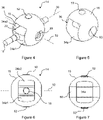
- Figure 4 shows the entire rotor assembly 14 with shaft 18, axle 20 and piston member 22 fitted.
- Figure 5 shows the rotor 16 by itself, and a cavity 60 which extends through the rotor 14 and is configured to receive the axle 20.
- Figure 5 shows the recess or opening 53 configured to receive and hold the first magnetic guide feature 52.
- the first magnetic guide feature 52 has been removed from the rotor assembly 14.
- Figure 6 shows a view looking along the first rotational axis 30 on Figure 6, and Figure 7 the same view as shown in Figure 6 looking down the opening 36 which defines the chamber 34 of the rotor 14, but with the magnets inserted into the recesses 53.
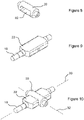
- Figure 8 shows a perspective view of the axle 20 having the passage 62 for receiving the axle 18 and piston member 22.
- the axle 20 is substantially cylindrical.
- Figure 9 shows an example configuration of the shaft 18 and piston member 22.
- the shaft 18 and piston member 22 may be integrally formed, as shown in Figure 10 , or may be fabricated from a number of parts.
- the piston member 22 is substantially square or rectangular in cross section.
- the shaft 18 may comprise cylindrical bearing regions which extend from the piston member 22 in order to seat on the bearing arrangement 44 of the housing 12, and hence permit rotation of the shaft 18 around the first rotational axis 30.
- Figure 10 shows the shaft 18 and piston member 22 assembled with the axle 20. They may be formed as an assembly, as described above, or they may be integrally formed as one, perhaps by casting or forging.
- the axle 20 may be provided substantially at the centre of the shaft 18 and piston member 22. That is to say, the axle 20 may be provided substantially halfway between the two ends of the shaft 18. When assembled, the shaft 18, axle 20 and piston member 22 may be fixed relative to one another.
- the axle 20 may be substantially perpendicular to the shaft and piston member 22, and hence the second rotational axis 32 may be substantially perpendicular to the first rotational axis 30.
- the piston members 22 are sized to terminate proximate to the wall 24 of the housing 12, a small clearance being maintained between the end of the piston members 22 and the housing wall 24.
- the clearance may be small enough to provide a seal between the piston members 22 and the housing wall 24.
- sealing members may be provided in the clearance between the housing wall 24 the piston members 22.
- FIG. 11 Further examples of a second magnetic guide feature 50 are shown in cross section in Figures 11, 12 which correspond to the example of Figure 1 .
- the second magnetic guide feature 50 is substantially circular (i.e. with no inflexions).
- the rotor 14 may be provided in one or more parts which are assembled together around the shaft 18 and axle 20 assembly.
- the rotor 16 may be provided as one piece, whether integrally formed as one piece or fabricated from several parts to form one element, in which case the axle 20 may be slid into the cavity 60, and then the shaft 18 and piston member 22 slid into a passage 62 formed in the axle 20, and then fixed together.
- a small clearance may be maintained between the axle 20 and bore of the cavity 60 of rotor 16.
- the clearance may be small enough to provide a seal between the axle 20 and the rotor 16 bore of the cavity 60.
- sealing members may be provided in the clearance between the axle 20 and rotor 16 bore of the cavity 60.
- the guide path defined by the second magnetic guide feature 50 describes a path around (i.e. on, close to, and/or to either side of) a first circumference of the housing.
- the plane of the first circumference overlays, or is aligned with, the plane described by the second rotational axis 32 as it rotates about the first rotational axis 30.
- Figure 13 shows an exploded view of a core 10 part of an apparatus according to the present disclosure.
- the second magnetic guide feature 50 is the same as shown in Figures 3B , 11 and 12 .
- the second magnetic guide feature 50 comprises a plurality of magnets, for example electro-magnets, arranged in the inner face of a spacer ring 12c.
- the electromagnets are arranged such that the polarity of the inner face of adjacent electromagnets are oppositely polarised.
- a first set of electromagnets and a second set of electromagnets are alternately arranged around the inner face of the spacer ring 12c.
- the polarity of the first set of electromagnets and the second set of electromagnets may switch during operation, but the first set of electromagnets will always have the same polarity as each other and the second set of electromagnets will always have the same polarity as each other.
- the magnetic coupling between the first magnetic guide feature 52 and the second magnetic guide feature 50 causes the rotor 16 to pivot relative to the piston member 22.
- the magnetic coupling between the first magnetic guide feature 52 and the second magnetic guide feature 50 may also act to drive the rotation of the shaft 18 about a first rotational axis 30 such that a separate motor is not required.
- Figure 14A shows a cross-section through the core 10 and rotor assembly 14.
- the first magnetic guide feature 52 and the second magnetic guide feature 50 may have a very small clearance between them. The small clearance increases the magnetic force developed, whilst ensuring that there is no friction between the first magnetic guide feature 52 and the second magnetic guide feature 50.
- the alternating arrangement of the first set of electromagnets 50a and the second set of electromagnets 50b is shown in more detail in Figure 14B .
- Figures 15 to 17 show an alternative example of the core 510.
- the piston 522, shaft 518 and axle 520 are substantially identical to the piston 22, shaft 18 and axle 20 shown in Figures 8 to 10 .
- the rotor 516 is substantially similar to the rotor 16 shown in Figures 1 to 7 , except that the rotor 516 includes a recess or opening 553 for receiving an engagement fixture 551, such as a pivot pin.
- the rotor 516 includes two recesses or openings 553 formed on the rotor for receiving engagement fixtures 551 in the form of pivot pins. The recesses or openings 553 may be diametrically opposed on the rotor 516.
- the first guide feature 552 is in the form of a ring comprising a plurality of magnets arranged on the outside diameter of the ring.
- the plurality of magnets of the first guide feature 552 are a plurality of electromagnets.
- the ring may be considered to be an orbital slewing ring.
- the first guide features 552 also includes a recess or opening 555 configured to receive the engagement fixtures 551 to couple the first guide feature 552 to the rotor 516.
- the first guide feature 552 may pivot about the engagement fixture 551 relative to the rotor 516.
- the first engagement feature comprises at least 10 magnets arranged on the outside of the ring, more preferably at least 15 magnets arranged on the outside of the ring and even more preferably at least 19 magnets arranged on the outside of the ring.
- adjacent magnets arranged on the outside of the ring have opposite polarities facing outwards (i.e. towards the second magnetic engagement feature 552).
- the second magnetic engagement feature 550 is substantially identical to the second magnetic engagement feature 50 shown in Figures 1 to 2 and 11 to 12.
- the spacing of the magnets of the first engagement feature 552 substantially matches the spacing of the electro-magnets of the second engagement feature 550. Therefore, in use, the magnets of the first engagement feature 552 may be substantially aligned with the electro-magnets of the second magnetic engagement feature 550. As disclosed in relation to the example in Figure 3B , the electro-magnets 550a, 550b of the second magnetic engagement feature 550 also have alternate polarities such that adjacent electro-magnets 550a, 550b have opposite polarities.
- first magnetic guide feature 552 and the second magnetic guide feature 550 are substantially identical to the operation described above in relation to Figure 3B , except that in this case, each pair of adjacent electro-magnets of the second guide feature 550 has a magnet from the first magnetic guide feature 552 between them. As such, more force will be developed to rotate and/or pivot the rotor 516 compared with the example of the core 10 in Figure 3B . In use, the first engagement feature 552 will be driven around a plane defined by the second magnetic guide feature 550.
- Figures 18 and 19 show an alternative example of the core 610.
- Figure 18 shows the housing comprised of two parts 612a, 612b, but in practise, the housing 612 may comprise more than two parts.
- the rotor assembly 614 is substantially identical to the rotor assembly 14 shown in Figures 1 to 7 and 13 to 14 .
- a first magnetic guide feature 52 is provided on the rotor 616.
- the first magnetic guide feature 52 may comprise one or two magnets or magnet clusters arranged on the outer surface of the rotor 616.
- the first magnetic guide feature 52 comprises two diametrically opposed magnets on the outside of the rotor 616. The two diametrically opposed magnets may have opposing polarities facing outwards.
- the two magnets of the first magnetic guide 52 may have opposite polarities facing outwards.
- the second magnetic guide feature 650 comprises and array of electro-magnets arranged on the inner surface of the housing 612.
- a controller (not shown) may be used to control the polarity of each of the electro-magnets of the second magnetic guide feature 650.
- the magnets of the first magnetic guide feature 650 will be magnetically coupled to the electro-magnets of the second magnetic guide feature 650 to cause the rotor 16 to pivot relative to the piston member 22.
- the magnetic coupling between the first magnetic guide feature 652 and the second magnetic guide feature 650 may also act to drive the rotation of the shaft 18 about a first rotational axis 30 such that a separate motor is not required.
- the guide path of the rotor 614 as it spins may be non-linear and may comprise at least a first inflexion point to direct the path away from a first side of the plane of the second rotational axis 632, then toward a second side of the plane of the second rotational axis 632, and a second inflexion point (on the opposite side of the housing) to direct the guide path away from the second side of the plane of the second rotational axis 632 and then back toward the first side of the plane of the second rotational axis 632.
- the guide path is not aligned with the plane of the second rotational axis 632, but rather oscillates from side to side of the plane of the second rotational axis 632.
- the guide path does not sit on the plane of the second rotational axis 632, but defines a sinusoidal route between either side of the plane of the second rotational axis 632.
- the path may be offset from the second rotational axis 632.
- the interaction of the first magnetic guide feature 652 and the second magnetic guide feature 650 tilts (i.e. rocks or pivots) the rotor 616 backwards and forwards around the axle 620 and hence the second rotational axis 632.
- the magnetic coupling between the first magnetic guide feature 652 and the second magnetic guide feature 650 may also act to drive the rotation of the shaft 618 about a first rotational axis 630 such that a separate motor is not required.
- the distance which the guide path extends from an inflexion on one side of the plane of the second rotational axis 632 to an inflexion on the other side of the plane of the second rotational axis 632 defines the relationship between the pivot angle of the rotor 616 about the second rotational axis 632 and the angular rotation of the shaft 618 about the first rotational axis 630.
- the number of inflexions defines a ratio of number of pivots (e.g. compression, expansion, displacement cycles etc) of the rotor 616 about the second rotational axis 632 per revolution of the rotor 616 about the first rotational axis 630.
- the trend of the guide path defines a ramp, amplitude and frequency of the rotor 616 about the second rotational axis 632 in relation to the rotation of the first rotational axis 630, thereby defining a ratio of angular displacement of the chambers 634 in relation to the radial reward from the shaft (or vice versa) at any point.
- the attitude of the guide path defined by the interaction between the first magnetic guide feature 652 and the second magnetic guide feature 650 directly describes the mechanical ratio/relationship between the rotational velocity of the rotor and the rate of change of volume of the rotor chambers 634a, 634b. That is to say, the trajectory of the guide path directly describes the mechanical ratio/relationship between the rotational velocity of the rotor 616 and the rate of pivot of the rotor 616.
- the rate of change and extent of displacement in chamber volume in relation to the rotational velocity of the rotor assembly 614 is set by the severity of the trajectory change (i.e. the inflexion) of the guide path.
- the profile of the guide path defined by the magnetic interaction between the first magnetic guide feature 652 and the second magnetic guide feature 650 can be tuned to produce a variety of displacement versus compression characteristics, as combustion engines for petrol, diesel (and other fuels), pump and expansion may require different characteristics and/or tuning during the operational life of the rotor assembly. Put another way, the trajectory of the guide path can be varied.
- the guide path may provide a "programmable guide path" which may be pre-set for any given application of the apparatus. That is to say, the route may be optimised to meet the needs of the application. Put another way, the guide path may be programmed to suit differing applications.
- a controller may be used to control the polarity of each of the electro-magnets of the first magnetic guide feature and/or the second magnetic guide feature 650.
- the guide path may be moveable to allow adjustment of the guide path, which may provide dynamic adjustment of the guide path while the apparatus is in operation. This may allow for tuning of rate and extent of the pivoting action of the rotor about the second rotational axis to assist with controlling performance and/or efficiency of the apparatus. That is to say, an adjustable guide path would enable variation of the mechanical ratio/relationship between the rotational velocity of the rotor and the rate of change or extent of displacement of the volume of the rotor chambers 634a, 634b. Hence the guide path results from the magnetic coupling of the first magnetic guide feature 652 and the second magnetic guide feature 650.
- This example provides a variable speed, variable volume and variable acceleration / deceleration of the opening and closing of the compression chambers 634a, 634b.
- the rotor assembly 614 may enact a straight line reward (or any other) rather than a sinusoidal opening and closing of the chambers as presented with a straight guide track.
- the guide path resulting from the magnetic coupling of the first magnetic guide feature 652 and the second magnetic guide feature 650 defines the rate of change of displacement of the rotor 616 relative to the piston 622, enabling a profound effect on the mechanical reward between the rotation and pivoting of the rotor 616.
- Figure 20 shows another non limiting example of a rotor 16, akin to that shown in Figures 1 to 19 .
- Bearing lands 73 are shown for receiving a bearing assembly (e.g. a roller bearing arrangement), or providing a bearing surface, to carry the rotor 16 on the axle 20.
- a "cut out" feature 74 provided as a cavity in a non-critical region of the rotor, which lightens the structure (i.e. provides a weight saving feature) and provides a land to grip/clamp/support the rotor 16 during manufacture.
- An additional land 75 adjacent the first magnetic guide feature 52 may also be provided to grip/clamp/support the rotor 16 during manufacture.
- first magnetic guide feature 52 is flush with the surface of the rotor 16, but in other examples, the surface of the first magnetic guide feature 52 may project from the surface of the rotor 16.
- the first magnetic guide feature 52 is magnetically coupled with the second magnetic guide path 50, and will travel along, the guide path, rotating as it moves along the track.
- Figures 21 , 22 and 25 illustrate how the rotor apparatus of Figures 1 to 19 may be adapted to operate as a roticulating apparatus.
- Common terminology is used to identify common features, although in order to distinguish between features of the examples, alternative reference numerals are used as appropriate.
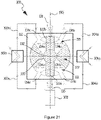
- Figure 21 illustrates an apparatus 100 according to the present disclosure arranged as a closed loop heat pump, for example a refrigeration unit.
- the apparatus 100 comprises a first shaft portion 118 (akin to shaft 18) which defines, and is rotatable about, a first rotational axis 130 (akin to rotational axis 30).
- a first axle 120 (akin to axle 20) defines a second rotational axis 132 (akin to rotational axis 32), the first shaft portion 118 extending through the first axle 120.
- the second rotational axis 132 is substantially perpendicular to the first rotational axis 130.
- a first piston member 122a (akin to first piston member 22) is provided on the first shaft portion 118, the first piston member 122a extending from the first axle 120 towards a distal end of the first shaft portion 118.
- a first rotor 119 (akin to rotor 16, 516, 616 in Figures 1 to 20 ) is carried on the first axle 120.
- a housing 112 (akin to housing 12) is provided around the rotor 119 assembly.
- the first rotor 119 comprises a first chamber 134a (akin to first chamber 34a), the first piston member 122a extending across the first chamber 134a.
- a wall of the housing 112 is provided adjacent the first chamber 134a.
- first port 114a Provided in the wall of the housing 112, and adjacent the first chamber 134a, is a first port 114a and a second port 114b (i.e akin to ports 40, 42).
- the ports 114a, 114b are in flow communication with the first chamber 134a, and are operable as flow inlets/outlets.
- the first chamber 134a is divided into sub-chambers 134a1, 134a2 (akin to sub-chambers 34a1, 34a2), each on opposite sides of the piston 122a. Hence at any one time, the ports 114a, 114b may be in flow communication with one of the sub-chambers 134a1, 134a2, but not both.
- the first rotor 119 comprises a second chamber 134b (akin to second chamber 34b).
- a wall of the housing 112 is provided adjacent the second chamber 134b.
- the housing 112 comprises a third port 116a and fourth port 116b, which are in flow communication with the second chamber 134b.
- the ports 116a, 116b are in flow communication with the first chamber 134b, and are operable as flow inlets/outlets.
- the second chamber 134b is divided into sub-chambers 134b1, 134b2 (akin to sub-chambers 34b1, 34b2), each on opposite sides of the piston 122b. Hence at any one time, the ports 116a, 116b may be in flow communication with one of the sub-chambers 134b1, 134b2, but not both.
- the first piston member 122a extends from one side of the first axle 120 along the first shaft portion 118, and a second piston member 122b (akin to second piston member 22) extends from the other side of the first axle 120 along the first shaft portion 118, across the second chamber 134b.
- the arrangement is configured to permit relative pivoting motion between the first rotor 119 and the second piston member 122b as the first rotor 119 rotates about the first rotational axis 130.
- the first shaft portion 118, first axle 120 and first piston member(s) 122a, 122b may be fixed relative to one another.
- first rotor 119 and first axle 120 are rotatable with the first shaft portion 118 around the first rotational axis 130, and the first rotor 119 is pivotable about the axle 120 about the second rotational axis 132 to permit relative pivoting motion between the first rotor 119 and the first piston member 122a as the first rotor 119 rotates about the first rotational axis 130.
- the second port 114b is in fluid communication with the third port 116a via a first duct/conduit 300a which comprises a first heat exchanger 302a.
- the first heat exchanger 302a is operable to remove heat energy from working fluid passing through it. That is to say, the first heat exchanger 302a is a heat sink for the working fluid (i.e. a heat sink for the medium or media flowing through the system).
- a first section 300a1 of duct 300a connects the second port 114b to the first heat exchanger 302a, and a second section 300a2 of duct 300a connects the first heat exchanger 302a to third port 116a. That is to say, a fluid in a duct/conduit 300a may pass through the first heat exchanger 302.
- first chamber 134a heat exchanger 302a and second chamber 134b are arranged in flow series.
- the fourth port 116b is in fluid communication with the first port 114a via a second duct (or conduit) 304a which comprises a second heat exchanger 306a.
- the second heat exchanger 306a is operable to add heat energy from working fluid passing through it. That is to say, the second heat exchanger 306a is a heat source for the working fluid (i.e. a heat source for the medium or media flowing through the system).
- the first heat exchanger 302a may be provided as any suitable heat sink (for example in thermal communication with a volume to be heated, a river, ambient air etc).
- the second heat exchanger 306a may comprise or be in thermal communication with any suitable heat source (for example, a volume to be cooled, the internal air of a food store etc).
- a first section 304a1 of duct 304a connects the fourth port 116b to the second heat exchanger 306a, and a second section 304a2 of duct 304a connects the second heat exchanger 306a to the first port 114a.
- the magnetic coupling of the first magnetic guide feature 52 and the second magnetic guide feature 50 induces a rotational force to drive the rotor 119 around the first rotational axis 130.
- a motor 308 is coupled to the first shaft portion 118 to provide additional drive for the rotor 119 around the first rotational axis 130, but this may not be required, in use.
- the first chamber 134a and piston 122a hence provide a first fluid flow section 111, which in this example are operable as a compressor or displacement pump.
- the first fluid flow section 111 is configured for the passage of fluid between the first port 114a and second port 114b via the first chamber 134a.
- the second chamber 134b and piston 122b hence provide a second fluid flow section 115, which in this example are operable as a metering section or expansion section.
- the second fluid flow section 115 is configured for the passage of fluid between the third port 116a and fourth port 116b via the second chamber 134.
- the volumetric capacity of the first rotor second chamber 134b may be substantially the same, less, or greater than the volumetric capacity of the first rotor first chamber 134a.
- the volumetric capacity of the second fluid flow section 115 may be the same, less, or greater than the volumetric capacity of the first fluid flow section 111.
- the volumetric capacity of the first rotor second chamber 134b may be at most half the volumetric capacity of the first rotor first chamber 134a.
- the volumetric capacity of the first rotor second chamber 134b may be at least twice the volumetric capacity of the first rotor first chamber 134a.
- this provides an expansion ratio within the confines of a single device.
- first rotor first chamber 134a as a different width than the first rotor second chamber 134b, with the first piston 122a consequentially having a different width than the second piston 122b.
- the pistons will pivot, and hence travel, to the same extent around the second rotational axis 132, the volume of the chambers 134a, 134b and swept volume of the pistons 122a, 122b will differ.
- the different volumes may be achieved by providing the first rotor first chamber 134a as wider than the first rotor second chamber 134b, with the first piston 122a consequentially being wider than the second piston 122b.
- the pistons will pivot, and hence travel, to the same extent around the second rotational axis 132, the volume of the chamber 134a will be greater than the volume of chamber 134b, and hence the swept volume of the piston 122a will be greater than piston 122b.
- the fluid may be a refrigerant fluid or other media, for example, but not limited to, Ethanol, R22 or Super saturated CO 2 .
- the working fluid may not be consumed or rendered inoperable after each cycle. That is to say, for the majority of its operation the same fixed volume of working fluid will remain and continually cycle around the system.
- the working fluid may be partly or wholly replaced during operation of the device (for example during each cycle, or after a predetermined number of cycles).
- first fluid flow section 111 in this example a displacement/compressor/pump section
- second fluid flow section 115 in this example an metering/expansion section
- the rotation of the rotor 119 is driven both by the motor and the metering/expansion of the fluid in the second chamber 134b (i.e. in sub-chambers 134b1, 134b2).
- the configuration of the device of the present disclosure recovers some of the energy from the expansion phase to partly drive the rotor 119.
- the working fluid enters the sub-chamber 134a1 via port 114a.
- the working fluid is then pumped (e.g. compressed) by the action of the piston 122a, driven by the magnetic coupling of the first magnetic guide feature 52 and the second magnetic guide feature 50, in the sub-chamber 134a and exits via the second port 114b.
- working fluid is being drawn into the sub-chamber 134a1, working fluid is being exhausted from sub-chamber 134a2 through the second port 114b.
- working fluid is being drawn into sub-chamber 134a2 through the first port 114b.
- the working fluid travels along duct 300a2 and enters the sub-chamber 134b1 of the rotor via the third port 116a where it its pressure is restrained and the working fluid is metered into duct 304a via the fourth port 116b.
- the working fluid is exhausted from the sub-chamber 134b1 via the fourth port 116b, and more working fluid enters the sub-chamber 134b2 via the third port 116a where it expands.
- sequential expansion of the working fluid in the rotor sub-chambers 134b1, 134b2 induces a force to thereby (at least in part) cause pivoting of the rotor about its second rotational axis, and to cause rotation of the rotor about its first rotational axis.
- This force is in addition to that provided by the magnetic coupling of the first magnetic guide feature 52 and the second magnetic guide feature 50.
- working fluid then travels from the second chamber 134b along duct 304a1 and enters the second heat exchanger 306a, which in this example is configured as a heat source.
- the working fluid absorbs heat from the heat source and then leaves the second heat exchanger 306a and travels along duct 304a2 before entering the first chamber 134a to re-start the cycle.
- Figure 22 illustrates another example of a closed loop heat pump, for example a refrigeration unit.
- This example includes many features in common with, or equivalent to, the example of Figure 21 , and are hence referred to with the same reference numerals.
- the apparatus 200 comprises a first fluid flow section 111 which, akin to the example of Figure 15 may be operable as a compressor or displacement pump.
- the first fluid flow section 111 has a first port 114a and a second port 114b, which are operable as flow inlets/outlets.
- the second fluid flow section 115 also comprises a second fluid flow section 115 which, akin to the example of Figure 15 , may be operable as a metering section or expansion section.
- the second fluid flow section 115 has a third port 116a and a fourth port 116b, which are operable as flow inlets/outlets.
- the apparatus 200 comprises a first shaft portion 118 which defines and is rotatable about a first rotational axis 130.
- a first axle 120 defines a second rotational axis 132, the first shaft portion 118 extending through the first axle 120.
- the second rotational axis 132 is substantially perpendicular to the first rotational axis 130.
- a first piston member 122a is provided on the first shaft portion 118, the first piston member 122a extending from the first axle 120 towards a distal end of the first shaft portion 118.
- a first rotor 119 is carried on the first axle 120.
- the first rotor 119 comprises a first chamber 134a, the first piston member 122a extending across the first chamber 134a.
- the first displacement outlet 113a and first displacement inlet 114a are in flow communication with the first chamber 134a.
- the first shaft portion 118, first axle 120 and first piston member(s) 122a, 122b may be fixed relative to one another.
- the first rotor 119 comprises a second chamber 134b.
- the first piston member 122a extends from one side of the first axle 120 along the first shaft portion 118 through the first chamber 134a to define sub-chambers 134a1, 134a2, and a second piston member 122b extends from the other side of the first axle 120 along the first shaft portion 118, across the second chamber 134b to define sub-chambers 134b1, 134b2.
- the arrangement is configured to permit relative pivoting motion between the first rotor 119 and the second piston member 122b as the first rotor 119 rotates about the first rotational axis 130.
- the first rotor 119 and first axle 120 are rotatable with the first shaft portion 118 around the first rotational axis 130, and the first rotor 119 is pivotable about the axle 120 about the second rotational axis 132 to permit relative pivoting motion between the first rotor 119 and the first piston member 122a and second piston member 122b as the first rotor 119 rotates about the first rotational axis 130.
- the apparatus 200 further comprises a second shaft portion 218 rotatable about the first rotational axis 130 and coupled to the first shaft portion 118 such that the first shaft portion 118 and second shaft portion 218 are rotatable together around the first rotational axis 130.
- a second axle 220 defines a third rotational axis 232, the second shaft portion 218 extending through the second axle 220.
- the third rotational axis 232 is substantially perpendicular to the first rotational axis 130 and parallel to the second rotational axis 132 of the first rotor, and would hence extend out of/into the page as shown in Figure 22 .
- a second rotor 219 is carried on the second axle 220.
- the first shaft portion 118 is directly coupled to the second shaft portion 218 such that the first rotor 119 and second rotor are operable to only rotate at the same speed as each other.
- a second housing 212 (akin to housing 12) is provided around the second rotor 219.
- the second rotor 219 comprises a first chamber 234a and a second chamber 234b.
- a second piston member 222b is provided on the second shaft portion 218, the second piston member 222b extending from the second axle 220 across the second chamber 234b towards a distal end of the second shaft portion 218 to define sub-chambers 234b1, 234b2.
- the second piston member 222b extends from one side of the second axle 220 along the second shaft portion 218.
- a second rotor first piston member 222a extends from the other side of the second axle 220 along the second shaft portion 218, across the first chamber 234a to define sub-chambers 234a1, 234a2.
- the arrangement is configured to permit relative pivoting motion between the second rotor 219 and the first and second piston members 222a, 222b as the second rotor 219 rotates about the first rotational axis 130.
- the second shaft portion 218, second axle 220 and second piston member(s) 222a, 222b may be fixed relative to one another.
- the third port 116a and fourth port 116b are in flow communication with the second chamber 234b, the third port 116a and fourth port 116b being provided in a wall of housing 212 of the second rotor.
- the second rotor 219 and second axle 220 are rotatable with the second shaft portion 218 around the first rotational axis 130, and the second rotor 219 is pivotable about the second axle 220 about the third rotational axis 232 to permit relative pivoting motion between the second rotor 219 and the first and second piston members 222a, 222b as the second rotor 219 rotates about the first rotational axis 130.
- the second port 114b of the first rotor 119 is in fluid communication with the third port 116a of the second rotor 219 via a first duct/conduit 300a which comprises a first heat exchanger 302a.
- the first heat exchanger 302a is operable to remove heat energy from working fluid passing through it (i.e. is a heat sink ).
- a first section 300a1 of duct 300a connects the second port 114b to the first heat exchanger 302a, and a second section 300a2 of duct 300a connects the first heat exchanger 302a to the third port 116a.
- the first rotor second chamber 134b is in flow communication with a fifth port 114c and a sixth port 114d provided in a wall of the first housing 112, such that the arrangement is configured for the passage of fluid between the fifth port 114c and sixth port 114d via the first rotor second chamber 134b.
- the second rotor first chamber 234a is in flow communication with a seventh port 116c and an eighth port 116d provided in a wall of the second housing 212, such that the arrangement is configured for the passage of fluid between the seventh port 116c and eighth port 116d via the second rotor first chamber 234a.
- the sixth port 114d of the first rotor 119 is in fluid communication with the seventh port 116c of the second rotor 219 via a second duct/conduit 300b which comprises (i.e. extends through) the first heat exchanger 302a.
- a first section 300b1 of duct 300b connects the sixth port 114d to the first heat exchanger 302a, and a second section 300b2 of duct 300b connects the first heat exchanger 302a to the seventh port 116c.
- the fourth port 116b of the second rotor 219 is in fluid communication with the first port 114a of the first rotor 119 via a second duct/conduit 304a which comprises a second heat exchanger 306a.
- the second heat exchanger 306a is operable to add heat energy to the working fluid passing through it (i.e. is a heat source ).
- a first section 304a1 of duct 304a connects the fourth port 116b to the second heat exchanger 306a, and a second section 304a2 of duct 300a connects the second heat exchanger 306a to the first port 114a.
- the eight port 116d of the second rotor 219 is in fluid communication with the fifth port 114c of the first rotor via a second duct/conduit 304b which comprises (i.e. extends through) the second heat exchanger 306a.
- a first section 304b1 of duct 304b connects the eighth port 116d to the second heat exchanger 306a, and a second section 304b2 of duct 304b connects the second heat exchanger 306a to the fifth port 114c.
- the first rotor 119 assembly i.e. the first rotor chambers 134a, 134b and first rotor pistons 122a, 122b
- first housing 112 hence provide the first fluid flow section 111, which in this example are operable as a compressor or displacement pump.
- the first fluid flow section 111 is configured for the passage of fluid between the first port 114a and second port 114b via the first rotor first chamber 134a, and for the passage of fluid between the fifth port 114c and sixth port 114d via the first rotor second chamber 134b.
- the rotor 219 assembly i.e. second rotor chambers 234a, 234b and first rotor pistons 222a, 222b
- second housing 212 hence provide the second fluid flow section 115, which in this example are operable as a metering section or expansion section.
- the second fluid flow section 115 is configured for the passage of fluid between the third port 116a and fourth port 116b via the second rotor second chamber 234b, and for the passage of fluid between the seventh port 116c and eighth port 116d via the second rotor first chamber 234a,
- the first chamber 134a and second chamber 134b of the first rotor 119 have substantially the same volumetric capacity as each other.
- the first chamber 234a and second chamber 234b of the second rotor 219 i.e. the second fluid flow section 115
- the volumetric capacity of the first rotor chambers 134a, 134b may be substantially the same, less, or greater than the volumetric capacity of the second rotor chambers 234a, 234b (second fluid flow section 115).
- the volumetric capacity of the rotor chambers 234a, 234b of the second fluid flow section 115 may be the same, less, or greater than the volumetric capacity of the rotor chambers 134a, 134b first fluid flow section 111.
- the volumetric capacity of the second fluid flow section 115 may be at most half the volumetric capacity of the first fluid flow section 111.
- the volumetric capacity of the second fluid flow section 115 may be at least twice the volumetric capacity of the first fluid flow section 111.
- the difference in volumetric capacity may be achieved by providing the first rotor chambers 134a, 134b as wider than the second rotor chambers 234a, 234b, with the first rotor pistons 122a, 122b consequentially being wider than the second rotor pistons 222a, 222b.
- the pistons 122, 222 may pivot by the same angle, the volume of the first chambers 134a, 134b will be greater than the second chambers 234a, 234b, and the swept volume of the first rotor pistons 122a, 122b will be greater than the swept volume of the second rotor pistons 222a, 222b.
- first rotor shaft 118 and second rotor shaft 218 are integrally formed as one, and extend through both rotors 119, 219.
- the working fluid enters the sub-chambers 134a1, 134b1 via the first port 114a and fifth port 114c respectively.
- the working fluid is then pumped (e.g. compressed) by the action of the respective pistons 122a, 122b driven by the magnetic coupling of the first magnetic guide feature 52 and the second magnetic guide feature 50 induces a rotational force to drive the rotor 119 around the first rotational axis 130, in the sub-chambers 134a, 134b and exits via the second port 114b and sixth port 114d respectively.
- working fluid is being exhausted from the sub-chambers 134a1, 134b1, working fluid is being drawn into sub-chambers 134a2, 134b2 through the first port 114a and fifth port 114c respectively.
- the working fluid travels along ducts 300a2, 300b2 and enters the sub-chambers 234b1, 234a1 of the second rotor via the third port 116a and seventh port 116c respectively where its pressure is restrained and the working fluid is metered into ducts 304a1, 304b1 respectively via the fourth port 116b and eighth port 116d respectively.
- the working fluid is exhausted from the sub-chambers 234b1, 234a1 via the fourth port 116b and eighth port 116d, and more working fluid enters the sub-chambers 234b2, 234a2 via the third port 116a and seventh port 116c.
- sequential delivery and behaviour of the working fluid in the rotor sub-chambers 234a1, 234a2, 234b1, 234b2 induces a force to thereby (at least in part) cause pivoting of the second rotor 219 about its second rotational axis 232, and to cause rotation of the rotor about its first rotational axis.
- This force is in addition to that provided by the magnetic coupling of the first magnetic guide feature 52 and the second magnetic guide feature 50.
- working fluid then travels from the second rotor chambers 234a, 234b along ducts 304a1, 304b1 and enters the second heat exchanger 306a, which in this example is configured as a heat source.
- the working fluid absorbs heat from the heat source and then leaves the second heat exchanger 306a and travels along ducts 304a2, 304b2 before entering the first rotor chambers 134a, 134b to re-start the cycle.
- the first rotor first chamber 134a may have a volumetric capacity substantially less than or substantially greater than the volumetric capacity of the first rotor second chamber 134b.
- the second rotor second chamber 234b may have a volumetric capacity substantially less than or substantially greater than the volumetric capacity of the second rotor first chamber 234a.
- first rotor first chamber 134a may have a volumetric capacity of at most half or at least twice the volumetric capacity of the first rotor second chamber 134b.
- second rotor second chamber 234b may have a volumetric capacity of at most half or at least twice the volumetric capacity of the second rotor first chamber 234a.
- Such an example provides a multi stage device, or two working fluid circuits with different expansion ratios through a common system.
- Ducts 300a, 300b and ducts 304a, 304b have been illustrated as discrete circuits. However duct 300a and duct 300b may, at least in part, be combined to define a common flow path which passes through heat exchanger 302. Likewise duct 304a and duct 304b may, at least in part, be combined to define a common flow path which passes through heat exchanger 306. Alternatively the ducts 300a, 300b may pass through entirely separate heat exchanger units 302 having different, or the same, heat capacities as each other. Likewise alternatively the ducts 304a, 304b may pass through entirely separate heat exchanger units 306 having different, or the same, heat capacities as each other.
- drive shafts 118, 218 are described as being rigidly/directly linked and so they operate at the same rotational speed as each other to provide lossless operation between them.
- first shaft 118 and second shaft 218 may be coupled by mechanical (for example by a gear box) or virtual means (for example by an electronic control system) so they may rotate at different speeds relative to one another.
- the core of the apparatus of the present disclosure is a true positive displacement unit which offers up to a 100% internal volume reduction per revolution. It is operable to simultaneously 'push' and 'pull' the piston 122 across its chamber, so for example, in the same chamber can create a full vacuum on one side of a piston whilst simultaneously producing compression and/or displacement on the other.
- Coupling of the displacement section and expansion sections i.e. direct drive between the first fluid flow section 111 and second fluid flow section 115, whether part of the same rotor as shown in Figures 21 , 25 , or linked rotors as shown in Figures 22 , means that mechanical losses are minimised relative to examples of the related art, as well as enabling recovery from the processes in each section to help drive the other side.
- the device can perform efficient operation under varied loads and varied speeds, which is not possible with a conventional arrangement (for example those including an axial flow turbine). This allows for harvesting of energy at input levels not previously achievable.
- the apparatus of the present invention can be scaled to any size to suit different capacities or power requirements, its dual output drive shaft also makes it easy to mount multiple drives on a common line shaft, thereby increasing capacity, smoothness, power output, offering redundancy, or more power on demand.
- a heat engine device of the present disclosure could be carried on a vehicle to provide additional drive or electrical generation to supplement the output of a larger engine with little weight penalty.
- the device inherently has an extremely low inertia which offers low load and quick and easy start-up.
- the apparatus of the present disclosure provides a technical solution with a high thermodynamic efficiency, which can operate at low speed. Operation at low speed is advantageous as it enables electricity generation at speeds closer to or at the required frequency, thereby reducing reliance, and losses due to, gearing and signal inversion.
- the rotor 14 and housing 12 may be configured with a small clearance between them thus enabling oil-less and vacuum operation, and/or obviate the need for contact sealing means between rotor 16 and housing 12, thereby minimising frictional losses. Frictional losses are further reduced by the use of the first magnetic guide feature 52 and the second magnetic guide feature 50, which obviate the need of a bearing roller to guide the rotor 16.
- first magnetic guide feature 52 and the second magnetic guide feature 50 are magnetically coupled to provide sufficient force to propel the rotor 16 and to perform the guidance to keep the rotor on the desired guide path.
- the shaft 18, 118, 218 may extend out of both sides of the rotor housing to be coupled to a powertrain for driving device and/or an electrical generator.
- Figure 25 illustrates an example of an open loop air cycle apparatus 1000 according to the present disclosure, which includes many features in common, or equivalent to, the example of Figure 21 , and are hence referred to with the same reference numerals.
- the system is an open loop, with no connection between the first port 114a and the fourth port 116b. That is to say, the second duct 304a and second heat exchanger 306a not present, and hence the first port 114a and the fourth port 116b are isolated from one another.
- the magnetic coupling of the first magnetic guide feature 52 and the second magnetic guide feature 50 induces a rotational force to drive the rotor 119 around the first rotational axis 130.
- a motor 308 is coupled to the first shaft portion 118 to provide additional drive for the rotor 119 around the first rotational axis 130, but this motor may not be required because the rotational force induced from the magnetic coupling of the first magnetic guide feature 52 and the second magnetic guide feature 50 may be sufficient to provide all of the required rotational force.
- the first chamber 134a and piston 122a hence provide a first fluid flow section 111 , which in this example are operable as a compressor or displacement pump.
- the first fluid flow section 111 is configured for the passage of fluid between the first port 114a and second port 114b via the first chamber 134a.
- the second chamber 134b and piston 122b hence provide a second fluid flow section 115, which in this example are operable as a metering section or expansion section.
- the second fluid flow section 115 is configured for the passage of fluid between the third port 116a and fourth port 116b via the second chamber 134.
- the first port 114a may be in fluid communication with a source of ambient air, for example open to atmosphere.
- the working fluid may comprise air.
- the fluid may be any suitable fluid.
- the first heat exchanger 302a may be in thermal communication with any suitable heat source or a substance to be cooled.
- a substance for example a second fluid to be cooled, is passed through a duct 303 in the first heat exchanger 302a, such that the substance may transfer heat to the working fluid and the substance is cooled as it passes through the first heat exchanger 302.
- the substance may be any medium that may flow and be cooled, such as a fluid such as air, gas or liquid.
- the substance is medium for cooling personal climatic conditions, for example to provide temperature control in buildings.
- the substance may be used to cool or heat electronics systems.
- the first heat exchanger 302a is a heat source configured to add heat energy to working fluid passing through it.
- the volumetric capacity of the first chamber 134a may be substantially the same, less, or greater than the volumetric capacity of the second chamber 134b.
- the volumetric capacity of the second fluid flow section 115 may be the same, less, or greater than the volumetric capacity of the first fluid flow section 111.
- the volumetric capacity of the second fluid flow section 115 is preferably greater than the volumetric capacity of the first fluid flow section 111.
- volumetric capacity of the second chamber 134b may be at most half the volumetric capacity of the first rotor first chamber 134a.
- the volumetric capacity of the second chamber 134b may be at most 20% of the volumetric capacity of the first rotor first chamber 134a
- the volumetric capacity of the first rotor second chamber 134b may be at least twice the volumetric capacity of the first rotor first chamber 134a.
- volumetric capacity of the first rotor second chamber 134b may be at least three times the volumetric capacity of the first rotor first chamber 134a.
- this provides an expansion ratio within the confines of a single device (for example as shown in Figure 23 ).
- first chamber 134a as a different width than the second chamber 134b, with the first piston 122a consequentially having a different width than the second piston 122b.
- the pistons will pivot, and hence travel, to the same extent around the second rotational axis 132, the volume of the chambers 134a, 134b and swept volume of the pistons 122a, 122b will differ.
- the different volumes may be achieved by providing the second chamber 134b as wider than the first chamber 134a, with the second piston 122b consequentially being wider than the first piston 122a.
- the volume of the second chamber 134b will be greater than the volume of the first chamber 134a, and hence the swept volume of the piston 122b will be greater than piston 122a.
- first fluid flow section 111 in this example a displacement/compressor/pump section
- second fluid flow section 115 in this example a metering/expansion section
- the rotation of the rotor 119 is driven both by the motor and the metering/expansion of the fluid in the second chamber 134b (i.e. in sub-chambers 134b1, 134b2).
- the working fluid for example air enters the sub-chamber 134a1 via the first port 114a.
- the working fluid is then displaced/compressed/metered by the action of the piston 122a, driven by the magnetic coupling of the first magnetic guide feature 52 and the second magnetic guide feature 50 and the expansion of working fluid in the second chamber 134b (described below in stage 3), and exits via the second port 114b.
- working fluid is being drawn into the sub-chamber 134a1, working fluid is being exhausted from sub-chamber 134a2 through the second port 114b.
- the working fluid then travels from the first chamber 134a along duct 300a1 and enters the first heat exchanger 302a, which is configured as a heat source. Hence heat is added to the working fluid as it passes through the first heat exchanger 302a.
- a substance such as air, gas or liquid may also be passed through the heat exchanger 302a, via a separate inlet and acts to transfer heat to the working fluid.
- a substance enters the heat exchanger 302a at a first temperature and leaves the heat exchanger at a second temperature, wherein the second temperature is lower than the first temperature.
- the heat from the substance is transferred to the working fluid.
- the working fluid absorbs heat from the heat source (for example, the substance) and then leaves the first heat exchanger 302a and travels along duct 300a2 before entering the second chamber 134b.
- the working fluid exits the first heat exchanger 302a via the duct 300a2.
- the pressure of the working fluid is held at a relatively low pressure in the duct 300a2, for example below atmospheric pressure.
- the working fluid travels along duct 300a2 and enters the sub-chamber 134b1 of the rotor via the third port 116a and the working fluid is expanded.
- working fluid is entering and expanding in the sub-chamber 134b1, working fluid is being exhausted from sub-chamber 134b2 via the fourth port 116b.
- the working fluid is exhausted from the sub-chamber 134b2 via the fourth port 116b, and more working fluid enters the sub-chamber 134b1 via the third port 116a where it expands.
- the exhaust gas expands sequentially in the sub-chambers 134b1, 134b2 of the second chamber 134b (hence the fluid decreases in pressure and increases in volume).
- this expansion results in a negative pressure being maintained in the duct 300a, which in turn contributes to driving the first piston 122a across chamber 134a introducing a further portion of air to start the process again.
- the expansion of the exhaust gas in sub-chambers 134b1, 134b2 may result in work being done by the fluid on the second piston 122b to urge the first piston 122b across the chamber 134b (operating as an expansion chamber), which drives the first piston 122a across the first chamber 134a to draw in and compress a further portion of air to start the process again.
- the system shown in Figure 25 is operable to work as an air source cold pump.
- the system of Figure 25 is reversible such that if the direction of the rotation of the first shaft portion 118 is reversed, a positive pressure difference is created between the second fluid flow section 115 and the first fluid flow section 111.
- the heat exchanger 302 extracts heat from the fluid passing therethrough to heat a substance in duct 303.
- the system is an air source heat pump.
- the magnetic coupling between the first magnetic guide feature 52 and the second magnetic guide feature 50 is operable to rotate the first shaft portion in a either a first direction or a second direction (i.e. in a clockwise direction or an anticlockwise direction).
- the first heat exchanger 302a is operable to act as a heat source to transfer heat from the substance to the fluid.
- the first heat exchanger 302a is operable to act as a heat source to transfer heat from the fluid to the substance.
- the system to operable to work as an air source heat pump.
- At least one of the first magnetic guide feature 52 and second magnetic guide feature 50 comprises an electro-magnet operable to magnetically couple to the other of the first magnetic guide feature 52 and second magnetic guide feature 50 to pivot the rotor 16 thereby inducing the rotor 16 to pivot about the axle 20 relative to the first piston member 22.
- both the first magnetic guide feature 52 and the second magnetic guide feature 50 comprise electro-magents.
- the first magnetic guide feature 52 comprises one or more permanent magnets and the second magnetic guide feature 50 comprises one or more electro-magnets.
- the second magnetic guide feature 50 comprises one or more permanent magents and the first magnetic guide feature 52 comprises one or more electro-magnets.
Landscapes
- Engineering & Computer Science (AREA)
- Mechanical Engineering (AREA)
- General Engineering & Computer Science (AREA)
- Physics & Mathematics (AREA)
- Thermal Sciences (AREA)
- Combustion & Propulsion (AREA)
- Chemical & Material Sciences (AREA)
- Hydraulic Motors (AREA)
- Engine Equipment That Uses Special Cycles (AREA)
- Connection Of Motors, Electrical Generators, Mechanical Devices, And The Like (AREA)
- Heat-Exchange Devices With Radiators And Conduit Assemblies (AREA)
- Soil Working Implements (AREA)
- Applications Or Details Of Rotary Compressors (AREA)
- Compressors, Vaccum Pumps And Other Relevant Systems (AREA)
Claims (15)
- Vorrichtung, umfassend:eine Welle (18), die eine erste Drehachse (30) definiert und um diese drehbar ist;eine Achse (20), die eine zweite Drehachse definiert, wobei sich die Welle (18) durch die Achse (20) erstreckt;ein erstes Kolbenglied (22), das auf der Welle (18) vorgesehen ist, wobei sich das erste Kolbenglied (22) von der Achse (20) zu einem distalen Ende der Welle (18) erstreckt;einen Rotor (16), der auf der Achse (20) getragen wird;wobei der Rotor (16) eine erste Kammer (34a) umfasst,wobei sich das erste Kolbenglied (22) durch die erste Kammer (34a) erstreckt;ein Gehäuse, das eine Wand aufweist, die einen Hohlraum definiert, wobei der Rotor (16) in dem Hohlraum drehbar und schwenkbar ist;wobei:der Rotor (16) und die Achse (20) mit der Welle (18) um die erste Drehachse (30) drehbar sind;der Rotor (16) um die zweite Drehachse (32) um die Achse (20) schwenkbar ist, um eine relative Schwenkbewegung zwischen dem Rotor (16) und dem ersten Kolbenglied (22) zu gestatten, während sich der Rotor (16) um die erste Drehachse (30) dreht; unddadurch gekennzeichnet, dass die Vorrichtung ferner Folgendes umfasst:ein erstes magnetisches Führungsmerkmal (52), das mit dem Rotor (16) gekoppelt ist;ein zweites magnetisches Führungsmerkmal (50), das mit dem Gehäuse gekoppelt ist; undmindestens eines von dem ersten magnetischen Führungsmerkmal (52) und dem zweiten magnetischen Führungsmerkmal (50) einen Magneten umfasst, der dahingehend betreibbar ist, mit dem anderen von dem ersten magnetischen Führungsmerkmal (52) und dem zweiten magnetischen Führungsmerkmal (50) gekoppelt zu werden, um den Rotor (16) zu schwenken, wodurch bewirkt wird, dass der Rotor (16) bezüglich des ersten Kolbenglieds (22) um die Achse (20) schwenkt.
- Vorrichtung nach Anspruch 1, wobei der Magnet einen Elektromagneten umfasst.
- Vorrichtung nach den Ansprüchen 1 oder 2, wobei die magnetische Kopplung zwischen dem ersten magnetischen Führungsmerkmal (52) und dem zweiten magnetischen Führungsmerkmal (50) die Drehung der Welle (18) um die erste Drehachse (30) antreibt.
- Vorrichtung nach einem vorhergehenden Anspruch, wobei das magnetische Führungsmerkmal (52) mindestens einen Permanentmagneten umfasst.
- Vorrichtung nach Anspruch 4, wobei das magnetische Führungsmerkmal (52) zwei diametral gegenüberliegende Permanentmagneten umfasst, die auf dem Rotor (16) angeordnet sind.
- Vorrichtung nach Anspruch 4, wobei das erste magnetische Führungsmerkmal (52) eine oder mehrere Gruppen von Permanentmagneten umfasst, die auf dem Rotor (16) angeordnet sind.
- Vorrichtung nach einem vorhergehenden Anspruch, wobei das erste magnetische Führungsmerkmal (52) Folgendes umfasst:einen Drehkranz; undmehrere Magneten, die auf einer Außenseite des Drehkranzes angeordnet sind, wobei der Drehkranz zur Kopplung mit dem Rotor (16) über eine Eingriffseinrichtung (551) ausgelegt ist.
- Vorrichtung nach einem vorhergehenden Anspruch, wobei das zweite magnetische Führungsmerkmal (50) mehrere Elektromagneten umfasst.
- Vorrichtung nach Anspruch 8, wobei das zweite magnetische Führungsmerkmal (50) einen Abstandsring (12c) umfasst und die mehreren Elektromagnete auf einer Innenfläche des Abstandsrings (12c) angeordnet sind.
- Vorrichtung nach Anspruch 8, wobei die mehreren Elektromagneten in einer Anordnung auf der Innenseite des Gehäuses angeordnet sind.
- Vorrichtung nach einem der Ansprüche 7 bis 8, wobei die Vorrichtung eine Steuerung zum Steuern der Polarität der mehreren Elektromagneten des zweiten magnetischen Führungsmerkmals (50) umfasst.
- Vorrichtung nach einem vorhergehenden Anspruch, wobei:
die magnetische Kopplung des zweiten Führungsmerkmals (50) und des ersten magnetischen Führungsmerkmals (52) zur Bereitstellung eines Führungswegs um einen ersten Umfang des Rotors (16) oder Gehäuses ausgelegt ist. - Vorrichtung nach Anspruch 12, wobei der Führungsweg mindestens Folgendes umfasst:
eine erste Biegung, die den Führungsweg von einer ersten Seite des ersten Umfangs weg und dann zu einer zweiten Seite des ersten Umfangs zurück führt; und eine zweite Biegung, die den Führungsweg von der zweiten Seite des ersten Umfangs weg und dann zu der ersten Seite des ersten Umfangs zurück führt. - Vorrichtung nach einem vorhergehenden Anspruch, wobei die Vorrichtung Folgendes umfasst:einen ersten Fluidstromabschnitt (111);einen ersten Durchgang (114a) und einen zweiten Durchgang (114b), die in einer Wand des Gehäuses vorgesehen sind und jeweils in Strömungsverbindung mit der ersten Kammer (34a) stehen; undeinen zweiten Fluidstromabschnitt (115), der Folgendes umfasst:eine zweite Kammer (34b),eine zweite Gehäusewand neben der zweiten Kammer (34b), einen dritten Durchgang (116a) und einen vierten Durchgang (116b), die in der zweiten Gehäusewand vorgesehen sind und mit der zweiten Kammer (34b) jeweils in Strömungsverbindung stehen,so dass der zweite Fluidstromabschnitt (115) für das Passieren von Fluid zwischen dem dritten Durchgang (116a) und dem vierten Durchgang (116b) über die zweite Kammer (34b) ausgelegt ist;wobei der zweite Durchgang (114b) über einen ersten Wärmetauscher (302a) mit dem dritten Durchgang (116a) in Fluidverbindung steht.
- Vorrichtung nach Anspruch 14, wobei die magnetische Kopplung zwischen dem ersten magnetischen Führungsmerkmal (52) und dem zweiten magnetischen Führungsmerkmal (50) dahingehend betreibbar ist, den Teil der ersten Welle (18) entweder in einer ersten Richtung oder eine zweiten Richtung zu drehen, so dass, wenn die magnetische Kopplung zum Antrieb des Rotors (16) um die erste Drehachse (30, 130) in einer ersten Richtung ausgelegt ist, der erste Wärmetauscher (302a) dahingehend betreibbar ist, als eine Wärmequelle zu dienen, um Wärme von der Substanz auf das Fluid zu übertragen, und wobei, wenn die magnetische Kopplung dazu ausgelegt ist, den Rotor (16) in einer der ersten Richtung entgegengesetzten zweiten Richtung um die erste Drehachse (30) anzutreiben, der erste Wärmetauscher (302a) dahingehend betreibbar ist, als eine Wärmesenke zur Übertragung von Wärme von dem Fluid auf die Substanz zu wirken.
Applications Claiming Priority (2)
| Application Number | Priority Date | Filing Date | Title |
|---|---|---|---|
| GB1803181.5A GB2571354B (en) | 2018-02-27 | 2018-02-27 | Roticulating thermodynamic apparatus |
| PCT/GB2019/050401 WO2019166768A1 (en) | 2018-02-27 | 2019-02-15 | Roticulating thermodynamic apparatus |
Publications (2)
| Publication Number | Publication Date |
|---|---|
| EP3755883A1 EP3755883A1 (de) | 2020-12-30 |
| EP3755883B1 true EP3755883B1 (de) | 2022-04-13 |
Family
ID=61903126
Family Applications (3)
| Application Number | Title | Priority Date | Filing Date |
|---|---|---|---|
| EP22159775.0A Active EP4056804B1 (de) | 2018-02-27 | 2019-02-15 | Thermodynamische vorrichtung |
| EP19707078.2A Active EP3755883B1 (de) | 2018-02-27 | 2019-02-15 | Rotierende thermodynamische vorrichtung |
| EP19707079.0A Active EP3755884B1 (de) | 2018-02-27 | 2019-02-15 | Rotierende thermodynamische vorrichtung |
Family Applications Before (1)
| Application Number | Title | Priority Date | Filing Date |
|---|---|---|---|
| EP22159775.0A Active EP4056804B1 (de) | 2018-02-27 | 2019-02-15 | Thermodynamische vorrichtung |
Family Applications After (1)
| Application Number | Title | Priority Date | Filing Date |
|---|---|---|---|
| EP19707079.0A Active EP3755884B1 (de) | 2018-02-27 | 2019-02-15 | Rotierende thermodynamische vorrichtung |
Country Status (17)
| Country | Link |
|---|---|
| US (2) | US11085301B2 (de) |
| EP (3) | EP4056804B1 (de) |
| JP (1) | JP6922100B2 (de) |
| CN (1) | CN111919012B (de) |
| AU (1) | AU2019226434B2 (de) |
| CA (2) | CA3091763C (de) |
| CL (1) | CL2020002176A1 (de) |
| ES (1) | ES3035364T3 (de) |
| FI (1) | FI4056804T3 (de) |
| GB (1) | GB2571354B (de) |
| IL (1) | IL276769B (de) |
| NZ (1) | NZ767494A (de) |
| RU (1) | RU2752114C1 (de) |
| SG (1) | SG11202007895PA (de) |
| UA (1) | UA125054C2 (de) |
| WO (2) | WO2019166769A1 (de) |
| ZA (1) | ZA202005111B (de) |
Families Citing this family (2)
| Publication number | Priority date | Publication date | Assignee | Title |
|---|---|---|---|---|
| GB201520830D0 (en) * | 2015-11-25 | 2016-01-06 | Fenton Jonathan P | Fluid compression apparatus |
| GB2611027B (en) * | 2021-09-17 | 2023-09-27 | Fetu Ltd | Thermodynamic cycle |
Family Cites Families (38)
| Publication number | Priority date | Publication date | Assignee | Title |
|---|---|---|---|---|
| US826985A (en) * | 1905-05-15 | 1906-07-24 | Daniel Appel | Rotary machine. |
| US1904373A (en) * | 1930-08-20 | 1933-04-18 | James L Kempthorne | Engine |
| US1967167A (en) * | 1933-02-27 | 1934-07-17 | Edward M Kline | Fluid compression apparatus |
| US2043544A (en) * | 1933-10-07 | 1936-06-09 | James L Kempthorne | Rotary engine |
| US2173663A (en) | 1937-02-04 | 1939-09-19 | Raymond John Edwin | Rotary engine |
| US3769944A (en) | 1972-05-08 | 1973-11-06 | Redskin Eng Co | Rotary engine |
| US4024841A (en) * | 1974-10-25 | 1977-05-24 | Smith David B | Rotary internal combustion engine with oscillating pistons |
| US3973469A (en) | 1974-12-16 | 1976-08-10 | John Humen | Floating chamber machine |
| CH597502A5 (de) | 1975-07-03 | 1978-04-14 | Roger Bajulaz | |
| IT1122261B (it) | 1979-07-23 | 1986-04-23 | Sacchi Giulio | Pompa alternativa a doppio effetto |
| EP0431168A4 (en) * | 1987-05-25 | 1991-11-13 | Tselevoi Nauchno-Tekhnichesky Kooperativ "Stimer" | Volume-expansion rotor machine |
| NO169672C (no) * | 1989-01-09 | 1992-07-22 | 3 D Int As | Kraftomsetningsmaskin med stempler som beveges parvis i forhold til hverandre i et sfaerisk hus. |
| US5199864A (en) * | 1990-09-28 | 1993-04-06 | Southwest Research Institute | Spherical fluid pump or motor with spherical ball comprising two parts |
| CN1061646A (zh) | 1990-11-23 | 1992-06-03 | “蒸汽机”专业科技公司 | 容积式旋转机械 |
| US5410944A (en) * | 1993-06-03 | 1995-05-02 | Cushman; William B. | Telescoping robot arm with spherical joints |
| UA9616C2 (uk) | 1995-04-04 | 1996-09-30 | Микола Миколайович Бельдій | Силовий агрегат |
| RU2134796C1 (ru) * | 1996-12-19 | 1999-08-20 | Сергей Борисович Матвеев | Объемная машина (варианты) |
| NO308046B1 (no) | 1998-08-14 | 2000-07-10 | 3D International As | Drivsystem for maskin, sÕsom motor, kompressor m.m. |
| US6241493B1 (en) * | 1999-08-17 | 2001-06-05 | Spherical Machines, Inc. | Spherical fluid machine with control mechanism |
| US7214045B2 (en) | 1999-08-17 | 2007-05-08 | Spherical Machines, Inc. | Spherical fluid machine with flow control mechanism |
| US6325038B1 (en) * | 2000-01-18 | 2001-12-04 | Spherical Propulsion, Llc | Spherical internal combustion engine |
| JP3404570B2 (ja) | 2000-06-09 | 2003-05-12 | 富美夫 大倉 | 球形の回転ピストン機関 |
| US6390052B1 (en) | 2000-10-17 | 2002-05-21 | Mcmaster Motor Company | Wobble engine |
| AU2002250128A1 (en) | 2001-02-20 | 2002-09-04 | Thomas E. Kasmer | Hydristor heat pump |
| US20050186100A1 (en) * | 2004-02-23 | 2005-08-25 | Paul Weatherbee | Spherical fluid machines |
| ES2307149T3 (es) * | 2004-04-06 | 2008-11-16 | Peraves Aktiengesellschaft | Maquina de piston oscilante y vehiculo con una maquina de piston oscilante de este tipo. |
| DE102006009197B4 (de) | 2006-02-22 | 2008-09-11 | Hüttlin, Herbert, Dr. h.c. | Schwenkkolbenmaschine |
| FR2906562A1 (fr) | 2006-09-28 | 2008-04-04 | Olivier Joseph | Dispositif mecanique |
| JP2008223752A (ja) * | 2007-03-12 | 2008-09-25 | Futao Nagayama | 回転式空気機械 |
| WO2009127791A1 (fr) | 2008-04-17 | 2009-10-22 | Olivier Joseph | Dispositif mecanique |
| FR2937093B1 (fr) | 2008-10-10 | 2013-10-11 | Vincent Genissieux | Machine rotative a losange deformable a dispositif electromagnetique |
| US9151220B2 (en) | 2013-11-30 | 2015-10-06 | Wieslaw Julian Oledzki | Rotary two-stroke internal combustion engine fueled by solid particulate |
| GB201520830D0 (en) * | 2015-11-25 | 2016-01-06 | Fenton Jonathan P | Fluid compression apparatus |
| US10662774B2 (en) | 2016-09-13 | 2020-05-26 | Regi U.S., Inc. | Prime mover assembly having fixed center member between rotating members |
| US10323517B2 (en) | 2016-11-08 | 2019-06-18 | Thomas F. Welker | Multiple axis rotary engine |
| US10734878B2 (en) * | 2017-09-27 | 2020-08-04 | Electronics And Telecommunications Research Institute | Spherical wheel motor and control system thereof |
| US10951105B2 (en) | 2019-04-11 | 2021-03-16 | Honeywell International Inc. | Geared spherical electromagnetic machine with two-axis rotation |
| US20200343804A1 (en) * | 2019-04-26 | 2020-10-29 | Honeywell International Inc. | Multi-stage spherical motor |
-
2018
- 2018-02-27 GB GB1803181.5A patent/GB2571354B/en active Active
-
2019
- 2019-02-15 NZ NZ767494A patent/NZ767494A/en unknown
- 2019-02-15 ES ES22159775T patent/ES3035364T3/es active Active
- 2019-02-15 UA UAA202005530A patent/UA125054C2/uk unknown
- 2019-02-15 WO PCT/GB2019/050402 patent/WO2019166769A1/en not_active Ceased
- 2019-02-15 SG SG11202007895PA patent/SG11202007895PA/en unknown
- 2019-02-15 AU AU2019226434A patent/AU2019226434B2/en active Active
- 2019-02-15 FI FIEP22159775.0T patent/FI4056804T3/fi active
- 2019-02-15 RU RU2020129609A patent/RU2752114C1/ru active
- 2019-02-15 EP EP22159775.0A patent/EP4056804B1/de active Active
- 2019-02-15 US US16/975,781 patent/US11085301B2/en active Active
- 2019-02-15 JP JP2020544807A patent/JP6922100B2/ja active Active
- 2019-02-15 WO PCT/GB2019/050401 patent/WO2019166768A1/en not_active Ceased
- 2019-02-15 CA CA3091763A patent/CA3091763C/en active Active
- 2019-02-15 EP EP19707078.2A patent/EP3755883B1/de active Active
- 2019-02-15 CA CA3091765A patent/CA3091765C/en active Active
- 2019-02-15 CN CN201980022739.3A patent/CN111919012B/zh active Active
- 2019-02-15 US US16/975,755 patent/US10989053B2/en active Active
- 2019-02-15 EP EP19707079.0A patent/EP3755884B1/de active Active
-
2020
- 2020-08-17 IL IL276769A patent/IL276769B/en active IP Right Grant
- 2020-08-18 ZA ZA2020/05111A patent/ZA202005111B/en unknown
- 2020-08-24 CL CL2020002176A patent/CL2020002176A1/es unknown
Also Published As
Similar Documents
| Publication | Publication Date | Title |
|---|---|---|
| US5947712A (en) | High efficiency rotary vane motor | |
| CN111316050A (zh) | 制冷装置和方法 | |
| US10041701B1 (en) | Heating and cooling devices, systems and related method | |
| KR102800931B1 (ko) | 고성능 압축기 및 증기 압축 시스템 | |
| US11408286B2 (en) | Rotational displacement apparatus | |
| EP3755883B1 (de) | Rotierende thermodynamische vorrichtung | |
| US3965697A (en) | Compressor and air cooling system employing same | |
| US5855474A (en) | Multiple purpose two stage rotating vane device | |
| US8695335B1 (en) | Liquid ring system and applications thereof | |
| OA20258A (en) | Roticulating thermodynamic apparatus. | |
| US20160363113A1 (en) | Friction-free Rotary Piston Scissor Action Motor / Hot Air Energy Generator | |
| US12372027B1 (en) | Turbine apparatus | |
| WO2003012290A1 (en) | An improved planetary rotary machine using apertures, volutes and continuous carbon fiber reinforced peek seals | |
| JP3704491B2 (ja) | ロータリー弁を用いたパルスチューブエキスパンダ | |
| CN2151279Y (zh) | 波环型线滑片式转子机 | |
| JP2006112262A (ja) | 膨張機及びこれを用いたランキンシステム | |
| EP2925965A1 (de) | Dampfmotor mit rotierendem kolben und verfahren zur kühlung und schmierung dafür | |
| CA2471187A1 (en) | Improved refrigeration compressor with magnetic coupling | |
| JPS59158960A (ja) | 極低温冷凍機 | |
| CZ133498A3 (cs) | Stroj s rotujícími písty | |
| GB2488033A (en) | Fluid motors having rocking pistons and control valves |
Legal Events
| Date | Code | Title | Description |
|---|---|---|---|
| STAA | Information on the status of an ep patent application or granted ep patent |
Free format text: STATUS: UNKNOWN |
|
| STAA | Information on the status of an ep patent application or granted ep patent |
Free format text: STATUS: THE INTERNATIONAL PUBLICATION HAS BEEN MADE |
|
| PUAI | Public reference made under article 153(3) epc to a published international application that has entered the european phase |
Free format text: ORIGINAL CODE: 0009012 |
|
| STAA | Information on the status of an ep patent application or granted ep patent |
Free format text: STATUS: REQUEST FOR EXAMINATION WAS MADE |
|
| 17P | Request for examination filed |
Effective date: 20200922 |
|
| AK | Designated contracting states |
Kind code of ref document: A1 Designated state(s): AL AT BE BG CH CY CZ DE DK EE ES FI FR GB GR HR HU IE IS IT LI LT LU LV MC MK MT NL NO PL PT RO RS SE SI SK SM TR |
|
| AX | Request for extension of the european patent |
Extension state: BA ME |
|
| DAV | Request for validation of the european patent (deleted) | ||
| DAX | Request for extension of the european patent (deleted) | ||
| GRAP | Despatch of communication of intention to grant a patent |
Free format text: ORIGINAL CODE: EPIDOSNIGR1 |
|
| STAA | Information on the status of an ep patent application or granted ep patent |
Free format text: STATUS: GRANT OF PATENT IS INTENDED |
|
| INTG | Intention to grant announced |
Effective date: 20211029 |
|
| GRAS | Grant fee paid |
Free format text: ORIGINAL CODE: EPIDOSNIGR3 |
|
| GRAA | (expected) grant |
Free format text: ORIGINAL CODE: 0009210 |
|
| STAA | Information on the status of an ep patent application or granted ep patent |
Free format text: STATUS: THE PATENT HAS BEEN GRANTED |
|
| AK | Designated contracting states |
Kind code of ref document: B1 Designated state(s): AL AT BE BG CH CY CZ DE DK EE ES FI FR GB GR HR HU IE IS IT LI LT LU LV MC MK MT NL NO PL PT RO RS SE SI SK SM TR |
|
| REG | Reference to a national code |
Ref country code: GB Ref legal event code: FG4D |
|
| REG | Reference to a national code |
Ref country code: CH Ref legal event code: EP |
|
| REG | Reference to a national code |
Ref country code: DE Ref legal event code: R096 Ref document number: 602019013676 Country of ref document: DE |
|
| REG | Reference to a national code |
Ref country code: IE Ref legal event code: FG4D |
|
| REG | Reference to a national code |
Ref country code: AT Ref legal event code: REF Ref document number: 1483562 Country of ref document: AT Kind code of ref document: T Effective date: 20220515 |
|
| REG | Reference to a national code |
Ref country code: NL Ref legal event code: FP |
|
| REG | Reference to a national code |
Ref country code: SE Ref legal event code: TRGR |
|
| REG | Reference to a national code |
Ref country code: LT Ref legal event code: MG9D |
|
| REG | Reference to a national code |
Ref country code: AT Ref legal event code: MK05 Ref document number: 1483562 Country of ref document: AT Kind code of ref document: T Effective date: 20220413 |
|
| PG25 | Lapsed in a contracting state [announced via postgrant information from national office to epo] |
Ref country code: PT Free format text: LAPSE BECAUSE OF FAILURE TO SUBMIT A TRANSLATION OF THE DESCRIPTION OR TO PAY THE FEE WITHIN THE PRESCRIBED TIME-LIMIT Effective date: 20220816 Ref country code: NO Free format text: LAPSE BECAUSE OF FAILURE TO SUBMIT A TRANSLATION OF THE DESCRIPTION OR TO PAY THE FEE WITHIN THE PRESCRIBED TIME-LIMIT Effective date: 20220713 Ref country code: LT Free format text: LAPSE BECAUSE OF FAILURE TO SUBMIT A TRANSLATION OF THE DESCRIPTION OR TO PAY THE FEE WITHIN THE PRESCRIBED TIME-LIMIT Effective date: 20220413 Ref country code: HR Free format text: LAPSE BECAUSE OF FAILURE TO SUBMIT A TRANSLATION OF THE DESCRIPTION OR TO PAY THE FEE WITHIN THE PRESCRIBED TIME-LIMIT Effective date: 20220413 Ref country code: GR Free format text: LAPSE BECAUSE OF FAILURE TO SUBMIT A TRANSLATION OF THE DESCRIPTION OR TO PAY THE FEE WITHIN THE PRESCRIBED TIME-LIMIT Effective date: 20220714 Ref country code: FI Free format text: LAPSE BECAUSE OF FAILURE TO SUBMIT A TRANSLATION OF THE DESCRIPTION OR TO PAY THE FEE WITHIN THE PRESCRIBED TIME-LIMIT Effective date: 20220413 Ref country code: ES Free format text: LAPSE BECAUSE OF FAILURE TO SUBMIT A TRANSLATION OF THE DESCRIPTION OR TO PAY THE FEE WITHIN THE PRESCRIBED TIME-LIMIT Effective date: 20220413 Ref country code: BG Free format text: LAPSE BECAUSE OF FAILURE TO SUBMIT A TRANSLATION OF THE DESCRIPTION OR TO PAY THE FEE WITHIN THE PRESCRIBED TIME-LIMIT Effective date: 20220713 Ref country code: AT Free format text: LAPSE BECAUSE OF FAILURE TO SUBMIT A TRANSLATION OF THE DESCRIPTION OR TO PAY THE FEE WITHIN THE PRESCRIBED TIME-LIMIT Effective date: 20220413 |
|
| PG25 | Lapsed in a contracting state [announced via postgrant information from national office to epo] |
Ref country code: RS Free format text: LAPSE BECAUSE OF FAILURE TO SUBMIT A TRANSLATION OF THE DESCRIPTION OR TO PAY THE FEE WITHIN THE PRESCRIBED TIME-LIMIT Effective date: 20220413 Ref country code: PL Free format text: LAPSE BECAUSE OF FAILURE TO SUBMIT A TRANSLATION OF THE DESCRIPTION OR TO PAY THE FEE WITHIN THE PRESCRIBED TIME-LIMIT Effective date: 20220413 Ref country code: LV Free format text: LAPSE BECAUSE OF FAILURE TO SUBMIT A TRANSLATION OF THE DESCRIPTION OR TO PAY THE FEE WITHIN THE PRESCRIBED TIME-LIMIT Effective date: 20220413 Ref country code: IS Free format text: LAPSE BECAUSE OF FAILURE TO SUBMIT A TRANSLATION OF THE DESCRIPTION OR TO PAY THE FEE WITHIN THE PRESCRIBED TIME-LIMIT Effective date: 20220813 |
|
| REG | Reference to a national code |
Ref country code: DE Ref legal event code: R097 Ref document number: 602019013676 Country of ref document: DE |
|
| PG25 | Lapsed in a contracting state [announced via postgrant information from national office to epo] |
Ref country code: SM Free format text: LAPSE BECAUSE OF FAILURE TO SUBMIT A TRANSLATION OF THE DESCRIPTION OR TO PAY THE FEE WITHIN THE PRESCRIBED TIME-LIMIT Effective date: 20220413 Ref country code: SK Free format text: LAPSE BECAUSE OF FAILURE TO SUBMIT A TRANSLATION OF THE DESCRIPTION OR TO PAY THE FEE WITHIN THE PRESCRIBED TIME-LIMIT Effective date: 20220413 Ref country code: RO Free format text: LAPSE BECAUSE OF FAILURE TO SUBMIT A TRANSLATION OF THE DESCRIPTION OR TO PAY THE FEE WITHIN THE PRESCRIBED TIME-LIMIT Effective date: 20220413 Ref country code: EE Free format text: LAPSE BECAUSE OF FAILURE TO SUBMIT A TRANSLATION OF THE DESCRIPTION OR TO PAY THE FEE WITHIN THE PRESCRIBED TIME-LIMIT Effective date: 20220413 Ref country code: DK Free format text: LAPSE BECAUSE OF FAILURE TO SUBMIT A TRANSLATION OF THE DESCRIPTION OR TO PAY THE FEE WITHIN THE PRESCRIBED TIME-LIMIT Effective date: 20220413 Ref country code: CZ Free format text: LAPSE BECAUSE OF FAILURE TO SUBMIT A TRANSLATION OF THE DESCRIPTION OR TO PAY THE FEE WITHIN THE PRESCRIBED TIME-LIMIT Effective date: 20220413 |
|
| PLBE | No opposition filed within time limit |
Free format text: ORIGINAL CODE: 0009261 |
|
| STAA | Information on the status of an ep patent application or granted ep patent |
Free format text: STATUS: NO OPPOSITION FILED WITHIN TIME LIMIT |
|
| 26N | No opposition filed |
Effective date: 20230116 |
|
| PG25 | Lapsed in a contracting state [announced via postgrant information from national office to epo] |
Ref country code: AL Free format text: LAPSE BECAUSE OF FAILURE TO SUBMIT A TRANSLATION OF THE DESCRIPTION OR TO PAY THE FEE WITHIN THE PRESCRIBED TIME-LIMIT Effective date: 20220413 |
|
| PG25 | Lapsed in a contracting state [announced via postgrant information from national office to epo] |
Ref country code: SI Free format text: LAPSE BECAUSE OF FAILURE TO SUBMIT A TRANSLATION OF THE DESCRIPTION OR TO PAY THE FEE WITHIN THE PRESCRIBED TIME-LIMIT Effective date: 20220413 |
|
| P01 | Opt-out of the competence of the unified patent court (upc) registered |
Effective date: 20230525 |
|
| PG25 | Lapsed in a contracting state [announced via postgrant information from national office to epo] |
Ref country code: MC Free format text: LAPSE BECAUSE OF FAILURE TO SUBMIT A TRANSLATION OF THE DESCRIPTION OR TO PAY THE FEE WITHIN THE PRESCRIBED TIME-LIMIT Effective date: 20220413 |
|
| PG25 | Lapsed in a contracting state [announced via postgrant information from national office to epo] |
Ref country code: LU Free format text: LAPSE BECAUSE OF NON-PAYMENT OF DUE FEES Effective date: 20230215 |
|
| REG | Reference to a national code |
Ref country code: IE Ref legal event code: MM4A |
|
| PG25 | Lapsed in a contracting state [announced via postgrant information from national office to epo] |
Ref country code: IT Free format text: LAPSE BECAUSE OF FAILURE TO SUBMIT A TRANSLATION OF THE DESCRIPTION OR TO PAY THE FEE WITHIN THE PRESCRIBED TIME-LIMIT Effective date: 20220413 Ref country code: IE Free format text: LAPSE BECAUSE OF NON-PAYMENT OF DUE FEES Effective date: 20230215 |
|
| PG25 | Lapsed in a contracting state [announced via postgrant information from national office to epo] |
Ref country code: BG Free format text: LAPSE BECAUSE OF FAILURE TO SUBMIT A TRANSLATION OF THE DESCRIPTION OR TO PAY THE FEE WITHIN THE PRESCRIBED TIME-LIMIT Effective date: 20220413 |
|
| PG25 | Lapsed in a contracting state [announced via postgrant information from national office to epo] |
Ref country code: BG Free format text: LAPSE BECAUSE OF FAILURE TO SUBMIT A TRANSLATION OF THE DESCRIPTION OR TO PAY THE FEE WITHIN THE PRESCRIBED TIME-LIMIT Effective date: 20220413 |
|
| PG25 | Lapsed in a contracting state [announced via postgrant information from national office to epo] |
Ref country code: CY Free format text: LAPSE BECAUSE OF FAILURE TO SUBMIT A TRANSLATION OF THE DESCRIPTION OR TO PAY THE FEE WITHIN THE PRESCRIBED TIME-LIMIT; INVALID AB INITIO Effective date: 20190215 |
|
| PG25 | Lapsed in a contracting state [announced via postgrant information from national office to epo] |
Ref country code: HU Free format text: LAPSE BECAUSE OF FAILURE TO SUBMIT A TRANSLATION OF THE DESCRIPTION OR TO PAY THE FEE WITHIN THE PRESCRIBED TIME-LIMIT; INVALID AB INITIO Effective date: 20190215 |
|
| PG25 | Lapsed in a contracting state [announced via postgrant information from national office to epo] |
Ref country code: TR Free format text: LAPSE BECAUSE OF FAILURE TO SUBMIT A TRANSLATION OF THE DESCRIPTION OR TO PAY THE FEE WITHIN THE PRESCRIBED TIME-LIMIT Effective date: 20220413 |
|
| REG | Reference to a national code |
Ref country code: CH Ref legal event code: U11 Free format text: ST27 STATUS EVENT CODE: U-0-0-U10-U11 (AS PROVIDED BY THE NATIONAL OFFICE) Effective date: 20260301 |
|
| PGFP | Annual fee paid to national office [announced via postgrant information from national office to epo] |
Ref country code: NL Payment date: 20260218 Year of fee payment: 8 |
|
| PGFP | Annual fee paid to national office [announced via postgrant information from national office to epo] |
Ref country code: SE Payment date: 20260218 Year of fee payment: 8 |
|
| PGFP | Annual fee paid to national office [announced via postgrant information from national office to epo] |
Ref country code: GB Payment date: 20260123 Year of fee payment: 8 |
|
| PGFP | Annual fee paid to national office [announced via postgrant information from national office to epo] |
Ref country code: DE Payment date: 20260218 Year of fee payment: 8 |
|
| PGFP | Annual fee paid to national office [announced via postgrant information from national office to epo] |
Ref country code: BE Payment date: 20260218 Year of fee payment: 8 |
|
| PGFP | Annual fee paid to national office [announced via postgrant information from national office to epo] |
Ref country code: FR Payment date: 20260218 Year of fee payment: 8 |
|
| PGFP | Annual fee paid to national office [announced via postgrant information from national office to epo] |
Ref country code: CH Payment date: 20260301 Year of fee payment: 8 |