EP3752211B1 - Dreidimensionales blutstillendes produkt und verfahren zur herstellung davon - Google Patents
Dreidimensionales blutstillendes produkt und verfahren zur herstellung davon Download PDFInfo
- Publication number
- EP3752211B1 EP3752211B1 EP19704033.0A EP19704033A EP3752211B1 EP 3752211 B1 EP3752211 B1 EP 3752211B1 EP 19704033 A EP19704033 A EP 19704033A EP 3752211 B1 EP3752211 B1 EP 3752211B1
- Authority
- EP
- European Patent Office
- Prior art keywords
- hemostatic
- collagen
- weight
- composition
- layers
- Prior art date
- Legal status (The legal status is an assumption and is not a legal conclusion. Google has not performed a legal analysis and makes no representation as to the accuracy of the status listed.)
- Active
Links
Images
Classifications
-
- A—HUMAN NECESSITIES
- A61—MEDICAL OR VETERINARY SCIENCE; HYGIENE
- A61L—METHODS OR APPARATUS FOR STERILISING MATERIALS OR OBJECTS IN GENERAL; DISINFECTION, STERILISATION OR DEODORISATION OF AIR; CHEMICAL ASPECTS OF BANDAGES, DRESSINGS, ABSORBENT PADS OR SURGICAL ARTICLES; MATERIALS FOR BANDAGES, DRESSINGS, ABSORBENT PADS OR SURGICAL ARTICLES
- A61L24/00—Surgical adhesives or cements; Adhesives for colostomy devices
- A61L24/04—Surgical adhesives or cements; Adhesives for colostomy devices containing macromolecular materials
- A61L24/043—Mixtures of macromolecular materials
-
- A—HUMAN NECESSITIES
- A61—MEDICAL OR VETERINARY SCIENCE; HYGIENE
- A61L—METHODS OR APPARATUS FOR STERILISING MATERIALS OR OBJECTS IN GENERAL; DISINFECTION, STERILISATION OR DEODORISATION OF AIR; CHEMICAL ASPECTS OF BANDAGES, DRESSINGS, ABSORBENT PADS OR SURGICAL ARTICLES; MATERIALS FOR BANDAGES, DRESSINGS, ABSORBENT PADS OR SURGICAL ARTICLES
- A61L24/00—Surgical adhesives or cements; Adhesives for colostomy devices
- A61L24/04—Surgical adhesives or cements; Adhesives for colostomy devices containing macromolecular materials
- A61L24/10—Polypeptides; Proteins
- A61L24/102—Collagen
-
- A—HUMAN NECESSITIES
- A61—MEDICAL OR VETERINARY SCIENCE; HYGIENE
- A61L—METHODS OR APPARATUS FOR STERILISING MATERIALS OR OBJECTS IN GENERAL; DISINFECTION, STERILISATION OR DEODORISATION OF AIR; CHEMICAL ASPECTS OF BANDAGES, DRESSINGS, ABSORBENT PADS OR SURGICAL ARTICLES; MATERIALS FOR BANDAGES, DRESSINGS, ABSORBENT PADS OR SURGICAL ARTICLES
- A61L24/00—Surgical adhesives or cements; Adhesives for colostomy devices
- A61L24/04—Surgical adhesives or cements; Adhesives for colostomy devices containing macromolecular materials
-
- B—PERFORMING OPERATIONS; TRANSPORTING
- B33—ADDITIVE MANUFACTURING TECHNOLOGY
- B33Y—ADDITIVE MANUFACTURING, i.e. MANUFACTURING OF THREE-DIMENSIONAL [3-D] OBJECTS BY ADDITIVE DEPOSITION, ADDITIVE AGGLOMERATION OR ADDITIVE LAYERING, e.g. BY 3-D PRINTING, STEREOLITHOGRAPHY OR SELECTIVE LASER SINTERING
- B33Y10/00—Processes of additive manufacturing
-
- B—PERFORMING OPERATIONS; TRANSPORTING
- B33—ADDITIVE MANUFACTURING TECHNOLOGY
- B33Y—ADDITIVE MANUFACTURING, i.e. MANUFACTURING OF THREE-DIMENSIONAL [3-D] OBJECTS BY ADDITIVE DEPOSITION, ADDITIVE AGGLOMERATION OR ADDITIVE LAYERING, e.g. BY 3-D PRINTING, STEREOLITHOGRAPHY OR SELECTIVE LASER SINTERING
- B33Y70/00—Materials specially adapted for additive manufacturing
-
- B—PERFORMING OPERATIONS; TRANSPORTING
- B33—ADDITIVE MANUFACTURING TECHNOLOGY
- B33Y—ADDITIVE MANUFACTURING, i.e. MANUFACTURING OF THREE-DIMENSIONAL [3-D] OBJECTS BY ADDITIVE DEPOSITION, ADDITIVE AGGLOMERATION OR ADDITIVE LAYERING, e.g. BY 3-D PRINTING, STEREOLITHOGRAPHY OR SELECTIVE LASER SINTERING
- B33Y80/00—Products made by additive manufacturing
-
- C—CHEMISTRY; METALLURGY
- C08—ORGANIC MACROMOLECULAR COMPOUNDS; THEIR PREPARATION OR CHEMICAL WORKING-UP; COMPOSITIONS BASED THEREON
- C08L—COMPOSITIONS OF MACROMOLECULAR COMPOUNDS
- C08L5/00—Compositions of polysaccharides or of their derivatives not provided for in groups C08L1/00 or C08L3/00
- C08L5/08—Chitin; Chondroitin sulfate; Hyaluronic acid; Derivatives thereof
-
- C—CHEMISTRY; METALLURGY
- C08—ORGANIC MACROMOLECULAR COMPOUNDS; THEIR PREPARATION OR CHEMICAL WORKING-UP; COMPOSITIONS BASED THEREON
- C08L—COMPOSITIONS OF MACROMOLECULAR COMPOUNDS
- C08L89/00—Compositions of proteins; Compositions of derivatives thereof
- C08L89/04—Products derived from waste materials, e.g. horn, hoof or hair
- C08L89/06—Products derived from waste materials, e.g. horn, hoof or hair derived from leather or skin, e.g. gelatin
-
- C—CHEMISTRY; METALLURGY
- C09—DYES; PAINTS; POLISHES; NATURAL RESINS; ADHESIVES; COMPOSITIONS NOT OTHERWISE PROVIDED FOR; APPLICATIONS OF MATERIALS NOT OTHERWISE PROVIDED FOR
- C09D—COATING COMPOSITIONS, e.g. PAINTS, VARNISHES OR LACQUERS; FILLING PASTES; CHEMICAL PAINT OR INK REMOVERS; INKS; CORRECTING FLUIDS; WOODSTAINS; PASTES OR SOLIDS FOR COLOURING OR PRINTING; USE OF MATERIALS THEREFOR
- C09D11/00—Inks
- C09D11/02—Printing inks
- C09D11/03—Printing inks characterised by features other than the chemical nature of the binder
- C09D11/033—Printing inks characterised by features other than the chemical nature of the binder characterised by the solvent
-
- C—CHEMISTRY; METALLURGY
- C09—DYES; PAINTS; POLISHES; NATURAL RESINS; ADHESIVES; COMPOSITIONS NOT OTHERWISE PROVIDED FOR; APPLICATIONS OF MATERIALS NOT OTHERWISE PROVIDED FOR
- C09D—COATING COMPOSITIONS, e.g. PAINTS, VARNISHES OR LACQUERS; FILLING PASTES; CHEMICAL PAINT OR INK REMOVERS; INKS; CORRECTING FLUIDS; WOODSTAINS; PASTES OR SOLIDS FOR COLOURING OR PRINTING; USE OF MATERIALS THEREFOR
- C09D11/00—Inks
- C09D11/02—Printing inks
- C09D11/04—Printing inks based on proteins
-
- C—CHEMISTRY; METALLURGY
- C09—DYES; PAINTS; POLISHES; NATURAL RESINS; ADHESIVES; COMPOSITIONS NOT OTHERWISE PROVIDED FOR; APPLICATIONS OF MATERIALS NOT OTHERWISE PROVIDED FOR
- C09D—COATING COMPOSITIONS, e.g. PAINTS, VARNISHES OR LACQUERS; FILLING PASTES; CHEMICAL PAINT OR INK REMOVERS; INKS; CORRECTING FLUIDS; WOODSTAINS; PASTES OR SOLIDS FOR COLOURING OR PRINTING; USE OF MATERIALS THEREFOR
- C09D11/00—Inks
- C09D11/02—Printing inks
- C09D11/14—Printing inks based on carbohydrates
-
- A—HUMAN NECESSITIES
- A61—MEDICAL OR VETERINARY SCIENCE; HYGIENE
- A61L—METHODS OR APPARATUS FOR STERILISING MATERIALS OR OBJECTS IN GENERAL; DISINFECTION, STERILISATION OR DEODORISATION OF AIR; CHEMICAL ASPECTS OF BANDAGES, DRESSINGS, ABSORBENT PADS OR SURGICAL ARTICLES; MATERIALS FOR BANDAGES, DRESSINGS, ABSORBENT PADS OR SURGICAL ARTICLES
- A61L2300/00—Biologically active materials used in bandages, wound dressings, absorbent pads or medical devices
- A61L2300/20—Biologically active materials used in bandages, wound dressings, absorbent pads or medical devices containing or releasing organic materials
- A61L2300/23—Carbohydrates
- A61L2300/232—Monosaccharides, disaccharides, polysaccharides, lipopolysaccharides
-
- A—HUMAN NECESSITIES
- A61—MEDICAL OR VETERINARY SCIENCE; HYGIENE
- A61L—METHODS OR APPARATUS FOR STERILISING MATERIALS OR OBJECTS IN GENERAL; DISINFECTION, STERILISATION OR DEODORISATION OF AIR; CHEMICAL ASPECTS OF BANDAGES, DRESSINGS, ABSORBENT PADS OR SURGICAL ARTICLES; MATERIALS FOR BANDAGES, DRESSINGS, ABSORBENT PADS OR SURGICAL ARTICLES
- A61L2400/00—Materials characterised by their function or physical properties
- A61L2400/04—Materials for stopping bleeding
-
- A—HUMAN NECESSITIES
- A61—MEDICAL OR VETERINARY SCIENCE; HYGIENE
- A61L—METHODS OR APPARATUS FOR STERILISING MATERIALS OR OBJECTS IN GENERAL; DISINFECTION, STERILISATION OR DEODORISATION OF AIR; CHEMICAL ASPECTS OF BANDAGES, DRESSINGS, ABSORBENT PADS OR SURGICAL ARTICLES; MATERIALS FOR BANDAGES, DRESSINGS, ABSORBENT PADS OR SURGICAL ARTICLES
- A61L2400/00—Materials characterised by their function or physical properties
- A61L2400/06—Flowable or injectable implant compositions
-
- A—HUMAN NECESSITIES
- A61—MEDICAL OR VETERINARY SCIENCE; HYGIENE
- A61L—METHODS OR APPARATUS FOR STERILISING MATERIALS OR OBJECTS IN GENERAL; DISINFECTION, STERILISATION OR DEODORISATION OF AIR; CHEMICAL ASPECTS OF BANDAGES, DRESSINGS, ABSORBENT PADS OR SURGICAL ARTICLES; MATERIALS FOR BANDAGES, DRESSINGS, ABSORBENT PADS OR SURGICAL ARTICLES
- A61L2420/00—Materials or methods for coatings medical devices
- A61L2420/08—Coatings comprising two or more layers
Definitions
- the present invention relates to the field of hemostatic compositions, in particular to printed hemostatic products, for example a three-dimensional (3D) hemostatic product, and to a method for manufacturing such a three-dimensional hemostatic product.
- printed hemostatic products for example a three-dimensional (3D) hemostatic product
- Hemostasis helps repair the vascular breach and, generally, ensures the maintenance of vessel and tissue integrity.
- a natural mechanism comprising various stages is triggered to stem the flow of blood.
- vasoconstriction which slows the bleeding, lasts for 15 to 60 seconds and induces a complex cascade of reactions.
- a fibrous mesh composed of fibrin forms around the platelet plug: the final thrombus is formed and is protected from premature dissolution by factor XIII, which stabilizes fibrin.
- the fibrin mesh draws tighter (retraction) and the edges of the wound come together: the wound shrinks.
- fibroblasts can then grow and organize into a conjunctive matrix within the thrombus and finally close the wound.
- fibrinogen fibrinogen
- Absorbent hemostatic products notably comprising polysaccharides such as regenerated oxidized cellulose or alginates, work mainly by mechanical action and simple absorption. They frequently present a problem of excessive swelling. If said swelling leads to rapid absorption of liquid, in particular blood, it can also lead to undesirable pressure when used in a "closed" environment, for example in contact with the dura mater or in urology.
- certain products notably those comprising plant polysaccharides such as cellulose or alginates, can further cause inflammatory reactions during their resorption and/or can lead to degradation products not recognized by the host. The consequence of this is that it is desirable to remove such products so that they do not remain in the body and thus do not produce these adverse effects.
- Active hemostatic products such as products containing thrombin or fibrin
- blood-derived products Such products involve risks of allergies and disease transmission, in particular in the case where the disease vector would not be inactivated by classically applied treatments.
- said downstream treatments are generally complex and/or costly.
- preparation before use which can be a constraint, indeed a nuisance, in terms of an emergency.
- products containing both fibrin and thrombin base their mode of action on the interaction between the two blood-derived products comprising the product.
- the reaction can occasionally take place without interaction with the blood, in which case the products are said to float.
- the product is pushed away by the blood which continues to flow, possibly causing the product to become diluted or to coagulate and form a gel on top of the blood, a situation in which the flow of blood is not blocked. Hemostasis can thus not be achieved.
- Such hemostatic powder has a satisfactory absorption capacity, good hemostatic capacity, almost no adverse effects, good capacity to anchor on the edge of the wound and satisfactory penetration in the blood flow where it is used and/or limited swelling.
- hemostatic powder presents the advantage of having a very good flowability that enables it to be sprayed on the bleeding region. It can be administered in most surgical procedures, such as laparotomies, laparoscopies, coelioscopies, and robotic surgical techniques
- the hemostatic powder can be directly applicable on the bleeding region without specific preparation by the surgeon which is another advantage.
- US 2006/159731 discloses a multilayer hemostatic product comprising a layer comprising non-crosslinked fibrillar collagen and a layer comprising collagen crosslinked with a sugar.
- the aim of the present invention is to propose an hemostatic product that is simple to use, and especially does not need a complex preparation process, which can further be easily applied on a specific area to cover the whole bleeding region of interest.
- Another aim of the present invention is to propose an hemostatic product that has a good hemostasis efficacy, and an enhanced efficacy compared to existing hemostatic products.
- Still another aim of the present invention is to propose a hemostatic product which can be adapted to a very specific need of a patient, and that can be easily manufactured.
- a further aim of the present invention is to propose a hemostatic product which can be use in areas of multiple bleeding and/or where the bleeding area has a complex form.
- the hemostatic flowable is preferably used to form all the layers of the stack of layers in order to obtain the three-dimensional hemostatic product (10).
- hemostatic flowable Preferable but non-limiting aspects of the hemostatic flowable described above, taken alone or in combination, are the following:
- an hemostatic flowable as a printing ink as defined in claim 10 taken alone or in combination, are the following:
- the inventors have surprisingly discovered that it was possible to manufacture a three-dimensional (3D) hemostatic product by using an hemostatic flowable as a printing ink in a three-dimensional printer, despite the fact that the hemostatic powder composition mixed with saline solution to form the hemostatic flowable is made of a collagen which is not cross-linked.
- the hemostatic flowable has a structure which enables an easy deposition with a 3D printer, and a good cohesion of the product formed by successive layers naturally joining together when deposited on one another.
- weight percentages are given relative to the total dry weight of the composition of one product, e.g. of the hemostatic powder or of the hemostatic flowable or of the hemostatic product defined in this disclosure.
- total dry weight of the composition of the hemostatic powder and “total dry weight of the composition of the hemostatic powder” refer to the total weight of the composition of the hemostatic powder free of solvent, in particular water, and thus the total weight relative to the anhydrous product.
- total dry weight of the composition of the hemostatic flowable and “total dry weight of the composition of the hemostatic flowable” refer to the total weight of the composition of the hemostatic flowable free of solvent, in particular water, and thus the total weight relative to the anhydrous product.
- total dry weight of the composition of the hemostatic product and “total dry weight of the composition of the hemostatic product” refer to the total weight of the composition of the hemostatic product free of solvent, in particular water, and thus the total weight relative to the anhydrous product.
- weights of the components and the resulting percentages can correspond to the anhydrous weight of these components, in other words, to the weight of the component not including the water which it could contain. This can also be applied to the percentages obtained.
- composition of the hemostatic powder used for forming the hemostatic flowable can comprise a collagen content greater than or equal to 70% by weight relative to the total weight of the composition of the hemostatic powder, in particular greater than or equal to 75% by weight, in particular greater than or equal to 77% by weight, indeed greater than or equal to 80% by weight.
- composition of the hemostatic powder can comprise a collagen content less than or equal to 99% by weight relative to the total weight of the composition of the hemostatic powder, in particular less than or equal to 96% by weight, in particular less than or equal to 93% by weight, indeed less than or equal to 90% by weight.
- the composition of the hemostatic powder can comprise a collagen content ranging from 70% to 99% by weight relative to the total weight of the composition of the hemostatic powder, in particular ranging from 75% to 96% by weight, in particular ranging from 77% to 93% by weight, indeed ranging from 80% to 90% by weight.
- the content of collagen is around 86% by weight of the total weight of the composition of the hemostatic powder.
- Collagen is the main structure protein in mammals. Collagen consists of tropocollagen (TC) molecules that have lengths around 280-300 nm and diameters of around 1.5 nm.
- TC tropocollagen
- fibrous collagen refers to collagen in the form of fiber, corresponding to an assembly of fibrils. Fibers generally have a diameter ranging from 1 ⁇ m to 10 ⁇ m.
- fibrils refers to collagen in the form of fibrils. More precisely, fibrils generally have a diameter of 10 nm to 1 ⁇ m. Thus, fibrils are formed from staggered arrays of tropocollagen molecules, and these fibrils may be arranged to form collagen fibers. Fibrous and/or fibrillar collagen is generally not soluble, whereas non-fibrillar collagen is highly soluble.
- fibrous collagen and fibrillar collagen can be in particular that given by Markus Buehler in "Nature designs tough collagen: explaining the nanostructure of collagen fibrils," in PNAS, August 15, 2006, vol. 103, no. 33, pp. 12285-12290 .
- collagens of the fibrillar type More than 28 different collagens have been discovered and are classified in 3 main categories: collagens of the fibrillar type, collagens of the non-fibrillar type, and FACIT collagens.
- Collagens of the fibrillar type are collagens that mostly comprise fibrillar and/or fibrous collagens and hardly any non-fibrillar collagens (for example collagen of type I).
- collagens of the non-fibrillar type are collagens that mostly comprise non-fibrillar collagens.
- Some collagens of the non-fibrillar type may consist only in non-fibrillar collagens (for example collagen of type IV or V).
- the industrial extraction and purification of collagen generally consists in the destructuration of the initial tissues to 1) remove every or the majority of contaminant proteins and 2) to obtain the requested structuration level depending on the final use of the product.
- Collagen extraction is generally performed in acid or basic conditions that allow the solubilisation of monomolecular soluble collagen which is not fibrillar.
- the final collagen naturally contains a mix of fibrillar/fibrous collagen and non-fibrillar collagen. The proportion between fibrillar/fibrous collagen and non-fibrillar collagen depends on the tissue chosen for the extraction and the extraction process.
- the final product is different than a collagen that has been obtained by an artificial mix of only fibrillar collagen and only non-fibrillar collagen.
- the article entitled “ Extraction of collagen from connective tissue by neutral salt solutions” (Proceedings of the NATIONAL ACADEMY OF SCIENCES Volume 41 Number I January 15, 1955 by Jércons Gross, John H. Highberger and Francis O. Schmitt ) are shown the differences between fibrillar and non-fibrillar collagens obtained after a specific extraction process which leads - as described previously - to a mix of those two collagens.
- the collagen is of the fibrillar type, and comprises fibrous and/or fibrillar collagen in an amount of at least 60% by weight, in particular at least 70% by weight, in particular at least 75% by weight, indeed at least 80% by weight relative to the total weight of the collagen.
- the collagen comprises at least 85%, in particular at least 90%, in particular at least 95%, indeed at least 98% by weight of fibrous and/or fibrillar collagen relative to the total weight of the collagen in the composition of the hemostatic powder.
- the composition comprises a content of fibrous and/or fibrillar collagen ranging from 85% to 95% by weight relative to the total weight of the collagen in the composition, and most preferably from 85% to 90% by weight.
- the composition of the hemostatic powder thus comprises a content of non-fibrillar collagen ranging from 5% to 15% by weight relative to the total weight of the collagen in the composition, and most preferably from 10% to 15% by weight.
- fibrous and/or fibrillar collagen should be present in a sufficient amount to perform the hemostasis, and the non-fibrillar collagen should also be in a sufficient amount for the cohesion of the product and not in a too large amount to avoid excess of swelling.
- the collagen can be selected among type I collagens or type I and III collagens.
- the collagen can be extracted from various source tissues, in particular skin and/or tendons, from all species, more particularly porcine, bovine or equine species.
- the collagen can mostly be made of fibrous collagen of porcine origin extracted from skin and/or tendons.
- the extraction can be such as described in international application WO 2010/125086 .
- the aforesaid collagen in particular fibrous and/or fibrillar collagen, can come from acid or basic extraction. According to a particular embodiment, said collagen comes from basic extraction. According to a particular embodiment, the collagen can be such as described in patent application FR2944706 .
- the collagen comes from a basic extraction that enables maximizing the content of fibrous and/or fibrillar collagen in the extracted collagen.
- such basic extraction can be optimized for controlling the proportion of the fibrillar/fibrous collagen and the non-fibrillar collagen within the extracted collagen.
- the basic extraction allows the hydrolysis of proteoglycans. This action leads to the destructuration of the tissue and the separation of the fibers without modification of their shape. In acidic conditions, the swelling of the inner collagen molecules in the fibers leads to their partial destructuration during the process with the release of greater amount of non-fibrillar soluble collagen.
- the collagen can be used as it is after extraction, i.e. without further treatment, or it can be cross-linked, notably by classic modes of cross-linking such as thermal dehydration, the use of bridging agents, for example formaldehyde and/or glutaraldehyde; by oxidized polysaccharides, for example according to the method described in international application WO 2010/125086 ; and/or by oxidized amylopectins or glycogen.
- Cross-linking the collagen is however not preferred as it complexifies the manufacturing process, without necessarily increasing the hemostatic efficacy.
- the collagen used in the composition does thus not undergo any further treatment, and in particular it is not cross-linked.
- Using non-cross-linked collagen has notably the advantage of simplifying the manufacturing process.
- non-crosslinked collagen in the hemostatic flowable that can be used for forming the hemostatic product is also very advantageous as it limits the leaching out of chemicals during product degradation which could enhance the toxicity of the product.
- the resorption of the final product will be faster, and there will be no toxic intermediate-products during such resorption.
- composition of the hemostatic powder used for the hemostatic flowable further comprises at least one monosaccharide, alone or in mixture with other monosaccharides.
- Said monosaccharides can be selected from ribose, sucrose, fructose, glucose and mixtures thereof.
- the monosaccharide present in the hemostatic composition, alone or in mixture with monosaccharides, is in particular glucose.
- the composition of the hemostatic powder can comprise a monosaccharide content ranging from 1% to 12.5% by weight relative to the total weight of the composition, in particular ranging from 1.5% to 10% by weight, in particular ranging from 2% to 8% by weight, and quite particularly ranging from 2.5% to 7.5% by weight. Most preferably, the monosaccharide content is around 5% by weight relative to the total weight of the composition.
- the composition of the hemostatic powder can comprise a collagen/monosaccharide weight ratio ranging from 5 to 100, in particular from 7 to 65, more particularly from 10 to 50, and still more particularly from 11 to 40. Most preferably, the composition comprises a collagen/monosaccharide weight ratio of around 19.
- the monosaccharide notably ribose, sucrose, fructose, glucose and mixtures thereof, and in particular glucose
- the monosaccharide can notably make it possible to obtain particles comprising mainly fibrous and/or fibrillar collagen and monosaccharides with the desired characteristics, notably of size and density.
- Incorporation of monosaccharide in the mixture of collagen further allows reduction of the electrical charges within the composition, which enables forming a powder adapted to be placed within container such as tubes, blower, spraying or application dispensers. This also eases the formation of an hemostatic flowable by mixing such hemostatic powder with a saline solution, the resulting hemostatic flowable having properties particular advantageous for its use as a printing ink for a 3D additive printer.
- the presence of monosaccharide can make it easier and/or cheaper to obtain particles of a desired density and/or size, in particular in terms of improving the hemostatic properties of a powder of the composition.
- Grounding collagen fibers without any additives leads to the reduction of the size of the fibers and lowers the density of the powder.
- the final preparation contains important amount of electrical charges that prevent the manipulation of the final product. Adding monosaccharide before grinding of the collagen leads to a hardening of the preparation to mix allowing a rapid grinding (limitation of denaturation), thus enabling preparation of a powder with reduced electrical charges (suitable for placing the powder into containers, such as dispensers) and a final density suitable for applying and reconstituting the composition.
- this also enables using such hemostatic powder to form hemostatic flowables with specific properties advantageously adapted for additive printing, in particular in terms of dimensions and density of the particles, but also with respect to the rheology of the hemostatic flowable.
- the composition comprises, preferably consists of, particles comprising, preferably consisting of, collagen and monosaccharide, notably selected from ribose, sucrose, fructose, glucose and mixtures thereof, in particular glucose.
- the composition can comprise at least one coagulation factor.
- Said coagulation factors are well known to those persons skilled in the art.
- one of the coagulation factors is thrombin.
- the composition of the hemostatic powder comprises only thrombin as coagulation factor.
- Said coagulation factor in particular thrombin, can come from animal sources (extracted from animal tissues and fluids) or from recombinant sources (produced by cultures of genetically modified cells).
- the coagulation factor may for example be thrombin extracted from human tissues and fluids.
- a coagulation factor in particular thrombin
- its content is preferably less than 0.5% by weight relative to the total weight of the composition of the hemostatic powder, preferably less than 0.1% by weight.
- the composition can comprise a thrombin content ranging from 0.01 lU/mg to 20 lU/mg of the composition, in particular from 0.05 lU/mg to 10 IU/mg, in particular from 0.1 lU/mg to 5 IU/mg, indeed from 0.2 IU/mg to 2 IU/mg. Most preferably the content of thrombin - if any-is around 0.83 lU/mg of the composition.
- the composition can comprise at least one other carbohydrate compound, which can be a glycosaminoglycan.
- carbohydrate compound may be part of the composition, with or without a coagulation factor such as thrombin.
- Said glycosaminoglycan can be selected from chondroitin sulfates, dermatan sulfate, hyaluronic acid and mixtures thereof, in particular chondroitin sulfates.
- Glycosaminoglycans can make it possible to improve the speed at which blood is absorbed by the hemostatic composition. More particularly, glycosaminoglycans can accelerate contact between the blood and the hemostatic products, in particular collagen and thrombin.
- the composition can comprise a glycosaminoglycan content ranging from 1% to 30% by weight relative to the total weight of the composition, in particular ranging from 2% to 25% by weight, in particular ranging from 3% to 20% by weight, in particular ranging from 4% to 15% by weight, quite particularly ranging from 5% to 12.5% by weight.
- a glycosaminoglycan content ranging from 1% to 30% by weight relative to the total weight of the composition, in particular ranging from 2% to 25% by weight, in particular ranging from 3% to 20% by weight, in particular ranging from 4% to 15% by weight, quite particularly ranging from 5% to 12.5% by weight.
- Most preferably the content of glycosaminoglycan - if any - is around 9% by weight of the total weight of the composition.
- the composition can comprise a collagen/glycosaminoglycan weight ratio ranging from 2.5 to 50, in particular from 3.5 to 35, more particularly from 5 to 25, and still more particularly from 6.5 to 20.
- the composition comprises at least one, in particular one, monosaccharide and at least one, in particular one, glycosaminoglycan, notably such as defined above, and in particular in the amounts defined above.
- the carbohydrate compounds are quite particularly monosaccharides and glycosaminoglycans.
- the composition can comprise a carbohydrate content ranging from 2% to 25% by weight relative to the total weight of the composition, in particular ranging from 5% to 23% by weight, in particular ranging from 7% to 21% by weight, quite particularly ranging from 10% to 18% by weight.
- the composition can comprise a collagen/carbohydrate compound weight ratio ranging from 2 to 40, in particular from 2.5 to 30, more particularly from 3 to 20, and still more particularly from 3.5 to 15.
- total weight of carbohydrate compounds refers to the sum of the weight of the monosaccharides defined above and the weight of the other carbohydrate compounds mentioned above.
- the composition comprises, preferably consists of:
- composition comprises, preferably consists of:
- the composition comprises, preferably consists of:
- composition comprises, preferably consists of:
- the composition comprises, preferably consists of:
- composition comprises, preferably consists of:
- the composition comprises, preferably consists of:
- composition comprises, preferably consists of:
- the composition comprises, preferably consists of:
- the composition comprises, preferably consists of:
- an amount of around X% refers to a variation of plus or minus 20%, in other words, an amount of around 10% means from 8% to 12%, in particular a variation of plus or minus 10%, indeed plus or minus 5%.
- such powder of the coagulation factor is preferably mixed with the powder of the homogeneous molecular mixture of collagen/monosaccharide already prepared.
- glycosaminoglycan e.g. chondroitin sulfate
- a coagulation factor e.g. thrombin
- the thrombin is not stabilized neither by carbohydrate nor collagen.
- the thrombin is never in contact with a solution of the monosaccharide (contrary to WO 98/57678 ) which prevents any denaturation of the protein and a rehydration of the powder leading to an impossibility to dry it again properly.
- composition in powder form can in particular comprise, or consist of:
- the proposed hemostatic powder has the advantage of allowing a grinding adapted to the use of the hemostatic powder, in particular a grinding to have particles of small dimensions, in particular lower than 500 ⁇ m, more preferably lower than 350 ⁇ m.
- composition of the hemostatic powder advantageously can for instance comprise at least 50% by weight of particles whose size is between 200 ⁇ m and 400 ⁇ m.
- the particles constituting the hemostatic powder advantageously have a mean granulometry ranging from 10 ⁇ m to 500 ⁇ m, in particular from 50 ⁇ m to 400 ⁇ m.
- At least 90% by weight, in particular 100% by weight, of the particles constituting said hemostatic powder can pass through a screen whose mesh is 500 ⁇ m, in particular 400 ⁇ m.
- At least 90% by weight, and in particular at least 95% by weight, of the particles constituting said hemostatic powder can be retained by a screen whose mesh is 10 ⁇ m, notably 20 ⁇ m, indeed 30 ⁇ m, indeed 50 ⁇ m.
- at least 90% by weight, and preferably 90% by weight, of the particles constituting said hemostatic powder have a size larger 20 ⁇ m that can be retained by a screen whose mesh is 20 ⁇ m.
- the composition of the hemostatic powder is formed to comprise at least 50% by weight of particles whose size is lower than 200 ⁇ m, 90% by weight of particles whose size is lower than 350 ⁇ m, 98% by weight of particles whose size is lower than 400 ⁇ m.
- the particles constituting the hemostatic powder advantageously have a mean granulometry ranging from 20 ⁇ m to 300 ⁇ m, preferably from 25 ⁇ m to 270 ⁇ m.
- 80% by weight of particles constituting the hemostatic powder have a granulometry ranging from 20 ⁇ m to 300 ⁇ m.
- Such a specific example of the hemostatic powder is particularly advantageous to form an hemostatic flowable to be used in a 3D additive printer as is described in more details below.
- the powder repartition is preferably chosen to allow the powder to be hydrated. With particles size too small, the powder does not form a hydrated matrix consistent with the specification and aspect required.
- the hemostatic composition in powder form comprises in particular:
- composition of hemostatic powder can comprise:
- dry powder means that the composition comprises a limited content of solvent, in particular water. Said limited content can be less than 5% by weight, in particular less than 3% by weight, and quite particularly less than 1% by weight relative to the total weight of the composition.
- Said dry form can be obtained by simple evaporation of the solvent used, by dehydration by organic solvents.
- the described hemostatic powder is formed from non-cross-linked collagen because it is much simpler in terms of manufacturing process, and it has been proven to have a good efficacy with respect to hemostasis even though the collagen of the powder was not cross-linked.
- the inventors have surprisingly discovered that, despite the fact that the collagen was not cross-linked, mixing the above described specific hemostatic powder with a saline solution enabled forming an hemostatic product with a rheology, in particular a viscosity, allowing its use to form complex 3D hemostatic product, using for instance the hemostatic flowable as the raw material deposited in successive layers by a 3D additive printer.
- the dry hemostatic powder as described above, where the collagen is not cross-linked is thus to be hydrated, for example with a saline solution or with water, in order to form an hemostatic flowable, which will be used as a printing ink in a 3D printer.
- compositions whose consistencies enable the composition to sustain a certain shape without any stress applied, while being deformable if a stress, such as pressure, is applied on the composition.
- a stress such as pressure
- the minimum shear stress required to initiate flow of the product corresponds to the yield stress.
- a flowable is not a liquid, nor a sponge, nor a powder, rather a kind of paste, gel or matrix that presents a certain viscosity, such viscosity depending on the stress applied on the flowable.
- the flowable has a viscosity comprised between 20 Pa.s and 10000 Pa.s (corresponding to a range of fluidity between 0.0001 (Pa.s) -1 and 0.05 (Pa.s) -1 ) when no stress or a low stress (e.g. lower than 10 Pa) is applied.
- the flowable can however have a higher viscosity for instance from 1000 Pa.s to 1000000 Pa.s for higher stress.
- a flowable refers to a composition that is for instance capable of passing through a syringe and/or cannula. Advantageously, it can also pass through the nozzle of a printer head of a 3D printer as will be explained below.
- the mixing of the hemostatic powder and the saline solution is thus performed to make an hemostatic flowable as defined above, in which the hemostatic powder is suspended in water or in the saline solution.
- the hemostatic powder used to manufacture the hemostatic flowable can be for example prepared according to a method comprising at least the following steps:
- step a) of an aqueous suspension comprising, the fibrous/fibrillar collagen and a monosaccharide leads to a homogeneous repartition of the monosaccharide around the collagen molecules. Further, the close contact between the molecular species of collagen and the monosaccharide leads, after dehydration, to a hard cake suitable for obtaining - by grounding - a powder with the required high density. On the contrary, mixing a collagen powder and a glucose powder does not lead to an homogeneous and sprayable powder, in particular because of the density and electrical charges.
- the collagen can be present at a concentration ranging from 30 g/L to 150 g/L.
- the monosaccharide can be added to the suspension or to the homogeneous collagen paste in an amount such as defined in the description, and more particularly from around 2% to 5% by weight relative to the weight of the collagen.
- the monosaccharide can be present at a concentration ranging from 0.3 g/L to 10 g/L.
- the aqueous suspension of collagen of step a) can be acid, and in particular comprise an acid such as hydrochloric acid.
- Said acid can be present at a concentration ranging from 0.01 M to 0.5 M, and in particular from 0.02 M to 0.1 M, indeed around 0.05 M.
- Said suspension can be in the form of homogeneous paste.
- Step b) can comprise the pouring of the suspension into a mold.
- Step c) is performed so as to obtain a cake as thick as possible (superior the final particle-size wanted), with a very high density and as less air bubbles as possible (less than 5%) inside the cake.
- Step d) can be followed by a step of screening of the powder, notably in order to obtain the desired particle size.
- step a) consists in forming a mixture comprising 95% by weight of non-cross-linked collagen of the fibrillar type and 5% by weight of monosaccharide (e.g. glucose).
- monosaccharide e.g. glucose
- a glycosaminoglycan e.g. chondroitin sulfate
- chondroitin sulfate a glycosaminoglycan
- a glycosaminoglycan weight ratio ranging from 70/30 to 100/0, preferably a weight ratio of 80/20, or 85/15, or 90/10 or 95/5.
- Those weight ratios could be used for any type of mixture formed by non-cross-linked collagen of the fibrillar type and monosaccharide.
- the composition of the hemostatic powder can comprise 95% by weight of the mixture made of 95% of collagen and 5% of glucose, and 5% by weight of chondroitin sulfate.
- the hemostatic powder thus comprises 90.25% by weight of collagen and 4.75% by weight of glucose, and 5% by weight of chondroitin sulfate.
- the composition of the hemostatic powder can comprise 85% by weight of the mixture made of 95% of collagen and 5% of glucose, and 15% by weight of chondroitin sulfate.
- the hemostatic powder thus comprises 80.75% by weight of collagen, 4.25% by weight of glucose, and 15% by weight of chondroitin sulfate.
- the composition of the hemostatic powder can comprise 80% by weight of the mixture made of 95% of collagen and 5% of glucose, and 20% by weight of chondroitin sulfate.
- the hemostatic powder thus comprises 76% by weight of collagen, 4% by weight of glucose, and 20% by weight of chondroitin sulfate.
- the composition of the hemostatic powder can comprise 90% by weight of the mixture made of 95% of collagen and 5% of glucose, and 10% by weight of chondroitin sulfate.
- the hemostatic powder thus comprises 85.5% by weight of collagen, 4.5% by weight of glucose, and 10% by weight of chondroitin sulfate.
- the composition of the hemostatic powder used to manufacture the hemostatic flowable comprises chondroitin sulfate in a content of 10% by weight of the total weight of the mixture, such that the final composition comprises:
- thrombin When thrombin is also added, it represents a final content lower than 0.01% by weight relative to the total weight of the composition. In the above mixture, thrombin may be in an amount of 0.083 IU/mg of the composition.
- the hemostatic powder is then suspended in a saline solution.
- the saline solution is preferably a standard sterile saline solution used in operating room.
- composition of the saline solution can comprise monovalent or divalent chloride cations, such as calcium chloride or sodium chloride, in a concentration ranging from 0 to 300 mM, preferably a concentration ranging from 100 to 200 mM, especially a concentration of about 150 mM.
- monovalent or divalent chloride cations such as calcium chloride or sodium chloride
- It is preferably composed of distilled water with an amount of sodium chloride between 0.5% and 1.5%, and preferably around 0.9%.
- the saline solution is preferably pure, meaning that it consists of a mix of sodium chloride in distilled water, without the addition of any other components.
- the saline solution can comprise a coagulation factor, such as thrombin.
- the hemostatic powder to be mixed with the saline solution does preferably not comprise any coagulation factor.
- the coagulation factor is in an amount ranging from 10 IU/mL to 5000 IU/mL of the saline solution, preferably ranging from 25 IU/mL to 2500 IU/mL of the saline solution, more preferably ranging from 50 IU/mL to 1000 IU/mL of the saline solution, and even more preferably ranging from 100 IU/mL to 500 IU/mL of the saline solution.
- the saline solution can be stored in different forms, such as bulk in a large container, or in a specific container of a determined volume.
- the saline solution is part of a kit to produce the hemostatic flowable, such a kit also comprising a specific amount of the hemostatic powder in a container.
- the composition of the hemostatic flowable made from the hemostatic powder can comprise a dried non cross-linked fibrillar collagen content ranging from 60% to 99% by weight relative to the total weight of the composition, in particular ranging from 75% to 90% by weight, and quite particularly ranging from 83% to 88% by weight.
- the composition of the hemostatic flowable made from the hemostatic powder can comprise a monosaccharide content, particularly glucose, ranging from 1% to 10% by weight relative to the total weight of the composition, in particular ranging from 3% to 7% by weight, and quite particularly ranging from 4% to 5% by weight.
- a monosaccharide content particularly glucose
- the composition of the hemostatic flowable made from the hemostatic powder can comprise a glycosaminoglycan content (lyophilized, dried particles), particularly chondroitin sulfate, ranging from 1% to 30% by weight relative to the total weight of the composition, in particular ranging from 5% to 12% by weight, and quite particularly ranging from 8% to 10% by weight.
- a glycosaminoglycan content lyophilized, dried particles
- chondroitin sulfate ranging from 1% to 30% by weight relative to the total weight of the composition, in particular ranging from 5% to 12% by weight, and quite particularly ranging from 8% to 10% by weight.
- the composition of the hemostatic flowable made from the hemostatic powder can comprise a coagulation factor, preferably thrombin, in a content lower than 1% by weight relative to the total weight of the composition.
- a coagulation factor preferably thrombin
- its content is lower than preferably than 0.5% by weight relative to the total weight of the composition, preferably less than 0.1% by weight.
- the composition of the hemostatic flowable made from the hemostatic powder can comprise a cross-linking initiator, particularly oxidized glycogen or retinol, or a photo-initiator.
- a cross-linking initiator particularly oxidized glycogen or retinol
- a photo-initiator e.g., a photo-initiator.
- Those initiators are not necessary for the manufacturing of the hemostatic product, but will rather be of use to later functionalize the hemostatic product.
- Such cross-linking initiator or photo-initiator is chosen to enable a reaction in the hemostatic product only upon a specific stimulus. In particular, for the cross-linking initiator, no cross-linking will occur spontaneously and the cross-linking initiator has to be activated.
- the hemostatic flowable made from the hemostatic powder mixed with a specific amount of saline solution can be used as a hemostatic agent.
- This hemostatic flowable can also be used as a pharmaceutical composition, in particular a hemostatic drug.
- the hemostatic flowable is suitable to make a 3D-hemostatic product, and can be advantageously used directly in a 3D printer.
- the hemostatic flowable is usable as a raw material forming the printing ink in any kind of 3D printer, in particular the so-called bioprinter, for example 3D printers working by extrusion of the raw material.
- the 3D printer comprises several printing heads, several printing inks of different composition are usually used, at least one of them being the proposed hemostatic flowable. In a particular case, several hemostatic flowables of different compositions will be used as printing inks in the 3D printer.
- bioprinters one can refer to the article of Published T. Ozbolat and Monika Hospodiuk entitled “Current advances and future perspectives in extrusion-based bioprinting” published in Biomaterials in 2015 (see Biomaterials 76 (2016) 321-343 ).
- all the active components can be contained all together, in a powder form, within a specific container. This is very advantageous for several aspects. It first eases the storage of the product, as one has to particularly take care of the container having the hemostatic powder, and not really of the saline solution, which is a commonly available product.
- hemostatic powder has to be sterilized before storage, which would for example not be the case if some components were first mixed with a saline solution (e.g. thrombin), and then mixed to an hemostatic powder.
- a saline solution e.g. thrombin
- the hemostatic product could for example be soaked in a solution comprising a coagulation factor.
- a solution comprising a coagulation factor could also be used to coat the external surface of the hemostatic product.
- Such coating coudl for instance be done by spraying said solution on the external surface of the hemostatic product.
- the hemostatic product made by 3D-printing can also be sterilized at the end of the manufacturing process, and thus the hemostatic powder would not need to be sterilized.
- the container could have the form of a cartridge directly usable in the 3D printer.
- the mass of saline solution to be used for hydrating the hemostatic composition is between 2 and 10 times of the mass of the hemostatic powder, preferably between 4 and 5 times of the mass of the hemostatic powder.
- the proposed hemostatic flowable has the advantage of having a rheology to insure printability with the bioprinter.
- the hemostatic flowable has particles with dimensions sufficiently low to pass through the printing head of the printer and avoid blockages in the printer nozzle (typically lower than 400 ⁇ m).
- the yield stress of the hemostatic flowable is comprised between 500 Pa and 20000 Pa, preferably less than 15000 Pa, even more preferably between 1000 Pa and 3000 Pa.
- the amount of hemostatic powder for a printing ink cartridge can be between 1 g and 2 g.
- the amount of saline solution in such printing ink cartridge is then between 4 mL and 10 mL, more preferably between 5 mL and 10 mL.
- the printing ink of a printing ink cartridge is an hemostatic flowable made with 1.65 g of hemostatic powder mixed with 7 mL of pure saline solution.
- the printing ink cartridge includes an hemostatic flowable made with 16.5 g of hemostatic powder mixed with 70 mL of pure saline solution.
- said container While transferring the saline solution into the container containing the hemostatic powder, said container is preferably rotated, for instance around its own axis, in order to ease the incorporation of the saline solution into the hemostatic powder. If the saline solution is incorporated manually by a user, the rotation of the container can also be done by hand. The process could however be automated in required.
- Tapping and/or slightly shaking the container while transferring the saline solution could also be advantageous to promote incorporation of the saline solution into the hemostatic powder.
- the container is closed and agitated to mix the hemostatic powder with the saline solution.
- the agitation can be performed by mixing the components with a spatula or by shaking.
- the agitation is preferably done for a duration between 5 seconds and 60 seconds, even more preferably at least 30 seconds, for example 20 seconds.
- a shaking time of between 10 second to 30 seconds, for example 20 seconds, is however already efficient in terms of hydration of the hemostatic powder.
- the shaking is preferably performed by hand but could also be automated.
- the mixing or shaking could consist in moving the container up and down a certain amount of times.
- the dispenser could be moved up and down at least between 10 to 30 times, preferably 20 times.
- the dispenser could also be flipped over and then moved up and down a certain amount of times.
- the dispenser 1 could also be moved up and down at least between 10 to 30 times, preferably 20 times.
- the container enclosing the hemostatic flowable having been formed is preferably left to stand for at least of 30 seconds, preferably at least of 60 seconds, and even more preferably at least of 90 seconds.
- the standing time is likely to be between 30 seconds and 120 seconds, preferably around 90 seconds.
- This rest period enables the hydration of the hemostatic powder and initial swelling to form the hydrated hemostatic flowable.
- the hemostatic flowable can be prepared at room temperature and stand for one minute to a few hours. A maximal swelling can be reached in less than 5 minutes.
- the above preparation of the hemostatic flowable can be done directly in a cartridge to be used in the bioprinter or in an intermediate container before the hemostatic flowable is transferred into a printing cartridge.
- the hemostatic flowable thus formed has the advantage of being homogeneous.
- the hemostatic flowable has substantially an homogeneous fluidity within the container. This is particularly advantageous as the deposition of the hemostatic flowable will thus be identical whether it is the beginning of the material from the container or the remaining of the material.
- the hemostatic flowable is usable for a few hours, e.g. at least 8 hours, without any loss of properties or performance.
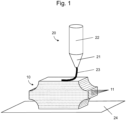
- Figure 1 schematically illustrates the manufacturing of a 3D hemostatic product using a 3D additive printer 20 from which only the depositing nozzle 21 and the body of a printing ink container 22 are represented.
- the printing process is preferably done at ambient atmosphere, at room temperature.
- the process has the advantage of allowing an impression of the 3D hemostatic product directly in an operating room for instance.
- the printing process can be of course also done in any other rooms, in particular outside of an operating room, and independently of any surgical operation.
- the 3D hemostatic product could be directly printed on a surface of a patient to be treated, for instance directly on a bleeding area or a bleeding wound of a patient being operated.
- the printing process can be done without a patient, outside of a patient, in particular outside of any surgical area of a patient.
- the nozzle 21 of the 3D printer 20 is used to deposit the hemostatic flowable 23 from the printing ink container 22 onto a support 24 and form successive layers 11 onto one another to produce a 3D hemostatic product 10.
- the 3D printer is controlled to produce a spatial patterning of raw material, comprising - and preferably consisting of - the hemostatic flowable, and assemble it using a computer-aided layer-by-layer deposition approach for fabrication of the 3D hemostatic product 10.
- the 3D hemostatic product that is to be manufactured has a shape that can be defined by a three-dimensional model which is provided as an input data to the 3D additive printer 20.
- the 3D additive printer 20 usually comprises a processing unit that is configured to process the 3D model to define a printing pattern with a plurality of layers designed to be stacked on one another so as to form a stack of layers corresponding to the 3D model.
- This printing pattern will also depend on the raw material to be used as printing ink and the nature of the 3D hemostatic product to be manufactured.
- the simplest 3D hemostatic product is indeed made of a single material, i.e. the hemostatic flowable, arranged in a stack of layers that are naturally joined together (it is said that the layers are added together).
- naturally joined together it is meant that there is no need of a further active process to have two adjacent layers be joined together, in particular no cross-linking is needed.
- the layers that are printed on one another are joined together by self-assembly. There is no cross-linking phenomena and no covalent bounds created between the layers.
- the proposed hemostatic flowable used for the printing of the hemostatic product has a high concentration in polymers (due to the concentration in collagen) that promotes this self-assembly.
- the proposed hemostatic flowable is mainly composed of non-cross-linked collagen of the fibrillar type which further promotes this self-assembly.
- the proposed hemostatic flowable has thixotropic properties that enables a self-assembly particularly interesting for the manufacturing of product through printing.
- the proposed hemostatic flowable has thixotropic properties that enables returning to its original, unconstrained, more viscous and stable state in a predetermined time which is sufficiently long for another layer to be printed onto a first layer while allowing mixing of the material used to print those layers, and sufficiently short for the printed product to be quickly cohesive and stable.
- the proposed hemostatic flowable after deposition, returns to its original unconstrained state in less than 10 minutes, more preferably less than 5 minutes, even more preferably less than 1 minute or less than 30 seconds.
- an artificial body part e.g. a portion of tendon, cartilage, meniscus, intervertebral disc, etc.
- the hemostatic flowable to improve its implantation within the body of the patient and the corresponding healing process.
- the printing process can be controlled so that each layer can be made of several printing inks.
- each layer can be made of several printing inks.
- it will be possible to form the intermediate layers with a peripheral part made with the hemostatic flowable.
- This way of additive printing enables manufacturing a 3D product with an envelope (external walls) having hemostatic properties whereas the core of the 3D product can be made of a different material.
- the 3D additive printer 20 can be an extrusion printer equipped with multiple nozzle dispensers, each nozzle dispenser being associated with a different printing ink. It presents the advantage of allowing to print conveniently the 3D hemostatic product made from different layers, wherein each layer can be composed of different compositions contained in different printing cartridges. In particular, one layer can have several portions being each printed with a different printing ink, in particular different hemostatic flowables.
- each layer of the 3D hemostatic product can be made of a different pattern, and superposing layers can be printed in various orientations and patterns.
- the 3D hemostatic product 10 can be made by superposing two-dimensional (2D) layers.
- a 2D layer can be made with various hemostatic flowable compositions forming several portions of the layer.
- a 2D layer can be formed to have a hemostatic gradient, by forming several portions with several hemostatic flowable having different hemostatic powers.
- 2D layers can be printed with various patterns, for instance curved lines, circles, polygons, dots, waves.
- patterns can have different orientations, for instance, patterns can be oriented perpendicularly, or in diagonal following various angles. Moreover, within a layer, the distance between patterns can also vary.
- the superposed layers can moreover have different thickness, shapes and dimensions.
- a 2D layer can be completely filled, or alternatively present voids
- hemostatic products with complex shapes can be printed.
- Those printed hemostatic products can also have areas with a specific function, and several areas with different functions.
- the printed hemostatic product can also be prepared so as to have a shape that can vary over time, for instance upon hydration. More precisely, the printed hemostatic product is a 3D hemostatic product, i.e. a product having a shape according to three spatial dimensions, with a fourth dimension corresponding to the transformation of the product over the time. Such 3D printed products with a fourth dimension are also referred to 4D products.
- each layer or at least two different layers, can have different hemostatic and/or swelling properties, for instance upon hydration.
- the composition of the final printed hemostatic product can comprise a fibrillar collagen content, preferably a partially fibrillar collagen content, ranging from 60% to 99% by weight relative to the total weight of the composition, in particular ranging from 75% to 90% by weight, and quite particularly ranging from 83% to 88% by weight.
- the composition of the printed hemostatic product can comprise a monosaccharide content ranging from 1% to 10% by weight relative to the total weight of the composition, in particular ranging from 3% to 7% by weight, and quite particularly ranging from 4% to 5% by weight.
- composition of the printed hemostatic product can comprise a glycosaminoglycan content ranging from 1% to 30% by weight relative to the total weight of the composition, in particular ranging from 5% to 12% by weight, and quite particularly ranging from 8% to 10% by weight.
- the composition of the printed hemostatic product can comprise a coagulation factor, preferably thrombin, in a content lower than 1% by weight relative to the total weight of the composition.
- a coagulation factor preferably thrombin
- its content is lower than preferably than 0.5% by weight relative to the total weight of the composition, preferably less than 0.1% by weight.
- the presence of collagen in the hemostatic flowable used to make the 3D-hemostatic product is necessary for the product cohesion, especially the cohesion between the different layers of the product.
- the use of non cross-linked fibrillar collagen is particularly advantageous.
- using fibrillar collagen helps promoting hemostasis.
- the hemostatic flowable has a high concentration in polymers (corresponding to the concentration of collagen) which promotes the printing process and enables manufacturing hemostatic products by a self-assembling manufacturing process.
- it enables manufacturing printed hemostatic products that are cohesive, self-supporting, and resistant without the need of a further reinforcing step, for example through natural or forced cross-linking, with photo-stimulation or heat-stimulation for instance.
- monosaccharides and particularly glucose, are conveniently used for preparing the hemostatic powder, in particular since it reduces electrical charges within the composition.
- monosaccharide can also be used for its hydrophilicity and are typically charge-polarized and capable of hydrogen bonding. This makes these molecules soluble not only in water but also in other polar solvents. Monosaccharide can also be useful for preservation of the possible coagulation factor.
- Glycosaminoglycans and especially chondroitin sulfates, are very hydrophilic too.
- the proportion of glycosaminoglycans in the composition of the hemostatic flowable used for the manufacturing of the printed hemostatic product makes the swelling properties of the printed product vary. More precisely, it influences the swelling properties of the pattern made with the specific hemostatic flowable.
- layers rich in chondroitin sulfates may swell more than layers mainly made of collagen and poorer in chondroitin sulfates.
- Variation in hydration and swelling across the printed hemostatic product can be used to deform and/or expand the hemostatic product upon hydration, in order to cover a bleeding wound for instance.
- glycosaminoglycans and especially chondroitin sulfates, in the hemostatic flowable is also advantageous as it helps the printing process. More precisely, it appears that it promotes the flowing of the hemostatic flowable through the nozzle of the printing head of the bioprinter, as a lubricant could do.
- the coagulation factor such as thrombin, that can be added at any step of the manufacturing process of the hemostatic product, is used to promote coagulation.
- an hemostatic flowable containing the coagulation factor can be printed in target zones only, for instance in zones where coagulation is required.
- a 3D hemostatic product made with the proposed 3D printing process can be used quickly after having been manufactured with the 3D printer, e.g. within a few minutes. Since the fabrication process by a bioprinter is convenient and automatized, the 3D hemostatic product can be printed for immediate use following predesigned templates for instance, depending on a wound or bleeding site to heal.
- the hemostatic product can be dried and applied dried on a bleeding site. If it is desired to use the 3D hemostatic product at a later stage, e.g. well after this above optimal usage recommendation, the 3D hemostatic product could be partially dried, at ambient atmosphere and/or in an autoclave for instance. In this case, the hemostatic product can be rehydrated before application on the wound. It is preferable to rehydrate the 3D hemostatic product before use, even though it is not absolutely necessary as it could be rehydrated with the blood surrounding the area where it has to be used.
- the printed 3D-hemostatic product can be dried at room temperature or lyophilized, in order to better preserve collagen triple helical structure.
- the proposed hemostatic flowable has the advantage of not requiring any cross-linking before or during the additive printing process to form cohesive stacked layers. It can however be considered having a cross-linking during the printing process to more finely control the joining of the layers and possibly perform more complex printing pattern. Such cross-linking could be for instance done by using a focused UV irradiation or any adapted chemical cross-linking process.
- the printed 3D hemostatic object can be cross-linked before or after being dried.
- the cross-linking can be local, in order to create a reinforced local zone, or in order to fix the printed shape locally. This is particularly advantageous to make a product with high resistance to manipulations and a higher bleeding flow strength. It has however to be noted that such cross-linking step is absolutely not necessary for the printing process to lead to cohesive, self-supporting, and resistant printed 3D products.
- the cross-linking can concern the whole hemostatic product, in order to reinforce the hemostatic product, and particularly to impede or limit its swelling and deformation.
- Local or general cross-linking can be induced by heat, light, or any suitable process.
- a cross-linking initiator within the composition on the hemostatic flowable used for printing the hemostatic product.
- the hemostatic product is devoid of coagulation factor, it could be soaked, dipped, sprayed with a coagulation factor, such as a thrombin solution, before or after drying.
- a coagulation factor such as a thrombin solution
- the coagulation factor can be absorbed or deposited on the product.
- the components of the hemostatic flowable can be used sterile, but not necessarily.
- the printed hemostatic product can be sterilized before use.
- a dried sterile printed hemostatic product can be applied on a bleeding wound.
- the dried sterile printed hemostatic product can be soaked in a saline solution or/and a coagulation factor solution prior to its application on the bleeding wound.
- the properties and corresponding use of the printed hemostatic product will depend on the properties of each of the layers forming this printed hemostatic product.
- composition and structure of the printed hemostatic product could be chosen to swell and deform in order to conform to the bleeding wound.
- a possible pattern rich in coagulation factor can locally promote blood coagulation.
- a possible "pro-adhesive" pattern can locally promote the product cohesion to or adhesion with the bleeding wound.
- a possible external layer rich in water can advantageously prevent the product adhesion to surrounding tissues.
- Using a printed hemostatic product formed with an hemostatic flowable as described above has the advantage of enhancing the contact surface with the wound.
- the contact with the bleeding area goes deeper. This is in particular of interest when the bleeding area corresponds to soft tissues and parenchymal organs.
- the 3D hemostatic product being manufactured with a 3D additive printer, it can have any kind of three-dimensional structure, from a simple one being a full volume to a very complex one with a lot of lattices and angles.
- the 3D hemostatic product can for instance have the shape of a rod, an hollow cylinder, a ball, etc.
- the 3D hemostatic product could also be a patch provided with a honeycomb structure, for instance a patch having the shape of a membrane with a thickness of at least a few millimeters (e.g. from 5 mm to 50 mm).
- the hemostatic product can resorb, for instance a few weeks to several months after having been applied, according to size, thickness or possible cross-linking of the product.
- a hemostatic method comprising the depositing of the printed hemostatic product such as defined above on a hemorrhaging part of an animal's body, including humans.
- the printed hemostatic product can be used in surgical procedures, in particular laparotomies, laparoscopies, coelioscopies and robotic procedures.
- the printed hemostatic product described above could also be used as a cicatrizing agent for internal and external wounds.
- cicatrizing agent refers to a product that makes it possible to obtain a clinically satisfactory healing of the tissues with which it is in contact.
- Example 1 Protocol for measuring hemostatic capacity in vitro
- Citrated (around 0.1 M) human blood is maintained at 37°C in a water bath throughout the measurement.
- the product to be tested (10 mg) is deposited in a 5 mL polypropylene tube with a snap-on cap, and then citrated fresh blood (2 mL) is added.
- CaCl 2 is then added so that the final CaCl 2 concentration in the blood is 15 mM, and then the test tube is closed.
- the contents are then around mixed by vigorous inversions (10 times) and then the test tube is plunged into the water bath; the test tube is returned to the vertical position every 10 seconds. The time required to form a clot is noted and corresponds to hemostatic capacity.
- a known quantity of product notably of powder, is sifted through 50 ⁇ m, 100 ⁇ m, 200 ⁇ m, 300 ⁇ m and 400 ⁇ m screens for 2 minutes (per screen). The fractions from each screen are weighed. The proportion of each particle size range is determined.
- a 15 mL flask is weighed (m 0 in mg) and then X mg of powder of the dry composition is added (m 0+x in mg).
- a 0.15 M aqueous NaCI solution (2 mL) is added and the composition is left to swell for 20 minutes; the flask is then centrifuged at 1,000 rpm.
- the swelling ratio is calculated as follows: ((m 1 -m 0 )/(m 0 + x -m 0 )).
- Pieces of pig dermis (30 kg), defatted with acetone, are left to swell for 3 hours in 100 kg of 0.05 M NaOH solution.
- the dermises are finely cut up by a cutting mill and the paste obtained is diluted with 50 liters of 0.05 M NaOH.
- the mixture is then sieved under pressure through a 1 mm screen.
- the paste obtained is then brought to pH 6-7.5 with HCI and the precipitate obtained is collected by centrifugation or filtration through a 1 mm screen.
- the retentate is dehydrated with acetone according to methods known to those persons skilled in the art.
- This dehydrated retentate thus consists in collagen of the fibrillar type, with a large content of fibrillar/fibrous collagen relative to the non-fibrillar collagen.
- such extracted collagen comprises from 85% to 95% by weight of fibrillar/fibrous collagen relative to the total weight of the collagen, and from 5% to 15% by weight of non-fibrillar collagen relative to the total weight of the collagen.
- the mixture is homogenized for 1 hour and then poured out and dehydrated. After drying, the dry product is ground at a rate of 25 g/min using a Fitzpatrick hammer mill at 7,000 rpm under controlled heating. The product is then screened by mechanical sifting to eliminate particles whose size is larger than 400 ⁇ m.
- Dermatan sulfate is then added to the powder in an amount of 2% by weight relative to the dry matter of the powder (0.612 g).
- the mixture is then homogenized using a ball mill, lyophilized thrombin is added to the mixture in an amount of 15 IU/mg of powder, and finally the mixture is homogenized using a ball mill.
- the mixture is homogenized for 3 hours and then distributed onto plates and dehydrated. After drying, the dry product is ground by fraction at a rate of 5 g/min using a hammer mill at 12,000 rpm under controlled heating. The product is then screened by mechanical sifting to eliminate particles whose size is larger than 400 ⁇ m and those smaller than 50 ⁇ m.
- Granulometry is measured in order to verify that the distribution is such that 60% of the sample by weight has a granulometry greater than 200 ⁇ m.
- Purified chondroitin sulfates are then added to the powder in an amount of 20% by weight relative to the dry matter of the powder (1.575 kg).
- the mixture is homogenized using a ball mill.
- lyophilized thrombin is added to the mixture in an amount of 10 IU/mg of powder.
- the mixture is homogenized using a ball mill.
- the mixture is homogenized for 1 hour and then poured out and dehydrated. After drying, the dry product is ground at a rate of 25 g/min using a Fitzpatrick hammer mill at 7,000 rpm under controlled heating. The product is then screened by mechanical sifting to eliminate particles whose size is larger than 400 ⁇ m and smaller than 50 ⁇ m.
- Chondroitin sulfate is then added to the powder in an amount of 10% by weight relative to the dry matter of the powder (105g). The mixture is then homogenized using a ball mill.
- Such powder composition has a tapped density of around 0.408 g/mL.
- the mixture is homogenized for 1 hour and then poured out and dehydrated. After drying, the dry product is ground at a rate of 25 g/min using a Fitzpatrick hammer mill at 7,000 rpm under controlled heating. The product is then screened by mechanical sifting to eliminate particles whose size is larger than 400 ⁇ m and smaller than 50 ⁇ m.
- Chondroitin sulfate mixed with a thrombin powder is then added to the powder in an amount of 10% by weight relative to the dry matter of the powder (52.5g).
- the thrombin is added to the mixture in a final amount of 0.85U/mg.
- the mixture is then homogenized using a ball mill.
- Such powder composition has a tapped density of around 0.425 g/mL.
- Example 4 750 g of collagen of the fibrillar type as prepared in Example 4 is mixed with 6675 mL of highly purified water. The mixture is stirred at a first stirring rate of 20 rpm during 10 minutes, and then at a second stirring rate of 40 rpm during 15 minutes.
- the above mixture is then stirred again at the first stirring rate of 20 rpm while a solution of glucose (37.5 g of glucose with 300 mL of water) is incorporated.
- the quantity of glucose added corresponds to 5% by weight relative to the weight of the collagen being used in the mixture.
- This new mixture is stirred at the second stirring rate of 40 rpm during 10 minutes. This preparation is then stored during 16 hours.
- a quantity of 87.5 mL of a 1 M aqueous HCI solution is then added to the preparation while being stirred at a stirring rate of 30 rpm.
- This new mixture is then stirred at a first stirring rate of 35 rpm during 1 minute, then at a second stirring rate of 40 rpm during 1 minute, followed then by several stirring sessions of 5 minutes at the same stirring rate of 40 rpm, a quick pause in the stirring being made between two sessions.
- the thick paste obtained in the preceding phase is then separated in several pieces having similar shape and mass. Those pieces of the paste are then placed for 24 hours in a hermetically sealed enclosure having an atmosphere saturated with ammonia. After this neutralization step, the pieces of paste are dried at 20°C during 96 hours, and the dry products are then ground at a rate of 1 kg/h using a cryogenic mill of Forplex at 8,500 rpm. The powder product is then screened by mechanical sifting to eliminate particles whose size is larger than 200 ⁇ m and smaller than 50 ⁇ m, resulting in a collagen-glucose powder.
- a powder of chondroitin sulfate (CS) which is made of particles having a size between 50 ⁇ m and 200 ⁇ m is then added to the collagen-glucose powder in an amount of 10% by weight relative to the dry matter of the collagen-glucose powder.
- CS chondroitin sulfate
- 30 g of the powder of chondroitin sulfate is mixed with 300 g of the collagen-glucose powder.
- freeze-dried thrombin is also added, in a quantity of 1000UI/g.
- the mixture is then homogenized using a V blender.
- the final hemostatic powder has a tapped density of around 0.4 g/mL.
- the goal of the experimentation is to determine the proportion of fibrillar/fibrous collagen and non-fibrillar collagen in a collagen (extracted collagen or collagen ground into powder). Such proportion can be determined by studying the proportion of insoluble (corresponding to the fibrillar/fibrous collagen) and soluble collagen (corresponding to the non-fibrillar collagen) in the collagen.
- the experimentation consists in solubilizing about 2.5 g of the collagen under test in 166 mL of water at pH 13 during 16 hours.
- the solution is then centrifuged (10 000 rpm during 10 minutes).
- the supernatant (corresponding to the non-fibrillar collagen) and the residue (corresponding to the fibrous/fibrillar collagen) are then split.
- the residue is directly dried with successive acetone baths and under a controlled air flow.
- the pH of the supernatant is adjusted at pH 3 with acetic acid and chlorhydric acid at 6M.
- the solid collagen from the supernatant is obtained by adding NaCl 0.6M, and by performing a centrifugation. It is then dried with successive acetone baths and under a controlled air flow.
- the collagen weights from the residue (Mresidue) and from the supernatant (Msupernatant) are calculated, and the formula Mresidue/(Mresidues + Msupernatant) x 100 gives the percentage of fibrous collagen on total amount of collagen.
- the ratio Mresidue/(MResidues + Msupernatant) must be superior to 80% both for the collagen used to prepare the powder and for the final collagen powder. Preferentially the ratio is superior to 85%.
- the above experimentation made of three batches of collagen prepared as in example 4 gives very similar ratios of 92.67%, 94.60% and 91.51% respectively. After having ground the collagen of these three batches, the ratio remains very similar as it is of 91.63%, 88.02%, and 88.69% respectively.
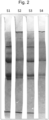
- Another way to show the presence of both fibrous/fibrillar collagen and soluble collagen is to perform a SDS page electrophoresis.
- Figure 2 illustrates such electrophoresis, with sample S1 corresponding to the supernatant of a first batch (made from collagen extracted as in example 4), sample S2 corresponding to the residue of this first batch, and sample S3 corresponding to the supernatant of a second batch (also made from collagen extracted as in example 4), sample S4 corresponding to the residue of this second batch.
Landscapes
- Chemical & Material Sciences (AREA)
- Health & Medical Sciences (AREA)
- Life Sciences & Earth Sciences (AREA)
- Engineering & Computer Science (AREA)
- Materials Engineering (AREA)
- Organic Chemistry (AREA)
- Manufacturing & Machinery (AREA)
- Wood Science & Technology (AREA)
- Epidemiology (AREA)
- General Health & Medical Sciences (AREA)
- Public Health (AREA)
- Veterinary Medicine (AREA)
- Animal Behavior & Ethology (AREA)
- Surgery (AREA)
- Chemical Kinetics & Catalysis (AREA)
- General Chemical & Material Sciences (AREA)
- Molecular Biology (AREA)
- Medicinal Chemistry (AREA)
- Polymers & Plastics (AREA)
- Dermatology (AREA)
- Materials For Medical Uses (AREA)
- Medicines That Contain Protein Lipid Enzymes And Other Medicines (AREA)
- Meat, Egg Or Seafood Products (AREA)
- Pharmaceuticals Containing Other Organic And Inorganic Compounds (AREA)
Claims (19)
- Gedrucktes blutstillendes Produkt, das mindestens drei Dimensionen aufweist und aus einem Stapel von Schichten besteht, die von einer ersten äußeren Schicht bis zu einer zweiten äußeren Schicht aufeinander aufgebracht sind, wobei eine Vielzahl von benachbarten Schichten des Stapels von Schichten miteinander verbunden sind, und wobei jede von der Vielzahl von benachbarten Schichten des Stapels von Schichten mindestens einen Abschnitt aufweist, der aus einem blutstillenden fließfähigen Stoff mit einer Zusammensetzung besteht, die Folgendes umfasst:- nicht vernetztes Kollagen vom fibrillären Typ, das einen Gehalt an faserigem Kollagen und/oder fibrillärem Kollagen von mindestens 70 Gew.-%, bezogen auf das Gesamtgewicht des Kollagens, umfasst; und- mindestens ein Monosaccharid.
- Gedrucktes blutstillendes Produkt nach Anspruch 1, wobei mindestens eine Schicht der Vielzahl von benachbarten Schichten des Stapels von Schichten verschiedene Abschnitte aufweist, die aus blutstillenden fließfähigen Stoffen mit unterschiedlichen Zusammensetzungen bestehen.
- Gedrucktes blutstillendes Produkt nach Anspruch 1, wobei die mindestens eine Schicht der Vielzahl von benachbarten Schichten des Stapels von Schichten vollständig aus dem gleichen blutstillenden fließfähigen Stoff besteht.
- Gedrucktes blutstillendes Produkt nach Anspruch 3, wobei sämtliche Schichten des Stapels von Schichten die gleiche Zusammensetzung aufweisen.
- Gedrucktes blutstillendes Produkt nach einem der Ansprüche 1 bis 4, wobei mindestens eine von der ersten und der zweiten äußeren Schicht des Stapels von Schichten einen Abschnitt aufweist, der aus dem blutstillenden fließfähigen Stoff besteht.
- Gedrucktes blutstillendes Produkt nach Anspruch 5, wobei die mindestens eine von der ersten und der zweiten äußeren Schicht vollständig aus dem gleichen blutstillenden fließfähigen Stoff besteht.
- Gedrucktes blutstillendes Produkt nach einem der Ansprüche 5 bis 6, wobei die erste und die zweite äußere Schicht des Stapels von Schichten die gleiche Zusammensetzung aufweisen, und wobei vorzugsweise jede Schicht des Stapels von Schichten einen Umfangsabschnitt aufweist, der aus einem fließfähigen Gemisch besteht, das identisch mit dem fließfähigen Gemisch der mindestens einen von der ersten und der zweiten äußeren Schicht ist.
- Gedrucktes blutstillendes Produkt nach einem der Ansprüche 1 bis 7, wobei mindestens eine Schicht des Stapels von Schichten einen Abschnitt umfasst, der aus einem blutstillenden fließfähigen Stoff besteht, der Quellungseigenschaften aufweist, die sich von den Quellungseigenschaften der anderen Schichten des Stapels von Schichten unterscheiden.
- Gedrucktes blutstillendes Produkt nach einem der Ansprüche 1 bis 8, wobei der blutstillende fließfähige Stoff mit einem blutstillenden Pulver hergestellt wird, das eine Zusammensetzung aufweist, die Folgendes umfasst:- Kollagen vom fibrillären Typ, das einen Gehalt an faserigem Kollagen und/oder fibrillärem Kollagen von mindestens 70 Gew.-%, bezogen auf das Gesamtgewicht des Kollagens, umfasst, wobei das Kollagen in einer Menge von 75 bis 96 Gew.-%, bezogen auf das Gesamtgewicht der Zusammensetzung des blutstillenden Pulvers, vorzugsweise von 80 bis 90 Gew.-%, vorliegt; und- mindestens ein Monosaccharid in einer Menge von 1 bis 12,5 Gew.-%, bezogen auf das Gesamtgewicht der Zusammensetzung des blutstillenden Pulvers, vorzugsweise in einer Menge von 2,5 bis 7,5 Gew.-% und, mehr zu bevorzugen, in einer Menge von 4 bis 6 Gew.-%.
- Verwendung eines blutstillenden fließfähigen Stoffs als eine Druckfarbe für einen dreidimensionalen Drucker, wobei der blutstillende fließfähige Stoff aus einem blutstillenden Pulver hergestellt wird, das mit einer Salzlösung gemischt wird, wobei das blutstillende Pulver eine Zusammensetzung aufweist, die Folgendes umfasst:- nicht vernetztes Kollagen vom fibrillären Typ, das einen Gehalt an faserigem Kollagen und/oder fibrillärem Kollagen von mindestens 70 Gew.-%, bezogen auf das Gesamtgewicht des Kollagens, umfasst; und- mindestens ein Monosaccharid.
- Verwendung nach Anspruch 10, wobei die Zusammensetzung des blutstillenden Pulvers, das den blutstillenden fließfähigen Stoff bildet, Folgendes umfasst:- Kollagen vom fibrillären Typ, das einen Gehalt an faserigem Kollagen und/oder fibrillärem Kollagen von mindestens 70 Gew.-%, bezogen auf das Gesamtgewicht des Kollagens, umfasst, wobei das Kollagen in einer Menge von 75 bis 96 Gew.-%, bezogen auf das Gesamtgewicht der Zusammensetzung des blutstillenden Pulvers, vorzugsweise von 80 bis 90 Gew.-%, vorliegt; und- mindestens ein Monosaccharid in einer Menge von 1 bis 12,5 Gew.-%, bezogen auf das Gesamtgewicht der Zusammensetzung des blutstillenden Pulvers, vorzugsweise in einer Menge von 2,5 bis 7,5 Gew.-% und, mehr zu bevorzugen, in einer Menge von 4 bis 6 Gew.-%.
- Verfahren zur Herstellung eines blutstillenden Produkts, das mindestens drei Dimensionen aufweist, mit einem dreidimensionalen additiven Drucker, das die folgenden Schritte umfasst:a) Bereitstellen eines dreidimensionalen Modells für den dreidimensionalen additiven Drucker, wobei das dreidimensionale Modell der Struktur des herzustellenden blutstillenden Produkts entspricht, und Verarbeiten des dreidimensionalen Modells, um ein Druckmuster mit einer Vielzahl von Schichten zu definieren, die dazu gestaltet sind, aufeinander gestapelt zu werden, um einen Stapel von Schichten zu bilden, der dem dreidimensionalen Modell entspricht;b) Bereitstellen mindestens eines blutstillenden fließfähigen Stoffs für den dreidimensionalen additiven Drucker zur Verwendung als eine Druckfarbe, wobei der fließfähige Stoff aus einem mit einer Salzlösung gemischten blutstillenden Pulver besteht, wobei das blutstillende Pulver eine Zusammensetzung aufweist, die Folgendes umfasst:∘ nicht vernetztes Kollagen vom fibrillären Typ, das einen Gehalt an faserigem Kollagen und/oder fibrillärem Kollagen von mindestens 70 Gew.-%, bezogen auf das Gesamtgewicht des Kollagens, umfasst; und∘ mindestens ein Monosaccharid;c) Drucken des blutstillenden Produkts mit dem dreidimensionalen additiven Drucker durch Aufbringen von Druckfarbe, um aufeinanderfolgend Schichten aufeinander zu drucken, wobei das Bilden das Aufbringen des blutstillenden fließfähigen Stoffs mit dem dreidimensionalen additiven Drucker zum Bilden von mindestens einem Abschnitt von mindestens einer Schicht des Stapels von Schichten umfasst.
- Verfahren nach Anspruch 12, wobei die mindestens eine Schicht des Stapels von Schichten vollständig mit dem Aufbringen des blutstillenden fließfähigen Stoffs hergestellt wird.
- Verfahren nach einem der Ansprüche 12 bis 13, wobei der blutstillende fließfähige Stoff in verschiedenen Schichten des Stapels von Schichten verwendet wird, um das blutstillende Produkt (10) zu erhalten, und wobei der blutstillende fließfähige Stoff vorzugsweise zum Bilden sämtlicher Schichten des Stapels von Schichten verwendet wird, um das blutstillende Produkt (10) zu erhalten.
- Verfahren nach einem der Ansprüche 12 bis 14, wobei im Schritt b) dem dreidimensionalen additiven Drucker eine Vielzahl von blutstillenden fließfähigen Stoffen zur Verwendung als Druckfarben bereitgestellt werden, wobei die blutstillenden fließfähigen Stoffe unterschiedliche Zusammensetzungen aufweisen.
- Verfahren nach einem der Ansprüche 12 bis 15, wobei die Zusammensetzung des blutstillenden Pulvers, das den blutstillenden fließfähigen Stoff bildet, Folgendes umfasst:- Kollagen vom fibrillären Typ, das einen Gehalt an faserigem Kollagen und/oder fibrillärem Kollagen von mindestens 70 Gew.-%, bezogen auf das Gesamtgewicht des Kollagens, umfasst, wobei das Kollagen in einer Menge von 75 bis 96 Gew.-%, bezogen auf das Gesamtgewicht der Zusammensetzung des blutstillenden Pulvers, vorzugsweise von 80 bis 90 Gew.-%, vorliegt; und- mindestens ein Monosaccharid in einer Menge von 1 bis 12,5 Gew.-%, bezogen auf das Gesamtgewicht der Zusammensetzung des blutstillenden Pulvers, vorzugsweise in einer Menge von 2,5 bis 7,5 Gew.-% und, mehr zu bevorzugen, in einer Menge von 4 bis 6 Gew.-%.
- Verfahren nach einem der Ansprüche 12 bis 16, wobei, nachdem das blutstillende Produkt im Druckschritt c) gebildet wurde, ein Beschichtungsschritt d) durchgeführt wird, wobei eine Lösung, die einen Gerinnungsfaktor, insbesondere Thrombin, umfasst, zum Beschichten einer äußeren Oberfläche des blutstillenden Produkts verwendet wird, wobei der Beschichtungsschritt d) vorzugsweise durch Sprühen der Lösung, die einen Gerinnungsfaktor umfasst, auf die äußere Oberfläche des blutstillenden Produkts durchgeführt wird.
- Verfahren nach einem der Ansprüche 12 bis 17, wobei, nachdem das blutstillende Produkt im Druckschritt c) gebildet wurde, ein Tränkungsschritt e) durchgeführt wird, wobei das blutstillende Produkt in einer Lösung getränkt wird, die einen Gerinnungsfaktor, insbesondere Thrombin, umfasst.
- Verfahren nach einem der Ansprüche 12 bis 18, wobei der gesamte Prozess bei Umgebungsatmosphäre ohne jegliche Stimulation des blutstillenden Produkts, insbesondere ohne Photostimulation oder Wärmestimulation, durchgeführt wird.
Applications Claiming Priority (2)
| Application Number | Priority Date | Filing Date | Title |
|---|---|---|---|
| EP18305154 | 2018-02-15 | ||
| PCT/EP2019/053896 WO2019158734A1 (en) | 2018-02-15 | 2019-02-15 | Multi-dimensional hemostatic product and method for producing the same |
Publications (3)
| Publication Number | Publication Date |
|---|---|
| EP3752211A1 EP3752211A1 (de) | 2020-12-23 |
| EP3752211C0 EP3752211C0 (de) | 2023-12-27 |
| EP3752211B1 true EP3752211B1 (de) | 2023-12-27 |
Family
ID=61563314
Family Applications (1)
| Application Number | Title | Priority Date | Filing Date |
|---|---|---|---|
| EP19704033.0A Active EP3752211B1 (de) | 2018-02-15 | 2019-02-15 | Dreidimensionales blutstillendes produkt und verfahren zur herstellung davon |
Country Status (9)
| Country | Link |
|---|---|
| US (1) | US12171900B2 (de) |
| EP (1) | EP3752211B1 (de) |
| JP (1) | JP7395095B2 (de) |
| CN (1) | CN112055599A (de) |
| AU (1) | AU2019221631B2 (de) |
| BR (1) | BR112020016593B1 (de) |
| CA (1) | CA3090405A1 (de) |
| IL (1) | IL276693B2 (de) |
| WO (1) | WO2019158734A1 (de) |
Family Cites Families (48)
| Publication number | Priority date | Publication date | Assignee | Title |
|---|---|---|---|---|
| DE3175003D1 (en) | 1981-06-25 | 1986-08-28 | Serapharm Gmbh & Co Kg | Enriched plasma derivative for promoting wound sealing and wound healing |
| US4515637A (en) | 1983-11-16 | 1985-05-07 | Seton Company | Collagen-thrombin compositions |
| US4942153A (en) | 1987-02-03 | 1990-07-17 | Fernandez Helen M | Skin moisturizing product and process |
| US5263984A (en) | 1987-07-20 | 1993-11-23 | Regen Biologics, Inc. | Prosthetic ligaments |
| US4891359A (en) | 1988-12-08 | 1990-01-02 | Johnson & Johnson Patient Care, Inc. | Hemostatic collagen paste composition |
| IT1263394B (it) | 1993-07-30 | 1996-08-05 | Fidia Advanced Biopolymers Srl | Composizioni farmaceutiche per uso topico a base di acido ialuronico e suoi derivati |
| DE19620676A1 (de) | 1996-05-22 | 1997-11-27 | Vinzens Schulte | Unterlage für zu bohrende Werkstücke |
| US6096309A (en) | 1997-06-18 | 2000-08-01 | Cohesion Technologies, Inc. | Compositions containing thrombin and microfibrillar nanometer collagen, and methods for preparation and use thereof |
| US20050208114A1 (en) | 1998-03-24 | 2005-09-22 | Petito George D | Composition and method for healing tissues |
| US7691829B2 (en) | 1998-03-24 | 2010-04-06 | Petito George D | Composition and method for healing tissues |
| MXPA01001752A (es) | 1998-08-20 | 2002-04-08 | 3M Innovative Properties Co | Parche en aerosol y sistema de aplicacion de medicamento. |
| AT412445B (de) | 2000-06-20 | 2005-03-25 | Biering Wolfgang | Flüssiges collagen-hämostatikum |
| AT411326B (de) | 2000-06-20 | 2003-12-29 | Biering Wolfgang | Hämostatische collagen-pellets |
| US20030003157A1 (en) | 2001-06-06 | 2003-01-02 | University Of Medicine & Dentistry Of New Jersey | Collagen compositions and methods for making and using the same |
| JP3805654B2 (ja) | 2001-08-29 | 2006-08-02 | 株式会社ネクスト | 止血・癒着防止性のバイオポリマーの微細粒子 |
| WO2003026709A1 (en) | 2001-09-26 | 2003-04-03 | Mbs Multination Business Services (G.B.) Ltd. | Liquid mixture for use as a dressing spray |
| EP1501558A1 (de) | 2002-05-08 | 2005-02-02 | Rheinisch-Westfälische Technische Hochschule Aachen (RWTH) | Resorbierbare pharmazeutische formulierung zur kontinuierlichen thrombinfreisetzung |
| US20060159731A1 (en) * | 2002-06-03 | 2006-07-20 | Yissum Research Development Company Of The Hebrew University Of Jerusalem | Multi-layer collagenic article useful for wounds healing and a method for its production thereof |
| US20060019868A1 (en) | 2004-01-30 | 2006-01-26 | Pendharkar Sanyog M | Hemostatic compositions and devices |
| EP1660013A4 (de) | 2003-08-26 | 2011-07-20 | Gel Del Technologies Inc | Protein-biomaterialien und biokoazervate und herstellungs- und verwendungsverfahren dafür |
| CN1554448A (zh) | 2003-12-23 | 2004-12-15 | 张淑荣 | 壳聚糖明胶聚乙烯醇生物止血敷料 |
| DE602005022554D1 (de) | 2004-01-30 | 2010-09-09 | Ferrosan As | Hämostatische sprays und zusammensetzungen |
| EP1731134B1 (de) | 2004-03-17 | 2015-10-07 | Hayashibara Co., Ltd. | Funktionale pulver |
| EP1580229A1 (de) | 2004-03-22 | 2005-09-28 | Warner-Lambert Company Llc | Biopolymerzusammensetzungen und daraus hergestellte Produkte |
| JP4439517B2 (ja) | 2004-05-13 | 2010-03-24 | 株式会社ネクスト21 | 経内視鏡手術に用いる止血と、癒着の防止装置 |
| US8021684B2 (en) | 2004-07-09 | 2011-09-20 | Ferrosan Medical Devices A/S | Haemostatic composition comprising hyaluronic acid |
| JP5133061B2 (ja) * | 2004-10-20 | 2013-01-30 | エシコン・インコーポレイテッド | 強化された吸収性複層の止血用創傷手当て用品および製造方法 |
| MY142987A (en) | 2005-06-08 | 2011-02-14 | Hayashibara Biochem Lab | Solution for tissue adhesion prevention and method for tissue adhesion prevention |
| CN1709507A (zh) | 2005-06-29 | 2005-12-21 | 肖春 | 外用复方止血镇痛消炎药 |
| CN101272790A (zh) | 2005-09-22 | 2008-09-24 | 特罗比奥股份公司 | 稳定的蛋白酶组合物 |
| ES2557179T3 (es) | 2007-09-13 | 2016-01-22 | Deru Gmbh | Componente de endoprótesis |
| US8304595B2 (en) | 2007-12-06 | 2012-11-06 | Nanosys, Inc. | Resorbable nanoenhanced hemostatic structures and bandage materials |
| US20090177133A1 (en) | 2008-01-04 | 2009-07-09 | Kristine Kieswetter | Reduced pressure dressing coated with biomolecules |
| RU2545810C2 (ru) * | 2008-02-29 | 2015-04-10 | Ферросан Медикал Дивайсиз А/С | Устройство для ускорения остановки кровотечения и/или заживления ран |
| WO2009109963A1 (en) | 2008-03-03 | 2009-09-11 | Omrix Biopharmaceuticals Ltd. | A gelatin sponge comprising an active ingredient, its preparation and use |
| FR2944706B1 (fr) | 2009-04-28 | 2012-08-24 | Biom Up | Nouveaux materiaux en collagene et procedes d'obtention. |
| CN101757614B (zh) | 2010-02-22 | 2012-04-04 | 苏州汇涵医用科技发展有限公司 | 止血剂及其制备方法 |
| CN101837143A (zh) | 2010-04-22 | 2010-09-22 | 胡堃 | 一种药物缓释止血组合物及制备方法 |
| JP5992500B2 (ja) | 2011-03-21 | 2016-09-14 | カーエーテー クンストシュトフ− ウント エラストテヒニーク ゲゼルシャフト ミット ベシュレンクテル ハフツング リーガウ−アウグストゥスバートKET Kunststoff− und Elasttechnik GmbH Liegau−Augustusbad | 湿潤創傷ケアのための一次ドレッシング及びその製造方法 |
| EP2508212A1 (de) | 2011-04-05 | 2012-10-10 | Universitätsklinikum Freiburg | Biokompatibles und biologisch abbaubares Gradientenschichtsystem für die regenerative Medizin und zur Gewebeunterstützung |
| DK2701611T3 (en) | 2011-04-27 | 2015-10-05 | Biom Up | Dispenser for biomedical hemostatic powder |
| CN103635202B (zh) | 2011-04-27 | 2016-09-28 | 比奥马普公司 | 止血组合物 |
| RU2013155713A (ru) | 2011-07-06 | 2015-08-20 | Профибрикс Бв | Составы для лечения ран |
| KR102259117B1 (ko) * | 2012-05-14 | 2021-05-31 | 데이진 가부시키가이샤 | 시트 성형체 및 지혈재 |
| EP2882392B1 (de) | 2012-08-08 | 2019-03-20 | Smith & Nephew PLC | Massgeschneiderte wundbehandlungsvorrichtungen und verfahren zur verwendung in der unterdruckwundtherapie |
| WO2016019078A1 (en) * | 2014-07-30 | 2016-02-04 | Tufts University | Three dimensional printing of bio-ink compositions |
| CA2983292A1 (en) | 2015-04-23 | 2017-01-19 | Sharklet Technologies, Inc. | Bilayered devices for enhanced healing |
| CN109311224B (zh) | 2016-06-08 | 2020-12-29 | 富士胶片株式会社 | 明胶成型体的制造方法及明胶成型体 |
-
2019
- 2019-02-15 EP EP19704033.0A patent/EP3752211B1/de active Active
- 2019-02-15 JP JP2020566319A patent/JP7395095B2/ja active Active
- 2019-02-15 AU AU2019221631A patent/AU2019221631B2/en active Active
- 2019-02-15 CN CN201980013769.8A patent/CN112055599A/zh active Pending
- 2019-02-15 WO PCT/EP2019/053896 patent/WO2019158734A1/en not_active Ceased
- 2019-02-15 US US16/970,094 patent/US12171900B2/en active Active
- 2019-02-15 BR BR112020016593-0A patent/BR112020016593B1/pt active IP Right Grant
- 2019-02-15 IL IL276693A patent/IL276693B2/en unknown
- 2019-02-15 CA CA3090405A patent/CA3090405A1/en active Pending
Also Published As
| Publication number | Publication date |
|---|---|
| JP2021513908A (ja) | 2021-06-03 |
| RU2020129227A (ru) | 2022-03-15 |
| CA3090405A1 (en) | 2019-08-22 |
| JP7395095B2 (ja) | 2023-12-11 |
| BR112020016593A2 (pt) | 2020-12-15 |
| EP3752211A1 (de) | 2020-12-23 |
| US20210162095A1 (en) | 2021-06-03 |
| EP3752211C0 (de) | 2023-12-27 |
| IL276693B1 (en) | 2023-07-01 |
| US12171900B2 (en) | 2024-12-24 |
| IL276693B2 (en) | 2023-11-01 |
| AU2019221631A1 (en) | 2020-08-27 |
| IL276693A (en) | 2020-09-30 |
| AU2019221631B2 (en) | 2023-12-07 |
| CN112055599A (zh) | 2020-12-08 |
| WO2019158734A1 (en) | 2019-08-22 |
| BR112020016593B1 (pt) | 2023-11-14 |
Similar Documents
| Publication | Publication Date | Title |
|---|---|---|
| US20230381288A1 (en) | Hemostatic compositions | |
| EP3496770B1 (de) | Hämostatisches fliessfähiges material | |
| EP3752211B1 (de) | Dreidimensionales blutstillendes produkt und verfahren zur herstellung davon | |
| HK40043331B (en) | Multi-dimensional hemostatic product and method for producing the same | |
| HK40043331A (en) | Multi-dimensional hemostatic product and method for producing the same | |
| RU2813067C2 (ru) | Многомерное гемостатическое изделие и способ его изготовления | |
| HK40042327A (en) | Multi-dimensional hemostatic product and method for producing the same | |
| HK40012180A (en) | Hemostatic compositions | |
| HK40012180B (en) | Hemostatic compositions | |
| HK40012614A (en) | Hemostatic flowable | |
| HK40012614B (en) | Hemostatic flowable |
Legal Events
| Date | Code | Title | Description |
|---|---|---|---|
| STAA | Information on the status of an ep patent application or granted ep patent |
Free format text: STATUS: UNKNOWN |
|
| STAA | Information on the status of an ep patent application or granted ep patent |
Free format text: STATUS: THE INTERNATIONAL PUBLICATION HAS BEEN MADE |
|
| PUAI | Public reference made under article 153(3) epc to a published international application that has entered the european phase |
Free format text: ORIGINAL CODE: 0009012 |
|
| STAA | Information on the status of an ep patent application or granted ep patent |
Free format text: STATUS: REQUEST FOR EXAMINATION WAS MADE |
|
| 17P | Request for examination filed |
Effective date: 20200814 |
|
| AK | Designated contracting states |
Kind code of ref document: A1 Designated state(s): AL AT BE BG CH CY CZ DE DK EE ES FI FR GB GR HR HU IE IS IT LI LT LU LV MC MK MT NL NO PL PT RO RS SE SI SK SM TR |
|
| AX | Request for extension of the european patent |
Extension state: BA ME |
|
| DAV | Request for validation of the european patent (deleted) | ||
| DAX | Request for extension of the european patent (deleted) | ||
| REG | Reference to a national code |
Ref country code: HK Ref legal event code: DE Ref document number: 40043331 Country of ref document: HK |
|
| GRAP | Despatch of communication of intention to grant a patent |
Free format text: ORIGINAL CODE: EPIDOSNIGR1 |
|
| STAA | Information on the status of an ep patent application or granted ep patent |
Free format text: STATUS: GRANT OF PATENT IS INTENDED |
|
| INTG | Intention to grant announced |
Effective date: 20211208 |
|
| GRAJ | Information related to disapproval of communication of intention to grant by the applicant or resumption of examination proceedings by the epo deleted |
Free format text: ORIGINAL CODE: EPIDOSDIGR1 |
|
| STAA | Information on the status of an ep patent application or granted ep patent |
Free format text: STATUS: REQUEST FOR EXAMINATION WAS MADE |
|
| INTC | Intention to grant announced (deleted) | ||
| GRAP | Despatch of communication of intention to grant a patent |
Free format text: ORIGINAL CODE: EPIDOSNIGR1 |
|
| STAA | Information on the status of an ep patent application or granted ep patent |
Free format text: STATUS: GRANT OF PATENT IS INTENDED |
|
| INTG | Intention to grant announced |
Effective date: 20220602 |
|
| 19U | Interruption of proceedings before grant |
Effective date: 20220428 |
|
| 19W | Proceedings resumed before grant after interruption of proceedings |
Effective date: 20231002 |
|
| GRAJ | Information related to disapproval of communication of intention to grant by the applicant or resumption of examination proceedings by the epo deleted |
Free format text: ORIGINAL CODE: EPIDOSDIGR1 |
|
| GRAP | Despatch of communication of intention to grant a patent |
Free format text: ORIGINAL CODE: EPIDOSNIGR1 |
|
| RAP3 | Party data changed (applicant data changed or rights of an application transferred) |
Owner name: DILON TECHNOLOGIES INC. |
|
| INTG | Intention to grant announced |
Effective date: 20231019 |
|
| GRAS | Grant fee paid |
Free format text: ORIGINAL CODE: EPIDOSNIGR3 |
|
| GRAA | (expected) grant |
Free format text: ORIGINAL CODE: 0009210 |
|
| STAA | Information on the status of an ep patent application or granted ep patent |
Free format text: STATUS: THE PATENT HAS BEEN GRANTED |
|
| AK | Designated contracting states |
Kind code of ref document: B1 Designated state(s): AL AT BE BG CH CY CZ DE DK EE ES FI FR GB GR HR HU IE IS IT LI LT LU LV MC MK MT NL NO PL PT RO RS SE SI SK SM TR |
|
| REG | Reference to a national code |
Ref country code: GB Ref legal event code: FG4D |
|
| REG | Reference to a national code |
Ref country code: CH Ref legal event code: EP |
|
| REG | Reference to a national code |
Ref country code: DE Ref legal event code: R096 Ref document number: 602019043966 Country of ref document: DE |
|
| REG | Reference to a national code |
Ref country code: IE Ref legal event code: FG4D |
|
| U01 | Request for unitary effect filed |
Effective date: 20240129 |
|
| U07 | Unitary effect registered |
Designated state(s): AT BE BG DE DK EE FI FR IT LT LU LV MT NL PT SE SI Effective date: 20240207 |
|
| PG25 | Lapsed in a contracting state [announced via postgrant information from national office to epo] |
Ref country code: GR Free format text: LAPSE BECAUSE OF FAILURE TO SUBMIT A TRANSLATION OF THE DESCRIPTION OR TO PAY THE FEE WITHIN THE PRESCRIBED TIME-LIMIT Effective date: 20240328 |
|
| PG25 | Lapsed in a contracting state [announced via postgrant information from national office to epo] |
Ref country code: ES Free format text: LAPSE BECAUSE OF FAILURE TO SUBMIT A TRANSLATION OF THE DESCRIPTION OR TO PAY THE FEE WITHIN THE PRESCRIBED TIME-LIMIT Effective date: 20231227 |
|
| PG25 | Lapsed in a contracting state [announced via postgrant information from national office to epo] |
Ref country code: GR Free format text: LAPSE BECAUSE OF FAILURE TO SUBMIT A TRANSLATION OF THE DESCRIPTION OR TO PAY THE FEE WITHIN THE PRESCRIBED TIME-LIMIT Effective date: 20240328 Ref country code: ES Free format text: LAPSE BECAUSE OF FAILURE TO SUBMIT A TRANSLATION OF THE DESCRIPTION OR TO PAY THE FEE WITHIN THE PRESCRIBED TIME-LIMIT Effective date: 20231227 |
|
| U20 | Renewal fee for the european patent with unitary effect paid |
Year of fee payment: 6 Effective date: 20240326 |
|
| PG25 | Lapsed in a contracting state [announced via postgrant information from national office to epo] |
Ref country code: RS Free format text: LAPSE BECAUSE OF FAILURE TO SUBMIT A TRANSLATION OF THE DESCRIPTION OR TO PAY THE FEE WITHIN THE PRESCRIBED TIME-LIMIT Effective date: 20231227 Ref country code: NO Free format text: LAPSE BECAUSE OF FAILURE TO SUBMIT A TRANSLATION OF THE DESCRIPTION OR TO PAY THE FEE WITHIN THE PRESCRIBED TIME-LIMIT Effective date: 20240327 Ref country code: HR Free format text: LAPSE BECAUSE OF FAILURE TO SUBMIT A TRANSLATION OF THE DESCRIPTION OR TO PAY THE FEE WITHIN THE PRESCRIBED TIME-LIMIT Effective date: 20231227 |
|
| PG25 | Lapsed in a contracting state [announced via postgrant information from national office to epo] |
Ref country code: IS Free format text: LAPSE BECAUSE OF FAILURE TO SUBMIT A TRANSLATION OF THE DESCRIPTION OR TO PAY THE FEE WITHIN THE PRESCRIBED TIME-LIMIT Effective date: 20240427 |
|
| PG25 | Lapsed in a contracting state [announced via postgrant information from national office to epo] |
Ref country code: CZ Free format text: LAPSE BECAUSE OF FAILURE TO SUBMIT A TRANSLATION OF THE DESCRIPTION OR TO PAY THE FEE WITHIN THE PRESCRIBED TIME-LIMIT Effective date: 20231227 |
|
| PG25 | Lapsed in a contracting state [announced via postgrant information from national office to epo] |
Ref country code: SK Free format text: LAPSE BECAUSE OF FAILURE TO SUBMIT A TRANSLATION OF THE DESCRIPTION OR TO PAY THE FEE WITHIN THE PRESCRIBED TIME-LIMIT Effective date: 20231227 |
|
| PG25 | Lapsed in a contracting state [announced via postgrant information from national office to epo] |
Ref country code: SM Free format text: LAPSE BECAUSE OF FAILURE TO SUBMIT A TRANSLATION OF THE DESCRIPTION OR TO PAY THE FEE WITHIN THE PRESCRIBED TIME-LIMIT Effective date: 20231227 Ref country code: SK Free format text: LAPSE BECAUSE OF FAILURE TO SUBMIT A TRANSLATION OF THE DESCRIPTION OR TO PAY THE FEE WITHIN THE PRESCRIBED TIME-LIMIT Effective date: 20231227 Ref country code: RO Free format text: LAPSE BECAUSE OF FAILURE TO SUBMIT A TRANSLATION OF THE DESCRIPTION OR TO PAY THE FEE WITHIN THE PRESCRIBED TIME-LIMIT Effective date: 20231227 Ref country code: IS Free format text: LAPSE BECAUSE OF FAILURE TO SUBMIT A TRANSLATION OF THE DESCRIPTION OR TO PAY THE FEE WITHIN THE PRESCRIBED TIME-LIMIT Effective date: 20240427 Ref country code: CZ Free format text: LAPSE BECAUSE OF FAILURE TO SUBMIT A TRANSLATION OF THE DESCRIPTION OR TO PAY THE FEE WITHIN THE PRESCRIBED TIME-LIMIT Effective date: 20231227 |
|
| PG25 | Lapsed in a contracting state [announced via postgrant information from national office to epo] |
Ref country code: PL Free format text: LAPSE BECAUSE OF FAILURE TO SUBMIT A TRANSLATION OF THE DESCRIPTION OR TO PAY THE FEE WITHIN THE PRESCRIBED TIME-LIMIT Effective date: 20231227 |
|
| PG25 | Lapsed in a contracting state [announced via postgrant information from national office to epo] |
Ref country code: PL Free format text: LAPSE BECAUSE OF FAILURE TO SUBMIT A TRANSLATION OF THE DESCRIPTION OR TO PAY THE FEE WITHIN THE PRESCRIBED TIME-LIMIT Effective date: 20231227 |
|
| PG25 | Lapsed in a contracting state [announced via postgrant information from national office to epo] |
Ref country code: MC Free format text: LAPSE BECAUSE OF FAILURE TO SUBMIT A TRANSLATION OF THE DESCRIPTION OR TO PAY THE FEE WITHIN THE PRESCRIBED TIME-LIMIT Effective date: 20231227 |
|
| REG | Reference to a national code |
Ref country code: DE Ref legal event code: R097 Ref document number: 602019043966 Country of ref document: DE Ref country code: CH Ref legal event code: PL |
|
| PG25 | Lapsed in a contracting state [announced via postgrant information from national office to epo] |
Ref country code: CH Free format text: LAPSE BECAUSE OF NON-PAYMENT OF DUE FEES Effective date: 20240229 |
|
| PG25 | Lapsed in a contracting state [announced via postgrant information from national office to epo] |
Ref country code: CH Free format text: LAPSE BECAUSE OF NON-PAYMENT OF DUE FEES Effective date: 20240229 |
|
| PLBE | No opposition filed within time limit |
Free format text: ORIGINAL CODE: 0009261 |
|
| STAA | Information on the status of an ep patent application or granted ep patent |
Free format text: STATUS: NO OPPOSITION FILED WITHIN TIME LIMIT |
|
| 26N | No opposition filed |
Effective date: 20240930 |
|
| PG25 | Lapsed in a contracting state [announced via postgrant information from national office to epo] |
Ref country code: IE Free format text: LAPSE BECAUSE OF NON-PAYMENT OF DUE FEES Effective date: 20240215 |
|
| PG25 | Lapsed in a contracting state [announced via postgrant information from national office to epo] |
Ref country code: IE Free format text: LAPSE BECAUSE OF NON-PAYMENT OF DUE FEES Effective date: 20240215 |
|
| U20 | Renewal fee for the european patent with unitary effect paid |
Year of fee payment: 7 Effective date: 20250212 |
|
| PGFP | Annual fee paid to national office [announced via postgrant information from national office to epo] |
Ref country code: GB Payment date: 20250324 Year of fee payment: 7 |
|
| PG25 | Lapsed in a contracting state [announced via postgrant information from national office to epo] |
Ref country code: CY Free format text: LAPSE BECAUSE OF FAILURE TO SUBMIT A TRANSLATION OF THE DESCRIPTION OR TO PAY THE FEE WITHIN THE PRESCRIBED TIME-LIMIT; INVALID AB INITIO Effective date: 20190215 |
|
| PG25 | Lapsed in a contracting state [announced via postgrant information from national office to epo] |
Ref country code: HU Free format text: LAPSE BECAUSE OF FAILURE TO SUBMIT A TRANSLATION OF THE DESCRIPTION OR TO PAY THE FEE WITHIN THE PRESCRIBED TIME-LIMIT; INVALID AB INITIO Effective date: 20190215 |
|
| PG25 | Lapsed in a contracting state [announced via postgrant information from national office to epo] |
Ref country code: TR Free format text: LAPSE BECAUSE OF FAILURE TO SUBMIT A TRANSLATION OF THE DESCRIPTION OR TO PAY THE FEE WITHIN THE PRESCRIBED TIME-LIMIT Effective date: 20231227 |