EP3744591B1 - Système pour déterminer la pression de fermeture d'un empilement de freins - Google Patents
Système pour déterminer la pression de fermeture d'un empilement de freins Download PDFInfo
- Publication number
- EP3744591B1 EP3744591B1 EP20172646.0A EP20172646A EP3744591B1 EP 3744591 B1 EP3744591 B1 EP 3744591B1 EP 20172646 A EP20172646 A EP 20172646A EP 3744591 B1 EP3744591 B1 EP 3744591B1
- Authority
- EP
- European Patent Office
- Prior art keywords
- brake
- brake system
- pressure
- stack
- electrical signal
- Prior art date
- Legal status (The legal status is an assumption and is not a legal conclusion. Google has not performed a legal analysis and makes no representation as to the accuracy of the status listed.)
- Active
Links
Images


Classifications
-
- B—PERFORMING OPERATIONS; TRANSPORTING
- B60—VEHICLES IN GENERAL
- B60T—VEHICLE BRAKE CONTROL SYSTEMS OR PARTS THEREOF; BRAKE CONTROL SYSTEMS OR PARTS THEREOF, IN GENERAL; ARRANGEMENT OF BRAKING ELEMENTS ON VEHICLES IN GENERAL; PORTABLE DEVICES FOR PREVENTING UNWANTED MOVEMENT OF VEHICLES; VEHICLE MODIFICATIONS TO FACILITATE COOLING OF BRAKES
- B60T13/00—Transmitting braking action from initiating means to ultimate brake actuator with power assistance or drive; Brake systems incorporating such transmitting means, e.g. air-pressure brake systems
- B60T13/10—Transmitting braking action from initiating means to ultimate brake actuator with power assistance or drive; Brake systems incorporating such transmitting means, e.g. air-pressure brake systems with fluid assistance, drive, or release
- B60T13/66—Electrical control in fluid-pressure brake systems
- B60T13/662—Electrical control in fluid-pressure brake systems characterised by specified functions of the control system components
-
- B—PERFORMING OPERATIONS; TRANSPORTING
- B60—VEHICLES IN GENERAL
- B60T—VEHICLE BRAKE CONTROL SYSTEMS OR PARTS THEREOF; BRAKE CONTROL SYSTEMS OR PARTS THEREOF, IN GENERAL; ARRANGEMENT OF BRAKING ELEMENTS ON VEHICLES IN GENERAL; PORTABLE DEVICES FOR PREVENTING UNWANTED MOVEMENT OF VEHICLES; VEHICLE MODIFICATIONS TO FACILITATE COOLING OF BRAKES
- B60T13/00—Transmitting braking action from initiating means to ultimate brake actuator with power assistance or drive; Brake systems incorporating such transmitting means, e.g. air-pressure brake systems
- B60T13/10—Transmitting braking action from initiating means to ultimate brake actuator with power assistance or drive; Brake systems incorporating such transmitting means, e.g. air-pressure brake systems with fluid assistance, drive, or release
- B60T13/66—Electrical control in fluid-pressure brake systems
-
- B—PERFORMING OPERATIONS; TRANSPORTING
- B64—AIRCRAFT; AVIATION; COSMONAUTICS
- B64C—AEROPLANES; HELICOPTERS
- B64C25/00—Alighting gear
- B64C25/32—Alighting gear characterised by elements which contact the ground or similar surface
- B64C25/42—Arrangement or adaptation of brakes
-
- B—PERFORMING OPERATIONS; TRANSPORTING
- B64—AIRCRAFT; AVIATION; COSMONAUTICS
- B64C—AEROPLANES; HELICOPTERS
- B64C25/00—Alighting gear
- B64C25/32—Alighting gear characterised by elements which contact the ground or similar surface
- B64C25/42—Arrangement or adaptation of brakes
- B64C25/44—Actuating mechanisms
-
- B—PERFORMING OPERATIONS; TRANSPORTING
- B60—VEHICLES IN GENERAL
- B60T—VEHICLE BRAKE CONTROL SYSTEMS OR PARTS THEREOF; BRAKE CONTROL SYSTEMS OR PARTS THEREOF, IN GENERAL; ARRANGEMENT OF BRAKING ELEMENTS ON VEHICLES IN GENERAL; PORTABLE DEVICES FOR PREVENTING UNWANTED MOVEMENT OF VEHICLES; VEHICLE MODIFICATIONS TO FACILITATE COOLING OF BRAKES
- B60T8/00—Arrangements for adjusting wheel-braking force to meet varying vehicular or ground-surface conditions, e.g. limiting or varying distribution of braking force
- B60T8/17—Using electrical or electronic regulation means to control braking
- B60T8/1701—Braking or traction control means specially adapted for particular types of vehicles
- B60T8/1703—Braking or traction control means specially adapted for particular types of vehicles for aircrafts
Definitions
- the present disclosure relates to brake systems. More specifically, the present disclosure relates to a brake system that determines a stack closure pressure of a brake stack based on monitoring a fluid pressure of the brake system.
- Aircraft brakes are used in a variety of situations. For example, aircraft brakes are used to slow the aircraft down during landing roll along a runway. Aircraft brakes may also be used during ground handling operations such as, for example, taxiing, steering, and parking. Aircraft brakes typically include a brake stack having a series of rotating members, which are referred to as rotors, that turn along with the wheels of the aircraft. The brake stack also includes a series of stationary members, which are referred to as stators, that are interleaved with the rotors.
- brake stack closure pressure When the brake stack is compressed, friction forces are developed between the rotors and stators and a brake torque is generated.
- the brake torque causes the aircraft to decelerate and eventually come to a stop. It is to be appreciated that brake torque is only generated after the rotors and stators are compressed to the point they are in firm contact with one another, which is referred to as brake stack closure.
- Hydraulically actuated aircraft brakes require a minimum amount of hydraulic brake pressure to overcome the spring force exerted to maintain the running clearance between the brake piston and the stators to generate brake torque. The minimum amount of hydraulic brake pressure required to generate brake torque is referred to as stack closure pressure.
- the aircraft brakes may either be underfilled or overfilled with hydraulic brake fluid.
- a rapid onset of brake torque results in aircraft deceleration overshoot.
- underfilling results in an initial brake pressure that is too low. This results in brake onset delay that is often accompanied by pressure overshoot at the moment brake stack closure occurs.
- US 5505531A discloses a brake system having a brake stack with a stack closure pressure, a force member positioned within a cylinder, a valve configured to adjust fluid pressure in the brake system, and one or more pressure transducers that generate a proportional electrical signal representative of the fluid pressure within the cylinder, the brake system comprising one or more processors in electronic communication with the valve and the one or more pressure transducers.
- a brake system having a brake stack with a stack closure pressure includes a force member positioned within a cylinder, a valve configured to adjust fluid pressure in the brake system, and one or more pressure transducers that generate a proportional electrical signal representative of the fluid pressure within the cylinder.
- the brake system also includes one or more processors in electronic communication with the valve and the one or more pressure transducers and a memory coupled to the one or more processors.
- the memory stores data comprising a database and program code that, when executed by the one or more processors, causes the brake system to generate a valve command instructing the valve to increase the fluid pressure in the brake system, which results in increasing an amount of brake fluid supplied to the cylinder at a fixed rate.
- the brake system is further caused to monitor an output of the proportional electrical signal generated by the one or more pressure transducers.
- the brake system is also caused to determine a derivative value of the output of the proportional electrical signal as the amount of brake fluid supplied to the cylinder is increased at the fixed rate.
- the brake system is also caused to determine a transition point of the derivative value, wherein the transition point represents when the derivative value exceeds about zero and increases to a positive value. Further, the brake system is caused to select the fluid pressure at the transition point as the stack closure pressure of the brake system.
- an aircraft having a brake system includes a brake stack including one or more rotors interleaved with one or more stators, a force member positioned within a cylinder, a valve configured to adjust fluid pressure in the brake system, one or more pressure transducers that generate a proportional electrical signal representative of the fluid pressure within the cylinder, one or more processors in electronic communication with the valve and the one or more pressure transducers, and a memory coupled to the one or more processors.
- the memory stores data comprising a database and program code that, when executed by the one or more processors, causes the brake system to generate a valve command instructing the valve to increase the fluid pressure in the brake system, which results in increasing of an amount of hydraulic brake fluid supplied to the cylinder at a fixed rate.
- the brake system is also caused to monitor an output of the proportional electrical signal generated by the one or more pressure transducers.
- the brake control system is also caused to determine a derivative value of the output of the proportional electrical signal as the amount of hydraulic brake fluid supplied to the cylinder is increased at the fixed rate.
- the brake control system is caused to determine a transition point of the derivative value, wherein the transition point represents when the derivative value exceeds about zero and increases to a positive value. Further, the brake control system is caused to select the fluid pressure at the transition point as a stack closure pressure of the brake system.
- the stack closure pressure represents a minimum amount brake pressure required to generate brake torque by the brake stack.
- a method for determining a stack closure pressure for a brake stack of a brake system.
- the method includes generating, by a computer, a valve command instructing a valve to increase fluid pressure of the brake system, which results in an amount of brake fluid supplied to a cylinder at a fixed rate.
- a force member is positioned within the cylinder and the valve is configured to control the amount of brake fluid supplied to the cylinder.
- the method also includes monitoring, by the computer, an output of a proportional electrical signal generated by one or more pressure transducers. The proportional electrical signal is representative of the fluid pressure within the cylinder.
- the method also includes determining a derivative value of the output of the proportional electrical signal as the amount of brake fluid supplied to the cylinder is increased at the fixed rate.
- the method further includes determining a transition point of the derivative value, wherein the transition point represents when the derivative value exceeds about zero and increases to a positive value. Further, the method includes selecting the fluid pressure at the transition point as the stack closure pressure of the brake system.
- the present disclosure is directed towards a system and method for determining a stack closure pressure of a brake stack.
- the brake stack is part of a brake system for a vehicle.
- the stack closure pressure represents a minimum amount of brake pressure required to generate brake torque, where the brake torque causes the vehicle to either decelerate or come to a stop.
- the stack closure pressure is then used as an initial commanded pressure by the brake system. It is to be appreciated that the initial commanded pressure may be used in an autobrake control system. Setting the stack closure pressure as the initial commanded pressure of the brake system reduces the lag that commonly occurs in conventional open loop brake systems when the brakes are initially applied.
- the stack closure pressure is recalculated over time to account for changes in the brake system such as, for example, brake wear and any changes in the volume of the brake fluid.
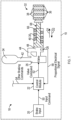
- the brake system 18 includes a brake input 20, a control module 22, a valve 26, one or more pressure transducers 28, a force member 30, a brake heat stack, which is referred to as a brake stack 32, and a fluid reservoir 34.
- the control module 22 is in electronic communication with the brake input 20, the valve 26, and the pressure transducers 28.
- the force member 30 is configured to translate back and forth in a linear motion within a cylinder 40. Specifically, the force member 30 translates within the cylinder 40 in response to a change in fluid pressure within a pressurized chamber 48 of the cylinder 40, which is explained in greater detail below and is shown in FIGS. 2-4 .
- the brake system 18 also includes a high pressure conduit 42 that fluidly connects the fluid reservoir 34 to the valve 26 and a return conduit 44 that fluidly connects the pressurized chamber 48 of the cylinder 40 to the valve 26.
- the pressure transducers 28 monitor the fluid pressure within the cylinder 40, and more specifically the fluid pressure of the pressurized chamber 48 within the cylinder 40.
- the brake stack 32 includes one or more rotors 36 interleaved with one or more stators 38.
- a brake stack closure represents a state of the brake stack 32 where the rotors 36 and stators 38 bear frictionally upon one another, and any further compression of the brake stack 32 creates a brake torque that resists movement of the vehicle 10.
- the control module 22 determines a stack closure pressure of the brake stack 32.
- the stack closure pressure represents a minimum amount brake pressure required to generate the brake torque by the brake stack 32.
- the vehicle 10 is an aircraft and the brake system 18 employs hydraulic braking fluid for transferring hydraulic pressure to the brake stack 32.
- the vehicle 10 is not limited to an aircraft.
- FIG. 1 illustrates only a single brake system 18, an aircraft may actually include multiple brake systems 18.
- an aircraft may include separate brake systems that correspond to the left and right wheels of an aircraft.
- individual stack closure pressures are determined for each individual brake system 18.
- the disclosed brake system 18 is any brake system including a dead band space.
- the dead band space represents the displacement a brake piston (i.e., the force member 30) undergoes as a user initially exerts force upon the brake pedal, but the force is not transmitted to the brake stack 32. Therefore, the brake system 18 is not limited to hydraulic systems.
- the brake system 18 may be a pneumatically based brake system instead of a hydraulic brake system. Accordingly, the brake fluid is a liquid or a gas.
- the brake input 20 is a brake pedal.
- An operator depresses the brake pedal manually to create an input command 50 received by the control module 22.
- the input command 50 represents an amount of braking requested by the brake system 18.
- a manual brake pedal is employed, then an operator indicates the amount of braking requested by the brake system 18 using the brake pedal.
- the input command 50 is generated by an autobrake algorithm, where autobrake instructions are saved in a memory 1034 of the control module 22 (the memory 1034 is shown in FIG. 7 ).
- the control module 22 determines a valve command 52. Specifically, the control module 22 determines the valve command 52 based on the input command 50 from the brake input 20. The valve command 52 may also be determined based on a plurality of other braking commands 54. Some examples of the other braking commands 54 include, but are not limited to, autobrake, gear retract braking, or parking brake. For example, if the autobrake algorithm is employed, then the autobrake instructions generate the input command 50, where the input command 50 represents the amount of braking requested by the brake system 18. The control module 22 then determines the valve command 52 based on at least the input command 50. The valve command 52 is sent to the valve 26, where the valve 26 is configured to adjust the fluid pressure in the brake system 18.
- the valve 26 In response to receiving the valve command 52 from the control module 22, the valve 26 adjusts an amount of fluid pressure supplied to the brake system 18, which results in an increase in an amount of the brake fluid contained within the pressurized chamber 48. Specifically, the valve 26 either increases or decreases the amount of pressure supplied to the brake system 18.
- the force member 30 may be a piston that includes an end portion 68.
- a biasing member 66 such as a coil spring, may be placed within the cylinder 40.
- the force member 30 overcomes a biasing force exerted by the biasing member 66 to translate in a first direction D1 towards the brake stack 32.
- the end portion 68 of the force member 30 eventually abuts against and exerts a compressive force upon the brake stack 32.
- actuating the valve 26 results in an increase in the amount of brake fluid supplied to the cylinder 40 until the fluid pressure of the pressurized chamber 48 is at least equal to the stack closure pressure (the stack closure pressure is labeled in FIG.
- any additional brake fluid supplied to the pressurized chamber 48 results in the end portion 68 of the force member 30 further compressing the brake stack 32.
- the force member 30 continues to compress the brake stack 32 until the fluid pressure of the pressurized chamber 48 reaches a maximum pressure value 74 ( FIG. 2 ).
- the brake stack 32 FIG. 1 is fully compressed.
- the pressure transducers 28 generate a proportional electrical signal 58 representative of the fluid pressure in the pressurized chamber 48 of the cylinder 40.
- the proportional electrical signal 58 is received by the control module 22.
- the proportional electrical signal 58 is a current value ranging from about four to about twenty milliamps.
- the pressure transducers 28 may output other electrical signals instead. That is, the proportional electrical signal 58 is selected from a current value, a capacitance value, or a voltage value.
- the valve 26 is a servo valve and the valve command 52 is a milliamp signal.
- FIG. 2 is a graph 70 illustrating an exemplary procedure to determine the stack closure pressure, where the x-axis represents a brake fluid compliance displacement within the pressurized chamber 48 of the cylinder 40 and the y-axis represents the fluid pressure as measured by the pressure transducers 28.
- the brake fluid compliance displacement represents the displacement of the force member 30 within the cylinder 40, where positive displacement is movement in the first direction D1 and negative displacement is movement in a second direction D2.
- the second direction D2 is opposite the first direction D1 and is oriented in a direction away from the brake stack 32.
- the control module 22 generates a valve command 52 instructing the valve 26 to increase the fluid pressure of the brake system 18 and results in an increase in the amount of brake fluid supplied to the cylinder 40 at a fixed rate.
- the fixed rate represents a steady-state amount of brake fluid supplied to the cylinder 40.
- the graph 70 includes a line representing an output 72 of the proportional electrical signal 58 generated by the one or more pressure transducers 28.
- the output 72 is divided into two portions, namely portion A and portion B.
- portion A the control module 22 instructs the valve 26 to increase the fluid pressure, which results in an increase in the amount of brake fluid supplied to the cylinder 40 at the fixed rate.
- portion A the control module 22 instructs the valve 26 to increase the fluid pressure, which results in an increase in the amount of brake fluid supplied to the cylinder 40 at the fixed rate.
- the brake fluid compliance displacement along the y-axis increases, there is only a negligible increase in the brake pressure. That is, the relationship between the hydraulic brake fluid compliance displacement and the fluid pressure has a derivative value (i.e., the slope of a line) of about zero, i.e. a negligible derivative value.
- a derivative value i.e., the slope of a line
- about zero may include positive fluid pressure values, e.g. being negligible fluid pressure values.
- whether a fluid pressure value may be considered about zero and/or may be considered a negligible fluid pressure value depends on the operating range of fluid pressure values of a system.
- any fluid pressure values that are less than about 300 psi (2068 kPa) may be considered about zero, and/or may be considered as negligible fluid pressure values.
- the control module 22 filters derivative values of the output 72 of the proportional electrical signal 58 that are below a threshold pressure value to about zero.
- the threshold pressure value represents negligible changes in the brake pressure that may be disregarded for purposes of detecting the stack closure pressure. That is, in response to determining the derivative value of the output 72 of the proportional electrical signal 58 is below the threshold pressure value, the control module 22 sets the derivative value to about zero.
- the threshold pressure value is about 200 pounds per square inch (psi) (about 1379 kPa).
- Portion A terminates at the transition point C.
- the transition point C represents when the derivative value of the fluid pressure exceeds about zero and increases to a positive value.
- the positive value is equal to or greater than about 300 psi (2068 kPa).
- the transition point C represents the stack closure pressure of the brake system 18.
- the stack closure pressure represents the minimum amount brake pressure required to generate brake torque by the brake stack 32.
- portions A and B of the output 72 of the proportional electrical signal 58 generated by the one or more pressure transducers 28 include different derivative values, the rate at which brake fluid is supplied to the cylinder 40 does not change. In other words, the brake fluid continues to be supplied to the cylinder 40 at the fixed rate.
- the control module 22 selects the fluid pressure at the transition point C as the stack closure pressure of the brake system 18, where the stack closure pressure represents the minimum amount brake pressure required to generate brake torque by the brake stack 32.
- the fluid pressure at the transition point is saved in the memory 1034 ( FIG. 7 ) of the control module 22, where the memory 1034 stores the magnitude of previously recorded derivative values of the fluid pressure, which are referred to as a plurality of previously recorded values at the transition point C.
- the stack closure pressure of the brake system 18 is an average of the fluid pressure at the transition point and the plurality of previously recorded values at the transition point C.
- the magnitude of at least three fluid pressures are stored in the memory of the control module 22 before the stack closure pressure is determined by the control module 22. It is to be appreciated that the stack closure pressure may be adjusted over time to take factors such as, for example, wear in the brake stack 32 and a change in the volume of the brake fluid into account.
- FIG. 3A shows a graph 80 illustrating a relationship between fluid pressure of the pressurized chamber 48 and time during the procedure shown in FIG. 2.
- FIG. 3A also illustrates stack closure pressure 82 and the maximum pressure value 74.
- the stack closure pressure 82 represents the minimum amount of brake pressure required to generate brake torque
- the maximum pressure value 74 represents the maximum amount of brake pressure the brake system 18 may command. That is, at the maximum pressure value 74, the brake stack 32 ( FIG. 1 ) is fully compressed.
- FIG. 3B shows a graph 90 illustrating a relationship between brake torque and time during the procedure shown in FIG. 2.
- FIG. 3B also illustrates a zero torque point 92.
- the zero torque point 92 represents when the brake stack 32 ( FIG. 1 ) starts to create brake torque to cause the vehicle 10 to decelerate or stop.
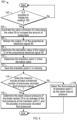
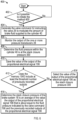
- FIG. 4 is an exemplary process flow diagram illustrating a method 100 for determining the stack closure pressure of the brake system 18.
- the method 100 begins at block 102.
- the control module 22 determines if the method 100 is initiated. For example, if the vehicle 10 is an aircraft, then the method 100 is initiated if the aircraft is in the air and the landing gear (not shown) of the aircraft is deployed. Once the method 100 is initiated, then the method 100 proceeds to block 104.
- control module 22 In block 104, the control module 22 generates the valve command 52 instructing the valve 26 to increase the fluid pressure of the brake system 18 and results in an increase in the amount of brake fluid supplied to the cylinder 40 the amount of brake fluid supplied to the cylinder 40 at the fixed rate. The method 100 may then proceed to block 106.
- control module 22 monitors the output 72 ( FIG. 2 ) of the proportional electrical signal 58 generated by the one or more pressure transducers 28. The method 100 may then proceed to block 108.
- control module 22 determines the derivative value of the output 72 ( FIG. 2 ) of the proportional electrical signal 58 generated by the one or more pressure transducers 28. It is to be appreciated that the proportional electrical signal 58 is monitored by the control module 22 as the valve 26 increases the amount of brake fluid supplied to the cylinder 40 at the fixed rate. The method 100 may then proceed to block 110.
- control module 22 determines the transition point C of the derivative value, where the transition point C occurs when the derivative value exceeds about zero and increases to a positive value. The method 100 may then proceed to block 112.
- control module 22 saves the transition point C determined in block 110 in the memory 1034 ( FIG. 7 ). The method may then proceed to decision block 114.
- the control module 22 determines if the memory 1034 includes at least the threshold number of previously recorded fluid pressures at the transition point. For example, in one example threshold number of previously recorded fluid pressures is two. Therefore, there are three total fluid pressures saved in the memory 1034. If the memory 1034 does not include the threshold number of previously recorded values, then the method 100 proceeds to block 116. In block 116, the control module 22 selects the fluid pressure at the transition point C determined in block 110 as the brake stack pressure. Alternatively, the control module 22 may not select a brake stack pressure. The method 100 may then terminate.
- the method 100 may proceed to block 118.
- the control module 22 determines the stack closure pressure of the brake system 18 is an average of the fluid pressure at the transition point C and the plurality of previously recorded values at the transition point C. The method 100 may then terminate.
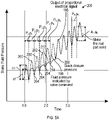
- FIGS. 5A and 5B illustrate alternative approaches for determining the stack closure pressure. Namely, FIG. 5A illustrates a graph 200 of a response of the brake system 18 based on amplitude attenuation and FIG. 5B is a graph 250 of response of the brake system 18 based on a phase lag. It is to be appreciated that while amplitude attenuation and the phase lag are illustrated in separate figures, the brake system 18 may exhibit both responses. In other words, amplitude attenuation and phase lag are not mutually exclusive of one another. Referring now to both FIGS.
- a dashed reference line is the fluid pressure indicated by the valve command 196 and the solid line represents an output of the proportional electrical signal 198, which is generated by the one or more pressure transducers 28.
- the fluid pressure indicated by valve command 196 is in the form of a periodic signal.
- the periodic signal includes a sine waveform.
- a sine waveform is illustrated, it is to be appreciated that other types of periodic signals may be used as well.
- the periodic signal includes one of the following: a sine waveform, step waveform, an impulse waveform, a triangular waveform, and a sawtooth waveform.
- the periodic signal may also be referred to as a dithering input since the value of the periodic signal switches between respective maximum and minimum values.
- the fluid pressure indicated by valve command 196 includes a maximum value 202 and a minimum value 204 for each period P n of the periodic signal (where FIG. 5 illustrates multiple periods P 1 , P 2 , etc.).
- the output of the proportional electrical signal 198 includes a maximum value 212 and a minimum value 214 for each period p n of the periodic signal as well.
- the valve command 52 instructs the valve 26 to modulate the fluid pressure of the brake system 18 based on a waveform of the periodic signal, which results in modulating the amount of brake fluid supplied to the cylinder 40.
- the valve 26 modulates the fluid pressure of the brake system 18 based on a sine waveform.
- the valve command 52 also instructs the valve 26 to increase the fluid pressure of the brake system 18 at a fixed rate while simultaneously modulating the fluid pressure as well. This results in an increase in the amount of brake fluid supplied to the cylinder 40 at the fixed rate while simultaneously modulating the amount of brake fluid.
- the maximum value 202 and the minimum value 204 of each period P n of the fluid pressure indicated by valve command 196 increases in value.
- the maximum value 202 as well as the minimum value 204 of the third period P 3 is greater than the respective maximum value 202 and minimum value 204 of the second period P 2 .
- the maximum value 202 as well as the minimum value 204 of the fourth period P 4 is greater than the respective values for the maximum value 202 and the minimum value 204 of the third period P 3 .
- the valve 26 initially starts to increase the amount of brake fluid to the cylinder 40, which is a result of increasing the fluid pressure in the brake system 18 in response to receiving the valve command 52.
- the output of the proportional electrical signal 198 (which is generated by the one or more pressure transducers 28) does not match the fluid pressure indicated by valve command 196 until the stack closure pressure 300 is reached. This is because the frequency response of the brake system 18 commensurately changes in response to a change in the compliance of the brake fluid within the cylinder 40.
- the fluid pressure of the pressurized chamber 48 of the cylinder 40 follows the waveform the periodic signal of the valve command 52. Specifically, the phase P n of the fluid pressure indicated by valve command 196 and the phase p n of the output of the proportional electrical signal 198 are substantially synchronized with one another before the stack closure pressure 300 is achieved. However, after stack closure pressure 300 is achieved, a phase lag between the valve command 196 and the proportional electrical signal 198 is observed. It is to be appreciated that the phase lag is generally not visible in FIG. 5A due to the x-axis and y-axis scales. Instead, the phase lag is visible in FIG. 5B and is described below. Referring back to FIG.
- the maximum value 202 and the minimum value 204 of a specific phase P n of the fluid pressure indicated by valve command 196 does not match the maximum value 212 and the minimum value 216 of the output of the proportional electrical signal 198 of the respective phase p n until the proportional electrical signal 58 is about equal to the stack closure pressure 300.
- a pressure amplitude a n of a respective phase p n of the output of the proportional electrical signal 198 is less than a valve amplitude A n of a single phase P n of the fluid pressure indicated by valve command 196 until the proportional electrical signal 58 generated by the pressure transducers 28 is about equal to the stack closure pressure 300.
- the pressure amplitude a n of a respective phase p n of the output of the proportional electrical signal 198 is substantially the same as the then the valve amplitude A n defined by a single phase P n of the fluid pressure indicated by valve command 196.
- the control module 22 determines the valve amplitude A n of a single phase P n of the commanded pressure indicated by valve command 196 and the pressure amplitude a n of the respective phase p n of the output of the proportional electrical signal 198 generated by the one or more pressure transducers 28. The control module 22 then compares the valve amplitude A n to the pressure amplitude a n . In response to determining the valve amplitude A n and the pressure amplitude a n are about equal to one another, the control module 22 determines the output of the proportional electrical signal 198 is about equal to the stack closure pressure 300.
- control module 22 determines the fluid pressure indicated by valve command 196 and the output of the proportional electrical signal 198 are about equal to one another when the difference in the first amplitude A n and the second amplitude a n are equal to or less than about twenty seven percent (27%).
- this value is merely exemplary in nature. Indeed, the differences in amplitude between the fluid pressure indicated by valve command 196 and the output of the proportional electrical signal 198 may vary based on the precision required by a particular application.
- the control module 22 determines a value indicated by the output of the proportional electrical signal 198 is about equal to the fluid pressure indicated by valve command 196, then the control module 22 saves the value of the output of the proportional electrical signal 198 in the memory 1034 ( FIG. 7 ) of the control module 22.
- the memory 1034 includes the threshold number plurality of previously recorded outputs of the proportional electrical signal 198.
- the threshold number plurality of previously recorded outputs of the proportional electrical signal 198 is two.
- the stack closure pressure of the brake system 18 is an average of the output of the proportional electrical signal 198 and the two previously recorded outputs of the proportional electrical signal 198.
- FIG. 6 is a process flow diagram illustrating an alternative method 400 for determining the stack closure pressure of the brake stack 32 based on the periodic signal shown in FIG. 5A based on amplitude attenuation.
- the method 400 begins at block 402.
- the control module 22 initiates the method 400. For example, if the vehicle 10 is an aircraft, then the method 400 is initiated if the aircraft is in the air and the landing gear (not shown) of the aircraft is deployed. Once the method 400 is initiated, then the method 400 proceeds to block 404.
- control module 22 In block 404, the control module 22 generates the valve command 52 instructing the valve 56 to modulate the fluid pressure of the brake system 18 and results in modulating the amount of brake fluid supplied to the cylinder 40 based on the waveform of the periodic signal, which is seen in FIG. 5 as the fluid pressure indicated by valve command 196.
- the method 400 may then proceed to block 406.
- control module 22 monitors the output of the proportional electrical signal 198 generated by the one or more pressure transducers 28. As seen in FIG. 5 , the output of the proportional electrical signal 198 is not equal to the fluid pressure indicated by the valve command 196 until the stack closure pressure 300 is achieved. The method 400 may then proceed to block 408.
- control module 22 determines the fluid pressure within the cylinder 40 is at the stack closure pressure 300 in response to the output of the proportional electrical signal 198 being about equal to the fluid pressure indicated by the valve command 196, where the stack closure pressure represents the minimum amount brake pressure required to generate brake torque by the brake stack 32.
- the method 400 may then proceed to block 410.
- control module 22 saves the value the output of the proportional electrical signal 198 that is about equal to the fluid pressure indicated by the valve command 196 in the memory 1034 ( FIG. 7 ). The method 400 may then proceed to decision block 412.
- the control module 22 determines if the memory 1034 includes at least the threshold number of previously recorded outputs of the proportional electrical signal 198. For example, in one example threshold number of previously recorded outputs of the proportional electrical signal 198 is two. If the memory 1034 does not include the threshold number of previously recorded outputs of the proportional electrical signal 198, then the method 400 proceeds to block 414. In block 412, the control module 22 selects the value of the output of the proportional electrical signal 198 determined in block 408 as the brake stack pressure. Alternatively, the control module 22 may not select a brake stack pressure. The method 400 may then terminate.
- the method 400 may proceed to block 416.
- the control module 22 determines the stack closure pressure of the brake system 18 is an average of the value the output of the proportional electrical signal 198 that is about equal to the fluid pressure indicated by the valve command 196 and the previously recorded outputs of the proportional electrical signal 198. The method 400 may then terminate.
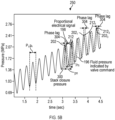
- the graph 250 in FIG. 5B illustrates the valve command 196 and the output of the proportional electrical signal 198, which is generated by the one or more pressure transducers 28.
- the valve 26 modulates the fluid pressure of the brake system 18 based on the periodic signal, which is a sine waveform.
- the valve command 52 also instructs the valve 26 to increase the fluid pressure of the brake system 18 at the fixed rate while simultaneously modulating the fluid pressure as well, which results in increasing the amount of brake fluid supplied to the cylinder 40 at the fixed rate while simultaneously modulating the amount of brake fluid.
- the fluid pressure of the pressurized chamber 48 of the cylinder 40 follows the waveform the periodic signal of the valve command 52. Specifically, the phase p n of the output of the proportional electrical signal 198 and the phase P n of the fluid pressure indicated by valve command 196 are substantially synchronized with one another before the stack closure pressure 300 is achieved. However, immediately after stack closure pressure 300 is achieved, a phase lag 304 between the valve command 196 and the proportional electrical signal 198 is present. As seen in FIG. 5A , the phase p n of the output of the proportional electrical signal 198 lags the phase P n of the fluid pressure indicated by valve command 196 immediately after the proportional electrical signal 58 ( FIG. 1 ) is about equal to the stack closure pressure 300. In other words, the phase lag 304 exists between the phase p n of the output of the proportional electrical signal 198 and the phase P n of the fluid pressure indicated by valve command 196
- the phase lag 304 shown in FIG. 5B represents a difference between the maximum value 202 of the output of the proportional electrical signal 198 and the maximum value 212 of the fluid pressure indicated by valve command 196. However, it is to be appreciated that the phase lag 304 may be represented as a difference between any two analogous points measured along the proportional electrical signal 198 and the fluid pressure indicated by valve command 196. The phase lag 304 remains constant after stack closure pressure 300 is reached.
- phase lag 304 measured between a first maximum value 202 1 of the output of the proportional electrical signal 198 and a first maximum value 212 1 of the fluid pressure indicated by valve command 196 is about the same as the phase lag 304 measured between a third maximum value 202 3 of the output of the proportional electrical signal 198 and a third maximum value 212 3 of the fluid pressure indicated by valve command 196.
- the phase lag 304 is recalculated over the life of the brake system to account for changes in the brake system 18 such as, for example, brake wear and any changes in the volume of the brake fluid.
- FIG. 7 is a process flow diagram illustrating an alternative method 500 for determining the stack closure pressure of the brake stack 32 based on phase shifting.
- the method 500 begins at block 502.
- the control module 22 initiates the method 400. Once the method 500 is initiated, then the method 400 proceeds to block 504.
- control module 22 In block 504, the control module 22 generates the valve command 52 instructing the valve 56 to modulate the fluid pressure of the brake system 18, which results in modulating the amount of brake fluid supplied to the cylinder 40 based on the waveform of the periodic signal, which is seen in FIG. 5B as the fluid pressure indicated by valve command 196.
- the method 500 may then proceed to block 506.
- control module 22 monitors the output of the proportional electrical signal 198 generated by the one or more pressure transducers 28. As seen in FIG. 5B , the output of the proportional electrical signal 198 is in phase with the fluid pressure indicated by the valve command 196 until the stack closure pressure 300 is achieved. The method 500 may then proceed to block 508.
- control module 22 detects the phase lag 304, where the phase lag 304 represents a lag in the output of the proportional electrical signal 198 generated by the one or more pressure transducers when compared to the fluid pressure indicated by the valve command 196.
- the method 500 may then proceed to block 510.
- control module 22 in response to detecting the phase lag 304, saves the value the output of the proportional electrical signal 198 generated by the one or more pressure transducers 28 immediately after the phase lag 304 is detected in the memory 1034 ( FIG. 7 ). The method 500 may then proceed to decision block 512.
- the control module 22 determines if the memory 1034 includes at least the threshold number of previously recorded outputs of the proportional electrical signal 198. For example, in one example threshold number of previously recorded outputs of the proportional electrical signal 198 is two. If the memory 1034 does not include the threshold number of previously recorded outputs of the proportional electrical signal 198, then the method 500 proceeds to block 514. In block 512, the control module 22 selects the value of the output of the proportional electrical signal 198 determined in block 510 as the brake stack pressure. Alternatively, the control module 22 may not select a brake stack pressure. The method 500 may then terminate.
- the method 500 may proceed to block 516.
- the control module 22 determines the stack closure pressure of the brake system 18 is an average of the value the output of the proportional electrical signal 198 generated by the one or more pressure transducers 28 immediately after the phase lag 304 is detected and the previously recorded outputs of the proportional electrical signal 198. The method 500 may then terminate.
- the disclosed brake system provides a relatively simple and robust approach for determining the stack closure pressure of the brake stack.
- the value of the stack closure pressure may be used as an initial pressure command, which results in a reduced amount of lag that commonly occurs in conventional brake systems when the brakes are initially applied.
- the value of the stack closure pressure is not a fixed value and may be adjusted to accommodate changes in the brake system that occur over time.
- the stack closure pressure is recalculated over the life of the brake system to account for changes in the brake system such as, for example, brake wear and any changes in the volume of the brake fluid.
- vehicles such as aircraft include more than one brake system, and each brake system may include its own individual stack closure pressure.
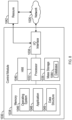
- the control module 22 is implemented on one or more computer devices or systems, such as exemplary computer system 1030.
- the computer system 1030 includes a processor 1032, a memory 1034, a mass storage memory device 1036, an input/output (I/O) interface 1038, and a Human Machine Interface (HMI) 1040.
- the computer system 1030 is operatively coupled to one or more external resources 1042 via the network 1026 or I/O interface 1038.
- External resources may include, but are not limited to, servers, databases, mass storage devices, peripheral devices, cloud-based network services, or any other suitable computer resource that may be used by the computer system 1030.
- the processor 1032 may include one or more devices selected from microprocessors, micro-controllers, digital signal processors, microcomputers, central processing units, field programmable gate arrays, programmable logic devices, state machines, logic circuits, analog circuits, digital circuits, or any other devices that manipulate signals (analog or digital) based on operational instructions that are stored in the memory 1034.
- Memory 1034 may include a single memory device or a plurality of memory devices including, but not limited to, read-only memory (ROM), random access memory (RAM), volatile memory, non-volatile memory, static random-access memory (SRAM), dynamic random-access memory (DRAM), flash memory, cache memory, or any other device capable of storing information.
- the mass storage memory device 1036 may include data storage devices such as a hard drive, optical drive, tape drive, volatile or non-volatile solid-state device, or any other device capable of storing information.
- the processor 1032 operates under the control of an operating system 1046 that resides in memory 1034.
- the operating system 1046 manages computer resources so that computer program code embodied as one or more computer software applications, such as an application 1048 residing in memory 1034, may have instructions executed by the processor 1032 (e.g. as a computer-implemented method).
- the processor 1032 may execute the application 1048 directly, in which case the operating system 1046 may be omitted.
- One or more data structures 1049 also reside in memory 1034, and may be used by the processor 1032, operating system 1046, or application 1048 to store or manipulate data.
- the I/O interface 1038 provides a machine interface that operatively couples the processor 1032 to other devices and systems, such as the network 1026 or external resource 1042.
- the application 1048 thereby works cooperatively with the network 1026 or external resource 1042 by communicating via the I/O interface 1038 to provide the various features, functions, applications, processes, or modules comprising examples of the disclosure.
- the application 1048 also includes program code that is executed by one or more external resources 1042, or otherwise rely on functions or signals provided by other system or network components external to the computer system 1030.
- examples of the disclosure may include applications that are located externally to the computer system 1030, distributed among multiple computers or other external resources 1042, or provided by computing resources (hardware and software) that are provided as a service over the network 1026, such as a cloud computing service.
- the HMI 1040 is operatively coupled to the processor 1032 of computer system 1030 in a known manner to allow a user to interact directly with the computer system 1030.
- the HMI 1040 may include video or alphanumeric displays, a touch screen, a speaker, and any other suitable audio and visual indicators capable of providing data to the user.
- the HMI 1040 may also include input devices and controls such as an alphanumeric keyboard, a pointing device, keypads, pushbuttons, control knobs, microphones, etc., capable of accepting commands or input from the user and transmitting the entered input to the processor 1032.
- a database 1044 may reside on the mass storage memory device 1036 and may be used to collect and organize data used by the various systems and modules described herein.
- the database 1044 may include data and supporting data structures that store and organize the data.
- the database 1044 may be arranged with any database organization or structure including, but not limited to, a relational database, a hierarchical database, a network database, or combinations thereof.
- a database management system in the form of a computer software application executing as instructions on the processor 1032 may be used to access the information or data stored in records of the database 1044 in response to a query, where a query may be dynamically determined and executed by the operating system 1046, other applications 1048, or one or more modules.
- a brake system 18 having a brake stack 32 with a stack closure pressure 82, a force member 30 positioned within a cylinder 40, a valve 52 configured to adjust fluid pressure in the brake system 18, and one or more pressure transducers 28 that generate a proportional electrical signal 198 representative of the fluid pressure within the cylinder 40, the brake system 18 comprising:
- the one or more processors 1032 are configured to execute instructions to cause the brake system 18 to: in response to determining that the valve amplitude A n and the pressure amplitude a n are about equal to one another, save the output of the proportional electrical signal 198 in the memory 1034, wherein the memory 1034 includes a plurality of previously recorded outputs of the proportional electrical signal 198.
- the one or more processors 1032 are configured to execute instructions to cause the brake system 18 to: determine the stack closure pressure 300 of the brake system 18 as an average of the output of the proportional electrical signal 198 and the plurality of previously recorded outputs of the proportional electrical signal 198.
- the brake system 18 determines the stack closure pressure 300 of the brake system 18 as an average of the output of the proportional electrical signal 198 and the plurality of previously recorded outputs of the proportional electrical signal 198 in response to the memory 1034 including a threshold number of previously recorded outputs of the proportional electrical signal 198.
- the present disclosure also relates to an aircraft, comprising a brake system according to the primary example.
- a brake system 18 having a brake stack 32 with a stack closure pressure 82, a force member 30 positioned within a cylinder 40, a valve 52 configured to adjust fluid pressure in the brake system 18, and one or more pressure transducers 28 that generate a proportional electrical signal 198 representative of the fluid pressure within the cylinder 40, the brake system 18 comprising:
- the one or more processors 1032 are configured to execute instructions to cause the brake system 18 to: in response to detecting the phase lag 304, save the output of the proportional electrical signal 198 in the memory 1034, wherein the memory 1034 includes a plurality of previously recorded outputs of the proportional electrical signal 198.
- the one or more processors 1032 are configured to execute instructions to cause the brake system 18 to: determine the stack closure pressure 300 of the brake system 18 as an average of the output of the proportional electrical signal 198 and the plurality of previously recorded outputs of the proportional electrical signal 198.
- the brake system 18 determines the stack closure pressure 300 of the brake system 18 as an average of the output of the proportional electrical signal 198 and the plurality of previously recorded outputs of the proportional electrical signal 198 in response to the memory 1034 including a threshold number of previously recorded outputs of the proportional electrical signal 198.
- the present disclosure also relates to an aircraft, comprising a brake system according to the secondary example.
- amplitude attenuation and the phase lag are illustrated in separate figures, the brake system 18 may exhibit both responses. In other words, amplitude attenuation and phase lag are not mutually exclusive of one another. Accordingly, the above primary example and secondary example may be combined.
Landscapes
- Engineering & Computer Science (AREA)
- Mechanical Engineering (AREA)
- Aviation & Aerospace Engineering (AREA)
- Transportation (AREA)
- Braking Systems And Boosters (AREA)
- Regulating Braking Force (AREA)
Claims (15)
- Système de freinage (18) doté d'une pile de freins (32) présentant une pression de fermeture des freins (82), d'un organe d'application de force (30) disposé à l'intérieur d'un vérin (40), d'un distributeur (56) conçu pour réguler la pression de fluide dans le système de freinage (18), et d'un ou plusieurs capteurs de pression (28) générant un signal électrique proportionnel (58) représentatif de la pression de fluide régnant à l'intérieur du vérin (40), le système de freinage (18) comprenant :un ou plusieurs processeurs (1032) en communication électronique avec le distributeur (56) et le ou les capteurs de pression (28), etune mémoire (1034) couplée au(x)processeur(s) (1032), la mémoire (1034) stockant des données, parmi lesquelles une base de données (1044) et un code de programme qui, lorsqu'il est exécuté par le ou les processeurs (1032), amène le système de freinage (18) à :générer une commande de distributeur (156) ordonnant au distributeur (56) d'augmenter la pression de fluide dans le système de freinage (18), ce qui se traduit par une augmentation selon un taux fixe de la quantité de fluide de freinage fournie au vérin (40),surveiller la sortie du signal électrique proportionnel (58) généré par le ou les capteurs de pression (28),déterminer une valeur dérivée relative à la sortie du signal électrique proportionnel (58) tandis que la quantité de fluide de freinage fournie au vérin (40) augmente selon ledit taux fixe,déterminer un point de transition (C) de la valeur dérivée, ledit point de transition (C) représentant le moment auquel la valeur dérivée dépasse environ zéro et passe à une valeur positive, etchoisir la pression de fluide existant au point de transition (C) comme pression de fermeture des freins (82) du système de freinage (18).
- Système de freinage (18) selon la revendication 1, dans lequel le ou les processeurs (1032) sont conçus pour exécuter des instructions visant à amener le système de freinage (18) à :
sauvegarder la pression de fluide existant au point de transition (C) dans la mémoire (1034), ladite mémoire (1034) comportant une pluralité de valeurs précédemment enregistrées existant au point de transition (C). - Système de freinage (18) selon la revendication 2, dans lequel le ou les processeurs (1032) sont conçus pour exécuter des instructions visant à amener le système de freinage (18) à :
déterminer la pression de fermeture des freins (82) du système de freinage (18) comme moyenne de la pression de fluide existant au point de transition (C) et de la pluralité de valeurs précédemment enregistrées existant au point de transition (C). - Système de freinage (18) selon la revendication 3, dans lequel le ou les processeurs (1032) sont conçus pour exécuter des instructions visant à amener le système de freinage (18) à :déterminer si la mémoire (1034) comporte au moins un nombre seuil de valeurs précédemment enregistrées existant au point de transition (C), eten réaction à la détermination du fait que la mémoire (1034) comporte au moins ledit nombre seuil de valeurs précédemment enregistrées existant au point de transition (C), déterminer la pression de fermeture des freins (82) du système de freinage (18) comme moyenne de la pression de fluide existant au point de transition (C) et de la pluralité de valeurs précédemment enregistrées existant au point de transition (C).
- Système de freinage (18) selon l'une quelconque des revendications 1 à 4, dans lequel des instructions de freinage automatique sont sauvegardées dans la mémoire (1034), et dans lequel le ou les processeurs (1032) sont conçus pour exécuter des instructions visant à amener le système de freinage (18) à :faire générer, par les instructions de freinage automatique, une commande d'entrée (50), ladite commande d'entrée (50) représentant la quantité de freinage demandée par le système de freinage (18), etdéterminer la commande de distributeur (156) compte tenu, au moins, de la commande d'entrée (50).
- Système de freinage (18) selon l'une quelconque des revendications 1 à 5, dans lequel le ou les processeurs (1032) sont conçus pour exécuter des instructions visant à amener le système de freinage (18) à :déterminer si la valeur dérivée relative à la sortie du signal électrique proportionnel (58) est inférieure à une valeur de pression seuil, eten réaction à la détermination du fait que la valeur dérivée relative à la sortie du signal électrique proportionnel (58) est inférieure à la valeur de pression seuil, régler la valeur dérivée à environ zéro.
- Système de freinage (18) selon l'une quelconque des revendications 1 à 6, dans lequel le fluide de freinage est un liquide ou un gaz.
- Système de freinage (18) selon l'une quelconque des revendications 1 à 7, dans lequel le système de freinage (18) comporte un espace de zone neutre.
- Système de freinage (18) selon l'une quelconque des revendications 1 à 8, dans lequel le signal électrique proportionnel (58) appartient au groupe comprenant : une valeur d'intensité, une valeur de capacitance et une valeur de tension.
- Aéronef comprenant le système de freinage (18) selon l'une quelconque des revendications 1 à 9, dans lequel :la pile de freins (32) comporte en outre un ou plusieurs rotors (36) intercalés entre un ou plusieurs stators (38),la quantité de fluide de freinage est une quantité de fluide de freinage hydraulique, etla pression de fermeture des freins (82) représente une quantité minimale de pression de freinage requise pour que la pile de freins (32) génère un couple de freinage.
- Procédé de détermination de la pression de fermeture des freins (82) d'une pile de freins (32) d'un système de freinage (18), le procédé comprenant :la génération, par un ordinateur (1030), d'une commande de distributeur (156) ordonnant à un distributeur (56) d'augmenter la pression de fluide du système de freinage (18), se qui se traduit par une quantité de fluide de freinage fournie à un vérin (40) selon un taux fixe, un organe d'application de force (30) étant disposé à l'intérieur du vérin (40) et le distributeur (56) étant conçu pour commander la quantité de fluide de freinage fournie au vérin (40),la surveillance, par l'ordinateur (1030), de la sortie d'un signal électrique proportionnel (198) généré par un ou plusieurs capteurs de pression (28), ledit signal électrique proportionnel (58) étant représentatif de la pression de fluide régnant à l'intérieur du vérin (40),la détermination d'une valeur dérivée relative à la sortie du signal électrique proportionnel (58) tandis que la quantité de fluide de freinage fournie au vérin (40) augmente selon ledit taux fixe,la détermination d'un point de transition (C) de la valeur dérivée, ledit point de transition (C) représentant le moment auquel la valeur dérivée dépasse environ zéro et passe à une valeur positive, etle choix de la pression de fluide existant au point de transition (C) comme pression de fermeture des freins (82) du système de freinage (18).
- Procédé selon la revendication 11, comprenant en outre :
la sauvegarde de la pression de fluide existant au point de transition (C) dans une mémoire (1034) de l'ordinateur (1030), ladite mémoire (1034) comportant une pluralité de valeurs précédemment enregistrées existant au point de transition (C). - Procédé selon la revendication 12, comprenant en outre :
la détermination de la pression de fermeture des freins (82) du système de freinage (18) comme moyenne de la pression de fluide existant au point de transition (C) et de la pluralité de valeurs précédemment enregistrées existant au point de transition (C). - Procédé selon l'une quelconque des revendications 11 à 13, comprenant en outre :la génération, par des instructions de freinage automatique, d'une commande d'entrée (50), ladite commande d'entrée (50) représentant la quantité de freinage demandée par le système de freinage (18) et les instructions de freinage automatique sont sauvegardées dans une mémoire (1034) de l'ordinateur (1030), etla détermination de la commande de distributeur (156) compte tenu, au moins, de la commande d'entrée (50).
- Procédé selon l'une quelconque des revendications 11 à 14, comprenant en outre :la détermination du fait ou non que la valeur dérivée relative à la sortie du signal électrique proportionnel (58) est inférieure à une valeur de pression seuil, eten réaction à la détermination du fait que la valeur dérivée relative à la sortie du signal électrique proportionnel (58) est inférieure à la valeur de pression seuil, le réglage de la valeur dérivée à environ zéro.
Applications Claiming Priority (2)
| Application Number | Priority Date | Filing Date | Title |
|---|---|---|---|
| US16/410,730 US11345465B2 (en) | 2019-05-13 | 2019-05-13 | System for determining the stack closure pressure of a brake stack |
| US16/410,720 US11015729B2 (en) | 2019-05-13 | 2019-05-13 | System for determining the stack closure pressure of a brake stack |
Publications (3)
| Publication Number | Publication Date |
|---|---|
| EP3744591A1 EP3744591A1 (fr) | 2020-12-02 |
| EP3744591B1 true EP3744591B1 (fr) | 2023-02-22 |
| EP3744591B8 EP3744591B8 (fr) | 2023-03-29 |
Family
ID=70483055
Family Applications (1)
| Application Number | Title | Priority Date | Filing Date |
|---|---|---|---|
| EP20172646.0A Active EP3744591B8 (fr) | 2019-05-13 | 2020-05-04 | Système pour déterminer la pression de fermeture d'un empilement de freins |
Country Status (4)
| Country | Link |
|---|---|
| EP (1) | EP3744591B8 (fr) |
| CN (1) | CN111923882B (fr) |
| BR (1) | BR102020006561A2 (fr) |
| CA (1) | CA3077639C (fr) |
Families Citing this family (1)
| Publication number | Priority date | Publication date | Assignee | Title |
|---|---|---|---|---|
| CN118859830B (zh) * | 2024-09-25 | 2024-11-29 | 泉州市川亚机械设备有限公司 | 一种面料复合机的控制系统 |
Family Cites Families (10)
| Publication number | Priority date | Publication date | Assignee | Title |
|---|---|---|---|---|
| DE3809101C2 (de) * | 1988-03-18 | 2003-05-28 | Continental Teves Ag & Co Ohg | Verfahren und Schaltungsanordnung zur Steuerung eines ASR-Systems mit Bremsen- und Motoreingriff |
| DE3903585A1 (de) * | 1989-02-07 | 1990-08-09 | Knorr Bremse Ag | Blockiergeschuetzte bremsanlage mit giermomentbegrenzung |
| US5505531A (en) * | 1995-05-12 | 1996-04-09 | The Boeing Company | Method to maintain brake stack closure during autobrake application |
| DE19521086A1 (de) * | 1995-06-09 | 1996-12-12 | Teves Gmbh Alfred | Verfahren zum Einregeln eines vorgegebenen, veränderlichen Bremsdruckes in den Radbremsen einer Bremsanlage |
| US20040186648A1 (en) * | 2002-09-26 | 2004-09-23 | Yuhong Zheng | Boundary auto-calibration scheme for proportional poppet valve pressure control |
| JP4985448B2 (ja) * | 2008-02-13 | 2012-07-25 | 株式会社アドヴィックス | 駐車ブレーキ制御装置 |
| DE102013216157A1 (de) * | 2012-09-28 | 2014-04-03 | Continental Teves Ag & Co. Ohg | Verfahren zur Regelung einer Bremsanlage für Kraftfahrzeuge |
| US9150209B2 (en) * | 2013-07-22 | 2015-10-06 | General Electric Company | System and method for monitoring braking effort |
| DE102014105922A1 (de) * | 2014-04-28 | 2015-10-29 | Linde Material Handling Gmbh | Verfahren zur Verschleißmessung einer Federspeicherbremse eines Flurförderzeugs |
| US10882498B2 (en) * | 2017-04-18 | 2021-01-05 | Goodrich Corporation | Electrical power connection in an emergency park brake system |
-
2020
- 2020-04-01 BR BR102020006561-0A patent/BR102020006561A2/pt unknown
- 2020-04-07 CA CA3077639A patent/CA3077639C/fr active Active
- 2020-04-21 CN CN202010316044.0A patent/CN111923882B/zh active Active
- 2020-05-04 EP EP20172646.0A patent/EP3744591B8/fr active Active
Also Published As
| Publication number | Publication date |
|---|---|
| CN111923882A (zh) | 2020-11-13 |
| BR102020006561A2 (pt) | 2021-02-17 |
| CA3077639A1 (fr) | 2020-11-13 |
| EP3744591A1 (fr) | 2020-12-02 |
| EP3744591B8 (fr) | 2023-03-29 |
| CN111923882B (zh) | 2025-02-11 |
| CA3077639C (fr) | 2023-10-17 |
Similar Documents
| Publication | Publication Date | Title |
|---|---|---|
| US11834022B2 (en) | Brake selection device for indicating an actual position of a parking brake system | |
| EP3225475B1 (fr) | Contrôle anti-patinage à pression adaptative | |
| US9669810B2 (en) | Brake assembly including independently activatable brake actuators | |
| EP3184383B1 (fr) | Procédé de détection étagée de conditions de défaillance de freinage dans des systèmes de commande de frein | |
| CN112124573B (zh) | 在备用操作模式期间提供有限防滑控制的制动系统 | |
| EP3744591B1 (fr) | Système pour déterminer la pression de fermeture d'un empilement de freins | |
| US20210179261A1 (en) | Aircraft brake system | |
| US11345465B2 (en) | System for determining the stack closure pressure of a brake stack | |
| US11015729B2 (en) | System for determining the stack closure pressure of a brake stack | |
| CN116985770A (zh) | 陡坡缓降预控制方法及装置 | |
| US11059473B2 (en) | Bistable control valve for maintaining fluid pressure in a parking brake system | |
| US11505311B2 (en) | Brake system providing limited antiskid control during a backup mode of operation | |
| KR101510419B1 (ko) | Esc 시스템을 이용한 브레이크 드래그 저감장치 및 그 저감방법 | |
| CN110562227B (zh) | 一种电液耦合制动系统及车辆 | |
| CN117440910A (zh) | 制动系统 | |
| US7467692B2 (en) | Method of and system for reducing power required for an electric brake to maintain a static force | |
| US12054242B2 (en) | Wheel braking device |
Legal Events
| Date | Code | Title | Description |
|---|---|---|---|
| PUAI | Public reference made under article 153(3) epc to a published international application that has entered the european phase |
Free format text: ORIGINAL CODE: 0009012 |
|
| STAA | Information on the status of an ep patent application or granted ep patent |
Free format text: STATUS: THE APPLICATION HAS BEEN PUBLISHED |
|
| AK | Designated contracting states |
Kind code of ref document: A1 Designated state(s): AL AT BE BG CH CY CZ DE DK EE ES FI FR GB GR HR HU IE IS IT LI LT LU LV MC MK MT NL NO PL PT RO RS SE SI SK SM TR |
|
| AX | Request for extension of the european patent |
Extension state: BA ME |
|
| STAA | Information on the status of an ep patent application or granted ep patent |
Free format text: STATUS: REQUEST FOR EXAMINATION WAS MADE |
|
| 17P | Request for examination filed |
Effective date: 20210519 |
|
| RBV | Designated contracting states (corrected) |
Designated state(s): AL AT BE BG CH CY CZ DE DK EE ES FI FR GB GR HR HU IE IS IT LI LT LU LV MC MK MT NL NO PL PT RO RS SE SI SK SM TR |
|
| GRAP | Despatch of communication of intention to grant a patent |
Free format text: ORIGINAL CODE: EPIDOSNIGR1 |
|
| STAA | Information on the status of an ep patent application or granted ep patent |
Free format text: STATUS: GRANT OF PATENT IS INTENDED |
|
| RIC1 | Information provided on ipc code assigned before grant |
Ipc: B60T 13/66 20060101AFI20210627BHEP |
|
| INTG | Intention to grant announced |
Effective date: 20210803 |
|
| GRAJ | Information related to disapproval of communication of intention to grant by the applicant or resumption of examination proceedings by the epo deleted |
Free format text: ORIGINAL CODE: EPIDOSDIGR1 |
|
| STAA | Information on the status of an ep patent application or granted ep patent |
Free format text: STATUS: REQUEST FOR EXAMINATION WAS MADE |
|
| INTC | Intention to grant announced (deleted) | ||
| GRAP | Despatch of communication of intention to grant a patent |
Free format text: ORIGINAL CODE: EPIDOSNIGR1 |
|
| STAA | Information on the status of an ep patent application or granted ep patent |
Free format text: STATUS: GRANT OF PATENT IS INTENDED |
|
| INTG | Intention to grant announced |
Effective date: 20220209 |
|
| GRAJ | Information related to disapproval of communication of intention to grant by the applicant or resumption of examination proceedings by the epo deleted |
Free format text: ORIGINAL CODE: EPIDOSDIGR1 |
|
| STAA | Information on the status of an ep patent application or granted ep patent |
Free format text: STATUS: REQUEST FOR EXAMINATION WAS MADE |
|
| INTC | Intention to grant announced (deleted) | ||
| GRAP | Despatch of communication of intention to grant a patent |
Free format text: ORIGINAL CODE: EPIDOSNIGR1 |
|
| STAA | Information on the status of an ep patent application or granted ep patent |
Free format text: STATUS: GRANT OF PATENT IS INTENDED |
|
| INTG | Intention to grant announced |
Effective date: 20220913 |
|
| GRAS | Grant fee paid |
Free format text: ORIGINAL CODE: EPIDOSNIGR3 |
|
| GRAA | (expected) grant |
Free format text: ORIGINAL CODE: 0009210 |
|
| STAA | Information on the status of an ep patent application or granted ep patent |
Free format text: STATUS: THE PATENT HAS BEEN GRANTED |
|
| AK | Designated contracting states |
Kind code of ref document: B1 Designated state(s): AL AT BE BG CH CY CZ DE DK EE ES FI FR GB GR HR HU IE IS IT LI LT LU LV MC MK MT NL NO PL PT RO RS SE SI SK SM TR |
|
| REG | Reference to a national code |
Ref country code: GB Ref legal event code: FG4D |
|
| REG | Reference to a national code |
Ref country code: CH Ref legal event code: EP |
|
| REG | Reference to a national code |
Ref country code: DE Ref legal event code: R096 Ref document number: 602020008201 Country of ref document: DE |
|
| REG | Reference to a national code |
Ref country code: CH Ref legal event code: PK Free format text: BERICHTIGUNG B8 Ref country code: AT Ref legal event code: REF Ref document number: 1549326 Country of ref document: AT Kind code of ref document: T Effective date: 20230315 Ref country code: IE Ref legal event code: FG4D |
|
| RAP4 | Party data changed (patent owner data changed or rights of a patent transferred) |
Owner name: THE BOEING COMPANY |
|
| REG | Reference to a national code |
Ref country code: LT Ref legal event code: MG9D |
|
| P01 | Opt-out of the competence of the unified patent court (upc) registered |
Effective date: 20230516 |
|
| REG | Reference to a national code |
Ref country code: NL Ref legal event code: MP Effective date: 20230222 |
|
| REG | Reference to a national code |
Ref country code: AT Ref legal event code: MK05 Ref document number: 1549326 Country of ref document: AT Kind code of ref document: T Effective date: 20230222 |
|
| PG25 | Lapsed in a contracting state [announced via postgrant information from national office to epo] |
Ref country code: RS Free format text: LAPSE BECAUSE OF FAILURE TO SUBMIT A TRANSLATION OF THE DESCRIPTION OR TO PAY THE FEE WITHIN THE PRESCRIBED TIME-LIMIT Effective date: 20230222 Ref country code: PT Free format text: LAPSE BECAUSE OF FAILURE TO SUBMIT A TRANSLATION OF THE DESCRIPTION OR TO PAY THE FEE WITHIN THE PRESCRIBED TIME-LIMIT Effective date: 20230622 Ref country code: NO Free format text: LAPSE BECAUSE OF FAILURE TO SUBMIT A TRANSLATION OF THE DESCRIPTION OR TO PAY THE FEE WITHIN THE PRESCRIBED TIME-LIMIT Effective date: 20230522 Ref country code: NL Free format text: LAPSE BECAUSE OF FAILURE TO SUBMIT A TRANSLATION OF THE DESCRIPTION OR TO PAY THE FEE WITHIN THE PRESCRIBED TIME-LIMIT Effective date: 20230222 Ref country code: LV Free format text: LAPSE BECAUSE OF FAILURE TO SUBMIT A TRANSLATION OF THE DESCRIPTION OR TO PAY THE FEE WITHIN THE PRESCRIBED TIME-LIMIT Effective date: 20230222 Ref country code: LT Free format text: LAPSE BECAUSE OF FAILURE TO SUBMIT A TRANSLATION OF THE DESCRIPTION OR TO PAY THE FEE WITHIN THE PRESCRIBED TIME-LIMIT Effective date: 20230222 Ref country code: HR Free format text: LAPSE BECAUSE OF FAILURE TO SUBMIT A TRANSLATION OF THE DESCRIPTION OR TO PAY THE FEE WITHIN THE PRESCRIBED TIME-LIMIT Effective date: 20230222 Ref country code: ES Free format text: LAPSE BECAUSE OF FAILURE TO SUBMIT A TRANSLATION OF THE DESCRIPTION OR TO PAY THE FEE WITHIN THE PRESCRIBED TIME-LIMIT Effective date: 20230222 Ref country code: AT Free format text: LAPSE BECAUSE OF FAILURE TO SUBMIT A TRANSLATION OF THE DESCRIPTION OR TO PAY THE FEE WITHIN THE PRESCRIBED TIME-LIMIT Effective date: 20230222 |
|
| PG25 | Lapsed in a contracting state [announced via postgrant information from national office to epo] |
Ref country code: SE Free format text: LAPSE BECAUSE OF FAILURE TO SUBMIT A TRANSLATION OF THE DESCRIPTION OR TO PAY THE FEE WITHIN THE PRESCRIBED TIME-LIMIT Effective date: 20230222 Ref country code: PL Free format text: LAPSE BECAUSE OF FAILURE TO SUBMIT A TRANSLATION OF THE DESCRIPTION OR TO PAY THE FEE WITHIN THE PRESCRIBED TIME-LIMIT Effective date: 20230222 Ref country code: IS Free format text: LAPSE BECAUSE OF FAILURE TO SUBMIT A TRANSLATION OF THE DESCRIPTION OR TO PAY THE FEE WITHIN THE PRESCRIBED TIME-LIMIT Effective date: 20230622 Ref country code: GR Free format text: LAPSE BECAUSE OF FAILURE TO SUBMIT A TRANSLATION OF THE DESCRIPTION OR TO PAY THE FEE WITHIN THE PRESCRIBED TIME-LIMIT Effective date: 20230523 Ref country code: FI Free format text: LAPSE BECAUSE OF FAILURE TO SUBMIT A TRANSLATION OF THE DESCRIPTION OR TO PAY THE FEE WITHIN THE PRESCRIBED TIME-LIMIT Effective date: 20230222 |
|
| PG25 | Lapsed in a contracting state [announced via postgrant information from national office to epo] |
Ref country code: SM Free format text: LAPSE BECAUSE OF FAILURE TO SUBMIT A TRANSLATION OF THE DESCRIPTION OR TO PAY THE FEE WITHIN THE PRESCRIBED TIME-LIMIT Effective date: 20230222 Ref country code: RO Free format text: LAPSE BECAUSE OF FAILURE TO SUBMIT A TRANSLATION OF THE DESCRIPTION OR TO PAY THE FEE WITHIN THE PRESCRIBED TIME-LIMIT Effective date: 20230222 Ref country code: EE Free format text: LAPSE BECAUSE OF FAILURE TO SUBMIT A TRANSLATION OF THE DESCRIPTION OR TO PAY THE FEE WITHIN THE PRESCRIBED TIME-LIMIT Effective date: 20230222 Ref country code: DK Free format text: LAPSE BECAUSE OF FAILURE TO SUBMIT A TRANSLATION OF THE DESCRIPTION OR TO PAY THE FEE WITHIN THE PRESCRIBED TIME-LIMIT Effective date: 20230222 Ref country code: CZ Free format text: LAPSE BECAUSE OF FAILURE TO SUBMIT A TRANSLATION OF THE DESCRIPTION OR TO PAY THE FEE WITHIN THE PRESCRIBED TIME-LIMIT Effective date: 20230222 |
|
| REG | Reference to a national code |
Ref country code: DE Ref legal event code: R097 Ref document number: 602020008201 Country of ref document: DE |
|
| PG25 | Lapsed in a contracting state [announced via postgrant information from national office to epo] |
Ref country code: SK Free format text: LAPSE BECAUSE OF FAILURE TO SUBMIT A TRANSLATION OF THE DESCRIPTION OR TO PAY THE FEE WITHIN THE PRESCRIBED TIME-LIMIT Effective date: 20230222 |
|
| PLBE | No opposition filed within time limit |
Free format text: ORIGINAL CODE: 0009261 |
|
| REG | Reference to a national code |
Ref country code: CH Ref legal event code: PL |
|
| STAA | Information on the status of an ep patent application or granted ep patent |
Free format text: STATUS: NO OPPOSITION FILED WITHIN TIME LIMIT |
|
| PG25 | Lapsed in a contracting state [announced via postgrant information from national office to epo] |
Ref country code: MC Free format text: LAPSE BECAUSE OF FAILURE TO SUBMIT A TRANSLATION OF THE DESCRIPTION OR TO PAY THE FEE WITHIN THE PRESCRIBED TIME-LIMIT Effective date: 20230222 |
|
| REG | Reference to a national code |
Ref country code: BE Ref legal event code: MM Effective date: 20230531 |
|
| 26N | No opposition filed |
Effective date: 20231123 |
|
| PG25 | Lapsed in a contracting state [announced via postgrant information from national office to epo] |
Ref country code: SI Free format text: LAPSE BECAUSE OF FAILURE TO SUBMIT A TRANSLATION OF THE DESCRIPTION OR TO PAY THE FEE WITHIN THE PRESCRIBED TIME-LIMIT Effective date: 20230222 Ref country code: MC Free format text: LAPSE BECAUSE OF FAILURE TO SUBMIT A TRANSLATION OF THE DESCRIPTION OR TO PAY THE FEE WITHIN THE PRESCRIBED TIME-LIMIT Effective date: 20230222 Ref country code: LU Free format text: LAPSE BECAUSE OF NON-PAYMENT OF DUE FEES Effective date: 20230504 Ref country code: LI Free format text: LAPSE BECAUSE OF NON-PAYMENT OF DUE FEES Effective date: 20230531 Ref country code: CH Free format text: LAPSE BECAUSE OF NON-PAYMENT OF DUE FEES Effective date: 20230531 |
|
| REG | Reference to a national code |
Ref country code: IE Ref legal event code: MM4A |
|
| PG25 | Lapsed in a contracting state [announced via postgrant information from national office to epo] |
Ref country code: IE Free format text: LAPSE BECAUSE OF NON-PAYMENT OF DUE FEES Effective date: 20230504 |
|
| PG25 | Lapsed in a contracting state [announced via postgrant information from national office to epo] |
Ref country code: IE Free format text: LAPSE BECAUSE OF NON-PAYMENT OF DUE FEES Effective date: 20230504 |
|
| PG25 | Lapsed in a contracting state [announced via postgrant information from national office to epo] |
Ref country code: IT Free format text: LAPSE BECAUSE OF FAILURE TO SUBMIT A TRANSLATION OF THE DESCRIPTION OR TO PAY THE FEE WITHIN THE PRESCRIBED TIME-LIMIT Effective date: 20230222 Ref country code: BE Free format text: LAPSE BECAUSE OF NON-PAYMENT OF DUE FEES Effective date: 20230531 |
|
| PG25 | Lapsed in a contracting state [announced via postgrant information from national office to epo] |
Ref country code: BG Free format text: LAPSE BECAUSE OF FAILURE TO SUBMIT A TRANSLATION OF THE DESCRIPTION OR TO PAY THE FEE WITHIN THE PRESCRIBED TIME-LIMIT Effective date: 20230222 |
|
| PG25 | Lapsed in a contracting state [announced via postgrant information from national office to epo] |
Ref country code: BG Free format text: LAPSE BECAUSE OF FAILURE TO SUBMIT A TRANSLATION OF THE DESCRIPTION OR TO PAY THE FEE WITHIN THE PRESCRIBED TIME-LIMIT Effective date: 20230222 |
|
| PGFP | Annual fee paid to national office [announced via postgrant information from national office to epo] |
Ref country code: DE Payment date: 20250529 Year of fee payment: 6 |
|
| PGFP | Annual fee paid to national office [announced via postgrant information from national office to epo] |
Ref country code: GB Payment date: 20250527 Year of fee payment: 6 |
|
| PGFP | Annual fee paid to national office [announced via postgrant information from national office to epo] |
Ref country code: FR Payment date: 20250526 Year of fee payment: 6 |
|
| PG25 | Lapsed in a contracting state [announced via postgrant information from national office to epo] |
Ref country code: CY Free format text: LAPSE BECAUSE OF FAILURE TO SUBMIT A TRANSLATION OF THE DESCRIPTION OR TO PAY THE FEE WITHIN THE PRESCRIBED TIME-LIMIT; INVALID AB INITIO Effective date: 20200504 |
|
| PG25 | Lapsed in a contracting state [announced via postgrant information from national office to epo] |
Ref country code: HU Free format text: LAPSE BECAUSE OF FAILURE TO SUBMIT A TRANSLATION OF THE DESCRIPTION OR TO PAY THE FEE WITHIN THE PRESCRIBED TIME-LIMIT; INVALID AB INITIO Effective date: 20200504 |
|
| PG25 | Lapsed in a contracting state [announced via postgrant information from national office to epo] |
Ref country code: TR Free format text: LAPSE BECAUSE OF FAILURE TO SUBMIT A TRANSLATION OF THE DESCRIPTION OR TO PAY THE FEE WITHIN THE PRESCRIBED TIME-LIMIT Effective date: 20230222 |