EP3741984B1 - Gasmotor mit drucktanksystem zur bereitstellung von gasen - Google Patents
Gasmotor mit drucktanksystem zur bereitstellung von gasen Download PDFInfo
- Publication number
- EP3741984B1 EP3741984B1 EP20175232.6A EP20175232A EP3741984B1 EP 3741984 B1 EP3741984 B1 EP 3741984B1 EP 20175232 A EP20175232 A EP 20175232A EP 3741984 B1 EP3741984 B1 EP 3741984B1
- Authority
- EP
- European Patent Office
- Prior art keywords
- gas
- tank
- pressure
- bar
- main tank
- Prior art date
- Legal status (The legal status is an assumption and is not a legal conclusion. Google has not performed a legal analysis and makes no representation as to the accuracy of the status listed.)
- Active
Links
Images
Classifications
-
- F—MECHANICAL ENGINEERING; LIGHTING; HEATING; WEAPONS; BLASTING
- F02—COMBUSTION ENGINES; HOT-GAS OR COMBUSTION-PRODUCT ENGINE PLANTS
- F02M—SUPPLYING COMBUSTION ENGINES IN GENERAL WITH COMBUSTIBLE MIXTURES OR CONSTITUENTS THEREOF
- F02M21/00—Apparatus for supplying engines with non-liquid fuels, e.g. gaseous fuels stored in liquid form
- F02M21/02—Apparatus for supplying engines with non-liquid fuels, e.g. gaseous fuels stored in liquid form for gaseous fuels
- F02M21/0218—Details on the gaseous fuel supply system, e.g. tanks, valves, pipes, pumps, rails, injectors or mixers
- F02M21/0221—Fuel storage reservoirs, e.g. cryogenic tanks
- F02M21/0224—Secondary gaseous fuel storages
-
- F—MECHANICAL ENGINEERING; LIGHTING; HEATING; WEAPONS; BLASTING
- F17—STORING OR DISTRIBUTING GASES OR LIQUIDS
- F17C—VESSELS FOR CONTAINING OR STORING COMPRESSED, LIQUEFIED OR SOLIDIFIED GASES; FIXED-CAPACITY GAS-HOLDERS; FILLING VESSELS WITH, OR DISCHARGING FROM VESSELS, COMPRESSED, LIQUEFIED, OR SOLIDIFIED GASES
- F17C1/00—Pressure vessels, e.g. gas cylinder, gas tank, replaceable cartridge
- F17C1/005—Storage of gas or gaseous mixture at high pressure and at high density condition, e.g. in the single state phase
-
- B—PERFORMING OPERATIONS; TRANSPORTING
- B60—VEHICLES IN GENERAL
- B60K—ARRANGEMENT OR MOUNTING OF PROPULSION UNITS OR OF TRANSMISSIONS IN VEHICLES; ARRANGEMENT OR MOUNTING OF PLURAL DIVERSE PRIME-MOVERS IN VEHICLES; AUXILIARY DRIVES FOR VEHICLES; INSTRUMENTATION OR DASHBOARDS FOR VEHICLES; ARRANGEMENTS IN CONNECTION WITH COOLING, AIR INTAKE, GAS EXHAUST OR FUEL SUPPLY OF PROPULSION UNITS IN VEHICLES
- B60K15/00—Arrangement in connection with fuel supply of combustion engines or other fuel consuming energy converters, e.g. fuel cells; Mounting or construction of fuel tanks
- B60K15/03—Fuel tanks
- B60K15/03006—Gas tanks
-
- F—MECHANICAL ENGINEERING; LIGHTING; HEATING; WEAPONS; BLASTING
- F02—COMBUSTION ENGINES; HOT-GAS OR COMBUSTION-PRODUCT ENGINE PLANTS
- F02B—INTERNAL-COMBUSTION PISTON ENGINES; COMBUSTION ENGINES IN GENERAL
- F02B19/00—Engines characterised by precombustion chambers
- F02B19/10—Engines characterised by precombustion chambers with fuel introduced partly into pre-combustion chamber, and partly into cylinder
- F02B19/1019—Engines characterised by precombustion chambers with fuel introduced partly into pre-combustion chamber, and partly into cylinder with only one pre-combustion chamber
- F02B19/108—Engines characterised by precombustion chambers with fuel introduced partly into pre-combustion chamber, and partly into cylinder with only one pre-combustion chamber with fuel injection at least into pre-combustion chamber, i.e. injector mounted directly in the pre-combustion chamber
-
- F—MECHANICAL ENGINEERING; LIGHTING; HEATING; WEAPONS; BLASTING
- F02—COMBUSTION ENGINES; HOT-GAS OR COMBUSTION-PRODUCT ENGINE PLANTS
- F02B—INTERNAL-COMBUSTION PISTON ENGINES; COMBUSTION ENGINES IN GENERAL
- F02B19/00—Engines characterised by precombustion chambers
- F02B19/12—Engines characterised by precombustion chambers with positive ignition
-
- F—MECHANICAL ENGINEERING; LIGHTING; HEATING; WEAPONS; BLASTING
- F02—COMBUSTION ENGINES; HOT-GAS OR COMBUSTION-PRODUCT ENGINE PLANTS
- F02D—CONTROLLING COMBUSTION ENGINES
- F02D19/00—Controlling engines characterised by their use of non-liquid fuels, pluralities of fuels, or non-fuel substances added to the combustible mixtures
- F02D19/02—Controlling engines characterised by their use of non-liquid fuels, pluralities of fuels, or non-fuel substances added to the combustible mixtures peculiar to engines working with gaseous fuels
- F02D19/021—Control of components of the fuel supply system
- F02D19/022—Control of components of the fuel supply system to adjust the fuel pressure, temperature or composition
-
- F—MECHANICAL ENGINEERING; LIGHTING; HEATING; WEAPONS; BLASTING
- F02—COMBUSTION ENGINES; HOT-GAS OR COMBUSTION-PRODUCT ENGINE PLANTS
- F02D—CONTROLLING COMBUSTION ENGINES
- F02D19/00—Controlling engines characterised by their use of non-liquid fuels, pluralities of fuels, or non-fuel substances added to the combustible mixtures
- F02D19/02—Controlling engines characterised by their use of non-liquid fuels, pluralities of fuels, or non-fuel substances added to the combustible mixtures peculiar to engines working with gaseous fuels
- F02D19/026—Measuring or estimating parameters related to the fuel supply system
- F02D19/027—Determining the fuel pressure, temperature or volume flow, the fuel tank fill level or a valve position
-
- F—MECHANICAL ENGINEERING; LIGHTING; HEATING; WEAPONS; BLASTING
- F02—COMBUSTION ENGINES; HOT-GAS OR COMBUSTION-PRODUCT ENGINE PLANTS
- F02M—SUPPLYING COMBUSTION ENGINES IN GENERAL WITH COMBUSTIBLE MIXTURES OR CONSTITUENTS THEREOF
- F02M21/00—Apparatus for supplying engines with non-liquid fuels, e.g. gaseous fuels stored in liquid form
- F02M21/02—Apparatus for supplying engines with non-liquid fuels, e.g. gaseous fuels stored in liquid form for gaseous fuels
- F02M21/0218—Details on the gaseous fuel supply system, e.g. tanks, valves, pipes, pumps, rails, injectors or mixers
-
- F—MECHANICAL ENGINEERING; LIGHTING; HEATING; WEAPONS; BLASTING
- F02—COMBUSTION ENGINES; HOT-GAS OR COMBUSTION-PRODUCT ENGINE PLANTS
- F02M—SUPPLYING COMBUSTION ENGINES IN GENERAL WITH COMBUSTIBLE MIXTURES OR CONSTITUENTS THEREOF
- F02M21/00—Apparatus for supplying engines with non-liquid fuels, e.g. gaseous fuels stored in liquid form
- F02M21/02—Apparatus for supplying engines with non-liquid fuels, e.g. gaseous fuels stored in liquid form for gaseous fuels
- F02M21/0218—Details on the gaseous fuel supply system, e.g. tanks, valves, pipes, pumps, rails, injectors or mixers
- F02M21/0245—High pressure fuel supply systems; Rails; Pumps; Arrangement of valves
-
- F—MECHANICAL ENGINEERING; LIGHTING; HEATING; WEAPONS; BLASTING
- F02—COMBUSTION ENGINES; HOT-GAS OR COMBUSTION-PRODUCT ENGINE PLANTS
- F02M—SUPPLYING COMBUSTION ENGINES IN GENERAL WITH COMBUSTIBLE MIXTURES OR CONSTITUENTS THEREOF
- F02M21/00—Apparatus for supplying engines with non-liquid fuels, e.g. gaseous fuels stored in liquid form
- F02M21/02—Apparatus for supplying engines with non-liquid fuels, e.g. gaseous fuels stored in liquid form for gaseous fuels
- F02M21/0218—Details on the gaseous fuel supply system, e.g. tanks, valves, pipes, pumps, rails, injectors or mixers
- F02M21/0248—Injectors
- F02M21/0275—Injectors for in-cylinder direct injection, e.g. injector combined with spark plug
-
- F—MECHANICAL ENGINEERING; LIGHTING; HEATING; WEAPONS; BLASTING
- F02—COMBUSTION ENGINES; HOT-GAS OR COMBUSTION-PRODUCT ENGINE PLANTS
- F02M—SUPPLYING COMBUSTION ENGINES IN GENERAL WITH COMBUSTIBLE MIXTURES OR CONSTITUENTS THEREOF
- F02M21/00—Apparatus for supplying engines with non-liquid fuels, e.g. gaseous fuels stored in liquid form
- F02M21/02—Apparatus for supplying engines with non-liquid fuels, e.g. gaseous fuels stored in liquid form for gaseous fuels
- F02M21/0218—Details on the gaseous fuel supply system, e.g. tanks, valves, pipes, pumps, rails, injectors or mixers
- F02M21/0248—Injectors
- F02M21/0278—Port fuel injectors for single or multipoint injection into the air intake system
-
- F—MECHANICAL ENGINEERING; LIGHTING; HEATING; WEAPONS; BLASTING
- F17—STORING OR DISTRIBUTING GASES OR LIQUIDS
- F17C—VESSELS FOR CONTAINING OR STORING COMPRESSED, LIQUEFIED OR SOLIDIFIED GASES; FIXED-CAPACITY GAS-HOLDERS; FILLING VESSELS WITH, OR DISCHARGING FROM VESSELS, COMPRESSED, LIQUEFIED, OR SOLIDIFIED GASES
- F17C7/00—Methods or apparatus for discharging liquefied, solidified, or compressed gases from pressure vessels, not covered by another subclass
-
- B—PERFORMING OPERATIONS; TRANSPORTING
- B60—VEHICLES IN GENERAL
- B60K—ARRANGEMENT OR MOUNTING OF PROPULSION UNITS OR OF TRANSMISSIONS IN VEHICLES; ARRANGEMENT OR MOUNTING OF PLURAL DIVERSE PRIME-MOVERS IN VEHICLES; AUXILIARY DRIVES FOR VEHICLES; INSTRUMENTATION OR DASHBOARDS FOR VEHICLES; ARRANGEMENTS IN CONNECTION WITH COOLING, AIR INTAKE, GAS EXHAUST OR FUEL SUPPLY OF PROPULSION UNITS IN VEHICLES
- B60K15/00—Arrangement in connection with fuel supply of combustion engines or other fuel consuming energy converters, e.g. fuel cells; Mounting or construction of fuel tanks
- B60K15/03—Fuel tanks
- B60K15/03006—Gas tanks
- B60K2015/03026—Gas tanks comprising a valve
-
- B—PERFORMING OPERATIONS; TRANSPORTING
- B60—VEHICLES IN GENERAL
- B60K—ARRANGEMENT OR MOUNTING OF PROPULSION UNITS OR OF TRANSMISSIONS IN VEHICLES; ARRANGEMENT OR MOUNTING OF PLURAL DIVERSE PRIME-MOVERS IN VEHICLES; AUXILIARY DRIVES FOR VEHICLES; INSTRUMENTATION OR DASHBOARDS FOR VEHICLES; ARRANGEMENTS IN CONNECTION WITH COOLING, AIR INTAKE, GAS EXHAUST OR FUEL SUPPLY OF PROPULSION UNITS IN VEHICLES
- B60K15/00—Arrangement in connection with fuel supply of combustion engines or other fuel consuming energy converters, e.g. fuel cells; Mounting or construction of fuel tanks
- B60K15/03—Fuel tanks
- B60K2015/03118—Multiple tanks, i.e. two or more separate tanks
- B60K2015/03125—Suction lines for dual tanks
-
- B—PERFORMING OPERATIONS; TRANSPORTING
- B60—VEHICLES IN GENERAL
- B60K—ARRANGEMENT OR MOUNTING OF PROPULSION UNITS OR OF TRANSMISSIONS IN VEHICLES; ARRANGEMENT OR MOUNTING OF PLURAL DIVERSE PRIME-MOVERS IN VEHICLES; AUXILIARY DRIVES FOR VEHICLES; INSTRUMENTATION OR DASHBOARDS FOR VEHICLES; ARRANGEMENTS IN CONNECTION WITH COOLING, AIR INTAKE, GAS EXHAUST OR FUEL SUPPLY OF PROPULSION UNITS IN VEHICLES
- B60K15/00—Arrangement in connection with fuel supply of combustion engines or other fuel consuming energy converters, e.g. fuel cells; Mounting or construction of fuel tanks
- B60K15/03—Fuel tanks
- B60K2015/03118—Multiple tanks, i.e. two or more separate tanks
- B60K2015/03144—Fluid connections between the tanks
-
- B—PERFORMING OPERATIONS; TRANSPORTING
- B60—VEHICLES IN GENERAL
- B60K—ARRANGEMENT OR MOUNTING OF PROPULSION UNITS OR OF TRANSMISSIONS IN VEHICLES; ARRANGEMENT OR MOUNTING OF PLURAL DIVERSE PRIME-MOVERS IN VEHICLES; AUXILIARY DRIVES FOR VEHICLES; INSTRUMENTATION OR DASHBOARDS FOR VEHICLES; ARRANGEMENTS IN CONNECTION WITH COOLING, AIR INTAKE, GAS EXHAUST OR FUEL SUPPLY OF PROPULSION UNITS IN VEHICLES
- B60K15/00—Arrangement in connection with fuel supply of combustion engines or other fuel consuming energy converters, e.g. fuel cells; Mounting or construction of fuel tanks
- B60K15/03—Fuel tanks
- B60K2015/03309—Tanks specially adapted for particular fuels
- B60K2015/03315—Tanks specially adapted for particular fuels for hydrogen
-
- F—MECHANICAL ENGINEERING; LIGHTING; HEATING; WEAPONS; BLASTING
- F02—COMBUSTION ENGINES; HOT-GAS OR COMBUSTION-PRODUCT ENGINE PLANTS
- F02D—CONTROLLING COMBUSTION ENGINES
- F02D41/00—Electrical control of supply of combustible mixture or its constituents
- F02D41/0025—Controlling engines characterised by use of non-liquid fuels, pluralities of fuels, or non-fuel substances added to the combustible mixtures
- F02D41/0027—Controlling engines characterised by use of non-liquid fuels, pluralities of fuels, or non-fuel substances added to the combustible mixtures the fuel being gaseous
-
- F—MECHANICAL ENGINEERING; LIGHTING; HEATING; WEAPONS; BLASTING
- F02—COMBUSTION ENGINES; HOT-GAS OR COMBUSTION-PRODUCT ENGINE PLANTS
- F02D—CONTROLLING COMBUSTION ENGINES
- F02D41/00—Electrical control of supply of combustible mixture or its constituents
- F02D41/30—Controlling fuel injection
- F02D41/3094—Controlling fuel injection the fuel injection being effected by at least two different injectors, e.g. one in the intake manifold and one in the cylinder
-
- F—MECHANICAL ENGINEERING; LIGHTING; HEATING; WEAPONS; BLASTING
- F02—COMBUSTION ENGINES; HOT-GAS OR COMBUSTION-PRODUCT ENGINE PLANTS
- F02M—SUPPLYING COMBUSTION ENGINES IN GENERAL WITH COMBUSTIBLE MIXTURES OR CONSTITUENTS THEREOF
- F02M21/00—Apparatus for supplying engines with non-liquid fuels, e.g. gaseous fuels stored in liquid form
- F02M21/02—Apparatus for supplying engines with non-liquid fuels, e.g. gaseous fuels stored in liquid form for gaseous fuels
- F02M21/0203—Apparatus for supplying engines with non-liquid fuels, e.g. gaseous fuels stored in liquid form for gaseous fuels characterised by the type of gaseous fuel
- F02M21/0206—Non-hydrocarbon fuels, e.g. hydrogen, ammonia or carbon monoxide
-
- F—MECHANICAL ENGINEERING; LIGHTING; HEATING; WEAPONS; BLASTING
- F02—COMBUSTION ENGINES; HOT-GAS OR COMBUSTION-PRODUCT ENGINE PLANTS
- F02M—SUPPLYING COMBUSTION ENGINES IN GENERAL WITH COMBUSTIBLE MIXTURES OR CONSTITUENTS THEREOF
- F02M21/00—Apparatus for supplying engines with non-liquid fuels, e.g. gaseous fuels stored in liquid form
- F02M21/02—Apparatus for supplying engines with non-liquid fuels, e.g. gaseous fuels stored in liquid form for gaseous fuels
- F02M21/0203—Apparatus for supplying engines with non-liquid fuels, e.g. gaseous fuels stored in liquid form for gaseous fuels characterised by the type of gaseous fuel
- F02M21/0215—Mixtures of gaseous fuels; Natural gas; Biogas; Mine gas; Landfill gas
-
- F—MECHANICAL ENGINEERING; LIGHTING; HEATING; WEAPONS; BLASTING
- F17—STORING OR DISTRIBUTING GASES OR LIQUIDS
- F17C—VESSELS FOR CONTAINING OR STORING COMPRESSED, LIQUEFIED OR SOLIDIFIED GASES; FIXED-CAPACITY GAS-HOLDERS; FILLING VESSELS WITH, OR DISCHARGING FROM VESSELS, COMPRESSED, LIQUEFIED, OR SOLIDIFIED GASES
- F17C2205/00—Vessel construction, in particular mounting arrangements, attachments or identifications means
- F17C2205/01—Mounting arrangements
- F17C2205/0123—Mounting arrangements characterised by number of vessels
- F17C2205/013—Two or more vessels
- F17C2205/0134—Two or more vessels characterised by the presence of fluid connection between vessels
- F17C2205/0142—Two or more vessels characterised by the presence of fluid connection between vessels bundled in parallel
-
- F—MECHANICAL ENGINEERING; LIGHTING; HEATING; WEAPONS; BLASTING
- F17—STORING OR DISTRIBUTING GASES OR LIQUIDS
- F17C—VESSELS FOR CONTAINING OR STORING COMPRESSED, LIQUEFIED OR SOLIDIFIED GASES; FIXED-CAPACITY GAS-HOLDERS; FILLING VESSELS WITH, OR DISCHARGING FROM VESSELS, COMPRESSED, LIQUEFIED, OR SOLIDIFIED GASES
- F17C2205/00—Vessel construction, in particular mounting arrangements, attachments or identifications means
- F17C2205/03—Fluid connections, filters, valves, closure means or other attachments
- F17C2205/0302—Fittings, valves, filters, or components in connection with the gas storage device
- F17C2205/0323—Valves
- F17C2205/0335—Check-valves or non-return valves
-
- F—MECHANICAL ENGINEERING; LIGHTING; HEATING; WEAPONS; BLASTING
- F17—STORING OR DISTRIBUTING GASES OR LIQUIDS
- F17C—VESSELS FOR CONTAINING OR STORING COMPRESSED, LIQUEFIED OR SOLIDIFIED GASES; FIXED-CAPACITY GAS-HOLDERS; FILLING VESSELS WITH, OR DISCHARGING FROM VESSELS, COMPRESSED, LIQUEFIED, OR SOLIDIFIED GASES
- F17C2205/00—Vessel construction, in particular mounting arrangements, attachments or identifications means
- F17C2205/03—Fluid connections, filters, valves, closure means or other attachments
- F17C2205/0302—Fittings, valves, filters, or components in connection with the gas storage device
- F17C2205/0338—Pressure regulators
-
- F—MECHANICAL ENGINEERING; LIGHTING; HEATING; WEAPONS; BLASTING
- F17—STORING OR DISTRIBUTING GASES OR LIQUIDS
- F17C—VESSELS FOR CONTAINING OR STORING COMPRESSED, LIQUEFIED OR SOLIDIFIED GASES; FIXED-CAPACITY GAS-HOLDERS; FILLING VESSELS WITH, OR DISCHARGING FROM VESSELS, COMPRESSED, LIQUEFIED, OR SOLIDIFIED GASES
- F17C2221/00—Handled fluid, in particular type of fluid
- F17C2221/01—Pure fluids
- F17C2221/012—Hydrogen
-
- F—MECHANICAL ENGINEERING; LIGHTING; HEATING; WEAPONS; BLASTING
- F17—STORING OR DISTRIBUTING GASES OR LIQUIDS
- F17C—VESSELS FOR CONTAINING OR STORING COMPRESSED, LIQUEFIED OR SOLIDIFIED GASES; FIXED-CAPACITY GAS-HOLDERS; FILLING VESSELS WITH, OR DISCHARGING FROM VESSELS, COMPRESSED, LIQUEFIED, OR SOLIDIFIED GASES
- F17C2221/00—Handled fluid, in particular type of fluid
- F17C2221/03—Mixtures
- F17C2221/032—Hydrocarbons
- F17C2221/033—Methane, e.g. natural gas, CNG, LNG, GNL, GNC, PLNG
-
- F—MECHANICAL ENGINEERING; LIGHTING; HEATING; WEAPONS; BLASTING
- F17—STORING OR DISTRIBUTING GASES OR LIQUIDS
- F17C—VESSELS FOR CONTAINING OR STORING COMPRESSED, LIQUEFIED OR SOLIDIFIED GASES; FIXED-CAPACITY GAS-HOLDERS; FILLING VESSELS WITH, OR DISCHARGING FROM VESSELS, COMPRESSED, LIQUEFIED, OR SOLIDIFIED GASES
- F17C2223/00—Handled fluid before transfer, i.e. state of fluid when stored in the vessel or before transfer from the vessel
- F17C2223/01—Handled fluid before transfer, i.e. state of fluid when stored in the vessel or before transfer from the vessel characterised by the phase
- F17C2223/0107—Single phase
- F17C2223/0123—Single phase gaseous, e.g. CNG, GNC
-
- F—MECHANICAL ENGINEERING; LIGHTING; HEATING; WEAPONS; BLASTING
- F17—STORING OR DISTRIBUTING GASES OR LIQUIDS
- F17C—VESSELS FOR CONTAINING OR STORING COMPRESSED, LIQUEFIED OR SOLIDIFIED GASES; FIXED-CAPACITY GAS-HOLDERS; FILLING VESSELS WITH, OR DISCHARGING FROM VESSELS, COMPRESSED, LIQUEFIED, OR SOLIDIFIED GASES
- F17C2223/00—Handled fluid before transfer, i.e. state of fluid when stored in the vessel or before transfer from the vessel
- F17C2223/03—Handled fluid before transfer, i.e. state of fluid when stored in the vessel or before transfer from the vessel characterised by the pressure level
- F17C2223/036—Very high pressure (>80 bar)
-
- F—MECHANICAL ENGINEERING; LIGHTING; HEATING; WEAPONS; BLASTING
- F17—STORING OR DISTRIBUTING GASES OR LIQUIDS
- F17C—VESSELS FOR CONTAINING OR STORING COMPRESSED, LIQUEFIED OR SOLIDIFIED GASES; FIXED-CAPACITY GAS-HOLDERS; FILLING VESSELS WITH, OR DISCHARGING FROM VESSELS, COMPRESSED, LIQUEFIED, OR SOLIDIFIED GASES
- F17C2225/00—Handled fluid after transfer, i.e. state of fluid after transfer from the vessel
- F17C2225/01—Handled fluid after transfer, i.e. state of fluid after transfer from the vessel characterised by the phase
- F17C2225/0107—Single phase
- F17C2225/0123—Single phase gaseous, e.g. CNG, GNC
-
- F—MECHANICAL ENGINEERING; LIGHTING; HEATING; WEAPONS; BLASTING
- F17—STORING OR DISTRIBUTING GASES OR LIQUIDS
- F17C—VESSELS FOR CONTAINING OR STORING COMPRESSED, LIQUEFIED OR SOLIDIFIED GASES; FIXED-CAPACITY GAS-HOLDERS; FILLING VESSELS WITH, OR DISCHARGING FROM VESSELS, COMPRESSED, LIQUEFIED, OR SOLIDIFIED GASES
- F17C2225/00—Handled fluid after transfer, i.e. state of fluid after transfer from the vessel
- F17C2225/03—Handled fluid after transfer, i.e. state of fluid after transfer from the vessel characterised by the pressure level
- F17C2225/035—High pressure, i.e. between 10 and 80 bars
-
- F—MECHANICAL ENGINEERING; LIGHTING; HEATING; WEAPONS; BLASTING
- F17—STORING OR DISTRIBUTING GASES OR LIQUIDS
- F17C—VESSELS FOR CONTAINING OR STORING COMPRESSED, LIQUEFIED OR SOLIDIFIED GASES; FIXED-CAPACITY GAS-HOLDERS; FILLING VESSELS WITH, OR DISCHARGING FROM VESSELS, COMPRESSED, LIQUEFIED, OR SOLIDIFIED GASES
- F17C2250/00—Accessories; Control means; Indicating, measuring or monitoring of parameters
- F17C2250/01—Intermediate tanks
-
- F—MECHANICAL ENGINEERING; LIGHTING; HEATING; WEAPONS; BLASTING
- F17—STORING OR DISTRIBUTING GASES OR LIQUIDS
- F17C—VESSELS FOR CONTAINING OR STORING COMPRESSED, LIQUEFIED OR SOLIDIFIED GASES; FIXED-CAPACITY GAS-HOLDERS; FILLING VESSELS WITH, OR DISCHARGING FROM VESSELS, COMPRESSED, LIQUEFIED, OR SOLIDIFIED GASES
- F17C2250/00—Accessories; Control means; Indicating, measuring or monitoring of parameters
- F17C2250/04—Indicating or measuring of parameters as input values
- F17C2250/0404—Parameters indicated or measured
- F17C2250/043—Pressure
-
- F—MECHANICAL ENGINEERING; LIGHTING; HEATING; WEAPONS; BLASTING
- F17—STORING OR DISTRIBUTING GASES OR LIQUIDS
- F17C—VESSELS FOR CONTAINING OR STORING COMPRESSED, LIQUEFIED OR SOLIDIFIED GASES; FIXED-CAPACITY GAS-HOLDERS; FILLING VESSELS WITH, OR DISCHARGING FROM VESSELS, COMPRESSED, LIQUEFIED, OR SOLIDIFIED GASES
- F17C2265/00—Effects achieved by gas storage or gas handling
- F17C2265/06—Fluid distribution
- F17C2265/066—Fluid distribution for feeding engines for propulsion
-
- F—MECHANICAL ENGINEERING; LIGHTING; HEATING; WEAPONS; BLASTING
- F17—STORING OR DISTRIBUTING GASES OR LIQUIDS
- F17C—VESSELS FOR CONTAINING OR STORING COMPRESSED, LIQUEFIED OR SOLIDIFIED GASES; FIXED-CAPACITY GAS-HOLDERS; FILLING VESSELS WITH, OR DISCHARGING FROM VESSELS, COMPRESSED, LIQUEFIED, OR SOLIDIFIED GASES
- F17C2270/00—Applications
- F17C2270/01—Applications for fluid transport or storage
- F17C2270/0165—Applications for fluid transport or storage on the road
- F17C2270/0168—Applications for fluid transport or storage on the road by vehicles
-
- Y—GENERAL TAGGING OF NEW TECHNOLOGICAL DEVELOPMENTS; GENERAL TAGGING OF CROSS-SECTIONAL TECHNOLOGIES SPANNING OVER SEVERAL SECTIONS OF THE IPC; TECHNICAL SUBJECTS COVERED BY FORMER USPC CROSS-REFERENCE ART COLLECTIONS [XRACs] AND DIGESTS
- Y02—TECHNOLOGIES OR APPLICATIONS FOR MITIGATION OR ADAPTATION AGAINST CLIMATE CHANGE
- Y02E—REDUCTION OF GREENHOUSE GAS [GHG] EMISSIONS, RELATED TO ENERGY GENERATION, TRANSMISSION OR DISTRIBUTION
- Y02E60/00—Enabling technologies; Technologies with a potential or indirect contribution to GHG emissions mitigation
- Y02E60/30—Hydrogen technology
- Y02E60/32—Hydrogen storage
-
- Y—GENERAL TAGGING OF NEW TECHNOLOGICAL DEVELOPMENTS; GENERAL TAGGING OF CROSS-SECTIONAL TECHNOLOGIES SPANNING OVER SEVERAL SECTIONS OF THE IPC; TECHNICAL SUBJECTS COVERED BY FORMER USPC CROSS-REFERENCE ART COLLECTIONS [XRACs] AND DIGESTS
- Y02—TECHNOLOGIES OR APPLICATIONS FOR MITIGATION OR ADAPTATION AGAINST CLIMATE CHANGE
- Y02T—CLIMATE CHANGE MITIGATION TECHNOLOGIES RELATED TO TRANSPORTATION
- Y02T10/00—Road transport of goods or passengers
- Y02T10/10—Internal combustion engine [ICE] based vehicles
- Y02T10/12—Improving ICE efficiencies
-
- Y—GENERAL TAGGING OF NEW TECHNOLOGICAL DEVELOPMENTS; GENERAL TAGGING OF CROSS-SECTIONAL TECHNOLOGIES SPANNING OVER SEVERAL SECTIONS OF THE IPC; TECHNICAL SUBJECTS COVERED BY FORMER USPC CROSS-REFERENCE ART COLLECTIONS [XRACs] AND DIGESTS
- Y02—TECHNOLOGIES OR APPLICATIONS FOR MITIGATION OR ADAPTATION AGAINST CLIMATE CHANGE
- Y02T—CLIMATE CHANGE MITIGATION TECHNOLOGIES RELATED TO TRANSPORTATION
- Y02T10/00—Road transport of goods or passengers
- Y02T10/10—Internal combustion engine [ICE] based vehicles
- Y02T10/30—Use of alternative fuels, e.g. biofuels
Definitions
- the invention relates to a gas engine with a pressure tank system for providing gases at at least two different pressure levels, preferably for supplying an internal combustion engine with fuel gases such as natural gas (CNG), hydrogen gas or other fuel gases.
- fuel gases such as natural gas (CNG), hydrogen gas or other fuel gases.
- gas engines equipped with pre-chamber ignition systems are sometimes used, including gas engines with an active pre-chamber.
- a coordinated high-pressure injection of fuel gas by means of a high-pressure injector with subsequent ignition of the fuel gas-air mixture is required to trigger the primary ignition.
- the ignition flame of the fuel gas-air mixture ignited in the pre-chamber then reaches the main combustion chamber via a connection to the main combustion chamber, which provides a comparatively high and widely distributed ignition energy.
- the far greater energy conversion takes place in the main combustion chamber. Consequently, a far greater amount of fuel gas is supplied to it.
- low-pressure injector - can provide the fuel gas at a comparatively low pressure.
- the fuel gas supply to the high-pressure injectors and the low-pressure injectors in such gas engines for coordinating the respective fuel gas-air mixture is implemented either by means of a single tank that is connected to all injectors, or by means of two completely separate tanks, with a fixed assignment of one tank to each of the two injector types.
- the use of a single tank has the disadvantage that the need for refueling is based on the higher pressure level required for the pre-chamber injection, so that a large proportion of the tank capacity remains unused.
- the use of two completely separate tanks has the disadvantage that each of the two tanks must have an external and accessible connection for refueling and separate refueling is necessary. Connecting and disconnecting the tank device to the filler neck is more time-consuming for gaseous fuels than for liquid fuels and would have to be done twice.
- a gas engine with a pressure tank system is already known in which fuel gas is supplied via a main tank both to high-pressure injectors for direct injection into a main combustion chamber and to low-pressure injectors for intake manifold injection. If the pressure within the main tank falls below a necessary pressure level for direct injection, the gas is compressed online using a booster.
- the EN 10 2013 214 786 A1 discloses a tank system for the stationary storage of gasoline, kerosene or fuel gas.
- the object of the invention is to provide a gas engine with a pressure tank system for supplying such gas engines, which overcomes the aforementioned disadvantages.
- the invention relates to a gas engine with a pressure tank system according to claim 1.
- a transfer is made possible when there is a positive pressure difference between the main tank and the secondary tank.
- a positive pressure difference between the main tank and the secondary tank exists when the pressure in the main tank is greater than in the secondary tank. Gas transfer in the other direction, i.e. from the secondary tank into the main tank, is prevented by the valve.
- the main tank has a larger capacity than the secondary tank.
- the ratio of the capacity of the main tank to the secondary tank can be at least 8:2 and preferably at least 9:1. This relative design has proven to be advantageous in particular for the use of the pressure tank system for supplying fuel gas to gas engines that are equipped with an active pre-chamber ignition system.
- the gas engine comprises at least one cylinder which is equipped with an active pre-chamber ignition system.
- a cylinder comprises a main combustion chamber which has gas connections to an intake line, an exhaust line and an active pre-chamber.
- a spark plug is arranged in the prechamber to trigger the primary ignition of a fuel gas-air mixture.
- a pressure reducer can be arranged along the gas connections from the main tank and the secondary tank in order to reduce the combustion gas arriving at the low-pressure or high-pressure injector to the pressure required there.
- the invention further relates to a motor vehicle with a gas engine according to the invention, which can be a land, water or air vehicle.
- the motor vehicle can in particular be a mobile work machine or a ship.
- the invention also relates to a method for operating a gas engine or motor vehicle according to the invention, whereby the ignition of the fuel gas-air mixture in the combustion chamber of the gas engine does not take place directly, but in an active prechamber in which part of the fuel gas-air mixture used in the gas engine by means of gas injection via a high-pressure injector directly into the prechamber and is ignited there by the spark plug, whereby the energy released in the prechamber is available for igniting the fuel gas-air mixture in the main combustion chamber.
- hydrogen is injected as the fuel gas.
- the gas injection at the low-pressure injector takes place at a pressure of between 2 and 50 bar, preferably between 5 and 20 bar and more preferably between 8 and 15 bar. In one embodiment, the gas injection at the high-pressure injector takes place at a pressure of between 100 and 200 bar, preferably between 150 and 250 bar and more preferably between 180 and 220 bar.
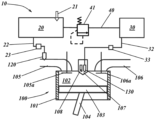
- the pressure tank system 10 comprises a main tank 20 and a secondary tank 30, the secondary tank 30 having a smaller capacity than the main tank 20.
- the low-pressure injector 120 feeding the fuel gas into the intake line 105 is connected to the main tank 20 via a pressure line 22, with a pressure reducer 23 being arranged on the pressure line 22.
- the high-pressure injector 130 feeding the fuel gas into the prechamber 107 is connected to the secondary tank 30 via a high-pressure line 32, with a pressure reducer 33 also being arranged on the high-pressure line 32.
- a connection 21 for pressurized refueling with the fuel gas is provided on the main tank 20.
- the secondary tank 30 does not have such a refueling connection. Instead, the tanks 20 and 30 are connected by means of a connecting line 40 in which a one-way valve 41 is arranged.
- the check valve 41 is designed and directed in such a way that gas can generally only pass from the main tank 20 into the secondary tank 30. Such a gas pass takes place when the pressure in the main tank 20 has reached or exceeds a certain threshold value.
- the threshold value is the so-called opening pressure of the one-way valve 41.
- the pressure in the main tank 20 would drop significantly faster.
- the relatively larger dimensioning of the main tank 20 reduces this difference in the system according to the invention, whereby with an advantageous dimensioning the relative design of the tanks is selected such that the difference in the pressure reduction is not completely compensated by a staggered capacity.
- the pressure in the main tank 20 drops faster than in the secondary tank 30.
- no pressure equalization takes place due to the one-way valve 41, so that the pressure in the secondary tank 30 remains higher than in the main tank 20.
Landscapes
- Engineering & Computer Science (AREA)
- Chemical & Material Sciences (AREA)
- Mechanical Engineering (AREA)
- General Engineering & Computer Science (AREA)
- Combustion & Propulsion (AREA)
- Oil, Petroleum & Natural Gas (AREA)
- General Chemical & Material Sciences (AREA)
- Chemical Kinetics & Catalysis (AREA)
- Life Sciences & Earth Sciences (AREA)
- Sustainable Development (AREA)
- Sustainable Energy (AREA)
- Transportation (AREA)
- Cooling, Air Intake And Gas Exhaust, And Fuel Tank Arrangements In Propulsion Units (AREA)
- Filling Or Discharging Of Gas Storage Vessels (AREA)
Description
- Die Erfindung betrifft einen Gasmotor mit einem Drucktanksystem zur Bereitstellung von Gasen auf wenigstens zwei unterschiedlichen Druckniveaus, vorzugsweise zur Versorgung eines Verbrennungsmotors mit Brenngasen wie beispielsweise Erdgas (CNG), Wasserstoffgas oder andere Brenngase.
- Auch im Bereich der mobilen Arbeitsmaschinen steht die Entwicklung von Gasmotoren im Fokus. Aufgrund ihrer Vorteile kommen hierbei fallweise mit Vorkammer-Zündsystemen ausgestattete Gasmotoren zum Einsatz, einschließlich Gasmotoren mit einer aktiven Vorkammer. In derartigen Gasmotoren ist eine koordinierte Hochdruckeinspritzung von Brenngas mittels eines Hochdruckinjektors mit nachfolgender Zündung des Brenngas-Luft-Gemischs erforderlich, um die Primärzündung auszulösen. Über eine Verbindung zur Hauptbrennkammer gelangt die Zündflamme des in der Vorkammer gezündeten Brenngas-Luft-Gemisches dann in den Hauptbrennraum, wodurch eine vergleichsweise hohe und weitläufig ausgebreitete Zündenergie bereitsteht. Der weitaus größere Energieumsatz erfolgt im Hauptbrennraum. Folglich wird diesem eine weitaus größere Brenngas-Menge zugeführt. Zur Konditionierung des für den Hauptbrennraum benötigten Brenngas-Luft-Gemisches wird das Brenngas in die Saugleitung des Gasmotors eingespritzt. Dem hierfür vorgesehenen Injektor - im Folgenden als Niederdruckinjektor bezeichnet - kann das Brenngas bei einem vergleichsweise diedrigen Druck bereitgestellt werden.
- Im Stand der Technik wird derartigen Gasmotoren die Brenngasversorgung der Hochdruckinjektoren und der Niederdruckinjektoren zur Koordinierung des jeweiligen Brenngas-Luft-Gemischs entweder anhand eines einzigen Tanks, der mit sämtlichen Injektoren in Verbindung steht, oder anhand von zwei vollständig getrennten Tanks realisiert, wobei hierbei eine feste Zuordnung von jeweils einem Tank zu einem der beiden Injektortypen besteht. Die Verwendung eines einzigen Tanks hat aber den Nachteil, dass sich die Notwendigkeit eines Nachtankens am höheren Druckniveau orientiert, das für die Vorkammereinspritzung erforderlich ist, sodass ein hoher Anteil der Tankkapazität ungenützt bleibt. Die Verwendung zweier vollständig voneinander getrennter Tanks hat den Nachteil, dass jeder der beiden Tanks einen nach aussen geführten und erreichbaren Anschluss zur Betankung haben muss und eine separate Bbetanktung nötig wird. Das Verbinden und Lösen der Tankvorrichtung an die Einfüllstutzen, ist bei gasförmigen Kraftstoffen langwieriger als für Flüssigkraftstoffe und müsste zweifach erfolgen.
- Aus der
WO 2016/115603 A1 ist bereits ein Gasmotor mit einem Drucktanksystem bekannt, bei diesem mittels eines Hauttanks Brenngas sowohl an Hochdruckinjektoren zur Direkteinspritzung in eine Hauptbrennkammer als auch an Niederdruckinjektoren zur Saugrohreinspritzung geliefert wird. Fällt der Druckinnerhalb des Haupttanks unter eine notwendiges Druckniveau für die Direkteinspritzung ab, wird das Gas mittels eines Boosters online komprimiert. - Die
DE 10 2013 214 786 A1 offenbart ein Tanksystem für die stationäre Lagerung von Benzin, Kerosin oder Brenngas. - Aufgabe der Erfindung ist es, einen Gasmotor mit Drucktanksystem für die Versorgung derartiger Gasmotoren bereitzustellen, das die genannten Nachteile überwindet.
- Vor diesem Hintergrund betrifft die Erfindung einen Gasmotor mit Drucktanksystem gemäß Anspruch 1.
- Erfindungsgemäß wird ein Übertritt bei Vorliegen einer positiven Druckdifferenz zwischen Haupttank und Nebentank ermöglicht. Eine positive Druckdifferenz zwischen Haupttank und Nebentank liegt vor, wenn der Druck im Haupttank größer als im Nebentank ist. Ein Gasübertritt in die andere Richtung, also vom Nebentank in den Haupttank, wird vom Ventil unterbunden.
- Vorzugsweise weist der Haupttank ein größeres Fassungsvolumen auf als der Nebentank. Insbesondere kann das Verhältnis der Fassungsvolumina von Haupttank zu Nebentank mindestens 8 : 2 und vorzugsweise mindestens 9 : 1 betragen. Diese relative Auslegung hat sich insbesondere für die Anwendung des Drucktanksystems zur Brenngas-Versorgung von Gasmotoren, die mit einem aktiven Vorkammerzündsystem ausgestattet sind, als vorteilhaft erwiesen.
- In einer Ausführungsform beträgt der maximale Fülldruck der Tanks mindestens 200 bar, vorzugsweise mindestens 350 bar oder 700 bar. Letztere Werte sind deshalb vorteilhaft, weil es sich für die Speicherung von gasförmigem Wasserstoff und Erdgas (CNG) um standardierte Druckniveaus eines vollbetankten Druckspeichers für mobile Anwendungen handelt.
- Der Gasmotor umfasst wenigstens einen Zylinder, welcher mit einem aktiven Vorkammerzündsystem ausgestattet ist. Ein solcher Zylinder umfasst einen Hauptbrennraum, der Gasverbindungen zu einer Ansaugleitung, einer Abgasleitung und einer aktiven Vorkammer aufweist. Zwischen einem solchen erfindungsgemäßen Gasmotor und dem Drucktanksystem bestehen dann zwei Gasverbindungen. Das betrifft erstens eine Druckleitung zwischen dem Haupttank und dem Niederdruckinjektor, der das Brenngas in die Ansaugleitung zuführt. Das betrifft zweitens eine Druckleitung zwischen dem Nebentank und den Hochdruckinjektoren, die das Brenngas direkt in die ihr zugeordnete Vorkammer zuführen.
- In der Vorkammer ist eine Zündkerze zur Auslösung der Primärzündung eines Brenngas-Luft-Gemischs angeordnet.
- Entlang der vom Haupttank und vom Nebentank ausgehenden Gasverbindungen kann jeweils ein Druckminderer angeordnet sein, um das am Nieder- bzw. Hochdruckinjektor ankommende Brenngar auf den dort benötigten Druck zu reduzieren.
- Die Erfindung betrifft weiterhin ein Kraftfahrzeug mit einem erfindunsgemäßen Gasmotor, bei dem es sich um ein Land-, Wasser- oder Luftfahrzeug handeln kann. Bei dem Kraftfahrzeug kann es sich insbesondere um eine mobile Arbeitsmaschine oder ein Schiff handeln.
- Letztlich betrifft die Erfindung auch ein Verfahren zum Betrieb eines erfindunsgemäßen Gasmotors oder Kraftfahrzeugs, woebi die Zündung des Brenngas-Luft-Gemischs im Brennraum des Gasmotors nicht direkt erfolgt, sondern in einer aktiven Vorkammer, in der ein Teil des im Gasmotor genutzten Brenngas-Luft-Gemischs mittels Gaseinspritzung per Hochdruckinjektor direkt in die Vorkammer eingespritzt wird und dort mit der Zündkerze gezündet wird, wodurch die in der Vorkammer freigesetzte Energie zur Zündung des Brenngas-Luft-Gemisches im Hauptbrennraum zur Verfügung steht.
- In einer Ausführungsform wird als Brenngas Wasserstoff eingespritzt.
- Die Gaseinspritzung am Niederdruckinjektor erfolgt in einer Ausführungsform bei einem Druck von zwischen 2 und 50 bar, vorzugsweise zwischen 5 und 20 bar und weiter vorzugsweise zwischen 8 und 15 bar. Die Gaseinspritzung am Hochdruckinjektor erfolgt in einer Ausführungsform bei einem Druck von zwischen 100 und 200 bar, vorzugsweise zwischen 150 und 250 bar und weiter vorzugsweise zwischen 180 und 220 bar.
- Weitere Einzelheiten und Vorteile der Erfindung ergeben sich aus dem nachfolgend anhand der Figur beschriebenen Ausführungsbeispiel.
- Die einzige Figur zeigt eine schematische Darstellung eines Ausschnitts eines Gasmotors 100 und eines assoziierten Drucktanksystems 10 gemäß einem Ausführungsbeispiel der Erfindung. Zur besseren Übersicht zeigt die Figur nur einen einzigen schematisch dargestellten Zylinder.
- Der Gasmotor 100 umfasst einen Zylinder 101 mit einem Hauptbrennraum 102, in dem sich ein Kolben 103 auf und ab bewegt und über eine Pleuelstange 104 in bekannter Weise eine in der Figur nicht näher dargestellte Kurbelwelle je nach Verbrennungstakt antreibt oder von dieser angetrieben wird. Der Hauptbrennraum 102 des Zylinders 101 wird aus einer Ansaugleitung 105 mit dem Brenngas-Luft-Gemisch versorgt. Die Abgase verlassen den Brennraum 102 durch eine Abgasleitung 106. Zur getakteten Öffnung der Leitungen 105 und 106 sind Einlass- und Auslassventile 105a bzw. 106a vorgesehen.
- Das Brenngas-Luft-Gemisch entsteht durch die Einspritzung des Brenngases in die Ansaugleitung 105 über einen Niedrigdruckinjektor 120.
- Spätestens unmittelbar vor dem extern angeregten Zündvorgang befindet sich in der Vorkammer 107 ein konditioniertes Brenngas-Luft-Gemisch. Der externe Energieeintrag, der heutzutage nach wie vor über eine Zündfunke erfolgt, beschränkt sich auf das Innenvolumen der Vorkammer 107, welches wesentlich kleiner als das des Hauptbrennraums 102 ist. Das Entzünden des Brenngas-Luft-Gemisches mittels Zündfunken in der Vorkammer 107 erfolgt wesentlich definierter als es in einem um Grössenordnungen grösseren Hauptbrennraum 102 erfolgen kann. Das Innenvolumen der Vorkammer 107 ist mit dem Hauptbrennraum 102 verbunden, zumeist über mehrere Kanäle. Daher schiesst das in der Vorkammer 107 entzündete Brenngas-Luft-Gemisch in den Hauptbrennraum 102 und liefert Aktivierungsenergie zum dortigen Entzünden des Brenngas-Luft-Gemisches. Die über eine Vorkammer 107 in den Hauptbrennraum 102 eingebrachte Energie ist um ein Vielfaches höher als es mit einer anwendungstauglichen Zündkerze 108 möglich wäre.
- Das Drucktanksystem 10 umfasst einen Haupttank 20 und einen Nebentank 30, wobei der Nebentank 30 ein geringeres Fassungsvolumen aufweist, als der Haupttank 20. Der das Brenngas in die Ansaugleitung 105 zuführende Niederdruckinjektor 120 steht über eine Druckleitung 22 mit dem Haupttank 20 in Verbindung, wobei an der Druckleitung 22 ein Druckminderer 23 angeordnet ist. Der das Brenngas in die Vorkammer 107 zuführende Hochdruckinjektor 130 steht über eine Hochdruckleitung 32 mit dem Nebentank 30 in Verbindung, wobei auch an der Hochdruckleitung 32 ein Druckminderer 33 angeordnet ist.
- Am Haupttank 20 ist ein Anschluss 21 zur Druckbetankung mit dem Brenngas vorgesehen. Am Nebentank 30 fehlt ein derartiger Betankungsanschluss. Stattdessen sind die Tanks 20 und 30 anhand einer Verbindungsleitung 40 verbunden, in der ein Einwegventil 41 angeordnet ist. Das Rückschlagventil 41 ist so ausgebildet und gerichtet, dass ein Gasübertritt generell nur vom Haupttank 20 in den Nebentank 30 stattfinden kann. Ein solcher Gasübertritt findet dann statt, wenn der Druck im Haupttank 20 einen bestimmten Schwellenwert erreicht hat oder diesen übersteigt. Bei dem Schwellenwert handelt es sich um den soge-nannten Öffnungsdruck des Einwegventils 41.
- Anhand des gezeigten, erfindungsgemäß ausgebildeten Drucktanksystems 10 kann eine effiziente Brenngasversorgung des Motors 100 unter einer weit besseren Ausnutzung des Gesamtvolumens des Drucktanksystems erfolgen.
- Im Betrieb des Gasmotors 100 kann in einem Beispiel, welches typische reale Werte wiedergibt, das Brenngas am Niederdruckinjektor 120 mit einem Druck von 10 bar in die Saugleitung 105 und am Hochdruckinjektor 130 mit einem Druck von 200 bar in die aktive Vorkammer 107 eingespritzt werden. Das Verhältnis der Brenngas-Einspritzmengen zwischen Niederdruckinjektor 120 und der Gesamtmenge sämtlicher Hochdruckinjektoren 130 kann beispielsweise 95 : 5 betragen, sodass 95 % des insgesamt in das System eingespritzten Brenngases am Niederdruckinjektor 120 in die Saugleitung 105 eingespritzt werden und 5 % des insgesamt in das System eingespritzten Brenngases in die Hochdruckinjektoren 130 in die Vorkammer 107 eingespritzt werden. Folglich stellt der Nebentank 30 eine weitaus geringere Gasmenge zur Verfügung als der Haupttank 20. Allerdings kann der Nebentank 30 nur solange genutzt werden bis das in ihm verbleibene Brenngas einen Druck von 200 bar aufweist. Hingegen kann der Haupttank 30 solange genutzt werden bis das in ihm ver-bleibene Brenngas einen Druck von 50 bar aufweist. Daher kann aus dem Haupttank ein wesentlich höherer relativer Energieinhalt entnommen werden als aus dem Nebentank.
- Zum Auftanken des Drucktanksystems 10 wird eine Tankleitung für komprimiertes Brenngas mit dem Druckbetankungsanschluss 21 verbunden. Sobald der Gasdruck im Haupttank 20 den Öffnungsdruck des Einwegventils 41 erreicht hat, setzt ein Gasübertritt vom Haupttank 20 in den Nebentank 30 über die Verbindungsleitung 40 ein. Bei fortdauernder Betankung werden dann beide Tanks gleichzeitig bis zur vollständigen Füllung betankt. Der Fülldruck nach Vollbetankung in den Tanks 20 und 30 kann beispielsweise 350 bar betragen.
- Nach abgeschlossener Betankung und Betriebsaufnahme des Gasmotors 100 wird am Niederdruckinjektor 120 Brenngas in die Saugleitung 105 eingespritzt und am Hochdruckinjektor 130 Brenngas in die Vorkammer 107 eingespritzt. Durch den resultierenden Gasverbrauch am Niederdruckinjektor 120 sinkt der Druck im Haupttank 20 und durch den resultierenden Gasverbrauch am Hochdruckinjektor 130 sinkt der Gasdruck im Nebentank 30.
- Unter Fortführung des obigen Zahlenbeispiels müsste bei einem Ein-Tank-System bereits bei einem Erreichen eines Gasdrucks im Tank von 200 bar wieder betankt werden, weil sonst dem Hochdruckinjektor 130 kein Brenngas mit einem ausreichend hohen Druckniveau zugeführt werden könnte. Durch die Versorgung der Niederdruck- und der Hochdruckeinspritzung über getrennte Tanks 20 und 30 wird erst dann ein Nachtanken erforderlich, wenn der Gasdruck im Haupttank auf 50 bar abgesunken ist oder der Gasdruck im Nebentank auf 200 bar abgesunken ist.
- Über den Niederdruckinjektor 120 wird dabei aber eine deutlich höhere Gasmenge eingespritzt, wie bereits oben näher beschrieben. So würde der Druck im Haupttank 20 bei einer identischen Dimensionierung von Haupttank 20 und Nebentank 30 deutlich schneller sinken. Durch die relativ größere Dimensionierung des Haupttanks 20 wird dieser Unterschied in dem erfindungsgemäßen System verringert, wobei bei einer vorteilhaften Dimensionierung die relative Auslegung der Tanks so gewählt ist, dass der Unterschied in der Druckabnahme nicht vollständig durch eine Staffelung des Fassungsvermögens ausgeglichen wird. So sinkt auch im erfindungsgemäßen System der Druck im Haupttank 20 schneller als im Nebentank 30. Durch das Einwegventil 41 findet aber kein Druckausgleich statt, sodass der Druck im Nebentank 30 höher bleibt als im Haupttank 20. So kann der Nebentank 30 auch dann noch den höheren Druck von beispielsweise 200 bar liefern, der am Hochdruckinjektor 130 benötigt wird, wenn der Druck im Haupttank 20 längst weit unter diesen Wert abgefallen ist. Folglich kann der Haupttank 20 bis auf einen viel niedrigeren Druck von beispielsweise etwa 50 bar entleert werden, bevor das System wieder betankt werden muss. Bei einem Ein-Tank-System müsste dagegen bereits bei Erreichen der 200 bar wieder betankt werden, weil sonst dem Hochdruckinjektor 130 kein Brenngas mit einem ausreichend hohen Druckniveau zugeführt werden könnte.
- Durch eine anwendungsbezogene Abschätzung der relativen Gasverbrauchswerte im Hauptbrennraum 102 und in der Vorkammer 107, die in der Realität natürlich mehr oder weniger großen Schwankungen unterworfen ist, kann die relative Größe der Tanks 20 und 30 dahingehend angepasst werden, dass diese ihre Mindestdrücke möglichst gleichzeitig erreichen, in der Tendenz aber der Haupttank 20 zuerst leer wird. Dies ist einer optimalen Nutzung des gesamten zur Verfügung stehenden Tankvolumens zuträglich, da der Haupttank 20 größer ist und einen größeren Anteil am gesamten zur Verfügung stehenden Tankvolumen aufweist.
- In Bezug auf das entnehmbare Gasvorkommen, d.h. den nutzbaren Energieinhalt weist das erfindungsgemässe Drucktanksystem eine höhere volume¬tri¬sche Energiedichte auf. Der Anteil des Energieeintrags in das Drucktank-,system, der als Kompressionsenergie aufgewendet werden muss, ist für ein erfindungsgemässes Drucktanksystem niedriger.
- Generell kann das Drucktanksystem derart konzipiert sein, dass lediglich ein Austausch des Haupttanks erfolgt, wohingegen alle anderen Bestandteile des Druck¬-tanksystems am Einsatzort bzw. in dem Fahrzeug verbleiben. Durch einen Austausch des entleerten gegen einen voll befüllten Haupttank füllt sich der Nebentank unmittelbar nachdem der Haupttank im Fahrzeug eingebaut und angeschlossen ist.
- Sofern der von dem Haupttank versorgte Prozess eine wesentlich grössere Gasmenge als der vom Nebentank versorgte Prozess erfordert, kann ein solches Gastank-Wechsel-Konzept sehr vorteilhaft sein, da durch einen Austausch eines voll betankten Hauptanks nahezu die gleiche Gasmenge in dem Drucktanksystem vorhanden ist als wenn eine Betankung der bereits verbundenen Tanks stattgefunden hätte.
- Sofern es nicht vorgesehen ist, dass das Fahrzeug nicht zu einer Tankstelle fährt, sondern das Betanken an seinem Einsatz erfolgt, was bei Mobilen Arbeitsmaschine der Fall ist, muss dort entweder ein Verdichten des Gases möglich sein oder der Gas-Transporttank kann nur soweit entladen werden bis der Maximaldruck des Drucktanksystems der Mobilen Arbeitsmaschine erreicht ist.
- Ein Verdichten des Gases vor Ort der mobilen Arbeitsmaschine ist langwierig und würde unnötig lange Stillstandszeiten verursachen. Was das Verdichten des Gases anbetrifft kann dies an einem zentralen Einsatzort mit einer entsprechend gross ausgelegten Anlage weitaus praktikabler erfolgen. Wenn nun das Gas mit einem Transporttank jeweils zu der nachzutankenden Mobilen Arbeitsmaschine gebracht wird, kann der Transporttank nur soweit entladen werden bis der Maximaldruck des Drucktanksystems der Mobilen Arbeitsmaschine erreicht ist. Folglich verbleibt in dem Transporttank immer eine vergleichsweise hohe Gasmenge, die auf allen Fahrten transportiert werden muss und stets ungenutzt bleibt.
- Ferner muss das Verdichten zur Befüllung der Transporttanks auf ein deutlich höheres Druckniveau erfolgen, was deutlich aufwendiger und deutlich energieintensiver ist. Besonders bevorzugt kommen bei einem solchen Gas-Tank-Wechselkonzept solche Hauttanks zum Einsatz, die bereits standardisiert sind.
- Ein Gas-Tank-Wechselkonzept kann mit dem erfindungsgemässen Drucktanksystem sehr vorteilhaft umgesetzt werden und würde für solche mit Gasmotoren, die mit einer aktiven Vorkammer ausgestattet sind, betriebenen Mobile Arbeitsmaschinen, die an ihrem Einsatzort betankt werden, grosse Vorteile bieten. Daher stellt ein solches Gas-Tank-Wechselkonzept eine vorteilhafte ausgestaltung der erfindung dar.
Claims (9)
- Gasmotor (100) mit wenigstens einem Zylinder (101), der einen Brennraum (102) umfasst, der mit einer Ansaugleitung (105), einer Abgasleitung (106) und einer Vorkammer (107) in Verbindung steht, und mit einem Drucktanksystem (10) zur Bereitstellung von Gasen auf wenigstens zwei unterschiedlichen Druckniveaus;wobei das Drucktanksystem (10) einen Haupttank (20) und einen Nebentank (30) aufweist, wobei der Haupttank (20) einen Anschluss (21) für eine Druckbetankung aufweist, wobei sowohl der Haupttank (20) als auch der Nebentank (30) jeweils wenigstens eine Druckleitung (22, 32) zur Gasabgabe aufweisen, und wobei der Haupttank (20) und der Nebentank (30) anhand einer Verbindungsleitung (40) verbunden sind, in der ein Ventil (41) angeordnet ist, das ausgebildet und gerichtet ist, einen Gasübertritt vom Haupttank (20) in den Nebentank (30) zu erlauben und einen Gasübertritt in die Gegenrichtung zu unterbinden, wobei das Drucktanksystem (10) über das Ventil (41) einen Gasübertritt vom Haupttank (20) in den Nebentank (30) nur bei einer positiven Druckdifferenz zwischen Haupttank (20) und Nebentank (30) ermöglicht; undwobei die Druckleitung (22) des Haupttanks (20) mit einem Niederdruckinjektor (120) verbunden ist, der ausgebildet und angeordnet ist, Brenngase in die Ansaugleitung (105) zuzuführen, und wobei die Druckleitung (32) des Nebentanks (30) mit einem Hochdruckinjektor (130) verbunden ist, der ausgebildet und angeordnet ist, Brenngase in die Vorkammer (107) zuzuführen.
- Gasmotor nach Anspruch 1, dadurch gekennzeichnet, dass der Haupttank (20) des Drucktanksystems (10) ein größeres Fassungsvolumen als der Nebentank (30) aufweist.
- Gasmotor nach Anspruch 2, dadurch gekennzeichnet, dass das Verhältnis der Fassungsvolumina von Haupttank (20) zu Nebentank (30) mindestens 8 : 2 und vorzugsweise mindestens 9 : 1 beträgt.
- Gasmotor nach einem der vorhergehenden Ansprüche, dadurch gekennzeichnet, dass der maximale Fülldruck der Tanks (20, 30) des Drucktanksystems (10) mindestens 200 bar, vorzugsweise mindestens 250 bar und weiter vorzugsweise mindestens 700 bar beträgt.
- Kraftfahrzeug mit einem Gasmotor (100) nach einem der vorhergehenden Ansprüche.
- Kraftfahrzeug nach Anspruch 5, dadurch gekennzeichnet, dass es sich bei dem Kraftfahrzeug um eine mobile Arbeitsmaschine handelt.
- Verfahren zum Betrieb eines Gasmotors (100) nach einem der Ansprüche 1 bis 4 oder eines Kraftfahrzeugs nach Anspruch 5 oder 6, dadurch gekennzeichnet, dass die Zündung des Brenngas-Luft-Gemischs im Brennraum (102) des Gasmotors (100) nicht direkt erfolgt, sondern indem ein Teil des im Gasmotor (100) gezündeten Brenngas-Luft-Gemischs mittels Brenngaszuführung per Hochdruckinjektor (130) in die Vorkammer (107) eingespritzt und darin mit einer Vorrichtung, die extern mit Energie versorgt wird, vorzugsweise einer Zündkerze (108), gezündet wird, wodurch dann das Brenngas-Luft-Gemisch im Brennraum (102) entzündet wird.
- Verfahren nach Anspruch 7, dadurch gekennzeichnet, dass als Brenngas Wasserstoff zugeführt wird und es sich bei dem Brenngas-Luft-Gemisch um Knallgas handelt.
- Verfahren nach Anspruch 7 oder 8, dadurch gekennzeichnet, dass die Gaszuführung am Niederdruckinjektor (120) bei einem Druck von zwischen 2 und 50 bar, vorzugsweise zwischen 5 und 20 bar und weiter vorzugsweise zwischen 8 und 15 bar erfolgt und/oder die Gaszuführung am Hochdruckinjektor (130) bei einem Druck von zwischen 100 und 200 bar, vorzugsweise zwischen 150 und 250 bar und weiter vorzugsweise zwischen 180 und 220 bar erfolgt.
Applications Claiming Priority (1)
| Application Number | Priority Date | Filing Date | Title |
|---|---|---|---|
| CH00677/19A CH716217A1 (de) | 2019-05-22 | 2019-05-22 | Drucktanksystem zur Bereitstellung von Gasen. |
Publications (2)
| Publication Number | Publication Date |
|---|---|
| EP3741984A1 EP3741984A1 (de) | 2020-11-25 |
| EP3741984B1 true EP3741984B1 (de) | 2024-07-03 |
Family
ID=70740532
Family Applications (1)
| Application Number | Title | Priority Date | Filing Date |
|---|---|---|---|
| EP20175232.6A Active EP3741984B1 (de) | 2019-05-22 | 2020-05-18 | Gasmotor mit drucktanksystem zur bereitstellung von gasen |
Country Status (2)
| Country | Link |
|---|---|
| EP (1) | EP3741984B1 (de) |
| CH (1) | CH716217A1 (de) |
Families Citing this family (7)
| Publication number | Priority date | Publication date | Assignee | Title |
|---|---|---|---|---|
| DE102021202390A1 (de) * | 2021-03-11 | 2022-09-15 | Robert Bosch Gesellschaft mit beschränkter Haftung | Verbesserte Wasserstoff-Einblasanlage mit zwei Gasinjektoren pro Brennraum |
| CH718806A1 (de) * | 2021-07-12 | 2023-01-13 | Liebherr Machines Bulle Sa | Kraftstoffeinspritzvorrichtung für eine Brennkraftmaschine, insbesondere für einen Wasserstoffverbrennungsmotor. |
| CN114290895B (zh) * | 2022-01-04 | 2024-04-09 | 一汽解放汽车有限公司 | 供油系统及其控制方法 |
| CH719504A1 (de) * | 2022-03-15 | 2023-09-29 | Liebherr Machines Bulle Sa | Verfahren zum Betrieb eines Gasmotors mit Kraftstoffversorgungsvorrichtung mit Selektionsmöglichkeit zur Direkteinspritzung und/oder Luftpfadeinspeisung von Kraftstoff. |
| CH719503A2 (de) * | 2022-03-15 | 2023-09-29 | Liebherr Machines Bulle Sa | Gasbrennkraftmaschine mit Brenngasrekuperation. |
| IT202200016824A1 (it) * | 2022-08-05 | 2024-02-05 | Cnh Ind Italia Spa | Veicolo da lavoro alimentato a gas migliorato |
| CN117326119B (zh) * | 2023-09-14 | 2025-08-12 | 成都飞机工业(集团)有限责任公司 | 一种高压气源车 |
Family Cites Families (9)
| Publication number | Priority date | Publication date | Assignee | Title |
|---|---|---|---|---|
| US5868122A (en) * | 1997-12-30 | 1999-02-09 | Westport Research Inc. | Compressed natural gas cylinder pump and reverse cascade fuel supply system |
| US9000905B2 (en) * | 2006-08-21 | 2015-04-07 | Nmhg Oregon, Llc | Auxiliary fuel tank |
| DE102008029493B4 (de) * | 2008-06-20 | 2012-12-27 | Man Truck & Bus Ag | Kraftfahrzeug mit einer Gashochdruckversorgung von Energiewandlern |
| US8443820B2 (en) * | 2009-06-03 | 2013-05-21 | Ford Global Technologies, Llc | Fuel distribution in multi-fuel tank compressed gas fuel systems |
| CA2799952C (en) * | 2012-12-20 | 2014-04-29 | Westport Power Inc. | Mid-cycle fuel injection strategies |
| DE102013214786A1 (de) * | 2013-07-29 | 2015-01-29 | comITen GbR (vertretungsberechtigter Gesellschafter: Axel Moddemann, 53619 Rheinbreitbach) | Tank |
| WO2016115603A1 (en) * | 2015-01-23 | 2016-07-28 | Mosaic Technology Development Pty Ltd | Compressed gas fuel storage and delivery system |
| JP6435912B2 (ja) * | 2015-02-23 | 2018-12-12 | 株式会社デンソー | 燃料タンクシステム |
| DE102016224582A1 (de) * | 2016-12-09 | 2018-06-14 | Robert Bosch Gmbh | Vorrichtung zum direkten Einblasen eines gasförmigen Brennstoffs in einen Brennraum einer Brennkraftmaschine |
-
2019
- 2019-05-22 CH CH00677/19A patent/CH716217A1/de not_active Application Discontinuation
-
2020
- 2020-05-18 EP EP20175232.6A patent/EP3741984B1/de active Active
Also Published As
| Publication number | Publication date |
|---|---|
| EP3741984A1 (de) | 2020-11-25 |
| CH716217A1 (de) | 2020-11-30 |
Similar Documents
| Publication | Publication Date | Title |
|---|---|---|
| EP3741984B1 (de) | Gasmotor mit drucktanksystem zur bereitstellung von gasen | |
| DE102006017541B4 (de) | Verfahren zum Austrag von Hochdruckspeicherbehältern | |
| DE102016004352A1 (de) | Dynamische dichtung für ein nadelrückschlagelement einer brennstoffeinspritzvorrichtung | |
| DE112009000577T5 (de) | Hochdruck-Common-Rail-Kraftstoffsystem mit Gasinjektion | |
| DE10146051B4 (de) | Kraftstoffdirekteinspritzsystem | |
| DE102014006533A1 (de) | Dual-Brennstoffmotorsystem und Motorsystembetriebsverfahren | |
| WO2000017568A1 (de) | Zapfanlage und verfahren zum befüllen eines gastanks mit einem arbeitsgas, insbesondere erdgas | |
| DE202017007214U1 (de) | Kraftstoffaustausch- und Kraftstofffördersystem für Kraftstoffanlagen | |
| DE102016112843A1 (de) | Verfahren zum Betanken von insbesondere Lastkraftfahrzeugen mit Erdgas | |
| EP3329173A1 (de) | Brenngasversorgungseinrichtung zur bereitstellung eines brenngases und brennkraftmaschine | |
| DE102017004196B4 (de) | Brennkraftmaschine, Anordnung mit einer solchen Brennkraftmaschine und Verfahren | |
| DE10361665B4 (de) | Benzin-Direkteinspritzungs-System | |
| DE10301159A1 (de) | Kraftfahrzeug mit einer Brennkraftmaschine für unter Normalbedingungen gasförmigen Kraftstoff und Verfahren zu deren Versorgung | |
| DE3909750C2 (de) | ||
| DE202013102660U1 (de) | Gasspeichersystem für gasförmige Kraftstoffe | |
| DE102015014402A1 (de) | Verfahren und Vorrichtung zur Erzeugung eines Kraftstoffgemisches für Brennkraftmaschinen | |
| DE102017205910A1 (de) | Kraftstofffördereinrichtung für eine Brennkraftmaschine, sowie ein Verfahren zur Förderung von Kraftstoff in einer Kraftstofffördereinrichtung | |
| DE3728683C2 (de) | ||
| DE102018222128A1 (de) | Kraftstoffdosiersystem zur dosierten Abgabe von gasförmigem und flüssigem Kraftstoff | |
| DE4107846A1 (de) | Fluessiggaspumpe, insbesondere fahrzeugtaugliche fluessiggaspumpe fuer kryogenen wasserstoff | |
| WO2018162187A1 (de) | Kraftstoffzuführeinrichtung, insbesondere für ein kraftfahrzeug, mit mindestens einem kraftstofftank | |
| DE10123719B4 (de) | Verfahren zum Betreiben einer mit Flüssiggas betriebenen Brennkraftmaschine | |
| DE102013211483B4 (de) | Gasspeichersystem für gasförmige Kraftstoffe | |
| DE102013019730A1 (de) | Brennstoffzumesseinrichtung | |
| DE202013012716U1 (de) | Brennstoffzumesseinrichtung |
Legal Events
| Date | Code | Title | Description |
|---|---|---|---|
| PUAI | Public reference made under article 153(3) epc to a published international application that has entered the european phase |
Free format text: ORIGINAL CODE: 0009012 |
|
| STAA | Information on the status of an ep patent application or granted ep patent |
Free format text: STATUS: THE APPLICATION HAS BEEN PUBLISHED |
|
| AK | Designated contracting states |
Kind code of ref document: A1 Designated state(s): AL AT BE BG CH CY CZ DE DK EE ES FI FR GB GR HR HU IE IS IT LI LT LU LV MC MK MT NL NO PL PT RO RS SE SI SK SM TR |
|
| AX | Request for extension of the european patent |
Extension state: BA ME |
|
| STAA | Information on the status of an ep patent application or granted ep patent |
Free format text: STATUS: REQUEST FOR EXAMINATION WAS MADE |
|
| 17P | Request for examination filed |
Effective date: 20210112 |
|
| STAA | Information on the status of an ep patent application or granted ep patent |
Free format text: STATUS: EXAMINATION IS IN PROGRESS |
|
| 17Q | First examination report despatched |
Effective date: 20220107 |
|
| GRAP | Despatch of communication of intention to grant a patent |
Free format text: ORIGINAL CODE: EPIDOSNIGR1 |
|
| STAA | Information on the status of an ep patent application or granted ep patent |
Free format text: STATUS: GRANT OF PATENT IS INTENDED |
|
| INTG | Intention to grant announced |
Effective date: 20240327 |
|
| GRAS | Grant fee paid |
Free format text: ORIGINAL CODE: EPIDOSNIGR3 |
|
| GRAA | (expected) grant |
Free format text: ORIGINAL CODE: 0009210 |
|
| STAA | Information on the status of an ep patent application or granted ep patent |
Free format text: STATUS: THE PATENT HAS BEEN GRANTED |
|
| AK | Designated contracting states |
Kind code of ref document: B1 Designated state(s): AL AT BE BG CH CY CZ DE DK EE ES FI FR GB GR HR HU IE IS IT LI LT LU LV MC MK MT NL NO PL PT RO RS SE SI SK SM TR |
|
| REG | Reference to a national code |
Ref country code: CH Ref legal event code: EP |
|
| REG | Reference to a national code |
Ref country code: DE Ref legal event code: R096 Ref document number: 502020008423 Country of ref document: DE |
|
| REG | Reference to a national code |
Ref country code: LT Ref legal event code: MG9D |
|
| REG | Reference to a national code |
Ref country code: NL Ref legal event code: MP Effective date: 20240703 |
|
| PG25 | Lapsed in a contracting state [announced via postgrant information from national office to epo] |
Ref country code: PT Free format text: LAPSE BECAUSE OF FAILURE TO SUBMIT A TRANSLATION OF THE DESCRIPTION OR TO PAY THE FEE WITHIN THE PRESCRIBED TIME-LIMIT Effective date: 20241104 |
|
| PG25 | Lapsed in a contracting state [announced via postgrant information from national office to epo] |
Ref country code: NL Free format text: LAPSE BECAUSE OF FAILURE TO SUBMIT A TRANSLATION OF THE DESCRIPTION OR TO PAY THE FEE WITHIN THE PRESCRIBED TIME-LIMIT Effective date: 20240703 |
|
| PG25 | Lapsed in a contracting state [announced via postgrant information from national office to epo] |
Ref country code: PT Free format text: LAPSE BECAUSE OF FAILURE TO SUBMIT A TRANSLATION OF THE DESCRIPTION OR TO PAY THE FEE WITHIN THE PRESCRIBED TIME-LIMIT Effective date: 20241104 Ref country code: NL Free format text: LAPSE BECAUSE OF FAILURE TO SUBMIT A TRANSLATION OF THE DESCRIPTION OR TO PAY THE FEE WITHIN THE PRESCRIBED TIME-LIMIT Effective date: 20240703 |
|
| PG25 | Lapsed in a contracting state [announced via postgrant information from national office to epo] |
Ref country code: NO Free format text: LAPSE BECAUSE OF FAILURE TO SUBMIT A TRANSLATION OF THE DESCRIPTION OR TO PAY THE FEE WITHIN THE PRESCRIBED TIME-LIMIT Effective date: 20241003 |
|
| PG25 | Lapsed in a contracting state [announced via postgrant information from national office to epo] |
Ref country code: PL Free format text: LAPSE BECAUSE OF FAILURE TO SUBMIT A TRANSLATION OF THE DESCRIPTION OR TO PAY THE FEE WITHIN THE PRESCRIBED TIME-LIMIT Effective date: 20240703 Ref country code: FI Free format text: LAPSE BECAUSE OF FAILURE TO SUBMIT A TRANSLATION OF THE DESCRIPTION OR TO PAY THE FEE WITHIN THE PRESCRIBED TIME-LIMIT Effective date: 20240703 Ref country code: GR Free format text: LAPSE BECAUSE OF FAILURE TO SUBMIT A TRANSLATION OF THE DESCRIPTION OR TO PAY THE FEE WITHIN THE PRESCRIBED TIME-LIMIT Effective date: 20241004 |
|
| PG25 | Lapsed in a contracting state [announced via postgrant information from national office to epo] |
Ref country code: BG Free format text: LAPSE BECAUSE OF FAILURE TO SUBMIT A TRANSLATION OF THE DESCRIPTION OR TO PAY THE FEE WITHIN THE PRESCRIBED TIME-LIMIT Effective date: 20240703 |
|
| PG25 | Lapsed in a contracting state [announced via postgrant information from national office to epo] |
Ref country code: LV Free format text: LAPSE BECAUSE OF FAILURE TO SUBMIT A TRANSLATION OF THE DESCRIPTION OR TO PAY THE FEE WITHIN THE PRESCRIBED TIME-LIMIT Effective date: 20240703 |
|
| PG25 | Lapsed in a contracting state [announced via postgrant information from national office to epo] |
Ref country code: IS Free format text: LAPSE BECAUSE OF FAILURE TO SUBMIT A TRANSLATION OF THE DESCRIPTION OR TO PAY THE FEE WITHIN THE PRESCRIBED TIME-LIMIT Effective date: 20241103 |
|
| PG25 | Lapsed in a contracting state [announced via postgrant information from national office to epo] |
Ref country code: CZ Free format text: LAPSE BECAUSE OF FAILURE TO SUBMIT A TRANSLATION OF THE DESCRIPTION OR TO PAY THE FEE WITHIN THE PRESCRIBED TIME-LIMIT Effective date: 20240703 Ref country code: HR Free format text: LAPSE BECAUSE OF FAILURE TO SUBMIT A TRANSLATION OF THE DESCRIPTION OR TO PAY THE FEE WITHIN THE PRESCRIBED TIME-LIMIT Effective date: 20240703 |
|
| PG25 | Lapsed in a contracting state [announced via postgrant information from national office to epo] |
Ref country code: RS Free format text: LAPSE BECAUSE OF FAILURE TO SUBMIT A TRANSLATION OF THE DESCRIPTION OR TO PAY THE FEE WITHIN THE PRESCRIBED TIME-LIMIT Effective date: 20241003 Ref country code: ES Free format text: LAPSE BECAUSE OF FAILURE TO SUBMIT A TRANSLATION OF THE DESCRIPTION OR TO PAY THE FEE WITHIN THE PRESCRIBED TIME-LIMIT Effective date: 20240703 |
|
| PG25 | Lapsed in a contracting state [announced via postgrant information from national office to epo] |
Ref country code: RS Free format text: LAPSE BECAUSE OF FAILURE TO SUBMIT A TRANSLATION OF THE DESCRIPTION OR TO PAY THE FEE WITHIN THE PRESCRIBED TIME-LIMIT Effective date: 20241003 Ref country code: PL Free format text: LAPSE BECAUSE OF FAILURE TO SUBMIT A TRANSLATION OF THE DESCRIPTION OR TO PAY THE FEE WITHIN THE PRESCRIBED TIME-LIMIT Effective date: 20240703 Ref country code: NO Free format text: LAPSE BECAUSE OF FAILURE TO SUBMIT A TRANSLATION OF THE DESCRIPTION OR TO PAY THE FEE WITHIN THE PRESCRIBED TIME-LIMIT Effective date: 20241003 Ref country code: LV Free format text: LAPSE BECAUSE OF FAILURE TO SUBMIT A TRANSLATION OF THE DESCRIPTION OR TO PAY THE FEE WITHIN THE PRESCRIBED TIME-LIMIT Effective date: 20240703 Ref country code: IS Free format text: LAPSE BECAUSE OF FAILURE TO SUBMIT A TRANSLATION OF THE DESCRIPTION OR TO PAY THE FEE WITHIN THE PRESCRIBED TIME-LIMIT Effective date: 20241103 Ref country code: HR Free format text: LAPSE BECAUSE OF FAILURE TO SUBMIT A TRANSLATION OF THE DESCRIPTION OR TO PAY THE FEE WITHIN THE PRESCRIBED TIME-LIMIT Effective date: 20240703 Ref country code: GR Free format text: LAPSE BECAUSE OF FAILURE TO SUBMIT A TRANSLATION OF THE DESCRIPTION OR TO PAY THE FEE WITHIN THE PRESCRIBED TIME-LIMIT Effective date: 20241004 Ref country code: FI Free format text: LAPSE BECAUSE OF FAILURE TO SUBMIT A TRANSLATION OF THE DESCRIPTION OR TO PAY THE FEE WITHIN THE PRESCRIBED TIME-LIMIT Effective date: 20240703 Ref country code: ES Free format text: LAPSE BECAUSE OF FAILURE TO SUBMIT A TRANSLATION OF THE DESCRIPTION OR TO PAY THE FEE WITHIN THE PRESCRIBED TIME-LIMIT Effective date: 20240703 Ref country code: CZ Free format text: LAPSE BECAUSE OF FAILURE TO SUBMIT A TRANSLATION OF THE DESCRIPTION OR TO PAY THE FEE WITHIN THE PRESCRIBED TIME-LIMIT Effective date: 20240703 Ref country code: BG Free format text: LAPSE BECAUSE OF FAILURE TO SUBMIT A TRANSLATION OF THE DESCRIPTION OR TO PAY THE FEE WITHIN THE PRESCRIBED TIME-LIMIT Effective date: 20240703 |
|
| REG | Reference to a national code |
Ref country code: DE Ref legal event code: R097 Ref document number: 502020008423 Country of ref document: DE |
|
| PG25 | Lapsed in a contracting state [announced via postgrant information from national office to epo] |
Ref country code: DK Free format text: LAPSE BECAUSE OF FAILURE TO SUBMIT A TRANSLATION OF THE DESCRIPTION OR TO PAY THE FEE WITHIN THE PRESCRIBED TIME-LIMIT Effective date: 20240703 Ref country code: RO Free format text: LAPSE BECAUSE OF FAILURE TO SUBMIT A TRANSLATION OF THE DESCRIPTION OR TO PAY THE FEE WITHIN THE PRESCRIBED TIME-LIMIT Effective date: 20240703 Ref country code: SM Free format text: LAPSE BECAUSE OF FAILURE TO SUBMIT A TRANSLATION OF THE DESCRIPTION OR TO PAY THE FEE WITHIN THE PRESCRIBED TIME-LIMIT Effective date: 20240703 |
|
| PG25 | Lapsed in a contracting state [announced via postgrant information from national office to epo] |
Ref country code: EE Free format text: LAPSE BECAUSE OF FAILURE TO SUBMIT A TRANSLATION OF THE DESCRIPTION OR TO PAY THE FEE WITHIN THE PRESCRIBED TIME-LIMIT Effective date: 20240703 |
|
| PG25 | Lapsed in a contracting state [announced via postgrant information from national office to epo] |
Ref country code: SK Free format text: LAPSE BECAUSE OF FAILURE TO SUBMIT A TRANSLATION OF THE DESCRIPTION OR TO PAY THE FEE WITHIN THE PRESCRIBED TIME-LIMIT Effective date: 20240703 Ref country code: IT Free format text: LAPSE BECAUSE OF FAILURE TO SUBMIT A TRANSLATION OF THE DESCRIPTION OR TO PAY THE FEE WITHIN THE PRESCRIBED TIME-LIMIT Effective date: 20240703 |
|
| PLBE | No opposition filed within time limit |
Free format text: ORIGINAL CODE: 0009261 |
|
| STAA | Information on the status of an ep patent application or granted ep patent |
Free format text: STATUS: NO OPPOSITION FILED WITHIN TIME LIMIT |
|
| 26N | No opposition filed |
Effective date: 20250404 |
|
| PGFP | Annual fee paid to national office [announced via postgrant information from national office to epo] |
Ref country code: DE Payment date: 20250602 Year of fee payment: 6 |
|
| PGFP | Annual fee paid to national office [announced via postgrant information from national office to epo] |
Ref country code: GB Payment date: 20250529 Year of fee payment: 6 |
|
| PGFP | Annual fee paid to national office [announced via postgrant information from national office to epo] |
Ref country code: FR Payment date: 20250528 Year of fee payment: 6 |
|
| PG25 | Lapsed in a contracting state [announced via postgrant information from national office to epo] |
Ref country code: SE Free format text: LAPSE BECAUSE OF FAILURE TO SUBMIT A TRANSLATION OF THE DESCRIPTION OR TO PAY THE FEE WITHIN THE PRESCRIBED TIME-LIMIT Effective date: 20240703 |
|
| REG | Reference to a national code |
Ref country code: CH Ref legal event code: H13 Free format text: ST27 STATUS EVENT CODE: U-0-0-H10-H13 (AS PROVIDED BY THE NATIONAL OFFICE) Effective date: 20251223 |
|
| PG25 | Lapsed in a contracting state [announced via postgrant information from national office to epo] |
Ref country code: LU Free format text: LAPSE BECAUSE OF NON-PAYMENT OF DUE FEES Effective date: 20250518 |
|
| PG25 | Lapsed in a contracting state [announced via postgrant information from national office to epo] |
Ref country code: CH Free format text: LAPSE BECAUSE OF NON-PAYMENT OF DUE FEES Effective date: 20250531 |
|
| REG | Reference to a national code |
Ref country code: BE Ref legal event code: MM Effective date: 20250531 |
|
| PG25 | Lapsed in a contracting state [announced via postgrant information from national office to epo] |
Ref country code: MC Free format text: LAPSE BECAUSE OF FAILURE TO SUBMIT A TRANSLATION OF THE DESCRIPTION OR TO PAY THE FEE WITHIN THE PRESCRIBED TIME-LIMIT Effective date: 20240703 |
|
| PG25 | Lapsed in a contracting state [announced via postgrant information from national office to epo] |
Ref country code: IE Free format text: LAPSE BECAUSE OF NON-PAYMENT OF DUE FEES Effective date: 20250518 |
|
| PG25 | Lapsed in a contracting state [announced via postgrant information from national office to epo] |
Ref country code: BE Free format text: LAPSE BECAUSE OF NON-PAYMENT OF DUE FEES Effective date: 20250531 |