EP3740375B1 - Verfahren zur nachbearbeitung eines durch generative fertigung erhaltenen teils aus einem kunststoffpulver - Google Patents
Verfahren zur nachbearbeitung eines durch generative fertigung erhaltenen teils aus einem kunststoffpulver Download PDFInfo
- Publication number
- EP3740375B1 EP3740375B1 EP19704657.6A EP19704657A EP3740375B1 EP 3740375 B1 EP3740375 B1 EP 3740375B1 EP 19704657 A EP19704657 A EP 19704657A EP 3740375 B1 EP3740375 B1 EP 3740375B1
- Authority
- EP
- European Patent Office
- Prior art keywords
- powder
- post
- particles
- additive manufacturing
- parts
- Prior art date
- Legal status (The legal status is an assumption and is not a legal conclusion. Google has not performed a legal analysis and makes no representation as to the accuracy of the status listed.)
- Active
Links
- 239000000843 powder Substances 0.000 title claims description 96
- 238000004519 manufacturing process Methods 0.000 title claims description 91
- 239000000654 additive Substances 0.000 title claims description 62
- 230000000996 additive effect Effects 0.000 title claims description 62
- 238000000034 method Methods 0.000 title claims description 60
- 239000000463 material Substances 0.000 title claims description 23
- 229920003023 plastic Polymers 0.000 title claims description 23
- 239000004033 plastic Substances 0.000 title claims description 23
- 238000012805 post-processing Methods 0.000 title description 11
- 239000002245 particle Substances 0.000 claims description 60
- 238000007664 blowing Methods 0.000 claims description 38
- 238000005488 sandblasting Methods 0.000 claims description 23
- 238000005406 washing Methods 0.000 claims description 21
- 238000005245 sintering Methods 0.000 claims description 13
- 229920000571 Nylon 11 Polymers 0.000 claims description 11
- 230000008030 elimination Effects 0.000 claims description 10
- 238000003379 elimination reaction Methods 0.000 claims description 10
- 239000004952 Polyamide Substances 0.000 claims description 6
- 229920002647 polyamide Polymers 0.000 claims description 6
- 239000004953 Aliphatic polyamide Substances 0.000 claims description 3
- 229920003231 aliphatic polyamide Polymers 0.000 claims description 3
- 239000011521 glass Substances 0.000 claims description 3
- 239000003125 aqueous solvent Substances 0.000 claims description 2
- 239000004005 microsphere Substances 0.000 claims description 2
- 238000002156 mixing Methods 0.000 claims description 2
- 238000012545 processing Methods 0.000 claims description 2
- 239000000047 product Substances 0.000 description 32
- 239000002537 cosmetic Substances 0.000 description 28
- 238000005554 pickling Methods 0.000 description 18
- 238000012797 qualification Methods 0.000 description 11
- 238000004140 cleaning Methods 0.000 description 9
- 230000015572 biosynthetic process Effects 0.000 description 6
- 230000003750 conditioning effect Effects 0.000 description 5
- XKRFYHLGVUSROY-UHFFFAOYSA-N Argon Chemical compound [Ar] XKRFYHLGVUSROY-UHFFFAOYSA-N 0.000 description 4
- 238000010586 diagram Methods 0.000 description 4
- 210000004209 hair Anatomy 0.000 description 4
- 239000000243 solution Substances 0.000 description 4
- 238000003786 synthesis reaction Methods 0.000 description 4
- KFZMGEQAYNKOFK-UHFFFAOYSA-N Isopropanol Chemical compound CC(C)O KFZMGEQAYNKOFK-UHFFFAOYSA-N 0.000 description 3
- 238000001816 cooling Methods 0.000 description 3
- 239000012467 final product Substances 0.000 description 3
- 239000007789 gas Substances 0.000 description 3
- 238000000227 grinding Methods 0.000 description 3
- 238000012216 screening Methods 0.000 description 3
- 239000000126 substance Substances 0.000 description 3
- 238000002604 ultrasonography Methods 0.000 description 3
- 238000010146 3D printing Methods 0.000 description 2
- 229920000299 Nylon 12 Polymers 0.000 description 2
- 229910052786 argon Inorganic materials 0.000 description 2
- 239000011248 coating agent Substances 0.000 description 2
- 238000000576 coating method Methods 0.000 description 2
- 238000011960 computer-aided design Methods 0.000 description 2
- 238000009833 condensation Methods 0.000 description 2
- 230000005494 condensation Effects 0.000 description 2
- 210000004087 cornea Anatomy 0.000 description 2
- 238000010410 dusting Methods 0.000 description 2
- 230000005611 electricity Effects 0.000 description 2
- 210000000744 eyelid Anatomy 0.000 description 2
- 239000012530 fluid Substances 0.000 description 2
- 230000004927 fusion Effects 0.000 description 2
- 239000007788 liquid Substances 0.000 description 2
- 239000000203 mixture Substances 0.000 description 2
- 230000007935 neutral effect Effects 0.000 description 2
- 230000000717 retained effect Effects 0.000 description 2
- 238000007873 sieving Methods 0.000 description 2
- 230000003068 static effect Effects 0.000 description 2
- 238000003756 stirring Methods 0.000 description 2
- 229920001169 thermoplastic Polymers 0.000 description 2
- BVKZGUZCCUSVTD-UHFFFAOYSA-M Bicarbonate Chemical compound OC([O-])=O BVKZGUZCCUSVTD-UHFFFAOYSA-M 0.000 description 1
- 241001264766 Callistemon Species 0.000 description 1
- 206010015946 Eye irritation Diseases 0.000 description 1
- 241000257303 Hymenoptera Species 0.000 description 1
- 239000000853 adhesive Substances 0.000 description 1
- 230000001070 adhesive effect Effects 0.000 description 1
- 230000004931 aggregating effect Effects 0.000 description 1
- 238000013019 agitation Methods 0.000 description 1
- WYTGDNHDOZPMIW-RCBQFDQVSA-N alstonine Natural products C1=CC2=C3C=CC=CC3=NC2=C2N1C[C@H]1[C@H](C)OC=C(C(=O)OC)[C@H]1C2 WYTGDNHDOZPMIW-RCBQFDQVSA-N 0.000 description 1
- 238000000149 argon plasma sintering Methods 0.000 description 1
- 230000001680 brushing effect Effects 0.000 description 1
- 230000007547 defect Effects 0.000 description 1
- 238000001035 drying Methods 0.000 description 1
- 235000013399 edible fruits Nutrition 0.000 description 1
- 230000000694 effects Effects 0.000 description 1
- 238000001704 evaporation Methods 0.000 description 1
- 230000008020 evaporation Effects 0.000 description 1
- 231100000013 eye irritation Toxicity 0.000 description 1
- 210000000720 eyelash Anatomy 0.000 description 1
- 239000000835 fiber Substances 0.000 description 1
- IYRWEQXVUNLMAY-UHFFFAOYSA-N fluoroketone group Chemical group FC(=O)F IYRWEQXVUNLMAY-UHFFFAOYSA-N 0.000 description 1
- 235000013305 food Nutrition 0.000 description 1
- 238000007499 fusion processing Methods 0.000 description 1
- 239000012535 impurity Substances 0.000 description 1
- 238000002347 injection Methods 0.000 description 1
- 239000007924 injection Substances 0.000 description 1
- 150000002500 ions Chemical class 0.000 description 1
- 238000010309 melting process Methods 0.000 description 1
- 239000002184 metal Substances 0.000 description 1
- 238000012986 modification Methods 0.000 description 1
- 230000004048 modification Effects 0.000 description 1
- 230000003647 oxidation Effects 0.000 description 1
- 238000007254 oxidation reaction Methods 0.000 description 1
- 238000004806 packaging method and process Methods 0.000 description 1
- 229920002401 polyacrylamide Polymers 0.000 description 1
- 239000012254 powdered material Substances 0.000 description 1
- 238000011084 recovery Methods 0.000 description 1
- 238000010992 reflux Methods 0.000 description 1
- QEVHRUUCFGRFIF-MDEJGZGSSA-N reserpine Chemical compound O([C@H]1[C@@H]([C@H]([C@H]2C[C@@H]3C4=C(C5=CC=C(OC)C=C5N4)CCN3C[C@H]2C1)C(=O)OC)OC)C(=O)C1=CC(OC)=C(OC)C(OC)=C1 QEVHRUUCFGRFIF-MDEJGZGSSA-N 0.000 description 1
- 238000005070 sampling Methods 0.000 description 1
- 239000004576 sand Substances 0.000 description 1
- 238000000110 selective laser sintering Methods 0.000 description 1
- 238000005507 spraying Methods 0.000 description 1
Images
Classifications
-
- B—PERFORMING OPERATIONS; TRANSPORTING
- B29—WORKING OF PLASTICS; WORKING OF SUBSTANCES IN A PLASTIC STATE IN GENERAL
- B29C—SHAPING OR JOINING OF PLASTICS; SHAPING OF MATERIAL IN A PLASTIC STATE, NOT OTHERWISE PROVIDED FOR; AFTER-TREATMENT OF THE SHAPED PRODUCTS, e.g. REPAIRING
- B29C64/00—Additive manufacturing, i.e. manufacturing of three-dimensional [3D] objects by additive deposition, additive agglomeration or additive layering, e.g. by 3D printing, stereolithography or selective laser sintering
- B29C64/30—Auxiliary operations or equipment
- B29C64/35—Cleaning
-
- B—PERFORMING OPERATIONS; TRANSPORTING
- B29—WORKING OF PLASTICS; WORKING OF SUBSTANCES IN A PLASTIC STATE IN GENERAL
- B29C—SHAPING OR JOINING OF PLASTICS; SHAPING OF MATERIAL IN A PLASTIC STATE, NOT OTHERWISE PROVIDED FOR; AFTER-TREATMENT OF THE SHAPED PRODUCTS, e.g. REPAIRING
- B29C64/00—Additive manufacturing, i.e. manufacturing of three-dimensional [3D] objects by additive deposition, additive agglomeration or additive layering, e.g. by 3D printing, stereolithography or selective laser sintering
- B29C64/10—Processes of additive manufacturing
- B29C64/141—Processes of additive manufacturing using only solid materials
- B29C64/153—Processes of additive manufacturing using only solid materials using layers of powder being selectively joined, e.g. by selective laser sintering or melting
-
- B—PERFORMING OPERATIONS; TRANSPORTING
- B29—WORKING OF PLASTICS; WORKING OF SUBSTANCES IN A PLASTIC STATE IN GENERAL
- B29C—SHAPING OR JOINING OF PLASTICS; SHAPING OF MATERIAL IN A PLASTIC STATE, NOT OTHERWISE PROVIDED FOR; AFTER-TREATMENT OF THE SHAPED PRODUCTS, e.g. REPAIRING
- B29C64/00—Additive manufacturing, i.e. manufacturing of three-dimensional [3D] objects by additive deposition, additive agglomeration or additive layering, e.g. by 3D printing, stereolithography or selective laser sintering
- B29C64/10—Processes of additive manufacturing
- B29C64/165—Processes of additive manufacturing using a combination of solid and fluid materials, e.g. a powder selectively bound by a liquid binder, catalyst, inhibitor or energy absorber
-
- B—PERFORMING OPERATIONS; TRANSPORTING
- B29—WORKING OF PLASTICS; WORKING OF SUBSTANCES IN A PLASTIC STATE IN GENERAL
- B29C—SHAPING OR JOINING OF PLASTICS; SHAPING OF MATERIAL IN A PLASTIC STATE, NOT OTHERWISE PROVIDED FOR; AFTER-TREATMENT OF THE SHAPED PRODUCTS, e.g. REPAIRING
- B29C64/00—Additive manufacturing, i.e. manufacturing of three-dimensional [3D] objects by additive deposition, additive agglomeration or additive layering, e.g. by 3D printing, stereolithography or selective laser sintering
- B29C64/10—Processes of additive manufacturing
- B29C64/188—Processes of additive manufacturing involving additional operations performed on the added layers, e.g. smoothing, grinding or thickness control
-
- B—PERFORMING OPERATIONS; TRANSPORTING
- B29—WORKING OF PLASTICS; WORKING OF SUBSTANCES IN A PLASTIC STATE IN GENERAL
- B29C—SHAPING OR JOINING OF PLASTICS; SHAPING OF MATERIAL IN A PLASTIC STATE, NOT OTHERWISE PROVIDED FOR; AFTER-TREATMENT OF THE SHAPED PRODUCTS, e.g. REPAIRING
- B29C64/00—Additive manufacturing, i.e. manufacturing of three-dimensional [3D] objects by additive deposition, additive agglomeration or additive layering, e.g. by 3D printing, stereolithography or selective laser sintering
- B29C64/30—Auxiliary operations or equipment
- B29C64/364—Conditioning of environment
-
- B—PERFORMING OPERATIONS; TRANSPORTING
- B29—WORKING OF PLASTICS; WORKING OF SUBSTANCES IN A PLASTIC STATE IN GENERAL
- B29C—SHAPING OR JOINING OF PLASTICS; SHAPING OF MATERIAL IN A PLASTIC STATE, NOT OTHERWISE PROVIDED FOR; AFTER-TREATMENT OF THE SHAPED PRODUCTS, e.g. REPAIRING
- B29C71/00—After-treatment of articles without altering their shape; Apparatus therefor
- B29C71/0009—After-treatment of articles without altering their shape; Apparatus therefor using liquids, e.g. solvents, swelling agents
-
- B—PERFORMING OPERATIONS; TRANSPORTING
- B29—WORKING OF PLASTICS; WORKING OF SUBSTANCES IN A PLASTIC STATE IN GENERAL
- B29C—SHAPING OR JOINING OF PLASTICS; SHAPING OF MATERIAL IN A PLASTIC STATE, NOT OTHERWISE PROVIDED FOR; AFTER-TREATMENT OF THE SHAPED PRODUCTS, e.g. REPAIRING
- B29C71/00—After-treatment of articles without altering their shape; Apparatus therefor
- B29C71/0081—After-treatment of articles without altering their shape; Apparatus therefor using an electric field, e.g. for electrostatic charging
-
- B—PERFORMING OPERATIONS; TRANSPORTING
- B33—ADDITIVE MANUFACTURING TECHNOLOGY
- B33Y—ADDITIVE MANUFACTURING, i.e. MANUFACTURING OF THREE-DIMENSIONAL [3-D] OBJECTS BY ADDITIVE DEPOSITION, ADDITIVE AGGLOMERATION OR ADDITIVE LAYERING, e.g. BY 3-D PRINTING, STEREOLITHOGRAPHY OR SELECTIVE LASER SINTERING
- B33Y10/00—Processes of additive manufacturing
-
- B—PERFORMING OPERATIONS; TRANSPORTING
- B33—ADDITIVE MANUFACTURING TECHNOLOGY
- B33Y—ADDITIVE MANUFACTURING, i.e. MANUFACTURING OF THREE-DIMENSIONAL [3-D] OBJECTS BY ADDITIVE DEPOSITION, ADDITIVE AGGLOMERATION OR ADDITIVE LAYERING, e.g. BY 3-D PRINTING, STEREOLITHOGRAPHY OR SELECTIVE LASER SINTERING
- B33Y40/00—Auxiliary operations or equipment, e.g. for material handling
- B33Y40/10—Pre-treatment
-
- B—PERFORMING OPERATIONS; TRANSPORTING
- B33—ADDITIVE MANUFACTURING TECHNOLOGY
- B33Y—ADDITIVE MANUFACTURING, i.e. MANUFACTURING OF THREE-DIMENSIONAL [3-D] OBJECTS BY ADDITIVE DEPOSITION, ADDITIVE AGGLOMERATION OR ADDITIVE LAYERING, e.g. BY 3-D PRINTING, STEREOLITHOGRAPHY OR SELECTIVE LASER SINTERING
- B33Y40/00—Auxiliary operations or equipment, e.g. for material handling
- B33Y40/20—Post-treatment, e.g. curing, coating or polishing
-
- B—PERFORMING OPERATIONS; TRANSPORTING
- B33—ADDITIVE MANUFACTURING TECHNOLOGY
- B33Y—ADDITIVE MANUFACTURING, i.e. MANUFACTURING OF THREE-DIMENSIONAL [3-D] OBJECTS BY ADDITIVE DEPOSITION, ADDITIVE AGGLOMERATION OR ADDITIVE LAYERING, e.g. BY 3-D PRINTING, STEREOLITHOGRAPHY OR SELECTIVE LASER SINTERING
- B33Y70/00—Materials specially adapted for additive manufacturing
-
- B—PERFORMING OPERATIONS; TRANSPORTING
- B22—CASTING; POWDER METALLURGY
- B22F—WORKING METALLIC POWDER; MANUFACTURE OF ARTICLES FROM METALLIC POWDER; MAKING METALLIC POWDER; APPARATUS OR DEVICES SPECIALLY ADAPTED FOR METALLIC POWDER
- B22F3/00—Manufacture of workpieces or articles from metallic powder characterised by the manner of compacting or sintering; Apparatus specially adapted therefor ; Presses and furnaces
- B22F3/24—After-treatment of workpieces or articles
- B22F2003/247—Removing material: carving, cleaning, grinding, hobbing, honing, lapping, polishing, milling, shaving, skiving, turning the surface
-
- B—PERFORMING OPERATIONS; TRANSPORTING
- B29—WORKING OF PLASTICS; WORKING OF SUBSTANCES IN A PLASTIC STATE IN GENERAL
- B29C—SHAPING OR JOINING OF PLASTICS; SHAPING OF MATERIAL IN A PLASTIC STATE, NOT OTHERWISE PROVIDED FOR; AFTER-TREATMENT OF THE SHAPED PRODUCTS, e.g. REPAIRING
- B29C59/00—Surface shaping of articles, e.g. embossing; Apparatus therefor
- B29C59/02—Surface shaping of articles, e.g. embossing; Apparatus therefor by mechanical means, e.g. pressing
- B29C2059/027—Grinding; Polishing
-
- B—PERFORMING OPERATIONS; TRANSPORTING
- B29—WORKING OF PLASTICS; WORKING OF SUBSTANCES IN A PLASTIC STATE IN GENERAL
- B29C—SHAPING OR JOINING OF PLASTICS; SHAPING OF MATERIAL IN A PLASTIC STATE, NOT OTHERWISE PROVIDED FOR; AFTER-TREATMENT OF THE SHAPED PRODUCTS, e.g. REPAIRING
- B29C64/00—Additive manufacturing, i.e. manufacturing of three-dimensional [3D] objects by additive deposition, additive agglomeration or additive layering, e.g. by 3D printing, stereolithography or selective laser sintering
- B29C64/30—Auxiliary operations or equipment
- B29C64/357—Recycling
-
- B—PERFORMING OPERATIONS; TRANSPORTING
- B29—WORKING OF PLASTICS; WORKING OF SUBSTANCES IN A PLASTIC STATE IN GENERAL
- B29K—INDEXING SCHEME ASSOCIATED WITH SUBCLASSES B29B, B29C OR B29D, RELATING TO MOULDING MATERIALS OR TO MATERIALS FOR MOULDS, REINFORCEMENTS, FILLERS OR PREFORMED PARTS, e.g. INSERTS
- B29K2077/00—Use of PA, i.e. polyamides, e.g. polyesteramides or derivatives thereof, as moulding material
Definitions
- the present invention relates to the field of industrial processes making it possible to obtain, by additive manufacturing, parts made of plastic material of small dimensions, such as cosmetic product applicators.
- Cosmetic products include in the present document in particular all products for making up the skin, lips or integuments. Cosmetic products also include care products, in particular liquid care formulas, intended for application to the skin, lips and integuments.
- the invention potentially relates to any plastic part obtained by additive synthesis for which it is advantageous to guarantee the absence of particles detached following additive manufacturing or liable to come off during use of the part
- the invention presents of particular interest in the context of an applicator for a cosmetic product intended to be applied near the eyes, in particular on the eyelashes or the eyelids.
- the cosmetic product can be a mascara, an eye shadow, or a make-up for the contour of the eyes commonly designated by the English term “eyeliner”.
- An article of mascara conventionally comprises a case, a reservoir of mascara and an applicator.
- applicators those of the “bottle brush” type, those injected and those manufactured by additive manufacturing (sometimes called “additive synthesis”).
- additive manufacturing sometimes called “additive synthesis”.
- the making additive designates manufacturing processes by adding or aggregating material, also commonly referred to by the expression “three-dimensional printing” or “3D printing”.
- a brush type applicator comprises a brush which comprises bristles formed by fibers trapped in a twisted metal wire forming the core of the applicator.
- An injected applicator is generally formed in a single piece and comprises bristles or teeth made of plastic, for example.
- An applicator manufactured by additive manufacturing is also generally in one piece and can be formed, for example, from a powder of thermoplastic polymers.
- the invention relates to a method of post-treatment of plastic parts obtained by additive manufacturing solving at least one of the aforementioned problems.
- the post-processing according to the invention is part of a manufacturing process by additive manufacturing which is also the subject of the invention.
- the publication WO2011 / 145960 describes a process for additive manufacturing by sintering a powder of a plastic material followed by a depouding step and a post-treatment, which may include sandblasting, to improve the surface finish.
- the publication US2006 / 251826 describes an ionizing blowing apparatus used to treat plastic particles, to facilitate their coating with an adhesive; these particles are used in additive manufacturing processes by selective sintering.
- the publication US7285234 describes an additive manufacturing process by sintering a powder of a plastic material, comprising a step of contacting said powder with charged particles.
- the succession of steps implemented in the method which is the subject of the invention allows the particles to be eliminated in the product obtained by additive manufacturing.
- stripping that is to say the detachment or elimination of the produced part of residues, dirt and unwanted elements, followed by ionizing blowing makes it possible to guarantee the absence of loose particles or likely to come off when using the part.
- the process allows, depending on the parameters used for each step, the elimination of particles of undesirable sizes in the final product.
- the pickling step may comprise (or be constituted) by a step of sandblasting said part.
- Sandblasting can for example use glass microspheres with a diameter of between 45 and 90 microns.
- the post-treatment process may include a pre-blowing step prior to the sandblasting step.
- the post-treatment process may further include a final washing step.
- the washing step (S3) may include washing the part in a non-aqueous solvent.
- the sandblasting and ionizing blowing steps can be carried out in batches of 300 to 10,000 pieces.
- An embodiment also relates to a method of manufacturing a part made of plastic material, comprising an additive manufacturing step by sintering a powder of the plastic material, followed by a depouding step and a post-process. treatment as previously defined.
- the plastic material used can be a polyamide, preferably an aliphatic polyamide, for example polyamide 11.
- An embodiment finally relates to a method for producing a part comprising a manufacturing method as defined above, and further comprising a qualification step comprising the determination, in a batch of a predetermined number of parts, of the number of residual loose or partially sintered particles of greater dimension greater than a predefined dimension, and, if said number of particles is non-zero, the modification of at least one parameter of a post-treatment step, then the succession of such manufacturing processes and qualification steps until said number of particles of larger predefined larger dimension is zero.
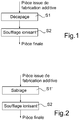
- the process presented at figure 1 presents the steps of a method, in accordance with one embodiment of the invention, of post-treatment of a part obtained by additive manufacturing, namely by sintering of a powder of a plastic material.
- the method comprises a pickling step (S1), and an ionizing blowing step (S2).
- S1 pickling step
- S2 ionizing blowing step
- the method is applicable to a part or a set (batch) of parts. Having a particular interest in an industrial context, it is described below for the treatment of several parts.
- the post-treatment process for parts obtained by additive manufacturing begins with a pickling step S1.
- the parts come from additive manufacturing by sintering a powder of a plastic material, for example polyamide of the PA11 type, as is detailed with reference to figure 4 .
- the parts were taken out of the powder and were able to undergo a depolding operation, also detailed with reference to the figure 4 below, but they may have particles that are detached or liable to come off during use.
- the process aims to ensure the absence of particles, in certain size ranges, in the final product, that is to say on the final part.
- Pickling consists in exerting a mechanical action on the surface of the parts so as to eliminate the undesirable elements which are there, such as loose or partially sintered powder grains or any impurity.
- Pickling can be obtained by spraying a substance, fluid or powdery, on the surface of the parts. This projection can be carried out in a barrel or rotating drum.
- the stripping step can correspond to sandblasting (as in the process of figure 2 ).
- the stripping step can be carried out in batches of 300 to 10,000 pieces for example, in particular 3000 to 4000 pieces.
- the method comprises, after the pickling step S1, an ionizing blowing step S2.
- the pickling can leave particles lodged interstices or hairs of the part obtained by additive manufacturing.
- the particles are essentially particles of the material constituting said part, for example grains of PA11, but can also be particles of an abrasive used during the pickling step S1, where appropriate (typically when the pickling comprises a sandblasting).
- Ionization generally consists of removing or adding charges to an atom or a molecule.
- ionization systems commonly called ionizers produce ions which are charged atoms.
- the ionizers come in different forms. The most common shape is that of a bar. The ionization bar must be located near the support to be ionized, typically less than 50 mm.
- the Applicant has identified that the implementation of an ionizing blowing step is particularly relevant in a process for post-treatment of parts obtained by additive manufacturing, in particular the post-treatment of applicators of cosmetic product.
- ionization eliminates the effects of static electricity carried by the part.
- the blowing air flow separates the residual particles from the parts, on the surface of which they are no longer retained by static electricity. The particles thus separated from the parts are sucked out of the ionizing blowing chamber.
- the ionizing blowing can be carried out in a barrel or drum identical to that used for the pickling step S1, or even in the same barrel as that used for the pickling step S1.
- the device advantageously comprises two ionization systems, for example two ionization bars.
- a bar is positioned inside the barrel (or other enclosure) and a bar placed outside.
- the following blowing parameters can be used successfully, in particular for the post-treatment of applicators of cosmetic product of the mascara brush type, or parts of similar dimensions.
- the ionizing blowing can be carried out under a pressure of 4 bars.
- the ionizing blowing step S5 can last 30 to 40 minutes.
- the ionizing blowing step S5 can be carried out in batches of 300 to 10,000 pieces for example, in particular from 3,000 to 4000 pieces such as cosmetic product applicators.
- the blowing pressure can be 3 to 5 bars
- the blowing time can be significantly reduced, and for example be of the order of 15 minutes or less.
- the parts for example cosmetic product applicators, it is certain that the parts are free of particles of undesired dimensions.
- the aforementioned parameters allow in particular the elimination of almost all of the particles of more than 150 microns on a cosmetic product applicator, and the elimination of all of the particles of more than 500 microns.
- the figure 2 represents a process identical to that of figure 1 , in which the pickling step S1 is a sandblasting step S1 '.
- Sandblasting is a known technique for cleaning a surface, which uses an abrasive sprayed at high speed with a compressed gas (usually air) through a nozzle on the surface to be cleaned.
- a compressed gas usually air
- the sandblasting of parts resulting from additive manufacturing by sintering a powder of a plastic material requires the implementation of optimized parameters.
- the parameters are suitable due to the small size of the applicators, the need to sand extremely fine elements (namely the hairs of the applicators) without destroying them, the interest of sanding a large quantity of parts at the same time (eg 300 to 10,000 parts), and the importance of detaching parts by sandblasting any particles that may come off when using the applicator.
- the sandblasting step S1 ′ makes it possible in particular to eliminate the partially sintered powder grains.
- the sandblasting is carried out in a sandblasting machine comprising at least one nozzle projecting glass balls having a diameter of 45 to 90 microns. Sandblasting also makes it possible to obtain the desired surface finish on the parts.
- Other abrasive media can be envisaged, for example bicarbonate, or compressed fruit stones.
- the type of sandblasting machine In addition to the nature and size of the abrasive particles, the type of sandblasting machine, the injection pressure, the distance of the nozzle from the surface of the barrel, are important parameters for obtaining the desired results.
- the sandblasting is carried out in a rotary barrel sandblaster.
- the selected barrel has a diameter of 500 mm.
- the barrel rotates at 3 revolutions per minute to ensure the stirring of the pieces.
- Sandblasting can take 35 to 45 minutes, for example 40 minutes.
- the balls are injected under an air pressure of 2.5 bars.
- Stirring can be improved by the use of a second nozzle, blowing sideways into the barrel and / or lifting the parts relative to the surface of the barrel.
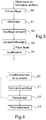
- the figure 3 represents a post-processing method in accordance with one embodiment of the invention and comprising optional steps.
- the method comprises a pre-blowing step (S0) prior to the pickling step.
- the method comprises a washing / cleaning step (S3) successive to the ionizing blowing step (S2).
- the S0 pre-blowing step is carried out on the parts before their pickling. This step ensures that easily removable particles from the parts are removed before attacking the pickling of the parts.
- the pre-blowing step thus aims to remove a maximum of particles by subjecting the parts obtained by additive manufacturing to a flow of pressurized air.
- the pre-blowing step can advantageously be carried out in the barrel of the machine which will be used for the pickling step S1.
- the pre-blowing can be carried out for 5 to 10 minutes, for example 7 minutes, with two nozzles blowing air at 2.5 bars.
- Additional cleaning can be carried out in a so-called washing / cleaning step S3.
- cleaning is meant any type of action allowing the removal of grains, particles, and other residual elements on the surface of parts obtained by additive manufacturing, or in the bristles or interstices of these parts. Washing corresponds to a type of cleaning using a washing product, aqueous or not.
- Washing in a suitable solution can be carried out.
- the washing can be carried out on a principle of reflux washing.
- the washing tank may include a rotating mesh basket, and / or submerged jets.
- the parts can be subjected to ultrasound.
- the ultrasound used can have a frequency between 25 kHz and 45 kHz.
- the washing can be carried out in particular in a 50% solution of isopropyl alcohol or preferably in a chemical solution of fluoroketone.
- This chemical solution has good efficiency in the elimination of residual sandblasting balls, and more generally in the elimination of particles smaller than 80 microns, without altering the mechanical properties of the parts, in particular of the cosmetic product applicators.
- a qualification step S4 can make it possible to ensure that the final parts obtained at the end of the post-treatment process meet certain qualitative criteria.
- the qualification step can make it possible to ensure the absence of potentially irritating particles in the finished products.
- the qualification step can be carried out periodically during production, at regular or random intervals, or more preferably by random sampling of a determined number of parts in each batch.
- a batch can consist of a set of 10,000 to 100,000 pieces, and from each batch can be taken from 8 to 100 pieces.
- the qualification step it can be ensured that none of the parts taken contains particles, detached or liable to come off during use, the largest dimension of which is greater than 500 microns.
- the qualification step can allow that a predefined maximum number of such particles (not critical for the consumer) for a given quantity of applicators is present (for example 7 particles for a sample of 32 applicators in a batch of 10,000 to 100,000 pieces or 10 particles for a sample of 50 pieces from a set of more than 500,000 pieces).
- a predefined maximum number of such particles not critical for the consumer
- the affected lot can be rejected and destroyed. Measures to verify the process and / or correct the manufacturing parameters can be taken.
- the pickling step S1 can in particular include a sandblasting step S1 ′.
- the optional S0 pre-blowing and S3 washing / cleaning steps described above can vary the optimal parameters for performing the other steps, but they can be incorporated independently of one another into one of the processes according to the figure 1 or the figure 2 .
- the qualification step S4 can be incorporated into any of the methods according to figure 1 , the figure 2 , or the figure 3 , or in general can be carried out in order to qualify certain parts, whatever their method of obtaining and the post-processing they have undergone.
- the figure 4 shows a method of manufacturing a part according to one embodiment.
- This method comprises an additive manufacturing step E1, followed by a step of depouding the parts E2, itself followed by a post-treatment process E3 corresponding to a post-treatment in accordance with the invention, for example such as described with reference to one of the figures 1 to 4 .
- a preliminary step of conditioning the powder E0 can be optionally provided.
- the additive manufacturing step S1 is carried out by sintering a powder, in particular a powder of a plastic material.
- the additive manufacturing process used is advantageously a powder bed melting process, powder bonding, also called “selective laser sintering”.
- a powder bed fusion process involves producing objects from powdered materials using one or more lasers to selectively melt the powder particles on the surface of the powder bed layer after layer. layer, in a closed room.
- the type of powder used can be any type of powder suitable for use in such a process.
- the powder used can in particular be a powder of a thermoplastic polymer, or a powder of a polyamide, preferably an aliphatic polyamide, for example polyamide 11, also designated PA 11, or polyacrylamide.
- Polyamide 12 or PA12 can also be used successfully, although PA 11 is preferable to it for certain applications, in particular the manufacture of cosmetic product applicators, because it has greater flexibility.
- An example of a particularly suitable PA11 powder is the powder sold under the reference “PA1101” by the company EOS Materials.
- the powder has grains the largest dimension of which is less than or equal to 150 microns.
- the largest dimension is less than or equal to 80 microns, and even more preferably less than or equal to 60 microns.
- the machine used for the additive manufacturing step can be a machine marketed under the name FORMIGA P110 by the company EOS Materials, or any equivalent machine.
- the additive manufacturing machine is first loaded with powder.
- the manufacture can be carried out in a container containing approximately 10 kg of powder (typically for PA11).
- the manufacture can be carried out over several floors, for example between two and ten floors, in particular over seven floors.
- the formation of blanks by laser sintering then begins.
- the powder in the tank is maintained at approximately 150 ° C.
- the laser (s) provide the additional energy necessary for the localized fusion of the powder.
- a 25 W laser can be used successfully.
- Additively manufacturing a batch of three thousand to four thousand pieces may take about fifteen hours under these conditions.
- the assembly must be cooled.
- the cooling can last on the order of fifteen hours.
- the total time of the additive manufacturing step can therefore be of the order of 30 hours.
- the cooling is advantageously carried out under neutral gas, for example under argon.
- cooling can be carried out outside the machine, with neutral gas (in particular under argon). of the contents of the bin.
- the additive manufacturing step E1 is carried out in a machine which uses a digital file geometrically representing the part to be produced.
- the file is obtained after having designed the part to be produced on computer-aided design (CAD) software.
- CAD computer-aided design
- This file can be in STL format or any other standard file format that can be used for additive synthesis by powder bed fusion.
- the file is then processed by software provided by the manufacturer of the machine used for the additive synthesis.
- This software cuts the file into sections in the form of digital images (for example a hundred images), for example in SU or BFF format, each of them corresponding to a layer of the model to be printed, i.e. say to a section of the part to be produced taken in a plane perpendicular to a given axis.
- This data is then transmitted to the additive manufacturing machine to produce the part.
- the additive manufacturing step thus results in the formation of raw parts embedded in powder and full of powder.
- the additive manufacturing step E1 is followed by a dusting step E2. This step separates the raw parts from the powder.
- the powder recovered can be reused, as described below in a step of conditioning the powder E0.
- the powder recovered can undergo a sorting process in order to keep only the grains whose largest dimension is less than or equal to a given size (for example 150 microns, 80 microns or 60 microns).
- the depouding step consists in separating the raw parts from the powder in which they are embedded, and in eliminating a maximum of powder carried by the raw part (for example in recesses of the rough part, in the hairs of a part crude such as a cosmetic product applicator).
- This step can be done manually.
- manually is meant that an operator must grasp the raw parts, individually or in clusters, and remove the powder therefrom by agitation, blowing, and / or brushing.
- the dusting step can be carried out automatically, which is advantageous for the production of parts, in particular small parts of complex shapes such as cosmetic product applicators, on an industrial scale.
- this operation is carried out in a powdering booth in order to guarantee production on an industrial scale, for example more than 200,000 pieces per week.
- the absence of residual powder is fundamental.
- the Applicant has found that not only it is necessary to separate the applicators of raw cosmetic products as well as obtained from the powder, but that it was also important to guarantee the total absence of grains detached from the applicator (for example retained in its bristles) or liable to come off during use, and of which the largest dimension is larger than a given size, which may cause eye irritation.
- the post-processing described with reference to figures 1 to 4 aims at the total elimination of these grains. Typically, post-processing aims to remove all particles greater than 500 microns. In fact, particles with dimensions greater than the dimensions of the initial powder grains can be generated during additive manufacturing, for example in the event of incomplete sintering of certain grains.
- a post-treatment process E3 in accordance with the invention is applied, for example a process as described with reference to one of figures 1 to 4 .
- the final parts obtained are devoid of or almost devoid of residual particles which are detached or liable to come off.
- the powder used for the additive manufacturing step E1 for example of PA 11 or PA 12, originally exhibits suitable characteristics. This is the object of the powder conditioning step E0, prior to the additive manufacturing step E1.
- the most important feature is the particle size of the powder used.
- the powder used should advantageously only have grains, the largest dimension of which is less than 150 microns.
- an even finer powder can be used, namely the largest grain size of which is less than 80 microns or less than 60 microns.
- the desired characteristics in particular the particle size, can be guaranteed by the selection of a commercially available powder having these characteristics. Nevertheless, for obvious cost reasons, it is advantageous to be able to re-use so-called used powder, that is to say that has already been used during an additive manufacturing step E1. In particular, part of the powder recovered during the depouding step E2 can be reused for a next cycle (or a batch).
- the used powder may have been altered, compared to the new powder, during additive manufacturing, even if this powder is not bound to the raw part manufactured.
- the powder grains may have been heat-deformed, stuck, or partially sintered.
- the used powder collected is calibrated by a suitable sorting or calibration process.
- a screening of the used powder can be carried out.
- Several types of sieving can be envisaged in order to separate, from the recovered powder, the grains having a larger dimension greater than the maximum desired dimension. It is in particular possible to use screening by ultrasound, by micro-vibration and / or by blowing.
- the desired maximum dimension of the largest grain dimension may be, for example, 150 microns, or 80 microns, or 60 microns.
- Sorting or sieving allows the recovery of a calibrated used powder, which is suitable for re-use for the additive manufacturing of parts similar to those produced in the previous cycle.
- the invention thus proposes a method of post-treatment of one or more parts obtained by additive manufacturing by sintering of a powder of a plastic material.
- This post-treatment which involves a succession of pickling of the part and an ionizing blowing, makes it possible to eliminate, by the choice of parameters adapted in each of these stages, the detached or susceptible particles. to detach from the part during use, even if these particles are lodged in interstices or in hairs that comprise the part.
- the invention can be applied to many types of plastic parts, in various technical fields where the absence of particles on the parts is important.
- One of the preferred applications of the invention is the post-treatment of cosmetic product applicators, and in particular applicators intended for the application of a cosmetic product near the eyes, such as mascara brushes.
- the method guarantees the absence of particles of dimensions greater than a given dimension (for example 500 microns).
- the method can also make it possible to guarantee a maximum number of particles in certain size ranges (for example between 150 microns and 500 microns).
- An embodiment also relates to a manufacturing method implementing such a post-treatment method, for obtaining by additive manufacturing parts devoid of or almost devoid of particles, at least in certain size ranges of particles which are not not desired.
Landscapes
- Engineering & Computer Science (AREA)
- Chemical & Material Sciences (AREA)
- Materials Engineering (AREA)
- Manufacturing & Machinery (AREA)
- Optics & Photonics (AREA)
- Physics & Mathematics (AREA)
- Mechanical Engineering (AREA)
- Toxicology (AREA)
- Environmental & Geological Engineering (AREA)
- Health & Medical Sciences (AREA)
- Life Sciences & Earth Sciences (AREA)
- Sustainable Development (AREA)
- Cosmetics (AREA)
- Manufacture Of Porous Articles, And Recovery And Treatment Of Waste Products (AREA)
Claims (11)
- Verfahren zur Nachbearbeitung eines Teils, das durch additive Fertigung durch Sintern eines Kunststoffpulvers erhalten wird, zur Entfernung von Partikeln, die sich von dem Teil gelöst haben oder teilgesintert sind, wobei das Verfahren die aufeinanderfolgenden Schritte umfasst:- Abtragen (S1); und- ionisierendes Abblasen (S2).
- Nachbearbeitungsverfahren nach Anspruch 1,
wobei der Schritt des Abtragens einen Schritt des Sandstrahlens (S1') des Teils umfasst. - Nachbearbeitungsverfahren nach Anspruch 2,
wobei beim Sandstrahlen Glasmikrokügelchen mit einem Durchmesser zwischen 45 und 90 Mikron verwendet werden. - Nachbearbeitungsverfahren nach einem der vorhergehenden Ansprüche, umfassend einen Schritt des Vor-Abblasens vor dem Schritt des Abtragens (S1).
- Nachbearbeitungsverfahren nach einem der vorhergehenden Ansprüche, ferner umfassend einen abschließenden Schritt des Abwaschens (S3).
- Nachbearbeitungsverfahren nach Anspruch 5,
wobei der Schritt des Abwaschens (S3) das Abwaschen des Teils in einem nicht-wässrigen Lösungsmittel umfasst. - Nachbearbeitungsverfahren nach einem der vorhergehenden Ansprüche, wobei die Schritte des Abtragens (S1) und des ionisierenden Abblasens (S2) in Chargen von 300 bis 10 000 Teilen erfolgen.
- Verfahren zum Fertigen eines Teils aus Kunststoffmaterial,
umfassend einen Schritt der additiven Fertigung (E1) durch Sintern eines Pulvers aus dem Kunststoffmaterial, gefolgt von einem Schritt des Entstaubens (E2) und einem Nachbearbeitungsverfahren (E3) nach einem der vorhergehenden Ansprüche. - Fertigungsverfahren nach Anspruch 8,
wobei das Kunststoffmaterial ein Polyamid, vorzugsweise ein aliphatisches Polyamid, beispielsweise Polyamid 11, ist. - Fertigungsverfahren nach Anspruch 8 oder Anspruch 9,
umfassend vor dem Schritt der additiven Fertigung (E1) einen Schritt der Konditionierung des Polyamidpulvers (E0), umfassend:- Bereitstellen von Neupulver, das nur Körner enthält, deren größte Abmessung kleiner oder gleich 150 Mikrometer ist;- Bereitstellen von sogenanntem Altpulver, das bereits in einem Schritt der additiven Fertigung verwendet wurde, und Kalibrieren des Altpulvers derart, dass es nur Körner enthält, deren größte Abmessung kleiner oder gleich 150 Mikrometer ist;- Mischen von Neupulver und kalibriertem Altpulver in einem Verhältnis von Neupulver/Altpulver zwischen 70/30 und 50/50, vorzugsweise in der Größenordnung von 60/40. - Verfahren zum Herstellen von Teilen, umfassend ein Fertigungsverfahren nach einem der Ansprüche 8 bis 10,
dadurch gekennzeichnet, dass
es ferner einen Schritt der Qualifizierung (S4) umfasst, der das Bestimmen der Anzahl von abgelösten oder teilgesinterten Restpartikeln, deren größte Abmessung größer als eine vorbestimmte Abmessung ist, in einer Charge einer vorbestimmten Anzahl von Teilen umfasst, sowie bei einer Anzahl von Partikeln ungleich Null die Änderung mindestens eines Parameters eines Schrittes der Nachbearbeitung, dann die Aufeinanderfolge solcher Fertigungsverfahren und Qualifizierungsschritte (S4) solange, bis die Anzahl der Partikel mit größter Abmessung größer als die vorbestimmte gleich Null ist.
Applications Claiming Priority (2)
| Application Number | Priority Date | Filing Date | Title |
|---|---|---|---|
| FR1850297A FR3076760B1 (fr) | 2018-01-15 | 2018-01-15 | Procede de post-traitement d'une piece obtenue par fabrication additive a partir d'une poudre d'un materiau plastique |
| PCT/FR2019/050037 WO2019138183A1 (fr) | 2018-01-15 | 2019-01-09 | Procédé de post-traitement d'une pièce obtenue par fabrication additive à partir d'une poudre d'un matériau plastique |
Publications (2)
| Publication Number | Publication Date |
|---|---|
| EP3740375A1 EP3740375A1 (de) | 2020-11-25 |
| EP3740375B1 true EP3740375B1 (de) | 2021-10-27 |
Family
ID=62222815
Family Applications (1)
| Application Number | Title | Priority Date | Filing Date |
|---|---|---|---|
| EP19704657.6A Active EP3740375B1 (de) | 2018-01-15 | 2019-01-09 | Verfahren zur nachbearbeitung eines durch generative fertigung erhaltenen teils aus einem kunststoffpulver |
Country Status (7)
| Country | Link |
|---|---|
| US (1) | US11945165B2 (de) |
| EP (1) | EP3740375B1 (de) |
| JP (1) | JP7250802B2 (de) |
| KR (2) | KR102778128B1 (de) |
| CN (1) | CN111819063A (de) |
| FR (1) | FR3076760B1 (de) |
| WO (1) | WO2019138183A1 (de) |
Citations (4)
| Publication number | Priority date | Publication date | Assignee | Title |
|---|---|---|---|---|
| CN203650266U (zh) | 2013-08-22 | 2014-06-18 | 苏州市中顺喷砂机械设备有限公司 | 塑胶专用全自动输送式喷砂机 |
| DE102013207354A1 (de) | 2013-04-23 | 2014-10-23 | Zf Friedrichshafen Ag | Verfahren und Strahldüse zum Reinigen von Oberflächen |
| CN105728723A (zh) | 2016-03-18 | 2016-07-06 | 武汉萨普汽车科技有限公司 | 一种选择性激光烧结加工品的后处理系统及后处理方法 |
| US20170363377A1 (en) | 2016-06-20 | 2017-12-21 | Hs Marston Aerospace Limited | Cleaning of a 3D Printed Article |
Family Cites Families (39)
| Publication number | Priority date | Publication date | Assignee | Title |
|---|---|---|---|---|
| DE3636606A1 (de) * | 1986-10-28 | 1988-05-05 | Bayer Ag | Verfahren zur vorbehandlung von polyamidformteilen fuer die haftfeste lackierung |
| EP0257274B1 (de) | 1986-07-25 | 1991-08-21 | Bayer Ag | Verfahren zur antistatischen Ausrüstung oder Vorbehandlung von Polyamiden/Polyimiden, die so behandelten Werkstoffe und ihre Verwendung |
| JP2875438B2 (ja) * | 1992-09-24 | 1999-03-31 | 日本ペイント株式会社 | 熱可塑性樹脂製品の表面処理方法 |
| US6989115B2 (en) * | 1996-12-20 | 2006-01-24 | Z Corporation | Method and apparatus for prototyping a three-dimensional object |
| DE19747309B4 (de) * | 1997-10-27 | 2007-11-15 | Degussa Gmbh | Verwendung eines Polyamids 12 für selektives Laser-Sintern |
| JP2002285202A (ja) * | 2001-03-27 | 2002-10-03 | Aisin Seiki Co Ltd | 焼結部品のバリ除去装置 |
| DE10306887A1 (de) * | 2003-02-18 | 2004-08-26 | Daimlerchrysler Ag | Verfahren zur Beschichtung von Partikeln für generative rapid prototyping Prozesse |
| DE10306886A1 (de) * | 2003-02-18 | 2004-09-02 | Daimlerchrysler Ag | Verfahren und Vorrichtung zur Herstellung von Körpern durch sequentiellen Materialschichtaufbau |
| DE10311437A1 (de) * | 2003-03-15 | 2004-09-23 | Degussa Ag | Laser-Sinter-Pulver mit PMMI, PMMA und/oder PMMI-PMMA-Copolymeren, Verfahren zu dessen Herstellung und Formkörper, hergestellt aus diesem Laser-Sinterpulver |
| JPWO2005040066A1 (ja) * | 2003-10-29 | 2007-03-01 | 住友精密工業株式会社 | カーボンナノチューブ分散複合材料とその製造方法並びにその適用物 |
| US7213309B2 (en) * | 2004-02-24 | 2007-05-08 | Yunzhang Wang | Treated textile substrate and method for making a textile substrate |
| DE102004019293A1 (de) * | 2004-04-21 | 2005-11-17 | Bayer Ag | Verfahren zur Formung von Kunstoffplatten |
| US7807947B2 (en) * | 2005-05-09 | 2010-10-05 | 3D Systems, Inc. | Laser sintering process chamber gas curtain window cleansing in a laser sintering system |
| US20080153947A1 (en) * | 2006-12-21 | 2008-06-26 | Richard Benton Booth | Methods and systems for fabricating fire retardant materials |
| WO2010083997A2 (de) * | 2009-01-23 | 2010-07-29 | Eos Gmbh Electro Optical Systems | Verfahren und system zur wiederverwendung von restpulver aus einer anlage zur generativen fertigung von dreidimensionalen objekten |
| US8991211B1 (en) * | 2009-11-01 | 2015-03-31 | The Exone Company | Three-dimensional printing glass articles |
| PL219312B1 (pl) * | 2010-05-21 | 2015-04-30 | Jankowski Piotr Mbm Technology Spółka Cywilna | Sposób i urządzenie do wygładzania elementów wykonanych w technologii przyrostowej SLS |
| US20120211029A1 (en) | 2011-02-22 | 2012-08-23 | Pandit Viraj S | Load lock assembly and method for particle reduction |
| EP2788170B2 (de) * | 2011-12-05 | 2024-11-27 | Hexcel Corporation | Verfahren zur verarbeitung von paek und daraus hergestellte artikel |
| US9186775B2 (en) | 2011-12-21 | 2015-11-17 | Fuji Manufacturing Co., Ltd. | Method for producing elastic grinding material, elastic grinding material, and blasting method using said elastic grinding material |
| KR101531653B1 (ko) * | 2013-07-16 | 2015-06-25 | 제이케이엔지니어링주식회사 | 터널식 용기 세정장치 |
| DE102014102137C5 (de) * | 2014-02-19 | 2022-10-06 | Dyemansion Gmbh | Verfahren zum Behandeln von Oberflächen von Kunststoffgegenständen und Kunststoffgegenstand |
| CN104404440A (zh) * | 2014-09-25 | 2015-03-11 | 江苏华冶科技有限公司 | 一种炉辊加工方法 |
| CN104479440B (zh) * | 2014-12-22 | 2017-01-18 | 广东罗曼智能科技股份有限公司 | 一种释放负离子油漆及其制备方法和喷涂工艺 |
| CN104440585B (zh) * | 2014-12-30 | 2017-02-22 | 苏州逸美德科技有限公司 | 一种全自动高效喷砂除飞边设备 |
| US10421267B2 (en) * | 2015-02-12 | 2019-09-24 | Arevo, Inc. | Method to monitor additive manufacturing process for detection and in-situ correction of defects |
| US9676952B2 (en) * | 2015-02-24 | 2017-06-13 | Xerox Corporation | 3D printing system comprising solid build ink comprising colorant |
| CN104818482B (zh) * | 2015-04-21 | 2017-07-21 | 中国人民解放军国防科学技术大学 | 耐高温、高结合强度的低红外发射率复合涂层、带涂层的金属合金材料及其制备方法 |
| EP3310559A4 (de) * | 2015-06-19 | 2019-03-13 | Applied Materials, Inc. | Oberflächenbearbeitung in der generativen fertigung mit laser und gasstrom |
| CN105033265B (zh) * | 2015-08-26 | 2017-05-31 | 硕威三维打印科技(上海)有限公司 | 一种激光成型旧粉末回收再利用的系统及方法 |
| US10487677B2 (en) * | 2015-11-10 | 2019-11-26 | General Electric Company | Turbine component having a seal slot and additive manufacturing process for making same |
| US10786950B2 (en) * | 2016-01-29 | 2020-09-29 | Hewlett-Packard Development Company, L.P. | Three-dimensional (3D) printing composite build material composition |
| CN109070452B (zh) * | 2016-05-12 | 2021-06-22 | 惠普发展公司,有限责任合伙企业 | 增材制造系统和用于后处理的方法 |
| CN109562561B (zh) * | 2016-09-07 | 2021-01-12 | 宝洁公司 | 聚合物材料和由其制成的制品 |
| CN106984811A (zh) * | 2017-03-18 | 2017-07-28 | 珠海新茂义齿科技有限公司 | 一种义齿金属激光3d打印方法 |
| US11179904B2 (en) * | 2017-04-12 | 2021-11-23 | Hewlett-Packard Development Company, L.P. | Three-dimensional (3D) part finishing system |
| CN206747592U (zh) * | 2017-05-29 | 2017-12-15 | 安徽科元三维技术有限公司 | 3d打印产品清理装置 |
| US11485072B2 (en) * | 2017-10-27 | 2022-11-01 | DePuy Synthes Products, Inc. | Selective laser sintering of asymmetric particles |
| FR3076759B1 (fr) * | 2018-01-15 | 2020-02-14 | Chanel Parfums Beaute | Procede de fabrication d'un applicateur de produit cosmetique par fabrication additive |
-
2018
- 2018-01-15 FR FR1850297A patent/FR3076760B1/fr active Active
-
2019
- 2019-01-09 EP EP19704657.6A patent/EP3740375B1/de active Active
- 2019-01-09 KR KR1020207023120A patent/KR102778128B1/ko active Active
- 2019-01-09 US US16/962,140 patent/US11945165B2/en active Active
- 2019-01-09 CN CN201980008430.9A patent/CN111819063A/zh active Pending
- 2019-01-09 JP JP2020538953A patent/JP7250802B2/ja active Active
- 2019-01-09 WO PCT/FR2019/050037 patent/WO2019138183A1/fr not_active Ceased
- 2019-01-09 KR KR1020237038434A patent/KR20230156968A/ko not_active Ceased
Patent Citations (4)
| Publication number | Priority date | Publication date | Assignee | Title |
|---|---|---|---|---|
| DE102013207354A1 (de) | 2013-04-23 | 2014-10-23 | Zf Friedrichshafen Ag | Verfahren und Strahldüse zum Reinigen von Oberflächen |
| CN203650266U (zh) | 2013-08-22 | 2014-06-18 | 苏州市中顺喷砂机械设备有限公司 | 塑胶专用全自动输送式喷砂机 |
| CN105728723A (zh) | 2016-03-18 | 2016-07-06 | 武汉萨普汽车科技有限公司 | 一种选择性激光烧结加工品的后处理系统及后处理方法 |
| US20170363377A1 (en) | 2016-06-20 | 2017-12-21 | Hs Marston Aerospace Limited | Cleaning of a 3D Printed Article |
Non-Patent Citations (9)
| Title |
|---|
| "DYEMANSION - POWERSHOT C", INFOBROSCHURE, pages 1 - 3 |
| ANONYMOUS: "DyeMansion Powershot C/S", BETRIEBSANLEITUNG, VERSION 1.70D, 1 September 2017 (2017-09-01), pages 1 - 51, XP055950268 |
| BREUNINGER JANNIS, BECKER RALF, WOLF ANDREAS, ROMMEL STEVE, VERL ALEXANDER: "Generative Fertigung mit Kunststoffen - Konzeption und Konstruktion fur Selektives Lasersintern", 1 January 2013, pages: 30 - 32, XP055950261 |
| DR. ESCHERICH: "Systeme für Elektrostatik & Oberflächenreinigung - Systems for Electrostatics & Sur face Cleaning", BROSCHURE, 1 January 2017 (2017-01-01), pages 356pp, XP055950283, Retrieved from the Internet <URL:https://www.dr-escherich.de/downloads/Catalog-2017-web.pdf> |
| DYEMANSION: "Introducing DyeMansion Powershot C | Additive Manufacturing Finishing Systems", YOUTUBE, 22 February 2017 (2017-02-22), XP055950278, Retrieved from the Internet <URL:https://www.youtube.com/watch?v=xUeleGg42ao> |
| DYEMANSION: "Powershot C (Cleaning)", TECHNISCHES DATENBLATT, pages 1 - 2 |
| DYEMANSION: "TECHNOLOGY AND PORTFOLIO", INFOBROSCHURE, pages 1 - 7 |
| EOS: "Kunststoff Laser-Sinter-System FORMIGA P 110 zur direkten Herstellung von Serien, Ersatzteilen und Funktionsprototypen", PRODUKTDATENBLATT, 1 June 2013 (2013-06-01), pages 1 - 4, XP055950288 |
| SCHMID MANFRED: "Additive Fertigung mit Selektivem Lasersintern (SLS)", PROZESS- UND WERKSTOFFUBERBLICK, 29 October 2015 (2015-10-29), pages 1 - 16, XP055950255, DOI: 10.1007/978-3-658-12289-8 |
Also Published As
| Publication number | Publication date |
|---|---|
| US20200406549A1 (en) | 2020-12-31 |
| JP2021510645A (ja) | 2021-04-30 |
| US11945165B2 (en) | 2024-04-02 |
| KR20230156968A (ko) | 2023-11-15 |
| FR3076760A1 (fr) | 2019-07-19 |
| WO2019138183A1 (fr) | 2019-07-18 |
| FR3076760B1 (fr) | 2020-02-07 |
| KR20200106536A (ko) | 2020-09-14 |
| KR102778128B1 (ko) | 2025-03-06 |
| EP3740375A1 (de) | 2020-11-25 |
| CN111819063A (zh) | 2020-10-23 |
| JP7250802B2 (ja) | 2023-04-03 |
Similar Documents
| Publication | Publication Date | Title |
|---|---|---|
| EP3740374B1 (de) | Verfahren zur herstellung eines applikators für kosmetische produkte durch generative fertigung | |
| FR3066128B1 (fr) | Procede de valorisation des megots de cigarette | |
| EP3740375B1 (de) | Verfahren zur nachbearbeitung eines durch generative fertigung erhaltenen teils aus einem kunststoffpulver | |
| TW201515816A (zh) | 圓柱狀奈米壓印用模具的製造方法以及奈米壓印用再生模具的製造方法 | |
| EP3487357B1 (de) | Applikator für ein kosmetikum | |
| US20180029096A1 (en) | Gold evaporative sources with reduced contaminants and methods for making the same | |
| US10549321B2 (en) | Method and device for cleaning deposited material from a molding surface of a mold for forming ophthalmic lenses | |
| KR101779740B1 (ko) | 드럼통 도장 제거 장치 | |
| JP2010040681A (ja) | チップ収納トレイ | |
| WO2013017739A1 (fr) | Procédé de traitement d'un article en verre creux comportant un revêtement et installation pour mettre en oeuvre le procédé | |
| KR101086633B1 (ko) | 전복조개 껍질의 진주층 분리 방법 | |
| KR20100037957A (ko) | 헤어라인이 형성된 사출품의 금속증착방법 | |
| FR3151981A1 (fr) | Système d’ajustage, de précontrainte et de compactage de peinture par martelage et procédé correspondant. | |
| EP4438774A1 (de) | Gegenelektrode für elektrochemisches verfahren mit automatischer anpassung an die geometrie des zu behandelnden werkstücks | |
| FR3042510A1 (fr) | Procede de reduction de rugosite de la surface d'une piece | |
| JP2010237369A (ja) | 電子写真感光体の再生方法及び再生された電子写真感光体 | |
| JPS6150770A (ja) | 成形品の仕上げ方法 | |
| JPH0941003A (ja) | 金属粉末射出成形体のバリ処理方法 |
Legal Events
| Date | Code | Title | Description |
|---|---|---|---|
| STAA | Information on the status of an ep patent application or granted ep patent |
Free format text: STATUS: UNKNOWN |
|
| STAA | Information on the status of an ep patent application or granted ep patent |
Free format text: STATUS: THE INTERNATIONAL PUBLICATION HAS BEEN MADE |
|
| PUAI | Public reference made under article 153(3) epc to a published international application that has entered the european phase |
Free format text: ORIGINAL CODE: 0009012 |
|
| STAA | Information on the status of an ep patent application or granted ep patent |
Free format text: STATUS: REQUEST FOR EXAMINATION WAS MADE |
|
| 17P | Request for examination filed |
Effective date: 20200807 |
|
| AK | Designated contracting states |
Kind code of ref document: A1 Designated state(s): AL AT BE BG CH CY CZ DE DK EE ES FI FR GB GR HR HU IE IS IT LI LT LU LV MC MK MT NL NO PL PT RO RS SE SI SK SM TR |
|
| AX | Request for extension of the european patent |
Extension state: BA ME |
|
| TPAC | Observations filed by third parties |
Free format text: ORIGINAL CODE: EPIDOSNTIPA |
|
| DAV | Request for validation of the european patent (deleted) | ||
| DAX | Request for extension of the european patent (deleted) | ||
| GRAP | Despatch of communication of intention to grant a patent |
Free format text: ORIGINAL CODE: EPIDOSNIGR1 |
|
| STAA | Information on the status of an ep patent application or granted ep patent |
Free format text: STATUS: GRANT OF PATENT IS INTENDED |
|
| RIC1 | Information provided on ipc code assigned before grant |
Ipc: B29C 64/357 20170101ALN20210521BHEP Ipc: B22F 3/24 20060101ALI20210521BHEP Ipc: B29C 71/00 20060101ALI20210521BHEP Ipc: B33Y 40/00 20200101ALI20210521BHEP Ipc: B33Y 10/00 20150101ALI20210521BHEP Ipc: B29C 64/364 20170101ALI20210521BHEP Ipc: B29C 64/35 20170101ALI20210521BHEP Ipc: B29C 64/165 20170101ALI20210521BHEP Ipc: B29C 64/153 20170101AFI20210521BHEP |
|
| INTG | Intention to grant announced |
Effective date: 20210623 |
|
| RIC1 | Information provided on ipc code assigned before grant |
Ipc: B29C 64/357 20170101ALN20210611BHEP Ipc: B22F 3/24 20060101ALI20210611BHEP Ipc: B29C 71/00 20060101ALI20210611BHEP Ipc: B33Y 40/00 20200101ALI20210611BHEP Ipc: B33Y 10/00 20150101ALI20210611BHEP Ipc: B29C 64/364 20170101ALI20210611BHEP Ipc: B29C 64/35 20170101ALI20210611BHEP Ipc: B29C 64/165 20170101ALI20210611BHEP Ipc: B29C 64/153 20170101AFI20210611BHEP |
|
| GRAS | Grant fee paid |
Free format text: ORIGINAL CODE: EPIDOSNIGR3 |
|
| GRAA | (expected) grant |
Free format text: ORIGINAL CODE: 0009210 |
|
| STAA | Information on the status of an ep patent application or granted ep patent |
Free format text: STATUS: THE PATENT HAS BEEN GRANTED |
|
| AK | Designated contracting states |
Kind code of ref document: B1 Designated state(s): AL AT BE BG CH CY CZ DE DK EE ES FI FR GB GR HR HU IE IS IT LI LT LU LV MC MK MT NL NO PL PT RO RS SE SI SK SM TR |
|
| REG | Reference to a national code |
Ref country code: GB Ref legal event code: FG4D Free format text: NOT ENGLISH |
|
| REG | Reference to a national code |
Ref country code: CH Ref legal event code: EP |
|
| REG | Reference to a national code |
Ref country code: AT Ref legal event code: REF Ref document number: 1441421 Country of ref document: AT Kind code of ref document: T Effective date: 20211115 |
|
| REG | Reference to a national code |
Ref country code: DE Ref legal event code: R096 Ref document number: 602019008744 Country of ref document: DE |
|
| REG | Reference to a national code |
Ref country code: IE Ref legal event code: FG4D Free format text: LANGUAGE OF EP DOCUMENT: FRENCH |
|
| REG | Reference to a national code |
Ref country code: LT Ref legal event code: MG9D |
|
| REG | Reference to a national code |
Ref country code: NL Ref legal event code: MP Effective date: 20211027 |
|
| REG | Reference to a national code |
Ref country code: AT Ref legal event code: MK05 Ref document number: 1441421 Country of ref document: AT Kind code of ref document: T Effective date: 20211027 |
|
| PG25 | Lapsed in a contracting state [announced via postgrant information from national office to epo] |
Ref country code: RS Free format text: LAPSE BECAUSE OF FAILURE TO SUBMIT A TRANSLATION OF THE DESCRIPTION OR TO PAY THE FEE WITHIN THE PRESCRIBED TIME-LIMIT Effective date: 20211027 Ref country code: LT Free format text: LAPSE BECAUSE OF FAILURE TO SUBMIT A TRANSLATION OF THE DESCRIPTION OR TO PAY THE FEE WITHIN THE PRESCRIBED TIME-LIMIT Effective date: 20211027 Ref country code: FI Free format text: LAPSE BECAUSE OF FAILURE TO SUBMIT A TRANSLATION OF THE DESCRIPTION OR TO PAY THE FEE WITHIN THE PRESCRIBED TIME-LIMIT Effective date: 20211027 Ref country code: BG Free format text: LAPSE BECAUSE OF FAILURE TO SUBMIT A TRANSLATION OF THE DESCRIPTION OR TO PAY THE FEE WITHIN THE PRESCRIBED TIME-LIMIT Effective date: 20220127 Ref country code: AT Free format text: LAPSE BECAUSE OF FAILURE TO SUBMIT A TRANSLATION OF THE DESCRIPTION OR TO PAY THE FEE WITHIN THE PRESCRIBED TIME-LIMIT Effective date: 20211027 |
|
| PG25 | Lapsed in a contracting state [announced via postgrant information from national office to epo] |
Ref country code: IS Free format text: LAPSE BECAUSE OF FAILURE TO SUBMIT A TRANSLATION OF THE DESCRIPTION OR TO PAY THE FEE WITHIN THE PRESCRIBED TIME-LIMIT Effective date: 20220227 Ref country code: SE Free format text: LAPSE BECAUSE OF FAILURE TO SUBMIT A TRANSLATION OF THE DESCRIPTION OR TO PAY THE FEE WITHIN THE PRESCRIBED TIME-LIMIT Effective date: 20211027 Ref country code: PT Free format text: LAPSE BECAUSE OF FAILURE TO SUBMIT A TRANSLATION OF THE DESCRIPTION OR TO PAY THE FEE WITHIN THE PRESCRIBED TIME-LIMIT Effective date: 20220228 Ref country code: PL Free format text: LAPSE BECAUSE OF FAILURE TO SUBMIT A TRANSLATION OF THE DESCRIPTION OR TO PAY THE FEE WITHIN THE PRESCRIBED TIME-LIMIT Effective date: 20211027 Ref country code: NO Free format text: LAPSE BECAUSE OF FAILURE TO SUBMIT A TRANSLATION OF THE DESCRIPTION OR TO PAY THE FEE WITHIN THE PRESCRIBED TIME-LIMIT Effective date: 20220127 Ref country code: NL Free format text: LAPSE BECAUSE OF FAILURE TO SUBMIT A TRANSLATION OF THE DESCRIPTION OR TO PAY THE FEE WITHIN THE PRESCRIBED TIME-LIMIT Effective date: 20211027 Ref country code: LV Free format text: LAPSE BECAUSE OF FAILURE TO SUBMIT A TRANSLATION OF THE DESCRIPTION OR TO PAY THE FEE WITHIN THE PRESCRIBED TIME-LIMIT Effective date: 20211027 Ref country code: HR Free format text: LAPSE BECAUSE OF FAILURE TO SUBMIT A TRANSLATION OF THE DESCRIPTION OR TO PAY THE FEE WITHIN THE PRESCRIBED TIME-LIMIT Effective date: 20211027 Ref country code: GR Free format text: LAPSE BECAUSE OF FAILURE TO SUBMIT A TRANSLATION OF THE DESCRIPTION OR TO PAY THE FEE WITHIN THE PRESCRIBED TIME-LIMIT Effective date: 20220128 Ref country code: ES Free format text: LAPSE BECAUSE OF FAILURE TO SUBMIT A TRANSLATION OF THE DESCRIPTION OR TO PAY THE FEE WITHIN THE PRESCRIBED TIME-LIMIT Effective date: 20211027 |
|
| REG | Reference to a national code |
Ref country code: DE Ref legal event code: R026 Ref document number: 602019008744 Country of ref document: DE |
|
| PG25 | Lapsed in a contracting state [announced via postgrant information from national office to epo] |
Ref country code: SM Free format text: LAPSE BECAUSE OF FAILURE TO SUBMIT A TRANSLATION OF THE DESCRIPTION OR TO PAY THE FEE WITHIN THE PRESCRIBED TIME-LIMIT Effective date: 20211027 Ref country code: SK Free format text: LAPSE BECAUSE OF FAILURE TO SUBMIT A TRANSLATION OF THE DESCRIPTION OR TO PAY THE FEE WITHIN THE PRESCRIBED TIME-LIMIT Effective date: 20211027 Ref country code: RO Free format text: LAPSE BECAUSE OF FAILURE TO SUBMIT A TRANSLATION OF THE DESCRIPTION OR TO PAY THE FEE WITHIN THE PRESCRIBED TIME-LIMIT Effective date: 20211027 Ref country code: EE Free format text: LAPSE BECAUSE OF FAILURE TO SUBMIT A TRANSLATION OF THE DESCRIPTION OR TO PAY THE FEE WITHIN THE PRESCRIBED TIME-LIMIT Effective date: 20211027 Ref country code: DK Free format text: LAPSE BECAUSE OF FAILURE TO SUBMIT A TRANSLATION OF THE DESCRIPTION OR TO PAY THE FEE WITHIN THE PRESCRIBED TIME-LIMIT Effective date: 20211027 Ref country code: CZ Free format text: LAPSE BECAUSE OF FAILURE TO SUBMIT A TRANSLATION OF THE DESCRIPTION OR TO PAY THE FEE WITHIN THE PRESCRIBED TIME-LIMIT Effective date: 20211027 |
|
| PLBI | Opposition filed |
Free format text: ORIGINAL CODE: 0009260 |
|
| PLAX | Notice of opposition and request to file observation + time limit sent |
Free format text: ORIGINAL CODE: EPIDOSNOBS2 |
|
| PG25 | Lapsed in a contracting state [announced via postgrant information from national office to epo] |
Ref country code: MC Free format text: LAPSE BECAUSE OF FAILURE TO SUBMIT A TRANSLATION OF THE DESCRIPTION OR TO PAY THE FEE WITHIN THE PRESCRIBED TIME-LIMIT Effective date: 20211027 |
|
| REG | Reference to a national code |
Ref country code: CH Ref legal event code: PL |
|
| 26 | Opposition filed |
Opponent name: DYEMANSION GMBH Effective date: 20220727 |
|
| REG | Reference to a national code |
Ref country code: BE Ref legal event code: MM Effective date: 20220131 |
|
| PG25 | Lapsed in a contracting state [announced via postgrant information from national office to epo] |
Ref country code: LU Free format text: LAPSE BECAUSE OF NON-PAYMENT OF DUE FEES Effective date: 20220109 Ref country code: AL Free format text: LAPSE BECAUSE OF FAILURE TO SUBMIT A TRANSLATION OF THE DESCRIPTION OR TO PAY THE FEE WITHIN THE PRESCRIBED TIME-LIMIT Effective date: 20211027 |
|
| PG25 | Lapsed in a contracting state [announced via postgrant information from national office to epo] |
Ref country code: SI Free format text: LAPSE BECAUSE OF FAILURE TO SUBMIT A TRANSLATION OF THE DESCRIPTION OR TO PAY THE FEE WITHIN THE PRESCRIBED TIME-LIMIT Effective date: 20211027 Ref country code: BE Free format text: LAPSE BECAUSE OF NON-PAYMENT OF DUE FEES Effective date: 20220131 |
|
| PLBB | Reply of patent proprietor to notice(s) of opposition received |
Free format text: ORIGINAL CODE: EPIDOSNOBS3 |
|
| PG25 | Lapsed in a contracting state [announced via postgrant information from national office to epo] |
Ref country code: LI Free format text: LAPSE BECAUSE OF NON-PAYMENT OF DUE FEES Effective date: 20220131 Ref country code: CH Free format text: LAPSE BECAUSE OF NON-PAYMENT OF DUE FEES Effective date: 20220131 |
|
| PG25 | Lapsed in a contracting state [announced via postgrant information from national office to epo] |
Ref country code: IE Free format text: LAPSE BECAUSE OF NON-PAYMENT OF DUE FEES Effective date: 20220109 |
|
| P01 | Opt-out of the competence of the unified patent court (upc) registered |
Effective date: 20230525 |
|
| PG25 | Lapsed in a contracting state [announced via postgrant information from national office to epo] |
Ref country code: MK Free format text: LAPSE BECAUSE OF FAILURE TO SUBMIT A TRANSLATION OF THE DESCRIPTION OR TO PAY THE FEE WITHIN THE PRESCRIBED TIME-LIMIT Effective date: 20211027 Ref country code: CY Free format text: LAPSE BECAUSE OF FAILURE TO SUBMIT A TRANSLATION OF THE DESCRIPTION OR TO PAY THE FEE WITHIN THE PRESCRIBED TIME-LIMIT Effective date: 20211027 |
|
| PG25 | Lapsed in a contracting state [announced via postgrant information from national office to epo] |
Ref country code: HU Free format text: LAPSE BECAUSE OF FAILURE TO SUBMIT A TRANSLATION OF THE DESCRIPTION OR TO PAY THE FEE WITHIN THE PRESCRIBED TIME-LIMIT; INVALID AB INITIO Effective date: 20190109 |
|
| PG25 | Lapsed in a contracting state [announced via postgrant information from national office to epo] |
Ref country code: TR Free format text: LAPSE BECAUSE OF FAILURE TO SUBMIT A TRANSLATION OF THE DESCRIPTION OR TO PAY THE FEE WITHIN THE PRESCRIBED TIME-LIMIT Effective date: 20211027 |
|
| PG25 | Lapsed in a contracting state [announced via postgrant information from national office to epo] |
Ref country code: MT Free format text: LAPSE BECAUSE OF FAILURE TO SUBMIT A TRANSLATION OF THE DESCRIPTION OR TO PAY THE FEE WITHIN THE PRESCRIBED TIME-LIMIT Effective date: 20211027 |
|
| PGFP | Annual fee paid to national office [announced via postgrant information from national office to epo] |
Ref country code: DE Payment date: 20250124 Year of fee payment: 7 |
|
| PGFP | Annual fee paid to national office [announced via postgrant information from national office to epo] |
Ref country code: FR Payment date: 20250124 Year of fee payment: 7 |
|
| PGFP | Annual fee paid to national office [announced via postgrant information from national office to epo] |
Ref country code: IT Payment date: 20250124 Year of fee payment: 7 Ref country code: GB Payment date: 20250110 Year of fee payment: 7 |