EP3736070A1 - Fraise en bout à rayon, machine-outil l'utilisant, et procédé de conception ainsi que procédé d'usinage de fraise en bout à rayon - Google Patents
Fraise en bout à rayon, machine-outil l'utilisant, et procédé de conception ainsi que procédé d'usinage de fraise en bout à rayon Download PDFInfo
- Publication number
- EP3736070A1 EP3736070A1 EP19789340.7A EP19789340A EP3736070A1 EP 3736070 A1 EP3736070 A1 EP 3736070A1 EP 19789340 A EP19789340 A EP 19789340A EP 3736070 A1 EP3736070 A1 EP 3736070A1
- Authority
- EP
- European Patent Office
- Prior art keywords
- circular arc
- arc edge
- machining
- radius
- central axis
- Prior art date
- Legal status (The legal status is an assumption and is not a legal conclusion. Google has not performed a legal analysis and makes no representation as to the accuracy of the status listed.)
- Pending
Links
Images


Classifications
-
- B—PERFORMING OPERATIONS; TRANSPORTING
- B23—MACHINE TOOLS; METAL-WORKING NOT OTHERWISE PROVIDED FOR
- B23C—MILLING
- B23C5/00—Milling-cutters
- B23C5/02—Milling-cutters characterised by the shape of the cutter
- B23C5/10—Shank-type cutters, i.e. with an integral shaft
-
- B—PERFORMING OPERATIONS; TRANSPORTING
- B23—MACHINE TOOLS; METAL-WORKING NOT OTHERWISE PROVIDED FOR
- B23C—MILLING
- B23C2210/00—Details of milling cutters
- B23C2210/08—Side or top views of the cutting edge
- B23C2210/082—Details of the corner region between axial and radial cutting edges
-
- B—PERFORMING OPERATIONS; TRANSPORTING
- B23—MACHINE TOOLS; METAL-WORKING NOT OTHERWISE PROVIDED FOR
- B23C—MILLING
- B23C2210/00—Details of milling cutters
- B23C2210/08—Side or top views of the cutting edge
- B23C2210/084—Curved cutting edges
Definitions
- the present invention relates to a radius endmill and a machine tool using the same, and a designing method and a machining method of the radius endmill.
- Thinning of structure components used in an aircraft has advanced in terms of improvement in precision and weight reduction.
- a coupling member or the like between a body panel produced through sheet metal molding in the related art and a frame (hereinafter, simply referred to as a "coupling member"), for example, utilization of a coupling member manufactured through machining has been started in terms of weight reduction and improvement in precision.
- machining since machining generally leads to an increase in material costs, it is necessary to reduce machining costs.
- Rz [mm] is represented by the following equation using an feed rate fz [mm/tooth] and a nose R [mm] that is a radius of a circular arc edge at an edge tip.
- Rz fz 2 / 8 ⁇ R
- Equation (1) it is necessary to increase the nose R in order to improve the feed rate fz.
- a radius endmill having a circular arc edge at an edge tip of a tool is used in many cases for machining of aircraft components.
- a cutting force is generated mainly in a feeding direction.
- the radius endmill has an arc shape, a cutting force is generated in a direction of a central axis line of the tool as well, and a cutting force may be generated in a plate thickness direction in some cases. Therefore, according to the radius endmill, chatter vibrations are likely to occur in a workpiece having a thin plate portion.
- PTLs 1 and 2 Countermeasures for such chatter vibrations are disclosed in PTLs 1 and 2.
- PTL 1 discloses that an outer peripheral edge connected to a circular arc edge is provided.
- PTL 2 discloses that different pitches are provided between adjacent spiral grooves.
- chatter vibrations regenerative self-excited chatter vibrations
- NPL 1 chatter vibrations
- the regenerative self-excited chatter vibrations are generated such that vibrations generated when cutting with a previous edge is performed remain as irregularities of a machined surface and the vibrations are regenerated as variations in uncut chip thickness in current cutting. Therefore, a closed loop in which a cutting force varies and vibrations are regenerated is configured, the vibrations grow under predetermined conditions, and large chatter vibrations are generated.
- the present inventors conducted intensive studies and focused on the fact that a regeneration width varies depending on the size and the shape of a circular arc edge provided at an edge tip of a radius endmill.
- the regeneration width is a dimension that may become a cause of regenerative self-excited chatter vibrations and means a dimension in a cutting direction in which cutting with one edge is performed, that is, a dimension in a cutting direction in which the circular arc edge and the workpiece are brought into contact with each other. Since influences of vibrations at the time of regeneration of the previous edge increases as the regeneration width increases, chatter vibrations are more likely to be generated, and machining stability is more degraded.
- the present invention was made in view of such circumstances, and an object thereof is to provide a radius endmill and a machine tool using the same, and a designing method and a machining method of the radius endmill capable of suppressing chatter vibrations and improving machining stability.
- a radius endmill includes: a circular arc edge provided on an outer peripheral side of a distal end portion of a tool body, and an angular range in which the circular arc edge is formed in a vertical section including a central axis line of the tool body is equal to or less than 30°.
- the angular range (nose R angle ⁇ r) in which the circular arc edge is formed is equal to or less than 30°, it is possible to obtain the regeneration width of equal to or less than 1/2 the regeneration width obtained in a case in which the angular range is set to 90°, thereby to suppress chatter vibrations, and to improve machining stability.
- a lower limit value of the angular range is 0.09°, for example.
- the radius (nose R) forming the arc shape of the circular arc edge is equal to or greater than 1 mm and equal to or less than 1000 mm, for example.
- the circular arc edge is formed, as a circular arc edge for a bottom surface, at least from a position having a tangential line in a direction that perpendicularly intersects the central axis line in the bottom surface of the distal end portion of the tool body to a side surface in the vertical section, and a dimension of the circular arc edge for the bottom surface in the direction of the central axis line is equal to or less than 0.75 mm.
- the radius endmill for machining the bottom surface is provided.
- the dimension (nose R height Hr) of the circular arc edge in the direction of the central axis line of the tool body in the vertical section is equal to or less than 0.75 mm, it is possible to obtain the regeneration width of equal to or less than 1/2 the regeneration width obtained in the case in which the angular range of the circular arc edge is set to 90°, thereby to suppress chatter vibrations, and to improve machining stability.
- a lower limit value of the nose R height Hr is 0.03 mm, for example.
- the circular arc edge is formed, as a circular arc edge for a side surface, from a position having a tangential line in a direction parallel to the central axis line in the side surface of the distal end portion of the tool body to a bottom surface of the distal end portion in the vertical section, and a dimension of the circular arc edge for the side surface in the direction that perpendicularly intersects the direction of the central axis line is equal to or less than 0.75 mm.
- the radius endmill for machining the side surface is provided.
- the dimension (nose R height Hr) of the circular arc edge in the direction that perpendicularly intersects the direction of the central axis line of the tool body in the vertical section is equal to or less than 0.75 mm, it is possible to obtain the regeneration width of equal to or less than 1/2 the regeneration width obtained in the case in which the angular range of the circular arc edge is set to 90°, thereby to suppress chatter vibrations, and to improve machining stability.
- a lower limit value of the nose R height Hr is 0.03 mm, for example.
- the circular arc edge is formed, as a circular arc edge for a bottom surface, at least from a position having a tangential line in a direction that perpendicularly intersects the central axis line in the bottom surface of the distal end portion of the tool body to a side surface in the vertical section, and a dimension of the circular arc edge for the bottom surface in the direction of the central axis line is equal to or less than 0.75 mm
- the circular arc edge is formed, as a circular arc edge for a side surface, from a position having a tangential line parallel to the central axis line in the side surface of the distal end portion of the tool body to the bottom surface of the distal end portion in the vertical section, and a dimension of the circular arc edge for the side surface in the direction that perpendicularly intersects the direction of the central axis line is equal to or less than 0.75 mm.
- a radius endmill for hybrid machining capable of performing machining of a bottom surface and machining of a side surface is provided.
- the dimension of the circular arc edge for the bottom surface in the direction of the central axis line of the tool body is equal to or less than 0.75 mm and setting the dimension of the circular arc edge for the side surface in the direction that perpendicularly intersects the central axis line of the tool body to be equal to or less than 0.75 mm, it is possible to obtain the regeneration width of equal to or less than 1/2 the regeneration width obtained in the case in which the angular range of the circular arc edge is set to 90°, thereby to suppress chatter vibrations, and to improve machining stability.
- a machine tool includes: any one of the aforementioned radius endmills; and a drive portion configured to cause the radius endmill to rotate about the central axis line of the radius endmill with a proximal end portion of the radius endmill fixed to the drive portion, and a radius of an arc forming an arc shape of the circular arc edge in the radius endmill is determined on the basis of a feed per one edge calculated from a rotation frequency and a cutting feed speed of the drive portion and required surface roughness required during machining.
- the feed per one edge is calculated from the rotation frequency and the cutting feed speed of the drive portion.
- the radius of the circular arc edge in the radius endmill is determined on the basis of the feed per one edge and the required surface roughness required during machining (for example, surface roughness required in terms of a drawing). In this manner, it is possible to suppress chatter vibrations and to perform stable machining under arbitrary cutting conditions that satisfy the required surface roughness.
- the radius of the circular arc edge is determined using the maximum rotation frequency and cutting feed speed of the drive portion, it is possible to maximize the machining rate.
- a radius endmill designing method is a radius endmill designing method for designing any one of the aforementioned radius endmills, and the method includes: determining a radius of an arc forming an arc shape of the circular arc edge in the radius endmill on the basis of a feed per one edge calculated from a rotation frequency and a cutting feed speed of a drive portion configured to cause the radius endmill to rotate about the central axis line and required surface roughness required during machining.
- the feed per one edge is calculated from the rotation frequency and the cutting feed speed of the drive portion.
- the radius of the circular arc edge in the radius end mil is determined on the basis of the feed per one edge and the required surface roughness required during machining (for example, surface roughness required in terms of a drawing). In this manner, it is possible to perform machining with suppressed chatter vibrations under arbitrary cutting conditions that satisfy the required surface roughness.
- the radius of the circular arc edge is determined using the maximum rotation frequency and cutting feed speed of the drive portion, it is possible to maximize the machining rate.
- a machining method is a machining method for machining a workpiece using any one of the aforementioned radius endmills, and the method includes: a workpiece fixing process of fixing the workpiece that has a thin plate portion; and a machining process of machining the thin plate portion using the radius endmill, and in the machining process, the machining is performed on the workpiece from different directions with the workpiece fixed in the workpiece fixing process.
- chatter vibrations are suppressed even in the case of the workpiece that has the thin plate portion. Also, it is possible to suppress chatter vibrations even when machining is performed from different directions with the workpiece fixed, thereby to perform one-chuck machining, and to perform the machining with high efficiency.
- the vertical direction and the parallel direction are allowed to be inclined within the angular range of the circular arc edge.
- the regeneration width is reduced by setting the angular range of the circular arc edge to be equal to or less than 30°, it is possible to suppress chatter vibrations and to improve machining stability.
- Fig. 1 illustrates a radius endmill 1 according to this embodiment.
- the radius endmill 1 is caused to rotate about a central axis line L1 by a shank portion of a tool body 3 being fixed to a spindle (drive portion) of a machine tool.
- the diameter (tool diameter) of the radius endmill 1 is equal to or greater than 4 mm and equal to or less than 32 mm in a case of an integrated-type endmill. Note that in a case of an edge tip replacement-type cutter, an upper limit of the tool diameter is equal to or greater than 200 mm.
- a circular arc edge 5 is provided on an outer peripheral side of a bottom surface of a distal end portion 4 of the tool body 3 of the radius endmill 1.
- the radius of the arc forming the circular arc edge 5 will be referred to as a nose R [mm].
- the radius endmill 1 in the drawing is for machining a bottom surface and is adapted to perform cutting and machining in the tool diameter direction.
- Regenerative chatter vibrations are likely to be generated when the distal end portion 4 is caused to confront a plate-shaped portion of a workpiece, which is formed as a thin plate, in particular, in a face-to-face manner and the workpiece is fed relatively in the surface extending direction and is machined in the bottom surface.
- the number of teeth in the radius endmill 1 illustrated in Fig. 1 is two. However, the number of teeth may be equal to or greater than two.
- a flank 6 that is recessed relative to the side of the tool body 3 is formed on an inner peripheral side (the side of the central axis line L1) of the circular arc edge 5.
- a proximal end portion 7 that is an end portion on the side opposite to the distal end portion 4 of the radius endmill 1 serves as a shank and is fixed to a chuck of the spindle (drive portion) of the machine tool.
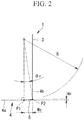
- Fig. 2 illustrates details of the portion A in Fig. 1 .
- the circular arc edge 5 is formed as a circular arc edge for a bottom surface from a position P1 having a tangential line in a direction (the horizontal direction in the drawing) that perpendicularly intersects the central axis line L1 in a bottom surface 4a of the distal end portion 4 of the tool body 3 to a position P2 that intersects the side surface 4b in a vertical section including the central axis line L1 (see Fig. 1 ).
- the circular arc edge 5 may be provided to extend on the side of the central axis line L1 beyond the position P1. In this manner, smooth connection to a bottom edge provided on the side of the central axis line L1 can be achieved.
- a nose R height Hr that is a dimension of the circular arc edge 5 in the direction of the central axis line L1 (the up-down direction in the drawing) is equal to or less than 0.75 mm.
- the nose R that is a radius of the arc forming the circular arc edge 5 is equal to or greater than 1 mm and equal to or less than 1000 mm.
- a nose R angle ⁇ r that is an angular range in which the circular arc edge 5 is formed is equal to or less than 30°.
- the nose R angle ⁇ r is represented by the following equation using the nose R height Hr and the nose R.
- ⁇ r cos ⁇ 1 R ⁇ Hr / R
- the dimension of the circular arc edge 5 in the direction (the horizontal direction in the drawing) that perpendicularly intersects the central axis line L1 corresponds to a regeneration width Wc.
- the regeneration width Wc is a dimension that may become a cause of regenerative self-excited chatter vibrations and means a dimension in the cutting direction in which cutting with one edge is performed, that is, a dimension in a cutting direction (the horizontal direction in Fig. 2 ) in which the circular arc edge 5 and the workpiece are brought into contact with each other.
- the regeneration width Wc increases, influences of vibrations at the time of regeneration of a previous edge increase.
- the regeneration width Wc is represented by the following equation using Equation (2).
- a comparative regeneration width Wc0 that is a comparison target will be defined as the following equation.
- Wc 0 R ⁇ sin cos ⁇ 1 R ⁇ Ad / R
- Ad represents the depth of cut in the direction of the central axis line L1.
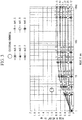
- the following table shows a case in which the nose R height Hr according to this embodiment is arranged such that Wc0/Wc is equal to or greater than two by changing the depth of cut Ad.
- [Table 2] Concerning nose R height Hr Nose R [mm] 1 3 5 10 25.4 50 500 1000 Ad 0.5 0.09 0.11 0.11 0.12 0.12 0.12 0.12 0.12 0.12 0.12 Ad 1.0 0.13 0.21 0.23 0.24 0.24 0.24 0.25 0.25 Ad 1.5 0.13 0.29 0.33 0.35 0.36 0.37 0.37 0.37 Ad 2.0 0.13 0.35 0.41 0.46 0.48 0.49 0.5 0.5 Ad 2.5 0.13 0.39 0.49 0.56 0.6 0.61 0.62 0.62 Ad 3.0 0.13 0.4 0.56 0.66 0.71 0.73 0.75 0.75
- Table 2 can be represented by a graph as in Fig. 3 .
- numerical values of an existing radius endmill adapted such that the nose R height Hr is set to be smaller than the nose R for finishing a bottom surface are plotted for reference.
- stability that is equal to or greater than double the stability in the comparative example can be obtained if the nose R height Hr falls within the following range in a case in which the depth of cut Ad is equal to or less than 3.0 mm and the nose R is equal to or greater than 1 mm and equal to or less than 1000 mm in consideration of maximum cutting that is assumed in rough machining.
- Table 3 can be represented by a graph as in Fig. 4 .
- numerical values of an existing radius endmill adapted such that the nose R height Hr is set to be smaller than the nose R for finishing a bottom surface as illustrated in Fig. 3 are plotted for reference.
- stability that is equal to or greater than double the stability in the comparative example can be obtained if the nose R angle ⁇ r falls within the following range in a case in which the depth of cut Ad is equal to or less than 3.0 mm and the nose R is equal to or greater than 1 mm and equal to or less than 1000 mm in consideration of maximum cutting that is assumed in rough machining.
- the nose R height Hr at this time is R ⁇ (1 - 31/2/2).
- the nose R is determined on the basis of the feed per one edge and required surface roughness required during machining, specifically, required in terms of a drawing.
- the feed rate fz [mm/tooth] is represented by the following equation in a case in which a cutting feed speed of the machine tool is F [mm/min], a spindle rotation frequency of the spindle of the machine tool is S [/min], and the number of teeth is N.
- fz F / S / N
- the cutting feed speed F has a maximum cutting feed speed Fmax, and a maximum spindle rotation frequency Smax is present for the spindle rotation frequency S. It is preferable to perform machining with the cutting feed speed close to Fmax, which is the maximum value, for reducing the machining time.
- the surface roughness Rz is represented by the following equation.
- Rz fz 2 / 8 ⁇ R
- the nose R is represented by the following equation using the surface roughness Rz and the feed rate fz.
- R A ⁇ fz 2 / 8 ⁇ Rz
- A is a coefficient obtained in consideration of practical machining and is equal to or greater than two and equal to or less than four, for example.
- the nose R height Hr is preferably set in consideration not only of a hemstitch height (surface roughness Rz) but also of a vibration amplitude Vr [mm] in the direction of the central axis line L1.
- Hr Rz + Vr
- the nose R is determined by the feed rate fz determined by the cutting feed speedF of the machine tool and the spindle rotation frequency S and the required surface roughness.
- the workpiece that is a target of machining has a shape molded through sheet metal machining and has a thin plate portion, such as a coupling member adapted to couple a body panel and a frame of an aircraft, for example.
- the workpiece before cutting is fixed to a workpiece fixing portion of the machine tool (workpiece fixing process).
- the proximal end portion 7 (see Fig. 1 ) of the radius endmill 1 is fixed to the spindle of the machine tool.
- the radius endmill 1 is caused to rotate about the central axis line L1 by causing the spindle to rotate, thereby cutting the workpiece (machining process). Since the radius endmill 1 according to this embodiment is for machining a bottom surface, cutting is performed by the depth of cut Ad in the direction of the central axis line L1, and the radius endmill 1 is fed at the cutting feed speedF relative to the workpiece in the direction that perpendicularly intersects the central axis line L1.
- the machine tool is controlled in a multiaxial (five axes or six axes, for example) manner, and the workpiece is machined with the radius endmill 1 from different angles at the time of machining. In other words, a plurality of surfaces of the workpiece are machined in one step (one chuck).
- the nose R height Hr that is the dimension of the circular arc edge 5 of the radius endmill 1 for machining a bottom surface in the direction of the central axis line L1 of the tool body 3 to be equal to or less than 0.75 mm
- the feed rate fz is calculated from the spindle rotation frequency S of the spindle of the machine tool and the cutting feed speedF.
- the nose R that is a radius of the circular arc edge 5 of the radius endmill 1 is determined on the basis of the feed rate fz and the required surface roughness Rz required during machining.
- performing machining on the workpiece from different directions with the workpiece fixed means that the machining is performed in the direction vertical to the central axis line L1 of the tool body 3 in a case of machining of a bottom surface while machining is performed in the direction parallel to the central axis line L1 of the tool body 3 in a case of machining of a side surface, for example.
- the vertical direction and the parallel direction are allowed to be inclined within the angular range of the circular arc edge 5.
- the regeneration width in this example is 7 times and three times the regeneration width of the existing radius endmill for rough machining and finishing machining, respectively, and chatter vibrations can be significantly reduced.
- chatter vibrations occurred in the existing radius endmill, while chatter vibrations did not occur in the radius endmill of this example even when the machining was conducted under the same conditions.
- This embodiment is different in that the first embodiment is adapted for machining a bottom surface while this embodiment is adapted for machining a side surface.
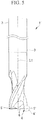
- Fig. 5 illustrates a radius endmill 1' according to this embodiment.
- a circular arc edge 5' is provided on a side surface 4b of a distal end portion of a tool body 3 of the radius endmill 1'.
- the radius endmill 1' in the drawing is for machining a side surface and is adapted to perform cutting and machining in the direction of a central axis line L1 of the tool body 3.
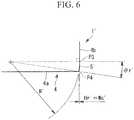
- Fig. 6 illustrates details of the portion A' in Fig. 5 .
- the circular arc edge 5' is formed as a circular arc edge for a side surface from a position P3 having a tangential line in a direction (the up-down direction in the drawing) parallel to the central axis line L1 in the side surface 4b of the distal end portion 4 of the tool body 3 to a position P4 that intersects the bottom surface 4a in a vertical section including the central axis line L1.
- a nose R height Hr' that is the dimension of the circular arc edge 5' in the direction (the horizontal direction in the drawing) that perpendicularly intersects the central axis line L1 is equal to or less than 0.75 mm.
- a nose R' that is the radius of the arc forming the circular arc edge 5' is equal to or greater than 1 mm and equal to or less than 1000 mm.
- a nose R angle ⁇ r' that is an angular range in which the circular arc edge 5' is formed is greater than 0° and equal to or less than 30°.
- the regeneration width Wc' is equal to or less than 1/2 the regeneration width Wc0 in the comparative example in which the regeneration width Wc0 is set in accordance with the dimension corresponding to the depth of cut, similarly to the first embodiment, it is possible to suppress chatter vibrations according to this embodiment.
- the other effects and advantages are also similar to those of the first embodiment.
- This embodiment provides a hybrid-type radius endmill 1" as a combination of the circular arc edge 5 according to the first embodiment adapted for machining a bottom surface and the circular arc edge 5' according to the second embodiment adapted for machining a side surface.
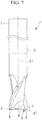
- Fig. 7 illustrates the radius endmill 1" according to this embodiment.
- the circular arc edge 5 is provided on a bottom surface 4a of a distal end portion 4 of a tool body 3 of the radius endmill 1", and the circular arc edge 5' is provided on a side surface 4b.
- the radius endmill 1" in the drawing can perform machining of a bottom surface using the circular arc edge 5 and machining of a side surface using the circular arc edge 5'.
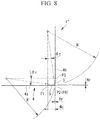
- Fig. 8 illustrates details of the portion A" in Fig. 7 .
- the circular arc edge 5 is formed as a circular arc edge for a bottom surface from the position P1 having a tangential line in the direction (the horizontal direction in the drawing) that perpendicularly intersects the central axis line L1 in the bottom surface 4a of the distal end portion 4 of the tool body 3 to the position P2 that intersects the side surface 4b in a vertical section including the central axis line L1.
- a nose R height Hr that is a dimension of the circular arc edge 5 in the direction (the up-down direction in the drawing) of the central axis line L1 is equal to or less than 0.75 mm.
- a nose R that is a radius of the arc forming the circular arc edge 5 is equal to or greater than 1 mm and equal to or less than 1000 mm.
- a nose R angle ⁇ r that is an angular range in which the circular arc edge 5 is formed is greater than 0° and equal to or less than 30°.
- the circular arc edge 5' is formed as a circular arc edge for a side surface from the position P3 having a tangential line in the direction (the up-down direction in the drawing) parallel to the central axis line L1 in the side surface 4b of the distal end portion 4 of the tool body 3 to the position P4 (the same position as the position P2) that intersects the bottom surface 4a in a vertical section including the central axis line L1.
- a nose R height Hr' that is a dimension of the circular arc edge 5' in the direction (the horizontal direction in the drawing) that perpendicularly intersects the central axis line L1 is equal to or less than 0.75 mm.
- a nose R' that is a radius of the arc forming the circular arc edge 5' is equal to or greater than 1 mm and equal to or less than 1000 mm.
- a nose R angle ⁇ r' that is an angular range in which the circular arc edge 5' is formed is greater than 0° and equal to or less than 30°.
- a regeneration width Wc' is R' ⁇ sin ⁇ r + Hr'.
- the regeneration width Wc' is equal to or less than 1/2 the regeneration width Wc0 in the comparative example in which the regeneration width Wc0 is set in accordance with the dimension corresponding to the depth of cut, similarly to the first embodiment and the second embodiment, it is possible to suppress chatter vibrations according to this embodiment.
- the other effects and advantages are also similar to those of the first embodiment and the second embodiment.
Landscapes
- Engineering & Computer Science (AREA)
- Mechanical Engineering (AREA)
- Milling Processes (AREA)
- Turning (AREA)
Applications Claiming Priority (2)
| Application Number | Priority Date | Filing Date | Title |
|---|---|---|---|
| JP2018078299A JP7075584B2 (ja) | 2018-04-16 | 2018-04-16 | ラジアスエンドミル及びこれを用いた工作機械、並びにラジアスエンドミルの設計方法及び加工方法 |
| PCT/JP2019/015289 WO2019203043A1 (fr) | 2018-04-16 | 2019-04-08 | Fraise en bout à rayon, machine-outil l'utilisant, et procédé de conception ainsi que procédé d'usinage de fraise en bout à rayon |
Publications (2)
| Publication Number | Publication Date |
|---|---|
| EP3736070A1 true EP3736070A1 (fr) | 2020-11-11 |
| EP3736070A4 EP3736070A4 (fr) | 2021-03-24 |
Family
ID=68240127
Family Applications (1)
| Application Number | Title | Priority Date | Filing Date |
|---|---|---|---|
| EP19789340.7A Pending EP3736070A4 (fr) | 2018-04-16 | 2019-04-08 | Fraise en bout à rayon, machine-outil l'utilisant, et procédé de conception ainsi que procédé d'usinage de fraise en bout à rayon |
Country Status (5)
| Country | Link |
|---|---|
| US (1) | US12103093B2 (fr) |
| EP (1) | EP3736070A4 (fr) |
| JP (1) | JP7075584B2 (fr) |
| CN (1) | CN112074366B (fr) |
| WO (1) | WO2019203043A1 (fr) |
Families Citing this family (2)
| Publication number | Priority date | Publication date | Assignee | Title |
|---|---|---|---|---|
| WO2018118414A1 (fr) * | 2016-12-20 | 2018-06-28 | The Procter & Gamble Company | Procédés et appareils pour fabriquer des stratifiés élastomères avec des brins élastiques dotés d'une finition de filage |
| CN115443297A (zh) * | 2020-05-26 | 2022-12-06 | 昭和电工材料株式会社 | 复合物、成型体及固化物 |
Family Cites Families (24)
| Publication number | Priority date | Publication date | Assignee | Title |
|---|---|---|---|---|
| JP2002283121A (ja) | 2001-03-27 | 2002-10-03 | Toyoda Gosei Co Ltd | エンドミル及びそのエンドミルを使用した切削方法 |
| JP2003323204A (ja) * | 2002-04-30 | 2003-11-14 | Okuma Corp | ボールエンドミル工具を用いた加工方法 |
| DE10225481A1 (de) | 2002-06-10 | 2003-12-18 | Sandvik Ab | Fräser mit Wiper-Radius |
| JP2004074397A (ja) * | 2002-06-18 | 2004-03-11 | Toyota Industries Corp | 仕上げ用ラジアスエンドミル |
| DE20310713U1 (de) * | 2003-07-12 | 2003-09-18 | Fette GmbH, 21493 Schwarzenbek | Stirnfräser |
| JP2006212744A (ja) | 2005-02-04 | 2006-08-17 | Nisshin Kogu Kk | エンドミル |
| JP2007038344A (ja) * | 2005-08-03 | 2007-02-15 | Dijet Ind Co Ltd | エンドミル |
| WO2007046132A1 (fr) * | 2005-10-18 | 2007-04-26 | Osg Corporation | Fraise a bout hemispherique |
| US7306408B2 (en) | 2006-01-04 | 2007-12-11 | Sgs Tool Company | Rotary cutting tool |
| IL174775A (en) | 2006-04-04 | 2013-06-27 | Hanita Metal Works Ltd | Milling face |
| DE102006027232B4 (de) * | 2006-06-09 | 2025-08-14 | EMUGE-Werk Richard Glimpel GmbH & Co. KG Fabrik für Präzisionswerkzeuge | Gewindebohrer mit Kantenübergang |
| DE102007010163A1 (de) | 2007-02-28 | 2008-09-04 | Sandvik Intellectual Property Ab | Kugelkopffräser |
| JP5088678B2 (ja) * | 2007-08-31 | 2012-12-05 | 日立ツール株式会社 | ロングネックラジアスエンドミル |
| JP5731102B2 (ja) * | 2009-01-21 | 2015-06-10 | 三菱マテリアル株式会社 | ラジアスエンドミル |
| US9227253B1 (en) * | 2009-03-30 | 2016-01-05 | Steven M. Swift | Rotary cutter for machining materials |
| JP5803647B2 (ja) | 2011-02-16 | 2015-11-04 | 三菱日立ツール株式会社 | エンドミル |
| US9707627B2 (en) * | 2011-12-27 | 2017-07-18 | Kyocera Corporation | Radius end mill |
| US8858128B2 (en) * | 2012-11-14 | 2014-10-14 | Iscar, Ltd. | Corner radius end mill |
| US10058934B2 (en) * | 2014-06-18 | 2018-08-28 | Kyocera Sgs Precision Tools, Inc. | Rotary cutting tool with honed edges |
| US9517515B2 (en) * | 2014-09-15 | 2016-12-13 | Iscar, Ltd. | End mill convex radial relief surface and corner having circular arc profile |
| US20160271706A1 (en) * | 2015-03-18 | 2016-09-22 | Kennametal Inc. | Endmill with convex ramping edge |
| US10131003B2 (en) * | 2015-11-23 | 2018-11-20 | Iscar, Ltd. | Cemented carbide corner radius end mill with continuously curved rake ridge and helical flute design |
| WO2018003684A1 (fr) | 2016-06-27 | 2018-01-04 | 三菱日立ツール株式会社 | Plaquette de coupe et outil de coupe rotatif à bord de coupe remplaçable |
| CN206824730U (zh) | 2017-06-08 | 2018-01-02 | 东莞市高冶切削工具有限公司 | 大进给圆鼻立铣刀 |
-
2018
- 2018-04-16 JP JP2018078299A patent/JP7075584B2/ja active Active
-
2019
- 2019-04-08 US US16/968,658 patent/US12103093B2/en active Active
- 2019-04-08 WO PCT/JP2019/015289 patent/WO2019203043A1/fr not_active Ceased
- 2019-04-08 EP EP19789340.7A patent/EP3736070A4/fr active Pending
- 2019-04-08 CN CN201980013777.2A patent/CN112074366B/zh active Active
Also Published As
| Publication number | Publication date |
|---|---|
| JP2019181644A (ja) | 2019-10-24 |
| US12103093B2 (en) | 2024-10-01 |
| CN112074366A (zh) | 2020-12-11 |
| JP7075584B2 (ja) | 2022-05-26 |
| EP3736070A4 (fr) | 2021-03-24 |
| CN112074366B (zh) | 2024-02-13 |
| US20200406378A1 (en) | 2020-12-31 |
| WO2019203043A1 (fr) | 2019-10-24 |
Similar Documents
| Publication | Publication Date | Title |
|---|---|---|
| KR101549717B1 (ko) | 와이퍼 날을 갖는 절삭 인서트 | |
| EP2554309A1 (fr) | Fraise à queue | |
| JP5108106B2 (ja) | スローアウェイ式切削回転工具 | |
| EP3205431A1 (fr) | Fraise en bout arrondie | |
| JP5198579B2 (ja) | スローアウェイ式切削回転工具 | |
| EP2832483A1 (fr) | Fraise à bout hémisphérique | |
| CN102844139A (zh) | 镶刀及切削工具、以及使用该切削工具的切削加工物的制造方法 | |
| KR101959189B1 (ko) | 절삭 인서트 및 날끝 교환식 회전 절삭 공구 | |
| EP3243588B1 (fr) | Procédé d'usinage d'une partie rainurée | |
| Kull Neto et al. | Tool life and surface roughness in the milling of curved hardened-steel surfaces | |
| US12103093B2 (en) | Radius endmill and machine tool using the same, and designing method and machining method of radius endmill | |
| CA3138082C (fr) | Outil de fraisage et procede d'usinage d'une piece | |
| EP3865237A1 (fr) | Fraise en bout | |
| JP3676594B2 (ja) | スローアウェイチップならびに回転切削工具、および金型形成方法 | |
| EP4431211A1 (fr) | Outil de coupe | |
| EP3812070A1 (fr) | Fraise à queue à rainurer | |
| US20220402085A1 (en) | Machining method | |
| JPWO2010023760A1 (ja) | スローアウェイ式切削回転工具 | |
| JP4378307B2 (ja) | 軸方向送り刃先交換式工具 | |
| JP2005059174A (ja) | 刃先交換式切削工具 | |
| WO2021124698A1 (fr) | Procédé de fraisage | |
| JP7239864B2 (ja) | 切削インサート及び刃先交換式回転切削工具 | |
| JPWO2010061478A1 (ja) | スローアウェイ式切削回転工具 | |
| JP2000301407A (ja) | スローアウェイ式転削工具 |
Legal Events
| Date | Code | Title | Description |
|---|---|---|---|
| STAA | Information on the status of an ep patent application or granted ep patent |
Free format text: STATUS: THE INTERNATIONAL PUBLICATION HAS BEEN MADE |
|
| PUAI | Public reference made under article 153(3) epc to a published international application that has entered the european phase |
Free format text: ORIGINAL CODE: 0009012 |
|
| STAA | Information on the status of an ep patent application or granted ep patent |
Free format text: STATUS: REQUEST FOR EXAMINATION WAS MADE |
|
| 17P | Request for examination filed |
Effective date: 20200807 |
|
| AK | Designated contracting states |
Kind code of ref document: A1 Designated state(s): AL AT BE BG CH CY CZ DE DK EE ES FI FR GB GR HR HU IE IS IT LI LT LU LV MC MK MT NL NO PL PT RO RS SE SI SK SM TR |
|
| AX | Request for extension of the european patent |
Extension state: BA ME |
|
| A4 | Supplementary search report drawn up and despatched |
Effective date: 20210224 |
|
| RIC1 | Information provided on ipc code assigned before grant |
Ipc: B23C 5/10 20060101AFI20210218BHEP |
|
| DAV | Request for validation of the european patent (deleted) | ||
| DAX | Request for extension of the european patent (deleted) | ||
| STAA | Information on the status of an ep patent application or granted ep patent |
Free format text: STATUS: EXAMINATION IS IN PROGRESS |
|
| 17Q | First examination report despatched |
Effective date: 20230817 |