EP3727808B1 - Verfahren zum herstellen eines kunststoffbauteils, sowie kunststoffbauteil - Google Patents
Verfahren zum herstellen eines kunststoffbauteils, sowie kunststoffbauteil Download PDFInfo
- Publication number
- EP3727808B1 EP3727808B1 EP18803633.9A EP18803633A EP3727808B1 EP 3727808 B1 EP3727808 B1 EP 3727808B1 EP 18803633 A EP18803633 A EP 18803633A EP 3727808 B1 EP3727808 B1 EP 3727808B1
- Authority
- EP
- European Patent Office
- Prior art keywords
- plastic
- components
- plastic component
- painted
- processing
- Prior art date
- Legal status (The legal status is an assumption and is not a legal conclusion. Google has not performed a legal analysis and makes no representation as to the accuracy of the status listed.)
- Active
Links
Images

Classifications
-
- B—PERFORMING OPERATIONS; TRANSPORTING
- B29—WORKING OF PLASTICS; WORKING OF SUBSTANCES IN A PLASTIC STATE IN GENERAL
- B29C—SHAPING OR JOINING OF PLASTICS; SHAPING OF MATERIAL IN A PLASTIC STATE, NOT OTHERWISE PROVIDED FOR; AFTER-TREATMENT OF THE SHAPED PRODUCTS, e.g. REPAIRING
- B29C66/00—General aspects of processes or apparatus for joining preformed parts
- B29C66/50—General aspects of joining tubular articles; General aspects of joining long products, i.e. bars or profiled elements; General aspects of joining single elements to tubular articles, hollow articles or bars; General aspects of joining several hollow-preforms to form hollow or tubular articles
- B29C66/51—Joining tubular articles, profiled elements or bars; Joining single elements to tubular articles, hollow articles or bars; Joining several hollow-preforms to form hollow or tubular articles
- B29C66/54—Joining several hollow-preforms, e.g. half-shells, to form hollow articles, e.g. for making balls, containers; Joining several hollow-preforms, e.g. half-cylinders, to form tubular articles
-
- B—PERFORMING OPERATIONS; TRANSPORTING
- B08—CLEANING
- B08B—CLEANING IN GENERAL; PREVENTION OF FOULING IN GENERAL
- B08B7/00—Cleaning by methods not provided for in a single other subclass or a single group in this subclass
- B08B7/0035—Cleaning by methods not provided for in a single other subclass or a single group in this subclass by radiant energy, e.g. UV, laser, light beam or the like
- B08B7/0042—Cleaning by methods not provided for in a single other subclass or a single group in this subclass by radiant energy, e.g. UV, laser, light beam or the like by laser
-
- B—PERFORMING OPERATIONS; TRANSPORTING
- B23—MACHINE TOOLS; METAL-WORKING NOT OTHERWISE PROVIDED FOR
- B23K—SOLDERING OR UNSOLDERING; WELDING; CLADDING OR PLATING BY SOLDERING OR WELDING; CUTTING BY APPLYING HEAT LOCALLY, e.g. FLAME CUTTING; WORKING BY LASER BEAM
- B23K26/00—Working by laser beam, e.g. welding, cutting or boring
- B23K26/0006—Working by laser beam, e.g. welding, cutting or boring taking account of the properties of the material involved
-
- B—PERFORMING OPERATIONS; TRANSPORTING
- B23—MACHINE TOOLS; METAL-WORKING NOT OTHERWISE PROVIDED FOR
- B23K—SOLDERING OR UNSOLDERING; WELDING; CLADDING OR PLATING BY SOLDERING OR WELDING; CUTTING BY APPLYING HEAT LOCALLY, e.g. FLAME CUTTING; WORKING BY LASER BEAM
- B23K26/00—Working by laser beam, e.g. welding, cutting or boring
- B23K26/0093—Working by laser beam, e.g. welding, cutting or boring combined with mechanical machining or metal-working covered by other subclasses than B23K
-
- B—PERFORMING OPERATIONS; TRANSPORTING
- B23—MACHINE TOOLS; METAL-WORKING NOT OTHERWISE PROVIDED FOR
- B23K—SOLDERING OR UNSOLDERING; WELDING; CLADDING OR PLATING BY SOLDERING OR WELDING; CUTTING BY APPLYING HEAT LOCALLY, e.g. FLAME CUTTING; WORKING BY LASER BEAM
- B23K26/00—Working by laser beam, e.g. welding, cutting or boring
- B23K26/36—Removing material
- B23K26/362—Laser etching
-
- B—PERFORMING OPERATIONS; TRANSPORTING
- B23—MACHINE TOOLS; METAL-WORKING NOT OTHERWISE PROVIDED FOR
- B23K—SOLDERING OR UNSOLDERING; WELDING; CLADDING OR PLATING BY SOLDERING OR WELDING; CUTTING BY APPLYING HEAT LOCALLY, e.g. FLAME CUTTING; WORKING BY LASER BEAM
- B23K26/00—Working by laser beam, e.g. welding, cutting or boring
- B23K26/36—Removing material
- B23K26/38—Removing material by boring or cutting
-
- B—PERFORMING OPERATIONS; TRANSPORTING
- B23—MACHINE TOOLS; METAL-WORKING NOT OTHERWISE PROVIDED FOR
- B23K—SOLDERING OR UNSOLDERING; WELDING; CLADDING OR PLATING BY SOLDERING OR WELDING; CUTTING BY APPLYING HEAT LOCALLY, e.g. FLAME CUTTING; WORKING BY LASER BEAM
- B23K26/00—Working by laser beam, e.g. welding, cutting or boring
- B23K26/36—Removing material
- B23K26/38—Removing material by boring or cutting
- B23K26/382—Removing material by boring or cutting by boring
-
- B—PERFORMING OPERATIONS; TRANSPORTING
- B23—MACHINE TOOLS; METAL-WORKING NOT OTHERWISE PROVIDED FOR
- B23K—SOLDERING OR UNSOLDERING; WELDING; CLADDING OR PLATING BY SOLDERING OR WELDING; CUTTING BY APPLYING HEAT LOCALLY, e.g. FLAME CUTTING; WORKING BY LASER BEAM
- B23K26/00—Working by laser beam, e.g. welding, cutting or boring
- B23K26/36—Removing material
- B23K26/40—Removing material taking account of the properties of the material involved
- B23K26/402—Removing material taking account of the properties of the material involved involving non-metallic material, e.g. isolators
-
- B—PERFORMING OPERATIONS; TRANSPORTING
- B29—WORKING OF PLASTICS; WORKING OF SUBSTANCES IN A PLASTIC STATE IN GENERAL
- B29C—SHAPING OR JOINING OF PLASTICS; SHAPING OF MATERIAL IN A PLASTIC STATE, NOT OTHERWISE PROVIDED FOR; AFTER-TREATMENT OF THE SHAPED PRODUCTS, e.g. REPAIRING
- B29C59/00—Surface shaping of articles, e.g. embossing; Apparatus therefor
- B29C59/16—Surface shaping of articles, e.g. embossing; Apparatus therefor by wave energy or particle radiation, e.g. infrared heating
-
- B—PERFORMING OPERATIONS; TRANSPORTING
- B29—WORKING OF PLASTICS; WORKING OF SUBSTANCES IN A PLASTIC STATE IN GENERAL
- B29C—SHAPING OR JOINING OF PLASTICS; SHAPING OF MATERIAL IN A PLASTIC STATE, NOT OTHERWISE PROVIDED FOR; AFTER-TREATMENT OF THE SHAPED PRODUCTS, e.g. REPAIRING
- B29C65/00—Joining or sealing of preformed parts, e.g. welding of plastics materials; Apparatus therefor
- B29C65/56—Joining or sealing of preformed parts, e.g. welding of plastics materials; Apparatus therefor using mechanical means or mechanical connections, e.g. form-fits
- B29C65/562—Joining or sealing of preformed parts, e.g. welding of plastics materials; Apparatus therefor using mechanical means or mechanical connections, e.g. form-fits using extra joining elements, i.e. which are not integral with the parts to be joined
-
- B—PERFORMING OPERATIONS; TRANSPORTING
- B29—WORKING OF PLASTICS; WORKING OF SUBSTANCES IN A PLASTIC STATE IN GENERAL
- B29C—SHAPING OR JOINING OF PLASTICS; SHAPING OF MATERIAL IN A PLASTIC STATE, NOT OTHERWISE PROVIDED FOR; AFTER-TREATMENT OF THE SHAPED PRODUCTS, e.g. REPAIRING
- B29C66/00—General aspects of processes or apparatus for joining preformed parts
- B29C66/01—General aspects dealing with the joint area or with the area to be joined
- B29C66/02—Preparation of the material, in the area to be joined, prior to joining or welding
- B29C66/022—Mechanical pre-treatments, e.g. reshaping
- B29C66/0224—Mechanical pre-treatments, e.g. reshaping with removal of material
- B29C66/02241—Cutting, e.g. by using waterjets, or sawing
- B29C66/02242—Perforating or boring
-
- B—PERFORMING OPERATIONS; TRANSPORTING
- B29—WORKING OF PLASTICS; WORKING OF SUBSTANCES IN A PLASTIC STATE IN GENERAL
- B29C—SHAPING OR JOINING OF PLASTICS; SHAPING OF MATERIAL IN A PLASTIC STATE, NOT OTHERWISE PROVIDED FOR; AFTER-TREATMENT OF THE SHAPED PRODUCTS, e.g. REPAIRING
- B29C66/00—General aspects of processes or apparatus for joining preformed parts
- B29C66/01—General aspects dealing with the joint area or with the area to be joined
- B29C66/02—Preparation of the material, in the area to be joined, prior to joining or welding
- B29C66/024—Thermal pre-treatments
- B29C66/0246—Cutting or perforating, e.g. burning away by using a laser or using hot air
-
- B—PERFORMING OPERATIONS; TRANSPORTING
- B29—WORKING OF PLASTICS; WORKING OF SUBSTANCES IN A PLASTIC STATE IN GENERAL
- B29C—SHAPING OR JOINING OF PLASTICS; SHAPING OF MATERIAL IN A PLASTIC STATE, NOT OTHERWISE PROVIDED FOR; AFTER-TREATMENT OF THE SHAPED PRODUCTS, e.g. REPAIRING
- B29C66/00—General aspects of processes or apparatus for joining preformed parts
- B29C66/01—General aspects dealing with the joint area or with the area to be joined
- B29C66/02—Preparation of the material, in the area to be joined, prior to joining or welding
- B29C66/028—Non-mechanical surface pre-treatments, i.e. by flame treatment, electric discharge treatment, plasma treatment, wave energy or particle radiation
-
- B—PERFORMING OPERATIONS; TRANSPORTING
- B29—WORKING OF PLASTICS; WORKING OF SUBSTANCES IN A PLASTIC STATE IN GENERAL
- B29C—SHAPING OR JOINING OF PLASTICS; SHAPING OF MATERIAL IN A PLASTIC STATE, NOT OTHERWISE PROVIDED FOR; AFTER-TREATMENT OF THE SHAPED PRODUCTS, e.g. REPAIRING
- B29C71/00—After-treatment of articles without altering their shape; Apparatus therefor
- B29C71/04—After-treatment of articles without altering their shape; Apparatus therefor by wave energy or particle radiation, e.g. for curing or vulcanising preformed articles
-
- B—PERFORMING OPERATIONS; TRANSPORTING
- B60—VEHICLES IN GENERAL
- B60J—WINDOWS, WINDSCREENS, NON-FIXED ROOFS, DOORS, OR SIMILAR DEVICES FOR VEHICLES; REMOVABLE EXTERNAL PROTECTIVE COVERINGS SPECIALLY ADAPTED FOR VEHICLES
- B60J5/00—Doors
- B60J5/10—Doors arranged at the vehicle rear
-
- B—PERFORMING OPERATIONS; TRANSPORTING
- B60—VEHICLES IN GENERAL
- B60R—VEHICLES, VEHICLE FITTINGS, OR VEHICLE PARTS, NOT OTHERWISE PROVIDED FOR
- B60R19/00—Wheel guards; Radiator guards, e.g. grilles; Obstruction removers; Fittings damping bouncing force in collisions
- B60R19/02—Bumpers, i.e. impact receiving or absorbing members for protecting vehicles or fending off blows from other vehicles or objects
- B60R19/03—Bumpers, i.e. impact receiving or absorbing members for protecting vehicles or fending off blows from other vehicles or objects characterised by material, e.g. composite
-
- B—PERFORMING OPERATIONS; TRANSPORTING
- B23—MACHINE TOOLS; METAL-WORKING NOT OTHERWISE PROVIDED FOR
- B23K—SOLDERING OR UNSOLDERING; WELDING; CLADDING OR PLATING BY SOLDERING OR WELDING; CUTTING BY APPLYING HEAT LOCALLY, e.g. FLAME CUTTING; WORKING BY LASER BEAM
- B23K2101/00—Articles made by soldering, welding or cutting
- B23K2101/006—Vehicles
-
- B—PERFORMING OPERATIONS; TRANSPORTING
- B23—MACHINE TOOLS; METAL-WORKING NOT OTHERWISE PROVIDED FOR
- B23K—SOLDERING OR UNSOLDERING; WELDING; CLADDING OR PLATING BY SOLDERING OR WELDING; CUTTING BY APPLYING HEAT LOCALLY, e.g. FLAME CUTTING; WORKING BY LASER BEAM
- B23K2103/00—Materials to be soldered, welded or cut
- B23K2103/30—Organic materials
- B23K2103/42—Plastics other than composite materials
-
- B—PERFORMING OPERATIONS; TRANSPORTING
- B29—WORKING OF PLASTICS; WORKING OF SUBSTANCES IN A PLASTIC STATE IN GENERAL
- B29C—SHAPING OR JOINING OF PLASTICS; SHAPING OF MATERIAL IN A PLASTIC STATE, NOT OTHERWISE PROVIDED FOR; AFTER-TREATMENT OF THE SHAPED PRODUCTS, e.g. REPAIRING
- B29C35/00—Heating, cooling or curing, e.g. crosslinking or vulcanising; Apparatus therefor
- B29C35/02—Heating or curing, e.g. crosslinking or vulcanizing during moulding, e.g. in a mould
- B29C35/08—Heating or curing, e.g. crosslinking or vulcanizing during moulding, e.g. in a mould by wave energy or particle radiation
- B29C35/0805—Heating or curing, e.g. crosslinking or vulcanizing during moulding, e.g. in a mould by wave energy or particle radiation using electromagnetic radiation
- B29C2035/0838—Heating or curing, e.g. crosslinking or vulcanizing during moulding, e.g. in a mould by wave energy or particle radiation using electromagnetic radiation using laser
-
- B—PERFORMING OPERATIONS; TRANSPORTING
- B29—WORKING OF PLASTICS; WORKING OF SUBSTANCES IN A PLASTIC STATE IN GENERAL
- B29L—INDEXING SCHEME ASSOCIATED WITH SUBCLASS B29C, RELATING TO PARTICULAR ARTICLES
- B29L2031/00—Other particular articles
- B29L2031/30—Vehicles, e.g. ships or aircraft, or body parts thereof
- B29L2031/3044—Bumpers
-
- B—PERFORMING OPERATIONS; TRANSPORTING
- B29—WORKING OF PLASTICS; WORKING OF SUBSTANCES IN A PLASTIC STATE IN GENERAL
- B29L—INDEXING SCHEME ASSOCIATED WITH SUBCLASS B29C, RELATING TO PARTICULAR ARTICLES
- B29L2031/00—Other particular articles
- B29L2031/30—Vehicles, e.g. ships or aircraft, or body parts thereof
- B29L2031/3055—Cars
Definitions
- the invention is based on a method for producing plastic components for a vehicle, wherein the plastic components are at least partially painted in a painting step and are then connected to other components on the unpainted surfaces.
- the plastic components are connected to other components for reinforcement or cladding or to accommodate functional components.
- the plastic components When the plastic components are used for the body of the vehicle, they are generally painted in the color of the vehicle. The painting takes place immediately after the component has been manufactured from plastic injection molding. When painting the often large-format components, painting lines are used in which robot arms hold the plastic component with or without a frame and expose it to a paint mist.
- This masking process usually has to be done manually, and the removal of the adhesive strips after painting is also done manually.
- the laser has long been an established tool for processing components in many areas of industry. For example, it has been made widely available in the field of surface processing on fiber composite materials over the last 10 years.
- Laser processing generally has the particular advantage that it can be carried out dry and without the use of chemical substances. It is also generally a clean, dust-free processing method that does not cause any material damage. Laser processing has low operating costs and is therefore highly economical.
- the EN 10 2012 204 715 A1 describes a process for a painted plastic component, whereby the plastic component is first painted and then removed with a laser on the inside of the component.
- a CO2 laser processing is known in which the radius of application of a processing device is increased with the help of the robot by connecting a robot to linear axes.
- the laser beam is guided via mirrors in the work head.
- a light source in particular a laser light source, is arranged on this platform and a robot unit is connected to the platform.
- the robot unit has a beam utilization unit at the spatially movable end.
- the beam guidance system contains at least one light beam transmitter that is fixedly or movably connected to the platform and at least one beam receiver that is fixedly or movably connected to the beam utilization unit.
- the beam transmitter and the beam receiver are arranged at a variable distance from each other.
- the painting step is followed by a processing step in which punching and/or drilling is combined with laser ablation.
- the plastic component is combined in a further combination step with other components made of plastic and/or metal and/or composite material in the connection areas.
- connection areas extend continuously along the plastic component contour.
- the object is further achieved with plastic components manufactured according to the method, wherein the plastic components are tailgates, or front modules or rear modules or sill panels of a vehicle.
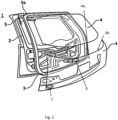
- FIG. 1 the main components of a tailgate 1 are shown, which serves as an example of large-area plastic components.
- the base of the tailgate is a support part 2, which is made, for example, from fiber-reinforced plastics.
- the stiffening frame 3 is a closed form or a non-closed, arbitrary form made of a polyurethane material or other composite materials.
- the trim parts 4 are connected to the support part 2.
- stiffening elements 5 are provided, which in this embodiment are made of metal and are arranged in the area 3a. They are connected separately to the support part 2.
- the trim parts 4 are painted on their visible surfaces 4a.
- the painting can of course also include areas of the edge of the trim parts 4 that remain visible after assembly.
- the trim parts 4 are examples of the plastic components that are mounted on the vehicle with externally visible painted surfaces.
- the machining process is shown schematically in three main steps.
- the machining process should not be limited to these three Main steps are limited.
- the plastic components e.g. the trim parts 4
- the plastic components 4 are processed in different orientations x, y, z, as also shown very schematically below the process steps. Particularly when using painting robots and robot arms that guide the components with or without a frame, the plastic components 4 are held in a wide variety of orientations and painted in this way.
- the processing system 10 in processing step S2 takes over the painted plastic component 4 automatically or manually and contains at least one processing station 10 in which the plastic component 4 is freed of contamination on the unpainted inner side 4b.
- a CO2 laser is used to remove contamination from areas 6 that are required to connect the plastic component 4 to other components.
- drilling holes is also possible with a laser, whereby a single laser can be used to remove the impurities and to drill the holes. Alternatively, two different lasers can be used.
- the processing system used in processing step S2 processes the plastic component 4 preferably in a vertical direction, ie as in the Figure 2 indicated in an orientation along the x-axis.
Landscapes
- Engineering & Computer Science (AREA)
- Mechanical Engineering (AREA)
- Physics & Mathematics (AREA)
- Optics & Photonics (AREA)
- Plasma & Fusion (AREA)
- Thermal Sciences (AREA)
- Health & Medical Sciences (AREA)
- Toxicology (AREA)
- Laser Beam Processing (AREA)
- Application Of Or Painting With Fluid Materials (AREA)
Description
- Die Erfindung geht aus von einem Verfahren zum Herstellen von Kunststoffbauteilen für ein Fahrzeug, wobei die Kunststoffbauteile in einem Lackierschritt mindesten teilweise lackiert werden und anschließend auf den nicht lackierten Flächen mit weiteren Bauteilen verbunden werden.
- Die Erfindung erstreckt sich auf ein Kunststoffbauteil, das nach dem Verfahren hergestellt wird.
- Im Automobilbau werden seit längerer Zeit großformatige Kunststoff Bauteile bzw. Kunststoffbaugruppen verwendet. Für die Karosserie werden dabei Front-oder Heckmodule aus Kunststoff hergestellt, sowie Türen oder Heck klappen oder auch Verkleidungsteile für Schweller oder Fahrzeugsäulen.
- Je nach Aufgabenstellung der großformatigen Kunststoffbauteile oder Kunststoffbaugruppen werden die Kunststoffbauteile mit weiteren Bauteilen zur Verstärkung oder zur Verkleidung oder zur Aufnahme von funktionalen Bauteilen verbunden.
- Aus der
EP 2384917 B1 ist eine solche Fahrzeugkarosseriegruppe bekannt, bei der Bereiche für die Befestigung vorgesehen sind, und wobei das Bauteil aus mehreren Einzel Strukturen zusammengesetzt ist. - Wenn die Kunststoffbauteile für die Karosserie des Fahrzeugs eingesetzt werden, werden sie im Allgemeinen in der Wagenfarbe lackiert. Die Lackierung erfolgt direkt nach der Herstellung des Bauteils aus Kunststoffspritzguss. Beim Lackieren der oftmals großformatigen Bauteile werden Lackierstraßen eingesetzt, in denen Roboterarme die Kunststoffbauteil mit oder ohne Rahmen halten und einem Lackiernebel aussetzen.
- Dabei lässt es sich nicht vermeiden, dass nicht nur die Sichtflächen, die eigentlich lackiert werden sollen, mit Lack versehen werden, sondern dass auch Rückseiten oder verdeckte Flächen durch den sogenannten "Overspray" verunreinigt werden. Dabei handelt es sich um den Niederschlag des Lackiernebels auf dem gesamten Bauteil.
- Da die Kunststoffbauteile nach dem Lackieren weiter verbaut und verarbeitet werden müssen, ist diese Verunreinigung durch das Lackieren schädlich. Gerade bei der Verarbeitung der Kunststoffbauteile mithilfe von Fügeverfahren wie Verschweißen oder Verklebungen sind die Lackiererreste für ein sicheres verarbeiten störend. Um Bereiche auf den Kunstbauteilen frei von Verunreinigungen nach dem lackieren zu halten, werden in der Produktion Klebestreifen, die sog. Maskierhilfsmittel, auf die Bereiche geklebt, die letztendlich für die weitere Verarbeitung des Kunststoffbauteils benötigt werden.
- Dieser Maskierungsprozess muss meist manuell durchgeführt werden, auch das Entfernen der Klebestreifen nach dem Lackieren erfolgt manuell.
- Zur Bearbeitung von Bauteilen belegt der Laser als Bearbeitungsgerät in vielen Bereichen der Industrie seit langem einen festen Platz. Es wurde beispielsweise im Bereich der Oberflächenbearbeitung auf Faserverbundwerkstoffen in den letzten 10 Jahren industriell großflächig nutzbar gemacht.
- Die Laserbearbeitung weist ganz allgemein als besondere Vorteile auf, dass sie trocken und ohne Einsatz von chemischen Substanzen durchgeführt werden kann. Außerdem betrifft es im Allgemeinen ein sauberes, staubfreies Verfahren zur Bearbeitung, bei der zudem keine Materialschädigung stattfindet. Die Laserbearbeitung weist geringe Betriebskosten auf und ist damit im Ergebnis mit einer hohen Wirtschaftlichkeit verbunden.
- Aus der
EP 0 233 755 A1 ist ein Verfahren bekannt, mit dem Formtrennmittel von Kunststoffbauteilen mit Laserlicht entfernt wird. Ziel ist es, die Haftung von Farbe zu verbessern. - Die
DE 10 2012 204 715 A1 beschreibt ein Verfahren für ein lackiertes Kunststoffbauteil, wobei das Kunststoffbauteil zunächst lackiert wird und mit einem Laser an der Bauteilinnenseite abgetragen wird. - Aus der
DE 102009012858 A1 ist eine CO2-Laserbearbeitungen bekannt, bei der durch eine Anbindung eines Roboters an lineare Achsen der Einsatzradius einer Bearbeitungsvorrichtung mit Hilfe des Roboters erhöht wird. Die Führung des Laserstrahls erfolgt über Spiegel im Arbeitskopf. Auf dieser Plattform ist eine Lichtquelle, insbesondere eine Laserlichtquelle angeordnet und eine Roboter-Einheit ist mit der Plattform verbunden. Die Roboter-Einheit weist am räumlich beweglichen Ende eine Strahlverwertereinheit auf. Außerdem ist ein Strahlführungssystem zum Führen des Lichtes von der Lichtquelle bis zur Strahlverwertereinheit, insbesondere Arbeitskopf. Das Strahlführungssystem enthält mindestens einen mit der Plattform fest oder beweglich verbundenen Lichtstrahlsender und mindestens einen mit der Strahlverwertereinheit fest oder beweglich verbundenen Strahlempfänger. Außerdem sind der Strahlsender und der Strahlempfänger zueinander in einem veränderbaren Abstand angeordnet. - Mit einer solchen Anordnung werden Oberflächenbehandlungen ausgeführt. Ausgehend von diesem Stand der Technik ist es die Aufgabe der Erfindung ein Verfahren zur Herstellung von Kunststoffteilen, die lackiert werden vorzustellen, wobei auf einfache Art und Weise Prozessschritte miteinander integriert werden. Weiterhin ist es Aufgabe der Erfindung ein Kunststoffbauteil herzustellen, das besonders einfach und kostengünstig für die Weiterverarbeitung vorbereitet ist.
- Die Aufgabe wird gelöst mit einem Verfahren zum Herstellen von Kunststoffbauteilen für ein Fahrzeug nach Anspruch 1.
- Durch die Verwendung von Lasern zum Abtragen der Verunreinigung auf den Kunststoffbauteilen erspart man sich das Verkleben und Entfernen von Klebestreifen und den Einsatz von menschlicher Arbeitskraft.
- Dabei ist vorgesehen, dass mindestens die Vorderseite des Kunststoffbauteils lackiert wird und auf der Rückseite Verunreinigungen durch Overspray oder gezielte Bereiche auf der Vorderseite mit Laserlicht entfernt werden.
- Erfindungsgemäß erfolgt nach dem Lackierschritt ein Bearbeitungsschritt, in dem Stanzen und/oder Bohren mit einer Laserablation kombiniert ist.
- Durch die Integration der Laserablation in den Bearbeitungsschritt was auch bedeutet, dass eine Maschinenstation für diesen Bearbeitungsschritt verwendet wird, können die Kunststoffbauteile sehr effizient bearbeitet werden. Dabei ist es auch denkbar, dass die Bearbeitungsschritte des Bohrens ebenfalls mit einem Laser ausgeführt werden, wobei derselbe Laserkopf für das Bohren verwendet werden kann, wie für die Laserablation des Oversprays. Allerdings ist auch der Einsatz von zwei unterschiedlichen Laserköpfen, jeweils ihre Aufgabe optimiert, denkbar.
- Erfindungsgemäß wird für den Bearbeitungsschritt das Kunststoffbauteil hochkant gehalten.
- Dabei ist der Vorteil, dass Produktionsfläche eingespart werden kann, wenn die großformatigen Kunststoffbauteile nicht horizontal bearbeitet werden, sondern in einer vertikalen Anordnung.
- Es ist dabei von Vorteil, dass nach dem Bearbeitungsschritt das Kunststoffbauteil in einem weiteren Kombinationsschritt mit weiteren Bauteilen aus Kunststoff und/oder aus Metall und /oder aus Kompositmaterial in den Bereichen zur Verbindung verbunden wird.
- Vorteilhafterweise erstrecken sich die Bereiche zur Verbindung kontinuierlich entlang der Kunststoffbauteilkontur.
- Die Aufgabe wird weiterhin gelöst mit Kunststoffbauteile hergestellt nach dem Verfahren, wobei die Kunststoffbauteile Heckklappen, oder Frontmodule oder Heckmodule oder Schwellverkleidungen eines Fahrzeugs sind.
- Die Erfindung wird in der nachfolgenden Ausführung erläutert und mit Figuren dargestellt.
- Figur 1
- zeigt ein Beispiel einer Fahrzeugheckklappe,
- Figur 2
- zeigt schematisch Herstellungsschritte.
- In
Figur 1 sind die Hauptbestandteile einer Heckklappe 1 dargestellt, die als ein Beispiel für großflächige Kunststoffbauteile dient. Als Basis der Heckklappe dient ein Trägerteil 2, das beispielsweise aus faserverstärkten Kunststoffen hergestellt ist. Der versteifende Rahmen 3 ist eine geschlossene Form oder auch eine nichtgeschlossene, beliebige Form aus einem Polyurethan-Material oder andere Verbundmaterialien. Die Verkleidungsteile 4 werden mit dem Trägerteil 2 verbunden. Zur Versteifung der Heckklappe sind Versteifungselemente 5 vorgesehen, die in diesem Ausführungsbeispiel aus Metall hergestellt sind und im Bereich 3a angeordnet sind. Sie werden getrennt mit dem Trägerteil 2 verbunden. - Die Verkleidungsteile 4 sind dabei auf ihren sichtbaren Flächen 4a lackiert. Die Lackierung kann dabei natürlich auch Bereiche des Rands der Verkleidungsteile 4 umfassen, die nach dem Zusammenbau sichtbar bleiben.
- Auf der Innenseite 4b der Verkleidungsteile 4 sind Bereiche 6 vorhanden, die für die Verbindung des Verkleidungsteils 4 mit dem Trägerteil 2 von Verunreinigungen befreit werden müssen.
- Weiterhin kann das Verkleidungsteil 4 auch Bereiche 7 aufweisen, die für die Aufnahme von Sensoren vorbereitet werden müssen, und ebenfalls vor Verunreinigungen befreit werden.
- Die Verkleidungsteile 4 sind beispielhaft für die Kunststoffbauteile, die am Fahrzeug mit außen sichtbaren Lackflächen montiert sind.
- In
Figur 2 ist schematisch das Bearbeitungsverfahren in den drei Hauptschritten dargestellt. Das Bearbeitungsverfahren soll dabei nicht allein auf diese drei Hauptschritte limitiert sein. In einem ersten Bearbeitungsschritt dem Lackierschritt S1, bzw. in einer ersten Bearbeitungsstation, werden die Kunststoffbauteile, z.B. die Verkleidungsteile 4, lackiert. Dabei werden die Kunststoffbauteile 4, wie ebenfalls sehr schematisch unterhalb der Verfahrensschritte dargestellt, in unterschiedlichen Orientierungen x, y, z bearbeitet. Besonders bei der Verwendung von Lackiererrobotern sowie von Roboterarmen, die die Bauteile mit oder ohne Rahmen führen, werden die Kunststoffbauteile 4 in unterschiedlichsten Orientierungen gehalten und so lackiert. - Die Bearbeitungsanlage 10 im Bearbeitungsschritt S2 übernimmt das lackierte Kunststoffbauteil 4 automatisch oder manuell und enthält mindestens eine Bearbeitungsstation 10, in der das Kunststoffbauteil 4 von Verunreinigungen auf der nicht lackierten Innenseite 4b befreit wird. Dabei wird ein CO2-Laser eingesetzt, um Bereiche 6, die zur Verbindung des Kunststoffbauteils 4 mit weiteren Bauteilen benötigt werden, von der Verunreinigung zu befreien.
- Weiterhin werden auch Bereiche 7, die zur Montage von Funktionsbauteilen wie beispielsweise Sensoren vorgesehen sind, von Verunreinigung befreit.
- Im Bearbeitungsschritt S2 können auch weitere Bearbeitungen wie das Bohren von Löchern, sowie das Stanzen von Ausnehmungen vorgesehen sein. Dabei ist das Bohren von Löchern auch mit einem Laser möglich, wobei ein einziger Laser für das Abtragen der Verunreinigungen und für das Bohren der Löcher verwendet werden kann. Alternativ dazu werden zwei unterschiedliche Laser verwendet.
- Die im Bearbeitungsschritt S2 eingesetzte Bearbeitungsanlage bearbeitet das Kunststoffbauteil 4 vorzugsweise in vertikaler Richtung, d.h. wie in der
Figur 2 angedeutet in einer Ausrichtung entlang der x-Achse. - Durch diese Hochkantanordnung wird Bauraum in der Produktion eingespart. Nahe der Bearbeitungsanlage 10 des Bearbeitungsschrittes S2 kann dann zudem ein Lagerturm 15 für unterschiedliche Stanzwerkzeuge und/oder Bohrwerkzeuge vorgesehen sein, mit der die Station automatisch bestückt werden kann.
- Dadurch ist es möglich im Bearbeitungsschritt S2 an dieser Station ganz unterschiedliche Kunststoffbauteile 4 zu bearbeiten, da ein Austausch der Werkzeuge einfach erfolgen kann und der CO2-Laser leicht auf unterschiedliche Reinigungsaufgaben abgestimmt werden kann.
- Im nächsten Verarbeitungsschritt S3 wird das vorbereitete Kunststoffbauteil 4 mit weiteren Komponenten und weiteren Bauteilen verbunden.
-
- 1 Bauteil
- 2 Trägerteil
- 3 Rahmen
- 3a Bereich des Rahmens
- 4 Verkleidungsteil
- 4a sichtbaren Flächen
- 4b Innenseite
- 5 Verstärkungsteil
- 6 Bereiche für Verbindung
- 7 Bereiche für Funktionen
- S1, S2, S3 Bearbeitungsschritte
- 10 Bearbeitungsanlage
- 15 Lagerturm
Claims (6)
- Verfahren zum Herstellen von Kunststoffbauteilen (4) für ein Fahrzeug, wobei die Kunststoffbauteile (4) in einem Lackierschritt (S1) mindesten teilweise lackiert werden und anschließend auf den nicht lackierten Flächen mit weiteren Bauteilen verbunden werden, wobei ein Bereich (6), der zur Verbindung mit den weiteren Bauteilen dient, durch ein Abtragungsverfahren mit Laserlicht von Verunreinigungen befreit wird und, wobei nach dem Lackierschritt (S1) ein Bearbeitungsschritt (S2) erfolgt, in dem Stanzen und/oder Bohren mit einer Laserablation kombiniert ist, wobei für den Bearbeitungsschritt (S2) das Kunststoffbauteil (4) hochkant gehalten wird.
- Verfahren nach Anspruch 1, dadurch gekennzeichnet, dass mindestens die Vorderseite (4a) des Kunststoffbauteils (4) lackiert wird und auf der Innenseite (4b) Verunreinigungen durch Overspray mit Laserlicht entfernt werden.
- Verfahren nach einem der vorhergehenden Ansprüche, dadurch gekennzeichnet, dass nach dem Bearbeitungsschritt (S2) das Kunststoffbauteil (4) in einem weiteren Kombinationsschritt (S3) mit weiteren Bauteilen aus Kunststoff und/oder aus Metall und /oder aus Verbundmaterial in den Bereichen (6) zur Verbindung verbunden wird.
- Verfahren nach einem der vorhergehenden Ansprüche, dadurch gekennzeichnet, dass die Bereiche (6) zur Verbindung sich kontinuierlich entlang der Kunststoffbauteilkontur erstrecken.
- Verfahren nach einem der vorhergehenden Ansprüche, dadurch gekennzeichnet, dass Bereiche (7) für Funktionen von Verunreinigungen gereinigt werden.
- Kunststoffbauteile hergestellt nach dem Verfahren nach den Ansprüchen 1 bis 5, wobei die Kunststoffbauteile Heckklappen, oder Frontmodule oder Heckmodule oder Schwellverkleidungen eines Fahrzeugs sind.
Applications Claiming Priority (3)
| Application Number | Priority Date | Filing Date | Title |
|---|---|---|---|
| DE102017223376 | 2017-12-20 | ||
| DE102018208715.6A DE102018208715B4 (de) | 2017-12-20 | 2018-06-04 | Verfahren zum Herstellen eines Kunststoffbauteils, sowie Kunststoffbauteil |
| PCT/EP2018/081056 WO2019120758A1 (de) | 2017-12-20 | 2018-11-13 | Verfahren zum herstellen eines kunststoffbauteils, sowie kunststoffbauteil und bearbeitungsanlage |
Publications (2)
| Publication Number | Publication Date |
|---|---|
| EP3727808A1 EP3727808A1 (de) | 2020-10-28 |
| EP3727808B1 true EP3727808B1 (de) | 2024-07-10 |
Family
ID=66768468
Family Applications (1)
| Application Number | Title | Priority Date | Filing Date |
|---|---|---|---|
| EP18803633.9A Active EP3727808B1 (de) | 2017-12-20 | 2018-11-13 | Verfahren zum herstellen eines kunststoffbauteils, sowie kunststoffbauteil |
Country Status (6)
| Country | Link |
|---|---|
| US (1) | US20200338838A1 (de) |
| EP (1) | EP3727808B1 (de) |
| CN (1) | CN111479671A (de) |
| DE (1) | DE102018208715B4 (de) |
| HU (1) | HUE068514T2 (de) |
| WO (1) | WO2019120758A1 (de) |
Families Citing this family (1)
| Publication number | Priority date | Publication date | Assignee | Title |
|---|---|---|---|---|
| USD1034377S1 (en) * | 2023-06-30 | 2024-07-09 | Hyundai Motor Company | Liftgate panel for automobile |
Citations (1)
| Publication number | Priority date | Publication date | Assignee | Title |
|---|---|---|---|---|
| DE102012204715A1 (de) * | 2011-07-12 | 2013-01-17 | Montaplast Gmbh | Herstellungsverfahren für ein lackiertes Kunststoffbauteil, insbesondere ein Karosserieteil eines Kraftfahrzeugs, sowie Vorrichtung zur Durchführung des Verfahrens |
Family Cites Families (19)
| Publication number | Priority date | Publication date | Assignee | Title |
|---|---|---|---|---|
| ES2019931B3 (es) * | 1986-02-14 | 1991-07-16 | Amoco Corp | Tratamiento por laser ultravioleta de superficies moldeadas. |
| DE8717969U1 (de) * | 1987-01-16 | 1991-12-19 | Bystronic Laser AG, Niederönz | Anlage zur Herstellung von Werkstücken |
| US6193046B1 (en) * | 1996-12-25 | 2001-02-27 | Nissan Motor Co., Ltd. | Transfer apparatus transferring body side of automotive vehicle and transfer method thereof |
| DE10242710A1 (de) * | 2002-09-13 | 2004-04-08 | Daimlerchrysler Ag | Verfahren zum Herstellen eines Verbindungsbereiches auf einem Werkstück |
| DE10307309B4 (de) * | 2003-02-20 | 2007-06-14 | Hitachi Via Mechanics, Ltd., Ebina | Vorrichtung und Verfahren zur Bearbeitung von elektrischen Schaltungssubstraten mittels Laser |
| DE102005061562B4 (de) * | 2005-12-22 | 2008-04-24 | Lisa Dräxlmaier GmbH | Verbindung Fensterrahmen- Türkasten |
| DE102006044154A1 (de) * | 2006-09-15 | 2008-05-21 | Behr Gmbh & Co. Kg | Stapelscheibenwärmetauscher zur Ladeluftkühlung |
| DE102008038988B3 (de) * | 2008-08-13 | 2009-09-17 | Kraussmaffei Technologies Gmbh | Stanz- und Beschnittvorrichtung für Kunststoffbauteile |
| KR20110095267A (ko) * | 2008-11-18 | 2011-08-24 | 레르 리키드 쏘시에떼 아노님 뿌르 레드 에렉스뿔라따시옹 데 프로세데 조르즈 클로드 | 고속 레이저 블랭킹을 위한 지지 테이블 프레임 |
| KR20110089356A (ko) * | 2008-11-19 | 2011-08-05 | 어플라이드 머티어리얼스, 인코포레이티드 | 레이저-스크라이빙 도구 구조 |
| DE102009012858A1 (de) | 2009-03-15 | 2010-09-23 | Slcr Lasertechnik Gmbh | Vorrichtung zur Bearbeitung eines Bauteils |
| WO2010144630A1 (en) * | 2009-06-09 | 2010-12-16 | Lean Tool Systems, Llc | Gauge system for workpiece processing |
| FR2959720B1 (fr) | 2010-05-05 | 2012-08-10 | Faurecia Bloc Avant | Ensemble modulaire de carrosserie de vehicule automobile |
| JP5712291B2 (ja) * | 2011-07-12 | 2015-05-07 | 本田技研工業株式会社 | 車両のサイドアウタパネル |
| US9481130B2 (en) * | 2012-03-14 | 2016-11-01 | Inteva Products, Llc | Method of permanently joining plastic components and a plastic component joining assembly |
| DE102012006502A1 (de) * | 2012-03-29 | 2013-10-02 | Dula-Werke Dustmann & Co. Gmbh | Verfahren zum mehrstufigen Schleifen von Werkstücken, sowie Vakuumtisch, Vorratsbehälter, Abstreifeinrichtung und Anlage zur Durchführung des Verfahrens |
| US9991090B2 (en) * | 2012-11-15 | 2018-06-05 | Fei Company | Dual laser beam system used with an electron microscope and FIB |
| US20160288735A1 (en) * | 2015-04-02 | 2016-10-06 | Honda Motor Co., Ltd. | Exterior assembly and method for coupling an exterior assembly to a vehicular frame |
| US10180247B1 (en) * | 2017-07-03 | 2019-01-15 | Valeo North America, Inc. | Device and method for placement of light source on a heat sink |
-
2018
- 2018-06-04 DE DE102018208715.6A patent/DE102018208715B4/de active Active
- 2018-11-13 WO PCT/EP2018/081056 patent/WO2019120758A1/de not_active Ceased
- 2018-11-13 CN CN201880080875.3A patent/CN111479671A/zh active Pending
- 2018-11-13 EP EP18803633.9A patent/EP3727808B1/de active Active
- 2018-11-13 HU HUE18803633A patent/HUE068514T2/hu unknown
- 2018-11-13 US US16/955,819 patent/US20200338838A1/en not_active Abandoned
Patent Citations (1)
| Publication number | Priority date | Publication date | Assignee | Title |
|---|---|---|---|---|
| DE102012204715A1 (de) * | 2011-07-12 | 2013-01-17 | Montaplast Gmbh | Herstellungsverfahren für ein lackiertes Kunststoffbauteil, insbesondere ein Karosserieteil eines Kraftfahrzeugs, sowie Vorrichtung zur Durchführung des Verfahrens |
Also Published As
| Publication number | Publication date |
|---|---|
| EP3727808A1 (de) | 2020-10-28 |
| DE102018208715A1 (de) | 2019-06-27 |
| HUE068514T2 (hu) | 2024-12-28 |
| DE102018208715B4 (de) | 2025-06-18 |
| WO2019120758A1 (de) | 2019-06-27 |
| CN111479671A (zh) | 2020-07-31 |
| US20200338838A1 (en) | 2020-10-29 |
Similar Documents
| Publication | Publication Date | Title |
|---|---|---|
| DE60319123T2 (de) | Tragendes fahrzeugdachsystem | |
| DE102013113230A1 (de) | Verfahren zur Herstellung eines Außenverkleidungsteils für ein bewegbares Karosserieteil sowie ein entsprechendes Außenverkleidungsteil | |
| EP1319581B1 (de) | Kotflügel aus Kunststoff an Kraftfahrzeugen | |
| DE10146694B4 (de) | Verkleidungselement für das Dach eines Fahrzeuginnenraums | |
| DE102007058783B4 (de) | Fahrzeugkarosserie mit einem Karosserieelement und Verfahren zum Herstellen der Fahrzeugkarosserie | |
| EP3110664A1 (de) | Befestigungsanordnung für ein dachanbauteil eines kraftfahrzeugs | |
| DE102022119353A1 (de) | Kraftfahrzeug mit einem Dachholm, einer Windschutzscheibe und einem Dachmodul | |
| DE102021122873B4 (de) | Dachmodul zur Bildung eines Fahrzeugdachs mit einer Reinigungseinrichtung | |
| EP3727808B1 (de) | Verfahren zum herstellen eines kunststoffbauteils, sowie kunststoffbauteil | |
| EP2832627B1 (de) | Verfahren zum Aufbau eines Nutzfahrzeug-Fahrerhauses | |
| EP3587084B1 (de) | Verfahren zum herstellen eines kunststoffbauteils | |
| DE102019219129A1 (de) | Verfahren zur Herstellung eines Fahrzeugs | |
| DE102018215366A1 (de) | Fahrzeugkarosserie | |
| DE4015827C2 (de) | ||
| DE19952318A1 (de) | Verfahren und Vorrichtung zum Entfernen eines Üerzugsfilms von einem Kunststoffstossfänger eines Kraftfahrzeugs | |
| DE102020131219A1 (de) | Fahrzeugdach mit lackiertem starren Dachmodul | |
| DE10105168A1 (de) | Fahrzeugdach | |
| DE112013004737T5 (de) | Verfahren zur Bildung geklebter Strukturen und hierdurch gebildete geklebte Strukturen | |
| EP3849853B1 (de) | Karosseriestruktur für ein fahrzeug | |
| DE102018215365B4 (de) | Verfahren zum Einbau einer Sicherheitsgurtanordnung in eine Fahrzeugkarosserie | |
| DE102019214260A1 (de) | Verfahren zur Herstellung eines Fahrzeugs sowie Prozessanordnung | |
| DE102015000748B4 (de) | Befestigungsanordnung einer Radlaufschale an einem Karosseriebauteil eines Kraftfahrzeugs, insbesondere Personenkraftfahrzeugs | |
| DE112023004105T5 (de) | Fahrzeugdach mit Dichtsystem und Verfahren zu dessen Herstellung | |
| DE102014016194A1 (de) | Türeinstieg für ein Fahrzeug | |
| WO2023227406A1 (de) | Kraftfahrzeugkarosserie, verfahren zum herstellen einer kraftfahrzeugkarosserie sowie kraftfahrzeug |
Legal Events
| Date | Code | Title | Description |
|---|---|---|---|
| STAA | Information on the status of an ep patent application or granted ep patent |
Free format text: STATUS: UNKNOWN |
|
| STAA | Information on the status of an ep patent application or granted ep patent |
Free format text: STATUS: THE INTERNATIONAL PUBLICATION HAS BEEN MADE |
|
| PUAI | Public reference made under article 153(3) epc to a published international application that has entered the european phase |
Free format text: ORIGINAL CODE: 0009012 |
|
| STAA | Information on the status of an ep patent application or granted ep patent |
Free format text: STATUS: REQUEST FOR EXAMINATION WAS MADE |
|
| 17P | Request for examination filed |
Effective date: 20200703 |
|
| AK | Designated contracting states |
Kind code of ref document: A1 Designated state(s): AL AT BE BG CH CY CZ DE DK EE ES FI FR GB GR HR HU IE IS IT LI LT LU LV MC MK MT NL NO PL PT RO RS SE SI SK SM TR |
|
| AX | Request for extension of the european patent |
Extension state: BA ME |
|
| DAV | Request for validation of the european patent (deleted) | ||
| DAX | Request for extension of the european patent (deleted) | ||
| STAA | Information on the status of an ep patent application or granted ep patent |
Free format text: STATUS: EXAMINATION IS IN PROGRESS |
|
| 17Q | First examination report despatched |
Effective date: 20210712 |
|
| REG | Reference to a national code |
Ref country code: DE Ref legal event code: R079 Free format text: PREVIOUS MAIN CLASS: B29C0065560000 Ipc: B08B0007000000 Ref country code: DE Ref legal event code: R079 Ref document number: 502018014846 Country of ref document: DE Free format text: PREVIOUS MAIN CLASS: B29C0065560000 Ipc: B08B0007000000 |
|
| GRAP | Despatch of communication of intention to grant a patent |
Free format text: ORIGINAL CODE: EPIDOSNIGR1 |
|
| STAA | Information on the status of an ep patent application or granted ep patent |
Free format text: STATUS: GRANT OF PATENT IS INTENDED |
|
| RIC1 | Information provided on ipc code assigned before grant |
Ipc: B29C 35/08 20060101ALN20240212BHEP Ipc: B23K 26/402 20140101ALI20240212BHEP Ipc: B29C 71/04 20060101ALI20240212BHEP Ipc: B29C 65/56 20060101ALI20240212BHEP Ipc: B23K 26/40 20140101ALI20240212BHEP Ipc: B08B 7/00 20060101AFI20240212BHEP |
|
| INTG | Intention to grant announced |
Effective date: 20240315 |
|
| GRAS | Grant fee paid |
Free format text: ORIGINAL CODE: EPIDOSNIGR3 |
|
| GRAA | (expected) grant |
Free format text: ORIGINAL CODE: 0009210 |
|
| STAA | Information on the status of an ep patent application or granted ep patent |
Free format text: STATUS: THE PATENT HAS BEEN GRANTED |
|
| AK | Designated contracting states |
Kind code of ref document: B1 Designated state(s): AL AT BE BG CH CY CZ DE DK EE ES FI FR GB GR HR HU IE IS IT LI LT LU LV MC MK MT NL NO PL PT RO RS SE SI SK SM TR |
|
| REG | Reference to a national code |
Ref country code: CH Ref legal event code: EP |
|
| REG | Reference to a national code |
Ref country code: DE Ref legal event code: R096 Ref document number: 502018014846 Country of ref document: DE |
|
| REG | Reference to a national code |
Ref country code: LT Ref legal event code: MG9D |
|
| REG | Reference to a national code |
Ref country code: NL Ref legal event code: MP Effective date: 20240710 |
|
| REG | Reference to a national code |
Ref country code: SK Ref legal event code: T3 Ref document number: E 45030 Country of ref document: SK |
|
| PG25 | Lapsed in a contracting state [announced via postgrant information from national office to epo] |
Ref country code: PT Free format text: LAPSE BECAUSE OF FAILURE TO SUBMIT A TRANSLATION OF THE DESCRIPTION OR TO PAY THE FEE WITHIN THE PRESCRIBED TIME-LIMIT Effective date: 20241111 |
|
| PG25 | Lapsed in a contracting state [announced via postgrant information from national office to epo] |
Ref country code: NL Free format text: LAPSE BECAUSE OF FAILURE TO SUBMIT A TRANSLATION OF THE DESCRIPTION OR TO PAY THE FEE WITHIN THE PRESCRIBED TIME-LIMIT Effective date: 20240710 |
|
| REG | Reference to a national code |
Ref country code: HU Ref legal event code: AG4A Ref document number: E068514 Country of ref document: HU |
|
| PG25 | Lapsed in a contracting state [announced via postgrant information from national office to epo] |
Ref country code: PT Free format text: LAPSE BECAUSE OF FAILURE TO SUBMIT A TRANSLATION OF THE DESCRIPTION OR TO PAY THE FEE WITHIN THE PRESCRIBED TIME-LIMIT Effective date: 20241111 Ref country code: NL Free format text: LAPSE BECAUSE OF FAILURE TO SUBMIT A TRANSLATION OF THE DESCRIPTION OR TO PAY THE FEE WITHIN THE PRESCRIBED TIME-LIMIT Effective date: 20240710 |
|
| PGFP | Annual fee paid to national office [announced via postgrant information from national office to epo] |
Ref country code: HU Payment date: 20241121 Year of fee payment: 7 |
|
| PG25 | Lapsed in a contracting state [announced via postgrant information from national office to epo] |
Ref country code: NO Free format text: LAPSE BECAUSE OF FAILURE TO SUBMIT A TRANSLATION OF THE DESCRIPTION OR TO PAY THE FEE WITHIN THE PRESCRIBED TIME-LIMIT Effective date: 20241010 |
|
| PG25 | Lapsed in a contracting state [announced via postgrant information from national office to epo] |
Ref country code: FI Free format text: LAPSE BECAUSE OF FAILURE TO SUBMIT A TRANSLATION OF THE DESCRIPTION OR TO PAY THE FEE WITHIN THE PRESCRIBED TIME-LIMIT Effective date: 20240710 Ref country code: PL Free format text: LAPSE BECAUSE OF FAILURE TO SUBMIT A TRANSLATION OF THE DESCRIPTION OR TO PAY THE FEE WITHIN THE PRESCRIBED TIME-LIMIT Effective date: 20240710 Ref country code: GR Free format text: LAPSE BECAUSE OF FAILURE TO SUBMIT A TRANSLATION OF THE DESCRIPTION OR TO PAY THE FEE WITHIN THE PRESCRIBED TIME-LIMIT Effective date: 20241011 |
|
| PGFP | Annual fee paid to national office [announced via postgrant information from national office to epo] |
Ref country code: GB Payment date: 20241120 Year of fee payment: 7 |
|
| PG25 | Lapsed in a contracting state [announced via postgrant information from national office to epo] |
Ref country code: BG Free format text: LAPSE BECAUSE OF FAILURE TO SUBMIT A TRANSLATION OF THE DESCRIPTION OR TO PAY THE FEE WITHIN THE PRESCRIBED TIME-LIMIT Effective date: 20240710 |
|
| PGFP | Annual fee paid to national office [announced via postgrant information from national office to epo] |
Ref country code: FR Payment date: 20241128 Year of fee payment: 7 |
|
| PG25 | Lapsed in a contracting state [announced via postgrant information from national office to epo] |
Ref country code: LV Free format text: LAPSE BECAUSE OF FAILURE TO SUBMIT A TRANSLATION OF THE DESCRIPTION OR TO PAY THE FEE WITHIN THE PRESCRIBED TIME-LIMIT Effective date: 20240710 |
|
| PG25 | Lapsed in a contracting state [announced via postgrant information from national office to epo] |
Ref country code: IS Free format text: LAPSE BECAUSE OF FAILURE TO SUBMIT A TRANSLATION OF THE DESCRIPTION OR TO PAY THE FEE WITHIN THE PRESCRIBED TIME-LIMIT Effective date: 20241110 |
|
| PG25 | Lapsed in a contracting state [announced via postgrant information from national office to epo] |
Ref country code: HR Free format text: LAPSE BECAUSE OF FAILURE TO SUBMIT A TRANSLATION OF THE DESCRIPTION OR TO PAY THE FEE WITHIN THE PRESCRIBED TIME-LIMIT Effective date: 20240710 |
|
| PGFP | Annual fee paid to national office [announced via postgrant information from national office to epo] |
Ref country code: SK Payment date: 20241106 Year of fee payment: 7 |
|
| PG25 | Lapsed in a contracting state [announced via postgrant information from national office to epo] |
Ref country code: ES Free format text: LAPSE BECAUSE OF FAILURE TO SUBMIT A TRANSLATION OF THE DESCRIPTION OR TO PAY THE FEE WITHIN THE PRESCRIBED TIME-LIMIT Effective date: 20240710 Ref country code: RS Free format text: LAPSE BECAUSE OF FAILURE TO SUBMIT A TRANSLATION OF THE DESCRIPTION OR TO PAY THE FEE WITHIN THE PRESCRIBED TIME-LIMIT Effective date: 20241010 |
|
| PG25 | Lapsed in a contracting state [announced via postgrant information from national office to epo] |
Ref country code: RS Free format text: LAPSE BECAUSE OF FAILURE TO SUBMIT A TRANSLATION OF THE DESCRIPTION OR TO PAY THE FEE WITHIN THE PRESCRIBED TIME-LIMIT Effective date: 20241010 Ref country code: PL Free format text: LAPSE BECAUSE OF FAILURE TO SUBMIT A TRANSLATION OF THE DESCRIPTION OR TO PAY THE FEE WITHIN THE PRESCRIBED TIME-LIMIT Effective date: 20240710 Ref country code: NO Free format text: LAPSE BECAUSE OF FAILURE TO SUBMIT A TRANSLATION OF THE DESCRIPTION OR TO PAY THE FEE WITHIN THE PRESCRIBED TIME-LIMIT Effective date: 20241010 Ref country code: LV Free format text: LAPSE BECAUSE OF FAILURE TO SUBMIT A TRANSLATION OF THE DESCRIPTION OR TO PAY THE FEE WITHIN THE PRESCRIBED TIME-LIMIT Effective date: 20240710 Ref country code: IS Free format text: LAPSE BECAUSE OF FAILURE TO SUBMIT A TRANSLATION OF THE DESCRIPTION OR TO PAY THE FEE WITHIN THE PRESCRIBED TIME-LIMIT Effective date: 20241110 Ref country code: HR Free format text: LAPSE BECAUSE OF FAILURE TO SUBMIT A TRANSLATION OF THE DESCRIPTION OR TO PAY THE FEE WITHIN THE PRESCRIBED TIME-LIMIT Effective date: 20240710 Ref country code: GR Free format text: LAPSE BECAUSE OF FAILURE TO SUBMIT A TRANSLATION OF THE DESCRIPTION OR TO PAY THE FEE WITHIN THE PRESCRIBED TIME-LIMIT Effective date: 20241011 Ref country code: FI Free format text: LAPSE BECAUSE OF FAILURE TO SUBMIT A TRANSLATION OF THE DESCRIPTION OR TO PAY THE FEE WITHIN THE PRESCRIBED TIME-LIMIT Effective date: 20240710 Ref country code: ES Free format text: LAPSE BECAUSE OF FAILURE TO SUBMIT A TRANSLATION OF THE DESCRIPTION OR TO PAY THE FEE WITHIN THE PRESCRIBED TIME-LIMIT Effective date: 20240710 Ref country code: BG Free format text: LAPSE BECAUSE OF FAILURE TO SUBMIT A TRANSLATION OF THE DESCRIPTION OR TO PAY THE FEE WITHIN THE PRESCRIBED TIME-LIMIT Effective date: 20240710 |
|
| REG | Reference to a national code |
Ref country code: DE Ref legal event code: R097 Ref document number: 502018014846 Country of ref document: DE |
|
| PG25 | Lapsed in a contracting state [announced via postgrant information from national office to epo] |
Ref country code: SM Free format text: LAPSE BECAUSE OF FAILURE TO SUBMIT A TRANSLATION OF THE DESCRIPTION OR TO PAY THE FEE WITHIN THE PRESCRIBED TIME-LIMIT Effective date: 20240710 Ref country code: RO Free format text: LAPSE BECAUSE OF FAILURE TO SUBMIT A TRANSLATION OF THE DESCRIPTION OR TO PAY THE FEE WITHIN THE PRESCRIBED TIME-LIMIT Effective date: 20240710 Ref country code: DK Free format text: LAPSE BECAUSE OF FAILURE TO SUBMIT A TRANSLATION OF THE DESCRIPTION OR TO PAY THE FEE WITHIN THE PRESCRIBED TIME-LIMIT Effective date: 20240710 |
|
| PG25 | Lapsed in a contracting state [announced via postgrant information from national office to epo] |
Ref country code: EE Free format text: LAPSE BECAUSE OF FAILURE TO SUBMIT A TRANSLATION OF THE DESCRIPTION OR TO PAY THE FEE WITHIN THE PRESCRIBED TIME-LIMIT Effective date: 20240710 |
|
| PG25 | Lapsed in a contracting state [announced via postgrant information from national office to epo] |
Ref country code: IT Free format text: LAPSE BECAUSE OF FAILURE TO SUBMIT A TRANSLATION OF THE DESCRIPTION OR TO PAY THE FEE WITHIN THE PRESCRIBED TIME-LIMIT Effective date: 20240710 |
|
| REG | Reference to a national code |
Ref country code: DE Ref legal event code: R082 Ref document number: 502018014846 Country of ref document: DE Representative=s name: EULER, MATTHIAS, DR., DE |
|
| PLBE | No opposition filed within time limit |
Free format text: ORIGINAL CODE: 0009261 |
|
| STAA | Information on the status of an ep patent application or granted ep patent |
Free format text: STATUS: NO OPPOSITION FILED WITHIN TIME LIMIT |
|
| 26N | No opposition filed |
Effective date: 20250411 |
|
| REG | Reference to a national code |
Ref country code: CH Ref legal event code: PL |
|
| PG25 | Lapsed in a contracting state [announced via postgrant information from national office to epo] |
Ref country code: MC Free format text: LAPSE BECAUSE OF FAILURE TO SUBMIT A TRANSLATION OF THE DESCRIPTION OR TO PAY THE FEE WITHIN THE PRESCRIBED TIME-LIMIT Effective date: 20240710 |
|
| PG25 | Lapsed in a contracting state [announced via postgrant information from national office to epo] |
Ref country code: LU Free format text: LAPSE BECAUSE OF NON-PAYMENT OF DUE FEES Effective date: 20241113 |
|
| REG | Reference to a national code |
Ref country code: CH Ref legal event code: PL |
|
| PG25 | Lapsed in a contracting state [announced via postgrant information from national office to epo] |
Ref country code: CH Free format text: LAPSE BECAUSE OF NON-PAYMENT OF DUE FEES Effective date: 20241130 |
|
| REG | Reference to a national code |
Ref country code: BE Ref legal event code: MM Effective date: 20241130 |
|
| PG25 | Lapsed in a contracting state [announced via postgrant information from national office to epo] |
Ref country code: SE Free format text: LAPSE BECAUSE OF FAILURE TO SUBMIT A TRANSLATION OF THE DESCRIPTION OR TO PAY THE FEE WITHIN THE PRESCRIBED TIME-LIMIT Effective date: 20240710 |
|
| PG25 | Lapsed in a contracting state [announced via postgrant information from national office to epo] |
Ref country code: BE Free format text: LAPSE BECAUSE OF NON-PAYMENT OF DUE FEES Effective date: 20241130 |
|
| PG25 | Lapsed in a contracting state [announced via postgrant information from national office to epo] |
Ref country code: IE Free format text: LAPSE BECAUSE OF NON-PAYMENT OF DUE FEES Effective date: 20241113 |
|
| PGFP | Annual fee paid to national office [announced via postgrant information from national office to epo] |
Ref country code: DE Payment date: 20251119 Year of fee payment: 8 |
|
| PG25 | Lapsed in a contracting state [announced via postgrant information from national office to epo] |
Ref country code: AT Free format text: LAPSE BECAUSE OF NON-PAYMENT OF DUE FEES Effective date: 20241113 |
|
| REG | Reference to a national code |
Ref country code: AT Ref legal event code: MM01 Ref document number: 1701608 Country of ref document: AT Kind code of ref document: T Effective date: 20241113 |
|
| PGFP | Annual fee paid to national office [announced via postgrant information from national office to epo] |
Ref country code: CZ Payment date: 20251105 Year of fee payment: 8 |
|
| PG25 | Lapsed in a contracting state [announced via postgrant information from national office to epo] |
Ref country code: CY Free format text: LAPSE BECAUSE OF FAILURE TO SUBMIT A TRANSLATION OF THE DESCRIPTION OR TO PAY THE FEE WITHIN THE PRESCRIBED TIME-LIMIT; INVALID AB INITIO Effective date: 20181113 |