EP3725366B1 - Elektrisches kontaktbauteil - Google Patents
Elektrisches kontaktbauteil Download PDFInfo
- Publication number
- EP3725366B1 EP3725366B1 EP19180525.8A EP19180525A EP3725366B1 EP 3725366 B1 EP3725366 B1 EP 3725366B1 EP 19180525 A EP19180525 A EP 19180525A EP 3725366 B1 EP3725366 B1 EP 3725366B1
- Authority
- EP
- European Patent Office
- Prior art keywords
- electrical contact
- contact
- electrical
- cage
- contact component
- Prior art date
- Legal status (The legal status is an assumption and is not a legal conclusion. Google has not performed a legal analysis and makes no representation as to the accuracy of the status listed.)
- Active
Links
Images


Classifications
-
- A—HUMAN NECESSITIES
- A61—MEDICAL OR VETERINARY SCIENCE; HYGIENE
- A61N—ELECTROTHERAPY; MAGNETOTHERAPY; RADIATION THERAPY; ULTRASOUND THERAPY
- A61N1/00—Electrotherapy; Circuits therefor
- A61N1/18—Applying electric currents by contact electrodes
- A61N1/32—Applying electric currents by contact electrodes alternating or intermittent currents
- A61N1/36—Applying electric currents by contact electrodes alternating or intermittent currents for stimulation
- A61N1/372—Arrangements in connection with the implantation of stimulators
- A61N1/375—Constructional arrangements, e.g. casings
- A61N1/3752—Details of casing-lead connections
-
- H—ELECTRICITY
- H01—ELECTRIC ELEMENTS
- H01R—ELECTRICALLY-CONDUCTIVE CONNECTIONS; STRUCTURAL ASSOCIATIONS OF A PLURALITY OF MUTUALLY-INSULATED ELECTRICAL CONNECTING ELEMENTS; COUPLING DEVICES; CURRENT COLLECTORS
- H01R13/00—Details of coupling devices of the kinds covered by groups H01R12/70 or H01R24/00 - H01R33/00
- H01R13/02—Contact members
- H01R13/10—Sockets for co-operation with pins or blades
- H01R13/11—Resilient sockets
- H01R13/111—Resilient sockets co-operating with pins having a circular transverse section
-
- H—ELECTRICITY
- H01—ELECTRIC ELEMENTS
- H01R—ELECTRICALLY-CONDUCTIVE CONNECTIONS; STRUCTURAL ASSOCIATIONS OF A PLURALITY OF MUTUALLY-INSULATED ELECTRICAL CONNECTING ELEMENTS; COUPLING DEVICES; CURRENT COLLECTORS
- H01R13/00—Details of coupling devices of the kinds covered by groups H01R12/70 or H01R24/00 - H01R33/00
- H01R13/02—Contact members
- H01R13/22—Contacts for co-operating by abutting
- H01R13/24—Contacts for co-operating by abutting resilient; resiliently-mounted
- H01R13/2407—Contacts for co-operating by abutting resilient; resiliently-mounted characterized by the resilient means
- H01R13/2421—Contacts for co-operating by abutting resilient; resiliently-mounted characterized by the resilient means using coil springs
-
- H—ELECTRICITY
- H01—ELECTRIC ELEMENTS
- H01R—ELECTRICALLY-CONDUCTIVE CONNECTIONS; STRUCTURAL ASSOCIATIONS OF A PLURALITY OF MUTUALLY-INSULATED ELECTRICAL CONNECTING ELEMENTS; COUPLING DEVICES; CURRENT COLLECTORS
- H01R13/00—Details of coupling devices of the kinds covered by groups H01R12/70 or H01R24/00 - H01R33/00
- H01R13/02—Contact members
- H01R13/22—Contacts for co-operating by abutting
- H01R13/24—Contacts for co-operating by abutting resilient; resiliently-mounted
- H01R13/2464—Contacts for co-operating by abutting resilient; resiliently-mounted characterized by the contact point
- H01R13/2492—Contacts for co-operating by abutting resilient; resiliently-mounted characterized by the contact point multiple contact points
-
- H—ELECTRICITY
- H01—ELECTRIC ELEMENTS
- H01R—ELECTRICALLY-CONDUCTIVE CONNECTIONS; STRUCTURAL ASSOCIATIONS OF A PLURALITY OF MUTUALLY-INSULATED ELECTRICAL CONNECTING ELEMENTS; COUPLING DEVICES; CURRENT COLLECTORS
- H01R13/00—Details of coupling devices of the kinds covered by groups H01R12/70 or H01R24/00 - H01R33/00
- H01R13/46—Bases; Cases
- H01R13/502—Bases; Cases composed of different pieces
-
- H—ELECTRICITY
- H01—ELECTRIC ELEMENTS
- H01R—ELECTRICALLY-CONDUCTIVE CONNECTIONS; STRUCTURAL ASSOCIATIONS OF A PLURALITY OF MUTUALLY-INSULATED ELECTRICAL CONNECTING ELEMENTS; COUPLING DEVICES; CURRENT COLLECTORS
- H01R13/00—Details of coupling devices of the kinds covered by groups H01R12/70 or H01R24/00 - H01R33/00
- H01R13/02—Contact members
- H01R13/22—Contacts for co-operating by abutting
- H01R13/24—Contacts for co-operating by abutting resilient; resiliently-mounted
- H01R13/2464—Contacts for co-operating by abutting resilient; resiliently-mounted characterized by the contact point
- H01R13/2478—Contacts for co-operating by abutting resilient; resiliently-mounted characterized by the contact point spherical
-
- H—ELECTRICITY
- H01—ELECTRIC ELEMENTS
- H01R—ELECTRICALLY-CONDUCTIVE CONNECTIONS; STRUCTURAL ASSOCIATIONS OF A PLURALITY OF MUTUALLY-INSULATED ELECTRICAL CONNECTING ELEMENTS; COUPLING DEVICES; CURRENT COLLECTORS
- H01R2201/00—Connectors or connections adapted for particular applications
- H01R2201/12—Connectors or connections adapted for particular applications for medicine and surgery
-
- H—ELECTRICITY
- H01—ELECTRIC ELEMENTS
- H01R—ELECTRICALLY-CONDUCTIVE CONNECTIONS; STRUCTURAL ASSOCIATIONS OF A PLURALITY OF MUTUALLY-INSULATED ELECTRICAL CONNECTING ELEMENTS; COUPLING DEVICES; CURRENT COLLECTORS
- H01R24/00—Two-part coupling devices, or either of their cooperating parts, characterised by their overall structure
- H01R24/58—Contacts spaced along longitudinal axis of engagement
-
- H—ELECTRICITY
- H01—ELECTRIC ELEMENTS
- H01R—ELECTRICALLY-CONDUCTIVE CONNECTIONS; STRUCTURAL ASSOCIATIONS OF A PLURALITY OF MUTUALLY-INSULATED ELECTRICAL CONNECTING ELEMENTS; COUPLING DEVICES; CURRENT COLLECTORS
- H01R39/00—Rotary current collectors, distributors or interrupters
- H01R39/64—Devices for uninterrupted current collection
- H01R39/643—Devices for uninterrupted current collection through ball or roller bearing
Definitions
- the present invention relates to an electrical contact component for a medical implant.
- Medical implants in particular active medical implants, generally have therapeutic and / or diagnostic electrodes which, as intended, receive or emit electrical impulses in the target tissue. To ensure the function of the implant, it is necessary to make electrical contact between the electrode and the components inside the implant, in particular with the energy source and the control circuits.
- IPG active implants
- the electrical contact element is formed by a plurality of electrically conductive contact bodies and at least one cage element for receiving the electrically conductive contact bodies.
- the electrical mating contact is in particular the plug of an electrode that is to be electrically connected to the implantable medical device.
- the receiving device for receiving the electrical contact element is designed in particular for positioning and guiding the electrical contact element (cage element and electrically conductive contact body).
- contact body in the context of the present invention denotes in particular any body that is designed to be able to make electrical contact with the electrical counter-contact.
- cage element in the sense of the present invention denotes in particular a receiving device for receiving the electrically conductive contact bodies, which is designed to hold the contact bodies at a distance from one another and in position.
- a cage element can have several receptacles for the electrically conductive contact bodies, the electrically conductive contact bodies in particular reaching through the cage element or extending through the cage element or the cage so that the electrically conductive contact bodies can make electrical contact with the electrical countercontact.
- the receptacles can have a smaller diameter than the diameter of the contact bodies arranged therein. It can thus be ensured in particular that the contact bodies are arranged or fixed within the receiving device for receiving the electrical contact element, in particular within the groove, by the cage element.
- the cage element or its receptacles are preferably designed in such a way that the contact bodies enjoy a predefined degree of freedom of movement, i. H. in particular that the contact bodies can move within the receptacle.
- the electrical contact component furthermore has a spring element which is arranged within the receiving device for receiving the electrical contact element, in particular the groove, between the contact bodies and the inside of the outer ring, the spring element being designed in particular for this purpose is to always keep at least one of the contact bodies with the outer ring and the electrical mating contact in electrical contact, so that a constant electrical contact between the electrical mating contact and the outer ring exists or is guaranteed.
- the spring element can be designed to keep one of the contact bodies and the outer ring and at least one of the contact bodies and the electrical mating contact in electrical contact in order to ensure constant electrical contact between the electrical mating contact and the outer ring, provided the cage element itself is electrical is conductive.
- the spring element can be arranged in any position or orientation within the receiving device for receiving the electrical contact element, provided that at least one of the contact bodies and the outer ring and at least one of the contact bodies and the electrical mating contact are kept in constant electrical contact.
- the spring element exerts a force on the contact body or bodies which is directed in the direction of the electrical counter-contact.
- the electrically conductive outer ring and the at least one cage element are materially joined, in particular by pressing, gluing, soldering, riveting, spot-welding or welding.
- the electrically conductive outer ring and the at least one cage element consist of a metal or a metal alloy.
- the outer ring and cage element can thus be joined more easily, in particular by welding or soldering.
- the cage element can also contribute to establishing a reliable electrical contact between the outer ring and the electrical mating contact.
- the cage element is arranged within the receiving device, in particular within the groove.
- the electrical contact component according to the invention has only one cage element.
- the outer ring has a housing and a cover, the housing and the cover each having a web on the inside, and the webs with it the inside of the housing form the receiving device for receiving the electrical contact element, in particular the groove.
- the housing is materially joined to the cover, in particular by pressing, gluing, soldering, riveting, spot welding or welding.
- the receiving device for receiving the electrically conductive contact element in particular the groove, has one of the following shapes: prismatic, rectangular, trapezoidal, half-round, quarter-round or triangular.
- the electrically conductive contact bodies are designed as balls or rollers, the cage element in particular being designed accordingly as a roller cage or ball cage.
- the spring element is designed as an annular spring element.
- the spring element can advantageously be designed as a closed, annular spring element.
- the ring-shaped spring element has one of the following cross-sections: round (ring-shaped tube), half-round, S-shaped, Z-shaped, C-shaped, rectangular or omega-shaped.
- a spring element is arranged on each contact body of the electrical contact element, the respective spring element being arranged between the respective contact body and the inside of the outer ring.
- the respective contact body is cohesively joined to the respective spring element or formed in one piece.
- the spring element arranged on the contact body is designed as a resilient pressure piece.
- the resilient pressure piece is formed here by the spring element and a sleeve, the spring element being arranged within the sleeve.
- the contact body arranged on the spring element is preferably also arranged in the sleeve, in particular the contact body and the resilient pressure piece being designed together as a spring ball.
- the sleeve described above can also serve as an individual cage element, which means that one cage element for all electrically conductive contact bodies can be dispensed with.
- the annular spring element is designed as a spiral spring.
- the cage element is designed to be resilient.
- an additional spring element can advantageously be dispensed with, since a cage element configured in this way can keep the contact bodies in electrical contact with the inside of the outer ring and the electrical mating contact.
- the cage element is preferably designed as a sheet metal cage and is formed from an electrically conductive material.
- the cage element is designed as a sheet metal cage or solid cage, the solid cage being designed in particular as an annular band, which has a plurality of openings for receiving the contact body, and the diameter of the plurality of openings is smaller than the diameter of the contact body.
- the cage element consists of or comprises one of the following substances: plastic, in particular a thermosetting plastic, a thermoplastic, an elastomer or a combination thereof, stainless steel, in particular chromium-nickel-molybdenum steel, such as 1.4435, a platinum iridium alloy, a nickel-cobalt alloy, in particular MP35N, titanium or a titanium alloy, in particular nitinol.
- plastic in particular a thermosetting plastic, a thermoplastic, an elastomer or a combination thereof
- stainless steel in particular chromium-nickel-molybdenum steel, such as 1.4435, a platinum iridium alloy, a nickel-cobalt alloy, in particular MP35N, titanium or a titanium alloy, in particular nitinol.
- the outer ring comprises or consists of stainless steel, in particular chromium-nickel-molybdenum steel, such as 1.4435, a platinum-iridium alloy, a nickel-cobalt alloy, in particular MP35N, titanium or a titanium alloy .
- the contact bodies comprise or consist of stainless steel as the material, in particular chromium-nickel-molybdenum steel such as 1.4435, a nickel-cobalt alloy, in particular MP35N, titanium or a titanium alloy.
- the electrical contact element has 7 to 15 contact bodies.
- a contact socket for an implantable medical device is made available which has at least one electrical contact component according to claim 1 or one of the associated embodiments.
- the contact socket according to the invention has a plug receptacle for receiving an electrical mating contact, in particular the plug of a Electrode line, the connector receptacle being formed, among other things, by the at least one electrical contact component.
- the contact socket or the electrical contact component serves to transmit electrical signals to and from the electrical mating contact or the plug of the electrode line.
- such a contact socket is part of a header of an implantable medical device, the contact socket, in particular the contact component according to the invention, being in electrical contact with the components of the implantable medical device which are arranged inside the housing of the implantable medical device.
- the electrical contact component in the contact socket according to the invention is then in electrical contact with a bushing of the implantable medical device via an electrical conductor.
- the electrical conductor is in particular a conduction band.
- the contact socket can also be arranged in the housing of an implantable medical device, in which case the medical device in question preferably does not have a header.
- the electrical contact component according to the invention can be electrically contacted with the components of the implantable medical device without a hermetic leadthrough.
- the contact socket has 1 to 10, in particular 4 to 8, of the electrical contact components according to the invention.
- an implantable medical device which has at least one electrical contact component according to the invention or a contact socket according to the invention.
- such an implantable medical device comprises a hermetically sealed housing with an electrical feedthrough, wherein within the Housing necessary components such as energy source, control electronics, diagnostic electronics and / or capacitor are arranged, and the contact socket according to the invention or the electrical contact component according to the invention in the header of the implantable medical device. Electrical signals are exchanged between the aforementioned components and the contact socket, or more precisely the electrical contact component, via the bushing.
- the contact socket or the electrical contact component is electrically connected to the electrical leadthrough via an electrical conductor, such as a conduction band.
- the contact socket according to the invention or the contact component according to the invention can be in the housing of the implantable medical device, the medical device in this case not having a header.
- the implantable medical device is designed as a cardiac pacemaker, cardioverter defibrillator or neurostimulator.
- an electrical mating contact is required in the header of an IPG or ICD.
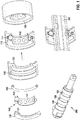
- a preferred electrical contact component 100 accordingly comprises the following components: an outer profile ring 110, a spring ring 150, seven to fifteen balls 142, and a multi-part cage 141 for receiving the balls 142.
- the outer profile ring 110 is designed in such a way that the balls 142 have at least one electrical point contact (preferably several point contacts) with the profile ring 110.
- the inner contour 111 of the profile ring 110 can have different shapes (prism, rectangular, trapezoidal, round, semicircular, etc.).
- a wiring tape (supply of energy / current) can be welded to the outside of the profile ring 110.
- the profile ring 110 is preferably a classic turned part, but can also be produced by MIM (metal injection molding) or other shaping methods such as printing or pressing and sintering.
- the profile ring 110 can be formed in one piece but also in two pieces 120, 130.
- a two-part profile ring 110 is used, after the balls 142 and the cage 141 have been assembled, the two parts 120, 130 are joined together in a materially bonded manner, for example by pressing, welding, gluing, soldering, riveting or spots.
- the spring ring 150 consists of a one-piece resilient component which, on the one hand, ensures constant contact between ball 142 and profile ring 110 and, on the other hand, allows the balls 142 to spring in the radial direction (inward and outward).
- the spring ring 150 can be designed to be open or closed. Cross-sectional shapes of the spring ring 150 can assume the following geometries: o- / c- / s- / z-shape.
- the spring ring 150 can also be a closed spiral spring.
- the balls 142 are dimensioned in such a way that when the electrode 300 is plugged in, an electrical contact is made between the electrode 300 and the profile ring 110 (via the spring ring 150).
- a cage 141 is used to hold the balls 142 in the profile ring 110.
- the cage 141 has the task of keeping the balls 142 at a distance and position from one another.
- the cage 141 can be resilient at least in the radial direction in the event that the spring ring 150 can be omitted as a component.
- the cage 141 can be implemented as a closed or as an open ring and consist of one or more parts. Suitable materials for the cage are, for example, plastic (e.g. polyamide), nitinol, 1.4435, platinum iridium, MP35N, titanium, stainless steel and all other types of material that meet the requirements for electrical contact in the permanent implant.
- the outer ring is preferably made of a platinum iridium alloy and the balls of the ball bearing are made of MP35N, 1.4435 (stainless steel) or titanium.
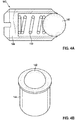
- each contact body 142 which is preferably designed as a ball, the spring element 150 being arranged within a sleeve 144 which, together with the sleeve 144, forms a resilient pressure piece 143 ( Figures 4a and 4b ).
- the spring element 150 is preferably designed as a helical spring.
- the resilient pressure piece 143 in particular the sleeve 144 and the spring element in the groove 111 of the outer profile ring 120 consisting of housing 120 and cover 130, arranged or fastened.
- a cage element 141 is used for spacing and positioning the contact bodies 141 and thus also the spring elements 150 ( Figures 4c and 4d ).
Landscapes
- Health & Medical Sciences (AREA)
- Engineering & Computer Science (AREA)
- Biomedical Technology (AREA)
- Nuclear Medicine, Radiotherapy & Molecular Imaging (AREA)
- Radiology & Medical Imaging (AREA)
- Life Sciences & Earth Sciences (AREA)
- Animal Behavior & Ethology (AREA)
- General Health & Medical Sciences (AREA)
- Public Health (AREA)
- Veterinary Medicine (AREA)
- Electrotherapy Devices (AREA)
Description
- Die vorliegende Erfindung betrifft ein elektrisches Kontaktbauteil für ein medizinisches Implantat.
- Medizinische Implantate, insbesondere aktive medizinische Implantate, weisen in der Regel therapeutische und/oder diagnostische Elektroden auf, die bestimmungsgemäß im Zielgewebe elektrische Impulse aufnehmen oder abgeben. Zur Gewährleistung der Funktion des Implantats ist es erforderlich, die Elektrode sicher und zuverlässig mit den Komponenten im Inneren des Implantats, insbesondere mit der Energiequelle und den Steuerschaltkreise, elektrisch zu kontaktieren.
- Hinsichtlich der Kontaktierung der Elektroden existieren internationale Standards, beispielsweise DF-4/IS-4 für 4-polige Steckerverbindungen bzw. Konnektoren. Eine Variante, um den IS4 Standard in aktiven Implantaten (IPG/ICD) zu realisieren, stellt ein elektrisches Kontaktbauteil der, welches aus einer rotationssymmetrischen Federhülse und einem in die Federhülse eingeschweißten Federelement besteht. Ein bevorzugtes Federelement ist beispielsweise eine schräggewickelte Spiralfeder, die zu einen Ringfeder bzw. Torusfeder verschweißt ist.
- Die oben beschriebene Variante ist jedoch in der Herstellung und Montage aufwendig, insbesondere die Fertigung der Ring- bzw. Torusfeder, und schwer automatisierbar.
- Es ist daher einer der Erfindung zu Grunde liegende Aufgabe, ein elektrisches Kontaktbauteil für die Steckeraufnahme bzw. Kontaktbuchse eines medizinischen Implantats zur Verfügung zu stellen, welches eine robuste und zuverlässige elektrische Kontaktierung ermöglicht und vergleichsweise einfach herstellbar ist.
- Diese Aufgabe wird durch ein elektrisches Kontaktbauteil mit den Merkmalen des Anspruchs 1, eine Kontaktbuchse mit den Merkmalen des Anspruchs 13, und ein implantierbares Medizingerät mit den Merkmalen des Anspruchs 14 gelöst. Bevorzugte Ausführungsformen sind in den entsprechenden abhängigen Ansprüche und der folgenden Beschreibung angegeben.
- Gemäß Anspruch 1 wird ein elektrisches Kontaktbauteil für eine Kontaktbuchse eines implantieren Medizingeräts zur Verfügung gestellt. Das elektrische Kontaktbauteil weist auf:
- ein elektrisches Kontaktelement zur elektrischen Kontaktierung eines elektrischen Gegenkontakts, und
- einen elektrisch leitfähigen Außenring mit einer Steckerbohrung zur Aufnahme des elektrischen Gegenkontakts, wobei der Außenring auf der Innenseite eine Aufnahmeeinrichtung zur Aufnahme des elektrischen Kontaktelements, insbesondere eine Nut, aufweist.
- Erfindungsgemäß ist dabei vorgesehen, dass das elektrische Kontaktelement durch eine Vielzahl von elektrisch leitfähigen Kontaktkörpern und mindestens ein Käfigelement zur Aufnahme der elektrisch leitfähigen Kontaktkörper gebildet wird.
- Bei dem elektrischen Gegenkontakt handelt es sich insbesondere um den Stecker einer Elektrode, die mit dem implantierbaren Medizingerät elektrisch verbunden werden soll.
- Die Aufnahmeeinrichtung zur Aufnahme des elektrischen Kontaktelements ist insbesondere zur Positionierung und Führung des elektrischen Kontaktelements (Käfigelement und elektrisch leitfähige Kontaktkörper) ausgebildet.
- Der Begriff Kontaktkörper im Sinne der vorliegenden Erfindung bezeichnet insbesondere jeden Körper, der dazu ausgebildet ist, den elektrischen Gegenkontakt elektrisch kontaktieren zu können.
- Der Begriff Käfigelement im Sinne der vorliegenden Erfindung bezeichnet insbesondere eine Aufnahmeeinrichtung zur Aufnahme der elektrisch leitfähigen Kontaktkörper, welches dazu ausgebildet ist, die Kontaktkörper voneinander auf Abstand und in Position zu halten. Ein solches Käfigelement kann mehrere Aufnahmen für die elektrisch leitfähigen Kontaktköper aufweisen, wobei die elektrisch leitfähigen Kontaktkörper insbesondere das Käfigelement durchgreifen bzw. sich durch das Käfigelement oder den Käfig erstrecken, so dass die elektrisch leitfähigen Kontaktkörper den elektrischen Gegenkontakt elektrisch kontaktieren können. Hierbei können die Aufnahmen einen geringeren Durchmesser aufweisen, als der Durchmesser der darin angeordneten Kontaktkörper. Somit kann insbesondere gewährleistet werden, dass die Kontaktkörper innerhalb der Aufnahmeeinrichtung zur Aufnahme des elektrischen Kontaktelements, insbesondere innerhalb der Nut, durch das Käfigelement angeordnet bzw. fixiert werden. Vorzugsweise ist das Käfigelement bzw. dessen Aufnahmen derart ausgebildet, dass die Kontaktkörper einen vordefinierten Freiheitsgrad der Bewegung genießen, d. h. insbesondere, dass die Kontaktkörper sich innerhalb der Aufnahme bewegen können.
- Gemäß einer Ausführungsform des erfindungsgemäßen elektrischen Kontaktbauteils ist vorgesehen, dass das elektrische Kontaktbauteil weiterhin ein Federelement aufweist, welches innerhalb der Aufnahmeeinrichtung zur Aufnahme des elektrischen Kontaktelements, insbesondere der Nut, zwischen den Kontaktkörpern und der Innenseite des Außenrings angeordnet ist, wobei das Federelement insbesondere dazu ausgebildet ist, immer mindestens einen der Kontaktkörper mit dem Außenring und dem elektrischen Gegenkontakt in einem elektrischen Kontakt zu halten, so dass ein ständiger elektrischer Kontakt zwischen dem elektrischen Gegenkontakt und dem Außenring besteht bzw. gewährleistet wird.
- Alternativ kann das Federelement dazu ausgebildet sein, einen der Kontaktkörper und den Außenring und mindestens einen der Kontaktkörper und den elektrischen Gegenkontakt in elektrischen Kontakt zu halten, um so einen ständigen elektrischen Kontakt zwischen dem elektrischen Gegenkontakt und dem Außenring zu gewährleisten, sofern das Käfigelement selbst elektrisch leitfähig ist.
- Hierbei kann das Federelement in beliebiger Lage oder Orientierung innerhalb der Aufnahmeeinrichtung zur Aufnahme des elektrischen Kontaktelements angeordnet sein, sofern mindestens einer der Kontaktkörper und der Außenring und mindestens einer der Kontaktkörper und der elektrischen Gegenkontakt in ständigen elektrischen Kontakt gehalten werden.
- Insbesondere übt das Federelement auf den oder die Kontaktkörper eine Kraft aus, die in Richtung des elektrischen Gegenkontakts gerichtet ist.
- Gemäß einer weiteren Ausführungsform des erfindungsgemäßen elektrischen Kontaktbauteils ist vorgesehen, dass der elektrisch leitfähige Außenring und das mindestens eine Käfigelement stoffschlüssig gefügt sind, insbesondere durch Verpressen, Verkleben, Verlöten, Vernieten, Punkten oder Verschweißen.
- Gemäß einer Ausführungsform des erfindungsgemäßen elektrischen Kontaktbauteils ist vorgesehen, dass der elektrisch leitfähige Außenring und das mindestens eine Käfigelement aus einem Metall oder einer Metalllegierung bestehen. Vorteilhafterweise können damit Außenring und Käfigelement einfacher gefügt werden, insbesondere durch Schweißen oder Löten. Gleichzeitig kann dabei auch das Käfigelement zur Herstellung eines zuverlässigen elektrischen Kontakts zwischen Außenring und elektrischen Gegenkontakt beitragen.
- Gemäß einer Ausführungsform des erfindungsgemäßen elektrischen Kontaktbauteils ist vorgesehen, dass das Käfigelement innerhalb der Aufnahmeeinrichtung, insbesondere innerhalb der Nut angeordnet ist.
- Gemäß einer weiteren Ausführungsform, weist das erfindungsgemäßen elektrische Kontaktbauteil nur ein Käfigelement auf.
- Gemäß einer Ausführungsform des erfindungsgemäßen elektrischen Kontaktbauteils ist vorgesehen, dass der Außenring ein Gehäuse und einen Deckel aufweist, wobei das Gehäuse und der Deckel jeweils einen Steg auf der Innenseite aufweisen, und die Stege mit der Innenseite des Gehäuses die Aufnahmeeinrichtung zur Aufnahme des elektrischen Kontaktelements, insbesondere die Nut, bilden.
- Gemäß einer weiteren Ausführungsform des erfindungsgemäßen elektrischen Kontaktbauteils ist vorgesehen, dass das Gehäuse mit dem Deckel stoffschlüssig gefügt ist, insbesondere durch Verpressen, Verkleben, Verlöten, Vernieten, Punkten oder Verschweißen.
- Gemäß einer weiteren Ausführungsform des erfindungsgemäßen elektrischen Kontaktbauteils ist vorgesehen, dass die Aufnahmeeinrichtung zur Aufnahme des elektrisch leitfähigen Kontaktelements, insbesondere die Nut, eines der folgenden Formen aufweist: prismaförmig, rechteckig, trapezförmig, halbrund, viertelrund oder dreieckig.
- Gemäß einer weiteren Ausführungsform des erfindungsgemäßen elektrischen Kontaktbauteils ist vorgesehen, dass die elektrisch leitfähigen Kontaktkörper als Kugeln oder Rollen ausgebildet sind, wobei insbesondere das Käfigelement entsprechend als Rollenkäfig oder Kugelkäfig ausgebildet ist.
- Gemäß einer weiteren Ausführungsform des erfindungsgemäßen elektrischen Kontaktbauteils ist vorgesehen, dass das Federelement als ringförmiges Federelement ausgebildet ist. Vorteilhafterweise kann das Federelement als ein geschlossenes ringförmiges Federelement ausgebildet sein.
- Gemäß einer weiteren Ausführungsform des erfindungsgemäßen elektrischen Kontaktbauteils ist vorgesehen, dass das ringförmige Federelement einen der folgenden Querschnitte aufweist: rund (ringförmiges Rohr), halbrund, s-förmig, z-förmig, c-förmig, rechteckig oder omega-förmig.
- Gemäß einer weiteren Aufführungsform des erfindungsgemäßen elektrischen Kontaktbauteils ist vorgesehen, dass an jedem Kontaktkörper des elektrischen Kontaktelements ein Federelement angeordnet ist, wobei das jeweilige Federelement zwischen den jeweiligen Kontaktkörper und der Innenseite des Außenrings angeordnet ist.
- Gemäß einer weiteren Ausführungsform des erfindungsgemäßen Kontaktbauteils ist vorgesehen, dass der jeweilige Kontaktkörper mit dem jeweiligen Federelement stoffschlüssig gefügt oder einstückig ausgebildet ist.
- Gemäß einer weiteren Ausführungsform des erfindungsgemäßen elektrischen Kontaktbauteils ist vorgesehen, dass das an dem Kontaktkörper angeordnete Federelement als federndes Druckstück ausgebildet ist.
- Insbesondere wird hierbei das federnde Druckstück durch das Federelement und eine Hülse ausgebildet, wobei das Federelement innerhalb der Hülse angeordnet ist. Vorzugsweise ist auch der an dem Federelement angeordnete Kontaktkörper in der Hülse angeordnet, wobei insbesondere der Kontaktkörper und das federnde Druckstück zusammen als Federkugel ausgebildet sind. Die oben beschriebene Hülse kann hierbei auch als ein individuelles Käfigelement dienen, wodurch auf ein Käfigelement für alle elektrisch leitfähigen Kontaktkörper verzichtet werden kann.
- Gemäß einer weiteren Ausführungsform des erfindungsgemäßen elektrischen Kontaktbauteils ist vorgesehen, dass das ringförmige Federelement als Spiralfeder ausgebildet ist.
- Gemäß einer alternativen Ausführungsform des erfindungsgemäßen elektrischen Kontaktbauteils ist vorgesehen, dass das Käfigelement federelastisch ausgebildet ist. Vorteilhafterweise kann in dieser Ausführungsform auf ein zusätzliches Federelement verzichtet werden, da ein solcherart ausgestaltetes Käfigelement die Kontaktkörper in elektrischen Kontakt mit der Innenseite des Außenrings und dem elektrischen Gegenkontakt halten kann. Vorzugsweise ist dabei das Käfigelement als Blechkäfig ausgebildet und aus einem elektrisch leitfähigen Material geformt.
- Gemäß einer weiteren Ausführungsform des erfindungsgemäßen elektrischen Kontaktbauteils ist vorgesehen, dass das Käfigelement als Blechkäfig oder Massivkäfig ausgebildet ist, wobei der Massivkäfig insbesondere als ringförmiges Band ausgebildet ist, welches eine Vielzahl von Öffnungen zur Aufnahme der Kontaktkörper aufweist, und der Durchmesser der Vielzahl von Öffnungen geringer ist, als der Durchmesser der Kontaktkörper.
- Gemäß einer weiteren Ausführungsform des erfindungsgemäßen elektrischen Kontaktbauteils ist vorgesehen, dass das Käfigelement aus einem der folgenden Stoffe besteht oder umfasst: Kunststoff, insbesondere ein Duroplast, ein Thermoplast, ein Elastomer oder eine Kombinationen davon, Edelstahl, insbesondere Chrom-Nickel-Molybdän-Stahl, wie etwa 1.4435, eine Platiniridiumlegierung, eine Nickel-Kobalt-Legierung, insbesondere MP35N, Titan oder eine Titanlegierung, insbesondere Nitinol.
- Gemäß einer weiteren Ausführungsform des erfindungsgemäßen elektrischen Kontaktbauteils ist vorgesehen, dass der Außenring Edelstahl, insbesondere Chrom-Nickel-Molybdän-Stahl, wie etwa 1.4435, eine Platiniridiumlegierung, eine Nickel-Kobalt-Legierung, insbesondere MP35N, Titan oder eine Titanlegierung umfasst oder daraus besteht.
- Gemäß einer Ausführungsform des erfindungsgemäßen elektrischen Kontaktbauteils ist vorgesehen, dass die Kontaktkörper als Material Edelstahl, insbesondere Chrom-Nickel-Molybdän-Stahl wie etwa 1.4435, eine Nickel-Kobalt-Legierung, insbesondere MP35N, Titan oder eine Titanlegierung umfassen oder daraus bestehen.
- Gemäß einer weiteren Ausführungsform des erfindungsgemäßen elektrischen Kontaktbauteils ist vorgesehen, dass das elektrische Kontaktelement 7 bis 15 Kontaktkörper aufweist.
- Gemäß Anspruch 13, wird eine Kontaktbuchse für ein implantierbares Medizingerät zur Verfügung gestellt, welches mindestens ein elektrisches Kontaktbauteil gemäß Anspruch 1 oder einer der dazugehörigen Ausführungsformen aufweist.
- Insbesondere weist die erfindungsgemäße Kontaktbuchse eine Steckeraufnahme zur Aufnahme eines elektrischen Gegenkontakts auf, insbesondere der Stecker einer Elektrodenleitung, wobei die Steckeraufnahme unter anderem durch das mindestens eine elektrische Kontaktbauteil gebildet wird. Die Kontaktbuchse bzw. das elektrische Kontaktbauteil dient dabei der Übertragung von elektrischen Signalen auf und von dem elektrischen Gegenkontakt bzw. dem Stecker der Elektrodenleitung.
- Typischerweise ist eine solche Kontaktbuchse Bestandteil eines Headers eines implantierbaren Medizingeräts, wobei die Kontaktbuchse, insbesondere das erfindungsgemäße Kontaktbauteil, in elektrischem Kontakt mit den Komponenten des implantierbaren Medizingeräts steht, welche im Inneren des Gehäuse des implantierbaren Medizingeräts angeordnet sind.
- Insbesondere ist dann das elektrische Kontaktbauteil in der erfindungsgemäßen Kontaktbuchse über einen elektrischen Leiter mit einer Durchführung des implantierbaren Medizingeräts elektrisch in Kontakt. Bei dem elektrischen Leiter handelt es sich insbesondere um ein Leitungsband.
- Alternativ dazu kann die Kontaktbuchse auch im Gehäuse eines implantierbaren Medizingeräts angeordnet sein, wobei in diesem Fall das betreffende Medizingerät vorzugsweise keinen Header aufweist. Vorteilhafterweise kann dabei das erfindungsgemäße elektrische Kontaktbauteil ohne hermetische Durchführung mit den Komponenten des implantierbaren Medizingeräts elektrisch kontaktiert werden.
- Gemäß einer Ausführungsform der erfindungsgemäßen Kontaktbuchse ist vorgesehen, dass die Kontaktbuchse 1 bis 10, insbesondere 4 bis 8, der erfindungsgemäßen elektrischen Kontaktbauteile aufweist.
- Gemäß Anspruch 14 wird ein implantierbares Medizingerät zur Verfügung gestellt, welches mindestens ein erfindungsgemäßes elektrisches Kontaktbauteil oder eine erfindungsgemäße Kontaktbuchse aufweist.
- Typischerweise umfasst ein solches implantierbares Medizingerät ein hermetisches verschlossenes Gehäuse mit einer elektrischen Durchführung, wobei innerhalb des Gehäuses notwendige Komponenten wie Energiequelle, Steuerelektronik, Diagnoseelektronik und/oder Kondensator angeordnet sind, und die erfindungsgemäße Kontaktbuchse bzw. das erfindungsgemäße elektrische Kontaktbauteil im Header des implantierbaren Medizingeräts. Über die Durchführung werden dabei elektrische Signale zwischen den vorgenannten Komponenten und der Kontaktbuchse, oder genauer dem elektrischen Kontaktbauteil, ausgetauscht. Insbesondere ist die Kontaktbuchse bzw. das elektrische Kontaktbauteil über einen elektrischen Leiter, wie ein Leitungsband, mit der elektrischen Durchführung elektrisch verbunden.
- Alternativ dazu kann die erfindungsgemäße Kontaktbuchse bzw. das erfindungsgemäße Kontaktbauteil im Gehäuse des implantierbaren Medizingerät, wobei das Medizingerät in diesem Fall keinen Header aufweist.
- Gemäß einer Ausführungsform des erfindungsgemäßen implantierbaren Medizingeräts ist vorgesehen, dass das implantierbare Medizingerät als Herzschrittmacher, Kardioverter-Defibrillator oder Neurostimulator ausgebildet ist.
- Im Folgenden werden Ausführungsbeispiele der Erfindung anhand von Figuren beschrieben. Diese dienen der Erläuterung der Erfindung, schränken jedoch nicht den Schutzumfang ein.
-
- Fig. 1
- ein erfindungsgemäßes elektrisches Kontaktbauteil;
- Fig. 2
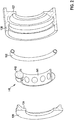
- eine Detailansicht einiger Komponenten des erfindungsgemäßen elektrischen Kontaktbauteils;
- Fig. 3
- einige Ausführungsformen des erfindungsgemäßen elektrischen Kontaktbauteils; und
- Fig. 4
- alternative Ausführungsformen von Komponenten des erfindungsgemäßen elektrischen Kontaktbauteils.
- Zur Kontaktierung einer IS4 oder DF4 Elektrode wird im Header eines IPGs oder ICDs ein elektrischer Gegenkontakt benötigt. Erfindungsgemäß ist insbesondere vorgesehen, statt der herkömmlichen Federkontakte ein Wälzlager 140, insbesondere Kugellager, als elektrischen Kontakt zu verwenden.
- Wie in den
Figuren 1 bis 3 dargestellt, umfasst demnach ein bevorzugtes erfindungsgemäßes elektrisches Kontaktbauteil 100 folgende Komponenten: einen äußeren Profilring 110, einen Federring 150, sieben bis fünfzehn Kugel 142, sowie einen mehrteiligen Käfig 141 zur Aufnahme der Kugeln 142. - Der äußere Profilring 110 ist so gestaltet, dass die Kugeln 142 mindestens einen elektrischen punktuellen Kontakt (vorzugsweise mehrere punktuelle Kontakte) zum Profilring 110 aufweisen. Die Innenkontur 111 des Profilringes 110 kann unterschiedliche Formen (Prisma, rechteckig, trapezförmig, rund, halbrund etc.). An der Außenseite des Profilrings 110 kann ein Verdrahtungsband (Zuführung der Energie / Strom) angeschweißt werden. Der Profilring 110 ist vorzugsweise ein klassisches Drehteil, kann aber auch durch MIM (metal injection molding) oder andere Formgebungsverfahren wie Drucken oder Verpressen und Sintern hergestellt werden. Der Profilring 110 kann einteilig aber auch zweiteilig 120, 130 ausgebildet sein. Soweit ein zweiteiliger Profilring 110 verwendet wird, sind beide Teile 120, 130 nach Montage der Kugeln 142 und des Käfigs 141 miteinander stoffschlüssig gefügt, beispielsweise durch Verpressen, Schweißen, Kleben, Löten, Nieten oder Punkten.
- Der Federring 150 besteht aus einer einteiligen federnden Komponente, die zum einen den ständigen Kontakt zwischen Kugel 142 und Profilring 110 sicherstellt, zum anderen die Kugeln 142 in radialer Richtung (nach innen und außen) federn lässt. Der Federring 150 kann offen sowie geschlossen gestaltet sein. Querschnittsformen des Federrings 150 können folgenden Geometrien annehmen: o-/c-/s-/z-Form. Der Federring 150 kann auch eine geschlossene Spiralfeder sein.
- Die Kugeln 142 sind dabei so dimensioniert, dass mit dem Stecken der Elektrode 300 ein elektrischer Kontakt zwischen Elektrode 300 und Profilring 110 (über dem Federring 150) realisiert wird.
- Um die Kugeln 142 im Profilring 110 zu halten, wird ein Käfig 141 genutzt. Der Käfig 141 dabei hat die Aufgabe, die Kugeln 142 voneinander auf Abstand und Position zu halten. Der Käfig 141 kann in mindestens in radialer Richtung federelastisch sein für den Fall, dass der Federring 150 als Komponente weggelassen werden kann. Der Käfig 141 kann als geschlossener bzw. als geöffneter Ring realisiert sein und aus einem oder mehreren Teilen bestehen. Geeignete Materialien den Käfig sind beispielsweise Kunststoff (z.B. Polyamid), Nitinol, 1.4435, Platiniridium, MP35N, Titan, Edelstahl sowie alle weiteren Materialarten, welche die Anforderungen an ein elektrischen Kontakt im Dauerimplantat erfüllen.
- Vorzugsweise ist der Außenring aus einer Platiniridiumlegierung und die Kugeln des Kugellagers aus MP35N, 1.4435 (Edelstahl) oder Titan.
- Prinzipiell sind jedoch alle Materialpaarungen denkbar, welche die Anforderungen an einen elektrischen Kontakt im Dauerimplantat erfüllen.
- In den
Figuren 4a bis 4d sind eine weitere Ausführungsform des erfindungsgemäßen elektrischen Kontaktelements dargestellt. In diesem Fall ist an jedem Kontaktkörper 142, der vorzugsweise als Kugel ausgebildet ist, jeweils ein individuelle Federelement 150 angeordnet, wobei das Federelement 150 innerhalb einer Hülse 144 angeordnet ist, welche zusammen mit der Hülse 144 ein federndes Druckstück 143 bildet (Fig. 4a und 4b ). Das Federelement 150 ist dabei vorzugsweise als Schraubenfeder ausgebildet. Wie inFig. 4c dargestellt ist, ist das federnde Druckstück 143, insbesondere die Hülse 144 und das Federelement in der Nut 111 des äußeren Profilrings 120 bestehend aus Gehäuse 120 und Deckel 130, angeordnet bzw. befestigt. Auch in dieser Ausführungsform wird ein Käfigelement 141 zur Beabstandung und Positionierung der Kontaktkörper 141 und damit auch der Federelemente 150 verwendet (Fig. 4c und 4d ). -
Elektrisches Kontaktbauteil 100 Außenring/Profilring 110 Nut Außenring/Profilring 111 Gehäuse Außenring/Profilring 120 Steg Gehäuse 121 Deckel Außenring/Profilring 130 Steg Deckel 131 Elektrisches Kontaktelement 140 Käfigelement 141 Kontaktkörper (Kugel) 142 Federndes Druckstück 143 Druckstückhülse 144 Federelement 150 Kontaktbuchse 200 Stecker/Elektrodenleitung 300
Claims (15)
- Elektrisches Kontaktbauteil (100) für eine Kontaktbuchse (200) eines implantierbaren Medizingeräts, aufweisend:- ein elektrisches Kontaktelement (140) zur elektrischen Kontaktierung eines elektrischen Gegenkontakts (300), und- einen elektrisch leitfähigen Außenring (110) mit einer Steckerbohrung zur Aufnahme des elektrischen Gegenkontakts (300), wobei der Außenring (110, 120, 130) auf der Innenseite eine Aufnahmeeinrichtung (111) zur Aufnahme des elektrischen Kontaktelements (140), insbesondere eine Nut, aufweist,wobei das elektrische Kontaktelement (140) durch eine Vielzahl von Kontaktkörpern (142) und mindestens ein Käfigelement (141) zur Aufnahme der Kontaktkörper (142) gebildet wird,
dadurch gekennzeichnet,
dass das elektrische Kontaktbauteil (100) weiterhin ein elektrisch leitfähiges Federelement (150) aufweist, das innerhalb der Aufnahmeeinrichtung (111) zur Aufnahme des elektrischen Kontaktelements (140), insbesondere innerhalb der Nut, zwischen den Kontaktkörpern (142) und der Innenseite des Außenrings (110) angeordnet ist, und
das dazu ausgebildet ist, mindestens einen der Kontaktkörper (142) mit dem Außenring (110) und dem elektrischen Gegenkontakt (300) in elektrischen Kontakt zu halten. - Elektrisches Kontaktbauteil (100) nach Anspruch 1, dadurch gekennzeichnet, dass der Außenring (110) ein Gehäuse (120) und einen Deckel (130) aufweist, wobei das Gehäuse (120) und der Deckel (130) jeweils einen Steg (121, 131) auf der Innenseite aufweisen, und die Stege (121, 131) mit der Innenseite des Gehäuses die Aufnahmeeinrichtung (111) zur Aufnahme des elektrischen Kontaktelements (140), insbesondere die Nut, bilden.
- Elektrisches Kontaktbauteil (100) nach einem der vorherigen Ansprüche, dadurch gekennzeichnet, dass die Aufnahmeeinrichtung (111) zur Aufnahme des elektrischen Kontaktelements (140), insbesondere die Nut, eines der folgenden Formen aufweist: prismaförmig, rechteckig, trapezförmig, dreieckig, viertelrund oder halbrund.
- Elektrisches Kontaktbauteil (100) nach einem der vorherigen Ansprüche, dadurch gekennzeichnet, dass die Kontaktkörper (142) als Kugeln oder Rollen ausgebildet sind, wobei das Käfigelement (141) als Rollenkäfig oder Kugelkäfig ausgebildet ist.
- Elektrisches Kontaktbauteil (100) nach einem der vorherigen Ansprüche, dadurch gekennzeichnet, dass das Federelement (150) als ringförmiges Federelement ausgebildet ist, insbesondere als geschlossenes ringförmiges Federelement, insbesondere als ringförmiges Rohr oder ringförmige Spiralfeder.
- Elektrisches Kontaktbauteil (100) nach Anspruch 5, dadurch gekennzeichnet, dass das ringförmige Federelement (150) eine der folgenden Querschnitte aufweist: rund, halbrund, s-förmig, z-förmig, c-förmig, Ω-förmig oder rechteckig.
- Elektrisches Kontaktbauteil (100) nach einem der Ansprüche 1 bis 4, dadurch gekennzeichnet, dass an jedem Kontaktkörper (142) jeweils ein Federelement (150) angeordnet ist, wobei insbesondere das jeweilige Federelement (150) als federndes Druckstück ausgebildet ist.
- Elektrisches Kontaktbauteil (100) nach einem der vorherigen Ansprüche, dadurch gekennzeichnet, dass das Käfigelement (141) als Blechkäfig oder Massivkäfig ausgebildet ist, wobei insbesondere der Massivkäfig als ringförmiges Band ausgebildet ist, welches eine Vielzahl von Öffnungen zur Aufnahme der Kontaktkörper (142) aufweist, wobei der Durchmesser der Vielzahl von Öffnungen geringer ist, als der Durchmesser der Kontaktkörper (142).
- Elektrisches Kontaktbauteil (100) nach einem der vorherigen Ansprüche, dadurch gekennzeichnet, dass das Käfigelement (141) aus einem der folgenden Stoffe besteht oder umfasst: ein Kunststoff, insbesondere ein Duroplast, ein Thermoplast, ein Elastomer oder eine Kombinationen davon, Edelstahl, insbesondere Chrom-Nickel-Molybdän-Stahl, eine Platiniridiumlegierung, eine Nickel-Kobaltlegierung, insbesondere MP35N, Titan oder Titanlegierung, insbesondere Nitinol.
- Elektrisches Kontaktbauteil (100) nach einem der vorherigen Ansprüche, dadurch gekennzeichnet, dass der Außenring (110) Edelstahl, insbesondere Chrom-Nickel-Molybdän-Stahl, eine Platiniridiumlegierung, eine Nickel-Kobalt-Legierung, insbesondere MP35N, Titan oder eine Titanlegierung umfasst oder daraus besteht.
- Elektrisches Kontaktbauteil (100) nach einem der vorherigen Ansprüche, dadurch gekennzeichnet, dass die Kontaktkörper (142) Edelstahl, insbesondere Chrom-Nickel-Molybdän-Stahl, eine Platiniridiumlegierung, eine Nickel-Kobalt-Legierung, insbesondere MP35N, Titan oder eine Titanlegierung umfasst oder daraus besteht.
- Elektrisches Kontaktbauteil (100) nach einem der vorherigen Ansprüche, dadurch gekennzeichnet, dass das elektrische Kontaktelement (100) 7 bis 15 Kontaktkörper (142) aufweist.
- Kontaktbuchse (100) für ein implantierbares Medizingerät, aufweisend mindestens ein elektrisches Kontaktbauteil (100) nach einem der Ansprüche 1 bis 12.
- Implantierbares Medizingerät, aufweisend mindestens ein elektrisches Kontaktbauteil (100) nach einem der Ansprüche 1 bis 12 oder eine Kontaktbuchse (200) nach Anspruch 13.
- Implantierbares Medizingerät nach Anspruch 14, dadurch gekennzeichnet, dass das Medizingerät als Herzschrittmacher, Kardioverter-Defibrillator oder Neurostimulator ausgebildet ist.
Priority Applications (1)
| Application Number | Priority Date | Filing Date | Title |
|---|---|---|---|
| US16/839,246 US11116987B2 (en) | 2019-04-17 | 2020-04-03 | Electrical contact component |
Applications Claiming Priority (1)
| Application Number | Priority Date | Filing Date | Title |
|---|---|---|---|
| EP19169882 | 2019-04-17 |
Publications (2)
| Publication Number | Publication Date |
|---|---|
| EP3725366A1 EP3725366A1 (de) | 2020-10-21 |
| EP3725366B1 true EP3725366B1 (de) | 2021-12-15 |
Family
ID=66217966
Family Applications (1)
| Application Number | Title | Priority Date | Filing Date |
|---|---|---|---|
| EP19180525.8A Active EP3725366B1 (de) | 2019-04-17 | 2019-06-17 | Elektrisches kontaktbauteil |
Country Status (2)
| Country | Link |
|---|---|
| US (1) | US11116987B2 (de) |
| EP (1) | EP3725366B1 (de) |
Families Citing this family (17)
| Publication number | Priority date | Publication date | Assignee | Title |
|---|---|---|---|---|
| US11241297B2 (en) | 2016-12-12 | 2022-02-08 | Cadwell Laboratories, Inc. | System and method for high density electrode management |
| US11517239B2 (en) | 2018-04-05 | 2022-12-06 | Cadwell Laboratories, Inc. | Systems and methods for processing and displaying electromyographic signals |
| US11596337B2 (en) | 2018-04-24 | 2023-03-07 | Cadwell Laboratories, Inc | Methods and systems for operating an intraoperative neurophysiological monitoring system in conjunction with electrocautery procedures |
| US11185684B2 (en) | 2018-09-18 | 2021-11-30 | Cadwell Laboratories, Inc. | Minimally invasive two-dimensional grid electrode |
| US11517245B2 (en) | 2018-10-30 | 2022-12-06 | Cadwell Laboratories, Inc. | Method and system for data synchronization |
| US11471087B2 (en) | 2018-11-09 | 2022-10-18 | Cadwell Laboratories, Inc. | Integrity verification system for testing high channel count neuromonitoring recording equipment |
| US12533069B2 (en) | 2018-11-09 | 2026-01-27 | Cadwell Laboratories, Inc. | Systems and methods of electrode switching for neurophysiological sensing and stimulation |
| US11317841B2 (en) | 2018-11-14 | 2022-05-03 | Cadwell Laboratories, Inc. | Method and system for electrode verification |
| US11529107B2 (en) | 2018-11-27 | 2022-12-20 | Cadwell Laboratories, Inc. | Methods for automatic generation of EEG montages |
| US11128076B2 (en) | 2019-01-21 | 2021-09-21 | Cadwell Laboratories, Inc. | Connector receptacle |
| EP3725366B1 (de) * | 2019-04-17 | 2021-12-15 | BIOTRONIK SE & Co. KG | Elektrisches kontaktbauteil |
| CN113612047B (zh) * | 2020-10-28 | 2024-05-24 | 湖南华峰新宇电子有限公司 | 一种防卡死复位迅速的信号连接器插座 |
| DE102021102864B3 (de) * | 2021-02-08 | 2022-01-20 | Heraeus Deutschland GmbH & Co. KG | Federkontaktring |
| CN113113791A (zh) * | 2021-04-09 | 2021-07-13 | 广东电网有限责任公司 | 一种端子排插拔式接线系统 |
| US12514549B2 (en) | 2021-08-31 | 2026-01-06 | Cadwell Laboratories, Inc. | Methods and systems for evaluating echo data contemporaneous with an electrodiagnostic study |
| DE102021210211A1 (de) * | 2021-09-15 | 2023-03-16 | Zf Friedrichshafen Ag | Kontaktierungsring zum elektrischen Potenzialausgleich an rotierenden Wellen |
| WO2024050326A1 (en) * | 2022-08-31 | 2024-03-07 | Tc1 Llc | Noose tail circular spring connector for implantable medical device |
Family Cites Families (21)
| Publication number | Priority date | Publication date | Assignee | Title |
|---|---|---|---|---|
| US1450172A (en) * | 1920-03-08 | 1923-04-03 | Edward Dewald Jr | Swivel-plug connector |
| US2328212A (en) * | 1942-02-13 | 1943-08-31 | Harry Cleason | Electric swivel |
| US3387250A (en) * | 1966-03-08 | 1968-06-04 | Bjorn James | Electric swivel connection |
| FR2100554A1 (de) * | 1970-06-22 | 1972-03-24 | Falbet Jean | |
| FR2180550B1 (de) * | 1972-04-20 | 1978-02-10 | Doloise Metallurgique | |
| US3832674A (en) * | 1972-12-11 | 1974-08-27 | Mark Products | Electrical connector |
| US4157857A (en) * | 1977-07-18 | 1979-06-12 | Western Electric Company, Inc. | Edge connector for printed circuit boards |
| US4469104A (en) * | 1982-07-16 | 1984-09-04 | Cordis Corporation | Multipolar connector for pacing lead |
| EP0269430A3 (de) * | 1986-11-26 | 1989-02-22 | A. F. BULGIN & COMPANY PLC. | Elektrischer Verbinder |
| US5281148A (en) * | 1992-09-15 | 1994-01-25 | Trakker, Inc. | Electrical circuit card connector |
| US5321583A (en) * | 1992-12-02 | 1994-06-14 | Intel Corporation | Electrically conductive interposer and array package concept for interconnecting to a circuit board |
| US6162062A (en) * | 1999-01-05 | 2000-12-19 | Liao; Sheng Hsin | Structure of telephone connector |
| US6498952B2 (en) * | 2001-03-08 | 2002-12-24 | Pacesetter, Inc. | Hermetically sealed feedthrough connector using shape memory alloy for implantable medical device |
| DE10227156A1 (de) * | 2002-06-18 | 2004-01-08 | Harting Electro-Optics Gmbh & Co. Kg | Steckverbinder mit verschiebbarer Steckerteil-Aufnahme |
| US9138586B2 (en) * | 2012-01-27 | 2015-09-22 | Greatbatch Ltd. | Contact block using spherical electrical contacts for electrically contacting implantable leads |
| WO2013155121A1 (en) * | 2012-04-09 | 2013-10-17 | Cbg Corporation | Radial electrical connector resistant to fluids |
| EP3028741A1 (de) * | 2014-12-04 | 2016-06-08 | BIOTRONIK SE & Co. KG | Kontaktelement und verfahren zur herstellung eines kontaktelements |
| DE102016217673B4 (de) * | 2016-09-15 | 2020-06-04 | Te Connectivity Germany Gmbh | Elektrischer Kontakt für einen Steckverbinder, mit drehbaren Wälzkontaktkörpern und elektrische Steckverbindung mit einem solchen Kontakt |
| DE102016217667B4 (de) * | 2016-09-15 | 2020-04-02 | Te Connectivity Germany Gmbh | Elektrischer Kontakt mit Wälzkontaktkörpern an sich gegenüberliegenden Seiten sowie Steckverbindung mit einem solchen Kontakt |
| US20190393648A9 (en) * | 2016-12-27 | 2019-12-26 | St. Jude Medical, Cardiology Division, Inc. | Devices for detangling and inhibiting cable entanglement during manipulation of catheters |
| EP3725366B1 (de) * | 2019-04-17 | 2021-12-15 | BIOTRONIK SE & Co. KG | Elektrisches kontaktbauteil |
-
2019
- 2019-06-17 EP EP19180525.8A patent/EP3725366B1/de active Active
-
2020
- 2020-04-03 US US16/839,246 patent/US11116987B2/en not_active Expired - Fee Related
Also Published As
| Publication number | Publication date |
|---|---|
| US20200330772A1 (en) | 2020-10-22 |
| EP3725366A1 (de) | 2020-10-21 |
| US11116987B2 (en) | 2021-09-14 |
Similar Documents
| Publication | Publication Date | Title |
|---|---|---|
| EP3725366A1 (de) | Elektrisches kontaktbauteil | |
| EP2823856B1 (de) | Federkontaktbauteil, Steckerkontaktbuchse und Kontaktbuchsenbauteil | |
| DE69027846T2 (de) | Verbindungsanordnung zur zufuhr bei implantierbarer ärztlichen vorrichtung | |
| EP2711046B1 (de) | Elektrodenleitung und Anschlussstück für elektromedizinische Implantate | |
| EP2111895A2 (de) | Anschlussgehäuse für ein elektromedizinisches Implantat | |
| EP1897588A1 (de) | Elektrische Durchführung | |
| DE3140075C2 (de) | ||
| DE102018221355B4 (de) | Kontaktierungsverfahren und System | |
| DE102018124307A1 (de) | Stecker mit einem umspritzten, nicht drehbaren Steckeranschluss und vier Anschlüssen, insbesondere IS4-/DF4-Stecker | |
| DE2401793A1 (de) | Buchsenkontakt | |
| DE3912189A1 (de) | Schutzleiterverbindung | |
| EP1955729B1 (de) | Elektrodenleitung und Anschlussstück für einen implantierbaren Herzstimulator | |
| EP0414929B2 (de) | Wahlweise bipolar oder unipolar betreibbares medizinisches Gerät mit einem Anschluss für eine elektrische Signale zwischen dem Gerät und dem Körper eines Lebewesens leitende Elektrode | |
| EP3069758A1 (de) | Gestanzte flansche für elektrische durchführungen mit integriertem massestift | |
| DE102018221635B3 (de) | Kontaktierungsverfahren und System | |
| DE202007018766U1 (de) | Kontaktmodul für ein medizinisches Implantat | |
| EP3332836B1 (de) | Durchführung eines implantierbaren medizinelektronischen geräts | |
| DE102006037122B3 (de) | Medizinische Elektrode mit wenigstens zwei Polen und einem Stecker und deren Verwendung | |
| EP3069760B1 (de) | Implantierbare elektromedizinische vorrichtung | |
| EP3181194A1 (de) | Durchführung eines medizinelektronischen geräts, verfahren zur herstellung einer solchen und medizinelektronisches gerät | |
| DE69725341T2 (de) | Kontaktelemente einer vielpoligen steckverbindung an einem elektrodenkabel für eine implantierbare medizinische vorrichtung | |
| DE10339958B4 (de) | Elektrischer Steckkontakt | |
| DE3942735A1 (de) | Aufnehmerspule fuer ein reizstromgeraet zur heilung von knochenschaeden | |
| EP3384958A1 (de) | Durchführung für implantatskomponenten | |
| EP1974767A1 (de) | Federkontakt und Kontaktbuchse für einen Elektrodenleitungsstecker |
Legal Events
| Date | Code | Title | Description |
|---|---|---|---|
| PUAI | Public reference made under article 153(3) epc to a published international application that has entered the european phase |
Free format text: ORIGINAL CODE: 0009012 |
|
| STAA | Information on the status of an ep patent application or granted ep patent |
Free format text: STATUS: THE APPLICATION HAS BEEN PUBLISHED |
|
| AK | Designated contracting states |
Kind code of ref document: A1 Designated state(s): AL AT BE BG CH CY CZ DE DK EE ES FI FR GB GR HR HU IE IS IT LI LT LU LV MC MK MT NL NO PL PT RO RS SE SI SK SM TR |
|
| AX | Request for extension of the european patent |
Extension state: BA ME |
|
| STAA | Information on the status of an ep patent application or granted ep patent |
Free format text: STATUS: REQUEST FOR EXAMINATION WAS MADE |
|
| 17P | Request for examination filed |
Effective date: 20210421 |
|
| RBV | Designated contracting states (corrected) |
Designated state(s): AL AT BE BG CH CY CZ DE DK EE ES FI FR GB GR HR HU IE IS IT LI LT LU LV MC MK MT NL NO PL PT RO RS SE SI SK SM TR |
|
| GRAP | Despatch of communication of intention to grant a patent |
Free format text: ORIGINAL CODE: EPIDOSNIGR1 |
|
| STAA | Information on the status of an ep patent application or granted ep patent |
Free format text: STATUS: GRANT OF PATENT IS INTENDED |
|
| RIC1 | Information provided on ipc code assigned before grant |
Ipc: A61N 1/375 20060101AFI20210623BHEP Ipc: H01R 4/50 20060101ALI20210623BHEP Ipc: H01R 13/24 20060101ALN20210623BHEP Ipc: H01R 24/58 20110101ALN20210623BHEP Ipc: H01R 39/64 20060101ALN20210623BHEP |
|
| INTG | Intention to grant announced |
Effective date: 20210715 |
|
| GRAS | Grant fee paid |
Free format text: ORIGINAL CODE: EPIDOSNIGR3 |
|
| GRAA | (expected) grant |
Free format text: ORIGINAL CODE: 0009210 |
|
| STAA | Information on the status of an ep patent application or granted ep patent |
Free format text: STATUS: THE PATENT HAS BEEN GRANTED |
|
| AK | Designated contracting states |
Kind code of ref document: B1 Designated state(s): AL AT BE BG CH CY CZ DE DK EE ES FI FR GB GR HR HU IE IS IT LI LT LU LV MC MK MT NL NO PL PT RO RS SE SI SK SM TR |
|
| REG | Reference to a national code |
Ref country code: GB Ref legal event code: FG4D Free format text: NOT ENGLISH Ref country code: CH Ref legal event code: EP |
|
| REG | Reference to a national code |
Ref country code: DE Ref legal event code: R096 Ref document number: 502019002987 Country of ref document: DE |
|
| REG | Reference to a national code |
Ref country code: IE Ref legal event code: FG4D Free format text: LANGUAGE OF EP DOCUMENT: GERMAN |
|
| REG | Reference to a national code |
Ref country code: AT Ref legal event code: REF Ref document number: 1455022 Country of ref document: AT Kind code of ref document: T Effective date: 20220115 |
|
| REG | Reference to a national code |
Ref country code: LT Ref legal event code: MG9D |
|
| REG | Reference to a national code |
Ref country code: NL Ref legal event code: MP Effective date: 20211215 |
|
| PG25 | Lapsed in a contracting state [announced via postgrant information from national office to epo] |
Ref country code: RS Free format text: LAPSE BECAUSE OF FAILURE TO SUBMIT A TRANSLATION OF THE DESCRIPTION OR TO PAY THE FEE WITHIN THE PRESCRIBED TIME-LIMIT Effective date: 20211215 Ref country code: LT Free format text: LAPSE BECAUSE OF FAILURE TO SUBMIT A TRANSLATION OF THE DESCRIPTION OR TO PAY THE FEE WITHIN THE PRESCRIBED TIME-LIMIT Effective date: 20211215 Ref country code: FI Free format text: LAPSE BECAUSE OF FAILURE TO SUBMIT A TRANSLATION OF THE DESCRIPTION OR TO PAY THE FEE WITHIN THE PRESCRIBED TIME-LIMIT Effective date: 20211215 Ref country code: BG Free format text: LAPSE BECAUSE OF FAILURE TO SUBMIT A TRANSLATION OF THE DESCRIPTION OR TO PAY THE FEE WITHIN THE PRESCRIBED TIME-LIMIT Effective date: 20220315 |
|
| PG25 | Lapsed in a contracting state [announced via postgrant information from national office to epo] |
Ref country code: SE Free format text: LAPSE BECAUSE OF FAILURE TO SUBMIT A TRANSLATION OF THE DESCRIPTION OR TO PAY THE FEE WITHIN THE PRESCRIBED TIME-LIMIT Effective date: 20211215 Ref country code: NO Free format text: LAPSE BECAUSE OF FAILURE TO SUBMIT A TRANSLATION OF THE DESCRIPTION OR TO PAY THE FEE WITHIN THE PRESCRIBED TIME-LIMIT Effective date: 20220315 Ref country code: LV Free format text: LAPSE BECAUSE OF FAILURE TO SUBMIT A TRANSLATION OF THE DESCRIPTION OR TO PAY THE FEE WITHIN THE PRESCRIBED TIME-LIMIT Effective date: 20211215 Ref country code: HR Free format text: LAPSE BECAUSE OF FAILURE TO SUBMIT A TRANSLATION OF THE DESCRIPTION OR TO PAY THE FEE WITHIN THE PRESCRIBED TIME-LIMIT Effective date: 20211215 Ref country code: GR Free format text: LAPSE BECAUSE OF FAILURE TO SUBMIT A TRANSLATION OF THE DESCRIPTION OR TO PAY THE FEE WITHIN THE PRESCRIBED TIME-LIMIT Effective date: 20220316 |
|
| PG25 | Lapsed in a contracting state [announced via postgrant information from national office to epo] |
Ref country code: NL Free format text: LAPSE BECAUSE OF FAILURE TO SUBMIT A TRANSLATION OF THE DESCRIPTION OR TO PAY THE FEE WITHIN THE PRESCRIBED TIME-LIMIT Effective date: 20211215 |
|
| PG25 | Lapsed in a contracting state [announced via postgrant information from national office to epo] |
Ref country code: SM Free format text: LAPSE BECAUSE OF FAILURE TO SUBMIT A TRANSLATION OF THE DESCRIPTION OR TO PAY THE FEE WITHIN THE PRESCRIBED TIME-LIMIT Effective date: 20211215 Ref country code: SK Free format text: LAPSE BECAUSE OF FAILURE TO SUBMIT A TRANSLATION OF THE DESCRIPTION OR TO PAY THE FEE WITHIN THE PRESCRIBED TIME-LIMIT Effective date: 20211215 Ref country code: RO Free format text: LAPSE BECAUSE OF FAILURE TO SUBMIT A TRANSLATION OF THE DESCRIPTION OR TO PAY THE FEE WITHIN THE PRESCRIBED TIME-LIMIT Effective date: 20211215 Ref country code: PT Free format text: LAPSE BECAUSE OF FAILURE TO SUBMIT A TRANSLATION OF THE DESCRIPTION OR TO PAY THE FEE WITHIN THE PRESCRIBED TIME-LIMIT Effective date: 20220418 Ref country code: ES Free format text: LAPSE BECAUSE OF FAILURE TO SUBMIT A TRANSLATION OF THE DESCRIPTION OR TO PAY THE FEE WITHIN THE PRESCRIBED TIME-LIMIT Effective date: 20211215 Ref country code: EE Free format text: LAPSE BECAUSE OF FAILURE TO SUBMIT A TRANSLATION OF THE DESCRIPTION OR TO PAY THE FEE WITHIN THE PRESCRIBED TIME-LIMIT Effective date: 20211215 Ref country code: CZ Free format text: LAPSE BECAUSE OF FAILURE TO SUBMIT A TRANSLATION OF THE DESCRIPTION OR TO PAY THE FEE WITHIN THE PRESCRIBED TIME-LIMIT Effective date: 20211215 |
|
| PG25 | Lapsed in a contracting state [announced via postgrant information from national office to epo] |
Ref country code: PL Free format text: LAPSE BECAUSE OF FAILURE TO SUBMIT A TRANSLATION OF THE DESCRIPTION OR TO PAY THE FEE WITHIN THE PRESCRIBED TIME-LIMIT Effective date: 20211215 |
|
| REG | Reference to a national code |
Ref country code: DE Ref legal event code: R097 Ref document number: 502019002987 Country of ref document: DE |
|
| PG25 | Lapsed in a contracting state [announced via postgrant information from national office to epo] |
Ref country code: IS Free format text: LAPSE BECAUSE OF FAILURE TO SUBMIT A TRANSLATION OF THE DESCRIPTION OR TO PAY THE FEE WITHIN THE PRESCRIBED TIME-LIMIT Effective date: 20220415 |
|
| PLBE | No opposition filed within time limit |
Free format text: ORIGINAL CODE: 0009261 |
|
| STAA | Information on the status of an ep patent application or granted ep patent |
Free format text: STATUS: NO OPPOSITION FILED WITHIN TIME LIMIT |
|
| PG25 | Lapsed in a contracting state [announced via postgrant information from national office to epo] |
Ref country code: DK Free format text: LAPSE BECAUSE OF FAILURE TO SUBMIT A TRANSLATION OF THE DESCRIPTION OR TO PAY THE FEE WITHIN THE PRESCRIBED TIME-LIMIT Effective date: 20211215 Ref country code: AL Free format text: LAPSE BECAUSE OF FAILURE TO SUBMIT A TRANSLATION OF THE DESCRIPTION OR TO PAY THE FEE WITHIN THE PRESCRIBED TIME-LIMIT Effective date: 20211215 |
|
| 26N | No opposition filed |
Effective date: 20220916 |
|
| PG25 | Lapsed in a contracting state [announced via postgrant information from national office to epo] |
Ref country code: SI Free format text: LAPSE BECAUSE OF FAILURE TO SUBMIT A TRANSLATION OF THE DESCRIPTION OR TO PAY THE FEE WITHIN THE PRESCRIBED TIME-LIMIT Effective date: 20211215 |
|
| PG25 | Lapsed in a contracting state [announced via postgrant information from national office to epo] |
Ref country code: MC Free format text: LAPSE BECAUSE OF FAILURE TO SUBMIT A TRANSLATION OF THE DESCRIPTION OR TO PAY THE FEE WITHIN THE PRESCRIBED TIME-LIMIT Effective date: 20211215 |
|
| REG | Reference to a national code |
Ref country code: BE Ref legal event code: MM Effective date: 20220630 |
|
| PG25 | Lapsed in a contracting state [announced via postgrant information from national office to epo] |
Ref country code: LU Free format text: LAPSE BECAUSE OF NON-PAYMENT OF DUE FEES Effective date: 20220617 Ref country code: FR Free format text: LAPSE BECAUSE OF NON-PAYMENT OF DUE FEES Effective date: 20220630 |
|
| PG25 | Lapsed in a contracting state [announced via postgrant information from national office to epo] |
Ref country code: IT Free format text: LAPSE BECAUSE OF FAILURE TO SUBMIT A TRANSLATION OF THE DESCRIPTION OR TO PAY THE FEE WITHIN THE PRESCRIBED TIME-LIMIT Effective date: 20211215 Ref country code: BE Free format text: LAPSE BECAUSE OF NON-PAYMENT OF DUE FEES Effective date: 20220630 |
|
| P01 | Opt-out of the competence of the unified patent court (upc) registered |
Effective date: 20230612 |
|
| GBPC | Gb: european patent ceased through non-payment of renewal fee |
Effective date: 20230617 |
|
| PG25 | Lapsed in a contracting state [announced via postgrant information from national office to epo] |
Ref country code: MK Free format text: LAPSE BECAUSE OF FAILURE TO SUBMIT A TRANSLATION OF THE DESCRIPTION OR TO PAY THE FEE WITHIN THE PRESCRIBED TIME-LIMIT Effective date: 20211215 Ref country code: CY Free format text: LAPSE BECAUSE OF FAILURE TO SUBMIT A TRANSLATION OF THE DESCRIPTION OR TO PAY THE FEE WITHIN THE PRESCRIBED TIME-LIMIT Effective date: 20211215 Ref country code: GB Free format text: LAPSE BECAUSE OF NON-PAYMENT OF DUE FEES Effective date: 20230617 |
|
| PG25 | Lapsed in a contracting state [announced via postgrant information from national office to epo] |
Ref country code: HU Free format text: LAPSE BECAUSE OF FAILURE TO SUBMIT A TRANSLATION OF THE DESCRIPTION OR TO PAY THE FEE WITHIN THE PRESCRIBED TIME-LIMIT; INVALID AB INITIO Effective date: 20190617 |
|
| PG25 | Lapsed in a contracting state [announced via postgrant information from national office to epo] |
Ref country code: TR Free format text: LAPSE BECAUSE OF FAILURE TO SUBMIT A TRANSLATION OF THE DESCRIPTION OR TO PAY THE FEE WITHIN THE PRESCRIBED TIME-LIMIT Effective date: 20211215 |
|
| PGFP | Annual fee paid to national office [announced via postgrant information from national office to epo] |
Ref country code: IE Payment date: 20240617 Year of fee payment: 6 |
|
| PGFP | Annual fee paid to national office [announced via postgrant information from national office to epo] |
Ref country code: DE Payment date: 20240617 Year of fee payment: 6 |
|
| PG25 | Lapsed in a contracting state [announced via postgrant information from national office to epo] |
Ref country code: MT Free format text: LAPSE BECAUSE OF FAILURE TO SUBMIT A TRANSLATION OF THE DESCRIPTION OR TO PAY THE FEE WITHIN THE PRESCRIBED TIME-LIMIT Effective date: 20211215 |
|
| PGFP | Annual fee paid to national office [announced via postgrant information from national office to epo] |
Ref country code: CH Payment date: 20240701 Year of fee payment: 6 |
|
| REG | Reference to a national code |
Ref country code: AT Ref legal event code: MM01 Ref document number: 1455022 Country of ref document: AT Kind code of ref document: T Effective date: 20240617 |
|
| PG25 | Lapsed in a contracting state [announced via postgrant information from national office to epo] |
Ref country code: AT Free format text: LAPSE BECAUSE OF NON-PAYMENT OF DUE FEES Effective date: 20240617 |
|
| REG | Reference to a national code |
Ref country code: DE Ref legal event code: R119 Ref document number: 502019002987 Country of ref document: DE |
|
| REG | Reference to a national code |
Ref country code: CH Ref legal event code: H13 Free format text: ST27 STATUS EVENT CODE: U-0-0-H10-H13 (AS PROVIDED BY THE NATIONAL OFFICE) Effective date: 20260127 |
|
| PG25 | Lapsed in a contracting state [announced via postgrant information from national office to epo] |
Ref country code: DE Free format text: LAPSE BECAUSE OF NON-PAYMENT OF DUE FEES Effective date: 20260101 Ref country code: IE Free format text: LAPSE BECAUSE OF NON-PAYMENT OF DUE FEES Effective date: 20250617 |
|
| PGFP | Annual fee paid to national office [announced via postgrant information from national office to epo] |
Ref country code: AT Payment date: 20260410 Year of fee payment: 5 |
|
| PG25 | Lapsed in a contracting state [announced via postgrant information from national office to epo] |
Ref country code: CH Free format text: LAPSE BECAUSE OF NON-PAYMENT OF DUE FEES Effective date: 20250630 |