EP3724147B1 - Method for simultaneous exhaust gas cleaning and manufacturing of supplementary cementitious material - Google Patents
Method for simultaneous exhaust gas cleaning and manufacturing of supplementary cementitious material Download PDFInfo
- Publication number
- EP3724147B1 EP3724147B1 EP18815217.7A EP18815217A EP3724147B1 EP 3724147 B1 EP3724147 B1 EP 3724147B1 EP 18815217 A EP18815217 A EP 18815217A EP 3724147 B1 EP3724147 B1 EP 3724147B1
- Authority
- EP
- European Patent Office
- Prior art keywords
- exhaust gas
- cement
- carbonation
- rcf
- starting material
- Prior art date
- Legal status (The legal status is an assumption and is not a legal conclusion. Google has not performed a legal analysis and makes no representation as to the accuracy of the status listed.)
- Active
Links
Images

Classifications
-
- C—CHEMISTRY; METALLURGY
- C04—CEMENTS; CONCRETE; ARTIFICIAL STONE; CERAMICS; REFRACTORIES
- C04B—LIME, MAGNESIA; SLAG; CEMENTS; COMPOSITIONS THEREOF, e.g. MORTARS, CONCRETE OR LIKE BUILDING MATERIALS; ARTIFICIAL STONE; CERAMICS; REFRACTORIES; TREATMENT OF NATURAL STONE
- C04B18/00—Use of agglomerated or waste materials or refuse as fillers for mortars, concrete or artificial stone; Treatment of agglomerated or waste materials or refuse, specially adapted to enhance their filling properties in mortars, concrete or artificial stone
- C04B18/04—Waste materials; Refuse
- C04B18/16—Waste materials; Refuse from building or ceramic industry
- C04B18/167—Recycled materials, i.e. waste materials reused in the production of the same materials
-
- C—CHEMISTRY; METALLURGY
- C04—CEMENTS; CONCRETE; ARTIFICIAL STONE; CERAMICS; REFRACTORIES
- C04B—LIME, MAGNESIA; SLAG; CEMENTS; COMPOSITIONS THEREOF, e.g. MORTARS, CONCRETE OR LIKE BUILDING MATERIALS; ARTIFICIAL STONE; CERAMICS; REFRACTORIES; TREATMENT OF NATURAL STONE
- C04B20/00—Use of materials as fillers for mortars, concrete or artificial stone according to more than one of groups C04B14/00 - C04B18/00 and characterised by shape or grain distribution; Treatment of materials according to more than one of the groups C04B14/00 - C04B18/00 specially adapted to enhance their filling properties in mortars, concrete or artificial stone; Expanding or defibrillating materials
- C04B20/0076—Use of materials as fillers for mortars, concrete or artificial stone according to more than one of groups C04B14/00 - C04B18/00 and characterised by shape or grain distribution; Treatment of materials according to more than one of the groups C04B14/00 - C04B18/00 specially adapted to enhance their filling properties in mortars, concrete or artificial stone; Expanding or defibrillating materials characterised by the grain distribution
-
- C—CHEMISTRY; METALLURGY
- C04—CEMENTS; CONCRETE; ARTIFICIAL STONE; CERAMICS; REFRACTORIES
- C04B—LIME, MAGNESIA; SLAG; CEMENTS; COMPOSITIONS THEREOF, e.g. MORTARS, CONCRETE OR LIKE BUILDING MATERIALS; ARTIFICIAL STONE; CERAMICS; REFRACTORIES; TREATMENT OF NATURAL STONE
- C04B20/00—Use of materials as fillers for mortars, concrete or artificial stone according to more than one of groups C04B14/00 - C04B18/00 and characterised by shape or grain distribution; Treatment of materials according to more than one of the groups C04B14/00 - C04B18/00 specially adapted to enhance their filling properties in mortars, concrete or artificial stone; Expanding or defibrillating materials
- C04B20/02—Treatment
- C04B20/023—Chemical treatment
- C04B20/0232—Chemical treatment with carbon dioxide
-
- C—CHEMISTRY; METALLURGY
- C04—CEMENTS; CONCRETE; ARTIFICIAL STONE; CERAMICS; REFRACTORIES
- C04B—LIME, MAGNESIA; SLAG; CEMENTS; COMPOSITIONS THEREOF, e.g. MORTARS, CONCRETE OR LIKE BUILDING MATERIALS; ARTIFICIAL STONE; CERAMICS; REFRACTORIES; TREATMENT OF NATURAL STONE
- C04B20/00—Use of materials as fillers for mortars, concrete or artificial stone according to more than one of groups C04B14/00 - C04B18/00 and characterised by shape or grain distribution; Treatment of materials according to more than one of the groups C04B14/00 - C04B18/00 specially adapted to enhance their filling properties in mortars, concrete or artificial stone; Expanding or defibrillating materials
- C04B20/02—Treatment
- C04B20/026—Comminuting, e.g. by grinding or breaking; Defibrillating fibres other than asbestos
-
- C—CHEMISTRY; METALLURGY
- C04—CEMENTS; CONCRETE; ARTIFICIAL STONE; CERAMICS; REFRACTORIES
- C04B—LIME, MAGNESIA; SLAG; CEMENTS; COMPOSITIONS THEREOF, e.g. MORTARS, CONCRETE OR LIKE BUILDING MATERIALS; ARTIFICIAL STONE; CERAMICS; REFRACTORIES; TREATMENT OF NATURAL STONE
- C04B28/00—Compositions of mortars, concrete or artificial stone, containing inorganic binders or the reaction product of an inorganic and an organic binder, e.g. polycarboxylate cements
- C04B28/02—Compositions of mortars, concrete or artificial stone, containing inorganic binders or the reaction product of an inorganic and an organic binder, e.g. polycarboxylate cements containing hydraulic cements other than calcium sulfates
- C04B28/04—Portland cements
-
- C—CHEMISTRY; METALLURGY
- C04—CEMENTS; CONCRETE; ARTIFICIAL STONE; CERAMICS; REFRACTORIES
- C04B—LIME, MAGNESIA; SLAG; CEMENTS; COMPOSITIONS THEREOF, e.g. MORTARS, CONCRETE OR LIKE BUILDING MATERIALS; ARTIFICIAL STONE; CERAMICS; REFRACTORIES; TREATMENT OF NATURAL STONE
- C04B28/00—Compositions of mortars, concrete or artificial stone, containing inorganic binders or the reaction product of an inorganic and an organic binder, e.g. polycarboxylate cements
- C04B28/02—Compositions of mortars, concrete or artificial stone, containing inorganic binders or the reaction product of an inorganic and an organic binder, e.g. polycarboxylate cements containing hydraulic cements other than calcium sulfates
- C04B28/06—Aluminous cements
-
- C—CHEMISTRY; METALLURGY
- C04—CEMENTS; CONCRETE; ARTIFICIAL STONE; CERAMICS; REFRACTORIES
- C04B—LIME, MAGNESIA; SLAG; CEMENTS; COMPOSITIONS THEREOF, e.g. MORTARS, CONCRETE OR LIKE BUILDING MATERIALS; ARTIFICIAL STONE; CERAMICS; REFRACTORIES; TREATMENT OF NATURAL STONE
- C04B28/00—Compositions of mortars, concrete or artificial stone, containing inorganic binders or the reaction product of an inorganic and an organic binder, e.g. polycarboxylate cements
- C04B28/02—Compositions of mortars, concrete or artificial stone, containing inorganic binders or the reaction product of an inorganic and an organic binder, e.g. polycarboxylate cements containing hydraulic cements other than calcium sulfates
- C04B28/06—Aluminous cements
- C04B28/065—Calcium aluminosulfate cements, e.g. cements hydrating into ettringite
-
- C—CHEMISTRY; METALLURGY
- C04—CEMENTS; CONCRETE; ARTIFICIAL STONE; CERAMICS; REFRACTORIES
- C04B—LIME, MAGNESIA; SLAG; CEMENTS; COMPOSITIONS THEREOF, e.g. MORTARS, CONCRETE OR LIKE BUILDING MATERIALS; ARTIFICIAL STONE; CERAMICS; REFRACTORIES; TREATMENT OF NATURAL STONE
- C04B2111/00—Mortars, concrete or artificial stone or mixtures to prepare them, characterised by specific function, property or use
- C04B2111/00017—Aspects relating to the protection of the environment
- C04B2111/00019—Carbon dioxide sequestration
-
- C—CHEMISTRY; METALLURGY
- C04—CEMENTS; CONCRETE; ARTIFICIAL STONE; CERAMICS; REFRACTORIES
- C04B—LIME, MAGNESIA; SLAG; CEMENTS; COMPOSITIONS THEREOF, e.g. MORTARS, CONCRETE OR LIKE BUILDING MATERIALS; ARTIFICIAL STONE; CERAMICS; REFRACTORIES; TREATMENT OF NATURAL STONE
- C04B2111/00—Mortars, concrete or artificial stone or mixtures to prepare them, characterised by specific function, property or use
- C04B2111/00241—Physical properties of the materials not provided for elsewhere in C04B2111/00
Definitions
- the present invention relates to a method for cleaning an exhaust gas from CO 2 with simultaneous manufacturing of a supplementary cementitious material from recycled concrete fines and to the use of a stockpile or silo containing recycled concrete fines for exhaust gas cleaning from CO 2 and/or SO x with x from 0 to 3.
- Cement is a widely used and versatile building material.
- Portland cement consumes considerable amounts of mineral raw materials and energy (fuel).
- SCM supplementary cementitious material
- the most used SCMs are the latent-hydraulic or pozzolanic materials granulated blast-furnace slag (GBFS) and coal fly ashes (FA) respectively.
- GBFS latent-hydraulic or pozzolanic materials granulated blast-furnace slag
- FA coal fly ashes
- WO 2014/040852 A1 proposes to more completely separate the aggregate in RCF from the hardened cement paste by grinding RCF in the presence of carbon dioxide. Thereby, the hardened cement paste carbonates and separates from the aggregate.
- the carbonated hardened cement paste is proposed to be calcined to provide a binder. However, a calcination results in CO 2 emissions increasing the CO 2 footprint of the final building material.
- WO 2014/154741 A1 describes a similar approach of grinding in the presence of CO 2 and mentions a use as "filler and/or supplementary cementitious material in binder" for the fines. From the tests made it is not clear, whether the fines are deemed reactive.
- RCF in composite binders. Since RCF as such has not enough latent hydraulic or pozzolanic reactivity it is described to grind it together with cement for activation.
- WO 2004/041746 A1 reports improved reactivity when RCF is first ground separately from the cement and then subjected to a second grinding together with at least 20 % of the cement.
- any material containing at least 15 % calcium silicate hydrate is said to provide a "rapid binder" when ground together with cement.
- the material can be RCF and is used in an amount of 0.1 to 5 % of the cement. This small amount used is a result of the unfavourable physical characteristics of such materials, namely their high surface area resulting from the C-S-H presence, impairing the workability of concrete made from the cement.
- JP H05 238790 discloses a cement extender and production thereof, wherein crushed waste concrete is sieved, the fines with a size ⁇ 0.3 mm are carbonated, and de-agglomerated.
- the product is suitable for use in composite cements.
- SO x sulphur oxides
- FeS 2 pyrite
- SO x is also generated from the burning of sulphur from the fuel used in the kiln or from waste typically burned in cement plants which can contain organic sulphur compounds.
- the allowed amounts of SO x emissions are limited. The inhalation of such substances entails risks to human health, and their interaction with the atmosphere results in the formation of sulfuric acid causing acid rain.
- Carbon capture and storage (CCS) technologies have also been developed to mitigate the CO 2 emission from cement plants or coal fired power plants.
- CCS Carbon capture and storage
- Natural carbonation of cement-based materials is a potential way to reduce the carbon footprint related to cement manufacturing process and use. Carbonation takes place during service life and after demolition when crushed concrete pieces are exposed to the atmosphere during a stockpiling period. Theoretically, due to the instability of hydration compounds in the presence of CO 2 (even in the case of the very low 0.04% CO 2 concentration which prevails in the atmosphere) concrete is able to absorb over time almost the same amount of CO 2 as that initially chemically released during the calcite calcination in the cement kiln.
- CO 2 reabsorption by carbonation is particularly relevant for recycled concrete aggregates (RCA) taken from demolition sites of concrete building and infrastructure.
- RCA recycled concrete aggregates
- Ca- or Mg-rich waste material e.g. fly ashes, slag etc.
- RCF recycled concrete fines
- Process alterations reduce the amount of SO x generated while scrubber technologies capture SO x after it has been generated.
- Some kiln systems can potentially reduce the amount of SO x generated through the use of process alterations, such as equipment changes, alterations to operating procedures, and/or raw material or fuel changes.
- Scrubber technologies that capture SO x after it has been generated in the kiln system can be divided into four classes: dry reagent injection, hot meal injection, lime/limestone spray dryer absorber, and wet scrubbers.
- the overall sulphur capture efficiency is dependent on the type of absorbent injected, temperature of the injection zone, fineness of the absorbent, and residence time.
- An example of a dry reagent system is the addition of calcium hydroxide (Ca(OH) 2 ) to the kiln feed or its injection in the riser duct between the two upper cyclones of a preheater.
- a hot meal injection system uses calcined material from the kiln system as a source of lime (CaO) for the absorption of SO x .
- a lime/limestone spray dryer system injects a slurry of lime or limestone into the conditioning tower of the preheater.
- equipment changes and operating alterations are cost intensive. Replacing one raw material with another raw material may not be economically feasible and increasing alkali input for reducing the sulphur may not be possible because of product quality limits on total alkali concentration in the cement.
- RCF carbonated RCF are a reactive and useful supplementary cementitious material and can replace a considerable amount of cement in composite binders. At the same time RCF are able to absorb significant amounts of CO 2 and SO x from exhaust gases, in particular from exhaust gases emitted by cement plants and coal fired power plants. RCF stockpiles equipped with suitable gas introduction systems provide a significant potential for CO 2 and SO x sequestration from exhaust gases.
- the above mentioned problems are solved by a method for exhaust gas cleaning from CO 2 and simultaneous manufacturing of a supplementary cementitious material wherein recycled concrete fines with d 90 ⁇ 1000 ⁇ m are provided in a stockpile or silo as starting material, flushing the starting material with the exhaust gas to provide a carbonated material, withdrawing the carbonated material and cleaned exhaust gas, and de-agglomerating the carbonated material to obtain the supplementary cementitious material.
- the problems are further solved by using a stockpile or silo containing recycled concrete fines with d 90 ⁇ 1000 ⁇ m for exhaust gas cleaning with simultaneous conversion of the recycled concrete fines into a supplementary cementitious material.
- SCM supplementary cementitious material
- SCM reactivity in the following.
- One of the possibilities to demonstrate the SCM reactivity is to replace a part of cement by the reactive SCM creating a binder and to compare the strength of such binder with that of binder containing the same amount of non-reactive material.
- the strength of the SCM-containing binder is appreciably higher than that of the binder with non-reactive material.
- SCM does not include mineral additions without SCM reactivity (at least not with an appreciable degree of SCM reactivity) like limestone.
- Cement designates a material that, after mixing with an aqueous liquid to form a paste, is able to develop mechanical strength by hydraulic reaction.
- cement mostly denotes a clinker ground with or without further components, but also mixtures like super sulphated cement, geopolymer binder, and hydraulic materials not obtained by sintering like dicalcium silicate obtained by hydrothermal treatment.
- Composite binder or binder mixture means a mixture containing cement and a supplementary cementitious material.
- a binder is usually used adding water or another liquid and mostly also aggregate. Typically, admixtures and/or additives are added to the binder and/or the paste.
- recycled concrete fines which are waste materials rich in carbonatable Ca and/or Mg phases are used for cleaning the exhaust gas.
- Rich in carbonatable Ca and/or Mg phases means that at least 12.5 wt.-% of the waste material calculated as oxides is CaO and/or MgO and at least 80 wt.-% of the CaO and MgO is in carbonatable phases before carbonation.
- CaO and/or MgO constitute at least 20 wt.-%, more preferably at least 30 wt.-% and most preferred at least 50 wt.-% of the waste material.
- At least 85 wt.-%, more preferably at least 90 wt.-% of the CaO and MgO are in carbonatable phases.
- at least 10 wt.-% of the material calculated as oxides is carbonatable but not yet carbonated CaO and/or MgO.
- the fines resulting from concrete demolishing are converted into supplementary cementitious material after separation of particles reusable as aggregate.
- RCF composition and particle size distribution
- the exact composition and particle size distribution of RCF depends on the original binder and composition used in the concrete and on the demolishing and grinding procedures applied. Usually, the original aggregate is separated as much as possible and the RCF contain mostly the ground hardened binder paste together with fine sand/aggregates, usually in amounts of 30 to 80 wt.-% of the total material weight.
- the concrete is crushed into smaller particles that, upon exposure to ambient atmosphere, carbonate readily to a certain extent but by far not enough for the use as SCM according to the invention.
- This carbonation is also designated natural carbonation herein.
- the carbonation during concrete recycling can be simulated by exposing fresh hardened concrete to an atmosphere with 0.04 Vol.-% CO 2 at 65 % relative humidity (RH) for one week, providing the material is finely ground, i.e. below 200 ⁇ m.
- RCF used as SCM according to the invention contains at least 1.25 times, preferably 1.5 times, most preferred 1.75 times more CO 2 than is bound by natural carbonation.
- the SCM contains calcium carbonate with at least 30 wt.-% of the calcium carbonate being other polymorphs than calcite, contrary to the natural carbonation where calcite is the dominant calcium carbonate polymorph formed
- the reactivity index of the carbonated RCF i.e. the SCM according to the invention, is at least 1.1 times, preferably 1.2 times, most preferred 1.3 times, that of limestone (LL according to EN 197-1) at the same replacement level of 30 % of CEM I 32.5 R according to EN 197-1, at 28 days, in mortar.
- the reactivity index is defined as the ratio of the EN 196-1 mortar strength of the SCM-containing composite binder over the strength of a limestone-containing composite binder.
- the SCM according to the invention is suitable to make composite binders analogously to known SCMs such as ground granulated blast furnace slag, fly ash and oil shale. If the fineness after carbonation is not as desired, i.e. comparable to that of the cement, appropriate fineness is achieved by grinding the SCM according to the invention and/or by co-grinding it with the cement. It is noted that contrary to the prior art using the RCF without carbonation as taught in the mentioned prior art a co-grinding is neither necessary nor preferred to obtain suitable SCM reactivity for the carbonated RCF.
- the method according to the invention requires RCF in the form of suitably treated demolished concrete as starting material.
- the coarse demolishing waste is crushed and ground in a manner known as such to provide recycled concrete fines that consist mostly of the ground binder paste.
- parts of the fine parts of the original aggregate are present.
- Original aggregate and non-concrete parts of the demolishing waste are separated by crushing, separation steps if needed (e.g. extracting metal with a magnet) and grinding.
- the particle size distribution determined by laser granulometry of RCF useful as starting material for conversion into SCM by carbonation usually conforms to a D 90 ⁇ 1000 ⁇ m, preferably ⁇ 500 ⁇ m, more preferred ⁇ 200 ⁇ m and most preferred ⁇ 100 ⁇ m with a Rosin-Rammler slope n from 0.5 or 0.6 to 1.4, preferably from 0.7 to 1.2. If the particles are coarser, they can be sieved and/or ground before or during carbonation to improve carbonation, i.e. ensure faster and more even carbonation.
- the starting material can also be mixed from different RCF to ensure a more homogenous composition or adjust the phase composition.
- additional material into the starting material that accelerates the carbonation process and/or improves the final properties of the SCM.
- substances for enhancing grinding or carbonating process or mixtures of two or more thereof are used as additional material.
- additional material will be included in an amount from 0.001 to 1 wt.-% with respect to the total starting material.
- Suitable materials include aqueous solvents like alkanolamines, for example primary amines like monoethanolamine (MEA) and diglycolamine (DGA), secondary amines like diethanolamine (DEA) and diisopropanolamine (DIPA), and tertiary amines like methyldiethanolamine (MDEA) and triethanolamine (TEA), or mixtures thereof, halogenides, ethylene-dinitrilotetraaccetic acid (EDTA) or other substances that improve dissolution of CO 2 in the pore solution.
- enzymes such as carbonic anhydrase can be used to enhance carbonation efficiency and modify the properties of the reaction products. It is to be noted that these additions may have not only one action but can exercise a double role. They can e.g. modify the hydration process of the final binder as well as modify the carbonation process. The effect can largely depend on the dosage.
- admixtures that modify properties of the final composite binder and building material made from it.
- admixtures are water reducing agents and plasticizers like for example, but not exclusively, organic compounds with one or more from carboxylate, sulfonate, phosphonate, phosphate or alcohol functional groups. These serve to achieve a good consistency, i.e. flowability, of the paste with a smaller amount of water. Since a decrease of w/b normally provides an increase of strength, such admixtures are commonly used.
- Air entraining agents are also able to improve flowability and can be used fore this aim or are need for other reasons such as, but not limited to, density modifications, compactibility improvements etc.
- admixtures that influence workability are retarders. They mainly aim at prolonging the time that a specified consistency is maintained. Retarders slow the setting and/or hardening of the binder paste. Suitable substances are for example, but not exclusively, phosphates, borates, salts of Pb, Zn, Cu, As, Sb, lignosulphonates, hydroxycarboxylic acids and their salts, phosphonates, sugars (saccharides). It is also possible to add admixtures that are designed to modify the rheology properties to control the setting time, i.e. plasticizers and superplasticizers. Those can have a retarding impact as well, e.g. lignosulphonates, polycarboxylic acids, etc.
- Additives can be added as well such as e.g. fillers, pigments, reinforcing elements, self-healing agents etc. All these can be added in the amounts known per se.
- the starting material is subjected to carbonation as a first step of the method according to the invention.
- the starting material is placed inside a stockpile or silo and subjected to a carbonation atmosphere by flushing it with the exhaust gas to be cleaned.
- Useful contact times are achieved by flushing for 1 minute to 6 hours.
- the flushing can be achieved e.g. by direct exposure to exhaust gas from a near-by cement plant or waste incineration or coal fired power plant.
- the raw exhaust gases from the plants are cleaned, since the CO 2 and/or SO x concentration in them is high.
- This has the advantage that very little investment is needed since e.g. cement plant exhaust gas occurs in close proximity.
- the direct use of exhaust gases for carbonation and/or sulphurization of waste materials allows to increase the CO 2 and/or SO x sequestration level due to the high concentration of CO 2 and/or SO x .
- a typical exhaust gas from a rotary kiln for clinker manufacturing comprises: 14-33 Vol.-% CO 2 depending on the clinkering technology, used fuels and raw materials, see e.g. " Carbon dioxide Capture and Storage: Special Report of the intergovernmental panel on climate change", P. Metz, Cambridge University Press, 2005, p. 79 . It can further comprise from 0.002 to 0.2 Vol.-% SO x in the raw gas, depending mainly on the raw materials and fuel used but also on process settings.
- the gases cleaned according to the invention can also be adjusted in humidity and/or temperature for drying or wetting of the stockpiled waste material to assure the maximum carbonation and/or sulphatation rate.
- the raw exhaust gases can be also treated to increase CO 2 or SO x concentration. If carbonated RCF with low sulphur content is desired as by-product of the method, the exhaust gases can be also cleaned from sulphur.
- the carbonation and/or sulphurization process rate increases with increasing temperature.
- the heat of the exhaust gases can be further used to accelerate the carbonation process.
- the temperature is adjusted to range from 10 to 150 °C, more preferably from 20 to 100 °C and most preferably to 40 to 80 °C.
- ambient temperature is also suitable and is preferably used when heating would be needed otherwise.
- the temperature will typically range from ambient to that of the exhaust gas as received, i.e. hot exhaust gas will not be purposefully cooled. Heating is possible but not preferred.
- the carbonation and/or sulphurization can take place in a closed compartment, e.g. a storage hall originally designed for cement or a clinker silo with the pneumatic mixing arrangement originally designed for cement, raw meal or other raw materials used for cement production or for cement constituents.
- a stockpile is the easiest approach.
- the waste material can be piled e.g. with bulldozers or from a conveyor boom. It is possible but not necessary to provide side walls on one, two, three or all sides or forming a circle or U shape.
- the stockpile may need to be protected from rain and surface water to optimize the carbonation/sulphurization conditions.
- a gas introduction system is arranged at the bottom of the stockpile or silo.
- the system comprises conduits for passing the exhaust gas to a number of distributors typically comprising several openings e.g. nozzles.
- the distributors are arranged at the bottom of the stockpile or silo evenly distributed over the whole bottom section and are designed to generate a homogeneous flow of the exhaust gas. Thereby a uniform distribution of exhaust gas and the contained CO 2 through the waste material can be achieved.
- the exhaust gas flows in vertical direction with respect to the stockpile.
- the RCF is placed into a silo and subjected to a carbonating and/or sulphating atmosphere by flushing the material in the silo with the exhaust gas which has higher CO 2 and/or SO x concentration than atmospheric concentration of CO 2 and/or SO x .
- the method can further comprise a step of withdrawing the carbonated/sulphurized waste material, in particular the carbonated RCF, through a bottom discharge outlet.
- the treated exhaust gas can be further captured and processed as done currently.
- processing includes processes such as e.g. dust removal, gas cooling, gas conditioning or using the gas for other technological purposes such as heat recovery or drying of wet materials.
- exhaust gas from a cement plant operating in the so-called oxyfuel mode is used.
- the kiln and optionally also the precalciner/heat exchanger are fed with oxygen instead of air to avoid formation of nitrogen oxides.
- the exhaust gas withdrawn from such plants is richer in CO 2 .
- oxyfuel exhaust gas provides a very advantageous carbonation atmosphere, comparable to one obtained by enriching "normal" exhaust gas in CO 2 .
- the carbonated material obtained is de-agglomerated in a next step to form the supplemental cementitious material according to the invention.
- the paste fraction of the SCM obtained contains calcium carbonate and a mixture of amorphous phases comprising mainly transformed remnants of original hydrates, amorphous alumina and/or silica (gel), the silica and/or alumina being possibly partly hydrated.
- Preferably, not more than 70 wt-% of the calcium carbonate is formed as calcite.
- the SCM shows low water demand. Additionally, the SCM has high pozzolanic and/or latent hydraulic reactivity thereby providing synergies between calcium carbonate and alumina rich material when reacting in a cementitious matrix. This results in an appreciable evolution of compressive strength of a composite binder and allows a significant reduction of the clinker content of such binder.
- the SCM obtained by carbonation and de-agglomeration has a suitable fineness, since the particle size distribution of RCF used as starting material is fine enough. If the fineness of the SCM is not sufficient, or if an especially high fineness is desired, the SCM can be ground in known devices and in a known manner, either together or without other binder components, e.g. cement. Grinding aids can be added or may be present from grinding the demolished concrete.
- the reactivity of the supplemental cementitious material according to the invention allows its use in composite binders in an amount from 1 to 80 wt.-%, preferably from 5 to 50 wt.-%.
- Suitable cements are Portland cement (OPC), calcium sulfoaluminate cement (CSA), calcium aluminate cement (CAC) and other hydraulic cements including lime.
- the cement is usually present in an amount from 5 to 95 wt.-%, preferably 30 to 80 wt.-% in the binder.
- usual additives and/or admixtures can be used as described above for adding to the RCF.
- the amounts of all components in a specific binder add up to 100 %, so if SCM and cement are the sole components their amounts add up to 100 %, when there are other components, the amount of SCM and cement is less than 100 %.
- SCMs like slag, fly ash and other main cement constituents according to EN 197-1 can be contained.
- SCMs like slag, fly ash and other main cement constituents according to EN 197-1
- SCM according to the invention is contained since that is technically easier.
- Fly ash is often added to concrete, this is also possible for concrete from the composite binder according to the invention.
- the cement has a D 90 ⁇ 90 ⁇ m, preferably ⁇ 60 ⁇ m and a slope n from 0.6 to 1.4, preferably from 0.7 to 1.2, determined by laser granulometry and calculated by the Rosin-Rammler model.
- the composite binder according to the invention is useful to applications known per se for cements according to EN 197-1 and other common hydraulic binders.
- any amount in % or parts is by weight and in the case of doubt referring to the total weight of the composition/mixture concerned.
- a characterization as “approximately”, “around” and similar expression in relation to a numerical value means that up to 10 % higher and lower values are included, preferably up to 5 % higher and lower values, and in any case at least up to 1 % higher and lower values, the exact value being the most preferred value or limit.
- substantially free means that a particular material is not purposefully added to a composition, and is only present in trace amounts or as an impurity. As used herein, unless indicated otherwise, the term “free from” means that a composition does not comprise a particular material, i.e. the composition comprises 0 weight percent of such material.
- ground hardened paste had the particle size distributions shown in figure 1 and contained the following phases: aggregates from the concrete, unreacted cement phase and unreacted slag/fly ash particles, C-S-H phase, portlandite, AFt and AFm phases, iron bearing hydrates like hydrogarnets, iron hydroxide, goethite, magnesium bearing hydrates like hydrotalcite and brucite and minor phases as known per se.
- the chemical composition was typical for standard CEM II/B-V as defined in EN 196-1. This hardened paste is comparable to the real industrial RCF in the beginning of the recycling process, i.e. it is only little carbonated.
- Natural carbonation was simulated by exposing the obtained ground hardened paste to an atmosphere with 0.04 Vol.-% CO 2 at 65 % RH for one week, resulting in two RCF samples from the two used binders. These are also designated naturally carbonated RCF in the following and correspond to the typical RCF at the end of the recycling process, i.e. such that can be sampled from a storage pile for RCF.
- the ground hardened paste samples were carbonated in a carbonation atmosphere containing 100 Vol.-% CO 2 at 2 bar above ambient pressure and at ambient temperature for 2 hours to obtain the SCM.
- Thermogravimetry was used to determine the amount of bound CO 2 .
- Samples of the ground hardened pastes, the RCFs, and the SCM according to the invention were heated between approximately 20 and 1050 °C.
- the amount of bound CO 2 was calculated from the mass loss between 450 °C and 850 °C and normalized to the ignited cement paste mass.
- Table 3 presents the results.
- Table 3 sample ground hardened paste RCF naturally carbonated SCM according to invention from cement bound CO 2 [g/100 g of ignited cement paste mass] CEM II/B-V 3 7 12 CEM III/A 3 11 22
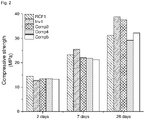
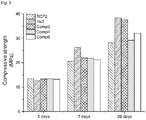
- Each RCF and SCM was blended with CEM I 32,5 R in a weight ratio 30:70 to obtain binder samples.
- Three further comparison binder samples were made by blending the same CEM I with 30 % limestone (LL according to EN 197-1), 30 % fly ash (V according to EN 197-1) and 20 % limestone + 10 % fly ash, respectively. The samples are listed in the following table 4.
- Table 4 Sample contains 70 % CEM I and designation 30 % SCM acc. to invention Inv1 30 % naturally carbonated RCF RCF1 30 % fly ash Comp3 30 % limestone Comp4 20 % limestone+10 % fly ash Comp5 30 % SCM acc. to invention Inv2 30 % naturally carbonated RCF RCF2
- the present invention allows to turn waste or recycled material into added value products, namely providing high reactivity SCM.
- the SCM according to the invention allows high clinker replacement and provides an opportunity to increase the composite binder production rate by providing a new source of reactive SCM.
- the method according to the invention provides a significant potential for CO 2 sequestration from exhaust gas, especially from cement plant exhaust gas. Since cement plant exhaust gas occurs in close proximity to where the SCM is needed for making composite binders the method needs very little investment.
- the carbonation device can be placed between the cement plant exhaust gas filter and its stack. It might even be beneficial to place it before the filter to achieve some filtering of the exhaust gas.
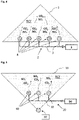
- the stockpile 1 comprises a gas introduction system 2 comprising conduits 3 and gas distributors 4. Exhaust gas 5 is passed into the conduits 3 and discharged into the stockpile 1 by the distributors 4. The conduits 3 are arranged at the bottom of the stockpile 1. Exhaust gas 5 is introduced into the RCF by the distributors 4, which can be nozzles for example. The exhaust gas 5 flows in vertical direction with respect to the stockpile 1 thereby contacting contained CO 2 and/or SO x with the waste material. The RCF is carbonated and/or sulphurized by flushing the stockpile bed with the exhaust gases containing CO 2 and/or SO x .
- Fig. 5 schematically shows an embodiment of the method according to the invention, wherein the recycled concrete fines are placed into a silo 10, optionally after the pretreatment.
- Carbonation and/or sulphurization of the RCF is performed in the silo 10 by exhaust gas 50.
- This is provided by gas distribution system 20 through conduits 30 arranged at the bottom of the silo 10 and introduced through distributors 40.
- the exhaust gas 50 flows in vertical direction with respect to the silo 10.
- the starting material is carbonated and/or sulphurized by flushing the exhaust gas 50 through the starting material.
- the silo 10 can contain a bottom discharge outlet 60 for withdrawing the obtained carbonated/sulphurized RCF.
Landscapes
- Chemical & Material Sciences (AREA)
- Engineering & Computer Science (AREA)
- Ceramic Engineering (AREA)
- Structural Engineering (AREA)
- Materials Engineering (AREA)
- Organic Chemistry (AREA)
- Chemical Kinetics & Catalysis (AREA)
- Civil Engineering (AREA)
- Inorganic Chemistry (AREA)
- General Chemical & Material Sciences (AREA)
- Environmental & Geological Engineering (AREA)
- Processing Of Solid Wastes (AREA)
- Treating Waste Gases (AREA)
Priority Applications (1)
| Application Number | Priority Date | Filing Date | Title |
|---|---|---|---|
| PL18815217T PL3724147T3 (pl) | 2017-12-13 | 2018-12-13 | Sposób jednoczesnego oczyszczania gazów spalinowych i wytwarzania uzupełniającego materiału cementowego |
Applications Claiming Priority (3)
| Application Number | Priority Date | Filing Date | Title |
|---|---|---|---|
| EP17207076.5A EP3498681A1 (en) | 2017-12-13 | 2017-12-13 | Use of carbonated recycled concrete fines as supplementary cementitious material |
| EP18176964.7A EP3581257A1 (en) | 2018-06-11 | 2018-06-11 | Method using recycled concrete fines for co2/sox removal from exhaust gas |
| PCT/EP2018/084823 WO2019115722A1 (en) | 2017-12-13 | 2018-12-13 | Method for simultaneous exhaust gas cleaning and manufacturing of supplementary cementitious material |
Publications (2)
| Publication Number | Publication Date |
|---|---|
| EP3724147A1 EP3724147A1 (en) | 2020-10-21 |
| EP3724147B1 true EP3724147B1 (en) | 2022-05-04 |
Family
ID=64650414
Family Applications (1)
| Application Number | Title | Priority Date | Filing Date |
|---|---|---|---|
| EP18815217.7A Active EP3724147B1 (en) | 2017-12-13 | 2018-12-13 | Method for simultaneous exhaust gas cleaning and manufacturing of supplementary cementitious material |
Country Status (8)
| Country | Link |
|---|---|
| US (1) | US11208350B2 (pl) |
| EP (1) | EP3724147B1 (pl) |
| CN (1) | CN111465587A (pl) |
| AU (1) | AU2018382566B2 (pl) |
| DK (1) | DK3724147T3 (pl) |
| ES (1) | ES2915414T3 (pl) |
| PL (1) | PL3724147T3 (pl) |
| WO (1) | WO2019115722A1 (pl) |
Cited By (1)
| Publication number | Priority date | Publication date | Assignee | Title |
|---|---|---|---|---|
| US12492145B2 (en) | 2021-03-18 | 2025-12-09 | Hsustainability Gmbh | Method and device for carbonation |
Families Citing this family (34)
| Publication number | Priority date | Publication date | Assignee | Title |
|---|---|---|---|---|
| US12252440B2 (en) | 2019-03-11 | 2025-03-18 | Saudi Arabian Oil Company | Recycled concrete aggregates and heavy oil fuel ash for green controlled low strength material |
| PT3744700T (pt) | 2019-05-28 | 2022-08-17 | Heidelbergcement Ag | Processo e dispositivo melhorados para carbonatar resíduos de betão e/ou sequestrar co2 |
| PL4010301T3 (pl) * | 2019-08-15 | 2025-03-24 | CRH Group Services Limited | Sposób wytwarzania kompozytu poddanego karbonatyzacji |
| EP3808713A1 (en) | 2019-10-18 | 2021-04-21 | HeidelbergCement AG | Integrated process for manufaturing hydraulically hardening building material |
| AU2020415707A1 (en) * | 2019-12-23 | 2022-08-18 | Western Sydney University | Entrainment of carbon dioxide in concrete aggregate |
| US12304863B2 (en) | 2020-03-11 | 2025-05-20 | Saudi Arabian Oil Company | Recycled concrete waste powder and aggregates with heavy oil fuel ash for producing a green flowable backfill material |
| JP7369650B2 (ja) * | 2020-03-19 | 2023-10-26 | 太平洋セメント株式会社 | 二酸化炭素吸収液の再資源化方法、セメント用粉砕助剤、及び、セメントの製造方法 |
| EP3656750A3 (en) | 2020-03-24 | 2020-12-30 | HeidelbergCement AG | Use of carbon dioxide from and for cement |
| EP3778525A1 (en) | 2020-06-17 | 2021-02-17 | HeidelbergCement AG | Improved method for manufacturing supplementary cementitious material |
| JP7074943B1 (ja) | 2021-02-22 | 2022-05-24 | 日本コンクリート工業株式会社 | 粉体の製造方法 |
| WO2022268869A1 (en) * | 2021-06-23 | 2022-12-29 | Holcim Technology Ltd | Method of preparation of a construction element by carbonation of cement |
| EP4108316A1 (en) * | 2021-06-25 | 2022-12-28 | Sika Technology AG | Method for performing desulfurization and decarbonization of a flue gas |
| CN113416090B (zh) * | 2021-07-01 | 2022-04-08 | 石家庄铁道大学 | 一种可进行co2 捕捉的含sap孔体系透气砂浆的制备方法 |
| FR3125034B1 (fr) | 2021-07-08 | 2025-12-26 | Vicat | Composition cimentaire comprenant du biochar carbonaté |
| DE202021002494U1 (de) * | 2021-07-24 | 2022-07-14 | Jörg Freiherr von und zu Weiler | Träger aus verwittertem Steinmehl und zugstabilem Material |
| EP4124609A1 (en) | 2021-07-29 | 2023-02-01 | HeidelbergCement AG | Separation of hardened concrete paste from aggregate |
| FR3125815A1 (fr) | 2021-08-02 | 2023-02-03 | Vicat | Procédé de carbonatation accélérée et sa mise en œuvre dans un procédé de valorisation de déchets de béton et de rejets gazeux industriels |
| FR3125814A1 (fr) | 2021-08-02 | 2023-02-03 | Vicat | Utilisation d’une fraction obtenue à partir d’un béton usagé comme sable pour la préparation de béton ou mortier |
| FR3125816A1 (fr) | 2021-08-02 | 2023-02-03 | Vicat | Utilisation d’une fraction obtenue à partir d’un béton usagé comme matière première pour la préparation d’un clinker |
| EP4155279A1 (en) | 2021-09-22 | 2023-03-29 | HeidelbergCement AG | Method for manufacturing supplementary cementitious material |
| EP4197982A1 (en) | 2021-12-17 | 2023-06-21 | Holcim Technology Ltd | Method for the preparation of a carbonated mineral component, carbonated mineral component and method for the preparation of a binder composition |
| FR3132710A1 (fr) | 2022-02-17 | 2023-08-18 | Vicat | Composition cimentaire comprenant des cendres de biomasse carbonatées |
| FR3132711A1 (fr) | 2022-02-17 | 2023-08-18 | Vicat | Utilisation de cendres de biomasse carbonatées comme matériau cimentaire de substitution |
| US20250162941A1 (en) | 2022-03-10 | 2025-05-22 | Hsustainability Gmbh | Method for carbonating waste materials |
| EP4241873A1 (en) | 2022-03-10 | 2023-09-13 | Heidelberg Materials AG | Removing heavy metals from cement plant off-gas for carbon capture |
| EP4265582A1 (en) | 2022-04-21 | 2023-10-25 | Holcim Technology Ltd | Method for the preparation of a carbonated mineral component, carbonated mineral component and method for the preparation of a hydraulic binder |
| CN114620963A (zh) * | 2022-04-22 | 2022-06-14 | 广州大学 | 一种再生粉完全碳化的方法 |
| FR3136683A1 (fr) | 2022-06-20 | 2023-12-22 | Vicat | Procédé de captation et de stockage du co 2 |
| US12275674B2 (en) | 2022-07-11 | 2025-04-15 | Saudi Arabian Oil Company | Basaltic lava for producing green controlled low strength material (CLSM) |
| EP4365146A1 (en) * | 2022-11-02 | 2024-05-08 | Sika Technology AG | Blended cements, methods for their manufacture, and use of an admixture to increase performance of blended cements |
| WO2024128216A1 (ja) * | 2022-12-13 | 2024-06-20 | 太平洋セメント株式会社 | セメント組成物及び水硬性組成物 |
| EP4488346A1 (en) | 2023-07-03 | 2025-01-08 | Heidelberg Materials AG | Method for upgrading biogas and syngas |
| GB2638122A (en) * | 2023-12-14 | 2025-08-20 | Cocooncarbon Ltd | Process and system |
| NL2037199B1 (en) | 2024-03-07 | 2025-09-15 | C2Ca Tech B V | Method for obtaining a cement constituent from a concrete element |
Family Cites Families (13)
| Publication number | Priority date | Publication date | Assignee | Title |
|---|---|---|---|---|
| JP3123810B2 (ja) | 1992-02-29 | 2001-01-15 | 住友大阪セメント株式会社 | セメント増量材およびその製造方法 |
| US5725655A (en) | 1996-09-17 | 1998-03-10 | Catterton; Robert L. | Method for new concrete from old concrete |
| SE524154C2 (sv) | 2002-11-07 | 2004-07-06 | Procedo Entpr Ets | Förfarande för framställning av blandcement med reducerande koldioxidemissioner |
| GB0603443D0 (en) | 2006-02-21 | 2006-04-05 | Hills Colin D | Production of secondary aggregates |
| CN101343155B (zh) * | 2008-08-29 | 2011-07-27 | 济南大学 | 碳化养护废弃物制成的再生骨料 |
| JP4822373B1 (ja) | 2010-12-17 | 2011-11-24 | 中国電力株式会社 | 炭酸化養生設備、炭酸化コンクリート製造方法および炭酸ガス固定化方法 |
| FR2978761B1 (fr) | 2011-08-02 | 2014-06-06 | Lafarge Sa | Procede de fabrication d'un liant hydraulique rapide |
| EP2708520A1 (de) | 2012-09-14 | 2014-03-19 | Cemex Research Group AG | Verfahren zur Herstellung von Zuschlag sowie von Kalziumcarbonat aus Beton-Gesteinskörnung sowie eine Vorrichtung zur Durchführung des Verfahrens |
| CN105102396B (zh) | 2013-03-28 | 2019-01-22 | Sika技术股份公司 | 从拆除废料收回骨料和粉状矿物材料 |
| CN104556882B (zh) * | 2015-01-21 | 2016-12-07 | 中国科学院沈阳应用生态研究所 | 一种利用建筑材料制造具有碳封存功能的混凝土制品的方法 |
| CN105800971B (zh) * | 2016-05-03 | 2018-11-06 | 湖南大学 | 用再生混凝土破碎过程中的细粉制成的辅助性胶凝材料 |
| CN106431116A (zh) * | 2016-09-30 | 2017-02-22 | 河海大学 | 以回收废弃混凝土为原料的建筑砌块及其制备方法 |
| KR101777142B1 (ko) | 2017-05-29 | 2017-09-12 | 한국지역난방공사 | 폐콘크리트 미분말을 이용한 광물 탄산화물질 제조시스템 |
-
2018
- 2018-12-13 PL PL18815217T patent/PL3724147T3/pl unknown
- 2018-12-13 DK DK18815217.7T patent/DK3724147T3/da active
- 2018-12-13 WO PCT/EP2018/084823 patent/WO2019115722A1/en not_active Ceased
- 2018-12-13 EP EP18815217.7A patent/EP3724147B1/en active Active
- 2018-12-13 AU AU2018382566A patent/AU2018382566B2/en active Active
- 2018-12-13 CN CN201880080395.7A patent/CN111465587A/zh active Pending
- 2018-12-13 ES ES18815217T patent/ES2915414T3/es active Active
- 2018-12-13 US US16/768,201 patent/US11208350B2/en active Active
Cited By (1)
| Publication number | Priority date | Publication date | Assignee | Title |
|---|---|---|---|---|
| US12492145B2 (en) | 2021-03-18 | 2025-12-09 | Hsustainability Gmbh | Method and device for carbonation |
Also Published As
| Publication number | Publication date |
|---|---|
| ES2915414T3 (es) | 2022-06-22 |
| WO2019115722A1 (en) | 2019-06-20 |
| CN111465587A (zh) | 2020-07-28 |
| DK3724147T3 (da) | 2022-07-25 |
| PL3724147T3 (pl) | 2022-07-04 |
| AU2018382566A1 (en) | 2020-05-07 |
| AU2018382566B2 (en) | 2023-12-21 |
| EP3724147A1 (en) | 2020-10-21 |
| CA3085504A1 (en) | 2019-06-20 |
| US20200290925A1 (en) | 2020-09-17 |
| US11208350B2 (en) | 2021-12-28 |
Similar Documents
| Publication | Publication Date | Title |
|---|---|---|
| EP3724147B1 (en) | Method for simultaneous exhaust gas cleaning and manufacturing of supplementary cementitious material | |
| AU2020281669B2 (en) | Improved process and device for carbonating concrete waste and/or sequestering CO2 | |
| EP3498681A1 (en) | Use of carbonated recycled concrete fines as supplementary cementitious material | |
| EP3581257A1 (en) | Method using recycled concrete fines for co2/sox removal from exhaust gas | |
| JP7450409B2 (ja) | セメント混合材、混合セメントおよび炭酸ガス吸着材の製造方法 | |
| US11642625B2 (en) | Method for scrubbing exhaust gas from CO2 and/or SOx | |
| US20240375998A1 (en) | Method for manufacturing supplementary cementitious material | |
| EP4241874A1 (en) | Improvement of reactivity by oxidation | |
| EP4259590B1 (en) | Method of producing a synthetic carbonated mineral component in a cement manufacturing plant | |
| EP4452463B1 (en) | Improvement of reactivity by oxidation | |
| CA3085504C (en) | Method for simultaneous exhaust gas cleaning and manufacturing of supplementary cementitious material | |
| CA3237433A1 (en) | Method of producing a synthetic carbonated mineral component in a cement manufacturing plant | |
| EA041254B1 (ru) | Способ одновременной очистки отходящего газа и производства дополнительного минерального вяжущего материала | |
| JP7769566B2 (ja) | ウォラストナイト含有焼成物の製造方法及び該焼成物の利用 | |
| CA3139016C (en) | Improved process and device for carbonating concrete waste and/or sequestering co2 | |
| EP4378907A1 (en) | Composite binder hardening by carbonation | |
| JP2024032602A (ja) | ウォラストナイト含有焼成物の製造方法 |
Legal Events
| Date | Code | Title | Description |
|---|---|---|---|
| STAA | Information on the status of an ep patent application or granted ep patent |
Free format text: STATUS: UNKNOWN |
|
| STAA | Information on the status of an ep patent application or granted ep patent |
Free format text: STATUS: THE INTERNATIONAL PUBLICATION HAS BEEN MADE |
|
| PUAI | Public reference made under article 153(3) epc to a published international application that has entered the european phase |
Free format text: ORIGINAL CODE: 0009012 |
|
| STAA | Information on the status of an ep patent application or granted ep patent |
Free format text: STATUS: REQUEST FOR EXAMINATION WAS MADE |
|
| 17P | Request for examination filed |
Effective date: 20200602 |
|
| AK | Designated contracting states |
Kind code of ref document: A1 Designated state(s): AL AT BE BG CH CY CZ DE DK EE ES FI FR GB GR HR HU IE IS IT LI LT LU LV MC MK MT NL NO PL PT RO RS SE SI SK SM TR |
|
| AX | Request for extension of the european patent |
Extension state: BA ME |
|
| DAV | Request for validation of the european patent (deleted) | ||
| DAX | Request for extension of the european patent (deleted) | ||
| STAA | Information on the status of an ep patent application or granted ep patent |
Free format text: STATUS: EXAMINATION IS IN PROGRESS |
|
| 17Q | First examination report despatched |
Effective date: 20210406 |
|
| GRAP | Despatch of communication of intention to grant a patent |
Free format text: ORIGINAL CODE: EPIDOSNIGR1 |
|
| STAA | Information on the status of an ep patent application or granted ep patent |
Free format text: STATUS: GRANT OF PATENT IS INTENDED |
|
| GRAJ | Information related to disapproval of communication of intention to grant by the applicant or resumption of examination proceedings by the epo deleted |
Free format text: ORIGINAL CODE: EPIDOSDIGR1 |
|
| STAA | Information on the status of an ep patent application or granted ep patent |
Free format text: STATUS: EXAMINATION IS IN PROGRESS |
|
| INTG | Intention to grant announced |
Effective date: 20211116 |
|
| GRAP | Despatch of communication of intention to grant a patent |
Free format text: ORIGINAL CODE: EPIDOSNIGR1 |
|
| STAA | Information on the status of an ep patent application or granted ep patent |
Free format text: STATUS: GRANT OF PATENT IS INTENDED |
|
| INTC | Intention to grant announced (deleted) | ||
| RIN1 | Information on inventor provided before grant (corrected) |
Inventor name: BOLTE, GERD Inventor name: BEN HAHA, MOHSEN Inventor name: ZAJAC, MACIEJ Inventor name: SKOCEK, JAN |
|
| INTG | Intention to grant announced |
Effective date: 20220111 |
|
| GRAS | Grant fee paid |
Free format text: ORIGINAL CODE: EPIDOSNIGR3 |
|
| GRAA | (expected) grant |
Free format text: ORIGINAL CODE: 0009210 |
|
| STAA | Information on the status of an ep patent application or granted ep patent |
Free format text: STATUS: THE PATENT HAS BEEN GRANTED |
|
| AK | Designated contracting states |
Kind code of ref document: B1 Designated state(s): AL AT BE BG CH CY CZ DE DK EE ES FI FR GB GR HR HU IE IS IT LI LT LU LV MC MK MT NL NO PL PT RO RS SE SI SK SM TR |
|
| REG | Reference to a national code |
Ref country code: GB Ref legal event code: FG4D |
|
| REG | Reference to a national code |
Ref country code: CH Ref legal event code: EP |
|
| REG | Reference to a national code |
Ref country code: AT Ref legal event code: REF Ref document number: 1488913 Country of ref document: AT Kind code of ref document: T Effective date: 20220515 |
|
| REG | Reference to a national code |
Ref country code: IE Ref legal event code: FG4D Ref country code: DE Ref legal event code: R096 Ref document number: 602018035103 Country of ref document: DE |
|
| REG | Reference to a national code |
Ref country code: PT Ref legal event code: SC4A Ref document number: 3724147 Country of ref document: PT Date of ref document: 20220602 Kind code of ref document: T Free format text: AVAILABILITY OF NATIONAL TRANSLATION Effective date: 20220530 |
|
| REG | Reference to a national code |
Ref country code: ES Ref legal event code: FG2A Ref document number: 2915414 Country of ref document: ES Kind code of ref document: T3 Effective date: 20220622 |
|
| REG | Reference to a national code |
Ref country code: DK Ref legal event code: T3 Effective date: 20220719 |
|
| REG | Reference to a national code |
Ref country code: GR Ref legal event code: EP Ref document number: 20220401465 Country of ref document: GR Effective date: 20220808 |
|
| REG | Reference to a national code |
Ref country code: LT Ref legal event code: MG9D |
|
| REG | Reference to a national code |
Ref country code: NL Ref legal event code: MP Effective date: 20220504 |
|
| PG25 | Lapsed in a contracting state [announced via postgrant information from national office to epo] |
Ref country code: SE Free format text: LAPSE BECAUSE OF FAILURE TO SUBMIT A TRANSLATION OF THE DESCRIPTION OR TO PAY THE FEE WITHIN THE PRESCRIBED TIME-LIMIT Effective date: 20220504 Ref country code: NO Free format text: LAPSE BECAUSE OF FAILURE TO SUBMIT A TRANSLATION OF THE DESCRIPTION OR TO PAY THE FEE WITHIN THE PRESCRIBED TIME-LIMIT Effective date: 20220804 Ref country code: NL Free format text: LAPSE BECAUSE OF FAILURE TO SUBMIT A TRANSLATION OF THE DESCRIPTION OR TO PAY THE FEE WITHIN THE PRESCRIBED TIME-LIMIT Effective date: 20220504 Ref country code: LT Free format text: LAPSE BECAUSE OF FAILURE TO SUBMIT A TRANSLATION OF THE DESCRIPTION OR TO PAY THE FEE WITHIN THE PRESCRIBED TIME-LIMIT Effective date: 20220504 Ref country code: HR Free format text: LAPSE BECAUSE OF FAILURE TO SUBMIT A TRANSLATION OF THE DESCRIPTION OR TO PAY THE FEE WITHIN THE PRESCRIBED TIME-LIMIT Effective date: 20220504 Ref country code: FI Free format text: LAPSE BECAUSE OF FAILURE TO SUBMIT A TRANSLATION OF THE DESCRIPTION OR TO PAY THE FEE WITHIN THE PRESCRIBED TIME-LIMIT Effective date: 20220504 Ref country code: BG Free format text: LAPSE BECAUSE OF FAILURE TO SUBMIT A TRANSLATION OF THE DESCRIPTION OR TO PAY THE FEE WITHIN THE PRESCRIBED TIME-LIMIT Effective date: 20220804 |
|
| PG25 | Lapsed in a contracting state [announced via postgrant information from national office to epo] |
Ref country code: RS Free format text: LAPSE BECAUSE OF FAILURE TO SUBMIT A TRANSLATION OF THE DESCRIPTION OR TO PAY THE FEE WITHIN THE PRESCRIBED TIME-LIMIT Effective date: 20220504 Ref country code: LV Free format text: LAPSE BECAUSE OF FAILURE TO SUBMIT A TRANSLATION OF THE DESCRIPTION OR TO PAY THE FEE WITHIN THE PRESCRIBED TIME-LIMIT Effective date: 20220504 Ref country code: IS Free format text: LAPSE BECAUSE OF FAILURE TO SUBMIT A TRANSLATION OF THE DESCRIPTION OR TO PAY THE FEE WITHIN THE PRESCRIBED TIME-LIMIT Effective date: 20220904 |
|
| PG25 | Lapsed in a contracting state [announced via postgrant information from national office to epo] |
Ref country code: SM Free format text: LAPSE BECAUSE OF FAILURE TO SUBMIT A TRANSLATION OF THE DESCRIPTION OR TO PAY THE FEE WITHIN THE PRESCRIBED TIME-LIMIT Effective date: 20220504 Ref country code: SK Free format text: LAPSE BECAUSE OF FAILURE TO SUBMIT A TRANSLATION OF THE DESCRIPTION OR TO PAY THE FEE WITHIN THE PRESCRIBED TIME-LIMIT Effective date: 20220504 Ref country code: EE Free format text: LAPSE BECAUSE OF FAILURE TO SUBMIT A TRANSLATION OF THE DESCRIPTION OR TO PAY THE FEE WITHIN THE PRESCRIBED TIME-LIMIT Effective date: 20220504 |
|
| REG | Reference to a national code |
Ref country code: DE Ref legal event code: R097 Ref document number: 602018035103 Country of ref document: DE |
|
| PLBE | No opposition filed within time limit |
Free format text: ORIGINAL CODE: 0009261 |
|
| STAA | Information on the status of an ep patent application or granted ep patent |
Free format text: STATUS: NO OPPOSITION FILED WITHIN TIME LIMIT |
|
| PG25 | Lapsed in a contracting state [announced via postgrant information from national office to epo] |
Ref country code: AL Free format text: LAPSE BECAUSE OF FAILURE TO SUBMIT A TRANSLATION OF THE DESCRIPTION OR TO PAY THE FEE WITHIN THE PRESCRIBED TIME-LIMIT Effective date: 20220504 |
|
| 26N | No opposition filed |
Effective date: 20230207 |
|
| PG25 | Lapsed in a contracting state [announced via postgrant information from national office to epo] |
Ref country code: SI Free format text: LAPSE BECAUSE OF FAILURE TO SUBMIT A TRANSLATION OF THE DESCRIPTION OR TO PAY THE FEE WITHIN THE PRESCRIBED TIME-LIMIT Effective date: 20220504 |
|
| P01 | Opt-out of the competence of the unified patent court (upc) registered |
Effective date: 20230527 |
|
| REG | Reference to a national code |
Ref country code: AT Ref legal event code: UEP Ref document number: 1488913 Country of ref document: AT Kind code of ref document: T Effective date: 20220504 |
|
| PG25 | Lapsed in a contracting state [announced via postgrant information from national office to epo] |
Ref country code: LU Free format text: LAPSE BECAUSE OF NON-PAYMENT OF DUE FEES Effective date: 20221213 |
|
| PG25 | Lapsed in a contracting state [announced via postgrant information from national office to epo] |
Ref country code: CY Free format text: LAPSE BECAUSE OF FAILURE TO SUBMIT A TRANSLATION OF THE DESCRIPTION OR TO PAY THE FEE WITHIN THE PRESCRIBED TIME-LIMIT Effective date: 20220504 |
|
| PG25 | Lapsed in a contracting state [announced via postgrant information from national office to epo] |
Ref country code: MK Free format text: LAPSE BECAUSE OF FAILURE TO SUBMIT A TRANSLATION OF THE DESCRIPTION OR TO PAY THE FEE WITHIN THE PRESCRIBED TIME-LIMIT Effective date: 20220504 Ref country code: HU Free format text: LAPSE BECAUSE OF FAILURE TO SUBMIT A TRANSLATION OF THE DESCRIPTION OR TO PAY THE FEE WITHIN THE PRESCRIBED TIME-LIMIT; INVALID AB INITIO Effective date: 20181213 |
|
| PG25 | Lapsed in a contracting state [announced via postgrant information from national office to epo] |
Ref country code: MC Free format text: LAPSE BECAUSE OF FAILURE TO SUBMIT A TRANSLATION OF THE DESCRIPTION OR TO PAY THE FEE WITHIN THE PRESCRIBED TIME-LIMIT Effective date: 20220504 |
|
| PG25 | Lapsed in a contracting state [announced via postgrant information from national office to epo] |
Ref country code: MC Free format text: LAPSE BECAUSE OF FAILURE TO SUBMIT A TRANSLATION OF THE DESCRIPTION OR TO PAY THE FEE WITHIN THE PRESCRIBED TIME-LIMIT Effective date: 20220504 |
|
| PG25 | Lapsed in a contracting state [announced via postgrant information from national office to epo] |
Ref country code: MT Free format text: LAPSE BECAUSE OF FAILURE TO SUBMIT A TRANSLATION OF THE DESCRIPTION OR TO PAY THE FEE WITHIN THE PRESCRIBED TIME-LIMIT Effective date: 20220504 |
|
| PG25 | Lapsed in a contracting state [announced via postgrant information from national office to epo] |
Ref country code: BG Free format text: LAPSE BECAUSE OF FAILURE TO SUBMIT A TRANSLATION OF THE DESCRIPTION OR TO PAY THE FEE WITHIN THE PRESCRIBED TIME-LIMIT Effective date: 20220504 |
|
| PG25 | Lapsed in a contracting state [announced via postgrant information from national office to epo] |
Ref country code: BG Free format text: LAPSE BECAUSE OF FAILURE TO SUBMIT A TRANSLATION OF THE DESCRIPTION OR TO PAY THE FEE WITHIN THE PRESCRIBED TIME-LIMIT Effective date: 20220504 |
|
| PGFP | Annual fee paid to national office [announced via postgrant information from national office to epo] |
Ref country code: CH Payment date: 20250101 Year of fee payment: 7 |
|
| REG | Reference to a national code |
Ref country code: CH Ref legal event code: U11 Free format text: ST27 STATUS EVENT CODE: U-0-0-U10-U11 (AS PROVIDED BY THE NATIONAL OFFICE) Effective date: 20260101 |
|
| PGFP | Annual fee paid to national office [announced via postgrant information from national office to epo] |
Ref country code: GB Payment date: 20251218 Year of fee payment: 8 |
|
| PGFP | Annual fee paid to national office [announced via postgrant information from national office to epo] |
Ref country code: AT Payment date: 20251215 Year of fee payment: 8 Ref country code: PT Payment date: 20251211 Year of fee payment: 8 |
|
| PGFP | Annual fee paid to national office [announced via postgrant information from national office to epo] |
Ref country code: DK Payment date: 20251217 Year of fee payment: 8 |
|
| PGFP | Annual fee paid to national office [announced via postgrant information from national office to epo] |
Ref country code: FR Payment date: 20251217 Year of fee payment: 8 |
|
| PGFP | Annual fee paid to national office [announced via postgrant information from national office to epo] |
Ref country code: TR Payment date: 20251208 Year of fee payment: 8 Ref country code: GR Payment date: 20251215 Year of fee payment: 8 Ref country code: BE Payment date: 20251223 Year of fee payment: 8 |
|
| PGFP | Annual fee paid to national office [announced via postgrant information from national office to epo] |
Ref country code: CZ Payment date: 20251128 Year of fee payment: 8 Ref country code: IE Payment date: 20251218 Year of fee payment: 8 |
|
| PGFP | Annual fee paid to national office [announced via postgrant information from national office to epo] |
Ref country code: PL Payment date: 20251205 Year of fee payment: 8 |
|
| PGFP | Annual fee paid to national office [announced via postgrant information from national office to epo] |
Ref country code: RO Payment date: 20251209 Year of fee payment: 8 |
|
| PGFP | Annual fee paid to national office [announced via postgrant information from national office to epo] |
Ref country code: ES Payment date: 20260119 Year of fee payment: 8 |
|
| PGFP | Annual fee paid to national office [announced via postgrant information from national office to epo] |
Ref country code: DE Payment date: 20251222 Year of fee payment: 8 |
|
| PGFP | Annual fee paid to national office [announced via postgrant information from national office to epo] |
Ref country code: IT Payment date: 20251231 Year of fee payment: 8 |