EP3722809A1 - Verfahren zur vorhersage von gliomen - Google Patents
Verfahren zur vorhersage von gliomen Download PDFInfo
- Publication number
- EP3722809A1 EP3722809A1 EP18886235.3A EP18886235A EP3722809A1 EP 3722809 A1 EP3722809 A1 EP 3722809A1 EP 18886235 A EP18886235 A EP 18886235A EP 3722809 A1 EP3722809 A1 EP 3722809A1
- Authority
- EP
- European Patent Office
- Prior art keywords
- glioma
- vimentin
- subject
- blood
- grade
- Prior art date
- Legal status (The legal status is an assumption and is not a legal conclusion. Google has not performed a legal analysis and makes no representation as to the accuracy of the status listed.)
- Pending
Links
Images


Classifications
-
- G—PHYSICS
- G01—MEASURING; TESTING
- G01N—INVESTIGATING OR ANALYSING MATERIALS BY DETERMINING THEIR CHEMICAL OR PHYSICAL PROPERTIES
- G01N33/00—Investigating or analysing materials by specific methods not covered by groups G01N1/00 - G01N31/00
- G01N33/48—Biological material, e.g. blood, urine; Haemocytometers
- G01N33/50—Chemical analysis of biological material, e.g. blood, urine; Testing involving biospecific ligand binding methods; Immunological testing
- G01N33/53—Immunoassay; Biospecific binding assay; Materials therefor
- G01N33/575—Immunoassay; Biospecific binding assay; Materials therefor for cancer
- G01N33/57557—Immunoassay; Biospecific binding assay; Materials therefor for cancer of other specific parts of the body, e.g. brain
Definitions
- the present invention relates to a method for predicting the onset of glioma in a subject.
- Glioma is one of the malignant tumors that occur in the brain and accounts for about 25% of all the intracranial tumors.
- Non Patent Literature 1 There are various types of glioma, and the Classification made by the World Health Organization (WHO) is used worldwide (Non Patent Literature 1). The WHO Classification is based on malignancy and these types of glioma are classified into grade 1 (having the lowest malignancy) to grade 4 (having the highest malignancy). The treatment strategy for each type of glioma is also determined based on these grades.
- glioma Since some of glioma have high malignancy and poor prognosis (for example, glioblastoma, which is classified into the grade 4, has a five-year survival rate of 10% or less), it is important to correctly judge that the tumor is glioma and start the treatment suitable for glioma, for the prognosis of patients.
- the definitive diagnosis of glioma involves diagnostic imaging such as CT and MRI and histopathologic examination in which the pathologist observes, with microscope, brain tissues sampled from a subject who is suspected of having glioma from the diagnostic imaging.
- the histopathologic examination requires complicated operations of immunohistochemical staining, it takes time to obtain the result.
- the brain tissue sampling also has high invasiveness and high risk to a subject, there is a case where the brain tissue sampling cannot be conducted.
- diagnostic imaging it is quite often difficult to distinguish glioma from metastatic brain tumors and malignant lymphoma, which are diseases different from glioma.
- diagnostic imaging uses contrast agents and takes a long test time, it is difficult to frequently conduct the diagnostic imaging on children and subjects having severe systemic conditions.
- Non Patent Literature 2 the search for tumor markers contained in bloods, which are easily sampled, has been made and several glioma markers have been reported.
- vimentin which is employed in the present invention, it has been reported that vimentin can be used as a marker for detecting colonic neoplasms such as colon cancer (Patent Literature 1) and that vimentin can be used as a marker for diagnosing metastatic brain tumors (Patent Literature 2). Note that glioma is not classified into metastatic brain tumors. Furthermore, vimentin has been reported to be expressed in immature neuroglial cells in the central nerves and the expression enhancement of vimentin correlates with the malignancy of glioma, based on the immunohistochemical studies (Non Patent Literature 3). However, it has not been known that vimentin is present out of cells of blood and the like.
- the glioma markers in blood reported so far have low sensitivity and specificity, and accordingly have not been clinically applied.
- the present invention relates to the following [1] to [16]:
- the present invention is capable of simply, promptly, and accurately predicting the onset of glioma by using a blood, which can be obtained by means that has low invasiveness and risk to a subject. Therefore, using the present invention makes it possible to conduct prompt and accurate diagnosis of glioma on a subject who is suspected of having glioma from diagnostic imaging. In addition, the present invention also makes it possible to conduct an examination for glioma during a normal health examination.
- the prediction result obtained by the present invention may be utilized for determination on the effect of the treatment of glioma and determination on the relapse after the treatment.
- a method for predicting the onset of glioma in a subject according to the present invention comprises the steps of:
- Glioma is one of the malignant tumors that occur in the brain. Brain tumors are broadly divided into primary brain tumors and metastatic brain tumors, and glioma is classified into the primary brain tumor.
- glioma is classified into grade 1 (having the lowest malignancy) to grade 4 (having the highest malignancy).
- the grade 1 glioma includes pilocytic astrocytoma and subependymal giant cell astrocytoma.
- the grade 2 glioma includes diffuse astrocytoma, oligodendroglioma, and mixed oligodendroglioma-astrocytoma.
- the grade 3 glioma includes anaplastic astrocytoma, anaplastic oligodendroglioma, and anaplastic mixed oligodendroglioma-astrocytoma.
- the grade 4 glioma includes glioblastoma and gliosarcoma.
- the present invention is applicable to glioma of any of these grades, but is applicable preferably to grade 2 to 4 gliomas, and particularly preferably to grade 4 glioma.
- Glioblastoma is a glioma that occurs from the neuroglial cells, and is a glioma having a high malignancy that is classified into grade 4 in the WHO Classification. It is known that glioblastoma is likely to occur in the cerebral hemispheres of 45- to 65-year-old males, and as symptoms causes headache, convolution, character change, dementia, paralysis, and the like, and that the progress of the symptoms is fast because of its high malignancy.
- the subject includes any animal that could contract glioma, but is preferably a mammal, and particularly preferably a human.
- the subject may be one who is suspected of having glioma by publicly-known means for testing glioma (for example, CT, MRI, or the like) or may be one who is not suspected of having glioma (for example, one who has a normal health examination).
- publicly-known means for testing glioma for example, CT, MRI, or the like
- glioma for example, one who has a normal health examination
- the subject may be of any sex and any age.
- the blood sample derived from the subject may be prepared by a method used in the art in general with no particular limitation.
- blood sampled from the subject may be used as it is, but it is preferable to use a sample obtained by processing blood sampled from the subject (for example, blood serum, plasma, or the like). From the viewpoint that it is possible to accurately and promptly measure vimentin, it is preferable to use a blood serum sample.
- the blood serum sample may be prepared by a method used in the art in general with no particular limitation.
- the blood serum sample may be prepared by sampling blood (for example, venous blood) from the subject, allowing the blood standing at room temperature (for example, 30 minutes), and centrifuging this (for example, for 10 minutes at 3500 rpm).
- the blood serum sample thus prepared may be cryopreserved (for example, -80 ° C) until used for the method of the present invention.
- Vimentin is a publicly-known cytoskeletal protein (type III intermediate filament) that is present mainly in the cytoplasms of mesenchymal cells. Although vimentin is currently widely used in immunohistochemical staining, it has not been known that vimentin is present out of cells of blood and the like.
- Vimentin in the blood sample may be detected by using a vimentin detection method and a quantification method that are used in the art in general and are applicable to bloods with no particular limitation.
- Specific examples of the methods include the ELISA (Enzyme-Linked ImmunoSorbent Assay) using a vimentin-specific antibody, which has a high specificity to vimentin and is excellent in quantitativity.
- Step (1) may be executed using vimentin detecting means that is publicly known in the art and is applicable to bloods, for example, a vimentin detection kit including a vimentin antibody, preferably , the ELISA kit for vimentin.
- vimentin detection kit including a vimentin antibody, preferably , the ELISA kit for vimentin.
- the ELISA favorable for Step (1) includes the sandwich method and the direct-adsorption method.
- the sandwich ELISA is preferable from the viewpoint that the sandwich ELISA has a high specificity to vimentin.
- the sandwich ELISA may be conducted by the following steps:
- the primary antibody used in the sandwich ELISA is an antibody to vimentin, which recognizes an epitope different from an epitope recognized by the capture antibody.
- Kit for measuring vimentin using the sandwich ELISA are commercially available (for example, trade name: Vimentin ELISA Kit (Uscn Life Science Inc., Wuhan, China)), and any of these commercial products may be used for Step (1) with no particular limitation.
- Vimentin in the blood sample may be detected by a method other than the ELISA.
- a method utilizing micro-flow channels include a method utilizing micro-flow channels, the western blot method, the dot blot method, the Ouchterloney method, the immunoprecipitation method, and the like.
- Step (2) a possibility that the subject has contracted glioma is predicted based on the presence or absence of vimentin in the blood sample measured in Step (1). Specifically, in a case where vimentin is detected, it is predicted that there is a high possibility that the subject has contracted glioma.
- the prediction result obtained according to the present invention may be utilized as described below.
- the present invention is executed on a subject who is suspected of having glioma from diagnostic imaging such as CT or MRI, by combining the prediction result obtained by the present invention with other diagnostic criteria (result of histopathologic examination and the like) for glioma, it is possible to conduct more prompt and more accurate definitive diagnosis.
- diagnostic imaging such as CT or MRI
- other diagnostic criteria result of histopathologic examination and the like
- brain tissue sampling is difficult due to the health status or the like of the subject, it is possible to more effectively utilize the prediction result by the present invention.
- the present invention is executed on someone who is not suspected of having glioma (for example, someone who has a normal health examination), it is possible to determine whether or not a secondary examination (close examination) is needed for glioma, by using the prediction result obtained according to the present invention.
- the test for glioma which has conventionally not been conducted, may be made to be an examination item in a normal health examination by using the present invention that uses a blood sample, which imposes low invasiveness and risk to a subject, and can be executed with simple means.
- the above-described prediction method can be grasped as a blood marker for detecting glioma, comprising vimentin.
- This blood marker can be used for predicting or detecting the onset of glioma in a subject.
- the present invention relates to a kit for conducting the above-described method for predicting glioma.
- This kit comprises: a reagent for detecting vimentin in a blood sample; and an instruction stating that in a case where vimentin is detected, it is predicted that there is a high possibility that a subject has contracted glioma.
- any reagent that is used in the art in general for detecting and quantifying vimentin and is applicable to bloods may be used with no particular limitation.
- Specific example of such reagent includes a vimentin-specific antibody.
- the kit of the present invention preferably uses the above-described ELISA, particularly the sandwich ELISA.
- the kit in this case may comprise a reagent used in ELISA (for example, a solid-phase blocking agent used in the sandwich ELISA, a vimentin antibody (capture antibody), a primary antibody, an enzyme, an enzyme substrate, and the like).
- Example the effects of the present invention will be described in detail by way of Example ; however, the present invention is not limited to Example.
- the vimentin concentrations in blood samples derived from glioma patients of grade 2 to 4 according to the WHO Classification and healthy individuals were measured and compared.
- the subjects were classified into the following groups.
- Glioma of grade 3 8 patients where: Anaplastic oligodendroglioma: 8 patients
- Glioma of grade 4 15 patients where: Glioblastoma: 15 patients
- the subjects of group 2 to 4 were subjected to the craniotomy and tumor resection or biopsy at the neurosurgery department of the Tokyo Women's Medical University Hospital between May, 2013 and June, 2014 and were definitively diagnosed with the respective diseases from the pathological examinations of sampled brain tissues.
- the venous blood was sampled from each subject and was left to stand for 30 minutes at room temperature, followed by centrifugation (for 10 minutes at 3500 rpm) to prepare a blood serum sample.
- the prepared blood serum sample was cryopreserved (-80°C) until vimentin was measured.
- the cryopreserved blood serum sample was thawed at 4°C. Subsequently, the sandwich ELISA was conducted using a commercially-available vimentin measuring kit (trade name: Vimentin ELISA Kit (Uscn Life Science Inc., Wuhan, China)) according to the protocol attached to the kit to measure the vimentin concentration in the blood serum sample.
- a commercially-available vimentin measuring kit (trade name: Vimentin ELISA Kit (Uscn Life Science Inc., Wuhan, China)) according to the protocol attached to the kit to measure the vimentin concentration in the blood serum sample.
- the measurement result is shown in Fig. 1 .
- the vimentin concentration of group 0 was less than the detection limit concentration (7.8 ng/ml) and was thus deemed as 0 ng/ml.
- Fig. 2 shows groups 2 to 4 plotted collectively as the glioma patients.
- the blood serum vimentin concentration between the healthy individuals and the glioma patients was statistically evaluated using the Student-t test. The result is shown in the following table. Comparison for each pair in the Student-t test Level -Level Difference Standard error of difference Lower confidence limit Upper confidence limit p-value 2 to 4 0 17.1509 4.7456 7.5263 26.7755 0.0009
- glioma and healthy individuals can be distinguished using the presence of vimentin in the blood serum samples as an index.
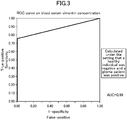
- a ROC curve was created using data of the blood serum vimentin concentrations of the healthy individuals (group 0) and the glioma patients (groups 2 to 4) ( Fig. 3 ).
- the ROC curve indicates the reliability of the test.
- the "sensitivity (true-positive rate)" in the Y axis indicates the rate of indicating positive (abnormal value) when the test is conducted on a group who contract glioma
- the "1-specificity (false-positive rate)" in the X axis indicates the rate of detecting the healthy individuals (negative) who do no contract glioma as positive.
- the AUC of the ROC curve of Example 1 was 0.88. From this result, it is understood that the present invention, which uses the presence of blood vimentin as an index, is a method with a high reliability in predicting the onset of glioma.
- the present invention which is capable of predicting the onset of glioma, may be utilized for diagnosis of glioma.
Landscapes
- Health & Medical Sciences (AREA)
- Life Sciences & Earth Sciences (AREA)
- Immunology (AREA)
- Engineering & Computer Science (AREA)
- Molecular Biology (AREA)
- Biomedical Technology (AREA)
- Chemical & Material Sciences (AREA)
- Hematology (AREA)
- Urology & Nephrology (AREA)
- Biotechnology (AREA)
- Microbiology (AREA)
- Cell Biology (AREA)
- Food Science & Technology (AREA)
- Medicinal Chemistry (AREA)
- Physics & Mathematics (AREA)
- Analytical Chemistry (AREA)
- Biochemistry (AREA)
- General Health & Medical Sciences (AREA)
- General Physics & Mathematics (AREA)
- Pathology (AREA)
- Investigating Or Analysing Biological Materials (AREA)
Applications Claiming Priority (2)
| Application Number | Priority Date | Filing Date | Title |
|---|---|---|---|
| JP2017235811A JP6579339B2 (ja) | 2017-12-08 | 2017-12-08 | 神経膠腫の予測方法 |
| PCT/JP2018/045169 WO2019112056A1 (ja) | 2017-12-08 | 2018-12-07 | 神経膠腫の予測方法 |
Publications (2)
| Publication Number | Publication Date |
|---|---|
| EP3722809A1 true EP3722809A1 (de) | 2020-10-14 |
| EP3722809A4 EP3722809A4 (de) | 2021-09-15 |
Family
ID=66750194
Family Applications (1)
| Application Number | Title | Priority Date | Filing Date |
|---|---|---|---|
| EP18886235.3A Pending EP3722809A4 (de) | 2017-12-08 | 2018-12-07 | Verfahren zur vorhersage von gliomen |
Country Status (3)
| Country | Link |
|---|---|
| EP (1) | EP3722809A4 (de) |
| JP (1) | JP6579339B2 (de) |
| WO (1) | WO2019112056A1 (de) |
Family Cites Families (2)
| Publication number | Priority date | Publication date | Assignee | Title |
|---|---|---|---|---|
| US7057200B2 (en) | 2003-07-24 | 2006-06-06 | Eastman Kodak Company | Storage phosphor erase |
| KR101492024B1 (ko) * | 2013-03-04 | 2015-02-11 | 한국화학연구원 | 전이성 뇌종양 진단용 마커 |
-
2017
- 2017-12-08 JP JP2017235811A patent/JP6579339B2/ja active Active
-
2018
- 2018-12-07 EP EP18886235.3A patent/EP3722809A4/de active Pending
- 2018-12-07 WO PCT/JP2018/045169 patent/WO2019112056A1/ja not_active Ceased
Also Published As
| Publication number | Publication date |
|---|---|
| WO2019112056A1 (ja) | 2019-06-13 |
| JP6579339B2 (ja) | 2019-09-25 |
| EP3722809A4 (de) | 2021-09-15 |
| JP2019100992A (ja) | 2019-06-24 |
Similar Documents
| Publication | Publication Date | Title |
|---|---|---|
| Yang et al. | The role of biomarkers in the management of epithelial ovarian cancer | |
| JP6443937B2 (ja) | 膵癌用唾液バイオマーカー、及び、これを用いた膵癌患者を健常者から識別する方法 | |
| Qiu et al. | Circulating tumor cells correlate with clinicopathological features and outcomes in differentiated thyroid cancer | |
| JP7325845B2 (ja) | 膵がん及び膵管内乳頭粘液性腫瘍のマーカー | |
| EP2558865A1 (de) | Verfahren und kit zur krebsdiagnose | |
| CN112534068A (zh) | 使用液体活检多种癌基因生物标志物的乳腺癌早期诊断及治疗后监测的方法 | |
| Bukhari et al. | Oxidative stress-induced DNA damage and homocysteine accumulation may beinvolved in ovarian cancer progression in both young and old patients | |
| JP2008292424A (ja) | 腫瘍の検出方法 | |
| JP5904939B2 (ja) | 大腸がんマーカーガレクチン、採血試料中のガレクチン濃度の分析方法及び大腸がんマーカーガレクチン検出キット | |
| CN103314299B (zh) | 包含硫氧还蛋白1作为活性成分的用于诊断卵巢癌或肺炎的组合物及其应用 | |
| JP6464156B2 (ja) | 腫瘍バイオマーカー | |
| EP2210107A1 (de) | Verfahren zum nachweis oder zur beobachtung einer krebserkrankung unter verwendung von lpc als marker | |
| WO2011148669A1 (ja) | 大腸がんマーカービトロネクチン、及び採血試料中のビトロネクチン濃度の分析方法 | |
| JP6579339B2 (ja) | 神経膠腫の予測方法 | |
| EP3553519B1 (de) | Olfactomedin-4, neudesin und desmoplakin als neuartige biomarker von brustkrebs | |
| Fini et al. | Evaluating specivity, sensitivity, positive and negative predictive values of CA125 for diagnosing ovarian cancer | |
| JP6613526B2 (ja) | 膠芽腫の予測方法 | |
| la Brzobohatá et al. | BIOM-37. EV-TRACK: EXTRACELLULAR VESICLE PROFILING FOR NON-INVASIVE GLIOBLASTOMA DIAGNOSIS AND MONITORING | |
| Abdulameer et al. | GDF-15/GFRAL axis as biomarkers for diagnosis or prognosis breast cancer (newly and under treatment) | |
| Shehata et al. | Clinical Value of C-reactive Protein and Erythrocyte Sedimentation Rate in Advanced Bladder Cancer | |
| TWI516766B (zh) | 多形性神經膠母細胞瘤之分群判斷方法 | |
| KR101825644B1 (ko) | Nedd4-1 단백질의 발현 수준을 측정하는 물질을 포함하는 자궁경부암 진단용 조성물 및 이를 이용한 자궁경부암 진단을 위한 정보제공방법 | |
| WO2016060382A1 (ko) | 췌장암 진단용 조성물 및 이를 이용한 췌장암 진단방법 | |
| CN119470897A (zh) | 血清tert蛋白作为可切除非小细胞肺癌早期诊断及预后评估的标志物的应用 | |
| CN108504736A (zh) | 检测orm1基因表达量的系统在诊断结核病中的应用 |
Legal Events
| Date | Code | Title | Description |
|---|---|---|---|
| STAA | Information on the status of an ep patent application or granted ep patent |
Free format text: STATUS: THE INTERNATIONAL PUBLICATION HAS BEEN MADE |
|
| PUAI | Public reference made under article 153(3) epc to a published international application that has entered the european phase |
Free format text: ORIGINAL CODE: 0009012 |
|
| STAA | Information on the status of an ep patent application or granted ep patent |
Free format text: STATUS: REQUEST FOR EXAMINATION WAS MADE |
|
| 17P | Request for examination filed |
Effective date: 20200703 |
|
| AK | Designated contracting states |
Kind code of ref document: A1 Designated state(s): AL AT BE BG CH CY CZ DE DK EE ES FI FR GB GR HR HU IE IS IT LI LT LU LV MC MK MT NL NO PL PT RO RS SE SI SK SM TR |
|
| AX | Request for extension of the european patent |
Extension state: BA ME |
|
| DAV | Request for validation of the european patent (deleted) | ||
| DAX | Request for extension of the european patent (deleted) | ||
| A4 | Supplementary search report drawn up and despatched |
Effective date: 20210818 |
|
| RIC1 | Information provided on ipc code assigned before grant |
Ipc: G01N 33/53 20060101ALI20210812BHEP Ipc: G01N 33/574 20060101AFI20210812BHEP |
|
| STAA | Information on the status of an ep patent application or granted ep patent |
Free format text: STATUS: EXAMINATION IS IN PROGRESS |
|
| 17Q | First examination report despatched |
Effective date: 20240503 |
|
| STAA | Information on the status of an ep patent application or granted ep patent |
Free format text: STATUS: THE APPLICATION HAS BEEN WITHDRAWN |