EP3717656B1 - Verfahren zur kultivierung von säugerzellen - Google Patents
Verfahren zur kultivierung von säugerzellen Download PDFInfo
- Publication number
- EP3717656B1 EP3717656B1 EP18811260.1A EP18811260A EP3717656B1 EP 3717656 B1 EP3717656 B1 EP 3717656B1 EP 18811260 A EP18811260 A EP 18811260A EP 3717656 B1 EP3717656 B1 EP 3717656B1
- Authority
- EP
- European Patent Office
- Prior art keywords
- culture
- point
- shift
- cells
- hours
- Prior art date
- Legal status (The legal status is an assumption and is not a legal conclusion. Google has not performed a legal analysis and makes no representation as to the accuracy of the status listed.)
- Active
Links
Images











Classifications
-
- C—CHEMISTRY; METALLURGY
- C12—BIOCHEMISTRY; BEER; SPIRITS; WINE; VINEGAR; MICROBIOLOGY; ENZYMOLOGY; MUTATION OR GENETIC ENGINEERING
- C12N—MICROORGANISMS OR ENZYMES; COMPOSITIONS THEREOF; PROPAGATING, PRESERVING, OR MAINTAINING MICROORGANISMS; MUTATION OR GENETIC ENGINEERING; CULTURE MEDIA
- C12N5/00—Undifferentiated human, animal or plant cells, e.g. cell lines; Tissues; Cultivation or maintenance thereof; Culture media therefor
- C12N5/06—Animal cells or tissues; Human cells or tissues
-
- C—CHEMISTRY; METALLURGY
- C12—BIOCHEMISTRY; BEER; SPIRITS; WINE; VINEGAR; MICROBIOLOGY; ENZYMOLOGY; MUTATION OR GENETIC ENGINEERING
- C12N—MICROORGANISMS OR ENZYMES; COMPOSITIONS THEREOF; PROPAGATING, PRESERVING, OR MAINTAINING MICROORGANISMS; MUTATION OR GENETIC ENGINEERING; CULTURE MEDIA
- C12N5/00—Undifferentiated human, animal or plant cells, e.g. cell lines; Tissues; Cultivation or maintenance thereof; Culture media therefor
- C12N5/0018—Culture media for cell or tissue culture
-
- C—CHEMISTRY; METALLURGY
- C12—BIOCHEMISTRY; BEER; SPIRITS; WINE; VINEGAR; MICROBIOLOGY; ENZYMOLOGY; MUTATION OR GENETIC ENGINEERING
- C12P—FERMENTATION OR ENZYME-USING PROCESSES TO SYNTHESISE A DESIRED CHEMICAL COMPOUND OR COMPOSITION OR TO SEPARATE OPTICAL ISOMERS FROM A RACEMIC MIXTURE
- C12P21/00—Preparation of peptides or proteins
- C12P21/02—Preparation of peptides or proteins having a known sequence of two or more amino acids, e.g. glutathione
-
- C—CHEMISTRY; METALLURGY
- C12—BIOCHEMISTRY; BEER; SPIRITS; WINE; VINEGAR; MICROBIOLOGY; ENZYMOLOGY; MUTATION OR GENETIC ENGINEERING
- C12N—MICROORGANISMS OR ENZYMES; COMPOSITIONS THEREOF; PROPAGATING, PRESERVING, OR MAINTAINING MICROORGANISMS; MUTATION OR GENETIC ENGINEERING; CULTURE MEDIA
- C12N2500/00—Specific components of cell culture medium
- C12N2500/60—Buffer, e.g. pH regulation, osmotic pressure
-
- C—CHEMISTRY; METALLURGY
- C12—BIOCHEMISTRY; BEER; SPIRITS; WINE; VINEGAR; MICROBIOLOGY; ENZYMOLOGY; MUTATION OR GENETIC ENGINEERING
- C12N—MICROORGANISMS OR ENZYMES; COMPOSITIONS THEREOF; PROPAGATING, PRESERVING, OR MAINTAINING MICROORGANISMS; MUTATION OR GENETIC ENGINEERING; CULTURE MEDIA
- C12N2523/00—Culture process characterised by temperature
Definitions
- the present invention relates to mammalian cell culture.
- the present invention relates to mammalian cell culture processes for the production of products, such as therapeutic products.
- bio-therapeutics including monoclonal antibodies, antigens and other specialized protein modalities are increasingly used for the treatment of disease in fields such as oncology, immunosuppression, autoimmune disease, and inflammatory disorders (Leader et al., 2008; Aggarwal, 2011).
- these therapeutics, or "bio-therapeutics” have recently been approved for treatment of cancer and autoimmune diseases at high doses, production of these bio-therapeutics at industrial scale is required in order to meet the increasing clinical demands.
- Recombinant mammalian cells especially Chinese hamster ovary (CHO) cells
- CHO Chinese hamster ovary
- Accumulated lactate may acidify the cell culture and affect cell growth, cell productivity and final product quality. Even under controlled pH conditions accumulated lactate at high enough concentrations can be toxic to mammalian cells and may inhibit cell growth and protein production during the mid-to-late stage of the cell culture process. This is particularly true when the cell density is high.
- US8765413 describes a similar approach in which a pH down-shift and a temperature down-shift are combined to slow down cellular metabolism, thereby reducing lactate formation and improving volumetric productivity in CHO cell culture.
- US8765413 reports that CHO cells generally produce less lactate at lower pH (e.g., pH 6.8) than at higher values (e.g., pH 7.0), and also suggests that shifting the culture pH to a lower value will decrease the concentration of extracellular ammonia.
- WO 2008/033517 describes methods and compositions for producing recombinant proteins (in particular anti-TNFa or anti-interleukin-12 antibodies), including use of a linear pH ramp starting from a pH of about 7.1 to 7.2 and reducing to a final pH of about 6.9 over 24, 48, or 72 hours. This method reportedly leads to increased cell growth and productivity.
- Ammonia dissolved in the cell culture medium is converted to ammonium in a reaction (ammonia + H 2 O ammonium + OH - ) that is dependent on the pH culture medium.
- ammonia and “ammonium” are generally used interchangeably.
- Ammonia accumulated to over 14 mM has been shown to be detrimental to culture growth (Hayter et al., 1991; Lao and Toth, 1997), and high ammonium concentrations have also been shown to adversely impact the glycosylation patterns of recombinant proteins, reducing both galactosylation and sialylation (Andersen and Goochee, 1995; Borys et al., 1994; Gawlitzek et al., 2000).
- Elevated levels of dissolved carbon dioxide is also known to affect cell growth and protein production in mammalian cell cultures.
- pCO 2 levels can increase to significantly higher than normal physiological values. Dissolved CO 2 at such high levels can reduce cell growth and metabolism, lower productivity, and eventually elicit adverse effects on glycosylation (Mostafa and Gu, 2003; Kimura and Miller, 1997; deZengotita et al., 2002; Schmelzer and Miller, 2002; Zhu et al., 2005).
- Matching pCO 2 level and profile is also desirable during cell culture process scale-up and transfer between different manufacturing facilities.
- One key issue here is how to achieve the same or similar pCO 2 profiles across different scales. Normally larger scales show higher pCO 2 levels due to differences in fermenter hydrostatic pressure, mixing, and CO 2 stripping characteristics (Li et al., 2006; Mostafa and Gu, 2003). It is possible that a process with high pCO 2 level will be even more challenging to scale-up, as further escalation of pCO 2 could push the process to damaging conditions. Therefore, there is also a clear need to improve comparability of pCO 2 profiles between scales to increase the understanding of process levers on pCO 2 and to benefit future scale down models.
- Osmolality is another important process variable during cultivation of mammalian cells. When increased to high levels, osmolality has been found to be detrimental to mammalian cell culture (Kim and Lee, 2002; deZengotita et al., 2002; Cherlet and Marc, 1999).
- This invention relates to processes for culturing cells, particularly mammalian cells.
- the invention relates to a process for culturing mammalian cells in which the process comprises a pH up-shift.
- the invention provides a fed-batch process for culturing mammalian cells comprising controlling the pH using a pH set-point, the process comprising a first culture stage comprising inoculating mammalian cells into a culture medium at a first pH and culturing the cells at the first pH, wherein the first culture stage the pH set-point is maintained at the first pH and a second culture stage comprising culturing the cells at a second pH that is higher than the first pH, wherein in the second culture stage the set-point is maintained at the second pH; and wherein the second pH is at least 0.1 pH units higher than the first pH, and wherein the second culture stage has a duration of at least 6 hours.
- the processes disclosed herein advantageously avoid accumulation of undesirable metabolites.
- undesirable metabolites include lactate, ammonium and CO 2 .
- the processes of the invention may result in higher cell viability, higher cell concentration and/or higher product titer.
- the processes comprise a first culture stage at a first pH and a second culture stage at a second pH, wherein the second pH is higher than the first pH.
- the second pH is at least 0.1 pH units higher than the first pH.
- the second pH may be about 0.1 to 0.5, 0.1 to 0.4, or 0.1 to 0.3 pH units higher than the first pH.
- the second pH may be about 0.2 pH units higher than the first pH.
- the first pH may be about 7.0.
- the first pH may be about 7.0 and the second pH may be about 7.2.
- the first pH may be a range having a first lower limit and a first upper limit.
- the second pH may be a range having a second lower limit and a second upper limit
- the processes comprise controlling the pH using a set-point.
- the set-point may vary.
- the processes may comprise controlling the pH using pH set-points.
- the processes may further comprise controlling the pH using a dead-band, which may be ⁇ 0.05 pH units relative to a pH set-point.
- the processes of the invention comprise a pH up-shift.
- the processes comprise a first culture stage at a first pH and a second culture stage at a second pH, wherein the second pH is higher than the first pH.
- the first culture stage comprises inoculating mammalian cells into a culture medium at the first pH.
- the pH up-shift stage is between the first culture stage and the second culture stage.
- the pH up-shift is the pH increase from the first pH to the second pH. This may be a gradual increase, which may be a continuous increase, or which may comprise discrete steps or increments.
- the processes may be processes that do not comprise a pH down-shift.
- the processes are fed-batch processes.
- a fed-batch process is where one or more nutrients are added to the culture vessel during the culture process.
- the cells remain in the culture vessel throughout the cell culture process.
- the cells and/or a product of the cells is harvested the end of the process.
- the processes comprise inoculating mammalian cells into a culture medium.
- the first culture stage of the process which is carried out at a first pH, comprises inoculating cells into a culture medium at the first pH.
- Inoculating cells into a culture medium refers to adding one or more cells, which may be a population of cells, into sterile culture medium. Inoculating may also be referred to as seeding.
- the mammalian cells may be CHO cells.
- the temperature of the processes may be maintained at a substantially constant value. Processes in which the temperature is maintained at a substantially constant value do not comprise a significant temperature shift between the first culture stage and the second culture stage.
- a substantially constant temperature value may be within ⁇ 0.5°C.
- a substantially constant temperature value may be about 37°C.
- a substantially constant temperature value may be about 36.5°C.
- a substantially constant temperature value may be 36.0 - 37.0°C.
- the processes of the invention may comprise culturing mammalian cells that are capable of expressing an antibody.
- the cells may be recombinant cells.
- the antibody may be a recombinant antibody.
- the cells may comprise a nucleic acid encoding the antibody under the control of a promoter, which may be an inducible promoter.
- the temperature of the process may be maintained at a substantially constant value.
- the mammalian cells may be capable of expressing an antibody,
- the invention provides processes for culturing mammalian cells.
- the processes of the invention involve a pH up-shift.
- the processes of the invention involve a sustained pH up-shift. This reduces the accumulation of undesirable metabolites such as lactate and ammonium.
- the processes disclosed herein may improve maintenance of moderate pCO 2 levels and/or lower culture osmolality. Consequently the processes may result in higher cell viability, higher cell concentration, higher cell productivity, higher product titer, and/or improved product quality.
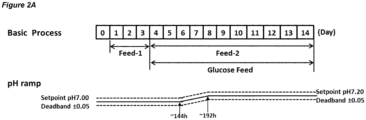
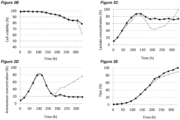
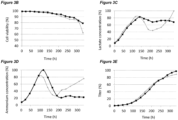
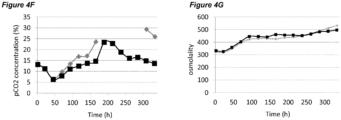
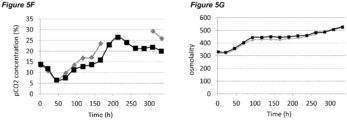
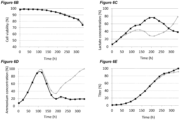
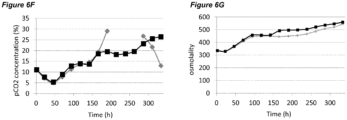
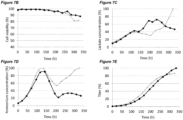
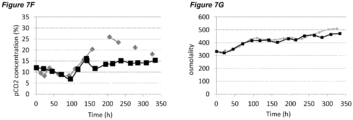
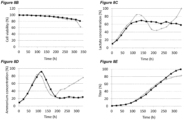
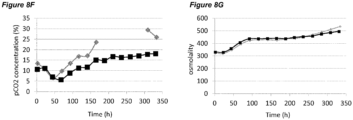
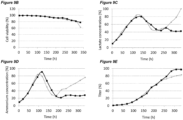
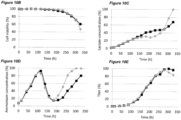
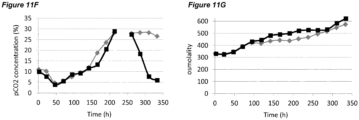
- the processes comprising a pH up-shift may be improved relative to a control process in which the pH is the same throughout the process (same pH set-point in first and second culture stages). These improvements are illustrated in the accompanying Figures 2A-G to 9A-G , which show improvements in cell viability (B series of figures), lactate levels (C figures), ammonium levels (D figures), product titer (E figures), pCO 2 profile (F figures) and osmolality (G figures).
- the processes disclosed herein may advantageously avoid excessive lactate accumulation, especially in the late stages of the process and at the end of the processes.
- the processes may advantageously reduce ammonia production, and/or reduce excessive ammonia accumulation especially in the late stages of the process and at the end of the process.
- the processes are particularly suitable for industrial-scale cell culture, and for culture of cells that produce therapeutic products.
- the culture vessels for such cell cultures may be termed bioreactors.
- An industrial scale process may be a process in which the volume of culture medium is at least about 50L, 100L, 500L, 1000L, or 10000L.
- An industrial scale process may be a process in which the volume of culture medium is at least about 20L, 30L or 40L.
- An industrial scale process may be a process in which the volume of culture medium is about 20-100L, 20-500L, 20-1000L, 50-100L, 50-500L, 50-1000L, 50-5000L, 50-10000L, 50-20000L, 100-1000L, 100-5000L, 100-10000L, 100-20000L, 500-5000L, 500-10000L, or 500-20000L.
- the processes of the invention involve a pH up-shift. More specifically, the processes of the invention comprise a first culture stage at a first pH and a second culture stage at a second pH, wherein the second pH is higher than the first pH.
- the first culture stage comprises inoculating mammalian cells into a culture medium at the first pH.
- the first culture stage may begin on Day 0 of the process.
- the first culture stage is the initial culture stage.
- the first culture stage may be the stage in which cell seeding and lag phase growth occurs.
- the first culture stage may be followed directly by a pH up-shift, which is followed directly by the second culture stage.
- the second culture stage may comprise harvesting the cells and/or a product produced by the cells. The process may terminate at termination of the second culture stage.
- the processes are particularly suitable for industrial-scale cell culture, and for culture of cells that produce therapeutic products.
- the processes comprise a first culture stage, carried out at a first pH, and a second culture stage, carried out at a second pH that is higher than the first pH.
- a fed-batch process for culturing CHO cells expressing an antibody such as Vanucizumab may comprise a first culture stage comprising inoculating mammalian cells into a culture medium at a first pH and culturing the cells at the first pH, and a second culture stage comprising culturing the cells at a second pH that is higher than the first pH, wherein the first pH is about 7.0 and wherein the second pH is about 0.1, 0.2, 0.3, 0.4, 0.5, or 0.1 - 0.5 units higher than the first pH.
- the first pH may be a value in the range 6.5-7.5, 6.6-7.4, 6.7-7.3, 6.8-7.2, or 6.9-7.1.
- the first pH may be about 7.0.
- the first pH may be about 7.0 and the second pH may be about 7.2.
- the first pH may have a value of about pH 6.5, 6.6, 6.7, 6.8, 6.9, 7.0, 7.1, 7.2, 7.3, 7.4, or 7.5.
- the second pH may have a value of about pH 6.6, 6.7, 6.8, 6.9, 7.0, 7.1, 7.2, 7.3, 7.4, 7.5, or 7.6.
- the first pH may have a value of about pH 6.5 to 7.5.
- the second pH may have a value of about pH 6.6 to 7.6, wherein the second pH is higher than the first pH as described herein.
- the first pH may have a value of pH 6.5 ⁇ 0.05, 6.6 ⁇ 0.05, 6.7 ⁇ 0.05, 6.8 ⁇ 0.05, 6.9 ⁇ 0.05, 7.0 ⁇ 0.05, 7.1 ⁇ 0.05, 7.2 ⁇ 0.05, 7.3 ⁇ 0.05, 7.4 ⁇ 0.05, or 7.5 ⁇ 0.05.
- the second pH may have a value of pH 6.6 ⁇ 0.05, 6.7 ⁇ 0.05, 6.8 ⁇ 0.05, 6.9 ⁇ 0.05, 7.0 ⁇ 0.05, 7.1 ⁇ 0.05, 7.2 ⁇ 0.05, 7.3 ⁇ 0.05, 7.4 ⁇ 0.05, 7.5 ⁇ 0.05, or 7.6 ⁇ 0.05.
- the first pH may have a value of pH 6.5 ⁇ 0.05 to 7.5 ⁇ 0.05.
- the second pH may have a value of pH 6.6 ⁇ 0.05 to 7.6 ⁇ 0.05, wherein the second pH is higher than the first pH.
- the second pH is 0.1 pH units, or at least 0.1 pH units higher than the first pH.
- a second pH that is about 0.1 pH units higher than the first pH may be referred to herein as pH ⁇ 0.1.
- the second pH may be about 0.2, 0.3, 0.4, 0.5, 0.6, 0.7, 0.8, 0.9, or 1.0 pH units, or at least about 0.2, 0.3, 0.4, 0.5, 0.6, 0.7, 0.8, 0.9 or 1.0 pH units higher than the first pH.
- the second pH may be about 0.1-0.5 pH units higher than the first pH, about 0.1-0.4 units higher than the first pH, or about 0.1-0.3 pH units higher than the first pH.
- the first pH may be about 7.0.
- the second pH may be about 7.1-7.4, 7.1 - 7.5, 7.2-7.4 or about 7.2 - 7.5.
- the first pH may be a value in the range 6.50-7.50, 6.60-7.40, 6.70-7.30, 6.80-7.20, or 6.90-7.10.
- the first pH may be about 7.00.
- the first pH may be about 7.00 and the second pH may be about 7.20.
- the first pH may have a value of about pH 6.50, 6.60, 6.70, 6.80, 6.90, 7.00, 7.10, 7.20, 7.30, 7.40, or 7.50.
- the second pH may have a value of about pH 6.60, 6.70, 6.80, 6.90, 7.00, 7.10, 7.20, 7.30, 7.40, 7.50, or 7.60.
- the first pH may have a value of about pH 6.5 to 7.5.
- the second pH may have a value of about pH 6.6 to 7.6, wherein the second pH is higher than the first pH as described herein.
- the second pH may be about 0.10 pH units, or at least about 0.10 pH units higher than the first pH.
- a second pH that is about 0.10 pH units higher than the first pH may be referred to herein as pH ⁇ 0.10.
- the second pH may be about 0.20, 0.30, 0.40, 0.50, 0.60, 0.70, 0.80, 0.90 or 1.00 pH units, or at least about 0.20, 0.30, 0.40, 0.50, 0.60, 0.70, 0.80, 0.90 or 1.00 pH units higher than the first pH.
- the second pH may be about 0.10-0.50 pH units higher than the first pH, about 0.10-0.40 units higher than the first pH, or about 0.10-0.30 pH units higher than the first pH.
- the first pH may be about 7.00.
- the second pH may be about 7.10-7.40, 7.10 - 7.50, 7.20-7.40 or about 7.20- 7.50.
- the processes disclosed herein may comprise controlling the pH using a pH set-point.
- the set-point is the desired or target pH value.
- the processes may be in a bioreactor or other controlled culture facility that is programmable to regulate the pH using a pH set-point.
- the bioreactor contains at least one pH probe to monitor the culture pH. Departure of the culture pH from its set-point may trigger a pH corrective action (or pH regulatory action) to bring the pH closer to the set-point.
- a pH corrective action may comprise addition of an agent that reduces the pH (such as CO 2 , HCl or any other suitable acid) or addition of an agent that increases the pH (such as NaOH or any other suitable base).
- a pH corrective action may comprise removal of an agent that reduces the pH (for example removal of CO 2 , known as CO 2 stripping).
- a pH corrective action may comprise attenuating the addition of an agent that reduces or increases the pH, in order to increase or reduce the pH respectively, for example attenuating the addition of CO 2 to maintain a relatively high pH.
- the processes may comprise controlling the pH using a dead-band.
- a dead-band defines a zone within which no pH corrective action is triggered. Only when the pH drifts outside the zone defined by the dead-band is a pH corrective action triggered.
- the pH set-point may have a dead-band.
- the dead-band may be ⁇ 0.05, that is, the dead-band may be ⁇ 0.05 pH units relative to the pH set-point.
- the processes disclosed herein comprise controlling the pH using a pH set-point, wherein in the first culture stage the set-point is set to the first pH, and in the second culture stage the set-point is set to the second pH.
- the set-point In the first culture stage the set-point is maintained at the first pH.
- the second culture stage In the second culture stage the set-point is maintained at the second pH.
- the set-point In the first culture stage the set-point is maintained at the first pH and in the second culture stage the set-point is maintained at the second pH.
- the maintenance of the set-point may in the first and second culture stages may have a duration as set out below for the durations of the first and second culture stages respectively.
- a set point for the first culture stage, or the second culture stage, or both may be maintained for at least 2, 4, 6, 8, 12, or 18 hours; or 3 to 10 days, 4 to 10 days, 4 to 8 days or 4 to 6 days; or at least 1, 2, 3, 4, 5, 6, 7, 8, 9, 10, 11, 12, 13, or 14 days.
- the set-point may be set to pH 6.50, 6.60, 6.70, 6.80, 6.90, 7.00, 7.10, 7.20, 7.30, 7.40, or 7.50.
- the set-point may be set to pH 6.60, 6.70, 6.80, 6.90, 7.00, 7.10, 7.20, 7.30, 7.40, 7.50, or 7.60, wherein the pH set-point of the second culture stage is higher than the pH set-point of the first culture stage.
- the pH set-point of the second culture stage may be about 0.10 pH units, or at least about 0.10 pH units higher than the pH set point of the first culture stage.
- a second pH that is about 0.10 pH units higher than the first pH may be referred to herein as pH ⁇ 0.10.
- the second pH set-point may be about 0.20, 0.30, 0.40, 0.50, 0.60, 0.70, 0.80, 0.90 or 1.00 pH units, or at least about 0.20, 0.30, 0.40, 0.50, 0.60, 0.70, 0.80, 0.90 or 1.00 pH units higher than the first pH set-point.
- the second pH set-point may be about 0.10-0.50 pH units higher than the first pH, about 0.10-0.40 units higher than the first pH set-point, or about 0.10-0.30 pH units higher than the first pH set-point.
- the first pH set-point may be about 7.00.
- the first pH set point may be a value in the range 6.50-7.50, 6.60-7.40, 6.70-7.30, 6.80-7.20, or 6.90-7.10.
- the pH set-point may have a dead-band that is the same throughout the process, that is, the dead-band may have a constant value.
- the pH set-point in the first culture stage may have a dead-band that is the same as the dead-band of the pH set-point in the second culture stage.
- the pH set-point in the first culture stage and the pH set-point in the second culture stage may have dead-bands that are different from each other.
- the pH set-point in the first culture stage and/or the second culture stage may have a dead-band of ⁇ 0.50, a dead-band of ⁇ 0.25, a dead-band of ⁇ 0.10, a dead-band of ⁇ 0.05 pH units, a dead-band of ⁇ 0.01, or a dead-band of ⁇ 0.005 pH units.
- the pH set-point in the first culture stage may be 7.00 ⁇ 0.05.
- the pH set-point in the second culture stage may be from 7.10 ⁇ 0.05 to 7.40 ⁇ 0.05.
- the pH set-point in the first culture stage may be 7.00 ⁇ 0.05 and the pH in the second culture stage may be from 7.10 ⁇ 0.05 to 7.40 ⁇ 0.05.
- the pH set-point in the first culture stage may be 7.00 ⁇ 0.05 and the pH set-point in the second culture stage may be 7.10 ⁇ 0.05.
- the pH set-point in the first culture stage may be 7.00 ⁇ 0.05 and the pH set-point in the second culture stage may be 7.20 ⁇ 0.05.
- the pH set-point in the first culture stage may be 7.00 ⁇ 0.05 and the pH set-point in the second culture stage may be 7.30 ⁇ 0.05.
- the pH set-point in the first culture stage may be 7.00 ⁇ 0.05 and the pH set-point in the second culture stage may be 7.40 ⁇ 0.05.
- the first pH may be a range having a first lower limit and a first upper limit.
- the second pH may be a range having a second lower limit and a second upper limit.
- the first culture stage comprises culturing the cells within the range having the first lower limit and first upper limit
- the second culture stage comprises culturing the cells within the range having the second lower limit and second upper limit.
- the second lower limit may be at least 0.10 pH units higher than the first upper limit.
- the first pH may be a range having a first lower limit of 6.95 and a first upper limit of 7.05
- the second pH may be a range having a second lower limit of 7.15 and a second upper limit of 7.25.
- the second lower limit may be at least 0.20 pH units higher than the first upper limit.
- the first pH may be a range having a first lower limit of 6.95 and a first upper limit of 7.05
- the second pH may be a range having a second lower limit of 7.25 and a second upper limit of 7.35.
- the second lower limit may be, or may be at least, 0.10 pH units higher than the first upper limit.
- the second lower limit may be, or may be at least, 0.20, 0.30, 0.40, 0.50, 0.60, 0.70, 0.80, 0.90 or 1.00 pH units, higher than the first upper limit.
- the first pH and/or the second pH may be a range having a width of 1.00, 0.50, 0.20, 0.10, 0.02 or 0.01 pH units.
- the first pH may be a range having a mid-point value of pH 6.50, 6.60, 6.70, 6.80, 6.90, 7.00, 7.10, 7.20, 7.30, 7.40, or 7.50.
- the second pH may be a range having a mid-point value of pH 6.60, 6.70, 6.80, 6.90, 7.00, 7.10, 7.20, 7.30, 7.40, 7.50, or 7.60.
- the first pH may be a range having a mid-point value of pH 7.00 and a width of 0.10, which is a range of pH 6.95 to 7.05.
- the second pH may be a range having a mid-point value of pH 7.20 and a width of 0.10, which is a range of pH 7.15 to 7.25.
- the process may be a process that does not comprise a pH down-shift (negative shift). That is, the processes may be a process that does not comprise any significant decrease in pH.
- a significant decrease in pH may be a decrease of at least 0.10, 0.20, 0.30, 0.40, 0.50, 0.60, 0.70, 0.80, 0.90 or 1.00 pH units, which may last at least 1, 5, or 30 minutes.
- the process may be a process that does not comprise culturing the cells at any pH that is lower than the first pH.
- the processes of the invention comprise a pH up-shift.
- the pH up-shift is between the first and second culture stages.
- a pH up-shift is a positive shift or an alkaline shift, that is, the pH up-shift is an increase in pH.
- the pH up-shift is an increase in pH from the first pH to the second pH.
- the pH up-shift may be gradual. That is, the pH up-shift may comprise a gradual increase in pH over a period of time.
- the pH may gradually increase from the first pH to the second pH for example over a period of time of 24-72 hours.
- the period of time may be 24-72 hours, 36-60 hours, or about 48 hours.
- the period of time may be, or may be at least 6, 12, 24, 36 or 48 hours.
- a gradual increase in pH may increase the pH by about, or by less than about, 0.001, 0.002, 0.003, 0.004, 0.005, 0.006, 0.007, 0.008, 0.009, 0.01, or 0.05 pH units per hour.
- a gradual increase in pH may increase the pH by about 0.001 to 0.05, 0.001 to 0.01, 0.001 to 0.005 or 0.002 to 0.008 pH units per hour.
- a pH up-shift may be "non-gradual". Such a pH up-shift may have a duration of less than 2 hours, or less than 1 hour, or less than 30, 20, 10, 9, 8, 7, 6, 5, 4, 3, 2, or 1 minutes.
- a non-gradual increase in pH may increase the pH by about, or by at least about, 0.1, 0.2, 0.3, 0.4, 0.5, 0.6, 0.7, 0.8, 0.9, 1.0, 1.5, 2.0, 2.5 or 3.0 pH units per hour,
- Increasing the pH gradually may advantageously minimise detrimental effects on the mammalian cells.
- Detrimental effects may be associated with an immediate or sudden increase of the pH of the culture medium, which effects are avoided by a gradual increase in pH.
- Processes of the invention in which the pH is increased gradually may have improved product titer and/or product quality compared to processes in which the pH increase is non-gradual, or in which pH set-point is increased in a single step as discussed below.
- Processes of the invention which comprise controlling the pH using a pH set-point may comprise a pH up-shift in which the set-point is increased from the first pH to the second pH either (a) gradually or (b) instantly.
- this may comprise a continuous increase in the set-point from the first pH to the second pH over a period of time.
- this may comprise a stepped increase in the set-point from the first pH to the second pH over a period of time.
- This period of time may be 24-72 hours, 36-60 hours or about 48 hours. This period of time may be at least 6, 12, 24, 36 or 48 hours.
- a gradual continuous increase in pH set-point may be a termed a pH ramp, or a pH linear ramp.
- the processes of the invention may comprise a pH up-shift which is a pH ramp, in which the set-point is continuously increased from the first pH to the second pH.
- a gradual stepped increase in pH set-point may comprise discrete steps or increments. This may be termed a gradated increase.
- Each discrete step may increase the pH set-point by at least about 0.05 pH units.
- Each discrete step may increase the pH set-point by at least about 0.01, 0.05, 0.10, 0.15, 0.20, or 0.25 pH units.
- Each discrete step may be maintained for a period which is at least about 12 hours.
- Each discrete step may be maintained for a period which is at least about 1, 2, 4, 6, 8, 12, 18, 24 or 36 hours, or at least about 1-24 or 6-18 hours.
- a gradual stepped increase in pH set-point may be carried out by repeatedly increasing the pH set-point until the pH set-point reaches the second pH.
- the stepped increase may repeatedly increase the pH set-point in a series of discrete steps, or increments.
- a gradual stepped increase in pH set-point may be carried out by:
- Incrementally increasing the pH set-point may comprise increasing the pH set-point by increments of, or of at least, 0.05 pH units.
- the increments may be, or may be at least, about 0.01, 0.05, 0.10, 0.15, 0.20, or 0.25 pH units.
- Intermediate pH set-points may be maintained for a period which is at least about 12 hours.
- Each discrete step or increment may be maintained for a period which is at least about 1, 2, 4, 6, 8, 12, 18, 24 or 36 hours, or at least 1-24 or 6-18 hours.
- Each discrete step may be about 0.05 pH units maintained for about 12 hours.
- a gradual increase in pH set-point that is a stepped pH set-point increase may be preferable in some situations. For example when technical limitations mean that the bioreactor cannot be programmed to gradually increase the pH set-point in a continuous increase.
- the pH set-point may be increased instantly.
- An instant change in pH set-point may comprise an increase in the pH set-point from the first pH to the second pH in a single step. In this way, the pH set-point is changed from the first pH directly to the second pH without being set to any intermediate value.
- the pH set-point is increased instantly from the first pH to the second pH, the pH of the fermentation may increase in a non-gradual manner.
- the amount of time taken for the pH of the fermentation to change from the first pH to the second pH may depend on the volume of the fermentation and/or the stirring rate. For example, Example 6 below involves an instant increase in the pH set-point, and the time taken for the fermentation to increase from the first pH to the second pH was about 10 minutes for a 2L fermentation and 1-2 hours for a 1000L fermentation.
- the dead-band may be maintained at a constant value throughout the process.
- the dead-band may be ⁇ 0.05 pH units about the set-point throughout the process.
- the dead-band may be maintained at a constant value in the first culture stage, the pH up-shift, and the second culture stage.
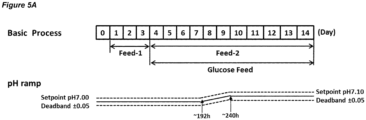
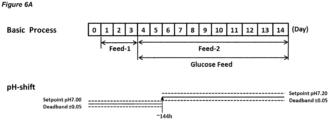
- Embodiments of processes in which the dead-band is maintained at a constant value are shown in Figures 2A , 3A , 4A , 5A , 6A , 8A , and 10A .
- the dead-band may be widened.
- the pH up-shift may comprise dead-band widening.
- the dead-band may be widened instantly, that is, the dead-band may be widened in a single step.
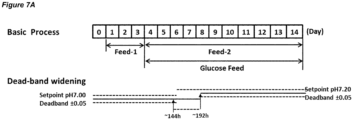
- An embodiment of a process in which the dead-band is widened in a single step is shown in Figure 7A .
- the dead-band may be widened gradually, for example the dead-band may be widened in a series of discrete steps or increments.
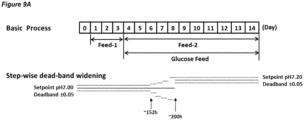
- An embodiment of a processes in which the dead-band is widened in a series of increments is shown in Figure 9A .
- the pH up-shift may comprise widening the dead-band in a single step, or instantly.
- the pH up-shift may comprise widening the dead-band from an initial value about the set-point that is set to the first pH to a wider value about the set-point that is set to the first pH in a single step, such that it encompasses the second pH, and then increasing the pH set-point to the second pH.
- the dead-band may be restored to its initial value about the pH set-point at the same time as the pH set-point is increased to the second pH.
- the dead-band may be restored to a value different from its initial value.
- the dead-band may be restored to a value that does not encompass the first pH.
- the process may comprise a first culture stage at pH 7.00 and a second culture stage at pH 7.20; the pH set-point in the first culture stage and the second culture stage may have a dead-band of ⁇ 0.05; the pH up-shift may comprise widening the dead-band about the set-point that is set to the first pH from ⁇ 0.05 to ⁇ 0.25 (from pH 7.00 ⁇ 0.05 to pH 7.00 ⁇ 0.25) in a single step such that it encompasses the second pH, and then increasing the pH set-point to the second pH.
- the dead-band may be restored to ⁇ 0.05 about the pH set-point that is set to the second pH (pH 7.20 ⁇ 0.05) at the same time as the pH set-point is increased to the second pH.
- Figure 7A shows a process in accordance with this embodiment.
- the pH up-shift may comprise widening the dead-band in a single step from ⁇ 0.05 to ⁇ 0.25.
- the pH up-shift may comprise widening the dead-band in a single step from ⁇ 0.01 to ⁇ 0.05, from ⁇ 0.05 to ⁇ 0.25, from ⁇ 0.05 to ⁇ 0.50, or from ⁇ 0.10 to ⁇ 0.50.
- the dead-band may be widened in a single step and the widened dead-band may be maintained for about, or for at least 12, 18, 24, 36, 48, 60 or 72 hours.
- the widened dead-band may be maintained for 36-60, 40-56 or 44-52 hours, or about 48 hours.
- the widened dead-band may be maintained until the pH reaches the second pH.
- the pH up-shift may comprise a gradual widening of the dead-band.
- the pH up-shift may comprise repeatedly widening the dead-band in a series of discrete steps or increments.
- the pH up-shift may comprise repeatedly widening the dead-band from an initial value about the pH set-point that is set to the first pH in a series of discrete steps or increments until the dead-band encompasses the second pH, and then increasing the pH set-point to the second pH.
- the dead-band may be restored to its initial value about the set-point that is set to the second pH at the same time as the pH set-point is increased to the second pH.
- the dead-band may be restored to a value different from its initial value.
- the dead-band may be restored to a value that does not encompass the first pH.
- the process may comprise a first culture stage at pH 7.00 and a second culture stage at pH 7.20; the pH set-point in the first culture stage and the second culture stage may have a dead-band of ⁇ 0.05; the pH up-shift may comprise incrementally widening the dead-band about the set-point that is set to the first pH from ⁇ 0.05 to a value that encompasses pH 7.20 in a series of increments, for example four increments.
- the dead-band may then be restored to ⁇ 0.05 about the pH set-point that is set to the second pH (pH 7.20 ⁇ 0.05) at the same time as the pH is increased to the second pH.
- Figure 9A shows a process in accordance with this embodiment.
- the pH up-shift may comprise widening the dead-band in a series of increments or discrete steps.
- the increments may be 0.05 pH units.
- the increments, or discrete steps may be, or may be less than, 0.01, 0.02, 0.03, 0.04, or 0.05 pH units.
- the increments may be the same size as each other, or different sizes.
- a dead-band of ⁇ 0.05 may be widened to ⁇ 0.25 in a series of four increments of 0.05 pH units as follows: to ⁇ 0.10, to ⁇ 0.15, to ⁇ 0.20, to ⁇ 0.25.
- the dead-band may be widened in a series of increments or discrete steps, and each increment or discrete step may be maintained for about, or for at least, 12 hours. Each increment or discrete step may be maintained for about, or for at least 2, 4, 6, 8, 12, 18, or 24 hours.
- the increments may have the same duration as each other, or different durations.
- the pH up-shift may comprise a continuous gradual widening of the dead-band over a period of time.
- the pH up-shift may comprise continuously widening the dead-band from an initial value about the pH set-point that is set to the first pH until the dead-band encompasses the second pH, and then increasing the pH set-point to the second pH.
- the dead-band may be restored to its initial value about the set-point that is set to the second pH at the same time as the pH set-point is increased to the second pH.
- the dead-band may be restored to a value different from its initial value.
- the dead-band may be restored to a value that does not encompass the first pH.
- the process may comprise a first culture stage at pH 7.00 and a second culture stage at pH 7.20; the pH set-point in the first culture stage and the second culture stage may have a dead-band of ⁇ 0.05; the pH up-shift may comprise continuously widening the dead-band about the set-point that is set to the first pH from ⁇ 0.05 to a value that encompasses pH 7.20. The dead-band may then be restored to ⁇ 0.05 about the pH set-point that is set to the second pH (pH 7.20 ⁇ 0.05) at the same time as the pH is increased to the second pH.
- the period of time over which the dead-band is continuously widened may be 24-72 hours, 36-60 hours or about 48 hours. This period of time may be at least 6, 12, 24, 36 or 48 hours.
- An incremental increase in dead-band may be preferable in some situations. For example when technical limitations mean that the bioreactor cannot be programmed to gradually increase the pH set-point in a continuous increase or when technical limitations mean that the bioreactor cannot be programmed to continuously widen the dead-band.
- the pH up-shift may comprise an increase in the set-point and a widening of the dead-band in any operable combination of the above.
- the combinations in the embodiments shown in Figures 2A to 9A may be preferable, for example to minimise fluctuations in pH (pH turbulence).
- the pH may be measured on-line or off-line.
- the pH values discussed herein refer to on-line values unless stated otherwise.
- the pH may be measured at 37.0 ⁇ 1.0°C.
- the pH may be measured at 36.5 ⁇ 1.0°C.
- the pH may be measured at the temperature used in the bioreactor for the production fermentation.
- For on-line measurements the pH is measured by a probe in the bioreactor. Suitable pH probes for on-line measurements include a Mettler-Toledo InPro pH sensor.
- For off-line measurements the pH is measured by a probe in a sample from the bioreactor, for example in a temperature controlled sample vessel.
- Suitable apparatus for off-line measurement include the Knick Portavo 907 pH meter, pH 3310 WTW, and the Mettler-Toledo InPro Semi-Micro pH electrode.
- Suitable sampling devices include the S-S-MONOVETTE ® 9mL (Sarstedt).
- the procedure for off-line pH measurement may be as follows: pre-warm benchtop pH electrode to the measurement temperature (e.g. 37.0 ⁇ 1.0°C) by immersing in a water bath or aluminium block at the measurement temperature; then heat the sample to the measurement temperature (e.g. 37.0 ⁇ 1.0°C) and measure the pH as soon as the sample has reached the measurement temperature (e.g. after three minutes); then wait until a stable pH value is reached (e.g. less than 1 minute); the sable pH value is used as the off-line measurement.
- Calibration buffers may be used to calibrate the pH measurement apparatus, for example Duracal Buffers (Hamilton).
- the on-line measurement may be re-calibrated if it differs significantly from the off-line measurement. For example if the on-line measurement differs by more than 0.05 pH units.
- a re-calibration procedure may comprise taking a second sample from the bioreactor if the first sample has measured as having an off-line pH value that differs by more than 0.05 pH units from the on-line value. If the second sample also as an off-line pH value that differs by more than 0.05 pH units from the on-line value then the on-line (internal) pH probe is re-calibrated by setting to the pH value determined by the off-line (external) pH probe.
- the processes of the invention may comprise addition of a pH up-shift feed medium to the culture medium.
- the pH up-shift feed medium may have an alkaline (basic) pH relative to the culture medium.
- the pH up-shift feed medium may contain factors, such as nutrients, that when metabolised by cells increase the pH of the culture medium. For example, certain amino acids such as glutamate, aspartate and alanine are metabolised by cells to yield ammonium.
- the pH up-shift feed medium may contain glutamate, aspartate and/or alanine.
- the pH up-shift may comprise addition of alkaline agents (bases) such as NaOH, Na 2 CO 3 , or NaHCOs to the culture medium.
- alkaline agents such as NaOH, Na 2 CO 3 , or NaHCOs
- Alkaline agents may be referred to as bases, alkalis, and alkali salts.
- the pH up-shift may comprise allowing the cell culture to accumulate cellular metabolites that increase the pH of the culture medium.
- the pH up-shift may comprise removing dissolved CO 2 from the culture medium, for example by stripping CO 2 from the bioreactor. Stripping CO 2 from the bioreactor causes dissolved CO 2 to leave the culture medium. As the pH of the culture medium is dependent on the balance of dissolved CO 2 and bicarbonate (HCO 3 - ), removing dissolved CO 2 from the culture medium can alter the pH of the culture medium.
- HCO 3 - bicarbonate
- the process does not comprise an increase in pH at a rate faster than 0.15, 0.20, 0.25, or 0.5 pH units per 24 hours.
- the process does not also comprise addition of concentrated solutions of alkaline reagents (bases), such as NaOH, Na 2 CO 3 , NaHCOs, to the culture medium.
- bases such as NaOH, Na 2 CO 3 , NaHCOs
- Concentrated solutions of alkaline reagents (bases) are those having a concentration above, for example, 0.5, 0.6, 0.7, 0.8, 0.9, or 1.0 M. Processes in which the pH up-shift does not involve addition of concentrated solutions of base may advantageously minimise increases in culture osmolality.
- Adding a pH up-shift feed medium is advantageous for the fed-batch processes of the invention, because it efficiently enables both feeding of the cell culture and increasing of the pH of the cell culture in a single process step.
- the addition of a pH up-shift feed medium over a period of time also facilitates a gradual increase in pH over a period of time, which may be advantageous as discussed above.
- the processes of the invention comprise inoculating cells into a culture medium.
- Inoculating cells into a culture medium refers to adding one or more cells, or a population of cells, into sterile culture medium. Inoculating may also be referred to as seeding. In the context of culture process duration and timings, the inoculation of cells into the culture medium defines Day 0 of the process.
- a fed-batch process is a cell culture process, or fermentation process, in which cells are cultured in a culture vessel, or bioreactor, with one or more nutrients necessary for cell growth or product formation added to the bioreactor during the culture process.
- Nutrients can be added to the culture vessel either continuously or intermittently.
- Nutrients may be added in the form of a feed medium.
- Nutrients include sugars and amino acids, as well as vitamins, nucleosides, organic chemical compounds, and inorganic metal salts.
- a feed medium may comprise sugar (mono- or disaccharide), amino acids, vitamins, nucleosides, organic chemical compounds, and inorganic metal salts.
- the cells remain in the bioreactor throughout the cell culture process, until the cells and or cell products are harvested.
- a batch process is a cell culture process in which the cells and all necessary culture medium components are added to the culture vessel at the beginning of the fermentation process and no nutrients are subsequently added to the culture vessel.
- a feed medium for example, in a batch process there is no addition of sugar (e.g. glucose), and/or no addition of amino acids.
- the fed-batch processes of the invention are not batch processes.
- the fed-batch processes of the invention may comprise addition of sugars to the culture medium.
- the fed-batch processes of the invention may comprise addition of a feed medium to the culture medium.
- the cells are inoculated into a culture medium.
- the culture medium may be a commercially available medium.
- the culture medium may be chemically defined, and protein- and serum-free, for example CD CHO AGT TM Medium (Thermo Fisher Scientific, Formula No. A15649).
- a feed medium (“feed 1") is added to the culture medium.
- the initial culture medium may be termed a basal medium, which is supplemented with feed medium during the fed-batch culture process.
- the basal medium may be a chemically defined, and protein- and serum-free, for example CD CHO AGT TM Medium (Thermo Fisher Scientific, Formula No. A15649).
- the basal medium may be any suitable commercially available medium, including customised media, used in accordance with the supplier or manufacturer instructions.
- the feed medium may comprise additional methionine, threonine, serine, tyrosine and glycine.
- the feed medium may comprise additional methionine, threonine, serine, tyrosine and glycine at respective concentrations in the range of about 0.5 g/l to about 1.5 g/l.
- the feed medium may be added to the culture medium in the range of about 2.0 to about 3.0 wt % of the initial culture weight per day.
- the feed medium may be, for example, a feed medium containing Feed Base 5 Medium (Thermo Fisher Scientific, catalogue number 074-91011DW), Feed Base 2 Medium (Thermo Fisher Scientific, catalogue number 074-91007MV), Feed Base 6 Medium (Thermo Fisher Scientific, catalogue number 074-91012MW), Minimum Essential Medium Vitamins (MEM 100x, Thermo Fisher Scientific, catalogue number 074-91008BX), CD CHO AGT TM Medium (Thermo Fisher Scientific, Formula No. A15649), and SPE (Lonza Verviers Sprl, catalogue number BESP531F) and.
- Feed Base 5 Medium Thermo Fisher Scientific, catalogue number 074-91011DW
- Feed Base 2 Medium Thermo Fisher Scientific, catalogue number 074-91007MV
- Feed Base 6 Medium Thermo Fisher Scientific, catalogue number 074-91012MW
- Minimum Essential Medium Vitamins MEM 100x, Thermo Fisher Scientific, catalogue number 074-91008BX
- the feed medium may be a medium containing specific ratios of Feed Base 5 Medium, Feed Base 2 Medium, Feed Base 6 Medium, Minimum Essential Medium Vitamins, SPE and CD CHO AGT Medium.
- a feed medium may be prepared by combining Feed Base 5 Medium, Feed Base 2 Medium, and Feed Base 6 Medium to provide a feed medium, any of Minimum Essential Medium Vitamins, SPE and CD CHO AGT Medium may also be included in the feed medium.
- the feed medium may be any suitable commercially available medium, including customised media, used in accordance with the supplier or manufacturer instructions.
- the fed-batch processes of the invention may further comprise addition of pH up-shift feed medium ("feed 2").
- the pH up-shift feed medium may comprise nutrients that, when metabolised by the cells, increase the pH.
- the pH up-shift feed medium may comprise elevated levels of glutamate, aspartate and/or alanine relative to the feed medium.
- the pH up-shift feed medium may comprise additional lysine, threonine, serine, valine, leucine and tryptophan.
- the pH up-shift feed medium may comprise additional lysine, threonine, serine, valine, leucine and tryptophan at respective concentrations in the range of about 0.5 g/l to about 6.0 g/l.
- the pH up-shift feed medium may be, for example, a feed medium containing Feed Base 8 Medium (Thermo Fisher Scientific, catalogue number 074-91013RW) and Feed Base 9 Medium (Thermo Fisher Scientific, catalogue number 074-91014EW).
- a pH up-shift feed medium may be prepared by combining Feed Base 8 Medium and Feed Base 9 Medium to provide a pH up-shift medium.
- the pH up-shift medium may have a pH of about 10-11.
- the relative proportions of Feed Base 8 Medium and Feed Base 9 Medium may be adjusted and tested for effectiveness in achieving a desired pH up-shift in any cell culture using routine techniques, for example in preparatory design of experiment processes.
- the pH up-shift feed medium may have a basic (alkaline) pH relative to the culture medium.
- the pH up-shift feed medium may have a pH above 10.0.
- the pH up-shift medium may have a pH above 8.0, 9.0 or 10.0.
- the pH up-shift medium may have a pH of about 8.0 - 12.0, about 10.0 - 11.0, or about 10 - 11.
- the pH up-shift feed medium may have a pH of about 10.0, 10.5 or 11.0.
- the pH up-shift feed medium may have a pH of about 10 or about 11.
- the up-shift feed medium may be added to the culture medium in the range of about 0.5 to about 1.5 wt % of the initial culture weight per day.
- the fed-batch processes of the invention may comprise addition of a feed medium to the culture medium during the first culture stage, followed by addition of a pH up-shift medium to the culture medium.
- the feed medium may be substituted with the pH up-shift medium after a certain number of days, as discussed below.
- the addition of the pH up-shift medium to the culture may precede the pH up-shift by several days, as discussed below.
- An additional glucose feed solution may be added to the culture to maintain an appropriate glucose concentration, for example ⁇ 3g/l.
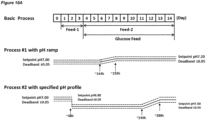
- Example 10 also demonstrates that the pH up-shift in accordance with the invention (process #1, in which the pH up-shift is followed by a second culture stage at a higher pH than the first culture stage) is advantageous compared with a process (process #2) in which there is a pH up-shift but there is no culture stage at a pH that is higher than the first culture stage (the culture stage in which the cells were inoculated into the medium, or the culture stage starting with Day 0).
- the inoculation of cells into the culture medium defines Day 0 of the process.
- the processes of the invention may comprise a first culture stage having a duration of, or of at least, 3, 4, 5 or 6 days.
- the first culture stage may have a duration of, or of at least 1, 2, 4, 6, 8, 12, or 18 hours.
- the first culture stage may have a duration of 3 to 10 days, 4 to 10 days, 4 to 8 days or 4 to 6 days.
- the first culture stage may have a duration of, or of at least, 1, 2, 3, 4, 5, 6, 7, 8, 9, 10, 11, 12, 13, or 14 days.
- the first culture stage may begin with inoculation of cells into a cell culture medium. When the mammalian cells are CHO cells the first culture stage may have a duration of 6, 7, 8 or 9 days.
- Reference to the first culture stage having a certain duration may specifically mean that the culture is at, or is maintained at, the first pH for that duration.
- “maintained at” may mean “continuously maintained at”. That is the processes of the invention may comprise a first culture stage that comprises culturing the cells at the first pH, or maintaining the first pH, or maintaining the set-point that is set to the first pH, for or for at least 1, 2, 4, 6, 8, 12, or 18 hours; or for 3 to 10 days, 4 to 10 days, 4 to 8 days or 4 to 6 days; or for or for at least 1, 2, 3, 4, 5, 6, 7, 8, 9, 10, 11, 12, 13, or 14 days.
- a sustained pH up-shift is a pH up-shift that is maintained for a certain duration.
- a sustained pH up-shift may be a pH up-shift that is maintained for at least 1 hour, or for a duration disclosed herein as the duration for the first and/or second culture stage.
- the processes of the invention may comprise a second culture stage having a duration of, or of at least 4, 5, or 6 days.
- the second culture stage may have a duration of or of at least 6, 8, 12, or 18 hours.
- the second culture stage may have a duration of 3 to 10 days, 4 to 10 days, 4 to 8 days or 4 to 6 days.
- the second culture stage may have a duration of, or of at least, 1, 2, 3, 4, 5, 6, 7, 8, 9, 10, 11, 12, 13, or 14 days.
- the second culture stage may continue until the end of the process.
- the second culture stage may terminate with harvesting of cells and/or products expressed by the cells.
- the mammalian cells are CHO cells the second culture stage may have a duration of 6, 7, 8 or 9 days.
- Reference to the second culture stage having a certain duration may specifically mean that the culture is at, or is maintained at, the second pH for that duration. In this context "maintained at” may mean “continuously maintained at”.
- the processes of the invention may comprise a second culture stage that comprises culturing the cells at the second pH, or maintaining the second pH, or maintaining the set-point that is set to the second pH for or for at least 6, 8, 12, or 18 hours; or for 3 to 10 days, 4 to 10 days, 4 to 8 days or 4 to 6 days; or for or for at least 1, 2, 3, 4, 5, 6, 7, 8, 9, 10, 11, 12, 13, or 14 days.
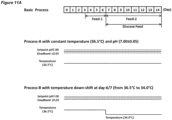
- the process of the invention may be a process wherein the temperature is maintained at a substantially constant value.
- the process may be a process in which the mammalian cells are capable of expressing an antibody,
- the processes of the invention comprise controlling the pH using a pH set-point, the process comprising a first culture stage, in which the set-point is set to the first pH, and a second culture stage in which the set-point is set to the second pH.
- the first culture stage comprises inoculating mammalian cells into a culture medium at the first pH.
- the first culture stage may have a specific duration as set out above, in which the set-point is maintained at the first pH for that duration.
- the second culture stage may have a specific duration as set out above, in which the set-point may be maintained at the second pH for that duration.
- culturing the cells may refer to culturing the cells at a specific pH for a specific duration. This may more specifically refer to culturing the cells at a specific pH that is maintained for a specific duration. This may refer to culturing the cells using a specific pH set-point for a specific duration. For example reference to a second culture stage comprising "culturing the cells at a second pH” may refer to culturing the cells at the second pH for a specific duration using a set-point set to the second pH.
- the processes of the invention may comprise a pH up-shift at, or starting at, Day 6-8 (144-192 hours).
- the processes of the invention may comprise a pH up-shift at Day 5-9 or Day 4-10.
- the process may comprise a pH up-shift at Day 4, 5, 6, 7, 8, 9 or 10 , or after Day 4, 5, 6, 7, 8, 9 or 10.
- the process may comprise a pH up-shift at Day 6 (144 hours), 156 hours, Day 7 (168 hours), or Day 8 (192 hours).
- the optimal timing of the pH up-shift may be determined in a series of preparatory, design of experiment, processes. For example, the timing of the pH up-shift may be chosen to maximise the final product titer while retaining key product quality parameters within desired ranges (e.g. retaining Critical Quality Attributes within specific ranges specified by the FDA or EMEA in its approval of a therapeutic product, see below).
- the timing of the pH up-shift may be determined by measuring final product titer in a series of preparatory, design of experiment, processes to determine the pH up-shift timing yielding the maximal product titer with a product quality profile suitable for clinical application.
- product titer and quality can be measured in a series of preparatory process (which may be a scaled-down version of the process) in which the timing of the pH up-shift is varied, and the timing of the pH up-shift chosen to take place on the day determined to provide a process that yields maximal product titer and a product quality profile suitable for clinical application.
- Product quality profile may be determined by measuring glycosylation, IEC pattern, electrophoretic pattern, Mass Spectrometry, chromatography, or Caliper data.
- the product quality profile suitable for clinical application may be those approved by the FDA or EMEA for a particular therapeutic product.
- the approved product may be required to have certain attributes in terms any or all of: size-related variants, charge-related variants, trisulfide content, Fc glycosylation, microheterogeneity, glycation, mode of action related bio-functions, sequence variants, cell-age related product modifications and process related impurities.
- the specific mode of action (MoA) for therapeutic products at the cellular level is usually well described. Based on the MoA, non-clinical safety data, clinical study registrations and early phase of clinical study results, a set of quality parameters for any specific drug may be well defined.
- the drug substance should maintain the similar or comparable quality in order to achieve desired therapeutical effects.
- Key drug substance quality parameters may differ from one drug to another. These quality parameters usually include: glycosylation, glycation, amino acid misincorporation, c-terminal lysine removal, C-terminal amidation, addition to cysteine, incorrect dissulfide pairing, trisulfide formation, deamidation, succinimide formation, sulfation, phosphorylation, Met/Trp oxidation, ⁇ -carboxylation, ⁇ -hydroxylation, etc.
- CQA Critical Quality Attributes
- variables such as the timing of the pH-upshift, the appropriate total process duration, or the harvest time may be determined by the criteria of maximal final product titer with acceptable product quality profile for clinical application.
- the fed-batch processes of the invention may comprise adding a feed medium to the culture.
- the feed medium may be added on Day 1-3.
- the feed medium may be added on Day 1-3, 1-4, 1-5 or 1-6.
- the feed medium is referred to as "Feed-1".
- the fed-batch processes of the invention may comprise adding a pH up-shift feed medium to the culture.
- the pH up-shift feed medium may be added on Day 4-14.
- the pH up-shift feed medium may be added on Day 4, 5, 6, or 7 of the process and on each subsequent day.
- the feed medium may be substituted with the pH up-shift feed medium from Day 4, 5, 6, or 7 of the process onwards.
- the pH up-shift feed medium is referred to as "Feed-2".
- the pH up-shift feed medium may prevent a down-shift in the pH of the cell culture medium, for example by neutralising acidic metabolites produced by cells.
- the pH up-shift feed medium may increase the pH of the cell culture medium.
- the fed-batch processes of the invention may comprise supplementing the culture with a glucose solution on days when the pH up-shift medium is added to the culture, in order to maintain an appropriate glucose concentration.
- the processes of the invention may have a duration of at least 6 days, or at least 7, 8, 9, 10, 11, 12, 13, 14, 15, 16, 17 or 18 days.
- the total duration may be the duration from the day of inoculation (Day 0) to the day of harvesting of cells and/or products expressed by the cells.
- the process may have a duration of 14 days.
- the total number of days of the process may also be referred to as the "runtime".
- the runtime of the process may be selected for maximal product titre, or maximal product titre with constant product quality profile.
- the product quality profile may be predefined for clinical application.
- the product quality profile may be determined by measuring glycosylation, and/or ion exchange chromatography (IEC) pattern.
- IEC ion exchange chromatography
- the first culture stage may have a duration of 1-5, 1-4 or 1-3 days.
- the pH up-shift may have a duration of about 10 or 30 minutes, or about 1, 2, 3, 4, 5, 6, 7, 8, 12, 24, 36, 48, 52, or 60 hours, or may have a duration of about 2-72, 2-60, 2-52, 2-48, 8-52, 12-52, 12-48, 24-52 or 24-48 hours.
- the pH up-shift may have a duration of at least about 10 or 30 minutes, or at least about 1, 2, 3, 4, 5, 6, 7, 8, 12, 24, 36, 48, 52, or 60 hours, or may have a duration of at least about 2-72, 2-60, 2-52, 2-48, 8-52, 12-52, 12-48, 24-52 or 24-48 hours.
- the second culture stage may have a duration of about 4, 5, 6, 7, 8, 9, 10, 11, 12, 13, or 14 days, or about 4-14, 5-14, 6-14, 7-14, or 8-14 days.
- the processes may comprise a harvest step.
- the cells and/or product are harvested.
- the harvest step terminates the process.
- the harvest step may be on Day 10-18, for example on Day 14.
- the timing of the harvest step may be determined by measuring cell viability daily.
- the harvest step may be carried out on the first day in the process in which cell viability is below 85%, 80%, 75% or 70%.
- the timing of the harvest step in the process of the invention may be determined by measuring lactate accumulation in a control process.
- the control process is identical to the process of the invention except that the first pH is maintained throughout the process (throughout both the first and second culture stages). Lactate is measured daily in the control process.
- the harvest step may be carried out on the Day number corresponding to the first day in the second culture stage of the control process after which at least 4, at least 5, or at least 6 consecutive daily increases in lactate have been measured.
- the additional criterion may be applied that the harvest step may be only carried out on a day on which no increase in lactate is measured in the process of the invention relative to the previous day.
- the timing of the harvest step may be determined by measuring product titer.
- the timing of the harvest step may be determined by measuring final product titer in a series of preparatory, design of experiment, processes to determine which timing yields the maximal product titer with a product quality profile suitable for clinical application.
- product titer and quality can be measured daily in a preparatory process (which may be a scaled-down version of the process of the invention, or may be identical to the process of the invention), and the harvest step chosen to take place on the day with highest product titer with a product quality profile suitable for clinical application.
- the timing of the harvest step may be determined by measuring product quality.
- Product quality can be measured in terms of glycosylation (e.g. galactosylation, high mannose structure) or in terms of an in vitro or in vivo activity having a threshold value beyond which the product is non-optimal.
- the product quality can be measured daily in a preparatory process (which may be a scaled-down version of the process of the invention, or may be identical to the process of the invention), and the harvest step takes place on the day before the day that product quality was determined to be non-optimal in the preparatory process.
- the temperature of the processes of the invention may be maintained at a substantially constant value.
- a significant temperature shift may be defined as a shift of about 0.5, 1.0, 1.5, 2.0, 3.0, 4.0, or 5.0°C or more.
- a substantially constant value may be within ⁇ 0.1°C, ⁇ 0.2°C, ⁇ 0.3°C, ⁇ 0.4°C, ⁇ 0.5°C, ⁇ 1.0°C, ⁇ 1.5°C, or ⁇ 2.0°C of a target value.
- a target value may be 35.0, 35.5, 36.0, 36.5, 37.0, or 37.5°C
- a temperature of substantially constant value may be 36.0 - 37.0°C. That is, the temperature may be maintained between the values of 36.0°C and 37.0°C. Similarly, a temperature of substantially constant value may be 36.4 - 36.6°C. A temperature of substantially constant value may be 36.5°C. The temperature may be measured using an on-line temperature sensor in the bioreactor.
- Maintaining the temperature of the process at a substantially constant value may advantageously avoid issues caused by a significant temperature shift during the process.
- Reduction of temperature in cell culture processes for the production of recombinant proteins may cause undesired changes in product quality (e.g. changes in glycosylation), or may cause a loss of cellular productivity.
- Reduction in temperature may reduce the Integral Viable Cell Density, which is an indicator of cellular productivity and therefore generally correlates with final product titer.
- the mammalian cells may be recombinant cells. Recombinant cells may comprise a nucleic acid sequence encoding a heterologous protein.
- the mammalian cells may be CHO cells, more specifically recombinant CHO cells.
- the mammalian cells may be CHO K1.
- the mammalian cells may be CHO K1SV.
- the mammalian cells may be BHK cells, more specifically recombinant BHK cells.
- the mammalian cells may be BHK-21 cells.
- the mammalian cells may be PER.C6 cells.
- the mammalian cells may be from a myeloma cell line.
- the mammalian cells may be human cell lines, such as HEK293 and its derivatives and PER.C6.
- the mammalian cells may be capable of expressing an antibody.
- the mammalian cells may comprise a nucleic acid encoding an antibody.
- the nucleic acid encoding the antibody may be operably linked to a constitutive promoter, or to an inducible promoter.
- the antibody may be a multi-specific antibody, an antibody fragment, an antibody fragment with multispecific functions, a fusion antibody, or a fusion antibody fragment.
- the antibody may be a monoclonal antibody.
- the antibody may be a therapeutic antibody.
- the antibody may be a bispecific antibody.
- the antibody may be a humanized antibody.
- the antibody may be anti-Ang2/VEGF-CrossMab (Schaefer 2011; Fenn 2013).
- the processes may be processes for producing a product, wherein the product is expressed by the mammalian cells.
- the mammalian cells may be engineered to express the product.
- Expression systems, methods, and vectors for genetically engineering cells to express a protein of interest are well known to those skilled in the art; for example, various techniques are illustrated in Sambrook et al., Molecular Cloning: A Laboratory Manual 3 ed. (2001 ).
- the mammalian cells may be engineered to express the product using the GS Gene Expression System (Lonza Biologics plc, Slough UK).
- the product may be a recombinant protein.
- the product may be an antibody.
- the antibody may be a multi-specific antibody, an antibody fragment, an antibody fragment with multispecific functions, a fusion antibody, or a fusion antibody fragment.
- the antibody may be a monoclonal antibody.
- the antibody may be a therapeutic antibody.
- the antibody may be a bispecific antibody.
- the antibody may be a bivalent bispecific antibody, such as a CrossMAb antibody (Schaefer, et al. 2011; Fenn et al. 2013).
- the antibody may be a biologically functional fragment of an antibody.
- Antibody fragments include Fab, Fab', F(ab')2, scFv, dAb, complementarity determining region (CDR) fragments, linear antibodies, single-chain antibody molecules, minibodies, diabodies and multispecific antibodies formed from antibody fragments.
- CDR complementarity determining region
- the product may be a bivalent bispecific antibody that binds to Ang2 and VEGF.
- the product may be a bivalent bispecific CrossMab antibody that binds to Ang2 and VEGF.
- the product may be the antibody anti-Ang2/VEGF-CrossMab (Schaefer, et al. 2011; Fenn et al. 2013).
- the product may be Vanucizumab, that is, the product may be the antibody anti-Ang2/VEGF-CrossMab having the INN Vanucizumab.
- the product may be the anti-Ang2/VEGF-CrossMab antibody described in WO 2011/117329 , or may be an antibody having the heavy and light chain CDR amino acid sequences, or having the VH and VL domain amino acid sequences, of the first and second antigen-binding sites of the anti-Ang2/VEGF-CrossMab described in WO 2011/117329 , or a fragment of the anti-Ang2/VEGF-CrossMab described in WO 2011/117329 .
- the product may be an antibody having the heavy and light chain CDR amino acid sequences, or having the VH and VL domain amino acid sequences, of the first and second antigen-binding sites of Vanucizumab, or a therapeutically active fragment of Vanucizumab.
- the product may be a monoclonal antibody that binds to CSF-1R.
- the product may be the anti-CSF-1R antibody having the INN Emactuzumab.
- the product may be an anti-CSF-1R antibody described in WO 2011/070024 , or may be an antibody having the heavy and light chain CDR sequences, or VH and VL domain amino acid sequences, of an antibody described in WO 2011/070024 (or of Emactuzumab) , or a fragment of an anti-CSF-1R antibody described in WO 2011/070024 (or of Emactuzumab) .
- the product may be a therapeutic protein, peptide or enzyme.
- the product may be recombinant human glucuronidase, recombinant human acid alpha glucosidase, or recombinant human insulin.
- the processes may be process for producing an antibody that is not an anti-TNF ⁇ antibody, or may be a process that is not a process for producing an anti-TNG ⁇ antibody.
- Therapeutic antibodies include, without limitation anti-VEGF antibodies; anti-Ang2 antibodies; anti-CSF-1R antibodies; anti-HER2 antibodies anti-CD20 antibodies; anti-IL-8 antibodies; anti-CD40 antibodies, anti-CD11a antibodies; anti-CD11b antibodies; anti-CD11c antibodies; anti-CD18 antibodies; anti-IgE antibodies; anti-Apo-2 receptor antibodies; amti-Apo2:/TRAIL antibodies; anti-Tissue Factor (TF) antibodies; anti-human ⁇ 4 ⁇ 7 integrin antibodies; anti-EGFR antibodies; anti-CD3 antibodies; anti-CD25 antibodies; anti-CD4 antibodies; anti-CD52 antibodies; anti-Fc receptor antibodies; anti-carcinoembryonic antigen (CEA) antibodies; antibodies directed against breast epithelial cells; antibodies that bind to colon carcinoma cells; anti-CD38 antibodies; anti-CD33 antibodies; anti-CD22 antibodies; anti-EpCAM antibodies; antiGpIIb/IIIa antibodies; anti-RSV antibodies; anti-CMV antibodies; anti-HIV
- the product may be a protein, or an antibody, which is not Epo-Fc.
- the processes of the invention may further comprise a step of isolating the product, or purifying the product.
- the step of isolating or purifying the product may comprise ion exchange chromatography.
- the step of isolating or purifying the product may comprise loading a composition comprising the product onto an ion exchange chromatography material, optionally washing the ion exchange chromatography material, and eluting the product from the ion exchange chromatography material.
- the composition comprising the product may comprise culture medium from the cell culture, and/or may comprise the mammalian cells, which may be lysed mammalian cells.
- the method of isolating or purifying the product may comprise a step of preparing a composition comprising the product.
- the step of preparing a composition comprising the product may comprise harvesting the cells, and/or lysing the cells, and/or harvesting cell culture medium.
- the step of preparing a composition comprising the product may comprise protein A chromatography.
- the step of preparing a composition may comprise lyophilising the product.
- the step of preparing a composition may comprise formulating the product in a pharmaceutically acceptable carrier (e.g. physiological saline) and/or formulating the product in a solution comprising one or more pharmaceutical excipients.
- a pharmaceutically acceptable carrier e.g. physiological saline
- Products and compositions may be produced by the processes of the invention.
- the processes of the invention may avoid excessive accumulation of undesirable metabolites such as lactate and ammonium.
- the processes of the invention may improve maintenance of moderate pCO 2 levels and/or lower culture osmolality.
- the process of the invention may be a process having an improved parameter relative to a control process, wherein the control process is identical to the process of the invention except that the first pH is maintained throughout the process (throughout both the first and second culture stages).
- the control process may be a process in which the pH in the first culture stage is 7.00 and the pH in the second culture stage is 7.00.
- the parameter may be determined at the harvest step, or on the day of the harvest step.
- the parameter may be determined on Day 14.
- the process of the invention may be a process in which cell viability is at least 10%, 15% or 20% higher than a control process.
- the process of the invention may be a process in which lactate levels are at least 10%, 20%, 30%, 40%, or 50% lower than a control process.
- the process of the invention may be a process in which ammonium levels are at least 10%, 20%, 30%, 40%, 50%, 60%, 70% or 80% lower than a control process.
- the process of the invention may be a process in which the product titer is at least 5%, 10% or 15% higher than a control process.
- the process of the invention may be a process in which osmolality is at least 5% lower than a control process.
- the process of the invention may be a process in which osmolality is below 500 Osm/kg at the harvest step.
- the processes of the invention are also improved compared with processes comprising a pH down-shift from an initial value followed by a pH up-shift towards the initial value, as shown by Example 10 processes #1 and #2.
- Processes comprising a pH down-shift from an initial value followed by a pH up-shift towards the initial value are disclosed in US 8,765,413 .
- a method of extending the longevity of a mammalian cell culture may comprise the process of the invention as described above.
- a method of increasing cell viability in a mammalian cell culture may comprise the process of the invention as described above.
- a method of increasing Integral Viable Cell Density (IVCD) in a mammalian cell culture may comprise the process of the invention as described above.
- a method of reducing lactate accumulation in a mammalian cell culture may comprise the process of the invention as described above.
- a method of reducing ammonium accumulation in a mammalian cell culture may comprise the process of the invention as described above.
- a method of improving pCO 2 profile in a mammalian cell culture may comprise the process of the invention as described above.
- a method of reducing osmolality in a mammalian cell culture may comprise the process of the invention as disclosed above.
- the invention further provides the use of a pH-increasing agent (e.g. alkaline agent, or base), for extending longevity of a mammalian cell culture; for increasing cell viability in a mammalian cell culture; for reducing lactate accumulation in a mammalian cell culture; for reducing ammonium accumulation in a mammalian cell culture; for improving pCO 2 profile in a mammalian cell culture; or for reducing osmolality in a mammalian cell culture, by performing a method or process of the invention as disclosed above.
- the process comprises adding the pH-increasing agent to the mammalian cell culture to increase the pH from the first pH to the second pH.
- the use involves adding the pH-increasing agent to the culture medium of the mammalian cell culture to effect the pH up-shift that occurs between the first and second culture stages.
- the invention further provides the use of a pH-increasing agent (e.g. alkaline agent, or base), for increasing product titer in a mammalian cell culture.
- a pH-increasing agent e.g. alkaline agent, or base
- the invention provides the use of a pH-increasing agent for increasing product titer in a process for culturing mammalian cells as disclosed herein, wherein the product is expressed by the mammalian cells, for example a recombinant protein such as an antibody.
- the increase in product titre is relative to a mammalian cell culture in which no pH-increasing agent is added to the mammalian cell culture.
- a pH-increasing agent may be for increasing product titer in a process for producing a product (such as a recombinant protein product) as disclosed herein.
- the temperature of the process may be maintained at a substantially constant value.
- the mammalian cells may be capable of expressing an antibody
- the invention may include any of the features of the processes of the invention discussed above in relation to the first aspect of the invention.
- a pH value that is "about” a certain figure may be interpreted according to the degree of precision with which it has been expressed. For example a pH of "about 7.0” may refer to pH 6.95 - 7.05, whereas a pH of "about 10" may refer to pH 9.5 - 10.5.
- a pH value that is relatively high on the pH scale is relatively alkaline and a pH value that is relatively low is relatively acidic.
- a higher pH in the context of the present disclosure refers to a more alkaline pH.
- CHO K1SV a cell-line derived from Chinese Hamster Ovary (CHO) cells
- the GS expression vector system was provided by Lonza Biologics.
- CHO K1SV cells were engineered to express a bi-specific monoclonal antibody, anti-Ang2/VEGF-CrossMab (anti-A2V; Vanucizumab, or RG7221; described in WO 2011/117329 ) recognizing VEGF-A with one arm and Ang2 with the other (Schaefer, et al. 2011; Fenn et al.
- Example 10 CHO K1SV cells were engineered to express a humanized monoclonal antibody (anti-CSF-1R; Emactuzumab, or RG7155; described in WO 2011/070024 ) that inhibits CSF-1 receptor (CSF-1R) activation (Ries et al., 2014).
- CSF-1R CSF-1 receptor
- Colony-stimulating factor 1 (CSF-1) and its receptor, CSF-1R regulate the migration, differentiation, and survival of macrophages and their precursors (Hume and MacDonald, 2012).
- CD CHO AGT TM Medium basal medium (Thermo Fisher Scientific, Formula No. A15649) was used to culture the CHO K1SV cells. After thawing, the cells were passaged in this medium in the presence of 50 ⁇ M methionine sulfoximine (MSX; Bedford Laboratories, Bedford, Ohio) in shake flasks on a 3-4 day schedule. Passage conditions were 36.5 °C, 7% CO 2 , and 160 rpm for 125 mL and 500 mL flasks using Kuhner Shaker X platform (Adolf kuhner AG, Birsfelden, Basel, Switzerland).
- MSX methionine sulfoximine
- the cultured cells were used to inoculate the N-1 step at about 3.0 ⁇ 10 5 cells/mL without MSX.
- Production bioreactors were inoculated at about 6.0 ⁇ 10 5 cells/mL without MSX.
- the cells were cultured in production bioreactors under fed-batch culture conditions with predefined pH, dissolved oxygen, temperature and nutrient feeding strategy. 2 L bioreactors with an initial culture volume of 1.2 L were employed, unless otherwise noted.
- the temperature in the bioreactors was controlled at 36.5°C, and the stirrer speed was set to be about 213 rpm.
- a gas mixture containing air, CO 2 , and O 2 was provided.
- the dissolved carbon dioxide concentration (dCO 2 ) was measured off-line once a day.
- the dissolved oxygen concentration (DO) was controlled on-line and adjusted to 25% by varying the oxygen partial pressure in the gas mixture.
- the pH was maintained at a defined set-point, or within a defined dead-band, by the addition of CO 2 or 1.0 M NaHCOs, unless otherwise noted.
- the feed medium (referred to as “Feed-1” in the Figures) and the pH up-shift feed medium (referred to as “Feed-2” in the Figures) included a combination of glucose, glutamine, amino acids, growth factors, nucleosides, vitamins, trace elements, and salts.
- the feed medium was contained Feed Base 5 Medium (catalogue number 074-91011DW), Feed Base 2 Medium (catalogue number 074-91007MV), Feed Base 6 Medium (catalogue number 074-91012MW), Minimum Essential Medium Vitamins (MEM 100x, catalogue number 074-91008BX), CD CHO AGT TM Medium (Formula No. A15649), and SPE (Lonza Verviers Sprl, catalogue number BESP531F).
- the pH up-shift feed medium contained Feed Base 8 Medium (catalogue number 074-91013RW) and Feed Base 9 Medium (catalogue number 074-91014EW).
- Samples of about 10 ml were taken daily with a syringe for off-line analysis. Production duration typically lasted about 14 days.
- Cell concentration and viability was measured by the trypan blue exclusion method using a CEDEX instrument (Roche Diagnostics GmbH, Germany). Off-line measurements were performed with a COBAS INTEGRA ® 400 plus (Roche Diagnostics GmbH, Germany) for glucose, glutamine, glutamate, lactate, ammonium, and product concentration.
- EXAMPLE-1 CONTROL PROCESS - SAME PH THROUGHOUT (CONSTANT PH SET-POINT)
- Anti-Ang2/VEGF cells were grown in shake flasks and passaged several times.
- the production fermentation run was started with an initial cell count of approximately 6.0 ⁇ 10 5 cells/mL, at 36.5 °C and at a constant pH set-point of 7.00 with a dead-band of ⁇ 0.05 pH units. That is the process began (Day 0) with inoculation of approximately 6.0 ⁇ 10 5 cells/mL into the culture medium (CD CHO Medium AGT TM Medium ) as discussed above.
- Feed medium was prepared in solution and continuously added to the culture on Day 1-3, at an amount ranging from about 2.0 to about 3.0 weight % of the initial culture weight per day.
- pH up-shift feed medium was prepared in solution and was continuously added to the culture on Day 4-14 at an amount ranging from about 0.5 to about 1.5 weight % of the initial culture weight per day.
- An additional glucose feed solution was prepared and continuously added to the culture during Day 4-14 to maintain glucose concentration at about ⁇ 3g/l.
- the online pH set-point was 7.00 ⁇ 0.05, maintained using carbon-dioxide gas injection or by addition of 1M sodium carbonate. If the off-line pH measurement deviated from the online measurement by 0.05 pH unit or more, the online pH measurement was re-calibrated to be equal to the off-line pH measurement.
- Process samples were taken daily from the cultures and analyzed for the required parameters.
- Figure 1 illustrates the pH set-point and dead-band settings and feed schedule for the culture process.
- EXAMPLE-2 PH RAMP ( ⁇ 0.20 BETWEEN 144 AND 192 HOURS)
- Anti-Ang2/VEGF cells were grown in shake flasks and passaged several times. The production fermentation run was started with an initial cell count of about 6.0 ⁇ 10 5 cells/mL, at 36.5 °C and a pH set-point of 7.00 with a dead-band of ⁇ 0.05 pH units.
- Feed medium was prepared in solution and was continuously added to the culture on Day 1-3, at an amount ranging from about 2.0 to about 3.0 weight % of the initial culture weight per day.
- pH up-shift feed medium was prepared in solution and was continuously added to the culture on Day 4-14 at an amount ranging from about 0.5 to about 1.5 weight % of the initial culture weight per day.
- An additional glucose feed solution was prepared and continuously added to the culture during Day 4-14 to maintain glucose concentration at about ⁇ 3g/l.
- FIG. 2A illustrates the pH set-point and dead-band settings and feed schedule for the culture process.
- the online pH set-point was initially maintained at 7.00 ⁇ 0.05 using carbon-dioxide gas injection or by addition of 1M sodium carbonate. Starting from about 144 hours, the pH set-point was set to gradually increase from 7.00 to 7.20 in a pH ramp over a period of about 48 hours. At about 192 hours, the pH set-point reached pH7.20 ⁇ 0.05 and was maintained at this value until the end of the production process. Process samples were taken from the cultures daily and analyzed for the required parameters.
- Figures 2B-G illustrate the effects on cell viability, lactate concentration, ammonium concentration, product titer, pCO 2 , and osmolality during the culture process having pH settings according to Figure 2A (black squares), as compared to a culture process having pH settings according to Figure 1 (grey diamonds).
- Figure 2B shows that at the end of the 14 day production process, cell viability in the process with the pH ramp ( ⁇ pH 0.20 units between 144 and 192 hours) was higher than for the process without such a pH ramp.
- Figure 2C shows that the process with the pH ramp lactate levels reach a high of about 88% between Day 4-5, before dropping to about 72% where they are maintained until the end of the process.
- Figure 2G shows that at the end of the process, culture osmolality in the process with the pH-ramp is lower than in the process without a pH-ramp.
- EXAMPLE-3 PH RAMP ( ⁇ 0.20 BETWEEN 156 AND 208 HOURS)
- Anti-Ang2/VEGF cells were grown in shake flasks and passaged several times. The production fermentation run was started with an initial cell count of about 6.0 ⁇ 10 5 cells/mL at 36.5 °C and a pH set-point of 7.00 with a dead-band of ⁇ 0.05 pH units.
- Feed medium was prepared in solution and was continuously added to the culture during Day 1-3 at an amount ranging from about 2.0 to about 3.0 weight % of the initial culture weight per day.
- pH up-shift feed medium was prepared in solution and was continuously added to the culture during Day 4-14 at an amount ranging from about 0.5 to about 1.5 weight % of the initial culture weight per day.
- An additional glucose feed solution was prepared and continuously added to the culture during Day 4-14 to maintain glucose concentration at about ⁇ 3g/l.
- Figure 3A illustrates the pH set-point and dead-band settings and feed schedule for the culture process.
- the online pH set-point was initially maintained at 7.00 ⁇ 0.05 using carbon-dioxide gas injection or by addition of 1M sodium carbonate. Starting from about 156 hours, the pH set-point was set to gradually increase from 7.00 to 7.20 in a pH ramp over a period of about 52 hours. At about 208 hours, the pH set-point reached pH 7.20 ⁇ 0.05 and was maintained at this value until the end of the production process. Process samples were taken from the cultures daily and analyzed for the required parameters.
- Figures 3B-G illustrate the effects on cell viability, lactate concentration, ammonium concentration, product titer, pCO 2 , and osmolality during the culture process having pH settings according to Figure 3A (black squares), as compared to a culture process having pH settings according to Figure 1 (grey diamonds).
- Figure 3B shows that t the end of the 14 day production process, cell viability in the process with the pH ramp ( ⁇ pH 0.20 units between 156 and 208 hours) was higher than for the process without a pH ramp.
- Figure 3C shows that in the process with the pH ramp lactate levels reach a high of about 80% at approximately 140 hours, then drop to about 70% where they are maintained until the end of the process. At the end of the process lower amounts of lactate are produced with the pH ramp settings in comparison to the process without a pH ramp.
- Figure 3D shows that in the process with the pH ramp ammonium levels reach a high of about 100% after approximately 110 hours, then drop to about 20% where they are maintained until the end of the process. Much lower amounts of ammonium are produced with the pH ramp settings in comparison to the process without a pH ramp.
- Figure 3E shows that at the end of the process, product titer in the process with the pH ramp is higher than in the process without a pH ramp.
- Figure 3F shows that in the process with the pH-ramp pCO 2 level increased moderately but was maintained at under about 19% until the end of the process. In contrast, much higher pCO 2 levels were observed in the process without a pH-ramp, particularly between 160 and 320 hours.
- Figure 3G shows that at the end of the process, culture osmolality in the process with the pH-ramp is lower than in the process without a pH-ramp.
- EXAMPLE-4 PH RAMP ( ⁇ 0.30 BETWEEN 192 AND 240 HOURS)
- Anti-Ang2/VEGF cells were grown in shake flasks and passaged several times. The production fermentation run was started with an initial cell count of about 6.0 ⁇ 10 5 cells/mL, at 36.5 °C and a pH set-point of 7.00 with a dead-band of ⁇ 0.05 pH units.
- Feed medium was prepared in solution and was continuously added to the culture on Day 1-3 at an amount ranging from about 2.0 to about 3.0 weight % of the initial culture weight per day.
- pH up-shift feed medium was prepared in solution and was continuously added to the culture on Day 4-14 at an amount ranging from about 0.5 to about 1.5 weight % of the initial culture weight per day.
- An additional glucose feed solution was prepared and continuously added to the culture during Day 4-14 to maintain glucose concentration at about ⁇ 3g/l.
- Figure 4A illustrates the pH set-point and dead-band settings and feed schedule for the culture process.
- the online pH set-point was initially maintained at 7.00 ⁇ 0.05 using carbon-dioxide gas injection or by addition of 1M sodium carbonate. Starting from about 192 hours, the pH set-point was set to gradually increase from 7.00 to 7.30 in a pH ramp over a period of about 48 hours. At about 240 hours, the pH set-point reached pH 7.30 ⁇ 0.05 and was maintained at this value until the end of the production process. Process samples were taken from the cultures daily and analyzed for the required parameters.
- Figures 4B-G illustrate the effects on cell viability, lactate concentration, ammonium concentration, product titer, pCO 2 , and osmolality during the culture process having pH settings according to Figure 4A (black squares), as compared to a culture process having pH settings according to Figure 1 (grey diamonds).
- Figure 4B shows that at the end of the 14 day production process, cell viability in the process with the pH ramp ( ⁇ pH 0.30 units between 192 and 240 hours) is higher than for the process without a pH ramp.
- Figure 4C shows that in the process with the pH ramp lactate levels reach a high of about 90% at approximately 140 hours, then drop to about 60% before gradually increasing to below 90% at the end of the process. At the end of the process lower amounts of lactate are produced with the pH ramp settings in comparison to the process without a pH ramp.
- Figure 4D shows that in the process with the pH ramp ammonium levels reach a high of about 97% at approximately 110 hours, then drop rapidly to about 28% before continuing to drop to a low level of about 15% at the end of the process.
- FIG. 4E shows that at the end of the process, product titer in the process with the pH ramp is higher than in the process without a pH ramp.
- Figure 4F shows that in the process with the pH-ramp the pCO 2 level increased moderately to approximately 24% at around 200 hours before decreasing to less than 15% by the end of the process. In contrast, much higher pCO 2 levels were observed in the process without a pH-ramp, particularly between 160 and 320 hours.
- Figure 4G shows that at the end of the process, culture osmolality in the process with the pH-ramp ( ⁇ pH 0.30 units between 192 and 240 hours) is lower than in the process without a pH-ramp.
- EXAMPLE-5 PH RAMP ( ⁇ 0.10 BETWEEN 192 AND 240 HOURS)
- Anti-Ang2/VEGF cells were grown in shake flasks and passaged several times. The production fermentation run was started with an initial cell count of about 6.0 ⁇ 10 5 cells/mL, at 36.5 °C and a pH set-point of 7.00 with a dead-band of ⁇ 0.05 pH units.
- Feed medium was prepared in solution and was continuously added to the culture on Day 1-3 at an amount ranging from about 2.0 to about 3.0 weight % of the initial culture weight per day.
- pH up-shift feed medium was prepared in solution and was continuously added to the culture on Day 4-14 at an amount ranging from about 0.5 to about 1.5 weight % of the initial culture weight per day.
- An additional glucose feed solution was prepared and continuously added to the culture during Day 4-14 to maintain glucose concentration at about ⁇ 3g/l.
- Figure 5A illustrates the pH set-point and dead-band settings and feed schedule for the culture process.
- the online pH set-point was initially maintained at 7.00 ⁇ 0.05 using carbon-dioxide gas injection or by addition of 1M sodium carbonate. Starting from about 192 hours, the pH set-point was set to gradually increase from 7.00 to 7.10 in a pH ramp over a period of about 48 hours. At about 240 hours, the pH set-point reached pH 7.10 ⁇ 0.05 and was maintained at this value until the end of the production process. Process samples were taken from the cultures daily and analyzed for the required parameters.
- Figures 5B-G illustrate the effects on cell viability, lactate concentration, ammonium concentration, product titer, pCO 2 , and osmolality during the culture process having pH settings according to Figure 5A (black squares), as compared to a culture process having pH settings according to Figure 1 (grey diamonds).
- Figure 5B shows that at the end of the 14 day production process, cell viability in the process with the pH ramp ( ⁇ pH 0.10 units between 192 and 240 hours) was higher than in the process without a pH ramp.
- Figure 5C shows that in the process with the pH ramp lactate levels reach a high of about 90% after approximately 110 hours, before dropping to about 55% and then gradually increasing to about 80% at the end of the process. At the end of the process lower amounts of lactate are produced with the pH ramp settings in comparison to the process without a pH ramp.
- Figure 5D shows that in the process with the pH ramp, ammonium levels reach a high of about 97% after approximately 110 hours, before dropping rapidly to about 27% and then gradually increasing to a level of about 42% at the end of the process.
- FIG. 5E shows that at the end of the process, product titer in the process with the pH ramp is slightly higher than in the process without a pH ramp.
- Figure 5F shows that in the process with the pH-ramp the pCO 2 level increased moderately to approximately 26% at around 200 hours before decreasing to less than 20% by the end of the process. In contrast, much higher pCO 2 levels were observed in the process without a pH-ramp, particularly between 160 and 320 hours.
- Figure 5G shows that the end of the process, culture osmolality in the process with the pH-ramp ( ⁇ pH 0.10 units between 192 and 240 hours) is slightly higher than in the process without a pH-ramp.
- EXAMPLE-6 INSTANT PH UP-SHIFT ( ⁇ 0.20 AT 144 HOURS)
- Anti-Ang2/VEGF cells were grown in shake flasks and passaged several times. The production fermentation run was started with an initial cell count of about 6.0 ⁇ 10 5 cells/mL, at 36.5 °C and a pH set-point of 7.00 with a dead-band of ⁇ 0.05 pH units.
- Feed medium was prepared in solution and was continuously added to the culture on Day 1-3 at an amount ranging from about 2.0 to about 3.0 weight % of the initial culture weight per day.
- pH up-shift feed medium was prepared in solution and was continuously added to the culture on Day 4-14 at an amount ranging from about 0.5 to about 1.5 weight % of the initial culture weight per day.
- An additional glucose feed solution was prepared and continuously added to the culture during Day 4-14 to maintain glucose concentration at about ⁇ 3g/l.
- Figure 6A illustrates the pH set-point and dead-band settings and feed schedule for the culture process.
- the online pH set-point was initially maintained at 7.00 ⁇ 0.05 using carbon-dioxide gas injection or by addition of 1M sodium carbonate.
- the pH set-point was increased in a single step from 7.00 to 7.20 with the same dead-band of pH ⁇ 0.05 and was maintained at this value until the end of the production process.
- Process samples were taken from the cultures daily and analyzed for the required parameters.
- Figures 6B-G illustrate the effects on cell viability, lactate concentration, ammonium concentration, product titer, pCO 2 , and osmolality during the culture process having pH settings according to Figure 6A (black squares), as compared to a culture process having pH settings according to Figure 1 (grey diamonds).
- Figure 6B shows that at the end of the 14 day production process, cell viability in the process with the instant pH up-shift ( ⁇ pH 0.20 units at 144 hours) is comparable with the cell viability in the process without a pH up-shift.
- Figure 6C shows that in the process with the instant pH up-shift lactate levels reach a high of about 78% after approximately 200 hours, before gradually dropping to less than 40% at the end of the process. At the end of the process lower amounts of lactate are produced with the instant pH up-shift settings in comparison to the process without a pH up-shift.
- Figure 6D shows that in the process with the instant pH up-shift, ammonium levels reach a high of about 90% after approximately 110 hours, which then drop rapidly to about 20% before being maintained at this low level until the end of the process.
- FIG. 6E shows that at the end of the process, product titer in the process with the instant pH up-shift is higher than in the process without a pH up-shift.
- Figure 6F shows that in the process with the instant pH up-shift, the pCO 2 level increased gradually and moderately to approximately 26% by the end of the process. In contrast, much higher pCO 2 levels were observed in the process without a pH up-shift, particularly between 160 and 320 hours.
- Figure 6G shows that at the end of the process, culture osmolality in the process with the instant pH up-shift is just slightly higher than in the process without a pH up-shift.
- EXAMPLE-7 PH UP-SHIFT THROUGH WIDENING PH DEAD-BAND
- Anti-Ang2/VEGF cells were grown in shake flasks and passaged several times. The production fermentation run was started with an initial cell count of about 6.0 ⁇ 10 5 cells/mL, at 36.5 °C and a pH set-point of 7.00 with a dead-band of ⁇ 0.05 pH units.
- Feed medium was prepared in solution and was continuously added to the culture on Day 1-3 at an amount ranging from about 2.0 to about 3.0 weight % of the initial culture weight per day.
- pH up-shift feed medium was prepared in solution and was continuously added to the culture on Day 4-14 at an amount ranging from about 0.5 to about 1.5 weight % of the initial culture weight per day.
- An additional glucose feed solution was prepared and continuously added to the culture during Day 4-14 to maintain glucose concentration at about ⁇ 3g/l.
- Figure 7A illustrates pH set-point and dead-band settings and feed schedule for the culture process.
- the online pH set-point was initially maintained at 7.00 ⁇ 0.05 using carbon-dioxide gas injection or by addition of 1M sodium carbonate.
- the pH set-point remained at 7.00 and the pH dead-band was widened from ⁇ 0.05 to ⁇ 0.25.
- the pH set-point was increased from 7.00 to 7.20 and the dead-band restored to ⁇ 0.05.
- the pH set-point was maintained at this value until the end of the production process. Process samples were taken from the cultures daily and analyzed for the required parameters.
- Figures 7B-G illustrate the effects on cell viability, lactate concentration, ammonium concentration, product titer, pCO 2 , and osmolality during the culture process having pH settings according to Figure 7A (black squares), as compared to a culture process having pH settings according to Figure 1 (grey diamonds).
- Figure 7B shows that at the end of the 14 day production process, cell viability in the process with the pH up-shift ( ⁇ pH 0.20 units through widening pH-dead-band between 144 and 192 hours) is higher than the cell viability in the process without a pH up-shift.
- Figure 7C shows that in the process with the pH up-shift lactate levels reach a high of about 70% after approximately 240 hours, gradually dropping to about 45% at the end of the process. At the end of the process lower amounts of lactate are produced with the pH up-shift settings in comparison to the process without a pH up-shift.
- Figure 7D shows that in the process with the pH up-shift ammonium levels reach a high of about 90% after approximately 110 hours, before dropping rapidly to about 22% and then being maintained between 22-32% until the end of the process. Lower amounts of ammonium are produced with the pH up-shift settings in comparison to the process without a pH up-shift.
- Figure 7E shows that at the end of the process, product titer in the process with the pH up-shift is at least 10% higher than in the process without a pH up-shift.
- Figure 7F shows that in the process with the pH up-shift the pCO 2 level increased gradually to approximately 16% at around 140 hours then was maintained at this level until the end of the process.
- FIG. 7G shows that at the end of the process, culture osmolality in the process with the pH up-shift is lower than in the process without a pH up-shift.
- Anti-Ang2/VEGF cells were grown in shake flasks and passaged several times. The production fermentation run was started with an initial cell count of about 6.0 ⁇ 10 5 cells/mL, at 36.5 °C and a pH set-point of 7.00 with a dead-band of ⁇ 0.05 pH units.
- Feed medium was prepared in solution and was continuously added to the culture on Day 1-3 at an amount ranging from about 2.0 to about 3.0 weight % of the initial culture weight per day.
- pH up-shift feed medium was prepared in solution and was continuously added to the culture on Day 4-14 at an amount ranging from about 0.5 to about 1.5 weight % of the initial culture weight per day.
- An additional glucose feed solution was prepared and continuously added to the culture during Day 4-14 to maintain glucose concentration at about ⁇ 3g/l.
- Figure 8A illustrates the pH set-point and dead-band settings and feed schedule for the culture process.
- the online pH set-point was initially maintained at 7.00 ⁇ 0.05 using carbon-dioxide gas injection or by addition of 1M sodium carbonate.
- the pH set-point was increased to pH 7.05 ⁇ 0.05 and maintained for 12 hours.
- the pH set-point was increased to pH 7.10 ⁇ 0.05 and maintained for 12 hours.
- the pH set-point was increased to pH 7.15 ⁇ 0.05 and maintained for another 12 hours.
- the pH set-point was increased to pH 7.20 ⁇ 0.05 and maintained at this value until the end of the production process. Process samples were taken from the cultures daily and analyzed for the required parameters.
- Figures 8B-G illustrate the effects on cell viability, lactate concentration, ammonium concentration, product titer, pCO 2 , and osmolality during the culture process having pH settings according to Figure 8A (black squares), as compared to a culture process having pH settings according to Figure 1 (grey diamonds).
- Figure 8B shows that at the end of the 14 day process, cell viability in the process with the pH up-shift ( ⁇ pH 0.20 units through stepwise pH-set-point increases between 156 and 192 hours) is higher than the cell viability in the process without a pH up-shift.
- Figure 8C shows that in the process with the pH up-shift, lactate levels reach a high of about 70% after approximately 140 hours, before gradually dropping to about 58% at the end of the process. At the end of the process lower amounts of lactate are produced with the pH up-shift settings in comparison to the process without a pH up-shift.
- Figure 8D shows that in the process with the pH up-shift ammonium levels reach a high of about 90% after approximately 116 hours, dropping rapidly to about 25% after about 188 hours and then being maintained between 21-24% until the end of the process. Lower amounts of ammonium are produced with the pH up-shift settings in comparison to the process without a pH up-shift.
- Figure 8E shows that at the end of the process, product titer in the process with the pH up-shift is at least 15% higher than in the process without a pH up-shift.
- Figure shows that in the process with the pH up-shift the pCO 2 level increased gradually to approximately 17% at around 210 hours then was maintained at this level until the end of the process.
- Figure 8G shows that at the end of the process, culture osmolality in the process with the pH up-shift is lower than in the process without a pH up-shift.
- Anti-Ang2/VEGF cells were grown in shake flasks and passaged several times. The production fermentation run was started with an initial cell count of about 6.0 ⁇ 10 5 cells/mL, at 36.5 °C and a pH set-point of 7.00 with a dead-band of ⁇ 0.05 pH units.
- Feed medium was prepared in solution and was continuously added to the culture on Day 1-3 at an amount ranging from about 2.0 to about 3.0 weight % of the initial culture weight per day.
- pH up-shift feed medium was prepared in solution and was continuously added to the culture on Day 4-14 at an amount ranging from about 0.5 to about 1.5 weight % of the initial culture weight per day.
- An additional glucose feed solution was prepared and continuously added to the culture during Day 4-14 to maintain glucose concentration at about ⁇ 3g/l.
- Figure 9A illustrates the pH set-point and dead-band settings and feed schedule for the culture process.
- the online pH set-point was initially maintained at 7.00 ⁇ 0.05 using carbon-dioxide gas injection or by addition of 1M sodium carbonate.
- the pH dead-band was widened to ⁇ 0.10 and maintained for 12 hours.
- the pH dead-band was widened again to ⁇ 0.15 and maintained for 12 hours.
- the pH dead-band was widened to ⁇ 0.20 and maintained for a further 12 hours.
- the pH dead-band was widened to ⁇ 0.25 and maintained for 12 hours.
- the pH set-point was increased to pH 7.20 ⁇ 0.05 and maintained at this value until the end of the production process. Process samples were taken from the cultures daily and analyzed for the required parameters.
- Figures 9B-G illustrate the effects on cell viability, lactate concentration, ammonium concentration, product titer, pCOz, and osmolality during the culture process having pH settings according to Figure 9A (black squares), as compared to a culture process having pH settings according to Figure 1 (grey diamonds).
- Figure 9B shows that at the end of the 14 day process, cell viability in the process with the pH up-shift ( ⁇ pH 0.20 units through stepwise widening of the pH dead-band between 152 and 200 hours) is higher than the cell viability in the process without a pH up-shift.
- Figure 9C shows that in the process with the pH up-shift, lactate levels reach a high of about 80% after approximately 140 hours, gradually dropping to about 42% at the end of the process. Lower amounts of lactate are produced in the process with the pH up-shift settings in comparison to the process without a pH up-shift, particularly at the end of the process.
- Figure 9D shows that in the process with the pH up-shift ammonium levels reach a high of about 90% after approximately 116 hours, before dropping rapidly to about 25% after about 190 hours and then being maintained between 21-28% until the end of the process. Lower amounts of ammonium are produced with in the process with the pH up-shift settings in comparison to the process without a pH up-shift.
- Figure 9E shows that at the end of the 14 day process, product titer in the process with the pH up-shift is about 15% higher than in the process without a pH up-shift.
- Figure 9F shows that in the process with the pH up-shift, the pCO 2 level increased gradually to approximately 22% at around 210 hours then was maintained between 22 and 25% until the end of the process.
- Figure 9G shows that at the end of the process, culture osmolality in the process with the pH up-shift is lower than in the process without a pH up-shift.
- Anti-CSF-1R cells were grown in shake flasks and passaged several times. The production fermentation run was started with an initial cell count of about 6.0 ⁇ 10 5 cells/mL at 36.5 °C, and a pH set-point of 7.00 with a dead-band of ⁇ 0.05 pH units. 0.25 L bioreactors were employed, at an initial culture volume of 0.2 L. Feed medium was prepared in solution and was continuously added to the culture on Day 1-3 at an amount ranging from about 2.0 to about 3.0 weight % of the initial culture weight per day. pH up-shift feed medium was prepared in solution and was continuously added to the culture on Day 4-14 at an amount ranging from about 0.5 to about 1.5 weight % of the initial culture weight per day. An additional glucose feed solution was prepared and continuously added to the culture during Day 4-14 to maintain glucose concentration at about ⁇ 3g/l.
- Figure 10A illustrates the pH set-point and dead-band settings and feed schedules for two different culture processes.
- the online pH set-point was initially maintained at 7.00 ⁇ 0.05 using carbon-dioxide gas injection or by addition of 1M sodium carbonate. Starting from about 144 hours, the pH set-point was set to gradually increase from 7.00 to 7.20 within about 48 hours. At about 192 hours, the pH set-point reached pH 7.20 ⁇ 0.05 and was maintained at this value until the end of the production process.
- the online pH set-point was initially maintained at 7.00 ⁇ 0.05 using carbon-dioxide gas injection or by addition of 1M sodium carbonate.
- the pH set-point was lowered to 6.80 ⁇ 0.05 and maintained at this value until 240 hours.
- the pH set-point was set to gradually increase from 6.80 ⁇ 0.05 to 7.00 ⁇ 0.05 within about 48 hours.
- the pH set-point reached pH 7.00 ⁇ 0.05 and was maintained at this value until the end of the production process.
- Process samples were taken from the cultures daily and analyzed for the required parameters.
- Figures 10B-F illustrate the effects on cell viability, lactate concentration, ammonium concentration, product titer, and osmolality during the culture process having pH settings according to Figure 10A process #1 (black squares), as compared to a culture process having pH settings according to Figure 10A process #2 (grey diamonds).
- Figure 10B illustrates the difference in cell viability during the two culture processes (process #1 black squares; process #2 grey diamonds). After 14 days, cell viability in process #1 (pH ramp ⁇ pH 0.20 units between 144 and 192 hours) is higher than in process #2.
- Figure 10C shows that in process #1, lactate levels reach about 68% at the end of the 14 day production process. Lower amounts of lactate are produced in the process with the pH up-shift in accordance with the processes of the invention, in comparison to the process without a pH up-shift in accordance with the invention.
- process #2 there is an increase in pH but the process does not involve a first culture stage comprising inoculating the cells at the first pH and culturing the cells at that first pH, followed by a second culture stage in which the cells are cultured at a second pH that is higher than the first pH.
- process #2 comprises a pH down-shift.
- Figure 10D shows that in process#1, ammonium levels reach a high of about 90% after 115 hours, and drop to about 15% before increasing to about 80% at the end of the production process. Lower amounts of ammonium are produced with in the process with the pH up-shift in accordance with the invention, in comparison to the process without a pH up-shift in accordance with the invention.
- Figure 10E shows that at the end of the 14 day production process, anti-CSF-1R product titer from process #1 is higher than for process #2.
- Figure 10F shows that at the end of the process, culture osmolality in the process with the pH up-shift in accordance with the invention is lower than in the process without a pH up-shift in accordance within the invention
- Anti-Ang2/VEGF -expressing CHO KSV cells were grown in shake flasks and passaged several times. The production fermentation run was started with an initial cell count of about 6.0 ⁇ 10 5 cells/mL, at an initial temperature of 36.5 °C and a pH set-point of 7.00 with a dead-band of ⁇ 0.05 pH units.
- a feed medium was prepared in solution and was continuously added to the culture on Day 3-6 at an amount ranging from about 2.0 to about 3.0 weight % of the initial culture weight per day.
- a pH up-shift feed medium was prepared in solution and was continuously added to the culture on Day 7-14 at an amount ranging from about 0.5 to about 1.5 weight % of the initial culture weight per day.
- An additional glucose feed solution was prepared and continuously added to the culture during Day 7-14 to maintain glucose concentration at about ⁇ 3g/l.
- Figure 11A illustrates the temperature settings, pH set-point and dead-band settings, and feed schedules for two different culture processes.
- the online pH set-point was maintained constant at 7.00 ⁇ 0.05 using carbon-dioxide gas injection or by addition of 1M sodium carbonate for the entire duration of the process.
- the temperature was maintained constant at 36.5 °C for the entire duration of the process.
- the online pH set-point was maintained constant at 7.00 ⁇ 0.05 using carbon-dioxide gas injection or by addition of 1M sodium carbonate for the entire duration of the process.
- the temperature was initially maintained at 36.5 °C. At about 144 hours, the temperature was lowered to 34.0 °C, and was maintained at this value until the end of the production process.
- Process samples were taken from the cultures daily and analyzed for the required parameters.
- Viable cell density was measured with Trypan Blue dye exclusion using a Cedex HiRes Analyzer (Material Number: 05650216001, Roche Diagnostics GmbH, Germany).
- cell culture fluid was collected through centrifugation. The supernatants were subjected to further small-scale purification with Protein-A.
- Figures 11B-G illustrate the effects on cell viability, lactate concentration, ammonium concentration, product titer, pCO 2 , and osmolality during the culture process having pH settings according to Figure 11A process A (grey diamonds), as compared to a culture process having pH settings according to Figure 11A process B (black squares).
- Figure 11B illustrates the difference in cell viability during the two culture processes (Process A grey diamonds; Process B black squares). After 14 days, cell viability in Process A (constant 36.5 °C temperature) is slightly lower than in Process B (temperature down-shift from 36.5 °C to 34.0°C at 144 hours).
- Figure 11C shows that in Process A lactate levels reach about 34% at the end of the 14 day production process, whereas lactate levels of 100% were produced in Process B at the same time-point.
- Figure 11D shows that in Process A ammonium levels reach a high of about 97% after 115 hours, and drop to about 33% before increasing to about 72% at the end of the production process.
- the temperature shift from 36.5°C to about 34.0°C changed the quality of anti-Ang2/VEGF-CrossMab produced by the cells.
- the content of G0F antibody increased by about 3% and G1F structure showed some changes ( Figure 12 ). Issues related to changes in product quality caused by temperature shifts may be advantageously avoided in the methods of the invention by maintaining a substantially constant temperature.
- Example 1 (Ferm in 2 L bioreactor) pH constant at 7.00 ⁇ 0.05 62.9 100 75.9 89.0
- Example 2 (Ferm in 2 L bioreactor) Process with a pH-ramp 78.6 73.4 18.1 100.0
- Example 3 (Ferm in 2 L bioreactor) Process with a pH-ramp 78.9 68.2 22.6 97.7
- Example 4 (Ferm in 2 L bioreactor) Process with a pH-ramp 76.9 88.2 15.7 94.9
- Example 5 (Ferm in 2 L bioreactor) Process with a pH-ramp 77.9 80.9 43.2 91.0
- Example 6 (Control in 2 L bioreactor) pH constant at 7.00 ⁇ 0.05 74.3 78.4 100 91.4
- Example 6 (Ferm in 2 L bioreactor) Process with an instant pH-shift 74.2 38.2 18.9
Landscapes
- Life Sciences & Earth Sciences (AREA)
- Engineering & Computer Science (AREA)
- Health & Medical Sciences (AREA)
- Organic Chemistry (AREA)
- Chemical & Material Sciences (AREA)
- Wood Science & Technology (AREA)
- Zoology (AREA)
- Biotechnology (AREA)
- Biomedical Technology (AREA)
- Genetics & Genomics (AREA)
- Bioinformatics & Cheminformatics (AREA)
- General Health & Medical Sciences (AREA)
- Biochemistry (AREA)
- Microbiology (AREA)
- General Engineering & Computer Science (AREA)
- Proteomics, Peptides & Aminoacids (AREA)
- General Chemical & Material Sciences (AREA)
- Chemical Kinetics & Catalysis (AREA)
- Molecular Biology (AREA)
- Cell Biology (AREA)
- Preparation Of Compounds By Using Micro-Organisms (AREA)
- Micro-Organisms Or Cultivation Processes Thereof (AREA)
- Peptides Or Proteins (AREA)
Claims (15)
- Fed-batch-Verfahren zum Kultivieren von Säugerzellen, umfassend das Regeln des pH unter Verwendung eines pH-Sollwertes, wobei das Verfahren Folgendes umfasstein erstes Kultivierungsstadium, umfassend das Inokulieren von Säugerzellen in ein Kulturmedium bei einem ersten pH und Kultivieren der Zellen bei dem ersten pH, wobei in dem ersten Kultivierungsstadium der pH-Sollwert bei dem ersten pH gehalten wird; undein zweites Kultivierungsstadium, umfassend das Kultivieren der Zellen bei einem zweiten pH, der höher ist als der erste pH, wobei in dem zweiten Kultivierungsstadium der Sollwert bei dem zweiten pH gehalten wird;und wobei der zweite pH mindestens 0,1 pH-Einheiten höher ist als der erste pH, und wobei das zweite Kultivierungsstadium eine Dauer von mindestens 6 Stunden hat.
- Verfahren nach Anspruch 1, wobei das zweite Kultivierungsstadium eine Dauer von mindestens 3 Tagen hat.
- Verfahren nach Anspruch 1 oder Anspruch 2, wobei die Temperatur des Verfahrens innerhalb von ± 0,5 °C gehalten wird.
- Verfahren nach einem der vorstehenden Ansprüche, wobei der erste pH ein Wert im Bereich von 6,5 - 7,5 ist und:a. der zweite pH 0,1 bis 0,5 pH-Einheiten höher ist als der erste pH; oderb. der zweite pH 0,2 pH-Einheiten höher ist als der erste pH.
- Verfahren nach einem der vorstehenden Ansprüche, wobeia. der erste pH etwa 7,0 beträgt; undb. der zweite pH (i) pH 7,1; (ii) pH 7,2; (iii) pH 7,3; (iv) pH 7,4 (v) pH 7,5 oder (vi) 7,1 - 7,5 beträgt.
- Verfahren nach einem der vorstehenden Ansprüche, in dem der Sollwert von dem ersten pH (a) stufenweise oder (b) sofort auf den zweiten pH erhöht wird.
- Verfahren nach einem der vorstehenden Ansprüche, wobei der Sollwert stufenweise von dem ersten pH auf den zweiten pH erhöht wird und wobei (a) der Sollwert kontinuierlich oder (b) der Sollwert in einer Reihe von einzelnen Schritten erhöht wird.
- Verfahren nach einem der vorstehenden Ansprüche, in dem der pH stufenweise über einen Zeitraum von 24 - 72 Stunden von dem ersten pH auf den zweiten pH erhöht wird.
- Verfahren nach einem der vorstehenden Ansprüche, umfassend das Zugeben eines pH-Erhöhungsspeisemediums zu dem Kulturmedium.
- Verfahren nach einem der vorstehenden Ansprüche, wobei der Sollwert eine Totzone von ± 0,05 pH-Einheiten aufweist.
- Verfahren nach einem der vorstehenden Ansprüche, wobei die Säugerzellen CHO-Zellen sind.
- Verfahren nach einem der vorstehenden Ansprüche, das ein Verfahren zum Produzieren eines Produktes ist, wobei das Produkt von den Säugerzellen exprimiert wird, wobei gegebenenfalls die Säugerzellen rekombinante Zellen sind und wobei das Produkt ein rekombinantes Protein ist.
- Verfahren nach Anspruch 12, wobei das Produkt (a) ein Antikörper; (b) Vanucizumab oder (c) Emactuzumab ist.
- Verfahren nach einem der Ansprüche 12 bis 13, umfassend den Schritt des Isolierens des Produktes und gegebenenfalls den Schritt des Herstellens einer das Produkt umfassenden Zusammensetzung.
- Verwendung eines pH-Erhöhungsmittels zuma. Erhöhen des Produkt-Titers in einer Säugerzellenkultur, wobei das Produkt in den Säugerzellen exprimiert wird;b. Erhöhen der Zelllebensfähigkeit in einer Säugerzellenkultur;c. Verlängern der Langlebigkeit einer Säugerzellenkultur;d. Reduzieren der Lactatakkumulation in einer Säugerzellenkultur;e. Reduzieren der Ammoniumakkumulation in einer Säugerzellenkultur;f. Verbessern des pCO2-Profils in einer Säugerzellenkultur;g. Reduzieren der Osmolalität in einer Säugerzellenkultur;in einem Verfahren zum Kultivieren von Säugerzellen, wie in einem der vorstehenden Ansprüche dargelegt, wobei das pH-Erhöhungsmittel der Säugerzellenkultur zugegeben wird, um den pH von dem ersten pH auf den zweiten pH zu erhöhen.
Priority Applications (1)
| Application Number | Priority Date | Filing Date | Title |
|---|---|---|---|
| EP24160088.1A EP4538364A3 (de) | 2017-11-30 | 2018-11-29 | Verfahren zur kultivierung von säugerzellen |
Applications Claiming Priority (2)
| Application Number | Priority Date | Filing Date | Title |
|---|---|---|---|
| EP17204794 | 2017-11-30 | ||
| PCT/EP2018/083025 WO2019106097A1 (en) | 2017-11-30 | 2018-11-29 | Process for culturing mammalian cells |
Related Child Applications (1)
| Application Number | Title | Priority Date | Filing Date |
|---|---|---|---|
| EP24160088.1A Division EP4538364A3 (de) | 2017-11-30 | 2018-11-29 | Verfahren zur kultivierung von säugerzellen |
Publications (3)
| Publication Number | Publication Date |
|---|---|
| EP3717656A1 EP3717656A1 (de) | 2020-10-07 |
| EP3717656C0 EP3717656C0 (de) | 2024-03-13 |
| EP3717656B1 true EP3717656B1 (de) | 2024-03-13 |
Family
ID=60629436
Family Applications (2)
| Application Number | Title | Priority Date | Filing Date |
|---|---|---|---|
| EP24160088.1A Pending EP4538364A3 (de) | 2017-11-30 | 2018-11-29 | Verfahren zur kultivierung von säugerzellen |
| EP18811260.1A Active EP3717656B1 (de) | 2017-11-30 | 2018-11-29 | Verfahren zur kultivierung von säugerzellen |
Family Applications Before (1)
| Application Number | Title | Priority Date | Filing Date |
|---|---|---|---|
| EP24160088.1A Pending EP4538364A3 (de) | 2017-11-30 | 2018-11-29 | Verfahren zur kultivierung von säugerzellen |
Country Status (5)
| Country | Link |
|---|---|
| US (1) | US20200385673A1 (de) |
| EP (2) | EP4538364A3 (de) |
| JP (1) | JP7471220B2 (de) |
| CN (1) | CN111406112A (de) |
| WO (1) | WO2019106097A1 (de) |
Families Citing this family (2)
| Publication number | Priority date | Publication date | Assignee | Title |
|---|---|---|---|---|
| EP4502149A1 (de) | 2022-03-31 | 2025-02-05 | FUJIFILM Corporation | Produktherstellungsverfahren und produkt |
| US20240318221A1 (en) * | 2023-03-23 | 2024-09-26 | Eli Lilly And Company | Methods of producing fc-containing proteins |
Citations (3)
| Publication number | Priority date | Publication date | Assignee | Title |
|---|---|---|---|---|
| US8765413B2 (en) | 2010-04-26 | 2014-07-01 | Novartis Ag | Cell cultivation process |
| WO2018073365A1 (en) | 2016-10-19 | 2018-04-26 | F. Hoffmann-La Roche Ag | Method for producing an immunoconjugate |
| WO2018170099A1 (en) | 2017-03-14 | 2018-09-20 | Amgen Inc. | Control of total afucosylated glycoforms of antibodies produced in cell culture |
Family Cites Families (18)
| Publication number | Priority date | Publication date | Assignee | Title |
|---|---|---|---|---|
| US5705364A (en) * | 1995-06-06 | 1998-01-06 | Genentech, Inc. | Mammalian cell culture process |
| JP2004520809A (ja) * | 2000-08-23 | 2004-07-15 | ファイザー・プロダクツ・インク | 好中球阻害性因子を調製するためのプロセス |
| TWI384069B (zh) * | 2004-08-27 | 2013-02-01 | Pfizer Ireland Pharmaceuticals | 多胜肽之製法 |
| CN101040046A (zh) * | 2004-10-15 | 2007-09-19 | 帝斯曼知识产权资产管理有限公司 | 新颖的食物制造方法 |
| JP5025480B2 (ja) * | 2004-10-15 | 2012-09-12 | ディーエスエム アイピー アセッツ ビー.ブイ. | 真核細胞における化合物の生成方法 |
| DE102005046225B4 (de) * | 2005-09-28 | 2012-01-05 | Cellca Gmbh | Verbessertes Zellkulturmedium |
| MX345141B (es) | 2006-09-13 | 2017-01-18 | Abbvie Inc * | Mejoras de cultivos celulares. |
| US8178318B2 (en) * | 2008-08-06 | 2012-05-15 | Praxair Technology, Inc. | Method for controlling pH, osmolality and dissolved carbon dioxide levels in a mammalian cell culture process to enhance cell viability and biologic product yield |
| US8470552B2 (en) | 2009-10-12 | 2013-06-25 | Keck Graduate Institute | Strategy to reduce lactic acid production and control PH in animal cell culture |
| KR101434070B1 (ko) | 2009-12-10 | 2014-08-25 | 에프. 호프만-라 로슈 아게 | 인간 csf-1r 세포외 도메인 4에 우선적으로 결합하는 항체 및 그의 용도 |
| AR080794A1 (es) | 2010-03-26 | 2012-05-09 | Hoffmann La Roche | Anticuerpos bivalentes biespecificos anti- vegf/ anti-ang-2 |
| GB201106225D0 (en) * | 2011-04-13 | 2011-05-25 | Glaxosmithkline Biolog Sa | Fermentation process |
| CN105189735B (zh) | 2011-04-29 | 2019-04-12 | 拜康研究有限公司 | 在培养期间减少乳酸累积的方法和生产多肽的方法 |
| WO2013114164A1 (en) * | 2012-01-30 | 2013-08-08 | Dr. Reddy's Laboratories Limited | Method for obtaining glycoprotein composition with increased afucosylation content |
| KR102243980B1 (ko) * | 2013-10-11 | 2021-04-26 | 리제너론 파마슈티칼스 인코포레이티드 | 대사적으로 최적화된 세포 배양 |
| EP3110941A4 (de) * | 2014-02-25 | 2017-10-18 | Dr. Reddy's Laboratories Ltd. | Verfahren zur modifizierung der galactosylierung und g0f-gehalt einer glycoproteinzusammensetzung durch glutaminergänzung |
| US9221002B2 (en) * | 2014-02-26 | 2015-12-29 | Amec Foster Wheeler North America Corp. | Pulse cleaning filter system arrangement |
| CA3214798A1 (en) * | 2015-09-23 | 2017-03-30 | Pfizer Inc. | Cells and method of cell culture |
-
2018
- 2018-11-29 EP EP24160088.1A patent/EP4538364A3/de active Pending
- 2018-11-29 US US16/763,772 patent/US20200385673A1/en active Pending
- 2018-11-29 EP EP18811260.1A patent/EP3717656B1/de active Active
- 2018-11-29 CN CN201880076383.7A patent/CN111406112A/zh active Pending
- 2018-11-29 JP JP2020528927A patent/JP7471220B2/ja active Active
- 2018-11-29 WO PCT/EP2018/083025 patent/WO2019106097A1/en not_active Ceased
Patent Citations (3)
| Publication number | Priority date | Publication date | Assignee | Title |
|---|---|---|---|---|
| US8765413B2 (en) | 2010-04-26 | 2014-07-01 | Novartis Ag | Cell cultivation process |
| WO2018073365A1 (en) | 2016-10-19 | 2018-04-26 | F. Hoffmann-La Roche Ag | Method for producing an immunoconjugate |
| WO2018170099A1 (en) | 2017-03-14 | 2018-09-20 | Amgen Inc. | Control of total afucosylated glycoforms of antibodies produced in cell culture |
Non-Patent Citations (10)
| Title |
|---|
| D1-PCT Direct Letter dated November 29, 2018 submitted when filing the application for the Opposed Patent |
| D2-Priority application EP 17 204 794.6 |
| D4a- US 62471347_Priority document of WO 2018/170099 A1 |
| D5-International Preliminary Report on Patentability issued for WO 2019/106097 A1 (PA) |
| D6a-Supplemental material to Hogiri et al. (D6) |
| FRANCESCA ZAGARI, JORDAN MARTIN, STETTLER MATTHIEU, BROLY HERVÉ, WURM FLORIAN M.: "Lactate metabolism shift in CHO cell culture: the role of mitochondrial oxidative activity", NEW BIOTECHNOLOGY, vol. 30, no. 2, 1 January 2013 (2013-01-01), NL , pages 238 - 245, XP055295213, ISSN: 1871-6784, DOI: 10.1016/j.nbt.2012.05.021 |
| HOGIRI TOMOHARU, TAMASHIMA HIROSHI, NISHIZAWA AKITOSHI, OKAMOTO MASAHIRO: "Optimization of a pH-shift control strategy for producing monoclonal antibodies in Chinese hamster ovary cell cultures using a pH-dependent dynamic model", JOURNAL OF BIOSCIENCE AND BIOENGINEERING, vol. 125, no. 2, 1 February 2018 (2018-02-01), NL , pages 245 - 250, XP093240528, ISSN: 1389-1723, DOI: 10.1016/j.jbiosc.2017.08.015 |
| MATTHEW GAGNON; GREGORY HILLER; YEN‐TUNG LUAN; AMY KITTREDGE; JORDY DEFELICE; DENIS DRAPEAU: "High-End pH-Controlled Delivery of Glucose Effectively Suppresses Lactate Accumulation in CHO Fed-Batch Cultures", BIOTECHNOLOGY AND BIOENGINEERING, vol. 108, no. 6, 24 February 2011 (2011-02-24), Hoboken, USA, pages 1328 - 1337, XP071098253, ISSN: 0006-3592, DOI: 10.1002/bit.23072 |
| RACHEL LEGMANN; H. BRETT SCHREYER; RODNEY G. COMBS; ELLEN L. MCCORMICK; A. PETER RUSSO; SETH T. RODGERS: "A predictive high‐throughput scale‐down model of monoclonal antibody production in CHO cells", BIOTECHNOLOGY AND BIOENGINEERING, vol. 104, no. 6, 21 July 2009 (2009-07-21), Hoboken, USA, pages 1107 - 1120, XP071108330, ISSN: 0006-3592, DOI: 10.1002/bit.22474 |
| SATOSHI OGUCHI ; HIROYUKI SAITO ; MASAYOSHI TSUKAHARA ; HARUHIKO TSUMURA: "pH Condition in temperature shift cultivation enhances cell longevity and specific hMab productivity in CHO culture", CYTOTECHNOLOGY, vol. 52, no. 3, 8 March 2007 (2007-03-08), Do , pages 199 - 207, XP019499827, ISSN: 1573-0778, DOI: 10.1007/s10616-007-9059-2 |
Also Published As
| Publication number | Publication date |
|---|---|
| EP3717656A1 (de) | 2020-10-07 |
| US20200385673A1 (en) | 2020-12-10 |
| JP7471220B2 (ja) | 2024-04-19 |
| JP2021503916A (ja) | 2021-02-15 |
| EP3717656C0 (de) | 2024-03-13 |
| EP4538364A3 (de) | 2025-06-18 |
| CN111406112A (zh) | 2020-07-10 |
| WO2019106097A1 (en) | 2019-06-06 |
| EP4538364A2 (de) | 2025-04-16 |
Similar Documents
| Publication | Publication Date | Title |
|---|---|---|
| US11673941B2 (en) | Mammalian cell culture | |
| US20250388856A1 (en) | Cell culture method using amino acid-enriched medium | |
| US11459595B2 (en) | Methods for increasing mannose content of recombinant proteins | |
| JP2025076426A (ja) | 抗体生産のための細胞培養方法及び組成物 | |
| CN106029896B (zh) | 调控鸟氨酸代谢以操控重组蛋白的高甘露糖糖型含量 | |
| KR20220143108A (ko) | 포유 동물 세포 배양 공정 | |
| EP3717656B1 (de) | Verfahren zur kultivierung von säugerzellen | |
| CN109072273B (zh) | 使用全乙酰基半乳糖调节重组蛋白的蛋白质半乳糖基化概况的方法 | |
| CN114616321A (zh) | 细胞培养方法 | |
| HK40033779A (en) | Process for culturing mammalian cells | |
| US20240425894A1 (en) | Cell culture processes | |
| HK40089565A (en) | Methods for increasing mannose content of recombinant proteins | |
| WO2025120067A1 (en) | Cell culture processes | |
| AU2023295808A1 (en) | Cell culture processes | |
| HK1187957A (en) | Animal cell culturing method |
Legal Events
| Date | Code | Title | Description |
|---|---|---|---|
| STAA | Information on the status of an ep patent application or granted ep patent |
Free format text: STATUS: UNKNOWN |
|
| STAA | Information on the status of an ep patent application or granted ep patent |
Free format text: STATUS: THE INTERNATIONAL PUBLICATION HAS BEEN MADE |
|
| PUAI | Public reference made under article 153(3) epc to a published international application that has entered the european phase |
Free format text: ORIGINAL CODE: 0009012 |
|
| STAA | Information on the status of an ep patent application or granted ep patent |
Free format text: STATUS: REQUEST FOR EXAMINATION WAS MADE |
|
| 17P | Request for examination filed |
Effective date: 20200611 |
|
| AK | Designated contracting states |
Kind code of ref document: A1 Designated state(s): AL AT BE BG CH CY CZ DE DK EE ES FI FR GB GR HR HU IE IS IT LI LT LU LV MC MK MT NL NO PL PT RO RS SE SI SK SM TR |
|
| AX | Request for extension of the european patent |
Extension state: BA ME |
|
| DAV | Request for validation of the european patent (deleted) | ||
| DAX | Request for extension of the european patent (deleted) | ||
| STAA | Information on the status of an ep patent application or granted ep patent |
Free format text: STATUS: EXAMINATION IS IN PROGRESS |
|
| 17Q | First examination report despatched |
Effective date: 20210514 |
|
| GRAP | Despatch of communication of intention to grant a patent |
Free format text: ORIGINAL CODE: EPIDOSNIGR1 |
|
| STAA | Information on the status of an ep patent application or granted ep patent |
Free format text: STATUS: GRANT OF PATENT IS INTENDED |
|
| INTG | Intention to grant announced |
Effective date: 20231017 |
|
| GRAS | Grant fee paid |
Free format text: ORIGINAL CODE: EPIDOSNIGR3 |
|
| GRAA | (expected) grant |
Free format text: ORIGINAL CODE: 0009210 |
|
| STAA | Information on the status of an ep patent application or granted ep patent |
Free format text: STATUS: THE PATENT HAS BEEN GRANTED |
|
| AK | Designated contracting states |
Kind code of ref document: B1 Designated state(s): AL AT BE BG CH CY CZ DE DK EE ES FI FR GB GR HR HU IE IS IT LI LT LU LV MC MK MT NL NO PL PT RO RS SE SI SK SM TR |
|
| REG | Reference to a national code |
Ref country code: GB Ref legal event code: FG4D |
|
| REG | Reference to a national code |
Ref country code: CH Ref legal event code: EP |
|
| REG | Reference to a national code |
Ref country code: DE Ref legal event code: R096 Ref document number: 602018066635 Country of ref document: DE |
|
| REG | Reference to a national code |
Ref country code: IE Ref legal event code: FG4D |
|
| U01 | Request for unitary effect filed |
Effective date: 20240315 |
|
| U07 | Unitary effect registered |
Designated state(s): AT BE BG DE DK EE FI FR IT LT LU LV MT NL PT SE SI Effective date: 20240325 |
|
| PG25 | Lapsed in a contracting state [announced via postgrant information from national office to epo] |
Ref country code: GR Free format text: LAPSE BECAUSE OF FAILURE TO SUBMIT A TRANSLATION OF THE DESCRIPTION OR TO PAY THE FEE WITHIN THE PRESCRIBED TIME-LIMIT Effective date: 20240614 |
|
| PG25 | Lapsed in a contracting state [announced via postgrant information from national office to epo] |
Ref country code: RS Free format text: LAPSE BECAUSE OF FAILURE TO SUBMIT A TRANSLATION OF THE DESCRIPTION OR TO PAY THE FEE WITHIN THE PRESCRIBED TIME-LIMIT Effective date: 20240613 Ref country code: HR Free format text: LAPSE BECAUSE OF FAILURE TO SUBMIT A TRANSLATION OF THE DESCRIPTION OR TO PAY THE FEE WITHIN THE PRESCRIBED TIME-LIMIT Effective date: 20240313 |
|
| PG25 | Lapsed in a contracting state [announced via postgrant information from national office to epo] |
Ref country code: ES Free format text: LAPSE BECAUSE OF FAILURE TO SUBMIT A TRANSLATION OF THE DESCRIPTION OR TO PAY THE FEE WITHIN THE PRESCRIBED TIME-LIMIT Effective date: 20240313 |
|
| PG25 | Lapsed in a contracting state [announced via postgrant information from national office to epo] |
Ref country code: RS Free format text: LAPSE BECAUSE OF FAILURE TO SUBMIT A TRANSLATION OF THE DESCRIPTION OR TO PAY THE FEE WITHIN THE PRESCRIBED TIME-LIMIT Effective date: 20240613 Ref country code: NO Free format text: LAPSE BECAUSE OF FAILURE TO SUBMIT A TRANSLATION OF THE DESCRIPTION OR TO PAY THE FEE WITHIN THE PRESCRIBED TIME-LIMIT Effective date: 20240613 Ref country code: HR Free format text: LAPSE BECAUSE OF FAILURE TO SUBMIT A TRANSLATION OF THE DESCRIPTION OR TO PAY THE FEE WITHIN THE PRESCRIBED TIME-LIMIT Effective date: 20240313 Ref country code: GR Free format text: LAPSE BECAUSE OF FAILURE TO SUBMIT A TRANSLATION OF THE DESCRIPTION OR TO PAY THE FEE WITHIN THE PRESCRIBED TIME-LIMIT Effective date: 20240614 Ref country code: ES Free format text: LAPSE BECAUSE OF FAILURE TO SUBMIT A TRANSLATION OF THE DESCRIPTION OR TO PAY THE FEE WITHIN THE PRESCRIBED TIME-LIMIT Effective date: 20240313 |
|
| PG25 | Lapsed in a contracting state [announced via postgrant information from national office to epo] |
Ref country code: IS Free format text: LAPSE BECAUSE OF FAILURE TO SUBMIT A TRANSLATION OF THE DESCRIPTION OR TO PAY THE FEE WITHIN THE PRESCRIBED TIME-LIMIT Effective date: 20240713 |
|
| PG25 | Lapsed in a contracting state [announced via postgrant information from national office to epo] |
Ref country code: SM Free format text: LAPSE BECAUSE OF FAILURE TO SUBMIT A TRANSLATION OF THE DESCRIPTION OR TO PAY THE FEE WITHIN THE PRESCRIBED TIME-LIMIT Effective date: 20240313 |
|
| PG25 | Lapsed in a contracting state [announced via postgrant information from national office to epo] |
Ref country code: CZ Free format text: LAPSE BECAUSE OF FAILURE TO SUBMIT A TRANSLATION OF THE DESCRIPTION OR TO PAY THE FEE WITHIN THE PRESCRIBED TIME-LIMIT Effective date: 20240313 |
|
| PG25 | Lapsed in a contracting state [announced via postgrant information from national office to epo] |
Ref country code: PL Free format text: LAPSE BECAUSE OF FAILURE TO SUBMIT A TRANSLATION OF THE DESCRIPTION OR TO PAY THE FEE WITHIN THE PRESCRIBED TIME-LIMIT Effective date: 20240313 |
|
| PG25 | Lapsed in a contracting state [announced via postgrant information from national office to epo] |
Ref country code: SK Free format text: LAPSE BECAUSE OF FAILURE TO SUBMIT A TRANSLATION OF THE DESCRIPTION OR TO PAY THE FEE WITHIN THE PRESCRIBED TIME-LIMIT Effective date: 20240313 |
|
| PG25 | Lapsed in a contracting state [announced via postgrant information from national office to epo] |
Ref country code: SM Free format text: LAPSE BECAUSE OF FAILURE TO SUBMIT A TRANSLATION OF THE DESCRIPTION OR TO PAY THE FEE WITHIN THE PRESCRIBED TIME-LIMIT Effective date: 20240313 Ref country code: SK Free format text: LAPSE BECAUSE OF FAILURE TO SUBMIT A TRANSLATION OF THE DESCRIPTION OR TO PAY THE FEE WITHIN THE PRESCRIBED TIME-LIMIT Effective date: 20240313 Ref country code: RO Free format text: LAPSE BECAUSE OF FAILURE TO SUBMIT A TRANSLATION OF THE DESCRIPTION OR TO PAY THE FEE WITHIN THE PRESCRIBED TIME-LIMIT Effective date: 20240313 Ref country code: PL Free format text: LAPSE BECAUSE OF FAILURE TO SUBMIT A TRANSLATION OF THE DESCRIPTION OR TO PAY THE FEE WITHIN THE PRESCRIBED TIME-LIMIT Effective date: 20240313 Ref country code: IS Free format text: LAPSE BECAUSE OF FAILURE TO SUBMIT A TRANSLATION OF THE DESCRIPTION OR TO PAY THE FEE WITHIN THE PRESCRIBED TIME-LIMIT Effective date: 20240713 Ref country code: CZ Free format text: LAPSE BECAUSE OF FAILURE TO SUBMIT A TRANSLATION OF THE DESCRIPTION OR TO PAY THE FEE WITHIN THE PRESCRIBED TIME-LIMIT Effective date: 20240313 |
|
| U20 | Renewal fee for the european patent with unitary effect paid |
Year of fee payment: 7 Effective date: 20241022 |
|
| REG | Reference to a national code |
Ref country code: DE Ref legal event code: R026 Ref document number: 602018066635 Country of ref document: DE |
|
| PLBI | Opposition filed |
Free format text: ORIGINAL CODE: 0009260 |
|
| PLAX | Notice of opposition and request to file observation + time limit sent |
Free format text: ORIGINAL CODE: EPIDOSNOBS2 |
|
| 26 | Opposition filed |
Opponent name: OETKE, CORNELIA Effective date: 20241213 |
|
| PGFP | Annual fee paid to national office [announced via postgrant information from national office to epo] |
Ref country code: CH Payment date: 20241201 Year of fee payment: 7 |
|
| PLBB | Reply of patent proprietor to notice(s) of opposition received |
Free format text: ORIGINAL CODE: EPIDOSNOBS3 |
|
| PG25 | Lapsed in a contracting state [announced via postgrant information from national office to epo] |
Ref country code: MC Free format text: LAPSE BECAUSE OF FAILURE TO SUBMIT A TRANSLATION OF THE DESCRIPTION OR TO PAY THE FEE WITHIN THE PRESCRIBED TIME-LIMIT Effective date: 20240313 |
|
| PG25 | Lapsed in a contracting state [announced via postgrant information from national office to epo] |
Ref country code: IE Free format text: LAPSE BECAUSE OF NON-PAYMENT OF DUE FEES Effective date: 20241129 |
|
| U20 | Renewal fee for the european patent with unitary effect paid |
Year of fee payment: 8 Effective date: 20251022 |
|
| REG | Reference to a national code |
Ref country code: CH Ref legal event code: U11 Free format text: ST27 STATUS EVENT CODE: U-0-0-U10-U11 (AS PROVIDED BY THE NATIONAL OFFICE) Effective date: 20251201 |
|
| PGFP | Annual fee paid to national office [announced via postgrant information from national office to epo] |
Ref country code: GB Payment date: 20251023 Year of fee payment: 8 |