EP3717447B1 - Verfahren zur herstellung von alkoxylatzusammensetzungen - Google Patents
Verfahren zur herstellung von alkoxylatzusammensetzungen Download PDFInfo
- Publication number
- EP3717447B1 EP3717447B1 EP18825568.1A EP18825568A EP3717447B1 EP 3717447 B1 EP3717447 B1 EP 3717447B1 EP 18825568 A EP18825568 A EP 18825568A EP 3717447 B1 EP3717447 B1 EP 3717447B1
- Authority
- EP
- European Patent Office
- Prior art keywords
- acid
- mixture
- aryl
- formula
- aliphatic
- Prior art date
- Legal status (The legal status is an assumption and is not a legal conclusion. Google has not performed a legal analysis and makes no representation as to the accuracy of the status listed.)
- Active
Links
Classifications
-
- C—CHEMISTRY; METALLURGY
- C08—ORGANIC MACROMOLECULAR COMPOUNDS; THEIR PREPARATION OR CHEMICAL WORKING-UP; COMPOSITIONS BASED THEREON
- C08G—MACROMOLECULAR COMPOUNDS OBTAINED OTHERWISE THAN BY REACTIONS ONLY INVOLVING UNSATURATED CARBON-TO-CARBON BONDS
- C08G65/00—Macromolecular compounds obtained by reactions forming an ether link in the main chain of the macromolecule
- C08G65/02—Macromolecular compounds obtained by reactions forming an ether link in the main chain of the macromolecule from cyclic ethers by opening of the heterocyclic ring
- C08G65/26—Macromolecular compounds obtained by reactions forming an ether link in the main chain of the macromolecule from cyclic ethers by opening of the heterocyclic ring from cyclic ethers and other compounds
- C08G65/2603—Macromolecular compounds obtained by reactions forming an ether link in the main chain of the macromolecule from cyclic ethers by opening of the heterocyclic ring from cyclic ethers and other compounds the other compounds containing oxygen
- C08G65/2606—Macromolecular compounds obtained by reactions forming an ether link in the main chain of the macromolecule from cyclic ethers by opening of the heterocyclic ring from cyclic ethers and other compounds the other compounds containing oxygen containing hydroxyl groups
- C08G65/2609—Macromolecular compounds obtained by reactions forming an ether link in the main chain of the macromolecule from cyclic ethers by opening of the heterocyclic ring from cyclic ethers and other compounds the other compounds containing oxygen containing hydroxyl groups containing aliphatic hydroxyl groups
-
- C—CHEMISTRY; METALLURGY
- C07—ORGANIC CHEMISTRY
- C07C—ACYCLIC OR CARBOCYCLIC COMPOUNDS
- C07C45/00—Preparation of compounds having >C = O groups bound only to carbon or hydrogen atoms; Preparation of chelates of such compounds
- C07C45/45—Preparation of compounds having >C = O groups bound only to carbon or hydrogen atoms; Preparation of chelates of such compounds by condensation
- C07C45/48—Preparation of compounds having >C = O groups bound only to carbon or hydrogen atoms; Preparation of chelates of such compounds by condensation involving decarboxylation
-
- A—HUMAN NECESSITIES
- A01—AGRICULTURE; FORESTRY; ANIMAL HUSBANDRY; HUNTING; TRAPPING; FISHING
- A01N—PRESERVATION OF BODIES OF HUMANS OR ANIMALS OR PLANTS OR PARTS THEREOF; BIOCIDES, e.g. AS DISINFECTANTS, AS PESTICIDES OR AS HERBICIDES; PEST REPELLANTS OR ATTRACTANTS; PLANT GROWTH REGULATORS
- A01N25/00—Biocides, pest repellants or attractants, or plant growth regulators, characterised by their forms, or by their non-active ingredients or by their methods of application, e.g. seed treatment or sequential application; Substances for reducing the noxious effect of the active ingredients to organisms other than pests
- A01N25/02—Biocides, pest repellants or attractants, or plant growth regulators, characterised by their forms, or by their non-active ingredients or by their methods of application, e.g. seed treatment or sequential application; Substances for reducing the noxious effect of the active ingredients to organisms other than pests containing liquids as carriers, diluents or solvents
- A01N25/04—Dispersions, emulsions, suspoemulsions, suspension concentrates or gels
-
- A—HUMAN NECESSITIES
- A01—AGRICULTURE; FORESTRY; ANIMAL HUSBANDRY; HUNTING; TRAPPING; FISHING
- A01N—PRESERVATION OF BODIES OF HUMANS OR ANIMALS OR PLANTS OR PARTS THEREOF; BIOCIDES, e.g. AS DISINFECTANTS, AS PESTICIDES OR AS HERBICIDES; PEST REPELLANTS OR ATTRACTANTS; PLANT GROWTH REGULATORS
- A01N25/00—Biocides, pest repellants or attractants, or plant growth regulators, characterised by their forms, or by their non-active ingredients or by their methods of application, e.g. seed treatment or sequential application; Substances for reducing the noxious effect of the active ingredients to organisms other than pests
- A01N25/30—Biocides, pest repellants or attractants, or plant growth regulators, characterised by their forms, or by their non-active ingredients or by their methods of application, e.g. seed treatment or sequential application; Substances for reducing the noxious effect of the active ingredients to organisms other than pests characterised by the surfactants
-
- A—HUMAN NECESSITIES
- A61—MEDICAL OR VETERINARY SCIENCE; HYGIENE
- A61K—PREPARATIONS FOR MEDICAL, DENTAL OR TOILETRY PURPOSES
- A61K47/00—Medicinal preparations characterised by the non-active ingredients used, e.g. carriers or inert additives; Targeting or modifying agents chemically bound to the active ingredient
- A61K47/30—Macromolecular organic or inorganic compounds, e.g. inorganic polyphosphates
- A61K47/34—Macromolecular compounds obtained otherwise than by reactions only involving carbon-to-carbon unsaturated bonds, e.g. polyesters, polyamino acids, polysiloxanes, polyphosphazines, copolymers of polyalkylene glycol or poloxamers
-
- C—CHEMISTRY; METALLURGY
- C07—ORGANIC CHEMISTRY
- C07C—ACYCLIC OR CARBOCYCLIC COMPOUNDS
- C07C29/00—Preparation of compounds having hydroxy or O-metal groups bound to a carbon atom not belonging to a six-membered aromatic ring
- C07C29/132—Preparation of compounds having hydroxy or O-metal groups bound to a carbon atom not belonging to a six-membered aromatic ring by reduction of an oxygen containing functional group
- C07C29/136—Preparation of compounds having hydroxy or O-metal groups bound to a carbon atom not belonging to a six-membered aromatic ring by reduction of an oxygen containing functional group of >C=O containing groups, e.g. —COOH
- C07C29/143—Preparation of compounds having hydroxy or O-metal groups bound to a carbon atom not belonging to a six-membered aromatic ring by reduction of an oxygen containing functional group of >C=O containing groups, e.g. —COOH of ketones
- C07C29/145—Preparation of compounds having hydroxy or O-metal groups bound to a carbon atom not belonging to a six-membered aromatic ring by reduction of an oxygen containing functional group of >C=O containing groups, e.g. —COOH of ketones with hydrogen or hydrogen-containing gases
-
- C—CHEMISTRY; METALLURGY
- C07—ORGANIC CHEMISTRY
- C07C—ACYCLIC OR CARBOCYCLIC COMPOUNDS
- C07C41/00—Preparation of ethers; Preparation of compounds having groups, groups or groups
- C07C41/01—Preparation of ethers
- C07C41/02—Preparation of ethers from oxiranes
- C07C41/03—Preparation of ethers from oxiranes by reaction of oxirane rings with hydroxy groups
-
- C—CHEMISTRY; METALLURGY
- C08—ORGANIC MACROMOLECULAR COMPOUNDS; THEIR PREPARATION OR CHEMICAL WORKING-UP; COMPOSITIONS BASED THEREON
- C08G—MACROMOLECULAR COMPOUNDS OBTAINED OTHERWISE THAN BY REACTIONS ONLY INVOLVING UNSATURATED CARBON-TO-CARBON BONDS
- C08G65/00—Macromolecular compounds obtained by reactions forming an ether link in the main chain of the macromolecule
- C08G65/02—Macromolecular compounds obtained by reactions forming an ether link in the main chain of the macromolecule from cyclic ethers by opening of the heterocyclic ring
- C08G65/26—Macromolecular compounds obtained by reactions forming an ether link in the main chain of the macromolecule from cyclic ethers by opening of the heterocyclic ring from cyclic ethers and other compounds
- C08G65/2603—Macromolecular compounds obtained by reactions forming an ether link in the main chain of the macromolecule from cyclic ethers by opening of the heterocyclic ring from cyclic ethers and other compounds the other compounds containing oxygen
- C08G65/2606—Macromolecular compounds obtained by reactions forming an ether link in the main chain of the macromolecule from cyclic ethers by opening of the heterocyclic ring from cyclic ethers and other compounds the other compounds containing oxygen containing hydroxyl groups
- C08G65/2612—Macromolecular compounds obtained by reactions forming an ether link in the main chain of the macromolecule from cyclic ethers by opening of the heterocyclic ring from cyclic ethers and other compounds the other compounds containing oxygen containing hydroxyl groups containing aromatic or arylaliphatic hydroxyl groups
-
- C—CHEMISTRY; METALLURGY
- C09—DYES; PAINTS; POLISHES; NATURAL RESINS; ADHESIVES; COMPOSITIONS NOT OTHERWISE PROVIDED FOR; APPLICATIONS OF MATERIALS NOT OTHERWISE PROVIDED FOR
- C09K—MATERIALS FOR MISCELLANEOUS APPLICATIONS, NOT PROVIDED FOR ELSEWHERE
- C09K23/00—Use of substances as emulsifying, wetting, dispersing, or foam-producing agents
-
- C—CHEMISTRY; METALLURGY
- C09—DYES; PAINTS; POLISHES; NATURAL RESINS; ADHESIVES; COMPOSITIONS NOT OTHERWISE PROVIDED FOR; APPLICATIONS OF MATERIALS NOT OTHERWISE PROVIDED FOR
- C09K—MATERIALS FOR MISCELLANEOUS APPLICATIONS, NOT PROVIDED FOR ELSEWHERE
- C09K23/00—Use of substances as emulsifying, wetting, dispersing, or foam-producing agents
- C09K23/42—Ethers, e.g. polyglycol ethers of alcohols or phenols
-
- A—HUMAN NECESSITIES
- A61—MEDICAL OR VETERINARY SCIENCE; HYGIENE
- A61K—PREPARATIONS FOR MEDICAL, DENTAL OR TOILETRY PURPOSES
- A61K45/00—Medicinal preparations containing active ingredients not provided for in groups A61K31/00 - A61K41/00
- A61K45/06—Mixtures of active ingredients without chemical characterisation, e.g. antiphlogistics and cardiaca
Definitions
- the technical field of the present invention relates to non-ionic surfactants and in particular, alkoxylates surfactants.
- Alkoxylates surfactants have the property to stabilize emulsions and dispersions used in agricultural or pharmaceutical formulations.
- non-ionic surfactants that are widely used, one may mention nonylphenol ethoxylates (NPE) and tristyrylphenol ethoxylates (TSE), the structure of which is shown hereafter.
- NPE nonylphenol ethoxylates
- TSE tristyrylphenol ethoxylates
- Both compounds contain at least one phenyl ring and a polyalkoxylated chain directly attached thereto.
- NPE-type compounds are cheap and versatile surfactants. They display good wetting, emulsifying and dispersing properties.
- composition containing a NPE-type compound As an example of composition containing a NPE-type compound, US 4,233,174 discloses a cleaning composition comprising from 35 to 80 wt. % of one or both of:
- NPE-type compounds are not readily biodegradable. Further, their precursor and degradation product nonylphenol is classified as an endocrine disruptor and is reprotoxic. For this reason, NPE-type compounds have been banned in Europe, but they are still used in the US and in Asia.
- TSE-type compounds are not readily biodegradable either. Due to their bio-accumulating behavior they are considered as a persistent organic pollutant. However, they are widely used in agricultural formulations (for example in emulsifiable concentrates and suspension concentrates) due to their excellent emulsifying and dispersing properties.
- Alkyl ethoxylates that are less toxic are often used as a substitute to NPE. However, they are not as efficient as emulsifiers as NPE and they are also more expensive.
- Document CN 106220478 describes an alpha-phenyl alkyl alcohol poly(oxyethylene) ether as a substitute to NPE.
- the alpha-phenyl alkyl alcohol poly(oxyethylene) ether has the formula: where n ranges from 5 to 18 and m ranges from 3 to 50.
- this non-ionic surfactant displays good wetting, infiltrating, emulsifying, dispersing, solubilizing and washing properties and can be used as an emulsifier, a textile auxiliary, a detergent, a dispersant, a softener, a crude oil demulsifier and can replace alkylphenol ethoxylate.
- Documents CN106279670 , CN106187834 , CN106220679 describe derivatives of the alpha-phenyl alkyl alcohol poly(oxyethylene) ether disclosed in CN 106220478 . These derivatives are the ether sulfate derivative, the disodium succinate derivative and the ether phosphate.
- This process affords pure alpha-phenyl alkyl alcohol poly(oxyethylene) ether.
- CMR carcinogenic, mutagenic or toxic for reproduction
- the Friedel-Craft acylation requires the use of stoichiometric amounts of harmful Lewis acids such as AlCl 3 and therefore generates an important quantity of salts.
- the process described in CN106220478 has very low sustainability: low atom economy (which is defined as the ratio between the molecular weight of the product divided by sum of the molecular weights of the reactants multiplied by the stoichiometry, high E-factor which is defined as the total mass of generated wastes per ton of desired product) and toxicity. It is not economically relevant. There is thus a need to find an alternative process for the preparation of the alpha-phenyl alkyl alcohol poly(oxyethylene) ether.
- SAEO Secondary alcohol ethoxylates
- US 6,846,793 discloses a cleaning concentrate comprising a surfactant having an HLB value from 1 to 10 (HLB: hydrophilic-lipophilic balance), such as a secondary alcohol ethoxylate, and a NPE-type compound of formula: wherein:
- the present invention relates to a process for the preparation of a mixture (I) comprising:
- the aliphatic radical is an alkyl radical.
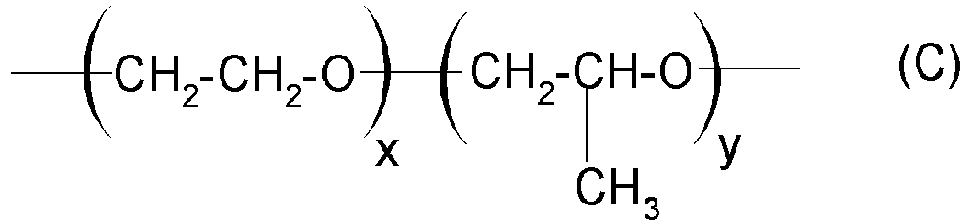
- the polyalkoxylated chain -Z m1 - has formula (C) where 0 ⁇ x ⁇ 20 ; 0 ⁇ y ⁇ 20 and 2 ⁇ x+y ⁇ 40;
- aliphatic carboxylic acid refers to a fatty acid, that is, a monocarboxylic acid having a long aliphatic chain.
- the aliphatic chain may be linear or branched, saturated or unsaturated.
- the aliphatic chain may be an alkyl chain.
- the total number of carbon atoms in the carboxylic fatty acid may vary from 4 to 28.
- Preferred fatty acids are those containing a number of carbon atoms from 8 to 22 carbon atoms, preferably from 12 to 18 carbon atoms.
- the most preferred fatty acids are caprylic acid (C 8 ), capric acid (C 10 ), lauric acid (C 12 ), myristic acid (C 14 ), palmitic acid (C 16 ), oleic and stearic acids (C 18 ).
- aryl radical refers to a radical obtained from removing one hydrogen atom from an aromatic ring which can be optionally substituted by one or more hydrocarbon group and/or halogen.
- the hydrocarbon group can be optionally substituted and/or interrupted by a heteroatom or a heteroatom-containing group.
- aromatic ring can designate a cyclic conjugated unsaturated hydrocarbon ring having a number of delocalized ⁇ electrons following the Huckel rule.
- aromatic ring encompasses also heteroaromatic ring, that is to say, cyclic conjugated unsaturated ring containing one or more heteroatoms and having a number of delocalized ⁇ electrons following the Huckel rule.
- aromatic ring encompasses also polycyclic aromatic compounds.
- the rings can be fused or they can be linked by C-C linkage or by a spiro linkage.
- aryl carboxylic acid refers to a monocarboxylic acid having the formula where Ar is an aryl radical as defined above.
- Aryl carboxylic acids may be selected from the group consisting of benzoic acid, toluic acid, furoic acid, nicotinic acid, thiophenecarboxylic acid, 2-mesitylenecarboxylic acid, isopropylbenzoic acid, chlorobenzoic acid, fluorobenzoic acid, trifluoromethylbenzoic acid, methoxybenzoic acid, naphthoic acid, anthracenecarboxylic acid, biphenylcarboxylic acid, benzoylbenzoic acid.
- the most preferred aryl carboxylic acids are benzoic acid and toluic acid.
- the process for preparing the mixture of alkoxylates (A) and (B) preferably comprises the three following steps in this order: a catalytic decarboxylative cross-ketonisation, a hydrogenation and an alkoxylation.
- the first step of the process is a catalytic decarboxylative cross-ketonisation of aryl carboxylic acids and aliphatic carboxylic acids, also called Piria reaction.
- a catalytic decarboxylative cross-ketonisation of aryl carboxylic acids and aliphatic carboxylic acids typically comprises the following steps:
- the mixture of ketones acts itself as a solvent. Therefore, no other solvent is needed to be added to the mixture of ketones.
- the catalytic decarboxylative cross-ketonisation of aryl carboxylic acids and aliphatic carboxylic acids typically comprises the steps of:
- Suitable decarboxylative cross-ketonisation conditions may be as follows:
- the aryl carboxylic acid may be selected from the group consisting of benzoic acid, furoic acid, o-toluic acid, m-toluic acid and p-toluic acid.
- the first step of the process leads to mixture (III), that is, a mixture comprising the dialiphatic ketone of formula (F) and the aryl aliphatic ketone of formula (G).
- the weight of the dialiphatic ketone of formula (F) based on the total weight of the dialiphatic ketone of formula (F) and of the aryl aliphatic ketone of formula (G), namely the ratio r FG with r FG being defined as follows: r FG weight of F weight of F + weight of G can be of up to 2%, up to 5%, up to 10%, up to 20%, up to 30% or up to 50%.
- the ratio r FG can be of at least 1%, at least 2%, at least 5%, at least 10%, or at least 20%.
- r FG Some preferred ranges for r FG are from 1% to 50%, from 1% to 20%, from 2% to 30% and from 2% to 20%.
- the total weight of the dialiphatic ketone of formula (F) and of the aryl aliphatic ketone of formula (G) based on the total weight of the mixture (III) can be of at least 10%, at least 20%, at least 50%, at least at least 80% or at least 90%; it can also be of at least 95%, at least 98% or at least 99%. Further, mixture (III) can consist essentially of or can consist of the dialiphatic ketone of formula (F) and of the aryl aliphatic ketone of formula (G).
- the mixture containing the dialiphatic ketone and the aryl aliphatic ketone undergoes a hydrogenation by which the dialiphatic ketone is converted into a dialiphatic alcohol, also referred hereinafter as dialiphatic carbinol, and by which the aryl aliphatic ketone is converted into an aryl aliphatic alcohol, also referred hereinafter as aryl aliphatic carbinol.
- the aryl aliphatic ketone is more reactive than the dialiphatic ketone under standard hydrogenation conditions.
- the conversion rate of the aryl aliphatic ketone is generally higher than that of the dialiphatic ketone.
- the dialiphatic ketone needs harsh hydrogenation conditions in order to obtain a suitable conversion rate.
- the hydrogenation temperature and the hydrogenation pressure are preferably selected in such a way that a conversion level of the dialiphatic ketone of at least 20% is obtained after 4 hours.
- a suitable hydrogenation temperature can be at least 120°C, preferably at least 150°C, even more preferably at least 180°C.
- a suitable hydrogenation pressure can be at least 10 bar, preferably at least 20 bar and preferably at least 30 bar.
- the duration of the hydrogenation may range from 0.5 to 10 hours, preferably from 2 to 6 hours, more preferably about 4 hours.
- the hydrogenation catalyst is typically a platinum group metal supported on carbon.
- the loading of the platinum group metal generally ranges from 0.5 to 10 wt.%. Preferably, the loading ranges from 1 to 5 wt.%.
- the hydrogenation is preferably conducted in the presence of a base, such as NaOH.
- a base such as NaOH.
- the presence of such base significantly improves the selectivity toward the aryl aliphatic carbinol by reducing the formation of by-products that are formed during the hydrogenation through hydrodeoxygenation (e.g. alkylbenzene) and/or aromatic ring hydrogenation (e.g alkylcyclohexane) side reactions on the phenyl aliphatic ketone.
- the presence of such base also improves the conversion rate of the dialiphatic ketone as it will be shown in the experimental section.
- the base is added at a molar percentage generally ranging from 5 to 20% with respect to the sum of the number of moles of the ketones.
- mixture (II) that is a mixture comprising the dialiphatic carbinol and the aryl aliphatic carbinol.
- Mixture (II) may further contain residual amounts of the dialiphatic ketone and aryl aliphatic ketone which have not been hydrogenated.
- the weight of the dialiphatic carbinol of formula (E) based on the total weight of the aryl aliphatic carbinol of formula (D) and of the dialiphatic carbinol of formula (E), namely the ratio r ED with r ED being defined as follows: r ED weight of E weight of E + weight of D can be of up to 2%, up to 5%, up to 10%, up to 20%, up to 30% or up to 50%.
- the ratio r ED can be of at least 1%, at least 2%, at least 5%, at least 10%, or at least 20%.
- r ED Some preferred ranges for r ED are from 1% to 50%, from 1% to 20%, from 2% to 30% and from 2% to 20%.
- the total weight of the aryl aliphatic carbinol of formula (D) and of the dialiphatic carbinol of formula (E) based on the total weight of the mixture (II) can be of at least 10%, at least 20%, at least 50%, at least at least 80% or at least 90%; it can also be of at least 95%, at least 98% or at least 99%.
- mixture (II) can consist essentially of or can consist of the aryl aliphatic carbinol of formula (D) and the dialiphatic carbinol of formula (E).
- the mixture containing the dialiphatic carbinol and the aryl aliphatic carbinol undergoes a polyalkoxylation by which polyalkoxy groups are added to the hydroxyl group of both carbinols.
- the polyalkoxy groups may be polyethoxy groups or polypropoxy groups.
- the polyalkoxy groups may comprise polyethoxy and polypropoxy groups.
- the polyalkoxy groups consist of a block copolymer of ethylene oxide and propylene oxide units.
- the polyalkoxy groups consist of a random copolymer of ethylene oxide and propylene oxide units.
- Alkoxylation of an alcohol is a process known to the person skilled in the art. Nevertheless, suitable alkoxylation conditions are provided hereafter for indication purposes.
- the alkoxylation step is generally preceded by a dehydration step in presence of a base, such as NaOH.
- a base such as NaOH.
- the molar percentage of the base amounts generally to less than 10 % of the sum of the number of moles of the two carbinols.
- the molar percentage of the base can be less than 1% with respect to the sum of the number of moles of the aryl aliphatic carbinol and dialiphatic carbinol.
- the molar percentage of the base can be less than 5% with respect to the sum of the number of moles of the aryl alkyl carbinol and the dialiphatic carbinol.
- Dehydration occurs at a temperature generally ranging from 100 to 150°C, preferably from 120 to 130°C at a pressure which is less than the atmospheric pressure, for example 0.1 bar. Dehydration is carried out for a duration generally ranging from 0.25 to 2 hours.
- Alkoxylation is carried out.
- the required quantity of alkylene oxide is added to the reaction mixture.
- Alkoxylation is carried out a temperature generally ranging from 100 to 250°C, preferably from 100 to 200°C, preferably from 100 to 150°C and preferably from 120 to 130°C.
- the reaction is started at 125°C during from 2 to 4 hours. This corresponds to the reaction stage. Then, the temperature is increased at about 130°C during 0.5 to 1.5 hours in order to consume all the alkylene oxide introduced. This corresponds to a post-reaction stage.
- a final stage of neutralization is then carried out at a temperature typically ranging from 30°C to 100°C during from 0.5 to 2 hours by addition of a weak acid, such as acetic acid, to the reaction mixture.
- a weak acid such as acetic acid
- the molar percentage of the weak acid amounts generally to less than 10 % of the sum of the number of moles of the ethoxylated carbinols.
- the third step of the process leads to mixture (I) comprising a mixture of an aryl aliphatic carbinol alkoxylate and a dialiphatic carbinol alkoxylate.
- the weight of the dialiphatic carbinol alkoxylate of formula (B) based on the total weight of the aryl aliphatic carbinol alkoxylate of formula (A) and of the dialiphatic carbinol alkoxylate of formula (B), namely the ratio r BA with r BA being defined as follows: r BA weight of B weight of A + weight of B can be of up to 2%, up to 5%, up to 10%, up to 20%, up to 30% or even up to 50%.
- the ratio r BA can be of at least 1%, at least 2%, at least 5%, at least 10% or at least 20%.
- r BA Some preferred ranges for r BA are from 1% to 50%, from 1% to 30%, from 2% to 20%, from 2% to 10% and from 5% to 20%.
- the total weight of the aryl aliphatic carbinol alkoxylate of formula (A) and of the dialiphatic carbinol alkoxylate of formula (B) based on the total weight of the mixture (I) can be of at least 10%, at least 20%, at least 50%, at least at least 80% or at least 90%; it can also be of at least 95%, at least 98% or at least 99%.
- mixture (I) can consist essentially of or can consist of the aryl aliphatic carbinol alkoxylate of formula (A) and the dialiphatic carbinol alkoxylate of formula (B).
- Mixture (I) may further contain residual amounts of unreacted aryl aliphatic carbinol and dialiphatic carbinol from mixture (II), both these carbinols having not been alkoxylated.
- Mixture (I) may also contain residual amounts of unreacted dialiphatic ketone and aryl aliphatic ketone from mixture (III).
- Polyalkoxylation is conducted on the mixture containing both the aryl aliphatic carbinol and the dialiphatic carbinol.
- the invention relies on a key catalytic Piria cross-ketonization and starts from widely available carboxylic acids generating only water and CO 2 as by-products, in contrast to the process disclosed in CN 106220478 which uses toxic reactants.
- the claimed process contains fewer steps, has a better atom economy and lower E-factor. It is therefore significantly more sustainable and economically viable which is a technical advantage.
- the process produces a composition comprising a mixture of at least two non-ionic surfactants of different natures. It is therefore different from the one described in CN106220478 which produces a composition containing only the NPE substitute, that is to say the alpha-phenyl alkyl alcohol poly(oxyethylene).
- the surfactant basic properties in particular the Hydrophilic-Lipophilic Balance HLB value, may be adjusted according to the user's needs by selecting the nature and the length of the aliphatic R radical and by selecting the nature and the number of moles of the alkoxy group.
- Mixture I may be used in a phytosanitary composition or in a pharmaceutical composition.
- Phytosanitary and pharmaceutical compositions may be prepared under various forms. One may cite:
- the solvent or co-solvent may be an organic solvent, preferably originating from the refinery of crude oil.
- One may cite xylene and naphtha.
- the emulsifiable concentrate, the microemulsion, the emulsion and the suspension comprise may optionally further comprise a co-surfactant.
- the co-surfactant is advantageously an anionic surfactant; it is preferably chosen from optionally alkoxylated alkyl sulfates, optionally alkoxylated alkyl sulfonates, optionally alkoxylated alkylaryl sulfates, optionally alkoxylated alkylaryl sulfonates and mixtures thereof, and is more preferably an alkylaryl sulfonate (understand: an alkylaryl sulfonate which is not alkoxylated);
- the counter-ion of the anionic surfactant, in particular of the alkylaryl sulfonate can be an ammonium cation, an alkali metal cation or an alkaline-earth metal cation.
- alkylaryl sulfonate it can be cited linear calcium dodecylbenzene sulfonate, commercially available as Rhodacal ® 60/B from RHODIA OPERATIONS.
- the amount of co-surfactant based on the total weight of the emulsifiable concentrate, the microemulsion, the emulsion and the suspension, as the case may be, ranges generally from 0.1% to 10%, in particular from 1% to 5%.
- reaction progress was monitored thanks to FTIR in order to ensure that complete conversion of complexes was reached. This requires usually an additional 0h30 of stirring after the last cycle.
- reaction mixture is cooled down at 40°C and chloroform (CHCl 3 ) is added into the mixture to dissolve products.
- chloroform CHCl 3
- the chloroform mixture is filtered over a silica plug and the product eluted with around 1.5 L of CHCl 3 .
- 47.71 g of product (91% yield relative to fatty acids) is obtained as a light brown powder constituted of 55 mol % of cross-adduct phenylhexadecan-1-one and 45 mol % of hentriacontan-16-one (palmitone).
- the product is obtained as a brown powder (51.84 g, 91% isolated yield relative to the fatty acid) and consists of 85 mol % of cross adduct and 15 mol % of hentriacontan-16-one.
- the product is obtained as a brown powder (33.75 g, 83% isolated yield relative to the fatty acid) and consists of 99 mol % of cross adduct and only 1 mol % of hentriacontan-16-one.
- the reaction is carried out following the protocol described in paragraph 1.1 with a total amount of 39.2g of lauric acid (195.8 mmol), 19.8g of benzoic acid (162.2 mmol) and 3.4g of Fe (0) (60.8 mmol).
- the product is obtained as a brown powder (40.3g, 87% isolated yield relative to the fatty acid) and consists of 87 mol % of cross adduct and 13 mol % of tricosan-12-one.
- reaction is carried out following the protocol described in paragraph 1.1 with a total amount of 25.6g of lauric acid (127.9 mmol), 27.2g of benzoic acid (222.9 mmol) and 4.9g of Fe (0) (87.6 mmol).
- the product is obtained as a brown powder (23.84g, 71% isolated yield relative to the fatty acid) and consists of 99 mol % of cross adduct and 1 mol % of tricosan-12-one.
- the hydrogenation reactions are conducted in 35 mL or 100 mL autoclaves (Hastelloy C22) equipped with a self-aspirating Rushton turbine to ensure good transfer.
- the starting mixture of ketones (solid in the form of a powder) is mixed with a NaOH powder and Pd/C (3% of Pd on a carbon support) and is then loaded into the reactor.
- the reactor is then purged 3 times with nitrogen and 3 times with hydrogen.
- the reactor is pressured under 20 bar of hydrogen and the temperature is set at 80°C in order to melt the ketones mixture.
- reaction mixture When the temperature of the reaction mixture reaches 80°C, stirring can be started at a speed of 1000 rpm and the temperature is then increased to the desired reaction temperature (cf table 1 below). The reaction mixture is then allowed to stir at this temperature under 20 bar of hydrogen during several hours. Then the reactor is cooled down at room temperature, the pressure is decreased down to 1 bar and 70 mL of CHCl 3 are added. The suspension is filtered in order to remove the catalyst and the solvent is evaporated under vacuum to yield a white solid which is then analyzed thanks to NMR in order to quantify conversion & selectivity.
- the conditions that afford both good conversion and selectivity are: 150°C, 20 bar, 15 mol % of NaOH (with respect to the sum of the number of moles of ketones) and Pd/C (3%): 3 wt.%.
- the NaOH addition and dehydration steps are conducted in a standard glassware equipment. 3.3 g ofNaOH 50 wt.% aqueous solution (0.04 mole) is reacted with 985 g (3.75 moles) of 1-phenyldodecan-1-one at 125°C under reduced pressure (0.1 bar) during 30 minutes. The residual amount of water after this step is 176 ppm.
- the ethoxylation reaction is then conducted in a 15 L spray loop reactor (stainless steel) equipped with a heat exchanger.
- the reaction is started at 125°C during 3h and then the temperature is increased at 130°C during 1h. During this reaction phase, the pressure goes from 0.5 barg to 4.5 barg, the average EO flow rate is around 400 g/h with a maximum of 750 g/h.
- a post-reaction step is then conducted at 130°C during 1h00 in order to consume totally the ethylene oxide. During this post-reaction stage the pressure drops from 4.5 barg to 1.0 barg.
- the final neutralization stage is again conducted in a standard glassware equipment at 50°C using 3.0 g of acetic acid 80 wt.% (0.04 mole).
- the obtained product is liquid at room temperature and exhibits the following properties:
- the products consists of a mixture composed of 97 wt. % of ethoxylated product (average a number of EO around 10) and 3 wt.% of residual alcohol precursor.
- HPLC analysis allowed determining the amount of free polyethylene glycol (PEG): 5.7 % (equivalent PEG400).
- the NaOH addition and dehydration steps are conducted in a standard glassware equipment.
- the ethoxylation reaction is then conducted in a 15L spray loop reactor (stainless steel) equipped with a heat exchanger.
- the reaction is started at 125°C and 2 equivalents of ethylene oxide are added. The temperature is then increased to 150°C and the 8 remaining equivalents of ethylene oxide are added.
- the post-reaction step is conducted at 150°C in order to consume totally the ethylene oxide.
- the final neutralization stage is conducted in a standard glassware equipment at 80°C using 5.0 g of isononanoic acid (0.03 mole).
- the obtained product is solid at room temperature and exhibits the following properties:
- the product consists on a mixture composed of 71 wt. % of ethoxylated secondary alcohol (average number of EO around 21) and 29 wt.% of the alcohol precursor.
- HPLC analysis allowed determining the amount of free PEG: 490 ppm (equivalent PEG400).
- the ethoxylated 1-phenyldodecan-1-ol (10 EO) was blended with the product resulting from the ethoxylation of 12-tricosanol (10 EO) at different weight ratios.
- the various weight ratios are indicated in Table 2.
- Table 2 Blend of surfactants n° Weight percentage of 1-phenyldodecan-1-ol (+10 EO) in the blend Weight percentage of 12-tricosanol (+10 EO) in the blend 1 100 0 2 98 2 3 90 10 4 80 20
- Rhodacal ® 60/B 98% 46% n°4 3.9% Rhodacal ® 60/B 3.1%
- Solvesso TM 150-ND 47% Rhodacal ® 60/B is a linear calcium dodecylbenzene sulfonate, thus an anionic surfactant Solvesso TM 150-ND is a solvent naphtha
- the stability of the emulsion was assessed using the following rating:
- the surface tension in the absence of any surfactants is about 70 dyne/cm.
- Surface tension measurement show that the compositions containing the blend of surfactants give surface tension values in the range of 30-32 dyne/cm for all the studied ratios, thus lower than 70 dyne/cm. Those low surface tensions are indicative of good wetting properties of the composition.
Landscapes
- Chemical & Material Sciences (AREA)
- Organic Chemistry (AREA)
- Health & Medical Sciences (AREA)
- Life Sciences & Earth Sciences (AREA)
- General Health & Medical Sciences (AREA)
- Engineering & Computer Science (AREA)
- Medicinal Chemistry (AREA)
- Chemical Kinetics & Catalysis (AREA)
- Polymers & Plastics (AREA)
- Wood Science & Technology (AREA)
- Toxicology (AREA)
- Dentistry (AREA)
- Plant Pathology (AREA)
- Zoology (AREA)
- Environmental Sciences (AREA)
- Pest Control & Pesticides (AREA)
- Agronomy & Crop Science (AREA)
- Materials Engineering (AREA)
- Proteomics, Peptides & Aminoacids (AREA)
- Inorganic Chemistry (AREA)
- Pharmacology & Pharmacy (AREA)
- Epidemiology (AREA)
- Animal Behavior & Ethology (AREA)
- Public Health (AREA)
- Veterinary Medicine (AREA)
- Dispersion Chemistry (AREA)
- Organic Low-Molecular-Weight Compounds And Preparation Thereof (AREA)
Claims (6)
- Verfahren zur Herstellung eines Gemischs (I), umfassend:- ein arylaliphatisches Carbinolalkoxylat der Formel (A):
 R für einen aliphatischen Rest mit 4 bis 24 Kohlenstoffatomen steht;Z für eine Alkoxylat-Einheit der allgemeinen Formel -(Y-O)- steht, wobei Y für einen zweiwertigen Kohlenwasserstoffrest mit 2 bis 6 Kohlenstoffatomen steht und 50 ≥ m1 ≥ 2;Ar für einen Arylrest steht;- ein dialiphatisches Carbinolalkoxylat der Formel (B) :
 R wie oben definiert ist;Z' für eine Alkoxylat-Einheit der allgemeinen Formel -(Y'-O)- steht, wobei Y' für einen zweiwertigen Kohlenwasserstoffrest mit 2 bis 6 Kohlenstoffatomen steht, wobei Z' mit Z identisch oder davon verschieden sein kann, und 50 ≥ m2 ≥ 2;wobei das Verfahren die folgenden Schritte umfasst:a) Durchführen einer katalytischen decarboxylierenden Kreuzketonisierung von Aryl- und aliphatischen Carbonsäuren, umfassend die Schritte:i) Bereitstellen eines Gemischs, enthaltend- eine Arylcarbonsäure der Formel
 - eine aliphatische Carbonsäure der Formel
 - einen Katalysator;ii) Erhitzen des Gemischs auf eine Temperatur, die ausreicht, um das Gemisch (III) zu bilden, das ein dialiphatisches Keton der Formel (F)
 wobei R wie oben definiert ist,und ein arylaliphatisches Keton der Formel (G)
 wobei R und Ar wie oben definiert sind, umfasst;b) Hydrieren des Gemischs (III) in Gegenwart einer Base zur Bildung des Gemischs (II), umfassend- ein arylaliphatisches Carbinol der Formel (D):
 R für einen aliphatischen Rest mit 4 bis 24 Kohlenstoffatomen steht;Ar für einen Arylrest steht;- ein dialiphatisches Carbinol der Formel (E):
 c) Alkoxylieren des Gemischs (II) zur Bildung des Gemischs (I);wobei der Schritt a) des Durchführens der katalytischen decarboxylierenden Kreuzketonisierung von Aryl- und aliphatischen Carbonsäuren die folgenden Schritte umfasst:i) Bereitstellen eines Gemischs, enthaltend:- die Arylcarbonsäure;- die aliphatische Carbonsäure;- eine metallhaltige Verbindung;wobei die Molzahl des Metalls in dem Gemisch mindestens gleich 90 % der Summe der Molzahl an Arylcarbonsäure und der Molzahl an aliphatischer Carbonsäure, geteilt durch die Wertigkeit des Metalls, ist,wobei die Mischung frei von zugegebenem Lösungsmittel ist;ii) Erhitzen des Gemischs auf eine Temperatur, die ausreicht, um Metallcarboxylate zu bilden;iii) weiteres Erhitzen des Gemischs auf eine Temperatur, die ausreicht, um das dialiphatische Keton der Formel (F) und das arylaliphatische Keton der Formel (G) zu bilden;iv) Zugeben von- Arylcarbonsäure in einer Menge, die weitgehend der Menge an Arylcarbonsäure entspricht, die bei der Bildung des arylaliphatischen Ketons in Schritt iii) verbraucht wird;- aliphatischer Carbonsäure in einer Menge, die weitgehend der Menge an aliphatischer Carbonsäure entspricht, die bei der Bildung des arylaliphatischen Ketons und des dialiphatischen Ketons in Schritt iii) verbraucht wird;zu dem Reaktionsgemisch aus Schritt iii);wobei das Gemisch bei einer Temperatur gehalten wird, die ausreicht, um die Bildung des dialiphatischen Ketons und des arylaliphatischen Ketons fortzusetzen;v) gegebenenfalls Wiederholen von Schritt iv).
 - Verfahren nach Anspruch 1, wobei in dem Gemisch (I) das Gewicht des dialiphatischen Carbinolalkoxylats der Formel (B), bezogen auf das Gesamtgewicht des arylaliphatischen Carbinolalkoxylats der Formel (A) und des dialiphatischen Carbinolalkoxylats der Formel (B), im Bereich von 2 bis 20 % liegt.
- Verfahren nach Anspruch 1 oder 2, wobei in dem Gemisch (I) der aliphatische Rest ein Alkylrest ist.
- Verfahren nach einem der Ansprüche 1 bis 3, wobei:- die polyalkoxylierte Kette -Zm1- die Formel (C) aufweist, wobei 0 ≤ x ≤ 20; 0 ≤ y ≤ 20 und 2 ≤ x + y ≤ 40;
 - die polyalkoxylierte Kette -Z'm2- die Formel (C') aufweist, wobei 0 ≤ x' ≤ 20; 0 ≤ y' ≤ 20 und 2 ≤ x' + y' ≤ 40;
- Verfahren nach einem der Ansprüche 1 bis 4, wobei die aliphatische Carbonsäure aus der Gruppe bestehend aus Caprylsäure (C8), Caprinsäure (C10), Laurinsäure (C12), Myristinsäure (C14), Palmitinsäure (C16), Ölsäure und Stearinsäure (C18) ausgewählt wird.
- Verfahren nach einem der Ansprüche 1 bis 4, wobei die Arylcarbonsäure aus der Gruppe bestehend aus Benzoesäure, Toluylsäure, Furoesäure, Nicotinsäure, Thiophencarbonsäure, 2-Mesitylencarbonsäure, Isopropylbenzoesäure, Chlorbenzoesäure, Fluorbenzoesäure, Trifluormethylbenzoesäure, Methoxybenzoesäure, Naphthoesäure, Anthracencarbonsäure, Biphenylcarbonsäure, Benzoylbenzoesäure, vorzugsweise Benzoesäure und Toluylsäure, ausgewählt wird.
Applications Claiming Priority (2)
| Application Number | Priority Date | Filing Date | Title |
|---|---|---|---|
| EP17306685 | 2017-12-01 | ||
| PCT/EP2018/083241 WO2019106196A1 (en) | 2017-12-01 | 2018-11-30 | Process for the preparation of alkoxylates compositions |
Publications (2)
| Publication Number | Publication Date |
|---|---|
| EP3717447A1 EP3717447A1 (de) | 2020-10-07 |
| EP3717447B1 true EP3717447B1 (de) | 2024-05-15 |
Family
ID=60888305
Family Applications (1)
| Application Number | Title | Priority Date | Filing Date |
|---|---|---|---|
| EP18825568.1A Active EP3717447B1 (de) | 2017-12-01 | 2018-11-30 | Verfahren zur herstellung von alkoxylatzusammensetzungen |
Country Status (4)
| Country | Link |
|---|---|
| US (2) | US20200339748A1 (de) |
| EP (1) | EP3717447B1 (de) |
| CN (1) | CN111566079B (de) |
| WO (1) | WO2019106196A1 (de) |
Families Citing this family (5)
| Publication number | Priority date | Publication date | Assignee | Title |
|---|---|---|---|---|
| CN110935392B (zh) * | 2019-11-26 | 2022-02-15 | 沈阳建筑大学 | 一种泡沫封堵环保厕所用防冻型有机发泡液及其制备方法 |
| WO2021143999A1 (en) | 2020-01-13 | 2021-07-22 | Rhodia Operations | New coalescing agent for coating compositions and coating compositions comprising the same |
| CN112337474B (zh) * | 2020-11-03 | 2023-05-09 | 中海油天津化工研究设计院有限公司 | 一种高活性镍基丙酮加氢催化剂及制备方法 |
| US12570926B2 (en) | 2022-07-01 | 2026-03-10 | The Procter & Gamble Company | Fabric and home care product |
| EP4547646A1 (de) | 2022-07-01 | 2025-05-07 | Specialty Operations France | Sulfonierte und sulfatierte arylalkylverbindungen als tenside |
Citations (2)
| Publication number | Priority date | Publication date | Assignee | Title |
|---|---|---|---|---|
| EP3415493A1 (de) * | 2017-06-16 | 2018-12-19 | Rhodia Operations | Verfahren zur katalytischen decarboxylierende kreuzketonisierung von aryl- und aliphatischen carbonsäuren |
| WO2018229285A1 (en) * | 2017-06-16 | 2018-12-20 | Rhodia Operations | Process for the catalytic decarboxylative cross-ketonization of aryl and aliphatic carboxylic acid |
Family Cites Families (12)
| Publication number | Priority date | Publication date | Assignee | Title |
|---|---|---|---|---|
| US3359331A (en) * | 1965-11-10 | 1967-12-19 | Exxon Research Engineering Co | Secondary alcohol ethoxylation |
| US3372201A (en) * | 1966-06-17 | 1968-03-05 | Gen Aniline & Film Corp | Alkoxylation of secondary alcohols |
| GB2012804B (en) | 1978-01-19 | 1982-03-10 | Lankro Chem Ltd | Quick break cleaning composition |
| TW519535B (en) * | 1996-12-06 | 2003-02-01 | Nippon Catalytic Chem Ind | Higher secondary alcohol alkoxylate compound composition, method for production thereof, and detergent and emulsifier using the composition |
| US6767881B1 (en) | 2003-03-19 | 2004-07-27 | Ecolab, Inc. | Cleaning concentrate |
| WO2012005897A1 (en) * | 2010-06-29 | 2012-01-12 | Dow Global Technologies Llc | Branched secondary alcohol alkoxylate surfactants and process to make them |
| ES2614428T3 (es) | 2010-12-09 | 2017-05-31 | Cognis Ip Management Gmbh | Cetonización cruzada descarboxilativa catalítica de ácidos arilcarboxílicos y alquilcarboxílicos usando catalizadores de hierro |
| US9193650B1 (en) * | 2014-11-13 | 2015-11-24 | Chevron U.S.A. Inc. | Long chain secondary alcohols from fatty acids and fatty oils |
| CN106279670A (zh) | 2016-07-19 | 2017-01-04 | 南通市晗泰化工有限公司 | α‑苯基烷基醇聚氧乙烯醚硫酸铵及制备方法 |
| CN106220478A (zh) * | 2016-07-19 | 2016-12-14 | 南通市晗泰化工有限公司 | α‑苯基烷基醇聚氧乙烯醚及制备方法 |
| CN106187834A (zh) | 2016-07-19 | 2016-12-07 | 南京林业大学 | α‑苯基烷基醇聚氧乙烯醚琥珀酸二钠盐及制备方法 |
| CN106220679B (zh) | 2016-07-19 | 2019-06-11 | 南通市晗泰化工有限公司 | α-苯基烷基醇聚氧乙烯醚磷酸酯及制备方法 |
-
2018
- 2018-11-30 WO PCT/EP2018/083241 patent/WO2019106196A1/en not_active Ceased
- 2018-11-30 EP EP18825568.1A patent/EP3717447B1/de active Active
- 2018-11-30 CN CN201880077872.4A patent/CN111566079B/zh active Active
- 2018-11-30 US US16/764,157 patent/US20200339748A1/en not_active Abandoned
-
2023
- 2023-06-08 US US18/331,471 patent/US20230312822A1/en active Pending
Patent Citations (2)
| Publication number | Priority date | Publication date | Assignee | Title |
|---|---|---|---|---|
| EP3415493A1 (de) * | 2017-06-16 | 2018-12-19 | Rhodia Operations | Verfahren zur katalytischen decarboxylierende kreuzketonisierung von aryl- und aliphatischen carbonsäuren |
| WO2018229285A1 (en) * | 2017-06-16 | 2018-12-20 | Rhodia Operations | Process for the catalytic decarboxylative cross-ketonization of aryl and aliphatic carboxylic acid |
Also Published As
| Publication number | Publication date |
|---|---|
| WO2019106196A1 (en) | 2019-06-06 |
| US20230312822A1 (en) | 2023-10-05 |
| CN111566079B (zh) | 2023-06-20 |
| US20200339748A1 (en) | 2020-10-29 |
| EP3717447A1 (de) | 2020-10-07 |
| CN111566079A (zh) | 2020-08-21 |
Similar Documents
| Publication | Publication Date | Title |
|---|---|---|
| US20230312822A1 (en) | Process for the preparation of alkoxylates compositions | |
| US4214101A (en) | Process for preparing ether carboxylates | |
| US7371716B2 (en) | C10-alkanolalkoxylate mixtures and the use thereof | |
| KR100243735B1 (ko) | 고급 제2급 알콜 알콕실레이트 화합물 조성물,그 제조방법,이를 이용한 세정제 및 유화제 | |
| TWI488835B (zh) | 用於作為界面活性劑之經環氧烷封端的二級醇烷氧化物 | |
| CN102066540A (zh) | 含有中等范围的烷氧基化物的清洁组合物 | |
| JPH03215445A (ja) | アルコールのアルコキシル化方法 | |
| CN101578130A (zh) | 烷氧基化物混合物表面活性剂 | |
| US20210087334A1 (en) | Preparation of Alkylcyclohexanol Polyoxyethylene Ether Emulsifier and Application Thereof | |
| JPH0155308B2 (de) | ||
| JP7372921B2 (ja) | 芳香族系ポリエーテルアミンアルコキシレート | |
| KR20160020414A (ko) | 고형 세정제 조성물 | |
| CN100383100C (zh) | C10链烷醇烷氧基化物混合物及其作为新型低泡润湿剂的用途 | |
| JP3002472B2 (ja) | 界面活性剤組成物 | |
| JPH04234416A (ja) | フェノール樹脂アルコキシレート | |
| CN106590587A (zh) | 含聚醚羧酸盐表面活性剂组合物及其制备方法和用途 | |
| CN103270011B (zh) | 脂肪醇的聚甘油醚的制备方法 | |
| KR101527819B1 (ko) | 알콕시화 촉매의 제조 방법, 및 알콕시화 방법 | |
| EP3587386B1 (de) | Verfahren zum herstellen von fettalkohol-ethoxylaten | |
| WO2019005731A1 (en) | MIXTURES FOR EASILY BIODEGRADABLE ALCOXYLATES | |
| KR20080042890A (ko) | 알콕시화 촉매의 제조 방법, 및 알콕시화 방법 | |
| US7268259B1 (en) | Random fatty alcohol alkoxylates with low temperature stability, and methods of producing and using the same | |
| US5220077A (en) | Alkoxylation process | |
| KR20200032126A (ko) | 생분해성 계면활성제 | |
| US6376721B1 (en) | Process for alkoxylation in the presence of rare earth triflimides |
Legal Events
| Date | Code | Title | Description |
|---|---|---|---|
| STAA | Information on the status of an ep patent application or granted ep patent |
Free format text: STATUS: UNKNOWN |
|
| STAA | Information on the status of an ep patent application or granted ep patent |
Free format text: STATUS: THE INTERNATIONAL PUBLICATION HAS BEEN MADE |
|
| PUAI | Public reference made under article 153(3) epc to a published international application that has entered the european phase |
Free format text: ORIGINAL CODE: 0009012 |
|
| STAA | Information on the status of an ep patent application or granted ep patent |
Free format text: STATUS: REQUEST FOR EXAMINATION WAS MADE |
|
| 17P | Request for examination filed |
Effective date: 20200701 |
|
| AK | Designated contracting states |
Kind code of ref document: A1 Designated state(s): AL AT BE BG CH CY CZ DE DK EE ES FI FR GB GR HR HU IE IS IT LI LT LU LV MC MK MT NL NO PL PT RO RS SE SI SK SM TR |
|
| AX | Request for extension of the european patent |
Extension state: BA ME |
|
| DAV | Request for validation of the european patent (deleted) | ||
| DAX | Request for extension of the european patent (deleted) | ||
| STAA | Information on the status of an ep patent application or granted ep patent |
Free format text: STATUS: EXAMINATION IS IN PROGRESS |
|
| 17Q | First examination report despatched |
Effective date: 20210527 |
|
| RAP3 | Party data changed (applicant data changed or rights of an application transferred) |
Owner name: RHODIA OPERATIONS |
|
| RAP1 | Party data changed (applicant data changed or rights of an application transferred) |
Owner name: SPECIALTY OPERATIONS FRANCE |
|
| GRAP | Despatch of communication of intention to grant a patent |
Free format text: ORIGINAL CODE: EPIDOSNIGR1 |
|
| STAA | Information on the status of an ep patent application or granted ep patent |
Free format text: STATUS: GRANT OF PATENT IS INTENDED |
|
| RIC1 | Information provided on ipc code assigned before grant |
Ipc: C07C 49/04 20060101ALI20231121BHEP Ipc: C07C 49/76 20060101ALI20231121BHEP Ipc: C07C 43/11 20060101ALI20231121BHEP Ipc: C07C 31/125 20060101ALI20231121BHEP Ipc: C08G 65/26 20060101ALI20231121BHEP Ipc: A01N 25/30 20060101ALI20231121BHEP Ipc: C07C 41/03 20060101ALI20231121BHEP Ipc: C07C 29/145 20060101ALI20231121BHEP Ipc: C07C 45/48 20060101AFI20231121BHEP |
|
| INTG | Intention to grant announced |
Effective date: 20231221 |
|
| P01 | Opt-out of the competence of the unified patent court (upc) registered |
Effective date: 20240109 |
|
| GRAS | Grant fee paid |
Free format text: ORIGINAL CODE: EPIDOSNIGR3 |
|
| GRAA | (expected) grant |
Free format text: ORIGINAL CODE: 0009210 |
|
| STAA | Information on the status of an ep patent application or granted ep patent |
Free format text: STATUS: THE PATENT HAS BEEN GRANTED |
|
| AK | Designated contracting states |
Kind code of ref document: B1 Designated state(s): AL AT BE BG CH CY CZ DE DK EE ES FI FR GB GR HR HU IE IS IT LI LT LU LV MC MK MT NL NO PL PT RO RS SE SI SK SM TR |
|
| REG | Reference to a national code |
Ref country code: CH Ref legal event code: EP |
|
| REG | Reference to a national code |
Ref country code: DE Ref legal event code: R096 Ref document number: 602018069587 Country of ref document: DE |
|
| REG | Reference to a national code |
Ref country code: IE Ref legal event code: FG4D |
|
| REG | Reference to a national code |
Ref country code: LT Ref legal event code: MG9D |
|
| REG | Reference to a national code |
Ref country code: NL Ref legal event code: MP Effective date: 20240515 |
|
| PG25 | Lapsed in a contracting state [announced via postgrant information from national office to epo] |
Ref country code: IS Free format text: LAPSE BECAUSE OF FAILURE TO SUBMIT A TRANSLATION OF THE DESCRIPTION OR TO PAY THE FEE WITHIN THE PRESCRIBED TIME-LIMIT Effective date: 20240915 |
|
| PG25 | Lapsed in a contracting state [announced via postgrant information from national office to epo] |
Ref country code: BG Free format text: LAPSE BECAUSE OF FAILURE TO SUBMIT A TRANSLATION OF THE DESCRIPTION OR TO PAY THE FEE WITHIN THE PRESCRIBED TIME-LIMIT Effective date: 20240515 |
|
| PG25 | Lapsed in a contracting state [announced via postgrant information from national office to epo] |
Ref country code: HR Free format text: LAPSE BECAUSE OF FAILURE TO SUBMIT A TRANSLATION OF THE DESCRIPTION OR TO PAY THE FEE WITHIN THE PRESCRIBED TIME-LIMIT Effective date: 20240515 Ref country code: FI Free format text: LAPSE BECAUSE OF FAILURE TO SUBMIT A TRANSLATION OF THE DESCRIPTION OR TO PAY THE FEE WITHIN THE PRESCRIBED TIME-LIMIT Effective date: 20240515 |
|
| PG25 | Lapsed in a contracting state [announced via postgrant information from national office to epo] |
Ref country code: GR Free format text: LAPSE BECAUSE OF FAILURE TO SUBMIT A TRANSLATION OF THE DESCRIPTION OR TO PAY THE FEE WITHIN THE PRESCRIBED TIME-LIMIT Effective date: 20240816 |
|
| PG25 | Lapsed in a contracting state [announced via postgrant information from national office to epo] |
Ref country code: PT Free format text: LAPSE BECAUSE OF FAILURE TO SUBMIT A TRANSLATION OF THE DESCRIPTION OR TO PAY THE FEE WITHIN THE PRESCRIBED TIME-LIMIT Effective date: 20240916 |
|
| REG | Reference to a national code |
Ref country code: AT Ref legal event code: MK05 Ref document number: 1686832 Country of ref document: AT Kind code of ref document: T Effective date: 20240515 |
|
| PG25 | Lapsed in a contracting state [announced via postgrant information from national office to epo] |
Ref country code: NL Free format text: LAPSE BECAUSE OF FAILURE TO SUBMIT A TRANSLATION OF THE DESCRIPTION OR TO PAY THE FEE WITHIN THE PRESCRIBED TIME-LIMIT Effective date: 20240515 |
|
| PG25 | Lapsed in a contracting state [announced via postgrant information from national office to epo] |
Ref country code: ES Free format text: LAPSE BECAUSE OF FAILURE TO SUBMIT A TRANSLATION OF THE DESCRIPTION OR TO PAY THE FEE WITHIN THE PRESCRIBED TIME-LIMIT Effective date: 20240515 |
|
| PG25 | Lapsed in a contracting state [announced via postgrant information from national office to epo] |
Ref country code: AT Free format text: LAPSE BECAUSE OF FAILURE TO SUBMIT A TRANSLATION OF THE DESCRIPTION OR TO PAY THE FEE WITHIN THE PRESCRIBED TIME-LIMIT Effective date: 20240515 |
|
| PG25 | Lapsed in a contracting state [announced via postgrant information from national office to epo] |
Ref country code: PL Free format text: LAPSE BECAUSE OF FAILURE TO SUBMIT A TRANSLATION OF THE DESCRIPTION OR TO PAY THE FEE WITHIN THE PRESCRIBED TIME-LIMIT Effective date: 20240515 |
|
| PG25 | Lapsed in a contracting state [announced via postgrant information from national office to epo] |
Ref country code: LV Free format text: LAPSE BECAUSE OF FAILURE TO SUBMIT A TRANSLATION OF THE DESCRIPTION OR TO PAY THE FEE WITHIN THE PRESCRIBED TIME-LIMIT Effective date: 20240515 |
|
| PG25 | Lapsed in a contracting state [announced via postgrant information from national office to epo] |
Ref country code: PT Free format text: LAPSE BECAUSE OF FAILURE TO SUBMIT A TRANSLATION OF THE DESCRIPTION OR TO PAY THE FEE WITHIN THE PRESCRIBED TIME-LIMIT Effective date: 20240916 Ref country code: PL Free format text: LAPSE BECAUSE OF FAILURE TO SUBMIT A TRANSLATION OF THE DESCRIPTION OR TO PAY THE FEE WITHIN THE PRESCRIBED TIME-LIMIT Effective date: 20240515 Ref country code: NO Free format text: LAPSE BECAUSE OF FAILURE TO SUBMIT A TRANSLATION OF THE DESCRIPTION OR TO PAY THE FEE WITHIN THE PRESCRIBED TIME-LIMIT Effective date: 20240815 Ref country code: NL Free format text: LAPSE BECAUSE OF FAILURE TO SUBMIT A TRANSLATION OF THE DESCRIPTION OR TO PAY THE FEE WITHIN THE PRESCRIBED TIME-LIMIT Effective date: 20240515 Ref country code: LV Free format text: LAPSE BECAUSE OF FAILURE TO SUBMIT A TRANSLATION OF THE DESCRIPTION OR TO PAY THE FEE WITHIN THE PRESCRIBED TIME-LIMIT Effective date: 20240515 Ref country code: IS Free format text: LAPSE BECAUSE OF FAILURE TO SUBMIT A TRANSLATION OF THE DESCRIPTION OR TO PAY THE FEE WITHIN THE PRESCRIBED TIME-LIMIT Effective date: 20240915 Ref country code: HR Free format text: LAPSE BECAUSE OF FAILURE TO SUBMIT A TRANSLATION OF THE DESCRIPTION OR TO PAY THE FEE WITHIN THE PRESCRIBED TIME-LIMIT Effective date: 20240515 Ref country code: GR Free format text: LAPSE BECAUSE OF FAILURE TO SUBMIT A TRANSLATION OF THE DESCRIPTION OR TO PAY THE FEE WITHIN THE PRESCRIBED TIME-LIMIT Effective date: 20240816 Ref country code: FI Free format text: LAPSE BECAUSE OF FAILURE TO SUBMIT A TRANSLATION OF THE DESCRIPTION OR TO PAY THE FEE WITHIN THE PRESCRIBED TIME-LIMIT Effective date: 20240515 Ref country code: ES Free format text: LAPSE BECAUSE OF FAILURE TO SUBMIT A TRANSLATION OF THE DESCRIPTION OR TO PAY THE FEE WITHIN THE PRESCRIBED TIME-LIMIT Effective date: 20240515 Ref country code: BG Free format text: LAPSE BECAUSE OF FAILURE TO SUBMIT A TRANSLATION OF THE DESCRIPTION OR TO PAY THE FEE WITHIN THE PRESCRIBED TIME-LIMIT Effective date: 20240515 Ref country code: AT Free format text: LAPSE BECAUSE OF FAILURE TO SUBMIT A TRANSLATION OF THE DESCRIPTION OR TO PAY THE FEE WITHIN THE PRESCRIBED TIME-LIMIT Effective date: 20240515 Ref country code: RS Free format text: LAPSE BECAUSE OF FAILURE TO SUBMIT A TRANSLATION OF THE DESCRIPTION OR TO PAY THE FEE WITHIN THE PRESCRIBED TIME-LIMIT Effective date: 20240815 |
|
| PG25 | Lapsed in a contracting state [announced via postgrant information from national office to epo] |
Ref country code: DK Free format text: LAPSE BECAUSE OF FAILURE TO SUBMIT A TRANSLATION OF THE DESCRIPTION OR TO PAY THE FEE WITHIN THE PRESCRIBED TIME-LIMIT Effective date: 20240515 |
|
| PG25 | Lapsed in a contracting state [announced via postgrant information from national office to epo] |
Ref country code: EE Free format text: LAPSE BECAUSE OF FAILURE TO SUBMIT A TRANSLATION OF THE DESCRIPTION OR TO PAY THE FEE WITHIN THE PRESCRIBED TIME-LIMIT Effective date: 20240515 |
|
| PG25 | Lapsed in a contracting state [announced via postgrant information from national office to epo] |
Ref country code: CZ Free format text: LAPSE BECAUSE OF FAILURE TO SUBMIT A TRANSLATION OF THE DESCRIPTION OR TO PAY THE FEE WITHIN THE PRESCRIBED TIME-LIMIT Effective date: 20240515 |
|
| PG25 | Lapsed in a contracting state [announced via postgrant information from national office to epo] |
Ref country code: SK Free format text: LAPSE BECAUSE OF FAILURE TO SUBMIT A TRANSLATION OF THE DESCRIPTION OR TO PAY THE FEE WITHIN THE PRESCRIBED TIME-LIMIT Effective date: 20240515 Ref country code: RO Free format text: LAPSE BECAUSE OF FAILURE TO SUBMIT A TRANSLATION OF THE DESCRIPTION OR TO PAY THE FEE WITHIN THE PRESCRIBED TIME-LIMIT Effective date: 20240515 |
|
| PG25 | Lapsed in a contracting state [announced via postgrant information from national office to epo] |
Ref country code: SM Free format text: LAPSE BECAUSE OF FAILURE TO SUBMIT A TRANSLATION OF THE DESCRIPTION OR TO PAY THE FEE WITHIN THE PRESCRIBED TIME-LIMIT Effective date: 20240515 |
|
| PG25 | Lapsed in a contracting state [announced via postgrant information from national office to epo] |
Ref country code: SM Free format text: LAPSE BECAUSE OF FAILURE TO SUBMIT A TRANSLATION OF THE DESCRIPTION OR TO PAY THE FEE WITHIN THE PRESCRIBED TIME-LIMIT Effective date: 20240515 Ref country code: SK Free format text: LAPSE BECAUSE OF FAILURE TO SUBMIT A TRANSLATION OF THE DESCRIPTION OR TO PAY THE FEE WITHIN THE PRESCRIBED TIME-LIMIT Effective date: 20240515 Ref country code: RO Free format text: LAPSE BECAUSE OF FAILURE TO SUBMIT A TRANSLATION OF THE DESCRIPTION OR TO PAY THE FEE WITHIN THE PRESCRIBED TIME-LIMIT Effective date: 20240515 Ref country code: EE Free format text: LAPSE BECAUSE OF FAILURE TO SUBMIT A TRANSLATION OF THE DESCRIPTION OR TO PAY THE FEE WITHIN THE PRESCRIBED TIME-LIMIT Effective date: 20240515 Ref country code: DK Free format text: LAPSE BECAUSE OF FAILURE TO SUBMIT A TRANSLATION OF THE DESCRIPTION OR TO PAY THE FEE WITHIN THE PRESCRIBED TIME-LIMIT Effective date: 20240515 Ref country code: CZ Free format text: LAPSE BECAUSE OF FAILURE TO SUBMIT A TRANSLATION OF THE DESCRIPTION OR TO PAY THE FEE WITHIN THE PRESCRIBED TIME-LIMIT Effective date: 20240515 |
|
| PG25 | Lapsed in a contracting state [announced via postgrant information from national office to epo] |
Ref country code: IT Free format text: LAPSE BECAUSE OF FAILURE TO SUBMIT A TRANSLATION OF THE DESCRIPTION OR TO PAY THE FEE WITHIN THE PRESCRIBED TIME-LIMIT Effective date: 20240515 |
|
| REG | Reference to a national code |
Ref country code: DE Ref legal event code: R097 Ref document number: 602018069587 Country of ref document: DE |
|
| PLBE | No opposition filed within time limit |
Free format text: ORIGINAL CODE: 0009261 |
|
| STAA | Information on the status of an ep patent application or granted ep patent |
Free format text: STATUS: NO OPPOSITION FILED WITHIN TIME LIMIT |
|
| 26N | No opposition filed |
Effective date: 20250218 |
|
| PG25 | Lapsed in a contracting state [announced via postgrant information from national office to epo] |
Ref country code: SI Free format text: LAPSE BECAUSE OF FAILURE TO SUBMIT A TRANSLATION OF THE DESCRIPTION OR TO PAY THE FEE WITHIN THE PRESCRIBED TIME-LIMIT Effective date: 20240515 |
|
| REG | Reference to a national code |
Ref country code: CH Ref legal event code: PL |
|
| PG25 | Lapsed in a contracting state [announced via postgrant information from national office to epo] |
Ref country code: MC Free format text: LAPSE BECAUSE OF FAILURE TO SUBMIT A TRANSLATION OF THE DESCRIPTION OR TO PAY THE FEE WITHIN THE PRESCRIBED TIME-LIMIT Effective date: 20240515 |
|
| PG25 | Lapsed in a contracting state [announced via postgrant information from national office to epo] |
Ref country code: LU Free format text: LAPSE BECAUSE OF NON-PAYMENT OF DUE FEES Effective date: 20241130 |
|
| REG | Reference to a national code |
Ref country code: CH Ref legal event code: PL |
|
| PG25 | Lapsed in a contracting state [announced via postgrant information from national office to epo] |
Ref country code: CH Free format text: LAPSE BECAUSE OF NON-PAYMENT OF DUE FEES Effective date: 20241130 |
|
| REG | Reference to a national code |
Ref country code: BE Ref legal event code: MM Effective date: 20241130 |
|
| PG25 | Lapsed in a contracting state [announced via postgrant information from national office to epo] |
Ref country code: SE Free format text: LAPSE BECAUSE OF FAILURE TO SUBMIT A TRANSLATION OF THE DESCRIPTION OR TO PAY THE FEE WITHIN THE PRESCRIBED TIME-LIMIT Effective date: 20240515 |
|
| PG25 | Lapsed in a contracting state [announced via postgrant information from national office to epo] |
Ref country code: BE Free format text: LAPSE BECAUSE OF NON-PAYMENT OF DUE FEES Effective date: 20241130 |
|
| PGFP | Annual fee paid to national office [announced via postgrant information from national office to epo] |
Ref country code: FR Payment date: 20250930 Year of fee payment: 8 |
|
| PG25 | Lapsed in a contracting state [announced via postgrant information from national office to epo] |
Ref country code: IE Free format text: LAPSE BECAUSE OF NON-PAYMENT OF DUE FEES Effective date: 20241130 |
|
| PGFP | Annual fee paid to national office [announced via postgrant information from national office to epo] |
Ref country code: DE Payment date: 20250930 Year of fee payment: 8 |
|
| PGFP | Annual fee paid to national office [announced via postgrant information from national office to epo] |
Ref country code: GB Payment date: 20251001 Year of fee payment: 8 |
|
| PG25 | Lapsed in a contracting state [announced via postgrant information from national office to epo] |
Ref country code: CY Free format text: LAPSE BECAUSE OF FAILURE TO SUBMIT A TRANSLATION OF THE DESCRIPTION OR TO PAY THE FEE WITHIN THE PRESCRIBED TIME-LIMIT; INVALID AB INITIO Effective date: 20181130 |