EP3717271B1 - Sicherheitselement mit verstecktem bild und sichtbarem bild, und verfahren zur herstellung eines sicherheitselements - Google Patents
Sicherheitselement mit verstecktem bild und sichtbarem bild, und verfahren zur herstellung eines sicherheitselements Download PDFInfo
- Publication number
- EP3717271B1 EP3717271B1 EP18836936.7A EP18836936A EP3717271B1 EP 3717271 B1 EP3717271 B1 EP 3717271B1 EP 18836936 A EP18836936 A EP 18836936A EP 3717271 B1 EP3717271 B1 EP 3717271B1
- Authority
- EP
- European Patent Office
- Prior art keywords
- lines
- embossed structure
- geometric shapes
- background layer
- colour
- Prior art date
- Legal status (The legal status is an assumption and is not a legal conclusion. Google has not performed a legal analysis and makes no representation as to the accuracy of the status listed.)
- Active
Links
Images



Classifications
-
- B—PERFORMING OPERATIONS; TRANSPORTING
- B42—BOOKBINDING; ALBUMS; FILES; SPECIAL PRINTED MATTER
- B42D—BOOKS; BOOK COVERS; LOOSE LEAVES; PRINTED MATTER CHARACTERISED BY IDENTIFICATION OR SECURITY FEATURES; PRINTED MATTER OF SPECIAL FORMAT OR STYLE NOT OTHERWISE PROVIDED FOR; DEVICES FOR USE THEREWITH AND NOT OTHERWISE PROVIDED FOR; MOVABLE-STRIP WRITING OR READING APPARATUS
- B42D25/00—Information-bearing cards or sheet-like structures characterised by identification or security features; Manufacture thereof
- B42D25/30—Identification or security features, e.g. for preventing forgery
- B42D25/324—Reliefs
-
- B—PERFORMING OPERATIONS; TRANSPORTING
- B42—BOOKBINDING; ALBUMS; FILES; SPECIAL PRINTED MATTER
- B42D—BOOKS; BOOK COVERS; LOOSE LEAVES; PRINTED MATTER CHARACTERISED BY IDENTIFICATION OR SECURITY FEATURES; PRINTED MATTER OF SPECIAL FORMAT OR STYLE NOT OTHERWISE PROVIDED FOR; DEVICES FOR USE THEREWITH AND NOT OTHERWISE PROVIDED FOR; MOVABLE-STRIP WRITING OR READING APPARATUS
- B42D25/00—Information-bearing cards or sheet-like structures characterised by identification or security features; Manufacture thereof
- B42D25/30—Identification or security features, e.g. for preventing forgery
- B42D25/342—Moiré effects
Definitions
- the invention relates to a security element with hidden picture, security document consisting of such a security element, and a method for producing such security element, the security element consists of a background layer in a form of sequences of parallel first lines, and of an embossed structure having such parameters that one obtains various colour effects for individual parts of the picture constituting the security element.
- Security elements in a form of embossed optically variable structures give unique effects.
- a valuable and/or security document consists of an element in a form of embossed optically variable structure is easily identified, both visually as well as tactilely but difficult to produce and counterfeit.
- Security elements with an angular effect are produced by printing lines located at an appropriate angle relative to each other. Embossed lines consisting of the security pattern are perpendicular to the substrate background. The singular effect becomes visible, since the ink applied onto the substrate is of significant thickness, and at an appropriate angle, the pattern is dark or bright.
- One group of security elements consist of printed security elements applied by a printing technique, that contain a pattern of thin lines.
- the thin lines are used with such a frequency of lines per unit area, that an observer looking at the valuable and/or security document can see, at the first moment, not single lines but rather a surface of some texture or some colour.
- known security elements are produced from many embossed lines divided into partial areas, in which lines run horizontally or vertically, creating a raster structure. These lines adjoin each other directly, and have, usually, a triangular cross-section profile. In this case, depending on the observation angle, one can see either the security element of practically uniform colour or only a part of this element. Also, it is possible to arrange raised lines having a triangular profile in the security element such that grooves are created that come from joining two lines. Each of the lines located in a partial area is a raised line in terms of width and spacing between the lines, having such dimensions that the sequence of lines in the partial area encodes a picture or pictures. A graphical element is printed onto the substrate of a valuable and/or security document.
- RGB colours RGB RGB (R - red, G - green, and B - blue ).
- a technique of concealing a security element in an imprint on a document is a technique of latent image performed by gravure printing.
- the background is embossed with or without ink, according to the first raster of lines and with a given slope, whereas a hidden security element is placed such that to create a gap in the raster, according to another angle, for example perpendicular to the first slope such that the latent image is difficult to detect at a typical observation direction relative to the substrate plane but it is detectable when observing sideways.
- the document EP 2 562 726 A1 describes security feature with moiré effect, that has been achieved due to the dynamic effect.
- the document EP 0 581 414 A1 describes anti-counterfeit latent image formation object. However, this solutions are different than said invention.
- the goal of the present invention is to overcome these drawbacks by providing a security element according to claim 1 and a method according to claim 13.
- the security element has an embossed structure of any arbitrary shape creating a multicoloured hidden picture and visible picture with a clear colour division of individual parts of the picture, and is very simple and cheap to produce but also difficult to counterfeit as well as easy to verify.
- security and/or valuable document means all documents, such as banknotes, personal documents, driving licence, cheques, securities, tickets, passports, as well as other valuable and secured documents, and data storage media for safe storing data.
- security document or “valuable document” are used interchangeably.
- a substrate may be, for example, a paper substrate, a paperlike substrate and/or a substrate made from paperlike materials like teslin, a polymer substrate, including polypropylene (PP) and/or polyamide (PA), as well as hybrid background based on a paper/polymer combination.
- a paper substrate a paperlike substrate and/or a substrate made from paperlike materials like teslin
- a polymer substrate including polypropylene (PP) and/or polyamide (PA), as well as hybrid background based on a paper/polymer combination.
- PP polypropylene
- PA polyamide
- An illuminant is a radiation source having a power distribution within the wavelength range capable of inducing photo-impressions, 380 nm ⁇ ⁇ ⁇ 780 nm.
- Different illuminant light sources exist. Illuminants include different tones of daylight, various colours of artificial lighting, colours of spectral lines, and colours of phosphors.
- secondary light sources exist that shine with reflected or transmitted light, as, for example, stained glass, the colour of which depends on the original light source it is illuminated with. Thus, saying that a security element has a given colour, one must indicate the illumination type the colour is detected.
- Objects are observed due to the light transmitted by the objects (like, e.g., fluids, stained glass) or reflected from the objects (walls, paintings, etc).
- An eye receives a stream of light originating from an illuminant and transmitted through or reflected from an observed object.
- the colour of an object reflecting or transmitting the light depends on the light it is observed at.
- a coloured object will have different colours when observing it under glow lamp light, daylight, and yet another colour will be perceived when illuminating the object with a bulb.
- the illuminant has a colour temperature of 6774K and gives an impression of cool white light (CW). Also, other illuminants exist that correspond to diffused light under different geographical conditions. For the purposes of the present invention, it has been assumed that a security and/or valuable document is observed in the diffused light.
- a security and/or valuable document consists of a security element in a form of a hidden picture.
- the picture may be of any, complex shape, and it may be unicoloured or multicoloured.
- the security element defines a sequence of parallel first lines superimposed onto the substrate, the sequence consists of at least two parallel, colour lines of the same widths. One of these lines within the sequence may have a substrate colour.
- the background layer defines a sequence of parallel first lines having L different colours, the sequence being repeated any arbitrary number of times.
- One sequence may be created by two, three, or four lines of different colours, or even 16 colours, however, even then the substrate colour may be an additional line colour in the sequence of the first lines.
- the present invention is not restricted to any specific number of colours in a single sequence of the first lines.
- a sequence of the first lines is created, individually or collectively, by colours, most preferably, from the CMY palette: C- Cyan, M- Magenta, Y- Yellow, but also colours from the PANTONE palette are used.
- Cyan is a tone of blue, but slightly brighter and more faded, it may be referred to as grey/sky-blue or livid/blue. Most similar colours are sky-blue, sapphire, and turquoise.
- Magenta is, in the additive synthesis, a colour derived by combining red and blue.
- the sequence of the first lines may also be created, individually or collectively, by colours from palette RGB: R - Red , G - Green, and B - Blue.
- RGB colour space involves the additive synthesis, in which the lowest values define the colour black, whereas the highest ones - white.
- colours are produced by illuminating coloured objects with the white light.
- An example is insertion a colour filter (stained glass) in the path of the light to the eye, or many filters in a cascade. Filters absorb some colours (some portion of the spectrum), and an observer receives the light of the complementary colour relative to the absorbed colour.
- the filter absorbs colour red, the observer receives Cyan (C), when green, the observer can see Magenta (M), when the blue is absorbed, then the observer can see Yellow (Y).
- C Cyan
- M Magenta
- Y Yellow
- the primary colours of the CMY system are the complementary colours to the RGB palette.
- the geometric shapes are equidistant, when lines going through the centres of these geometric shapes, drawn perpendicularly to the shift direction, are at the same distance within a single part of the hidden or visible picture.
- the shift of the first geometric shapes of the embossed structure and/or second geometric shapes of the inked embossed structure relative to the sequences of the first lines of the background layer is a parallel shift.
- the coefficient w is responsible for a single transition between the used colours. In order to obtain z colour transitions, the coefficient w is multiplied by a value of z-1.
- first geometric shapes of the embossed structure and/or second geometric shapes of the inked embossed structure, as described above, may be shifted clockwise or anticlockwise relative to the sequences of the first lines by a predetermined angle.
- the predetermined angle is from 1° to 12°, preferably it is equal to 6°.
- the second geometric shapes may have a form of a grid of different elements, the shape of which depends on a designed hidden and/or visible picture of the security element.
- a first element and/or part of the hidden picture in at least one colour of the background layer is obtained by embossing the first geometric shapes of the embossed structure with a shift relative to the sequences of the first lines of the background layer.
- the first element and/or part of the hidden picture in one colour of the background layer is obtained by embossing the first geometric shapes of the embossed structure with a shift relative to the sequences of the first lines of the background layer by an integer multiple of the line width, wherein width of a single first geometric shape may not be bigger than n , and a single first shape of the embossed structure is located within a single line of the background layer.
- the second element and/or part of the hidden picture in at least one another colour of the background layer is obtained by embossing the first geometric shapes of the embossed structure of the second element and/or part with a shift by an additional distance relative to the first geometric shapes of the embossed structure of the first element and/or part of the hidden picture.
- the second element and/or part of the hidden picture in one another colour of the background layer, wherein the width of a single first geometric shape may not be bigger than n is obtained by embossing the first geometric shapes of the embossed structure of the second element and/or part of the hidden picture with a shift by an additional distance equal to an integer multiple of the width of the first lines of the background layer relative to the first geometric shapes of the embossed structure of the first element and/or part of the hidden picture, wherein the width of a single first geometric shape may not be bigger than n.
- the inked embossed structure is inked with at least one intaglio ink.
- the single geometric shape of the first geometric shapes of the embossed structure has a width in the range from n-50%n to n+50%n
- the single geometric shape from the second geometric shapes of the inked embossed structure has a width in the range from n to Ln - 1, where:
- the background layer defines a multiple of sequences of the first lines of different colours, that are repeating in the same order.
- one sequence of the first lines is defined by three different colours.
- the angle at a profile base to obtain a single geometric shape of the first geometric shapes of the embossed structure and/or the angle at a profile base to obtain a single geometric shape from the second geometric shapes of the inked embossed structure is from 75° to 90°.
- the first geometric shapes of the embossed structure and/or the second geometric shapes of the inked embossed structure may be turned clockwise or anticlockwise relative to the sequences of the first lines by a predetermined angle.
- the predetermined angle is from 1° to 12°, preferably it is equal to 6°.
- the second geometric shapes may have a form of a grid of different elements, the shape of which depends on the designed hidden and/or visible picture of the security element.
- the second element and/or part of the hidden picture in at least one another colour of the background layer is obtained by shifting the first geometric shapes of the embossed structure of the second element and/or part by an additional distance relative to the first geometric shapes of the embossed structure of the first element and/or part of the hidden picture.
- the sequences of the parallel first lines of the background layer are produced by offset printing, letterset printing, or flexographic printing.
- the embossed structure is produced by blind embossing, whereas the inked embossed structure is produced by wet embossing using at least one intaglio ink.
- the inked embossed structure is embossed in the same run as the first geometric shapes of the blind embossed structure.
- a single shape of the first geometric shapes of the blind embossed structure has a width in the range from n-50%n to n+50%n
- a single shape of the second geometric shapes of the inked embossed structure has a width in the range from n to Ln - 1, where:
- a security and/or valuable document comprising a security element as defined above.
- the security and/or valuable document is produced from one: paper, polymer, a combination thereof, and/or bound paper materials, paperlike, and/or polymer materials.
- the security element consists of background layer in a form of sequences of parallel first lines and of an embossed structure having such parameters that one obtains various colour effects of individual parts of a picture consisting of the security element.
- the below described embodiments are not intended to limit the protection scope, but merely to illustrate one of many possible purposes of the present invention.
- the present invention may be used in any field where one needs to produce a multicolour hidden picture with a clear colour division of individual parts of the picture, as well as to produce a multicolour hidden picture joined in a visual manner with a visible picture.
- a security and/or valuable document, 100 has a form and format of a banknote, cheque, ticket, or another valuable document.
- the security and/or valuable document, 100 shown in Fig. 1 , comprises a substrate, 107, made, for example, from paper, polymer, like polypropylene (PP) and/or polyamide (PA), a combination of paper and polymer materials, and/or bound paper materials, paperlike materials, like teslin, or hybrid materials based on a combination of paper and polymer.
- PP polypropylene
- PA polyamide
- the invention is not limited to any specific material.
- the material of the substrate, 107 may have a multilayered structure comprising several mutually bonded layers.
- the security element, 106 in a form of a hidden picture located on the security and/or valuable document, 100, is consisting of a layer consisting of the background, 108, shown in Fig. 2 , superimposed onto the substrate, 107, and of a second layer, manufactured by the blind intaglio technique, shown in Fig. 3 .
- the term "applying" onto the substrate, 107 means offset printing, letterset printing, and the term “blind technique” means to perform the embossing without any ink on the substrate, 107.
- the background or the background layer, 108 is an underprint made from a sequence of parallel first lines of a constant width n , and any number of colours L.
- the sequence of the first lines results from the formula Ln.
- the background layer, 108 may consist of a sequence of the first lines comprising a single coloured line of a width n, as well as it may be produced from a sequence of the first lines comprising two, three, or any number of mutually parallel lines of different colours L of the same width n.
- the colour of the substrate, 107 becomes a second colour of the sequence of the first lines of a width n, i.e., of the same width that the first line, superimposed onto the substrate, 107, has.
- the colour of the substrate, 107 may be utilised as another colour in a sequence of the first lines. If the sequence of the first lines will be composed of a first, 101, a second, 102, and a third colour, 103, then such sequence of the first lines is denoted by the symbol 3n.
- the background layer, 108 may be constituted by at least one sequence of the first lines, as well as any arbitrary number of sequences of the first lines, and, preferably, the order of the colours in every sequence of the first lines is the same. It means that if the sequence of the first lines is defined by the first, 101, second, 102, and third, 103, colour, then any subsequent sequence of the first lines is created by the same colours arranged, one by one, in the same order, i.e., again the first, 101, second, 102, third colour, 103.
- a parallel line of the third colour, 103, of the preceding sequence of the first lines adjoins with its edges with a parallel line of the first colour, 101, of a subsequent sequence of the first lines.
- the first colour, 101 is Cyan
- the second colour, 102 is Yellow
- the third colour, 103 is Magenta.
- a line, first line, line in a sequence of the first lines of the background layer, line of the background layer are used interchangeably.
- the width n of a line in a sequence of the first lines may be different, however, it affects the readability of the hidden picture.
- the width n is in the range from 100 to 400 micrometers, preferably from 120 to 250 micrometers, and most preferably 150 - 200 micrometers.
- the readability of the hidden picture is more affected by the number of used colours L in a sequence of the first lines than by the width n of these lines.
- the background is composed of, thereby the higher the number of parallel lines of the same colour, the narrower the individual sequences of the first lines become, and the parallel lines of the same colour in neighbouring sequences of the first lines become located more and more close to each other.
- a sequence of the first lines may be imprinted with a colour ink, such as an ink for offset printing, letterset printing, or flexographic printing.
- a colour ink such as an ink for offset printing, letterset printing, or flexographic printing.
- an embossing process is performed of an embossed structure onto the homogeneous, striped background layer, 108, as described above.
- the embossed structure is the second layer of the security element, 106, consisting of a designed hidden picture.
- the layer is embossed using an intaglio machine and it is raised. It may present any complex picture showing a plant, an animal, or any other object or abstract graphics.
- the embossed structure may be constituted by a grid of equidistant, relative to each other, first geometric shapes.
- the first geometric shapes, within a single part of the hidden picture, are equidistant, when the lines going through the centres of these geometric shapes, drawn perpendicularly to the shift direction, are at the same distance within a single part of the hidden picture.
- the peripheral geometric shapes of the hidden picture have a smaller width than the remaining geometric shapes of this hidden picture, and for such peripheral geometric shape the distance from the line going through the centre of this geometric shape to the line going through the centre of neighbouring geometric shape will be smaller than for non-peripheral geometric shapes within a single part of the hidden picture.
- the first geometric shape it is meant, for example, rectangular, square, triangle, trapezium, circle, ellipse, diamond, as well as other shapes of complex structures (fractal structures), or lines.
- a specific example of equal distances is parallelism.
- the grid of the embossed structure is defined by equidistant, relative to each other, first geometric shapes, it is beneficial to produce them using semicircular engraving profile.
- the engraving profile is symmetrical.
- the solution is not limited to such profile but it may be used also with V-shaped or W-shaped profiles.
- the first geometric shapes of the embossed structure do not adjoin each other directly, since are separated from each other by a value of the shift p ( Fig. 3 ), that, depending on the embossed picture and an effect, that is to be achieved, is from 50 to 400 micrometers.
- the only colour that is visible is the colour located on the sides and edges of the embossing.
- a combination of two colours, 101 and 102 will be placed on a side or close to an edge, then a mixed colour will be perceived by an observer's eyes.
- a semicircular profile colours are mixed smoothly.
- edges of the embossing it is meant a part from the half of a side of the embossed element to the half of the apex of the embossing.
- the security element, 106 in a form of a multicolour hidden picture is obtained through embossing the first geometric shapes of the embossed structure of different elements and/or parts defining the hidden picture with a shift by an appropriate value of the shift p relative to the sequences of the first lines of the background layer, 108.
- a value of the shift p may by defined by an integer or non-integer width of the first lines or their multiple, and, substantially, the width of a single first geometric shape should be in the range from 50%n to 150%n, where n is the width of a single line in a sequence of the first lines.
- a hidden picture is obtained by a shift of the first geometric shapes of an embossed structure relative to the sequences of the first lines, it means that the first geometric shapes of the embossed structure are embossed with a shift relative to the sequences of the first lines of the background layer.
- first geometric shapes of the embossed structure are embossed with a shift relative to the sequences of the first lines of the background layer.
- geometric shape and shape are used interchangeably to indicate a single first geometric shape of an embossed structure.
- Other colours of other individual elements and/or parts of a hidden picture are obtained by embossing the first geometric shapes of the embossed structure of these other elements and/or parts, with a shift by an additional distance upwards or downwards relative to the first geometric shapes of an embossed structure of a previous element and/or part of the hidden picture, 105.
- This additional distance is the width or a multiple of the width of a single first line in a sequence of the background layer, 108.
- the first geometric shapes of an embossed structure are being shifted in parallel relative to the sequences of the first lines, however, also, it is possible to shift with a rotation by a predetermined angle.
- the shift by a value of the shift p, of an embossed structure relative to the sequences of the first lines by a distance even as small as of the order of 1/100 millimetre, causes a change of a tone of the later of hidden picture effect of the security element, 106.
- the intaglio matrix depending on the preparation of the intaglio matrix, one can obtain various colour effects for individual parts of the hidden picture consisting of the security element, 106.
- the engraving depth for embossing the first geometric shapes is from 30 to 80 micrometers, preferably from 40 to 60 micrometers.
- the width of the first geometric shapes of the embossed structure may be arbitrarily wider n+50%n or narrower n-50%n.
- the width of a single shape of the first geometric shapes of the embossed structure depends on the number of colours L in a sequence of the first lines, and the width n of these lines, and on the colour effect that one assumes to obtain for the hidden picture of 106. The more different colours in a sequence of the first lines, the bigger the width of a single geometric shape of the first geometric shapes of the embossed structure may be. And reversely, the less different colours in a sequence of the first lines, the smaller the width of single geometric shape of the first geometric shapes of the embossed structure may be.
- the width of a single geometric shape of the first geometric shapes of an embossed structure is from 50 to 600 micrometers, preferably from 150 to 250 micrometers.
- the slope angle ⁇ of the sides of the embossing elements (printing elements) at the base of the engraving shown in Fig. 4 is the slope angle ⁇ of the sides of the embossing elements (printing elements) at the base of the engraving shown in Fig. 4 .
- this angle is from 75° to 90°.
- the first geometric shapes of the embossed structure have the same angle.
- the background layer, 108 will be illuminated with side light, then a hidden picture will appear that will be visible even when observing it transversely, sidewise, or at any other position.
- a security element, 106 in a form of a hidden picture, consists of a background layer, 108, superimposed onto a substrate, 107, of a security and/or valuable document, 100.
- the background layer, 108 is defined by at least one sequence of parallel first lines consisting of at least two lines of different colours, and, moreover, the colour of the substrate, 107, may consist of one of the colours of the sequence of the first lines, and the lines in the sequence of the first lines have the same width.
- the security element consists of at least one embossed structure, 104, on the background layer, 108, the embossed structure, 104, being defined by equidistant, relative to each other, first geometric shapes, and a hidden picture, 105, is obtained by embossing the first geometric shapes of the embossed structure, 104, with a shift relative to the sequences of the first lines of the background layer, 108.
- a security element, 106 in a form of a hidden picture, 105, into many colouristically separate but, at the same time, clear parts 105a, 105b.
- the background layer, 108, of the security element, 106 onto the substrate, 107, is imprinted, the layer comprising a lot of sequences of parallel first lines consisting of at least two lines of different colours, the background layer, 108, being consisted of of any arbitrary number of multiples of the sequences of the first lines.
- the lines in a sequence are of the same width n.
- an embossed structure, 104 is blind-embossed, consisting of raised equidistant, relative to each other, first geometric shapes that are created by a permanent deformation of the substrate, 107, whereby parts of the sequences of the first lines become accentuated.
- the length of the first geometric shapes of the embossed structure, 104 depends on the desired effect.
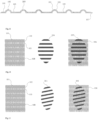
- Fig. 7 shows z cross-sectional view of the picture element, 105b, and of the background layer, 108, along the axis ⁇ - ⁇ .
- another colour of a part in the hidden picture, 105 is obtained through embossing, with a shift by an additional distance, the first geometric shapes of the embossed structure, 104a, of the second element, 105a, relative to the first geometric shapes of the embossed structure, 104b, of the first element, 105b.
- the first geometric shapes of the embossed structure 104a, 104b, according to the present embodiment preferably are located within a single line of the background layer, 108.
- the first geometric shapes of the embossed structure of both elements, 105a, 105b are embossed with a shift by the value of the shift 3n relative to the sequences of the first lines, 108, but, additionally, the second graphical element, 105a, is shifted relative to the first graphical element, 105b, by additional line width n, such that both graphical elements obtain another colour. Also, depending on the desired sparkle effect, a shift by the line width n is performed upwards and/or downwards relative to the first graphical element, 105b.
- a picture, 105 is obtained that, when observing at an acute angle in diffused light accentuates embossed elements in the first colour, 101, for the second graphical element, 105a, and in the second colour, 102, for the first graphical element, 105b.
- this principle is valid for a picture, 105, consisting of many elements, each of which being in another colour, as well as for pictures consisting of many sparkling parts.
- embossing the first geometric shapes of the embossed structure, 104 with a shift by an integer multiple of the width of a single line in the sequence of the first lines, relative to the first part or graphical element, as well as subsequent parts or elements consisting of a portion of the hidden picture, multicolour pictures are produced with a clear colour division of individual parts of the picture, 105.
- the width of a single first geometric shape may not be bigger than the width of a single line in a sequence of the first lines, and the geometric shapes are located within single lines of the background layer.
- Fig. 10 shows a cross-sectional view of the graphical elements of Fig.
- the first graphical element, 105b falls onto the junction between the second colour, 102, and the first colour, 101, then, when observing at an acute angle from the direction A, the picture, 105, will be visible, such that the second graphical element, 105a, will be visible in the first colour, 101, whereas the first graphical element, 105b, will be visible in the second colour, 102, and from the direction B the second graphical element, 105a, will be visible in the third colour, 103, whereas the first graphical element, 105b will be visible in the first colour, 101.
- a side light (D) will be placed at a level of the substrate, 107, the light being perpendicular to the first geometric shapes of the embossed structure, 104, then the whole sparkle effect of both graphical elements, 105a, 105b, is visible from the directions A, B, C, and from any other direction, and a colour will be visible from a given observation direction.
- the invention may consist of a plurality of graphical elements in many colours consisting of a hidden picture of the security element, 106, accordant with the present embodiment.
- the purpose of the third embodiment is to obtain multicoloured smooth colour transitions in a picture, 205, of the security element, 106, creating a rainbow impression.
- rainbow it is meant a uniform transition, over some surface, from one colour to second colour, or from one fade of the same colour to its another fade.
- the rainbow impression within its classical meaning, is possible to obtain, if the background layer, 108, is created by sequences of first lines at least in colour Magenta, Yellow, and Cyan.
- Pantone colours for example red, velvet, brown
- no rainbow will be obtained in the classical sense, but a uniform transition from one colours with its tones to another colour with its tones.
- the background layer, 108, of the security element, 106 consistis of at least three sequences of parallel first lines of at least two colours, wherein the colour of one of the first lines in a sequence may be the colour of the substrate, 107.
- the background layer, 108 consists of any number of sequences of the first lines of the same width n.
- the width of the first geometric shapes of the embossed structure, 204 depends on the effect, that is to be obtained, and it is in the range from n-50%n to n+50%n.
- the first geometric shapes of the embossed structure, 204 are embossed with a parallel shift relative to the background layer, 108, however, it is also possible to make the embossing with a parallel shift with a turn by a predetermined angle.
- a value of the shift p is calculated by adding the coefficient w to the Ln value, or by subtracting it.
- the coefficient w is subtracted from the Ln value, an effect of colour transition is obtained, the transition being inverted by 180°.
- the rate of the colour transitions depends on the number of sequences, the graphical element of the picture, 205, is located, this being illustrated by the following two calculation examples a and b.
- the embossed structure, 204 is adjusted such that to obtain desired colours of the security element, 106.
- the tone of the colour obtained in the embossing depends on the overlapping extent of two neighbouring colours onto this embossing.
- the overlapping extent denotes mixing two neighbouring colours, in different ratios, on the side profiles of an embossed structure, 204. This is shown in Fig. 11 .
- the mixing ratios of colours on the profiles of the embossed structure, 204 are arbitrary.
- the colour transition between the colours of the sequences of the first lines may be repeated many times in the area of the graphical element of the picture, 205.
- the coefficient w that is responsible for a single colour transition, is multiplied by a value of z-1.
- the coefficient w is responsible for a single transition between the used colours. For example, when placing five colour transitions in the picture, 205, the coefficient w is multiplied by z - 1 , i.e., 4.
- Fig. 12 shows a preferable embodiment, in which the background layer, 108, of the security element, 106, in a form of a hidden picture, 205, consists of 6 sequences of parallel lines of three colours of the same width n, wherein a colour of a single line in a sequence of the first lines may be the colour of the substrate, 107.
- an embossed structure, 204 was blind-embossed on the background layer, 108.
- Ln is 3n
- i s 6
- the first colour, 101 is colour Cyan
- the second colour 102 is Yellow
- the third colour, 103 is Magenta
- the size of the embossed structure, 204 may be bigger than the structure of the first lines, and it may be embossed beyond the area of the background layer, 108. Then, the security element, 106, has a hidden picture over the whole surface of the imprinted background, 108, and the embossing outside the structure of the first lines is not visible, i.e., it gives no hidden picture. In this way, a risk is reduced of misalignment of the embossed structure, 204, with the background layer, 108.
- each of the Examples 1 to 5 may be supplemented by embossing outside the structure of the first lines, as described above.
- a multicoloured security element, 106 in a form of a hidden picture, 305, shows the moiré effect.
- the background layer, 108 as described above, is blind-embossed with an embossed structure, 304, consisting of raised first geometric shapes, parallel relative to each other, wherein they are turned from the sequences of the first lines, 108, by a predetermined angle.
- the width of the first geometric shapes of the embossed structure, 304 may be arbitrarily wider n+50%n or narrower n-50%n.
- the security element, 106 created by the superimposed first geometric shapes of the embossed structure, 304, on the background layer, 108, consisting of at least two sequences of the first lines of three different colours, observed in diffused light when observing perpendicularly to the surface or when observing in parallel to the lines, has a uniform colour.
- the security element, 106 is viewed at an acute angle, then one can observe the moiré effect.
- This effect arises due to the fact that on every single geometric shape of the embossed structure, 304, a sequence of one-by-one colours 101, 102, 103, is located, sometimes many times, instead of the single colour of the background layer, 108.
- the first geometric shapes of the embossed structure, 304, according to the invention may create any arbitrary shape, from simple ones up to very complex patterns presenting leafs, butterflies, drops, or other motifs.
- the predetermined angle is from 1° to 12°, preferably the angle is from 3° to 6°.
- Fig. 13 shows a security element, 106, in a form of a hidden picture, 305, produced according to this embodiment.
- the colour of the substrate, 107 may constitute one of the colours in a sequence of the first lines 3n.
- the lines are of the same width n.
- a picture, 305, of the security element, 106 is created by blind embossing, within the background layer, 108, first geometric shapes of an embossed structure, 304, that are shifted, relative to the sequences of the first lines of the background layer, 108, by a value of the shift p , and are turned relative to the sequences of the first lines, by an angle of 6°.
- the first geometric shapes of the embossed structure, 304, along with the background layer, 108 may define any arbitrary pattern.
- a plurality of subsequent colours may be located on a single shape, sometimes many times.
- Fig. 14 shows an example of the security element, 106, with three repeating lines of different colours within a single geometric shape of the embossed structure, 304.
- the moiré effect may be obtained both by turning, by a predetermined angle, the embossed structure, 104, shown in the first embodiment as well as the embossed structure, 204, of the second embodiment.
- the security element, 106 may consist of a plurality of different parts, of which, in every single part, its first geometric shapes of the embossing the embossed structure, are differently, relative to each other, turned and shifted.
- the first geometric shapes of embossed structure, 104, 204, 304 are turned by a predetermined angle clockwise or anticlockwise.
- the hidden picture, 105, of the first embodiment may consist of three parts, of which the upper part of the hidden picture, 105, is turned, for example, by an angle of 6°, the lower part of the picture, 105, is turned by an angle of - 6°, and the central part is shifted by the line width n and is turned by 6°.
- the fifth embodiment is the security element, 106, shown in Fig. 15 .
- the security element, 106 in a form of a hidden picture, on a security and/or valuable document, 100, consists of a layer consisting of the background, 108, the layer being superimposed onto the substrate, 107, and of at least one embossed structure, 404, that consists of equidistant, relative to each other, first geometric shapes, a hidden picture, 405, being obtained by embossing the first geometric shapes of the embossed structure with a shift relative to the sequences of the first lines of the background layer, 108.
- the security element, 106 also has at least one inked embossed structure, XXX, consisting of equidistant, relative to each other, second geometric shapes embossed and covered with an ink on the background layer, 108.
- XXX inked embossed structure
- the security element, 106 in addition to the hidden picture, 405, also contains a visible picture, XXX', obtained by embossing second geometric shapes of inked embossed structure, XXX, with a shift relative to the sequences of the first lines of the background layer, 108.
- Th visible picture, XXX' may be any arbitrary picture, however, preferably the visible picture is a complement of the hidden picture, its repetition, or its mirror image.
- the inked embossed structure XXX may be constituted by a grid of equidistant, relative to each other, second geometric shapes.
- the second geometric shapes within a single part of the visible picture, are equidistant, when the lines going through the centres of these geometric shapes, drawn perpendicularly to the shift direction, are at the same distance within a single part of the visible picture.
- peripheral geometric shapes of the picture have a smaller width than the remaining geometric shapes of this picture, and for such peripheral geometric shapes the distance from the line going through the centre of this geometric shape to the line going through the centre of a neighbouring geometric shape will be smaller than for non-peripheral geometric shapes within the single part of the picture.
- second geometric shape it is meant, for example, a rectangle, square, triangle, trapezium, circle, ellipse, diamond, as well as other shapes of complex structures (fractal structures), or lines.
- fractal structures complex structures
- a specific example of equal distances is parallelism.
- the inked embossed structure XXX may be a grid of squares of a side depending on the desired effect.
- the width of the second geometric shapes of the structure is in the range from n to Ln-1. It means that the first geometric shapes of the embossed structure, 404, and the second geometric shapes of the structure may have the same width, but also may have different widths.
- the square side width is 2n and the shift is 3n. If the goal is to cover one colour out of a four-coloured background layer, 108, then the square side is n and the shift is 4n.
- Fig. 15 shows an embodiment in which both a hidden picture, 405, and a visible picture, XXX' co-exist within the security element, 106.
- the background layer, 108 consists of 6 sequences of parallel lines of three colours: a first one, 101, a second one, 102, and a third one, 103, of the same line width n.
- an embossed structure, 404 was blind-embossed on the background layer, 108, the structure 404 having a form of a grid of squares of a side width n, with a parallel shift by 3n relative to the sequences of the first lines of the background layer, 108, and, in the same run, a inked embossed structure, XXX, was wet-embossed, having a form of a grid of squares of a side width 2n, with a parallel shift by 3n relative to the sequences of the first lines of the background layer, 108.
- the inked embossed structure, XXX covers, with the used ink, two colours of the background layer, 108, i.e., the first colour, 101, and the second colour, 102, and only one colour is visible - the colour third, 103, in a darker or brighter tone depending on the colour of the ink used for inking the inked embossed structure, XXX.
- the visible picture, XXX' is a picture of any arbitrary shape resulting from combining the ink covering the first colour, 101, and the second colour, 102, and visible elements of the third colour, 103.
- the same third colour, 103 is on the blind-embossed structure consisting of the hidden picture, 405.
- the first geometric shapes of the embossed structure, 404, as well as the second geometric shapes of the inked embossed structure, XXX may be arbitrarily shifted according to the second embodiment, as well as may be shifted with a turn by a predetermined angle, this being described in detail in the fourth embodiment.
- each of the Examples from 1 to 4 may be completed by a visible picture, XXX', produced in the manner as described in the fifth embodiment.
- the visible picture is not limited to a grid of squares, but it may be based on any equidistant geometric shape.
- the security element may consist of a plurality of embossed structures and of a plurality of inked embossed structures.
- the invention relates to a method for manufacturing a security element, 106, in a form of a hidden picture, on a security and/or valuable document, 100.
- a background layer, 108 is applied, consisting of at least one sequences of parallel first lines comprising at least two lines of different colours.
- the colour of the substrate, 107 may be one of the colours of the sequences of the first lines of the background layer, 108, and the lines in the sequence of the first lines have the same width n.
- the sequence of the parallel first lines are produced by offset printing, letterset printing, or flexographic printing.
- the sequence of the first lines consists of three different colours, a first one, 101, a second one, 102, and a third one, 103.
- these are colours from the CMY palette or the PANTONE system.
- a second layer of the security element, 106 is applied, comprising a designed hidden picture.
- This layer is embossed using an intaglio machine.
- a plate for intaglio printing is used.
- the picture in the intaglio plate may be etched, light-exposed and washed out, engraved, or laser fired.
- a designed picture creates an embossed structure, 104, 204, 304, 404.
- the picture creates an embossed structure 104, 204, 304, 404 and a inked embossed structure XXX.
- the embossed structure 104, 204, 304, 404, and/or the inked embossed structure XXX may consist of a grid of equidistant, relative to each other, geometric shapes. Under the term of the grid of geometric shapes it is meant a grid of circles, squares, diamonds, ellipses, rectangles, triangles, etc. Also, the shapes may be segments of straight or curved lines.
- the form of the first geometric shapes of the embossed structure, 104, 204, 304, 404, as well as of the second geometric shapes of the inked embossed structure, XXX, depends on the desired hidden and visible pictures.
- a single shape of the first geometric shapes of the embossed structure, 104, 204, 304, 404 has a width in the range from n-50%n to n+50%n.
- a single shape of the second geometric shapes of the inked embossed structure, XXX has a width in the range from n to Ln-1.
- the first geometric shapes of the embossed structure, 104, 204, 404, and/or the second geometric shapes of the inked embossed structure, XXX are embossed with a parallel shift relative to the sequences of the first lines of the background layer, 108, depending on the desired effect.
- a value of the shift p may be an integer or non-integer multiple of the width of the first lines, wherein the width of a single first geometric shape of the embossed structure should be in the range from 50%n to 150%n.
- the embossing of the embossed structure 104, 204, 304, 404, in a form of a designed picture may be performed using an intaglio technique.
- the embossing of the embossed structure, 104, 204, 304, 404, is performed by blind embossing, whereas the embossing of the inked embossed structure, XXX, is performed in a wet process using at least one intaglio ink.
- the security element, 106 consists of a hidden, 405, and visible XXX' pictures
- the security element, 106 in the same run, when blind embossing the embossed structure, 404, with a shift relative to the sequences of the first lines of the background layer, 108, by a predetermined value of the shift p, also inking is performed of the inked embossed structure, XXX.
- Individual colours are applied onto a mould for wet embossing by means of special patterns for applying intaglio ink (or inks). Every colour has its separate pattern and may comprise another shape, therefore the second geometric shapes of the structure may be inked in different colours by appropriate shapes on different patterns.
- the structure is produced by wet embossing on the background layer, 108, i.e., using at least one intaglio ink, the ink being applied onto the coloured lines of the background layer, 108.
- the grid of the elements of the embossed structure with the inked, XXX, and non inked, 404, areas, is shifted in parallel.
- the inked embossed structure, XXX may have a form of a grid of shapes, the form of the shapes depending on the desired effect. For example, if the grid of the second geometric shapes is a grid of squares, then, if two colours are covered out of a three-colour background layer, 108, then the side width is 2n and the shift is 3n. If one colour is covered out of a four-colour background layer, 108, then the square side is n and the shift is 4n. Then, when observing perpendicularly, colours of the background layer, 108, are visible that are not covered by the ink, along with the visible picture, XXX'.
- a value of the shift p is calculated by adding or subtracting the coefficient w to/from the Ln value.
- the coefficient w is responsible for a single transition between the used colours.
- a colour transition between colours of sequences of the first lines may occur repeatedly in an area of the graphical element of the hidden picture.
- the coefficient w is multiplied by a value of z-1.
- a value of the shift p is calculated for the first geometric shapes of the embossed structure relative to the first lines of the background layer, 108.
- the inked embossed structure, XXX consists of a grid of squares, rectangles, oval or circular elements, and if one desires to obtain a colour transition of both pictures, the visible one XXX' and the hidden one 405, then a value of the shift p for the inked part is the same as for the blind embossing.
- the first geometric shapes of the embossed structure, 104, 204, 304 are turned by a predetermined angle clockwise or anticlockwise.
- the predetermined angle is from 1° to 12°, preferably is 6°.
- the second element and/or part, 105a, of the hidden picture, 105, of another colour is obtained by shifting the first geometric shapes of the embossed structure, 104a, of the second element and/or part, 105a, of the hidden picture, 105, by an additional distance upwards and/or downwards relative to the first geometric shapes of the embossed structure, 104b, of the first element and/or part, 105b, of the hidden picture, 105.
- This additional distance is equal to an integer multiple of the width of the first lines, i.e., for example, it is equal to n, but the width of a single geometric shape of the first geometric shapes may not be bigger than n.
Landscapes
- Printing Methods (AREA)
- Credit Cards Or The Like (AREA)
Claims (15)
- Sicherheitselement (106) mit verstecktem Bild (405) und sichtbarem Bild (XXX'), bestehend aus:- einer Hintergrundschicht (108), die auf einem Substrat (107) eines Sicherheits- und/oder Wertdokuments (100) aufgebracht ist, wobei die Hintergrundschicht (108) aus mehreren Sequenzen relativ zueinander paralleler erster Linien besteht, wobei eine Sequenz der relativ zueinander parallelen ersten Linien mindestens zwei Linien (101, 102, 103) unterschiedlicher Farbe enthält, die sich in derselben Reihenfolge wiederholen, wobei die Farbe des Substrats (107) eine der Farben der Sequenz der ersten Linien sein kann, und die Linien in der Sequenz der ersten Linien gleich breit sind, und- mindestens einer Prägestruktur (104, 204, 304, 404) auf der Hintergrundschicht (108), wobei die Prägestruktur (104, 204, 304, 404) aus relativ zueinander äquidistanten ersten geometrischen Formen besteht, während das versteckte Bild (105, 205, 305, 405) durch Prägen der ersten geometrischen Formen der geprägten Struktur (104, 204, 304, 404) mit einer Verschiebung (P) in Bezug auf die Sequenzen der ersten Linien der Hintergrundschicht (108) entsteht, wobei das Sicherheitselement mindestens eine eingefärbte Prägestruktur (XXX) umfasst, die aus geprägten und mit Farbe bedeckten zweiten geometrischen Formen besteht, die relativ zueinander äquidistant auf der Hintergrundschicht (108) angeordnet sind, während das sichtbare Bild (XXX') durch Prägen der zweiten geometrischen Formen der eingefärbten Prägestruktur (XXX) mit einer Verschiebung bezüglich der Sequenzen der ersten Linien der Hintergrundschicht (108) entsteht.
- Sicherheitselement nach Anspruch 1, wobei die geometrischen Formen äquidistant sind, wenn die Linien, die durch die Mittelpunkte dieser geometrischen Formen verlaufen und senkrecht zur Verschieberichtung gezogen werden, innerhalb eines einzelnen Teils des verborgenen oder sichtbaren Bildes den gleichen Abstand haben.
- Sicherheitselement nach Anspruch 1 oder 2, wobei die Verschiebung der ersten geometrischen Formen der Prägestruktur (104, 204, 404) und/oder der zweiten geometrischen Formen der eingefärbten Prägestruktur (XXX) parallel zu den Sequenzen der ersten Linien der Hintergrundschicht (108) ist.
- Sicherheitselement nach einem der vorhergehenden Ansprüche, wobei ein Wert der Verschiebung p nach der Formel p= Ln, berechnet wird, wobei L die Anzahl der unterschiedlichen Farben in der Sequenz der ersten Linien und n die Breite einer Linie in der Sequenz der ersten Linien bezeichnet.
- Sicherheitselement nach einem der Ansprüche 1-3, wobei der Wert der Verschiebung p nach der Formel p=Ln+w oder p=Ln-w berechnet wird, wobei der Koeffizient w nach der folgenden Formel berechnet wird:
 L die Anzahl der unterschiedlichen Farben in einer Sequenz der ersten Linien bezeichnet,n die Breite einer einzelnen Linie in einer Sequenz der ersten Linien bezeichnet,is die Anzahl der Sequenzen der ersten Linien in einem Bereich der Prägestruktur bezeichnet.
 - Sicherheitselement nach den Ansprüchen 1-2 und 3-5, wobei die ersten geometrischen Formen der Prägestruktur (104, 204, 304, 404) und/oder die zweiten geometrischen Formen der eingefärbten Prägestruktur (XXX) in Bezug auf die Sequenzen der ersten Linien um einen vorgegebenen Winkel im oder gegen den Uhrzeigersinn verschoben sind.
- Sicherheitselement nach einem der vorhergehenden Ansprüche, wobei die Prägestruktur (104, 204, 304, 404) aus relativ zueinander äquidistanten ersten geometrischen Formen und die eingefärbte Prägestruktur (XXX) aus relativ zueinander äquidistanten zweiten geometrischen Formen besteht, die die Form eines Rasters aus unterschiedlichen Elementen aufweisen, dessen Form von dem entworfenen versteckten Bild (105, 205, 305, 405) und/oder sichtbaren Bild (XXX') des Sicherheitselements (106) abhängig ist.
- Sicherheitselement nach einem der vorhergehenden Ansprüche, wobei ein erstes Element und/oder Teil (105b) des versteckten Bildes (105) in mindestens einer Farbe der Hintergrundschicht (108) durch Prägen der ersten geometrischen Formen der Prägestruktur (104) mit einer Verschiebung bezüglich der Sequenzen der ersten Linien der Hintergrundschicht (108) entsteht.
- Sicherheitselement nach Anspruch 7, wobei das erste Element und/oder ein Teil (105b) des versteckten Bildes (105) in einer Farbe der Hintergrundschicht (108) durch Prägen der ersten geometrischen Formen der Prägestruktur (104b) mit einer Verschiebung bezüglich der Sequenzen der ersten Linien der Hintergrundschicht (108) um ein ganzzahliges Vielfaches der Linienbreite erhalten wird, wobei eine Breite einer einzelnen ersten geometrischen Form nicht größer als n sein darf, und eine einzelne erste Form der Prägestruktur (104b) sich innerhalb einer einzelnen Linie der Hintergrundschicht (108) befindet.
- Sicherheitselement nach Anspruch 7 oder 9, wobei ein zweites Element und/oder Teil (105a) des versteckten Bildes (105) in mindestens einer anderen Farbe der Hintergrundschicht (108) entsteht, indem die ersten geometrischen Formen der geprägten Struktur (104a) des zweiten Elements und/oder Teils (105a) mit einer Verschiebung um einen zusätzlichen Abstand relativ zu den ersten geometrischen Formen der geprägten Struktur (104b) des ersten Elements und/oder Teils (105b) des verborgenen Bildes (105) geprägt wird.
- Sicherheitselement nach Anspruch 8, wobei ein zweites Element und/oder Teil (105a) des versteckten Bildes (105) in einer anderen Farbe der Hintergrundschicht (108) ist, wobei, dass die Breite einer einzelnen ersten geometrischen Form nicht größer als n sein darf, entsteht, indem die ersten geometrischen Formen der geprägten Struktur (104a) des zweiten Elements und/oder Teils (105a) des versteckten Bildes (105) mit einer Verschiebung um einen zusätzlichen Abstand gleich einem ganzzahligen Vielfachen der Breite der ersten Linien der Hintergrundschicht (108) relativ zu den ersten geometrischen Formen der geprägten Struktur (104b) des ersten Elements und/oder Teils (105b) des versteckten Bildes geprägt wird, wobei die Breite einer einzelnen ersten geometrischen Form nicht größer als n sein darf.
- Sicherheitselement nach einem der vorhergehenden Ansprüche 1-8, 10, wobei eine einzelne geometrische Form der ersten geometrischen Formen der Prägestruktur (104, 204, 304, 404) eine Breite im Bereich von n-50%n bis n+50%n aufweist, und eine einzelne geometrische Form der zweiten geometrischen Formen der eingefärbten Prägestruktur (XXX) eine Breite im Bereich von n bis Ln-1 aufweist,
wobei:L die Anzahl der unterschiedlichen Farben in der Sequenz der ersten Linien bezeichnet,n die Breite einer einzelnen Linie in der Sequenz der ersten Linien bezeichnet. - Verfahren zur Herstellung eines Sicherheitselements (106) mit einem versteckten Bild (405) und einem sichtbaren Bild (XXXX') auf einem Sicherheits- und/oder Wertdokument (100), umfassend die folgenden Schritte:a) Aufbringen einer Hintergrundschicht (108) auf ein Substrat (107), wobei die Hintergrundschicht (108) aus mehreren Sequenzen paralleler erster Linien besteht, wobei eine Sequenz der parallelen ersten Linien mindestens zwei Linien unterschiedlicher Farbe enthält, die sich in derselben Reihenfolge wiederholen, wobei die Farbe des Substrats (107) eine der Farben der Sequenzen der ersten Linien der Hintergrundschicht (108) sein kann, und die Linien in der Sequenz der ersten Linien gleich breit sind,b) Prägen mindestens einer Prägestruktur (104, 204, 304, 404) auf die Hintergrundschicht (108), wobei die Prägestruktur aus äquidistanten ersten geometrischen Formen besteht, die in Bezug auf die Sequenzen der ersten Linien verschoben sind, wobei das versteckte Bild (105, 205, 305, 405) durch Prägen der ersten geometrischen Formen der Prägestruktur (104, 204, 304, 404) mit einer Verschiebung bezüglich der Sequenzen der ersten Linien entsteht,c) Prägen mindestens einer eingefärbten Prägestruktur (XXX) auf die Hintergrundschicht (108), wobei die eingefärbte Prägestruktur durch äquidistante, relativ zueinander eingefärbte und in Bezug auf die Sequenzen der ersten Linien verschobene zweite geometrische Formen erzeugt wird, wobei das sichtbare Bild (XXX') durch Nassprägen der zweiten geometrischen Formen der eingefärbten Prägestruktur (XXX) mit einer Verschiebung bezüglich der Sequenzen der ersten Linien der Hintergrundschicht (108) entsteht.
- Verfahren nach Anspruch 13, wobei die Prägung der Prägestruktur (104, 204, 304, 404) durch Blindprägen erfolgt.
- Verfahren nach Anspruch 13, wobei die eingefärbte Prägestruktur (XXX) in demselben Durchgang wie die ersten geometrischen Formen der Blindprägestruktur (104, 204, 304, 404) geprägt wird.
Applications Claiming Priority (2)
| Application Number | Priority Date | Filing Date | Title |
|---|---|---|---|
| PL423662A PL234566B1 (pl) | 2017-11-30 | 2017-11-30 | Element zabezpieczający z obrazem ukrytym, dokument zabezpieczony oraz sposób wytwarzania elementu zabezpieczającego |
| PCT/PL2018/050061 WO2019108077A1 (en) | 2017-11-30 | 2018-11-30 | A security element with a hidden picture, security document, and a method for producing a security element |
Publications (2)
| Publication Number | Publication Date |
|---|---|
| EP3717271A1 EP3717271A1 (de) | 2020-10-07 |
| EP3717271B1 true EP3717271B1 (de) | 2025-05-28 |
Family
ID=65139075
Family Applications (1)
| Application Number | Title | Priority Date | Filing Date |
|---|---|---|---|
| EP18836936.7A Active EP3717271B1 (de) | 2017-11-30 | 2018-11-30 | Sicherheitselement mit verstecktem bild und sichtbarem bild, und verfahren zur herstellung eines sicherheitselements |
Country Status (5)
| Country | Link |
|---|---|
| EP (1) | EP3717271B1 (de) |
| ES (1) | ES3038734T3 (de) |
| PL (1) | PL234566B1 (de) |
| PT (1) | PT3717271T (de) |
| WO (1) | WO2019108077A1 (de) |
Families Citing this family (1)
| Publication number | Priority date | Publication date | Assignee | Title |
|---|---|---|---|---|
| PL447634A1 (pl) * | 2024-01-29 | 2025-08-04 | Polska Wytwórnia Papierów Wartościowych Spółka Akcyjna | Zabezpieczający element graficzny, nośnik danych zawierający zabezpieczający element graficzny oraz sposób wytwarzania nośnika danych |
Family Cites Families (6)
| Publication number | Priority date | Publication date | Assignee | Title |
|---|---|---|---|---|
| JP2615401B2 (ja) * | 1992-06-04 | 1997-05-28 | 大蔵省印刷局長 | 偽造防止用潜像模様形成体及びその作製方法 |
| WO2009139396A1 (ja) * | 2008-05-01 | 2009-11-19 | 独立行政法人 国立印刷局 | 画像形成体、真偽判別具及び真偽判別方法 |
| RU2440248C1 (ru) * | 2010-08-03 | 2012-01-20 | Федеральное Государственное Унитарное Предприятие "Гознак" (Фгуп "Гознак") | Носитель информации с оптически переменной структурой (варианты) |
| GB201212046D0 (en) * | 2012-07-06 | 2012-08-22 | Rue De Int Ltd | Security devices |
| JP6394984B2 (ja) * | 2015-06-02 | 2018-09-26 | 独立行政法人 国立印刷局 | 潜像印刷物 |
| GB2550168B (en) * | 2016-05-11 | 2018-07-25 | De La Rue Int Ltd | Security device and method of manufacture |
-
2017
- 2017-11-30 PL PL423662A patent/PL234566B1/pl unknown
-
2018
- 2018-11-30 WO PCT/PL2018/050061 patent/WO2019108077A1/en not_active Ceased
- 2018-11-30 EP EP18836936.7A patent/EP3717271B1/de active Active
- 2018-11-30 ES ES18836936T patent/ES3038734T3/es active Active
- 2018-11-30 PT PT188369367T patent/PT3717271T/pt unknown
Also Published As
| Publication number | Publication date |
|---|---|
| WO2019108077A1 (en) | 2019-06-06 |
| PL423662A1 (pl) | 2019-06-03 |
| ES3038734T3 (en) | 2025-10-14 |
| PT3717271T (pt) | 2025-10-01 |
| PL234566B1 (pl) | 2020-03-31 |
| EP3717271A1 (de) | 2020-10-07 |
Similar Documents
| Publication | Publication Date | Title |
|---|---|---|
| CN101421118B (zh) | 具有光学可变结构和涂层的防伪元件及其制造方法 | |
| CN104968504B (zh) | 光学可变表面图案 | |
| JP4587809B2 (ja) | 光学可変素子を備えたデータ担体 | |
| CA2738992C (en) | Anti-counterfeit printed matter | |
| EP2727741B1 (de) | Wertdokument mit einer optisch variablen struktur (varianten) | |
| EP2803498A1 (de) | Gedrucktes Sicherheitsmerkmal, Gegenstand mit diesem gedruckten Sicherheitsmerkmal und Herstellungsverfahren dafür | |
| JP5142154B2 (ja) | 潜像印刷物 | |
| JP2013018177A (ja) | 複写防止印刷物 | |
| JP2018024105A (ja) | 潜像印刷物 | |
| JP2013248833A (ja) | 潜像印刷物 | |
| JP5424266B2 (ja) | 偽造防止用印刷物 | |
| JP6948030B2 (ja) | 色彩変化印刷物 | |
| EP3717271B1 (de) | Sicherheitselement mit verstecktem bild und sichtbarem bild, und verfahren zur herstellung eines sicherheitselements | |
| EP4284655B1 (de) | Sicherheitsvorrichtungen und verfahren zur herstellung davon | |
| US20240424822A1 (en) | Optically variable representation element | |
| JP2013123850A (ja) | 色彩可変模様を有する印刷物 | |
| JP5967658B2 (ja) | 特殊潜像画像形成体 | |
| JP5835713B2 (ja) | 特殊潜像画像形成体 | |
| CN110418721B (zh) | 具有结构元件的产品或者产品包装 | |
| JP5907382B2 (ja) | 潜像印刷物 | |
| EA010332B1 (ru) | Устройство защиты | |
| JP5481691B2 (ja) | 偽造防止用形成体 | |
| CN120439701A (zh) | 防伪元件和用于制造防伪元件的方法 | |
| AU2014203192B2 (en) | Forgery preventive printed matter | |
| CN122003329A (zh) | 具有组合安全特征的安全元件 |
Legal Events
| Date | Code | Title | Description |
|---|---|---|---|
| STAA | Information on the status of an ep patent application or granted ep patent |
Free format text: STATUS: UNKNOWN |
|
| STAA | Information on the status of an ep patent application or granted ep patent |
Free format text: STATUS: THE INTERNATIONAL PUBLICATION HAS BEEN MADE |
|
| PUAI | Public reference made under article 153(3) epc to a published international application that has entered the european phase |
Free format text: ORIGINAL CODE: 0009012 |
|
| STAA | Information on the status of an ep patent application or granted ep patent |
Free format text: STATUS: REQUEST FOR EXAMINATION WAS MADE |
|
| 17P | Request for examination filed |
Effective date: 20200628 |
|
| AK | Designated contracting states |
Kind code of ref document: A1 Designated state(s): AL AT BE BG CH CY CZ DE DK EE ES FI FR GB GR HR HU IE IS IT LI LT LU LV MC MK MT NL NO PL PT RO RS SE SI SK SM TR |
|
| AX | Request for extension of the european patent |
Extension state: BA ME |
|
| DAV | Request for validation of the european patent (deleted) | ||
| DAX | Request for extension of the european patent (deleted) | ||
| STAA | Information on the status of an ep patent application or granted ep patent |
Free format text: STATUS: EXAMINATION IS IN PROGRESS |
|
| 17Q | First examination report despatched |
Effective date: 20210908 |
|
| GRAP | Despatch of communication of intention to grant a patent |
Free format text: ORIGINAL CODE: EPIDOSNIGR1 |
|
| STAA | Information on the status of an ep patent application or granted ep patent |
Free format text: STATUS: GRANT OF PATENT IS INTENDED |
|
| INTG | Intention to grant announced |
Effective date: 20241216 |
|
| GRAS | Grant fee paid |
Free format text: ORIGINAL CODE: EPIDOSNIGR3 |
|
| GRAA | (expected) grant |
Free format text: ORIGINAL CODE: 0009210 |
|
| STAA | Information on the status of an ep patent application or granted ep patent |
Free format text: STATUS: THE PATENT HAS BEEN GRANTED |
|
| AK | Designated contracting states |
Kind code of ref document: B1 Designated state(s): AL AT BE BG CH CY CZ DE DK EE ES FI FR GB GR HR HU IE IS IT LI LT LU LV MC MK MT NL NO PL PT RO RS SE SI SK SM TR |
|
| REG | Reference to a national code |
Ref country code: GB Ref legal event code: FG4D |
|
| REG | Reference to a national code |
Ref country code: CH Ref legal event code: EP |
|
| REG | Reference to a national code |
Ref country code: IE Ref legal event code: FG4D Ref country code: DE Ref legal event code: R096 Ref document number: 602018082298 Country of ref document: DE |
|
| REG | Reference to a national code |
Ref country code: NL Ref legal event code: MP Effective date: 20250528 Ref country code: PT Ref legal event code: SC4A Ref document number: 3717271 Country of ref document: PT Date of ref document: 20251001 Kind code of ref document: T Free format text: AVAILABILITY OF NATIONAL TRANSLATION Effective date: 20250924 |
|
| PG25 | Lapsed in a contracting state [announced via postgrant information from national office to epo] |
Ref country code: FI Free format text: LAPSE BECAUSE OF FAILURE TO SUBMIT A TRANSLATION OF THE DESCRIPTION OR TO PAY THE FEE WITHIN THE PRESCRIBED TIME-LIMIT Effective date: 20250528 |
|
| REG | Reference to a national code |
Ref country code: LT Ref legal event code: MG9D |
|
| PG25 | Lapsed in a contracting state [announced via postgrant information from national office to epo] |
Ref country code: NO Free format text: LAPSE BECAUSE OF FAILURE TO SUBMIT A TRANSLATION OF THE DESCRIPTION OR TO PAY THE FEE WITHIN THE PRESCRIBED TIME-LIMIT Effective date: 20250828 Ref country code: GR Free format text: LAPSE BECAUSE OF FAILURE TO SUBMIT A TRANSLATION OF THE DESCRIPTION OR TO PAY THE FEE WITHIN THE PRESCRIBED TIME-LIMIT Effective date: 20250829 |
|
| REG | Reference to a national code |
Ref country code: ES Ref legal event code: FG2A Ref document number: 3038734 Country of ref document: ES Kind code of ref document: T3 Effective date: 20251014 |
|
| PG25 | Lapsed in a contracting state [announced via postgrant information from national office to epo] |
Ref country code: PL Free format text: LAPSE BECAUSE OF FAILURE TO SUBMIT A TRANSLATION OF THE DESCRIPTION OR TO PAY THE FEE WITHIN THE PRESCRIBED TIME-LIMIT Effective date: 20250528 Ref country code: NL Free format text: LAPSE BECAUSE OF FAILURE TO SUBMIT A TRANSLATION OF THE DESCRIPTION OR TO PAY THE FEE WITHIN THE PRESCRIBED TIME-LIMIT Effective date: 20250528 |
|
| PG25 | Lapsed in a contracting state [announced via postgrant information from national office to epo] |
Ref country code: HR Free format text: LAPSE BECAUSE OF FAILURE TO SUBMIT A TRANSLATION OF THE DESCRIPTION OR TO PAY THE FEE WITHIN THE PRESCRIBED TIME-LIMIT Effective date: 20250528 |
|
| PGFP | Annual fee paid to national office [announced via postgrant information from national office to epo] |
Ref country code: MT Payment date: 20250821 Year of fee payment: 8 |
|
| PG25 | Lapsed in a contracting state [announced via postgrant information from national office to epo] |
Ref country code: RS Free format text: LAPSE BECAUSE OF FAILURE TO SUBMIT A TRANSLATION OF THE DESCRIPTION OR TO PAY THE FEE WITHIN THE PRESCRIBED TIME-LIMIT Effective date: 20250828 |
|
| PG25 | Lapsed in a contracting state [announced via postgrant information from national office to epo] |
Ref country code: IS Free format text: LAPSE BECAUSE OF FAILURE TO SUBMIT A TRANSLATION OF THE DESCRIPTION OR TO PAY THE FEE WITHIN THE PRESCRIBED TIME-LIMIT Effective date: 20250928 |
|
| PG25 | Lapsed in a contracting state [announced via postgrant information from national office to epo] |
Ref country code: LV Free format text: LAPSE BECAUSE OF FAILURE TO SUBMIT A TRANSLATION OF THE DESCRIPTION OR TO PAY THE FEE WITHIN THE PRESCRIBED TIME-LIMIT Effective date: 20250528 |
|
| REG | Reference to a national code |
Ref country code: CH Ref legal event code: U11 Free format text: ST27 STATUS EVENT CODE: U-0-0-U10-U11 (AS PROVIDED BY THE NATIONAL OFFICE) Effective date: 20251201 |
|
| PGFP | Annual fee paid to national office [announced via postgrant information from national office to epo] |
Ref country code: PT Payment date: 20251127 Year of fee payment: 8 |
|
| PGFP | Annual fee paid to national office [announced via postgrant information from national office to epo] |
Ref country code: DE Payment date: 20251127 Year of fee payment: 8 |
|
| PGFP | Annual fee paid to national office [announced via postgrant information from national office to epo] |
Ref country code: GB Payment date: 20251126 Year of fee payment: 8 |
|
| PG25 | Lapsed in a contracting state [announced via postgrant information from national office to epo] |
Ref country code: DK Free format text: LAPSE BECAUSE OF FAILURE TO SUBMIT A TRANSLATION OF THE DESCRIPTION OR TO PAY THE FEE WITHIN THE PRESCRIBED TIME-LIMIT Effective date: 20250528 Ref country code: SM Free format text: LAPSE BECAUSE OF FAILURE TO SUBMIT A TRANSLATION OF THE DESCRIPTION OR TO PAY THE FEE WITHIN THE PRESCRIBED TIME-LIMIT Effective date: 20250528 |
|
| PGFP | Annual fee paid to national office [announced via postgrant information from national office to epo] |
Ref country code: AT Payment date: 20250902 Year of fee payment: 8 |
|
| PGFP | Annual fee paid to national office [announced via postgrant information from national office to epo] |
Ref country code: FR Payment date: 20251126 Year of fee payment: 8 |
|
| PGFP | Annual fee paid to national office [announced via postgrant information from national office to epo] |
Ref country code: CH Payment date: 20251201 Year of fee payment: 8 |
|
| PG25 | Lapsed in a contracting state [announced via postgrant information from national office to epo] |
Ref country code: CZ Free format text: LAPSE BECAUSE OF FAILURE TO SUBMIT A TRANSLATION OF THE DESCRIPTION OR TO PAY THE FEE WITHIN THE PRESCRIBED TIME-LIMIT Effective date: 20250528 |
|
| PGFP | Annual fee paid to national office [announced via postgrant information from national office to epo] |
Ref country code: BG Payment date: 20250820 Year of fee payment: 8 |
|
| PG25 | Lapsed in a contracting state [announced via postgrant information from national office to epo] |
Ref country code: EE Free format text: LAPSE BECAUSE OF FAILURE TO SUBMIT A TRANSLATION OF THE DESCRIPTION OR TO PAY THE FEE WITHIN THE PRESCRIBED TIME-LIMIT Effective date: 20250528 |
|
| PG25 | Lapsed in a contracting state [announced via postgrant information from national office to epo] |
Ref country code: SK Free format text: LAPSE BECAUSE OF FAILURE TO SUBMIT A TRANSLATION OF THE DESCRIPTION OR TO PAY THE FEE WITHIN THE PRESCRIBED TIME-LIMIT Effective date: 20250528 Ref country code: RO Free format text: LAPSE BECAUSE OF FAILURE TO SUBMIT A TRANSLATION OF THE DESCRIPTION OR TO PAY THE FEE WITHIN THE PRESCRIBED TIME-LIMIT Effective date: 20250528 |
|
| PG25 | Lapsed in a contracting state [announced via postgrant information from national office to epo] |
Ref country code: IT Free format text: LAPSE BECAUSE OF FAILURE TO SUBMIT A TRANSLATION OF THE DESCRIPTION OR TO PAY THE FEE WITHIN THE PRESCRIBED TIME-LIMIT Effective date: 20250528 |
|
| PGFP | Annual fee paid to national office [announced via postgrant information from national office to epo] |
Ref country code: ES Payment date: 20251203 Year of fee payment: 8 |
|
| REG | Reference to a national code |
Ref country code: DE Ref legal event code: R097 Ref document number: 602018082298 Country of ref document: DE |
|
| PLBE | No opposition filed within time limit |
Free format text: ORIGINAL CODE: 0009261 |
|
| STAA | Information on the status of an ep patent application or granted ep patent |
Free format text: STATUS: NO OPPOSITION FILED WITHIN TIME LIMIT |
|
| REG | Reference to a national code |
Ref country code: CH Ref legal event code: L10 Free format text: ST27 STATUS EVENT CODE: U-0-0-L10-L00 (AS PROVIDED BY THE NATIONAL OFFICE) Effective date: 20260409 |