EP3714935A1 - Neuromodulationselektrodenanordnung - Google Patents
Neuromodulationselektrodenanordnung Download PDFInfo
- Publication number
- EP3714935A1 EP3714935A1 EP20166069.3A EP20166069A EP3714935A1 EP 3714935 A1 EP3714935 A1 EP 3714935A1 EP 20166069 A EP20166069 A EP 20166069A EP 3714935 A1 EP3714935 A1 EP 3714935A1
- Authority
- EP
- European Patent Office
- Prior art keywords
- electrically conductive
- protrusion
- assembly according
- base
- shape
- Prior art date
- Legal status (The legal status is an assumption and is not a legal conclusion. Google has not performed a legal analysis and makes no representation as to the accuracy of the status listed.)
- Granted
Links
Images




Classifications
-
- A—HUMAN NECESSITIES
- A61—MEDICAL OR VETERINARY SCIENCE; HYGIENE
- A61N—ELECTROTHERAPY; MAGNETOTHERAPY; RADIATION THERAPY; ULTRASOUND THERAPY
- A61N1/00—Electrotherapy; Circuits therefor
- A61N1/02—Details
- A61N1/04—Electrodes
-
- A—HUMAN NECESSITIES
- A61—MEDICAL OR VETERINARY SCIENCE; HYGIENE
- A61N—ELECTROTHERAPY; MAGNETOTHERAPY; RADIATION THERAPY; ULTRASOUND THERAPY
- A61N1/00—Electrotherapy; Circuits therefor
- A61N1/02—Details
- A61N1/04—Electrodes
- A61N1/0404—Electrodes for external use
- A61N1/0408—Use-related aspects
- A61N1/0456—Specially adapted for transcutaneous electrical nerve stimulation [TENS]
-
- A—HUMAN NECESSITIES
- A61—MEDICAL OR VETERINARY SCIENCE; HYGIENE
- A61M—DEVICES FOR INTRODUCING MEDIA INTO, OR ONTO, THE BODY; DEVICES FOR TRANSDUCING BODY MEDIA OR FOR TAKING MEDIA FROM THE BODY; DEVICES FOR PRODUCING OR ENDING SLEEP OR STUPOR
- A61M21/00—Other devices or methods to cause a change in the state of consciousness; Devices for producing or ending sleep by mechanical, optical, or acoustical means, e.g. for hypnosis
-
- A—HUMAN NECESSITIES
- A61—MEDICAL OR VETERINARY SCIENCE; HYGIENE
- A61N—ELECTROTHERAPY; MAGNETOTHERAPY; RADIATION THERAPY; ULTRASOUND THERAPY
- A61N1/00—Electrotherapy; Circuits therefor
- A61N1/02—Details
- A61N1/04—Electrodes
- A61N1/0404—Electrodes for external use
- A61N1/0472—Structure-related aspects
- A61N1/0484—Garment electrodes worn by the patient
-
- A—HUMAN NECESSITIES
- A61—MEDICAL OR VETERINARY SCIENCE; HYGIENE
- A61N—ELECTROTHERAPY; MAGNETOTHERAPY; RADIATION THERAPY; ULTRASOUND THERAPY
- A61N1/00—Electrotherapy; Circuits therefor
- A61N1/18—Applying electric currents by contact electrodes
- A61N1/20—Applying electric currents by contact electrodes continuous direct currents
- A61N1/22—Electromedical belts, e.g. neck chains, armbands
-
- A—HUMAN NECESSITIES
- A61—MEDICAL OR VETERINARY SCIENCE; HYGIENE
- A61N—ELECTROTHERAPY; MAGNETOTHERAPY; RADIATION THERAPY; ULTRASOUND THERAPY
- A61N1/00—Electrotherapy; Circuits therefor
- A61N1/18—Applying electric currents by contact electrodes
- A61N1/32—Applying electric currents by contact electrodes alternating or intermittent currents
- A61N1/321—Electromedical belts
-
- A—HUMAN NECESSITIES
- A61—MEDICAL OR VETERINARY SCIENCE; HYGIENE
- A61N—ELECTROTHERAPY; MAGNETOTHERAPY; RADIATION THERAPY; ULTRASOUND THERAPY
- A61N1/00—Electrotherapy; Circuits therefor
- A61N1/18—Applying electric currents by contact electrodes
- A61N1/32—Applying electric currents by contact electrodes alternating or intermittent currents
- A61N1/36—Applying electric currents by contact electrodes alternating or intermittent currents for stimulation
-
- A—HUMAN NECESSITIES
- A61—MEDICAL OR VETERINARY SCIENCE; HYGIENE
- A61M—DEVICES FOR INTRODUCING MEDIA INTO, OR ONTO, THE BODY; DEVICES FOR TRANSDUCING BODY MEDIA OR FOR TAKING MEDIA FROM THE BODY; DEVICES FOR PRODUCING OR ENDING SLEEP OR STUPOR
- A61M21/00—Other devices or methods to cause a change in the state of consciousness; Devices for producing or ending sleep by mechanical, optical, or acoustical means, e.g. for hypnosis
- A61M2021/0005—Other devices or methods to cause a change in the state of consciousness; Devices for producing or ending sleep by mechanical, optical, or acoustical means, e.g. for hypnosis by the use of a particular sense, or stimulus
- A61M2021/0055—Other devices or methods to cause a change in the state of consciousness; Devices for producing or ending sleep by mechanical, optical, or acoustical means, e.g. for hypnosis by the use of a particular sense, or stimulus with electric or electro-magnetic fields
-
- A—HUMAN NECESSITIES
- A61—MEDICAL OR VETERINARY SCIENCE; HYGIENE
- A61M—DEVICES FOR INTRODUCING MEDIA INTO, OR ONTO, THE BODY; DEVICES FOR TRANSDUCING BODY MEDIA OR FOR TAKING MEDIA FROM THE BODY; DEVICES FOR PRODUCING OR ENDING SLEEP OR STUPOR
- A61M21/00—Other devices or methods to cause a change in the state of consciousness; Devices for producing or ending sleep by mechanical, optical, or acoustical means, e.g. for hypnosis
- A61M21/02—Other devices or methods to cause a change in the state of consciousness; Devices for producing or ending sleep by mechanical, optical, or acoustical means, e.g. for hypnosis for inducing sleep or relaxation, e.g. by direct nerve stimulation, hypnosis, analgesia
-
- A—HUMAN NECESSITIES
- A61—MEDICAL OR VETERINARY SCIENCE; HYGIENE
- A61N—ELECTROTHERAPY; MAGNETOTHERAPY; RADIATION THERAPY; ULTRASOUND THERAPY
- A61N1/00—Electrotherapy; Circuits therefor
- A61N1/02—Details
- A61N1/04—Electrodes
- A61N1/0404—Electrodes for external use
- A61N1/0408—Use-related aspects
- A61N1/0452—Specially adapted for transcutaneous muscle stimulation [TMS]
-
- A—HUMAN NECESSITIES
- A61—MEDICAL OR VETERINARY SCIENCE; HYGIENE
- A61N—ELECTROTHERAPY; MAGNETOTHERAPY; RADIATION THERAPY; ULTRASOUND THERAPY
- A61N1/00—Electrotherapy; Circuits therefor
- A61N1/02—Details
- A61N1/04—Electrodes
- A61N1/0404—Electrodes for external use
- A61N1/0472—Structure-related aspects
- A61N1/0492—Patch electrodes
-
- A—HUMAN NECESSITIES
- A61—MEDICAL OR VETERINARY SCIENCE; HYGIENE
- A61N—ELECTROTHERAPY; MAGNETOTHERAPY; RADIATION THERAPY; ULTRASOUND THERAPY
- A61N1/00—Electrotherapy; Circuits therefor
- A61N1/18—Applying electric currents by contact electrodes
- A61N1/32—Applying electric currents by contact electrodes alternating or intermittent currents
- A61N1/36—Applying electric currents by contact electrodes alternating or intermittent currents for stimulation
- A61N1/36014—External stimulators, e.g. with patch electrodes
-
- A—HUMAN NECESSITIES
- A61—MEDICAL OR VETERINARY SCIENCE; HYGIENE
- A61N—ELECTROTHERAPY; MAGNETOTHERAPY; RADIATION THERAPY; ULTRASOUND THERAPY
- A61N1/00—Electrotherapy; Circuits therefor
- A61N1/18—Applying electric currents by contact electrodes
- A61N1/32—Applying electric currents by contact electrodes alternating or intermittent currents
- A61N1/36—Applying electric currents by contact electrodes alternating or intermittent currents for stimulation
- A61N1/36014—External stimulators, e.g. with patch electrodes
- A61N1/36025—External stimulators, e.g. with patch electrodes for treating a mental or cerebral condition
Definitions
- Embodiments of the present disclosure generally relate to a neuromodulation of a tibial and a peroneal nerve, transcutaneous modulation of sacral spinal roots or other nerves suitable for the neuromodulation. More particularly, the embodiments relate to a neuromodulation electrode enabling an effective transfer of a neuromodulation signal from a signal generator onto the target nerve.
- Electrical neuromodulation has been used for a treatment of pain, urinary incontinence, mental and other difficulties, as well as for the prevention of vascular disease, as disclosed for instance in US 5358513 .
- Neuromodulation electrodes in the form of a body invasive needle electrodes inserted into the immediate vicinity of the nerve to be stimulated. Insertion of the needle electrodes into the immediate vicinity of the nerve is always associated with a risk of a nerve damage and/or an introduction of an infection into the body of a patient.
- the non-invasive method describes bipolar electrodes for multiple uses, having electrodes made of metal, for example made of stainless steel coated with silver, enabling a modulation of a desired nerve. Such electrodes would be placed with their respective ends onto a stimulation point on a patient's skin.
- the described electrodes bear a disadvantage that their respective ends often do not provide a good contact with the skin over the desired surface area due to manufacturing defects of the electrodes caused for example by an uneven surface machining, surface impurities and other defects or due to physiological effects such as skin wrinkling, pores, or hairs.
- This causes differences of the electrode to skin contact area and may result in a skin/tissue damage, which is unacceptable.
- the smaller the contact area of the electrode is with the skin the greater the issue becomes.
- the desired contact area of the electrode with the skin varies upon many conditions. For instance obese patients have typically a higher resistance skin that consequently requires a higher intensity of the stimulating current flowing through the electrodes to the skin, which can result in exceeding the safe threshold of about 2 mA/cm2. Thin patients have typically the skin resistance lower and therefore the stimulating current intensity does not need to be as high.
- the electrodes known from the above-mentioned state of the art do not allow to achieve an effective surface area contact of the electrodes with the skin. Moreover, due to the hygiene requirements, these electrodes need to be disinfected after each use, which introduces additional micro-scratches on the electrode surface and further worsen the contact. The cost of the electrodes is relatively high and their frequent replacement would be a cost prohibitive.
- a neuromodulation electrode assembly comprising an enclosure having on one side a protrusion extending up to an end having an opening, an electrical interface adapted to be coupled to an external apparatus, an electro conductive electrode piece coupled to the electrical interface on one end and having the opposite end configured to interact with a patient skin via a portion of the electrode piece that projects outwards through the opening.
- the electrode piece further comprising, an electrically conductive solid element coupled on one side to the electrical interface and an electrically conductive soft deformable element that projects outwards through the opening and which adapted to form an interface between the solid element and the patient skin.
- FIG. 1 illustrates a perspective view of an exemplary embodiment of the neuromodulation electrode assembly 1.
- the embodiment comprises an enclosure having on one side a protrusion 2 extending up to an end having an opening 3.
- An electrical interface 4 is adapted to be coupled to an external apparatus that may provide a signal for the neuromodulation.
- the neuromodulation electrode assembly 1 may further comprises an electro conductive piece 5 that may be coupled to the electrical interface 4 on one end and having the opposite end configured to interact with a patient skin via a portion of the electrode piece 5 that projects outwards through the opening.
- the electrode piece may comprises an electrically conductive solid element 15, 16 coupled on one side to the electrical interface.
- the electrode piece may further comprises an electrically conductive soft deformable element that projects outwards through the opening 3 and which may be adapted to form an interface between the solid element and the patient skin.
- the size of opening 3 may be variable.
- the protrusion 2 may have a shape chosen from: a substantially conical shape, a substantially pyramidal shape, a bell shape, a substantially frustoconical or frustopyramidal, shape, a substantially cylindrical shape, a substantially cuboid shape, a substantially prismatic shape or a substantially polygonal shape.
- the electrically conductive soft deformable element may be made of a material chosen from a gel, a rubber, a polymer or a paraffin with or without an electrically conductive filament.
- the electrically conductive filament 7, 14 may be made of a carbon, a carbide, a graphene, an electrically conductive liquid or electrically conductive solid material such as for instance metal.
- the electrically conductive soft deformable element may be made of a hydrogel being a hydrophilic-material-based gel that may be suspended in a water.
- the hydrophilic-material-based gel may be composed of one or more polymers, potassium carbonate and a cellulose or silicone-based material.
- the electrically conductive soft deformable element may be removable and may be configured to be easily replaceable.
- the electrically conductive soft deformable element may be made by a foil or a flexible film it may be further capable to adapt to the shape of the protrusion 2 and a support portion 12.
- the electrically conductive soft deformable element may be made of a hydrogel.
- the hydrogel may be made via one of an inkjet/extrusion printing, a wet-spinning and/or a physical cross-linking.
- the electrically conductive soft deformable element may be a part or a coating.
- the electrically conductive soft deformable element thickness ranges from 0.05 mm to 55 mm, even more preferably 0.05 mm to 15 mm and even more preferably 0.05 mm to 10 mm.
- the conductive soft deformable element has a contact portion which covers the electrically conductive solid element and has a thickness between 0.005 and 15 mm.
- the electrically conductive soft deformable element has an electrical resistance between 0 ⁇ to 250 kQ.
- the neuromodulation electrode assembly may be electrically coupled via the electrical interface 4 to an external apparatus, which may provide an electrical signal with a desired waveform.
- the waveform frequency may be preferably set between 1 Hz to 20 Hz or even more preferably, set to the frequency between 2 Hz to 6 Hz.
- the pulses may be monophasic or biphasic and, for example, right-angled, sinusoidal or triangular with exponential starts or ends and with widths from 0.1 ms to 5 ms, with amplitude from 0 mA up to 50 mA.
- FIG. 2 illustrates a perspective view of one embodiment that may be utilized with the exemplary neuromodulation electrode assembly.
- the enclosure may comprises a base 6 from which may extend the protrusion 2 that may be removably attached to the base 6.
- the electrically conductive solid element may be rigid with the base and the electrically conductive soft deformable element 7, 14 may be held between the protrusion 2 and the base 6.
- the conductive soft deformable element 7, 14 may be at least partially hollow and the electrically conductive solid element 16, 15 may be received within the conductive soft deformable element.
- the electrically conductive solid element may be at least partially hollow and a portion of the conductive soft deformable element 7 may be received within the electrically conductive solid element.
- the protrusion 2 may be hollow and may cover a support portion 12 belonging to the base 6.
- the support portion 12 may have a shape substantially complementary to the protrusion 2 and protruding from the base up to an apex formed by the electrically conductive solid element, the electrically conductive soft deformable element 7 may be held between the support portion 12 and the protrusion 2.
- the protrusion 2 that may be removably attached to the base 6 may form a removable holder 8 that may be attached to the base 6 by a snap fitting 10 and / or at least one screw or an adhesive layer or a Velcro®-type fastening (hook and loop fastener).
- the electrically conductive soft deformable element 7 When the electrically conductive soft deformable element 7 is held in between the removable protrusion 2 that may form the removable holder 8 and the support portion 12 or the base 6 then the electrically conductive soft deformable element 7 may deform and may consequently form a flexible film capable to adapt to the shape of the electrically conductive solid element 16, 15 and may form an effective electrical interface with the skin and may provide an improved distribution of the neuromodulation signal.
- a variable size opening 3 that may be made in the removable protrusion 2 that may form removable holder 8 it may be possible to control how far the electrically conductive soft deformable element projects outwards through the opening 3.
- this may enable to adapt the interface between the electrically conductive soft deformable element and the patient skin.
- the protrusion 2 that may form a removable holder 8 may be made with the opening 3 having various diameters and/or shapes, consequently enabling a change in the surface area of the electrically conductive soft deformable element 7 that may form an interface between the neuromodulation electrode and the patient's skin, thereby, influencing the neuromodulation current distribution of the neuromodulation electrode to skin electrical interface.
- the electrically conductive soft deformable element may be attached to the base 6 via a feature or a profile made in the base that would secure the electrically conductive soft deformable element in a position relative to the base.
- the electrically conductive soft deformable element may be removeably attached to the base via an adhesive layer.
- the electrically conductive soft deformable element gel electrode may be held within the base as a result of the neuromodulation electrode being put in contact with the skin.
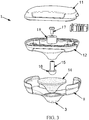
- FIG. 3 illustrates an exploded view that shows one possible embodiment of a configuration of the neuromodulation electrode assembly 1.
- the one possible embodiment of the neuromodulation electrode assembly 1 comprises the enclosure that may comprise the protrusion 2 that may form a removable holder 8 and may be coupled to the support portion 12 belonging to the base 6.
- the embodiment may further comprise a magnetic field source 18, an electrically conductive solid element 15 that may preferably have a shaped end 16 having a surface, an electrically conductive soft deformable element 14 and a means 17 to attach the magnetic field source 18 to the support portion 12 or the base 6.
- the shaped end 16 of the electrically conductive solid element 15 may be one of a semi-circular shape, a conical shape, a pyramidal shape, a bell shape, a substantially frustoconical or frustopyramidal shape, a substantially cylindrical shape, a substantially cuboid shape, a substantially prismatic shape or a substantially polygonal shape.
- the shape end 16 may be coated.
- the magnetic field source 18 may be formed by at least one magnet.
- the magnetic field source 18 may be located inside or outside the enclosure.
- the magnetic field source 18 may be used to increase a depth range of neuromodulation signals transmitted by the neuromodulation electrode assembly 1.
- the magnetic field source 18 may be a permanent magnet or an electromagnet.
- the magnetic field source 18 may have a shape of a hollow cylinder configured to receive a portion of the electrically conductive solid element 15 within.
- the magnetic source 18 may be a group of magnets that may surround a portion of the electrically conductive solid element 15.
- the electrically conductive solid element 15 may be made of various materials, preferably of at least one of diamagnetic materials.
- the shaped end 16 of the element 15 may be formed from at least one of diamagnetic material such as precious metals, a brass, a copper, a carbon, a carbide for example.
- the electrically conductive solid element 15 may be in the form of an electro conductive plate that may have an inner side coupled to the electrical interface 4.
- an electro conductive spring may be coupled to one side of the electrically conductive solid element 15, while the other end of the spring may be connected to the electrical interface 4 forming the electrical connection between the electrically conductive solid element 15 and the electrical interface 4.
- the electro conductive spring may be a coil spring, a compression type spring, a disc spring, a conical spring or a leaf spring.
- the electrically conductive solid element 15 may be positively forced by the spring towards the electrically conductive soft deformable element 14 and that may be consequently forced to project outwards through the opening 3 and may form an outside surface of the shaped end 16 of the electrically conductive solid element 15.
- the magnetic field may be advantageously adjusted using a variable or a tunable excitation of at least one of the electromagnets.
- the variable or tunable excitation may affect the direction of electrical energy flow from the neuromodulation electrode into a patient tissue. This may be advantageously utilized to find a desired nerve, even if the neuromodulation electrode is placed on the skin of a patient inaccurately.
- FIG. 4 illustrates a side cross-sectional view of an exemplary embodiment depicted in the neuromodulation electrode assembly.
- the thickness of the electrically conductive soft deformable element 8, 14 placed between the protrusion 2 that may be formed by a removable holder 8 and the support portion 12 may be controlled via the shape of the protrusion 2 and mating surface of the support portion 12. Additionally or alternatively the thickness of the electrically conductive soft deformable element 14 may be controlled via the shaped end 16 of the electrically conductive solid element 15 and/or via the positive force that may be caused by the spring coupled to the electrically conductive solid element 15.
- the spring may be configured to force the electrically conductive solid element 15 outwards through the opening 3.
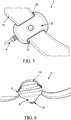
- FIG. 5 illustrates a bottom perspective view of another embodiment featuring an attachment member that may be utilized with the exemplary neuromodulation electrode assembly.
- the enclosure further comprises an attachment member 19 coupled to the base 6.
- the attachment member may be adapted to secure a position of the electrode assembly against the skin in a particular positon.
- the attachment member 19 may be configured to be able to encircle a patient limb 23.
- the attachment member 19 may be made of one of a strap, a belt, a chain or a clip.
- the attachment member 19 may be coupled to the assembly through at least one opening 20 in at least one side of the base 6.
- FIG. 6 illustrates a side perspective view of Figure 5 featuring an attachment member 19 that may be utilized with the exemplary neuromodulation electrode assembly. It shows one possibility, where the attachment member 19 may be secured to the base of the enclosure.
- the attachment member 19 may be made of a rubber, a neoprene, an elastomer, a leather, a plastic or other suitable material.
- the attachment member may be configured to control the depth of the neuromodulation electrode immersion into the limb 23 by controlling the electrode's preload against the limb 23 the attachment member is causing. This may be achieved by tensioning of the attachment member, in other words controlling how tight the attachment member encircles the patient limb 23.
- the electrically conductive soft deformable element may also be configured to contribute, due to its elasticity, to control the depth of the neuromodulation electrode immersion into the limb 23.
- FIG. 7 and FIG. 8 illustrate a perspective view of another embodiment featuring a positioning element 21 that may be utilized with the exemplary neuromodulation electrode assembly.
- the attachment member comprises a positioning element that may be used for an angular positioning of the neuromodulation electrode against the skin of a patient.
- the positioning element 21 may be coupled to the attachment member 19 via one of a strap, a belt, a chain or a clip.
- the positioning element comprises at least one of a cushion, a pad, a pillow or a solid or semi-solid piece.
- the positioning element 21 may be moveably attached to attachment member (21).
- the positioning element may be moveable along the attachment so that it may be moved along and/or around the limb.
- FIG. 9 illustrates a perspective view of another embodiment of the exemplary neuromodulation electrode assembly being attached to a limb 23.
- the embodiment shows an advantageous positioning of neuromodulation electrode where the positioning element 21 may be configured to enable a movement and/or an angular tilt of the neuromodulation electrode to reach and/or secure the most advantageous position of the neuromodulation electrode for the neuromodulation of a particular nerve. This enables to reach a correct location placement of the neuromodulation electrode that is crucial for the effectiveness of the neuromodulation procedure and eliminates a risk of the procedure efficiency reduction due to improper location placement of the neuromodulation electrode.
- the above-mentioned embodiments may offer an effective neuromodulation electrode assembly configured to provide a precise neuromodulation of a desired nerves whilst forming an efficient electro conductive interface between a patient skin and the neuromodulation electrode.
- the electrically conductive soft deformable element may represents a low cost disposable accessory.
Landscapes
- Health & Medical Sciences (AREA)
- Life Sciences & Earth Sciences (AREA)
- Veterinary Medicine (AREA)
- Biomedical Technology (AREA)
- Animal Behavior & Ethology (AREA)
- General Health & Medical Sciences (AREA)
- Public Health (AREA)
- Engineering & Computer Science (AREA)
- Nuclear Medicine, Radiotherapy & Molecular Imaging (AREA)
- Radiology & Medical Imaging (AREA)
- Heart & Thoracic Surgery (AREA)
- Biophysics (AREA)
- Psychology (AREA)
- Physics & Mathematics (AREA)
- Acoustics & Sound (AREA)
- Anesthesiology (AREA)
- Hematology (AREA)
- Electrotherapy Devices (AREA)
- Pain & Pain Management (AREA)
- Child & Adolescent Psychology (AREA)
- Developmental Disabilities (AREA)
- Hospice & Palliative Care (AREA)
- Neurology (AREA)
- Psychiatry (AREA)
- Social Psychology (AREA)
Applications Claiming Priority (3)
| Application Number | Priority Date | Filing Date | Title |
|---|---|---|---|
| CZ2017647 | 2017-10-11 | ||
| EP18786299.0A EP3493874B1 (de) | 2017-10-11 | 2018-10-11 | Neuromodulierende elektrodenanordnung |
| PCT/EP2018/077798 WO2019073003A1 (en) | 2017-10-11 | 2018-10-11 | NEUROMODULATION ELECTRODE ASSEMBLY |
Related Parent Applications (2)
| Application Number | Title | Priority Date | Filing Date |
|---|---|---|---|
| EP18786299.0A Division-Into EP3493874B1 (de) | 2017-10-11 | 2018-10-11 | Neuromodulierende elektrodenanordnung |
| EP18786299.0A Division EP3493874B1 (de) | 2017-10-11 | 2018-10-11 | Neuromodulierende elektrodenanordnung |
Publications (3)
| Publication Number | Publication Date |
|---|---|
| EP3714935A1 true EP3714935A1 (de) | 2020-09-30 |
| EP3714935B1 EP3714935B1 (de) | 2024-01-31 |
| EP3714935C0 EP3714935C0 (de) | 2024-01-31 |
Family
ID=66379677
Family Applications (2)
| Application Number | Title | Priority Date | Filing Date |
|---|---|---|---|
| EP18786299.0A Active EP3493874B1 (de) | 2017-10-11 | 2018-10-11 | Neuromodulierende elektrodenanordnung |
| EP20166069.3A Active EP3714935B1 (de) | 2017-10-11 | 2018-10-11 | Neuromodulationselektrodenanordnung |
Family Applications Before (1)
| Application Number | Title | Priority Date | Filing Date |
|---|---|---|---|
| EP18786299.0A Active EP3493874B1 (de) | 2017-10-11 | 2018-10-11 | Neuromodulierende elektrodenanordnung |
Country Status (10)
| Country | Link |
|---|---|
| US (1) | US11400277B2 (de) |
| EP (2) | EP3493874B1 (de) |
| JP (2) | JP7036465B2 (de) |
| KR (2) | KR102651846B1 (de) |
| CN (1) | CN111212676B (de) |
| AU (1) | AU2018348807B2 (de) |
| DK (1) | DK3493874T3 (de) |
| ES (2) | ES2970834T3 (de) |
| RU (1) | RU2746456C1 (de) |
| WO (1) | WO2019073003A1 (de) |
Families Citing this family (20)
| Publication number | Priority date | Publication date | Assignee | Title |
|---|---|---|---|---|
| EP3498332B1 (de) | 2013-01-21 | 2021-07-14 | Cala Health, Inc. | Vorrichtungen zur tremor-steuerung |
| US12453853B2 (en) | 2013-01-21 | 2025-10-28 | Cala Health, Inc. | Multi-modal stimulation for treating tremor |
| AU2015271774B2 (en) | 2014-06-02 | 2020-04-16 | Cala Health, Inc. | Systems and methods for peripheral nerve stimulation to treat tremor |
| CN119565022A (zh) | 2015-06-10 | 2025-03-07 | 卡拉健康公司 | 用于外周神经刺激以利用可拆卸治疗和监测单元治疗震颤的系统和方法 |
| WO2017023864A1 (en) | 2015-07-31 | 2017-02-09 | Cala Health, Inc. | Systems, devices, and method for the treatment of osteoarthritis |
| EP3352843B1 (de) | 2015-09-23 | 2021-06-23 | Cala Health, Inc. | Gerät zur peripheren nervenstimulation im finger zur behandlung von hand-tremores |
| WO2017132067A2 (en) | 2016-01-21 | 2017-08-03 | Cala Health, Inc. | Systems, methods and devices for peripheral neuromodulation for treating diseases related to overactive bladder |
| CN109803717B (zh) | 2016-08-25 | 2024-01-09 | 卡拉健康公司 | 通过周围神经刺激治疗心脏机能障碍的系统和方法 |
| EP3606604A4 (de) | 2017-04-03 | 2020-12-16 | Cala Health, Inc. | Systeme, verfahren und vorrichtungen zur peripheren neuromodulation zur behandlung von erkrankungen im zusammenhang mit überaktiver blase |
| RU2746456C1 (ru) * | 2017-10-11 | 2021-04-14 | Тесла Медикал С.Р.О. | Электрод для нейромодуляции в сборе |
| US11857778B2 (en) | 2018-01-17 | 2024-01-02 | Cala Health, Inc. | Systems and methods for treating inflammatory bowel disease through peripheral nerve stimulation |
| US12251560B1 (en) | 2019-08-13 | 2025-03-18 | Cala Health, Inc. | Connection quality determination for wearable neurostimulation systems |
| US11996645B2 (en) | 2019-10-01 | 2024-05-28 | Verily Life Sciences Llc | Separable high density connectors for implantable device |
| US11890468B1 (en) | 2019-10-03 | 2024-02-06 | Cala Health, Inc. | Neurostimulation systems with event pattern detection and classification |
| WO2023038539A1 (ru) * | 2021-09-07 | 2023-03-16 | Общество с ограниченной ответственностью "Косима" (ООО "Косима") | Неинвазивная электроидная матрица спинального нейропротеза и способ ее применения |
| JP2023153464A (ja) * | 2022-04-05 | 2023-10-18 | 株式会社アイリカ | 美顔器 |
| JP7834569B2 (ja) * | 2022-05-02 | 2026-03-24 | 株式会社三共 | 遊技機 |
| JP7834567B2 (ja) * | 2022-05-02 | 2026-03-24 | 株式会社三共 | 遊技機 |
| JP7834568B2 (ja) * | 2022-05-02 | 2026-03-24 | 株式会社三共 | 遊技機 |
| JP7834566B2 (ja) * | 2022-05-02 | 2026-03-24 | 株式会社三共 | 遊技機 |
Citations (6)
| Publication number | Priority date | Publication date | Assignee | Title |
|---|---|---|---|---|
| US5358513A (en) | 1992-12-09 | 1994-10-25 | Medtronic, Inc. | Parameter selection and electrode placement of neuromuscular electrical stimulation apparatus |
| US20030004555A1 (en) * | 2001-06-29 | 2003-01-02 | Giuntoli David M. | Electro-acupuncture device with D-shaped stimulation electrodes |
| US20140228927A1 (en) * | 2013-02-08 | 2014-08-14 | Neurowave Medical Technologies Llc | Apparatus for transcutaneous electrical stimulation of the tibial nerve |
| CZ2015467A3 (cs) | 2015-07-06 | 2017-01-18 | Tesla Medical, S.R.O. | Elektrostimulační zařízení s pólovým nástavcem |
| CZ2015468A3 (cs) | 2015-07-06 | 2017-01-18 | Tesla Medical, S.R.O. | Elektrostimulační zařízení s vodivým magnetem |
| WO2017132067A2 (en) * | 2016-01-21 | 2017-08-03 | Cala Health, Inc. | Systems, methods and devices for peripheral neuromodulation for treating diseases related to overactive bladder |
Family Cites Families (15)
| Publication number | Priority date | Publication date | Assignee | Title |
|---|---|---|---|---|
| NL7402355A (nl) * | 1974-02-21 | 1975-08-25 | Philips Nv | Huidelektrode. |
| US7047078B2 (en) * | 2001-03-30 | 2006-05-16 | Case Western Reserve University | Methods for stimulating components in, on, or near the pudendal nerve or its branches to achieve selective physiologic responses |
| GB0230361D0 (en) * | 2002-12-27 | 2003-02-05 | Koninkl Philips Electronics Nv | Electrode arrangement |
| US8417352B2 (en) * | 2004-10-19 | 2013-04-09 | Meagan Medical, Inc. | System and method for stimulating sensory nerves |
| US8874227B2 (en) * | 2009-03-20 | 2014-10-28 | ElectroCore, LLC | Devices and methods for non-invasive capacitive electrical stimulation and their use for vagus nerve stimulation on the neck of a patient |
| GB0523916D0 (en) * | 2005-11-24 | 2006-01-04 | Femeda Ltd | Compressible electrodes |
| US8170683B2 (en) | 2007-12-14 | 2012-05-01 | Ethicon, Inc. | Dermatome stimulation devices and methods |
| US8660656B2 (en) | 2009-10-16 | 2014-02-25 | Hanger, Inc. | Cuff assembly |
| US8938303B1 (en) * | 2010-06-01 | 2015-01-20 | Brandie Matsen | Restless leg therapeutic device |
| US10016233B2 (en) * | 2010-12-06 | 2018-07-10 | Biosense Webster (Israel) Ltd. | Treatment of atrial fibrillation using high-frequency pacing and ablation of renal nerves |
| EP2928550B1 (de) * | 2012-12-07 | 2023-06-07 | Medtronic, Inc. | Minimal-invasives implantierbares neurostimulationssystem |
| WO2015065442A1 (en) * | 2013-10-31 | 2015-05-07 | Advanced Bionics Ag | Headpieces and implantable cochlear stimulation systems including the same |
| CN107106841B (zh) * | 2014-10-31 | 2021-06-25 | 阿文特公司 | 经由胫后神经刺激来监测和治疗病症的方法和系统 |
| CN109069828A (zh) * | 2015-12-15 | 2018-12-21 | 波士顿科学医学有限公司 | 用于头痛的非侵入性治疗的系统和方法 |
| RU2746456C1 (ru) * | 2017-10-11 | 2021-04-14 | Тесла Медикал С.Р.О. | Электрод для нейромодуляции в сборе |
-
2018
- 2018-10-11 RU RU2020113390A patent/RU2746456C1/ru active
- 2018-10-11 EP EP18786299.0A patent/EP3493874B1/de active Active
- 2018-10-11 CN CN201880066581.5A patent/CN111212676B/zh active Active
- 2018-10-11 WO PCT/EP2018/077798 patent/WO2019073003A1/en not_active Ceased
- 2018-10-11 KR KR1020207011054A patent/KR102651846B1/ko active Active
- 2018-10-11 US US16/755,651 patent/US11400277B2/en active Active
- 2018-10-11 AU AU2018348807A patent/AU2018348807B2/en active Active
- 2018-10-11 JP JP2020520454A patent/JP7036465B2/ja active Active
- 2018-10-11 ES ES20166069T patent/ES2970834T3/es active Active
- 2018-10-11 DK DK18786299.0T patent/DK3493874T3/da active
- 2018-10-11 EP EP20166069.3A patent/EP3714935B1/de active Active
- 2018-10-11 KR KR1020247009550A patent/KR102720932B1/ko active Active
- 2018-10-11 ES ES18786299T patent/ES2821129T3/es active Active
-
2022
- 2022-02-22 JP JP2022025698A patent/JP7450280B2/ja active Active
Patent Citations (6)
| Publication number | Priority date | Publication date | Assignee | Title |
|---|---|---|---|---|
| US5358513A (en) | 1992-12-09 | 1994-10-25 | Medtronic, Inc. | Parameter selection and electrode placement of neuromuscular electrical stimulation apparatus |
| US20030004555A1 (en) * | 2001-06-29 | 2003-01-02 | Giuntoli David M. | Electro-acupuncture device with D-shaped stimulation electrodes |
| US20140228927A1 (en) * | 2013-02-08 | 2014-08-14 | Neurowave Medical Technologies Llc | Apparatus for transcutaneous electrical stimulation of the tibial nerve |
| CZ2015467A3 (cs) | 2015-07-06 | 2017-01-18 | Tesla Medical, S.R.O. | Elektrostimulační zařízení s pólovým nástavcem |
| CZ2015468A3 (cs) | 2015-07-06 | 2017-01-18 | Tesla Medical, S.R.O. | Elektrostimulační zařízení s vodivým magnetem |
| WO2017132067A2 (en) * | 2016-01-21 | 2017-08-03 | Cala Health, Inc. | Systems, methods and devices for peripheral neuromodulation for treating diseases related to overactive bladder |
Also Published As
| Publication number | Publication date |
|---|---|
| WO2019073003A1 (en) | 2019-04-18 |
| ES2821129T3 (es) | 2021-04-23 |
| AU2018348807A1 (en) | 2020-04-23 |
| EP3493874B1 (de) | 2020-08-12 |
| KR20200069306A (ko) | 2020-06-16 |
| EP3714935B1 (de) | 2024-01-31 |
| RU2021109742A (ru) | 2021-05-17 |
| US11400277B2 (en) | 2022-08-02 |
| CA3077601A1 (en) | 2019-04-18 |
| KR20240042239A (ko) | 2024-04-01 |
| RU2021109742A3 (de) | 2021-10-13 |
| KR102720932B1 (ko) | 2024-10-24 |
| JP7036465B2 (ja) | 2022-03-15 |
| JP2022075684A (ja) | 2022-05-18 |
| EP3714935C0 (de) | 2024-01-31 |
| US20200282201A1 (en) | 2020-09-10 |
| ES2970834T3 (es) | 2024-05-30 |
| AU2018348807B2 (en) | 2024-01-04 |
| KR102651846B1 (ko) | 2024-03-27 |
| CN111212676A (zh) | 2020-05-29 |
| EP3493874A1 (de) | 2019-06-12 |
| CN111212676B (zh) | 2023-08-15 |
| DK3493874T3 (da) | 2020-10-12 |
| JP2020536664A (ja) | 2020-12-17 |
| BR112020006520A2 (pt) | 2020-10-13 |
| RU2746456C1 (ru) | 2021-04-14 |
| JP7450280B2 (ja) | 2024-03-15 |
Similar Documents
| Publication | Publication Date | Title |
|---|---|---|
| US11400277B2 (en) | Neuromodulation electrode assembly | |
| US10646708B2 (en) | Transdermal electrical stimulation at the neck | |
| EP2588187B1 (de) | Einmal-elektrode für die elektrostimulation | |
| US20140249542A1 (en) | Devices with cannula and electrode lead for brain stimulation and methods of use and manufacture | |
| WO2017201525A1 (en) | Transdermal electrical stimulation at the neck to induce neuromodulation | |
| IL259474B (en) | Device for subcutaneous injection for the treatment of premature ejaculation or erectile dysfunction and the methods of its use | |
| EP1136096A1 (de) | Elektrode zur Stimulation von Muskeln | |
| CN101626804A (zh) | 用于神经刺激的电极贴片和方法 | |
| WO2017027046A1 (en) | Cochlear implants having a lateral magnet insertion and removal channel | |
| EP4415805A1 (de) | Cochleaimplantate mit mrt-kompatibler magnetvorrichtung sowie zugehörige systeme und verfahren | |
| JP7349154B2 (ja) | 神経の電気刺激のためのシステム | |
| US20260108725A1 (en) | Cochlear implants having mri-compatible magnet assemblies and associated systems and methods | |
| US20250001186A1 (en) | Cochlear implants having mri-compatible magnet apparatus and associated systems and methods | |
| US20220118245A1 (en) | System for electrical stimulation of nerves | |
| CA3077601C (en) | Neuromodulation electrode assembly | |
| RU2771731C2 (ru) | Электрод для нейромодуляции в сборе | |
| CN112386795A (zh) | 一种植入式神经电刺激系统 | |
| US10874869B2 (en) | Electrostimulation device | |
| BR112020006520B1 (pt) | Montagem de eletrodos de neuromodulação | |
| CN116271519A (zh) | 电极组件、定位组件及穿戴式电刺激系统 |
Legal Events
| Date | Code | Title | Description |
|---|---|---|---|
| PUAI | Public reference made under article 153(3) epc to a published international application that has entered the european phase |
Free format text: ORIGINAL CODE: 0009012 |
|
| STAA | Information on the status of an ep patent application or granted ep patent |
Free format text: STATUS: REQUEST FOR EXAMINATION WAS MADE |
|
| 17P | Request for examination filed |
Effective date: 20200326 |
|
| AC | Divisional application: reference to earlier application |
Ref document number: 3493874 Country of ref document: EP Kind code of ref document: P |
|
| AK | Designated contracting states |
Kind code of ref document: A1 Designated state(s): AL AT BE BG CH CY CZ DE DK EE ES FI FR GB GR HR HU IE IS IT LI LT LU LV MC MK MT NL NO PL PT RO RS SE SI SK SM TR |
|
| P01 | Opt-out of the competence of the unified patent court (upc) registered |
Effective date: 20230526 |
|
| RIC1 | Information provided on ipc code assigned before grant |
Ipc: A61N 1/36 20060101ALN20230731BHEP Ipc: A61N 1/32 20060101ALN20230731BHEP Ipc: A61N 1/22 20060101ALN20230731BHEP Ipc: A61N 1/04 20060101AFI20230731BHEP |
|
| GRAP | Despatch of communication of intention to grant a patent |
Free format text: ORIGINAL CODE: EPIDOSNIGR1 |
|
| STAA | Information on the status of an ep patent application or granted ep patent |
Free format text: STATUS: GRANT OF PATENT IS INTENDED |
|
| INTG | Intention to grant announced |
Effective date: 20230913 |
|
| GRAS | Grant fee paid |
Free format text: ORIGINAL CODE: EPIDOSNIGR3 |
|
| GRAA | (expected) grant |
Free format text: ORIGINAL CODE: 0009210 |
|
| STAA | Information on the status of an ep patent application or granted ep patent |
Free format text: STATUS: THE PATENT HAS BEEN GRANTED |
|
| AC | Divisional application: reference to earlier application |
Ref document number: 3493874 Country of ref document: EP Kind code of ref document: P |
|
| AK | Designated contracting states |
Kind code of ref document: B1 Designated state(s): AL AT BE BG CH CY CZ DE DK EE ES FI FR GB GR HR HU IE IS IT LI LT LU LV MC MK MT NL NO PL PT RO RS SE SI SK SM TR |
|
| REG | Reference to a national code |
Ref country code: GB Ref legal event code: FG4D Ref country code: CH Ref legal event code: EP |
|
| REG | Reference to a national code |
Ref country code: DE Ref legal event code: R096 Ref document number: 602018064854 Country of ref document: DE |
|
| REG | Reference to a national code |
Ref country code: NO Ref legal event code: T2 Effective date: 20240131 |
|
| REG | Reference to a national code |
Ref country code: IE Ref legal event code: FG4D |
|
| U01 | Request for unitary effect filed |
Effective date: 20240131 |
|
| U07 | Unitary effect registered |
Designated state(s): AT BE BG DE DK EE FI FR IT LT LU LV MT NL PT SE SI Effective date: 20240205 |
|
| P04 | Withdrawal of opt-out of the competence of the unified patent court (upc) registered |
Effective date: 20240131 |
|
| REG | Reference to a national code |
Ref country code: ES Ref legal event code: FG2A Ref document number: 2970834 Country of ref document: ES Kind code of ref document: T3 Effective date: 20240530 |
|
| PG25 | Lapsed in a contracting state [announced via postgrant information from national office to epo] |
Ref country code: IS Free format text: LAPSE BECAUSE OF FAILURE TO SUBMIT A TRANSLATION OF THE DESCRIPTION OR TO PAY THE FEE WITHIN THE PRESCRIBED TIME-LIMIT Effective date: 20240531 |
|
| PG25 | Lapsed in a contracting state [announced via postgrant information from national office to epo] |
Ref country code: GR Free format text: LAPSE BECAUSE OF FAILURE TO SUBMIT A TRANSLATION OF THE DESCRIPTION OR TO PAY THE FEE WITHIN THE PRESCRIBED TIME-LIMIT Effective date: 20240501 |
|
| PG25 | Lapsed in a contracting state [announced via postgrant information from national office to epo] |
Ref country code: HR Free format text: LAPSE BECAUSE OF FAILURE TO SUBMIT A TRANSLATION OF THE DESCRIPTION OR TO PAY THE FEE WITHIN THE PRESCRIBED TIME-LIMIT Effective date: 20240131 Ref country code: RS Free format text: LAPSE BECAUSE OF FAILURE TO SUBMIT A TRANSLATION OF THE DESCRIPTION OR TO PAY THE FEE WITHIN THE PRESCRIBED TIME-LIMIT Effective date: 20240430 |
|
| PG25 | Lapsed in a contracting state [announced via postgrant information from national office to epo] |
Ref country code: RS Free format text: LAPSE BECAUSE OF FAILURE TO SUBMIT A TRANSLATION OF THE DESCRIPTION OR TO PAY THE FEE WITHIN THE PRESCRIBED TIME-LIMIT Effective date: 20240430 Ref country code: IS Free format text: LAPSE BECAUSE OF FAILURE TO SUBMIT A TRANSLATION OF THE DESCRIPTION OR TO PAY THE FEE WITHIN THE PRESCRIBED TIME-LIMIT Effective date: 20240531 Ref country code: HR Free format text: LAPSE BECAUSE OF FAILURE TO SUBMIT A TRANSLATION OF THE DESCRIPTION OR TO PAY THE FEE WITHIN THE PRESCRIBED TIME-LIMIT Effective date: 20240131 Ref country code: GR Free format text: LAPSE BECAUSE OF FAILURE TO SUBMIT A TRANSLATION OF THE DESCRIPTION OR TO PAY THE FEE WITHIN THE PRESCRIBED TIME-LIMIT Effective date: 20240501 |
|
| PG25 | Lapsed in a contracting state [announced via postgrant information from national office to epo] |
Ref country code: PL Free format text: LAPSE BECAUSE OF FAILURE TO SUBMIT A TRANSLATION OF THE DESCRIPTION OR TO PAY THE FEE WITHIN THE PRESCRIBED TIME-LIMIT Effective date: 20240131 |
|
| PG25 | Lapsed in a contracting state [announced via postgrant information from national office to epo] |
Ref country code: PL Free format text: LAPSE BECAUSE OF FAILURE TO SUBMIT A TRANSLATION OF THE DESCRIPTION OR TO PAY THE FEE WITHIN THE PRESCRIBED TIME-LIMIT Effective date: 20240131 |
|
| PG25 | Lapsed in a contracting state [announced via postgrant information from national office to epo] |
Ref country code: SM Free format text: LAPSE BECAUSE OF FAILURE TO SUBMIT A TRANSLATION OF THE DESCRIPTION OR TO PAY THE FEE WITHIN THE PRESCRIBED TIME-LIMIT Effective date: 20240131 |
|
| PG25 | Lapsed in a contracting state [announced via postgrant information from national office to epo] |
Ref country code: CZ Free format text: LAPSE BECAUSE OF FAILURE TO SUBMIT A TRANSLATION OF THE DESCRIPTION OR TO PAY THE FEE WITHIN THE PRESCRIBED TIME-LIMIT Effective date: 20240131 |
|
| PG25 | Lapsed in a contracting state [announced via postgrant information from national office to epo] |
Ref country code: SK Free format text: LAPSE BECAUSE OF FAILURE TO SUBMIT A TRANSLATION OF THE DESCRIPTION OR TO PAY THE FEE WITHIN THE PRESCRIBED TIME-LIMIT Effective date: 20240131 |
|
| PG25 | Lapsed in a contracting state [announced via postgrant information from national office to epo] |
Ref country code: SM Free format text: LAPSE BECAUSE OF FAILURE TO SUBMIT A TRANSLATION OF THE DESCRIPTION OR TO PAY THE FEE WITHIN THE PRESCRIBED TIME-LIMIT Effective date: 20240131 Ref country code: SK Free format text: LAPSE BECAUSE OF FAILURE TO SUBMIT A TRANSLATION OF THE DESCRIPTION OR TO PAY THE FEE WITHIN THE PRESCRIBED TIME-LIMIT Effective date: 20240131 Ref country code: RO Free format text: LAPSE BECAUSE OF FAILURE TO SUBMIT A TRANSLATION OF THE DESCRIPTION OR TO PAY THE FEE WITHIN THE PRESCRIBED TIME-LIMIT Effective date: 20240131 Ref country code: CZ Free format text: LAPSE BECAUSE OF FAILURE TO SUBMIT A TRANSLATION OF THE DESCRIPTION OR TO PAY THE FEE WITHIN THE PRESCRIBED TIME-LIMIT Effective date: 20240131 |
|
| REG | Reference to a national code |
Ref country code: DE Ref legal event code: R097 Ref document number: 602018064854 Country of ref document: DE |
|
| U20 | Renewal fee for the european patent with unitary effect paid |
Year of fee payment: 7 Effective date: 20241015 |
|
| PLBE | No opposition filed within time limit |
Free format text: ORIGINAL CODE: 0009261 |
|
| STAA | Information on the status of an ep patent application or granted ep patent |
Free format text: STATUS: NO OPPOSITION FILED WITHIN TIME LIMIT |
|
| 26N | No opposition filed |
Effective date: 20241101 |
|
| P05 | Withdrawal of opt-out of the competence of the unified patent court (upc) changed |
Free format text: CASE NUMBER: APP_5625/2024 Effective date: 20240205 |
|
| PG25 | Lapsed in a contracting state [announced via postgrant information from national office to epo] |
Ref country code: MC Free format text: LAPSE BECAUSE OF FAILURE TO SUBMIT A TRANSLATION OF THE DESCRIPTION OR TO PAY THE FEE WITHIN THE PRESCRIBED TIME-LIMIT Effective date: 20240131 |
|
| PGFP | Annual fee paid to national office [announced via postgrant information from national office to epo] |
Ref country code: IE Payment date: 20250918 Year of fee payment: 8 |
|
| U20 | Renewal fee for the european patent with unitary effect paid |
Year of fee payment: 8 Effective date: 20250916 |
|
| REG | Reference to a national code |
Ref country code: CH Ref legal event code: U11 Free format text: ST27 STATUS EVENT CODE: U-0-0-U10-U11 (AS PROVIDED BY THE NATIONAL OFFICE) Effective date: 20251101 |
|
| PGFP | Annual fee paid to national office [announced via postgrant information from national office to epo] |
Ref country code: GB Payment date: 20251023 Year of fee payment: 8 |
|
| PGFP | Annual fee paid to national office [announced via postgrant information from national office to epo] |
Ref country code: NO Payment date: 20250930 Year of fee payment: 8 |
|
| PGFP | Annual fee paid to national office [announced via postgrant information from national office to epo] |
Ref country code: CH Payment date: 20251101 Year of fee payment: 8 |
|
| PG25 | Lapsed in a contracting state [announced via postgrant information from national office to epo] |
Ref country code: CY Free format text: LAPSE BECAUSE OF FAILURE TO SUBMIT A TRANSLATION OF THE DESCRIPTION OR TO PAY THE FEE WITHIN THE PRESCRIBED TIME-LIMIT; INVALID AB INITIO Effective date: 20181011 |
|
| PGFP | Annual fee paid to national office [announced via postgrant information from national office to epo] |
Ref country code: ES Payment date: 20251110 Year of fee payment: 8 |
|
| PG25 | Lapsed in a contracting state [announced via postgrant information from national office to epo] |
Ref country code: HU Free format text: LAPSE BECAUSE OF FAILURE TO SUBMIT A TRANSLATION OF THE DESCRIPTION OR TO PAY THE FEE WITHIN THE PRESCRIBED TIME-LIMIT; INVALID AB INITIO Effective date: 20181011 |