EP3713682B1 - Ultraschallschwingeinheit mit dämpfung - Google Patents
Ultraschallschwingeinheit mit dämpfung Download PDFInfo
- Publication number
- EP3713682B1 EP3713682B1 EP18807262.3A EP18807262A EP3713682B1 EP 3713682 B1 EP3713682 B1 EP 3713682B1 EP 18807262 A EP18807262 A EP 18807262A EP 3713682 B1 EP3713682 B1 EP 3713682B1
- Authority
- EP
- European Patent Office
- Prior art keywords
- converter
- vibration
- unit
- ultrasonic vibration
- damping element
- Prior art date
- Legal status (The legal status is an assumption and is not a legal conclusion. Google has not performed a legal analysis and makes no representation as to the accuracy of the status listed.)
- Active
Links
Images



Classifications
-
- B—PERFORMING OPERATIONS; TRANSPORTING
- B06—GENERATING OR TRANSMITTING MECHANICAL VIBRATIONS IN GENERAL
- B06B—METHODS OR APPARATUS FOR GENERATING OR TRANSMITTING MECHANICAL VIBRATIONS OF INFRASONIC, SONIC, OR ULTRASONIC FREQUENCY, e.g. FOR PERFORMING MECHANICAL WORK IN GENERAL
- B06B3/00—Methods or apparatus specially adapted for transmitting mechanical vibrations of infrasonic, sonic, or ultrasonic frequency
- B06B3/02—Methods or apparatus specially adapted for transmitting mechanical vibrations of infrasonic, sonic, or ultrasonic frequency involving a change of amplitude
-
- B—PERFORMING OPERATIONS; TRANSPORTING
- B29—WORKING OF PLASTICS; WORKING OF SUBSTANCES IN A PLASTIC STATE IN GENERAL
- B29C—SHAPING OR JOINING OF PLASTICS; SHAPING OF MATERIAL IN A PLASTIC STATE, NOT OTHERWISE PROVIDED FOR; AFTER-TREATMENT OF THE SHAPED PRODUCTS, e.g. REPAIRING
- B29C65/00—Joining or sealing of preformed parts, e.g. welding of plastics materials; Apparatus therefor
- B29C65/02—Joining or sealing of preformed parts, e.g. welding of plastics materials; Apparatus therefor by heating, with or without pressure
- B29C65/08—Joining or sealing of preformed parts, e.g. welding of plastics materials; Apparatus therefor by heating, with or without pressure using ultrasonic vibrations
- B29C65/083—Joining or sealing of preformed parts, e.g. welding of plastics materials; Apparatus therefor by heating, with or without pressure using ultrasonic vibrations using a rotary sonotrode or a rotary anvil
- B29C65/086—Joining or sealing of preformed parts, e.g. welding of plastics materials; Apparatus therefor by heating, with or without pressure using ultrasonic vibrations using a rotary sonotrode or a rotary anvil using a rotary anvil
-
- B—PERFORMING OPERATIONS; TRANSPORTING
- B29—WORKING OF PLASTICS; WORKING OF SUBSTANCES IN A PLASTIC STATE IN GENERAL
- B29C—SHAPING OR JOINING OF PLASTICS; SHAPING OF MATERIAL IN A PLASTIC STATE, NOT OTHERWISE PROVIDED FOR; AFTER-TREATMENT OF THE SHAPED PRODUCTS, e.g. REPAIRING
- B29C66/00—General aspects of processes or apparatus for joining preformed parts
- B29C66/01—General aspects dealing with the joint area or with the area to be joined
- B29C66/05—Particular design of joint configurations
- B29C66/10—Particular design of joint configurations particular design of the joint cross-sections
- B29C66/11—Joint cross-sections comprising a single joint-segment, i.e. one of the parts to be joined comprising a single joint-segment in the joint cross-section
- B29C66/112—Single lapped joints
- B29C66/1122—Single lap to lap joints, i.e. overlap joints
-
- B—PERFORMING OPERATIONS; TRANSPORTING
- B29—WORKING OF PLASTICS; WORKING OF SUBSTANCES IN A PLASTIC STATE IN GENERAL
- B29C—SHAPING OR JOINING OF PLASTICS; SHAPING OF MATERIAL IN A PLASTIC STATE, NOT OTHERWISE PROVIDED FOR; AFTER-TREATMENT OF THE SHAPED PRODUCTS, e.g. REPAIRING
- B29C66/00—General aspects of processes or apparatus for joining preformed parts
- B29C66/40—General aspects of joining substantially flat articles, e.g. plates, sheets or web-like materials; Making flat seams in tubular or hollow articles; Joining single elements to substantially flat surfaces
- B29C66/41—Joining substantially flat articles ; Making flat seams in tubular or hollow articles
-
- B—PERFORMING OPERATIONS; TRANSPORTING
- B29—WORKING OF PLASTICS; WORKING OF SUBSTANCES IN A PLASTIC STATE IN GENERAL
- B29C—SHAPING OR JOINING OF PLASTICS; SHAPING OF MATERIAL IN A PLASTIC STATE, NOT OTHERWISE PROVIDED FOR; AFTER-TREATMENT OF THE SHAPED PRODUCTS, e.g. REPAIRING
- B29C66/00—General aspects of processes or apparatus for joining preformed parts
- B29C66/80—General aspects of machine operations or constructions and parts thereof
- B29C66/81—General aspects of the pressing elements, i.e. the elements applying pressure on the parts to be joined in the area to be joined, e.g. the welding jaws or clamps
- B29C66/816—General aspects of the pressing elements, i.e. the elements applying pressure on the parts to be joined in the area to be joined, e.g. the welding jaws or clamps characterised by the mounting of the pressing elements, e.g. of the welding jaws or clamps
-
- B—PERFORMING OPERATIONS; TRANSPORTING
- B29—WORKING OF PLASTICS; WORKING OF SUBSTANCES IN A PLASTIC STATE IN GENERAL
- B29C—SHAPING OR JOINING OF PLASTICS; SHAPING OF MATERIAL IN A PLASTIC STATE, NOT OTHERWISE PROVIDED FOR; AFTER-TREATMENT OF THE SHAPED PRODUCTS, e.g. REPAIRING
- B29C66/00—General aspects of processes or apparatus for joining preformed parts
- B29C66/80—General aspects of machine operations or constructions and parts thereof
- B29C66/83—General aspects of machine operations or constructions and parts thereof characterised by the movement of the joining or pressing tools
- B29C66/834—General aspects of machine operations or constructions and parts thereof characterised by the movement of the joining or pressing tools moving with the parts to be joined
- B29C66/8341—Roller, cylinder or drum types; Band or belt types; Ball types
- B29C66/83411—Roller, cylinder or drum types
-
- B—PERFORMING OPERATIONS; TRANSPORTING
- B29—WORKING OF PLASTICS; WORKING OF SUBSTANCES IN A PLASTIC STATE IN GENERAL
- B29C—SHAPING OR JOINING OF PLASTICS; SHAPING OF MATERIAL IN A PLASTIC STATE, NOT OTHERWISE PROVIDED FOR; AFTER-TREATMENT OF THE SHAPED PRODUCTS, e.g. REPAIRING
- B29C66/00—General aspects of processes or apparatus for joining preformed parts
- B29C66/90—Measuring or controlling the joining process
- B29C66/95—Measuring or controlling the joining process by measuring or controlling specific variables not covered by groups B29C66/91 - B29C66/94
- B29C66/951—Measuring or controlling the joining process by measuring or controlling specific variables not covered by groups B29C66/91 - B29C66/94 by measuring or controlling the vibration frequency and/or the vibration amplitude of vibrating joining tools, e.g. of ultrasonic welding tools
-
- B—PERFORMING OPERATIONS; TRANSPORTING
- B29—WORKING OF PLASTICS; WORKING OF SUBSTANCES IN A PLASTIC STATE IN GENERAL
- B29C—SHAPING OR JOINING OF PLASTICS; SHAPING OF MATERIAL IN A PLASTIC STATE, NOT OTHERWISE PROVIDED FOR; AFTER-TREATMENT OF THE SHAPED PRODUCTS, e.g. REPAIRING
- B29C66/00—General aspects of processes or apparatus for joining preformed parts
- B29C66/90—Measuring or controlling the joining process
- B29C66/95—Measuring or controlling the joining process by measuring or controlling specific variables not covered by groups B29C66/91 - B29C66/94
- B29C66/951—Measuring or controlling the joining process by measuring or controlling specific variables not covered by groups B29C66/91 - B29C66/94 by measuring or controlling the vibration frequency and/or the vibration amplitude of vibrating joining tools, e.g. of ultrasonic welding tools
- B29C66/9512—Measuring or controlling the joining process by measuring or controlling specific variables not covered by groups B29C66/91 - B29C66/94 by measuring or controlling the vibration frequency and/or the vibration amplitude of vibrating joining tools, e.g. of ultrasonic welding tools by controlling their vibration frequency
-
- B—PERFORMING OPERATIONS; TRANSPORTING
- B29—WORKING OF PLASTICS; WORKING OF SUBSTANCES IN A PLASTIC STATE IN GENERAL
- B29C—SHAPING OR JOINING OF PLASTICS; SHAPING OF MATERIAL IN A PLASTIC STATE, NOT OTHERWISE PROVIDED FOR; AFTER-TREATMENT OF THE SHAPED PRODUCTS, e.g. REPAIRING
- B29C66/00—General aspects of processes or apparatus for joining preformed parts
- B29C66/90—Measuring or controlling the joining process
- B29C66/95—Measuring or controlling the joining process by measuring or controlling specific variables not covered by groups B29C66/91 - B29C66/94
- B29C66/959—Measuring or controlling the joining process by measuring or controlling specific variables not covered by groups B29C66/91 - B29C66/94 characterised by specific values or ranges of said specific variables
- B29C66/9592—Measuring or controlling the joining process by measuring or controlling specific variables not covered by groups B29C66/91 - B29C66/94 characterised by specific values or ranges of said specific variables in explicit relation to another variable, e.g. X-Y diagrams
-
- B—PERFORMING OPERATIONS; TRANSPORTING
- B06—GENERATING OR TRANSMITTING MECHANICAL VIBRATIONS IN GENERAL
- B06B—METHODS OR APPARATUS FOR GENERATING OR TRANSMITTING MECHANICAL VIBRATIONS OF INFRASONIC, SONIC, OR ULTRASONIC FREQUENCY, e.g. FOR PERFORMING MECHANICAL WORK IN GENERAL
- B06B2201/00—Indexing scheme associated with B06B1/0207 for details covered by B06B1/0207 but not provided for in any of its subgroups
- B06B2201/70—Specific application
- B06B2201/72—Welding, joining, soldering
-
- B—PERFORMING OPERATIONS; TRANSPORTING
- B29—WORKING OF PLASTICS; WORKING OF SUBSTANCES IN A PLASTIC STATE IN GENERAL
- B29L—INDEXING SCHEME ASSOCIATED WITH SUBCLASS B29C, RELATING TO PARTICULAR ARTICLES
- B29L2031/00—Other particular articles
- B29L2031/712—Containers; Packaging elements or accessories, Packages
- B29L2031/7128—Bags, sacks, sachets
-
- G—PHYSICS
- G10—MUSICAL INSTRUMENTS; ACOUSTICS
- G10K—SOUND-PRODUCING DEVICES; METHODS OR DEVICES FOR PROTECTING AGAINST, OR FOR DAMPING, NOISE OR OTHER ACOUSTIC WAVES IN GENERAL; ACOUSTICS NOT OTHERWISE PROVIDED FOR
- G10K11/00—Methods or devices for transmitting, conducting or directing sound in general; Methods or devices for protecting against, or for damping, noise or other acoustic waves in general
- G10K11/002—Devices for damping, suppressing, obstructing or conducting sound in acoustic devices
-
- G—PHYSICS
- G10—MUSICAL INSTRUMENTS; ACOUSTICS
- G10K—SOUND-PRODUCING DEVICES; METHODS OR DEVICES FOR PROTECTING AGAINST, OR FOR DAMPING, NOISE OR OTHER ACOUSTIC WAVES IN GENERAL; ACOUSTICS NOT OTHERWISE PROVIDED FOR
- G10K11/00—Methods or devices for transmitting, conducting or directing sound in general; Methods or devices for protecting against, or for damping, noise or other acoustic waves in general
- G10K11/16—Methods or devices for protecting against, or for damping, noise or other acoustic waves in general
- G10K11/162—Selection of materials
Definitions
- the present invention relates to an ultrasonic oscillating unit with at least one converter for converting an electrical alternating voltage into a mechanical ultrasonic oscillation and a sonotrode, which is oscillatingly coupled to the converter.
- the vibration coupling can be achieved either by attaching the converter directly to the sonotrode or by interposing an amplitude transformer.
- Such an ultrasonic oscillating unit can be used for welding a wide variety of materials.
- the sonotrode is brought into contact with the material to be processed, so that the sonotrode transmits an ultrasonic vibration to the material to be processed.
- the material to be processed is generally positioned between the sonotrode and a counter-tool, so that the sonotrode applies a force to the material in the direction of the counter-tool.
- An example of such a device is US2016/023297 shown.
- the components of the ultrasonic oscillating unit converter, amplitude transformer and sonotrode are often arranged along a marked longitudinal axis.
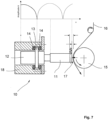
- FIG 7 An example is in figure 7 a known embodiment of an ultrasonic oscillating unit 10 is shown.
- This consists of a converter housing 18, the converter 12, which has a piezoelectric oscillating module, and a sonotrode 11, which is attached to the converter 12.
- the converter 12 has a flange 13 which is mounted softly in the converter housing 18 via elastic O-rings.
- a counter tool 15 is arranged opposite the sonotrode 11 .
- a gap 17 remains between the sonotrode 11 and the tool 15, through which a material web 16, which is to be processed by means of the ultrasonic oscillating unit 10, is moved.
- the sonotrode In order to generate ultrasonic vibrations with the greatest possible amplitude, the sonotrode must be excited with an excitation frequency that is close to a resonance frequency of the sonotrode.
- the resonance frequencies of the sonotrode are often also referred to as natural frequencies.
- the converter is usually operated at an operating frequency that is almost identical to the natural frequency f of the sonotrode.
- the converter itself is usually made to oscillate by applying an AC voltage to the piezoelectric elements located in the converter.
- the operating frequency at which the converter oscillates is thus controlled by the applied frequency of an AC voltage.
- the individual components of the ultrasonic oscillating unit are matched to one another in such a way that the entire oscillating system has a natural frequency that corresponds to the natural frequency of the sonotrode.
- a standing longitudinal wave forms in the entire ultrasonic oscillating unit with stationary oscillation nodes and antinodes, with the oscillations associated with the standing wave having the working frequency.
- the arrangement of the flange 13 in the node of oscillation ensures that the flange 13 oscillates only slightly in the propagation direction of the ultrasonic oscillation.
- the ultrasonic oscillating unit 10 is decoupled from the converter housing 18, so that practically no oscillating energy is transmitted from the ultrasonic oscillating unit 10 to the converter housing 18.
- these low-frequency parasitic vibrations can cause a reduced quality of the welding result. They can also put undue stress on the components of the ultrasonic welder, particularly the Piezo elements of the converter cause and be responsible for an increased energy requirement. In addition, the parasitic vibrations cause increased noise, which is undesirable.
- this object is achieved in that a damped vibration damper unit is provided which is connected to the ultrasonic vibration unit at a vibration node, the vibration damper unit being connected to a damping element which is designed in such a way that it damps vibration of the vibration damper unit.
- a vibration absorber unit is understood to mean any unit that can be excited to oscillate. It is not necessary, even if this can be advantageous, for the vibration damper unit to have a resonant frequency that is adapted to specific frequencies. Because the vibration damper unit is connected to damping elements, the vibration damper unit is also referred to as a damped vibration damper unit.
- the advantage of using this damped vibration absorber unit is that a desired longitudinal working vibration of the converter with the working frequency is not damped by the damping elements, while the low-frequency parasitic vibration is damped.
- the damping elements are located on the vibration absorber unit, which is connected to the ultrasonic vibration unit at a vibration node of the standing wave of the working vibration.
- the working vibration is also not influenced by the damping of the vibration damper unit.
- connection according to the invention via a coupling element arranged at a vibration node makes it possible for only vibration components in the region of the vibration node to be transmitted to the vibration absorber unit and damped there. However, these are essentially the unwanted parasitic oscillations. Therefore, the working vibration is hardly affected by the damped vibration absorber unit.
- the structure according to the invention can be compared to an electromagnetic blocking circuit.
- a blocking circuit prevents the transmission of signals of a specific frequency, while signals of all other frequencies are transmitted almost unaffected.
- the arrangement of the coupling element allows the transmission and thus the energy transfer of vibrations that have no vibration node in the area of the coupling element. All vibrations that have a vibration node in the area of the coupling element are blocked, ie not transmitted to the vibration absorber unit via the coupling element.
- a forced vibration is thus imposed on the vibration absorber unit, the vibration frequency of which differs from the natural frequency f or the working frequency of the ultrasonic vibration unit. Due to the vibration of the vibration absorber unit, vibration energy is transferred from the vibration absorber unit to the damping element and transformed into thermal energy, for example.
- the present invention thus uses the knowledge that standing waves within an ultrasonic oscillating unit have vibration nodes and antinodes at different locations with regard to different frequencies.
- the standing wave described is a physical ideal that is not achieved in practice.
- areas with a minimum vibration amplitude and areas with a maximum vibration amplitude form in any case.
- a vibration node within the meaning of the present invention is therefore always understood to mean a region with a minimum vibration amplitude.
- the coupling element is to be connected to the ultrasonic oscillating unit at an oscillation node, this simply means that the coupling element is to be arranged in an area with a minimum oscillation amplitude.
- the coupling element has a finite extension in the direction of the standing wave and therefore cannot act on the ultrasonic vibration unit in a punctiform manner.
- the damping element consists of a different material than the vibration absorber unit.
- the damping element preferably consists of an elastomer. It has been shown that elastomers are particularly well suited to bringing about the desired damping of the vibration absorber unit.
- the use of an elastomer as a damping element is both inexpensive and simple. A connection an elastomer with the vibration absorber unit can be realized, for example, by clamping or casting.
- the damping element made of an elastomer has a contact surface via which it is in contact with the vibration absorber unit, the contact surface preferably being >2 cm 2 , particularly preferably >10 cm 2 and most preferably >20 cm 2 .
- a sufficiently large contact surface between the vibration absorber unit and an elastomer, as is described here, ensures that the vibration energy can be efficiently transferred from the vibration absorber unit to the elastomer and converted into thermal energy by the latter.
- the damping element made of an elastomer is arranged in such a way that it exerts a force on the vibration damper unit via said contact surface, with the damping element preferably exerting a force in the direction of the vibration damper unit via the contact surface.
- the force transmission described here can be implemented, for example, by clamping rings that press an elastomer onto or against the vibration absorber unit. This results in an advantageous coupling of the damping element to the vibration damper unit, as a result of which the vibration energy is efficiently transferred from the vibration damper unit to the damping element.
- the mass of the vibration absorber unit is ⁇ 10%, preferably between 1% and 8% and most preferably between 3% and 5% of the mass of the ultrasonic oscillating unit.
- the damping element is designed and arranged in such a way that it damps the vibration absorber unit with a degree of damping of between 5% and 50% and preferably between 7.5% and 20%.
- the degree of damping is a dimensionless variable that represents a measure of the damping of the vibration absorber unit.
- the degree of damping is sometimes also referred to as the damping factor or Lehr's damping factor.
- the coupling element is arranged on the converter of the ultrasonic oscillating unit.
- the ultrasonic oscillating unit is designed in such a way that an oscillation node of the working oscillation is in the area of the converter.
- the ultrasonic oscillating unit can form two nodes and three antinodes, one node being arranged in the area of the converter and one node being arranged in the area of the sonotrode.
- the arrangement of the coupling element at a vibration node, which is in the area of the converter has the advantage that in this area the vibration amplitude of the desired ultrasonic vibration is lower than in the area of the sonotrode, so that the energy transfer from the desired vibration to the vibration damper unit is still possible is further reduced.
- tests and simulation calculations have shown that the oscillation amplitude of the parasitic oscillation is greater in the area of the converter than in the area of the sonotrode, so that the energy transfer of the parasitic oscillation to the vibration absorber unit is greater in the area of the converter.
- the aim of coupling the damped vibration absorber unit via a coupling element is to transfer as much energy as possible from the parasitic vibration to the vibration absorber unit and at the same time to transfer as little vibration energy as possible from the desired working vibration to the vibration absorber unit.
- the converter has an outer surface in the shape of a cylinder jacket and the coupling element is designed at least in sections as a flange which is connected to the outer surface of the converter in the shape of a cylinder jacket.
- the flange is preferably formed in one piece with the converter. Forming the coupling element as a flange is a variant that is easy to produce and inexpensive. In particular, a flange represents an ideal coupling element for coupling the converter to a cylindrical vibration absorber unit.
- the coupling element is designed in such a way that it has a ticket-shaped cross section.
- the coupling element has three sections, namely a first radial section extending radially to the cylinder surface axis, which matures on the converter, an axial section extending in the axial direction thereto, and a second radial section extending in the radial direction from the axial section.
- the vibration absorber unit is connected to the converter and forms a converter housing which encloses the converter at its end remote from the sonotrode.
- the converter housing preferably has a housing base and a cylindrical housing wall, the cylindrical housing wall being connected to the coupling element.
- the use of the vibration absorber unit as a converter housing is particularly advantageous since the vibration absorber unit thus fulfills two important functions at the same time. On the one hand, it protects the converter and the electronics connected to it from the outside Influences and on the other hand, it creates the possibility of efficiently damping a parasitic vibration occurring during operation by attaching damping elements to the vibration absorber unit.
- the damping element is designed as a sleeve which surrounds the converter housing.
- the damping element is elastically prestressed in such a way that it exerts a force on the converter housing.
- an elastomer sleeve can be used as the damping element, for example, the diameter of the elastomer sleeve in the non-expanded state being smaller than the diameter of the cylindrical converter housing. If the elastomer sleeve is now slipped over the converter housing, the elasticity of the elastomer exerts a force from the elastomer on the converter housing.
- a particular advantage of this embodiment is that it can be implemented easily.
- the damping element is arranged within the converter housing.
- the damping element is either connected to the converter housing over the entire contact surface or is pressed onto the converter housing with the aid of a clamping element.
- a damping element made of an elastomer is pressed against the inner wall of the converter housing with the aid of a clamping element, the clamping element having a conical outer contour.
- the damping element is sleeve-shaped and has a cone-shaped inner contour, which is designed to correspond to the outer contour of the clamping element.
- a sleeve made of elastomer and a metal sleeve with a conical outer contour can be used as the clamping element. Installing such a solution turns out to be easy and can be done as described below. Both sleeves are pushed into a cylindrical converter housing, whereby the bottom of the cylinder has to be opened for this purpose. First, the elastomer sleeve is pushed in and then the metal sleeve, which due to the conical design of its outer contour, presses the elastomer sleeve against the inner wall of the converter housing.
- the conical outer contour of the metal sleeve is designed in such a way that stable compression of the elastomer is achieved precisely when the metal sleeve has been pushed completely into the converter housing.
- FIG 1 a first embodiment of a vibration absorber unit attached to a converter is shown.
- a sectional view through the converter 1 can be seen, which is connected to a vibration absorber unit 2 via a coupling element 3 .
- all elements shown are cylindrically symmetrical with respect to the longitudinal axis of the converter 1, so that the present sectional view represents any sectional plane that contains the longitudinal axis of the converter and the converter housing/the vibration absorber unit.
- the converter 1 is vibrationally coupled to a sonotrode.
- the vibration coupling can either take place in that the sonotrode is in figure 1 connects to the converter 1 on the right or the converter 1 is connected on its right side to an amplitude transformer, to which in turn the sonotrode is attached.
- the figure 1 12 also shows further details of the converter 1, such as the piezoelectric elements 6 and the converter screw 7.
- the coupling element 3 of the converter is designed as a flange, to which the vibration absorber unit 2 is attached.
- the vibration damper unit is designed here as a converter housing 2 and encloses the left half of the converter 1 in this view.
- a sleeve-shaped damping element 4 is attached to the inner wall of the converter housing 2, which is pressed against the inner wall of the converter housing 2 by means of a cone-shaped clamping element 5.
- the through the damping element 4 and the cone-shaped clamping element 5 damped vibration damper unit 2 is as in figure 1 shown attached to the converter via a coupling element 3 .
- the ultrasonic oscillating unit consisting of the sonotrode and the converter 1 and optionally an amplitude transformer arranged between the converter 1 and the sonotrode is designed such that when it is excited with the ultrasonic natural frequency f, a standing wave is formed in the longitudinal direction.
- the oscillation amplitude of this longitudinal wave is location-dependent, i.e. zones with a minimum oscillation amplitude and zones with a maximum oscillation amplitude form within the ultrasonic oscillation unit.
- a graph is shown above the representation of the converter, which shows the magnitude of the vibration amplitude A over the longitudinal axis x.
- the oscillation amplitude A is minimal (oscillation nodes), while the oscillation amplitude increases in the direction of the front-side boundary surfaces of the converter. Antinodes of vibration are thus formed at the end faces.
- the position of the coupling element 3 is selected in such a way that it corresponds to the position of an oscillation node. This ensures that there is no or almost no transfer of energy for the desired ultrasonic vibration via the coupling element to the vibration absorber unit.
- the ultrasonic oscillating unit has parasitic oscillation components, these generally have no oscillation node at the position of the coupling element 3, so that energy is transferred to the vibration absorber unit 2 for parasitic oscillation components.
- the coupling element 3 is as in figure 1 shown in the form of a flange integral with the converter. In an alternative embodiment, however, it can also be designed as a separate component.
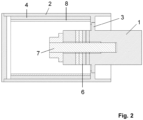
- FIG 2 1 is shown a sectional view of a second embodiment of a vibration damper assembly attached to a converter.
- the converter 1, the coupling element 3 (the flange) and the vibration absorber unit 2 are designed here in accordance with the first embodiment.
- the section plane shown corresponds to the section plane shown figure 1 .
- the damping element 4 is also an elastomer sleeve here, which, in contrast to the first embodiment, is pressed against the inner wall of the converter housing 2 in this embodiment by means of an expanding ring 8 .
- the expanding ring 8 exerts approximately the same force on the damping element 4 in all areas in which it is in contact with the damping element 4 .
- figure 3 1 is a sectional view of a third embodiment of a vibration absorber unit attached to a converter.
- This embodiment differs from the second embodiment ( figure 2 ) only to the effect that the damping element 4 is not fixed by means of a spreader ring 8, but is attached to the inner wall of the converter housing by casting. Thus, this embodiment does not contain an additional clamping element for fastening the damping element 4 to the vibration absorber unit 2.
- FIG 4 1 is shown a fourth embodiment of a vibration absorber unit attached to a converter.
- the damping element 4 is attached to the outside of the converter housing 2 .
- the damping element 4 can consist, for example, of an elastic elastomer sleeve which is undersized in relation to the cylindrical converter housing 2 . If such an elastomer sleeve 4 is slipped over the converter housing 2, as in the present case, it presses against the outer wall of the converter housing 2 due to its undersize and its elasticity with a force that depends on the undersize and elasticity.
- FIG 5 a fifth embodiment of the invention is shown, which differs from that in figure 4 shown embodiment differs in that the damping element 4, in this case again realized by an elastomer sleeve, is attached here to the outer wall of the converter housing 2 and is pressed against the converter housing 2 by means of clamping rings 8.
- the damping element 4 in this case again realized by an elastomer sleeve, is attached here to the outer wall of the converter housing 2 and is pressed against the converter housing 2 by means of clamping rings 8.
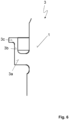
- FIG 6 a partial sectional view of an alternative embodiment of a coupling element 3 is shown.
- the coupling element 3 is integrally connected to the converter 1 and has a first radial section 3a, which extends essentially radially from the cylindrical outer contour of the converter 1, an axial section 3b, which extends essentially perpendicularly to the first radial section 3a and thus essentially axially and a second radial portion 3c extending radially from the axial portion 3b.
- the second radial section 3c can then be connected to the vibration damper unit or to the converter housing designed as a vibration damper unit.
Landscapes
- Engineering & Computer Science (AREA)
- Mechanical Engineering (AREA)
- Apparatuses For Generation Of Mechanical Vibrations (AREA)
- Pressure Welding/Diffusion-Bonding (AREA)
Applications Claiming Priority (2)
| Application Number | Priority Date | Filing Date | Title |
|---|---|---|---|
| DE102017127826.5A DE102017127826A1 (de) | 2017-11-24 | 2017-11-24 | Ultraschallschwingeinheit mit Dämpfung |
| PCT/EP2018/081686 WO2019101666A1 (de) | 2017-11-24 | 2018-11-19 | Ultraschallschwingeinheit mit dämpfung |
Publications (2)
| Publication Number | Publication Date |
|---|---|
| EP3713682A1 EP3713682A1 (de) | 2020-09-30 |
| EP3713682B1 true EP3713682B1 (de) | 2023-05-10 |
Family
ID=64426898
Family Applications (1)
| Application Number | Title | Priority Date | Filing Date |
|---|---|---|---|
| EP18807262.3A Active EP3713682B1 (de) | 2017-11-24 | 2018-11-19 | Ultraschallschwingeinheit mit dämpfung |
Country Status (6)
| Country | Link |
|---|---|
| US (1) | US11376630B2 (https=) |
| EP (1) | EP3713682B1 (https=) |
| JP (1) | JP2021504110A (https=) |
| CN (1) | CN111356538B (https=) |
| DE (1) | DE102017127826A1 (https=) |
| WO (1) | WO2019101666A1 (https=) |
Families Citing this family (3)
| Publication number | Priority date | Publication date | Assignee | Title |
|---|---|---|---|---|
| DE102021126177A1 (de) * | 2021-10-08 | 2023-04-13 | Sig Technology Ag | Siegelvorrichtung und verfahren zum siegeln von ausstattungselementen an werkstücke mittels ultraschall |
| DE102022105131A1 (de) * | 2022-03-04 | 2023-09-07 | Ms Ultraschall Technologie Gmbh | Konverter |
| CN116079225A (zh) * | 2022-12-19 | 2023-05-09 | 东莞市富佳机械设备有限公司 | 一种超声波焊接的换能器安装机构 |
Family Cites Families (16)
| Publication number | Priority date | Publication date | Assignee | Title |
|---|---|---|---|---|
| USRE25119E (en) * | 1956-10-04 | 1962-01-30 | rawding | |
| JPS5152304U (https=) * | 1974-10-21 | 1976-04-21 | ||
| JPS58105599U (ja) * | 1982-01-11 | 1983-07-18 | 三菱電機株式会社 | 箱体の防音構造 |
| JPS58108175U (ja) * | 1982-01-13 | 1983-07-23 | 海上電機株式会社 | 絶縁型超音波振動子 |
| JPS60160699U (ja) * | 1984-04-03 | 1985-10-25 | 株式会社村田製作所 | 超音波送受波器 |
| FR2571988B1 (fr) | 1984-10-23 | 1988-12-16 | Scp Biscornet | Tete ultrasonore |
| US4647336A (en) | 1985-03-08 | 1987-03-03 | Kimberly-Clark Corporation | Rebuildable support assembly |
| DE8617264U1 (de) | 1986-06-27 | 1986-10-02 | Schulz, Hans-Georg, 4800 Bielefeld | Halter für ein akustisches Schwinggebilde in einem Ultraschallaggregat |
| JP3473512B2 (ja) | 1999-07-23 | 2003-12-08 | 株式会社デンソー | 超音波接合方法 |
| AU2001235352A1 (en) * | 2000-01-21 | 2001-07-31 | Hesse And Knipps Gmbh | Holding device for an ultrasonic transducer |
| DE102006020418A1 (de) * | 2006-04-26 | 2007-10-31 | Herrmann Ultraschalltechnik Gmbh & Co. Kg | Vorrichtung zum Bearbeiten von Werkstücken mittels Ultraschall |
| DK2073942T3 (en) * | 2006-09-28 | 2018-02-26 | 3L Ludvigsen As | Rotatable Ultrasonic Sealing Device |
| US8128646B2 (en) * | 2008-06-03 | 2012-03-06 | Olympus Medical Systems, Corp. | Ultrasonic vibration apparatus |
| US8113258B2 (en) * | 2008-07-08 | 2012-02-14 | Sonics & Materials Inc. | Ultrasonic welding device |
| DE102013103887A1 (de) | 2013-04-17 | 2014-10-23 | Schunk Sonosystems Gmbh | Ultraschallschweißvorrichtung |
| CN106140593B (zh) | 2015-04-20 | 2020-05-19 | 无锡德众超声技术有限公司 | 具有减振功能的超声波换能器 |
-
2017
- 2017-11-24 DE DE102017127826.5A patent/DE102017127826A1/de not_active Withdrawn
-
2018
- 2018-11-19 WO PCT/EP2018/081686 patent/WO2019101666A1/de not_active Ceased
- 2018-11-19 JP JP2020528278A patent/JP2021504110A/ja active Pending
- 2018-11-19 CN CN201880074263.3A patent/CN111356538B/zh active Active
- 2018-11-19 EP EP18807262.3A patent/EP3713682B1/de active Active
- 2018-11-19 US US16/765,228 patent/US11376630B2/en active Active
Also Published As
| Publication number | Publication date |
|---|---|
| WO2019101666A1 (de) | 2019-05-31 |
| JP2021504110A (ja) | 2021-02-15 |
| CN111356538B (zh) | 2022-06-07 |
| DE102017127826A1 (de) | 2019-05-29 |
| CN111356538A (zh) | 2020-06-30 |
| US20200276613A1 (en) | 2020-09-03 |
| US11376630B2 (en) | 2022-07-05 |
| EP3713682A1 (de) | 2020-09-30 |
Similar Documents
| Publication | Publication Date | Title |
|---|---|---|
| EP2288450B1 (de) | Sonotrode für eine ultraschallschwingeinheit | |
| DE69515921T2 (de) | Befestigungsvorrichtung für ein Vibrationselement | |
| EP3096893B1 (de) | Konvertereinheit | |
| DE112016007605B4 (de) | Haltestruktur eines Ultraschallschwingung-Übertragungsmechanismus | |
| DE102013104034B4 (de) | Schwingungstilger mit in allen drei Raumrichtungen wirksamen Anschlägen für seine Tilgermasse und Verfahren zu seiner Herstellung | |
| EP3713682B1 (de) | Ultraschallschwingeinheit mit dämpfung | |
| EP3898009B1 (de) | Ultraschallschweissanlage mit halterung | |
| EP2251151B1 (de) | Handwerkzeugmaschine, insbesondere Elektrohandwerkzeugmaschine | |
| DE102014210886A1 (de) | Ultraschall-Konverter | |
| EP3427688A1 (de) | Zahnärztliches handstück | |
| EP2273239A1 (de) | Schwingungskörper für eine Füllstandsmessvorrichtung mit Abgleichschraube zur Verstellung der Resonanzfrequenz | |
| DE2047883A1 (de) | Schwingungsubertrager fur Ultraschall | |
| DE102014115416B4 (de) | Schwingungstilger mit in allen drei Raumrichtungen wirksamen Anschlägen für seine Tilgermasse | |
| DE3712656A1 (de) | Schwingungsdaempfer | |
| EP3268137B1 (de) | Siebsystem, wirbelstromsiebmaschine und verwendung eines siebsystems oder einer wirbelstromsiebmaschine | |
| DE212017000184U1 (de) | Vorrichtung zum Ultraschallschweißen und Sonotrode für eine solche Vorrichtung | |
| DE2414474C2 (https=) | ||
| EP3180543B1 (de) | Schwingungselement mit entkoppeltem bauteil | |
| EP3600700B1 (de) | Torsionales ultraschallbearbeitungssystem und verfahren zum abstimmen eines torsionsschwingers | |
| EP3269492A1 (de) | Vorrichtung zum ultraschallschweissen und sonotrode für eine solche vorrichtung | |
| EP0659516B2 (de) | Ultraschallschweissgerät | |
| DE102016117689B4 (de) | Sonotrodeneinheit sowie Verfahren zu ihrer Herstellung | |
| EP4415891B1 (de) | Ultraschallschwingsystem mit mechanischem resonator | |
| WO2025228779A1 (de) | Ultraschallschwingelement mit stoffschlüssiger halterung | |
| WO2026078141A1 (de) | Vorrichtung zur übertragung von mechanischen schwingungen auf mindestens eine masse mittels transformation |
Legal Events
| Date | Code | Title | Description |
|---|---|---|---|
| STAA | Information on the status of an ep patent application or granted ep patent |
Free format text: STATUS: UNKNOWN |
|
| STAA | Information on the status of an ep patent application or granted ep patent |
Free format text: STATUS: THE INTERNATIONAL PUBLICATION HAS BEEN MADE |
|
| PUAI | Public reference made under article 153(3) epc to a published international application that has entered the european phase |
Free format text: ORIGINAL CODE: 0009012 |
|
| STAA | Information on the status of an ep patent application or granted ep patent |
Free format text: STATUS: REQUEST FOR EXAMINATION WAS MADE |
|
| 17P | Request for examination filed |
Effective date: 20200615 |
|
| AK | Designated contracting states |
Kind code of ref document: A1 Designated state(s): AL AT BE BG CH CY CZ DE DK EE ES FI FR GB GR HR HU IE IS IT LI LT LU LV MC MK MT NL NO PL PT RO RS SE SI SK SM TR |
|
| AX | Request for extension of the european patent |
Extension state: BA ME |
|
| DAV | Request for validation of the european patent (deleted) | ||
| DAX | Request for extension of the european patent (deleted) | ||
| GRAP | Despatch of communication of intention to grant a patent |
Free format text: ORIGINAL CODE: EPIDOSNIGR1 |
|
| STAA | Information on the status of an ep patent application or granted ep patent |
Free format text: STATUS: GRANT OF PATENT IS INTENDED |
|
| INTG | Intention to grant announced |
Effective date: 20221202 |
|
| GRAS | Grant fee paid |
Free format text: ORIGINAL CODE: EPIDOSNIGR3 |
|
| GRAA | (expected) grant |
Free format text: ORIGINAL CODE: 0009210 |
|
| STAA | Information on the status of an ep patent application or granted ep patent |
Free format text: STATUS: THE PATENT HAS BEEN GRANTED |
|
| AK | Designated contracting states |
Kind code of ref document: B1 Designated state(s): AL AT BE BG CH CY CZ DE DK EE ES FI FR GB GR HR HU IE IS IT LI LT LU LV MC MK MT NL NO PL PT RO RS SE SI SK SM TR |
|
| REG | Reference to a national code |
Ref country code: GB Ref legal event code: FG4D Free format text: NOT ENGLISH |
|
| REG | Reference to a national code |
Ref country code: AT Ref legal event code: REF Ref document number: 1566182 Country of ref document: AT Kind code of ref document: T Effective date: 20230515 Ref country code: CH Ref legal event code: EP |
|
| REG | Reference to a national code |
Ref country code: DE Ref legal event code: R096 Ref document number: 502018012142 Country of ref document: DE |
|
| REG | Reference to a national code |
Ref country code: NL Ref legal event code: FP Ref country code: IE Ref legal event code: FG4D Free format text: LANGUAGE OF EP DOCUMENT: GERMAN |
|
| REG | Reference to a national code |
Ref country code: LT Ref legal event code: MG9D |
|
| PG25 | Lapsed in a contracting state [announced via postgrant information from national office to epo] |
Ref country code: SE Free format text: LAPSE BECAUSE OF FAILURE TO SUBMIT A TRANSLATION OF THE DESCRIPTION OR TO PAY THE FEE WITHIN THE PRESCRIBED TIME-LIMIT Effective date: 20230510 Ref country code: PT Free format text: LAPSE BECAUSE OF FAILURE TO SUBMIT A TRANSLATION OF THE DESCRIPTION OR TO PAY THE FEE WITHIN THE PRESCRIBED TIME-LIMIT Effective date: 20230911 Ref country code: NO Free format text: LAPSE BECAUSE OF FAILURE TO SUBMIT A TRANSLATION OF THE DESCRIPTION OR TO PAY THE FEE WITHIN THE PRESCRIBED TIME-LIMIT Effective date: 20230810 Ref country code: ES Free format text: LAPSE BECAUSE OF FAILURE TO SUBMIT A TRANSLATION OF THE DESCRIPTION OR TO PAY THE FEE WITHIN THE PRESCRIBED TIME-LIMIT Effective date: 20230510 |
|
| PG25 | Lapsed in a contracting state [announced via postgrant information from national office to epo] |
Ref country code: RS Free format text: LAPSE BECAUSE OF FAILURE TO SUBMIT A TRANSLATION OF THE DESCRIPTION OR TO PAY THE FEE WITHIN THE PRESCRIBED TIME-LIMIT Effective date: 20230510 Ref country code: PL Free format text: LAPSE BECAUSE OF FAILURE TO SUBMIT A TRANSLATION OF THE DESCRIPTION OR TO PAY THE FEE WITHIN THE PRESCRIBED TIME-LIMIT Effective date: 20230510 Ref country code: LV Free format text: LAPSE BECAUSE OF FAILURE TO SUBMIT A TRANSLATION OF THE DESCRIPTION OR TO PAY THE FEE WITHIN THE PRESCRIBED TIME-LIMIT Effective date: 20230510 Ref country code: LT Free format text: LAPSE BECAUSE OF FAILURE TO SUBMIT A TRANSLATION OF THE DESCRIPTION OR TO PAY THE FEE WITHIN THE PRESCRIBED TIME-LIMIT Effective date: 20230510 Ref country code: IS Free format text: LAPSE BECAUSE OF FAILURE TO SUBMIT A TRANSLATION OF THE DESCRIPTION OR TO PAY THE FEE WITHIN THE PRESCRIBED TIME-LIMIT Effective date: 20230910 Ref country code: HR Free format text: LAPSE BECAUSE OF FAILURE TO SUBMIT A TRANSLATION OF THE DESCRIPTION OR TO PAY THE FEE WITHIN THE PRESCRIBED TIME-LIMIT Effective date: 20230510 Ref country code: GR Free format text: LAPSE BECAUSE OF FAILURE TO SUBMIT A TRANSLATION OF THE DESCRIPTION OR TO PAY THE FEE WITHIN THE PRESCRIBED TIME-LIMIT Effective date: 20230811 |
|
| PG25 | Lapsed in a contracting state [announced via postgrant information from national office to epo] |
Ref country code: FI Free format text: LAPSE BECAUSE OF FAILURE TO SUBMIT A TRANSLATION OF THE DESCRIPTION OR TO PAY THE FEE WITHIN THE PRESCRIBED TIME-LIMIT Effective date: 20230510 |
|
| PGFP | Annual fee paid to national office [announced via postgrant information from national office to epo] |
Ref country code: NL Payment date: 20231120 Year of fee payment: 6 |
|
| PG25 | Lapsed in a contracting state [announced via postgrant information from national office to epo] |
Ref country code: SK Free format text: LAPSE BECAUSE OF FAILURE TO SUBMIT A TRANSLATION OF THE DESCRIPTION OR TO PAY THE FEE WITHIN THE PRESCRIBED TIME-LIMIT Effective date: 20230510 |
|
| PG25 | Lapsed in a contracting state [announced via postgrant information from national office to epo] |
Ref country code: SM Free format text: LAPSE BECAUSE OF FAILURE TO SUBMIT A TRANSLATION OF THE DESCRIPTION OR TO PAY THE FEE WITHIN THE PRESCRIBED TIME-LIMIT Effective date: 20230510 Ref country code: SK Free format text: LAPSE BECAUSE OF FAILURE TO SUBMIT A TRANSLATION OF THE DESCRIPTION OR TO PAY THE FEE WITHIN THE PRESCRIBED TIME-LIMIT Effective date: 20230510 Ref country code: RO Free format text: LAPSE BECAUSE OF FAILURE TO SUBMIT A TRANSLATION OF THE DESCRIPTION OR TO PAY THE FEE WITHIN THE PRESCRIBED TIME-LIMIT Effective date: 20230510 Ref country code: EE Free format text: LAPSE BECAUSE OF FAILURE TO SUBMIT A TRANSLATION OF THE DESCRIPTION OR TO PAY THE FEE WITHIN THE PRESCRIBED TIME-LIMIT Effective date: 20230510 Ref country code: DK Free format text: LAPSE BECAUSE OF FAILURE TO SUBMIT A TRANSLATION OF THE DESCRIPTION OR TO PAY THE FEE WITHIN THE PRESCRIBED TIME-LIMIT Effective date: 20230510 Ref country code: CZ Free format text: LAPSE BECAUSE OF FAILURE TO SUBMIT A TRANSLATION OF THE DESCRIPTION OR TO PAY THE FEE WITHIN THE PRESCRIBED TIME-LIMIT Effective date: 20230510 |
|
| PGFP | Annual fee paid to national office [announced via postgrant information from national office to epo] |
Ref country code: FR Payment date: 20231120 Year of fee payment: 6 |
|
| REG | Reference to a national code |
Ref country code: DE Ref legal event code: R097 Ref document number: 502018012142 Country of ref document: DE |
|
| PLBE | No opposition filed within time limit |
Free format text: ORIGINAL CODE: 0009261 |
|
| STAA | Information on the status of an ep patent application or granted ep patent |
Free format text: STATUS: NO OPPOSITION FILED WITHIN TIME LIMIT |
|
| 26N | No opposition filed |
Effective date: 20240213 |
|
| PG25 | Lapsed in a contracting state [announced via postgrant information from national office to epo] |
Ref country code: SI Free format text: LAPSE BECAUSE OF FAILURE TO SUBMIT A TRANSLATION OF THE DESCRIPTION OR TO PAY THE FEE WITHIN THE PRESCRIBED TIME-LIMIT Effective date: 20230510 |
|
| PG25 | Lapsed in a contracting state [announced via postgrant information from national office to epo] |
Ref country code: SI Free format text: LAPSE BECAUSE OF FAILURE TO SUBMIT A TRANSLATION OF THE DESCRIPTION OR TO PAY THE FEE WITHIN THE PRESCRIBED TIME-LIMIT Effective date: 20230510 |
|
| PG25 | Lapsed in a contracting state [announced via postgrant information from national office to epo] |
Ref country code: MC Free format text: LAPSE BECAUSE OF FAILURE TO SUBMIT A TRANSLATION OF THE DESCRIPTION OR TO PAY THE FEE WITHIN THE PRESCRIBED TIME-LIMIT Effective date: 20230510 |
|
| PG25 | Lapsed in a contracting state [announced via postgrant information from national office to epo] |
Ref country code: LU Free format text: LAPSE BECAUSE OF NON-PAYMENT OF DUE FEES Effective date: 20231119 |
|
| GBPC | Gb: european patent ceased through non-payment of renewal fee |
Effective date: 20231119 |
|
| PG25 | Lapsed in a contracting state [announced via postgrant information from national office to epo] |
Ref country code: MC Free format text: LAPSE BECAUSE OF FAILURE TO SUBMIT A TRANSLATION OF THE DESCRIPTION OR TO PAY THE FEE WITHIN THE PRESCRIBED TIME-LIMIT Effective date: 20230510 Ref country code: LU Free format text: LAPSE BECAUSE OF NON-PAYMENT OF DUE FEES Effective date: 20231119 |
|
| REG | Reference to a national code |
Ref country code: BE Ref legal event code: MM Effective date: 20231130 |
|
| REG | Reference to a national code |
Ref country code: IE Ref legal event code: MM4A |
|
| PG25 | Lapsed in a contracting state [announced via postgrant information from national office to epo] |
Ref country code: IE Free format text: LAPSE BECAUSE OF NON-PAYMENT OF DUE FEES Effective date: 20231119 |
|
| PG25 | Lapsed in a contracting state [announced via postgrant information from national office to epo] |
Ref country code: GB Free format text: LAPSE BECAUSE OF NON-PAYMENT OF DUE FEES Effective date: 20231119 |
|
| PG25 | Lapsed in a contracting state [announced via postgrant information from national office to epo] |
Ref country code: BE Free format text: LAPSE BECAUSE OF NON-PAYMENT OF DUE FEES Effective date: 20231130 |
|
| PG25 | Lapsed in a contracting state [announced via postgrant information from national office to epo] |
Ref country code: IE Free format text: LAPSE BECAUSE OF NON-PAYMENT OF DUE FEES Effective date: 20231119 Ref country code: GB Free format text: LAPSE BECAUSE OF NON-PAYMENT OF DUE FEES Effective date: 20231119 Ref country code: BE Free format text: LAPSE BECAUSE OF NON-PAYMENT OF DUE FEES Effective date: 20231130 |
|
| PG25 | Lapsed in a contracting state [announced via postgrant information from national office to epo] |
Ref country code: BG Free format text: LAPSE BECAUSE OF FAILURE TO SUBMIT A TRANSLATION OF THE DESCRIPTION OR TO PAY THE FEE WITHIN THE PRESCRIBED TIME-LIMIT Effective date: 20230510 |
|
| PG25 | Lapsed in a contracting state [announced via postgrant information from national office to epo] |
Ref country code: BG Free format text: LAPSE BECAUSE OF FAILURE TO SUBMIT A TRANSLATION OF THE DESCRIPTION OR TO PAY THE FEE WITHIN THE PRESCRIBED TIME-LIMIT Effective date: 20230510 |
|
| REG | Reference to a national code |
Ref country code: AT Ref legal event code: MM01 Ref document number: 1566182 Country of ref document: AT Kind code of ref document: T Effective date: 20231119 |
|
| PG25 | Lapsed in a contracting state [announced via postgrant information from national office to epo] |
Ref country code: AT Free format text: LAPSE BECAUSE OF NON-PAYMENT OF DUE FEES Effective date: 20231119 |
|
| PGFP | Annual fee paid to national office [announced via postgrant information from national office to epo] |
Ref country code: IT Payment date: 20241126 Year of fee payment: 7 |
|
| PG25 | Lapsed in a contracting state [announced via postgrant information from national office to epo] |
Ref country code: AT Free format text: LAPSE BECAUSE OF NON-PAYMENT OF DUE FEES Effective date: 20231119 |
|
| PGFP | Annual fee paid to national office [announced via postgrant information from national office to epo] |
Ref country code: CH Payment date: 20241201 Year of fee payment: 7 |
|
| REG | Reference to a national code |
Ref country code: NL Ref legal event code: MM Effective date: 20241201 |
|
| PG25 | Lapsed in a contracting state [announced via postgrant information from national office to epo] |
Ref country code: CY Free format text: LAPSE BECAUSE OF FAILURE TO SUBMIT A TRANSLATION OF THE DESCRIPTION OR TO PAY THE FEE WITHIN THE PRESCRIBED TIME-LIMIT; INVALID AB INITIO Effective date: 20181119 |
|
| PG25 | Lapsed in a contracting state [announced via postgrant information from national office to epo] |
Ref country code: HU Free format text: LAPSE BECAUSE OF FAILURE TO SUBMIT A TRANSLATION OF THE DESCRIPTION OR TO PAY THE FEE WITHIN THE PRESCRIBED TIME-LIMIT; INVALID AB INITIO Effective date: 20181119 Ref country code: NL Free format text: LAPSE BECAUSE OF NON-PAYMENT OF DUE FEES Effective date: 20241201 |
|
| PG25 | Lapsed in a contracting state [announced via postgrant information from national office to epo] |
Ref country code: FR Free format text: LAPSE BECAUSE OF NON-PAYMENT OF DUE FEES Effective date: 20241130 |
|
| PG25 | Lapsed in a contracting state [announced via postgrant information from national office to epo] |
Ref country code: TR Free format text: LAPSE BECAUSE OF FAILURE TO SUBMIT A TRANSLATION OF THE DESCRIPTION OR TO PAY THE FEE WITHIN THE PRESCRIBED TIME-LIMIT Effective date: 20230510 |
|
| PGFP | Annual fee paid to national office [announced via postgrant information from national office to epo] |
Ref country code: DE Payment date: 20251117 Year of fee payment: 8 |