EP3713557B1 - Deuterated analogs of d-serine and uses thereof - Google Patents
Deuterated analogs of d-serine and uses thereof Download PDFInfo
- Publication number
- EP3713557B1 EP3713557B1 EP18825828.9A EP18825828A EP3713557B1 EP 3713557 B1 EP3713557 B1 EP 3713557B1 EP 18825828 A EP18825828 A EP 18825828A EP 3713557 B1 EP3713557 B1 EP 3713557B1
- Authority
- EP
- European Patent Office
- Prior art keywords
- compound
- pharmaceutical composition
- deuterium
- serine
- pharmaceutically acceptable
- Prior art date
- Legal status (The legal status is an assumption and is not a legal conclusion. Google has not performed a legal analysis and makes no representation as to the accuracy of the status listed.)
- Active
Links
Images






Classifications
-
- A—HUMAN NECESSITIES
- A61—MEDICAL OR VETERINARY SCIENCE; HYGIENE
- A61K—PREPARATIONS FOR MEDICAL, DENTAL OR TOILETRY PURPOSES
- A61K31/00—Medicinal preparations containing organic active ingredients
- A61K31/185—Acids; Anhydrides, halides or salts thereof, e.g. sulfur acids, imidic, hydrazonic or hydroximic acids
- A61K31/19—Carboxylic acids, e.g. valproic acid
- A61K31/195—Carboxylic acids, e.g. valproic acid having an amino group
- A61K31/197—Carboxylic acids, e.g. valproic acid having an amino group the amino and the carboxyl groups being attached to the same acyclic carbon chain, e.g. gamma-aminobutyric acid [GABA], beta-alanine, epsilon-aminocaproic acid or pantothenic acid
-
- A—HUMAN NECESSITIES
- A61—MEDICAL OR VETERINARY SCIENCE; HYGIENE
- A61K—PREPARATIONS FOR MEDICAL, DENTAL OR TOILETRY PURPOSES
- A61K31/00—Medicinal preparations containing organic active ingredients
- A61K31/185—Acids; Anhydrides, halides or salts thereof, e.g. sulfur acids, imidic, hydrazonic or hydroximic acids
- A61K31/19—Carboxylic acids, e.g. valproic acid
- A61K31/195—Carboxylic acids, e.g. valproic acid having an amino group
- A61K31/197—Carboxylic acids, e.g. valproic acid having an amino group the amino and the carboxyl groups being attached to the same acyclic carbon chain, e.g. gamma-aminobutyric acid [GABA], beta-alanine, epsilon-aminocaproic acid or pantothenic acid
- A61K31/198—Alpha-amino acids, e.g. alanine or edetic acid [EDTA]
-
- A—HUMAN NECESSITIES
- A61—MEDICAL OR VETERINARY SCIENCE; HYGIENE
- A61K—PREPARATIONS FOR MEDICAL, DENTAL OR TOILETRY PURPOSES
- A61K45/00—Medicinal preparations containing active ingredients not provided for in groups A61K31/00 - A61K41/00
- A61K45/06—Mixtures of active ingredients without chemical characterisation, e.g. antiphlogistics and cardiaca
-
- A—HUMAN NECESSITIES
- A61—MEDICAL OR VETERINARY SCIENCE; HYGIENE
- A61K—PREPARATIONS FOR MEDICAL, DENTAL OR TOILETRY PURPOSES
- A61K9/00—Medicinal preparations characterised by special physical form
- A61K9/0012—Galenical forms characterised by the site of application
- A61K9/0053—Mouth and digestive tract, i.e. intraoral and peroral administration
-
- A—HUMAN NECESSITIES
- A61—MEDICAL OR VETERINARY SCIENCE; HYGIENE
- A61P—SPECIFIC THERAPEUTIC ACTIVITY OF CHEMICAL COMPOUNDS OR MEDICINAL PREPARATIONS
- A61P25/00—Drugs for disorders of the nervous system
-
- A—HUMAN NECESSITIES
- A61—MEDICAL OR VETERINARY SCIENCE; HYGIENE
- A61P—SPECIFIC THERAPEUTIC ACTIVITY OF CHEMICAL COMPOUNDS OR MEDICINAL PREPARATIONS
- A61P25/00—Drugs for disorders of the nervous system
- A61P25/18—Antipsychotics, i.e. neuroleptics; Drugs for mania or schizophrenia
-
- A—HUMAN NECESSITIES
- A61—MEDICAL OR VETERINARY SCIENCE; HYGIENE
- A61P—SPECIFIC THERAPEUTIC ACTIVITY OF CHEMICAL COMPOUNDS OR MEDICINAL PREPARATIONS
- A61P25/00—Drugs for disorders of the nervous system
- A61P25/24—Antidepressants
-
- A—HUMAN NECESSITIES
- A61—MEDICAL OR VETERINARY SCIENCE; HYGIENE
- A61P—SPECIFIC THERAPEUTIC ACTIVITY OF CHEMICAL COMPOUNDS OR MEDICINAL PREPARATIONS
- A61P25/00—Drugs for disorders of the nervous system
- A61P25/28—Drugs for disorders of the nervous system for treating neurodegenerative disorders of the central nervous system, e.g. nootropic agents, cognition enhancers, drugs for treating Alzheimer's disease or other forms of dementia
-
- A—HUMAN NECESSITIES
- A61—MEDICAL OR VETERINARY SCIENCE; HYGIENE
- A61P—SPECIFIC THERAPEUTIC ACTIVITY OF CHEMICAL COMPOUNDS OR MEDICINAL PREPARATIONS
- A61P29/00—Non-central analgesic, antipyretic or antiinflammatory agents, e.g. antirheumatic agents; Non-steroidal antiinflammatory drugs [NSAID]
Definitions
- N-methyl-D-aspartate receptor is a glutamate receptor and ion channel in nerve cells. Activation of NMDAR allows positively charged ions to flow through the membrane. NMDA receptors play a role in physiological processes affecting memory and mood. See e.g., Nicholls et al., Neuron, 2008, 58(1):104-17 . Binding of an agonist (such as N-methyl-D-aspartate or glutamate) and a co-agonist (such as glycine or D-serine) is required for NMDAR activation.
- an agonist such as N-methyl-D-aspartate or glutamate
- a co-agonist such as glycine or D-serine
- NMDA modulators have been reported to be useful in a variety of therapeutic applications. For example, memantine is used to treat Alzheimer's disease and Lewy Body Dementia. However, treatment with NMDA modulators can have side effects such as sedation and hallucinations.
- Anti-NMDAR encephalitis is an autoimmune encephalitis characterized by the presence of antibodies against synaptic NMDAR.
- Anti-NMDAR encephalitis also known as NMDA receptor antibody encephalitis or NMDAR encephalitis
- the encephalitis associated with antibodies against NMDAR predominantly affects children and young adults, occurs with or without tumor association, responds to treatment, but can relapse.
- the exact incidence of anti-NMDAR encephalitis is unknown. Due to the rareness of the syndrome and the varied clinical presentations, anti-NMDAR syndrome may be misdiagnosed and under-recognized.
- Schizophrenia is a chronic and devastating neuropsychiatric disorder that is ranked as a leading cause of disability worldwide.
- the disease afflicts nearly 1% of the world's population, affecting both men and women equally, and striking all ethnic and socioeconomic groups with a similar level of prevalence.
- the illness is characterized by multiple symptoms that are categorized into three clusters known as positive symptoms (hallucinations and delusional behaviors), negative symptoms (anhedonia, social withdrawal and apathy), and cognitive dysfunction (diminished capacity for learning, memory, and executive function).
- positive symptoms hallucinations and delusional behaviors
- negative symptoms anhedonia, social withdrawal and apathy
- cognitive dysfunction diminished capacity for learning, memory, and executive function.
- Currently available antipsychotic drugs exhibit efficacy for positive symptoms, but have been limited in their capacity to treat negative symptoms and cognitive deficits.
- D-serine occurs naturally in the human body, although in much smaller amounts than L-serine. Only L-serine is found in proteins.
- D-serine is an agonist of NMDA receptors. Academic studies have demonstrated that oral dosing of D-serine can result in dose-dependent improvement in positive, negative, and cognitive symptoms in schizophrenic patients when added to D2 antipsychotics (antipsychotic drugs that bind to and inhibit or block the activation of dopamine D2 receptors). However, preclinical studies have demonstrated that administration of D-serine can cause nephrotoxicity in rats. In addition, in some patients who received high doses of D-serine, clinical findings suggesting renal impairment were observed. As a result, the clinical development of D-serine has historically been limited.
- US 4 582 931 A discloses preparation of deutero-D-serine and its use as an intermediate to prepare a fluorodeuteroalanine.
- Svante Axelsson B. et al (Journal of the Chemical Society, Perkin Transactions 1, 1994, p. 807-815 ) relates to stereospecifically labelled samples of D-serine, D-cystine and ⁇ -chloro-D-alanine, prepared by a chemicoenzymic synthesis.
- Kantrowitz J. T. et al (Schizophrenia Research, vol. 121, no. 1-3, 2010, p. 125-130 ) relates to the evaluation of the efficacy and safety of D-serine at doses >30 mg/kg/day; a 4-week, open-label trial of adjunctive D-serine (30, 60 or 120 mg/kg/day).
- US 2017/326137 A1 relates to a method of enhancing NMDAR-mediated neurotransmission in a disease associated with NMDAR antibody production and a method of mitigating the severity of, mitigating the pathogenesis of, lowering the incidence of or treating a disease associated with NMDAR antibody production, said methods comprising administering an NMDAR agonist, an alanine-serine-cysteine transporter inhibitor, a D-amino acid oxidase inhibitor, a glycine transport inhibitor or a combination thereof to said subject.
- US 2002/035145 A1 provides methods for treating neuropsychiatric disorders such as schizophrenia, Alzheimer's Disease, autism, depression, benign forgetfulness, childhood learning disorders, close head injury, and attention deficit disorder.
- the methods entail administering to a patient diagnosed as having a neuropsychiatric disorder a pharmaceutical composition containing (i) a therapeutically effective amount of D-alanine (or a modified form thereof), provided that the composition is substantially free of D-cycloserine, and/or (ii) D-serine (or a modified form thereof), and/or (iii) 105 to 500 mg of D-cycloserine (or a modified form thereof), and/or (iv) N-methylglycine (or a modified form thereof).
- US 2014/187597 A1 discloses a pharmaceutical composition, medical food, dietary supplement or micronutrient for the treatment of a movement disorder comprising an NMDAR agonist or partial agonist as active ingredient therein in combination with a pharmaceutically acceptable carrier.
- D-D-serine may have advantageous properties, including reduced nephrotoxicity, relative to D-serine. Further, deuterated D-serine has the potential to restore NMDA receptor activity in key disease-related areas of the brain.
- this invention relates to pharmaceutical compositions comprising Compound 100, pharmaceutically acceptable salts thereof, and such compositions for use in treating a number of disorders.
- the invention provides a pharmaceutical composition comprising Compound 100: wherein
- This invention also provides a pharmaceutical composition for use in treating diseases and conditions that are beneficially treated by administering a modulator of N-methyl-D-aspartate (NMDA) receptor function.
- the invention also provides a pharmaceutical composition for use in treating a disease or condition selected from epilepsy, NMDAR encephalitis, Parkinson's disease, cognitive deficits in Parkinson's disease, Alzheimer's disease, mild cognitive impairment, amyotrophic lateral sclerosis (ALS), Huntington's disease, schizophrenia (including positive, cognitive, and/or negative symptoms of schizophrenia, as well as prodromal schizophrenia), bipolar disorder, bipolar mania, bipolar depression, treatment-refractory depression, cognitive deficits in depression, major depressive disorder, generalized anxiety disorder, major depressive disorder with mixed features, and cognition deficits associated with diseases or conditions such as Huntington's disease, subjective cognitive decline, traumatic brain injury, Lewy Body Dementia, the use comprising the step of administering to a subject in need thereof an effective amount of a pharmaceutical composition comprising Compound 100:
- This invention also provides a pharmaceutical composition for use in treating schizophrenia (including positive, negative, and/or cognitive symptoms of schizophrenia), the use comprising administering to a subject in need thereof an effective amount of a pharmaceutical composition comprising Compound 100: wherein
- the invention provides a pharmaceutical composition comprising Compound 100: wherein
- each position designated specifically as deuterium has at least 90% incorporation of deuterium. In certain embodiments, in Compound 100, each position designated specifically as deuterium has at least 95% incorporation of deuterium. In certain embodiments, in Compound 100, each position designated specifically as deuterium has at least 97% incorporation of deuterium.
- any atom not designated as deuterium is present at its natural isotopic abundance.
- Compound 100 may exist as a zwitterion (e.g., Compound 100 can be represented by the structure: ). It will be understood that such zwitterionic forms are included within the scope of this invention.
- the pharmaceutical composition is suitable for oral administration. In certain embodiments, the pharmaceutical composition is suitable for intravenous administration.
- Compound 100 may be co-administered together with and one or more additional therapeutic agents selected from a compound of Formula III, IV, V and VI, as defined below.
- a pharmaceutical composition comprising Compound 100, as defined herein, and a compound of Formula III: wherein
- composition comprising Compound 100, as defined herein, and a compound of Formula IV: wherein
- composition comprising Compound 100, as defined herein, and a compound of Formula V: wherein
- composition comprising Compound 100, as defined herein, and a compound of Formula VI: wherein
- Another aspect of the invention is a unit dose form comprising Compound 100, or a pharmaceutically acceptable salt thereof, together with a pharmaceutically acceptable carrier or diluent.
- the amount of Compound 100, or a pharmaceutically acceptable salt thereof is in the range of 1 g to 10 g, or 1 g to 5 g.
- the amount of Compound 100, or a pharmaceutically acceptable salt thereof is about 1 g, about 2 g, about 3 g, about 4 g, or about 5 g, about 8 g, about 10 g, or in the range of about 5 g to about 10 g.
- the amount of Compound 100, or a pharmaceutically acceptable salt thereof is 1 g, 2 g, 3 g, 4 g, 5 g, 8 g, 10 g, or in the range of 5 to 10 g.
- the unit dose form is a tablet. In certain embodiments, the unit dose form is a sachet.
- Another aspect of the invention is a packaged pharmaceutical formulation comprising Compound 100, or a pharmaceutically acceptable salt thereof, together with a container or package.
- the amount of Compound 100, or a pharmaceutically acceptable salt thereof is in the range of 1 g to 10 g, or 1 g to 5 g.
- the amount of Compound 100, or a pharmaceutically acceptable salt thereof is about 1 g, about 2 g, about 3 g, about 4 g, or about 5 g, about 8 g, about 10 g, or in the range of about 5 g to about 10 g.
- the amount of Compound 100, or a pharmaceutically acceptable salt thereof is 1 g, 2 g, 3 g, 4 g, 5 g, 8 g, 10 g, or in the range of 5 to 10 g.
- the packaged pharmaceutical formulation comprises a tablet. In certain embodiments, the packaged pharmaceutical formulation comprises a sachet.
- the invention provides a pharmaceutical composition for use in treating NMDAR encephalitis, the use comprising administering to a subject in need thereof an effective amount of a pharmaceutical composition comprising Compound 100 wherein
- the invention provides a pharmaceutical composition for use in treating epilepsy, NMDAR encephalitis, Parkinson's disease, cognitive deficits in Parkinson's disease, Alzheimer's disease, mild cognitive impairment, amyotrophic lateral sclerosis (ALS), Huntington's disease, schizophrenia (including positive, cognitive, and/or negative symptoms of schizophrenia, as well as prodromal schizophrenia), bipolar disorder, bipolar mania, bipolar depression, treatment-refractory depression, cognitive deficits in depression, major depressive disorder, generalized anxiety disorder, major depressive disorder with mixed features, and cognition deficits in associated with diseases or conditions such as Huntington's disease, subjective cognitive decline, traumatic brain injury, Lewy Body Dementia, the use comprising administering to a subject in need thereof an effective amount of a pharmaceutical composition comprising Compound 100 wherein
- the invention provides a pharmaceutical composition for use in treating Additional diseases or conditions include post-traumatic stress disorder (PTSD), ataxia, and serine deficiency disorders, the use comprising administering to a subject in need thereof an effective amount of a pharmaceutical composition comprising Compound 100 wherein
- PTSD post-traumatic stress disorder
- ataxia ataxia
- serine deficiency disorders the use comprising administering to a subject in need thereof an effective amount of a pharmaceutical composition comprising Compound 100 wherein
- the invention provides a pharmaceutical composition for use in treating depression, the use comprising administering to a subject in need thereof an effective amount of a pharmaceutical composition comprising Compound 100 wherein
- the invention provides a pharmaceutical composition for use in treating schizophrenia (including positive, negative, and/or cognitive symptoms of schizophrenia), the use comprising administering to a subject in need thereof an effective amount of a pharmaceutical composition comprising Compound 100 wherein
- compositions or uses administration of Compound 100 results in reduced nephrotoxicity compared to administration of an equivalent dose of (non-deuterated) D-Serine.
- treat means decrease, suppress, attenuate, diminish, arrest, or stabilize the development or progression of a disease (e.g., a disease or disorder delineated herein), lessen the severity of the disease or improve the symptoms associated with the disease.
- a disease e.g., a disease or disorder delineated herein
- Disease means any condition or disorder that damages or interferes with the normal function of a cell, tissue, or organ.
- the term "subject” includes humans and non-human mammals.
- Non-limiting examples of non-human mammals include mice, rats, guinea pigs, rabbits, dogs, cats, monkeys, apes, pigs, cows, sheep, horses, etc.
- the subject is a human suffering from schizophrenia.
- alkyl refers to a monovalent saturated hydrocarbon group.
- a C 1 -C 4 alkyl is an alkyl having from 1 to 4 carbon atoms; a C 1 -C 6 alkyl is an alkyl having from 1 to 6 carbon atoms.
- an alkyl may be linear or branched. In some embodiments, an alkyl may be primary, secondary, or tertiary.
- Non-limiting examples of alkyl groups include methyl; ethyl; propyl, including n -propyl and isopropyl; butyl, including n-butyl, isobutyl, sec-butyl, and t-butyl; pentyl, including, for example, n-pentyl, isopentyl, and neopentyl; and hexyl, including, for example, n-hexyl and 2-methylpentyl.
- Non-limiting examples of primary alkyl groups include methyl, ethyl, n-propyl, n-butyl, n-pentyl, and n-hexyl.
- Non-limiting examples of secondary alkyl groups include isopropyl, sec-butyl, and 2-methylpentyl.
- Non-limiting examples of tertiary alkyl groups include t-butyl.
- a "C 1 -C 6 hydroxyalkyl” group is a C 1 -C 6 alkyl group substituted with one to three hydroxyl groups.
- D-D-serine refers to a deuterated analog of the amino acid serine in the (D)-configuration.
- D-D-serine can be represented by the structure of Formula II: wherein each of Y 1 , Y 2a and Y 2b is independently H or D, provided that at least one of Y 1 , Y 2a and Y 2b is D.
- any atom not specifically designated as a particular isotope is meant to represent any stable isotope of that atom.
- the position is understood to have hydrogen at its natural abundance isotopic composition.
- the position has at least 80%, at least 90%, at least 95%, at least 96%, at least 97%, at least 98%, or at least 99% hydrogen.
- a position when a position is designated specifically as “H” or “hydrogen”, the position incorporates ⁇ 20% deuterium, ⁇ 10% deuterium, ⁇ 5% deuterium, ⁇ 4% deuterium, ⁇ 3% deuterium, ⁇ 2% deuterium, or ⁇ 1% deuterium.
- the position when a position is designated specifically as “D” or “deuterium”, the position is understood to have deuterium at an abundance that is at least 3340 times greater than the natural abundance of deuterium, which is 0.015% (i.e., at least 50.1% incorporation of deuterium).
- isotopic enrichment factor means the ratio between the isotopic abundance and the natural abundance of a specified isotope.
- a compound of this invention has an isotopic enrichment factor for each designated deuterium atom of at least 3500 (52.5% deuterium incorporation at each designated deuterium atom), at least 4000 (60% deuterium incorporation), at least 4500 (67.5% deuterium incorporation), at least 5000 (75% deuterium), at least 5500 (82.5% deuterium incorporation), at least 6000 (90% deuterium incorporation), at least 6333.3 (95% deuterium incorporation), at least 6466.7 (97% deuterium incorporation), at least 6600 (99% deuterium incorporation), or at least 6633.3 (99.5% deuterium incorporation).
- each designated deuterium atom has deuterium incorporation of at least 52.5%. In some embodiments, in a compound of this invention, each designated deuterium atom has deuterium incorporation of at least 60%. In some embodiments, in a compound of this invention, each designated deuterium atom has deuterium incorporation of at least 67.5%. In some embodiments, in a compound of this invention, each designated deuterium atom has deuterium incorporation of at least 75%. In some embodiments, in a compound of this invention, each designated deuterium atom has deuterium incorporation of at least 82.5%.
- each designated deuterium atom has deuterium incorporation of at least 90%. In some embodiments, in a compound of this invention, each designated deuterium atom has deuterium incorporation of at least 95%. In some embodiments, in a compound of this invention, each designated deuterium atom has deuterium incorporation of at least 97.5%. In some embodiments, in a compound of this invention, each designated deuterium atom has deuterium incorporation of at least 99%. In some embodiments, in a compound of this invention, each designated deuterium atom has deuterium incorporation of at least 99.5%.
- Deuterium incorporation in a compound of the invention can be measured using a variety of techniques, some of which are known in the art.
- 1 H NMR can be used to measure deuterium incorporation (e.g., by measuring the absence of or decrease in proton signals corresponding to deuterated positions, e.g., relative to a non-deuterated position or positions).
- isotopologue refers to a species in which the chemical structure differs from a specific compound of this invention only in the isotopic composition thereof.
- compound when referring to a compound of this invention, refers to a collection of molecules having an identical chemical structure, except that there may be isotopic variation among the constituent atoms of the molecules.
- a compound represented by a particular chemical structure will contain molecules having deuterium at each of the positions designated as deuterium in the chemical structure, and may also contain isotopologues having hydrogen atoms at one or more of the designated deuterium positions in that structure.
- the relative amount of such isotopologues in a compound of this invention will depend upon a number of factors including the isotopic purity of deuterated reagents used to make the compound and the efficiency of incorporation of deuterium in the various synthesis steps used to prepare the compound.
- the invention also provides salts of the compounds of the invention.
- a salt of a compound of this invention is formed between an acid and a basic group of the compound, such as an amino functional group, or a base and an acidic group of the compound, such as a carboxyl functional group.
- the compound is a pharmaceutically acceptable acid addition salt.
- the acid addition salt may be a deuterated acid addition salt.
- pharmaceutically acceptable refers to a component that is, within the scope of sound medical judgment, suitable for use in contact with the tissues of humans and other mammals without undue toxicity, irritation, allergic response and the like, and are commensurate with a reasonable benefit/risk ratio.
- pharmaceutically acceptable salt means any non-toxic salt that, upon administration to a recipient, is capable of providing, either directly or indirectly, a compound of this invention.
- pharmaceutically acceptable counterion is an ionic portion of a salt that is not toxic when released from the salt upon administration to a recipient.
- Acids commonly employed to form pharmaceutically acceptable salts include inorganic acids such as hydrogen bisulfide, hydrochloric acid, hydrobromic acid, hydroiodic acid, sulfuric acid and phosphoric acid, as well as organic acids such as paratoluenesulfonic acid, salicylic acid, tartaric acid, bitartaric acid, ascorbic acid, maleic acid, besylic acid, fumaric acid, gluconic acid, glucuronic acid, formic acid, glutamic acid, methanesulfonic acid, ethanesulfonic acid, benzenesulfonic acid, lactic acid, oxalic acid, para-bromophenylsulfonic acid, carbonic acid, succinic acid, citric acid, benzoic acid and acetic acid, as well as related inorganic and organic acids.
- inorganic acids such as hydrogen bisulfide, hydrochloric acid, hydrobromic acid, hydroiodic acid, sulfuric acid and phosphoric acid
- Such pharmaceutically acceptable salts thus include sulfate, pyrosulfate, bisulfate, sulfite, bisulfite, phosphate, monohydrogenphosphate, dihydrogenphosphate, metaphosphate, pyrophosphate, chloride, bromide, iodide, acetate, propionate, decanoate, caprylate, acrylate, formate, isobutyrate, caprate, heptanoate, propiolate, oxalate, malonate, succinate, suberate, sebacate, fumarate, maleate, butyne-1,4-dioate, hexyne-l,6-dioate, benzoate, chlorobenzoate, methylbenzoate, dinitrobenzoate, hydroxybenzoate, methoxybenzoate, phthalate, terephthalate, sulfonate, xylene sulfonate, phenylacetate, phenylpropionat
- pharmaceutically acceptable acid addition salts include those formed with mineral acids such as hydrochloric acid and hydrobromic acid, and especially those formed with organic acids such as maleic acid.
- the acids commonly employed to form pharmaceutically acceptable salts include the above-listed inorganic acids, wherein at least one hydrogen is replaced with deuterium.
- the pharmaceutically acceptable salt may also be a salt of a compound of the present invention having an acidic functional group, such as a carboxylic acid functional group, and a base.
- exemplary bases include, but are not limited to, hydroxide of alkali metals including sodium, potassium, and lithium; hydroxides of alkaline earth metals such as calcium and magnesium; hydroxides of other metals, such as aluminum and zinc; ammonia, organic amines such as unsubstituted or hydroxyl-substituted mono-, di-, or trialkylamines, dicyclohexylamine; tributylamine; pyridine; N-methyl, N-ethylamine; diethylamine; triethylamine; mono-, bis-, or tris-(2-OH-(C 1 -C 6 )-alkylamine), such as N,N-dimethyl-N-(2-hydroxyethyl)amine or tri-(2-hydroxyethyl)amine; N-methyl-D
- Compound 100 contains an asymmetric carbon atom (i.e., the carbon bearing the -NH 2 and Y 1 groups in a compound of Formula II shown below).
- Compound 100 is a deuterated D-serine analog substantially free from other possible stereoisomers, e.g., a compound of Formula II (such as Compound 100) is substantially free of a compound of the structure:
- substantially free of other stereoisomers means less than 25% of other stereoisomers, preferably less than 10% of other stereoisomers, more preferably less than 5% of other stereoisomers and most preferably less than 2% of other stereoisomers are present.
- stable compounds refers to compounds which possess stability sufficient to allow for their manufacture and which maintain the integrity of the compound for a sufficient period of time to be useful for the purposes detailed herein (e.g., formulation into therapeutic products, intermediates for use in production of therapeutic compounds, isolatable or storable intermediate compounds, treating a disease or condition responsive to therapeutic agents).
- Stepoisomer refers to both enantiomers and diastereomers.
- Tet and “t-” each refer to tertiary.
- Stec or “s-” each refer to secondary.
- n- refers to normal.
- i- refers to iso.
- US refers to the United States of America.
- Substituted with deuterium refers to the replacement of one or more hydrogen atoms with a corresponding number of deuterium atoms.
- variable may be referred to generally (e.g.,"each R") or may be referred to specifically (e.g., R 1 , R 2 , R 3 , etc.). Unless otherwise indicated, when a variable is referred to generally, it is meant to include all specific embodiments of that particular variable.
- schizophrenia refers to a psychiatric disorder that includes at least two of the following: delusions, hallucinations, disorganized speech, grossly disorganized or catatonic behavior, or negative symptoms. Patients may be diagnosed as schizophrenic using the DSM-IV criteria ( APA, 2013, Diagnostic and Statistical Manual of Mental Disorders (Fifth Edition), Washington, D.C .).
- “Negative” symptoms of schizophrenia include affect blunting, anergia, alogia and social withdrawal, which can be measured using SANS (the Scales for the Assessment of Negative Symptoms; see Andreasen, 1983, Scales for the Assessment of Negative Symptoms (SANS), Iowa City, Iowa).
- SANS the Scales for the Assessment of Negative Symptoms; see Andreasen, 1983, Scales for the Assessment of Negative Symptoms (SANS), Iowa City, Iowa).
- PANSS Positive and Negative Syndrome Scale
- “Cognitive” symptoms of schizophrenia include impairment in obtaining, organizing, and using intellectual knowledge which can be measured by the Positive and Negative Syndrome Scale-cognitive subscale (PANSS-cognitive subscale) ( Lindenmayer et al., 1994, J. Nerv. Ment. Dis. 182:631-638 ) or with cognitive tasks such as the Wisconsin Card Sorting Test.
- PANSS-cognitive subscale Positive and Negative Syndrome Scale-cognitive subscale
- cognitive tasks such as the Wisconsin Card Sorting Test.
- the present invention provides a pharmaceutical composition comprising Compound 100: wherein
- each position designated specifically as deuterium has at least 90% incorporation of deuterium.
- Compound 100 has at least 90% incorporation of deuterium, or at least 95% incorporation of deuterium, or at least 97% incorporation of deuterium.
- any atom not designated as deuterium is present at its natural isotopic abundance.
- the compound is at least about 90% stereomerically pure.
- any atom not designated as deuterium in any of the embodiments set forth herein is present at its natural isotopic abundance.
- deuterium incorporation at each designated deuterium atom is at least 52.5%, at least 75%, at least 82.5%, at least 90%, at least 95%, at least 97%, or at least 99%.
- the present invention also provides deuterated intermediates useful, e.g., in the preparation of Compound 100, and as provided in the Exemplary Schemes.
- Compound 100 may be readily achieved by synthetic chemists of ordinary skill by reference to the Exemplary Synthesis and Examples disclosed herein. Relevant procedures analogous to those of use for the preparation of Compound 100 and intermediates thereof are disclosed, for instance in U.S. Patent No. 4,582,931 .
- Such methods can be carried out utilizing corresponding deuterated and optionally, other isotope-containing reagents and/or intermediates to synthesize the compounds delineated herein, or invoking standard synthetic protocols known in the art for introducing isotopic atoms to a chemical structure.
- esterification of dl-serine (1) results in formation of the serine ester (2), which can be cyclized to the oxazoline (3) using benzoimidate.
- Oxazoline (3) is then deuterated by deprotonation with a strong base (such as butyllithium) and quenching with a deuterium source (such as acetic acid O-D) to produce deuterated intermediate (4), which is resolved (e.g., using a chiral salt such as d- ⁇ -bromocamphorsulfonic acid or separating the enantiomers using SMB (simulated moving bed) chromatography) to provide intermediate (5) (as the salt). After neutralizing the salt, the oxazoline (5) is then hydrolyzed to provide Compound 100.
- a strong base such as butyllithium
- a deuterium source such as acetic acid O-D
- deuterated reagents allow deuterium incorporation in Compound 100, e.g., about 90%, about 95%, about 97%, or about 99% deuterium.
- Certain compounds of Formulae V and VI are commercially available at high enantiomeric purity, or may be purchased as a mixture of enantiomers and resolved as shown above or by using resolution methods well-known in the art, or may be prepared according to methods known in the art.
- the invention provides pharmaceutical compositions comprising Compound 100 , wherein the pharmaceutical composition comprises 0.1 g to 60 g of the compound; and wherein each position designated specifically as deuterium has at least 50.1 % incorporation of deuterium; or a pharmaceutically acceptable salt of said compound; and a pharmaceutically acceptable carrier.
- the carrier(s) are "acceptable" in the sense of being compatible with the other ingredients of the formulation and, in the case of a pharmaceutically acceptable carrier, not deleterious to the recipient thereof in an amount used in the medicament.
- compositions comprising in combination an effective amount of (i) Compound 100, or a pharmaceutically acceptable salt thereof, and (ii) one or more compounds selected from glycine, sarcosine, (nondeuterated) D-alanine and (nondeuterated) D-aspartic acid, or a pharmaceutically acceptable salt thereof; and a pharmaceutically acceptable carrier.
- the invention provides a pharmaceutical composition comprising in combination an effective amount of Compound 100 and sarcosine.
- Pharmaceutically acceptable carriers, adjuvants and vehicles that may be used in the pharmaceutical compositions of this invention include, but are not limited to, ion exchangers, alumina, aluminum stearate, lecithin, serum proteins, such as human serum albumin, buffer substances such as phosphates, glycine, sorbic acid, potassium sorbate, partial glyceride mixtures of saturated vegetable fatty acids, water, salts or electrolytes, such as protamine sulfate, disodium hydrogen phosphate, potassium hydrogen phosphate, sodium chloride, zinc salts, colloidal silica, magnesium trisilicate, polyvinyl pyrrolidone, cellulose-based substances, polyethylene glycol, sodium carboxymethylcellulose, polyacrylates, waxes, polyethylene-polyoxypropylene-block polymers, polyethylene glycol and wool fat.
- ion exchangers alumina, aluminum stearate, lecithin
- serum proteins such as human serum albumin
- buffer substances such as phosphat
- solubility and bioavailability of Compound 100 in pharmaceutical compositions may be enhanced by methods well-known in the art.
- One method includes the use of lipid excipients in the formulation. See “ Oral Lipid-Based Formulations: Enhancing the Bioavailability of Poorly Water-Soluble Drugs (Drugs and the Pharmaceutical Sciences),” David J. Hauss, ed. Informa Healthcare, 2007 ; and “ Role of Lipid Excipients in Modifying Oral and Parenteral Drug Delivery: Basic Principles and Biological Examples," Kishor M. Wasan, ed. Wiley-Interscience, 2006 .
- Another known method of enhancing bioavailability is the use of an amorphous form of a compound of this invention optionally formulated with a poloxamer, such as LUTROL TM and PLURONIC TM (BASF Corporation), or block copolymers of ethylene oxide and propylene oxide. See United States patent 7,014,866 ; and United States patent publications 20060094744 and 20060079502 .
- compositions of the invention include those suitable for oral, rectal, nasal, topical (including buccal and sublingual), vaginal or parenteral (including subcutaneous, intramuscular, intravenous and intradermal) administration.
- the compound of the formulae herein is administered transdermally (e.g., using a transdermal patch or iontophoretic techniques).
- Other formulations may conveniently be presented in unit dosage form, e.g., tablets, sustained release capsules, and in liposomes, and may be prepared by any methods well known in the art of pharmacy. See, for example, Remington: The Science and Practice of Pharmacy, Lippincott Williams & Wilkins, Baltimore, MD (20th ed. 2000 ).
- a unit dosage form can comprise, e.g., 100 mg to 1 g, or 500 mg to 2 g, of Compound 100.
- a unit dosage form can further include one or more second therapeutic agents, e.g., an antipsychotic agent or other agent for the treatment of schizophrenia.
- a unit dosage form can be administered once per day, or multiple times per day (e.g., twice per day, three times per day, or four times per day). In certain embodiments, the unit dosage form is administered once per day. In other embodiments, the unit dosage form is administered twice per day. In other embodiments, the unit dosage form is administered three times per day. In other embodiments, the unit dosage form is administered four times per day.
- Such preparative methods include the step of bringing into association with the molecule to be administered ingredients such as the carrier that constitutes one or more accessory ingredients.
- ingredients such as the carrier that constitutes one or more accessory ingredients.
- the compositions are prepared by uniformly and intimately bringing into association the active ingredients with liquid carriers, liposomes or finely divided solid carriers, or both, and then, if necessary, shaping the product.
- compositions of the present invention suitable for oral administration may be presented as discrete units such as capsules, sachets, or tablets each containing a predetermined amount of the active ingredient; a powder or granules; a solution or a suspension in an aqueous liquid or a non-aqueous liquid; an oil-in-water liquid emulsion; a water-in-oil liquid emulsion; packed in liposomes; or as a bolus, etc.
- Soft gelatin capsules can be useful for containing such suspensions, which may beneficially increase the rate of compound absorption.
- carriers that are commonly used include lactose and corn starch.
- Lubricating agents such as magnesium stearate, are also typically added.
- useful diluents include lactose and dried cornstarch.
- aqueous suspensions are administered orally, the active ingredient is combined with emulsifying and suspending agents. If desired, certain sweetening and/or flavoring and/or coloring agents may be added.
- compositions suitable for oral administration include lozenges comprising the ingredients in a flavored basis, usually sucrose and acacia or tragacanth; and pastilles comprising the active ingredient in an inert basis such as gelatin and glycerin, or sucrose and acacia.
- compositions suitable for parenteral administration include aqueous and non-aqueous sterile injection solutions which may contain anti-oxidants, buffers, bacteriostats and solutes which render the formulation isotonic with the blood of the intended recipient; and aqueous and non-aqueous sterile suspensions which may include suspending agents and thickening agents.
- the formulations may be presented in unit-dose or multi-dose containers, for example, sealed ampules and vials, and may be stored in a freeze dried (lyophilized) condition requiring only the addition of the sterile liquid carrier, for example water for injections, immediately prior to use.
- Extemporaneous injection solutions and suspensions may be prepared from sterile powders, granules and tablets.
- Such injection solutions may be in the form, for example, of a sterile injectable aqueous or oleaginous suspension.
- This suspension may be formulated according to techniques known in the art using suitable dispersing or wetting agents (such as, for example, Tween 80) and suspending agents.
- the sterile injectable preparation may also be a sterile injectable solution or suspension in a non-toxic parenterally-acceptable diluent or solvent, for example, as a solution in 1,3-butanediol.
- the acceptable vehicles and solvents that may be employed are mannitol, water, Ringer's solution and isotonic sodium chloride solution.
- sterile, fixed oils are conventionally employed as a solvent or suspending medium.
- any bland fixed oil may be employed including synthetic mono- or diglycerides.
- Fatty acids, such as oleic acid and its glyceride derivatives are useful in the preparation of injectables, as are natural pharmaceutically-acceptable oils, such as olive oil or castor oil, especially in their polyoxyethylated versions.
- These oil solutions or suspensions may also contain a long-chain alcohol diluent or dispersant.
- a composition of this invention further comprises one or more additional therapeutic agents.
- the additional therapeutic agent may be selected from any compound or therapeutic agent known to have or that demonstrates advantageous properties when administered with a compound having the same mechanism of action as D-serine.
- Such agents include those indicated as being useful in combination with D-serine, including but not limited to, those described in U.S. Patent Nos. 9,040,581 and 9,687,460 .
- the additional therapeutic agent is an agent useful in the treatment of a disease or condition selected from epilepsy, NMDAR encephalitis, Parkinson's disease, cognitive deficits in Parkinson's disease, Alzheimer's disease, mild cognitive impairment, amyotrophic lateral sclerosis (ALS), Huntington's disease, schizophrenia (including positive, cognitive, and/or negative symptoms of schizophrenia, as well as prodromal schizophrenia), bipolar disorder, bipolar mania, bipolar depression, treatment-refractory depression, cognitive deficits in depression, major depressive disorder, generalized anxiety disorder, major depressive disorder with mixed features, and cognition deficits in associated with diseases or conditions such as Huntington's disease, subjective cognitive decline, traumatic brain injury, Lewy Body Dementia, and the like.
- a disease or condition selected from epilepsy, NMDAR encephalitis, Parkinson's disease, cognitive deficits in Parkinson's disease, Alzheimer's disease, mild cognitive impairment, amyotrophic lateral sclerosis (ALS), Huntington's disease, schizophrenia (including positive, cognitive, and/
- a pharmaceutical composition containing Compound 100 can be administered to a patient suffering from schizophrenia along with, or in sequence with, an art-known additional therapeutic agent for treating schizophrenia (e.g., olanzapine, clozapine, haloperidol, and the like).
- an art-known additional therapeutic agent for treating schizophrenia e.g., olanzapine, clozapine, haloperidol, and the like.
- Such pharmaceutical compositions are included within the invention.
- the antipsychotic therapeutic typically is administered at a dosage of 0.25-5000 mg/day (e.g., 5-1000 mg/day)).
- "Typical" antipsychotics are conventional antipsychotics such as phenothiazine, butryophenones, thioxantheses, dibenzoxazepines, dihydroindolones, and diphenylbutylpiperidines.
- "Atypical” antipsychotics are a newer generation of antipsychotics which generally act on the dopamine D 2 and 5HT 2 serotonin receptor and have high levels of efficacy and a benign extrapyramidal symptom side effect profile.
- typical antipsychotics include chlorpromazine, thioridazine, mesoridazine, fluphenazine, perphenazine, trifluoperazine, thiothixene, haloperidol, loxapine, molindone, acetophenazine, chlorprothixene, droperidol, and pimozide.
- Examples of atypical antipsychotics include bolanserin, clozapine, risperidone, olanzapine, cariprazine, asenapine, lurasidone, brexpiprazole, lumateperone, aripiprazole, aripiprazole lauroxil, iloperidone, paliperidone, ziprasidone, and quetiapine.
- Depot antipsychotics also can be used, e.g., haloperidol decanoate, fluphenazine decanoate, and fluphenazine enanthate.
- Additional antipsychotics include butaperazine, carphenazine, remoxipride, piperacetazine, and sulpiride.
- a pharmaceutical composition containing Compound 100 can be administered to a patient with symptoms of schizophrenia together with, or in sequence with, one or more art-known drugs for treating schizophrenia (including antipsychotic agents, e.g., olanzapine, clozapine, haloperidol, quetiapine, risperidone, chlorpromazine and the like).
- the pharmaceutical composition is for administration to a patient with a DSM-V diagnosis of schizophrenia for at least one year.
- the pharmaceutical composition is for administration to a patient with a PANSS total score of 70-110.
- the pharmaceutical composition is for administration to a patient meeting the additional PANSS criteria:
- the pharmaceutical composition is for administration to a patient with clinically stable disease, defined as no hospitalization and no change in medications, for at least 3 months.
- the patient is currently being treated with a maximum of one primary atypical antipsychotic and one low-dose atypical antipsychotic (such as low-dose Seroquel ® for sleep or low-dose mood stabilizer) where the sum of primary and secondary antipsychotics is ⁇ 6 mg of risperidone equivalents or 600 mg of chlorpromazine equivalents, respectively, wherein the dose of the antipsychotic medications remain stable for 4 weeks
- the antipsychotic therapeutic typically is administered at a dosage of 0.25-5000 mg/d (e.g., 5-1000 mg/d)).
- Typical antipsychotics are conventional antipsychotics such as phenothiazine, butryophenones, thioxantheses, dibenzoxazepines, dihydroindolones, and diphenylbutylpiperidines.
- "Atypical” antipsychotics are a newer generation of antipsychotics which generally act on the dopamine D 2 and 5HT 2 serotonin receptor and have high levels of efficacy and a benign extrapyramidal symptom side effect profile.
- Examples of typical antipsychotics include chlorpromazine, thioridazine, mesoridazine, fluphenazine, perphenazine, trifluoperazine, thiothixene, haloperidol, loxapine, molindone, acetophenazine, chlorprothixene, droperidol, and pimozide.
- Examples of atypical antipsychotics include bolanserin, clozapine, risperidone, olanzapine, cariprazine, asenapine, lurasidone, brexpiprazole, lumateperone, aripiprazole, aripiprazole lauroxil, iloperidone, paliperidone, ziprasidone, and quetiapine.
- Depot antipsychotics also can be used, e.g., haloperidol decanoate, fluphenazine decanoate, and fluphenazine enanthate.
- Additional antipsychotics include butaperazine, carphenazine, remoxipride, piperacetazine, and sulpiride.
- the invention provides separate dosage forms of a compound of this invention and one or more of any of the above-described additional therapeutic agents, wherein the compound and additional therapeutic agent are associated with one another.
- association with one another means that the separate dosage forms are packaged together or otherwise attached to one another such that it is readily apparent that the separate dosage forms are intended to be sold and administered together (within less than 24 hours of one another, consecutively or simultaneously).
- the compound of the present invention is present in an effective amount.
- the term "effective amount” refers to an amount which, when administered in a proper dosing regimen, is sufficient to treat the target disorder.
- the dosing regimen can include one or more additional therapeutic agents (e.g., where the compound or composition of the invention is used in a combination (e.g., when a compound or composition of the invention is used as an adjunctive therapy).
- subject in need thereof refers to a subject having or being diagnosed with a disease or condition selected from epilepsy, NMDAR encephalitis, Parkinson's disease, cognitive deficits in Parkinson's disease, Alzheimer's disease, mild cognitive impairment, amyotrophic lateral sclerosis (ALS), Huntington's disease, schizophrenia (including positive, cognitive, and/or negative symptoms of schizophrenia, as well as prodromal schizophrenia), bipolar disorder, bipolar mania, bipolar depression, treatment-refractory depression, cognitive deficits in depression, major depressive disorder, generalized anxiety disorder, major depressive disorder with mixed features, and cognition deficits associated with diseases or conditions such as Huntington's disease, subjective cognitive decline, traumatic brain injury, Lewy Body Dementia, and the like.
- a disease or condition selected from epilepsy, NMDAR encephalitis, Parkinson's disease, cognitive deficits in Parkinson's disease, Alzheimer's disease, mild cognitive impairment, amyotrophic lateral sclerosis (ALS), Huntington's disease, schizophrenia (including positive, cognitive,
- Body surface area may be approximately determined from height and weight of the subject. See, e.g., Scientific Tables, Geigy Pharmaceuticals, Ardsley, N.Y., 1970, 537 .
- the pharmaceutical composition comprises an effective amount of Compound 100that is in the range from 0.1 g to 60 g. In certain embodiments, an effective amount of Compound 100 is in the range from 1 to 60 g/day, or from 5 to 30 g/day, or from 10 to 20 g/day. In certain embodiments, an effective amount of Compound 100 is in the range from 100 mg to 1 g/day. In certain embodiments, an effective amount of Compound 100 is in the range from 1 to 10 g/day. In certain embodiments, an effective amount of a compound of Compound 100 is in the range from 1 to 8 g/day.
- an effective amount of Compound 100 is in the range from 1 g/day to 10 g/day, or in the range from 1 g/day to 5 g/day, or in the range from 2 g/day to 4 g/day.
- the pharmaceutical composition comprises 1 g of Compound 100, 2 g of Compound 100, 3 g of Compound 100, 5 g of Compound 100, 8 g of Compound 100, or 10 g of Compound 100.
- an effective amount of Compound 100 is in the range from 30 milligrams per kilogram body weight per day (mg/kg/day) to 900 mg/kg/day, or from 60 mg/kg/day to 300 mg/kg/day, or from 150 mg/kg/day to 300 mg/kg/day. In certain embodiments, an effective amount of Compound 100is in the range from 30 mg/kg/day to 120 mg/kg/day. In certain embodiments, an effective amount of a compound of Compound 100 is in the range from 10 mg/kg/day to 150 mg/kg/day, or 10 mg/kg/day to 120 mg/kg/day, or 10 mg/kg/day to 90 mg/kg/day.
- Effective doses will also vary, as recognized by those skilled in the art, depending on the diseases treated, the severity of the disease, the route of administration, the sex, age and general health condition of the subject, excipient usage, the possibility of co-usage with other therapeutic treatments such as use of other agents and the judgment of the treating physician. For example, guidance for selecting an effective dose can be determined by reference to the prescribing information for Compound 100.
- an effective amount of the additional therapeutic agent is between about 20% and 100% of the dosage normally utilized in a monotherapy regime using just that agent. Preferably, an effective amount is between about 70% and 100% of the normal monotherapeutic dose.
- the normal monotherapeutic dosages of these additional therapeutic agents are well known in the art. See, e.g., Wells et al., eds., Pharmacotherapy Handbook, 2nd Edition, Appleton and Lange, Stamford, Conn. (2000 ); PDR Pharmacopoeia, Tarascon Pocket Pharmacopoeia 2000, Deluxe Edition, Tarascon Publishing, Loma Linda, Calif. (2000 ).
- additional therapeutic agents may act synergistically with the compounds of this invention. When this occurs, it will allow the effective dosage of the additional therapeutic agent and/or the compound of this invention to be reduced from that required in a monotherapy. This has the advantage of minimizing toxic side effects of either the additional therapeutic agent of a compound of this invention, synergistically improving efficacy, improving ease of administration or use and/or reduced overall expense of compound preparation or formulation.
- the invention provides a pharmaceutical composition for use in treating a disease or condition in a subject in need thereof, the use comprising the step of administering to the subject an effective amount of a pharmaceutical composition comprising Compound 100, such that the disease or condition is treated, the disease being selected from the group consisting of epilepsy, NMDAR encephalitis, Parkinson's disease, cognitive deficits in Parkinson's disease, Alzheimer's disease, mild cognitive impairment, amyotrophic lateral sclerosis (ALS), Huntington's disease, schizophrenia (including positive, cognitive, and/or negative symptoms of schizophrenia, as well as prodromal schizophrenia), bipolar disorder, bipolar mania, bipolar depression, treatment-refractory depression, cognitive deficits in depression, major depressive disorder, generalized anxiety disorder, major depressive disorder with mixed features, and cognition deficits in associated with diseases or conditions such as Huntington's disease, subjective cognitive decline, traumatic brain injury, and Lewy Body Dementia.
- the disease being selected from the group consisting of epilepsy, NMDAR encephalitis, Parkinson
- a pharmaceutical composition is used to treat a disease or condition selected from epilepsy and NMDAR encephalitis in a subject in need thereof.
- the use comprises administering to the subject in need thereof an effective amount of a pharmaceutical composition comprising Compound 100, wherein each position designated specifically as deuterium has at least 50.1 % incorporation of deuterium; or a pharmaceutically acceptable salt thereof; and a pharmaceutically acceptable carrier such that the disease or condition is treated.
- This invention also provides a pharmaceutical composition for use in treating schizophrenia (including positive, negative, and/or cognitive symptoms of schizophrenia), the use comprising administering to a subject in need thereof an effective amount of a pharmaceutical composition of Compound 100 wherein each position designated specifically as deuterium has at least 50.1 % incorporation of deuterium; or a pharmaceutically acceptable salt thereof; and a pharmaceutically acceptable carrier .
- the use further comprises administering an antipsychotic therapeutic agent to the subject.
- the use further comprises administering a second therapeutic agent to the subject, wherein the second agent is an antipsychotic therapeutic agent.
- negative and/or positive and/or cognitive symptom(s) of schizophrenia can be measured before and after treatment of the subject or patient. A reduction in such a symptom(s) indicates that the patient's condition has improved. Improvement in the symptoms of schizophrenia can be assessed using the Scales for the Assessment of Negative Symptoms (SANS) or Positive and Negative Syndrome Scale (PANSS) (see, e.g., Andreasen, 1983, Scales for the Assessment of Negative Symptoms (SANS), Iowa City , Iowa and Kay et al., 1987, Schizophrenia Bulletin 13:261-276 ). Likewise, one can measure improvement of other neuropsychiatric disorders in patients who have been treated by the use of the pharmaceutical composition of the invention. In certain embodiments, positive symptoms of schizophrenia are improved after treatment, relative to pre-treatment symptoms. In certain embodiments, negative symptoms of schizophrenia are improved after treatment, relative to pre-treatment symptoms. In certain embodiments, cognitive symptoms of schizophrenia are improved after treatment, relative to pre-treatment symptoms.
- the use of treating schizophrenia includes administering a pharmaceutical composition comprising Compound 100 wherein each position designated specifically as deuterium has at least 50.1 % incorporation of deuterium; or a pharmaceutically acceptable salt thereof; and a pharmaceutically acceptable carrier to a patient suffering from schizophrenia along with, or in sequence with, an art-known drug for treating schizophrenia (including antipsychotic agents, e.g., olanzapine, clozapine, haloperidol, and the like).
- the patient suffering from schizophrenia is stable on antipsychotic therapy, i.e., an existing antipsychotic therapy, prior to treatment as described herein (e.g., Compound 100 is used as adjunctive therapy, in conjunction with an additional antipsychotic therapeutic agent).
- the antipsychotic therapeutic typically is administered at a dosage of 0.25-5000 mg/d (e.g., 5-1000 mg/d)).
- Typical antipsychotics are conventional antipsychotics such as phenothiazine, butryophenones, thioxantheses, dibenzoxazepines, dihydroindolones, and diphenylbutylpiperidines.
- "Atypical” antipsychotics are a newer generation of antipsychotics which generally act on the dopamine D 2 and 5HT 2 serotonin receptor and have high levels of efficacy and a benign extrapyramidal symptom side effect profile.
- Examples of typical antipsychotics include chlorpromazine, thioridazine, mesoridazine, fluphenazine, perphenazine, trifluoperazine, thiothixene, haloperidol, loxapine, molindone, acetophenazine, chlorprothixene, droperidol, and pimozide.
- Examples of atypical antipsychotics include bolanserin, clozapine, risperidone, olanzapine, cariprazine, asenapine, lurasidone, brexpiprazole, lumateperone, aripiprazole, aripiprazole lauroxil, iloperidone, paliperidone, ziprasidone, and quetiapine.
- Depot antipsychotics also can be used, e.g., haloperidol decanoate, fluphenazine decanoate, and fluphenazine enanthate.
- Additional antipsychotics include butaperazine, carphenazine, remoxipride, piperacetazine, and sulpiride.
- the use of treating schizophrenia includes administering a pharmaceutical composition comprising Compound 100 wherein each position designated specifically as deuterium has at least 50.1 % incorporation of deuterium; or a pharmaceutically acceptable salt thereof; and a pharmaceutically acceptable carrier to a patient with symptoms of schizophrenia along with, or in sequence with, one or more art-known drugs for treating schizophrenia (including antipsychotic agents, e.g., olanzapine, clozapine, haloperidol, quetiapine, risperidone, chlorpromazine and the like).
- the pharmaceutical composition is for administration to a patient with a DSM-V diagnosis of schizophrenia for at least one year.
- the pharmaceutical composition is for administration to a patient with a PANSS total score of 70-110.
- the pharmaceutical composition is for administration to a patient meeting the additional PANSS criteria:
- the pharmaceutical composition is for administration to a patient with clinically stable disease, defined as no hospitalization and no change in medications, for at least 3 months.
- the patient is currently being treated with a maximum of one primary atypical antipsychotic and one low-dose atypical antipsychotic (such as low-dose Seroquel ® for sleep or low-dose mood stabilizer) where the sum of primary and secondary antipsychotics is ⁇ 6 mg of risperidone equivalents or 600 mg of chlorpromazine equivalents, respectively, wherein the dose of the antipsychotic medications remain stable for 4 weeks
- the antipsychotic therapeutic typically is administered at a dosage of 0.25-5000 mg/d (e.g., 5-1000 mg/d)).
- Typical antipsychotics are conventional antipsychotics such as phenothiazine, butryophenones, thioxantheses, dibenzoxazepines, dihydroindolones, and diphenylbutylpiperidines.
- "Atypical” antipsychotics are a newer generation of antipsychotics which generally act on the dopamine D 2 and 5HT 2 serotonin receptor and have high levels of efficacy and a benign extrapyramidal symptom side effect profile.
- Examples of typical antipsychotics include chlorpromazine, thioridazine, mesoridazine, fluphenazine, perphenazine, trifluoperazine, thiothixene, haloperidol, loxapine, molindone, acetophenazine, chlorprothixene, droperidol, and pimozide.
- Examples of atypical antipsychotics include bolanserin, clozapine, risperidone, olanzapine, cariprazine, asenapine, lurasidone, brexpiprazole, lumateperone, aripiprazole, aripiprazole lauroxil, iloperidone, paliperidone, ziprasidone, and quetiapine.
- Depot antipsychotics also can be used, e.g., haloperidol decanoate, fluphenazine decanoate, and fluphenazine enanthate.
- Additional antipsychotics include butaperazine, carphenazine, remoxipride, piperacetazine, and sulpiride.
- the degree or extent of nephrotoxicity in the subject is reduced compared to treatment with an equivalent amount of D-serine (e.g., a molar equivalent amount of D-serine).
- Nephrotoxicity can be monitored by measuring levels of markers such as serum creatinine levels or blood urea nitrogen (BUN).
- a range of about 7 to 20 mg/dL (2.5 to 7.1 mmol/L) is considered normal for BUN.
- a range of approximately 0.6 to 1.2 milligrams (mg) per deciliter (dL) in adult males and 0.5 to 1.1 milligrams per deciliter in adult females is considered normal for serum creatinine.
- the serum creatinine and/or the BUN level is maintained in a normal range during and after treatment.
- a use of treating schizophrenia comprises administering to subject in need thereof a pharmaceutical composition comprising Compound 100 wherein each position designated specifically as deuterium has at least 50.1 % incorporation of deuterium; or a pharmaceutically acceptable salt thereof, and a pharmaceutically acceptable carrier, wherein the amount of Compound 100 administered per day is in the range of 10 mg/kg to 120 mg/kg (i.e., 10 mg per kilogram of body weight of the subject to 120 per kilogram of body weight of the subject), and wherein the serum creatinine level or the BUN level (or both) of the subject is maintained in the normal range (as described above).
- a pharmaceutical composition comprising Compound 100 wherein each position designated specifically as deuterium has at least 50.1 % incorporation of deuterium; or a pharmaceutically acceptable salt thereof; and a pharmaceutically acceptable carrier is administered once per day.
- a pharmaceutical composition comprising Compound 100 wherein each position designated specifically as deuterium has at least 50.1 % incorporation of deuterium; or a pharmaceutically acceptable salt thereof; and a pharmaceutically acceptable carrier is administered twice per day.
- a pharmaceutical composition comprising Compound 100 wherein each position designated specifically as deuterium has at least 50.1 % incorporation of deuterium; or a pharmaceutically acceptable salt thereof; and a pharmaceutically acceptable carrier is administered three times per day.
- a pharmaceutical composition comprising Compound 100 wherein each position designated specifically as deuterium has at least 50.1 % incorporation of deuterium; or a pharmaceutically acceptable salt thereof; and a pharmaceutically acceptable carrier is administered four times per day.
- an effective amount of Compound 100 is in the range from 1 to 60 g/day, or from 5 to 30 g/day, or from 10 to 20 g/day. In certain embodiments, an effective amount of Compound 100 is in the range from 100 mg to 1 g/day. In certain embodiments, an effective amount of a compound of Compound 100 is in the range from 1 to 10 g/day.
- an effective amount of Compound 100 is in the range from 30 mg/kg/day to 900 mg/kg/day, or from 60 mg/kg/day to 300 mg/kg/day, or from 150 mg/kg/day to 300 mg/kg/day. In certain embodiments, an effective amount of Compound 100 is in the range from 10 mg/kg/day to 150 mg/kg/day, or 10 mg/kg/day to 120 mg/kg/day, or 10 mg/kg/day to 90 mg/kg/day.
- Identifying a subject in need of such treatment can be in the judgment of a subject or a health care professional and can be subjective (e.g. opinion) or objective (e.g. measurable by a test or diagnostic method).
- any of the above uses comprises the further step of coadministering to the subject in need thereof one or more additional therapeutic agents.
- additional therapeutic agent may be made from any additional therapeutic agent known to be useful for co-administration with a co-agonist of the NMDAR.
- additional therapeutic agent is also dependent upon the particular disease or condition to be treated. Examples of additional therapeutic agents that may be employed in the methods of this invention are those set forth above for use in combination compositions comprising a compound of this invention and an additional therapeutic agent.
- the use of a combination of this invention include coadministering Compound 100 and one or more additional therapeutic agents selected from a compound of Formula III, IV, V and VI to a subject in need thereof for treatment of any of the diseases or conditions described herein.
- the use comprises administering in combination an effective amount of Compound 100 and sarcosine.
- the use further comprises administering an antipsychotic therapeutic agent to the subject.
- the combination therapies of this invention include coadministering Compound 100 to a patient suffering from schizophrenia who is stable on antipsychotic therapy.
- the method comprises administering in combination an effective amount of Compound 100 and an antipsychotic agent.
- co-administered or “administering in combination” as used herein means that the additional therapeutic agent may be administered together with a compound of this invention as part of a single dosage form (such as a composition of this invention comprising a compound of the invention and an additional therapeutic agent as described above) or as separate, multiple dosage forms. Alternatively, the additional agent may be administered prior to, consecutively with, or following the administration of a compound of this invention. In such combination therapy treatment, both the compounds of this invention and the additional therapeutic agent(s) are administered by conventional methods.
- composition of this invention comprising both a compound of the invention and an additional therapeutic agent, to a subject does not preclude the separate administration of that same therapeutic agent, any other additional therapeutic agent or any compound of this invention to said subject at another time during a course of treatment.
- administering results in reduced nephrotoxicity compared to administration of an equivalent dose of (non-deuterated) D-Serine.
- the effective amount of Compound 100 is less than its effective amount would be where the additional therapeutic agent is not administered. In another embodiment, the effective amount of the additional therapeutic agent is less than its effective amount would be where Compound 100 is not administered. In this way, undesired side effects associated with high doses of either agent may be minimized.
- Other potential advantages including without limitation improved dosing regimens and/or reduced drug cost
- the invention provides Compound 100 for use in the treatment in a subject of a disease, disorder or symptom thereof delineated herein.
- the mean plasma, hippocampus, and cortex concentrations at 1 hour were 19200 ng/mL, 674 ng/g, and 754 ng/g, respectively.
- the mean plasma, hippocampus, and cortex concentrations at 6 hours were 1780 ng/mL, 1385 ng/g, and 936 ng/g, respectively.
- Similar concentrations of Compound 100 were seen in hippocampus and cortex at 1 hour and 6 hours. Concentrations of Compound 100 in plasma, hippocampus, and cortex were within 2-fold of each other at 6 hour.
- Table 1 Mean Plasma, Hippocampus and Cortex Concentration at 1 hr and 6 hr and (CV%) for Compound 100 in Male, Sprague-Dawley Rats Following PO Administration of a 30 mg/kg Discrete Dose Compound Dose (mg/kg) Plasma (ng/mL) Hippocampus (ng/g) Cortex (ng/g) 1 hr 6 hr 1 hr 6 hr 1 hr 6 hr Compound 100 30 19200 (2.2%) 1780 (20.7%) 674 1385 (0.5%) 754 (7.9%) 936 (3.6%)
- the nephrotoxicity of non-deuterated D-serine was investigated in Male Sprague-Dawley Rats.
- the rats were administered a discrete dose of 300 mg/kg PO dose of non-deuterated D-serine in 0.5% methylcellulose in water, in the fasted state.
- the hippocampus, cortex and plasma were collected and analyzed. Additional blood was collected and were analyzed for the full clinical chemistry profile.
- Urine was also collected and examined for glucose and total protein.
- the average endogenous level of the non-deuterated D-serine was 155 ng/mL in rat plasma, 8970 ng/g in rat cortex, and 13450 ng/g in rat hippocampus from control group.
- the endogenous level of non-deuterated D-serine was only subtracted from the reported plasma concentration.
- the plasma pharmacokinetic (PK) parameters for non-deuterated D-serine are shown in Table 2.
- the hippocampus, cortex, and plasma concentration at 8 hr for the non-deuterated D-serine are shown in Table 3 and Figure 2 .
- the T max , T 1 ⁇ 2 , C max and AUC inf for non-deuterated D-serine were 0.5 hr, 3.63 hr, 268000 ng/mL, and 500000 hr*ng/mL; respectively.
- the mean plasma, hippocampus, and cortex concentration at 1 hour are 19200 ng/mL, 674 ng/g, and 754 ng/g; respectively.
- the mean plasma, hippocampus, and cortex concentrations at 8 hours were 11250 ng/mL, 17725 ng/g, and 11875 ng/g, respectively.
- Concentrations of non-deuterated D-serine in plasma, hippocampus, and cortex were within 2-fold of each other at 8 hours.
- Nephrotoxicity of the non-deuterated D-serine at 300 mg/kg in Male Sprague-Dawley Rats was evaluated. Blood urea nitrogen and creatinine levels were elevated. Elevated levels of urea nitrogen and creatinine are suggestive of nephrotoxicity.
- Table 2 Mean Plasma Pharmacokinetic Parameters (CV%) for non-deuterated D-Serine in Male, Sprague-Dawley Rats Following PO Administration of a 300 mg/kg Discrete Dose Compound Dose (mg/kg) T 1/2 (hr) T max (hr) C max (ng/mL) AUC inf (hr*ng/mL) Non-deuterated D-Serine 300 3.63 (19.6%) 0.5 268000 (26.3%) 500000 (10.9%)
- Table 3 Mean Plasma, Hippocampus and Cortex Concentration at 8 hr and (CV%) for Non-deuterated D-Serine in Male, Sprague-Dawley Rats Following PO Administration of a 300 mg/kg Discrete Dose Compound Route Dose (mg/kg) Plasma (ng/mL) Hippocampus (ng/g) Cortex (ng/g) 8 hr 8 hr 8 hr Non-deuterated D-
- the pharmacokinetic profile of Compound 100 was investigated in male Sprague-Dawley rats compared with that of non-deuterated D-serine.
- the rats were administered discrete 150 mg/kg PO doses of Compound 100 (92% D by mass spectroscopy) in 0.5% methylcellulose in water and non-deuterated D-serine, in the fasted state.
- Plasma was collected and analyzed for Compound 100 and non-deuterated D-Serine. Additional blood was collected and analyzed for the full clinical chemistry profile.
- the PK parameters for Compound 100 and non-deuterated D-serine are shown in Table 4.
- the hippocampus, cortex, and plasma concentration at 4 hr, 8 hr, and 24 hr for Compound 100 are shown in Table 5 and Figure 3 .
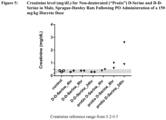
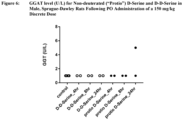
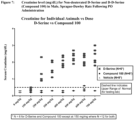
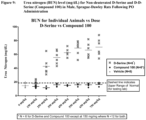
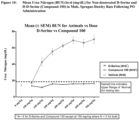
- Clinical pathology data are shown in Figures 4 , 5 and 6 .
- the T max for Compound 100 was 2-fold greater than that of the non-deuterated D-serine.
- the C max and AUC inf for Compound 100 were similar to the non-deuterated D-serine.
- the T max , C max and AUC inf for non-deuterated D-serine were 0.333 hr, 180000 ng/mL, and 349000 hr*ng/mL; respectively.
- the T max , C max and AUC inf for Compound 100 were 0.667 hr, 186000 ng/mL, and 383000 hr*ng/mL, respectively.
- the mean plasma, hippocampus, and cortex concentrations at 4 hr were 23283 ng/mL, 6155 ng/g, and 5070 ng/g, respectively.
- the mean plasma, hippocampus, and cortex concentrations at 8 hr were 2038 ng/mL, 4335 ng/g, and 4035 ng/g, respectively.
- the mean plasma, hippocampus, and cortex concentrations at 24 hr were 711 ng/mL, 4200 ng/g, and 2420 ng/g, respectively.
- Compound 100 concentrations in plasma and cortex decreased within 24 hr; however, Compound 100 concentration in hippocampus remained steady at 24 hr.
- Rats received 150 mg/kg of either Compound 100 or non-deuterated D-serine (PO administration). Elevated levels of blood urea nitrogen (BUN) were seen in the non-deuterated D-serine at 8 hr and 24 hr serum samples. Elevated levels of creatinine and Gamma glutamyl transferase (GGT) were seen in the non-deuterated D-serine at 24 hr serum samples. Elevated levels of blood urea nitrogen, creatinine and GGT are suggestive of nephrotoxicity.
- BUN blood urea nitrogen
- GGT Gamma glutamyl transferase
- Table 4 Mean Plasma Pharmacokinetic Parameters (CV%) for non-deuterated D-Serine and Compound 100 in Male, Sprague-Dawley Rats Following PO Administration of a 150 mg/kg Discrete Dose Compound Dose (mg/kg) T max (hr) C max (ng/mL) AUC inf (hr*ng/mL) Non-deuterated D-Serine 150 0.333 (38.7%) 180000 (20.9%) 349000 (29.4%) Compound 100 150 0.667 (38.7%) 2.0X 186000 (24.7%) 383000 (10.5%) Table 5: Mean Plasma, Hippocampus and Cortex Concentration at 4 hr, 8 hr, 24 hr and CV% for Compound 100 in Male, Sprague-Dawley Rats Following PO Administration of a 150 mg/kg Discrete Dose Compound Route Dose (mg/kg) Time Plasma (ng/mL) Hippocampus (ng/g) Cortex (ng/g
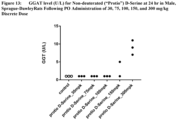
- the pharmacokinetic profile of non-deuterated D-serine was investigated in male Sprague-Dawley rats. The rats were administered a single discrete 30, 75, 100, 150, and 300 mg/kg PO doses of non-deuterated D-serine in 0.5% methylcellulose in water, in the fasted state. Plasma was collected and analyzed for the non-deuterated D-serine. Additional blood was collected and analyzed for the full clinical chemistry profile. The PK parameters for the non-deuterated D-Serine are shown in Table 6. Clinical pathology data are shown in Figure 11, 12 , and 13 .
- the T max was from 0.3 to 0.5 for all doses.
- Increase in exposure in terms of C max and AUC inf was seen as the doses increased from 30 to 300 mg/kg.
- the C max for 30, 75, 100, 150, and 300 mg/kg are 24300, 54300, 96100, 180000, and 216000 ng/mL, respectively.
- the AUC inf for 30, 75, 100, 150, and 300 mg/kg are 50600, 148000, 246000, 349000, and 911000 ng*hr/mL; respectively.
- nephrotoxicity dose response of non-deuterated D-serine was evaluated in male Sprague-Dawley Rats at 30, 75, 100, 150, and 300 mg/kg PO. Elevated levels of urea nitrogen, creatine, and gamma glutamyl transferase (GGT) (which are markers indicative of nephrotoxicity) were seen in the 24 hr samples at the 150 and 300 mg/kg doses compared to control values and reference values provided by Charles River Laboratory.
- GTT gamma glutamyl transferase
- Table 6 Mean Plasma Pharmacokinetic Parameters (CV%) for non-deuterated D-Serine in Male, Sprague-Dawley Rats Following PO Administration of 30, 75, 100, 150, and 300 mg/kg Discrete Dose Compound Dose (mg/kg) T max (hr) C max (ng/mL) AUC inf (ng*h/mL) Non-deuterated D-Serine 30 0.5 24300 (10%) 50600 (9.9%) Non-deuterated D-Serine 75 2.5X 0.5 54300 (13.2%) 2.2X 148000 (14.3%) 2.9X Non-deuterated D-Serine 100 3.3X 0.5 96100 (40.4%) 4.0X 246000 (29.4%) 4.9X Non-deuterated D-Serine 150 5X 0.3 (38.7%) 180000 (20.9%) 7.4X 349000 (29.4%) 6.9X Non-deuterated D-Serine 300 10X 0.5 261000 (32.3%) 10.7X 911000 (6.9%
- Non-deuterated D-serine and deuterated D-serine were administered to male Sprague Dawley rats (intravenous (IV), 5 mg/kg in phosphate-buffered saline (PBS); and orally (PO), 10 mg/kg, 0.5% methylcellulose in water). Three rats were used for each group. Blood was collected at the following time points: for IV dosing: pre-dose, 0.05, 0.167, 0.5, 1, 2, 4, 6, 8 and 12 hours post-dose; for PO dosing: pre-dose, 0.25, 0.5, 1, 2, 4, 6, 8 and 12 hours post-dose PO. Urine was collected at pre-dose (minimum 12 hours), 0-6, 6-12 and 12-24 hours. Plasma samples were analyzed and quantified for dosed compound LC-MS/MS.
- Table 7 Compound Route Dose (mg/kg) Formulation T 1/2 (hr) T max (hr) C max (ng/mL) AUC inf (ng*h/mL)
- Compound 100 PO 10 0.5% Methylcellulose 2.66 0.417 11400 21500
- deuterated D-serine (Compound 100) had a half-life (T 1/2 ) about 1.5-fold longer than for the non-deuterated D-serine; the deuterated and non-deuterated compounds had a similar T max .
- Deuterated D-serine (Compound 100) had a C max about 1.3-fold greater than for the non-deuterated D-serine, and an AUC inf about 1.6-fold greater than for the non-deuterated D-serine.
- non-deuterated D-serine and two deuterated D-serine analogs were administered to male Sprague Dawley rats.
- Example 6 Exemplary Formulation of a D-D-Serine
- a modified-release tablet formulation of a D-D-serine is prepared using the materials shown in the table below: Tablet Strength: 500 mg D-D-serine (e.g., Compound 100) Total Tablet Wt: 855 mg Material Generic Name Wt % Amount per tablet (mg) D-D-Serine N/A 58.5 500.0 I Methocel K100M Hypromellose 30.0 256.5 Vivapur 101 Microcrystalline cellulose 10.0 85.7 Aerosil 200 Colloidal silicon dioxide 0.5 4.3 Magnesium stearate N/A 1.0 8.6 Total 100 855
- Example 9 Evaluation of the Pharmacology of Compound 100 and Non-deuterated D-Serine in an Automated Patch Clamp System (ScreenPatch ⁇ )
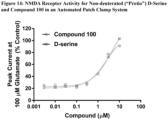
- the activation of the NMDA receptors by Compound 100 and by D-serine was assessed in an automated patch clamp system (ScreenPatch ⁇ ) using HEK293 cells expressing human NMDAR subunits GluN1 and GluN2A.
- a representative graph is depicted in Figure 14 .
- Example 10 Evaluation of the Brain Distribution of Compound 100 in Sprague Dawley Rats after PO Administration
- the distribution profile of Compound 100 was investigated in male Sprague-Dawley rats.
- the rats (4) were administered a single dose of Compound 100 (oral (PO)) at 100 mg/kg.
- oral (PO) oral
- tissues from perfused brain and plasma were collected and analyzed by LC-MS.
- concentration of Compound 100 in the cortex was found to be greater than in plasma or other brain locations.
- the plasma, cortex, brain stem, and cerebellum concentration at 24 hr for Compound 100 are shown in Figure 15 .
- the mean concentrations at 24 hr in the plasma, cortex, brain stem, and cerebellum were 880 ng/mL, 4660 ng/g, 721 ng/g, and 290 ng/g, respectively.
- Example 11 Evaluation of the Concentration of Compound 100 in Sprague Dawley Rats Cortex versus Plasma after 4 Days of PO Administration
- the concentration of Compound 100 in the rat cortex versus time after 4 days of dosing 100 mg/kg is shown in Figure 16 .
- T 1/2 half-life of Compound 100 in the cortex (location of the target) was shown to be approximately 48 hours, in contrast to the much shorter plasma T 1/2 which was shown to be less than 12 hours.
Landscapes
- Health & Medical Sciences (AREA)
- Animal Behavior & Ethology (AREA)
- Chemical & Material Sciences (AREA)
- Veterinary Medicine (AREA)
- Medicinal Chemistry (AREA)
- Public Health (AREA)
- General Health & Medical Sciences (AREA)
- Pharmacology & Pharmacy (AREA)
- Life Sciences & Earth Sciences (AREA)
- Bioinformatics & Cheminformatics (AREA)
- Engineering & Computer Science (AREA)
- Epidemiology (AREA)
- Chemical Kinetics & Catalysis (AREA)
- Nuclear Medicine, Radiotherapy & Molecular Imaging (AREA)
- General Chemical & Material Sciences (AREA)
- Organic Chemistry (AREA)
- Neurosurgery (AREA)
- Biomedical Technology (AREA)
- Neurology (AREA)
- Psychiatry (AREA)
- Pain & Pain Management (AREA)
- Nutrition Science (AREA)
- Physiology (AREA)
- Rheumatology (AREA)
- Hospice & Palliative Care (AREA)
- Acyclic And Carbocyclic Compounds In Medicinal Compositions (AREA)
- Medicines That Contain Protein Lipid Enzymes And Other Medicines (AREA)
- Pharmaceuticals Containing Other Organic And Inorganic Compounds (AREA)
Priority Applications (1)
| Application Number | Priority Date | Filing Date | Title |
|---|---|---|---|
| EP25156008.2A EP4560024A3 (en) | 2017-11-22 | 2018-11-21 | Deuterated analogs of d-serine and uses thereof |
Applications Claiming Priority (5)
| Application Number | Priority Date | Filing Date | Title |
|---|---|---|---|
| US201762590109P | 2017-11-22 | 2017-11-22 | |
| US201862636081P | 2018-02-27 | 2018-02-27 | |
| US201862636427P | 2018-02-28 | 2018-02-28 | |
| US201862755157P | 2018-11-02 | 2018-11-02 | |
| PCT/US2018/062263 WO2019104179A1 (en) | 2017-11-22 | 2018-11-21 | Deuterated analogs of d-serine and uses thereof |
Related Child Applications (2)
| Application Number | Title | Priority Date | Filing Date |
|---|---|---|---|
| EP25156008.2A Division EP4560024A3 (en) | 2017-11-22 | 2018-11-21 | Deuterated analogs of d-serine and uses thereof |
| EP25156008.2A Division-Into EP4560024A3 (en) | 2017-11-22 | 2018-11-21 | Deuterated analogs of d-serine and uses thereof |
Publications (2)
| Publication Number | Publication Date |
|---|---|
| EP3713557A1 EP3713557A1 (en) | 2020-09-30 |
| EP3713557B1 true EP3713557B1 (en) | 2025-03-12 |
Family
ID=64755715
Family Applications (2)
| Application Number | Title | Priority Date | Filing Date |
|---|---|---|---|
| EP18825828.9A Active EP3713557B1 (en) | 2017-11-22 | 2018-11-21 | Deuterated analogs of d-serine and uses thereof |
| EP25156008.2A Pending EP4560024A3 (en) | 2017-11-22 | 2018-11-21 | Deuterated analogs of d-serine and uses thereof |
Family Applications After (1)
| Application Number | Title | Priority Date | Filing Date |
|---|---|---|---|
| EP25156008.2A Pending EP4560024A3 (en) | 2017-11-22 | 2018-11-21 | Deuterated analogs of d-serine and uses thereof |
Country Status (13)
| Country | Link |
|---|---|
| US (4) | US20200368193A1 (https=) |
| EP (2) | EP3713557B1 (https=) |
| JP (3) | JP7518765B2 (https=) |
| KR (1) | KR102916897B1 (https=) |
| CN (1) | CN111491629A (https=) |
| AU (2) | AU2018371784B2 (https=) |
| BR (1) | BR112020010156A2 (https=) |
| CA (1) | CA3082834A1 (https=) |
| IL (2) | IL274585B2 (https=) |
| MX (1) | MX2020005336A (https=) |
| PL (1) | PL3713557T3 (https=) |
| TW (1) | TWI886093B (https=) |
| WO (1) | WO2019104179A1 (https=) |
Families Citing this family (6)
| Publication number | Priority date | Publication date | Assignee | Title |
|---|---|---|---|---|
| CN111491629A (zh) * | 2017-11-22 | 2020-08-04 | 康塞特医药品公司 | D-丝氨酸的氘化类似物及其用途 |
| RU2738873C2 (ru) * | 2018-12-29 | 2020-12-17 | Общество С Ограниченной Ответственностью "Сольвекс" (Ооо "Сольвекс") | Препарат для магнитно-резонансной томографии, содержащий дейтерированный саркозин, и способ диагностики с использованием этого препарата |
| WO2020206367A1 (en) * | 2019-04-03 | 2020-10-08 | Concert Pharmaceuticals, Inc. | Processes for the preparation of deuterated d-serine |
| WO2020243638A1 (en) * | 2019-05-30 | 2020-12-03 | Concert Pharmaceuticals, Inc. | Methods of treatment with deuterated analogs of d-serine |
| EP4076461B1 (en) * | 2019-12-19 | 2026-01-28 | Intra-Cellular Therapies, Inc. | Lumateperone for use in schizophrenia treatment |
| US12414948B2 (en) | 2022-05-18 | 2025-09-16 | Intra-Cellular Therapies, Inc. | Methods |
Citations (1)
| Publication number | Priority date | Publication date | Assignee | Title |
|---|---|---|---|---|
| WO2014191992A1 (en) * | 2013-05-28 | 2014-12-04 | Sarah Herzog Memorial Hospital-Ezrath Nashim | Autoimmune-induced glutamatergic receptor dysfunction methods and treatments |
Family Cites Families (30)
| Publication number | Priority date | Publication date | Assignee | Title |
|---|---|---|---|---|
| US4582931A (en) | 1984-12-24 | 1986-04-15 | Merck & Co., Inc. | Preparation of 2-Deutero-D-serine |
| CN1087725C (zh) | 1994-03-25 | 2002-07-17 | 同位素技术有限公司 | 用氘代方法增强药物效果 |
| US6221335B1 (en) | 1994-03-25 | 2001-04-24 | Isotechnika, Inc. | Method of using deuterated calcium channel blockers |
| US6361957B1 (en) | 1999-08-03 | 2002-03-26 | Glytech, Inc. | Assay for D-serine transport antagonist and use for treating psychosis |
| PT871440E (pt) | 1995-12-07 | 2006-07-31 | Daniel C Javitt | Tratamento de sintomas negativos e cognitivos de esquizofrenia com antagonistas da captacao de glicina |
| US5845286A (en) | 1996-12-24 | 1998-12-01 | Colizza; Vincent | Date value reduction system |
| DE1073432T1 (de) * | 1998-04-14 | 2002-02-07 | The General Hospital Corp., Boston | Verwendung von glycinrezeptoragonisten und glycinaufnahmeinhibitoren zur behandlung neuropsychiatrischer beschwerden |
| US6440710B1 (en) | 1998-12-10 | 2002-08-27 | The Scripps Research Institute | Antibody-catalyzed deuteration, tritiation, dedeuteration or detritiation of carbonyl compounds |
| US6258605B1 (en) | 1999-03-26 | 2001-07-10 | Neo Gen Screening, Inc. | Clinical method for the genetic screening of newborns using tandem mass spectrometry |
| GB9925962D0 (en) | 1999-11-02 | 1999-12-29 | Novartis Ag | Organic compounds |
| PT1104760E (pt) | 1999-12-03 | 2003-06-30 | Pfizer Prod Inc | Compostos de sulfamoil-heteroarilpirazole como agentes analgesicos e anti-inflamatorios |
| HU229938B1 (en) | 2001-05-03 | 2015-01-28 | Hoffmann La Roche | Pharmaceutical dosage form of amorphous nelfinavir mesylate |
| TW200413273A (en) | 2002-11-15 | 2004-08-01 | Wako Pure Chem Ind Ltd | Heavy hydrogenation method of heterocyclic rings |
| IL154318A (en) * | 2003-02-06 | 2010-05-31 | Sarah Herzog Memorial Hospital | Pharmaceutical compositions for the treatment of movement disorders |
| US20060094744A1 (en) | 2004-09-29 | 2006-05-04 | Maryanoff Cynthia A | Pharmaceutical dosage forms of stable amorphous rapamycin like compounds |
| CA2602626A1 (en) | 2005-04-11 | 2006-10-19 | Yale University | Method of treating schizophrenia prodrome |
| CN101309917B (zh) | 2005-10-06 | 2013-09-11 | 奥斯拜客斯制药有限公司 | 具有增强治疗性质的胃h+,k+-atp酶氘代抑制剂 |
| US7750168B2 (en) | 2006-02-10 | 2010-07-06 | Sigma-Aldrich Co. | Stabilized deuteroborane-tetrahydrofuran complex |
| JO2630B1 (en) | 2006-04-13 | 2012-06-17 | نوفارتيس ايه جي | Organic compounds |
| US7884124B2 (en) | 2006-06-30 | 2011-02-08 | Sepracor Inc. | Fluoro-substituted inhibitors of D-amino acid oxidase |
| WO2008030382A1 (en) | 2006-09-05 | 2008-03-13 | Schering Corporation | Pharmaceutical combinations for lipid management and in the treatment of atherosclerosis and hepatic steatosis |
| IL188681A0 (en) | 2008-01-09 | 2008-12-29 | Amino Acid Solutions Inc | Pharmaceutical compositions and methods utilizing a d-amino acid |
| WO2012019106A2 (en) | 2010-08-06 | 2012-02-09 | Board Of Regents Of The University Of Nebraska | Positive and negative modulators of nmda receptors |
| US9040581B1 (en) | 2013-02-21 | 2015-05-26 | The Florida State University Research Foundation, Inc. | Methods of treatment using D-serine |
| WO2014205074A2 (en) | 2013-06-18 | 2014-12-24 | The Trustees Of Columbia University In The City Of New York | Devices, compositions and methods for imaging with raman scattering |
| WO2015160470A2 (en) * | 2014-03-20 | 2015-10-22 | The Trustees Of Princeton University | Nadph production by the 10-formyl-thf pathway, and its use in the diagnosis and treatment of disease |
| GB201521903D0 (en) | 2015-12-11 | 2016-01-27 | Electrophoretics Ltd | Isorbaric mass labels |
| EP3465202B1 (en) | 2016-06-02 | 2023-07-05 | Metabolon, Inc. | Mass spectrometry method for detection and quantitation of metabolites |
| CN111491629A (zh) * | 2017-11-22 | 2020-08-04 | 康塞特医药品公司 | D-丝氨酸的氘化类似物及其用途 |
| WO2020243650A1 (en) | 2019-05-29 | 2020-12-03 | Concert Pharmaceuticals, Inc. | Deuterated analogs of d-serine and uses thereof |
-
2018
- 2018-11-21 CN CN201880081985.1A patent/CN111491629A/zh active Pending
- 2018-11-21 US US16/766,194 patent/US20200368193A1/en not_active Abandoned
- 2018-11-21 EP EP18825828.9A patent/EP3713557B1/en active Active
- 2018-11-21 WO PCT/US2018/062263 patent/WO2019104179A1/en not_active Ceased
- 2018-11-21 IL IL274585A patent/IL274585B2/en unknown
- 2018-11-21 KR KR1020207017407A patent/KR102916897B1/ko active Active
- 2018-11-21 MX MX2020005336A patent/MX2020005336A/es unknown
- 2018-11-21 BR BR112020010156-7A patent/BR112020010156A2/pt unknown
- 2018-11-21 CA CA3082834A patent/CA3082834A1/en active Pending
- 2018-11-21 IL IL322463A patent/IL322463A/en unknown
- 2018-11-21 EP EP25156008.2A patent/EP4560024A3/en active Pending
- 2018-11-21 JP JP2020528027A patent/JP7518765B2/ja active Active
- 2018-11-21 PL PL18825828.9T patent/PL3713557T3/pl unknown
- 2018-11-21 AU AU2018371784A patent/AU2018371784B2/en active Active
- 2018-11-22 TW TW107141705A patent/TWI886093B/zh active
-
2019
- 2019-07-02 US US16/459,916 patent/US10668036B2/en active Active
-
2020
- 2020-05-27 US US16/884,652 patent/US12029712B2/en active Active
-
2023
- 2023-06-02 JP JP2023091296A patent/JP7733058B2/ja active Active
-
2024
- 2024-06-03 US US18/731,580 patent/US20250000830A1/en active Pending
-
2025
- 2025-01-17 AU AU2025200345A patent/AU2025200345A1/en active Pending
- 2025-06-24 JP JP2025106389A patent/JP2025138735A/ja active Pending
Patent Citations (1)
| Publication number | Priority date | Publication date | Assignee | Title |
|---|---|---|---|---|
| WO2014191992A1 (en) * | 2013-05-28 | 2014-12-04 | Sarah Herzog Memorial Hospital-Ezrath Nashim | Autoimmune-induced glutamatergic receptor dysfunction methods and treatments |
Non-Patent Citations (3)
| Title |
|---|
| PAUL BARRACLOUGH ET AL: "Two separate and distinct syntheses of stereospecifically deuteriated samples of (2S)-proline", ORGANIC & BIOMOLECULAR CHEMISTRY, 21 April 2006 (2006-04-21), England, pages 1483, XP055558096, Retrieved from the Internet <URL:https://pubs.rsc.org/en/content/articlepdf/1991/c3/c39910001085> DOI: 10.1039/b601097k * |
| PAUL J. REIDER ET AL: "Synthesis of (R)-serine-2-d and its conversion to the broad-spectrum antibiotic fludalanine", THE JOURNAL OF ORGANIC CHEMISTRY, vol. 52, no. 15, 1 July 1987 (1987-07-01), United States, pages 3326 - 3334, XP055422122, ISSN: 0022-3263, DOI: 10.1021/jo00391a029 * |
| YAK-FA CHEUNG ET AL: "Stereospecific synthesis of isotopically labeled serine at carbon 3 and stereochemical analysis of D-serine dehydrase reaction", JOURNAL OF THE AMERICAN CHEMICAL SOCIETY, vol. 98, no. 11, 1 May 1976 (1976-05-01), pages 3397 - 3398, XP055558183, ISSN: 0002-7863, DOI: 10.1021/ja00427a070 * |
Also Published As
| Publication number | Publication date |
|---|---|
| AU2025200345A1 (en) | 2025-02-13 |
| US10668036B2 (en) | 2020-06-02 |
| JP2023123476A (ja) | 2023-09-05 |
| CA3082834A1 (en) | 2019-05-31 |
| US20200390732A1 (en) | 2020-12-17 |
| US20200368193A1 (en) | 2020-11-26 |
| JP7733058B2 (ja) | 2025-09-02 |
| KR20200103662A (ko) | 2020-09-02 |
| US20190328692A1 (en) | 2019-10-31 |
| IL274585B1 (en) | 2025-09-01 |
| KR102916897B1 (ko) | 2026-01-26 |
| JP2021504326A (ja) | 2021-02-15 |
| MX2020005336A (es) | 2020-08-13 |
| US12029712B2 (en) | 2024-07-09 |
| JP7518765B2 (ja) | 2024-07-18 |
| IL274585B2 (en) | 2026-01-01 |
| US20250000830A1 (en) | 2025-01-02 |
| EP4560024A2 (en) | 2025-05-28 |
| TW201924668A (zh) | 2019-07-01 |
| WO2019104179A1 (en) | 2019-05-31 |
| IL274585A (en) | 2020-06-30 |
| CN111491629A (zh) | 2020-08-04 |
| BR112020010156A2 (pt) | 2020-11-10 |
| PL3713557T3 (pl) | 2025-09-22 |
| IL322463A (en) | 2025-09-01 |
| EP4560024A3 (en) | 2025-08-20 |
| EP3713557A1 (en) | 2020-09-30 |
| AU2018371784A1 (en) | 2020-05-28 |
| AU2018371784B2 (en) | 2024-10-17 |
| WO2019104179A4 (en) | 2019-08-01 |
| JP2025138735A (ja) | 2025-09-25 |
| TWI886093B (zh) | 2025-06-11 |
Similar Documents
| Publication | Publication Date | Title |
|---|---|---|
| EP3713557B1 (en) | Deuterated analogs of d-serine and uses thereof | |
| US20110212944A1 (en) | 2-oxo-1-pyrrolidine derivatives | |
| JP2025523693A (ja) | 安定なシロシン塩、エステルおよび抱合体の調製およびそれらの使用 | |
| US20120071554A1 (en) | Deuterated 2-propylpentanoic acid compounds | |
| US20220313640A1 (en) | Deuterated analogs of d-serine and uses thereof | |
| WO2018013625A1 (en) | Deuterated miconazole | |
| US10843993B2 (en) | Deuterated idebenone | |
| EA050051B1 (ru) | Дейтерированные аналоги d-серина и их применение | |
| US20220218641A1 (en) | Methods of treatment with deuterated analogs of d-serine | |
| EP4304655A1 (en) | Fatty acid-bifunctional degrader conjugates and their methods of use | |
| KR20250127049A (ko) | 펜에틸아민 및 카티논 및 이의 입체이성질체 및 이의 전구체의 제조 | |
| BR112020022885B1 (pt) | Processo para preparar um composto e composto | |
| WO2013109692A1 (en) | Deuterated alpha-lipoic acid |
Legal Events
| Date | Code | Title | Description |
|---|---|---|---|
| STAA | Information on the status of an ep patent application or granted ep patent |
Free format text: STATUS: UNKNOWN |
|
| STAA | Information on the status of an ep patent application or granted ep patent |
Free format text: STATUS: THE INTERNATIONAL PUBLICATION HAS BEEN MADE |
|
| PUAI | Public reference made under article 153(3) epc to a published international application that has entered the european phase |
Free format text: ORIGINAL CODE: 0009012 |
|
| STAA | Information on the status of an ep patent application or granted ep patent |
Free format text: STATUS: REQUEST FOR EXAMINATION WAS MADE |
|
| 17P | Request for examination filed |
Effective date: 20200622 |
|
| AK | Designated contracting states |
Kind code of ref document: A1 Designated state(s): AL AT BE BG CH CY CZ DE DK EE ES FI FR GB GR HR HU IE IS IT LI LT LU LV MC MK MT NL NO PL PT RO RS SE SI SK SM TR |
|
| AX | Request for extension of the european patent |
Extension state: BA ME |
|
| DAV | Request for validation of the european patent (deleted) | ||
| DAX | Request for extension of the european patent (deleted) | ||
| STAA | Information on the status of an ep patent application or granted ep patent |
Free format text: STATUS: EXAMINATION IS IN PROGRESS |
|
| 17Q | First examination report despatched |
Effective date: 20230331 |
|
| P01 | Opt-out of the competence of the unified patent court (upc) registered |
Effective date: 20230502 |
|
| GRAP | Despatch of communication of intention to grant a patent |
Free format text: ORIGINAL CODE: EPIDOSNIGR1 |
|
| STAA | Information on the status of an ep patent application or granted ep patent |
Free format text: STATUS: GRANT OF PATENT IS INTENDED |
|
| INTG | Intention to grant announced |
Effective date: 20240606 |
|
| RAP3 | Party data changed (applicant data changed or rights of an application transferred) |
Owner name: CONCERT PHARMACEUTICALS, INC. |
|
| RAP1 | Party data changed (applicant data changed or rights of an application transferred) |
Owner name: SUN PHARMACEUTICAL INDUSTRIES, INC. |
|
| GRAJ | Information related to disapproval of communication of intention to grant by the applicant or resumption of examination proceedings by the epo deleted |
Free format text: ORIGINAL CODE: EPIDOSDIGR1 |
|
| STAA | Information on the status of an ep patent application or granted ep patent |
Free format text: STATUS: EXAMINATION IS IN PROGRESS |
|
| GRAP | Despatch of communication of intention to grant a patent |
Free format text: ORIGINAL CODE: EPIDOSNIGR1 |
|
| STAA | Information on the status of an ep patent application or granted ep patent |
Free format text: STATUS: GRANT OF PATENT IS INTENDED |
|
| INTC | Intention to grant announced (deleted) | ||
| INTG | Intention to grant announced |
Effective date: 20241015 |
|
| GRAS | Grant fee paid |
Free format text: ORIGINAL CODE: EPIDOSNIGR3 |
|
| GRAA | (expected) grant |
Free format text: ORIGINAL CODE: 0009210 |
|
| STAA | Information on the status of an ep patent application or granted ep patent |
Free format text: STATUS: THE PATENT HAS BEEN GRANTED |
|
| AK | Designated contracting states |
Kind code of ref document: B1 Designated state(s): AL AT BE BG CH CY CZ DE DK EE ES FI FR GB GR HR HU IE IS IT LI LT LU LV MC MK MT NL NO PL PT RO RS SE SI SK SM TR |
|
| REG | Reference to a national code |
Ref country code: GB Ref legal event code: FG4D |
|
| REG | Reference to a national code |
Ref country code: CH Ref legal event code: EP |
|
| REG | Reference to a national code |
Ref country code: DE Ref legal event code: R096 Ref document number: 602018080087 Country of ref document: DE |
|
| REG | Reference to a national code |
Ref country code: IE Ref legal event code: FG4D |
|
| REG | Reference to a national code |
Ref country code: NL Ref legal event code: FP |
|
| REG | Reference to a national code |
Ref country code: SE Ref legal event code: TRGR |
|
| PG25 | Lapsed in a contracting state [announced via postgrant information from national office to epo] |
Ref country code: RS Free format text: LAPSE BECAUSE OF FAILURE TO SUBMIT A TRANSLATION OF THE DESCRIPTION OR TO PAY THE FEE WITHIN THE PRESCRIBED TIME-LIMIT Effective date: 20250612 |
|
| PG25 | Lapsed in a contracting state [announced via postgrant information from national office to epo] |
Ref country code: FI Free format text: LAPSE BECAUSE OF FAILURE TO SUBMIT A TRANSLATION OF THE DESCRIPTION OR TO PAY THE FEE WITHIN THE PRESCRIBED TIME-LIMIT Effective date: 20250312 |
|
| PG25 | Lapsed in a contracting state [announced via postgrant information from national office to epo] |
Ref country code: ES Free format text: LAPSE BECAUSE OF FAILURE TO SUBMIT A TRANSLATION OF THE DESCRIPTION OR TO PAY THE FEE WITHIN THE PRESCRIBED TIME-LIMIT Effective date: 20250312 |
|
| REG | Reference to a national code |
Ref country code: LT Ref legal event code: MG9D |
|
| PG25 | Lapsed in a contracting state [announced via postgrant information from national office to epo] |
Ref country code: NO Free format text: LAPSE BECAUSE OF FAILURE TO SUBMIT A TRANSLATION OF THE DESCRIPTION OR TO PAY THE FEE WITHIN THE PRESCRIBED TIME-LIMIT Effective date: 20250612 |
|
| PG25 | Lapsed in a contracting state [announced via postgrant information from national office to epo] |
Ref country code: HR Free format text: LAPSE BECAUSE OF FAILURE TO SUBMIT A TRANSLATION OF THE DESCRIPTION OR TO PAY THE FEE WITHIN THE PRESCRIBED TIME-LIMIT Effective date: 20250312 |
|
| PG25 | Lapsed in a contracting state [announced via postgrant information from national office to epo] |
Ref country code: LV Free format text: LAPSE BECAUSE OF FAILURE TO SUBMIT A TRANSLATION OF THE DESCRIPTION OR TO PAY THE FEE WITHIN THE PRESCRIBED TIME-LIMIT Effective date: 20250312 |
|
| PG25 | Lapsed in a contracting state [announced via postgrant information from national office to epo] |
Ref country code: GR Free format text: LAPSE BECAUSE OF FAILURE TO SUBMIT A TRANSLATION OF THE DESCRIPTION OR TO PAY THE FEE WITHIN THE PRESCRIBED TIME-LIMIT Effective date: 20250613 Ref country code: BG Free format text: LAPSE BECAUSE OF FAILURE TO SUBMIT A TRANSLATION OF THE DESCRIPTION OR TO PAY THE FEE WITHIN THE PRESCRIBED TIME-LIMIT Effective date: 20250312 |
|
| REG | Reference to a national code |
Ref country code: AT Ref legal event code: MK05 Ref document number: 1774462 Country of ref document: AT Kind code of ref document: T Effective date: 20250312 |
|
| PG25 | Lapsed in a contracting state [announced via postgrant information from national office to epo] |
Ref country code: SM Free format text: LAPSE BECAUSE OF FAILURE TO SUBMIT A TRANSLATION OF THE DESCRIPTION OR TO PAY THE FEE WITHIN THE PRESCRIBED TIME-LIMIT Effective date: 20250312 |
|
| PG25 | Lapsed in a contracting state [announced via postgrant information from national office to epo] |
Ref country code: PT Free format text: LAPSE BECAUSE OF FAILURE TO SUBMIT A TRANSLATION OF THE DESCRIPTION OR TO PAY THE FEE WITHIN THE PRESCRIBED TIME-LIMIT Effective date: 20250714 |
|
| PG25 | Lapsed in a contracting state [announced via postgrant information from national office to epo] |
Ref country code: AT Free format text: LAPSE BECAUSE OF FAILURE TO SUBMIT A TRANSLATION OF THE DESCRIPTION OR TO PAY THE FEE WITHIN THE PRESCRIBED TIME-LIMIT Effective date: 20250312 |
|
| PG25 | Lapsed in a contracting state [announced via postgrant information from national office to epo] |
Ref country code: CZ Free format text: LAPSE BECAUSE OF FAILURE TO SUBMIT A TRANSLATION OF THE DESCRIPTION OR TO PAY THE FEE WITHIN THE PRESCRIBED TIME-LIMIT Effective date: 20250312 Ref country code: EE Free format text: LAPSE BECAUSE OF FAILURE TO SUBMIT A TRANSLATION OF THE DESCRIPTION OR TO PAY THE FEE WITHIN THE PRESCRIBED TIME-LIMIT Effective date: 20250312 |
|
| PG25 | Lapsed in a contracting state [announced via postgrant information from national office to epo] |
Ref country code: SK Free format text: LAPSE BECAUSE OF FAILURE TO SUBMIT A TRANSLATION OF THE DESCRIPTION OR TO PAY THE FEE WITHIN THE PRESCRIBED TIME-LIMIT Effective date: 20250312 |
|
| PG25 | Lapsed in a contracting state [announced via postgrant information from national office to epo] |
Ref country code: IS Free format text: LAPSE BECAUSE OF FAILURE TO SUBMIT A TRANSLATION OF THE DESCRIPTION OR TO PAY THE FEE WITHIN THE PRESCRIBED TIME-LIMIT Effective date: 20250712 |
|
| REG | Reference to a national code |
Ref country code: CH Ref legal event code: U11 Free format text: ST27 STATUS EVENT CODE: U-0-0-U10-U11 (AS PROVIDED BY THE NATIONAL OFFICE) Effective date: 20251201 |
|
| PGFP | Annual fee paid to national office [announced via postgrant information from national office to epo] |
Ref country code: NL Payment date: 20251126 Year of fee payment: 8 |
|
| REG | Reference to a national code |
Ref country code: DE Ref legal event code: R097 Ref document number: 602018080087 Country of ref document: DE |
|
| PGFP | Annual fee paid to national office [announced via postgrant information from national office to epo] |
Ref country code: DE Payment date: 20251128 Year of fee payment: 8 |
|
| PGFP | Annual fee paid to national office [announced via postgrant information from national office to epo] |
Ref country code: GB Payment date: 20251127 Year of fee payment: 8 |
|
| PG25 | Lapsed in a contracting state [announced via postgrant information from national office to epo] |
Ref country code: DK Free format text: LAPSE BECAUSE OF FAILURE TO SUBMIT A TRANSLATION OF THE DESCRIPTION OR TO PAY THE FEE WITHIN THE PRESCRIBED TIME-LIMIT Effective date: 20250312 |
|
| PGFP | Annual fee paid to national office [announced via postgrant information from national office to epo] |
Ref country code: IT Payment date: 20251119 Year of fee payment: 8 |
|
| PGFP | Annual fee paid to national office [announced via postgrant information from national office to epo] |
Ref country code: FR Payment date: 20251125 Year of fee payment: 8 |
|
| PLBE | No opposition filed within time limit |
Free format text: ORIGINAL CODE: 0009261 |
|
| STAA | Information on the status of an ep patent application or granted ep patent |
Free format text: STATUS: NO OPPOSITION FILED WITHIN TIME LIMIT |
|
| PGFP | Annual fee paid to national office [announced via postgrant information from national office to epo] |
Ref country code: CH Payment date: 20251201 Year of fee payment: 8 Ref country code: SE Payment date: 20251127 Year of fee payment: 8 |
|
| REG | Reference to a national code |
Ref country code: CH Ref legal event code: L10 Free format text: ST27 STATUS EVENT CODE: U-0-0-L10-L00 (AS PROVIDED BY THE NATIONAL OFFICE) Effective date: 20260121 |
|
| PGFP | Annual fee paid to national office [announced via postgrant information from national office to epo] |
Ref country code: PL Payment date: 20251103 Year of fee payment: 8 |
|
| PGFP | Annual fee paid to national office [announced via postgrant information from national office to epo] |
Ref country code: RO Payment date: 20251110 Year of fee payment: 8 |
|
| 26N | No opposition filed |
Effective date: 20251215 |