EP3708018B1 - Schuheinlegesohlen-rohling und verfahren zum individuellen anpassen eines solchen schuheinlegesohlen-rohlings - Google Patents
Schuheinlegesohlen-rohling und verfahren zum individuellen anpassen eines solchen schuheinlegesohlen-rohlings Download PDFInfo
- Publication number
- EP3708018B1 EP3708018B1 EP19161972.5A EP19161972A EP3708018B1 EP 3708018 B1 EP3708018 B1 EP 3708018B1 EP 19161972 A EP19161972 A EP 19161972A EP 3708018 B1 EP3708018 B1 EP 3708018B1
- Authority
- EP
- European Patent Office
- Prior art keywords
- main body
- cover
- shoe insole
- layer
- shoe
- Prior art date
- Legal status (The legal status is an assumption and is not a legal conclusion. Google has not performed a legal analysis and makes no representation as to the accuracy of the status listed.)
- Active
Links
Images
Classifications
-
- A—HUMAN NECESSITIES
- A43—FOOTWEAR
- A43B—CHARACTERISTIC FEATURES OF FOOTWEAR; PARTS OF FOOTWEAR
- A43B7/00—Footwear with health or hygienic arrangements
- A43B7/14—Footwear with health or hygienic arrangements with foot-supporting parts
- A43B7/1405—Footwear with health or hygienic arrangements with foot-supporting parts with pads or holes on one or more locations, or having an anatomical or curved form
- A43B7/1455—Footwear with health or hygienic arrangements with foot-supporting parts with pads or holes on one or more locations, or having an anatomical or curved form with special properties
- A43B7/1464—Footwear with health or hygienic arrangements with foot-supporting parts with pads or holes on one or more locations, or having an anatomical or curved form with special properties with adjustable pads to allow custom fit
-
- A—HUMAN NECESSITIES
- A43—FOOTWEAR
- A43B—CHARACTERISTIC FEATURES OF FOOTWEAR; PARTS OF FOOTWEAR
- A43B17/00—Insoles for insertion, e.g. footbeds or inlays, for attachment to the shoe after the upper has been joined
- A43B17/003—Insoles for insertion, e.g. footbeds or inlays, for attachment to the shoe after the upper has been joined characterised by the material
- A43B17/006—Insoles for insertion, e.g. footbeds or inlays, for attachment to the shoe after the upper has been joined characterised by the material multilayered
-
- A—HUMAN NECESSITIES
- A43—FOOTWEAR
- A43B—CHARACTERISTIC FEATURES OF FOOTWEAR; PARTS OF FOOTWEAR
- A43B7/00—Footwear with health or hygienic arrangements
-
- A—HUMAN NECESSITIES
- A43—FOOTWEAR
- A43B—CHARACTERISTIC FEATURES OF FOOTWEAR; PARTS OF FOOTWEAR
- A43B9/00—Footwear characterised by the assembling of the individual parts
-
- A—HUMAN NECESSITIES
- A61—MEDICAL OR VETERINARY SCIENCE; HYGIENE
- A61F—FILTERS IMPLANTABLE INTO BLOOD VESSELS; PROSTHESES; DEVICES PROVIDING PATENCY TO, OR PREVENTING COLLAPSING OF, TUBULAR STRUCTURES OF THE BODY, e.g. STENTS; ORTHOPAEDIC, NURSING OR CONTRACEPTIVE DEVICES; FOMENTATION; TREATMENT OR PROTECTION OF EYES OR EARS; BANDAGES, DRESSINGS OR ABSORBENT PADS; FIRST-AID KITS
- A61F5/00—Orthopaedic methods or devices for non-surgical treatment of bones or joints; Nursing devices ; Anti-rape devices
- A61F5/01—Orthopaedic devices, e.g. long-term immobilising or pressure directing devices for treating broken or deformed bones such as splints, casts or braces
- A61F5/14—Special medical insertions for shoes for flat-feet, club-feet or the like
Definitions
- the invention relates to a shoe insole blank, especially a shoe insole blank, which can be used in orthopedics for individual adaptation to the sole of the foot of a wearer of the shoe insole.
- Such shoe insole blanks can be produced from a wide variety of materials, the use of PU foam plastic being widespread recently.
- These blanks can be made from a PU foam plastic sheet material by removing material by milling and / or grinding or preferably by means of the RIM process, the foam plastic being created within a foam mold by combining a polyol with an isocyanate within the closed foam mold.
- a so-called milling block can also be produced, which can be machined by milling or grinding in order to insert an orthopedically effective footbed on the upper side of the blank.
- a shoe insole blank is created in the foaming mold with an orthopedically effective footbed formed directly by the foaming mold.
- Such shoe insole blanks used in orthopedics usually have a preformed, orthopedically effective footbed, which is individually adapted to the foot shape and / or the inner shape of the wearer of the shoe insert, in particular by orthopedic surgeons and / or orthopedic technicians.
- a preformed, orthopedically effective footbed which is individually adapted to the foot shape and / or the inner shape of the wearer of the shoe insert, in particular by orthopedic surgeons and / or orthopedic technicians.
- the shoe insole blanks are provided with suitable covers on the upper side and / or underside. These blankets can be applied over the whole area or only partially, in one layer or in multiple layers to the base body of the shoe insole blank.
- EP 1 967 086 B1 a milling block that can be produced using the RIM process is known, in which an orthopedically effective footbed is introduced on the upper side by milling and / or grinding can be.
- EP 2 929 792 B1 shows an orthopedic shoe insole blank which can be produced using the RIM process and has an essentially shoe insole-like basic shape, which shows a footbed three-dimensionally formed from the shoe plastic on an upper side. In the latter process, the three-dimensionally shaped footbed is formed directly during the RIM foaming process through the appropriate design of the foaming mold.
- DE 10 2009 035 354 A1 shows an orthopedic insert for a safety shoe with a core which is individually adapted to the wearer's foot and on whose side facing the foot a textile cover is glued by means of an adhesive.
- Such an orthopedic insert which is inexpensive to manufacture and yet meets the anti-static requirements of safety shoes, is achieved in that the core is formed from a single material to which graphite is added.
- DE 200 23 245 U1 shows an individually adaptable, in particular orthopedic, shoe insert which has shoe insert elements in the form of an anatonic shaped blank, at least one pad and at least one cover element.
- the blank is covered at least on its surface directed towards the sole of the foot with the cover element, an upper cover, which at least completely covers this.
- the pad is arranged between the blank and the cover element.
- At least the blank and / or the cover element has a thermally re-softenable adhesive on their surface facing one another, by means of which the shoe insole elements are connected to one another in a multiple detachable and reattachable manner.
- blankets can be applied to both the upper side and the lower side.
- such a blanket should only be applied when the shoe insole has been adapted to the individual foot shape of the wearer of the shoe insole, that is to say the base body has been finished.
- the state of the art, in particular EP 2 929 792 B1 suggests to provide the blanket with a TPU layer on the back before it is applied to the three-dimensionally shaped footbed - i.e. after it has been adapted to the foot shape of the footbed - by means of which the blanket can be attached to the foam plastic without any additional additives or adhesives can be ironed on.
- This TPU layer is heated during the ironing process at the same time as the shoe insole blank to such an extent that both the material of the shoe insole blank and the TPU layer are heated above their respective melting temperature and can thus fuse or weld to one another.
- both the material of the shoe insole blank and the TPU layer are heated above their respective melting temperature and can thus fuse or weld to one another.
- the object of the invention to provide an orthopedically effective shoe insole blank which has a three-dimensional footbed and which is provided with a blanket which can be detached from the base body of the shoe insole blank for individual adaptation of the shoe insole blank without the base body being removed or the ceiling is damaged.
- the detached blanket should be able to be attached to the base body again after an adjustment work and be firmly connected to the base body in such a way that the blanket does not slip or even come off under normal conditions of use of the shoe insert.
- the removal and reapplication of the ceiling should be possible with simple means, without the need for costly aids.
- an orthopedic shoe insole blank according to claim 1 which has a shoe insole-like base body made of PU foam plastic.
- the base body of the shoe insert blank has a three-dimensional, orthopedically effective footbed on the upper side.
- a cover is connected to the PU foam plastic of the base body solely by means of a PU layer applied either to the base body or on a blanket.
- the base body can have a cover applied by means of such a PU layer on both the top and the bottom.
- the blank shoe insole according to the invention has a special PU layer between the base body and the upper or lower cover, which can be activated at temperatures above 40 ° C and below the melting temperature of the PU foam plastic to form an adhesive bond, the activated one PU layer remains so viscous that it does not penetrate the material of the respective ceiling.
- a PU layer is used as an adhesive to apply a cover to the top and / or bottom of the base body made of PU material
- the polyurethane (PU) used for the PU layer at temperatures above approx. 40 ° C, preferably above 50 ° C can be activated, ie its adhesive properties increase sharply above the activation temperature.
- the activation temperature should be below the melting temperature of the PU material from which the base body is made. In this way, after the PU layer has been activated, the blanket can be applied to the base body without welding to the PU foam plastic of the base body.
- an adhesion-promoting PU layer for applying a cover to a PU base body selected according to the invention, has a favorable effect on the adhesion of the cover to the base body.
- a PU compound is to be used as an adhesion-promoting PU layer which, above the activation temperature but below the melting temperature, assumes a viscous, pasty and at the same time sticky state, so that the PU layer material does not enter the material of the activated state even in the activated state Ceiling penetrates, especially if the ceiling material is a textile or a textile-like material.
- the PU layer can be heated to activation temperature using a suitable heat source, such as a hot air blower, infrared lamp, microwave or simply an oven.
- a suitable heat source such as a hot air blower, infrared lamp, microwave or simply an oven.
- the layer thickness of the PU layer is very thin compared to the thickness of the ceiling or the base body, so that the PU layer is heated quickly.
- the base body can be brought together with the ceiling, this being done either by means of a suitable device or by hand. This is possible in particular because the PU layer is thin, and so the energy required for activation avoids unnecessary heating of the ceiling or the base body, which means that these two components are only slightly heated and so are held in the hand during the joining phase can.
- activation can be at temperatures between 40 ° C and around 100 ° C. Even if an activation temperature below 50 ° C. appears possible and is covered by the concept of the invention, it should preferably not fall below this in order not to reduce the firm hold of the blanket on the PU foam plastic base body.
- the body temperature of humans is around 37 ° C, so that on hot summer days when walking on hot asphalt, temperatures of over 40 ° C in the shoe can occur, which could possibly result in a relative movement between the blanket and the body of the shoe insole. It is therefore preferred that the activation temperature of the PU compound used is above 50 ° C. so that such relative movements, ie slipping of the ceiling, are excluded.
- the selection of the activation temperature below the melting temperature of the PU foam plastic of the base body prevents, on the one hand, that the energy input when gluing the ceiling to the base body is not too high and, on the other hand, the materials used for the ceiling and for the base body are not melted, which will be discussed later would prevent non-destructive peeling.
- a viscous PU compound with an activation temperature below about 100 ° C also enables the blanket to be detached again from the base body of the shoe insole blank.
- the shoe insole blank with the blanket applied to it is heated to a temperature which is below the melting temperature of the materials used for the blanket or the PU base body, i. H. of the PU foam plastic, but above the activation temperature of the PU layer material, the cover can be detached from the base body in a non-destructive manner, with neither the base body nor the cover being damaged.
- a reliable connection of the blanket to the shoe insole base body is achieved under normal conditions can be done by hand.
- gluing as well as detaching and re-gluing the ceiling to the PU base body.
- the possibility of reapplying the blanket to the base body after a previous detachment offers a wide range of possibilities for the individual adaptation of the shoe insole blank to the individual shape of the sole of the foot of the wearer of the shoe insole.
- the material used according to the invention for the preferably thin and thermally activatable PU layer is an activatable PU material, the PU casting material, a PU-based adhesive, thermoplastic polyurethane (TPU) or some other chemical composition that has below of 40 ° C shows good adhesion behavior with the foam plastic of the base body.
- the material of the PU layer used according to the invention softens above the activation temperature in such a way that it can be applied to the PU foam plastic of the base body, possibly with plastic deformation of the PU layer and, possibly after renewed thermal activation, from the PU base body can be removed again without damaging the base body or the ceiling comes.
- the cover can be applied to the base body in the manner of an adhesive label and detached from it again.
- a shoe insole blank with a basic shape for an orthopedic footbed with an applied blanket can be delivered "preassembled" by the manufacturer of the blank to shoe orthopedic surgeons or orthopedic technicians without the need to send two separate components, as was previously the case in the prior art.
- the usually complex cutting of the blanket by the orthopedic surgeon or orthopedic technician can be dispensed with, since this cutting can already be done by the manufacturer of the shoe insert blank.
- the orthopedic technician still has the option of being able to process the shoe insole base body on all surfaces by removing the blanket at least partially or completely after heating the blank and connecting the blanket to the base body again by activating the viscous PU layer.
- the basic shape which is made available by the manufacturer of the shoe insole blanks, can thus be easily adapted to the sole of the foot of a wearer of a shoe insole or to the shoe in which the shoe insole is to be placed, with comfort or functional Blankets are already available in a suitable shape and size as a sole component.
- the inventive use of a viscous PU compound for gluing a blanket to the base body of a shoe insert blank is preferably applied to the back of the blanket, i.e. the side that comes into contact with the base body of the shoe insole blank.
- the connection between the PU layer and the ceiling is more stable than the connection between the PU layer and the PU base body, so that the PU layer essentially remains on the ceiling after the ceiling has been detached from the base body.
- the base body can also be orthopedically adapted to the sole of the foot of the wearer of the shoe insole on the previously covered surface, for example by milling, grinding, hot forming, plastic deformation or cutting and / or also by applying a pad. The same blanket can then be re-applied to the base body by simply heating the PU layer to the activation temperature.
- the base body is in a foam mold as a milling block or as an already pre-contoured shoe insole blank by means of the RIM process educated.
- the idea of the invention here also includes a partial shape of a shoe insole, in particular a half-sole, the blanket optionally completing the shoe sole shape.
- the PU layer that provides hold is only applied in the area in which the base body and the ceiling overlap one another. Further examples of this are arch wedges or heel wedges or similar elements used in orthopedics that have an orthopedic effect on the wearer of the shoe insole.
- an orthopedic surgeon or an orthopedic technician is provided with a simple option for processing a basic shape for a shoe insole blank, in which he can process the shoe insole base body made of PU material, which has already been provided with a blanket, on all sides and thus individually adjust the basic shape the sole of the foot of the wearer can adapt to the shoe insole.
- the idea of the invention also includes the adaptation of the shoe insole blank according to the invention to the inner shape of the shoe into which the shoe insole is to be inserted. It is also preferred to achieve an optimal orthopedic result when adapting to both sides.
- the shoe orthopedic surgeon is relieved of the effort of cutting and applying glue or similar aids to connect the blanket to the shoe insole base, which not only makes work easier, but also avoids the cumbersome and often unclean handling of adhesives, with the associated soiling the shoe insert and the tools or devices at the orthopedic surgeon.
- the shoe orthopedic technician or shoe orthopedic technician can, after heating the blank shoe insole according to the invention with the blanket applied, to a temperature below the melting temperature of the PU foam plastic of the base body, detach the blanket from the base body and attach the base body to the shape of the sole of the foot of the wearer or to the inner shape of the shoe the shoe insole is to be inserted, and after re-heating / activating the PU layer to a temperature above 40 ° C, but below the melting temperature of the PU base material, apply the blanket to the base body again using pressure.
- the orthopedic surgeon or shoe orthopedic technician can put the same blanket, which he previously detached from the base body of the shoe insole, back onto the processed base body without having to apply an adhesive, such as hot glue or the like, to it again. All he has to do is ensure that the PU layer reaches the activation temperature, which means that he can, for example, manually press the blanket onto the base body. After falling below the activation temperature, the blanket is firmly bonded to the base body as a shoe insert, which is individually adapted to the shape of the foot. The orthopedic surgeon or orthopedic specialist is free to choose his means both for detaching and for reapplying the blanket.
- a simple oven is sufficient, in which he can heat the sole with the applied blanket, or in which he only heats the blanket, for the inventive detachment and reapplication of the blanket.
- Other heat sources are of course also available to the person skilled in the art, such as a microwave oven, a hot air blower, a simple heated plate, etc.
- a person skilled in the art will find diverse solutions for this, all of which are encompassed by the concept of the invention.
- Automated application of the blanket, in particular at the manufacturer of the shoe insole blank, is within the ability of the relevant specialist and is available with various options, such as, for. B. a modification of an ironing device or by means of an infrared or microwave path and a downstream press conceivable.
- the delivery of the blank shoe insole according to the invention with a blanket that has not been applied is covered by the concept of the invention, the blanket or base body being provided with a PU layer that is above a temperature of 40 ° C, preferably above 50 ° C, for bonding with the shoe insole base body is provided.
- the PU compound applied to one of the two parts is preferred.
- the idea of the invention consequently also includes the delivery of the shoe insole base body with an applied PU layer that can be activated according to the invention, but without a cover, since such a layer can be added, for example, by the orthopedic surgeon to complete the shoe insole according to the invention.
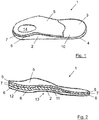
- Figure 1 shows schematically a perspective view of a first embodiment according to the invention.
- the foam plastic shoe insole blank 1 shown has a three-dimensionally designed orthopedically effective footbed on its upper side 3.
- the base body 2 is formed from PU foam plastic material and was preferably produced using the RIM foaming process.
- An upper cover 5 is applied to the base body 2 only in partial areas, so that, for example, the forefoot area 10 and the area of the heel recess 14 are not covered.
- the upper cover 5 was applied to the PU foam plastic material of the base body 2 by means of a PU layer 7.
- the PU layer provided for connecting the top cover 5 to the top 3 of the base body 2 is so thin in relation to the layer thicknesses of the top cover 5 and the base body 2 that it is in Figure 1 appears as a line.
- the PU layer as explained in detail above, is a PU mass that can be activated by means of heat, which shows a significant increase in the adhesive properties at temperatures preferably above 40 ° C, but is / remains so viscous that the material of the PU layer does not penetrate into the material upper cover 5.
- the adhesion activation temperature of the material of the PU layer is below the melting temperature of the PU foam plastic material of the base body 2.
- Figure 2 shows a longitudinal section through a second embodiment of the invention.
- the main body in the embodiment of Figure 2 designed in the manner of a half sole, ie it extends only from the heel area 12 to the metatarsal area 11, the forefoot area 10 not being supported by the base body 2.
- a foot-supporting arch is formed by the base body 2 in the metatarsal area, so that the base body 2 has an orthopedic function at least as a result.
- the shoe insole blank according to FIG Figure 2 an upper cover 5 as well as a lower cover 6, which each have a PU layer 7 with the respective upper side 3 and the lower side 4 with the in the heel and base body 2 formed in the middle area are connected.
- the two mutually facing sides of the upper cover 5 and the lower cover 6 are, for example, directly connected to one another via a PU layer 7 that was previously applied either to the upper cover 5 or the lower cover 6.
- a one-sided application of the PU layer 7 is sufficient for a connection of two PU components according to the invention that can be detached again by means of heat.
- This also means that in this exemplary embodiment - if one of the two covers 5 or 6 is not made of PU material - that cover 5 or 6 preferably also has a PU layer, which then does not necessarily have an adhesion-promoting PU layer according to FIG of the invention.
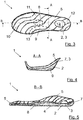
- Figure 3 shows a plan view of a further embodiment of the invention.
- the illustrated orthopedic shoe insole blank 1 is covered over the entire surface with an upper cover 5 on the upper side 3, with the exception of the heel recess 14 in the heel region 12.
- Dashed lines in FIG Figure 3 indicated that the shoe insole blank 1 according to the invention has both a pad 8 and an arch wedge 9 in the metatarsal region 11.
- the person skilled in the art recognizes the arch wedge 9 in the section AA across the shoe insole blank 1, which is shown in FIG Figure 4 is shown.
- the person skilled in the art also recognizes from this illustration that the upper cover 5 is applied to the upper side 3 of the base body 2 by means of a PU layer 7.
- FIG. 5 shown longitudinal section of the shoe insole blank 1 according to Figure 3 illustrates the full-surface covering of the upper side 3 of the base body 2 with an upper cover 5, which is attached to the base body by means of a PU layer 7 to promote adhesion.
- the pad 8 arranged in the metatarsal area 11 can also be seen in section.
- the specialist has many options to adapt the shoe insole orthopedically and creatively with simple means, since he either only needs to heat the PU layer above activation temperature to apply the blanket, or - if he has an already applied blanket from the base body or from another blanket want to solve - you just have to ensure that the shoe insole parts are heated to the point where the activation temperature in the PU layer is reached.
- Simple options such as an oven, a hot air blower or a hot plate, etc. are sufficient for this.
Landscapes
- Health & Medical Sciences (AREA)
- Public Health (AREA)
- General Health & Medical Sciences (AREA)
- Epidemiology (AREA)
- Engineering & Computer Science (AREA)
- Life Sciences & Earth Sciences (AREA)
- Wood Science & Technology (AREA)
- Materials Engineering (AREA)
- Chemical & Material Sciences (AREA)
- Nursing (AREA)
- Orthopedic Medicine & Surgery (AREA)
- Biomedical Technology (AREA)
- Heart & Thoracic Surgery (AREA)
- Vascular Medicine (AREA)
- Animal Behavior & Ethology (AREA)
- Veterinary Medicine (AREA)
- Footwear And Its Accessory, Manufacturing Method And Apparatuses (AREA)
Priority Applications (6)
| Application Number | Priority Date | Filing Date | Title |
|---|---|---|---|
| EP19161972.5A EP3708018B1 (de) | 2019-03-11 | 2019-03-11 | Schuheinlegesohlen-rohling und verfahren zum individuellen anpassen eines solchen schuheinlegesohlen-rohlings |
| ES19161972T ES2874193T3 (es) | 2019-03-11 | 2019-03-11 | Pieza en bruto de plantilla para calzado y procedimiento para la adaptación individual de una pieza en bruto de plantilla para calzado de este tipo |
| PT191619725T PT3708018T (pt) | 2019-03-11 | 2019-03-11 | Sola de sapato em branco e método para personalizar a mesma |
| LTEP19161972.5T LT3708018T (lt) | 2019-03-11 | 2019-03-11 | Batų vidpadžio ruošinys ir jo pritaikymo būdas |
| PL19161972T PL3708018T3 (pl) | 2019-03-11 | 2019-03-11 | Półfabrykat wkładki do buta i sposób do indywidualnego dopasowywania takiego półfabrykatu wkładki do buta |
| RU2020109869A RU2736253C1 (ru) | 2019-03-11 | 2020-03-06 | Заготовка обувной стельки и способ индивидуальной подгонки заготовки обувной стельки |
Applications Claiming Priority (1)
| Application Number | Priority Date | Filing Date | Title |
|---|---|---|---|
| EP19161972.5A EP3708018B1 (de) | 2019-03-11 | 2019-03-11 | Schuheinlegesohlen-rohling und verfahren zum individuellen anpassen eines solchen schuheinlegesohlen-rohlings |
Publications (2)
| Publication Number | Publication Date |
|---|---|
| EP3708018A1 EP3708018A1 (de) | 2020-09-16 |
| EP3708018B1 true EP3708018B1 (de) | 2021-03-10 |
Family
ID=65763388
Family Applications (1)
| Application Number | Title | Priority Date | Filing Date |
|---|---|---|---|
| EP19161972.5A Active EP3708018B1 (de) | 2019-03-11 | 2019-03-11 | Schuheinlegesohlen-rohling und verfahren zum individuellen anpassen eines solchen schuheinlegesohlen-rohlings |
Country Status (6)
| Country | Link |
|---|---|
| EP (1) | EP3708018B1 (pl) |
| ES (1) | ES2874193T3 (pl) |
| LT (1) | LT3708018T (pl) |
| PL (1) | PL3708018T3 (pl) |
| PT (1) | PT3708018T (pl) |
| RU (1) | RU2736253C1 (pl) |
Cited By (1)
| Publication number | Priority date | Publication date | Assignee | Title |
|---|---|---|---|---|
| RU2845575C2 (ru) * | 2022-10-10 | 2025-08-22 | Шпаннрит ГмбХ | Заготовка ортопедической обувной стельки из полиуретанового пенопласта |
Families Citing this family (3)
| Publication number | Priority date | Publication date | Assignee | Title |
|---|---|---|---|---|
| RU204293U1 (ru) * | 2021-01-09 | 2021-05-19 | Дмитрий Юрьевич Барышов | Заготовка для индивидуальной ортопедической стельки |
| US20230180891A1 (en) * | 2021-12-14 | 2023-06-15 | Nike, Inc. | Sole structure for article of footwear |
| ES3015087T3 (en) * | 2022-10-10 | 2025-04-29 | Spannrit Gmbh | Orthopaedic pur foam plastic shoe insole blank |
Family Cites Families (9)
| Publication number | Priority date | Publication date | Assignee | Title |
|---|---|---|---|---|
| DE20023245U1 (de) * | 1999-01-20 | 2003-06-12 | Spannrit Schuhkomponenten Gmbh, 63801 Kleinostheim | Schuheinlagensystem |
| US6782640B2 (en) * | 2001-09-12 | 2004-08-31 | Craig D. Westin | Custom conformable device |
| US7426794B2 (en) * | 2004-01-05 | 2008-09-23 | Robert John Swensen | Insole support system |
| WO2007086806A1 (en) * | 2006-01-25 | 2007-08-02 | New2Ell Pte Ltd | Customizing fitting insole to fit shape and features of individuals |
| US7707751B2 (en) * | 2006-06-16 | 2010-05-04 | Schering-Plough Healthcare Products, Inc. | Adjustable orthotic |
| EP2241207B1 (de) | 2007-03-05 | 2014-08-13 | Spannrit Schuhkomponenten GmbH | Schaumkunststoff-Schuheinlegesohlen-Rohling |
| DE102009035354A1 (de) * | 2009-07-30 | 2011-02-10 | Horn, Pascal | Orthopädische Einlage für einen Sicherheitsschuh |
| RU2531452C9 (ru) * | 2013-08-21 | 2019-02-04 | Эльмар Маисович Султанов | Заготовка для индивидуальной ортопедической стельки и способ ее изготовления |
| PL2929792T3 (pl) | 2014-04-10 | 2017-05-31 | Spannrit Gmbh | Półfabrykat wkładki do obuwia z pianki z tworzywa sztucznego z pokryciem i sposobem jej nanoszenia |
-
2019
- 2019-03-11 LT LTEP19161972.5T patent/LT3708018T/lt unknown
- 2019-03-11 PL PL19161972T patent/PL3708018T3/pl unknown
- 2019-03-11 ES ES19161972T patent/ES2874193T3/es active Active
- 2019-03-11 EP EP19161972.5A patent/EP3708018B1/de active Active
- 2019-03-11 PT PT191619725T patent/PT3708018T/pt unknown
-
2020
- 2020-03-06 RU RU2020109869A patent/RU2736253C1/ru active
Non-Patent Citations (1)
| Title |
|---|
| None * |
Cited By (1)
| Publication number | Priority date | Publication date | Assignee | Title |
|---|---|---|---|---|
| RU2845575C2 (ru) * | 2022-10-10 | 2025-08-22 | Шпаннрит ГмбХ | Заготовка ортопедической обувной стельки из полиуретанового пенопласта |
Also Published As
| Publication number | Publication date |
|---|---|
| LT3708018T (lt) | 2021-07-12 |
| ES2874193T3 (es) | 2021-11-04 |
| PL3708018T3 (pl) | 2021-09-20 |
| RU2736253C1 (ru) | 2020-11-12 |
| EP3708018A1 (de) | 2020-09-16 |
| PT3708018T (pt) | 2021-06-01 |
Similar Documents
| Publication | Publication Date | Title |
|---|---|---|
| EP3708018B1 (de) | Schuheinlegesohlen-rohling und verfahren zum individuellen anpassen eines solchen schuheinlegesohlen-rohlings | |
| DE102018202805A1 (de) | Verbund-Sportartikel | |
| EP2575525B1 (de) | Vorrichtung und verfahren zum anpassen eines schuhs | |
| DE2314963A1 (de) | Brandsohle und verfahren zu ihrer herstellung | |
| AT512305B1 (de) | Vorrichtung und Verfahren zur Herstellung einer an einen Fuß bzw. ein Bein eines Benutzers angepassten Schale eines Schischuhs | |
| EP1967086A1 (de) | Schaumkunststoff-Schuheinlegesohle | |
| DE69830908T2 (de) | Verfahren zum Herstellen von profilierten und laminierten Materialen | |
| DE102010015145B4 (de) | Thermoplastisch verformbare Schuheinlegesohle | |
| EP2929792B1 (de) | Schaumkunststoff-Schuheinlegesohlen-Rohling mit einer Decke und Verfahren zum aufbringen derselbigen | |
| EP3869991B1 (de) | Versteifungselement sowie verfahren zur herstellung eines funktionalen hybriden versteifungselements | |
| EP1887899B1 (de) | Orthopädisch zugerichteter schuh | |
| EP2342987B1 (de) | Integrales Dämpf- und Stützelement | |
| DE102018206906B4 (de) | Einlegesohlen-Fräsblock und Verfahren zum Herstellen eines solchen Fräsblocks | |
| EP2636327B1 (de) | Schuhsohlenkunststoff | |
| EP1021967B1 (de) | Schuheinlagensystem | |
| EP4070681B1 (de) | Orthopädischer schuheinlegesohlenrohling | |
| EP4152998B1 (de) | Einlegesohle | |
| EP3397106B1 (de) | Vorrichtung und verfahren zum anpassen der schale eines skischuhs zu einem fuss | |
| DE60311880T2 (de) | Verfahren zum herstellen von schuhen | |
| EP1090611B1 (de) | Polster mit weichelastischem Bereich | |
| DE3114534A1 (de) | Verfahren zur herstellung einer schuheinlage, insbesondere einer orthopaedischen schuheinlage und eine nach diesem verfahren hergestellte schuheinlage | |
| DE20023245U1 (de) | Schuheinlagensystem | |
| DE19902147C2 (de) | Anatomisch deformter Rohling, Schuheinlagensystem und Verfahren zur Herstellung eines anatomisch geformten Rohlings | |
| EP3183983A1 (de) | Innenschuh mit einem knöchelverstärkungselement aus kunststoff-material | |
| DE10258951B4 (de) | Verfahren zum Herstellen einer Schuheinlage |
Legal Events
| Date | Code | Title | Description |
|---|---|---|---|
| STAA | Information on the status of an ep patent application or granted ep patent |
Free format text: STATUS: EXAMINATION IS IN PROGRESS |
|
| PUAI | Public reference made under article 153(3) epc to a published international application that has entered the european phase |
Free format text: ORIGINAL CODE: 0009012 |
|
| 17P | Request for examination filed |
Effective date: 20200227 |
|
| AK | Designated contracting states |
Kind code of ref document: A1 Designated state(s): AL AT BE BG CH CY CZ DE DK EE ES FI FR GB GR HR HU IE IS IT LI LT LU LV MC MK MT NL NO PL PT RO RS SE SI SK SM TR |
|
| AX | Request for extension of the european patent |
Extension state: BA ME |
|
| GRAP | Despatch of communication of intention to grant a patent |
Free format text: ORIGINAL CODE: EPIDOSNIGR1 |
|
| STAA | Information on the status of an ep patent application or granted ep patent |
Free format text: STATUS: GRANT OF PATENT IS INTENDED |
|
| INTG | Intention to grant announced |
Effective date: 20201006 |
|
| GRAS | Grant fee paid |
Free format text: ORIGINAL CODE: EPIDOSNIGR3 |
|
| GRAA | (expected) grant |
Free format text: ORIGINAL CODE: 0009210 |
|
| STAA | Information on the status of an ep patent application or granted ep patent |
Free format text: STATUS: THE PATENT HAS BEEN GRANTED |
|
| AK | Designated contracting states |
Kind code of ref document: B1 Designated state(s): AL AT BE BG CH CY CZ DE DK EE ES FI FR GB GR HR HU IE IS IT LI LT LU LV MC MK MT NL NO PL PT RO RS SE SI SK SM TR |
|
| REG | Reference to a national code |
Ref country code: GB Ref legal event code: FG4D Free format text: NOT ENGLISH |
|
| REG | Reference to a national code |
Ref country code: CH Ref legal event code: EP Ref country code: AT Ref legal event code: REF Ref document number: 1368804 Country of ref document: AT Kind code of ref document: T Effective date: 20210315 |
|
| REG | Reference to a national code |
Ref country code: DE Ref legal event code: R096 Ref document number: 502019000942 Country of ref document: DE |
|
| REG | Reference to a national code |
Ref country code: IE Ref legal event code: FG4D Free format text: LANGUAGE OF EP DOCUMENT: GERMAN |
|
| REG | Reference to a national code |
Ref country code: PT Ref legal event code: SC4A Ref document number: 3708018 Country of ref document: PT Date of ref document: 20210601 Kind code of ref document: T Free format text: AVAILABILITY OF NATIONAL TRANSLATION Effective date: 20210526 |
|
| REG | Reference to a national code |
Ref country code: DE Ref legal event code: R082 Ref document number: 502019000942 Country of ref document: DE Representative=s name: KUHNEN & WACKER PATENT- UND RECHTSANWALTSBUERO, DE |
|
| REG | Reference to a national code |
Ref country code: RO Ref legal event code: EPE |
|
| REG | Reference to a national code |
Ref country code: SK Ref legal event code: T3 Ref document number: E 37253 Country of ref document: SK |
|
| PG25 | Lapsed in a contracting state [announced via postgrant information from national office to epo] |
Ref country code: NO Free format text: LAPSE BECAUSE OF FAILURE TO SUBMIT A TRANSLATION OF THE DESCRIPTION OR TO PAY THE FEE WITHIN THE PRESCRIBED TIME-LIMIT Effective date: 20210610 Ref country code: GR Free format text: LAPSE BECAUSE OF FAILURE TO SUBMIT A TRANSLATION OF THE DESCRIPTION OR TO PAY THE FEE WITHIN THE PRESCRIBED TIME-LIMIT Effective date: 20210611 Ref country code: FI Free format text: LAPSE BECAUSE OF FAILURE TO SUBMIT A TRANSLATION OF THE DESCRIPTION OR TO PAY THE FEE WITHIN THE PRESCRIBED TIME-LIMIT Effective date: 20210310 Ref country code: HR Free format text: LAPSE BECAUSE OF FAILURE TO SUBMIT A TRANSLATION OF THE DESCRIPTION OR TO PAY THE FEE WITHIN THE PRESCRIBED TIME-LIMIT Effective date: 20210310 Ref country code: BG Free format text: LAPSE BECAUSE OF FAILURE TO SUBMIT A TRANSLATION OF THE DESCRIPTION OR TO PAY THE FEE WITHIN THE PRESCRIBED TIME-LIMIT Effective date: 20210610 |
|
| REG | Reference to a national code |
Ref country code: NL Ref legal event code: MP Effective date: 20210310 |
|
| PG25 | Lapsed in a contracting state [announced via postgrant information from national office to epo] |
Ref country code: SE Free format text: LAPSE BECAUSE OF FAILURE TO SUBMIT A TRANSLATION OF THE DESCRIPTION OR TO PAY THE FEE WITHIN THE PRESCRIBED TIME-LIMIT Effective date: 20210310 Ref country code: RS Free format text: LAPSE BECAUSE OF FAILURE TO SUBMIT A TRANSLATION OF THE DESCRIPTION OR TO PAY THE FEE WITHIN THE PRESCRIBED TIME-LIMIT Effective date: 20210310 |
|
| PG25 | Lapsed in a contracting state [announced via postgrant information from national office to epo] |
Ref country code: NL Free format text: LAPSE BECAUSE OF FAILURE TO SUBMIT A TRANSLATION OF THE DESCRIPTION OR TO PAY THE FEE WITHIN THE PRESCRIBED TIME-LIMIT Effective date: 20210310 |
|
| PG25 | Lapsed in a contracting state [announced via postgrant information from national office to epo] |
Ref country code: SM Free format text: LAPSE BECAUSE OF FAILURE TO SUBMIT A TRANSLATION OF THE DESCRIPTION OR TO PAY THE FEE WITHIN THE PRESCRIBED TIME-LIMIT Effective date: 20210310 Ref country code: EE Free format text: LAPSE BECAUSE OF FAILURE TO SUBMIT A TRANSLATION OF THE DESCRIPTION OR TO PAY THE FEE WITHIN THE PRESCRIBED TIME-LIMIT Effective date: 20210310 |
|
| PG25 | Lapsed in a contracting state [announced via postgrant information from national office to epo] |
Ref country code: IS Free format text: LAPSE BECAUSE OF FAILURE TO SUBMIT A TRANSLATION OF THE DESCRIPTION OR TO PAY THE FEE WITHIN THE PRESCRIBED TIME-LIMIT Effective date: 20210710 |
|
| REG | Reference to a national code |
Ref country code: DE Ref legal event code: R097 Ref document number: 502019000942 Country of ref document: DE |
|
| REG | Reference to a national code |
Ref country code: BE Ref legal event code: MM Effective date: 20210331 |
|
| PLBE | No opposition filed within time limit |
Free format text: ORIGINAL CODE: 0009261 |
|
| STAA | Information on the status of an ep patent application or granted ep patent |
Free format text: STATUS: NO OPPOSITION FILED WITHIN TIME LIMIT |
|
| PG25 | Lapsed in a contracting state [announced via postgrant information from national office to epo] |
Ref country code: DK Free format text: LAPSE BECAUSE OF FAILURE TO SUBMIT A TRANSLATION OF THE DESCRIPTION OR TO PAY THE FEE WITHIN THE PRESCRIBED TIME-LIMIT Effective date: 20210310 Ref country code: AL Free format text: LAPSE BECAUSE OF FAILURE TO SUBMIT A TRANSLATION OF THE DESCRIPTION OR TO PAY THE FEE WITHIN THE PRESCRIBED TIME-LIMIT Effective date: 20210310 Ref country code: LU Free format text: LAPSE BECAUSE OF NON-PAYMENT OF DUE FEES Effective date: 20210311 Ref country code: IE Free format text: LAPSE BECAUSE OF NON-PAYMENT OF DUE FEES Effective date: 20210311 Ref country code: MC Free format text: LAPSE BECAUSE OF FAILURE TO SUBMIT A TRANSLATION OF THE DESCRIPTION OR TO PAY THE FEE WITHIN THE PRESCRIBED TIME-LIMIT Effective date: 20210310 |
|
| 26N | No opposition filed |
Effective date: 20211213 |
|
| PG25 | Lapsed in a contracting state [announced via postgrant information from national office to epo] |
Ref country code: IS Free format text: LAPSE BECAUSE OF FAILURE TO SUBMIT A TRANSLATION OF THE DESCRIPTION OR TO PAY THE FEE WITHIN THE PRESCRIBED TIME-LIMIT Effective date: 20210710 Ref country code: FR Free format text: LAPSE BECAUSE OF NON-PAYMENT OF DUE FEES Effective date: 20210510 |
|
| PG25 | Lapsed in a contracting state [announced via postgrant information from national office to epo] |
Ref country code: BE Free format text: LAPSE BECAUSE OF NON-PAYMENT OF DUE FEES Effective date: 20210331 |
|
| REG | Reference to a national code |
Ref country code: CH Ref legal event code: PL |
|
| PG25 | Lapsed in a contracting state [announced via postgrant information from national office to epo] |
Ref country code: LI Free format text: LAPSE BECAUSE OF NON-PAYMENT OF DUE FEES Effective date: 20220331 Ref country code: CH Free format text: LAPSE BECAUSE OF NON-PAYMENT OF DUE FEES Effective date: 20220331 |
|
| P01 | Opt-out of the competence of the unified patent court (upc) registered |
Effective date: 20230523 |
|
| PG25 | Lapsed in a contracting state [announced via postgrant information from national office to epo] |
Ref country code: CY Free format text: LAPSE BECAUSE OF FAILURE TO SUBMIT A TRANSLATION OF THE DESCRIPTION OR TO PAY THE FEE WITHIN THE PRESCRIBED TIME-LIMIT Effective date: 20210310 |
|
| PG25 | Lapsed in a contracting state [announced via postgrant information from national office to epo] |
Ref country code: SI Free format text: LAPSE BECAUSE OF FAILURE TO SUBMIT A TRANSLATION OF THE DESCRIPTION OR TO PAY THE FEE WITHIN THE PRESCRIBED TIME-LIMIT Effective date: 20210310 Ref country code: HU Free format text: LAPSE BECAUSE OF FAILURE TO SUBMIT A TRANSLATION OF THE DESCRIPTION OR TO PAY THE FEE WITHIN THE PRESCRIBED TIME-LIMIT; INVALID AB INITIO Effective date: 20190311 |
|
| PG25 | Lapsed in a contracting state [announced via postgrant information from national office to epo] |
Ref country code: RO Free format text: LAPSE BECAUSE OF NON-PAYMENT OF DUE FEES Effective date: 20230311 |
|
| PG25 | Lapsed in a contracting state [announced via postgrant information from national office to epo] |
Ref country code: MK Free format text: LAPSE BECAUSE OF FAILURE TO SUBMIT A TRANSLATION OF THE DESCRIPTION OR TO PAY THE FEE WITHIN THE PRESCRIBED TIME-LIMIT Effective date: 20210310 |
|
| PG25 | Lapsed in a contracting state [announced via postgrant information from national office to epo] |
Ref country code: TR Free format text: LAPSE BECAUSE OF FAILURE TO SUBMIT A TRANSLATION OF THE DESCRIPTION OR TO PAY THE FEE WITHIN THE PRESCRIBED TIME-LIMIT Effective date: 20210310 |
|
| PG25 | Lapsed in a contracting state [announced via postgrant information from national office to epo] |
Ref country code: MT Free format text: LAPSE BECAUSE OF FAILURE TO SUBMIT A TRANSLATION OF THE DESCRIPTION OR TO PAY THE FEE WITHIN THE PRESCRIBED TIME-LIMIT Effective date: 20210310 |
|
| PGFP | Annual fee paid to national office [announced via postgrant information from national office to epo] |
Ref country code: DE Payment date: 20250227 Year of fee payment: 7 |
|
| PGFP | Annual fee paid to national office [announced via postgrant information from national office to epo] |
Ref country code: RO Payment date: 20250306 Year of fee payment: 7 Ref country code: LT Payment date: 20250214 Year of fee payment: 7 |
|
| PGFP | Annual fee paid to national office [announced via postgrant information from national office to epo] |
Ref country code: AT Payment date: 20250221 Year of fee payment: 7 |
|
| PGFP | Annual fee paid to national office [announced via postgrant information from national office to epo] |
Ref country code: IT Payment date: 20250227 Year of fee payment: 7 Ref country code: GB Payment date: 20250328 Year of fee payment: 7 |
|
| PGFP | Annual fee paid to national office [announced via postgrant information from national office to epo] |
Ref country code: ES Payment date: 20250401 Year of fee payment: 7 |
|
| PGFP | Annual fee paid to national office [announced via postgrant information from national office to epo] |
Ref country code: PT Payment date: 20251104 Year of fee payment: 8 |
|
| PGFP | Annual fee paid to national office [announced via postgrant information from national office to epo] |
Ref country code: CZ Payment date: 20251105 Year of fee payment: 8 |
|
| PGFP | Annual fee paid to national office [announced via postgrant information from national office to epo] |
Ref country code: LV Payment date: 20251104 Year of fee payment: 8 |
|
| PGFP | Annual fee paid to national office [announced via postgrant information from national office to epo] |
Ref country code: PL Payment date: 20251105 Year of fee payment: 8 |
|
| PGFP | Annual fee paid to national office [announced via postgrant information from national office to epo] |
Ref country code: SK Payment date: 20251104 Year of fee payment: 8 |