EP3703652B1 - Funktionalisierte polypeptide zur verwendung bei der haarbehandlung - Google Patents
Funktionalisierte polypeptide zur verwendung bei der haarbehandlung Download PDFInfo
- Publication number
- EP3703652B1 EP3703652B1 EP18851777.5A EP18851777A EP3703652B1 EP 3703652 B1 EP3703652 B1 EP 3703652B1 EP 18851777 A EP18851777 A EP 18851777A EP 3703652 B1 EP3703652 B1 EP 3703652B1
- Authority
- EP
- European Patent Office
- Prior art keywords
- cosmetic composition
- hair
- amino acid
- composition according
- groups
- Prior art date
- Legal status (The legal status is an assumption and is not a legal conclusion. Google has not performed a legal analysis and makes no representation as to the accuracy of the status listed.)
- Active
Links
Images

Classifications
-
- A—HUMAN NECESSITIES
- A61—MEDICAL OR VETERINARY SCIENCE; HYGIENE
- A61K—PREPARATIONS FOR MEDICAL, DENTAL OR TOILETRY PURPOSES
- A61K8/00—Cosmetics or similar toiletry preparations
- A61K8/18—Cosmetics or similar toiletry preparations characterised by the composition
- A61K8/30—Cosmetics or similar toiletry preparations characterised by the composition containing organic compounds
- A61K8/64—Proteins; Peptides; Derivatives or degradation products thereof
-
- A—HUMAN NECESSITIES
- A61—MEDICAL OR VETERINARY SCIENCE; HYGIENE
- A61K—PREPARATIONS FOR MEDICAL, DENTAL OR TOILETRY PURPOSES
- A61K8/00—Cosmetics or similar toiletry preparations
- A61K8/18—Cosmetics or similar toiletry preparations characterised by the composition
- A61K8/30—Cosmetics or similar toiletry preparations characterised by the composition containing organic compounds
- A61K8/64—Proteins; Peptides; Derivatives or degradation products thereof
- A61K8/65—Collagen; Gelatin; Keratin; Derivatives or degradation products thereof
-
- A—HUMAN NECESSITIES
- A61—MEDICAL OR VETERINARY SCIENCE; HYGIENE
- A61Q—SPECIFIC USE OF COSMETICS OR SIMILAR TOILETRY PREPARATIONS
- A61Q5/00—Preparations for care of the hair
- A61Q5/002—Preparations for repairing the hair, e.g. hair cure
-
- A—HUMAN NECESSITIES
- A61—MEDICAL OR VETERINARY SCIENCE; HYGIENE
- A61K—PREPARATIONS FOR MEDICAL, DENTAL OR TOILETRY PURPOSES
- A61K2800/00—Properties of cosmetic compositions or active ingredients thereof or formulation aids used therein and process related aspects
- A61K2800/80—Process related aspects concerning the preparation of the cosmetic composition or the storage or application thereof
- A61K2800/82—Preparation or application process involves sonication or ultrasonication
Definitions
- the present invention relates to the field of cosmetics, and more specifically to, cosmetic compositions and methods useful in treatment and repair as well as protection of hair.
- hair fibers have three components called cuticle, cortex and medulla.
- Hair cortex is made of a cysteine rich protein (keratin) being linked through several disulphide bonds and covered by a thick layer of cuticle.
- the medulla is an inner core of the hair fiber.
- the damage causes changes in the physical properties of the hair fiber.
- Such damage includes premature fracture, longitudinal fibrillation, separation of hair cortex, loss of strength, loss of gloss and/or increased absorption.
- Temporary solutions are available to treat the damaged hair with silicones or other hair conditioners, but as a result these treatments may create more damage to the hair.
- Other treatments such as Reduction methods (Thioglycolic acid or Ammonium Salt) and Oxidation methods (Sodium Bromate, hydrogen peroxides) have been routinely used, but these treatments do not aid in permanent repair of the hair fiber, as the products acting on the hair are eventually washed off when washing and shampooing the hair.
- Oleplex comprising a synthetic molecule, bis-aminopropyl diglycol dimaleate (CAS No. 1629579-82-3 ), that aids in permanent hair repair.
- US2015/0037270 relates to compositions and methods for repairing bonds, for example, disulphide bonds, in hair or on the skin, and discloses crosslinking agent, wherein the crosslinking agent comprises reactive moieties and optionally a linker that links the reactive moieties.
- GB2541137A relates to compositions and methods for repairing bonds, for example, disulphide bonds, in hair or on the skin, and uses a formulation comprising a binding agent, wherein the binding agent contains a linker and two or more reactive functional groups bound to the linker or spacer.
- US20110229568 discloses peptide derivatives and peptidomimetics, having Michael acceptor groups, said peptides being used as inhibitors for transglutaminases, methods for their preparation, pharmaceutical compositions containing said compounds as well as uses of said transglutaminase inhibitors for the treatment of coeliac disease and transglutaminase dependent diseases.
- the disclosed peptide derivatives and peptidomimetics are therefore, as such, not suitable for hair repair.
- US20050176643A1 relates to compounds and methods for treating eating disorders or metabolic syndromes and provides a PYY peptide, which is coupled to a reactive group.
- a reactive group is capable of reacting on a blood component so as to form a stable covalent bond therewith.
- the disclosed compounds are therefore, as such, not suitable for hair repair.
- the object of the present invention is to provide a composition that may be used to treat and repair hair fibres.
- the object is further to provide a composition for hair repair that protects the hair from further damage.
- the object is attained by providing cosmetic composition comprising a functionalized polypeptide.
- the present invention relates to a cosmetic composition
- a cosmetic composition comprising a polypeptide, having a base amino acid sequence and wherein at least two amino acid residue side chains are substituted with functional Michael acceptor groups.
- the present invention relates to a method of treatment of damaged hair fibres, using the cosmetic composition above.
- the present invention relates to the use of the cosmetic composition above in a method of treatment of damaged hair fibres.
- Michael addition there is a Michael donor and a Michael acceptor, wherein the Michael donor has a slightly negative charge and can thus donate electrons.
- a Michael acceptor has a slightly positive charge and may accept electrons.
- thiol group is meant an organosulfur compound R-S-H where R represents an alkyl or other organic substituent.
- the thiol groups discussed are those present on cysteine residues within keratin. Normally, the thiol groups on the cysteines in keratin are bonded by disulphide bridges. Upon damage to the keratin, the disulphide bridges will break and the thiol groups will be free towards the environment as a negatively charged group.
- damaged hair is meant hair fibres having broken disulphide bridges, which results in free thiol groups on the hair fibre.
- Michael thiol click chemistry or Thiol-ene reactions
- Michael thiol reaction, or Thiol-ene reactions can be initiated by a wide variety of catalysts, light, heat or free radical initiators.
- thiol reactive group or functional Michael acceptor group
- any chemical substance that comprises a C C bond and can act as a Michael acceptor.
- base amino acid sequence is meant any base amino acid sequence that may be provided with at least two thiol-reactive groups or Michael acceptor groups.
- Extracellular Matrix (ECM) protein is meant any protein that may naturally be present in the extracellular matrix that provides structural and biochemical support to surrounding cells.
- Collagen is a structural protein in the extracellular space in various connective tissues in animal bodies, and the main component of skin and connective tissue, and it is the main organic component in bone and teeth.
- Fibrillar collagens belong to a family of structurally related collagens that form the characteristic collagen fibril bundles seen in connective tissue. Fibrillar collagen includes collagen type I, II, III, V, and XI.
- Non-fibrillar collagens are a family of structurally-related short-chain collagens that do not form large fibril bundles and include collagen type IV, VI, VI, IX, X, XII, XIII, XVIII, and endostatins (MeSH entry for collagen, available at: https://www.ncbi.nlm.nih.gov/mesh/68003094).
- non-covalent protein-protein interaction hydrogen bonds, ionic interactions, Van der Waals forces, or hydrophobic bonds between proteins.
- a hydrogen bond is the electrostatic attraction between two polar groups that occurs when a hydrogen (H) atom covalently bound to a highly electronegative atom such as nitrogen (N), oxygen (O), or fluorine (F) experiences the electrostatic field of another highly electronegative atom nearby.
- Van der Waals forces are distance dependent interactions between atoms. Unlike ionic or covalent bonds, these attractions are not a result of any chemical electronic bond and so this force is more susceptible to being perturbed and are relatively weak compared to covalent bonds.
- Ionic bonding is a type of chemical bond that involves the electrostatic attraction between oppositely charged ions
- hydrophobic bonding is an observed tendency of nonpolar substances to aggregate in aqueous solution and exclude water molecules.
- the present invention aims to provide cosmetic compositions useful in hair care products for repairing damaged hair fibres, as well as methods for repairing damaged hair and use of cosmetic compositions in such methods. Additionally, the present disclosure aims to provide such a compound that will protect the hair fibre from further damage.
- the invention relates to a cosmetic composition
- a cosmetic composition comprising a polypeptide having a base amino acid sequence and wherein at least two amino acid residue side chains are substituted with functional Michael acceptor groups.
- the at least two amino acid residue side chains substituted with functional Michael acceptor groups are located on the surface of the polypeptide molecule so that said functional Michael acceptor groups are accessible for free thiol groups on other polypeptides, such as those on damaged hair fibres.
- the base amino acid sequence of the polypeptide of the cosmetic composition according to the invention may be the sequence of a natural protein, such as a protein being a normal constituent of the extracellular matrix (ECM) or a synthetic peptide.
- ECM extracellular matrix
- a polypeptide By using a polypeptide, a large molecule for treatment of damaged hair is obtained, and said polypeptide will cover a larger portion of the damaged hair, as compared to the prior art mentioned above.
- a large molecule also makes it possible to conjugate a large number of functional Michael acceptor groups to said molecule.
- the functional Michael acceptor groups are covalently conjugated to any amino acid residues that comprise an amino group or a carboxyl group on a side chain of the base amino acid sequence.
- the amino acid residue may be any natural or unnatural amino acid that has an amino or carboxyl side chain group.
- the amino acid residue comprise an amino group and the substituted amino acid residue will have the formula wherein P is the polypeptide, R is an amino acid side chain, and X is the functional Michael acceptor group.
- R is CH 2 -CH 2 -CH 2 -CH 2 .
- the number of functional Michael acceptor groups, conjugated to the polypeptide is determined by different factors.
- the length of the base amino acid sequence is a first factor that will decide the number of functional Michael acceptor groups conjugated to the polypeptide.
- a second factor is the amount of amino acid residues having an amino and/or carboxylic acid side chain group within the base amino acid sequence. According to the present invention, at least two amino acid residue side chains are substituted with functional Michael acceptor groups. Consequently, the base amino acid sequence will comprise at least two amino acid residues having side chain groups which can be substituted with Michael acceptor functional groups, such as amino or carboxyl side chain groups.
- the amino acid residues to which the functional Michael acceptor groups are conjugated are lysines.
- Lysines have an amino side chain that can easily be derivatized into a Michael acceptor group.
- the base amino acid sequence may preferably comprise at least two lysine residues.
- any unnatural amino acid comprising an amino group or a carboxyl group may also be used within the base amino acid sequence.
- the base amino acid sequence comprised in the polypeptide of the cosmetic composition according to the invention is functionalized with functional Michael acceptor groups that may react with thiol groups as Michael donors.
- the functional Michael acceptor groups may be any Michael acceptors that may be coupled to the base amino acid sequence.
- the functional Michael acceptor groups are preferably chosen from the group comprising acrylic, methacrylic, maleimido or vinyl sulfone groups. These Michael acceptor groups are easily conjugated to an amino side chain on the base amino acid sequence. Furthermore, they are easily conjugated to any lysine residue within the base amino acid sequence.
- the number of amino acids in the base amino acid sequence is preferably from about 25 to about 1000 amino acids.
- the base amino acid sequence may be the sequence of any polypeptide.
- the polypeptide is hydrophilic.
- the base amino acid sequence is the sequence of an Extracellular matrix (ECM) protein, a fragment thereof, or ECM protein mimetic peptide.
- ECM protein may further be chosen from the group comprising of collagen type I, II, III and IV, gelatin, and keratin.
- mimetic is meant that the peptide can structurally mimic the protein being mimicked.
- the base amino acid sequence is the sequence of an ECM protein mimetic peptide, it is preferably the sequence of a collagen mimetic peptide. In this particular case, it means that the collagen mimetic peptide can self-assemble into a triple-helix, and thus can mimic the triple helical assembly of collagen.
- the collagen mimetic peptide may preferably have the following amino acid sequence:
- collagen mimetic peptide When used as the base amino acid sequence in the polypeptide according to the invention, 2, 3 or 4 side chains of amino acid residues are substituted with functional Michael acceptor groups. Preferably 2 or 4 residues are substituted, and more preferably 4 residues are substituted.
- the base amino acid sequence may comprise 2-114 amino acid residues that are substituted with functional Michael acceptor groups.
- 2-114 functional Michael acceptor groups may be present on the polypeptide.
- This non-covalent bonding further strengthens the bonding between the polypeptide of the cosmetic composition according to the invention and the hair fibre.
- the protein-protein interactions may occur both on areas where the hair is damaged, and on non-damaged areas of the same hair fibre.
- treatment of damaged hair is obtained by covalent binding of the free thiol groups on the hair fibre to the polypeptide, as well as non-covalent protein-protein interactions between the polypeptide and the hair fibre.
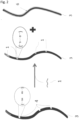
- Fig.1 is a schematic drawing illustrating the polypeptide (1) of the cosmetic composition of the invention having functional Michael acceptors (2) and the hair fibre (3) with free thiol groups (4) present.
- the functional Michael acceptors (2) on the polypeptide (1) will, together with the free thiol groups (4) which are present on the hair fibre (3) as a result broken disulphide bridges, cause a covalent bond (5) between the hair fibre (3) and the polypeptide (1).
- protein-protein interactions will occur between the proteins present in the hair fibre, and the polypeptide, further strengthening the binding between the polypeptide (1) and the hair fibre (3) .
- said polypeptides of the cosmetic composition of the invention will more easily cover a large part of the hair fibre, and may ultimately form a protecting layer surrounding the entire hair fibre.
- a protecting layer is covalently bound to the hair fibre by said Michael thiol click chemistry reaction, as well as bound to the hair fibre by the other interactions specified above.
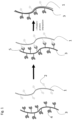
- Fig. 2 illustrates the repair of the broken disulphide bridges (4) on the hair fibre (3) by the polypeptide of the cosmetic composition of the invention (1), as well as the binding of the polypeptide (1) to the rest of the hair fibre by protein-protein interactions. Consequently a protective layer (6) is formed over the entire hair fibre.
- Fig. 3 shows Scanning Electron Microscopic (SEM) pictures of a hair fibre before (a) and after (b) treatment of the hair fibre with a functionalized polypeptide used in the cosmetic composition according to the invention (maleimide collagen type 1).
- a jagged surface is seen, caused by broken disulphide bridges in the hair cortex.
- the surface of the hair fibre is smooth due to a repair of the sulphur-sulphur bridging.
- a set of hair comprising the hair fibres according to the Fig. 3b will be glossy and shiny as well as smooth to the feeling.
- the polypeptide of the cosmetic composition of the invention Due to the covalent links to the hair fibre, accomplished by the Michael thiol click chemistry reactions, the polypeptide of the cosmetic composition of the invention will additionally be more durable, resist wearing off and will not be easily washed off the hair upon washing and shampooing thereof. As a consequence, also the protecting layer formed, attached by both covalent links and protein-protein interactions, will be more durable and not easily washed off. Thus, treatment of the hair with the polypeptide of the cosmetic composition of the invention can be performed less often with maintained effect, as compared to the prior art.
- An additional effect of the polypeptide of the cosmetic composition according to the present invention is that it will provide a moisturizing effect on the hair.
- the moisturizing effect is attained due to the fact that the proteins or peptides used as the base amino acid sequence are hydrophilic and thus will absorb water. This moisturizing property will contribute to a hair that is glossy, shiny and smooth.
- the cosmetic composition may additionally comprise any cosmetically acceptable excipients, and/or carriers.
- the cosmetic composition may be an aqueous cosmetic composition.
- the aqueous cosmetic composition has a pH in the range 7.4-10, such as 7.4, 8, 8.5, 9, 9.5 or 10.
- the cosmetic composition comprises 1-5% of the polypeptide having a base amino acid sequence, wherein at least two amino acid residue side chains are substituted with functional Michael acceptor groups, which can form covalent bonds with nucleophilic functional groups, such as 1%, 2%, 3%, 4% or 5% of the polypeptide.
- the cosmetic composition may further comprise a photoinitiator.
- a photoinitiator is 2-Hydroxy-4'-(2-hydroxyethoxy)-2-methylpropiophenone (also known as Irgacure 2959).
- a method for treatment and/or repair of damaged hair fibres comprises bringing the cosmetic composition according to the invention, into contact with damaged hair fibres.
- the polypeptide of the cosmetic composition should remain in contact with the damaged hair for a time period sufficient for the Michael acceptor groups on the polypeptide to react with free thiol groups on the damaged hair fibres.
- the time period may be at least 15 minutes, such as at least 20 minutes, or at least 30 minutes.
- additional polypeptide or composition according to the invention may be added to and brought into contact with the damaged hair. Excess polypeptide is then washed away, using a suitable hair cleaning composition.
- the treatment of hair fibres with the cosmetic composition according to the invention should be allowed to proceed for a time period of at least 15 minutes, preferably at least 20 minutes, and more preferably at least 30 minutes.
- the treatment may be performed by a first application of the polypeptide or cosmetic composition to the hair fibres for a first time period, and thereafter a second application of the polypeptide or the cosmetic composition for a second time period, without rinsing the hair fibres with water in between the applications.
- the hair fibres are rinsed with water and optionally washed with a shampoo and optionally a conditioner.
- the treatment may have a duration according to any the specified time periods above.
- the total time period of treatment for a double application should be at least 30 minutes, preferably at least 35 minutes. It may be advantageous to allow a longer time period after the second application compared to after the first application.
- Treatment of the hair with the polypeptide of the cosmetic composition according to the invention may be performed once a month, or once every two months, or even less often.
- the inventors have observed that 2 months after treatment of hair with the polypeptide of the cosmetic composition according to the invention, no changes to the hair morphology from what is shown in Fig. 3b was observed. This is due to the covalent attachment of the functional Michael acceptor groups to the base amino acid sequence, which is not easily broken by every day treatments of the hair fibre.
- the polypeptide remains intact as well as covalently bound to the hair fibre. This is compared to the prior art where electrostatic attachments are used within the active ingredient, which are less stable, and consequently may more easily be broken, causing the disulphide bridges to break again.
- a photoinitiator can also be brought into contact with the damaged hair fibres in addition to the polypeptide of the cosmetic composition according to the invention.
- the method then further comprises irradiating the damaged hair fibres with UV-light (e.g. 365 nm) for 30 seconds to 5 minutes.
- UV-light e.g. 365 nm
- the method for treatment of damaged and/or repair of damaged hair fibres may be a cosmetic method.
- the use of the cosmetic composition according to the present invention is provided in a method for repairing damaged hair fibres.
- Freeze dried porcine collagen was purchased from NIPPON meat packers, Japan, collagen mimetic peptide [Gly-(Pro-Lys-Gly) 4 (Pro-Hyp-Gly) 4 (Asp-Hyp-Gly) 4 ] and (Pro-Lys-Gly) 4 (Pro-Hyp-Gly) 4 (Asp-Hyp-Gly) 4 were synthesized on a Symphony automated peptide synthesizer (Protein Technologies Inc., Arlington, AZ, U.S.A.).
- Type A gelatin from porcine skin (gel strength 300 bloom), Sodium hydroxide, methacrylic anhydride, 2-Hydroxy-4'-(2-hydroxyethoxy)-2-methylpropiophenone, Dithiothreitol (DTT) and 60% solution of Ammonium thioglycolate (ATG) were purchased from Sigma-Aldrich, St.Louis, USA.
- Acrylic anhydride was purchased from abcr GmbH Germany 3-(Maleimido)propionic acid N-hydroxysuccinimide ester and 6-Maleimidohexanoic acid N-hydroxysuccinimide were purchased from Chem-Impex International, Inc.
- Human hairs were obtained and subjected to disulfide damage by treatment with DTT (3 wt% in water) or ATG (5 wt% in water) for 15 minutes, 30 minutes and 1hr. The hairs were then rinsed for 2 minutes with water, and then dried with a towel.
- Freeze dried collagen / CMP / gelatin was dissolved in Milli Q water and gently stirred.
- the pH of the solution was increased to pH 10 using 2N NaOH and acrylic anhydride / methacrylic anhydride at a molar ratio of 5:1 (with respect to number of lysine amine groups in collagen/CMP) was added subsequently drop-wise at room temperature and stirred for 3 hours.
- the reaction mixture was dialyzed against distilled water using 12-14kDa cutoff dialysis tubing (Spectrum Laboratories, Inc., CA, US) for 2 days to remove reaction by-products and freeze dried and stored at 4°C until further use.
- Freeze dried collagen / CMP / gelatin was dissolved in Milli Q water and the pH of the solution was adjusted to pH 10 using 2N NaOH.
- the solution of 6-Maleimidohexanoic acid N-hydroxysuccinimide in DMSO (3:1 molar ratio with respect to number of lysine amine groups in collagen /CMP) was added drop-wise at room temperature and stirred for 3 hours.
- the reaction mixture was dialyzed against distilled water using 12-14kDa cutoff dialysis tubing (Spectrum Laboratories, Inc., CA, US) for 2 days to remove reaction by-products and freeze dried and stored at 4°C until further use.
- TNBS Tri-nitro benzene sulfonic acid
- TNBS 2,4,6-trinitrobenzenesulfonic acid
- 2mg of dry sample was mixed with 1ml of 4wt% NaHCO3 (pH 8.5) and 1 ml of 0.5wt% TNBS solution at 40°C under mild shaking.
- 3 mL of 6M HCl solution was added and the mixture was heated to 90°C to dissolve any sample residuals. Then the solutions were cooled and extracted three times with anhydrous diethyl ether to remove the unreacted TNBS species.
- UV absorbance of samples was recorded using Shimadzu UV-Vis spectrophotometer (UV-2450) against a blank, prepared by the above procedure, except that the HCl solution was added before the addition of TNBS.
- Functionalized polypetide solution in Milli Q water (0.1-10 % w/w) was applied on the damaged hairs thoroughly using brush.
- the hairs were laid on aluminum foil and allowed to process for 15 minutes.
- the crosslinking solution was applied second time on the hairs and left for 20 minutes.
- the hairs were then washed with shampoo and rinsed thoroughly with water and air dried. The washing and drying step was repeated for 10 times.
- Crosslinking formulation used: Maleimide collagen (1% in water).
- the crosslinking formulation was then applied to the hairs thoroughly using brush or spray, soaking the hairs.
- the crosslinking solution was left to process for (2 -15 minutes).
- the crosslinking solution was applied second time on the hairs and left for 10 -20 minutes.
- the hairs were then washed with shampoo and rinsed thoroughly with water and air dried. The washing and drying step was repeated for 10 times.
- the hair samples treated with crosslinking formulation showed no sign of breakage and showed similar strength and appearance compared to the untreated virgin hair.
- the hair samples treated with crosslinking formulation showed higher thickness and strength and showed more shine and healthier appearance compared to the control samples.
- This method can be applied also using Maleimide collagen mimetic peptide (3 % in water) or Maleimide gelatin (1 - 3% in water).
- the crosslinking formulation was then applied to the hairs thoroughly using brush or spray, soaking the hairs.
- the crosslinking solution was left to process for (2 -15 minutes).
- the crosslinking solution was applied second time on the hairs and left for 10 -20 minutes.
- the hairs were then washed with shampoo and rinsed thoroughly with water and air dried. The washing and drying step was repeated for 10 times.
- the hair samples treated with crosslinking formulation showed no sign of breakage and showed similar strength and appearance compared to the untreated virgin hair.
- the hair samples treated with crosslinking formulation showed higher thickness and strength and showed more shine and healthier appearance compared to the control samples.
- Crosslinking formulation Methacrylated gelatin (3%) + (0.2%) 2-Hydroxy-4'-(2-hydroxyethoxy)-2-methylpropiophenone (Irgacure 2959) in water.
- the crosslinking formulation was then applied to the hairs thoroughly using brush or spray, soaking the hairs.
- the soaked hair sample was exposed to UV light (365 nm) for 30 sec to 5 minutes.
- the crosslinking solution was further left to process for (1-10 minutes).
- the hairs were then washed with shampoo and rinsed thoroughly with water and air dried. The washing and drying step was repeated for 10 times.
- the hair samples treated with crosslinking formulation showed no sign of breakage and showed higher thickness and more shine and healthier appearance compared to the control samples.
- Methacrylated collagen 1% in water
- Methacrylated collagen mimetic peptide 3 % in water
- the strength of hairs after treatment with the functionalized polypeptide as described herein was compared to untreated and damaged hair (treated with ATG / DTT). The comparison was performed by fixing the hair at one end and attaching a weight on the other end. The treated hair can hold approximately 40 g more weight compared to the damaged hair (treated with ATG / DTT).
Landscapes
- Health & Medical Sciences (AREA)
- Life Sciences & Earth Sciences (AREA)
- Animal Behavior & Ethology (AREA)
- General Health & Medical Sciences (AREA)
- Public Health (AREA)
- Veterinary Medicine (AREA)
- Birds (AREA)
- Epidemiology (AREA)
- Dermatology (AREA)
- Cosmetics (AREA)
- Peptides Or Proteins (AREA)
Claims (11)
- Kosmetische Zusammensetzung, die für eine Haarreparatur geeignet ist, umfassend ein Polypeptid mit einer Basenaminosäuresequenz, wobei zumindest zwei Aminosäureresteseitenketten mit funktionellen Michael-Akzeptor-Gruppen substituiert sind, die kovalente Bindungen mit nukleophilen funktionellen Gruppen bilden können.
- Kosmetische Zusammensetzung nach Anspruch 1, wobei die Aminosäureresteseitenketten, die mit funktionellen Michael-Akzeptor-Gruppen substituiert sind, Aminogruppen und/oder Carboxylgruppen umfassen.
- Kosmetische Zusammensetzung nach einem der Ansprüche 1 bis 2, wobei die Aminosäurereste mit Seitenketten, die mit funktionellen Michael-Akzeptor-Gruppen substituiert sind, Lysinreste sind.
- Kosmetische Zusammensetzung nach einem der Ansprüche 1 bis 3, wobei die funktionellen Michael-Akzeptor-Gruppen aus Acryl, Methacryl-, Maleimido- und Vinylsulfongruppen ausgewählt sind.
- Kosmetische Zusammensetzung nach einem der Ansprüche 1 bis 4, wobei die Basenaminosäuresequenz ein Protein extrazellulärer Matrix (ECM) oder ein ECM-Protein mimetisches Peptid ist, wobei das ECM-Protein mimetische Peptid ein kollagenmimetisches Peptid ist, das die Dreichfachhelixassemblierung von Kollagen durch Selbstassemblierung in eine Dreifachhelix nachahmt.
- Kosmetische Zusammensetzung nach Anspruch 5, wobei das ECM-Protein Gelatine, Keratin oder Kollagen von Typ I, II, III oder IV ist.
- Kosmetische Zusammensetzung nach Anspruch 5, wobei das kollagenmimetische Peptid Gly-(Pro-Lys-Gly)4(Pro-Hyp-Gly)4(Asp-Hyp-Gly)4 oder (Pro-Lys-Gly)4(Pro-Hyp-Gly)4(Asp-Hyp-Gly)4 ist, und wobei 2, 3 oder 4 Seitenketten von Aminosäureresten mit funktionellen Michael-Akzeptor-Gruppen substituiert sind.
- Kosmetische Zusammensetzung nach einem der Ansprüche 1 bis 7, die eine wässrige Zusammensetzung mit einem pH-Wert in dem Bereich von 7,4 bis 10 ist.
- Kosmetische Zusammensetzung nach einem der Ansprüche 1 bis 8, die 1 % bis 5 % des Polypeptids umfasst.
- Kosmetisches Verfahren zum Reparieren von geschädigten Haarfasern, das das Inkontaktbringen der kosmetischen Zusammensetzung nach einem der Ansprüche 1 bis 9 mit den beschädigten Haarfasern umfasst.
- Verwendung der kosmetischen Zusammensetzung nach einem der Ansprüche 1 bis 9 in einem Verfahren zum Reparieren von geschädigten Haarfasern, das das Inkontaktbringen der kosmetischen Zusammensetzung mit den geschädigten Haarfasern umfasst.
Applications Claiming Priority (2)
| Application Number | Priority Date | Filing Date | Title |
|---|---|---|---|
| SE1751041A SE1751041A1 (en) | 2017-08-30 | 2017-08-30 | Functionalized polypeptide for hair treatment |
| PCT/SE2018/000020 WO2019045612A1 (en) | 2017-08-30 | 2018-08-24 | FUNCTIONALIZED POLYPEPTIDES USEFUL IN HAIR TREATMENT |
Publications (3)
| Publication Number | Publication Date |
|---|---|
| EP3703652A1 EP3703652A1 (de) | 2020-09-09 |
| EP3703652A4 EP3703652A4 (de) | 2021-12-22 |
| EP3703652B1 true EP3703652B1 (de) | 2025-03-12 |
Family
ID=65525933
Family Applications (1)
| Application Number | Title | Priority Date | Filing Date |
|---|---|---|---|
| EP18851777.5A Active EP3703652B1 (de) | 2017-08-30 | 2018-08-24 | Funktionalisierte polypeptide zur verwendung bei der haarbehandlung |
Country Status (6)
| Country | Link |
|---|---|
| US (1) | US11896705B2 (de) |
| EP (1) | EP3703652B1 (de) |
| JP (1) | JP7066952B2 (de) |
| CA (1) | CA3074428C (de) |
| SE (1) | SE1751041A1 (de) |
| WO (1) | WO2019045612A1 (de) |
Families Citing this family (1)
| Publication number | Priority date | Publication date | Assignee | Title |
|---|---|---|---|---|
| JP2021529154A (ja) * | 2018-04-26 | 2021-10-28 | シブラー ペッター | 損傷したケラチンの治療および/または予防のための方法 |
Family Cites Families (13)
| Publication number | Priority date | Publication date | Assignee | Title |
|---|---|---|---|---|
| WO2000045777A1 (fr) * | 1999-02-01 | 2000-08-10 | Eddy Van Dijk | Composition, kit, procede et dispositif pour le traitment de cheveux |
| US7601691B2 (en) * | 1999-05-17 | 2009-10-13 | Conjuchem Biotechnologies Inc. | Anti-obesity agents |
| DE102006052755A1 (de) * | 2006-11-08 | 2008-05-15 | N-Zyme Biotec Gmbh | Michaelsysteme als Transglutaminaseinhibitoren |
| WO2013023137A2 (en) * | 2011-08-10 | 2013-02-14 | William Marsh Rice University | Multi-hierarchical self-assembly of a collagen mimetic peptide |
| US20150034119A1 (en) * | 2013-08-01 | 2015-02-05 | Liqwd, Inc. | Hair Color Smoothing Compositions and Methods |
| GB2541137B (en) | 2013-08-01 | 2017-11-29 | Liqwd Inc | Method and kits for treating hair |
| US20150037270A1 (en) | 2013-08-01 | 2015-02-05 | Liqwd, Inc. | Compositions and Kits for Hair and Skin |
| WO2015032985A1 (en) * | 2013-09-09 | 2015-03-12 | Uab Ferentis | Transparent hydrogel and method of making the same from functionalized natural polymers |
| US20170296450A1 (en) * | 2014-09-17 | 2017-10-19 | Safewhite, Inc. | Methods and materials for delivering agents to hair, skin, or nails |
| EP3283510B1 (de) * | 2015-04-14 | 2020-08-05 | UAB Ferentis | Mimetisches kollagenpeptid |
| US9597273B2 (en) * | 2015-04-24 | 2017-03-21 | Liqwd, Inc. | Methods for treating relaxed hair |
| KR102043855B1 (ko) * | 2015-12-09 | 2019-11-12 | 주식회사 엘지생활건강 | 표면 개질용 기능성 조성물 |
| JP2021529154A (ja) | 2018-04-26 | 2021-10-28 | シブラー ペッター | 損傷したケラチンの治療および/または予防のための方法 |
-
2017
- 2017-08-30 SE SE1751041A patent/SE1751041A1/en not_active Application Discontinuation
-
2018
- 2018-08-24 EP EP18851777.5A patent/EP3703652B1/de active Active
- 2018-08-24 WO PCT/SE2018/000020 patent/WO2019045612A1/en not_active Ceased
- 2018-08-24 US US16/642,388 patent/US11896705B2/en active Active
- 2018-08-24 JP JP2020512831A patent/JP7066952B2/ja active Active
- 2018-08-24 CA CA3074428A patent/CA3074428C/en active Active
Also Published As
| Publication number | Publication date |
|---|---|
| CA3074428A1 (en) | 2019-03-07 |
| CA3074428C (en) | 2024-02-13 |
| JP7066952B2 (ja) | 2022-05-16 |
| EP3703652A4 (de) | 2021-12-22 |
| JP2020532557A (ja) | 2020-11-12 |
| SE1751041A1 (en) | 2019-03-01 |
| EP3703652A1 (de) | 2020-09-09 |
| US11896705B2 (en) | 2024-02-13 |
| WO2019045612A1 (en) | 2019-03-07 |
| US20200188270A1 (en) | 2020-06-18 |
Similar Documents
| Publication | Publication Date | Title |
|---|---|---|
| AU654076B2 (en) | Method and composition to condition hair and impart semi-permanent hair set retention properties | |
| US20250257107A1 (en) | Recombinant keratins and production thereof | |
| JP2001525822A (ja) | ヘアトリートメント用組成物 | |
| JP2011502171A (ja) | ケラチン誘導体及びそれを製造する方法 | |
| CN112105341A (zh) | 一种处理和/或预防受损角蛋白的方法 | |
| EP3703652B1 (de) | Funktionalisierte polypeptide zur verwendung bei der haarbehandlung | |
| JP2003081785A (ja) | パーマネントウェーブ処理剤およびこれを用いるパーマ方法 | |
| US8747823B2 (en) | Compositions and methods for treating a keratin based substrate | |
| US7622104B2 (en) | Methods for relaxing and re-waving hair comprising at least one reducing agent and at least one hydroxide compound | |
| EP3810081B1 (de) | Kosmetische zusammensetzung zur behandlung von keratinfasern | |
| US20220105014A1 (en) | Chemical membrane complex repair solution and method of using the same | |
| CA1095419A (en) | Polypeptides for cosmetic formulations | |
| Teglia et al. | Proteins in cosmetics | |
| JP7281172B2 (ja) | 化粧料 | |
| Tinoco | The Potential of Multifunctional Proteins and Peptides for Hair Protection and Coloring | |
| WO2025085768A1 (en) | Fusion polypeptides and applications thereof | |
| CN102458352A (zh) | 毛发处理剂及毛发处理剂用原料 | |
| JP7169623B2 (ja) | アルギニンエステルを含有する化粧料 | |
| FR2883288A1 (fr) | Polypeptides modifies de la famille des kap et utilisation en cosmetique | |
| JP2000327545A (ja) | パーマネントウェーブ用第1剤 | |
| JP2003040742A (ja) | パーマネントウェーブ前処理剤 | |
| JPH08165299A (ja) | 可溶性ケラチンおよび化粧料 | |
| JP2000302652A (ja) | 毛髪処理剤 |
Legal Events
| Date | Code | Title | Description |
|---|---|---|---|
| STAA | Information on the status of an ep patent application or granted ep patent |
Free format text: STATUS: THE INTERNATIONAL PUBLICATION HAS BEEN MADE |
|
| PUAI | Public reference made under article 153(3) epc to a published international application that has entered the european phase |
Free format text: ORIGINAL CODE: 0009012 |
|
| STAA | Information on the status of an ep patent application or granted ep patent |
Free format text: STATUS: REQUEST FOR EXAMINATION WAS MADE |
|
| 17P | Request for examination filed |
Effective date: 20200327 |
|
| AK | Designated contracting states |
Kind code of ref document: A1 Designated state(s): AL AT BE BG CH CY CZ DE DK EE ES FI FR GB GR HR HU IE IS IT LI LT LU LV MC MK MT NL NO PL PT RO RS SE SI SK SM TR |
|
| AX | Request for extension of the european patent |
Extension state: BA ME |
|
| DAV | Request for validation of the european patent (deleted) | ||
| DAX | Request for extension of the european patent (deleted) | ||
| TPAC | Observations filed by third parties |
Free format text: ORIGINAL CODE: EPIDOSNTIPA |
|
| A4 | Supplementary search report drawn up and despatched |
Effective date: 20211119 |
|
| RIC1 | Information provided on ipc code assigned before grant |
Ipc: A61Q 5/00 20060101ALI20211115BHEP Ipc: A61K 8/65 20060101ALI20211115BHEP Ipc: A61K 8/64 20060101AFI20211115BHEP |
|
| STAA | Information on the status of an ep patent application or granted ep patent |
Free format text: STATUS: EXAMINATION IS IN PROGRESS |
|
| 17Q | First examination report despatched |
Effective date: 20240527 |
|
| GRAP | Despatch of communication of intention to grant a patent |
Free format text: ORIGINAL CODE: EPIDOSNIGR1 |
|
| STAA | Information on the status of an ep patent application or granted ep patent |
Free format text: STATUS: GRANT OF PATENT IS INTENDED |
|
| INTG | Intention to grant announced |
Effective date: 20241004 |
|
| GRAS | Grant fee paid |
Free format text: ORIGINAL CODE: EPIDOSNIGR3 |
|
| GRAA | (expected) grant |
Free format text: ORIGINAL CODE: 0009210 |
|
| STAA | Information on the status of an ep patent application or granted ep patent |
Free format text: STATUS: THE PATENT HAS BEEN GRANTED |
|
| AK | Designated contracting states |
Kind code of ref document: B1 Designated state(s): AL AT BE BG CH CY CZ DE DK EE ES FI FR GB GR HR HU IE IS IT LI LT LU LV MC MK MT NL NO PL PT RO RS SE SI SK SM TR |
|
| REG | Reference to a national code |
Ref country code: GB Ref legal event code: FG4D |
|
| REG | Reference to a national code |
Ref country code: CH Ref legal event code: EP |
|
| REG | Reference to a national code |
Ref country code: DE Ref legal event code: R096 Ref document number: 602018080107 Country of ref document: DE |
|
| REG | Reference to a national code |
Ref country code: IE Ref legal event code: FG4D |
|
| PG25 | Lapsed in a contracting state [announced via postgrant information from national office to epo] |
Ref country code: RS Free format text: LAPSE BECAUSE OF FAILURE TO SUBMIT A TRANSLATION OF THE DESCRIPTION OR TO PAY THE FEE WITHIN THE PRESCRIBED TIME-LIMIT Effective date: 20250612 |
|
| PG25 | Lapsed in a contracting state [announced via postgrant information from national office to epo] |
Ref country code: FI Free format text: LAPSE BECAUSE OF FAILURE TO SUBMIT A TRANSLATION OF THE DESCRIPTION OR TO PAY THE FEE WITHIN THE PRESCRIBED TIME-LIMIT Effective date: 20250312 |
|
| PG25 | Lapsed in a contracting state [announced via postgrant information from national office to epo] |
Ref country code: ES Free format text: LAPSE BECAUSE OF FAILURE TO SUBMIT A TRANSLATION OF THE DESCRIPTION OR TO PAY THE FEE WITHIN THE PRESCRIBED TIME-LIMIT Effective date: 20250312 |
|
| REG | Reference to a national code |
Ref country code: LT Ref legal event code: MG9D |
|
| PG25 | Lapsed in a contracting state [announced via postgrant information from national office to epo] |
Ref country code: NO Free format text: LAPSE BECAUSE OF FAILURE TO SUBMIT A TRANSLATION OF THE DESCRIPTION OR TO PAY THE FEE WITHIN THE PRESCRIBED TIME-LIMIT Effective date: 20250612 |
|
| PG25 | Lapsed in a contracting state [announced via postgrant information from national office to epo] |
Ref country code: HR Free format text: LAPSE BECAUSE OF FAILURE TO SUBMIT A TRANSLATION OF THE DESCRIPTION OR TO PAY THE FEE WITHIN THE PRESCRIBED TIME-LIMIT Effective date: 20250312 |
|
| REG | Reference to a national code |
Ref country code: NL Ref legal event code: MP Effective date: 20250312 |
|
| PG25 | Lapsed in a contracting state [announced via postgrant information from national office to epo] |
Ref country code: LV Free format text: LAPSE BECAUSE OF FAILURE TO SUBMIT A TRANSLATION OF THE DESCRIPTION OR TO PAY THE FEE WITHIN THE PRESCRIBED TIME-LIMIT Effective date: 20250312 |
|
| PG25 | Lapsed in a contracting state [announced via postgrant information from national office to epo] |
Ref country code: GR Free format text: LAPSE BECAUSE OF FAILURE TO SUBMIT A TRANSLATION OF THE DESCRIPTION OR TO PAY THE FEE WITHIN THE PRESCRIBED TIME-LIMIT Effective date: 20250613 Ref country code: BG Free format text: LAPSE BECAUSE OF FAILURE TO SUBMIT A TRANSLATION OF THE DESCRIPTION OR TO PAY THE FEE WITHIN THE PRESCRIBED TIME-LIMIT Effective date: 20250312 |
|
| REG | Reference to a national code |
Ref country code: AT Ref legal event code: MK05 Ref document number: 1774441 Country of ref document: AT Kind code of ref document: T Effective date: 20250312 |
|
| PG25 | Lapsed in a contracting state [announced via postgrant information from national office to epo] |
Ref country code: NL Free format text: LAPSE BECAUSE OF FAILURE TO SUBMIT A TRANSLATION OF THE DESCRIPTION OR TO PAY THE FEE WITHIN THE PRESCRIBED TIME-LIMIT Effective date: 20250312 |
|
| PG25 | Lapsed in a contracting state [announced via postgrant information from national office to epo] |
Ref country code: SE Free format text: LAPSE BECAUSE OF FAILURE TO SUBMIT A TRANSLATION OF THE DESCRIPTION OR TO PAY THE FEE WITHIN THE PRESCRIBED TIME-LIMIT Effective date: 20250312 |
|
| PG25 | Lapsed in a contracting state [announced via postgrant information from national office to epo] |
Ref country code: SM Free format text: LAPSE BECAUSE OF FAILURE TO SUBMIT A TRANSLATION OF THE DESCRIPTION OR TO PAY THE FEE WITHIN THE PRESCRIBED TIME-LIMIT Effective date: 20250312 |
|
| PG25 | Lapsed in a contracting state [announced via postgrant information from national office to epo] |
Ref country code: PT Free format text: LAPSE BECAUSE OF FAILURE TO SUBMIT A TRANSLATION OF THE DESCRIPTION OR TO PAY THE FEE WITHIN THE PRESCRIBED TIME-LIMIT Effective date: 20250714 |
|
| PGFP | Annual fee paid to national office [announced via postgrant information from national office to epo] |
Ref country code: DE Payment date: 20250829 Year of fee payment: 8 |
|
| PG25 | Lapsed in a contracting state [announced via postgrant information from national office to epo] |
Ref country code: IT Free format text: LAPSE BECAUSE OF FAILURE TO SUBMIT A TRANSLATION OF THE DESCRIPTION OR TO PAY THE FEE WITHIN THE PRESCRIBED TIME-LIMIT Effective date: 20250312 Ref country code: PL Free format text: LAPSE BECAUSE OF FAILURE TO SUBMIT A TRANSLATION OF THE DESCRIPTION OR TO PAY THE FEE WITHIN THE PRESCRIBED TIME-LIMIT Effective date: 20250312 |
|
| PGFP | Annual fee paid to national office [announced via postgrant information from national office to epo] |
Ref country code: BE Payment date: 20250901 Year of fee payment: 8 Ref country code: GB Payment date: 20250829 Year of fee payment: 8 |
|
| PG25 | Lapsed in a contracting state [announced via postgrant information from national office to epo] |
Ref country code: AT Free format text: LAPSE BECAUSE OF FAILURE TO SUBMIT A TRANSLATION OF THE DESCRIPTION OR TO PAY THE FEE WITHIN THE PRESCRIBED TIME-LIMIT Effective date: 20250312 |
|
| PGFP | Annual fee paid to national office [announced via postgrant information from national office to epo] |
Ref country code: FR Payment date: 20250829 Year of fee payment: 8 |
|
| PG25 | Lapsed in a contracting state [announced via postgrant information from national office to epo] |
Ref country code: CZ Free format text: LAPSE BECAUSE OF FAILURE TO SUBMIT A TRANSLATION OF THE DESCRIPTION OR TO PAY THE FEE WITHIN THE PRESCRIBED TIME-LIMIT Effective date: 20250312 Ref country code: EE Free format text: LAPSE BECAUSE OF FAILURE TO SUBMIT A TRANSLATION OF THE DESCRIPTION OR TO PAY THE FEE WITHIN THE PRESCRIBED TIME-LIMIT Effective date: 20250312 |
|
| PGFP | Annual fee paid to national office [announced via postgrant information from national office to epo] |
Ref country code: IE Payment date: 20250829 Year of fee payment: 8 |
|
| PG25 | Lapsed in a contracting state [announced via postgrant information from national office to epo] |
Ref country code: RO Free format text: LAPSE BECAUSE OF FAILURE TO SUBMIT A TRANSLATION OF THE DESCRIPTION OR TO PAY THE FEE WITHIN THE PRESCRIBED TIME-LIMIT Effective date: 20250312 |
|
| PG25 | Lapsed in a contracting state [announced via postgrant information from national office to epo] |
Ref country code: SK Free format text: LAPSE BECAUSE OF FAILURE TO SUBMIT A TRANSLATION OF THE DESCRIPTION OR TO PAY THE FEE WITHIN THE PRESCRIBED TIME-LIMIT Effective date: 20250312 |
|
| PG25 | Lapsed in a contracting state [announced via postgrant information from national office to epo] |
Ref country code: IS Free format text: LAPSE BECAUSE OF FAILURE TO SUBMIT A TRANSLATION OF THE DESCRIPTION OR TO PAY THE FEE WITHIN THE PRESCRIBED TIME-LIMIT Effective date: 20250712 |
|
| REG | Reference to a national code |
Ref country code: DE Ref legal event code: R097 Ref document number: 602018080107 Country of ref document: DE |
|
| PG25 | Lapsed in a contracting state [announced via postgrant information from national office to epo] |
Ref country code: DK Free format text: LAPSE BECAUSE OF FAILURE TO SUBMIT A TRANSLATION OF THE DESCRIPTION OR TO PAY THE FEE WITHIN THE PRESCRIBED TIME-LIMIT Effective date: 20250312 |
|
| PLBE | No opposition filed within time limit |
Free format text: ORIGINAL CODE: 0009261 |
|
| STAA | Information on the status of an ep patent application or granted ep patent |
Free format text: STATUS: NO OPPOSITION FILED WITHIN TIME LIMIT |
|
| REG | Reference to a national code |
Ref country code: CH Ref legal event code: L10 Free format text: ST27 STATUS EVENT CODE: U-0-0-L10-L00 (AS PROVIDED BY THE NATIONAL OFFICE) Effective date: 20260121 |
|
| 26N | No opposition filed |
Effective date: 20251215 |
|
| REG | Reference to a national code |
Ref country code: CH Ref legal event code: H13 Free format text: ST27 STATUS EVENT CODE: U-0-0-H10-H13 (AS PROVIDED BY THE NATIONAL OFFICE) Effective date: 20260324 |
|
| PG25 | Lapsed in a contracting state [announced via postgrant information from national office to epo] |
Ref country code: MC Free format text: LAPSE BECAUSE OF FAILURE TO SUBMIT A TRANSLATION OF THE DESCRIPTION OR TO PAY THE FEE WITHIN THE PRESCRIBED TIME-LIMIT Effective date: 20250312 |
|
| PG25 | Lapsed in a contracting state [announced via postgrant information from national office to epo] |
Ref country code: LU Free format text: LAPSE BECAUSE OF NON-PAYMENT OF DUE FEES Effective date: 20250824 |
|
| PG25 | Lapsed in a contracting state [announced via postgrant information from national office to epo] |
Ref country code: CH Free format text: LAPSE BECAUSE OF NON-PAYMENT OF DUE FEES Effective date: 20250831 |