EP3702397A1 - Verfahren zur herstellung von hydridosilan-oligomeren - Google Patents
Verfahren zur herstellung von hydridosilan-oligomeren Download PDFInfo
- Publication number
- EP3702397A1 EP3702397A1 EP19159383.9A EP19159383A EP3702397A1 EP 3702397 A1 EP3702397 A1 EP 3702397A1 EP 19159383 A EP19159383 A EP 19159383A EP 3702397 A1 EP3702397 A1 EP 3702397A1
- Authority
- EP
- European Patent Office
- Prior art keywords
- hydridosilane
- oligomer
- neopentasilane
- branched
- composition
- Prior art date
- Legal status (The legal status is an assumption and is not a legal conclusion. Google has not performed a legal analysis and makes no representation as to the accuracy of the status listed.)
- Granted
Links
Images

Classifications
-
- C—CHEMISTRY; METALLURGY
- C08—ORGANIC MACROMOLECULAR COMPOUNDS; THEIR PREPARATION OR CHEMICAL WORKING-UP; COMPOSITIONS BASED THEREON
- C08G—MACROMOLECULAR COMPOUNDS OBTAINED OTHERWISE THAN BY REACTIONS ONLY INVOLVING UNSATURATED CARBON-TO-CARBON BONDS
- C08G77/00—Macromolecular compounds obtained by reactions forming a linkage containing silicon with or without sulfur, nitrogen, oxygen or carbon in the main chain of the macromolecule
- C08G77/60—Macromolecular compounds obtained by reactions forming a linkage containing silicon with or without sulfur, nitrogen, oxygen or carbon in the main chain of the macromolecule in which all the silicon atoms are connected by linkages other than oxygen atoms
-
- C—CHEMISTRY; METALLURGY
- C01—INORGANIC CHEMISTRY
- C01B—NON-METALLIC ELEMENTS; COMPOUNDS THEREOF; METALLOIDS OR COMPOUNDS THEREOF NOT COVERED BY SUBCLASS C01C
- C01B33/00—Silicon; Compounds thereof
- C01B33/04—Hydrides of silicon
-
- C—CHEMISTRY; METALLURGY
- C01—INORGANIC CHEMISTRY
- C01B—NON-METALLIC ELEMENTS; COMPOUNDS THEREOF; METALLOIDS OR COMPOUNDS THEREOF NOT COVERED BY SUBCLASS C01C
- C01B33/00—Silicon; Compounds thereof
- C01B33/02—Silicon
- C01B33/021—Preparation
-
- C—CHEMISTRY; METALLURGY
- C09—DYES; PAINTS; POLISHES; NATURAL RESINS; ADHESIVES; COMPOSITIONS NOT OTHERWISE PROVIDED FOR; APPLICATIONS OF MATERIALS NOT OTHERWISE PROVIDED FOR
- C09D—COATING COMPOSITIONS, e.g. PAINTS, VARNISHES OR LACQUERS; FILLING PASTES; CHEMICAL PAINT OR INK REMOVERS; INKS; CORRECTING FLUIDS; WOODSTAINS; PASTES OR SOLIDS FOR COLOURING OR PRINTING; USE OF MATERIALS THEREFOR
- C09D1/00—Coating compositions, e.g. paints, varnishes or lacquers, based on inorganic substances
-
- C—CHEMISTRY; METALLURGY
- C09—DYES; PAINTS; POLISHES; NATURAL RESINS; ADHESIVES; COMPOSITIONS NOT OTHERWISE PROVIDED FOR; APPLICATIONS OF MATERIALS NOT OTHERWISE PROVIDED FOR
- C09D—COATING COMPOSITIONS, e.g. PAINTS, VARNISHES OR LACQUERS; FILLING PASTES; CHEMICAL PAINT OR INK REMOVERS; INKS; CORRECTING FLUIDS; WOODSTAINS; PASTES OR SOLIDS FOR COLOURING OR PRINTING; USE OF MATERIALS THEREFOR
- C09D183/00—Coating compositions based on macromolecular compounds obtained by reactions forming in the main chain of the macromolecule a linkage containing silicon, with or without sulfur, nitrogen, oxygen, or carbon only; Coating compositions based on derivatives of such polymers
- C09D183/16—Coating compositions based on macromolecular compounds obtained by reactions forming in the main chain of the macromolecule a linkage containing silicon, with or without sulfur, nitrogen, oxygen, or carbon only; Coating compositions based on derivatives of such polymers in which all the silicon atoms are connected by linkages other than oxygen atoms
-
- C—CHEMISTRY; METALLURGY
- C09—DYES; PAINTS; POLISHES; NATURAL RESINS; ADHESIVES; COMPOSITIONS NOT OTHERWISE PROVIDED FOR; APPLICATIONS OF MATERIALS NOT OTHERWISE PROVIDED FOR
- C09D—COATING COMPOSITIONS, e.g. PAINTS, VARNISHES OR LACQUERS; FILLING PASTES; CHEMICAL PAINT OR INK REMOVERS; INKS; CORRECTING FLUIDS; WOODSTAINS; PASTES OR SOLIDS FOR COLOURING OR PRINTING; USE OF MATERIALS THEREFOR
- C09D7/00—Features of coating compositions, not provided for in group C09D5/00; Processes for incorporating ingredients in coating compositions
- C09D7/20—Diluents or solvents
-
- H—ELECTRICITY
- H10—SEMICONDUCTOR DEVICES; ELECTRIC SOLID-STATE DEVICES NOT OTHERWISE PROVIDED FOR
- H10P—GENERIC PROCESSES OR APPARATUS FOR THE MANUFACTURE OR TREATMENT OF DEVICES COVERED BY CLASS H10
- H10P14/00—Formation of materials, e.g. in the shape of layers or pillars
- H10P14/20—Formation of materials, e.g. in the shape of layers or pillars of semiconductor materials
- H10P14/26—Formation of materials, e.g. in the shape of layers or pillars of semiconductor materials using liquid deposition
- H10P14/265—Formation of materials, e.g. in the shape of layers or pillars of semiconductor materials using liquid deposition using solutions
-
- H—ELECTRICITY
- H10—SEMICONDUCTOR DEVICES; ELECTRIC SOLID-STATE DEVICES NOT OTHERWISE PROVIDED FOR
- H10P—GENERIC PROCESSES OR APPARATUS FOR THE MANUFACTURE OR TREATMENT OF DEVICES COVERED BY CLASS H10
- H10P14/00—Formation of materials, e.g. in the shape of layers or pillars
- H10P14/20—Formation of materials, e.g. in the shape of layers or pillars of semiconductor materials
- H10P14/34—Deposited materials, e.g. layers
- H10P14/3402—Deposited materials, e.g. layers characterised by the chemical composition
- H10P14/3404—Deposited materials, e.g. layers characterised by the chemical composition being Group IVA materials
- H10P14/3411—Silicon, silicon germanium or germanium
-
- H—ELECTRICITY
- H10—SEMICONDUCTOR DEVICES; ELECTRIC SOLID-STATE DEVICES NOT OTHERWISE PROVIDED FOR
- H10P—GENERIC PROCESSES OR APPARATUS FOR THE MANUFACTURE OR TREATMENT OF DEVICES COVERED BY CLASS H10
- H10P14/00—Formation of materials, e.g. in the shape of layers or pillars
- H10P14/20—Formation of materials, e.g. in the shape of layers or pillars of semiconductor materials
- H10P14/34—Deposited materials, e.g. layers
- H10P14/3451—Structure
- H10P14/3452—Microstructure
- H10P14/3454—Amorphous
-
- H—ELECTRICITY
- H10—SEMICONDUCTOR DEVICES; ELECTRIC SOLID-STATE DEVICES NOT OTHERWISE PROVIDED FOR
- H10P—GENERIC PROCESSES OR APPARATUS FOR THE MANUFACTURE OR TREATMENT OF DEVICES COVERED BY CLASS H10
- H10P14/00—Formation of materials, e.g. in the shape of layers or pillars
- H10P14/20—Formation of materials, e.g. in the shape of layers or pillars of semiconductor materials
- H10P14/38—Formation of materials, e.g. in the shape of layers or pillars of semiconductor materials characterised by treatments done after the formation of the materials
- H10P14/3802—Crystallisation or recrystallisation of non-monocrystalline semiconductor materials, e.g. regrowth
Definitions
- the present invention relates to a method for preparing hydridosilane oligomers and to hydridosilane oligomers obtainable by said method as well as their use.
- the present invention further refers to a method for preparing coating compositions and for preparing silicon-containing layers.
- Hydridosilanes and their oligomers are known in literature as possible starting materials for the production of silicon layers.
- Hydridosilanes are compounds that essentially only contain silicon and hydrogen atoms. Hydridosilanes known in synthetically accessible amounts have 11 or fewer silicon atoms. Hydridosilanes can in principle be gaseous, liquid or solid and -especially in the case of solids- are essentially soluble in aromatic or aliphatic solvents such as toluene or cyclooctane or in other liquid hydridosilanes such as neopentasilane (Si(SiH 3 ) 4 ). Some examples of hydridosilanes are monosilane, disilane, trisilane, cyclopentasilane and neopentasilane.
- hydridosilanes i.e. hydridosilanes with more than 8 silicon atoms
- hydridosilanes with more than 8 silicon atoms
- the oligomerization of cyclic hydridosilanes is characterized by a loss-free conversion of hydridosilane into oligomers, but has the disadvantage that essentially only linear oligomers are formed. As described above, linear oligomers are disadvantageous for the wetting of coatings of conventional substrates, since they usually lead to non-homogeneous layers with many defects.
- the polymerization of hydridosilanes is initiated by UV irradiation.
- a disadvantage of this method is the low absorption of hydridosilanes in the UV range which requires high radiation intensities for successful polymerization. Furthermore, homogeneous energy input is required which is difficult to control.
- Linear and branched hydridosilanes of the formula Si n H 2n+2 are oligomerized by polycondensation.
- a higher hydridosilane molecule is formed from two lower hydridosilane molecules after abstraction of hydrogen and/or relatively small hydridosilyl radicals.
- DE 10 2010 002 405 A1 describes methods for the polycondensation of hydridosilanes, in particular neopentasilane, which proceeds in the absence of a catalyst.
- DE 10 2010 041 842 A1 also refers to a method for the oligomerization of non-cyclic hydridosilanes, in particular neopentasilane.
- the disadvantage of these methods is that the corresponding monomers, e.g. neopentasilane, have to be synthesized in a complex and cost-intensive way.
- EP 0 630 933 A2 describes a method for preparing a condensate which can be converted thermally to a semi-conductive material.
- the condensate is prepared via a dehydro-polymerization reaction of a hydridosilane monomer based on monomers selected from monosilane, disilane and trisilane in the presence of a catalyst comprising at least one metal and/or a metal compound.
- US 5 252 766 and WO 2008/045327 A2 relate to catalyst-supported hydridosilane syntheses, namely methods which comprise the conversion of a hydridosilane compound in the presence of a lanthanide or a transition metal complex.
- a disadvantage of these methods is that the catalysts used have to be removed in a costly and inconvenient manner after completion of the oligomerization.
- the preparation of the corresponding catalyst system is costly and inconvenient.
- the object of the present invention to provide a method for preparing hydridosilane oligomers which utilizes hydridosilane mixtures with a high content of linear hydridosilanes and still provides good coating properties as well as good silicon-containing layers.
- the present invention relates to a hydridosilane oligomer obtainable by the method according to the present invention as well as to a use of hydridosilane oligomers obtained by the method according to the present invention.
- the present invention relates to a method for preparing a coating composition.
- the method for preparing a coating composition comprises (i) preparing hydridosilane oligomers according to the method for preparing hydridosilane oligomers, and (ii) diluting the hydridosilane oligomers with an organic solvent.
- the organic solvent is preferably an organic solvent selected from the group consisting of toluene and cyclooctane.
- the present invention also refers to a method for preparing a silicon-containing layer which comprises (a) preparing hydridosilane oligomers according to the method for preparing hydridosilane oligomers; (b) optionally diluting the hydridosilane oligomers with an organic solvent; (c) applying the hydridosilane oligomer formulation on a substrate; and (d) converting the hydridosilane oligomer formulation into amorphous silicon.
- the organic solvent is preferably selected from the group consisting of toluene and cyclooctane.
- the method of the present invention for preparing hydridosilane oligomers provides hydridosilane oligomers which exhibit good coating properties. Furthermore, it was surprisingly found that significantly increased layer thicknesses of amorphous silicon can be produced by using hydridosilane oligomers produced by the method of the present invention compared to layers produced directly from neopentasilane oligomers.
- the present invention relates to a method for preparing hydridosilane oligomers.
- the method of the present invention for preparing hydridosilane oligomers comprises reacting a hydridosilane composition (I) comprising at least one linear hydridosilane Si n H 2n+2 with n ⁇ 2 in the presence of a branched hydridosilane compound (II).
- the branched hydridosilane compound (II) of the present invention comprises at least one quaternary silicon atom Si(SiR 3 ) 4 , wherein R is chosen from the group consisting of H; Si n H 2n+1 with n ⁇ 1, Si m H 2m with m ⁇ 2; and Si j H 2j-1 with j ⁇ 3.
- the hydridosilane composition (I) preferably comprises 10 to 100 wt.-% of linear hydridosilanes, more preferably 30 to 100 wt.-% of linear hydridosilanes, even more preferably 50 to 100 wt.-% of linear hydridosilanes, most preferably 70 to 100 wt.-% of linear hydridosilanes, and in particular 90 to 100 wt.-% of linear hydridosilanes, based on the total weight of the hydridosilane composition (I).
- a hydridosilane composition (I) consisting of linear hydridosilanes is preferred.
- the hydridosilane composition (I) may further comprise iso-branched hydridosilanes. Iso-branched hydridosilanes means hydridosilanes having at least on SiH(SiR 3 ) 3 group, wherein R is chosen from the group consisting of H; and Si n H 2n+1 with n ⁇ 1.
- the hydridosilane composition (I) comprises at least one linear hydridosilane Si n H 2n+2 , wherein n is 2 to 9.
- the hydridosilane composition (I) of the present invention may comprise hydridosilane mixtures having a mass average molecular weight of M w in the range of 200 to 5000 g/mol, preferably 500 to 4000 g/mol and in particular 1000 to 3000 g/mol, measured by gel permeation chromatography (GPC) as described in the examples.
- GPC gel permeation chromatography
- the branched hydridosilane compound (II) preferably is selected from the group consisting of neopentasilane, neopentasilane oligomer, 2,2-disilyltetrasilane, 2,2-disilylpentasilane, 3,3-disilylpentasilane, 2,2,3-trisilyltetrasilane, 1,1-disilylcyclopentasilane, 2,2,3,3-tetrasilyltetrasilane, 2,2,3-trisilylpentasilane, 2,2,4-trisilylpentasilane, 2,2-disilylhexasilane, 3,3-disilylhexasilane, 1,1-disilylcyclohexasilane, 1,1,2-trisilylcyclopentasilane, 1,1,3-trisilylcyclopentasilane, 2,2-disilylheptasilane
- the neopentasilane oligomer is an oligomer of neopentasilane.
- the neopentasilane oligomer has a weight average molecular weight of M w in the range of 500 to 5000 g/mol, more preferably of 1000 to 4000 g/mol and in particular of 1500 to 3500 g/mol, measured by gel permeation chromatography (GPC) as described in the examples.
- GPC gel permeation chromatography
- the branched hydridosilane compound (II) may consist of neopentasilane and/or neopentasilane oligomer.
- the branched hydridosilane compound (II) consists of 80 to 98 wt.-% of neopentasilane and 2 to 20 wt.-% of a neopentasilane oligomer, more preferably of 85 to 94 wt.-% of neopentasilane and 6 to 15 wt.-% of a neopentasilane oligomer, and in particular of 90 to 92 wt.-% of neopentasilane and 8 to 10 wt.-% of a neopentasilane oligomer, based on the total weight of the branched hydridosilane compound (II).
- the branched hydridosilane compound (II) preferably is present in a range of 0.05 to 50 wt.-%, more preferably 0.1 to 47 wt.-%, even more preferably 1 to 45 wt.-%, most preferably 2 to 43 wt.-%, and in particular 4 to 40 wt.-%, based on the total weight of the hydridosilane composition (I) and the branched hydridosilane compound (II).
- the method of preparing hydridosilane oligomers can in principle be conducted as desired.
- the hydridosilane composition (I) is reacted in the presence of the branched hydridosilane compound (II) in the absence of a catalyst.
- catalyst refers to a substance that causes or accelerates a chemical reaction without itself being affected. Accordingly, the term “catalyst” includes, inter alia, a transition metal.
- transition metal refers to any element in the d-block of the periodic table, including the elements of the 3 rd to 12 th IUPAC group of the periodic table. Moreover, the term “transition metal” further refers to any element in the f-block of the periodic table, including the elements of the lanthanide and actinide series.
- reaction of the hydridosilane composition (I) in the presence of the branched hydridosilane compound (II) is preferably solvent-free.
- a solvent selected from the group consisting of linear, branched or cyclic, saturated, unsaturated or aromatic hydrocarbons with 1 - 12 carbon atoms, alcohols, ethers, carboxylic acids, esters, nitriles, amides, sulfoxides and water can be added to the reaction of hydridosilane composition (I) in the presence of the branched hydridosilane compound (II).
- a dopant can be added before, during or after the reaction of the hydridosilane composition (I) in the presence of the branched hydridosilane compound (II).
- a dopant is understood to mean an elemental polymorph or an element compound of a semimetal of the 13 th or 15 th IUPAC group of the periodic table which is capable of reacting with hydridosilanes with incorporation of at least the semimetal of the 13 th or 15 th IUPAC group of the periodic table to form a semimetal-containing oligomer.
- Corresponding semimetal-containing oligomers are preferentially suitable for the preparation of doped silicon layers.
- the dopant(s) can be added to the reaction of the hydridosilane composition (I) in the presence of the branched hydridosilane compound (II) in proportions of 0.01 to 20 wt.-%, based on the total weight of the hydridosilane composition (I) and the branched hydridosilane compound (II).
- the reaction of the hydridosilane composition (I) in the presence of the branched hydridosilane compound (II) is preferably performed at a temperature in the range of 50 °C to 300 °C, more preferably 60 °C to 250 °C, even more preferably 70 °C to 200 °C, most preferably 90 °C to 180 °C and by irradiating with electromagnetic radiation, preferably in the visible spectral range. Irradiation with electromagnetic radiation is preferably carried out with a suitable light source such as a cold light lamp.
- the present invention relates to a hydridosilane oligomer obtainable by the method for preparing hydridosilane oligomers as described above. It will be appreciated that the various components and their characteristics as well as the respective amounts described above for the method for preparing hydridosilane oligomers apply in the same manner for the hydridosilane oligomer obtainable by this method.
- the hydridosilane oligomer of the present invention can have a mass average molecular weight of M w in the range of 500 to 5000 g/mol, measured by gel permeation chromatography (GPC) as described in the examples. Furthermore, the hydridosilane oligomer of the present invention can have a mass average molecular weight of M w in the range of 1000 to 5000 g/mol, measured by gel permeation chromatography (GPC) as described in the examples.
- GPC gel permeation chromatography
- the hydridosilane oligomers obtainable by the method for preparing hydridosilane oligomers of the present invention are suitable for a multitude of uses. They are particularly suitable for the preparation of formulations and coating compositions as well as for preparing silicon-containing layers. Furthermore, they are particularly suitable - alone or in compositions with further constituents - for production of electronic and optoelectronic component layers. The invention thus also provides for the use of the hydridosilane oligomers obtainable by the method according to the present invention for production of optoelectronic and electronic component layers.
- the present invention relates to a method for preparing a coating composition which comprises (i) preparing a hydridosilane oligomer according to the method for preparing hydridosilane oligomers as described above; and (ii) diluting the hydridosilane oligomer of step (i) with an organic solvent.
- Suitable organic solvents according to the present invention can be selected from the group consisting of linear, branched or cyclic, saturated, unsaturated or aromatic hydrocarbons with 1 - 12 carbon atoms, alcohols, ethers, carboxylic acids, esters, nitriles, amides, sulfoxides and water.
- the inventive coating composition preferably comprises 0.1 to 99 wt.-%, more preferably 10 to 97 wt.-%, most preferably 25 to 95 wt.-%, and in particular 60 to 80 wt.-% of the organic solvent, based on the total weight of the hydridosilane oligomer and the organic solvent.
- the method for preparing a coating composition may further comprise adding substances such as dopants, nanoparticles or additives for adjusting the rheological properties.
- substances such as dopants, nanoparticles or additives for adjusting the rheological properties.
- Suitable dopants are as described above and it will be further appreciated that other corresponding substances are known to those skilled in the art.
- the present invention relates to a method for preparing a silicon-containing layer which comprises (a) preparing a hydridosilane oligomer according to the method for preparing hydridosilane oligomers as described above; (b) optionally diluting the hydridosilane oligomer with an organic solvent; (c) applying the hydridosilane oligomer formulation on a substrate; and (d) converting the hydridosilane composition into amorphous silicon.
- suitable organic solvents and possible weight ranges thereof are as described above for the method for preparing of a coating composition.
- the hydridosilane oligomer formulation results from steps (a) and (b).
- the method for preparing a silicon-containing layer may further comprise adding substances such as dopants, nanoparticles or additives for adjusting the rheological properties to the hydridosilane oligomer formulation.
- substances such as dopants, nanoparticles or additives for adjusting the rheological properties to the hydridosilane oligomer formulation.
- Suitable dopants are as described above and it will be further appreciated that other corresponding substances are known to those skilled in the art.
- suitable substrates for the method for preparing a silicon-containing layer can be selected from the group consisting of glass, quartz glass, graphite, metal, silicon, or of a layer of silicon, indium tin oxide, ZnO:F, ZnO:AI or SnO 2 :F present on a heat-stable support.
- Preferred metals are aluminum, stainless steel, Cr steel, titanium, chromium or molybdenum.
- polymer films e.g. polyether ether ketone (PEEK), polyethylene naphthalate (PEN), polyethylene terephthalate (PET) or polyimides.
- the application step (c) is preferably carried out via gas or liquid phase coating processes such as printing, spraying, aerosol assisted chemical vapor deposition, direct liquid injection chemical vapor deposition, spin-coating, dip-coating, meniscus coating, slit coating, slot-die coating and curtain coating.
- gas or liquid phase coating processes such as printing, spraying, aerosol assisted chemical vapor deposition, direct liquid injection chemical vapor deposition, spin-coating, dip-coating, meniscus coating, slit coating, slot-die coating and curtain coating.
- Suitable printing processes can be selected from the group consisting of flexographic/gravure printing, nano- or microprinting, inkjet printing, offset printing, reverse offset printing, digital offset printing and screen printing.
- aerosol assisted chemical vapor deposition and direct liquid injection chemical vapor deposition should be included among the gas phase processes. Preference is given to application via a liquid phase coating process.
- a pre-crosslinking operation can preferably be conducted via UV irradiation of the liquid film on the substrate, after which the still-liquid film has crosslinked precursor fractions.
- the coated substrate may also preferably be dried prior to conversion (d), in order to remove any solvent present.
- the heating temperature is preferably less than 200 °C.
- the conversion step (d) can be carried out thermally.
- Thermal conversion is preferably effected at temperatures of 200 to 1000 °C, more preferably 250 to 750 °C, and most preferably 300 to 700 °C.
- Corresponding rapid high-energy processes can be effected, for example, by the use of an IR lamp, a hotplate, an oven, a flash lamp, a plasma of suitable gas composition, an RTP system, a microwave system or an electron beam treatment (if required, in the respective preheated or warmed state).
- the conversion step (d) can further be carried out by using electromagnetic radiation, especially with UV light.
- the conversion step (d) may be carried out by electron ion bombardment.
- Typical conversion times are preferably between 0.1 ms and 360 min.
- the conversion time is more preferably between 0.1 ms and 10 min, especially preferably between 1 s and 120 s.
- the silicon-containing layer may further be enriched with hydrogen.
- This process is called hydrogen passivation, which eliminates defects in the material, and can be effected with reactive hydrogen by the hotwire method, with a hydrogen-containing plasma (remotely or directly; under reduced pressure or under atmospheric pressure) or by means of corona treatment or an electron beam treatment with supply of hydrogen.
- a hydrogen-containing plasma remote or directly; under reduced pressure or under atmospheric pressure
- corona treatment or an electron beam treatment with supply of hydrogen.
- the application step (c), the optional pre-crosslinking step, the optional drying step and/or the conversion step (d) can be carried out under oxidizing conditions.
- oxidizing conditions can be established is known to those skilled in the art.
- the amorphous silicon layer may be crystallized by means of introduction of thermal energy, electromagnetic radiation and/or particle bombardment to produce fully or partly crystalline silicon-containing layers. Methods for this purpose are known to those skilled in the art.
- the method for preparing a silicon-containing layer can be conducted simultaneously or more than once in succession with respect to a substrate (simultaneous or successive deposition, in which case the resulting films are partly or completely superposed on one another).
- a method for producing multilayer systems is preferentially suitable for production of systems formed from intrinsic (i.e. undoped) and doped layers, which are essential, for example, for the construction of solar cells.
- the method is more preferably suitable for production of multilayer systems for optimal passivation or avoidance of defects at the interface to the substrate, when a thin intrinsic (i.e. undoped) silicon-containing layer and then a layer having the opposite doping from the substrate are applied to the substrate.
- first an essentially dopant-free formulation and then a formulation having the opposite doping in relation to the substrate are therefore applied to a doped substrate.
- the substrate may be coated on both sides.
- the present invention relates to the use of hydridosilane oligomers obtainable by the method for preparing hydridosilane oligomers as described above for producing optoelectronic or electronic components such as hetero-emitter solar cells, HIT (heterojunction with intrinsic thin layer) solar cells, selective emitter solar cells, back contact solar cells, field-effect transistors, thin film transistors, dielectric layers in microelectronic components, surface passivation of semiconductor materials, components containing quantum dots, barriers against diffusion of constituents from the environment through layers, and barrier layers for thermal decoupling of the upper and lower sides of layers.
- optoelectronic or electronic components such as hetero-emitter solar cells, HIT (heterojunction with intrinsic thin layer) solar cells, selective emitter solar cells, back contact solar cells, field-effect transistors, thin film transistors, dielectric layers in microelectronic components, surface passivation of semiconductor materials, components containing quantum dots, barriers against diffusion of constituents from the environment through layers, and barrier layers for thermal decoup
- GPC measurements are performed with an Agilent LC 1100 series system equipped with a PSS SDV linear S column. Cyclooctane is used as eluent and polybutadiene as reference.
- Mass spectra are measured on a HP 5971/A/5890-II GC/MS coupling (HP 1 capillary column, length 25 m, diameter 0.2 mm, 0.33 ⁇ m poly(dimethylsiloxane)).
- the respective formulation is applied with a 1 mL syringe through a syringe filter (polytetrafluorethylene (PTFE)) with a 1 ⁇ m pore width onto a respective substrate.
- a syringe filter polytetrafluorethylene (PTFE)
- PTFE polytetrafluorethylene
- Wet films are generated by spin coating at 25 °C at certain revolutions per minute (rpm) for a certain time.
- Density measurements are performed with a DMA 500 manufactured by Anton Paar GmbH.
- the hydridosilane composition 1 used in the following examples is provided from a commercial SiH 4 -based fluidized bed reactor (FBR) process for polysilicon production.
- FBR fluidized bed reactor
- the hydridosilane composition 1 is a liquid, colorless oil. A density of 0.95 g/mL, a dynamic viscosity of 8.3 mPas and a surface tension of 29.3 mN/m are determined by the methods as described above.
- the hydridosilane composition 1 is composed of silane (1.2 %), disilane (4.0 %), trisilane (5.2 %), tetrasilane isomers (4.0 %), n-pentasilane (2.7 %), iso-pentasilane (4.9 %), hexasilane isomers (15.9 %), heptasilane isomers (10.2 %), octasilane isomers (9.3 %), nonasilane isomers (13.5 %) and higher silanes (Si n H 2n+2 with n > 9; 29.2 %) determined by GC/MS as described above.
- the hydridosilane composition 1 is diluted in a ratio of 1:2 with a toluene mixture containing 10 % of cyclooctane.
- the formulation is prepared at ambient temperature (20 °C) and applied with a syringe through a syringe filter (PTFE) with a 1 ⁇ m pore width onto a pre-cleaned EagleXG glass substrate (Corning Inc.). Pre-cleaning is carried out by putting the substrates into acetone, isopropanol and subsequently deionized water in an ultrasonic bath for 10 minutes each. Before coating, substrates are dried completely in a nitrogen flow. Wet films are generated by spin coating at 25 °C at 4500, 9000 and 9999 rpm for 10 sec. Conversion of the wet films is conducted by thermal treatment on a hot plate at 500 °C for 60 sec.
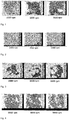
- Photographs of the respective silicon-containing layer are shown in Figure 1 . Dark grey areas represent coated substrate surface by amorphous silicon. Light grey/white areas result from dewetted substrate surface. It is evident that a conformal and continuous layer is not obtained.
- the hydridosilane composition 1 is applied neat with a syringe through a syringe filter (PTFE) with a 1 ⁇ m pore width onto a pre-cleaned EagleXG glass substrate (Corning Inc.). Pre-cleaning is carried out by putting the substrates into acetone, isopropanol and subsequently deionized water in an ultrasonic bath for 10 minutes each. Before coating, substrates are dried completely in a nitrogen flow. Wet films are generated by spin coating at 25 °C at 2000, 4500 and 9999 rpm for 10 sec. Conversion of the wet films is conducted by thermal treatment on a hot plate at 500 °C for 60 sec.
- PTFE syringe filter
- Photographs of the respective silicon-containing layer are shown in Figure 2 . Dark grey areas represent coated substrate surface by amorphous silicon. Light grey/white areas result from dewetted substrate surface. All films show almost complete dewetting. It is evident that a conformal and continuous layer is not obtained.
- the hydridosilane composition 1 is put into a glass apparatus equipped with a reflux condenser.
- the hydridosilane composition 1 is oligomerized by heating to 100 °C for two hours while stirring and illuminating with a cold light lamp, which is connected to the reactor via fiber optics purchased from Micro-Epsilon Eltrotec GmbH.
- the gas volume above the liquid reactant is purged with inert gas.
- the hydridosilane oligomer 1 is diluted in a ratio of 1:2 with a toluene mixture containing 10 % of cyclooctane.
- the formulation is prepared at ambient temperature (20 °C) and applied with a syringe through a syringe filter (PTFE) with a 1 ⁇ m pore width onto a pre-cleaned EagleXG glass substrate (Corning Inc.). Pre-cleaning is carried out by putting the substrates into acetone, isopropanol and subsequently deionized water in an ultrasonic bath for 10 minutes each. Before coating, substrates are dried completely in a nitrogen flow. Three wet films are generated by spin coating at 25 °C at 9999 rpm for 10 sec each. Conversion of the wet films is conducted by thermal treatment on a hot plate at 500 °C for 60 sec.
- Photographs of the respective silicon-containing layer are shown in Figure 3 . Dark grey areas represent coated substrate surface by amorphous silicon. Light grey/white areas result from dewetted substrate surface. All films show significant dewetting. It is evident that a conformal and continuous layer is not obtained.
- the resulting reaction mixture is put into a glass apparatus equipped with a reflux condenser.
- the reaction mixture is oligomerized by heating to 100 °C for two hours while stirring and illuminating with a cold light lamp, which is connected to the reactor via fiber optics purchased from Micro-Epsilon Eltrotec GmbH.
- the gas volume above the liquid reactant is purged with inert gas.
- the hydridosilane oligomer 2 is diluted in a ratio of 1:2 with a toluene mixture containing 10 % of cyclooctane.
- the formulation is prepared at ambient temperature (20 °C) and applied with a syringe through a syringe filter (PTFE) with a 1 ⁇ m pore width onto a pre-cleaned EagleXG glass substrate (Corning Inc.). Pre-cleaning is carried out by putting the substrates into acetone, isopropanol and subsequently deionized water in an ultrasonic bath for 10 minutes each. Before coating, substrates are dried completely in a nitrogen flow. Three wet films are generated by spin coating at 25 °C at 9999 rpm for 10 sec each. Conversion of the wet films is conducted by thermal treatment on a hot plate at 500 °C for 60 sec.
- Photographs of the respective silicon-containing layer are shown in Figure 4 . Dark grey areas represent coated substrate surface by amorphous silicon. Light grey/white areas result from dewetted substrate surface. All films show reduced dewetting. A conformal and continuous amorphous silicon film is obtained on more than 50% of the substrate surface.
- the resulting reaction mixture is put into a glass apparatus equipped with a reflux condenser.
- the reaction mixture is oligomerized by heating to 100 °C for two hours while stirring and illuminating with a cold light lamp, which is connected to the reactor via fiber optics purchased from Micro-Epsilon Eltrotec GmbH.
- the gas volume above the liquid reactant is purged with inert gas.
- the hydridosilane oligomer 3 is diluted in a ratio of 1:2 with a toluene mixture containing 10 % of cyclooctane.
- the formulation is prepared at ambient temperature (20 °C) and applied with a syringe through a syringe filter (PTFE) with a 1 ⁇ m pore width onto a pre-cleaned EagleXG glass substrate (Corning Inc.). Pre-cleaning is carried out by putting the substrates into acetone, isopropanol and subsequently deionized water in an ultrasonic bath for 10 minutes each. Before coating, substrates are dried completely in a nitrogen flow. Wet films are generated by spin coating at 25 °C at 2000, 4500 and 9999 rpm for 10 sec. Conversion of the wet films is conducted by thermal treatment on a hot plate at 500 °C for 60 sec.
- Photographs of the respective silicon-containing layer are shown in Figure 5 . Dark grey areas represent coated substrate surface by amorphous silicon. Light grey/white areas result from dewetted substrate surface. For all films, the dewetting is reduced further compared to E-1. A conformal and continuous amorphous silicon film is obtained on more than 80% of the substrate surface.
- Neopentasilane is put into a glass apparatus equipped with a reflux condenser.
- the neopentasilane is oligomerized by heating to 140 °C for two hours while stirring and illuminating with a cold light lamp, which is connected to the reactor via fiber optics purchased from Micro-Epsilon Eltrotec GmbH.
- the gas volume above the liquid reactant is purged with inert gas.
- the hydridosilane oligomer 4 is diluted in a ratio of 1:2 with a toluene mixture containing 10 % of cyclooctane.
- the formulation is prepared at ambient temperature (20 °C) and applied with a syringe through a syringe filter (PTFE) with a 1 ⁇ m pore width onto a pre-cleaned EagleXG glass substrate (Corning Inc.). Pre-cleaning is carried out by putting the substrates into acetone, isopropanol and subsequently deionized water in an ultrasonic bath for 10 minutes each. Before coating, substrates are dried completely in a nitrogen flow. Wet films are generated by spin coating at 25 °C at 1750, 2000, 4500, 8000 and 9999 rpm for 10 sec. Conversion of the wet films is conducted by thermal treatment on a hot plate at 500 °C for 60 sec.
- the layer thicknesses of the silicon-containing layers of E-2 and CE-4 are determined by means of spectral ellipsometry as described above and are shown in Figure 6 . It is evident, that formulations based on the hydridosilane oligomer 3 give significant higher layer thicknesses of the corresponding amorphous silicon layers than the formulations based on hydridosilane oligomer 4 featuring the same solid contents and solvent mixtures.
Landscapes
- Chemical & Material Sciences (AREA)
- Organic Chemistry (AREA)
- Engineering & Computer Science (AREA)
- Materials Engineering (AREA)
- Wood Science & Technology (AREA)
- Life Sciences & Earth Sciences (AREA)
- Chemical Kinetics & Catalysis (AREA)
- Inorganic Chemistry (AREA)
- Health & Medical Sciences (AREA)
- Medicinal Chemistry (AREA)
- Polymers & Plastics (AREA)
- Silicon Compounds (AREA)
- Crystallography & Structural Chemistry (AREA)
- Application Of Or Painting With Fluid Materials (AREA)
Priority Applications (9)
| Application Number | Priority Date | Filing Date | Title |
|---|---|---|---|
| EP19159383.9A EP3702397B1 (de) | 2019-02-26 | 2019-02-26 | Verfahren zur herstellung von hydridosilan-oligomeren |
| TW108142313A TW202031738A (zh) | 2019-02-26 | 2019-11-21 | 氫矽烷寡聚物之製備方法 |
| JP2021549886A JP2022522440A (ja) | 2019-02-26 | 2019-11-28 | ヒドリドシランオリゴマーの製造方法 |
| CA3131270A CA3131270A1 (en) | 2019-02-26 | 2019-11-28 | Method for the preparation of hydridosilane oligomers |
| SG11202109197VA SG11202109197VA (en) | 2019-02-26 | 2019-11-28 | Method for the preparation of hydridosilane oligomers |
| PCT/EP2019/082920 WO2020173588A1 (en) | 2019-02-26 | 2019-11-28 | Method for the preparation of hydridosilane oligomers |
| CN201980095752.1A CN113767135A (zh) | 2019-02-26 | 2019-11-28 | 用于制备氢化硅烷低聚物的方法 |
| US17/433,260 US20220089448A1 (en) | 2019-02-26 | 2019-11-28 | Method for the preparation of hydridosilane oligomers |
| KR1020217030149A KR20210132108A (ko) | 2019-02-26 | 2019-11-28 | 히드리도실란 올리고머의 제조 방법 |
Applications Claiming Priority (1)
| Application Number | Priority Date | Filing Date | Title |
|---|---|---|---|
| EP19159383.9A EP3702397B1 (de) | 2019-02-26 | 2019-02-26 | Verfahren zur herstellung von hydridosilan-oligomeren |
Publications (2)
| Publication Number | Publication Date |
|---|---|
| EP3702397A1 true EP3702397A1 (de) | 2020-09-02 |
| EP3702397B1 EP3702397B1 (de) | 2021-06-09 |
Family
ID=65598516
Family Applications (1)
| Application Number | Title | Priority Date | Filing Date |
|---|---|---|---|
| EP19159383.9A Active EP3702397B1 (de) | 2019-02-26 | 2019-02-26 | Verfahren zur herstellung von hydridosilan-oligomeren |
Country Status (9)
| Country | Link |
|---|---|
| US (1) | US20220089448A1 (de) |
| EP (1) | EP3702397B1 (de) |
| JP (1) | JP2022522440A (de) |
| KR (1) | KR20210132108A (de) |
| CN (1) | CN113767135A (de) |
| CA (1) | CA3131270A1 (de) |
| SG (1) | SG11202109197VA (de) |
| TW (1) | TW202031738A (de) |
| WO (1) | WO2020173588A1 (de) |
Families Citing this family (6)
| Publication number | Priority date | Publication date | Assignee | Title |
|---|---|---|---|---|
| US12180581B2 (en) | 2017-09-18 | 2024-12-31 | Waters Technologies Corporation | Use of vapor deposition coated flow paths for improved chromatography of metal interacting analytes |
| US11709155B2 (en) | 2017-09-18 | 2023-07-25 | Waters Technologies Corporation | Use of vapor deposition coated flow paths for improved chromatography of metal interacting analytes |
| US11709156B2 (en) | 2017-09-18 | 2023-07-25 | Waters Technologies Corporation | Use of vapor deposition coated flow paths for improved analytical analysis |
| US12181452B2 (en) | 2017-09-18 | 2024-12-31 | Waters Technologies Corporation | Use of vapor deposition coated flow paths for improved chromatography of metal interacting analytes |
| US11918936B2 (en) | 2020-01-17 | 2024-03-05 | Waters Technologies Corporation | Performance and dynamic range for oligonucleotide bioanalysis through reduction of non specific binding |
| US12352734B2 (en) | 2020-09-24 | 2025-07-08 | Waters Technologies Corporation | Chromatographic hardware improvements for separation of reactive molecules |
Citations (6)
| Publication number | Priority date | Publication date | Assignee | Title |
|---|---|---|---|---|
| US5252766A (en) | 1990-09-14 | 1993-10-12 | Director-General Of Agency Of Industrial Science | Method for producing polysilanes |
| EP0630933A2 (de) | 1993-06-15 | 1994-12-28 | Nippon Oil Co. Ltd. | Verfahren zur Herstellung eines Halbleitermaterials |
| EP1640342A1 (de) | 2003-06-13 | 2006-03-29 | JSR Corporation | Silanpolymer und verfahren zur bildung von siliciumfilm |
| WO2008045327A2 (en) | 2006-10-06 | 2008-04-17 | Kovio, Inc. | Silicon polymers, methods of polymerizing silicon compounds, and methods of forming thin films from such silicon polymers |
| DE102010002405A1 (de) | 2010-02-26 | 2011-09-01 | Evonik Degussa Gmbh | Verfahren zur Oligomerisierung von Hydridosilanen, die mit dem Verfahren herstellbaren Oligomerisate und ihre Verwendung |
| DE102010041842A1 (de) | 2010-10-01 | 2012-04-05 | Evonik Degussa Gmbh | Verfahren zur Herstellung höherer Hydridosilanverbindungen |
Family Cites Families (1)
| Publication number | Priority date | Publication date | Assignee | Title |
|---|---|---|---|---|
| DE102013010101A1 (de) * | 2013-06-18 | 2014-12-18 | Evonik Industries Ag | Formulierungen umfassend Hydridosilane und Hydridosilan-Oligomere, Verfahren zu ihrer Herstellung und ihrer Verwendung |
-
2019
- 2019-02-26 EP EP19159383.9A patent/EP3702397B1/de active Active
- 2019-11-21 TW TW108142313A patent/TW202031738A/zh unknown
- 2019-11-28 WO PCT/EP2019/082920 patent/WO2020173588A1/en not_active Ceased
- 2019-11-28 JP JP2021549886A patent/JP2022522440A/ja not_active Withdrawn
- 2019-11-28 SG SG11202109197VA patent/SG11202109197VA/en unknown
- 2019-11-28 KR KR1020217030149A patent/KR20210132108A/ko not_active Withdrawn
- 2019-11-28 CN CN201980095752.1A patent/CN113767135A/zh active Pending
- 2019-11-28 CA CA3131270A patent/CA3131270A1/en active Pending
- 2019-11-28 US US17/433,260 patent/US20220089448A1/en not_active Abandoned
Patent Citations (7)
| Publication number | Priority date | Publication date | Assignee | Title |
|---|---|---|---|---|
| US5252766A (en) | 1990-09-14 | 1993-10-12 | Director-General Of Agency Of Industrial Science | Method for producing polysilanes |
| EP0630933A2 (de) | 1993-06-15 | 1994-12-28 | Nippon Oil Co. Ltd. | Verfahren zur Herstellung eines Halbleitermaterials |
| EP1640342A1 (de) | 2003-06-13 | 2006-03-29 | JSR Corporation | Silanpolymer und verfahren zur bildung von siliciumfilm |
| WO2008045327A2 (en) | 2006-10-06 | 2008-04-17 | Kovio, Inc. | Silicon polymers, methods of polymerizing silicon compounds, and methods of forming thin films from such silicon polymers |
| DE102010002405A1 (de) | 2010-02-26 | 2011-09-01 | Evonik Degussa Gmbh | Verfahren zur Oligomerisierung von Hydridosilanen, die mit dem Verfahren herstellbaren Oligomerisate und ihre Verwendung |
| US20120291665A1 (en) * | 2010-02-26 | 2012-11-22 | Evonik Degussa Gmbh | Method for oligomerizing hydridosilanes, the oligomers that can be produced by means of the method, and the use thereof |
| DE102010041842A1 (de) | 2010-10-01 | 2012-04-05 | Evonik Degussa Gmbh | Verfahren zur Herstellung höherer Hydridosilanverbindungen |
Non-Patent Citations (1)
| Title |
|---|
| D. F. SHRIVER; M. A. DREZDZON: "The manipulation of air sensitive compounds", 1986, WILEY VCH |
Also Published As
| Publication number | Publication date |
|---|---|
| US20220089448A1 (en) | 2022-03-24 |
| EP3702397B1 (de) | 2021-06-09 |
| TW202031738A (zh) | 2020-09-01 |
| CN113767135A (zh) | 2021-12-07 |
| KR20210132108A (ko) | 2021-11-03 |
| SG11202109197VA (en) | 2021-09-29 |
| JP2022522440A (ja) | 2022-04-19 |
| CA3131270A1 (en) | 2020-09-03 |
| WO2020173588A1 (en) | 2020-09-03 |
Similar Documents
| Publication | Publication Date | Title |
|---|---|---|
| EP3702397B1 (de) | Verfahren zur herstellung von hydridosilan-oligomeren | |
| CN103069544B (zh) | p-掺杂硅层 | |
| CN105307977B (zh) | 包含氢化硅烷和氢化硅烷低聚物的配制品、其制备方法及其用途 | |
| JP6012469B2 (ja) | シリコン層の製造方法 | |
| US20160145439A1 (en) | Formulations comprising hydridosilanes and hydridosilane oligomers, their process of manufacture and their use | |
| JP6571296B2 (ja) | 緻密なシリカ質膜形成用組成物 | |
| US20190023723A1 (en) | Doped compositions, processes for production thereof and use thereof | |
| WO2016009897A1 (ja) | 加熱重合によるポリシランの製造方法 | |
| WO2016072320A1 (ja) | シランの重合禁止剤 |
Legal Events
| Date | Code | Title | Description |
|---|---|---|---|
| PUAI | Public reference made under article 153(3) epc to a published international application that has entered the european phase |
Free format text: ORIGINAL CODE: 0009012 |
|
| STAA | Information on the status of an ep patent application or granted ep patent |
Free format text: STATUS: THE APPLICATION HAS BEEN PUBLISHED |
|
| AK | Designated contracting states |
Kind code of ref document: A1 Designated state(s): AL AT BE BG CH CY CZ DE DK EE ES FI FR GB GR HR HU IE IS IT LI LT LU LV MC MK MT NL NO PL PT RO RS SE SI SK SM TR |
|
| AX | Request for extension of the european patent |
Extension state: BA ME |
|
| STAA | Information on the status of an ep patent application or granted ep patent |
Free format text: STATUS: REQUEST FOR EXAMINATION WAS MADE |
|
| 17P | Request for examination filed |
Effective date: 20201124 |
|
| RBV | Designated contracting states (corrected) |
Designated state(s): AL AT BE BG CH CY CZ DE DK EE ES FI FR GB GR HR HU IE IS IT LI LT LU LV MC MK MT NL NO PL PT RO RS SE SI SK SM TR |
|
| GRAP | Despatch of communication of intention to grant a patent |
Free format text: ORIGINAL CODE: EPIDOSNIGR1 |
|
| STAA | Information on the status of an ep patent application or granted ep patent |
Free format text: STATUS: GRANT OF PATENT IS INTENDED |
|
| INTG | Intention to grant announced |
Effective date: 20210120 |
|
| GRAS | Grant fee paid |
Free format text: ORIGINAL CODE: EPIDOSNIGR3 |
|
| GRAA | (expected) grant |
Free format text: ORIGINAL CODE: 0009210 |
|
| STAA | Information on the status of an ep patent application or granted ep patent |
Free format text: STATUS: THE PATENT HAS BEEN GRANTED |
|
| AK | Designated contracting states |
Kind code of ref document: B1 Designated state(s): AL AT BE BG CH CY CZ DE DK EE ES FI FR GB GR HR HU IE IS IT LI LT LU LV MC MK MT NL NO PL PT RO RS SE SI SK SM TR |
|
| REG | Reference to a national code |
Ref country code: GB Ref legal event code: FG4D |
|
| REG | Reference to a national code |
Ref country code: CH Ref legal event code: EP Ref country code: AT Ref legal event code: REF Ref document number: 1400465 Country of ref document: AT Kind code of ref document: T Effective date: 20210615 |
|
| REG | Reference to a national code |
Ref country code: DE Ref legal event code: R096 Ref document number: 602019005143 Country of ref document: DE |
|
| REG | Reference to a national code |
Ref country code: IE Ref legal event code: FG4D |
|
| REG | Reference to a national code |
Ref country code: LT Ref legal event code: MG9D |
|
| PG25 | Lapsed in a contracting state [announced via postgrant information from national office to epo] |
Ref country code: FI Free format text: LAPSE BECAUSE OF FAILURE TO SUBMIT A TRANSLATION OF THE DESCRIPTION OR TO PAY THE FEE WITHIN THE PRESCRIBED TIME-LIMIT Effective date: 20210609 Ref country code: LT Free format text: LAPSE BECAUSE OF FAILURE TO SUBMIT A TRANSLATION OF THE DESCRIPTION OR TO PAY THE FEE WITHIN THE PRESCRIBED TIME-LIMIT Effective date: 20210609 Ref country code: HR Free format text: LAPSE BECAUSE OF FAILURE TO SUBMIT A TRANSLATION OF THE DESCRIPTION OR TO PAY THE FEE WITHIN THE PRESCRIBED TIME-LIMIT Effective date: 20210609 Ref country code: BG Free format text: LAPSE BECAUSE OF FAILURE TO SUBMIT A TRANSLATION OF THE DESCRIPTION OR TO PAY THE FEE WITHIN THE PRESCRIBED TIME-LIMIT Effective date: 20210909 |
|
| REG | Reference to a national code |
Ref country code: AT Ref legal event code: MK05 Ref document number: 1400465 Country of ref document: AT Kind code of ref document: T Effective date: 20210609 |
|
| REG | Reference to a national code |
Ref country code: NL Ref legal event code: MP Effective date: 20210609 |
|
| PG25 | Lapsed in a contracting state [announced via postgrant information from national office to epo] |
Ref country code: GR Free format text: LAPSE BECAUSE OF FAILURE TO SUBMIT A TRANSLATION OF THE DESCRIPTION OR TO PAY THE FEE WITHIN THE PRESCRIBED TIME-LIMIT Effective date: 20210910 Ref country code: NO Free format text: LAPSE BECAUSE OF FAILURE TO SUBMIT A TRANSLATION OF THE DESCRIPTION OR TO PAY THE FEE WITHIN THE PRESCRIBED TIME-LIMIT Effective date: 20210909 Ref country code: LV Free format text: LAPSE BECAUSE OF FAILURE TO SUBMIT A TRANSLATION OF THE DESCRIPTION OR TO PAY THE FEE WITHIN THE PRESCRIBED TIME-LIMIT Effective date: 20210609 Ref country code: RS Free format text: LAPSE BECAUSE OF FAILURE TO SUBMIT A TRANSLATION OF THE DESCRIPTION OR TO PAY THE FEE WITHIN THE PRESCRIBED TIME-LIMIT Effective date: 20210609 Ref country code: SE Free format text: LAPSE BECAUSE OF FAILURE TO SUBMIT A TRANSLATION OF THE DESCRIPTION OR TO PAY THE FEE WITHIN THE PRESCRIBED TIME-LIMIT Effective date: 20210609 |
|
| PG25 | Lapsed in a contracting state [announced via postgrant information from national office to epo] |
Ref country code: SK Free format text: LAPSE BECAUSE OF FAILURE TO SUBMIT A TRANSLATION OF THE DESCRIPTION OR TO PAY THE FEE WITHIN THE PRESCRIBED TIME-LIMIT Effective date: 20210609 Ref country code: EE Free format text: LAPSE BECAUSE OF FAILURE TO SUBMIT A TRANSLATION OF THE DESCRIPTION OR TO PAY THE FEE WITHIN THE PRESCRIBED TIME-LIMIT Effective date: 20210609 Ref country code: ES Free format text: LAPSE BECAUSE OF FAILURE TO SUBMIT A TRANSLATION OF THE DESCRIPTION OR TO PAY THE FEE WITHIN THE PRESCRIBED TIME-LIMIT Effective date: 20210609 Ref country code: SM Free format text: LAPSE BECAUSE OF FAILURE TO SUBMIT A TRANSLATION OF THE DESCRIPTION OR TO PAY THE FEE WITHIN THE PRESCRIBED TIME-LIMIT Effective date: 20210609 Ref country code: RO Free format text: LAPSE BECAUSE OF FAILURE TO SUBMIT A TRANSLATION OF THE DESCRIPTION OR TO PAY THE FEE WITHIN THE PRESCRIBED TIME-LIMIT Effective date: 20210609 Ref country code: NL Free format text: LAPSE BECAUSE OF FAILURE TO SUBMIT A TRANSLATION OF THE DESCRIPTION OR TO PAY THE FEE WITHIN THE PRESCRIBED TIME-LIMIT Effective date: 20210609 Ref country code: PT Free format text: LAPSE BECAUSE OF FAILURE TO SUBMIT A TRANSLATION OF THE DESCRIPTION OR TO PAY THE FEE WITHIN THE PRESCRIBED TIME-LIMIT Effective date: 20211011 Ref country code: CZ Free format text: LAPSE BECAUSE OF FAILURE TO SUBMIT A TRANSLATION OF THE DESCRIPTION OR TO PAY THE FEE WITHIN THE PRESCRIBED TIME-LIMIT Effective date: 20210609 Ref country code: AT Free format text: LAPSE BECAUSE OF FAILURE TO SUBMIT A TRANSLATION OF THE DESCRIPTION OR TO PAY THE FEE WITHIN THE PRESCRIBED TIME-LIMIT Effective date: 20210609 |
|
| PG25 | Lapsed in a contracting state [announced via postgrant information from national office to epo] |
Ref country code: PL Free format text: LAPSE BECAUSE OF FAILURE TO SUBMIT A TRANSLATION OF THE DESCRIPTION OR TO PAY THE FEE WITHIN THE PRESCRIBED TIME-LIMIT Effective date: 20210609 |
|
| REG | Reference to a national code |
Ref country code: DE Ref legal event code: R097 Ref document number: 602019005143 Country of ref document: DE |
|
| PLBE | No opposition filed within time limit |
Free format text: ORIGINAL CODE: 0009261 |
|
| STAA | Information on the status of an ep patent application or granted ep patent |
Free format text: STATUS: NO OPPOSITION FILED WITHIN TIME LIMIT |
|
| PG25 | Lapsed in a contracting state [announced via postgrant information from national office to epo] |
Ref country code: DK Free format text: LAPSE BECAUSE OF FAILURE TO SUBMIT A TRANSLATION OF THE DESCRIPTION OR TO PAY THE FEE WITHIN THE PRESCRIBED TIME-LIMIT Effective date: 20210609 |
|
| 26N | No opposition filed |
Effective date: 20220310 |
|
| PG25 | Lapsed in a contracting state [announced via postgrant information from national office to epo] |
Ref country code: AL Free format text: LAPSE BECAUSE OF FAILURE TO SUBMIT A TRANSLATION OF THE DESCRIPTION OR TO PAY THE FEE WITHIN THE PRESCRIBED TIME-LIMIT Effective date: 20210609 |
|
| PG25 | Lapsed in a contracting state [announced via postgrant information from national office to epo] |
Ref country code: IT Free format text: LAPSE BECAUSE OF FAILURE TO SUBMIT A TRANSLATION OF THE DESCRIPTION OR TO PAY THE FEE WITHIN THE PRESCRIBED TIME-LIMIT Effective date: 20210609 |
|
| PG25 | Lapsed in a contracting state [announced via postgrant information from national office to epo] |
Ref country code: MC Free format text: LAPSE BECAUSE OF FAILURE TO SUBMIT A TRANSLATION OF THE DESCRIPTION OR TO PAY THE FEE WITHIN THE PRESCRIBED TIME-LIMIT Effective date: 20210609 |
|
| REG | Reference to a national code |
Ref country code: CH Ref legal event code: PL |
|
| PG25 | Lapsed in a contracting state [announced via postgrant information from national office to epo] |
Ref country code: LU Free format text: LAPSE BECAUSE OF NON-PAYMENT OF DUE FEES Effective date: 20220226 |
|
| PG25 | Lapsed in a contracting state [announced via postgrant information from national office to epo] |
Ref country code: FR Free format text: LAPSE BECAUSE OF NON-PAYMENT OF DUE FEES Effective date: 20220228 |
|
| PG25 | Lapsed in a contracting state [announced via postgrant information from national office to epo] |
Ref country code: LI Free format text: LAPSE BECAUSE OF NON-PAYMENT OF DUE FEES Effective date: 20220228 Ref country code: IE Free format text: LAPSE BECAUSE OF NON-PAYMENT OF DUE FEES Effective date: 20220226 Ref country code: CH Free format text: LAPSE BECAUSE OF NON-PAYMENT OF DUE FEES Effective date: 20220228 |
|
| PGFP | Annual fee paid to national office [announced via postgrant information from national office to epo] |
Ref country code: DE Payment date: 20230216 Year of fee payment: 5 Ref country code: BE Payment date: 20230216 Year of fee payment: 5 |
|
| P01 | Opt-out of the competence of the unified patent court (upc) registered |
Effective date: 20230524 |
|
| GBPC | Gb: european patent ceased through non-payment of renewal fee |
Effective date: 20230226 |
|
| PG25 | Lapsed in a contracting state [announced via postgrant information from national office to epo] |
Ref country code: GB Free format text: LAPSE BECAUSE OF NON-PAYMENT OF DUE FEES Effective date: 20230226 |
|
| PG25 | Lapsed in a contracting state [announced via postgrant information from national office to epo] |
Ref country code: GB Free format text: LAPSE BECAUSE OF NON-PAYMENT OF DUE FEES Effective date: 20230226 |
|
| PG25 | Lapsed in a contracting state [announced via postgrant information from national office to epo] |
Ref country code: MK Free format text: LAPSE BECAUSE OF FAILURE TO SUBMIT A TRANSLATION OF THE DESCRIPTION OR TO PAY THE FEE WITHIN THE PRESCRIBED TIME-LIMIT Effective date: 20210609 Ref country code: CY Free format text: LAPSE BECAUSE OF FAILURE TO SUBMIT A TRANSLATION OF THE DESCRIPTION OR TO PAY THE FEE WITHIN THE PRESCRIBED TIME-LIMIT Effective date: 20210609 |
|
| PG25 | Lapsed in a contracting state [announced via postgrant information from national office to epo] |
Ref country code: HU Free format text: LAPSE BECAUSE OF FAILURE TO SUBMIT A TRANSLATION OF THE DESCRIPTION OR TO PAY THE FEE WITHIN THE PRESCRIBED TIME-LIMIT; INVALID AB INITIO Effective date: 20190226 |
|
| REG | Reference to a national code |
Ref country code: DE Ref legal event code: R119 Ref document number: 602019005143 Country of ref document: DE |
|
| PG25 | Lapsed in a contracting state [announced via postgrant information from national office to epo] |
Ref country code: MT Free format text: LAPSE BECAUSE OF FAILURE TO SUBMIT A TRANSLATION OF THE DESCRIPTION OR TO PAY THE FEE WITHIN THE PRESCRIBED TIME-LIMIT Effective date: 20210609 |
|
| REG | Reference to a national code |
Ref country code: BE Ref legal event code: MM Effective date: 20240229 |
|
| PG25 | Lapsed in a contracting state [announced via postgrant information from national office to epo] |
Ref country code: DE Free format text: LAPSE BECAUSE OF NON-PAYMENT OF DUE FEES Effective date: 20240903 |
|
| PG25 | Lapsed in a contracting state [announced via postgrant information from national office to epo] |
Ref country code: BE Free format text: LAPSE BECAUSE OF NON-PAYMENT OF DUE FEES Effective date: 20240229 |
|
| PG25 | Lapsed in a contracting state [announced via postgrant information from national office to epo] |
Ref country code: DE Free format text: LAPSE BECAUSE OF NON-PAYMENT OF DUE FEES Effective date: 20240903 Ref country code: BE Free format text: LAPSE BECAUSE OF NON-PAYMENT OF DUE FEES Effective date: 20240229 |
|
| PG25 | Lapsed in a contracting state [announced via postgrant information from national office to epo] |
Ref country code: TR Free format text: LAPSE BECAUSE OF FAILURE TO SUBMIT A TRANSLATION OF THE DESCRIPTION OR TO PAY THE FEE WITHIN THE PRESCRIBED TIME-LIMIT Effective date: 20210609 |