EP3697223B1 - System for automated production of panigacci - Google Patents
System for automated production of panigacci Download PDFInfo
- Publication number
- EP3697223B1 EP3697223B1 EP18804393.9A EP18804393A EP3697223B1 EP 3697223 B1 EP3697223 B1 EP 3697223B1 EP 18804393 A EP18804393 A EP 18804393A EP 3697223 B1 EP3697223 B1 EP 3697223B1
- Authority
- EP
- European Patent Office
- Prior art keywords
- terracotta
- dishes
- panigacci
- conveyor belt
- cooking
- Prior art date
- Legal status (The legal status is an assumption and is not a legal conclusion. Google has not performed a legal analysis and makes no representation as to the accuracy of the status listed.)
- Active
Links
Images

Classifications
-
- A—HUMAN NECESSITIES
- A21—BAKING; EDIBLE DOUGHS
- A21B—BAKERS' OVENS; MACHINES OR EQUIPMENT FOR BAKING
- A21B5/00—Baking apparatus for special goods; Other baking apparatus
- A21B5/02—Apparatus for baking hollow articles, waffles, pastry, biscuits, or the like
Definitions
- the present invention relates to the food industry.
- the invention relates to an apparatus for the automated production of panigacci, typical product of Lunigiana.
- panigacci are a type of round bread made starting from a fluid dough, made with water, flour and salt, which is cooked between clay dishes, so-called "testi", previously heated at high temperatures. Panigacci bake in the dishes in a few minutes and don't need yeast.
- the dough is poured in red-hot dishes already extracted from the oven or from fire.
- a dose of dough is poured and immediately after is overlaid another dish, on which in turn other dough is poured and overlaid over yet another dish, and so on up to form a stack of 10-20 dishes interspersed with dough.
- panigacci It is desirable for the restaurants and cafes to create a large number of panigacci to serve to customers freshly cooked, when they have the best flavor and aroma.
- the cooking technique does not allow to achieve a high number of panigacci, with waiting times that are not negligible for customers.
- the terracotta dishes are placed on the grid and always extracted one by one, with difficulty to heat them homogeneously, since the residence time to the flame can vary considerably from dish to dish.
- panigacci Another problem is the dosing of the right amount of batter to put in the terracotta dishes, which is normally done by hand. To put too much batter means to make a higher panigaccio, but sometimes raw inside. Too little can result in a too thin and therefore dry or burned panigaccio. For this reason, to every pile of terracotta dishes that is "disassembled”, we often get panigacci sometimes very different from each other.
- a further problem is that the terracotta dishes extracted from the oven or live fire are sometimes overheated, and often not all at the same temperature. If a terracotta dish is too hot, a burnt panigaccio may result. If the terracotta dishes in the pile are at very different temperatures, there may be raw or overcooked panigacci, if not burnt.
- the cooking provided in GB226793 would instead be inhomogeneous, both due to the heating discontinuity that would occur during the conveyor belt path, due to the fact that the terracotta dishes would pass on areas with higher heat and lower heat, both for the fact that the terracotta dishes would be heated only in one direction, providing heterogeneity of heating to the two surfaces of the panigaccio.
- an apparatus for the automated production of panigacci comprising:
- the terracotta dishes of the first plurality and the terracotta dishes of the second plurality are constrained, respectively, to the first outer surface and at the second outer surface in a removable way.
- the interlocking interface between terracotta dish and conveyor belt can be made of Teflon or printed directly in terracotta.
- the interface can be a vacuum suction cup resistant to high temperatures.
- the terracotta dishes of the first plurality and the terracotta dishes of the second plurality are constrained, respectively, to the first outer surface and to the second outer surface by means of elastic elements, in particular springs having elastic constant k .
- the doser is adapted to pour a dose of batter on at least one terracotta dish of the first plurality at an area of pouring arranged at the entrance of the area of cooking.
- a kneading machine is also provided arranged to prepare the batter and comprising dispensers of water, salt and flour.
- the kneading machine can comprise a densimeter arranged to keep constant the density of the doses of batter.
- the kneading machine is operated by the control unit to provide a constant density to the doses of batter.
- a first brush and a second brush are provided arranged to clean, respectively, the terracotta dishes of the first plurality and the terracotta dishes of the second plurality at the outlet of the area of cooking. This way, the terracotta dishes can be used in a continuous cycle.
- a freezer is provided arranged to freeze the panigacci exiting from the area of cooking. This way, the frozen panigacci are already ready for sale on an industrial scale.
- a vacuum creation device is provided for inserting the panigacci leaving the cooking area and sealing them in a vacuum container.
- the oven is an infrared gas oven.
- a control unit for is provided adjusting the speed v with which the first and the second conveyor belt move.
- control unit is configured in such a way that the first conveyor belt and the second conveyor belt cross said area of cooking with a speed v ⁇ L / t , where t ⁇ 60 s.
- the control unit therefore provides the possibility of entering data concerning the power of the oven and the length of the conveyor belts inside the oven, i.e. the space that the terracotta dishes travel in the oven. Having this information, the control unit can calculate the speed at which the conveyor belts must be moved in order to obtain terracotta dishes at the desired temperature at the output of the oven.
- an apparatus 100 for the automated production of panigacci comprises a first conveyor belt 110 arranged to rotate about a first plurality of rollers 119 and a second conveyor belt 120 arranged to rotate about a second plurality of rollers 129.
- a first and a second plurality of terracotta dishes 115 and 125 are constrained in order to have the concavity towards the outside of the conveyor belt 110, whereas the terracotta dishes 125 are constrained in order to have the concavity towards the inside of the conveyor belt 120.
- the apparatus 100 comprises then a doser 140 arranged to pour a dose of batter on the terracotta dishes 115 constrained to the first conveyor belt 115.
- the doser pours the dose of batter on the terracotta dishes 115 at an area of pouring arranged at the entrance of an area of cooking 150.
- the area of cooking 150 is the zone in which a portion of length L of the first conveyor belt 110 and a portion of length L of the second conveyor belt 120 is located at a mutual distance equal to a predetermined value D. Furthermore, the apparatus 100 is configured in such a way that at the area of cooking 150 each terracotta dish 115 is aligned with a corresponding terracotta dish 125. This way, when the terracotta dishes 115 and 125 enter in the area of cooking 150 there is a matching adapted to generate a pressure P on the dose of batter located between of them, allowing its squeezing and cooking in a completely automatic way.
- two brush means 117 and 127 are also provided arranged to clean the terracotta dishes 115 and 125 at the outlet of the area of cooking 150, thus allowing to the terracotta dishes of being used in a continuous cycle.
- the apparatus 100 provides then a kneading machine 160 arranged to prepare the batter and comprising dispensers 161 of water, salt and flour.
- a freezer or a deep freeze 170 can also be provided arranged to freeze the panigacci 50 at the outlet of the area of cooking 150.
- the oven 130 comprises at least one resistance 135 of tubular shape that extends in a direction parallel to the conveying direction of the conveyor belts 110 and 120.
- this exemplary embodiment of the oven 130 determines a more homogeneous heating of the terracotta dishes 125, since along all the path of the oven, the temperature at which the terracotta dishes 125 are exposed remains constant.
- the conveyor belts 110 can also be two, arranged parallel to each other, in order to increase the number of terracotta dishes 125 heated at the same time.
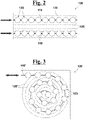
- Fig. 3 an alternative exemplary embodiment of the invention is shown, where the conveyor belt 110, and so the conveyor belt 120, which passes through oven 130 is spiral-shaped.
- the conveying direction of the terracotta dishes can go by the centre outwards or vice-versa according to the needs. Furthermore, between the centre and the outer of the spiral there can be a difference in height.
- This particular spiral shape determines a longer path of the terracotta dishes in the oven, under a same external size of the oven itself.
- the oven 130 of Fig. 2 allows to reduce the heating power necessary to cause the terracotta dishes 125 to come out at the predetermined temperature, with energy and money saving.
- an exemplary embodiment of the oven 130' comprises resistances 135' with circular shape arranged in a concentric way. This solution allows the same heating homogeneity of the terracotta dishes 125 obtained in the embodiment of Figure 2 .
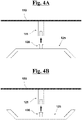
- Figs. 4A and 4B show a possible system of quick hanging and release of the terracotta dishes 125, respectively, by the first and by the second conveyor belt 110 and 120.
- this system provides that the conveyor belts 110 and 120 comprise respective hollow seats 111 and 121 and that the terracotta dishes comprise bushes 126 arranged to fit in the seats 111 and 121.
- the bushes 126 are made of Teflon or PVC resistant at a temperature higher than 500°C.
Landscapes
- Life Sciences & Earth Sciences (AREA)
- Engineering & Computer Science (AREA)
- Food Science & Technology (AREA)
- Baking, Grill, Roasting (AREA)
- General Preparation And Processing Of Foods (AREA)
Description
- The present invention relates to the food industry.
- In particular, the invention relates to an apparatus for the automated production of panigacci, typical product of Lunigiana.
- As known, the panigacci are a type of round bread made starting from a fluid dough, made with water, flour and salt, which is cooked between clay dishes, so-called "testi", previously heated at high temperatures. Panigacci bake in the dishes in a few minutes and don't need yeast.
- More precisely, instead of baking in the oven, the dough is poured in red-hot dishes already extracted from the oven or from fire. In any dish a dose of dough is poured and immediately after is overlaid another dish, on which in turn other dough is poured and overlaid over yet another dish, and so on up to form a stack of 10-20 dishes interspersed with dough.
- Thus every dish crushes the underlying dough until it reaches a nearly constant thickness and round shape. The dough standing between the hot dishes cooks in minutes on both sides, forming panigacci. The stack is then dismantled and the panigacci are detached from the dishes with a blade or vane. They are traditionally served in baskets and are used as a relish for meats and soft cheese, or even desserts.
- It is desirable for the restaurants and cafes to create a large number of panigacci to serve to customers freshly cooked, when they have the best flavor and aroma. However, the cooking technique does not allow to achieve a high number of panigacci, with waiting times that are not negligible for customers.
- For faster heating the dishes, it is known to use a carousel grid, arranged in an open oven or over a bed of embers or over a flame. In this way, by turning the grid, the cold dishes are introduced in the oven and the hot dishes are extracted bringing them to an external position from where they can be easily picked up without burning.
- However, the terracotta dishes are placed on the grid and always extracted one by one, with difficulty to heat them homogeneously, since the residence time to the flame can vary considerably from dish to dish.
- Another problem is the dosing of the right amount of batter to put in the terracotta dishes, which is normally done by hand. To put too much batter means to make a higher panigaccio, but sometimes raw inside. Too little can result in a too thin and therefore dry or burned panigaccio. For this reason, to every pile of terracotta dishes that is "disassembled", we often get panigacci sometimes very different from each other.
- A further problem is that the terracotta dishes extracted from the oven or live fire are sometimes overheated, and often not all at the same temperature. If a terracotta dish is too hot, a burnt panigaccio may result. If the terracotta dishes in the pile are at very different temperatures, there may be raw or overcooked panigacci, if not burnt.
- It is therefore desirable to solve the aforementioned problems. On the other hand, it is desirable to keep the panigacci cooking in the original way, in order not to distort a traditional product.
- In the document
GB226793 - However, even using terracotta dishes instead of molds, this system would not be absolutely suitable for the production of panigacci. In fact, in
GB226793 GB226793 - It is therefore a feature of the present invention to provide an apparatus for making panigacci for carrying out the steps of dosing the batter, stacking the terracotta dishes and cooking the panigacci in a completely automatic way.
- It is also a feature of the present invention to provide such an apparatus which allows the production of panigacci in a continuous cycle much more rapidly than in the prior art.
- It is still a feature of the present invention to provide such an apparatus that allows to have a more homogeneous and digestible cooking of the panigacci with respect to the known art.
- These and other objects are achieved by an apparatus for the automated production of panigacci comprising:
- at least a first conveyor belt arranged to rotate about a first plurality of rollers, said first conveyor belt comprising a first outer surface and a first plurality of terracotta dishes, each terracotta dish of the first plurality being constrained to the first outer surface;
- at least a second conveyor belt arranged to rotate about a second plurality of rollers, said second conveyor belt comprising a second outer surface and a second plurality of terracotta dishes, each terracotta dish of the second plurality being constrained at the second outer surface;
- an oven arranged to be crossed by the first conveyor belt and by the second conveyor belt for heating the first and the second plurality of terracotta dishes;
- a doser arranged to pour a dose of batter on at least one terracotta dish of the first plurality;
- In this way, the process of stacking the terracotta dishes and of cooking the panigacci is automated, allowing a continuous cycle production, while keeping the traditional recipe intact.
- Advantageously, the terracotta dishes of the first plurality and the terracotta dishes of the second plurality are constrained, respectively, to the first outer surface and at the second outer surface in a removable way.
- This way, broken or too dirty terracotta dishes can be easily substituted.
- In particular, the interlocking interface between terracotta dish and conveyor belt can be made of Teflon or printed directly in terracotta. Alternatively, the interface can be a vacuum suction cup resistant to high temperatures.
- In particular, the terracotta dishes of the first plurality and the terracotta dishes of the second plurality are constrained, respectively, to the first outer surface and to the second outer surface by means of elastic elements, in particular springs having elastic constant k.
- This way, by suitably adjusting the elastic constant k, it is possible to adjust the pressure P exerted on the batter located between the terracotta dishes.
- Advantageously, the doser is adapted to pour a dose of batter on at least one terracotta dish of the first plurality at an area of pouring arranged at the entrance of the area of cooking.
- Advantageously, a kneading machine is also provided arranged to prepare the batter and comprising dispensers of water, salt and flour.
- In particular, the kneading machine can comprise a densimeter arranged to keep constant the density of the doses of batter. Alternatively, the kneading machine is operated by the control unit to provide a constant density to the doses of batter.
- In particular, a first brush and a second brush are provided arranged to clean, respectively, the terracotta dishes of the first plurality and the terracotta dishes of the second plurality at the outlet of the area of cooking. This way, the terracotta dishes can be used in a continuous cycle.
- Advantageously, a freezer is provided arranged to freeze the panigacci exiting from the area of cooking. This way, the frozen panigacci are already ready for sale on an industrial scale.
- Alternatively, a vacuum creation device is provided for inserting the panigacci leaving the cooking area and sealing them in a vacuum container.
- In particular, the oven is an infrared gas oven.
- Advantageously, a control unit for is provided adjusting the speed v with which the first and the second conveyor belt move.
- In particular, the control unit is configured in such a way that the first conveyor belt and the second conveyor belt cross said area of cooking with a speed v ≅ L / t, where t ≅ 60s.
- In particular, the control unit is adapted to adjust the speed v in such a way that the terracotta dishes leave the oven at a temperature T = 315° ± 25°.
- This way, there is a homogeneous cooking and that provides high digestibility to the panigaccio, while preserving the flavour of the traditional preparation.
- The control unit therefore provides the possibility of entering data concerning the power of the oven and the length of the conveyor belts inside the oven, i.e. the space that the terracotta dishes travel in the oven. Having this information, the control unit can calculate the speed at which the conveyor belts must be moved in order to obtain terracotta dishes at the desired temperature at the output of the oven.
- This allows terracotta dishes to be output from the oven always at the desired temperature, and so it does not need a temperature sensing device and, above all, it does not need to further heat the terracotta dishes at an insufficient temperature or to cool the terracotta dishes cool at too high a temperature, which would be incompatible with the automated production carried out by the apparatus of the present invention.
- Advantageously, it is possible to arrange several conveyor belts in parallel, so as to allow a greater production of panigacci per minute.
- Further characteristic and/or advantages of the present invention are more bright with the following description of an exemplary embodiment thereof, exemplifying but not limitative, with reference to the attached drawings in which:
-
Fig. 1 shows an exemplary embodiment of the apparatus for the automated production of panigacci, according to the present invention; -
Fig. 2 shows top plan view of a first exemplary embodiment of the oven; -
Fig. 3 shows top plan view of a second exemplary embodiment of the oven; -
Fig. 4A shows a side view of a possible system of quick hanging and release of the terracotta dishes by the first conveyor belt; -
Fig. 4B shows a side view of a possible system of quick hanging and release of the terracotta dishes by the second conveyor belt. - With reference to
Fig. 1 , anapparatus 100 for the automated production of panigacci, according to the present invention, comprises afirst conveyor belt 110 arranged to rotate about a first plurality ofrollers 119 and asecond conveyor belt 120 arranged to rotate about a second plurality ofrollers 129. - To the respective external surfaces of the
conveyor belts terracotta dishes terracotta dishes 115 are constrained in order to have the concavity towards the outside of theconveyor belt 110, whereas theterracotta dishes 125 are constrained in order to have the concavity towards the inside of theconveyor belt 120. - The
apparatus 100 also comprises anoven 130 arranged to be crossed by theconveyor belts respective terracotta dishes - The
apparatus 100 comprises then adoser 140 arranged to pour a dose of batter on theterracotta dishes 115 constrained to thefirst conveyor belt 115. In particular, the doser pours the dose of batter on theterracotta dishes 115 at an area of pouring arranged at the entrance of an area ofcooking 150. - The area of cooking 150 is the zone in which a portion of length L of the
first conveyor belt 110 and a portion of length L of thesecond conveyor belt 120 is located at a mutual distance equal to a predetermined value D. Furthermore, theapparatus 100 is configured in such a way that at the area of cooking 150 eachterracotta dish 115 is aligned with a correspondingterracotta dish 125. This way, when theterracotta dishes - In the exemplary embodiment of
Fig. 1 , two brush means 117 and 127 are also provided arranged to clean theterracotta dishes cooking 150, thus allowing to the terracotta dishes of being used in a continuous cycle. - Advantageously, the
apparatus 100 provides then a kneadingmachine 160 arranged to prepare the batter and comprisingdispensers 161 of water, salt and flour. - In addition a freezer or a
deep freeze 170 can also be provided arranged to freeze thepanigacci 50 at the outlet of the area ofcooking 150. - With reference even at
Fig. 2 , in a possible exemplary embodiment, theoven 130 comprises at least oneresistance 135 of tubular shape that extends in a direction parallel to the conveying direction of theconveyor belts oven 130 determines a more homogeneous heating of theterracotta dishes 125, since along all the path of the oven, the temperature at which theterracotta dishes 125 are exposed remains constant. - As shown, the
conveyor belts 110 can also be two, arranged parallel to each other, in order to increase the number ofterracotta dishes 125 heated at the same time. - In
Fig. 3 an alternative exemplary embodiment of the invention is shown, where theconveyor belt 110, and so theconveyor belt 120, which passes throughoven 130 is spiral-shaped. - As shown by the two-way arrow, the conveying direction of the terracotta dishes can go by the centre outwards or vice-versa according to the needs. Furthermore, between the centre and the outer of the spiral there can be a difference in height.
- This particular spiral shape determines a longer path of the terracotta dishes in the oven, under a same external size of the oven itself. This way, under a same outer encumbrance, the
oven 130 ofFig. 2 allows to reduce the heating power necessary to cause theterracotta dishes 125 to come out at the predetermined temperature, with energy and money saving. Alternatively, under a same power of the oven, it is possible to reduce the external size of the oven, allowing to place the apparatus in areas not enough wide for the solution ofFig. 2 . - As shown in
Fig. 3 , an exemplary embodiment of the oven 130' comprises resistances 135' with circular shape arranged in a concentric way. This solution allows the same heating homogeneity of theterracotta dishes 125 obtained in the embodiment ofFigure 2 . -
Figs. 4A and 4B show a possible system of quick hanging and release of theterracotta dishes 125, respectively, by the first and by thesecond conveyor belt - In particular, this system provides that the
conveyor belts hollow seats bushes 126 arranged to fit in theseats bushes 126 are made of Teflon or PVC resistant at a temperature higher than 500°C.
Claims (8)
- An apparatus (100) for the automated production of panigacci, said apparatus (100) comprising:- at least a first conveyor belt (110) arranged to rotate about a first plurality of rollers (119), said first conveyor belt (110) comprising a first outer surface and a first plurality of terracotta dishes (115), each terracotta dish (115) of said first plurality being constrained to said first outer surface;- at least a second conveyor belt (120) arranged to rotate about a second plurality of rollers (129), said second conveyor belt (120) comprising a second outer surface and a second plurality of terracotta dishes (125), each terracotta dish (125) of said second plurality being constrained to said second outer surface;- an oven (130) arranged to be crossed by said first conveyor belt (110) and by said second conveyor belt (120) for heating said first and said second plurality of terracotta dishes (115,125);- a doser (140) arranged to pour a dose of batter on at least one terracotta dish (115) of said first plurality;said apparatus (100) comprising an area of cooking (150), external to said oven (130), wherein a portion of length L of said first conveyor belt (110) and a portion of length L of said second conveyor belt (120) are constantly at a mutual distance equal to a predetermined value D, said apparatus (100) being configured in such a way that in said area of cooking (150) each terracotta dish (115) of said first plurality is aligned with a corresponding terracotta dish (125) of said second plurality, said predetermined value D being such that a dose of batter interposed between two terracotta dishes (115,125) aligned to each other is subject to a pressure P in such a way to allow its squeezing and cooking.
- The apparatus (100) for the automated production of panigacci, according to claim 1, wherein said terracotta dishes (115) of said first plurality and said terracotta dishes (125) of said second plurality are constrained, respectively, to said first outer surface and to said second outer surface in a removable way.
- The apparatus (100) for the automated production of panigacci, according to claim 1, wherein said terracotta dishes (115) of said first plurality and said terracotta dishes (125) of said second plurality are constrained, respectively, to said first outer surface and to said second outer surface by means of springs having elastic constant k.
- The apparatus (100) for the automated production of panigacci, according to claim 1, wherein said doser (140) is adapted to pour a dose of batter on at least one terracotta dish (115) of said first plurality at an area of pouring arranged at the entrance of said area of cooking (150).
- The apparatus (100) for the automated production of panigacci, according to claim 1, wherein a kneading machine (160) is also provided arranged to prepare the batter and comprising dispensers (161) of water, salt and flour.
- The apparatus (100) for the automated production of panigacci, according to claim 1, wherein a first brush (117) and a second brush (127) are provided arranged to clean, respectively, the terracotta dishes (115) of said first plurality and the terracotta dishes (125) of said second plurality exiting from said area of cooking (150).
- The apparatus (100) for the automated production of panigacci, according to claim 1, wherein a freezer (170) is provided arranged to freeze the panigacci (50) exiting from said area of cooking (150).
- The apparatus (100) for the automated production of panigacci, according to claim 1, wherein said oven (130) is an infrared gas oven.
Applications Claiming Priority (2)
| Application Number | Priority Date | Filing Date | Title |
|---|---|---|---|
| IT102017000118798A IT201700118798A1 (en) | 2017-10-20 | 2017-10-20 | System for the automated production of panigacci |
| PCT/IB2018/058166 WO2019077582A1 (en) | 2017-10-20 | 2018-10-19 | System for automated production of panigacci |
Publications (2)
| Publication Number | Publication Date |
|---|---|
| EP3697223A1 EP3697223A1 (en) | 2020-08-26 |
| EP3697223B1 true EP3697223B1 (en) | 2022-05-04 |
Family
ID=61187737
Family Applications (1)
| Application Number | Title | Priority Date | Filing Date |
|---|---|---|---|
| EP18804393.9A Active EP3697223B1 (en) | 2017-10-20 | 2018-10-19 | System for automated production of panigacci |
Country Status (3)
| Country | Link |
|---|---|
| EP (1) | EP3697223B1 (en) |
| IT (1) | IT201700118798A1 (en) |
| WO (1) | WO2019077582A1 (en) |
Family Cites Families (4)
| Publication number | Priority date | Publication date | Assignee | Title |
|---|---|---|---|---|
| GB226793A (en) * | 1923-12-28 | 1925-07-23 | Eugene Delay | Machine for the manufacture of waffles |
| US2859713A (en) * | 1954-10-21 | 1958-11-11 | Eugene M Noel | Continuous griddle |
| AU646787B3 (en) * | 1993-07-27 | 1994-03-03 | Penny Hlavaty | Cooking arrangements |
| ITUB20155257A1 (en) * | 2015-10-23 | 2017-04-23 | Ristorante Da Andrea Di Venturini Andrea | PANIGACCI MACHINE FOR PRODUCTION |
-
2017
- 2017-10-20 IT IT102017000118798A patent/IT201700118798A1/en unknown
-
2018
- 2018-10-19 EP EP18804393.9A patent/EP3697223B1/en active Active
- 2018-10-19 WO PCT/IB2018/058166 patent/WO2019077582A1/en not_active Ceased
Also Published As
| Publication number | Publication date |
|---|---|
| WO2019077582A1 (en) | 2019-04-25 |
| IT201700118798A1 (en) | 2019-04-20 |
| EP3697223A1 (en) | 2020-08-26 |
Similar Documents
| Publication | Publication Date | Title |
|---|---|---|
| US20140345476A1 (en) | Sandwich making appliance and method of making a sandwich | |
| US9554670B2 (en) | Waffle-iron type cooking apparatus for cooking and forming rounded bun shaped waffles | |
| KR200478529Y1 (en) | Movable dome-shaped stove equipped with additional gas burner for heating exchangable inner floor | |
| US20160007799A1 (en) | Apparatus, system and method for a waffle sandwich press | |
| US10687665B1 (en) | Stuffed waffle maker | |
| US20190117014A1 (en) | Appliance iron for making edible spoons | |
| CN114206177A (en) | System and method for heating food | |
| CN105410084A (en) | Continuous conveying type barbecue oven | |
| KR200174537Y1 (en) | Manufacturing device of pancakes | |
| EP3697223A1 (en) | System for automated production of panigacci | |
| EP2632275A1 (en) | Method and apparatus for cooking pizza. | |
| KR102177414B1 (en) | A grill for roasting | |
| JP7018874B2 (en) | Panigatch manufacturing method and equipment | |
| US20220117243A1 (en) | Super-thin tin bread, method of its production and its use | |
| US11576388B2 (en) | Process for preparing pizza | |
| US10485239B1 (en) | Stuffed waffle maker | |
| CN103141533A (en) | Matchbox-type oven | |
| HK40063205A (en) | System and method for heating food | |
| TR2024002383U5 (en) | IMPROVEMENT OF THE PIZZA COOKER | |
| US20190320847A1 (en) | Asymmetrically patterned baked bread food | |
| HK1257817B (en) | Method and apparatus for making panigacci | |
| JPH0638825U (en) | Baking device | |
| GR20170100080A (en) | Utensil for separating pies in ortions | |
| US20170339965A1 (en) | Asymmetrically patterned baked bread food | |
| HK1223004B (en) | Sandwich making appliance and method of making a sandwich with the same |
Legal Events
| Date | Code | Title | Description |
|---|---|---|---|
| STAA | Information on the status of an ep patent application or granted ep patent |
Free format text: STATUS: UNKNOWN |
|
| STAA | Information on the status of an ep patent application or granted ep patent |
Free format text: STATUS: THE INTERNATIONAL PUBLICATION HAS BEEN MADE |
|
| PUAI | Public reference made under article 153(3) epc to a published international application that has entered the european phase |
Free format text: ORIGINAL CODE: 0009012 |
|
| STAA | Information on the status of an ep patent application or granted ep patent |
Free format text: STATUS: REQUEST FOR EXAMINATION WAS MADE |
|
| 17P | Request for examination filed |
Effective date: 20200515 |
|
| AK | Designated contracting states |
Kind code of ref document: A1 Designated state(s): AL AT BE BG CH CY CZ DE DK EE ES FI FR GB GR HR HU IE IS IT LI LT LU LV MC MK MT NL NO PL PT RO RS SE SI SK SM TR |
|
| AX | Request for extension of the european patent |
Extension state: BA ME |
|
| DAV | Request for validation of the european patent (deleted) | ||
| DAX | Request for extension of the european patent (deleted) | ||
| GRAP | Despatch of communication of intention to grant a patent |
Free format text: ORIGINAL CODE: EPIDOSNIGR1 |
|
| STAA | Information on the status of an ep patent application or granted ep patent |
Free format text: STATUS: GRANT OF PATENT IS INTENDED |
|
| INTG | Intention to grant announced |
Effective date: 20210414 |
|
| GRAJ | Information related to disapproval of communication of intention to grant by the applicant or resumption of examination proceedings by the epo deleted |
Free format text: ORIGINAL CODE: EPIDOSDIGR1 |
|
| STAA | Information on the status of an ep patent application or granted ep patent |
Free format text: STATUS: REQUEST FOR EXAMINATION WAS MADE |
|
| GRAP | Despatch of communication of intention to grant a patent |
Free format text: ORIGINAL CODE: EPIDOSNIGR1 |
|
| STAA | Information on the status of an ep patent application or granted ep patent |
Free format text: STATUS: GRANT OF PATENT IS INTENDED |
|
| INTC | Intention to grant announced (deleted) | ||
| INTG | Intention to grant announced |
Effective date: 20210913 |
|
| GRAS | Grant fee paid |
Free format text: ORIGINAL CODE: EPIDOSNIGR3 |
|
| GRAA | (expected) grant |
Free format text: ORIGINAL CODE: 0009210 |
|
| STAA | Information on the status of an ep patent application or granted ep patent |
Free format text: STATUS: THE PATENT HAS BEEN GRANTED |
|
| AK | Designated contracting states |
Kind code of ref document: B1 Designated state(s): AL AT BE BG CH CY CZ DE DK EE ES FI FR GB GR HR HU IE IS IT LI LT LU LV MC MK MT NL NO PL PT RO RS SE SI SK SM TR |
|
| REG | Reference to a national code |
Ref country code: GB Ref legal event code: FG4D |
|
| REG | Reference to a national code |
Ref country code: CH Ref legal event code: EP |
|
| REG | Reference to a national code |
Ref country code: AT Ref legal event code: REF Ref document number: 1488055 Country of ref document: AT Kind code of ref document: T Effective date: 20220515 |
|
| REG | Reference to a national code |
Ref country code: IE Ref legal event code: FG4D Ref country code: DE Ref legal event code: R096 Ref document number: 602018035086 Country of ref document: DE |
|
| REG | Reference to a national code |
Ref country code: LT Ref legal event code: MG9D |
|
| REG | Reference to a national code |
Ref country code: NL Ref legal event code: MP Effective date: 20220504 |
|
| REG | Reference to a national code |
Ref country code: AT Ref legal event code: MK05 Ref document number: 1488055 Country of ref document: AT Kind code of ref document: T Effective date: 20220504 |
|
| PG25 | Lapsed in a contracting state [announced via postgrant information from national office to epo] |
Ref country code: SE Free format text: LAPSE BECAUSE OF FAILURE TO SUBMIT A TRANSLATION OF THE DESCRIPTION OR TO PAY THE FEE WITHIN THE PRESCRIBED TIME-LIMIT Effective date: 20220504 Ref country code: PT Free format text: LAPSE BECAUSE OF FAILURE TO SUBMIT A TRANSLATION OF THE DESCRIPTION OR TO PAY THE FEE WITHIN THE PRESCRIBED TIME-LIMIT Effective date: 20220905 Ref country code: NO Free format text: LAPSE BECAUSE OF FAILURE TO SUBMIT A TRANSLATION OF THE DESCRIPTION OR TO PAY THE FEE WITHIN THE PRESCRIBED TIME-LIMIT Effective date: 20220804 Ref country code: NL Free format text: LAPSE BECAUSE OF FAILURE TO SUBMIT A TRANSLATION OF THE DESCRIPTION OR TO PAY THE FEE WITHIN THE PRESCRIBED TIME-LIMIT Effective date: 20220504 Ref country code: LT Free format text: LAPSE BECAUSE OF FAILURE TO SUBMIT A TRANSLATION OF THE DESCRIPTION OR TO PAY THE FEE WITHIN THE PRESCRIBED TIME-LIMIT Effective date: 20220504 Ref country code: HR Free format text: LAPSE BECAUSE OF FAILURE TO SUBMIT A TRANSLATION OF THE DESCRIPTION OR TO PAY THE FEE WITHIN THE PRESCRIBED TIME-LIMIT Effective date: 20220504 Ref country code: GR Free format text: LAPSE BECAUSE OF FAILURE TO SUBMIT A TRANSLATION OF THE DESCRIPTION OR TO PAY THE FEE WITHIN THE PRESCRIBED TIME-LIMIT Effective date: 20220805 Ref country code: FI Free format text: LAPSE BECAUSE OF FAILURE TO SUBMIT A TRANSLATION OF THE DESCRIPTION OR TO PAY THE FEE WITHIN THE PRESCRIBED TIME-LIMIT Effective date: 20220504 Ref country code: ES Free format text: LAPSE BECAUSE OF FAILURE TO SUBMIT A TRANSLATION OF THE DESCRIPTION OR TO PAY THE FEE WITHIN THE PRESCRIBED TIME-LIMIT Effective date: 20220504 Ref country code: BG Free format text: LAPSE BECAUSE OF FAILURE TO SUBMIT A TRANSLATION OF THE DESCRIPTION OR TO PAY THE FEE WITHIN THE PRESCRIBED TIME-LIMIT Effective date: 20220804 Ref country code: AT Free format text: LAPSE BECAUSE OF FAILURE TO SUBMIT A TRANSLATION OF THE DESCRIPTION OR TO PAY THE FEE WITHIN THE PRESCRIBED TIME-LIMIT Effective date: 20220504 |
|
| PG25 | Lapsed in a contracting state [announced via postgrant information from national office to epo] |
Ref country code: RS Free format text: LAPSE BECAUSE OF FAILURE TO SUBMIT A TRANSLATION OF THE DESCRIPTION OR TO PAY THE FEE WITHIN THE PRESCRIBED TIME-LIMIT Effective date: 20220504 Ref country code: PL Free format text: LAPSE BECAUSE OF FAILURE TO SUBMIT A TRANSLATION OF THE DESCRIPTION OR TO PAY THE FEE WITHIN THE PRESCRIBED TIME-LIMIT Effective date: 20220504 Ref country code: LV Free format text: LAPSE BECAUSE OF FAILURE TO SUBMIT A TRANSLATION OF THE DESCRIPTION OR TO PAY THE FEE WITHIN THE PRESCRIBED TIME-LIMIT Effective date: 20220504 Ref country code: IS Free format text: LAPSE BECAUSE OF FAILURE TO SUBMIT A TRANSLATION OF THE DESCRIPTION OR TO PAY THE FEE WITHIN THE PRESCRIBED TIME-LIMIT Effective date: 20220904 |
|
| PG25 | Lapsed in a contracting state [announced via postgrant information from national office to epo] |
Ref country code: SM Free format text: LAPSE BECAUSE OF FAILURE TO SUBMIT A TRANSLATION OF THE DESCRIPTION OR TO PAY THE FEE WITHIN THE PRESCRIBED TIME-LIMIT Effective date: 20220504 Ref country code: SK Free format text: LAPSE BECAUSE OF FAILURE TO SUBMIT A TRANSLATION OF THE DESCRIPTION OR TO PAY THE FEE WITHIN THE PRESCRIBED TIME-LIMIT Effective date: 20220504 Ref country code: RO Free format text: LAPSE BECAUSE OF FAILURE TO SUBMIT A TRANSLATION OF THE DESCRIPTION OR TO PAY THE FEE WITHIN THE PRESCRIBED TIME-LIMIT Effective date: 20220504 Ref country code: EE Free format text: LAPSE BECAUSE OF FAILURE TO SUBMIT A TRANSLATION OF THE DESCRIPTION OR TO PAY THE FEE WITHIN THE PRESCRIBED TIME-LIMIT Effective date: 20220504 Ref country code: DK Free format text: LAPSE BECAUSE OF FAILURE TO SUBMIT A TRANSLATION OF THE DESCRIPTION OR TO PAY THE FEE WITHIN THE PRESCRIBED TIME-LIMIT Effective date: 20220504 Ref country code: CZ Free format text: LAPSE BECAUSE OF FAILURE TO SUBMIT A TRANSLATION OF THE DESCRIPTION OR TO PAY THE FEE WITHIN THE PRESCRIBED TIME-LIMIT Effective date: 20220504 |
|
| REG | Reference to a national code |
Ref country code: DE Ref legal event code: R097 Ref document number: 602018035086 Country of ref document: DE |
|
| PLBE | No opposition filed within time limit |
Free format text: ORIGINAL CODE: 0009261 |
|
| STAA | Information on the status of an ep patent application or granted ep patent |
Free format text: STATUS: NO OPPOSITION FILED WITHIN TIME LIMIT |
|
| PG25 | Lapsed in a contracting state [announced via postgrant information from national office to epo] |
Ref country code: AL Free format text: LAPSE BECAUSE OF FAILURE TO SUBMIT A TRANSLATION OF THE DESCRIPTION OR TO PAY THE FEE WITHIN THE PRESCRIBED TIME-LIMIT Effective date: 20220504 |
|
| 26N | No opposition filed |
Effective date: 20230207 |
|
| PG25 | Lapsed in a contracting state [announced via postgrant information from national office to epo] |
Ref country code: SI Free format text: LAPSE BECAUSE OF FAILURE TO SUBMIT A TRANSLATION OF THE DESCRIPTION OR TO PAY THE FEE WITHIN THE PRESCRIBED TIME-LIMIT Effective date: 20220504 Ref country code: MC Free format text: LAPSE BECAUSE OF FAILURE TO SUBMIT A TRANSLATION OF THE DESCRIPTION OR TO PAY THE FEE WITHIN THE PRESCRIBED TIME-LIMIT Effective date: 20220504 |
|
| REG | Reference to a national code |
Ref country code: CH Ref legal event code: PL |
|
| REG | Reference to a national code |
Ref country code: BE Ref legal event code: MM Effective date: 20221031 |
|
| PG25 | Lapsed in a contracting state [announced via postgrant information from national office to epo] |
Ref country code: LU Free format text: LAPSE BECAUSE OF NON-PAYMENT OF DUE FEES Effective date: 20221019 |
|
| PG25 | Lapsed in a contracting state [announced via postgrant information from national office to epo] |
Ref country code: LI Free format text: LAPSE BECAUSE OF NON-PAYMENT OF DUE FEES Effective date: 20221031 Ref country code: CH Free format text: LAPSE BECAUSE OF NON-PAYMENT OF DUE FEES Effective date: 20221031 |
|
| PG25 | Lapsed in a contracting state [announced via postgrant information from national office to epo] |
Ref country code: BE Free format text: LAPSE BECAUSE OF NON-PAYMENT OF DUE FEES Effective date: 20221031 |
|
| PG25 | Lapsed in a contracting state [announced via postgrant information from national office to epo] |
Ref country code: IE Free format text: LAPSE BECAUSE OF NON-PAYMENT OF DUE FEES Effective date: 20221019 |
|
| PG25 | Lapsed in a contracting state [announced via postgrant information from national office to epo] |
Ref country code: CY Free format text: LAPSE BECAUSE OF FAILURE TO SUBMIT A TRANSLATION OF THE DESCRIPTION OR TO PAY THE FEE WITHIN THE PRESCRIBED TIME-LIMIT Effective date: 20220504 |
|
| PG25 | Lapsed in a contracting state [announced via postgrant information from national office to epo] |
Ref country code: MK Free format text: LAPSE BECAUSE OF FAILURE TO SUBMIT A TRANSLATION OF THE DESCRIPTION OR TO PAY THE FEE WITHIN THE PRESCRIBED TIME-LIMIT Effective date: 20220504 Ref country code: HU Free format text: LAPSE BECAUSE OF FAILURE TO SUBMIT A TRANSLATION OF THE DESCRIPTION OR TO PAY THE FEE WITHIN THE PRESCRIBED TIME-LIMIT; INVALID AB INITIO Effective date: 20181019 |
|
| PG25 | Lapsed in a contracting state [announced via postgrant information from national office to epo] |
Ref country code: TR Free format text: LAPSE BECAUSE OF FAILURE TO SUBMIT A TRANSLATION OF THE DESCRIPTION OR TO PAY THE FEE WITHIN THE PRESCRIBED TIME-LIMIT Effective date: 20220504 |
|
| PG25 | Lapsed in a contracting state [announced via postgrant information from national office to epo] |
Ref country code: MT Free format text: LAPSE BECAUSE OF FAILURE TO SUBMIT A TRANSLATION OF THE DESCRIPTION OR TO PAY THE FEE WITHIN THE PRESCRIBED TIME-LIMIT Effective date: 20220504 |
|
| PG25 | Lapsed in a contracting state [announced via postgrant information from national office to epo] |
Ref country code: BG Free format text: LAPSE BECAUSE OF FAILURE TO SUBMIT A TRANSLATION OF THE DESCRIPTION OR TO PAY THE FEE WITHIN THE PRESCRIBED TIME-LIMIT Effective date: 20220504 |
|
| PG25 | Lapsed in a contracting state [announced via postgrant information from national office to epo] |
Ref country code: BG Free format text: LAPSE BECAUSE OF FAILURE TO SUBMIT A TRANSLATION OF THE DESCRIPTION OR TO PAY THE FEE WITHIN THE PRESCRIBED TIME-LIMIT Effective date: 20220504 |
|
| PGFP | Annual fee paid to national office [announced via postgrant information from national office to epo] |
Ref country code: DE Payment date: 20250422 Year of fee payment: 7 |
|
| PGFP | Annual fee paid to national office [announced via postgrant information from national office to epo] |
Ref country code: GB Payment date: 20250417 Year of fee payment: 7 |
|
| PGFP | Annual fee paid to national office [announced via postgrant information from national office to epo] |
Ref country code: IT Payment date: 20250416 Year of fee payment: 7 |
|
| PGFP | Annual fee paid to national office [announced via postgrant information from national office to epo] |
Ref country code: FR Payment date: 20250422 Year of fee payment: 7 |