EP3689973A1 - Molded article - Google Patents
Molded article Download PDFInfo
- Publication number
- EP3689973A1 EP3689973A1 EP18863337.4A EP18863337A EP3689973A1 EP 3689973 A1 EP3689973 A1 EP 3689973A1 EP 18863337 A EP18863337 A EP 18863337A EP 3689973 A1 EP3689973 A1 EP 3689973A1
- Authority
- EP
- European Patent Office
- Prior art keywords
- cellulose
- thermoplastic resin
- resin
- resin composition
- anhydride
- Prior art date
- Legal status (The legal status is an assumption and is not a legal conclusion. Google has not performed a legal analysis and makes no representation as to the accuracy of the status listed.)
- Granted
Links
Images



Classifications
-
- C—CHEMISTRY; METALLURGY
- C08—ORGANIC MACROMOLECULAR COMPOUNDS; THEIR PREPARATION OR CHEMICAL WORKING-UP; COMPOSITIONS BASED THEREON
- C08L—COMPOSITIONS OF MACROMOLECULAR COMPOUNDS
- C08L1/00—Compositions of cellulose, modified cellulose or cellulose derivatives
- C08L1/02—Cellulose; Modified cellulose
-
- C—CHEMISTRY; METALLURGY
- C08—ORGANIC MACROMOLECULAR COMPOUNDS; THEIR PREPARATION OR CHEMICAL WORKING-UP; COMPOSITIONS BASED THEREON
- C08J—WORKING-UP; GENERAL PROCESSES OF COMPOUNDING; AFTER-TREATMENT NOT COVERED BY SUBCLASSES C08B, C08C, C08F, C08G or C08H
- C08J5/00—Manufacture of articles or shaped materials containing macromolecular substances
- C08J5/04—Reinforcing macromolecular compounds with loose or coherent fibrous material
- C08J5/045—Reinforcing macromolecular compounds with loose or coherent fibrous material with vegetable or animal fibrous material
-
- C—CHEMISTRY; METALLURGY
- C08—ORGANIC MACROMOLECULAR COMPOUNDS; THEIR PREPARATION OR CHEMICAL WORKING-UP; COMPOSITIONS BASED THEREON
- C08K—Use of inorganic or non-macromolecular organic substances as compounding ingredients
- C08K5/00—Use of organic ingredients
- C08K5/04—Oxygen-containing compounds
- C08K5/14—Peroxides
-
- C—CHEMISTRY; METALLURGY
- C08—ORGANIC MACROMOLECULAR COMPOUNDS; THEIR PREPARATION OR CHEMICAL WORKING-UP; COMPOSITIONS BASED THEREON
- C08L—COMPOSITIONS OF MACROMOLECULAR COMPOUNDS
- C08L101/00—Compositions of unspecified macromolecular compounds
- C08L101/02—Compositions of unspecified macromolecular compounds characterised by the presence of specified groups, e.g. terminal or pendant functional groups
- C08L101/025—Compositions of unspecified macromolecular compounds characterised by the presence of specified groups, e.g. terminal or pendant functional groups containing nitrogen atoms
-
- C—CHEMISTRY; METALLURGY
- C08—ORGANIC MACROMOLECULAR COMPOUNDS; THEIR PREPARATION OR CHEMICAL WORKING-UP; COMPOSITIONS BASED THEREON
- C08L—COMPOSITIONS OF MACROMOLECULAR COMPOUNDS
- C08L23/00—Compositions of homopolymers or copolymers of unsaturated aliphatic hydrocarbons having only one carbon-to-carbon double bond; Compositions of derivatives of such polymers
- C08L23/02—Compositions of homopolymers or copolymers of unsaturated aliphatic hydrocarbons having only one carbon-to-carbon double bond; Compositions of derivatives of such polymers not modified by chemical after-treatment
- C08L23/04—Homopolymers or copolymers of ethene
- C08L23/06—Polyethylene
-
- F—MECHANICAL ENGINEERING; LIGHTING; HEATING; WEAPONS; BLASTING
- F21—LIGHTING
- F21S—NON-PORTABLE LIGHTING DEVICES; SYSTEMS THEREOF; VEHICLE LIGHTING DEVICES SPECIALLY ADAPTED FOR VEHICLE EXTERIORS
- F21S41/00—Illuminating devices specially adapted for vehicle exteriors, e.g. headlamps
- F21S41/10—Illuminating devices specially adapted for vehicle exteriors, e.g. headlamps characterised by the light source
-
- C—CHEMISTRY; METALLURGY
- C08—ORGANIC MACROMOLECULAR COMPOUNDS; THEIR PREPARATION OR CHEMICAL WORKING-UP; COMPOSITIONS BASED THEREON
- C08J—WORKING-UP; GENERAL PROCESSES OF COMPOUNDING; AFTER-TREATMENT NOT COVERED BY SUBCLASSES C08B, C08C, C08F, C08G or C08H
- C08J2323/00—Characterised by the use of homopolymers or copolymers of unsaturated aliphatic hydrocarbons having only one carbon-to-carbon double bond; Derivatives of such polymers
-
- C—CHEMISTRY; METALLURGY
- C08—ORGANIC MACROMOLECULAR COMPOUNDS; THEIR PREPARATION OR CHEMICAL WORKING-UP; COMPOSITIONS BASED THEREON
- C08J—WORKING-UP; GENERAL PROCESSES OF COMPOUNDING; AFTER-TREATMENT NOT COVERED BY SUBCLASSES C08B, C08C, C08F, C08G or C08H
- C08J2323/00—Characterised by the use of homopolymers or copolymers of unsaturated aliphatic hydrocarbons having only one carbon-to-carbon double bond; Derivatives of such polymers
- C08J2323/26—Characterised by the use of homopolymers or copolymers of unsaturated aliphatic hydrocarbons having only one carbon-to-carbon double bond; Derivatives of such polymers modified by chemical after-treatment
-
- C—CHEMISTRY; METALLURGY
- C08—ORGANIC MACROMOLECULAR COMPOUNDS; THEIR PREPARATION OR CHEMICAL WORKING-UP; COMPOSITIONS BASED THEREON
- C08L—COMPOSITIONS OF MACROMOLECULAR COMPOUNDS
- C08L51/00—Compositions of graft polymers in which the grafted component is obtained by reactions only involving carbon-to-carbon unsaturated bonds; Compositions of derivatives of such polymers
- C08L51/06—Compositions of graft polymers in which the grafted component is obtained by reactions only involving carbon-to-carbon unsaturated bonds; Compositions of derivatives of such polymers grafted on to homopolymers or copolymers of aliphatic hydrocarbons containing only one carbon-to-carbon double bond
-
- F—MECHANICAL ENGINEERING; LIGHTING; HEATING; WEAPONS; BLASTING
- F21—LIGHTING
- F21V—FUNCTIONAL FEATURES OR DETAILS OF LIGHTING DEVICES OR SYSTEMS THEREOF; STRUCTURAL COMBINATIONS OF LIGHTING DEVICES WITH OTHER ARTICLES, NOT OTHERWISE PROVIDED FOR
- F21V15/00—Protecting lighting devices from damage
- F21V15/01—Housings, e.g. material or assembling of housing parts
-
- H—ELECTRICITY
- H01—ELECTRIC ELEMENTS
- H01R—ELECTRICALLY-CONDUCTIVE CONNECTIONS; STRUCTURAL ASSOCIATIONS OF A PLURALITY OF MUTUALLY-INSULATED ELECTRICAL CONNECTING ELEMENTS; COUPLING DEVICES; CURRENT COLLECTORS
- H01R13/00—Details of coupling devices of the kinds covered by groups H01R12/70 or H01R24/00 - H01R33/00
- H01R13/46—Bases; Cases
- H01R13/502—Bases; Cases composed of different pieces
- H01R13/504—Bases; Cases composed of different pieces different pieces being moulded, cemented, welded, e.g. ultrasonic welding, or swaged together
Definitions
- the present invention relates to a molded article, such as a lamp body of a lighting appliance, a speaker unit, a connection box, a connector, a pulley, and a film for a house, the molded article being provided with a resin part, and particularly relates to a molded article provided with a resin part prepared by injection molding, T-die molding, or the like.
- the present invention relates to: a molded article, such as a lamp body of a lighting appliance, a speaker unit, a connection box, a connector, a pulley, and a film for a house, the molded article being provided with a resin part, the resin part having a high mechanical strength and formed with a cellulose-reinforced thermoplastic resin composition containing a thermoplastic resin and a cellulose reinforcing agent; and a material for a molded article, such as a lamp body of a lighting appliance, a speaker unit, a connection box, a connector, a pulley, and a film for a house, the molded article being provided with a resin part formed with a thermoplastic resin composition for obtaining a cellulose-reinforced thermoplastic resin composition.
- the lighting appliance for a vehicle is generally provided with a lamp body including an opening, a front cover that covers the opening, an extension, a reflection mirror (reflector), a light source, electrical components, and the like.
- a lamp body including an opening, a front cover that covers the opening, an extension, a reflection mirror (reflector), a light source, electrical components, and the like.
- it is effective to form the lamp body with a resin material, the lamp body having a relatively high ratio of the weight to the total weight of the lighting appliance for a vehicle among the components of the lighting appliance for a vehicle.
- connection box and connector for an automobile is generally produced by performing injection molding using a glass fiber-reinforced thermoplastic resin composition in which a glass fiber is dispersed as a reinforcing material.
- a glass fiber-reinforced thermoplastic resin composition in which a glass fiber is dispersed as a reinforcing material.
- the use of such a highly strong resin enables thinning and weight reduction of the connection box and the connector.
- connection box, the connector, and the like are produced by injection molding, runner end materials and mis-shot products are produced.
- connection boxes, connectors, and the like formed using a glass fiber-reinforced thermoplastic resin are collected from scrapped cars in some cases.
- deterioration in strength of a recycled glass fiber-reinforced thermoplastic resin due to recycling is significant.
- a resin part is in general integrally molded along the outer periphery of a rolling bearing, and the resin part is formed by injection molding using a resin or the like containing a reinforced fiber from the viewpoint of productivity.
- a gate for adjusting the inlet velocity of a resin material is essential for an injection molding machine.
- a weld is produced to generate nonuniformity of the reinforced fiber in a circumferential direction, so that there is a possibility that unevenness in strength and size accuracy occurs.
- the size accuracy of the outer peripheral portion, which guides a belt, in the resin part, the strength characteristics and the like to endure the tension of the belt are required. Being excellent in size accuracy is also required similarly in the lamp body.
- Such weight reduction and improvements in strength characteristics of various molded members are also required in, for example, molded members, for a house for agriculture, not limited to members for a vehicle, such as an automobile.
- the house for agriculture is widely used for the purpose of protecting products in the house from the outside and retaining a constant environment.
- a transparent film using as the main raw material vinyl chloride, polyethylene, a polyethylene-vinyl acetate copolymer, polyethylene terephthalate (PET), a polyethylene-tetrafluoroethylene copolymer, or the like is mainly used as a film for a house for agriculture so that situation of the inside can be grasped to a certain extent from the outside.
- the scale of an agricultural house has been made large in some cases from the viewpoint such as improving productivity.
- the weight of the film to be used for the house increases, making an influence on the skeleton that supports the whole house large.
- an area where a flying object from the outside contacts increases. Therefore, weight reduction, high modulus of elasticity, and high strength are required in a film for a house.
- the recyclability of a material is also required in some cases from the viewpoint of efficient utilization of resources in recent years.
- cellulose fiber is regarded as promising as a compounding material for the resin part which various members are provided with.
- the cellulose fiber has excellent characteristics, such as a light weight, a high strength, a high modulus of elasticity, and a low linear thermal expansion, and therefore is widely known as a reinforcement material for a resin or the like.
- cellulose exists on the earth in a large amount and is a renewable natural resource, and therefore cellulose is suitable as a material having a high recyclability.
- a micronized cellulose fiber has a more satisfactory surface smoothness as compared to a glass fiber and a carbon fiber.
- the cellulose fiber has a very high hydrophilicity and therefore has a poor affinity to a highly hydrophobic resin, such as polypropylene or polyethylene, so that the cellulose cannot be mixed uniformly with such a resin by only performing kneading mechanically with a twin-screw extruder or the like. Therefore, the mechanical properties of a resultant composite material have not necessarily been satisfiable and have been insufficient.
- a highly hydrophilic thermoplastic resin such as polyethylene or polypropylene
- the dispersibility of the cellulose fiber is poor, making it very difficult to obtain further mechanical strength.
- Patent Literatures 1 and 2 using an unsaturated dicarboxylic acid and/or an anhydride thereof as a compatibilizer or an interface reinforcement agent in a resin composition containing a cellulose-based material and a polyolefin is proposed.
- Patent Literature 3 using a polybasic acid anhydride as a hydrophobically modifying agent in part of hydroxy groups of microfibrillated cellulose to use a resultant hydrophobically modified cellulose fiber as a reinforcement material for a resin is proposed.
- Patent Literature 4 improving the dispersibility of cellulose by using polyethylene obtained by grafting a monomer having a carboxy group, which has affinity to a hydroxy group existing in cellulose, through a particular method is proposed.
- thermoplastic resin composition capable of dispersing cellulose simply and uniformly in a highly hydrophobic resin and capable of improving the mechanical strength of a molded material formed using a resultant resin composition. It is also an object of the present invention to provide a molded article provided with a resin part formed with a cellulose-reinforced thermoplastic resin composition obtained using the thermoplastic resin composition.
- thermoplastic resin composition having an improved dispersibility of the cellulose fiber is obtained and that by heating and kneading the thermoplastic resin composition to react the contained components, a cellulose-reinforced thermoplastic resin composition is obtained.
- thermoplastic resin composition and the cellulose-reinforced thermoplastic resin composition can remarkably be improved, and thereby a molded article provided with a resin part formed using the thermoplastic resin composition and a molded article provided with a resin part formed using the cellulose-reinforced thermoplastic resin composition are obtained.
- the gist and constitution of the present invention are as follows.
- thermoplastic resin composition in which cellulose is uniformly dispersed and contained and a cellulose-reinforced thermoplastic resin composition obtained by heating and kneading the thermoplastic resin composition are used, thereby enabling providing a molded article provided with a resin part having an improved mechanical strength.
- the resin part of the present invention is formed with a cellulose-reinforced thermoplastic resin composition formed with a thermoplastic resin and a cellulose reinforcing agent.
- molded articles provided with a resin part such as a lamp body of a lighting appliance, a speaker unit, a connection box, a connector, a pulley, and a film for a house, which are reduced in weight and highly strengthened and are excellent in recyclability and surface smoothness is enabled.
- a molded article according to an embodiment of the present invention such as a lamp body of a lighting appliance, a speaker unit, a connection box, a connector, a pulley, or a film for a house, is provided with a resin part formed with a thermoplastic resin composition, the thermoplastic resin composition containing 5 to 70 parts by mass of cellulose based on 100 parts by mass of a thermoplastic resin and containing an organic peroxide, wherein a tensile strength of a resin molded body formed with the thermoplastic resin composition measured in accordance with JIS K 7161 is 40 MPa or more.
- a cellulose-reinforced thermoplastic resin composition to be used in the present invention is obtained by heating and kneading the thermoplastic resin composition to react contained components. Therefore, a molded article according to another aspect of the present invention, such as a lamp body of a lighting appliance, a speaker unit, a connection box, a connector, a pulley, or a film for a house, is provided with resin part formed with a cellulose-reinforced thermoplastic resin composition containing an ester-bonded composite resin (composite) of a hydroxy group of cellulose and a polyolefin resin having a carboxy group and a crosslinked structure, wherein a content of a cellulose component in the ester-bonded composite resin is 9.0 to 42% by mass, and a tensile strength of a resin molded body formed with the cellulose-reinforced thermoplastic resin composition measured in accordance with JIS K 7161 is 40 MPa or more.
- the tensile strength of the resin molded body formed with the thermoplastic resin composition to be used in the present invention is a characteristic or a physical property of the resin contained in this thermoplastic resin composition. Such tensile strength is evaluated in such a way that the cellulose-reinforced thermoplastic resin composition obtained by heating and kneading the thermoplastic resin composition to react the contained components is processed into a test specimen (resin molded body) having an embodiment which is in accordance with the test specimen Type 2 and conforms to the tensile strength evaluation in JIS K 7127.
- the contained components in the cellulose-reinforced thermoplastic resin composition have already reacted, and therefore the tensile strength can be evaluated only by processing the cellulose-reinforced thermoplastic resin composition into a test specimen (resin molded body) having an embodiment which is in accordance with the test specimen Type 2 and conforms to the tensile strength evaluation in JIS K 7127.
- the temperature in general may be equal to or higher than the temperature where the organic peroxide thermally decomposes and a radical reaction is initiated, specifically a one-minute half-life temperature of the organic peroxide or higher (preferably, a temperature that is higher than the one-minute half-life temperature by 20°C).
- a one-minute half-life temperature of the organic peroxide or higher preferably, a temperature that is higher than the one-minute half-life temperature by 20°C.
- heating-and-kneading is performed with a twin-screw extruder [for example, KZW15TW-45MG-NH manufactured by TECHNOVEL CORPORATION]
- test specimen for a tensile test in accordance with the test specimen Type 2 in JIS K 7127 is prepared from the cellulose-reinforced thermoplastic resin composition obtained by heating and kneading the thermoplastic resin composition to react the contained components, and the tensile strength is determined by measurement in accordance with JIS K 7161 for this test specimen for a tensile test.
- the test specimen is prepared with an injection molding machine [for example, ROBOTSHOT ⁇ -30C manufactured by FANUC CORPORATION] after drying a pellet of the thermoplastic resin composition at 80°C for 24 hours, the pellet obtained by performing the heating-and-kneading with the twin-screw extruder.
- the tensile strength is measured with a tensile tester [for example, Instron tester 5567 manufactured by Instron] under conditions of a distance between marked lines of 25 mm and a testing speed: 50 mm/min.
- the tensile strength is preferable when it is higher, and is 40 MPa or more in the present invention, and the tensile strength is more preferably 45 MPa or more, still more preferably 50 MPa or more, and particularly preferably 55 MPa or more. It is to be noted that the upper limit of the tensile strength is realistically 100 MPa.
- the tensile strength can be adjusted by the types and contents of the components contained in each of the above-described resin composition and cellulose-reinforced thermoplastic resin, and in particular, it is effective to adjust the amount of the organic peroxide to be compounded.
- the tensile strength can be adjusted further effectively by using the amount of the organic peroxide to be compounded and the amount of a maleic anhydride-modified polyolefin to be compounded together in a well-balanced manner.
- thermoplastic resin composition in order.
- thermoplastic resin composition to be used for forming the resin part which the molded article of the present invention is provided with contains at least a thermoplastic resin, cellulose, and an organic peroxide.
- the thermoplastic resin composition may contain a polyolefin resin modified by grafting an unsaturated carboxylic acid or an anhydride thereof.
- one of the thermoplastic resins may be a polyolefin resin modified by grafting an unsaturated carboxylic acid or an anhydride thereof, or the thermoplastic resin consists of only a polyolefin resin modified by grafting an unsaturated carboxylic acid or an anhydride thereof.
- a base resin refers to a resin component the content of which is largest among the thermoplastic resins other than the polyolefin resin modified by grafting an unsaturated carboxylic acid or an anhydride thereof, the thermoplastic resins contained in the thermoplastic resin composition, and may be contained at least in the same mass as the polyolefin resin modified by grafting an unsaturated carboxylic acid or an anhydride thereof. In addition, cellulose is not included in the thermoplastic resin.
- the base resin to be used in the present invention is not particularly limited and may be any of the resins which are each generally used as a thermoplastic resin.
- the base resin include a polyolefin resin, a polyester resin, a polycarbonate resin, a polyamide resin, a polyimide resin, a polyurethane resin, a polyphenylene sulfide resin, a polyphenylene oxide resin, a cellulose acylate resin, and a phenoxy resin.
- a polyolefin resin is preferable in the present invention.
- the polyolefin resin is a polyolefin resin obtained by polymerizing at least one olefin and may be a homopolymer or a copolymer.
- examples of such an olefin include ⁇ -olefins having 4 to 12 carbon atoms, including ethylene, propylene, isobutylene, and isobutene (1-butene), butadiene, isoprene, a (meth)acrylate, (meth)acrylic acid, (meth)acrylamide, vinyl alcohol, vinyl acetate, vinyl chloride, styrene, and acrylonitrile.
- Examples of the ⁇ -olefins having 4 to 12 carbon atoms include 1-butene, 2-methyl-1-propene, 2-methyl-1-butene, 3-methyl-1-butene, 1-hexene, 2-ethyl-1-butene, 2,3-dimethyl-1-butene, 2-methyl-1-pentene, 3-methyl-1-pentene, 4-methyl-1-pentene, 3,3-dimethyl-1-butene, 1-heptene, methyl-1-hexene, dimethyl-1-pentene, ethyl-1-pentene, trimethyl-1-butene, methyl ethyl-1-butene, 1-octene, methyl-1-pentene, ethyl-1-hexene, dimethyl-1-hexene, propyl-1-heptene, methyl ethyl-1-heptene, trimethyl-1-pentene, propyl-1-pentene, diethyl-1-butene
- polystyrene resin examples include vinyl resins such as a polyethylene resin, a polypropylene resin, a polyisobutylene resin, a polyisobutene resin, a polyisoprene resin, a polybutadiene resin, a (meth)acrylic resin (so-called allyl resin), and a polyvinyl chloride resin, a poly(meth)acrylamide resin, a polystyrene resin, an acrylonitrile/butadiene/styrene copolymer resin (ABS resin), an ethylene/(meth)acrylate copolymer, and an ethylene/vinyl acetate copolymer.
- vinyl resins such as a polyethylene resin, a polypropylene resin, a polyisobutylene resin, a polyisobutene resin, a polyisoprene resin, a polybutadiene resin, a (meth)acrylic resin (so-called allyl resin
- a polyethylene resin, a polypropylene resin, an acrylonitrile/butadiene/styrene copolymer resin (ABS resin) are preferable, more preferably a polyethylene resin and a polypropylene resin.
- polyethylene resin examples include an ethylene homopolymer and an ethylene- ⁇ -olefin copolymer.
- ⁇ -olefin 1-butene, 1-pentene, 1-hexene, and 1-octene are preferable.
- Examples of the ethylene- ⁇ -olefin copolymer include an ethylene-1-butene copolymer, an ethylene-1-pentene copolymer, an ethylene-1-hexene copolymer, and an ethylene-1-octene copolymer.
- polyethylene When the polyethylene resin is classified according to the density or the shape, polyethylene may be any of high density polyethylene (HDPE), low density polyethylene (LDPE), very low density polyethylene (VLDPE), linear low density polyethylene (LLDPE), and ultra high molecular weight-polyethylene (UHMW-PE).
- HDPE high density polyethylene
- LDPE low density polyethylene
- VLDPE very low density polyethylene
- LLDPE linear low density polyethylene
- UHMW-PE ultra high molecular weight-polyethylene
- vinyl resin examples include vinyl chloride resins [such as homopolymers of a vinyl chloride monomer (such as a polyvinyl chloride resin) and copolymers of a vinyl chloride monomer and another monomer (such as a vinyl chloride-vinyl acetate copolymer and a vinyl chloride-(meth)acrylate copolymer)], vinyl alcohol resins (including homopolymers such as polyvinyl alcohol, copolymers such as an ethylene-vinyl alcohol copolymer, and the like), and polyvinyl acetal resins such as polyvinyl formal. These vinyl-based resins can be used singly, or two or more thereof can be used in combination.
- vinyl chloride resins such as homopolymers of a vinyl chloride monomer (such as a polyvinyl chloride resin) and copolymers of a vinyl chloride monomer and another monomer (such as a vinyl chloride-vinyl acetate copolymer and a vinyl chloride-(meth
- the thermoplastic resin forming the cellulose-reinforced thermoplastic resin composition to be used for forming the resin part which the molded article of the present invention is provided with be a crosslinkable polyolefin resin.
- the crosslinkable polyolefin resin include low density polyethylene, middle density polyethylene, high density polyethylene, linear low density polyethylene, linear very low density polyethylene, an ethylene-propylene block copolymer, an ethylene-propylene random copolymer, an ethylene-butene block copolymer, an ethylene-butene random copolymer, an ethylene-vinyl acetate copolymer, an ethylene-methyl methacrylate copolymer, an ethylene-methyl acrylate copolymer resin, an ethylene-ethyl acrylate copolymer resin, and an ethylene-butyl acrylate copolymer resin.
- the polyolefin resin which is the base resin may be used singly, or two or more of the polyolefin resins each of which is the base resin may be used in combination. It is to be noted that when a plurality of polyolefin resins are used, the amounts of the other components to be compounded are specified assuming the total amount of the polyolefin resins to be 100 parts by mass of the polyolefin resins, unless otherwise noted.
- the melt flow rate (MFR) of the polyolefin resin is usually 0.01 to 400 g/10 min and, from the viewpoint of enhancing mechanical strength and production stability, the melt flow rate of the polyolefin resin is preferably 1 to 400 g/10 min, more preferably 0.1 to 50 g/10 min, and still more preferably 0.4 to 10 g/10 min. It is to be noted that in the present invention, the melt flow rate of the polyolefin resin, including the polyolefin resin modified by grafting an unsaturated carboxylic acid or an anhydride thereof, refers to the mass (g/10 min) of a polymer that flows out per 10 minutes at 190°C under a load of 2.16 kg in accordance with JIS K 7210.
- the base resin for example, polyethylene, polypropylene, or polystyrene, which is a representative of the base resin, is formed from only carbon atoms and hydrogen atoms, and the hydrophobicity is extremely high.
- the surface of cellulose fiber is a surface which has a hydroxy group and has a high polarity, and therefore has a low compatibility with a highly hydrophobic thermoplastic resin, so that it is difficult to disperse the cellulose fiber uniformly.
- the polyolefin part of the polyolefin resin modified by grafting an unsaturated carboxylic acid or an anhydride thereof as well as a hydrophobic thermoplastic resin has a high hydrophobicity and the structures thereof are similar, so that the polyolefin part has a high compatibility with and affinity to the hydrophobic thermoplastic resin. Therefore, dispersing the cellulose fiber uniformly in the thermoplastic resin is facilitated.
- the polyolefin resin modified by grafting an unsaturated carboxylic acid or an anhydride thereof has a partial structure of interacting with the hydrophobic thermoplastic resin and a partial structure of interacting with hydrophilic cellulose in a molecule thereof, as described above, thereby functioning as a mediator to bind the hydrophobic thermoplastic resin and the hydrophilic cellulose together, and therefore is classified as a coupling agent.
- the structural part of an unsaturated carboxylic acid or the anhydride thereof in the polyolefin resin modified by grafting an unsaturated carboxylic acid or an anhydride thereof exists at an extremely near distance from the hydroxy group on the surface of the cellulose fiber, as described above. Therefore, an esterification reaction with the hydroxy group of the cellulose occurs easily and efficiently, and thereby a composite resin in which the cellulose and the polyolefin resin modified by grafting an unsaturated carboxylic acid or an anhydride thereof are chemically bonded is formed.
- a crosslinking reaction progresses between the base resin and cellulose of the cellulose fiber due to a radical obtained by decomposition of the organic peroxide, so that a firm composite resin is formed.
- the thermoplastic resin contains the polyolefin resin modified by grafting an unsaturated carboxylic acid or an anhydride thereof
- the organic peroxide allows a crosslinked structure, which is formed due to the radical reaction between the polyolefin resin modified by grafting an unsaturated carboxylic acid or an anhydride thereof and the base resin, to be formed.
- the cellulose, the polyolefin resin modified by grafting an unsaturated carboxylic acid or an anhydride thereof, and the base resin are chemically bonded (covalently bonded) to each other and a firmer composite resin is formed.
- the unsaturated carboxylic acid or the anhydride of thereof, which graft-modifies a polyolefin resin, in the polyolefin resin modified by grafting an unsaturated carboxylic acid or an anhydride thereof may be a chain compound or a cyclic compound, but is preferably a cyclic compound, more preferably a cyclic unsaturated carboxylic anhydride.
- 0.1 to 25 parts by mass of the unsaturated carboxylic acid or the anhydride thereof based on 100 parts by mass of the unmodified polyolefin resin is preferable, more preferably 0.1 to 10 parts by mass, and still more preferably 0.1 to 4 parts by mass.
- Examples of the unsaturated carboxylic acid include maleic acid, fumaric acid, itaconic acid, acrylic acid, and methacrylic acid.
- Examples of a cyclic acid anhydride among the unsaturated carboxylic anhydrides include acid anhydrides having a maleic acid skeleton, such as maleic anhydride, citraconic anhydride (methylmaleic anhydride), 2,3-dimethylmaleic anhydride, 2-(2-carboxyethyl)-3-methylmaleic anhydride, 2-cyclohexene-1,2-dicarboxylic anhydride, phenylmaleic anhydride, 2,3-diphenylmaleic anhydride, 5,6-dihydro-1,4-dithiin-2,3-dicarboxylic anhydride, and 2,3-bis(2,4,5-trimethyl-3-thienyl)maleic anhydride, and acid anhydrides having a phthalic acid skeleton, such as 4-ethynylphthalic anhydride, 4,4'-(ethin-1,2-diyl)diphthalic anhydride, 4-(1-propynyl)phthalic anhydr
- Examples of a chain acid anhydride among the unsaturated carboxylic anhydrides include an acid anhydride of fumaric acid, itaconic acid, acrylic acid, or methacrylic acid, and mixed acid anhydrides of these unsaturated carboxylic acids with a saturated aliphatic carboxylic acid, an aromatic carboxylic acid, or a heterocyclic carboxylic acid.
- the unsaturated carboxylic anhydride be a cyclic unsaturated carboxylic anhydride, more preferably an acid anhydride having a maleic acid skeleton, and particularly preferably maleic anhydride.
- thermoplastic resin composition to be used in the present invention contain a polyolefin resin modified by grafting an unsaturated carboxylic acid or an anhydride thereof and the polyolefin resin modified by grafting an unsaturated carboxylic acid or an anhydride thereof be a maleic anhydride-modified polyolefin resin.
- the polyolefin of the maleic anhydride-modified polyolefin is not particularly limited as long as the compatibility with the base resin is good. It is preferable that the maleic anhydride-modified polyolefin be maleic anhydride-modified polyethylene, maleic anhydride-modified polypropylene, or maleic anhydride-modified polystyrene, and the maleic anhydride-modified polyolefin is more preferably maleic anhydride-modified polyethylene or maleic anhydride-modified polypropylene. It is to be noted that a maleic anhydride-modified copolymer of a copolymer of two selected from ethylene, propylene, and styrene is also preferable.
- maleic anhydride-modified polyethylene and the maleic anhydride-modified polypropylene examples include an ethylene-propylene copolymer modified with maleic anhydride, ethylene- ⁇ -olefin copolymers (such as an ethylene-vinyl acetate copolymer, an ethylene-hexene copolymer, and an ethylene-octene copolymer) modified with maleic anhydride, and styrene/ethylene/butylene/styrene (SEBS) having a group containing maleic anhydride.
- SEBS styrene/ethylene/butylene/styrene
- maleic anhydride-modified polyethylene and the maleic anhydride-modified polypropylene may contain not only maleic anhydride but also a polar group (an alkylene glycol-based or (meth)acrylic acid-based monomer component) as a polar group to be grafted or copolymerized.
- maleic anhydride-modified polyethylene and maleic anhydride-modified polypropylene are maleic anhydride-modified polyolefins (polyethylene, polypropylene, polystyrene, or copolymers thereof), an ethylene-propylene copolymer modified with maleic anhydride, ethylene- ⁇ -olefin copolymers (such as an ethylene-vinyl acetate copolymer, an ethylene-hexene copolymer, and an ethylene-octene copolymer) modified with maleic anhydride, and styrene/ethylene/butylene/styrene (SEBS) having a group containing maleic anhydride.
- SEBS styrene/ethylene/butylene/styrene
- the maleic anhydride-modified polyolefin resin be a maleic anhydride-modified polyethylene.
- a maleic anhydride-modified polyethylene having a melt flow rate (MFR) at 190°C under a load of 2.16 kg of 0.3 to 10 g/10 min is preferable.
- MFR melt flow rate
- a maleic anhydride-modified polyethylene having a relative intensity ratio in an infrared absorption spectrum of 0.1 to 0.2, the relative intensity ratio measured in the infrared absorption spectrum is preferable.
- the maleic anhydride-modified polyethylene is hot-pressed at 150°C and 200 kgf/cm 2 for 5 minutes to prepare a film having a thickness of 100 ⁇ m, and the infrared absorption spectrum of this film is measured.
- the thermoplastic resin can thereby be allowed to tightly adhere to the cellulose firmly at the interface between the two.
- the relative intensity ratio in the infrared absorption spectrum is more preferably 0.15 to 0.2.
- thermoplastic resin to be used in the present invention may be a mixed resin of the polyolefin resin modified by grafting an unsaturated carboxylic acid or an anhydride thereof and the polyolefin resin not modified with an unsaturated carboxylic acid or an anhydride thereof.
- the content of the polyolefin resin modified by grafting an unsaturated carboxylic acid or an anhydride thereof be 0.5 to 20 parts by mass, more preferably 1 to 15 parts by mass, and still more preferably 1 to 10 parts by mass based on 100 parts by mass of the base resin.
- the content of the polyolefin resin modified by grafting an unsaturated carboxylic acid or an anhydride thereof is too small, a tight adhesion effect at the interface of the cellulose and the resin is not obtained sufficiently, so that an effect of improving the mechanical strength of the resin composition is not obtained sufficiently.
- the organic peroxide is a polymerization initiator that crosslinks polymer molecules of the thermoplastic resins, such as the base resin and the polyolefin resin modified by grafting an unsaturated carboxylic acid or an anhydride thereof, by a radical reaction.
- the organic peroxide is a compound having at least carbon atoms and an -O-O- bond, and examples thereof include a ketone peroxide, a peroxyketal, a hydroperoxide, a dialkyl peroxide, an acyl peroxide, an alkyl peroxyester, a diacyl peroxide, a monoperoxycarbonate, and a peroxydicarbonate.
- At least one organic peroxide selected from a peroxyketal, a dialkyl peroxide, a diacyl peroxide, an alkyl peroxyester, and a monoperoxycarbonate is preferable, and a dialkyl peroxide in particular is preferable.
- the organic peroxide is represented by a formula
- the organic peroxides represented by the following formulas (1) to (9) are preferable.
- R 1 to R 8 each independently represent an alkyl group, a cycloalkyl group, or an aryl group.
- R 1 and R 2 , and R 3 and R 4 herein are optionally bonded to each other to form a ring.
- n represents an integer of 1 to 6.
- the alkyl group may be linear or branched. It is preferable that the carbon numbers of the alkyl group be 1 to 20, more preferably 1 to 12. It is preferable that the number of ring members of the cycloalkyl group be 3 to 7, more preferably 5 or 6. It is preferable that the carbon numbers of the cycloalkyl group be 3 to 20, more preferably 3 to 12. Examples of the cycloalkyl group include cyclopropyl, cyclopentyl, and cyclohexyl.
- the alkyl group and the cycloalkyl group optionally have a substituent, and examples of the substituent include an alkyl group, an alkenyl group, an alkynyl group, a cycloalkyl group, an aryl group, an alkoxy group, an aryloxy group, an acyl group, an acyloxy group, an alkyloxycarbonyl group, an aryloxycarbonyl group, a halogen atom, and a carboxy group.
- the carbon numbers of the aryl group be 6 to 20, more preferably 6 to 12.
- the aryl group optionally has a substituent, and examples of the substituent include an alkyl group, a cycloalkyl group, an aryl group, an alkoxy group, an aryloxy group, and a halogen atom. Examples of the aryl group include phenyl and naphthyl, and phenyl is preferable.
- the ring formed in such a way that R 1 and R 2 are bonded to each other be a 5- or 6-membered saturated carbon ring, and be a cyclopentane ring or a cyclohexane ring. It is preferable that the ring formed in such a way that R 3 and R 4 are bonded to each other be a 7- to 12-membered ring, and a bond forming the ring optionally contains -O-O-.
- organic peroxide represented by formula (2) also be a bis form as shown in the following formula (2a) in which R 1 and R 2 are bonded to each other to form a ring.
- R 3 and R 4 are as defined for R 3 and R 4 in formula (2), and preferred ranges thereof are also the same.
- organic peroxide represented by formula (4) also be a bis form as shown in the following formula (4a) when R 4 is an alkyl group having a substituent.
- R 3 is as defined for R 3 in formula (4), and preferred ranges thereof are also the same.
- R 4a represents an alkylene group, a cycloalkylene group, or an arylene group
- the organic peroxides represented by formulas (1) to (9) are preferable, and the organic peroxide represented by formula (4) in particular is preferable.
- organic peroxide examples include the following specific examples.
- the one-minute half-life temperature of the organic peroxide be 130 to 190°C.
- the half-life of the organic peroxide herein refers to a time until the amount of active oxygen in the organic peroxide becomes half the amount before decomposition when the organic peroxide decomposes due to heat.
- the one-minute half-life temperature of the organic peroxide is too high, setting the temperature in a twin-screw extruder is made difficult, and conversely when the one-minute half-life temperature is too low, the organic peroxide itself is unstable and decomposes during storage.
- heating-and-kneading is enabled with a twin-screw extruder which is used usually, enabling dispersing cellulose uniformly in a highly hydrophobic resin.
- the one-minute half-life temperature of the organic peroxide is determined by preparing an organic peroxide solution having a concentration of 0.1 mol/L using a relatively inactive solvent, such as benzene, and measuring a change in the organic peroxide concentration with time when the organic peroxide is thermally decomposed (see "Kakyozai Handbook (Handbook of Crosslinking Agents) (first edition)" published by TAISEISHA, LTD., page 162 ).
- the content of the organic peroxide be 0.01 to 0.30 parts by mass, more preferably 0.05 to 0.20 parts by mass, and still more preferably 0.05 to 0.1 parts by mass based on 100 parts by mass of the thermoplastic resin.
- the content of the organic peroxide is too small, an effect of improving the mechanical strength of the resin composition is not obtained sufficiently.
- the content of the organic peroxide is too large, the thermal fluidity of the resin composition is lowered, making it difficult to perform processing by molding.
- RO ⁇ (A radical) which is obtained by decomposition of the organic peroxide abstracts a hydrogen atom of the base resin and of the cellulose to produce radicals of the base resin and the cellulose further. It is inferred that the produced radical of the base resin and the produced radical of the cellulose undergo a bonding reaction and thereby the base resin and the cellulose adhere to each other at the interface thereof.
- the above-described tight adhesion reaction at the interface is as follows when a case where the base resin is polyethylene is taken as an example.
- PE-H represents polyethylene
- Cellulose-H represents cellulose
- PE ⁇ and Cellulose ⁇ each represent a produced radical.
- the cellulose to be used in the present invention be plant-derived fibrous cellulose, especially plant-derived, micro-fibrous cellulose.
- a resin part of the present invention for example, a lamp body of a lighting appliance, a speaker unit, a connection box, a connector, a pulley, a film for a house, or the like, cellulose is used as a compounding material for the resin part, weight reduction and high strengthening can be achieved, and recyclability and surface smoothness of the molded article can be improved.
- a film for a house when the embodiment of the molded article is like a film, a film for a house, as a molded article, can possess an improved surface smoothness by including a layer of the thermoplastic resins in which such fibrous cellulose is composited, and a film for a house possessing an excellent light permeability can thereby be obtained.
- cellulose is a polar molecule having an -OH group, and the affinity between molecules is therefore high.
- a film for a house excellent in adhesion performance can be obtained because the interfacial adhesive force of the film for a house is improved.
- an advantageous point such as, for example, that the film for a house, when broken, can simply be repaired with an adhesive tape or the like, is obtained.
- Pulp is a raw material for paper and contains as the main component a tracheid which is extracted from a plant.
- the main component of pulp is a polysaccharide
- the main component of the polysaccharide is cellulose.
- the plant-derived fibrous cellulose is not particularly limited, and examples thereof include plant-derived cellulose such as wood, bamboo, hemp, jute, kenaf, harvest losses of farm products (for example, straw of wheat, rice, or the like, maize, stems of raw cotton or the like, sugarcane), cloth, regenerated pulp, and old paper; however, in the present invention, wood or wood-derived fibrous cellulose is preferable, and the plant-derived fibrous cellulose is particularly preferably craft pulp.
- the craft pulp is a general term of pulp obtained by removing lignin/hemicellulose from wood or a plant raw material by a chemical treatment with caustic soda or the like to take out cellulose that is almost pure.
- the diameter of the cellulose to be used in the present invention be 1 to 30 ⁇ m, more preferably 1 to 20 ⁇ m, and still more preferably 5 to 15 ⁇ m.
- the length (fiber length) be 10 to 100 ⁇ m, more preferably 20 to 50 ⁇ m.
- the amount of the cellulose to be compounded is 5 to 70 parts by mass, more preferably 10 to 60 parts by mass, and still more preferably 10 to 30 parts by mass based on 100 parts by mass of the thermoplastic resin.
- the amount of the cellulose to be compounded is less than 5 parts by mass, a sufficient effect of reinforcement of a resin is not obtained, and conversely, when the amount of the cellulose to be compounded exceeds 70 parts by mass, the thermal fluidity of the resin composition is lowered, so that the molding processability is deteriorated, and the mechanical strength is lowered in some cases according to the circumstances.
- an inorganic filler such as, for example, talc, calcium carbonate, mica, and a glass fiber
- an organic filler such as, for example, a polyester, and a polyamide fiber
- various additives such as a flame retardant, a stabilizer, an antioxidizing agent, an infrared ray absorber, a plasticizer, and a lubricant, and a colorant, such as a dye and a pigment, can be added.
- a component forming the thermoplastic resin composition to be used in the present invention can be compounded in an amount within a general range, except that 5 to 70 parts by mass of cellulose based on 100 parts by mass of the thermoplastic resin composition is contained, but it is most preferable that all the components be each compounded in an amount within a preferred range. However, the following remains unchanged: it is also a preferred aspect that a particular component is in a preferred range and the other components are each compounded in an amount within a general range.
- the cellulose-reinforced thermoplastic resin composition to be used in the present invention is produced from the above-described thermoplastic resin composition.
- the cellulose-reinforced thermoplastic resin composition to be used in the present invention is such that by heating and kneading the above-described thermoplastic resin composition, the contained components have reacted.
- the base resin and a hydrogen atom of the cellulose of the cellulose fiber react due to the organic peroxide which is a radical reaction initiator, so that a crosslinking reaction between the base resin and the cellulose fiber progresses.
- thermoplastic resin contains a polyolefin resin modified by grafting an unsaturated carboxylic acid or an anhydride thereof
- the polyolefin resin modified by grafting an unsaturated carboxylic acid or an anhydride thereof and the cellulose react, so that an ester bond of a hydroxy group of the cellulose and the polyolefin resin having a carboxy group and a crosslinked structure is formed.
- the cellulose-reinforced thermoplastic resin composition to be used in the present invention has a crosslinked structure between the thermoplastic resin and the cellulose of the cellulose fiber, and further, contains an ester-bonded composite resin (composite) of a hydroxy group of the cellulose and the polyolefin resin having a carboxy group and a crosslinked structure.
- the content of the cellulose component in the ester-bonded composite resin is 9.0 to 42% by mass
- the tensile strength of a resin molded body formed with the cellulose-reinforced thermoplastic resin composition measured in accordance with JIS K 7161 is 40 MPa or more.
- the content of the cellulose component in the composite is calculated as the cellulose component based on the total content of the thermoplastic resin component and the cellulose component each contained, as a component forming the composite, in the thermoplastic resin composition for obtaining the cellulose-reinforced thermoplastic resin composition.
- the crosslinking reaction that is caused by the organic peroxide which is a radical reaction initiator also forms a crosslinked structure in which a carbon atom of the main chain in the polyolefin resin modified by grafting an unsaturated carboxylic acid or an anhydride thereof and a carbon atom of the main chain in the polyolefin resin not modified with an unsaturated carboxylic acid or an anhydride thereof are bonded at two or more sites.
- the polyolefin resin having a carboxy group and a crosslinked structure be a polyolefin resin having a crosslinked structure in which a carbon atom of the main chain in the polyolefin resin modified by grafting an unsaturated carboxylic acid or an anhydride thereof and a carbon atom of the main chain in the polyolefin resin not modified with an unsaturated carboxylic acid or an anhydride thereof are bonded at two or more sites.
- thermoplastic resin composition contains a polyolefin resin modified by grafting an unsaturated carboxylic acid or an anhydride thereof
- the polyolefin resin modified by grafting an unsaturated carboxylic acid or an anhydride thereof is included in the components forming the composite.
- the polyolefin resin before modification for obtaining the polyolefin resin modified by grafting an unsaturated carboxylic acid or an anhydride thereof and the polyolefin resin not modified with an unsaturated carboxylic acid or an anhydride thereof as well as those in the above-described thermoplastic resin composition may be different polyolefin resins.
- the cellulose contained in the cellulose-reinforced thermoplastic resin composition as well as the cellulose contained in the above-described thermoplastic resin composition be plant-derived fibrous cellulose, especially plant-derived, micro-fibrous cellulose.
- the cellulose-reinforced thermoplastic resin composition is produced by heating and kneading the thermoplastic resin composition as described above.
- the apparatus to be used in kneading-and-heating is not particularly limited as long as heating-and-kneading can be performed at a temperature where the organic peroxide thermally decomposes, and examples thereof include a blender, a kneader, a mixing roll, a Banbury mixer, and a single-screw or twin-screw extruder. Among these, a twin-screw extruder is preferable.
- the cellulose-reinforced thermoplastic resin composition can be obtained with a twin-screw extruder by directly loading each component into a hopper unit of the twin-screw extruder with a weight feeder, kneading loaded components with the twin-screw extruder setting the setting temperature of the kneading zone to the above-described temperature, and reacting this kneaded product while heating the kneaded product.
- the cellulose-reinforced thermoplastic resin composition produced separately preparing the thermoplastic resin composition to be used in the present invention may be used, but it is preferable to produce the cellulose-reinforced thermoplastic resin composition in such a way that at a stage of producing the cellulose-reinforced thermoplastic resin composition with, for example, an extruder [for example, a twin-screw extruder such as KZW15TW-45MG-NH manufactured by TECHNOVEL CORPORATION], each component is loaded into a hopper of the extruder with a feeder controlling each component by the mass to be supplied into this extruder per hour, and a resultant thermoplastic resin composition is heated and kneaded.
- an extruder for example, a twin-screw extruder such as KZW15TW-45MG-NH manufactured by TECHNOVEL CORPORATION
- each component is loaded into a hopper of the extruder with a feeder controlling each component by the mass to be supplied into this extruder per hour,
- heating-and-kneading is performed by loading each component into the hopper of the extruder and setting a barrel temperature in the kneading zone to, for example, a temperature where the organic peroxide thermally decomposes.
- the kneading temperature is set to a temperature higher than the one-minute half-life temperature of the organic peroxide. It is preferable that the kneading temperature be a temperature higher than the one-minute half-life temperature of the organic peroxide by 5°C or more, more preferably a temperature higher by 10°C or more, still more preferably a temperature higher by 15°C or more, and most preferably a temperature higher by 20°C or more.
- the kneading temperature be 150 to 200°C.
- the kneading time is not particularly limited, and may be a general reaction time when a usual organic peroxide is used.
- the cellulose-reinforced thermoplastic resin composition can also be used for producing a molded article, such as a lamp body of a lighting appliance, a speaker unit, a connection box, a connector, a pulley, or a film for a house, the molded article being provided with a resin part by making the cellulose-reinforced thermoplastic resin composition into a pellet.
- the cellulose-reinforced thermoplastic resin composition to be used in the present invention an organic peroxide is compounded, therefore a decomposition residue of the organic peroxide is left in some cases by performing heating-and-kneading to perform reaction, and as a result, the decomposition residue may be contained in the cellulose-reinforced thermoplastic resin composition.
- the resin part of the molded article according to the present invention is formed using the cellulose-reinforced thermoplastic resin composition obtained by heating and kneading the thermoplastic resin composition to be used in the present invention. That is, the resin part is formed from the cellulose-reinforced resin composition containing an ester-bonded composite resin (composite) of a hydroxy group of cellulose and a polyolefin resin having a carboxy group and a crosslinked structure, wherein the content of the cellulose component in the ester-bonded composite resin is 9.0 to 42% by mass, and the tensile strength of a resin molded body formed with the cellulose-reinforced thermoplastic resin composition measured in accordance with JIS K 7161 is 40 MPa or more.
- an ester-bonded composite resin composite of a hydroxy group of cellulose and a polyolefin resin having a carboxy group and a crosslinked structure
- the tight adhesion at the interface between the thermoplastic resin and cellulose is changed for the better by the use of the cellulose-reinforced thermoplastic resin composition, as described above. Therefore, the resin part of an obtained molded article is excellent in mechanical strength, such as, for example, tensile strength.
- the molded article of the present invention is, for example, a lamp body of a lighting appliance, a speaker unit, a connection box, a connector, a pulley, or a film for a house.
- the film for a house includes a layer formed with the thermoplastic resin composition.
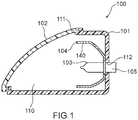
- Fig. 1 is a schematic sectional diagram showing an example of a lamp body of a lighting appliance according to an embodiment of the molded article.
- a configuration of a headlight (headlamp) as a lighting appliance for a vehicle is shown as an example of a lighting appliance 100.
- the lighting appliance 100 includes a lamp body 101, a front cover 102, a light source 103, a reflection mirror (reflector) 104, and a socket part 105.
- the lamp body 101 includes an opening 111 at the front.
- the front cover 102 is attached to the lamp body 101 in such a way as to cover the opening 111 of the lamp body 101. Thereby, a space 110 closed up tightly by the lamp body 101 and the front cover 102 is formed.
- the light source 103 and the reflection mirror 104 are disposed in the space 110.
- the light source 103 is, for example, a LED light bulb or a halogen light bulb.
- the light source 103 is connected to the socket part 105 fixed in a through hole 112 formed in the lamp body 101 and emits light by electric power supplied from the socket part 105.
- the reflection mirror 104 includes a concave surface 140 dented toward the front cover 102.
- a hole is formed at the central part of the reflection mirror 104, and the light source 103 is inserted and fixed in the hole.
- the reflection mirror 104 reflects the light emitted from the light source 103 by the concave surface 140 to lead the light on the side of the front cover 102.
- the front cover 102 is formed from a light (visible light)-transmittable resin material.
- the front cover 102 also functions as a lens that condenses or diffuses light from the light source 103.
- the lamp body 101 herein is provided with a resin part formed with the above-described thermoplastic resin composition. Thereby, weight reduction and high strengthening of the lamp body 101 can be achieved, and the recyclability and the surface smoothness can be improved.
- the method of producing the lamp body 101 is not particularly limited, and the lamp body 101 can be molded by injection molding of injecting the thermoplastic resin composition into a metal mold. Thereby, the resistance against wear of a metal mold is improved, and a metal mold is made difficult to corrode.
- Fig. 1 shows an example of a case where the whole of the lamp body 101 is formed by the resin part, but the lamp body 101 is not limited to this and may include the resin part and a part formed with a material other than a resin.
- Fig. 1 shows an example of a case where the lighting appliance 100 is a headlight; however, the lighting appliance 100 is not limited to this, and the lamp body 101 can be applied as a lamp body of a lighting appliance for a vehicle, such as a brake lamp, a fog lamp, and a reversing light. Further, the lamp body 101 can be applied as a body part (housing) of various lighting appliances, not limited to the lighting appliance for a vehicle.
- FIG. 2 is a perspective diagram showing an example of a speaker unit according to an embodiment of the molded article.
- a speaker unit 210 is provided with: an almost tightly-closed case body (enclosure) 213 formed by a board-like baffle 211 and a box-like storing part 212 bonded to the back of the baffle 211; and a speaker 214 held by the case body 213 in such a way as to expose a sound-emitting surface to the surface of the baffle 211.
- the case body (enclosure) 213 is also generally called a speaker box or a cabinet and has various shapes, such as a box type, a cylindrical type, and a conical type, depending on an apparatus or the like to which the case body 213 is applied.
- the speaker 214 includes: an exciter 215 as a source of vibration for a magnetic circuit; and cone paper 216 that releases a sound wave generated by the vibration of the exciter 215 outside the case body 213.
- Fig. 3 is a perspective diagram showing a speaker apparatus 200 for automotive application, which is an embodiment of applying the speaker unit to a speaker apparatus for automotive application.
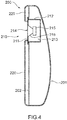
- Fig. 4 is a sectional diagram of the speaker apparatus 200 for automotive application shown in Fig. 3 , the sectional diagram viewed from the arrow direction along the line A-A in Fig. 3 .
- the speaker unit 210 to be used as the speaker apparatus 200 for automotive application is provided between an outer panel 201 on the vehicle outer side and an inner panel 202 on the vehicle inner side, the panels forming a door in a vehicle, such as an automobile, and is attached in a state where the speaker unit 210 is exposed from the opening of the inner panel 202.
- an inner trim 220 covering the surface of the inner panel 202 is attached in a state of exposing the speaker unit 210.
- the above-described thermoplastic resin composition is used for the baffle 211, the storing part 212, and the cone paper 216 of the case body 213.
- the speaker unit 210 in particular can contribute to reducing fuel consumption of a vehicle due to the weight reduction and is made highly strong, and therefore vibration of the case body 213 caused by vibration of a vehicle can be suppressed. As a result, noise attributable to the vibration of the case body 213 can be reduced and the acoustic characteristics can be improved.
- the above-described thermoplastic resin composition is used for the speaker unit 210, and therefore the speaker unit 210 exhibits an excellent whitening resistance.
- the speaker unit 210 includes the case body 213 formed with the thermoplastic resin composition and therefore is rich in recyclability and surface smoothness.
- the object of applying the speaker unit is not limited to an automobile, and examples thereof include mobile objects such as a two-wheeled vehicle, a railroad vehicle, a plane, and a ship, a computer apparatus, a headphone, or all the speaker apparatuses to be installed for home-use.
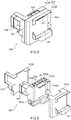
- FIG. 5 is a perspective diagram showing a connection box according to an embodiment of the molded article.
- Fig. 6 is a disassembled perspective diagram of the connection box shown in Fig. 5 .
- a connection box 300 is formed, for example, as a junction box to be installed on the indoor side of an automobile. This connection box 300 is provided with a case 320 including a first case 320a and a second case 320b.
- the connection box 300 is provided with a first substrate 340a, a second substrate 340b, and a third substrate 340c in the accommodating space inside thereof.
- the first substrate 340a and the second substrate 340b are disposed in such a way as to be in parallel with each other, and the third substrate 340c is disposed in such a way as to be vertically connected to end portions of the first substrate 340a and the second substrate 340b.
- an electronic control unit (ECU: Electronic Control Unit) not shown in the figures is to be installed.
- a connector 341 for ECU of the first substrate 340a is disposed in such a way as to protrude from the mounting surface 321 and can electrically connect the circuit of the first substrate 340a to ECU.
- a connector 322 for mounting a relay From the end portion of the second case 320b, a connector 322 for mounting a relay, the connector integrated with the case 320 of the connection box 300, protrudes.
- a relay not shown in the figures can be mounted to the connector 322 for mounting a relay.
- An indoor side connector 342a is disposed on the first substrate 340a, and an indoor side connector 342b is disposed on the second substrate 340b. These indoor side connectors 342a, 342b are each electrically connected to a circuit on the indoor side of an automobile through a wire harness not shown in the figures.
- a connector 343 for mounting a relay is disposed on the second substrate 340b. In the example shown in the figures, three relays can be loaded to the connector 343 for mounting a relay.
- An engine room side connector 344 is disposed on the third substrate 340c. This engine room side connector 344 is to be electrically connected to a circuit on the engine room side through a wire harness not shown in the figures.
- connection box 300 the case 320 and connectors 322, 341 to 344 of the connection box 300 are formed using the thermoplastic resin composition, and therefore weight reduction and high strengthening can be achieved, and recyclability and surface smoothness can be improved.
- connection box and the connector is not particularly limited, and the connection box and the connector can be molded by injection molding of injecting the thermoplastic resin composition into a metal mold.
- the connector in the present invention includes a connector housing, the connector itself, a connector integrated with a connection box case, and the like.
- connection box and the connector examples include a material for transportation equipment, such as an automobile, a two-wheeled vehicle, a train, and an airplane, a structural member of a robot arm, parts for a robot for amusement, a material for a home electric appliance, a case body for office automation equipment, information processing equipment, and a portable terminal.
- Fig. 7 shows a front diagram of a pulley according to an embodiment of the molded article
- Fig. 8 shows a sectional diagram of Fig. 1 , the sectional diagram taken along the line B-B in Fig. 1
- a pulley 400 is formed by a rolling bearing 410 and a resin part 420 integrally molded around the rolling bearing 410.
- the rolling bearing 410 includes an inner ring 411, an outer ring 412, and a rolling element 413 provided between the inner and outer rings.
- the resin part 420 is formed using the thermoplastic resin composition.
- the resin part 420 is provided with a cylindrical boss 421, a cylindrical rim 422, and an annular part 423 that connects the boss 421 and the rim 422.
- the outer peripheral surface 424 of the rim 422 is a guide surface of a belt not shown in the figures.
- Fig. 7 shows an example where the resin part 420 is formed using the thermoplastic resin composition, but the whole pulley may be formed using the thermoplastic resin composition.
- the method of producing the pulley 400 is not particularly limited, but the pulley 400 can be molded by injection molding of disposing the rolling bearing 410 in a metal mold and injecting the thermoplastic resin composition into the metal mold. Thereby, the resistance against wear of a metal mold and the smoothness of the edge (sharp-edge characteristic) of the resin part 420 can be improved.
- a pulley 400 which is reduced in weight and highly strengthened and is excellent in recyclability, surface smoothness, and further, size accuracy can be molded.
- Examples of the use of the pulley include a material for transportation equipment, such as an automobile, a two-wheeled vehicle, a train, and an airplane, a structural member of a robot arm, parts for a robot for amusement, a material for a home electric appliance, a case body for office automation equipment, information processing equipment, and a portable terminal.
- Fig. 9 is a schematic perspective diagram showing an example of an appearance of an agricultural house to which a film for a house according to an aspect of the molded article is applied.
- a house 510 for agriculture is provided with a film 501 stretched over a skeleton 502.
- the whole surface of the house 510 for agriculture is covered with the film 501 stretched over the skeleton 502.
- the house for agriculture in which a space separated from the outside is thereby formed can be made.
- the material forming the skeleton 502 is not particularly limited, and a conventionally known aggregate (such as, for example, steel material and steel pipe) for use in a plastic greenhouse can be used.
- the film 501 is a film to be stretched over the skeleton 502, and the above-described film for a house is applied to the film 501.
- the house 510 for agriculture may be provided with ventilation means (not shown in the figure), such as, for example, a ventilation fan, to be provided at the ceiling or the side of a house.
- ventilation means such as, for example, a ventilation fan, to be provided at the ceiling or the side of a house.
- the doorway (not shown in the figure) for a worker who is engaged in work in the house 510 for agriculture be, for example, double-entry doors or the like such that the air outside cannot directly get into the space in the house.
- the film 501 in the house 510 for agriculture includes a layer which is formed using the thermoplastic resin composition.
- the film 501 possesses recyclability together with weight reduction and high strengthening, and further, the surface smoothness and the adhesion performance can be improved more than a conventional film.
- the film 501 (film for a house) may include a layer which is formed from the thermoplastic resin composition and can be produced by a known method, such as, for example, an inflation molding method, a T-die molding method, a lamination method, and a calender method.
- the film 501 (film for a house) may be a single-layered or multi-layered film including one layer or a plurality of layers which is or are formed using the thermoplastic resin composition, or a laminated film in which on a layer formed from the thermoplastic resin composition, a resin layer formed from another resin composition is laminated.
- the resin capable of forming the other resin layer which can be laminated on the layer formed from the thermoplastic resin composition include a polyolefin resin which is usually used for a use as a film for a house.
- the thickness of the layer which is formed from the thermoplastic resin composition, the layer included in the film 501 (film for a house) is, for example, 50 ⁇ m or more and 200 ⁇ m or less, the lower limit value is preferably 75 ⁇ m or less, and it is preferable that the upper limit value be 150 ⁇ m or less.
- the thickness of the film for a house can appropriately be set according to the use or the like.
- Fig. 9 shows an example of a case where the film 501 (film for a house) is applied to the whole surface of the house 510 for agriculture, but the house 510 for agriculture is not limited to this and may be such that the film for a house is used in some of the surfaces of the house 510 for agriculture.
- the house 510 for agriculture can be prepared in such a way that a framework is built in desired width, depth, and height, and the film 501 (film for a house) obtained using the above-described thermoplastic resin composition is stretched over the skeleton 502. Thereby, a house 510 for agriculture which is reduced in weight and highly strengthened and is excellent in recyclability can be obtained.
- Examples of the use of the film for a house include a house for gardening, a house for raising a living thing, a house for a terrace, and a simple warehouse, not limited to a house for agriculture, the house for cultivating plants.
- thermoplastic resin composition in which the above-described (1) thermoplastic resins (base resin and maleic anhydride-modified polyethylene), (2) cellulose, and (3) organic peroxide are each contained in a content shown in Table 1 to Table 10 below, was prepared.
- the barrel temperature was set to a temperature higher than the one-minute half-life temperature of the organic peroxide by 20°C to perform heating-and-kneading at a screw rotational speed of 100 rpm, thereby obtaining a cellulose-reinforced thermoplastic resin composition.
- the thermoplastic resin contained a maleic anhydride-modified polyethylene
- the maleic anhydride-modified polyethylene used was described as a coupling agent in Tables 1 to 25 for convenience.
- Injection molding was performed using the cellulose-reinforced thermoplastic resin composition prepared above to separately prepare a lamp body, a speaker unit, a connection box and a connector, and a pulley each provided with a resin part. It is to be noted that with respect to injection conditions, injection molding was carried out under the molding conditions which are generally regarded as suitable in injection molding of these molded articles.
- a single-layered film having a thickness of 100 ⁇ m was prepared to obtain a film for a house by molding the cellulose-reinforced thermoplastic resin composition prepared above into a film using a T-die cast film production apparatus at an extruding temperature of 200°C.
- Pellets of the cellulose-reinforced thermoplastic resin compositions obtained above were dried at 80°C for 24 hours to prepare respective test specimens for a tensile test in accordance with the test specimen Type 2 in JIS K 7127 with an injection molding machine [ROBOTSHOT ⁇ -30C manufactured by FANUC CORPORATION].
- the tensile strength (MPa) of the test specimens for a tensile test prepared above was measured in accordance with JIS K 7161 with a tensile tester [Instron tester 5567 manufactured by Instron] under conditions of a distance between marked lines of 25 mm and a testing speed: 50 mm/min.
- the MFR of the base resin and the maleic anhydride-modified polyethylenes A to G, which are thermoplastic resins, the relative intensity ratio in the infrared absorption spectrum of the maleic anhydride-modified polyethylenes A to G, and the one-minute half-life temperature of the organic peroxides to be used were measured in the following manners.
- the mass (g/10 min) of a polymer that flows out per 10 minutes at 190°C under a load of 2.16 kg was determined using MELT INDEXER [manufactured by Toyo Seiki Seisaku-sho, Ltd.] in accordance with JIS K 7210.
- Each maleic anhydride-modified polyethylene was hot-pressed at 150°C and 200 kgf/cm 2 for 5 minutes to prepare a film having a thickness of 100 ⁇ m.
- the infrared absorption spectrum of this film was measured to determine the relative intensity ratio from the ratio of absorption intensity at around 1791 cm -1 /absorption intensity at around 719 cm -1 .
- the half-life which is a time until the amount of active oxygen in an organic peroxide becomes half the amount before decomposition when the organic peroxide decomposes due to heat, was determined by preparing a benzene solution of the organic peroxide the concentration of which is 0.1 mol/L and measuring a change in the organic peroxide concentration with time when the organic peroxide was thermally decomposed.
- thermoplastic resin composition formed using 11 parts by mass of the cellulose, 1 part by mass of the maleic anhydride-modified polyethylene A, and 0.10 parts by mass of the dialkyl peroxide A each based on 100 parts by mass of the high density polyethylene was heated and kneaded with a twin-screw extruder [KZW15TW-45MG-NH manufactured by TECHNOVEL CORPORATION] to obtain a pellet of a cellulose-reinforced thermoplastic resin. Thereafter, a test specimen for evaluating tensile strength was prepared using the pellet with an injection molding machine [ROBOTSHOT ⁇ -30C manufactured by FANUC CORPORATION].
- Pellets of cellulose-reinforced thermoplastic resin compositions were each prepared in the same manner as in Example 1, except that the compounded amount of the maleic anhydride-modified polyethylene A in the thermoplastic resin composition of Example 1 was changed as shown in Table 1 described below. Thereafter, test specimens as lamp bodies each provided with a resin part for evaluating tensile tension were each prepared using these pellets.
- a pellet of a cellulose-reinforced thermoplastic resin composition was produced in the same manner as in Example 1, except that the composition in the thermoplastic resin composition of Example 1 was changed to 11 parts by mass of the cellulose, 2 parts by mass of the maleic anhydride-modified polyethylene A, and 0.05 parts by mass of the dialkyl peroxide A each based on 100 parts by mass of the high density polyethylene. Thereafter, a test specimen as a lamp body provided with a resin part for evaluating tensile strength was prepared using this pellet.
- a pellet of a cellulose-reinforced thermoplastic resin composition was produced in the same manner as in Example 1, except that the composition in the thermoplastic resin composition of Example 1 was changed to 11 parts by mass of the cellulose, 5 parts by mass of the maleic anhydride-modified polyethylene A, and 0.05 parts by mass of the dialkyl peroxide A each based on 100 parts by mass of the high density polyethylene. Thereafter, a test specimen as a lamp body provided with a resin part for evaluating tensile strength was prepared using this pellet.
- a pellet of a cellulose-reinforced thermoplastic resin composition was produced in the same manner as in Example 1, except that the composition in the thermoplastic resin composition of Example 1 was changed to 11 parts by mass of the cellulose, 10 parts by mass of the maleic anhydride-modified polyethylene A, and 0.05 parts by mass of the dialkyl peroxide A each based on 100 parts by mass of the high density polyethylene. Thereafter, a test specimen as a lamp body provided with a resin part for evaluating tensile strength was prepared using this pellet.
- a pellet of a cellulose-reinforced thermoplastic resin composition was produced in the same manner as in Example 1, except that the composition in the thermoplastic resin composition of Example 1 was changed to 11 parts by mass of the cellulose, 5 parts by mass of the maleic anhydride-modified polyethylene A, and 0.01 parts by mass of the dialkyl peroxide A each based on 100 parts by mass of the high density polyethylene. Thereafter, a test specimen as a lamp body provided with a resin part for evaluating tensile strength was prepared using this pellet.
- a pellet of a cellulose-reinforced thermoplastic resin composition was produced in the same manner as in Example 1, except that the composition in the thermoplastic resin composition of Example 1 was changed to 11 parts by mass of the cellulose, 5 parts by mass of the maleic anhydride-modified polyethylene A, and 0.03 parts by mass of the dialkyl peroxide A each based on 100 parts by mass of the high density polyethylene. Thereafter, a test specimen as a lamp body provided with a resin part for evaluating tensile strength was prepared using this pellet.
- a pellet of a cellulose-reinforced thermoplastic resin composition was produced in the same manner as in Example 1, except that the composition in the thermoplastic resin composition of Example 1 was changed to 11 parts by mass of the cellulose, 5 parts by mass of the maleic anhydride-modified polyethylene A, and 0.12 parts by mass of the dialkyl peroxide A each based on 100 parts by mass of the high density polyethylene. Thereafter, a test specimen as a lamp body provided with a resin part for evaluating tensile strength was prepared using this pellet.
- a pellet of a cellulose-reinforced thermoplastic resin composition was produced in the same manner as in Example 1, except that the composition in the thermoplastic resin composition of Example 1 was changed to 43 parts by mass of the cellulose, 5 parts by mass of the maleic anhydride-modified polyethylene A, and 0.10 parts by mass of the dialkyl peroxide A each based on 100 parts by mass of the high density polyethylene. Thereafter, a test specimen as a lamp body provided with a resin part for evaluating tensile strength was prepared using this pellet.
- a pellet of a cellulose-reinforced thermoplastic resin composition was produced in the same manner as in Example 1, except that the composition in the thermoplastic resin composition of Example 1 was changed to 73 parts by mass of the cellulose, 5 parts by mass of the maleic anhydride-modified polyethylene A, and 0.10 parts by mass of the dialkyl peroxide A each based on 100 parts by mass of the high density polyethylene. Thereafter, a test specimen as a lamp body provided with a resin part for evaluating tensile strength was prepared using this pellet.
- a pellet of a cellulose-reinforced thermoplastic resin composition was produced in the same manner as in Example 1, except that the maleic anhydride-modified polyethylene A was not used in the thermoplastic resin composition of Example 1. Thereafter, a test specimen as a lamp body provided with a resin part for evaluating tensile strength was prepared using this pellet.
- a pellet of a cellulose-reinforced thermoplastic resin composition was produced in the same manner as in Example 1, except that the type of maleic anhydride-modified polyethylene in the thermoplastic resin composition of Example 1 was changed to the type shown in Table 3 described below. Thereafter, a test specimen as a lamp body provided with a resin part for evaluating tensile strength was prepared using this pellet.
- a pellet of a cellulose-reinforced thermoplastic resin composition was produced in the same manner as in Example 1, except that the composition in the thermoplastic resin composition of Example 1 was changed to 11 parts by mass of the cellulose, 5 parts by mass of the maleic anhydride-modified polyethylene A, and 0.10 parts by mass of the peroxyketal each based on 100 parts by mass of the high density polyethylene. Thereafter, a test specimen as a lamp body provided with a resin part for evaluating tensile strength was prepared using this pellet.
- a pellet of a cellulose-reinforced thermoplastic resin composition was produced in the same manner as in Example 1, except that the composition in the thermoplastic resin composition of Example 1 was changed to 11 parts by mass of the cellulose, 5 parts by mass of the maleic anhydride-modified polyethylene A, and 0.17 parts by mass of the dialkyl peroxide B each based on 100 parts by mass of the high density polyethylene. Thereafter, a test specimen as a lamp body provided with a resin part for evaluating tensile strength was prepared using this pellet.
- a pellet of a cellulose-reinforced thermoplastic resin composition was produced in the same manner as in Example 1, except that the composition in the thermoplastic resin composition of Example 1 was changed to 11 parts by mass of the cellulose, 5 parts by mass of the maleic anhydride-modified polyethylene A, and 0.30 parts by mass of the diacyl peroxide each based on 100 parts by mass of the high density polyethylene. Thereafter, a test specimen as a lamp body provided with a resin part for evaluating tensile strength was prepared using this pellet.
- a pellet of a cellulose-reinforced thermoplastic resin composition was produced in the same manner as in Example 1, except that the composition in the thermoplastic resin composition of Example 1 was changed to 11 parts by mass of the cellulose, 5 parts by mass of the maleic anhydride-modified polyethylene A, and 0.09 parts by mass of the dialkyl peroxide C each based on 100 parts by mass of the high density polyethylene. Thereafter, a test specimen as a lamp body provided with a resin part for evaluating tensile strength was prepared using this pellet.
- a pellet of a cellulose-reinforced thermoplastic resin composition was produced in the same manner as in Example 1, except that the composition in the thermoplastic resin composition of Example 1 was changed to 11 parts by mass of the cellulose, 5 parts by mass of the maleic anhydride-modified polyethylene A, and 0.16 parts by mass of the alkyl peroxyester each based on 100 parts by mass of the high density polyethylene. Thereafter, a test specimen as a lamp body provided with a resin part for evaluating tensile strength was prepared using this pellet.
- a pellet of a cellulose-reinforced thermoplastic resin composition was produced in the same manner as in Example 1, except that the composition in the thermoplastic resin composition of Example 1 was changed to 11 parts by mass of the cellulose, 5 parts by mass of the maleic anhydride-modified polyethylene A, and 0.14 parts by mass of the monoperoxycarbonate each based on 100 parts by mass of the high density polyethylene. Thereafter, a test specimen as a lamp body provided with a resin part for evaluating tensile strength was prepared using this pellet.
- a pellet of a cellulose-reinforced thermoplastic resin composition was produced in the same manner as in Example 1, except that the maleic anhydride-modified polyethylene A and the organic peroxide were not used. Thereafter, a test specimen as a lamp body provided with a resin part for evaluating tensile strength was prepared using this pellet.
- a pellet of a cellulose-reinforced thermoplastic resin composition was produced in the same manner as in Example 1, except that the organic peroxide was not used. Thereafter, a test specimen as a lamp body provided with a resin part for evaluating tensile strength was prepared using this pellet.
- a test specimen as a speaker unit provided with a resin part for evaluating tensile strength was prepared with an injection molding machine [ROBOTSHOT ⁇ -30C manufactured by FANUC CORPORATION] using the pellet of the cellulose-reinforced thermoplastic resin composition produced in Example 1.
- Test specimens as speaker units each provided with a resin part for evaluating tensile strength were each prepared using each of the cellulose-reinforced thermoplastic resin compositions produced in Examples 2 to 26 in the same manner as in Example 27.
- test specimen as a speaker unit provided with a resin part for evaluating tensile strength was prepared using the cellulose-reinforced thermoplastic resin composition produced in Comparative Example 1 in the same manner as in Example 27.
- test specimen as a speaker unit provided with a resin part for evaluating tensile strength was prepared using the cellulose-reinforced thermoplastic resin composition produced in Comparative Example 2 in the same manner as in Example 27.
- a test specimen as a connection box and a connector each provided with a resin part for evaluating tensile strength was prepared with an injection molding machine [ROBOTSHOT ⁇ -30C manufactured by FANUC CORPORATION] using the pellet of the cellulose-reinforced thermoplastic resin composition produced in Example 1.
- Test specimens as connection boxes and connectors each provided with a resin part for evaluating tensile strength were each prepared using each of the cellulose-reinforced thermoplastic resin compositions produced in Examples 2 to 26 in the same manner as in Example 53.
- test specimen as a connection box and a connector each provided with a resin part for evaluating tensile strength was prepared using the cellulose-reinforced thermoplastic resin composition produced in Comparative Example 1 in the same manner as in Example 53.
- test specimen as a connection box and a connector each provided with a resin part for evaluating tensile strength was prepared using the cellulose-reinforced thermoplastic resin composition produced in Comparative Example 2 in the same manner as in Example 53.
- a test specimen as a pulley provided with a resin part for evaluating tensile strength was prepared with an injection molding machine [ROBOTSHOT ⁇ -30C manufactured by FANUC CORPORATION] using the pellet of the cellulose-reinforced thermoplastic resin composition produced in Example 1.
- Test specimens as pulleys each provided with a resin part for evaluating tensile strength were each prepared using each of the cellulose-reinforced thermoplastic resin compositions produced in Examples 2 to 26 in the same manner as in Example 79.
- test specimen as a pulley provided with a resin part for evaluating tensile strength was prepared using the cellulose-reinforced thermoplastic resin composition produced in Comparative Example 1 in the same manner as in Example 79.
- test specimen as a pulley provided with a resin part for evaluating tensile strength was prepared using the cellulose-reinforced thermoplastic resin composition produced in Comparative Example 2 in the same manner as in Example 79.
- test specimen as a film for a house was prepared using the cellulose-reinforced thermoplastic resin composition produced in Comparative Example 2 in the same manner as in Example 105.
- thermoplastic resin compositions of Examples 1 to 130 in which cellulose is uniformly dispersed and contained, and the cellulose-reinforced thermoplastic resin compositions obtained using the thermoplastic resin compositions have an action capable of improving the mechanical strength of a molded material.
- thermoplastic resin compositions and the cellulose-reinforced thermoplastic resin compositions each having such an action were used, and therefore a lamp body, a speaker unit, a connection box and a connector, a pulley, a film for a house each provided with a resin part having an improved mechanical strength were enabled to be prepared.
- thermoplastic resin compositions obtained using the thermoplastic resin compositions of Examples 1 to 130 of the present invention improve the tensile strength and have a high reinforcing efficiency in the cellulose-reinforced thermoplastic resins, and therefore it is found that the cellulose-reinforced thermoplastic resin compositions are each useful as a lamp body, a speaker unit, a connection box and a connector, a pulley, or a film for a house provided with a resin part as a cellulose-reinforced resin.
- thermoplastic resin compositions are obtained from the thermoplastic resin compositions of Examples 1 to 130, and therefore it can be concluded that a lamp body, a speaker unit, a connection box and a connector, a pulley, or a film for a house provided with a resin part molded from the cellulose-reinforced thermoplastic resin compositions is reduced in weight and highly strengthened, and is excellent in recyclability and surface smoothness.
Landscapes
- Chemical & Material Sciences (AREA)
- Health & Medical Sciences (AREA)
- Chemical Kinetics & Catalysis (AREA)
- Medicinal Chemistry (AREA)
- Polymers & Plastics (AREA)
- Organic Chemistry (AREA)
- Engineering & Computer Science (AREA)
- Manufacturing & Machinery (AREA)
- Materials Engineering (AREA)
- General Engineering & Computer Science (AREA)
- Compositions Of Macromolecular Compounds (AREA)
Abstract
Description
- The present invention relates to a molded article, such as a lamp body of a lighting appliance, a speaker unit, a connection box, a connector, a pulley, and a film for a house, the molded article being provided with a resin part, and particularly relates to a molded article provided with a resin part prepared by injection molding, T-die molding, or the like. In particular, the present invention relates to: a molded article, such as a lamp body of a lighting appliance, a speaker unit, a connection box, a connector, a pulley, and a film for a house, the molded article being provided with a resin part, the resin part having a high mechanical strength and formed with a cellulose-reinforced thermoplastic resin composition containing a thermoplastic resin and a cellulose reinforcing agent; and a material for a molded article, such as a lamp body of a lighting appliance, a speaker unit, a connection box, a connector, a pulley, and a film for a house, the molded article being provided with a resin part formed with a thermoplastic resin composition for obtaining a cellulose-reinforced thermoplastic resin composition.
- In recent years, for the purpose of reducing fuel consumption of a vehicle, such as an automobile, further weight reduction of the vehicle has been required. To reduce the weight of a vehicle, not only the weight of a large part, such as a body forming the vehicle, but also the weights of various members, such as a lighting appliance including a headlight or the like, a speaker unit for automotive application as one component of an audio system to be loaded on the vehicle, a connection box and a connector for an automobile, and a guide pulley for a belt that drives engine accessories or the like of an automobile, need to be reduced.
- The lighting appliance for a vehicle is generally provided with a lamp body including an opening, a front cover that covers the opening, an extension, a reflection mirror (reflector), a light source, electrical components, and the like. To reduce the weight of the lighting appliance for a vehicle, it is effective to form the lamp body with a resin material, the lamp body having a relatively high ratio of the weight to the total weight of the lighting appliance for a vehicle among the components of the lighting appliance for a vehicle.
- In addition to further weight reduction, improvements in strength characteristics against vibration and in acoustic characteristics as a speaker unit are also required in the speaker unit for automotive application. To meet such requirements, it is desirable to form, for example, a case body (enclosure or cabinet), a frame, and the like of the speaker unit with a suitable compounded material.
- The connection box and connector for an automobile is generally produced by performing injection molding using a glass fiber-reinforced thermoplastic resin composition in which a glass fiber is dispersed as a reinforcing material. The use of such a highly strong resin enables thinning and weight reduction of the connection box and the connector. On the other hand, when the connection box, the connector, and the like are produced by injection molding, runner end materials and mis-shot products are produced. In addition, connection boxes, connectors, and the like formed using a glass fiber-reinforced thermoplastic resin are collected from scrapped cars in some cases. However, deterioration in strength of a recycled glass fiber-reinforced thermoplastic resin due to recycling is significant. Therefore, when a recycled glass fiber-reinforced thermoplastic resin is used, thinning and weight reduction of a connection box, a connector, and the like are difficult from the viewpoint of retaining the strength. Thus, a fiber-reinforced material such that effects of thinning and weight reduction are not lost even if it is recycled, the fiber-reinforced material being excellent in recyclability, is desired.
- In a pulley for a vehicle, a resin part is in general integrally molded along the outer periphery of a rolling bearing, and the resin part is formed by injection molding using a resin or the like containing a reinforced fiber from the viewpoint of productivity. However, in the case of the injection molding, a gate for adjusting the inlet velocity of a resin material is essential for an injection molding machine. In addition, at a part where the resin materials having flown from the gate into a metal mold join, a weld is produced to generate nonuniformity of the reinforced fiber in a circumferential direction, so that there is a possibility that unevenness in strength and size accuracy occurs. Therefore, when a pulley is produced by injection molding, the size accuracy of the outer peripheral portion, which guides a belt, in the resin part, the strength characteristics and the like to endure the tension of the belt are required. Being excellent in size accuracy is also required similarly in the lamp body.
- Such weight reduction and improvements in strength characteristics of various molded members are also required in, for example, molded members, for a house for agriculture, not limited to members for a vehicle, such as an automobile. The house for agriculture is widely used for the purpose of protecting products in the house from the outside and retaining a constant environment. A transparent film using as the main raw material vinyl chloride, polyethylene, a polyethylene-vinyl acetate copolymer, polyethylene terephthalate (PET), a polyethylene-tetrafluoroethylene copolymer, or the like is mainly used as a film for a house for agriculture so that situation of the inside can be grasped to a certain extent from the outside. Further, in recent years, the scale of an agricultural house has been made large in some cases from the viewpoint such as improving productivity. In a large-scale house for agriculture, the weight of the film to be used for the house increases, making an influence on the skeleton that supports the whole house large. In addition, an area where a flying object from the outside contacts increases. Therefore, weight reduction, high modulus of elasticity, and high strength are required in a film for a house. Further, the recyclability of a material is also required in some cases from the viewpoint of efficient utilization of resources in recent years.
- To meet the requirements as described above, cellulose fiber is regarded as promising as a compounding material for the resin part which various members are provided with. The cellulose fiber has excellent characteristics, such as a light weight, a high strength, a high modulus of elasticity, and a low linear thermal expansion, and therefore is widely known as a reinforcement material for a resin or the like. In addition, cellulose exists on the earth in a large amount and is a renewable natural resource, and therefore cellulose is suitable as a material having a high recyclability. Further, a micronized cellulose fiber has a more satisfactory surface smoothness as compared to a glass fiber and a carbon fiber. However, the cellulose fiber has a very high hydrophilicity and therefore has a poor affinity to a highly hydrophobic resin, such as polypropylene or polyethylene, so that the cellulose cannot be mixed uniformly with such a resin by only performing kneading mechanically with a twin-screw extruder or the like. Therefore, the mechanical properties of a resultant composite material have not necessarily been satisfiable and have been insufficient. Generally, in the case where a highly hydrophilic thermoplastic resin, such as polyethylene or polypropylene, is used when a molded material containing a cellulose fiber is produced, the dispersibility of the cellulose fiber is poor, making it very difficult to obtain further mechanical strength.
- To solve such a problem, a technique of using a compatibilizer for the purpose of changing the dispersibility of cellulose in a resin for the better is known. In addition, attempts to improve the dispersibility of cellulose in a resin by subjecting the cellulose or the resin to a modification treatment with a modifier or the like are made (For example, see Patent Literatures 1 to 4).
- For example, in Patent Literatures 1 and 2, using an unsaturated dicarboxylic acid and/or an anhydride thereof as a compatibilizer or an interface reinforcement agent in a resin composition containing a cellulose-based material and a polyolefin is proposed. In Patent Literature 3, using a polybasic acid anhydride as a hydrophobically modifying agent in part of hydroxy groups of microfibrillated cellulose to use a resultant hydrophobically modified cellulose fiber as a reinforcement material for a resin is proposed. In Patent Literature 4, improving the dispersibility of cellulose by using polyethylene obtained by grafting a monomer having a carboxy group, which has affinity to a hydroxy group existing in cellulose, through a particular method is proposed.
- Even though any of the above-described methods is used, the mechanical strength of a molded article is improved due to the reinforcement effect of cellulose, but further improvements in the mechanical strength are desired.
-
- Patent Literature 1: Japanese Patent Application Laid-Open No.
S62-39642 - Patent Literature 2: United States Patent Application Publication No.
US 2008/0146701 - Patent Literature 3: Japanese Patent Application Laid-Open No.
2012-214563 - Patent Literature 4: Japanese Patent No.
3479661 - It is an object of the present invention to provide a molded article provided with a resin part formed with a thermoplastic resin composition capable of dispersing cellulose simply and uniformly in a highly hydrophobic resin and capable of improving the mechanical strength of a molded material formed using a resultant resin composition. It is also an object of the present invention to provide a molded article provided with a resin part formed with a cellulose-reinforced thermoplastic resin composition obtained using the thermoplastic resin composition.
- The present inventors have conducted diligent studies for the purpose of solving the above-described problems to obtain findings that by allowing a resin composition to contain a cellulose fiber, a thermoplastic resin, and an organic peroxide, a thermoplastic resin composition having an improved dispersibility of the cellulose fiber is obtained and that by heating and kneading the thermoplastic resin composition to react the contained components, a cellulose-reinforced thermoplastic resin composition is obtained. The present inventors have found that as a result, the mechanical strength of molded materials formed using the thermoplastic resin composition and the cellulose-reinforced thermoplastic resin composition can remarkably be improved, and thereby a molded article provided with a resin part formed using the thermoplastic resin composition and a molded article provided with a resin part formed using the cellulose-reinforced thermoplastic resin composition are obtained.
- The gist and constitution of the present invention are as follows.
- [1] A molded article comprising a resin part formed with a thermoplastic resin composition, the thermoplastic resin composition comprising 5 to 70 parts by mass of cellulose based on 100 parts by mass of a thermoplastic resin and comprising an organic peroxide, wherein a tensile strength of a resin molded body formed with the thermoplastic resin composition measured in accordance with JIS K 7161 is 40 MPa or more.
- [2] The molded article according to [1], wherein the thermoplastic resin comprises a polyolefin resin modified by grafting an unsaturated carboxylic acid or an anhydride thereof.
- [3] The molded article according to [1] or [2], wherein a one-minute half-life temperature of the organic peroxide is 130 to 190°C.
- [4] The molded article according to any one of [1] to [3], wherein the organic peroxide is at least one organic peroxide selected from a dialkyl peroxide, a peroxyketal, a diacyl peroxide, an alkyl peroxyester, and a monoperoxycarbonate.
- [5] The molded article according to any one of [1] to [4], wherein a content of the organic peroxide is 0.01 to 0.30 parts by mass based on 100 parts by mass of the thermoplastic resin.
- [6] The molded article according to any one of [1] to [5], wherein the thermoplastic resin comprises a polyolefin resin modified by grafting an unsaturated carboxylic acid or an anhydride thereof, and the polyolefin resin modified by grafting an unsaturated carboxylic acid or an anhydride thereof is a maleic anhydride-modified polyolefin resin.
- [7] The molded article according to any one of [1] to [6], wherein the thermoplastic resin is a mixed resin of a polyolefin resin modified by grafting an unsaturated carboxylic acid or an anhydride thereof, and a polyolefin resin not modified with an unsaturated carboxylic acid or an anhydride thereof.
- [8] The molded article according to any one of [1] to [7], wherein the cellulose is a plant-derived, fibrous cellulose.
- [9] A molded article comprising a resin part formed with a cellulose-reinforced thermoplastic resin composition, the cellulose-reinforced thermoplastic resin composition comprising an ester-bonded composite resin of a hydroxy group of cellulose and a polyolefin resin having a carboxy group and a crosslinked structure, wherein a content of a cellulose component in the ester-bonded composite resin is 9.0 to 42% by mass, and a tensile strength of a resin molded body formed with the cellulose-reinforced thermoplastic resin composition measured in accordance with JIS K 7161 is 40 MPa or more.
- [10] The molded article according to [9], wherein the polyolefin resin having a carboxy group and a crosslinked structure is a polyolefin resin having a crosslinked structure such that a carbon atom in a main chain of the polyolefin resin modified by grafting an unsaturated carboxylic acid or an anhydride thereof and a carbon atom in a main chain of a polyolefin resin not modified with an unsaturated carboxylic acid or an anhydride thereof are bonded at two or more sites.
- [11] The molded article according to [10], wherein a polyolefin resin before modification for obtaining the polyolefin resin modified by grafting an unsaturated carboxylic acid or an anhydride thereof and the polyolefin resin not modified with an unsaturated carboxylic acid or an anhydride thereof are different polyolefin resins.
- [12] The molded article according to any one of [9] to [11], wherein the cellulose is a plant-derived, fibrous cellulose.
- [13] The molded article according to any one of [1] to [12], wherein the molded article is a lamp body of a lighting appliance, a speaker unit, a connection box, a connector, a pulley, or a film for a house.
- In the present invention, a thermoplastic resin composition in which cellulose is uniformly dispersed and contained and a cellulose-reinforced thermoplastic resin composition obtained by heating and kneading the thermoplastic resin composition are used, thereby enabling providing a molded article provided with a resin part having an improved mechanical strength. In addition, the resin part of the present invention is formed with a cellulose-reinforced thermoplastic resin composition formed with a thermoplastic resin and a cellulose reinforcing agent. Therefore, realizing molded articles provided with a resin part, such as a lamp body of a lighting appliance, a speaker unit, a connection box, a connector, a pulley, and a film for a house, which are reduced in weight and highly strengthened and are excellent in recyclability and surface smoothness is enabled.
-
- [
Fig. 1 ] A schematic sectional diagram showing an example of a lamp body of a lighting appliance according to an embodiment of a molded article of the present invention. - [
Fig. 2 ] A perspective diagram showing an example of a speaker unit according to an embodiment of a molded article of the present invention. - [
Fig. 3 ] A perspective diagram showing an aspect of applying a speaker unit according to an embodiment of a molded article of the present invention to a speaker apparatus for automotive application. - [
Fig. 4 ] A sectional diagram of the speaker apparatus for automotive application shown inFig. 3 , the sectional diagram viewed from the arrow direction along the line A-A inFig. 3 . - [
Fig. 5 ] A perspective diagram showing an example of a connection box according to an embodiment of a molded article of the present invention. - [
Fig. 6 ] A disassembled perspective diagram of the connection box shown inFig. 5 . - [
Fig. 7 ] A front diagram showing an example of a pulley according to an embodiment of a molded article of the present invention. - [
Fig. 8 ] A sectional diagram of the pulley shown inFig. 7 , the sectional diagram taken along the line B-B inFig. 7 . - [
Fig. 9 ] A perspective diagram showing an example of a house for agriculture using a film for a house according to an embodiment of a molded article of the present invention. - A molded article according to an embodiment of the present invention, such as a lamp body of a lighting appliance, a speaker unit, a connection box, a connector, a pulley, or a film for a house, is provided with a resin part formed with a thermoplastic resin composition, the thermoplastic resin composition containing 5 to 70 parts by mass of cellulose based on 100 parts by mass of a thermoplastic resin and containing an organic peroxide, wherein a tensile strength of a resin molded body formed with the thermoplastic resin composition measured in accordance with JIS K 7161 is 40 MPa or more.
- A cellulose-reinforced thermoplastic resin composition to be used in the present invention is obtained by heating and kneading the thermoplastic resin composition to react contained components. Therefore, a molded article according to another aspect of the present invention, such as a lamp body of a lighting appliance, a speaker unit, a connection box, a connector, a pulley, or a film for a house, is provided with resin part formed with a cellulose-reinforced thermoplastic resin composition containing an ester-bonded composite resin (composite) of a hydroxy group of cellulose and a polyolefin resin having a carboxy group and a crosslinked structure, wherein a content of a cellulose component in the ester-bonded composite resin is 9.0 to 42% by mass, and a tensile strength of a resin molded body formed with the cellulose-reinforced thermoplastic resin composition measured in accordance with JIS K 7161 is 40 MPa or more.
- The tensile strength of the resin molded body formed with the thermoplastic resin composition to be used in the present invention is a characteristic or a physical property of the resin contained in this thermoplastic resin composition. Such tensile strength is evaluated in such a way that the cellulose-reinforced thermoplastic resin composition obtained by heating and kneading the thermoplastic resin composition to react the contained components is processed into a test specimen (resin molded body) having an embodiment which is in accordance with the test specimen Type 2 and conforms to the tensile strength evaluation in JIS K 7127. On the other hand, the contained components in the cellulose-reinforced thermoplastic resin composition have already reacted, and therefore the tensile strength can be evaluated only by processing the cellulose-reinforced thermoplastic resin composition into a test specimen (resin molded body) having an embodiment which is in accordance with the test specimen Type 2 and conforms to the tensile strength evaluation in JIS K 7127.
- To react the contained components in the thermoplastic resin composition by use of the organic peroxide as a radical polymerization initiator, the temperature in general may be equal to or higher than the temperature where the organic peroxide thermally decomposes and a radical reaction is initiated, specifically a one-minute half-life temperature of the organic peroxide or higher (preferably, a temperature that is higher than the one-minute half-life temperature by 20°C). By heating and kneading the thermoplastic resin composition with a general twin-screw extruder, the cellulose-reinforced thermoplastic resin composition can be prepared as a pellet.
- Hereinafter, the conditions of heating and kneading will be described, but these are not for specifying the method for producing the cellulose-reinforced thermoplastic resin composition to be used in the present invention, but are conditions for measuring the tensile strength which is a parameter as a physical property or a characteristic.
- The temperature of kneading the thermoplastic resin composition is a temperature where the organic peroxide existing in the composition decomposes or higher, and is preferably a temperature that is higher than the one-minute half-life temperature of the organic peroxide to be used by 20°C. It is to be noted that stirring is not particularly limited, and may be sufficient when performed, for example, at a rotational speed of 100 rpm with a screw diameter of 15 mm and L/D = 45. This heating-and-kneading may be performed with a heating and kneading machine as a model instead of a heating and kneading machine for use in production.
- When heating-and-kneading is performed with a twin-screw extruder [for example, KZW15TW-45MG-NH manufactured by TECHNOVEL CORPORATION], the heating-and-kneading is performed at a screw rotational speed of 100 rpm loading the thermoplastic resin composition into a hopper of the twin-screw extruder having a screw diameter of 15 mm and L/D = 45 with a feeder controlling each component by the mass to be supplied per hour and setting a barrel temperature in a kneading zone to a temperature higher than the one-minute half-life temperature of the organic peroxide by 20°C.
- A test specimen for a tensile test in accordance with the test specimen Type 2 in JIS K 7127 is prepared from the cellulose-reinforced thermoplastic resin composition obtained by heating and kneading the thermoplastic resin composition to react the contained components, and the tensile strength is determined by measurement in accordance with JIS K 7161 for this test specimen for a tensile test.
- It is to be noted that when heating-and-kneading is performed with a twin-screw extruder, the test specimen is prepared with an injection molding machine [for example, ROBOTSHOT α-30C manufactured by FANUC CORPORATION] after drying a pellet of the thermoplastic resin composition at 80°C for 24 hours, the pellet obtained by performing the heating-and-kneading with the twin-screw extruder. The tensile strength is measured with a tensile tester [for example, Instron tester 5567 manufactured by Instron] under conditions of a distance between marked lines of 25 mm and a testing speed: 50 mm/min.
- The tensile strength is preferable when it is higher, and is 40 MPa or more in the present invention, and the tensile strength is more preferably 45 MPa or more, still more preferably 50 MPa or more, and particularly preferably 55 MPa or more. It is to be noted that the upper limit of the tensile strength is realistically 100 MPa.
- The tensile strength can be adjusted by the types and contents of the components contained in each of the above-described resin composition and cellulose-reinforced thermoplastic resin, and in particular, it is effective to adjust the amount of the organic peroxide to be compounded. For example, the tensile strength can be adjusted further effectively by using the amount of the organic peroxide to be compounded and the amount of a maleic anhydride-modified polyolefin to be compounded together in a well-balanced manner.
- Hereinafter, description will be given from the thermoplastic resin composition in order.
- The thermoplastic resin composition to be used for forming the resin part which the molded article of the present invention is provided with contains at least a thermoplastic resin, cellulose, and an organic peroxide. The thermoplastic resin composition may contain a polyolefin resin modified by grafting an unsaturated carboxylic acid or an anhydride thereof.
- In the present invention, one of the thermoplastic resins may be a polyolefin resin modified by grafting an unsaturated carboxylic acid or an anhydride thereof, or the thermoplastic resin consists of only a polyolefin resin modified by grafting an unsaturated carboxylic acid or an anhydride thereof.
- A base resin refers to a resin component the content of which is largest among the thermoplastic resins other than the polyolefin resin modified by grafting an unsaturated carboxylic acid or an anhydride thereof, the thermoplastic resins contained in the thermoplastic resin composition, and may be contained at least in the same mass as the polyolefin resin modified by grafting an unsaturated carboxylic acid or an anhydride thereof. In addition, cellulose is not included in the thermoplastic resin.
- The base resin to be used in the present invention is not particularly limited and may be any of the resins which are each generally used as a thermoplastic resin. Examples of the base resin include a polyolefin resin, a polyester resin, a polycarbonate resin, a polyamide resin, a polyimide resin, a polyurethane resin, a polyphenylene sulfide resin, a polyphenylene oxide resin, a cellulose acylate resin, and a phenoxy resin. Among these, a polyolefin resin is preferable in the present invention.
- The polyolefin resin is a polyolefin resin obtained by polymerizing at least one olefin and may be a homopolymer or a copolymer. Examples of such an olefin include α-olefins having 4 to 12 carbon atoms, including ethylene, propylene, isobutylene, and isobutene (1-butene), butadiene, isoprene, a (meth)acrylate, (meth)acrylic acid, (meth)acrylamide, vinyl alcohol, vinyl acetate, vinyl chloride, styrene, and acrylonitrile.
- Examples of the α-olefins having 4 to 12 carbon atoms include 1-butene, 2-methyl-1-propene, 2-methyl-1-butene, 3-methyl-1-butene, 1-hexene, 2-ethyl-1-butene, 2,3-dimethyl-1-butene, 2-methyl-1-pentene, 3-methyl-1-pentene, 4-methyl-1-pentene, 3,3-dimethyl-1-butene, 1-heptene, methyl-1-hexene, dimethyl-1-pentene, ethyl-1-pentene, trimethyl-1-butene, methyl ethyl-1-butene, 1-octene, methyl-1-pentene, ethyl-1-hexene, dimethyl-1-hexene, propyl-1-heptene, methyl ethyl-1-heptene, trimethyl-1-pentene, propyl-1-pentene, diethyl-1-butene, 1-nonene, 1-decene, 1-undecene and 1-dodecene.
- Examples of the polyolefin resin include vinyl resins such as a polyethylene resin, a polypropylene resin, a polyisobutylene resin, a polyisobutene resin, a polyisoprene resin, a polybutadiene resin, a (meth)acrylic resin (so-called allyl resin), and a polyvinyl chloride resin, a poly(meth)acrylamide resin, a polystyrene resin, an acrylonitrile/butadiene/styrene copolymer resin (ABS resin), an ethylene/(meth)acrylate copolymer, and an ethylene/vinyl acetate copolymer.
- Among these resins, a polyethylene resin, a polypropylene resin, an acrylonitrile/butadiene/styrene copolymer resin (ABS resin) are preferable, more preferably a polyethylene resin and a polypropylene resin.
- Examples of the polyethylene resin include an ethylene homopolymer and an ethylene-α-olefin copolymer. As the α-olefin, 1-butene, 1-pentene, 1-hexene, and 1-octene are preferable.
- Examples of the ethylene-α-olefin copolymer include an ethylene-1-butene copolymer, an ethylene-1-pentene copolymer, an ethylene-1-hexene copolymer, and an ethylene-1-octene copolymer.
- When the polyethylene resin is classified according to the density or the shape, polyethylene may be any of high density polyethylene (HDPE), low density polyethylene (LDPE), very low density polyethylene (VLDPE), linear low density polyethylene (LLDPE), and ultra high molecular weight-polyethylene (UHMW-PE).
- Examples of the vinyl resin include vinyl chloride resins [such as homopolymers of a vinyl chloride monomer (such as a polyvinyl chloride resin) and copolymers of a vinyl chloride monomer and another monomer (such as a vinyl chloride-vinyl acetate copolymer and a vinyl chloride-(meth)acrylate copolymer)], vinyl alcohol resins (including homopolymers such as polyvinyl alcohol, copolymers such as an ethylene-vinyl alcohol copolymer, and the like), and polyvinyl acetal resins such as polyvinyl formal. These vinyl-based resins can be used singly, or two or more thereof can be used in combination.
- It is preferable that the thermoplastic resin forming the cellulose-reinforced thermoplastic resin composition to be used for forming the resin part which the molded article of the present invention is provided with be a crosslinkable polyolefin resin. Examples of the crosslinkable polyolefin resin include low density polyethylene, middle density polyethylene, high density polyethylene, linear low density polyethylene, linear very low density polyethylene, an ethylene-propylene block copolymer, an ethylene-propylene random copolymer, an ethylene-butene block copolymer, an ethylene-butene random copolymer, an ethylene-vinyl acetate copolymer, an ethylene-methyl methacrylate copolymer, an ethylene-methyl acrylate copolymer resin, an ethylene-ethyl acrylate copolymer resin, and an ethylene-butyl acrylate copolymer resin.
- The polyolefin resin which is the base resin may be used singly, or two or more of the polyolefin resins each of which is the base resin may be used in combination. It is to be noted that when a plurality of polyolefin resins are used, the amounts of the other components to be compounded are specified assuming the total amount of the polyolefin resins to be 100 parts by mass of the polyolefin resins, unless otherwise noted.
- The melt flow rate (MFR) of the polyolefin resin is usually 0.01 to 400 g/10 min and, from the viewpoint of enhancing mechanical strength and production stability, the melt flow rate of the polyolefin resin is preferably 1 to 400 g/10 min, more preferably 0.1 to 50 g/10 min, and still more preferably 0.4 to 10 g/10 min. It is to be noted that in the present invention, the melt flow rate of the polyolefin resin, including the polyolefin resin modified by grafting an unsaturated carboxylic acid or an anhydride thereof, refers to the mass (g/10 min) of a polymer that flows out per 10 minutes at 190°C under a load of 2.16 kg in accordance with JIS K 7210.
- With respect to the base resin, for example, polyethylene, polypropylene, or polystyrene, which is a representative of the base resin, is formed from only carbon atoms and hydrogen atoms, and the hydrophobicity is extremely high. On the other hand, the surface of cellulose fiber is a surface which has a hydroxy group and has a high polarity, and therefore has a low compatibility with a highly hydrophobic thermoplastic resin, so that it is difficult to disperse the cellulose fiber uniformly. In the present invention, it is preferable to use the polyolefin resin modified by grafting an unsaturated carboxylic acid or an anhydride thereof in order to uniformly disperse a highly hydrophilic cellulose fiber, which has a hydroxy group which is a polar group, in the highly hydrophobic thermoplastic resin.
- The carboxy group (-CO2H) existing in the polyolefin resin modified by grafting an unsaturated carboxylic acid or an anhydride thereof and the - C(=O)-O-C(=O)- bond based on the acid anhydride have a high affinity to and compatibility with the hydroxy group (-OH) on the surface of the cellulose fiber due to interactions, such as a hydrogen bond and a dipole interaction. On the other hand, the polyolefin part of the polyolefin resin modified by grafting an unsaturated carboxylic acid or an anhydride thereof as well as a hydrophobic thermoplastic resin has a high hydrophobicity and the structures thereof are similar, so that the polyolefin part has a high compatibility with and affinity to the hydrophobic thermoplastic resin. Therefore, dispersing the cellulose fiber uniformly in the thermoplastic resin is facilitated.
- The polyolefin resin modified by grafting an unsaturated carboxylic acid or an anhydride thereof has a partial structure of interacting with the hydrophobic thermoplastic resin and a partial structure of interacting with hydrophilic cellulose in a molecule thereof, as described above, thereby functioning as a mediator to bind the hydrophobic thermoplastic resin and the hydrophilic cellulose together, and therefore is classified as a coupling agent.
- In addition, the structural part of an unsaturated carboxylic acid or the anhydride thereof in the polyolefin resin modified by grafting an unsaturated carboxylic acid or an anhydride thereof exists at an extremely near distance from the hydroxy group on the surface of the cellulose fiber, as described above. Therefore, an esterification reaction with the hydroxy group of the cellulose occurs easily and efficiently, and thereby a composite resin in which the cellulose and the polyolefin resin modified by grafting an unsaturated carboxylic acid or an anhydride thereof are chemically bonded is formed.
- In the present invention, a crosslinking reaction progresses between the base resin and cellulose of the cellulose fiber due to a radical obtained by decomposition of the organic peroxide, so that a firm composite resin is formed. Further, when the thermoplastic resin contains the polyolefin resin modified by grafting an unsaturated carboxylic acid or an anhydride thereof, the organic peroxide allows a crosslinked structure, which is formed due to the radical reaction between the polyolefin resin modified by grafting an unsaturated carboxylic acid or an anhydride thereof and the base resin, to be formed. Thereby, the cellulose, the polyolefin resin modified by grafting an unsaturated carboxylic acid or an anhydride thereof, and the base resin are chemically bonded (covalently bonded) to each other and a firmer composite resin is formed.
- The unsaturated carboxylic acid or the anhydride of thereof, which graft-modifies a polyolefin resin, in the polyolefin resin modified by grafting an unsaturated carboxylic acid or an anhydride thereof may be a chain compound or a cyclic compound, but is preferably a cyclic compound, more preferably a cyclic unsaturated carboxylic anhydride.
- With respect to the amount of graft modification with the unsaturated carboxylic acid or the anhydride thereof, 0.1 to 25 parts by mass of the unsaturated carboxylic acid or the anhydride thereof based on 100 parts by mass of the unmodified polyolefin resin is preferable, more preferably 0.1 to 10 parts by mass, and still more preferably 0.1 to 4 parts by mass.
- Examples of the unsaturated carboxylic acid include maleic acid, fumaric acid, itaconic acid, acrylic acid, and methacrylic acid.
- Examples of a cyclic acid anhydride among the unsaturated carboxylic anhydrides include acid anhydrides having a maleic acid skeleton, such as maleic anhydride, citraconic anhydride (methylmaleic anhydride), 2,3-dimethylmaleic anhydride, 2-(2-carboxyethyl)-3-methylmaleic anhydride, 2-cyclohexene-1,2-dicarboxylic anhydride, phenylmaleic anhydride, 2,3-diphenylmaleic anhydride, 5,6-dihydro-1,4-dithiin-2,3-dicarboxylic anhydride, and 2,3-bis(2,4,5-trimethyl-3-thienyl)maleic anhydride, and acid anhydrides having a phthalic acid skeleton, such as 4-ethynylphthalic anhydride, 4,4'-(ethin-1,2-diyl)diphthalic anhydride, 4-(1-propynyl)phthalic anhydride, and 4-phenylethynylphthalic anhydride.
- Examples of a chain acid anhydride among the unsaturated carboxylic anhydrides include an acid anhydride of fumaric acid, itaconic acid, acrylic acid, or methacrylic acid, and mixed acid anhydrides of these unsaturated carboxylic acids with a saturated aliphatic carboxylic acid, an aromatic carboxylic acid, or a heterocyclic carboxylic acid.
- It is preferable that the unsaturated carboxylic anhydride be a cyclic unsaturated carboxylic anhydride, more preferably an acid anhydride having a maleic acid skeleton, and particularly preferably maleic anhydride.
- It is preferable that thermoplastic resin composition to be used in the present invention contain a polyolefin resin modified by grafting an unsaturated carboxylic acid or an anhydride thereof and the polyolefin resin modified by grafting an unsaturated carboxylic acid or an anhydride thereof be a maleic anhydride-modified polyolefin resin.
- The polyolefin of the maleic anhydride-modified polyolefin is not particularly limited as long as the compatibility with the base resin is good. It is preferable that the maleic anhydride-modified polyolefin be maleic anhydride-modified polyethylene, maleic anhydride-modified polypropylene, or maleic anhydride-modified polystyrene, and the maleic anhydride-modified polyolefin is more preferably maleic anhydride-modified polyethylene or maleic anhydride-modified polypropylene. It is to be noted that a maleic anhydride-modified copolymer of a copolymer of two selected from ethylene, propylene, and styrene is also preferable.
- Examples of the maleic anhydride-modified polyethylene and the maleic anhydride-modified polypropylene include an ethylene-propylene copolymer modified with maleic anhydride, ethylene-α-olefin copolymers (such as an ethylene-vinyl acetate copolymer, an ethylene-hexene copolymer, and an ethylene-octene copolymer) modified with maleic anhydride, and styrene/ethylene/butylene/styrene (SEBS) having a group containing maleic anhydride. In addition, the maleic anhydride-modified polyethylene and the maleic anhydride-modified polypropylene may contain not only maleic anhydride but also a polar group (an alkylene glycol-based or (meth)acrylic acid-based monomer component) as a polar group to be grafted or copolymerized. Among these, particularly preferred maleic anhydride-modified polyethylene and maleic anhydride-modified polypropylene are maleic anhydride-modified polyolefins (polyethylene, polypropylene, polystyrene, or copolymers thereof), an ethylene-propylene copolymer modified with maleic anhydride, ethylene-α-olefin copolymers (such as an ethylene-vinyl acetate copolymer, an ethylene-hexene copolymer, and an ethylene-octene copolymer) modified with maleic anhydride, and styrene/ethylene/butylene/styrene (SEBS) having a group containing maleic anhydride.
- It is most preferable that the maleic anhydride-modified polyolefin resin be a maleic anhydride-modified polyethylene. In particular, a maleic anhydride-modified polyethylene having a melt flow rate (MFR) at 190°C under a load of 2.16 kg of 0.3 to 10 g/10 min is preferable. In addition, a maleic anhydride-modified polyethylene having a relative intensity ratio in an infrared absorption spectrum of 0.1 to 0.2, the relative intensity ratio measured in the infrared absorption spectrum, is preferable.
- With respect to the relative intensity ratio in the infrared absorption spectrum, the maleic anhydride-modified polyethylene is hot-pressed at 150°C and 200 kgf/cm2 for 5 minutes to prepare a film having a thickness of 100 µm, and the infrared absorption spectrum of this film is measured. The relative intensity ratio in the infrared absorption spectrum can be measured by determining the relative intensity ratio of the maleic anhydride-modified polyethylene from a ratio of absorption intensity at around 1791 cm-1 (an absorption peak of C=O stretching vibration of a saturated 5-memberd ring acid anhydride derived from maleic anhydride)/absorption intensity at around 719 cm-1 (an absorption peak of rocking vibration of a methylene group derived from polyethylene).
- When the relative intensity ratio in the infrared absorption spectrum is 0.1 to 0.2, the thermoplastic resin can thereby be allowed to tightly adhere to the cellulose firmly at the interface between the two. The relative intensity ratio in the infrared absorption spectrum is more preferably 0.15 to 0.2.
- With respect to the polyolefin resin modified by grafting an unsaturated carboxylic acid or an anhydride thereof, it is preferable that a polyolefin resin before modification and a polyolefin base resin not modified with an unsaturated carboxylic acid or an anhydride thereof be different polyolefin resins. Being different herein includes a difference in the types of resin components and in the constituent monomer components, and a difference in a physical property such as the MFR. In addition, the thermoplastic resin to be used in the present invention may be a mixed resin of the polyolefin resin modified by grafting an unsaturated carboxylic acid or an anhydride thereof and the polyolefin resin not modified with an unsaturated carboxylic acid or an anhydride thereof.
- It is preferable that the content of the polyolefin resin modified by grafting an unsaturated carboxylic acid or an anhydride thereof be 0.5 to 20 parts by mass, more preferably 1 to 15 parts by mass, and still more preferably 1 to 10 parts by mass based on 100 parts by mass of the base resin. When the content of the polyolefin resin modified by grafting an unsaturated carboxylic acid or an anhydride thereof is too small, a tight adhesion effect at the interface of the cellulose and the resin is not obtained sufficiently, so that an effect of improving the mechanical strength of the resin composition is not obtained sufficiently. On the other hand, when the content of the polyolefin resin modified by grafting an unsaturated carboxylic acid or an anhydride thereof is too large, the content gives a bad influence on the strength of the base resin, so that the strength of the whole resin composition is lowered.
- The organic peroxide is a polymerization initiator that crosslinks polymer molecules of the thermoplastic resins, such as the base resin and the polyolefin resin modified by grafting an unsaturated carboxylic acid or an anhydride thereof, by a radical reaction. The organic peroxide is a compound having at least carbon atoms and an -O-O- bond, and examples thereof include a ketone peroxide, a peroxyketal, a hydroperoxide, a dialkyl peroxide, an acyl peroxide, an alkyl peroxyester, a diacyl peroxide, a monoperoxycarbonate, and a peroxydicarbonate. Among these, in the present invention, at least one organic peroxide selected from a peroxyketal, a dialkyl peroxide, a diacyl peroxide, an alkyl peroxyester, and a monoperoxycarbonate is preferable, and a dialkyl peroxide in particular is preferable. When the organic peroxide is represented by a formula, the organic peroxides represented by the following formulas (1) to (9) are preferable.



- In the formulas, R1 to R8 each independently represent an alkyl group, a cycloalkyl group, or an aryl group. R1 and R2, and R3 and R4 herein are optionally bonded to each other to form a ring. n represents an integer of 1 to 6.
- The alkyl group may be linear or branched. It is preferable that the carbon numbers of the alkyl group be 1 to 20, more preferably 1 to 12. It is preferable that the number of ring members of the cycloalkyl group be 3 to 7, more preferably 5 or 6. It is preferable that the carbon numbers of the cycloalkyl group be 3 to 20, more preferably 3 to 12. Examples of the cycloalkyl group include cyclopropyl, cyclopentyl, and cyclohexyl.
- The alkyl group and the cycloalkyl group optionally have a substituent, and examples of the substituent include an alkyl group, an alkenyl group, an alkynyl group, a cycloalkyl group, an aryl group, an alkoxy group, an aryloxy group, an acyl group, an acyloxy group, an alkyloxycarbonyl group, an aryloxycarbonyl group, a halogen atom, and a carboxy group.
- It is preferable that the carbon numbers of the aryl group be 6 to 20, more preferably 6 to 12. The aryl group optionally has a substituent, and examples of the substituent include an alkyl group, a cycloalkyl group, an aryl group, an alkoxy group, an aryloxy group, and a halogen atom. Examples of the aryl group include phenyl and naphthyl, and phenyl is preferable.
- It is preferable that the ring formed in such a way that R1 and R2 are bonded to each other be a 5- or 6-membered saturated carbon ring, and be a cyclopentane ring or a cyclohexane ring. It is preferable that the ring formed in such a way that R3 and R4 are bonded to each other be a 7- to 12-membered ring, and a bond forming the ring optionally contains -O-O-.
- It is preferable that the organic peroxide represented by formula (2) also be a bis form as shown in the following formula (2a) in which R1 and R2 are bonded to each other to form a ring.

- In the formula, R3 and R4 are as defined for R3 and R4 in formula (2), and preferred ranges thereof are also the same. L1 represents a divalent linking group, and it is preferable that L1 be -O-, -S-, -SO2-, -C(=O)-, an alkylene group, or an arylene group.
- It is preferable that the organic peroxide represented by formula (4) also be a bis form as shown in the following formula (4a) when R4 is an alkyl group having a substituent.

- In the formula, R3 is as defined for R3 in formula (4), and preferred ranges thereof are also the same. R4a represents an alkylene group, a cycloalkylene group, or an arylene group, L2 represents a divalent linking group, and it is preferable that L2 be -O-, -S-, -SO2-, -C(=O)-, an alkylene group, an ethenylene group, an ethynylene group, or an arylene group.
- Among the organic peroxides represented by formulas (1) to (9), the organic peroxides represented by formulas (2), (4), and (6) to (8) are preferable, and the organic peroxide represented by formula (4) in particular is preferable.
- Examples of the organic peroxide include the following specific examples.
- (1) Ketone Peroxide Compounds
Cyclohexanone peroxide, chain methyl ethyl ketone peroxide, and the like - (2) Peroxyketal Compounds
1,1-Bis(t-butylperoxy)-3,3,5-trimethylcyclohexane, 1,1-bis(t-butylperoxy)cyclohexane, 2,2-bis(t-butylperoxy)octane, n-butyl-4,4-bis(t-butylperoxy)valerate, 2,2-bis(t-butylperoxy)butane, cyclic methyl ethyl ketone peroxide, and the like - (3) Hydroperoxide Compounds
t-Butyl peroxide, t-butyl cumyl peroxide, and the like - (4) Dialkyl Peroxide Compounds
Di-t-butyl peroxide, t-butyl cumyl peroxide, dicumyl peroxide, α, α'-bis(t-butylperoxy-m-isopropyl)benzene, 2,5-dimethyl-2,5-di(t-butylperoxy)hexane, 2,5-dimethyl-2,5-di(t-butylperoxy)hexine-3, and the like - (5) Acyl Peroxide Compounds
Acethyl peroxide, isobutyryl peroxide, octanoyl peroxide, decanoyl peroxide, lauroyl peroxide, 3,5,5-trimethylhexanoyl peroxide, succinic acid peroxide, benzoyl peroxide, 2,4-dichlorobenzoyl peroxide, m-toluoyl peroxide, and the like - (6) Alkyl Peroxyester Compounds
t-Butyl peroxyacetate, t-butyl peroxyisobutyrate, t-butyl peroxypivalate, t-butyl peroxyneodecanoate, cumyl peroxyneodecanoate, t-butyl peroxy-2-ehtylhexanoate, t-butyl peroxy-3,5,5-trimethylhexanoate, t-butyl peroxylaurate, t-butyl peroxybenzoate, di-t-butyl peroxyisophthalate, 2,5-dimethyl-2,5-di(benzoylperoxy)hexane, t-butyl peroxy maleic acid, t-butyl peroxy isopropyl carbonate, cumyl peroxyoctoate, t-hexyl peroxyneodecanoate, t-hexyl peroxypivalate, t-butyl peroxyneohexanoate, t-hexyl peroxyneohexanoate, cumyl peroxyneohexanoate, and the like - (7) Diacyl Peroxide Compounds
Diacetyl peroxide, diisobutyryl peroxide, dioctanoyl peroxide, didecanoyl peroxide, dilauroyl peroxide, bis(3,5,5-trimethylhexanoyl) peroxide, dibenzoyl peroxide, bis(2,4-dichlorobenzoyl) peroxide, bis(m-toluoyl) peroxide, and the like - (8) Monoperoxycarbonate Compounds
t-Butylperoxy isopropyl carbonate, t-amylperoxy-2-ethylhexyl carbonate, and the like - (9) Peroxydicarbonate Compounds
Di-n-propyl peroxydicarbonate, diisopropyl peroxydicarbonate, di-s-butyl peroxydicarbonate, bis(4-t-butylcyclohexyl) peroxydicarbonate, bis(2-ethylhexyl) peroxydicarbonate, and the like - It is preferable that the one-minute half-life temperature of the organic peroxide be 130 to 190°C. The half-life of the organic peroxide herein refers to a time until the amount of active oxygen in the organic peroxide becomes half the amount before decomposition when the organic peroxide decomposes due to heat. When the one-minute half-life temperature of the organic peroxide is too high, setting the temperature in a twin-screw extruder is made difficult, and conversely when the one-minute half-life temperature is too low, the organic peroxide itself is unstable and decomposes during storage. By setting the one-minute half-life temperature to the range as described above, heating-and-kneading is enabled with a twin-screw extruder which is used usually, enabling dispersing cellulose uniformly in a highly hydrophobic resin.
- The one-minute half-life temperature of the organic peroxide is determined by preparing an organic peroxide solution having a concentration of 0.1 mol/L using a relatively inactive solvent, such as benzene, and measuring a change in the organic peroxide concentration with time when the organic peroxide is thermally decomposed (see "Kakyozai Handbook (Handbook of Crosslinking Agents) (first edition)" published by TAISEISHA, LTD., page 162).
- It is preferable that the content of the organic peroxide be 0.01 to 0.30 parts by mass, more preferably 0.05 to 0.20 parts by mass, and still more preferably 0.05 to 0.1 parts by mass based on 100 parts by mass of the thermoplastic resin. When the content of the organic peroxide is too small, an effect of improving the mechanical strength of the resin composition is not obtained sufficiently. On the other hand, when the content of the organic peroxide is too large, the thermal fluidity of the resin composition is lowered, making it difficult to perform processing by molding.
- RO· (A radical) which is obtained by decomposition of the organic peroxide abstracts a hydrogen atom of the base resin and of the cellulose to produce radicals of the base resin and the cellulose further. It is inferred that the produced radical of the base resin and the produced radical of the cellulose undergo a bonding reaction and thereby the base resin and the cellulose adhere to each other at the interface thereof. The above-described tight adhesion reaction at the interface is as follows when a case where the base resin is polyethylene is taken as an example.
ROOR → 2RO·
RO· + PE-H → ROH + PE·
RO· + Cellulose-H → ROH + Cellulose·
PE· + Cellulose· → PE-Cellulose
- Herein, PE-H represents polyethylene, Cellulose-H represents cellulose, PE· and Cellulose·each represent a produced radical.
- It is preferable that the cellulose to be used in the present invention be plant-derived fibrous cellulose, especially plant-derived, micro-fibrous cellulose. In the molded article provided with a resin part of the present invention, for example, a lamp body of a lighting appliance, a speaker unit, a connection box, a connector, a pulley, a film for a house, or the like, cellulose is used as a compounding material for the resin part, weight reduction and high strengthening can be achieved, and recyclability and surface smoothness of the molded article can be improved. Further, for example, when the embodiment of the molded article is like a film, a film for a house, as a molded article, can possess an improved surface smoothness by including a layer of the thermoplastic resins in which such fibrous cellulose is composited, and a film for a house possessing an excellent light permeability can thereby be obtained. In addition, cellulose is a polar molecule having an -OH group, and the affinity between molecules is therefore high. Thus, a film for a house excellent in adhesion performance can be obtained because the interfacial adhesive force of the film for a house is improved. Thereby, an advantageous point, such as, for example, that the film for a house, when broken, can simply be repaired with an adhesive tape or the like, is obtained.
- Pulp is a raw material for paper and contains as the main component a tracheid which is extracted from a plant. From the chemical viewpoint, the main component of pulp is a polysaccharide, and the main component of the polysaccharide is cellulose. The plant-derived fibrous cellulose is not particularly limited, and examples thereof include plant-derived cellulose such as wood, bamboo, hemp, jute, kenaf, harvest losses of farm products (for example, straw of wheat, rice, or the like, maize, stems of raw cotton or the like, sugarcane), cloth, regenerated pulp, and old paper; however, in the present invention, wood or wood-derived fibrous cellulose is preferable, and the plant-derived fibrous cellulose is particularly preferably craft pulp. It is to be noted that the craft pulp is a general term of pulp obtained by removing lignin/hemicellulose from wood or a plant raw material by a chemical treatment with caustic soda or the like to take out cellulose that is almost pure.
- It is preferable that the diameter of the cellulose to be used in the present invention be 1 to 30 µm, more preferably 1 to 20 µm, and still more preferably 5 to 15 µm. In addition, it is preferable that the length (fiber length) be 10 to 100 µm, more preferably 20 to 50 µm.
- In the present invention, the amount of the cellulose to be compounded is 5 to 70 parts by mass, more preferably 10 to 60 parts by mass, and still more preferably 10 to 30 parts by mass based on 100 parts by mass of the thermoplastic resin. When the amount of the cellulose to be compounded is less than 5 parts by mass, a sufficient effect of reinforcement of a resin is not obtained, and conversely, when the amount of the cellulose to be compounded exceeds 70 parts by mass, the thermal fluidity of the resin composition is lowered, so that the molding processability is deteriorated, and the mechanical strength is lowered in some cases according to the circumstances.
- To the thermoplastic resin composition to be used in the present invention, an inorganic filler, such as, for example, talc, calcium carbonate, mica, and a glass fiber, or an organic filler, such as, for example, a polyester, and a polyamide fiber, and besides, various additives, such as a flame retardant, a stabilizer, an antioxidizing agent, an infrared ray absorber, a plasticizer, and a lubricant, and a colorant, such as a dye and a pigment, can be added.
- A component forming the thermoplastic resin composition to be used in the present invention can be compounded in an amount within a general range, except that 5 to 70 parts by mass of cellulose based on 100 parts by mass of the thermoplastic resin composition is contained, but it is most preferable that all the components be each compounded in an amount within a preferred range. However, the following remains unchanged: it is also a preferred aspect that a particular component is in a preferred range and the other components are each compounded in an amount within a general range.
- The cellulose-reinforced thermoplastic resin composition to be used in the present invention is produced from the above-described thermoplastic resin composition. The cellulose-reinforced thermoplastic resin composition to be used in the present invention is such that by heating and kneading the above-described thermoplastic resin composition, the contained components have reacted. In the above-described reaction, the base resin and a hydrogen atom of the cellulose of the cellulose fiber react due to the organic peroxide which is a radical reaction initiator, so that a crosslinking reaction between the base resin and the cellulose fiber progresses. Further, when the thermoplastic resin contains a polyolefin resin modified by grafting an unsaturated carboxylic acid or an anhydride thereof, the polyolefin resin modified by grafting an unsaturated carboxylic acid or an anhydride thereof and the cellulose react, so that an ester bond of a hydroxy group of the cellulose and the polyolefin resin having a carboxy group and a crosslinked structure is formed.
- Accordingly, the cellulose-reinforced thermoplastic resin composition to be used in the present invention has a crosslinked structure between the thermoplastic resin and the cellulose of the cellulose fiber, and further, contains an ester-bonded composite resin (composite) of a hydroxy group of the cellulose and the polyolefin resin having a carboxy group and a crosslinked structure. Herein, the content of the cellulose component in the ester-bonded composite resin is 9.0 to 42% by mass, and the tensile strength of a resin molded body formed with the cellulose-reinforced thermoplastic resin composition measured in accordance with JIS K 7161 is 40 MPa or more. It is to be noted that the content of the cellulose component in the composite is calculated as the cellulose component based on the total content of the thermoplastic resin component and the cellulose component each contained, as a component forming the composite, in the thermoplastic resin composition for obtaining the cellulose-reinforced thermoplastic resin composition.
- Besides what is described above, the crosslinking reaction that is caused by the organic peroxide which is a radical reaction initiator also forms a crosslinked structure in which a carbon atom of the main chain in the polyolefin resin modified by grafting an unsaturated carboxylic acid or an anhydride thereof and a carbon atom of the main chain in the polyolefin resin not modified with an unsaturated carboxylic acid or an anhydride thereof are bonded at two or more sites.
- Accordingly, it is preferable that the polyolefin resin having a carboxy group and a crosslinked structure be a polyolefin resin having a crosslinked structure in which a carbon atom of the main chain in the polyolefin resin modified by grafting an unsaturated carboxylic acid or an anhydride thereof and a carbon atom of the main chain in the polyolefin resin not modified with an unsaturated carboxylic acid or an anhydride thereof are bonded at two or more sites. It is to be noted that when the thermoplastic resin composition contains a polyolefin resin modified by grafting an unsaturated carboxylic acid or an anhydride thereof, the polyolefin resin modified by grafting an unsaturated carboxylic acid or an anhydride thereof is included in the components forming the composite.
- On this occasion, the polyolefin resin before modification for obtaining the polyolefin resin modified by grafting an unsaturated carboxylic acid or an anhydride thereof and the polyolefin resin not modified with an unsaturated carboxylic acid or an anhydride thereof as well as those in the above-described thermoplastic resin composition may be different polyolefin resins.
- In addition, it is preferable that the cellulose contained in the cellulose-reinforced thermoplastic resin composition as well as the cellulose contained in the above-described thermoplastic resin composition be plant-derived fibrous cellulose, especially plant-derived, micro-fibrous cellulose.
- The cellulose-reinforced thermoplastic resin composition is produced by heating and kneading the thermoplastic resin composition as described above. The apparatus to be used in kneading-and-heating is not particularly limited as long as heating-and-kneading can be performed at a temperature where the organic peroxide thermally decomposes, and examples thereof include a blender, a kneader, a mixing roll, a Banbury mixer, and a single-screw or twin-screw extruder. Among these, a twin-screw extruder is preferable. The cellulose-reinforced thermoplastic resin composition can be obtained with a twin-screw extruder by directly loading each component into a hopper unit of the twin-screw extruder with a weight feeder, kneading loaded components with the twin-screw extruder setting the setting temperature of the kneading zone to the above-described temperature, and reacting this kneaded product while heating the kneaded product.
- The cellulose-reinforced thermoplastic resin composition produced separately preparing the thermoplastic resin composition to be used in the present invention may be used, but it is preferable to produce the cellulose-reinforced thermoplastic resin composition in such a way that at a stage of producing the cellulose-reinforced thermoplastic resin composition with, for example, an extruder [for example, a twin-screw extruder such as KZW15TW-45MG-NH manufactured by TECHNOVEL CORPORATION], each component is loaded into a hopper of the extruder with a feeder controlling each component by the mass to be supplied into this extruder per hour, and a resultant thermoplastic resin composition is heated and kneaded. In such a method, existing apparatuses and facilities can be used without changing the facilities, and the cellulose-reinforced thermoplastic resin composition can be produced simultaneously with the preparation of the thermoplastic resin composition.
- As described above, heating-and-kneading is performed by loading each component into the hopper of the extruder and setting a barrel temperature in the kneading zone to, for example, a temperature where the organic peroxide thermally decomposes. The kneading temperature is set to a temperature higher than the one-minute half-life temperature of the organic peroxide. It is preferable that the kneading temperature be a temperature higher than the one-minute half-life temperature of the organic peroxide by 5°C or more, more preferably a temperature higher by 10°C or more, still more preferably a temperature higher by 15°C or more, and most preferably a temperature higher by 20°C or more.
- When a general organic peroxide is used, it is preferable that the kneading temperature be 150 to 200°C.
- With respect to heating-and-kneading, performing heating-and-kneading with, for example, a screw diameter of 15 mm and L/D = 45 at a screw rotational speed of 100 rpm is sufficient. The kneading time is not particularly limited, and may be a general reaction time when a usual organic peroxide is used.
- When the cellulose-reinforced thermoplastic resin composition is produced using an extruder, the cellulose-reinforced thermoplastic resin composition can also be used for producing a molded article, such as a lamp body of a lighting appliance, a speaker unit, a connection box, a connector, a pulley, or a film for a house, the molded article being provided with a resin part by making the cellulose-reinforced thermoplastic resin composition into a pellet.
- It is to be noted that in the cellulose-reinforced thermoplastic resin composition to be used in the present invention, an organic peroxide is compounded, therefore a decomposition residue of the organic peroxide is left in some cases by performing heating-and-kneading to perform reaction, and as a result, the decomposition residue may be contained in the cellulose-reinforced thermoplastic resin composition.
- The resin part of the molded article according to the present invention is formed using the cellulose-reinforced thermoplastic resin composition obtained by heating and kneading the thermoplastic resin composition to be used in the present invention. That is, the resin part is formed from the cellulose-reinforced resin composition containing an ester-bonded composite resin (composite) of a hydroxy group of cellulose and a polyolefin resin having a carboxy group and a crosslinked structure, wherein the content of the cellulose component in the ester-bonded composite resin is 9.0 to 42% by mass, and the tensile strength of a resin molded body formed with the cellulose-reinforced thermoplastic resin composition measured in accordance with JIS K 7161 is 40 MPa or more.
- In the molded body provided with a resin part according to the present invention, the tight adhesion at the interface between the thermoplastic resin and cellulose is changed for the better by the use of the cellulose-reinforced thermoplastic resin composition, as described above. Therefore, the resin part of an obtained molded article is excellent in mechanical strength, such as, for example, tensile strength. The molded article of the present invention is, for example, a lamp body of a lighting appliance, a speaker unit, a connection box, a connector, a pulley, or a film for a house. When the molded article is a film for a house, the film for a house includes a layer formed with the thermoplastic resin composition.
-
Fig. 1 is a schematic sectional diagram showing an example of a lamp body of a lighting appliance according to an embodiment of the molded article. InFig. 1 , a configuration of a headlight (headlamp) as a lighting appliance for a vehicle is shown as an example of alighting appliance 100. Thelighting appliance 100 includes alamp body 101, afront cover 102, alight source 103, a reflection mirror (reflector) 104, and asocket part 105. Thelamp body 101 includes anopening 111 at the front. Thefront cover 102 is attached to thelamp body 101 in such a way as to cover theopening 111 of thelamp body 101. Thereby, aspace 110 closed up tightly by thelamp body 101 and thefront cover 102 is formed. - The
light source 103 and thereflection mirror 104 are disposed in thespace 110. Thelight source 103 is, for example, a LED light bulb or a halogen light bulb. Thelight source 103 is connected to thesocket part 105 fixed in a throughhole 112 formed in thelamp body 101 and emits light by electric power supplied from thesocket part 105. - The
reflection mirror 104 includes aconcave surface 140 dented toward thefront cover 102. A hole is formed at the central part of thereflection mirror 104, and thelight source 103 is inserted and fixed in the hole. Thereflection mirror 104 reflects the light emitted from thelight source 103 by theconcave surface 140 to lead the light on the side of thefront cover 102. - The
front cover 102 is formed from a light (visible light)-transmittable resin material. Thefront cover 102 also functions as a lens that condenses or diffuses light from thelight source 103. - The
lamp body 101 herein is provided with a resin part formed with the above-described thermoplastic resin composition. Thereby, weight reduction and high strengthening of thelamp body 101 can be achieved, and the recyclability and the surface smoothness can be improved. - The method of producing the
lamp body 101 is not particularly limited, and thelamp body 101 can be molded by injection molding of injecting the thermoplastic resin composition into a metal mold. Thereby, the resistance against wear of a metal mold is improved, and a metal mold is made difficult to corrode. -
Fig. 1 shows an example of a case where the whole of thelamp body 101 is formed by the resin part, but thelamp body 101 is not limited to this and may include the resin part and a part formed with a material other than a resin. In addition,Fig. 1 shows an example of a case where thelighting appliance 100 is a headlight; however, thelighting appliance 100 is not limited to this, and thelamp body 101 can be applied as a lamp body of a lighting appliance for a vehicle, such as a brake lamp, a fog lamp, and a reversing light. Further, thelamp body 101 can be applied as a body part (housing) of various lighting appliances, not limited to the lighting appliance for a vehicle. -
Fig. 2 is a perspective diagram showing an example of a speaker unit according to an embodiment of the molded article. Aspeaker unit 210 is provided with: an almost tightly-closed case body (enclosure) 213 formed by a board-like baffle 211 and a box-like storing part 212 bonded to the back of thebaffle 211; and aspeaker 214 held by thecase body 213 in such a way as to expose a sound-emitting surface to the surface of thebaffle 211. It is to be noted that the case body (enclosure) 213 is also generally called a speaker box or a cabinet and has various shapes, such as a box type, a cylindrical type, and a conical type, depending on an apparatus or the like to which thecase body 213 is applied. Thespeaker 214 includes: anexciter 215 as a source of vibration for a magnetic circuit; andcone paper 216 that releases a sound wave generated by the vibration of theexciter 215 outside thecase body 213. -
Fig. 3 is a perspective diagram showing aspeaker apparatus 200 for automotive application, which is an embodiment of applying the speaker unit to a speaker apparatus for automotive application.Fig. 4 is a sectional diagram of thespeaker apparatus 200 for automotive application shown inFig. 3 , the sectional diagram viewed from the arrow direction along the line A-A inFig. 3 . As shown inFigs. 3 and4 , thespeaker unit 210 to be used as thespeaker apparatus 200 for automotive application is provided between anouter panel 201 on the vehicle outer side and aninner panel 202 on the vehicle inner side, the panels forming a door in a vehicle, such as an automobile, and is attached in a state where thespeaker unit 210 is exposed from the opening of theinner panel 202. It is to be noted that to theinner panel 202, aninner trim 220 covering the surface of theinner panel 202 is attached in a state of exposing thespeaker unit 210. - In the
speaker unit 210 used for thespeaker apparatus 200 for automotive application shown inFigs. 2 to 4 , the above-described thermoplastic resin composition is used for thebaffle 211, the storingpart 212, and thecone paper 216 of thecase body 213. Thereby, weight reduction and improvements in strength characteristics and acoustic characteristics can be achieved in thespeaker apparatus 200 for automotive application. Thespeaker unit 210 in particular can contribute to reducing fuel consumption of a vehicle due to the weight reduction and is made highly strong, and therefore vibration of thecase body 213 caused by vibration of a vehicle can be suppressed. As a result, noise attributable to the vibration of thecase body 213 can be reduced and the acoustic characteristics can be improved. In addition, the above-described thermoplastic resin composition is used for thespeaker unit 210, and therefore thespeaker unit 210 exhibits an excellent whitening resistance. Further, thespeaker unit 210 includes thecase body 213 formed with the thermoplastic resin composition and therefore is rich in recyclability and surface smoothness. - The object of applying the speaker unit is not limited to an automobile, and examples thereof include mobile objects such as a two-wheeled vehicle, a railroad vehicle, a plane, and a ship, a computer apparatus, a headphone, or all the speaker apparatuses to be installed for home-use.
-
Fig. 5 is a perspective diagram showing a connection box according to an embodiment of the molded article.Fig. 6 is a disassembled perspective diagram of the connection box shown inFig. 5 . Aconnection box 300 is formed, for example, as a junction box to be installed on the indoor side of an automobile. Thisconnection box 300 is provided with acase 320 including afirst case 320a and asecond case 320b. - The
connection box 300 is provided with a first substrate 340a, asecond substrate 340b, and athird substrate 340c in the accommodating space inside thereof. The first substrate 340a and thesecond substrate 340b are disposed in such a way as to be in parallel with each other, and thethird substrate 340c is disposed in such a way as to be vertically connected to end portions of the first substrate 340a and thesecond substrate 340b. - On a mounting
surface 321 of thefirst case 320a, an electronic control unit (ECU: Electronic Control Unit) not shown in the figures is to be installed. Aconnector 341 for ECU of the first substrate 340a is disposed in such a way as to protrude from the mountingsurface 321 and can electrically connect the circuit of the first substrate 340a to ECU. - From the end portion of the
second case 320b, aconnector 322 for mounting a relay, the connector integrated with thecase 320 of theconnection box 300, protrudes. A relay not shown in the figures can be mounted to theconnector 322 for mounting a relay. - An
indoor side connector 342a is disposed on the first substrate 340a, and anindoor side connector 342b is disposed on thesecond substrate 340b. Theseindoor side connectors connector 343 for mounting a relay is disposed on thesecond substrate 340b. In the example shown in the figures, three relays can be loaded to theconnector 343 for mounting a relay. An engineroom side connector 344 is disposed on thethird substrate 340c. This engineroom side connector 344 is to be electrically connected to a circuit on the engine room side through a wire harness not shown in the figures. - In this way, the
case 320 andconnectors connection box 300 are formed using the thermoplastic resin composition, and therefore weight reduction and high strengthening can be achieved, and recyclability and surface smoothness can be improved. - The method of producing the connection box and the connector is not particularly limited, and the connection box and the connector can be molded by injection molding of injecting the thermoplastic resin composition into a metal mold. It is to be noted that the connector in the present invention includes a connector housing, the connector itself, a connector integrated with a connection box case, and the like.
- Examples of the uses of the connection box and the connector include a material for transportation equipment, such as an automobile, a two-wheeled vehicle, a train, and an airplane, a structural member of a robot arm, parts for a robot for amusement, a material for a home electric appliance, a case body for office automation equipment, information processing equipment, and a portable terminal.
-
Fig. 7 shows a front diagram of a pulley according to an embodiment of the molded article, andFig. 8 shows a sectional diagram ofFig. 1 , the sectional diagram taken along the line B-B inFig. 1 . As shown inFigs. 7 and 8 , apulley 400 is formed by a rollingbearing 410 and aresin part 420 integrally molded around the rollingbearing 410. The rollingbearing 410 includes aninner ring 411, anouter ring 412, and a rollingelement 413 provided between the inner and outer rings. Theresin part 420 is formed using the thermoplastic resin composition. Theresin part 420 is provided with acylindrical boss 421, acylindrical rim 422, and anannular part 423 that connects theboss 421 and therim 422. The outerperipheral surface 424 of therim 422 is a guide surface of a belt not shown in the figures. -
Fig. 7 shows an example where theresin part 420 is formed using the thermoplastic resin composition, but the whole pulley may be formed using the thermoplastic resin composition. This can contribute to weight reduction and high strengthening of thepulley 400. The method of producing thepulley 400 is not particularly limited, but thepulley 400 can be molded by injection molding of disposing the rollingbearing 410 in a metal mold and injecting the thermoplastic resin composition into the metal mold. Thereby, the resistance against wear of a metal mold and the smoothness of the edge (sharp-edge characteristic) of theresin part 420 can be improved. In addition, by performing injection molding using the thermoplastic resin composition, apulley 400 which is reduced in weight and highly strengthened and is excellent in recyclability, surface smoothness, and further, size accuracy can be molded. - Examples of the use of the pulley include a material for transportation equipment, such as an automobile, a two-wheeled vehicle, a train, and an airplane, a structural member of a robot arm, parts for a robot for amusement, a material for a home electric appliance, a case body for office automation equipment, information processing equipment, and a portable terminal.
-
Fig. 9 is a schematic perspective diagram showing an example of an appearance of an agricultural house to which a film for a house according to an aspect of the molded article is applied. As shown inFig. 9 , ahouse 510 for agriculture is provided with afilm 501 stretched over askeleton 502. - As shown in
Fig. 9 , the whole surface of thehouse 510 for agriculture is covered with thefilm 501 stretched over theskeleton 502. When thefilm 501 is stretched over the skeleton, the house for agriculture in which a space separated from the outside is thereby formed can be made. - The material forming the
skeleton 502 is not particularly limited, and a conventionally known aggregate (such as, for example, steel material and steel pipe) for use in a plastic greenhouse can be used. Thefilm 501 is a film to be stretched over theskeleton 502, and the above-described film for a house is applied to thefilm 501. - The
house 510 for agriculture may be provided with ventilation means (not shown in the figure), such as, for example, a ventilation fan, to be provided at the ceiling or the side of a house. In addition, it is preferable that the doorway (not shown in the figure) for a worker who is engaged in work in thehouse 510 for agriculture be, for example, double-entry doors or the like such that the air outside cannot directly get into the space in the house. - The
film 501 in thehouse 510 for agriculture includes a layer which is formed using the thermoplastic resin composition. Thereby, thefilm 501 possesses recyclability together with weight reduction and high strengthening, and further, the surface smoothness and the adhesion performance can be improved more than a conventional film. - The film 501 (film for a house) may include a layer which is formed from the thermoplastic resin composition and can be produced by a known method, such as, for example, an inflation molding method, a T-die molding method, a lamination method, and a calender method.
- The film 501 (film for a house) may be a single-layered or multi-layered film including one layer or a plurality of layers which is or are formed using the thermoplastic resin composition, or a laminated film in which on a layer formed from the thermoplastic resin composition, a resin layer formed from another resin composition is laminated. Examples of the resin capable of forming the other resin layer which can be laminated on the layer formed from the thermoplastic resin composition include a polyolefin resin which is usually used for a use as a film for a house.
- The thickness of the layer which is formed from the thermoplastic resin composition, the layer included in the film 501 (film for a house) is, for example, 50 µm or more and 200 µm or less, the lower limit value is preferably 75 µm or less, and it is preferable that the upper limit value be 150 µm or less. When the film for a house is a multi-layered film, the thickness of the film for a house can appropriately be set according to the use or the like.
-
Fig. 9 shows an example of a case where the film 501 (film for a house) is applied to the whole surface of thehouse 510 for agriculture, but thehouse 510 for agriculture is not limited to this and may be such that the film for a house is used in some of the surfaces of thehouse 510 for agriculture. In addition, thehouse 510 for agriculture can be prepared in such a way that a framework is built in desired width, depth, and height, and the film 501 (film for a house) obtained using the above-described thermoplastic resin composition is stretched over theskeleton 502. Thereby, ahouse 510 for agriculture which is reduced in weight and highly strengthened and is excellent in recyclability can be obtained. - Examples of the use of the film for a house include a house for gardening, a house for raising a living thing, a house for a terrace, and a simple warehouse, not limited to a house for agriculture, the house for cultivating plants.
- Hereinafter, the present invention will be described in more detail based on Examples, but the present invention is not limited to these Examples. The materials used are shown below.
-
- High density polyethylene (HDPE)
- MFR (190°C/2.16 kg) = 5 g/10 min
- Density = 0.953 g/cm3
-
- Maleic anhydride-modified polyethylene A
- MFR (190°C/2.16 kg) = 9.0 g/10 min
- Relative intensity ratio in infrared absorption spectrum = 0.15
- Maleic anhydride-modified polyethylene B
- MFR (190°C/2.16 kg) = 0.4 g/10 min
- Relative intensity ratio in infrared absorption spectrum = 0.14
- Maleic anhydride-modified polyethylene C
- MFR (190°C/2.16 kg) = 3.4 g/10 min
- Relative intensity ratio in infrared absorption spectrum = 0.10
- Maleic anhydride-modified polyethylene D
- MFR (190°C/2.16 kg) = 4.4 g/10 min
- Relative intensity ratio in infrared absorption spectrum = 0.16
- Maleic anhydride-modified polyethylene E
- MFR (190°C/2.16 kg) = 1.3 g/10 min
- Relative intensity ratio in infrared absorption spectrum = 0.17
- Maleic anhydride-modified polyethylene F MFR (190°C/2.16 kg) = 1.2 g/10 min
Relative intensity ratio in infrared absorption spectrum = 0.16 - Maleic anhydride-modified polyethylene G
- MFR (190°C/2.16 kg) = 1.1 g/10 min
- Relative intensity ratio in infrared absorption spectrum = 0.12
-
- Pulp [trade name KC FLOCK W-200 manufactured by Nippon Paper Industries Co., Ltd., powdered cellulose having an average particle diameter of about 32 µm]
-
- Peroxyketal [trade name PERHEXA C manufactured by NOF CORPORATION]
- Dialkyl peroxide A [trade name PERHEXA 25B manufactured by NOF CORPORATION]
- Dialkyl peroxide B [trade name PERCUMYL D manufactured by NOF CORPORATION]
- Dialkyl peroxide C [trade name PERBUTYL D manufactured by NOF CORPORATION]
- Diacyl peroxide [trade name NYPER FF manufactured by NOF CORPORATION]
- Alkyl peroxyester [trade name PERBUTYL A manufactured by NOF CORPORATION]
- Monoperoxycarbonate [trade name PERHEXYL I manufactured by NOF CORPORATION]
- Firstly, common production method, molding method, and physical property evaluation method, which are performed in Examples and Comparative Examples, will be described.
- A thermoplastic resin composition, in which the above-described (1) thermoplastic resins (base resin and maleic anhydride-modified polyethylene), (2) cellulose, and (3) organic peroxide are each contained in a content shown in Table 1 to Table 10 below, was prepared. The obtained thermoplastic resin composition was loaded into a hopper of a twin-screw extruder [KZW15TW-45MG-NH manufactured by TECHNOVEL CORPORATION] having a screw diameter of 15 mm and L/D = 45 with a feeder controlling the obtained thermoplastic resin composition by the mass to be supplied per hour. The barrel temperature was set to a temperature higher than the one-minute half-life temperature of the organic peroxide by 20°C to perform heating-and-kneading at a screw rotational speed of 100 rpm, thereby obtaining a cellulose-reinforced thermoplastic resin composition. It is to be noted that when the thermoplastic resin contained a maleic anhydride-modified polyethylene, the maleic anhydride-modified polyethylene used was described as a coupling agent in Tables 1 to 25 for convenience.
- Injection molding was performed using the cellulose-reinforced thermoplastic resin composition prepared above to separately prepare a lamp body, a speaker unit, a connection box and a connector, and a pulley each provided with a resin part. It is to be noted that with respect to injection conditions, injection molding was carried out under the molding conditions which are generally regarded as suitable in injection molding of these molded articles.
- A single-layered film having a thickness of 100 µm was prepared to obtain a film for a house by molding the cellulose-reinforced thermoplastic resin composition prepared above into a film using a T-die cast film production apparatus at an extruding temperature of 200°C.
- Pellets of the cellulose-reinforced thermoplastic resin compositions obtained above were dried at 80°C for 24 hours to prepare respective test specimens for a tensile test in accordance with the test specimen Type 2 in JIS K 7127 with an injection molding machine [ROBOTSHOT α-30C manufactured by FANUC CORPORATION].
- The tensile strength (MPa) of the test specimens for a tensile test prepared above was measured in accordance with JIS K 7161 with a tensile tester [Instron tester 5567 manufactured by Instron] under conditions of a distance between marked lines of 25 mm and a testing speed: 50 mm/min.
- The MFR of the base resin and the maleic anhydride-modified polyethylenes A to G, which are thermoplastic resins, the relative intensity ratio in the infrared absorption spectrum of the maleic anhydride-modified polyethylenes A to G, and the one-minute half-life temperature of the organic peroxides to be used were measured in the following manners.
- The mass (g/10 min) of a polymer that flows out per 10 minutes at 190°C under a load of 2.16 kg was determined using MELT INDEXER [manufactured by Toyo Seiki Seisaku-sho, Ltd.] in accordance with JIS K 7210.
- Each maleic anhydride-modified polyethylene was hot-pressed at 150°C and 200 kgf/cm2 for 5 minutes to prepare a film having a thickness of 100 µm. The infrared absorption spectrum of this film was measured to determine the relative intensity ratio from the ratio of absorption intensity at around 1791 cm-1/absorption intensity at around 719 cm-1.
- The half-life, which is a time until the amount of active oxygen in an organic peroxide becomes half the amount before decomposition when the organic peroxide decomposes due to heat, was determined by preparing a benzene solution of the organic peroxide the concentration of which is 0.1 mol/L and measuring a change in the organic peroxide concentration with time when the organic peroxide was thermally decomposed.
- A thermoplastic resin composition formed using 11 parts by mass of the cellulose, 1 part by mass of the maleic anhydride-modified polyethylene A, and 0.10 parts by mass of the dialkyl peroxide A each based on 100 parts by mass of the high density polyethylene was heated and kneaded with a twin-screw extruder [KZW15TW-45MG-NH manufactured by TECHNOVEL CORPORATION] to obtain a pellet of a cellulose-reinforced thermoplastic resin. Thereafter, a test specimen for evaluating tensile strength was prepared using the pellet with an injection molding machine [ROBOTSHOT α-30C manufactured by FANUC CORPORATION].
- Pellets of cellulose-reinforced thermoplastic resin compositions were each prepared in the same manner as in Example 1, except that the compounded amount of the maleic anhydride-modified polyethylene A in the thermoplastic resin composition of Example 1 was changed as shown in Table 1 described below. Thereafter, test specimens as lamp bodies each provided with a resin part for evaluating tensile tension were each prepared using these pellets.
- A pellet of a cellulose-reinforced thermoplastic resin composition was produced in the same manner as in Example 1, except that the composition in the thermoplastic resin composition of Example 1 was changed to 11 parts by mass of the cellulose, 2 parts by mass of the maleic anhydride-modified polyethylene A, and 0.05 parts by mass of the dialkyl peroxide A each based on 100 parts by mass of the high density polyethylene. Thereafter, a test specimen as a lamp body provided with a resin part for evaluating tensile strength was prepared using this pellet.
- A pellet of a cellulose-reinforced thermoplastic resin composition was produced in the same manner as in Example 1, except that the composition in the thermoplastic resin composition of Example 1 was changed to 11 parts by mass of the cellulose, 5 parts by mass of the maleic anhydride-modified polyethylene A, and 0.05 parts by mass of the dialkyl peroxide A each based on 100 parts by mass of the high density polyethylene. Thereafter, a test specimen as a lamp body provided with a resin part for evaluating tensile strength was prepared using this pellet.
- A pellet of a cellulose-reinforced thermoplastic resin composition was produced in the same manner as in Example 1, except that the composition in the thermoplastic resin composition of Example 1 was changed to 11 parts by mass of the cellulose, 10 parts by mass of the maleic anhydride-modified polyethylene A, and 0.05 parts by mass of the dialkyl peroxide A each based on 100 parts by mass of the high density polyethylene. Thereafter, a test specimen as a lamp body provided with a resin part for evaluating tensile strength was prepared using this pellet.
- A pellet of a cellulose-reinforced thermoplastic resin composition was produced in the same manner as in Example 1, except that the composition in the thermoplastic resin composition of Example 1 was changed to 11 parts by mass of the cellulose, 5 parts by mass of the maleic anhydride-modified polyethylene A, and 0.01 parts by mass of the dialkyl peroxide A each based on 100 parts by mass of the high density polyethylene. Thereafter, a test specimen as a lamp body provided with a resin part for evaluating tensile strength was prepared using this pellet.
- A pellet of a cellulose-reinforced thermoplastic resin composition was produced in the same manner as in Example 1, except that the composition in the thermoplastic resin composition of Example 1 was changed to 11 parts by mass of the cellulose, 5 parts by mass of the maleic anhydride-modified polyethylene A, and 0.03 parts by mass of the dialkyl peroxide A each based on 100 parts by mass of the high density polyethylene. Thereafter, a test specimen as a lamp body provided with a resin part for evaluating tensile strength was prepared using this pellet.
- A pellet of a cellulose-reinforced thermoplastic resin composition was produced in the same manner as in Example 1, except that the composition in the thermoplastic resin composition of Example 1 was changed to 11 parts by mass of the cellulose, 5 parts by mass of the maleic anhydride-modified polyethylene A, and 0.12 parts by mass of the dialkyl peroxide A each based on 100 parts by mass of the high density polyethylene. Thereafter, a test specimen as a lamp body provided with a resin part for evaluating tensile strength was prepared using this pellet.
- A pellet of a cellulose-reinforced thermoplastic resin composition was produced in the same manner as in Example 1, except that the composition in the thermoplastic resin composition of Example 1 was changed to 43 parts by mass of the cellulose, 5 parts by mass of the maleic anhydride-modified polyethylene A, and 0.10 parts by mass of the dialkyl peroxide A each based on 100 parts by mass of the high density polyethylene. Thereafter, a test specimen as a lamp body provided with a resin part for evaluating tensile strength was prepared using this pellet.
- A pellet of a cellulose-reinforced thermoplastic resin composition was produced in the same manner as in Example 1, except that the composition in the thermoplastic resin composition of Example 1 was changed to 73 parts by mass of the cellulose, 5 parts by mass of the maleic anhydride-modified polyethylene A, and 0.10 parts by mass of the dialkyl peroxide A each based on 100 parts by mass of the high density polyethylene. Thereafter, a test specimen as a lamp body provided with a resin part for evaluating tensile strength was prepared using this pellet.
- A pellet of a cellulose-reinforced thermoplastic resin composition was produced in the same manner as in Example 1, except that the maleic anhydride-modified polyethylene A was not used in the thermoplastic resin composition of Example 1. Thereafter, a test specimen as a lamp body provided with a resin part for evaluating tensile strength was prepared using this pellet.
- A pellet of a cellulose-reinforced thermoplastic resin composition was produced in the same manner as in Example 1, except that the type of maleic anhydride-modified polyethylene in the thermoplastic resin composition of Example 1 was changed to the type shown in Table 3 described below. Thereafter, a test specimen as a lamp body provided with a resin part for evaluating tensile strength was prepared using this pellet.
- A pellet of a cellulose-reinforced thermoplastic resin composition was produced in the same manner as in Example 1, except that the composition in the thermoplastic resin composition of Example 1 was changed to 11 parts by mass of the cellulose, 5 parts by mass of the maleic anhydride-modified polyethylene A, and 0.10 parts by mass of the peroxyketal each based on 100 parts by mass of the high density polyethylene. Thereafter, a test specimen as a lamp body provided with a resin part for evaluating tensile strength was prepared using this pellet.
- A pellet of a cellulose-reinforced thermoplastic resin composition was produced in the same manner as in Example 1, except that the composition in the thermoplastic resin composition of Example 1 was changed to 11 parts by mass of the cellulose, 5 parts by mass of the maleic anhydride-modified polyethylene A, and 0.17 parts by mass of the dialkyl peroxide B each based on 100 parts by mass of the high density polyethylene. Thereafter, a test specimen as a lamp body provided with a resin part for evaluating tensile strength was prepared using this pellet.
- A pellet of a cellulose-reinforced thermoplastic resin composition was produced in the same manner as in Example 1, except that the composition in the thermoplastic resin composition of Example 1 was changed to 11 parts by mass of the cellulose, 5 parts by mass of the maleic anhydride-modified polyethylene A, and 0.30 parts by mass of the diacyl peroxide each based on 100 parts by mass of the high density polyethylene. Thereafter, a test specimen as a lamp body provided with a resin part for evaluating tensile strength was prepared using this pellet.
- A pellet of a cellulose-reinforced thermoplastic resin composition was produced in the same manner as in Example 1, except that the composition in the thermoplastic resin composition of Example 1 was changed to 11 parts by mass of the cellulose, 5 parts by mass of the maleic anhydride-modified polyethylene A, and 0.09 parts by mass of the dialkyl peroxide C each based on 100 parts by mass of the high density polyethylene. Thereafter, a test specimen as a lamp body provided with a resin part for evaluating tensile strength was prepared using this pellet.
- A pellet of a cellulose-reinforced thermoplastic resin composition was produced in the same manner as in Example 1, except that the composition in the thermoplastic resin composition of Example 1 was changed to 11 parts by mass of the cellulose, 5 parts by mass of the maleic anhydride-modified polyethylene A, and 0.16 parts by mass of the alkyl peroxyester each based on 100 parts by mass of the high density polyethylene. Thereafter, a test specimen as a lamp body provided with a resin part for evaluating tensile strength was prepared using this pellet.
- A pellet of a cellulose-reinforced thermoplastic resin composition was produced in the same manner as in Example 1, except that the composition in the thermoplastic resin composition of Example 1 was changed to 11 parts by mass of the cellulose, 5 parts by mass of the maleic anhydride-modified polyethylene A, and 0.14 parts by mass of the monoperoxycarbonate each based on 100 parts by mass of the high density polyethylene. Thereafter, a test specimen as a lamp body provided with a resin part for evaluating tensile strength was prepared using this pellet.
- A pellet of a cellulose-reinforced thermoplastic resin composition was produced in the same manner as in Example 1, except that the maleic anhydride-modified polyethylene A and the organic peroxide were not used. Thereafter, a test specimen as a lamp body provided with a resin part for evaluating tensile strength was prepared using this pellet.
- A pellet of a cellulose-reinforced thermoplastic resin composition was produced in the same manner as in Example 1, except that the organic peroxide was not used. Thereafter, a test specimen as a lamp body provided with a resin part for evaluating tensile strength was prepared using this pellet.
- A test specimen as a speaker unit provided with a resin part for evaluating tensile strength was prepared with an injection molding machine [ROBOTSHOT α-30C manufactured by FANUC CORPORATION] using the pellet of the cellulose-reinforced thermoplastic resin composition produced in Example 1.
- Test specimens as speaker units each provided with a resin part for evaluating tensile strength were each prepared using each of the cellulose-reinforced thermoplastic resin compositions produced in Examples 2 to 26 in the same manner as in Example 27.
- A test specimen as a speaker unit provided with a resin part for evaluating tensile strength was prepared using the cellulose-reinforced thermoplastic resin composition produced in Comparative Example 1 in the same manner as in Example 27.
- A test specimen as a speaker unit provided with a resin part for evaluating tensile strength was prepared using the cellulose-reinforced thermoplastic resin composition produced in Comparative Example 2 in the same manner as in Example 27.
- A test specimen as a connection box and a connector each provided with a resin part for evaluating tensile strength was prepared with an injection molding machine [ROBOTSHOT α-30C manufactured by FANUC CORPORATION] using the pellet of the cellulose-reinforced thermoplastic resin composition produced in Example 1.
- Test specimens as connection boxes and connectors each provided with a resin part for evaluating tensile strength were each prepared using each of the cellulose-reinforced thermoplastic resin compositions produced in Examples 2 to 26 in the same manner as in Example 53.
- A test specimen as a connection box and a connector each provided with a resin part for evaluating tensile strength was prepared using the cellulose-reinforced thermoplastic resin composition produced in Comparative Example 1 in the same manner as in Example 53.
- A test specimen as a connection box and a connector each provided with a resin part for evaluating tensile strength was prepared using the cellulose-reinforced thermoplastic resin composition produced in Comparative Example 2 in the same manner as in Example 53.
- A test specimen as a pulley provided with a resin part for evaluating tensile strength was prepared with an injection molding machine [ROBOTSHOT α-30C manufactured by FANUC CORPORATION] using the pellet of the cellulose-reinforced thermoplastic resin composition produced in Example 1.
- Test specimens as pulleys each provided with a resin part for evaluating tensile strength were each prepared using each of the cellulose-reinforced thermoplastic resin compositions produced in Examples 2 to 26 in the same manner as in Example 79.
- A test specimen as a pulley provided with a resin part for evaluating tensile strength was prepared using the cellulose-reinforced thermoplastic resin composition produced in Comparative Example 1 in the same manner as in Example 79.
- A test specimen as a pulley provided with a resin part for evaluating tensile strength was prepared using the cellulose-reinforced thermoplastic resin composition produced in Comparative Example 2 in the same manner as in Example 79.
- A test specimen as a film for a house, the film provided with a resin part for evaluating tensile strength, was prepared with an injection molding machine [ROBOTSHOT α-30C manufactured by FANUC CORPORATION] using the pellet of the cellulose-reinforced thermoplastic resin composition produced in Example 1.
- Test specimens as films for a house, the films each provided with a resin part for evaluating tensile strength, were each prepared using each of the cellulose-reinforced thermoplastic resin compositions produced in Examples 2 to 26 in the same manner as in Example 105.
- A test specimen as film for a house, the film provided with a resin part for evaluating tensile strength, was prepared using the cellulose-reinforced thermoplastic resin composition produced in Comparative Example 1 in the same manner as in Example 105.
- A test specimen as a film for a house, the film provided with a resin part for evaluating tensile strength, was prepared using the cellulose-reinforced thermoplastic resin composition produced in Comparative Example 2 in the same manner as in Example 105.
- Obtained results are shown together in Tables 1 to 25 below. It is to be noted that blanks in each material component in the tables indicate that the material component was not used, or was not evaluated because the material component was not used.
[Table 1] Item Composition Example 1 Example 2 Example 3 Example 4 Example 5 Example 6 Example 7 Thermoplastic resins Base resin HDPE 100 100 100 100 100 100 100 Coupling agent Maleic anhydride-modified polyethylene A 1 2 3 5 10 2 5 MFR [g/10 min.] 9.0 9.0 9.0 9.0 9.0 9.0 9.0 Relative intensity ratio in infrared spectrum 0.15 0.15 0.15 0.15 0.15 0.15 0.15 Cellulose Pulp 11 11 11 11 11 11 11 Organic Peroxide Dialkyl peroxide A 0.10 0.10 0.10 0.10 0.10 0.05 0.05 One-minute half-life temperature [°C] 179.8 179.8 179.8 179.8 179.8 179.8 179.8 Evaluation Tensile strength [MPa] 52 57 52 60 54 52 51 [Table 2] Item Composition Example 8 Example 9 Example 10 Example 11 Example 12 Example 13 Example 14 Thermoplastic resins Base resin HDPE 100 100 100 100 100 100 100 Coupling agent Maleic anhydride-modified polyethylene A 10 5 5 5 5 5 MFR [g/10 min.] 9.0 9.0 9.0 9.0 9.0 9.0 Relative intensity ratio in infrared spectrum 0.15 0.15 0.15 0.15 0.15 0.15 Cellulose Pulp 11 11 11 11 43 73 11 Organic Peroxide Dialkyl peroxide A 0.05 0.01 0.03 0.12 0.10 0.10 0.10 One-minute half-life temperature [°C] 179.8 179.8 179.8 179.8 179.8 179.8 179.8 Evaluation Tensile strength [MPa] 44 40 47 52 54 52 50 [Table 3] Item Composition Example 15 Example 16 Example 17 Example 18 Example 19 Example 20 Thermoplastic resins Base resin HDPE 100 100 100 100 100 100 Coupling agent Maleic anhydride-modified polyethylene B 5 Maleic anhydride-modified polyethylene C 5 Maleic anhydride-modified polyethylene D 5 Meleic anhydride-modified polyethylene E 5 Maleic anhydride-modified polyethylene F 5 Maleic anhydride-modified polyethylene G 5 MFR [g/10 min.] 0.4 3.4 4.4 1.3 1.2 1.1 Relative intensity ratio in infrared spectrum 0.14 0.10 0.16 0.17 0.16 0.12 Cellulose Pulp 11 11 11 11 11 11 Organic Peroxide Dialkyl peroxide A 0.10 0.10 0.10 0.10 0.10 0.10 One-minute half-life temperature [°C] 179.8 179.8 179.8 179.8 179.8 179.8 Evaluation Tensile strength [MPa] 57 56 56 59 59 58 [Table 4] Item Composition Example 21 Example 22 Example 23 Example 24 Example 25 Example 26 Thermoplastic resins Base resin HDPE 100 100 100 100 100 100 Coupling agent Maleic anhydride-modified polyethylene A 5 5 5 5 5 5 MFR [g/10 min.] 9.0 9.0 9.0 9.0 9.0 9.0 Relative intensity ratio in infrared spectrum 0.15 0.15 0.15 0.15 0.15 0.15 Cellulose Pulp 11 11 11 11 11 11 Organic Peroxide Peroxyketal 0.10 Dialkyl peroxide B 0.17 Diacyl peroxide 0.30 Dialkyl peroxide C 0.09 Alkyl peroxyester 0.16 Monoperoxycarbonate 0.14 One-minute half-life temperature [°C] 153.8 175.2 130.0 185.9 159.9 155.0 Evaluation Tensile strength [MPa] 55 57 51 57 56 53 [Table 5] Item Composition Comparative Example 1 Comparative Example 2 Thermoplastic resins Base resin HDPE 100 100 Coupling agent Maleic anhydride-modified polyethylene A 5 MFR [g/10 min.] 9.0 Relative intensity ratio in infrared spectrum 0.15 Cellulose Pulp 11 11 Organic Peroxide Dialkyl peroxide A Peroxyketal Dialkyl peroxide B Diacyl peroxide Dialkyl peroxide C Alkyl peroxyester Monoperoxycarbonate Evaluation Tensile strength [MPa] 33 35 [Table 6] Item Composition Example 27 Example 28 Example 29 Example 30 Example 31 Example 32 Example 33 Thermoplastic resins Base resin HDPE 100 100 100 100 100 100 100 Coupling agent Maleic anhydride-modified polyethylene A 1 2 3 5 10 2 5 MFR [g/10 min.] 9.0 9.0 9.0 9.0 9.0 9.0 9.0 Relative intensity ratio in infrared spectrum 0.15 0.15 0.15 0.15 0.15 0.15 0.15 Cellulose Pulp 11 11 11 11 11 11 11 Organic Peroxide Dialkyl peroxide A 0.10 0.10 0.10 0.10 0.10 0.05 0.05 One-minute half-life temperature [°C] 179.8 179.8 179.8 179.8 179.8 179.8 179.8 Evaluation Tensile strength [MPa] 52 57 52 60 54 52 51 [Table 7] Item Composition Example 34 Example 35 Example 36 Example 37 Example 38 Example 39 Example 40 Thermoplastic resins Base resin HDPE 100 100 100 100 100 100 100 Coupling agent Maleic anhydride-modified polyethylene A 10 5 5 5 5 5 MFR [g/10 min.] 9.0 9.0 9.0 9.0 9.0 9.0 Relative intensity ratio in infrared spectrum 0.15 0.15 0.15 0.15 0.15 0.15 Cellulose Pulp 11 11 11 11 43 73 11 Organic Peroxide Dialkyl peroxide A 0.05 0.01 0.03 0.12 0.10 0.10 0.10 One-minute half-life temperature [°C] 179.8 179.8 179.8 179.8 179.8 179.8 179.8 Evaluation Tensile strength [MPa] 44 40 47 52 54 52 50 [Table 8] Item Composition Example 41 Example 42 Example 43 Example 44 Example 45 Example 46 Thermoplastic resins Base resin HDPE 100 100 100 100 100 100 Coupling agent Maleic anhydride-modified polyethylene B 5 Maleic anhydride-modified polyethylene C 5 Maleic anhydride-modified polyethylene D 5 Maleic anhydride-modified polyethylene E 5 Maleic anhydride-modified polyethylene F 5 Maleic anhydride-modified polyethylene G 5 MFR [g/10 min.] 0.4 3.4 4.4 1.3 1.2 1.1 Relative intensity ratio in infrared spectrum 0.14 0.10 0.16 0.17 0.16 0.12 Cellulose Pulp 11 11 11 11 11 11 Organic Peroxide Dialkyl peroxide A 0.10 0.10 0.10 0.10 0.10 0.10 One-minute half-life temperature [°C] 179.8 179.8 179.8 179.8 179.8 179.8 Evaluation Tensile strength [MPa] 57 56 56 59 59 58 [Table 9] Item Composition Example 47 Example 48 Example 49 Example 50 Example 51 Example 52 Thermoplastic resins Base resin HDPE 100 100 100 100 100 100 Coupling agent Maleic anhydride-modified polyethylene A 5 5 5 5 5 5 MFR [g/10 min.] 9.0 9.0 9.0 9.0 9.0 9.0 Relative intensity ratio in infrared spectrum 0.15 0.15 0.15 0.15 0.15 0.15 Cellulose Pulp 11 11 11 11 11 11 Organic Peroxide Peroxyketal 0.10 Dialkyl peroxide B 0.17 Diacyl peroxide 0.30 Dialkyl peroxide C 0.09 Alkyl peroxyester 0.16 Monoperoxycarbonate 0.14 One-minute half-life temperature [°C] 153.8 175.2 130.0 185.9 159.9 155.0 Evaluation Tensile strength [MPa] 55 57 51 57 56 53 [Table 10] Item Composition Comparative Example 3 Comparative Example 4 Thermoplastic resins Base resin HDPE 100 100 Coupling agent Maleic anhydride-modified polyethylene A 5 MFR [g/10 min.] 9.0 Relative intensity ratio in infrared spectrum 0.15 Cellulose Pulp 11 11 Organic Peroxide Dialkyl peroxide A Peroxyketal Dialkyl peroxide B Diacyl peroxide Dialkyl peroxide C Alkyl peroxyester Monoperoxycarbonate Evaluation Tensile strength [MPa] 33 35 [Table 11] Item Composition Example 53 Example 54 Example 55 Example 58 Example 57 Example 58 Example 59 Thermoplastic resins Base resin HDPE 100 100 100 100 100 100 100 Coupling agent Maleic anhydride-modified polyethylene A 1 2 3 5 10 2 5 MFR [g/10 min.] 9.0 9.0 9.0 9.0 9.0 9.0 9.0 Relative intensity ratio in infrared spectrum 0.15 0.15 0.15 0.15 0.15 0.15 0.15 Cellulose Pulp 11 11 11 11 11 11 11 Organic Peroxide Dialkyl peroxide A 0.10 0.10 0.10 0.10 0.10 0.05 0.05 One-minute half-life temperature [°C] 179.8 179.8 179.8 179.8 179.8 179.8 179.8 Evaluation Tensile strength [MPa] 52 57 52 60 54 52 51 [Table 12] Item Composition Example 60 Example 61 Example 62 Example 63 Example 64 Example 65 Example 66 Thermoplastic resins Base resin HDPE 100 100 100 100 100 100 100 Coupling agent Maleic anhydride-modified polyethylene A 10 5 5 5 5 5 MFR [g/10 min.] 9.0 9.0 9.0 9.0 9.0 90 Relative intensity ratio in infrared spectrum 0.15 0.15 0.15 0.15 0.15 0.15 Cellulose Pulp 11 11 11 11 43 73 11 Organic Peroxide Dialkyl peroxide A 0.05 0.01 0.03 0.12 0.10 0.10 0.10 One-minute half-life temperature [°C] 179.8 179.8 179.8 179.8 179.8 179.8 179.8 Evaluation Tensile strength [MPa] 44 40 47 52 54 52 50 [Table 13] Item Composition Example 67 Example 68 Example 69 Example 70 Example 71 Example 72 Thermoplastic resins Base resin HDPE 100 100 100 100 100 100 Coupling agent Maleic anhydride-modified polyethylene B 5 Maleic anhydride-modified polyethylene C 5 Maleic anhydride-modified polyethylene D 5 Maleic anhydride-modified polyethylene E 5 Maleic anhydride-modified polyethylene F 5 Maleic anhydride-modified polyethylene G 5 MFR [g/10 min.] 0.4 3.4 4.4 1.3 1.2 1.1 Relative intensity ratio in infrared spectrum 0.14 0.10 0.16 0.17 0.16 0.12 Cellulose Pulp 11 11 11 11 11 11 Organic Peroxide Dialkyl peroxide A 0.10 0.10 0.10 0.10 0.10 0.10 One-minute half-life temperature [°C] 179.8 179.8 179.8 179.8 179.8 179.8 Evaluation Tensile strength [MPa] 57 56 56 59 59 58 [Table 14] Item Composition Example 73 Example 74 Example 75 Example 76 Example 77 Example 78 Thermoplastic resins Base resin HDPE 100 100 100 100 100 100 Coupling agent Maleic anhydride-modified polyethylene A 5 5 5 5 5 5 MFR [g/10 min.] 9.0 9.0 9.0 9.0 9.0 9.0 Relative intensity ratio in infrared spectrum 0.15 0.15 0.15 0.15 0.15 0.15 Cellulose Pulp 11 11 11 11 11 11 Organic Peroxide Peroxyketal 0.10 Dialkyl peroxide B 0.17 Diacyl peroxide 0.30 Dialkyl peroxide C 0.09 Alkyl peroxyester 0.16 Monoperoxycarbonate 0.14 One-minute half-life temperature [°C] 153.8 175.2 130.0 185.9 159.9 155.0 Evaluation Tensile strength [MPa] 55 57 51 57 56 53 [Table 15] Item Composition Comparative Example 5 Comparative Example 6 Thermoplastic resins Base resin HDPE 100 100 Coupling agent Maleic anhydride-modified polyethylene A 5 MFR [g/10 min.] 9.0 Relative intensity ratio in infrared spectrum 0.15 Cellulose Pulp 11 11 Organic Peroxide Dialkyl peroxide A Peroxyketal Dialkyl peroxide B Diacyl peroxide Dialkyl peroxide C Alkyl peroxyester Monoperoxycarbonate Evaluation Tensile strength [MPa] 33 35 [Table 16] Item Composition Example 79 Example 80 Example 81 Example 82 Example 83 Example 84 Example 85 Thermoplastic resins Base resin HDPE 100 100 100 100 100 100 10D Coupling agent Maleic anhydride-modified polyethylene A 1 2 3 5 10 2 5 MFR [g/10 min.] 9.0 9.0 9.0 9.0 9.0 9.0 9.0 Relative intensity ratio in infrared spectrum 0.15 0.15 0.15 0.15 0.15 0.15 0.15 Cellulose Pulp 11 11 11 11 11 11 11 Organic Peroxide Dialkyl peroxide A 0.10 0.10 0.10 0.10 0.10 0.05 0.05 One-minute half-life temperature [°C] 179.8 179.8 179.8 179.8 179.8 179.8 179.8 Evaluation Tensile strength [MPa] 52 57 52 60 54 52 51 [Table 17] Item Composition Example 86 Example 87 Example 88 Example 89 Example 90 Example 91 Example 92 Thermoplastic resins Base resin HDPE 100 100 100 100 100 100 100 Coupling agent Maleic anhydride-modified polyethylene A 10 5 5 5 5 5 MFR [g/10 min.] 9.0 9.0 9.0 9.0 9.0 9.0 Relative intensity ratio In infrared spectrum 0.15 0.15 0.15 0.15 0.15 0.15 Cellulose Pulp 11 11 11 11 43 73 11 Organic Peroxide Dialkyl peroxide A 0.05 0.01 0.03 0.12 0.10 0.10 0.10 One-minute half-life temperature [°C] 179.8 179.6 179.8 179.8 179.8 179.8 179.8 Evaluation Tensile strength [MPa] 44 40 47 52 54 52 50 [Table 18] Item Composition Example 93 Example 94 Example 95 Example 96 Example 97 Example 98 Thermoplastic resins Base resin HDPE 100 100 100 100 100 100 Coupling agent Maleic anhydride-modified polyethylene B 5 Maleic anhydride-modified polyethylene C 5 Maleic anhydride-modified polyethylene D 5 Maleic anhydride-modified polyethylene E 5 Maleic anhydride-modified polyethylene F 5 Maleic anhydride-modified polyethylene G 5 MFR [g/10 min.] 0.4 34 4.4 1.3 1.2 1.1 Relative intensity ratio in infrared spectrum 0.14 0.10 0.16 0.17 0.16 0.12 Cellulose Pulp 11 11 11 11 11 11 Organic Peroxide Dialkyl peroxide A 0.10 0.10 0.10 0.10 0.10 0.10 One-minute half-life temperature [°C] 179.8 179.8 179.8 179.8 179.8 179.8 Evaluation Tensile strength [MPa] 57 56 56 59 59 58 [Table 19] Item Composition Example 99 Example 100 Example 101 Example 102 Example 103 Example 104 Thermoplastic resins Base resin HDPE 100 100 100 100 100 100 Coupling agent Maleic anhydride-modified polyethylene A 5 5 5 5 5 5 MFR [g/10 min.] 9.0 9.0 9.0 9.0 9.0 9.0 Relative intensity ratio In Infrared spectrum 0.15 0.15 0.15 0.15 0.15 0.15 Cellulose Pulp 11 11 11 11 11 11 Organic Peroxide Peroxyketal 0.10 Dialkyl peroxide B 0.17 Diacyl peroxide 0.30 Dialkyl peroxide C 0.09 Alkyl peroxyester 0.16 Monoperoxycarbonate 0.14 One-minute half-life temperature [°C] 153.8 175.2 130.0 185.9 159.9 155.0 Evaluation Tensile strength [MPa] 55 57 51 57 56 53 [Table 20] Item Composition Comparative Example 7 Comparative Example 8 Thermoplastic resins Base resin HDPE 100 100 Coupling agent Maleic anhydride-modified polyethylene A 5 MFR [g/10 min.] 9.0 Relative intensity ratio in infrared spectrum 0.15 Cellulose Pulp 11 11 Organic Peroxide Dialkyl peroxide A Peroxyketal Dialkyl peroxide B Diacyl peroxide Dialkyl peroxide C Alkyl peroxyester Monoperoxycarbonate Evaluation Tensile strength [MPa] 33 35 [Table 21] Item Composition Example 105 Example 106 Example 107 Example 108 Example 109 Example 110 Example 111 Thermoplastic resins Base resin HDPE 100 100 100 100 100 100 100 Coupling agent Maleic anhydride-modified polyethylene A 1 2 3 5 10 2 5 MFR [g/10 min.] 9.0 9.0 9.0 9.0 9.0 9.0 9.0 Relative intensity ratio in infrared spectrum 0.15 0.15 0.15 0.15 0.15 0.15 0.15 Cellulose Pulp 11 11 11 11 11 11 11 Organic Peroxide Dialkyl peroxide A 0.10 0.10 0.10 0.10 0.10 0.05 0.05 One-minute half-life temperature [°C] 179.8 179.8 179.8 179.8 179.8 179.8 179.8 Evaluation Tensile strength [MPa] 52 57 52 60 54 52 51 [Table 22] Item Composition Example 112 Example 113 Example 114 Example 115 Example 116 Example 117 Example 118 Thermoplastic resins Base resin HDPE 100 100 100 100 100 100 100 Coupling agent Maleic anhydride-modified polyethylene A 10 5 5 5 5 5 MFR [g/10 min.] 9.0 9.0 9.0 9.0 9.0 9.0 Relative intensity ratio in infrared spectrum 0.15 0.15 0.15 0.15 0.15 0.15 Cellulose Pulp 11 11 11 11 43 73 11 Organic Peroxide Dialkyl peroxide A 0.05 0.01 0.03 0.12 0.10 0.10 0.10 One-minute half-life temperature [°C] 179.8 179.8 179.8 179.8 179.8 179.8 179.8 Evaluation Tensile strength [MPa] 44 40 47 52 54 52 50 [Table 23] Item Composition Example 119 Example 120 Example 121 Example 122 Example 123 Example 124 Thermoplastic resins Base resin HDPE 100 100 100 100 100 100 Coupling agent Maleic anhydride-modified polyethylene B 5 Maleic anhydride-modified polyethylene C 5 Maleic anhydride-modified polyethylene D 5 Maleic anhydride-modified polyethylene E 5 Maleic anhydride-modified polyethylene F 5 Maleic anhydride-modified polyethylene G 5 MFR [g/10 min.] 0.4 3.4 4.4 1.3 1.2 1.1 Relative intensity ratio in infrared spectrum 0.14 0.10 0.16 0.17 0.16 0.12 Cellulose Pulp 11 11 11 11 11 11 Organic Peroxide Dialkyl peroxide A 0.10 0.10 0.10 0.10 0.10 0.10 One-minute half-life temperature [°C] 179.8 179.8 179.8 179.8 179.8 179.8 Evaluation Tensile strength [MPa] 57 56 56 59 59 58 [Table 24] Item Composition Example 125 Example 126 Example 127 Example 128 Example 129 Example 130 Thermoplastic resins Base resin HDPE 100 100 100 100 100 100 Coupling agent Maleic anhydride-modified polyethylene A 5 5 5 5 5 5 MFR [g/10 min.] 9.0 9.0 9.0 9.0 9.0 9.0 Relative intensity ratio in infrared spectrum 0.15 0.15 0.15 0.15 0.15 0.15 Cellulose Pulp 11 11 11 11 11 11 Organic Peroxide Peroxyketal 0.10 Dialkyl peroxide B 0.17 Diacyl peroxide 0.30 Dialkyl peroxide C 0.09 Alkyl peroxyester 0.16 Monoperoxycarbonate 0.14 One-minute half-life temperature [°C] 153.8 175.2 130.0 185.9 159.9 155.0 Evaluation Tensile strength [MPa] 55 57 51 57 56 53 [Table 25] Item Composition Comparative Example 9 Comparative Example 10 Thermoplastic resins Base resin HDPE 100 100 Coupling agent Maleic anhydride-modified polyethylene A 5 MFR [g/10 min.] 9.0 Relative Intensity ratio In Infrared spectrum 0.15 Cellulose Pulp 11 11 Organic Peroxide Dialkyl peroxide A Peroxyketal Dialkyl peroxide B Diacyl peroxide Dialkyl peroxide C Alkyl peroxyester Monoperoxycarbonate Evaluation Tensile strength [MPa] 33 35 - As it is clear from Tables 1 to 25 above, all of the test specimens of the lamp bodies, the speaker units, the connection boxes and the connectors, the pulleys, and the films for a house each provided with a resin part formed from the cellulose-reinforced thermoplastic resin compositions obtained by heating and kneading the thermoplastic resin compositions of Examples 1 to 130 of the present invention achieved a tensile strength of 40 MPa or more, the tensile strength measured in accordance with JIS K 7161, and, on the other hand, exhibited a higher tensile strength than the test specimens of the lamp bodies, the speaker units, the connection boxes and the connectors, the pulleys, and the films for a house each provided with a resin part of Comparative Examples 1 to 10. From this fact, it is found that the thermoplastic resin compositions of Examples 1 to 130 in which cellulose is uniformly dispersed and contained, and the cellulose-reinforced thermoplastic resin compositions obtained using the thermoplastic resin compositions have an action capable of improving the mechanical strength of a molded material. In addition, in Examples 1 to 130, the thermoplastic resin compositions and the cellulose-reinforced thermoplastic resin compositions each having such an action were used, and therefore a lamp body, a speaker unit, a connection box and a connector, a pulley, a film for a house each provided with a resin part having an improved mechanical strength were enabled to be prepared.
- The cellulose-reinforced thermoplastic resin compositions obtained using the thermoplastic resin compositions of Examples 1 to 130 of the present invention improve the tensile strength and have a high reinforcing efficiency in the cellulose-reinforced thermoplastic resins, and therefore it is found that the cellulose-reinforced thermoplastic resin compositions are each useful as a lamp body, a speaker unit, a connection box and a connector, a pulley, or a film for a house provided with a resin part as a cellulose-reinforced resin. In addition, the cellulose-reinforced thermoplastic resin compositions are obtained from the thermoplastic resin compositions of Examples 1 to 130, and therefore it can be concluded that a lamp body, a speaker unit, a connection box and a connector, a pulley, or a film for a house provided with a resin part molded from the cellulose-reinforced thermoplastic resin compositions is reduced in weight and highly strengthened, and is excellent in recyclability and surface smoothness.
-
- 100
- lighting appliance
- 101
- lamp body
- 102
- front cover
- 103
- light source
- 104
- reflection mirror (reflector)
- 105
- socket part
- 110
- space
- 111
- opening
- 112
- through hole
- 140
- concave surface
- 200
- speaker apparatus for automotive application
- 201
- outer panel
- 202
- inner panel
- 210
- speaker unit
- 211
- baffle
- 212
- storing part
- 213
- case body
- 214
- speaker
- 215
- exciter
- 216
- cone paper
- 220
- inner trim
- 300
- connection box,
- 320
- case
- 320a
- first case
- 320b
- second case
- 321
- mounting surface
- 322
- connector for mounting relay
- 340a
- first substrate
- 340b
- second substrate
- 340c
- third substrate
- 341
- connector for ECU
- 342a
- indoor side connector
- 342b
- indoor side connector
- 343
- connector for mounting relay
- 344
- engine room side connector
- 400
- pulley
- 410
- rolling bearing
- 411
- inner ring
- 412
- outer ring
- 413
- rolling element
- 420
- resin part
- 421
- boss
- 422
- rim
- 423
- annular part
- 424
- outer peripheral surface
- 501
- film
- 502
- skeleton
- 510
- house for agriculture


Claims (13)
- A molded article comprising a resin part formed with a thermoplastic resin composition, the thermoplastic resin composition comprising 5 to 70 parts by mass of cellulose based on 100 parts by mass of a thermoplastic resin; and an organic peroxide, wherein
a tensile strength of a resin molded body formed with the thermoplastic resin composition measured in accordance with JIS K 7161 is 40 MPa or more. - The molded article according to claim 1, wherein the thermoplastic resin comprises a polyolefin resin modified by grafting an unsaturated carboxylic acid or an anhydride thereof.
- The molded article according to claim 1 or 2, wherein a one-minute half-life temperature of the organic peroxide is 130 to 190°C.
- The molded article according to any one of claims 1 to 3, wherein the organic peroxide is at least one organic peroxide selected from a dialkyl peroxide, a peroxyketal, a diacyl peroxide, an alkyl peroxyester, and a monoperoxycarbonate.
- The molded article according to any one of claims 1 to 4, wherein a content of the organic peroxide is 0.01 to 0.30 parts by mass based on 100 parts by mass of the thermoplastic resin.
- The molded article according to any one of claims 1 to 5, wherein the thermoplastic resin comprises a polyolefin resin modified by grafting an unsaturated carboxylic acid or an anhydride thereof, and the polyolefin resin modified by grafting an unsaturated carboxylic acid or an anhydride thereof is a maleic anhydride-modified polyolefin resin.
- The molded article according to any one of claims 1 to 6, wherein the thermoplastic resin is a mixed resin of a polyolefin resin modified by grafting an unsaturated carboxylic acid or an anhydride thereof, and a polyolefin resin not modified with an unsaturated carboxylic acid or an anhydride thereof.
- The molded article according to any one of claims 1 to 7, wherein the cellulose is a plant-derived, fibrous cellulose.
- A molded article comprising a resin part formed with a cellulose-reinforced thermoplastic resin composition, the cellulose-reinforced thermoplastic resin composition comprising an ester-bonded composite resin of a hydroxy group of cellulose and a polyolefin resin having a carboxy group and a crosslinked structure, wherein
a content of a cellulose component in the ester-bonded composite resin is 9.0 to 42% by mass, and
a tensile strength of a resin molded body formed with the cellulose-reinforced thermoplastic resin composition measured in accordance with JIS K 7161 is 40 MPa or more. - The molded article according to claim 9, wherein the polyolefin resin having a carboxy group and a crosslinked structure is a polyolefin resin having a crosslinked structure such that a carbon atom in a main chain of the polyolefin resin modified by grafting an unsaturated carboxylic acid or an anhydride thereof and a carbon atom in a main chain of a polyolefin resin not modified with an unsaturated carboxylic acid or an anhydride thereof are bonded at two or more sites.
- The molded article according to claim 10, wherein a polyolefin resin before modification for obtaining the polyolefin resin modified by grafting an unsaturated carboxylic acid or an anhydride thereof and the polyolefin resin not modified with an unsaturated carboxylic acid or an anhydride thereof are different polyolefin resins.
- The molded article according to any one of claims 9 to 11, wherein the cellulose is a plant-derived, fibrous cellulose.
- The molded article according to any one of claims 1 to 12, wherein the molded article is a lamp body of a lighting appliance, a speaker unit, a connection box, a connector, a pulley, or a film for a house.
Applications Claiming Priority (7)
| Application Number | Priority Date | Filing Date | Title |
|---|---|---|---|
| JP2017190830 | 2017-09-29 | ||
| JP2017190829 | 2017-09-29 | ||
| JP2017190826 | 2017-09-29 | ||
| JP2017190827 | 2017-09-29 | ||
| JP2017210342 | 2017-10-31 | ||
| JP2018098149 | 2018-05-22 | ||
| PCT/JP2018/036584 WO2019066071A1 (en) | 2017-09-29 | 2018-09-28 | Molded article |
Publications (3)
| Publication Number | Publication Date |
|---|---|
| EP3689973A1 true EP3689973A1 (en) | 2020-08-05 |
| EP3689973A4 EP3689973A4 (en) | 2021-06-09 |
| EP3689973B1 EP3689973B1 (en) | 2025-06-11 |
Family
ID=65903418
Family Applications (1)
| Application Number | Title | Priority Date | Filing Date |
|---|---|---|---|
| EP18863337.4A Active EP3689973B1 (en) | 2017-09-29 | 2018-09-28 | Molded article |
Country Status (5)
| Country | Link |
|---|---|
| US (1) | US11746215B2 (en) |
| EP (1) | EP3689973B1 (en) |
| JP (1) | JP7203743B2 (en) |
| CN (1) | CN111183188A (en) |
| WO (1) | WO2019066071A1 (en) |
Families Citing this family (7)
| Publication number | Priority date | Publication date | Assignee | Title |
|---|---|---|---|---|
| WO2019066069A1 (en) | 2017-09-29 | 2019-04-04 | 古河電気工業株式会社 | Molded article |
| JP7203742B2 (en) * | 2017-09-29 | 2023-01-13 | 古河電気工業株式会社 | Molding |
| EP3705520A4 (en) | 2017-10-31 | 2021-07-21 | Furukawa Electric Co., Ltd. | MOLDED ARTICLE |
| JP7501069B2 (en) * | 2020-04-16 | 2024-06-18 | Toppanホールディングス株式会社 | Wood base material, decorative material, and method for producing wood base material |
| JP7808427B2 (en) * | 2020-04-21 | 2026-01-29 | オイレス工業株式会社 | Resin composition for sliding member and sliding member |
| SE547546C2 (en) * | 2024-02-08 | 2025-10-14 | Hamid Yousefzadegan | Led lamp |
| CN119286092B (en) * | 2024-09-30 | 2025-06-24 | 东莞市极光生物科技有限公司 | Antistatic polyolefin masterbatch and production process thereof |
Family Cites Families (99)
| Publication number | Priority date | Publication date | Assignee | Title |
|---|---|---|---|---|
| US3464952A (en) * | 1967-01-23 | 1969-09-02 | Grace W R & Co | Polyethylene stabilized by treatment with sulfur dioxide in the presence of free radicals |
| US3645939A (en) | 1968-02-01 | 1972-02-29 | Us Plywood Champ Papers Inc | Compatibilization of hydroxyl containing materials and thermoplastic polymers |
| US3856724A (en) | 1971-01-29 | 1974-12-24 | Texaco Inc | Reinforced thermoplastic compositions |
| JPS5052156A (en) * | 1973-08-31 | 1975-05-09 | ||
| FR2433031A1 (en) | 1978-08-11 | 1980-03-07 | Solvay | PROCESS FOR THE MANUFACTURE OF OBJECTS FROM COMPOSITIONS COMPRISING MODIFIED POLYOLEFINS AND CELLULOSIC FIBERS |
| JPS55131031A (en) * | 1979-03-31 | 1980-10-11 | Idemitsu Petrochem Co Ltd | Polypropylene resin composition |
| JPS58139593A (en) | 1982-02-13 | 1983-08-18 | Onkyo Corp | Cabinet for acoustic device |
| JPS6239642A (en) | 1985-08-13 | 1987-02-20 | Nobuo Shiraishi | Composite resin composition |
| JPS6333448A (en) | 1986-07-25 | 1988-02-13 | Nippon Denso Co Ltd | Polyolefin composition |
| JPH05269736A (en) | 1992-03-30 | 1993-10-19 | Calp Corp | Fiber material to be blended in resin and resin composite used thereof |
| JP3566348B2 (en) | 1994-09-20 | 2004-09-15 | アイン・エンジニアリング株式会社 | A method and an apparatus for collecting and granulating a waste resin molded product, and a method for manufacturing a wooden synthetic board using the collected resin material. |
| JPH08267597A (en) | 1995-03-28 | 1996-10-15 | Nippon Zeon Co Ltd | Wood board-like polyolefin resin board and method for producing the same |
| JPH09280345A (en) | 1996-02-15 | 1997-10-28 | Bridgestone Corp | Pulley and manufacturing method thereof |
| JP3180021B2 (en) | 1996-04-08 | 2001-06-25 | 矢崎総業株式会社 | Connector terminal locking structure |
| JP3674150B2 (en) * | 1996-05-27 | 2005-07-20 | 大倉工業株式会社 | Polyolefin resin composition, composite material, and production method |
| JP3605946B2 (en) * | 1996-06-18 | 2004-12-22 | 三井化学株式会社 | Polyolefin-based resin composition, composite material and manufacturing method |
| EP0822223B1 (en) * | 1996-07-31 | 2010-03-03 | Johnson Control S.P.A. | A process for preparing reinforced polyolefins and reinforced polyolefin composition |
| US6124384A (en) | 1997-08-19 | 2000-09-26 | Mitsui Chemicals, Inc. | Composite resin composition |
| JPH11217468A (en) * | 1997-11-27 | 1999-08-10 | Okura Ind Co Ltd | Molding method of resin composition |
| JP3419340B2 (en) | 1999-03-18 | 2003-06-23 | 株式会社豊田中央研究所 | Method for producing resin composition |
| JP3479661B2 (en) | 2000-09-07 | 2003-12-15 | 独立行政法人産業技術総合研究所 | Method for producing highly crystalline cellulose-polyethylene composite |
| JP5005864B2 (en) | 2001-09-28 | 2012-08-22 | 株式会社ダイセル | Fiber molded body |
| JP4781582B2 (en) | 2001-09-28 | 2011-09-28 | ダイセル化学工業株式会社 | Reinforced fiber molded body |
| US6824599B2 (en) | 2001-10-03 | 2004-11-30 | The University Of Alabama | Dissolution and processing of cellulose using ionic liquids |
| JP2004293569A (en) | 2003-03-25 | 2004-10-21 | Nsk Ltd | Resin pulley |
| WO2004092279A1 (en) | 2003-04-14 | 2004-10-28 | Crompton Corporation | Coupling agents for natural fiber-filled polyolefins |
| JP4179037B2 (en) | 2003-04-21 | 2008-11-12 | オンキヨー株式会社 | Molding composition, speaker unit mounting member using the same, and speaker system using the same |
| JP4013870B2 (en) | 2003-07-08 | 2007-11-28 | 関西ティー・エル・オー株式会社 | Method for producing aliphatic polyester composition |
| US20080146701A1 (en) | 2003-10-22 | 2008-06-19 | Sain Mohini M | Manufacturing process of cellulose nanofibers from renewable feed stocks |
| JP2005187524A (en) | 2003-12-24 | 2005-07-14 | Idemitsu Kosan Co Ltd | Polyolefin composition and molded article thereof |
| US7888412B2 (en) | 2004-03-26 | 2011-02-15 | Board Of Trustees Of The University Of Alabama | Polymer dissolution and blend formation in ionic liquids |
| US7348371B2 (en) | 2005-12-20 | 2008-03-25 | Equistar Chemicals, Lp | Cellulosic-reinforced composites having increased resistance to water absorption |
| US20070208110A1 (en) * | 2006-03-03 | 2007-09-06 | Sigworth William D | Coupling agents for natural fiber-filled polyolefins |
| JP4002942B1 (en) * | 2006-12-04 | 2007-11-07 | 日棉化学工業株式会社 | Composite material and manufacturing method thereof |
| JP4858156B2 (en) | 2006-12-22 | 2012-01-18 | パナソニック株式会社 | Speaker frame, speaker using the same, electronic device, and moving device |
| US20080188636A1 (en) | 2007-02-06 | 2008-08-07 | North Carolina State University | Polymer derivatives and composites from the dissolution of lignocellulosics in ionic liquids |
| JP5030667B2 (en) | 2007-05-29 | 2012-09-19 | 国立大学法人京都大学 | Microfibrillated cellulose composite resin and method for producing the same |
| CN101896551A (en) * | 2007-12-20 | 2010-11-24 | 尤尼吉可株式会社 | Thermoplastic resin composition and molded article obtained by molding thereof |
| JP5433949B2 (en) | 2008-01-11 | 2014-03-05 | 三菱化学株式会社 | Cellulose fiber-containing polyolefin resin composition |
| EP2268857B1 (en) | 2008-03-27 | 2012-09-26 | Cordenka GmbH & Co. KG | Cellulosic mouldings |
| JP5395496B2 (en) | 2008-09-12 | 2014-01-22 | ダイセルポリマー株式会社 | Method for producing cellulose fiber-containing thermoplastic resin composition |
| US8524887B2 (en) | 2009-04-15 | 2013-09-03 | Eastman Chemical Company | Regioselectively substituted cellulose esters produced in a tetraalkylammonium alkylphosphate ionic liquid process and products produced therefrom |
| KR101063227B1 (en) | 2009-10-12 | 2011-09-07 | 현대자동차주식회사 | Nylon-4 Composite Composition |
| JP5717643B2 (en) | 2009-10-23 | 2015-05-13 | 国立大学法人京都大学 | Composition comprising microfibrillated plant fibers |
| JP2011093990A (en) | 2009-10-28 | 2011-05-12 | Mitsubishi Paper Mills Ltd | Process for producing cellulose-containing thermoplastic resin, cellulose-containing thermoplastic resin and molded product thereof |
| JP2011116838A (en) | 2009-12-02 | 2011-06-16 | Mitsubishi Paper Mills Ltd | Method for producing cellulose-containing thermoplastic resin, cellulose-containing thermoplastic resin and molded body of the same |
| JP4594445B1 (en) | 2010-04-02 | 2010-12-08 | 株式会社環境経営総合研究所 | Foam and production method thereof |
| JP2011219571A (en) | 2010-04-07 | 2011-11-04 | Mitsubishi Paper Mills Ltd | Method for producing cellulose-containing thermoplastic resin, the cellulose-containing thermoplastic resin, and molded body of the same |
| JP2012102324A (en) | 2010-10-14 | 2012-05-31 | Riken Technos Corp | Resin composition |
| JP2012087199A (en) | 2010-10-19 | 2012-05-10 | Hayashi Telempu Co Ltd | Composite filler, method for production thereof, and composite filler-blended resin composition |
| BRPI1101225A2 (en) | 2011-03-04 | 2013-06-04 | Madeplast Ind E Com De Madeira Plastica Ltda Me | composition of thermoplastic composite material, thermoplastic composite product and method for its production |
| JP2012207063A (en) | 2011-03-29 | 2012-10-25 | Fuji Xerox Co Ltd | Composite polymer composition, resin composition, and resin molding |
| JP5757765B2 (en) | 2011-03-31 | 2015-07-29 | 国立大学法人京都大学 | Resin composition containing modified microfibrillated plant fiber |
| JP2012236906A (en) | 2011-05-11 | 2012-12-06 | Nissan Motor Co Ltd | Resin composition |
| JP2013043984A (en) | 2011-08-26 | 2013-03-04 | Olympus Corp | Cellulose nanofiber, method of manufacturing the same, composite resin composition, and molded product |
| JP5462227B2 (en) | 2011-09-07 | 2014-04-02 | 株式会社日本製鋼所 | Process for producing polyolefin microporous stretched film with cellulose nanofiber, polyolefin microporous stretched film with cellulose nanofiber, and separator for non-aqueous secondary battery |
| US9751969B2 (en) | 2011-09-13 | 2017-09-05 | Celluforce Inc. | NCC-based supramolecular materials for thermoplastic and thermoset polymer composites |
| JP2013107987A (en) | 2011-11-21 | 2013-06-06 | Mitsubishi Paper Mills Ltd | Cellulose-combined thermoplastic resin and molding thereof |
| US20140336309A1 (en) * | 2011-12-28 | 2014-11-13 | Toyobo Co., Ltd. | Resin composition |
| US9512304B2 (en) | 2012-03-09 | 2016-12-06 | Dic Corporation | Method for producing resin composition comprising modified microfibrillated plant fibers, and same resin composition |
| JP5935414B2 (en) | 2012-03-14 | 2016-06-15 | 富士ゼロックス株式会社 | Resin composition and resin molded body |
| JP5851336B2 (en) | 2012-05-09 | 2016-02-03 | オリンパス株式会社 | Composite rubber material, molded body, and method for producing composite rubber material |
| JP6150569B2 (en) | 2012-05-25 | 2017-06-21 | オリンパス株式会社 | Modified cellulose nanofiber and method for producing the same, resin composition, molded article |
| JP6086662B2 (en) | 2012-06-01 | 2017-03-01 | オリンパス株式会社 | Molded body and method for producing the same |
| JP2014015512A (en) | 2012-07-06 | 2014-01-30 | Japan Polyethylene Corp | Cellulose fiber-containing resin composition |
| US9366408B2 (en) | 2012-07-24 | 2016-06-14 | Lion Idemitsu Composites Co., Ltd. | Vehicle lamp having plant fiber |
| JP3180021U (en) | 2012-09-18 | 2012-11-29 | Ykk株式会社 | Ball chain |
| US20140121307A1 (en) * | 2012-10-30 | 2014-05-01 | Cyclewood Solutions, Inc. | Blending lignin with thermoplastics and a coupling agent or compatibilizer |
| JP6425260B2 (en) * | 2012-11-29 | 2018-11-21 | 西川ゴム工業株式会社 | Method of producing elastomer composition |
| JP6234037B2 (en) | 2013-02-26 | 2017-11-22 | 国立大学法人京都大学 | Composition comprising cellulose and dispersant |
| KR102141476B1 (en) | 2013-03-21 | 2020-08-05 | 가부시키가이샤 아데카 | Antistatic agent, antistatic agent composition, antistatic resin composition, and molded article |
| JP2014193959A (en) | 2013-03-28 | 2014-10-09 | Oji Holdings Corp | Plant fiber-containing resin composition and production method thereof |
| ES2589889T3 (en) | 2013-04-22 | 2016-11-16 | Denso-Holding Gmbh & Co. | Dough to fill joints and / or fissures |
| JP6334870B2 (en) * | 2013-09-02 | 2018-05-30 | 興国インテック株式会社 | Seal composition for fuel cell |
| CA2924867C (en) | 2013-09-17 | 2022-08-16 | University Of Guelph | Hybrid sustainable composites and methods of making and using thereof |
| JPWO2015053226A1 (en) | 2013-10-07 | 2017-03-09 | 日東紡績株式会社 | High strength and high elastic cellulose filament |
| JP6198005B2 (en) | 2014-03-26 | 2017-09-20 | 荒川化学工業株式会社 | Method for producing cellulose fiber / resin composite composition, composite composition, resin composition for molding, and resin molded product |
| WO2015152189A1 (en) | 2014-03-31 | 2015-10-08 | 大日精化工業株式会社 | Production method for readily dispersible cellulose composition, readily dispersible cellulose composition, cellulose dispersion resin composition, and production method for water-based dispersant for cellulose |
| JP2015203093A (en) | 2014-04-16 | 2015-11-16 | 三菱レイヨン株式会社 | Crosslinked acrylic resin, matted resin composition, fluororesin molded product, film, laminated film and laminated molded article |
| JP6215127B2 (en) | 2014-04-23 | 2017-10-18 | 王子ホールディングス株式会社 | Method for producing fiber-containing resin composition |
| JP6233214B2 (en) | 2014-07-04 | 2017-11-22 | 王子ホールディングス株式会社 | Method for producing fiber-containing resin composition |
| CN104292412B (en) | 2014-10-10 | 2017-07-14 | 铁科腾跃科技有限公司 | A kind of cellulose base base polyurethane prepolymer for use as and using its encapsulant, preparation method and application |
| JP6815867B2 (en) | 2014-10-21 | 2021-01-20 | 古河電気工業株式会社 | Polyolefin resin compositions, articles and vehicle skins |
| JP6570103B2 (en) | 2014-11-13 | 2019-09-04 | 中越パルプ工業株式会社 | A composite resin composition and a method for producing the composite resin composition. |
| JP6787137B2 (en) | 2016-01-14 | 2020-11-18 | 王子ホールディングス株式会社 | Fine cellulose fiber-containing resin composition and its manufacturing method |
| JP7244983B2 (en) | 2016-01-25 | 2023-03-23 | 王子ホールディングス株式会社 | Resin composition containing fine cellulose fibers and method for producing the same |
| WO2017141779A1 (en) | 2016-02-18 | 2017-08-24 | スターライト工業株式会社 | Nanofiber dispersion, method for producing nanofiber dispersion, powdery nanofibers obtained from dispersion, resin composition including said powdery nanofibers, and molding material for 3d printer in which said resin composition is used |
| JP2017171698A (en) | 2016-03-18 | 2017-09-28 | スターライト工業株式会社 | Slidable resin composition |
| CN108834420A (en) * | 2016-03-31 | 2018-11-16 | 古河电气工业株式会社 | Thermoplastic resin composition, cellulose-reinforced thermoplastic resin composition, method for producing cellulose-reinforced thermoplastic resin composition, cellulose-reinforced resin molded article, and method for producing cellulose-reinforced resin molded article |
| CN108779310B (en) | 2016-03-31 | 2024-07-19 | 古河电气工业株式会社 | Thermoplastic resin composition, method for producing thermoplastic resin composition, cellulose reinforced resin molded article, and method for producing cellulose reinforced resin molded article |
| WO2017170745A1 (en) | 2016-03-31 | 2017-10-05 | 古河電気工業株式会社 | Thermoplastic resin composition, thermoplastic resin composition production method, cellulose-reinforced resin molded product, and cellulose-reinforced resin molded product manufacturing method |
| KR20180132763A (en) | 2016-03-31 | 2018-12-12 | 웨스트 프레이저 밀즈 리미티드 | Cellulose composites containing wood pulp |
| JP6210582B2 (en) | 2017-01-13 | 2017-10-11 | 古河電気工業株式会社 | Cellulose fiber-dispersed polyethylene resin composite, molded body and pellets using the same, and method for recycling cellulose fiber-attached polyethylene thin film pieces |
| JP6210583B2 (en) | 2017-01-13 | 2017-10-11 | 古河電気工業株式会社 | Cellulose fiber-dispersed polyethylene resin composite, molded body and pellets using the same, and method for producing cellulose fiber-dispersed polyethylene resin composite |
| WO2018180469A1 (en) | 2017-03-29 | 2018-10-04 | 古河電気工業株式会社 | Polyolefin resin composite and method for producing same |
| JP6284672B2 (en) | 2017-06-14 | 2018-02-28 | 古河電気工業株式会社 | Method for producing cellulose fiber-dispersed polyethylene resin composite, and method for recycling cellulose fiber-attached polyethylene thin film pieces |
| WO2019066069A1 (en) | 2017-09-29 | 2019-04-04 | 古河電気工業株式会社 | Molded article |
| JP7203742B2 (en) | 2017-09-29 | 2023-01-13 | 古河電気工業株式会社 | Molding |
| EP3705520A4 (en) | 2017-10-31 | 2021-07-21 | Furukawa Electric Co., Ltd. | MOLDED ARTICLE |
-
2018
- 2018-09-28 WO PCT/JP2018/036584 patent/WO2019066071A1/en not_active Ceased
- 2018-09-28 JP JP2019545200A patent/JP7203743B2/en active Active
- 2018-09-28 EP EP18863337.4A patent/EP3689973B1/en active Active
- 2018-09-28 CN CN201880063825.4A patent/CN111183188A/en active Pending
-
2020
- 2020-03-27 US US16/833,222 patent/US11746215B2/en active Active
Also Published As
| Publication number | Publication date |
|---|---|
| EP3689973B1 (en) | 2025-06-11 |
| JPWO2019066071A1 (en) | 2020-09-10 |
| JP7203743B2 (en) | 2023-01-13 |
| WO2019066071A1 (en) | 2019-04-04 |
| EP3689973A4 (en) | 2021-06-09 |
| US11746215B2 (en) | 2023-09-05 |
| US20200224009A1 (en) | 2020-07-16 |
| CN111183188A (en) | 2020-05-19 |
Similar Documents
| Publication | Publication Date | Title |
|---|---|---|
| US11746215B2 (en) | Molded article | |
| JP6895948B2 (en) | Thermoplastic Resin Composition, Cellulose Reinforced Thermoplastic Resin Composition, Cellulose Reinforced Thermoplastic Resin Composition Production Method, Cellulose Reinforced Resin Molded Product and Cellulose Reinforced Resin Molded Product Production Method | |
| US11891498B2 (en) | Molded article provided with a resin part | |
| CN1266179C (en) | Method for preparing acid-modified polypropylene resin | |
| JP2013539812A (en) | Preparation process of high melt strength propylene polymer | |
| JP5272530B2 (en) | Foaming resin composition and foamed molded article | |
| JP7836034B2 (en) | Method for manufacturing a resin composition and resin composition | |
| EP3689974A1 (en) | Molded article | |
| JP7269259B2 (en) | Resin molding and resin composition | |
| JP7748875B2 (en) | Cellulose fiber reinforced resin molding and method for producing the same | |
| JP3906641B2 (en) | Method for producing acid-modified polypropylene resin | |
| JP2002225011A (en) | Woody composition for molding and method for producing the same | |
| JP2019065139A (en) | Exterior part for vehicle | |
| EP4455205A1 (en) | Cellulose fiber-reinforced resin composite, method for manufacturing cellulose fiber-reinforced resin composite, and cellulose fiber-reinforced resin molded body | |
| JP2019065141A (en) | bumper | |
| JP2009127004A (en) | Modified polypropylene resin and method for producing the same |
Legal Events
| Date | Code | Title | Description |
|---|---|---|---|
| STAA | Information on the status of an ep patent application or granted ep patent |
Free format text: STATUS: THE INTERNATIONAL PUBLICATION HAS BEEN MADE |
|
| PUAI | Public reference made under article 153(3) epc to a published international application that has entered the european phase |
Free format text: ORIGINAL CODE: 0009012 |
|
| STAA | Information on the status of an ep patent application or granted ep patent |
Free format text: STATUS: REQUEST FOR EXAMINATION WAS MADE |
|
| 17P | Request for examination filed |
Effective date: 20200409 |
|
| AK | Designated contracting states |
Kind code of ref document: A1 Designated state(s): AL AT BE BG CH CY CZ DE DK EE ES FI FR GB GR HR HU IE IS IT LI LT LU LV MC MK MT NL NO PL PT RO RS SE SI SK SM TR |
|
| AX | Request for extension of the european patent |
Extension state: BA ME |
|
| DAV | Request for validation of the european patent (deleted) | ||
| DAX | Request for extension of the european patent (deleted) | ||
| A4 | Supplementary search report drawn up and despatched |
Effective date: 20210511 |
|
| RIC1 | Information provided on ipc code assigned before grant |
Ipc: C08L 101/00 20060101AFI20210504BHEP Ipc: C08G 81/02 20060101ALI20210504BHEP Ipc: C08K 5/14 20060101ALI20210504BHEP Ipc: C08L 1/02 20060101ALI20210504BHEP Ipc: C08L 23/26 20060101ALI20210504BHEP Ipc: C08L 51/06 20060101ALI20210504BHEP Ipc: F21S 41/10 20180101ALI20210504BHEP Ipc: C08J 5/04 20060101ALI20210504BHEP Ipc: C08L 23/06 20060101ALI20210504BHEP |
|
| STAA | Information on the status of an ep patent application or granted ep patent |
Free format text: STATUS: EXAMINATION IS IN PROGRESS |
|
| 17Q | First examination report despatched |
Effective date: 20240716 |
|
| GRAP | Despatch of communication of intention to grant a patent |
Free format text: ORIGINAL CODE: EPIDOSNIGR1 |
|
| STAA | Information on the status of an ep patent application or granted ep patent |
Free format text: STATUS: GRANT OF PATENT IS INTENDED |
|
| INTG | Intention to grant announced |
Effective date: 20250226 |
|
| GRAS | Grant fee paid |
Free format text: ORIGINAL CODE: EPIDOSNIGR3 |
|
| GRAA | (expected) grant |
Free format text: ORIGINAL CODE: 0009210 |
|
| STAA | Information on the status of an ep patent application or granted ep patent |
Free format text: STATUS: THE PATENT HAS BEEN GRANTED |
|
| AK | Designated contracting states |
Kind code of ref document: B1 Designated state(s): AL AT BE BG CH CY CZ DE DK EE ES FI FR GB GR HR HU IE IS IT LI LT LU LV MC MK MT NL NO PL PT RO RS SE SI SK SM TR |
|
| P01 | Opt-out of the competence of the unified patent court (upc) registered |
Free format text: CASE NUMBER: APP_21684/2025 Effective date: 20250507 |
|
| REG | Reference to a national code |
Ref country code: GB Ref legal event code: FG4D |
|
| REG | Reference to a national code |
Ref country code: CH Ref legal event code: EP |
|
| REG | Reference to a national code |
Ref country code: IE Ref legal event code: FG4D |
|
| REG | Reference to a national code |
Ref country code: DE Ref legal event code: R096 Ref document number: 602018082575 Country of ref document: DE |
|
| PG25 | Lapsed in a contracting state [announced via postgrant information from national office to epo] |
Ref country code: FI Free format text: LAPSE BECAUSE OF FAILURE TO SUBMIT A TRANSLATION OF THE DESCRIPTION OR TO PAY THE FEE WITHIN THE PRESCRIBED TIME-LIMIT Effective date: 20250611 Ref country code: ES Free format text: LAPSE BECAUSE OF FAILURE TO SUBMIT A TRANSLATION OF THE DESCRIPTION OR TO PAY THE FEE WITHIN THE PRESCRIBED TIME-LIMIT Effective date: 20250611 |
|
| PGFP | Annual fee paid to national office [announced via postgrant information from national office to epo] |
Ref country code: DE Payment date: 20250919 Year of fee payment: 8 |
|
| REG | Reference to a national code |
Ref country code: LT Ref legal event code: MG9D |
|
| PG25 | Lapsed in a contracting state [announced via postgrant information from national office to epo] |
Ref country code: GR Free format text: LAPSE BECAUSE OF FAILURE TO SUBMIT A TRANSLATION OF THE DESCRIPTION OR TO PAY THE FEE WITHIN THE PRESCRIBED TIME-LIMIT Effective date: 20250912 Ref country code: NO Free format text: LAPSE BECAUSE OF FAILURE TO SUBMIT A TRANSLATION OF THE DESCRIPTION OR TO PAY THE FEE WITHIN THE PRESCRIBED TIME-LIMIT Effective date: 20250911 |
|
| REG | Reference to a national code |
Ref country code: NL Ref legal event code: MP Effective date: 20250611 |
|
| PG25 | Lapsed in a contracting state [announced via postgrant information from national office to epo] |
Ref country code: BG Free format text: LAPSE BECAUSE OF FAILURE TO SUBMIT A TRANSLATION OF THE DESCRIPTION OR TO PAY THE FEE WITHIN THE PRESCRIBED TIME-LIMIT Effective date: 20250611 |
|
| PGFP | Annual fee paid to national office [announced via postgrant information from national office to epo] |
Ref country code: GB Payment date: 20250917 Year of fee payment: 8 |
|
| PG25 | Lapsed in a contracting state [announced via postgrant information from national office to epo] |
Ref country code: HR Free format text: LAPSE BECAUSE OF FAILURE TO SUBMIT A TRANSLATION OF THE DESCRIPTION OR TO PAY THE FEE WITHIN THE PRESCRIBED TIME-LIMIT Effective date: 20250611 |
|
| PGFP | Annual fee paid to national office [announced via postgrant information from national office to epo] |
Ref country code: FR Payment date: 20250918 Year of fee payment: 8 |
|
| PG25 | Lapsed in a contracting state [announced via postgrant information from national office to epo] |
Ref country code: RS Free format text: LAPSE BECAUSE OF FAILURE TO SUBMIT A TRANSLATION OF THE DESCRIPTION OR TO PAY THE FEE WITHIN THE PRESCRIBED TIME-LIMIT Effective date: 20250911 |
|
| PG25 | Lapsed in a contracting state [announced via postgrant information from national office to epo] |
Ref country code: LV Free format text: LAPSE BECAUSE OF FAILURE TO SUBMIT A TRANSLATION OF THE DESCRIPTION OR TO PAY THE FEE WITHIN THE PRESCRIBED TIME-LIMIT Effective date: 20250611 |
|
| PG25 | Lapsed in a contracting state [announced via postgrant information from national office to epo] |
Ref country code: NL Free format text: LAPSE BECAUSE OF FAILURE TO SUBMIT A TRANSLATION OF THE DESCRIPTION OR TO PAY THE FEE WITHIN THE PRESCRIBED TIME-LIMIT Effective date: 20250611 |
|
| PG25 | Lapsed in a contracting state [announced via postgrant information from national office to epo] |
Ref country code: PT Free format text: LAPSE BECAUSE OF FAILURE TO SUBMIT A TRANSLATION OF THE DESCRIPTION OR TO PAY THE FEE WITHIN THE PRESCRIBED TIME-LIMIT Effective date: 20251013 |
|
| REG | Reference to a national code |
Ref country code: AT Ref legal event code: MK05 Ref document number: 1802292 Country of ref document: AT Kind code of ref document: T Effective date: 20250611 |
|
| PG25 | Lapsed in a contracting state [announced via postgrant information from national office to epo] |
Ref country code: IS Free format text: LAPSE BECAUSE OF FAILURE TO SUBMIT A TRANSLATION OF THE DESCRIPTION OR TO PAY THE FEE WITHIN THE PRESCRIBED TIME-LIMIT Effective date: 20251011 |
|
| PG25 | Lapsed in a contracting state [announced via postgrant information from national office to epo] |
Ref country code: AT Free format text: LAPSE BECAUSE OF FAILURE TO SUBMIT A TRANSLATION OF THE DESCRIPTION OR TO PAY THE FEE WITHIN THE PRESCRIBED TIME-LIMIT Effective date: 20250611 Ref country code: SM Free format text: LAPSE BECAUSE OF FAILURE TO SUBMIT A TRANSLATION OF THE DESCRIPTION OR TO PAY THE FEE WITHIN THE PRESCRIBED TIME-LIMIT Effective date: 20250611 |
|
| PG25 | Lapsed in a contracting state [announced via postgrant information from national office to epo] |
Ref country code: CZ Free format text: LAPSE BECAUSE OF FAILURE TO SUBMIT A TRANSLATION OF THE DESCRIPTION OR TO PAY THE FEE WITHIN THE PRESCRIBED TIME-LIMIT Effective date: 20250611 |
|
| PG25 | Lapsed in a contracting state [announced via postgrant information from national office to epo] |
Ref country code: PL Free format text: LAPSE BECAUSE OF FAILURE TO SUBMIT A TRANSLATION OF THE DESCRIPTION OR TO PAY THE FEE WITHIN THE PRESCRIBED TIME-LIMIT Effective date: 20250611 |
|
| PG25 | Lapsed in a contracting state [announced via postgrant information from national office to epo] |
Ref country code: EE Free format text: LAPSE BECAUSE OF FAILURE TO SUBMIT A TRANSLATION OF THE DESCRIPTION OR TO PAY THE FEE WITHIN THE PRESCRIBED TIME-LIMIT Effective date: 20250611 |
|
| PG25 | Lapsed in a contracting state [announced via postgrant information from national office to epo] |
Ref country code: SK Free format text: LAPSE BECAUSE OF FAILURE TO SUBMIT A TRANSLATION OF THE DESCRIPTION OR TO PAY THE FEE WITHIN THE PRESCRIBED TIME-LIMIT Effective date: 20250611 Ref country code: RO Free format text: LAPSE BECAUSE OF FAILURE TO SUBMIT A TRANSLATION OF THE DESCRIPTION OR TO PAY THE FEE WITHIN THE PRESCRIBED TIME-LIMIT Effective date: 20250611 |
|
| REG | Reference to a national code |
Ref country code: DE Ref legal event code: R097 Ref document number: 602018082575 Country of ref document: DE |
|
| PG25 | Lapsed in a contracting state [announced via postgrant information from national office to epo] |
Ref country code: DK Free format text: LAPSE BECAUSE OF FAILURE TO SUBMIT A TRANSLATION OF THE DESCRIPTION OR TO PAY THE FEE WITHIN THE PRESCRIBED TIME-LIMIT Effective date: 20250611 |
|
| PG25 | Lapsed in a contracting state [announced via postgrant information from national office to epo] |
Ref country code: IT Free format text: LAPSE BECAUSE OF FAILURE TO SUBMIT A TRANSLATION OF THE DESCRIPTION OR TO PAY THE FEE WITHIN THE PRESCRIBED TIME-LIMIT Effective date: 20250611 |
|
| PLBE | No opposition filed within time limit |
Free format text: ORIGINAL CODE: 0009261 |
|
| STAA | Information on the status of an ep patent application or granted ep patent |
Free format text: STATUS: NO OPPOSITION FILED WITHIN TIME LIMIT |
|
| REG | Reference to a national code |
Ref country code: CH Ref legal event code: L10 Free format text: ST27 STATUS EVENT CODE: U-0-0-L10-L00 (AS PROVIDED BY THE NATIONAL OFFICE) Effective date: 20260423 |
|
| REG | Reference to a national code |
Ref country code: CH Ref legal event code: H13 Free format text: ST27 STATUS EVENT CODE: U-0-0-H10-H13 (AS PROVIDED BY THE NATIONAL OFFICE) Effective date: 20260504 |
|
| PG25 | Lapsed in a contracting state [announced via postgrant information from national office to epo] |
Ref country code: LU Free format text: LAPSE BECAUSE OF NON-PAYMENT OF DUE FEES Effective date: 20250928 |
|
| 26N | No opposition filed |
Effective date: 20260312 |
|
| REG | Reference to a national code |
Ref country code: BE Ref legal event code: MM Effective date: 20250930 |
|
| PG25 | Lapsed in a contracting state [announced via postgrant information from national office to epo] |
Ref country code: LT Free format text: LAPSE BECAUSE OF FAILURE TO SUBMIT A TRANSLATION OF THE DESCRIPTION OR TO PAY THE FEE WITHIN THE PRESCRIBED TIME-LIMIT Effective date: 20250611 |
|
| PG25 | Lapsed in a contracting state [announced via postgrant information from national office to epo] |
Ref country code: MC Free format text: LAPSE BECAUSE OF FAILURE TO SUBMIT A TRANSLATION OF THE DESCRIPTION OR TO PAY THE FEE WITHIN THE PRESCRIBED TIME-LIMIT Effective date: 20250611 |
|
| PG25 | Lapsed in a contracting state [announced via postgrant information from national office to epo] |
Ref country code: BE Free format text: LAPSE BECAUSE OF NON-PAYMENT OF DUE FEES Effective date: 20250930 Ref country code: IE Free format text: LAPSE BECAUSE OF NON-PAYMENT OF DUE FEES Effective date: 20250928 Ref country code: CH Free format text: LAPSE BECAUSE OF NON-PAYMENT OF DUE FEES Effective date: 20250930 |
|
| PG25 | Lapsed in a contracting state [announced via postgrant information from national office to epo] |
Ref country code: SE Free format text: LAPSE BECAUSE OF FAILURE TO SUBMIT A TRANSLATION OF THE DESCRIPTION OR TO PAY THE FEE WITHIN THE PRESCRIBED TIME-LIMIT Effective date: 20250611 |