EP3689324A1 - Neue kühlstoffe und zubereitungen, die diese enthalten - Google Patents
Neue kühlstoffe und zubereitungen, die diese enthalten Download PDFInfo
- Publication number
- EP3689324A1 EP3689324A1 EP20150849.6A EP20150849A EP3689324A1 EP 3689324 A1 EP3689324 A1 EP 3689324A1 EP 20150849 A EP20150849 A EP 20150849A EP 3689324 A1 EP3689324 A1 EP 3689324A1
- Authority
- EP
- European Patent Office
- Prior art keywords
- acid
- ethyl
- methyl
- group
- coolants
- Prior art date
- Legal status (The legal status is an assumption and is not a legal conclusion. Google has not performed a legal analysis and makes no representation as to the accuracy of the status listed.)
- Granted
Links
- 0 C=C=C(COc1ccc(*CO2)c2c1)N(C1CCCCC1)c1ccccc1 Chemical compound C=C=C(COc1ccc(*CO2)c2c1)N(C1CCCCC1)c1ccccc1 0.000 description 1
- BUGOXVUVHNQIQU-UBYDKEOZSA-N CCCC(/C(/C)=C/C=C\C)N(CC)C(COc1ccc(C)cc1)=C Chemical compound CCCC(/C(/C)=C/C=C\C)N(CC)C(COc1ccc(C)cc1)=C BUGOXVUVHNQIQU-UBYDKEOZSA-N 0.000 description 1
- ZSDUZMNPBYLAFF-UHFFFAOYSA-N Cc(cc1)ccc1OCC(N(CC1SCCC1)C1NNCC1)=O Chemical compound Cc(cc1)ccc1OCC(N(CC1SCCC1)C1NNCC1)=O ZSDUZMNPBYLAFF-UHFFFAOYSA-N 0.000 description 1
- YZZYQHPDSKJBRO-ZRDIBKRKSA-N O=C(/C=C/c(cc1)cc2c1OCO2)N(C1CCCCC1)c1ccccn1 Chemical compound O=C(/C=C/c(cc1)cc2c1OCO2)N(C1CCCCC1)c1ccccn1 YZZYQHPDSKJBRO-ZRDIBKRKSA-N 0.000 description 1
Classifications
-
- A—HUMAN NECESSITIES
- A61—MEDICAL OR VETERINARY SCIENCE; HYGIENE
- A61K—PREPARATIONS FOR MEDICAL, DENTAL OR TOILETRY PURPOSES
- A61K31/00—Medicinal preparations containing organic active ingredients
- A61K31/185—Acids; Anhydrides, halides or salts thereof, e.g. sulfur acids, imidic, hydrazonic or hydroximic acids
- A61K31/19—Carboxylic acids, e.g. valproic acid
- A61K31/192—Carboxylic acids, e.g. valproic acid having aromatic groups, e.g. sulindac, 2-aryl-propionic acids, ethacrynic acid
-
- A—HUMAN NECESSITIES
- A61—MEDICAL OR VETERINARY SCIENCE; HYGIENE
- A61K—PREPARATIONS FOR MEDICAL, DENTAL OR TOILETRY PURPOSES
- A61K8/00—Cosmetics or similar toiletry preparations
- A61K8/18—Cosmetics or similar toiletry preparations characterised by the composition
- A61K8/30—Cosmetics or similar toiletry preparations characterised by the composition containing organic compounds
- A61K8/49—Cosmetics or similar toiletry preparations characterised by the composition containing organic compounds containing heterocyclic compounds
- A61K8/4986—Cosmetics or similar toiletry preparations characterised by the composition containing organic compounds containing heterocyclic compounds with sulfur as the only hetero atom
-
- A—HUMAN NECESSITIES
- A61—MEDICAL OR VETERINARY SCIENCE; HYGIENE
- A61K—PREPARATIONS FOR MEDICAL, DENTAL OR TOILETRY PURPOSES
- A61K31/00—Medicinal preparations containing organic active ingredients
- A61K31/33—Heterocyclic compounds
- A61K31/38—Heterocyclic compounds having sulfur as a ring hetero atom
- A61K31/381—Heterocyclic compounds having sulfur as a ring hetero atom having five-membered rings
-
- A—HUMAN NECESSITIES
- A61—MEDICAL OR VETERINARY SCIENCE; HYGIENE
- A61K—PREPARATIONS FOR MEDICAL, DENTAL OR TOILETRY PURPOSES
- A61K8/00—Cosmetics or similar toiletry preparations
- A61K8/18—Cosmetics or similar toiletry preparations characterised by the composition
- A61K8/30—Cosmetics or similar toiletry preparations characterised by the composition containing organic compounds
- A61K8/40—Cosmetics or similar toiletry preparations characterised by the composition containing organic compounds containing nitrogen
- A61K8/42—Amides
-
- A—HUMAN NECESSITIES
- A61—MEDICAL OR VETERINARY SCIENCE; HYGIENE
- A61P—SPECIFIC THERAPEUTIC ACTIVITY OF CHEMICAL COMPOUNDS OR MEDICINAL PREPARATIONS
- A61P1/00—Drugs for disorders of the alimentary tract or the digestive system
- A61P1/02—Stomatological preparations, e.g. drugs for caries, aphtae, periodontitis
-
- A—HUMAN NECESSITIES
- A61—MEDICAL OR VETERINARY SCIENCE; HYGIENE
- A61P—SPECIFIC THERAPEUTIC ACTIVITY OF CHEMICAL COMPOUNDS OR MEDICINAL PREPARATIONS
- A61P17/00—Drugs for dermatological disorders
- A61P17/02—Drugs for dermatological disorders for treating wounds, ulcers, burns, scars, keloids, or the like
-
- A—HUMAN NECESSITIES
- A61—MEDICAL OR VETERINARY SCIENCE; HYGIENE
- A61P—SPECIFIC THERAPEUTIC ACTIVITY OF CHEMICAL COMPOUNDS OR MEDICINAL PREPARATIONS
- A61P31/00—Antiinfectives, i.e. antibiotics, antiseptics, chemotherapeutics
- A61P31/02—Local antiseptics
-
- A—HUMAN NECESSITIES
- A61—MEDICAL OR VETERINARY SCIENCE; HYGIENE
- A61Q—SPECIFIC USE OF COSMETICS OR SIMILAR TOILETRY PREPARATIONS
- A61Q19/00—Preparations for care of the skin
-
- C—CHEMISTRY; METALLURGY
- C07—ORGANIC CHEMISTRY
- C07C—ACYCLIC OR CARBOCYCLIC COMPOUNDS
- C07C235/00—Carboxylic acid amides, the carbon skeleton of the acid part being further substituted by oxygen atoms
- C07C235/02—Carboxylic acid amides, the carbon skeleton of the acid part being further substituted by oxygen atoms having carbon atoms of carboxamide groups bound to acyclic carbon atoms and singly-bound oxygen atoms bound to the same carbon skeleton
- C07C235/04—Carboxylic acid amides, the carbon skeleton of the acid part being further substituted by oxygen atoms having carbon atoms of carboxamide groups bound to acyclic carbon atoms and singly-bound oxygen atoms bound to the same carbon skeleton the carbon skeleton being acyclic and saturated
- C07C235/18—Carboxylic acid amides, the carbon skeleton of the acid part being further substituted by oxygen atoms having carbon atoms of carboxamide groups bound to acyclic carbon atoms and singly-bound oxygen atoms bound to the same carbon skeleton the carbon skeleton being acyclic and saturated having at least one of the singly-bound oxygen atoms further bound to a carbon atom of a six-membered aromatic ring, e.g. phenoxyacetamides
- C07C235/20—Carboxylic acid amides, the carbon skeleton of the acid part being further substituted by oxygen atoms having carbon atoms of carboxamide groups bound to acyclic carbon atoms and singly-bound oxygen atoms bound to the same carbon skeleton the carbon skeleton being acyclic and saturated having at least one of the singly-bound oxygen atoms further bound to a carbon atom of a six-membered aromatic ring, e.g. phenoxyacetamides having the nitrogen atoms of the carboxamide groups bound to hydrogen atoms or to acyclic carbon atoms
-
- C—CHEMISTRY; METALLURGY
- C07—ORGANIC CHEMISTRY
- C07D—HETEROCYCLIC COMPOUNDS
- C07D317/00—Heterocyclic compounds containing five-membered rings having two oxygen atoms as the only ring hetero atoms
- C07D317/08—Heterocyclic compounds containing five-membered rings having two oxygen atoms as the only ring hetero atoms having the hetero atoms in positions 1 and 3
- C07D317/44—Heterocyclic compounds containing five-membered rings having two oxygen atoms as the only ring hetero atoms having the hetero atoms in positions 1 and 3 ortho- or peri-condensed with carbocyclic rings or ring systems
- C07D317/46—Heterocyclic compounds containing five-membered rings having two oxygen atoms as the only ring hetero atoms having the hetero atoms in positions 1 and 3 ortho- or peri-condensed with carbocyclic rings or ring systems condensed with one six-membered ring
- C07D317/48—Methylenedioxybenzenes or hydrogenated methylenedioxybenzenes, unsubstituted on the hetero ring
- C07D317/50—Methylenedioxybenzenes or hydrogenated methylenedioxybenzenes, unsubstituted on the hetero ring with only hydrogen atoms, hydrocarbon or substituted hydrocarbon radicals, directly attached to atoms of the carbocyclic ring
- C07D317/60—Radicals substituted by carbon atoms having three bonds to hetero atoms with at the most one bond to halogen, e.g. ester or nitrile radicals
-
- C—CHEMISTRY; METALLURGY
- C07—ORGANIC CHEMISTRY
- C07D—HETEROCYCLIC COMPOUNDS
- C07D333/00—Heterocyclic compounds containing five-membered rings having one sulfur atom as the only ring hetero atom
- C07D333/02—Heterocyclic compounds containing five-membered rings having one sulfur atom as the only ring hetero atom not condensed with other rings
- C07D333/04—Heterocyclic compounds containing five-membered rings having one sulfur atom as the only ring hetero atom not condensed with other rings not substituted on the ring sulphur atom
- C07D333/06—Heterocyclic compounds containing five-membered rings having one sulfur atom as the only ring hetero atom not condensed with other rings not substituted on the ring sulphur atom with only hydrogen atoms, hydrocarbon or substituted hydrocarbon radicals, directly attached to the ring carbon atoms
- C07D333/14—Radicals substituted by singly bound hetero atoms other than halogen
- C07D333/20—Radicals substituted by singly bound hetero atoms other than halogen by nitrogen atoms
-
- C—CHEMISTRY; METALLURGY
- C07—ORGANIC CHEMISTRY
- C07D—HETEROCYCLIC COMPOUNDS
- C07D409/00—Heterocyclic compounds containing two or more hetero rings, at least one ring having sulfur atoms as the only ring hetero atoms
- C07D409/02—Heterocyclic compounds containing two or more hetero rings, at least one ring having sulfur atoms as the only ring hetero atoms containing two hetero rings
- C07D409/12—Heterocyclic compounds containing two or more hetero rings, at least one ring having sulfur atoms as the only ring hetero atoms containing two hetero rings linked by a chain containing hetero atoms as chain links
-
- C—CHEMISTRY; METALLURGY
- C11—ANIMAL OR VEGETABLE OILS, FATS, FATTY SUBSTANCES OR WAXES; FATTY ACIDS THEREFROM; DETERGENTS; CANDLES
- C11D—DETERGENT COMPOSITIONS; USE OF SINGLE SUBSTANCES AS DETERGENTS; SOAP OR SOAP-MAKING; RESIN SOAPS; RECOVERY OF GLYCEROL
- C11D3/00—Other compounding ingredients of detergent compositions covered in group C11D1/00
- C11D3/16—Organic compounds
- C11D3/26—Organic compounds containing nitrogen
- C11D3/32—Amides; Substituted amides
-
- C—CHEMISTRY; METALLURGY
- C11—ANIMAL OR VEGETABLE OILS, FATS, FATTY SUBSTANCES OR WAXES; FATTY ACIDS THEREFROM; DETERGENTS; CANDLES
- C11D—DETERGENT COMPOSITIONS; USE OF SINGLE SUBSTANCES AS DETERGENTS; SOAP OR SOAP-MAKING; RESIN SOAPS; RECOVERY OF GLYCEROL
- C11D3/00—Other compounding ingredients of detergent compositions covered in group C11D1/00
- C11D3/16—Organic compounds
- C11D3/34—Organic compounds containing sulfur
- C11D3/349—Organic compounds containing sulfur additionally containing nitrogen atoms, e.g. nitro, nitroso, amino, imino, nitrilo, nitrile groups containing compounds or their derivatives or thio urea
Definitions
- the invention is in the field of physiological coolants and relates to new representatives of this group, processes for their preparation and different preparations containing them.
- Physiological cooling agents are used regularly to produce a cool sensory impression on the skin or mucous membrane, for example on the mucous membrane in the mouth, nose and / or throat, although there is actually no physical cooling, such as when solvents evaporate . Both individual components and mixtures can be used as physiological cooling agents. It should be borne in mind that not all compounds that influence receptors in vitro , which (also) are involved in imparting a physiological cooling effect, actually produce such an effect in vivo on the skin or on mucous membranes. In particular, such an effect will not always be identical. This means, for example, that the strength of the mediated physiological cooling effect as well as the course of the strength of the cooling effect against time cannot be concluded solely from the fact that a specific compound is an agonist of a receptor involved in imparting a cooling impression.
- the best-known physiologically active cooling agent is L-menthol, but it has some disadvantages, e.g. B. strong smell impression, high volatility and in higher concentrations a bitter and / or pungent taste, or a skin irritant effect.
- lactic acid esters of menthol were produced in accordance with DE 2608226 A1 (H&R) and mixed carbonates with menthol (s) and polyols according to DE 4226043 A1 (SYMRISE) and menthone ketals according to EP 0507190 B1 (SYMRISE).
- V MANE FILS Menthyl monoesters of diacids US 5,725,865 and US 5,843,466
- N ⁇ - (Menthancarbonyl) alkyloxyalkylamides were found in JP 2004 059474 A2 (HASEGAWA).
- HASEGAWA Hexancarbonyl alkyloxyalkylamide
- menthyl glyoxylates and their hydrates are in JP 2005 343795 A2 (TAKASAGO) have been described as cooling substances.
- the cold menthol receptor TRPM8 (also called Cold-Membrane Receptor (CMR) 1) belongs to the family of "Transient Receptor Potential Ion Channels", is specifically expressed in a special group of neurons and forms pores in the cell membrane (each 4 units assemble into a tetramer), which selectively let Ca2 + ions pass.
- the protein has 6 transmembrane domains and a cytoplasmic C and N terminus. This receptor is stimulated by low temperatures (preferably 10 to 25 ° C.), and signal transduction occurs, which the nervous system interprets as a feeling of cold.
- the receptor was first described as a cold receptor in 2002 in several publications.
- Cooling compounds such as menthol
- the menthol compound has been shown to act as a natural modulator of the TRPM8 receptor.
- the application of menthol activates TRPM8, which causes a Ca 2+ influx into the cold-sensitive neurons.
- the electrical signal generated in this way is ultimately perceived as a feeling of cold.
- Excessive menthol concentrations lead to irritation and an anesthetic effect.
- menthol derivatives with similar effects have been described in various publications (cf. J. Soc. Cosmet. Chem. 29, pp. 185-200 (1978 ).
- TRPM8 modulators found so far have deficiencies in terms of potency, duration of action, skin / mucous membrane irritation, smell, taste, solubility and volatility.
- the primary object of the present invention was to identify new substances which have a particular physiological cooling effect, preferably those which lead to a modulation of the TRPM8 receptor, which can be used as alternatives, preferably as more suitable agents, to the previously known modulators.
- Such compounds should also be particularly suitable for applications in the fields of cosmetics, nutrition, textiles, OTC products (e.g. burn ointment), pharmaceuticals (e.g. tumor treatment, bladder weakness) or packaging.
- the compounds or mixtures of compounds to be specified should preferably have a taste which is as weak as possible, in particular taste little or not at all bitter, and should preferably not be irritating.
- agents with active ingredients which could impart a particularly long-lasting sensation of cooling were sought.
- these agents should preferably be able to convey particularly intense and / or rapidly occurring cooling impressions.
- Another task has been to compensate for bad taste notes that have many flavors, in particular sweeteners such as representatives of the group of steviosides. This particularly affects their bitter, astringent and metallic aftertaste.
- a first subject of the invention relates to physiological coolants of the formula (I) in which the substituents can independently have the following meanings: R1 linear or branched C 1 -C 6 alkyl groups which optionally carry 1, 2, 3 or 4 identical or different substituents which are selected from the group consisting of NH 2 , OH, SH, halogens or linear or branched C 1 -C 6 -Alkyl groups; linear or branched C 3 -C 7 cycloalkyl groups which optionally carry 1, 2, 3 or 4 identical or different substituents which are selected from the group consisting of NH2, OH, SH, halogens or linear or branched C 1 -C 6 -Alkyl groups, the cycloalkyl groups optionally being bonded via a C 1 -C 4 -alkylene group, and where optionally 1, 2 or 3 ring carbon atoms can be replaced by identical or different heteroatoms selected from oxygen, nitrogen and sulfur; mono- or polynuclear C 1 -
- the compounds according to the invention have the common property of achieving a particularly long cooling effect on the skin or mucous membrane in vivo even in low doses. This was not predictable for the TRPM8 agonists mentioned in this application, nor does it apply to all of these agonists.
- the agent to be tested is diluted so that the compounds to be used according to the invention are present in a concentration of 100 ppm.
- the same dilution step must also be carried out for the comparison agent that contains WS3.
- the cooling effect of the agents with the compounds to be used according to the invention is preferably extended by at least 10 minutes, preferably by at least 15 minutes, more preferably at least 20 minutes and particularly preferably at least 30 minutes compared to the comparative experiments.
- coolants according to the invention are able to mask the known taste disadvantages of aromas, especially also of sweeteners such as the steviosides.
- sweeteners such as the steviosides.
- pungent, bitter and metallic aftertaste is covered when small amounts are added.
- coolants according to the invention are able to improve the stability of emulsions, especially against segregation.
- physiological coolants according to the invention are not yet known from the prior art, they can, however, be prepared by generally known standard processes in preparative organic chemistry.
- a ketone is reacted with an amine compound with elimination of water.
- a corresponding carboxylic acid is converted into the acid chloride and this is then condensed with the amine compound from the first step.
- Coolants of formula (I) with particularly advantageous properties i.e. A particularly long-lasting cooling effect and / or a particularly efficient masking of undesirable taste impressions is regularly found in structures in which R1 represents a methyl group and / or the radicals R2 and R8 together with the carbon atoms to which they are attached, a phenyl radical or a Form thiophene residue.
- coolants are the following: structure designation Structure 1 Structure 2 Structure 3 Structure 4 Structure 5 Structure 6
- Suitable additional coolants which form component (b1) are selected from the group formed by menthol, menthol methyl ether, menthone glyceryl acetal (FEMA GRAS 1 3807), menthone glyceryl ketal (FEMA GRAS 3808), menthyl lactate ( FEMA GRAS 3748), Menthol Ethylene Glycol Carbonate (FEMA GRAS 3805), Menthol Propylene Glycol Carbonate (FEMA GRAS 3806), Menthyl-N-ethyloxamate, Monomethyl Succinate (FEMA GRAS 3810), Monomenthyl Glutamate (FEMA GRAS 4006), Menthoxy-1 , 2-propanediol (FEMA GRAS 3784), menthoxy-2-methyl-1,2-propanediol (FEMA GRAS 3849) and the menthane carboxylic acid esters and amides WS-3, WS-4, WS-5, WS-12, WS- 14 and WS-30 and their
- a first important representative of the substances that form component (b1) is the monomenthyl succinate (FEMA GRAS 3810), which was already manufactured by Brown & Williamson Tobacco Corp. in 1963. has been patented ( US 3,111,127 ) and as a coolant subject to property rights US 5,725,865 and 5,843,466 ( V.Mane Fils ) is.
- FEMA GRAS 4006 Both the succinate and the analog monomenthyl glutarate (FEMA GRAS 4006) are important representatives of monomenthyl esters based on di- and polycarboxylic acids:
- FEMA GRAS 3807 menthone glyceryl acetal
- FEMA GRAS 3808 menthone glyceryl ketal
- the former structure is obtained by esterification of lactic acid with menthol, the latter by acetalization of menthone with glycerin (cf. DE 2608226 A1 , H&R).
- This group of compounds also includes 3- (I-menthoxy) -1,2, propanediol, which is also known as cooling agent 10 (FEMA GRAS 3784, cf. US 6,328,982 , TIC), and the 3- (l-menthoxy) -2-methyl-1,2, propanediol (FEMA GRAS 3849), which has an additional methyl group.
- the 3- (l-menthoxy) -1,2, propanediol is prepared, for example, starting from menthol according to the following scheme (cf. US 4,459,425 , Takagaso):
- menthone glyceryl acetal / ketal and menthyl lactate as well as menthol ethylene glycol carbonate and menthol propylene glycol carbonatew, which the applicant has known as Frescolat® MGA, Frescolat® ML, Frecolat® MGC and Frescolat, have proven to be particularly advantageous ® MPC sells.
- menthol compounds were first developed which have a CC bond in the 3-position and of which a number of representatives can also be used for the purposes of the invention. These substances are generally referred to as WS types.
- the basic body is a menthol derivative in which the hydroxyl group is replaced by a carboxyl group (WS-1). All other WS types are derived from this structure, such as, for example, the species WS-3, WS-4, WS-5, WS-12, WS-14 and WS-30, which are also preferred in the sense of the invention.
- the following two diagrams show the synthetic routes:
- esters derived from WS-1 are described, for example, in US 4,157,384 , the corresponding N-substituted amides in J. Soc. Cosmet. Chem. Pp. 185-200 (1978 ) described.
- the coolant is furthermore particularly preferably 2- (p-tolyloxy) -N- (1H-pyrazol-5-yl) -N - ((thiophene-2-yl) methyl) acetamide
- the mixtures according to the invention can contain components (a) and (b1) in a weight ratio of about 1:99 to about 99: 1, preferably about 10:90 to about 90:10, more preferably about 25:75 to about 75:25 and in particular about 40:60 to 60:40.
- the preparations according to the invention can contain one or more flavorings which are selected from the group formed by acetophenone, allyl capronate, alpha-ionone, beta-ionone, anisaldehyde, anisyl acetate, anisyl formate, benzaldehyde, benzothiazole, benzyl acetate, benzyl alcohol, benzyl benzoate, beta -Ionone, butyl butyrate, butyl capronate, butylidene phthalide, carvone, camphene, caryophyllene, cineol, cinnamyl acetate, citral, citronellol, citronellal, citronellyl acetate, cyclohexylacetate, cymol, damascon, decalactone, dihydrocumarin, dimethylanthrylethylilylethylyl ethanilyl ethylacetyl ethan
- Hedion® heliotropin
- 2-heptanone 3-heptanone
- 4-heptanone trans-2-heptenal, cis-4-heptenal, trans-2-hexenal, cis-3-hexenol, trans-2-hexenoic acid, trans-3-hexenoic acid, cis- 2-hexenyl acetate, cis-3-hexenyl acetate, cis-3-hexenyl capronate, trans-2-hexenyl capronate, cis-3-hexenyl formate, cis-2-hexyl acetate, cis-3-hexyl acetate, trans-2-hexyl acetate, cis-3- Hexyl formate, para-hydroxybenzyl acetone, isoamyl alcohol, isoamyl isovalerianate, isobutyl butyrate, isobutyraldehyde, isoeu
- the preparations according to the invention can contain components (a) and (b2) in a weight ratio of about 1:99 to about 99: 1, preferably about 10:90 to about 90:10, more preferably about 25:75 to about 75:25 and in particular about 40:60 to 60:40.
- the coolants, the mixtures or the preparations can be in encapsulated form. This is of particular interest, for example, if the capsules loaded with the coolants are applied to textile surfaces, for example as a component of fabric softener or laundry aftertreatment agent, or if they are finished by forced application, for example on tights.
- fragrances can be encapsulated by coating materials and are present as macrocapsules with diameters from approximately 0.1 to approximately 5 mm or microcapsules with diameters from approximately 0.0001 to approximately 0.1 mm.
- Suitable coating materials are, for example, starches, including their breakdown products and chemically or physically produced derivatives (in particular dextrins and maltodextrins), gelatin, gum arabic, agar-agar, ghatti gum, gellan gum, modified and unmodified celluloses, pullulan, curdlan, carrageenans , Alginic acid, alginates, pectin, inulin, xanthan gum and mixtures of two or more of these substances.
- starches including their breakdown products and chemically or physically produced derivatives (in particular dextrins and maltodextrins), gelatin, gum arabic, agar-agar, ghatti gum, gellan gum, modified and unmodified celluloses, pullulan, curdlan, carrageenans , Alginic acid, alginates, pectin, inulin, xanthan gum and mixtures of two or more of these substances.
- the solid encapsulation material is preferably a gelatin (in particular pork, beef, poultry and / or fish gelatin), this preferably having a swelling factor of greater than or equal to 20, preferably greater than or equal to 24.
- gelatin is particularly preferred because it is readily available and can be obtained with different swelling factors.
- maltodextrins in particular based on cereals, especially corn, wheat, tapioca or potatoes, which preferably have DE values in the range from 10 to 20.
- celluloses e.g. cellulose ether
- alginates e.g. sodium alginate
- carrageenan e.g. beta, jota, lambda and / or kappa-carrageenan
- gum arabic curdlan and / or agar agar.
- alginate capsules as described in detail, for example, in the following documents: EP 0389700 A1 , US 4,251,195 , US 6,214,376 , WO 2003 055587 or WO 2004 050069 A1 .
- the capsule shell consists of melamine-formaldehyde resins or coacervation products made of cationic monomers or biopolymers (such as chitosan) and anionic monomers such as (meth) acrylates or alginates.
- the capsules are generally finely dispersed liquid or solid phases coated with film-forming polymers, in the production of which the polymers are deposited on the material to be encased after emulsification and coacervation or interfacial polymerization.
- melted waxes are taken up in a matrix ("microsponge"), which as microparticles can additionally be coated with film-forming polymers.
- microsponge a matrix
- particles are alternately coated with polyelectrolytes of different charges (“layer-by-layer” method).
- the microscopic capsules can be dried like powder.
- multinuclear aggregates also called microspheres, are known which contain two or more nuclei distributed in the continuous shell material.
- Monocore or multi-core microcapsules can also be enclosed by an additional second, third, etc. shell.
- the shell can consist of natural, semi-synthetic or synthetic materials.
- wrapping materials are, for example, gum arabic, agar agar, agarose, maltodextrins, alginic acid or its salts, for example sodium or calcium alginate, fats and fatty acids, cetyl alcohol, collagen, chitosan, lecithins, gelatin, albumin, shellac, polysaccharides, such as starch or Dextran, polypeptides, protein hydrolyzates, sucrose and waxes.
- Semi-synthetic wrapping materials include chemically modified celluloses, in particular cellulose esters and ethers, eg cellulose acetate, ethyl cellulose, hydroxypropyl cellulose, hydroxypropyl methyl cellulose and carboxymethyl cellulose, and starch derivatives, in particular starch ethers and esters.
- Synthetic covering materials are, for example, polymers such as polyacrylates, polyamides, polyvinyl alcohol or polyvinyl pyrrolidone.
- microcapsules of the prior art are the following commercial products (the shell material is given in brackets): Hallcrest microcapsules (gelatin, gum arabic), Coletica Thalaspheres (maritime collagen), Lipotec millicapsules (alginic acid, agar agar), Induchem Unispheres (lactose , microcrystalline cellulose, hydroxypropylmethyl cellulose); Unicerin C30 (lactose, microcrystalline cellulose, hydroxypropylmethylcellulose), Kobo Glycospheres (modified starch, fatty acid esters, phospholipids), Softspheres (modified agar agar) and Kuhs Probiol Nanospheres (phospholipids) as well as Primaspheres and Primasponges (Chitosan, Primary Phosphates ) and alginates .
- Steps (a) and (c) are interchangeable in that anionic polymers are used instead of the cationic polymers in step (a) and vice versa.
- the capsules can also be produced by alternately enveloping the active substance with layers of differently charged polyelectrolytes (layer-by-layer technology).
- the European patent EP 1064088 B1 Max Planck Society.
- the invention further relates to cosmetic or pharmaceutical preparations which contain either one or more of the coolants according to the invention or a preparation which contains these and other coolants.
- This content is preferably about 0.1 to about wt .-% and in particular about 0.5 to 2 wt .-% - based on the finished preparation.
- These agents can be, for example, skin care products, personal care products, hair care products, sunscreens or decorative cosmetics.
- Cold juices, wound ointments or wound sprays can be considered as pharmaceutical agents. It is also possible to incorporate the substances into plasters or tablets, especially if they contain active substances that themselves have an unpleasant taste.
- the preparations according to the invention can contain further typical auxiliaries and additives, such as, for example, mild surfactants, oil bodies, emulsifiers, pearlescent waxes, consistency agents, thickeners, superfatting agents, stabilizers, polymers, silicone compounds, fats, waxes, lecithins, phospholipids, UV light protection factors, humectants, biogenic agents Active ingredients, antioxidants, deodorants, antiperspirants, antidandruff agents, film formers, swelling agents, insect repellents, self-tanners, tyrosine inhibitors (depigmenting agents), hydrotropes, solubilizers, preservatives, perfume oils, dyes and the like contain.
- mild surfactants such as, for example, mild surfactants, oil bodies, emulsifiers, pearlescent waxes, consistency agents, thickeners, superfatting agents, stabilizers, polymers, silicone compounds, fats, waxes, lecithins, phospholipids,
- Anionic, nonionic, cationic and / or amphoteric or zwitterionic surfactants may be present as surface-active substances, the proportion of which in the compositions is usually about 1 to 70, preferably 5 to 50 and in particular 10 to 30% by weight.
- nonionic surfactants are fatty alcohol polyglycol ethers, alkylphenol polyglycol ethers, fatty acid polyglycol esters, fatty acid amide polyglycol ethers, fatty amine polyglycol ethers, alkoxylated triglycerides, mixed ethers or mixed formals, optionally partially oxidized alk (en) yl oligoglycosides or especially glucoramide acid-based vegetable derivatives, fatty acid-based glucoramides, , Polyol fatty acid esters, sugar esters, sorbitan esters, polysorbates and amine oxides. If the nonionic surfactants contain polyglycol ether chains, they can have a conventional, but preferably a narrow, homolog distribution.
- amphoteric or zwitterionic surfactants are alkyl betaines, alkyl amido betaines, aminopropionates, aminoglycinates, imidazolinium betaines and sulfobetaines.
- the surfactants mentioned are exclusively known compounds.
- Typical examples of particularly suitable mild, i.e. particularly skin-compatible surfactants are fatty alcohol polyglycol ether sulfates, monoglyceride sulfates, mono- and / or dialkyl sulfosuccinates, fatty acid taurides, fatty acid glutamates, ⁇ -olefin sulfonates, ethercarboxylic acids, alkyl oligoglucosides, fatty acid glucamides, alkylamidobetaines, amphoacetals and / or protein fatty acid condensates, the latter preferably based on wheat proteins.
- esters of linear C 6 -C 22 fatty acids with linear or branched C 6 -C 22 fatty alcohols or esters of branched C 6 -C 4 come as oil bodies, for example 13 -carboxylic acids with linear or branched C 6 -C 22 -fatty alcohols, such as myristyl myristate, myristyl palmitate, myristyl stearate, Myristylisostearat, myristyl, Myristylbehenat, Myristylerucat, cetyl myristate, cetyl palmitate, cetyl stearate, Cetylisostearat, cetyl oleate, cetyl behenate, Cetylerucat, Stearylmyristat, stearyl palmitate, stearyl stearate , Stearylisostearat, stearyl ole
- esters of linear C 6 -C 22 fatty acids with branched alcohols in particular 2-ethylhexanol
- esters of C 18 -C 38 alkylhydroxycarboxylic acids with linear or branched C 6 -C 22 fatty alcohols especially dioctyl malates
- esters of linear or branched C6-C13 carboxylic acids with linear or branched C6-C13 alcohols such as ethylhexyl isononanoate
- triglycerides based on C 6 -C 10 fatty acids liquid mono- / di- / triglyceride mixtures based on C 6 -C 18 fatty acids
- the amount used can be between 5 and 80% by weight, preferably between 10 and 50% by weight and in particular between 20 and 40% by weight, based on the final formulation.
- Alkoxylates The adducts of ethylene oxide and / or of propylene oxide with fatty alcohols, fatty acids, alkylphenols or with castor oil are known, commercially available products. These are mixtures of homologues, the average degree of alkoxylation of which is the ratio of the amounts of ethylene oxide and / or propylene oxide and substrate, with which the addition reaction is carried out. C 12/18 fatty acid monoesters and diesters of adducts of ethylene oxide with glycerol are known as refatting agents for cosmetic preparations.
- Alkyl and / or alkenyl oligoglycoside Alkyl and / or alkenyl oligoglycosides, their preparation and their use are known from the prior art. They are produced in particular by reacting glucose or oligosaccharides with primary alcohols with 8 to 18 carbon atoms.
- the glycoside residue both monoglycosides in which a cyclic sugar residue is glycosidically bound to the fatty alcohol and oligomeric glycosides with a degree of oligomerization of up to about 8 are suitable.
- the degree of oligomerization is a statistical mean value which is based on a homolog distribution customary for such technical products.
- Partial glycerides Typical examples of suitable partial glycerides are hydroxystearic hydroxystearic acid diglyceride, isostearic acid, Isostearinklarediglycerid monoglyceride, oleic acid diglyceride, Ricinolklaremoglycerid, Ricinolklarediglycerid, Linolklaremonoglycerid, Linolklarediglycerid, LinolenTalkremonoglycerid, Linolenchurediglycerid, Erucaklaklamonoglycerid, Erucaklakladiglycerid, Weinchuremonoglycerid, Weinklarediglycerid, Citronenklamonoglycerid, Citronendiglycerid, ⁇ pfelklamonoglycerid, malic acid diglyceride and technical mixtures thereof, which may still contain small amounts of triglyceride from the manufacturing process. Addition products of 1 to 30, preferably 5 to 10, mol of ethylene oxide
- Sorbitan esters As sorbitan sorbitan, sorbitan sesquiisostearate come sorbitan diisostearate, sorbitan triisostearate, sorbitan monooleate, sorbitan dioleate, trioleate, Sorbitanmonoerucat, Sorbitansesquierucat, Sorbitandierucat, Sorbitantrierucat, Sorbitanmonoricinoleat, Sorbitansesquiricinoleat, Sorbitandiricinoleat, Sorbitantriricinoleat, Sorbitanmonohydroxystearat, Sorbitansesquihydroxystearat, Sorbitandihydroxystearat, Sorbitantrihydroxystearat, Sorbitanmonotartrat, Sorbitansesqui tartrate, sorbitan ditartrate, sorbitan tritartrate, sorbitan monocitrate, sorbitan sesquicitrate, sorbitan dicit
- Polyglycerol esters are Polyglyceryl-2 Dipolyhydroxystearate (Dehymuls® PGPH), Polyglycerin-3-Diisostearate (Lameform® TGI), Polyglyceryl-4 Isostearate (Isolan® GI 34), Polyglyceryl-3 Oleate, Diisostearois® PolyglycerylI-3 (Polyglyceryl-3) ), Polyglyceryl-3 Methylglucose Distearate (Tego Care® 450), Polyglyceryl-3 Beeswax (Cera Bellina®), Polyglyceryl-4 Caprate (Polyglycerol Caprate T2010 / 90), Polyglyceryl-3 Cetyl Ether (Chimexane® NL), Polyglyceryl-3 Distearate (Cremophor® GS 32) and Polyglyceryl Polyricinoleate (Admul® WOL 1403) Polyglyceryl-2 Dipolyhydroxystearate (De
- polystyrene resin examples include the mono-, di- and triesters of trimethylolpropane or pentaerythritol with lauric acid, coconut fatty acid, tallow fatty acid, palmitic acid, stearic acid, oleic acid, behenic acid and the like which are optionally reacted with 1 to 30 mol of ethylene oxide.
- Anionic emulsifiers are aliphatic fatty acids with 12 to 22 carbon atoms, such as, for example, palmitic acid, stearic acid or behenic acid, and dicarboxylic acids with 12 to 22 carbon atoms, such as, for example, azelaic acid or sebacic acid.
- mono-, di- and trialkyl phosphates as well as mono-, di- and / or tri-PEG-alkyl phosphates and their salts, such as, for example, cetyl phosphate, potassium salt and the citrate esters, in particular glyceryl oleate citrate and glyceryl stearyl citrate.
- zwitterionic surfactants are surface-active compounds that carry at least one quaternary ammonium group and at least one carboxylate and one sulfonate group in the molecule.
- Particularly suitable zwitterionic surfactants are the so-called betaines such as the N-alkyl-N, N-dimethylammonium glycinate, for example the coconut alkyldimethylammonium glycinate, N-acylaminopropyl-N, N-dimethylammonium glycinate, for example the coconut acylaminopropyldimethylammonium glycinate, and 2-alkyl-3-carboxyimide-3-carboxymethylimide each with 8 to 18 carbon atoms in the alkyl or acyl group and the cocoacylaminoethylhydroxyethylcarboxymethylglycinate.
- betaines such as the N-alkyl-N, N-dimethylammonium glycinate, for example the coconut alkyldimethylammonium glycinate, N-acylaminopropyl-N, N-dimethylammonium glycinate, for example
- fatty acid amide derivative known under the CTFA name Cocamidopropyl Betaine is particularly preferred.
- Suitable emulsifiers are ampholytic surfactants.
- Ampholytic surfactants are surface-active compounds which, in addition to a C 8/18 alkyl or acyl group, contain at least one free amino group and at least one -COOH or -SO 3 H group in the molecule and are capable of forming internal salts.
- ampholytic surfactants are N-alkylglycine, N-alkylpropionic acid, N-alkylaminobutyric acid, N-alkyliminodipropionic acid, N-hydroxyethyl-N-alkylamidopropylglycine, N-alkyltaurine, N-alkylsarcosine, 2-alkylaminopropionic acid and alkylaminoacetic acid each with about 8 to 18 C. -Atoms in the alkyl group .
- Particularly preferred ampholytic surfactants are the N-cocoalkylaminopropionate, the cocoacylaminoethylaminopropionate and the C 12/18 acylsarcosine.
- cationic surfactants are also suitable as emulsifiers, those of the esterquat type, preferably methylquaternized difatty acid triethanolamine ester salts, being particularly preferred.
- the amount of emulsifiers used is typically in the range from about 0.5 to about 10% by weight and preferably about 1 to about 5% by weight.
- Typical examples of fats are glycerides, ie solid or liquid vegetable or animal products, which essentially consist of mixed glycerol esters of higher fatty acids
- waxes include natural or synthetic waxes, such as candelilla wax, carnauba wax, Japanese wax, esparto grass wax, cork wax, guaruma wax, rice germ oil wax , Sugar cane wax, ouricury wax, montan wax, beeswax, shellac wax, walrus, lanolin (wool wax), pretzel fat, ceresin, ozokerite (earth wax), petrolatum, paraffin waxes, micro waxes; chemically modified waxes (hard waxes), such as montan ester waxes, Sasol waxes, hydrogenated jojoba waxes and synthetic waxes, such as polyalkylene waxes and polyethylene glycol waxes.
- lecithins In addition to fats, fat-like substances such as lecithins and phospholipids can also be used as additives.
- lecithins as those glycerophospholipids which are formed from fatty acids, glycerol, phosphoric acid and choline by esterification. Become lecithins therefore often in the professional world as phosphatidylcholines (PC).
- PC phosphatidylcholines
- Examples of natural lecithins are the cephalins, which are also referred to as phosphatidic acids and are derivatives of 1,2-diacyl-sn-glycerol-3-phosphoric acids.
- phospholipids are usually understood to be mono- and preferably diesters of phosphoric acid with glycerol (glycerol phosphates), which are generally classed as fats.
- glycerol phosphates glycerol phosphates
- sphingosines or sphingolipids are also suitable.
- Pearlescent waxes that can be used are, for example: alkylene glycol esters, especially ethylene glycol distearate; Fatty acid alkanolamides, especially coconut fatty acid diethanolamide; Partial glycerides, especially stearic acid monoglyceride; Esters of polyvalent, optionally hydroxy-substituted carboxylic acids with fatty alcohols having 6 to 22 carbon atoms, especially long-chain esters of tartaric acid; Fatty substances, such as, for example, fatty alcohols, fatty ketones, fatty aldehydes, fatty ethers and fatty carbonates, which have a total of at least 24 carbon atoms, especially lauron and distearyl ether; Fatty acids such as stearic acid, hydroxystearic acid or behenic acid, ring opening products of olefin epoxides with 12 to 22 carbon atoms with fatty alcohols with 12 to 22 carbon atoms and / or polyols with 2 to 15
- consistency agents are primarily fatty alcohols or hydroxy fatty alcohols with 12 to 22 and preferably 16 to 18 carbon atoms and in addition partial glycerides, fatty acids or hydroxy fatty acids.
- a combination of these substances with alkyl oligoglucosides and / or fatty acid N-methylglucamides of the same chain length and / or polyglycerol poly-12-hydroxystearates is preferred.
- Suitable thickeners are, for example, aerosil types (hydrophilic silicas), polysaccharides, in particular xanthan gum, guar guar, agar agar, alginates and tyloses, carboxymethyl cellulose and hydroxyethyl and hydroxypropyl cellulose, and also higher molecular weight polyethylene glycol mono- and diesters of fatty acids, polyacrylates, (e.g. Carbopole® and Pemulen types from Lubrizol; Synthalene® from Sigma; Keltrol types from Kelco; Sepigel types from Seppic; Salcare types from BASF), polyacrylamides, polymers, polyvinyl alcohol and polyvinylpyrrolidone.
- aerosil types hydrophilic silicas
- polysaccharides in particular xanthan gum, guar guar, agar agar, alginates and tyloses, carboxymethyl cellulose and hydroxyethyl and hydroxypropyl cellulose,
- Bentonites such as Bentone® Gel VS-5PC (Elementis), which is a mixture of cyclopentasiloxane, disteardimonium hectorite and propylene carbonate, have also proven to be particularly effective.
- Surfactants such as ethoxylated fatty acid glycerides, esters of fatty acids with polyols such as pentaerythritol or trimethylolpropane, fatty alcohol ethoxylates with a narrow homolog distribution or alkyl oligoglucosides as well as electrolytes such as table salt and ammonium chloride are also suitable.
- Substances such as, for example, lanolin and lecithin and polyethoxylated or acylated lanolin and lecithin derivatives, polyol fatty acid esters, monoglycerides and fatty acid alkanolamides can be used as superfatting agents, the latter simultaneously serving as foam stabilizers.
- Metal salts of fatty acids such as e.g. Magnesium, aluminum and / or zinc stearate or ricinoleate can be used.
- Suitable cationic polymers are, for example, cationic cellulose derivatives, e.g. a quaternized hydroxyethyl cellulose available under the name Polymer JR 400® from Dow, cationic starch, copolymers of diallylammonium salts and acrylamides, quaternized vinylpyrrolidone / vinylimidazole polymers such as e.g.
- Luviquat® condensation products of polyglycols and amines, quaternized collagen polypeptides, such as, for example, lauryldimonium hydroxypropyl hydrolyzed collagen (Lamequat®L / BASF), quaternized wheat polypeptides, polyethyleneimine, cationic silicone polymers, e.g.
- Amodimethicones, copolymers of adipic acid and dimethylaminohydroxypropyldiethylenetriamine (Cartaretine® / Sandoz), copolymers of acrylic acid with dimethyldiallylammonium chloride (Merquat® 550 / Lubrizol), polyaminopolyamides as well as their cross-linked water-soluble polymers, cationic chitin-derived products such as quanogenated halide, such as quanogenated alkali metal halide, , such as Dibromobutane with bisdialkylamines, e.g. Bis-dimethylamino-1,3-propane, cationic guar gum, e.g. Jaguar® CBS, Jaguar® C-17, Jaguar® C-16 (Solvay), quaternized ammonium salt polymers, e.g. Mirapol® A-15, Mirapol® AD-1, Mirapol® AZ-1 (Solvay).
- Anionic, zwitterionic, amphoteric and nonionic polymers include, for example, vinyl acetate / crotonic acid copolymers, vinylpyrrolidone / vinyl acrylate copolymers, vinyl acetate / butyl maleate / isobornyl acrylate copolymers, methyl vinyl ether / maleic anhydride copolymers and their esters, uncrosslinked acrylamide acrylamide and non-crosslinked acrylamide and polyamides with acrylamides and non-crosslinked acrylamide acrylamide and with polyesters, uncrosslinked polyamide acrylamide and non-crosslinked acrylamide acrylamide and with polyesters, non-crosslinked acrylamide and polyammonyl acrylate, and non-crosslinked acrylamide acrylamide and Copolymers, octylacrylamide / methyl methacrylate / tert-butylaminoethyl methacrylate / 2-hydroxypropyl methacrylate copolymers
- Suitable silicone compounds are, for example, dimethylpolysiloxanes, methylphenylpolysiloxanes, cyclic silicones as well as amino, fatty acid, alcohol, polyether, epoxy, fluorine, glycoside and / or alkyl modified silicone compounds, which can be both liquid and resinous at room temperature.
- Simethicones in which it is mixtures of dimethicones with an average chain length of 200 to 300 dimethylsiloxane units and hydrogenated silicates.
- UV light protection filters are to be understood, for example, as organic or liquid substances which are liquid or crystalline at room temperature and which are able to absorb ultraviolet rays and absorb the energy absorbed in the form of long-wave radiation, e.g. To give off heat again.
- the UV light protection filters are usually present in amounts of 0.1 to 50 and preferably 1 to 45% by weight.
- UV-A and UV-B filters can of course also be used in mixtures.
- Particularly favorable combinations consist of the derivatives of benzoylmethane, for example 4-tert-butyl-4'-methoxydibenzoylmethane (Parsol® 1789) and 2-cyano-3,3-phenylcinnamic acid-2-ethyl-hexyl ester (octocrylene) in combination with Esters of cinnamic acid, preferably 2-ethylhexyl 4-methoxycinnamate and / or propyl 4-methoxycinnamate and / or isoamyl 4-methoxycinnamate.
- benzoylmethane for example 4-tert-butyl-4'-methoxydibenzoylmethane (Parsol® 1789) and 2-cyano-3,3-phenylcinnamic acid-2-ethyl-hexyl ester (octocrylene) in combination with
- water-soluble filters such as 2-phenylbenzimidazole-5-sulfonic acid and their alkali, alkaline earth, ammonium, alkylammonium, alkanolammonium and glucammonium salts.
- insoluble light protection pigments namely finely dispersed metal oxides or salts
- suitable metal oxides are, in particular, zinc oxide and titanium dioxide and, in addition, oxides of iron, zirconium, silicon, manganese, aluminum and cerium and mixtures thereof.
- Silicates (talc), barium sulfate or zinc stearate can be used as salts.
- the oxides and salts are used in the form of the pigments for skin-care and skin-protecting emulsions and decorative cosmetics.
- the particles should have an average diameter of less than 100 nm, preferably between 5 and 50 nm and in particular between 15 and 30 nm.
- the pigments can also be surface-treated, ie hydrophilized or hydrophobicized.
- Typical examples are coated titanium dioxide, such as titanium dioxide T 805 (Degussa) or Eusolex® T2000, Eusolex® T, Eusolex® T-ECO, Eusolex® TS, Eusolex® T-Aqua, Eusolex® T-45D (all Merck), Uvinul TiO 2 (BASF).
- Silicones, and in particular trialkoxyoctylsilanes or simethicones, are particularly suitable as hydrophobic coating agents. So-called micro- or nanopigments are preferably used in sunscreens.
- Micronized zinc oxide such as Z-COTE® or Z-COTE HP1® is preferably used.
- Suitable according to the invention include amino acids, pyrrolidonecarboxylic acid, lactic acid and its salts, lactitol, urea and urea derivatives, uric acid, glucosamine, creatinine, cleavage products of collagen, chitosan or chitosan salts / derivatives, and in particular polyols and polyol derivatives (e.g.
- glycerol diglycerol, Triglycerin, ethylene glycol, propylene glycol, butylene glycol, erythritol, 1,2,6-hexanetriol, polyethylene glycols such as PEG-4, PEG-6, PEG-7, PEG-8, PEG-9, PEG-10, PEG-12, PEG- 14, PEG-16, PEG-18, PEG-20), sugar and sugar derivatives (including fructose, glucose, maltose, maltitol, mannitol, inositol, sorbitol, sorbitylsilanediol, sucrose, trehalose, xylose, xylitol, glucuronic acid and their salts), ethoxylated sorbitol (Sorbeth-6, Sorbeth-20, Sorbeth-30, Sorbeth-40), honey and hardened honey, hardened starch hydrolysates and mixtures of hardened wheat protein and PEG-20 acetate cop
- biogenic active substances include tocopherol, tocopherol acetate, tocopherol palmitate, ascorbic acid, (deoxy) ribonucleic acid and its fragmentation products, ⁇ -glucans, retinol, bisabolol, allantoin, phytantriol, panthenol, AHA acids, amino acids, ceramides, pseudocleamides, essential extracts, essential oils such as To understand prunus extract, Bambaranus extract and vitamin complexes.
- Antioxidants interrupt the photochemical reaction chain, which is triggered when UV radiation penetrates the skin.
- Typical examples are amino acids (e.g. glycine, histidine, tyrosine, tryptophan) and their derivatives, imidazoles (e.g. urocanic acid) and their derivatives, peptides such as D, L-carnosine, D-carnosine, L-carnosine and their derivatives (e.g. anserine) , Carotenoids, carotenes (e.g. ⁇ -carotene, ⁇ -carotene, lycopene) and their derivatives, chlorogenic acid and their derivatives, lipoic acid and their derivatives (e.g.
- thiols e.g. thioredoxin, glutathione, cysteine, cystine, Cystamine and their glycosyl, N-acetyl, methyl, ethyl, propyl, amyl, butyl and lauryl, palmitoyl, oleyl, ⁇ -linoleyl, cholesteryl and glyceryl esters
- salts dilauryl thiodipropionate , Distearylthiodipropionate, thiodipropionic acid and their derivatives (esters, ethers, peptides, lipids, nucleotides, nucleosides and salts) as well as sulfoximine compounds (e.g.
- buthioninsulfoximines homocysteine sulfoximine, butioninsulfones, penta-, hexa-, heptathioninsulfoximine
- Dosages e.g. pmol to ⁇ mol / kg
- metal chelators e.g. ⁇ -hydroxy fatty acids, palmitic acid, phytic acid, lactoferrin
- ⁇ -hydroxy acids e.g. citric acid, lactic acid, malic acid
- humic acid bile acid, bile extracts, bilirubin, biliverdin , EDTA, EGTA and their derivatives, unsaturated fatty acids and their derivatives (e.g.
- vitamin E acetate
- vitamin A and derivatives vitamin A palmitate
- Cosmetic deodorants counteract, mask or eliminate body odors.
- Body odors arise from the action of skin bacteria on apocrine sweat, producing unpleasant smelling breakdown products.
- deodorants contain active ingredients that act as germ inhibitors, enzyme inhibitors, odor absorbers or odor maskers.
- Anti-germ agents In principle, all substances effective against gram-positive bacteria are suitable as antimicrobial agents, such as. B. 2-methyl-5-cyclohexylpentanol, 1,2-decylene glycol, 4-hydroxybenzoic acid and its salts and esters, N- (4-chlorophenyl) -N '- (3,4-dichlorophenyl) urea, 2,4,4 '-Trichlor-2'-hydroxy-diphenyl ether (triclosan), 4-chloro-3,5-dimethyl-phenol, 2,2'-methylene-bis (6-bromo-4-chlorophenol), 3-methyl-4- (1-methylethyl) phenol, 2-benzyl-4-chlorophenol, 3- (4-chlorophenoxy) -1,2-propanediol, 3-iodo-2-propynyl butyl carbamate, chlorhexidine, 3,4,4'-trichlorocarbanilide (TTC ), antibacterial fragrances
- Enzyme inhibitors are suitable as enzyme inhibitors. These are preferably trialkyl citrates such as trimethyl citrate, tripropy icitrate, triisopropyl citrate, tributyl citrate and in particular triethyl citrate (Hydagen® CAT). The substances inhibit enzyme activity and thereby reduce odor.
- trialkyl citrates such as trimethyl citrate, tripropy icitrate, triisopropyl citrate, tributyl citrate and in particular triethyl citrate (Hydagen® CAT).
- esterase inhibitors include sterol sulfates or phosphates, such as, for example, lanosterol, cholesterol, campesteric, stigmasterol and sitosterol sulfate or phosphate, dicarboxylic acids and their esters, such as, for example, glutaric acid, glutaric acid monoethyl ester, glutaric acid diethyl ester, adipic acid, Monoethyl adipate, diethyl adipate, malonic acid and diethyl malonate, hydroxycarboxylic acids and their esters such as citric acid, malic acid, tartaric acid or tartaric acid diethyl ester, and zinc glycinate.
- dicarboxylic acids and their esters such as, for example, glutaric acid, glutaric acid monoethyl ester, glutaric acid diethyl ester, adipic acid, Monoethyl adipate, diethyl adipate, mal
- Odor absorber Suitable odor absorbers are substances which absorb odor-forming compounds and can retain them to a large extent. They lower the partial pressure of the individual components and thus also reduce their speed of propagation. It is important that perfumes must remain unaffected. Odor absorbers are not effective against bacteria. They contain, for example, a complex zinc salt of ricinoleic acid or special, largely odorless fragrances, which are known to the person skilled in the art as "fixers", such as, for example, the main constituent. B. extracts of Labdanum or Styrax or certain abietic acid derivatives. Fragrance agents or perfume oils act as odor maskers and, in addition to their function as odor maskers, give the deodorants their respective fragrance.
- Perfume oils are, for example, mixtures of natural and synthetic fragrances. Natural fragrances are extracts of flowers, stems and leaves, fruits, fruit peels, roots, woods, herbs and grasses, needles and branches as well as resins and balms. Animal raw materials, such as civet and castoreum, are also suitable. Typical synthetic fragrance compounds are products of the ester, ether, aldehyde, ketone, alcohol and hydrocarbon type.
- Fragrance compounds of the ester type are, for example, benzyl acetate, p-tert-butylcyclohexyl acetate, linalyl acetate, phenylethyl acetate, linalyl benzoate, benzyl formate, allyl cyclohexyl propionate, styrallyl propionate and benzyl salicylate.
- the ethers include, for example, benzyl ethyl ether
- the aldehydes include, for example, the linear alkanals with 8 to 18 carbon atoms, citral, citronellal, citronellyloxyacetaldehyde, cyclamenaldehyde, hydroxycitronellal, lilial and bourgeonal
- the ketones include, for example, the jonones and methylcedryl ketone
- the alcohols are anethole, citronellellone Eugenol, isoeugenol, geraniol, linalool, phenylethyl alcohol and terpineol
- the hydrocarbons mainly include the terpenes and balsams.
- fragrance oils which are mostly used as aroma components, are also suitable as perfume oils, e.g. sage oil, chamomile oil, clove oil, lemon balm oil, mint oil, cinnamon leaf oil, linden blossom oil, juniper berry oil, vetiver oil, oliban oil, galbanum oil, labdanum oil and lavandin oil.
- bergamot oil dihydromyrcenol, lilial, lyral, citronellol, phenylethyl alcohol, ⁇ -hexylcinnamaldehyde, geraniol, benzyl acetone, cyclamen aldehyde, linalool, Boisambrene Forte, Ambroxan, indole, hedione, Sandelice, lemon oil, mandarin oil, orange oil, allyl amyl glycolate, Cyclovertal, lavandin oil, muscatel Sage oil, ⁇ -damascone, geranium oil bourbon, cyclohexyl salicylate, Vertofix Coeur, Iso-E-Super, Fixolide NP, Evernyl, Iraldein gamma, phenylacetic acid, geranyl acetate, benzyl acetate, rose oxide, romilate, iroty
- water-soluble additives are e.g. Preservatives, water-soluble fragrances, pH adjusting agents, e.g. Buffer mixtures, water soluble thickeners, e.g. water-soluble natural or synthetic polymers such as e.g. Xanthan gum, hydroxyethyl cellulose, polyvinyl pyrrolidone or high molecular weight polyethylene oxides.
- Common film formers are, for example, chitosan, microcrystalline chitosan, quaternized chitosan, polyvinylpyrrolidone, vinylpyrrolidone-vinyl acetate copolymers, polymers of the acrylic acid series, quaternary cellulose derivatives, hydrolyzed jojobester, collagen, hyaluronic acid or its salts and similar compounds.
- Piroctone olamine (1-hydroxy-4-methyl-6- (2,4,4-trimythylpentyl) -2- (1H) -pyridinone monoethanolamine salt
- Crinipan® AD Climbazole
- Ketoconazol® (4-acetyl- 1 - ⁇ - 4- [2- (2.4-dichlorophenyl) r-2- (1H-imidazol-1-ylmethyl) -1,3-dioxylan-c-4-ylmethoxyphenyl ⁇ piperazine, ketoconazole, elubiol, selenium disulfide, sulfur colloidal , Schwefelpolyehtylenglykolsorbitanmonooleat, Schwefelrizinolpolyehtoxylat, Schwfel tar distillate, salicylic acid (or in combination with hexachlorophene), undecylenic acid monoethanolamide sulfosuccinate Na salt, Lamepon® UD (protein undecy
- Montmorillonites, clay minerals, pemules and alkyl-modified carbopol types can serve as swelling agents for aqueous phases.
- Other suitable polymers or swelling agents can be found in the overview of R. Lochhead in Cosm.Toil. 108, 95 (1993 ) can be removed.
- Possible insect repellents are N, N-diethyl-m-toluamide, 1,2-pentanediol or ethyl butylacetylaminopropionate. Dihydroxyacetone is suitable as a self-tanner.
- Arbutin, ferulic acid, kojic acid, coumaric acid and ascorbic acid (vitamin C) can be used as tyrosine inhibitors, which prevent the formation of melanin and are used in depigmenting agents.
- Toothpastes or toothpastes are generally understood to mean gel-like or pasty preparations made from water, thickeners, humectants, abrasive or cleaning bodies, surfactants, sweeteners, aroma substances, deodorising active substances and active substances against mouth and tooth diseases.
- all usual cleaning bodies such as.
- As chalk, dicalcium phosphate, insoluble sodium metaphosphate, aluminum silicates, calcium pyrophosphate, finely divided synthetic resins, silicas, aluminum oxide and aluminum oxide trihydrate can be used.
- Particularly suitable cleaning materials for the toothpastes according to the invention are, in particular, finely divided xerogel silicas, hydrogel silicas, precipitated silicas, aluminum oxide trihydrate and finely divided alpha-aluminum oxide or mixtures of these cleaning substances in amounts of 15 to 40% by weight of the toothpaste.
- Mainly low molecular weight polyethylene glycols, glycerol, sorbitol or mixtures of these products in amounts of up to 50% by weight are suitable as humectants.
- the known thickeners are the thickening, finely divided gel silicas and hydrocolloids, such as. B.
- carboxymethyl cellulose hydroxyethyl cellulose, hydroxypropyl guar, hydroxyethyl starch, polyvinyl pyrrolidone, high molecular weight polyethylene glycol, plant gums such as tragacanth, agar, carrageenan moss, gum arabic, xantham gum and carboxyvinyl polymers (e.g. Carbopol® types).
- the oral and dental care products can include, in particular, surface-active substances, preferably anionic and nonionic high-foaming surfactants, such as the substances already mentioned above, but especially alkyl ether sulfate salts, alkyl polyglucosides and mixtures thereof.
- a preferred embodiment of the cosmetic preparations are toothpastes in the form of an aqueous, pasty dispersion containing polishing agents, humectants, viscosity regulators and, if appropriate, other customary components, and the mixture of menthofuran and menthol compounds in amounts of 0.5 to 2% by weight.
- a combination with aqueous-alcoholic solutions of various degrees of essential oils, emulsifiers, astringent and toning drug extracts, tartar-inhibiting, antibacterial additives and taste corrections is easily possible.
- Another preferred embodiment of the invention is a mouthwash in the form of an aqueous or aqueous-alcoholic solution containing the mixture of menthofuran and menthol compounds in amounts of 0.5 to 2% by weight. In mouthwashes that are diluted before use, sufficient effects can be achieved with higher concentrations in accordance with the intended dilution ratio.
- Suitable preservatives are, for example, phenoxyethanol, formaldehyde solution, parabens, o-cymen-5-ol, 4-hydroxyacetophenone, tropolone or sorbic acid as well as the silver complexes known under the name Surfacine® and the other substance classes listed in Appendix 6, Parts A and B of the Cosmetics Regulation .
- Perfume oils are mixtures of natural and synthetic fragrances. Natural fragrances are extracts of flowers (lily, lavender, roses, jasmine, neroli, ylang-ylang), stems and leaves (geranium, patchouli, petitgrain), fruits (anise, coriander, caraway, juniper), fruit peel (bergamot, lemon, Oranges), roots (mace, angelica, celery, cardamom, costus, iris, calmus), wood (pine, sandal, guaiac, cedar, Rosewood), herbs and grasses (tarragon, lemongrass, sage, thyme), needles and twigs (spruce, fir, pine, mountain pine), resins and balms (galbanum, elemi, benzoin, myrrh, olibanum, opoponax).
- Typical synthetic fragrance compounds are products of the ester, ether, aldehyde, ketone, alcohol and hydrocarbon type. Fragrance compounds of the ester type are, for example, benzyl acetate, phenoxyethyl isobutyrate, p-tert-butylcyclohexyl acetate, linalyl acetate, dimethylbenzylcarbinylacetate, phenylethyl acetate, linalyl benzoate, benzyl formate, ethyl methylphenyl glycinate, allyl cyclohexyl benzylatepylpropionate, stally.
- the ethers include, for example, benzyl ethyl ether
- the aldehydes include, for example, the linear alkanals having 8 to 18 carbon atoms, citral, citronellal, citronellyloxyacetaldehyde, cyclamenaldehyde, hydroxycitronellal, lilial and bourgeonal
- the ketones include, for example, the jonones, ⁇ -isomethylionone and methylcedryl ketone
- the hydrocarbons mainly include the terpenes and balms.
- fragrance oils which are mostly used as aroma components, are also suitable as perfume oils, e.g. sage oil, chamomile oil, clove oil, lemon balm oil, mint oil, cinnamon leaf oil, linden blossom oil, juniper berry oil, vetiver oil, oliban oil, galbanum oil, labolanum oil and lavandin oil.
- bergamot oil dihydromyrcenol, lilial, lyral, citronellol, phenylethyl alcohol, ⁇ -hexylcinnamaldehyde, geraniol, benzyl acetone, cyclamen aldehyde, linalool, Boisambrene Forte, Ambroxan, indole, hedione, Sandelice, lemon oil, mandarin oil, orange oil, allyl amyl glycolate, Cyclovertal, lavandin oil, muscatel Sage oil, ⁇ -damascone, geranium oil bourbon, cyclohexyl salicylate, Vertofix Coeur, Iso-E-Super, Fixolide NP, Evernyl, Iraldein gamma, phenylacetic acid, geranyl acetate, benzyl acetate, rose oxide, romilllate, iroty
- Suitable flavors are, for example, peppermint oil, spearmint oil, anise oil, star anise oil, caraway oil, eucalyptus oil, fennel oil, lemon oil, wintergreen oil, clove oil, menthol and the like.
- Dyes which can be used are the substances which are suitable and approved for cosmetic purposes, as described, for example, in the publication " Cosmetic Dyes "of the Dye Commission of the German Research Foundation, Verlag Chemie, Weinheim, 1984, pp. 81-106 are put together. Examples are culinary red A (CI 16255), patent blue V (CI42051), indigotine (CI73015), chlorophyllin (CI75810), quinoline yellow (CI47005), titanium dioxide (CI77891), indanthrene blue RS (CI 69800) and madder varnish (CI58000). Luminol can also be present as the luminescent dye. These dyes are usually used in concentrations of 0.001 to 0.1% by weight, based on the mixture as a whole.
- compositions according to the invention are selected from the group of products for the treatment, protection, care and cleaning of the skin and / or the hair or as a make-up product, either as leave-on or rinse-off products.
- the formulations comprise, for example, dispersions, suspensions, creams, lotions or milk, depending on the production method and ingredients, gels (including hydrogels, for example hydrodispersion gels, oleogels), sprays (for example pump sprays or sprays with propellant), foams or impregnating solutions for cosmetic wipes, Soaps, washing liquids, shower and bath preparations, bath products (capsules, oil, tablets, salts, bath salts, soaps, etc.), effervescent preparations, skin care products such as Emulsions, ointments, pastes, gels (as described above), oils, balms, serums, powders (e.g.
- hair care products such as shampoos (including 2-in-1 shampoos, anti- Dandruff shampoo, baby shampoo, shampoo for dry scalp, concentrated shampoo), conditioner, hair tonic, hair tonic, hair conditioner, styling creams, pomades, permanent wave and firming lotions, hair sprays, e.g. Styling aids (e.g. gel or wax), hair straightening agents (detangling agents, relaxation agents), hair coloring agents such as temporary hair dye, semi-permanent hair dye, permanent hair dye, hair conditioner, hair foam, eye care products, make-ups, make-up remover or baby products.
- shampoos including 2-in-1 shampoos, anti- Dandruff shampoo, baby shampoo, shampoo for dry scalp, concentrated shampoo
- conditioner hair tonic, hair tonic, hair conditioner, styling creams, pomades, permanent wave and firming lotions
- hair sprays e.g. Styling aids (e.g. gel or wax), hair straightening agents (detangling agents, relaxation agents), hair coloring agents such as temporary hair dye, semi-perman
- the formulations according to the invention are particularly preferably in the form of an emulsion, in particular in the form of a W / O, O / W, W / O / W, O / W / O emulsion, PIT emulsion, B. a Pickering Emulsion, a low oil emulsion, a micro or nano emulsion, a gel (including hydrogel, hydrodispersion gel, oleogel) or a solution.
- the total proportion of auxiliaries and additives can be 1 to 50, preferably 5 to 40% by weight, based on the composition.
- the agents can be produced by customary cold or hot processes; the phase inversion temperature method is preferably used.
- the invention further relates to oral preparations which contain either one or more of the coolants according to the invention or an aroma preparation which contains these coolants.
- This content is preferably about 0.1 to about wt .-% and in particular about 0.5 to 2 wt .-% - based on the finished preparation.
- oral preparations are to be understood on the one hand as oral and dental care products including chewing gum and on the other hand as food preparations.
- Orally consumable sweet-tasting products can also be used for oral and dental cleaning and care.
- Examples include toothpastes, tooth gels, tooth powder, mouthwashes and the like. Toothpastes or toothpastes are generally understood to mean gel-like or pasty preparations made from water, thickeners, humectants, abrasive or cleaning bodies, surfactants, sweeteners, aroma substances, deodorising active substances and active substances against mouth and tooth diseases.
- all usual cleaning bodies such as.
- As chalk, dicalcium phosphate, insoluble sodium metaphosphate, aluminum silicates, calcium pyrophosphate, finely divided synthetic resins, silicas, aluminum oxide and aluminum oxide trihydrate can be used.
- Particularly suitable cleaning materials for the toothpastes according to the invention are, in particular, finely divided xerogel silicas, hydrogel silicas, precipitated silicas, aluminum oxide trihydrate and finely divided alpha-aluminum oxide or mixtures of these cleaning substances in amounts of 15 to 40% by weight of the toothpaste.
- Mainly low molecular weight polyethylene glycols, glycerol, sorbitol or mixtures of these products in amounts of up to 50% by weight are suitable as humectants.
- the known thickeners are the thickening, finely divided gel silicas and hydrocolloids, such as. B.
- carboxymethyl cellulose hydroxyethyl cellulose, hydroxypropyl guar, hydroxyethyl starch, polyvinyl pyrrolidone, high molecular weight polyethylene glycol, plant gums such as tragacanth, agar, carragheen moss, gum arabic, xantham gum and carboxy vinyl polymers (e.g. Carbopol® types).
- the oral and dental care products can include, in particular, surface-active substances, preferably anionic and nonionic high-foaming surfactants, such as the substances already mentioned above, but especially alkyl ether sulfate salts, alkyl polyglucosides and mixtures thereof.
- wound healing and anti-inflammatory substances such as B. allantoin, urea, azulene, chamomile active ingredients and acetylsalicylic acid derivatives.
- a preferred embodiment of the cosmetic preparations are toothpastes in the form of an aqueous, pasty dispersion containing polishing agents, humectants, viscosity regulators and, if appropriate, other customary components, and the mixture of menthofuran and menthol compounds in amounts of 0.5 to 2% by weight.
- a combination with aqueous-alcoholic solutions of various degrees of essential oils, emulsifiers, astringent and toning drug extracts, tartar-inhibiting, antibacterial additives and taste corrections is easily possible.
- Another preferred embodiment of the invention is a mouthwash in the form of an aqueous or aqueous-alcoholic solution containing the mixture of menthofuran and menthol compounds in amounts of 0.5 to 2% by weight. In mouthwashes that are diluted before use, sufficient effects can be achieved with higher concentrations in accordance with the intended dilution ratio.
- Suitable preservatives are, for example, phenoxyethanol, formaldehyde solution, parabens, pentanediol or sorbic acid as well as the silver complexes known under the name Surfacine® and the other classes of substances listed in Appendix 6, Parts A and B of the Cosmetics Ordinance.
- Perfume oils are mixtures of natural and synthetic fragrances. Natural fragrances are extracts of flowers (lily, lavender, roses, jasmine, neroli, ylang-ylang), stems and leaves (geranium, patchouli, petitgrain), fruits (anise, coriander, caraway, juniper), fruit peel (bergamot, lemon, Oranges), roots (mace, angelica, celery, cardamom, costus, iris, calmus), wood (pine, sandal, guaiac, cedar, rosewood), herbs and grasses (tarragon, lemongrass, sage, thyme), Needles and twigs (spruce, fir, pine, mountain pine), resins and balsams (galbanum, elemi, benzoin, myrrh, olibanum, opoponax).
- Typical synthetic fragrance compounds are products of the ester, ether, aldehyde, ketone, alcohol and hydrocarbon type. Fragrance compounds of the ester type are, for example, benzyl acetate, phenoxyethyl isobutyrate, p-tert-butylcyclohexyl acetate, linalyl acetate, dimethylbenzylcarbinylacetate, phenylethyl acetate, linalyl benzoate, benzyl formate, ethyl methylphenyl glycinate, allyl cyclohexyl benzylatepylpropionate, stally.
- the ethers include, for example, benzyl ethyl ether
- the aldehydes include, for example, the linear alkanals having 8 to 18 carbon atoms, citral, citronellal, citronellyloxyacetaldehyde, cyclamenaldehyde, hydroxycitronellal, lilial and bourgeonal
- the ketones include, for example, the jonones, ⁇ -isomethylionone and methylcedryl ketone
- the alcohols Anethole, citronellol, eugenol, Isoeugenol, geraniol, linalool, phenylethyl alcohol and terpineol
- the hydrocarbons mainly include the terpenes and balms.
- fragrance oils which are mostly used as aroma components, are also suitable as perfume oils, e.g. sage oil, chamomile oil, clove oil, lemon balm oil, mint oil, cinnamon leaf oil, linden blossom oil, juniper berry oil, vetiver oil, oliban oil, galbanum oil, labolanum oil and lavandin oil.
- bergamot oil dihydromyrcenol, lilial, lyral, citronellol, phenylethyl alcohol, ⁇ -hexylcinnamaldehyde, geraniol, benzyl acetone, cyclamen aldehyde, linalool, Boisambrene Forte, Ambroxan, indole, hedione, Sandelice, lemon oil, mandarin oil, orange oil, allyl amyl glycolate, Cyclovertal, lavandin oil, muscatel Sage oil, ⁇ -damascone, geranium oil bourbon, cyclohexyl salicylate, Vertofix Coeur, Iso-E-Super, Fixolide NP, Evernyl, Iraldein gamma, phenylacetic acid, geranyl acetate, benzyl acetate, rose oxide, romilllate, iroty
- peppermint oil peppermint oil, spearmint oil, anise oil, star anise oil, caraway oil, eucalyptus oil, fennel oil, lemon oil, winter green oil, clove oil, menthol and the like come into consideration as aromas which form component (b2).
- Chewing gum compositions typically contain a water-insoluble and a water-soluble component.
- the water-insoluble base which is also called “gum base”. usually includes natural or synthetic elastomers, resins, fats and oils, plasticizers, fillers, dyes and optionally waxes.
- the proportion of the base in the total composition usually amounts to 5 to 95, preferably 10 to 50 and in particular 20 to 35% by weight.
- the base consists of 20 to 60% by weight of synthetic elastomers, 0 to 30% by weight of natural elastomers, 5 to 55% by weight of plasticizers, 4 to 35% by weight of fillers and minor amounts of additives such as dyes, antioxidants and the like together, with the proviso that at most they are water-soluble in small amounts.
- Suitable synthetic elastomers include, for example, polyisobutylenes with average molecular weights (according to GPC) of 10,000 to 100,000 and preferably 50,000 to 80,000, isobutylene-isoprene copolymers (“butyl elastomers”), styrene-butadiene copolymers (styrene: butadiene ratio, for example 1: 3 to 3: 1), polyvinyl acetates with average molecular weights (according to GPC) of 2,000 to 90,000 and preferably 10,000 to 65,000, polyisoprene, polyethylene, vinyl acetate-vinyl laurate copolymers and mixtures thereof.
- polyisobutylenes with average molecular weights accordinging to GPC
- GPC isobutylene-isoprene copolymers
- styrene-butadiene copolymers styrene: butadiene ratio, for example 1: 3 to
- suitable natural elastomers are rubbers such as smoked or liquid latex or guayule as well as natural rubber materials such as Jelutong, Lechi caspi, Perillo, Sorva, Massaranduba balata, Massaranduba chocolate, Nispero, Rosindinba, Chicle, Gutta hang lkang and their mixtures.
- the selection of the synthetic and natural elastomers and their mixing ratios essentially depends on whether or not bubbles are to be produced with the chewing gums ("bubble gums").
- Elastomer mixtures containing Jelutong, Chicle, Sorva and Massaranduba are preferably used.
- esters of resin acids are particularly suitable, for example esters of lower aliphatic alcohols or polyols with wholly or partially hydrogenated, monomeric or oligomeric resin acids.
- the methyl, glycerol or pentareythritol esters and mixtures thereof are used for this purpose.
- terpene resins can also be considered, which can be derived from alpha-pinene, beta-pinene, delta-limonene or their mixtures.
- Magnesium or calcium carbonate, ground pumice, silicates, especially magnesium or aluminum silicates, clays, aluminum oxides are used as fillers or texturing agents.
- Suitable emulsifiers are tallow, hardened tallow, hardened or partially hardened vegetable oils, cocoa butter, partial glycerides, lecithin, triacetin and saturated or unsaturated fatty acids with 6 to 22 and preferably 12 to 18 carbon atoms and mixtures thereof.
- Possible dyes and whitening agents are, for example, the FD and C types approved for the coloring of foods, plant and fruit extracts and titanium dioxide.
- the base materials can contain waxes or be wax-free; Examples of wax-free compositions can be found, inter alia, in the patent US 5,286,500 , the content of which is hereby expressly referred to.
- chewing gum preparations regularly contain a water-soluble portion, which is formed, for example, by softeners, sweeteners, fillers, flavorings, flavor enhancers, emulsifiers, colorants, acidifiers, antioxidants and the like, with the proviso that the components have at least a sufficient water solubility .
- a water-soluble portion which is formed, for example, by softeners, sweeteners, fillers, flavorings, flavor enhancers, emulsifiers, colorants, acidifiers, antioxidants and the like, with the proviso that the components have at least a sufficient water solubility .
- individual components can belong to both the water-insoluble and the water-soluble phase.
- the water-insoluble fraction usually makes up 5 to 95 and preferably 20 to 80% by weight of the preparation.
- Water soluble softeners or plasticizers are added to the chewing gum compositions to improve chewability and chewing feel and are typically present in the blends in amounts of 0.5 to 15% by weight.
- Typical examples are glycerin, lecithin and aqueous solutions of sorbitol, hardened starch hydrolysates or corn syrup.
- Suitable sweeteners are both sugar-containing and sugar-free compounds which are used in amounts of 5 to 95, preferably 20 to 80 and in particular 30 to 60% by weight, based on the chewing gum composition.
- Typical saccharide sweeteners are sucrose, dextrose, maltose, dextrin, dried invert sugar, fructose, levulose, galactose, corn syrup and mixtures thereof. Sorbitol, mannitol, xylitol, hardened starch hydrolysates, maltitol and mixtures thereof can be used as sugar substitutes.
- HIAS High Intensity Artificial Sweeteners
- sucralose such as, for example, sucralose, aspartame, acesulfame salts, alitame, saccharin and saccharin salts, cyclamic acid and its salts, glycyrrhizines, dihydrochalcones, thaumatin, monellin and the like, alone or in admixtures .
- the hydrophobic HIAS which is the subject of the international patent application, are also particularly effective WO 2002 091849 A1 (Wrigleys) as well as stevia extracts and their active components, in particular ribeaudioside A. The amount used of these substances depends primarily on their performance and is typically in the range from 0.02 to 8% by weight.
- Fillers such as polydextrose, raftilose, rafitilin, fructooligosaccharides (NutraFlora), palatinose oligosaaccharides, guar gum hydrolysates (sun fiber) and dextrins are particularly suitable for the production of low-calorie chewing gums.
- the selection of other flavors is practically unlimited and is not critical to the essence of the invention.
- the total proportion of all flavors is usually 0.1 to 15 and preferably 0.2 to 5% by weight, based on the chewing gum composition.
- Suitable other flavors are, for example, essential oils, synthetic flavors and the like, such as anise oil, star anise oil, caraway oil, eucalyptus oil, fennel oil, lemon oil, wintergreen oil, clove oil, and the like, which are also used, for example, in oral and dental care products.
- the chewing gums can further contain auxiliaries and additives which are suitable, for example, for dental care, especially for combating plaque and gingivitis, such as chlorhexidine, CPC or trichlosan.
- pH regulators e.g. buffers or urea
- active ingredients against tooth decay e.g. phosphates or fluorides
- biogenic active ingredients antibodies, enzymes, caffeine, plant extracts
- baked goods for example bread, dry biscuits, cakes, other pastries, confectionery (for example chocolates, chocolate bar products, other bar products, fruit gums, hard and soft caramels, chewing gum), alcoholic or non-alcoholic beverages (for example coffee, tea, iced tea, Wine, wine-based beverages, beer, beer-based beverages, liqueurs, schnapps, brandies, (carbonated) fruit-containing lemonades, (carbonated) isotonic beverages, (carbonated) soft drinks, nectars, spritzers, fruit and vegetable juices, fruit or vegetable juice preparations, instant drinks (e.g. Instant cocoa drinks, instant tea drinks, instant coffee drinks, instant fruit drinks), meat products (e.g.
- ham fresh sausage or raw sausage preparations, seasoned or marinated fresh or pickled meat products
- eggs or egg products dry egg, protein, egg yolk
- Cereal products e.g. breakfast cereals, muesli bars, v ready-cooked rice products
- milk products e.g. milk drinks, buttermilk drinks, milk ice cream, yogurt, kefir, cream cheese, soft cheese, hard cheese, dry milk powder, whey, whey drinks, butter, buttermilk, partially or completely hydrolyzed milk protein-containing products
- Soybean fractions e.g.
- soy milk and products made from it fruit drinks containing soy protein, soy lecithin-containing preparations, fermented products such as tofu or tempe or products made from them), products from other vegetable protein sources, e.g. oat protein drinks, fruit preparations (e.g. jams, fruit ice cream, Fruit sauces, fruit fillings), vegetable preparations (e.g. ketchup, sauces, dried vegetables, frozen vegetables, pre-cooked vegetables, cooked vegetables), snack items (e.g. baked or fried potato chips or potato dough products, extrudates based on corn or peanuts), products au f fat and oil base or emulsions of the same (e.g.
- the food can contain other auxiliaries and additives, such as:
- Probiotic microorganisms also referred to as "probiotics", which form the group (N), are living microorganisms which have properties which are useful for the host. According to the definition of the FAO / WHO, these are "living microorganisms that give the host a health benefit when dosed appropriately”. Lactic acid bacteria (LAB) and bifidobacteria are the best known probiotics; however, different yeasts and bacilli can also be used. Probiotics are usually ingested as part of fermented foods to which special live cultures have been added, such as yogurt, soy yogurt or other probiotic foods. In addition, tablets, capsules, powders and sachets are also available that contain the microorganisms contained in freeze-dried form.
- Table B provides an overview of commercially available probiotics and the associated health claims that can be used as component (b1) in the sense of the present invention.
- Table A ⁇ /b> Probiotic substances tribe designation Manufacturer Offer of a reward Bacillus coagulans GBI-30, 6086 GanedenBC Ganeden Biotech Increases the immune response to viral infection Bifidobacterium animalis subsp. lactis BB-12 Probio-Tec Bifidobacterium BB-12 Chr. Hansen Clinical studies in humans have shown that BB-12 alone or in combination has a positive effect on the gastrotestinal system. Bifidobacterium infantis 35624 Align Procter & Gamble A preliminary study showed that the bacterium can reduce abdominal pain.
- Lactobacillus reuteri Protectis (DSM 17938, daughter strain of ATCC 55730) Lactobacillus reuteri Protectis (DSM 17938, daughter strain of ATCC 55730) Saccharomyces boulardii DiarSafe and others Wren Laboratories Limited evidence in the treatment of acute diarrheal diseases. Lactobacillus rhamnosus GR-1 & Lactobacillus reuteri RC-14 Bion Flore Intime / Jarrow Fem-Dophilus Chr. Hansen In one study, proof of effectiveness against vaginitis.
- the preparations can further contain prebiotic substances ("prebiotics") which form the group H.
- prebiotics are defined as indigestible food components, the administration of which stimulates the growth or activity of a number of beneficial bacteria in the large intestine.
- prebiotic compounds improves the stability of the anthocyanins against degradation processes in the intestinal tract.
- the following are various substances, in particular carbohydrates, which are particularly preferred as prebiotics in the sense of the invention.
- Fructooligosaccharides include in particular short-chain representatives with 3 to 5 carbon atoms, such as D-fructose and D-glucose.
- FOS also known as neo sugar, are manufactured commercially on the basis of sucrose and the enzyme fructosyltransferase obtained from fungi. FOS particularly support the growth of bifidobacteria in the intestine and are marketed in the USA together with probiotic bacteria in various functionalized foods.
- Inuline Inuline. Inulins belong to a group of naturally occurring fructose-containing oligosaccharides. They belong to a class of carbohydrates called fructans. They are obtained from the roots of the chicory plant (Cichorium intybus) or so-called Jerusalem artichokes. Inulins consist predominantly of fructose units and typically have a glucose unit as the end group. The fructose units are linked to one another via a beta (2-1) glycosidic bond. The average degree of polymerization of inulins, which are used as prebiotics in the food sector, is 10 to 12. Inulins also stimulate the growth of bifidobacteria in the large intestine.
- Isomaltooligosaccharides This group is a mixture of alpha-D linked glucose oligomers including isomaltose, panose, isomaltotetraose, isomaltopentaose, nigerose, kojibiosis, isopanose and higher branched oligosaccharides.
- Isomaltooligosaccharides are produced in different enzymatic ways. They also stimulate the growth of bifidobacteria and lactobacilli in the colon. Isomaltooligosaccharides are used especially in Japan as food additives in functionalized foods. They are now also being used in the United States.
- Lactilol is the disaccharide of lactulose. It is used medicinally for constipation and for haematological encephalopathy. Lactilol is used as a prebiotic in Japan. It resists degradation in the upper digestive tract, but is fermented by various intestinal bacteria, which leads to an increase in the biomass of bifidobacteria and lactobacilli in the intestine. Lactilol is also known under the chemical name 4-0- (beta-D-galactopyranosyl) -D-glucitol. The medical scope of lactilol in the USA is limited due to the lack of studies; in Europe it is preferably used as a sweetener.
- Lactosucrose is a trisaccharide that is made up of D-galactose, D-glucose and D-fructose. Lactosucrose is produced by enzymatic transfer of the galactosyl residue in the lactose to the sucrose. It is not broken down in the stomach or in the upper part of the intestinal tract and is only consumed by bifidobacteria for growth. From a physiological point of view, lactosucrose acts as a stimulator for the growth of the intestinal flora. Lactosucrose is also known as 4G-beta-D-galactosucrose. It is widely used in Japan as a food additive and as a component of functionalized food, especially as an additive for yoghurts. Lactosucrose is currently being tested in the United States for a similar application.
- Lactulose is a semi-synthetic disaccharide made from D-lactose and D-fructose. The sugars are linked via a beta-glycosidic bond, which makes them resistant to hydrolysis by digestive enzymes. Instead, lactulose is fermented by a limited number of intestinal bacteria, which leads to growth in particular of lactobacilli and bifidobacteria. Lactulose is a prescription drug for constipation and hepatic encephalopathy in the United States. In Japan, on the other hand, it is sold freely as a food additive and as a component of functionalized foods.
- Pyrodextrins comprise a mixture of glucose-containing oligosaccharides that are formed in the hydrolysis of starch. Pyrodextrins promote the proliferation of bifidobacteria in the large intestine. They are also not broken down in the upper intestine.
- Soybean oligosaccharides This group is oligosaccharides, which are mainly found only in soybeans and above that in other beans and peas. The two main representatives are the trisaccharide raffinose and the tetrasaccharide stachyose.
- Raffinose is composed of one molecule of D-galactose, D-glucose and D-fructose.
- Stachyose consists of two molecules of D-galactose and one molecule of D-glucose and D-fructose.
- Soy oligosaccharides stimulate the growth of bifidobacteria in the large intestine and are already used in Japan as food additives and in functionalized foods. They are currently being tested for this application in the USA.
- Transgalactooligosaccharides are mixtures of oligosaccharides based on D-glucose and D-galactose. TOS are produced from D-lactose with the help of the enzyme beta glucosidase from Aspergillus oryzae. Like many other prebiotics, TOS are stable in the small intestine and stimulate the growth of bifidobacteria in the large intestine. TOS are already marketed as food additives in both Europe and Japan.
- Xylooligosaccharides contain beta-1,4 linked xylose units.
- the degree of polymerization of the xylooligosaccharides is between 2 and 4. They are obtained by enzymatic hydrolysis of the polysaccharide xylan. They are already in Japan Marketed as food additives, in the USA they are still in the test phase.
- Biopolymers are Suitable biopolymers, which are also suitable as prebiotics, such as, for example, beta-glucans, are distinguished by the fact that they are produced on a plant basis; Microbial cell wall suspensions or whole cells with a high beta-glucan content are also suitable. Remaining proportions of monomers have 1-3 and 1-4 or 1-3 and 1-6 linkages, the content can vary widely. Beta-glucans based on yeasts, in particular Saccharomyces, especially Saccharomyces cerevisiae, are preferably obtained. Other suitable biopolymers are chitin and chitin derivatives, especially oligoglucosamine and chitosan, which is a typical hydrocolloid.
- GOS Galactooligosaccharide
- Galacto-oligosaccharides are produced by the enzymatic conversion of lactose, a component of beef milk.
- GOS generally comprise a chain of galactose units that are formed by successive transgalactosylation reactions and that have a terminal glucose unit. Terminal glucose units are mostly formed by early hydrolysis of GOS.
- the degree of polymerization of the GOS can vary considerably and ranges from 2 to 8 monomer units. A number of factors determine the structure and sequence of monomer units: the enzyme source, the starting material (lactose concentration and origin of the lactose), the enzymes involved in the process, conditions during processing and the composition of the medium.
- Emulsifiers are distinguished by the important property of being soluble in both water and fat. Emulsifiers usually consist of a fat-soluble and a water-soluble part. They are always used when water and oil are to be mixed continuously and homogeneously.
- Suitable emulsifiers used in the food processing industry are selected from: ascorbyl palmitate (E 304) lecithin (E 322) phosphoric acid (E 338) sodium phosphate (E 339) potassium phosphate (E 340) calcium phosphate (E 341) magnesium orthophosphate (E 343) propylene glycol alginate (E 405) polyoxyethylene (8) stearate (E 430) polyoxyethylene stearate (E 431) ammonium phosphatide (E 442) sodium phosphate and potassium phosphate (E 450) sodium salts of fatty acids (E 470 a) mono- and diglycerides of fatty acids (E 471) acetic acid monoglycerides ( E 472 a) lactic acid monoglycerides (E 472 b) citric acid monoglycerides (E 472 c) tartaric acid monoglycerides (E 472 d) diacetyl tartaric acid monoglycerides (E 472 e) sugar esters of
- the food additives can contain vitamins as a further optional group of additives.
- Vitamins have a wide variety of biochemical modes of action. Some have a similar effect to hormones and regulate mineral metabolism (e.g. vitamin D), or affect cell and tissue growth and cell differentiation (e.g. some forms of vitamin A). Others are antioxidants (e.g. vitamin E and, under certain circumstances, vitamin C).
- the largest number of vitamins e.g. the B vitamins represent precursors for enzymatic co-factors that support enzymes to catalyze certain processes in metabolism.
- vitamins can sometimes be closely linked to the enzymes, for example as part of the prosthetic group: an example of this is biotin, which is part of the enzyme that is responsible for the formation of fatty acids.
- Vitamins can also be less strongly bound and then act as co-catalysts, for example as groups that are easy to split off and transport chemical groups or electrons between the molecules. For example, folic acid transports methyl, formyl and methylene groups into the cell. Although their support in enzyme-substrate reactions is well known, their other properties are of great importance to the body.
- Natural and artificial antioxidants differ primarily in that the former occur naturally in food and the latter are manufactured artificially.
- natural antioxidants that are to be used as a food additive are obtained from vegetable oils, for example.
- Vitamin E - also known as tocopherol - is often made from soybean oil, for example.
- synthetic antioxidants such as propyl gallate, octyl gallate and dodecyl gallate are obtained by chemical synthesis. The gallates can cause allergies in sensitive people.
- antioxidants which can be used in compositions of the present invention are: sulfur dioxide, E 220 sulfites sodium sulfite, E 221 sodium hydrogen sulfite, E 222 sodium disulfite, E 223 potassium disulfite, E 224 calcium sulfite, E 226 calcium hydrogen sulfite, E 227 potassium hydrogen sulfite, E 228 lactic acid, E 270 ascorbic acid 300 sodium L-ascorbate, E 301 calcium L-ascorbate, E 302 ascorbic acid ester, E 304 tocopherol, E 306 alpha-tocopherol, E 307 gamma-tocopherol, E 308 delta-tocopherol, E 309 propyl gallate, E 310 octygallate, E 311 dodecyl gallate, E 312 isoascorbic acid, E 315 sodium iso ascorbate, E 316 tertiary-butylhydroquinone (TB
- These preparations - as well as the aroma mixtures - can furthermore contain additional aroma substances to reinforce a salty, possibly slightly acidic and / or umami taste impression.
- the products or aroma mixtures according to the invention are thus used in combination with at least one further substance which is suitable for enhancing a pleasant taste impression (salty, umami, optionally slightly acidic).
- Preferred here are salty-tasting compounds and salt-strengthening compounds.
- Preferred compounds are in the WO 2007/045566 disclosed.
- Umami compounds as in US Pat WO 2008/046895 and EP 1 989 944 are described.
- flavor mixtures and products preferred according to the invention can also include flavorings for masking bitter and / or astringent taste impressions (taste corrections).
- the (further) taste corrections are z. B. selected from the following list: nucleotides (e.g. adenosine 5'-monophosphate, Cytidine 5'-monophosphate) or their pharmaceutically acceptable salts, lactisols, sodium salts (e.g. sodium chloride, sodium lactate, sodium citrate, sodium acetate, sodium gluconoate), further hydroxyflavanones (e.g.
- Hydroxybenzoic acid amides after DE 10 2004 041496 e.g. 2,4-dihydroxybenzoic acid vanillylamide, 2,4-dihydroxybenzoic acid N- (4-hydroxy-3-methoxybenzyl) amide, 2,4,6-trihydroxybenzoic acid N- (4-hydroxy-3-methoxybenzyl) amide, 2- Hydroxybenzoic acid N-4- (hydroxy-3-methoxybenzyl) amide, 4-hydroxybenzoic acid N- (4-hydroxy-3-methoxybenzyl) amide, 2,4-dihydroxybenzoic acid N- (4-hydroxy-3-methoxybenzyl) ) amide monosodium salt, 2,4-dihydroxybenzoic acid N-2- (4-hydroxy-3-methoxyphenyl) ethylamide, 2,4-dihydroxybenzoic acid N- (4-hydroxy
- gamma-aminobutyric acid WO 2005/096841 to reduce or mask an unpleasant taste impression such as bitterness
- malic acid glycosides WO 2006/003107
- salty tasting mixtures according to PCT / EP 2006/067120
- diacetyltrimers WO 2006/058893 , Mixtures of whey proteins with lecithins and / or bitter masking substances such as Gingerdione according to WO 2007/003527 .
- Preferred flavoring substances are those which cause a sweet smell impression, the further flavoring substance or substances which cause a sweet smell impression are preferably selected from the group consisting of:
- Vanillin, ethylvanillin, ethylvanillin isobutyrate 3 ethoxy-4-isobutyryloxybenzaldehyde
- furaneol (2,5-dimethyl-4-hydroxy-3 (2H) -furanone) and descendants
- furaneol (2,5-dimethyl-4-hydroxy-3 (2H) -furanone
- descendants e.g. homofuraneol, 2-ethyl-4-hydroxy-5- 5- methyl-3 (2H) -furanone
- homofuronol 2-ethyl-5-methyl-4-hydroxy-3 (2H) -furanone and 5-ethyl-2-methyl-4-hydroxy-3 (2H) -furanone
- Maltol and derivatives e.g.
- ethyl maltol coumarin and derivatives
- gamma-lactones e.g. gamma-undecalactone, gamma-nonalactone
- delta-lactones e.g. 4-methyldeltalactone, massoilactone, deltadecalac-clay, tuberolactone
- methyl sorbate 4 divanillin, divan -Hydroxy-2 (or 5) -ethyl-5 (or 2) -methyl-3 (2H) furanone, 2-hydroxy-3-methyl-2-cyclopentenone, 3-hydroxy-4,5-dimethyl-2 (5H ) -furanone, fruit esters and fruit lactones (e.g.
- n-butyl acetate isoamyl acetate, ethyl propionate, ethyl butyrate, n-butyl ester, butyl butyrate, ethyl 3-methyl butyrate, n-hexanoate, n-hexanoate, n-hexanoic acid -n-butyl ester, n-octanoic acid ethyl ester, eth yl-3-methyl-3-phenylglycidate, ethyl 2-trans-4-cis-decadienoate), 4- (p-hydroxyphenyl) -2-butanone, 1,1-dimethoxy-2,2,5-trimethyl-4 -hexane, 2,6-dimethyl-5-hepten-1-al, 4-hydroxycinnamic acid, 4-methoxy-3-hydroxycinnamic acid, 3-methoxy-4-hydroxycinnamic acid, 2-hydroxycinnamic acid
- the oral preparations can also comprise further substances which also serve to mask bitter and / or astringent taste impressions.
- These other taste corrections are e.g. B. selected from the following list: nucleotides (e.g. adenosine 5'-monophosphate, cytidine 5'-monophosphate) or their physiologically acceptable salts, lactisols, sodium salts (e.g.
- hydroxybenzoic acid amides preferably 2,4-dihydroxybenzoic acid vanillylamide, 2,4-dihydroxybenzoic acid N- (4-hydroxy-3-methoxybenzyl) amide, 2, 4,6-trihydroxybenzoic acid N- (4-hydroxy-3-methoxybenzyl) amide, 2-hydroxybenzoic acid N-4- (hydroxy-3-methoxybenzyl) amide, 4-hydroxybenzoic acid N- (4-hydroxy-3 -methoxybenzyl) amide, 2,4-dihydroxybenzoic acid N
- Food coloring agents or coloring agents for short are food additives for coloring food.
- Dyes are divided into the groups of natural dyes and synthetic dyes.
- the nature-identical dyes are also of synthetic origin.
- the nature-identical dyes are synthetic replicas of coloring substances occurring in nature.
- Suitable dyes for use in the present composition are selected from: curcumin, E 100 riboflavin, lactoflavin, lactoflavin, vitamin B2, E 101 tartrazine, E 102 quinoline yellow, E 104 yellow orange S, yellow orange RGL, E 110 cochineal, carminic acid, real carmine , E 120 Azorubin, Carmoisin, E 122 Amaranth, E 123 Cochenillerot A, Ponceau 4 R, Victoriascharlach 4 R, E 124 Erythrosin, E 127 Allura Red AC, E 129 Patent Blue V, E 131 Indigotin, Indigo-Karmin, E 132 Brilliant Blue FCF , Patent blue AE, amido blue
- the two essential properties of the new coolants are, on the one hand, that they modulate the TRPM8 receptor as an antagonist and thus one physiological reaction, namely to trigger a cooling effect on the skin or mucous membrane, and on the other hand to mask unpleasant taste notes.
- the physiological cooling effect is used for example in the formulation of wound and burn ointments as well as preparations against insect bites.
- the present invention therefore furthermore relates to the coolants of the formula (I) as medicaments, in particular as medicaments for use to relieve pain and inflammatory conditions in the skin and mucous membranes.
- astringent, bitter and / or metallic flavors are not only found in aromas and sweeteners as described above, but also in connection with many active pharmaceutical ingredients, which makes them particularly difficult to take in children.
- active pharmaceutical ingredients are the following: aspirin Acetylsalicylic acid Minoxidil (6-piperidin-1-ylpyrimidine-2,4-diamine 3-oxide) Erythromycin Dimetinden (Fenistil) (RS-dimethyl (2- (3- [pyridin-2-yl) ethyl] -1H-inden-2-yl) ethyl) amine) Betamethasone (8S, 9R, 10S.11S, 13S, 14S, 16S, 17R) -9-fluoro-11,17- (2-hydroxyacetyl) -10, 13,16-trimethyl-6,7,8,9,10, 11,12,13,14,15,16,17-dodecahydro-3H-cyclopenta (alpha) Ibuprof
- Another object of the present invention therefore includes medicaments containing the coolants of the formula (I) and pharmaceutical active substances selected from the group formed by aspirin, minoxidil, erythromycin, fenistil, betamethasone, ibuprofen, ketoprofen, dicyclofenac, metronidazole, acylovir, imiquimod , Terbafine, cyclopiroxolamine and mixtures thereof.
- Another object of the present invention thus also includes medicaments containing the coolants of the formula (I) and pharmaceutical active substances of the NSAID type, in particular for use in the treatment of inflammatory conditions of the skin and mucous membrane and of the joints.
- the medicaments can contain the coolants of the formula (I) and the active pharmaceutical ingredients in a weight ratio of from about 1:99 to about 10:90 and in particular from 2:98 to about 5:95.
- Coolant 1 here means the coolant according to structure 1 according to the invention.
- Table F1 ⁇ /b> Transparent liquid soap (quantities in% by weight) Components INCI name amount Tagat O 2 PEG-20 glyceryl oleate 2.5 Coconut oil diethanolamine condensate Cocamide DEA 5.0 Abil B 8842 Cyclomethicone 0.5 Sodium lauryl ether sulfate. 28% Sodium Laureth Sulfate 35.0 Tego-Betaine L7 Cocamidopropyl betaines 5.0 Soap. 25% Coconut acid. Potassium salt.
- Coolant 1 1.0 ⁇ b> Table F4 ⁇ /b> Body care lotion with triclosan (amounts in% by weight) Components INCI name amount Texapon N 25 Sodium Laureth Sulfate 37.5 Lamepon S Potassium Cocoyl Hydrolyzed Collagen 28.0 Lamesoft LMG Hydrogenated tallow glycerides. TEA-Cocoyl Hydrolyzed Collagen 5.0 Lamesoft 156 Glyceryl laurate.
- Glyceryl laurate 15.0 Tagat L 2 PEG-20 glyceryl laurate 2.0 Arlacide
- Chlorhexidine digluconate 0.1 Rewoquat B 50 Benzalkonium chloride 0.1 Lactic acid. 80% Lactic acid 0.1 water water Ad 100 Hydrolite® 5 Hydrolite® 5 Green 0.2 Euxyl® K700 Potassium sorbate. Benzyl alcohol.
- Phenoxyethanol 0.3 Coolant 2 1.3 ⁇ b> Table F6 ⁇ /b> Liquid soap (quantities in% by weight) Ingredient INCI amount Deionized water water 2.0 Soap bases mix Sodium tallowates / palmitates 95.8 Titanium dioxide Titanium dioxide 1.0 Hydrolite® 5 Hydrolite® 5 Green 1.2 Preservatives Phenoxyethanol 0.5 Coolant 1 1.0 ⁇ b> Table F7 ⁇ /b> Shampoo (quantities in% by weight) Components amount Sodium lauryl ether sulfate (eg Texapon NSO) 12th Cocamidopropyl betaine (eg Dehyton K) 2nd Sodium chloride 1.4 Citric acid 1.3 1,2-pentanediol (Hydrolite® 5) 0.3 Phenoxyethanol.
- Liquid soap Ingredient INCI amount Deionized water water 2.0 Soap bases mix Sodium tallowates / palmitates 95.8 Titanium dioxide Titanium dioxide 1.0 Hydrolite® 5 Hydrolite
- Laureth-10 6.0 Sodium chloride Sodium chloride 1.4 Citric acid monohydrate crystalline Citric acid 0.1 Hydrolite® 5 Hydrolite® 5 Green 0.5 Dragocid Liquid Phenoxyethanol, parabens 0.5 Coolant 1 1.0 ⁇ b> Table F9 ⁇ /b> Anti-dandruff shampoo (amounts in% by weight) Components amount Climbazole 0.50 Sodium Laureth Sulfate 37.00 Cocamidopropyl betaines 8.00 PEG-6 Caprylic / Capric Glycerides 2.50 Laureth-2 2.00 Water (aqua). Glycerol. Thymus vulgaris (Thyme). Flower / leaf extract 0.50 Rosmarinus Officinalis (Rosemary) Leaf Water.
- Citrus Paradisi grapefruit juice. Pyrus malus (apple) juice. Trideceth-9. PrunusAmygdalus Dulcis (Sweet Almond) Seed Extract 0.50 Extrapone® bamboo P Propylene glycol. Water (aqua). Butylene glycol.
- Coolant 1 1.50 ⁇ b> Table F12 ⁇ /b> Hair conditioner with UV protection (quantities in% by weight) Components INCI name amount Renex PEG 6000 PEG-150 2.50 Hair conditioner base Cetyl alcohol. behentrimonium chloride. Triticum Vulgare (Wheat) bran extract. linoleic acid 3.00 PCL solid Stearyl heptanoate.
- stearyl caprylate 0.50 Dow Corning 5200 Laurylmethicone copolyol 0.50 Natrosol 250 HR Hydroxyethyl cellulose 0.50 Benzophenone-4 Benzophenone-4 1.00 Neo Heliopan AP Disodiumphenyldibenz-imidazole tetrasulphonate 1.00 Amino methyl propanol Amino methyl propanol 2.00 Dow Corning 949 cationic emulsion Amodimethicone. cetrimonium chloride.
- Edenor L2 SM (Stearinic acid. Palmitinic acid) 1.0 The water 52.2 urea 5.0 The water 10.0 Calcium thioglycolate 6.0 Sodium hydroxide solution. 10% 10.0 1,2-pentanediol (Hydrolite® 5) 0.5 Neo Dragocid Powder (Methyl parabene. Sorbinic acid. Dehydro acetic acid. Propyl parabene) 0.2 Coolant 3 2.0 ⁇ b> Table F16 ⁇ /b> After shave tonic (amounts in% by weight) Components INCI amount SymSol® PF-3 Water (aqua). Pentylene glycol. Sodium lauryl sulfoacetate.
- Coolant 1 1.00 ⁇ b> Table F17 ⁇ /b> Deodorant formulation as roll-on gel (amounts in% by weight) Components amount 1,3-butylene glycol 2.00 PEG-40 hydrogenated castor oil 2.00 Hydroxyethyl cellulose 0.50 1,2-pentanediol (Hydrolite® 5) 0.30 1,3-propanediol 0.50 3-phenylpropanol 0.40 Ethylhexyl glycerin 0.10 Coolant 1 0.50 water ad 100.00 ⁇ b> Table F18 ⁇ /b> Clear deodorant as roll-on (quantities in% by weight) Components INCI amount Methocel E4M Premium Hydroxyprop
- PEG-5 ethyl hexanoates water 1.00 Solubilizer PEG-40 Hydrogenated Castor Oil. Trideceth-9.
- Trideceth-9 Propylene glycol. Water (aqua) 4.00 Neo-PCL Water Soluble N Trideceth-9. PEG-5 ethyl hexanoates. Aqua 1.50 SymRelief® Bisabolol. Zingiber Officinale (Ginger) Root Extract 0.10 water Water (aqua) Ad 100 1.2 Propylene glycol Propylene glycol 6:00 am Hydrolite® 5 1,2-pentanediol 0.40 SymDiol® 68 1,2-hexanediol.
- Cyclosiloxanes Cyclohexasiloxanes (and) Cyclopentasiloxanes 0.50 Dragoxat® 89 Ethylhexyl isononanoate 2.00 PCL-Liquid 100 Cetearyl ethyl hexanoate 4.00 Neutral oil Caprylic / Capric triglycerides 4.00 Carbopol® Ultrez 21 Acrylates / C10-30 alkyl acrylate crosspolymer 0.20 Keltrol® CG-T Xanthan gum 0.10 water Water (aqua) Ad 100 Glycerol 99.5 P.
- SPF 40 (quantities in% by weight) Components INCI amount Dehymuls PGPH Polyglyceryl-2 dipolyhydroxystearate 5.00 Copherol 1250 Tocopheryl acetate 0.50 Permulgin 3220 Ozocerite 0.50 Zinc stearate Zinc stearate 0.50 Tegosoft TN C12-15 alkyl benzoates 10.00 Neo Heliopan® E1000 Isoamyl p-methoxycinnamate 2.00 Neo Heliopan® 303 Octocrylene 5.00 Neo Heliopan® MBC 4-methylbenzylidenes camphor 3.00 Zinc oxide. neutral Zinc oxide 5.00 Water.
- Neo Heliopan® OS Ethylhexyl salicylate 5.00
- Neo Heliopan® AV Ethylhexyl methoxycinnamate 7.50
- Methylisothiazlinone Bronopol 0.10 Coolant 1 1.00 water Ad 100 ⁇ b> Table F48 ⁇ /b> Air freshener in gel form (amounts in% by weight) Ingredient amount Demineralised water Ad 100 Genugel® X-6424 (carrageenan) 2.00 Arkopal® N 100 or Tergitol® NP 10 (Emulsifer) 3.50 1,2-pentanediol (Hydrolite® 5) 0.60 Preventol® D 7 (5-chloro-2-methyl-4-isothiazolin-3-one.
- Coolant 1 1.00 ⁇ b> Table F49 ⁇ /b> Textile cleaner (quantities in% by weight) Ingredients (INCI) amount Aqua 72.10 Dialkyl ester ammomium methosulfate 16.60 Polydimethylsiloxanes 0.30 Magnesium chlorides 10.00 1,2-pentanediol (Hydrolite® 5) 0.60 Mixture of 5-chloro-2-methyl-2H-isothiazol-3-one and 2-methyl-2H-isothiazol-3-one 0.10 Coolant 1 (encapsulated) 0.40
Landscapes
- Health & Medical Sciences (AREA)
- Chemical & Material Sciences (AREA)
- Organic Chemistry (AREA)
- Life Sciences & Earth Sciences (AREA)
- Animal Behavior & Ethology (AREA)
- General Health & Medical Sciences (AREA)
- Public Health (AREA)
- Veterinary Medicine (AREA)
- Medicinal Chemistry (AREA)
- Pharmacology & Pharmacy (AREA)
- Epidemiology (AREA)
- Chemical Kinetics & Catalysis (AREA)
- Engineering & Computer Science (AREA)
- General Chemical & Material Sciences (AREA)
- Nuclear Medicine, Radiotherapy & Molecular Imaging (AREA)
- Wood Science & Technology (AREA)
- Oil, Petroleum & Natural Gas (AREA)
- Bioinformatics & Cheminformatics (AREA)
- Dermatology (AREA)
- Birds (AREA)
- Communicable Diseases (AREA)
- Oncology (AREA)
- Cosmetics (AREA)
Abstract
Description
- Die Erfindung befindet sich auf dem Gebiet der physiologischen Kühlstoffe und betrifft neue Vertreter dieser Gruppe, Verfahren zu ihrer Herstellung sowie unterschiedliche Zubereitungen, die diese enthalten.
- Physiologische Kühlwirkstoffe werden regelmäßig eingesetzt, um einen kühlen sensorischen Eindruck auf der Haut bzw. Schleimhaut, zum Beispiel auf der Schleimhaut im Mund-, Nasen- und/oder Rachenraum hervorzurufen, wobei allerdings tatsächlich keine physikalische Abkühlung wie zum Beispiel bei der Verdunstung von Lösungsmitteln stattfindet. Als physiologische Kühlwirkstoffe können sowohl Einzelkomponenten als auch Mischungen verwendet werden. Dabei ist zu berücksichtigen, dass nicht alle Verbindungen, die in vitro Rezeptoren beeinflussen, die (auch) an der Vermittlung einer physiologischen Kühlwirkung beteiligt sind, tatsächlich einen solchen Effekt in vivo auf der Haut oder auf Schleimhäuten erzeugen. Insbesondere wird ein solcher Effekt nicht immer identisch verlaufen. Das bedeutet zum Beispiel, dass die Stärke der vermittelten physiologischen Kühlwirkung sowie der Verlauf der Stärke der Kühlwirkung gegen Zeitdauer nicht alleine aus der Tatsache geschlossen werden können, dass eine bestimmte Verbindung ein Agonist eines an der Vermittlung eines Kühleindruckes beteiligten Rezeptors ist.
- Der bekannteste physiologisch wirksame Kühlwirkstoff ist L-Menthol, der aber einige Nachteile besitzt, z. B. starker Geruchseindruck, eine hohe Flüchtigkeit und in höheren Konzentrationen einen bitteren und/oder scharfen Eigengeschmack, bzw. eine Haut reizende Wirkung.
- Es wurde daher schon früher nach starken Kühlwirkstoffen gesucht, die nicht die nachteiligen Eigenschaften des L-Menthols aufweisen. So wurden z.B. Milchsäureester von Menthol(en) gemäß
DE 2608226 A1 (H&R) und gemischte Carbonate mit Menthol(en) und Polyolen gemäßDE 4226043 A1 (SYMRISE) und Menthonketale gemäßEP 0507190 B1 (SYMRISE) beschrieben. - Menthylmonoester von Disäuren nach
US 5,725,865 undUS 5,843,466 (V MANE FILS) sind zwar interessante natürlich vorkommende Alternativen, können aber in sensorischen Tests nicht die Stärke der vorher beschriebenen Kühlwirkstoffe erreichen. - In J. Soc. Cosmet. Chem. 29, 185-200 (1978) wurden die Ergebnisse einer Studie an ca. 1200 Verbindungen präsentiert, bei der die Verbindungen L-Menthancarbonsäure-N-ethylamid ("WS3") und insbesondere Nα-(L-Menthancarbonyl)-glycinethylester ("WS5") als die stärksten Kühlwirkstoffe gefunden wurden. Letzterer hat bei starker Wirkung aber den Nachteil, hydrolyseempfindlich zu sein und dabei die entsprechende freie Säure Nα-(L-Menthancarbonyl)-glycin zu bilden, die selbst nur noch eine sehr schwache Kühlwirkung zeigt. Trotz der beschriebenen ausführlichen Untersuchungen ist eine systematische Vorhersage zu den Eigenschaften von potentiellen Kühlwirkstoffen, insbesondere zu deren Bitterkeit und/oder deren anderen trigeminalen Effekten nicht möglich und auch nicht beschrieben. So sind auch viele unter die Klasse der Menthancarbonsäureamide fallende Moleküle zwar stark kühlend, zeigen jedoch häufig gleichzeitig ausgeprägt bittere Noten wie z.B. die Menthancarbonsäure-N-(alkyloxyalkyl)amide nach
JP 2004 059474 A2 US 2005 0222256 A1 (MILENNIUM SPECIALTY CHEM). - Nα-(Menthancarbonyl)alkyloxyalkylamide wurden in
JP 2004 059474 A2 JP 2005 343795 A2 - Übersichten zu den bisher hergestellten und verwendeten Kühlwirkstoffen findet man in Perfumer & Flavorist 32(10), 20-35 (2007) sowie in der Monographie "Chemistry and Technology of Flavors and Fragrances", Blackwell Publishing Ltd, Oxford 2005, p. 212 - 222.
- Der Kälte-Menthol-Rezeptor TRPM8 (auch bezeichnet als Cold-Membrane Receptor (CMR)1) gehört zur Familie der "Transient Receptor Potential Ion Channels", wird spezifisch in einer speziellen Gruppe von Neuronen exprimiert und bildet in der Zellmembran Poren aus (jeweils 4 Einheiten lagern sich dabei zu einem Tetramer zusammen), die selektiv Ca2+ Ionen passieren lassen. Das Protein weist 6 Transmembrandomänen auf und einen cytoplasmatischen C- sowie N-Terminus. Durch niedrige Temperaturen (bevorzugt 10 bis 25 °C) wird dieser Rezeptor stimuliert, es kommt zu einer Signaltransduktion, die vom Nervensystem als Kältegefühl interpretiert wird. Der Rezeptor ist erstmals 2002 als Kälterezeptor in mehreren Publikationen beschrieben worden.
- Kühlende Verbindungen, wie z.B. Menthol, spielen bereits seit langem eine wichtige Rolle in der Geschmacks- und Riechstoffindustrie, um eine Assoziation mit Frische und Sauberkeit zu erzeugen. Für die Verbindung Menthol ist gezeigt worden, dass sie als ein natürlicher Modulator des Rezeptors TRPM8 wirkt. Durch Applikation von Menthol wird TRPM8 aktiviert, wodurch ein Ca2+-Einstrom in die Kälte-sensitiven Neuronen bewirkt wird. Das dadurch erzeugte elektrische Signal wird schließlich als Kältegefühl wahrgenommen. Überhöhte Menthol-Konzentrationen führen zu Irritation und einer anästhetischen Wirkung. Darüber hinaus sind in verschiedenen Publikationen Mentholderivate mit ähnlicher Wirkung beschrieben worden (vgl. J. Soc. Cosmet. Chem. 29, S. 185-200 (1978).
- Es gibt auch vereinzelte, strukturell mit Menthol nicht verwandte Verbindungen, die eine signifikante TRPM8-Modulation bewirken, wie z.B. der Kühlstoff WS-23 oder in der Patentanmeldung
WO 2007 019719 A1 (GIVAUDAN) aufgeführten Verbindungen. - Viele der bisher gefundenen Modulatoren von TRPM8 weisen jedoch Mängel in Bezug auf Wirkstärke, Wirkdauer, Haut-/Schleimhautreizung, Geruch, Geschmack, Löslichkeit sowie Flüchtigkeit auf.
- Gegenstand der
WO 2010 02694 A1 

- Diese Verbindungen sind auch kommerziell erhältlich:
- Verbindung 1 unter CAS Nummer: 99602-94-5 (3R-cis-Form) 20
- Verbindung 2 unter CAS Nummer: 165753-08-2
- Verbindung 3 unter CAS Nummer: 338771-57-6
- Verbindung 4 unter CAS Nummer: 878942-21-3
- Verbindung 5 unter CAS Nummer: 748783-13-3 (ohne Stereochemie)
- Weitere Verbindungen zur Modulation des TRPM8-Rezeptors werden sowohl in der
WO 2011 061330 A2 (BASF) vorgeschlagen werden. - Spezielle Kühlstoffe mit der Carboxamidstruktur (I)

WO 2012 061698 A1 (SENOMYX) bekannt. - Primäre Aufgabe der vorliegenden Erfindung war es, neue Substanzen zu identifizieren, die eine besondere physiologische Kühlwirkung besitzen, vorzugsweise solche, die zu einer Modulation des TRPM8-Rezeptors führen, welche als Alternativen, vorzugsweise als geeignetere Mittel, zu den bisher bekannten Modulatoren einsetzbar sind. Solche Verbindungen sollten sich insbesondere auch für Anwendungen im Bereich Kosmetik, Ernährung, Textil, OTC-Produkte (z.B. Brandsalbe), Pharmaka (z.B. Tumorbehandlung, Blasenschwäche) oder Verpackungen eignen. Die anzugebenden Verbindungen bzw. Mischungen von Verbindungen sollten vorzugsweise einen möglichst schwachen Eigengeschmack zeigen, insbesondere wenig oder gar nicht bitter schmecken sowie möglichst nicht reizend sein.
- Für die Lösung der erfindungsgemäßen Aufgabe waren dabei vor allem Mittel mit Wirkstoffen gesucht, die eine besonders langandauernde Kühlempfindung vermitteln können. Bevorzugt sollten diese Mittel darüber hinaus besonders intensive und/oder schnell einsetzende Kühleindrücke vermitteln können.
- Auf der Mundschleimhaut zeigen viele der oben erwähnten konventionellen, im Stand derTechnik bekannten Kühlsubstanzen alle ein mehr oder weniger identisches Kühlverhalten. Das durch sie vermittelte kühlende Frischempfinden setzt nach etwa 0,5 Minuten ein, flacht dann aber nach einem Höhepunkt bei 3 bis 5 Minuten wieder relativ schnell ab, wobei die Kühlung insgesamt für höchstens 30 Minuten deutlich wahrnehmbar ist und erfahrungsgemäß in Intensität und Dauer nur wenig durch eine Veränderung der Dosierung zu beeinflussen ist. Auf Seiten der Verbraucher besteht aber der Wunsch nach einer insbesondere lange andauernden Kühlwirkung, die für den Verwender mit einem entsprechenden Frische- und Wohlgefühl verbunden ist.
- Eine weitere Aufgabe hat darin bestanden, geschmackliche Fehlnoten, die viele Aromen, insbesondere Süßstoffe wie etwa Vertreter der Gruppe der Stevioside aufweisen, auszugleichen. Dies betrifft insbesondere deren bittereren, adstringierenden und metallischen Nachgeschmack.
- Ein erster Gegenstand der Erfindung betrifft physiologische Kühlstoffe der Formel (I)

R1 lineare oder verzweigte C1-C6 Alkylgruppen, die gegebenenfalls 1, 2, 3 oder 4 gleiche oder verschiedene Substituenten tragen, die ausgewählt sind aus der Gruppe bestehend aus NH2, OH, SH, Halogenen oder linearen oder verzweigten C1-C6-Alkylgruppen; lineare oder verzweigte C3-C7-Cycloalkylgruppen, die gegebenenfalls 1, 2, 3 oder 4 gleiche oder verschiedene Substituenten tragen, die ausgewählt sind aus der Gruppe bestehend aus NH2, OH, SH, Halogenen oder linearen oder verzweigten C1-C6-Alkylgruppen, wobei die Cycloalkylgruppen gegebenenfalls über eine C1-C4-Alkylengruppe gebunden ist, und wobei gegebenenfalls 1, 2 oder 3 Ring-Kohlenstoffatome durch gleiche oder verschiedene Heteroatome ausgewählt aus Sauerstoff, Stickstoff und Schwefel ersetzt sein können; ein- oder mehrkernige C1-C6-Aryl-, Arylalkyl- oder Heteroarylgruppen, die gegebenenfalls 1, 2, 3 oder 4 gleiche oder verschiedene Substituenten tragen, die ausgewählt sind aus der Gruppe bestehend aus NH2, OH, SH, Halogenen, linearen oder verzweigten C1-C6-Alkylgruppen, wobei die Heteroarylgruppen 1, 2, 3 oder 4 Ring-Heteroatome aufweisen, die gleich oder verschiedenen und ausgewählt sind aus der Gruppe bestehend aus Sauerstoff, Stickstoff oder Schwefel; R2 lineare oder verzweigte C1-C5-Alkylgruppen; ein- oder mehrkernige C1-C6-Aryl-, Arylalkyl- oder Heteroarylgruppen, die gegebenenfalls 1, 2, 3 oder 4 gleiche oder verschiedene Substituenten tragen, die ausgewählt sind aus der Gruppe bestehend aus NH2, OH, SH, Halogenen, linearen oder verzweigten C1-C6-Alkylgruppen, wobei die Heteroarylgruppen 1, 2, 3 oder 4 Ring-Heteroatome aufweisen, die gleich oder verschiedenen und ausgewählt sind aus der Gruppe bestehend aus Sauerstoff, Stickstoff oder Schwefel; die Reste R1 und R2 zusammen mit den Kohlenstoffatomen, an die sie gebunden sind, einen 4-, 5-, 6- oder 7-gliedrigen, gegebenenfalls ein- oder mehrfach ungesättigten heterocyclischen Ring bilden, der wiederum seinerseits 1, 2, 3, 4 oder 5 gleiche oder verschiedene Substituenten tragen kann, welche ausgewählt sind aus der Gruppe bestehend aus linearen oder verzweigten C1-C6-Alkylgruppen, und der 1, 2 oder 3 Ring-Heteroatome aufweist, die gleich oder verschiedenen sind und ausgewählt sind aus der Gruppe bestehend aus Sauerstoff, Stickstoff und Schwefel; R3 Wasserstoff oder Halogen; lineare oder verzweigte C1-C6 Alkylgruppen, die gegebenenfalls 1, 2, 3 oder 4 gleiche oder verschiedene Substituenten tragen, die ausgewählt sind aus der Gruppe bestehend aus NH2, OH, SH, Halogenen oder linearen oder verzweigten C1-C6-Alkylgruppen; lineare oder verzweigte C1-C6-Alkoxygruppen, die gegebenenfalls 1, 2, 3 oder 4 gleiche oder verschiedene Substituenten tragen, die ausgewählt sind aus der Gruppe bestehend aus NH2, OH, SH, Halogenen oder C1-C6 Alkylgruppen; ein- oder mehrkernige C1-C6-Aryl-, Arylalkyl- oder Heteroarylgruppen, die gegebenenfalls 1, 2, 3 oder 4 gleiche oder verschiedene Substituenten tragen, die ausgewählt sind aus der Gruppe bestehend aus NH2, OH, SH, Halogenen, linearen oder verzweigten C1-C6-Alkylgruppen, wobei die Heteroarylgruppen 1, 2, 3 oder 4 Ring-Heteroatome aufweisen, die gleich oder verschiedenen und ausgewählt sind aus der Gruppe bestehend aus Sauerstoff, Stickstoff oder Schwefel; und wobei zwei benachbarte Reste R3, R4, R5, R6 und R7 zusammen mit den Kohlenstoffatomen, an die sie gebunden sind, einen 4-, 5-, 6- oder 7-gliedrigen, gegebenenfalls ein- oder mehrfach ungesättigten heterocyclischen Ring bilden, der wiederum seinerseits 1, 2, 3, 4 oder 5 gleiche oder verschiedene Substituenten tragen kann, welche ausgewählt sind aus der Gruppe bestehend aus linearen oder verzweigten C1-C6-Alkylgruppen, und der 1, 2 oder 3 Ring-Heteroatome aufweist, die gleich oder verschiedenen sind und ausgewählt sind aus der Gruppe bestehend aus Sauerstoff, Stickstoff und Schwefel; R4 wie R3 R5 wie R3 R6 wie R3 R7 wie R3 R8 C3-C8-Cycloalkylgruppen; ein- oder mehrkernige C1-C6-Aryl-, Arylalkyl- oder Heteroarylgruppen, die gegebenenfalls 1, 2, 3 oder 4 gleiche oder verschiedene Substituenten tragen, die ausgewählt sind aus der Gruppe bestehend aus NH2, OH, SH, Halogenen, linearen oder verzweigten C1-C6-Alkylgruppen, wobei die Heteroarylgruppen 1, 2, 3 oder 4 Ring-Heteroatome aufweisen, die gleich oder verschiedenen und ausgewählt sind aus der Gruppe bestehend aus Sauerstoff, Stickstoff oder Schwefel; X eine Einfachbindung; lineare oder verzweigte C1-C4-Alkylengruppen; lineare oder verzweigte C2-C4-Alkenylengruppen; A-C1-C4 oder C1-C4-A-Alkylengruppen; A-C2-C4- oder C2-C4-A-Gruppen, wobei A für Sauerstoff, Schwefel oder NH steht,
die Kühlstoffe in stereoisomeren-reiner Form oder als Gemische verschiedener Stereoisomere vorliegen können. - Überraschenderweise wurde gefunden, dass die erfindungsgemäßen Verbindungen die gemeinsame Eigenschaft haben, in vivo schon in niedriger Dosierung eine besonders lange Kühlwirkung auf Haut oder Schleimhaut zu erzielen. Dies war weder für die in dieser Anmeldung erwähnten TRPM8-Agonisten vorhersagbar, noch trifft es auf alle dieser Agonisten zu.
- Bisher gab es im Stand der Technik keine Hinweise dazu, dass speziell die erfindungsgemäß zu verwendenden Verbindungen eine besonders geeignete Kühlwirkung zu vermitteln in der Lage sind. Um die langandauernde Kühlwirkung zu quantifizieren, können Vergleichsversuche mit Menthan-3-carbonsäure-N-ethylamid durchgeführt werden. Für diese Vergleichsversuche tauscht der Fachmann die erfindungsgemäß einzusetzende Verbindung oder die Verbindungen durch Menthan-3-carbonsäure-N-ethylamid (auch WS3), vorzugsweise in gleicher Konzentration, aus. Dann werden die Kühlwirkungen der jeweiligen Mittel miteinander verglichen. Sofern die erfindungsgemäß einzusetzenden Verbindungen im zu untersuchenden Mittel in einer Konzentration von höher als 100 ppm enthalten sind, ist es bevorzugt, dass für die Evaluierung, ob die Kühlwirkung gegenüber WS3 verlängert ist, das zu testende Mittel so zu verdünnen, dass die erfindungsgemäßen einzusetzenden Verbindungen in einer Konzentration von 100 ppm vorliegen. Selbstverständlich ist der gleiche Verdünnungsschritt auch für das Vergleichsmittel vorzunehmen, das WS3 enthält.
- In diesem Zusammenhang ist bevorzugt, dass in den entsprechenden Vergleichen die Kühlwirkung der Mittel mit den erfindungsgemäß einzusetzenden Verbindungen vorzugsweise um wenigstens 10 Minuten, bevorzugt um wenigstens 15 Minuten, weiter bevorzugt wenigstens 20 Minuten und besonders bevorzugt wenigstens 30 Minuten gegenüber den Vergleichsversuchen verlängert ist.
- Ebenso überraschend war, dass die erfindungsgemäßen Kühlstoffe in der Lage sind, die bekannten geschmacklichen Nachteile von Aromen, speziell auch von Süßstoffen wie etwa den Steviosiden zu maskieren. Dabei wird insbesondere der stechende, bittere und metallische Nachgeschmack schon bei Zugabe geringer Mengen überdeckt.
- Schließlich wurde gefunden, dass die erfindungsgemäßen Kühlstoffe in der Lage sind, die Stabilität von Emulsionen, speziell gegen Entmischung, zu verbessern.
- Die erfindungsgemäßen physiologischen Kühlstoffe sind zwar noch nicht aus dem Stand der Technik bekannt, lassen sich jedoch nach allgemein bekannten Standardverfahren der präparativen organischen Chemie herstellen.
- Im ersten Teil der Reaktion erfolgt die Umsetzung eines Ketons mit einer Aminverbindung unter Wasserabspaltung. Im zweiten Teil der Synthese wird eine entsprechende Carbonsäure in das Säurechlorid überführt und dieses dann mit der Aminverbindung aus dem ersten Schritt kondensiert.
- Die zweistufige Reaktion ist im folgenden Schema verallgemeinert dargestellt:

- Kühlstoffe der Formel (I) mit besonders vorteilhaften Eigenschaften, d.h. einer besonders langandauerndes Kühlwirkung und/oder einer besonders effizienten Maskierung unerwünschter Geschmackseindrücke, findet man regelmäßig bei Strukturen, bei denen R1 für eine Methylgruppe steht und/oder die Reste R2 und R8 zusammen mit den Kohlenstoffatomen, an die sie gebunden sind, einen Phenylrest oder einen Thiophenrest bilden.
- Besonders bevorzugte Kühlstoffe sind die folgenden:
Struktur Bezeichnung 
Struktur 1 
Struktur 2 
Struktur 3 
Struktur 4 
Struktur 5 
Struktur 6 - Ein weiterer Gegenstand der Erfindung betrifft eine physiologische Kühlstoffmischung enthaltend, bestehend aus oder im Wesentlichen bestehend aus:
- (a) ein, zwei, drei oder mehreren Kühlstoffen der Formel (I) und gegebenenfalls
- (b1) mindestens einem weiteren physiologischen Kühlstoff.
- Der besondere Vorteil dieser Mischungen ist darin zu sehen, dass eine synergistische Verstärkung der Kühlleistung stattfindet.
- Geeignete zusätzliche Kühlstoffe, die die Komponente (b1) bilden, sind ausgewählt aus der Gruppe, die gebildet wird von Menthol, Menthol Methyl Ether, Menthone Glyceryl Acetal (FEMA GRAS1 3807), Menthone Glyceryl Ketal (FEMA GRAS 3808), Menthyl Lactate (FEMA GRAS 3748), Menthol Ethylene Glycol Carbonate (FEMA GRAS 3805), Menthol Propylene Glycol Carbonate (FEMA GRAS 3806), Menthyl-N-ethyloxamat, Monomethyl Succinate (FEMA GRAS 3810), Monomenthyl Glutamate (FEMA GRAS 4006), Menthoxy-1,2-propanediol (FEMA GRAS 3784), Menthoxy-2-methyl-1,2-propandiol (FEMA GRAS 3849) sowie den Menthancarbonsäureestern und -amiden WS-3, WS-4, WS-5, WS-12, WS-14 und WS-30 sowie deren Gemischen.
1 FEMA steht für "Flavor and Extracts Manufacturers Association" und GRAS ist definiert als "Generally Regarded As Safe". Eine FEMA GRAS Bezeichnung bedeutet, dass die so gekennzeichnete Substanz nach Standardmethode getestet und für toxikologisch unbedenklich erachtet wird. - Ein erster wichtiger Vertreter der Stoffe, die die Komponente (b1) bilden, stellt das Monomenthyl Succinate (FEMA GRAS 3810) dar, das als Stoff bereits 1963 von Brown & Williamson Tobacco Corp. patentiert worden (
US 3,111,127 ) und als Kühlmittel Gegenstand der SchutzrechteUS 5,725,865 und5,843,466 (V.Mane Fils) ist. Sowohl das Succinat als auch das analoge Monomenthyl Glutarate (FEMA GRAS 4006) stellen wichtige Vertreter von Monomenthylestern auf Basis von Di- und Polycarbonsäuren dar:
- Beispiele für Anwendungen dieser Stoffe finden sich beispielsweise in den Druckschriften
WO 2003 043431 (Unilever) oderEP 1332772 A1 (IFF). - Die nächste wichtige Gruppe von im Sinne der Erfindung bevorzugten Mentholverbindungen umfasst Carbonatester von Menthol und Polyolen, wie beispielsweise Glykolen, Glycerin oder Kohlenhydraten, wie beispielsweise Menthol Ethylenglycol Carbonate (FEMA GRAS 3805 = Frescolat® MGC), Menthol Propylenglycol Carbonate (FEMA GRAS 3784 = Frescolat® MPC), Menthol 2-Methyl-1,2-propandiol Carbonate (FEMA GRAS 3849) oder den entsprechenden Zuckerderivaten:
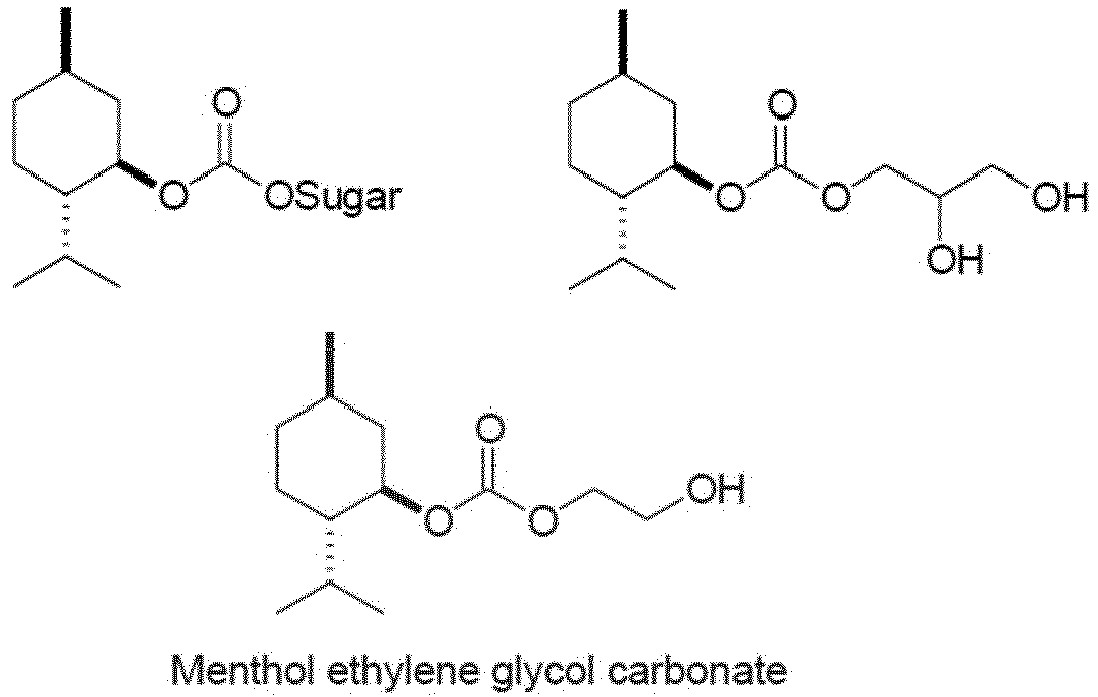
- Die Verwendung derartiger Stoffe als Kühlstoff für Zigaretten ist beispielsweise Gegenstand der Druckschrift
US 3,419,543 (Mold et al. ) aus dem Jahre 1968; die Anwendung als physiologisches Kühlmittel wird inDE 4226043 A1 (H&R) beansprucht. - Im Sinne der Erfindung bevorzugt sind die Mentholverbindungen Menthyl Lactate (FEMA GRAS 3748 = Frescolat® ML) und insbesondere das Menthone Glyceryl Acetal (FEMA GRAS 3807) bzw. Menthone Glyceryl Ketal (FEMA GRAS 3808), das unter der Bezeichnung Frescolat® MGA vermarktet wird.

- Erstere Struktur wird durch Veresterung von Milchsäure mit Menthol, letztere durch Acetalisierung von Menthon mit Glycerin gewonnen (vgl.
DE 2608226 A1 , H&R). In diese Gruppe von Verbindungen gehört auch das 3-(I-Menthoxy)-1,2,propandiol, das auch als Cooling Agent 10 bekannt ist (FEMA GRAS 3784, vgl.US 6,328,982 , TIC), sowie das 3-(l-Menthoxy)-2-methyl-1,2,propandiol (FEMA GRAS 3849), das über eine zusätzliche Methylgruppe verfügt.
- Die Herstellung des 3-(l-Menthoxy)-1,2,propandiol erfolgt beispielsweise ausgehend von Menthol nach dem folgenden Schema (vgl.
US 4,459,425 , Takagaso):
- Alternative Routen, bei denen in der ersten Stufe Menthol mit Epichlorhydrin umgesetzt wird, wird in
US 6,407,293 undUS 6,515,188 (Takagaso) beschrieben. Im Folgenden wird eine Übersicht der bevorzugten Mentholverbindungen gegeben, die sich durch eine CO-Bindung auszeichnen:


- Als ganz besonders vorteilhaft haben sich unter diesen Stoffen Menthone Glyceryl Acetal/Ketal sowie das Menthyl Lactate sowie Menthol Ethylene Glycol Carbonate bzw. Menthol Propylene Glycol Carbonatw erwiesen, die die Anmelderin unter den Bezeichnungen Frescolat® MGA, Frescolat® ML, Frecolat® MGC und Frescolat® MPC vertreibt.
- In den 70er Jahren des vergangenen Jahrhunderts wurden erstmals Mentholverbindungen entwickelt, die in der 3-Stellung über eine C-C-Bindung verfügen und von denen ebenfalls eine Reihe von Vertretern im Sinne der Erfindung eingesetzt werden können. Diese Stoffe werden im Allgemeinen als WS-Typen bezeichnet. Grundkörper ist ein Mentholderivat, bei dem die Hydroxyl- gegen eine Carboxylgruppe ersetzt ist (WS-1). Von dieser Struktur leiten sich alle weiteren WS-Typen ab, wie beispielsweise die ebenfalls im Sinne der Erfindung bevorzugten Spezies WS-3, WS-4, WS-5, WS-12, WS-14 und WS-30. Die beiden nachfolgenden Schaubilder zeigen die Synthesewege auf:

- Die sich von WS-1 ableitenden Ester werden beispielsweise in
US 4,157,384 , die entsprechenden N-substituierten Amide in J. Soc. Cosmet. Chem. S. 185-200 (1978) beschrieben. - Weiterhin besonders bevorzugt ist der Kühlstoff 2-(p-tolyloxy)-N-(1H-pyrazol-5-yl)-N-((thiophen-2-yl)methyl)acetamid

- Die erfindungsgemäßen Mischungen können die Komponenten (a) und (b1) im Gewichtsverhältnis von etwa 1:99 bis etwa 99:1, vorzugsweise etwa 10:90 bis etwa 90:10, weiter bevorzugt etwa 25:75 bis etwa 75:25 und insbesondere etwa 40:60 bis 60:40 enthalten.
- Ein weiterer Gegenstand der Erfindung betrifft Aromazubereitungen enthaltend, bestehend aus oder im Wesentlichen bestehend aus
- (a) ein, zwei, drei oder mehreren Kühlstoffen der Formel (I) und
- (b2) mindestens einem Aromastoff.
- Der besondere Vorteil dieser Mischungen ist darin zu sehen, dass die Kühlstoffe in der Lage sind, bereits in kleinen Konzentrationen unangenehme Geschmackseindrücke der Aromen, speziell von Süßstoffen zu maskieren.
- Die erfindungsgemäßen Zubereitungen können einen oder mehrere Aromastoffe enthalten, die ausgewählt sind von der Gruppe, die gebildet wird von Acetophenon, Allylcapronat, alpha-Ionon, beta-Ionon, Anisaldehyd, Anisylacetat, Anisylformiat, Benzaldehyd, Benzothiazol, Benzylacetat, Benzylalkohol, Benzylbenzoat, beta-Ionon, Butylbutyrat, Butylcapronat, Butylidenphthalid, Carvon, Camphen, Caryophyllen, Cineol, Cinnamylacetat, Citral, Citronellol, Citronellal, Citronellylacetat, Cyclohexylacetat, Cymol, Damascon, Decalacton, Dihydrocumarin, Dimethylanthranilat, Dimethylanthranilat, Dodecalacton, Ethoxyethylacetat, Ethylbuttersäure, Ethylbutyrat, Ethylcaprinat, Ethylcapronat, Ethylcrotonat, Ethylfuraneol, Ethylguajakol, Ethylisobutyrat, Ethylisovalerianat, Ethyllactat, Ethylmethylbutyrat, Ethylpropionat, Eucalyptol, Eugenol, Ethylheptylat, 4-(p-Hydroxyphenyl)-2-butanon, gamma-Decalacton, Geraniol, Geranylacetat, Geranylacetat, Grapefruitaldehyd, Methyldihydrojasmonat (z.B. Hedion®), Heliotropin, 2-Heptanon, 3-Heptanon, 4-Heptanon, trans-2-Heptenal, cis-4-Heptenal, trans-2-Hexenal, cis-3-Hexenol, trans-2-Hexensäure, trans-3-Hexensäure, cis-2-Hexenylacetat, cis-3-Hexenylacetat, cis-3-Hexenylcapronat, trans-2-Hexenylcapronat, cis-3-Hexenylformiat, cis-2-Hexylacetat, cis-3-Hexylacetat, trans-2-Hexylacetat, cis-3-Hexylformiat, para-Hydroxybenzylaceton, Isoamylalkohol, Isoamylisovalerianat, Isobutylbutyrat, Isobutyraldehyd, Isoeugenolmethylether, Isopropylmethylthiazol, Laurinsäure, Leavulinsäure, Linalool, Linalooloxid, Linalylacetat, Menthol, Menthofuran, Methylanthranilat, Methylbutanol, Methylbuttersäure, 2-Methylbutylacetat, Methylcapronat, Methylcinnamat, 5-Methylfurfural, 3,2,2-Methylcyclopentenolon, 6,5,2-Methylheptenon, Methyldihydrojasmonat, Methyljasmonat, 2-Methylmethylbutyrat, 2-Methyl-2-Pentenolsäure, Methylthiobutyrat, 3,1-Methylthiohexanol, 3-Methylthiohexylacetat, Nerol, Nerylacetat, trans,trans-2,4-Nonadienal, 2,4-Nonadienol, 2,6-Nonadienol, 2,4-Nonadienol, Nootkaton, delta Octalacton, gamma Octalacton, 2-Octanol, 3-Octanol, 1,3-Octenol, 1-Octylacetat, 3-Octylacetat, Palmitinsäure, Paraldehyd, Phellandren, Pentandion, Phenylethylacetat, Phenylethylalkohol, Phenylethylalkohol, Phenylethylisovalerianat, Piperonal, Propionaldehyd, Propylbutyrat, Pulegon, Pulegol, Sinensal, Sulfurol, Terpinen, Terpineol, Terpinolen, 8,3-Thiomenthanon, 4,4,2-Thiomethylpentanon, Thymol, delta-Undecalacton, gamma-Undecalacton, Valencen, Valeriansäure, Vanillin, Acetoin, Ethylvanillin, Ethylvanillinisobutyrat (= 3-Ethoxy-4-isobutyryloxybenzaldehyd), 2,5-Dimethyl-4-hydroxy-3(2H)-furanon und dessen Abkömmlinge (dabei vorzugsweise Homofuraneol (= 2-Ethyl-4-hydroxy-5-methyl-3(2H)-furanon), Homofuronol (= 2-Ethyl-5-methyl-4-hydroxy-3(2H)-furanon und 5-Ethyl-2-methyl-4-hydroxy-3(2H)-furanon), Maltol und Maltol-Abkömmlinge (dabei vorzugsweise Ethylmaltol), Cumarin und Cumarin-Abkömmlinge, gamma-Lactone (dabei vorzugsweise gamma-Undecalacton, gamma-Nonalacton, gamma-Decalacton), delta-Lactone (dabei vorzugsweise 4-Methyldeltadecalacton, Massoilacton, Deltadecalacton, Tuberolacton), Methylsorbat, Divanillin, 4-Hydroxy-2(oder 5)-ethyl-5(oder 2)-methyl-3(2H)furanon, 2-Hydroxy-3-methyl-2-cyclopentenon, 3-Hydroxy-4,5-dimethyl-2(5H)-furanon, Essigsäureisoamylester, Buttersäureethylester, Buttersäure-n-butylester, Buttersäureisoamylester, 3-Methyl-buttersäureethylester, n-Hexansäureethylester, n-Hexansäureallylester, n-Hexansäure-n-butylester, n-Octansäureethylester, Ethyl-3-methyl-3-phenylglycidat, Ethyl-2-trans-4-cis-decadienoat, 4-(p-Hydroxyphenyl)-2-butanon, 1,1-Dimethoxy-2,2,5-trimethyl-4-hexan, 2,6-Dimethyl-5-hepten-1-al und Phenylacetaldehyd, 2-Methyl-3-(methylthio)furan, 2-Methyl-3-furanthiol, bis(2-Methyl-3-furyl)disulfid, Furfurylmercaptan, Methional, 2-Acetyl-2-thiazolin, 3-Mercapto-2-pentanon, 2,5-Dimethyl-3-furanthiol, 2,4,5-Trimethylthiazol, 2-Acetylthiazol, 2,4-Dimethyl-5-ethylthiazol, 2-Acetyl-1-pyrrolin, 2-Methyl-3-ethylpyrazin, 2-Ethyl-3,5-dimethylpyrazin, 2-Ethyl-3,6-dimethylpyrazin, 2,3-Diethyl-5-methylpyrazin, 3-Isopropyl-2-methoxypyrazin, 3-Isobutyl-2-methoxypyrazin, 2-Acetylpyrazin, 2-Pentylpyridin, (E,E)-2,4-Decadienal, (E,E)-2,4-Nonadienal, (E)-2-Octenal, (E)-2-Nonenal, 2-Undecenal, 12-Methyltridecanal, 1-Penten-3-on, 4-Hydroxy-2,5-dimethyl-3(2H)-furanon, Guajakol, 3-Hydroxy-4,5-dimethyl-2(5H)-furanon, 3-Hydroxy-4-methyl-5-ethyl-2(5H)-furanon, Zimtaldehyd, Zimtalkohol, Methylsalicylat, Isopulegol sowie (hier nicht explizit genannte) Stereoisomere, Enantiomere, Stellungsisomere, Diastereomere, cis/trans-Isomere bzw. Epimere dieser Substanzen.
- Im Sinne der vorliegenden Erfindung kommen als Aromastoffe insbesondere auch künstliche wie auch natürliche Süßstoffe und Süßstoffverstärker in Betracht. Dies können ausgewählt sein aus der Gruppe, die gebildet wird von
- Zuckeralkohole (z.B. Erythritol, Threitol, Arabitol, Ribotol, Xylitol, Sorbitol, Mannitol, Dulcitol, Lactitol);
- Proteinen (z.B. Miraculin, Monellin, Thaumatin, Curculin, Brazzein);
- Synthetischen Süßstoffen (z.B. Magap, Natriumcyclamat, Acesulfam K, Neohesperidin Dihydrochalcon, Saccharin Natriumsalz, Aspartam, Superaspartam, Neotam, Alitam, Sucralose, Stevioside, Rebaudioside, Lugduname, Carrelame, Sucrononate, Sucrooctate, Monatin, Phenylodulcin);
- Süß schmeckendne Aminosäuren (z.B. Glycin, D-Leucin, D-Threonin, D-Asparagin, D-Phenylalanin, D-tryptophn, L-Prolin);
- süß schmeckenden niedermolekularen Substanzen, wie z.B. Hernandulcin, Dihydrochalconglykoside, Glycyrrhizin, Glycerrhetinsäure, ihre Derivate und Salze, Extrakte von Lakritz (Glycyrrhizza glabra ssp.), Lippia dulcis Extrakte, Momordica ssp. Extrakte oder
- pflanzlichen Extrakten wie z.B. Momordica grosvenori [Luo Han Guo] und die daraus gewonnenen Mogroside, Hydrangea dulcis oder Stevia ssp. (z.B. Stevia rebaudiana) Extrakte bzw. daraus gewonnene Stevioside.
- Die erfindungsgemäßen Zubereitungen können die Komponenten (a) und (b2) im Gewichtsverhältnis von etwa 1:99 bis etwa 99:1, vorzugsweise etwa 10:90 bis etwa 90:10, weiter bevorzugt etwa 25:75 bis etwa 75:25 und insbesondere etwa 40:60 bis 60:40 enthalten.
- In einer weiter bevorzugten Ausführungsform können die Kühlstoffe, die Mischungen oder der Zubereitungen in verkapselter Form vorliegen. Dies ist beispielsweise dann von besonderem Interesse, wenn die mit den Kühlstoffen beladenen Kapseln auf textile Oberflächen, beispielsweise als Bestandteil von Weichspülern oder Wäschenachbehandlungsmittel aufgebracht werden oder eine Ausrüstung durch Zwangsapplikation beispielsweise auf Strumpfhosen erfolgt.
- Hierunter sind sphärische Aggregate zu verstehen, die mindestens einen festen oder flüssigen Kern enthalten, der von mindestens einer kontinuierlichen Hülle umschlossen ist. Die Duftstoffe können durch Überzugsmaterialien verkapselt werden und dabei als Makrokapseln mit Durchmessern von etwa 0,1 bis etwa 5 mm oder Mikrokapseln mit Durchmessern von etwa 0,0001 bis etwa 0,1 mm vorliegen.
- Geeignete Überzugsmaterialien sind dabei beispielsweise Stärken, einschließlich deren Abbauprodukten sowie chemisch oder physikalisch erzeugten Derivaten (insbesondere Dextrine und Maltodextrine), Gelatine, Gummi Arabicum, Agar-Agar, Ghatti Gum, Gellan Gum, modifizierte und nicht-modifizierte Cellulosen, Pullulan, Curdlan, Carrageenane, Alginsäure, Alginate, Pektin, Inulin, Xanthan Gum und Mischungen von zwei oder mehreren dieser Substanzen.
- Das feste Verkapselungsmaterial ist vorzugsweise eine Gelatine (insbesondere Schweine-, Rind-, Geflügel- und/oder Fischgelatine), wobei diese vorzugsweise einen Schwellfaktor von größer oder gleich 20, vorzugsweise von größer oder gleich 24 aufweist. Unter diesen Stoffen ist Gelatine besonders bevorzugt, da sie gut verfügbar ist und mit unterschiedlichen Schwellfaktoren bezogen werden kann.
- Ebenfalls bevorzugt sind Maltodextrine (insbesondere auf Basis von Getreide, speziell Mais, Weizen, Tapioka oder Kartoffeln), die vorzugsweise DE-Werte im Bereich von 10 bis 20 aufweisen. Weiterhin bevorzugt sind Cellulosen (z.B. Celluloseether), Alginate (z.B. Natriumalginat), Carrageenan (z.B. beta-, jota-, lambda- und/oder kappa-Carrageenan), Gummi Arabicum, Curdlan und/oder Agar Agar.
- Ebenfalls bevorzugt sind Alginatkapseln wie sie beispielsweise in den folgenden Schriften ausführlich beschrieben werden:
EP 0389700 A1 ,US 4,251,195 ,US 6,214,376 ,WO 2003 055587 oderWO 2004 050069 A1 . - In einerweiteren bevorzugten Ausführungsform besteht die Hülle der Kapseln aus Melamin-Formaldehydharzen oder Koazervationsprodukten aus kationischen Monomeren oder Biopolymeren (wie z.B. Chitosan) und anionischen Monomeren, wie beispielsweise (Meth)Acrylaten oder Alginaten.
- Bei den Kapseln handelt es sich im Allgemeinen um mit filmbildenden Polymeren umhüllte feindisperse flüssige oder feste Phasen, bei deren Herstellung sich die Polymere nach Emulgierung und Koazervation oder Grenzflächenpolymerisation auf dem einzuhüllenden Material niederschlagen. Nach einem anderen Verfahren werden geschmolzene Wachse in einer Matrix aufgenommen ("microsponge"), die als Mikropartikel zusätzlich mit filmbildenden Polymeren umhüllt sein können. Nach einem dritten Verfahren werden Partikel abwechselnd mit Polyelektrolyten unterschiedlicher Ladung beschichtet ("layer-by-layer"-Verfahren). Die mikroskopisch kleinen Kapseln lassen sich wie Pulver trocknen. Neben einkernigen Mikrokapseln sind auch mehrkernige Aggregate, auch Mikrosphären genannt, bekannt, die zwei oder mehr Kerne im kontinuierlichen Hüllmaterial verteilt enthalten. Ein- oder mehrkernige Mikrokapseln können zudem von einer zusätzlichen zweiten, dritten etc. Hülle umschlossen sein. Die Hülle kann aus natürlichen, halbsynthetischen oder synthetischen Materialien bestehen. Natürlich Hüllmaterialien sind beispielsweise Gummi Arabicum, Agar-Agar, Agarose, Maltodextrine, Alginsäure bzw. ihre Salze, z.B. Natrium- oder Calciumalginat, Fette und Fettsäuren, Cetylalkohol, Collagen, Chitosan, Lecithine, Gelatine, Albumin, Schellack, Polysaccharide, wie Stärke oder Dextran, Polypeptide, Proteinhydrolysate, Sucrose und Wachse. Halbsynthetische Hüllmaterialien sind unter anderem chemisch modifizierte Cellulosen, insbesondere Celluloseester und -ether, z.B. Celluloseacetat, Ethylcellulose, Hydroxypropylcellulose, Hydroxypropylmethylcellulose und Carboxymethylcellulose, sowie Stärkederivate, insbesondere Stärkeether und -ester. Synthetische Hüllmaterialien sind beispielsweise Polymere wie Polyacrylate, Polyamide, Polyvinylalkohol oder Polyvinylpyrrolidon.
- Beispiele für Mikrokapseln des Stands der Technik sind folgende Handelsprodukte (in Klammern angegeben ist jeweils das Hüllmaterial) : Hallcrest Microcapsules (Gelatine, Gummi Arabicum), Coletica Thalaspheres (maritimes Collagen), Lipotec Millicapseln (Alginsäure, Agar-Agar), Induchem Unispheres (Lactose, mikrokristalline Cellulose, Hydroxypropylmethylcellulose); Unicerin C30 (Lactose, mikrokristalline Cellulose, Hydroxypropylmethylcellulose), Kobo Glycospheres (modifizierte Stärke, Fettsäureester, Phospholipide), Softspheres (modifiziertes Agar-Agar) und Kuhs Probiol Nanospheres (Phospholipide) sowie Primaspheres und Primasponges (Chitosan, Alginate) und Primasys (Phospholipide).
- Chitosanmikrokapseln und Verfahren zu ihrer Herstellung sind aus dem Stand der Technik hinlänglich bekannt [
WO 01/01926 WO 01/01927 WO 01/01928 WO 01/01929 - (a) aus Gelbildnern, kationischen Polymeren und Wirkstoffen eine Matrix zubereitet,
- (b) gegebenenfalls die Matrix in einer Ölphase dispergiert,
- (c) die dispergierte Matrix mit wässrigen Lösungen anionischer Polymere behandelt und gegebenenfalls dabei die Ölphase entfernt.
- Die Schritte (a) und (c) sind dabei insofern austauschbar, als man anstelle der kationischen Polymeren in Schritt (a) anionische Polymere einsetzt und umgekehrt.
- Man kann die Kapseln auch erzeugen, indem man den Wirkstoff abwechselnd mit Schichten aus unterschiedlich geladenen Polyelektrolyten einhüllt (layer-by-layer-Technologie). In diesem Zusammenhang sei auf das Europäische Patent
EP 1064088 B1 (Max-Planck Gesellschaft) verwiesen. - Ein weiterer Gegenstand der Erfindung betrifft kosmetische bzw. pharmazeutische Zubereitungen, die entweder einen oder mehrere der erfindungsgemäßen Kühlstoffe oder eine Zubereitung enthalten, welche einen Gehalt an diesen und weiteren Kühlstoffen aufweist. Dieser Gehalt beträgt vorzugsweise etwa 0,1 bis etwa Gew.-% und insbesondere etwa 0,5 bis 2 Gew.-% - bezogen auf die fertige Zubereitung.
- Bei diesen Mitteln kann es sich beispielsweise um Hautpflegemittel, Körperpflegemittel, Haarpflegemittel, Sonnenschutzmittel oder dekorative Kosmetik handeln. Als pharmazeutische Mittel kommen beispielsweise Erkältungssäfte, Wundsalben oder Wundsprays in Frage. Ebenfalls möglich ist die Einarbeitung der Stoffe in Pflaster oder Tabletten, insbesondere wenn diese Wirkstoffe enthalten, die selbst einen unangenehmen Geschmack aufweisen.
- Die erfindungsgemäßen Zubereitungen können weitere typische Hilfs- und Zusatzstoffe enthalten, wie beispielsweise milde Tenside, Ölkörper, Emulgatoren, Perlglanzwachse, Konsistenzgeber, Verdickungsmittel, Überfettungsmittel, Stabilisatoren, Polymere, Siliconverbindungen, Fette, Wachse, Lecithine, Phospholipide, UV-Lichtschutzfaktoren, Feuchthaltemittel, biogene Wirkstoffe, Antioxidantien, Deodorantien, Antitranspirantien, Antischuppenmittel, Filmbildner, Quellmittel, Insektenrepellentien, Selbstbräuner, Tyrosininhibitoren (Depigmentierungsmittel), Hydrotrope, Solubilisatoren, Konservierungsmittel, Parfümöle, Farbstoffe und dergleichen enthalten.
- Als oberflächenaktive Stoffe können anionische, nichtionische, kationische und/oder amphotere bzw. zwitterionische Tenside enthalten sein, deren Anteil an den Mitteln üblicherweise bei etwa 1 bis 70, vorzugsweise 5 bis 50 und insbesondere 10 bis 30 Gew.-% beträgt.
- Typische Beispiele für anionische Tenside sind Seifen, Alkylbenzolsulfonate, Alkansulfonate, Olefinsulfonate, Alkylethersulfonate, Glycerinethersulfonate, α-Methylestersulfonate, Sulfofettsäuren, Alkylsulfate, Alkylethersulfate, Glycerinethersulfate, Fettsäureethersulfate, Hydroxymischethersulfate, Monoglycerid(ether)sulfate, Fettsäureamid(ether)sulfate, Mono- und Dialkylsulfosuccinate, Mono- und Dialkylsulfosuccinamate, Sulfotriglyceride, Amidseifen, Ethercarbonsäuren und deren Salze, Fettsäureisethionate, Fettsäuresarcosinate, Fettsäuretauride, N-Acylaminosäuren, Alkyloligoglucosidsulfate, Proteinfettsäurekondensate (insbesondere pflanzliche Produkte auf Weizenbasis) und Alkyl(ether)phosphate. Sofern die anionischen Tenside Polyglycoletherketten enthalten, können diese eine konventionelle, vorzugsweise jedoch eine eingeengte Homologenverteilung aufweisen. Besonders bevorzugt sind in diesem Zusammenhang:
- (a) Acylaminosäuresalze wie beispielsweise Acylglutamate, beispielsweise Natrium acylglutamat, Di-TEA-Palmitoylaspartat und Natriumcapryl/Caprinsäure-Glutamat, Acylpeptide, beispielsweise Palmitoyl-hydrolysiertes Milchprotein, Natriumcocoyl-hydrolysiertes Sojaprotein und Natrium / Kaliumcocoyl-hydrolysiertes Kollagen und Alaninate;
- (b) Acyllactylate, Lauroyllactylat, Caproyllactylat
- (c) Sulfate, wie beispielsweise
- Alkylethersulfate wie insbesondere Natrium-, Ammonium-, Magnesium-, MIPA-, TIPA-Laurethsulfat, Natriummyrethsulfat und Natrium-C12-13-Parethsulfat;
- Alkylsulfate, beispielsweise Natrium-, Ammonium- und TEA-Laurylsulfat;
- Glyceridsulfate, wie beispielsweise Natriumcoco-Monoglyceridsulfat,
- Amidsulfate, wie beispielsweise Magnesium-PEG-3-Cocamidsulfat.
- (d) Sulfonate, wie beispielsweise
- Alkylsulfonate,
- Alkylarylsulfonate, insbesondere Natrium-C12-14-olefinsulfonat,
- (e) Sulfosuccinate, beispielsweise Dioctylnatriumsulfosuccinat, Dinatriumlaurethsulfosuccinat, Dinatriumlaurylsulfosuccinat und Dinatriumundecylenamido-MEA-Sulfosuccinat;
- (f) Sulfoacetate, wie Natriumlaurylsulfoacetat;
- (g) Sarcosinate, beispielsweise Myristoylsarcosin, TEA-Lauroylsarcosinat, Natriumlauroylsarcosinat und Natriumcocoylsarcosinat,
- (l) Isethionate, wie beispielsweise Natrium / Ammoniumcocoylisethionat,
- (h) Taurate, beispielsweise Natriumlauroyltaurat und Natriummethylcocoyltaurat,
- (i) Carboxylate, beispielsweise
- Seifen wie etwa TEA-Stearat,
- Ethercarboxylate, wie etwa Natriumlaureth-13-carboxylat und Natrium-PEG-6-cocamidcarboxylat,
- (j) Phosphate wie etwa Cetylphosphat (Mono-, Di-Cetyl und ihre Gemische), Kaliumcetylphosphat, (Mono-, Di-Cetyl und ihre Gemische), DEA-Cetylphosphat (Mono-, Di-Cetyl und ihre Mischungen), DEA-Oleth-10-phosphat und Dilaureth-4-phosphat.
- Typische Beispiele für nichtionische Tenside sind Fettalkoholpolyglycolether, Alkylphenolpolyglycolether, Fettsäurepolyglycolester, Fettsäureamidpolyglycolether, Fettaminpolyglycolether, alkoxylierte Triglyceride, Mischether bzw. Mischformale, gegebenenfalls partiell oxidierte Alk(en)yloligoglykoside bzw. Glucoronsäurederivate, Fettsäure-N-alkylglucamide, Proteinhydrolysate (insbesondere pflanzliche Produkte auf Weizenbasis), Polyolfettsäureester, Zuckerester, Sorbitanester, Polysorbate und Aminoxide. Sofern die nichtionischen Tenside Polyglycoletherketten enthalten, können diese eine konventionelle, vorzugsweise jedoch eine eingeengte Homologenverteilung aufweisen.
- Kationische Tenside enthalten mindestens ein N-Atom, das kovalent an 4 Alkyl- oder Arylgruppen gebunden ist. Dies führt unabhängig vom pH zu einer positiven Ladung. Alkylbetain, Alkylamidopropylbetain und Alkylamidopropylhydroxysulfaine sind vorteilhaft. Die verwendeten kationischen Tenside können weiterhin vorzugsweise ausgewählt sein aus der Gruppe bestehend aus quaternären Ammoniumverbindungen, insbesondere Benzyltrialkylammoniumchloriden oder -bromiden, wie beispielsweise Benzyldimethylstearylammoniumchlorid, sowie Alkyltrialkylammoniumsalzen, beispielsweise Cetyltrimethylammoniumchlorid oder -bromid, Alkyldimethyl-hydroxyethylammoniumchloriden oder Bromiden, Dialkyldimethylammoniumchloriden oder -bromiden, Alkylamidethyltrimethylammoniumethersulfaten, Alkylpyridiniumsalzen, beispielsweise Lauryl- oder Cetylpyridiniumchlorid, Imidazolinderivaten und Verbindungen mit einem kationischen Charakter, wie Aminoxiden, beispielsweise Alkyldimethylaminoxid oder Alkylaminoethyldimethylaminoxid. Insbesondere Cetyltrimethylammoniumsalze werden vorteilhaft verwendet. Besonders bevorzugt sind dabei:
- Alkylamine,
- Alkylimidazole,
- ethoxylierte Amine,
- quaternäre Ammoniumsalze;
- RNH2CH2CH2COO- (bei pH = 7)
- RNHCH2CH2COO- B+ (bei pH = 12) B + = ein beliebiges gewünschtes Kation sowie
- Esterquats.
- Typische Beispiele für amphotere bzw. zwitterionische Tenside sind Alkylbetaine, Alkylamidobetaine, Aminopropionate, Aminoglycinate, Imidazoliniumbetaine und Sulfobetaine. Bei den genannten Tensiden handelt es sich ausschließlich um bekannte Verbindungen.
- Typische Beispiele für besonders geeignete milde, d.h. besonders hautverträgliche Tenside sind Fettalkoholpolyglycolethersulfate, Monoglyceridsulfate, Mono- und/oder Dialkylsulfosuccinate, Fettsäureisethionate, Fettsäuresarcosinate, Fettsäuretauride, Fettsäureglutamate, α-Olefinsulfonate, Ethercarbonsäuren, Alkyloligoglucoside, Fettsäureglucamide, Alkylamidobetaine, Amphoacetale und/oder Proteinfettsäurekondensate, letztere vorzugsweise auf Basis von Weizenproteinen.
- Als Ölkörper kommen beispielsweise Guerbetalkohole auf Basis von Fettalkoholen mit 6 bis 18, vorzugsweise 8 bis 10 Kohlenstoffatomen, Ester von linearen C6-C22-Fettsäuren mit linearen oder verzweigten C6-C22-Fettalkoholen bzw. Ester von verzweigten C6-C13-Carbonsäuren mit linearen oder verzweigten C6-C22-Fettalkoholen, wie z.B. Myristylmyristat, Myristylpalmitat, Myristylstearat, Myristylisostearat, Myristyloleat, Myristylbehenat, Myristylerucat, Cetylmyristat, Cetylpalmitat, Cetylstearat, Cetylisostearat, Cetyloleat, Cetylbehenat, Cetylerucat, Stearylmyristat, Stearylpalmitat, Stearylstearat, Stearylisostearat, Stearyloleat, Stearylbehenat, Stearylerucat, Isostearylmyristat, Isostearylpalmitat, Isostearylstearat, Isostearylisostearat, Isostearyloleat, Isostearylbehenat, Isostearyloleat, Oleylmyristat, Oleylpalmitat, Oleylstearat, Oleylisostearat, Oleyloleat, Oleylbehenat, Oleylerucat, Behenylmyristat, Behenylpalmitat, Behenylstearat, Behenylisostearat, Behenyloleat, Behenylbehenat, Behenylerucat, Erucylmyristat, Erucylpalmitat, Erucylstearat, Erucylisostearat, Erucyloleat, Erucylbehenat und Erucylerucat. Besonders bevorzugt sin Cetearyl ethylhexanoate, Cetearylnonanoat, Stearylheptanoat und Stearylcaprylat sowie deren Gemische.
- Daneben eignen sich Ester von linearen C6-C22-Fettsäuren mit verzweigten Alkoholen, insbesondere 2-Ethylhexanol, Ester von C18-C38-Alkylhydroxycarbonsäuren mit linearen oder verzweigten C6-C22-Fettalkoholen, insbesondere Dioctylmalate, Ester von linearen oder verzweigten C6-C13 Carbonsäuren mit linearen oder verzweigten C6-C13 Alkoholen, wie beispielsweise Ethylhexylisononanoat, Ester von linearen und/oder verzweigten Fettsäuren mit mehrwertigen Alkoholen (wie z.B. Propylenglycol, Dimerdiol oder Trimertriol) und/oderGuerbetalkoholen, Triglyceride auf Basis C6-C10-Fettsäuren, flüssige Mono-/Di-/Triglyceridmischungen auf Basis von C6-C18-Fettsäuren, Ester von C6-C22-Fettalkoholen und/oder Guerbetalkoholen mit aromatischen Carbonsäuren, insbesondere Benzoesäure, Ester von C2-C12-Dicarbonsäuren mit linearen oder verzweigten Alkoholen mit 1 bis 22 Kohlenstoffatomen oder Polyolen mit 2 bis 10 Kohlenstoffatomen und 2 bis 6 Hydroxylgruppen, pflanzliche Öle, verzweigte primäre Alkohole, substituierte Cyclohexane, lineare und verzweigte C6-C22-Fettalkoholcarbonate, wie z.B. Dicaprylyl Carbonate (Cetiol® CC), Guerbetcarbonate auf Basis von Fettalkoholen mit 6 bis 18, vorzugsweise 8 bis 10 C Atomen, Ester der Benzoesäure mit linearen und/oder verzweigten C6-C22-Alkoholen (z.B. Finsolv® TN), lineare oder verzweigte, symmetrische oder unsymmetrische Dialkylether mit 6 bis 22 Kohlenstoffatomen pro Alkylgruppe, wie z.B. Dicaprylyl Ether (Cetiol® OE), Ringöffnungsprodukte von epoxidierten Fettsäureestern mit Polyolen, Siliconöle (Cyclomethicone, Siliciummethicontypen u.a.) und/oder aliphatische bzw. naphthenische Kohlenwasserstoffe, wie z.B. wie Squalan, Squalen oder Dialkylcyclohexane in Betracht.
- Die Einsatzmenge kann hier bezogen auf die Endformulierung zwischen 5 und 80 Gew.-%, vorzugsweise zwischen 10 und 50 Gew.-% und insbesondere zwischen 20 und 40 Gew.-% liegen.
- Als Emulgatoren kommen beispielsweise nichtionogene Tenside aus mindestens einer der folgenden Gruppen in Frage:
- Anlagerungsprodukte von 2 bis 30 Mol Ethylenoxid und/ oder 0 bis 5 Mol Propylenoxid an lineare Fettalkohole mit 8 bis 22 C-Atomen, an Fettsäuren mit 12 bis 22 C-Atomen, an Alkylphenole mit 8 bis 15 C-Atomen in der Alkylgruppe sowie Alkylamine mit 8 bis 22 Kohlenstoffatomen im Alkylrest;
- Alkyl- und/oder Alkenyloligoglykoside mit 8 bis 22 Kohlenstoffatomen im Alk(en)ylrest und deren ethoxylierte Analoga;
- Anlagerungsprodukte von 1 bis 15 Mol Ethylenoxid an Ricinusöl und/oder gehärtetes Ricinusöl;
- Anlagerungsprodukte von 15 bis 60 Mol Ethylenoxid an Ricinusöl und/oder gehärtetes Ricinusöl;
- Partialester von Glycerin und/oder Sorbitan mit ungesättigten, linearen oder gesättigten, verzweigten Fettsäuren mit 12 bis 22 Kohlenstoffatomen und/oder Hydroxycarbonsäuren mit 3 bis 18 Kohlenstoffatomen sowie deren Addukte mit 1 bis 30 Mol Ethylenoxid;
- Partialester von Polyglycerin (durchschnittlicher Eigenkondensationsgrad 2 bis 8), Polyethylenglycol (Molekulargewicht 400 bis 5000), Trimethylolpropan, Pentaerythrit, Zuckeralkoholen (z.B. Sorbit), Alkylglucosiden (z.B. Methylglucosid, Butylglucosid, Laurylglucosid) sowie Polyglucosiden (z.B. Cellulose) mit gesättigten und/oder ungesättigten, linearen oder verzweigten Fettsäuren mit 12 bis 22 Kohlenstoffatomen und/oder Hydroxycarbonsäuren mit 3 bis 18 Kohlenstoffatomen sowie deren Addukte mit 1 bis 30 Mol Ethylenoxid;
- Mischester aus Pentaerythrit, Fettsäuren, Citronensäure und Fettalkohol und/oder Mischester von Fettsäuren mit 6 bis 22 Kohlenstoffatomen, Methylglucose und Polyolen, vorzugsweise Glycerin oder Polyglycerin.
- Wollwachsalkohole;
- Polysiloxan-Polyalkyl-Polyether-Copolymere bzw. entsprechende Derivate;
- Block-Copolymere z.B. Polyethylenglycol-30 Dipolyhydroxystearate;
- Polymeremulgatoren, z.B. Pemulen-Typen (TR-1,TR-2) von Lubrizol oder Cosmedia® SP von BASF;
- Polyalkylenglycole sowie
- Glycerincarbonat.
- Im Folgenden werden besonders geeignete Emulgatoren näher erläutert:
- Alkoxylate. Die Anlagerungsprodukte von Ethylenoxid und/oder von Propylenoxid an Fettalkohole, Fettsäuren, Alkylphenole oder an Ricinusöl stellen bekannte, im Handel erhältliche Produkte dar. Es handelt sich dabei um Homologengemische, deren mittlerer Alkoxylierungsgrad dem Verhältnis der Stoffmengen von Ethylenoxid und/ oder Propylenoxid und Substrat, mit denen die Anlagerungsreaktion durchgeführt wird, entspricht. C12/18-Fettsäure-mono- und -diester von Anlagerungsprodukten von Ethylenoxid an Glycerin sind als Rückfettungsmittel für kosmetische Zubereitungen bekannt.
- Alkyl- und/oder Alkenyloligoglykosid. Alkyl- und/oder Alkenyloligoglycoside, ihre Herstellung und ihre Verwendung sind aus dem Stand der Technik bekannt. Ihre Herstellung erfolgt insbesondere durch Umsetzung von Glucose oder Oligosacchariden mit primären Alkoholen mit 8 bis 18 Kohlenstoffatomen. Bezüglich des Glycosidrestes gilt, daß sowohl Monoglycoside, bei denen ein cyclischer Zuckerrest glycosidisch an den Fettalkohol gebunden ist, als auch oligomere Glycoside mit einem Oligomerisationsgrad bis vorzugsweise etwa 8 geeignet sind. Der Oligomerisierungsgrad ist dabei ein statistischer Mittelwert, dem eine für solche technischen Produkte übliche Homologenverteilung zugrunde liegt.
- Partialglyceride. Typische Beispiele für geeignete Partialglyceride sind Hydroxystearinsäuremonoglycerid, Hydroxystearinsäurediglycerid, Isostearinsäuremonoglycerid, Isostearinsäurediglycerid, Ölsäuremonoglycerid, Ölsäurediglycerid, Ricinolsäuremoglycerid, Ricinolsäurediglycerid, Linolsäuremonoglycerid, Linolsäurediglycerid, Linolensäuremonoglycerid, Linolensäurediglycerid, Erucasäuremonoglycerid, Erucasäurediglycerid, Weinsäuremonoglycerid, Weinsäurediglycerid, Citronensäuremonoglycerid, Citronendiglycerid, Äpfelsäuremonoglycerid, Äpfelsäurediglycerid sowie deren technische Gemische, die untergeordnet aus dem Herstellungsprozeß noch geringe Mengen an Triglycerid enthalten können. Ebenfalls geeignet sind Anlagerungsprodukte von 1 bis 30, vorzugsweise 5 bis 10 Mol Ethylenoxid an die genannten Partialglyceride.
- Sorbitanester. Als Sorbitanester kommen Sorbitanmonoisostearat, Sorbitansesquiisostearat, Sorbitan-diisostearat, Sorbitantriisostearat, Sorbitanmonooleat, Sorbitansesquioleat, Sorbitan-dioleat, Sorbitantrioleat, Sorbitanmonoerucat, Sorbitansesquierucat, Sorbitandierucat, Sorbitantrierucat, Sorbitanmonoricinoleat, Sorbitansesquiricinoleat, Sorbitandiricinoleat, Sorbitantriricinoleat, Sorbitanmonohydroxystearat, Sorbitansesquihydroxystearat, Sorbitandihydroxystearat, Sorbitantrihydroxystearat, Sorbitanmonotartrat, Sorbitansesqui-tartrat, Sorbitanditartrat, Sorbitantritartrat, Sorbitanmonocitrat, Sorbitansesquicitrat, Sorbitandicitrat, Sorbitantricitrat, Sorbitanmonomaleat, Sorbitansesquimaleat, Sorbitan-dimaleat, Sorbitantrimaleat sowie deren technische Gemische. Ebenfalls geeignet sind Anlagerungsprodukte von 1 bis 30, vorzugsweise 5 bis 10 Mol Ethylenoxid an die genannten Sorbitanester.
- Polyglycerinester. Typische Beispiele fürgeeignete Polyglycerinestersind Polyglyceryl-2 Dipolyhydroxystearate (Dehymuls® PGPH), Polyglycerin-3-Diisostearate (Lameform® TGI), Polyglyceryl-4 Isostearate (Isolan® GI 34), Polyglyceryl-3 Oleate, Diisostearoyl Polyglyceryl-3 Diisostearate (Isolan® PDI), Polyglyceryl-3 Methylglucose Distearate (Tego Care® 450), Polyglyceryl-3 Beeswax (Cera Bellina®), Polyglyceryl-4 Caprate (Polyglycerol Caprate T2010/90), Polyglyceryl-3 Cetyl Ether (Chimexane® NL), Polyglyceryl-3 Distearate (Cremophor® GS 32) und Polyglyceryl Polyricinoleate (Admul® WOL 1403) Polyglyceryl Dimerate Isostearate sowie deren Gemische. Beispiele für weitere geeignete Polyolester sind die gegebenenfalls mit 1 bis 30 Mol Ethylenoxid umgesetzten Mono-, Di- und Triester von Trimethylolpropan oder Pentaerythrit mit Laurinsäure, Kokosfettsäure, Talgfettsäure, Palmitinsäure, Stearinsäure, Ölsäure, Behensäure und dergleichen.
- Anionische Emulgatoren. Typische anionische Emulgatoren sind aliphatische Fettsäuren mit 12 bis 22 Kohlenstoffatomen, wie beispielsweise Palmitinsäure, Stearinsäure oder Behensäure, sowie Dicarbonsäuren mit 12 bis 22 Kohlenstoffatomen, wie beispielsweise Azelainsäure oder Sebacinsäure.
- Ebenfalls geeignet sind Mono-, Di- und Trialkylphosphate sowie Mono-, Di- und/oder Tri-PEG-alkylphosphate und deren Salze, wie etwa Cetylphosphat Kaliumsalz sowie die Citratester, insbesondere Glyceryloleatcitrat und Glycerylstearylcitrat.
- Amphotere und kationische Emulgatoren. Weiterhin können als Emulgatoren zwitterionische Tenside verwendet werden. Als zwitterionische Tenside werden solche oberflächenaktiven Verbindungen bezeichnet, die im Molekül mindestens eine quartäre Ammoniumgruppe und mindestens eine Carboxylat- und eine Sulfonatgruppe tragen. Besonders geeignete zwitterionische Tenside sind die sogenannten Betaine wie die N-Alkyl-N,N-dimethylammoniumglycinate, beispielsweise das Kokosalkyldimethylammoniumglycinat, N-Acylaminopropyl-N,N-dimethylammoniumglycinate, beispielsweise das Kokosacylaminopropyldimethylammoniumglycinat, und 2-Alkyl-3-carboxylmethyl-3-hydroxyethylimidazoline mit jeweils 8 bis 18 C-Atomen in der Alkyl- oder Acylgruppe sowie das Kokosacylaminoethylhydroxyethylcarboxymethylglycinat. Besonders bevorzugt ist das unter der CTFA-Bezeichnung Cocamidopropyl Betaine bekannte Fettsäureamid-Derivat. Ebenfalls geeignete Emulgatoren sind ampholytische Tenside. Unter ampholytischen Tensiden werden solche oberflächenaktiven Verbindungen verstanden, die außer einer C8/18-Alkyl- oderAcylgruppe im Molekül mindestens eine freie Aminogruppe und mindestens eine -COOH- oder -SO3H-Gruppe enthalten und zur Ausbildung innerer Salze befähigt sind. Beispiele für geeignete ampholytische Tenside sind N-Alkylglycine, N-Alkylpropionsäuren, N-Alkylaminobuttersäuren, N-Alkyliminodipropionsäuren, N-Hydroxyethyl-N-alkylamidopropylglycine, N-Alkyltaurine, N-Alkylsarcosine, 2-Alkylaminopropionsäuren und Alkylaminoessigsäuren mit jeweils etwa 8 bis 18 C-Atomen in der Alkylgruppe.. Besonders bevorzugte ampholytische Tenside sind das N-Kokosalkylaminopropionat, das Kokosacylaminoethylaminopropionat und das C12/18-Acylsarcosin. Schließlich kommen auch Kationtenside als Emulgatoren in Betracht, wobei solche vom Typ der Esterquats, vorzugsweise methylquaternierte Difettsäuretriethanolaminester-Salze, besonders bevorzugt sind.
- Die Einsatzmenge der Emulgatoren liegt typisch im Bereich von etwa 0,5 bis etwa 10 Gew.-% und vorzugsweise etwa 1 bis etwa 5 Gew.-%.
- Typische Beispiele für Fette sind Glyceride, d.h. feste oder flüssige pflanzliche oder tierische Produkte, die im Wesentlichen aus gemischten Glycerinestern höherer Fettsäuren bestehen, als Wachse kommen u.a. natürliche oder synthetische Wachse, wie z.B. Candelillawachs, Carnaubawachs, Japanwachs, Espartograswachs, Korkwachs, Guarumawachs, Reiskeimölwachs, Zuckerrohrwachs, Ouricurywachs, Montanwachs, Bienenwachs, Schellackwachs, Walrat, Lanolin (Wollwachs), Bürzelfett, Ceresin, Ozokerit (Erdwachs), Petrolatum, Paraffinwachse, Mikrowachse; chemisch modifizierte Wachse (Hartwachse), wie z.B. Montanesterwachse, Sasolwachse, hydrierte Jojobawachse sowie synthetische Wachse, wie z.B. Polyalkylenwachse und Polyethylenglycolwachse in Frage. Neben den Fetten kommen als Zusatzstoffe auch fettähnliche Substanzen, wie Lecithine und Phospholipide in Frage. Unter der Bezeichnung Lecithine versteht der Fachmann diejenigen Glycero-Phospholipide, die sich aus Fettsäuren, Glycerin, Phosphorsäure und Cholin durch Veresterung bilden. Lecithine werden in der Fachwelt daher auch häufig als Phosphatidylcholine (PC). Als Beispiele für natürliche Lecithine seien die Kephaline genannt, die auch als Phosphatidsäuren bezeichnet werden und Derivate der 1,2-Diacyl-sn-glycerin-3-phosphorsäuren darstellen. Dem gegenüber versteht man unter Phospholipiden gewöhnlich Mono- und vorzugsweise Diester der Phosphorsäure mit Glycerin (Glycerinphosphate), die allgemein zu den Fetten gerechnet werden. Daneben kommen auch Sphingosine bzw. Sphingolipide in Frage.
- Als Perlglanzwachse kommen beispielsweise in Frage: Alkylenglycolester, speziell Ethylenglycoldistearat; Fettsäurealkanolamide, speziell Kokosfettsäurediethanolamid; Partialglyceride, speziell Stearinsäuremonoglycerid; Ester von mehrwertigen, gegebenenfalls hydroxysubstituierte Carbonsäuren mit Fettalkoholen mit 6 bis 22 Kohlenstoffatomen, speziell langkettige Ester der Weinsäure; Fettstoffe, wie beispielsweise Fettalkohole, Fettketone, Fettaldehyde, Fettether und Fettcarbonate, die in Summe mindestens 24 Kohlenstoffatome aufweisen, speziell Lauron und Distearylether; Fettsäuren wie Stearinsäure, Hydroxystearinsäure oder Behensäure, Ringöffnungsprodukte von Olefinepoxiden mit 12 bis 22 Kohlenstoffatomen mit Fettalkoholen mit 12 bis 22 Kohlenstoffatomen und/oder Polyolen mit 2 bis 15 Kohlenstoffatomen und 2 bis 10 Hydroxylgruppen sowie deren Mischungen
- Als Konsistenzgeber kommen in erster Linie Fettalkohole oder Hydroxyfettalkohole mit 12 bis 22 und vorzugsweise 16 bis 18 Kohlenstoffatomen und daneben Partialglyceride, Fettsäuren oder Hydroxyfettsäuren in Betracht. Bevorzugt ist eine Kombination dieser Stoffe mit Alkyloligoglucosiden und/oder Fettsäure-N-methylglucamiden gleicher Kettenlänge und/oder Polyglycerinpoly-12-hydroxystearaten. Geeignete Verdickungsmittel sind beispielsweise Aerosil-Typen (hydrophile Kieselsäuren), Polysaccharide, insbesondere Xanthan-Gum, Guar-Guar, Agar-Agar, Alginate und Tylosen, Carboxymethylcellulose und Hydroxyethyl- und Hydroxypropylcellulose, ferner höhermolekulare Polyethylenglycolmono- und -diester von Fettsäuren, Polyacrylate, (z.B. Carbopole® und Pemulen-Typen von Lubrizol; Synthalene® von Sigma; Keltrol-Typen von Kelco; Sepigel-Typen von Seppic; Salcare-Typen von BASF), Polyacrylamide, Polymere, Polyvinylalkohol und Polyvinylpyrrolidon. Als besonders wirkungsvoll haben sich auch Bentonite, wie z.B. Bentone® Gel VS-5PC (Elementis) erwiesen, bei dem es sich um eine Mischung aus Cyclopentasiloxan, Disteardimonium Hectorit und Propylencarbonat handelt. Weiter in Frage kommen Tenside, wie beispielsweise ethoxylierte Fettsäureglyceride, Ester von Fettsäuren mit Polyolen wie beispielsweise Pentaerythrit oder Trimethylolpropan, Fettalkoholethoxylate mit eingeengter Homologenverteilung oder Alkyloligoglucoside sowie Elektrolyte wie Kochsalz und Ammoniumchlorid.
- Als Überfettungsmittel können Substanzen wie beispielsweise Lanolin und Lecithin sowie polyethoxylierte oder acylierte Lanolin- und Lecithinderivate, Polyolfettsäureester, Monoglyceride und Fettsäurealkanolamide verwendet werden, wobei die letzteren gleichzeitig als Schaumstabilisatoren dienen.
- Als Stabilisatoren können Metallsalze von Fettsäuren, wie z.B. Magnesium-, Aluminium- und/oder Zinkstearat bzw. -ricinoleat eingesetzt werden.
- Geeignete kationische Polymere sind beispielsweise kationische Cellulosederivate, wie z.B. eine quaternierte Hydroxyethylcellulose, die unter der Bezeichnung Polymer JR 400® von Dow erhältlich ist, kationische Stärke, Copolymere von Diallylammoniumsalzen und Acrylamiden, quaternierte Vinylpyrrolidon/Vinylimidazol-Polymere, wie z.B. Luviquat® (BASF), Kondensationsprodukte von Polyglycolen und Aminen, quaternierte Kollagenpolypeptide, wie beispielsweise Lauryldimonium Hydroxypropyl Hydrolyzed Collagen (Lamequat®L/BASF), quaternierte Weizenpolypeptide, Polyethylenimin, kationische Siliconpolymere, wie z.B. Amodimethicone, Copolymere der Adipinsäure und Dimethylaminohydroxypropyldiethylentriamin (Cartaretine®/Sandoz), Copolymere der Acrylsäure mit Dimethyl-diallylammoniumchlorid (Merquat® 550/Lubrizol), Polyaminopolyamide sowie deren vernetzte wasserlöslichen Polymere, kationische Chitinderivate wie beispielsweise quaterniertes Chitosan, gegebenenfalls mikrokristallin verteilt, Kondensationsprodukte aus Dihalogenalkylen, wie z.B. Dibrombutan mit Bisdialkylaminen, wie z.B. Bis-Dimethylamino-1,3-propan, kationischer Guar-Gum, wie z.B. Jaguar® CBS, Jaguar® C-17, Jaguar® C-16 (Solvay), quaternierte Ammoniumsalz-Polymere, wie z.B. Mirapol® A-15, Mirapol® AD-1, Mirapol® AZ-1 (Solvay).
- Als anionische, zwitterionische, amphotere und nichtionische Polymere kommen beispielsweise Vinylacetat/Crotonsäure-Copolymere, Vinylpyrrolidon/Vinylacrylat-Copolymere, Vinylacetat/Butylmaleat/ Isobornylacrylat-Copolymere, Methylvinylether/Maleinsäureanhydrid-Copolymere und deren Ester, unvernetzte und mit Polyolen vernetzte Polyacrylsäuren, Acrylamidopropyltrimethylammoniumchlorid/ Acrylat-Copolymere, Octylacrylamid/Methylmeth-acrylat/tert.Butylaminoethylmethacrylat/2-Hydroxypropylmethacrylat-Copolymere, Polyvinylpyrrolidon, Vinylpyrrolidon/Vinylacetat-Copolymere, Vinylpyrrolidon/ Dimethylaminoethylmethacrylat/Vinylcaprolactam-Terpolymere sowie gegebenenfalls derivatisierte Celluloseether und Silicone in Frage.
- Geeignete Siliconverbindungen sind beispielsweise Dimethylpolysiloxane, Methylphenylpolysiloxane, cyclische Silicone sowie amino-, fettsäure-, alkohol-, polyether-, epoxy-, fluor-, glykosid- und/oder alkylmodifizierte Siliconverbindungen, die bei Raumtemperatur sowohl flüssig als auch harzförmig vorliegen können. Weiterhin geeignet sind Simethicone, bei denen es sich um Mischungen aus Dimethiconen mit einer durchschnittlichen Kettenlänge von 200 bis 300 Dimethylsiloxan-Einheiten und hydrierten Silicaten handelt.
- Es wurde gefunden, dass die erfindungsgemäßen Diester insbesondere in der Lage sind, die Klebrigkeit, die fürviele UV-Filter typisch ist, zu überwinden. Ein weiterer Gegenstand der vorliegenden Erfindung betrifft daher Zubereitungen, die neben den Diestern weiterhin wenigstens einen UV-Filter enthalten. Insbesondere sind solche Zubereitungen bevorzugt, welche
- (a) 1,3-Propandiol dicaprylate/caprate und
- (b) mindestens einen UV-Lichtschutzfilter
- (a) etwa 0,1 bis etwa 30 Gew.-% 1,3-Propandiol dicaprylate/caprate und
- (b) etwa 1 bis etwa 50 Gew.-% UV-Lichtschutzfilter
- Unter UV-Lichtschutzfilter (synonym auch öfters als Lichtschutzfaktoren bezeichnet) sind beispielsweise bei Raumtemperatur flüssig oder kristallin vorliegende organische Substanzen zu verstehen, die in der Lage sind, ultraviolette Strahlen zu absorbieren und die aufgenommene Energie in Form langwelliger Strahlung, z.B. Wärme wieder abzugeben. Üblicherweise sind die UV-Lichtschutzfilter in Mengen von 0,1 bis 50 und vorzugsweise 1 bis 45 Gew.-% zugegen.
- Als typische UV-A-Filter kommen insbesondere Derivate des Benzoylmethans in Frage, wie beispielsweise 1-(4'-tert.Butylphenyl)-3-(4'-methoxyphenyl)propan-1,3-dion, 4-tert.-Butyl-4'-methoxydibenzoylmethan (Parsol® 1789), 2-(4-Diethylamino-2-hydroxybenzoyl)-benzoic acid hexylester (Uvinul® A Plus), 1-Phenyl-3-(4'-isopropylphenyl)-propan-1,3-dion sowie Enaminverbindungen. Besonders bevorzugt sind:
- Terephthalylidenedibornanesulphonic acid and salts (Mexoryl®SX);
- Hexyl 2-(4-diethylamino-2-hydroxybenzoyl)benzoate (Uvinul® A Plus); 2,2'-(1,4-phenylene)bis-[1H-benzimidazole-4,5-disulfonic acid], disodium salt (Neo Heliopan® AP);
- Menthyl anthranilate (Neo Heliopan®MA);
- Avobenzone (Neo Heliopan® 357)
- UVB-Filter können öllöslich oder wasserlöslich sein. Als öllösliche Substanzen sind z.B. zu nennen:
- Octocylene;
- Homosalate;
- Octisalate;
- p-Aminobenzoesäure;
- Ethyl p-aminobenzoate+25EO;
- 2-Ethylhexyl p-dimethylaminobenzoat;
- Triethanolaminsalicylate (Neo Heliopan® TS);
- Menthyl anthranilat (Neo Heliopan®MA);
- 2-Ethylhexyl p-methoxycinnamat (Neo Heliopan®AV);
- Isoamyl p-methoxycinnamat (Neo Heliopan®E 1000);
- 2-Phenylbenzimidazolsulfonsäure (Neo Heliopan® Hydro) und deren Salze;
- 3-(4'-Trimethylammonium)benzylidenebornan-2-one methylsulfat;
- 3-(4'-Sulpho)benzylidenebornan-2-on und dessen Salze;
- 3-(4'-Methylbenzyliden)-d,l-campher (Neo Heliopan®MBC);
- N-[(2,4)-[2-(oxoborn-3-ylidene)methyl]benzyl]acrylamid polymer;
- 4,4'-[(6-[4-(1,1-dimethyl)aminocarbonyl)phenylamino]-1,3,5-triazine-2,4-diyl) diimino] bis(benzoesäure 2-ethylhexyl ester) (Uvasorb®HEB);
- Benzylidenemalonate-polysiloxan (Parsol®SLX);
- Tris(2-ethylhexyl)4,4',4"-(1,3,5-triazine-2,4,6-triyltriimino)tribenzoat (Uvinul®T150);
- Methoxy propylamino cyclohexenylidene ethoxyethyl cyanoacetate
- Geeignete Breitbandfilter umfassen beispielsweise:
- 2-hydroxy-4-methoxybenzophenon-5-sulfonsäure (sulisobenzone, benzophenone-4) und deren Salze;
- 2-hydroxy-4-methoxybenzophenon (Neo Heliopan® BB);
- Dinatrium 2,2'-dihydroxy-4,4'-dimethoxy-5,5'-disulphobenzophenon;
- Phenol,-(2H-benzotriazol-2-yl-4-methyl-6-(2-methyl-3-(1,3,3,3-tetramethyl-1-(trimethylsilyl)oxy)disiloxyanyl)propyl), (Mexoryl®XL);
- 2,2'-methylenebis(6-(2H-benztriazol-2-yl)-4-1,1,3,3-tetramethylbutyl)-phenol (Tinosorb®M);
- Tris-Biphenyl Triazine (Tinosorb® A2B);
- Bemotrizinol (Neo Heliopan®BMT);
- 2,4-bis[[(4-(3-sulphonato)-2-hydroxypropyloxy)-2-hydroxy]phenyl]-6-(4-methoxyphenyl)-1,3,5-triazin Natriumsalz;
- 2,4-bis[[(3-(2-propyloxy)-2-hydroxypropyloxy)-2-hydroxy]phenyl]-6-(4-methoxyphenyl)-1,3,5-triazin;
- 2,4-bis[[4-(2-ethylhexyloxy)-2-hydroxy]phenyl]-6-[4-(2-methoxyethyl¬carbonyl)phenylamino]-1,3,5-triazin;
- 2,4-bis[[4-(3-(2-propyloxy)-2-hydroxypropyloxy)-2-hydroxy]phenyl]-6-[4-(2-ethyl carboxyl)phenylamino]-1,3,5-triazin;
- 2,4-bis[[4-(2-ethylhexyloxy)-2-hydroxy]phenyl]-6-(1-methylpyrrol-2-yl)-1,3,5-triazin;
- 2,4-bis[[4-tris(trimethylsiloxysilylpropyloxy)-2-hydroxy]phenyl]-6-(4-methoxy phenyl)-1,3,5-triazin;
- 2,4-bis[[4-(2"-methylpropenyloxy)-2-hydroxy]phenyl]-6-(4-methoxyphenyl)-1,3,5-triazin;
- 2,4-bis[[4-(1',1',1',3',5',5',5'-heptamethylsiloxy-2"-methylpropyloxy)-2 hydroxy]phenyl]-6-(4-methoxyphenyl)-1,3,5-triazin;
- (5,6,5',6'-tetraphenyl-3,3'-(1,4-Phenylene)bis(1,2,4-triazine)
- Die UV-A und UV-B-Filter können selbstverständlich auch in Mischungen eingesetzt werden. Besonders günstige Kombinationen bestehen aus den Derivate des Benzoylmethans,, z.B. 4-tert.-Butyl-4'-methoxydibenzoylmethan (Parsol® 1789) und 2-Cyano-3,3-phenylzimtsäure-2-ethyl-hexylester (Octocrylene) in Kombination mit Ester der Zimtsäure, vorzugsweise 4-Methoxyzimtsäure-2-ethylhexylester und/oder 4-Methoxyzimtsäurepropylester und/oder 4-Methoxyzimtsäureisoamylester. Vorteilhaft werden derartige Kombinationen mit wasserlöslichen Filtern wie z.B. 2-Phenylbenzimidazol-5-sulfonsäure und deren Alkali-, Erdalkali-, Ammonium-, Alkylammonium-, Alkanolammonium- und Glucammoniumsalze kombiniert.
- Neben den genannten löslichen Stoffen kommen für diesen Zweck auch unlösliche Lichtschutzpigmente, nämlich feindisperse Metalloxide bzw. Salze in Frage. Beispiele für geeignete Metalloxide sind insbesondere Zinkoxid und Titandioxid und daneben Oxide des Eisens, Zirkoniums, Siliciums, Mangans, Aluminiums und Cers sowie deren Gemische. Als Salze können Silicate (Talk), Bariumsulfat oder Zinkstearat eingesetzt werden. Die Oxide und Salze werden in Form der Pigmente für hautpflegende und hautschützende Emulsionen und dekorative Kosmetik verwendet. Die Partikel sollten dabei einen mittleren Durchmesser von weniger als 100 nm, vorzugsweise zwischen 5 und 50 nm und insbesondere zwischen 15 und 30 nm aufweisen. Sie können eine sphärische Form aufweisen, es können jedoch auch solche Partikel zum Einsatz kommen, die eine ellipsoide oder in sonstiger Weise von der sphärischen Gestalt abweichende Form besitzen. Die Pigmente können auch oberflächenbehandelt, d.h. hydrophilisiert oder hydrophobiert vorliegen. Typische Beispiele sind gecoatete Titandioxide, wie z.B. Titandioxid T 805 (Degussa) oder Eusolex® T2000, Eusolex® T, Eusolex® T-ECO, Eusolex® T-S, Eusolex® T-Aqua, Eusolex® T-45D (alle Merck), Uvinul TiO2 (BASF). Als hydrophobe Coatingmittel kommen dabei vor allem Silicone und dabei speziell Trialkoxyoctylsilane oder Simethicone in Frage. In Sonnenschutzmitteln werden bevorzugt sogenannte Mikro- oder Nanopigmente eingesetzt. Vorzugsweise wird mikronisiertes Zinkoxid wie z.B. Z-COTE® oder Z-COTE HP1® verwendet.
- Feuchthaltemittel dienen zur weiteren Optimierung der sensorischen Eigenschaften der Zusammensetzung sowie zur Feuchtigkeitsregulierung der Haut. Gleichzeitig wird die Kältestabilität der erfindungsgemäßen Zubereitungen, insbesondere im Falle von Emulsionen, erhöht. Die Feuchthaltemittel sind üblicherweise in einer Menge von 0,1 bis 15 Gew.-%, vorzugsweise 1 bis 10 Gew.-%, und insbesondere 5 bis 10 Gew.-% enthalten.
- Erfindungsgemäß geeignet sind u.a. Aminosäuren, Pyrrolidoncarbonsäure, Milchsäure und deren Salze, Lactitol, Harnstoff und Harnstoffderivate, Harnsäure, Glucosamin, Kreatinin, Spaltprodukte des Kollagens, Chitosan oder Chitosansalze/-derivate, und insbesondere Polyole und Polyolderivate (z. B. Glycerin, Diglycerin, Triglycerin, Ethylenglycol, Propylenglycol, Butylenglycol, Erythrit, 1,2,6-Hexantriol, Polyethylenglycole wie PEG-4, PEG-6, PEG-7, PEG-8, PEG-9, PEG-10, PEG-12, PEG-14, PEG-16, PEG-18, PEG-20), Zucker und Zuckerderivate (u.a. Fructose, Glucose, Maltose, Maltitol, Mannit, Inosit, Sorbit, Sorbitylsilandiol, Sucrose, Trehalose, Xylose, Xylit, Glucuronsäure und deren Salze), ethoxyliertes Sorbit (Sorbeth-6, Sorbeth-20, Sorbeth-30, Sorbeth-40), Honig und gehärteter Honig, gehärtete Stärkehydrolysate sowie Mischungen aus gehärtetem Weizenprotein und PEG-20-Acetatcopolymer. Erfindungsgemäß bevorzugt geeignet als Feuchthaltemittel sind Glycerin, Diglycerin, Triglycerin und Butylenglycol.
- Unter biogenen Wirkstoffen sind beispielsweise Tocopherol, Tocopherolacetat, Tocopherolpalmitat, Ascorbinsäure, (Desoxy)Ribonucleinsäure und deren Fragmentierungsprodukte, β-Glucane, Retinol, Bisabolol, Allantoin, Phytantriol, Panthenol, AHA-Säuren, Aminosäuren, Ceramide, Pseudoceramide, essentielle Öle, Pflanzenextrakte, wie z.B. Prunusextrakt, Bambaranussextrakt und Vitaminkomplexe zu verstehen.
- Antioxidantien unterbrechen die photochemische Reaktionskette, welche ausgelöst wird, wenn UV-Strahlung in die Haut eindringt. Typische Beispiele hierfür sind Aminosäuren (z.B. Glycin, Histidin, Tyrosin, Tryptophan) und deren Derivate, Imidazole (z.B. Urocaninsäure) und deren Derivate, Peptide wie D,L-Carnosin, D-Carnosin, L-Carnosin und deren Derivate (z.B. Anserin), Carotinoide, Carotine (z.B. α-Carotin, β-Carotin, Lycopin) und deren Derivate, Chlorogensäure und deren Derivate, Liponsäure und deren Derivate (z.B. Dihydroliponsäure), Aurothioglucose, Propylthiouracil und andere Thiole (z.B. Thioredoxin, Glutathion, Cystein, Cystin, Cystamin und deren Glycosyl-, N-Acetyl-, Methyl-, Ethyl-, Propyl-, Amyl-, Butyl- und Lauryl-, Palmitoyl-, Oleyl-, γ-Linoleyl-, Cholesteryl- und Glycerylester) sowie deren Salze, Dilaurylthiodipropionat, Distearylthiodipropionat, Thiodipropionsäure und deren Derivate (Ester, Ether, Peptide, Lipide, Nukleotide, Nukleoside und Salze) sowie Sulfoximinverbindungen (z.B. Buthioninsulfoximine, Homocysteinsulfoximin, Butioninsulfone, Penta-, Hexa-, Heptathioninsulfoximin) in sehr geringen verträglichen Dosierungen (z.B. pmol bis µmol/kg), ferner (Metall)-Chelatoren (z.B. α-Hydroxyfettsäuren, Palmitinsäure, Phytinsäure, Lactoferrin), α-Hydroxysäuren (z.B. Citronensäure, Milchsäure, Äpfelsäure), Huminsäure, Gallensäure, Gallenextrakte, Bilirubin, Biliverdin, EDTA, EGTA und deren Derivate, ungesättigte Fettsäuren und deren Derivate (z.B. γ-Linolensäure, Linolsäure, Ölsäure), Folsäure und deren Derivate, Ubichinon und Ubichinol und deren Derivate, Vitamin C und Derivate (z.B. Ascorbylpalmitat, Mg-Ascorbylphosphat, Ascorbylacetat), Tocopherole und Derivate (z.B. Vitamin-E-acetat), Vitamin A und Derivate (Vitamin-A-palmitat) sowie Koniferylbenzoat des Benzoeharzes, Rutinsäure und deren Derivate, α-Glycosylrutin, Ferulasäure, Furfurylidenglucitol, Carnosin, Butylhydroxytoluol, Butylhydroxyanisol, Nordihydroguajakharzsäure, Nordihydroguajaretsäure, Trihydroxybutyrophenon, Harnsäure und deren Derivate, Mannose und deren Derivate, Superoxid-Dismutase, Zink und dessen Derivate (z.B. ZnO, ZnSO4) Selen und dessen Derivate (z.B. Selen-Methionin), Stilbene und deren Derivate (z.B. Stilbenoxid, trans-Stilbenoxid) und die erfindungsgemäß geeigneten Derivate (Salze, Ester, Ether, Zucker, Nukleotide, Nukleoside, Peptide und Lipide) dieser genannten Wirkstoffe.
- Kosmetische Deodorantien (Desodorantien) wirken Körpergerüchen entgegen, überdecken oder beseitigen sie. Körpergerüche entstehen durch die Einwirkung von Hautbakterien auf apokrinen Schweiß, wobei unangenehm riechende Abbauprodukte gebildet werden. Dementsprechend enthalten Deodorantien Wirkstoffe, die als keimhemmende Mittel, Enzyminhibitoren, Geruchsabsorber oder Geruchsüberdecker fungieren.
- Keimhemmende Mittel. Als keimhemmende Mittel sind grundsätzlich alle gegen grampositive Bakterien wirksamen Stoffe geeignet, wie z. B. 2-Methyl-5-cyclohexylpentanol, 1,2-Decylenglycol, 4-Hydroxybenzoesäure und ihre Salze und Ester, N-(4-Chlorphenyl)-N'-(3,4-dichlorphenyl)harnstoff, 2,4,4'-Trichlor-2'-hydroxy-diphenylether (Triclosan), 4-Chlor-3,5-dimethyl-phenol, 2,2'-Methylen-bis(6-brom-4-chlorphenol), 3-Methyl-4-(1-methylethyl)-phenol, 2-Benzyl-4-chlorphenol, 3-(4-Chlorphenoxy)-1,2-propandiol, 3-Iod-2-propinylbutylcarbamat, Chlorhexidin, 3,4,4'-Trichlorcarbanilid (TTC), antibakterielle Riechstoffe, Thymol, Thymianöl, Eugenol, Nelkenöl, Menthol, Minzöl, Farnesol, Phenoxyethanol, Glycerinmonocaprinat, Glycerinmonocaprylat, Glycerinmonolaurat (GML), Diglycerinmonocaprinat (DMC), Salicylsäure-N-alkylamide wie z. B. Salicylsäure-n-octylamid oder Salicylsäure-n-decylamid.
- Enzyminhibitoren. Als Enzyminhibitoren sind beispielsweise Esteraseinhibitoren geeignet. Hierbei handelt es sich vorzugsweise um Trialkylcitrate wie Trimethylcitrat, Tripropy-Icitrat, Triisopropylcitrat, Tributylcitrat und insbesondere Triethylcitrat (Hydagen® CAT). Die Stoffe inhibieren die Enzymaktivität und reduzieren dadurch die Geruchsbildung. Weitere Stoffe, die als Esteraseinhibitoren in Betracht kommen, sind Sterolsulfate oder -phosphate, wie beispielsweise Lanosterin-, Cholesterin-, Campesterin-, Stigmasterin- und Sitosterinsulfat bzw -phosphat, Dicarbonsäuren und deren Ester, wie beispielsweise Glutarsäure, Glutarsäuremonoethylester, Glutarsäurediethylester, Adipinsäure, Adipinsäuremonoethylester, Adipinsäurediethylester, Malonsäure und Malonsäurediethylester, Hydroxycarbonsäuren und deren Ester wie beispielsweise Citronensäure, Äpfelsäure, Weinsäure oder Weinsäurediethylester, sowie Zinkglycinat.
- Geruchsabsorber. Als Geruchsabsorber eignen sich Stoffe, die geruchsbildende Verbindungen aufnehmen und weitgehend festhalten können. Sie senken den Partialdruck der einzelnen Komponenten und verringern so auch ihre Ausbreitungsgeschwindigkeit. Wichtig ist, daß dabei Parfums unbeeinträchtigt bleiben müssen. Geruchsabsorber haben keine Wirksamkeit gegen Bakterien. Sie enthalten beispielsweise als Hauptbestandteil ein komplexes Zinksalz der Ricinolsäure oder spezielle, weitgehend geruchsneutrale Duftstoffe, die dem Fachmann als "Fixateure" bekannt sind, wie z. B. Extrakte von Labdanum bzw. Styrax oder bestimmte Abietinsäurederivate. Als Geruchsüberdecker fungieren Riechstoffe oder Parfümöle, die zusätzlich zu ihrer Funktion als Geruchsüberdecker den Deodorantien ihre jeweilige Duftnote verleihen. Als Parfümöle seien beispielsweise genannt Gemische aus natürlichen und synthetischen Riechstoffen. Natürliche Riechstoffe sind Extrakte von Blüten, Stengeln und Blättern, Früchten, Fruchtschalen, Wurzeln, Hölzern, Kräutern und Gräsern, Nadeln und Zweigen sowie Harzen und Balsamen. Weiterhin kommen tierische Rohstoffe in Frage, wie beispielsweise Zibet und Castoreum. Typische synthetische Riechstoffverbindungen sind Produkte vom Typ der Ester, Ether, Aldehyde, Ketone, Alkohole und Kohlenwasserstoffe. Riechstoffverbindungen vom Typ der Ester sind z.B. Benzylacetat, p-tert.-Butylcyclohexylacetat, Linalylacetat, Phenylethylacetat, Linalylbenzoat, Benzylformiat, Allylcyclohexylpropionat, Styrallylpropionat und Benzylsalicylat. Zu den Ethern zählen beispielsweise Benzylethylether, zu den Aldehyden z.B. die linearen Alkanale mit 8 bis 18 Kohlenstoffatomen, Citral, Citronellal, Citronellyloxyacetaldehyd, Cyclamenaldehyd, Hydroxycitronellal, Lilial und Bourgeonal, zu den Ketonen z.B. die Jonone und Methylcedrylketon, zu den Alkoholen Anethol, Citronellol, Eugenol, Isoeugenol, Geraniol, Linalool, Phenylethylalkohol und Terpineol, zu den Kohlenwasserstoffen gehören hauptsächlich die Terpene und Balsame. Bevorzugt werden jedoch Mischungen verschiedener Riechstoffe verwendet, die gemeinsam eine ansprechende Duftnote erzeugen. Auch ätherische Öle geringerer Flüchtigkeit, die meist als Aromakomponenten verwendet werden, eignen sich als Parfümöle, z.B. Salbeiöl, Kamillenöl, Nelkenöl, Melissenöl, Minzenöl, Zimtblätteröl, Lindenblütenöl, Wacholderbeerenöl, Vetiveröl, Olibanöl, Galbanumöl, Labdanumöl und Lavandinöl. Vorzugsweise werden Bergamotteöl, Dihydromyrcenol, Lilial, Lyral, Citronellol, Phenylethylalkohol, α-Hexylzimtaldehyd, Geraniol, Benzylaceton, Cyclamenaldehyd, Linalool, Boisambrene Forte, Ambroxan, Indol, Hedione, Sandelice, Citronenöl, Mandarinenöl, Orangenöl, Allylamylglycolat, Cyclovertal, Lavandinöl, Muskateller Salbeiöl, β-Damascone, Geraniumöl Bourbon, Cyclohexylsalicylat, Vertofix Coeur, Iso-E-Super, Fixolide NP, Evernyl, Iraldein gamma, Phenylessigsäure, Geranylacetat, Benzylacetat, Rosenoxid, Romilat, Irotyl und Floramat allein oder in Mischungen, eingesetzt.
- Antitranspirantien. Antitranspirantien (Antiperspirantien) reduzieren durch Beeinflussung der Aktivität der ekkrinen Schweißdrüsen die Schweißbildung, und wirken somit Achselnässe und Körpergeruch entgegen. Wässrige oder wasserfreie Formulierungen von Antitranspirantien enthalten typischerweise folgende Inhaltsstoffe:
- adstringierende Wirkstoffe,
- Ölkomponenten,
- nichtionische Emulgatoren,
- Coemulgatoren,
- Konsistenzgeber,
- Hilfsstoffe wie z. B. Verdicker oder Komplexierungsmittel und/oder
- nichtwässrige Lösungsmittel wie z. B. Ethanol, Propylenglykol und/oder Glycerin.
- entzündungshemmende, hautschützende oder wohlriechende ätherische Öle,
- synthetische hautschützende Wirkstoffe und/oder
- öllösliche Parfümöle.
- Übliche wasserlösliche Zusätze sind z.B. Konservierungsmittel, wasserlösliche Duftstoffe, pH-Wert-Stellmittel, z.B. Puffergemische, wasserlösliche Verdickungsmittel, z.B. wasserlösliche natürliche oder synthetische Polymere wie z.B. Xanthan-Gum, Hydroxyethylcellulose, Polyvinylpyrrolidon oder hochmolekulare Polyethylenoxide.
- Gebräuchliche Filmbildner sind beispielsweise Chitosan, mikrokristallines Chitosan, quaterniertes Chitosan, Polyvinylpyrrolidon, Vinylpyrrolidon-Vinylacetat-Copolymerisate, Polymere der Acrylsäurereihe, quaternäre Cellulose-Derivate, hydrolysierte Jojobester, Kollagen, Hyaluronsäure bzw. deren Salze und ähnliche Verbindungen.
- Als Antischuppenwirkstoffe kommen Pirocton Olamin (1-Hydroxy-4-methyl-6-(2,4,4-trimythylpentyl)-2-(1H)-pyridinonmonoethanolaminsalz), Crinipan® AD (Climbazole), Ketoconazol®, (4-Acetyl-1-{-4-[2-(2.4-dichlorphenyl) r-2-(1H-imidazol-1-ylmethyl)-1,3-dioxylan-c-4-ylmethoxyphenyl}piperazin, Ketoconazol, Elubiol, Selendisulfid, Schwefel kolloidal, Schwefelpolyehtylenglykolsorbitanmonooleat, Schwefelrizinolpolyehtoxylat, Schwfel-teer Destillate, Salicylsäure (bzw. in Kombination mit Hexachlorophen), Undexylensäure Monoethanolamid Sulfosuccinat Na-Salz, Lamepon® UD (Protein-Undecylensäurekondensat), Zinkpyrithion, Aluminiumpyrithion und Magnesiumpyrithion / Dipyrithion-Magnesiumsulfat in Frage.
- Als Quellmittel für wässrige Phasen können Montmorillonite, Clay Mineralstoffe, Pemulen sowie alkylmodifizierte Carbopoltypen (Lubrizol) dienen. Weitere geeignete Polymere bzw. Quellmittel können der Übersicht von R.Lochhead in Cosm.Toil. 108, 95 (1993 ) entnommen werden.
- Als Insekten-Repellentien kommen N,N-Diethyl-m-toluamid, 1,2-Pentandiol oder Ethyl Butylacetylaminopropionate in Frage. Als Selbstbräuner eignet sich Dihydroxyaceton. Als Tyrosinhinbitoren, die die Bildung von Melanin verhindern und Anwendung in Depigmentierungsmitteln finden, kommen beispielsweise Arbutin, Ferulasäure, Kojisäure, Cumarinsäure und Ascorbinsäure (Vitamin C) in Frage.
- Unter Zahnpasten oder Zahncremes werden im allgemeinen gelförmige oder pastöse Zubereitungen aus Wasser, Verdickungsmitteln, Feuchthaltemitteln, Schleif- oder Putzkörpern, Tensiden, Süßmitteln, Aromastoffen, deodorierenden Wirkstoffen sowie Wirkstoffen gegen Mund- und Zahnerkrankungen verstanden. In die erfindungsgemäßen Zahnpasten können alle üblichen Putzkörper, wie z. B. Kreide, Dicalciumphosphat, unlösliches Natriummetaphosphat, Aluminiumsilikate, Calciumpyrophosphat, feinteilige Kunstharze, Kieselsäuren, Aluminiumoxid und Aluminiumoxidtrihydrat eingesetzt werden.
- Bevorzugt geeignete Putzkörper für die erfindungsgemäßen Zahnpasten sind vor allem feinteilige Xerogelkieselsäuren, Hydrogelkieselsäuren, Fällungskieselsäuren, Aluminiumoxid-trihydrat und feinteiliges alpha -Aluminiumoxid oder Mischungen dieser Putzkörper in Mengen von 15 bis 40 Gew.-% der Zahnpasta. Als Feuchthaltemittel kommen vorwiegend niedermolekulare Polyethylenglykole, Glycerin, Sorbit oder Mischungen dieser Produkte in Mengen bis zu 50 Gew.-% in Frage. Unter den bekannten Verdickungsmitteln sind die verdickenden, feinteiligen Gelkieselsäuren und Hydrokolloide, wie z. B. Carboxymethylcellulose, Hydroxyethylcellulose, Hydroxypropylguar, Hydroxyethylstärke, Polyvinylpyrrolidon, hochmolekulares Polyethylenglykol, Pflanzengummen wie Traganth, Agar-Agar, Carragheenmoos, Gummiarabicum, Xantham-Gum und Carboxyvinylpolymere (z. B. Carbopol®-Typen) geeignet. Zusätzlich zu den Mischungen aus menthofuran und Mentholverbindungen können die Mund- und Zahnpflegemittel insbesondere oberflächenaktive Stoffe, bevorzugt anionische und nichtionische schaumstarke Tenside, wie die bereits oben genannten Stoffe, insbesondere aber Alkylethersulfat-Salze, Alkylpolyglucoside und deren Gemische.
- Weitere übliche Zahnpastenzusätze sind:
- Konservierungsmittel und antimikrobielle Stoffe wie z. B. p- Hydroxybenzösäuremethyl-, -ethyl- oder -propylester, Natriumsorbat, Natriumbenzoat, Bromchlorophen, Phenylsalicylsäureester, Thymol und dergleichen;
- Antizahnsteinwirkstoffe, z. B. Organophosphate wie 1-Hydroxyethan- 1.1-diphosphonsäure, 1-Phosphonpropan-1,2,3-tricarbonsäure und andere, die z. B. aus
US 3,488,419 ,DE 2224430 A1 undDE 2343196 A1 bekannt sind; - andere karieshemmende Stoffe wie z. B. Natriumfluorid, Natriummonofluorphosphat, Zinnfluorid;
- Süßungsmittel, wie z. B. Saccharin-Natrium, Natrium-Cyclamat, Sucrose, Lactose, Maltose, Fructose oder Apartam®, (L-Aspartyl-L-phenylalanin-methylester), Stivia-extrakte oder deren süßenden Bestandteile, insbesondere Ribeaudioside;
- Zusätzliche Aromen wie z. B. Eukalyptusöl, Anisöl, Fenchelöl, Kümmelöl, Methylacetat, Zimtaldehyd, Anethol, Vanillin, Thymol sowie Mischungen dieser und anderer natürlicher und synthetischer Aromen;
- Pigmente wie z. B. Titandioxid;
- Farbstoffe;
- Puffersubstanzen wie z. B. primäre, sekundäre oder tertiäre Alkaliphosphate oder Citronensäure/Natriumcitrat;
- wundheilende und entzündungshemmende Stoffe wie z. B. Allantoin, Harnstoff, Azulen, Kamillenwirkstoffe und Acetylsalicylsäurederivate.
- Eine bevorzugte Ausführung der kosmetischen Zubereitungen sind Zahnpasten in Form einer wässrigen, pastösen Dispersion, enthaltend Poliermittel, Feuchthaltemittel, Viskositätsregulatoren und gegebenenfalls weitere übliche Komponenten, sowie die Mischung aus Menthofuran und Mentholverbindungen in Mengen von 0,5 bis 2 Gew.-% enthalten.
- In Mundwässern ist eine Kombination mit wässrig-alkoholischen Lösungen verschiedener Grädigkeit von ätherischen Ölen, Emulgatoren, adstringierenden und tonisierenden Drogenauszügen, zahnsteinhemmenden, antibakteriellen Zusätzen und Geschmackskorrigentien ohne weiteres möglich. Eine weitere bevorzugte Ausführung der Erfindung ist ein Mundwasser in Form einer wässrigen oder wässrig-alkoholischen Lösung enthaltend die Mischung aus Menthofuran und Mentholverbindungen in Mengen von 0,5 bis 2 Gew.-%. In Mundwässern, die vor der Anwendung verdünnt werden, können mit, entsprechend dem vorgesehenen Verdünnungsverhältnis, höheren Konzentrationen ausreichende Effekte erzielt werden.
- Zur Verbesserung des Fließverhaltens können ferner Hydrotrope, wie beispielsweise Ethanol, Isopropylalkohol, oder Polyole eingesetzt werden; diese Stoffe entsprechen weitgehend den eingangs geschildern Trägern. Polyole, die hier in Betracht kommen, besitzen vorzugsweise 2 bis 15 Kohlenstoffatome und mindestens zwei Hydroxylgruppen. Die Polyole können noch weitere funktionelle Gruppen, insbesondere Aminogruppen, enthalten bzw. mit Stickstoff modifiziert sein. Typische Beispiele sind
- Glycerin;
- Alkylenglycole, wie beispielsweise Ethylenglycol, Diethylenglycol, Propylenglycol, Butylenglycol, Pentylenglycol, Caprylyl Glycol sowie Polyethylenglycole mit einem durchschnittlichen Molekulargewicht von 100 bis 1.000 Dalton;
- technische Oligoglyceringemische mit einem Eigenkondensationsgrad von 1,5 bis 10 wie etwa technische Diglyceringemische mit einem Diglyceringehalt von 40 bis 50 Gew.-%;
- Methyolverbindungen, wie insbesondere Trimethylolethan, Trimethylolpropan, Trimethylolbutan, Pentaerythrit und Dipentaerythrit;
- Niedrigalkylglucoside, insbesondere solche mit 1 bis 8 Kohlenstoffen im Alkylrest, wie beispielsweise Methyl- und Butylglucosid;
- Zuckeralkohole mit 5 bis 12 Kohlenstoffatomen, wie beispielsweise Sorbit oder Mannit,
- Zucker mit 5 bis 12 Kohlenstoffatomen, wie beispielsweise Glucose oder Saccharose;
- Aminozucker, wie beispielsweise Glucamin;
- Dialkoholamine, wie Diethanolamin oder 2-Amino-1,3-propandiol.
- Als Konservierungsmittel eignen sich beispielsweise Phenoxyethanol, Formaldehydlösung, Parabene, o-Cymen-5-ol, 4-Hydroxyacetophenon,Tropolon oder Sorbinsäure sowie die unter der Bezeichnung Surfacine® bekannten Silberkomplexe und die in Anlage 6, Teil A und B der Kosmetikverordnung aufgeführten weiteren Stoffklassen.
- Als Parfümöle seien genannt Gemische aus natürlichen und synthetischen Riechstoffen. Natürliche Riechstoffe sind Extrakte von Blüten (Lilie, Lavendel, Rosen, Jasmin, Neroli, Ylang-Ylang), Stengeln und Blättern (Geranium, Patchouli, Petitgrain), Früchten (Anis, Koriander, Kümmel, Wacholder), Fruchtschalen (Bergamotte, Zitrone, Orangen), Wurzeln (Macis, Angelica, Sellerie, Kardamon, Costus, Iris, Calmus), Hölzern (Pinien-, Sandel-, Guajak-, Zedern-, Rosenholz), Kräutern und Gräsern (Estragon, Lemongras, Salbei, Thymian), Nadeln und Zweigen (Fichte, Tanne, Kiefer, Latschen), Harzen und Balsamen (Galbanum, Elemi, Benzoe, Myrrhe, Olibanum, Opoponax). Weiterhin kommen tierische Rohstoffe in Frage, wie beispielsweise Zibet und Castoreum. Typische synthetische Riechstoffverbindungen sind Produkte vom Typ der Ester, Ether, Aldehyde, Ketone, Alkohole und Kohlenwasserstoffe. Riechstoffverbindungen vom Typ der Ester sind z.B. Benzylacetat, Phenoxyethylisobutyrat, p-tert.-Butylcyclohexylacetat, Linalylacetat, Dimethylbenzylcarbinylacetat, Phenylethylacetat, Linalylbenzoat, Benzylformiat, Ethylmethylphenylglycinat, Allylcyclohexylpropionat, Styrallylpropionat und Benzylsalicylat. Zu den Ethern zählen beispielsweise Benzylethylether, zu den Aldehyden z.B. die linearen Alkanale mit 8 bis 18 Kohlenstoffatomen, Citral, Citronellal, Citronellyloxyacetaldehyd, Cyclamenaldehyd, Hydroxycitronellal, Lilial und Bourgeonal, zu den Ketonen z.B. die Jonone, α-Isomethylionon und Methylcedrylketon, zu den Alkoholen Anethol, Citronellol, Eugenol, Isoeugenol, Geraniol, Linalool, Phenylethylalkohol und Terpineol, zu den Kohlenwasserstoffen gehören hauptsächlich die Terpene und Balsame. Bevorzugt werden jedoch Mischungen verschiedener Riechstoffe verwendet, die gemeinsam eine ansprechende Duftnote erzeugen. Auch ätherische Öle geringerer Flüchtigkeit, die meist als Aromakomponenten verwendet werden, eignen sich als Parfümöle, z.B. Salbeiöl, Kamillenöl, Nelkenöl, Melissenöl, Minzenöl, Zimtblätteröl, Lindenblütenöl, Wacholderbeerenöl, Vetiveröl, Olibanöl, Galbanumöl, Labolanumöl und Lavandinöl. Vorzugsweise werden Bergamotteöl, Dihydromyrcenol, Lilial, Lyral, Citronellol, Phenylethylalkohol, α-Hexylzimtaldehyd, Geraniol, Benzylaceton, Cyclamenaldehyd, Linalool, Boisambrene Forte, Ambroxan, Indol, Hedione, Sandelice, Citronenöl, Mandarinenöl, Orangenöl, Allylamylglycolat, Cyclovertal, Lavandinöl, Muskateller Salbeiöl, β-Damascone, Geraniumöl Bourbon, Cyclohexylsalicylat, Vertofix Coeur, Iso-E-Super, Fixolide NP, Evernyl, Iraldein gamma, Phenylessigsäure, Geranylacetat, Benzylacetat, Rosenoxid, Romilllat, Irotyl und Floramat allein oder in Mischungen, eingesetzt.
- Als Aromen kommen beispielsweise Pfefferminzöl, Krauseminzöl, Anisöl, Sternanisöl, Kümmelöl, Eukalyptusöl, Fenchelöl, Citronenöl, Wintergrünöl, Nelkenöl, Menthol und dergleichen in Frage.
- Als Farbstoffe können die für kosmetische Zwecke geeigneten und zugelassenen Substanzen verwendet werden, wie sie beispielsweise in der Publikation " Kosmetische Färbemittel" der Farbstoffkommission der Deutschen Forschungsgemeinschaft, Verlag Chemie, Weinheim, 1984, S.81-106 zusammengestellt sind. Beispiele sind Kochenillerot A (C.I. 16255), Patentblau V (C.I.42051), Indigotin (C.I.73015), Chlorophyllin (C.I.75810), Chinolingelb (C.I.47005), Titandioxid (C.I.77891), Indanthrenblau RS (C.I. 69800) und Krapplack (C.I.58000). Als Lumineszenzfarbstoff kann auch Luminol enthalten sein. Diese Farbstoffe werden üblicherweise in Konzentrationen von 0,001 bis 0,1 Gew.-%, bezogen auf die gesamte Mischung, eingesetzt.
- Bevorzugte erfindungsgemäße Zusammensetzungen sind ausgewählt aus der Gruppe der Produkte zur Behandlung, zum Schutz, zur Pflege und zur Reinigung der Haut und/oder der Haare oder als Schminkprodukt, entweder als Leave-on- oder Rinse-off-Produkte.
- Die Formulierungen umfassen beispielsweise Dispersionen, Suspensionen, Cremes, Lotionen oder Milch, je nach Herstellungsmethode und Inhaltsstoffen, Gele (einschließlich Hydrogele, z.B. Hydrodispersionsgele, Oleogele), Sprays (z. B. Pumpsprays oder Sprays mit Treibmittel) Schäume oder Imprägnierlösungen für kosmetische Tücher, Seifen, Waschflüssigkeiten, Dusch- und Badezubereituneng, Badprodukte (Kapseln, Öl, Tabletten, Salze, Badesalze, Seifen usw.), Brausepräparatr, Hautpflegeprodukte, wie z.B. Emulsionen, Salben, Pasten, Gele (wie oben beschrieben), Öle, Balsame, Seren, Pulver (z. B. Gesichtspuder, Körperpulver), Masken, Stifte, Roll-on Stifte, Aerosole (schäumend, nicht schäumend oder nachschäumend), Deodorantien und / oder Antitranspirantien, Mundwasser und Mundspülungen, Insektenschutzmittel, Sonnenschutzmittel, After-Sun-Präparate, Rasiermittel, Aftershave-Balsame, Pre- und Aftershave-Lotionen, Enthaarungsmittel, Haarpflegeprodukte wie z Shampooe (einschließlich 2-in-1-Shampooe, Anti-Schuppen-Shampooe, Baby-Shampooe, Shampooe für trockene Kopfhaut, konzentriertes Shampooe), Conditioner, Haartoniken, Haarwasser, Haarspülungen, Stylingcremes, Pomaden, Dauerwell- und Festigungslotionen, Haarsprays, z.B. Stylinghilfen (zB Gel oder Wachs), Haarglättungsmittel (Entwirrungsmittel, Entspannungsmittel), Haarfärbemittel wie z.B. temporäre Haarfärbemittel, semipermanente Haarfärbemittel, permanente Haarfärbemittel, Haarconditioner, Haarschäume, Augenpflegeprodukte, Make-ups, Make-up-Entferner oder Babyprodukte.
- Besonders bevorzugt liegen die erfindungsgemäßen Formulierungen in Form einer Emulsion vor, insbesondere in Form einer W/O-, O/W-, W/O/W-, O/W/O-Emulsion, PIT-Emulsion, B. eine Pickering-Emulsion, eine Emulsion mit einem geringen Ölgehalt, eine Mikro- oder Nanoemulsion, ein Gel (einschließlich Hydrogel, Hydrodispersionsgel, Oleogel) oder einer Lösung vor.
- Der Gesamtanteil der Hilfs- und Zusatzstoffe kann 1 bis 50, vorzugsweise 5 bis 40 Gew.-% - bezogen auf die Mittel - betragen. Die Herstellung der Mittel kann durch übliche Kalt - oder Heißprozesse erfolgen; vorzugsweise arbeitet man nach der Phaseninversionstemperatur-Methode.
- Ein weiterer Gegenstand der Erfindung betrifft orale Zubereitungen, die entweder einen oder mehrere der erfindungsgemäßen Kühlstoffe oder eine Aromazubereitung enthalten, welche einen Gehalt an diesen Kühlstoffen aufweist. Dieser Gehalt beträgt vorzugsweise etwa 0,1 bis etwa Gew.-% und insbesondere etwa 0,5 bis 2 Gew.-% - bezogen auf die fertige Zubereitung.
- Unter oralen Zubereitungen sind im Sinne der vorliegenden Erfindung zum einen Mund- und Zahnpflegemittel einschließlich Kaugummis und zum anderen Nahrungsmittelzubereitungen zu verstehen.
- Erfindungsgemäße oral konsumierbare süß schmeckende Produkte können auch der Mund- und Zahnreinigung und-pflege dienen. Beispiele hierfür sind Zahnpasten, Zahngele, Zahnpulver, Mundwässer und dergleichen. Unter Zahnpasten oder Zahncremes werden im allgemeinen gelförmige oder pastöse Zubereitungen aus Wasser, Verdickungsmitteln, Feuchthaltemitteln, Schleif- oder Putzkörpern, Tensiden, Süßmitteln, Aromastoffen, deodorierenden Wirkstoffen sowie Wirkstoffen gegen Mund- und Zahnerkrankungen verstanden. In die erfindungsgemäßen Zahnpasten können alle üblichen Putzkörper, wie z. B. Kreide, Dicalciumphosphat, unlösliches Natriummetaphosphat, Aluminiumsilikate, Calciumpyrophosphat, feinteilige Kunstharze, Kieselsäuren, Aluminiumoxid und Aluminiumoxidtrihydrat eingesetzt werden.
- Bevorzugt geeignete Putzkörper für die erfindungsgemäßen Zahnpasten sind vor allem feinteilige Xerogelkieselsäuren, Hydrogelkieselsäuren, Fällungskieselsäuren, Aluminiumoxid-trihydrat und feinteiliges alpha -Aluminiumoxid oder Mischungen dieser Putzkörper in Mengen von 15 bis 40 Gew.-% der Zahnpasta. Als Feuchthaltemittel kommen vorwiegend niedermolekulare Polyethylenglykole, Glycerin, Sorbit oder Mischungen dieser Produkte in Mengen bis zu 50 Gew.-% in Frage. Unter den bekannten Verdickungsmitteln sind die verdickenden, feinteiligen Gelkieselsäuren und Hydrokolloide, wie z. B. Carboxymethylcellulose, Hydroxyethylcellulose, Hydroxypropylguar, Hydroxyethylstärke, Polyvinylpyrrolidon, hochmolekulares Polyethylenglykol, Pflanzengummen wie Traganth, Agar-Agar, Carragheenmoos, Gummi arabicum, Xantham-Gum und Carboxyvinylpolymere (z. B. Carbopol®-Typen) geeignet. Zusätzlich zu den Mischungen aus menthofuran und Mentholverbindungen können die Mund- und Zahnpflegemittel insbesondere oberflächenaktive Stoffe, bevorzugt anionische und nichtionische schaumstarke Tenside, wie die bereits oben genannten Stoffe, insbesondere aber Alkylethersulfat-Salze, Alkylpolyglucoside und deren Gemische.
- Weitere übliche Zahnpastenzusätze sind:
- Konservierungsmittel und antimikrobielle Stoffe wie z. B. p- Hydroxybenzösäuremethyl-, -ethyl- oder -propylester, Natriumsorbat, Natriumbenzoat, Bromchlorophen, Phenylsalicylsäureester, Thymol und dergleichen;
- Antizahnsteinwirkstoffe, z. B. Organophosphate wie 1-Hydroxyethan-1.1-diphosphonsäure, 1-Phosphonpropan-1,2,3-tricarbonsäure und andere, die z. B. aus
US 3,488,419 ,DE 2224430 A1 undDE 2343196 A1 bekannt sind; - andere karieshemmende Stoffe wie z. B. Natriumfluorid, Natriummonofluorphosphat, Zinnfluorid;
- Süssungsmittel, wie z. B. Saccharin-Natrium, Natrium-Cyclamat, Sucrose, Lactose, Maltose, Fructose oder Apartam®, (L-Aspartyl- L-phenylalanin-methylester), Stivia-extrakte oder deren süßenden Bestandteile, insbesondere Ribeaudioside;
- Zusätzliche Aromen wie z. B. Eukalyptusöl, Anisöl, Fenchelöl, Kümmelöl, Methylacetat, Zimtaldehyd, Anethol, Vanillin, Thymol sowie Mischungen dieser und anderer natürlicher und synthetischer Aromen;
- Pigmente wie z. B. Titandioxid;
- Farbstoffe;
- Puffersubstanzen wie z. B. primäre, sekundäre oder tertiäre Alkaliphosphate oder Citronensäure/Natriumcitrat;
- wundheilende und entzündungshemmende Stoffe wie z. B. Allantoin, Harnstoff, Azulen, Kamillenwirkstoffe und Acetylsalicylsäurederivate.
- Eine bevorzugte Ausführung der kosmetischen Zubereitungen sind Zahnpasten in Form einer wässrigen, pastösen Dispersion, enthaltend Poliermittel, Feuchthaltemittel, Viskositätsregulatoren und gegebenenfalls weitere übliche Komponenten, sowie die Mischung aus Menthofuran und Mentholverbindungen in Mengen von 0,5 bis 2 Gew.-% enthalten.
- In Mundwässern ist eine Kombination mit wässrig-alkoholischen Lösungen verschiedener Grädigkeit von ätherischen Ölen, Emulgatoren, adstringierenden und tonisierenden Drogenauszügen, zahnsteinhemmenden, antibakteriellen Zusätzen und Geschmackskorrigentien ohne weiteres möglich. Eine weitere bevorzugte Ausführung der Erfindung ist ein Mundwasser in Form einer wässrigen oder wässrig-alkoholischen Lösung enthaltend die Mischung aus Menthofuran und Mentholverbindungen in Mengen von 0,5 bis 2 Gew.-%. In Mundwässern, die vor der Anwendung verdünnt werden, können mit, entsprechend dem vorgesehenen Verdünnungsverhältnis, höheren Konzentrationen ausreichende Effekte erzielt werden.
- Zur Verbesserung des Fließverhaltens können ferner Hydrotrope, wie beispielsweise Ethanol, Isopropylalkohol, oder Polyole eingesetzt werden; diese Stoffe entsprechen weitgehend den eingangs geschildern Trägern. Polyole, die hier in Betracht kommen, besitzen vorzugsweise 2 bis 15 Kohlenstoffatome und mindestens zwei Hydroxylgruppen. Die Polyole können noch weitere funktionelle Gruppen, insbesondere Aminogruppen, enthalten bzw. mit Stickstoff modifiziert sein. Typische Beispiele sind
- Glycerin;
- Alkylenglycole, wie beispielsweise Ethylenglycol, Diethylenglycol, Propylenglycol, Butylenglycol, Hexylenglycol sowie Polyethylenglycole mit einem durchschnittlichen Molekulargewicht von 100 bis 1.000 Dalton;
- technische Oligoglyceringemische mit einem Eigenkondensationsgrad von 1,5 bis 10 wie etwa technische Diglyceringemische mit einem Diglyceringehalt von 40 bis 50 Gew.-%;
- Methyolverbindungen, wie insbesondere Trimethylolethan, Trimethylolpropan, Trimethylolbutan, Pentaerythrit und Dipentaerythrit;
- Niedrigalkylglucoside, insbesondere solche mit 1 bis 8 Kohlenstoffen im Alkylrest, wie beispielsweise Methyl- und Butylglucosid;
- Zuckeralkohole mit 5 bis 12 Kohlenstoffatomen, wie beispielsweise Sorbit oder Mannit,
- Zucker mit 5 bis 12 Kohlenstoffatomen, wie beispielsweise Glucose oder Saccharose;
- Aminozucker, wie beispielsweise Glucamin;
- Dialkoholamine, wie Diethanolamin oder 2-Amino-1,3-propandiol.
- Als Konservierungsmittel eignen sich beispielsweise Phenoxyethanol, Formaldehydlösung, Parabene, Pentandiol oder Sorbinsäure sowie die unter der Bezeichnung Surfacine® bekannten Silberkomplexe und die in Anlage 6, Teil A und B der Kosmetikverordnung aufgeführten weiteren Stoffklassen.
- Als Parfümöle seien genannt Gemische aus natürlichen und synthetischen Riechstoffen. Natürliche Riechstoffe sind Extrakte von Blüten (Lilie, Lavendel, Rosen, Jasmin, Neroli, Ylang-Ylang), Stengeln und Blättern (Geranium, Patchouli, Petitgrain), Früchten (Anis, Koriander, Kümmel, Wacholder), Fruchtschalen (Bergamotte, Zitrone, Orangen), Wurzeln (Macis, Angelica, Sellerie, Kardamon, Costus, Iris, Calmus), Hölzern (Pinien-, Sandel-, Guajak-, Zedern-, Rosenholz), Kräutern und Gräsern (Estragon, Lemongras, Salbei, Thymian), Nadeln und Zweigen (Fichte, Tanne, Kiefer, Latschen), Harzen und Balsamen (Galbanum, Elemi, Benzoe, Myrrhe, Olibanum, Opoponax). Weiterhin kommen tierische Rohstoffe in Frage, wie beispielsweise Zibet und Castoreum. Typische synthetische Riechstoffverbindungen sind Produkte vom Typ der Ester, Ether, Aldehyde, Ketone, Alkohole und Kohlenwasserstoffe. Riechstoffverbindungen vom Typ der Ester sind z.B. Benzylacetat, Phenoxyethylisobutyrat, p-tert.-Butylcyclohexylacetat, Linalylacetat, Dimethylbenzylcarbinylacetat, Phenylethylacetat, Linalylbenzoat, Benzylformiat, Ethylmethylphenylglycinat, Allylcyclohexylpropionat, Styrallylpropionat und Benzylsalicylat. Zu den Ethern zählen beispielsweise Benzylethylether, zu den Aldehyden z.B. die linearen Alkanale mit 8 bis 18 Kohlenstoffatomen, Citral, Citronellal, Citronellyloxyacetaldehyd, Cyclamenaldehyd, Hydroxycitronellal, Lilial und Bourgeonal, zu den Ketonen z.B. die Jonone, α-Isomethylionon und Methylcedrylketon, zu den Alkoholen Anethol, Citronellol, Eugenol, Isoeugenol, Geraniol, Linalool, Phenylethylalkohol und Terpineol, zu den Kohlenwasserstoffen gehören hauptsächlich die Terpene und Balsame. Bevorzugt werden jedoch Mischungen verschiedener Riechstoffe verwendet, die gemeinsam eine ansprechende Duftnote erzeugen. Auch ätherische Öle geringerer Flüchtigkeit, die meist als Aromakomponenten verwendet werden, eignen sich als Parfümöle, z.B. Salbeiöl, Kamillenöl, Nelkenöl, Melissenöl, Minzenöl, Zimtblätteröl, Lindenblütenöl, Wacholderbeerenöl, Vetiveröl, Olibanöl, Galbanumöl, Labolanumöl und Lavandinöl. Vorzugsweise werden Bergamotteöl, Dihydromyrcenol, Lilial, Lyral, Citronellol, Phenylethylalkohol, α-Hexylzimtaldehyd, Geraniol, Benzylaceton, Cyclamenaldehyd, Linalool, Boisambrene Forte, Ambroxan, Indol, Hedione, Sandelice, Citronenöl, Mandarinenöl, Orangenöl, Allylamylglycolat, Cyclovertal, Lavandinöl, Muskateller Salbeiöl, β-Damascone, Geraniumöl Bourbon, Cyclohexylsalicylat, Vertofix Coeur, Iso-E-Super, Fixolide NP, Evernyl, Iraldein gamma, Phenylessigsäure, Geranylacetat, Benzylacetat, Rosenoxid, Romilllat, Irotyl und Floramat allein oder in Mischungen, eingesetzt.
- Als Aromen, die die Komponente (b2) bilden, kommen insbesondere Pfefferminzöl, Krauseminzöl, Anisöl, Sternanisöl, Kümmelöl, Eukalyptusöl, Fenchelöl, Citronenöl, Wintergrünöl, Nelkenöl, Menthol und dergleichen in Frage.
- Kaugummizusammensetzungen enthalten typischerweise eine wasserunlösliche und eine wasserlösliche Komponente.
- Die wasserunlösliche Basis, die auch als "Gummibasis" bezeichnet wird. umfasst üblicherweise natürliche oder synthetische Elastomere, Harze, Fette und Öle, Weichmacher, Füllstoffe, Farbstoffe sowie gegebenenfalls Wachse. Der Anteil der Basis an der Gesamtzusammensetzung macht üblicherweise 5 bis 95, vorzugsweise 10 bis 50 und insbesondere 20 bis 35 Gew.-% aus. In einer typischen Ausgestaltungsform der Erfindung setzt sich die Basis aus 20 bis 60 Gew.-% synthetischen Elastomeren, 0 bis 30 Gew.-% natürlichen Elastomeren, 5 bis 55 Gew.-% Weichmachern, 4 bis 35 Gew.-% Füllstoffe und in untergeordneten Mengen Zusatzstoffe wie Farbstoffe, Antioxidantien und dergleichen zusammen, mit der Maßgabe, dass sie allenfalls in geringen Mengen wasserlöslich sind.
- Als geeignete synthetische Elastomere kommen beispielsweise Polyisobutylene mit durchschnittlichen Molekulargewichten (nach GPC) von 10.000 bis 100.000 und vorzugsweise 50.000 bis 80.000, Isobutylen-Isopren-Copolymere ("Butyl Elastomere"), Styrol-Butadien-Copolymere (Styrol:Butadien-Verhältnis z.B. 1: 3 bis 3: 1), Polyvinylacetate mit durchschnittlichen Molekulargewichten (nach GPC) von 2.000 bis 90.000 und vorzugsweise 10.000 bis 65.000, Polyisoprene, Polyethylen, Vinylacetat-Vinyllaurat-Copolymere und deren Gemische. Beispiele für geeignete natürliche Elastomere sind Kautschuks wie etwa geräucherter oder flüssiger Latex oder Guayule sowie natürliche Gummistoffe wie Jelutong, Lechi caspi, Perillo, Sorva, Massaranduba balata, Massaranduba chocolate, Nispero, Rosindinba, Chicle, Gutta hang lkang sowie deren Gemische. Die Auswahl der synthetischen und natürlichen Elastomere und deren Mischungsverhältnisse richtet sich im Wesentlichen danach, ob mit den Kaugummis Blasen erzeugt werden sollen ("bubble gums") oder nicht. Vorzugsweise werden Elastomergemische eingesetzt, die Jelutong, Chicle, Sorva und Massaranduba enthalten.
- In den meisten Fällen erweisen sich die Elastomere in der Verarbeitung als zu hart oder zu wenig verformbar, so dass es sich als vorteilhaft erwiesen hat, spezielle Weichmacher mitzuverwenden, die natürlich insbesondere auch alle Anforderungen an die Zulassung als Nahrungsmittelzusatzstoffe erfüllen müssen. In dieser Hinsicht kommen vor allem Ester von Harzsäuren in Betracht, beispielsweise Ester von niederen aliphatischen Alkoholen oder Polyolen mit ganz oder teilweise gehärteten, monomeren oder oligomeren Harzsäuren. Insbesondere werden für diesen Zweck die Methyl-, Glycerin-, oder Pentareythritester sowie deren Gemische eingesetzt. Alternativ kommen auch Terpenharze in Betracht, die sich von alpha-Pinen, beta-Pinen, delta-Limonen oder deren Gemischen ableiten können.
- Als Füllstoffe oder Texturiermittel kommen Magnesium- oder Calciumcarbonat, gemahlener Bimsstein, Silicate, speziell Magnesium- oder Aluminiumsilicate, Tone, Aluminiumoxide. Talkum, Titandioxid, Mono-, Di- und Tricalciumphosphat sowie Cellulosepolymere.
- Geeignete Emulgatoren sind Talg, gehärteter Talg, gehärtete oder teilweise gehärtete pflanzliche Öle, Kakaobutter, Partialglyceride, Lecithin, Triacetin und gesättigte oder ungesättigte Fettsäuren mit 6 bis 22 und vorzugsweise 12 bis 18 Kohlenstoffatomen sowie deren Gemische.
- Als Farbstoffe und Weißungsmittel kommen beispielsweise die für die Färbung von Lebensmitteln zugelassenen FD und C-Typen, Pflanzen- und Fruchtextrakte sowie Titandioxid in Frage.
- Die Basismassen können Wachse enthalten oder wachsfrei sein; Beispiele für wachsfreie Zusammensetzungen finden sich unter anderem in der Patentschrift
US 5,286,500 , auf deren Inhalt hiermit ausdrücklich Bezug genommen wird. - Zusätzlich zu der wasserunlöslichen Gummibasis enthalten Kaugummizubereitungen regelmäßig einen wasserlösliche Anteil, der beispielsweise von Softener, Süßstoffen, Füllstoffen, Geschmacksstoffen, Geschmacksverstärkern, Emulgatoren, Farbstoffen, Säuerungsmitteln, Antioxidantien und dergleichen gebildet werden, hier mit der Maßgabe, dass die Bestandteile eine wenigstens hinreichende Wasserlöslichkeit besitzen. In Abhängigkeit der Wasserlöslichkeit der speziellen Vertreter können demnach einzelne Bestandteile sowohl der wasserunlöslichen wie auch der wasserlöslichen Phase angehören. Es ist jedoch auch möglich, Kombinationen beispielsweise eines wasserlöslichen und eines wasserunlöslichen Emulgators einzusetzen, wobei sich die einzelnen Vertreter, dann in unterschiedlichen Phasen befinden. Üblicherweise macht der wasserunlösliche Anteil 5 bis 95 und vorzugsweise 20 bis 80 Gew.-% der Zubereitung aus.
- Wasserlösliche Softener oder Plastifiziermittel werden den Kaugummizusammensetzungen hinzugegeben um die Kaubarkeit und das Kaugefühl zu verbessern und sind in den Mischungen typischerweise in Mengen von 0,5 bis 15 Gew.-% zugegen. Typische Beispiele sind Glycerin, Lecithin sowie wässrige Lösungen von Sorbitol, gehärteten Stärkehydrolysaten oder Kornsirup.
- Als Süßstoffe kommen sowohl zuckerhaltige wie zuckerfreie Verbindungen in Frage, die in Mengen von 5 bis 95, vorzugsweise 20 bis 80 und insbesondere 30 bis 60 Gew.-% bezogen auf die Kaugummizusammensetzung eingesetzt werden. Typische Saccharid-Süssstoffe sind Sucrose, Dextrose, Maltose, Dextrin, getrockneter Invertzucker, Fructose, Levulose, Galactose, Kornsirup sowie deren Gemische. Als Zuckerersatzstoffe kommen Sorbitol, Mannitol, Xylitol, gehärtete Stärkehydrolysate, Maltitol und deren Gemische in Frage. Weiterhin kommen als Zusatzstoffe auch sogenannte HIAS ("High Intensity Articifical Sweeteners") in Betracht, wie beispielsweise Sucralose, Aspartam, Acesulfamsalze, Alitam, Saccharin und Saccharinsalze, Cyclamsäure und deren Salze, Glycyrrhizine, Dihydrochalcone, Thaumatin, Monellin und dergleichen alleine oder in Abmischungen. Besonders wirksam sind auch die hydrophoben HIAS, die Gegenstand der internationalen Patentanmeldung
WO 2002 091849 A1 (Wrigleys) sowie Stevia Extrakte und deren aktiven Bestandteile, insbesondere Ribeaudiosid A sind. Die Einsatzmenge dieser Stoffe hängt in erster Linie von ihrem Leistungsvermögen ab und liegt typischerweise im Bereich von 0,02 bis 8 Gew.-%. - Insbesondere für die Herstellung kalorienarmer Kaugummis eignen sich Füllstoffe wie beispielsweise Polydextrose, Raftilose, Rafitilin, Fructooligosaccharide (NutraFlora), Palatinoseoligosaaccharide, Guar Gum Hydrolysate (Sun Fiber) sowie Dextrine.
- Die Auswahl an weiteren Geschmacksstoffen ist praktisch unbegrenzt und für das Wesen der Erfindung unkritisch. Üblicherweise liegt der Gesamtanteil aller Geschmacksstoffe bei 0,1 bis 15 und vorzugsweise 0,2 bis 5 gew.-% bezogen auf die Kaugummizusammensetzung. Geeignete weitere Geschmacksstoffe stellen beispielsweise essentielle Öle, synthetische Aromen und dergleichen dar, wie etwa Anisöl, Sternanisöl, Kümmelöl, Eukalyptusöl, Fenchelöl, Citronenöl, Wintergrünöl, Nelkenöl, und dergleichen, wie sie auch beispielsweise in Mund- und Zahnpflegemittel Verwendung finden.
Die Kaugummis können des weiteren Hilfs- und Zusatzstoffe enthalten, die beispielsweise für die Zahnpflege, speziell zur Bekämpfung von Plaque und Gingivitis geeignet sind, wie z.B. Chlorhexidin, CPC oder Trichlosan. Weiter können pH-Regulatoren (z.B. Puffer oder Harnstoff), Wirkstoffe gegen Karies (z.B. Phosphate oder Fluoride), biogene Wirkstoffe (Antikörper, Enzyme, Koffein, Pflanzenextrakte) enthalten sein, solange diese Stoffe für Nahrungsmittel zugelassen sind und nicht in unerwünschter Weise miteinander in Wechselwirkung treten. - Vorzugsweise handelt hierbei um Backwaren, beispielsweise Brot, Trockenkekse, Kuchen, sonstiges Gebäck, Süßwaren (beispielsweise Schokoladen, Schokoladenriegelprodukte, sonstige Riegelprodukte, Fruchtgummi, Hart- und Weichkaramellen, Kaugummi), alkoholische oder nicht-alkoholische Getränke (beispielsweise Kaffee, Tee, Eistee, Wein, weinhaltige Getränke, Bier, bierhaltige Getränke, Liköre, Schnäpse, Weinbrände, (carbonisierte) fruchthaltige Limonaden, (carbonisierte) isotonische Getränke, (carbonisierte) Erfrischungsgetränke, Nektare, Schorlen, Obst- und Gemüsesäfte, Frucht- oder Gemüsesaftzubereitungen, Instantgetränke (beispielsweise Instant-Kakao-Getränke, Instant-Tee-Getränke, Instant-Kaffeegetränke, Instant-Fruchtgetränke), Fleischprodukte (beispielsweise Schinken, Frischwurst- oder Rohwurstzubereitungen, gewürzte oder marinierte Frisch- oder Pökelfleischprodukte), Eier oder Eiprodukte (Trockenei, Eiweiß, Eigelb), Getreideprodukte (beispielsweise Frühstückscerealien, Müsliriegel, vorgegarte Fertigreis-Produkte), Milchprodukte (beispielsweise Milchgetränke, Buttermilchgetränke, Milcheis, Joghurt, Kefir, Frischkäse, Weichkäse, Hartkäse, Trockenmilchpulver, Molke, Molkegetränke, Butter, Buttermilch, teilweise oder ganz hydrolisierte Milchprotein-haltige Produkte), Produkte aus Sojaprotein oder anderen Sojabohnen-Fraktionen (beispielsweise Sojamilch und daraus gefertigte Produkte, Fruchtgetränke mit Sojaprotein, Sojalecithin-haltige Zubereitungen, fermentierte Produkte wie Tofu oder Tempe oder daraus gefertigte Produkte), Produkte aus anderen pflanzlichen Proteinquellen, beispielsweise Haferprotein-Getränke, Fruchtzubereitungen (beispielsweise Konfitüren, Fruchteis, Fruchtsoßen, Fruchtfüllungen), Gemüsezubereitungen (beispielsweise Ketchup, Soßen, Trockengemüse, Tiefkühlgemüse, vorgegarte Gemüse, eingekochte Gemüse), Knabberartikel (beispielsweise gebackene oder frittierte Kartoffelchips oder Kartoffelteigprodukte, Extrudate auf Mais- oder Erdnussbasis), Produkte auf Fett- und Ölbasis oder Emulsionen derselben (beispielsweise Mayonnaise, Remoulade, Dressings), sonstige Fertiggerichte und Suppen (beispielsweise Trockensuppen, Instant-Suppen, vorgegarte Suppen), Gewürze, Würzmischungen sowie insbesondere Aufstreuwürzungen (englisch: Seasonings), die beispielsweise im Snackbereich Anwendung finden. Die Nahrungsmittel können neben den bereits oben genannten Aromen und Süßstoffen weitere Hilfs- und Zusatzstoffe enthalten, wie z.B.:
- Probiotische Mikroorganismen, auch als "Probiotics" bezeichnet, die die Gruppe (N) bilden, stellen lebende Mikroorganismen dar, die für den Wirt nützliche Eigenschaften besitzen. Gemäß der Definition der FAO/WHO handelt es sich um "lebende Mikroorganismen, die bei angemessener Dosierung dem Wirt einen Gesundheitsvorteil vermitteln". Milchsäurebakterien (LAB) und Bifidobakterien stellen die bekanntesten Probiotics dar; es können aber auch verschiedene Hefen und Bazillen Verwendung finden. Probiotics werden üblicherweise als Bestandteil von fermentierten Nahrungsmitteln aufgenommen, denen man spezielle Lebendkulturen zugesetzt hat, wie z.B. Joghurt, Sojajoghurt oder andere probiotische Nahrungsmittel. Darüber hinaus sind auch Tabletten, kapseln, Pulver und Sachets erhältlich, die die Mikroorganismen in gefriergetrockneter Form enthalten. Tabelle B gibt einen Überblick über handelsübliche Probiotics und den zugehörigen Auslobungen zur Gesundheit, die im Sinne der vorliegenden Erfindung als Komponente (b1) eingesetzt werden können.
Tabelle A: Probiotische Stoffe Stamm Bezeichnung Hersteller Auslobung Bacillus coagulans GBI-30, 6086 GanedenBC Ganeden Biotech Steigert die Immunantwort bei viraler Infektion Bifidobacterium animalis subsp. lactis BB-12 Probio-Tec Bifidobacterium BB-12 Chr. Hansen Klinische Studien am Menschen haben gezeigt, dass BB-12 alleine oder in Kombination das gastrotestinale System positiv beeinflusst. Bifidobacterium infantis 35624 Align Procter & Gamble In einer vorläufigen Studie wurde gezeigt, dass das Bakterium abdominale Schmerzen verringern kann. Lactobacillus acidophilus NCFM Danisco Aus einer Studie geht hervor, dass die Nebeneffekte von antibiotischen Behandlungen verringert werden Lactobacillus paracasei St11 (or NCC2461) Lactobacillus johnsonii La1 (= Lactobacillus LC1, Lactobacillus johnsonii NCC533) Nestlé Verringert Gastritisbeschwerden und vemindert Entzündungen Lactobacillus plantarum 299v GoodBelly/ Pro-Viva/ProbiMage Probi Könnte IBS Symptome verbessern; jedoch noch mehr Studien erforderlich. Lactobacillus reuteri American Type Culture Collection | ATTC 55730 (Lactobacillus reuteri SD2112) BioGaia Erste Anzeichen für eine Wirksamkeit gegen Gangivitis, Fieber bei Kindern und Verminderung der Krankheitstage bei Erwachsenen. Lactobacillus reuteri Protectis (DSM 17938, daughter strain of ATCC 55730) Lactobacillus reuteri Protectis (DSM 17938, daughter strain of ATCC 55730) Saccharomyces boulardii DiarSafe and others Wren Laboratories Beschränkter Nachweis bei der Behandlung von akuten Durchfallerkrankungen. Lactobacillus rhamnosus GR-1 & Lactobacillus reuteri RC-14 Bion Flore Intime/Jarrow Fem-Dophilus Chr. Hansen In einer Studie Nachweis der Wirksamkeit gegen Vaginitis. Lactobacillus acidophilus NCFM & Bifidobacterium bifidum BB-12 Florajen3 American Lifeline, Inc Erste Hinweise auf Wirksamkeit gegen CDAD Lactobacillus acidophilus CL1285 & Lactobacillus casei LBC80R Bio-K+ CL1285 Bio-K+ International Hinweise auf Verbesserung bei der Verdauung, speziell im Hinblick auf Lactoseintoleranz. Lactobacillus plantarum HEAL 9 & Lactobacillus paracasei 8700:2 Bravo Friscus/ProbiFrisk Probi Derzeit laufen Untersuchungen zur Wirksamkeit gegen Erkältungs-erkrankungen. - Im Folgenden werden zwei weiteren Formen von Milchsäurebakterien genannt, die ebenfalls als Starterkulturen bzw. als Probiotics eingesetzt werden können:
- Lactobacillus bulgaricus;
- Streptococcus thermophilus;
- Streptococcus thermophilus,
- Leuconostoc species,
- Lactococcus lactis subsp. lactis biovar diacetylactis,
- Lactococcus lactis subsp. lactis,
- Lactococcus lactis subsp. cremoris, und
- Bifido bakterium lactis B12,
- In einer weiteren Ausgestaltung der Erfindung können die Zubereitungen des Weiteren Prebiotische Stoffe ("Prebiotics") enthalten, die die Gruppe H bilden. Prebiotics werden als unverdauliche Nahrungsbestandteile definiert, deren Verabreichung das Wachstum oder die Aktivität einer Reihe nützlicher Bakterien im Dickdarm stimuliert. Die Zugabe von prebiotischen Verbindungen verbessert die Stabilität der Anthocyanine gegenüber Abbauprozessen im Darmtrakt. Im Folgenden werden verschiedene Stoffe, insbesondere Kohlenhydrate, die als Prebiotics im Sinne der Erfindung besonders bevorzugt sind.
- Fructooligosaccharide. Fructooligosaccharide oder abgekürzt FOS umfassen insbesondere kurzkettige Vertreter mit 3 bis 5 Kohlenstoffatomen, wie beispielsweise D-Fructose und D-Glucose. FOS, auch als Neozucker bezeichnet, werden kommerziell auf Basis von Saccharose und dem aus Pilzen gewonnenen Enzym Fructosyltransferase hergestellt. FOS unterstützen insbesondere das Wachstum von Bifidobakterien im Darm und werden vor allem in den USA zusammen mit probiotischen Bakterien in verschiedenen funktionalisierten Lebensmitteln vermarktet.
- Inuline. Inuline zählen zu einer Gruppe von natürlich vorkommenden Fructose enthaltenden Oligosachhariden. Sie gehören zu einer Klasse von Kohlenhydraten, die als Fructane bezeichnet werden. Ihre Gewinnung erfolgt aus den Wurzeln der Chicoree-Pflanze (Cichorium intybus) oder so genannten Jerusalem-Artischocken. Inuline bestehen überwiegend aus Fructoseeinheiten und weisen typisch eine Glucoseeinheit als Endgruppe auf. Die Fructoseeinheiten sind dabei miteinander über eine beta-(2-1)glykosidische Bindung verknüpft. Der mittlere Polymerisationsgrad von Inulinen, die als Prebiotics im nahrungsmittelbereich Anwendung finden, liegt bei 10 bis 12. Inuline stimulieren ebenfalls das Wachstum von Bifidobakterien im Dickdarm.
- Isomaltooligosaccharide. Bei dieser Gruppe handelt es sich um eine Mischung von alpha-D-verknüpften Glucoseoligomeren, einschließlich Isomaltose, Panose, isomaltotetraose, Isomaltopentaose, Nigerose, Kojibiose, Isopanose und höherer verzweigter Oligosaccharide. Isomaltooligosaccharide werden über verschiedene enzymatische Wege hergestellt. Sie stimulieren ebenfalls das Wachstum von Bifidobakterien und Lactobacillen im Dickdarm. Isomaltooligosaccharide werden speziell in Japan als Nahrungsmittelzusatzstoffe in funktionalisierten Lebensmitteln eingesetzt. Inzwischen finden sie auch in den USA Verbreitung.
- Lactilol. Lactilol ist das Disaccharid der Lactulose. Seine medizinische Anwendung findet gegen Verstopfung und bei häpatischer Enzephalopathie. In Japan wird Lactilol als prebiotic eingesetzt. Es widersteht dem Abbau im oberen Verdauungstrakt, wird aber durch verschiedene Darmbakterien fermentiert, was zu einem Anstieg der Biomasse an Bifidobakterien und Lactobacillen im Darm führt. Lactilol ist auch unter der chemischen Bezeichnung 4-0-(beta-D-galactopyranosyl)-D-glucitol bekannt. Der medizinsche Anwendungsbereich von Lactilol in den USA ist wegen fehlender Studien beschränkt; in Europa wird es vorzugsweise als Süßstoff eingesetzt.
- Lactosucrose. Lactosucrose ist ein Trisaccharid, das sich aus D-Galactose, D-Glucose und D-Fructose aufbaut. Lactosucrose wird durch enzymatischen Transfer des Galactosylrestes in der Lactose auf die Sucrose hergestellt. Es wird weder im Magen noch im oberen Teil des Darmtraktes abgebaut und wird ausschließlich von Bifidobakterien zu Wachstum konsumiert. Unter physiologischen Gesichtspunkten wirkt Lactosucrose als Stimulator für das Wachstum der Darmflora. Lactosucrose ist ebenfalls bekannt als 4G-beta-D-galactosucrose. Es ist in Japan als Nahrungsmittelzusatzstoff und als Bestandteil von funktionalisierten lebensmittel weit verbreitet, insbesondere auch als Zusatzstoff für Joghurts. Lactosucrose wird derzeit auch in den USA für einen ähnlichen Anwendungszweck getestet.
- Lactulose. Lactulose ist ein halbsynthetisches Disaccharid aus D-Lactose und D-Fructose. Die Zucker sind über eine beta-glykosidische Bindung verknüpft, was sie resistent gegen Hydrolyse durch Verdauungsenzyme macht. Stattdessen wird Lactulose durch eine beschränkte Anzahl von Darmbakterien fermentiert, was zu einem Wachstum insbesondere von Lactobacillen und Bifidobakterien führt. Lactulose stellt in den USA ein verschreibungspflichtiges Medikament gegen Verstopfung und hepatische Enzephalopathie dar. In Japan hingegen wird es als Nahrungsmittelzusatzstoff und Bestandteil von funktionalisierten Lebensmitteln frei verkauft.
- Pyrodextrine. Pyrodextrine umfassen eine Mischung von glucoseenthaltenden Oligosacchariden, die bei der Hydrolyse von Stärke gebildet werden. Pyrodextrine fördern die Proliferation von Bifidobakterien im Dickdarm. Auch sie werden im oberen Darmbereich nicht abgebaut.
- Sojaoligosaccharide. Bei dieser Gruppe handelt es sich um Oligosaccharide, die im Wesentlichen nur in Sojabohnen und darüber noch in anderen Bohnen sowie Erbsen zu finden sind. Die beiden maßgeblichen Vertreter sind das Trisaccharid Raffinose und das Tetrasaccharid Stachyose. Raffinose setzt sich aus jeweils einem Molekül D-Galactose, D-Glucose und D-Fructose zusammen. Stachyose besteht aus zwei Molekülen D-Galactose sowie jeweils einem Molekül D-Glucose und D-Fructose. Sojaoligosacccharide stimulieren das Wachstum von Bifidobakterien im Dickdarm und werden in Japan bereits als Nahrungsmittelzusatzstoffe sowie in funktionalisierten Lebensmitteln eingesetzt. In den USA werden sie für diese Anwendung derzeit getestet.
- Transgalactooligosaccharide. Transgalactooligosaccharide (TOS) stellen Mischungen von Oligosacchariden auf Basis D-Glucose und D-Galactose dar. TOS werden ausgehend von D-Lactose mit Hilfe des Enzyms Betaglucosidase aus Aspergillus oryzae hergestellt. Wie viele andere Prebiotics sind auch TOS im Dünndarm stabil und stimulieren das Wachstum von Bifidobakterien im Dickdarm. TOS werden sowohl bereits in Europa als auch in Japan als Nahrungsmittelzusatzstoffe vermarktet.
- Xylooligosaccharide. Xylooligosaccharide enthalten beta-1,4-verknüpfte Xyloseeinheiten. Der Polymerisationsgrad der Xylooligosaccharide liegt zwischen 2 und 4. Sie werden durch enzymatische Hydrolyse des Polysaccharids Xylan erhalten. Sie werden bereits in Japan als Nahrungsmittelzusatzstoffe vermarktet, in den USA befinden sie sich noch in der Testphase.
- Biopolymere. Geeignete Biopolymere, die ebenfalls als Prebiotics in Betracht kommen, wie beispielsweise Beta-Glucane, zeichnen sich dadurch aus, dass sie auf pflanzlicher Basis hergestellt werden, beispielsweise kommen als Rohstoffquellen Cerealien wie Hafer und Gerste, aber auch Pilze, Hefen und Bakterien in Frage. Außerdem geeignet sind mikrobiell hergestellte Zellwandsuspensionen oder ganze Zellen mit hohem Beta-Glucan Gehalt. Restliche Anteile an Monomeren weisen 1-3 und 1-4 oder 1-3 und 1-6 Verknüpfungen auf, wobei der Gehalt stark variieren kann. Vorzugsweise werden Beta-Glucane auf Basis von Hefen, insbesondere Saccharomyces, speziell Saccharomyces cerevisiae, erhalten. Andere geeignete Biopolymere sind Chitin und Chitinderivate, insbesondere Oligoglucosamin und Chitosan, das ein typisches Hydrokolloid darstellt.
- Galactooligosaccharide (GOS). Galacto-Oligosaccharide werden durch die enzymatische Umwandlung von Lactose, einer Komponente von Rindermilch, erzeugt. GOS umfassen im Allgemeinen eine Kette von Galactose-Einheiten, die durch aufeinanderfolgende Transgalactosylierung-Reaktionen gebildet werden, und die eine terminale Glucoseeinheit aufweisen. Terminale Glucoseeinheiten werden zumeist durch eine frühzeitige Hydrolyse von GOS gebildet. Der Polymerisationsgrad der GOS kann ziemlich stark schwanken und reicht von 2 bis 8 Monomereinheiten. Eine Reihe von Faktoren bestimmt dabei den Aufbau und die Reihenfolge Monomereinheiten: die Enzym-Quelle, das Ausgangsmaterial (Lactose-Konzentration und Ursprung der Lactose), die am Prozess beteiligten Enzyme, Bedingungen bei der Verarbeitung und die Zusammensetzung des Mediums.
- Emulgatoren zeichnen sich durch die wichtige Eigenschaft aus, sowohl in Wasser als auch in Fett löslich zu sein. Emulgatoren bestehen meist aus einem fettlöslichen und einem wasserlöslichen Teil. Sie kommen immer dann zum Einsatz, wenn Wasser und Öl zu einer beständigen, homogenen Vermischung gebracht werden sollen.
- Geeignete Emulgatoren, die in der lebensmittelverarbeitenden Industrie verwendet werden sind ausgewählt aus: Ascorbylpalmitat (E 304) Lezithin (E 322) Phosphorsäure (E 338) Natriumphosphat (E 339) Kaliumphosphat (E 340) Kalziumphosphat (E 341) Magnesiumorthophosphat (E 343) Propylenglykolalginat (E 405) Polyoxyethylen(8)stearat (E 430) Polyoxyethylenstearat (E 431) Ammoniumphosphatide (E 442) Natriumphosphat und Kaliumphosphat (E 450) Natriumsalze der Speisefettsäuren (E 470 a) Mono- und Diglyceride von Speisefettsäuren (E 471) Essigsäuremonoglyceride (E 472 a) Milchsäuremonoglyceride (E 472 b) Zitronensäuremonoglyceride (E 472 c) Weinsäuremonoglyceride (E 472 d) Diacetylweinsäuremonoglyceride (E 472 e) Zuckerester von Speisefettsäuren (E 473) Zuckerglyceride (E 474) Polyglyceride von Speisefettsäuren (E 475) Polyglycerin-Polyricinoleat (E 476) Propylenglykolester von Speisefettsäuren (E 477) Natriumstearoyllaktylat (E 481) Calciumstearoyl-2-lactylat (E 482) Stearyltartrat (E 483) Sorbitanmonostearat (E 491) Stearinsäure (E 570).
- Verdickungsmittel sind Stoffe, die in erster Linie in der Lage sind, Wasser zu binden. Durch Entzug von ungebundenem Wasser kommt es zur Erhöhung der Viskosität. Ab einer für jedes Verdickungsmittel charakteristischen Konzentration treten zu diesem Effekt auch noch Netzwerkeffekte auf, die zu einer meist überproportionalen Erhöhung der Viskosität führen. Man spricht in diesem Fall davon, dass Moleküle miteinander 'kommunizieren', d.h. verschlaufen. Bei den meisten Verdickungsmitteln handelt es sich um lineare oder verzweigte Makromoleküle (z. B. Polysaccharide oder Proteine), die durch intermolekulare Wechselwirkungen, wie Wasserstoffbrücken, hydrophobe Wechselwirkungen oder lonenbeziehungen miteinander interagieren können. Extremfälle von Dickungsmitteln sind Schichtsilikate (Bentonite, Hectorite) oder hydratisierte SiO2-Partikel, die als Teilchen dispergiert vorliegen und in ihrer festkörperartigen Struktur Wasser binden können bzw. aufgrund der beschriebenen Wechselwirkungen miteinander interagieren können. Beispiele sind:
- E 400
- - Alginsäure
- E 401
- - Natriumalginat
- E 402
- - Kaliumalginat
- E 403
- - Ammoniumalginat
- E 404
- - Calciumalginat
- E 405
- - Propylenglycolalginat
- E 406
- - Agar Agar
- E 407
- - Carrgeen, Furcelleran
- E 407
- - Johannisbrotkernmehl
- E 412
- - Guarkernmehl
- E 413
- - Traganth
- E 414
- - Gummi arabicum
- E 415
- - Xanthan
- E 416
- - Karaya (Indischer Traganth)
- E 417
- - Tarakernmehl (Peruanisches Johannisbrotkernmehl)
- E 418
- - Gellan
- E 440
- - Pektin, Opekta
- E 440ii
- - Amidiertes Pektin
- E 460
- - Mikrokristalline Cellulose, Cellulosepulver
- E 461
- - Methylcellulose
- E 462
- - Ethylcellulose
- E 463
- - Hydroxypropylcellulose
- E 465
- - Methylethylcellulose
- E 466
- - Carboxymethylcellulose, Natriumcarboxymethylcellulose
- Die Nahrungsmittel können Carbonsäuren enthalten. Säuren im Sinne der Erfindung sind bevorzugt in Lebensmitteln zulässige Säuren, insbesondere die hier genannten:
- E 260
- - Essigsäure
- E 270
- - Milchsäure
- E 290
- - Kohlendioxid
- E 296
- - Apfelsäure
- E 297
- - Fumarsäure
- E 330
- - Citronensäure
- E 331
- - Natriumcitrat
- E 332
- - Kaliumcitrat
- E 333
- - Calciumcitrat
- E 334
- - Weinsäure
- E 335
- - Natriumtartrat
- E 336
- - Kaliumtartrat
- E 337
- - Natrium-Kaliumtartrat
- E 338
- - Phosphorsäure
- E 353
- - Metaweinsäure
- E 354
- - Calciumtartrat
- E 355
- - Adipinsäure
- E 363
- - Bernsteinsäure
- E 380
- - Triammoniumcitrat
- E 513
- - Schwefelsäure
- E 574
- - Gluconsäure
- E 575
- - Glucono-delta-Lacton
- Säureregulatoren sind Lebensmittelzusatzstoffe, die den Säuregrad oder die Basizität und damit den gewünschten pH-Wert eines Lebensmittels konstant halten. Es handelt sich meist um organische Säuren und deren Salze, Carbonate, seltener auch um anorganische Säuren und deren Salze. Der Zusatz eines Säureregulators verstärkt teils die Stabilität und Festigkeit des Lebensmittels, bewirkt eine erwünschte Ausfällung und verbessert die Wirkung von Konservierungsmitteln. Im Gegensatz zu Säuerungsmitteln werden sie nicht zur Geschmacksveränderung von Lebensmitteln benutzt. Ihre Wirkung beruht auf der Bildung eines Puffersystems im Lebensmittel, bei dem sich auf Zugabe von sauren oder basischen Stoffen der pH-Wert nicht oder nur geringfügig ändert. Beispiele sind:
- E 170
- - Calciumcarbonat
- E 260-263
- - Essigsäure und Acetate
- E 270
- - Milchsäure
- E 296
- - Äpfelsäure
- E 297
- - Fumarsäure
- E 325-327
- - Lactate (Milchsäure)
- E 330-333
- - Citronensäure und Citrate
- E 334-337
- - Weinsäure und Tartrate
- E 339-341
- - Orthophosphate
- E 350-352
- - Malate (Äpfelsäure)
- E 450-452
- - Di-, Tri- und Polyphosphate
- E 500-504
- - Carbonate (Kohlensäure)
- E 507
- - Salzsäure und ChlorideE 513-517Schwefelsäure und Sulfate
- E 524-528
- - Hydroxide
- E 529-530
- - Oxide
- E 355-357
- - Adipinsäure und Adipate
- E 574-578
- - Gluconsäure und Gluconate
- In einer weiteren Ausführungsform der vorliegenden Erfindung können die Nahrungsmittelzusatzstoffe als weitere fakultative Gruppe von Zusatzstoffen Vitamine enthalten. Vitamine verfügen über unterschiedlichste biochemische Wirkungsweisen. Einige wirken ähnlich wie Hormone und regulieren den Mineralmetabolismus (z.B. Vitamin D), oder wirken auf das Wachstum von Zellen und Gewebe sowie die Zelldifferenzierung (z.B. einige Formen des Vitamin A). Andere stellen Antioxidantien dar (z.B. Vitamin E und unter bestimmten Umständen auch Vitamin C). Die größte Zahl von Vitaminen (z.B. die B-Vitamine) stellen Vorstufen für enzymatische Co-Faktoren dar, die Enzyme dabei unterstützen, bestimmte Prozesse im Metabolismus zu katalysieren. In diesem Zusammenhang können Vitamin mitunter eng an die Enzyme gebunden sein, beispielsweise als Teil der prostetischen Gruppe: ein Beispiel hierfür ist Biotin, das ein Teil des Enzyms ist, welches für den Aufbau von Fettsäuren verantwortlich ist. Vitamine können andererseits auch weniger stark gebunden sein und dann als Co-Katalysatoren wirken, beispielsweise als Gruppen, die sich leicht abspalten lassen und chemische Gruppen oder Elektronen zwischen den Molekülen transportieren. So transportiert beispielsweise Folsäure Methyl-, Formyl- und Methylengruppen in die Zelle. Obwohl ihre Unterstützung in Enzym-Substrat-Reaktionen wohl bekannt ist, sind auch ihre übrigen Eigenschaften für den Körper von großer Bedeutung.
- Im Rahmen der vorliegenden Erfindung kommen als Vitamine Stoffe in Betracht, die ausgewählt sind aus der Gruppe bestehend aus
- Vitamin A (Retinol, Retinal, Betakarotin),
- Vitamin B1 (Thiamin),
- Vitamin B2 (Rioflavin),
- Vitamin B3 (Niacin, Niacinamid),
- Vitamin B5 (Panthothensäure),
- Vitamin B6 (Pyridoxin, Pyridoxamin, Paridoxal),
- Vitamin B7 (Biotin),
- Vitamin B9 (Folsäure, Folinsäure),
- Vitamin B12 (Cyanobalamin, Hydroxycobalmin, Methylcobalmin),
- Vitamin C (Ascorbinsäure),
- Vitamin D (Cholecalciferol),
- Vitamin E (Tocopherole, Tocotrienole) und
- Vitamin K (Phyllochinon, Menachinon).
- In der Lebensmittelindustrie werden sowohl natürliche als auch künstliche Antioxidationsmittel verwendet. Natürliche und künstliche Antioxidantien unterscheiden sich in erster Linie dadurch, dass erstere natürlich in der Nahrung vorkommen und letztere künstlich hergestellt werden. So werden natürliche Antioxidationsmittel, so sie als Lebensmittelzusatzstoff eingesetzt werden sollen, beispielsweise aus Pflanzenölen gewonnen. Vitamin E - auch als Tocopherol bekannt - wird beispielsweise häufig aus Sojaöl hergestellt. Synthetische Antioxidantien wie das Propylgallat, das Octylgallat und das Dodecylgallat werden dagegen durch chemische Synthese gewonnen. Die Gallate können bei empfindlichen Personen Allergien auslösen. Weitere einsetzbare Antioxidantien in Zusammensetzungen der vorliegenden Erfindung sind: Schwefeldioxid, E 220 Sulfite Natriumsulfit, E 221 Natriumhydrogensulfit, E 222 Natriumdisulfit, E 223 Kaliumdisulfit, E 224 Kalziumsulfit, E 226 Kalziumhydrogensulfit, E 227 Kaliumhydrogensulfit, E 228 Milchsäure, E 270 Ascorbinsäure, E 300 Natrium-L-Ascorbat, E 301 Calcium-L-Ascorbat, E 302 Ascorbinsäureester, E 304 Tocopherol, E 306 Alpha-Tocopherol, E 307 Gamma-Tocopherol, E 308 Delta-Tocopherol, E 309 Propylgallat, E 310 Octygallat, E 311 Dodecylgallat, E 312 Isoascorbinsäure, E 315 Natriumisoascorbat, E 316 tertiär-Butylhydrochinon (TBHQ), E 319 Butylhydroxianisol, E 320 Butylhydroxitoluol, E 321 Lecithin, E 322 Citronensäure, E 330 Salze der Zitronensäure (E 331 & E 332) Natriumzitrat, E 331 Kaliumzitrat, E 332 Calcium-Dinatrium-EDTA, E 385 Diphosphate, E 450 Dinatriumdiphosphat, E 450a Trinatriumdiphosphat, E 450b Tetranatriumdiphosphat, E 450c Dikaliumdiphosphat, E 450d Trekaliumdiphosphat, E 450e Dikalziumdiphosphat, E 450f Kalziumdihydrogendiphosphst, E 450g Triphosphate, E 451 Pentanatriumtriphosphat, E 451a Pentakaliumtriphosphat, E 451b Polyphosphat, E 452 Natriumpolyphosphat, E 452a Kaliumpolyphosphat, E 452b Natriumkalziumpolyphosphat, E 452c Kalziumpolyphosphat, E 452d Zinn-II-Chlorid, E 512.
- Diese Zubereitungen- wie auch die Aromamischungen- können des Weiteren zusätzliche Aromastoffe zum Verstärken eines salzigen, gegebenenfalls leicht sauren und/oder Umami-Geschmackseindrucks enthalten. Es werden somit die erfindungsgemäßen Produkte bzw. Aromamischungen in Kombination mit zumindest einer weiteren zur Verstärkung eines angenehmen Geschmackseindrucks (salzig, Umami, gegebenenfalls leicht sauer) geeigneten Substanz verwendet. Hierbei bevorzugt sind salzig schmeckende Verbindungen und salzverstärkende Verbindungen. Bevorzugte Verbindungen sind in der
WO 2007/045566 offenbart. Ferner bevorzugt sind Umami-Verbindungen wie in derWO 2008/046895 undEP 1 989 944 beschrieben sind. - Weiterhin können erfindungsgemäß bevorzugte Aromamischungen und Produkte auch Aromastoffe zur Maskierung von bitteren und/oder adstringierenden Geschmackseindrücken umfassen (Geschmackskorrigentien). Die (weiteren) Geschmackskorrigenzien werden z. B. aus der folgenden Liste ausgewählt: Nucleotide (z.B. Adenosin-5'-monophosphat, Cytidin-5'-monophosphat) oder deren pharmazeutisch akzeptable Salze, Lactisole, Natriumsalze (z.B. Natriumchlorid, Natriumlactat, Natriumcitrat, Natriumacetat, Natriumgluconoat), weitere Hydroxyflavanone (z.B. Eriodictyol, Homoeriodictyol oder deren Natriumsalze), insbesondere gemäß
US 2002/0188019 , Hydroxybenzoesäureamide nachDE 10 2004 041496 (z.B. 2,4-Dihydroxybenzoesäurevanillylamid, 2,4-Dihydroxybenzoesäure-N-(4-hydroxy-3-methoxybenzyl)amid, 2,4,6-Trihydroxybenzoesäure-N-(4-hydroxy-3-methoxybenzyl)amid, 2-Hydroxybenzoesäure-N-4-(hydroxy-3-methoxybenzyl)amid, 4-Hydroxybenzoesäure-N-(4-hydroxy-3-methoxybenzyl)amid, 2,4-Dihydroxybenzoesäure-N-(4-hydroxy-3-methoxyben-zyl)amid-Mono-natriumsalz, 2,4-Dihydroxybenzoesäure-N-2-(4-hydroxy-3-methoxyphenyl)-ethylamid, 2,4-Dihydroxybenzoesäure-N-(4-hydroxy-3-ethoxybenzyl)amid, 2,4-Dihydroxy-benzoesäureN-(3,4-dihydroxybenzyl)amid und 2-Hydroxy-5-methoxy-N-[2-(4-hydroxy-3-methoxyphenyl)ethyl]amid (Aduncamid), 4-Hydroxybenzoesäurevanillylamid), bittermaskie-rende Hydroxydeoxybenzoine z.B. gemäßWO 2006/106023 (z.B. 2-(4-Hydroxy-3-methoxyphenyl)-1-(2,4,6-tri¬hydroxyphenyl)ethanon, 1-(2,4-Dihydroxyphenyl)-2-(4-hydroxy-3-methoxyphenyl)ethanon, 1-(2-Hydroxy-4-methoxyphenyl)-2-(4-hydroxy-3-methoxy-phenyl)ethanon), Aminosäuren (z.B. gamma-Aminobuttersäure nachWO 2005/096841 zur Verminderung oder Maskierung eines unangenehmen Geschmackseindrucks wie Bitterkeit), Äpfelsäureglycoside nachWO 2006/003107 , salzig schmeckende Mischungen gemäßPCT/EP 2006/067120 WO 2006/058893 , Gemische von Molkeproteinen mit Lecithinen und/oder bittermaskierende Substanzen wie Gingerdione gemäßWO 2007/003527 . - Bevorzugte Aromastoffe sind solche, die einen süßen Geruchseindruck verursachen, wobei der oder die weiteren Aromastoffe, die einen süßen Geruchseindruck verursachen, bevor-zugt ausgewählt sind aus der Gruppe bestehend aus:
- Vanillin, Ethylvanillin, Ethylvanillinisobutyrat (= 3 Ethoxy-4-isobutyryloxybenzaldehyd), Furaneol (2,5-Dimethyl-4-hydroxy-3(2H)-furanon) und Abkömmlinge (z.B. Homofuraneol, 2-Ethyl-4-hydroxy-5-methyl-3(2H)-furanon), Homofuronol (2-Ethyl-5-methyl-4-hydroxy-3(2H)-furanon und 5-Ethyl-2-methyl-4-hydroxy-3(2H)-furanon), Maltol und Abkömmlinge (z.B. Ethylmaltol), Cumarin und Abkömmlinge, gamma-Lactone (z.B. gamma-Undecalacton, gamma-Nonalacton), delta-Lactone (z.B. 4-Methyldeltalacton, Massoilacton, Deltadecalac-ton, Tuberolacton), Methylsorbat, Divanillin, 4-Hydroxy-2(oder 5)-ethyl-5(oder 2)-methyl-3(2H)furanon, 2-Hydroxy-3-methyl-2-cyclopentenone, 3-Hydroxy-4,5-dimethyl-2(5H)-furanon, Fruchtester und Fruchtlactone (z.B. Essigsäure-n-butylester, Essigsäureisoamylester, Propionsäureethylester, Buttersäureethylester, Buttersäure-n-butylester, Buttersäurei-soamylester, 3-Methyl-buttersäureethylester, n-Hexansäureethylester, n-Hexansäure-allylester, n-Hexansäure-n-butylester, n-Octansäureethylester, Ethyl-3-methyl-3-phenylglycidat, Ethyl-2-trans-4-cis-decadienoat), 4-(p-Hydroxyphenyl)-2-butanon, 1,1-Dimethoxy-2,2,5-trimethyl-4-hexan, 2,6-Dimethyl-5-hepten-1-al, 4-Hydroxyzimtsäure, 4-Methoxy-3-hydroxyzimtsäure, 3-Methoxy-4-hydroxyzimtsäure, 2-Hydroxyzimtsäure, 2,4-Dihydroxybenzoesäure, 3-Hydroxybenzoesäure, 3,4-Dihydroxybenzoesäure, Vanillinsäure, Homovanillinsäure, Vanillomandelsäure und Phenylacetaldehyd.
- Weiterhin können die oralen Zubereitungen auch weitere Stoffe umfassen, die ebenfalls zur Maskierung von bitteren und/oder adstringierenden Geschmackseindrücken dienen. Diese weiteren Geschmackskorrigenzien werden z. B. aus der folgenden Liste ausgewählt: Nucleotiden (z.B. Adenosin-5'-monophosphat, Cytidin-5'-monophosphat) oder deren physiologisch akzeptablen Salzen, Lactisolen, Natriumsalzen (z.B. Natriumchlorid, Natriumlactat, Natriumcitrat, Natriumacetat, Natriumgluconoat), Hydroxyflavanonen, dabei bevorzugt Eriodictyol, Sterubin (Eriodictyol-7-methylether), Homoeriodictyol, und deren Natrium-, Kalium-, Calcium-, Magnesium- oder Zinksalzen (insbesondere solche wie beschrieben in
EP 1258200 A2 , die bezüglich der darin offenbarten entsprechenden Verbindungen auf dem Wege der Verweisung Bestandteil dieser Anmeldung wird), Hydroxybenzoesäureamiden, dabei vorzugsweise 2,4-Dihydroxybenzoesäurevanillylamid, 2,4-Dihydroxybenzoesäure-N-(4-hydroxy-3-methoxybenzyl)amid, 2,4,6-Trihydroxybenzoesäure-N-(4-hydroxy-3-methoxybenzyl)amid, 2-Hydroxy-benzoesäure-N-4-(hydroxy-3-methoxybenzyl)amid, 4-Hydroxybenzoesäure-N-(4-hydroxy-3-methoxybenzyl)amid, 2,4-Dihydroxybenzoesäure-N-(4-hydroxy-3-methoxybenzyl)amid-Mono-natriumsalz, 2,4-Dihydroxybenzoesäure-N-2-(4-hydroxy-3-methoxy-phenyl)ethylamid, 2,4-Dihydroxybenzoesäure-N-(4-hydroxy-3-ethoxybenzyl)amid, 2,4-Dihydroxybenzoesäure-N-(3,4-dihydroxybenzyl)amid und 2-Hydroxy-5-methoxy-N-[2-(4-hydroxy-3-methoxyphenyl)ethyl]amid; 4-Hydroxybenzoesäurevanillylamiden (insbesondere solche wie beschrieben inWO 2006/024587 , die bezüglich der darin offenbarten entsprechenden Verbindungen auf dem Wege der Verweisung Bestandteil dieser Anmeldung wird); Hydroxydeoxybenzoinen, dabei vorzugsweise 2-(4-Hydroxy-3-methoxyphenyl)-1-(2,4,6-trihydroxyphenyl)ethanon, 1-(2,4-Dihydroxyphenyl)-2-(4-hydroxy-3-methoxyphenyl)-ethanon und 1-(2-Hydroxy-4-methoxyphenyl)-2-(4-hydroxy-3-methoxyphenyl)ethanon) (insbesondere solche wie beschrieben inWO 2006/106023 beschrieben, die bezüglich der darin offenbarten entsprechenden Verbindungen auf dem Wege der Verweisung Bestandteil dieser Anmeldung wird); Hydroxyphenylalkandionen, wie zum Beispiel Gingerdion-[2], Gingerdion-[3], Gingerdion-[4], Dehydrogingerdion-[2], Dehydrogingerdion-[3], Dehydrogingerdion-[4]) (insbesondere solche wie beschrieben inWO 2007/003527 , die bezüglich der darin offenbarten entsprechenden Verbindungen auf dem Wege der Verweisung Bestandteil dieser Anmeldung wird); Diacetyltrimeren (insbesondere solche wie beschrieben inWO 2006/058893 , die bezüglich der darin offenbarten entsprechenden Verbindungen auf dem Wege der Verweisung Bestandteil dieser Anmeldung wird); gamma-Aminobuttersäuren (insbesondere solche wie beschrieben inWO 2005/096841 , die bezüglich der darin offenbarten entsprechenden Verbindungen auf dem Wege der Verweisung Bestandteil dieser Anmeldung wird); Divanillinen (insbesondere solche wie beschrieben inWO 2004/078302 , die bezüglich der darin offenbarten entsprechenden Verbindungen auf dem Wege der Verweisung Bestandteil dieser Anmeldung wird) und 4-Hydroxydihydrochalconen (vorzugsweise wie beschrieben inUS 2008/0227867 A1 , die bezüglich der darin offenbarten entsprechenden Verbindungen auf dem Wege der Verweisung Bestandteil dieser Anmeldung wird), dabei insbesondere Phloretin und Davidigenin, Aminosäuren oder Gemische von Molkeproteinen mit Lecithinen, Hesperetin wie in derWO 2007/014879 offenbart, die hinsichtlich dieser Verbindungen auf dem Wege der Verweisung Bestandteil dieser Anmeldung wird, 4-Hydroxydihydrochalkonen wie in derWO 2007/107596 offenbart, die hinsichtlich dieser Verbindungen auf dem Wege der Verweisung Bestandteil dieser Anmeldung wird, oder Propenylphenylglycosiden (Chavicolglycosiden) wie inEP 1955601 A1 beschrieben, die hinsichtlich dieser Verbindungen auf dem Wege der Verweisung Bestandteil dieser Anmeldung wird, oder Extrakten aus Rubus suavissimus, Extrakte aus Hydrangea macrophylla wie inEP 2298084 A1 beschrieben, Pellitorin und abgeleiteten Aromakompositionen wie inEP 2008530 A1 beschrieben, Umami-Verbindungen wie inWO 2008/046895 A1 undEP 1989944 A1 beschrieben, Umami-Verbindungen wie beschrieben inEP 2064959 A1 bzw.EP 2135516 A1 , Vanillyllignanen, Enterodiol, sowie N-Decadienoylaminosäuren und deren Gemische. - Lebensmittelfarbstoffe oder kurz Farbstoffe sind Lebensmittelzusatzstoffe zum Färben von Lebensmittel. Farbstoffe werden in die Gruppen der natürlichen Farbstoffe und synthetischen Farbstoffe unterteilt. Die naturidentischen Farbstoffe sind ebenfalls synthetischen Ursprungs. Die naturidentische Farbstoffe sind synthetische Nachbildungen von in der Natur vorkommenden, färbenden Substanzen. Geeignete Farbstoffe für den Einsatz in der vorliegenden Zusammensetzung sind ausgewählt aus: Kurkumin, E 100 Riboflavin, Lactoflavin, Laktoflavin, Vitamin B2, E 101 Tartrazin, E 102 Chinolingelb, E 104 Gelborange S, Gelborange RGL, E 110 Cochenille, Karminsäure, echtes Karmin, E 120 Azorubin, Carmoisin, E 122 Amaranth, E 123 Cochenillerot A, Ponceau 4 R, Victoriascharlach 4 R, E 124 Erythrosin, E 127 Allurarot AC, E 129 Patentblau V, E 131 Indigotin, Indigo-Karmin, E 132 Brillantblau FCF, Patentblau AE, Amidoblau AE, E 133 Chlorophylle, Chlorophylline, E 140 Kupferkomplexe der Chlorophylle, Kupfer-Chlorophyllin-Komple, E 141 Brillantsäuregrün, Grün S, E 142 Zuckerkulör, Zuckercouleur, E 150 a Sulfitlaugen-Zuckerkulör, E 150 b Ammoniak-Zuckerkulör, E 150 c Ammoniumsulfit-Zuckerkulör, E 150 d Brillantschwarz FCF, Brillantschwarz PN, Schwarz PN, E 151 Pflanzenkohle, E 153 Braun FK, E 154 Braun HT, E 155 Carotin, Karotin, E 160 a Annatto, Bixin, Norbixin, E 160 b Capsanthin, Capsorubin, E 160 c Lycopin, E 160 d Beta-apo-8'-Carotinal, Apocarotinal, Beta-Apocarotinal, E 160 e Beta-apo-8'-Carotinsäure-Ethylester (C30), Apocarotinester, Beta-Carotinsäureester, E 160 f Lutein, Xanthophyll, E 161 b Canthaxanthin, E 161 g Betanin, Betenrot, E 162 Anthocyane, E 163 Calciumcarbonat, E 170 Titandioxid, E 171 Eisenoxide, Eisenhydroxide, E 172 Aluminium, E 173 Silber, E 174 Gold, E 175 Litholrubin BK, Rubinpigment BK, E 180.
- Die beiden wesentlichen Eigenschaften der neuen Kühlstoffe besteht wie gesagt zum einen darin, als Antagonisten den TRPM8-Rezeptor zu modulieren und auf diese Weise eine physiologische Reaktion, nämlich eine Kühlwirkung auf Haut oder Schleimhaut auszulösen, und zum anderen unangenehme Geschmacksnoten zu maskieren. Die physiologische Kühlwirkung macht man sich zu Nutze etwa bei der Formulierung von Wund- und Brandsalben sowie Zubereitungen gegen Insektenstiche.
- Ein weiterer Gegenstand der vorliegenden Erfindung umfasst daher die Kühlstoffe der Formel (I) als Medikamente, insbesondere als Medikamente zur Verwendung zur Linderung von Schmerzen und Entzündungszuständen der Haut und der Schleimhäute.
- Adstringierende, bittere und/oder metallische Geschmacksnoten finden sich jedoch nicht nur wie oben beschrieben bei Aromen und Süßstoffen, sondern auch im Zusammenhang mit vielen pharmazeutischen Wirkstoffen, was deren Einnahme insbesondere bei Kindern erschwert. Typische Beispiele für solche pharmazeutische Wirkstoffe sind die folgenden:

Aspirin Acetylsalicylsäure 
Minoxidil (6-piperidin-1-ylpyrimidine-2,4-diamine 3-oxid) 
Erythromycin 
Dimetinden (Fenistil) (RS-dimethyl(2-(3-[pyridin-2-yl)ethyl]-1H-inden-2-yl)ethyl)amin) 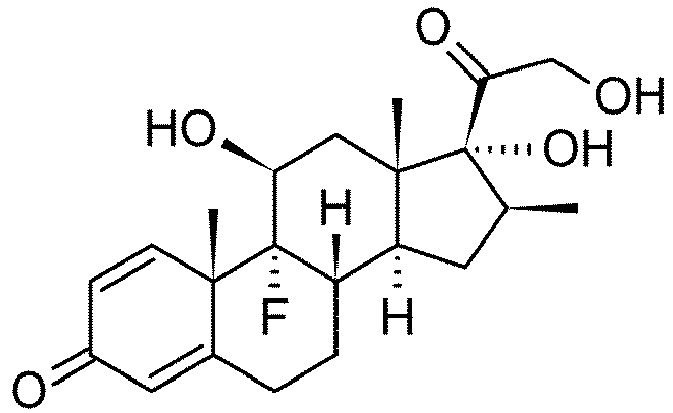
Betamethason (8S,9R,10S.11S,13S,14S,16S,17R)-9-fluoro-11,17-(2-hydroxyacetyl)-10, 13,16-trimethyl-6,7,8,9,10,11,12,13,14,15,16,17-dodecahydro-3H-cyclopenta(alpha) 
Ibuprofen (RS)-2-(4-(2-methylpropyl)phenyl)propansäure) 
Ketoprofen (RS)2-(3-benzoylphenyl)-propansäure 
Dicylofenac 2-(2,6-dichloranilino) phenylessigsäure 
Metronidazol (2-(2-methyl-5-nitro-1H-imidazol-1-yl)ethanol) 
Acyclovir (2-Amino-1,9-dihydro-9-((2-hydroxyethoxy)methyl)-6H-Purin-6-on), 
Imiquimod (3-(2-methylpropyl)-3,5,8-triazatricyclo[7.4.0.0.2,6]trideca-1(9),2(6),4,7,10,12-hexaen-7-amin) 
Terbinafin [(2E)-6,6-dimethylhept-2-en-4-yn-1-yl](methyl)(naphthalen-1-yl methyl)amin) 
Cyclopiroxolamine (6-cyclohexyl-1-hydroxy-4-methylpyridin-2(1H)-on) - Ein weiterer Gegenstand der vorliegenden Erfindung umfasst daher Medikamente enthaltend die Kühlstoffe der Formel (I) sowie pharmazeutische Wirkstoffe ausgewählt aus der Gruppe, die gebildet wird von Aspirin, Minoxidil, Erythromycin, Fenistil, Betamethason, Ibuprofen, Ketoprofen, Dicyclofenac, Metronidazol, Acylovir, Imiquimod, Terbafin, Cyclopiroxolamin sowie deren Gemische.
- In Probandenstudien hat sich ferner gezeigt, dass die erfindungsgemäßen Kühlstoffe der Formel (I) die schmerzmindernden Eigenshaften von nichtsteroidalen entzündungshemmenden Stoffen (NSAID), insbesondere von Ibuprofen und Ketoprofen über die Kühlwirkung hinaus verstärken, was für den Fachmann ebenfalls nicht zu erwarten gewesen ist.
- Ein weiterer Gegenstand der vorliegenden Erfindung umfasst damit ferner Medikamente enthaltend die Kühlstoffe der Formel (I) sowie pharmazeutische Wirkstoffe vom Typ der NSAID insbesondere zur Verwendung in der Behandlung von Entzündungszuständen der Haut und der Schleimhaut sowie der Gelenke.
- Die Medikamente können die Kühlstoffe der Formel (I) und die pharmazeutischen Wirkstoffe im Gewichtsverhältnis von etwa 1:99 bis etwa 10:90 und insbesondere 2:98 bis etwa 5:95 enthalten.
- Ein weiterer Gegenstand der Erfindung betrifft ein Verfahren zur Erzeugung eines physiologischen Kühleffektes auf Haut oder Schleimhaut, umfassend die folgenden Schritte:
- (i) Bereitstellen von mindestens einem erfindungsgemäßen Kühlstoff oder einer entsprechenden Kühlstoffmischung,
- (ii) gegebenenfalls Formulierung der Kühlstoffe in eine kosmetische, pharmazeutische oder orale Zusammensetzung; und
- (iii) in Kontaktbringen der Zubereitungen aus Schritt (i) oder Schritt (ii) mit menschlicher Haut oder Schleimhaut.
- Ebenfalls beansprucht wird ein Verfahren zur Verbesserung der geschmacklichen Eigenschaften von Aromastoffen umfassend die folgenden Schritte:
- (i) Bereitstellen von mindestens einem erfindungsgemäßen Kühlstoff und mindestens einem Aromastoff;
- (ii) vermischen der beiden Komponenten sowie gegebenenfalls
- (iii) Einarbeitung der Mischung in eine orale Zusammensetzung.
- Zwei weitere Gegenstände der vorliegenden Erfindung betreffen zu einen
- die Verwendung der erfindungsgemäßen Kühlstoffe oder der entsprechenden Kühlstoffmischungen zur Erzeugung eines physiologischen Kühleffektes auf Haut oder Schleimhaut sowie zum anderen
- die Verwendung der erfindungsgemäßen Kühlstoffe oder der entsprechenden Kühlstoffmischung zur Verbesserung der geschmacklichen Eigenschaften von Aromastoffen.
- Soweit bevorzugte Ausführungsformen betroffen sind, wird auf die vorstehenden Erläuterungen verwiesen, die für die erfindungsgemäßen Anwendungsverfahren und Verwendungen in gleicher Weise gelten, ohne dass es hierzu einer Wiederholung bedarf.
- Die folgenden Formulierungsbeispiele F1 to F55 zeigen unterschiedlichste Formulierungen für Kosmetische und pharmazeutische Zubereitungen. Kühlstoff 1 bedeutet hier der erfindungsgemäße Kühlstoff gemäß Struktur 1.
Tabelle F1 Transparente Flüssigseife (Mengen in Gew.-%) Bestandteile INCI Name Menge Tagat O 2 PEG-20 Glyceryl Oleate 2.5 Coconut oil diethanolamine condensate Cocamide DEA 5.0 Abil B 8842 Cyclomethicone 0.5 Sodium laurylethersulfate. 28% Sodium Laureth Sulfate 35.0 Tego-Betaine L7 Cocamidopropyl Betaine 5.0 Soap. 25% Coconut acid. Potassium salt. Potassium Oleate 20.0 Hydrolite® 5 1,2-propanediol 0.4 Kühlstoff 1 1.0 Wasser Wasser Ad 100 Tabelle F2 Flüssige Syndetseife (Mengen in Gew.-%) Bestandteile INCI Name Menge Elfan OS 46 Sodium Olefin C14-C16 Sulfonate 35.5 Armoteric LB Lauryl Betaine 8.0 Elfan SG 10.0 Elfacos GT 282 L Talloweth-60 Myristyl Glycol 3.0 PCL-Liquid 100 Cetearyl Ethylhexanoate 4.0 Hydrolite® 5 Green Hydrolite® 5 Green 0.4 Preservative Methylchloroisothiazolinone 0.1 Kühlstoff 1 1.5 Wasser Wasser Ad 100 Tabelle F3 Körperpflegelotion (Mengen in Gew.-%) Bestandteile INCI Name Menge Lumerol K 28 Disodium Laureth Sulfosuccinate. Cocamidopropyl Betaine. Magnesium Lauryl Sulfate 33.0 Amphotensid B 4 Cocamidopropyl Betaine 10.0 Perlglanzmittel GM 4055 MIPA-Pareth-25 Sulfate. Glycol Stearate 4.0 Sodium Chloride Sodium Chloride 2.0 Avocado oil Persea Gratissima (Avocado) Oil 3.0 Wasser Wasser Ad 100 Hydrolite® 5 Hydrolite® 5 Green 0.5 Euxyl® K727 Phenoxyethanol. Methyldibromo Glutaronitrile. Isothiazolinones 0.3 Kühlstoff 1 1.0 Tabelle F4 Körperpflegelotion mit Triclosan (Mengen in Gew.-%) Bestandteile INCI Name Menge Texapon N 25 Sodium Laureth Sulfate 37.5 Lamepon S Potassium Cocoyl Hydrolyzed Collagen 28.0 Lamesoft LMG Hydrogenated Tallow Glycerides. TEA-Cocoyl Hydrolyzed Collagen 5.0 Lamesoft 156 Glyceryl Laurate. TEA-Cocoyl Hydrolyzed Collagen 5.0 Sodium Chloride Sodium Chloride 1.7 Irgasan DP 300 Triclosan 0.5 Wasser Wasser Ad 100 Hydrolite® 5 Hydrolite® 5 Green 0.3 Euxyl® K703 Phenoxyethanol. Benzoic Acid. Dehydroacetic Acid 0.4 Kühlstoff 1 1.0 Tabelle F5 Intimwäsche (Mengen in Gew.-%) Bestandteile INCI Name Menge Tegobetaine HS Cocamidopropyl Betaine. Glyceryl Laurate 15.0 Tagat L 2 PEG-20 Glyceryl Laurate 2.0 Arlacide G Chlorhexidine Digluconate 0.1 Rewoquat B 50 Benzalkonium Chloride 0.1 Lactic Acid. 80% Lactic Acid 0.1 Wasser Wasser Ad 100 Hydrolite® 5 Hydrolite® 5 Green 0.2 Euxyl® K700 Potassium Sorbate. Benzyl Alcohol. Phenoxyethanol 0.3 Kühlstoff 2 1.3 Tabelle F6 Flüssigseife (Mengen in Gew.-%) Ingredient INCI Menge Deionisiertes Wasser Wasser 2.0 Soap bases mix Sodium tallowates / palmitates 95.8 Titanium dioxide Titanium dioxide 1.0 Hydrolite® 5 Hydrolite® 5 Green 1.2 Preservatives Phenoxyethanol 0.5 Kühlstoff 1 1.0 Tabelle F7 Shampoo (Mengen in Gew.-%) Bestandteile Menge Sodium lauryl ether sulfate (e.g. Texapon NSO) 12 Cocamidopropyl betaine (e.g. Dehyton K) 2 Sodium chloride 1.4 Citric acid 1.3 1,2-pentanediol (Hydrolite® 5) 0.3 Phenoxyethanol. methyl-. ethyl-. butyl- and propylparaben 0.5 Kühlstoff 4 1.0 Wasser Ad 100 Tabelle F8 2-in-1 Shampoo (Mengen in Gew.-%) Bestandteile INCI Name Menge Deionisiertes Wasser Wasser Ad 100 Plantacare PS 10 Sodium Laureth Sulfate. Lauryl Glucoside 20.0 Euperlan PK 771 Glycol Distearate. Sodium Lauryl Sulfate. Cocamide MEA. Laureth-10 6.0 Sodium chloride Sodium Chloride 1.4 Citric acid monohydrate crystalline Citric acid 0.1 Hydrolite® 5 Hydrolite® 5 Green 0.5 Dragocid Liquid Phenoxyethanol, Parabens 0.5 Kühlstoff 1 1.0 Tabelle F9 Anti-Schuppen Shampoo (Mengen in Gew.-%) Bestandteile Menge Climbazole 0.50 Sodium Laureth Sulfate 37.00 Cocamidopropyl Betaine 8.00 PEG-6 Caprylic/Capric Glycerides 2.50 Laureth-2 2.00 Wasser (Aqua). Glycerol. Thymus Vulgaris (Thyme). Flower/Leaf Extract 0.50 Rosmarinus Officinalis (Rosemary) Leaf Wasser. Wasser (Aqua). Butylene Glycol. Pentylene Glycol 0.50 Bisabolol 0.10 Panthenol 0.50 Polyquaternium-10 0.40 1,2-pentanediol (Hydrolite® 5) 0.50 Phenoxyethanol. Methylparaben. Ethylparaben. Butylparaben. Propylparaben. Isobutylparaben 0.70 Kühlstoff 5 1.50 Wasser (Aqua) Ad 100 Tabelle F10 Hair conditioner mit Crinipan. rinse-off (Mengen in Gew.-%) Bestandteile INCI Name Menge Lanette® O Cetearyl Alcohol 4.00 Dragoxat 89 Ethylhexyl Isononanoate 2.00 Genamin® KDM-P Behentrimonium Chloride 1.00 SF 1550 Phenyl Trimethicone 0.10 Neo Heliopan® BB Benzophenone-3 0.10 Crinipan® AD Climbazole 0.80 Glycerol 99.5 P. Glycerol 6.00 Wasser Wasser (Aqua) Ad 100 Actipone® Alpha Pulp Wasser (Aqua). Butylene Glycol. Malic Acid. Actinidia Chinensis (Kiwi)Fruit Juice. Citrus. Aurantium Dulcis (Orange). Juice. Citrus Paradisi (Grapefruit) Juice. Pyrus Malus (Apple) Juice. Trideceth-9. PrunusAmygdalus Dulcis (Sweet Almond) Seed Extract 0.50 Extrapone® Bamboo P Propylene Glycol. Wasser (Aqua). Butylene Glycol. Bambusa Vulgaris Shoot Extract 0.50 Sodium Hydroxide 10% solution Sodium Hydroxide 0.40 Colour I Colour 0.60 Colour II Colour 0.30 Hydrolite® 5 Hydrolite® 5 Green 0.40 Preservative Methylparaben 0.20 Kühlstoff 6 1.2 Tabelle F11 Sprühbarer Hair Conditioner mit Zinkpyrithrione - leave-on (Mengen in Gew.-%) Bestandteile INCI Name Menge Monomuls 60-35 C Hydrogenated Palm Glycerides 1.70 Cetiol OE Dicaprylyl Ether 7.20 Abil 100 Dimethicone 3.60 Dehyquart F 75 Distearoylethyl Hydroxyethylmonium. Methosulfate. Cetearyl Alcohol 4.00 Eumulgin B1 Ceteareth-12 3.50 Cetiol S Diethylhexylcyclohe xane 7.20 D-Panthenol Panthenol 0.10 Glycerol 99.5 P. Glycerol 1.50 Wasser Wasser (Aqua) Ad 100 Actipone® Rosemary Wasser (Aqua). Propylene. Glycol. Rosmarinus Officinalis. (Rosemary) Leaf Extract 0.10 Frescolat® ML Cryst. Menthyl Lactate 0.50 Dragosantol100 Bisabolol 0.10 Zinc Omadine Zinc pyrithione 0.10 Hydrolite® 5 Hydrolite® 5 0.40 Phenonip® phenoxyethanol. methylparaben. ethylparaben. butylparaben. propylparaben. isobutylparaben 0.30 Kühlstoff 1 1.50 Tabelle F12 Hair Conditioner mit UV-Schutz (Mengen in Gew.-%) Bestandteile INCI Name Menge Renex PEG 6000 PEG-150 2.50 Hair Conditioner Base Cetyl alcohol. behentrimonium chloride. Triticum Vulgare (Wheat) bran extract. linoleic acid 3.00 PCL-Solid Stearyl heptanoate. stearyl caprylate 0.50 Dow Corning 5200 Laurylmethicone copolyol 0.50 Natrosol 250 HR Hydroxyethylcellulose 0.50 Benzophenone-4 Benzophenone-4 1.00 Neo Heliopan AP Disodiumphenyldibenz-imidazole tetrasulphonate 1.00 Amino methyl propanol Amino methyl propanol 2.00 Dow Corning 949 cationic emulsion Amodimethicone. cetrimonium chloride. trideceth-12 2.00 Hydrolite® 5 Hydrolite® 5 0.80 1.2-hexanediol 1.2-hexanediol 0.50 Kühlstoff 3 1.50 Wasser Wasser (Aqua) Ad 100 Tabelle 13 Shower gel (Mengen in Gew.-%) Bestandteile INCI Menge Deionisiertes Wasser Wasser Ad 100 Plantacare PS 10 Sodium Laureth Sulfate. Lauryl Glucoside 20.0 Sodium chloride Sodium Chloride 1.4 Citric acid monohydrate crystalline Citric Acid 1.3 Hydrolite® 5 Hydrolite® 5 0.6 SymDiol®68 1.2-hexanediol. Caprylyl glycol 0.4 Kühlstoff 2 0.9 Tabelle F14 Rasierschaum (Mengen in Gew.-%) Bestandteile Menge Dem. Wasser 77.2 Triethanolamine 4.0 Edenor L2 SM (Stearinic acid. Palmitinic acid) (Cognis) 5.3 Laureth-23 3.0 Stearylalcohol 0.5 Sodium lauryl sulfate 3.0 Extrapone Seaweed (Wasser. propylene glycol. potassium iodide. Fucus Vesiculosus Extract) 1.0 Dragosantol (Bisabolol. Farnesol) 0.1 1,2-pentanediol (Hydrolite® 5) 1.0 Euxyl® K220 (Methylisothiazolinone. Ethylhexylglyerol) 0.6 Kühlstoff 4 0.6 Propane. butane 4.2 Bar 4.0 Tabelle F15 Enthaarungscreme (Mengen in Gew.-%) Bestandteile Menge Cetearyl alcohol 10.0 Ceteareth-12 2.0 PCL-Liquid (Cetearylethylhexanoate. Isopropylmyristate) 3.0 Dragosantol (Bisabolol. Farnesol) 0.1 Edenor L2 SM (Stearinic acid. Palmitinic acid) 1.0 Dem. Wasser 52.2 Urea 5.0 Dem. Wasser 10.0 Calcium thioglycolate 6.0 Sodium hydroxide solution. 10 % 10.0 1,2-pentanediol (Hydrolite® 5) 0.5 Neo Dragocid Powder (Methyl parabene. sorbinic acid. Dehydro acetic acid. Propyl parabene) 0.2 Kühlstoff3 2.0 Tabelle F16 After Shave Tonic (Mengen in Gew.-%) Bestandteile INCI Menge SymSol® PF-3 Wasser (Aqua). Pentylene Glycol. Sodium Lauryl Sulfoacetate. SodiumOleoyl Sarcosinate. Sodium Chloride. Disodium Sulfoacetate. SodiumOleate. Sodium Sulfate 3.00 SymSitive® 1609 Pentylene Glycol. 4-t-Butylcyclohexan ol 1.00 Frescolat® ML Menthyl Lactate 0.30 Glycerol 99.5 P. Glycerol 5.00 Wasser Wasser (Aqua) Ad 100 Extrapone® Glacier Wasser GW Glycerol. Wasser (Aqua) 1.00 SymCalmin® Butylene Glycol. Pentylene Glycol. Hydroxyphenyl Propamidobenzoic Acid 0.50 Dragosine® Carnosine 0.10 Hydrolite® 5 Pentylene Glycol 5.00 Ethanol 96 % Alcohol Denat. 5.00 Colour Pigment Colour Pigment 0.05 Hydrolite® 5 1,2-pentanediol 0.15 Kühlstoff 1 1.00 Tabelle F17 Deodorant Formulierung als Roll-on Gel (Mengen in Gew.-%) Bestandteile Menge 1.3-butylene glycol 2.00 PEG-40-hydrogenated castor oil 2.00 Hydroxyethylcellulose 0.50 1,2-pentanediol (Hydrolite® 5) 0.30 1.3-propanediol 0.50 3-phenylpropanol 0.40 Ethylhexyl glycerin 0.10 Kühlstoff 1 0.50 Wasser ad 100.00 Tabelle F18 Klares Deodorant als roll-on (Mengen in Gew.-%) Bestandteile INCI Menge Methocel E4M Premium Hydroxypropyl Methylcellulose 0.50 Wasser Wasser (Aqua) Ad 100 Neo-PCL Wasser Soluble N Trideceth-9. PEG-5 Ethylhexanoate. Wasser 1.00 Solubilizer PEG-40 Hydrogenated Castor Oil. Trideceth-9. Propylene Glycol. Wasser (Aqua) 3.00 Deolite Dimethyl Phenylpropanol. Pentylene Glycol 0.50 Locron LW Aluminium Chlorohydrate 25.00 Aloe Vera Gel Concentrate 10/1 Aloe Barbadensis Leaf Juice 1.00 Propylene Glycol -1.2 99 P GC Propylene Glycol 4.00 Ethanol 96 % Alcohol Denat. 30.00 Hydrolite® 5 1,2pentanediol 1.00 Kühlstoff 1 1.25 Tabelle F19 Deodorant stick (Mengen in Gew.-%) Bestandteile Menge Sodium stearate 8.00 PPG-3 Myristyl ether 70.00 1.2-propylene glycol 10.00 1.1-dimethyl-3-phenylpropanol 0.20 2-butyloctanoic acid 0.20 1,2-pentanediol (Hydrolite® 5) 0.60 Heptoxy-1.2-propanediol 0.20 Phenoxyethanol 0.30 Kühlstoff 1 1.50 Wasser Ad 100 Tabelle F20 Antiperspirantstift (Mengen in Gew.-%) Bestandteile INCI Menge PCL Liquid 100 Cetearyl ethylhexanonate to 100 Silicone Fluid 345 Cyclomethicone 10.00 CRODACOL C90 Cetyl Alcohol 8.00 SYNCROWAX HGLC C18-36 Triglyceride 8.00 CRODAMOL PTC Pentaerythritol Tetracaprylate/Caprate 5.00 SYNCROWAX HRC Tribehenin 4.00 VOLPO N5 Oleth-5 1.00 Titanium Dioxide 1.00 Rezal 36GP Aluminium Tetrachlorohydrex GLY 20.00 Dry Flo C Aluminium Starch Octenyl Succinate 22.50 Hydrolite® 5 1,2-pentanediol 0.60 Preservative Phenoxyethanol 0.40 Hexoxy-1.2-propanediol 0.10 Kühlstoff 1 1.40 Tabelle F21 Pumpspray (Mengen in Gew.-%) Bestandteile INCI Menge SymClariol® Decylene Glycol 0.50 Solubilizer PEG-40 Hydrogenated Castor Oil. Trideceth-9. Propylene Glycol. Wasser (Aqua) 4.00 Neo-PCL Wasser Soluble N Trideceth-9. PEG-5 Ethylhexanoate. Aqua 1.50 SymRelief® Bisabolol. Zingiber Officinale (Ginger) Root Extract 0.10 Wasser Wasser (Aqua) Ad 100 1.2 Propylene Glycol Propylene Glycol 6.00 Hydrolite® 5 1,2-pentanediol 0.40 SymDiol® 68 1.2-Hexanediol. Caprylyl Glycol 0.20 Kühlstoff 2 1.40 Tabelle F22 Antiperspirant (Mengen in Gew.-%) Bestandteile Mengen Reach AZP-908 SUF 24.00 Cyclomethicone (Pentamer) Ad 100 Polydecene (Silkflo 364 NF) 17.50 Neo Heliopan OS (ethylhexyl salicylate) 2.50 L-Menthyl lactate (Frescolate ML) 0.25 Polyethylene 3.00 Hydrogenated castor oil 2.00 Promyristyl PM-3 7.00 PEG-8 Distearate 3.00 Silicon dioxide (Cab-O-Sil M-5) 1.00 Stearyl alcohol 15.00 Octyldodecanol 0.10 1,2-pentanediol (Hydrolite® 5) 0.80 3-Phenylpropanol 0.40 Kühlstoff 3 1.60 Tabelle F23 Sprühdeodorant mit Triclosan (Mengen in Gew.-%) Bestandteile Menge PEG-40-hydrogenated castor oil 3.00 Ethylhexylglycerol (Octoxyglycerol) 0.80 Ethanol 40.00 Citrate buffer 0.50 Triclosan® (5-chloro-2-(2.4-dichlorophenoxy)phenol) 0.25 1,2-pentanediol (Hydrolite® 5) 0.75 Phenoxyethanol 0.40 Kühlstoff 1 1.40 Wasser Ad 100 Tabelle F24 O/W Lotion (Mengen in Gew.-%) Bestandteile Menge Paraffin oil 5.00 Isopropyl palmitate 5.00 Cetyl alcohol 2.00 Beeswax 2.00 Ceteareth-20 2.00 PEG-20-glyceryl stearate 1.50 Glycerol 3.00 1,2-pentanediol (Hydrolite® 5) 0.30 Methylparaben 0.30 Kühlstoff 3 1.00 Wasser ad 100.00 Tabelle F25 Body Lotion (Mengen in Gew.-%) Bestandteile Menge Cetearyl Alcohol 2.00 Ethylhexyl Isononanoate 5.00 Cetearyl Ethylhexanoate. Isopropyl Myristate 3.00 Glyceryl Oleate Citrate. Caprylic/Capric Triglyceride 4.00 Wasser (Aqua) 79.50 Carbomer 0.30 Sodium Benzoate 0.100 Propylene Glycol 5.00 Sodium Hydroxide 30% solution 0.30 1,2-pentanediol (Hydrolite® 5) 0.30 Triethylene Glycol. Imidazolidinyl Urea. Methylparaben. Propylparaben. Dehydroacetic Acid 0.30 Kühlstoff 5 1.30 Tabelle F26 Creme (Mengen in Gew.-%) Bestandteile Menge Paraffin oil 10.00 Ozokerite 4.00 Vaseline 4.00 VegeTabelle oil 10.00 Wool wax alcohol 2.00 Aluminum stearate 0.40 1,2-pentanediol (Hydrolite® 5) 2.00 Phenoxyethanol 0.50 Kühlstoff 1 1.50 Wasser ad 100.00 Tabelle F27 Creme (Mengen in Gew.-%) Bestandteile INCI Menge Dracorin® CE Glyceryl Stearate Citrate 1.00 Lanette® O Cetearyl Alcohol 2.00 Cutina® GMS-V Glyceryl Stearate 1.00 Tegosoft® MM Myristyl Myristate 1.00 Xiameter® PMX-0246. Cyclosiloxane Cyclohexasiloxane (and) Cyclopentasiloxane 0.50 Dragoxat® 89 Ethylhexyl Isononanoate 2.00 PCL-Liquid 100 Cetearyl Ethylhexanoate 4.00 Neutral Oil Caprylic/Capric Triglyceride 4.00 Carbopol® Ultrez 21 Acrylates/C10-30 Alkyl Acrylate Crosspolymer 0.20 Keltrol® CG-T Xanthan Gum 0.10 Wasser Wasser (Aqua) Ad 100 Glycerol 99.5 P. Glycerol 3.00 Propylene Glycol -1.2 99 P GC Propylene Glycol 2.00 Sodium Benzoate Sodium Benzoate 0.10 Sodium Hydroxide 10% solution Sodium Hydroxide 0.50 Hydrolite® 5 1,2-pentanediol 0.30 Euxyl® K702 Dehydroacetic Acid. Benzoic Acid. Phenoxyethanol.Polyaminopropyl Biguanide. Ethylhexylglycerin 0.30 Kühlstoff 1 2.00 Tabelle F28 Hand- und Körpercreme (Mengen in Gew.-%) Bestandteile INCI Menge Dracorin® GOC Glyceryl ide Oleate Citrate. Caprylic/Capric Triglyceride 2.00 PCL-Solid Stearyl Heptanoate. Stearyl Caprylate 2.50 Lanette® O Cetearyl Alcohol 1.50 Cutina® GMS-V Glyceryl Stearate 1.00 Dragoxat® 89 Ethylhexyl Isononanoate 3.00 PCL-Liquid 100 Cetearyl Ethylhexanoate 7.00 Isodragol® Triisononanoin 4.00 Xiameter® PMX-0345 Cyclosiloxane Cyclopentasiloxane (and) Cyclohexasiloxane 0.50 Wasser Wasser (Aqua) Ad 100 Carbopol® Ultrez 21 Acrylates/C10-30 Alkyl Acrylate Crosspolymer 0.20 Keltrol® CG-RD Xanthan Gum 0.10 Glycerol 85 P. Glycerol 3.00 DragoBetaGlucan Wasser (Aqua). Butylene Glycol. Glycerol. Avena Sativa (Oat) Kernel Extract 1.50 Potassium Sorbat Potassium Sorbate 0.10 Sodium Hydroxide 10% solution Sodium Hydroxide 0.50 Hydrolite® 5 1,2-pentanediol 0.20 Euxyl® K300 Methyl-. Butyl-. Ethyl-. Propyl. Isobutylparaben. Phenoxyethanol. 0.30 Kühlstoff 4 1.00 Tabelle F29 Gesichtscreme (Mengen in Gew.-%) Bestandteile INCI Menge Emulsiphos® Potassium Cetyl Phosphate. Hydrogenated Palm Glycerides 1.50 Cutina® GMS-V Glyceryl Stearate 1.70 Lanette® O Cetearyl Alcohol 3.00 Tegosoft® MM Myristyl Myristate 1.00 PCL-Liquid 100 Cetearyl Ethylhexanoate 1.00 Isodragol® Triisononanoin 3.00 Dragoxat® 89 Ethylhexyl Isononanoate 4.00 Avocado Oil Persea Gratissima (Avocado) Oil 3.00 Abil® 350 Dimethicone 0.50 Covi-ox® T-70 Tocopherol 0.10 Edeta® BD Disodium EDTA 0.10 Carbopol® Ultrez 21 Acrylates/C10-30 Alkyl Acrylate Crosspolymer 0.30 Keltrol® CG-RD Xanthan Gum 0.150 Wasser Wasser (Aqua) Ad 100 Glycerol 99.5 P. Glycerol 4.00 Propylene Glycol -1.2 99 P GC Propylene Glycol 3.00 SymMatrix® Maltodextrin. Rubus Fruticosus (Blackberry) Leaf Extract 0.50 Sodium Hydroxide 10% solution Sodium Hydroxide 0.50 Hydrolite® 5 1,2-pentanediol 0.30 Euxyl® K712 Sodium Benzoate. Potassium Sorbate 0.20 Kühlstoff 1 1.00 Tabelle F30 Feuchtigkeitscreme (Mengen in Gew.-%) Ingredient Menge PEG-7 hydrogenated castor oil 6.00 Cetearyl ethyl hexanoate 10.00 Isopropyl myristate 5.00 Mineral oil 7.00 Shea Butter (Butyrospermum parkii) 0.50 Aluminum stearate 0.50 Magnesium stearate 0.50 Bisabolol 0.20 Quaternium-18-Hectorit 0.70 Dipropylene glycol 5.0 Magnesium sulfate 0.70 1,2-pentanediol (Hydrolite® 5) 4.00 Preservative (Phenoxyethanol) 0.20 Kühlstoff 1 1.00 Aqua dem. 58.90 Tabelle F31 Antifaltencreme (Mengen in Gew.-%) Bestandteile Menge Glyceryl Stearate Citrate 1.00 Glyceryl Laurate 1.00 Cetearyl Alcohol (and) Myristyl Myristate 3.00 Cetearyl Ethylhexanoate 4.00 Mineral oil 4.00 Cyclohexasiloxane 0.50 Acrylates/C10-30 Alkyl Acrylate Crosspolymer 0.20 Wasser Ad 100 1.2-Hexanediol 2.00 Sodium Hydroxide 10% solution 0.10 Narcissus Tazetta Bulb Extract 1.00 1,2-pentanediol (Hydrolite® 5) 0.30 Preservative (Phenoxyethanol) 0.50 Kühlstoff 3 1.50 Tabelle F32 Desinfizierendes Hautpflegeöl (Mengen in Gew.-%) Bestandteile INCI Menge Neutral Oil Caprylic/Capric Triglyceride Ad 100 Sweet Almond Oil Prunus Dulcis 20.00 Dragoxat® 89 Ethylhexyl Isononanoate 4.00 Isopropyl Palmitate Isopropyl Palmitate 6.00 PCL-Liquid 100 Cetearyl Ethylhexanoate 15.00 Dragosantol® 100 Bisabolol 0.20 Retinyl Acetate In Oil (1 Mio. le/G) Retinyl Acetate 0.50 Vitamin E Acetate Tocopheryl Acetate 0.50 Covi-ox® T-70 Tocopherol 0.10 Hydrolite® 5 1,2-pentanediol 0.30 Preservative Methyl-. Butyl-. Ethyl-. Propylparaben 0.30 Kühlstoff 1 1.00 Tabelle F33 Antiseptische Wundcreme (Mengen in Gew.-%) Bestandteile (INCI) Menge Sorbitan Isostearate. Hydrogenated Castor Oil. Ceresin. Beeswax (Cera Alba) 6.00 Petrolatum 21.00 Cera Alba 5.00 Cetearyl Alcohol 7.00 Prunus Dulcis 7.00 Lanolin 5.00 Paraffinum Liquidum 12.00 Wasser (Aqua) Ad 100 Panthenol 7.00 Magnesium Sulfate 0.70 1,2-pentanediol (Hydrolite® 5) 1.00 Tocopheryl Acetate 1.00 Octenidine dihydrochloride 0.10 Phenoxyethanol 0.50 Kühlstoff 6 1.50 Tabelle F34 Feuchtigkeitsmaske (Mengen in Gew.-%) Bestandteile INCI Menge Wasser Wasser (Aqua) Ad 100 Stabileze QM PVM / Ma Decadiene Crosspolymer 0.50 Biotive® L-Arginine Arginine 0.75 Actipone® Laminaria Saccharina GW Glycerol. Wasser (Aqua). Laminaria Saccharina Extract 1.00 Extrapone® Cucumber Wasser (Aqua). Propylene Glycol. Cucumis Sativus (Cucumber) Juice 1.00 Glycerol 99.5 P. Glycerol 7.00 Neo Actipone® Soap Nutshell Sapindus Mukurossi Peel Extract 0.50 Colour I Colour 0.01 Hydrolite® 5 Pentylene Glycol 5.00 Solubilizer PEG-40 Hydrogenated Castor Oil. Trideceth-9. Wasser (Aqua) 0.60 Hydrolite® 5 1,2-pentanediol 0.08 Preservative Phenoxyethanol 0.40 Kühlstoff 1 1.00 Tabelle F35 Sprühbares Desinfektionsgel (Mengen in Gew.-%) Bestandteile INCI Menge Wasser Wasser (Aqua) Ad 100 Stabileze QM PVM / Ma Decadiene Crosspolymer 0.25 Sodium Hydroxide 10% solution Sodium Hydroxide 0.40 Coffein pure Caffeine 0.50 Extrapone® Horse Chestnut Propylene Glycol. Wasser (Aqua). Glucose. Aesculus Hippocastanum (Horse Chestnut) Seed Extract. Lactic Acid 1.00 Hydrolite® 5 1,2-pentanediol 3.00 1.3 Butylene Glycol Butylene Glycol 5.00 Biotive® Esculin Sesquihydrate Esculin 0.30 Ethanol 96 % Alcohol Denat. 10.00 Solubilizer PEG-40 Hydrogenated Castor Oil. Trideceth-9. Wasser (Aqua) 0.50 Octenidine dihydrochloride 0.10 Preservative Phenoxyethanol 0.70 Kühlstoff 1 1.00 Tabelle F36 Mineralisches Wasch- und Reinigungsgel (Mengen in Gew.-%) Bestandteile INCI Menge Wasser Wasser (Aqua) Ad 100 Pionier® NP 37 G Sodium Carbomer 1.50 SymSol® PF-3 Wasser (Aqua). Pentylene Glycol. Sodium Lauryl Sulfoacetate. SodiumOleoyl Sarcosinate. Sodium Chloride. Disodium Sulfoacetate. SodiumOleate. Sodium Sulfate 5.00 Hydroviton® 24 Wasser (Aqua). Pentylene Glycol. Glycerol. Sodium Lactate. Lactic Acid. Serine. Urea. Sorbitol. Sodium Chloride. Allantoin 1.00 Extrapone® Silk GW Wasser (Aqua). Glycerol. Hydrolyzed Silk 1.00 Hydrolite® 5 Green Hydrolite® 5 Green 4.00 Actipearls Red Star # DH10402/6 Wasser (Aqua). Propylene Glycol. Algin. Gellan Gum. Xanthan Gum. CalciumChloride. Cl 12490 (Pigment Red 5). Mica (Cl 77019). Titanium Dioxide (Cl 77891) 1.00 1,2-pentanediol (Hydrolite® 5) 1,2-pentanediol 0.50 3-Phenylpropanol 0.70 Kühlstoff 5 0.30 Tabelle F37 Anti-Akne Wäsche (Mengen in Gew.-%) Bestandteile (INCI) Menge Wasser (Aqua) 45.70 Polyquaternium-7 0.50 Cocamidopropyl Betaine 9.000 9.00 Coco Glucoside 2.000 2.00 Polysorbate 80. Glycerol. Gossypium Herbaceum. (Cotton) Seed Oil. Wasser (Aqua) 1.00 Trideceth-9. PEG-5 Ethylhexanoate. Wasser (Aqua) 1.00 Glycereth-90 Isostearate. Laureth-2 0.50 Sodium Laureth Sulfate 37.000 37.00 Glycerol. Triticum Vulgare (Wheat) Gluten. Wasser (Aqua) 1.00 Sodium Chloride 0.30 1,2-pentanediol (Hydrolite® 5) 1.00 Phenoxyethanol. Methylparaben. Ethylparaben. Butylparaben. Propylparaben. Isobutylparaben 0.30 Kühlstoff 5 1.50 Tabelle F38 Sonnenschutzformulierung (Mengen in Gew.-%) Ingredient Menge Ethylhexyl cinnamic acid 7.50 Benzophenon-3 2.00 Polyglyceryl dimer soyate 0.80 Sorbitane stearate 1.00 Tocopheryl acetate 0.50 Glyceryl stearate. PEG-100 Stearate 3.00 PEG-40. hydrogenated castor oil 1.00 Titanium dioxide. aluminum oxide hydrate. Dimethicon/Methicon Copolymer 3.00 Butyrospermum parkii (Shea Butter) 1.00 C12-15 alkyl benzoate 6.50 Butylene glycol 5.00 Xanthan gum 0.30 Disodium EDTA 0.10 Allantoin 0.10 Polyacryl amide. C13-14 isoparaffin. Laureth-7 1.00 1,2-pentanediol (Hydrolite® 5) 5.00 4-t Butylcyclohexanol 1.00 Preservatives (Methyl-. Butyl-. Ethyl-. Propylparaben. Phenoxyethanol) 0.30 Kühlstoff 3 2.00 Aqua dem. Ad 100 Tabelle F39 Sonnenschutzspray (Mengen in Gew.-%) Bestandteile INCI Menge Wasser. demineralized Wasser (aqua) 69.50 Glycerol Glycerol 4.00 1.3 butylene glycol Butylene glycol 5.00 D-Panthenol Panthenol 0.50 Lara Care A-200 Galactoarabinan 0.25 Baysilone oil M 10 Dimethicone 1.00 Edeta BD Disodium EDTA 0.10 Copherol 1250 Tocopheryl acetate 0.50 Cetiol OE Dicaprylyl ether 3.00 Neo Heliopan® HMS Homosalate 5.00 Neo Heliopan® AV Ethylhexyl methoxycinnamate 6.00 Neo Heliopan® 357 Butyl methoxydibenzoylmethane 1.00 Corapan TQ Diethylhexylnaphthalate 2.00 Alpha Bisabolol Bisabolol 0.10 Pemulen TR-2 Acrylates/C10-30 alkyl acrylate crosspolymer 0.25 NaOH. 10% Sodium hydroxide 0.60 Hydrolite® 5 1,2-pentanediol 0.20 Phenoxyethanol Phenoxyethanol 0.40 Solbrol M Methylparaben 0.10 Solbrol P Propylparaben 0.10 Kühlstoff 1 1.00 Tabelle F40 Sonnenschutzspray O/W. SPE 15-20 (Mengen in Gew.-%) Bestandteile INCI Menge Dracorin® GOC Glyceryl Oleate Citrate. Caprylic/Capric Triglyceride 2.00 Corapan® TQ Diethylhexyl 2.6-Naphthalate 3.00 Neo Heliopan® HMS Homosalate 7.00 Neo Heliopan® OS Ethylhexyl Salicylate 5.00 Neo Heliopan® 357 Butyl Methoxydibenzoylmethane 3.00 Isoadipate Diisopropyl Adipate 6.00 Baysilone® Oil M10 Dimethicone 1.00 Edeta® BD Disodium EDTA 0.10 Vitamin E Acetate Tocopheryl Acetate 0.50 Dragosantol® 100 Bisabolol 0.10 Pemulen® TR-2 Acrylates/C10-30 Alkyl Acrylate Crosspolymer 0.25 Wasser Wasser (Aqua) Ad 100 Glycerol 99.5 P. Glycerol 4.00 Butylene Glycol Butylene Glycol 5.00 Neo Heliopan® Hydro (103089). used as 25% aq. solution Phenylbenzimidazole Sulfonic Acid 8.00 Biotive® L-Arginine Arginine 0.55 Hydrolite® 5 1,2-pentanediol 0.40 Sobrol M Methylparaben 0.30 Kühlstoff 3 1.00 Tabelle F41 Sonnenschutzsoftcreme (W/O). SPF 40 (Mengen in Gew.-%) Bestandteile INCI Menge Dehymuls PGPH Polyglyceryl-2 dipolyhydroxystearate 5.00 Copherol 1250 Tocopheryl acetate 0.50 Permulgin 3220 Ozocerite 0.50 Zinc stearate Zinc stearate 0.50 Tegosoft TN C12-15 Alkyl benzoate 10.00 Neo Heliopan® E1000 Isoamyl-p-methoxycinnamate 2.00 Neo Heliopan® 303 Octocrylene 5.00 Neo Heliopan® MBC 4-Methylbenzylidene camphor 3.00 Zinc oxide. neutral Zinc oxide 5.00 Wasser. distilled Wasser (aqua) Add 100 EDETA BD Disodium EDTA 0.10 Glycerol Glycerol 4.00 Magnesium sulfate Magnesium sulfate 0.50 Hydrolite® 5 1,2-pentanediol 0.30 Symdiol® 68 1.2-Hexanediol. Caprylylglycol 0.30 Kühlstoff 1 1.00 Tabelle F42 Sonnenschutzmilch (W/O) (Mengen in Gew.-%) Bestandteile INCI Menge Dehymuls PGPH Polyglyceryl-2 dipolyhydroxystearate 3.00 Beeswax 8100 Beeswax 1.00 Monomuls 90-0-18 Glyceryl oleate 1.00 Zinc stearate Zinc stearate 1.00 Cetiol SN Cetearyl isononanoate 5.00 Cetiol OE Dicaprylyl ether 5.00 Tegosoft TN C12-15 alkyl benzoate 4.00 Vitamin E Tocopherol 0.50 Neo Heliopan® OS Ethylhexyl salicylate 5.00 Neo Heliopan® AV Ethylhexyl methoxycinnamate 7.50 Uvinul® T150 Ethylhexyl triazone 1.50 Wasser. distilled Wasser (Aqua) To 100 Trilon BD Disodium EDTA 0.10 Glycerol Glycerol 5.00 Neo Heliopan® AP 10% solution. neutralized with NaOH Disodium phenyl dibenzimidazole tetrasulfonate 15.00 Hydrolite® 5 1,2-pentanediol 0.25 Alpha bisabolol Bisabolol 0.10 SymOcide® PT Phenoxyethanol. Tropolone 0.25 Kühlstoff 3 1.00 Tabelle F43 After Sun Gel (Mengen in Gew.-%) Bestandteile INCI Menge SymSol® PF-3 Wasser (Aqua). Pentylene Glycol. Sodium Lauryl Sulfoacetate. SodiumOleoyl Sarcosinate. Sodium Chloride. Disodium Sulfoacetate. SodiumOleate. Sodium Sulfate 3.000 Glycerol 99.5 P. Glycerol 5.000 SymHelios® 1031 Benzylidene Dimethoxydimethylin danone 0.100 Wasser Wasser (Aqua) Ad 100 Pemulen® TR-2 Acrylates/C10-30 Alkyl Acrylate Crosspolymer 1.000 D-Panthenol 75 W Panthenol 0.500 SymFinity® 1298 Echinacea Purpurea Extract 0.100 Extrapone® Pearl GW Wasser (Aqua). Glycerol. Hydrolyzed Pearl. Xanthan Gum 1.000 Sodium Hydroxide 10% solution Sodium Hydroxide 2.500 Ethanol 96 % Alcohol Denat. 15.000 Hydrolite® 5 1,2-pentanediol 0.20 SymOcide® PS Phenoxyethanol. 1.2-Hexanediol. Decyleneglycol 0.50 Kühlstoff 1 1.00 Tabelle F44 After Sun Lotion (Mengen in Gew.-%) Bestandteile Menge Acrylate/C10-30 alkylacrylate crosspolymer 0.4 Cetearylethyl hexanoate 15.0 Bisabolol 0.2 Tocopheryl acetate 1.0 Panthenol 1.0 Alcohol 15.0 Glycerol 3.0 1.2-Hexanediol 0.60 Kühlstoff 3 1.50 1,2-pentanediol (Hydrolite® 5) 4.0 Aqua dem. Ad 100 Triethanolamine 0.2 Tabelle F45 Hair Styling Gel (Mengen in Gew.-%) Bestandteile Menge Wasser Ad 100 PVM/MA Decadiene Crosspolymer 0.60 PVP 3.00 Isocetyl Stearate 4.00 Ethylhexyl Methoxycinnamate 0.50 Aminomethyl Propanol 0.40 1,2-pentanediol (Hydrolite® 5) 0.60 SymDiol® 68T (1.2-Hexanediol. 1.2-Octanediol. Tropolone) 0.30 Phenoxyethanol 0.20 Kühlstoff 2 1.50 Tabelle F46 Silikonemulsion (Mengen in Gew.-%) Bestandteile Menge Potassium Cetyl Phosphate. Hydrogenated Palm Glycerides 1.00 Cyclohexasiloxane 4.00 Cetearyl Alcohol 1.50 Phenyl Trimethicone 3.00 Stearyl Heptanoate. Stearyl Caprylate 3.00 Dimethicone 1.00 Xanthan Gum 0.20 Isoamyl p-Methoxycinnamate 5.00 Wasser Ad 100 Methylpropanediol 3.00 1,2-pentanediol (Hydrolite® 5) 0.30 Diazolidinyl urea 0.10 Kühlstoff 5 1.50 Tabelle F47 Microemulsionsgel (Mengen in Gew.-%) Ingredient Menge Glycerol isostearate 1.80 Octoxyglycerol 1.00 Ceteareth-15 5.20 PEG-150 Distearate 1.00 Aluminium chlorohydrate 5.00 Isotridecylisononanoate 3.30 Cyclomethicone 6.60 1,2-pentanediol (Hydrolite® 5) 0.70 Euxyl® K145 (Methylchloroisothiazolinone. Methylisothiazlinone. Bronopol) 0.10 Kühlstoff 1 1.00 Wasser Ad 100 Tabelle F48 Lufterfrischer in Gelform (Mengen in Gew.-%) Ingredient Menge Demineralisiertes Wasser Ad 100 Genugel® X-6424 (carrageenan) 2.00 Arkopal® N 100 or Tergitol® NP 10 (Emulsifer) 3.50 1,2-pentanediol (Hydrolite® 5) 0.60 Preventol® D 7 (5-chloro-2-methyl-4-isothiazolin-3-one. 2-methyl-2H isothiazol-3-one) 0.10 Kühlstoff 1 1.00 Tabelle F49 Textilreiniger (Mengen in Gew.-%) Bestandteile (INCI) Menge Aqua 72.10 Dialkylester ammomium methosulfate 16.60 Polydimethylsiloxane 0.30 Magnesiumchloride 10.00 1,2-pentanediol (Hydrolite® 5) 0.60 Mixture of 5-Chloro-2-methyl-2H-isothiazol-3-one and 2-Methyl-2H-isothiazol-3-one 0.10 Kühlstoff 1 (verkapselt) 0.40
Claims (24)
- Physiologische Kühlstoffe der Formel (I)

R1 lineare oder verzweigte C1-C6 Alkylgruppen, die gegebenenfalls 1, 2, 3 oder 4 gleiche oder verschiedene Substituenten tragen, die ausgewählt sind aus der Gruppe bestehend aus NH2, OH, SH, Halogenen oder linearen oder verzweigten C1-C6-Alkylgruppen; lineare oder verzweigte C3-C7-Cycloalkylgruppen, die gegebenenfalls 1, 2, 3 oder 4 gleiche oder verschiedene Substituenten tragen, die ausgewählt sind aus der Gruppe bestehend aus NH2, OH, SH, Halogenen oder linearen oder verzweigten C1-C6-Alkylgruppen, wobei die Cycloalkylgruppen gegebenenfalls über eine C1-C4-Alkylengruppe gebunden ist, und wobei gegebenenfalls 1, 2 oder 3 Ring-Kohlenstoffatome durch gleiche oder verschiedene Heteroatome ausgewählt aus Sauerstoff, Stickstoff und Schwefel ersetzt sein können; ein- oder mehrkernige C1-C6-Aryl-, Arylalkyl- oder Heteroarylgruppen, die gegebenenfalls 1, 2, 3 oder 4 gleiche oder verschiedene Substituenten tragen, die ausgewählt sind aus der Gruppe bestehend aus NH2, OH, SH, Halogenen, linearen oder verzweigten C1-C6-Alkylgruppen, wobei die Heteroarylgruppen 1, 2, 3 oder 4 Ring-Heteroatome aufweisen, die gleich oder verschiedenen und ausgewählt sind aus der Gruppe bestehend aus Sauerstoff, Stickstoff oder Schwefel; R2 lineare oder verzweigte C1-C5-Alkylgruppen; ein- oder mehrkernige C1-C6-Aryl-, Arylalkyl- oder Heteroarylgruppen, die gegebenenfalls 1, 2, 3 oder 4 gleiche oder verschiedene Substituenten tragen, die ausgewählt sind aus der Gruppe bestehend aus NH2, OH, SH, Halogenen, linearen oder verzweigten C1-C6-Alkylgruppen, wobei die Heteroarylgruppen 1, 2, 3 oder 4 Ring-Heteroatome aufweisen, die gleich oder verschiedenen und ausgewählt sind aus der Gruppe bestehend aus Sauerstoff, Stickstoff oder Schwefel; die Reste R1 und R2 zusammen mit den Kohlenstoffatomen, an die sie gebunden sind, einen 4-, 5-, 6- oder 7-gliedrigen, gegebenenfalls ein- oder mehrfach ungesättigten heterocyclischen Ring bilden, der wiederum seinerseits 1, 2, 3, 4 oder 5 gleiche oder verschiedene Substituenten tragen kann, welche ausgewählt sind aus der Gruppe bestehend aus linearen oder verzweigten C1-C6-Alkylgruppen, und der 1, 2 oder 3 Ring-Heteroatome aufweist, die gleich oder verschiedenen sind und ausgewählt sind aus der Gruppe bestehend aus Sauerstoff, Stickstoff und Schwefel; R3 Wasserstoff oder Halogen; lineare oder verzweigte C1-C6 Alkylgruppen, die gegebenenfalls 1, 2, 3 oder 4 gleiche oder verschiedene Substituenten tragen, die ausgewählt sind aus der Gruppe bestehend aus NH2, OH, SH, Halogenen oder linearen oder verzweigten C1-C6-Alkylgruppen; lineare oder verzweigte C1-C6-Alkoxygruppen, die gegebenenfalls 1, 2, 3 oder 4 gleiche oder verschiedene Substituenten tragen, die ausgewählt sind aus der Gruppe bestehend aus NH2, OH, SH, Halogenen oder C1-C6 Alkylgruppen; ein- oder mehrkernige C1-C6-Aryl-, Arylalkyl- oder Heteroarylgruppen, die gegebenenfalls 1, 2, 3 oder 4 gleiche oder verschiedene Substituenten tragen, die ausgewählt sind aus der Gruppe bestehend aus NH2, OH, SH, Halogenen, linearen oder verzweigten C1-C6-Alkylgruppen, wobei die Heteroarylgruppen 1, 2, 3 oder 4 Ring-Heteroatome aufweisen, die gleich oder verschiedenen und ausgewählt sind aus der Gruppe bestehend aus Sauerstoff, Stickstoff oder Schwefel; und wobei zwei benachbarte Reste R3, R4, R5, R6 und R7 zusammen mit den Kohlenstoffatomen, an die sie gebunden sind, einen 4-, 5-, 6- oder 7-gliedrigen, gegebenenfalls ein- oder mehrfach ungesättigten heterocyclischen Ring bilden, der wiederum seinerseits 1, 2, 3, 4 oder 5 gleiche oder verschiedene Substituenten tragen kann, welche ausgewählt sind aus der Gruppe bestehend aus linearen oder verzweigten C1-C6-Alkylgruppen, und der 1, 2 oder 3 Ring-Heteroatome aufweist, die gleich oder verschiedenen sind und ausgewählt sind aus der Gruppe bestehend aus Sauerstoff, Stickstoff und Schwefel; R4 wie R3 R5 wie R3 R6 wie R3 R7 wie R3 R8 C3-C8-Cycloalkylgruppen; ein- oder mehrkernige C1-C6-Aryl-, Arylalkyl- oder Heteroarylgruppen, die gegebenenfalls 1, 2, 3 oder 4 gleiche oder verschiedene Substituenten tragen, die ausgewählt sind aus der Gruppe bestehend aus NH2, OH, SH, Halogenen, linearen oder verzweigten C1-C6-Alkylgruppen, wobei die Heteroarylgruppen 1, 2, 3 oder 4 Ring-Heteroatome aufweisen, die gleich oder verschiedenen und ausgewählt sind aus der Gruppe bestehend aus Sauerstoff, Stickstoff oder Schwefel; X eine Einfachbindung; lineare oder verzweigte C1-C4-Alkylengruppen; lineare oder verzweigte C2-C4-Alkenylengruppen; A-C1-C4 oder C1-C4-A-Alkylengruppen; A-C2-C4- oder C2-C4-A-Gruppen, wobei A für Sauerstoff, Schwefel oder NH steht, - Kühlstoffe gemäß Anspruch 1, dadurch gekennzeichnet, dass R1 für eine Methylgruppe steht.
- Kühlstoffe nach Anspruch 1, dadurch gekennzeichnet, dass die Reste R2 und R8 zusammen mit den Kohlenstoffatomen, an die sie gebunden sind, einen Phenylrest oder einen Thiophenrest bilden.
- Kühlstoffe gemäß Anspruch 1 ausgewählt aus der Gruppe, die gebildet wird von:
Struktur Bezeichnung 
Struktur 1 
Struktur 2 
Struktur 3 
Struktur 4 
Struktur 5 
Struktur 6 - Physiologische Kühlstoffmischung enthaltend, bestehend aus oder im Wesentlichen bestehend aus:(a) ein, zwei, drei oder mehreren Kühlstoffen der Formel (I) und gegebenenfalls(b1) mindestens einem weiteren physiologischen Kühlstoff.
- Mischung nach Anspruch 4, dadurch gekennzeichnet, dass die physiologischen Kühlstoffe, die die Komponente (b1) bilden, ausgewählt aus der Gruppe, die gebildet wird von Menthol, Menthol Methyl Ether, Menthone Glyceryl Acetal (FEMA GRAS 3807), Menthone Glyceryl Ketal (FEMA GRAS 3808), Menthyl Lactate (FEMA GRAS 3748), Menthol Ethylene Glycol Carbonate (FEMA GRAS 3805), Menthol Propylene Glycol Carbonate (FEMA GRAS 3806), Menthyl-N-ethyloxamat, Monomethyl Succinate (FEMA GRAS 3810), Monomenthyl Glutamate (FEMA GRAS 4006), Menthoxy-1,2-propanediol (FEMA GRAS 3784), Menthoxy-2-methyl-1,2-propandiol (FEMA GRAS 3849) sowie den Menthancarbonsäureestern und -amiden WS-3, WS-4, WS-5, WS-12, WS-14 und WS-30 sowie deren Gemischen.
- Mischung nach Anspruch 4, dadurch gekennzeichnet, dass die Komponenten (a) und (b1) im Gewichtsverhältnis von etwa 1:99 bis etwa 99:1 enthalten sind.
- Aromazubereitung enthaltend, bestehend aus oder im Wesentlichen bestehend aus(a) ein, zwei, drei oder mehreren Kühlstoffen der Formel (I) und(b2) mindestens einem Aromastoff.
- Zubereitung nach Anspruch 7, dadurch gekennzeichnet, dass die Aromastoffe, die die Komponente (b2) bilden, ausgewählt sind aus der Gruppe, die gebildet wird von Acetophenon, Allylcapronat, alpha-lonon, beta-lonon, Anisaldehyd, Anisylacetat, Anisylformiat, Benzaldehyd, Benzothiazol, Benzylacetat, Benzylalkohol, Benzylbenzoat, beta-lonon, Butylbutyrat, Butylcapronat, Butylidenphthalid, Carvon, Camphen, Caryophyllen, Cineol, Cinnamylacetat, Citral, Citronellol, Citronellal, Citronellylacetat, Cyclohexylacetat, Cymol, Damascon, Decalacton, Dihydrocumarin, Dimethylanthranilat, Dimethylanthranilat, Dodecalacton, Ethoxyethylacetat, Ethylbuttersäure, Ethylbutyrat, Ethylcaprinat, Ethylcapronat, Ethylcrotonat, Ethylfuraneol, Ethylguajakol, Ethylisobutyrat, Ethylisovalerianat, Ethyllactat, Ethylmethylbutyrat, Ethylpropionat, Eucalyptol, Eugenol, Ethylheptylat, 4-(p-Hydroxyphenyl)-2-butanon, gamma-Decalacton, Geraniol, Geranylacetat, Geranylacetat, Grapefruitaldehyd, Methyldihydrojasmonat (z.B. Hedion®), Heliotropin, 2-Heptanon, 3-Heptanon, 4-Heptanon, trans-2-Heptenal, cis-4-Heptenal, trans-2-Hexenal, cis-3-Hexenol, trans-2-Hexensäure, trans-3-Hexensäure, cis-2-Hexenylacetat, cis-3-Hexenylacetat, cis-3-Hexenylcapronat, trans-2-Hexenylcapronat, cis-3-Hexenylformiat, cis-2-Hexylacetat, cis-3-Hexylacetat, trans-2-Hexylacetat, cis-3-Hexylformiat, para-Hydroxybenzylaceton, Isoamylalkohol, Isoamylisovalerianat, Isobutylbutyrat, Isobutyraldehyd, Isoeugenolmethylether, Isopropylmethylthiazol, Laurinsäure, Leavulinsäure, Linalool, Linalooloxid, Linalylacetat, Menthol, Menthofuran, Methylanthranilat, Methylbutanol, Methylbuttersäure, 2-Methylbutylacetat, Methylcapronat, Methylcinnamat, 5-Methylfurfural, 3,2,2-Methylcyclopentenolon, 6,5,2-Methylheptenon, Methyldihydrojasmonat, Methyljasmonat, 2-Methylmethylbutyrat, 2-Methyl-2-Pentenolsäure, Methylthiobutyrat, 3,1-Methylthiohexanol, 3-Methylthiohexylacetat, Nerol, Nerylacetat, trans,trans-2,4-Nonadienal, 2,4-Nonadienol, 2,6-Nonadienol, 2,4-Nonadienol, Nootkaton, delta Octalacton, gamma Octalacton, 2-Octanol, 3-Octanol, 1,3-Octenol, 1-Octylacetat, 3-Octylacetat, Palmitinsäure, Paraldehyd, Phellandren, Pentandion, Phenylethylacetat, Phenylethylalkohol, Phenylethylalkohol, Phenylethylisovalerianat, Piperonal, Propionaldehyd, Propylbutyrat, Pulegon, Pulegol, Sinensal, Sulfurol, Terpinen, Terpineol, Terpinolen, 8,3-Thiomenthanon, 4,4,2-Thiomethylpentanon, Thymol, delta-Undecalacton, gamma-Undecalacton, Valencen, Valeriansäure, Vanillin, Acetoin, Ethylvanillin, Ethylvanillinisobutyrat (= 3-Ethoxy-4-isobutyryloxybenzaldehyd), 2,5-Dimethyl-4-hydroxy-3(2H)-furanon und dessen Abkömmlinge (dabei vorzugsweise Homofuraneol (= 2-Ethyl-4-hydroxy-5-methyl-3(2H)-furanon), Homofuronol (= 2-Ethyl-5-methyl-4-hydroxy-3(2H)-furanon und 5-Ethyl-2-methyl-4-hydroxy-3(2H)-furanon), Maltol und Maltol-Abkömmlinge (dabei vorzugsweise Ethylmaltol), Cumarin und Cumarin-Abkömmlinge, gamma-Lactone (dabei vorzugsweise gamma-Undecalacton, gamma-Nonalacton, gamma-Decalacton), delta-Lactone (dabei vorzugsweise 4-Methyldeltadecalacton, Massoilacton, Deltadecalacton, Tuberolacton), Methylsorbat, Divanillin, 4-Hydroxy-2(oder 5)-ethyl-5(oder 2)-methyl-3(2H)furanon, 2-Hydroxy-3-methyl-2-cyclopentenon, 3-Hydroxy-4,5-dimethyl-2(5H)-furanon, Essigsäureisoamylester, Buttersäureethylester, Buttersäure-n-butylester, Buttersäureisoamylester, 3-Methyl-buttersäureethylester, n-Hexansäureethylester, n-Hexansäureallylester, n-Hexansäure-n-butylester, n-Octansäureethylester, Ethyl-3-methyl-3-phenylglycidat, Ethyl-2-trans-4-cis-decadienoat, 4-(p-Hydroxyphenyl)-2-butanon, 1,1-Dimethoxy-2,2,5-trimethyl-4-hexan, 2,6-Dimethyl-5-hepten-1-al und Phenylacetaldehyd, 2-Methyl-3-(methylthio)furan, 2-Methyl-3-furanthiol, bis(2-Methyl-3-furyl)disulfid, Furfurylmercaptan, Methional, 2-Acetyl-2-thiazolin, 3-Mercapto-2-pentanon, 2,5-Dimethyl-3-furanthiol, 2,4,5-Trimethylthiazol, 2-Acetylthiazol, 2,4-Dimethyl-5-ethylthiazol, 2-Acetyl-1-pyrrolin, 2-Methyl-3-ethylpyrazin, 2-Ethyl-3,5-dimethylpyrazin, 2-Ethyl-3,6-dimethylpyrazin, 2,3-Diethyl-5-methylpyrazin, 3-Isopropyl-2-methoxypyrazin, 3-Isobutyl-2-methoxypyrazin, 2-Acetylpyrazin, 2-Pentylpyridin, (E,E)-2,4-Decadienal, (E,E)-2,4-Nonadienal, (E)-2-Octenal, (E)-2-Nonenal, 2-Undecenal, 12-Methyltridecanal, 1-Penten-3-on, 4-Hydroxy-2,5-dimethyl-3(2H)-furanon, Guajakol, 3-Hydroxy-4,5-dimethyl-2(5H)-furanon, 3-Hydroxy-4-methyl-5-ethyl2(5H)-furanon, Zimtaldehyd, Zimtalkohol, Methylsalicylat, Isopulegol sowie (hier nicht explizit genannte) Stereoisomere, Enantiomere, Stellungsisomere, Diastereomere, cis/trans-Isomere bzw. Epimere dieser Substanzen.
- Zubereitung nach Anspruch 7, dadurch gekennzeichnet, dass die Aromastoffe, die die Komponente (b2) bilden, ausgewählt sind aus der Gruppe, die gebildet wird von Erythritol, Threitol, Arabitol, Ribotol, Xylitol, Sorbitol, Mannitol, Dulcitol, Lactitol, Miraculin, Monellin, Thaumatin, Curculin, Brazzein, Magap, Natriumcyclamat, Acesulfam K, Neohesperidin Dihydrochalcon, Saccharin Natriumsalz, Aspartam, Superaspartam, Neotam, Alitam, Sucralose, Stevioside, Rebaudioside, Lugduname, Carrelame, Sucrononate, Sucrooctate, Monatin, Phenylodulcin, Glycin, D-Leucin, D-Threonin, D-Asparagin, D-Phenylalanin, D-tryptophn, L-Prolin, Hernandulcin, Dihydrochalconglykoside, Glycyrrhizin, Glycerrhetinsäure, ihre Derivate und Salze, Extrakte von Lakritz (Glycyrrhizza glabra ssp.), Lippia dulcis Extrakte, Momordica ssp. Extrakte, Mogrosiden, Hydrangea dulcis und Steviosiden sowie deren Mischungen.
- Zubereitung nach Anspruch 7, dadurch gekennzeichnet, dass die Komponenten (a) und (b2) im Gewichtsverhältnis von etwa 1:99 bis etwa 99:1 enthalten sind.
- Kühlstoffe nach Anspruch 1 oder Mischungen nach Anspruch 4 oder Zubereitungen nach Anspruch 7, dadurch gekennzeichnet, dass diese verkapselt vorliegen.
- Kosmetische oder pharmazeutische Zusammensetzung enthaltend mindestens einen Kühlstoff nach Anspruch 1 oder eine Mischung nach Anspruch 4.
- Orale Zusammensetzung enthaltend mindestens einen Kühlstoff nach Anspruch 1 oder eine Mischung nach Anspruch 4 oder eine Zubereitung nach Anspruch 7.
- Medikamente enthaltend mindestens einen der Kühlstoffe der Formel (I).
- Medikamente enthaltend mindestens einen der Kühlstoffe der Formel (I) zur Verwendung zur Linderung von Schmerzen und Entzündungszuständen der Haut und der Schleimhäute.
- Medikamente enthaltend die Kühlstoffe der Formel (I) sowie pharmazeutische Wirkstoffe ausgewählt aus der Gruppe, die gebildet wird von Aspirin, Minoxidil, Erythromycin, Fenistil, Betamethason, Ibuprofen, Ketoprofen, Dicyclofenac, Metronidazol, Acylovir, Imiquimod, Terbafin, Cyclopiroxolamin sowie deren Gemische.
- Medikamente enthaltend die Kühlstoffe der Formel (I) sowie pharmazeutische Wirkstoffe vom Typ der NSAID.
- Medikamente enthaltend die Kühlstoffe der Formel (I) sowie pharmazeutische Wirkstoffe vom Typ der NSAID zur Verwendung in der Behandlung von Entzündungszuständen der Haut und der Schleimhaut sowie der Gelenke.
- Medikamente nach den Ansprüche 15, 16, 17 oder 18, dadurch gekennzeichnet, dass sie die Kühlstoffe der Formel (I) und die pharmazeutischen Wirkstoffe im Gewichtsverhältnis von etwa 1:99 bis etwa 10:90 enthalten.
- Verfahren zur Erzeugung eines physiologischen Kühleffektes auf Haut oder Schleimhaut, umfassend die folgenden Schritte:(i) Bereitstellen von mindestens einem Kühlstoff gemäß Anspruch 1 oder einer Mischung nach Anspruch 4,(ii) gegebenenfalls Formulierung der Kühlstoffe in eine kosmetische, pharmazeutische oder orale Zusammensetzung; und(iii) Inkontaktbringen der Zubereitungen aus Schritt (i) oder Schritt (ii) mit menschlicher Haut oder Schleimhaut.
- Verfahren zur Verbesserung der geschmacklichen Eigenschaften von Aromastoffen umfassend die folgenden Schritte:(i) Bereitstellen von mindestens einem Kühlstoff nach Anspruch 1 oder einer Kühlstoffmischung nach Anspruch 4 und mindestens einem Aromastoff;(ii) Vermischen der beiden Komponenten sowie gegebenenfalls(iii) Einarbeitung der Mischung in eine orale Zusammensetzung.
- Verwendung von Kühlstoffen nach Anspruch 1 oder Mischungen nach Anspruch 4 zur Erzeugung eines physiologischen Kühleffektes auf Haut oder Schleimhaut.
- Verwendung von Kühlstoffen nach Anspruch 1 zur Verbesserung der geschmacklichen Eigenschaften von Aromastoffen.
Applications Claiming Priority (1)
| Application Number | Priority Date | Filing Date | Title |
|---|---|---|---|
| EP19155329 | 2019-02-04 |
Publications (2)
| Publication Number | Publication Date |
|---|---|
| EP3689324A1 true EP3689324A1 (de) | 2020-08-05 |
| EP3689324B1 EP3689324B1 (de) | 2024-11-20 |
Family
ID=65516422
Family Applications (1)
| Application Number | Title | Priority Date | Filing Date |
|---|---|---|---|
| EP20150849.6A Active EP3689324B1 (de) | 2019-02-04 | 2020-01-09 | Neue kühlstoffe und zubereitungen, die diese enthalten |
Country Status (1)
| Country | Link |
|---|---|
| EP (1) | EP3689324B1 (de) |
Cited By (2)
| Publication number | Priority date | Publication date | Assignee | Title |
|---|---|---|---|---|
| CN116139029A (zh) * | 2023-02-17 | 2023-05-23 | 广州翀潇生物科技有限公司 | 一种油包水型清凉止痒膏及其制备方法 |
| US12491184B2 (en) | 2022-10-25 | 2025-12-09 | Veradermics, Incorporated | Compositions and methods of use for modified release minoxidil |
Families Citing this family (1)
| Publication number | Priority date | Publication date | Assignee | Title |
|---|---|---|---|---|
| US20240209288A1 (en) * | 2022-12-21 | 2024-06-27 | The Procter & Gamble Company | Cleaning product |
Citations (57)
| Publication number | Priority date | Publication date | Assignee | Title |
|---|---|---|---|---|
| US3111127A (en) | 1961-06-27 | 1963-11-19 | Brown & Williamson Tobacco Corp | Smoking tobacco product and method of making the same |
| US3419543A (en) | 1964-10-01 | 1968-12-31 | Liggett & Myers Inc | Carbonate esters of flavorants |
| US3488419A (en) | 1965-12-08 | 1970-01-06 | Procter & Gamble | Oral compositions for calculus retardation |
| DE2224430A1 (de) | 1972-05-19 | 1973-12-06 | Henkel & Cie Gmbh | Zahnsteinbildung verhindernde mundund zahnpflegemittel |
| DE2343196A1 (de) | 1973-08-27 | 1975-04-03 | Henkel & Cie Gmbh | Azacycloalkan-2,2-diphosphonsaeuren |
| DE2608226A1 (de) | 1976-02-28 | 1977-09-08 | Haarmann & Reimer Gmbh | Mittel mit physiologischer kuehlwirkung |
| US4157384A (en) | 1972-01-28 | 1979-06-05 | Wilkinson Sword Limited | Compositions having a physiological cooling effect |
| US4251195A (en) | 1975-12-26 | 1981-02-17 | Morishita Jinta Company, Limited | Apparatus for making miniature capsules |
| US4459425A (en) | 1981-11-20 | 1984-07-10 | Takasago Perfumery Co., Ltd. | 3-Levo-Menthoxypropane-1,2-diol |
| EP0389700A1 (de) | 1988-01-29 | 1990-10-03 | FUJI CAPSULE KABUSHIKI KAISHA (also trading as FUJI CAPSULE CO., LTD.) | Weiche Agarkapseln |
| DE4226043A1 (de) | 1992-08-06 | 1994-02-10 | Haarmann & Reimer Gmbh | Mittel mit physiologischem Kühleffekt und für diese Mittel geeignete wirksame Verbindungen |
| US5286500A (en) | 1992-03-03 | 1994-02-15 | Wm. Wrigley Jr. Company | Wax-free chewing gum base |
| EP0507190B1 (de) | 1991-04-05 | 1995-06-21 | Haarmann & Reimer Gmbh | Mittel mit physiologischem Kühleffekt und für diese Mittel geeignete wirksame Verbindungen |
| US5725865A (en) | 1995-08-29 | 1998-03-10 | V. Mane Fils S.A. | Coolant compositions |
| US5843466A (en) | 1995-08-29 | 1998-12-01 | V. Mane Fils S.A. | Coolant compositions |
| WO2001001929A2 (de) | 1999-07-02 | 2001-01-11 | Primacare S.A. | Mikrokapseln - iv |
| WO2001001928A1 (de) | 1999-07-02 | 2001-01-11 | Primacare S.A. | Mikrokapseln - iii |
| WO2001001926A1 (de) | 1999-07-02 | 2001-01-11 | Primacare S.A. | Mikrokapseln - ii |
| WO2001001927A1 (de) | 1999-07-02 | 2001-01-11 | Primacare S.A. | Mikrokapseln - i |
| US6214376B1 (en) | 1998-08-25 | 2001-04-10 | Banner Pharmacaps, Inc. | Non-gelatin substitutes for oral delivery capsules, their composition and process of manufacture |
| US6328982B1 (en) | 1998-08-04 | 2001-12-11 | Takasago International Corporation | Cool feeling composition |
| US6407293B1 (en) | 2000-10-23 | 2002-06-18 | Takasago International Corporation | Process for producing 3-1-menthoxypropane-1,2-diol |
| EP1258200A2 (de) | 2001-05-11 | 2002-11-20 | Haarmann & Reimer Gmbh | Verwendung von Hydroxyflavanone zur Maskierung des bitteren Geschmacks, und Lebensmittel und pharmazeutische Zusammensetzungen enthaltend eine wirksame Menge dieser Hydroxyflavone |
| WO2002091849A1 (en) | 2001-05-11 | 2002-11-21 | Wm. Wrigley Jr. Company | A chewing gum having prolonged sensory benefits |
| EP1064088B1 (de) | 1998-03-19 | 2002-12-04 | Max-Planck-Gesellschaft zur Förderung der Wissenschaften e.V. | Herstellung von mit mehrlagen gestrichenen partikeln und hohlen schalen durch elektrostatische selbstorganisierung von nanokompositmehrlagen auf zersetzbaren schablonen |
| US6515188B2 (en) | 2001-04-23 | 2003-02-04 | Takasago International Corporation | Method for producing 3-l-menthoxypropane-1,2-diol |
| WO2003043431A1 (en) | 2001-11-23 | 2003-05-30 | Unilever N.V. | Water continuous food product with cooling flavour |
| WO2003055587A1 (de) | 2001-12-24 | 2003-07-10 | Symrise Gmbh & Co.Kg | Mononuklear gefüllte mikrokapseln |
| EP1332772A2 (de) | 2002-02-05 | 2003-08-06 | INTERNATIONAL FLAVORS & FRAGRANCES INC. | Zusammensetzungen gegen Schuppen und Jukreiz, die ein Kältegefühl erzeugendes Material und einen Kältegefühl-Verstärker enthalten |
| WO2004000789A1 (en) * | 2002-06-19 | 2003-12-31 | Eli Lilly And Company | Amide linker peroxisome proliferator activated receptor modulators |
| JP2004059474A (ja) | 2002-07-26 | 2004-02-26 | T Hasegawa Co Ltd | p−メンタン誘導体およびこれを含有する冷感剤 |
| WO2004050069A1 (de) | 2002-12-05 | 2004-06-17 | Symrise Gmbh & Co. Kg | Nahtlose gefüllte kapseln |
| WO2004078302A1 (de) | 2003-03-08 | 2004-09-16 | Symrise Gmbh & Co. Kg | Verwendung von divanillin als aromastoff |
| US20050222256A1 (en) | 2004-04-02 | 2005-10-06 | Erman Mark B | Physiological cooling compositions containing highly purified ethyl ester of N-[[5-methyl-2-(1-methylethyl)cyclohexyl] carbonyl]glycine |
| WO2005096841A1 (de) | 2004-04-07 | 2005-10-20 | Symrise Gmbh & Co. Kg | Verwendung von ϝ-aminobuttersäure zur maskierung oder verminderung eines unangenehmen geschmackseindrucks sowie zubereitungen enthaltend ϝ-aminobuttersäure |
| JP2005343795A (ja) | 2004-05-31 | 2005-12-15 | Takasago Internatl Corp | グリオキシル酸メンチルエステル類及びそれを含有する冷感剤組成物 |
| WO2006003107A1 (de) | 2004-06-30 | 2006-01-12 | Symrise Gmbh & Co. Kg | Verwendung von äpfelsäureglucosiden als geschmacksstoffe |
| DE102004041496A1 (de) | 2004-08-27 | 2006-03-02 | Symrise Gmbh & Co. Kg | Hydroxybenzoesäureamide und deren Verwendung zur Maskierung von bitterem Geschmack |
| WO2006058893A2 (en) | 2004-12-03 | 2006-06-08 | Symrise Gmbh & Co. Kg | Use of diacetyl trimer as an aromatic and flavouring substance |
| WO2006106023A1 (en) | 2005-04-04 | 2006-10-12 | Symrise Gmbh & Co. Kg | Hydroxydeoxybenzoins and the use thereof to mask a bitter taste |
| WO2007003527A1 (en) | 2005-07-05 | 2007-01-11 | Symrise Gmbh & Co. Kg | Hydroxyphenylalkadiones and their use for masking bitter taste and/or for intensifying sweet taste |
| WO2007014879A1 (en) | 2005-07-27 | 2007-02-08 | Symrise Gmbh & Co. Kg | Use of hesperetin for enhancing the sweet taste |
| WO2007019719A1 (en) | 2005-08-15 | 2007-02-22 | Givaudan Sa | Cooling compounds |
| WO2007045566A1 (en) | 2005-10-21 | 2007-04-26 | Symrise Gmbh & Co. Kg | Mixtures having a salty taste |
| WO2007107596A1 (en) | 2006-03-22 | 2007-09-27 | Symrise Gmbh & Co. Kg | Use of 4-hydroxydihydrochalcones and their salts for enhancing an impression of sweetness |
| WO2008046895A1 (en) | 2006-10-18 | 2008-04-24 | Symrise Gmbh & Co. Kg | Substituted bicyclo[4.1.0]heptane-7-carboxylic acid amides and derivatives thereof as food flavor substances |
| EP1955601A1 (de) | 2007-01-25 | 2008-08-13 | Symrise GmbH & Co. KG | Verwendung von Propenylphenylglycosiden zur Verstärkung süßer sensorischer Eindrücke |
| US20080227867A1 (en) | 2007-03-13 | 2008-09-18 | Symrise Gmbh & Co. Kg | Use of 4-hydroxychalcone derivatives for masking an upleasant taste |
| EP1989944A1 (de) | 2007-05-08 | 2008-11-12 | Symrise GmbH & Co. KG | Substituierte Cyclopropancarbonsäure(3-methyl-cyclohexyl)amide als Geschmacksstoffe |
| EP2008530A1 (de) | 2007-06-19 | 2008-12-31 | Symrise GmbH & Co. KG | Aromakomposition zum Verringern oder Unterdrücken von unerwünschtem bitteren und adstringierenden Eindruck |
| EP2064959A1 (de) | 2007-10-31 | 2009-06-03 | Symrise GmbH & Co. KG | Aromatische Neo-Menthylamide als Geschmacksstoffe |
| EP2135516A1 (de) | 2008-06-13 | 2009-12-23 | Symrise GmbH & Co. KG | Neo-Menthylderivate als Geschmacksstoffe |
| WO2010002694A2 (en) | 2008-06-30 | 2010-01-07 | Intel Corporation | Selective formation of dielectric etch stop layers |
| EP2298084A1 (de) | 2009-08-28 | 2011-03-23 | Symrise AG | Süßmittelreduzierte Produkte, Aromamischungen dafür sowie Verfahren zum Herstellen solcher Produkte |
| WO2011061330A2 (de) | 2009-11-20 | 2011-05-26 | Symrise Ag | Verwendung physiologischer kühlwirkstoffe und mittel enthaltend solche wirkstoffe |
| WO2012061698A2 (en) | 2010-11-05 | 2012-05-10 | Senomyx, Inc. | Compounds useful as modulators of trpm8 |
| DE202012013357U1 (de) * | 2012-12-12 | 2016-07-29 | Symrise Ag | Zubereitungen |
-
2020
- 2020-01-09 EP EP20150849.6A patent/EP3689324B1/de active Active
Patent Citations (59)
| Publication number | Priority date | Publication date | Assignee | Title |
|---|---|---|---|---|
| US3111127A (en) | 1961-06-27 | 1963-11-19 | Brown & Williamson Tobacco Corp | Smoking tobacco product and method of making the same |
| US3419543A (en) | 1964-10-01 | 1968-12-31 | Liggett & Myers Inc | Carbonate esters of flavorants |
| US3488419A (en) | 1965-12-08 | 1970-01-06 | Procter & Gamble | Oral compositions for calculus retardation |
| US4157384A (en) | 1972-01-28 | 1979-06-05 | Wilkinson Sword Limited | Compositions having a physiological cooling effect |
| DE2224430A1 (de) | 1972-05-19 | 1973-12-06 | Henkel & Cie Gmbh | Zahnsteinbildung verhindernde mundund zahnpflegemittel |
| DE2343196A1 (de) | 1973-08-27 | 1975-04-03 | Henkel & Cie Gmbh | Azacycloalkan-2,2-diphosphonsaeuren |
| US4251195A (en) | 1975-12-26 | 1981-02-17 | Morishita Jinta Company, Limited | Apparatus for making miniature capsules |
| DE2608226A1 (de) | 1976-02-28 | 1977-09-08 | Haarmann & Reimer Gmbh | Mittel mit physiologischer kuehlwirkung |
| US4459425A (en) | 1981-11-20 | 1984-07-10 | Takasago Perfumery Co., Ltd. | 3-Levo-Menthoxypropane-1,2-diol |
| EP0389700A1 (de) | 1988-01-29 | 1990-10-03 | FUJI CAPSULE KABUSHIKI KAISHA (also trading as FUJI CAPSULE CO., LTD.) | Weiche Agarkapseln |
| EP0507190B1 (de) | 1991-04-05 | 1995-06-21 | Haarmann & Reimer Gmbh | Mittel mit physiologischem Kühleffekt und für diese Mittel geeignete wirksame Verbindungen |
| US5286500A (en) | 1992-03-03 | 1994-02-15 | Wm. Wrigley Jr. Company | Wax-free chewing gum base |
| DE4226043A1 (de) | 1992-08-06 | 1994-02-10 | Haarmann & Reimer Gmbh | Mittel mit physiologischem Kühleffekt und für diese Mittel geeignete wirksame Verbindungen |
| US5843466A (en) | 1995-08-29 | 1998-12-01 | V. Mane Fils S.A. | Coolant compositions |
| US5725865A (en) | 1995-08-29 | 1998-03-10 | V. Mane Fils S.A. | Coolant compositions |
| EP1064088B1 (de) | 1998-03-19 | 2002-12-04 | Max-Planck-Gesellschaft zur Förderung der Wissenschaften e.V. | Herstellung von mit mehrlagen gestrichenen partikeln und hohlen schalen durch elektrostatische selbstorganisierung von nanokompositmehrlagen auf zersetzbaren schablonen |
| US6328982B1 (en) | 1998-08-04 | 2001-12-11 | Takasago International Corporation | Cool feeling composition |
| US6214376B1 (en) | 1998-08-25 | 2001-04-10 | Banner Pharmacaps, Inc. | Non-gelatin substitutes for oral delivery capsules, their composition and process of manufacture |
| WO2001001927A1 (de) | 1999-07-02 | 2001-01-11 | Primacare S.A. | Mikrokapseln - i |
| WO2001001926A1 (de) | 1999-07-02 | 2001-01-11 | Primacare S.A. | Mikrokapseln - ii |
| WO2001001928A1 (de) | 1999-07-02 | 2001-01-11 | Primacare S.A. | Mikrokapseln - iii |
| WO2001001929A2 (de) | 1999-07-02 | 2001-01-11 | Primacare S.A. | Mikrokapseln - iv |
| US6407293B1 (en) | 2000-10-23 | 2002-06-18 | Takasago International Corporation | Process for producing 3-1-menthoxypropane-1,2-diol |
| US6515188B2 (en) | 2001-04-23 | 2003-02-04 | Takasago International Corporation | Method for producing 3-l-menthoxypropane-1,2-diol |
| EP1258200A2 (de) | 2001-05-11 | 2002-11-20 | Haarmann & Reimer Gmbh | Verwendung von Hydroxyflavanone zur Maskierung des bitteren Geschmacks, und Lebensmittel und pharmazeutische Zusammensetzungen enthaltend eine wirksame Menge dieser Hydroxyflavone |
| WO2002091849A1 (en) | 2001-05-11 | 2002-11-21 | Wm. Wrigley Jr. Company | A chewing gum having prolonged sensory benefits |
| US20020188019A1 (en) | 2001-05-11 | 2002-12-12 | Ley Jakob Peter | Use of hydroxyflavanones for masking bitter taste |
| WO2003043431A1 (en) | 2001-11-23 | 2003-05-30 | Unilever N.V. | Water continuous food product with cooling flavour |
| WO2003055587A1 (de) | 2001-12-24 | 2003-07-10 | Symrise Gmbh & Co.Kg | Mononuklear gefüllte mikrokapseln |
| EP1332772A2 (de) | 2002-02-05 | 2003-08-06 | INTERNATIONAL FLAVORS & FRAGRANCES INC. | Zusammensetzungen gegen Schuppen und Jukreiz, die ein Kältegefühl erzeugendes Material und einen Kältegefühl-Verstärker enthalten |
| WO2004000789A1 (en) * | 2002-06-19 | 2003-12-31 | Eli Lilly And Company | Amide linker peroxisome proliferator activated receptor modulators |
| JP2004059474A (ja) | 2002-07-26 | 2004-02-26 | T Hasegawa Co Ltd | p−メンタン誘導体およびこれを含有する冷感剤 |
| WO2004050069A1 (de) | 2002-12-05 | 2004-06-17 | Symrise Gmbh & Co. Kg | Nahtlose gefüllte kapseln |
| WO2004078302A1 (de) | 2003-03-08 | 2004-09-16 | Symrise Gmbh & Co. Kg | Verwendung von divanillin als aromastoff |
| US20050222256A1 (en) | 2004-04-02 | 2005-10-06 | Erman Mark B | Physiological cooling compositions containing highly purified ethyl ester of N-[[5-methyl-2-(1-methylethyl)cyclohexyl] carbonyl]glycine |
| WO2005096841A1 (de) | 2004-04-07 | 2005-10-20 | Symrise Gmbh & Co. Kg | Verwendung von ϝ-aminobuttersäure zur maskierung oder verminderung eines unangenehmen geschmackseindrucks sowie zubereitungen enthaltend ϝ-aminobuttersäure |
| JP2005343795A (ja) | 2004-05-31 | 2005-12-15 | Takasago Internatl Corp | グリオキシル酸メンチルエステル類及びそれを含有する冷感剤組成物 |
| WO2006003107A1 (de) | 2004-06-30 | 2006-01-12 | Symrise Gmbh & Co. Kg | Verwendung von äpfelsäureglucosiden als geschmacksstoffe |
| DE102004041496A1 (de) | 2004-08-27 | 2006-03-02 | Symrise Gmbh & Co. Kg | Hydroxybenzoesäureamide und deren Verwendung zur Maskierung von bitterem Geschmack |
| WO2006024587A1 (de) | 2004-08-27 | 2006-03-09 | Symrise Gmbh & Co. Kg | Hydroxybenzoesäureamide und deren verwendung zur maskierung von bitterem geschmack |
| WO2006058893A2 (en) | 2004-12-03 | 2006-06-08 | Symrise Gmbh & Co. Kg | Use of diacetyl trimer as an aromatic and flavouring substance |
| WO2006106023A1 (en) | 2005-04-04 | 2006-10-12 | Symrise Gmbh & Co. Kg | Hydroxydeoxybenzoins and the use thereof to mask a bitter taste |
| WO2007003527A1 (en) | 2005-07-05 | 2007-01-11 | Symrise Gmbh & Co. Kg | Hydroxyphenylalkadiones and their use for masking bitter taste and/or for intensifying sweet taste |
| WO2007014879A1 (en) | 2005-07-27 | 2007-02-08 | Symrise Gmbh & Co. Kg | Use of hesperetin for enhancing the sweet taste |
| WO2007019719A1 (en) | 2005-08-15 | 2007-02-22 | Givaudan Sa | Cooling compounds |
| WO2007045566A1 (en) | 2005-10-21 | 2007-04-26 | Symrise Gmbh & Co. Kg | Mixtures having a salty taste |
| WO2007107596A1 (en) | 2006-03-22 | 2007-09-27 | Symrise Gmbh & Co. Kg | Use of 4-hydroxydihydrochalcones and their salts for enhancing an impression of sweetness |
| WO2008046895A1 (en) | 2006-10-18 | 2008-04-24 | Symrise Gmbh & Co. Kg | Substituted bicyclo[4.1.0]heptane-7-carboxylic acid amides and derivatives thereof as food flavor substances |
| EP1955601A1 (de) | 2007-01-25 | 2008-08-13 | Symrise GmbH & Co. KG | Verwendung von Propenylphenylglycosiden zur Verstärkung süßer sensorischer Eindrücke |
| US20080227867A1 (en) | 2007-03-13 | 2008-09-18 | Symrise Gmbh & Co. Kg | Use of 4-hydroxychalcone derivatives for masking an upleasant taste |
| EP1989944A1 (de) | 2007-05-08 | 2008-11-12 | Symrise GmbH & Co. KG | Substituierte Cyclopropancarbonsäure(3-methyl-cyclohexyl)amide als Geschmacksstoffe |
| EP2008530A1 (de) | 2007-06-19 | 2008-12-31 | Symrise GmbH & Co. KG | Aromakomposition zum Verringern oder Unterdrücken von unerwünschtem bitteren und adstringierenden Eindruck |
| EP2064959A1 (de) | 2007-10-31 | 2009-06-03 | Symrise GmbH & Co. KG | Aromatische Neo-Menthylamide als Geschmacksstoffe |
| EP2135516A1 (de) | 2008-06-13 | 2009-12-23 | Symrise GmbH & Co. KG | Neo-Menthylderivate als Geschmacksstoffe |
| WO2010002694A2 (en) | 2008-06-30 | 2010-01-07 | Intel Corporation | Selective formation of dielectric etch stop layers |
| EP2298084A1 (de) | 2009-08-28 | 2011-03-23 | Symrise AG | Süßmittelreduzierte Produkte, Aromamischungen dafür sowie Verfahren zum Herstellen solcher Produkte |
| WO2011061330A2 (de) | 2009-11-20 | 2011-05-26 | Symrise Ag | Verwendung physiologischer kühlwirkstoffe und mittel enthaltend solche wirkstoffe |
| WO2012061698A2 (en) | 2010-11-05 | 2012-05-10 | Senomyx, Inc. | Compounds useful as modulators of trpm8 |
| DE202012013357U1 (de) * | 2012-12-12 | 2016-07-29 | Symrise Ag | Zubereitungen |
Non-Patent Citations (9)
| Title |
|---|
| "Chemistry and Technology of Flavors and Fragrances", 2005, BLACKWELL PUBLISHING LTD, pages: 212 - 222 |
| "Farbstoffkommission der Deutschen Forschungsgemeinschaft", 1984, VERLAG CHEMIE, article "Kosmetische Färbemittel", pages: 81 - 106 |
| ALAIN NONCOVICH ET AL: "Discovery and development of a novel class of phenoxyacetyl amides as highly potent TRPM8 agonists for use as cooling agents", BIOORGANIC & MEDICINAL CHEMISTRY LETTERS, vol. 27, no. 16, 1 August 2017 (2017-08-01), AMSTERDAM, NL, pages 3931 - 3938, XP055405217, ISSN: 0960-894X, DOI: 10.1016/j.bmcl.2017.04.003 * |
| BROGGINI G ET AL: "Stereoselective intramolecular cycloadditions of homochiral N-alkenoyl aryl azides", TETRAHEDRON ASYMMETRY, PERGAMON PRESS LTD, OXFORD, GB, vol. 12, no. 8, 21 May 2001 (2001-05-21), pages 1201 - 1206, XP004245868, ISSN: 0957-4166, DOI: 10.1016/S0957-4166(01)00190-2 * |
| CHEMICAL ABSTRACTS, Columbus, Ohio, US; abstract no. 748783-13-3 |
| J. SOC. COSMET. CHEM., vol. 29, 1978, pages 185 - 200 |
| ORDONEZ ET AL: "A convenient method for the preparation of chiral phosphonoacetamides and their Horner-Wadsworth-Emmons reaction", TETRAHEDRON ASYMMETRY, PERGAMON PRESS LTD, OXFORD, GB, vol. 18, no. 20, 29 October 2007 (2007-10-29), pages 2427 - 2436, XP022324332, ISSN: 0957-4166, DOI: 10.1016/J.TETASY.2007.09.033 * |
| PERFUMER & FLAVORIST, vol. 32, no. 10, 2007, pages 20 - 35 |
| R.LOCHHEAD, COSM.TOIL., vol. 108, 1993, pages 95 |
Cited By (2)
| Publication number | Priority date | Publication date | Assignee | Title |
|---|---|---|---|---|
| US12491184B2 (en) | 2022-10-25 | 2025-12-09 | Veradermics, Incorporated | Compositions and methods of use for modified release minoxidil |
| CN116139029A (zh) * | 2023-02-17 | 2023-05-23 | 广州翀潇生物科技有限公司 | 一种油包水型清凉止痒膏及其制备方法 |
Also Published As
| Publication number | Publication date |
|---|---|
| EP3689324B1 (de) | 2024-11-20 |
Similar Documents
| Publication | Publication Date | Title |
|---|---|---|
| EP2931225B1 (de) | Kühlende zubereitungen | |
| EP3219303B1 (de) | Zubereitungen | |
| EP2789247B1 (de) | Antioxidative zubereitung | |
| EP2849718B1 (de) | Mischungen mit verbesserter kühlwirkung | |
| EP2932956B1 (de) | Kapseln mit hoher Wirkstoffbeladung | |
| EP3386595B1 (de) | Zubereitung mit stabiliziertem geschmack und geruch | |
| WO2013037977A2 (de) | Kosmetische zubereitungen | |
| EP3390596B1 (de) | Verwendung von 4-hydroxyacetophenon zur stabilisierung von geschmack und geruch | |
| EP3689324B1 (de) | Neue kühlstoffe und zubereitungen, die diese enthalten | |
| EP3294262B1 (de) | Flüssige kühlstoffzubereitungen | |
| WO2018113925A1 (de) | Aromamischung zur reduktion des geruchs oder geschmacks biogener amine | |
| DE202012013357U1 (de) | Zubereitungen | |
| JP6882144B6 (ja) | 組成物および化粧品組成物 | |
| EP3231294A1 (de) | Zusammensetzung und herstellung von spinatextrakt mit beta-ecdyson |
Legal Events
| Date | Code | Title | Description |
|---|---|---|---|
| PUAI | Public reference made under article 153(3) epc to a published international application that has entered the european phase |
Free format text: ORIGINAL CODE: 0009012 |
|
| STAA | Information on the status of an ep patent application or granted ep patent |
Free format text: STATUS: THE APPLICATION HAS BEEN PUBLISHED |
|
| AK | Designated contracting states |
Kind code of ref document: A1 Designated state(s): AL AT BE BG CH CY CZ DE DK EE ES FI FR GB GR HR HU IE IS IT LI LT LU LV MC MK MT NL NO PL PT RO RS SE SI SK SM TR |
|
| AX | Request for extension of the european patent |
Extension state: BA ME |
|
| STAA | Information on the status of an ep patent application or granted ep patent |
Free format text: STATUS: REQUEST FOR EXAMINATION WAS MADE |
|
| 17P | Request for examination filed |
Effective date: 20210204 |
|
| RBV | Designated contracting states (corrected) |
Designated state(s): AL AT BE BG CH CY CZ DE DK EE ES FI FR GB GR HR HU IE IS IT LI LT LU LV MC MK MT NL NO PL PT RO RS SE SI SK SM TR |
|
| STAA | Information on the status of an ep patent application or granted ep patent |
Free format text: STATUS: EXAMINATION IS IN PROGRESS |
|
| 17Q | First examination report despatched |
Effective date: 20211019 |
|
| GRAP | Despatch of communication of intention to grant a patent |
Free format text: ORIGINAL CODE: EPIDOSNIGR1 |
|
| STAA | Information on the status of an ep patent application or granted ep patent |
Free format text: STATUS: GRANT OF PATENT IS INTENDED |
|
| RIC1 | Information provided on ipc code assigned before grant |
Ipc: C07C 235/20 20060101ALI20240531BHEP Ipc: C07D 317/60 20060101ALI20240531BHEP Ipc: A61P 31/02 20060101ALI20240531BHEP Ipc: A61P 17/02 20060101ALI20240531BHEP Ipc: A61P 1/02 20060101ALI20240531BHEP Ipc: A61K 31/381 20060101ALI20240531BHEP Ipc: A61K 8/49 20060101ALI20240531BHEP Ipc: C11D 3/32 20060101ALI20240531BHEP Ipc: A61K 31/192 20060101ALI20240531BHEP Ipc: C11D 3/34 20060101ALI20240531BHEP Ipc: C07D 409/12 20060101ALI20240531BHEP Ipc: C07D 333/20 20060101ALI20240531BHEP Ipc: A61P 17/00 20060101ALI20240531BHEP Ipc: A61Q 19/00 20060101ALI20240531BHEP Ipc: A61K 8/42 20060101AFI20240531BHEP |
|
| INTG | Intention to grant announced |
Effective date: 20240621 |
|
| GRAS | Grant fee paid |
Free format text: ORIGINAL CODE: EPIDOSNIGR3 |
|
| GRAA | (expected) grant |
Free format text: ORIGINAL CODE: 0009210 |
|
| STAA | Information on the status of an ep patent application or granted ep patent |
Free format text: STATUS: THE PATENT HAS BEEN GRANTED |
|
| GRAT | Correction requested after decision to grant or after decision to maintain patent in amended form |
Free format text: ORIGINAL CODE: EPIDOSNCDEC |
|
| AK | Designated contracting states |
Kind code of ref document: B1 Designated state(s): AL AT BE BG CH CY CZ DE DK EE ES FI FR GB GR HR HU IE IS IT LI LT LU LV MC MK MT NL NO PL PT RO RS SE SI SK SM TR |
|
| REG | Reference to a national code |
Ref country code: GB Ref legal event code: FG4D Free format text: NOT ENGLISH |
|
| REG | Reference to a national code |
Ref country code: CH Ref legal event code: EP |
|
| REG | Reference to a national code |
Ref country code: DE Ref legal event code: R096 Ref document number: 502020009763 Country of ref document: DE |
|
| REG | Reference to a national code |
Ref country code: IE Ref legal event code: FG4D Free format text: LANGUAGE OF EP DOCUMENT: GERMAN |
|
| REG | Reference to a national code |
Ref country code: LT Ref legal event code: MG9D |
|
| REG | Reference to a national code |
Ref country code: NL Ref legal event code: MP Effective date: 20241120 |
|
| PG25 | Lapsed in a contracting state [announced via postgrant information from national office to epo] |
Ref country code: HR Free format text: LAPSE BECAUSE OF FAILURE TO SUBMIT A TRANSLATION OF THE DESCRIPTION OR TO PAY THE FEE WITHIN THE PRESCRIBED TIME-LIMIT Effective date: 20241120 Ref country code: IS Free format text: LAPSE BECAUSE OF FAILURE TO SUBMIT A TRANSLATION OF THE DESCRIPTION OR TO PAY THE FEE WITHIN THE PRESCRIBED TIME-LIMIT Effective date: 20250320 Ref country code: PT Free format text: LAPSE BECAUSE OF FAILURE TO SUBMIT A TRANSLATION OF THE DESCRIPTION OR TO PAY THE FEE WITHIN THE PRESCRIBED TIME-LIMIT Effective date: 20250320 |
|
| PG25 | Lapsed in a contracting state [announced via postgrant information from national office to epo] |
Ref country code: FI Free format text: LAPSE BECAUSE OF FAILURE TO SUBMIT A TRANSLATION OF THE DESCRIPTION OR TO PAY THE FEE WITHIN THE PRESCRIBED TIME-LIMIT Effective date: 20241120 Ref country code: NL Free format text: LAPSE BECAUSE OF FAILURE TO SUBMIT A TRANSLATION OF THE DESCRIPTION OR TO PAY THE FEE WITHIN THE PRESCRIBED TIME-LIMIT Effective date: 20241120 |
|
| PG25 | Lapsed in a contracting state [announced via postgrant information from national office to epo] |
Ref country code: BG Free format text: LAPSE BECAUSE OF FAILURE TO SUBMIT A TRANSLATION OF THE DESCRIPTION OR TO PAY THE FEE WITHIN THE PRESCRIBED TIME-LIMIT Effective date: 20241120 |
|
| PG25 | Lapsed in a contracting state [announced via postgrant information from national office to epo] |
Ref country code: ES Free format text: LAPSE BECAUSE OF FAILURE TO SUBMIT A TRANSLATION OF THE DESCRIPTION OR TO PAY THE FEE WITHIN THE PRESCRIBED TIME-LIMIT Effective date: 20241120 |
|
| PG25 | Lapsed in a contracting state [announced via postgrant information from national office to epo] |
Ref country code: NO Free format text: LAPSE BECAUSE OF FAILURE TO SUBMIT A TRANSLATION OF THE DESCRIPTION OR TO PAY THE FEE WITHIN THE PRESCRIBED TIME-LIMIT Effective date: 20250220 |
|
| PG25 | Lapsed in a contracting state [announced via postgrant information from national office to epo] |
Ref country code: LV Free format text: LAPSE BECAUSE OF FAILURE TO SUBMIT A TRANSLATION OF THE DESCRIPTION OR TO PAY THE FEE WITHIN THE PRESCRIBED TIME-LIMIT Effective date: 20241120 Ref country code: GR Free format text: LAPSE BECAUSE OF FAILURE TO SUBMIT A TRANSLATION OF THE DESCRIPTION OR TO PAY THE FEE WITHIN THE PRESCRIBED TIME-LIMIT Effective date: 20250221 |
|
| PG25 | Lapsed in a contracting state [announced via postgrant information from national office to epo] |
Ref country code: PL Free format text: LAPSE BECAUSE OF FAILURE TO SUBMIT A TRANSLATION OF THE DESCRIPTION OR TO PAY THE FEE WITHIN THE PRESCRIBED TIME-LIMIT Effective date: 20241120 |
|
| PG25 | Lapsed in a contracting state [announced via postgrant information from national office to epo] |
Ref country code: RS Free format text: LAPSE BECAUSE OF FAILURE TO SUBMIT A TRANSLATION OF THE DESCRIPTION OR TO PAY THE FEE WITHIN THE PRESCRIBED TIME-LIMIT Effective date: 20250220 |
|
| PG25 | Lapsed in a contracting state [announced via postgrant information from national office to epo] |
Ref country code: SM Free format text: LAPSE BECAUSE OF FAILURE TO SUBMIT A TRANSLATION OF THE DESCRIPTION OR TO PAY THE FEE WITHIN THE PRESCRIBED TIME-LIMIT Effective date: 20241120 |
|
| PG25 | Lapsed in a contracting state [announced via postgrant information from national office to epo] |
Ref country code: DK Free format text: LAPSE BECAUSE OF FAILURE TO SUBMIT A TRANSLATION OF THE DESCRIPTION OR TO PAY THE FEE WITHIN THE PRESCRIBED TIME-LIMIT Effective date: 20241120 |
|
| PG25 | Lapsed in a contracting state [announced via postgrant information from national office to epo] |
Ref country code: EE Free format text: LAPSE BECAUSE OF FAILURE TO SUBMIT A TRANSLATION OF THE DESCRIPTION OR TO PAY THE FEE WITHIN THE PRESCRIBED TIME-LIMIT Effective date: 20241120 |
|
| PG25 | Lapsed in a contracting state [announced via postgrant information from national office to epo] |
Ref country code: RO Free format text: LAPSE BECAUSE OF FAILURE TO SUBMIT A TRANSLATION OF THE DESCRIPTION OR TO PAY THE FEE WITHIN THE PRESCRIBED TIME-LIMIT Effective date: 20241120 |
|
| PG25 | Lapsed in a contracting state [announced via postgrant information from national office to epo] |
Ref country code: SK Free format text: LAPSE BECAUSE OF FAILURE TO SUBMIT A TRANSLATION OF THE DESCRIPTION OR TO PAY THE FEE WITHIN THE PRESCRIBED TIME-LIMIT Effective date: 20241120 |
|
| PG25 | Lapsed in a contracting state [announced via postgrant information from national office to epo] |
Ref country code: CZ Free format text: LAPSE BECAUSE OF FAILURE TO SUBMIT A TRANSLATION OF THE DESCRIPTION OR TO PAY THE FEE WITHIN THE PRESCRIBED TIME-LIMIT Effective date: 20241120 |
|
| PG25 | Lapsed in a contracting state [announced via postgrant information from national office to epo] |
Ref country code: IT Free format text: LAPSE BECAUSE OF FAILURE TO SUBMIT A TRANSLATION OF THE DESCRIPTION OR TO PAY THE FEE WITHIN THE PRESCRIBED TIME-LIMIT Effective date: 20241120 |
|
| REG | Reference to a national code |
Ref country code: DE Ref legal event code: R097 Ref document number: 502020009763 Country of ref document: DE |
|
| REG | Reference to a national code |
Ref country code: CH Ref legal event code: PL |
|
| PG25 | Lapsed in a contracting state [announced via postgrant information from national office to epo] |
Ref country code: SE Free format text: LAPSE BECAUSE OF FAILURE TO SUBMIT A TRANSLATION OF THE DESCRIPTION OR TO PAY THE FEE WITHIN THE PRESCRIBED TIME-LIMIT Effective date: 20241120 |
|
| PG25 | Lapsed in a contracting state [announced via postgrant information from national office to epo] |
Ref country code: MC Free format text: LAPSE BECAUSE OF FAILURE TO SUBMIT A TRANSLATION OF THE DESCRIPTION OR TO PAY THE FEE WITHIN THE PRESCRIBED TIME-LIMIT Effective date: 20241120 Ref country code: LU Free format text: LAPSE BECAUSE OF NON-PAYMENT OF DUE FEES Effective date: 20250109 |
|
| PLBE | No opposition filed within time limit |
Free format text: ORIGINAL CODE: 0009261 |
|
| STAA | Information on the status of an ep patent application or granted ep patent |
Free format text: STATUS: NO OPPOSITION FILED WITHIN TIME LIMIT |
|
| PG25 | Lapsed in a contracting state [announced via postgrant information from national office to epo] |
Ref country code: BE Free format text: LAPSE BECAUSE OF NON-PAYMENT OF DUE FEES Effective date: 20250131 |
|
| PG25 | Lapsed in a contracting state [announced via postgrant information from national office to epo] |
Ref country code: CH Free format text: LAPSE BECAUSE OF NON-PAYMENT OF DUE FEES Effective date: 20250131 |
|
| 26N | No opposition filed |
Effective date: 20250821 |
|
| REG | Reference to a national code |
Ref country code: BE Ref legal event code: MM Effective date: 20250131 |
|
| PG25 | Lapsed in a contracting state [announced via postgrant information from national office to epo] |
Ref country code: IE Free format text: LAPSE BECAUSE OF NON-PAYMENT OF DUE FEES Effective date: 20250109 |
|
| REG | Reference to a national code |
Ref country code: AT Ref legal event code: MM01 Ref document number: 1742938 Country of ref document: AT Kind code of ref document: T Effective date: 20250109 |
|
| PGFP | Annual fee paid to national office [announced via postgrant information from national office to epo] |
Ref country code: GB Payment date: 20260122 Year of fee payment: 7 |
|
| PGFP | Annual fee paid to national office [announced via postgrant information from national office to epo] |
Ref country code: DE Payment date: 20260120 Year of fee payment: 7 |
|
| PG25 | Lapsed in a contracting state [announced via postgrant information from national office to epo] |
Ref country code: AT Free format text: LAPSE BECAUSE OF NON-PAYMENT OF DUE FEES Effective date: 20250109 |
|
| PGFP | Annual fee paid to national office [announced via postgrant information from national office to epo] |
Ref country code: FR Payment date: 20260128 Year of fee payment: 7 |