EP3685137B1 - System and method for automated fault diagnosis and prognosis for rotating equipment - Google Patents
System and method for automated fault diagnosis and prognosis for rotating equipment Download PDFInfo
- Publication number
- EP3685137B1 EP3685137B1 EP18859348.7A EP18859348A EP3685137B1 EP 3685137 B1 EP3685137 B1 EP 3685137B1 EP 18859348 A EP18859348 A EP 18859348A EP 3685137 B1 EP3685137 B1 EP 3685137B1
- Authority
- EP
- European Patent Office
- Prior art keywords
- rotating equipment
- time
- intrinsic mode
- server
- mode functions
- Prior art date
- Legal status (The legal status is an assumption and is not a legal conclusion. Google has not performed a legal analysis and makes no representation as to the accuracy of the status listed.)
- Active
Links
Images






Classifications
-
- G—PHYSICS
- G01—MEASURING; TESTING
- G01H—MEASUREMENT OF MECHANICAL VIBRATIONS OR ULTRASONIC, SONIC OR INFRASONIC WAVES
- G01H1/00—Measuring characteristics of vibrations in solids by using direct conduction to the detector
- G01H1/003—Measuring characteristics of vibrations in solids by using direct conduction to the detector of rotating machines
-
- G—PHYSICS
- G01—MEASURING; TESTING
- G01H—MEASUREMENT OF MECHANICAL VIBRATIONS OR ULTRASONIC, SONIC OR INFRASONIC WAVES
- G01H17/00—Measuring mechanical vibrations or ultrasonic, sonic or infrasonic waves, not provided for in the preceding groups
-
- G—PHYSICS
- G05—CONTROLLING; REGULATING
- G05B—CONTROL OR REGULATING SYSTEMS IN GENERAL; FUNCTIONAL ELEMENTS OF SUCH SYSTEMS; MONITORING OR TESTING ARRANGEMENTS FOR SUCH SYSTEMS OR ELEMENTS
- G05B23/00—Testing or monitoring of control systems or parts thereof
- G05B23/02—Electric testing or monitoring
- G05B23/0205—Electric testing or monitoring by means of a monitoring system capable of detecting and responding to faults
- G05B23/0218—Electric testing or monitoring by means of a monitoring system capable of detecting and responding to faults characterised by the fault detection method dealing with either existing or incipient faults
- G05B23/0224—Process history based detection method, e.g. whereby history implies the availability of large amounts of data
- G05B23/024—Quantitative history assessment, e.g. mathematical relationships between available data; Functions therefor; Principal component analysis [PCA]; Partial least square [PLS]; Statistical classifiers, e.g. Bayesian networks, linear regression or correlation analysis; Neural networks
-
- G—PHYSICS
- G05—CONTROLLING; REGULATING
- G05B—CONTROL OR REGULATING SYSTEMS IN GENERAL; FUNCTIONAL ELEMENTS OF SUCH SYSTEMS; MONITORING OR TESTING ARRANGEMENTS FOR SUCH SYSTEMS OR ELEMENTS
- G05B23/00—Testing or monitoring of control systems or parts thereof
- G05B23/02—Electric testing or monitoring
- G05B23/0205—Electric testing or monitoring by means of a monitoring system capable of detecting and responding to faults
- G05B23/0259—Electric testing or monitoring by means of a monitoring system capable of detecting and responding to faults characterized by the response to fault detection
- G05B23/0283—Predictive maintenance, e.g. involving the monitoring of a system and, based on the monitoring results, taking decisions on the maintenance schedule of the monitored system; Estimating remaining useful life [RUL]
-
- G—PHYSICS
- G06—COMPUTING OR CALCULATING; COUNTING
- G06F—ELECTRIC DIGITAL DATA PROCESSING
- G06F18/00—Pattern recognition
- G06F18/20—Analysing
- G06F18/24—Classification techniques
- G06F18/243—Classification techniques relating to the number of classes
- G06F18/2433—Single-class perspective, e.g. one-against-all classification; Novelty detection; Outlier detection
-
- G—PHYSICS
- G06—COMPUTING OR CALCULATING; COUNTING
- G06N—COMPUTING ARRANGEMENTS BASED ON SPECIFIC COMPUTATIONAL MODELS
- G06N20/00—Machine learning
-
- G—PHYSICS
- G06—COMPUTING OR CALCULATING; COUNTING
- G06N—COMPUTING ARRANGEMENTS BASED ON SPECIFIC COMPUTATIONAL MODELS
- G06N3/00—Computing arrangements based on biological models
- G06N3/02—Neural networks
- G06N3/04—Architecture, e.g. interconnection topology
- G06N3/048—Activation functions
-
- G—PHYSICS
- G06—COMPUTING OR CALCULATING; COUNTING
- G06F—ELECTRIC DIGITAL DATA PROCESSING
- G06F2218/00—Aspects of pattern recognition specially adapted for signal processing
- G06F2218/02—Preprocessing
- G06F2218/04—Denoising
- G06F2218/06—Denoising by applying a scale-space analysis, e.g. using wavelet analysis
-
- G—PHYSICS
- G06—COMPUTING OR CALCULATING; COUNTING
- G06F—ELECTRIC DIGITAL DATA PROCESSING
- G06F2218/00—Aspects of pattern recognition specially adapted for signal processing
- G06F2218/08—Feature extraction
-
- G—PHYSICS
- G06—COMPUTING OR CALCULATING; COUNTING
- G06F—ELECTRIC DIGITAL DATA PROCESSING
- G06F2218/00—Aspects of pattern recognition specially adapted for signal processing
- G06F2218/12—Classification; Matching
-
- G—PHYSICS
- G06—COMPUTING OR CALCULATING; COUNTING
- G06N—COMPUTING ARRANGEMENTS BASED ON SPECIFIC COMPUTATIONAL MODELS
- G06N3/00—Computing arrangements based on biological models
- G06N3/02—Neural networks
- G06N3/08—Learning methods
- G06N3/084—Backpropagation, e.g. using gradient descent
Definitions
- the present techniques relate generally to the field of condition monitoring of a rotating equipment and more particularly, to a system and method for automated fault diagnosis and prognosis for the rotating equipment.
- Rotating equipment is widely used in the industry.
- gas compressors, generators, turbines, pumps, fans, blowers, and gear boxes are examples of commonly deployed rotating equipment.
- Rotating equipment can include a motor, a generator, a shaft, a gear box, a bearing, and/or a load. Any fault in the rotating equipment and/or its various components can cause the entire machine to break down, which can lead to various consequences, such as schedule delays, high production cost, and/or injuries to operators.
- Another problem is that data derived from the rotating equipment is not readily useful, as it is often affected by background noise present therein, especially in case of early faults. As a result, such data degrades the accuracy of diagnosing faults and/or estimating the time-to-failure of the rotating equipment.
- Vibration based fault diagnosis of monoblock centrifugal pump using decision tree discusses the use of C4.5 decision tree algorithm for fault diagnosis through statistical feature extracted from vibration signals of good and faulty conditions.
- a system for monitoring a rotating equipment includes a sensor positioned in proximity of the rotating equipment and configured to sense vibrations thereof.
- the sensor generates a digital signal corresponding to the vibrations of the rotating equipment.
- the sensor transmits the digital signal over a communication network.
- the system further includes a server that is in communication with the sensor over the communication network.
- the server receives the digital signal from the sensor over the communication network.
- the server determines a plurality of intrinsic mode functions based on the digital signal.
- An intrinsic mode function represents an oscillatory mode that is embedded in the digital signal.
- the server selects a set of intrinsic mode functions from the plurality of intrinsic mode functions and extracts a set of features from the set of intrinsic mode functions.
- the server applies the set of features as input values to a wavelet neural network.
- the server then predicts life percentage of the rotating equipment using the wavelet neural network and the applied set of features.
- the senor is a micro-electromechanical system (MEMS) based sensor that includes a microcontroller to convert a vibration signal to the digital signal. Further, the sensor includes a communication module that is optically configured to establish a connection with the communication network.
- the set of features includes a combination of time-domain features and frequency-domain features.
- the server applies the set of features as input values to the wavelet neural network to predict the life percentage of the rotating equipment. Further, the server calculates remaining useful life of the rotating equipment and displays the remaining useful life of the rotating equipment on a user interface of a user device.
- the present techniques utilize a combination of system components, which constitutes a system for automating fault diagnosis and prognosis for a rotating equipment. Accordingly, the components and the method steps have been represented, showing details that are pertinent for an understanding of the present technique so as not to obscure the disclosure with details that will be readily apparent to those with ordinary skill in the art having the benefit of the description herein. As required, detailed embodiments of the present technique are disclosed herein; however, it is to be understood that the disclosed embodiments are merely exemplary of the technique, which can be embodied in various forms.
- RUL remaining useful life
- time-to-failure One way to estimate when a rotating equipment will fail is to estimate a remaining useful life (RUL) or time-to-failure.
- the RUL of the rotating equipment is often an important parameter that helps improve system planning and operation of the rotating equipment.
- the RUL e.g., with some certainty and/or within some acceptable tolerance in the system planning, can lead to more efficient use of the rotating equipment. This can lead to, for example, more efficient production, less down times, less inventory size, fewer faults and/or smooth system upgrades.
- consideration of the RUL in the system planning can avoid sudden breakdowns while the rotating equipment is in operation.
- the time-to-failure of the rotating equipment may represent a totally non-functioning state of the rotating equipment, for example, equipment failure.
- the time-to-failure of the rotating equipment can also represent a state of the equipment wherein the equipment no longer yields expected results.
- the time-to-failure of the rotating equipment may be represent when the equipment reaches a condition of imminent failure.
- One approach for predicting the RUL is to employ a data-driven approach that uses data tracked in specific time intervals. This data can be produced, for example, by tracking the rotating equipment behavior via sensor outputs during normal operation up until a time-to-failure of the rotating equipment. The data can be pre-processed to reduce the background noise, the errors of measurement systems, to acquire more useful information and/or improve the signal-to-noise ratio.
- a data-driven approach can be beneficial when mechanical principles are not straightforward and/or when mechanical systems are complex.
- the data-driven method can be suitable for estimating the RUL of the rotating equipment.
- prediction models can be employed to recognize the trends and predict the RUL of the rotating equipment.
- prediction models often require prior knowledge of run-to-end data of equipment under test.
- run-to-end data of equipment's RUL is often difficult to obtain. For example, when the observed system is complex, expensive, and/or safety guidelines need to be observed, faults will typically be repaired before they lead to end of the RUL of the rotating equipment. This can thus deprive the data-driven approach from information necessary to predict the RUL of the rotating equipment with desired accuracy.
- the system environment 100 includes a wireless sensor 104, a server 106, and a user device 108 that communicate with each other by way of a communication network 110.
- Examples of the communication network 110 include, but are not limited to, wireless fidelity (Wi-Fi) network, a light fidelity (Li-Fi) network, a satellite network, the internet, a mobile network such as a cellular data network, high speed packet access (HSPA), or any combination thereof.
- Wi-Fi wireless fidelity
- Li-Fi light fidelity
- HSPA high speed packet access
- the rotating equipment 102 can be a device or a machine that has a rotatable component.
- the rotating equipment 102 can be any mechanical equipment in industry, such as mechanical equipment that includes a motor, a shaft, a gear box, a bearing, and/or a load.
- the rotating equipment 102 can be a gas compressor, a generator, a turbine, a pump, a fan, a blower, or a gear box.
- the wireless sensor 104 can be a device, module, and/or subsystem that detects vibrations of the rotating equipment 102 and transmits digital signals corresponding to the vibrations of the rotating equipment 102 to the server 106 by way of the communication network 110.
- the wireless sensor 104 is a MEMS (Micro-Electro-Mechanical-System) sensor.
- MEMS Micro-Electro-Mechanical-System
- FIG. 1 only one wireless sensor 104 is shown for illustrative purposes.
- the system environment 100 may include a plurality of wireless sensors.
- the plurality of wireless sensors may be used to monitor a turbine having multiple rotating components, such as a motor, a bearing, and a shaft.
- the wireless sensor 104 is described in detail in conjunction with FIG. 2 .
- the server 106 can be a data processing system that processes the digital signals corresponding to the vibrations of the rotating equipment 102.
- the server 106 detects the faults and predicts a remaining useful life (RUL) of the rotating equipment 102 using the processed data.
- the server 106 receives the digital signals corresponding to the vibrations of the rotating equipment 102 from the wireless sensor 104 by way of the communication network 110. Further, the server 106 transmits the detected faults and the RUL of the rotating equipment 102 to the user device 108 by way of the communication network 110.
- the server 106 includes a receiver 112, a memory 114, a first processor 116, and a transmitter 118 that communicate by way of a first communication bus 120.
- server 106 examples include, but are not limited to, a cloud server, a personal computer, a laptop, or a network of computer systems.
- server devices may include other components not shown in server 106, and/or different configurations of the components (e.g., a single transceiver can function as both the receiver 112 and the transmitter 118).
- the user device 108 may be a smartphone, a personal digital assistant (PDA), a tablet, a laptop, or any other portable communication device.
- the user device 108 can be a computer system placed in an operating room of an industry, which receives data of the detected faults and the RUL of the rotating equipment 102.
- the receiver 112 can include suitable logic, circuitry, and/or interfaces to receive the digital signals corresponding to the vibrations of the rotating equipment 102 from the wireless sensor 104.
- the receiver 112 may receive digital signals from a plurality of wireless sensors. Examples of the receiver 112 include, but are not limited to, an antenna, a radio frequency receiver, a wireless receiver, a Bluetooth receiver, and the like.
- the receiver 112 communicates with the memory 114, the first processor 116, and the transmitter 118 using various wired and wireless communication protocols, such as TCP/IP (Transmission Control Protocol / Internet Protocol), UDP (User Datagram Protocol), 2 nd Generation (2G), 3 rd Generation (3G), 4 th Generation (4G) communication protocols, and/or any combination thereof.
- TCP/IP Transmission Control Protocol / Internet Protocol
- UDP User Datagram Protocol
- 2G 2 nd Generation
- 3G 3 rd Generation
- 4G 4 th Generation
- the memory 114 can include suitable logic, circuitry, and/or interfaces to store instructions that are executed by the first processor 116. Further, the memory 114 stores the digital signals corresponding to the vibrations of the rotating equipment 102 received from the wireless sensor 104. Examples of the memory 114 include, but are not limited to, a random access memory (RAM), a read-only memory (ROM), a programmable ROM (PROM), an erasable PROM (EPROM), and the like.
- RAM random access memory
- ROM read-only memory
- PROM erasable PROM
- the first processor 116 can include suitable logic, circuitry, and/or interfaces to execute instructions stored in the memory 114.
- the first processor 116 stores the digital signals corresponding to the vibrations of the rotating equipment 102 received from the wireless sensor 104 by way of the receiver 112 in the memory 114.
- the first processor 116 can be configured to de-noise the digital signals corresponding to the vibrations of the rotating equipment 102, e.g., to reduce background noise that may degrade the signal-to-noise ratio of the received digital signals.
- the first processor 116 can be configured to use a suitable signal processing algorithm to de-noise a digital signal received from the wireless sensor 104.
- the signal processing algorithm can be an Ensemble Empirical Mode decomposition (EEMD) algorithm.
- EEMD Ensemble Empirical Mode decomposition
- the first processor 116 can be configured to use machine learning techniques to determine faults and/or predict the RUL.
- the first processor 116 can be configured to use a Wavelet Neural Network (WNN) to determine the faults in the rotating equipment 102 and/or to predict the remaining useful life of the rotating equipment 102. Examples of a WNN are discussed in detail below in conjunction with FIG. 3 and FIG. 5 .
- the first processor 116 can be configured to transmit the faults detected and/or the RUL of the rotating equipment 102 by way of the transmitter 118.
- WNN Wavelet Neural Network
- Examples of the first processor 116 include, but are not limited to, an application-specific integrated circuit (ASIC) processor, a reduced instruction set computing (RISC) processor, a complex instruction set computing (CISC) processor, a field-programmable gate array (FPGA), and the like. It will be apparent to a person skilled in the art that the first processor 116 is compatible with multiple operating systems.
- ASIC application-specific integrated circuit
- RISC reduced instruction set computing
- CISC complex instruction set computing
- FPGA field-programmable gate array
- the transmitter 118 can include suitable logic, circuitry, and/or interfaces to transmit the detected faults in the rotating equipment 102 to the user device 108. Further, the transmitter 118 transmits the data of detected faults and RUL of the rotating equipment 102 to the user device 108. Examples of the transmitter 118 include, but are not limited to, an antenna, a radio frequency transmitter, a wireless transmitter, a Bluetooth transmitter, and the like.
- the transmitter 118 communicates with the receiver 112, the memory 114, and first processor 116 using various wired and wireless communication protocols, such as TCP/IP (Transmission Control Protocol / Internet Protocol), UDP (User Datagram Protocol), 2 nd Generation (2G), 3 rd Generation (3G), 4 th Generation (4G) communication protocols, and/or any combination thereof.
- TCP/IP Transmission Control Protocol / Internet Protocol
- UDP User Datagram Protocol
- 2G 2 nd Generation
- 3G 3 rd Generation
- 4G 4 th Generation
- the wireless sensor 104 is a device, module, and/or subsystem that detects the vibrations of the rotating equipment 102 and transmits vibration data to the server 106 wirelessly by way of the communication network 110.
- the wireless sensor 104 is a vibration sensor or an accelerometer that measures the vibrations of the rotating equipment 102 and transmits the vibration data wirelessly to the server 106.
- the wireless sensor 104 can be a MEMS (Micro-Electro-Mechanical-System) based sensor.
- the wireless sensor 104 can be designed to include a (e.g., standardized) slot for plugging in a blink-up module 202.
- the wireless sensor 104 further includes an accelerometer 204 and a microcontroller 206.
- the standardized slot can be configured to receive the blink-up module 202 and/or another communication card.
- the blink-up module 202 is an 'Imp' communication module, available from Electric Imp Inc., a California based corporation.
- the blink-up module 202, the accelerometer 204, and the microcontroller 206 communicate with each other by way of a second communication bus 208.
- the wireless sensor 104 can establish a connection with the communication network 110 by way of the blink-up module 202.
- the blink-up module 202 can include a second processor (not shown) and/or a photo-detector (not shown). Further, the blink-up module 202 can include a communication interface (not shown) by way of which the blink-up module 202 establishes a connection with the communication network 110.
- the communication interface includes, but is not limited to, a wireless interface, such as a Wi-Fi interface or a Bluetooth interface, and a wired interface, such as an Ethernet interface, an infrared IrDA, an optical fiber interface and the like.
- the accelerometer 204 can be a device that senses the vibrations of the rotating equipment 102.
- the accelerometer 204 transmits vibration signals of the rotating equipment 102 to the microcontroller 206 by way of the second communication bus 208.
- the accelerometer 204 can be a three-axis accelerometer that measures the vibrations of the rotating equipment 102 in x, y, and z directions.
- the microcontroller 206 can convert the received vibration signals to digital signals. Further, the digital signals can be transmitted to the server 106 by way of the communication network 110 using the blink-up module 202.
- microcontroller 206 examples include, but are not limited to, a 8051 microcontroller, a Peripheral Interface controller (PIC), an Atmel AVR microcontroller, an Advanced Rise Machines (ARM) processor, a reduced instruction set computing (RISC) processor, a complex instruction set computing (CISC) processor, and the like. It will be apparent to a person skilled in the art that the microcontroller 206 is compatible with multiple operating systems.
- PIC Peripheral Interface controller
- ARM Advanced Rise Machines
- RISC reduced instruction set computing
- CISC complex instruction set computing
- the blink-up module 202 may need to be set-up.
- a software application provided by the Electric Imp that runs on an external computing device is designed to automatically extract network setup details of the communication network 110 if the external computing device is connected to the communication network 110.
- the external computing device can be a smart phone, a laptop, tablet, and the like.
- the network setup details may include Wi-Fi credentials, such as Wi-Fi SSID, a Wi-Fi Password, and the like.
- the user holds the external computing device's screen up to the photo-detector of the blink-up module 202.
- Network configuration data for the blink-up module 202 is then sent optically thereto.
- the external computing device can flash light at a frequency using the screen of the computing device to transmit the setup details to the blink-up module 202.
- the blink-up module 202 can verify the network configuration data and then relays message regarding establishment of the connection with the communication network 110 to the external computing device.
- the wireless sensor 104 can establish connection with the communication network 110, such as Wi-Fi network, to transmit vibration data to the server 106.
- the blink-up module 202 can control the wireless sensor 104 and establish the connection of the wireless sensor 104 with the communication network 110.
- circuitry of the wireless sensor 104 may be directly controlled by code executing within a virtual machine (not shown) that runs in the second processor (not shown) of the blink-up module 202.
- the second processor of the blink-up module 202 can control the wireless sensor 104.
- Using the virtual machine inside the blink-up module 202 can allow the wireless sensor 104 to not need a control processor (not shown).
- the blink-up module 202 can be associated with a unique identifier. The unique identifier can allow the server 106 to identify the wireless sensor 104 from which the vibration data is received.
- the server 106 can then use the unique identifier as an index for the vibration data collected from the wireless sensor 104.
- the server 106 may retrieve an appropriate code required to operate the wireless sensor 104.
- the blink-up module 202 acts as a network interface for the wireless sensor 104.
- the vibration data collected by the wireless sensor 104 may be stored on a cloud platform, such as a cloud platform provided by Electric Imp and/or other cloud platforms.
- the cloud platform may run on the server 106.
- an Electric Imp Integrated Development Environment (hereinafter, referred to as Imp IDE) provides a platform to deploy signal processing and machine learning codes to process the digital signals received by way of the communication network 110.
- the Imp IDE can run in a web browser of a computing device.
- the Imp IDE can be used to deploy codes on both sensor-side and server-side of the system environment 100.
- the signal processing and machine learning codes can be run on the server-side to perform the denoising and detect faults and predict the RUL of the rotating equipment 102. In some embodiments, the signal processing code can be run on the sensor-side to perform the denoising of the digitals.
- FIG. 3 a flow chart that illustrates a method for diagnosing faults in the rotating equipment 102, according to the techniques described herein is shown.
- the server 106 receives historical data from a database server (not shown) by way of the communication network 110.
- the historical data can be data indicative of vibration signals and faults collected from a plurality of rotating equipment that function similar to the rotating equipment 102.
- the database server is a data storage server that includes a memory to store the historical data.
- the historical data of the plurality of rotating equipment corresponds to data of one or more of the following health conditions: (a) normal condition, (b) slight rub fault in the outer race, (c) serious flaking fault in the outer race, and/or the like.
- Examples of the database server include, but are not limited to, a personal computer, a cloud server, a laptop, or a network of computer systems.
- the database server can be the server 106.
- the server 106 is configured to run a wavelet neural network (WNN) based machine learning algorithm.
- the WNN can be used to diagnose faults in the rotating equipment 102.
- the server 106 may use the historical data to train the WNN.
- the WNN may include three layers including an input layer, a hidden layer, and an output layer. Each layer can have one or more neurons or nodes.
- a wavelet basis function possesses properties of localization and is an orthogonal basis function.
- the input layer can be fed with features extracted from the historical data.
- the wavelet basis ⁇ a, b () function can be used as an activation function.
- Morlet wavelet can be used as the activation function of the neurons in the hidden layer.
- the Morlet wavelet expression and the calculation of partial derivatives of the corresponding error function are computationally efficient.
- the Morlet wavelet helps in updating of parameters in the training process.
- the wavelet basis function may be one of Haar, Mexican Hat, Shannon, and/or Meyer.
- the WNN can be trained using back-propagation (BP) algorithm.
- the back-propagation algorithm can be used to minimize an error function between outputs from the WNN and desired outputs.
- a desired output is the health condition of a digital signal acquired from the historical data.
- the server 106 continues the training of WNN till the error function reaches a specified value or the iterations reach a maximum limit.
- the training of the WNN can be stopped.
- the output of the wavelet neural network can be in the form of a normalized score (L i ).
- a function is used that maps the normalized score to a specific label.
- the specific label corresponds to a health condition of the rotating equipment 102.
- label '1' corresponds to normal condition
- label '2' corresponds to slight rub fault in the outer race
- label '3' corresponds to serious flaking fault in the outer race, and the like.
- the training of the WNN can involve optimizing weights, a dilation parameter, or a translation parameter.
- the server 106 receives a digital signal corresponding to (e.g., comprising data indicative of) the vibrations of the rotating equipment 102 by way of the communication network 110.
- the wireless sensor 104 can detect the vibrations of the rotating equipment 102, convert a vibration signal into the digital signal, and transmit the digital signal corresponding to the vibrations of the rotating equipment 102 to the server 106.
- the wireless sensor 104 includes the blink-up module 202 by way of which the wireless sensor 104 establishes a connection with the communication network 110 to transmit the digital signal to the server 106.
- the server 106 can pre-process the digital signal using the Ensemble Empirical Mode Decomposition (EEMD) algorithm to de-noise the digital signal.
- EEMD Ensemble Empirical Mode Decomposition
- the EEMD algorithm decomposes the digital signal into the plurality of intrinsic mode functions (IMFs).
- IMFs intrinsic mode functions
- the digital signal having multiple oscillation modes must be decomposed into its constituent mono-component signals i.e., oscillatory modes.
- Each intrinsic mode function (IMF) is associated with an oscillatory mode embedded in the digital signal.
- An IMF is a function that satisfies the following two conditions: (a) in the whole data set in the digital signal, the number of extrema and the number of zero crossings must either be equal or differ at most by one, and (b) at any point, the mean value of the envelope defined by the local maxima and the envelope defined by the local minima is zero. If any mono-component signal i.e., oscillatory mode satisfy the above condition then it becomes the IMF.
- the digital signal corresponding to the vibrations sensed by the wireless sensor 104 may be weak in nature since it can be affected by the background noise, especially in case of early faults. Therefore, the server 106 can pre-process digital signals to reduce the background noise and the errors of measurement systems, to further acquire useful information and improve signal-to-noise ratio (SNR).
- SNR signal-to-noise ratio
- the EEMD algorithm decomposes non-stationary and non-linear signals, and overcomes the mode mixing problem of EMD.
- EEMD provides the IMF components as a mean of an ensemble (e.g., a set or collection) of trials, as discussed further below.
- a trial consists of the decomposition results of the digital signal and a white noise of finite amplitude.
- the addition of the white noise populates whole time-frequency space uniformly with components of different scales.
- each of the noise-added decompositions consists of the digital signal and the added white noise, each individual trial may produce noisy results. However, the noise in each trial is different.
- EEMD can decrease the mode mixing problem, or even completely eliminate it using the ensemble mean of plurality of trails.
- the EMD method is a known signal processing technique for a person skilled in the art.
- the server 106 can calculate kurtosis values, the mean, and the standard deviation of the kurtosis value of each IMF. All the IMFs are not sensitive and are related to the faults. Therefore, to avoid interference of faultunrelated components, the server 106 can select a sensitive IMF. For instance, when a local defect, such as rub and flaking in an outer race, occurs in the rotating equipment 102, the digital signals show a series of impulses. Kurtosis is able to detect impulse components caused by local defects. Therefore, kurtosis values are used to select the sensitive IMF from the I IMFs decomposed by the EEMD algorithm.
- the server 106 can compute the kurtosis values of I IMFs for each data sample.
- the server 106 can select the sensitive IMF from the I IMFs that are related to the faults.
- the server 106 can construct a criterion for the selection of the sensitive IMF.
- the kurtosis values of IMFs are small.
- the rotating equipment 102 has local defects, the kurtosis values of IMFs increase. Therefore, faultfree digital signals have smaller mean m i value than that of faulty digital signals.
- a small standard deviation std i value may be used to distinguish various health conditions of the rotating equipment 102.
- the server 106 can select the sensitive IMF of the data sample under each health condition. Based on the definition of the selection criterion, the smallest f i in equation (9) indicates the sensitive IMF.
- the server 106 can extract statistical features from the sensitive IMF.
- the strength of the rotating equipment 102 around the fault changes, producing an impulse or shock. Further, the impulse may result in the variation of the collected digital signal. Moreover, amplitudes and distributions of the time-domain signals are changed. Therefore, time-domain statistical features can be extracted from time-domain waveforms of the digital signal to reflect the mechanical faults.
- Mean value (Xm) reflects the average of a signal. Root amplitude (Xroot), root mean square (Xrms), and peak (Xpeak) reflect the vibration amplitude and energy of the time-domain digital signal.
- a fault can excite a mechanical vibration and thereby raise the values of the mean value, the root amplitude, the root mean square, and the peak.
- the mean value, the root amplitude, the root mean square, and the peak values may reflect the severe degree of the fault; but they are not sensitive to weak incipient faults.
- the kurtosis value, the crest factor, the impulse factor, and the clearance factor can measure the impulse excitation in digital signals.
- the kurtosis value and the crest factor are robust to varying operating conditions and can be used as statistical features for incipient faults.
- the kurtosis value is sensitive to early faults. With the increase in severity of the faults, the kurtosis value also increases gradually. However, the kurtosis value may unexpectedly decrease for more severe faults. Therefore, the time-domain statistical features may not, alone, reflect the changes of faults at various degrees of severity. Therefore, more features can be extracted to effectively diagnose the faults in rotating equipment 102.
- the server 106 further processes the digital signal in frequency-domain to compensate for the shortcoming of the time-domain, since the time-domain representation reflects the variation from the waveform of the digital signal and cannot disclose the inherent nature of the digital signal.
- the time-domain representation reflects the variation from the waveform of the digital signal and cannot disclose the inherent nature of the digital signal.
- some abnormal frequencies typically emerge in the frequency spectra of the digital signal, which can reflect the health conditions of the rotating equipment 102.
- frequency spectra are often more sensitive to incipient faults since an imperceptible change will produce a spectrum line in corresponding frequency spectrum. Therefore, it may be useful for fault diagnosis to extract frequency-domain statistical features.
- these frequency-domain statistical features may contain some fault-related information that may not be present in the time domain statistical features. In other words, these statistical features in the frequency domain can be an effective compensation for those time-domain statistical features alone.
- a mean frequency indicates the vibration energy in the frequency domain, which represents the average of the amplitudes of all the frequencies.
- the mean frequency With the increase of fault severity, the mean frequency becomes larger.
- a standard deviation frequency describes the convergence of the spectrum power, reflecting the energy of frequency spectrum.
- a root mean square frequency shows the position change of main frequencies which are dominant in the frequency spectrum. Therefore, the frequency-domain features reflect the mechanical health conditions from different aspects. Different faults will result in the variation of the whole frequency spectrum and power spectrum. According to different fault categories, suitable statistical features are selected by the server 106 to achieve accurate diagnosis results.
- the server 106 may extract time and frequency domain statistical features from the sensitive IMFs to identify various mechanical health conditions.
- the statistical features can be standard deviation (Xstd), kurtosis (Xkur), shape factor (SF), impulse factor (IF) in the time domain, mean frequency (Xmf), root mean square frequency (Xrmsf), standard deviation frequency (Xstdf), spectrum peak ratio of bearing outer race (SPRO), spectrum peak ratio of bearing inner race (SPRI), spectrum peak ratio of bearing roller (SPRR) in the frequency domain, and/or the like.
- the server 106 can use SPRO, SPRI, and/or SPRR to extract features from the envelope spectrum of the sensitive IMFs.
- time-domain statistical features e.g., Xstd, Xkur, SF, IF
- frequency-domain statistical features e.g., Xmf, Xrmsf, Xstdf
- time-frequency domain statistical features e.g., SPRO, SPRI, SPRR
- the server 106 inputs the selected statistical features into the trained WNN to automatically recognize the mechanical health conditions.
- the input layer may include the statistical features extracted at time t as the input to the WNN.
- the WNN processes the statistical features in the hidden layer using the Morlet Wavelet Function to produce an output at the output layer.
- the output of the wavelet neural network can be in form of a normalized score.
- a function can be used that maps the normalized score to a specific label.
- the specific label corresponds to a health condition of the rotating equipment 102. For example, label '1' corresponds to normal condition, label '2' corresponds to slight rub fault in the outer race, label '3' corresponds to serious flaking fault in the outer race, and so forth.
- the output of the WNN represents the faults detected in the rotating equipment 102.
- the server 106 checks if new historical data is available. If the new historical data is available, the server 106 can extract the new historical data from the database server by way of the communication network 110. After extracting the new historical data, the server 106 performs step 320. If the new historical data is not available, the server 106 can continue to perform step 318 to check for availability of the new historical data until the new historical data is available.
- the server 106 on receiving the new historical data, provides the new historical data as an input to the WNN.
- the server 106 incrementally trains the WNN to detect faults in the rotating equipment 102. With the more available historical data, inventors have run experiments demonstrating that the WNN can be trained to achieve accuracy of more than 99% for diagnosis of faults in the rotating equipment 102.
- the number of layers or neurons of the WNN can be increased, e.g., to achieve an optimum structure of the WNN.
- the server 106 can automatically select the number of ensembles M that best fits for efficient processing of the digital signal.
- WNN wavelet neural network
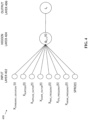
- the WNN 400 may include one or more layers. Each layer has one or more neurons or nodes.
- the WNN includes three layers including the input layer 402, the hidden layer 404, and the output layer 406 as shown in FIG. 4 .
- the input layer introduces input values into the WNN 400.
- the number of neurons in the input layer 402 can equal the number of extracted statistical features at the time t.
- the server 106 can extract one or more statistical features that are provided as inputs to each neuron of the input layer 402.
- the statistical features may be four time-domain statistical features (e.g., Xstd, Xkur, SF, IF), three frequency-domain statistical features (e.g., Xmf, Xrmsf, Xstdf), and three time-frequency domain statistical features (e.g., SPRO, SPRI, SPRR).
- the output layer 406 may include a function that delivers output of the WNN 400.
- the hidden layer 404 and the output layer 406 may include one neuron each.
- the wavelet basis function ⁇ a,b (t) can be used as an activation function for the statistical features at time t.
- the Morlet wavelet can be used as an activation function of the neurons in the hidden layer 404.
- the wavelet basis function may be one of Haar, Mexican Hat, Shannon, and Meyer.
- the output from the output layer 406 is a normalized score (L i ) that corresponds to the faults detected in the rotating equipment 102.
- each of the connections between nodes in successive pairs of layers has an associated weight held in a matrix, and the number of layers and nodes may be selected or adjusted according to the application the WNN 400 is intended to perform.
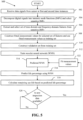
- FIG. 5 a flow chart that illustrates a method for predicting the remaining useful life of the rotating equipment 102, according to the techniques described herein is shown.
- the server 106 receives digital signals at a first time instance t-1 and a second time instance t from the wireless sensor 104 by way of the communication network 110.
- the wireless sensor 104 can detect the vibrations of the rotating equipment 102, convert the vibration signals into the digital signals, and transmit the digital signals to the server 106.
- the digital signals at the first and second time instances t-1 and t can correspond to the vibrations of the rotating equipment 102 at a previous inspection time and a present inspection time, respectively.
- the server 106 pre-processes the digital signals using the Ensemble Empirical Mode Decomposition (EEMD) algorithm, to de-noise the digital signals.
- the server 106 can decompose the digital signals into a plurality of intrinsic mode functions (IMFs). The decomposition of the digital signals into the plurality of IMFs is described in detail above in regard to FIG. 3 .
- the server 106 can further select sensitive IMFs from the IMFs.
- the server 106 can construct a criterion for the selection of sensitive IMFs. The selection criterion of sensitive IMFs is described in detail above in regard to FIG. 3 .
- the server 106 is configured to run a wavelet neural network (WNN) based machine learning algorithm.
- the WNN is used to predict remaining useful life of the rotating equipment 102.
- the WNN may include three layers including an input layer, a hidden layer, and an output layer. Each layer has one or more neurons or nodes.
- a wavelet basis function possesses properties of localization and is an orthogonal basis function.
- the wavelet basis function ⁇ a,b () can be used as an activation function.
- Morlet wavelet can be used as an activation function of the neurons in the hidden layer.
- the Morlet wavelet expression and the calculation of partial derivatives of the corresponding error function are computationally efficient.
- the Morlet wavelet updates the parameters in the training process.
- the wavelet basis function may be one of Haar, Mexican Hat, Shannon, and Meyer.
- the server 106 can extract features from the sensitive IMFs of the digital signals at the first and second time instances t-1 and t.
- the server 106 can extract combination of time-domain and frequency-domain features from the sensitive IMFs. For example, the kurtosis (Xkur), the root mean square (Xrms), the peak factor (Xpeak), and the crest (Xcrest) are extracted statistical features from the sensitive IMFs.
- Xkur kurtosis
- Xrms root mean square
- Xpeak peak factor
- crest crest
- the server 106 fits the extracted statistical features with Weibull hazard rate function.
- the server 106 can be then configured to input fitted statistical features into the WNN as inputs, thereby increasing the accuracy of the prediction of remaining useful life of the rotating equipment 102.
- the Weibull hazard rate function is the failure rate measure that indicates the health condition of the rotating equipment 102 at a given time.
- the Weibull hazard rate function is a powerful tool in representing various practical lifetime distributions and flexible enough to represent distributions with different scales and shapes.
- the values of the fitted statistical features are fitted measurement values.
- the fitted statistical features prevent any distortion of the values caused due to external noise factors in the digital signals collected in practical applications.
- a training set can be formed for the WNN by considering the digital signals at the first and second time instances t-1 and t.
- the server 106 uses the fitted measurement values of the extracted statistical features at the first and second time instances t-1 and t as input values to the WNN.
- the output of the WNN can be normalized life percentage Ti. Life percentage provides accurate mapping of the health condition of the rotating equipment 102, which is proportional to time. The rotating equipment 102 can be considered to be totally damaged when the rotating equipment 102 reaches 100% of the life percentage.
- the output of the WNN can be normalized between 0 and 1. Further, the output of the WNN is a predicted value of the life percentage of the rotating equipment 102.
- CDF cumulative distributive function
- the training set can be formed of historical data includes vibration signals, faults, and equipment life collected from one or more rotary equipment that function similar to the rotating equipment 102.
- the equipment life represents time (in hours or days) until a rotary equipment fails.
- the vibration signals are collected at regular intervals of time from the rotary equipment.
- the server 106 can extract statistical features from the vibration signals collected at first and second time instances t-1 and t.
- the server 106 can fit the extracted statistical features with Weibull hazard rate function.
- the server 106 can use fitted measurement values as input values to the WNN.
- the output of the WNN can be normalized life percentage Ti.
- the life percentage value from the WNN is predicted life percentage of the rotary equipment.
- the server 106 can calculate actual life percentage at any time instance based on the equipment life.
- the server 106 calculates a mean square error (MSE) between the actual value and predicted value.
- MSE can be used to present the network performance to define preferred WNN model.
- the server 106 After the server 106 obtains the MSE, the server 106 adjusts weights and biases of the WNN to minimize the MSE. The server 106 performs the training process at regular time intervals.
- the server 106 can construct a validation set by multiplying the fitted statistical features at the first and second time instances t-1 and t with a constant value (Cp). Moreover, the validation set contains the actual value of the life percentage of the rotating equipment 102 multiplied by the constant value (Cp). In some embodiments, the constant value (Cp) is 1.1 where the fitted statistical features are incremented by 10%.
- the server 106 trains the WNN for predicting the life percentage of the rotating equipment 102.
- the server 106 can train the WNN using Levenberg-Marquardt (LM) algorithm based on the training set and the validation set.
- LM Levenberg-Marquardt
- a person with skill in the art will appreciate that any suitable algorithm can be used to train the WNN.
- the over-fitting problem can be solved by the use of validation set.
- the MSE for the training set and the validation set are calculated. Both of the mean square errors drop early in the training process, because the WNN can learn the relationship between the inputs and the outputs by modifying the trainable weights based on the training set.
- the mean square error for the validation set starts to increase because the WNN starts to model the noise in the training set.
- the training process may be stopped at this point, and the preferred WNN with optimum modeling and generalization capability is achieved.
- the training process of WNN is completed, and the preferred WNN model can be used for the RUL prediction.
- the server 106 predicts life percentage of the rotating equipment 102 at the current time t using the preferred WNN.
- a manufacturer of rotating equipment 102 provides details related to rotating equipment life in product specification.
- the rotating equipment life is number of operating hours or number of revolutions at a given speed that the rotating equipment 102 is capable of enduring before any signs of fatigue.
- the remaining useful life (in hours) of the rotating equipment 102 can be calculated using rotating equipment life and remaining useful life (%).
- the server 106 can check if new inspection data is available at the current time. If the new inspection data is available, the server 106 can input the new inspection data received from the wireless sensor 104 by way of the communication network 110 to the preferred WNN. After extracting features from the new inspection data, the server 106 can perform step 522.
- the server 106 can fit the new inspection data on to the Weibull hazard rate function. Fitted measurement values are used as inputs to the WNN for prediction of the RUL of the rotating equipment 102. If the new inspection data is not available, the server 106 can continue to perform step 520 to check for availability of the new inspection data until the new inspection data is available.
- FIG. 6 an exemplary wavelet neural network model 600 for prognosis of the rotating equipment, in accordance with the techniques, is described herein.
- the WNN 600 is used to predict remaining useful life of the rotating equipment 102.
- the WNN 600 may include one or more layers. Each layer has one or more neurons, or nodes.
- the WNN 600 includes three layers including the input layer 602, the hidden layer 604, and the output layer 606 as shown in FIG. 6 .
- the number of neurons in the input layer 602 equals the number of extracted statistical features at the time instances t and t-1.
- the server 106 extracts one or more statistical features that are provided as inputs to the input layer 602.
- the inputs of the WNN 600 are X PEAK (t) and X PEAK (t-1), which are peak values of fitted measurements at the time instances t and t-1, respectively.
- inputs are (a) t and t-1, which are the time values at the time instances t and t-1, respectively; (b) X KURTOSIS (t) and X KURTOSIS (t-1), which are kurtosis values of fitted measurements at the time instances t and t-1, respectively; X RMS (t) and X RMS (t-1), which are root mean square (RMS) values of fitted measurements at the time instances t and t-1, respectively.
- the hidden layer 604 and the output layer 606 may include one or more neurons, each.
- wavelet basis function ⁇ a,b (t) is used as an activation function for the statistical features at time t.
- wavelet basis function ⁇ a,b (t-1) is used as an activation function for the statistical features at time t-1.
- the Morlet wavelet can be used as an activation function of the neurons in the hidden layer 604.
- the wavelet basis function may be one of Haar, Mexican Hat, Shannon, and Meyer.
- the output layer 606 represents the remaining useful life (Ti) of the rotating equipment 102.
- the output from the output layer 606 can be a normalized life percentage (T i ).
- the normalized life percentage may be used to calculate remaining useful life of the rotating equipment 102.
- each connection between nodes in successive pairs of layers has an associated weight held in a matrix, and the number of layers and nodes may be selected or adjusted according to the application the WNN 600 is intended to perform.
- FIG. 7 a flow chart that illustrates a method for monitoring the rotating equipment 102, according to the techniques described herein is shown.
- the server 106 receives an input data relating to digital signal that correspond to data indicative of vibrations of the rotating equipment 102.
- the server 106 can receive the input data in form of the digitals signal from the wireless sensor 104 positioned in proximity of the rotating equipment 102 by way of the communication network 110.
- the server 106 determines a plurality of intrinsic mode functions from the digital signal.
- the server 106 can use a signal processing algorithm, such as the Ensemble Empirical Mode Decomposition (EEMD) algorithm to de-noise the received digital signal from the wireless sensor 104.
- EEMD Ensemble Empirical Mode Decomposition
- the server 106 selects a set of intrinsic mode functions from the plurality of intrinsic mode functions based on criterion to select the set of intrinsic mode functions.
- the criterion can be determined based on values of a mean and a standard deviation of kurtosis values computed for each of the plurality of intrinsic mode functions.
- the server 106 extracts a set of features from the set of selected intrinsic mode functions.
- the set of features can include a combination of time-domain features and/or frequency-domain features.
- the server 106 applies the set of features as input values to a wavelet neural network.
- the server 106 predicts life percentage of the rotating equipment 102 using the wavelet neural network and the applied input values. Further, the server 106 can display RUL of the rotating equipment 102 on a user interface of the user device 108, where the server 106 determines the RUL based on the life percentage.
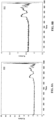
- the graphs 800 and 900 shown in FIGS. 8A and 9A show real measurement values (e.g., exemplary measurement data) of extracted statistical features (kurtosis and RMS) on the Y-axis and time on the X-axis.
- the graphs 850 and 950 shown in FIGS. 8B and 9B respectively, show fitted measurement values of the extracted statistical features (kurtosis and RMS) on the Y-axis and time on the X-axis.
- the graphs 800 and 900 show kurtosis and RMS values at various inspection points of a rotating equipment. The kurtosis and RMS values can be correlated with degradation of the rotating equipment.
- the exemplary measurement data taken from the rotating equipment at various inspection points usually has external noise (e.g., noise generated by motor fan or bearings) which may be irrelevant to degradation of the rotating equipment. So as to reduce the effects of the external noise, the Weibull hazard rate function (in equation (26)) is used to fit the exemplary measurement data, which is collected from the rotating equipment.
- the graphs 800 and 900 show fitted kurtosis and RMS values that can be correlated with degradation of the rotating equipment.
- the fitted measurement values are used as inputs to the WNN instead of real measurement values, so as to better represent the deterioration of the rotating equipment.
- the graphs 850 and 950 provide a better indication of the degradation of the rotating equipment compared to the graphs 800 and 900.
- sample data sets were collected from an experimental set up of a test rig (not shown).
- the test rig had four bearings that were installed on a shaft.
- the four bearings are: bearing 1, bearing 2, bearing 3, and bearing 4.
- two accelerometers were installed in which one is at the vertical axis Y and other is at the horizontal axis X.
- the two accelerometers were used to collect the vibration data of each bearing in the X and Y directions.
- the rotation speed of the shaft was kept constant at 2000 rpm by an AC motor coupled to the shaft.
- a radial load of 6000 lbs was applied onto the shaft and a bearing by a spring mechanism. All failures occurred after exceeding designed life time of the bearing which is more than 100 million revolutions.
- the first data set was used as a training set for a wavelet neural network (WNN).
- the WNN of three layers with wavelet basis function as an activation function was trained with first data set.
- the WNN model used time and Weibull hazard rates of RMS, kurtosis, and peak from present and previous inspection points as input and normalized life percentage as output for the WNN.
- Mean square error (MSE) was calculated to identify difference between predicted value of life percentage of the bearing 3 and actual value of life percentage of the bearing 3.
- the WNN was trained using Levenberg-Marquardt (LM) learning algorithm.
- the proposed WNN gave minimum MSE error for the training set with two neurons on hidden layer.
- the trained WNN was used to check the second data set to determine accuracy of the prediction by the WNN.
- the collected vibration signals at current and previous inspections t-1 and t were pre-processed using EEMD algorithm to de-noise the vibration signals.
- RMS, kurtosis, and peak values were extracted from the vibration signals at the time instances t-1 and t.
- 8 input values were fed into the WNN.
- the 8 input values were: (a) t and t-1, which were the time values at the current and previous inspections, respectively, (b) X KURTOSIS (t) and X KURTOSIS (t-1), which were kurtosis values of fitted measurements at the current and previous inspections, respectively, (c) X RMS (t) and X RMS (t-1), which were RMS values of fitted measurements at the current and previous inspections, respectively, and (d) X PEAK (t) and X PEAK (t-1), which were peak values of fitted measurements at the current and previous inspections, respectively.
- the output of the WNN was the normalized life percentage of the bearing 1.
- a graph 1000 of life percentage of the bearing 1 at various time instances vs. time elapsed was plotted based on output values of the WNN.
- the graph 1000 shown in FIG. 10 represents life percentage of the bearing 1 on the Y-axis and time elapsed (in hours) on the X-axis.
- the life percentage of the bearing 1 reached 100 %, the time elapsed was about 163 hours. From the results, it showed that the proposed WNN gave good performance in predicting RUL of the bearing 1.
- the accuracy of the prediction of RUL of the bearing 1 was more than 99 %.
- the server 106 can predict the RUL of the rotating equipment 102 with accuracy of more than 99%.
- the increased accuracy is achieved by the use of combination of the EEMD algorithm and the WNN.
- the accurate RUL of the rotating equipment 102 improves the reliability and cost of maintenance.
- the present technique uses a set of statistical features to predict the remaining life of the rotating equipment 102.
- the statistical features include a combination of time-domain and frequency-domain features.
- the combination of the time-domain and frequency-domain features considers both early-stage and late-stage faults. This helps achieve better accuracy in prediction of the RUL of the rotating equipment 102.
- the system allows preprocessing of the digital signals prior to storage of the digital signals in the database.
- the present technique uses a unique combination of the EEMD algorithm and the WNN to predict the RUL of the rotating equipment 102.
- the present technique attains a prediction of the RUL of the rotating equipment 102 with accuracy of more than 99%.
- the user experience is enhanced with the use of seamless blink up technology for easy connectivity of the wireless sensor 104 to the server 106.
- the techniques described herein may be embodied in computer-executable instructions implemented as software, including as application software, system software, firmware, middleware, embedded code, or any other suitable type of computer code.
- Such computer-executable instructions may be written using any of a number of suitable programming languages and/or programming or scripting tools, and also may be compiled as executable machine language code or intermediate code that is executed on a framework or virtual machine.
- these computer-executable instructions may be implemented in any suitable manner, including as a number of functional facilities, each providing one or more operations to complete execution of algorithms operating according to these techniques.
- a "functional facility,” however instantiated, is a structural component of a computer system that, when integrated with and executed by one or more computers, causes the one or more computers to perform a specific operational role.
- a functional facility may be a portion of or an entire software element.
- a functional facility may be implemented as a function of a process, or as a discrete process, or as any other suitable unit of processing.
- each functional facility may be implemented in its own way; all need not be implemented the same way.
- these functional facilities may be executed in parallel and/or serially, as appropriate, and may pass information between one another using a shared memory on the computer(s) on which they are executing, using a message passing protocol, or in any other suitable way.
- functional facilities include routines, programs, objects, components, data structures, etc. that perform particular tasks or implement particular abstract data types.
- functionality of the functional facilities may be combined or distributed as desired in the systems in which they operate.
- one or more functional facilities carrying out techniques herein may together form a complete software package.
- These functional facilities may, in alternative embodiments, be adapted to interact with other, unrelated functional facilities and/or processes, to implement a software program application.
- Some exemplary functional facilities have been described herein for carrying out one or more tasks. It should be appreciated, though, that the functional facilities and division of tasks described is merely illustrative of the type of functional facilities that may implement the exemplary techniques described herein, and that embodiments are not limited to being implemented in any specific number, division, or type of functional facilities. In some implementations, all functionality may be implemented in a single functional facility. It should also be appreciated that, in some implementations, some of the functional facilities described herein may be implemented together with or separately from others (i.e., as a single unit or separate units), or some of these functional facilities may not be implemented.
- Computer-executable instructions implementing the techniques described herein may, in some embodiments, be encoded on one or more computer-readable media to provide functionality to the media.
- Computer-readable media include magnetic media such as a hard disk drive, optical media such as a Compact Disk (CD) or a Digital Versatile Disk (DVD), a persistent or nonpersistent solid-state memory (e.g., Flash memory, Magnetic RAM, etc.), or any other suitable storage media.
- Such a computer-readable medium may be implemented in any suitable manner.
- “computer-readable media” also called “computer-readable storage media” refers to tangible storage media. Tangible storage media are non-transitory and have at least one physical, structural component.
- At least one physical, structural component has at least one physical property that may be altered in some way during a process of creating the medium with embedded information, a process of recording information thereon, or any other process of encoding the medium with information. For example, a magnetization state of a portion of a physical structure of a computer-readable medium may be altered during a recording process.
- some techniques described above comprise acts of storing information (e.g., data and/or instructions) in certain ways for use by these techniques.
- information e.g., data and/or instructions
- the information may be encoded on a computer-readable storage media.
- advantageous structures may be used to impart a physical organization of the information when encoded on the storage medium. These advantageous structures may then provide functionality to the storage medium by affecting operations of one or more processors interacting with the information; for example, by increasing the efficiency of computer operations performed by the processor(s).
- these instructions may be executed on one or more suitable computing device(s) operating in any suitable computer system, or one or more computing devices (or one or more processors of one or more computing devices) may be programmed to execute the computer-executable instructions.
- a computing device or processor may be programmed to execute instructions when the instructions are stored in a manner accessible to the computing device or processor, such as in a data store (e.g., an on-chip cache or instruction register, a computer-readable storage medium accessible via a bus, a computer-readable storage medium accessible via one or more networks and accessible by the device/processor, etc.).
- a data store e.g., an on-chip cache or instruction register, a computer-readable storage medium accessible via a bus, a computer-readable storage medium accessible via one or more networks and accessible by the device/processor, etc.
- Functional facilities comprising these computer-executable instructions may be integrated with and direct the operation of a single multi-purpose programmable digital computing device, a coordinated system of two or more multi-purpose computing device sharing processing power and jointly carrying out the techniques described herein, a single computing device or coordinated system of computing device (co-located or geographically distributed) dedicated to executing the techniques described herein, one or more Field-Programmable Gate Arrays (FPGAs) for carrying out the techniques described herein, or any other suitable system.
- FPGAs Field-Programmable Gate Arrays
- a computing device may comprise at least one processor, a network adapter, and computer-readable storage media.
- a computing device may be, for example, a desktop or laptop personal computer, a personal digital assistant (PDA), a smart mobile phone, a server, or any other suitable computing device.
- PDA personal digital assistant
- a network adapter may be any suitable hardware and/or software to enable the computing device to communicate wired and/or wirelessly with any other suitable computing device over any suitable computing network.
- the computing network may include wireless access points, switches, routers, gateways, and/or other networking equipment as well as any suitable wired and/or wireless communication medium or media for exchanging data between two or more computers, including the Internet.
- Computer-readable media may be adapted to store data to be processed and/or instructions to be executed by processor. The processor enables processing of data and execution of instructions. The data and instructions may be stored on the computer-readable storage media.
- a computing device may additionally have one or more components and peripherals, including input and output devices. These devices can be used, among other things, to present a user interface. Examples of output devices that can be used to provide a user interface include printers or display screens for visual presentation of output and speakers or other sound generating devices for audible presentation of output. Examples of input devices that can be used for a user interface include keyboards, and pointing devices, such as mice, touch pads, and digitizing tablets. As another example, a computing device may receive input information through speech recognition or in other audible format.
- Embodiments have been described where the techniques are implemented in circuitry and/or computer-executable instructions. It should be appreciated that some embodiments may be in the form of a method, of which at least one example has been provided. The acts performed as part of the method may be ordered in any suitable way. Accordingly, embodiments may be constructed in which acts are performed in an order different than illustrated, which may include performing some acts simultaneously, even though shown as sequential acts in illustrative embodiments.
- exemplary is used herein to mean serving as an example, instance, or illustration. Any embodiment, implementation, process, feature, etc. described herein as exemplary should therefore be understood to be an illustrative example and should not be understood to be a preferred or advantageous example unless otherwise indicated.
Landscapes
- Engineering & Computer Science (AREA)
- Physics & Mathematics (AREA)
- General Physics & Mathematics (AREA)
- Theoretical Computer Science (AREA)
- Artificial Intelligence (AREA)
- Evolutionary Computation (AREA)
- Data Mining & Analysis (AREA)
- Mathematical Physics (AREA)
- General Engineering & Computer Science (AREA)
- Automation & Control Theory (AREA)
- Software Systems (AREA)
- Life Sciences & Earth Sciences (AREA)
- Computing Systems (AREA)
- Computer Vision & Pattern Recognition (AREA)
- Evolutionary Biology (AREA)
- Health & Medical Sciences (AREA)
- Biomedical Technology (AREA)
- Biophysics (AREA)
- Computational Linguistics (AREA)
- General Health & Medical Sciences (AREA)
- Molecular Biology (AREA)
- Bioinformatics & Computational Biology (AREA)
- Bioinformatics & Cheminformatics (AREA)
- Medical Informatics (AREA)
- Testing Of Devices, Machine Parts, Or Other Structures Thereof (AREA)
- Measurement Of Mechanical Vibrations Or Ultrasonic Waves (AREA)
Applications Claiming Priority (3)
| Application Number | Priority Date | Filing Date | Title |
|---|---|---|---|
| US201762562365P | 2017-09-23 | 2017-09-23 | |
| US15/862,146 US11188065B2 (en) | 2017-09-23 | 2018-01-04 | System and method for automated fault diagnosis and prognosis for rotating equipment |
| PCT/CA2018/000177 WO2019056087A1 (en) | 2017-09-23 | 2018-09-21 | SYSTEM AND METHOD FOR AUTOMATED MALFUNCTION DIAGNOSIS AND PROGNOSIS FOR ROTARY EQUIPMENT |
Publications (4)
| Publication Number | Publication Date |
|---|---|
| EP3685137A1 EP3685137A1 (en) | 2020-07-29 |
| EP3685137A4 EP3685137A4 (en) | 2021-06-30 |
| EP3685137C0 EP3685137C0 (en) | 2023-12-20 |
| EP3685137B1 true EP3685137B1 (en) | 2023-12-20 |
Family
ID=65809203
Family Applications (1)
| Application Number | Title | Priority Date | Filing Date |
|---|---|---|---|
| EP18859348.7A Active EP3685137B1 (en) | 2017-09-23 | 2018-09-21 | System and method for automated fault diagnosis and prognosis for rotating equipment |
Country Status (5)
| Country | Link |
|---|---|
| US (1) | US11188065B2 (cg-RX-API-DMAC7.html) |
| EP (1) | EP3685137B1 (cg-RX-API-DMAC7.html) |
| JP (1) | JP6996794B2 (cg-RX-API-DMAC7.html) |
| CN (1) | CN111356910B (cg-RX-API-DMAC7.html) |
| WO (1) | WO2019056087A1 (cg-RX-API-DMAC7.html) |
Families Citing this family (83)
| Publication number | Priority date | Publication date | Assignee | Title |
|---|---|---|---|---|
| AU2019244842B2 (en) * | 2018-03-28 | 2024-03-07 | L&T Technology Services Limited | System and method for monitoring health and predicting failure of an electro-mechanical machine |
| US11257001B2 (en) * | 2018-10-09 | 2022-02-22 | International Business Machines Corporation | Prediction model enhancement |
| CN109977920B (zh) * | 2019-04-11 | 2022-06-07 | 福州大学 | 基于时频谱图及卷积神经网络的水轮机组故障诊断方法 |
| CN110031226A (zh) * | 2019-04-12 | 2019-07-19 | 佛山科学技术学院 | 一种轴承故障的诊断方法及装置 |
| US20200341444A1 (en) * | 2019-04-24 | 2020-10-29 | Rob Dusseault | Systems and methods for wireless monitoring and control of machinery |
| CN110188485B (zh) * | 2019-06-03 | 2020-08-25 | 安徽理工大学 | 一种滚动轴承动态性能劣化趋势自适应获取方法 |
| CN110160775A (zh) * | 2019-06-04 | 2019-08-23 | 昆明理工大学 | 一种基于振动信号分析的高压隔膜泵单向阀故障诊断方法 |
| CN110287853B (zh) * | 2019-06-20 | 2021-02-09 | 清华大学 | 一种基于小波分解的暂态信号去噪方法 |
| CN110160791B (zh) * | 2019-06-27 | 2021-03-23 | 郑州轻工业学院 | 基于小波-谱峭度的感应电机轴承故障诊断系统及诊断方法 |
| CN110375971B (zh) * | 2019-07-11 | 2020-08-14 | 北京理工大学 | 径流式涡轮叶轮和压气机叶轮的加速寿命试验装置及方法 |
| CN110399854B (zh) * | 2019-07-31 | 2020-10-23 | 中南大学 | 基于混合特征提取的滚动轴承故障分类方法 |
| CN110458071B (zh) * | 2019-08-01 | 2020-12-15 | 北京邮电大学 | 一种基于dwt-dfpa-gbdt的光纤振动信号特征提取与分类方法 |
| CN110458073B (zh) * | 2019-08-01 | 2021-05-14 | 北京邮电大学 | 一种基于MEEMD-Hilbert和多层小波分解的光纤振动信号特征提取方法 |
| EP3792709A1 (de) * | 2019-09-10 | 2021-03-17 | Avalance UG (haftungsbeschränkt) | Analysevorrichtung für betriebsgeräusche einer werkzeugmaschine |
| CN110647867B (zh) * | 2019-10-09 | 2022-05-13 | 中国科学技术大学 | 基于自适应抗噪声神经网络的轴承故障诊断方法及系统 |
| CN110618353B (zh) * | 2019-10-22 | 2021-04-06 | 北京航空航天大学 | 一种基于小波变换+cnn的直流电弧故障检测方法 |
| CN110929768A (zh) * | 2019-11-14 | 2020-03-27 | 国电大渡河检修安装有限公司 | 一种机器故障的预测方法 |
| CN110794683A (zh) * | 2019-11-27 | 2020-02-14 | 中国大唐集团科学技术研究院有限公司华中电力试验研究院 | 基于深度神经网络和峭度特征的风电齿轮箱状态评估方法 |
| CN111027641B (zh) * | 2019-12-25 | 2024-02-13 | 许昌北邮万联网络技术有限公司 | 一种旋转机械设备的故障诊断方法及装置 |
| CN111222458A (zh) * | 2020-01-06 | 2020-06-02 | 浙江工业大学 | 一种基于集合经验模态分解和卷积神经网络的滚动轴承故障诊断方法 |
| CN111397868B (zh) * | 2020-02-27 | 2022-02-08 | 广西电网有限责任公司电力科学研究院 | 一种基于聚合经验模态分解算法的断路器故障分析方法 |
| DE102020204944A1 (de) | 2020-04-20 | 2021-10-21 | Robert Bosch Gesellschaft mit beschränkter Haftung | Verfahren und System zur Diagnose eines Zustands eines Bauteils |
| CN111444893A (zh) * | 2020-05-06 | 2020-07-24 | 南昌航空大学 | 一种矿井提升机主轴装置的故障诊断方法 |
| US20210356361A1 (en) * | 2020-05-15 | 2021-11-18 | Deere & Company | Fault detection technique for a bearing |
| CN112067289A (zh) * | 2020-08-21 | 2020-12-11 | 天津电气科学研究院有限公司 | 一种基于神经网络的电机轴及传动轴异常振动预警算法 |
| WO2022036689A1 (en) * | 2020-08-21 | 2022-02-24 | Abb Schweiz Ag | Method for fault diagnosis using a fault diagnosis model trained by virtual data |
| CN114152454B (zh) * | 2020-09-08 | 2024-03-22 | 中国科学院上海高等研究院 | 基于ceemdan-cse模型的机械设备故障诊断方法及该模型的建立方法 |
| CN112232212B (zh) * | 2020-10-16 | 2021-09-07 | 广东石油化工学院 | 三重并发故障分析方法、系统、大机组设备及存储介质 |
| CN112378605B (zh) * | 2020-10-19 | 2023-06-27 | 大唐(赤峰)新能源有限公司 | 一种基于emd分解自学习的风电机组叶片故障识别方法 |
| CN112291733B (zh) * | 2020-10-21 | 2022-07-08 | 安徽德通智联科技有限公司 | 基于蓝牙与nbiot双无线技术的智能云振动监测系统及方法 |
| CN112307965B (zh) * | 2020-10-30 | 2021-05-25 | 哈尔滨市科佳通用机电股份有限公司 | 一种滚动轴承施封锁丢失和折断故障检测方法 |
| CN112326236B (zh) * | 2020-11-02 | 2023-04-18 | 北京信息科技大学 | 一种齿轮箱运行状态在线监测方法、系统及存储介质 |
| CN112347898B (zh) * | 2020-11-03 | 2024-04-09 | 重庆大学 | 一种基于dcae神经网络的滚动轴承健康指标构建方法 |
| CN112633098B (zh) * | 2020-12-14 | 2023-05-30 | 华中科技大学 | 一种旋转机械故障诊断方法、系统及存储介质 |
| CN112686144B (zh) * | 2020-12-29 | 2022-03-08 | 中南大学 | 一种基于磨音信号的矿石球磨过程负荷识别方法 |
| KR102469614B1 (ko) * | 2020-12-31 | 2022-11-21 | 주식회사 포스코아이씨티 | 진동 및 소리의 주파수를 센싱하는 센서모듈 및 이를 포함하는 설비 모니터링 시스템 |
| US20220205451A1 (en) * | 2020-12-31 | 2022-06-30 | Robert Bosch Gmbh | Sensing via signal to signal translation |
| CN112945162B (zh) * | 2021-01-26 | 2022-05-31 | 山西大学 | 一种堆积层滑坡位移预测模型及预测方法 |
| CN112949524B (zh) * | 2021-03-12 | 2022-08-26 | 中国民用航空飞行学院 | 一种基于经验模态分解与多核学习的发动机故障检测方法 |
| CN113092043A (zh) * | 2021-03-31 | 2021-07-09 | 国网四川省电力公司检修公司 | 一种铁芯松动振动数据采集方法及系统 |
| CN113033690B (zh) * | 2021-04-07 | 2024-04-02 | 东北大学 | 一种基于声音的双投影邻域保持嵌入的托辊故障检测方法 |
| US12321251B2 (en) * | 2021-05-25 | 2025-06-03 | Eugenie AI Inc. | System and method for predicting remaining useful life of a machine component |
| CN113375941B (zh) | 2021-06-08 | 2023-08-25 | 西安交通大学 | 高速动车组轴承的开集故障诊断方法 |
| JP7637579B2 (ja) * | 2021-06-30 | 2025-02-28 | Jswアクティナシステム株式会社 | レーザ照射装置、情報処理方法、及びプログラム |
| CN113468688B (zh) * | 2021-07-05 | 2022-12-09 | 西安交通大学 | 基于参数优化vmd和加权基尼指数的轴承故障诊断方法 |
| CN113642414A (zh) * | 2021-07-19 | 2021-11-12 | 北京航空航天大学 | 一种基于Transformer模型的滚动轴承剩余使用寿命预测方法 |
| CN113780055B (zh) * | 2021-07-19 | 2024-02-09 | 北京交通大学 | 一种momeda与压缩感知的滚动轴承故障诊断方法 |
| CN113465733B (zh) * | 2021-08-13 | 2022-04-05 | 重庆大学 | 基于eemd-dnn的振动台结构位移响应预测方法及装置 |
| CN113465732B (zh) * | 2021-08-13 | 2022-04-05 | 重庆大学 | 基于emd-dnn的振动台结构位移响应预测方法及装置 |
| CN113933035B (zh) * | 2021-09-30 | 2023-08-29 | 中国船舶重工集团公司第七一九研究所 | 基于相关性分析的旋转机械装备故障诊断方法和系统 |
| CN114112013B (zh) * | 2021-11-04 | 2023-06-30 | 北京建筑大学 | 古建筑安全性测定方法和装置、电子设备和存储介质 |
| CN114061746B (zh) * | 2021-11-23 | 2023-06-27 | 洛阳师范学院 | 旋转机械故障诊断中的重复瞬变信号提取方法 |
| CN114154415A (zh) * | 2021-12-01 | 2022-03-08 | 新智我来网络科技有限公司 | 设备寿命的预测方法及装置 |
| CN114279728B (zh) * | 2021-12-07 | 2023-07-25 | 郑州大学 | 一种振动筛机体的故障诊断方法及系统 |
| CN114298210A (zh) * | 2021-12-24 | 2022-04-08 | 江苏国科智能电气有限公司 | 一种多视角融合风电齿轮箱轴承剩余寿命预测方法 |
| KR102500883B1 (ko) * | 2021-12-27 | 2023-02-16 | 현대건설(주) | 머신러닝을 이용한 실시간 진동 신호 기반 회전기계의 건전성 관리 시스템 및 방법 |
| CN114004263B (zh) | 2021-12-29 | 2022-05-03 | 四川大学 | 一种特征融合转换的大型设备工况诊断预测方法 |
| CN114511017B (zh) * | 2022-01-24 | 2024-12-27 | 中铁第四勘察设计院集团有限公司 | 一种铁路站房结构损伤的多重分步识别方法及系统 |
| CN114518163B (zh) * | 2022-02-21 | 2024-03-19 | 无边界(苏州)新材料科技有限公司 | 一种基于Gaussian-LM算法进行全声态光纤监测的方法 |
| CN114584924B (zh) * | 2022-02-28 | 2024-05-31 | 长沙融创智胜电子科技有限公司 | 一种智能无人值守传感器系统及目标识别方法 |
| CN115293189B (zh) * | 2022-03-16 | 2025-10-10 | 南京航空航天大学 | 一种基于堆栈自编码降维的旋转机械状态监测方法 |
| CN114662702B (zh) * | 2022-03-31 | 2025-05-23 | 北京百度网讯科技有限公司 | 故障检测方法、装置、电子设备和介质 |
| WO2023201430A1 (en) * | 2022-04-19 | 2023-10-26 | Enertics Inc. | Methods and systems for monitoring, diagnosis and prediction of health of an industrial machine having a rotating component |
| JP2023169060A (ja) * | 2022-05-16 | 2023-11-29 | 横河電機株式会社 | 装置、方法およびプログラム |
| CN114964476B (zh) * | 2022-05-27 | 2023-08-22 | 中国石油大学(北京) | 油气管道系统动设备的故障诊断方法、装置及设备 |
| WO2023230678A1 (pt) * | 2022-05-31 | 2023-12-07 | Weg Equipamentos Eletricos S.A. | Método e sistema para geração de uma representação de realidade aumentada de deformações vibracionais para uma estrutura |
| CN115859091B (zh) * | 2022-11-01 | 2023-05-26 | 哈尔滨工业大学 | 一种轴承故障特征的提取方法、电子设备及存储介质 |
| CN115423221B (zh) * | 2022-11-03 | 2023-02-07 | 北京建筑大学 | 一种设施运行趋势预测方法 |
| CN115929495B (zh) * | 2022-11-30 | 2024-05-14 | 昆明理工大学 | 基于马尔可夫变迁场和改进高斯原型网络的发动机气门故障诊断方法 |
| CN116224925B (zh) * | 2022-12-16 | 2023-10-24 | 东莞市沃高实业投资有限公司 | 一种智能加工管理系统 |
| CN115839843A (zh) * | 2022-12-27 | 2023-03-24 | 江苏徐工国重实验室科技有限公司 | 变速箱故障的检测方法和装置 |
| CN116337445B (zh) * | 2023-04-13 | 2024-02-23 | 中国航发沈阳发动机研究所 | 基于多尺度排列熵和峭度值融合因子的轴承故障提取方法 |
| US20240402052A1 (en) * | 2023-06-05 | 2024-12-05 | Anil Agrawal | Method and system for monitoring a rotating equipment |
| EP4513152A1 (en) * | 2023-07-20 | 2025-02-26 | Schneider Electric Systems USA, Inc. | System and method for vibration analysis |
| CN117268961B (zh) * | 2023-11-23 | 2024-02-20 | 宁波市特种设备检验研究院 | 一种金属零部件的疲劳失效预警方法 |
| CN117972989B (zh) * | 2023-12-28 | 2024-07-26 | 天地(常州)自动化股份有限公司北京分公司 | 一种煤机设备的寿命预测方法及系统 |
| CN118351668B (zh) * | 2024-04-24 | 2024-11-08 | 力鼎智能装备(青岛)集团有限公司 | 一种基于数据分析的fms柔性智能产线安全预警系统 |
| CN118728740B (zh) * | 2024-09-04 | 2024-11-15 | 浙江日井泵业股份有限公司 | 一种深井泵工作性能在线监测方法及系统 |
| CN119198094B (zh) * | 2024-09-10 | 2025-09-23 | 东风汽车集团股份有限公司 | 发动机连杆大头轴承寿命预测方法、装置及设备 |
| CN118882367B (zh) * | 2024-09-29 | 2024-12-20 | 合肥巨阙电子有限公司 | 一种老化炉故障预测预警系统 |
| CN119441838B (zh) * | 2024-11-01 | 2025-11-04 | 湖南大学 | 基于传感器布局的动态载荷识别方法 |
| CN119848674B (zh) * | 2025-03-20 | 2025-05-20 | 西安热工研究院有限公司 | 一种基于振动趋势预测的发电机故障诊断方法及相关产品 |
| CN120333742B (zh) * | 2025-06-18 | 2025-08-22 | 广东工业大学 | 一种建筑隔振支座的减振测试方法及系统 |
Family Cites Families (22)
| Publication number | Priority date | Publication date | Assignee | Title |
|---|---|---|---|---|
| JP3449194B2 (ja) * | 1997-01-28 | 2003-09-22 | 松下電工株式会社 | 回転機器の異常診断方法およびその装置 |
| US6289735B1 (en) * | 1998-09-29 | 2001-09-18 | Reliance Electric Technologies, Llc | Machine diagnostic system and method for vibration analysis |
| DE60203458T3 (de) | 2001-09-27 | 2010-02-18 | Reliance Electric Technologies, LLC, Mayfield Heights | Integrierte Steuerung und Diagnose für ein motorbetriebenes System unter Verwendung von Schwingungs-, Druck-, Temperatur-, Geschwindigkeits-, und/oder Stromanalyse |
| CN102792240B (zh) * | 2009-11-16 | 2016-06-01 | Nrg系统股份有限公司 | 用于基于条件的维护的数据获取系统 |
| US8825567B2 (en) * | 2012-02-08 | 2014-09-02 | General Electric Company | Fault prediction of monitored assets |
| EP2895827B8 (en) * | 2012-09-11 | 2020-08-19 | S.P.M. Instrument AB | Apparatus for monitoring the condition of a machine |
| US10352794B2 (en) * | 2012-10-05 | 2019-07-16 | Siemens Energy, Inc. | Turbine blade fatigue life analysis using non-contact measurement and dynamical response reconstruction techniques |
| CN103308292B (zh) | 2013-05-16 | 2015-07-29 | 国家电网公司 | 基于振动信号分析的真空断路器机械状态检测方法 |
| US20150070190A1 (en) | 2013-09-12 | 2015-03-12 | Quirky, Inc. | Sensor Apparatus and Related Methods |
| KR101473886B1 (ko) * | 2013-12-27 | 2014-12-18 | 인하대학교 산학협력단 | 이상파랑 발생일 추출방법 |
| EP3201845A4 (en) | 2014-09-29 | 2018-05-30 | Sikorsky Aircraft Corporation | Vibration signatures for prognostics and health monitoring of machinery |
| CN104316317A (zh) | 2014-10-08 | 2015-01-28 | 西北工业大学 | 一种基于com组件的齿轮系统多故障诊断方法 |
| US20160245686A1 (en) * | 2015-02-23 | 2016-08-25 | Biplab Pal | Fault detection in rotor driven equipment using rotational invariant transform of sub-sampled 3-axis vibrational data |
| CN104748961A (zh) | 2015-03-30 | 2015-07-01 | 中国矿业大学 | 基于svd分解降噪和相关性eemd熵特征的齿轮故障诊断方法 |
| CN105424366A (zh) | 2015-12-14 | 2016-03-23 | 长春工业大学 | 基于eemd自适应消噪的轴承故障诊断方法 |
| CN106127184A (zh) * | 2016-07-05 | 2016-11-16 | 上海电机学院 | 一种风机齿轮箱故障诊断方法 |
| CN106197999B (zh) | 2016-07-08 | 2019-07-09 | 山东中衡光电科技有限公司 | 一种行星齿轮故障诊断方法 |
| CN106052998B (zh) * | 2016-07-14 | 2020-01-31 | 深圳市信维通信股份有限公司 | 振动器的测试系统 |
| CN106289774B (zh) * | 2016-07-26 | 2019-03-22 | 北京工业大学 | 一种滚动轴承故障识别与趋势预测方法 |
| CN106441888A (zh) | 2016-09-07 | 2017-02-22 | 广西大学 | 一种高速列车滚动轴承故障诊断方法 |
| CN106990303A (zh) | 2017-03-15 | 2017-07-28 | 国家电网公司 | 一种变压器故障诊断方法 |
| CN107122802A (zh) | 2017-05-02 | 2017-09-01 | 哈尔滨理工大学 | 一种基于改进小波神经网络的滚动轴承的故障检测方法 |
-
2018
- 2018-01-04 US US15/862,146 patent/US11188065B2/en active Active
- 2018-09-21 JP JP2020537813A patent/JP6996794B2/ja active Active
- 2018-09-21 WO PCT/CA2018/000177 patent/WO2019056087A1/en not_active Ceased
- 2018-09-21 EP EP18859348.7A patent/EP3685137B1/en active Active
- 2018-09-21 CN CN201880074933.1A patent/CN111356910B/zh active Active
Also Published As
| Publication number | Publication date |
|---|---|
| EP3685137C0 (en) | 2023-12-20 |
| WO2019056087A1 (en) | 2019-03-28 |
| EP3685137A4 (en) | 2021-06-30 |
| CN111356910B (zh) | 2022-04-08 |
| JP6996794B2 (ja) | 2022-01-17 |
| EP3685137A1 (en) | 2020-07-29 |
| JP2020534550A (ja) | 2020-11-26 |
| US11188065B2 (en) | 2021-11-30 |
| CN111356910A (zh) | 2020-06-30 |
| US20190095781A1 (en) | 2019-03-28 |
Similar Documents
| Publication | Publication Date | Title |
|---|---|---|
| EP3685137B1 (en) | System and method for automated fault diagnosis and prognosis for rotating equipment | |
| CA2875071C (en) | Method and system for testing operational integrity of a drilling rig | |
| US11209807B2 (en) | Anomaly detection | |
| RU2494364C2 (ru) | Способ и устройство для распознавания состояния исследуемой создающей шумы машины | |
| WO2016100816A1 (en) | Sensor data fusion for prognostics and health monitoring | |
| KR20200101507A (ko) | 기계학습을 이용한 회전기계 고장 진단 및 예측시스템 | |
| US20220365524A1 (en) | Device for fault detection and failure prediction by monitoring vibrations of objects in particular industrial assets | |
| EP3759558B1 (en) | Intelligent audio analytic apparatus (iaaa) and method for space system | |
| US11429900B1 (en) | Systems and methods for automatic detection of error conditions in mechanical machines | |
| Jaber et al. | The state of the art in research into the condition monitoring of industrial machinery | |
| US20240265239A1 (en) | Systems and methods for monitoring equipment | |
| US11650184B2 (en) | System and method for monitoring rotating equipment | |
| JP2023179851A (ja) | 装置状態評価システムおよび装置状態評価方法 | |
| JP6192414B2 (ja) | 転がり軸受の状態監視装置 | |
| JP2023021514A (ja) | 装置診断システムおよび装置診断方法 | |
| Kohlheb et al. | Embedded autoencoder-based condition monitoring of rotating machinery | |
| KR102761092B1 (ko) | 회전 기계 설비의 탁월 주파수 결정 방법, 및 이를 수행하는 컴퓨팅 시스템 | |
| CN113994088A (zh) | 用于对风涡轮机的部件进行计算机实现的监测的方法 | |
| JP2017161225A (ja) | 風力発電システムの異常予兆診断システム | |
| US20240281313A1 (en) | System for analyzing abnormal data and operating method thereof | |
| RU2783860C2 (ru) | Устройство и способ для виброакустического анализа промышленного оборудования, содержащего вращающиеся части | |
| US20250314550A1 (en) | Systems and methods for leakage detection, prevention, and mitigation | |
| KR20250178763A (ko) | 회전 기계의 상태 진단 장치 및 방법 | |
| JP2025087370A (ja) | 処理システム、プログラム及び処理方法 | |
| Rachuri et al. | Edge-Based IoT Architecture for Vibration Analysis |
Legal Events
| Date | Code | Title | Description |
|---|---|---|---|
| STAA | Information on the status of an ep patent application or granted ep patent |
Free format text: STATUS: THE INTERNATIONAL PUBLICATION HAS BEEN MADE |
|
| PUAI | Public reference made under article 153(3) epc to a published international application that has entered the european phase |
Free format text: ORIGINAL CODE: 0009012 |
|
| STAA | Information on the status of an ep patent application or granted ep patent |
Free format text: STATUS: REQUEST FOR EXAMINATION WAS MADE |
|
| 17P | Request for examination filed |
Effective date: 20200423 |
|
| AK | Designated contracting states |
Kind code of ref document: A1 Designated state(s): AL AT BE BG CH CY CZ DE DK EE ES FI FR GB GR HR HU IE IS IT LI LT LU LV MC MK MT NL NO PL PT RO RS SE SI SK SM TR |
|
| AX | Request for extension of the european patent |
Extension state: BA ME |
|
| DAV | Request for validation of the european patent (deleted) | ||
| DAX | Request for extension of the european patent (deleted) | ||
| A4 | Supplementary search report drawn up and despatched |
Effective date: 20210601 |
|
| RIC1 | Information provided on ipc code assigned before grant |
Ipc: G01M 7/02 20060101AFI20210526BHEP Ipc: G01M 13/04 20190101ALI20210526BHEP Ipc: G06N 3/04 20060101ALI20210526BHEP Ipc: G01H 17/00 20060101ALI20210526BHEP Ipc: G05B 23/02 20060101ALI20210526BHEP Ipc: G06K 9/00 20060101ALI20210526BHEP Ipc: G06K 9/62 20060101ALI20210526BHEP Ipc: G06N 3/08 20060101ALI20210526BHEP Ipc: G01H 1/00 20060101ALI20210526BHEP |
|
| REG | Reference to a national code |
Ref country code: DE Ref legal event code: R079 Free format text: PREVIOUS MAIN CLASS: G01M0007020000 Ipc: G01H0001000000 Ref document number: 602018063022 Country of ref document: DE |
|
| GRAP | Despatch of communication of intention to grant a patent |
Free format text: ORIGINAL CODE: EPIDOSNIGR1 |
|
| STAA | Information on the status of an ep patent application or granted ep patent |
Free format text: STATUS: GRANT OF PATENT IS INTENDED |
|
| RIC1 | Information provided on ipc code assigned before grant |
Ipc: G06N 3/048 20230101ALI20230109BHEP Ipc: G06F 18/2433 20230101ALI20230109BHEP Ipc: G06N 3/084 20230101ALI20230109BHEP Ipc: G05B 23/02 19680901ALI20230109BHEP Ipc: G01H 17/00 19850101ALI20230109BHEP Ipc: G01H 1/00 19680901AFI20230109BHEP |
|
| INTG | Intention to grant announced |
Effective date: 20230125 |
|
| GRAJ | Information related to disapproval of communication of intention to grant by the applicant or resumption of examination proceedings by the epo deleted |
Free format text: ORIGINAL CODE: EPIDOSDIGR1 |
|
| STAA | Information on the status of an ep patent application or granted ep patent |
Free format text: STATUS: REQUEST FOR EXAMINATION WAS MADE |
|
| GRAP | Despatch of communication of intention to grant a patent |
Free format text: ORIGINAL CODE: EPIDOSNIGR1 |
|
| STAA | Information on the status of an ep patent application or granted ep patent |
Free format text: STATUS: GRANT OF PATENT IS INTENDED |
|
| INTC | Intention to grant announced (deleted) | ||
| INTG | Intention to grant announced |
Effective date: 20230711 |
|
| GRAS | Grant fee paid |
Free format text: ORIGINAL CODE: EPIDOSNIGR3 |
|
| GRAA | (expected) grant |
Free format text: ORIGINAL CODE: 0009210 |
|
| STAA | Information on the status of an ep patent application or granted ep patent |
Free format text: STATUS: THE PATENT HAS BEEN GRANTED |
|
| AK | Designated contracting states |
Kind code of ref document: B1 Designated state(s): AL AT BE BG CH CY CZ DE DK EE ES FI FR GB GR HR HU IE IS IT LI LT LU LV MC MK MT NL NO PL PT RO RS SE SI SK SM TR |
|
| REG | Reference to a national code |
Ref country code: GB Ref legal event code: FG4D |
|
| REG | Reference to a national code |
Ref country code: DE Ref legal event code: R096 Ref document number: 602018063022 Country of ref document: DE |
|
| REG | Reference to a national code |
Ref country code: CH Ref legal event code: EP |
|
| REG | Reference to a national code |
Ref country code: IE Ref legal event code: FG4D |
|
| U01 | Request for unitary effect filed |
Effective date: 20240115 |
|
| U07 | Unitary effect registered |
Designated state(s): AT BE BG DE DK EE FI FR IT LT LU LV MT NL PT SE SI Effective date: 20240123 |
|
| PG25 | Lapsed in a contracting state [announced via postgrant information from national office to epo] |
Ref country code: GR Free format text: LAPSE BECAUSE OF FAILURE TO SUBMIT A TRANSLATION OF THE DESCRIPTION OR TO PAY THE FEE WITHIN THE PRESCRIBED TIME-LIMIT Effective date: 20240321 |
|
| PG25 | Lapsed in a contracting state [announced via postgrant information from national office to epo] |
Ref country code: ES Free format text: LAPSE BECAUSE OF FAILURE TO SUBMIT A TRANSLATION OF THE DESCRIPTION OR TO PAY THE FEE WITHIN THE PRESCRIBED TIME-LIMIT Effective date: 20231220 |
|
| PG25 | Lapsed in a contracting state [announced via postgrant information from national office to epo] |
Ref country code: GR Free format text: LAPSE BECAUSE OF FAILURE TO SUBMIT A TRANSLATION OF THE DESCRIPTION OR TO PAY THE FEE WITHIN THE PRESCRIBED TIME-LIMIT Effective date: 20240321 Ref country code: ES Free format text: LAPSE BECAUSE OF FAILURE TO SUBMIT A TRANSLATION OF THE DESCRIPTION OR TO PAY THE FEE WITHIN THE PRESCRIBED TIME-LIMIT Effective date: 20231220 |
|
| PG25 | Lapsed in a contracting state [announced via postgrant information from national office to epo] |
Ref country code: RS Free format text: LAPSE BECAUSE OF FAILURE TO SUBMIT A TRANSLATION OF THE DESCRIPTION OR TO PAY THE FEE WITHIN THE PRESCRIBED TIME-LIMIT Effective date: 20231220 Ref country code: NO Free format text: LAPSE BECAUSE OF FAILURE TO SUBMIT A TRANSLATION OF THE DESCRIPTION OR TO PAY THE FEE WITHIN THE PRESCRIBED TIME-LIMIT Effective date: 20240320 Ref country code: HR Free format text: LAPSE BECAUSE OF FAILURE TO SUBMIT A TRANSLATION OF THE DESCRIPTION OR TO PAY THE FEE WITHIN THE PRESCRIBED TIME-LIMIT Effective date: 20231220 |
|
| PG25 | Lapsed in a contracting state [announced via postgrant information from national office to epo] |
Ref country code: IS Free format text: LAPSE BECAUSE OF FAILURE TO SUBMIT A TRANSLATION OF THE DESCRIPTION OR TO PAY THE FEE WITHIN THE PRESCRIBED TIME-LIMIT Effective date: 20240420 |
|
| PG25 | Lapsed in a contracting state [announced via postgrant information from national office to epo] |
Ref country code: CZ Free format text: LAPSE BECAUSE OF FAILURE TO SUBMIT A TRANSLATION OF THE DESCRIPTION OR TO PAY THE FEE WITHIN THE PRESCRIBED TIME-LIMIT Effective date: 20231220 |
|
| PG25 | Lapsed in a contracting state [announced via postgrant information from national office to epo] |
Ref country code: SK Free format text: LAPSE BECAUSE OF FAILURE TO SUBMIT A TRANSLATION OF THE DESCRIPTION OR TO PAY THE FEE WITHIN THE PRESCRIBED TIME-LIMIT Effective date: 20231220 |
|
| PG25 | Lapsed in a contracting state [announced via postgrant information from national office to epo] |
Ref country code: SM Free format text: LAPSE BECAUSE OF FAILURE TO SUBMIT A TRANSLATION OF THE DESCRIPTION OR TO PAY THE FEE WITHIN THE PRESCRIBED TIME-LIMIT Effective date: 20231220 Ref country code: SK Free format text: LAPSE BECAUSE OF FAILURE TO SUBMIT A TRANSLATION OF THE DESCRIPTION OR TO PAY THE FEE WITHIN THE PRESCRIBED TIME-LIMIT Effective date: 20231220 Ref country code: RO Free format text: LAPSE BECAUSE OF FAILURE TO SUBMIT A TRANSLATION OF THE DESCRIPTION OR TO PAY THE FEE WITHIN THE PRESCRIBED TIME-LIMIT Effective date: 20231220 Ref country code: IS Free format text: LAPSE BECAUSE OF FAILURE TO SUBMIT A TRANSLATION OF THE DESCRIPTION OR TO PAY THE FEE WITHIN THE PRESCRIBED TIME-LIMIT Effective date: 20240420 Ref country code: CZ Free format text: LAPSE BECAUSE OF FAILURE TO SUBMIT A TRANSLATION OF THE DESCRIPTION OR TO PAY THE FEE WITHIN THE PRESCRIBED TIME-LIMIT Effective date: 20231220 |
|
| PG25 | Lapsed in a contracting state [announced via postgrant information from national office to epo] |
Ref country code: PL Free format text: LAPSE BECAUSE OF FAILURE TO SUBMIT A TRANSLATION OF THE DESCRIPTION OR TO PAY THE FEE WITHIN THE PRESCRIBED TIME-LIMIT Effective date: 20231220 |
|
| PG25 | Lapsed in a contracting state [announced via postgrant information from national office to epo] |
Ref country code: PL Free format text: LAPSE BECAUSE OF FAILURE TO SUBMIT A TRANSLATION OF THE DESCRIPTION OR TO PAY THE FEE WITHIN THE PRESCRIBED TIME-LIMIT Effective date: 20231220 |
|
| REG | Reference to a national code |
Ref country code: DE Ref legal event code: R097 Ref document number: 602018063022 Country of ref document: DE |
|
| PLBE | No opposition filed within time limit |
Free format text: ORIGINAL CODE: 0009261 |
|
| STAA | Information on the status of an ep patent application or granted ep patent |
Free format text: STATUS: NO OPPOSITION FILED WITHIN TIME LIMIT |
|
| U20 | Renewal fee for the european patent with unitary effect paid |
Year of fee payment: 7 Effective date: 20240927 |
|
| 26N | No opposition filed |
Effective date: 20240923 |
|
| PGFP | Annual fee paid to national office [announced via postgrant information from national office to epo] |
Ref country code: GB Payment date: 20241108 Year of fee payment: 7 |
|
| PG25 | Lapsed in a contracting state [announced via postgrant information from national office to epo] |
Ref country code: MC Free format text: LAPSE BECAUSE OF FAILURE TO SUBMIT A TRANSLATION OF THE DESCRIPTION OR TO PAY THE FEE WITHIN THE PRESCRIBED TIME-LIMIT Effective date: 20231220 |
|
| REG | Reference to a national code |
Ref country code: CH Ref legal event code: PL |
|
| PG25 | Lapsed in a contracting state [announced via postgrant information from national office to epo] |
Ref country code: CH Free format text: LAPSE BECAUSE OF NON-PAYMENT OF DUE FEES Effective date: 20240930 |
|
| PG25 | Lapsed in a contracting state [announced via postgrant information from national office to epo] |
Ref country code: IE Free format text: LAPSE BECAUSE OF NON-PAYMENT OF DUE FEES Effective date: 20240921 |
|
| U20 | Renewal fee for the european patent with unitary effect paid |
Year of fee payment: 8 Effective date: 20250929 |