EP3684893B1 - Utilisation d'ester dans une composition lubrifiante pour améliorer la propreté moteur - Google Patents
Utilisation d'ester dans une composition lubrifiante pour améliorer la propreté moteur Download PDFInfo
- Publication number
- EP3684893B1 EP3684893B1 EP18768908.8A EP18768908A EP3684893B1 EP 3684893 B1 EP3684893 B1 EP 3684893B1 EP 18768908 A EP18768908 A EP 18768908A EP 3684893 B1 EP3684893 B1 EP 3684893B1
- Authority
- EP
- European Patent Office
- Prior art keywords
- oil
- engine
- esters
- ester
- cleanliness
- Prior art date
- Legal status (The legal status is an assumption and is not a legal conclusion. Google has not performed a legal analysis and makes no representation as to the accuracy of the status listed.)
- Active
Links
Classifications
-
- C—CHEMISTRY; METALLURGY
- C10—PETROLEUM, GAS OR COKE INDUSTRIES; TECHNICAL GASES CONTAINING CARBON MONOXIDE; FUELS; LUBRICANTS; PEAT
- C10M—LUBRICATING COMPOSITIONS; USE OF CHEMICAL SUBSTANCES EITHER ALONE OR AS LUBRICATING INGREDIENTS IN A LUBRICATING COMPOSITION
- C10M129/00—Lubricating compositions characterised by the additive being an organic non-macromolecular compound containing oxygen
- C10M129/02—Lubricating compositions characterised by the additive being an organic non-macromolecular compound containing oxygen having a carbon chain of less than 30 atoms
- C10M129/68—Esters
-
- C—CHEMISTRY; METALLURGY
- C10—PETROLEUM, GAS OR COKE INDUSTRIES; TECHNICAL GASES CONTAINING CARBON MONOXIDE; FUELS; LUBRICANTS; PEAT
- C10M—LUBRICATING COMPOSITIONS; USE OF CHEMICAL SUBSTANCES EITHER ALONE OR AS LUBRICATING INGREDIENTS IN A LUBRICATING COMPOSITION
- C10M129/00—Lubricating compositions characterised by the additive being an organic non-macromolecular compound containing oxygen
- C10M129/02—Lubricating compositions characterised by the additive being an organic non-macromolecular compound containing oxygen having a carbon chain of less than 30 atoms
- C10M129/68—Esters
- C10M129/70—Esters of monocarboxylic acids
-
- C—CHEMISTRY; METALLURGY
- C10—PETROLEUM, GAS OR COKE INDUSTRIES; TECHNICAL GASES CONTAINING CARBON MONOXIDE; FUELS; LUBRICANTS; PEAT
- C10M—LUBRICATING COMPOSITIONS; USE OF CHEMICAL SUBSTANCES EITHER ALONE OR AS LUBRICATING INGREDIENTS IN A LUBRICATING COMPOSITION
- C10M129/00—Lubricating compositions characterised by the additive being an organic non-macromolecular compound containing oxygen
- C10M129/02—Lubricating compositions characterised by the additive being an organic non-macromolecular compound containing oxygen having a carbon chain of less than 30 atoms
- C10M129/68—Esters
- C10M129/72—Esters of polycarboxylic acids
-
- C—CHEMISTRY; METALLURGY
- C10—PETROLEUM, GAS OR COKE INDUSTRIES; TECHNICAL GASES CONTAINING CARBON MONOXIDE; FUELS; LUBRICANTS; PEAT
- C10M—LUBRICATING COMPOSITIONS; USE OF CHEMICAL SUBSTANCES EITHER ALONE OR AS LUBRICATING INGREDIENTS IN A LUBRICATING COMPOSITION
- C10M129/00—Lubricating compositions characterised by the additive being an organic non-macromolecular compound containing oxygen
- C10M129/02—Lubricating compositions characterised by the additive being an organic non-macromolecular compound containing oxygen having a carbon chain of less than 30 atoms
- C10M129/68—Esters
- C10M129/74—Esters of polyhydroxy compounds
-
- C—CHEMISTRY; METALLURGY
- C10—PETROLEUM, GAS OR COKE INDUSTRIES; TECHNICAL GASES CONTAINING CARBON MONOXIDE; FUELS; LUBRICANTS; PEAT
- C10M—LUBRICATING COMPOSITIONS; USE OF CHEMICAL SUBSTANCES EITHER ALONE OR AS LUBRICATING INGREDIENTS IN A LUBRICATING COMPOSITION
- C10M169/00—Lubricating compositions characterised by containing as components a mixture of at least two types of ingredient selected from base-materials, thickeners or additives, covered by the preceding groups, each of these compounds being essential
- C10M169/04—Mixtures of base-materials and additives
- C10M169/045—Mixtures of base-materials and additives the additives being a mixture of compounds of unknown or incompletely defined constitution and non-macromolecular compounds
-
- C—CHEMISTRY; METALLURGY
- C10—PETROLEUM, GAS OR COKE INDUSTRIES; TECHNICAL GASES CONTAINING CARBON MONOXIDE; FUELS; LUBRICANTS; PEAT
- C10M—LUBRICATING COMPOSITIONS; USE OF CHEMICAL SUBSTANCES EITHER ALONE OR AS LUBRICATING INGREDIENTS IN A LUBRICATING COMPOSITION
- C10M2207/00—Organic non-macromolecular hydrocarbon compounds containing hydrogen, carbon and oxygen as ingredients in lubricant compositions
- C10M2207/28—Esters
- C10M2207/281—Esters of (cyclo)aliphatic monocarboxylic acids
-
- C—CHEMISTRY; METALLURGY
- C10—PETROLEUM, GAS OR COKE INDUSTRIES; TECHNICAL GASES CONTAINING CARBON MONOXIDE; FUELS; LUBRICANTS; PEAT
- C10M—LUBRICATING COMPOSITIONS; USE OF CHEMICAL SUBSTANCES EITHER ALONE OR AS LUBRICATING INGREDIENTS IN A LUBRICATING COMPOSITION
- C10M2207/00—Organic non-macromolecular hydrocarbon compounds containing hydrogen, carbon and oxygen as ingredients in lubricant compositions
- C10M2207/28—Esters
- C10M2207/282—Esters of (cyclo)aliphatic oolycarboxylic acids
-
- C—CHEMISTRY; METALLURGY
- C10—PETROLEUM, GAS OR COKE INDUSTRIES; TECHNICAL GASES CONTAINING CARBON MONOXIDE; FUELS; LUBRICANTS; PEAT
- C10M—LUBRICATING COMPOSITIONS; USE OF CHEMICAL SUBSTANCES EITHER ALONE OR AS LUBRICATING INGREDIENTS IN A LUBRICATING COMPOSITION
- C10M2207/00—Organic non-macromolecular hydrocarbon compounds containing hydrogen, carbon and oxygen as ingredients in lubricant compositions
- C10M2207/28—Esters
- C10M2207/283—Esters of polyhydroxy compounds
-
- C—CHEMISTRY; METALLURGY
- C10—PETROLEUM, GAS OR COKE INDUSTRIES; TECHNICAL GASES CONTAINING CARBON MONOXIDE; FUELS; LUBRICANTS; PEAT
- C10N—INDEXING SCHEME ASSOCIATED WITH SUBCLASS C10M RELATING TO LUBRICATING COMPOSITIONS
- C10N2020/00—Specified physical or chemical properties or characteristics, i.e. function, of component of lubricating compositions
- C10N2020/01—Physico-chemical properties
- C10N2020/02—Viscosity; Viscosity index
-
- C—CHEMISTRY; METALLURGY
- C10—PETROLEUM, GAS OR COKE INDUSTRIES; TECHNICAL GASES CONTAINING CARBON MONOXIDE; FUELS; LUBRICANTS; PEAT
- C10N—INDEXING SCHEME ASSOCIATED WITH SUBCLASS C10M RELATING TO LUBRICATING COMPOSITIONS
- C10N2030/00—Specified physical or chemical properties which is improved by the additive characterising the lubricating composition, e.g. multifunctional additives
- C10N2030/04—Detergent property or dispersant property
-
- C—CHEMISTRY; METALLURGY
- C10—PETROLEUM, GAS OR COKE INDUSTRIES; TECHNICAL GASES CONTAINING CARBON MONOXIDE; FUELS; LUBRICANTS; PEAT
- C10N—INDEXING SCHEME ASSOCIATED WITH SUBCLASS C10M RELATING TO LUBRICATING COMPOSITIONS
- C10N2040/00—Specified use or application for which the lubricating composition is intended
- C10N2040/25—Internal-combustion engines
-
- C—CHEMISTRY; METALLURGY
- C10—PETROLEUM, GAS OR COKE INDUSTRIES; TECHNICAL GASES CONTAINING CARBON MONOXIDE; FUELS; LUBRICANTS; PEAT
- C10N—INDEXING SCHEME ASSOCIATED WITH SUBCLASS C10M RELATING TO LUBRICATING COMPOSITIONS
- C10N2040/00—Specified use or application for which the lubricating composition is intended
- C10N2040/25—Internal-combustion engines
- C10N2040/255—Gasoline engines
- C10N2040/26—Two-strokes or two-cycle engines
Definitions
- the present invention relates to the use of esters in a lubricating composition for improving engine cleanliness, in particular marine engines.
- the present invention also relates to a method for improving engine cleanliness, in particular marine engines, comprising the use of a lubricating composition comprising esters.
- additives are used in lubricating compositions and can have adverse effects on the cleanliness of engine parts, particularly crankcase cleanliness. Indeed, when these additives come into contact with sulfuric acid and/or are subjected to the temperature and pressure constraints applied within the engine, they can partially or completely decompose and form deposits that clog said parts. As a result, the deposits formed cause an increase in wear and rapid clogging of engine parts, and consequently, a more rapid reduction in the service life of the engines.
- WO 2013/045648 describes marine engine lubricating compositions for reducing fuel consumption while improving engine cleanliness. These compositions comprise at least one base oil, at least one detergent, at least one olefin copolymer and at least one glycerol ester.
- EP1344769 discloses polyamine-functionalized polyol esters and their use as dispersant additives that exhibit superior cleanliness by improving deposit control.
- a first subject of the present invention relates to the use, in a lubricating composition comprising at least one base oil, of 2 to 12% by weight relative to the weight of the lubricating composition of an ester having a viscosity at 100°C of between 200 and 1000 cSt, in which the alcohol forming the esters is trimethylolpropane and the acid forming the esters is chosen from fatty acids comprising from 6 to 24 carbon atoms, to improve engine cleanliness, preferably crankcase cleanliness.
- the improvement in engine cleanliness is defined by the increase in the thermal stability of the lubricant, which then implies the reduction of the varnish on the engine parts.
- the thermal stability of the lubricant is determined by the ECBT test as described below. It should be understood that the improvement in engine cleanliness is understood in relation to what is observed in the absence, in the lubricating composition of the invention, of the esters according to the invention.
- the ester is included in a proportion of 2 to 11%, preferably 3 to 11%, more preferably 3 to 10%, even more preferably 4 to 10% by weight relative to the weight of the lubricating composition.
- the viscosity at 100°C measured according to the ASTM D445 standard of the ester is between 200 and 900 cSt, preferably between 200 and 800, more preferably between 250 and 700 cSt.
- the esters of the present invention may be any type of ester obtained by reaction between an alcohol and an acid.
- the alcohol is trimethylolpropane and the acid forming the esters is chosen from fatty acids comprising from 6 to 24 carbon atoms.
- esters can in particular be chosen from mono-, di-, or triesters.
- the acids are chosen from acid anhydrides or fatty acids.
- the fatty acids comprise from 6 to 24 carbon atoms. These fatty acids can be saturated, mono and/or polyunsaturated.
- the fatty acids used for the reaction with the alcohols are, for example, fatty acids derived from oil of plant origin and may be saturated, mono and/or polyunsaturated. They are, for example, chosen from caprylic, pelargonic, capric, undecylenic, lauric, tridecylenic, myristic, pentadecylic, palmitic, margaric, stearic, nonadecylic, arachic, heneicosanoic, behenic, tricosanoic, lignoceric acids, or unsaturated fatty acids such as palmitoleic, oleic, erucic, nervonic, linoleic, a-linolenic, c-linolenic, di-homo-c-linolenic, arachidonic, eicosapentaenoic, docosahexanoic acid.
- caprylic pelargonic, capric, unde
- the fatty acids are derived from the hydrolysis of triglycerides present in vegetable and animal oils, such as coconut oil, palm oil, olive oil, peanut oil, rapeseed oil, sunflower oil, soybean oil, castor oil, wood oil, corn oil, pumpkin oil, grape seed oil, jojoba oil, sesame oil, walnut oil, hazelnut oil, almond oil, shea oil, macadamia oil, alfalfa oil, rye oil, safflower oil, coconut oil, cottonseed oil, linseed oil, beef tallow oil, or any mixture thereof.
- Natural oils may have been genetically modified to enrich their content of certain fatty acids, for example rapeseed oil or high oleic sunflower oil.
- the esters according to the invention may be mixed esters, that is to say esters obtained by mixing different alcohols and/or different acids.
- the ester according to the invention is not a glycerol ester.
- the lubricating composition further comprises at least one detergent.
- the detergents used in the lubricating compositions according to the present invention these are well known to those skilled in the art.
- the detergents commonly used in the formulation of lubricating compositions are typically anionic compounds comprising a long lipophilic hydrocarbon chain and a hydrophilic head.
- the associated cation is typically a metal cation of an alkali or alkaline earth metal.
- the detergents are preferably chosen from alkali or alkaline earth metal salts of carboxylic acids, sulfonates, salicylates, naphthenates, as well as phenate salts.
- the alkali and alkaline earth metals are preferably calcium, magnesium, sodium or barium.
- These metal salts may contain the metal in approximately stoichiometric amounts. In this case, they are referred to as non-overbased or "neutral” detergents, although they also provide some basicity. These "neutral" detergents typically have a BN (or Base Number in English, characterizing the basicity), measured according to ASTM D2896, of less than 150 mg KOH/g, or less than 100, or even less than 80 mg KOH/g.
- BN Base Number in English, characterizing the basicity
- neutral detergents can contribute in part to the BN of the lubricants according to the present invention.
- neutral detergents of the type carboxylates, sulfonates, salicylates, phenates, naphthenates of alkali and alkaline earth metals, for example calcium, sodium, magnesium, barium, will be used.
- BN is high, greater than 150 mg KOH/g, typically between 200 and 700 mg KOH/g, generally between 250 and 450 mg KOH/g.
- the excess metal providing the overbased character to the detergent is in the form of oil-insoluble metal salts, e.g. carbonate, hydroxide, oxalate, acetate, glutamate, preferably carbonate.
- oil-insoluble metal salts e.g. carbonate, hydroxide, oxalate, acetate, glutamate, preferably carbonate.
- the metals of these insoluble salts may be the same as those of the oil-soluble detergents or they may be different. They are preferably chosen from calcium, magnesium, sodium or barium.
- Overbased detergents are thus in the form of micelles composed of insoluble metal salts held in suspension in the lubricating composition by the detergents in the form of oil-soluble metal salts.
- These micelles may contain one or more types of insoluble metal salts, stabilized by one or more types of detergent.
- Overbased detergents containing only one type of detergent-soluble metal salt will generally be named after the nature of the hydrophobic chain of the latter detergent.
- carboxylate, phenate, salicylate, sulfonate, naphthenate type depending on whether this detergent is respectively a carboxylate, phenate, salicylate, sulfonate, or naphthenate.
- Overbased detergents will be said to be of mixed type if the micelles include several types of detergents, different from each other by the nature of their hydrophobic chain.
- the oil-soluble metal salts will preferably be carboxylates, phenates, sulfonates of salicylates, and mixed phenate-sulfonate and/or salicylates of calcium, magnesium, sodium or barium.
- the insoluble metal salts providing the overbased character are carbonates of alkali and alkaline earth metals, preferably calcium carbonate.
- the overbased detergents used in the lubricating compositions according to the present invention will preferably be carboxylates, phenates, sulfonates, salicylates and mixed phenate-sulfonate-salicylate detergents, overbased with calcium carbonate.
- the fatty amines of formula (I) included in the lubricating composition are notably described in the applications WO 2009/153453 And WO 2014/180843 filed by the applicant.
- the fatty amine of formula (I) or the mixture of fatty amines of formulas (III) and/or (IV) or the mixture of fatty amines of formulas (I), (III) and/or (IV) is added in an amount of 0.1 to 15%, preferably 0.5 to 10%, preferably 0.5 to 8% or 3 to 10% by weight relative to the total weight of the lubricating composition.
- fatty amine an amine of formula (I), (III) or (IV) comprising one or more hydrocarbon groups, saturated or unsaturated, linear or branched, and optionally comprising at least one heteroatom chosen from nitrogen, sulfur or oxygen, preferably oxygen.
- severe fatty amines according to the invention is meant a mixture of fatty amines of which at least one fatty amine is of formulas (I), (III) and/or (IV).
- the fatty amines of formula (I), (III) or (IV) are in particular as described in WO2017021426 .
- the present invention relates to improving the cleanliness of a marine engine, in particular a 2-stroke or 4-stroke marine engine. More particularly, the invention relates to improving the cleanliness of a 2-stroke marine engine, in particular crankcase cleanliness.
- the lubricating composition is used in particular as cylinder oil or system oil, preferably as cylinder oil.
- the base oil included in the lubricating composition is chosen from oils of mineral, synthetic or vegetable origin as well as their mixtures.
- Group 1 mineral oils may be obtained by distillation of selected naphthenic or paraffinic crudes and then purification of these distillates by processes such as solvent extraction, solvent or catalytic dewaxing, hydrotreatment or hydrogenation.
- Group 2 and 3 oils are obtained by more severe purification processes, for example a combination of hydrotreating, hydrocracking, hydrogenation and catalytic dewaxing.
- Group 4 and 5 synthetic bases include poly-alpha olefins, polybutenes, polyisobutenes, alkylbenzenes.
- base oils can be used alone or in a mixture.
- a mineral oil can be combined with a synthetic oil.
- Cylinder oils for 2-stroke marine diesel engines have a viscometric grade of SAE-40 to SAE-60, generally SAE-50 equivalent to a kinematic viscosity at 100°C between 16.3 and 21.9 mm 2 /s.
- Grade 40 oils have a kinematic viscosity at 100°C between 12.5 and 16.3 mm 2 /s.
- Grade 50 oils have a kinematic viscosity at 100°C between 16.3 and 21.9 mm 2 /s.
- Grade 60 oils have a kinematic viscosity at 100°C between 21.9 and 26.1 V.
- This viscosity can be obtained by mixing additives and base oils for example containing Group 1 mineral bases such as Neutral Solvent bases (for example 500NS or 600 NS) and Brightstock. Any other combination of mineral, synthetic or vegetable bases having, in mixture with the additives, a viscosity compatible with the SAE-50 grade can be used.
- Group 1 mineral bases such as Neutral Solvent bases (for example 500NS or 600 NS) and Brightstock.
- Neutral Solvent bases for example 500NS or 600 NS
- Brightstock any other combination of mineral, synthetic or vegetable bases having, in mixture with the additives, a viscosity compatible with the SAE-50 grade can be used.
- a conventional cylinder lubricant formulation for slow 2-stroke marine diesel engines is of SAE 40 to SAE60 grade, preferably SAE50 (according to SAE J300 classification) and comprises at least 50% by weight of lubricating base oil of mineral and/or synthetic origin, suitable for use in marine engines, for example, of API Group 1 class, i.e. obtained by distillation of selected crudes and then purification of these distillates by processes such as solvent extraction, solvent or catalytic dewaxing, hydrotreatment or hydrogenation.
- Their Viscosity Index (VI) is between 80 and 120; their sulfur content is greater than 0.03% and their saturated content is less than 90%.
- the lubricating composition may further comprise one or more thickening additives whose role is to increase the viscosity of the composition, both hot and cold, or viscosity index (VI) improving additives.
- thickening additives whose role is to increase the viscosity of the composition, both hot and cold, or viscosity index (VI) improving additives.
- these additives are most often low molecular weight polymers, of the order of 2000 to 50,000 daltons (Mn). They may be chosen from PIBs (of the order of 2000 daltons), poly-Acrylate or Poly Methacrylates (of the order of 30,000 daltons), Olefin-copolymers, Olefin and Alpha Olefin Copolymers, EPDM, Polybutenes, high molecular weight poly-alphaolefins (viscosity 100°C > 150), hydrogenated or non-hydrogenated styrene-olefin copolymers.
- PIBs of the order of 2000 daltons
- poly-Acrylate or Poly Methacrylates of the order of 30,000 daltons
- Olefin-copolymers Olefin and Alpha Olefin Copolymers
- EPDM Polybutenes
- high molecular weight poly-alphaolefins viscosity 100°C > 150
- the base oil(s) included in the lubricating composition according to the invention may be partially or totally substituted by these additives. Therefore, the polymers used to partially or totally substitute one or more of the base oils are preferably the aforementioned PIB type thickeners (for example marketed under the name Indopol H2100).
- the lubricating composition may further comprise at least one anti-wear additive.
- the anti-wear additive is zinc dithiophosphate or DTPZn.
- Various phosphorus, sulfur, nitrogen, chlorine and boron compounds are also found in this category.
- sulfur-phosphorus additives such as metal alkylthiophosphates, in particular zinc alkylthiophosphates, and more specifically zinc dialkyldithiophosphates or DTPZn.
- Amine phosphates, polysulfides, in particular sulfur-containing olefins are also commonly used anti-wear additives.
- anti-wear and extreme pressure additives of the nitrogen and sulfur type, such as for example metal dithiocarbamates, in particular molybdenum dithiocarbamate.
- Glycerol esters are also anti-wear additives. Examples include mono, di and trioleates, monopalmitates and monomyristates.
- the lubricating composition may further comprise at least one dispersant.
- Dispersants are well-known additives used in the formulation of lubricating compositions, in particular for application in the marine field. Their primary role is to maintain in suspension the particles initially present or appearing in the lubricating composition during its use in the engine. They prevent their agglomeration by acting on the steric hindrance. They may also have a synergistic effect on neutralization.
- the dispersants used as lubricant additives typically contain a polar group, associated with a relatively long hydrocarbon chain, generally containing from 50 to 400 carbon atoms. The polar group typically contains at least one nitrogen, oxygen or phosphorus element.
- succinimides are used, obtained by condensation of succinic anhydrides and amines, succinic esters obtained by condensation succinic anhydrides and alcohols or polyols. These compounds can then be treated with various compounds including sulfur, oxygen, formaldehyde, carboxylic acids and compounds containing boron or zinc to produce, for example, borated succinimides or zinc-blocked succinimides.
- Mannich bases obtained by polycondensation of phenols substituted by alkyl groups, formaldehyde and primary or secondary amines, are also compounds used as dispersants in lubricants.
- a dispersant from the PIB family for example borated or zinc-blocked succinimides, may be used.
- the lubricating composition may further comprise all types of functional additives suitable for their use, for example anti-foam additives to counteract the effect of detergents, which may be for example polar polymers such as polymethylsiloxanes, polyacrylates, antioxidant and/or anti-rust additives, for example organometallic detergents or thiadiazoles. These are known to those skilled in the art.
- the lubricant compositions described refer to the compounds taken separately before mixing, it being understood that said compounds may or may not retain the same chemical form before and after mixing.
- the lubricants according to the present invention obtained by mixing the compounds taken separately are not in the form of an emulsion or a microemulsion.
- the base oil of the composition according to the invention is a group 2 base oil.
- the present invention also relates to the use of a lubricating composition
- a lubricating composition comprising at least one base oil and from 2 to 12% by weight relative to the weight of the lubricating composition of an ester compound having a viscosity at 100°C measured according to the ASTM D445 standard of between 100 and 1000 cSt for improving engine cleanliness.
- the amounts of ester, the esters, the base oil and the lubricating composition and its possible additives are as defined above.
- the present invention also relates to a lubricating composition
- a lubricating composition comprising at least one base oil and from 2 to 12% by weight relative to the weight of the lubricating composition of an ester having a viscosity at 100°C measured according to the ASTM D445 standard of between 100 and 1000 cSt for improving engine cleanliness.
- the amounts ester, esters, base oil and lubricating composition and any additives thereto are as defined above.
- Example 1 Compositions according to the invention and comparative compositions
- compositions (CI: composition according to the invention and CC: comparative composition) were prepared:
- compositions are described in Table 3 below.
- Table 3 Composition CI1 CI2 CI3 CI4 CI5 CI6 CC1 CC2 CC3 CC4 CC5 CC6 Viscosity at 40°C (mm2/s) 117.5 189.2 170.2 198 181 200.5 217.6 196.8 189 201.6 216.0 151.9 Viscosity at 100°C (mm2/s) 19.7 19.74 18.1 19.36 17.72 19.3 19.02 19 18.08 18.8 19.6 19.6 VI 128 131 118 111 107 109 98 109 105 104 103 148 BN (KOH/g) 25.1 24.9 25.1 25.2 25 25.3 25.3 25.1 25 25.3 25.2 25
- Viscosity at 40°C is measured according to ASTM D7279.
- Viscosity at 100°C is measured according to ASTM D7279.
- the VI corresponds to the viscosity index and is calculated according to the NF ISO 2909 standard.
- BN corresponds to the basicity index (Base Number) measured according to the ASTM D2896 standard.
- Example 2 evaluation of the properties of the lubricating compositions according to the invention
- compositions according to the invention exhibit good thermal resistance and thus make it possible to improve engine cleanliness.
- COMPOSITIONS CI1 CI2 CI3 CI4 CI5 CI6 Measurement of the rating at 280°C 73.6 92.3 88.5 62.9 63.9 45.7 Critical temperature measured at rating 50 289°C 289°C 295°C 285°C 283°C 282°C Table 4
- COMPOSITIONS CC1 CC2 CC3 CC4 CC5 CC6 Measurement of the rating at 280°C 32.2 40.1 34.1 28.8 12.2 47
- the rating is 100. In other words, the lower the rating, the more varnish the surface has.
- the critical temperature corresponds to the temperature at which the surface has a rating of 50.
- esters having a viscosity according to the invention advantageously make it possible to improve engine cleanliness compared to lubricating compositions free of such esters and compared to lubricating compositions comprising esters of different viscosity.
- the varnish rating is much closer to 100 for the esters according to the invention.
- the critical temperature is much higher for the esters according to the invention.
Landscapes
- Chemical & Material Sciences (AREA)
- Chemical Kinetics & Catalysis (AREA)
- General Chemical & Material Sciences (AREA)
- Oil, Petroleum & Natural Gas (AREA)
- Organic Chemistry (AREA)
- Lubricants (AREA)
Description
- La présente invention concerne l'utilisation d'esters dans une composition lubrifiante pour améliorer la propreté moteur, notamment des moteurs marins. La présente invention concerne également un procédé pour améliorer la propreté moteur, notamment des moteurs marins, comprenant la mise en oeuvre d'une composition lubrifiante comprenant des esters.
- Dans le domaine maritime, d'importants efforts sont concentrés sur les compositions lubrifiantes afin de neutraliser l'acide sulfurique formé lors de la combustion du fioul ce qui permet de diminuer significativement l'usure corrosive des pièces du moteur.
- Pour répondre à cette problématique de diminution de l'usure corrosive, de nombreux additifs sont utilisés dans les compositions lubrifiantes et peuvent avoir des effets néfastes sur la propreté des pièces du moteur, notamment la propreté carter. En effet, lorsque ces additifs sont au contact de l'acide sulfurique et/ou subissent les contraintes de températures et de pressions appliquées au sein du moteur, ils peuvent se décomposer partiellement ou totalement et former des dépôts qui viennent encrasser lesdites pièces. Il en résulte que les dépôts formés induisent une augmentation de l'usure et un encrassement rapide des pièces du moteur, et par conséquent, une diminution plus rapide de la durée de vie des moteurs.
-
WO 2013/045648 décrit des compositions lubrifiantes pour moteur marin permettant de réduire la consommation de fioul tout en améliorant la propreté moteur. Ces compositions comprennent au moins une huile de base, au moins un détergent, au moins une oléfine copolymère et au moins un ester du glycérol.EP1344769 divulgue des esters de polyol fonctionnalisés par des polyamines et leur utilisation en tant qu'additifs dispersants qui présentent une propreté supérieure en améliorant le contrôle des dépôts. - Il existe cependant un intérêt à fournir des compositions lubrifiantes toujours plus performantes en termes de propreté moteur.
- L'invention est définie dans les revendications annexées.
- Ainsi, un premier objet de la présente invention concerne l'utilisation, dans une composition lubrifiante comprenant au moins une huile de base, de 2 à 12% en poids par rapport au poids de la composition lubrifiante d'un ester présentant une viscosité à 100°C comprise entre 200 et 1000 cSt, dans laquelle l'alcool formant les esters est le triméthylolpropane et l'acide formant les esters est choisi parmi les acides gras comprenant de 6 à 24 atomes de carbone, pour améliorer la propreté moteur, de préférence la propreté carter.
- Dans le cadre de la présente invention, l'amélioration de la propreté moteur est définie par l'augmentation de la stabilité thermique du lubrifiant ce qui implique alors la diminution du vernis sur les pièces du moteur. La stabilité thermique du lubrifiant est déterminée par l'essai ECBT tel que décrit plus bas. Il doit être compris que l'amélioration de la propreté moteur s'entend par rapport à ce qui est observé en l'absence, dans la composition lubrifiante de l'invention, des esters selon l'invention.
- Les inventeurs ont montré de façon surprenant qu'avec moins de 1% en poids d'ester ou plus de 14% en poids d'ester, la propreté moteur n'était pas améliorée.
- De préférence, l'ester est compris dans une proportion de 2 à 11%, de préférence de 3 à 11%, plus préférentiellement de 3 à 10%, encore plus préférentiellement de 4 à 10% en poids par rapport au poids de la composition lubrifiante.
- De préférence, la viscosité à 100°C mesurée selon la norme ASTM D445 de l'ester est comprise entre 200 et 900 cSt, de préférence entre 200 et 800, plus préférentiellement entre 250 et 700 cSt.
- Les esters de la présente invention peuvent être tous types d'ester obtenus par réaction entre un alcool et un acide. L'alcool est le triméthylolpropane et l'acide formant les esters est choisi parmi les acides gras comprenant de 6 à 24 atomes de carbone.
- Les esters peuvent notamment être choisis parmi les mono-, di-, ou triester.
- Les acides sont choisis parmi les anhydrides d'acide ou les acides gras.
- Avantageusement également, les acides gras comprennent de 6 à 24 atomes de carbone. Ces acides gras peuvent être saturés, mono et/ou polyinsaturés.
- Selon un mode de réalisation particulier de l'invention, les acides gras utilisés pour la réaction avec les alcools, sont par exemple des acides gras issus d'huile d'origine végétale et peuvent être saturés, mono et/ou polyinsaturés. Il sont par exemple choisis parmi les acides caprylique, pélargonique, caprique, undécylénique, laurique, tridécyléniques, myristiques, pentadécylique, palmitique, margarique, stéarique, nonadécylique, arachique, hénéicosanoïque, béhénique, tricosanoïque, lignocérique, ou des acides gras insaturés tels que l'acide palmitoléique, oléique, érucique, nervonique, linoléique, a-linolénique, c-linolénique, di-homo-c-linolénique, arachidonique, éicosapentaénoïque, docosahexanoique.
- De préférence, les acides gras sont issus de l'hydrolyse des triglycérides présents dans les huiles végétales et animales, telles que l'huile de coprah, de palme, d'olive, d'arachide, de colza, de tournesol, de soja, de ricin, de bois, de mais, de courge, de pépin de raisin, de jojoba, de sésame, de noix, de noisette, d'amande, de karité, de macadamia, de luzerne, de seigle, de carthame, de coco, de coton, de lin, le suif de boeuf, ou l'un quelconque de leurs mélanges. Les huiles naturelles peuvent avoir été génétiquement modifiées de façon à enrichir leur teneur en certains acides gras, par exemple l'huile de colza ou de tournesol oléique.
- Les esters selon l'invention peuvent être des esters mixtes, c'est-à-dire des esters obtenus par mélange de différents alcools et/ou de différents acides.
- L'ester selon l'invention n'est pas un ester de glycérol.
- De préférence, la composition lubrifiante comprend en outre au moins un détergent. S'agissant des détergents utilisés dans les compositions lubrifiantes selon la présente invention, ceux-ci sont bien connus de l'homme de métier.
- Selon un mode de réalisation particulier de l'invention, les détergents communément utilisés dans la formulation de compositions lubrifiantes sont typiquement des composés anioniques comportant une longue chaîne hydrocarbonée lipophile et une tête hydrophile. Le cation associé est typiquement un cation métallique d'un métal alcalin ou alcalino-terreux.
- Les détergents sont préférentiellement choisis parmi les sels de métaux alcalins ou alcalino-terreux d'acides carboxyliques, sulfonates, salicylates, naphténates, ainsi que les sels de phénates.
- Les métaux alcalins et alcalino terreux sont préférentiellement le calcium, le magnésium, le sodium ou le baryum.
- Ces sels métalliques peuvent contenir le métal en quantité approximativement stœchiométrique. Dans ce cas, on parle de détergents non surbasés ou « neutres », bien qu'ils apportent également une certaine basicité. Ces détergents « neutres » ont typiquement un BN (ou Base Number en anglais, caractérisant la basicité), mesuré selon ASTM D2896, inférieur à 150 mg KOH/g, ou inférieur à 100, ou encore inférieur à 80 mg KOH/g.
- Ce type de détergents dits neutres peut contribuer pour partie au BN des lubrifiants selon la présente invention. On emploiera par exemple des détergents neutres de type carboxylates, sulfonates, salicylates, phénates, naphténates de métaux alcalins et alcalino terreux, par exemple de calcium, sodium, magnésium, baryum.
- Lorsque le métal est en excès (en quantité supérieure à la quantité stœchiométrique), on a affaire à des détergents dits surbasés. Leur BN est élevé, supérieur à 150 mg KOH/g, typiquement compris entre 200 et 700 mg KOH/g, généralement compris entre 250 et 450 mg KOH/g.
- Le métal en excès apportant le caractère surbasé au détergent se présente sous la forme de sels métalliques insolubles dans l'huile, par exemple carbonate, hydroxyde, oxalate, acétate, glutamate, préférentiellement carbonate.
- Dans un même détergent surbasé, les métaux de ces sels insolubles peuvent être les mêmes que ceux des détergents solubles dans l'huile ou bien être différents. Ils sont préférentiellement choisis parmi le calcium, le magnésium, le sodium ou le baryum.
- Les détergents surbasés se présentent ainsi sous forme de micelles composées de sels métalliques insolubles maintenues en suspension dans la composition lubrifiante par les détergents sous forme de sels métalliques solubles dans l'huile.
- Ces micelles peuvent contenir un ou plusieurs types de sels métalliques insolubles, stabilisés par un ou plusieurs types détergents.
- Les détergents surbasés comportant un seul type de sel métallique soluble détergent seront généralement nommés d'après la nature de la chaîne hydrophobe de ce dernier détergent.
- Ainsi, ils seront dits de type carboxylate, phénate, salicylate, sulfonate, naphténate selon que ce détergent est respectivement un carboxylate, phénate, salicylate, sulfonate, ou naphténate.
- Les détergents surbasés seront dits de type mixte si les micelles comprennent plusieurs types de détergents, différents entre eux par la nature de leur chaîne hydrophobe.
- Pour une utilisation dans les compositions lubrifiantes selon la présente invention, les sels métalliques solubles dans l'huile seront préférentiellement des carboxylates, des phénates, des sulfonates des salicylates, et des détergents mixtes phénate - sulfonate et /ou salicylates de calcium, magnésium, sodium ou baryum.
- Les sels de métaux insolubles apportant le caractère surbasé sont des carbonates de métaux alcalins et alcalino terreux, préférentiellement le carbonate de calcium.
- Les détergents surbasés utilisés dans les compositions lubrifiantes selon la présente invention seront préférentiellement des carboxylates, des phénates, des sulfonates, des salicylates et des détergents mixtes phénates - sulfonates - salicylates, surbasés au carbonate de calcium.
- Selon l'invention, la composition lubrifiante peut en outre comprendre des détergents qui peuvent notamment être choisis parmi :
- les amines grasses solubles choisies parmi
- o les composés de formule (I):
R1-[(NR2)-R3]m-NR4R5,
dans laquelle,- R1 représente un groupement hydrocarboné saturé ou insaturé, linéaire ou ramifié, comprenant au moins 12 atomes de carbone, et optionnellement au moins un hétéroatome choisi parmi l'azote, le soufre ou l'oxygène,
- R2, R4 ou R5 représente indépendamment un atome d'hydrogène ou un groupement hydrocarboné saturé ou insaturé, linéaire ou ramifié, et comprenant optionnellement au moins un hétéroatome choisi parmi l'azote, le soufre ou l'oxygène,
- R3 représente un groupement hydrocarboné saturé ou insaturé, linéaire ou ramifié, comprenant un ou plusieurs atome(s) de carbone, et comprenant optionnellement au moins un hétéroatome choisi parmi l'azote, le soufre ou l'oxygène, de préférence l'oxygène,
- m est un entier supérieur ou égal à 1, de préférence compris entre 1 et 10, plus préférentiellement entre 1 et 6, encore plus préférentiellement est choisi parmi 1, 2 ou 3, ou
- o un mélange de polyalkylamines grasses comprenant une ou plusieurs polyalkylamines de formules (III) et/ou (IV) :

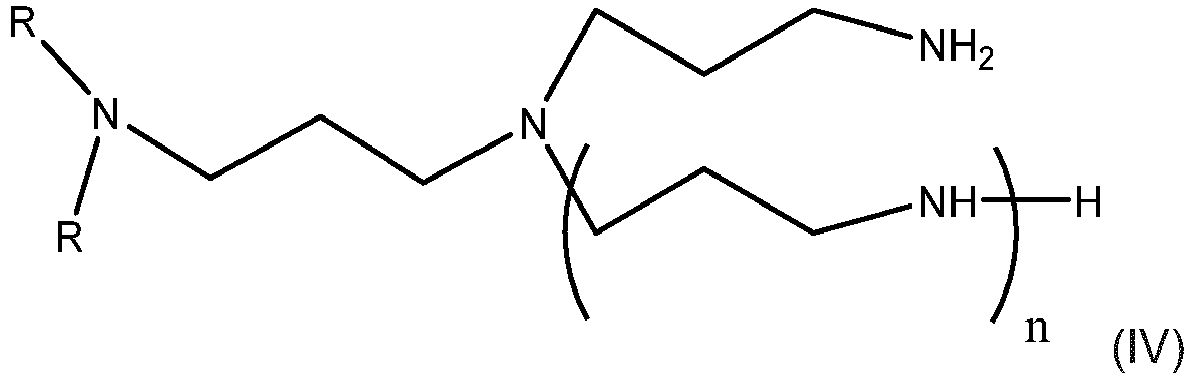
- R, identique ou différent, représente un groupe alkyle, linéaire ou ramifié, comprenant de 8 à 22 atomes de carbone,
- n et z, indépendamment l'un de l'autre, représentent 0, 1, 2 ou 3, et
- quand z est supérieur à 0, o et p, indépendamment l'un de l'autre, représentent 0, 1, 2 ou 3,
- o les mélanges d'amines grasses de formules (I), (III) et/ou (IV),
- o les composés de formule (I):
- un détergent à base de métaux alcalins ou alcalino-terreux, surbasé par des sels métalliques de carbonate
- Les amines grasses de formule (I) comprises dans la composition lubrifiante sont notamment décrites dans les demandes
WO 2009/153453 etWO 2014/180843 déposées par la demanderesse. - Selon un mode de réalisation préféré de l'invention, l'amine grasse de formule (I) ou le mélange d'amines grasses de formules (III) et/ou (IV) ou le mélange d'amines grasses de formules (I), (III) et/ou (IV) est ajouté en une quantité de 0,1 à 15%, de préférence de 0,5 à 10%, de préférence de 0,5 à 8% ou de 3 à 10% en poids par rapport au poids total de la composition lubrifiante.
- Par « amine grasse» selon l'invention, on entend une amine de formule (I), (III) ou (IV) comprenant un ou plusieurs groupements hydrocarbonés, saturé ou insaturé, linéaire ou ramifié, et comprenant optionnellement au moins un hétéroatome choisi parmi l'azote, le soufre ou l'oxygène, de préférence l'oxygène. Par « plusieurs amines grasses» selon l'invention, on entend un mélange d'amines grasses dont au moins une amine grasse est de formules (I), (III) et/ou (IV).
- Les amines grasses de formule (I), (III) ou (IV) sont notamment telles que décrites dans
WO2017021426 . - De façon particulièrement avantageuse, la présente invention a trait à l'amélioration de la propreté, de moteur marin, notamment de moteur marin 2-temps ou 4-temps. Plus particulièrement l'invention a trait à l'amélioration de la propreté moteur marin 2-temps, notamment propreté carter. Pour les moteurs 2-temps, la composition lubrifiante est notamment utilisée en tant qu'huile cylindre ou huile système, de préférence en tant qu'huile cylindre.
- Selon un mode de réalisation particulier de l'invention, l'huile de base comprise dans la composition lubrifiante est choisie parmi des huiles d'origine minérales, synthétiques ou végétales ainsi que leurs mélanges.
- Les huiles minérales ou synthétiques généralement utilisées dans l'application appartiennent à l'une des classes définies dans la classification API telle que résumée dans le tableau ci-dessous.
Teneur en saturés Teneur en soufre Indice de viscosité Groupe 1 Huiles minérales < 90 % > 0.03 % 80 ≤ VI < 120 Groupe 2 Huiles hydrocraquées ≥ 90 % ≤ 0.03 % 80 ≤ VI < 120 Groupe 3 Huiles hydro-isomérisées ≥ 90 % ≤ 0.03 % ≥ 120 Groupe 4 PAO Groupe 5 Autres bases non incluses dans bases groupes 1 à 4 - Les huiles minérales de Groupe 1 peuvent être obtenues par distillation de bruts naphténiques ou paraffiniques sélectionnés puis purification de ces distillats par des procédés tels l'extraction au solvant, le déparaffinage au solvant ou catalytique, l'hydrotraitement ou l'hydrogénation.
- Les huiles des Groupes 2 et 3 sont obtenues par des procédés de purification plus sévères, par exemple une combinaison parmi l'hydrotraitement, l'hydrocraquage, l'hydrogénation et le déparaffinage catalytique.
- Les exemples de bases synthétiques de Groupe 4 et 5 incluent les poly-alphas oléfines, les polybutènes, les polyisobutènes, les alkylbenzènes.
- Ces huiles de base peuvent être utilisées seules ou en mélange. Une huile minérale peut être combinée avec une huile synthétique.
- Les huiles cylindres pour moteurs marins diesel 2-temps ont un grade viscosimétrique SAE-40 à SAE-60, généralement SAE-50 équivalent à une viscosité cinématique à 100°C comprise entre 16.3 et 21.9 mm2/s.
- Les huiles de grade 40 ont une viscosité cinématique à 100°C comprise entre 12,5 et 16,3 mm2/s.
- Les huiles de grade 50 ont une viscosité cinématique à 100°C comprise entre 16,3 et 21,9 mm2/s.
- Les huiles de grade 60 ont une viscosité cinématique à 100°C comprise entre 21,9 et 26,1 V.
- Cette viscosité peut être obtenue par mélange d'additifs et d'huiles de base par exemple contenant des bases minérales de Groupe 1 telles des bases Neutral Solvant (par exemple 500NS ou 600 NS) et le Brightstock. Toute autre combinaison de bases minérales, synthétiques ou d'origine végétale ayant, en mélange avec les additifs, une viscosité compatible avec le grade SAE-50 peut être utilisée.
- Typiquement, une formulation classique de lubrifiant cylindre pour moteurs diesels marins 2-temps lents est de grade SAE 40 à SAE60, préférentiellement SAE50 (selon la classification SAE J300) et comprend au moins 50 % en poids d'huile de base lubrifiante d'origine minérale et/ou synthétique, adaptée à l'utilisation en moteur marin, par exemple, de classe API Groupe 1 c'est-à-dire obtenue par distillation de bruts sélectionnés puis purification de ces distillats par des procédés tels l'extraction au solvant, le déparaffinage au solvant ou catalytique, l'hydrotraitement ou l'hydrogénation. Leur Indice de Viscosité (VI) est compris en 80 et 120 ; leur teneur en soufre est supérieure à 0.03 % et leur teneur en saturé inférieure à 90 %.
- Selon un mode de réalisation particulier de l'invention, la composition lubrifiante peut comprendre en outre un ou plusieurs additifs épaississants dont le rôle est d'augmenter la viscosité de la composition, à chaud comme à froid, ou des par additifs améliorants d'indice de viscosité (VI).
- De préférence, ces additifs sont le plus souvent des polymères de faible poids moléculaire, de l'ordre de 2000 à 50 000 dalton (Mn). Ils pourront être choisis parmi les PIB (de l'ordre de 2000 dalton), poly-Acrylate ou Poly Métacrylates (de l'ordre de 30000 dalton), Oléfine-copolymères, Copolymères d'oléfine et d'Alpha Oléfines, EPDM, Polybutènes, Poly-Alphaoléfines à haut poids moléculaire (viscosité 100°C > 150), copolymères Styrène-Oléfine, hydrogénés ou non. Selon un mode de réalisation particulier de l'invention, la ou les huiles de base comprise(s) dans la composition lubrifiante selon l'invention peuvent être partiellement ou totalement substituées par ces additifs. Dès lors, les polymères utilisés pour substituer partiellement ou totalement une ou plusieurs des huiles de bases sont préférentiellement des épaississants précités de type PIB (par exemple commercialisés sous le nom d'Indopol H2100).
- Selon un mode de réalisation particulier de l'invention, la composition lubrifiante peut comprendre en outre au moins un additif anti-usure. De préférence, l'additif anti-usure est le di thiophosphate de Zinc ou DTPZn. On trouve également dans cette catégorie divers composés phosphorés, soufrés, azotés, chlorés et borés. Il existe une grande variété d'additifs anti-usure, mais la catégorie la plus utilisée est celle des additifs phospho soufrés comme les alkylthiophosphates métalliques, en particulier les alkylthiophosphates de Zinc, et plus spécifiquement les dialkyldithiophosphates de Zinc ou DTPZn. Les phosphates d'amines, les polysulfures, notamment les oléfines soufrées, sont également des additifs anti-usure employés couramment.
- On rencontre également usuellement dans les compositions lubrifiantes des additifs anti-usure et extrême pression de type azotés et soufrés, tels que par exemple les dithiocarbamates métalliques, en particulier dithiocarbamate de molybdène. Les esters du glycérol sont également des additifs anti usure. On peut citer par exemple les mono, di et trioléates, monopalmitates et monomyristates.
- Selon un mode de réalisation particulier de l'invention, la composition lubrifiante peut comprendre en outre au moins un dispersant. Les dispersants sont des additifs bien connus employés dans la formulation de composition lubrifiante, notamment pour application dans le domaine marin. Leur rôle premier est de maintenir en suspension les particules présentes initialement ou apparaissant dans la composition lubrifiante au cours de son utilisation dans le moteur. Ils préviennent leur agglomération en jouant sur l'encombrement stérique. Ils peuvent présenter également un effet synergique sur la neutralisation. Les dispersants utilisés comme additifs pour lubrifiant contiennent typiquement un groupement polaire, associé à une chaîne hydrocarbonée relativement longue, contenant généralement de 50 à 400 atomes de carbone. Le groupement polaire contient typiquement au moins un élément azote, oxygène ou phosphore. Les composés dérivés de l'acide succinique sont des dispersants particulièrement utilisés comme additifs de lubrification. On utilise en particulier les succinimides, obtenues par condensation d'anhydrides succiniques et d'amines, les esters succiniques obtenus par condensation d'anhydrides succiniques et d'alcools ou polyols. Ces composés peuvent être ensuite traités par divers composés notamment soufre, oxygène, formaldéhyde, acides carboxyliques et composés contenant du bore ou du zinc pour produire par exemple des succinimides boratées ou des succinimides bloqués au zinc. Les bases de Mannich, obtenues par polycondensation de phénols substitués par des groupements alkyls, de formaldéhyde et d'amines primaires ou secondaires, sont également des composés utilisés comme dispersants dans les lubrifiants. On pourra utiliser un dispersant dans la famille des PIB succinimides par exemple boratés ou bloqués au zinc.
- Selon un mode de réalisation particulier de l'invention, la composition lubrifiante peut comprendre en outre tous types d'additifs fonctionnels adaptés à leur utilisation, par exemple additifs anti mousse pour contrer l'effet des détergents, pouvant être par exemple des polymères polaires tels que polyméthylsiloxanes, polyacrylates, additifs anti oxydants et/ou anti rouille, par exemple détergents organo métalliques ou thiadiazoles. Ceux ci sont connus de l'homme du métier.
- Selon la présente invention, les compositions des lubrifiants décrites se réfèrent aux composés pris séparément avant mélange, étant entendu que lesdits composés peuvent ou non conserver la même forme chimique avant et après mélange. De préférence, les lubrifiants selon la présente invention obtenus par mélange des composés pris séparément ne sont pas sous forme d'émulsion ni de microémulsion.
- De préférence, l'huile de base de la composition selon l'invention est une huile de base du groupe 2.
- La présente invention a également pour objet l'utilisation d'une composition lubrifiante comprenant au moins une huile de base et de 2 à 12% en poids par rapport au poids de la composition lubrifiante d'un composé ester présentant une viscosité à 100°C mesurée selon la norme ASTM D445 comprise entre 100 et 1000 cSt pour améliorer la propreté moteur. Les quantités d'ester, les esters, l'huile de base et la composition lubrifiante et ses éventuels additifs sont tels que définis ci-dessus.
- La présente invention concerne également une composition lubrifiante comprenant au moins une huile de base et de 2 à 12% en poids par rapport au poids de la composition lubrifiante d'un ester présentant une viscosité à 100°C mesurée selon la norme ASTM D445 comprise entre 100 et 1000 cSt pour améliorer la propreté moteur. Les quantités d'ester, les esters, l'huile de base et la composition lubrifiante et ses éventuels additifs sont tels que définis ci-dessus.
- La présente demande va maintenant être décrite à l'aide d'exemples non limitatifs.
- Les esters du tableau 1 ont été mis en oeuvre dans les compositions lubrifiantes testées ci-dessous.
Ester Viscosité à 100°C (cSt) Ester 1 (selon l'invention) 600 Ester 2 (selon l'invention) 315 Ester 3 (selon l'invention) 589 Ester 4 (comparatif) 98 Ester 5 (comparatif) 36 Ester 6 (comparatif) 12 - Les compositions suivantes (CI : composition selon l'invention et CC : composition comparative) ont été préparées :


- Les propriétés de ces compositions sont décrites dans le tableau 3 ci-dessous
Tableau 3 Composition CI1 CI2 CI3 CI4 CI5 CI6 CC1 CC2 CC3 CC4 CC5 CC6 Viscosité à 40°C (mm2/s) 117,5 189,2 170,2 198 181 200,5 217,6 196,8 189 201,6 216.0 151.9 Viscosité à 100°C (mm2/s) 19,7 19,74 18,1 19,36 17,72 19,3 19,02 19 18,08 18,8 19.6 19.6 VI 128 131 118 111 107 109 98 109 105 104 103 148 BN (KOH/g) 25,1 24,9 25,1 25,2 25 25,3 25,3 25,1 25 25,3 25.2 25 - La viscosité à 40°C est mesurée selon la norme ASTM D7279.
- La viscosité à 100°C est mesurée selon la norme ASTM D7279.
- Le VI correspond à l'indice de viscosité et est calculé selon la norme NF ISO 2909.
- Le BN correspond à l'indice de basicité (Base Number) mesuré selon la norme ASTM D2896.
- Pour évaluer les propriétés des compositions lubrifiantes selon l'invention, des essais ECBT ont été menés.
- Ces essais permettent de simuler l'apparition d'un vernis sur les pièces du moteur.
- La tenue thermique des compositions a donc été évaluée grâce à l'essai ECBT. Une description détaillée de cet essai est donnée dans la publication intitulée « Research and Development of Marine Lubricants in ELF ANTAR France - The relevance of laboratory tests in simulating field performance » par Jean-Philippe ROMAN, MARINE PROPULSION CONFERENCE 2000 - AMSTERDAM - 29-30 MARCH 2000.
- Les résultats sont regroupés dans le tableau 4 ci-dessous.
- Les résultats montrent que les compositions selon l'invention présentent une bonne tenue thermique et permettent ainsi d'améliorer la propreté moteur.
COMPOSITIONS CI1 CI2 CI3 CI4 CI5 CI6 Mesure de la cotation à 280°C 73,6 92,3 88,5 62,9 63,9 45,7 Température critique mesurée à la cotation 50 289°C 289°C 295°C 285°C 283°C 282°C Tableau 4 COMPOSITIONS CC1 CC2 CC3 CC4 CC5 CC6 Mesure de la cotation à 280°C 32,2 40,1 34,1 28,8 12,2 47 Température critique mesurée à la cotation 50 277°C 278°C 277°C 276°C 274°C 279°C - S'agissant de la mesure de la cotation à 280°C, si la surface est sans vernis alors la cotation est de 100. En d'autres termes, plus la cotation est basse, plus la surface présente du vernis.
- La température critique correspond à la température à laquelle la surface présente une cotation de 50.
- Ces résultats montrent que les esters présentant une viscosité selon l'invention permettent avantageusement d'améliorer la propreté moteur par rapport aux compositions lubrifiantes exemptes de tels esters et par rapport aux compositions lubrifiantes comprenant des esters de viscosité différente. En effet, la cotation vernis est bien plus proche de 100 pour les esters selon l'invention. Par ailleurs, la température critique est bien plus importante pour les esters selon l'invention.
- Ces résultats mettent également en avant l'influence de la quantité d'ester mise en oeuvre.
Claims (5)
- Utilisation, dans une composition lubrifiante comprenant au moins une huile de base, de 2 à 12% en poids par rapport au poids de la composition lubrifiante d'un ester présentant une viscosité à 100°C comprise entre 200 et 1000 cSt pour améliorer la propreté moteur, l'alcool formant les esters est le triméthylolpropane et l'acide formant les esters est choisi parmi les acides gras comprenant de 6 à 24 atomes de carbone.
- Utilisation selon la revendication 1, dans laquelle la viscosité à 100°C de l'ester est comprise entre 200 et 900 cSt, de préférence entre 200 et 800, plus préférentiellement entre 250 et 700 cSt.
- Utilisation selon la revendication 1 ou 2, dans laquelle l'ester est compris dans une proportion de 2 à 11%, de préférence de 3 à 11%, plus préférentiellement de 3 à 10%, encore plus préférentiellement de 4 à 10% en poids par rapport au poids de la composition lubrifiante.
- Utilisation selon l'une quelconque des revendications 1 à 3, dans laquelle le moteur est un moteur marin, de préférence un moteur marin 2 temps.
- Procédé pour améliorer la propreté d'un moteur comprenant la mise en oeuvre dans ledit moteur, d'une composition lubrifiante comprenant au moins une huile de base et de 2 à 12% en poids par rapport au poids de la composition lubrifiante d'un ester présentant une viscosité à 100°C comprise entre 200 et 1000 cSt, ledit ester étant tel que défini dans la revendication 1.
Applications Claiming Priority (2)
| Application Number | Priority Date | Filing Date | Title |
|---|---|---|---|
| FR1758648A FR3071252B1 (fr) | 2017-09-19 | 2017-09-19 | Utilisation d'ester dans une composition lubrifiante pour ameliorer la proprete moteur |
| PCT/EP2018/075223 WO2019057718A1 (fr) | 2017-09-19 | 2018-09-18 | Utilisation d'ester dans une composition lubrifiante pour améliorer la propreté moteur |
Publications (2)
| Publication Number | Publication Date |
|---|---|
| EP3684893A1 EP3684893A1 (fr) | 2020-07-29 |
| EP3684893B1 true EP3684893B1 (fr) | 2024-11-06 |
Family
ID=60627783
Family Applications (1)
| Application Number | Title | Priority Date | Filing Date |
|---|---|---|---|
| EP18768908.8A Active EP3684893B1 (fr) | 2017-09-19 | 2018-09-18 | Utilisation d'ester dans une composition lubrifiante pour améliorer la propreté moteur |
Country Status (9)
| Country | Link |
|---|---|
| US (1) | US11136521B2 (fr) |
| EP (1) | EP3684893B1 (fr) |
| JP (2) | JP2020534404A (fr) |
| CN (1) | CN111133083A (fr) |
| DK (1) | DK3684893T3 (fr) |
| ES (1) | ES3002734T3 (fr) |
| FR (1) | FR3071252B1 (fr) |
| SG (1) | SG11202002373TA (fr) |
| WO (1) | WO2019057718A1 (fr) |
Families Citing this family (1)
| Publication number | Priority date | Publication date | Assignee | Title |
|---|---|---|---|---|
| FR3164220A1 (fr) * | 2024-07-05 | 2026-01-09 | Totalenergies Onetech | Utilisation d’esters pour l’amélioration de la propreté de moteurs marins |
Family Cites Families (15)
| Publication number | Priority date | Publication date | Assignee | Title |
|---|---|---|---|---|
| US3390083A (en) * | 1965-05-11 | 1968-06-25 | Exxon Research Engineering Co | Polyester additives for hydrocarbon oil compositions and process of preparing the same |
| FR2144559B1 (fr) * | 1971-07-05 | 1974-09-06 | Inst Francais Du Petrole | |
| US5942475A (en) * | 1996-09-06 | 1999-08-24 | Exxon Chemical Patents Inc. | Engine oil lubricants formed from complex alcohol esters |
| US6573224B2 (en) * | 1997-01-03 | 2003-06-03 | Bardahl Manufacturing Corporation | Two-cycle engine lubricant composition comprising an ester copolymer and a diester |
| ATE246239T1 (de) * | 1997-10-01 | 2003-08-15 | Unichema Chemie Bv | Komplexaster, diese enthaltende zusammensetzungen und ihre verwendung |
| US6844299B2 (en) | 2002-03-13 | 2005-01-18 | Bp Corporation North America Inc. | Polyol ester derivatives of polyamines and use in turbine oils to improve cleanliness |
| GB0404535D0 (en) * | 2004-03-01 | 2004-03-31 | Ici Plc | Antiwear automotive formulations |
| US8703677B2 (en) * | 2007-12-21 | 2014-04-22 | Chevron Japan Ltd | Lubricating oil compositions for internal combustion engines |
| FR2932813B1 (fr) | 2008-06-18 | 2010-09-03 | Total France | Lubrifiant cylindre pour moteur marin deux temps |
| EP2664632A1 (fr) * | 2008-07-31 | 2013-11-20 | The Lubrizol Corporation | Nouveaux copolymères et compositions lubrifiantes correspondantes |
| FR2974111B1 (fr) * | 2011-04-14 | 2013-05-10 | Total Raffinage Marketing | Lubrifiant cylindre pour moteur marin deux temps |
| FR2980799B1 (fr) * | 2011-09-29 | 2013-10-04 | Total Raffinage Marketing | Composition lubrifiante pour moteur marin |
| KR20140125873A (ko) * | 2012-02-17 | 2014-10-29 | 더루우브리졸코오포레이션 | 동력전달장치 이용분야에 적합한 낮은 분산제 수준과 에스테르화된 공중합체를 함유하는 윤활 조성물 |
| FR3005474B1 (fr) | 2013-05-07 | 2016-09-09 | Total Raffinage Marketing | Lubrifiant pour moteur marin |
| FR3039835B1 (fr) | 2015-08-03 | 2019-07-05 | Total Marketing Services | Utilisation d'une amine grasse pour prevenir et/ou reduire les pertes metalliques des pieces dans un moteur |
-
2017
- 2017-09-19 FR FR1758648A patent/FR3071252B1/fr active Active
-
2018
- 2018-09-18 CN CN201880060009.8A patent/CN111133083A/zh active Pending
- 2018-09-18 JP JP2020515869A patent/JP2020534404A/ja not_active Ceased
- 2018-09-18 EP EP18768908.8A patent/EP3684893B1/fr active Active
- 2018-09-18 WO PCT/EP2018/075223 patent/WO2019057718A1/fr not_active Ceased
- 2018-09-18 SG SG11202002373TA patent/SG11202002373TA/en unknown
- 2018-09-18 US US16/646,229 patent/US11136521B2/en active Active
- 2018-09-18 DK DK18768908.8T patent/DK3684893T3/da active
- 2018-09-18 ES ES18768908T patent/ES3002734T3/es active Active
-
2023
- 2023-10-13 JP JP2023177522A patent/JP2023174812A/ja active Pending
Also Published As
| Publication number | Publication date |
|---|---|
| CN111133083A (zh) | 2020-05-08 |
| FR3071252A1 (fr) | 2019-03-22 |
| SG11202002373TA (en) | 2020-04-29 |
| US11136521B2 (en) | 2021-10-05 |
| JP2023174812A (ja) | 2023-12-08 |
| US20200270542A1 (en) | 2020-08-27 |
| FR3071252B1 (fr) | 2020-04-03 |
| JP2020534404A (ja) | 2020-11-26 |
| EP3684893A1 (fr) | 2020-07-29 |
| WO2019057718A1 (fr) | 2019-03-28 |
| DK3684893T3 (da) | 2025-01-02 |
| ES3002734T3 (en) | 2025-03-07 |
Similar Documents
| Publication | Publication Date | Title |
|---|---|---|
| EP3289054B1 (fr) | Composition lubrifiante ultra-fluide | |
| EP2760982B1 (fr) | Composition lubrifiante pour moteur marin | |
| EP2643441B1 (fr) | Composition lubrifiante pour moteur | |
| EP3331975B1 (fr) | Utilisation d'une amine grasse pour prevenir et/ou reduire les pertes métalliques des pièces dans un moteur | |
| CA2707668A1 (fr) | Composition lubrifiante pour moteur quatre temps a bas taux de cendres | |
| EP3662041B1 (fr) | Composition lubrifiante comprenant un diester | |
| WO2011073960A1 (fr) | Composition additive pour huile moteur | |
| FR2992655A1 (fr) | Composition lubrifiante | |
| EP3430109A1 (fr) | Composition lubrifiante a base de polyalkylene glycols | |
| WO2017021522A1 (fr) | Compositions lubrifiantes pour prevenir ou diminuer le pre-allumage dans un moteur | |
| EP3212745B1 (fr) | Lubrifiant pour moteur marin | |
| EP3331974B1 (fr) | Utilisation des compositions lubrifiantes pour prevenir ou diminuer le pre-allumage dans un moteur | |
| EP3481927A1 (fr) | Composition lubrifiante pour moteur a gaz | |
| EP3430110B1 (fr) | Composition lubrifiante a base de polyalkylene glycols | |
| FR3002235A1 (fr) | Composition lubrifiante a base de composes amines | |
| EP3684893A1 (fr) | Utilisation d'ester dans une composition lubrifiante pour améliorer la propreté moteur | |
| EP3619287B1 (fr) | Utilisation d'une amine grasse pour réduire et/ou contrôler la combustion anormale du gaz dans un moteur marin | |
| EP3529341B1 (fr) | Composition lubrifiante | |
| HK40027613A (en) | Use of esters in a lubricant composition for improving the cleanliness of an engine | |
| HK40027613B (en) | Use of esters in a lubricant composition for improving the cleanliness of an engine | |
| FR3159172A1 (fr) | Composition lubrifiante pour moteur marin 2-temps | |
| FR3164221A1 (fr) | Composition lubrifiante pour moteur marin 4-temps | |
| FR3154413A1 (fr) | Compositions lubrifiantes d’indice de viscosité élevé |
Legal Events
| Date | Code | Title | Description |
|---|---|---|---|
| STAA | Information on the status of an ep patent application or granted ep patent |
Free format text: STATUS: UNKNOWN |
|
| STAA | Information on the status of an ep patent application or granted ep patent |
Free format text: STATUS: THE INTERNATIONAL PUBLICATION HAS BEEN MADE |
|
| PUAI | Public reference made under article 153(3) epc to a published international application that has entered the european phase |
Free format text: ORIGINAL CODE: 0009012 |
|
| STAA | Information on the status of an ep patent application or granted ep patent |
Free format text: STATUS: REQUEST FOR EXAMINATION WAS MADE |
|
| 17P | Request for examination filed |
Effective date: 20200318 |
|
| AK | Designated contracting states |
Kind code of ref document: A1 Designated state(s): AL AT BE BG CH CY CZ DE DK EE ES FI FR GB GR HR HU IE IS IT LI LT LU LV MC MK MT NL NO PL PT RO RS SE SI SK SM TR |
|
| AX | Request for extension of the european patent |
Extension state: BA ME |
|
| DAV | Request for validation of the european patent (deleted) | ||
| DAX | Request for extension of the european patent (deleted) | ||
| REG | Reference to a national code |
Ref country code: HK Ref legal event code: DE Ref document number: 40027613 Country of ref document: HK |
|
| STAA | Information on the status of an ep patent application or granted ep patent |
Free format text: STATUS: EXAMINATION IS IN PROGRESS |
|
| 17Q | First examination report despatched |
Effective date: 20220502 |
|
| RAP1 | Party data changed (applicant data changed or rights of an application transferred) |
Owner name: TOTALENERGIES ONETECH |
|
| REG | Reference to a national code |
Ref country code: DE Ref legal event code: R079 Free format text: PREVIOUS MAIN CLASS: C10M0129680000 Ipc: C10M0129740000 Ref country code: DE Ref legal event code: R079 Ref document number: 602018076283 Country of ref document: DE Free format text: PREVIOUS MAIN CLASS: C10M0129680000 Ipc: C10M0129740000 |
|
| GRAP | Despatch of communication of intention to grant a patent |
Free format text: ORIGINAL CODE: EPIDOSNIGR1 |
|
| STAA | Information on the status of an ep patent application or granted ep patent |
Free format text: STATUS: GRANT OF PATENT IS INTENDED |
|
| RIC1 | Information provided on ipc code assigned before grant |
Ipc: C10N 40/26 20060101ALN20240419BHEP Ipc: C10N 40/25 20060101ALN20240419BHEP Ipc: C10N 30/04 20060101ALN20240419BHEP Ipc: C10N 20/02 20060101ALN20240419BHEP Ipc: C10M 111/02 20060101ALI20240419BHEP Ipc: C10M 105/38 20060101ALI20240419BHEP Ipc: C10M 129/70 20060101ALI20240419BHEP Ipc: C10M 129/74 20060101AFI20240419BHEP |
|
| INTG | Intention to grant announced |
Effective date: 20240510 |
|
| GRAS | Grant fee paid |
Free format text: ORIGINAL CODE: EPIDOSNIGR3 |
|
| P01 | Opt-out of the competence of the unified patent court (upc) registered |
Free format text: CASE NUMBER: APP_46056/2024 Effective date: 20240809 |
|
| GRAA | (expected) grant |
Free format text: ORIGINAL CODE: 0009210 |
|
| STAA | Information on the status of an ep patent application or granted ep patent |
Free format text: STATUS: THE PATENT HAS BEEN GRANTED |
|
| AK | Designated contracting states |
Kind code of ref document: B1 Designated state(s): AL AT BE BG CH CY CZ DE DK EE ES FI FR GB GR HR HU IE IS IT LI LT LU LV MC MK MT NL NO PL PT RO RS SE SI SK SM TR |
|
| REG | Reference to a national code |
Ref country code: GB Ref legal event code: FG4D Free format text: NOT ENGLISH |
|
| REG | Reference to a national code |
Ref country code: CH Ref legal event code: EP |
|
| REG | Reference to a national code |
Ref country code: DE Ref legal event code: R096 Ref document number: 602018076283 Country of ref document: DE |
|
| REG | Reference to a national code |
Ref country code: IE Ref legal event code: FG4D Free format text: LANGUAGE OF EP DOCUMENT: FRENCH |
|
| REG | Reference to a national code |
Ref country code: DK Ref legal event code: T3 Effective date: 20241217 |
|
| REG | Reference to a national code |
Ref country code: NL Ref legal event code: FP |
|
| REG | Reference to a national code |
Ref country code: ES Ref legal event code: FG2A Ref document number: 3002734 Country of ref document: ES Kind code of ref document: T3 Effective date: 20250307 |
|
| REG | Reference to a national code |
Ref country code: LT Ref legal event code: MG9D |
|
| PG25 | Lapsed in a contracting state [announced via postgrant information from national office to epo] |
Ref country code: PT Free format text: LAPSE BECAUSE OF FAILURE TO SUBMIT A TRANSLATION OF THE DESCRIPTION OR TO PAY THE FEE WITHIN THE PRESCRIBED TIME-LIMIT Effective date: 20250306 Ref country code: HR Free format text: LAPSE BECAUSE OF FAILURE TO SUBMIT A TRANSLATION OF THE DESCRIPTION OR TO PAY THE FEE WITHIN THE PRESCRIBED TIME-LIMIT Effective date: 20241106 Ref country code: IS Free format text: LAPSE BECAUSE OF FAILURE TO SUBMIT A TRANSLATION OF THE DESCRIPTION OR TO PAY THE FEE WITHIN THE PRESCRIBED TIME-LIMIT Effective date: 20250306 |
|
| PG25 | Lapsed in a contracting state [announced via postgrant information from national office to epo] |
Ref country code: FI Free format text: LAPSE BECAUSE OF FAILURE TO SUBMIT A TRANSLATION OF THE DESCRIPTION OR TO PAY THE FEE WITHIN THE PRESCRIBED TIME-LIMIT Effective date: 20241106 |
|
| REG | Reference to a national code |
Ref country code: AT Ref legal event code: MK05 Ref document number: 1739360 Country of ref document: AT Kind code of ref document: T Effective date: 20241106 |
|
| PG25 | Lapsed in a contracting state [announced via postgrant information from national office to epo] |
Ref country code: BG Free format text: LAPSE BECAUSE OF FAILURE TO SUBMIT A TRANSLATION OF THE DESCRIPTION OR TO PAY THE FEE WITHIN THE PRESCRIBED TIME-LIMIT Effective date: 20241106 |
|
| PG25 | Lapsed in a contracting state [announced via postgrant information from national office to epo] |
Ref country code: NO Free format text: LAPSE BECAUSE OF FAILURE TO SUBMIT A TRANSLATION OF THE DESCRIPTION OR TO PAY THE FEE WITHIN THE PRESCRIBED TIME-LIMIT Effective date: 20250206 |
|
| PG25 | Lapsed in a contracting state [announced via postgrant information from national office to epo] |
Ref country code: LV Free format text: LAPSE BECAUSE OF FAILURE TO SUBMIT A TRANSLATION OF THE DESCRIPTION OR TO PAY THE FEE WITHIN THE PRESCRIBED TIME-LIMIT Effective date: 20241106 Ref country code: GR Free format text: LAPSE BECAUSE OF FAILURE TO SUBMIT A TRANSLATION OF THE DESCRIPTION OR TO PAY THE FEE WITHIN THE PRESCRIBED TIME-LIMIT Effective date: 20250207 Ref country code: AT Free format text: LAPSE BECAUSE OF FAILURE TO SUBMIT A TRANSLATION OF THE DESCRIPTION OR TO PAY THE FEE WITHIN THE PRESCRIBED TIME-LIMIT Effective date: 20241106 |
|
| PG25 | Lapsed in a contracting state [announced via postgrant information from national office to epo] |
Ref country code: PL Free format text: LAPSE BECAUSE OF FAILURE TO SUBMIT A TRANSLATION OF THE DESCRIPTION OR TO PAY THE FEE WITHIN THE PRESCRIBED TIME-LIMIT Effective date: 20241106 |
|
| PG25 | Lapsed in a contracting state [announced via postgrant information from national office to epo] |
Ref country code: RS Free format text: LAPSE BECAUSE OF FAILURE TO SUBMIT A TRANSLATION OF THE DESCRIPTION OR TO PAY THE FEE WITHIN THE PRESCRIBED TIME-LIMIT Effective date: 20250206 |
|
| PG25 | Lapsed in a contracting state [announced via postgrant information from national office to epo] |
Ref country code: SM Free format text: LAPSE BECAUSE OF FAILURE TO SUBMIT A TRANSLATION OF THE DESCRIPTION OR TO PAY THE FEE WITHIN THE PRESCRIBED TIME-LIMIT Effective date: 20241106 |
|
| PG25 | Lapsed in a contracting state [announced via postgrant information from national office to epo] |
Ref country code: EE Free format text: LAPSE BECAUSE OF FAILURE TO SUBMIT A TRANSLATION OF THE DESCRIPTION OR TO PAY THE FEE WITHIN THE PRESCRIBED TIME-LIMIT Effective date: 20241106 |
|
| PG25 | Lapsed in a contracting state [announced via postgrant information from national office to epo] |
Ref country code: RO Free format text: LAPSE BECAUSE OF FAILURE TO SUBMIT A TRANSLATION OF THE DESCRIPTION OR TO PAY THE FEE WITHIN THE PRESCRIBED TIME-LIMIT Effective date: 20241106 |
|
| PG25 | Lapsed in a contracting state [announced via postgrant information from national office to epo] |
Ref country code: SK Free format text: LAPSE BECAUSE OF FAILURE TO SUBMIT A TRANSLATION OF THE DESCRIPTION OR TO PAY THE FEE WITHIN THE PRESCRIBED TIME-LIMIT Effective date: 20241106 |
|
| PG25 | Lapsed in a contracting state [announced via postgrant information from national office to epo] |
Ref country code: CZ Free format text: LAPSE BECAUSE OF FAILURE TO SUBMIT A TRANSLATION OF THE DESCRIPTION OR TO PAY THE FEE WITHIN THE PRESCRIBED TIME-LIMIT Effective date: 20241106 |
|
| REG | Reference to a national code |
Ref country code: DE Ref legal event code: R097 Ref document number: 602018076283 Country of ref document: DE |
|
| PG25 | Lapsed in a contracting state [announced via postgrant information from national office to epo] |
Ref country code: SE Free format text: LAPSE BECAUSE OF FAILURE TO SUBMIT A TRANSLATION OF THE DESCRIPTION OR TO PAY THE FEE WITHIN THE PRESCRIBED TIME-LIMIT Effective date: 20241106 |
|
| PLBE | No opposition filed within time limit |
Free format text: ORIGINAL CODE: 0009261 |
|
| STAA | Information on the status of an ep patent application or granted ep patent |
Free format text: STATUS: NO OPPOSITION FILED WITHIN TIME LIMIT |
|
| 26N | No opposition filed |
Effective date: 20250807 |
|
| REG | Reference to a national code |
Ref country code: DK Ref legal event code: EBP Effective date: 20250930 |
|
| REG | Reference to a national code |
Ref country code: CH Ref legal event code: H13 Free format text: ST27 STATUS EVENT CODE: U-0-0-H10-H13 (AS PROVIDED BY THE NATIONAL OFFICE) Effective date: 20260504 |
|
| REG | Reference to a national code |
Ref country code: NL Ref legal event code: MM Effective date: 20251001 |