EP3679938A1 - Verfahren zur herstellung von gereinigten blutplättchen, verfahren zur herstellung eines blutplättchenpräparats, verfahren zur herstellung eines blutpräparats, blutplättchenkonservierungsflüssigkeit, blutplättchenkonservierungsmittel und verfahren zur konservierung von blutplättchen - Google Patents
Verfahren zur herstellung von gereinigten blutplättchen, verfahren zur herstellung eines blutplättchenpräparats, verfahren zur herstellung eines blutpräparats, blutplättchenkonservierungsflüssigkeit, blutplättchenkonservierungsmittel und verfahren zur konservierung von blutplättchen Download PDFInfo
- Publication number
- EP3679938A1 EP3679938A1 EP18858726.5A EP18858726A EP3679938A1 EP 3679938 A1 EP3679938 A1 EP 3679938A1 EP 18858726 A EP18858726 A EP 18858726A EP 3679938 A1 EP3679938 A1 EP 3679938A1
- Authority
- EP
- European Patent Office
- Prior art keywords
- platelets
- preserving
- platelet
- producing
- albumin
- Prior art date
- Legal status (The legal status is an assumption and is not a legal conclusion. Google has not performed a legal analysis and makes no representation as to the accuracy of the status listed.)
- Pending
Links
- 238000004519 manufacturing process Methods 0.000 title claims abstract description 129
- 238000000034 method Methods 0.000 title claims abstract description 93
- 210000001772 blood platelet Anatomy 0.000 title description 496
- 239000012530 fluid Substances 0.000 title description 38
- 238000004321 preservation Methods 0.000 title description 24
- 210000004369 blood Anatomy 0.000 title description 17
- 239000008280 blood Substances 0.000 title description 17
- 238000002360 preparation method Methods 0.000 title description 4
- 210000003593 megakaryocyte Anatomy 0.000 claims abstract description 172
- 239000012141 concentrate Substances 0.000 claims abstract description 38
- 238000005406 washing Methods 0.000 claims description 79
- 210000004027 cell Anatomy 0.000 claims description 73
- 102000009027 Albumins Human genes 0.000 claims description 68
- 108010088751 Albumins Proteins 0.000 claims description 68
- 239000007788 liquid Substances 0.000 claims description 45
- KRKNYBCHXYNGOX-UHFFFAOYSA-N citric acid Chemical compound OC(=O)CC(O)(C(O)=O)CC(O)=O KRKNYBCHXYNGOX-UHFFFAOYSA-N 0.000 claims description 38
- 108090000623 proteins and genes Proteins 0.000 claims description 38
- 239000003792 electrolyte Substances 0.000 claims description 34
- 239000003755 preservative agent Substances 0.000 claims description 29
- TWRXJAOTZQYOKJ-UHFFFAOYSA-L Magnesium chloride Chemical compound [Mg+2].[Cl-].[Cl-] TWRXJAOTZQYOKJ-UHFFFAOYSA-L 0.000 claims description 26
- WCUXLLCKKVVCTQ-UHFFFAOYSA-M Potassium chloride Chemical compound [Cl-].[K+] WCUXLLCKKVVCTQ-UHFFFAOYSA-M 0.000 claims description 26
- UIIMBOGNXHQVGW-UHFFFAOYSA-M Sodium bicarbonate Chemical compound [Na+].OC([O-])=O UIIMBOGNXHQVGW-UHFFFAOYSA-M 0.000 claims description 26
- 239000010836 blood and blood product Substances 0.000 claims description 26
- 229940125691 blood product Drugs 0.000 claims description 26
- FAPWRFPIFSIZLT-UHFFFAOYSA-M Sodium chloride Chemical compound [Na+].[Cl-] FAPWRFPIFSIZLT-UHFFFAOYSA-M 0.000 claims description 22
- 230000014509 gene expression Effects 0.000 claims description 22
- 238000000926 separation method Methods 0.000 claims description 15
- WQZGKKKJIJFFOK-GASJEMHNSA-N Glucose Natural products OC[C@H]1OC(O)[C@H](O)[C@@H](O)[C@@H]1O WQZGKKKJIJFFOK-GASJEMHNSA-N 0.000 claims description 13
- 229910001629 magnesium chloride Inorganic materials 0.000 claims description 13
- 239000001103 potassium chloride Substances 0.000 claims description 13
- 235000011164 potassium chloride Nutrition 0.000 claims description 13
- 235000017557 sodium bicarbonate Nutrition 0.000 claims description 13
- 229910000030 sodium bicarbonate Inorganic materials 0.000 claims description 13
- 230000005484 gravity Effects 0.000 claims description 12
- NLJMYIDDQXHKNR-UHFFFAOYSA-K sodium citrate Chemical compound O.O.[Na+].[Na+].[Na+].[O-]C(=O)CC(O)(CC([O-])=O)C([O-])=O NLJMYIDDQXHKNR-UHFFFAOYSA-K 0.000 claims description 12
- 239000001509 sodium citrate Substances 0.000 claims description 12
- UXVMQQNJUSDDNG-UHFFFAOYSA-L Calcium chloride Chemical compound [Cl-].[Cl-].[Ca+2] UXVMQQNJUSDDNG-UHFFFAOYSA-L 0.000 claims description 11
- 108700020796 Oncogene Proteins 0.000 claims description 11
- 239000001110 calcium chloride Substances 0.000 claims description 11
- 229910001628 calcium chloride Inorganic materials 0.000 claims description 11
- 239000008121 dextrose Substances 0.000 claims description 11
- 239000011780 sodium chloride Substances 0.000 claims description 11
- 102000007562 Serum Albumin Human genes 0.000 claims description 10
- 108010071390 Serum Albumin Proteins 0.000 claims description 10
- 238000002156 mixing Methods 0.000 claims description 7
- 102100026596 Bcl-2-like protein 1 Human genes 0.000 claims 1
- 239000012528 membrane Substances 0.000 abstract description 28
- 230000006378 damage Effects 0.000 abstract description 27
- 239000012510 hollow fiber Substances 0.000 abstract description 25
- 239000000243 solution Substances 0.000 description 145
- 239000000306 component Substances 0.000 description 88
- 239000000047 product Substances 0.000 description 48
- 239000002609 medium Substances 0.000 description 38
- 238000005119 centrifugation Methods 0.000 description 32
- 208000015181 infectious disease Diseases 0.000 description 24
- 108090000672 Annexin A5 Proteins 0.000 description 22
- 102000004121 Annexin A5 Human genes 0.000 description 22
- 108091006905 Human Serum Albumin Proteins 0.000 description 22
- 102000008100 Human Serum Albumin Human genes 0.000 description 22
- 101001070790 Homo sapiens Platelet glycoprotein Ib alpha chain Proteins 0.000 description 21
- 102100034173 Platelet glycoprotein Ib alpha chain Human genes 0.000 description 21
- 239000002245 particle Substances 0.000 description 21
- 230000000052 comparative effect Effects 0.000 description 18
- 238000012258 culturing Methods 0.000 description 17
- 230000006866 deterioration Effects 0.000 description 16
- 230000001939 inductive effect Effects 0.000 description 16
- 102100033566 Polycomb complex protein BMI-1 Human genes 0.000 description 14
- 101000872170 Homo sapiens Polycomb complex protein BMI-1 Proteins 0.000 description 13
- CIWBSHSKHKDKBQ-JLAZNSOCSA-N Ascorbic acid Chemical compound OC[C@H](O)[C@H]1OC(=O)C(O)=C1O CIWBSHSKHKDKBQ-JLAZNSOCSA-N 0.000 description 10
- 241000700605 Viruses Species 0.000 description 10
- 238000001802 infusion Methods 0.000 description 10
- HEMHJVSKTPXQMS-UHFFFAOYSA-M Sodium hydroxide Chemical compound [OH-].[Na+] HEMHJVSKTPXQMS-UHFFFAOYSA-M 0.000 description 9
- 230000006907 apoptotic process Effects 0.000 description 9
- 229960004106 citric acid Drugs 0.000 description 9
- 229960002713 calcium chloride Drugs 0.000 description 8
- 210000000601 blood cell Anatomy 0.000 description 7
- PJUIMOJAAPLTRJ-UHFFFAOYSA-N monothioglycerol Chemical compound OCC(O)CS PJUIMOJAAPLTRJ-UHFFFAOYSA-N 0.000 description 7
- 238000003860 storage Methods 0.000 description 7
- 239000007760 Iscove's Modified Dulbecco's Medium Substances 0.000 description 6
- 230000004069 differentiation Effects 0.000 description 6
- 239000003112 inhibitor Substances 0.000 description 6
- 238000002347 injection Methods 0.000 description 6
- 239000007924 injection Substances 0.000 description 6
- NOESYZHRGYRDHS-UHFFFAOYSA-N insulin Chemical compound N1C(=O)C(NC(=O)C(CCC(N)=O)NC(=O)C(CCC(O)=O)NC(=O)C(C(C)C)NC(=O)C(NC(=O)CN)C(C)CC)CSSCC(C(NC(CO)C(=O)NC(CC(C)C)C(=O)NC(CC=2C=CC(O)=CC=2)C(=O)NC(CCC(N)=O)C(=O)NC(CC(C)C)C(=O)NC(CCC(O)=O)C(=O)NC(CC(N)=O)C(=O)NC(CC=2C=CC(O)=CC=2)C(=O)NC(CSSCC(NC(=O)C(C(C)C)NC(=O)C(CC(C)C)NC(=O)C(CC=2C=CC(O)=CC=2)NC(=O)C(CC(C)C)NC(=O)C(C)NC(=O)C(CCC(O)=O)NC(=O)C(C(C)C)NC(=O)C(CC(C)C)NC(=O)C(CC=2NC=NC=2)NC(=O)C(CO)NC(=O)CNC2=O)C(=O)NCC(=O)NC(CCC(O)=O)C(=O)NC(CCCNC(N)=N)C(=O)NCC(=O)NC(CC=3C=CC=CC=3)C(=O)NC(CC=3C=CC=CC=3)C(=O)NC(CC=3C=CC(O)=CC=3)C(=O)NC(C(C)O)C(=O)N3C(CCC3)C(=O)NC(CCCCN)C(=O)NC(C)C(O)=O)C(=O)NC(CC(N)=O)C(O)=O)=O)NC(=O)C(C(C)CC)NC(=O)C(CO)NC(=O)C(C(C)O)NC(=O)C1CSSCC2NC(=O)C(CC(C)C)NC(=O)C(NC(=O)C(CCC(N)=O)NC(=O)C(CC(N)=O)NC(=O)C(NC(=O)C(N)CC=1C=CC=CC=1)C(C)C)CC1=CN=CN1 NOESYZHRGYRDHS-UHFFFAOYSA-N 0.000 description 6
- 238000000746 purification Methods 0.000 description 6
- 239000007787 solid Substances 0.000 description 6
- 208000032843 Hemorrhage Diseases 0.000 description 5
- 239000004698 Polyethylene Substances 0.000 description 5
- 102000036693 Thrombopoietin Human genes 0.000 description 5
- 108010041111 Thrombopoietin Proteins 0.000 description 5
- 208000007536 Thrombosis Diseases 0.000 description 5
- 102100033254 Tumor suppressor ARF Human genes 0.000 description 5
- 229960005070 ascorbic acid Drugs 0.000 description 5
- 239000007640 basal medium Substances 0.000 description 5
- 230000000740 bleeding effect Effects 0.000 description 5
- 230000003247 decreasing effect Effects 0.000 description 5
- 239000003814 drug Substances 0.000 description 5
- 238000001914 filtration Methods 0.000 description 5
- 230000003394 haemopoietic effect Effects 0.000 description 5
- 238000005259 measurement Methods 0.000 description 5
- 150000008106 phosphatidylserines Chemical class 0.000 description 5
- 210000002966 serum Anatomy 0.000 description 5
- -1 thiolglycerol Chemical compound 0.000 description 5
- HRXKRNGNAMMEHJ-UHFFFAOYSA-K trisodium citrate Chemical compound [Na+].[Na+].[Na+].[O-]C(=O)CC(O)(CC([O-])=O)C([O-])=O HRXKRNGNAMMEHJ-UHFFFAOYSA-K 0.000 description 5
- 239000013598 vector Substances 0.000 description 5
- VZSRBBMJRBPUNF-UHFFFAOYSA-N 2-(2,3-dihydro-1H-inden-2-ylamino)-N-[3-oxo-3-(2,4,6,7-tetrahydrotriazolo[4,5-c]pyridin-5-yl)propyl]pyrimidine-5-carboxamide Chemical compound C1C(CC2=CC=CC=C12)NC1=NC=C(C=N1)C(=O)NCCC(N1CC2=C(CC1)NN=N2)=O VZSRBBMJRBPUNF-UHFFFAOYSA-N 0.000 description 4
- BVKZGUZCCUSVTD-UHFFFAOYSA-M Bicarbonate Chemical compound OC([O-])=O BVKZGUZCCUSVTD-UHFFFAOYSA-M 0.000 description 4
- HTTJABKRGRZYRN-UHFFFAOYSA-N Heparin Chemical compound OC1C(NC(=O)C)C(O)OC(COS(O)(=O)=O)C1OC1C(OS(O)(=O)=O)C(O)C(OC2C(C(OS(O)(=O)=O)C(OC3C(C(O)C(O)C(O3)C(O)=O)OS(O)(=O)=O)C(CO)O2)NS(O)(=O)=O)C(C(O)=O)O1 HTTJABKRGRZYRN-UHFFFAOYSA-N 0.000 description 4
- 101001071312 Homo sapiens Platelet glycoprotein IX Proteins 0.000 description 4
- AFCARXCZXQIEQB-UHFFFAOYSA-N N-[3-oxo-3-(2,4,6,7-tetrahydrotriazolo[4,5-c]pyridin-5-yl)propyl]-2-[[3-(trifluoromethoxy)phenyl]methylamino]pyrimidine-5-carboxamide Chemical compound O=C(CCNC(=O)C=1C=NC(=NC=1)NCC1=CC(=CC=C1)OC(F)(F)F)N1CC2=C(CC1)NN=N2 AFCARXCZXQIEQB-UHFFFAOYSA-N 0.000 description 4
- 208000013544 Platelet disease Diseases 0.000 description 4
- 102100036851 Platelet glycoprotein IX Human genes 0.000 description 4
- 235000010323 ascorbic acid Nutrition 0.000 description 4
- 239000011668 ascorbic acid Substances 0.000 description 4
- 210000003850 cellular structure Anatomy 0.000 description 4
- 229940079593 drug Drugs 0.000 description 4
- 238000001943 fluorescence-activated cell sorting Methods 0.000 description 4
- 239000000203 mixture Substances 0.000 description 4
- 239000011148 porous material Substances 0.000 description 4
- 102000004169 proteins and genes Human genes 0.000 description 4
- 210000000130 stem cell Anatomy 0.000 description 4
- SGKRLCUYIXIAHR-AKNGSSGZSA-N (4s,4ar,5s,5ar,6r,12ar)-4-(dimethylamino)-1,5,10,11,12a-pentahydroxy-6-methyl-3,12-dioxo-4a,5,5a,6-tetrahydro-4h-tetracene-2-carboxamide Chemical compound C1=CC=C2[C@H](C)[C@@H]([C@H](O)[C@@H]3[C@](C(O)=C(C(N)=O)C(=O)[C@H]3N(C)C)(O)C3=O)C3=C(O)C2=C1O SGKRLCUYIXIAHR-AKNGSSGZSA-N 0.000 description 3
- XTWYTFMLZFPYCI-KQYNXXCUSA-N 5'-adenylphosphoric acid Chemical compound C1=NC=2C(N)=NC=NC=2N1[C@@H]1O[C@H](COP(O)(=O)OP(O)(O)=O)[C@@H](O)[C@H]1O XTWYTFMLZFPYCI-KQYNXXCUSA-N 0.000 description 3
- XTWYTFMLZFPYCI-UHFFFAOYSA-N Adenosine diphosphate Natural products C1=NC=2C(N)=NC=NC=2N1C1OC(COP(O)(=O)OP(O)(O)=O)C(O)C1O XTWYTFMLZFPYCI-UHFFFAOYSA-N 0.000 description 3
- 241000894006 Bacteria Species 0.000 description 3
- YASYEJJMZJALEJ-UHFFFAOYSA-N Citric acid monohydrate Chemical compound O.OC(=O)CC(O)(C(O)=O)CC(O)=O YASYEJJMZJALEJ-UHFFFAOYSA-N 0.000 description 3
- 101001015004 Homo sapiens Integrin beta-3 Proteins 0.000 description 3
- 102000004877 Insulin Human genes 0.000 description 3
- 108090001061 Insulin Proteins 0.000 description 3
- 102100032999 Integrin beta-3 Human genes 0.000 description 3
- ZDXPYRJPNDTMRX-VKHMYHEASA-N L-glutamine Chemical compound OC(=O)[C@@H](N)CCC(N)=O ZDXPYRJPNDTMRX-VKHMYHEASA-N 0.000 description 3
- 229930182816 L-glutamine Natural products 0.000 description 3
- 210000002361 Megakaryocyte Progenitor Cell Anatomy 0.000 description 3
- 101710092127 Polycomb complex protein BMI-1 Proteins 0.000 description 3
- 102000004338 Transferrin Human genes 0.000 description 3
- 108090000901 Transferrin Proteins 0.000 description 3
- 108010073929 Vascular Endothelial Growth Factor A Proteins 0.000 description 3
- 102000005789 Vascular Endothelial Growth Factors Human genes 0.000 description 3
- 108010019530 Vascular Endothelial Growth Factors Proteins 0.000 description 3
- 239000000556 agonist Substances 0.000 description 3
- 238000004458 analytical method Methods 0.000 description 3
- LLSDKQJKOVVTOJ-UHFFFAOYSA-L calcium chloride dihydrate Chemical compound O.O.[Cl-].[Cl-].[Ca+2] LLSDKQJKOVVTOJ-UHFFFAOYSA-L 0.000 description 3
- 229940052299 calcium chloride dihydrate Drugs 0.000 description 3
- 239000002458 cell surface marker Substances 0.000 description 3
- 230000008859 change Effects 0.000 description 3
- 229960002303 citric acid monohydrate Drugs 0.000 description 3
- 239000000470 constituent Substances 0.000 description 3
- 229960003722 doxycycline Drugs 0.000 description 3
- 229960002897 heparin Drugs 0.000 description 3
- 229920000669 heparin Polymers 0.000 description 3
- 210000004263 induced pluripotent stem cell Anatomy 0.000 description 3
- 229940125396 insulin Drugs 0.000 description 3
- 238000012423 maintenance Methods 0.000 description 3
- 239000000463 material Substances 0.000 description 3
- PHEDXBVPIONUQT-RGYGYFBISA-N phorbol 13-acetate 12-myristate Chemical compound C([C@]1(O)C(=O)C(C)=C[C@H]1[C@@]1(O)[C@H](C)[C@H]2OC(=O)CCCCCCCCCCCCC)C(CO)=C[C@H]1[C@H]1[C@]2(OC(C)=O)C1(C)C PHEDXBVPIONUQT-RGYGYFBISA-N 0.000 description 3
- 239000000523 sample Substances 0.000 description 3
- 229960000999 sodium citrate dihydrate Drugs 0.000 description 3
- 239000000126 substance Substances 0.000 description 3
- 239000012581 transferrin Substances 0.000 description 3
- 239000002699 waste material Substances 0.000 description 3
- XLYOFNOQVPJJNP-UHFFFAOYSA-N water Substances O XLYOFNOQVPJJNP-UHFFFAOYSA-N 0.000 description 3
- WMFHUUKYIUOHRA-UHFFFAOYSA-N (3-phenoxyphenyl)methanamine;hydrochloride Chemical compound Cl.NCC1=CC=CC(OC=2C=CC=CC=2)=C1 WMFHUUKYIUOHRA-UHFFFAOYSA-N 0.000 description 2
- 102000029791 ADAM Human genes 0.000 description 2
- 108091022885 ADAM Proteins 0.000 description 2
- ORILYTVJVMAKLC-UHFFFAOYSA-N Adamantane Natural products C1C(C2)CC3CC1CC2C3 ORILYTVJVMAKLC-UHFFFAOYSA-N 0.000 description 2
- 108090000448 Aryl Hydrocarbon Receptors Proteins 0.000 description 2
- 102100026792 Aryl hydrocarbon receptor Human genes 0.000 description 2
- 208000003950 B-cell lymphoma Diseases 0.000 description 2
- 102100021663 Baculoviral IAP repeat-containing protein 5 Human genes 0.000 description 2
- 108010039209 Blood Coagulation Factors Proteins 0.000 description 2
- 102000015081 Blood Coagulation Factors Human genes 0.000 description 2
- PHEDXBVPIONUQT-UHFFFAOYSA-N Cocarcinogen A1 Natural products CCCCCCCCCCCCCC(=O)OC1C(C)C2(O)C3C=C(C)C(=O)C3(O)CC(CO)=CC2C2C1(OC(C)=O)C2(C)C PHEDXBVPIONUQT-UHFFFAOYSA-N 0.000 description 2
- 208000035473 Communicable disease Diseases 0.000 description 2
- 102000004127 Cytokines Human genes 0.000 description 2
- 108090000695 Cytokines Proteins 0.000 description 2
- 239000006144 Dulbecco’s modified Eagle's medium Substances 0.000 description 2
- 108010049003 Fibrinogen Proteins 0.000 description 2
- 102000008946 Fibrinogen Human genes 0.000 description 2
- 101001056180 Homo sapiens Induced myeloid leukemia cell differentiation protein Mcl-1 Proteins 0.000 description 2
- 101000733249 Homo sapiens Tumor suppressor ARF Proteins 0.000 description 2
- 102100026539 Induced myeloid leukemia cell differentiation protein Mcl-1 Human genes 0.000 description 2
- MKYBYDHXWVHEJW-UHFFFAOYSA-N N-[1-oxo-1-(2,4,6,7-tetrahydrotriazolo[4,5-c]pyridin-5-yl)propan-2-yl]-2-[[3-(trifluoromethoxy)phenyl]methylamino]pyrimidine-5-carboxamide Chemical compound O=C(C(C)NC(=O)C=1C=NC(=NC=1)NCC1=CC(=CC=C1)OC(F)(F)F)N1CC2=C(CC1)NN=N2 MKYBYDHXWVHEJW-UHFFFAOYSA-N 0.000 description 2
- NIPNSKYNPDTRPC-UHFFFAOYSA-N N-[2-oxo-2-(2,4,6,7-tetrahydrotriazolo[4,5-c]pyridin-5-yl)ethyl]-2-[[3-(trifluoromethoxy)phenyl]methylamino]pyrimidine-5-carboxamide Chemical compound O=C(CNC(=O)C=1C=NC(=NC=1)NCC1=CC(=CC=C1)OC(F)(F)F)N1CC2=C(CC1)NN=N2 NIPNSKYNPDTRPC-UHFFFAOYSA-N 0.000 description 2
- 206010028980 Neoplasm Diseases 0.000 description 2
- 229960005552 PAC-1 Drugs 0.000 description 2
- 108010022425 Platelet Glycoprotein GPIIb-IIIa Complex Proteins 0.000 description 2
- LCTONWCANYUPML-UHFFFAOYSA-N Pyruvic acid Chemical compound CC(=O)C(O)=O LCTONWCANYUPML-UHFFFAOYSA-N 0.000 description 2
- 241000700159 Rattus Species 0.000 description 2
- BUGBHKTXTAQXES-UHFFFAOYSA-N Selenium Chemical compound [Se] BUGBHKTXTAQXES-UHFFFAOYSA-N 0.000 description 2
- 239000004098 Tetracycline Substances 0.000 description 2
- 101710102803 Tumor suppressor ARF Proteins 0.000 description 2
- 230000001133 acceleration Effects 0.000 description 2
- 230000004913 activation Effects 0.000 description 2
- 150000001413 amino acids Chemical class 0.000 description 2
- 230000002429 anti-coagulating effect Effects 0.000 description 2
- 230000015572 biosynthetic process Effects 0.000 description 2
- 230000023555 blood coagulation Effects 0.000 description 2
- 239000003114 blood coagulation factor Substances 0.000 description 2
- 229940019700 blood coagulation factors Drugs 0.000 description 2
- 239000012503 blood component Substances 0.000 description 2
- 210000001185 bone marrow Anatomy 0.000 description 2
- 210000003855 cell nucleus Anatomy 0.000 description 2
- 230000001112 coagulating effect Effects 0.000 description 2
- 210000001671 embryonic stem cell Anatomy 0.000 description 2
- 239000012091 fetal bovine serum Substances 0.000 description 2
- 229940012952 fibrinogen Drugs 0.000 description 2
- 239000007789 gas Substances 0.000 description 2
- 239000008103 glucose Substances 0.000 description 2
- 210000003958 hematopoietic stem cell Anatomy 0.000 description 2
- 238000000338 in vitro Methods 0.000 description 2
- 108010044426 integrins Proteins 0.000 description 2
- 102000006495 integrins Human genes 0.000 description 2
- 239000003550 marker Substances 0.000 description 2
- 210000000135 megakaryocyte-erythroid progenitor cell Anatomy 0.000 description 2
- RXWNCPJZOCPEPQ-NVWDDTSBSA-N puromycin Chemical compound C1=CC(OC)=CC=C1C[C@H](N)C(=O)N[C@H]1[C@@H](O)[C@H](N2C3=NC=NC(=C3N=C2)N(C)C)O[C@@H]1CO RXWNCPJZOCPEPQ-NVWDDTSBSA-N 0.000 description 2
- 239000011669 selenium Substances 0.000 description 2
- 229910052711 selenium Inorganic materials 0.000 description 2
- 239000003381 stabilizer Substances 0.000 description 2
- 230000035882 stress Effects 0.000 description 2
- 229960002180 tetracycline Drugs 0.000 description 2
- 229930101283 tetracycline Natural products 0.000 description 2
- 235000019364 tetracycline Nutrition 0.000 description 2
- 150000003522 tetracyclines Chemical class 0.000 description 2
- 108010047303 von Willebrand Factor Proteins 0.000 description 2
- 102100036537 von Willebrand factor Human genes 0.000 description 2
- 229960001134 von willebrand factor Drugs 0.000 description 2
- DGVVWUTYPXICAM-UHFFFAOYSA-N β‐Mercaptoethanol Chemical compound OCCS DGVVWUTYPXICAM-UHFFFAOYSA-N 0.000 description 2
- YQNRVGJCPCNMKT-LFVJCYFKSA-N 2-[(e)-[[2-(4-benzylpiperazin-1-ium-1-yl)acetyl]hydrazinylidene]methyl]-6-prop-2-enylphenolate Chemical compound [O-]C1=C(CC=C)C=CC=C1\C=N\NC(=O)C[NH+]1CCN(CC=2C=CC=CC=2)CC1 YQNRVGJCPCNMKT-LFVJCYFKSA-N 0.000 description 1
- IJRKANNOPXMZSG-SSPAHAAFSA-N 2-hydroxypropane-1,2,3-tricarboxylic acid;(2r,3s,4r,5r)-2,3,4,5,6-pentahydroxyhexanal Chemical compound OC[C@@H](O)[C@@H](O)[C@H](O)[C@@H](O)C=O.OC(=O)CC(O)(C(O)=O)CC(O)=O IJRKANNOPXMZSG-SSPAHAAFSA-N 0.000 description 1
- 102000000412 Annexin Human genes 0.000 description 1
- 108050008874 Annexin Proteins 0.000 description 1
- 108091003079 Bovine Serum Albumin Proteins 0.000 description 1
- 241000282472 Canis lupus familiaris Species 0.000 description 1
- 208000005623 Carcinogenesis Diseases 0.000 description 1
- 241000700198 Cavia Species 0.000 description 1
- 241000282693 Cercopithecidae Species 0.000 description 1
- 108010009392 Cyclin-Dependent Kinase Inhibitor p16 Proteins 0.000 description 1
- 102100039061 Cytokine receptor common subunit beta Human genes 0.000 description 1
- 102000004863 DNA (cytosine-5-)-methyltransferases Human genes 0.000 description 1
- 108090001056 DNA (cytosine-5-)-methyltransferases Proteins 0.000 description 1
- 102100028987 Dual specificity protein phosphatase 2 Human genes 0.000 description 1
- 239000006145 Eagle's minimal essential medium Substances 0.000 description 1
- 201000009051 Embryonal Carcinoma Diseases 0.000 description 1
- 241000283086 Equidae Species 0.000 description 1
- 108010040476 FITC-annexin A5 Proteins 0.000 description 1
- 241000282326 Felis catus Species 0.000 description 1
- 102000009123 Fibrin Human genes 0.000 description 1
- 108010073385 Fibrin Proteins 0.000 description 1
- BWGVNKXGVNDBDI-UHFFFAOYSA-N Fibrin monomer Chemical compound CNC(=O)CNC(=O)CN BWGVNKXGVNDBDI-UHFFFAOYSA-N 0.000 description 1
- 241000287828 Gallus gallus Species 0.000 description 1
- 102000003886 Glycoproteins Human genes 0.000 description 1
- 108090000288 Glycoproteins Proteins 0.000 description 1
- 241000282575 Gorilla Species 0.000 description 1
- 108010009202 Growth Factor Receptors Proteins 0.000 description 1
- 102000009465 Growth Factor Receptors Human genes 0.000 description 1
- 102100031573 Hematopoietic progenitor cell antigen CD34 Human genes 0.000 description 1
- 102000003964 Histone deacetylase Human genes 0.000 description 1
- 108090000353 Histone deacetylase Proteins 0.000 description 1
- 102100038970 Histone-lysine N-methyltransferase EZH2 Human genes 0.000 description 1
- 101000896234 Homo sapiens Baculoviral IAP repeat-containing protein 5 Proteins 0.000 description 1
- 101001033280 Homo sapiens Cytokine receptor common subunit beta Proteins 0.000 description 1
- 101000838335 Homo sapiens Dual specificity protein phosphatase 2 Proteins 0.000 description 1
- 101000777663 Homo sapiens Hematopoietic progenitor cell antigen CD34 Proteins 0.000 description 1
- 101000882127 Homo sapiens Histone-lysine N-methyltransferase EZH2 Proteins 0.000 description 1
- 101000994365 Homo sapiens Integrin alpha-6 Proteins 0.000 description 1
- 101001078143 Homo sapiens Integrin alpha-IIb Proteins 0.000 description 1
- 101001046677 Homo sapiens Integrin alpha-V Proteins 0.000 description 1
- 101000998120 Homo sapiens Interleukin-3 receptor subunit alpha Proteins 0.000 description 1
- 101000716729 Homo sapiens Kit ligand Proteins 0.000 description 1
- 101000897042 Homo sapiens Nucleotide pyrophosphatase Proteins 0.000 description 1
- 101001070786 Homo sapiens Platelet glycoprotein Ib beta chain Proteins 0.000 description 1
- 101001033026 Homo sapiens Platelet glycoprotein V Proteins 0.000 description 1
- 101000866766 Homo sapiens Polycomb protein EED Proteins 0.000 description 1
- 101000584499 Homo sapiens Polycomb protein SUZ12 Proteins 0.000 description 1
- 101001080401 Homo sapiens Proteasome assembly chaperone 1 Proteins 0.000 description 1
- 101000799461 Homo sapiens Thrombopoietin Proteins 0.000 description 1
- 101000799466 Homo sapiens Thrombopoietin receptor Proteins 0.000 description 1
- 206010061218 Inflammation Diseases 0.000 description 1
- 102100032816 Integrin alpha-6 Human genes 0.000 description 1
- 102100025306 Integrin alpha-IIb Human genes 0.000 description 1
- 102100022337 Integrin alpha-V Human genes 0.000 description 1
- 102100033493 Interleukin-3 receptor subunit alpha Human genes 0.000 description 1
- 239000002211 L-ascorbic acid Substances 0.000 description 1
- 235000000069 L-ascorbic acid Nutrition 0.000 description 1
- 102000004407 Lactalbumin Human genes 0.000 description 1
- 108090000942 Lactalbumin Proteins 0.000 description 1
- 239000000232 Lipid Bilayer Substances 0.000 description 1
- 101100385641 Locusta migratoria ACP21 gene Proteins 0.000 description 1
- 241001529936 Murinae Species 0.000 description 1
- 241000711408 Murine respirovirus Species 0.000 description 1
- 241000699666 Mus <mouse, genus> Species 0.000 description 1
- 101100519086 Mus musculus Pcgf2 gene Proteins 0.000 description 1
- 241000699670 Mus sp. Species 0.000 description 1
- 108091057508 Myc family Proteins 0.000 description 1
- 102100021969 Nucleotide pyrophosphatase Human genes 0.000 description 1
- 241000283973 Oryctolagus cuniculus Species 0.000 description 1
- 108010035766 P-Selectin Proteins 0.000 description 1
- 102100023472 P-selectin Human genes 0.000 description 1
- 241000282579 Pan Species 0.000 description 1
- 241001494479 Pecora Species 0.000 description 1
- 102100034168 Platelet glycoprotein Ib beta chain Human genes 0.000 description 1
- 102100038411 Platelet glycoprotein V Human genes 0.000 description 1
- 102100040919 Polycomb group RING finger protein 2 Human genes 0.000 description 1
- 101710092205 Polycomb group RING finger protein 2 Proteins 0.000 description 1
- 102100031338 Polycomb protein EED Human genes 0.000 description 1
- 102100030702 Polycomb protein SUZ12 Human genes 0.000 description 1
- 241000288906 Primates Species 0.000 description 1
- 108010007568 Protamines Proteins 0.000 description 1
- 102000007327 Protamines Human genes 0.000 description 1
- 108010014608 Proto-Oncogene Proteins c-kit Proteins 0.000 description 1
- 102000016971 Proto-Oncogene Proteins c-kit Human genes 0.000 description 1
- 108091082327 RAF family Proteins 0.000 description 1
- 239000012980 RPMI-1640 medium Substances 0.000 description 1
- 102000007056 Recombinant Fusion Proteins Human genes 0.000 description 1
- 108010008281 Recombinant Fusion Proteins Proteins 0.000 description 1
- MTCFGRXMJLQNBG-UHFFFAOYSA-N Serine Natural products OCC(N)C(O)=O MTCFGRXMJLQNBG-UHFFFAOYSA-N 0.000 description 1
- 108010002687 Survivin Proteins 0.000 description 1
- 102100034196 Thrombopoietin receptor Human genes 0.000 description 1
- 102000003990 Urokinase-type plasminogen activator Human genes 0.000 description 1
- 108090000435 Urokinase-type plasminogen activator Proteins 0.000 description 1
- 102100033178 Vascular endothelial growth factor receptor 1 Human genes 0.000 description 1
- 102000013814 Wnt Human genes 0.000 description 1
- 108050003627 Wnt Proteins 0.000 description 1
- 230000002159 abnormal effect Effects 0.000 description 1
- 230000032683 aging Effects 0.000 description 1
- 229940092233 albuminar Drugs 0.000 description 1
- 230000003698 anagen phase Effects 0.000 description 1
- 210000004102 animal cell Anatomy 0.000 description 1
- 239000003963 antioxidant agent Substances 0.000 description 1
- 230000003078 antioxidant effect Effects 0.000 description 1
- 235000006708 antioxidants Nutrition 0.000 description 1
- 239000012148 binding buffer Substances 0.000 description 1
- 230000003115 biocidal effect Effects 0.000 description 1
- 230000033228 biological regulation Effects 0.000 description 1
- 239000012472 biological sample Substances 0.000 description 1
- 210000002459 blastocyst Anatomy 0.000 description 1
- 238000004555 blood preservation Methods 0.000 description 1
- 210000001124 body fluid Anatomy 0.000 description 1
- 239000010839 body fluid Substances 0.000 description 1
- 239000000872 buffer Substances 0.000 description 1
- QHFQAJHNDKBRBO-UHFFFAOYSA-L calcium chloride hexahydrate Chemical compound O.O.O.O.O.O.[Cl-].[Cl-].[Ca+2] QHFQAJHNDKBRBO-UHFFFAOYSA-L 0.000 description 1
- ZNLVAQJGGDVQAU-UHFFFAOYSA-L calcium;dichloride;tetrahydrate Chemical compound O.O.O.O.[Cl-].[Cl-].[Ca+2] ZNLVAQJGGDVQAU-UHFFFAOYSA-L 0.000 description 1
- 230000036952 cancer formation Effects 0.000 description 1
- 231100000504 carcinogenesis Toxicity 0.000 description 1
- 230000032677 cell aging Effects 0.000 description 1
- 230000003306 cell dissemination Effects 0.000 description 1
- 230000001413 cellular effect Effects 0.000 description 1
- 235000013330 chicken meat Nutrition 0.000 description 1
- 210000000349 chromosome Anatomy 0.000 description 1
- 230000009849 deactivation Effects 0.000 description 1
- 230000008021 deposition Effects 0.000 description 1
- 238000010586 diagram Methods 0.000 description 1
- 235000014113 dietary fatty acids Nutrition 0.000 description 1
- 239000003085 diluting agent Substances 0.000 description 1
- 208000009190 disseminated intravascular coagulation Diseases 0.000 description 1
- 230000000694 effects Effects 0.000 description 1
- 210000003743 erythrocyte Anatomy 0.000 description 1
- 239000003797 essential amino acid Substances 0.000 description 1
- 235000020776 essential amino acid Nutrition 0.000 description 1
- 238000002474 experimental method Methods 0.000 description 1
- 239000000194 fatty acid Substances 0.000 description 1
- 229930195729 fatty acid Natural products 0.000 description 1
- 150000004665 fatty acids Chemical class 0.000 description 1
- 210000004700 fetal blood Anatomy 0.000 description 1
- 230000001605 fetal effect Effects 0.000 description 1
- 229950003499 fibrin Drugs 0.000 description 1
- 238000000684 flow cytometry Methods 0.000 description 1
- 239000003102 growth factor Substances 0.000 description 1
- 102000055151 human KITLG Human genes 0.000 description 1
- 239000012535 impurity Substances 0.000 description 1
- 238000001727 in vivo Methods 0.000 description 1
- 230000004054 inflammatory process Effects 0.000 description 1
- 208000032839 leukemia Diseases 0.000 description 1
- 150000002632 lipids Chemical class 0.000 description 1
- 230000007774 longterm Effects 0.000 description 1
- 239000003055 low molecular weight heparin Substances 0.000 description 1
- 229940127215 low-molecular weight heparin Drugs 0.000 description 1
- 241001515942 marmosets Species 0.000 description 1
- 210000005074 megakaryoblast Anatomy 0.000 description 1
- ABXIUYMKZDZUDC-UHFFFAOYSA-N n-[2-(1h-indol-3-yl)ethyl]-2-(5-methylpyridin-3-yl)-9-propan-2-ylpurin-6-amine Chemical compound N1=C2N(C(C)C)C=NC2=C(NCCC=2C3=CC=CC=C3NC=2)N=C1C1=CN=CC(C)=C1 ABXIUYMKZDZUDC-UHFFFAOYSA-N 0.000 description 1
- 239000004745 nonwoven fabric Substances 0.000 description 1
- 210000000496 pancreas Anatomy 0.000 description 1
- 230000001575 pathological effect Effects 0.000 description 1
- 210000005259 peripheral blood Anatomy 0.000 description 1
- 239000011886 peripheral blood Substances 0.000 description 1
- 239000002644 phorbol ester Substances 0.000 description 1
- 150000003904 phospholipids Chemical class 0.000 description 1
- 230000035790 physiological processes and functions Effects 0.000 description 1
- 230000010118 platelet activation Effects 0.000 description 1
- 210000001778 pluripotent stem cell Anatomy 0.000 description 1
- 229920000573 polyethylene Polymers 0.000 description 1
- 238000003825 pressing Methods 0.000 description 1
- 230000008569 process Effects 0.000 description 1
- 229940048914 protamine Drugs 0.000 description 1
- 108060006633 protein kinase Proteins 0.000 description 1
- 229950010131 puromycin Drugs 0.000 description 1
- 229940107700 pyruvic acid Drugs 0.000 description 1
- 108700042226 ras Genes Proteins 0.000 description 1
- 102000005962 receptors Human genes 0.000 description 1
- 108020003175 receptors Proteins 0.000 description 1
- 230000001172 regenerating effect Effects 0.000 description 1
- 230000008929 regeneration Effects 0.000 description 1
- 238000011069 regeneration method Methods 0.000 description 1
- 230000001105 regulatory effect Effects 0.000 description 1
- 238000012552 review Methods 0.000 description 1
- 239000011435 rock Substances 0.000 description 1
- 150000003839 salts Chemical class 0.000 description 1
- 229940082569 selenite Drugs 0.000 description 1
- 230000009758 senescence Effects 0.000 description 1
- 210000001626 skin fibroblast Anatomy 0.000 description 1
- 150000003384 small molecules Chemical class 0.000 description 1
- 210000001988 somatic stem cell Anatomy 0.000 description 1
- 239000006228 supernatant Substances 0.000 description 1
- 239000013589 supplement Substances 0.000 description 1
- 239000003634 thrombocyte concentrate Substances 0.000 description 1
- 210000001519 tissue Anatomy 0.000 description 1
- 238000012546 transfer Methods 0.000 description 1
- 230000009495 transient activation Effects 0.000 description 1
- 229960005356 urokinase Drugs 0.000 description 1
- 230000003612 virological effect Effects 0.000 description 1
- 229940088594 vitamin Drugs 0.000 description 1
- 239000011782 vitamin Substances 0.000 description 1
- 229930003231 vitamin Natural products 0.000 description 1
- 235000013343 vitamin Nutrition 0.000 description 1
Images
Classifications
-
- C—CHEMISTRY; METALLURGY
- C12—BIOCHEMISTRY; BEER; SPIRITS; WINE; VINEGAR; MICROBIOLOGY; ENZYMOLOGY; MUTATION OR GENETIC ENGINEERING
- C12N—MICROORGANISMS OR ENZYMES; COMPOSITIONS THEREOF; PROPAGATING, PRESERVING, OR MAINTAINING MICROORGANISMS; MUTATION OR GENETIC ENGINEERING; CULTURE MEDIA
- C12N5/00—Undifferentiated human, animal or plant cells, e.g. cell lines; Tissues; Cultivation or maintenance thereof; Culture media therefor
- C12N5/06—Animal cells or tissues; Human cells or tissues
- C12N5/0602—Vertebrate cells
- C12N5/0634—Cells from the blood or the immune system
- C12N5/0644—Platelets; Megakaryocytes
-
- A—HUMAN NECESSITIES
- A01—AGRICULTURE; FORESTRY; ANIMAL HUSBANDRY; HUNTING; TRAPPING; FISHING
- A01N—PRESERVATION OF BODIES OF HUMANS OR ANIMALS OR PLANTS OR PARTS THEREOF; BIOCIDES, e.g. AS DISINFECTANTS, AS PESTICIDES OR AS HERBICIDES; PEST REPELLANTS OR ATTRACTANTS; PLANT GROWTH REGULATORS
- A01N1/00—Preservation of bodies of humans or animals, or parts thereof
- A01N1/10—Preservation of living parts
- A01N1/12—Chemical aspects of preservation
- A01N1/122—Preservation or perfusion media
- A01N1/125—Freeze protecting agents, e.g. cryoprotectants or osmolarity regulators
-
- A—HUMAN NECESSITIES
- A61—MEDICAL OR VETERINARY SCIENCE; HYGIENE
- A61K—PREPARATIONS FOR MEDICAL, DENTAL OR TOILETRY PURPOSES
- A61K35/00—Medicinal preparations containing materials or reaction products thereof with undetermined constitution
- A61K35/12—Materials from mammals; Compositions comprising non-specified tissues or cells; Compositions comprising non-embryonic stem cells; Genetically modified cells
- A61K35/14—Blood; Artificial blood
- A61K35/19—Platelets; Megacaryocytes
-
- A—HUMAN NECESSITIES
- A61—MEDICAL OR VETERINARY SCIENCE; HYGIENE
- A61M—DEVICES FOR INTRODUCING MEDIA INTO, OR ONTO, THE BODY; DEVICES FOR TRANSDUCING BODY MEDIA OR FOR TAKING MEDIA FROM THE BODY; DEVICES FOR PRODUCING OR ENDING SLEEP OR STUPOR
- A61M1/00—Suction or pumping devices for medical purposes; Devices for carrying-off, for treatment of, or for carrying-over, body-liquids; Drainage systems
- A61M1/02—Blood transfusion apparatus
- A61M1/0209—Multiple bag systems for separating or storing blood components
-
- A—HUMAN NECESSITIES
- A61—MEDICAL OR VETERINARY SCIENCE; HYGIENE
- A61M—DEVICES FOR INTRODUCING MEDIA INTO, OR ONTO, THE BODY; DEVICES FOR TRANSDUCING BODY MEDIA OR FOR TAKING MEDIA FROM THE BODY; DEVICES FOR PRODUCING OR ENDING SLEEP OR STUPOR
- A61M1/00—Suction or pumping devices for medical purposes; Devices for carrying-off, for treatment of, or for carrying-over, body-liquids; Drainage systems
- A61M1/02—Blood transfusion apparatus
- A61M1/0272—Apparatus for treatment of blood or blood constituents prior to or for conservation, e.g. freezing, drying or centrifuging
-
- A—HUMAN NECESSITIES
- A61—MEDICAL OR VETERINARY SCIENCE; HYGIENE
- A61P—SPECIFIC THERAPEUTIC ACTIVITY OF CHEMICAL COMPOUNDS OR MEDICINAL PREPARATIONS
- A61P7/00—Drugs for disorders of the blood or the extracellular fluid
- A61P7/04—Antihaemorrhagics; Procoagulants; Haemostatic agents; Antifibrinolytic agents
-
- B—PERFORMING OPERATIONS; TRANSPORTING
- B01—PHYSICAL OR CHEMICAL PROCESSES OR APPARATUS IN GENERAL
- B01D—SEPARATION
- B01D21/00—Separation of suspended solid particles from liquids by sedimentation
- B01D21/26—Separation of sediment aided by centrifugal force or centripetal force
- B01D21/262—Separation of sediment aided by centrifugal force or centripetal force by using a centrifuge
-
- B—PERFORMING OPERATIONS; TRANSPORTING
- B01—PHYSICAL OR CHEMICAL PROCESSES OR APPARATUS IN GENERAL
- B01D—SEPARATION
- B01D61/00—Processes of separation using semi-permeable membranes, e.g. dialysis, osmosis or ultrafiltration; Apparatus, accessories or auxiliary operations specially adapted therefor
- B01D61/14—Ultrafiltration; Microfiltration
- B01D61/18—Apparatus therefor
-
- B—PERFORMING OPERATIONS; TRANSPORTING
- B01—PHYSICAL OR CHEMICAL PROCESSES OR APPARATUS IN GENERAL
- B01D—SEPARATION
- B01D63/00—Apparatus in general for separation processes using semi-permeable membranes
- B01D63/02—Hollow fibre modules
-
- B—PERFORMING OPERATIONS; TRANSPORTING
- B01—PHYSICAL OR CHEMICAL PROCESSES OR APPARATUS IN GENERAL
- B01D—SEPARATION
- B01D65/00—Accessories or auxiliary operations, in general, for separation processes or apparatus using semi-permeable membranes
- B01D65/02—Membrane cleaning or sterilisation ; Membrane regeneration
-
- B—PERFORMING OPERATIONS; TRANSPORTING
- B04—CENTRIFUGAL APPARATUS OR MACHINES FOR CARRYING-OUT PHYSICAL OR CHEMICAL PROCESSES
- B04B—CENTRIFUGES
- B04B15/00—Other accessories for centrifuges
- B04B15/12—Other accessories for centrifuges for drying or washing the separated solid particles
-
- A—HUMAN NECESSITIES
- A01—AGRICULTURE; FORESTRY; ANIMAL HUSBANDRY; HUNTING; TRAPPING; FISHING
- A01N—PRESERVATION OF BODIES OF HUMANS OR ANIMALS OR PLANTS OR PARTS THEREOF; BIOCIDES, e.g. AS DISINFECTANTS, AS PESTICIDES OR AS HERBICIDES; PEST REPELLANTS OR ATTRACTANTS; PLANT GROWTH REGULATORS
- A01N1/00—Preservation of bodies of humans or animals, or parts thereof
- A01N1/10—Preservation of living parts
- A01N1/14—Mechanical aspects of preservation; Apparatus or containers therefor
- A01N1/142—Apparatus
-
- A—HUMAN NECESSITIES
- A61—MEDICAL OR VETERINARY SCIENCE; HYGIENE
- A61M—DEVICES FOR INTRODUCING MEDIA INTO, OR ONTO, THE BODY; DEVICES FOR TRANSDUCING BODY MEDIA OR FOR TAKING MEDIA FROM THE BODY; DEVICES FOR PRODUCING OR ENDING SLEEP OR STUPOR
- A61M2202/00—Special media to be introduced, removed or treated
- A61M2202/04—Liquids
- A61M2202/0413—Blood
- A61M2202/0427—Platelets; Thrombocytes
-
- B—PERFORMING OPERATIONS; TRANSPORTING
- B01—PHYSICAL OR CHEMICAL PROCESSES OR APPARATUS IN GENERAL
- B01D—SEPARATION
- B01D2311/00—Details relating to membrane separation process operations and control
- B01D2311/04—Specific process operations in the feed stream; Feed pretreatment
-
- B—PERFORMING OPERATIONS; TRANSPORTING
- B01—PHYSICAL OR CHEMICAL PROCESSES OR APPARATUS IN GENERAL
- B01D—SEPARATION
- B01D2311/00—Details relating to membrane separation process operations and control
- B01D2311/26—Further operations combined with membrane separation processes
- B01D2311/2688—Biological processes
-
- B—PERFORMING OPERATIONS; TRANSPORTING
- B01—PHYSICAL OR CHEMICAL PROCESSES OR APPARATUS IN GENERAL
- B01D—SEPARATION
- B01D2313/00—Details relating to membrane modules or apparatus
- B01D2313/48—Mechanisms for switching between regular separation operations and washing
-
- B—PERFORMING OPERATIONS; TRANSPORTING
- B01—PHYSICAL OR CHEMICAL PROCESSES OR APPARATUS IN GENERAL
- B01D—SEPARATION
- B01D2313/00—Details relating to membrane modules or apparatus
- B01D2313/50—Specific extra tanks
- B01D2313/502—Concentrate storage tanks
-
- C—CHEMISTRY; METALLURGY
- C12—BIOCHEMISTRY; BEER; SPIRITS; WINE; VINEGAR; MICROBIOLOGY; ENZYMOLOGY; MUTATION OR GENETIC ENGINEERING
- C12N—MICROORGANISMS OR ENZYMES; COMPOSITIONS THEREOF; PROPAGATING, PRESERVING, OR MAINTAINING MICROORGANISMS; MUTATION OR GENETIC ENGINEERING; CULTURE MEDIA
- C12N2501/00—Active agents used in cell culture processes, e.g. differentation
- C12N2501/10—Growth factors
- C12N2501/165—Vascular endothelial growth factor [VEGF]
-
- C—CHEMISTRY; METALLURGY
- C12—BIOCHEMISTRY; BEER; SPIRITS; WINE; VINEGAR; MICROBIOLOGY; ENZYMOLOGY; MUTATION OR GENETIC ENGINEERING
- C12N—MICROORGANISMS OR ENZYMES; COMPOSITIONS THEREOF; PROPAGATING, PRESERVING, OR MAINTAINING MICROORGANISMS; MUTATION OR GENETIC ENGINEERING; CULTURE MEDIA
- C12N2501/00—Active agents used in cell culture processes, e.g. differentation
- C12N2501/60—Transcription factors
- C12N2501/606—Transcription factors c-Myc
-
- C—CHEMISTRY; METALLURGY
- C12—BIOCHEMISTRY; BEER; SPIRITS; WINE; VINEGAR; MICROBIOLOGY; ENZYMOLOGY; MUTATION OR GENETIC ENGINEERING
- C12N—MICROORGANISMS OR ENZYMES; COMPOSITIONS THEREOF; PROPAGATING, PRESERVING, OR MAINTAINING MICROORGANISMS; MUTATION OR GENETIC ENGINEERING; CULTURE MEDIA
- C12N2506/00—Differentiation of animal cells from one lineage to another; Differentiation of pluripotent cells
- C12N2506/45—Differentiation of animal cells from one lineage to another; Differentiation of pluripotent cells from artificially induced pluripotent stem cells
-
- C—CHEMISTRY; METALLURGY
- C12—BIOCHEMISTRY; BEER; SPIRITS; WINE; VINEGAR; MICROBIOLOGY; ENZYMOLOGY; MUTATION OR GENETIC ENGINEERING
- C12N—MICROORGANISMS OR ENZYMES; COMPOSITIONS THEREOF; PROPAGATING, PRESERVING, OR MAINTAINING MICROORGANISMS; MUTATION OR GENETIC ENGINEERING; CULTURE MEDIA
- C12N2510/00—Genetically modified cells
- C12N2510/04—Immortalised cells
Definitions
- the present invention relates to a method for producing purified platelets, a method for producing a platelet product, a method for producing a blood product, a platelet preserving solution, a platelet preserving agent, and a method for preserving platelets.
- Platelet products are administered to patients who are bleeding due to operations, injuries, or the like, or who are suffering from low levels of platelets, or the like.
- platelet products are produced from blood obtained through blood donation.
- the amount of blood donated will decrease and cause a shortage of platelet products.
- Non-Patent Literature 1 When producing platelet products from produced platelets, platelets are purified from a culture, and are filled into blood bags or the like.
- Non-Patent Literature 1 Takayama N et.al, "Generation of functional platelets from human embryonic stem cells in vitro via ES-sacs, VEGF-promoted structures that concentrate hematopoietic progenitors.”, 2008, Blood, Vol. 111, No.11, pages 5298-5306
- a method for purifying platelets from a megakaryocyte culture a method is conceivable in which platelets are separated using a filter from a megakaryocyte culture, and then the platelets are concentrated using a hollow fiber membrane and are further washed using the hollow fiber membrane (hereinafter, alternatively referred to as the "above-described method").
- the present invention is directed to a method for producing purified platelets (hereinafter, alternatively referred to as a "method for producing platelets"), including: a concentrating step of concentrating a megakaryocyte culture; and a centrifuging step of centrifuging platelets from an obtained concentrate.
- a method for producing platelets including: a concentrating step of concentrating a megakaryocyte culture; and a centrifuging step of centrifuging platelets from an obtained concentrate.
- the present invention is directed to a method for producing a platelet product, including a product producing step of producing a platelet product from purified platelets, wherein the purified platelets are obtained using the method for producing purified platelets of the present invention.
- the present invention is directed to a method for producing a blood product, including a blood product producing step of producing a blood product by mixing purified platelets and other components, wherein the purified platelets are obtained using the method for producing purified platelets of the present invention.
- the present invention is directed to a platelet preserving solution containing albumin (hereinafter, alternatively referred to as a "preserving solution").
- the present invention is directed to a platelet preserving agent containing albumin (hereinafter, alternatively referred to as a "preserving agent").
- the present invention is directed to a method for preserving platelets (hereinafter, alternatively referred to as a "method for preserving”), including a preserving step of preserving platelets in the presence of albumin.
- damage to platelets is suppressed compared with the above-described method, and purified platelets can be produced in a shorter period of time compared with the time that is taken to perform the above-described method so as to reduce damage to platelets. Furthermore, according to the present invention, platelets can be preferably preserved.
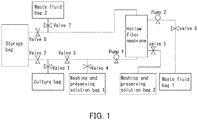
- FIG. 1 is a schematic diagram showing a concentration system in Example 1.
- the method for producing purified platelets of the present invention is characterized by including a concentrating step of concentrating a megakaryocyte culture, and a centrifuging step of centrifuging platelets from an obtained concentrate.
- the method for producing platelets of the present invention is characterized in that, in the centrifuging step, platelets are centrifuged from a concentrate obtained in the concentrating step, and there is no particular limitation on other configurations and conditions.
- the description of a later-described method for producing a platelet product and method for producing a blood product of the present invention is applicable to the method for producing platelets of the present invention.
- the megakaryocyte culture is concentrated before the platelets are separated. Therefore, according to the method for producing platelets of the present invention, it is possible to reduce the volume of a sample (e.g., a concentrate) subjected to the centrifuging step. Therefore, according to the method for producing platelets of the present invention, the time necessary to separate the platelets in the centrifuging step can be shortened, and the time that is taken to purify platelets from the megakaryocyte culture can be shortened, and thus it is possible to obtain platelets in a shorter period of time compared with the above-described method.
- a sample e.g., a concentrate
- the method for producing platelets of the present invention when separating platelets, it is not necessary to treat a large amount of megakaryocyte culture in separation through filtering, and thus, for example, damage to platelets that may occur when the flow rate is increased in the above-described method can be avoided. Therefore, according to the method for producing platelets of the present invention, damage to platelets is suppressed compared with the above-described method.
- a megakaryocyte is the largest cell in bone marrow in a living body, and means a cell that releases platelets or functions in an equivalent manner.
- the cell that functions in an equivalent manner means a cell that can produce platelets.
- a megakaryocyte may be a megakaryocyte before multinucleation (polyploidization), that is, an immature megakaryocyte or a megakaryocyte in the growth phase, or a megakaryocyte after multinucleation (multinucleated megakaryocyte).
- Specific examples of the megakaryocyte include a promegakaryoblast, a megakaryoblast, a promegakaryocyte, and a mature megakaryocyte. It is sufficient that the number of sets of chromosomes included in the megakaryocyte after multinucleation is more than two, and is specifically 16 to 32, for example.
- the source from which the megakaryocytes are derived includes human and non-human animals.
- the non-human animals include primates such as monkeys, gorillas, chimpanzees, and marmosets, mice, rats, dogs, cats, rabbits, sheep, horses, and guinea pigs.
- the megakaryocytes can be specified by a cell surface marker.
- the cell surface marker may be CD41a, CD42a, and CD42b. That is to say, the megakaryocytes are cells that are positive for CD41a, CD42a, and CD42b.
- the cell surface marker may be, for example, at least one selected from the group consisting of CD9, CD61, CD62p, CD42c, CD42d, CD49f, CD51, CD110, CD123, CD131, and CD203c.
- a "platelet” is one of the cell components in blood, and is a cell component that is positive for CD41a and CD42b.
- a platelet does not have, for example, a cell nucleus, and, furthermore, is smaller than a megakaryocyte. Therefore, a platelet and a megakaryocyte can be distinguished from each other, for example, according to whether or not there is a cell nucleus and/or the size. It is known that a platelet plays an important role in forming a blood clot and stopping bleeding, and relates to regeneration of damaged tissues and physiological processes of inflammation.
- Integrin ⁇ IIB ⁇ 3 glycoprotein IIb/IIIa; a complex of CD41a and CD61
- the source from which the platelets are derived is the same as the source from which the megakaryocytes are derived.
- phosphatidylserines which are negatively charged phospholipids, are exposed to the outside from the inside of the lipid bilayer. It is known that, in a living body, phosphatidylserines become exposed on the surface in accordance with activation of platelets, and many blood coagulation factors bind thereto, and thus the blood coagulation cascade is amplified. Meanwhile, in the abnormal platelets, many phosphatidylserines are always exposed on the surface, and thus, if abnormal platelets are administered to a patient, excessive blood coagulation occurs, which may result in a serious pathological condition such as disseminated intravascular coagulation.
- Annexin V binds to phosphatidylserines. Phosphatidylserines on the platelet surface can be detected, for example, using a flow cytometer using, as an indicator, the binding amount of fluorescence-labeled Annexin V. Therefore, damage to platelets can be evaluated as a change in the Annexin V positive rate in platelet fractions, that is, a change in the percentage or the number of platelets to which Annexin binds. Specifically, for example, if platelets are damaged during purification, the Annexin V positive rate in the platelets after the purification increases compared with the Annexin V positive rate before the purification.
- the bioactivity of platelets can be evaluated using a known method.
- the bioactivity of platelets can be evaluated as the amount of activated platelets, for example, using an antibody for PAC-1 that specifically binds to Integrin ⁇ IIB ⁇ 3 on membranes of activated platelets.
- the bioactivity of platelets may also be evaluated as the amount of activated platelets, for example, by detecting CD62p (P-selectin), which is a platelet activation marker, using an antibody.
- CD62p P-selectin
- the bioactivity of platelets may also be evaluated, for example, through flow cytometry, by performing gating using an antibody for an activation-independent platelet marker CD61 or CD41, and then detecting the binding of an anti-PAC-1 antibody or an anti-CD62p antibody.
- the bioactivity of platelets may also be evaluated in the presence of adenosine diphosphate (ADP).
- ADP adenosine diphosphate
- the bioactivity of platelets may be evaluated, for example, based on whether or not the platelets bind to fibrinogen in the presence of ADP.
- integrin that is necessary in the early stage of formation of a blood clot is activated.
- the bioactivity of platelets may be observed, for example, by visualizing formation of a blood clot in vivo as shown in FIG. 6 of WO 2011/034073 .
- the platelets can be evaluated as having deteriorated or being abnormal (hereinafter, these states may be collectively referred to as "deterioration"), that is, a bioactivity of the platelets can be evaluated as being low.
- deterioration a bioactivity of the platelets can be evaluated as being low.
- Platelets that have deteriorated do not have, for example, a sufficient function of forming a blood clot (blood coagulating function) or stopping bleeding, and thus the clinical usefulness thereof is low.
- the "deterioration of platelets” means a decrease in CD42b (GPIb ⁇ ) on the platelet surface. Therefore, platelets that have deteriorated include, for example, platelets in which the CD42b expression has been lowered, and platelets in which the extracellular region of CD42b has been cleaved through a shedding reaction.
- VWF von Willebrand factor
- the deterioration of platelets can be evaluated using, as an indicator, the CD42b negative rate (or the number of CD42b negative particles) with respect to the CD42b positive rate (or the number of CD42b positive particles) in platelet fractions.
- the CD42b negative rate with respect to the CD42b positive rate or the larger the number of CD42b negative particles with respect to the number of CD42b positive particles is, the more the platelets are evaluated as having deteriorated.
- the CD42b positive rate means the percentage of platelets to which an anti-CD42b antibody can bind, with respect to the platelets contained in the platelet fractions
- the CD42b negative rate means the percentage of platelets to which an anti-CD42b antibody cannot bind, with respect to the platelets contained in the platelet fractions.
- the megakaryocyte culture can be produced, for example, by culturing megakaryocytes. Therefore, the method for producing platelets of the present invention may include, for example, before the concentrating step, a producing step of producing a megakaryocyte culture.
- the producing step can be performed, for example, by culturing the megakaryocytes in the presence of a medium.
- the megakaryocytes may be cultured, for example, on feeder cells, or without feeder cells.
- the megakaryocytes can be cultured, for example, through float culturing, and thus they can be cultured without feeder cells.
- the megakaryocyte culture includes platelets described above.
- the culturing conditions of the megakaryocytes there is no particular limitation on the culturing conditions of the megakaryocytes, and ordinary culturing conditions of the megakaryocytes may be adopted.
- the culturing temperature is, for example, about 35 to about 42°C, about 36 to about 40°C, or about 37 to about 39°C.
- the CO 2 concentration is, for example, about 5 to about 15%.
- the O 2 concentration is, for example, about 15 to about 25%, or about 20%.
- the medium can be prepared, for example, using, as a basal medium, a medium that is used to culture animal cells.
- the basal medium include single media such as an IMDM medium, a Medium 199 medium, an Eagle's Minimum Essential Medium (EMEM) medium, an ⁇ MEM medium, a Dulbecco's modified Eagle's Medium (DMEM), a Ham's F12 medium, a RPMI1640 medium, a Fischer's medium, and a Neurobasal (registered trademark) Medium (manufactured by Thermo Fisher Scientific), and mixed media thereof.
- IMDM medium a Medium 199 medium
- EMEM Eagle's Minimum Essential Medium
- DMEM Dulbecco's modified Eagle's Medium
- Ham's F12 medium a RPMI1640 medium
- Fischer's medium a Fischer's medium
- Neurobasal (registered trademark) Medium manufactured by Thermo Fisher Scientific
- the medium may contain, for example, serum or plasma, or may be a non-serum medium without containing them.
- the source from which the serum and plasma are derived is preferably the same as the source from which the megakaryocytes are derived. Specifically, for example, if the megakaryocytes are human derived, both the serum and the plasma are preferably human derived.
- the medium may contain, for example, other components.
- other components There is no particular limitation on the other components, and examples thereof include albumin, insulin, transferrin, selenium, fatty acid, microelements, 2-mercaptoethanol, thiolglycerol, monothioglycerol (MTG), lipid, amino acid (e.g., L-glutamine), ascorbic acid, heparin, non-essential amino acid, vitamins, growth factor, low molecular weight compound, antibiotic, antioxidant, pyruvic acid, buffer, inorganic salts, cytokine, and the like.
- These other components may be contained, for example, alone or in combination of two or more.
- the cytokine is, for example, a substance that facilitates differentiation of blood cells, and specific examples thereof include a vascular endothelial growth factor (VEGF), thrombopoietin (TPO), various TPO-like agonists, a stem cell factor (SCF), an ITS (insulin-transferrin-selenite) supplement, an ADAM inhibitor, an FLT inhibitor, a WNT inhibitor, a ROCK inhibitor, an aryl hydrocarbon receptor (AhR) inhibitor, and the like.
- VEGF vascular endothelial growth factor
- TPO thrombopoietin
- SCF stem cell factor
- ITS insulin-transferrin-selenite
- ADAM inhibitor an FLT inhibitor
- WNT inhibitor a WNT inhibitor
- ROCK inhibitor aryl hydrocarbon receptor
- AhR aryl hydrocarbon receptor
- the medium is, for example, an IMDM medium containing serum, insulin, transferrin, serine, thiolglycerol
- the medium may further contain SCF, and may further contain heparin.
- concentrations of the other components There is no particular limitation on the concentrations of the other components.
- the concentration of the TPO is, for example, about 10 ng/mL to about 200 ng/mL, or about 50 ng/mL to about 100 ng/mL.
- concentration of the SCF is, for example, about 10 ng/mL to about 200 ng/mL, or about 50 ng/mL.
- the concentration of the heparin is, for example, about 10 U/mL to about 100 U/mL, or about 25 U/mL.
- the medium may further contain, for example, a phorbol ester (e.g., phorbol-12-myristate-13-acetate; PMA).
- the megakaryocytes can be induced from, for example, cells that are more undifferentiated than megakaryocytes. Therefore, the method for producing platelets of the present invention may include, for example, before the production of a megakaryocyte culture, a megakaryocyte inducing step of inducing megakaryocytes from cells that are more undifferentiated than the megakaryocytes.
- the "cells that are more undifferentiated than megakaryocytes” means cells having a potential to be differentiated into megakaryocytes.
- the cells that are more undifferentiated than megakaryocytes are, for example, hematopoietic stem cells, hematopoietic progenitors, CD34 positive cells, megakaryocyte-erythroid progenitors (MEP), megakaryocyte progenitors, and the like.
- the cells that are more undifferentiated than megakaryocytes may be isolated from, for example, bone marrow, cord blood, peripheral blood, or the like, or may be isolated from pluripotent cells such as embryonic stem cells (ES cell), induced pluripotent stem cells (iPS cells), nuclear transfer ES cells (ntES cells), germinal stem cells, somatic stem cells, embryonal carcinoma cells, or the like.
- pluripotent cells such as embryonic stem cells (ES cell), induced pluripotent stem cells (iPS cells), nuclear transfer ES cells (ntES cells), germinal stem cells, somatic stem cells, embryonal carcinoma cells, or the like.
- the method for inducing megakaryocytes there is no particular limitation on the method for inducing megakaryocytes, and known inducing methods may be used.
- the method for inducing megakaryocytes may be, for example, the methods described in WO 2011/034073 , WO 2012/157586 , or the like.
- an oncogene and a polycomb gene may be forcibly expressed in the cells that are more undifferentiated than megakaryocytes. Accordingly, in the megakaryocyte inducing step, for example, immortalized megakaryocytes that infinitely proliferate can be obtained.
- the immortalized megakaryocytes can be induced to multinucleated megakaryocytes, and platelets can be produced.
- an apoptosis suppressor may be forcibly expressed in the megakaryocyte progenitors. Accordingly, in the megakaryocyte inducing step, the immortalized megakaryocytes can be obtained.
- multinucleated megakaryocytes can be induced from the immortalized megakaryocytes, and platelets can be produced.
- the oncogene, the polycomb gene, and the apoptosis suppressor may be forcibly expressed.
- the oncogene, the polycomb gene, and the apoptosis suppressor may be forcibly expressed simultaneously or at different times.
- a procedure may be employed in which, after the oncogene and the polycomb gene are forcibly expressed, the forced expression is canceled, and then the apoptosis suppressor is forcibly expressed, in which the oncogene, the polycomb gene, and the apoptosis suppressor are forcibly expressed, or in which the oncogene and the polycomb gene are forcibly expressed, and the apoptosis suppressor is expressed.
- the immortalized megakaryocytes can be obtained.
- multinucleated megakaryocytes can be induced from the immortalized megakaryocytes, and platelets can be produced.
- the megakaryocyte inducing step preferably includes a first expressing step of forcibly expressing an oncogene and a polycomb gene in the cells that are more undifferentiated than megakaryocytes, a second expressing step of forcibly expressing an apoptosis suppressor such as a Bcl-xL gene in the undifferentiated cells, and a canceling step of canceling all the forced expressions.
- the genes can be forcibly expressed and the forced expression can be canceled, for example, using known methods such as the methods described in WO 2011/034073 , WO 2012/157586 , WO 2014/123242 , or Reference Document 1 below, or equivalent methods.
- the genes can be forcibly expressed and the forced expression can be canceled, for example, using a drug-responsive gene expression inducing system.
- the gene expression inducing system include a Tet-on (registered trademark) system, a Tet-off (registered trademark) system, and the like.
- Tet-on system for example, in the forcibly expressing step, culturing is performed in the presence of a drug that induces gene expression, such as tetracycline or doxycycline, and, in the step of canceling the forced expressions, the culturing is performed in the absence of the drug.
- a drug that induces gene expression such as tetracycline or doxycycline
- Reference Document 1 Nakamura S et al, "Expandable megakaryocyte cell lines enable clinically applicable generation of platelets from human induced pluripotent stem cells.”, Cell Stem Cell, 2014, vol. 14, No.4, pages 535-548
- the "oncogene” means a gene that can induce carcinogenesis of cells in a living body, and examples thereof include MYC family genes such as c-MYC, N-MYC, and L-MYC, SRC family genes, RAS family genes, RAF family genes, protein kinase family genes such as c-kit (CD117), PDGFR (platelet growth factor receptor), and Abl (Abelson murine leukemia viral oncogene homolog), and the like.
- MYC family genes such as c-MYC, N-MYC, and L-MYC
- SRC family genes RAS family genes
- RAF family genes protein kinase family genes
- protein kinase family genes such as c-kit (CD117), PDGFR (platelet growth factor receptor), and Abl (Abelson murine leukemia viral oncogene homolog), and the like.
- the "polycomb gene” means a gene that is known to function to negatively control CDKN2a (cyclin-dependent kinase inhibitor 2A, INK4a/ARF), thereby avoiding cellular aging (Reference Documents 2 to 4 below).
- polycomb gene examples include BMI1 (Polycomb complex protein BMI-1, polycomb group RING finger protein 4 (PCGF4), RING finger protein 51 (RNF51)), Mel18 (Polycomb group RING finger protein 2), Ring (Ring Finger Protein) 1a/b, Phc (Polyhomeotic Homolog) 1/2/3, Cbx (Chromobox) 2/4/6/7/8, Ezh2 (Enhancer Of Zeste 2 Polycomb Repressive Complex 2 Subunit), Eed (Embryonic Ectoderm Development), Suz12 (SUZ12 Polycomb Repressive Complex 2 Subunit), HADC (Histone deacetylases), Dnmt (DNA (cytosine-5)-methyltransferase)1/3a/3b, and the like.
- BMI1 Polycomb complex protein BMI-1, polycomb group RING finger protein 4 (PCGF4), RING finger protein 51 (RNF51)
- Mel18 Polycomb group RING finger protein 2
- Ring Ring
- Phc Polyhomeotic Homolog
- the "apoptosis suppressor” means a gene having a function that can suppress cellular apoptosis, and examples thereof include BCL2 (B-cell lymphoma 2), Bcl-xL (B-cell lymphoma-extra large), Survivin (Baculoviral IAP Repeat Containing 5), MCL1 (BCL2 Family Apoptosis Regulator), and the like.
- the concentrating step is a step of concentrating the megakaryocyte culture.
- the megakaryocyte culture contains platelets.
- the megakaryocyte culture is a mixed fluid containing solid fractions such as the megakaryocytes and the platelets, and liquid fractions such as the medium. Therefore, in the concentrating step, for example, solid fractions in the megakaryocyte culture, specifically, platelets are concentrated. Accordingly, in the concentrating step, for example, a concentrate containing the platelets can be obtained.
- the method for concentrating the megakaryocyte culture and, for example, known methods that can concentrate platelets may be used.
- the concentrating step can be performed, for example, using known solid-liquid separating methods.
- this step can be performed, for example, using a concentrating member, or through centrifuge or the like.
- the concentrating member may be a hollow fiber membrane, a porous structure, or the like.
- the pore size of the concentrating member is, for example, a pore size that makes it possible to capture platelets.
- the hollow fiber membrane may be, for example, a hollow fiber membrane made of polyethylene or the like, and, specifically, for example, it may be a Plasmaflo OP (Asahi Kasei Medical Co., Ltd.) or the like.
- the megakaryocyte culture is concentrated using the hollow fiber membrane, the megakaryocyte culture is preferably concentrated through cross-flow treatment.
- the concentrating step can be performed, for example, using a concentrating device including a culture vessel containing a megakaryocyte culture, the concentrating member, an inlet pipe, and an outlet pipe, wherein the culture vessel and a fluid inlet portion of the concentrating member are connected to the inlet pipe, and the culture vessel and a fluid outlet portion of the concentrating member are connected to the outlet pipe.
- a concentrating device including a culture vessel containing a megakaryocyte culture, the concentrating member, an inlet pipe, and an outlet pipe, wherein the culture vessel and a fluid inlet portion of the concentrating member are connected to the inlet pipe, and the culture vessel and a fluid outlet portion of the concentrating member are connected to the outlet pipe.
- a hollow fiber membrane is used as the concentrating member
- the fluid inlet portion can, for example, introduce the megakaryocyte culture into the hollow fiber membrane
- the fluid outlet portion can, for example, deliver a concentrate inside the hollow fiber membrane to the outlet pipe.
- a megakaryocyte culture in the culture vessel is introduced via the inlet pipe and the fluid inlet portion of the concentrating member to the concentrating member, so that the megakaryocyte culture is concentrated, and the obtained concentrate is delivered via the fluid outlet portion of the concentrating member and the outlet pipe to the culture vessel, so that a concentrate of the megakaryocyte culture can be obtained.
- the megakaryocyte culture can be introduced and delivered, for example, using a fluid sending unit such as a pump.
- the megakaryocyte culture may be introduced and delivered to the concentrating member once or a plurality of times.
- the concentrating step can be said to be, for example, a step of circulating the megakaryocyte culture in the concentrating device.
- the concentrating device further includes a fluid discharge vessel and a fluid discharge pipe, wherein the fluid discharge vessel and a fluid discharge portion of the concentrating member are connected to each other via the above-described fluid discharge pipe.
- the fluid discharge portion can, for example, deliver a waste fluid outside the hollow fiber membrane to the fluid discharge pipe.
- the waste fluid is delivered to the fluid discharge vessel in parallel with the concentration of the megakaryocyte culture.
- the concentration factor of the megakaryocyte culture in the concentrating step there is no particular limitation on the concentration factor of the megakaryocyte culture in the concentrating step, and, for example, it is 5 to 20 times, or 10 to 20 times.
- the concentration factor can be calculated using Equation (1) below. As described later, if separated components after the separating step are concentrated, the concentration factor of the megakaryocyte culture in the concentrating step is, for example, 5 to 20 times, or 10 to 20 times.
- M c V b / V a
- the centrifuging step is a step of centrifuging platelets from the obtained concentrate.
- the centrifuging step may include, for example, a step of centrifuging the concentrate a plurality of times at different centrifugal forces.
- the centrifuging step includes, for example, a first centrifuging step of separating megakaryocytes and platelets in the megakaryocyte culture through centrifugation, and a second centrifuging step of purifying the platelets through centrifugation from fractions containing the platelets after the first centrifuging step.
- the centrifuging step preferably includes a first centrifuging step of performing separation at a centrifugal force of about 150 to about 550 ⁇ g(g: acceleration of gravity), and a second centrifuging step of separating liquid components collected in the first centrifuging step, at a centrifugal force of about 600 to about 4000 ⁇ g.
- the centrifuging step can be performed, for example, using a known centrifugal separator. Therefore, the centrifugal force in the first and second centrifuging steps can be calculated using Equation (2) below, based on the number of rotations and the rotational radius of a rotor of a centrifugal separator that performs centrifugation.
- Equation (2) Equation (2) below, based on the number of rotations and the rotational radius of a rotor of a centrifugal separator that performs centrifugation.
- the centrifugal force in the first centrifuging step is about 150 to about 550 ⁇ g, and, from the viewpoint of suppressing shear stress on platelets due to deposition of solid fractions such as the megakaryocytes and the platelets, and more reliably suppressing expression of bioactivity of platelets due to shear stress, it is preferably about 160 to about 500 ⁇ g, and more preferably about 170 to about 400 ⁇ g.
- a platelet preserving solution may be added to the megakaryocyte culture.
- the platelet preserving solution examples include a blood preserving solution A as defined by Minimum Requirements for Biological Products (Acid-Citrate-Dextrose; ACD-A), a Bicanate injection containing human serum albumin and an ACD-A solution, and the like.
- ACD-A Blood-Citrate-Dextrose
- the ACD-A solution has, for example, a blood/platelet anticoagulant action, and functions also as a glucose supply source that is an energy source of platelets.
- the centrifugal force in the second centrifuging step is about 600 to about 4000 ⁇ g, and, from the viewpoint of suppressing deactivation of platelets, it is preferably about 800 to about 3000 ⁇ g, and more preferably about 1000 to about 2000 ⁇ g.
- the centrifuging step can be performed, for example, using a known centrifugal separator.
- a known centrifugal separator There is no particular limitation on the type of rotor used in the centrifugal separator, and the rotor may be, for example, an angle rotor, a swing rotor, a batch rotor, a continuous rotor, an elutriator rotor, or the like.
- the centrifugal separator is preferably a centrifugal separator including: a rotatable separator bowl having an inner wall to which a component with a large specific gravity in the concentrate or the collected liquid components (hereinafter, alternatively referred to as a "concentrate, etc.") is attached according to a centrifugal force, and an outlet port through which liquid components after separation of the concentrate, etc. flow out according to the centrifugal force; and a collecting unit for collecting the liquid components that have flowed out from the outlet port.
- a centrifugal separator including: a rotatable separator bowl having an inner wall to which a component with a large specific gravity in the concentrate or the collected liquid components (hereinafter, alternatively referred to as a "concentrate, etc.”) is attached according to a centrifugal force, and an outlet port through which liquid components after separation of the concentrate, etc. flow out according to the centrifugal force; and a collecting unit for collecting the liquid components that have flowed out from the outlet
- the inner wall is arranged closer to the outer side than the outlet port is.
- the inner wall may be an inner wall of the storage vessel.
- the separator bowl has such a storage vessel, when an axis that is perpendicular to the bottom face is taken as the center, the concentrate, etc. is preferably introduced from the outer side to the storage vessel. That is to say, the inlet port of the concentrate, etc. is preferably connected on the outer side of the storage vessel.
- centrifugal separator examples include the apparatuses described in JP 2005-296675A and JP H7-284529A . Furthermore, as the centrifugal separator, for example, it is possible to use a commercially available centrifugal separator that is used to separate blood components, a commercially available apparatus that is used to wash platelets of a platelet concentrate product, and the like. Examples of the commercially available apparatuses include an ACP215 manufactured by Haemonetics, COBE2991 manufactured by Terumo Corporation, and the like.
- centrifugal separator including the separator bowl for example, when the concentrate, etc. is introduced while the separator bowl is being rotated about an axis that passes through the center of the bottom face and is perpendicular to the bottom face, according to the centrifugal force, a component with a large specific gravity is attached to and deposited on the inner wall of the separator bowl, and a component with a small specific gravity remains in the fluid. Therefore, if centrifugation is performed using the centrifugal separator including the separator bowl, by introducing the concentrate, etc.
- the separator bowl at a predetermined speed, and, at the same time, the separated liquid components are collected by the collecting unit, for example, regardless of the capacity of the separator bowl, a large amount of concentrate or collected liquid components can be continuously separated.
- the component with a large specific gravity is, for example, megakaryocytes
- the component with a small specific gravity is, for example, platelets.
- the component with a large specific gravity is, for example, platelets
- the component with a small specific gravity is, for example, other components such as proteins.
- the liquid components containing the component with a small specific gravity and the component with a large specific gravity can be collected by, for example, the collecting unit.
- the collecting unit includes, for example, a tubular member such as a tube connected to the outlet port of the separator bowl, and a collecting bag replaceably connected to the tubular member.
- the collecting bag There is no limitation on the collecting bag, as long as, for example, the quality of platelets is not affected, and it is possible to use, for example, commercially available blood preservation bag, blood component preservation bag, or the like.
- the first centrifuging step can be performed, for example, by rotating the separator bowl at the above-described centrifugal force.
- the first centrifuging step is performed, for example, by introducing the concentrate to the separator bowl while rotating the separator bowl at the above-described centrifugal force.
- the megakaryocytes and the platelets can be separated from each other.
- the megakaryocytes are attached to the inner wall of the separator bowl, and the platelets remain in the liquid components after separation.
- liquid components containing platelets can be collected. Then, the liquid components containing platelets are subjected to the second centrifuging step, for example, as liquid components collected in the first centrifuging step.
- the method for the megakaryocyte culture to the separator bowl there is no particular limitation on the method for the megakaryocyte culture to the separator bowl, and, for example, it is possible to use a fluid sending unit such as a pump included in the centrifugal separator, or to connect a container containing the megakaryocyte culture and the separator bowl via a tube, suspend the container at a high position, and allow the megakaryocyte culture to naturally fall via the tube into the separator bowl.
- the introduction speed of the megakaryocyte culture there is no particular limitation on the introduction speed of the megakaryocyte culture, and, for example, it is about 50 to about 150 mL/min, about 80 to about 130 mL/min, or about 100 mL/min.
- the temperature at which the first centrifuging step is performed is room temperature (e.g., around 25°C).
- the centrifugation time in the first centrifuging step is a period of time that is greater than or equal to the time obtained by dividing the volume of the megakaryocyte culture by the introduction speed of the megakaryocyte culture.
- the separator bowl may be replaced or washed.
- the second centrifuging step is performed.
- the second centrifuging step can be performed, for example, by rotating the separator bowl at the above-described centrifugal force.
- the second centrifuging step is performed, for example, by introducing the liquid components collected in the first separating step to the separator bowl while rotating the separator bowl at the above-described centrifugal force. Accordingly, the platelets can be separated from the collected liquid components.
- the method for introducing the collected liquid components to the separator bowl there is no particular limitation on the method for introducing the collected liquid components to the separator bowl, and, for example, it may be performed in a similar way to that of the first centrifuging step, or to suspend a collecting bag containing the collected liquid components obtained in the first centrifuging step at a high position, and introduce the liquid components to the separator bowl by allowing them to naturally fall via a tubular member.
- the introduction speed of the collected liquid components and, for example, the description of the introduction speed of the megakaryocyte culture is applicable thereto.
- the temperature at which the second centrifuging step is performed and, for example, it is room temperature (e.g., around 25°C).
- the centrifugation time in the second centrifuging step is a period of time that is greater than or equal to the time obtained by dividing the volume of the collected liquid components by the introduction speed of the collected liquid components.
- the method for producing platelets of the present invention may further include a collecting step of collecting platelets after centrifugation.
- the collecting method There is no particular limitation on the collecting method, and the method can be performed by collected liquid fractions (liquid components) or solid fractions (solid components) containing platelets according to the centrifuging conditions in the centrifuging step.
- the platelets are attached to the inner wall of the separator bowl, and the other components remain in the liquid components after separation. Therefore, in the collecting step, for example, first, the liquid components in the separator bowl are collected using the collecting unit. Next, in the collecting step, for example, the separator bowl is swung. Accordingly, the platelets are shaken off the separator bowl, and, for example, are suspended in liquid components such as a washing and preserving solution (e.g., remaining washing and preserving solution) that is present in the separator bowl.
- a washing and preserving solution e.g., remaining washing and preserving solution
- the platelets are collected by applying pressure from the outlet port of the separator bowl, and delivering the washing and preserving solution from the inlet port of the separator bowl.
- the platelets are collected by introducing a gas such as air from the outlet port of the separator bowl. More specifically, a gas such as air is introduced from the outlet port of the separator bowl, and liquid components such as the washing and preserving solution containing the platelets are collected from the inlet port of the separator bowl.
- the washing and preserving solution that is present after collecting the liquid components in the separator bowl may be, for example, a washing and preserving solution remaining in the separator bowl after collecting the liquid components, a washing and preserving solution introduced after collecting the liquid components, or a mixed fluid thereof.
- the separator bowl has an inlet port for the washing and preserving solution
- the platelets may be collected, for example, from the inlet port for the washing and preserving solution.
- the washing and preserving solution include a bicarbonate Ringer's solution such as a Bicarbon infusion.
- the washing and preserving solution may further contain a platelet preserving solution (ACD), albumin, and the like, and, specifically, for example, it may contain 5 to 20 (v/v)% of ACD and 2.5 to 10 (w/v)% of albumin.
- ACD platelet preserving solution
- albumin and the like, and, specifically, for example, it may contain 5 to 20 (v/v)% of ACD and 2.5 to 10 (w/v)% of albumin.
- the washing and preserving solution is preferably a later-described preserving solution of the present invention.
- the method for producing platelets of the present invention may include, for example, after the second centrifuging step, a washing step of performing washing by adding a washing and preserving solution to the separator bowl and rotating the separator bowl.
- the method for producing platelets of the present invention may further include, after the washing step, a platelet collecting step of collecting platelets by adding a collected fluid to the separator bowl and rotating the separator bowl. Since the method for producing platelets of the present invention includes the washing step, for example, components such as the medium attached and deposited together with the platelets in the second centrifuging step can be removed.
- the method for producing platelets of the present invention includes the washing step, for example, when performed in combination with a later-described platelet separating step, clogging of the separating member can be suppressed, and purified platelets can be produced in a shorter period of time.
- a washing and preserving solution is introduced to the separator bowl, and the separator bowl is rotated at a centrifugal force of about 600 to 3600 ⁇ g. Accordingly, for example, the platelets are attached to the inner wall of the separator bowl, and the components such as a medium remain in the liquid components after washing.
- the method for introducing the washing and preserving solution and, for example, it may be performed in a similar way to that of the first and second centrifuging steps.
- the introduction speed of the washing and preserving solution and, for example, it is introduced at constant speed.
- the washing and preserving solution include a bicarbonate Ringer's solution such as a Bicarbon infusion.
- the washing and preserving solution may further contain a platelet preserving solution (ACD-A), albumin, and the like, and, specifically, for example, it may contain 5 to 20 (v/v)% of ACD and 2.5 to 10 (w/v)% albumin.
- ACD-A platelet preserving solution
- albumin and the like, and, specifically, for example, it may contain 5 to 20 (v/v)% of ACD and 2.5 to 10 (w/v)% albumin.
- the platelet collecting step may be performed, for example, in a similar way to that of the collecting step.
- the method for producing platelets of the present invention may include, for example, before the washing step, a separated component collecting step of collecting separated components in the separator bowl after the second centrifuging step.
- the method for producing platelets of the present invention includes, for example, a separated component concentrating step of concentrating the separated components.
- the method for producing platelets of the present invention includes the separated component collecting step, it is preferable that, in the washing step, for example, washing is performed by adding concentrated separated components and a washing and preserving solution to the separator bowl and rotating the separator bowl.
- the separated components are components attached to the inner wall of the separator bowl, and specific examples thereof include platelets.
- the separated component collecting step may be performed, for example, in a similar way to that of the collecting step.
- the separated component concentrating step may be performed, for example, in a similar way to that of the concentrating step, except that collected separated components are used instead of the megakaryocyte culture.
- the separated component concentrating step is preferably performed using the above-described concentrating member.
- concentration factor of the collected separated components in the separated component concentrating step there is no particular limitation on the concentration factor of the collected separated components in the separated component concentrating step, and it is, for example, 5 to 20 times, or 10 to 20 times.
- the concentration factor can be calculated using Equation (1) above, while replacing "megakaryocyte culture" with "collected separated components".
- the method for producing platelets of the present invention includes, for example, a platelet separating step of separating the platelets collected in the collecting step or the platelet collecting step described above, by causing the platelets to pass through a separating member.
- the platelets collected in the collecting step or the platelet collecting step may contain, for example, other blood cells such as megakaryocytes as well as the platelets. Therefore, since the method for producing platelets of the present invention includes the platelet separating step, for example, more reliably purified platelets can be obtained. Furthermore, according to the method for producing platelets of the present invention, for example, the amount of sample subjected to the separating member is made smaller compared with the above-described method.
- a separating member with a smaller size may be used compared with the separating member used in the above-described method.
- the separating member includes known separating members that can separate the platelets and other blood cells, such as a separating membrane made of a nonwoven fabric, a mesh material, or the like, a hollow fiber membrane, and a porous structure.
- the pore size of the separating member is, for example, a pore size that makes it possible to allow the platelets to pass through the separating member.
- the above-described description is applicable to the hollow fiber membrane.
- the method for introducing collected platelets to the separating member in the platelet separating step there is no particular limitation on the method for introducing collected platelets to the separating member in the platelet separating step, and, for example, they may be introduced using a fluid sending unit such as a pump or by allowing them to naturally fall, but the latter method is preferable because, when the separating member is clogged, an increase in the pressure to platelets is suppressed and damage to the platelets can be suppressed compared with the fluid sending method using the fluid sending unit.
- separated platelets may be collected after the platelet separating step.
- impurities in the separated platelets may be removed using a filter. In this manner, according to the method for producing platelets of the present invention, purified platelets can be produced.
- the platelets of the present invention are characterized by being obtained using the method for producing purified platelets of the present invention.
- the platelets of the present invention are characterized by being obtained using the method for producing platelets of the present invention, and there is no particular limitation on the other steps and conditions.
- the description of the method for producing platelets of the present invention is applicable to the platelets of the present invention.
- the platelets of the present invention may contain albumin.
- the platelets of the present invention include platelets and albumin.
- the description of albumin in a later-described preserving solution of the present invention is applicable to the albumin.
- the method for producing a platelet product of the present invention is characterized by including a product producing step of producing a platelet product from purified platelets, wherein the purified platelets are obtained using the method for producing purified platelets of the present invention.
- the method for producing a platelet product of the present invention is characterized in that the purified platelets are obtained using the method for producing platelets of the present invention, and there is no particular limitation on the other steps and conditions.
- the description of the method for producing platelets of the present invention is applicable to the method for producing a platelet product of the present invention.
- other components may be added.
- the other components include stabilizers of cells such as platelets, and the like.
- the method for producing a platelet product of the present invention may include, before the product producing step, a purified platelet producing step of producing purified platelets, using the method for producing platelets of the present invention.
- a purified platelet producing step of producing purified platelets using the method for producing platelets of the present invention.
- the description of the method for producing platelets of the present invention is applicable to the purified platelet producing step.
- the platelet product of the present invention is characterized by being obtained using the method for producing a platelet product of the present invention.
- the platelet product of the present invention is characterized by being obtained using the method for producing a platelet product of the present invention, and there is no particular limitation on the other steps and conditions.
- the description of the method for producing purified platelets of the present invention and the method for producing a platelet product is applicable to the platelet product of the present invention.
- the platelet product of the present invention may contain albumin.
- the platelet product of the present invention contains platelets and albumin.
- the description of albumin in a later-described preserving solution of the present invention is applicable to the albumin.
- the method for producing a blood product of the present invention is characterized by including a blood product producing step of producing a blood product by mixing purified platelets and other components, wherein the purified platelets are obtained using the method for producing purified platelets of the present invention.
- the method for producing a blood product of the present invention is characterized in that the purified platelets are obtained using the method for producing platelets of the present invention, and there is no particular limitation on the other steps and conditions.
- the description of the method for producing platelets of the present invention is applicable to the method for producing a blood product of the present invention.
- the other components include stabilizers of other blood cells such as red blood cells, cells such as platelets, and the like.
- the method for producing a blood product of the present invention may include, before the blood product producing step, a purified platelet producing step of producing purified platelets, using the method for producing platelets of the present invention.
- a purified platelet producing step of producing purified platelets using the method for producing platelets of the present invention.
- the description of the method for producing platelets of the present invention is applicable to the purified platelet producing step.
- the blood product of the present invention is characterized by being obtained using the method for producing a blood product of the present invention.
- the blood product of the present invention is characterized by being obtained using the method for producing a blood product of the present invention, and there is no particular limitation on the other steps and conditions.
- the description of the method for producing purified platelets of the present invention and the method for producing a blood product is applicable to the blood product of the present invention.
- the platelet preserving solution of the present invention is characterized by containing albumin.
- the preserving solution of the present invention is characterized by containing albumin, and there is no particular limitation on other configurations and conditions.
- the description of the method for producing purified platelets of the present invention, and a later-described preserving agent and preserving method of the present invention is applicable to the platelet preserving solution of the present invention.
- the present inventors conducted an in-depth study and found that, when platelets are preserved in the presence of albumin, a deterioration in platelets can be suppressed compared with the case in which platelets are preserved in the absence of albumin, and thus the present invention was achieved. Therefore, according to the present invention, platelets can be preferably preserved. Furthermore, the present inventors found that, when platelets are centrifuged in the presence of albumin, a deterioration in platelets can be suppressed compared with the case in which platelets are centrifuged in the absence of albumin.
- the preserving solution of the present invention a deterioration in platelets during centrifugation of the platelets can be suppressed, and it can be preferably used, for example, as a centrifugation solution for platelets, or a washing and preserving solution in the above-described method for producing purified platelets of the present invention.
- the albumin examples include serum albumin, lactalbumin, and the like, and it is preferable to use serum albumin.
- the source from which the albumin is derived is preferably the same as the source from which the platelets are derived.
- the albumin is preferably human albumin, and more preferably human serum albumin.
- the human serum albumin may be a protein constituted by an amino acid sequence registered with the NCBI Accession number NP_000468.
- the albumin may be, for example, purified from a biological sample such as blood, body fluids, or the like, or a recombinant protein.
- the albumin may be a commercially available product, or may be prepared in a laboratory.
- the lower limit of the concentration of the albumin is more than 0 w/v% (weight/volume%).
- the concentration of the albumin is more than 0 w/v% (weight/volume%).
- it is preferably 1.25 w/v% or more, and, from the viewpoint of even more reliably suppressing a deterioration in platelets, it is more preferably 2.5 w/v% or more, and even more preferably 5 w/v% or more.
- the upper limit of the concentration of the albumin is 25 w/v% or less, or 20% or less.
- the handleability during usage it is preferably 15 w/v% or less, and, from the viewpoint of improving the handleability during administration, it is more preferably 10 w/v% or less.
- the range of the concentration of the albumin is, for example, more than 0 w/v% and 25 w/v% or less.
- it is preferably 1.25 to 15 w/v%, more preferably 2.5 to 10 w/v%, and even more preferably 5 to 10 w/v%.
- the preserving solution of the present invention preferably contains a sugar, and examples of the sugar include dextrose (glucose).
- the lower limit of the concentration of the sugar is, for example, 0.05 w/v%, or 0.1 w/v% or more, and preferably 0.104 w/v% or more.
- the upper limit of the concentration of the sugar is 0.2 w/v%, or 0.4 w/v% or less, and preferably 0.367 w/v% or less.
- the range of the concentration of the sugar is, for example, 0.05 to 0.8 w/v%, preferably 0.1 to 0.4 w/v%, and more preferably 0.104 to 0.367 w/v%.
- the preserving solution of the present invention preferably contains, for example, an electrolyte.
- the electrolyte include sodium chloride, potassium chloride, calcium chloride, magnesium chloride, sodium hydrogen carbonate, sodium citrate, citric acid, and the like.
- the preserving solution of the present invention preferably contains sodium citrate, or citric acid.
- the preserving solution of the present invention may contain, for example, one electrolyte, or two or more electrolytes.
- the concentration of the electrolyte there is no particular limitation on the concentration of the electrolyte, and it may be set as appropriate according to the type of electrolyte.
- the range of the concentration of the sodium chloride is, for example, 0.3 to 1.5 w/v%, 0.3 to 0.8 w/v%, or 0.4 to 0.6 w/v%, and preferably 0.48 to 0.56 w/v%, or 0.486 to 0.557 w/v%.
- the range of the concentration of the potassium chloride is, for example, 0.01 to 0.04 w/v%, or 0.02 to 0.03 w/v%, and preferably 0.025 to 0.028 w/v%, or 0.025 to 0.0286 w/v%.
- the range of the concentration of the calcium chloride dihydrate is, for example, 0.01 to 0.04 w/v%, or 0.015 to 0.03 w/v%, and preferably 0.018 to 0.025 w/v%, or 0.0183 to 0.021 w/v%.
- concentration thereof is preferably set to be equivalent to the above-described concentration of the calcium chloride dihydrate in the preserving solution.
- the range of the concentration of the magnesium chloride is, for example, 0.01 to 0.03 w/v%, or 0.015 to 0.02 w/v%, and preferably 0.016 to 0.019 w/v%, or 0.0167 to 0.019 w/v%.
- the range of the concentration of the sodium hydrogen carbonate is, for example, 0.1 to 0.3 w/v%, or 0.15 to 0.25 w/v%, and preferably 0.19 to 0.23 w/v%, or 0.195 to 0.224 w/v%.
- the range of the concentration of the sodium citrate dihydrate is, for example, 0.05 to 0.5 w/v%, or 0.1 to 0.4 w/v%, and preferably 0.12 to 0.39 w/v%, or 0.123 to 0.384 w/v%.
- concentration thereof is preferably set to be equivalent to the above-described concentration of the sodium citrate dihydrate in the preserving solution.
- the range of the concentration of the citric acid monohydrate is, for example, 0.01 to 0.15 w/v%, or 0.03 to 0.14 w/v%, and preferably 0.035 to 0.135 w/v%, or 0.038 to 0.134 w/v%.
- citric acid is used instead of the citric acid monohydrate
- the concentration thereof is preferably set to be equivalent to the above-described concentration of the citric acid monohydrate in the preserving solution.
- the preserving solution of the present invention preferably contains the sugar and the electrolyte.
- the electrolyte preferably contains one, or two or more, of sodium chloride, potassium chloride, calcium chloride, magnesium chloride, sodium hydrogen carbonate, sodium citrate, and citric acid, and more preferably contains all of them.
- the description above is applicable to the concentrations of the sugar and the electrolyte, and any examples above may be used in combination.
- the preserving solution of the present invention may contain, for example, platelets.
- the preserving solution of the present invention can be said to be, for example, a platelet product.
- the platelets may contain only platelets, or also contain cell components other than platelets, wherein the case of the former is preferable.
- the platelets can be obtained, for example, using the method for producing purified platelets of the present invention.
- the preserving solution of the present invention may contain other components, instruction manuals, attached documents, and the like.
- the preserving solution of the present invention may be contained, for example, in a bag such as an infusion bag, a blood bag, or the like.
- the preserving solution of the present invention can be produced by mixing various components, or produced using a commercially available product.
- the preserving solution of the present invention can be produced by mixing a bicarbonate Ringer's solution such as a Bicarbon infusion and albumin, or by mixing a bicarbonate Ringer's solution and a blood preserving solution such as an ADC-A solution and adding albumin to the mixture.
- the preserving solution can be produced by adding the ACD-A solution, for example, such that a volume (Ac) of the ACD-A solution is, for example, 0 ⁇ B ⁇ Ac ⁇ 0.2 ⁇ B, preferably 0.05 ⁇ B ⁇ Ac ⁇ 0.2 ⁇ B, and more preferably 0.1 ⁇ B ⁇ Ac ⁇ 0.2 ⁇ B, with respect to a volume (B) of the Bicarbon infusion.
- the preserving solution can be produced by adding the human serum albumin product, for example, such that a volume (Al) of the human serum albumin product is, for example, 0 ⁇ B ⁇ Al ⁇ 0.25 ⁇ B, preferably 0.0125 ⁇ B ⁇ Al ⁇ 0.15 ⁇ B, and more preferably 0.025 ⁇ B ⁇ Al ⁇ 0.1 ⁇ B or 0.05 ⁇ B ⁇ Al ⁇ 0.1 ⁇ B, with respect to a volume (B) of the Bicarbon infusion.
- a volume (Al) of the human serum albumin product is, for example, 0 ⁇ B ⁇ Al ⁇ 0.25 ⁇ B, preferably 0.0125 ⁇ B ⁇ Al ⁇ 0.15 ⁇ B, and more preferably 0.025 ⁇ B ⁇ Al ⁇ 0.1 ⁇ B or 0.05 ⁇ B ⁇ Al ⁇ 0.1 ⁇ B, with respect to a volume (B) of the Bicarbon infusion.
- the preserving solution can be produced by adding an ACD-A solution and a human serum albumin product to a Bicarbon infusion (manufactured by Otsuka Pharmaceutical Co., Ltd.).
- a Bicarbon infusion manufactured by Otsuka Pharmaceutical Co., Ltd.
- the description above is applicable to the proportions of the ACD-A solution and the human serum albumin product added.
- the platelet preserving agent of the present invention is characterized by containing albumin.
- the preserving agent of the present invention is characterized by containing albumin, and there is no particular limitation on other configurations and conditions. According to the present invention, for example, a deterioration in platelets can be suppressed, and thus platelets can be preferably preserved.
- the description of the method for producing purified platelets of the present invention, and a later-described preserving agent and preserving method of the present invention is applicable to the preserving agent of the present invention.
- the albumin is preferably serum albumin.
- the content of the albumin may be set, for example, such that, when mixed with a predetermined amount of water, the concentration of the albumin in the preserving solution of the present invention is obtained.
- the preserving agent of the present invention preferably contains a sugar, and more preferably dextrose.
- the content of the sugar may be set, for example, such that, when mixed with a predetermined amount (preset amount) of water, the concentration of the sugar in the preserving solution of the present invention is obtained.
- the preserving agent of the present invention preferably contains an electrolyte.
- the electrolyte preferably contains one, or two or more, of sodium chloride, potassium chloride, calcium chloride, magnesium chloride, sodium hydrogen carbonate, sodium citrate, and citric acid, and more preferably contains all of them.
- the content of each electrolyte may be set, for example, such that, when mixed with a predetermined amount of water, the concentration of each electrolyte in the preserving solution of the present invention is obtained.
- the preserving agent of the present invention preferably contains the sugar and the electrolyte.
- the preserving agent of the present invention contains a plurality of constituent elements
- the constituent elements may be contained in the same container in a mixed state or unmixed state, or respectively contained in different containers. If the constituent elements are respectively contained in different containers, the preserving agent of the present invention can be said to be, for example, a preservation kit.
- the form of the preserving agent of the present invention there is no particular limitation on the form of the preserving agent of the present invention, and examples thereof include a liquid form and a solid form.
- the method for preserving platelets of the present invention is characterized by including a preserving step of preserving platelets in the presence of albumin.
- the preserving method of the present invention is characterized in that platelets are preserved in the presence of albumin, and there is no particular limitation on the other steps and conditions. According to the present invention, for example, a deterioration in platelets can be suppressed, and thus platelets can be preferably preserved.
- the description of the method for producing purified platelets, the preserving solution, and the preserving agent of the present invention is applicable to the preserving method of the present invention.
- the preserving step platelets are preserved in the presence of albumin.
- the preserving step can be performed, for example, by bringing platelets and the preserving solution of the present invention into contact with each other, and preserving the thus obtained mixed fluid.
- the platelets may contain only platelets, or also contain cell components other than platelets, wherein the case of the former is preferable.
- the platelets can be obtained, for example, using the method for producing purified platelets of the present invention.
- the albumin is preferably serum albumin.
- the description of the concentration of the albumin in the preserving solution of the present invention is applicable to the concentration of the albumin.
- the preservation conditions of the platelets there is no particular limitation on the preservation conditions of the platelets, and, for example, the conditions may be set as appropriate based on preservation conditions of known platelet products.
- the preservation temperature of platelets is, for example, 15 to 37°C, and preferably 20 to 24°C.
- the preservation time of the platelets is, for example, 0 to 14 days, preferably within 4 days.
- the pH of the platelets during preservation is, for example, pH 6.5 or more, and preferably pH 6.5 to 7.5.
- the platelets may be agitated by gently shaking a preservation container containing the platelets during preservation.
- the preserving step is preferably performed in the presence of a sugar.
- the sugar is preferably dextrose.
- the description of the concentration of the sugar in the preserving solution of the present invention is applicable to the concentration of the sugar.
- the preserving step is preferably performed in the presence of an electrolyte.
- the electrolyte preferably contains one, or two or more, of sodium chloride, potassium chloride, calcium chloride, magnesium chloride, sodium hydrogen carbonate, sodium citrate, and citric acid, and more preferably contains all of them.
- the description of the concentration of the electrolyte in the preserving solution of the present invention is applicable to the concentration of the electrolyte.
- the preserving step is preferably performed in the presence of the sugar and the electrolyte.
- the present invention is directed to use of albumin for preservation of platelets, and use of albumin for preservation of a platelet product.
- the description of the method for producing purified platelets of the present invention, the preserving solution, the preserving agent, and the preserving method is applicable to the present invention.
- Immortalized megakaryocytes were produced as follows.
- TKDN SeV2 and NIH5 human fetal skin fibroblasts-derived iPS cells generated using Sendai virus
- a human ES/iPS cell colony was co-cultured with C3H10T1/2 feeder cells in the presence of 20 ng/mL of VEGF (manufactured by R&D Systems) for 14 days, so that hematopoietic progenitors (Hematopoietic Progenitor Cells; HPC) were produced.
- the culturing conditions were 37°C, 20% O 2 , 5% CO 2 (the same conditions were applied below unless otherwise described).
- Reference Document 5 Takayama N. et al., "Transient activation of c-MYC expression is critical for efficient platelet generation from human induced pluripotent stem cells", J. Exp. Med., 2010, vo.13, pages 2817-2830
- a lentiviral vector system As the gene introducing system, a lentiviral vector system was used.
- a lentiviral vector is a tetracycline-controlled Tet-on (registered trademark) gene expression inducing system vector. It was produced by recombining an mOKS cassette of LV-TRE-mOKS-Ubc-tTA-I2G (Reference Document 6 below) with c-MYC, BMI1 or BCL-xL.
- c-MYC, BMI1, and BCL-xL were introduced into LV-TRE-c-Myc-Ubc-tTA-I2G, LVTRE-BMI1-Ubc-tTA-I2G, and LV-TRE-BCL-xL-Ubc-tTA-I2G.
- c-MYC, BMI1, and BCL-xL viruses were produced through gene introduction to 293T cells using the lentiviral vector.
- Target cells were infected with the obtained viruses, so that c-MYC, BMI1, and BCL-xL genes were introduced to the genomic sequences of the target cells.
- the genes stably introduced to the genomic sequences can be forcibly expressed by adding doxycycline (clontech#631311) to a medium.
- HPC obtained using the method (1-1) was disseminated at 5 ⁇ 10 4 cells/well on a 6-well plate on which C3H10T1/2 feeder cells were disseminated in advance, and c-MYC and BMI1 were forcibly expressed using the lentiviral method using BMI1 virus and c-MYC virus.
- six wells were used for each type of cell line. Specifically, the virus particles were added to a medium each at an MOI (multiplicity of infection) of 20, and infection was caused through spin infection (32°C, 900 rpm, centrifugation for 60 minutes). The spin infection was performed twice every 12 hours.
- MOI multiplicity of infection
- HPC to which c-MYC genes and BMI1 genes were introduced was cultured as follows, and thus megakaryocytes self-propagating strains were produced. Forced expression of c-MYC genes and BMI1 genes was performed by adding DOX to the medium to a concentration of 1 ⁇ g/mL.
- the virus-infected blood cells obtained as described above were collected through pipetting, subjected to centrifugation at 1200 rpm for 5 minutes for removing a supernatant, suspended in a new differentiation medium, and disseminated on new C3H10T1/2 feeder cells (6-well plate).
- passage was performed by performing a similar operation. In the re-dissemination, the number of cells was counted, and then the cells were disseminated at 1 ⁇ 10 5 cells/2 mL/well on C3H10T1/2 feeder cells (6-well plate).
- the virus-infected blood cells were collected, and were reacted with 2 ⁇ L of anti-human CD41a-APC antibody (BioLegend), 1 ⁇ L of anti-human CD42b-PE antibody (eBioscience), and 1 ⁇ L of anti-human CD235ab-pacific blue (BioLegend) antibody per 1.0 ⁇ 10 5 cells. After the reaction, analysis was performed using FACS Verse (trademark) (BD Biosciences). On the 14 th day of infection, cells with a CD41a positive rate of 50% or more were taken as megakaryocytes self-propagating strains.
- BCL-xL genes were introduced to the megakaryocytes self-propagating strains on the 14 th day of infection, using the lentiviral method using BCL-xL virus.
- the virus particles were added to a medium at an MOI of 10, and infection was caused through spin infection (32°C, 900 rpm, centrifugation for 60 minutes). Forced expression of BCL-xL genes was performed by adding DOX to the medium to a concentration of 1 ⁇ g/mL.
- megakaryocytes self-propagating strains to which the BCL-xL genes were introduced were collected, immunostained with 2 ⁇ L of anti-human CD41a-APC antibody (BioLegend), 1 ⁇ L of anti-human CD42b-PE antibody (eBioscience), and 1 ⁇ L of anti-human CD235ab-Pacific Blue (Anti-CD235ab-PB; BioLegend) antibody per 1.0 ⁇ 10 5 cells, and then analyzed using FACS Verse (trademark). Then, on the 24 th day of infection, strains with a CD41a positive rate of 50% or more were taken as immortalized megakaryocyte cell lines. The cells that had proliferated for 24 days or more after infection were taken as immortalized megakaryocyte cell lines SeV2-MKCL and NIH5-MKCL.
- SeV2-MKCL and NIH5-MKCL were subjected to stationary culturing using a 10-cm dish (10 mL/dish).
- the medium was obtained by adding the components listed below to a basal medium IMDM (concentration means final concentration).
- the culturing conditions were 27°C, 5% CO 2 .
- the forced expression was canceled by performing culturing in a medium not containing DOX.
- the immortalized megakaryocyte cell lines (SeV2-MKCL and NIH5-MKCL) obtained using the method (1) were washed twice with PBS (-), and suspended in a following platelet producing medium.
- the cell dissemination density was set to 1.0 ⁇ 10 5 cells/mL.
- the platelet producing medium was obtained by adding the components listed below to a basal medium IMDM (concentration means final concentration).
- the megakaryocyte culture obtained in (2) was used to produce platelets (was purified) as follows. Note that similar purification was performed twice.
- washing and preserving solution bags 1 and 2 contains a washing and preserving solution.
- a solution obtained by adding 20% (v/v%) ACD and 2.5% (w/v%) human serum albumin to a Bicanate injection (Bicarbon infusion, manufactured by Otsuka Pharmaceutical Co., Ltd.) and adjusting the pH to 7.2 using NaOH was used.
- the megakaryocyte culture was concentrated using a hollow fiber membrane (Plasmaflo OP, manufactured by Asahi Kasei Medical Co., Ltd.), and an obtained concentrate of the megakaryocyte culture was collected in a storage bag.
- Table 1 Procedure Open valve Pump 1 (rpm) Pump 2 (rpm) Content 1 2,3,4 - - 50 mL of washing and preserving solution is introduced from washing and preserving solution bag 1. 2 1,3,4 - - 50 mL of washing and preserving solution is introduced from washing and preserving solution bag 1. 3 5,6 - 100 500 mL of washing and preserving solution is introduced from washing and preserving solution bag 2. Pump 2 is operated for 1 minute.
- washing and preserving solution bag 1 4,7 50 - 500 mL of washing and preserving solution is introduced from washing and preserving solution bag 1.
- Pump 1 is operated for 1 minute.
- 5 1,3,6,8 100 100 Culture is introduced to hollow fiber membrane.
- 6 2,3,6,8 100 100 Concentrate is introduced to storage bag.
- 7 2,3,4 - - 50 mL of washing and preserving solution is introduced from washing and preserving solution bag 1.
- 8 4,8 50 - 500 mL of washing and preserving solution is introduced from washing and preserving solution bag 1.
- a waste fluid bag of an ACP215 disposable set was replaced with a collecting bag using a sterile tubing welder.
- a Hicaliq IVH bag (Terumo Corporation HC-B3006A) was used.
- 10% amount of ACD-A solution (manufactured by Terumo Corporation) was added to a concentrate of the megakaryocyte culture.
- a concentrate to which the ACD-A solution had been added was poured into a cell bag.
- a Hicaliq IVH bag (HC-B3006A manufactured by Terumo Corporation) was used.
- the cell bag containing the culture to which the ACD-A solution had been added was welded to an ACP215 disposable set, using a sterile tubing welder. Then, ACP215 was started up in a service mode, and the number of rotations was set to 2500 rpm (350 ⁇ g). The ACP215 was started and the culture in the cell bag was introduced to a separator bowl at about 100 mL/min. Liquid components that flowed out from the separator bowl were collected in the collecting bag. After the entire culture in the cell bag was introduced to the separator bowl, 500 mL of washing and preserving solution was introduced to the separator bowl. After the washing and preserving solution was introduced to the separator bowl, the centrifugation was stopped and the collecting bag containing the collected fluid (collected liquid components containing platelets) using a tube sealer.
- the collecting bag containing the collected fluid was welded to a new ACP215 disposable set using the sterile tubing welder.
- the ACP215 was started up in a normal mode.
- the program was set to WPC, and the ACP215 disposable set to which the collecting bag had been welded was set according to the device instructions. Note that the collecting bag containing the collected fluid was arranged on a stand.
- the centrifugation speed of the ACP215 was changed to 5000 rpm (1398.8 ⁇ g), and centrifugation was started.
- the mode was changed from automatic pouring to manual pouring. Specifically, the collected fluid was introduced to the separator bowl at an introduction speed of about 100 mL/min. After the entire collected fluid was added to the separator bowl, 500 mL of washing and preserving solution was further added.
- washing was performed using 2000 mL of the washing and preserving solution.
- Platelets were separated from the platelet product bag using the hollow fiber membrane according to a common method, and collected in the collecting bag (Examples 1-1 to 1-2).
- the platelet collecting rate, the megakaryocyte removing rate, and the Annexin V positive rate in platelets of the megakaryocyte culture, and the purified platelets obtained using the methods for producing platelets of the examples or the comparative examples were measured using a flow cytometer. Specifically, in measurement of the platelet collecting rate and the megakaryocyte removing rate, 900 ⁇ L of diluent was added to a 1.5-mL microtube, 100 ⁇ L of megakaryocyte culture or collected material (purified platelets) after platelet purification was added, and the resultant was mixed. Then, 200 ⁇ L of obtained solution was poured into a FACS tube, stained by adding the labeled antibody shown below, and analyzed using the flow cytometer.
- Annexin V positive rate 100 ⁇ L of megakaryocyte culture and collected material of purified platelets was poured into a FACS tube, and the solution was stained by adding the labeled antibody and proteins shown below, diluted to 5 times with an Annexin V binding buffer (BD Biosciences) immediately before flow cytometer analysis, and then subjected to analysis.
- Annexin V binding buffer BD Biosciences
- Platelets and megakaryocytes were divided from each other according to the particle size indicated by forward scatter (FSC) and side scatter (SSC), and, in each division, particles that were positive for CD41a and CD42b were taken as platelets, and particles that were positive for CD41a, CD42a, and CD42b were taken as megakaryocytes, and thus the number of platelets and the number of megakaryocytes in the megakaryocyte culture and the purified platelets were calculated. Then, the platelet collecting rate and the megakaryocyte removing rate were calculated based on the obtained number of platelets and number of megakaryocytes. The platelet collecting rate was calculated according to Equation (3) below, and the megakaryocyte removing rate was calculated according to Equation (4) below. Table 2 below shows the results.
- C P a / P b
- Examples 1-1 and 1-2 exhibited megakaryocyte removing rates greater than or equal to those of Comparative Examples 1-1 to 1-4, and it is seen that platelets can be purified to a sufficient purity according to the examples. Furthermore, it is seen that Examples 1-1 and 1-2 had platelet collecting rates greater than those of Comparative Examples 1-1 to 1-4.
- purified platelets can be produced in a shorter period of time compared with the time that is taken to perform the above-described method so as to reduce damage to platelets.
- Table 4A Concentration (Concentration with hollow fiber membrane) Centrifugation (Separation with ACP) Washing (Washing with ACP) Separation of Platelets (Separation with filter) Total treatment time (min) Input fluid amount (mL) 50000 2500 2800+3000 250 - Output fluid amount (mL) 2500 2800 250 250 - Treatment speed (mL/min) 300 200 100 20 - Treatment time (min) 158 12.5 58 12.5 241 Table 4B Comparative Separation with filter Concentration with hollow fiber membrane Washing with hollow fiber membrane Total treatment time (min) Input fluid amount (mL) 50000 50000 2500 - Output fluid amount (mL) 50000 2,500 250 - Treatment speed (mL/min) 200 300 100 - Treatment time (min) 250 167 45 462
- the total treatment time according to the method for producing platelets of Comparative Example was 462 minutes, whereas the total treatment time according to the method for producing platelets of the present invention was 241 minutes, meaning that the treatment time was shortened by half.
- purified platelets can be produced in a shorter period of time compared with the time that is taken to perform the above-described method so as to reduce damage to platelets.
- Platelets were purified in a similar way to that of Example 1 above, except that washed platelets were collected using a preserving solution.
- the preserving solution used was obtained by adding a 5 v/v% ACD-A solution (ACD-A solution 5 mL per L of Bicanate injection) and human serum albumin to a predetermined concentration (0, 1.25 or 5 w/v%), to a Bicanate injection, and adjusting the pH to 7.2 using NaOH.
- Table 5 shows the compositions of the preserving solutions.
- platelets in the preserving solution were preserved at 22°C for 24, 48, 72, or 168 hours.
- the preservation temperature was set to 22°C, and the platelets were agitated by gently shaking a bag containing the platelets during preservation.
- platelets at the start of preservation (0 hours) and platelets after preservation were collected, and the percentages of Annexin V positive particles were measured in a similar way to that of Example 1 (4) above.
- Table 6 below shows the results.
- the percentage shown in a parenthesis means the percentage of Annexin V positive particles increased with respect to the particles at the start of preservation.
- the percentage of Annexin V positive particles with respect to the platelets preserved in the preserving solutions to which human serum albumin was added decreased, that is, the percentage of damaged platelets decreased, in all points in time after preservation. Furthermore, when the concentration of the human serum albumin was increased, the percentage of damaged platelets decreased. Moreover, compared with the platelets preserved in the preserving solution to which human serum albumin was not added, an increase in Annexin V positive particles in the platelets preserved in the preserving solutions to which human serum albumin was added was significantly suppressed 168 hours after preservation.
- this preserving solution can be preferably used for long-term preservation of platelets.
- the washing and preserving solution used in the first centrifuging step and the second centrifuging step was obtained by adding 2.5 w/v% human serum albumin, and an ACD-A solution to a predetermined concentration (5, 10, or 20v/v%), to a Bicanate injection, and adjusting the pH to 7.2 using NaOH.
- Table 7 below shows the compositions of the preserving solutions.
- a method for producing purified platelets including:
- a method for producing a platelet product including a product producing step of producing a platelet product from purified platelets, wherein the purified platelets are obtained using the method for producing purified platelets according to any one of Supplementary Notes 1 to 10.
- a method for producing a blood product including a blood product producing step of producing a blood product by mixing purified platelets and other components, wherein the purified platelets are obtained using the method for producing purified platelets according to any one of Supplementary Notes 1 to 10.
- a platelet preserving solution including albumin.
- the platelet preserving solution according to any one of Supplementary Notes 13 to 15, wherein the albumin is serum albumin.
- the platelet preserving solution according to any one of Supplementary Notes 13 to 16, further including a sugar.
- the platelet preserving solution according to any one of Supplementary Notes 13 to 19, further including an electrolyte.
- a platelet preserving agent including albumin.
- a method for preserving platelets including a preserving step of preserving platelets in the presence of albumin.
- the electrolyte includes at least one selected from the group consisting of sodium chloride, potassium chloride, calcium chloride, magnesium chloride, sodium hydrogen carbonate, sodium citrate, and citric acid.
- a megakaryocyte culture is concentrated before platelets are separated. Therefore, according to the method for producing platelets of the present invention, it is possible to reduce the volume of a sample (e.g., a concentrate) subjected to the centrifuging step. Therefore, according to the method for producing platelets of the present invention, the time necessary to separate the platelets in the centrifuging step can be shortened, and the time that is taken to purify platelets from the megakaryocyte culture can be shortened, and thus it is possible to obtain platelets in a shorter period of time compared with the above-described method.
- a sample e.g., a concentrate
- the producing method of the present invention when separating platelets, it is not necessary to process a large amount of megakaryocyte culture in separation through filtering, and thus, for example, damage to platelets that may occur when the flow rate is increased in the above-described method can be avoided. Therefore, according to the method for producing platelets of the present invention, damage to platelets is suppressed compared with the above-described method. Therefore, the present invention is extremely useful, for example, in the cellular medicine field and medical field in which platelets are used.
Landscapes
- Health & Medical Sciences (AREA)
- Engineering & Computer Science (AREA)
- Life Sciences & Earth Sciences (AREA)
- Chemical & Material Sciences (AREA)
- Biomedical Technology (AREA)
- Hematology (AREA)
- General Health & Medical Sciences (AREA)
- Zoology (AREA)
- Chemical Kinetics & Catalysis (AREA)
- Organic Chemistry (AREA)
- Biotechnology (AREA)
- Bioinformatics & Cheminformatics (AREA)
- Wood Science & Technology (AREA)
- Genetics & Genomics (AREA)
- Animal Behavior & Ethology (AREA)
- Heart & Thoracic Surgery (AREA)
- Veterinary Medicine (AREA)
- Public Health (AREA)
- Cell Biology (AREA)
- Immunology (AREA)
- Microbiology (AREA)
- Biochemistry (AREA)
- General Engineering & Computer Science (AREA)
- Pharmacology & Pharmacy (AREA)
- Water Supply & Treatment (AREA)
- Anesthesiology (AREA)
- Medicinal Chemistry (AREA)
- Vascular Medicine (AREA)
- Developmental Biology & Embryology (AREA)
- Diabetes (AREA)
- General Chemical & Material Sciences (AREA)
- Nuclear Medicine, Radiotherapy & Molecular Imaging (AREA)
- Environmental Sciences (AREA)
- Dentistry (AREA)
- Virology (AREA)
- Epidemiology (AREA)
- Micro-Organisms Or Cultivation Processes Thereof (AREA)
- Medicines Containing Material From Animals Or Micro-Organisms (AREA)
- Apparatus Associated With Microorganisms And Enzymes (AREA)
- Peptides Or Proteins (AREA)
Applications Claiming Priority (2)
| Application Number | Priority Date | Filing Date | Title |
|---|---|---|---|
| JP2017179138 | 2017-09-19 | ||
| PCT/JP2018/034667 WO2019059235A1 (ja) | 2017-09-19 | 2018-09-19 | 精製血小板の製造方法、血小板製剤の製造方法、血液製剤の製造方法、血小板保存液、血小板保存剤および血小板の保存方法 |
Publications (2)
| Publication Number | Publication Date |
|---|---|
| EP3679938A1 true EP3679938A1 (de) | 2020-07-15 |
| EP3679938A4 EP3679938A4 (de) | 2021-06-09 |
Family
ID=65810847
Family Applications (1)
| Application Number | Title | Priority Date | Filing Date |
|---|---|---|---|
| EP18858726.5A Pending EP3679938A4 (de) | 2017-09-19 | 2018-09-19 | Verfahren zur herstellung von gereinigten blutplättchen, verfahren zur herstellung eines blutplättchenpräparats, verfahren zur herstellung eines blutpräparats, blutplättchenkonservierungsflüssigkeit, blutplättchenkonservierungsmittel und verfahren zur konservierung von blutplättchen |
Country Status (4)
| Country | Link |
|---|---|
| US (1) | US11773374B2 (de) |
| EP (1) | EP3679938A4 (de) |
| JP (2) | JP7323126B2 (de) |
| WO (1) | WO2019059235A1 (de) |
Families Citing this family (1)
| Publication number | Priority date | Publication date | Assignee | Title |
|---|---|---|---|---|
| US20230399617A1 (en) * | 2020-10-27 | 2023-12-14 | Nagasaki University | Osteogenic composition and use thereof |
Family Cites Families (21)
| Publication number | Priority date | Publication date | Assignee | Title |
|---|---|---|---|---|
| CA2072378C (en) * | 1991-11-21 | 2000-12-26 | Vlado Ivan Matkovich | System for processing separate containers of biological fluid |
| US5514070A (en) | 1994-01-21 | 1996-05-07 | Haemonetics Corporation | Plural collector centrifuge bowl for blood processing |
| US5580714A (en) | 1995-03-08 | 1996-12-03 | Celox Laboratories, Inc. | Cryopreservation solution |
| FR2746109B1 (fr) * | 1996-03-12 | 1998-04-17 | Rhone Poulenc Rorer Sa | Milieu pour la conservation de materiel biologique |
| DE19964109A1 (de) * | 1999-12-29 | 2001-07-05 | Dade Behring Marburg Gmbh | Gebrauchsfertiges langzeitstabiles Ristocetin Cofaktor Testreagenz |
| US7291450B2 (en) * | 2003-03-28 | 2007-11-06 | Smith & Nephew, Inc. | Preparation of a cell concentrate from a physiological solution |
| JP3850429B2 (ja) | 2005-06-22 | 2006-11-29 | テルモ株式会社 | 血液成分分離装置 |
| ES2725688T3 (es) | 2009-09-15 | 2019-09-26 | Univ Tokyo | Método novedoso para la producción de células diferenciadas |
| US9738906B2 (en) | 2011-05-13 | 2017-08-22 | The University Of Tokyo | Method for producing polyploidized megakaryocyte and platelets |
| WO2014100779A1 (en) * | 2012-12-21 | 2014-06-26 | Advanced Cell Technology, Inc. | Methods ofr production of platelets from pluripotent stem cells and compositions thereof |
| JP6495658B2 (ja) | 2013-02-08 | 2019-04-03 | 国立大学法人京都大学 | 巨核球及び血小板の製造方法 |
| US10039877B2 (en) * | 2013-08-23 | 2018-08-07 | Fenwal, Inc. | Apheresis platelets with fixed residual plasma volume |
| JP6554466B2 (ja) * | 2013-11-19 | 2019-07-31 | プラトードPlatod | 血小板産生流体装置 |
| JP6528399B2 (ja) | 2014-12-19 | 2019-06-12 | 株式会社カネカ | 細胞濃縮液の製造方法 |
| JP6457338B2 (ja) | 2015-05-28 | 2019-01-23 | 株式会社日立製作所 | 液体還流容器、細胞濃縮装置及び細胞濃縮システム |
| CN108026511B (zh) * | 2015-09-15 | 2021-09-24 | 株式会社美加细胞 | 利用旋转式搅拌培养法的血小板的制造方法 |
| CN108135940B (zh) * | 2015-10-14 | 2022-04-15 | 株式会社美加细胞 | 纯化血小板的制造方法 |
| CN108473954A (zh) * | 2015-11-02 | 2018-08-31 | 株式会社美加细胞 | 使用往复运动搅拌装置的血小板的制造方法 |
| JP6653610B2 (ja) | 2016-03-30 | 2020-02-26 | 積水化成品工業株式会社 | ゴム変性ポリスチレン系樹脂の発泡性粒子、発泡粒子及び発泡成形体、並びに、それらの製造方法及び用途 |
| JP7297203B2 (ja) * | 2017-03-06 | 2023-06-26 | 国立大学法人京都大学 | 血小板の製造方法 |
| JP7153276B2 (ja) * | 2017-07-07 | 2022-10-14 | 国立大学法人京都大学 | 血小板の製造方法および製造装置、ならびに血小板の製造装置における運転条件の決定方法 |
-
2018
- 2018-09-19 EP EP18858726.5A patent/EP3679938A4/de active Pending
- 2018-09-19 US US16/648,551 patent/US11773374B2/en active Active
- 2018-09-19 JP JP2019543675A patent/JP7323126B2/ja active Active
- 2018-09-19 WO PCT/JP2018/034667 patent/WO2019059235A1/ja not_active Ceased
-
2023
- 2023-05-02 JP JP2023076241A patent/JP7570456B2/ja active Active
Also Published As
| Publication number | Publication date |
|---|---|
| JPWO2019059235A1 (ja) | 2020-10-22 |
| US20200216809A1 (en) | 2020-07-09 |
| JP2023100831A (ja) | 2023-07-19 |
| JP7570456B2 (ja) | 2024-10-21 |
| US11773374B2 (en) | 2023-10-03 |
| WO2019059235A1 (ja) | 2019-03-28 |
| EP3679938A4 (de) | 2021-06-09 |
| JP7323126B2 (ja) | 2023-08-08 |
Similar Documents
| Publication | Publication Date | Title |
|---|---|---|
| JP7287634B2 (ja) | 精製血小板の製造方法 | |
| EP3372674B1 (de) | Verfahren zur herstellung von plättchen unter verwendung einer hin- und hergehenden rührvorrichtung | |
| EP2044197B1 (de) | Verfahren zur herstellung einer zellpopulation | |
| RU2756000C2 (ru) | Способ производства тромбоцитов способом ротационного перемешивания культуры | |
| JP7570456B2 (ja) | 精製血小板の製造方法、血小板製剤の製造方法、血液製剤の製造方法、血小板保存液、血小板保存剤および血小板の保存方法 | |
| US20250313804A1 (en) | Methods for expanding natural killer cells (nk cells) |
Legal Events
| Date | Code | Title | Description |
|---|---|---|---|
| STAA | Information on the status of an ep patent application or granted ep patent |
Free format text: STATUS: THE INTERNATIONAL PUBLICATION HAS BEEN MADE |
|
| PUAI | Public reference made under article 153(3) epc to a published international application that has entered the european phase |
Free format text: ORIGINAL CODE: 0009012 |
|
| STAA | Information on the status of an ep patent application or granted ep patent |
Free format text: STATUS: REQUEST FOR EXAMINATION WAS MADE |
|
| 17P | Request for examination filed |
Effective date: 20200409 |
|
| AK | Designated contracting states |
Kind code of ref document: A1 Designated state(s): AL AT BE BG CH CY CZ DE DK EE ES FI FR GB GR HR HU IE IS IT LI LT LU LV MC MK MT NL NO PL PT RO RS SE SI SK SM TR |
|
| AX | Request for extension of the european patent |
Extension state: BA ME |
|
| DAV | Request for validation of the european patent (deleted) | ||
| DAX | Request for extension of the european patent (deleted) | ||
| A4 | Supplementary search report drawn up and despatched |
Effective date: 20210511 |
|
| RIC1 | Information provided on ipc code assigned before grant |
Ipc: A61K 35/19 20150101AFI20210504BHEP Ipc: A61P 7/04 20060101ALI20210504BHEP Ipc: C12N 5/078 20100101ALI20210504BHEP Ipc: C12N 5/10 20060101ALI20210504BHEP |
|
| STAA | Information on the status of an ep patent application or granted ep patent |
Free format text: STATUS: EXAMINATION IS IN PROGRESS |
|
| 17Q | First examination report despatched |
Effective date: 20230112 |
|
| RIN1 | Information on inventor provided before grant (corrected) |
Inventor name: HIROSE, HIDENORI Inventor name: OKAMOTO, HARUKI Inventor name: TOMIZUKA, JUNKO Inventor name: TAKAHARA, HIROYA |