EP3676261B1 - Substituierte 2-azabicyclo[ 3.1.1] heptan und 2-azabicyclo[ 3.2.1] octan-derivate als orexin-rezeptor-antagonisten - Google Patents
Substituierte 2-azabicyclo[ 3.1.1] heptan und 2-azabicyclo[ 3.2.1] octan-derivate als orexin-rezeptor-antagonisten Download PDFInfo
- Publication number
- EP3676261B1 EP3676261B1 EP18766021.2A EP18766021A EP3676261B1 EP 3676261 B1 EP3676261 B1 EP 3676261B1 EP 18766021 A EP18766021 A EP 18766021A EP 3676261 B1 EP3676261 B1 EP 3676261B1
- Authority
- EP
- European Patent Office
- Prior art keywords
- methyl
- azabicyclo
- carbonyl
- heptane
- triazol
- Prior art date
- Legal status (The legal status is an assumption and is not a legal conclusion. Google has not performed a legal analysis and makes no representation as to the accuracy of the status listed.)
- Active
Links
Classifications
-
- C—CHEMISTRY; METALLURGY
- C07—ORGANIC CHEMISTRY
- C07D—HETEROCYCLIC COMPOUNDS
- C07D417/00—Heterocyclic compounds containing two or more hetero rings, at least one ring having nitrogen and sulfur atoms as the only ring hetero atoms, not provided for by group C07D415/00
- C07D417/02—Heterocyclic compounds containing two or more hetero rings, at least one ring having nitrogen and sulfur atoms as the only ring hetero atoms, not provided for by group C07D415/00 containing two hetero rings
- C07D417/06—Heterocyclic compounds containing two or more hetero rings, at least one ring having nitrogen and sulfur atoms as the only ring hetero atoms, not provided for by group C07D415/00 containing two hetero rings linked by a carbon chain containing only aliphatic carbon atoms
-
- A—HUMAN NECESSITIES
- A61—MEDICAL OR VETERINARY SCIENCE; HYGIENE
- A61K—PREPARATIONS FOR MEDICAL, DENTAL OR TOILETRY PURPOSES
- A61K31/00—Medicinal preparations containing organic active ingredients
- A61K31/33—Heterocyclic compounds
- A61K31/395—Heterocyclic compounds having nitrogen as a ring hetero atom, e.g. guanethidine or rifamycins
- A61K31/435—Heterocyclic compounds having nitrogen as a ring hetero atom, e.g. guanethidine or rifamycins having six-membered rings with one nitrogen as the only ring hetero atom
- A61K31/439—Heterocyclic compounds having nitrogen as a ring hetero atom, e.g. guanethidine or rifamycins having six-membered rings with one nitrogen as the only ring hetero atom the ring forming part of a bridged ring system, e.g. quinuclidine
-
- A—HUMAN NECESSITIES
- A61—MEDICAL OR VETERINARY SCIENCE; HYGIENE
- A61K—PREPARATIONS FOR MEDICAL, DENTAL OR TOILETRY PURPOSES
- A61K31/00—Medicinal preparations containing organic active ingredients
- A61K31/33—Heterocyclic compounds
- A61K31/395—Heterocyclic compounds having nitrogen as a ring hetero atom, e.g. guanethidine or rifamycins
- A61K31/435—Heterocyclic compounds having nitrogen as a ring hetero atom, e.g. guanethidine or rifamycins having six-membered rings with one nitrogen as the only ring hetero atom
- A61K31/44—Non condensed pyridines; Hydrogenated derivatives thereof
- A61K31/4427—Non condensed pyridines; Hydrogenated derivatives thereof containing further heterocyclic ring systems
- A61K31/444—Non condensed pyridines; Hydrogenated derivatives thereof containing further heterocyclic ring systems containing a six-membered ring with nitrogen as a ring heteroatom, e.g. amrinone
-
- A—HUMAN NECESSITIES
- A61—MEDICAL OR VETERINARY SCIENCE; HYGIENE
- A61K—PREPARATIONS FOR MEDICAL, DENTAL OR TOILETRY PURPOSES
- A61K31/00—Medicinal preparations containing organic active ingredients
- A61K31/33—Heterocyclic compounds
- A61K31/395—Heterocyclic compounds having nitrogen as a ring hetero atom, e.g. guanethidine or rifamycins
- A61K31/435—Heterocyclic compounds having nitrogen as a ring hetero atom, e.g. guanethidine or rifamycins having six-membered rings with one nitrogen as the only ring hetero atom
- A61K31/47—Quinolines; Isoquinolines
- A61K31/4709—Non-condensed quinolines and containing further heterocyclic rings
-
- A—HUMAN NECESSITIES
- A61—MEDICAL OR VETERINARY SCIENCE; HYGIENE
- A61K—PREPARATIONS FOR MEDICAL, DENTAL OR TOILETRY PURPOSES
- A61K31/00—Medicinal preparations containing organic active ingredients
- A61K31/33—Heterocyclic compounds
- A61K31/395—Heterocyclic compounds having nitrogen as a ring hetero atom, e.g. guanethidine or rifamycins
- A61K31/435—Heterocyclic compounds having nitrogen as a ring hetero atom, e.g. guanethidine or rifamycins having six-membered rings with one nitrogen as the only ring hetero atom
- A61K31/47—Quinolines; Isoquinolines
- A61K31/472—Non-condensed isoquinolines, e.g. papaverine
-
- A—HUMAN NECESSITIES
- A61—MEDICAL OR VETERINARY SCIENCE; HYGIENE
- A61K—PREPARATIONS FOR MEDICAL, DENTAL OR TOILETRY PURPOSES
- A61K31/00—Medicinal preparations containing organic active ingredients
- A61K31/33—Heterocyclic compounds
- A61K31/395—Heterocyclic compounds having nitrogen as a ring hetero atom, e.g. guanethidine or rifamycins
- A61K31/435—Heterocyclic compounds having nitrogen as a ring hetero atom, e.g. guanethidine or rifamycins having six-membered rings with one nitrogen as the only ring hetero atom
- A61K31/47—Quinolines; Isoquinolines
- A61K31/472—Non-condensed isoquinolines, e.g. papaverine
- A61K31/4725—Non-condensed isoquinolines, e.g. papaverine containing further heterocyclic rings
-
- A—HUMAN NECESSITIES
- A61—MEDICAL OR VETERINARY SCIENCE; HYGIENE
- A61K—PREPARATIONS FOR MEDICAL, DENTAL OR TOILETRY PURPOSES
- A61K31/00—Medicinal preparations containing organic active ingredients
- A61K31/33—Heterocyclic compounds
- A61K31/395—Heterocyclic compounds having nitrogen as a ring hetero atom, e.g. guanethidine or rifamycins
- A61K31/495—Heterocyclic compounds having nitrogen as a ring hetero atom, e.g. guanethidine or rifamycins having six-membered rings with two or more nitrogen atoms as the only ring heteroatoms, e.g. piperazine or tetrazines
- A61K31/498—Pyrazines or piperazines ortho- and peri-condensed with carbocyclic ring systems, e.g. quinoxaline, phenazine
-
- A—HUMAN NECESSITIES
- A61—MEDICAL OR VETERINARY SCIENCE; HYGIENE
- A61K—PREPARATIONS FOR MEDICAL, DENTAL OR TOILETRY PURPOSES
- A61K31/00—Medicinal preparations containing organic active ingredients
- A61K31/33—Heterocyclic compounds
- A61K31/395—Heterocyclic compounds having nitrogen as a ring hetero atom, e.g. guanethidine or rifamycins
- A61K31/495—Heterocyclic compounds having nitrogen as a ring hetero atom, e.g. guanethidine or rifamycins having six-membered rings with two or more nitrogen atoms as the only ring heteroatoms, e.g. piperazine or tetrazines
- A61K31/505—Pyrimidines; Hydrogenated pyrimidines, e.g. trimethoprim
- A61K31/506—Pyrimidines; Hydrogenated pyrimidines, e.g. trimethoprim not condensed and containing further heterocyclic rings
-
- A—HUMAN NECESSITIES
- A61—MEDICAL OR VETERINARY SCIENCE; HYGIENE
- A61K—PREPARATIONS FOR MEDICAL, DENTAL OR TOILETRY PURPOSES
- A61K31/00—Medicinal preparations containing organic active ingredients
- A61K31/33—Heterocyclic compounds
- A61K31/395—Heterocyclic compounds having nitrogen as a ring hetero atom, e.g. guanethidine or rifamycins
- A61K31/495—Heterocyclic compounds having nitrogen as a ring hetero atom, e.g. guanethidine or rifamycins having six-membered rings with two or more nitrogen atoms as the only ring heteroatoms, e.g. piperazine or tetrazines
- A61K31/505—Pyrimidines; Hydrogenated pyrimidines, e.g. trimethoprim
- A61K31/519—Pyrimidines; Hydrogenated pyrimidines, e.g. trimethoprim ortho- or peri-condensed with heterocyclic rings
-
- A—HUMAN NECESSITIES
- A61—MEDICAL OR VETERINARY SCIENCE; HYGIENE
- A61K—PREPARATIONS FOR MEDICAL, DENTAL OR TOILETRY PURPOSES
- A61K45/00—Medicinal preparations containing active ingredients not provided for in groups A61K31/00 - A61K41/00
- A61K45/06—Mixtures of active ingredients without chemical characterisation, e.g. antiphlogistics and cardiaca
-
- A—HUMAN NECESSITIES
- A61—MEDICAL OR VETERINARY SCIENCE; HYGIENE
- A61P—SPECIFIC THERAPEUTIC ACTIVITY OF CHEMICAL COMPOUNDS OR MEDICINAL PREPARATIONS
- A61P25/00—Drugs for disorders of the nervous system
- A61P25/30—Drugs for disorders of the nervous system for treating abuse or dependence
-
- C—CHEMISTRY; METALLURGY
- C07—ORGANIC CHEMISTRY
- C07D—HETEROCYCLIC COMPOUNDS
- C07D401/00—Heterocyclic compounds containing two or more hetero rings, having nitrogen atoms as the only ring hetero atoms, at least one ring being a six-membered ring with only one nitrogen atom
- C07D401/02—Heterocyclic compounds containing two or more hetero rings, having nitrogen atoms as the only ring hetero atoms, at least one ring being a six-membered ring with only one nitrogen atom containing two hetero rings
- C07D401/10—Heterocyclic compounds containing two or more hetero rings, having nitrogen atoms as the only ring hetero atoms, at least one ring being a six-membered ring with only one nitrogen atom containing two hetero rings linked by a carbon chain containing aromatic rings
-
- C—CHEMISTRY; METALLURGY
- C07—ORGANIC CHEMISTRY
- C07D—HETEROCYCLIC COMPOUNDS
- C07D401/00—Heterocyclic compounds containing two or more hetero rings, having nitrogen atoms as the only ring hetero atoms, at least one ring being a six-membered ring with only one nitrogen atom
- C07D401/14—Heterocyclic compounds containing two or more hetero rings, having nitrogen atoms as the only ring hetero atoms, at least one ring being a six-membered ring with only one nitrogen atom containing three or more hetero rings
-
- C—CHEMISTRY; METALLURGY
- C07—ORGANIC CHEMISTRY
- C07D—HETEROCYCLIC COMPOUNDS
- C07D413/00—Heterocyclic compounds containing two or more hetero rings, at least one ring having nitrogen and oxygen atoms as the only ring hetero atoms
- C07D413/14—Heterocyclic compounds containing two or more hetero rings, at least one ring having nitrogen and oxygen atoms as the only ring hetero atoms containing three or more hetero rings
-
- C—CHEMISTRY; METALLURGY
- C07—ORGANIC CHEMISTRY
- C07D—HETEROCYCLIC COMPOUNDS
- C07D417/00—Heterocyclic compounds containing two or more hetero rings, at least one ring having nitrogen and sulfur atoms as the only ring hetero atoms, not provided for by group C07D415/00
- C07D417/02—Heterocyclic compounds containing two or more hetero rings, at least one ring having nitrogen and sulfur atoms as the only ring hetero atoms, not provided for by group C07D415/00 containing two hetero rings
- C07D417/10—Heterocyclic compounds containing two or more hetero rings, at least one ring having nitrogen and sulfur atoms as the only ring hetero atoms, not provided for by group C07D415/00 containing two hetero rings linked by a carbon chain containing aromatic rings
-
- C—CHEMISTRY; METALLURGY
- C07—ORGANIC CHEMISTRY
- C07D—HETEROCYCLIC COMPOUNDS
- C07D417/00—Heterocyclic compounds containing two or more hetero rings, at least one ring having nitrogen and sulfur atoms as the only ring hetero atoms, not provided for by group C07D415/00
- C07D417/14—Heterocyclic compounds containing two or more hetero rings, at least one ring having nitrogen and sulfur atoms as the only ring hetero atoms, not provided for by group C07D415/00 containing three or more hetero rings
-
- C—CHEMISTRY; METALLURGY
- C07—ORGANIC CHEMISTRY
- C07D—HETEROCYCLIC COMPOUNDS
- C07D471/00—Heterocyclic compounds containing nitrogen atoms as the only ring hetero atoms in the condensed system, at least one ring being a six-membered ring with one nitrogen atom, not provided for by groups C07D451/00 - C07D463/00
- C07D471/02—Heterocyclic compounds containing nitrogen atoms as the only ring hetero atoms in the condensed system, at least one ring being a six-membered ring with one nitrogen atom, not provided for by groups C07D451/00 - C07D463/00 in which the condensed system contains two hetero rings
- C07D471/04—Ortho-condensed systems
-
- C—CHEMISTRY; METALLURGY
- C07—ORGANIC CHEMISTRY
- C07D—HETEROCYCLIC COMPOUNDS
- C07D471/00—Heterocyclic compounds containing nitrogen atoms as the only ring hetero atoms in the condensed system, at least one ring being a six-membered ring with one nitrogen atom, not provided for by groups C07D451/00 - C07D463/00
- C07D471/02—Heterocyclic compounds containing nitrogen atoms as the only ring hetero atoms in the condensed system, at least one ring being a six-membered ring with one nitrogen atom, not provided for by groups C07D451/00 - C07D463/00 in which the condensed system contains two hetero rings
- C07D471/08—Bridged systems
-
- C—CHEMISTRY; METALLURGY
- C07—ORGANIC CHEMISTRY
- C07D—HETEROCYCLIC COMPOUNDS
- C07D487/00—Heterocyclic compounds containing nitrogen atoms as the only ring hetero atoms in the condensed system, not provided for by groups C07D451/00 - C07D477/00
- C07D487/02—Heterocyclic compounds containing nitrogen atoms as the only ring hetero atoms in the condensed system, not provided for by groups C07D451/00 - C07D477/00 in which the condensed system contains two hetero rings
- C07D487/04—Ortho-condensed systems
-
- C—CHEMISTRY; METALLURGY
- C07—ORGANIC CHEMISTRY
- C07D—HETEROCYCLIC COMPOUNDS
- C07D498/00—Heterocyclic compounds containing in the condensed system at least one hetero ring having nitrogen and oxygen atoms as the only ring hetero atoms
- C07D498/02—Heterocyclic compounds containing in the condensed system at least one hetero ring having nitrogen and oxygen atoms as the only ring hetero atoms in which the condensed system contains two hetero rings
- C07D498/04—Ortho-condensed systems
-
- C—CHEMISTRY; METALLURGY
- C07—ORGANIC CHEMISTRY
- C07D—HETEROCYCLIC COMPOUNDS
- C07D513/00—Heterocyclic compounds containing in the condensed system at least one hetero ring having nitrogen and sulfur atoms as the only ring hetero atoms, not provided for in groups C07D463/00, C07D477/00 or C07D499/00 - C07D507/00
- C07D513/02—Heterocyclic compounds containing in the condensed system at least one hetero ring having nitrogen and sulfur atoms as the only ring hetero atoms, not provided for in groups C07D463/00, C07D477/00 or C07D499/00 - C07D507/00 in which the condensed system contains two hetero rings
- C07D513/04—Ortho-condensed systems
-
- C—CHEMISTRY; METALLURGY
- C07—ORGANIC CHEMISTRY
- C07D—HETEROCYCLIC COMPOUNDS
- C07D519/00—Heterocyclic compounds containing more than one system of two or more relevant hetero rings condensed among themselves or condensed with a common carbocyclic ring system not provided for in groups C07D453/00 or C07D455/00
Definitions
- This invention relates to novel pharmaceutically-useful compounds, which compounds are useful as antagonists of the orexin-1 and orexin-2 receptors or as selective antagonists of the orexin-1 receptor.
- the compounds are of potential utility in the treatment of addictive diseases, such as binge eating, and behavioural disorders, such as obsessive-compulsive disorders and impulse control disorder.
- the invention also relates to the use of such compounds as medicaments, to pharmaceutical compositions containing them, and to synthetic routes for their production.
- Binge eating is an eating disorder where a person feels compelled to overeat on a regular basis through regular "binges" or consumption of very large quantities of food over a very short period of time, even when they are not hungry.
- the condition tends to develop first in young adults, although many people do not seek help until they are in their 30s or 40s.
- binge eating is not particularly uncommon in men with the prevalence ratio of approximately 1.5 women for every man with the disorder.
- BED Binge eating disorder
- DSM-5 Diagnostic and Statistical Manual of Mental Disorders
- BED is defined by recurrent binge eating (i.e., eating unusually large quantities of food accompanied by subjective feelings of loss of control), marked distress about the binge eating, and the absence of inappropriate weight compensatory behaviours (e.g., purging, laxative misuse, excessive exercise, or extreme restraint) that characterize bulimia nervosa.
- BED is a common clinical problem, with an estimated lifetime prevalence rate of roughly 2.8% in adults, and common in both sexes and across minority groups.
- BED is associated strongly with obesity and is associated with elevated rates of medical and psychiatric co-morbidity.
- BED is frequently associated with increased depressive and body-image psychopathology and with psychosocial impairment.
- BED shares many features with, but is distinct from, the other eating disorders and obesity.
- BED was first introduced as a research category in the fourth edition of the Diagnostic and Statistical Manual of Mental Disorders (DSM-IV), the treatment literature has grown considerably for this eating disorder.
- BED represents a clinical challenge and effective treatments need to address binge eating, weight loss, and associated eating-disorder (e.g., body image concerns) and depressive psychopathology.
- Vyvanse is considered 'a big step forward', there is still a desire for new treatments mainly driven by side-effect profile being the 'big issue' with Vyvanse (currently, the only drug treatment that has been recently approved by the regulatory agencies for managing BED - a stimulant pro-drug).
- Individuals seeking treatment may also have co-morbid mood and/or anxiety disorder, or substance abuse disorder which preclude the use of Vyvanse.
- Nicotine and alcohol addiction involves repeated use of a psychoactive substance (nicotine or alcohol) causing a user to be intoxicated with a compulsion to take the preferred substance and often a determination to obtain the substance by almost any means.
- Addicts also have difficulty in modifying or stopping substance use. They build up tolerance to the addictive substance, sometimes requiring more and more for the same effect and develop withdrawal syndromes when use is interrupted.
- the orexin system has been demonstrated to play a key role in substance seeking and craving.
- conditioned animals received cues for cocaine, morphine or food, orexigenic neurons in the lateral hypothalamus are activated; in addition, when the reward seeking behaviour is extinguished, it can be reinstated by administration of an orexin agonist, and blocked by a selective orexin 1 receptor (OX1R) antagonist tool compound.
- OX1R selective orexin 1 receptor
- the orexin neuropeptides are 33- and 28-amino acid peptides, respectively, produced by proteolysis of a common precursor, prepro-orexin. Production takes place in neurons of the hypothalamus which project to areas of the brain involved in sleep-wake state, regulation of food intake, panic, anxiety, emotion, reward and addictive behaviours. The role in reward, feeding behaviour and anxiety is attributed to the orexin 1 receptor subtype, while the role in sleep has been attributed to the orexin 2 receptor (OX2R).
- the orexin 1 receptors are found in the brain, the enteric nervous system and the gut.
- OX1R antagonists have been tested in preclinical models relevant to BED such as unpredictable, intermittent access to highly palatable food (with or without stress), whereby animals are trained to binge eat. Selective OX1R antagonists have been shown to be highly efficacious in reducing binge behaviour.
- OX1R antagonists were shown to block stress induced reinstatement as well as nicotine induced anxiety response ( Plaza-Zabala A., et al., Neuropsychopharmacology, 2013, 38, 1724-1736 ).
- OX1R antagonism blocked nicotine related reward as measured by reversal of nicotine-induced lowering of intracranial self-stimulation thresholds ( Hollander J. A., et al., PNAS, 2008, 105(49), 19480-19485 ).
- OX1R antagonism Supporting the likely utility of OX1R antagonism as a likely therapeutic for broad addictive disorders orexigenic signalling via the OX1 receptor has been implicated in several other addictive disorders and OX1R antagonists have demonstrated efficacy in several animal models of addiction including cocaine, heroin and amphetamine ( Smith and Aston-Jones, Eur. J. Neurosci., 2012; 35(5):798-804 ; Hutcheson D. M., et al., Behavioural Pharmacology, 2011, 22(2), 173-181 ; Smith R. et al., Eur. J. Neurosci., 2009; 30(3):493-503 ).
- Panic-prone rats that were systematically pre-treated with SB334867 showed attenuated anxiety-like behaviour, locomotor and cardioexcitatory responses induced by the lactate challenge.
- SB408124 another OX1R antagonist also attenuated the sodium lactate-induced increases in locomotor activity and tachycardia responses in another group of panic-prone rats when compared to vehicle ( Johnson P. L., et al., Progress in Brain Research, Vol. 198, Chapter 9, A. Shekhar Ed .).
- OX1R antagonists While no proof of concept has been achieved with OX1R antagonists in the clinic, several dual orexin receptor antagonist (DORA) compounds (generally equipotent at OX1R and OX2R) have been extensively tested in large scale clinical trials. The only adverse events reported (sleep and dependence related) are attributable to OX2R antagonism. This emphasises the need for a selective OX1R antagonist and also indicates that such a compound would be safe and well tolerated.
- DORA dual orexin receptor antagonist
- OX1R antagonists have received a great deal of attention for the treatment of addictive and anxiety related disorders.
- OX1R antagonists are believed to be particularly useful in treating addictive disorders, specifically binge eating disorder (BED), alcohol use disorder (AUD) and smoking due to the fact that reward stimuli are known to trigger dopamine release and orexins enhance this signalling while OX1R antagonism normalises it ( Narita M. et al., J. Neurosci., 2006, 26(2): 398-405 ).
- OX2R antagonists were not efficacious in preclinical models relevant to BED and dual orexin receptor antagonists (DORAs), while having efficacy, were burdened by sedative effects like the OX2R antagonists ( Piccoli L., et al., Neuropsychopharmacology, 2012, 37, 1999-2011 ; Vickers S. P. et al., J. Psychopharmacology, 2015, 29(12):1290-1307 ).
- OX1R antagonists have also been shown to block binge eating without affecting normal food consumption. This is a potential highly differentiating factor for OX1R antagonists in BED as other potential mechanisms such as opioid antagonists are likely to cause anhedonia and stimulants are likely to affect appetite and result in sleep disturbance.
- salts include acid addition salts and base addition salts.
- Such salts may be formed by conventional means, for example by reaction of a free acid or a free base form of a compound of formula I with one or more equivalents of an appropriate acid or base, optionally in a solvent, or in a medium in which the salt is insoluble, followed by removal of said solvent, or said medium, using standard techniques (e.g. in vacuo, by freeze-drying or by filtration). Salts may also be prepared by exchanging a counter-ion of a compound of the invention in the form of a salt with another counter-ion, for example using a suitable ion exchange resin.
- esters and amides of the compounds of the invention are also included within the scope of the invention.
- Pharmaceutically acceptable esters and amides of compounds of formula I may have an appropriate group, for example an acid group, an alcohol group or an amine group, converted to the appropriate ester or amide.
- pharmaceutically acceptable esters (of carboxylic acids or alcohols) include optionally substituted C 1-6 alkyl, C 5-10 aryl and/or C 5-10 aryl-C 1-6 alkyl- esters.
- amides of carboxylic acids or amines
- Pharmaceutically acceptable amides include those of the formula -C(O)N(R z1 )R z2 or -N(R z3 )C(O)R z4 , in which R z1 , R z2 , R z3 and R z4 independently represent optionally substituted C 1-6 alkyl, C 5-10 aryl, or C 5-10 aryl-C 1-6 alkylene-.
- C 1-6 alkyl groups that may be mentioned in the context of such pharmaceutically acceptable esters and amides are not cyclic, e.g. linear and/or branched.
- parenteral administration includes all forms of administration other than oral administration.
- Compounds of the invention may contain double bonds and may thus exist as E (entussi) and Z (zusammen) geometric isomers about each individual double bond. Positional isomers may also be embraced by the compounds of the invention. All such isomers (e.g. if a compound of the invention incorporates a double bond or a fused ring, the cis- and trans- forms, are embraced) and mixtures thereof are included within the scope of the invention (e.g. single positional isomers and mixtures of positional isomers may be included within the scope of the invention).
- tautomer or tautomeric form
- proton tautomers also known as prototropic tautomers
- Valence tautomers include interconversions by reorganisation of some of the bonding electrons.
- Compounds of the invention may also contain one or more asymmetric carbon atoms and may therefore exhibit optical and/or diastereoisomerism.
- Diastereoisomers may be separated using conventional techniques, e.g. chromatography or fractional crystallisation.
- the various stereoisomers may be isolated by separation of a racemic or other mixture of the compounds using conventional, e.g. fractional crystallisation or HPLC, techniques.
- the desired optical isomers may be made by reaction of the appropriate optically active starting materials under conditions which will not cause racemisation or epimerisation (i.e.
- a 'chiral pool' method by reaction of the appropriate starting material with a 'chiral auxiliary' which can subsequently be removed at a suitable stage, by derivatisation (i.e. a resolution, including a dynamic resolution), for example with a homochiral acid followed by separation of the diastereomeric derivatives by conventional means such as chromatography, or by reaction with an appropriate chiral reagent or chiral catalyst all under conditions known to the skilled person.
- derivatisation i.e. a resolution, including a dynamic resolution
- stereoisomers including but not limited to diastereoisomers, enantiomers and atropisomers
- mixtures thereof e.g. racemic mixtures
- stereochemistry of any particular chiral atom is not specified, then all stereoisomers are contemplated and included as the compounds of the invention. Where stereochemistry is specified by a solid wedge or dashed line representing a particular configuration, then that stereoisomer is so specified and defined.
- the compounds of the present invention may exist in unsolvated as well as solvated forms with pharmaceutically acceptable solvents such as water, ethanol, and the like, and it is intended that the invention embrace both solvated and unsolvated forms.
- the present invention also embraces isotopically-labelled compounds of the present invention which are identical to those recited herein, but for the fact that one or more atoms are replaced by an atom having an atomic mass or mass number different from the atomic mass or mass number usually found in nature (or the most abundant one found in nature). All isotopes of any particular atom or element as specified herein are contemplated within the scope of the compounds of the invention.
- Exemplary isotopes that can be incorporated into compounds of the invention include isotopes of hydrogen, carbon, nitrogen, oxygen, phosphorus, sulfur, fluorine, chlorine and iodine, such as 2 H, 3 H, 11 C, 13 C, 14 C, 13 N, 15 O, 17 O, 18 O, 32 P, 33 P, 35 S, 18 F, 36 Cl, 123 I, and 125 I.
- Certain isotopically-labelled compounds of the present invention e.g., those labelled with 3 H and 14 C
- Tritiated ( 3 H) and carbon-I4 ( 14 C) isotopes are useful for their ease of preparation and detectability.
- isotopically labelled compounds of the present invention can generally be prepared by following procedures analogous to those disclosed in the Examples herein below, by substituting an isotopically labelled reagent for a non-isotopically labelled reagent.
- C 1-q alkyl, and C 1-q alkylene, groups (where q is the upper limit of the range) defined herein may be straight-chain or, when there is a sufficient number of carbon atoms, be branched-chain.
- C 2-q alkenyl, C 2-q alkenylene, C 2-q alkynyl, and C 2-q alkynylene, groups (where q is the upper limit of the range) defined herein may be straight-chain or, when there is a sufficient number of carbon atoms, be branched-chain.
- C 3-q cycloalkyl groups may be monocyclic or bicyclic alkyl groups, which cycloalkyl groups may further be bridged (so forming, for example, fused ring systems such as three fused cycloalkyl groups).
- Such cycloalkyl groups may be saturated or unsaturated containing one or more double or triple bonds (forming for example a cycloalkenyl or cycloalkynyl group).
- Substituents may be attached at any point on the cycloalkyl group. Further, where there is a sufficient number (i.e. a minimum of four) such cycloalkyl groups may also be part cyclic, e.g. forming an alkyl-cycloalkyl group.
- optional substituents may also be other cyclic groups, which may be attached via a single carbon atom common to both rings, so forming a spiro-cycle.
- halo when used herein, includes fluoro, chloro, bromo and iodo.
- Heterocycloalkyl groups that may be mentioned include non-aromatic monocyclic and bicyclic heterocycloalkyl groups in which at least one (e.g. one to four) of the atoms in the ring system is other than carbon (i.e. a heteroatom), and in which the total number of atoms in the ring system is from five to ten. Such heterocycloalkyl groups may also be bridged. Further, such heterocycloalkyl groups may be saturated or unsaturated containing one or more double and/or triple bonds, forming for example a C 2-q heterocycloalkenyl (where q is the upper limit of the range) or a C 7-q heterocycloalkynyl group.
- C 2-q heterocycloalkyl groups that may be mentioned include 7-azabicyclo[2.2.1]heptanyl, 6-azabicyclo[3.1.1]heptanyl, 6-azabicyclo[3.2.1]-octanyl, 8-azabicyclo-[3.2.1]octanyl, aziridinyl, azetidinyl, dihydropyranyl, dihydropyridyl, dihydropyrrolyl (including 2,5-dihydropyrrolyl), dioxolanyl (including 1,3-dioxolanyl), dioxanyl (including 1,3-dioxanyl and 1,4-dioxanyl), dithianyl (including 1,4-dithianyl), dithiolanyl (including 1,3-dithiolanyl), imidazolidinyl, imidazolinyl, morpholinyl, 7-oxabicyclo[2.2.1]heptanyl, 6-oxabicycl
- heterocycloalkyl groups may, where appropriate, be located on any atom in the ring system including a heteroatom.
- the point of attachment of heterocycloalkyl groups may be via any atom in the ring system including (where appropriate) a heteroatom (such as a nitrogen atom), or an atom on any fused carbocyclic ring that may be present as part of the ring system.
- optional substituents may also be other cyclic groups, which may be attached via a single carbon atom common to both rings (so forming a spiro-cycle).
- bicyclic refers to groups in which the second ring of a two-ring system is formed between two adjacent atoms of the first ring.
- bridged e.g. when employed in the context of cycloalkyl or heterocycloalkyl groups refers to monocyclic or bicyclic groups in which two non-adjacent atoms are linked by either an alkylene or heteroalkylene chain (as appropriate).
- Aryl groups that may be mentioned include C 6-10 aryl groups. Such groups may be monocyclic or bicyclic and have between 6 and 10 ring carbon atoms, in which at least one ring is aromatic.
- C 6-10 aryl groups include phenyl, naphthyl and the like, such as 1,2,3,4-tetrahydronaphthyl. The point of attachment of aryl groups may be via any atom of the ring system. However, when aryl groups are bicyclic, they are linked to the rest of the molecule via an aromatic ring.
- substituents may also be other cyclic groups, which may be, when attached to a non-aromatic ring of an aryl group, attached via a single carbon atom common to both rings (so forming a spiro-cycle).
- heteroaryl when used herein refers to an aromatic group containing one or more heteroatom(s) (e.g. one to four heteroatoms) preferably selected from N, O and S.
- Heteroaryl groups include those which have from 5 to 10 members and may be monocyclic or bicyclic, provided that at least one of the rings is aromatic (so forming, for example, a mono- or bicyclic heteroaromatic group).
- heteroaryl groups are bicyclic, they are linked to the rest of the molecule via an aromatic ring.
- Heteroaryl groups that may be mentioned include acridinyl, benzimidazolyl, benzodioxanyl, benzodioxepinyl, benzodioxolyl (including 1,3-benzodioxolyl), benzofuranyl, benzofurazanyl, benzothiadiazolyl (including 2,1,3-benzothiadiazolyl), benzothiazolyl, benzoxadiazolyl (including 2,1,3-benzoxadiazolyl), benzoxazinyl (including 3,4-dihydro-2 H -1,4-benzoxazinyl), benzoxazolyl, benzomorpholinyl, benzothienyl, carbazolyl, chromanyl, cinnolinyl, furanyl, imidazolyl, imidazo[1,2-a]pyridyl, indazolyl, indolinyl, indolyl, isobenzofuranyl,
- Substituents on heteroaryl groups may, where appropriate, be located on any atom in the ring system including a heteroatom.
- the point of attachment of heteroaryl groups may be via any atom in the ring system including (where appropriate) a heteroatom (such as a nitrogen atom), or an atom on any fused carbocyclic ring that may be present as part of the ring system.
- the heteroaryl may consist of a five-, six- or seven-membered monocyclic ring (e.g. a monocyclic heteroaryl ring) fused with another a five-, six- or seven-membered ring (e.g. a monocyclic aryl or heteroaryl ring).
- Heteroatoms that may be mentioned include phosphorus, silicon, boron and, preferably, oxygen, nitrogen and sulphur.
- cyclic substituents e.g. cycloalkyl or heterocycloalkyl groups
- groups such as alkyl groups
- compounds of the invention that are the subject of this invention include those that are stable. That is, compounds of the invention include those that are sufficiently robust to survive isolation from e.g. a reaction mixture to a useful degree of purity.
- E 1 to E 4 this will be understood by the skilled person to mean E 1 , E 2 , E 3 and E 4 , inclusively.
- compounds of the invention as hereinbefore defined but in which X represents -O-, -N(R x )- or -CH 2 - (such as X represents -O- or -N(R x )-).
- R x is preferably H.
- -L 1 -X-together represent -O-, -N(R x )-, -CH 2 - or -[CR 5 R 6 ]-O-.
- -L 1 -X-together represent -O-, -N(R x )- or -[CR 5 R 6 ]-O- (e.g. -O-, -NH- or -CH 2 -O-).
- R x represents hydrogen, methyl, ethyl, propyl, or methyl cyclopropyl (e.g. -CH 2 -C 3 H 5 ).
- Preferred compounds of the invention include those in which L 3 represents -CH 2 -.
- At least one of R 1 and R 2 represents hydrogen.
- Other particular compounds of the invention that may be mentioned include those in which at least one of R 1 and R 2 does not represent hydrogen.
- R 1 and R 2 independently represent hydrogen, halogen, -OR 7 or C 1-4 alkyl optionally substituted by one or more halo atoms.
- R 1 represents hydrogen, halogen, -OR 7 or C 1-4 alkyl optionally substituted by one or more halo atoms
- R 2 represents hydrogen.
- R 1 and R 2 independently represent hydrogen, methyl or fluoro.
- R 1 represents hydrogen, methyl or fluoro
- R 2 represents hydrogen.
- said non-hydrogen group may be located either cis- or trans- to the fragment containing L 1 -X-A.
- Compounds in which one of R 1 and R 2 represents a non-hydrogen group (e.g. methyl) and said non-hydrogen group at R 1 /R 2 is oriented cis to the fragment containing L 1 -X-A have been found to have increased activity levels compared to compounds in which said groups are oriented in the trans configuration.
- each R 3 , R 4 , R 5 and R 6 independently represents hydrogen or methyl. Most preferably, R 3 , R 4 , R 5 and R 6 (if present) all represent hydrogen.
- the linker between the core bridged ring system and A i.e. the linker represented by -[CR 3 R 4 ]-L 1 -X-
- the linker between the core bridged ring system and A i.e. the linker represented by -[CR 3 R 4 ]-L 1 -X-
- the linker represented by -[CR 3 R 4 ]-L 1 -X- has one of the following structures:
- linkers The most preferred of these linkers is -CH 2 -O-. Another preferred linker is -CH 2 -NH-.
- Particular compounds of the invention include compounds of formula IA: wherein R 1 , R 2 , L 1 , A and B are as defined in respect of the compounds of formula I, and X represents -S-, -CH 2 - or preferably -NH- or -O-, or a pharmaceutically acceptable salt, ester, amide or solvate thereof.
- Particular compounds of the invention include compounds of formula IB: wherein L 1 , A and B are as defined in respect of the compounds of formula I, or a pharmaceutically acceptable salt, ester, amide or solvate thereof.
- the methyl group (at R 2 position) and the fragment containing -CH 2 -L 1 -NH-A are attached to the 2-azabicyclo[3.1.1] heptane core in the cis orientation.
- E 1 to E 4 independently represent a C 1-6 alkyl group or preferably a halogen.
- A represents an aryl, heteroaryl, cycloalkyl or heterocycloalkyl group (particularly an aromatic group (i.e. an aryl or heteroaryl group)), each of which is substituted with at least one Q 1 group.
- the heteroaryl and heterocycloalkyl groups represented by A are monocyclic or bicyclic groups each containing one or two heteroatoms selected from O, S and, most preferably, N. Said groups may be optionally substituted with one or more Q 1 groups as indicated above.
- A represents either a monocyclic heteroaryl or heterocyclyl group substituted with at least one Q 1 group, or a bicyclic heteroaryl or heterocyclyl group optionally substituted with one or more Q 1 groups.
- A represents a carbocyclic group, i.e. an aryl or cycloalkyl group, each of which is optionally substituted with one or more Q 1 groups.
- A represents an aryl or heteroaryl group, each of which is optionally substituted by one or more Q 1 groups.
- Particular aryl and heteroaryl groups that may be mentioned in this respect include naphthyl, benzimidazolyl, imidazolyl, thiazolyl, pyrazolyl, oxazolyl, pyridazinyl, pyrrolyl, indazolyl, indolyl, isoindolyl, isoxazolyl, pyranyl, thiazolyl, triazolyl (including 1,2,3-triazolyl, 1,2,4-triazolyl and 1,3,4-triazolyl), and most preferably phenyl, pyridyl, pyrimidinyl, pyrazinyl, quinolinyl, isoquinolinyl, quinoxalinyl, quinazolinyl, benzothiazolyl, pyridopyrazinyl, benzox
- B represents a monocyclic group.
- B may represent phenyl or a monocyclic heteroaryl or heterocycloalkyl group containing one or two heteroatoms selected from O, S and N.
- said monocyclic groups may be optionally substituted with one or more Q 2 groups as indicated above.
- B represents a heterocyclic group, i.e. a heteroaryl or heterocycloalkyl group, each of which is optionally substituted with one or more Q 2 groups.
- B represents an aryl or heteroaryl group (e.g. a monocyclic aromatic group), each of which is optionally substituted by one or more Q 2 substituents.
- Particular aryl and heteroaryl groups that may be mentioned in this respect include naphthyl, benzimidazolyl, imidazolyl, thiazolyl, oxazolyl, pyridazinyl, pyrrolyl, quinolinyl, isoquinolinyl, quinoxalinyl, indazolyl, indolyl, isoindolyl, isoxazolyl, pyranyl, quinazolinyl, triazolyl (including 1,2,3-triazolyl, 1,2,4-triazolyl and 1,3,4-triazolyl), and most preferably phenyl, pyrazolyl, pyridyl, thiazolyl, pyrimidinyl, pyrazinyl, imidazopyridinyl,
- both A and B are aromatic groups. That is, A and B preferably independently represent an aryl or heteroaryl group, each of which is optionally substituted with one or more Q 1 or Q 2 groups, as appropriate.
- A represents a carbocyclic group each of which is optionally substituted with one or more Q 1 groups
- B represents a heterocyclic group each of which is optionally substituted with one or more Q 2 groups.
- at least one of R 1 and R 2 does not represent hydrogen, e.g. at least one of R 1 and R 2 represents methyl or fluoro.
- Preferred compounds of the invention include those in which Q 1 represents halogen, -CN, C 1-4 alkyl, -O-C 1-4 alkyl, aryl or heteroaryl (which latter four groups are optionally substituted by one or more substituents selected from halogen, methyl and halomethyl (e.g. trifluoromethyl)).
- Q 1 may represent halogen or C 1-4 alkyl optionally substituted by one or more halo atoms.
- Q 1 represents halogen or a methyl group optionally substituted by one or more halo atoms.
- Q 2 represents halogen, -CN, C 1-4 alkyl, C 3-6 cycloalkyl, -O-C 1-4 alkyl, aryl or heteroaryl (which latter five groups are optionally substituted by one or more substituents selected from halogen, CN, methyl and halomethyl (e.g. trifluoromethyl)).
- Q 2 may represent halogen, C 1-4 alkyl, C 3-6 cycloalkyl, -O-C 1-4 alkyl, phenyl or monocyclic heteroaryl (which latter five groups are optionally substituted by one or more substituents selected from halogen, methyl and halomethyl (e.g.
- Q 2 represents halogen, -CN, methyl, cyclopropyl, methoxy or ethoxy (which latter four groups are optionally substituted by one or more halo atoms), or phenyl, fluorophenyl, pyridinyl, pyrazinyl, pyrazolyl, pyrimidinyl, thiazolyl or triazolyl (which latter eight groups are optionally substituted by one or more substituents selected from halogen, methyl and halomethyl (e.g. trifluoromethyl)).
- Q 2 represents halogen, -CN, C 1-4 alkyl, C 3-6 cycloalkyl, -O-C 1-4 alkyl, aryl or heteroaryl (which latter five groups are optionally substituted by one or more substituents selected from halogen, methyl and halomethyl (e.g. trifluoromethyl)).
- Q 2 may represent halogen, C 1-4 alkyl, C 3-6 cycloalkyl, -O-C 1-4 alkyl, phenyl or monocyclic heteroaryl (which latter five groups are optionally substituted by one or more substituents selected from halogen, methyl and halomethyl (e.g.
- Q 2 represents halogen, methyl, cyclopropyl or methoxy (which latter three groups are optionally substituted by one or more halo atoms), or phenyl, fluorophenyl, pyridinyl, pyrazinyl, pyrazolyl, pyrimidinyl, thiazolyl or triazolyl (which latter eight groups are optionally substituted by one or more substituents selected from halogen, methyl and halomethyl (e.g. trifluoromethyl)).
- Preferred compounds of the invention include those in which:
- More preferred compounds include those in which:
- Still more preferred compounds include those in which:
- Particularly preferred compounds of the invention include those of the examples described hereinafter, including:
- Particularly preferred compounds are those which are antagonists of OX1R and/or OX1R/OX2R, as defined herein.
- the compounds of the invention may be isolated in the form of their pharmaceutically acceptable salts, such as those described previously herein above.
- the compounds of formula I which contain a 2-azabicyclo[3.1.1]heptane core can be prepared using conventional synthetic methods for example, but not limited to, those which include the routes outlined in Scheme 1 below for the formation of 2-tert-butyl 3-methyl 4-oxo-2-azabicyclo[3.1.1]heptane-2,3-dicarboxylate moiety.
- Compound of formula XI may be obtained by esterification of a compound of formula X (commercially available from Sigma-Aldrich) under standard literature conditions such as by reaction with triethylorthoacetate in a suitable solvent, such as toluene, under reflux.
- Compound of formula XII may be obtained by reductive amination and of compound XI with a benzylamine, in a suitable solvent, such as THF, in presence of a reducing agent like Na(AcO) 3 BH,
- Compound of formula XIII may be obtained from compound XII by removing the benzyl groups by hydrogenolysis, e. g. using ammonium formate and palladium on carbon, in a suitable solvent such as methanol under reflux.
- Compound of formula XIV may be obtained by N-protection of compound XIII under standard literature conditions such as by reaction with Di- tert -butyl dicarbonate in a mixture of THF/water, in presence of a suitable base, such as Na 2 CO 3 , at a temperature around 0 °C.
- Compound of formula XV may be obtained by hydrolysis of a compound of formula XIV in the presence of bases such as lithium or sodium hydroxide.
- Compound of formula XVI may be obtained by reaction of a compound of formula XV with an acetyl ester derivative, such as Meldrum's acid in the presence of a suitable base, such as DMAP.
- Compound of formula XVII may be obtained via a diazotransfer reaction starting from a compound of formula XVI in the presence of a suitable base, e.g. triethylamine, carrying out the reaction at a temperature between 0 °C and room temperature.
- a suitable base e.g. triethylamine
- Compound of formula XVIII (2-tert-butyl 3-methyl 4-oxo-2-azabicyclo[3.1.1]heptane-2,3-dicarboxylate) may be obtained by cyclisation of a compound of formula XVII using a suitable catalyst, such as a Rhodium II catalyst, in a suitable solvent, such as toluene, typically at reflux temperature.
- a suitable catalyst such as a Rhodium II catalyst
- the substituents R' to R 6 , A and B (or substituents thereon, e.g. defined by Q 1 or Q 2 ) in final compounds of the invention or relevant intermediates may be modified one or more times, after or during the processes described above by way of methods that are well known to those skilled in the art. Examples of such methods include substitutions, reductions, oxidations, alkylations, acylations, hydrolyses, esterifications, etherifications, halogenations or nitrations. Such reactions may result in the formation of a symmetric or asymmetric final compound of the invention or intermediate.
- the precursor groups can be changed to a different such group, or to the groups defined in formula I, at any time during the reaction sequence. For example, in cases in which there is a -CO 2 H present, the skilled person will appreciate that at any stage during the synthesis (e.g. the final step), the relevant ester group may be hydrolysed to form a carboxylic acid functional group.
- Compounds of the invention may be isolated from their reaction mixtures using conventional techniques (e.g. recrystallisations).
- the protection and deprotection of functional groups may take place before or after a reaction in the above-mentioned schemes.
- Protecting groups may be removed in accordance with techniques that are well known to those skilled in the art and as described hereinafter. For example, protected compounds/intermediates described herein may be converted chemically to unprotected compounds using standard deprotection techniques.
- the compounds of the invention are compounds of formula I as defined in the claims. Nevertheless, certain pharmaceutically-acceptable (e.g. "protected") derivatives of compounds of the invention falling outside of the literal scope of the claims may exist or be prepared which may not possess such activity, but may be administered parenterally or orally and thereafter be metabolised in the body to form compounds of the invention. Such compounds (which may possess some pharmacological activity, provided that such activity is appreciably lower than that of the "active" compounds to which they are metabolised) may therefore be described as "prodrugs" of compounds of the invention.
- a "prodrug of a compound of the invention” is as hereinbefore defined, including compounds that form a compound of the invention, in an experimentally-detectable amount, within a predetermined time (e.g. about 1 hour), following oral or parenteral administration.
- Certain compounds of the invention may possess no or minimal pharmacological activity as such, but may be administered parenterally or orally, and thereafter be metabolised in the body to form compounds of the invention that possess pharmacological activity as such.
- Such compounds include compounds that may possess some pharmacological activity, but that activity is appreciably lower than that of the "active" compounds of the invention to which they are metabolised.
- the compounds of the invention are useful because they possess pharmacological activity, and/or are metabolised in the body following oral or parenteral administration to form compounds which possess pharmacological activity.
- Compounds of the invention may be antagonists of OX1R and/or OX1R/OX2R, for example as may be shown in the tests described below and/or in tests known to the skilled person.
- the compounds of the invention may be useful in the treatment of those disorders in an individual in which antagonism of the orexin-1 and/or both the orexin-1 and orexin-2 receptors is desired and/or required.
- Said antagonist compounds may be described herein as being "active”.
- Compounds are typically considered to be effective as antagonists of OX1R and/or OX1R/OX2R if they exhibit a pKi of at least 6, e.g. when tested using the scintillation proximity assay (SPA) binding assay described herein.
- SPA scintillation proximity assay
- compounds may be considered to be effective as antagonists of OX1R and/or OX1R/OX2R if they exhibit a fpKi of at least 6, e.g. when
- anti-nism may refer to any measurable blocking or dampening of a biological response by binding to a particular receptor.
- the blocking or dampening of a biological response may be measured by the binding assays described herein (particularly the intracellular calcium measurement assay), as would be apparent to those skilled in the art.
- the measurable change may be objective (e.g. measurable by some test or marker, for example in an in vitro or in vivo assay or test, such as one described hereinafter, or otherwise another suitable assay or test known to those skilled in the art) or subjective (e.g. the subject gives an indication of or feels an effect).
- the compounds of the invention may also be useful in the treatment of disorders in an individual in which selective antagonism of the orexin-1 receptor is desired and/or required.
- a compound may be considered to be selective for OX1R (e.g. preferentially selective for OX1R over OX2R) when the antagonistic effect with OX1R is at least 50 times (e.g. at least 100 times) greater than a that with second receptor (e.g. OX2R).
- Selectivity may similarly be determined using the binding assays described herein (particularly the intracellular calcium measurement assay) for the receptors under consideration.
- Compounds showing a high degree of selectivity may possess additional advantages in the clinic as their use would be less likely to give rise to biological effects that are associated with antagonism of the second receptor. In the case of compounds that are selective for OX1R over OX2R, such compounds would advantageously be less likely to induce sedation in a subject, which is an effect associated with OX2R antagonism.
- Compounds of the invention are thus expected to be useful in the treatment or prevention of a disorder in which orexin-1 and/or orexin-2 receptors are known to play a role and which are characterised by or associated with an overall elevated activity of those receptors.
- the compounds of the invention are particularly expected to be useful in the treatment or prevention of disorders in which selective antagonism of the orexin-1 receptor is desired and/or required.
- Such conditions/disorders include substance dependence, addiction, an anxiety disorder, a panic disorder, binge eating, a compulsive disorder, an impulse control disorder, cognitive impairment and Alzheimer's disease.
- the compounds of the invention are expected to be particularly effective in the treatment or prevention of substance dependence and addiction. Particular examples that may be mentioned include binge eating, binge drinking, alcohol addiction, nicotine addiction, gambling addiction, and cocaine addiction.
- Anxiety disorders that may be treated or prevented using the compounds of the invention include generalized anxiety disorder, specific phobias, panic disorder, agoraphobia, social anxiety disorder, post-traumatic stress disorder, separation anxiety disorder, situational anxiety, obsessive-compulsive disorder, and selective mutism.
- Compulsive disorders that may be treated or prevented using the compounds of the invention include obsessive-compulsive disorders, and disorders on the OCD spectrum, such as obsessive body dysmorphic disorder, delusional disorder, eating disorders (including anorexia nervosa, bulimia nervosa and binge eating disorder) hypochondriasis, impulse control disorders in general, olfactory reference syndrome, paraphilias, pathological gambling, pica, non-paraphilic sexual addictions, Tourette's syndrome, body-focused repetitive behaviours (such as trichotillomania), Asperger's syndrome (autism spectrum), social phobia and compulsive hoarding.
- the compounds of the invention may also be useful in treating or preventing the compulsive and/or impulsive behaviour associated with movement disorders such as Parkinson's disease and Alzheimer's disease.
- Impulse control disorders that may be treated or prevented using the compounds of the invention include sexual compulsion (e.g. sex addiction), internet addiction, compulsive shopping, pyromania, intermittent explosive disorder, kleptomania (e.g. compulsive shop-lifting) and attention deficit hyperactivity disorder (ADHD).
- sexual compulsion e.g. sex addiction
- internet addiction e.g. sex addiction
- compulsive shopping e.g. sive shopping
- pyromania e.g. compulsive shop-lifting
- kleptomania e.g. compulsive shop-lifting
- ADHD attention deficit hyperactivity disorder
- Cognitive impairments that may be treated or prevented using the compounds of the invention include deficits in overall intelligence, deficits in cognitive abilities (such as learning disorders, dyslexia, dyscalculia, and the like), or neuropsychological deficits (such as in attention, working memory or executive function).
- Particular patient groups that may be mentioned include those which have co-morbid mood and/or anxiety disorder, or substance abuse disorder which precludes the use of existing therapies, such as Vyvanse.
- Patients include mammalian (including human) patients.
- the invention also relates to the compounds of the invention for use in the treatment of a human or animal body.
- the term "effective amount” refers to an amount of a compound, which confers a therapeutic effect on the treated patient.
- the effect may be objective (e.g. measurable by some test or marker) or subjective (e.g. the subject gives an indication of or feels an effect).
- Compounds of the invention may be administered orally, intravenously, subcutaneously, buccally, rectally, dermally, nasally, tracheally, bronchially, sublingually, by any other parenteral route or via inhalation, in a pharmaceutically acceptable dosage form.
- Compounds of the invention may be administered alone, but are preferably administered by way of known pharmaceutical formulations, including tablets, capsules or elixirs for oral administration, suppositories for rectal administration, sterile solutions or suspensions for parenteral or intramuscular administration, and the like.
- the type of pharmaceutical formulation may be selected with due regard to the intended route of administration and standard pharmaceutical practice.
- Such pharmaceutically acceptable carriers may be chemically inert to the active compounds and may have no detrimental side effects or toxicity under the conditions of use.
- Such formulations may be prepared in accordance with standard and/or accepted pharmaceutical practice. Otherwise, the preparation of suitable formulations may be achieved non-inventively by the skilled person using routine techniques and/or in accordance with standard and/or accepted pharmaceutical practice.
- a pharmaceutical formulation including a compound of the invention, as hereinbefore defined, in admixture with a pharmaceutically acceptable adjuvant, diluent and/or carrier.
- pharmaceutical formulations that may be mentioned include those in which the active ingredient is present in at least 1% (or at least 10%, at least 30% or at least 50%) by weight. That is, the ratio of active ingredient to the other components (i.e. the addition of adjuvant, diluent and carrier) of the pharmaceutical composition is at least 1:99 (or at least 10:90, at least 30:70 or at least 50:50) by weight.
- the amount of compound of the invention in the formulation will depend on the severity of the condition, and on the patient, to be treated, as well as the compound(s) which is/are employed, but may be determined non-inventively by the skilled person.
- Such combination products provide for the administration of a compound of the invention in conjunction with the other therapeutic agent, and may thus be presented either as separate formulations, wherein at least one of those formulations comprises a compound of the invention, and at least one comprises the other therapeutic agent, or may be presented (i.e. formulated) as a combined preparation (i.e. presented as a single formulation including a compound of the invention and the other therapeutic agent).
- the invention further provides a process for the preparation of a combination product as hereinbefore defined, which process comprises bringing into association a compound of the invention, as hereinbefore defined, or a pharmaceutically acceptable salt, ester, amide or solvate thereof with the other therapeutic agent that is useful in the treatment of a disease or disorder in which antagonism of the orexin-1 and/or orexin-2 receptors is desired and/or required, and at least one pharmaceutically-acceptable adjuvant, diluent or carrier.
- kits of parts as hereinbefore defined, by bringing the two components "into association with” each other, we include that the two components of the kit of parts may be:
- compounds of the invention may be administered at varying therapeutically effective doses to a patient in need thereof.
- the dose administered to a mammal, particularly a human, in the context of the present invention should be sufficient to effect a therapeutic response in the mammal over a reasonable timeframe.
- Administration may be continuous or intermittent (e.g. by bolus injection).
- the dosage may also be determined by the timing and frequency of administration.
- the dosage can vary from about 0.01 mg to about 2000 mg per day of a compound of the invention.
- the medical practitioner or other skilled person, will be able to determine routinely the actual dosage, which will be most suitable for an individual patient.
- the above-mentioned dosages are exemplary of the average case; there can, of course, be individual instances where higher or lower dosage ranges are merited, and such are within the scope of this invention.
- Compounds of the invention may also have the advantage that they may be more efficacious than, be less toxic than, be longer acting than, be more potent than, produce fewer side effects than, be more easily absorbed than, and/or have a better pharmacokinetic profile (e.g. higher oral bioavailability and/or lower clearance) than, and/or have other useful pharmacological, physical, or chemical properties over, compounds known in the prior art, whether for use in the above-stated indications or otherwise.
- pharmacokinetic profile e.g. higher oral bioavailability and/or lower clearance
- CHO cells stably transfected with human Orexin type 1 receptors (CHO-hOX 1 ) or HEK-293 cells transiently transfected with human Orexin type 2 receptors (HEK-hOX 2 ) were collected after 16 h induction with 5 mM sodium butyrate.
- YSi-WGA Wheatgerm Agglutinin-coated Yttrium Silicate
- the binding was performed in a final volume of 200 ⁇ l. 100 ⁇ l of hOX, or hOX 2 beads-membranes suspension were added to 100 ⁇ l of [ 3 H]SB-674042 or [ 3 H]EMPA solutions (radioligand concentration 2 nM final in the assay), into the 96-well Isoplates containing the 2 ⁇ l/well of compounds to be tested. Nonspecific binding was measured in the presence of 1 ⁇ M Almorexant. Assay plates were then incubated at room temperature for 3 h before being counted in a Microbeta scintillation counter (PerkinElmer).
- pKi IC 50 /(1+([L]/K D )) where [L] is the radioligand concentration in the displacement assay, and K D is the dissociation constant of the radioligand as calculated from previous saturation binding experiments which were performed similarly to the competition binding experiments using increasing radioligand concentrations.
- Intracellular calcium increase was measured by using FLIPR-384 (Molecular Devices).
- CHO-hOX 1 and CHO-hOX 2 cells were seeded into black walled clear-bottom 384-well plates at a density of 8,000 cells/well in F12K medium supplemented with 10% heat-inactivated foetal bovine serum and cultured overnight.
- a dual read-out FLIPR protocol was applied allowing for antagonist characterization.
- compound solution was added and the ability to increase intracellular calcium levels with respect to the agonist standard Orexin-A was monitored.
- Orexin-A concentration producing 80% of the maximal response
- a second addition containing Orexin-A at ECso concentration concentration producing 80% of the maximal response
- Inhibition of the agonist evoked signal indicates antagonist activity of the compound and allows for the calculation of the compounds IC 50 (concentration of the antagonist required for 50% inhibition of the agonist effect).
- Proton Magnetic Resonance (NMR) spectra may be typically recorded either on Varian instruments at 400 or 500 MHz, or on a Bruker instrument at 400 MHz. Chemical shifts are expressed in parts of million (ppm, ⁇ units). Chemical shifts are reported in ppm downfield ( ⁇ ) from Me 4 Si, used as internal standard, and are typically assigned as singlets (s), broad singlets (br.s.), doublets (d), doublets of doublets (dd), doublets of doublets of doublets (ddd), doublets of triplets (dt), triplets (t), triplets of doublets (td), quartets (q), or multiplets (m).
- LCMS may be recorded under the following conditions: DAD chromatographic traces, mass chromatograms and mass spectra may be taken on UPLC/PDA/MS AcquityTM system coupled with Micromass ZQ TM or Waters SQD single quadrupole mass spectrometer operated in positive and/or negative ES ionisation mode.
- the QC methods used were two, one operated under low pH conditions and another one operated under high pH conditions.
- MDAP Semipreparative mass directed autopurifications
- the stationary phases used were, XTerra C18, XBridge C18, Sunfire C18, XSelect C18, Gemini AXIA C18.
- the length of the columns was 5, 10 or 15 cm, while the internal diameter was 19, 21 or 30 mm.
- the particle size of the stationary phases was 5 or 10 ⁇ m.
- the purifications were carried out using low pH or high pH chromatographic conditions.
- the mobile phase solvent composition was the same used for QC analysis.
- the combinations stationary/mobile phases used were: XTerra, XBridge, Sunfire, XSelect - low pH mobile phases and XTerra, XBridge, Gemini AXIA - high pH mobile phases. All the purifications were carried out with the column kept at room T. The flow rate used was 17 or 20 ml/min for columns of internal diameter 19 or 21 mm and 40 or 43 ml/min for columns of internal diameter 30 mm.
- the trigger for the collection of the target species was the presence of the target m/z ratio value in the TIC MS signal.
- the gradient timetable was customised on the Rt behaviour of the target species.
- Relative stereochemistry "cis” is represented by using the bold highlight of the bonds, while the "trans” relative stereochemistry is represented by using bold and dotted highlight of the bonds.
- Triethyl orthoacetate (95 mL, 516 mmol) was added to a solution of 3-oxocyclobutane-1-carboxylic acid (20 g, 172 mmol) in toluene (400 mL) and the reaction was refluxed for 6h.
- the reaction mixture was cooled down to RT, quenched with a 1 N solution of HCl (100 mL x 2) and the layers were separated.
- the organic phase was washed with s.s. of NaHCOs (100 mL) and Brine (100 mL).
- Methyl 3-(3- ⁇ [(tert-butoxy)carbonyl]amino ⁇ cyclobutyl)-3-oxopropanoate ( p6, 39 g, 141 mmol) was dissolved in MeCN dry (500 mL) at 0 °C under nitrogen, then 4-acetamidobenzene-1-sulfonyl azide (37.2 g, 155 mmol) was added.
- TEA 59 mL, 423 mmol
- the solution turned into a suspension in 10 min. The resulting mixture was allowed to reach RT and stirred for 1.5h. The mixture was filtered washing with MeCN and concentrated under vacuum.
- Methyl 3-(3- ⁇ [(tert-butoxy)carbonyl]amino ⁇ cyclobutyl)-2-diazo-3-oxopropanoate ( p7, 35.3 g, 118.7 mmol) was dissolved in toluene dry (400 mL) under nitrogen, and Rhodium(II)acetate dimer (681 mg, 1.54 mmol) was added, and the mixture was immediately stirred in a preheated bath at 90 °C. The mixture immediately developed some bubbling, which stopped after 10 minutes. Therefore it was cooled down to RT and the catalyst was filtered off.
- Step b
- tert-butyl 3-(hydroxymethyl)-2-azabicyclo[3.1.1]heptane-2-carboxylate ( p14, 100 mg, 0.44 mmol) was dissolved in THF (7 mL). PPh 3 (174 mg, 0.66 mmol) was added, followed by 3-hydroxyisoquinoline (96 mg, 0.66 mmol). The mixture was stirred at RT for 15', then cooled to 0 °C. Di-tert-butyl azodicarboxylate (152 mg, 0.66 mmol) was added portionwise and, after 10', the ice bath was removed, allowing the mixture to stir at RT for 1.5h. The mixture was concentrated under vacuum to obtain a crude that was combined with crude from a similar preparation.
- LiAlH 4 (sol 2M in THF, 3.5 mL, 7 mmol) was added to a solution of methyl 2-[(4-methoxyphenyl)methyl]-2-azabicyclo[3.1.1]heptane-3-carboxylate ( p24, 1.29 g, 4.7 mmol) in THF dry (40 mL) at 0 °C under nitrogen. The mixture was stirred for 45 minutes, then solid sodium sulphate decahydrate was added. The resulting mixture was stirred for 4h, allowing temperature to reach RT.
- Dess-Martin periodinane (1.026 g, 2.42 mmol) was added portionwise to a stirred solution of tert-butyl 3-(hydroxymethyl)-2-azabicyclo[3.1.1]heptane-2-carboxylate ( p14, 460 mg, 2.02 mmol) in DCM (10 mL) at 0°C.
- the reaction mixture was stirred for 2 hours at RT.
- the reaction mixture was diluted with DCM (10 mL) and quenched with 5% sodium thiosulphate in saturated NaHCOs aqueous solution (25 mL).
- the resulting biphasic mixture was stirred vigorously for 15 minutes then extracted with DCM (3 x 20 mL).
- tert-butyl 3-[2-methoxyethenyl]-2-azabicyclo[3.1.1]heptane-2-carboxylate ( p31, 250 mg, 0.99 mmol) was dissolved in acetonitrile (10 mL) then 0.4 M trifluoroacetic acid in water (100 uL, 0.099 mmol) was added to the reaction mixture and the reaction was stirred at RT for 1 hour. After this period of time, the reaction was complete. A saturated solution of sodium bicarbonate (10 mL) was added to quench the reaction and then the solvent was evaporated.
- CIS/TRANS 2-tert-butyl 3-methyl 4-methyl-2-azabicyclo[3.1.1]heptane-2,3-dicarboxylate ( p37, 0.3 g, 1.11 mmol) was dissolved in anhydrous THF (8.5 mL) and cooled to -20°C.
- LiAlH 4 2M in THF (0.9 mL, 1.78 mmol) was added dropwise and reaction was stirred at - 20 ° for 4 h. The reaction was quenched with Na 2 SO 4 •10H 2 O and warmed to RT.
- CIS/TRANS 2-[(4-methoxyphenyl)methyl]-4-methyl-2-azabicyclo[3.1.1]heptane-3-carboxylate ( p44, 457 mg, 1.58 mmol) was dissolved in anhydrous THF (12 mL) and cooled at 0 °C.
- LiAlH 4 1M in THF (2.5 mL, 2.5 mmol) was added dropwise to the solution at 0 °C, then the mixture was stirred at 0 °C for 2 hours and at RT for 1 hour. Then the reaction was quenched at 0 °C with Na 2 SO 4 *10 H 2 O and left stirring overnight at RT. Then it was filtered and concentrated under reduced pressure.
- Preparation 46 and Preparation 47 CIS- ⁇ 2-[(4-methoxyphenyl)methyl]-4-methyl-2-azabicyclo[3.1.1]heptan-3-yl ⁇ methanol (p46) and TRANS- ⁇ 2-[(4-methoxyphenyl)methyl]-4-methyl-2-azabicyclo[3.1.1]heptan-3-yl ⁇ methanol (p47)
- CIS/TRANS ⁇ 2-[(4-methoxyphenyl)methyl]-4-methyl-2-azabicyclo[3.1.1]heptan-3-yl ⁇ methanol was synthesized following analogue procedure as in preparation 45 on a 19.7 g scale of CIS/TRANS 2-[(4-methoxyphenyl)methyl]-4-methyl-2-azabicyclo[3.1.1]heptane-3-carboxylate.
- CIS/TRANS ⁇ 2-[(4-methoxyphenyl)methyl]-4-methyl-2-azabicyclo[3.1.1]heptan-3-yl ⁇ methanol ( p45, 400 mg, 1.53 mmol) was dissolved in anhydrous THF (8 mL). Then triphenylphosphine (600 mg, 2.3 mmol) was added, followed by 4-fluorophenol (257 mg, 2.3 mmol). The mixture was stirred at RT for 15 minutes, then cooled to 0 °C. DIAD (0.453 mL, 2.3 mmol) was added dropwise and after 10 minutes the ice bath was removed, allowing the mixture to stir at RT for 30 minutes; then it was heated to 55 °C for 1.5 hours.
- DIAD 0.53 mL, 2.3 mmol
- methyl 6-methyl-3-(pyrimidin-2-yl)pyridine-2-carboxylate ( p57, 100 mg, 0.43 mmol) was dissolved in EtOH/H 2 O (4/1 mL) then NaOH (86 mg, 2.15 mmol) was added. The resulting mixture was stirred at 100 °C for 3 hrs. Then the solution was cooled down, EtOH was removed under vacuum and the aqueous phase was acidified with 1N HCl until pH 2/3.
- reaction temperature increased to 60 °C (over 45 minutes).
- the reaction temperature was increased to 77 °C and aged for 2 hours.
- the heat source was removed and the reaction was cooled for 1 hour.
- a 26 w/w% ammonium chloride solution was added very slowly to control gas evolution and exothermic which caused a black precipitated to form.
- the supernatant was transferred to the extractor which already contained 43 mL of water. The remaining black slurry was filtered and washed with diethyl ether.
- 6-methylpyridine-2,3-dicarboxylic acid (5.50 g, 30.36 mmol) was dissolved in Acetic anhydride (14.3 mL) and the mixture heated at 100 °C under nitrogen for 5 hours. Volatiles were removed under vacuum to give 2-methyl-5H,7H-furo[3,4-b]pyridine-5,7-dione ( Int. a, 4.97 g).
- Step b
- Int. b (2.7 g, 13.85 mmol) was suspended in toluene (100 mL) and DIPEA (2.9 mL, 16.64 mmol) was added. The mixture was stirred 10 minutes at room temperature, then Diphenyl azidophospate (4.05 g, 14.7 mmol) was added in one portion and the mixture was heated to reflux and stirred at that temperature for 1 hour. The solution was cooled to room temperature and t-BuOH (5.82 mL, 61 mmol) was added in one portion. The mixture was then stirred at 70 °C for 1 hour and then cooled to room temperature. Et 2 O was added and the resulting solution washed with NaHCOs satured solution.
- Step b
- Step b
- the mixture was then heated to 100 °C and stirred at that temperature overnight. The day after the mixture was cooled down to RT and MTBE and water were added. After vigorous mixing, the layers were separated and the bottom aqueous layer was acidified to pH 2 with 6N HCl. The resulting precipitate was removed by filtration affording a first crop of target compound (1 g).
- the mother-liquors were concentrated and purified by FC on C18 cartridge (eluent: from H 2 O+0.1% formic acid to H 2 O/ACN + 0.1% formic acid 95:5).
- Step b
- Step b
- the resulting reaction mixture was stirred 4 h at - 60 °C then it was allowed to reach RT and stirred overnight.
- the mixture was concentrated in vacuo, DCM and ice-cold water were added, the organic phase was washed with water, dried over sodium sulfate and concentrated under reduced pressure.
- Step b
- Step b
- 3-bromo-6-methylpyridine-2-carboxylic acid (408 mg, 1.89 mmol) was dissolved in a mixture of 1,4-Dioxane (2mL) ⁇ Water (0.200mL), then 4-Methyl-1H-1,2,3-triazole (236 mg, 2.84 mmol), cesium carbonate (1.24 g, 3.78 mmol), Cul (18 mg, 0.09 mmol) and (1R,2R)-N1,N2-dimethylcyclohexane-1,2-diamine (54 mg, 0.38 mmol) were added. The mixture was stirred at 120 °C for 2 hrs. Reaction mixture was cooled to RT and then water and MTBE were added.
- 2,2,6,6-tetramethylpiperidine (8.72mL, 51.7mmol) was dissolved in dry THF (62mL) under argon and stirred at -30 °C; n-Butyl lithium (21.33mL, 53.32mmol) 2.5 M in hexane was added over 5 m. The yellow solution was stirred at -30 °C for 20 min, then chilled at -78 °C and tripropan-2-yl borate (10.94mL, 47.4mmol) was added over 5 min.
- 6-methyl-2-pyridinecarbonitrile (5000mg, 42.32mmol) dissolved in dry THF (35mL) was added dropwise (over 20 min) maintaining internal temperature below -73 °C and the mixture became dark-brown.
- the mixture was stirred at -73 °C for 6 hrs.
- the mixture was quenched with acetic acid (5.94mL, 103.75mmol) dropwise at -73 °C (the temperature never exceeded -60 °C).
- the cooling bath was removed and the mixture left to reach the room temperature: during this period the mixture became thick and new THF (15 mL) had to be added in order to have a better stirring.
- Step b
- Methyl 3-amino-6-bromopyrazine-2-carboxylate (2 g, 8.62 mmol), Pd 2 (OAc) 3 (0.2 g, 0.89 mmol) and Xantphos (0.79 g, 1.37 mmol) were placed in a closed vessel with toluene (30 mL) and water (1 mL).
- Methylboronic acid (0.78 g, 13.1 mmol
- potassium phosphate tribasic (3.42 g, 16.1 mmol) were added and the reaction mixture was heated to 115 °C for 1 h. The reaction mixture was allowed to reach RT, and then it was filtrate on Celite and washed with DCM.
- the intermediate p148 was prepared using an analogue procedure as in Preparation 143 reacting CIS [2-[(4-methoxyphenyl)methyl]-4-methyl-4-azabicyclo[3.1.1]heptan-3-yl]methanol (p46). MS ( m / z ): 357.4 [MH] +
- the intermediate p149 was prepared using an analogue procedure as in Preparation 144 reacting CIS 3- ⁇ [(5-fluoropyridin-2-yl)oxy]methyl ⁇ -2-[(4-methoxyphenyl)methyl]-4-methyl-2-azabicyclo[3.1.1]heptane (p148). MS ( m / z ): 237.3 [MH] +
- Preparation 150 TRANS 2-( ⁇ 2-[(4-methoxyphenyl)methyl]-4-methyl-2-azabicyclo[3.1.1]heptan-3-yl ⁇ methyl)-2,3-dihydro-1H-isoindole-1,3-dione
- reaction was stirred O/N / RT. The day after s.s. of NaHCO 3 was added and the reaction was extracted with AcOEt (x3). The combined organic phases were washed with Brine, dried over Na 2 SO 4 , filtered and concentrated under vacuum.
- CIS ⁇ 2-[(4-methoxyphenyl)methyl]-4-methyl-2-azabicyclo[3.1.1]heptan-3-yl ⁇ methanamine ( p159 , 150 mg, 0.58 mmol) was dissolved in toluene (2.08mL), then sodium tert-butoxide (110.7 mg, 1.15 mmol), 1-bromo-4-fluorobenzene (0.06 mL, 0.58 mmol) and BINAP (36 mg, 0.06 mmol) were added. The mixture was degassed under N 2 and then Pd 2 (dba) 3 (15.8 mg, 0.02 mmol) was added. Reaction mixture was heated at 80 °C O/N.
- the intermediate p181 was prepared using an analogue procedure as in Preparation 144 reacting CIS N-( ⁇ 2-[(4-methoxyphenyl)methyl]-4-methyl-2-azabicyclo[3.1.1]heptan-3-yl ⁇ methyl)-5-(trifluoromethyl)pyrazin-2-amine (p180). MS ( m / z ): 287.3 [MH] +
- the intermediate p184 was prepared using an analogue procedure as in Preparation 170 reacting CIS tert-butyl N-( ⁇ 4-methyl-2-[6-methyl-3-(pyrimidin-2-yl)pyridine-2-carbonyl]-2-azabicyclo[3.1.1]heptan-3-yl ⁇ methyl)carbamate (p183). MS ( m / z ): 338.1 [MH] +
- the crude was purified by FC on silica gel and/or NH column (eluting mixture Cy/AcOEt) and/or C18 cartridge (eluent from water + 0.1% formic acid / MeCN + 0.1% formic acid) and/or preparative HPLC to afford the title compound.
- the desired alcohol intermediate ( p78-82 as reported in the table, 1 eq) was dissolved in THF ( ⁇ 40 vol). PPh 3 (1.5 eq) was added, followed by the desired phenol (commercially available, 1.5 eq). The mixture was stirred at RT for 15', then cooled to 0 °C. DIAD (1.5 eq) was added dropwise and, after 10', the ice bath was removed and the mixture was allowed to reach RT and stirred for at that temperature for 1.5-2.5 hrs.
- the desired alcohol intermediate (p78-82 as reported in the table, 1 eq) was dissolved in THF ( ⁇ 40 vol). PPh 3 (1.5 eq) was added, followed by the desired phenol (commercially available, 1.5 eq). The mixture was stirred at RT for 15', then cooled to 0 °C. DIAD (1.5 eq) was added dropwise and, after 10', the ice bath was removed and the mixture was heated to 55 °C and stirred for 1.5-2.5 hrs.
- Example 62 and 63 (3S,4R or 3R,4S)-4-fluoro-3- ⁇ [(5-fluoropyridin-2-yl)oxy]methyl ⁇ -2-(2-methyl-5-phenyl-1,3-thiazole-4-carbonyl)-2-azabicyclo[3.1.1]heptane (E62) and (3R,4S or 3S,4R)-4-fluoro-3- ⁇ [(5-fluoropyridin-2-yl)oxy]methyl ⁇ -2-(2-methyl-5-phenyl-1,3-thiazole-4-carbonyl)-2-azabicyclo[3.1.1]heptane (E63)
- Step b
- Int. c 120 mg, 0.346 mmol was dissolved in DMF (3 mL) and cooled with an ice bath. NaH 60% w/w dispersion in mineral oil (21 mg, 0.52 mmol) was added and mixture was stirred 10 min before adding 2,5-difluoropyridine (0.05 mL, 0.52 mmol). The mixture was stirred at RT for 3 hrs. The mixture was diluted with water and extracted several times with DCM.
- the desired alcohol intermediate ( p83-86 as reported in the table, 1 eq) was dissolved in THF ( ⁇ 40 vol). PPh 3 (1.5 eq) was added, followed by the desired phenol (commercially available, 1.5 eq). The mixture was stirred at RT for 15', then cooled to 0 °C. DIAD (1.5 eq) was added dropwise and, after 10', the ice bath was removed and the mixture was allowed to reach RT and stirred for at that temperature for 1.5-2.5 hrs.
- the desired alcohol intermediate (e.g. p86; 1 eq) was dissolved in THF ( ⁇ 40 vol). PPhs (1.5 eq) was added, followed by the desired phenol (1.5 eq). The mixture was stirred 15 min at RT, then cooled to 0 °C. DIAD (1.5 eq) was added drop-wise and, the mixture was allowed to reach RT, and then was heated at 55 °C from 1 to 3 hrs. The mixture was concentrated and the crude material was purified by FC on silica gel and/or NH column (eluting mixture Cy/AcOEt) and/or C18 column (eluent from water + 0.1% formic acid / MeCN + 0.1% formic acid) to afford the title compound.
Landscapes
- Chemical & Material Sciences (AREA)
- Organic Chemistry (AREA)
- Health & Medical Sciences (AREA)
- Medicinal Chemistry (AREA)
- Pharmacology & Pharmacy (AREA)
- Life Sciences & Earth Sciences (AREA)
- Animal Behavior & Ethology (AREA)
- General Health & Medical Sciences (AREA)
- Public Health (AREA)
- Veterinary Medicine (AREA)
- Epidemiology (AREA)
- Psychiatry (AREA)
- Chemical Kinetics & Catalysis (AREA)
- Engineering & Computer Science (AREA)
- Bioinformatics & Cheminformatics (AREA)
- Biomedical Technology (AREA)
- Neurology (AREA)
- Neurosurgery (AREA)
- Addiction (AREA)
- General Chemical & Material Sciences (AREA)
- Nuclear Medicine, Radiotherapy & Molecular Imaging (AREA)
- Pharmaceuticals Containing Other Organic And Inorganic Compounds (AREA)
- Nitrogen Condensed Heterocyclic Rings (AREA)
- Medicines That Contain Protein Lipid Enzymes And Other Medicines (AREA)
- Plural Heterocyclic Compounds (AREA)
- Nitrogen And Oxygen Or Sulfur-Condensed Heterocyclic Ring Systems (AREA)
Claims (15)
- Verbindung der Formel I,
 L1 für eine direkte Bindung oder -[CR5R6]- steht;X für eine direkte Bindung, -O-, -N(Rx)-, -CH2- oder -S-steht;A für eine Aryl-, Heteroaryl-, Cycloalkyl- oder Heterocycloalkylgruppe steht, die jeweils gegebenenfalls mit einer oder mehrere Q1-Gruppen substituiert sind;L2 für eine direkte Bindung oder -C(=O)- steht;B für eine Aryl-, Heteroaryl-, Cycloalkyl- oder Heterocycloalkylgruppe steht, die jeweils mit einer oder mehreren Q2-Gruppen substituiert sind;L3 für -CH2- oder -CH2CH2- steht;R1 und R2 unabhängig voneinander für Wasserstoff, Halogen, -OR7, -NR8R9, C1-12-Alkyl, C2-12-Alkenyl, C2-12-Alkinyl oder C3-12-Cycloalkyl (wobei letztere vier Gruppe gegebenenfalls mit einem oder mehrere E1-Substituenten substituiert sind) stehen; oder R1 und R2 zusammen mit dem Kohlenstoffatom, an das sie gebunden sind, C=O, C=C(R10)R11 oder eine C3-6-Cycloalkylgruppe bilden, die gegebenenfalls mit einem oder mehreren E2-Substituenten substituiert ist;R3, R4, R5 und R6 unabhängig voneinander für Wasserstoff, Halogen, C1-12-Alkyl, C2-12-Alkenyl, C2-12-Alkinyl oder C3-6-Cycloalkyl (wobei letztere vier Gruppen gegebenenfalls mit einem oder mehreren E3-Substituenten substituiert sind) stehen; oder ein beliebiges relevantes Paar aus R3, R4, R5 und R6 zusammen mit dem Kohlenstoffatom, an das sie gebunden sind, C=O oder eine C3-6-Cycloalkylgruppe bildet, die gegebenenfalls mit einem oder mehreren E4-Substituenten substituiert ist;R7, R8, R9, R10 und R11 unabhängig voneinander für Wasserstoff oder eine C1-6-Alkylgruppe stehen, die gegebenenfalls mit einem oder mehreren Halogenatomen substituiert ist;Rx für Wasserstoff, C1-6-Alkyl oder C3-6-Cycloalkyl (wobei letztere zwei Gruppen gegebenenfalls mit einem oder mehreren Halogenatomen substituiert sind) steht;Q1 und Q2 unabhängig voneinander für Halogen, -CN, -NHCOR12, C1-6-Alkyl, C3-6-Cycloalkyl, -O-C1-6-Alkyl, Aryl oder Heteroaryl (wobei letztere fünf Gruppen gegebenenfalls mit einem oder mehreren Substituenten substituiert sind, die aus Halogen, Methyl und Halogenmethyl ausgewählt sind (z. B. Trifluormethyl)) stehen;E1, E2, E3 und E4 unabhängig voneinander für Halogen oder eine C1-6-Alkylgruppe stehen, die gegebenenfalls mit einem oder mehreren Halogenatomen substituiert ist;R12 für C1-6-Alkyl oder Phenyl steht;oder ein pharmazeutisch unbedenkliches/r Salz, Ester, Amid oder Solvat davon.
 - Verbindung nach Anspruch 1, worin X für -O-, -N(Rx)- oder -CH2- steht.
- Verbindung nach Anspruch 2, worin der Linker -[CR3R4]-L1-X- eine der folgenden Strukturen aufweist:


- Verbindung nach einem der vorangegangenen Ansprüche, worin L2 für -C(=O)- steht.
- Verbindung nach einem der vorangegangenen Ansprüche, worin R1 und R2 unabhängig voneinander für Wasserstoff, Halogen, -OR7 oder C1-4-Alkyl, gegebenenfalls mit einem oder mehreren Halogenatomen substituiert, stehen.
- Verbindung nach einem der vorangegangenen Ansprüche, worin:(i) A für eine Aryl- oder Heteroarylgruppe steht, die jeweils gegebenenfalls mit einer oder mehreren Q1-Gruppen substituiert ist; und/oder(ii) B für eine Aryl- oder Heteroarylgruppe steht, die jeweils gegebenenfalls mit einem oder mehreren Q2-Substituenten substituiert ist.
- Verbindung nach einem der vorangegangenen Ansprüche, wobei die Verbindung aus folgenden Gruppen ausgewählt ist:3-[(4-Fluorphenoxy)methyl]-2-(2-methyl-5-phenyl-1,3-thiazol-4-carbonyl)-2-azabicyclo[3.1.1]heptan;(3R)-3-[(4-Fluorphenoxy)methyl]-2-(2-methyl-5-phenyl-1,3-thiazol-4-carbonyl)-2-azabicyclo[3.1.1]heptan;(3S)-3-[(4-Fluorphenoxy)methyl]-2-(2-methyl-5-phenyl-1,3-thiazol-4-carbonyl)-2-azabicyclo[3.1.1]heptan;3-(4-Fluorphenoxymethyl)-2-{[6-methyl-3-(1,3-thiazol-2-yl)pyridin-2-yl]carbonyl}-2-azabicyclo[3.1.1]heptan;(3R)-3-(4-Fluorphenoxymethyl)-2-{[6-methyl-3-(1,3-thiazol-2-yl)pyridin-2-yl]carbonyl}-2-azabicyclo[3.1.1]heptan;(3S)-3-(4-Fluorphenoxymethyl)-2-{[6-methyl-3-(1,3-thiazol-2-yl)pyridin-2-yl]carbonyl}-2-azabicyclo[3.1.1]heptan;3-(4-Fluorphenoxymethyl)-2-{[5-methyl-2-(1,3-thiazol-2-yl)phenyl]carbonyl}-2-azabicyclo[3.1.1]heptan;(3R)-3-(4-Fluorphenoxymethyl)-2-{[5-methyl-2-(1,3-thiazol-2-yl)phenyl]carbonyl}-2-azabicyclo[3.1.1]heptan;(3S)-3-(4-Fluorphenoxymethyl)-2-{[5-methyl-2-(1,3-thiazol-2-yl)phenyl]carbonyl}-2-azabicyclo[3.1.1]heptan;3-(4-Fluorphenoxymethyl)-2-{[5-methyl-2-(2H-1,2,3-triazol-2-yl)phenyl]carbonyl}-2-azabicyclo[3.1.1]heptan;(3R)-3-(4-Fluorphenoxymethyl)-2-{[5-methyl-2-(2H-1,2,3-triazol-2-yl)phenyl]carbonyl}-2-azabicyclo[3.1.1]heptan;(3S)-3-(4-Fluorphenoxymethyl)-2-{[5-methyl-2-(2H-1,2,3-triazol-2-yl)phenyl]carbonyl}-2-azabicyclo[3.1.1]heptan;3-(4-Fluorphenoxymethyl)-2-{ [6-methyl-3-(pyrimidin-2-yl)pyridin-2-yl]carbonyl}-2-azabicyclo[3.1.1]heptan;(3R)-3-(4-Fluorphenoxymethyl)-2-{ [6-methyl-3-(pyrimidin-2-yl)pyridin-2-yl]carbonyl}-2-azabicyclo[3.1.1]heptan;(3S)-3-(4-Fluorphenoxymethyl)-2-{ [6-methyl-3-(pyrimidin-2-yl)pyridin-2-yl]carbonyl}-2-azabicyclo[3.1.1]heptan;3-(4-Fluorphenoxymethyl)-2-{ [5-methyl-2-(pyrimidin-2-yl)phenyl]carbonyl}-2-azabicyclo[3.1.1]heptan;(3S)-3-(4-Fluorphenoxymethyl)-2-{ [5-methyl-2-(pyrimidin-2-yl)phenyl]carbonyl}-2-azabicyclo[3.1.1]heptan;(3R)-3-(4-fluorphenoxymethyl)-2-{ [5-methyl-2-(pyrimidin-2-yl)phenyl]carbonyl}-2-azabicyclo[3.1.1]heptan;3-(4-Chlorphenoxymethyl)-2-{ [5-methyl-2-(pyrimidin-2-yl)phenyl]carbonyl}-2-azabicyclo[3.1.1]heptan;3-(4-Chlorphenoxymethyl)-2-{ [5-methyl-2-(1,3-thiazol-2-yl)phenyl]carbonyl}-2-azabicyclo[3.1.1]heptan;3-{ [(5-Fluorpyridin-2-yl)oxy]methyl}-2-{ [6-methyl-3-(pyrimidin-2-yl)pyridin-2-yl]carbonyl}-2-azabicyclo[3.1.1]heptan;(3S)-3-{[(5-Fluorpyridin-2-yl)oxy]methyl}-2-{[6-methyl-3-(pyrimidin-2-yl)pyridin-2-yl]carbonyl}-2-azabicyclo[3.1.1]heptan;(3R)-3-{[(5-Fluorpyridin-2-yl)oxy]methyl}-2-{[6-methyl-3-(pyrimidin-2-yl)pyridin-2-yl]carbonyl}-2-azabicyclo[3.1.1]heptan;3-{[(5-Fluorpyridin-2-yl)oxy]methyl}-2-[(2-methyl-5-phenyl-1,3-thiazol-4-yl)carbonyl]-2-azabicyclo[3.1.1]heptan;3-{ [(5-Fluorpyridin-2-yl)oxy]methyl}-2-{ [5-methyl-2-(1,3-thiazol-2-yl)phenyl]carbonyl}-2-azabicyclo[3.1.1]heptan;(3S)-3-{[(5-Fluorpyridin-2-yl)oxy]methyl}-2-{[5-methyl-2-(1,3-thiazol-2-yl)phenyl]carbonyl}-2-azabicyclo[3.1.1]heptan;(3R)-3-{[(5-Fluorpyridin-2-yl)oxy]methyl}-2-{[5-methyl-2-(1,3-thiazol-2-yl)phenyl]carbonyl}-2-azabicyclo[3.1.1]heptan;3-{[(5-Fluorpyridin-2-yl)oxy]methyl}-2-{[5-methyl-2-(2H-1,2,3-triazol-2-yl)phenyl]carbonyl}-2-azabicyclo[3.1.1]heptan;(3S)-3-{[(5-Fluorpyridin-2-yl)oxy]methyl}-2-{[5-methyl-2-(2H-1,2,3-triazol-2-yl)phenyl]carbonyl}-2-azabicyclo[3.1.1]heptan;(3R)-3-{[(5-Fluorpyridin-2-yl)oxy]methyl}-2-{[5-methyl-2-(2H-1,2,3-triazol-2-yl)phenyl]carbonyl}-2-azabicyclo[3.1.1]heptan;3-{[(5-Fluorpyridin-2-yl)oxy]methyl}-2-{[6-methyl-3-(1,3-thiazol-2-yl)pyridin-2-yl]carbonyl}-2-azabicyclo[3.1.1]heptan;3-{[(5-Chlorpyridin-2-yl)oxy]methyl}-2-{[5-methyl-2-(pyrimidin-2-yl)phenyl]carbonyl}-2-azabicyclo[3.1.1]heptan;(3S)-3-{[(5-Chlorpyridin-2-yl)oxy]methyl}-2-{[5-methyl-2-(pyrimidin-2-yl)phenyl]carbonyl}-2-azabicyclo[3.1.1]heptan;(3R)-3-{[(5-Chlorpyridin-2-yl)oxy]methyl}-2-{[5-methyl-2-(pyrimidin-2-yl)phenyl]carbonyl}-2-azabicyclo[3.1.1]heptan;2-{[5-Methyl-2-(pyrimidin-2-yl)phenyl]carbonyl}-3-({[5-(trifluormethyl)pyridin-2-yl]oxy}methyl)-2-azabicyclo[3.1.1]heptan;(3S)-2-{[5-Methyl-2-(pyrimidin-2-yl)phenyl]carbonyl}-3-({[5-(trifluormethyl)pyridin-2-yl]oxy}methyl)-2-azabicyclo[3.1.1]heptan;(3R)-2-{[5-Methyl-2-(pyrimidin-2-yl)phenyl]carbonyl}-3-({[5-(trifluormethyl)pyridin-2-yl]oxy}methyl)-2-azabicyclo[3.1.1]heptan;3-{[2-(2-Methyl-5-phenyl-1,3-thiazol-4-carbonyl)-2-azabicyclo[3.1.1]heptan-3-yl]methoxy}isochinolin;3-[(4-Fluorphenoxy)methyl]-2-[6-methyl-3-(2H-1,2,3-triazol-2-yl)pyridin-2-carbonyl]-2-azabicyclo[3.1.1]heptan;3-[(4-Fluorphenoxy)methyl]-2-[5-(2-fluorphenyl)-2-methyl-1,3-thiazol-4-carbonyl]-2-azabicyclo[3.1.1]heptan;3-[2-(4-Fluorphenoxy)ethyl]-2-[5-methyl-2-(pyrimidin-2-yl)benzoyl]-2-azabicyclo[3.1.1]heptan;(3S)-3-[2-(4-Fluorphenoxy)ethyl]-2-[5-methyl-2-(pyrimidin-2-yl)benzoyl]-2-azabicyclo[3.1.1]heptan;(3R)-3-[2-(4-Fluorphenoxy)ethyl]-2-[5-methyl-2-(pyrimidin-2-yl)benzoyl]-2-azabicyclo[3.1.1]heptan;3-(3-Fluorphenoxymethyl)-2-(2-methyl-5-phenyl-1,3-thiazol-4-carbonyl)-2-azabicyclo[3.1.1]heptan;3-(2-Fluorphenoxymethyl)-2-(2-methyl-5-phenyl-1,3-thiazol-4-carbonyl)-2-azabicyclo[3.1.1]heptan;3-(4-Bromophenoxymethyl)-2-(2-methyl-5-phenyl-1,3-thiazol-4-carbonyl)-2-azabicyclo[3.1.1]heptan;3-(3,4-Difluorphenoxymethyl)-2-(2-methyl-5-phenyl-1,3-thiazol-4-carbonyl)-2-azabicyclo[3.1.1]heptan;2-(2-Methyl-5-phenyl-1,3-thiazol-4-carbonyl)-3-(4-methylphenoxymethyl)-2-azabicyclo[3.1.1]heptan;3-(4-Chlorphenoxymethyl)-2-(2-methyl-5-phenyl-1,3-thiazol-4-carbonyl)-2-azabicyclo[3.1.1]heptan;3-(4-Fluorphenoxymethyl)-2-[5-(4-fluorphenyl)-2-methyl-1,3-thiazol-4-carbonyl]-2-azabicyclo[3.1.1]heptan;2-(2-Chlor-5-phenyl-1,3-thiazol-4-carbonyl)-3-[(4-fluorphenoxy)methyl]-2-azabicyclo[3.1.1]heptan;3-[(4-Fluorphenoxy)methyl]-2-(2-methoxy-5-phenyl-1,3-thiazol-4-carbonyl)-2-azabicyclo[3.1.1]heptan;2-(2-Cyclopropyl-5-phenyl-1,3-thiazol-4-carbonyl)-3-[(4-fluorphenoxy)methyl]-2-azabicyclo[3.1.1]heptan;6-Fluor-2-{ [2-(2-methyl-5-phenyl-1,3-thiazol-4-carbonyl)-2-azabicyclo[3.1.1]heptan-3-yl]methoxy}-1,3-benzothiazol;2-(2-Methyl-5-phenyl-1,3-thiazol-4-carbonyl)-3-({ [5-(trifluormethyl)pyridin-2-yl]oxy}methyl)-2-azabicyclo[3.1.1]heptan;2-{ [2-(2-Methyl-5-phenyl-1,3-thiazol-4-carbonyl)-2-azabicyclo[3.1.1]heptan-3-yl]methoxy}chinolin;2-(2-Methyl-5-phenyl-1,3-thiazol-4-carbonyl)-3-[({7-methyl-7H-pyrrolo[2,3-d]pyrimidin-2-yl}oxy)methyl]-2-azabicyclo[3.1.1]heptan;2-{[2-(2-Methyl-5-phenyl-1,3-thiazol-4-carbonyl)-2-azabicyclo[3.1.1]heptan-3-yl]methoxy}chinoxalin;N-{[2-(2-Methyl-5-phenyl-1,3-thiazol-4-carbonyl)-2-azabicyclo[3.1.1]heptan-3-yl]methyl}isochinolin-3-amin;N-{[2-(2-Methyl-5-phenyl-1,3-thiazol-4-carbonyl)-2-azabicyclo[3.1.1]heptan-3-yl]methyl}chinolin-2-amin;6-Fluor-N-{ [2-(2-methyl-5-phenyl-1,3-thiazol-4-carbonyl)-2-azabicyclo[3.1.1]heptan-3-yl]methyl}-1,3-benzothiazol-2-amin;(3S,4R)-4-Fluor-3-{[(5-fluorpyridin-2-yl)oxy]methyl}-2-(2-methyl-5-phenyl-1,3-thiazol-4-carbonyl)-2-azabicyclo[3.1.1]heptan;(3R,4S)-4-Fluor-3-{[(5-fluorpyridin-2-yl)oxy]methyl}-2-(2-methyl-5-phenyl-1,3-thiazol-4-carbonyl)-2-azabicyclo[3.1.1]heptan;3-(4-Fluorphenoxymethyl)-4-methyl-2-(2-methyl-5-phenyl-1,3-thiazol-4-carbonyl)-2-azabicyclo[3.1.1]heptan;(3R,4R)-3-(4-Fluorphenoxymethyl)-4-methyl-2-(2-methyl-5-phenyl-1,3-thiazol-4-carbonyl)-2-azabicyclo[3.1.1]heptan;(3R,4S)-3-(4-Fluorphenoxymethyl)-4-methyl-2-(2-methyl-5-phenyl-1,3-thiazol-4-carbonyl)-2-azabicyclo[3.1.1]heptan;(3S,4S)-3-(4-Fluorphenoxymethyl)-4-methyl-2-(2-methyl-5-phenyl-1,3-thiazol-4-carbonyl)-2-azabicyclo[3.1.1]heptan;(3S,4R)-3-(4-Fluorphenoxymethyl)-4-methyl-2-(2-methyl-5-phenyl-1,3-thiazol-4-carbonyl)-2-azabicyclo[3.1.1]heptan;3-(4-Fluorphenoxymethyl)-4-methyl-2-[5-methyl-2-(pyrimidin-2-yl)benzoyl]-2-azabicyclo[3.1.1]heptan;(3S,4S)-3-(4-Fluorphenoxymethyl)-4-methyl-2-[5-methyl-2-(pyrimidin-2-yl)benzoyl]-2-azabicyclo[3.1.1]heptan;(3R,4S)-3-(4-Fluorphenoxymethyl)-4-methyl-2-[5-methyl-2-(pyrimidin-2-yl)benzoyl]-2-azabicyclo[3.1.1]heptan;(3R,4R)-3-(4-Fluorphenoxymethyl)-4-methyl-2-[5-methyl-2-(pyrimidin-2-yl)benzoyl]-2-azabicyclo[3.1.1]heptan;(3S,4R)-3-(4-Fluorphenoxymethyl)-4-methyl-2-[5-methyl-2-(pyrimidin-2-yl)benzoyl]-2-azabicyclo[3.1.1]heptan;racemisches Gemisch von cis-3-{[(5-Fluorpyridin-2-yl)oxy]methyl}-4-methyl-2-[5-methyl-2-(pyrimidin-2-yl)benzoyl]-2-azabicyclo[3.1.1]heptan;(3S,4R)-3-{[(5-Fluorpyridin-2-yl)oxy]methyl}-4-methyl-2-[5-methyl-2-(pyrimidin-2-yl)benzoyl]-2-azabicyclo[3.1.1]heptan;(3R,4S)-3-{[(5-Fluorpyridin-2-yl)oxy]methyl}-4-methyl-2-[5-methyl-2-(pyrimidin-2-yl)benzoyl]-2-azabicyclo[3.1.1]heptan;3-{[(5-Fluorpyridin-2-yl)oxy]methyl}-4-methyl-2-(2-methyl-5-phenyl-1,3-thiazol-4-carbonyl)-2-azabicyclo[3.1.1]heptan;3-{[(5-Fluorpyridin-2-yl)oxy]methyl}-4-methyl-2-[6-methyl-3-(pyrimidin-2-yl)pyridin-2-carbonyl]-2-azabicyclo[3.1.1]heptan;(3R,4S)-3-{[(5-Fluorpyridin-2-yl)oxy]methyl}-4-methyl-2-[6-methyl-3-(pyrimidin-2-yl)pyridin-2-carbonyl]-2-azabicyclo[3.1.1]heptan;(3R,4R)-3-{[(5-Fluorpyridin-2-yl)oxy]methyl}-4-methyl-2-[6-methyl-3-(pyrimidin-2-yl)pyridin-2-carbonyl]-2-azabicyclo[3.1.1]heptan;(3S,4R)-3-{[(5-Fluorpyridin-2-yl)oxy]methyl}-4-methyl-2-[6-methyl-3-(pyrimidin-2-yl)pyridin-2-carbonyl]-2-azabicyclo[3.1.1]heptan;(3S,4S)-3-{[(5-Fluorpyridin-2-yl)oxy]methyl}-4-methyl-2-[6-methyl-3-(pyrimidin-2-yl)pyridin-2-carbonyl]-2-azabicyclo[3.1.1]heptan;1-{[4-Methyl-2-(2-methyl-5-phenyl-1,3-thiazol-4-carbonyl)-2-azabicyclo[3.1.1]heptan-3-yl]methoxy}isochinolin;7-Chlor-2-{[4-methyl-2-(2-methyl-5-phenyl-1,3-thiazol-4-carbonyl)-2-azabicyclo[3.1.1]heptan-3-yl]methoxy}chinoxalin;3-{[4-Methyl-2-(2-methyl-5-phenyl-1,3-thiazol-4-carbonyl)-2-azabicyclo[3.1.1]heptan-3-yl]methoxy}isochinolin;3-{[(3R,4R)-4-Methyl-2-(2-methyl-5-phenyl-1,3-thiazol-4-carbonyl)-2-azabicyclo[3.1.1]heptan-3-yl]methoxy}isochinolin;3-{[(3R,4S)-4-Methyl-2-(2-methyl-5-phenyl-1,3-thiazol-4-carbonyl)-2-azabicyclo[3.1.1]heptan-3-yl]methoxy}isochinolin;3-{[(3S,4S)-4-Methyl-2-(2-methyl-5-phenyl-1,3-thiazol-4-carbonyl)-2-azabicyclo[3.1.1]heptan-3-yl]methoxy}isochinolin;3-{[(3S,4R)-4-Methyl-2-(2-methyl-5-phenyl-1,3-thiazol-4-carbonyl)-2-azabicyclo[3.1.1]heptan-3-yl]methoxy}isochinolin;(3R,4S)-3-(4-Fluorphenoxymethyl)-4-methyl-2-[6-methyl-3-(pyrimidin-2-yl)pyridin-2-carbonyl]-2-azabicyclo[3.1.1]heptan;(3S,4R)-3-(4-Fluorphenoxymethyl)-4-methyl-2-[6-methyl-3-(pyrimidin-2-yl)pyridin-2-carbonyl]-2-azabicyclo[3.1.1]heptan;(3R,4R)-3-(4-Fluorphenoxymethyl)-4-methyl-2-[6-methyl-3-(pyrimidin-2-yl)pyridin-2-carbonyl]-2-azabicyclo[3.1.1]heptan;(3S,4S)-3-(4-Fluorphenoxymethyl)-4-methyl-2-[6-methyl-3-(pyrimidin-2-yl)pyridin-2-carbonyl]-2-azabicyclo[3.1.1]heptan;racemisches Gemisch von cis-3-[(4-Fluorphenoxy)methyl]-4-methyl-2-[2-methyl-5-(pyrimidin-2-yl)-1,3-thiazol-4-carbonyl]-2-azabicyclo[3.1.1]heptan;racemisches Gemisch von cis-3-[(4-Fluorphenoxy)methyl]-4-methyl-2-[6-methyl-3-(2H-1,2,3-triazol-2-yl)pyridin-2-carbonyl]-2-azabicyclo[3.1.1]heptan;racemisches Gemisch von cis-3-[(4-Fluorphenoxy)methyl]-4-methyl-2-[6-methyl-3-(1,3-thiazol-2-yl)pyridin-2-carbonyl]-2-azabicyclo[3.1.1]heptan;racemisches Gemisch von cis-3-[(4-Fluorphenoxy)methyl]-4-methyl-2-[5-methyl-2-(2H-1,2,3-triazol-2-yl)benzoyl]-2-azabicyclo[3.1.1]heptan;racemisches Gemisch von cis-3-[(4-Fluorphenoxy)methyl]-4-methyl-2-[5-methyl-2-(1,3-thiazol-2-yl)benzoyl]-2-azabicyclo[3.1.1]heptan;racemisches Gemisch von cis-3-{[(5-Chlorpyridin-2-yl)oxy]methyl}-4-methyl-2-[6-methyl-3-(2H-1,2,3-triazol-2-yl)pyridin-2-carbonyl]-2-azabicyclo[3.1.1]heptan;racemisches Gemisch von cis-4-Methyl-2-[6-methyl-3-(2H-1,2,3-triazol-2-yl)pyridin-2-carbonyl]-3-{[(5-methylpyridin-2-yl)oxy]methyl}-2-azabicyclo[3.1.1]heptan;racemisches Gemisch von trans-3-[(4-Fluorphenoxy)methyl]-4-methyl-2-[5-methyl-2-(1,3-thiazol-2-yl)benzoyl]-2-azabicyclo[3.1.1]heptan;racemisches Gemisch von trans-3-{[(5-Chlorpyridin-2-yl)oxy]methyl}-4-methyl-2-[6-methyl-3-(2H-1,2,3-triazol-2-yl)pyridin-2-carbonyl]-2-azabicyclo[3.1.1]heptan;racemisches Gemisch von trans-3-[(4-Fluorphenoxy)methyl]-4-methyl-2-[6-methyl-3-(2H-1,2,3-triazol-2-yl)pyridin-2-carbonyl]-2-azabicyclo[3.1.1]heptan;(3R,4R)-3-[(4-Fluorphenoxy)methyl]-4-methyl-2-[6-methyl-3-(2H-1,2,3-triazol-2-yl)pyridin-2-carbonyl]-2-azabicyclo[3.1.1]heptan;(3S,4S)-3-[(4-Fluorphenoxy)methyl]-4-methyl-2-[6-methyl-3-(2H-1,2,3-triazol-2-yl)pyridin-2-carbonyl]-2-azabicyclo[3.1.1]heptan;racemisches Gemisch von trans-3-[(4-Fluorphenoxy)methyl]-4-methyl-2-[6-methyl-3-(1,3-thiazol-2-yl)pyridin-2-carbonyl]-2-azabicyclo[3.1.1]heptan;(3R,4R)-3-[(4-Fluorphenoxy)methyl]-4-methyl-2-[6-methyl-3-(1,3-thiazol-2-yl)pyridin-2-carbonyl]-2-azabicyclo[3.1.1]heptan;(3S,4S)-3-[(4-Fluorphenoxy)methyl]-4-methyl-2-[6-methyl-3-(1,3-thiazol-2-yl)pyridin-2-carbonyl]-2-azabicyclo[3.1.1]heptan;racemisches Gemisch von trans-3-[(4-Fluorphenoxy)methyl]-4-methyl-2-[5-methyl-2-(2H-1,2,3-triazol-2-yl)benzoyl]-2-azabicyclo[3.1.1]heptan;racemisches Gemisch von trans-6-Fluor-2-({4-methyl-2-[6-methyl-3-(2H-1,2,3-triazol-2-yl)pyridin-2-carbonyl]-2-azabicyclo[3.1.1]heptan-3-yl}methoxy)-1,3-benzothiazol;racemisches Gemisch von trans-3-[(3,4-Difluorphenoxy)methyl]-4-methyl-2-[6-methyl-3-(2H-1,2,3-triazol-2-yl)pyridin-2-carbonyl]-2-azabicyclo[3.1.1]heptan;racemisches Gemisch von trans-3-[(4-Fluorphenoxy)methyl]-4-methyl-2-[2-methyl-5-(pyrimidin-2-yl)-1,3-thiazol-4-carbonyl]-2-azabicyclo[3.1.1]heptan;racemisches Gemisch von trans-3-{[(5-Fluorpyridin-2-yl)oxy]methyl}-4-methyl-2-[2-methyl-5-(pyrimidin-2-yl)-1,3-thiazol-4-carbonyl]-2-azabicyclo[3.1.1]heptan;racemisches Gemisch von trans-3-{[(5-Fluorpyridin-2-yl)oxy]methyl}-4-methyl-2-[2-methyl-5-(pyridin-2-yl)-1,3-thiazol-4-carbonyl]-2-azabicyclo[3.1.1]heptan;racemisches Gemisch von cis-2'-(3-{[(5-Fluorpyridin-2-yl)oxy]methyl}-4-methyl-2-azabicyclo[3.1.1]heptan-2-carbonyl)-6'-methyl-2,3'-bipyridin;racemisches Gemisch von cis-3-[(4-Fluorphenoxy)methyl]-4-methyl-2-[2-methyl-5-(pyridin-2-yl)-1,3-thiazol-4-carbonyl]-2-azabicyclo[3.1.1]heptan;racemisches Gemisch von cis-3-[(4-Fluorphenoxy)methyl]-4-methyl-2-{6-methyl-3-[5-(trifluormethyl)pyrimidin-2-yl]pyridin-2-carbonyl}-2-azabicyclo[3.1.1]heptan;racemisches Gemisch von trans-3-[(4-Chlorphenoxy)methyl]-4-methyl-2-[6-methyl-3-(2H-1,2,3-triazol-2-yl)pyridin-2-carbonyl]-2-azabicyclo[3.1.1]heptan;(3S,4S)-3-[(4-Chlorphenoxy)methyl]-4-methyl-2-[6-methyl-3-(2H-1,2,3-triazol-2-yl)pyridin-2-carbonyl]-2-azabicyclo[3.1.1]heptan;(3R,4R)-3-[(4-Chlorphenoxy)methyl]-4-methyl-2-[6-methyl-3-(2H-1,2,3-triazol-2-yl)pyridin-2-carbonyl]-2-azabicyclo[3.1.1]heptan;racemisches Gemisch von cis-3-[(4-Fluorphenoxy)methyl]-2-[3-(5-fluorpyrimidin-2-yl)-6-methylpyridin-2-carbonyl]-4-methyl-2-azabicyclo[3.1.1]heptan;(3S,4S)-3-[(4-Fluorphenoxy)methyl]-4-methyl-2-[2-methyl-5-(pyrimidin-2-yl)-1,3-thiazol-4-carbonyl]-2-azabicyclo[3.1.1]heptan;(3R,4R)-3-[(4-Fluorphenoxy)methyl]-4-methyl-2-[2-methyl-5-(pyrimidin-2-yl)-1,3-thiazol-4-carbonyl]-2-azabicyclo[3.1.1]heptan;racemisches Gemisch von trans-3-[(4-Fluorphenoxy)methyl]-4-methyl-2-[2-methyl-5-(pyrazin-2-yl)-1,3-thiazol-4-carbonyl]-2-azabicyclo[3.1.1]heptan;racemisches Gemisch von trans-3-[(4-Fluorphenoxy)methyl]-4-methyl-2-[6-methyl-3-(1H-pyrazol-1-yl)pyridin-2-carbonyl]-2-azabicyclo[3.1.1]heptan;racemisches Gemisch von cis-N-({4-Methyl-2-[6-methyl-3-(2H-1,2,3-triazol-2-yl)pyridin-2-carbonyl]-2-azabicyclo[3.1.1]heptan-3-yl}methyl)isochinolin-3-amin;racemisches Gemisch von cis-6-Fluor-N-({4-methyl-2-[6-methyl-3-(2H-1,2,3-triazol-2-yl)pyridin-2-carbonyl]-2-azabicyclo[3.1.1]heptan-3-yl}methyl)-1,3-benzothiazol-2-amin;racemisches Gemisch von cis-3-[(4-Fluorphenoxy)methyl]-4-methyl-2-[6-methyl-3-(4-methyl-1H-pyrazol-1-yl)pyridin-2-carbonyl]-2-azabicyclo[3.1.1]heptan;racemisches Gemisch von cis-3-[(4-Fluorphenoxy)methyl]-4-methyl-2-[2-methyl-5-(pyrazin-2-yl)-1,3-thiazol-4-carbonyl]-2-azabicyclo[3.1.1]heptan;racemisches Gemisch von cis-N-({4-Methyl-2-[6-methyl-3-(2H-1,2,3-triazol-2-yl)pyridin-2-carbonyl]-2-azabicyclo[3.1.1]heptan-3-yl}methyl)chinazolin-2-amin;racemisches Gemisch von cis-3-[(4-Fluorphenoxy)methyl]-4-methyl-2-[2-methyl-5-(6-methylpyridin-2-yl)-1,3-thiazol-4-carbonyl]-2-azabicyclo[3.1.1]heptan;racemisches Gemisch von cis-3-[(4-Fluorphenoxy)methyl]-4-methyl-2-[6-methyl-3-(5-methylpyrimidin-2-yl)pyridin-2-carbonyl]-2-azabicyclo[3.1.1]heptan;racemisches Gemisch von cis-2-[5-(5-Chlorpyridin-3-yl)-2-methyl-1,3-thiazol-4-carbonyl]-3-[(4-fluorphenoxy)methyl]-4-methyl-2-azabicyclo[3.1.1]heptan;racemisches Gemisch von cis-3-[(4-Fluorphenoxy)methyl]-4-methyl-2-[2-methyl-5-(2H-1,2,3-triazol-2-yl)-1,3-thiazol-4-carbonyl]-2-azabicyclo[3.1.1]heptan;racemisches Gemisch von cis-3-[(4-Fluorphenoxy)methyl]-4-methyl-2-[2-methyl-5-(1H-pyrazol-1-yl)-1,3-thiazol-4-carbonyl]-2-azabicyclo[3.1.1]heptan;racemisches Gemisch von trans-3-{[(5-Chlorpyridin-2-yl)oxy]methyl}-4-methyl-2-[6-methyl-3-(pyrimidin-2-yl)pyridin-2-carbonyl]-2-azabicyclo[3.1.1]heptan;racemisches Gemisch von trans-3-[(4-Fluorphenoxy)methyl]-4-methyl-2-[2-methyl-5-(pyridin-2-yl)-1,3-thiazol-4-carbonyl]-2-azabicyclo[3.1.1]heptan;(3S,4S)-3-[(4-Fluorphenoxy)methyl]-4-methyl-2-[2-methyl-5-(pyridin-2-yl)-1,3-thiazol-4-carbonyl]-2-azabicyclo[3.1.1]heptan;(3R,4R)-3-[(4-Fluorphenoxy)methyl]-4-methyl-2-[2-methyl-5-(pyridin-2-yl)-1,3-thiazol-4-carbonyl]-2-azabicyclo[3.1.1]heptan;racemisches Gemisch von trans-3-[(4-Fluorphenoxy)methyl]-4-methyl-2-[2-methyl-5-(2H-1,2,3-triazol-2-yl)-1,3-thiazol-4-carbonyl]-2-azabicyclo[3.1.1]heptan;racemisches Gemisch von trans-3-[(4-Fluorphenoxy)methyl]-4-methyl-2-[6-methyl-3-(4-methyl-2H-1,2,3-triazol-2-yl)pyridin-2-carbonyl]-2-azabicyclo[3.1.1]heptan;racemisches Gemisch von trans-2-[5-Fluor-2-(2H-1,2,3-triazol-2-yl)benzoyl]-3-[(4-fluorphenoxy)methyl]-4-methyl-2-azabicyclo[3.1.1]heptan;racemisches Gemisch von cis-4-Methyl-2-[6-methyl-3-(2H-1,2,3-triazol-2-yl)pyridin-2-carbonyl]-3-({[5-(trifluormethyl)pyridin-2-yl]oxy}methyl)-2-azabicyclo[3.1.1]heptan;racemisches Gemisch von cis-3-{[(5-Fluorpyridin-2-yl)oxy]methyl}-4-methyl-2-[6-methyl-3-(2H-1,2,3-triazol-2-yl)pyridin-2-carbonyl]-2-azabicyclo[3.1.1]heptan;racemisches Gemisch von cis-3-{3-[(4-Fluorphenoxy)methyl]-4-methyl-2-azabicyclo[3.1.1]heptan-2-carbonyl}-4-(2H-1,2,3-triazol-2-yl)benzonitril;racemisches Gemisch von cis-3-[(4-Fluorphenoxy)methyl]-4-methyl-2-[2-methyl-5-(6-methylpyridin-3-yl)-1,3-thiazol-4-carbonyl]-2-azabicyclo[3.1.1]heptan;racemisches Gemisch von cis-3-[(4-Fluorphenoxy)methyl]-4-methyl-2-[6-methyl-3-(4-methyl-2H-1,2,3-triazol-2-yl)pyridin-2-carbonyl]-2-azabicyclo[3.1.1]heptan;racemisches Gemisch von cis-3-[(4-Fluorphenoxy)methyl]-4-methyl-2-[6-methyl-3-(2H-1,2,3-triazol-2-yl)pyrazin-2-carbonyl]-2-azabicyclo[3.1.1]heptan;racemisches Gemisch von cis-3-[(4-Fluorphenoxy)methyl]-4-methyl-2-[6-methyl-3-(4-methyl-1H-1,2,3-triazol-1-yl)pyridin-2-carbonyl]-2-azabicyclo[3.1.1]heptan;racemisches Gemisch von trans-6-Fluor-N-({4-methyl-2-[6-methyl-3-(2H-1,2,3-triazol-2-yl)pyridin-2-carbonyl]-2-azabicyclo[3.1.1]heptan-3-yl}methyl)-1,3-benzothiazol-2-amin;racemisches Gemisch von trans-5-Chlor-N-({4-methyl-2-[6-methyl-3-(2H-1,2,3-triazol-2-yl)pyridin-2-carbonyl]-2-azabicyclo[3.1.1]heptan-3-yl}methyl)pyridin-2-amin;racemisches Gemisch von trans-N-({4-Methyl-2-[6-methyl-3-(2H-1,2,3-triazol-2-yl)pyridin-2-carbonyl]-2-azabicyclo[3.1.1]heptan-3-yl}methyl)chinazolin-2-amin;racemisches Gemisch von trans-N-({4-Methyl-2-[6-methyl-3-(2H-1,2,3-triazol-2-yl)pyridin-2-carbonyl]-2-azabicyclo[3.1.1]heptan-3-yl}methyl)-1,3-benzothiazol-2-amin;6-Fluor-N-{[(3R,4S)-4-methyl-2-[6-methyl-3-(2H-1,2,3-triazol-2-yl)pyridin-2-carbonyl]-2-azabicyclo[3.1.1]heptan-3-yl]methyl}-1,3-benzothiazol-2-amin;6-Fluor-N-{[(3S,4R)-4-methyl-2-[6-methyl-3-(2H-1,2,3-triazol-2-yl)pyridin-2-carbonyl]-2-azabicyclo[3.1.1]heptan-3-yl]methyl}-1,3-benzothiazol-2-amin;racemisches Gemisch von cis-5-Chlor-N-({4-methyl-2-[6-methyl-3-(2H-1,2,3-triazol-2-yl)pyridin-2-carbonyl]-2-azabicyclo[3.1.1]heptan-3-yl}methyl)pyridin-2-amin;racemisches Gemisch von cis-5-Fluor-N-({4-methyl-2-[6-methyl-3-(2H-1,2,3-triazol-2-yl)pyridin-2-carbonyl]-2-azabicyclo[3.1.1]heptan-3-yl}methyl)-1,3-benzothiazol-2-amin;racemisches Gemisch von cis-N-({4-Methyl-2-[6-methyl-3-(2H-1,2,3-triazol-2-yl)pyridin-2-carbonyl]-2-azabicyclo[3.1.1]heptan-3-yl}methyl)chinoxalin-2-amin;N-{[(3S,4R)-4-Methyl-2-[6-methyl-3-(2H-1,2,3-triazol-2-yl)pyridin-2-carbonyl]-2-azabicyclo[3.1.1]heptan-3-yl]methyl}chinoxalin-2-amin;N-{[(3R,4S)-4-Methyl-2-[6-methyl-3-(2H-1,2,3-triazol-2-yl)pyridin-2-carbonyl]-2-azabicyclo[3.1.1]heptan-3-yl]methyl}chinoxalin-2-amin;racemisches Gemisch von cis-N-({4-Methyl-2-[6-methyl-3-(2H-1,2,3-triazol-2-yl)pyridin-2-carbonyl]-2-azabicyclo[3.1.1]heptan-3-yl}methyl)chinolin-2-amin;racemisches Gemisch von cis-6-Fluor-N-({4-methyl-2-[2-methyl-5-(pyrimidin-2-yl)-1,3-thiazol-4-carbonyl]-2-azabicyclo[3.1.1]heptan-3-yl}methyl)-1,3-benzothiazol-2-amin;6-Fluor-N-({(3R,4S)-4-methyl-2-[2-methyl-5-(pyrimidin-2-yl)-1,3-thiazol-4-carbonyl]-2-azabicyclo[3.1.1]heptan-3-yl}methyl)-1,3-benzothiazol-2-amin;6-Fluor-N-({(3S,4R)-4-methyl-2-[2-methyl-5-(pyrimidin-2-yl)-1,3-thiazol-4-carbonyl]-2-azabicyclo[3.1.1]heptan-3-yl}methyl)-1,3-benzothiazol-2-amin;racemisches Gemisch von cis-N-({4-Methyl-2-[6-methyl-3-(2H-1,2,3-triazol-2-yl)pyridin-2-carbonyl]-2-azabicyclo[3.1.1]heptan-3-yl}methyl)-5-(trifluormethyl)pyrazin-2-amin;N-{[(3S,4R)-4-Methyl-2-[6-methyl-3-(2H-1,2,3-triazol-2-yl)pyridin-2-carbonyl]-2-azabicyclo[3.1.1]heptan-3-yl]methyl}-5-(trifluormethyl)pyrazin-2-amin;N-{[(3R,4S)-4-Methyl-2-[6-methyl-3-(2H-1,2,3-triazol-2-yl)pyridin-2-carbonyl]-2-azabicyclo[3.1.1]heptan-3-yl]methyl}-5-(trifluormethyl)pyrazin-2-amin;racemisches Gemisch von cis-6-Fluor-N-({2-[5-fluor-2-(2H-1,2,3-triazol-2-yl)benzoyl]-4-methyl-2-azabicyclo[3.1.1]heptan-3-yl}methyl)-1,3-benzothiazol-2-amin;6-Fluor-N-({(3R,4S)-2-[5-fluor-2-(2H-1,2,3-triazol-2-yl)benzoyl]-4-methyl-2-azabicyclo[3.1.1]heptan-3-yl}methyl)-1,3-benzothiazol-2-amin;6-Fluor-N-({(3S,4R)-2-[5-fluor-2-(2H-1,2,3-triazol-2-yl)benzoyl]-4-methyl-2-azabicyclo[3.1.1]heptan-3-yl}methyl)-1,3-benzothiazol-2-amin;racemisches Gemisch von cis-N-({2-[5-Chlor-2-(2H-1,2,3-triazol-2-yl)benzoyl]-4-methyl-2-azabicyclo[3.1.1]heptan-3-yl}methyl)-6-fluor-1,3-benzothiazol-2-amin;N-({(3S,4R)-2-[5-Chlor-2-(2H-1,2,3-triazol-2-yl)benzoyl]-4-methyl-2-azabicyclo[3.1.1]heptan-3-yl}methyl)-6-fluor-1,3-benzothiazol-2-amin;N-({(3R,4S)-2-[5-Chlor-2-(2H-1,2,3-triazol-2-yl)benzoyl]-4-methyl-2-azabicyclo[3.1.1]heptan-3-yl}methyl)-6-fluor-1,3-benzothiazol-2-amin;racemisches Gemisch von cis-N-{[2-(3-Ethoxy-6-methylpyridin-2-carbonyl)-4-methyl-2-azabicyclo[3.1.1]heptan-3-yl]methyl}-6-fluor-1,3-benzothiazol-2-amin;racemisches Gemisch von cis-3-(3-{[(6-Fluor-1,3-benzothiazol-2-yl)amino]methyl}-4-methyl-2-azabicyclo[3.1.1]heptan-2-carbonyl)-4-(2H-1,2,3-triazol-2-yl)benzonitril;3-[(3S,4R)-3-{[(6-Fluor-1,3-benzothiazol-2-yl)amino]methyl}-4-methyl-2-azabicyclo[3.1.1]heptan-2-carbonyl]-4-(2H-1,2,3-triazol-2-yl)benzonitril;3-[(3R,4S)-3-{[(6-Fluor-1,3-benzothiazol-2-yl)amino]methyl}-4-methyl-2-azabicyclo[3.1.1]heptan-2-carbonyl]-4-(2H-1,2,3-triazol-2-yl)benzonitril;racemisches Gemisch von cis-N-({4-Methyl-2-[6-methyl-3-(2H-1,2,3-triazol-2-yl)pyridin-2-carbonyl]-2-azabicyclo[3.1.1]heptan-3-yl}methyl)-1,3-benzothiazol-2-amin;N-{[(3S,4R)-4-Methyl-2-[6-methyl-3-(2H-1,2,3-triazol-2-yl)pyridin-2-carbonyl]-2-azabicyclo[3.1.1]heptan-3-yl]methyl}-1,3-benzothiazol-2-amin;N-{[(3R,4S)-4-Methyl-2-[6-methyl-3-(2H-1,2,3-triazol-2-yl)pyridin-2-carbonyl]-2-azabicyclo[3.1.1]heptan-3-yl]methyl}-1,3-benzothiazol-2-amin;racemisches Gemisch von cis-N-({4-Methyl-2-[6-methyl-3-(2H-1,2,3-triazol-2-yl)pyridin-2-carbonyl]-2-azabicyclo[3.1.1]heptan-3-yl}methyl)-5-(trifluormethyl)pyridin-2-amin;N-{[(3S,4R)-4-Methyl-2-[6-methyl-3-(2H-1,2,3-triazol-2-yl)pyridin-2-carbonyl]-2-azabicyclo[3.1.1]heptan-3-yl]methyl}-5-(trifluormethyl)pyridin-2-amin;N-{[(3R,4S)-4-Methyl-2-[6-methyl-3-(2H-1,2,3-triazol-2-yl)pyridin-2-carbonyl]-2-azabicyclo[3.1.1]heptan-3-yl]methyl}-5-(trifluormethyl)pyridin-2-amin;racemisches Gemisch von cis-N-({4-Methyl-2-[6-methyl-3-(2H-1,2,3-triazol-2-yl)pyridin-2-carbonyl]-2-azabicyclo[3.1.1]heptan-3-yl}methyl)-[1,3]thiazolo[5,4-b]pyridin-2-amin;N-({(3S,4R)-4-Methyl-2-[6-methyl-3-(2H-1,2,3-triazol-2-yl)pyridin-2-carbonyl]-2-azabicyclo[3.1.1]heptan-3-yl}methyl)-[1,3]thiazolo[5,4-b]pyridin-2-amin;N-({(3R,4S)-4-Methyl-2-[6-methyl-3-(2H-1,2,3-triazol-2-yl)pyridin-2-carbonyl]-2-azabicyclo[3.1.1]heptan-3-yl}methyl)-[1,3]thiazolo[5,4-b]pyridin-2-amin;racemisches Gemisch von cis-N-({2-[5-Fluor-2-(2H-1,2,3-triazol-2-yl)benzoyl]-4-methyl-2-azabicyclo[3.1.1]heptan-3-yl}methyl)chinoxalin-2-amin;N-({(3S,4R)-2-[5-Fluor-2-(2H-1,2,3-triazol-2-yl)benzoyl]-4-methyl-2-azabicyclo[3.1.1]heptan-3-yl}methyl)chinoxalin-2-amin;N-({(3R,4S)-2-[5-Fluor-2-(2H-1,2,3-triazol-2-yl)benzoyl]-4-methyl-2-azabicyclo[3.1.1]heptan-3-yl}methyl)chinoxalin-2-amin;racemisches Gemisch von cis-N-({2-[5-Fluor-2-(2H-1,2,3-triazol-2-yl)benzoyl]-4-methyl-2-azabicyclo[3.1.1]heptan-3-yl}methyl)-5-(trifluormethyl)pyridin-2-amin;N-({(3S,4R)-2-[5-Fluor-2-(2H-1,2,3-triazol-2-yl)benzoyl]-4-methyl-2-azabicyclo[3.1.1]heptan-3-yl}methyl)-5-(trifluormethyl)pyridin-2-amin;N-({(3R,4S)-2-[5-Fluor-2-(2H-1,2,3-triazol-2-yl)benzoyl]-4-methyl-2-azabicyclo[3.1.1]heptan-3-yl}methyl)-5-(trifluormethyl)pyridin-2-amin;racemisches Gemisch von cis-N-({4-Methyl-2-[6-methyl-3-(2H-1,2,3-triazol-2-yl)pyridin-2-carbonyl]-2-azabicyclo[3.1.1]heptan-3-yl}methyl)-5-(trifluormethyl)pyrimidin-2-amin;N-{[(3S,4R)-4-Methyl-2-[6-methyl-3-(2H-1,2,3-triazol-2-yl)pyridin-2-carbonyl]-2-azabicyclo[3.1.1]heptan-3-yl]methyl}-5-(trifluormethyl)pyrimidin-2-amin;N-{[(3R,4S)-4-Methyl-2-[6-methyl-3-(2H-1,2,3-triazol-2-yl)pyridin-2-carbonyl]-2-azabicyclo[3.1.1]heptan-3-yl]methyl}-5-(trifluormethyl)pyrimidin-2-amin;racemisches Gemisch von cis-5-Fluor-6-methyl-N-({4-methyl-2-[6-methyl-3-(2H-1,2,3-triazol-2-yl)pyridin-2-carbonyl]-2-azabicyclo[3.1.1]heptan-3-yl}methyl)pyridin-2-amin;racemisches Gemisch von cis-N-({4-Methyl-2-[6-methyl-3-(2H-1,2,3-triazol-2-yl)pyridin-2-carbonyl]-2-azabicyclo[3.1.1]heptan-3-yl}methyl)-6-(trifluormethyl)pyridin-2-amin;racemisches Gemisch von cis-6-Fluor-N-({4-methyl-2-[6-methyl-3-(2H-1,2,3-triazol-2-yl)pyridin-2-carbonyl]-2-azabicyclo[3.1.1]heptan-3-yl}methyl)chinoxalin-2-amin; 6-Fluor-N-{[(3S,4R)-4-methyl-2-[6-methyl-3-(2H-1,2,3-triazol-2-yl)pyridin-2-carbonyl]-2-azabicyclo[3.1.1]heptan-3-yl]methyl}chinoxalin-2-amin;6-Fluor-N-{[(3R,4S)-4-methyl-2-[6-methyl-3-(2H-1,2,3-triazol-2-yl)pyridin-2-carbonyl]-2-azabicyclo[3.1.1]heptan-3-yl]methyl}chinoxalin-2-amin;racemisches Gemisch von cis-6,7-Difluor-N-({4-methyl-2-[6-methyl-3-(2H-1,2,3-triazol-2-yl)pyridin-2-carbonyl]-2-azabicyclo[3.1.1]heptan-3-yl}methyl)chinoxalin-2-amin;racemisches Gemisch von cis-4-Fluor-N-({4-methyl-2-[5-methyl-2-(1,3-thiazol-2-yl)benzoyl]-2-azabicyclo[3.1.1]heptan-3-yl}methyl)anilin;racemisches Gemisch von cis-N-({2-[5-Chlor-2-(2H-1,2,3-triazol-2-yl)benzoyl]-4-methyl-2-azabicyclo[3.1.1]heptan-3-yl}methyl)-5-(trifluormethyl)pyrazin-2-amin;N-({(3S,4R)-2-[5-Chlor-2-(2H-1,2,3-triazol-2-yl)benzoyl]-4-methyl-2-azabicyclo[3.1.1]heptan-3-yl}methyl)-5-(trifluormethyl)pyrazin-2-amin;N-({(3R,4S)-2-[5-Chlor-2-(2H-1,2,3-triazol-2-yl)benzoyl]-4-methyl-2-azabicyclo[3.1.1]heptan-3-yl}methyl)-5-(trifluormethyl)pyrazin-2-amin;racemisches Gemisch von cis-N-({2-[5-Chlor-2-(2H-1,2,3-triazol-2-yl)benzoyl]-4-methyl-2-azabicyclo[3.1.1]heptan-3-yl}methyl)pyrido[2,3-b]pyrazin-2-amin;racemisches Gemisch von cis-N-({2-[5-Chlor-2-(2H-1,2,3-triazol-2-yl)benzoyl]-4-methyl-2-azabicyclo[3.1.1]heptan-3-yl}methyl)-6-fluorchinoxalin-2-amin;N-{[(3S,4R)-2-[5-Chlor-2-(2H-1,2,3-triazol-2-yl)benzoyl]-4-methyl-2-azabicyclo[3.1.1]heptan-3-yl]methyl}-6-fluorchinoxalin-2-amin;N-{[(3R,4R)-2-[5-Chlor-2-(2H-1,2,3-triazol-2-yl)benzoyl]-4-methyl-2-azabicyclo[3.1.1]heptan-3-yl]methyl}-6-fluorchinoxalin-2-amin;racemisches Gemisch von cis-N-{[4-Methyl-2-(1-methyl-4-phenyl-1H-pyrazol-3-carbonyl)-2-azabicyclo[3.1.1]heptan-3-yl]methyl}-5-(trifluormethyl)pyridin-2-amin;N-{[(3S,4R)-4-Methyl-2-(1-methyl-4-phenyl-1H-pyrazol-3-carbonyl)-2-azabicyclo[3.1.1]heptan-3-yl]methyl}-5-(trifluormethyl)pyridin-2-amin;N-{[(3R,4S)-4-Methyl-2-(1-methyl-4-phenyl-1H-pyrazol-3-carbonyl)-2-azabicyclo[3.1.1]heptan-3-yl]methyl}-5-(trifluormethyl)pyridin-2-amin;racemisches Gemisch von cis-N-({4-Methyl-2-[1-methyl-4-(pyrimidin-2-yl)-1H-pyrazol-3-carbonyl]-2-azabicyclo[3.1.1]heptan-3-yl}methyl)-5-(trifluormethyl)pyridin-2-amin;N-{[(3S,4R)-4-Methyl-2-[1-methyl-4-(pyrimidin-2-yl)-1H-pyrazol-3-carbonyl]-2-azabicyclo[3.1.1]heptan-3-yl]methyl}-5-(trifluormethyl)pyridin-2-amin;N-{[(3R,4S)-4-Methyl-2-[1-methyl-4-(pyrimidin-2-yl)-1H-pyrazol-3-carbonyl]-2-azabicyclo[3.1.1]heptan-3-yl]methyl}-5-(trifluormethyl)pyridin-2-amin;racemisches Gemisch von cis-5-Methyl-N-({4-methyl-2-[6-methyl-3-(2H-1,2,3-triazol-2-yl)pyridin-2-carbonyl]-2-azabicyclo[3.1.1]heptan-3-yl}methyl)pyrazin-2-amin;racemisches Gemisch von cis-N-({4-Methyl-2-[6-methyl-3-(2H-1,2,3-triazol-2-yl)pyridin-2-carbonyl]-2-azabicyclo[3.1.1]heptan-3-yl}methyl)-6-(trifluormethyl)pyrazin-2-amin;racemisches Gemisch von cis-6-Fluor-N-({4-methyl-2-[6-methyl-3-(2H-1,2,3-triazol-2-yl)pyridin-2-carbonyl]-2-azabicyclo[3.1.1]heptan-3-yl}methyl)-1,3-benzoxazol-2-amin;6-Fluor-N-{[(3S,4R)-4-methyl-2-[6-methyl-3-(2H-1,2,3-triazol-2-yl)pyridin-2-carbonyl]-2-azabicyclo[3.1.1]heptan-3-yl]methyl}-1,3-benzoxazol-2-amin;6-Fluor-N-{[(3R,4S)-4-methyl-2-[6-methyl-3-(2H-1,2,3-triazol-2-yl)pyridin-2-carbonyl]-2-azabicyclo[3.1.1]heptan-3-yl]methyl}-1,3-benzoxazol-2-amin;racemisches Gemisch von cis-N-({2-[5-Fluor-2-(2H-1,2,3-triazol-2-yl)benzoyl]-4-methyl-2-azabicyclo[3.1.1]heptan-3-yl}methyl)-5-(trifluormethyl)pyrazin-2-amin;N-{[(3S,4R)-2-[5-Fluor-2-(2H-1,2,3-triazol-2-yl)benzoyl]-4-methyl-2-azabicyclo[3.1.1]heptan-3-yl]methyl}-5-(trifluormethyl)pyrazin-2-amin;N-{[(3R,4S)-2-[5-Fluor-2-(2H-1,2,3-triazol-2-yl)benzoyl]-4-methyl-2-azabicyclo[3.1.1]heptan-3-yl]methyl}-5-(trifluormethyl)pyrazin-2-amin;racemisches Gemisch von cis-6-Fluor-N-({2-[5-fluor-2-(2H-1,2,3-triazol-2-yl)benzoyl]-4-methyl-2-azabicyclo[3.1.1]heptan-3-yl}methyl)chinoxalin-2-amin;racemisches Gemisch von cis-N-({4-Methyl-2-[6-methyl-3-(2H-1,2,3-triazol-2-yl)pyridin-2-carbonyl]-2-azabicyclo[3.1.1]heptan-3-yl}methyl)-1,3-benzoxazol-2-amin;N-{[(3S,4R)-4-Methyl-2-[6-methyl-3-(2H-1,2,3-triazol-2-yl)pyridin-2-carbonyl]-2-azabicyclo[3.1.1]heptan-3-yl]methyl}-1,3-benzoxazol-2-amin;N-{[(3R,4S)-4-Methyl-2-[6-methyl-3-(2H-1,2,3-triazol-2-yl)pyridin-2-carbonyl]-2-azabicyclo[3.1.1]heptan-3-yl]methyl}-1,3-benzoxazol-2-amin;racemisches Gemisch von cis-N-({2-[5-Fluor-2-(2H-1,2,3-triazol-2-yl)benzoyl]-4-methyl-2-azabicyclo[3.1.1]heptan-3-yl}methyl)-[1,3]thiazolo[5,4-b]pyridin-2-amin;N-{[(3S,4R)-2-[5-Fluor-2-(2H-1,2,3-triazol-2-yl)benzoyl]-4-methyl-2-azabicyclo[3.1.1]heptan-3-yl]methyl}-[1,3]thiazolo[5,4-b]pyridin-2-amin;N-{[(3R,4S)-2-[5-Fluor-2-(2H-1,2,3-triazol-2-yl)benzoyl]-4-methyl-2-azabicyclo[3.1.1]heptan-3-yl]methyl}-[1,3]thiazolo[5,4-b]pyridin-2-amin;racemisches Gemisch von cis-3-{4-Methyl-3-[({[1,3]thiazolo[5,4-b]pyridin-2-yl}amino)methyl]-2-azabicyclo[3.1.1]heptan-2-carbonyl}-4-(2H-1,2,3-triazol-2-yl)benzonitril;3-[(3S,4R)-4-Methyl-3-[({[1,3]thiazolo[5,4-b]pyridin-2-yl}amino)methyl]-2-azabicyclo[3.1.1]heptan-2-carbonyl]-4-(2H-1,2,3-triazol-2-yl)benzonitril;3-[(3R,4S)-4-Methyl-3-[({[1,3]thiazolo[5,4-b]pyridin-2-yl}amino)methyl]-2-azabicyclo[3.1.1]heptan-2-carbonyl]-4-(2H-1,2,3-triazol-2-yl)benzonitril;racemisches Gemisch von cis-N-({2-[5-Chlor-2-(2H-1,2,3-triazol-2-yl)benzoyl]-4-methyl-2-azabicyclo[3.1.1]heptan-3-yl}methyl)-[1,3]thiazolo[5,4-b]pyridin-2-amin;N-{[(3S,4R)-2-[5-Chlor-2-(2H-1,2,3-triazol-2-yl)benzoyl]-4-methyl-2-azabicyclo[3.1.1]heptan-3-yl]methyl}-[1,3]thiazolo[5,4-b]pyridin-2-amin;N-{[(3R,4S)-2-[5-Chlor-2-(2H-1,2,3-triazol-2-yl)benzoyl]-4-methyl-2-azabicyclo[3.1.1]heptan-3-yl]methyl}-[1,3]thiazolo[5,4-b]pyridin-2-amin;racemisches Gemisch von cis-3-[4-Methyl-3-({[5-(trifluormethyl)pyrazin-2-yl]amino}methyl)-2-azabicyclo[3.1.1]heptan-2-carbonyl]-4-(2H-1,2,3-triazol-2-yl)benzonitril;racemisches Gemisch von cis-3-(3-{[(6-Fluorchinoxalin-2-yl)amino]methyl}-4-methyl-2-azabicyclo[3.1.1]heptan-2-carbonyl)-4-(2H-1,2,3-triazol-2-yl)benzonitril;racemisches Gemisch von cis-N-({2-[5-Chlor-2-(2H-1,2,3-triazol-2-yl)benzoyl]-4-methyl-2-azabicyclo[3.1.1]heptan-3-yl}methyl)-5-(trifluormethyl)pyrimidin-2-amin;N-{[(3S,4R)-2-[5-Chlor-2-(2H-1,2,3-triazol-2-yl)benzoyl]-4-methyl-2-azabicyclo[3.1.1]heptan-3-yl]methyl}-5-(trifluormethyl)pyrimidin-2-amin;N-{[(3R,4S)-2-[5-Chlor-2-(2H-1,2,3-triazol-2-yl)benzoyl]-4-methyl-2-azabicyclo[3.1.1]heptan-3-yl]methyl}-5-(trifluormethyl)pyrimidin-2-amin;racemisches Gemisch von cis-N-({2-[5-Chlor-2-(2H-1,2,3-triazol-2-yl)benzoyl]-4-methyl-2-azabicyclo[3.1.1]heptan-3-yl}methyl)-[1,3]oxazolo[5,4-b]pyridin-2-amin;N-{[(3S,4R)-2-[5-Chlor-2-(2H-1,2,3-triazol-2-yl)benzoyl]-4-methyl-2-azabicyclo[3.1.1]heptan-3-yl]methyl}-[1,3]oxazolo[5,4-b]pyridin-2-amin;N-{[(3R,4S)-2-[5-Chlor-2-(2H-1,2,3-triazol-2-yl)benzoyl]-4-methyl-2-azabicyclo[3.1.1]heptan-3-yl]methyl}-[1,3]oxazolo[5,4-b]pyridin-2-amin;racemisches Gemisch von cis-N-({4-Methyl-2-[1-methyl-4-(pyrimidin-2-yl)-1H-pyrazol-3-carbonyl]-2-azabicyclo[3.1.1]heptan-3-yl}methyl)-5-(trifluormethyl)pyrazin-2-amin;racemisches Gemisch von cis-N-({2-[4-Chlor-2-(2H-1,2,3-triazol-2-yl)benzoyl]-4-methyl-2-azabicyclo[3.1.1]heptan-3-yl}methyl)-5-(trifluormethyl)pyrazin-2-amin;racemisches Gemisch von cis-N-({2-[5-Chlor-2-(2H-1,2,3-triazol-2-yl)benzoyl]-4-methyl-2-azabicyclo[3.1.1]heptan-3-yl}methyl)-6-(trifluormethyl)pyridazin-3-amin;racemisches Gemisch von cis-N-({4-Methyl-2-[6-methyl-3-(pyrimidin-2-yl)pyridin-2-carbonyl]-2-azabicyclo[3.1.1]heptan-3-yl}methyl)-5-(trifluormethyl)pyrazin-2-amin;N-{[(3S,4R)- oder (3R,4S)-4-Methyl-2-[6-methyl-3-(pyrimidin-2-yl)pyridin-2-carbonyl]-2-azabicyclo[3.1.1]heptan-3-yl]methyl}-5-(trifluormethyl)pyrazin-2-amin;N-{[(3R,4S)- oder (3S,4R)-4-Methyl-2-[6-methyl-3-(pyrimidin-2-yl)pyridin-2-carbonyl]-2-azabicyclo[3.1.1]heptan-3-yl]methyl}-5-(trifluormethyl)pyrazin-2-amin;racemisches Gemisch von cis-N-({2-[4-Fluor-2-(2H-1,2,3-triazol-2-yl)benzoyl]-4-methyl-2-azabicyclo[3.1.1]heptan-3-yl}methyl)-5-(trifluormethyl)pyrazin-2-amin;racemisches Gemisch von cis-N-({2-[5-Fluor-2-(2H-1,2,3-triazol-2-yl)benzoyl]-4-methyl-2-azabicyclo[3.1.1]heptan-3-yl}methyl)-5-(trifluormethyl)pyrimidin-2-amin;racemisches Gemisch von cis-N-({2-[2-Fluor-6-(2H-1,2,3-triazol-2-yl)benzoyl]-4-methyl-2-azabicyclo[3.1.1]heptan-3-yl}methyl)-5-(trifluormethyl)pyrazin-2-amin;racemisches Gemisch von cis-N-({4-Methyl-2-[5-methyl-2-(2H-1,2,3-triazol-2-yl)benzoyl]-2-azabicyclo[3.1.1]heptan-3-yl}methyl)-5-(trifluormethyl)pyrazin-2-amin;N-{ [(3S, 4R) - oder (3R,4S)-4-Methyl-2-[5-methyl-2-(2H-1,2,3-triazol-2-yl)benzoyl]-2-azabicyclo[3.1.1]heptan-3-yl]methyl}-5-(trifluormethyl)pyrazin-2-amin;N-{ [(3R, 4S) - oder (3S,4R)-4-Methyl-2-[5-methyl-2-(2H-1,2,3-triazol-2-yl)benzoyl]-2-azabicyclo[3.1.1]heptan-3-yl]methyl}-5-(trifluormethyl)pyrazin-2-amin;racemisches Gemisch von cis-N-({2-[5-Chlor-2-(2H-1,2,3-triazol-2-yl)benzoyl]-4-methyl-2-azabicyclo[3.1.1]heptan-3-yl}methyl)-5-cyclopropylpyrazin-2-amin;racemisches Gemisch von cis-5-Cyclopropyl-N-({2-[5-fluor-2-(2H-1,2,3-triazol-2-yl)benzoyl]-4-methyl-2-azabicyclo[3.1.1]heptan-3-yl}methyl)pyrazin-2-amin;racemisches Gemisch von cis-N-({2-[5-Chlor-2-(2H-1,2,3-triazol-2-yl)benzoyl]-4-methyl-2-azabicyclo[3.1.1]heptan-3-yl}methyl)-5-cyclopropylpyrimidin-2-amin; undracemisches Gemisch von cis-5-Cyclopropyl-N-({2-[5-fluor-2-(2H-1,2,3-triazol-2-yl)benzoyl]-4-methyl-2-azabicyclo[3.1.1]heptan-3-yl}methyl)pyrimidin-2-amin.
- Verbindung der Formel I nach einem der vorangegangenen Ansprüche oder pharmazeutisch unbedenkliches/r Salz, Ester, Amid oder Solvat davon zur Verwendung in der Medizin.
- Pharmazeutische Formulierung, die eine Verbindung der Formel I nach einem der Ansprüche 1 bis 7 oder ein (en) pharmazeutisch unbedenkliches/r Salz, Ester, Amid oder Solvat davon in einem Gemisch mit einem pharmazeutisch unbedenklichen Hilfsstoff, Verdünnungsmittel oder Träger umfasst.
- Verbindung nach einem der Ansprüche 1 bis 7 oder pharmazeutisch unbedenkliches/r Salz, Ester, Amid oder Solvat davon zur Verwendung bei der Behandlung oder Vorbeugung einer Erkrankung oder Störung, bei der ein Antagonismus des Orexin-1- und/oder Orexin-2-Rezeptors erwünscht und/oder notwendig ist.
- Verwendung einer Verbindung der Formel I nach einem der Ansprüche 1 bis 7 oder eines pharmazeutisch unbedenklichen Salzes, Esters, Amids oder Solvats davon bei der Herstellung eines Medikaments zur Behandlung oder Vorbeugung einer Erkrankung oder Störung, bei der ein Antagonismus des Orexin-1- und/oder Orexin-2-Rezeptors erwünscht und/oder notwendig ist.
- Verbindung zur Verwendung nach Anspruch 10 oder Verwendung nach Anspruch 11, wobei die Erkrankung oder Störung aus der aus Substanzenabhängigkeit, Sucht, einer Angststörung, einer Panikstörung, Binge Eating, einer Zwangsstörung, einer Impulskontrollstörung, einer kognitiven Beeinträchtigung und der Alzheimer-Krankheit bestehenden Gruppe ausgewählt ist.
- Verbindung zur Verwendung oder Verwendung nach einem der Ansprüche 10 bis 12, wobei die Erkrankung oder Störung Binge Eating, Alkoholabhängigkeit, Nikotinabhängigkeit oder Kokainabhängigkeit ist.
- Kombinationsprodukt, umfassend:(A) eine Verbindung der Formel I nach einem der Ansprüche 1 bis 7 oder pharmazeutisch unbedenkliches/r Salz, Ester, Amid oder Solvat davon; und(B) ein weiteres Therapeutikum, das bei der Behandlung einer Erkrankung oder Störung nach einem der Ansprüche 10 bis 13 nützlich ist,wobei jede der Komponenten (A) und (B) in einem Gemisch mit einem pharmazeutisch unbedenklichen Hilfsstoff, Verdünnungsmittel oder Träger formuliert ist.
- Verfahren zur Herstellung einer Verbindung der Formel I nach Anspruch 1, wobei das Verfahren umfasst:(i) für Verbindungen der Formel I, worin L2 für -C(=O)-steht, Umsetzen einer entsprechenden Verbindung der Formel II,
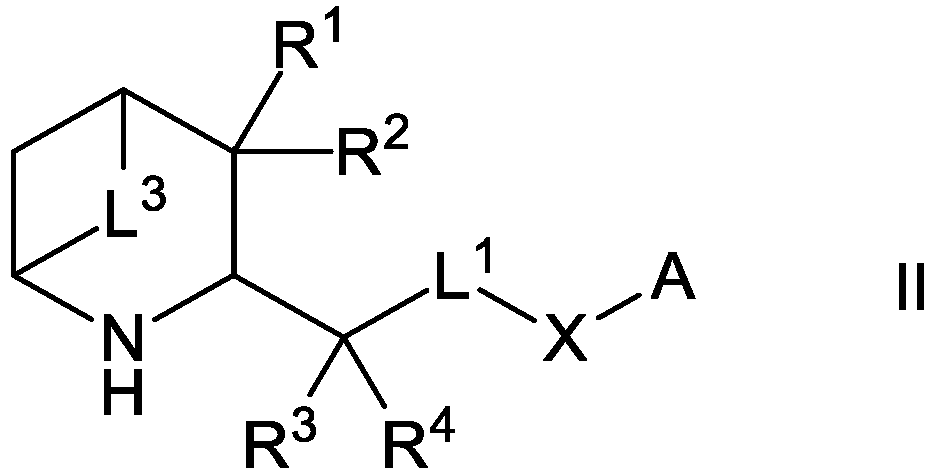
B-C(O)OH III
worin B wie in Anspruch 1 definiert ist, wobei die Gruppe -C(O)OH in der Verbindung der Formel III gegebenenfalls zuerst zum entsprechenden Acylhalogenid aktiviert wird;(ii) für Verbindungen der Formel I, worin X für -O- steht, Umsetzen einer entsprechenden Verbindung der Formel IVA,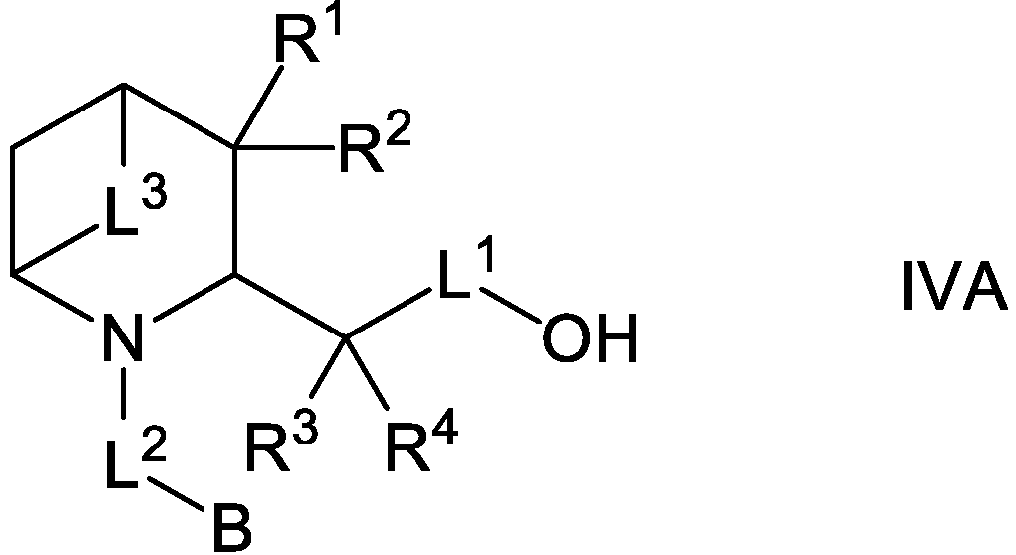
A-OH V
worin A wie in Anspruch 1 definiert ist;(iii) für Verbindungen der Formel I, worin X für -O-steht, Umsetzen einer entsprechenden Verbindung der Formel IVA mit einer Verbindung der Formel VI,
A-Lx VI
worin A wie in Anspruch 1 definiert ist und Lx für eine geeignete Abgangsgruppe steht;(iv) für Verbindungen der Formel I, worin X für -O- steht, Umsetzen einer entsprechenden Verbindung der Formel VII, (v) für Verbindungen der Formel I, worin X für -NH- steht, reduktive Aminierung einer entsprechenden Verbindung der Formel VIII,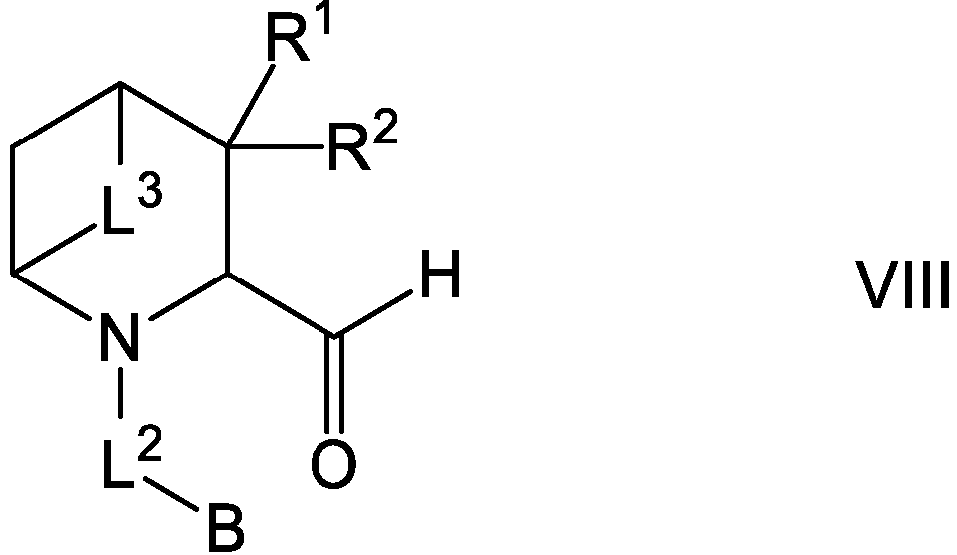
A-NH2 IX
worin A wie in Anspruch 1 definiert ist; oder(vi) für Verbindungen der Formel I, worin X für -NHsteht, Umsetzen einer entsprechenden Verbindung der Formel IVB,
Priority Applications (3)
| Application Number | Priority Date | Filing Date | Title |
|---|---|---|---|
| SM20250122T SMT202500122T1 (it) | 2017-09-01 | 2018-08-31 | Derivati di 2-azabiciclo[3.1.1]eptano e 2-azabiciclo[3.2.1]ottano sostituiti come antagonisti del recettore di oressina |
| HRP20250325TT HRP20250325T1 (hr) | 2017-09-01 | 2018-08-31 | Supstituirani derivati 2‑azabiciklo[3.1.1]heptana i 2‑azabiciklo[3.2.1]oktana kao antagonisti receptora oreksina |
| RS20250241A RS66599B1 (sr) | 2017-09-01 | 2018-08-31 | Supstituisani derivati 2‑azabiciklo[3.1.1]heptana i 2‑azabiciklo[3.2.1]oktana kao antagonisti receptora oreksina |
Applications Claiming Priority (3)
| Application Number | Priority Date | Filing Date | Title |
|---|---|---|---|
| GB1714049.2A GB2558975B (en) | 2017-09-01 | 2017-09-01 | Substituted 2-azabicyclo[3.1.1]heptane and 2-azabicyclo[3.2.1]octane derivatives as orexin receptor antagonists |
| GBGB1804745.6A GB201804745D0 (en) | 2018-03-23 | 2018-03-23 | New compounds |
| PCT/GB2018/052479 WO2019043407A1 (en) | 2017-09-01 | 2018-08-31 | DERIVATIVES OF 2-AZABICYCLO [3.1.1] HEPTANE AND 2-AZABICYCLO [3.2.1] OCTANE SUBSTITUTED AS OREXIN RECEPTOR ANTAGONISTS |
Publications (3)
| Publication Number | Publication Date |
|---|---|
| EP3676261A1 EP3676261A1 (de) | 2020-07-08 |
| EP3676261B1 true EP3676261B1 (de) | 2024-12-18 |
| EP3676261C0 EP3676261C0 (de) | 2024-12-18 |
Family
ID=63524326
Family Applications (1)
| Application Number | Title | Priority Date | Filing Date |
|---|---|---|---|
| EP18766021.2A Active EP3676261B1 (de) | 2017-09-01 | 2018-08-31 | Substituierte 2-azabicyclo[ 3.1.1] heptan und 2-azabicyclo[ 3.2.1] octan-derivate als orexin-rezeptor-antagonisten |
Country Status (16)
| Country | Link |
|---|---|
| US (1) | US11660293B2 (de) |
| EP (1) | EP3676261B1 (de) |
| JP (1) | JP7391012B2 (de) |
| KR (1) | KR102858857B1 (de) |
| CN (1) | CN111315734B (de) |
| AU (1) | AU2018326734B2 (de) |
| CA (1) | CA3074059A1 (de) |
| ES (1) | ES3009813T3 (de) |
| HR (1) | HRP20250325T1 (de) |
| HU (1) | HUE070482T2 (de) |
| IL (1) | IL272952B2 (de) |
| MD (1) | MD3676261T2 (de) |
| PL (1) | PL3676261T3 (de) |
| RS (1) | RS66599B1 (de) |
| SM (1) | SMT202500122T1 (de) |
| WO (1) | WO2019043407A1 (de) |
Families Citing this family (5)
| Publication number | Priority date | Publication date | Assignee | Title |
|---|---|---|---|---|
| CN110627721B (zh) * | 2019-10-29 | 2022-06-14 | 陕西科技大学 | 一种菲啶类化合物及其合成方法 |
| EP4052760B1 (de) | 2019-10-31 | 2024-03-13 | FUJIFILM Corporation | Pyrazinderivate oder deren salze und deren verwendung |
| CN116056766A (zh) | 2020-07-30 | 2023-05-02 | 富士胶片株式会社 | 含氮杂环化合物或其盐、其利用以及其中间体 |
| TW202400149A (zh) | 2022-05-13 | 2024-01-01 | 瑞士商愛杜西亞製藥有限公司 | 經噻唑并芳基-甲基取代之環狀肼-n-甲醯胺衍生物 |
| KR20250112793A (ko) * | 2022-12-16 | 2025-07-24 | 다이이찌 산쿄 가부시키가이샤 | 2-아자비시클로[3.1.1]헵탄 화합물 |
Family Cites Families (15)
| Publication number | Priority date | Publication date | Assignee | Title |
|---|---|---|---|---|
| EP1435955A2 (de) | 2001-05-05 | 2004-07-14 | SmithKline Beecham P.L.C. | N-aroyl-zyklisches amin-derivat als orexin-rezeptor-antagonisten |
| ATE555107T1 (de) | 2008-02-21 | 2012-05-15 | Actelion Pharmaceuticals Ltd | 2-aza-bicyclo-ä2,2,1-üheptan-derivate |
| EA201171293A1 (ru) * | 2009-04-24 | 2012-05-30 | Глэксо Груп Лимитед | 3-азабицикло[4.1.0]гептаны, применяемые в качестве антагонистов орексина |
| EP2275421A1 (de) | 2009-07-15 | 2011-01-19 | Rottapharm S.p.A. | Spiro-Amino-Verbindungen geeignet zur Behandlung von unter anderem Schlafstörungen und Drogenabhängigkeit |
| EP2470523A1 (de) | 2009-08-24 | 2012-07-04 | Glaxo Group Limited | 5-methyl-piperidinderivate als orexinrezeptor-antagonisten zur behandlung von schlafstörungen |
| US8809365B2 (en) | 2009-11-04 | 2014-08-19 | Universiteit Gent | 1-substituted 2-azabicyclo [3.1.1] heptyl derivatives useful as nicotinic acetylcholine receptor modulators for treating neurologic disorders |
| MX2012006909A (es) * | 2009-12-29 | 2012-07-10 | Suven Life Sciences Ltd | LIGANDOS DEL RECEPTOR NICOTINICO NEURONAL A4ß2 DE ACETILCOLINA. |
| WO2012089607A1 (en) | 2010-12-28 | 2012-07-05 | Glaxo Group Limited | Novel compounds with a 3a-azabicyclo [4.1.0] heptane core acting on orexin receptors |
| WO2012089606A1 (en) | 2010-12-28 | 2012-07-05 | Glaxo Group Limited | Azabicyclo [4.1.0] hept - 4 - yl derivatives as human orexin receptor antagonists |
| HK1204955A1 (zh) * | 2012-02-07 | 2015-12-11 | Eolas Therapeutics Inc. | 取代的脯氨酸/哌啶用作食慾素受體拮抗劑 |
| ITMI20120424A1 (it) | 2012-03-19 | 2013-09-20 | Rottapharm Spa | Composti chimici |
| TWI621618B (zh) | 2013-03-13 | 2018-04-21 | 比利時商健生藥品公司 | 經取代2-氮雜雙環類及其作為食慾素受體調控劑之用途 |
| CA2960791C (en) | 2014-09-11 | 2023-03-14 | Janssen Pharmaceutica Nv | Substituted 2-azabicycles and their use as orexin receptor modulators |
| GB201601703D0 (en) | 2016-01-29 | 2016-03-16 | C4X Discovery Ltd | Therapeutic compounds |
| SMT202200323T1 (it) | 2016-02-12 | 2022-09-14 | Astrazeneca Ab | Piperidine alo-sostituite come modulatori del recettore di oressina |
-
2018
- 2018-08-31 WO PCT/GB2018/052479 patent/WO2019043407A1/en not_active Ceased
- 2018-08-31 EP EP18766021.2A patent/EP3676261B1/de active Active
- 2018-08-31 HR HRP20250325TT patent/HRP20250325T1/hr unknown
- 2018-08-31 PL PL18766021.2T patent/PL3676261T3/pl unknown
- 2018-08-31 AU AU2018326734A patent/AU2018326734B2/en active Active
- 2018-08-31 US US16/643,420 patent/US11660293B2/en active Active
- 2018-08-31 MD MDE20200698T patent/MD3676261T2/ro unknown
- 2018-08-31 CA CA3074059A patent/CA3074059A1/en active Pending
- 2018-08-31 KR KR1020207008652A patent/KR102858857B1/ko active Active
- 2018-08-31 SM SM20250122T patent/SMT202500122T1/it unknown
- 2018-08-31 ES ES18766021T patent/ES3009813T3/es active Active
- 2018-08-31 RS RS20250241A patent/RS66599B1/sr unknown
- 2018-08-31 JP JP2020512422A patent/JP7391012B2/ja active Active
- 2018-08-31 HU HUE18766021A patent/HUE070482T2/hu unknown
- 2018-08-31 CN CN201880071489.8A patent/CN111315734B/zh active Active
-
2020
- 2020-02-27 IL IL272952A patent/IL272952B2/en unknown
Also Published As
| Publication number | Publication date |
|---|---|
| IL272952B1 (en) | 2023-03-01 |
| HUE070482T2 (hu) | 2025-06-28 |
| MD3676261T2 (ro) | 2025-05-31 |
| WO2019043407A1 (en) | 2019-03-07 |
| EP3676261C0 (de) | 2024-12-18 |
| JP7391012B2 (ja) | 2023-12-04 |
| AU2018326734B2 (en) | 2023-08-17 |
| SMT202500122T1 (it) | 2025-05-12 |
| ES3009813T3 (en) | 2025-04-01 |
| IL272952A (en) | 2020-04-30 |
| AU2018326734A1 (en) | 2020-03-19 |
| KR102858857B1 (ko) | 2025-09-12 |
| JP2020531556A (ja) | 2020-11-05 |
| EP3676261A1 (de) | 2020-07-08 |
| PL3676261T3 (pl) | 2025-04-14 |
| IL272952B2 (en) | 2023-07-01 |
| CN111315734A (zh) | 2020-06-19 |
| RS66599B1 (sr) | 2025-04-30 |
| US11660293B2 (en) | 2023-05-30 |
| CN111315734B (zh) | 2024-03-08 |
| US20220331299A1 (en) | 2022-10-20 |
| CA3074059A1 (en) | 2019-03-07 |
| HRP20250325T1 (hr) | 2025-04-25 |
| KR20200066295A (ko) | 2020-06-09 |
Similar Documents
| Publication | Publication Date | Title |
|---|---|---|
| US8436001B2 (en) | Pyrazol-4-yl-heterocyclyl-carboxamide compounds and methods of use | |
| EP3676261B1 (de) | Substituierte 2-azabicyclo[ 3.1.1] heptan und 2-azabicyclo[ 3.2.1] octan-derivate als orexin-rezeptor-antagonisten | |
| JP2025120943A (ja) | 免疫活性化のためのdgkzeta阻害剤としての置換アミノチアゾール類 | |
| EP2691399B1 (de) | Thiazolpyrimidinverbindungen | |
| CA3143489A1 (en) | Aminopyrimidine amide autophagy inhibitors and methods of use thereof | |
| KR102697255B1 (ko) | 벤즈이미다졸 유도체 및 이의 용도 | |
| CN105566321B (zh) | 杂芳化合物及其在药物中的应用 | |
| CA3108809C (en) | Heteroaromatic compounds, pharmaceutical compositions and uses thereof | |
| EP3380474A1 (de) | Janus-kinase-inhibitoren, zusammensetzungen davon und verwendung davon | |
| WO2021022178A1 (en) | Substituted sulfonamide pyrrolopyridines as jak inhibitors | |
| KR101707761B1 (ko) | 브루톤 티로신 키나아제 억제제로서의 티아졸 유도체 | |
| EP3510030A1 (de) | 8-(azetidin-1-yl)-[1,2,4]triazolo[1,5-a]pyridinyl-verbindungen, zusammensetzungen und verfahren zur verwendung davon | |
| EP3484867B1 (de) | Inhibitoren von tryptophan-2,3-dioxygenase | |
| EP3452464A1 (de) | Pyrazolderivate, zusammensetzungen und therapeutische verwendung davon | |
| EP3265464A1 (de) | Triazolopyridinverbindungen und verfahren zur verwendung davon | |
| RU2851298C2 (ru) | Новые ингибиторы JAK1-киназ | |
| WO2019081939A1 (en) | 2-AZABICYCLO [3.1.1] DERIVATIVES AS ANTAGONISTS OF OREXIN-1 AND OREXIN-2 RECEPTORS | |
| GB2558975A (en) | New compounds |
Legal Events
| Date | Code | Title | Description |
|---|---|---|---|
| REG | Reference to a national code |
Ref country code: HR Ref legal event code: TUEP Ref document number: P20250325T Country of ref document: HR |
|
| STAA | Information on the status of an ep patent application or granted ep patent |
Free format text: STATUS: UNKNOWN |
|
| STAA | Information on the status of an ep patent application or granted ep patent |
Free format text: STATUS: THE INTERNATIONAL PUBLICATION HAS BEEN MADE |
|
| PUAI | Public reference made under article 153(3) epc to a published international application that has entered the european phase |
Free format text: ORIGINAL CODE: 0009012 |
|
| STAA | Information on the status of an ep patent application or granted ep patent |
Free format text: STATUS: REQUEST FOR EXAMINATION WAS MADE |
|
| 17P | Request for examination filed |
Effective date: 20200228 |
|
| AK | Designated contracting states |
Kind code of ref document: A1 Designated state(s): AL AT BE BG CH CY CZ DE DK EE ES FI FR GB GR HR HU IE IS IT LI LT LU LV MC MK MT NL NO PL PT RO RS SE SI SK SM TR |
|
| AX | Request for extension of the european patent |
Extension state: BA ME |
|
| RAV | Requested validation state of the european patent: fee paid |
Extension state: MD Effective date: 20200228 |
|
| STAA | Information on the status of an ep patent application or granted ep patent |
Free format text: STATUS: EXAMINATION IS IN PROGRESS |
|
| 17Q | First examination report despatched |
Effective date: 20210311 |
|
| GRAP | Despatch of communication of intention to grant a patent |
Free format text: ORIGINAL CODE: EPIDOSNIGR1 |
|
| STAA | Information on the status of an ep patent application or granted ep patent |
Free format text: STATUS: GRANT OF PATENT IS INTENDED |
|
| INTG | Intention to grant announced |
Effective date: 20240814 |
|
| RAP3 | Party data changed (applicant data changed or rights of an application transferred) |
Owner name: CHRONOS THERAPEUTICS LIMITED |
|
| GRAS | Grant fee paid |
Free format text: ORIGINAL CODE: EPIDOSNIGR3 |
|
| GRAA | (expected) grant |
Free format text: ORIGINAL CODE: 0009210 |
|
| STAA | Information on the status of an ep patent application or granted ep patent |
Free format text: STATUS: THE PATENT HAS BEEN GRANTED |
|
| AK | Designated contracting states |
Kind code of ref document: B1 Designated state(s): AL AT BE BG CH CY CZ DE DK EE ES FI FR GB GR HR HU IE IS IT LI LT LU LV MC MK MT NL NO PL PT RO RS SE SI SK SM TR |
|
| REG | Reference to a national code |
Ref country code: GB Ref legal event code: FG4D |
|
| REG | Reference to a national code |
Ref country code: CH Ref legal event code: EP |
|
| REG | Reference to a national code |
Ref country code: DE Ref legal event code: R096 Ref document number: 602018077729 Country of ref document: DE |
|
| REG | Reference to a national code |
Ref country code: IE Ref legal event code: FG4D |
|
| U01 | Request for unitary effect filed |
Effective date: 20250114 |
|
| U07 | Unitary effect registered |
Designated state(s): AT BE BG DE DK EE FI FR IT LT LU LV MT NL PT RO SE SI Effective date: 20250120 |
|
| REG | Reference to a national code |
Ref country code: ES Ref legal event code: FG2A Ref document number: 3009813 Country of ref document: ES Kind code of ref document: T3 Effective date: 20250401 |
|
| REG | Reference to a national code |
Ref country code: HR Ref legal event code: T1PR Ref document number: P20250325 Country of ref document: HR |
|
| REG | Reference to a national code |
Ref country code: GR Ref legal event code: EP Ref document number: 20250400556 Country of ref document: GR Effective date: 20250409 |
|
| REG | Reference to a national code |
Ref country code: SK Ref legal event code: T3 Ref document number: E 46102 Country of ref document: SK |
|
| REG | Reference to a national code |
Ref country code: MD Ref legal event code: VAGR Ref document number: 3676261 Country of ref document: MD Date of ref document: 20250531 Kind code of ref document: T2 |
|
| REG | Reference to a national code |
Ref country code: HU Ref legal event code: AG4A Ref document number: E070482 Country of ref document: HU |
|
| U20 | Renewal fee for the european patent with unitary effect paid |
Year of fee payment: 8 Effective date: 20250814 |
|
| PGFP | Annual fee paid to national office [announced via postgrant information from national office to epo] |
Ref country code: HU Payment date: 20250827 Year of fee payment: 8 |
|
| PGFP | Annual fee paid to national office [announced via postgrant information from national office to epo] |
Ref country code: SM Payment date: 20250820 Year of fee payment: 8 |
|
| PGFP | Annual fee paid to national office [announced via postgrant information from national office to epo] |
Ref country code: MC Payment date: 20250822 Year of fee payment: 8 Ref country code: NO Payment date: 20250821 Year of fee payment: 8 Ref country code: GR Payment date: 20250825 Year of fee payment: 8 |
|
| PGFP | Annual fee paid to national office [announced via postgrant information from national office to epo] |
Ref country code: PL Payment date: 20250818 Year of fee payment: 8 Ref country code: TR Payment date: 20250818 Year of fee payment: 8 |
|
| PGFP | Annual fee paid to national office [announced via postgrant information from national office to epo] |
Ref country code: GB Payment date: 20250814 Year of fee payment: 8 |
|
| PGFP | Annual fee paid to national office [announced via postgrant information from national office to epo] |
Ref country code: AL Payment date: 20250825 Year of fee payment: 8 |
|
| PGFP | Annual fee paid to national office [announced via postgrant information from national office to epo] |
Ref country code: CH Payment date: 20250901 Year of fee payment: 8 |
|
| PGFP | Annual fee paid to national office [announced via postgrant information from national office to epo] |
Ref country code: IE Payment date: 20250814 Year of fee payment: 8 Ref country code: CZ Payment date: 20250821 Year of fee payment: 8 Ref country code: RS Payment date: 20250818 Year of fee payment: 8 |
|
| PLBE | No opposition filed within time limit |
Free format text: ORIGINAL CODE: 0009261 |
|
| STAA | Information on the status of an ep patent application or granted ep patent |
Free format text: STATUS: NO OPPOSITION FILED WITHIN TIME LIMIT |
|
| PGFP | Annual fee paid to national office [announced via postgrant information from national office to epo] |
Ref country code: SK Payment date: 20250818 Year of fee payment: 8 |
|
| PGFP | Annual fee paid to national office [announced via postgrant information from national office to epo] |
Ref country code: IS Payment date: 20250820 Year of fee payment: 8 |
|
| REG | Reference to a national code |
Ref country code: HR Ref legal event code: ODRP Ref document number: P20250325 Country of ref document: HR Payment date: 20251002 Year of fee payment: 8 |
|
| PGFP | Annual fee paid to national office [announced via postgrant information from national office to epo] |
Ref country code: MK Payment date: 20250815 Year of fee payment: 8 |
|
| 26N | No opposition filed |
Effective date: 20250919 |
|
| PGFP | Annual fee paid to national office [announced via postgrant information from national office to epo] |
Ref country code: HR Payment date: 20251002 Year of fee payment: 8 |
|
| VSFP | Annual fee paid to validation state [announced via postgrant information from national office to epo] |
Ref country code: MD Payment date: 20251029 Year of fee payment: 8 |
|
| PGFP | Annual fee paid to national office [announced via postgrant information from national office to epo] |
Ref country code: CY Payment date: 20250822 Year of fee payment: 8 |
|
| PGFP | Annual fee paid to national office [announced via postgrant information from national office to epo] |
Ref country code: ES Payment date: 20251119 Year of fee payment: 8 |