EP3671998A2 - Système d'entretien de câble - Google Patents
Système d'entretien de câble Download PDFInfo
- Publication number
- EP3671998A2 EP3671998A2 EP19216885.4A EP19216885A EP3671998A2 EP 3671998 A2 EP3671998 A2 EP 3671998A2 EP 19216885 A EP19216885 A EP 19216885A EP 3671998 A2 EP3671998 A2 EP 3671998A2
- Authority
- EP
- European Patent Office
- Prior art keywords
- cable
- tool
- arrangement
- tool arrangement
- assembly
- Prior art date
- Legal status (The legal status is an assumption and is not a legal conclusion. Google has not performed a legal analysis and makes no representation as to the accuracy of the status listed.)
- Withdrawn
Links
- 238000012360 testing method Methods 0.000 claims abstract description 30
- 238000009434 installation Methods 0.000 claims abstract description 15
- 230000007246 mechanism Effects 0.000 claims abstract description 15
- 239000000523 sample Substances 0.000 claims description 25
- 239000004020 conductor Substances 0.000 claims description 14
- 238000005096 rolling process Methods 0.000 claims description 6
- 230000014759 maintenance of location Effects 0.000 claims description 3
- 239000004065 semiconductor Substances 0.000 description 10
- 238000000034 method Methods 0.000 description 9
- 230000000712 assembly Effects 0.000 description 8
- 238000000429 assembly Methods 0.000 description 8
- 230000008569 process Effects 0.000 description 8
- 239000000463 material Substances 0.000 description 6
- 238000005553 drilling Methods 0.000 description 5
- 235000014676 Phragmites communis Nutrition 0.000 description 4
- 238000009413 insulation Methods 0.000 description 4
- 238000012545 processing Methods 0.000 description 2
- 229920000049 Carbon (fiber) Polymers 0.000 description 1
- 244000208734 Pisonia aculeata Species 0.000 description 1
- 229910000831 Steel Inorganic materials 0.000 description 1
- 230000009471 action Effects 0.000 description 1
- 230000002411 adverse Effects 0.000 description 1
- 238000013459 approach Methods 0.000 description 1
- 230000008901 benefit Effects 0.000 description 1
- 239000004917 carbon fiber Substances 0.000 description 1
- 239000000919 ceramic Substances 0.000 description 1
- 238000004891 communication Methods 0.000 description 1
- 239000002131 composite material Substances 0.000 description 1
- 230000005611 electricity Effects 0.000 description 1
- 238000010438 heat treatment Methods 0.000 description 1
- 238000003780 insertion Methods 0.000 description 1
- 230000037431 insertion Effects 0.000 description 1
- 239000011810 insulating material Substances 0.000 description 1
- 230000003993 interaction Effects 0.000 description 1
- 239000002184 metal Substances 0.000 description 1
- 229910001092 metal group alloy Inorganic materials 0.000 description 1
- VNWKTOKETHGBQD-UHFFFAOYSA-N methane Chemical compound C VNWKTOKETHGBQD-UHFFFAOYSA-N 0.000 description 1
- 229920000642 polymer Polymers 0.000 description 1
- 238000007585 pull-off test Methods 0.000 description 1
- 230000008439 repair process Effects 0.000 description 1
- 239000010959 steel Substances 0.000 description 1
- 230000036346 tooth eruption Effects 0.000 description 1
Images







Classifications
-
- H—ELECTRICITY
- H02—GENERATION; CONVERSION OR DISTRIBUTION OF ELECTRIC POWER
- H02G—INSTALLATION OF ELECTRIC CABLES OR LINES, OR OF COMBINED OPTICAL AND ELECTRIC CABLES OR LINES
- H02G1/00—Methods or apparatus specially adapted for installing, maintaining, repairing or dismantling electric cables or lines
- H02G1/12—Methods or apparatus specially adapted for installing, maintaining, repairing or dismantling electric cables or lines for removing insulation or armouring from cables, e.g. from the end thereof
- H02G1/1285—Methods or apparatus specially adapted for installing, maintaining, repairing or dismantling electric cables or lines for removing insulation or armouring from cables, e.g. from the end thereof by friction, e.g. abrading, grinding, brushing
-
- H—ELECTRICITY
- H02—GENERATION; CONVERSION OR DISTRIBUTION OF ELECTRIC POWER
- H02G—INSTALLATION OF ELECTRIC CABLES OR LINES, OR OF COMBINED OPTICAL AND ELECTRIC CABLES OR LINES
- H02G1/00—Methods or apparatus specially adapted for installing, maintaining, repairing or dismantling electric cables or lines
- H02G1/005—Methods or apparatus specially adapted for installing, maintaining, repairing or dismantling electric cables or lines for cutting cables or wires, or splicing
-
- H—ELECTRICITY
- H02—GENERATION; CONVERSION OR DISTRIBUTION OF ELECTRIC POWER
- H02G—INSTALLATION OF ELECTRIC CABLES OR LINES, OR OF COMBINED OPTICAL AND ELECTRIC CABLES OR LINES
- H02G1/00—Methods or apparatus specially adapted for installing, maintaining, repairing or dismantling electric cables or lines
- H02G1/12—Methods or apparatus specially adapted for installing, maintaining, repairing or dismantling electric cables or lines for removing insulation or armouring from cables, e.g. from the end thereof
-
- H—ELECTRICITY
- H02—GENERATION; CONVERSION OR DISTRIBUTION OF ELECTRIC POWER
- H02G—INSTALLATION OF ELECTRIC CABLES OR LINES, OR OF COMBINED OPTICAL AND ELECTRIC CABLES OR LINES
- H02G1/00—Methods or apparatus specially adapted for installing, maintaining, repairing or dismantling electric cables or lines
- H02G1/12—Methods or apparatus specially adapted for installing, maintaining, repairing or dismantling electric cables or lines for removing insulation or armouring from cables, e.g. from the end thereof
- H02G1/1202—Methods or apparatus specially adapted for installing, maintaining, repairing or dismantling electric cables or lines for removing insulation or armouring from cables, e.g. from the end thereof by cutting and withdrawing insulation
- H02G1/1248—Machines
-
- H—ELECTRICITY
- H02—GENERATION; CONVERSION OR DISTRIBUTION OF ELECTRIC POWER
- H02G—INSTALLATION OF ELECTRIC CABLES OR LINES, OR OF COMBINED OPTICAL AND ELECTRIC CABLES OR LINES
- H02G1/00—Methods or apparatus specially adapted for installing, maintaining, repairing or dismantling electric cables or lines
- H02G1/12—Methods or apparatus specially adapted for installing, maintaining, repairing or dismantling electric cables or lines for removing insulation or armouring from cables, e.g. from the end thereof
- H02G1/1202—Methods or apparatus specially adapted for installing, maintaining, repairing or dismantling electric cables or lines for removing insulation or armouring from cables, e.g. from the end thereof by cutting and withdrawing insulation
- H02G1/1248—Machines
- H02G1/1251—Machines the cutting element not rotating about the wire or cable
- H02G1/1253—Machines the cutting element not rotating about the wire or cable making a transverse cut
- H02G1/1256—Machines the cutting element not rotating about the wire or cable making a transverse cut using wire or cable-clamping means
-
- H—ELECTRICITY
- H02—GENERATION; CONVERSION OR DISTRIBUTION OF ELECTRIC POWER
- H02G—INSTALLATION OF ELECTRIC CABLES OR LINES, OR OF COMBINED OPTICAL AND ELECTRIC CABLES OR LINES
- H02G1/00—Methods or apparatus specially adapted for installing, maintaining, repairing or dismantling electric cables or lines
- H02G1/12—Methods or apparatus specially adapted for installing, maintaining, repairing or dismantling electric cables or lines for removing insulation or armouring from cables, e.g. from the end thereof
- H02G1/1202—Methods or apparatus specially adapted for installing, maintaining, repairing or dismantling electric cables or lines for removing insulation or armouring from cables, e.g. from the end thereof by cutting and withdrawing insulation
- H02G1/1248—Machines
- H02G1/1265—Machines the cutting element rotating about the wire or cable
-
- H—ELECTRICITY
- H02—GENERATION; CONVERSION OR DISTRIBUTION OF ELECTRIC POWER
- H02G—INSTALLATION OF ELECTRIC CABLES OR LINES, OR OF COMBINED OPTICAL AND ELECTRIC CABLES OR LINES
- H02G1/00—Methods or apparatus specially adapted for installing, maintaining, repairing or dismantling electric cables or lines
- H02G1/14—Methods or apparatus specially adapted for installing, maintaining, repairing or dismantling electric cables or lines for joining or terminating cables
-
- H—ELECTRICITY
- H02—GENERATION; CONVERSION OR DISTRIBUTION OF ELECTRIC POWER
- H02G—INSTALLATION OF ELECTRIC CABLES OR LINES, OR OF COMBINED OPTICAL AND ELECTRIC CABLES OR LINES
- H02G15/00—Cable fittings
- H02G15/02—Cable terminations
- H02G15/04—Cable-end sealings
- H02G15/043—Cable-end sealings with end caps, e.g. sleeve closed at one end
-
- H—ELECTRICITY
- H02—GENERATION; CONVERSION OR DISTRIBUTION OF ELECTRIC POWER
- H02G—INSTALLATION OF ELECTRIC CABLES OR LINES, OR OF COMBINED OPTICAL AND ELECTRIC CABLES OR LINES
- H02G9/00—Installations of electric cables or lines in or on the ground or water
- H02G9/10—Installations of electric cables or lines in or on the ground or water in cable chambers, e.g. in manhole or in handhole
Definitions
- the present disclosure relates to a system for servicing cable.
- the distribution network system typically includes conduits under the street pavement with primary splicing structures-e.g., manholes-every 300 to 500 feet and secondary splicing structures-e.g., secondary boxes-every 100 to 150 feet.
- Distribution-network feeders operate at different voltages-for example, in some applications, 13 kilovolt (kV) and 27kV feeders are commonly used.
- the distribution-network feeders consist of three cables that are A, B, and C phase. These feeders are installed in conduits to transport electricity from the supply substation to several distribution-network transformers.
- underground cable feeders may need to be de-energized in order to perform work. Because of the multipath characteristics of a network system, a feeder outage may not be immediately reflected in customer outages, but instead, may result in added stress to the components remaining in service and lower supply voltage to customers.
- a live end-cap is a splice that is often used during adverse system conditions to expedite feeder restoration.
- An LEC process includes separating a cable connection and insulating part of it to allow the selected portion of the feeder to be re-energized. Once an LEC is installed, a smaller, less critical portion of the feeder is dropped, and the rest of the feeder is energized back into service. Installing an LEC may be simpler and quicker than performing a complete repair during an outage.
- Embodiments described herein include a system for servicing cable.
- the system may include a chassis that supports two assemblies: a field-end assembly for performing operations on a field end of an electrical cable, and a live-end assembly for performing operations on a live end of the electrical cable.
- the chassis may be constructed with one or more rails that facilitate linear movement of one or both of the assemblies.
- At least some embodiments may include stationary tubes that serve as supports for a set of outer tubes to provide telescoping action for moving one of the assemblies linearly along the rails.
- Some embodiments may also or alternatively include a lead screw connected to a motor drive for moving one of the assemblies linearly toward and away from the other of the assemblies.
- Embodiments described herein may further include various systems, subsystems, assemblies, and subassemblies capable of performing one or more operations on an electrical cable.
- some embodiments may include a drilling-and-shorting assembly for creating a short circuit in a field-end of the cable, and may also include a continuity tester for testing the integrity of the short-circuit.
- Some embodiments may include an end-cap cradle assembly for positioning an end cap on a live end of an electrical cable.
- Embodiments may also include one or more tools for cutting an electrical cable; removing one or more layers of insulation, and ejecting the cable from the system.
- Embodiments described herein may not only automate and simplify processes currently performed manually, but may also allow some steps required with a manual process to be completely eliminated, thereby further increasing speed and efficiency of the process.
- At least some embodiments described herein may include a system for servicing cable that includes a support structure and first and second tool arrangements.
- the first tool arrangement is supported on the support structure and includes an opening configured to receive a cable in a direction transverse to a cable axis and at least one tool operable to perform one or more operations on a cable received in the opening.
- the second tool arrangement is supported on the support structure and includes at least one tool operable to perform one or more operations on a cable received by the first tool arrangement. At least one of the first or second tool arrangement is movable axially along the support structure relative to the other tool arrangement.
- a guide arrangement includes a plurality of guide elements, and a drive arrangement is configured to move at least one of the guide elements into contact with and apply a force to a cable received by the first tool arrangement.
- the drive arrangement is operable to vary the force to adjust a position of a cable received by the first tool arrangement.
- At least some embodiments described herein may include a system for servicing cable that includes a support structure and first and second tool arrangements supported on the support structure. At least one of the tool arrangements is movable axially relative to the other tool arrangement.
- the first tool arrangement includes a center portion configured to receive a cable therein, and further includes at least one tool operable to perform one or more operations on a cable received in the center portion.
- a plurality of guide elements are movable radially outward away from the center portion of the first tool arrangement to facilitate positioning of a cable in the center portion, and they are movable radially inward toward the center portion to exert forces on and secure a cable in the center portion of the first tool arrangement.
- At least one of the guide elements is separately movable from at least one other of the guide elements such that a position of a cable in the center portion of the first tool arrangement is adjustable by the guide elements.
- At least some embodiments described herein may include a system for servicing cable that includes a support structure and a first tool arrangement supported on the support structure and having a center portion configured to receive a cable therein.
- a second tool arrangement is disposed axially adjacent to the first tool arrangement and supported on the support structure.
- a plurality of guide elements is disposed around the center portion of the first tool arrangement, and a plurality of independently operable drive arrangements are each operable to move at least one of the guide elements away from the center portion of the first tool arrangement such that a cable is receivable by the first tool arrangement and toward the center portion of the first tool arrangement such that the guide elements secure a cable received by the first tool arrangement.
- FIG 1 shows a system 10 in accordance with embodiments described herein.
- the system 10 includes a generally cylindrical first tool arrangement, or live-end assembly 12, and a second tool arrangement, or field-end assembly 14.
- the assemblies 12, 14 are disposed axially adjacent to each other and are supported on a support structure or chassis 16, which includes telescoping tube arrangements 18, 20.
- the tube arrangements 18, 20 include stationary tubes 22, 24 mounted on a chassis plate 26, which cooperate with tubes 28, 30 attached as part of the field-end assembly 14-see Figure 3 .
- the tubes 28, 30 are stationary relative to the field-end assembly 14, they move relative to the stationary tubes 22, 24 when the field-end assembly 14 moves linearly toward and away from the live-end assembly 12.
- Figure 3 also shows a motor and gear arrangement 32 that is operable to move the field-end assembly 14 toward and away from the live-end the assembly 12 along a pair of support rails 34, 36-see also Figure 1 .
- Pinions from the motor and gear arrangement 32 move along a pair of racks 35, 37-see Figure 2 -held in place with rail caps 39, 41.
- an electrical cable 38 mounted on the live-end assembly 12 and having one end 40 prepped for application of an end-cap.
- the cable 38 includes a center conductor 42, and insulation layer 44, an inner layer of semi-conductive material 46, ground straps 48, and an outer insulating jacket material 50.
- the live-end assembly 12 includes a number of tools operable to perform various tasks on a cable, such as the cable 38.
- the live-end assembly 12 is also movable along the rails 22, 24 by operating a motor 52 to drive a lead screw 54.
- the field-end assembly 14 includes an end-cap-cradle assembly 56, a drilling-and-shorting assembly 58, a saw-cutting assembly 60, and a vacuum assembly 62, each of which is explained in more detail below.
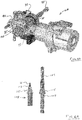
- Figure 4 shows the drilling-and-shorting assembly 58, which includes a drilling assembly 64 and a clamping mechanism 66.
- the clamping mechanism 66 includes a latch hook 68 and two side plates 70, 72.
- the latch hook 68 is made from a polymeric material and the two side plates 70, 72 are made from a carbon-fiber composite material, although the use of other materials for the latch hook and side plates is contemplated.
- the clamping mechanism 66 is used to lock into place an electrical cable, such as the cable 38 shown in Figure 1 when the cable is placed in a trough 74 of the drilling-and-shorting assembly 58.
- the clamping mechanism 66 securely holds the cable while the drilling assembly 64 short-circuits and tests the cable.
- the drilling assembly 64 includes a motor 76 operable to rotate a drill bit 78 to penetrate a cable when it is positioned in the trough 74.
- the drill assembly 64 is linearly movable along a track 80 such that it approaches a cable positioned in the trough 74 in a radial direction relative to the cable. Because the entire drilling-and-shorting assembly 58 moves linearly along the racks 35, 37, the drilling assembly 64 can be operated to produce holes in a line along the length of the cable.
- the clamping mechanism 66 can be used to secure the cable just prior to operating the drill assembly 64, and then it can be released to allow the drilling-and-shorting assembly 58 to move linearly relative to the cable to reposition the drill bit 78.
- a camera 82 is positioned proximate to the drill bit 78 to allow an operator to observe the positioning and operation of the drill bit 78.
- the vacuum assembly 62 can be run during or after operation of the drill assembly 64 to collect debris generated during the drilling operation.
- the drilling-and-shorting assembly 58 also includes a test probe 84 that is used to test the effectiveness of the short-circuit produced by the drill bit 78.
- Figure 5 shows the drilling-and-shorting assembly 58, including the drill bit 78 and the test probe 84.
- the drill assembly 64 is configured to hold the drill bit 78 with an ejection mechanism 86 so the drill bit 78 can be quickly released while inside the cable so that it can remain in the cable and maintain a short circuit.
- the drill bit 78 has a hexagonal shank 88 with an area of relief 90-see Figure 6 -into which small ball bearings can fit.
- FIG. 5A shows another view of the drill assembly 64. Rotating the lever 93 in a clockwise direction-as it is oriented in Figure 5A -causes rotation of a yoke 95, which in turn retracts the sleeve 92 to allow the drill bit 78 to be released.
- the test probe 84 includes a flange 94 configured with a number of sharp probes 96, only some of which are labeled for clarity.
- the probes 96 are configured to penetrate an insulating jacket layer of a cable and make electrical contact with the ground straps.
- the test probe 84 also includes an insulating material 98, which surrounds a conductor 100 positioned in the center of the test probe 84.
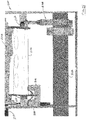
- Figure 6 shows the drill bit 78 and the test probe 84 both inserted into a field end of an electrical cable 102.
- the electrical cable includes an insulating jacket 104, a layer of ground straps 106, a thin semiconductor layer 107, a relatively thick insulating layer 108, another thin semiconductor layer 109, and a center conductor 110.
- the drill bit 78 has been ejected from the drill assembly 64 and forms a short circuit between the ground straps 106 and the center conductor 110.
- the drill bit 78 is used to create a hole for the probe 84, which may have a depth approximately one half the diameter of the cable 102.
- the field-end assembly 14 is moved linearly so that the drill bit 78 can make a second hole through the cable 102; the drill bit 78 is then ejected from the drill assembly 64 and remains in the cable 102.
- the drill bit 78 includes a number of sharp probes 112 similar to the probes 96 on the test probe 84.
- the probes 112 make a good electrical contact with the ground straps 106, while a cutting portion of the drill bit 78 makes electrical contact with the center conductor of the cable 102, thereby creating the short circuit.
- the test probe 84 is connected to a continuity tester 114, and together, the test probe and continuity tester may conveniently be referred to as a test arrangement 117.
- the test arrangement 117 may emit a signal to a remote position, such as a remotely-positioned operator control panel indicating the continuity-e.g., the electrical resistance-between the center conductor 110 and an outer conductor, in this case the ground straps 106, of the cable 102.
- the signal may, for example, be sent wirelessly to an operator control panel or other device so that an operator may confirm a successful short circuit before approaching the cable.
- FIG. 6A shows a drill bit 103 having a tapered portion 105 on its shank 107.
- the tapered portion 105 is configured to wedge itself into the hole made by the drill bit 103, thereby making contact with the ground straps, such as the ground straps 106 shown in Figure 6 .
- Figure 6A shows a test probe 109 having a conductor 111 surrounded by an insulating layer 113, similar to the test probe 84 shown in Figure 6 .
- the test probe 109 includes a tapered portion 115 on its shank, which is configured to make contact with ground straps when inserted into a hole made by the drill bit 103.
- the saw cutting assembly 60 includes an actuator arrangement 116 for moving the assembly 60 toward and away from an electrical cable, such as the cable 102.
- a motor arrangement 118 drives a band saw 120 around a pair of pulleys 122, 124. Because electrical cable, such as the cable 102 does not already have a cut end when it is placed in a system, such as the system 10, it is not possible to use a bandsaw with a standard configuration to cut through the cable. To solve this problem, the bandsaw 120 used in conjunction with the saw-cutting assembly 60 is twisted 90° at two locations 126, 128 along its length so the cutting teeth have a forward-facing aspect.
- Pairs of rollers 130, 132 help to guide and keep the twisted bandsaw 120 in its proper orientation.
- the saw-cutting assembly 60 is configured with a stop mechanism to ensure that the actuator 116 stops moving the bandsaw 120 forward before the entire saw blade 120-including the back edge-goes through the cut cable. Once the front cutting edge of the bandsaw 120 cuts entirely through the cable, the actuator 116 may easily reverse movement of the saw-cutting assembly 60; however, if the back edge of the bandsaw 120 goes entirely through the cable, it may be very difficult to reverse movement without placing undesirable tension on the bandsaw 120.
- Figures 8A-8D show the field-end assembly 14, and how the drilling-and-shorting assembly 58 is used to eject the electrical cable 102 after it has been cut using the saw-cutting assembly 60.
- the clamping mechanism 66 is actuated to grab the field end of the cable 102 after it has been cut.
- the entire drilling-and-shorting assembly 58 is rotated-clockwise as shown in the figures-with a movement determined by a linkage arrangement 134. Ejecting the field end of the cable 102 allows the live end to be prepped for an end cap as shown in Figures 13-15 .
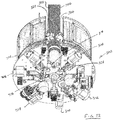
- FIG 9 shows the live-end assembly 12 detached from the chassis 16.
- the live-end assembly 12 is supported on a carriage assembly 136, which is configured to receive the chassis tubes 22, 24 in openings 138, 140.
- the live-end assembly 12 includes a number of tools for performing work on an electrical cable, such as the cable 38 or the cable 102.
- it includes two scoring tools 142, 144.
- One of the scoring tools 142, 144 can be used to cut into an outer jacket of the electrical cable, while the other of the scoring tools 142, 144 can be used to cut into an inner layer of semiconductor material.
- a tool more specifically designed to remove the semiconductor layers is a rolling tool 146, the operation of which is explained in more detail below in conjunction with Figure 12 .
- a cable cutter 148 is configured to cut through an outer jacket and ground straps of an electrical cable, and a stop mechanism 150 can be adjusted to provide a desired depth for the cable cutter 148.
- a stripping tool 152 includes a cutting portion similar to a lathe tool and is used to strip portions of the insulation from the electrical cable.
- a tool 154 can be used to sweep the cable to remove debris generated by the processing of the various cutters.
- One or more cameras, such as the cameras 156, 158 can be used to provide an operator information regarding the processing of the electrical cable.
- the carriage assembly 136 is shown in Figure 10 , and includes four bushings 160, 162, 164, 166, which support the carriage assembly 136 on the chassis tubes 22, 24.
- the carriage assembly 136 also includes a nut 168 configured to receive the lead screw 54 for moving the live-end assembly 12 toward and away from the field-end assembly 14.
- Figure 11 shows a tool-plate assembly 170 forming a portion of the live-end assembly 12.
- the tool-plate assembly 170 is configured to support an electrical cable on a plurality of rolling elements, which in this embodiment are cylindrical guide rollers 172 positioned around a center of the tool-plate assembly 170.
- the various tools described in conjunction with Figure 9 are mounted on the tool-plate assembly 170.
- the tool-plate assembly 170 may also include a heater, fans, and temperature control for heating the semiconductor layers of the cable to facilitate their removal.
- the tool-plate assembly 170 may also include one or more ratcheting pawls for attaching to a central core of an end cap so that it can be removed from the end cap by moving the live-end assembly 12 away from the end cap.
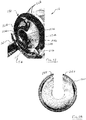
- Figure 12 shows one of the tools from the tool-plate assembly 170 in more detail.
- the rolling tool 146 is designed to remove one or both of the layers of semiconductor material often found on an electrical cable-see, e.g., the layers 46, 50 shown in Figure 1 or the layers 104, 107 shown in Figure 6 .
- the tool 146 includes a roller 174 having a relatively smooth surface, and in some embodiments may be polished to a very smooth finish.
- the roller 174 which may be made from a metal alloy, is rotated and brought into contact with the semiconductor layer, which it then removes through frictional forces.
- the semiconductor layer may be previously scored, heat can be applied to it, or both, in order to facilitate an easy removal process.
- a small drive mechanism 176 is used to rotate the roller 174, and an actuator 178 is used to position it appropriately and move it as needed along different portions of the semiconductor layer.
- a roller such as the roller 174, may be made from other materials, such as polymers or ceramics.
- Figure 13 shows the end-cap-cradle assembly 56 in more detail. Specifically, the assembly 56 is shown positioned on the tubes 22, 24 of the chassis 16-see also Figure 2 .
- the end-cap-cradle assembly 56 includes a cradle 180, which in Figure 13 is holding an end cap 182. A portion of an electrical cable 184 is also held by the live-end assembly 12, which in this view is removed for clarity.
- the cable 184 has a prepared end 186 ready to have the end cap 182 installed on it.
- the cradle 180 can be rotated such that an opening 188 in the end cap 180 is aligned with the prepared end 186 of the cable 184.
- Figure 13 also shows the drill-and-shorting assembly 58 rotated in the eject position after it has ejected the field end of the cable-see also Figure 8D .
- Figure 14 shows the cradle 180, including a portion of a drive mechanism 190 operable to rotate the cradle 180 and the end cap 182 into position.
- the cradle 180 also includes a spring 192 having a relatively high spring constant and a spring 194 having a lower spring constant.
- a pair of micro switches 196, 198 are used in conjunction with the springs 192, 194 to control the insertion force of the end cap 182 onto the cable 184, and also to test correct end-cap installation by limiting a pre-set amount of pull-off force.
- FIG 15 shows an end-cap-cradle assembly 200 similar to, but with a slightly different configuration from, the assembly 56 shown in Figure 13 .
- the assembly 200 includes a cradle 202 configured to hold an end cap 204.
- the assembly 200 is supported on a pair of tubes, including the tube 206, similar to the arrangement shown in Figure 13 .
- an actuator assembly 208 is configured to move the cradle 202 into position so that the end cap 204 is aligned with a prepared end of an electrical cable 210.
- the assembly 200 also includes a spring 212 having a relatively low spring constant, and a spring 214 having a much higher spring constant.
- a first limit switch 216 is configured to check a position of the end cap 204 upon installation onto the cable 210.
- a second limit switch 218 is configured to be used as part of a pull-off test after the end cap 204 is installed onto the cable 210.
- the entire end-cap-cradle assembly 200 is moved linearly-right-to-left as shown in Figure 15 -so that the end cap 204 is positioned over the prepared end of the cable 210.
- the movement continues until the spring 214 is compressed by a reaction force of the cable 210 acting on the end cap 204 and the limit switch 216 is tripped.
- the spring constant of the spring 214 can be set so that an approximate installation force is applied prior to the limit switch 216 being tripped. For example, in some embodiments, this may be approximately 40 pounds of force.
- the spring 214 and the limit switch 216 comprise an installation controller for the end cap configured to position the end cap 204 over the cut end of the cable 210 with a predetermined amount of installation force.
- an end cap such as the end cap 204 is applied to a cable
- a retaining ring in the end cap holds the end cap securely on the electrical cable.
- the end-cap-cradle assembly 200 is moved linearly-left-to right as shown in Figure 15 -to provide an estimation of the retention force between the end cap 204 and the cable 210.
- the spring constant for the spring 212 may be chosen such that approximately 5 pounds of force in the direction of removal will trip the limit switch 218. When this occurs, installation of the end cap 204 is complete. In this way the installation controller also indicates an amount of retention force between the end cap 204 and the cut end of the cable 210.
- Figure 16 shows a back side of the live-end assembly 12. In particular, it shows a portion of the tool-plate assembly 170 having an end plate 220-see Figure 18 -removed. Because the various tools and sensors associated with the live-end assembly 12 may require wires for power and communication, one of the issues that needs to be addressed is how to manage the wires when the live-end assembly 12 rotates.
- Figure 16 shows a number of wires 222 contained within an elongated flexible cable carrier 224.
- the cable carrier 224 is configured as a chain having jointed links that facilitates rotation in clockwise and counterclockwise directions.
- the tool-plate assembly 170 has been rotated in a counterclockwise direction, thereby wrapping the cable carrier 224 around a hub 226 of the tool-plate assembly 170.
- the hub 226 is disposed proximate to a center portion 227 of the live-end assembly 12. Because embodiments of a live-end assembly, such as the live-end assembly 12, may rotate 360° or more in either direction, it is desirable to guide the cable carrier 224 so that it does not fold back onto itself or otherwise bind, which could lead to an undesirable amount of stress on the links of the cable carrier 224.
- One way that managing the cable carrier 224 can be accomplished is by attaching fasteners such as magnets 228 to the cable carrier 224 and providing steel guide strips 230, 232, 234 to which the magnets 228 may adhere.
- the magnets 228 secure a position of the cable carrier 224 when it is wound around the hub 226.
- the cable carrier 224 may be provided with additional magnets 228 on the inside or outside of the links.
- several of the magnets 228 may be placed on an inside of the cable carrier 224 so that it is securely attached to the metal guide strip 234 surrounding the hub 226.
- Figure 17 shows the live-end assembly 12 after it has been rotated clockwise from the orientation shown in Figure 16 .
- the cable carrier 224 has started to unwind, revealing a number of the magnets 228 attached to the inside of the cable carrier 224, which now becomes an outside of the cable carrier 224 as its orientation changes.
- the fasteners used in this embodiment were magnets, other fasteners may be used, such as a hook-and-loop system or other device for maintaining a position of the cable carrier 224 while allowing it to be wrapped around and unwrapped from a hub 226 on the tool-plate assembly 170.
- the live-end assembly 12 uses two limit switches 236, 238 to limit rotation of the tool-plate assembly 170.
- the limit switches 236, 238 work in conjunction with the end plate 220, and in particular, with tabs 240, 242, respectively.
- the limit switches 236, 238 are axially offset from each other-i.e., they are positioned at different points along a longitudinal axis 244 of the live-end assembly 12.
- the tabs 240, 242 are also axially offset from each other at a distance that coincides with the distance between the limit switches 236, 238.
- the tool-plate assembly 170 also includes a magnetic reed switch 246 positioned inside a housing 248 of the tool-plate assembly 170.
- the cable carrier 224 is wrapped around the hub 226 so that one or more of the magnets 228 will be in close proximity to the reed switch 246, which will be actuated.
- the tabs 240, 242 will be oriented downward as shown in Figure 16 .
- Figure 18 the inside of the end plate 220 is shown such that when it is installed on the tool-plate assembly 170 with the tabs 240, 242 facing downward, the tab 242 will be on the left and the tab 240 will be on the right.
- the cable carrier 224 will be unwound from the hub 226 and the reed switch 246 will be unactuated-see Figure 17 . This alerts the system 10 that the tool-plate assembly 170 has been rotated in a clockwise direction. If the tool-plate assembly 170 is further rotated in the clockwise direction, the tab 240 will trip the limit switch 236, indicating that further rotation in the clockwise direction would be undesirable, and the system may prohibit further clockwise rotation of the tool-plate assembly 170.
- Figure 19 shows a sequence of clockwise and counterclockwise rotations of a tool-plate assembly and how the tabs T1 and T2, the limit switches L1 and L2, and the reed switch work together to ensure that rotation is properly limited.
- Figure 19 the outside of the end plate is shown, which is the opposite orientation from the end plate 220 shown in Figure 18 .
- the tool-plate assembly 170 includes an opening 250 that is configured as a slot along a length of the tool-plate assembly 170 and radially oriented between an outer portion 252 and a center portion 254 of the tool-plate assembly 170, and by extension the live-end assembly 12.
- the center portion 254 refers to a radial center of the tool-plate assembly 170, rather than a longitudinal center portion.
- the configuration of the opening 250 allows a cable, such as the cable 38, to be inserted into the live-end assembly 12 before it is cut.
- the guide rollers 172 act as guide elements and support the cable so that the various tools of the live-end assembly 12 can perform work on the cable.
- each of the guide elements is configured as a cylindrical guide roller 172; however, in other embodiments, some or all of the guide elements may have different shapes or may be stationary.
- each of the drive arrangements 264, 266, 268 is configured the same, and although they are identified separately as three different drive arrangements, they may be considered part of single drive arrangement 269, which controls movement of the guide arrangement 256 and all of the guide rollers 172.
- the drive arrangement 264 as an example of the operation of all three drive arrangements 264, 266, 268, it includes a rack-and-pinion arrangement 270 having a motor 272, which drives to pinion gears 274, 276 along a rack 278 to move the pair 258 of guide rollers 172 radially inward and outward.
- guide arrangements may be configured differently, for example, with a drive screw or other linear actuating arrangement, such as a pneumatic or hydraulic cylinder.
- Each of the pairs of guide rollers 258, 260, 262 is separately movable inward and outward. This helps to accurately position a cable for the required operations. Specifically, it may be important that the cable has a constant radial position relative to the tools on the live-end assembly while it is being cut and the various insulating and conducting layers are being prepared to receive the end-cap.
- the configuration of guide rollers 172 with their associated drive arrangements 264, 266, 268 provides that secure positioning.
- FIG. 21 shows a configuration in accordance with embodiments described herein that includes two guide arrangements 280, 282 axially spaced from each other along an axis 284, which is coincident with an axis of a cable secured in the guide arrangements 280, 282-see, for example, the cable axis 251 in Figure 1 .
- the guide arrangement 280 includes guide elements, or guide rollers 286, and the guide arrangement 282 includes guide elements, or guide rollers 288, not all of which are labeled for clarity.
- the guide elements 286 and the guide elements 288 are disposed symmetrically around the axis 284, which helps to ensure that a cable captured in the guide arrangements 280, 282 will be securely held in place by the guide elements 286, 288 when the tools from a live-end assembly, such as the live-end assembly 12, are operating on the cable.
- Each of the guide arrangements 280, 282 is configured similarly to the guide arrangement 256 shown in figure 20 , and respectively includes drive arrangements 290, 292, 294 and drive arrangements 296, 298, 300.
- Including more than one of the guide arrangements, such as the guide arrangements 280, 282, positioned axially from each other along the cable helps to stabilize the cable and keep it accurately positioned. Accurate positioning, including keeping the cable straight, may be important for a number of reasons.
- the tools of a live-end assembly are designed to operate in a specific orientation and direction.
- a cutting edge of a cutting tool will be positioned in a fixed orientation relative to a straight cable. If the cable is bent, the cutting edge will no longer possess the correct orientation to perform the cut. Also, the tool may no longer be able to reach the cable.
- guide elements such as the guide elements 286, 288, to straighten the cable may be required to properly prepare the cable for installation of the end cap.
- having a straight cable end can be necessary for the application of the end cap after the cable is prepared.
- FIG 22 shows a live-end assembly 302 that includes an opening 304 configured to receive a cable 306. Similar to the live-end assembly 12, the live-end assembly 302 includes a plurality of tools 304, 306, 308, 310, 312, 314 configured to perform one or more operations on the cable 306. As shown in Figure 22 , the cable 306 already has one end 316 prepared to receive an end-cap. In the embodiment shown in figure 22 , however, the live-end assembly 302 includes two guide arrangements 318, 320 spaced apart from each other axially along the length of the cable 306. As shown in Figure 22 , the guide arrangement 320 is clamped securely on the outer insulation 322 of the cable 306, while the guide arrangement 318 is secured to an inner insulating layer 324 of the cable 306.
- the first guide arrangement 318 is associated with the tools 304, 306, 308, 310, 312, 314, while the second guide arrangement 320 is not associated with any tools and merely provides additional clamping to secure the cable 306 in a desired position.
- both guide arrangements 318, 320 are part of the live-end assembly 302, but in other embodiments, guide arrangements, such as the guide arrangements 318, 320, may be separate from any tool arrangement and may be, for example, separately supported on a support structure, such as the chassis 16-see Figure 1 .
- a cable may be positioned so that its cut end extends farther outward from the guide arrangement 318, in which case another guide arrangement may be positioned in front of the tools to further stabilize and accurately position the cable end.
- the guide arrangements 256, 280, 318, 320 are all configured with three pairs of guide elements, which in these embodiments are guide rollers.
- a set of guide elements may not be arranged in a pair; they may include a single guide element in each set, or three or more guide elements in each set.
- less than three sets or more than three sets of the guide elements may be used, although three sets symmetrically positioned around a cable axis-such as shown in Figures 20-22 -may be desirable.
- each of the sets of guide elements is independently movable.
- a system such as the system 10, may include a plurality of live-end assemblies, two or more of which may include one or more guide arrangements and associated sets of tools.
- multiple guide arrangements may be positioned at a fixed axial distance from each other, while in others, one or both of the guide arrangements may be movable axially relative to the other to provide optimal positioning for securing a cable and positioning it for the work to be performed by the tools and the application of an end-cap.
Landscapes
- Installation Of Indoor Wiring (AREA)
- Testing Of Short-Circuits, Discontinuities, Leakage, Or Incorrect Line Connections (AREA)
Applications Claiming Priority (1)
| Application Number | Priority Date | Filing Date | Title |
|---|---|---|---|
| US201862780390P | 2018-12-17 | 2018-12-17 |
Publications (2)
| Publication Number | Publication Date |
|---|---|
| EP3671998A2 true EP3671998A2 (fr) | 2020-06-24 |
| EP3671998A3 EP3671998A3 (fr) | 2020-07-01 |
Family
ID=68944162
Family Applications (1)
| Application Number | Title | Priority Date | Filing Date |
|---|---|---|---|
| EP19216885.4A Withdrawn EP3671998A3 (fr) | 2018-12-17 | 2019-12-17 | Système d'entretien de câble |
Country Status (2)
| Country | Link |
|---|---|
| US (1) | US11381061B2 (fr) |
| EP (1) | EP3671998A3 (fr) |
Families Citing this family (12)
| Publication number | Priority date | Publication date | Assignee | Title |
|---|---|---|---|---|
| EP3900134A1 (fr) | 2018-12-21 | 2021-10-27 | 3M Innovative Properties Company | Système de préparation des câbles d'alimentation électrique |
| EP3900132A1 (fr) | 2018-12-21 | 2021-10-27 | 3M Innovative Properties Company | Système de préparation de câble d'alimentation électrique |
| US20230035721A1 (en) | 2019-12-26 | 2023-02-02 | 3M Innovative Properties Company | Gripper tool for cable-preparation system |
| US12244127B2 (en) * | 2020-08-27 | 2025-03-04 | Te Connectivity Solutions Gmbh | Cutting arm for a cable preparation machine |
| CN112421505B (zh) * | 2020-11-13 | 2022-03-22 | 江苏青贤电气有限公司 | 一种线缆剥皮回收设备 |
| CN113451946B (zh) * | 2021-08-03 | 2023-01-24 | 广东电网有限责任公司 | 一种全自动电缆接头制作工具 |
| JP7307130B2 (ja) * | 2021-09-06 | 2023-07-11 | 矢崎総業株式会社 | シールド箔の除去方法およびシールド箔の除去装置 |
| CN114243555B (zh) * | 2021-11-17 | 2023-07-21 | 云南电网有限责任公司丽江供电局 | 一种停电修补导地线装置 |
| CN114498458B (zh) * | 2021-12-23 | 2026-03-03 | 莫朗(江苏)电气有限公司 | 一种电力施工用的剥线器 |
| EP4432496A1 (fr) * | 2023-02-23 | 2024-09-18 | ULC Technologies, LLC | Système et procédé de préparation de câble avancé |
| CN117080948B (zh) * | 2023-10-18 | 2024-01-23 | 国网山东省电力公司荣成市供电公司 | 一种电缆终端处理的对接辅助装置 |
| CN120090099B (zh) * | 2025-05-07 | 2025-09-02 | 河北科技大学 | 一种全自动电缆皮剥离装置及其工作方法 |
Citations (1)
| Publication number | Priority date | Publication date | Assignee | Title |
|---|---|---|---|---|
| JP2001112138A (ja) * | 1999-08-04 | 2001-04-20 | Tanaka Seiki Kk | 剥離装置 |
Family Cites Families (22)
| Publication number | Priority date | Publication date | Assignee | Title |
|---|---|---|---|---|
| DE1190071B (de) | 1960-10-27 | 1965-04-01 | Kadus Werk Ludwig Kegel K G | Durch Pressluftkolben angetriebenes Kabelentmantelungsgeraet |
| US3168845A (en) | 1963-11-13 | 1965-02-09 | Western Electric Co | Apparatus for stripping measured lengths of insulation |
| GB1105797A (en) | 1966-08-16 | 1968-03-13 | Standard Telephones Cables Ltd | Cable eccentricity control mechanism |
| US3922818A (en) | 1974-07-22 | 1975-12-02 | Carpenter Mfg Co Inc | Method and apparatus for stripping insulation from electrical conductors |
| US4512828A (en) | 1983-12-27 | 1985-04-23 | Emanuel Helm | Cable holding and positioning apparatus and splicing method |
| US5243882A (en) | 1985-02-22 | 1993-09-14 | Jiri Stepan | Rotary wire stripper |
| US5016398A (en) | 1989-06-06 | 1991-05-21 | Akio Fukunaga | Wire stripping apparatus |
| JP2689882B2 (ja) | 1993-12-03 | 1997-12-10 | 日本電気株式会社 | 同軸ケーブル用端末処理工具 |
| CH689909A5 (de) | 1994-03-16 | 2000-01-14 | Komax Holding Ag | Verfahren zum Abtrennen und/oder Abisolieren sowie eine Vorrichtung zur Durchführung dieses Verfahrens. |
| FR2732522B1 (fr) | 1995-03-27 | 1997-06-06 | Silec Liaisons Elec | Dispositif d'isolement pour une extremite de cable |
| US5718037A (en) * | 1996-05-09 | 1998-02-17 | Gale; Ted L. | Splice block mover |
| EP1231692B1 (fr) | 2001-02-13 | 2005-07-13 | Komax Holding Ag | Dispositif pour dénuder un câble multibrin |
| WO2006100590A1 (fr) | 2005-03-25 | 2006-09-28 | Schleuniger Holding Ag | Tete de denudage destinee a un appareil de denudage |
| EP2345118B1 (fr) * | 2008-11-03 | 2018-11-28 | Schleuniger Holding AG | Machine à couper et dénuder pour produire des sections de câble |
| JP2010146896A (ja) | 2008-12-19 | 2010-07-01 | Chugoku Electric Power Co Inc:The | 短絡接地器具 |
| WO2011127978A1 (fr) | 2010-04-15 | 2011-10-20 | Abb Technology Ag | Dispositif et procédé d'usinage d'un câble électrique |
| US8986073B2 (en) | 2011-08-30 | 2015-03-24 | Tyco Electronics Corporation | Methods and apparatus for preparing power transmission cables |
| US8833206B2 (en) * | 2012-04-16 | 2014-09-16 | Denso Corporation | Wire sheath stripping machine |
| JP5897980B2 (ja) | 2012-04-27 | 2016-04-06 | 矢崎総業株式会社 | 同軸電線の端末処理方法及び端末処理装置 |
| EP2871734B1 (fr) | 2013-11-11 | 2022-02-09 | Schleuniger AG | Dispositif permettant de retirer l'enveloppe intérieure du conducteur électrique d'un câble |
| US10811856B2 (en) | 2015-07-08 | 2020-10-20 | Ulc Robotics, Inc. | System for servicing cable |
| CN205610101U (zh) | 2016-05-13 | 2016-09-28 | 王军凯 | 一种电缆外绝缘层剥皮器 |
-
2019
- 2019-12-16 US US16/715,909 patent/US11381061B2/en active Active
- 2019-12-17 EP EP19216885.4A patent/EP3671998A3/fr not_active Withdrawn
Patent Citations (1)
| Publication number | Priority date | Publication date | Assignee | Title |
|---|---|---|---|---|
| JP2001112138A (ja) * | 1999-08-04 | 2001-04-20 | Tanaka Seiki Kk | 剥離装置 |
Also Published As
| Publication number | Publication date |
|---|---|
| US11381061B2 (en) | 2022-07-05 |
| US20200194978A1 (en) | 2020-06-18 |
| EP3671998A3 (fr) | 2020-07-01 |
Similar Documents
| Publication | Publication Date | Title |
|---|---|---|
| US11381061B2 (en) | System for servicing cable | |
| US10811856B2 (en) | System for servicing cable | |
| US9484722B2 (en) | Pulling head assembly workstation | |
| US11489319B2 (en) | Method for installing a pulling head assembly | |
| EP2747225A1 (fr) | Procédé et dispositif pour enlever un écran d'un câble | |
| CN111181064A (zh) | 一种带电作业的机器人系统 | |
| KR20170049394A (ko) | 스트리핑헤드 및 그 작동 방법 | |
| EP4312232B1 (fr) | Système de branchement de fil automatisé | |
| US5214838A (en) | Method for inserting stator coil lead wires into terminals having wire-receiving channels | |
| US5742997A (en) | Stator manufacturing method | |
| US4151636A (en) | Injection shuttle system | |
| US4987801A (en) | Method and apparatus for stripping a wire end | |
| US3722063A (en) | Apparatus for insertng insulators and coil turns into the slots of a magnetic core | |
| KR101934678B1 (ko) | 열동형 과부하계전기용 바이메탈 조립체 제조방법 | |
| US4955130A (en) | Feeder blade replacement apparatus for coil inserter tooling | |
| US4299025A (en) | Methods and apparatus for placing windings in stator core slots and coil injection machine tool packs | |
| CN119401296A (zh) | 电缆绝缘层的剥离装置及其剥离方法、移动载体 | |
| US6067702A (en) | Stator manufacturing and testing method and apparatus | |
| CN115621921B (zh) | 一种线缆屏蔽层接地方法 | |
| CN118263743A (zh) | 自动三芯线打端子热缩一体机 | |
| EP0453311B2 (fr) | Méthode et appareil d'insertion des extrémités des fils de bobinage d'un stator dans des connecteurs ayant des cannaux de réception de conducteurs | |
| JPS63279586A (ja) | 導線端部への接続具自動取付装置 | |
| CN117277068B (zh) | 一种塑铜线号码管安装装置及方法 | |
| CN114709696A (zh) | 一种车载线缆接头处理产线 | |
| CN106182107A (zh) | 一种电缆切片机 |
Legal Events
| Date | Code | Title | Description |
|---|---|---|---|
| PUAI | Public reference made under article 153(3) epc to a published international application that has entered the european phase |
Free format text: ORIGINAL CODE: 0009012 |
|
| STAA | Information on the status of an ep patent application or granted ep patent |
Free format text: STATUS: THE APPLICATION HAS BEEN PUBLISHED |
|
| PUAL | Search report despatched |
Free format text: ORIGINAL CODE: 0009013 |
|
| AK | Designated contracting states |
Kind code of ref document: A2 Designated state(s): AL AT BE BG CH CY CZ DE DK EE ES FI FR GB GR HR HU IE IS IT LI LT LU LV MC MK MT NL NO PL PT RO RS SE SI SK SM TR |
|
| AX | Request for extension of the european patent |
Extension state: BA ME |
|
| AK | Designated contracting states |
Kind code of ref document: A3 Designated state(s): AL AT BE BG CH CY CZ DE DK EE ES FI FR GB GR HR HU IE IS IT LI LT LU LV MC MK MT NL NO PL PT RO RS SE SI SK SM TR |
|
| AX | Request for extension of the european patent |
Extension state: BA ME |
|
| RIC1 | Information provided on ipc code assigned before grant |
Ipc: H02G 1/00 20060101AFI20200528BHEP Ipc: H02G 1/12 20060101ALI20200528BHEP Ipc: H02G 9/10 20060101ALN20200528BHEP Ipc: H02G 15/04 20060101ALN20200528BHEP Ipc: H02G 1/14 20060101ALI20200528BHEP |
|
| STAA | Information on the status of an ep patent application or granted ep patent |
Free format text: STATUS: REQUEST FOR EXAMINATION WAS MADE |
|
| 17P | Request for examination filed |
Effective date: 20201217 |
|
| RBV | Designated contracting states (corrected) |
Designated state(s): AL AT BE BG CH CY CZ DE DK EE ES FI FR GB GR HR HU IE IS IT LI LT LU LV MC MK MT NL NO PL PT RO RS SE SI SK SM TR |
|
| STAA | Information on the status of an ep patent application or granted ep patent |
Free format text: STATUS: EXAMINATION IS IN PROGRESS |
|
| 17Q | First examination report despatched |
Effective date: 20210407 |
|
| STAA | Information on the status of an ep patent application or granted ep patent |
Free format text: STATUS: THE APPLICATION IS DEEMED TO BE WITHDRAWN |
|
| 18D | Application deemed to be withdrawn |
Effective date: 20210720 |