EP3664569A1 - Verfahren zur auslösung von reflexionsmapping, kommunikationsvorrichtung und speichermedium - Google Patents
Verfahren zur auslösung von reflexionsmapping, kommunikationsvorrichtung und speichermedium Download PDFInfo
- Publication number
- EP3664569A1 EP3664569A1 EP18841414.8A EP18841414A EP3664569A1 EP 3664569 A1 EP3664569 A1 EP 3664569A1 EP 18841414 A EP18841414 A EP 18841414A EP 3664569 A1 EP3664569 A1 EP 3664569A1
- Authority
- EP
- European Patent Office
- Prior art keywords
- data packet
- communication device
- underlying bearer
- transmitted
- value
- Prior art date
- Legal status (The legal status is an assumption and is not a legal conclusion. Google has not performed a legal analysis and makes no representation as to the accuracy of the status listed.)
- Granted
Links
Images


Classifications
-
- H—ELECTRICITY
- H04—ELECTRIC COMMUNICATION TECHNIQUE
- H04L—TRANSMISSION OF DIGITAL INFORMATION, e.g. TELEGRAPHIC COMMUNICATION
- H04L1/00—Arrangements for detecting or preventing errors in the information received
- H04L1/12—Arrangements for detecting or preventing errors in the information received by using return channel
- H04L1/16—Arrangements for detecting or preventing errors in the information received by using return channel in which the return channel carries supervisory signals, e.g. repetition request signals
- H04L1/18—Automatic repetition systems, e.g. Van Duuren systems
- H04L1/1867—Arrangements specially adapted for the transmitter end
- H04L1/1893—Physical mapping arrangements
-
- H—ELECTRICITY
- H04—ELECTRIC COMMUNICATION TECHNIQUE
- H04W—WIRELESS COMMUNICATION NETWORKS
- H04W28/00—Network traffic management; Network resource management
- H04W28/02—Traffic management, e.g. flow control or congestion control
- H04W28/0268—Traffic management, e.g. flow control or congestion control using specific QoS parameters for wireless networks, e.g. QoS class identifier [QCI] or guaranteed bit rate [GBR]
-
- H—ELECTRICITY
- H04—ELECTRIC COMMUNICATION TECHNIQUE
- H04W—WIRELESS COMMUNICATION NETWORKS
- H04W28/00—Network traffic management; Network resource management
- H04W28/02—Traffic management, e.g. flow control or congestion control
- H04W28/0252—Traffic management, e.g. flow control or congestion control per individual bearer or channel
- H04W28/0263—Traffic management, e.g. flow control or congestion control per individual bearer or channel involving mapping traffic to individual bearers or channels, e.g. traffic flow template [TFT]
-
- H—ELECTRICITY
- H04—ELECTRIC COMMUNICATION TECHNIQUE
- H04W—WIRELESS COMMUNICATION NETWORKS
- H04W76/00—Connection management
- H04W76/10—Connection setup
-
- H—ELECTRICITY
- H04—ELECTRIC COMMUNICATION TECHNIQUE
- H04W—WIRELESS COMMUNICATION NETWORKS
- H04W28/00—Network traffic management; Network resource management
- H04W28/02—Traffic management, e.g. flow control or congestion control
- H04W28/0252—Traffic management, e.g. flow control or congestion control per individual bearer or channel
Definitions
- the present disclosure relates to the field of wireless technologies, and in particular to a method for starting a reflective mapping, a communication device, and a storage medium.
- Reflective Mapping is introduced in the Service Data Adaptation Protocol (SDAP).
- SDAP Service Data Adaptation Protocol
- embodiments of the present disclosure are intended to provide a method for starting a reflective mapping, a communication device, and a storage medium, which can at least partially solve the above problems.
- an embodiment of the present disclosure provides a method for starting a reflective mapping, applied to a first communication device, including: when determining that first data packet is to be transmitted by first underlying bearer, adding a startup identifier of a first value to a second data packet; wherein the startup identifier of the first value is used to instruct a second communication device to start reflective mapping, the first data packet is a data packet transmitted by the second communication device to the first communication device, and the second data packet is a data packet that is originally to be transmitted by the first communication device; and, transmitting the second data packet carrying the startup identifier of the first value by the first underlying bearer.
- the method further includes: after transmitting the second data packet by the first underlying bearer and receiving the first data packet through the first underlying bearer, adding the startup identifier of a second value into a to-be-transmitted second data packet; transmitting the second data packet carrying the startup identifier of the second value by the first underlying bearer; or, after transmitting the second data packet by the first underlying bearer and receiving the first data packet through the first underlying bearer, transmit the second data packet not carrying the startup identifier.
- the method further includes: after transmitting the second data packet by the first underlying bearer and before receiving the first data packet through the first low layer bearer, continuing to transmit the second data packet carrying the startup identifier of the first value through the first underlying bearer.
- the method further includes: when determining that the first data packet is to be transmitted by the first underlying bearer, adding in the second data packet, identification information of the first data packet that is to be transmitted by the first underlying bearer; wherein the identification information is used by the second communication terminal to determine a data packet for performing reflective mapping transmission.
- adding a startup identifier of a first value to a second data packet includes: carrying the startup identifier of the first value in a packet header of the second data packet.
- the method further includes: determining whether quality of service (QoS) attribute of the first data packet changes; wherein the first underlying bearer is an underlying bearer having a target QoS attribute after the QoS attribute of the first data packet changes.
- QoS quality of service
- the method further includes: determining whether the first underlying bearer is established; when the first underlying bearer is not established and the first communication device is a base station, instructing establishment of the first underlying bearer by RRC signaling, RLC signaling, or MAC signaling; or, when the first underlying bearer is not established and the first communication device is a terminal, requesting for establishing the first underlying bearer by uplink control information.
- transmitting the second data packet carrying the startup identifier of the first value by the first underlying bearer includes: switching the second data packet which is originally determined to be transmitted by the second underlying bearer to be transmitted by the first underlying bearer.
- an embodiment of the present disclosure provides a method for starting a reflective mapping, applied to a second communication device, including: receiving a second data packet carrying a startup identifier transmitted by a first communication device by a first underlying bearer; and, when the startup identifier is of a first value, starting the reflective mapping to transmit a first data packet to the first communication device by the first underlying bearer.
- the method further includes: the first data packet further carries identification information; when the startup identifier is of a first value, starting the reflective mapping to transmit a first data packet to the first communication device by the first underlying bearer, includes: starting the reflective mapping to transmit the first data packet corresponding to the identification information by the first underlying bearer.
- starting the reflective mapping to transmit a first data packet to the first communication device by the first underlying bearer includes: switching the first data packet which is originally determined to be transmitted by a third underlying bearer to be transmitted by the first underlying bearer.
- an embodiment of the present disclosure provides a communication device, which is a first communication device, including: an adding unit used to, when determining that first data packet is to be transmitted by a first underlying bearer, add a startup identifier of a first value to a second data packet; wherein the startup identifier of the first value is used to instruct the second communication device to start reflective mapping, the first data packet is a data packet transmitted by a second communication device to the first communication device, and the second data packet is a data packet that is originally to be transmitted by the first communication device; a first transmission unit used to transmit the second data packet carrying the startup identifier of the first value by the first underlying bearer.
- an embodiment of the present disclosure provides a communication device, which is a second communication device, including: a receiving unit used to receive a second data packet carrying a startup identifier transmitted by a first communication device by a first underlying bearer; a second transmission unit used to, when the startup identifier is of a first value, start the reflective mapping to transmit a first data packet to the first communication device by the first underlying bearer.
- an embodiment of the present disclosure provides a communication device, which is a first communication device, including: a first transceiver, a first memory and a first processor.
- the first processor is coupled to the first transceiver and the first memory, respectively, and is used to execute a computer program to perform at least the following steps: when determining that first data packet is to be transmitted by a first underlying bearer, adding a startup identifier of a first value to a second data packet; wherein the startup identifier of the first value is used to instruct the second communication device to start reflective mapping, the first data packet is a data packet transmitted by a second communication device to the first communication device, and the second data packet is a data packet that is originally to be transmitted by the first communication device; transmitting the second data packet carrying the startup identifier of the first value by the first underlying bearer.
- the first processor is further used to perform steps including: after transmitting the second data packet by the first underlying bearer and receiving the first data packet through the first underlying bearer, adding the startup identifier of a second value into a to-be-transmitted second data packet; transmitting the second data packet carrying the startup identifier of the second value by the first underlying bearer; or, after transmitting the second data packet by the first underlying bearer and receiving the first data packet through the first underlying bearer, transmit the second data packet not carrying the startup identifier.
- the first processor is further used to perform steps including: after transmitting the second data packet by the first underlying bearer and before receiving the first data packet through the first low layer bearer, continuing to transmit the second data packet carrying the startup identifier of the first value through the first underlying bearer.
- the first processor is further used to perform steps including: when determining that the first data packet is to be transmitted by the first underlying bearer, adding in the second data packet, identification information of the first data packet that is to be transmitted by the first underlying bearer; wherein the identification information is used by the second communication terminal to determine a data packet for performing reflective mapping transmission.
- an embodiment of the present disclosure provides a communication device, which is a second communication device, including: a second transceiver, a second memory and a second processor.
- the second processor is coupled to the second transceiver and the second memory, respectively, and is used to execute a computer program to perform at least the following steps: receiving a second data packet carrying a startup identifier transmitted by a first communication device by a first underlying bearer; and when the startup identifier is of a first value, starting the reflective mapping to transmit a first data packet to the first communication device by the first underlying bearer.
- the first data packet further carries identification information; the second processor is further used to perform steps including: when the startup identifier is of a first value, starting the reflective mapping to transmit the first data packet corresponding to the identification information by the first underlying bearer.
- an embodiment of the present disclosure provides a communication device, including: a third transceiver, a third memory, a third processor, and a computer program stored on the third memory and processed by the third processor.
- the third processor is respectively coupled to the third transceiver and the third memory, and is used to execute the computer program to control the transceiver to exchange information, control the third memory to store information, perform the method for starting a reflective mapping applied to the first communication device or the second communication device.
- an embodiment of the present disclosure provides a computer storage medium including a computer program stored thereon.
- the computer program is executed by a processor to perform the method for starting a reflective mapping applied to the first communication device or the second communication device.
- the first communication device when the first communication device triggers the second communication device to start reflective mapping, uses the second data packet, which is originally to be transmitted to the second communication device, to carry the startup identifier for triggering startup of the reflective mapping, and transmits the second data packet carrying the startup identifier of the first value by the first underlying bearer for performing the reflective mapping.
- the second communication device after the second communication device receives the second data packet carrying the startup identifier of the first value transmitted by the first underlying bearer, the second communication device starts the reflective mapping to transmit the first data packet by the first underlying bearer.
- the solution provided in the application provides a specific implementation scheme I which the first communication device triggers the second communication device to start the reflective mapping. Further, the solution provided in the application uses the second data packet, which is originally to be transmitted to the second communication device, to carry the startup identifier of the first value, then there is no need for constructing a special data packet for transmission of the startup identifier of the first value, thereby having the characteristics of low overhead and easy to implement.
- the reflective mapping provided in embodiments of the present disclosure is defined in the SDAP protocol.
- the SDAP protocol is layered on two communicating communication devices, and may specifically include: a physical (PHY) layer, a media access control (MAC) layer, a radio link control (RLC) layer on a layer above the MAC layer, a Packet Data Convergence Protocol (PDCP) layer on the RLC layer and a new Access Stratum (AS) sublayer on the PDCP.
- the new AS sublayer herein is also known as the SDAP layer.
- the SDAP layer is used to map data to an underlying bearer of the SDAP layer, and mark a flow identifier corresponding to the data.
- a functional entity located at the SDAP layer here is called an SDAP entity.
- the underlying bearer of the SDAP layer includes: a bearer for communication between two communication parties using functional layers below the peer SDAP layer.
- the PHY layer is an L1 layer; the MAC layer, the RLC layer and the PDCP layer are L2 layers.
- Underlying layers of the SDAP may include the L2 layer and the L1 layer. Therefore, the underlying bearer of the SDAP in this embodiment may include one or more of all the bearers of the L1 layer and the L2 layer.
- the underlying bearer of the SDAP includes: a radio access bearer.
- the radio access bearer may be divided into data radio access bearer (DRB) and signaling radio access bearer (SRB) based on data and signaling.
- the underlying bearer of the SDAP may further include at least one of a logical channel, a transmission channel, and a physical channel.
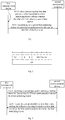
- an embodiment provides a method for starting a reflective mapping based on an associated data packet, which may be applied to a first communication device, including:
- the reflective mapping provided in this embodiment is a data transmission mechanism specified by the SDAP, and may be used for transmission of uplink and downlink data between a base station and a terminal.
- the second communication device when the first communication device is a base station, the second communication device may be a terminal; when the second communication device is a base station, the first communication device is a terminal.
- the present embodiment provides a method of starting a reflective mapping applied to the first communication device.
- the startup identifier of the first value is carried in the second data packet that currently needs to be transmitted to the second communication device.
- the second communication device is instructed to start the reflective mapping transmission mechanism. In this way, after the second communication device receives the startup identifier of the first value, the second communication device starts the reflective mapping transmission mechanism, and transmits the first data packet based on the reflective mapping. This ensures that the first communication device subsequently receives data packets transmitted from the second communication device at the first underlying bearer.
- the startup identifier may be one or more bits, and the value of the startup identifier may at least include a first value and a second value.
- the first value is different from the second value. For example, when the startup identifier is 1 bit, if the first value is "0", then the second value is "1"; if the first value is "1", then the second value is "0".
- the second data packet may be a data packet that is originally provided with a startup identifier bit or a startup identification field, or may be a data packet that is not originally provided with a startup identifier bit or a startup identification field.
- the second data packet herein is an associated data packet of the startup identifier of the first value.
- the startup identifier of the first value may be directly written into the startup identification field in the step S110.
- the second communication device may obtain the startup identifier of the first value by decoding the startup identification field according to a communication protocol or a pre-negotiation.
- the startup identification field needs to be added at a predetermined location of the second data packet.
- the startup identification field may be added in the front of the second data packet, or, the startup identification field may be appended at the end of the second data packet.
- the second communication device may determine whether the startup identification field is currently carried in the second data packet according to a length of the second data packet thereby obtaining the startup identifier of the first value.
- the startup identification field at least includes: a startup identifier bit.
- the startup identifier bit is at least 1 bit.
- the startup identifier of the first value may be added to the second data packet that needs to be transmitted to the second communication device, thereby completing startup of the reflective mapping transmission mechanism in a simple manner.
- the second data packet that originally needs to be transmitted to the second communication device is used to carry the startup identifier, then there is no need to use a control signaling data packet to carry the startup identifier.
- taking the second data packet as the associated data packet for transmission of the startup identifier will generate a smaller amount of data as comparing with constructing a special data packet, thereby having the characteristics of low overhead and easy to implement with the second data packet.
- the second data packet may be a data packet which is originally to be transmitted at a second underlying bearer.
- the second data packet which is originally to be transmitted through the second underlying bearer may be adjusted to be transmitted through the first underlying bearer. Since the second data packet carries the startup identifier of the first value, the second communication device starts the reflective mapping according to the startup identifier of the first value and transmits the first data packet through the first underlying bearer. In this way, if the second data packet is originally determined to be transmitted through the second underlying bearer, then, in the step S120, the second data packet carrying the startup identifier of the first value is adjusted to be transmitted through the first underlying bearer.
- the second data packet carrying the first value is directly transmitted through the first underlying bearer.
- the method further includes: according to a current data transmission status between the first communication device and the second communication device, determining the second data packet to be added with the startup identifier of the first value.
- the step of according to the current data transmission status between the first communication device and the second communication device, determining the second data packet to be added with the startup identifier of the first value includes: determining whether there is data transmission between the first communication device and the second communication device through the first underlying bearer; if yes, preferentially selecting a data packet transmitted through the first underlying bearer as the second packet.
- a data packet A, a data packet B and a data packet C are transmitted between a base station and a terminal through three different underlying bearers.
- the data packet C when the data packet C is transmitted through the first underlying bearer, the data packet C may be directly taken as the second data packet, which is added with the startup identifier of the first value and then is transmitted to the second communication device, thereby reducing underlying bearer switching during data packet transmission and reducing establishment of the underlying bearer.
- the step of according to the current data transmission status between the first communication device and the second communication device, determining the second data packet to be added with the startup identifier of the first value includes:
- the data packet A, the data packet B, and the data packet C are transmitted between the base station and the terminal through three different underlying bearers. Based on transmission status such as resource scheduling, current transmission time delays of the data packet A, the data packet B, and the data packet C transmitted to the terminal are determined, respectively. For example, the transmission time delay of the data packet B to the terminal is the smallest, then the data packet B is directly taken as the second data packet carrying the startup identifier of the first value amd the data packet B is transmitted through the first underlying bearer.
- the second communication device can be notified of transmitting the first data packet in the reflective mapping transmission mechanism as early as possible, thereby reducing transmission time delay of transmission of the first data packet through the the corresponding underlying bearer.
- the method may further include: switching the second data packet to utilize the second underlying bearer for transmission.
- the higher the QoS attribute the higher the transmission reliability and the transmission quality, and the higher communication resources and/or transmission time delays that may be consumed.
- the QoS attribute corresponding to the second underlying bearer which is originally used by the selected second data packet is required to be not higher than the QoS attribute corresponding to the first underlying bearer, otherwise the transmission of the second data packet itself may not satisfy the required QoS attribute.
- the method further includes:
- the startup identifier may be set to the second value. In this way, it can avoid the second communication device from continuing to receive the corresponding startup identifier for indicating startup after the second communication device receives the startup identifier and starts the reflective mapping transmission mechanism, thereby reducing problems of logical processing confusion inside the second communication device and ensuring normal operation of the second communication device.
- the method further includes: after transmitting the second data packet through the first underlying bearer and before receiving the first data packet through the first low layer bearer, continuing to transmit the second data packet carrying the startup identifier of the first value through the first underlying bearer.
- the second communication device may continue transmitting the first data packet to the first communication device by a third underlying bearer. While in this embodiment, in order to successfully trigger the second communication device to start the reflective mapping transmission mechanism, the second data packet carrying the startup identifier of the first value is continued to be transmitted through the first underlying bearer. It is worth noting that the transmitted second data packet here may be an initial data packet or a retransmission data packet.
- the second one of the second data packets starts to carry the startup identifier of the first value
- the first communication device sequentially transmits the second data packets by the first underlying bearer in turns of the second data packets.
- the fifth one of the second data packets is transmitted, the first data packet received by the first communication device is still received from the third underlying bearer, then the sixth one of the second data packets transmitted from the first communication device to the second communication device still carries the startup identifier of the first value.
- the startup identifier carried in the sixth one of the second data packets transmitted from the first communication device to the second communication device is set to be the second value.
- one or more second data packets carrying the startup identifier of the first value are used to trigger the second communication device to start the reflective mapping; meanwhile, after the reflective mapping is started successfully, the startup identifier carried in the second data packet is set to be the second value.
- the second data packet when the reflective mapping in the second communication device is successfully started, the second data packet no longer carries the startup identifier, which may reduce unnecessary transmission of the startup identifier, and reduce signaling overhead and amount of transmitted data.
- the method further includes: when it is determined that the first data packet needs to be transmitted at the first underlying bearer, adding in the second data packet, identification information of the first data packet that needs to be transmitted at the first underlying bearer; where the identification information is used by the second communication terminal to determine a data packet for performing reflective mapping transmission.
- the identification information may be a flow identifier of a data flow to which the first data packet belongs, or may be a service identifier of a service corresponding to the first data packet.
- the identification information may be identification information for the second communication device to determine a data packet which needs to be transmitted at the first underlying bearer.
- the foregoing startup identification field may include: a startup identifier bit of at least one bit.
- the startup identification field further includes an identification sub-field of a plurality of bits. The identification sub-field may be used to carry the identification information.
- FIG. 2 is a schematic diagram of a startup identification field.
- the startup identification field shown in FIG. 2 includes 8 bits, including: a startup identifier bit (RQF) of one bit and an identification sub-field of 4 bits.
- the identification sub-field carries a SDAP-based flow identifier.
- the "R" in FIG. 2 represents a reserved bit in the startup identification field, and the reserved bit may be used for subsequent various indications related to starting the reflective mapping. For example, the reserved bit may be used to indicate a starting data packet in a corresponding data flow for performing the reflective mapping.
- One data flow includes a plurality of data packets.
- the first communication device such as a base station may determine which data packet in the data flow to start transmission with the reflective mapping.
- FIG. 2 is only an optional schematic diagram of the startup identification field.
- the startup identification field is not limited to the structure of shown in FIG. 2 .
- the step S110 may include: carrying the startup identifier of the first value in a packet header of the second data packet.
- the data packet transmitted based on the SDAP may not have a packet header.
- the second data packet may be a data packet that includes a packet header and a body portion.
- the startup identifier of the first value may be carried in the packet header of the second data packet.
- the packet header of the second data packet here may be a special packet header for carrying the startup identifier of the first value.
- the method further includes: determining whether the quality of service (QoS) attribute of the first data packet changes; where the first underlying bearer is an underlying bearer having a target QoS attribute after the QoS attribute of the first data packet changes.
- QoS quality of service
- the first data packet is originally defined to be transmitted at the third underlying bearer.
- the first communication device finds change of the QoS attribute of the first data packet that needs to be switched, the first communication device needs to change the underlying bearer for transmission.
- the determining step may include one or more of the following optional modes.
- the method further includes:
- the base station may establish the first underlying bearer by using various signaling of the related art. For example, the base station may use RRC signaling, MAC layer signaling to instruct the terminal to participate in the establishment of the first underlying bearer. This is convenient for transmission of the second data packet carrying the start identifier of the first value by the first underlying bearer after the first underlying bearer is established.
- the uplink control information requests for establishing the first underlying bearer with the base station.
- the base station After receiving the uplink control information carrying establishment of the first underlying bearer, the base station establishes the first underlying bearer when conditions for establishing the first underlying bearer are met.
- an embodiment provides a method for starting a reflective mapping, which is applied to a second communication device, and including:
- the first communication device when the second communication device is a terminal, the first communication device may be a base station; and when the second communication device is a base station, the first communication device is a terminal.
- the second communication device may be a receiving end of the second data packet.
- the second communication device receives the second data packet carrying the startup identifier of the first value.
- the second communication device After receiving the second data packet carrying the startup identifier of the first value, the second communication device starts the reflective mapping transmission mechanism, and transmits the first data packet by the first underlying bearer which transmits the second data packet.
- the first communication device uses the second data packet, which originally needs to be transmitted to the second communication device, to carry the startup identifier of the first value.
- the second data packet which originally needs to be transmitted to the second communication device, to carry the startup identifier of the first value.
- the method further includes:
- the second data packet further carries identification information of the first data packet.
- the identification information herein may be an indication identifier which uniquely determines the first data packet, such as a service identifier of the first data packet and/or a flow identifier of data flow.
- the second communication device can learn that the currently started reflective mapping is applied to which type of data packet, that is, the second communication device can determine the first data packet transmitted by the first underlying bearer.
- the step S220 may include: switching the first data packet which is originally determined to be transmitted by a third underlying bearer to be transmitted by the first underlying bearer.
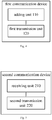
- the communication device is a first communication device, and includes:
- the communication device provided in this embodiment is a transmission device of the second data packet and a receiving device of the first data packet.
- the first communication device may be a base station or a terminal
- the second communication device may be a terminal or a base station.
- the adding unit 110 may correspond to a processor.
- the processor may be a central processing unit, a microprocessor, a digital signal processor, an application processor, a programmable array or an application specific integrated circuit or the like.
- the processor may add the startup identifier of the first value to the second data packet that is originally needed to be transmitted to the second communication device by executing executable instructions such as a computer program.
- the first transmission unit 120 may be corresponding to transmission antenna of the first communication device, and may be used to transmit the second data packet carrying the startup identifier of the first value to the second communication device, thereby triggering the second communication device to transmit the first data packet to the first communication device after the second communication device receives the second data packet from the first underlying bearer.
- the adding unit 110 is further used to, after transmitting the second data packet by the first underlying bearer and receiving the first data packet through the first underlying bearer, add the startup identifier of a second value into a to-be-transmitted second data packet, and transmit the second data packet carrying the startup identifier of the second value through the first underlying bearer.
- the adding unit 110 is further used to, after transmitting the second data packet by the first underlying bearer and receiving the first data packet through the first underlying bearer, transmit second data packets not carrying the startup identifier.
- the adding unit 110 is further used to, after transmitting the second data packet through the first underlying bearer and before receiving the first data packet through the first low layer bearer, continue to transmit the second data packet carrying the startup identifier of the first value through the first underlying bearer.
- the adding unit 110 is further used to, when it is determined that the first data packet needs to be transmitted at the first underlying bearer, add in the second data packet, identification information of the first data packet that needs to be transmitted at the first underlying bearer; where the identification information is used by the second communication terminal to determine a data packet for performing reflective mapping transmission.
- the adding unit 110 is further used to carry the startup identifier of the first value in a packet header of the second data packet.
- the first communication device further includes: a determining unit used to determine whether the quality of service (QoS) attribute of the first data packet changes; where the first underlying bearer is an underlying bearer having a target QoS attribute after the QoS attribute of the first data packet changes.
- QoS quality of service
- the determining unit may also correspond to the processor, and may determine whether the QoS attribute of the first data packet which is originally determined to be transmitted at the third underlying bearer is changed. If yes, it is required to start the reflective mapping transmission mechanism for the first underlying bearer.
- the determining unit is specifically used to determine whether the first underlying bearer is established.
- the first communication device may further include: an establishment unit corresponding to the processor and used to instruct establishment of the first underlying bearer by RRC signaling, RLC signaling, or MAC signaling when the first underlying bearer is not established and the first communication device is a base station; or, request for establishing the first underlying bearer by uplink control information when the first underlying bearer is not established and the first communication device is a terminal.
- the first transmission unit 120 may be used to switch the second data packet which is originally determined to be transmitted by the second underlying bearer to be transmitted by the first underlying bearer.
- an embodiment provides a communication device.
- the communication device is a second communication device, and includes:
- the first communication device may be a base station.
- the receiving unit 210 and the second transmission unit 220 each may correspond to a transceiver antenna, and may be used for transmitting wireless signals with the first communication device, thereby implementing startup of the reflective mapping and transmission of the second data packet and the first data packet.
- the first data packet further carries identification information.
- the second transmission unit 220 is used to, when the startup identifier is of a first value, start a reflective mapping to transmit the first data packet corresponding to the identification information by the first underlying bearer.
- the second transmission unit 220 is specifically used to switch the first data packet which is originally determined to be transmitted by a third underlying bearer to be transmitted by the first underlying bearer.
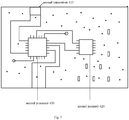
- the communication device is a first communication device and includes a first transceiver 310, a first memory 320 and a first processor 330.
- the first processor 330 is coupled to the first transceiver 310 and the first memory 320, respectively, and is used to execute a computer program to perform at least the following steps:
- first data packet when it is determined that first data packet needs to be transmitted in a first data radio bearer underlying bearer, adding a startup identifier of a first value to a second data packet; where the startup identifier of the first value is used to instruct the second communication device to start reflective mapping, the first data packet is a data packet transmitted by a second communication device to the first communication device, and the second data packet is a data packet that is originally to be transmitted by the first communication device;
- the first transceiver 310 in this embodiment may correspond to a transceiver antenna.
- the first memory 320 may include various types of storage media that can be used for data storage.
- at least some of the storage medium included in the first memory 320 is a non-volatile storage medium, and can be used to store the computer program.
- the first processor 330 may include a central processing unit, a microprocessor, a digital signal processor, an application processor, an application specific integrated circuit or a programmable array, etc., and may be used to implement PNF packet formation by execution of a computer program.
- the first processor 330 may be coupled to the first transceiver 310 and the first memory 320 through an in-device bus such as an integrated circuit bus.
- the first processor 330 can be used to control the first transceiver 310 to transmit and receive data, and to control the first memory 320 to store data, and to implement the above operations by execution of executable instructions such as a computer program.
- the steps that the first processor 330 may perform further include:
- the first processor 330 may also be used to perform the following steps: after transmitting the second data packet through the first underlying bearer and before receiving the first data packet through the first low layer bearer, continuing to transmit the second data packet carrying the startup identifier of the first value through the first underlying bearer.
- the first processor 330 may also be used to perform the following steps: when it is determined that the first data packet needs to be transmitted at the first underlying bearer, adding in the second data packet, identification information of the first data packet that needs to be transmitted at the first underlying bearer; where the identification information is used by the second communication terminal to determine a data packet for performing reflective mapping transmission.
- the first processor 330 is specifically used to carry the startup identifier of the first value in a packet header of the second data packet.
- the first processor 330 is further used to perform the following steps: determining whether the quality of service (QoS) attribute of the first data packet changes; where the first underlying bearer is an underlying bearer having a target QoS attribute after the QoS attribute of the first data packet changes.
- QoS quality of service
- the first processor 330 may be specifically used to determine whether the first underlying bearer is established; instruct establishment of the first underlying bearer by RRC signaling, RLC signaling, or MAC signaling when the first underlying bearer is not established and the first communication device is a base station; or, request for establishing the first underlying bearer by uplink control information when the first underlying bearer is not established and the first communication device is a terminal.
- the first transceiver 310 is used to, under the control of the first processor 330, switch the second data packet which is originally determined to be transmitted by the second underlying bearer to be transmitted by the first underlying bearer.
- an embodiment provides a communication device.
- the communication device is a second communication device and includes: a second transceiver 410, a second memory 420 and a second processor 430.
- the second processor 430 is coupled to the second transceiver 410 and the second memory 420, respectively, and is used to execute a computer program to perform at least the following steps:
- the second transceiver 410 in this embodiment may correspond to a transceiver antenna.
- the second memory 420 may include various types of storage media that can be used for data storage.
- at least some of the storage medium included in the second memory 420 is a non-volatile storage medium, and can be used to store the computer program.
- the second processor 430 may include: a central processing unit, a microprocessor, a digital signal processor, an application processor, an application specific integrated circuit or a programmable array, etc., and may be used to implement PNF packet formation by execution of a computer program.
- the second processor 430 may be coupled to the second transceiver 410 and the second memory 420 through an in-device bus such as an integrated circuit bus.
- the first data packet further carries identification information.
- the second processor 430 is specifically used to perform the following steps: when the startup identifier is of a first value, starting a reflective mapping to transmit the first data packet corresponding to the identification information by the first underlying bearer.
- the second processor 430 is specifically used to switch the first data packet which is originally determined to be transmitted by a third underlying bearer to be transmitted by the first underlying bearer.
- An embodiment of the present disclosure further provides a communication device, including: a third transceiver, a third memory, a third processor, and a computer program stored on the third memory and processed by the third processor.
- the third processor is respectively coupled to the third transceiver and the third memory, and is used to execute the computer program to control the transceiver to exchange information, control the memory to store information, perform the foregoing one or more methods for starting reflective mapping applied to the first communication device or the second communication device.
- the third transceiver may correspond to a transceiver antenna of the first communication device or the second communication device.
- the third memory may include various types of storage media that may be used for data storage.
- at least some of storage medium included in the second memory is a non-volatile storage medium and can be used to store the computer program.
- the third processor may include a central processing unit, a microprocessor, a digital signal processor, an application processor, an application specific integrated circuit or a programmable array, etc., and may be used to implement PNF packet formation by execution of a computer program.
- the third processor may be coupled to the third transceiver and the third memory through an in-device bus such as an integrated circuit bus.
- An embodiment of the present disclosure further provide a computer storage medium storing a computer program.
- the computer program is executed by a processor to perform the foregoing one or more methods for starting reflective mapping applied to the first communication device or the second communication device.
- the computer storage medium includes: a mobile storage device, a read-only memory (ROM), a random access memory (RAM), a magnetic disk, or an optical disk, or a medium which can store program codes.
- the computer storage medium may be a non-transitory storage medium.
- the non-transitory storage medium herein may also be referred to as a non-volatile storage medium.
- DRB is taken as an example of the underlying bearer, which is not limited to DRB.
- this example provides a method for starting a reflective mapping based on an associated data packet in SDAP, including the following steps.
- step S1 uplink and downlink data of QoS data flow (Flow#i) of a network side base station (gNB) and a terminal are transmitted and received at the DRB#j.
- Flow#i QoS data flow
- an RRC or SDAP function entity on the network side determines that the QoS level of the uplink Flow#i of the terminal needs to be modified.
- the target DRB is established by RRC connection reconfiguration signaling or other fast ways of L3/L2.
- the SDAP entity or the base station transmits the downlink data packet of the Flow#i at the DRB#k with an active reflection identifier being carried, and stops transmitting any downlink data packet of the Flow#i at the DRB#j.
- the active reflection identifier herein is the above startup identifier of the first value.
- step S5 after receiving the data packet of Flow#i at the DRB#k, the SDAP entity of the terminal determines whether the network side instructs to start the reflective mapping.
- the SDAP entity of the terminal transmits the uplink data packet of the subsequent Flow#i at the DRB#k, and stops transmitting at the DRB#j.
- the SDAP of the network side receives the uplink data of the Flow#i at the DRB#k, and then determines that the reflective mapping is successful, and then deactivates a reflective identifier.
- step S8 uplink and downlink data of Flow#i are simultaneously transmitted at DRB#k.
- This example provides a method of activating and deactivating an associated reflective identifier, including the following steps.
- a channel associated instruction including a reflection identifier is introduced in a header of a protocol data unit (PDU) of the SDAP, and is recorded as Reflective Flow Flag (RQF).
- PDU protocol data unit
- RQF Reflective Flow Flag
- one protocol data unit may be considered as a data packet.
- the header of the PDU may be the header of a data packet.
- RQF The value of RQF is:
- the RQF may be an identifier with multiple meanings, and the reflective mapping is only two values of them.
- the RQF may also be an identifier for reflective mapping only, and in this case, the RQF can occupy only 1 bit, as follows:
- the RQF is set to 1.
- the terminal parses the head of the SDAP PDU and reads the RQF from the header.
- the RQF indicates that the network side starts the reflective mapping.
- it may be necessary to read the Flow ID in the PDU header, and then uplink data on the Flow indicated by the Flow ID it transmitted at the DRB.
- FIG. 2 shows an example of a SDAP PDU scheme in which a PDU header carries RQF of 1-bit in length and a SDAP Flow ID of no more than 7 bits in length.
- FIG. 2 is a schematic diagram of location scheme of RQF and SDAP Flow ID in a PDU.
- the disclosed devices and methods may be implemented with other methods.
- the above-described device embodiments are only illustrative, e.g., the division of the unit is only a logic function division. In practical implementation, there may be another division method. For example, multiple units or components may be combined, or integrated into another system, or some features may be omitted, or not executed. From another point, the mutual coupling or direct coupling, or communication connection shown or discussed may be indirect coupling, or communication connections through some interfaces, devices, or units, which may be electronic, mechanical, or in other form.
- Units described as separate components may be, or may be not physically separate.
- a component displayed as a unit may be, or may be not a physical unit, that is, it may be located in one place, or may be distributed to multiple network units. According to practical requirements, some units or all the units may be selected to implement the objective of solutions in the embodiments of the application.
- various functional units may be integrated into a processing unit.
- each unit physically exists alone.
- two or more units may be integrated into one unit.
- the integrated unit may be implemented in the form of hardware or in the form of hardware plus software functional units.
- the foregoing program may be stored in a computer readable storage medium, and the program is executed to perform the steps of the above method embodiments.
- the foregoing storage medium includes: a mobile storage device, a read-only memory (ROM), a random access memory (RAM), a magnetic disk, or an optical disk, or a medium that can store program codes.
Landscapes
- Engineering & Computer Science (AREA)
- Computer Networks & Wireless Communication (AREA)
- Signal Processing (AREA)
- Mobile Radio Communication Systems (AREA)
Applications Claiming Priority (2)
| Application Number | Priority Date | Filing Date | Title |
|---|---|---|---|
| CN201710661763.4A CN109391375B (zh) | 2017-08-04 | 2017-08-04 | 反射映射的启动方法、通信设备及存储介质 |
| PCT/CN2018/098267 WO2019024888A1 (zh) | 2017-08-04 | 2018-08-02 | 反射映射的启动方法、通信设备及存储介质 |
Publications (3)
| Publication Number | Publication Date |
|---|---|
| EP3664569A1 true EP3664569A1 (de) | 2020-06-10 |
| EP3664569A4 EP3664569A4 (de) | 2021-04-28 |
| EP3664569B1 EP3664569B1 (de) | 2025-08-27 |
Family
ID=65232260
Family Applications (1)
| Application Number | Title | Priority Date | Filing Date |
|---|---|---|---|
| EP18841414.8A Active EP3664569B1 (de) | 2017-08-04 | 2018-08-02 | Verfahren zur auslösung von reflexionsmapping, kommunikationsvorrichtung und speichermedium |
Country Status (4)
| Country | Link |
|---|---|
| US (1) | US11277233B2 (de) |
| EP (1) | EP3664569B1 (de) |
| CN (1) | CN109391375B (de) |
| WO (1) | WO2019024888A1 (de) |
Families Citing this family (1)
| Publication number | Priority date | Publication date | Assignee | Title |
|---|---|---|---|---|
| CN111417146B (zh) * | 2019-01-07 | 2023-01-13 | 中国移动通信有限公司研究院 | 一种控制方法及设备 |
Family Cites Families (13)
| Publication number | Priority date | Publication date | Assignee | Title |
|---|---|---|---|---|
| CN101296020A (zh) * | 2007-04-27 | 2008-10-29 | 北京三星通信技术研究有限公司 | 部分功能ofdma中继系统直接消息转发的实现方法 |
| WO2017018689A1 (en) * | 2015-07-26 | 2017-02-02 | Lg Electronics Inc. | Method for transmitting information on priority for d2d link with relay ue in wireless communication system and apparatus therefor |
| CN106413120B (zh) * | 2015-07-31 | 2021-09-21 | 华为技术有限公司 | 数据发送方法、装置及系统 |
| CN109923891B (zh) * | 2016-10-11 | 2022-05-31 | Lg 电子株式会社 | 在无线通信系统中应用反映型服务质量的方法及其设备 |
| EP3536095A1 (de) * | 2016-11-04 | 2019-09-11 | Telefonaktiebolaget LM Ericsson (publ) | Reflektierende zuordnung von strömen zu funkträgern |
| CN109952781B (zh) * | 2016-11-04 | 2022-05-24 | 瑞典爱立信有限公司 | 用于处理数据分组的ue、网络节点及方法 |
| EP3550876A4 (de) * | 2016-12-29 | 2019-11-20 | LG Electronics Inc. -1- | Verfahren und vorrichtung zur drb-herstellung |
| CN109274474B (zh) * | 2017-05-05 | 2019-11-19 | 华为技术有限公司 | 一种基于反转服务流特性的通信方法及装置 |
| US20180324631A1 (en) * | 2017-05-05 | 2018-11-08 | Mediatek Inc. | Using sdap headers for handling of as/nas reflective qos and to ensure in-sequence packet delivery during remapping in 5g communication systems |
| CN109005527B (zh) * | 2017-06-06 | 2022-07-12 | 华为技术有限公司 | 一种数据传输方法和终端 |
| CN109246852B (zh) * | 2017-06-13 | 2023-08-11 | 夏普株式会社 | 无线协议层实体处理方法以及相应的用户设备 |
| CN109151915B (zh) * | 2017-06-16 | 2023-11-17 | 夏普株式会社 | 用于数据分组递送的方法、用户设备和基站 |
| US20200169913A1 (en) * | 2018-02-14 | 2020-05-28 | Lg Electronics Inc. | Method and apparatus for modifying mapping rule |
-
2017
- 2017-08-04 CN CN201710661763.4A patent/CN109391375B/zh active Active
-
2018
- 2018-08-02 US US16/636,189 patent/US11277233B2/en active Active
- 2018-08-02 EP EP18841414.8A patent/EP3664569B1/de active Active
- 2018-08-02 WO PCT/CN2018/098267 patent/WO2019024888A1/zh not_active Ceased
Also Published As
| Publication number | Publication date |
|---|---|
| US11277233B2 (en) | 2022-03-15 |
| CN109391375A (zh) | 2019-02-26 |
| EP3664569B1 (de) | 2025-08-27 |
| US20200177327A1 (en) | 2020-06-04 |
| US20210135799A9 (en) | 2021-05-06 |
| EP3664569A4 (de) | 2021-04-28 |
| CN109391375B (zh) | 2020-10-09 |
| WO2019024888A1 (zh) | 2019-02-07 |
Similar Documents
| Publication | Publication Date | Title |
|---|---|---|
| JP6147302B2 (ja) | 不連続及び周期的pusch送信を伴う無線アクセス技術 | |
| CN113271633A (zh) | 切换的方法和通信装置 | |
| US20260089801A1 (en) | Methods and apparatuses for a scg deactivation mechanism and a scg activation mechanism in a mr-dc scenario | |
| JP6880030B2 (ja) | アップリンク制御情報を送信するための方法、端末と記憶媒体 | |
| CN114175726B (zh) | 用于移动性控制的无线通信方法 | |
| US20230199895A1 (en) | Methods and apparatus for data transmission in new radio (nr) inactive state | |
| CN108990101B (zh) | 处理双连接中次要节点改变的装置及方法 | |
| CN115119311A (zh) | 传输小数据的方法和通信装置 | |
| JP6608528B2 (ja) | 無線通信の方法、ネットワーク装置及び端末機器 | |
| WO2019096058A1 (zh) | 传输控制信息的方法、终端设备和网络设备 | |
| CN114342465A (zh) | 无线通信的方法和终端设备 | |
| WO2020143374A1 (zh) | 传输处理方法、装置、设备及存储介质 | |
| US10143035B2 (en) | Device and method of handling communication with communication device | |
| US11277233B2 (en) | Method for starting reflective mapping, communication device, and storage medium | |
| JP2023514574A (ja) | ランダムアクセスプロシージャにおけるプリアンブルおよびペイロードメッセージの伝送 | |
| CN120111596A (zh) | 切换方法、装置、存储介质及程序产品 | |
| EP3606156B1 (de) | Verfahren und vorrichtung zur verarbeitung von daten mit hoher geschwindigkeit | |
| HK40020479A (en) | Method for initiating reflection mapping, communication device, and storage medium | |
| HK40020479B (en) | Method for initiating reflection mapping, communication device, and storage medium | |
| US11296856B2 (en) | Method for transmitting information and device | |
| US20240214127A1 (en) | Method for data transmission, terminal device, and computer storage medium | |
| CN112584496B (zh) | 一种资源使用方法及通信设备 | |
| US20230269810A1 (en) | Method for resource updating, electronic device, and storage medium | |
| WO2018058537A1 (zh) | 传输信号的方法和装置 | |
| CN120835337A (zh) | 一种运用于双连接dc场景下的数据处理方法 |
Legal Events
| Date | Code | Title | Description |
|---|---|---|---|
| STAA | Information on the status of an ep patent application or granted ep patent |
Free format text: STATUS: THE INTERNATIONAL PUBLICATION HAS BEEN MADE |
|
| PUAI | Public reference made under article 153(3) epc to a published international application that has entered the european phase |
Free format text: ORIGINAL CODE: 0009012 |
|
| STAA | Information on the status of an ep patent application or granted ep patent |
Free format text: STATUS: REQUEST FOR EXAMINATION WAS MADE |
|
| 17P | Request for examination filed |
Effective date: 20200218 |
|
| AK | Designated contracting states |
Kind code of ref document: A1 Designated state(s): AL AT BE BG CH CY CZ DE DK EE ES FI FR GB GR HR HU IE IS IT LI LT LU LV MC MK MT NL NO PL PT RO RS SE SI SK SM TR |
|
| AX | Request for extension of the european patent |
Extension state: BA ME |
|
| REG | Reference to a national code |
Ref country code: HK Ref legal event code: DE Ref document number: 40020479 Country of ref document: HK |
|
| DAV | Request for validation of the european patent (deleted) | ||
| DAX | Request for extension of the european patent (deleted) | ||
| A4 | Supplementary search report drawn up and despatched |
Effective date: 20210330 |
|
| RIC1 | Information provided on ipc code assigned before grant |
Ipc: H04W 76/10 20180101AFI20210324BHEP Ipc: H04W 28/02 20090101ALI20210324BHEP Ipc: H04L 1/18 20060101ALI20210324BHEP |
|
| STAA | Information on the status of an ep patent application or granted ep patent |
Free format text: STATUS: EXAMINATION IS IN PROGRESS |
|
| 17Q | First examination report despatched |
Effective date: 20230228 |
|
| GRAP | Despatch of communication of intention to grant a patent |
Free format text: ORIGINAL CODE: EPIDOSNIGR1 |
|
| STAA | Information on the status of an ep patent application or granted ep patent |
Free format text: STATUS: GRANT OF PATENT IS INTENDED |
|
| INTG | Intention to grant announced |
Effective date: 20250326 |
|
| GRAS | Grant fee paid |
Free format text: ORIGINAL CODE: EPIDOSNIGR3 |
|
| GRAA | (expected) grant |
Free format text: ORIGINAL CODE: 0009210 |
|
| STAA | Information on the status of an ep patent application or granted ep patent |
Free format text: STATUS: THE PATENT HAS BEEN GRANTED |
|
| AK | Designated contracting states |
Kind code of ref document: B1 Designated state(s): AL AT BE BG CH CY CZ DE DK EE ES FI FR GB GR HR HU IE IS IT LI LT LU LV MC MK MT NL NO PL PT RO RS SE SI SK SM TR |
|
| REG | Reference to a national code |
Ref country code: GB Ref legal event code: FG4D |
|
| REG | Reference to a national code |
Ref country code: CH Ref legal event code: EP |
|
| REG | Reference to a national code |
Ref country code: DE Ref legal event code: R096 Ref document number: 602018085038 Country of ref document: DE |
|
| REG | Reference to a national code |
Ref country code: IE Ref legal event code: FG4D |
|
| REG | Reference to a national code |
Ref country code: NL Ref legal event code: MP Effective date: 20250827 |
|
| PG25 | Lapsed in a contracting state [announced via postgrant information from national office to epo] |
Ref country code: IS Free format text: LAPSE BECAUSE OF FAILURE TO SUBMIT A TRANSLATION OF THE DESCRIPTION OR TO PAY THE FEE WITHIN THE PRESCRIBED TIME-LIMIT Effective date: 20251227 |
|
| PG25 | Lapsed in a contracting state [announced via postgrant information from national office to epo] |
Ref country code: NO Free format text: LAPSE BECAUSE OF FAILURE TO SUBMIT A TRANSLATION OF THE DESCRIPTION OR TO PAY THE FEE WITHIN THE PRESCRIBED TIME-LIMIT Effective date: 20251127 |
|
| REG | Reference to a national code |
Ref country code: LT Ref legal event code: MG9D |
|
| PG25 | Lapsed in a contracting state [announced via postgrant information from national office to epo] |
Ref country code: PT Free format text: LAPSE BECAUSE OF FAILURE TO SUBMIT A TRANSLATION OF THE DESCRIPTION OR TO PAY THE FEE WITHIN THE PRESCRIBED TIME-LIMIT Effective date: 20251229 |
|
| PG25 | Lapsed in a contracting state [announced via postgrant information from national office to epo] |
Ref country code: FI Free format text: LAPSE BECAUSE OF FAILURE TO SUBMIT A TRANSLATION OF THE DESCRIPTION OR TO PAY THE FEE WITHIN THE PRESCRIBED TIME-LIMIT Effective date: 20250827 |
|
| PG25 | Lapsed in a contracting state [announced via postgrant information from national office to epo] |
Ref country code: NL Free format text: LAPSE BECAUSE OF FAILURE TO SUBMIT A TRANSLATION OF THE DESCRIPTION OR TO PAY THE FEE WITHIN THE PRESCRIBED TIME-LIMIT Effective date: 20250827 Ref country code: HR Free format text: LAPSE BECAUSE OF FAILURE TO SUBMIT A TRANSLATION OF THE DESCRIPTION OR TO PAY THE FEE WITHIN THE PRESCRIBED TIME-LIMIT Effective date: 20250827 |
|
| PG25 | Lapsed in a contracting state [announced via postgrant information from national office to epo] |
Ref country code: GR Free format text: LAPSE BECAUSE OF FAILURE TO SUBMIT A TRANSLATION OF THE DESCRIPTION OR TO PAY THE FEE WITHIN THE PRESCRIBED TIME-LIMIT Effective date: 20251128 |
|
| PG25 | Lapsed in a contracting state [announced via postgrant information from national office to epo] |
Ref country code: SE Free format text: LAPSE BECAUSE OF FAILURE TO SUBMIT A TRANSLATION OF THE DESCRIPTION OR TO PAY THE FEE WITHIN THE PRESCRIBED TIME-LIMIT Effective date: 20250827 |
|
| PG25 | Lapsed in a contracting state [announced via postgrant information from national office to epo] |
Ref country code: LV Free format text: LAPSE BECAUSE OF FAILURE TO SUBMIT A TRANSLATION OF THE DESCRIPTION OR TO PAY THE FEE WITHIN THE PRESCRIBED TIME-LIMIT Effective date: 20250827 |
|
| PG25 | Lapsed in a contracting state [announced via postgrant information from national office to epo] |
Ref country code: BG Free format text: LAPSE BECAUSE OF FAILURE TO SUBMIT A TRANSLATION OF THE DESCRIPTION OR TO PAY THE FEE WITHIN THE PRESCRIBED TIME-LIMIT Effective date: 20250827 Ref country code: PL Free format text: LAPSE BECAUSE OF FAILURE TO SUBMIT A TRANSLATION OF THE DESCRIPTION OR TO PAY THE FEE WITHIN THE PRESCRIBED TIME-LIMIT Effective date: 20250827 |
|
| PG25 | Lapsed in a contracting state [announced via postgrant information from national office to epo] |
Ref country code: RS Free format text: LAPSE BECAUSE OF FAILURE TO SUBMIT A TRANSLATION OF THE DESCRIPTION OR TO PAY THE FEE WITHIN THE PRESCRIBED TIME-LIMIT Effective date: 20251127 |
|
| PG25 | Lapsed in a contracting state [announced via postgrant information from national office to epo] |
Ref country code: ES Free format text: LAPSE BECAUSE OF FAILURE TO SUBMIT A TRANSLATION OF THE DESCRIPTION OR TO PAY THE FEE WITHIN THE PRESCRIBED TIME-LIMIT Effective date: 20250827 |
|
| REG | Reference to a national code |
Ref country code: AT Ref legal event code: MK05 Ref document number: 1831665 Country of ref document: AT Kind code of ref document: T Effective date: 20250827 |
|
| PG25 | Lapsed in a contracting state [announced via postgrant information from national office to epo] |
Ref country code: SM Free format text: LAPSE BECAUSE OF FAILURE TO SUBMIT A TRANSLATION OF THE DESCRIPTION OR TO PAY THE FEE WITHIN THE PRESCRIBED TIME-LIMIT Effective date: 20250827 |
|
| PG25 | Lapsed in a contracting state [announced via postgrant information from national office to epo] |
Ref country code: DK Free format text: LAPSE BECAUSE OF FAILURE TO SUBMIT A TRANSLATION OF THE DESCRIPTION OR TO PAY THE FEE WITHIN THE PRESCRIBED TIME-LIMIT Effective date: 20250827 |
|
| PG25 | Lapsed in a contracting state [announced via postgrant information from national office to epo] |
Ref country code: AT Free format text: LAPSE BECAUSE OF FAILURE TO SUBMIT A TRANSLATION OF THE DESCRIPTION OR TO PAY THE FEE WITHIN THE PRESCRIBED TIME-LIMIT Effective date: 20250827 |
|
| PG25 | Lapsed in a contracting state [announced via postgrant information from national office to epo] |
Ref country code: IT Free format text: LAPSE BECAUSE OF FAILURE TO SUBMIT A TRANSLATION OF THE DESCRIPTION OR TO PAY THE FEE WITHIN THE PRESCRIBED TIME-LIMIT Effective date: 20250827 |
|
| PG25 | Lapsed in a contracting state [announced via postgrant information from national office to epo] |
Ref country code: CZ Free format text: LAPSE BECAUSE OF FAILURE TO SUBMIT A TRANSLATION OF THE DESCRIPTION OR TO PAY THE FEE WITHIN THE PRESCRIBED TIME-LIMIT Effective date: 20250827 |
|
| PG25 | Lapsed in a contracting state [announced via postgrant information from national office to epo] |
Ref country code: SK Free format text: LAPSE BECAUSE OF FAILURE TO SUBMIT A TRANSLATION OF THE DESCRIPTION OR TO PAY THE FEE WITHIN THE PRESCRIBED TIME-LIMIT Effective date: 20250827 Ref country code: EE Free format text: LAPSE BECAUSE OF FAILURE TO SUBMIT A TRANSLATION OF THE DESCRIPTION OR TO PAY THE FEE WITHIN THE PRESCRIBED TIME-LIMIT Effective date: 20250827 |