EP3663362B1 - Schimmelresistenter formbarer kork - Google Patents
Schimmelresistenter formbarer kork Download PDFInfo
- Publication number
- EP3663362B1 EP3663362B1 EP19217182.5A EP19217182A EP3663362B1 EP 3663362 B1 EP3663362 B1 EP 3663362B1 EP 19217182 A EP19217182 A EP 19217182A EP 3663362 B1 EP3663362 B1 EP 3663362B1
- Authority
- EP
- European Patent Office
- Prior art keywords
- cork
- zinc pyrithione
- heatshield
- binder
- present disclosure
- Prior art date
- Legal status (The legal status is an assumption and is not a legal conclusion. Google has not performed a legal analysis and makes no representation as to the accuracy of the status listed.)
- Active
Links
Images


Classifications
-
- C—CHEMISTRY; METALLURGY
- C09—DYES; PAINTS; POLISHES; NATURAL RESINS; ADHESIVES; COMPOSITIONS NOT OTHERWISE PROVIDED FOR; APPLICATIONS OF MATERIALS NOT OTHERWISE PROVIDED FOR
- C09D—COATING COMPOSITIONS, e.g. PAINTS, VARNISHES OR LACQUERS; FILLING PASTES; CHEMICAL PAINT OR INK REMOVERS; INKS; CORRECTING FLUIDS; WOODSTAINS; PASTES OR SOLIDS FOR COLOURING OR PRINTING; USE OF MATERIALS THEREFOR
- C09D5/00—Coating compositions, e.g. paints, varnishes or lacquers, characterised by their physical nature or the effects produced; Filling pastes
- C09D5/14—Paints containing biocides, e.g. fungicides, insecticides or pesticides
-
- B—PERFORMING OPERATIONS; TRANSPORTING
- B64—AIRCRAFT; AVIATION; COSMONAUTICS
- B64G—COSMONAUTICS; VEHICLES OR EQUIPMENT THEREFOR
- B64G1/00—Cosmonautic vehicles
- B64G1/22—Parts of, or equipment specially adapted for fitting in or to, cosmonautic vehicles
- B64G1/52—Protection, safety or emergency devices; Survival aids
- B64G1/58—Thermal protection, e.g. heat shields
-
- A—HUMAN NECESSITIES
- A01—AGRICULTURE; FORESTRY; ANIMAL HUSBANDRY; HUNTING; TRAPPING; FISHING
- A01N—PRESERVATION OF BODIES OF HUMANS OR ANIMALS OR PLANTS OR PARTS THEREOF; BIOCIDES, e.g. AS DISINFECTANTS, AS PESTICIDES OR AS HERBICIDES; PEST REPELLANTS OR ATTRACTANTS; PLANT GROWTH REGULATORS
- A01N25/00—Biocides, pest repellants or attractants, or plant growth regulators, characterised by their forms, or by their non-active ingredients or by their methods of application, e.g. seed treatment or sequential application; Substances for reducing the noxious effect of the active ingredients to organisms other than pests
- A01N25/08—Biocides, pest repellants or attractants, or plant growth regulators, characterised by their forms, or by their non-active ingredients or by their methods of application, e.g. seed treatment or sequential application; Substances for reducing the noxious effect of the active ingredients to organisms other than pests containing solids as carriers or diluents
- A01N25/10—Macromolecular compounds
-
- A—HUMAN NECESSITIES
- A01—AGRICULTURE; FORESTRY; ANIMAL HUSBANDRY; HUNTING; TRAPPING; FISHING
- A01N—PRESERVATION OF BODIES OF HUMANS OR ANIMALS OR PLANTS OR PARTS THEREOF; BIOCIDES, e.g. AS DISINFECTANTS, AS PESTICIDES OR AS HERBICIDES; PEST REPELLANTS OR ATTRACTANTS; PLANT GROWTH REGULATORS
- A01N55/00—Biocides, pest repellants or attractants, or plant growth regulators, containing organic compounds containing elements other than carbon, hydrogen, halogen, oxygen, nitrogen and sulfur
- A01N55/02—Biocides, pest repellants or attractants, or plant growth regulators, containing organic compounds containing elements other than carbon, hydrogen, halogen, oxygen, nitrogen and sulfur containing metal atoms
-
- B—PERFORMING OPERATIONS; TRANSPORTING
- B64—AIRCRAFT; AVIATION; COSMONAUTICS
- B64C—AEROPLANES; HELICOPTERS
- B64C1/00—Fuselages; Constructional features common to fuselages, wings, stabilising surfaces or the like
- B64C1/40—Sound or heat insulation, e.g. using insulation blankets
-
- B—PERFORMING OPERATIONS; TRANSPORTING
- B64—AIRCRAFT; AVIATION; COSMONAUTICS
- B64D—EQUIPMENT FOR FITTING IN OR TO AIRCRAFT; FLIGHT SUITS; PARACHUTES; ARRANGEMENT OR MOUNTING OF POWER PLANTS OR PROPULSION TRANSMISSIONS IN AIRCRAFT
- B64D41/00—Power installations for auxiliary purposes
-
- C—CHEMISTRY; METALLURGY
- C08—ORGANIC MACROMOLECULAR COMPOUNDS; THEIR PREPARATION OR CHEMICAL WORKING-UP; COMPOSITIONS BASED THEREON
- C08G—MACROMOLECULAR COMPOUNDS OBTAINED OTHERWISE THAN BY REACTIONS ONLY INVOLVING UNSATURATED CARBON-TO-CARBON BONDS
- C08G59/00—Polycondensates containing more than one epoxy group per molecule; Macromolecules obtained by polymerising compounds containing more than one epoxy group per molecule using curing agents or catalysts which react with the epoxy groups
- C08G59/18—Macromolecules obtained by polymerising compounds containing more than one epoxy group per molecule using curing agents or catalysts which react with the epoxy groups ; e.g. general methods of curing
- C08G59/20—Macromolecules obtained by polymerising compounds containing more than one epoxy group per molecule using curing agents or catalysts which react with the epoxy groups ; e.g. general methods of curing characterised by the epoxy compounds used
- C08G59/22—Di-epoxy compounds
- C08G59/24—Di-epoxy compounds carbocyclic
- C08G59/245—Di-epoxy compounds carbocyclic aromatic
-
- C—CHEMISTRY; METALLURGY
- C08—ORGANIC MACROMOLECULAR COMPOUNDS; THEIR PREPARATION OR CHEMICAL WORKING-UP; COMPOSITIONS BASED THEREON
- C08G—MACROMOLECULAR COMPOUNDS OBTAINED OTHERWISE THAN BY REACTIONS ONLY INVOLVING UNSATURATED CARBON-TO-CARBON BONDS
- C08G59/00—Polycondensates containing more than one epoxy group per molecule; Macromolecules obtained by polymerising compounds containing more than one epoxy group per molecule using curing agents or catalysts which react with the epoxy groups
- C08G59/18—Macromolecules obtained by polymerising compounds containing more than one epoxy group per molecule using curing agents or catalysts which react with the epoxy groups ; e.g. general methods of curing
- C08G59/40—Macromolecules obtained by polymerising compounds containing more than one epoxy group per molecule using curing agents or catalysts which react with the epoxy groups ; e.g. general methods of curing characterised by the curing agents used
- C08G59/50—Amines
-
- C—CHEMISTRY; METALLURGY
- C08—ORGANIC MACROMOLECULAR COMPOUNDS; THEIR PREPARATION OR CHEMICAL WORKING-UP; COMPOSITIONS BASED THEREON
- C08G—MACROMOLECULAR COMPOUNDS OBTAINED OTHERWISE THAN BY REACTIONS ONLY INVOLVING UNSATURATED CARBON-TO-CARBON BONDS
- C08G59/00—Polycondensates containing more than one epoxy group per molecule; Macromolecules obtained by polymerising compounds containing more than one epoxy group per molecule using curing agents or catalysts which react with the epoxy groups
- C08G59/18—Macromolecules obtained by polymerising compounds containing more than one epoxy group per molecule using curing agents or catalysts which react with the epoxy groups ; e.g. general methods of curing
- C08G59/40—Macromolecules obtained by polymerising compounds containing more than one epoxy group per molecule using curing agents or catalysts which react with the epoxy groups ; e.g. general methods of curing characterised by the curing agents used
- C08G59/50—Amines
- C08G59/5093—Complexes of amines
-
- C—CHEMISTRY; METALLURGY
- C08—ORGANIC MACROMOLECULAR COMPOUNDS; THEIR PREPARATION OR CHEMICAL WORKING-UP; COMPOSITIONS BASED THEREON
- C08G—MACROMOLECULAR COMPOUNDS OBTAINED OTHERWISE THAN BY REACTIONS ONLY INVOLVING UNSATURATED CARBON-TO-CARBON BONDS
- C08G59/00—Polycondensates containing more than one epoxy group per molecule; Macromolecules obtained by polymerising compounds containing more than one epoxy group per molecule using curing agents or catalysts which react with the epoxy groups
- C08G59/18—Macromolecules obtained by polymerising compounds containing more than one epoxy group per molecule using curing agents or catalysts which react with the epoxy groups ; e.g. general methods of curing
- C08G59/40—Macromolecules obtained by polymerising compounds containing more than one epoxy group per molecule using curing agents or catalysts which react with the epoxy groups ; e.g. general methods of curing characterised by the curing agents used
- C08G59/50—Amines
- C08G59/54—Amino amides>
-
- C—CHEMISTRY; METALLURGY
- C08—ORGANIC MACROMOLECULAR COMPOUNDS; THEIR PREPARATION OR CHEMICAL WORKING-UP; COMPOSITIONS BASED THEREON
- C08K—Use of inorganic or non-macromolecular organic substances as compounding ingredients
- C08K5/00—Use of organic ingredients
- C08K5/0091—Complexes with metal-heteroatom-bonds
-
- C—CHEMISTRY; METALLURGY
- C08—ORGANIC MACROMOLECULAR COMPOUNDS; THEIR PREPARATION OR CHEMICAL WORKING-UP; COMPOSITIONS BASED THEREON
- C08L—COMPOSITIONS OF MACROMOLECULAR COMPOUNDS
- C08L63/00—Compositions of epoxy resins; Compositions of derivatives of epoxy resins
-
- C—CHEMISTRY; METALLURGY
- C08—ORGANIC MACROMOLECULAR COMPOUNDS; THEIR PREPARATION OR CHEMICAL WORKING-UP; COMPOSITIONS BASED THEREON
- C08L—COMPOSITIONS OF MACROMOLECULAR COMPOUNDS
- C08L97/00—Compositions of lignin-containing materials
- C08L97/007—Cork
-
- C—CHEMISTRY; METALLURGY
- C09—DYES; PAINTS; POLISHES; NATURAL RESINS; ADHESIVES; COMPOSITIONS NOT OTHERWISE PROVIDED FOR; APPLICATIONS OF MATERIALS NOT OTHERWISE PROVIDED FOR
- C09D—COATING COMPOSITIONS, e.g. PAINTS, VARNISHES OR LACQUERS; FILLING PASTES; CHEMICAL PAINT OR INK REMOVERS; INKS; CORRECTING FLUIDS; WOODSTAINS; PASTES OR SOLIDS FOR COLOURING OR PRINTING; USE OF MATERIALS THEREFOR
- C09D163/00—Coating compositions based on epoxy resins; Coating compositions based on derivatives of epoxy resins
-
- F—MECHANICAL ENGINEERING; LIGHTING; HEATING; WEAPONS; BLASTING
- F02—COMBUSTION ENGINES; HOT-GAS OR COMBUSTION-PRODUCT ENGINE PLANTS
- F02C—GAS-TURBINE PLANTS; AIR INTAKES FOR JET-PROPULSION PLANTS; CONTROLLING FUEL SUPPLY IN AIR-BREATHING JET-PROPULSION PLANTS
- F02C3/00—Gas-turbine plants characterised by the use of combustion products as the working fluid
- F02C3/04—Gas-turbine plants characterised by the use of combustion products as the working fluid having a turbine driving a compressor
-
- F—MECHANICAL ENGINEERING; LIGHTING; HEATING; WEAPONS; BLASTING
- F02—COMBUSTION ENGINES; HOT-GAS OR COMBUSTION-PRODUCT ENGINE PLANTS
- F02C—GAS-TURBINE PLANTS; AIR INTAKES FOR JET-PROPULSION PLANTS; CONTROLLING FUEL SUPPLY IN AIR-BREATHING JET-PROPULSION PLANTS
- F02C7/00—Features, components parts, details or accessories, not provided for in, or of interest apart form groups F02C1/00 - F02C6/00; Air intakes for jet-propulsion plants
- F02C7/24—Heat or noise insulation
-
- F—MECHANICAL ENGINEERING; LIGHTING; HEATING; WEAPONS; BLASTING
- F05—INDEXING SCHEMES RELATING TO ENGINES OR PUMPS IN VARIOUS SUBCLASSES OF CLASSES F01-F04
- F05D—INDEXING SCHEME FOR ASPECTS RELATING TO NON-POSITIVE-DISPLACEMENT MACHINES OR ENGINES, GAS-TURBINES OR JET-PROPULSION PLANTS
- F05D2220/00—Application
- F05D2220/30—Application in turbines
- F05D2220/32—Application in turbines in gas turbines
- F05D2220/323—Application in turbines in gas turbines for aircraft propulsion, e.g. jet engines
-
- F—MECHANICAL ENGINEERING; LIGHTING; HEATING; WEAPONS; BLASTING
- F05—INDEXING SCHEMES RELATING TO ENGINES OR PUMPS IN VARIOUS SUBCLASSES OF CLASSES F01-F04
- F05D—INDEXING SCHEME FOR ASPECTS RELATING TO NON-POSITIVE-DISPLACEMENT MACHINES OR ENGINES, GAS-TURBINES OR JET-PROPULSION PLANTS
- F05D2260/00—Function
- F05D2260/20—Heat transfer, e.g. cooling
- F05D2260/231—Preventing heat transfer
Definitions
- aspects of the present disclosure generally relate to heatshields and heatshield materials.
- Heatshield materials are materials having high thermal conductivity to ensure that heat is quickly conducted away from potential hot spots on the heatshield. Heatshield materials also have high specific heat capacity so that the temperature increase of the material after absorbing heat is lower than that of many other materials. When applied to surfaces of an aerospace vehicle, heatshield materials form a heatshield that protects and insulates the structure subjected to thermal stress by the extreme thermal conditions.
- cork based heatshield materials include cork epoxy, cork phenolic and cork silicone.
- cork and phenolic resin to form weakened char is an important failure mode of cork phenolic heatshield materials.
- the cork-based heatshields quickly char and begin burning. Once ignited, the heatshield materials will continue to burn even after the external heat source is turned off.
- the cork phenolic heatshield ablates, the surface of the heatshield will form char with cracks, the size of which increases with time. Eventually the remaining material will break and erode away due to the mechanical load or aerodynamic shear.
- Aerospace vehicles may also be protected from moisture (and mold) by coating heatshield surfaces with one or more sealant layers. These additional layers increase the weight and cost of the vehicle components and aerospace vehicles as a whole. These additional layers also increase the amount of time to manufacture such components and vehicles as a whole.
- BR2009PI00643 relates to a zinc pyrithione paint composition
- a zinc pyrithione paint composition comprising (in %): zinc pyrithione (99), hybrid, epoxy or carboxylated polyester resin (10-70), epoxy resin (15-60), curing agent (0.1-1), mineral fillers such as barium suflate and barite (0-40), organic pigments (1-10), inorganic pigments (0-15) and additive with antimicrobial agent (0-3).
- JP2013228065 relates to a lining agent for a drain pipe capable of realizing a drain pipe with antibiotic property and fungicidal property by executing the lining treatment on an inner wall thereof. JP2013228065 also relates to a lining method of the drain pipe using the same.
- US2008248076 relates to an antimicrobial vulcanized rubber article that includes at least one rubber component; and an antimicrobial agent selected from the group consisting of zinc pyrithione, zinc dimethyldithiocarbamate, and chlorhexidine base.
- US4031059 relates to two types of highly filled, elastomeric silicone-base ablative compositions whose densities range from about 0.20 g/cc to about 0.30 g/cc.
- One type is a carbon char forming, high thermal efficiency ablator containing at least 92 percent by volume of low density filler with a total filler-to-resin volumetric ratio of at least 16 to 1.
- the additives comprise ground cork, silica or glass microspheres, phenolic microballons and silica and/or carbon fibers.
- the second type is a silica char forming, RF-transparent ablator containing at least 90 percent by volume of low density filler with a total filler-to-resin volumetric ratio of at least 11 to 1.
- the additives comprise silica or glass microspheres and silica fibers.
- a material that is the reaction product is provided as defined in claim 1.
- Described herein is a material, or reaction product thereof, comprising a binder, a curing agent, and a zinc pyrithione represented by the formula:
- R 1 , R 2 , R 3 , R 4 , R 5 , R 6 , R 7 , and R 8 are independently hydrogen, alkyl, cycloalkyl, alkoxyl, hydroxyl, aryl, or heterocyclyl.
- a heatshield comprising a honeycomb core comprising a plurality of intersecting wall portions that form a plurality of cells.
- the heatshield also comprises a material disposed on a surface of at least one of the cells.
- the material is the reaction product of a binder, a curing agent, and a zinc pyrithione represented by the formula: R 1 , R 2 , R 3 , R 4 , R 5 , R 6 , R 7 , and R 8 are independently hydrogen, alkyl, cycloalkyl, alkoxyl, hydroxyl, aryl, or heterocyclyl.
- auxiliary power unit comprising a plurality of components, each having one or more surfaces.
- the auxiliary power unit further comprises a heatshield disposed on at least one of the one or more surfaces, the heatshield comprising a honeycomb core and a material that is the reaction product of a binder, a curing agent, and a zinc pyrithione represented by the formula:
- R 1 , R 2 , R 3 , R 4 , R 5 , R 6 , R 7 , and R 8 are independently hydrogen, alkyl, cycloalkyl, alkoxyl, hydroxyl, aryl, or heterocyclyl.
- alkyl includes a substituted or unsubstituted, linear or branched acyclic alkyl radical containing from 1 to about 20 carbon atoms.
- alkyl is a C 1-10 alkyl, C 1-7 alkyl or C 1-5 alkyl.
- alkyl is selected from methyl, ethyl, propyl, butyl, pentyl, hexyl, heptyl, octyl, nonyl, decyl, and structural isomers thereof.
- cycloalkyl includes a substituted or unsubstituted, cyclic alkyl radical containing from 1 to about 20 carbon atoms.
- aryl includes a substituted or unsubstituted carbon-containing aromatic ring. In at least one aspect, aryl is selected from phenyl, naphthyl, anthracenyl, or pyrenyl.
- alkoxyl includes an alkyl ether or aryl ether where the term alkyl and aryl are as defined above. In at least one aspect, alkoxyl is selected from methoxyl, ethoxyl, propoxyl, butoxyl, pentoxyl, hexyloxyl, heptyloxyl, octyloxyl, nonyloxyl, decyloxyl, and structural isomers thereof.
- heterocyclyl includes a ring having at least one heteratom (i.e ., not carbon) within the cyclized ring.
- Heterocyclyl includes a monocyclic, bicyclic or tricyclic ring having from 3 to about 15 ring atoms selected from carbon, nitrogen, sulfur and oxygen, where at least one ring atom is a heteroatom.
- Heterocyclyl includes a fully saturated ring ( e . g ., heterocycloalkyl), partially saturated ring ( e . g ., heterocycloalkenyl) and a fully unsaturated ring ( e . g ., heteroaryl).
- Non-limiting examples of fully saturated five- and six-membered heterocyclyl include pyrrolidinyl, imidazolidinyl, piperidinyl, piperazinyl, tetrahydrofuranyl, morpholinyl and thiazolidinyl.
- hydroxyl refers to -OH.
- Compounds of the present disclosure include tautomeric, geometric or stereoisomeric forms of the compounds. Ester, oxime, onium, hydrate, solvate and N-oxide forms of a compound are also embraced by the present disclosure.
- the present disclosure considers all such compounds, including cis- and trans-geometric isomers (Z- and E- geometric isomers), R- and S-enantiomers, diastereomers, d-isomers, l-isomers, atropisomers, epimers, conformers, rotamers, mixtures of isomers and racemates thereof are embraced by the present disclosure.
- aspects of the present disclosure generally relate to heatshields and heatshield materials.
- a material such as a heatshield material, comprising (and/or the reaction product of) (1) a binder, (2) a curing agent, and (3) an antibiotic additive.
- the material such as a heatshield material, may further comprise (4) cork.
- a binder in accordance with materials of the present disclosure provides mechanical strength and thermal stability to the material. Binders have one or more electrophilic moieties, such as an epoxide, that can react with a curing agent to form a material with increased mechanical strength and thermal stress resistance properties.
- a binder can be selected from phenolic, epoxy, silicone, polyurethane, and mixtures thereof.
- Phenolics can be selected from novolac, resole, and mixtures thereof, which have high temperature stability (e . g ., 300° - 350°C) and high water and chemical stability.
- Epoxies can be selected from partially cured epoxies, two-component epoxy resins that include a catalyst (such as HYSOL ® EA 956 epoxy resin available from Henkel Corporation of Bay Point, California), a two liquid system that includes both a resin and a hardener (such as EPOFIX resin available from Struers A/S of Ballerup, Denmark), triglycidyl ethers of aminophenol (such as Araldite MY 0500 or MY 0510 from Huntsman Advanced Materials (Monthey, Switzerland)), tetrafunctional epoxies such as N,N,N',N'-tetraglycidyl-m-xylenediamines (such as Araldite MY0720 or MY0721 from Huntsman Advanced Materials
- Epoxies may also include a difunctional epoxy, such a Bisphenol-A (Bis-A) or Bisphenol-F (Bis-F)-based epoxies.
- Bis-A epoxy resin is available commercially as Araldite GY6010 (Huntsman Advanced Materials) or DER 331, which is available from Dow Chemical Company (Midland, Mich.).
- a Bis-F epoxy resin is available commercially as Araldite GY281 or GY285 (Huntsman Advanced Materials).
- Epoxy can be represented by the formula:
- the epoxy can also be a mixture of different epoxies.
- Silicone can be selected from a high temperature silicone resin binder (such as Dow Corning Sylgard 184 resin), or oligosiloxane, such as an oligosiloxane represented by the formula R n SiX m O y .
- R is a nonreactive substituent, e . g ., methyl or phenyl
- X is hydrogen, hydroxyl (-OH), halogen (F, Cl, Br, I) or alkoxyl.
- n, m, and y are integers such that the weight average molecular weight (Mw) of the silicone is between about 1,000 and about 10,000.
- polyurethane is represented by the formula: x is an integer between about 10 and about 10,000.
- R 1 , R 2 , R 3 , R 4 , and R 5 are independently hydrogen or C 1 -C 20 alkyl.
- Polyurethanes can be selected from Aptek 2100 A/B and Aerodur 3002 (available from Argosy International, Inc.). Polyurethanes can be unsubstituted, monosubstituted, or multiplysubstituted ( e . g ., disubstituted, trisubstituted, or tetrasubstituted on one or more phenyl rings) where each instance of substitution is selected from alkyl ( e . g ., C 1 -C 20 alkyl), aryl, amino, nitro, and halo (-F, -Cl, -Br, -I).
- a curing agent in accordance with materials of the present disclosure provides mechanical strength and thermal stability to the material.
- a curing agent has one or more nucleophilic moieties, such as an amine, to react with the one or more electrophilic moieties of a binder.
- Curing agents can be selected from amines, such as monoamines, diamines, triamines, tetraamines, pentamines, hexamines, heptamines, octamines, nonamines, decamines, and mixtures thereof.
- Diamines include alkyl diamines, cycloalkyl diamines, monoaryl diamines, and polyaryl diamines.
- Cycloalkyl diamine can be 4,4'-methylenebis(cyclo-hexan-1-amine).
- Monoaryl diamines include 1,4-diaminobenzene.
- Polyaryl diamines include those listed in Table I: Table I. Polyaryl Diamines.
- Amines also include polyaminoamides, which are polymeric fatty acids typically prepared by thermal polymerization of unsaturated fatty acids, for example, linoleic acid, linolenic, oleic acid, stearic acid and the like.
- VERSAMID ® (tradename) resins sold by Cognis BASF are, for example, condensation products of dimer acids and a mixture of alkylene polyamines.
- polyaminoamides include, for example, VERSAMID ® 140, VERSAMID ® 125 and VERSAMID ® 115 from Cognis BASF; (HY 815, E-115), (HY 825, E-125), and (HY 840, E-140) from Hunstman; EPIKURE ® 3115A, EPIKURE ® 3125, EPIKURE ® 3140, EPIKURE ® 3015 from Hexion Specialty Chemicals Inc.; Ancamide ® 220, Ancamide ® 260A, Ancamide ® 350A, and Ancamide ® 503 from Air Products; RoyOxy TM RAC 9543, RoyOxy TM RAC 9544, RoyOxy TM RAC 9546, and RoyOxy TM RAC 9503 from RoyOxy TM .
- Antibiotic additives of the present disclosure prevents moisture-related damage, such as mold, to the material.
- Antibiotic additives of the present disclosure are zinc pyrithiones (and isomers thereof). Isomers of zinc pyrithiones include zinc 1-oxidopyridine-2-thiones.
- a zinc pyrithione is represented by the formula: ;
- R 1 , R 2 , R 3 , R 4 , R 5 , R 6 , R 7 , and R 8 are independently hydrogen, alkyl, cycloalkyl, alkoxyl, hydroxyl, aryl, or heterocyclyl.
- each of R 1 , R 2 , R 3 , R 4 , R 5 , R 6 , R 7 , and R 8 is hydrogen.
- Zinc pyrithiones do not have restrictions for aircraft applications in the European Union or elsewhere worldwide, some are commercially available, they are easy to synthesize, and are inexpensive. Furthermore, decomposition temperatures of zinc pyrithiones are high (e.g., 464°F), they have limited water solubility (e.g., 8 ppm at pH 7), and have antiobiotic activity sufficient to prevent or reduce microbial degradation of biologically active components (such as cork) on or within the material. In at least one aspect, a zinc pyrithione has a decomposition temperature greater than about 200°F, such as greater than about 300°F, such as greater than about 400°F, such as greater than about 450°F.
- a zinc pyrithione has a water solubility of less than 500 ppm at pH 7, such as less than 400 ppm at pH 7, such as less than 300 ppm at pH 7, such as less than 200 ppm at pH 7, such as less than 100 ppm at pH 7, such as less than 50 ppm at pH 7, such as less than 25 ppm at pH 7, such as less than 10 ppm at pH 7.
- Water solubility may suitably be measured at room temperature (about 20°C to 25°C, e.g. about 23°C).
- zinc pyrithiones of the present disclosure can be present in a material, such as a heatshield material, in amounts small enough such that the physical properties of the material are improved or not substantially altered compared to an otherwise identical material without a zinc pyrithione.
- Materials of the present disclosure have a density of between about 0.5 g/cc and about 1.5 g/cc, such as between about 0.8 g/cc and about 1.2 g/cc, for example about 0.8 g/cc. Higher density materials usually offer good ablation performance, but also have higher thermal conductivities and are therefore poor insulators.
- zinc pyrithiones of the present disclosure can be present in a material, such as a heatshield material, in amounts small enough such that pot life of the material is improved or not substantially altered compared to an otherwise identical material without a zinc pyrithione.
- a pot life of a material of the present disclosure comprising a zinc pyrithione is less than about 24 hours at room temperature.
- a zinc pyrithione provides dual functionality when present within or disposed on a material of the present disclosure: (1) as an antibiotic to reduce or eliminate mold formation, and (2) as a curing agent in addition to the curing agent, as described above.
- heteroatoms of a zinc pyrithione such as oxygen, nitrogen, and/or sulfur
- Such dual functionality provides reduced pot life in addition to reduction or elimination of mildew and fungus (mold) accumulation within or on the material, while maintaining or improving the physical properties of the material (as compared to the material without zinc pyrithione).
- substantially all of the zinc pyrithione of a material reacts with a binder.
- only a portion of the zinc pyrithione of a material reacts with a binder.
- antibiotics such as selenium disulfide
- selenium disulfide do not possess such dual functionality and act only as an inert filler without a curative functionality if present in a material having a binder and curing agent.
- a zinc pyrithione can be incorporated into the binder/curing agent of materials of the present disclosure.
- Conventional antibiotics such as para-nitrophenol, have been applied to an outer surface of a binder layer on a substrate.
- incorporation of zinc pyrithione into a binder prevents mold formation within the material, on the material, and/or adjacent the material even if a surface of the material chips away during use and regardless of how large of a surface area of the material is chipped away ( i . e ., exposed).
- Such incorporation of zinc pyrithione extends the lifetime of the advantageous physical and mechanical properties of the material.
- a material of the present disclosure has a molar ratio of binder to curing agent between about 0.3:1 and about 1:0.3, such as between about 0.5:1 and about 1:0.5, such as between about 0.7:1 and about 1:0.7, such as between about 0.9:1 and about 1:0.9, for example 1:1.
- a material of the present disclosure is made of less than about 20 wt% zinc pyrithione content, such as less than about 10 wt%, such as less than about 5 wt%, such as less than about 2 wt%, such as less than about 1 wt%, such as less than about 0.5 wt%.
- Zinc pyrithiones may be synthesized as shown in Scheme 1 by mixing ZnCl 2 with substituted or unsubstituted 2-mercaptopyridine N-oxide in any suitable solvent at a molar ratio of about 1:2 ZnCl 2 to 2-mercaptopyridine N-oxide.
- a base may be used to deprotonate the thiol to react with ZnCl 2 .
- Solvents include dichloromethane or ethanol.
- Bases include triethylamine. Starting materials may be synthesized or obtained from Sigma-Aldrich of St. Louis, MO.
- R 1 , R 2 , R 3 , R 4 , R 5 , R 6 , R 7 , and R 8 are as described above.
- Non-limiting examples of 2-mercaptopyridine N-oxide include:
- Cork in accordance with materials of the present disclosure provides lightweight insulation to the material.
- Cork is a cellulosic growth structure grown on and obtained from the external surfaces of a cork oak tree.
- Cork with over 200 million cells per cubic inch, works well as a heatshield material because of the structure and mechanics of these cells. It can be used as insulation material for launch vehicles because of its low density yet resilient mechanical properties, minimal cost, its ability to absorb vibration and withstand acoustic noise, and, its chemical stability.
- a material of the present disclosure is made of between about 1 wt% and about 35 wt% cork, such as between about 5 wt% and about 20 wt%, such as between about 8 wt% and about 12 wt%, for example 10 wt%.
- Cork can be present in a material as cork board ( e . g ., a sheet of cork) and/or as particles of cork.
- Particles can be formed by grinding cork board to form particles of a desired diameter. The particles are mixed with a binder, a curing agent, and antibiotic additive before curing to form a material.
- Particles can have a particle diameter of from about 1 mm to about 1 inch, such as from about 0.001 inch to about 0.01 inch, such as from about 0.001 inch to about 0.005 inch, such as from about 0.5 mm to about 1 mm.
- Materials of the present disclosure can have one or more fillers. Fillers in accordance with materials of the present disclosure provide additional mechanical strength to the material. Conventional heatshield materials have fillers, often at a weight ratio of binder to filler of 1:1 or higher. Such large filler content adds substantial weight to the material which is not ideal for vehicles, such as aircraft, due to added weight and, accordingly, added fuel consumption.
- the dual functionality of zinc pyrithiones of the present disclosure provides materials with optional filler content. If present in materials of the present disclosure, fillers can be selected from silica or glass microspheres, phenolic microballoons, silica microballoons, silica, carbon fibers, or combinations thereof.
- a material of the present disclosure has less than about 50 wt% filler, such as less than about 40 wt% filler, such as less than about 30 wt% filler, such as less than about 20 wt% filler, such as less than about 10 wt% filler, such as less than about 5 wt% filler.
- Example 1 A material was tested to determine resistance of the material to fungi, according to ASTM G21-15 (described in detail below). Cork was ground to particle size of 0.5-1 mm.
- the material comprised an epoxy, a diamine, cork (10 - 20 wt% of the material), and unsubstituted zinc pyrithione represented by the structure: Zinc pyrithione was purchased commercially.
- the diamine was Versamid 125 (a polyaminoamide at 50% of remaining fraction) and the epoxy was EPON 828 (which is a difunctional bisphenol A/epichlorohydrin derived liquid epoxy resin) (at 50% of the remaining fraction). Then (1-2% by weight of the mixture) of zinc pyrithione (Sureshield 1000) was added.
- the epoxy, diamine, cork, and zinc pyrithione were mixed in a material container using a spatula. The material was then scooped from the container with the spatula and spread to a thickness of about 0.1 inch on a turbine engine APU surface.
- Fungi strains tested were Aspergillus brasiliensisB 9642, Penicillium funiculosumC 11797, Chaetomium globosum 6205, Trichoderma virensD 9645, and Aureobasidium pullulans 15233. The material showed robust antibiotic activity against these fungi strains with a rating of 0 after 4 weeks.
- Example 2 Cork was ground to particle size of 0.5-1 mm.
- the material comprised an epoxy, a diamine, cork (10 - 20 wt% of the material), and zinc pyrithione represented by the structure: Zinc pyrithione was purchased commercially.
- the diamine was Versamid 125 (a polyaminoamide at 50% of remaining fraction) and the epoxy was EPON 828 (which is a difunctional bisphenol A/epichlorohydrin derived liquid epoxy resin) (at 50% of the remaining fraction). Then (1-2% by weight of the mixture) of zinc pyrithione was added.
- the epoxy, diamine, cork, and zinc pyrithione were mixed in a material container using a spatula.
- the material was then scooped from the container with the spatula and spread to a thickness of about 0.1 inch on a turbine engine APU surface.
- Example 3 Cork was ground to particle size of 0.5-1 mm.
- the material comprised an epoxy, a diamine, cork (10 - 20 wt% of the material), and zinc pyrithione represented by the structure: Zinc pyrithione was purchased commercially.
- the diamine was Versamid 125 (a polyaminoamide at 50% of remaining fraction) and the epoxy was EPON 828 (which is a difunctional bisphenol A/epichlorohydrin derived liquid epoxy resin) (at 50% of the remaining fraction). Then (1-2% by weight of the mixture) of zinc pyrithione was added.
- the epoxy, diamine, cork, and zinc pyrithione were mixed in a material container using a spatula.
- the material was then scooped from the container with the spatula and spread to a thickness of about 0.1 inch on a turbine engine APU surface.
- Example 4 Cork was ground to particle size of 0.5-1 mm.
- the material comprised an epoxy, a diamine, cork (10 - 20 wt% of the material), and zinc pyrithione represented by the structure: Zinc pyrithione was purchased commercially.
- the diamine was Versamid 125 (a polyaminoamide at 50% of remaining fraction) and the epoxy was EPON 828 (which is a difunctional bisphenol A/epichlorohydrin derived liquid epoxy resin) (at 50% of the remaining fraction). Then (1-2% by weight of the mixture) of zinc pyrithione was added.
- the epoxy, diamine, cork, and zinc pyrithione were mixed in a material container using a spatula.
- the material was then scooped from the container with the spatula and spread to a thickness of about 0.1 inch on a turbine engine APU surface.
- ASTM G21-15 recites: " 1. Scope 1.1 This practice covers determination of the effect of fungi on the properties of synthetic polymeric materials in the form of molded and fabricated articles, tubes, rods, sheets, and film materials. Changes in optical, mechanical, and electrical properties may be determined by the applicable ASTM methods. 1.2 The values stated in SI units are to be regarded as the standard. The inch-pound units given in parentheses are for information only. 1.3 This standard does not purport to address all of the safety concerns, if any, associated with its use. It is the responsibility of the user of this standard to establish appropriate safety and health practices and determine the applicability of regulatory limitations prior to use. 2.
- plasticizers such as plasticizers, cellulosics, lubricants, stabilizers, and colorants
- plasticizers such as plasticizers, cellulosics, lubricants, stabilizers, and colorants
- colorants that are responsible for fungus attack on plastic materials.
- use of this test method should be agreed upon by all parties involved. It is important to establish the resistance to microbial attack under conditions favorable for such attack, namely, a temperature of 2 to 38°C (35 to 100°F) and a relative humidity of 60 to 100 %.
- the stock cultures may be kept for not more than four months at approximately 3 to 10°C (37 to 50°F). Use subcultures incubated at 28 to 30°C (82 to 86°F) for 7 to 20 days in preparing the spore suspension.
- 6.4.1.2 Prepare a spore suspension of each of the five fungi by pouring into one subculture of each fungus a sterile 10-mL portion of water or of a sterile solution containing 0.05 g/L of a nontoxic wetting agent such as sodium dioctyl sulfosuccinate. Use a sterile platinum, plastic, or nichrome inoculating wire to gently scrape the surface growth from the culture of the test organism.
- spore charge into a sterile flask or tube containing 45 mL of sterile water with wetting agent and 10 to 15 solid glass beads. Cap and shake the flask vigorously to liberate the spores from the fruiting bodies and to break the spore clumps. 6.4.3 Alternatively, the spore charge can be poured into a sterile glass tissue grinder and gently ground to break up the spore clumps and liberate the spores from the fruiting bodies. 6.4.4 Filter the shaken or ground suspension through a thin layer of sterile glass wool in a glass funnel into a sterile flask in order to remove mycelial fragments.
- the mixed spore suspension may be prepared fresh each day or may be held in the refrigerator at 3 to 10°C (37 to 50°F) for not more than four days.
- the individual spore suspensions may be held in the refrigerator at 3 to 10°C (37 to 50°F) for not more than fourteen days.
- Viability Control 7.1 With each daily group of tests place each of three pieces of sterilized filter paper, 25 mm (1 in.) square, on hardened nutrient-salts agar in separate Petri dishes.
- Test Specimens The simplest specimen may be a 50 by 50-mm (2 by 2-in.) piece, a 50-mm (2-in.) diameter piece, or a piece (rod or tubing) at least 76 mm (3 in.) long cut from the material to be tested.
- Completely fabricated parts or sections cut from fabricated parts may be used as test specimens. On such specimens, observation of effect is limited to appearance, density of growth, optical reflection or transmission, or manual evaluation of change in physical properties such as stiffness.
- Film-forming materials such as coatings may be tested in the form of films at least 50 by 25 mm (2 by 1 in.) in size. Such films may be prepared by casting on glass and stripping after cure, or by impregnating (completely covering) filter paper or ignited glass fabric. 8.3 For visual evaluation, three specimens shall be inoculated. If the specimen is different on two sides, three specimens of each, face up and face down, shall be tested.
- the test may be terminated in less than 28 days for samples exhibiting a growth rating of two or more.
- the final report must detail the actual duration of incubation.
- 9.3 Observation for Visible Effects If the test is for visible effects only, remove the specimens from the incubator and rate them as follows: Observed Growth on Specimens (Sporulating or Non-Sporulating, or Both) Rating, None 0, Traces of growth (less than 10 %) 1, Light growth (10 to 30 %) 2, Medium growth (30 to 60 %) 3, Heavy growth (60 % to complete coverage) 4.
- 9.3.1 Specimens are rated after the fourth week. At Week 4, a rating of trace or no growth (one or less) is confirmed with the stereoscope using oblique lighting and the magnification is recorded.
- Growth includes sporulating and non-sporulating hyphae. Traces of growth may be defined as scattered, sparse fungus growth such as might develop from a mass of spores in the original inoculum, or extraneous contamination such as fingermarks, insect feces, etc. Continuous cobwebby growth extending over the entire specimen, even though not obscuring the specimen, should be rated as two. When non-test organisms are present, include all growth of test and non-test organisms in the final rating. NOTE 5-Considerable physical change in plastics may occur without much visual growth, hence some measure of change in physical property selected from those cited in the appendix is recommended.
- Materials of the present disclosure can be disposed on one or more surfaces of a substrate, such as one or more surfaces of a vehicle component.
- a material of the present disclosure can be disposed on a substrate surface at a thickness of less than about 2 inches, such as less than about 1 inch, such as less than about 0.5 inches, such as less than about 0.4 inches, such as less than about 0.3 inches, such as less than about 0.2 inches, such as less than about 0.1 inches.
- a vehicle component is any suitable component of a vehicle, such as a structural component, such as a panel or joint, of an aircraft, automobile, etc.
- a vehicle component include an auxiliary power unit (APU), a nose of an aircraft, a fuel tank, a tail cone, a panel, a coated lap joint between two or more panels, a wing-to-fuselage assembly, a structural aircraft composite, a fuselage body-joint, a wing rib-to-skin joint, and/or other internal component.
- APU auxiliary power unit
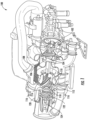
- FIG. 1 is a perspective view in partial section of an auxiliary power unit (APU) of an aircraft.
- APU 100 has a thrust bearing 102 , a load compressor 104 , an inlet guide vane assembly 106 , a perforated inlet housing 108, an engine compressor hub containment 110 , a high pressure ratio compressor 112 , a cooled first-stage nozzle 114 , dual-orifice fuel atomisers 116 , full turbine-hub containment 118 , an effusion-cooled combustor 120 , a two stage axial turbine 122 , and a two-bearing, four-wheel rotating group 124 .
- APU 100 has a thrust bearing 102 , a load compressor 104 , an inlet guide vane assembly 106 , a perforated inlet housing 108, an engine compressor hub containment 110 , a high pressure ratio compressor 112 , a cooled first-stage nozzle 114 , dual-orifice fuel atomisers 116
- One or more of these APU components can have a material of the present disclosure disposed on one or more surfaces of the component. During use, the temperature of the APU increases substantially from an ambient temperature. A material of the present disclosure reduces or eliminates thermal stress on the APU and reduces or eliminates mold formation that may occur when the APU is not in use.
- FIG 2 is a side view of a spacecraft.
- spacecraft 200 has a heatshield structure 202 bound on the surface thereof.
- Heatshield structure 202 has a material of the present disclosure disposed on and/or within the heatshield structure. Heatshield structure 202 protects the spacecraft 200 and its occupants from the heat generated during reentry into the Earth's atmosphere.
- a material of the present disclosure reduces or eliminates thermal stress on the heatshield (and spacecraft) and reduces or eliminates mold formation that may occur when the heatshield (and spacecraft) are not in use.
- heatshield structure 202 is shown on a manned spacecraft, it will be appreciated that heatshield structure 202 is well suited for use on a wide variety of other manned and unmanned space vehicles that are expected to encounter high temperatures on their exterior surfaces during travel through the Earth's, or a planetary atmosphere. Heatshield structure 202 is also usable on other forms of vehicles, and possibly even on fixed ( e . g ., non-mobile) structures. Heatshield structure 202 may find use on virtually any form of mobile airborne platform or ground based vehicle, or possibly even on marine vehicles.
- Alternative uses of materials of the present disclosure include, but are not limited to, as adhesives for applications involving bacteriostatic or fungicidal applications, as a paint additive for increasing hardness and algaecidal properties, or as an anti-mildew additive for compositions in wet environments.
- Materials of the present disclosure can be disposed on a substrate, such as a surface of a vehicle component, by any suitable deposition method, such as flow-coating, drop-casting, dip-coating, spray-coating, screen printing, slot-die coating, flow coating and/or ink-jet printing.
- Materials of the present disclosure can be disposed on one or more surfaces of a vehicle component (such as an inner surface ( e . g ., inner cavity), an outer surface, or both, of a vehicle component) by depositing the material onto the one or more surfaces of the vehicle component.
- the cork can be cleaned, ground into a desired particle size, and mixed with a binder, a curing agent, and a zinc pyrithione before depositing and curing the material.
- Conventional heatshields made of cork are made by pressing cork onto a substrate, followed by finishing the cork.
- cork when cork is applied to an auxiliary power unit (APU), it is cork board that is pasted/glued onto an aluminum surface of an APU component, and then the cork is cleaned with one or more solvents.
- the cork is dried with heat to remove moisture from the cork.
- the cork is then coated with a resin ( e . g ., epoxy).
- the cork-epoxy is then coated with a sealant (such as silicone) that cures at room temperature.
- the sealant surface is then cleaned to obtain a uniform pore-free coating.
- the sealant takes up to 6 days to cure at RT or 2 days in an oven.
- Heatshield materials of the present disclosure render several of these processing procedures merely optional, such as drying the cork, applying adhesive to cork board, coating a material with a sealant (such as silicone), and cleaning a sealant surface.
- a sealant such as silicone
- heatshield materials of the present disclosure render several of these processing procedures merely optional, such as drying the cork, applying adhesive to cork board, coating a material with a sealant (such as silicone), and cleaning a sealant surface.
- a sealant such as silicone
- the material can be cured.
- Curing a material can be performed at room temperature.
- curing may comprise raising the temperature of the material to a peak curing temperature and maintaining the peak curing temperature for between about 1 second and about 48 hours, such as between about 1 hour and about 10 hours.
- the peak curing temperature is between about 30°C and about 200°C, such as between about 50°C and about 90°C, for example 50°C, 60°C, 70°C, 80°C, 90°C.
- depositing the material onto a substrate surface can be achieved by spin-coating the first material onto a surface of a substrate, such as a vehicle component, at a rate of between about 100 rpm and about 4,000 rpm, such as between about 500 rpm and about 2,000 rpm, for example about 500 rpm, about 1,000 rpm, about 1,500 rpm, about 2,000 rpm.
- a substrate such as a vehicle component
- Materials, such as heatshield materials, of the present disclosure can be used alone as a heatshield or incorporated onto and/or into a honeycomb core.
- a honeycomb core provides additional mechanical strength and heat shielding ability to a heatshield.
- Materials of the present disclosure (such as those comprising cork) can be used as a secondary heatshield in case the honeycomb structure is compromised.
- a honeycomb core can be made of a plurality of intersecting wall portions forming a plurality of cells.
- a strain compliant material can be disposed on the wall portions of the honeycomb core prior to filling of the cells with a heatshield material of the present disclosure. The heatshield material at least partially fills the cells of the honeycomb core.
- FIG 3 is a perspective view of one section of a honeycomb heatshield.
- heatshield 300 includes a honeycomb core 302.
- Honeycomb core 302 has a plurality of intersecting wall portions 304 that form a plurality of cells 306.
- Material 308 is a heatshield material of the present disclosure and is press fit into the cells 306 of honeycomb core 302 .
- FIG 4 is a cross section of the heatshield of Figure 3 .
- honeycomb core 302 can be secured via an adhesive layer 400 to a carrier structure 402 .
- honeycomb core 302 is made of a fabric of fiberglass, for example Style 120 (E-glass), which is impregnated with a phenolic resin.
- honeycomb core 302 is made of a Leno weave fiberglass or carbon fiber fabric having an open weave construction. This enables material 308 , when compressed into the cells 306 of honeycomb core 302 , to fill cells 306 and become an integral portion of the wall structure of honeycomb core 302 .
- honeycomb core 302 Prior to filling the cells 306 of honeycomb core 302 with material 308 , honeycomb core 302 can be cleaned with a radio frequency (RF) generated plasma field so that its surfaces are thoroughly conditioned for the remaining manufacturing operations (if any) to which honeycomb core 302 will be subjected.
- RF radio frequency
- FIG. 5 is a perspective view of the carrier panel side of a honeycomb panel.
- walls 304 of honeycomb core 302 are partially slotted, which can be achieved using a diamond edged cutting tool, on the side of honeycomb core 302 that will be bonded to heatshield carrier structure 402 .
- Slots 500 provide escape paths for ambient air that might otherwise create back pressure in cells 306 during the subsequent honeycomb core 302 filling process, and for water and gases that evolve during a subsequently performed autoclave curing process. The air, water and gases are drawn off by a vacuum that is applied to a vacuum bag enclosing a preform to form heatshield 300 comprising material 308 , honeycomb core 302 , and carrier structure 402 .
- carrier structure 402 is made of a layer structure of one or more metal sheets, or possibly even as a honeycomb structure having metal, for example titanium or aluminum, flat sheets.
- Adhesive layer 400 can be made of any suitable adhesive, such as HT-424 adhesive, which is an epoxy-phenolic structural film adhesive commercially available from Cytec Industries, Inc. of West Paterson, N.J.
- Zinc pyrithiones do not have restrictions for aircraft applications in the European Union or elsewhere worldwide, some are commercially available, they are easy to synthesize, and are inexpensive. Furthermore, decomposition temperatures of zinc pyrithiones are high ( e . g ., 464°F), they have limited water solubility ( e . g ., 8 ppm at pH 7), and have antiobiotic activity sufficient to prevent or reduce microbial degradation of biologically active components (such as cork) nearby or within the material.
- zinc pyrithiones of the present disclosure can be present in a material, such as a heatshield material, in amounts small enough such that the physical properties of the material are improved or are not substantially altered compared to an otherwise identical material without a zinc pyrithione. Furthermore, zinc pyrithiones of the present disclosure can be present in a material, such as a heatshield material, in amounts small enough such that pot life of the material is not substantially altered compared to an otherwise identical material without a zinc pyrithione.
- a zinc pyrithione provides dual functionality when present within or disposed on a material of the present disclosure: (1) as an antibiotic to reduce or eliminate mold formation, and (2) as a curing agent in addition to the curing agent.
- dual functionality can be used to reduce pot life in addition to reduction or elimination of mildew and fungus (mold) accumulation within or on the material, while maintaining or improving the physical properties of the material (as compared to the material without zinc pyrithione).
- a zinc pyrithione can be incorporated into the binder/curing agent of materials of the present disclosure. Unlike conventional antibiotics that are only applied to a binder surface, incorporation of zinc pyrithione into a material prevents mold formation within the material, on the material, and/or adjacent the material even if a surface of the material chips away during use and regardless of how large of a surface area of the material is chipped away ( i . e ., exposed). Such incorporation of zinc pyrithione extends the advantageous physical and mechanical properties of the material.
- aspects of the present disclosure may be devised without departing from the basic scope thereof.
- material systems such as aircraft material systems, such as panels, coated lap joints between two or more panels, and wing-to-fuselage assemblies
- aspects of the present disclosure may be directed to other material systems not associated with an aircraft, such as a multicomponent material system used in aerospace, automotive, marine, energy industry.
Landscapes
- Chemical & Material Sciences (AREA)
- Engineering & Computer Science (AREA)
- Health & Medical Sciences (AREA)
- Organic Chemistry (AREA)
- Chemical Kinetics & Catalysis (AREA)
- Polymers & Plastics (AREA)
- Medicinal Chemistry (AREA)
- Life Sciences & Earth Sciences (AREA)
- General Health & Medical Sciences (AREA)
- Aviation & Aerospace Engineering (AREA)
- Combustion & Propulsion (AREA)
- Wood Science & Technology (AREA)
- Materials Engineering (AREA)
- Plant Pathology (AREA)
- Mechanical Engineering (AREA)
- Remote Sensing (AREA)
- Emergency Medicine (AREA)
- Critical Care (AREA)
- Physics & Mathematics (AREA)
- Thermal Sciences (AREA)
- Agronomy & Crop Science (AREA)
- General Engineering & Computer Science (AREA)
- Pest Control & Pesticides (AREA)
- Dentistry (AREA)
- Zoology (AREA)
- Environmental Sciences (AREA)
- Toxicology (AREA)
- Compositions Of Macromolecular Compounds (AREA)
- Laminated Bodies (AREA)
- Turbine Rotor Nozzle Sealing (AREA)
- Disintegrating Or Milling (AREA)
- Agricultural Chemicals And Associated Chemicals (AREA)
Claims (15)
- Material, welches das Reaktionsprodukt ist aus:einem Bindemittel;einem Härtungsmittel; undeinem Zink-Pyrithion, dargestellt durch die Formel (I):
 wobei R1, R2, R3, R4, R5, R6, R7 und R8 unabhängig ausgewählt werden aus der Gruppe bestehend aus Wasserstoff, Alkyl, Cycloalkyl, Alkoxyl, Hydroxyl, Aryl und Heterocyclyl; undwobei das Material des Weiteren Kork aufweist.
 - Material nach Anspruch 1, wobei R1, R2, R3, R4, R5, R6, R7 und R8 Wasserstoff sind.
- Material nach Anspruch 1 oder 2, wobei das Zink-Pyrithion eine Zerfallstemperatur von mehr als 204°C hat.
- Material nach einem der Ansprüche 1 bis 3, wobei das Zink-Pyrithion eine Wasserlöslichkeit von weniger als 100 ppm bei pH 7 hat.
- Material nach einem der Ansprüche 1 bis 4, wobei das Material eine Dichte zwischen ca. 0,8 g/cc und ca. 1,2 g/cc hat.
- Material nach einem der Ansprüche 1 bis 5, wobei das Material eine Topfzeit von weniger als 24 Stunden bei Raumtemperatur hat.
- Material nach einem der Ansprüche 1 bis 6, wobei das Material weniger als 5 Gew.-% Zink-Pyrithion aufweist.
- Material nach einem der Ansprüche 1 bis 7, wobei das Material nach 4 Wochen eine antibiotische Aktivitätsrate von 0 gemäß ASTM G21-15 hat.
- Material nach einem der Ansprüche 1 bis 8, wobei das Material zwischen 8 Gew.-% und 12 Gew.-% Kork aufweist.
- Material nach einem der Ansprüche 1 bis 9, wobei das Bindemittel ausgewählt wird aus der Gruppe bestehend aus Phenol, Epoxid, Silikon, Polyurethan und Mischungen davon.
- Material nach einem der Ansprüche 1 bis 9, wobei das Bindemittel Phenol ist.
- Material nach einem der Ansprüche 1 bis 9, wobei das Bindemittel Epoxid ist.
- Material nach einem der Ansprüche 1 bis 9, wobei das Bindemittel Silikon ist.
- Material nach einem der Ansprüche 1 bis 13, wobei das Härtungsmittel ausgewählt wird aus der Gruppe bestehend aus Alkyldiamin, Cycloalkyldiamin, Monoaryldiamin, Polyaryldiamin und Mischungen davon.
- Material nach einem der Ansprüche 1 bis 14, wobei das Reaktionsprodukt aus dem Zink-Pyrithion und dem Bindemittel in dem Material enthalten ist, in dem ein nukleophiler Rest des Zink-Pyrithions mit einem elektrophilen Rest des Bindemittels reagiert.
Applications Claiming Priority (2)
| Application Number | Priority Date | Filing Date | Title |
|---|---|---|---|
| US15/344,001 US10647856B2 (en) | 2016-11-04 | 2016-11-04 | Mold resistant formable cork |
| EP17199738.0A EP3318609B1 (de) | 2016-11-04 | 2017-11-02 | Schimmelresistenter formbarer kork |
Related Parent Applications (2)
| Application Number | Title | Priority Date | Filing Date |
|---|---|---|---|
| EP17199738.0A Division-Into EP3318609B1 (de) | 2016-11-04 | 2017-11-02 | Schimmelresistenter formbarer kork |
| EP17199738.0A Division EP3318609B1 (de) | 2016-11-04 | 2017-11-02 | Schimmelresistenter formbarer kork |
Publications (2)
| Publication Number | Publication Date |
|---|---|
| EP3663362A1 EP3663362A1 (de) | 2020-06-10 |
| EP3663362B1 true EP3663362B1 (de) | 2023-05-10 |
Family
ID=60450417
Family Applications (2)
| Application Number | Title | Priority Date | Filing Date |
|---|---|---|---|
| EP17199738.0A Active EP3318609B1 (de) | 2016-11-04 | 2017-11-02 | Schimmelresistenter formbarer kork |
| EP19217182.5A Active EP3663362B1 (de) | 2016-11-04 | 2017-11-02 | Schimmelresistenter formbarer kork |
Family Applications Before (1)
| Application Number | Title | Priority Date | Filing Date |
|---|---|---|---|
| EP17199738.0A Active EP3318609B1 (de) | 2016-11-04 | 2017-11-02 | Schimmelresistenter formbarer kork |
Country Status (5)
| Country | Link |
|---|---|
| US (1) | US10647856B2 (de) |
| EP (2) | EP3318609B1 (de) |
| JP (1) | JP7008455B2 (de) |
| CN (1) | CN108017880B (de) |
| CA (1) | CA2976479C (de) |
Family Cites Families (15)
| Publication number | Priority date | Publication date | Assignee | Title |
|---|---|---|---|---|
| US900643A (en) * | 1908-02-28 | 1908-10-06 | Leonidas W Avant | Process for extracting honey. |
| US4031059A (en) | 1974-01-21 | 1977-06-21 | Martin Marietta Corporation | Low density ablator compositions |
| US4772495A (en) * | 1987-07-23 | 1988-09-20 | United Technologies Corporation | Trowelable ablative coating composition and method of use |
| US4837250A (en) * | 1987-07-23 | 1989-06-06 | Usbi Booster Production Company, Inc. | Trowelable ablative coating composition and method of use |
| AU2002950271A0 (en) * | 2002-07-19 | 2002-09-12 | The Commonwealth Of Australia | Optical stabilization system |
| US20100210745A1 (en) * | 2002-09-09 | 2010-08-19 | Reactive Surfaces, Ltd. | Molecular Healing of Polymeric Materials, Coatings, Plastics, Elastomers, Composites, Laminates, Adhesives, and Sealants by Active Enzymes |
| US6933334B2 (en) * | 2003-06-25 | 2005-08-23 | United Technologies Corporation | Silicone-cork ablative material |
| JP2007118415A (ja) | 2005-10-28 | 2007-05-17 | Masamitsu Nagahama | 樹木製品、樹木製品の製造方法、粒状物の使用 |
| US20080248076A1 (en) * | 2007-04-06 | 2008-10-09 | Johansson Anders H | Antimicrobial rubber bands |
| BRPI0900643A2 (pt) * | 2009-01-30 | 2010-11-09 | Isolucks Do Brasil Ltda Epp | tinta anti-microbiana zinco piritiona |
| US8307747B2 (en) * | 2010-01-19 | 2012-11-13 | Magpul Industries Corp. | Self-engaging non-reciprocating charging handle |
| JP5878298B2 (ja) * | 2011-03-02 | 2016-03-08 | リグナイト株式会社 | 断熱材用組成物及び断熱材 |
| JP2013228065A (ja) * | 2012-04-26 | 2013-11-07 | Taikoh Co Ltd | 排水管用ライニング剤とこれを用いた排水管のライニング工法 |
| JP6004742B2 (ja) | 2012-05-23 | 2016-10-12 | 日東化工株式会社 | ゴムチップマット |
| WO2014036681A1 (zh) * | 2012-09-04 | 2014-03-13 | 西能化工科技(上海)有限公司 | 热膨胀性微球及其制备和应用 |
-
2016
- 2016-11-04 US US15/344,001 patent/US10647856B2/en active Active
-
2017
- 2017-08-11 CA CA2976479A patent/CA2976479C/en active Active
- 2017-09-29 JP JP2017189386A patent/JP7008455B2/ja active Active
- 2017-10-19 CN CN201710975636.1A patent/CN108017880B/zh active Active
- 2017-11-02 EP EP17199738.0A patent/EP3318609B1/de active Active
- 2017-11-02 EP EP19217182.5A patent/EP3663362B1/de active Active
Also Published As
| Publication number | Publication date |
|---|---|
| CN108017880A (zh) | 2018-05-11 |
| JP7008455B2 (ja) | 2022-02-10 |
| US20180127597A1 (en) | 2018-05-10 |
| EP3318609B1 (de) | 2020-02-05 |
| EP3663362A1 (de) | 2020-06-10 |
| CA2976479A1 (en) | 2018-05-04 |
| US10647856B2 (en) | 2020-05-12 |
| CA2976479C (en) | 2021-10-19 |
| JP2018115312A (ja) | 2018-07-26 |
| CN108017880B (zh) | 2022-03-11 |
| EP3318609A1 (de) | 2018-05-09 |
Similar Documents
| Publication | Publication Date | Title |
|---|---|---|
| EP1947154B1 (de) | Polyfunktionelle epoxidharzbeschichtungsmasse mit rostverhinderndem pigment, daraus erhaltener beschichtungsfilm, mit dem beschichtungsfilm beschichtetes substrat sowie rostverhinderungsverfahren | |
| EP3201271B1 (de) | Zweikomponentige zusammensetzung | |
| EP3119846B1 (de) | Luft-wasser-barriere-silikonbeschichtungen | |
| EP0057691B1 (de) | Neue fluorelastomere filmzubereitungen, enthaltend silanverbindungen, sowie verfahren zu deren herstellung | |
| WO2009076609A2 (en) | Glycidyl carbamate coatings having improved corrosion resistance | |
| BRPI0808244B1 (pt) | Composto de resina de politioéter amina, composição de resina, método para usar uma composição de resina e composição de revestimento | |
| US20140272155A1 (en) | Ambient curable corrosion resistant sol-gel coating and composition and process for making the same | |
| CN118652606B (zh) | 一种防火隔热涂层材料及其制备工艺 | |
| KR102443779B1 (ko) | 바닥재용 도료 조성물 | |
| EP3663362B1 (de) | Schimmelresistenter formbarer kork | |
| RU2471840C2 (ru) | Защита от коррозии для топливных резервуаров, не содержащая хроматов | |
| CN113004733A (zh) | 一种抗菌防霉阻燃的硅酸盐内墙涂料及其制备方法 | |
| JPH0196277A (ja) | 接着剤組成物 | |
| CN109161368B (zh) | 一种热硫化胶黏剂 | |
| US20060194062A1 (en) | Epoxy resin composition | |
| CN116355199A (zh) | 聚醚取代胺改性硅氧烷的组合物及其在稀土抗菌抗病毒金属板的应用 | |
| CN114644880A (zh) | 一种双组份聚氨酯防火涂料及其制备方法和应用 | |
| CN109868020A (zh) | 一种多功能涂层和一种水性环保多功能涂层液 | |
| CN110819284A (zh) | 一种环保、阻燃性优良的端硅烷基密封胶的制备方法 | |
| CN210449767U (zh) | 一种疏水玻璃组件 | |
| JPS6051769A (ja) | 水系感圧型接着剤 | |
| RU2507228C1 (ru) | Вибропоглощающая эпоксидная композиция | |
| Figovsky et al. | Progress in Elaboration of Chemical and Abrasion Resistant Materials | |
| JPH03143964A (ja) | 塗膜塗料組成物 | |
| CN109135464A (zh) | 一种环保抗菌防腐改性内墙涂料 |
Legal Events
| Date | Code | Title | Description |
|---|---|---|---|
| PUAI | Public reference made under article 153(3) epc to a published international application that has entered the european phase |
Free format text: ORIGINAL CODE: 0009012 |
|
| STAA | Information on the status of an ep patent application or granted ep patent |
Free format text: STATUS: THE APPLICATION HAS BEEN PUBLISHED |
|
| AC | Divisional application: reference to earlier application |
Ref document number: 3318609 Country of ref document: EP Kind code of ref document: P |
|
| AK | Designated contracting states |
Kind code of ref document: A1 Designated state(s): AL AT BE BG CH CY CZ DE DK EE ES FI FR GB GR HR HU IE IS IT LI LT LU LV MC MK MT NL NO PL PT RO RS SE SI SK SM TR |
|
| STAA | Information on the status of an ep patent application or granted ep patent |
Free format text: STATUS: REQUEST FOR EXAMINATION WAS MADE |
|
| 17P | Request for examination filed |
Effective date: 20201125 |
|
| RBV | Designated contracting states (corrected) |
Designated state(s): AL AT BE BG CH CY CZ DE DK EE ES FI FR GB GR HR HU IE IS IT LI LT LU LV MC MK MT NL NO PL PT RO RS SE SI SK SM TR |
|
| GRAP | Despatch of communication of intention to grant a patent |
Free format text: ORIGINAL CODE: EPIDOSNIGR1 |
|
| STAA | Information on the status of an ep patent application or granted ep patent |
Free format text: STATUS: GRANT OF PATENT IS INTENDED |
|
| INTG | Intention to grant announced |
Effective date: 20230109 |
|
| RAP3 | Party data changed (applicant data changed or rights of an application transferred) |
Owner name: THE BOEING COMPANY |
|
| GRAS | Grant fee paid |
Free format text: ORIGINAL CODE: EPIDOSNIGR3 |
|
| GRAA | (expected) grant |
Free format text: ORIGINAL CODE: 0009210 |
|
| STAA | Information on the status of an ep patent application or granted ep patent |
Free format text: STATUS: THE PATENT HAS BEEN GRANTED |
|
| AC | Divisional application: reference to earlier application |
Ref document number: 3318609 Country of ref document: EP Kind code of ref document: P |
|
| AK | Designated contracting states |
Kind code of ref document: B1 Designated state(s): AL AT BE BG CH CY CZ DE DK EE ES FI FR GB GR HR HU IE IS IT LI LT LU LV MC MK MT NL NO PL PT RO RS SE SI SK SM TR |
|
| REG | Reference to a national code |
Ref country code: GB Ref legal event code: FG4D |
|
| REG | Reference to a national code |
Ref country code: AT Ref legal event code: REF Ref document number: 1566665 Country of ref document: AT Kind code of ref document: T Effective date: 20230515 Ref country code: CH Ref legal event code: EP |
|
| REG | Reference to a national code |
Ref country code: DE Ref legal event code: R096 Ref document number: 602017068797 Country of ref document: DE |
|
| REG | Reference to a national code |
Ref country code: IE Ref legal event code: FG4D |
|
| P01 | Opt-out of the competence of the unified patent court (upc) registered |
Effective date: 20230519 |
|
| REG | Reference to a national code |
Ref country code: LT Ref legal event code: MG9D |
|
| REG | Reference to a national code |
Ref country code: NL Ref legal event code: MP Effective date: 20230510 |
|
| REG | Reference to a national code |
Ref country code: AT Ref legal event code: MK05 Ref document number: 1566665 Country of ref document: AT Kind code of ref document: T Effective date: 20230510 |
|
| PG25 | Lapsed in a contracting state [announced via postgrant information from national office to epo] |
Ref country code: SE Free format text: LAPSE BECAUSE OF FAILURE TO SUBMIT A TRANSLATION OF THE DESCRIPTION OR TO PAY THE FEE WITHIN THE PRESCRIBED TIME-LIMIT Effective date: 20230510 Ref country code: PT Free format text: LAPSE BECAUSE OF FAILURE TO SUBMIT A TRANSLATION OF THE DESCRIPTION OR TO PAY THE FEE WITHIN THE PRESCRIBED TIME-LIMIT Effective date: 20230911 Ref country code: NO Free format text: LAPSE BECAUSE OF FAILURE TO SUBMIT A TRANSLATION OF THE DESCRIPTION OR TO PAY THE FEE WITHIN THE PRESCRIBED TIME-LIMIT Effective date: 20230810 Ref country code: NL Free format text: LAPSE BECAUSE OF FAILURE TO SUBMIT A TRANSLATION OF THE DESCRIPTION OR TO PAY THE FEE WITHIN THE PRESCRIBED TIME-LIMIT Effective date: 20230510 Ref country code: ES Free format text: LAPSE BECAUSE OF FAILURE TO SUBMIT A TRANSLATION OF THE DESCRIPTION OR TO PAY THE FEE WITHIN THE PRESCRIBED TIME-LIMIT Effective date: 20230510 Ref country code: AT Free format text: LAPSE BECAUSE OF FAILURE TO SUBMIT A TRANSLATION OF THE DESCRIPTION OR TO PAY THE FEE WITHIN THE PRESCRIBED TIME-LIMIT Effective date: 20230510 |
|
| PG25 | Lapsed in a contracting state [announced via postgrant information from national office to epo] |
Ref country code: RS Free format text: LAPSE BECAUSE OF FAILURE TO SUBMIT A TRANSLATION OF THE DESCRIPTION OR TO PAY THE FEE WITHIN THE PRESCRIBED TIME-LIMIT Effective date: 20230510 Ref country code: PL Free format text: LAPSE BECAUSE OF FAILURE TO SUBMIT A TRANSLATION OF THE DESCRIPTION OR TO PAY THE FEE WITHIN THE PRESCRIBED TIME-LIMIT Effective date: 20230510 Ref country code: LV Free format text: LAPSE BECAUSE OF FAILURE TO SUBMIT A TRANSLATION OF THE DESCRIPTION OR TO PAY THE FEE WITHIN THE PRESCRIBED TIME-LIMIT Effective date: 20230510 Ref country code: LT Free format text: LAPSE BECAUSE OF FAILURE TO SUBMIT A TRANSLATION OF THE DESCRIPTION OR TO PAY THE FEE WITHIN THE PRESCRIBED TIME-LIMIT Effective date: 20230510 Ref country code: IS Free format text: LAPSE BECAUSE OF FAILURE TO SUBMIT A TRANSLATION OF THE DESCRIPTION OR TO PAY THE FEE WITHIN THE PRESCRIBED TIME-LIMIT Effective date: 20230910 Ref country code: HR Free format text: LAPSE BECAUSE OF FAILURE TO SUBMIT A TRANSLATION OF THE DESCRIPTION OR TO PAY THE FEE WITHIN THE PRESCRIBED TIME-LIMIT Effective date: 20230510 Ref country code: GR Free format text: LAPSE BECAUSE OF FAILURE TO SUBMIT A TRANSLATION OF THE DESCRIPTION OR TO PAY THE FEE WITHIN THE PRESCRIBED TIME-LIMIT Effective date: 20230811 |
|
| PG25 | Lapsed in a contracting state [announced via postgrant information from national office to epo] |
Ref country code: FI Free format text: LAPSE BECAUSE OF FAILURE TO SUBMIT A TRANSLATION OF THE DESCRIPTION OR TO PAY THE FEE WITHIN THE PRESCRIBED TIME-LIMIT Effective date: 20230510 |
|
| PG25 | Lapsed in a contracting state [announced via postgrant information from national office to epo] |
Ref country code: SK Free format text: LAPSE BECAUSE OF FAILURE TO SUBMIT A TRANSLATION OF THE DESCRIPTION OR TO PAY THE FEE WITHIN THE PRESCRIBED TIME-LIMIT Effective date: 20230510 |
|
| PG25 | Lapsed in a contracting state [announced via postgrant information from national office to epo] |
Ref country code: SM Free format text: LAPSE BECAUSE OF FAILURE TO SUBMIT A TRANSLATION OF THE DESCRIPTION OR TO PAY THE FEE WITHIN THE PRESCRIBED TIME-LIMIT Effective date: 20230510 Ref country code: SK Free format text: LAPSE BECAUSE OF FAILURE TO SUBMIT A TRANSLATION OF THE DESCRIPTION OR TO PAY THE FEE WITHIN THE PRESCRIBED TIME-LIMIT Effective date: 20230510 Ref country code: RO Free format text: LAPSE BECAUSE OF FAILURE TO SUBMIT A TRANSLATION OF THE DESCRIPTION OR TO PAY THE FEE WITHIN THE PRESCRIBED TIME-LIMIT Effective date: 20230510 Ref country code: EE Free format text: LAPSE BECAUSE OF FAILURE TO SUBMIT A TRANSLATION OF THE DESCRIPTION OR TO PAY THE FEE WITHIN THE PRESCRIBED TIME-LIMIT Effective date: 20230510 Ref country code: DK Free format text: LAPSE BECAUSE OF FAILURE TO SUBMIT A TRANSLATION OF THE DESCRIPTION OR TO PAY THE FEE WITHIN THE PRESCRIBED TIME-LIMIT Effective date: 20230510 Ref country code: CZ Free format text: LAPSE BECAUSE OF FAILURE TO SUBMIT A TRANSLATION OF THE DESCRIPTION OR TO PAY THE FEE WITHIN THE PRESCRIBED TIME-LIMIT Effective date: 20230510 |
|
| REG | Reference to a national code |
Ref country code: DE Ref legal event code: R097 Ref document number: 602017068797 Country of ref document: DE |
|
| PLBE | No opposition filed within time limit |
Free format text: ORIGINAL CODE: 0009261 |
|
| STAA | Information on the status of an ep patent application or granted ep patent |
Free format text: STATUS: NO OPPOSITION FILED WITHIN TIME LIMIT |
|
| 26N | No opposition filed |
Effective date: 20240213 |
|
| PG25 | Lapsed in a contracting state [announced via postgrant information from national office to epo] |
Ref country code: SI Free format text: LAPSE BECAUSE OF FAILURE TO SUBMIT A TRANSLATION OF THE DESCRIPTION OR TO PAY THE FEE WITHIN THE PRESCRIBED TIME-LIMIT Effective date: 20230510 |
|
| PG25 | Lapsed in a contracting state [announced via postgrant information from national office to epo] |
Ref country code: SI Free format text: LAPSE BECAUSE OF FAILURE TO SUBMIT A TRANSLATION OF THE DESCRIPTION OR TO PAY THE FEE WITHIN THE PRESCRIBED TIME-LIMIT Effective date: 20230510 |
|
| REG | Reference to a national code |
Ref country code: CH Ref legal event code: PL |
|
| PG25 | Lapsed in a contracting state [announced via postgrant information from national office to epo] |
Ref country code: MC Free format text: LAPSE BECAUSE OF FAILURE TO SUBMIT A TRANSLATION OF THE DESCRIPTION OR TO PAY THE FEE WITHIN THE PRESCRIBED TIME-LIMIT Effective date: 20230510 |
|
| PG25 | Lapsed in a contracting state [announced via postgrant information from national office to epo] |
Ref country code: LU Free format text: LAPSE BECAUSE OF NON-PAYMENT OF DUE FEES Effective date: 20231102 |
|
| PG25 | Lapsed in a contracting state [announced via postgrant information from national office to epo] |
Ref country code: CH Free format text: LAPSE BECAUSE OF NON-PAYMENT OF DUE FEES Effective date: 20231130 |
|
| PG25 | Lapsed in a contracting state [announced via postgrant information from national office to epo] |
Ref country code: MC Free format text: LAPSE BECAUSE OF FAILURE TO SUBMIT A TRANSLATION OF THE DESCRIPTION OR TO PAY THE FEE WITHIN THE PRESCRIBED TIME-LIMIT Effective date: 20230510 Ref country code: LU Free format text: LAPSE BECAUSE OF NON-PAYMENT OF DUE FEES Effective date: 20231102 Ref country code: CH Free format text: LAPSE BECAUSE OF NON-PAYMENT OF DUE FEES Effective date: 20231130 |
|
| REG | Reference to a national code |
Ref country code: BE Ref legal event code: MM Effective date: 20231130 |
|
| REG | Reference to a national code |
Ref country code: IE Ref legal event code: MM4A |
|
| PG25 | Lapsed in a contracting state [announced via postgrant information from national office to epo] |
Ref country code: IE Free format text: LAPSE BECAUSE OF NON-PAYMENT OF DUE FEES Effective date: 20231102 |
|
| PG25 | Lapsed in a contracting state [announced via postgrant information from national office to epo] |
Ref country code: BE Free format text: LAPSE BECAUSE OF NON-PAYMENT OF DUE FEES Effective date: 20231130 |
|
| PG25 | Lapsed in a contracting state [announced via postgrant information from national office to epo] |
Ref country code: IE Free format text: LAPSE BECAUSE OF NON-PAYMENT OF DUE FEES Effective date: 20231102 Ref country code: BE Free format text: LAPSE BECAUSE OF NON-PAYMENT OF DUE FEES Effective date: 20231130 |
|
| PG25 | Lapsed in a contracting state [announced via postgrant information from national office to epo] |
Ref country code: BG Free format text: LAPSE BECAUSE OF FAILURE TO SUBMIT A TRANSLATION OF THE DESCRIPTION OR TO PAY THE FEE WITHIN THE PRESCRIBED TIME-LIMIT Effective date: 20230510 |
|
| PG25 | Lapsed in a contracting state [announced via postgrant information from national office to epo] |
Ref country code: BG Free format text: LAPSE BECAUSE OF FAILURE TO SUBMIT A TRANSLATION OF THE DESCRIPTION OR TO PAY THE FEE WITHIN THE PRESCRIBED TIME-LIMIT Effective date: 20230510 |
|
| PG25 | Lapsed in a contracting state [announced via postgrant information from national office to epo] |
Ref country code: CY Free format text: LAPSE BECAUSE OF FAILURE TO SUBMIT A TRANSLATION OF THE DESCRIPTION OR TO PAY THE FEE WITHIN THE PRESCRIBED TIME-LIMIT; INVALID AB INITIO Effective date: 20171102 |
|
| PG25 | Lapsed in a contracting state [announced via postgrant information from national office to epo] |
Ref country code: HU Free format text: LAPSE BECAUSE OF FAILURE TO SUBMIT A TRANSLATION OF THE DESCRIPTION OR TO PAY THE FEE WITHIN THE PRESCRIBED TIME-LIMIT; INVALID AB INITIO Effective date: 20171102 |
|
| PG25 | Lapsed in a contracting state [announced via postgrant information from national office to epo] |
Ref country code: TR Free format text: LAPSE BECAUSE OF FAILURE TO SUBMIT A TRANSLATION OF THE DESCRIPTION OR TO PAY THE FEE WITHIN THE PRESCRIBED TIME-LIMIT Effective date: 20230510 |
|
| PGFP | Annual fee paid to national office [announced via postgrant information from national office to epo] |
Ref country code: DE Payment date: 20251128 Year of fee payment: 9 |
|
| PGFP | Annual fee paid to national office [announced via postgrant information from national office to epo] |
Ref country code: GB Payment date: 20251127 Year of fee payment: 9 |
|
| PGFP | Annual fee paid to national office [announced via postgrant information from national office to epo] |
Ref country code: IT Payment date: 20251119 Year of fee payment: 9 |
|
| PGFP | Annual fee paid to national office [announced via postgrant information from national office to epo] |
Ref country code: FR Payment date: 20251125 Year of fee payment: 9 |