EP3661234B1 - Ringnetzwerk von bluetooth-lautsprechern - Google Patents
Ringnetzwerk von bluetooth-lautsprechern Download PDFInfo
- Publication number
- EP3661234B1 EP3661234B1 EP20150519.5A EP20150519A EP3661234B1 EP 3661234 B1 EP3661234 B1 EP 3661234B1 EP 20150519 A EP20150519 A EP 20150519A EP 3661234 B1 EP3661234 B1 EP 3661234B1
- Authority
- EP
- European Patent Office
- Prior art keywords
- speaker
- bluetooth
- ring network
- speakers
- audio
- Prior art date
- Legal status (The legal status is an assumption and is not a legal conclusion. Google has not performed a legal analysis and makes no representation as to the accuracy of the status listed.)
- Active
Links
Images




Classifications
-
- H—ELECTRICITY
- H04—ELECTRIC COMMUNICATION TECHNIQUE
- H04R—LOUDSPEAKERS, MICROPHONES, GRAMOPHONE PICK-UPS OR LIKE ACOUSTIC ELECTROMECHANICAL TRANSDUCERS; ELECTRIC HEARING AIDS; PUBLIC ADDRESS SYSTEMS
- H04R3/00—Circuits for transducers
- H04R3/12—Circuits for transducers for distributing signals to two or more loudspeakers
-
- H—ELECTRICITY
- H04—ELECTRIC COMMUNICATION TECHNIQUE
- H04R—LOUDSPEAKERS, MICROPHONES, GRAMOPHONE PICK-UPS OR LIKE ACOUSTIC ELECTROMECHANICAL TRANSDUCERS; ELECTRIC HEARING AIDS; PUBLIC ADDRESS SYSTEMS
- H04R27/00—Public address systems
-
- H—ELECTRICITY
- H04—ELECTRIC COMMUNICATION TECHNIQUE
- H04W—WIRELESS COMMUNICATION NETWORKS
- H04W4/00—Services specially adapted for wireless communication networks; Facilities therefor
- H04W4/80—Services using short range communication, e.g. near-field communication [NFC], radio-frequency identification [RFID] or low energy communication
-
- H—ELECTRICITY
- H04—ELECTRIC COMMUNICATION TECHNIQUE
- H04R—LOUDSPEAKERS, MICROPHONES, GRAMOPHONE PICK-UPS OR LIKE ACOUSTIC ELECTROMECHANICAL TRANSDUCERS; ELECTRIC HEARING AIDS; PUBLIC ADDRESS SYSTEMS
- H04R2227/00—Details of public address [PA] systems covered by H04R27/00 but not provided for in any of its subgroups
- H04R2227/005—Audio distribution systems for home, i.e. multi-room use
-
- H—ELECTRICITY
- H04—ELECTRIC COMMUNICATION TECHNIQUE
- H04R—LOUDSPEAKERS, MICROPHONES, GRAMOPHONE PICK-UPS OR LIKE ACOUSTIC ELECTROMECHANICAL TRANSDUCERS; ELECTRIC HEARING AIDS; PUBLIC ADDRESS SYSTEMS
- H04R2420/00—Details of connection covered by H04R, not provided for in its groups
- H04R2420/07—Applications of wireless loudspeakers or wireless microphones
-
- H—ELECTRICITY
- H04—ELECTRIC COMMUNICATION TECHNIQUE
- H04R—LOUDSPEAKERS, MICROPHONES, GRAMOPHONE PICK-UPS OR LIKE ACOUSTIC ELECTROMECHANICAL TRANSDUCERS; ELECTRIC HEARING AIDS; PUBLIC ADDRESS SYSTEMS
- H04R2420/00—Details of connection covered by H04R, not provided for in its groups
- H04R2420/09—Applications of special connectors, e.g. USB, XLR, in loudspeakers, microphones or headphones
-
- H—ELECTRICITY
- H04—ELECTRIC COMMUNICATION TECHNIQUE
- H04R—LOUDSPEAKERS, MICROPHONES, GRAMOPHONE PICK-UPS OR LIKE ACOUSTIC ELECTROMECHANICAL TRANSDUCERS; ELECTRIC HEARING AIDS; PUBLIC ADDRESS SYSTEMS
- H04R2430/00—Signal processing covered by H04R, not provided for in its groups
- H04R2430/01—Aspects of volume control, not necessarily automatic, in sound systems
Definitions
- This disclosure relates to Bluetooth speakers, and more particularly, to a system for combining a number of Bluetooth speakers and audio devices in a ring network.
- Bluetooth is a wireless technology standard for exchanging data over short distances. Bluetooth supports audio through an advanced audio distribution profile (A2DP). Most modern mobile phones and audio devices support A2DP and there is a large marketplace for Bluetooth speakers that can play audio sourced from Bluetooth audio devices, such as mobile phones.
- A2DP advanced audio distribution profile
- Bluetooth speakers are single unit objects that render audio in a single place. They usually have low power requirements and are intended for a signle listener in a quiet room.
- a Bluetooth speaker system can connect up to 7 devices in a single piconet. Audio may be routed from one A2DP source device to another A2DP sink device in the piconet.
- Several proprietary solutions allow a second A2DP sink device which provices for a total of two speakers to simultaneously play the same audio.
- Document US 2014/0329468 A1 discloses wireless speaker audio system configured to receive audio information wirelessly transmitted by an audio source including first and second wireless transceivers.
- the first wireless transceiver establishes a bidirectional secondary wireless link with the audio source for receiving and acknowledging receipt of the audio information.
- the first and second wireless transceivers communicate with each other via a primary wireless link:
- Document US 2012/0171958 A1 discloses a Bluetooth communication system with multiple sink communication devices and a source communication device which broadcasts audio data packets to all sink communication devices in multiplexed data packets intended for different sink communication devices using a single stream that is broadcast to all of the multiple sink communication devices which each decode only the data packets intended for the particular sink communication device.
- Embodiments of the invention address these and other limitations in the prior art.
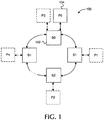
- Fig. 1 illustrates an example Bluetooth speaker ring network 100, which includes a number of Bluetooth speakers 102 and a number of audio devices 104.
- the audio devices 104 may be any audio device that can connect through the Bluetooth protocol to one of the Bluetooth speakers. Examples of Bluetooth enabled speakers include an iPhone, iPod, or Android phones, for example.
- the ring network 100 can include any number of Bluetooth speakers 102.
- P1, P2, and P3 through Pn are optional. That is, only one audio device, P0, needs to be connected to the ring network 100 as an audio source. However, up to five audio devices may optionally be connected to every speaker or any number of speakers within the ring network 100.
- a ring or ring network refers to an organized set of Bluetooth speakers paired to one another in a chain, in which the end of the chain may connect back to the beginning of the chain to form a ring architecture.
- a ringleader is a Bluetooth speaker that is receiving audio from an audio device and forwarding the audio along the ring network. As discussed in more detail below, the ringleader may change at any time.
- Data such as metadata or status data
- Data may be sent from each speaker in the Bluetooth ring network, to the ringleader audio device.
- data such as metadata
- data may be sent from the ringleader audio device to each speaker in the Bluetooth ring network, as described in further detail below.
- Fig. 2 illustrates an example operation for forming a complete ring network for a number of Bluetooth speakers according to embodiments of the invention.
- a first speaker s(n) is placed into a ring network mode by a user.
- the user may place the first speaker s(n) into the ring network mode by, for example, a button or a switch on the speaker.
- a second speaker s(new) is also placed into a ring network mode by a user.
- each speaker When each speaker is placed into the ring network mode, each speaker performs a limited inquiry to locate and find other speakers with which to form a network, as seen in operation 200.
- speaker s(n) seeks out and identifies speaker s(new) through the inquiry process.
- Speaker s(n) may approve or disapprove speaker s(new) joining the ring network.
- speaker s(n) establishes a Bluetooth connection with speaker s(new) and configures the Asynchronous ConnectionLess (ACL) layer.
- speaker s(new) establishes a new Bluetooth Serial Port Profile (SPP) connection back to speaker s(n).
- SPP Serial Port Profile
- zero to five A2DP audio sources may be coupled to each of the Bluetooth speakers s(n) and s(new).
- Each SPP client port is assigned a direction, either upstream or downstream, depending on which direction around the ring that port connection leads.
- the directional designation also indicates which way the audio data flows within the ring network.
- Messages proceed around the ring according to the direction specified in the message.
- the ring progress is accomplished by forwarding messages received out of the port leading in the direction the message is traveling.
- message termination rules extinguish messages, otherwise stale messages may be continually sent around the ring network, as mentioned above.
- message termination rules include a rule of never forwarding a message back to the originator of the message. If a message reaches an open end of a chain, the message is dropped.
- Fig. 3 illustrates a ringleader takeover on a larger ring network.
- a ring network may include speaker s(n-1) through speaker s(n+3). Joining additional speakers to the ring network is discussed in more detail below.
- a tail message is also sent from speaker s(n) upstream to speaker s(n-1). This tail message provides redundancy to ensure that the system does not go fully circular and start forwarding the stale ringleader message, and later audio, around the ring over and over.
- the ringleader assignment is complete. The new ring leader then forwards audio data around the ring to be played on each of the speakers.
- the Bluetooth ring network may periodically send a resynchronization (resync) signal to ensure all of the speakers in the ring network are aligned.
- the resync signal is sent from the ringleader speaker s(n) downstream, as illustrated in Fig. 4 .
- the assignment of upstream or downstream SPP client ports, discussed above, can change if the ring network reverses directions.
- Fig. 5 illustrates a ringleader being established in the system, as discussed above with respect to Fig. 3 .
- a delay signal is sent around the ring network upstream, starting with the speaker s(n-1) that received the tail message.
- audio delays are made using the assumption that speaker-to-speaker delays in the system are fixed, and by counting the nodes starting at speaker s(n-1) that received the tail message.
- the delay message sent around the ring provides each speaker with a count of how many delay units to use, as shown in Fig. 5 .
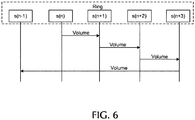
- the volume on the audio device connected to the ringleader speaker s(n) may be adjusted, and the volume on each of the speakers is adjusted. Then, a volume message may be sent around the ring, as illustrated in Fig. 6 .
- a user may adjust the volume on their audio device. This adjustment then sends a new audio volume signal to the speaker the audio device is connected with on the ring network. In Fig. 6 , this is speaker s(n). Speaker s(n) then receives the new audio volume signal from the audio device, and sends this new audio volume signal to its downstream speaker s(n+1). The downstream speaker s(n+1) then also sends the audio volume signal downstream, which continues until each speaker has received the new audio volume signal and has adjusted its audio volume.
- the audio volume signal may stop circulating the ring network when the audio volume signal received is the same audio volume the speaker is already set at. Or it may stop circulating the ring network when a speaker receives the new audio volume signal and a tail message, as described above (not shown).
- any audio control signal such as stop, pause, next audio, previous audio, restart audio, fast forward audio, and reverse audio, may be sent from the audio device to its connected speakers and sent around the ring network.
- the audio device may send data, such as metadata including a audio title, artist information, or other audio identification information, to the Bluetooth speaker connected to the audio device.
- the data is then transferred downstream through the ring network to each of the Bluetooth speakers.
- Such data may then be displayed on a display of the speakers.
- metadata from each of the speakers such as speaker name and status, may be sent around the ring and forwarded back to the audio device.
- the audio device may then display information about each of the speakers connected in the ring network.
- a speaker s(new) can join the ring network, as shown in the example embodiment of Fig. 7 .
- the speaker s(new) is placed in a ring network mode by a user using a button or a switch, for example, and the speaker s(new) will inquire for speaker s(n) at operation 700. This may be performed by the speaker s(n) outputting a pairing signal once speaker s(new) is placed in the ring network mode.
- s(n) detects the pairing signal of speaker s(new) in operation 700.
- speaker s(new) connects at the ACL level with speaker s(n). That is, speaker s(new) is configured to allow speaker s(n) to send audio data and signals to speaker s(new) and registers speaker s(n) as the upstream speaker of speaker s(new).
- speaker s(n) and speaker s(n+1) are disconnected or deleted in the configurable speaker registers of each, which includes disconnecting the SPP client in operation 706 from the SPP port of speaker s(n), so speaker s(n+1) is no longer connected as the downstream speaker of s(n+1).
- speaker s(n) is reconfigured to remove access to speaker s(n+1) so that speaker s(n+1) is no longer registered as the downstream speaker of s(n).
- a no server connection message is sent from speaker s(n+1) downstream to speaker s(n-1) in operations 710, 712 and 714.
- a no server connection message is also sent to speaker s(new) from speaker s(n) at operation 716.
- speaker s(n) is connected to the SPP client connect of speaker s(new) in the configurable speaker register. Then, a no client connection message is sent from speaker s(new) to speaker s(n) in operation 720.
- Speaker s(n) then sends a no client connection message to speaker s(n-1) in operation 722, and speaker s(n-1) sends a no client connection message to speaker s(n+2) in operation 724, and a no client connection from speaker s(n+2) to speaker s(n+1) in operation 726.
- speaker s(n+1) connects at the ACL level to speaker s(new) in the configurable speaker register.
- speaker s(new) and speaker s(n+1) connect the SPP client in the configurable speaker register of each.
- Speaker s(new) is then added to the ring in between speaker s(n) and speaker s(n+1) and the ring is closed in operation 732 and any of the speakers in the new ring can takeover if audio from an audio device is received at that speaker.
- speaker s(n) disconnects, or deletes, the address of the downstream Bluetooth speaker.
- the address of the new Bluetooth speaker s(new) is added to speaker s(n) as the new downstream speaker.
- the address of the speaker s(n+1), which was disconnected from speaker s(n) is then added as the downstream address of speaker s(new), while the address of speaker s(n) is added as the upstream address in speaker s(new).
- the address of speaker s(new) is added as the upstream speaker of speaker s(n+1).
- a new ring network is formed with speaker s(new) located in the ring downstream from speaker s(n) and upstream from speaker s(n+1).
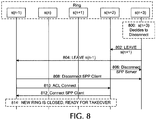
- Speakers may drop out of the network in a controlled manner, as shown in Fig. 8 , or in an unexpected manner, as shown in Fig. 9 .
- speaker s(n+3) leaves the ring network in operation 800.
- a leave message is sent in operations 802 and 804 to the upstream speaker s(n+2) and the downstream speaker s(n-1).
- speaker s(n+2) and speaker s(n-1) disconnect the SPP client from speaker s(n+3) or, stated another way, the address of each is removed from the respective configurable register.
- Speaker s(n-1) connects at the ACL level to speaker s(n+2) at operation 810 and speaker s(n+2) connects the SPP client to speaker s(n-1) in operation 812 in the respect configurable registers. Then the new ring network is formed in 814 without speaker s(n+3).
- An example of a controlled leave may be when one of the audio devices connected to the speakers receives a phone call.
- the audio device receives the phone call
- the speaker connected to that audio device drops out of the ring network and sends a leave message around the ring network.
- the phone call would then only play on the speaker connected to the audio device, and not on all of the speakers in the newly formed ring network.
- the receiver of the phone call decides whether to take the call on the phone or the speaker. After the phone call is finished, speaker s(n+3) may rejoin the network using the operation discussed with respect to Fig. 7 .
- a speaker may also suddenly drop out of the ring network.
- the speaker may go out of range or power off.
- the ring network is broken and a ring recovery protocol is used, as illustrated in Fig. 9 .
- speaker s(n+3) suddenly drops out of the network.
- HCI host controller interface
- This timeout occurs when the upstream and downstream speakers are unable to connect to the speaker that has dropped out.
- the speakers speaker s(n+2) and speaker s(n-1) may try to reconnect with speaker s(n+3).
- operation 906 it is recognized that the ring is open and may need to recover. Then, a no server connection message is sent downstream starting at speaker s(n-1) in operations 908, 910, and 912.
- a no client connection message is sent upstream starting at speaker s(n+2) in operations 914, 916, and 918.
- speaker s(n-1) and speaker s(n+1) establish a connection at the ACL level and an SPP client connection in operations 920 and 922 in their respective configurable registers.
- the new ring network without speaker s(n+3) is formed, and ready for any of the speakers remaining in the ring network to take over.
- speaker s(n+3) may rejoin the ring network, if desired, using the operation discussed above with respect to Fig. 7 .
- An example is as follows. A first person sets up two speakers to create a left plus right stereo setup. The first speaker is set in the ring network mode. A pair button is pressed on the first speaker, and the first person's iPhone is then paired to the first speaker as the audio device.
- the speakers will search for any device to pair with when in the ring network mode. Further, if there are no devices yet connected to the speaker when in the pair mode, then the speaker will search for a device to connect with without a pair button being pressed.
- the first person then sets the second speaker into the ring network mode. Since the first speaker is connected to the iPhone, the first person may press the pair button the first speaker to pair it to the second speaker. Again, if the second speaker has been paired before, then the user may press the pair button the second speaker. If it has not been paired before, as this is the first power on, it should already be searching for a device to pair with.
- the first person may press play on her iPhone, and audio comes out of both speakers. Left audio will come out of the speaker paired directly to the iPhone, and right audio comes out of the second speaker. This is always the case for a two speaker ring network.
- a second person may wish to also connect a speaker to the ring network formed by the first and second speakers owned by the first person.
- the second person may place his speaker in the ring network mode.
- the first person then presses the pair button on one of his speakers, and the second person presses the pair button on his speaker.
- the speakers may include a light source to indicate when the speakers are connected.
- the light source may blink after the user presses the pair button on the speaker.
- the speaker has connected to the new device, the light source on the speaker goes solid.
- the audio begins playing out of all of the speakers. Now that three speakers are connected, mono audio plays out of each of the speakers.
- a third person may also wish to join the ring network.
- the first person again presses the pair button on one of his speakers.
- the third person may put his speaker in the ring network mode and press the pair button.
- audio will begin playing out of the speaker of the third person.
- the third person can take control of the ring network of speakers by pressing play on his audio device, such as an iPad, and the new audio beings playing on all speakers. The last person to hit play on their audio device takes control of the ring network.
- a fourth person may wish to add another four speakers to the ring network.
- the fourth person may press the pair button on any of the speakers already in the ring network, and then press the pair button on one of his four speakers. This is repeated for each of the speakers, and all of the speakers will then be added to the ring network, which now comprises eight speakers.
- a fifth person may not have a speaker, but wants to share audio from his audio device.
- the fifth person may press the pair button on one of the speakers. Then, the audio device is paired to the speaker, and the fifth person may press play and takeover the ring network.
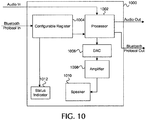
- Fig. 10 shows a block diagram of an example speaker 1000 used in the ring network.
- the speaker includes an audio in portion, which is routed to the processor 1002, and a Bluetooth protocol in, which is routed to the configurable register 1004.
- the Bluetooth protocol allows for registering the upstream and downstream speakers to the current speaker.
- the audio data and the Bluetooth protocol data are routed to the processor 1002. Audio data is sent from the processor to the next speaker in the ring network, as well as Bluetooth protocol information.
- the processor 1002 also forwards to the audio data to a digital-to-analog convert 1006, when sends the audio data to an amplifier 1008 and ultimately a speaker 1010 to play the audio data.
- the configurable register 1004 is also connected to a status indicator 1012 to allow a user to see that the speaker is connected within the ring network.
- the status indicator 1012 may be, for example, a light, as discussed above. However, any status indicator may be used that allows a user to see that the speakers are connected.
Landscapes
- Engineering & Computer Science (AREA)
- Signal Processing (AREA)
- Physics & Mathematics (AREA)
- Acoustics & Sound (AREA)
- Computer Networks & Wireless Communication (AREA)
- General Health & Medical Sciences (AREA)
- Health & Medical Sciences (AREA)
- Otolaryngology (AREA)
- Circuit For Audible Band Transducer (AREA)
- Mobile Radio Communication Systems (AREA)
- Small-Scale Networks (AREA)
- Telephone Function (AREA)
- Telephonic Communication Services (AREA)
Claims (13)
- Verfahren zum Bilden eines Ringnetzwerks (100) aus mehreren mindestens drei Bluetooth®-Lautsprechern (102) als organisierter Satz von Bluetooth®-Lautsprechern, die in einer Kette miteinander gekoppelt sind, wobei das Ende der Kette wieder mit dem Anfang der Kette verbunden ist, um eine Ringarchitektur zu bilden, wobei das Verfahren umfasst:Ausfüllen eines konfigurierbaren Lautsprecherregisters (1004) eines ersten Bluetooth®-Lautsprechers (s(n)) der mehreren mindestens drei Bluetooth®-Lautsprecher mit einer Adresse eines zweiten Bluetooth®-Lautsprechers (s(n-1)) der mehreren mindestens drei Bluetooth®-Lautsprecher, wobei der zweite Bluetooth®-Lautsprecher (s(n-1)) einen abströmseitigen Anschluss aufweist, der mit einem anströmseitigen Anschluss des ersten Bluetooth®-Lautsprechers (s(n)) verbunden ist;Ausfüllen des konfigurierbaren Lautsprecherregisters (1004) des ersten Bluetooth®-Lautsprechers (s(n)) mit einer Adresse eines dritten Bluetooth®-Lautsprechers (s(n+1)) der mehreren mindestens drei Bluetooth®-Lautsprecher, wobei der erste Bluetooth®-Lautsprecher (s(n)) einen abströmseitigen Anschluss aufweist, der mit einem anströmseitigen Anschluss des dritten Bluetooth®-Lautsprechers (s(n+1)) verbunden ist; undbei Empfang von Audiodaten von einer Audiovorrichtung (104), Übernehmen der Kontrolle des Ringnetzwerks (100), durch den ersten Bluetooth®-Lautsprecher (s(n)), durch Senden einer Ringleiternachricht durch den abströmseitigen Anschluss des ersten Bluetooth®-Lautsprechers (s(n)) an den anströmseitigen Anschluss des dritten Bluetooth®-Lautsprechers (s(n+1)) und Weiterleiten der empfangenen Audiodaten rund um das Ringnetzwerk (100), um sie auf jedem von dem ersten, zweiten und dritten Bluetooth®-Lautsprecher wiederzugeben.
- Verfahren nach Anspruch 1, wobei das Übernehmen der Kontrolle des Ringnetzwerks (100), durch den ersten Bluetooth®-Lautsprecher (s(n)), ein Senden eines Abschlusssignals von dem ersten Bluetooth®-Lautsprecher (s(n)) durch seinen anströmseitigen Anschluss an den zweiten Bluetooth®-Lautsprecher (s(n-1)) umfasst, um sicherzustellen, dass das Ringnetzwerk keinen vollständigen Kreis bildet.
- Verfahren nach Anspruch 2, wobei die empfangenen Audiodaten rund um das Ringnetzwerk (100) über den dritten Bluetooth®-Lautsprecher (s(n+1)) gemäß einer in der Ringleiternachricht spezifizierten Richtung weitergeleitet werden.
- Verfahren nach Anspruch 3, wobei die Ringleiternachricht gesendet wird, wenn die Audiodaten von der Audioquelle (104) empfangen werden.
- Verfahren nach Anspruch 3, wobei das Abschlusssignal an den zweiten Bluetooth®-Lautsprecher (s(n-1)) gesendet wird, um zu verhindern, dass die Audiodaten von dem zweiten Bluetooth®-Lautsprecher (s(n-1)) zurück zu dem ersten Bluetooth®-Lautsprecher (s(n)) weitergeleitet werden.
- Verfahren nach Anspruch 3, ferner umfassend Senden eines Verzögerungssignals rund um das Ringnetzwerk (100), um eine Verzögerung bei einer Ausgabe des Audiosignals an jedem Bluetooth®-Lautsprecher der mehreren Bluetooth®-Lautsprecher (102) um einen festen Wert basierend auf einer Knotenzählung von dem ersten Bluetooth®-Lautsprecher (s(n)), der als Ringleiter-Bluetooth®-Lautsprecher wirkt, anzupassen.
- Verfahren nach Anspruch 6, wobei das Verzögerungssignal den zweiten Bluetooth®-Lautsprecher (s(n-1)) der mehreren Bluetooth®-Lautsprecher in dem Ringnetzwerk (100) veranlasst, die Ausgabe der Audiodaten um einen anderen Zeitraum als der dritte Bluetooth®-Lautsprecher (s(n+1)) der mehreren Bluetooth®-Lautsprecher zu verzögern.
- Verfahren nach Anspruch 7, wobei der erste Bluetooth®-Lautsprecher (s(n)) eine Ausgabe der Audiodaten nicht verzögert.
- Verfahren nach Anspruch 3, ferner umfassend:Empfangen eines Lautstärkesignals von der Audioquelle (104); undSenden des Lautstärkesignals rund um das Ringnetzwerk (100) über den dritten Bluetooth®-Lautsprecher (s(n+1)).
- Verfahren nach Anspruch 3, ferner umfassend Senden eines Synchronisationssignals rund um das Ringnetzwerk (100) über den dritten Bluetooth®-Lautsprecher (s(n+1)), um die Audiodaten von der Audioquelle (104) zu synchronisieren.
- Verfahren nach Anspruch 3, ferner umfassend:Empfangen von Lautsprecher-Metadaten von dem Ringnetzwerk über den zweiten Bluetooth®-Lautsprecher (s(n-1)); undWeiterleiten der Lautsprecher-Metadaten an die Audioquelle (104) .
- Verfahren nach Anspruch 3, ferner umfassend:Empfangen von Audiovorrichtungs-Metadaten von der Audioquelle (104); undWeiterleiten der Audiovorrichtungs-Metadaten rund um das Ringnetzwerk über den dritten Bluetooth®-Lautsprecher (s (n+1)) .
- Verfahren nach Anspruch 1, ferner umfassend:Empfangen einer Anfrage von einem neuen Bluetooth®-Lautsprecher, dem Ringnetzwerk beizutreten;Trennen der Verbindung von dem dritten Bluetooth®-Lautsprecher (s(n+1)); undFestlegen des neuen Bluetooth®-Lautsprechers als einen neuen dritten Bluetooth®-Lautsprecher, der abströmseitig mit dem ersten Bluetooth®-Lautsprecher (s(n)) verbunden ist.
Applications Claiming Priority (3)
| Application Number | Priority Date | Filing Date | Title |
|---|---|---|---|
| US14/550,545 US9544690B2 (en) | 2014-11-21 | 2014-11-21 | Ring network of bluetooth speakers |
| EP15805697.8A EP3222063B1 (de) | 2014-11-21 | 2015-11-23 | Ringnetzwerk aus bluetooth-lautsprechern |
| PCT/US2015/062203 WO2016081945A1 (en) | 2014-11-21 | 2015-11-23 | Ring network of bluetooth speakers |
Related Parent Applications (1)
| Application Number | Title | Priority Date | Filing Date |
|---|---|---|---|
| EP15805697.8A Division EP3222063B1 (de) | 2014-11-21 | 2015-11-23 | Ringnetzwerk aus bluetooth-lautsprechern |
Publications (2)
| Publication Number | Publication Date |
|---|---|
| EP3661234A1 EP3661234A1 (de) | 2020-06-03 |
| EP3661234B1 true EP3661234B1 (de) | 2022-01-05 |
Family
ID=54834939
Family Applications (2)
| Application Number | Title | Priority Date | Filing Date |
|---|---|---|---|
| EP20150519.5A Active EP3661234B1 (de) | 2014-11-21 | 2015-11-23 | Ringnetzwerk von bluetooth-lautsprechern |
| EP15805697.8A Active EP3222063B1 (de) | 2014-11-21 | 2015-11-23 | Ringnetzwerk aus bluetooth-lautsprechern |
Family Applications After (1)
| Application Number | Title | Priority Date | Filing Date |
|---|---|---|---|
| EP15805697.8A Active EP3222063B1 (de) | 2014-11-21 | 2015-11-23 | Ringnetzwerk aus bluetooth-lautsprechern |
Country Status (7)
| Country | Link |
|---|---|
| US (5) | US9544690B2 (de) |
| EP (2) | EP3661234B1 (de) |
| JP (2) | JP6675764B2 (de) |
| KR (2) | KR102509480B1 (de) |
| CN (1) | CN107534812B (de) |
| TW (1) | TWI690216B (de) |
| WO (1) | WO2016081945A1 (de) |
Families Citing this family (12)
| Publication number | Priority date | Publication date | Assignee | Title |
|---|---|---|---|---|
| US9544690B2 (en) | 2014-11-21 | 2017-01-10 | Avnera Corporation | Ring network of bluetooth speakers |
| JP6668636B2 (ja) | 2015-08-19 | 2020-03-18 | ヤマハ株式会社 | オーディオシステムおよびオーディオ機器 |
| JP2017041756A (ja) * | 2015-08-19 | 2017-02-23 | ヤマハ株式会社 | オーディオシステムおよびオーディオ機器 |
| US10009862B1 (en) * | 2017-09-06 | 2018-06-26 | Texas Instruments Incorporated | Bluetooth media device time synchronization |
| US10893364B2 (en) | 2018-01-09 | 2021-01-12 | DGL Group Ltd. | Expandable speaker systems |
| US10812907B2 (en) | 2018-01-09 | 2020-10-20 | DGL Group Ltd. | Expandable speaker system and method for broadcast |
| CN109743657A (zh) * | 2019-02-19 | 2019-05-10 | 广州岩花科技有限公司 | 一种基于蓝牙传输进行中转音频的智能音响系统 |
| DE102019217400A1 (de) * | 2019-11-11 | 2021-05-12 | Sivantos Pte. Ltd. | Verfahren zum Betrieb eines Netzwerks sowie Hörgerät |
| US12086502B2 (en) | 2019-11-13 | 2024-09-10 | Lg Electronics Inc. | Method for transmitting audio data using short-range communication in wireless communication system, and device for same |
| JP7711496B2 (ja) * | 2021-08-30 | 2025-07-23 | 株式会社デンソー | 監視システム |
| JP7711497B2 (ja) * | 2021-08-30 | 2025-07-23 | 株式会社デンソー | 監視システム |
| US12167215B1 (en) * | 2021-09-29 | 2024-12-10 | Southern Audio Services, Inc. | System of pairing and synchronizing loudspeaker, lighting, and other systems |
Citations (3)
| Publication number | Priority date | Publication date | Assignee | Title |
|---|---|---|---|---|
| US20120171958A1 (en) * | 2010-12-31 | 2012-07-05 | Motorola Mobility, Inc. | Method and apparatus for distributing data in a short-range wireless communication system |
| JP2013143591A (ja) * | 2012-01-06 | 2013-07-22 | Sharp Corp | Avシステム |
| US20140254431A1 (en) * | 2013-03-08 | 2014-09-11 | Analog Devices Technology | Advanced TDM Daisy-Chain Communication Systems and Devices |
Family Cites Families (22)
| Publication number | Priority date | Publication date | Assignee | Title |
|---|---|---|---|---|
| JP2001057566A (ja) * | 1999-08-17 | 2001-02-27 | Matsushita Electric Ind Co Ltd | 信号伝送システムおよび信号伝送システム初期化方法 |
| DE19963155A1 (de) * | 1999-12-24 | 2001-06-28 | Mannesmann Vdo Ag | Audio- und/oder Videosystem, insbesondere für Kraftfahrzeuge oder Heimanwendungen |
| DE10060168A1 (de) * | 2000-12-04 | 2002-06-13 | Harman Becker Automotive Sys | Verfahren zur Datenübertragung |
| US20020072816A1 (en) * | 2000-12-07 | 2002-06-13 | Yoav Shdema | Audio system |
| EP1388016A1 (de) * | 2001-03-28 | 2004-02-11 | Norwood Systems Pty Ltd. | Drahtloses kommunikationsnetz |
| US8234395B2 (en) * | 2003-07-28 | 2012-07-31 | Sonos, Inc. | System and method for synchronizing operations among a plurality of independently clocked digital data processing devices |
| FR2895869B1 (fr) * | 2005-12-29 | 2008-05-23 | Henri Seydoux | Systeme de distribution sans fil d'un signal audio entre une pluralite d'enceintes actices |
| JP4337835B2 (ja) | 2006-03-28 | 2009-09-30 | ヤマハ株式会社 | 出力遅延補正機能を有するオーディオネットワークシステム |
| US9697844B2 (en) | 2006-05-17 | 2017-07-04 | Creative Technology Ltd | Distributed spatial audio decoder |
| US10013381B2 (en) * | 2006-08-31 | 2018-07-03 | Bose Corporation | Media playing from a docked handheld media device |
| KR100879539B1 (ko) * | 2007-02-27 | 2009-01-22 | 삼성전자주식회사 | 헤드셋의 스테레오 지원 시스템 및 방법 |
| JP5207756B2 (ja) * | 2007-03-07 | 2013-06-12 | キヤノン株式会社 | 通信システム、通信装置、及びその制御方法 |
| US8254837B2 (en) * | 2009-04-23 | 2012-08-28 | Motorola Mobility Llc | Establishing full-duplex audio over an asynchronous bluetooth link |
| US8768252B2 (en) * | 2010-09-02 | 2014-07-01 | Apple Inc. | Un-tethered wireless audio system |
| US8861771B2 (en) | 2011-06-03 | 2014-10-14 | Alan Stott | Apparatus and system for playing audio signals from an audio source |
| JP5604415B2 (ja) * | 2011-12-27 | 2014-10-08 | エヌ・ティ・ティ・コムウェア株式会社 | ネットワークシステム及びネットワーク構築方法、端末 |
| CN202721808U (zh) * | 2012-07-05 | 2013-02-06 | 深圳市奋达科技股份有限公司 | 便携式无线组合音箱系统 |
| US9094747B2 (en) * | 2012-07-30 | 2015-07-28 | Treefrog Developments, Inc. | Weatherproof loudspeaker and speaker assembly |
| US9462384B2 (en) | 2012-09-05 | 2016-10-04 | Harman International Industries, Inc. | Nomadic device for controlling one or more portable speakers |
| TWM474314U (zh) * | 2013-08-20 | 2014-03-11 | Guang De Internat Technology Co Ltd | 無線揚聲裝置及無線多聲道系統 |
| CN104135704A (zh) * | 2014-07-11 | 2014-11-05 | 黄天旭 | 一种音箱组网方法和音箱网络 |
| US9544690B2 (en) | 2014-11-21 | 2017-01-10 | Avnera Corporation | Ring network of bluetooth speakers |
-
2014
- 2014-11-21 US US14/550,545 patent/US9544690B2/en active Active
-
2015
- 2015-11-23 KR KR1020227015363A patent/KR102509480B1/ko active Active
- 2015-11-23 CN CN201580074164.1A patent/CN107534812B/zh active Active
- 2015-11-23 KR KR1020177017068A patent/KR102396745B1/ko active Active
- 2015-11-23 EP EP20150519.5A patent/EP3661234B1/de active Active
- 2015-11-23 EP EP15805697.8A patent/EP3222063B1/de active Active
- 2015-11-23 JP JP2017527262A patent/JP6675764B2/ja active Active
- 2015-11-23 TW TW104138814A patent/TWI690216B/zh active
- 2015-11-23 WO PCT/US2015/062203 patent/WO2016081945A1/en not_active Ceased
-
2016
- 2016-11-30 US US15/365,795 patent/US9699560B2/en active Active
-
2017
- 2017-06-05 US US15/613,738 patent/US9998827B2/en active Active
-
2018
- 2018-06-12 US US16/006,760 patent/US10142734B2/en active Active
- 2018-11-19 US US16/195,340 patent/US10547944B2/en active Active
-
2020
- 2020-03-06 JP JP2020038840A patent/JP6977083B2/ja active Active
Patent Citations (3)
| Publication number | Priority date | Publication date | Assignee | Title |
|---|---|---|---|---|
| US20120171958A1 (en) * | 2010-12-31 | 2012-07-05 | Motorola Mobility, Inc. | Method and apparatus for distributing data in a short-range wireless communication system |
| JP2013143591A (ja) * | 2012-01-06 | 2013-07-22 | Sharp Corp | Avシステム |
| US20140254431A1 (en) * | 2013-03-08 | 2014-09-11 | Analog Devices Technology | Advanced TDM Daisy-Chain Communication Systems and Devices |
Also Published As
| Publication number | Publication date |
|---|---|
| US20180295445A1 (en) | 2018-10-11 |
| JP2018504801A (ja) | 2018-02-15 |
| US10142734B2 (en) | 2018-11-27 |
| US20170085989A1 (en) | 2017-03-23 |
| WO2016081945A1 (en) | 2016-05-26 |
| CN107534812A (zh) | 2018-01-02 |
| EP3661234A1 (de) | 2020-06-03 |
| US20190200128A1 (en) | 2019-06-27 |
| US9998827B2 (en) | 2018-06-12 |
| KR20220062693A (ko) | 2022-05-17 |
| US10547944B2 (en) | 2020-01-28 |
| TWI690216B (zh) | 2020-04-01 |
| JP6675764B2 (ja) | 2020-04-01 |
| TW201633801A (zh) | 2016-09-16 |
| KR20170089891A (ko) | 2017-08-04 |
| JP2020109989A (ja) | 2020-07-16 |
| US9544690B2 (en) | 2017-01-10 |
| US9699560B2 (en) | 2017-07-04 |
| US20170272861A1 (en) | 2017-09-21 |
| US20160150320A1 (en) | 2016-05-26 |
| KR102509480B1 (ko) | 2023-03-10 |
| CN107534812B (zh) | 2020-02-21 |
| EP3222063A1 (de) | 2017-09-27 |
| KR102396745B1 (ko) | 2022-05-12 |
| EP3222063B1 (de) | 2020-01-08 |
| JP6977083B2 (ja) | 2021-12-08 |
Similar Documents
| Publication | Publication Date | Title |
|---|---|---|
| EP3222063B1 (de) | Ringnetzwerk aus bluetooth-lautsprechern | |
| EP3258705B1 (de) | Nfmi-basierte robustheit | |
| EP3718323B1 (de) | Drahtlose gemeinsame nutzung von audioinhalt mit niedriger latenz | |
| US10348370B2 (en) | Wireless device communication | |
| EP3545695B1 (de) | Drahtloses audioanbindungssystem | |
| US12615469B2 (en) | Switching between multiple earbud architectures | |
| CN115996371B (zh) | 蓝牙连接方法、装置、电子设备及存储介质 | |
| US20140185842A1 (en) | Display apparatus and sound control method thereof | |
| US20240179235A1 (en) | System and method for establishing call audio sharing using bluetooth low energy audio technology | |
| CN113472379B (zh) | 一种对讲通信方法、耳机盒、耳机及存储介质 | |
| CN119854734B (zh) | 一种无线音频数据传输方法、系统及装置 | |
| US20180255119A1 (en) | Communication system including eavesdropping | |
| CN213818123U (zh) | 可切换通信方式的蓝牙耳机 | |
| CN121357729A (zh) | 设备组队方法、系统、电子装置、存储介质和计算机程序 |
Legal Events
| Date | Code | Title | Description |
|---|---|---|---|
| PUAI | Public reference made under article 153(3) epc to a published international application that has entered the european phase |
Free format text: ORIGINAL CODE: 0009012 |
|
| STAA | Information on the status of an ep patent application or granted ep patent |
Free format text: STATUS: THE APPLICATION HAS BEEN PUBLISHED |
|
| AC | Divisional application: reference to earlier application |
Ref document number: 3222063 Country of ref document: EP Kind code of ref document: P |
|
| AK | Designated contracting states |
Kind code of ref document: A1 Designated state(s): AL AT BE BG CH CY CZ DE DK EE ES FI FR GB GR HR HU IE IS IT LI LT LU LV MC MK MT NL NO PL PT RO RS SE SI SK SM TR |
|
| RAP1 | Party data changed (applicant data changed or rights of an application transferred) |
Owner name: AVNERA CORPORATION |
|
| STAA | Information on the status of an ep patent application or granted ep patent |
Free format text: STATUS: REQUEST FOR EXAMINATION WAS MADE |
|
| STAA | Information on the status of an ep patent application or granted ep patent |
Free format text: STATUS: EXAMINATION IS IN PROGRESS |
|
| 17P | Request for examination filed |
Effective date: 20201124 |
|
| RBV | Designated contracting states (corrected) |
Designated state(s): AL AT BE BG CH CY CZ DE DK EE ES FI FR GB GR HR HU IE IS IT LI LT LU LV MC MK MT NL NO PL PT RO RS SE SI SK SM TR |
|
| 17Q | First examination report despatched |
Effective date: 20210112 |
|
| GRAP | Despatch of communication of intention to grant a patent |
Free format text: ORIGINAL CODE: EPIDOSNIGR1 |
|
| STAA | Information on the status of an ep patent application or granted ep patent |
Free format text: STATUS: GRANT OF PATENT IS INTENDED |
|
| RIC1 | Information provided on ipc code assigned before grant |
Ipc: H04W 4/00 20180101AFI20210630BHEP Ipc: H04R 3/12 20060101ALI20210630BHEP |
|
| INTG | Intention to grant announced |
Effective date: 20210726 |
|
| GRAS | Grant fee paid |
Free format text: ORIGINAL CODE: EPIDOSNIGR3 |
|
| GRAA | (expected) grant |
Free format text: ORIGINAL CODE: 0009210 |
|
| STAA | Information on the status of an ep patent application or granted ep patent |
Free format text: STATUS: THE PATENT HAS BEEN GRANTED |
|
| AC | Divisional application: reference to earlier application |
Ref document number: 3222063 Country of ref document: EP Kind code of ref document: P |
|
| AK | Designated contracting states |
Kind code of ref document: B1 Designated state(s): AL AT BE BG CH CY CZ DE DK EE ES FI FR GB GR HR HU IE IS IT LI LT LU LV MC MK MT NL NO PL PT RO RS SE SI SK SM TR |
|
| REG | Reference to a national code |
Ref country code: GB Ref legal event code: FG4D |
|
| REG | Reference to a national code |
Ref country code: CH Ref legal event code: EP |
|
| REG | Reference to a national code |
Ref country code: AT Ref legal event code: REF Ref document number: 1461657 Country of ref document: AT Kind code of ref document: T Effective date: 20220115 |
|
| REG | Reference to a national code |
Ref country code: DE Ref legal event code: R096 Ref document number: 602015076373 Country of ref document: DE |
|
| REG | Reference to a national code |
Ref country code: IE Ref legal event code: FG4D |
|
| REG | Reference to a national code |
Ref country code: LT Ref legal event code: MG9D |
|
| REG | Reference to a national code |
Ref country code: NL Ref legal event code: MP Effective date: 20220105 |
|
| REG | Reference to a national code |
Ref country code: AT Ref legal event code: MK05 Ref document number: 1461657 Country of ref document: AT Kind code of ref document: T Effective date: 20220105 |
|
| PG25 | Lapsed in a contracting state [announced via postgrant information from national office to epo] |
Ref country code: NL Free format text: LAPSE BECAUSE OF FAILURE TO SUBMIT A TRANSLATION OF THE DESCRIPTION OR TO PAY THE FEE WITHIN THE PRESCRIBED TIME-LIMIT Effective date: 20220105 |
|
| PG25 | Lapsed in a contracting state [announced via postgrant information from national office to epo] |
Ref country code: SE Free format text: LAPSE BECAUSE OF FAILURE TO SUBMIT A TRANSLATION OF THE DESCRIPTION OR TO PAY THE FEE WITHIN THE PRESCRIBED TIME-LIMIT Effective date: 20220105 Ref country code: RS Free format text: LAPSE BECAUSE OF FAILURE TO SUBMIT A TRANSLATION OF THE DESCRIPTION OR TO PAY THE FEE WITHIN THE PRESCRIBED TIME-LIMIT Effective date: 20220105 Ref country code: PT Free format text: LAPSE BECAUSE OF FAILURE TO SUBMIT A TRANSLATION OF THE DESCRIPTION OR TO PAY THE FEE WITHIN THE PRESCRIBED TIME-LIMIT Effective date: 20220505 Ref country code: NO Free format text: LAPSE BECAUSE OF FAILURE TO SUBMIT A TRANSLATION OF THE DESCRIPTION OR TO PAY THE FEE WITHIN THE PRESCRIBED TIME-LIMIT Effective date: 20220405 Ref country code: LT Free format text: LAPSE BECAUSE OF FAILURE TO SUBMIT A TRANSLATION OF THE DESCRIPTION OR TO PAY THE FEE WITHIN THE PRESCRIBED TIME-LIMIT Effective date: 20220105 Ref country code: HR Free format text: LAPSE BECAUSE OF FAILURE TO SUBMIT A TRANSLATION OF THE DESCRIPTION OR TO PAY THE FEE WITHIN THE PRESCRIBED TIME-LIMIT Effective date: 20220105 Ref country code: ES Free format text: LAPSE BECAUSE OF FAILURE TO SUBMIT A TRANSLATION OF THE DESCRIPTION OR TO PAY THE FEE WITHIN THE PRESCRIBED TIME-LIMIT Effective date: 20220105 Ref country code: BG Free format text: LAPSE BECAUSE OF FAILURE TO SUBMIT A TRANSLATION OF THE DESCRIPTION OR TO PAY THE FEE WITHIN THE PRESCRIBED TIME-LIMIT Effective date: 20220405 |
|
| PG25 | Lapsed in a contracting state [announced via postgrant information from national office to epo] |
Ref country code: PL Free format text: LAPSE BECAUSE OF FAILURE TO SUBMIT A TRANSLATION OF THE DESCRIPTION OR TO PAY THE FEE WITHIN THE PRESCRIBED TIME-LIMIT Effective date: 20220105 Ref country code: LV Free format text: LAPSE BECAUSE OF FAILURE TO SUBMIT A TRANSLATION OF THE DESCRIPTION OR TO PAY THE FEE WITHIN THE PRESCRIBED TIME-LIMIT Effective date: 20220105 Ref country code: GR Free format text: LAPSE BECAUSE OF FAILURE TO SUBMIT A TRANSLATION OF THE DESCRIPTION OR TO PAY THE FEE WITHIN THE PRESCRIBED TIME-LIMIT Effective date: 20220406 Ref country code: FI Free format text: LAPSE BECAUSE OF FAILURE TO SUBMIT A TRANSLATION OF THE DESCRIPTION OR TO PAY THE FEE WITHIN THE PRESCRIBED TIME-LIMIT Effective date: 20220105 Ref country code: AT Free format text: LAPSE BECAUSE OF FAILURE TO SUBMIT A TRANSLATION OF THE DESCRIPTION OR TO PAY THE FEE WITHIN THE PRESCRIBED TIME-LIMIT Effective date: 20220105 |
|
| PG25 | Lapsed in a contracting state [announced via postgrant information from national office to epo] |
Ref country code: IS Free format text: LAPSE BECAUSE OF FAILURE TO SUBMIT A TRANSLATION OF THE DESCRIPTION OR TO PAY THE FEE WITHIN THE PRESCRIBED TIME-LIMIT Effective date: 20220505 |
|
| REG | Reference to a national code |
Ref country code: DE Ref legal event code: R097 Ref document number: 602015076373 Country of ref document: DE |
|
| PG25 | Lapsed in a contracting state [announced via postgrant information from national office to epo] |
Ref country code: SM Free format text: LAPSE BECAUSE OF FAILURE TO SUBMIT A TRANSLATION OF THE DESCRIPTION OR TO PAY THE FEE WITHIN THE PRESCRIBED TIME-LIMIT Effective date: 20220105 Ref country code: SK Free format text: LAPSE BECAUSE OF FAILURE TO SUBMIT A TRANSLATION OF THE DESCRIPTION OR TO PAY THE FEE WITHIN THE PRESCRIBED TIME-LIMIT Effective date: 20220105 Ref country code: RO Free format text: LAPSE BECAUSE OF FAILURE TO SUBMIT A TRANSLATION OF THE DESCRIPTION OR TO PAY THE FEE WITHIN THE PRESCRIBED TIME-LIMIT Effective date: 20220105 Ref country code: EE Free format text: LAPSE BECAUSE OF FAILURE TO SUBMIT A TRANSLATION OF THE DESCRIPTION OR TO PAY THE FEE WITHIN THE PRESCRIBED TIME-LIMIT Effective date: 20220105 Ref country code: DK Free format text: LAPSE BECAUSE OF FAILURE TO SUBMIT A TRANSLATION OF THE DESCRIPTION OR TO PAY THE FEE WITHIN THE PRESCRIBED TIME-LIMIT Effective date: 20220105 Ref country code: CZ Free format text: LAPSE BECAUSE OF FAILURE TO SUBMIT A TRANSLATION OF THE DESCRIPTION OR TO PAY THE FEE WITHIN THE PRESCRIBED TIME-LIMIT Effective date: 20220105 |
|
| PLBE | No opposition filed within time limit |
Free format text: ORIGINAL CODE: 0009261 |
|
| STAA | Information on the status of an ep patent application or granted ep patent |
Free format text: STATUS: NO OPPOSITION FILED WITHIN TIME LIMIT |
|
| PG25 | Lapsed in a contracting state [announced via postgrant information from national office to epo] |
Ref country code: AL Free format text: LAPSE BECAUSE OF FAILURE TO SUBMIT A TRANSLATION OF THE DESCRIPTION OR TO PAY THE FEE WITHIN THE PRESCRIBED TIME-LIMIT Effective date: 20220105 |
|
| 26N | No opposition filed |
Effective date: 20221006 |
|
| PG25 | Lapsed in a contracting state [announced via postgrant information from national office to epo] |
Ref country code: SI Free format text: LAPSE BECAUSE OF FAILURE TO SUBMIT A TRANSLATION OF THE DESCRIPTION OR TO PAY THE FEE WITHIN THE PRESCRIBED TIME-LIMIT Effective date: 20220105 |
|
| PG25 | Lapsed in a contracting state [announced via postgrant information from national office to epo] |
Ref country code: MC Free format text: LAPSE BECAUSE OF FAILURE TO SUBMIT A TRANSLATION OF THE DESCRIPTION OR TO PAY THE FEE WITHIN THE PRESCRIBED TIME-LIMIT Effective date: 20220105 |
|
| REG | Reference to a national code |
Ref country code: CH Ref legal event code: PL |
|
| REG | Reference to a national code |
Ref country code: BE Ref legal event code: MM Effective date: 20221130 |
|
| PG25 | Lapsed in a contracting state [announced via postgrant information from national office to epo] |
Ref country code: LI Free format text: LAPSE BECAUSE OF NON-PAYMENT OF DUE FEES Effective date: 20221130 Ref country code: IT Free format text: LAPSE BECAUSE OF FAILURE TO SUBMIT A TRANSLATION OF THE DESCRIPTION OR TO PAY THE FEE WITHIN THE PRESCRIBED TIME-LIMIT Effective date: 20220105 Ref country code: CH Free format text: LAPSE BECAUSE OF NON-PAYMENT OF DUE FEES Effective date: 20221130 |
|
| PG25 | Lapsed in a contracting state [announced via postgrant information from national office to epo] |
Ref country code: LU Free format text: LAPSE BECAUSE OF NON-PAYMENT OF DUE FEES Effective date: 20221123 |
|
| PG25 | Lapsed in a contracting state [announced via postgrant information from national office to epo] |
Ref country code: IE Free format text: LAPSE BECAUSE OF NON-PAYMENT OF DUE FEES Effective date: 20221123 |
|
| PG25 | Lapsed in a contracting state [announced via postgrant information from national office to epo] |
Ref country code: BE Free format text: LAPSE BECAUSE OF NON-PAYMENT OF DUE FEES Effective date: 20221130 |
|
| PG25 | Lapsed in a contracting state [announced via postgrant information from national office to epo] |
Ref country code: HU Free format text: LAPSE BECAUSE OF FAILURE TO SUBMIT A TRANSLATION OF THE DESCRIPTION OR TO PAY THE FEE WITHIN THE PRESCRIBED TIME-LIMIT; INVALID AB INITIO Effective date: 20151123 |
|
| PG25 | Lapsed in a contracting state [announced via postgrant information from national office to epo] |
Ref country code: CY Free format text: LAPSE BECAUSE OF FAILURE TO SUBMIT A TRANSLATION OF THE DESCRIPTION OR TO PAY THE FEE WITHIN THE PRESCRIBED TIME-LIMIT Effective date: 20220105 |
|
| PG25 | Lapsed in a contracting state [announced via postgrant information from national office to epo] |
Ref country code: MK Free format text: LAPSE BECAUSE OF FAILURE TO SUBMIT A TRANSLATION OF THE DESCRIPTION OR TO PAY THE FEE WITHIN THE PRESCRIBED TIME-LIMIT Effective date: 20220105 |
|
| PG25 | Lapsed in a contracting state [announced via postgrant information from national office to epo] |
Ref country code: MT Free format text: LAPSE BECAUSE OF FAILURE TO SUBMIT A TRANSLATION OF THE DESCRIPTION OR TO PAY THE FEE WITHIN THE PRESCRIBED TIME-LIMIT Effective date: 20220105 |
|
| PG25 | Lapsed in a contracting state [announced via postgrant information from national office to epo] |
Ref country code: TR Free format text: LAPSE BECAUSE OF FAILURE TO SUBMIT A TRANSLATION OF THE DESCRIPTION OR TO PAY THE FEE WITHIN THE PRESCRIBED TIME-LIMIT Effective date: 20220105 |
|
| PGFP | Annual fee paid to national office [announced via postgrant information from national office to epo] |
Ref country code: DE Payment date: 20251128 Year of fee payment: 11 |
|
| PGFP | Annual fee paid to national office [announced via postgrant information from national office to epo] |
Ref country code: GB Payment date: 20251127 Year of fee payment: 11 |
|
| PGFP | Annual fee paid to national office [announced via postgrant information from national office to epo] |
Ref country code: FR Payment date: 20251125 Year of fee payment: 11 |