EP3655487B1 - Füllstoff haftzusammensetzungen zur anzeige der schleifbereitschaft - Google Patents
Füllstoff haftzusammensetzungen zur anzeige der schleifbereitschaft Download PDFInfo
- Publication number
- EP3655487B1 EP3655487B1 EP18755969.5A EP18755969A EP3655487B1 EP 3655487 B1 EP3655487 B1 EP 3655487B1 EP 18755969 A EP18755969 A EP 18755969A EP 3655487 B1 EP3655487 B1 EP 3655487B1
- Authority
- EP
- European Patent Office
- Prior art keywords
- color
- cure
- formulation
- dye
- color changing
- Prior art date
- Legal status (The legal status is an assumption and is not a legal conclusion. Google has not performed a legal analysis and makes no representation as to the accuracy of the status listed.)
- Active
Links
Images




Classifications
-
- C—CHEMISTRY; METALLURGY
- C09—DYES; PAINTS; POLISHES; NATURAL RESINS; ADHESIVES; COMPOSITIONS NOT OTHERWISE PROVIDED FOR; APPLICATIONS OF MATERIALS NOT OTHERWISE PROVIDED FOR
- C09D—COATING COMPOSITIONS, e.g. PAINTS, VARNISHES OR LACQUERS; FILLING PASTES; CHEMICAL PAINT OR INK REMOVERS; INKS; CORRECTING FLUIDS; WOODSTAINS; PASTES OR SOLIDS FOR COLOURING OR PRINTING; USE OF MATERIALS THEREFOR
- C09D5/00—Coating compositions, e.g. paints, varnishes or lacquers, characterised by their physical nature or the effects produced; Filling pastes
- C09D5/34—Filling pastes
-
- C—CHEMISTRY; METALLURGY
- C08—ORGANIC MACROMOLECULAR COMPOUNDS; THEIR PREPARATION OR CHEMICAL WORKING-UP; COMPOSITIONS BASED THEREON
- C08F—MACROMOLECULAR COMPOUNDS OBTAINED BY REACTIONS ONLY INVOLVING CARBON-TO-CARBON UNSATURATED BONDS
- C08F283/00—Macromolecular compounds obtained by polymerising monomers on to polymers provided for in subclass C08G
- C08F283/01—Macromolecular compounds obtained by polymerising monomers on to polymers provided for in subclass C08G on to unsaturated polyesters
-
- C—CHEMISTRY; METALLURGY
- C09—DYES; PAINTS; POLISHES; NATURAL RESINS; ADHESIVES; COMPOSITIONS NOT OTHERWISE PROVIDED FOR; APPLICATIONS OF MATERIALS NOT OTHERWISE PROVIDED FOR
- C09D—COATING COMPOSITIONS, e.g. PAINTS, VARNISHES OR LACQUERS; FILLING PASTES; CHEMICAL PAINT OR INK REMOVERS; INKS; CORRECTING FLUIDS; WOODSTAINS; PASTES OR SOLIDS FOR COLOURING OR PRINTING; USE OF MATERIALS THEREFOR
- C09D167/00—Coating compositions based on polyesters obtained by reactions forming a carboxylic ester link in the main chain; Coating compositions based on derivatives of such polymers
- C09D167/06—Unsaturated polyesters having carbon-to-carbon unsaturation
-
- C—CHEMISTRY; METALLURGY
- C09—DYES; PAINTS; POLISHES; NATURAL RESINS; ADHESIVES; COMPOSITIONS NOT OTHERWISE PROVIDED FOR; APPLICATIONS OF MATERIALS NOT OTHERWISE PROVIDED FOR
- C09D—COATING COMPOSITIONS, e.g. PAINTS, VARNISHES OR LACQUERS; FILLING PASTES; CHEMICAL PAINT OR INK REMOVERS; INKS; CORRECTING FLUIDS; WOODSTAINS; PASTES OR SOLIDS FOR COLOURING OR PRINTING; USE OF MATERIALS THEREFOR
- C09D167/00—Coating compositions based on polyesters obtained by reactions forming a carboxylic ester link in the main chain; Coating compositions based on derivatives of such polymers
- C09D167/08—Polyesters modified with higher fatty oils or their acids, or with natural resins or resin acids
-
- C—CHEMISTRY; METALLURGY
- C09—DYES; PAINTS; POLISHES; NATURAL RESINS; ADHESIVES; COMPOSITIONS NOT OTHERWISE PROVIDED FOR; APPLICATIONS OF MATERIALS NOT OTHERWISE PROVIDED FOR
- C09D—COATING COMPOSITIONS, e.g. PAINTS, VARNISHES OR LACQUERS; FILLING PASTES; CHEMICAL PAINT OR INK REMOVERS; INKS; CORRECTING FLUIDS; WOODSTAINS; PASTES OR SOLIDS FOR COLOURING OR PRINTING; USE OF MATERIALS THEREFOR
- C09D4/00—Coating compositions, e.g. paints, varnishes or lacquers, based on organic non-macromolecular compounds having at least one polymerisable carbon-to-carbon unsaturated bond ; Coating compositions, based on monomers of macromolecular compounds of groups C09D183/00 - C09D183/16
- C09D4/06—Organic non-macromolecular compounds having at least one polymerisable carbon-to-carbon unsaturated bond in combination with a macromolecular compound other than an unsaturated polymer of groups C09D159/00 - C09D187/00
-
- C—CHEMISTRY; METALLURGY
- C09—DYES; PAINTS; POLISHES; NATURAL RESINS; ADHESIVES; COMPOSITIONS NOT OTHERWISE PROVIDED FOR; APPLICATIONS OF MATERIALS NOT OTHERWISE PROVIDED FOR
- C09D—COATING COMPOSITIONS, e.g. PAINTS, VARNISHES OR LACQUERS; FILLING PASTES; CHEMICAL PAINT OR INK REMOVERS; INKS; CORRECTING FLUIDS; WOODSTAINS; PASTES OR SOLIDS FOR COLOURING OR PRINTING; USE OF MATERIALS THEREFOR
- C09D5/00—Coating compositions, e.g. paints, varnishes or lacquers, characterised by their physical nature or the effects produced; Filling pastes
-
- C—CHEMISTRY; METALLURGY
- C09—DYES; PAINTS; POLISHES; NATURAL RESINS; ADHESIVES; COMPOSITIONS NOT OTHERWISE PROVIDED FOR; APPLICATIONS OF MATERIALS NOT OTHERWISE PROVIDED FOR
- C09D—COATING COMPOSITIONS, e.g. PAINTS, VARNISHES OR LACQUERS; FILLING PASTES; CHEMICAL PAINT OR INK REMOVERS; INKS; CORRECTING FLUIDS; WOODSTAINS; PASTES OR SOLIDS FOR COLOURING OR PRINTING; USE OF MATERIALS THEREFOR
- C09D7/00—Features of coating compositions, not provided for in group C09D5/00; Processes for incorporating ingredients in coating compositions
- C09D7/40—Additives
- C09D7/41—Organic pigments; Organic dyes
Definitions
- the present invention in general relates to a curable filler composition and in particular, to such a composition that changes color to reflect the level of cure.
- Free radical curable resins have been used in varied applications, such as in polyester vehicle body filler compositions and glass reinforced polyester vehicle body filler compositions used in the automotive body repair field.
- a common problem encountered in working with such free radical curable resin vehicle body filler compositions is their poor adhesion to various substrates used to form vehicle body panels and other vehicle parts.
- Another common problem encountered in working with such vehicle body filler compositions is the time-consuming process required to detect low spots or other imperfections on a vehicle body during the filler sanding process.
- the poor adhesion problem in vehicle body filler compositions presents itself when determining when a cured composition has hardened (or synonymously referred to in the field and herein as having "dried") to an extent needed to allow for sanding of the cured filler composition. While premature attempts to sand a cured partially-hardened composition lead to displacement of curing filler material from a desired location that often requires reapplication of uncured filler composition, waiting too long to assure complete cure to hardness slows repair throughput and can allow for moisture absorption that can negatively affect the longevity of a subsequently applied paint coating through mechanisms such as paint blistering.
- US4370428A relates to a polyester patching composition and comprises the unsaturated polyester dissolved in a reactive monomer such as styrene, acrylic compounds, divinyl benzene, or diallylphthalate, which then reacts with a peroxide catalyst and a color changing pigment.
- a vehicle bond filler formulation includes a part A having curable resin with a degree of unsaturation; and a monomer reactive diluent in which the curable resin is dissolved or suspended.
- a part B, storage separate free-radical cure initiator package is included that contains a free-radical cure initiator.
- At least one color changing dye is included that is adapted to change color upon mixing of the part A and the part B, a terminal color change occurring within ⁇ 5 minutes of cure of the curable resin to a sandable condition, the at least one color changing dye being present in either the part A or a separate part C.
- a process for repairing a vehicle body includes mixing a part A polyester resin formulation containing a curable resin having a degree of unsaturation, a monomer reactive diluent in which the curable resin is dissolved or suspended; with a part B storage separate free-radical cure initiator package comprising a free-radical cure initiator to form a mixture. At least one color changing dye that changes color during cure is present in the mixture. The mixture is then applied to a substrate of the vehicle body in need of repair. The mixture is cured to form a fill to repair the vehicle body under conditions adapted to cause the at least one color changing dye to change color observable within ⁇ 5 minutes of cure of the curable resin to a sandable condition. The fill is then sanded. Through the addition of a guide coat colorant that changes color based on ambient air exposure, confirmation that no low spots or other imperfections remain on the vehicle body is achieved by sanding the fill until no color remains associated with the air reacted guide coat colorant.
- the present invention has utility as a free radical curable resin as an automotive body filler that has a color change corresponding to the progress of the cure process until a dry to sand condition has been attained.
- the present invention has further utility as an internal guide coat, based on inclusion of a guide coat_dye that changes color based on exposure to ambient air and as a result, has a different color on the surface of the repair than when in bulk, allowing for the detection and removal of low spots or other imperfections from a vehicle body by additional sanding of the inventive filler to remove oxidized guide coat colorant surface regions.
- the present invention also has utility as a process for repairing a vehicle body.
- the internal guide coat colorant changes color when exposed to ambient air to identify low spots in a filled area.
- the cure color change is achieved through resort to at least one color changing dye that reacts with a free radical cure initiator during the vehicle body repair process and changes color to indicate when the filler composition has achieved a level of cure so as to be dry enough to sand.
- the at least one color changing dye is added to a filler and/or putty curable formulation during production.
- the formulation remains storage stable until mixed with a free radical generating peroxide.
- the free radicals initiate a crosslinking reaction of curable resin having a degree of unsaturation with a monomer reactive diluent present in the formulation in which the curable resin is dissolved or suspended, resulting in a hardened mixture on the repair area.
- Dye molecules also react with free radicals and change color during that process, for instance going from red to colorless.
- the cure color change correlates with completion of a crosslinking reaction and indicates the time when the cured filler is ready for sanding.
- Dyes that are particularly useful to indicate dry to sand time exhibit one color in an oxidized state, and exhibit a different color when in a reduced state.
- the inventive filler also acts as an internal guide coat through resort to the inclusion of a guide coat colorant that reacts to ambient air and as a result, has a different color on the surface of the repair compared to the guide coat colorant in the bulk.
- the guide coat colorant reacts to oxygen or moisture or room light to change color, the surface reacted color is described herein synonymously as an oxidized color.
- low spots or other imperfections remain after an initial sanding that removes the oxidized guide coat colorant from the majority of surface, so as to make low spots visually identifiable as there fill regions in which sanding has not removed the surface oxidized guide coat colorant. This allows a technician to continue the sanding process until complete removal of the color associated with the oxidized guide coat colorant is achieved, further allowing the technician to visually confirm that no low spots or other imperfections remain on the repair.
- range is intended to encompass not only the end point values of the range but also intermediate values of the range as explicitly being included within the range and varying by the last significant figure of the range.
- a recited range of from 1 to 4 is intended to include 1-2, 1-3, 2-4, 3-4, and 1-4.
- the present invention includes the modification of a free radical curable resin formulation to include at least one dye that changes color to mark the progression of cure and in some inventive embodiments, the time when the cured material is suitable for sanding.
- Substrates to which an inventive formulation are applied illustratively include mild steel, stainless steel, zinc/zinc-aluminum-coated steel, copper, bronze, silicon bronze, tin, aluminum, solder, brass, thermoplastics, and sheet molding compositions. It is appreciated that the present invention is particularly well-suited for the autobody repair industry.
- An inventive polyester resin formulation in certain embodiments is based on a polyester resin; however, it is appreciated that other free radical curable formulations operative herein illustratively include acrylics, vinyl esters, and combinations thereof.
- the free radical curable resin is modified with specialized additives to control the free-radical polymerization so as to minimize cure reaction exothermocity and shrinkage.
- a thermoplastic filler also incorporated.
- sandable with reference of a cured inventive formulation is defined as having limited clogging of sandpaper and able to form featheredge.
- terminal color change is when an evolving color or dissipation of a color has no discernable difference in color to an unaided human eye over ten minutes under constant ambient lighting conditions.
- An inventive polyester resin has a degree of ethylenic unsaturation that is between 20 and 100% of the non-alcoholic monomer in the polyester resin and denotes reactivity within the polyester resin backbone to free radical polymerization.
- the unsaturation in a polyester backbone is reactive with vinyl and allyl moieties of a styrenic or non-styrenic molecule through free-radical polymerization.
- an inventive unsaturated polyester resin is terminally functionalized with molecules illustratively including allyl glycidyl ether, glycidyl methacrylate, trimethylolpropane diallyl ether, allyl pentaerythritol or polymeric allyl glycidyl ether.
- An inventive unsaturated polyester is readily formed in a single reaction or in multi-stage reactions.
- Typical reaction temperatures range from 130-240°C.
- a conventional esterification catalyst is present and illustratively includes acids, transition metal catalysts and organo-tin compounds.
- Typical catalyst loadings range from 0.01 to 1 total weight percent of the reactants.
- Reactive polyester resins used in a body filler formulation have a weight average molecular average weight ranging from 5,000 to 600,000. For purposes of calculating monomer percent, reactive diluents are omitted. Based polyester resin formulations operative herein are detailed in Table 1.
- Reactive diluents operative herein include acrylics, acrylates, and methacrylates such as methyl methacrylate, butyl acrylate, ethyl-hexyl acrylate, hydroxpropyl methacrylate, hydroxethyl methacrylate, lauryl acrylate, stearyl methacrylate, lauryl methacrylate, butanediol diacrylate, ethyleneglycol dimethacrylate, ethyleneglycol-DCPD methacrylate, ethyl(meth)acrylate and n- and isobutyl(meth)acrylate, cyclohexyl(meth)acrylate, isobornyl(meth)acrylate, benzyl(meth)acrylate, butyleneglycol dimethacrylate, diethyleneglycol dimethacrylate, triethylenegly
- Additives are present in an inventive formulation to improve at least one property of handling, storage, cure rate, sandability, or substrate adhesion.
- the additives illustratively include at least one of a thixotropic agent, a pigment, a dye, a suppressant, a filler, an adhesion promoter, an inhibitor, a leveling agent, or a wetting agent.
- a thixotropic agent operative in the present invention illustratively include fumed silica, organoclays, inorganic clays and precipitated silica. Multifunctional alcohols are commonly used to enhance thixotropic properties.
- a thixotropic agent is present from 0 to 10 percent by weight. The thixotropic agent is typically present from 0.1 to 2 total weight percent of a complete formulation for application to a substrate.
- a fast pigment or dye operative in the present invention illustratively include titanium dioxide, carbon black, iron oxides, and phthalocyanine blue. These fast pigments and dyes are amenable to dissolution or suspension in the reactive diluent and do not change color during the course of free radical polymerization.
- a pigment or dye is present from 0 to 10 total weight percent of a complete formulation for application to a substrate.
- an unreactive pigment or dye synonymously referred to herein as a fast pigment or dye is added to the part B to visually show a user when parts A and B have been uniformly mixed.
- a fast blue pigment is added to the BPO containing part B for this purpose.
- a suppressant reduces vapor emissions and in some embodiments enhances cure time.
- a suppressant operative in the present invention illustratively includes waxes, polyethers, polysiloxanes and various block copolymers.
- a suppressant is present from 0 to 5 total weight percent of a complete formulation for application to a substrate.
- Filler particulates or fibers operative in the present invention illustratively include talc, alumina trihydrate, calcium sulfate, calcium carbonate, magnesium sulfate, magnesium carbonate, barium sulfate, microspheroids and the like.
- a filler is present from 0 to 60 total weight percent of a complete formulation for application to a substrate. It is appreciated that a pigment and filler can have the same function and in those instances where both are present in a formulation, the amounts of both are cumulative.
- a microspheroid is defined to include a hollow microsphere or a solid bead having an aspect ratio of between two normal maximal linear dimensions of between 1 and 1.6.
- a spheroid particle is formed of glass or a thermoplastic material.
- the microspheroid is within 10 linear dimension percent of spherical and formed of glass.
- a microspheroid typically has a longest linear dimension of between 20 and 100 microns to improve sandability and reduce density.
- a leveling agent operative in the present invention illustratively includes acrylic resins, fluorocarbons, fluoropolymers and silicones.
- a leveling agent is present from 0 to 2 total weight percent of a complete formulation for application to a substrate.
- a wetting agent operative in the present invention illustratively includes boric acid esters, phosphate esters, fatty acid salts, and polyethers.
- a wetting agent is present from 0 to 2 total weight percent of a complete formulation for application to a substrate.
- An adhesion promoter operative in the present invention illustratively includes silanes, tetrahydrophthalic anhydride.
- An adhesion promoter is present from 0 to 2 total weight percent of a complete formulation for application to a substrate.
- Cure inhibitors operative herein illustratively include hydroquinone, parabenzoquinone, toluhydroquinone, 4-tert butylcatechol, and metal naphthenates.
- a cure inhibitor is present from 0.0005 to 1 total weight percent of a complete formulation for application to a substrate.
- a resin formulation is typically stored as a part A that includes all components with the exception of a curative package, and a part B containing a curative package that is mixed with the part A immediately before application to the vehicle body substrate.
- a resin formulation is stored as a part A that includes all components with the exception of a curative package and a package containing at least one color changing dye.
- a part B containing a curative package, and a part C containing at least one color changing dye are mixed with part A immediately before application to the vehicle body substrate. It is appreciated that other components with the exception of the polyester resin are also present in the curative package.
- the resin compositions of the present invention are cured to react with the reactive diluent by a number of free-radical cure initiators that include organic peroxide, azo-type initiators, electron beam, ultraviolet (UV) light, and combinations thereof.
- Peroxide initiators operative herein illustratively include diacylperoxides, hydroperoxides, ketone peroxides, peroxyesters, peroxyketals, dialkyl peroxides, alkyl peresters and percarbonates.
- Azo-type initiators operative herein illustratively include azobisisobutyronitrile (AIBN).
- Benzoyl peroxide (BPO) is a prototypical free-radical cure initiator.
- Chemical cure initiators are typically present from 1 to 5 total weight percent of a fully mixed and applied polyester resin formulation. These resin compositions may optionally be cured by UV or electron beam.
- the resulting filler At dry to sand ("DTS"), the resulting filler has sufficient bond strength to substrate to render a "featheredge,” meaning a smooth and gradual transition from thicker fill at the center of the repair to thinner fill at the edges of the repair, and no tearing or chipping at a perimeter edge of the fill on the substrate.
- a "featheredge” meaning a smooth and gradual transition from thicker fill at the center of the repair to thinner fill at the edges of the repair, and no tearing or chipping at a perimeter edge of the fill on the substrate.
- at least one dye is added that has a color change occurring at a time that corresponds to the DTS condition of the resin formulation cure.
- the unsaturated central double bond is reactive with free radicals of the resin curative package and is kinetically competitive with unsaturations in the resin and monomer, such that the unsaturated central double bond reacts during cure thereby disrupting the conjugation between groups A and A', resulting in the color created by the conjugation between A and A' disappearing as cure progresses.
- a and A' may separately have a color visible, yet so long as the color of A and A' without a pi-bonding conjugation is different than that of A-X-A', then a suitable dye exists for the present invention.
- azo dyes are particularly suitable owing to the brilliant color of the dyes and variety of commercially available colors.
- Specific dyes operative in the present invention include: red (FR-1 of United Initiators), those detailed in US2006/0202158 , or US2016/041143 ; blue - (Oil Blue A of Greenville Colorants L.L.C.); and yellow/orange: dimethylamino - azobenzene (DAB), methylamino - azobenzene (MAB) aminoazobenzene (AAB), 4-hydroxyazobenzene, dimethylamino - azopyridine, and substituted forms thereof in which any given aryl-hydrogen is substituted by a C 1 -C 4 alkyl, C 1 -C 4 alkyl primary amine, C 0 -C 4 alkyl phenyl, C 0 -C 4 alkyl hydroxyl, C 1 -C 4 alkyl ester,
- the radicals initiate crosslinking reaction of resin (unsaturated polyester) with monomer, typically styrene, resulting in hardened mixture on the repair area.
- Molecules of at least one color changing dye also react with radicals and change color during that process, for instance going from red to colorless.
- at least one color changing dye serves to show visually when a Part A and Part B are well mixed, and then through a change in color, the attainment of DTS status.
- the color change correlates with completion of crosslinking reaction and indicates the time when the mixture is DTS.
- Color changing dyes that are particularly useful for DTS time determination exhibit one color in an oxidized state and exhibit a different color in a reduced state.
- Thinner edges are particularly useful to indicate time to sand as they cure last because of larger heat losses than from areas in the middle of the repair site.
- a color changing dye is present from 0.00005 to 0.002 total weight percent of the active dye in a complete formulation for application to a substrate with the specific amounts being informed by the following examples that illustrate the rate of color change as a function of temperature and the amount of free-radical cure initiator. It is appreciated that this dye amount is typically added as a dilute solution as detailed in Table 1.
- a color changing dyes are present in an inventive formulation for application to a substrate with the specific amounts being informed by the following examples that illustrate the rate of color changes as a function of temperature and the amount of free-radical cure initiator and a second dye creates a guide coat. It is appreciated that the inclusion of at least two color changing dyes into the inventive formulation allows for increased flexibility in matching the reactivity of the color changing dyes with free radicals that correlates with DTS time of the repair mixture under various repair conditions.
- the inclusion of at least two color changing dyes allows for the selection of at least one color changing dye with a longer residence time before changing from color to colorless, or from one color to another, and at least one color changing dye with a shorter residence time before changing from color to colorless, or from one color to another.
- matching the reactivity of the color changing dyes with free radicals that correlates with the DTS time of the repair under various repair conditions is made easier.
- the amount of free radical initiator can also be controlled to match the reactivity of the color changing dyes with free radicals that correlates with the DTS time of the repair under various conditions.
- the at least two color changing dyes may titrated to be present in amounts that signal, with multiple colors, the achievement of DTS relative to ambient temperature.
- Color change of the cure reactive dye occurs in some inventive embodiments with resort to an unaided, normal human eye. While the color changes of the cure reactive color changing dyes is readily detectable with a laboratory ultraviolet-visible (UV-VIS) spectrum spectrophotometer, this equipment is uncommon in a vehicle repair shop. However, a color change associated with cure is readily detected by collecting a digital color photograph that can be analyzed by software based on the known spectra of the fill in uncured and fully cured states containing a given color changing dye package, even if not discernable by an unaided normal human eye. The analysis software operating on a remote computer accessed via the Internet or an intranet, or a device such as a tablet or smart phone used to collect the digital photograph. It is appreciated that such software can predict cure time based on analysis of two or more photographs of the same fill that vary as a function of time.
- UV-VIS ultraviolet-visible
- a guide coat colorant is present that helps detect low spots or other imperfections on the repair site.
- Dyes that are particularly useful to form an inventive internal guide coat formulation form a different color on the surface of the formulation than either color of the cure reactive dye.
- the guide coat colorant color change is triggered by presence on the surface of the fill and is illustratively achieved by the reaction dye molecules in proximity to the fill surface of the formulation with oxygen from air, moisture from air, or light exposure.
- Guide coat colorants operative herein illustratively include copper (II) salts, such as chlorides, sulfates, nitrates; resorcin; methylene blue, ferricyanides, silver nitrate.
- guide coat colorant include resin soluble molecules (dyes) and insoluble materials (pigments). Owing to reactivity with air or room light found in a repair setting, the guide coat colorant changes color. With reference to the following examples in which methylene blue is utilized for this purpose, the guide coat dye is blue on the oxidized surface of the repair while the bulk color of methylene blue is significantly lighter, being a light off-white color. It is appreciated that speed of the color changing reaction is important in order to develop a guide coat during cure of the inventive formulation and should be on the order of the DTS time. It is further appreciated that good contrast between surface and bulk colors aid in detection of low spots or other imperfections on the repair site.
- Cure reactive color change dye provides more accurate method to determine time to start sanding, resulting in better quality of repair, especially at the featheredge, where the fill thickness thins to create a common surface plane with the repair and practically allows multiple repairs to be performed in parallel by watching color changes of each repair. Also, it provides visual indication of potential problem with the repair, for instance if the amount of catalyst is too small the color change will not be complete, indicating an incomplete cure and the need to revisit the repair.
- both features of this invention - the internal guide coat and color change to indicate DTS time - are totally independent and may be used separately or combined for maximum benefit. It is further appreciated that the color changing dyes operative herein can also be used with primers to determine DTS time and develop internal guide coat.
- Part B contains 50% by weight BPO and small amount of not reactive blue dye to show mixing with Part A.
- Part B is added to Part A in the amount 2 or 3 total weight percent based on Part A.
- Example 1 The process of Example 1 is repeated with SF resin in place of RU 64.
- SF is slower than RU 64 body filler, under like cure conditions, it takes 30% more time to complete color change and cure, compared to RU 64 body filler, but otherwise behaves the same.
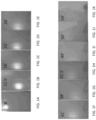
- FIGS. 1A-1J are photographs of a silicon bronze panel with the polyester based filler composition containing a free-radical fading red dye mixed of EXAMPLE 1 with 2 weight percent fully formulated benzoyl peroxide cure initiator (BPO).
- BPO benzoyl peroxide cure initiator
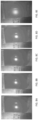
- FIGS. 2A-2E are photographs of the same silicon bronze panel with the same polyester based filler composition containing a free-radical fading red dye mixed with 3 total weight percent fully formulated BPO with the temperature held at between 9.4 and 11.7 degrees Celsius. The times are in yellow superimposed on each panel. The color change is essentially complete at 20 minutes, except edges. At 25 minutes the edges are not pink and sample sanded well.
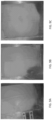
- FIG. 3A is a photograph showing the difference between the final color of a given a polyester based filler composition, RU 64 application done at 9.4°C (left) and at 20°C (right) with the dye of FIGS. 1A-1J and 2 total weight percent BPO in both.
- FIG. 3B is a photograph showing the difference between the final color of RU 64 application done at 9.4°C (left) containing total weight percent BPO and at 20°C (right) containing 2 total weight percent BPO with the dye of FIGS. 1A-1J .
- the 3 total weight percent BPO is noted to be closer to the 20°C color than the 2 total weight percent BPO shown in FIG. 3A cured at 9.4°C.
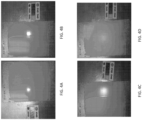
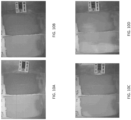
- FIGS. 4A-4D are photographs of a silicon bronze panel with a polyester based filler composition of Example 1, RU 64 containing a free-radical fading red dye mixed with 2 total weight percent BPO with the temperature held at 20°C as a function of time: 2'31 min ( FIG. 4A ), 7'05 min ( FIG. 4B ), 9'38 min ( FIG. 4C ), and 16'30 min ( FIG. 4D ).
- the starting purple color of FIG. 4A then transitions to a more purple color seen in FIG. 4B .
- the pink almost completely faded except the furthest edges.
- the last photo is at about 16.5 minutes ( FIG.
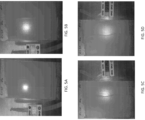
- FIGS. 5A-5D are photographs of a silicon bronze panel with a polyester based filler composition that is a slower cure filler relative to RU 64 containing a free-radical fading red dye mixed with 2 total weight percent BPO with the temperature held at 20°C as a function of time: 3'31 min ( FIG. 5A ), 7'08 min ( FIG. 5B ), 14'38 min ( FIG. 5C ), .and 17'30 min ( FIG. 5D ).
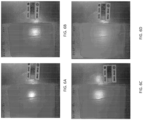
- FIGS. 6A-6D are photographs of a silicon bronze panel with a polyester based filler composition shown in FIGS. 5A-5D and containing a free-radical fading red dye mixed with 3 % BPO with the temperature held at 20 °C as a function of time: 3'36 min ( FIG. 6A ), 6'39 min ( FIG. 6B ), 9'25 min ( FIG. 6C ), and 12' 18 min ( FIG. 6D ).
- the same color transition can be seen in the formulation of EXAMPLE 3 relative to EXAMPLE 1, but at different times at 3 total weight percent BPO that are faster than the same resin loaded with BPO at 2 total weight percent.
- the more purple color begins to develop at about 10 minutes ( FIG. 6C ).
- the color change was basically complete at 12'18, except on edges ( FIG. 6D ).
- the filler was sanded at 13.5 minutes with no clog; no pink edges at that time.
- the color changing dye of EXAMPLE 1 is replaced with 100 ppm Oil Blue A color changing dye.
- the procedure of EXAMPLE 4 is then repeated with similar results except for an as mixed dark blue color that changes to light blue with complete cure. It is more difficult to see when color change is complete at dry to sand time than with cure reactive red dye (purple to light blue). Table 1.
- Part B contains 50 weight percent BPO and small amount of not reactive blue dye to show mixing with Part A.
- Part B is added to Part A in the amount 2 or 3 total weight percent based on Part A.
- Methylene blue forms a blue layer on the surface, which serves as guide coat.
- Example 1 The process of Example 1 is repeated with SF resin in place of RU 64.
- SF is slower than RU 64 body filler, under like cure conditions, it takes 30% more time to complete color change and cure, compared to RU 64 body filler, but otherwise behaves the same.
- the base polyester resin formulation of EXAMPLE 1 is tested as a conventional comparative. A residual blue color is noted before and after cure and associated with a blue nonreactive colorant present in the part B.
- FIGS. 7A-7C are photographs of RU 64 filler without the inventive cure reactive color changing red dye catalyzed with 2 total weight percent unreactive blue dye containing BPO (Comparative control) on two different substrates in each photograph with silicon bronze (left) and galvanized steel (right) the temperature held at 20°C as a function of time: 4'49 min ( FIG. 7A ), 6'07 min ( FIG. 6B ), and 14'07 min ( FIG. 7C ).
- FIGS. 8A-8E are photographs of the silicon bronze panels curing at 20°C: 2'49 min ( FIG. 8A ), 3'49 min ( FIG. 8B ), 5'22 min ( FIG. 8C ), 8'33 min ( FIG. 8D ), and 14'14 min ( FIG. 8E ).
- FIGS. 9A-9C are photographs of the Example 9 formulation on silicon bronze catalyzed with 2 total weight percent unreactive blue dye containing BPO ( FIG. 9A ), with the same red dye of Fig. 9A and 40 ppm methylene blue ( FIG. 9B ), and the same composition of FIG. 9B curing to show low spots and need for more sanding.
- FIGS. 10A-10D are photographs of a cure reactive dye-free version of Example 9 as a comparative control, and the Example 9 formulation are applied side-by-side on galvanized steel substrates in each photograph, the temperature held at 20°C as a function of time: 3'55 min ( FIG. 10A ), 9'18 min ( FIG. 10B ), 12'47 min ( FIG. 10C ) and 18'31 min ( FIG. 10D ).
- the control does not change color while filler with dyes changes from purple to blue at dry to sand time.
- FIGS. 11A-11E are photographs of a galvanized steel panel with the Example 7 formulation at 20°C as a function of time: 4'29 min ( FIG. 11A ), 5'33 min ( FIG. 11B ), 7'36 min ( FIG. 11C ), 14'01 min ( FIG. 11D ), and 20'50 min ( FIG. 11E ). A color change is noted as the formulations cures.
- FIGS. 12A-12E are photographs of a reactive dye-free formulation otherwise identical to the Example 9 formulation cured at 20°C as a function of time and as a comparative control relative to FIGS. 11A-11E : about 4' 15 min ( FIG. 12A ), about 5'30 min ( FIG. 12B ), 8'42 min ( FIG. 12C ), 13'52 min ( FIG. 12D ), and 23'52 min ( FIG. 12E ). No color change is noted as the formulations cures.
Landscapes
- Chemical & Material Sciences (AREA)
- Organic Chemistry (AREA)
- Life Sciences & Earth Sciences (AREA)
- Engineering & Computer Science (AREA)
- Materials Engineering (AREA)
- Wood Science & Technology (AREA)
- Chemical Kinetics & Catalysis (AREA)
- Oil, Petroleum & Natural Gas (AREA)
- Health & Medical Sciences (AREA)
- Medicinal Chemistry (AREA)
- Polymers & Plastics (AREA)
- Paints Or Removers (AREA)
Claims (13)
- Fahrzeug-Bindefüllerformulierung, aufweisend:einen Teil A, der ein härtbares Harz mit einem Ungesättigtheitsgrad aufweist; und ein reaktives Monomer-Verdünnungsmittel, in dem das härtbare Harz gelöst oder suspendiert ist, wobei das reaktive Monomer-Verdünnungsmittel Acryl, Acrylat, Methacrylat, Ethermonomer der Struktur (C1-C6-Alkyl)-O-(C2-C6-Alkylen), Styrol, α-Methylstyrol, Vinyltoluol, difunktionelles Styrol, Allyl-substituiertes Benzol, Divinylbenzol, difunktionelles Acrylat, trifunktionelles Acrylat, Acrylnitril, Monovinyl-terminierte Polydimethylsiloxane, und Kombinationen von beliebigen der vorgenannten ist;einen Teil B-Separatlagerungseinheit-Härtungsinitiator für freie Radikale, der einen Härtungsinitiator für freie Radikale aufweist; undzumindest einen farbverändernden Farbstoff, der von 0,00005 bis 0,002 Gesamtgewichtsprozent des aktiven Farbstoffs in einer vollständigen Formulierung vorhanden ist, ausgelegt dazu, i) die Farbe beim Mischen des Teils A und des Teils B zu ändern, sodass eine abschließende Farbänderung innerhalb von ± 5 Minuten Aushärten des härtbaren Harzes zu einem schleifbaren Zustand erfolgt, oder ii) als ein Leitschichtfarbmittel, das mit Umgebungsluft oder -licht oder einer Kombination dieser reaktiv ist, zu dienen.
- Formulierung nach Anspruch 1, ferner aufweisend einen Teil C, wobei der zumindest eine farbverändernde Farbstoff entweder in dem Teil A oder einem Teil C vorhanden ist.
- Formulierung nach Anspruch 1, wobei der zumindest eine farbverändernde Farbstoff zumindest zwei farbverändernde Farbstoffe ist.
- Formulierung nach Anspruch 1, wobei das härtbare Harz ein Polyester ist.
- Formulierung nach Anspruch 1, wobei der zumindest eine farbverändernde Farbstoff die Formel A-X-A' hat, wobei A und A' jeweils unabhängig voneinander eine Aryleinheit C6H5-, C10H7-, C5NH4-, C4NH4-, C4N2H3- und substituierte Formen davon sind, wobei ein beliebiger Wasserstoff durch ein C1-C4-Alkyl, C1-C4 primäres Alkylamin, C0-C4-Alkylphenyl, C0-C4-Alkylhydroxil, einen C1-C4-Alkylester, C0-C4-Alkylsulfonate, oder eine Kombination davon, substituiert ist, wobei X N=N, C=C, C(O), C(N-H) ist, und
wobei bevorzugt
X N=N ist. - Formulierung nach Anspruch 1, wobei die zumindest eine Farbe zwei farbverändernde Farbstoffe ist, wobei jeder der zwei farbverändernden Farbstoffe nach einer unterschiedlichen Farbe vor dem Härten und bei der abschließenden Farbänderung nach dem Härten für ein nicht unterstütztes, gewöhnliches menschliches Auge farblos ist.
- Formulierung nach Anspruch 1, wobei der Härtungsinitiator für freie Radikale ein Peroxid ist, und wobei
das Peroxid optional Benzoylperoxid ist. - Formulierung nach Anspruch 1, wobei einer des zumindest einen farbverändernden Farbstoffs vor dem Härten rot ist, oder, alternativ, wobei
der zumindest eine farbverändernde Farbstoff eine erste Farbe ist, wenn ein oxidierter Zustand vorliegt, und die abschließende Farbe ist, die eine andere Farbe ist, wenn ein reduzierter Zustand vorliegt. - Formulierung nach Anspruch 1, wobei der zumindest eine farbverändernde Farbstoff vor dem Härten blau ist, oder, alternativ, wobei
das Leitschichtfarbmittel vorhanden und ausgelegt ist, die Farbe basierend auf Sauerstoffexposition zu ändern. - Verfahren zum Reparieren einer Fahrzeugkarosserie, aufweisend:Mischen eines Polyesterharzformulierungsteils A, aufweisend: ein härtbares Harz mit einem Ungesättigtheitsgrad, ein reaktives Monomer-Verdünnungsmittel, in dem das härtbare Harz gelöst oder suspendiert ist, wobei das reaktive Monomer-Verdünnungsmittel Acryl, Acrylat, Methacrylat, Ethermonomer der Struktur (C1-C6-Alkyl)-O-(C2-C6-Alkylen), Styrol, α-Methylstyrol, Vinyltoluol, difunktionelles Styrol, Allyl-substituiertes Benzol, Divinylbenzol, difunktionelles Acrylat, trifunktionelles Acrylat, Acrylnitril, Monovinyl-terminierte Polydimethylsiloxane, und Kombinationen von beliebigen der vorgenannten ist, und zumindest einen farbverändernden Farbstoff, der von 0,00005 bis 0,002 Gesamtgewichtsprozent des aktiven Farbstoffs in einer vollständigen Formulierung vorhanden ist, ausgelegt dazu, die Farbe beim Mischen des Teils A und des Teils B zu ändern, wobei eine abschließende Farbänderung innerhalb von ± 5 Minuten Aushärten des härtbaren Harzes zu einem schleifbaren Zustand erfolgt, oder ein Leitschichtfarbmittel, das mit Umgebungsluft oder -licht oder einer Kombination dieser reaktiv ist; mit einem Teil B-Separatlagerungseinheit-Härtungsinitiator für freie Radikale, der einen Härtungsinitiator für freie Radikale aufweist, zum Bilden einer Mischung;Aufbringen der Mischung auf ein Substrat der zu reparierenden Fahrzeugkarosserie; undAushärten der Mischung, um eine Füllung zu bilden, um die Fahrzeugkarosserie unter Bedingungen zu reparieren, die ausgelegt sind, den zumindest einen farbverändernden Farbstoff zu einer abschließenden Farbänderung innerhalb von ± 5 Minuten Aushärten des härtbaren Harzes zu einem Schleifmittel zu veranlassen.
- Verfahren nach Anspruch 10, wobei das Härten innerhalb von 20 Minuten nach der Bildung der Mischung erfolgt.
- Verfahren nach Anspruch 10, ferner aufweisend das Schleifen der Füllung, und wobei optional
das Leitschichtfarbmittel vorhanden ist und Vertiefungen auf der Fahrzeugkarosserie zeigt, in denen die Leitschichtfarbmittel-Farbänderung aufgetreten ist und nicht durch das Schleifen entfernt wurde, oder, alternativ,
ferner aufweisend das Bestätigen, dass keine Vertiefungen auf der Fahrzeugkarosserie verbleiben, indem die Füllung geschliffen wird, bis keine Oberflächenfarbe für ein nicht unterstütztes, gewöhnliches menschliches Auge mehr sichtbar ist. - Verfahren nach Anspruch 10, wobei die Füllung eine Strukturkante und einen zentralen Bereich aufweist, oder, alternativ, wobei
die abschließende Farbänderung des zumindest einen farbverändernden Farbstoffs von einem nicht unterstützten, gewöhnlichen menschlichen Auge oder einer Software, die auf einem Rechengerät läuft und ein Farbfoto der Füllung analysiert, beobachtet wird.
Applications Claiming Priority (2)
| Application Number | Priority Date | Filing Date | Title |
|---|---|---|---|
| US201762534486P | 2017-07-19 | 2017-07-19 | |
| PCT/US2018/042483 WO2019018392A1 (en) | 2017-07-19 | 2018-07-17 | LOAD COMPOSITION INDICATING PREPARATION CONDITION FOR SANDING |
Publications (2)
| Publication Number | Publication Date |
|---|---|
| EP3655487A1 EP3655487A1 (de) | 2020-05-27 |
| EP3655487B1 true EP3655487B1 (de) | 2024-09-04 |
Family
ID=63244970
Family Applications (1)
| Application Number | Title | Priority Date | Filing Date |
|---|---|---|---|
| EP18755969.5A Active EP3655487B1 (de) | 2017-07-19 | 2018-07-17 | Füllstoff haftzusammensetzungen zur anzeige der schleifbereitschaft |
Country Status (1)
| Country | Link |
|---|---|
| EP (1) | EP3655487B1 (de) |
Families Citing this family (1)
| Publication number | Priority date | Publication date | Assignee | Title |
|---|---|---|---|---|
| US12152141B2 (en) * | 2020-09-09 | 2024-11-26 | Illinois Tool Works Inc. | Flame resistant body fill composition |
-
2018
- 2018-07-17 EP EP18755969.5A patent/EP3655487B1/de active Active
Also Published As
| Publication number | Publication date |
|---|---|
| EP3655487A1 (de) | 2020-05-27 |
Similar Documents
| Publication | Publication Date | Title |
|---|---|---|
| US20230104052A1 (en) | Filler composition indicating readiness to sand | |
| TWI429668B (zh) | 加速劑溶液 | |
| KR100974631B1 (ko) | 미끄럼방지 바닥용 수성 칼라 코팅제 조성물 | |
| DE102007034458A1 (de) | Harzsystem für Intumeszent Beschichtung mit verbesserter Metallhaftung | |
| CN108977053B (zh) | 复合涂层材料及其制备方法和应用 | |
| WO2007037559A1 (en) | Waterborne curable resin composition | |
| EP3655487B1 (de) | Füllstoff haftzusammensetzungen zur anzeige der schleifbereitschaft | |
| CA3122298C (en) | PRIMER WITH INTERNAL GUIDING LAYER | |
| AU768611B2 (en) | Acrylic polymer composition | |
| US12421430B2 (en) | Composition based on (meth)acrylate monomers | |
| JPH0557281B2 (de) | ||
| US20240166846A1 (en) | Marine repair composition | |
| US12152141B2 (en) | Flame resistant body fill composition | |
| KR20050108297A (ko) | 복합경화형 코팅 조성물, 이를 이용한 저광택 표면 제품의제조방법 및 그 제품 | |
| WO2024107375A1 (en) | Marine repair composition | |
| KR20140075344A (ko) | 도로 피복용 수지 조성물 | |
| JPH02296876A (ja) | 紫外線硬化性陰ぺい塗膜形成性組成物 | |
| JP3685423B2 (ja) | ビニルモノマーの重合方法 | |
| CN118344809A (zh) | 一种耐高温紫外光固化涂料及其制备方法 | |
| KR20240071048A (ko) | 씽크볼 및 씽크볼 형성용 조성물 | |
| JP2025518746A (ja) | (メタ)アクリレートベースの化合物 | |
| JPH01268770A (ja) | 光重合性コーテイング剤 | |
| EP2508541A1 (de) | Prozess zur Herstellung eines Verbundstoffmaterials | |
| JPH10130332A (ja) | 重合性組成物 | |
| JP2003290371A (ja) | 保護具アイピース及びその製造方法 |
Legal Events
| Date | Code | Title | Description |
|---|---|---|---|
| STAA | Information on the status of an ep patent application or granted ep patent |
Free format text: STATUS: UNKNOWN |
|
| STAA | Information on the status of an ep patent application or granted ep patent |
Free format text: STATUS: THE INTERNATIONAL PUBLICATION HAS BEEN MADE |
|
| PUAI | Public reference made under article 153(3) epc to a published international application that has entered the european phase |
Free format text: ORIGINAL CODE: 0009012 |
|
| STAA | Information on the status of an ep patent application or granted ep patent |
Free format text: STATUS: REQUEST FOR EXAMINATION WAS MADE |
|
| 17P | Request for examination filed |
Effective date: 20200107 |
|
| AK | Designated contracting states |
Kind code of ref document: A1 Designated state(s): AL AT BE BG CH CY CZ DE DK EE ES FI FR GB GR HR HU IE IS IT LI LT LU LV MC MK MT NL NO PL PT RO RS SE SI SK SM TR |
|
| AX | Request for extension of the european patent |
Extension state: BA ME |
|
| DAV | Request for validation of the european patent (deleted) | ||
| DAX | Request for extension of the european patent (deleted) | ||
| STAA | Information on the status of an ep patent application or granted ep patent |
Free format text: STATUS: EXAMINATION IS IN PROGRESS |
|
| 17Q | First examination report despatched |
Effective date: 20230406 |
|
| REG | Reference to a national code |
Ref country code: DE Ref legal event code: R079 Free format text: PREVIOUS MAIN CLASS: C09D0005000000 Ipc: C09D0005340000 Ref country code: DE Ref legal event code: R079 Ref document number: 602018073973 Country of ref document: DE Free format text: PREVIOUS MAIN CLASS: C09D0005000000 Ipc: C09D0005340000 |
|
| GRAP | Despatch of communication of intention to grant a patent |
Free format text: ORIGINAL CODE: EPIDOSNIGR1 |
|
| STAA | Information on the status of an ep patent application or granted ep patent |
Free format text: STATUS: GRANT OF PATENT IS INTENDED |
|
| RIC1 | Information provided on ipc code assigned before grant |
Ipc: C09D 4/06 20060101ALI20240312BHEP Ipc: C09D 167/08 20060101ALI20240312BHEP Ipc: C09D 167/06 20060101ALI20240312BHEP Ipc: C09D 7/41 20180101ALI20240312BHEP Ipc: C09D 5/00 20060101ALI20240312BHEP Ipc: C09D 5/34 20060101AFI20240312BHEP |
|
| INTG | Intention to grant announced |
Effective date: 20240412 |
|
| GRAS | Grant fee paid |
Free format text: ORIGINAL CODE: EPIDOSNIGR3 |
|
| GRAA | (expected) grant |
Free format text: ORIGINAL CODE: 0009210 |
|
| STAA | Information on the status of an ep patent application or granted ep patent |
Free format text: STATUS: THE PATENT HAS BEEN GRANTED |
|
| AK | Designated contracting states |
Kind code of ref document: B1 Designated state(s): AL AT BE BG CH CY CZ DE DK EE ES FI FR GB GR HR HU IE IS IT LI LT LU LV MC MK MT NL NO PL PT RO RS SE SI SK SM TR |
|
| P01 | Opt-out of the competence of the unified patent court (upc) registered |
Free format text: CASE NUMBER: APP_43410/2024 Effective date: 20240724 |
|
| REG | Reference to a national code |
Ref country code: GB Ref legal event code: FG4D |
|
| REG | Reference to a national code |
Ref country code: CH Ref legal event code: EP |
|
| REG | Reference to a national code |
Ref country code: IE Ref legal event code: FG4D |
|
| REG | Reference to a national code |
Ref country code: DE Ref legal event code: R096 Ref document number: 602018073973 Country of ref document: DE |
|
| REG | Reference to a national code |
Ref country code: LT Ref legal event code: MG9D |
|
| REG | Reference to a national code |
Ref country code: NL Ref legal event code: MP Effective date: 20240904 |
|
| PG25 | Lapsed in a contracting state [announced via postgrant information from national office to epo] |
Ref country code: NO Free format text: LAPSE BECAUSE OF FAILURE TO SUBMIT A TRANSLATION OF THE DESCRIPTION OR TO PAY THE FEE WITHIN THE PRESCRIBED TIME-LIMIT Effective date: 20241204 |
|
| PG25 | Lapsed in a contracting state [announced via postgrant information from national office to epo] |
Ref country code: FI Free format text: LAPSE BECAUSE OF FAILURE TO SUBMIT A TRANSLATION OF THE DESCRIPTION OR TO PAY THE FEE WITHIN THE PRESCRIBED TIME-LIMIT Effective date: 20240904 Ref country code: PL Free format text: LAPSE BECAUSE OF FAILURE TO SUBMIT A TRANSLATION OF THE DESCRIPTION OR TO PAY THE FEE WITHIN THE PRESCRIBED TIME-LIMIT Effective date: 20240904 Ref country code: GR Free format text: LAPSE BECAUSE OF FAILURE TO SUBMIT A TRANSLATION OF THE DESCRIPTION OR TO PAY THE FEE WITHIN THE PRESCRIBED TIME-LIMIT Effective date: 20241205 |
|
| PG25 | Lapsed in a contracting state [announced via postgrant information from national office to epo] |
Ref country code: BG Free format text: LAPSE BECAUSE OF FAILURE TO SUBMIT A TRANSLATION OF THE DESCRIPTION OR TO PAY THE FEE WITHIN THE PRESCRIBED TIME-LIMIT Effective date: 20240904 |
|
| PG25 | Lapsed in a contracting state [announced via postgrant information from national office to epo] |
Ref country code: LV Free format text: LAPSE BECAUSE OF FAILURE TO SUBMIT A TRANSLATION OF THE DESCRIPTION OR TO PAY THE FEE WITHIN THE PRESCRIBED TIME-LIMIT Effective date: 20240904 |
|
| PG25 | Lapsed in a contracting state [announced via postgrant information from national office to epo] |
Ref country code: HR Free format text: LAPSE BECAUSE OF FAILURE TO SUBMIT A TRANSLATION OF THE DESCRIPTION OR TO PAY THE FEE WITHIN THE PRESCRIBED TIME-LIMIT Effective date: 20240904 |
|
| PG25 | Lapsed in a contracting state [announced via postgrant information from national office to epo] |
Ref country code: ES Free format text: LAPSE BECAUSE OF FAILURE TO SUBMIT A TRANSLATION OF THE DESCRIPTION OR TO PAY THE FEE WITHIN THE PRESCRIBED TIME-LIMIT Effective date: 20240904 Ref country code: RS Free format text: LAPSE BECAUSE OF FAILURE TO SUBMIT A TRANSLATION OF THE DESCRIPTION OR TO PAY THE FEE WITHIN THE PRESCRIBED TIME-LIMIT Effective date: 20241204 |
|
| PG25 | Lapsed in a contracting state [announced via postgrant information from national office to epo] |
Ref country code: RS Free format text: LAPSE BECAUSE OF FAILURE TO SUBMIT A TRANSLATION OF THE DESCRIPTION OR TO PAY THE FEE WITHIN THE PRESCRIBED TIME-LIMIT Effective date: 20241204 Ref country code: PL Free format text: LAPSE BECAUSE OF FAILURE TO SUBMIT A TRANSLATION OF THE DESCRIPTION OR TO PAY THE FEE WITHIN THE PRESCRIBED TIME-LIMIT Effective date: 20240904 Ref country code: NO Free format text: LAPSE BECAUSE OF FAILURE TO SUBMIT A TRANSLATION OF THE DESCRIPTION OR TO PAY THE FEE WITHIN THE PRESCRIBED TIME-LIMIT Effective date: 20241204 Ref country code: LV Free format text: LAPSE BECAUSE OF FAILURE TO SUBMIT A TRANSLATION OF THE DESCRIPTION OR TO PAY THE FEE WITHIN THE PRESCRIBED TIME-LIMIT Effective date: 20240904 Ref country code: HR Free format text: LAPSE BECAUSE OF FAILURE TO SUBMIT A TRANSLATION OF THE DESCRIPTION OR TO PAY THE FEE WITHIN THE PRESCRIBED TIME-LIMIT Effective date: 20240904 Ref country code: GR Free format text: LAPSE BECAUSE OF FAILURE TO SUBMIT A TRANSLATION OF THE DESCRIPTION OR TO PAY THE FEE WITHIN THE PRESCRIBED TIME-LIMIT Effective date: 20241205 Ref country code: FI Free format text: LAPSE BECAUSE OF FAILURE TO SUBMIT A TRANSLATION OF THE DESCRIPTION OR TO PAY THE FEE WITHIN THE PRESCRIBED TIME-LIMIT Effective date: 20240904 Ref country code: ES Free format text: LAPSE BECAUSE OF FAILURE TO SUBMIT A TRANSLATION OF THE DESCRIPTION OR TO PAY THE FEE WITHIN THE PRESCRIBED TIME-LIMIT Effective date: 20240904 Ref country code: BG Free format text: LAPSE BECAUSE OF FAILURE TO SUBMIT A TRANSLATION OF THE DESCRIPTION OR TO PAY THE FEE WITHIN THE PRESCRIBED TIME-LIMIT Effective date: 20240904 |
|
| REG | Reference to a national code |
Ref country code: AT Ref legal event code: MK05 Ref document number: 1720382 Country of ref document: AT Kind code of ref document: T Effective date: 20240904 |
|
| PG25 | Lapsed in a contracting state [announced via postgrant information from national office to epo] |
Ref country code: NL Free format text: LAPSE BECAUSE OF FAILURE TO SUBMIT A TRANSLATION OF THE DESCRIPTION OR TO PAY THE FEE WITHIN THE PRESCRIBED TIME-LIMIT Effective date: 20240904 |
|
| PG25 | Lapsed in a contracting state [announced via postgrant information from national office to epo] |
Ref country code: IS Free format text: LAPSE BECAUSE OF FAILURE TO SUBMIT A TRANSLATION OF THE DESCRIPTION OR TO PAY THE FEE WITHIN THE PRESCRIBED TIME-LIMIT Effective date: 20250104 Ref country code: PT Free format text: LAPSE BECAUSE OF FAILURE TO SUBMIT A TRANSLATION OF THE DESCRIPTION OR TO PAY THE FEE WITHIN THE PRESCRIBED TIME-LIMIT Effective date: 20250106 |
|
| PG25 | Lapsed in a contracting state [announced via postgrant information from national office to epo] |
Ref country code: RO Free format text: LAPSE BECAUSE OF FAILURE TO SUBMIT A TRANSLATION OF THE DESCRIPTION OR TO PAY THE FEE WITHIN THE PRESCRIBED TIME-LIMIT Effective date: 20240904 Ref country code: SM Free format text: LAPSE BECAUSE OF FAILURE TO SUBMIT A TRANSLATION OF THE DESCRIPTION OR TO PAY THE FEE WITHIN THE PRESCRIBED TIME-LIMIT Effective date: 20240904 |
|
| PG25 | Lapsed in a contracting state [announced via postgrant information from national office to epo] |
Ref country code: EE Free format text: LAPSE BECAUSE OF FAILURE TO SUBMIT A TRANSLATION OF THE DESCRIPTION OR TO PAY THE FEE WITHIN THE PRESCRIBED TIME-LIMIT Effective date: 20240904 Ref country code: AT Free format text: LAPSE BECAUSE OF FAILURE TO SUBMIT A TRANSLATION OF THE DESCRIPTION OR TO PAY THE FEE WITHIN THE PRESCRIBED TIME-LIMIT Effective date: 20240904 |
|
| PG25 | Lapsed in a contracting state [announced via postgrant information from national office to epo] |
Ref country code: CZ Free format text: LAPSE BECAUSE OF FAILURE TO SUBMIT A TRANSLATION OF THE DESCRIPTION OR TO PAY THE FEE WITHIN THE PRESCRIBED TIME-LIMIT Effective date: 20240904 |
|
| PG25 | Lapsed in a contracting state [announced via postgrant information from national office to epo] |
Ref country code: SK Free format text: LAPSE BECAUSE OF FAILURE TO SUBMIT A TRANSLATION OF THE DESCRIPTION OR TO PAY THE FEE WITHIN THE PRESCRIBED TIME-LIMIT Effective date: 20240904 |
|
| REG | Reference to a national code |
Ref country code: DE Ref legal event code: R026 Ref document number: 602018073973 Country of ref document: DE |
|
| PLBI | Opposition filed |
Free format text: ORIGINAL CODE: 0009260 |
|
| PLAX | Notice of opposition and request to file observation + time limit sent |
Free format text: ORIGINAL CODE: EPIDOSNOBS2 |
|
| 26 | Opposition filed |
Opponent name: PPG INDUSTRIES, INC. Effective date: 20250602 |
|
| PG25 | Lapsed in a contracting state [announced via postgrant information from national office to epo] |
Ref country code: DK Free format text: LAPSE BECAUSE OF FAILURE TO SUBMIT A TRANSLATION OF THE DESCRIPTION OR TO PAY THE FEE WITHIN THE PRESCRIBED TIME-LIMIT Effective date: 20240904 |
|
| PG25 | Lapsed in a contracting state [announced via postgrant information from national office to epo] |
Ref country code: SE Free format text: LAPSE BECAUSE OF FAILURE TO SUBMIT A TRANSLATION OF THE DESCRIPTION OR TO PAY THE FEE WITHIN THE PRESCRIBED TIME-LIMIT Effective date: 20240904 |
|
| PGFP | Annual fee paid to national office [announced via postgrant information from national office to epo] |
Ref country code: DE Payment date: 20250729 Year of fee payment: 8 |
|
| PGFP | Annual fee paid to national office [announced via postgrant information from national office to epo] |
Ref country code: IT Payment date: 20250721 Year of fee payment: 8 |
|
| PGFP | Annual fee paid to national office [announced via postgrant information from national office to epo] |
Ref country code: GB Payment date: 20250728 Year of fee payment: 8 |
|
| PLBB | Reply of patent proprietor to notice(s) of opposition received |
Free format text: ORIGINAL CODE: EPIDOSNOBS3 |