EP3649840A1 - Vorrichtung zur stütze eines arbeitskops - Google Patents
Vorrichtung zur stütze eines arbeitskops Download PDFInfo
- Publication number
- EP3649840A1 EP3649840A1 EP19020618.5A EP19020618A EP3649840A1 EP 3649840 A1 EP3649840 A1 EP 3649840A1 EP 19020618 A EP19020618 A EP 19020618A EP 3649840 A1 EP3649840 A1 EP 3649840A1
- Authority
- EP
- European Patent Office
- Prior art keywords
- frame
- cylinder
- carriage
- integral
- working head
- Prior art date
- Legal status (The legal status is an assumption and is not a legal conclusion. Google has not performed a legal analysis and makes no representation as to the accuracy of the status listed.)
- Withdrawn
Links
- 230000033001 locomotion Effects 0.000 claims description 27
- 239000012530 fluid Substances 0.000 claims description 6
- 238000006073 displacement reaction Methods 0.000 description 5
- 238000005520 cutting process Methods 0.000 description 3
- 238000011144 upstream manufacturing Methods 0.000 description 3
- 238000012423 maintenance Methods 0.000 description 2
- 239000000463 material Substances 0.000 description 2
- 238000005452 bending Methods 0.000 description 1
- 230000002457 bidirectional effect Effects 0.000 description 1
- 230000005540 biological transmission Effects 0.000 description 1
- 238000010276 construction Methods 0.000 description 1
- 230000001419 dependent effect Effects 0.000 description 1
- 238000005304 joining Methods 0.000 description 1
- 238000004519 manufacturing process Methods 0.000 description 1
- 239000002184 metal Substances 0.000 description 1
- 238000005457 optimization Methods 0.000 description 1
- 230000002035 prolonged effect Effects 0.000 description 1
- 230000000284 resting effect Effects 0.000 description 1
- 239000007787 solid Substances 0.000 description 1
- 238000003466 welding Methods 0.000 description 1
Images





Classifications
-
- A—HUMAN NECESSITIES
- A01—AGRICULTURE; FORESTRY; ANIMAL HUSBANDRY; HUNTING; TRAPPING; FISHING
- A01B—SOIL WORKING IN AGRICULTURE OR FORESTRY; PARTS, DETAILS, OR ACCESSORIES OF AGRICULTURAL MACHINES OR IMPLEMENTS, IN GENERAL
- A01B63/00—Lifting or adjusting devices or arrangements for agricultural machines or implements
- A01B63/02—Lifting or adjusting devices or arrangements for agricultural machines or implements for implements mounted on tractors
- A01B63/023—Lateral adjustment of their tools
-
- A—HUMAN NECESSITIES
- A01—AGRICULTURE; FORESTRY; ANIMAL HUSBANDRY; HUNTING; TRAPPING; FISHING
- A01D—HARVESTING; MOWING
- A01D34/00—Mowers; Mowing apparatus of harvesters
- A01D34/835—Mowers; Mowing apparatus of harvesters specially adapted for particular purposes
- A01D34/86—Mowers; Mowing apparatus of harvesters specially adapted for particular purposes for use on sloping ground, e.g. on embankments or in ditches
- A01D34/866—Mounting means
Definitions
- the present invention relates to an apparatus for connecting an agricultural machine to a working head; the invention relates to an apparatus for agricultural and similar machines (including those for forest use, road and riverbed maintenance, etc.), usable for the support of a working head which can be, for example, a bush-cutter, a shredder, a ditcher, etc.
- the apparatus can be used to support an operating head, interposed between a driving machine and an operating head (or an accessory or an operating machine) to transmit the motion from the driving machine to the operating head and to move the latter in respect to the driving machine.
- the apparatus comprises: - a first frame provided with means for the connection to the driving machine; - a second frame connected to the first frame; - first moving means arranged and acting between the first frame and the second frame, adapted to translate the second frame bidirectionally with respect to the first frame along a direction substantially orthogonal with respect to the moving direction of the driving machine; - a carriage provided with support and connection means for a working head; - second moving means arranged and acting between the second frame and the carriage, able to translate the carriage bidirectionally with respect to the second frame along a substantially orthogonal direction with respect to the moving direction of the driving machine.
- the apparatus is of relatively simplified construction requiring the use of components characterized by simplicity and sturdiness such as to provide the apparatus, in combination with the high structural functionality, characteristics that remain unaffected even after prolonged use;
- the apparatus allows an optimization of the movement of a second frame with respect to the first which is associated with a tractor, and of the second frame with respect to a carriage which carries the working head, with the interposition of an additional movement element between the carriage and the head;
- the apparatus comprises an additional connecting and moving element shaped so as to be arranged and acting between the carriage and the working head, and provided with moving means adapted to vary the distance between the carriage and the working head, said additional moving means comprising a proximal portion which is integral with the carriage and a distal portion which is integral with the working head; that the moving means which vary the distance between the carriage and the working head can advantageously consist of a linear actuator which has a proximal portion directly integral with the carriage and a distal portion directly integral with the working head;
- the apparatus can be mounted both front and rear of the self-propelled machine; the apparatus is suitable to work at a very high distance from the longitudinal axis of the tractor and, at the same time, has a very small encumbrance in width, that is such as to allow a road use in accordance with the rules of the Highway Code; with the machine in question it is possible to work on inclined planes with respect to the ground level on which the machine drive is moved.
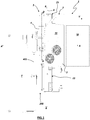
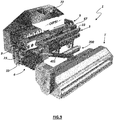
- an apparatus (1) made in accordance with the invention can be used interposed between a driving machine (M) and an operating head (T) to transmit the motion from the driving machine (M) to the operating head (T) and to move the latter with respect to the driving machine (M).
- the driving machine (M) which can be an agricultural tractor provided in a known manner with a three-point hitch and a power take-off, is represented schematically by a block (M) in a discontinuous section; with (V) the movement direction of this machine (M) is indicated.
- the driving machine (M) can be an agricultural tractor or a similar machine capable of moving an operating head, supplying the latter with motion.
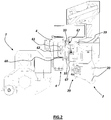
- the apparatus (1) comprises a first frame (2), a second frame (3) and a carriage (4), connected to each other in cascade; the set of these three elements (2, 3, 4) is upstream connected to the motor (M), from which it is supported, and downstream connected to the operating head (T) to carry the latter, which may be constituted by a bush-cutter, a shredder, a ditcher, a forestry equipment, etc.
- the terms working head, operating head or accessory can be used in an equivalent manner.
- the first frame (2) is provided with means for the connection to the driving machine (M); in practice, the first frame (2) is provided with a system of attachments (20) which makes it, in a per se known manner, complementarily associable with the three-point hitch of the tractor (M); moreover, the apparatus (1) is provided with means for connection to the power take-off of the same driving machine (M), indicated in general with (29) in the drawings.
- the first frame (2) is also provided with a lower roller (200) for resting on the ground. This facilitates the movement of the apparatus (1) on the ground, both when the apparatus operates at the same height as the self-propelled machine, and when it operates at a different altitude.
- the roller (200) is also used to support the apparatus (1) during the parking phases.
- First moving means (5) are provided between the first frame (2) and the second frame (3), said first moving means are shaped so as to move the second frame (3) bidirectionally with respect to the first frame (2) along a substantially orthogonal direction with respect to the movement direction (V) of the driving machine (M); in practice, the moving means (5) can move the second frame (3) to the right and to the left with respect to the first frame (2) in a reference which has as its longitudinal axis the direction (V) of movement of the tractor (M).
- the first moving means (5) comprise a hydraulic cylinder whose outer sheath (50) is fixed in one of its ends (52) to a bracket (25) of the first frame (2).
- the longitudinal axis of the cylinder is indicated by X in the drawings.
- the external end (510) of the stem (51) which slides in the cylinder (50) is fixed to the second frame (3) so as to move it bidirectionally according to the operating configurations that the apparatus (1) must assume.
- the outer end (510) is fixed to a connecting element (53) which is keyed to the second frame (3); in particular, the opposite portions of the element (53) (arranged upwards and downwards) are firmly received in corresponding seats (35) provided on the second frame (3).
- the displacement of the outer end (510) which is integral with the second frame (3) determines the corresponding displacement of the same frame (3) with respect to the first frame (2) which is integral with the sheath (50) of the cylinder (5) via the end (52).
- the stem is in an extension configuration
- the stem is in configuration of completed retraction
- Figs. 10 and 11 there is a better view of a guide device for the cylinder (5) which decisively eliminates the possibility of inflection of the stem (51) when it is extended, that is when it projects outside the sheath (50).
- the second frame (3) comprises a support structure (33) formed by four rectangular-section tubular elements.
- the structure (33) is movable, under the action of the cylinder (50), along a corresponding sliding portion (23) of the first frame (2).
- the second frame (3) can therefore be moved with respect to the first frame (2) thanks to the action of the cylinder (50) to slide bidirectionally along the sliding portion (23) which constitutes, in practice, a guide rail for the structure (33).
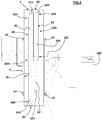
- Fig. 3 shows a representation of the cylinder (50) inside which the stem (51), moved by the action of a fluid passing through the extension (501) and retraction (502) fittings, is sliding.
- the retraction fitting (502) is provided with a return duct (503) which moves the inlet of the retraction fitting (504) into the cylinder to an additional fitting (502) located downstream, in the proximal zone of the cylinder (50) in correspondence of the fixing point (25) to the frame (2), to the secondary inlet (502) which is arranged at the distal region of the cylinder (50).
- the guide device for the cylinder (5) comprises a rod (54) arranged parallel to the stem (51) and provided with two ends (55) and (56) which have a greater cross-section than the remaining part of the same rod (54).
- the guiding device for the cylinder (5) further comprises a first guide element (57) and a second guide element (58).
- the first guide element (57) is arranged near the distal end of the sheath (50), or of the end of the sheath (50) placed on the right in the reference of Figs. 10 and 11 .
- the first guide element (57) has a through seat (570) of a diameter substantially corresponding to that of the rod (54) and lower than that of the ends (55, 56) of the same rod (54).
- the second guide element (58) is provided with a first through seat (580), of a diameter substantially corresponding to that of the rod (54) and lower than that of the ends (55, 56) of the same rod (54), and of a second through seat (581) of a diameter substantially corresponding to that of the stem (51).
- the rod (54) is passing through the two seats (570) and (580) presented by the two guide elements (57) and (58), with the ends (55) and (56) of the rod (54) placed outside said elements (57) and (58), respectively on the left and on the right side, while the stem (51) is arranged to pass through the second seat (581) of the second guide element (58), the sliding of said stem (51) with respect to said second seat (581) being made with slight interference.
- the stem (51) when the stem (51) is moved, it moves the second element (58).
- the stem (51), near its end (510) in which it is fixed to the connecting element (53) has a larger section (511) with respect to the remaining part of the same stem (51).
- the stem (51) is pushed out of the sheath (50) (to the right in the arrangement of Figs. 10 and 11 ) and drags along its run, together with the second frame (3), the second guide element (58) by sliding the rod (54) through the seat (570) of the first element (57).
- the maximum extension of the stem (51) corresponds to a limit stop of the rod (54), whose end (55) placed on the left goes against the outer face (facing left) of the first guide element (57), and whose end (56) on the right goes against the outer face (facing right) of the second guide element (58).
- the presence of the rod (54) contributes to increasing the flexural strength of the rod (51) since the same rod (51), together with the rod (54) and the two guide elements (57) and (58) substantially defines a quadrilateral with the hinges fixed at 90 °.
- the return stroke of the rod (51), i.e. the retraction movement of the cylinder (5), causes the second element (58) to move to the left, pushed by the larger section (511) of the stem (51), until the second element (58) goes against the first element (57) in correspondence with the maximum retraction configuration shown in Fig. 10 .
- the length of the rod (54) can be, for example, of a value substantially equal to about half the value of the extension of the stem (51) outside the sheath (50).
- second moving means (6) which are shaped so as to move the carriage (4) bidirectionally with respect to the second frame (3), always along a substantially orthogonal direction with respect to the moving direction (V) of the driving machine (M).
- the second movement means (6) comprise two cylinders (60, 62) whose sheaths are integral with one another and whose stems (61, 63) are arranged opposited, with a first head (611) of a first stem (61) integral with the structure (33) of the second frame (3) and with a second head (631) of a second stem (63) integral with the carriage (4).
- a displacement of the carriage (4) with respect to the second frame (3) considerably high if compared to the longitudinal encumbrance of the cylinders (60, 62) since the strokes of the two stems (61, 63) are added together in the maximum extension configuration.
- the stem (61) slides, whose foot (610) is integral with the piston, while the head (611) is integral with the second frame (3); in the second cylinder (62) the stem (63) slides, whose foot (630) is integral with the piston, while the head (631) is integral with the carriage (4).
- the first cylinder (60) is provided with extension fittings (600) and retraction fittings (601); the second cylinder (62) is provided with extension fittings (620) and retraction fittings (621).
- the sheaths of the two cylinders (60, 62) are contained in a box-shaped body (66) which is slidable along the elements (33) of the second frame (3) thanks to L-shaped or C-shaped arms (67) which copy a corresponding profile of the structure (33) allowing the sliding of the carriage (4) along the second frame (3) thanks to friction reduction means provided between the respective contact surfaces.
- the arms (67) constitute a sort of carriages which envelope the two tubular elements (33) arranged externally, i.e. from the side of the apparatus (1) facing the working head (T).
- connections of the hydraulic circuits for moving the second frame (3) and the carriage (4) can be housed, in a per se known manner, in relative cable-carrying chains (9).
- the depth of the space i.e. the space occupied in a direction parallel to that of the advancement (V) of the machine, is extremely reduced since the encumbrance of the second frame (3) is substantially contained in the first frame (2) and the overall dimensions of the carriage (4) are substantially contained in the second frame (3).
- the apparatus (1) makes it possible to move the carriage (4) (and the head supported by it cantilevered, that is without engaging the lateral areas of the apparatus) along the entire width of the second frame (3), i.e. along a direction substantially orthogonal to that indicated by (V) in the drawings.
- the second moving means (6) acting between said second frame (3) and said carriage (4) therefore comprise a guide defined by the structure (33) and moving means (6) which comprise the two cylinders (60) and (62) and allow the carriage (4) to slide along the entire length of the second frame (3).
- the carriage (4) can be placed at any point without any moving means projecting laterally to the apparatus.
- the working head (T) consists of a shredder which is supported by a main pin (400) carried by the carriage (4) and that can be moved thanks to a cylinder (401).
- the representation of a shredder as a working head (T) carried by the carriage (4) is only an example; moreover, the working head (T) can be associated with the carriage (4) not only as shown in the drawings but also in other ways such as, for example, through an articulated arm or other connection and movement structure, depending on the characteristics and how to use the same operating head.
- the apparatus (1) allows an articulated and complete movement, thanks to the high possibility of moving the supported working head or tool (T) with respect to the frame (2) connected to the self-propelled machine. In this way it is possible to reach areas more or less close to the path of the self-propelled machine that carries the apparatus, both to the right and to the left than to the center, according to different inclination planes of the working head and at different heights.
- the tool (T) which is supported by the carriage (4) on the opposite side with respect to the tractor (M), can be moved along the whole transverse development of the second frame (3).
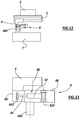
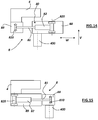
- Figs. 12-15 show a schematic representation of a possible embodiment of an additional connecting and moving element (8) shaped so as to be arranged and acting between the carriage (4) and the working head (T); the element (8) is provided with moving means (80) apt to vary the distance between said carriage (4) and said moving head (T).
- bi-directional translation means for example those indicated with 5 in the present description
- bi-directional translation means are provided between the second frame (3) and the carriage (4) (for example those indicated with 6 in the present description)
- the additional element (8) which allows the bi-directional movement of the member (the pin 400 in the example) in respect to the carriage (4).
- the additional moving element (8) acts between the carriage (4) and the work head (T), with the member (400) that remains integral with the carriage (4).
- the moving means (80) of the additional element (8) comprise a proximal portion (89) integral with the carriage (4) and a distal portion (88) integral with the pin (400).
- the moving means comprise a cylinder (80) whose stem (81) is fixed to the proximal portion (89) (and therefore to the carriage 4) and whose sheath (82) is fixed to the distal portion (88) (and therefore to the pin 400).
- the references (810) and (820) indicate, respectively, the possible hinging axes between the stem (81) and the proximal portion (89) and between the sheath (82) and the distal portion (88).
- the portions (88) and (89) can comprise box-shaped bodies which are firmly fixed to the carriage (4) and to the pin (400), for example by welding and/or bolting or other convenient joining means.
- the stem (81) is fixed to the distal portion (88) while the sheath (82) is fixed to the proximal portion (89).
- the cylinder (80) is arranged horizontally to allow a further extension of the head (T) in a lateral direction (W) with respect to the apparatus (1), i.e. laterally with respect to the moving direction (V) of the tractor (M).
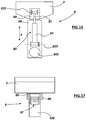
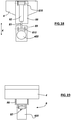
- the cylinder (80) can also be placed vertically, as in the examples of Figs. 16-19 to allow an additional vertical movement (in the direction indicated by the arrows K in the drawings).
- This feature can be extremely useful, for example, to approach the ground when the apparatus is working on rough ground or on a slope.
- the numbering used in these last figures is the same used in Figs. 12-15 .
- the cylinder (80) is fixed with the stem to a portion (89) of the additional element (8) which is integral with the carriage (4) while the sheath (82) is fixed to the portion (88) which is integral to the support for the working head (T), i.e. to the pin (400).
- the cylinder (80) is fixed with the sheath (82) to the portion (88) integral with the carriage and with the stem (81) to the portion (89) which is integral to the support (400) for the working head (T) .
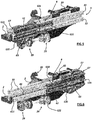
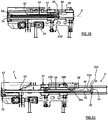
- Figs. 20-27 show an exemplary embodiment of the additional connecting and moving element (8) which is particularly advantageous due to the conformation of the means for moving the head (T) with respect to the carriage (4) as well as the transmission means of the fluid for the movement of the same head (T).
- Fig. 20 the carriage (4) is schematically represented by a block in a discontinuous section and the pin (400) is represented by its longitudinal axis.
- the additional element (8) is composed of a proximal portion (89) which is fixed to the carriage (4) and a distal portion (88) integral with the head (T).
- the proximal portion (89) is formed by a longitudinally extending guide along which the distal portion (88) slides bi-directionally, to allow a further extension of the head (T) in a lateral direction (W) with respect to the apparatus (1), i.e. laterally with respect to the moving direction (V) of the driving machine (M).
- the proximal portion (89) is fixed to the carriage (4) by means of a bracket (801) and a perforated portion (802) adapted to receive the pin (400) presented by the carriage (4).
- the working head (T) is mounted on the distal portion (88), which is fitted on the proximal portion (89) and slides along the latter.
- the bidirectional movement (W) of the distal portion (88) and of the head (T) along the guide (89) defined by the proximal portion is achieved by means of an actuator (80) which can be constituted by a hydraulic jack whose sheath (82) it is integral with the proximal portion (89) and whose stem (81) is integral with the distal portion (88) and therefore with the working head (T).
- the extension of the jack (80) determines the corresponding displacement towards the outside of the working head (T) which can be further moved with respect to the carriage (4) that supports it.
- the supply ducts (803, 804) of the engine (MT) of the head (T) are arranged parallel to the actuator (80); advantageously the ducts (803, 804) consist of rigid telescopic tubes which pass inside the portions (89) and (88), thus eliminating the flexible and substantially external tubing which is usually used for moving the operating heads.
- the ducts (803, 804) can be made of metal or a convenient material, including plastic; the term rigid means that they are able to offer resistance to the action of external forces tending to deform them; in other words, they do not have the typical flexibility of flexible hydraulic fittings or pipes.
- main ducts (803) intended respectively and alternately for the delivery and return of the fluid which, pushed by a pump (not visible in the drawings of Figs. 20-27 ), is intended for the motor (MT) of the head (T) i.e. for the movement of the cutting (or other types) devices provided on it.
- a third duct (804) is provided for drainage, that is to recover any leakage to convey it to a tank (also not shown).
- the supply ducts (803, 804) are connected upstream (on the side of the carriage 4) and downstream (on the side of the head T) through relative connections (807).
- the supply ducts (803, 804) are of the telescopic type and therefore can advantageously adapt to the extension of the additional element (8) while maintaining a considerable rigidity and resistance to stresses, in particular flexural stress.
- the drawings show a possible and effective example of connection between the proximal portion (805) and the distal portion (806), which in the example is smaller in diameter than the previous one.
- the connection is made through a sleeve (813) composed of two heads (814) joined by bolts (815). Inside the heads (814) there is a head body (816) fitted and keyed to the proximal portion (805) and internally provided with suitable gaskets and/or scraper elements (817) which guarantee the tight of the connection.
- the distal portion (806) therefore slides tightly inside the proximal portion (805). Inside both the portions (805, 806) the oleodynamic fluid passes, which can pass between an upstream opening (819) connected to the fittings (807) directed towards the carriage (4) and a downstream opening (818) where the fittings (807) are provided directed to the motor (MT) or to other suitable members operated by an oleodynamic / hydraulic circuit.
- the extension of the additional element (8) is made considerably solid and safe thanks to a support element (808) through which the cylinder (80) and the supply pipes (803, 804) pass.
- a support element (808) through which the cylinder (80) and the supply pipes (803, 804) pass.
- the cylinder (80) and the feeding tubes (803, 804) protrude from the body of the proximal portion (89) through a perforated end element (881).
- the end element (881) is provided with a series of through holes which are traversed by the cylinder (80) and the supply tubes (803, 804); on the same cylinder (80) and on the supply tubes (803, 804) the supporting element (808) is fitted which has a series of through holes which have the same arrangement (or predetermined arrangement) of the holes of the terminal element (881).
- a mechanical end-stop (809) provided with a distal end (811) intended to engage with the support element (808) and a proximal end (812) intended to engage with the end element (881).
- the presence of the support element (808) helps to considerably stiffen the additional element (8) since it drastically reduces the free length of the same subjected to bending stresses.
Landscapes
- Life Sciences & Earth Sciences (AREA)
- Environmental Sciences (AREA)
- Engineering & Computer Science (AREA)
- Mechanical Engineering (AREA)
- Soil Sciences (AREA)
- Harvester Elements (AREA)
- Agricultural Machines (AREA)
- Catching Or Destruction (AREA)
Applications Claiming Priority (1)
| Application Number | Priority Date | Filing Date | Title |
|---|---|---|---|
| IT102018000010084A IT201800010084A1 (it) | 2018-11-06 | 2018-11-06 | Apparecchiatura per il collegamento di una macchina agricola ad una testa di lavoro |
Publications (1)
| Publication Number | Publication Date |
|---|---|
| EP3649840A1 true EP3649840A1 (de) | 2020-05-13 |
Family
ID=65409302
Family Applications (1)
| Application Number | Title | Priority Date | Filing Date |
|---|---|---|---|
| EP19020618.5A Withdrawn EP3649840A1 (de) | 2018-11-06 | 2019-11-05 | Vorrichtung zur stütze eines arbeitskops |
Country Status (2)
| Country | Link |
|---|---|
| EP (1) | EP3649840A1 (de) |
| IT (1) | IT201800010084A1 (de) |
Cited By (1)
| Publication number | Priority date | Publication date | Assignee | Title |
|---|---|---|---|---|
| IT202200023139A1 (it) * | 2022-11-09 | 2024-05-09 | Vigolo S R L | Trinciasarmenti |
Citations (4)
| Publication number | Priority date | Publication date | Assignee | Title |
|---|---|---|---|---|
| EP0150975A2 (de) * | 1984-01-28 | 1985-08-07 | Turner International (Engineering) Limited | Mähmaschinen |
| EP1097626A1 (de) * | 1999-11-04 | 2001-05-09 | Stefano Orsi | Häcksler |
| CA2725694A1 (en) * | 2010-12-16 | 2012-06-16 | Irwin Sieben | Attachment for laterally shifting a working implement |
| EP3318114A1 (de) | 2016-11-08 | 2018-05-09 | ORSI Group S.R.L. | Vorrichtung zur unterstützung eines landwirtschaftlichen arbeitskopfs |
-
2018
- 2018-11-06 IT IT102018000010084A patent/IT201800010084A1/it unknown
-
2019
- 2019-11-05 EP EP19020618.5A patent/EP3649840A1/de not_active Withdrawn
Patent Citations (4)
| Publication number | Priority date | Publication date | Assignee | Title |
|---|---|---|---|---|
| EP0150975A2 (de) * | 1984-01-28 | 1985-08-07 | Turner International (Engineering) Limited | Mähmaschinen |
| EP1097626A1 (de) * | 1999-11-04 | 2001-05-09 | Stefano Orsi | Häcksler |
| CA2725694A1 (en) * | 2010-12-16 | 2012-06-16 | Irwin Sieben | Attachment for laterally shifting a working implement |
| EP3318114A1 (de) | 2016-11-08 | 2018-05-09 | ORSI Group S.R.L. | Vorrichtung zur unterstützung eines landwirtschaftlichen arbeitskopfs |
Cited By (1)
| Publication number | Priority date | Publication date | Assignee | Title |
|---|---|---|---|---|
| IT202200023139A1 (it) * | 2022-11-09 | 2024-05-09 | Vigolo S R L | Trinciasarmenti |
Also Published As
| Publication number | Publication date |
|---|---|
| IT201800010084A1 (it) | 2020-05-06 |
Similar Documents
| Publication | Publication Date | Title |
|---|---|---|
| EP2067924B1 (de) | Bohranlage und Bohrverfahren | |
| EP2935082B1 (de) | Teleskopischer ausleger | |
| EP1507735B1 (de) | Entfernbarer hydraulikschlauchträger | |
| US3893480A (en) | Hydraulic line assembly | |
| KR101789859B1 (ko) | 유압 조인트 구조, 유압 조인트 구조를 포함한 유압 작동 장치, 유압 조인트 구조를 구성하는 조인트 부분, 및 조인트 부분을 포함한 유압 발생 유닛, 첨단 공구 유닛, 유압 호스 유닛 | |
| DE2151436A1 (de) | Geraet zur Feuerbekaempfung | |
| US20240417231A1 (en) | Aerial work platform | |
| CN108495774A (zh) | 维护车辆 | |
| DE2141424A1 (de) | Ausfahrbare und einziehbare Auslegeranordnung | |
| US3666019A (en) | Row marking apparatus | |
| EP3318114A1 (de) | Vorrichtung zur unterstützung eines landwirtschaftlichen arbeitskopfs | |
| RU2067153C1 (ru) | Подъемная установка для обслуживания нефтяных и газовых скважин | |
| DE3509868C2 (de) | ||
| DE19512070A1 (de) | Bohrgerät | |
| EP3556970B1 (de) | Autobetonpumpe | |
| CS198284B2 (en) | Facility for shifting the frame of the walking reinfor cement connected with the working face conveyer | |
| IT201800010065A1 (it) | Apparecchiatura per il collegamento di una macchina agricola ad una testa di lavoro | |
| IT201800010084A1 (it) | Apparecchiatura per il collegamento di una macchina agricola ad una testa di lavoro | |
| US7568530B2 (en) | Ground working implement | |
| IT201800010061A1 (it) | Apparecchiatura per il collegamento di una macchina agricola ad una testa di lavoro | |
| IT201800003699U1 (it) | Apparecchiatura per il collegamento di una macchina agricola ad una testa di lavoro | |
| DE10144294C2 (de) | Teleskopiebare Rohrleitung | |
| IT201800003700U1 (it) | Apparecchiatura per il collegamento di una macchina agricola ad una testa di lavoro | |
| IT201800003707U1 (it) | Apparecchiatura per il collegamento di una macchina agricola ad una testa di lavoro. | |
| US5012962A (en) | Indexing mechanism for a mannequin carriage having a slidable, pivotable support and index bar moveable by a fluid cylinder for movement between a dressing position and a garment press |
Legal Events
| Date | Code | Title | Description |
|---|---|---|---|
| PUAI | Public reference made under article 153(3) epc to a published international application that has entered the european phase |
Free format text: ORIGINAL CODE: 0009012 |
|
| STAA | Information on the status of an ep patent application or granted ep patent |
Free format text: STATUS: THE APPLICATION HAS BEEN PUBLISHED |
|
| AK | Designated contracting states |
Kind code of ref document: A1 Designated state(s): AL AT BE BG CH CY CZ DE DK EE ES FI FR GB GR HR HU IE IS IT LI LT LU LV MC MK MT NL NO PL PT RO RS SE SI SK SM TR |
|
| AX | Request for extension of the european patent |
Extension state: BA ME |
|
| 18D | Application deemed to be withdrawn |
Effective date: 20201114 |