EP3634657B1 - Verfahren zur behandlung von flaschen in einer flaschenwaschanlage und flaschenwaschanlage - Google Patents
Verfahren zur behandlung von flaschen in einer flaschenwaschanlage und flaschenwaschanlage Download PDFInfo
- Publication number
- EP3634657B1 EP3634657B1 EP18732683.0A EP18732683A EP3634657B1 EP 3634657 B1 EP3634657 B1 EP 3634657B1 EP 18732683 A EP18732683 A EP 18732683A EP 3634657 B1 EP3634657 B1 EP 3634657B1
- Authority
- EP
- European Patent Office
- Prior art keywords
- bottles
- rinsing
- bottle washing
- cooling
- washing system
- Prior art date
- Legal status (The legal status is an assumption and is not a legal conclusion. Google has not performed a legal analysis and makes no representation as to the accuracy of the status listed.)
- Active
Links
Images



Classifications
-
- B—PERFORMING OPERATIONS; TRANSPORTING
- B08—CLEANING
- B08B—CLEANING IN GENERAL; PREVENTION OF FOULING IN GENERAL
- B08B9/00—Cleaning hollow articles by methods or apparatus specially adapted thereto
- B08B9/08—Cleaning containers, e.g. tanks
- B08B9/20—Cleaning containers, e.g. tanks by using apparatus into or on to which containers, e.g. bottles, jars, cans are brought
-
- B—PERFORMING OPERATIONS; TRANSPORTING
- B08—CLEANING
- B08B—CLEANING IN GENERAL; PREVENTION OF FOULING IN GENERAL
- B08B3/00—Cleaning by methods involving the use or presence of liquid or steam
- B08B3/04—Cleaning involving contact with liquid
- B08B3/10—Cleaning involving contact with liquid with additional treatment of the liquid or of the object being cleaned, e.g. by heat, by electricity or by vibration
- B08B3/14—Removing waste, e.g. labels, from cleaning liquid
-
- Y—GENERAL TAGGING OF NEW TECHNOLOGICAL DEVELOPMENTS; GENERAL TAGGING OF CROSS-SECTIONAL TECHNOLOGIES SPANNING OVER SEVERAL SECTIONS OF THE IPC; TECHNICAL SUBJECTS COVERED BY FORMER USPC CROSS-REFERENCE ART COLLECTIONS [XRACs] AND DIGESTS
- Y02—TECHNOLOGIES OR APPLICATIONS FOR MITIGATION OR ADAPTATION AGAINST CLIMATE CHANGE
- Y02B—CLIMATE CHANGE MITIGATION TECHNOLOGIES RELATED TO BUILDINGS, e.g. HOUSING, HOUSE APPLIANCES OR RELATED END-USER APPLICATIONS
- Y02B30/00—Energy efficient heating, ventilation or air conditioning [HVAC]
- Y02B30/52—Heat recovery pumps, i.e. heat pump based systems or units able to transfer the thermal energy from one area of the premises or part of the facilities to a different one, improving the overall efficiency
Definitions
- the invention relates to a method for treating bottles in a bottle washer on the way to filling, the bottles being rinsed with fresh water after the actual cleaning, the bottles passing through the bottle washer from a prewash towards a main wash and a rinse, with cooling and rinsing of warm, cleaned bottles, the temperature of the bottles and the temperature of the air in the bottles is reduced after the rinsing process in such a way that at least further cooling and condensation of water vapor in the bottles and a reduction in volume of the air due to cooling and thereby recontamination occur germs flowing into the bottles with the air is largely prevented, with the cooling of the fresh water being achieved by heat extraction with a cooling unit and the energy taken from the fresh water flow after the rinsing process in the bottle washing system on the energy output side of the cooling unit at a higher temperature level by heating the rinsing water is supplied again.
- the invention relates to a bottle washing system with at least one device for carrying out a main wash and a device for carrying out a subsequent rinsing with fresh water.
- a generic method and a corresponding device are from DE 2510927A1 known.
- the bottle washer described here is based on a cycle.
- Fresh water can be tracked from the outside via a line if there is a lack of water in the circuit.
- the circulating water is cooled to 12 to 15 °C in a heat exchanger.
- With a heat transport medium in a compressor, the heat absorbed in the heat exchangers is released again. With these, the temperature of the cleaning liquid is increased from about 65 °C to 80 °C.
- Deposit bottles are cleaned after pre-sorting and then refilled as quickly as possible for hygienic reasons.
- the cleaning process is divided into several stages with at least a pre-cleaning, a main cleaning with cleaning agents, acids and alkalis and in the last process step a rinsing with running cold fresh water.
- Pre-cleaning is used to remove coarse soiling and is carried out with a moderately hot detergent solution between 40 and 65 °C.
- the main cleaning stage works at 60 to 90 °C.
- the cleaning water of the main cleaning stage consists of a washing liquor with a high pH value or a very low pH value. In modern bottle washers, incoming fresh water is used for rinsing and cooling the cleaned bottles and runs through the washing process in the opposite direction to the bottles to be cleaned.
- the bottles should have a maximum temperature of 25 °C. After the washing process and before refilling, the bottles are depending on The process used is more or less exposed to the ambient air in the hall where the bottle washing and bottling plants are located.
- the volume loss caused by the two processes is compensated for by the inflowing hall air.
- germs such as mould, yeast, bacteria and their spores from the hall air can penetrate the bottle and affect the shelf life of the drink.
- a process that is common in the food industry is the packaging of food in a modified atmosphere.
- this can only be carried out with extremely great technical and economic effort.
- Sterilization of the bottles is always achieved during bottle cleaning through the use of acids or alkalis at elevated temperatures above 60 °C. It is also known that oxidizing substances, in particular hydrogen peroxide and ozone, have a germicidal effect. These two substances are used for sterilization when cleaning bottles.
- the disclosure document DE 43 32 241 A1 describes a process in which the bottles are filled with a germicidal liquid until they are refilled in order to prevent contamination.
- the patent DE 10 2004 039 084 B4 describes a device with an ionization unit, which is also the Ambient air ionized to prevent recontamination. In addition, care must be taken to ensure that the substances are removed from the bottle before it is filled with beverages. None of these practices prevent ambient air from entering the cylinders prior to filling.
- the invention is based on the object of creating a method and a device of the type mentioned at the outset with which returnable bottles can be cleaned in a particularly hygienic, technically simple and economical manner. This object is achieved with a method having the features of patent claim 1 and with a device having the features of patent claim 4. Preferred embodiments of the invention are specified in the dependent claims.
- the cold incoming fresh water to the bottle washing system for cooling and rinsing warm cleaned bottles before entering the bottle washing system is cooled to such an extent that the temperature of the bottles and the temperature of the air in the bottles is reduced after the rinsing process in such a way that at least further cooling and condensation of water vapor in the bottles and a reduction in volume of the air due to cooling and thus recontamination by germs flowing in with the air into the bottles is largely reduced or cannot take place.
- the entrainment of germs into the bottles to be filled is avoided in the process of cleaning the bottles until they are filled.
- the invention prevents or reduces the occurrence of contamination after cleaning and before the bottles are filled by cooling the bottles during the rinsing process to the same temperature as the hall temperature down to the freezing point of the water, since no further cooling with the phenomena described can take place.
- the invention will further increase the bottle throughput of the washing process, since cooling down between the washing process and filling is no longer necessary and the time required for this can be saved.
- the energetic balance area of a bottle washing system consists of the energy input through the heating and the energy output through the warm washed bottles, the waste water and the radiation losses. With the process presented, the energy losses via the bottles and the waste water are fed back into the balance area as a secondary effect, so that heating energy can be saved.
- the cooling rate of a solid material with a colder cooling liquid essentially depends on the temperature of the solid material, the temperature of the cooling liquid, its thermal conductivity and the heat capacities of both parties involved in the process.
- the turbulence of the coolant flow and its viscosity are further influencing factors.
- the incoming fresh water must be cooled before it is used so that, with the amount of water remaining approximately the same and without any far-reaching changes in the cleaning process, a more extensive cooling of the bottles can be achieved according to the current state of the art.
- the additionally cooled fresh water enables a higher heat transfer rate due to the larger temperature difference and it has a higher heat transfer capacity than the uncooled fresh water.
- the incoming fresh water therefore runs through at least one cooling unit, preferably an evaporator of a heat pump, before it is used for flushing.
- the fresh water is cooled down and then used as rinsing water in the first step of bottle cleaning. Heating energy is saved due to the stronger cooling of the bottles and the fact that the energy remains in the process.
- the rinsing water before it is passed on internally in the bottle washing process, via the heat dissipation unit Cooling system preferably routed to the condenser of the heat pump and further heated.
- the energy extracted from the fresh water is returned to the rinsing water and thus to the process without losses.
- the bottles are gradually cooled during the bottle washing process to avoid excessive stresses in the glass, it may be necessary for only part of the outgoing rinsing water to be heated and only a partial flow to be routed via the heat dissipation unit of the cooling system, preferably to the condenser of the heat pump.
- the heat recovery is to be adapted to the different bottle washing system concepts. Closed rinsing water circuits must also be cooled in the same way and the extracted energy transferred to areas of the bottle washing process that are to be heated.
- the rinsing water Since the rinsing water is cooler than the draining waste water from the bottle washing process due to the pre-cooling of the fresh water, the rinsing water is, in a further version of the process, after it has passed the rinsing of the bottle washing system, in a heat exchanger with the waste water directly or through an intermediate circuit in heat transfer contacted. As a result, heat that flows away with the waste water is recovered. The rinsing water then passes through the heat dissipation unit of the cooling system and prefers the condenser of the heat pump and is distributed to the cleaning stages as required.
- the rinsing water is cooled with a heat pump after the rinsing process in order to increase the amount of heat to be recovered from the waste water.
- the heat is then added back to the rinsing water at a higher temperature level after passing the heat transfer via the condenser of the heat pump.
- the heat pumps can be operated depending on the load. Several heat pumps can also be connected in series and run in cascade, so that the desired operating conditions can be optimally designed with fluctuating external conditions.
- a further aspect of the invention consists in providing a bottle washing system with at least one device for carrying out a main wash and a device for carrying out a subsequent rinsing with fresh water.
- This bottle washer is used in particular to carry out the method described above.
- the bottle washing system has a cooling unit for cooling the fresh water and a heating device, the heating device being provided and designed to supply the heat removed from the fresh water with the cooling unit to the rinsing water at a higher temperature level.
- this cools the bottles down to such an extent that the otherwise still warm bottles, which cool down after the rinsing process and leave the bottle washing system due to the ambient air and the negative pressure created in the bottles, are prevented from sucking in external air from the hall and in this way germs would be introduced into the bottles.
- the cooling unit and the heating device are preferably designed as a condenser and evaporator of a heat pump.
- the invention can be carried out in a particularly simple and reliable manner with such a heat pump.
- a heat exchanger or heat exchanger is preferably assigned to the heat pump, which absorbs the rinsing water and heats it with the waste water flow from the bottle washing system.
- the bottle washing system is assigned a second heat pump, in which the preheated rinsing water is first cooled in the evaporator of the second heat pump.
- each heat pump is assigned two heat exchangers.
- a single heat exchanger on a heat pump is also beneficial.
- a heat exchanger is preferably provided both at the inlet and at the outlet of the heat pump, which further increases the effect of the heat pump.
- the first step in the process of improving hygiene when bottling drinks in returnable returnable bottles and saving heat energy is to cool down the incoming fresh water.
- the fresh water is used as cooling and rinsing water for the bottles coming out of a hot washing solution during the cleaning process of returnable returnable bottles.
- the cooling of the incoming fresh water is achieved with the evaporator of at least one heat pump. Due to the greater temperature difference, the additionally cooled fresh water has a higher heat transfer rate and a higher heat transfer capacity than the uncooled fresh water.
- the bottles and the atmosphere in the bottles leave the washing plant cooler than when using uncooled fresh water.
- the bottle temperature is better adapted to a generally cool hall air and further heat transfer processes are severely restricted. Another positive effect is increased heat recovery, since the bottles are not cooled by the air in the hall and the heat is therefore withdrawn from the system.
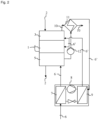
- the bottles 2 run through the bottle washer 1 from the prewash 3 in the direction of the main wash 4 and rinse 5.
- the fresh water 6, which becomes the rinse and wash water 6', is conducted in countercurrent.
- the fresh water 6 is cooled by the evaporator 7 of a heat pump 8 before it passes through the rinsing device 5 of the bottle washer 1, frees the bottles of washing suds and also cools them down in the process.
- the rinsing water 6 ′ preheated by the rinsing process is routed via the condenser 9 of the heat pump 8 and further heated. After that, the rinsing water 6′ returns to the cleaning process as required.
- the rinsing water 6' is conducted via a heat exchanger 11 and further heated with the waste water flow 10 from the bottle washing system 1.
- the final preheating stage of the rinsing water 6' takes place in the condenser 9 of the heat pump 8.
- the rinsing water 6' is then fed to the bottle washing system 1 as required.
- the preheated rinsing water 6 ′ is cooled again by means of an evaporator 13 of a heat pump 14 before it is brought into heat-transferring contact with the waste water stream 10 .
- the heat is fed back to the rinsing water 6 ′ via the condenser 15 of this heat pump 14 after the heat has been extracted from the waste water stream 10 .
- the rinse water 6 ' is only then via the condenser 9 of Heat pump 8 out and further heated. After that, the rinsing water 6′ returns to the cleaning process as required.
- a fourth embodiment of a bottle washer according to the invention is in 4 shown. Identical parts are described with the same reference numbers.
- heat exchangers 16, 17, 18 and 19 the heat exchangers 16 and 17 of the heat pump 14 are connected upstream or downstream and the heat exchangers 18 and 19 of the heat pump 7 are connected upstream or downstream. This results in even greater heating of the washing water 6' and greater cooling of the fresh water 6.
Landscapes
- Engineering & Computer Science (AREA)
- Mechanical Engineering (AREA)
- Filling Of Jars Or Cans And Processes For Cleaning And Sealing Jars (AREA)
- Cleaning In General (AREA)
Applications Claiming Priority (2)
| Application Number | Priority Date | Filing Date | Title |
|---|---|---|---|
| DE102017112532.9A DE102017112532A1 (de) | 2017-06-07 | 2017-06-07 | Verfahren zur Behandlung von Flaschen in einer Flaschenwaschanlage und Flaschenwaschanlage |
| PCT/EP2018/064696 WO2018224467A1 (de) | 2017-06-07 | 2018-06-05 | Verfahren zur behandlung von flaschen in einer flaschenwaschanlage und flaschenwaschanlage |
Publications (3)
| Publication Number | Publication Date |
|---|---|
| EP3634657A1 EP3634657A1 (de) | 2020-04-15 |
| EP3634657B1 true EP3634657B1 (de) | 2023-06-21 |
| EP3634657C0 EP3634657C0 (de) | 2023-06-21 |
Family
ID=62684750
Family Applications (1)
| Application Number | Title | Priority Date | Filing Date |
|---|---|---|---|
| EP18732683.0A Active EP3634657B1 (de) | 2017-06-07 | 2018-06-05 | Verfahren zur behandlung von flaschen in einer flaschenwaschanlage und flaschenwaschanlage |
Country Status (5)
| Country | Link |
|---|---|
| EP (1) | EP3634657B1 (pl) |
| DE (1) | DE102017112532A1 (pl) |
| HU (1) | HUE063310T2 (pl) |
| PL (1) | PL3634657T3 (pl) |
| WO (1) | WO2018224467A1 (pl) |
Cited By (1)
| Publication number | Priority date | Publication date | Assignee | Title |
|---|---|---|---|---|
| EP4714566A1 (en) * | 2024-09-18 | 2026-03-25 | Sidel Participations | Washing machine for washing empty containers adapted to be filled with a pourable product |
Families Citing this family (2)
| Publication number | Priority date | Publication date | Assignee | Title |
|---|---|---|---|---|
| DE102024102266A1 (de) | 2024-01-26 | 2025-07-31 | Krones Aktiengesellschaft | Verfahren und Vorrichtung zur Energierückgewinnung an einer Flaschenreinigungsmaschine |
| DE102024103455A1 (de) * | 2024-02-08 | 2025-08-14 | Krones Aktiengesellschaft | Behälterreinigungsanlage zum Reinigen von Behältern |
Family Cites Families (7)
| Publication number | Priority date | Publication date | Assignee | Title |
|---|---|---|---|---|
| DE877256C (de) * | 1941-02-09 | 1953-05-21 | Holstein & Kappert Maschf | Verfahren zum Kuehlen von Gefaessen unter Frischwassertemperatur und Reinigungsmaschine mit einer Abteilung zur Durchfuehrung des Verfahrens |
| NL7403678A (nl) * | 1974-03-19 | 1975-09-23 | Milpro N V | Werkwijze en inrichting voor het spoelen van voorwerpen. |
| DE3205956A1 (de) * | 1982-02-19 | 1983-09-15 | Robert 6141 Einhausen Becker | Vorrichtung zur flaschenreinigung, bei der waerme zurueckgewonnen und frischwasser eingespart wird |
| DE4003987A1 (de) * | 1990-02-09 | 1991-08-22 | Bht Hygiene Technik Gmbh | Spuelvorrichtung zum reinigen von gegenstaenden, insbesondere von endoskopen, und verfahren zum reinigen derselben |
| DE4332241A1 (de) | 1993-09-23 | 1995-03-30 | Kronseder Maschf Krones | Verfahren zum Behandeln von Flaschen o. dgl. |
| DE102004039084B4 (de) | 2004-08-12 | 2007-01-04 | Krones Ag | Vorrichtung zum Reinigen oder Pasteurisieren von Gegenständen |
| DE202008004775U1 (de) * | 2008-04-04 | 2008-06-05 | Khs Ag | Vorrichtung zum Behandeln von Flaschen o.dgl. Behältern |
-
2017
- 2017-06-07 DE DE102017112532.9A patent/DE102017112532A1/de not_active Withdrawn
-
2018
- 2018-06-05 HU HUE18732683A patent/HUE063310T2/hu unknown
- 2018-06-05 WO PCT/EP2018/064696 patent/WO2018224467A1/de not_active Ceased
- 2018-06-05 EP EP18732683.0A patent/EP3634657B1/de active Active
- 2018-06-05 PL PL18732683.0T patent/PL3634657T3/pl unknown
Cited By (1)
| Publication number | Priority date | Publication date | Assignee | Title |
|---|---|---|---|---|
| EP4714566A1 (en) * | 2024-09-18 | 2026-03-25 | Sidel Participations | Washing machine for washing empty containers adapted to be filled with a pourable product |
Also Published As
| Publication number | Publication date |
|---|---|
| EP3634657A1 (de) | 2020-04-15 |
| HUE063310T2 (hu) | 2024-01-28 |
| PL3634657T3 (pl) | 2023-11-27 |
| DE102017112532A1 (de) | 2018-12-13 |
| EP3634657C0 (de) | 2023-06-21 |
| WO2018224467A1 (de) | 2018-12-13 |
Similar Documents
| Publication | Publication Date | Title |
|---|---|---|
| EP3601145B1 (de) | Vorrichtung zum befüllen eines behälters mit einem füllprodukt | |
| EP2057928B1 (de) | Reinigungsgerät mit Latentwärmespeicher | |
| DE1617968C3 (de) | Anlage zum kontinuierlichen Pasteurisieren oder Sterilisieren einer Flüssigkeit in einem Rohrleitungssystem | |
| DE102007050533A1 (de) | Geschirrspülmaschine mit verbesserter Wärmerückgewinnung | |
| DE4208665A1 (de) | Verfahren zum trocknen von gegenstaenden sowie anlage zur durchfuehrung des verfahrens | |
| DE102015119318A1 (de) | Vorrichtung zum Reinigen eines zu reinigenden Anlagenteils einer Getränkeabfüllanlage | |
| DE69521058T2 (de) | Gerät zur kontinuierlichen sterilisation von flüssigkeiten, wie etwa milch und sahne | |
| WO2018224467A1 (de) | Verfahren zur behandlung von flaschen in einer flaschenwaschanlage und flaschenwaschanlage | |
| DE2622434A1 (de) | Reinigungsmaschine fuer behaelter, insbesondere flaschen | |
| WO2018046149A1 (de) | Abfüllanlage zum wärmebehandeln und abfüllen einer flüssigkeit | |
| EP2117361B1 (de) | Verfahren zur reduzierung des energiebedarfs bei pasteurisieranlagen sowie füllanlage | |
| EP3519114B1 (de) | Flaschenreinigungsvorrichtung und verfahren zum reinigen von flaschen unter verwendung der flaschenreinigungsvorrichtung | |
| DE102013114607B4 (de) | Verfahren zum Reinigen von Behältern sowie Behälterreinigungsmaschine | |
| EP2361697B1 (de) | Reinigungsanlage für Behälter und Verfahren zu ihrem Betrieb | |
| DE2020303B2 (de) | Vorrichtung zum Sterilisieren einer Anlage zur thermischen Behandlung flüssiger Produkte | |
| DE2225676C3 (de) | Verfahren zur Reduzierung des Wasserverbrauchs von Gefäßbehandlungsmaschinen | |
| DE102018108566A1 (de) | Reinigungs- und/oder Desinfektionsgerät und Verfahren zum Reinigen und/oder Desinfizieren von Spülgut | |
| DE2510927A1 (de) | Verfahren und vorrichtung zum spuelen von gegenstaenden | |
| DE1617961A1 (de) | Verfahren zum Reinigen einer Anlage zum kontinuierlichen Sterilisieren eines Stoffes und Anordnung zur Durchfuehrung des Verfahrens | |
| DE3205956A1 (de) | Vorrichtung zur flaschenreinigung, bei der waerme zurueckgewonnen und frischwasser eingespart wird | |
| DE102016115582A1 (de) | Verfahren zum thermischen Desinfizieren, insbesondere Sterilisieren, und zum anschließenden Abkühlen einer Zentrifuge | |
| DE102015206338A1 (de) | Transportspülmaschine sowie Verfahren zum Betreiben einer Transportspülmaschine | |
| EP3831456B1 (de) | Vorrichtung zur herstellung und bereitstellung von sterilwasser und verfahren zum betreiben der vorrichtung | |
| DE4212433A1 (de) | Flaschenreinigungsmaschine mit mehreren in Flaschendurchlaufrichtung angeordneten Behandlungszonen | |
| DE900540C (de) | Reinigungs- und Sterilisiermaschine |
Legal Events
| Date | Code | Title | Description |
|---|---|---|---|
| STAA | Information on the status of an ep patent application or granted ep patent |
Free format text: STATUS: UNKNOWN |
|
| STAA | Information on the status of an ep patent application or granted ep patent |
Free format text: STATUS: THE INTERNATIONAL PUBLICATION HAS BEEN MADE |
|
| PUAI | Public reference made under article 153(3) epc to a published international application that has entered the european phase |
Free format text: ORIGINAL CODE: 0009012 |
|
| STAA | Information on the status of an ep patent application or granted ep patent |
Free format text: STATUS: REQUEST FOR EXAMINATION WAS MADE |
|
| 17P | Request for examination filed |
Effective date: 20191220 |
|
| AK | Designated contracting states |
Kind code of ref document: A1 Designated state(s): AL AT BE BG CH CY CZ DE DK EE ES FI FR GB GR HR HU IE IS IT LI LT LU LV MC MK MT NL NO PL PT RO RS SE SI SK SM TR |
|
| AX | Request for extension of the european patent |
Extension state: BA ME |
|
| DAV | Request for validation of the european patent (deleted) | ||
| DAX | Request for extension of the european patent (deleted) | ||
| STAA | Information on the status of an ep patent application or granted ep patent |
Free format text: STATUS: EXAMINATION IS IN PROGRESS |
|
| 17Q | First examination report despatched |
Effective date: 20220421 |
|
| GRAP | Despatch of communication of intention to grant a patent |
Free format text: ORIGINAL CODE: EPIDOSNIGR1 |
|
| STAA | Information on the status of an ep patent application or granted ep patent |
Free format text: STATUS: GRANT OF PATENT IS INTENDED |
|
| INTG | Intention to grant announced |
Effective date: 20230224 |
|
| GRAS | Grant fee paid |
Free format text: ORIGINAL CODE: EPIDOSNIGR3 |
|
| GRAA | (expected) grant |
Free format text: ORIGINAL CODE: 0009210 |
|
| STAA | Information on the status of an ep patent application or granted ep patent |
Free format text: STATUS: THE PATENT HAS BEEN GRANTED |
|
| AK | Designated contracting states |
Kind code of ref document: B1 Designated state(s): AL AT BE BG CH CY CZ DE DK EE ES FI FR GB GR HR HU IE IS IT LI LT LU LV MC MK MT NL NO PL PT RO RS SE SI SK SM TR |
|
| REG | Reference to a national code |
Ref country code: CH Ref legal event code: EP |
|
| REG | Reference to a national code |
Ref country code: DE Ref legal event code: R096 Ref document number: 502018012531 Country of ref document: DE |
|
| REG | Reference to a national code |
Ref country code: AT Ref legal event code: REF Ref document number: 1580535 Country of ref document: AT Kind code of ref document: T Effective date: 20230715 |
|
| REG | Reference to a national code |
Ref country code: IE Ref legal event code: FG4D Free format text: LANGUAGE OF EP DOCUMENT: GERMAN |
|
| U01 | Request for unitary effect filed |
Effective date: 20230721 |
|
| U07 | Unitary effect registered |
Designated state(s): AT BE BG DE DK EE FI FR IT LT LU LV MT NL PT SE SI Effective date: 20230727 |
|
| REG | Reference to a national code |
Ref country code: LT Ref legal event code: MG9D |
|
| PG25 | Lapsed in a contracting state [announced via postgrant information from national office to epo] |
Ref country code: NO Free format text: LAPSE BECAUSE OF FAILURE TO SUBMIT A TRANSLATION OF THE DESCRIPTION OR TO PAY THE FEE WITHIN THE PRESCRIBED TIME-LIMIT Effective date: 20230921 |
|
| PG25 | Lapsed in a contracting state [announced via postgrant information from national office to epo] |
Ref country code: RS Free format text: LAPSE BECAUSE OF FAILURE TO SUBMIT A TRANSLATION OF THE DESCRIPTION OR TO PAY THE FEE WITHIN THE PRESCRIBED TIME-LIMIT Effective date: 20230621 Ref country code: HR Free format text: LAPSE BECAUSE OF FAILURE TO SUBMIT A TRANSLATION OF THE DESCRIPTION OR TO PAY THE FEE WITHIN THE PRESCRIBED TIME-LIMIT Effective date: 20230621 Ref country code: GR Free format text: LAPSE BECAUSE OF FAILURE TO SUBMIT A TRANSLATION OF THE DESCRIPTION OR TO PAY THE FEE WITHIN THE PRESCRIBED TIME-LIMIT Effective date: 20230922 |
|
| REG | Reference to a national code |
Ref country code: SK Ref legal event code: T3 Ref document number: E 42361 Country of ref document: SK |
|
| PG25 | Lapsed in a contracting state [announced via postgrant information from national office to epo] |
Ref country code: ES Free format text: LAPSE BECAUSE OF FAILURE TO SUBMIT A TRANSLATION OF THE DESCRIPTION OR TO PAY THE FEE WITHIN THE PRESCRIBED TIME-LIMIT Effective date: 20230621 |
|
| PG25 | Lapsed in a contracting state [announced via postgrant information from national office to epo] |
Ref country code: IS Free format text: LAPSE BECAUSE OF FAILURE TO SUBMIT A TRANSLATION OF THE DESCRIPTION OR TO PAY THE FEE WITHIN THE PRESCRIBED TIME-LIMIT Effective date: 20231021 |
|
| REG | Reference to a national code |
Ref country code: HU Ref legal event code: AG4A Ref document number: E063310 Country of ref document: HU |
|
| PG25 | Lapsed in a contracting state [announced via postgrant information from national office to epo] |
Ref country code: SM Free format text: LAPSE BECAUSE OF FAILURE TO SUBMIT A TRANSLATION OF THE DESCRIPTION OR TO PAY THE FEE WITHIN THE PRESCRIBED TIME-LIMIT Effective date: 20230621 Ref country code: RO Free format text: LAPSE BECAUSE OF FAILURE TO SUBMIT A TRANSLATION OF THE DESCRIPTION OR TO PAY THE FEE WITHIN THE PRESCRIBED TIME-LIMIT Effective date: 20230621 Ref country code: IS Free format text: LAPSE BECAUSE OF FAILURE TO SUBMIT A TRANSLATION OF THE DESCRIPTION OR TO PAY THE FEE WITHIN THE PRESCRIBED TIME-LIMIT Effective date: 20231021 Ref country code: ES Free format text: LAPSE BECAUSE OF FAILURE TO SUBMIT A TRANSLATION OF THE DESCRIPTION OR TO PAY THE FEE WITHIN THE PRESCRIBED TIME-LIMIT Effective date: 20230621 |
|
| PG25 | Lapsed in a contracting state [announced via postgrant information from national office to epo] |
Ref country code: PL Free format text: LAPSE BECAUSE OF FAILURE TO SUBMIT A TRANSLATION OF THE DESCRIPTION OR TO PAY THE FEE WITHIN THE PRESCRIBED TIME-LIMIT Effective date: 20230621 |
|
| REG | Reference to a national code |
Ref country code: DE Ref legal event code: R097 Ref document number: 502018012531 Country of ref document: DE |
|
| PLBE | No opposition filed within time limit |
Free format text: ORIGINAL CODE: 0009261 |
|
| STAA | Information on the status of an ep patent application or granted ep patent |
Free format text: STATUS: NO OPPOSITION FILED WITHIN TIME LIMIT |
|
| 26N | No opposition filed |
Effective date: 20240322 |
|
| U20 | Renewal fee for the european patent with unitary effect paid |
Year of fee payment: 7 Effective date: 20240605 |
|
| PG2D | Information on lapse in contracting state deleted |
Ref country code: PL |
|
| PG25 | Lapsed in a contracting state [announced via postgrant information from national office to epo] |
Ref country code: MC Free format text: LAPSE BECAUSE OF FAILURE TO SUBMIT A TRANSLATION OF THE DESCRIPTION OR TO PAY THE FEE WITHIN THE PRESCRIBED TIME-LIMIT Effective date: 20230621 |
|
| U20 | Renewal fee for the european patent with unitary effect paid |
Year of fee payment: 8 Effective date: 20250515 |
|
| PGFP | Annual fee paid to national office [announced via postgrant information from national office to epo] |
Ref country code: PL Payment date: 20250523 Year of fee payment: 8 |
|
| PGFP | Annual fee paid to national office [announced via postgrant information from national office to epo] |
Ref country code: GB Payment date: 20250620 Year of fee payment: 8 |
|
| PGFP | Annual fee paid to national office [announced via postgrant information from national office to epo] |
Ref country code: HU Payment date: 20250602 Year of fee payment: 8 |
|
| PGFP | Annual fee paid to national office [announced via postgrant information from national office to epo] |
Ref country code: SK Payment date: 20250602 Year of fee payment: 8 |
|
| PGFP | Annual fee paid to national office [announced via postgrant information from national office to epo] |
Ref country code: CZ Payment date: 20250523 Year of fee payment: 8 |
|
| PGFP | Annual fee paid to national office [announced via postgrant information from national office to epo] |
Ref country code: IE Payment date: 20250618 Year of fee payment: 8 |
|
| PGFP | Annual fee paid to national office [announced via postgrant information from national office to epo] |
Ref country code: CH Payment date: 20250701 Year of fee payment: 8 |
|
| PG25 | Lapsed in a contracting state [announced via postgrant information from national office to epo] |
Ref country code: CY Free format text: LAPSE BECAUSE OF FAILURE TO SUBMIT A TRANSLATION OF THE DESCRIPTION OR TO PAY THE FEE WITHIN THE PRESCRIBED TIME-LIMIT; INVALID AB INITIO Effective date: 20180605 |