EP3609988B1 - Verwendung von esterverbindungen - Google Patents
Verwendung von esterverbindungen Download PDFInfo
- Publication number
- EP3609988B1 EP3609988B1 EP18726045.0A EP18726045A EP3609988B1 EP 3609988 B1 EP3609988 B1 EP 3609988B1 EP 18726045 A EP18726045 A EP 18726045A EP 3609988 B1 EP3609988 B1 EP 3609988B1
- Authority
- EP
- European Patent Office
- Prior art keywords
- acid
- radicals
- ester
- branched
- unbranched
- Prior art date
- Legal status (The legal status is an assumption and is not a legal conclusion. Google has not performed a legal analysis and makes no representation as to the accuracy of the status listed.)
- Active
Links
Classifications
-
- C—CHEMISTRY; METALLURGY
- C07—ORGANIC CHEMISTRY
- C07C—ACYCLIC OR CARBOCYCLIC COMPOUNDS
- C07C51/00—Preparation of carboxylic acids or their salts, halides or anhydrides
- C07C51/347—Preparation of carboxylic acids or their salts, halides or anhydrides by reactions not involving formation of carboxyl groups
- C07C51/36—Preparation of carboxylic acids or their salts, halides or anhydrides by reactions not involving formation of carboxyl groups by hydrogenation of carbon-to-carbon unsaturated bonds
-
- C—CHEMISTRY; METALLURGY
- C07—ORGANIC CHEMISTRY
- C07C—ACYCLIC OR CARBOCYCLIC COMPOUNDS
- C07C69/00—Esters of carboxylic acids; Esters of carbonic or haloformic acids
- C07C69/66—Esters of carboxylic acids having esterified carboxylic groups bound to acyclic carbon atoms and having any of the groups OH, O—metal, —CHO, keto, ether, acyloxy, groups, groups, or in the acid moiety
- C07C69/67—Esters of carboxylic acids having esterified carboxylic groups bound to acyclic carbon atoms and having any of the groups OH, O—metal, —CHO, keto, ether, acyloxy, groups, groups, or in the acid moiety of saturated acids
-
- C—CHEMISTRY; METALLURGY
- C07—ORGANIC CHEMISTRY
- C07C—ACYCLIC OR CARBOCYCLIC COMPOUNDS
- C07C51/00—Preparation of carboxylic acids or their salts, halides or anhydrides
- C07C51/347—Preparation of carboxylic acids or their salts, halides or anhydrides by reactions not involving formation of carboxyl groups
- C07C51/367—Preparation of carboxylic acids or their salts, halides or anhydrides by reactions not involving formation of carboxyl groups by introduction of functional groups containing oxygen only in singly bound form
-
- C—CHEMISTRY; METALLURGY
- C07—ORGANIC CHEMISTRY
- C07C—ACYCLIC OR CARBOCYCLIC COMPOUNDS
- C07C67/00—Preparation of carboxylic acid esters
- C07C67/02—Preparation of carboxylic acid esters by interreacting ester groups, i.e. transesterification
-
- C—CHEMISTRY; METALLURGY
- C07—ORGANIC CHEMISTRY
- C07C—ACYCLIC OR CARBOCYCLIC COMPOUNDS
- C07C67/00—Preparation of carboxylic acid esters
- C07C67/03—Preparation of carboxylic acid esters by reacting an ester group with a hydroxy group
-
- C—CHEMISTRY; METALLURGY
- C07—ORGANIC CHEMISTRY
- C07C—ACYCLIC OR CARBOCYCLIC COMPOUNDS
- C07C67/00—Preparation of carboxylic acid esters
- C07C67/08—Preparation of carboxylic acid esters by reacting carboxylic acids or symmetrical anhydrides with the hydroxy or O-metal group of organic compounds
-
- C—CHEMISTRY; METALLURGY
- C07—ORGANIC CHEMISTRY
- C07C—ACYCLIC OR CARBOCYCLIC COMPOUNDS
- C07C67/00—Preparation of carboxylic acid esters
- C07C67/14—Preparation of carboxylic acid esters from carboxylic acid halides
-
- C—CHEMISTRY; METALLURGY
- C07—ORGANIC CHEMISTRY
- C07C—ACYCLIC OR CARBOCYCLIC COMPOUNDS
- C07C67/00—Preparation of carboxylic acid esters
- C07C67/30—Preparation of carboxylic acid esters by modifying the acid moiety of the ester, such modification not being an introduction of an ester group
-
- C—CHEMISTRY; METALLURGY
- C07—ORGANIC CHEMISTRY
- C07C—ACYCLIC OR CARBOCYCLIC COMPOUNDS
- C07C67/00—Preparation of carboxylic acid esters
- C07C67/30—Preparation of carboxylic acid esters by modifying the acid moiety of the ester, such modification not being an introduction of an ester group
- C07C67/303—Preparation of carboxylic acid esters by modifying the acid moiety of the ester, such modification not being an introduction of an ester group by hydrogenation of unsaturated carbon-to-carbon bonds
-
- C—CHEMISTRY; METALLURGY
- C07—ORGANIC CHEMISTRY
- C07C—ACYCLIC OR CARBOCYCLIC COMPOUNDS
- C07C67/00—Preparation of carboxylic acid esters
- C07C67/30—Preparation of carboxylic acid esters by modifying the acid moiety of the ester, such modification not being an introduction of an ester group
- C07C67/31—Preparation of carboxylic acid esters by modifying the acid moiety of the ester, such modification not being an introduction of an ester group by introduction of functional groups containing oxygen only in singly bound form
-
- C—CHEMISTRY; METALLURGY
- C07—ORGANIC CHEMISTRY
- C07C—ACYCLIC OR CARBOCYCLIC COMPOUNDS
- C07C67/00—Preparation of carboxylic acid esters
- C07C67/30—Preparation of carboxylic acid esters by modifying the acid moiety of the ester, such modification not being an introduction of an ester group
- C07C67/317—Preparation of carboxylic acid esters by modifying the acid moiety of the ester, such modification not being an introduction of an ester group by splitting-off hydrogen or functional groups; by hydrogenolysis of functional groups
-
- C—CHEMISTRY; METALLURGY
- C07—ORGANIC CHEMISTRY
- C07C—ACYCLIC OR CARBOCYCLIC COMPOUNDS
- C07C69/00—Esters of carboxylic acids; Esters of carbonic or haloformic acids
- C07C69/52—Esters of acyclic unsaturated carboxylic acids having the esterified carboxyl group bound to an acyclic carbon atom
- C07C69/604—Polycarboxylic acid esters, the acid moiety containing more than two carboxyl groups
-
- C—CHEMISTRY; METALLURGY
- C07—ORGANIC CHEMISTRY
- C07C—ACYCLIC OR CARBOCYCLIC COMPOUNDS
- C07C69/00—Esters of carboxylic acids; Esters of carbonic or haloformic acids
- C07C69/66—Esters of carboxylic acids having esterified carboxylic groups bound to acyclic carbon atoms and having any of the groups OH, O—metal, —CHO, keto, ether, acyloxy, groups, groups, or in the acid moiety
- C07C69/67—Esters of carboxylic acids having esterified carboxylic groups bound to acyclic carbon atoms and having any of the groups OH, O—metal, —CHO, keto, ether, acyloxy, groups, groups, or in the acid moiety of saturated acids
- C07C69/675—Esters of carboxylic acids having esterified carboxylic groups bound to acyclic carbon atoms and having any of the groups OH, O—metal, —CHO, keto, ether, acyloxy, groups, groups, or in the acid moiety of saturated acids of saturated hydroxy-carboxylic acids
-
- C—CHEMISTRY; METALLURGY
- C07—ORGANIC CHEMISTRY
- C07C—ACYCLIC OR CARBOCYCLIC COMPOUNDS
- C07C69/00—Esters of carboxylic acids; Esters of carbonic or haloformic acids
- C07C69/66—Esters of carboxylic acids having esterified carboxylic groups bound to acyclic carbon atoms and having any of the groups OH, O—metal, —CHO, keto, ether, acyloxy, groups, groups, or in the acid moiety
- C07C69/67—Esters of carboxylic acids having esterified carboxylic groups bound to acyclic carbon atoms and having any of the groups OH, O—metal, —CHO, keto, ether, acyloxy, groups, groups, or in the acid moiety of saturated acids
- C07C69/716—Esters of keto-carboxylic acids or aldehydo-carboxylic acids
-
- C—CHEMISTRY; METALLURGY
- C07—ORGANIC CHEMISTRY
- C07C—ACYCLIC OR CARBOCYCLIC COMPOUNDS
- C07C69/00—Esters of carboxylic acids; Esters of carbonic or haloformic acids
- C07C69/66—Esters of carboxylic acids having esterified carboxylic groups bound to acyclic carbon atoms and having any of the groups OH, O—metal, —CHO, keto, ether, acyloxy, groups, groups, or in the acid moiety
- C07C69/73—Esters of carboxylic acids having esterified carboxylic groups bound to acyclic carbon atoms and having any of the groups OH, O—metal, —CHO, keto, ether, acyloxy, groups, groups, or in the acid moiety of unsaturated acids
-
- C—CHEMISTRY; METALLURGY
- C10—PETROLEUM, GAS OR COKE INDUSTRIES; TECHNICAL GASES CONTAINING CARBON MONOXIDE; FUELS; LUBRICANTS; PEAT
- C10M—LUBRICATING COMPOSITIONS; USE OF CHEMICAL SUBSTANCES EITHER ALONE OR AS LUBRICATING INGREDIENTS IN A LUBRICATING COMPOSITION
- C10M105/00—Lubricating compositions characterised by the base-material being a non-macromolecular organic compound
- C10M105/08—Lubricating compositions characterised by the base-material being a non-macromolecular organic compound containing oxygen
- C10M105/32—Esters
- C10M105/40—Esters containing free hydroxy or carboxyl groups
-
- C—CHEMISTRY; METALLURGY
- C10—PETROLEUM, GAS OR COKE INDUSTRIES; TECHNICAL GASES CONTAINING CARBON MONOXIDE; FUELS; LUBRICANTS; PEAT
- C10M—LUBRICATING COMPOSITIONS; USE OF CHEMICAL SUBSTANCES EITHER ALONE OR AS LUBRICATING INGREDIENTS IN A LUBRICATING COMPOSITION
- C10M105/00—Lubricating compositions characterised by the base-material being a non-macromolecular organic compound
- C10M105/08—Lubricating compositions characterised by the base-material being a non-macromolecular organic compound containing oxygen
- C10M105/32—Esters
- C10M105/42—Complex esters, i.e. compounds containing at least three esterified carboxyl groups and derived from the combination of at least three different types of the following five types of compound: monohydroxy compounds, polyhydroxy compounds, monocarboxylic acids, polycarboxylic acids and hydroxy carboxylic acids
-
- C—CHEMISTRY; METALLURGY
- C12—BIOCHEMISTRY; BEER; SPIRITS; WINE; VINEGAR; MICROBIOLOGY; ENZYMOLOGY; MUTATION OR GENETIC ENGINEERING
- C12P—FERMENTATION OR ENZYME-USING PROCESSES TO SYNTHESISE A DESIRED CHEMICAL COMPOUND OR COMPOSITION OR TO SEPARATE OPTICAL ISOMERS FROM A RACEMIC MIXTURE
- C12P7/00—Preparation of oxygen-containing organic compounds
- C12P7/62—Carboxylic acid esters
-
- C—CHEMISTRY; METALLURGY
- C10—PETROLEUM, GAS OR COKE INDUSTRIES; TECHNICAL GASES CONTAINING CARBON MONOXIDE; FUELS; LUBRICANTS; PEAT
- C10M—LUBRICATING COMPOSITIONS; USE OF CHEMICAL SUBSTANCES EITHER ALONE OR AS LUBRICATING INGREDIENTS IN A LUBRICATING COMPOSITION
- C10M2207/00—Organic non-macromolecular hydrocarbon compounds containing hydrogen, carbon and oxygen as ingredients in lubricant compositions
- C10M2207/28—Esters
- C10M2207/287—Partial esters
- C10M2207/289—Partial esters containing free hydroxy groups
- C10M2207/2895—Partial esters containing free hydroxy groups used as base material
-
- C—CHEMISTRY; METALLURGY
- C10—PETROLEUM, GAS OR COKE INDUSTRIES; TECHNICAL GASES CONTAINING CARBON MONOXIDE; FUELS; LUBRICANTS; PEAT
- C10M—LUBRICATING COMPOSITIONS; USE OF CHEMICAL SUBSTANCES EITHER ALONE OR AS LUBRICATING INGREDIENTS IN A LUBRICATING COMPOSITION
- C10M2207/00—Organic non-macromolecular hydrocarbon compounds containing hydrogen, carbon and oxygen as ingredients in lubricant compositions
- C10M2207/28—Esters
- C10M2207/30—Complex esters, i.e. compounds containing at leasst three esterified carboxyl groups and derived from the combination of at least three different types of the following five types of compounds: monohydroxyl compounds, polyhydroxy xompounds, monocarboxylic acids, polycarboxylic acids or hydroxy carboxylic acids
- C10M2207/301—Complex esters, i.e. compounds containing at leasst three esterified carboxyl groups and derived from the combination of at least three different types of the following five types of compounds: monohydroxyl compounds, polyhydroxy xompounds, monocarboxylic acids, polycarboxylic acids or hydroxy carboxylic acids used as base material
-
- C—CHEMISTRY; METALLURGY
- C10—PETROLEUM, GAS OR COKE INDUSTRIES; TECHNICAL GASES CONTAINING CARBON MONOXIDE; FUELS; LUBRICANTS; PEAT
- C10N—INDEXING SCHEME ASSOCIATED WITH SUBCLASS C10M RELATING TO LUBRICATING COMPOSITIONS
- C10N2030/00—Specified physical or chemical properties which is improved by the additive characterising the lubricating composition, e.g. multifunctional additives
- C10N2030/62—Food grade properties
-
- C—CHEMISTRY; METALLURGY
- C10—PETROLEUM, GAS OR COKE INDUSTRIES; TECHNICAL GASES CONTAINING CARBON MONOXIDE; FUELS; LUBRICANTS; PEAT
- C10N—INDEXING SCHEME ASSOCIATED WITH SUBCLASS C10M RELATING TO LUBRICATING COMPOSITIONS
- C10N2030/00—Specified physical or chemical properties which is improved by the additive characterising the lubricating composition, e.g. multifunctional additives
- C10N2030/66—Hydrolytic stability
-
- C—CHEMISTRY; METALLURGY
- C10—PETROLEUM, GAS OR COKE INDUSTRIES; TECHNICAL GASES CONTAINING CARBON MONOXIDE; FUELS; LUBRICANTS; PEAT
- C10N—INDEXING SCHEME ASSOCIATED WITH SUBCLASS C10M RELATING TO LUBRICATING COMPOSITIONS
- C10N2040/00—Specified use or application for which the lubricating composition is intended
- C10N2040/02—Bearings
-
- C—CHEMISTRY; METALLURGY
- C10—PETROLEUM, GAS OR COKE INDUSTRIES; TECHNICAL GASES CONTAINING CARBON MONOXIDE; FUELS; LUBRICANTS; PEAT
- C10N—INDEXING SCHEME ASSOCIATED WITH SUBCLASS C10M RELATING TO LUBRICATING COMPOSITIONS
- C10N2040/00—Specified use or application for which the lubricating composition is intended
- C10N2040/04—Oil-bath; Gear-boxes; Automatic transmissions; Traction drives
-
- C—CHEMISTRY; METALLURGY
- C10—PETROLEUM, GAS OR COKE INDUSTRIES; TECHNICAL GASES CONTAINING CARBON MONOXIDE; FUELS; LUBRICANTS; PEAT
- C10N—INDEXING SCHEME ASSOCIATED WITH SUBCLASS C10M RELATING TO LUBRICATING COMPOSITIONS
- C10N2070/00—Specific manufacturing methods for lubricant compositions
Definitions
- the invention relates to the use of a lubricant containing ester compounds of the general formula (Ia), (Ib), (Ic) as defined in the claims in a lubricating oil or lubricating grease.
- Ester compounds have been used more and more frequently in lubricant formulations in recent years. Since the ester units in the ester compounds in natural oils as well as in synthetic ester oils are susceptible to hydrolysis, there is a great need for ester compounds which meet the high requirements for use in lubricants. In the case of the known ester compounds, the ester is split into the fatty acid and the alcohol when the lubricant is used in the presence of water. This reaction can be catalyzed, for example, by acids, bases or by copper. This results in the destruction of the molecules, which means that the lubricants lose their lubricating effect.
- conventional lubricants for example based on native esters, are not suitable for high-temperature applications because they Temperatures can be destroyed by oxidation and / or thermal decomposition processes and by polymerization and thereby their lubricating properties and effects are severely restricted.
- the lubricant is broken down into low-molecular, volatile components. Evaporation of these volatile components results in undesirable viscosity changes, oil loss, and excessive vapor formation. This also results in a loss of the lubricating effect.
- Polymerization also causes the lubricants to lose their lubricating effect due to the formation of insoluble polymerization products. This dirt must be removed, which increases the maintenance work. In addition, chemical waste is produced that must be disposed of at great expense.
- lubricants In order to meet the diverse requirements, lubricants must have high stability, low coefficients of friction and high wear resistance, among other things. High temperatures often occur when used in chains, roller and plain bearings, in vehicle technology, conveyor technology, mechanical engineering, office technology and in industrial systems and machines, but also in the areas of household machines and consumer electronics. For example, high processing temperatures often occur in food processing, such as cooking, baking, boiling, roasting, braising, sterilizing, roasting and steaming. Various tools are used in these processes. High-temperature-resistant lubricants are required to lubricate these tools.
- a food-compatible lubricant should be H1 suitable if the lubricant can come into direct or indirect contact with food, luxury food and foodstuffs.
- the preferred areas of application in the food industry include chains in ovens and other high-temperature applications, as well as transport hangers, especially trolleys and their bearings.
- estolide compounds which are usually based on vegetable oils, are in accordance with SC Cermak et al., Industrial Crops and Products 2013, 46, 386-392 , synthesized.
- the structure shown cannot be correct from the perspective of the scientific representation of a repetitive unit, since the linkage of the repetitive unit does not emerge from it. Disadvantages of this process are the low selectivity (which accordingly leads to a mixture of dimer and oligomer mixtures instead of a defined product compound), the harsh reaction conditions, the low yield and the complicated separation of dimer/oligomer mixtures.
- the two final steps are then the hydrogenation of the remaining C ⁇ C double bond and the esterification of the remaining carboxylic acid group, with 2-ethylhexan-1-ol preferably being used as the alcohol component.
- the U.S. 2014/252281 A1 discloses a mixture of two ester compounds obtained by reacting oleic acid by hydroformulation and hydrogenation to give regioisomeric compounds, e.g. 2-ethylhexyl-10-methyloxydecanolystearate and 2-ethylhexyl-9-methyloxydecanolystearate. These ester compounds are used as a dielectric insulating liquid for electrical equipment.
- the present invention was therefore based on the object of providing new lubricants which meet the above requirements and which can be produced in a sustainable and environmentally friendly way from simple and easily accessible, preferably renewable, raw materials as starting materials.
- the synthesis process should have a high selectivity, a high yield should be achieved and a simple work-up should be possible.
- the lubricants used contain an ester compound or a mixture of at least two compounds of the general formula (Ia), (Ib) or (Ic)
- the compounds used according to the invention with the general structure (Ia), (Ib), (Ic) have an additional "methylene bridge” (methylene -unit, -(CH 2 )-) between the carbon of the fatty acid chain and the oxygen of the CO single bond of the adjacent ester group.
- This "methylene bridge” opens up additional options with regard to conformational changes in the respective molecules and can thus contribute to greater steric flexibility, combined with correspondingly advantageous product properties. This also opens up the possibility of new product properties compared to other, more rigid lubricants such as the so-called Estolide compounds.
- estolide compounds which according to the description are produced by linking several unsaturated fatty acids as a result of uncontrolled addition of the carboxylic acid unit of an unsaturated fatty acid with the alkene unit of another unsaturated fatty acid and accordingly lead to mixtures of compounds of different chain lengths with the aid of the method according to the invention, the targeted production of compounds of certain chain lengths, these being present as regioisomers.
- This selective synthesis of compounds of different chain lengths and their presence in isolated form enables subsequent targeted "blending", i.e. the mixing of compounds of different chain lengths tailored to the desired individual application in order to achieve the desired lubricant properties.
- the individual representatives of the compounds according to the invention thus form a modular "building block system" which can then be used specifically for specific lubricant applications.
- Particularly preferred representatives of the compounds of general formula (Ia), (Ib), (Ic) are those compounds which are prepared from the unsaturated fatty acids oleic acid, linoleic acid, linolenic acid, erucic acid, nervonic acid, gadoleic acid and other ⁇ -n-fatty acids can.
- n' and n" are either 1 and 2 or 2 and 1, and R 1 and R 2 are as defined in claim 1.
- novel compounds used according to the invention can be produced in a variety of ways, with two preferred embodiments being described below.
- the syntheses differ considerably from the production processes leading to other lubricant compounds, for example in comparison to the processes for producing the so-called estolide compounds, by means of which the compounds are typically not accessible.
- Both preferred embodiments of the synthesis of the compounds start from an unsaturated fatty acid as the starting compound.
- unsaturated fatty acid in particular, oleic acid, linoleic acid, linolenic acid, erucic acid and nervonic acid, gadoleic acid and other ⁇ -n-fatty acids are used here.
- the use of renewable raw materials as starting compounds is advantageous from the perspective of economy and sustainability.
- the process starts from an unsaturated fatty acid, which is first esterified, or the corresponding ester is used directly.
- This esterified product is then subjected to a hydroformylation reaction in the presence of molecular hydrogen (H 2 ) and carbon monoxide (CO) and after subsequent hydrogenation, which preferably takes place in situ , the corresponding methylol-substituted derivative is obtained.
- H 2 molecular hydrogen
- CO carbon monoxide
- the specialist can also, for example, read the contributions by EH Pryde, EN Frankel, JC Cowan, J. Am. Oil Chem. Soc. 1972, 49, 451-456 , EN Frankel, Ann. NY Acad. science 1973, 214, 79-93 , JWE Coenen, Fette, Seifen, Anstrichstoff 1975, 77, 461-467 , EN Franke!, EH Pryde, J. Am. Oil Chem. Soc. 1977, 54, 873A-881A , EH Pryde, J. Am. Oil Chem. Soc. 1979, 56, 719A-725A available.
- the hydroxy group of the resulting methylol-substituted derivative is then re-esterified, for example directly with a non-hydroxy-substituted fatty acid or with another long-chain alkanoic acid containing at least one hydroxy group (or its ester in the sense of a transesterification reaction).
- This long-chain alkanecarboxylic acid containing at least one hydroxy group is preferably represents a long-chain fatty acid which carries at least one hydroxymethyl group and can be prepared, for example, in the way described above.
- the respective acids can be used directly or activated acid derivatives, for example acid chlorides and anhydrides, or acid esters (for a transesterification reaction). It is also possible to use di-, tri- and higher carboxylic acids or their derivatives.
- Subsequent hydrogenation of the carbonyl group in 3 then affords the 9-methylol-substituted oleic acid ester 4 (in a mixture with the 10-methylol-substituted regioisomer), which is then converted into the desired target compounds 5 by acylation of the hydroxy group.
- the hydroformylation and hydrogenation reaction steps can be combined here, so that the subsequent hydrogenation of the aldehyde group to the methylol-substituted derivative 4 takes place directly after the hydroformylation in situ .
- the hydroxymethyl group (methylol group) formed during the hydroformylation can be located either in the 9-position or in the 10-position due to the typically low or insignificant regioselectivity of the hydroformylation reaction, and a mixture of both isomers is typically present.
- Figure 5 only the 9-substituted isomer is shown graphically for clarity. In the type 5 products formed, compounds where m' is 0 or 1 to 5 are particularly preferred.
- the target compounds can also be produced by a second, preferred embodiment of the method described below.
- formaldehyde or a formaldehyde derivative, for example paraformaldehyde
- the sequence can also be varied here and, for example, the esterification can be started first, followed by the ene reaction and subsequent esterification.
- carboxylic acids for example carboxylic acid chlorides and anhydrides, or carboxylic acid esters (for a transesterification reaction) can be used. It is also possible to use di-, tri- and higher carboxylic acids or their derivatives.
- an esterification reaction first takes place, with 2-ethylhexan-1-ol being used in the exemplary example as a readily available bulk chemical that can be obtained in large quantities.
- 2-ethylhexan-1-ol being used in the exemplary example as a readily available bulk chemical that can be obtained in large quantities.
- the person skilled in the art generally has a wide spectrum of methods available for the esterification, with catalytic processes using acids or biocatalysts, preferably a lipase, representing an attractive synthesis option.
- a mixture of both isomers is obtained.
- a hydrogenation of the C ⁇ C double bonds resulting from the ene reaction can also only be carried out finally after oligomerization has taken place first.
- one or more of the hydrogenation steps can optionally also generally be dispensed with, with the resulting products then having at least one double bond.
- reaction sequence is changed compared to embodiment A (FIG. 6).
- an ene reaction takes place directly to give the compound 7, which is then converted into the intermediate 4 by hydrogenation of the trans- C ⁇ C double bond and subsequent esterification.
- compound 7 can be esterified first (which would form compound 6 ) followed by hydrogenation, which also gives compound 4 .
- a mixture of both isomers will be included.
- the compound 4 is then converted into the desired target compounds of type 5 as already described above in embodiment A, with compounds with m' equal to 0 or 1 to 5 being particularly preferred.
- An exemplary representative of the preferred compound class ( Ib ) is the mixture described below of the three regioisomers described below by transesterification of the mixture described in Example 9 below with 1,6-n-hexanediol as the (di)alcohol component (FIG. 7).
- 1,6- n -hexanediol is a diol and can therefore be esterified twice and both the 9-position and the 10-position-substituted regioisomer of the ester mixture prepared in Example 9 can react with 1,6-n-hexanediol , this results in a mixture of 3 regioisomers (due to the participation of two 9-substituted regioisomers or two 10-substituted regioisomers or one 9-substituted regioisomer and one 10-substituted regioisomer in such a transesterification reaction), which is shown in Figure 7 below .
- n -hexanedicarboxylic acid is a dicarboxylic acid and can therefore be doubly esterified and both the regioisomer of the ester mixture prepared in Example 8 that is substituted in the 9-position and in the 10-position can react with n -hexanedicarboxylic acid, this results in a mixture of 3 Regioisomers (by involving two 9-substituted regioisomers or two 10-substituted regioisomers or one 9-substituted regioisomer and one 10-substituted regioisomer in such a transesterification reaction), which is shown in Figure 8 below.
- the molecular fragment resulting from n -hexanedicarboxylic acid is shown with a frame.
- such representatives of the compound class ( Ic ) can also be prepared by transesterification starting from analogous O- acylated compounds with structurally simpler acyl components (such as acetyl, propanoyl) or directly starting from the corresponding non-O-acylated compounds with free hydroxymethyl -Group done by an esterification reaction.
- n-hexanedicarboxylic acid and dimer acid are used, in particular hydrogenated dimer acid, hydrogenated or non-hydrogenated trimer acids, terephthalic acid, isophthalic acid, phthalic acid, trimellitic acid, hemimellitic acid, trimesic acid, citric acid, itaconic acid, oxalic acid, 2,2' -Thiodiacetic acid, 3,3'-thiodipropionic acid, admergic acid, 2,5-furandicarboxylic acid, cyclohexane-1,4-dicarboxylic acid, cyclohexane-1,2-dicarboxylic acid, cyclohexene-4,5-dicarboxylic acid, phenylsuccinic acid, glutamic acid, aspartic acid, ethylenediaminetetraacetic acid, diethylenetriaminepentaacetic
- a further characteristic of the process is the inclusion of the reaction type of esterification within the framework of the preferred embodiments of the process starting from unsaturated fatty acids and the synthesis sequences used therein.
- a wide range of options are available to the person skilled in the art for the esterification of hydroxy groups.
- either the required acids can be used directly or activated acid derivatives derived therefrom, for example acid chlorides and anhydrides, or acid esters (for a transesterification reaction).
- a particularly attractive synthesis option is represented by catalytic processes that allow direct esterification starting from alcohol and acid components without the need to use activated carboxylic acid derivatives such as carboxylic acid chlorides and anhydrides.
- Such catalytic processes are known both with the participation of chemocatalysts or biocatalysts and, for example (especially with a focus on biocatalysts) in G. Hills, Eur. J. Lipid Sci. technol. 2003, 105, 601-607 , O. Thum, KM Oxenboll, SOFW J. 2008, 134, 44-47 , L Hilterhaus, O Thum, A Liese, Org Process Res Dev 2008, 12, 618-625 and MB Ansorge-Schuraum, O. Thum, Chem. Soc. Rev. 2013, 42, 6475-6490 described.
- biocatalysts are particularly attractive because esterification reactions can be carried out in a highly efficient manner under mild reaction conditions. Accordingly, the preparation of the compounds of the general formula ( I ) according to the invention in the context of a synthesis process in which a biocatalyst selected from the enzyme class of hydrolases is used for at least one of the esterification reactions involved is a particularly preferred embodiment
- the hydrolase enzyme class for the process according to the invention is lipases, with the commercially available lipase from Candida antarctica B being a particularly suitable lipase component.
- esterification reaction type is also a characteristic of the process according to the invention
- the preparation of the compounds of the general formula ( I ) according to the invention in the context of a synthesis process in which at least one of the esterification reactions involved takes place under solvent-free reaction conditions is a particularly preferred embodiment.
- a particular technical advantage of the process developed and of the products obtained with an O-acylated methylol function is the presence of a primary alcohol function in the underlying hydroxymethylol-substituted fatty acid esters as substrate.
- This primary alcohol functional group is highly suitable for enzyme-catalytic reactions under mild production conditions and at low temperatures, thereby enabling the production of the desired compounds under environmentally friendly conditions with low energy consumption at the same time.
- Another general technical advantage of the compounds and the manufacturing process is the extremely high selectivity.
- the one in the DE 698 35 694 T2 Estolide compounds disclosed cannot be produced with this selectivity, since here, starting from an unsaturated fatty acid as the basic building block, the reaction linkage takes place by addition of the fatty acid unit of this building block to the alkene unit of the next building block and thereby di-, tri-, tetra- or generally oligomers and even Polymers are built up as a mixture.
- mild reaction conditions and highly selective enzyme reactions preferably only achieves the mono-functionalization of the methylol component of the starting compound (which, for example, is a mixture of a 9- and 10-methylol-substituted fatty acid ester consists).
- the tailor-made production of more highly substituted trimers and tetramers in a selective manner by appropriately targeted syntheses is also conceivable.
- the target compounds are therefore obtained with high selectivity in a defined form while avoiding higher oligomeric or polymeric structures, which is not possible with the known processes with which complex product mixtures are obtained.
- ester compounds used according to the invention are outstandingly suitable for use in lubricant compositions and are suitable both for use in the high-temperature range, in the marine sector and as a lubricant that is used in the food sector.
- the lubricant compositions according to the invention can contain other base oil components, in particular based on natural glyceride esters and fatty acids, preferably sunflower oil, rapeseed oil or rapeseed oil, linseed oil, corn oil or corn oil, safflower oil, soybean oil, linseed oil, peanut oil, "Lesqueralle” oil, Palm oil, olive oil, in the monomeric, oligomeric and/or polymerized forms or mixtures of the oils mentioned.
- natural glyceride esters and fatty acids preferably sunflower oil, rapeseed oil or rapeseed oil, linseed oil, corn oil or corn oil, safflower oil, soybean oil, linseed oil, peanut oil, "Lesqueralle” oil, Palm oil, olive oil, in the monomeric, oligomeric and/or polymerized forms or mixtures of the oils mentioned.
- the lubricant compositions according to the invention can also contain other esters such as trimethylolpropane and pentaerytritol esters and TMP complex esters, fully or partially esterified with saturated and/or mono- or polyunsaturated carboxylic acids of chain length C6-C36, which can be linear or branched, complex esters of dimer acids, dimer acid esters such as ethylhexyl dimerate, aliphatic carboxylic acid and dicarboxylic acid esters and phosphate esters, trimellitic and pyromellitic acid esters, ethers, polyether polyols and perfluoropolyethers, alkyl diphenyl ethers and polyphenyl ethers, silicone oils, polyglycols consisting of statistically distributed polyoxyethylene and/or polyoxypropylene units and/or other polyoxyalkylene building blocks and others Glycol derivatives, polyalphaolefins and metallocen
- the lubricant containing the ester compound represented by the general formula (Ia), (Ib) (Ic) can be used in the form of both a lubricating oil and a lubricating grease.
- the lubricant also includes additives that are used individually or in combination and from the group consisting of anti-corrosion additives, antioxidants, anti-wear additives, UV stabilizers, inorganic or organic solid lubricants, pour point and VI improvers, polymers, adhesion additives, dyes, emulsifiers, defoamers and solid lubricants typical of the formulation of a lubricating oil or grease.
- Greases can be made with different thickeners.
- a possible thickening group are ureas consisting of the reaction product of a diisocyanate, preferably 2,4-diisocyanatotoluene, 2,6-diisocyanatotoluene, 4,4'-diisocyanatodiphenylmethane, 2,4'-diisocyanatophenylmethane, 4,4'-diisocyanatodiphenyl, 4,4 '-Diisocyanato-3,3'-dimethylphenyl, 4,4'-diisocyanato-3,3'-dimethylphenylmethane, which can be used individually or in combination, with an amine of general formula R' 2 -NR, or a diamine of general formula R' 2 -NR-NR' 2 , where R is an aryl, alkyl or alkylene radical having 2 to 22 carbon atoms and R' is identical or different a hydrogen
- antioxidants can reduce or even prevent the oxidation of the oil or fat according to the invention, in particular when it is used. Accordingly, the addition of antioxidants represents a further preferred embodiment of the method according to the invention.
- the antioxidants are selected from the group consisting of diaromatic amines, phenolic resins, thiophenolic resins, phosphites, butylated hydroxytoluene, butylated hydroxyanisole, phenyl- ⁇ -naphthylamines, phenyl- ⁇ -naphthylamines , octylated / butylated diphenylamines, di- ⁇ -tocopherol, di-tert-butyl-phenyl, benzenepropanoic acid and mixtures of these components.
- the lubricant used according to the invention can contain anti-corrosion additives, metal deactivators or ion complexing agents. These include triazoles, imidazolines, N -methylglycine (sarcosine), benzotriazole derivatives, N , N- bis(2-ethylhexyl)-ar-methyl- 1H- benzotriazole-1-methanamine; N -Methyl- N- (1-oxo-9-octadecenyl)glycine, mixture of phosphoric acid and its mono- and diisooctyl esters reacted with (C11-14)-alkylamines, mixtures of phosphoric acid and mono- and diisooctyl esters reacted with tert-alkylamines and (C12-14) primary amines, dodecanoic acid, triphenyl phosphorothioate and amine phosphates.
- metal deactivators or ion complexing agents include tri
- IRGAMET® 39 IRGACOR® DSS G, Amin O
- SARKOSYL ® O Siba
- COBRATEC ® 122 CUVAN@ 303, VANLUBE ® 9123, CI-426, CI-426EP, CI-429 and CI-498.
- the lubricant used according to the invention can also contain anti-wear additives, anti-wear additives and friction modifiers.
- Anti-wear additives are amines, amine phosphates, phosphates, thiophosphates, phosphorothioates, aryl phosphates, alkylated polysulfides, sulphurised amine compounds, sulphurised fatty acid methyl esters, naphthenic acids, nanoparticles from the groups Al 2 O 3 , SiO 2 , TiO 2 , ZrO 2 , WO 3 , Ta 2 O 5 , V 2 O 5 , CeO 2 , aluminum titanate, BN, MoSi 2 , SiC, Si 3 N 4 , TiC, TiN, ZrB 2 , clay minerals and/or mixtures thereof and thermally stable carbonates and/or sulfates, and mixtures of these components.
- anti-wear additives include IRGALUBE ® TPPT, IRGALUBE ® 232, IRGALUBE ® 349, IRGALUBE ® 211 and ADDITIN ® RC3760 Liq 3960, FIRC-SHUN ® FG 1505 and FG 1506, INA-LUBE ® KR-015FG, LUBEBOND ® , FLU ORO ® FG, SYNALOX ® 40-D, ACHESON ® FGA 1820 and ACHESON ® FGA 1810.
- the lubricant used in accordance with the invention may contain pour point and viscosity improvers and adhesion additives.
- Pour point and viscosity improvers are selected from the groups of linear and/or branched alkylated, acrylated and aliphatic polymers and copolymers and polymerized fatty acid esters, as well as from the group PIB (polyisobutylene) and PB (polybutene) partially or fully hydrogenated.
- the lubricant used according to the invention can also contain UV stabilizers.
- UV stabilizers are selected from the groups of nitrogen heterocycles, substituted nitrogen heterocycles, linear and branched alkylated, acylated, aliphatic nitrogen heterocycles, and derivatives thereof.
- the lubricant used according to the invention can also contain solid lubricants.
- solid lubricants are PTFE, BN, pyrophosphate, Zn oxide, Mg oxide, pyrophosphate, thiosulfate, Mg carbonate, Ca carbonate, Ca stearate, Zn sulfide, Mo sulfide, W sulfide, Sn sulfide, and graphite , graphene, nanotubes, SiO2 modifications or a mixture thereof.
- the lubricant used according to the invention can contain emulsifiers.
- Emulsifiers are selected from the groups of branched and / or linear ethoxylated and / or propoxylated alcohols and their salts such as alcohols, C16-C18, ethoxylated, propoxylated, polyglycols, fatty acid esters, silicates, ionic surfactants such.
- the lubricant used according to the invention can contain defoamers.
- Defoamers are selected from the groups of ethoxylated and/or propoxylated alcohols with chain lengths C10-C18, mono- and diglycerides of edible fats, acrylates, propoxylated and/or ethoxylated alkyl ethers (polyglycols), alcohols, siloxanes.
- a preferred form of the manufacturing process for an oil formulation is as follows: The ester compound is placed in the vessel. The viscosity-imparting component and/or one or more other base oils are added, and a clear solution is produced with stirring and, if necessary, heating to a defined temperature. Solid additives are then added at a temperature above their melting point and stirred until dissolved. The contents of the kettle are then cooled to a maximum of 60°C and the liquid additives are added. After another hour of stirring time, the oil can be bottled.
- the procedure is also as follows: The base oil mixture is placed in the boiler. The thickener components are added in a defined manner while stirring at a defined temperature. The resulting fat is stirred for a defined period of time and, especially when using soap-based thickening agents, is boiled until it is water-free. Solid additives are then added at a temperature above their melting point and stirred until dissolved. The contents of the kettle are then cooled to a maximum of 60°C and the liquid additives are added. After another hour of stirring time, the fat can be filled.
- the lubricant compositions based on the ester compound of the general formulas ( Ia ) or ( Ib ) or ( Ic ) are used in the marine sector, in inland waters and in offshore installations, ie for the lubrication of chains, plain bearings, propeller rudders, propeller shafts, machine components and systems that come into contact with salt water in the marine sector or with water and aqueous media in inland waters. Furthermore, they are used in the lubrication of tools in the food processing industry, as hydraulic oil in the food processing industry, for transport and control chains, for devices for processing grain, flour and animal feed, as well as in ovens.
- roller and plain bearings are also used to lubricate roller and plain bearings, transport and control chains in vehicle technology, conveyor technology, mechanical engineering, office technology and in industrial systems and machines, in the areas of household appliances and entertainment electronics.
- they are used to lubricate bevel and spur gears, roller bearings in continuous casting plants and transport roller bearings in continuous furnaces and for open ring gear lubrication on rotary kilns, tube mills, drums and mixers, as they are used specifically in the cement, lime, gypsum, mine and chemical industry.
- the compounds according to the invention if they contain stereocenters, can be both racemic and enantiomerically enriched or enantiomerically pure compounds.
- ester compounds and their preparation as well as their use in a lubricant composition are explained using corresponding experimental examples.
- Oleic acid (1.0 eq.) and Guerbet alcohol (1.0 eq.) were introduced and CAL-B (Novozym 435, 30 mg/mmol substrate) and molecular sieve 4 ⁇ (120 mg/mmol) were added.
- the reaction mixture was stirred at 50° C. for 24 hours and then filtered through a 0.2 ⁇ M PTFE filter. The corresponding oleic acid ester was obtained in 97-99% product purity.
- the unsaturated free acid (1.0 eq.) or 2-ethylhexyl ester (1.0 eq.) was dissolved in cyclohexane under an atmosphere of hydrogen and treated with palladium on carbon (Pd/C, 10% Pd, 20 wt.%). shifted.
- the reaction mixture was stirred at room temperature for two hours and then filtered through a 0.2 ⁇ M PTFE filter. Column chromatography provided the desired product as a colorless oil.
- the hydroxymethylated stearic acid (2'-ethylhexyl) ester (1.0 eq.) was dissolved in MTBE and treated with Novozym 435 (CAL-B, 30 mg/mmol) and molecular sieves 4 ⁇ (120 mg/mmol) and a fatty acid (1 .0 eq.) added.
- the reaction mixture was stirred at 50 to 60°C for 24 hours and then filtered through a 0.2 ⁇ M PTFE filter. Removal of the solvent under reduced pressure afforded the product as a colorless oil.
- the synthesis was carried out according to AVV 4.
- a mixture of 9-(hydroxymethyl)octadecanoic acid (2'-ethylhexyl) ester and 10-(hydroxymethyl)octadecanoic acid (2'-ethylhexyl) ester (51.7 mg, 100 ⁇ mol) and stearic acid (28.4 mg, 100 ⁇ mol) were dissolved in 50 ⁇ L MTBE and treated with Novozym 435 (3 mg) and molecular sieve 4 ⁇ (12 mg) and stirred at 50.degree. Work up provided the desired product as a colorless oil.
- the synthesis was carried out according to AW 4.
- a mixture of 9-(hydroxymethyl)octadecanoic acid (2'-ethylhexyl) ester and 10-(hydroxymethyl)octadecanoic acid (2'-ethylhexyl) ester (51.7 mg, 100 ⁇ mol) and oleic acid (28.2 mg, 100 ⁇ mol) were mixed with Novozym 435 (3 mg) and molecular sieve 4 ⁇ (12 mg) and stirred at 60.degree. Work up provided the desired product as a colorless oil.
- the synthesis was carried out according to AVV 4.
- a mixture of 9-(hydroxymethyl)octadecanoic acid (2'-ethylhexyl) ester and 10-(hydroxymethyl)octadecanoic acid (2'-ethylhexyl) ester (213.2 mg; 500 ⁇ mol), and 12-Hydroxystearic acid (142.8 mg; 480 ⁇ mol) was stirred with molecular sieve 4 ⁇ (59.53 mg), Novozym 435 (14.5 mg) and MTBE (0.5 mL) at 50° C. for 24 h. Work up provided the desired product as a colorless oil.
- the acid chlorides were purchased commercially or prepared according to the following procedure: Thionyl chloride (15 eq.) was slowly added dropwise to the carboxylic acid (1.0 eq.) dissolved in toluene at 0° C. while stirring. After refluxing for 16 h, the excess thionyl chloride and the solvent were removed by microdistillation to afford the acid chloride. This was used immediately.
- the fatty acid component with a free alcohol function (1.0 eq.) was placed in toluene with pyridine (1.1 eq.) and the acid chloride (1.2 eq.) was slowly added while stirring with ice cooling. The mixture was brought to room temperature over 15 min and then refluxed for 6-16 h. After phase separation, the aqueous phase was acidified with acetic acid and extracted twice more with ethyl acetate. The combined extracts were dried over magnesium sulfate and evaporated to dryness under reduced pressure. Column chromatography provided the desired products.
Landscapes
- Chemical & Material Sciences (AREA)
- Organic Chemistry (AREA)
- Chemical Kinetics & Catalysis (AREA)
- Health & Medical Sciences (AREA)
- General Chemical & Material Sciences (AREA)
- Engineering & Computer Science (AREA)
- Oil, Petroleum & Natural Gas (AREA)
- Life Sciences & Earth Sciences (AREA)
- Wood Science & Technology (AREA)
- Zoology (AREA)
- Emergency Medicine (AREA)
- Biochemistry (AREA)
- Bioinformatics & Cheminformatics (AREA)
- General Engineering & Computer Science (AREA)
- General Health & Medical Sciences (AREA)
- Genetics & Genomics (AREA)
- Biotechnology (AREA)
- Microbiology (AREA)
- Organic Low-Molecular-Weight Compounds And Preparation Thereof (AREA)
- Lubricants (AREA)
- Low-Molecular Organic Synthesis Reactions Using Catalysts (AREA)
- Preparation Of Compounds By Using Micro-Organisms (AREA)
- Fats And Perfumes (AREA)
Description
- Die Erfindung betrifft die Verwendung eines Schmiermittels enthaltend Esterverbindungen der allgemeinen Formel (Ia), (Ib), (Ic) wie in den Ansprüchen definiert in einem Schmieröl oder Schmierfett.
- Esterverbindungen sind in den letzten Jahren immer häufiger in Schmiermittelzubereitungen eingesetzt worden. Da die Estereinheiten in den Esterverbindungen in natürlichen Ölen wie auch in synthetischen Esterölen hydrolyseanfällig sind, besteht ein großer Bedarf an Esterverbindungen, die den hohen Anforderungen für den Einsatz in Schmiermitteln genügen. Bei den bekannten Esterverbindungen wird bei der Anwendung des Schmiermittels in Gegenwart von Wasser der Ester in die Fettsäure und den Alkohol gespalten. Diese Reaktion kann beispielsweise durch Säuren, Basen oder durch Kupfer katalysiert werden. Das hat die Zerstörung der Moleküle zur Folge, wodurch die Schmierstoffe an Schmierwirkung verlieren.
- Des weiteren sind herkömmliche Schmierstoffe beispielsweise basierend auf nativen Estern für Hochtemperaturanwendungen nicht geeignet, da sie bei hohen Temperaturen durch Oxidations- und/oder thermische Zersetzungsvorgänge sowie durch Polymerisationen zerstört werden können und dadurch ihre schmierenden Eigenschaften und Wirkungen stark eingeschränkt werden. Bei Zersetzungsreaktionen wird der Schmierstoff in niedermolekulare flüchtige Komponenten gespalten. Das Verdampfen dieser flüchtigen Komponenten führt zu unerwünschten Viskositätsänderungen, Ölverlust und zur übermäßigen Dampfbildung. Hieraus resultiert ebenfalls ein Verlust der Schmierwirkung. Auch durch Polymerisation verlieren die Schmierstoffe aufgrund der Bildung unlöslicher Polymerisationsprodukte ihre Schmierwirkung. Diese Verschmutzungen müssen entfernt werden, wodurch sich die Wartungsarbeiten erhöhen. Es werden darüber hinaus chemische Abfallstoffe produziert, die aufwendig entsorgt werden müssen. Aufgrund der vermehrten Reinigungs- und Wartungsarbeiten erhöhen sich die Ausfallzeiten der zu schmierenden Vorrichtungen. Insgesamt führt die Verwendung von ungeeigneten Schmierstoffen bei Hochtemperaturanwendungen zu höheren Kosten, da die Arbeitsgeräte verschmutzen und ein höherer Bedarf an Schmierstoffen besteht. Darüber hinaus sinkt die Produktqualität.
- Um den vielfältigen Anforderungen gerecht zu werden, müssen Schmierstoffe unter anderem eine hohe Stabilität, niedrige Reibungsbeiwerte und hohe Verschleißfestigkeiten aufweisen. Hohe Temperaturen treten oftmals bei der Verwendung in Ketten, Wälz- und Gleitlagern, in der Fahrzeugtechnik, der Fördertechnik, dem Maschinenbau, der Bürotechnik sowie in industriellen Anlagen und Maschinen, aber auch in den Bereichen der Haushaltsmaschinen und der Unterhaltungselektronik, auf. Hohe Verarbeitungstemperaturen treten beispielsweise oftmals bei der Lebensmittelverarbeitung auf, wie beim Kochen, Backen, Sieden, Rösten, Schmoren, Sterilisieren, Braten und Dämpfen. Bei diesen Vorgängen kommen diverse Arbeitsgeräte zum Einsatz. Zur Schmierung dieser Arbeitsgeräte sind hochtemperaturbeständige Schmierstoffe notwendig.
- An die Basisöle zum Schmieren von Arbeitsgeräten für die Verarbeitung von Lebensmitteln werden besondere Anforderungen in Bezug auf ihre Umweltverträglichkeit und Toxizität gestellt. Grundsätzlich sollte ein lebensmittelverträglicher Schmierstoff H1 tauglich sein, wenn der Schmierstoff mittelbar oder unmittelbar mit Nahrungs-, Genuss- und Lebensmitteln in Kontakt kommen kann. Zu den bevorzugten Anwendungsbereichen in der Lebensmittelindustrie gehören Ketten in Backöfen und anderen Hochtemperaturanwendungen, sowie Transportgehänge, insbesondere Trolleys und deren Lager.
- Diese Schmierstoffe unterliegen gesetzlichen Vorschriften, wie der Zertifizierung nach NSF/H1 oder NSF/H2,
- Bei Anwendungen von Schmierstoffen im Marinebereich, die sich zumeist unterhalb der Wasserlinie befinden, besteht das Risiko, die Meeres- bzw. Gewässerumwelt durch Austritt von Schmierstoffen zu kontaminieren. Obwohl versucht wird, bei diesen Anwendungen die Wasserseite bestmöglich abzudichten, sind Schmierstoffverluste alltäglich. Laut einer Quelle der "United States Environmental Protection Agency" im Jahre 2011 verlieren unterschiedliche Schiffsbauten von weniger als einen Liter Schmierstoff bis hin zu 20 Liter pro Tag und Schiff. Eine gute biologische Abbaubarkeit des Schmierstoffes ist hierbei Voraussetzung für eine hohe Umweltverträglichkeit der Schmiermittel. Generell werden solche Anwendungen über gesetzliche Anforderungen oder Normen z.B. VGP, Eco-Label oder OSPAR geregelt.
- Die bisher bekannten Schmierstoffe, können aber allen diesen Anforderungen nicht genügen.
- Es wurde bereits vorgeschlagen, sogenannte Estolidverbindungen in Schmierstoffen einzusetzen. Diese Esterverbindungen, die in der Regel auf Pflanzenölen beruhen, werden gemäß S. C. Cermak et al., Industrial Crops and Products 2013, 46, 386-392, synthetisiert. Gemäß dieser Literatur sowie der Patentschrift
EP 1 051 465 B1 werden dabei Verbindungen der in Abbildung 1 dargestellten allgemeinen Struktur Lit-1 erhalten, wobei x und y gleich oder größer als 1, x+y gleich 10, n gleich oder größer 1, R gleich CHR1R2, R1 und R2 unabhängig voneinander ausgewählt aus Wasserstoff und gesättigten oder ungesättigten, verzweigten oder unverzweigten, substituierten oder unsubstituierten und C1- bis C36-Kohlenwasserstoffen, R3 ein aus Ölsäure, Sterearinsäure oder anderen Fettsäuren resultierendes strukturelles Fragment sind und die bevorzugte Position der sekundären Esterverzweigung an der 9oder 10-Position ist (entsprechend x=5 bzw. 6 und y=5 bzw. 4).
- Die Herstellung dieser sogenannten Estolid-Verbindungen vom Typ Lit-1 erfolgt gemäß der oben genannten Literatur durch Addition einer Fettsäure an die C=C-Doppelbindung der nächsten Fettsäure, so dass entsprechende Dimere (n = 0) sowie darüber hinaus auch Tri-, Tetra-, Penta- und Hexamere (n = 1, 2, 3, 4) erhalten werden. Allerdings kann die dargestellte Struktur aus Perspektive der wissenschaftlichen Darstellung einer repititiven Einheit nicht richtig sein, da die Verknüpfung der repititiven Einheit daraus nicht hervorgeht. Nachteilig an diesem Verfahren sind die niedrige Selektivität (die entsprechend statt zu einer definierten Produktverbindung zu einem Gemisch aus Dimer und Oligomergemischen führt), die harschen Reaktionsbedingungen, die geringe Ausbeute sowie die aufwändige Trennung von Dimer/Oligomergemischen. Die beiden abschließenden Schritte bilden dann die Hydrierung der verbliebenen C=C-Doppelbindung sowie die Veresterung der verbleibenden Carbonsäuregruppe, wobei als Alkoholkomponente vorzugsweise 2-Ethylhexan-1-ol eingesetzt wird.
- Die
US 2014/252281 A1 offenbart eine Mischung aus zwei Esterverbindungen, die durch Umsetzung von Ölsäure durch Hydroformulierung und Hydrierung zu regioisomeren Verbindungen, beispielsweise 2-Ethylhexyl-10-methyloxydecanolystearat und 2-Ethylhexyl-9-methyloxydecanolystearat, erhalten werden. Diese Esterverbindungen werden als dielektrische Isolationsflüssigkeit für elektrische Apparate eingesetzt. - Der vorliegenden Erfindung lag daher die Aufgabe zu Grunde, neue Schmiermittel bereitzustellen, die den oben genannten Anforderungen zugenügen und die aus einfachen und leicht zugänglichen, vorzugsweise nachwachsenden Rohstoffen als Ausgangsmaterialien auf nachhaltigen und umweltfreundlichen Wege herzustellen ist. Darüber hinaus sollte das Syntheseverfahren eine hohe Selektivität aufweisen, eine hohe Ausbeute erzielt werden und eine einfache Aufarbeitung möglich sein.
- Diese Aufgabe wurde durch die Verwendung neuer Schmiermittel gemäß den Ansprüchen 1 bis 5 gelöst.
- Die verwendeten Schmiermittel enthalten eine Esterverbindung oder eine Mischung aus mindestens zwei Verbindungen der allgemeinen Formel (Ia), (Ib) oder (Ic)
- Im Gegensatz zu den bekannten sogenannten Estolid-Verbindungen mit der Struktur Lit-1, die in Abbildung 1 dargestellt ist, besitzen die erfindungsgemäßen verwendeten Verbindungen mit der allgemeinen Struktur (Ia), (Ib), (Ic) eine zusätzliche "Methylenbrücke" (Methylen-Einheit, -(CH2)-) zwischen dem Kohlenstoff der Fettsäurekette und dem Sauerstoff der C-O-Einfachbindung der benachbarten Estergruppe. Diese "Methylenbrücke" eröffnet zusätzliche Optionen hinsichtlich konformativer Änderungen der jeweiligen Moleküle und kann somit zu einer höheren sterischen Flexibilität beitragen, verbunden mit entsprechend vorteilhaften Produkteigenschaften. Dies eröffnet auch die Möglichkeit zu neuartigen Produkteigenschaften im Vergleich zu anderen, rigideren Schmierstoffen wie beispielsweise die sogenannten Estolid-Verbindungen. Im Gegensatz zu den Estolid-Verbindungen, die laut Beschreibung durch Verknüpfung mehrerer ungesättigter Fettsäuren infolge nicht-kontrollierter Addition der Carbonsäure-Einheit einer ungesättigten Fettsäure mit der Alken-Einheit einer weiteren ungesättigten Fettsäuren hergestellt werden und entsprechend zu Gemischen von Verbindungen unterschiedlicher Kettenlänge führen, gelingt mit Hilfe des erfindungsgemäßen Verfahrens die gezielte Herstellung von Verbindungen bestimmter Kettenlänge, wobei diese als Regiosiomere vorliegen. Diese selektive Synthese von Verbindungen unterschiedlicher Kettenlänge und deren Vorliegen in isolierter Form ermöglicht das spätere gezielte "blending", also das für die angestrebte individuelle Anwendung maßgeschneiderte Mischen von Verbindungen unterschiedlicher Kettenlänge zum Erreichen der gewünschten Schmierstoff-Eigenschaften. Die individuellen Vertreter der erfindungsgemäßen Verbindungen bilden somit ein modulares "Baukasten-System", das gezielt für spezifische Schmierstoff-Anwendungen dann eingesetzt werden kann.
- Als besonders bevorzugte Vertreter der Verbindungen der allgemeinen Formell (Ia), (Ib), (Ic) gelten solche Verbindungen, die ausgehend von den ungesättigten Fettsäuren Ölsäure, Linolsäure, Linolensäure, Erucasäure, Nervonsäure, Gadoleinsäure und anderen ω-n-Fettsäuren hergestellt werden können.
- Als ein beispielhafter Verbindungstyp dieser Vertreter der erfindungsgemäß verwendeten Verbindungen seien dabei die nachfolgend in Abbildung 2 dargestellten und von Ölsäure abgeleiteten Verbindungen der allgemeinen Struktur (Ia) genannt, wobei m gleich 1 bis 5, n' und n" entweder 1 und 2 oder 2 und 1, und R1 und R2 die in Anspruch 1 beschriebene Bedeutungen besitzen.

- Ein weiterer Verbindungstyp der Vertreter der erfindungsgemäß verwendeten Verbindungen sind die nachfolgend in Abbildung 3 dargestellten und von Ölsäure abgeleiteten Verbindungen mit " Diolbrücken " der allgemeinen Struktur (Ib), wobei m' gleich 0 bis 5, n' und n" entweder 1 und 2 oder 2 und 1, n‴ gleich 0 bis 10 sind, R2 und R6 die in Anspruch 2 beschriebene Bedeutungen besitzen.

- Ein alternativer, weiterer beispielhafter Verbindungstyp der erfindungsgemäß verwendeten Verbindungen seien dabei die nachfolgend in Abbildung 4 dargestellten und von Ölsäure abgeleiteten Verbindungen mit " Dicarbonsäurebrücken " der allgemeinen Struktur (Ic), wobei m' gleich 0 bis 5, n' und n" entweder 1 und 2 oder 2 und 1, n‴ gleich 0 bis 10 sind, R1 und R6 die in Anspruch 3 beschriebene Bedeutung besitzen.

- Die Herstellung der neuartigen erfindungsgemäß verwendeten Verbindungen kann auf vielfältigem Wege erfolgen, wobei nachfolgend zwei bevorzugte Ausführungsformen beschrieben werden. Die Synthesen unterscheiden sich dabei erheblich von denen zu anderen Schmierstoff-Verbindungen führenden Herstellverfahren, zum Beispiel im Vergleich zu den Verfahren zur Herstellung der sogenannten Estolid-Verbindungen, auf deren Wege typischerweise die Verbindungen nicht zugänglich sind.
- Beide bevorzugten Ausführungsformen der Synthese der Verbindungen gehen von einer ungesättigten Fettsäure als Ausgangsverbindung aus. Insbesondere kommen hierbei Ölsäure, Linolsäure, Linolensäure, Erucasäure und Nervonsäure, Gadoleinsäure und anderen ω-n-Fettsäuren zum Einsatz. Der Einsatz von nachwachsenden Rohstoffen als Ausgangsverbindungen ist hierbei aus der Perspektive der Ökonomie als auch Nachhaltigkeit vorteilhaft.
- Für die beiden oben genannten zwei bevorzugten Synthesestrategien gibt es dabei jeweils unterschiedliche Ausführungsformen. Insbesondere kann die Sequenz der dabei beteiligten Reaktionsschritte in beliebiger Form variiert werden.
- Die beiden oben genannten zwei bevorzugten Synthesestrategien werden im Nachfolgenden im Detail beschrieben.
- In der ersten bevorzugten Ausführungsform geht das Verfahren von einer ungesättigten Fettsäure aus, die zunächst verestert wird oder es wird direkt der entsprechende Ester eingesetzt. Dieses veresterte Produkt wird dann in Gegenwart von molekularem Wasserstoff (H2) sowie Kohlenmonoxid (CO) einer Hydroformylierungsreaktion unterzogen und nach anschließender Hydrierung, die vorzugsweise in situ erfolgt, wird das korrespondierende Methylol-substituierten Derivat erhalten. Diese Schritte der Hydroformylierung ungesättigter Fettsäuren bzw. deren anschließende Hydrierung zum korrespondierenden Methylol-substituierten Derivat sind vielfach in der Literatur beschrieben, beispielsweise in R. Lai, M. Naudet, E. Ucciani, Rev. Fr. Corps Gras 1966, 13, 737-745, R. Lai, M. Naudet, E. Ucciani, Rev. Fr. Corps Gras 1968, 15, 5-21, R. Lai, E. Ucciani, M. Naudet, Bull. Soc. Chim. Fr. 1969, 793-797, E. N. Frankel, J. Am. Oil Chem. Soc. 1971, 48, 248-253, E. N. Franke!, F. L. Thomas, J. Am. Oil Chem. Soc. 1972, 49, 10-14, J. P. Friedrich, G. R. List, V. E. Sohns, J. Am. Oil Chem. Soc. 1973, 50, 455-458, E. H. Pryde, J. Am. Oil Chem. Soc. 1984, 61, 419-425, E. H. Pryde, J. Am. Oil Chem. Soc. 1984, 61, 419-425 und E. Benetskiy, S. Lühr, M. Vilches-Herrera, D. Selent, H. Jiao, L. Domke, K. Dyballa, R. Franke, A. Börner, ACS Catal. 2014, 4, 2130-2136.
- Als Übersichtsartikel zu diesem Thema stehen dem Fachmann zudem beispielsweise die Beiträge von E. H. Pryde, E. N. Frankel, J. C. Cowan, J. Am. Oil Chem. Soc. 1972, 49, 451-456, E. N. Frankel, Ann. N.Y. Acad. Sci. 1973, 214, 79-93, J. W. E. Coenen, Fette, Seifen, Anstrichmittel 1975, 77, 461-467, E. N. Franke!, E. H. Pryde, J. Am. Oil Chem. Soc. 1977, 54, 873A-881A, E. H. Pryde, J. Am. Oil Chem. Soc. 1979, 56, 719A-725A zur Verfügung.
- Die Hydroxy-Gruppe des erhaltenen Methylol-substituierten Derivats wird anschließend erneut verestert, wobei dies beispielsweise direkt mit einer nichthydroxysubstituierten Fettsäure erfolgen kann oder mit einer anderweitigen langkettigen, mindestens eine Hydroxy-Gruppe aufweisende Alkancarbonsäure (oder deren Ester im Sinne einer Umesterungsreaktion). Diese langkettigen, mindestens eine Hydroxy-Gruppe aufweisende Alkancarbonsäure stellt dabei vorzugsweise eine langkettige Fettsäure dar, die mindestens eine Hydroxymethyl-Gruppe trägt und beispielsweise auf oben geschildertem Weg hergestellt werden kann. Für die Veresterung der Hydroxy-Gruppe zur Herstellung der Dimeren bzw. Oligomeren können entweder die jeweiligen Säuren direkt oder aktivierte Säurederivate, z.B. Säurechloride und Anhydride, oder Säureester (für eine Umesterungsreaktion) eingesetzt werden. Es können auch Di-, Tri- und höhere Carbonsäuren bzw. deren Derivate eingesetzt werden. Im Detail umfasst die erste bevorzugte Ausführungsform des Verfahrens zur
- Herstellung von erfindungsgemäß verwendeten Esterverbindungen die folgenden Schritte:
- (A) Ausgehend von einer ungesättigten Fettsäure bzw. einem daraus abgeleiteten Ester mit der allgemeinen Formel (IV)

- wobei R1, R3 und n wie oben genannt definiert sind,
- wird eine Hydroformylierung unter Ausbildung von Verbindungen mit der allgemeinen Formel (V)

- wobei R1, R3 und n wie oben genannt definiert sind, durchgeführt, und A ausgewählt ist aus CH2, CH2CH2, cis-CH=CH und/ oder trans-CH=CH , und
- (B) die erhaltenen Verbindungen mit der allgemeinen Formel (V) werden anschließend durch Hydrierung in die Verbindungen mit der allgemeinen Formel (VI)

- wobei R1, R3, A und n wie oben genannt definiert sind,
- umgewandelt, und
- (C) anschließend wird eine Esterbildungsreaktion unter Verwendung eines Acyldonors mit der Formel (VII)

- wobei R1, R2, R3, A und n sowie m wie oben genannt definiert sind, durchgeführt, wodurch die erfindungsgemäßen Verbindungen der allgemeinen Formel (I)

- wobei R1, R2, R3, A und n sowie m wie oben genannt definiert sind, erhalten werden. Optional kann anschließend noch ein Austausch der R1-Gruppe durch eine Veresterungs- bzw. Umesterungsreaktion erfolgen. Ebenfalls optional kann im Falle einer freien Hydroxy-Gruppe im Rest R2 noch dessen weitere Veresterung erfolgen.
- wobei R1, R2, R3, A und n sowie m wie oben genannt definiert sind, durchgeführt, wodurch die erfindungsgemäßen Verbindungen der allgemeinen Formel (I)
- Diese erste bevorzugte Ausführungsform sei nachfolgend zudem am Beispiel der Herstellung entsprechender Verbindungen ausgehend von Ölsäure als exemplarischer Vertreter einer ungesättigten Fettsäure als Ausgangsverbindung vorgestellt bzw. verdeutlicht. Diese Syntheseroute ist zudem graphisch in nachfolgender Abbildung 5 zusammenfassend dargestellt.
- Ausgehend von Ölsäure 1 als eine aus einem nachwachsenden Rohstoff einfach zugängliche Ausgangsverbindung erfolgt zunächst eine Veresterungs-reaktion, wobei im exemplarischen Beispiel 2-Ethylhexan-1-ol als gut verfügbare und in großen Mengen erhältliche Bulkchemikalie verwendet wird (Abbildung 5). Für die Veresterung steht dem Fachmann generell ein breites Spektrum an Methoden zur Verfügung, wobei eine attraktive Syntheseoption katalytische Verfahren unter Einsatz von Säuren oder Biokatalysatoren, vorzugsweise einer Lipase, darstellen.

- Der bei der Veresterungsreaktion erhaltene Ester 2 wird anschließend einer Hydroformylierungsreaktion unterzogen, wodurch die in 9-Position mit einem CH(=O)-Rest substituierte Verbindung 3 (im Gemisch mit dem in 10-Position mit einem CH(=O)-Rest substituierten Regioisomer) entsteht. Die nachfolgende Hydrierung der Carbonylgruppe in 3 liefert dann den in 9-Position Methylol-substituierten Ölsäureester 4 (im Gemisch mit dem in 10-Position Methylol-substituierten Regioisomer), der anschließend durch Acylierung der Hydroxy-Gruppe in die gewünschten Zielverbindungen 5 umgesetzt wird.
- Die Reaktionsschritte Hydroformylierung und Hydrierung können dabei kombiniert werden, so dass nach der Hydroformylierung in situ direkt die anschließende Hydrierung der Aldehyd-Gruppe zum Methylol-substituierten Derivat 4 erfolgt. Die bei der Hydroformylierung entstehende Hydroxymethyl-Gruppe (Methylol-Gruppe) kann dabei aufgrund der typischerweise gering bzw. nicht ausgeprägten Regioselektivität der Hydroformylierungsreaktion sich sowohl in 9- als auch in 10-Position befinden und typischerweise wird ein Gemisch aus beiden Isomeren enthalten. In Abbildung 5 ist graphisch aus Gründen der Übersichtlichkeit nur das in 9-Position substituierte Isomer gezeigt. Bei den gebildeten Produkten vom Typ 5 sind Verbindungen mit m' gleich 0 oder 1 bis 5 besonders bevorzugt.
- Alternativ gelingt die Herstellung der Zielverbindungen auch auf dem Wege einer zweiten, bevorzugten Ausführungsform auf nachfolgend beschriebenem Wege. Hierbei erfolgt zunächst die Reaktion einer ungesättigten Fettsäure mit Formaldehyd (oder einem Formaldehydderivat, zum Beispiel Paraformaldehyd) im Rahmen einer En-Reaktion, optional einer nachgeschalteten Reduktion der resultierenden C=C-Bindung (zum Beispiel über eine heterogenkatalytische Hydrierung), sowie gefolgt von einer nachfolgenden Veresterung. Die Sequenz kann auch hier variiert werden und beispielsweise zuerst mit der Veresterung begonnen werden, gefolgt von der En-Reaktion und nachgeschalteter Veresterung. Für die Veresterung der Hydroxy-Gruppe zur Herstellung der Dimeren bzw. Oligomeren können entweder Carbonsäuren direkt oder aktivierte Carbonsäurederivate, z.B. Carbonsäurechloride und Anhydride, oder Carbonsäureester (für eine Umesterungsreaktion) eingesetzt werden. Es können auch Di-, Tri- und höhere Carbonsäuren bzw. deren Derivate eingesetzt werden.
- Der Schritt der En-Reaktion ausgehend von einer ungesättigten Fettsäure und Formaldehyd (oder einem Formaldehydderivat, zum Beispiel Paraformaldehyd) unter Ausbildung der Hydroxymethyl-substituierten ungesättigten Fettsäurederivat-Produkte mit der trans-C=C-Doppelbindung in benachbarter Position zum Hydroxymethyl-Substituenten ist in der Literatur bereits beschrieben, beispielsweise in U. Biermann, J. Metzger, Fat. Sci. Technol. 1991, 93, 282-284 und J. Metzger, U. Biermann, Synthesis 1992, 5, 463-465, so dass der Fachmann sich bei der Auswahl der Reaktionsbedingungen an diesen beschriebenen Arbeiten orientieren kann. So wird beispielsweise in U. Biermann, J. Metzger, Fat. Sci. Technol. 1991, 93, 282-284 bei der Umsetzung von Ölsäure als Fettsäure mit Paraformaldehyd (2.3 Äquivalente) noch Me2AlCl als in stöchiometrischen Mengen zugesetzte Lewis-Säure mit ebenfalls 2.3 Äquivalenten verwendet. Die En-Reaktion mit anderweitigen Substraten wurde bereits früher berichtet, unter anderem in B. Snider, D. Rodini, T. Kirk, R. Cordova, J. Am. Chem. Soc. 1982, 104, 555-563, so dass vom Fachmann bei der Wahl der Reaktionsbedingungen auch die in diesen Arbeiten beschriebenen Reaktionsbedingungen herangezogen werden können.
- Im Detail umfasst diese zweite bevorzugte Ausführungsform des Verfahrens zur Herstellung von erfindungsgemäß verwendeten Esterverbindungen der allgemeinen Formel (I) die folgenden Schritte:
- (A) Ausgehend von einer ungesättigten Fettsäure bzw. einem daraus abgeleiteten Ester mit der allgemeinen Formel (IV)

- wobei R1, R3 und n wie oben genannt definiert sind,
- wird eine En-Reaktion und anschließender optionaler Hydrierung der dabei entstehenden C=C-Doppelbindung unter Ausbildung von Verbindungen mit der allgemeinen Formel (VI)

- wobei R1, R3, A und n wie oben genannt definiert sind,
- durchgeführt, und
- (B) die erhaltenen Verbindungen mit der allgemeinen Formel (VI) werden anschließend einer Esterbildungsreaktion unter Verwendung eines Acyldonors mit der Formel (VII)

- wobei R1, R2, R3, A und n sowie m wie oben genannt definiert sind, unterzogen, wodurch erfindungsgemäße Verbindungen der allgemeinen Formel (I)

- wobei R1, R2, R3, A und n sowie m wie oben genannt definiert sind, erhalten werden. Optional kann anschließend noch ein Austausch der R1-Gruppe durch eine Veresterungs- bzw. Umesterungsreaktion erfolgen. Ebenfalls optional kann im Falle einer freien Hydroxy-Gruppe im Rest R2 noch dessen weitere Veresterung erfolgen.
- wobei R1, R2, R3, A und n sowie m wie oben genannt definiert sind, unterzogen, wodurch erfindungsgemäße Verbindungen der allgemeinen Formel (I)
- Die zweite Ausführungsform sei im Folgenden am Beispiel der Herstellung der jeweiligen Verbindungen ausgehend von Ölsäure als exemplarischer Vertreter einer ungesättigten Fettsäure als Ausgangs-verbindung vorgestellt und verdeutlicht. Dieses Beispiel ist zudem graphisch zusammenfassend in nachfolgender Abbildung 6 dargestellt. Hierbei kann die Reaktionssequenz der einzelnen beteiligten Schritte variiert werden, so dass unter anderem die im Nachfolgenden beschriebenen Ausführungsformen A und B daraus resultieren.
- Ausgehend von Ölsäure 1 erfolgt bei der Ausführungsform A zunächst eine Veresterungsreaktion, wobei im exemplarischen Beispiel 2-Ethylhexan-1-ol als gut verfügbare und in großen Mengen erhältliche Bulkchemikalie verwendet wird. Wie bereits oben genannt steht für die Veresterung dem Fachmann generell ein breites Spektrum an Methoden zur Verfügung, wobei eine attraktive Syntheseoption katalytische Verfahren unter Einsatz von Säuren oder Biokatalysatoren, vorzugsweise einer Lipase, darstellen. Der bei der Veresterungsreaktion erhaltenen Ester 2 wird anschließend einer En-Reaktion mit Paraformaldehyd in Gegenwart einer Lewis-Säure unterzogen, wodurch das Hydroxymethyl-substituierte ungesättigte Fettsäurederivat 6, enthaltend eine trans-C=C-Doppelbindung in benachbarter Position zum Hydroxymethyl-Substituenten (z.B. befindet sich die Doppelbindung bei Einführung der Hydroxymethyl-Funktion in 9-Position dann in 10,11-Position), entsteht (Abbildung 6). Die nachfolgende Hydrierung dieser zur Methylol-Gruppe benachbarten C=C-Doppelbindung (Alken-Einheit) in 6 liefert dann den gesättigten Methylol-substituierten Ölsäureester 4, der anschließend durch Acylierung der Hydroxy-Gruppe in die gewünschten Zielverbindungen vom Typ 5 umgesetzt wird.

- Die bei der En-Reaktion entstehende Hydroxymethyl-Gruppe kann dabei aufgrund der gering bzw. nicht ausgeprägten Regioselektivität der En-Reaktion sich sowohl in 9- als auch in 10-Position befinden mit entsprechender Positionierung der trans-C=C-Doppelbindung in 10,11-Position (im Falle der 9-Position der Hydroxymethyl-Gruppe) oder in 8,9-Position (im Falle der 10-Position der Hydroxymethyl-Gruppe). Typischerweise wird ein Gemisch aus beiden Isomeren erhalten. In Abbildung 6 ist graphisch aus Gründen der Übersichtlichkeit nur das in 9-Position Hydroxymethyl-substituierte Isomer mit trans-C=C-Doppelbindung in 10,11-Position gezeigt. Bei den gebildeten Produkten vom Typ 5 sind Verbindungen mit m' gleich 0 oder 1 bis 5 besonders bevorzugt.
- Optional kann eine Hydrierung der aus der En-Reaktion resultierenden C=C-Doppelbindungen auch erst abschließend nach zunächst erfolgter Oligomerisierung durchgeführt werden. Darüber hinaus kann optional zudem generell auf eine oder mehrere der Hydrierungsschritte verzichtet werden, wobei die dann resultierenden Produkte mindestens eine Doppelbindung aufweisen.
- Bei der ebenfalls bevorzugten Ausführungsform B ist im Vergleich zur Ausführungsform A die Reaktionssequenz geändert (Abbildung 6). So erfolgt zunächst direkt ausgehend von Ölsäure 1 eine En-Reaktion unter Erhalt der Verbindung 7, welche anschließend auf dem Wege einer Hydrierung der trans-C=C-Doppelbindung und nachfolgender Veresterung in die Zwischenstufe 4 umgewandelt wird. Optional und alternativ kann auch zuerst eine Veresterung der Verbindung 7 (wodurch die Verbindung 6 gebildet werden würde) und schließend die Hydrierung erfolgen, wodurch ebenfalls die Verbindung 4 erhalten wird. Auch in diesem Fall der En-Reaktion ausgehend von 1 kann die entstehende Hydroxymethyl-Gruppe in Verbindung 7 aufgrund der gering bzw. nicht ausgeprägten Regioselektivität der En-Reaktion sich sowohl in 9- als auch in 10-Position befinden mit entsprechender Positionierung der trans-C=C-Doppelbindung in 10,11-Position (im Falle der 9-Position der Hydroxymethyl-Gruppe) oder in 8,9-Position (im Falle der 10-Position der Hydroxymethyl-Gruppe). Typischerweise wird ein Gemisch aus beiden Isomeren enthalten. In Abbildung 6 ist graphisch aus Gründen der Übersichtlichkeit nur das in 9-Position Hydroxymethyl-substituierte Isomer mit trans-C=C-Doppelbindung in 10,11-Position gezeigt. Die Verbindung 4 wird dann wie oben bereits bei der Ausführungsform A beschrieben in die gewünschten Zielverbindungen vom Typ 5 umgewandelt, wobei Verbindungen mit m' gleich 0 oder 1 bis 5 besonders bevorzugt sind.
- Ein beispielhafter Vertreter der bevorzugten Verbindungsklasse (Ib) ist die nachfolgend beschriebene Mischung der drei durch Umesterung der in dem nachfolgend genannten Beispiel 9 beschriebenen Mischung von zwei Regioisomeren mit 1,6-n-Hexandiol als (Di-)Alkoholkomponente (Abbildung 7). Da 1,6-n-Hexandiol ein Diol darstellt und somit zweifach verestert werden kann und hierbei mit 1,6-n-Hexandiol sowohl das in 9- als auch in 10-Position substituierte Regioisomer der in Beispiel 9 hergestellten Ester-Mischung reagieren kann, entsteht hierbei eine Mischung aus 3 Regiosiomeren (durch Beteiligung von zwei 9-substituierten Regioisomeren bzw. zwei 10-substituierten Regioisomeren bzw. einem 9-substituierten Regioisomer und einem 10-substituierten Regioisomer in einer solchen Umesterungsreaktion), die in nachfolgender Abbildung 7 dargestellt ist. Zur besseren Veranschaulichung ist das jeweils aus 1,6- n-Hexandiol hervorgehende Molekülfragment umrahmt dargestellt. Alternativ kann die Herstellung solcher Vertreter der Verbindungsklasse (Ib) auch durch die Umesterung ausgehend von einfachen Alkylestern (wie Methyl- und Ethylestern) oder direkt ausgehend von den korrespondieren Carbonsäuren durch eine Veresterungsreaktion erfolgen.

- Als ein beispielhafter Vertreter der bevorzugten Verbindungsklasse (Ic) sei die nachfolgend beschriebene Mischung der drei durch Veresterung der in nachfolgenden Beispiel 8 beschriebenen Mischung von zwei Regioisomeren mit n-Hexandicarbonsäure als (Di-)Carbonsäurekomponente genannt (Abbildung 8). Da n-Hexandicarbonsäure eine Dicarbonsäure darstellt und somit zweifach verestert werden kann und hierbei mit n-Hexandicarbonsäure sowohl das in 9-als auch in 10-Position substituierte Regioisomer der in Beispiel 8 hergestellten Ester-Mischung reagieren kann, entsteht hierbei eine Mischung dann aus 3 Regiosiomeren (durch Beteiligung von zwei 9-substituierten Regioisomeren bzw. zwei 10-substituierten Regioisomeren bzw. einem 9-substituierten Regioisomer und einem 10-substituierten Regioisomer in einer solchen Umesterungsreaktion), die in nachfolgender Abbildung 8 dargestellt ist. Zur besseren Veranschaulichung ist das jeweils aus n-Hexandicarbonsäure hervorgehende Molekülfragment umrahmt dargestellt. Alternativ kann die Herstellung solcher Vertreter der Verbindungsklasse (Ic) auch durch die Umesterung ausgehend von analogen O-acylierten Verbindungen mit strukturell einfacheren Acyl-Komponenten (wie zum Beispiel Acetyl, Propanoyl) oder direkt ausgehend von den korrespondieren nicht O-acylierten Verbindungen mit freier Hydroxymethyl-Gruppe durch eine Veresterungsreaktion erfolgen.

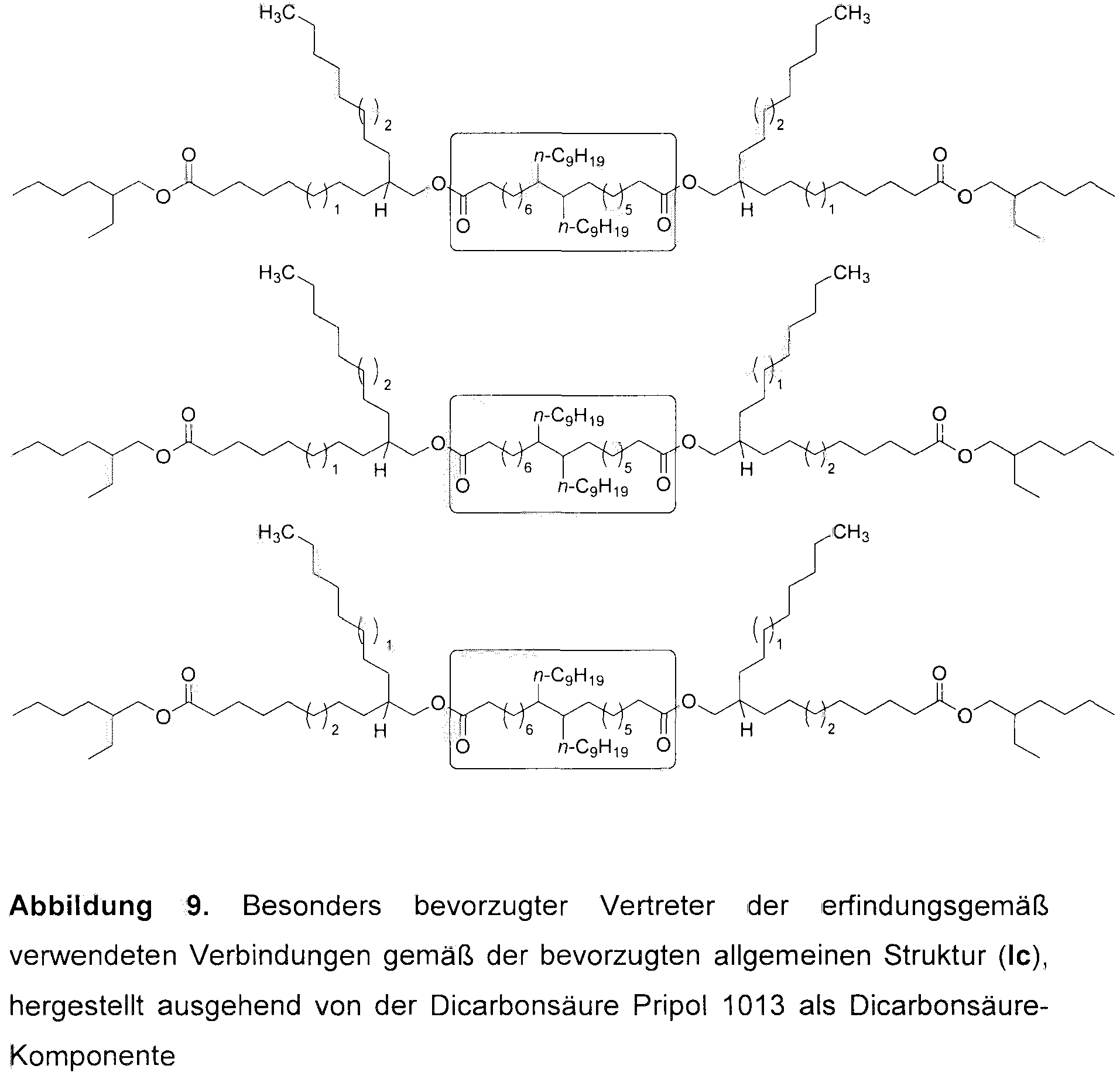
- Des weiteren ist ein Vertreter dieser Verbindungsklasse (Ic) die in dem nachfolgenden Beispiel 13 beschriebene Mischung aus den darin enthaltenen, der allgemeinen Struktur (Ic) entsprechenden Regiosomeren, die aus der Veresterungsreaktion der in Beispiel 8 beschriebenen erfindungsgemäßen Mischung mit der Dicarbonsäure Pripol 1013 der Firma Croda GmbH gebildet wird (Abbildung 9). Zur besseren Veranschaulichung ist das jeweils aus der kommerziellen Dicarbonsäure Pripol 1013 hervorgehende Molekülfragment umrahmt dargestellt.
- Neben n-Hexandicarbonsäure und Dimersäure (Pripol 1013) werden weitere mehrwertige Carbonsäuren und Carbonsäureanhydride verwendet, insbesondere hydrierte Dimersäure, hydrierte oder nicht hydrierte Trimersäuren, Terephthalsäure, Isophthalsäure, Phthalsäure, Trimellitsäure, Hemimellitsäure, Trimesinsäure, Zitronensäure, Itaconsäure, Oxalsäure, 2,2'-Thiodiessigsäure, 3,3'-Thiodipropionsäure, Admerginsäure, 2,5-Furandicarbonsäure, Cyclohexan-1,4-dicarbonsäure, Cyclohexan-1,2-dicarbonsäure, Cyclohexen-4,5-dicarbonsäure, Phenylbernsteinsäure, Glutaminsäure, Asparaginsäure, Ethylendiamintetraessigsäure, Diethylentriaminpentaessigsäure, Propylendiamintetraessigsäure, Nitrilotriessigsäure, Diglycolsäure und Iminodiessigsäure und deren Derivate.
- Ein weiteres Kennzeichen des Verfahrens ist der Einbezug des Reaktionstyps der Veresterung im Rahmen der von ungesättigten Fettsäuren ausgehenden bevorzugten Ausführungsformen des Verfahrens und der dabei angewendeten Synthesesequenzen. Für die Veresterung von Hydroxy-Gruppen stehen dem Fachmann vielfältige Möglichkeiten zur Verfügung. So können entweder die benötigten Säuren direkt oder davon abgeleitete, aktivierte Säurederivate, z.B. Säurechloride und Anhydride, oder Säureester (für eine Umesterungsreaktion) eingesetzt werden. Eine besonders attraktive Syntheseoption stellen dabei katalytische Verfahren dar, die eine Direktveresterung ausgehend von Alkohol und Säure-Komponente ohne Notwendigkeit des Einsatzes von aktivierten Carbonsäurederivaten wie Carbonsäurechloride und Anhydride erlauben. Solche katalytischen Verfahren sind sowohl unter Beteiligung von Chemokatalysatoren bzw. Biokatalysatoren bekannt und beispielweise (insbesondere mit Fokus auf Biokatalysatoren) in G. Hills, Eur. J. Lipid Sci. Technol. 2003, 105, 601-607, O. Thum, K. M. Oxenboll, SOFW J. 2008, 134, 44-47, L. Hilterhaus, O. Thum, A. Liese, Org. Process Res. Dev. 2008, 12, 618-625 und M. B. Ansorge-Schumacher, O. Thum, Chem. Soc. Rev. 2013, 42, 6475-6490 beschrieben. Der Einsatz von Biokatalysatoren ist dabei besonders attraktiv, da unter milden Reaktionsbedingungen Veresterungsreaktionen in hocheffizienter Weise durchgeführt werden können. Entsprechend stellt die Herstellung der erfindungsgemäßen Verbindungen der allgemeinen Formel (I) im Rahmen eines Syntheseverfahrens, bei der für mindestens eine der dabei beteiligten Veresterungsreaktionen ein Biokatalysator ausgewählt aus der Enzymklasse der Hydrolasen verwendet wird, eine besonders bevorzugte Ausführungsform dar. Besonders geeignet als Biokatalysatoren aus der Enzymklasse der Hydrolasen sind für das erfindungsgemäße Verfahren dabei Lipasen, wobei wiederum die kommerziell verfügbare Lipase aus Candida antarctica B eine besonders geeignete Lipase-Komponente darstellt,
- Für die zu den Verbindungen führenden Syntheseverfahren stehen dem Fachmann bei der Wahl der Reaktionsbedingungen vielfältige Wahlmöglichkeiten zur Verfügung, wobei für die beteiligten Einzelreaktionstypen diese in der Literatur eingehend beschrieben sind. Unter anderem ist der Fachmann frei bei der Wahl der jeweiligen Reaktionsmedien und kann beispielsweise auf ein breites Spektrum an Lösungsmitteln zur Durchführung der Synthesereaktionen des erfindungsgemäßen Verfahrens zurückgreifen. Besonders vorteilhaft ist dabei allerdings im Hinblick auf die Nachhaltigkeit des Herstellverfahrens die Vermeidung von Lösungsmitteln. Insbesondere für Veresterungsreaktionen sind Lösungsmittel-freien Synthesen in der Literatur bereits als effizient beschrieben, beispielsweise in den bereits oben genannten Beiträgen G. Hills, Eur. J. Lipid Sci. Technol. 2003, 105, 601-607, O. Thum, K. M. Oxenboll, SOFWJ. 2008, 134, 44-47, L. Hilterhaus, O. Thum, A. Liese, Org. Process Res. Dev. 2008, 12, 618-625 und M. B. Ansorge-Schumacher, O. Thum, Chem. Soc. Rev. 2013, 42, 6475-6490. Da der Reaktionstyp der Veresterung auch ein Kennzeichen des erfindungsgemäßen Verfahrens darstellt, ist die Herstellung der erfindungsgemäßen Verbindungen der allgemeinen Formel (I) im Rahmen eines Syntheseverfahrens, bei der mindestens eine der dabei beteiligten Veresterungsreaktionen unter Lösungsmittel-freien Reaktionsbedingungen erfolgt, eine besonders bevorzugte Ausführungsform.
- Ein besonderer technischer Vorteil des entwickelten Verfahrens sowie der damit erhaltenen Produkte mit einer O-acylierten Methylol-Funktion ist das Vorliegen einer primären Alkoholfunktion bei den zugrundeliegenden Hydroxymethylolsubstituierten Fettsäureestern als Substrat. Diese funktionelle primäre AlkoholGruppe ist in hohem Maße für Enzym-katalytische Reaktionen unter milden Herstellungsbedingungen und bei niedrigen Temperaturen geeignet und ermöglicht dadurch die Herstellung der gewünschten Verbindungen unter umweltfreundlichen Bedingungen bei gleichzeitigem niedrigem Energieverbrauch.
- Ein weiterer genereller technischer Vorteil der Verbindungen sowie des Herstellungsverfahrens liegt in der enorm hohen Selektivität. Die in der
DE 698 35 694 T2 offenbarten Estolidverbindungen können nicht in dieser Selektivität hergestellt werden, da hier ausgehend von einer ungesättigten Fettsäure als Basisbaustein durch Addition der Fettsäureeinheit dieses Bausteins an die Alkeneinheit des nächsten Bausteins die Reaktionsverknüpfung erfolgt und dadurch Di-, Tri-, Tetra- bzw. generell Oligomere und sogar Polymere als Mischung aufgebaut werden. Bei dem hier beschriebenen Verfahren wird durch milde Reaktionsbedingungen und hochselektive Enzymreaktionen, aber auch durch die Strategie der Reaktionsführung vorzugsweise jeweils nur die Mono-Funktionalisierung der Methylol-Komponente der Ausgangsverbindung erreicht (die beispielsweise als Mischung aus einem 9- und 10-Methylol-substituierten Fettsäureester besteht). Darüber hinaus ist auch die maßgeschneiderte Herstellung höher substituierte Trimere und Tetramere in selektiver Art und Weise durch entsprechend gezielte Synthesen denkbar. Daher werden die Zielverbindungen mit hoher Selektivität in definierter Form unter Vermeidung von höheren oligomeren oder polymeren Strukturen erhalten, wie dies mit den bekannten Verfahren, mit denen komplexe Produktmischungen erhalten werden, nicht möglich ist. - Die erfindungsgemäß verwendeten Esterverbindungen sind hervorragend geeignet, in Schmierstoffzusammensetzungen eingesetzt zu werden und eignen sich sowohl zum Einsatz im Hochtemperaturbereich, im Marinebereich sowie als Schmiermittel, das im Lebensmittelbereich eingesetzt wird.
- Neben den neuen Esterverbindungen können die erfindungsgemäßen Schmiermittelzusammensetzungen weitere Grundölkomponenten insbesondere auf der Basis von natürlichen Glyceridestern und Fettsäuren enthalten, vorzugsweise Sonnenblumenöl, Rapsöl oder Rüböl, Leinöl, Maisöl oder Maiskeimöl, Diestelöl, Sojabohnenöl, Leinsamenöl, Erdnussöl, "Lesqueralle"-Öl, Palmöl, Olivenöl, in der monomeren, oligomeren und/oder polymerisierten Formen oder Mischungen aus den genannten Ölen.
- Darüber hinaus können die erfindungsgemäßen Schmiermittelzusammensetzungen neben den neuen Esterverbindungen weitere Ester wie Trimethylolpropan- und Pentaerytritolester sowie TMP- Komplexester, vollständig oder teilverestert mit gesättigten und/oder einfach oder mehrfach ungesättigten Carbonsäuren der Kettenlänge C6-C36, wobei diese linear oder verzweigt sein können, Komplexester aus Dimersäuren, Dimersäureester wie Ethylhexyldimerat, aliphatische Carbonsäure- und Dicarbonsäureester sowie Phosphatester, Trimellith- und Pyromellithsäureester, Ether, Polyetherpolyole sowie Perfluorpolyether, Alkyldiphenylether und Polyphenylether, Silikonöle, Polyglycole bestehend aus statistisch verteilten Polyoxyethylen- und/oder Polyoxypropyleneinheiten und/oder andere Polyoxyalkylenbausteine sowie anderer Glycolderivate, Polyalphaolefine und Metallocen-katalysiert hergestellte Polyalphaolefine sowie Alphaolefin-Copolymere, polymere Systemen wie beispielsweise nicht hydriertes, teilhydriertes oder vollhydriertes Polyisobutylen oder einer Mischung dieser, Styrol- und Polystyrol sowie seine Derivate und/ oder polymere Systeme basierend auf Acrylaten, Acetatpolymeren und Amiden, Polyethylenen, Polypropylenen, halogenierten Polypropylenen und/ oder Cycloalkanen, Mineralöle wie z.B. Weißöl, alkylierte Diphenylether, alkylierte Naphtaline und Perfluoropolyether enthalten.
- Das Schmiermittel, das die Esterverbindung der allgemeinen Formel (Ia), (Ib) (Ic) enthält, kann sowohl in Form eines Schmieröls als auch als Schmierfett eingesetzt werden.
- Das Schmiermittel umfasst des weiteren Additive, die einzeln oder in Kombination eingesetzt werden und aus der Gruppe bestehend aus Korrosionsschutzadditiven, Antioxidaten, Verschleißschutzadditiven, UV-Stabilisatoren, anorganischen oder organischen Feststoffschmierstoffen, Pourpoint- und VI-Verbesserern, Polymeren, Haftzusätzen, Farbstoffen, Emulgatoren, Entschäumern und Festschmierstoffen ausgewählt werden, die für die Formulierung eines Schmieröles bzw. Schmierfettes typisch sind.
- Schmierfette können mit unterschiedlichen Verdickungsmitteln hergestellt werden. Eine mögliche Verdickergruppe sind Harnstoffe bestehend aus dem Reaktionsprodukt aus einem Diisocyanat, vorzugsweise 2,4-Diisocyanatotoluol, 2,6-Diisocyanatotoluol, 4,4'-Diisocyanatodiphenylmethan, 2,4'-Diisocyanatophenylmethan, 4,4'-Diisocyanatodiphenyl, 4,4'-Diisocyanato-3-3'-dimethylphenyl, 4,4'-Diisocyanato-3,3'-dimethylphenylmethan, die einzeln oder in Kombination verwendet werden können, mit einem Amin der allgemeinen Formel R'2-N-R, oder einem Diamin der allgemeinen Formel R'2-N-R-NR'2, wobei R ein Aryl-, Alkyl- oder Alkylenrest mit 2 bis 22 Kohlenstoffatomen ist und R' identisch oder verschieden ein Wasserstoff, ein Alkyl-, Alkylen- oder Arylrest ist, oder mit Gemischen aus Aminen und Diaminen oder als Verdickungsmittel wird ein Vertreter ausgewählt aus der Gruppe der Al-Komplexseifen, Metall-Einfachseifen der Elemente der ersten und zweiten Hauptgruppe des Periodensystems, Metall-Komplexseifen der Elemente der ersten und zweiten Hauptgruppe des Periodensystems, Bentonite, Sulfonate, Silikate, Aerosil, Polyimide oder PTFE oder einer Mischung der vorgenannten Verdickungsmittel.
- Um den gesetzlichen Bestimmungen bezüglich der Verwendung von Schmierstoffen zum Schmieren von Arbeitsgeräten für die Verarbeitung von Lebensmitteln zu entsprechen, ist es zweckmäßig, wenn die eingesetzten Additive eine H1-Klassifikation aufweisen.
- Der Zusatz von Antioxidantien kann die Oxidation des erfindungsgemäßen Öls oder Fetts, insbesondere bei seinem Einsatz, verringern oder gar verhindern. Entsprechend stellt der Zusatz von Antioxidantien eine weitere bevorzugte Ausführungsform des erfindungsgemäßen Verfahrens dar. Die Antioxidantien werden ausgewählt aus der Gruppe bestehend aus diaromatischen Aminen, Phenolharzen, Thiophenolharzen, Phosphiten, butyliertem Hydroxytoluol, butylierten Hydroxyanisol, Phenyl-□-naphthylaminen, Phenyl-□-naphthylaminen, octylierten/butylierten Diphenylaminen, Di-□-Tocopherol, Di-tert-butyl-phenyl, Benzolpropansäure und Mischungen dieser Komponenten.
- Der erfindungsmäßig verwendete Schmierstoff kann Korrosionsschutzadditive, Metalldesaktivatoren oder Ionen-Komplexbildner enthalten. Hierzu zählen Triazole, Imidazoline, N-Methylglycin (Sarcosin), Benzotriazolderivate, N,N-Bis(2-ethylhexyl)-ar-methyl-1H-benzotriazol-1-methanamin; N-Methyl-N-(1-oxo-9-octadecenyl)glycin, Gemisch aus Phosphorsäure und deren Mono- und Diisooctylester umgesetzt mit (C11-14)-Alkylaminen, Gemische aus Phosphorsäure und Mono- und Diisooctylester umgesetzt mit tert-Alkylaminen und primären (C12-14)-Aminen, Dodekansäure, Triphenylphosphorthionat und Aminphosphate. Kommerziell erhältliche Additive sind beispielsweise die nachfolgend genannten Produkte: IRGAMET® 39, IRGACOR® DSS G, Amin O; SARKOSYL® O (Ciba), COBRATEC® 122, CUVAN@ 303, VANLUBE® 9123, CI-426, CI-426EP, CI-429 und CI-498.
- Der erfindungsmäßig verwendete Schmierstoff kann zudem Verschleißschutzadditive, Anti-Wear- Additive und Frictionmodifier enthalten.
- Verschleißschutzadditive sind Amine, Aminphosphate, Phosphate, Thiophosphate, Phosphorthionate, Arylphosphat, alkylierte Polysulfide, geschwefelte Aminverbindungen, geschwefelte Fettsäuremethylester, Naphthensäuren, Nanopartikel aus den Gruppen Al2O3, SiO2, TiO2, ZrO2, WO3, Ta2O5, V2O5, CeO2, Aluminiumtitanat, BN, MoSi2, SiC, Si3N4, TiC, TiN, ZrB2, Tonminerale und/oder deren Gemische sowie thermisch stabile Carbonate und / oder Sulfate, und Mischungen dieser Komponenten. Zu den kommerziell erhältlichen Verschleißschutzadditiven gehören IRGALUBE® TPPT, IRGALUBE® 232, IRGALUBE® 349, IRGALUBE® 211 und ADDITIN® RC3760 Liq 3960, FIRC-SHUN® FG 1505 und FG 1506, INA-LUBE® KR-015FG, LUBEBOND®, FLUORO® FG, SYNALOX® 40-D, ACHESON® FGA 1820 und ACHESON® FGA 1810.
- Der erfindungsmäßig verwendete Schmierstoff kann Pourpoint- und Viskositätsverbesser und Haftzusätze enthalten. Pourpoint- und Viskositätsverbesser sind ausgewählt aus den Gruppen der linearen und/oder verzweigten alkylierten, acrylierten und aliphatischen Polymeren und Copolymeren sowie polymerisierten Fettsäureestern, so wie aus der Gruppe PIB (Polyisobutylene) und PB (Polybutene) teilhydriert oder vollhydriert.
- Der erfindungsmäßig verwendete Schmierstoff kann desweiteren UV-Stabilisatoren enthalten. UV-Stabilisatoren sind ausgewählt aus den Gruppen der Stickstoffheterocyclen, substituierten Stickstoffheterocyclen, linear und verzweigten alkylierten, acylierten, aliphatischen Stickstoffheterocyclen, sowie derer Derivate.
- Der erfindungsmäßig verwendete Schmierstoff kann auch Festschmierstoffe enthalten. Festschmierstoffe sind z.B. PTFE, BN, Pyrophosphat, Zn-Oxid, Mg-Oxid, Pyrophosphate, Thiosulfate, Mg-Carbonat, Ca-Carbonat, Ca-Stearat, Zn-Sulfid, Mo-sulfid, W-sulfid, Sn-Sulfid, Graphite, Graphen, Nano-Tubes, SiO2-Modifikationen oder eine Mischung daraus enthalten.
- Der erfindungsmäßig verwendete Schmierstoff kann Emulgatoren enthalten. Emulgatoren sind ausgewählt aus den Gruppen der verzweigten und/oder linearen ethoxylierten und/oder propoxylierten Alkohole und deren Salze wie beispielsweise Alkohole, C16-C18, ethoxyliert, propoxyliert, Polyglykole, Fettsäureester, Silikate, ionische Tenside wie z. B. Natriumsalze von Alkylsulfonsäuren, wobei die Ketten C14-17-Kohlenstoffe enthalten.
- Der erfindungsmäßig verwendete Schmierstoff kann Entschäumer enthalten. Entschäumer sind ausgewählt aus den Gruppen der ethoxylierten und/oder propoxylierten Alkohole der Kettenlängen C10-C18, Mono- und Diglyceride von Speisefetten, Akrylate, propoxylierte und/oder ethoxylierte Alkylether (Polyglycole), Alkohole, Siloxane.
- Eine bevorzugte Form des Herstellungsverfahren für eine Ölformulierung ist dabei wie folgt: Die Esterverbindung wird im Kessel vorgelegt. Die viskositätsgebende Komponente und/oder ein oder mehrere weitere Grundöle werden zugegeben, und unter Rühren und gegebenenfalls Aufheizen auf eine definierte Temperatur, eine klare Lösung erzeugt. Feste Additive werden sodann bei einer Temperatur oberhalb ihres Schmelzpunktes zugegeben und solange gerührt bis diese gelöst sind. Anschließend wird der Kesselinhalt auf maximal 60°C abgekühlt und die flüssigen Additive zugegeben. Nach einer weiteren Stunde Rührzeit kann das Öl abgefüllt werden.
- Bei einer bevorzugten Form des Herstellungsverfahren für eine Fettformulierung wird zudem wie folgt vorgegangen: Die Grundölmischung wird im Kessel vorgelegt. Die Verdickerkomponenten werden unter Rühren bei einer definierten Temperatur auf definierte Art und Weise zugegeben. Das so entstehende Fett wird eine definierte Zeit gerührt und speziell bei Verwendung von Verdickungsmitteln auf Seifenbasis wasserfrei gekocht. Feste Additive werden sodann bei einer Temperatur oberhalb ihres Schmelzpunktes zugegeben und solange gerührt bis diese gelöst sind. Anschließend wird der Kesselinhalt auf maximal 60°C abgekühlt und die flüssigen Additive zugegeben. Nach einer weiteren Stunde Rührzeit kann das Fett abgefüllt werden.
- Die Schmiermittelzusammensetzungen auf Basis der Esterverbindung der allgemeinen Formeln (Ia) oder (Ib) oder (Ic), werden im Marinebereich, im Bereich der Binnengewässer und bei Offshore-Anlagen, d.h. zur Schmierung von Ketten, Gleitlagern, Propellerrudern, Propellerwellen, Maschinenbauteilen und Anlagen, die im Marinebereich mit Salzwasser oder in Binnengewässern mit Wasser und wässrigen Medien in Berührung kommen, eingesetzt. Des weiteren finden sie Anwendung bei der Schmierung von Arbeitsgeräten in der lebensmittelverarbeitenden Industrie, als Hydrauliköl in der lebensmittelverarbeitenden Industrie, für Transport- und Steuerketten, für Vorrichtungen für die Verarbeitung von Getreide, Mehl und Tierfutter, sowie in Backöfen. Außerdem werden sie zur Schmierung von Wälz- und Gleitlagern, Transport- und Steuerketten in der Fahrzeugtechnik, der Fördertechnik, dem Maschinenbau, der Bürotechnik sowie in industriellen Anlagen und Maschinen, in den Bereichen der Haushaltsmaschinen und der Unterhaltungselektronik eingesetzt. Darüber hinaus werden sie zur Schmierung von Kegelrad- und Stirnradgetrieben, von Laufrollenlagern in Stranggießanlagen und Transportrollenlagern in Durchlauföfen und zur offenen Zahnkranzschmierung an Drehrohröfen, Rohrmühlen, Trommeln und Mischern, wie sie speziell in der Zement-, Kalk-, Gips-, Minen- und Chemieindustrie, eingesetzt.
- Ergänzend sei angemerkt, dass es sich bei den erfindungsgemäßen Verbindungen, sofern diese Stereozentren enthalten, sowohl um racemische als auch enantiomerenangereicherte bzw. enantiomerenreine Verbindungen handeln kann.
- Im nachfolgenden Abschnitt werden die Esterverbindungen und ihre Herstellung sowie ihre Verwendung in einer Schmierstoffzusammensetzung anhand entsprechender experimenteller Beispiele erläutert.
-

- Ölsäure (1,0 Äq.) und Guerbet-Alkohol (1,0 Äq.) wurden vorgelegt und mit CAL-B (Novozym 435, 30 mg/mmol Substrat) und Molekularsieb 4Å (120 mg/mmol) versetzt. Die Reaktionsmischung wurde für 24 Stunden bei 50 °C gerührt und anschließend durch einen 0,2 µM PTFE-Filter filtriert. Der entsprechende Ölsäureester wurde in 97-99% Produktreinheit erhalten.
-

- Die Synthese erfolgte nach AW 1. Ölsäure (31,6 ml, 100 mmol) und 2-Ethylhexan-1-ol (15,6 ml, 100 mmol) wurden mit Novozym 435 (3,0 g) und Molekularsieb 4Å (12,0 g) versetzt. 2-Ethylhexyloleat (99% Reinheit) wurde als farblose Flüssigkeit erhalten.
- Ausbeute: 37,3 g, 95%.
- 1H-NMR (500 MHz, CDCl3): δ [ppm] = 5.34 (m, 2H, CH=CH), 3.98 (dd, 2H, 2 J = 5.8 Hz, 3 J = 2.4 Hz, OCH2 ), 2.29 (t, 2H, 3 J = 7.5 Hz, CH2CH2 COOR), 2.01 (m, 4H, CH2 CH=CHCH2 ), 1.61 (qi, 2H, 3 J = 7.3 Hz, CH2 CH2COOR), 1.56 (sept, 1H, 3 J = 6.0 Hz, OCH2CH), 1.28 (m, 28H), 0.88 (m, 9H, CH3 ).
- 13C-NMR (125 MHz, CDCl3): δ [ppm] = 174.21, 130.11, 129.87, 66.76, 38.90, 34.58, 32.05, 30.57, 29.91, 29.84, 29.67, 29.47, 29.33, 29.29, 29.26, 29.07, 27.36, 27.31, 25.19, 23.95, 23.12, 22.83, 14.25, 14.18.
- GC (FID): Phenomenex ZB-5MSi, 0.5 ml/min (H2), Inj. Temp.: 300 °C, Det. Temp.: 350 °C; 300 °C -> 350 °C (5 °C/min), 350 °C für 5 min, Rt = 3,51 min. HRMS (ESI): berechnet für C26H50O2Na [M+Na]+: 417.3703, gefunden: 417.3699. IR (neat) [cm-1]: 2956, 2922, 2853, 1736, 1461, 1240, 1171, 724.
-

- Die Synthese erfolgte nach AW 1. Ölsäure (1,59 ml, 5,00 mmol) und 2-Butyloctan-1-ol (1,12 ml, 5,00 mmol) wurden mit Novozym 435 (150 mg) und Molekularsieb 4Ä (600 mg) versetzt. 2-Butyloctyloleat (97% Reinheit) wurde als farblose Flüssigkeit erhalten.
- Ausbeute: 1,30 g, 58%.
- 1H-NMR (500 MHz, CDCl3): δ [ppm] = 5.34 (m, 2H, CH=CH), 3.96 (d, 2H, 2 J = 5.8 Hz, OCH2 ), 2.29 (t, 2H, 3 J = 7.5 Hz, CH2CH2 COOR), 2.01 (m, 4H, CH2 CH=CHCH2 ), 1.61 (m, 2H, CH2 CH2COOR), 1.60 (m, 1H, OCH2CH), 1.28 (m, 36H), 0.88 (m, 9H, CH3 ).
- 13C-NMR (125 MHz, CDCl3): δ [ppm] = 174.21, 130.11, 129.87, 67.16, 37.43, 34.60, 32.06, 31.97, 31.44, 31.11, 29.92, 29.86, 29.78, 29.68, 29.47, 29.35, 29.31, 29.28, 29.07, 27.36, 27.32, 26.82, 25.21, 23.14, 22.83, 22.81, 14.25, 14.24, 14.19.
- GC (FID): Phenomenex ZB-5MSi, 0.5 ml/min (H2), Inj. Temp.: 300 °C, Det. Temp.: 350 °C; 300 °C -> 350 °C (5 °C/min), 350 °C für 5 min; Rt = 4,27 min.
- HRMS (ESI): berechnet für C30H50O2Na [M+Na]+: 473.4329, gefunden: 473,4324.
- IR (neat) [cm-1]: 2954, 2922, 2853, 1737, 1457, 1241, 1169, 723.
-

- Die Synthese erfolgte nach AW 1. Ölsäure (1,59 ml, 5,00 mmol) und 2-Hexyldecan-1-ol (1,44 ml, 5,00 mmol) wurden mit Novozym 435 (150 mg) und Molekularsieb 4Å (600 mg) versetzt. 2-Hexyldecyloleat (97% Reinheit) wurde als farblose Flüssigkeit erhalten.
- Ausbeute: 1,51 g, 60%.
- 1H-NMR (500 MHz, CDCl3): δ [ppm] = 5.34 (m, 2H, CH=CH), 3.97 (d, 2H, 2 J = 5.8 Hz, OCH2 ), 2.29 (t, 2H, 3 J = 7.5 Hz, CH2CH2 COOR), 2.01 (m, 4H, CH2 CH=CHCH2 ), 1.61 (m, 2H, CH2 CH2COOR), 1.60 (m, 1H, OCH2CH), 1.28 (m, 44H), 0.88 (m, 9H, CH3 ).
- 13C-NMR (125 MHz, CDCl3): δ [ppm] = 174.22, 130.12, 129.87, 67.18, 37.45, 34.61, 32.06, 31.97, 31.44, 30.12, 29.92, 29.86, 29.78, 29.72, 29.68, 29.48, 29.36, 29.32, 29.29, 27.37, 27.32, 26.86, 26.82, 25.21, 22.84, 22.81, 14.26, 14.25.
- GC (FID): Phenomenex ZB-5MSi, 0.5 ml/min (H2), Inj. Temp.: 300 °C, Det. Temp.: 350 °C; 300 °C -> 350 °C (5 °C/min), 350 °C für 5 min; Rt = 5,65 min.
- HRMS (ESI): berechnet für C34H66O2Na [M+Na]+: 529.4955, gefunden: 529.4951.
- IR (neat) [cm-']: 2921, 2852, 1737, 1464, 1169, 722.
-

- Die Synthese erfolgte nach AW 1. Ölsäure (1,59 ml, 5,00 mmol) und 2-Octyldodecan-1-ol (1,78 ml, 5,00 mmol) wurden mit Novozym 435 (150 mg) und Molekularsieb 4Å (600 mg) versetzt. 2-Octyldodecyloleat (98% Reinheit) wurde als farblose Flüssigkeit erhalten.
- Ausbeute: 1,67 g, 59%.
- 1H-NMR (500 MHz, CDCl3): δ [ppm] = 5.34 (m, 2H, CH=CH), 3.97 (d, 2H, 2 J = 5.8 Hz, OCH2 ), 2.29 (t, 2H, 3 J = 7.5 Hz, CH2CH2 COOR), 2.01 (m, 4H, CH2 CH=CHCH2 ), 1.61 (m, 2H, CH2 CH2COOR), 1.60 (m, 1H, OCH2CH), 1.28 (m, 52H), 0.88 (m, 9H, CH3 ).
- 13C-NMR (125 MHz, CDCl3): δ [ppm] = 174.22, 130.12, 129.87, 67.19, 37.43, 34.61, 32.08, 32.07, 31.42, 30.12, 29.92, 29.87, 29.82, 29.81, 29.77, 29.72, 29.69, 29.52, 29.48, 29.36, 29.32, 29.29, 27.37, 27.32, 26.85, 25.21, 22.84, 14.27.
- GC (FID): Phenomenex ZB-5MSi, 0.5 ml/min (H2), Inj. Temp.: 300 °C, Det. Temp.: 350 °C; 300 °C -> 350 °C (5 °C/min), 350 °C für 5 min; Rt = 7,70 min.
- HRMS (ESI): berechnet für C34H66O2Na [M+Na]+: 585,5581, gefunden: 585,5568.
- IR (neat) [cm-']: 2920, 2852, 1737, 1464, 1170, 722.
-

- In Anlehnung an Versuchsvorschriften von Metzger und Biermann (U. Biermann, J. Metzger, Fat. Sci. Technol. 1991, 93, 282-284; J. Metzger, U. Biermann, Synthesis 1992, 5, 463-465) wurde Ölsäure (1,0 Äq.) oder sein 2-Ethylhexylester (1,0 Äq.) und Paraformaldehyd (2,3 Äq.) unter Argon in trockenem Dichlormethan vorgelegt und auf 0 °C gekühlt. Anschließend wurde EtAlCl2 oder Me2AlCl (2,3 - 3,3 Äq., 1,0 M in n-Hexan) hinzugetropft und die Reaktionsmischung danach langsam auf Raumtemperatur erwärmt und für zwei Stunden gerührt. Wasser (1:1 v/v) wurde hinzugegeben und mit 4 M HCl auf pH=1 angesäuert. Die Phasen wurden getrennt und die wässrige Phase noch dreimal mit Diethylether (1:1 v/v) extrahiert. Die vereinigten Extrakte wurden über Magnesiumsulfat getrocknet und vom Lösungsmittel bei verringertem Druck befreit. Anschließende Säulenchromatographie lieferte die Produkte als farblose Öle. Die Produkte wurden als 1:1-Gemisch der C9 und C10-Addukte erhalten.
-

- Die Synthese erfolgte nach AW 2. Ölsäure (4,73 ml, 15 mmol) und Paraformaldehyd (1,04 g, 34,5 mmol) wurden unter Zugabe von Me2AlCl (34,5 ml, 34,5 mmol) umgesetzt. Aufarbeitung und Säulenchromatographie (Cyclohexan/Ethylacetat 7:3, v/v) lieferte das Produkt als farblose Flüssigkeit.
- Ausbeute: 1,50 g, 32%.
- 1H-NMR (500 MHz, CDCl3): δ [ppm] = 5.52 (m, 1H, CH=CHCH), 5.13 (m, 1H, CH=CHCH), 3.52 (m, 1H, CH2 OH), 3.33 (m, 1H, CH2 OH), 2.34 (2 t, 2H, 3 J = 7.5 Hz, CH2 COO), 2.15 (m, 1H, CH=CHCH), 2.04 (m, 2H, CH2 CH=CH), 1.64 (m, 2H, CH2 CH2COO), 1.27 (m, 22H), 0.88 (2 t, 3H, CH3 ).
- 13C-NMR (125 MHz, CDCl3): δ [ppm] = 179.15, 179.07, 134.33, 133.88, 131.64, 131.30, 66.15, 66.10, 46.06, 34.01, 34.01, 32.82, 32.68, 32.03, 32.01, 31.27, 31.21, 29.82, 29.69, 29.68, 29.57, 29.45, 29.37, 29.29, 29.28, 29.26, 29.16, 28.99, 28.79, 27.24, 27.15, 27.07, 24.80, 24.75, 22.82, 22.81, 14.25.
- Die analytischen Daten stimmen mit der Literatur (J. Metzger, U. Biermann, Synthesis 1992, 5, 463-465) überein.
-

- Die Synthese erfolgte nach AVV 2. 2-Ethylhexyloleat (23,7 g 60 mmol) und Paraformaldehyd (4,14 g, 138 mmol) wurden unter Zugabe von EtAlCl2 (198 ml, 198 mmol) umgesetzt. Aufarbeitung und Vakuumdestillation (bei 10-3 mbar) lieferte das Produkt als farblose Flüssigkeit.
- Ausbeute: 17,6 g, 69%.
- 1H-NMR (500 MHz, CDCl3): δ [ppm] = 5.51 (m, 1H, CH=CHCH), 5.12 (m, 1H, CH=CHCH), 3.98 (m, 2H, COOCH2 ), 3.51 (m, 1H, CH2 OH) 3.32 (m, 1H, CH2 OH), 2.29 (2 t, 2H, 3 J = 7.5 Hz, CH2 COO), 2.12 (m, 1H, CH=CHCH), 2.02 (m, 2H, CH2 CH=CH), 1.61 (m, 2H, CH2 CH2COO), 1.56 (m, 1H, OCH2CH), 1.27 (m, 28H), 0.88 (3 t, 9H, CH3 ).
- 13C-NMR (125 MHz, CDCl3): δ [ppm] = 174.21, 174.18, 134.27, 133.90, 131.58, 131.33, 66.79, 66.77, 66.12, 66.09, 46.09, 38.88, 34.56, 34.54, 32.81, 32.72, 32.02, 31.99, 31.25, 31.23, 30.56, 29.81, 29.67, 29.67, 29.64, 29.46, 29.44, 29.34, 29.28, 29.24, 29.10, 29.06, 28.90, 27.23, 27.18, 25.16, 25.12, 23.93, 23.12, 22.81, 22.80, 14.25, 14.24, 14.19, 11.13.
- GC (FID): Phenomenex ZB-5MSi, 0.5 ml/min (H2), Inj. Temp.: 300 °C, Det. Temp.: 350 °C; 300 °C -> 350 °C (5 °C/min), 350 °C für 5 min; Rt = 4,29, 4,53 min.
- HRMS (ESI): berechnet für C27H52O3Na [M+Na]+: 447.3809, gefunden: 447.3813.
- IR (neat) [cm-1]: 2923, 2854, 1733, 1462, 1379, 1171, 1032, 969.
-

- Die ungesättigte freie Säure (1,0 Äq.) oder der 2-Ethylhexylester (1,0 Äq.) wurde unter einer Wasserstoffatmosphäre in Cyclohexan gelöst und mit Palladium auf Aktivkohle (Pd/C, 10% Pd, 20 Gew.-%) versetzt. Die Reaktionsmischung wurde für zwei Stunden bei Raumtemperatur gerührt und anschließend durch einen 0,2 µM PTFE-Filter filtriert. Säulenchromatographie lieferte das gewünschte Produkt als farbloses Öl.
-

- Die Synthese wurde nach AW 3 durchgeführt. Ein Gemisch aus E-9-(Hydroxymethyl)octadec-10-ensäure und E-10-(Hydroxymethyl)octadec-8-ensäure (450 mg, 1,44 mmol) wurde unter Wasserstoffatmosphäre in 25 ml Cyclohexan gelöst und mit Pd/C (90 mg) versetzt. Aufarbeitung und Säulenchromatographie (Cyclohexan/Ethylacetat 1:2, v/v) lieferte das gewünschte Produkt als farbloses Öl.
- Ausbeute: 130 mg, 25%.
- 1H-NMR (500 MHz, CDCl3): δ [ppm] = 3.53 (d, 2H, 3 J = 5.5 Hz CH2 OH), 2.35 (t, 2H, 3 J = 7.5 Hz, CH2 COO), 1.63 (qi, 2H, 3 J = 7.3 Hz, CH2 CH2COO), 1.45 (m, 1H, HOCH2CH), 1.27 (m, 36H), 0.88 (t, 3H, 3 J = 6.9 Hz, CH3 ).
- 13C-NMR (125 MHz, CDCl3): δ [ppm] = 179.62, 65.81, 65.79, 40.59, 34.15, 34.14, 32.05, 31.07, 31.02, 30.99, 30.22, 30.05, 29.91, 29.80, 29.78, 29.76, 29.49, 29.30, 29.15, 29.13, 27.04, 26.92, 26.88, 24.80, 22.83, 14.27.
- HRMS (ESI): berechnet für C19H38O3Na [M+Na]+: 337.2713, gefunden: 337.2717.
- IR (neat) [cm-']: 2913, 2848, 1699, 1469, 1185, 972, 719.
-

- Die Synthese wurde nach AW 3 durchgeführt. Ein Gemisch aus E-9-(Hydroxymethyl)octadec-10-ensäure-(2'-ethylhexyl)ester und E-10-(Hydroxymethyl)octadec-8-ensäure-(2'-ethylhexyl)ester (1,06 g, 2,50 mmol) wurde unter Wasserstoffatmosphäre in 50 ml Cyclohexan gelöst und mit Pd/C (212 mg) versetzt. Aufarbeitung und Säulenchromatographie (Cyclohexan/Ethylacetat 7:1, v/v) lieferte das gewünschte Produkt als farbloses Öl.
- Ausbeute: 660 mg, 62%.
- 1H-NMR (500 MHz, CDCl3): δ [ppm] = 3.97 (m, 2H, COOCH2 ), 3.54 (d, 2H, 3 J = 5.5 Hz CH2 OH), 2.29 (t, 2H, 3 J = 7.5 Hz, CH2 COO), 1.61 (m, 2H, CH2 CH2COO), 1.56 (m, 1H, OCH2CH), 1.27 (m, 36H), 0.89 (3 t, 9H, CH3 ).
- 13C-NMR (125 MHz, CDCl3): δ [ppm] = 174.27, 174.26, 66.79, 65.85, 65.83, 40.67, 38.90, 34.60, 34.58, 32.05, 31.08, 31.07, 31.05, 30.57, 30.22, 30.14, 30.02, 29.81, 29.78, 29.76, 29.59, 29.49, 29.41, 29.40, 29.30, 29.07, 27.05, 27.01, 26.97, 25.19, 23.95, 23.13, 22.83, 14.27, 14.20, 11.15.
- GC (FID): Phenomenex ZB-5MSi, 0.5 ml/min (H2), Inj. Temp.: 300 °C, Det. Temp.: 350 °C; 300 °C -> 350 °C (5 °C/min), 350 °C für 5 min; Rt = 4,61 min.
- HRMS (ESI): berechnet für C27H54O3Na [M+Na]+: 449.3965, gefunden: 449.3975..
- IR (neat) [cm-']: 2921, 2853, 1736, 1459, 1171, 1031.
-

- Die Synthese wurde nach AW 3 durchgeführt. Ein Gemisch aus E-9-(Hydroxymethyl)octadec-10-ensäure-(2'-ethylhexyl)ester und E-10-(Hydroxymethyl)octadec-8-ensäure-(2'-ethylhexyl)ester (2,00 g, 2,90 mmol) wurde unter Wasserstoffatmosphäre in 50 ml Cyclohexan gelöst und mit Pd/C (400 mg) versetzt. Aufarbeitung und Säulenchromatographie (Cyclohexan/Ethylacetat 15:1, v/v) lieferte das gewünschte Produkt als farbloses Öl.
- Ausbeute: 1.62 g, 81%.
- 1H-NMR (500 MHz, CDCl3): δ [ppm] = 3.97 (m, 4H, COOCH2 ), 2.28 (t, 4H, 3 J = 7.5 Hz, CH2 COO), 1.61 (m, 6H, CH2 CH2COO), 1.25 (m, 62H), 0.89 (m, 12H, CH3 ).
- 13C-NMR (125 MHz, CDCl3): δ [ppm] = 174.22, 174.16, 67.13, 66.75, 38.91, 37.46, 34.60, 34.58, 32.07, 31.42, 30.58, 30.12, 30.06, 29.94, 29.85, 29.81, 29.76, 29.71, 29.65, 29.63, 29.58, 29.46, 29.43, 29.39, 29.34, 29.32, 29.07, 26.85, 25.21, 23.95, 23.12, 22.84, 14.25, 14.18, 11.13.
- GC (FID): Phenomenex ZB-5MSi, 0.5 ml/min (H2), Inj. Temp.: 300 °C, Det. Temp.: 350 °C; 300 °C -> 350 °C (5 °C/min), 350 °C für 5 min; Rt = 14,4 min.
- HRMS (ESI): berechnet für C45H88O4Na [M+Na]+: 715.6575, gefunden: 715.6573.
- IR (neat) [cm-1]: 2921, 2852, 1736, 1463, 1169.
Tabelle 1 Chemische und physikalische Eigenschaften des Produkts hergestellt gemäß Beispiel 9 Parameter Methode Einheit Produkt hergestellt gemäß Beispiel 9 Aussehen flüssig klar farblos Kin. Vis. 40°C ASTM mm2/s 29,8 Kin. Vis. 100°C D 7042 6,56 VI 184,1 biologische Abbaubarkeit OECD 301 F % 81,3 -

- Der hydroxymethylierte Stearinsäure-(2'-ethylhexyl)ester (1,0 Äq.) wurde in MTBE gelöst und mit Novozym 435 (CAL-B, 30 mg/mmol) und Molekularsieb 4Å (120 mg/mmol) sowie einer Fettsäure (1,0 Äq.) versetzt. Die Reaktionsmischung wurde bei 50 bis 60 °C für 24 Stunden gerührt und anschließend durch einen 0,2 µM PTFE-Filter filtriert. Entfernen des Lösungsmittels unter verminderten Druck lieferte das Produkt als farbloses Öl.
-

- Die Synthese erfolgte nach AVV 4. Ein Gemisch aus 9-(Hydroxymethyl)octadecansäure-(2'-ethylhexyl)ester und 10-(Hydroxymethyl)octadecansäure-(2'-ethylhexyl)ester (51,7 mg, 100 µmol) und Stearinsäure (28,4 mg, 100 µmol) wurden in 50 µL MTBE gelöst und mit Novozym 435 (3 mg) und Molekularsieb 4Å (12 mg) versetzt und bei 50 °C gerührt. Aufarbeitung lieferte das gewünschte Produkt als farbloses Öl.
- Ausbeute: 58 mg, 85%.
- 1H-NMR (500 MHz, CDCl3): δ [ppm] = 3.98 (m, 2H, COOCH2 ), 3.95 (m, 2H, COOCH2 ), 2.29 (2 t, 4H, 3 J = 7.4 Hz, CH2 COO), 1.61 (m, 4H, CH2 CH2COO), 1.56 (m, 2H, OCH2CH), 1.27 (m, 62H), 0.89 (4 t, 12H, CH3 ).
- 13C-NMR (125 MHz, CDCl3): δ [ppm] = 174.29, 174.27, 174.22, 67.16, 66.78, 38.91, 37.46, 34.63, 34.60, 34.59, 32.08, 32.07, 31.43, 30.58, 30.13, 29.86, 29.83, 29.82, 29.77, 29.72, 29.66, 29.64, 29.52, 29.51, 29.48, 29.44, 29.35, 29.33, 29.08, 26.86, 25.22, 25.21, 23.96, 23.14, 22.85, 14.28, 14.21, 11.15.
- Die analytischen Daten stimmen mit denen der Verbindung aus Beispiel 9 überein.
-

- Ein Gemisch aus E-9-(Hydroxymethyl)octadec-10-ensäure-(2'-ethylhexyl)ester und E-10-(Hydroxymethyl)octadec-8-ensäure-(2'-ethylhexyl)ester (10,0 g, 23,5 mmol) wurde mit Stearinsäure (6,70 g, 23,5 mmol) vermischt und auf 70 °C erhitzt, wodurch die Stearinsäure schmolz. Novozym 435 (CAL-B, 706 mg, 30 mg/mmol) und Molekularsieb 4Å (3,3 g, 120 mg/mmol) wurden hinzugefügt. Die Reaktionsmischung wurde für 24 Stunden bei 70 °C gerührt. Anschließend wurde durch ein 0.2 µM PTFE-Filter filtriert. Entfernen des Solvens in vacuo und Filtration über Kieselgel (Cyclohexan/Ethylacetat 15:1, v/v) lieferte das Produkt als farbloses Öl.
- Ausbeute: 11,9 g, 73%.
- 1H-NMR (500 MHz, CDCl3): δ [ppm] = 5.40 (m, 1H, CH=CH), 5.14 (m, 1H, CH=CH), 3.98 (m, 2H, COOCH2 ), 2.29 (m, 4H, CH2 COO), 1.97 (m, 2H, CHCH2) 1.61 (m, 5H, CH2 CH2COO + OCH2CH), 1.27 (m, 60H), 0.88 (4 t, 12H, CH3 ).
- GC (FID): Phenomenex ZB-5MSi, 0.5 ml/min (H2), Inj. Temp.: 300 °C, Det. Temp.: 350 °C; 300 °C -> 350 °C (5 °C/min), 350 °C für 5 min; Rt = 14,1 min.
- HRMS (ESI): berechnet für C45H86O4Na [M+Na]+: 713,6418, gefunden: 713,6419.
- IR (neat) [cm-1]: 2959, 2926, 2856, 1736, 1257, 1011, 865, 790, 700.
-

- Die Synthese erfolgte nach AW 4. Ein Gemisch aus 9-(Hydroxymethyl)octadecansäure-(2'-ethylhexyl)ester und 10-(Hydroxymethyl)octadecansäure-(2'-ethylhexyl)ester (51,7 mg, 100 µmol) und Ölsäure (28,2 mg, 100 µmol) wurden mit Novozym 435 (3 mg) und Molekularsieb 4Å (12 mg) versetzt und bei 60 °C gerührt. Aufarbeitung lieferte das gewünschte Produkt als farbloses Öl.
- Ausbeute: 39 mg, 56%.
- 1H-NMR (500 MHz, CDCl3): δ [ppm] = 5.34 (m, 2H, CH=CH), 3.98 (m, 2H, COOCH2 ), 3.95 (m, 2H, COOCH2 ), 2.29 (2 t, 4H, 3 J = 7.4 Hz, CH2 COO), 1.61 (m, 4H, CH2 CH2COO), 1.56 (m, 2H, OCH2CH), 1.27 (m, 58H), 0.89 (4 t, 12H, CH3 ).
- MS (ESI): m/z = 691.5 [M+H]+.
- IR (neat) [cm-']: 2959, 2926, 2856, 1736, 1257, 1011, 865, 790, 700.
-

- Die Synthese erfolgte nach AVV 4. Ein Gemisch aus 9-(Hydroxymethyl)octadecansäure-(2'-ethylhexyl)ester und 10-(Hydroxymethyl)octadecansäure-(2'-ethylhexyl)ester (213,2 mg; 500 µmol), und 12-Hydroxystearinsäure (142,8 mg; 480 µmol) wurden mit Molekularsieb 4 Å (59,53 mg), Novozym 435 (14,5 mg) und MTBE (0,5 mL) wurden 24 h bei 50 °C gerührt. Aufarbeitung lieferte das gewünschte Produkt als farbloses Öl.
- Ausbeute: 267 mg, 76 %.
- 1H-NMR (500 MHz, CDCl3): δ [ppm] = 4.05-3,86 (m, 4H, COOCH2 ); 3.58 (dt, 1H, 3 J = 7.4, 4.2 Hz, CH2 OH), 2.29 (t, 4H, 3 J = 7.5 Hz, CH2 COO); 1.58 (dt, 6H, 3 J = 24,3, 6,6 Hz); 1.41 (d, 6H, 3 J = 6.5 Hz); 1,37-1,20 (m, 55H); 0.88 (td, 12H, 3 J = 6.9, 6.3, 3.8 Hz, CH3 ).
- 13C-NMR (125 MHz, CDCl3): δ [ppm] = 174.22, 150.97, 67.14, 66.78, 38.91, 37.63, 37.46, 34.59, 32.05, 31.99, 31.43, 30.58, 30.11, 29.85, 29.83, 29.75, 29.73, 29.69, 29.66, 29.61, 29.58, 29.52, 29.49, 29.46, 29.43, 29.40, 29.32, 29.30, 29.07, 26.84, 25.79, 25.76, 25.19, 23.95, 23.12, 22.82, 22.76, 14.24, 14.22, 14.18, 11.13.
- HRMS (ESI): berechnet für C45H88O5Na+, 731,6524; gefunden: 731,6521.
-

- Die Synthese erfolgte in Anlehnung an AW 4. Ein Gemisch aus E-9-(Hydroxymethyl)octadec-10-ensäure-(2'-ethylhexyl)ester und E-10-(Hydroxymethyl)octadec-8-ensäure-(2'-ethylhexyl)ester (999,6 mg, 2,4 mmol) und Adipinsäure (172,6 mg, 1,2 mmol) wurden mit Novozym 435 (70,6 mg) und Molekularsieb 4Å (288 mg) versetzt und bei 60 °C gerührt. Aufarbeitung lieferte das gewünschte Produkt als gelbliches Öl.
- Ausbeute: 1,06 g, 94%.
- 1H-NMR (500 MHz, CDCl3): δ [ppm] = 5.43 (m, 2H, CH=CH), 5.19-5.09 (m, 2H, CH=CH), 4.07-3.86 (m, 8H, COOCH2 ), 2.29 (m, 8H, CH2 COO), 1.98 (m, 4H, CHCH2) 1.61 (m, 10H, CH2 CH2COO + OCH2CH), 1.27 (m, 60H), 0.88 (4 t, 16H, CH3 )
- 13C-NMR (125 MHz, CDCl3): δ [ppm] = 174.13, 174.06, 174.02, 173.53, 173.51, 173.32, 132.68, 132.62, 132.38, 132.32, 130.56, 130.44, 130.38, 67.73, 67.59, 66.80, 66.64, 42.10, 42.05, 38.76, 38.74, 34.47, 34.43, 34.39, 34.01, 33.96, 32.61, 32.57, 32.55, 31.93, 31.89, 31.46, 30.43, 30.41, 29.70, 29.65, 29.54, 29.50, 29.37, 29.32, 29.31, 29.25, 29.18, 29.17, 29.06, 29.02, 28.93, 28.80, 28.76, 26.88, 25.07, 25.04, 25.01, 24.48, 24.45, 23.81, 23.79, 22.99, 22.97, 22.70, 22.68, 14.12, 14.06, 11.00, 10.99.
- HRMS (ESI): berechnet für C60H110O8Na+: 981,8093; gefunden: 981,8094.
-

- Die Synthese erfolgte in Anlehnung an Versuchsvorschriften von Raghunanan et al. (L. Raghunanan, S. Narine ACS Sust, Chem. & Eng. 2016 4 (3), 693-700) und Neises et al. (B. Neises, W. Steglich, Angew. Chem. Int. Ed. Engl. 1978, 17, 522-524). Ölsäure (5,01 g, 17,7 mmol), 1,6-Hexandiol (804,6 mg, 6,8 mmol), N,N-Dimethylaminopyridin (86,7 mg, 0,71 mmol) und N,N'-Dicyclohexylcarbodiimid (2,84 g, 13,8 mmol) wurden in Dichlormethan bei Raumtemperatur gerührt. Nach 18 h wurden die Phasen getrennt und die wässrige Phase noch dreimal mit Dichlormethan (1:1 v/v) extrahiert. Die vereinigten Extrakte wurden über Magnesiumsulfat getrocknet und vom Lösungsmittel bei verringertem Druck befreit. Das Produkt wurde als gelbliches Öl erhalten.
- Ausbeute: 2,79 g, 63%.
- 1H-NMR (500 MHz, CDCl3): δ [ppm] = 5.34 (4H, m, CH=CH), 4.06 (4H, t, O-CH2 ), 2.28 (4H, t, CH2 COO), 2.00 (8H, m, CH=CH-CH2 ), 1.63 (8H, m, O-CH2-CH2 , CH2 -CH2-COO), 1.21-1.35 (44H, m), 0.88 (6H, t, CH3).
- MS (ESI): m/z = 669,6 [M+Na]+.
- Die analytischen Daten stimmen mit der Literatur (L. Raghunanan, S. Narine ACS Sust. Chem. & Eng. 2016 4 (3), 693-700) überein.
-

- Die Synthese erfolgte nach AW 2. (Z)-Hexan-1,6-diyldioleat (1,73 g, 2,68 mmol) und Paraformaldehyd (373 mg, 12,4 mmol) wurden unter Zugabe von EtAlCl2 (19 ml, 19 mmol) umgesetzt. Aufarbeitung und Säulenchromatographie (Cyclohexan/Ethylacetat 15: 1, v/v) lieferte das gewünschte Produkt als farbloses Öl.
- Ausbeute: 353 mg, 19%.
- 1H-NMR (500 MHz, CDCl3): δ [ppm] = 5.51 (m, 2H, CH=CHCH), 5.13 (m, 2H, CH=CHCH), 4.06 (m, 4H, COOCH 2), 3.53 (m, 2H, CH 2OH) 3.32 (m, 2H, CH 2OH), 2.29 (t, 4H, CH 2COO), 2.14 (m, 2H, CH=CHCH), 2.02 (m, 4H, CH 2CH=CH), 1.63 (m, 8H, CH 2CH2COO, OCH2CH), 1.32 (m, 42H), 0.88 (t, 6H, CH 3).
- 13C-NMR (125 MHz, CDCl3): δ [ppm] = 134.29, 133.92, 131.62, 131.34, 66.13, 64.32, 46.10, 34.50, 34.48, 32.83, 32.73, 32.04, 32.01, 31.28, 31.24, 29.82, 29.69, 29.64, 29.46, 29.34, 29.29, 29.26, 29.11, 28.91, 28.71, 27.25, 27.19, 25.78, 25.13, 25.09, 22.81, 14.26.
- HRMS (ESI): berechnet für C44H82O6Na+: 729,6004; gefunden: 729,6014.
-

- Die Säurechloride wurden kommerziell erworben oder gemäß folgender Vorschrift dargestellt: Der in Toluol gelösten Carbonsäure (1,0 Äq.) wurde unter Rühren bei 0 °C langsam Thionylchlorid (15 Aq.) zugetropft. Nach 16 h Erhitzen unter Rückfluss wurde das überschüssige Thionylchlorid sowie das Lösungsmittel mittels Mikrodestillation entfernt, um das Säurechlorid zu erhalten. Dieses wurde unmittelbar verwendet.
- Die Fettsäurekomponente mit freier Alkoholfunktion (1,0 Äq.) wurde in Toluol mit Pyridin (1,1 Äq.) vorgelegt und unter Rühren bei Eiskühlung langsam mit dem Säurechlorid (1,2 Äq.) versetzt. Das Gemisch wurde innerhalb 15 min auf Raumtemperatur gebracht und anschließend für 6-16 h unter Rückfluss erhitzt. Nach Phasentrennung wurde die wässrige Phase mit Essigsäure angesäuert und noch zweimal mit Ethylacetat extrahiert. Die vereinigten Extrakte wurden über Magnesiumsulfat getrocknet und bei vermindertem Druck zur Trockne eingeengt. Säulenchromatographie lieferte die gewünschten Produkte.
-

- Die Synthese erfolgte nach AW 5. Ein Gemisch aus 9-(((12-Hydroxyoctadecanoyl)-oxy)methyl)octadecansäure-(2'-ethylhexyl)ester und 10-((((12-Hydroxyoctadecanoyl)-oxy)methyl)octadecansäure-(2'-ethylhexyl)ester (2,04 g, 2,87 mmol) wurde mit Pyridin (0,25 mL, 3,16 mmol) und Hexansäurechlorid (0,5 mL, 3,58 mmol) umgesetzt. Aufarbeitung und Säulenchromatographie über eine C18-RP-Säule (Acetonitril) lieferte das gewünschte Produkt als farbloses Öl.
- Ausbeute: 8 mg, 2%. 4.86 (s, 1H), 4.01 - 3.91 (m, 8H), 2.27 (s, 5H), 1.76 - 1.15 (m, 64H), 0.89 (s, 9H).
- 1H-NMR (500 MHz, CDCl3): δ [ppm] = 4,86 (m, 1H, COOCH), 4.01-3.91 (m, 4H, COOCH2 ); 2.27 (m, 6H, CH2 COO); 1.76-1.15 (m, 72H); 0.88 (m, 15H, CH3 ).
- HRMS (ESI): berechnet für C51H98O6Na+: 829,7256; gefunden: 829,7261.
-

- Die Synthese erfolgte nach AW 5. Ein Gemisch aus 6-(((E)-9-(hydroxymethyl)octadec-10-enoyl)oxy)hexyl-(E)-10-(hydroxymethyl)octadec-8-ensäureester, hexane-1,6-diyl (10E,10'E)-bis(9-(hydroxymethyl)octadec-10-ensäureester) und hexane-1,6-diyl (8E,8'E)-bis(10-(hydroxymethyl)octadec-8-ensäureester) (181 mg, 0,26 mmol) wurde mit Pyridin (0,25 µL, 0,28 mmol) und Stearinsäurechlorid (95,6 mg, 0,31 mmol) umgesetzt. Aufarbeitung und präparative Dünnschichtchromatographie lieferte das gewünschte Produkt als farbloses Öl.
- Ausbeute: 20 mg, 3%.
- 1H-NMR (500 MHz, CDCl3): δ [ppm] = 5.43 (m, 2H, CH=CH), 5.15 (m, 2H, CH=CH), 4.04 (m, 4H, COOCH 2), 3.94 (t, 4H, COOCH 2-(CH2)4-CH 2OOC), 2.28 (m, 4H, CH 2COO), 1.98 (m, 4H, CH 2CH2), 1.61 (m, 10H, CH2 CH2COO + OCH2CH), 1.45-1.11 (m, 108H), 0.88 (t, 12H, CH3 ).
- HRMS (ESI): berechnet für C80H150O8Na+: 1261,1223; gefunden: 1262,1246.
-

- Die Synthese erfolgte nach AW 5. Ein Gemisch aus E-9-(Hydroxymethyl)octadec-10-ensäure und E-10-(Hydroxymethyl)octadec-8-ensäure (428 g, 1,3 mmol) wurde mit Pyridin (0,13 mL, 1,65 mmol) und Stearinsäurechlorid (aus Stearinsäure: 467 mg, 1,64 mmol) umgesetzt. Aufarbeitung und Filtration über Kieselgel (Cyclohexan:Ethylacetat 15:1 v/v) lieferte das gewünschte Produkt als farbloses Wachs.
- Ausbeute: 716 mg, 92%.
- 1H-NMR (500 MHz, CDCl3): δ [ppm] = 5.42 (m, 1H, CH=CH-CH), 5.21 (m, 1H, CH=CH-CH), 3.94 (m, 2H, CH-CH 2-O), 2.34 (m, 2H, CH 2COOH), 2.28 (m, 2H, CH 2-COOCH2), 2.04-1.93 (m, 2H, CH 2-CH=CH), 1.61 (m, 5H. CH=CH-CH. CH 2-CH2-COO), 1.25 (s, 47H), 0.88 (t, 3 J = 6.9 Hz, 6H, CH 3).
- 13C-NMR (125 MHz, CDCl3): δ [ppm] = 179.15, 179.07, 134.33, 133.88, 131.64, 131.30, 66.15, 66.10, 46.06, 34.01, 34.01, 32.82, 32.68, 32.03, 32.01, 31.27, 31.21, 29.82, 29.69, 29.68, 29.57, 29.45, 29.37, 29.29, 29.28, 29.26, 29.16, 28.99, 28,79, 27.24, 27.15, 27.07, 24.80, 24.75, 22.82, 22.81, 14.25.
- HRMS (ESI): berechnet für C37H70O4Na+: 601,5166; gefunden: 601,5158.
EA: berechnet für C37H70O4 C: 76,76%, H: 12,19%, gefunden: C: 76,71%, H: 12,42% -

- Ein Gemisch aus (E)-9-((stearoyloxy)methyl)octadec-10-ensäure und (E)-10-((stearoyloxy)methyl)octadec-8-ensäure (271 mg, 0,47 mmol) wurde mit einem Gemisch aus E-9-(Hydroxymethyl)octadec-10-ensäure-(2'-ethylhexyl)ester und E-10-(Hydroxymethyl)octadec-8-ensäure-(2'-ethylhexyl)ester (188 mg, 0,44 mmol) in Toluol vorgelegt und mit p-Toluolsulfonsäure (84 mg, 0,44 mmol) und Molekularsieb 4Å (62 mg, 121,2 mg/mmol) versetzt. Nach 2 h Rühren bei 40 °C wurde Eis hinzugegeben. Nach Phasentrennung wurde die wässrige Phase dreimal mit Ethylacetat (1:1 v/v) extrahiert. Die vereinigten organischen Phasen wurden mit gesättigter wässriger Natriumhydrogencarbonatlösung und anschließend mit gesättigter wässriger Natriumchloridlösung gewaschen, über Magnesiumsulfat getrocknet und unter vermindertem Druck zur Trockne eingeengt. Säulenchromatographie (Cyclohexan: Ethylacetat 20:1 v/v) lieferte das gewünschte Produkt als farbloses Öl.
- Ausbeute: 14 mg, 3%.
- 1H-NMR (500 MHz, CDCl3): δ [ppm] = 5.42 (m, 2H, CH=CH-CH), 5.21 (m, 2H, CH=CH-CH), 3.98 (m, 2H, CH-CH 2-O-Ethylhexyl), 3.96-3.87 (m, 4H, CH-CH 2-O), 2.28(m, 6H, CH 2-COOCH2), 1.98 (m, 4H, CH 2-CH=CH), 1.68-1.50 (m, 8H. CH=CH-CH. CH 2-CH2-COO), 1.43-1.15 (s, 77H), 0.88 (t, 3 J = 4.7 Hz, 15H, CH 3).
- 13C-NMR (125 MHz, CDCl3): δ [ppm] = 174.21, 174.17, 174.05, 174.00, 173.96, 132.77, 132.47, 130.76, 130.75, 130.59, 67.74, 67.72, 66.79, 42.25, 42.20, 38.90, 34.59, 34.58, 34.55, 32.77, 32.72, 32.70, 32.08, 32.04, 31.61, 30.58, 29.86, 29.83, 29.82, 29.80, 29.69, 29.66, 29.52, 29.47, 29.46, 29.42, 29.40, 29.35, 29.34, 29.22, 29.21, 29.19, 29.17, 29.08, 28.95, 28.91, 27.05, 27.03, 25.20, 25.19, 25.16, 25.14, 23.95, 23.14, 22.85, 22.83, 14.27, 14.21, 11.15.
- HRMS (ESI): berechnet für C64H120O6Na+: 1007,8984; gefunden: 1007,8977.
EA: berechnet für C37H70O4 C: 77,99%, H: 12,27%, gefunden: C: 78,17%, H: 12,30% .
Claims (5)
- Verwendung eines Schmiermittels enthaltend eine Esterverbindung oder eine Mischung aus mindestens 2 Esterverbindungen, der allgemeinen Struktur (la)
 n' und n" entweder 1 und 2 oder 2 und 1 ist,m' 1 bis 5 ist,der Rest R1 ausgewählt wird aus der Gruppe bestehend aus Wasserstoff, verzweigten oder unverzweigten C1- bis C60-Alkylresten, verzweigten oder unverzweigten C2- bis C60-Alkenylresten, C7- bis C60-Arylalkylresten, C1- bis C60-Heteroarylalkylresten und/oder C6- bis C60-Arylreste,der Rest R2 ausgewählt wird aus der Gruppe bestehend aus verzweigten oder unverzweigten C1- bis C60-Alkylresten, verzweigten oder unverzweigten C2- bis C60-Alkenylresten, C7- bis C60-Arylalkylresten und/oder C6- bis C60-Heteroarylalkylresten und/oder cyclisch gesättigten und oder ungesättigten C5-bis C60-Alkylresten, wobei diese unsubstituiert oder einfach oder mehrfach mit wenigstens einem Substituenten ausgewählt aus der Gruppe aus OH, CH2OH substituiert sindals Schmieröl oder Schmierfett.
 - Verwendung eines Schmiermittels enthaltend eine Esterverbindung oder eine Mischung aus mindestens 2 Esterverbindungen, der allgemeinen Struktur (Ib)
 n' und n" entweder 1 und 2 oder 2 und 1, n‴ gleich 0 bis 10 sind,m' gleich 0 bis 5 ist, vorzugsweise 1 bis 5,der Rest R2 ausgewählt wird aus der Gruppe bestehend aus verzweigten oder unverzweigten C1- bis C60-Alkylresten, verzweigten oder unverzweigten C1- bis C60-Alkenylresten, C7- bis C60-Arylalkylresten und/oder C6- bis C60-Heteroarylalkylresten und/oder cyclisch gesättigten und oder ungesättigten C5-bis C60-Alkylresten, wobei diese unsubstituiert oder einfach oder mehrfach mit wenigstens einem Substituenten ausgewählt aus der Gruppe aus OH, CH2OH substituiert sind,Rest R6 ausgewählt wird aus der Gruppe bestehend aus verzweigten oder unverzweigten C1- bis C60-Alkylresten sowie verzweigten oder unverzweigten C2- bis C60-Alkenylresten,als Schmieröl oder Schmierfett.
 - Verwendung eines Schmiermittels enthaltend eine Esterverbindung oder eine Mischung aus mindestens 2 Esterverbindungen, der allgemeinen Struktur (Ic)
 n' und n" entweder 1 und 2 oder 2 und 1, n‴ gleich 0 bis 10 sind,m' gleich 0 bis 5,der Rest R1 ausgewählt wird aus der Gruppe bestehend aus Wasserstoff, verzweigten oder unverzweigten C1- bis C60-Alkylresten, verzweigten oder unverzweigten C1- bis C60-Alkenylresten, C7- bis C60-Arylalkylresten, C1- bis C60-Heteroarylalkylresten und/oder C6- bis C60-Arylreste,der Rest R6 ausgewählt wird aus der Gruppe bestehend aus verzweigten oder unverzweigten C1- bis C60-Alkylresten sowie verzweigten oder unverzweigten C2- bis C60-Alkenylresten,als Schmieröl oder Schmierfett.
 - Verwendung des Schmiermittels enthaltend eine Esterverbindung oder eine Mischung aus mindestens 2 Esterverbindungen nach einem der vorherigen Ansprüche 1 bis 3, wobei jeweils zwei dieser Verbindungen Regioisomere zueinander darstellen, als Schmieröl oder Schmierfett.
- Verwendung des Schmiermittels enthaltend eine Esterverbindung oder eine Mischung aus mindestens 2 Esterverbindungen der allgemeinen Formeln (la) oder (Ib) oder (Ic), in einer Schmiermittelzusammensetzung nach einem der vorherigen Ansprüche im Marinebereich, zur Schmierung von Arbeitsgeräten in der lebensmittelverarbeitenden Industrie, zur Schmierung von Wälz- und Gleitlagern, Transport- und Steuerketten in der Fahrzeugtechnik, der Fördertechnik, dem Maschinenbau, der Bürotechnik zur Schmierung von Kegelrad- und Stirnradgetrieben, von Laufrollenlagern in Stranggießanlagen und Transportrollenlagern in Durchlauföfen und zur offenen Zahnkrankschmierung an Drehrohröfen, Rohrmühlen, Trommeln und Mischern, wie sie speziell in der Zement-, Kalk-, Gips-, Minen- und Chemieindustrie.
Priority Applications (1)
| Application Number | Priority Date | Filing Date | Title |
|---|---|---|---|
| EP21185857.6A EP3913039B1 (de) | 2017-04-13 | 2018-04-11 | Mischung aus esterverbindungen |
Applications Claiming Priority (3)
| Application Number | Priority Date | Filing Date | Title |
|---|---|---|---|
| DE102017003647 | 2017-04-13 | ||
| DE102018002891.8A DE102018002891A1 (de) | 2017-04-13 | 2018-04-10 | Neue Esterverbindungen, Verfahren zu ihrer Herstellung sowie ihre Verwendung |
| PCT/EP2018/000197 WO2018188803A1 (de) | 2017-04-13 | 2018-04-11 | Neue esterverbindungen, verfahren zu ihrer herstellung sowie ihre verwendung |
Related Child Applications (2)
| Application Number | Title | Priority Date | Filing Date |
|---|---|---|---|
| EP21185857.6A Division-Into EP3913039B1 (de) | 2017-04-13 | 2018-04-11 | Mischung aus esterverbindungen |
| EP21185857.6A Division EP3913039B1 (de) | 2017-04-13 | 2018-04-11 | Mischung aus esterverbindungen |
Publications (2)
| Publication Number | Publication Date |
|---|---|
| EP3609988A1 EP3609988A1 (de) | 2020-02-19 |
| EP3609988B1 true EP3609988B1 (de) | 2023-06-07 |
Family
ID=63678889
Family Applications (2)
| Application Number | Title | Priority Date | Filing Date |
|---|---|---|---|
| EP21185857.6A Active EP3913039B1 (de) | 2017-04-13 | 2018-04-11 | Mischung aus esterverbindungen |
| EP18726045.0A Active EP3609988B1 (de) | 2017-04-13 | 2018-04-11 | Verwendung von esterverbindungen |
Family Applications Before (1)
| Application Number | Title | Priority Date | Filing Date |
|---|---|---|---|
| EP21185857.6A Active EP3913039B1 (de) | 2017-04-13 | 2018-04-11 | Mischung aus esterverbindungen |
Country Status (15)
| Country | Link |
|---|---|
| US (2) | US10829436B2 (de) |
| EP (2) | EP3913039B1 (de) |
| JP (1) | JP7065868B2 (de) |
| KR (1) | KR102357477B1 (de) |
| CN (1) | CN110431218B (de) |
| AU (1) | AU2018251648B2 (de) |
| BR (1) | BR112019021113A2 (de) |
| CA (1) | CA3056475C (de) |
| DE (1) | DE102018002891A1 (de) |
| ES (1) | ES2951767T3 (de) |
| FI (1) | FI3609988T3 (de) |
| PH (1) | PH12019502093A1 (de) |
| SG (1) | SG11201906688VA (de) |
| WO (1) | WO2018188803A1 (de) |
| ZA (1) | ZA201906079B (de) |
Families Citing this family (10)
| Publication number | Priority date | Publication date | Assignee | Title |
|---|---|---|---|---|
| DE102018002891A1 (de) * | 2017-04-13 | 2018-10-18 | Klüber Lubrication München Se & Co. Kg | Neue Esterverbindungen, Verfahren zu ihrer Herstellung sowie ihre Verwendung |
| WO2020152286A2 (de) * | 2019-01-23 | 2020-07-30 | Peter Greven GmbH & Co. KG | Estolidester und ihre verwendung als basisöl in schmierstoffen |
| WO2020181113A1 (en) * | 2019-03-06 | 2020-09-10 | Bp Corporation North America Inc. | Lubricating compositions and base oils for use in the same |
| CN113906007A (zh) * | 2019-03-26 | 2022-01-07 | 银杏生物制品公司 | 10-亚甲基脂质的衍生物,该类衍生物的制备方法及其用途 |
| FR3105255B1 (fr) * | 2019-12-20 | 2023-03-03 | Total Marketing Services | Procede de fabrication d’estolides et composition d’estolides |
| JP7610421B2 (ja) * | 2021-02-03 | 2025-01-08 | Nokクリューバー株式会社 | グリース組成物 |
| KR102873521B1 (ko) | 2022-07-12 | 2025-10-17 | 신에쓰 가가꾸 고교 가부시끼가이샤 | 레지스트 재료 및 패턴 형성 방법 |
| JP7775175B2 (ja) | 2022-10-12 | 2025-11-25 | 信越化学工業株式会社 | レジスト組成物、及びパターン形成方法 |
| CN116120173A (zh) * | 2023-02-22 | 2023-05-16 | 金浦新材料股份有限公司 | 一种长链烷基-β-酮酸酯类化合物的合成方法 |
| CN118165777B (zh) * | 2024-03-14 | 2024-11-15 | 沧州中克油脂有限公司 | 一种高品质季戊四醇油酸酯及其制备方法和应用 |
Family Cites Families (12)
| Publication number | Priority date | Publication date | Assignee | Title |
|---|---|---|---|---|
| US4496487A (en) * | 1982-09-07 | 1985-01-29 | Henkel Corporation | Hydroxymethyl polyols |
| DE3630778A1 (de) * | 1986-09-10 | 1988-03-24 | Neynaber Chemie Gmbh | Gleitmittelsystem fuer die verarbeitung von hart-pvc |
| CA2309914C (en) | 1997-11-14 | 2007-03-06 | The United States Of America, As Represented By The Secretary Of Agriculture | Biodegradable oleic estolide ester base stocks and lubricants |
| JP2002212399A (ja) * | 2001-01-12 | 2002-07-31 | Asahi Denka Kogyo Kk | 熱可塑性ポリエステル系樹脂組成物 |
| WO2004096744A2 (en) | 2003-04-25 | 2004-11-11 | Dow Global Technolgies Inc. | Aldehyde and alcohol compositions derived from seed oils |
| JP2006524744A (ja) * | 2003-04-25 | 2006-11-02 | ダウ グローバル テクノロジーズ インコーポレイティド | 植物油系ポリオール及びそれから製造したポリウレタン |
| WO2008124265A2 (en) * | 2007-04-09 | 2008-10-16 | Dow Global Technologies, Inc. | Capped polyester polyol lubricant composition |
| MY155231A (en) * | 2007-07-12 | 2015-09-30 | Dow Global Technologies Inc | Room temperature curable polymers and precursors thereof |
| WO2013043311A1 (en) * | 2011-09-23 | 2013-03-28 | E. I. Du Pont De Nemours And Company | Dielectric fluids comprising polyol esters, methods for preparing mixtures of polyol esters, and electrical apparatuses comprising polyol ester dielectric fluids |
| CN103843072B (zh) * | 2011-09-30 | 2018-01-23 | 陶氏环球技术有限责任公司 | 用于增强的热管理的基于合成酯的电介质流体组合物 |
| US10023824B2 (en) * | 2013-04-11 | 2018-07-17 | Afton Chemical Corporation | Lubricant composition |
| DE102018002891A1 (de) * | 2017-04-13 | 2018-10-18 | Klüber Lubrication München Se & Co. Kg | Neue Esterverbindungen, Verfahren zu ihrer Herstellung sowie ihre Verwendung |
-
2018
- 2018-04-10 DE DE102018002891.8A patent/DE102018002891A1/de not_active Withdrawn
- 2018-04-11 FI FIEP18726045.0T patent/FI3609988T3/fi active
- 2018-04-11 CA CA3056475A patent/CA3056475C/en active Active
- 2018-04-11 EP EP21185857.6A patent/EP3913039B1/de active Active
- 2018-04-11 ES ES18726045T patent/ES2951767T3/es active Active
- 2018-04-11 BR BR112019021113-6A patent/BR112019021113A2/pt not_active Application Discontinuation
- 2018-04-11 US US16/493,830 patent/US10829436B2/en active Active
- 2018-04-11 EP EP18726045.0A patent/EP3609988B1/de active Active
- 2018-04-11 WO PCT/EP2018/000197 patent/WO2018188803A1/de not_active Ceased
- 2018-04-11 JP JP2019550862A patent/JP7065868B2/ja active Active
- 2018-04-11 SG SG11201906688VA patent/SG11201906688VA/en unknown
- 2018-04-11 CN CN201880017939.5A patent/CN110431218B/zh active Active
- 2018-04-11 KR KR1020197025090A patent/KR102357477B1/ko active Active
- 2018-04-11 AU AU2018251648A patent/AU2018251648B2/en active Active
-
2019
- 2019-09-13 PH PH12019502093A patent/PH12019502093A1/en unknown
- 2019-09-13 ZA ZA2019/06079A patent/ZA201906079B/en unknown
-
2020
- 2020-10-29 US US16/949,433 patent/US11795134B2/en active Active
Also Published As
| Publication number | Publication date |
|---|---|
| WO2018188803A1 (de) | 2018-10-18 |
| EP3609988A1 (de) | 2020-02-19 |
| CN110431218A (zh) | 2019-11-08 |
| PH12019502093A1 (en) | 2020-03-09 |
| US20200140370A1 (en) | 2020-05-07 |
| AU2018251648B2 (en) | 2020-06-18 |
| ES2951767T3 (es) | 2023-10-24 |
| CA3056475C (en) | 2022-05-31 |
| CA3056475A1 (en) | 2018-10-18 |
| US11795134B2 (en) | 2023-10-24 |
| US20210061750A1 (en) | 2021-03-04 |
| AU2018251648A1 (en) | 2019-10-10 |
| JP2020512449A (ja) | 2020-04-23 |
| SG11201906688VA (en) | 2019-08-27 |
| US10829436B2 (en) | 2020-11-10 |
| CN110431218B (zh) | 2022-09-13 |
| EP3913039B1 (de) | 2024-01-31 |
| ZA201906079B (en) | 2021-05-26 |
| FI3609988T3 (fi) | 2023-09-01 |
| DE102018002891A1 (de) | 2018-10-18 |
| KR102357477B1 (ko) | 2022-02-04 |
| EP3913039A1 (de) | 2021-11-24 |
| BR112019021113A2 (pt) | 2020-05-12 |
| JP7065868B2 (ja) | 2022-05-12 |
| KR20190120760A (ko) | 2019-10-24 |
Similar Documents
| Publication | Publication Date | Title |
|---|---|---|
| EP3913039B1 (de) | Mischung aus esterverbindungen | |
| EP3601209B1 (de) | Neue esterverbindungen, verfahren zu ihrer herstellung sowie ihre verwendung | |
| US10150931B2 (en) | Grease compositions comprising estolide base oils | |
| US9076588B2 (en) | Dielectric fluids comprising estolide compounds and methods of making and using the same | |
| DE69516154T2 (de) | Verfahren zur herstellung eines synthetischen esters aus pflanzlichem öl | |
| US20130102510A1 (en) | Estolide compositions exhibiting high oxidative stability | |
| EP3375850B1 (de) | Hochtemperaturschmierstoff für die lebensmittelindustrie | |
| US8829216B2 (en) | Hydroxy estolides, poly-capped estolides, and methods of making the same | |
| US9783484B2 (en) | Processes of preparing estolide compounds that include removing sulfonate residues | |
| DE10138687A1 (de) | Kohlenhydrat-Ester für Schmierstoffanwendungen | |
| HK40010234B (en) | Novel ester compounds, method for the production thereof and use thereof | |
| HK40010234A (en) | Novel ester compounds, method for the production thereof and use thereof | |
| HK40009514A (en) | Novel ester compounds, method for the production thereof and use thereof |
Legal Events
| Date | Code | Title | Description |
|---|---|---|---|
| STAA | Information on the status of an ep patent application or granted ep patent |
Free format text: STATUS: UNKNOWN |
|
| STAA | Information on the status of an ep patent application or granted ep patent |
Free format text: STATUS: THE INTERNATIONAL PUBLICATION HAS BEEN MADE |
|
| PUAI | Public reference made under article 153(3) epc to a published international application that has entered the european phase |
Free format text: ORIGINAL CODE: 0009012 |
|
| STAA | Information on the status of an ep patent application or granted ep patent |
Free format text: STATUS: REQUEST FOR EXAMINATION WAS MADE |
|
| 17P | Request for examination filed |
Effective date: 20191008 |
|
| AK | Designated contracting states |
Kind code of ref document: A1 Designated state(s): AL AT BE BG CH CY CZ DE DK EE ES FI FR GB GR HR HU IE IS IT LI LT LU LV MC MK MT NL NO PL PT RO RS SE SI SK SM TR |
|
| AX | Request for extension of the european patent |
Extension state: BA ME |
|
| RIN1 | Information on inventor provided before grant (corrected) |
Inventor name: BETKE, TOBIAS Inventor name: SEEMEYER, STEFAN Inventor name: PLASS, CARMEN Inventor name: LODERER, DIRK Inventor name: MA, LING Inventor name: KILTHAU, THOMAS Inventor name: GROEGER, HARALD |
|
| DAV | Request for validation of the european patent (deleted) | ||
| DAX | Request for extension of the european patent (deleted) | ||
| STAA | Information on the status of an ep patent application or granted ep patent |
Free format text: STATUS: EXAMINATION IS IN PROGRESS |
|
| 17Q | First examination report despatched |
Effective date: 20210423 |
|
| GRAP | Despatch of communication of intention to grant a patent |
Free format text: ORIGINAL CODE: EPIDOSNIGR1 |
|
| STAA | Information on the status of an ep patent application or granted ep patent |
Free format text: STATUS: GRANT OF PATENT IS INTENDED |
|
| INTG | Intention to grant announced |
Effective date: 20221213 |
|
| GRAS | Grant fee paid |
Free format text: ORIGINAL CODE: EPIDOSNIGR3 |
|
| GRAA | (expected) grant |
Free format text: ORIGINAL CODE: 0009210 |
|
| STAA | Information on the status of an ep patent application or granted ep patent |
Free format text: STATUS: THE PATENT HAS BEEN GRANTED |
|
| AK | Designated contracting states |
Kind code of ref document: B1 Designated state(s): AL AT BE BG CH CY CZ DE DK EE ES FI FR GB GR HR HU IE IS IT LI LT LU LV MC MK MT NL NO PL PT RO RS SE SI SK SM TR |
|
| REG | Reference to a national code |
Ref country code: GB Ref legal event code: FG4D Free format text: NOT ENGLISH |
|
| REG | Reference to a national code |
Ref country code: CH Ref legal event code: EP Ref country code: AT Ref legal event code: REF Ref document number: 1575033 Country of ref document: AT Kind code of ref document: T Effective date: 20230615 |
|
| P01 | Opt-out of the competence of the unified patent court (upc) registered |
Effective date: 20230517 |
|
| REG | Reference to a national code |
Ref country code: DE Ref legal event code: R096 Ref document number: 502018012352 Country of ref document: DE |
|
| REG | Reference to a national code |
Ref country code: NO Ref legal event code: T2 Effective date: 20230607 |
|
| REG | Reference to a national code |
Ref country code: FI Ref legal event code: FGE |
|
| REG | Reference to a national code |
Ref country code: NL Ref legal event code: FP |
|
| REG | Reference to a national code |
Ref country code: LT Ref legal event code: MG9D |
|
| REG | Reference to a national code |
Ref country code: ES Ref legal event code: FG2A Ref document number: 2951767 Country of ref document: ES Kind code of ref document: T3 Effective date: 20231024 |
|
| PG25 | Lapsed in a contracting state [announced via postgrant information from national office to epo] |
Ref country code: SE Free format text: LAPSE BECAUSE OF FAILURE TO SUBMIT A TRANSLATION OF THE DESCRIPTION OR TO PAY THE FEE WITHIN THE PRESCRIBED TIME-LIMIT Effective date: 20230607 |
|
| PG25 | Lapsed in a contracting state [announced via postgrant information from national office to epo] |
Ref country code: RS Free format text: LAPSE BECAUSE OF FAILURE TO SUBMIT A TRANSLATION OF THE DESCRIPTION OR TO PAY THE FEE WITHIN THE PRESCRIBED TIME-LIMIT Effective date: 20230607 Ref country code: LV Free format text: LAPSE BECAUSE OF FAILURE TO SUBMIT A TRANSLATION OF THE DESCRIPTION OR TO PAY THE FEE WITHIN THE PRESCRIBED TIME-LIMIT Effective date: 20230607 Ref country code: LT Free format text: LAPSE BECAUSE OF FAILURE TO SUBMIT A TRANSLATION OF THE DESCRIPTION OR TO PAY THE FEE WITHIN THE PRESCRIBED TIME-LIMIT Effective date: 20230607 Ref country code: HR Free format text: LAPSE BECAUSE OF FAILURE TO SUBMIT A TRANSLATION OF THE DESCRIPTION OR TO PAY THE FEE WITHIN THE PRESCRIBED TIME-LIMIT Effective date: 20230607 Ref country code: GR Free format text: LAPSE BECAUSE OF FAILURE TO SUBMIT A TRANSLATION OF THE DESCRIPTION OR TO PAY THE FEE WITHIN THE PRESCRIBED TIME-LIMIT Effective date: 20230908 |
|
| PG25 | Lapsed in a contracting state [announced via postgrant information from national office to epo] |
Ref country code: SK Free format text: LAPSE BECAUSE OF FAILURE TO SUBMIT A TRANSLATION OF THE DESCRIPTION OR TO PAY THE FEE WITHIN THE PRESCRIBED TIME-LIMIT Effective date: 20230607 |
|
| REG | Reference to a national code |
Ref country code: DE Ref legal event code: R082 Ref document number: 502018012352 Country of ref document: DE Representative=s name: PUSCHMANN BORCHERT KAISER KLETTNER PATENTANWAE, DE |
|
| PG25 | Lapsed in a contracting state [announced via postgrant information from national office to epo] |
Ref country code: IS Free format text: LAPSE BECAUSE OF FAILURE TO SUBMIT A TRANSLATION OF THE DESCRIPTION OR TO PAY THE FEE WITHIN THE PRESCRIBED TIME-LIMIT Effective date: 20231007 |
|
| PG25 | Lapsed in a contracting state [announced via postgrant information from national office to epo] |
Ref country code: SM Free format text: LAPSE BECAUSE OF FAILURE TO SUBMIT A TRANSLATION OF THE DESCRIPTION OR TO PAY THE FEE WITHIN THE PRESCRIBED TIME-LIMIT Effective date: 20230607 Ref country code: SK Free format text: LAPSE BECAUSE OF FAILURE TO SUBMIT A TRANSLATION OF THE DESCRIPTION OR TO PAY THE FEE WITHIN THE PRESCRIBED TIME-LIMIT Effective date: 20230607 Ref country code: RO Free format text: LAPSE BECAUSE OF FAILURE TO SUBMIT A TRANSLATION OF THE DESCRIPTION OR TO PAY THE FEE WITHIN THE PRESCRIBED TIME-LIMIT Effective date: 20230607 Ref country code: PT Free format text: LAPSE BECAUSE OF FAILURE TO SUBMIT A TRANSLATION OF THE DESCRIPTION OR TO PAY THE FEE WITHIN THE PRESCRIBED TIME-LIMIT Effective date: 20231009 Ref country code: IS Free format text: LAPSE BECAUSE OF FAILURE TO SUBMIT A TRANSLATION OF THE DESCRIPTION OR TO PAY THE FEE WITHIN THE PRESCRIBED TIME-LIMIT Effective date: 20231007 Ref country code: EE Free format text: LAPSE BECAUSE OF FAILURE TO SUBMIT A TRANSLATION OF THE DESCRIPTION OR TO PAY THE FEE WITHIN THE PRESCRIBED TIME-LIMIT Effective date: 20230607 Ref country code: CZ Free format text: LAPSE BECAUSE OF FAILURE TO SUBMIT A TRANSLATION OF THE DESCRIPTION OR TO PAY THE FEE WITHIN THE PRESCRIBED TIME-LIMIT Effective date: 20230607 |
|
| PG25 | Lapsed in a contracting state [announced via postgrant information from national office to epo] |
Ref country code: PL Free format text: LAPSE BECAUSE OF FAILURE TO SUBMIT A TRANSLATION OF THE DESCRIPTION OR TO PAY THE FEE WITHIN THE PRESCRIBED TIME-LIMIT Effective date: 20230607 |
|
| REG | Reference to a national code |
Ref country code: DE Ref legal event code: R097 Ref document number: 502018012352 Country of ref document: DE |
|
| PLBE | No opposition filed within time limit |
Free format text: ORIGINAL CODE: 0009261 |
|
| STAA | Information on the status of an ep patent application or granted ep patent |
Free format text: STATUS: NO OPPOSITION FILED WITHIN TIME LIMIT |
|
| PG25 | Lapsed in a contracting state [announced via postgrant information from national office to epo] |
Ref country code: DK Free format text: LAPSE BECAUSE OF FAILURE TO SUBMIT A TRANSLATION OF THE DESCRIPTION OR TO PAY THE FEE WITHIN THE PRESCRIBED TIME-LIMIT Effective date: 20230607 |
|
| PG25 | Lapsed in a contracting state [announced via postgrant information from national office to epo] |
Ref country code: SI Free format text: LAPSE BECAUSE OF FAILURE TO SUBMIT A TRANSLATION OF THE DESCRIPTION OR TO PAY THE FEE WITHIN THE PRESCRIBED TIME-LIMIT Effective date: 20230607 |
|
| 26N | No opposition filed |
Effective date: 20240308 |
|
| PG25 | Lapsed in a contracting state [announced via postgrant information from national office to epo] |
Ref country code: SI Free format text: LAPSE BECAUSE OF FAILURE TO SUBMIT A TRANSLATION OF THE DESCRIPTION OR TO PAY THE FEE WITHIN THE PRESCRIBED TIME-LIMIT Effective date: 20230607 |
|
| REG | Reference to a national code |
Ref country code: DE Ref legal event code: R082 Ref document number: 502018012352 Country of ref document: DE |
|
| PG25 | Lapsed in a contracting state [announced via postgrant information from national office to epo] |
Ref country code: BG Free format text: LAPSE BECAUSE OF FAILURE TO SUBMIT A TRANSLATION OF THE DESCRIPTION OR TO PAY THE FEE WITHIN THE PRESCRIBED TIME-LIMIT Effective date: 20230607 |
|
| PG25 | Lapsed in a contracting state [announced via postgrant information from national office to epo] |
Ref country code: MC Free format text: LAPSE BECAUSE OF FAILURE TO SUBMIT A TRANSLATION OF THE DESCRIPTION OR TO PAY THE FEE WITHIN THE PRESCRIBED TIME-LIMIT Effective date: 20230607 |
|
| PG25 | Lapsed in a contracting state [announced via postgrant information from national office to epo] |
Ref country code: MC Free format text: LAPSE BECAUSE OF FAILURE TO SUBMIT A TRANSLATION OF THE DESCRIPTION OR TO PAY THE FEE WITHIN THE PRESCRIBED TIME-LIMIT Effective date: 20230607 Ref country code: BG Free format text: LAPSE BECAUSE OF FAILURE TO SUBMIT A TRANSLATION OF THE DESCRIPTION OR TO PAY THE FEE WITHIN THE PRESCRIBED TIME-LIMIT Effective date: 20230607 |
|
| REG | Reference to a national code |
Ref country code: CH Ref legal event code: PL |
|
| PG25 | Lapsed in a contracting state [announced via postgrant information from national office to epo] |
Ref country code: LU Free format text: LAPSE BECAUSE OF NON-PAYMENT OF DUE FEES Effective date: 20240411 |
|
| REG | Reference to a national code |
Ref country code: BE Ref legal event code: MM Effective date: 20240430 |
|
| PG25 | Lapsed in a contracting state [announced via postgrant information from national office to epo] |
Ref country code: LU Free format text: LAPSE BECAUSE OF NON-PAYMENT OF DUE FEES Effective date: 20240411 |
|
| PG25 | Lapsed in a contracting state [announced via postgrant information from national office to epo] |
Ref country code: BE Free format text: LAPSE BECAUSE OF NON-PAYMENT OF DUE FEES Effective date: 20240430 |
|
| PG25 | Lapsed in a contracting state [announced via postgrant information from national office to epo] |
Ref country code: BE Free format text: LAPSE BECAUSE OF NON-PAYMENT OF DUE FEES Effective date: 20240430 Ref country code: CH Free format text: LAPSE BECAUSE OF NON-PAYMENT OF DUE FEES Effective date: 20240430 |
|
| PG25 | Lapsed in a contracting state [announced via postgrant information from national office to epo] |
Ref country code: IE Free format text: LAPSE BECAUSE OF NON-PAYMENT OF DUE FEES Effective date: 20240411 |
|
| PGFP | Annual fee paid to national office [announced via postgrant information from national office to epo] |
Ref country code: NL Payment date: 20250424 Year of fee payment: 8 |
|
| REG | Reference to a national code |
Ref country code: AT Ref legal event code: MM01 Ref document number: 1575033 Country of ref document: AT Kind code of ref document: T Effective date: 20240411 |
|
| PGFP | Annual fee paid to national office [announced via postgrant information from national office to epo] |
Ref country code: FI Payment date: 20250424 Year of fee payment: 8 |
|
| PGFP | Annual fee paid to national office [announced via postgrant information from national office to epo] |
Ref country code: DE Payment date: 20250428 Year of fee payment: 8 |
|
| PGFP | Annual fee paid to national office [announced via postgrant information from national office to epo] |
Ref country code: GB Payment date: 20250422 Year of fee payment: 8 Ref country code: ES Payment date: 20250513 Year of fee payment: 8 |
|
| PGFP | Annual fee paid to national office [announced via postgrant information from national office to epo] |
Ref country code: NO Payment date: 20250422 Year of fee payment: 8 |
|
| PGFP | Annual fee paid to national office [announced via postgrant information from national office to epo] |
Ref country code: IT Payment date: 20250422 Year of fee payment: 8 |
|
| PGFP | Annual fee paid to national office [announced via postgrant information from national office to epo] |
Ref country code: FR Payment date: 20250424 Year of fee payment: 8 |
|
| PG25 | Lapsed in a contracting state [announced via postgrant information from national office to epo] |
Ref country code: AT Free format text: LAPSE BECAUSE OF NON-PAYMENT OF DUE FEES Effective date: 20240411 |
|
| PG25 | Lapsed in a contracting state [announced via postgrant information from national office to epo] |
Ref country code: CY Free format text: LAPSE BECAUSE OF FAILURE TO SUBMIT A TRANSLATION OF THE DESCRIPTION OR TO PAY THE FEE WITHIN THE PRESCRIBED TIME-LIMIT; INVALID AB INITIO Effective date: 20180411 |
|
| PG25 | Lapsed in a contracting state [announced via postgrant information from national office to epo] |
Ref country code: HU Free format text: LAPSE BECAUSE OF FAILURE TO SUBMIT A TRANSLATION OF THE DESCRIPTION OR TO PAY THE FEE WITHIN THE PRESCRIBED TIME-LIMIT; INVALID AB INITIO Effective date: 20180411 |