EP3609705B1 - Verfahren zur trennung von schichten eines laminierten textilprodukts und system zur anwendung dieses verfahrens - Google Patents
Verfahren zur trennung von schichten eines laminierten textilprodukts und system zur anwendung dieses verfahrens Download PDFInfo
- Publication number
- EP3609705B1 EP3609705B1 EP18718133.4A EP18718133A EP3609705B1 EP 3609705 B1 EP3609705 B1 EP 3609705B1 EP 18718133 A EP18718133 A EP 18718133A EP 3609705 B1 EP3609705 B1 EP 3609705B1
- Authority
- EP
- European Patent Office
- Prior art keywords
- layer
- yarns
- textile product
- elements
- carrier sheet
- Prior art date
- Legal status (The legal status is an assumption and is not a legal conclusion. Google has not performed a legal analysis and makes no representation as to the accuracy of the status listed.)
- Active
Links
Images


Classifications
-
- B—PERFORMING OPERATIONS; TRANSPORTING
- B32—LAYERED PRODUCTS
- B32B—LAYERED PRODUCTS, i.e. PRODUCTS BUILT-UP OF STRATA OF FLAT OR NON-FLAT, e.g. CELLULAR OR HONEYCOMB, FORM
- B32B43/00—Operations specially adapted for layered products and not otherwise provided for, e.g. repairing; Apparatus therefor
- B32B43/006—Delaminating
-
- B—PERFORMING OPERATIONS; TRANSPORTING
- B29—WORKING OF PLASTICS; WORKING OF SUBSTANCES IN A PLASTIC STATE IN GENERAL
- B29B—PREPARATION OR PRETREATMENT OF THE MATERIAL TO BE SHAPED; MAKING GRANULES OR PREFORMS; RECOVERY OF PLASTICS OR OTHER CONSTITUENTS OF WASTE MATERIAL CONTAINING PLASTICS
- B29B17/00—Recovery of plastics or other constituents of waste material containing plastics
- B29B17/02—Separating plastics from other materials
-
- B—PERFORMING OPERATIONS; TRANSPORTING
- B32—LAYERED PRODUCTS
- B32B—LAYERED PRODUCTS, i.e. PRODUCTS BUILT-UP OF STRATA OF FLAT OR NON-FLAT, e.g. CELLULAR OR HONEYCOMB, FORM
- B32B37/00—Methods or apparatus for laminating, e.g. by curing or by ultrasonic bonding
- B32B37/04—Methods or apparatus for laminating, e.g. by curing or by ultrasonic bonding characterised by the partial melting of at least one layer
-
- B—PERFORMING OPERATIONS; TRANSPORTING
- B29—WORKING OF PLASTICS; WORKING OF SUBSTANCES IN A PLASTIC STATE IN GENERAL
- B29B—PREPARATION OR PRETREATMENT OF THE MATERIAL TO BE SHAPED; MAKING GRANULES OR PREFORMS; RECOVERY OF PLASTICS OR OTHER CONSTITUENTS OF WASTE MATERIAL CONTAINING PLASTICS
- B29B17/00—Recovery of plastics or other constituents of waste material containing plastics
- B29B17/02—Separating plastics from other materials
- B29B2017/0213—Specific separating techniques
- B29B2017/0217—Mechanical separating techniques; devices therefor
- B29B2017/022—Grippers, hooks, piercing needles, fingers, e.g. mounted on robots
-
- B—PERFORMING OPERATIONS; TRANSPORTING
- B29—WORKING OF PLASTICS; WORKING OF SUBSTANCES IN A PLASTIC STATE IN GENERAL
- B29B—PREPARATION OR PRETREATMENT OF THE MATERIAL TO BE SHAPED; MAKING GRANULES OR PREFORMS; RECOVERY OF PLASTICS OR OTHER CONSTITUENTS OF WASTE MATERIAL CONTAINING PLASTICS
- B29B17/00—Recovery of plastics or other constituents of waste material containing plastics
- B29B17/02—Separating plastics from other materials
- B29B2017/0213—Specific separating techniques
- B29B2017/0255—Specific separating techniques using different melting or softening temperatures of the materials to be separated
-
- B—PERFORMING OPERATIONS; TRANSPORTING
- B29—WORKING OF PLASTICS; WORKING OF SUBSTANCES IN A PLASTIC STATE IN GENERAL
- B29L—INDEXING SCHEME ASSOCIATED WITH SUBCLASS B29C, RELATING TO PARTICULAR ARTICLES
- B29L2031/00—Other particular articles
- B29L2031/732—Floor coverings
-
- B—PERFORMING OPERATIONS; TRANSPORTING
- B29—WORKING OF PLASTICS; WORKING OF SUBSTANCES IN A PLASTIC STATE IN GENERAL
- B29L—INDEXING SCHEME ASSOCIATED WITH SUBCLASS B29C, RELATING TO PARTICULAR ARTICLES
- B29L2031/00—Other particular articles
- B29L2031/732—Floor coverings
- B29L2031/7322—Carpets
-
- B—PERFORMING OPERATIONS; TRANSPORTING
- B29—WORKING OF PLASTICS; WORKING OF SUBSTANCES IN A PLASTIC STATE IN GENERAL
- B29L—INDEXING SCHEME ASSOCIATED WITH SUBCLASS B29C, RELATING TO PARTICULAR ARTICLES
- B29L2031/00—Other particular articles
- B29L2031/732—Floor coverings
- B29L2031/7324—Mats
-
- B—PERFORMING OPERATIONS; TRANSPORTING
- B32—LAYERED PRODUCTS
- B32B—LAYERED PRODUCTS, i.e. PRODUCTS BUILT-UP OF STRATA OF FLAT OR NON-FLAT, e.g. CELLULAR OR HONEYCOMB, FORM
- B32B2419/00—Buildings or parts thereof
- B32B2419/04—Tiles for floors or walls
-
- B—PERFORMING OPERATIONS; TRANSPORTING
- B32—LAYERED PRODUCTS
- B32B—LAYERED PRODUCTS, i.e. PRODUCTS BUILT-UP OF STRATA OF FLAT OR NON-FLAT, e.g. CELLULAR OR HONEYCOMB, FORM
- B32B2471/00—Floor coverings
-
- B—PERFORMING OPERATIONS; TRANSPORTING
- B32—LAYERED PRODUCTS
- B32B—LAYERED PRODUCTS, i.e. PRODUCTS BUILT-UP OF STRATA OF FLAT OR NON-FLAT, e.g. CELLULAR OR HONEYCOMB, FORM
- B32B2471/00—Floor coverings
- B32B2471/02—Carpets
-
- Y—GENERAL TAGGING OF NEW TECHNOLOGICAL DEVELOPMENTS; GENERAL TAGGING OF CROSS-SECTIONAL TECHNOLOGIES SPANNING OVER SEVERAL SECTIONS OF THE IPC; TECHNICAL SUBJECTS COVERED BY FORMER USPC CROSS-REFERENCE ART COLLECTIONS [XRACs] AND DIGESTS
- Y02—TECHNOLOGIES OR APPLICATIONS FOR MITIGATION OR ADAPTATION AGAINST CLIMATE CHANGE
- Y02W—CLIMATE CHANGE MITIGATION TECHNOLOGIES RELATED TO WASTEWATER TREATMENT OR WASTE MANAGEMENT
- Y02W30/00—Technologies for solid waste management
- Y02W30/50—Reuse, recycling or recovery technologies
- Y02W30/62—Plastics recycling; Rubber recycling
Definitions
- the present invention in general pertains to a method for separating layers of a laminated textile product, the laminated textile product comprising a first layer comprising a primary carrier sheet with yarns stitched therein, which yarns form a pile on the front surface of this sheet, and a second layer comprising a secondary carrier sheet operatively connected to the back surface of the primary carrier sheet by use of an intermediate layer comprising a thermoplastic adhesive, the method comprising heating the intermediate layer to a temperature above a softening temperature of the thermoplastic adhesive, and thereafter mechanically taking hold of the first layer, while at the same time mechanically taking hold of the second layer, and applying forces on both layers in diverging directions to separate the first layer from the second layer.
- the invention also pertains to a system that is suitable for applying this method.
- a method as described in the General field of the invention section here above is known from JP2006000433 (assigned to Sato Michiyo).
- the purpose of this known method is to create a method that enables recycling of textile products, in particular a carpet product (i.a. a textile product that is used to cover at least part of a floor, wall or other surface of an object such as for example broad loom carpet, carpet tiles, entrance mats, car mats, airplane and boat mats, runners etc.) to reduce industrial wastes.
- a carpet product i.a. a textile product that is used to cover at least part of a floor, wall or other surface of an object such as for example broad loom carpet, carpet tiles, entrance mats, car mats, airplane and boat mats, runners etc.
- the solution provided in the Japanese patent application is to firstly weaken the adhesion strength of the thermoplastic adhesive between the primary carrier sheet and the secondary carrier sheet by warming the carpet as a whole to above a softening temperature of the adhesive, in this case above 40°C, and then to apply forces on both layers in opposite directions to separate the first layer from the second layer.
- This is accomplished by applying a torque by using two pairs of rolls provided with radially extending sharp pins that penetrate the carrier sheets, the rolls being rotated at the same speed but counter clockwise.
- This known method has some disadvantages. The main disadvantage being that the sharp pins of the upper rolls must penetrate sufficiently into the primary carrier sheet to provide for a sufficient mechanical holding of the first layer.
- the pins may even extend into the second layer which increases the risk of tearing of the product instead of an adequate separation of the two layers. For that reason, this method is typically used only when the primary backing is a relatively thick sheet, for example a non-woven backing such as obtainable from Low&Bonar (Arnhem, The Netherlands).
- the mechanical holding of the first layer is not very strong, which may lead to non-separation of the layers for certain products, effectively reducing the application of this known method to only a small portion of the existing textile products.
- Another method for recycling a laminated carpet material is known for example from JP2005144076 (Tajima Inc. ).
- the adhesive is firstly heated to about 80°C whereafter the individual layers of the laminate are separated by stretching the carpet between two pairs of gripping means in order to break the connection between the carrier sheets.
- the breaking of the connection between the sheets can be improved by using cam or roller means to apply additional mechanical forces.
- this method can only be applied with a very particular type of textile product wherein the adhesive layer breaks before the primary or secondary carrier do.
- JP2010069083 Silicone Textile
- the primary carrier sheet is separated from the backing layer by heating the laminated textile product to a temperature of 170-220°C and then peeling off the backing layer from the rest of the laminate by using a row of knives.
- a disadvantage of this method is that the reliability of the method decreases significantly when the knives wear or when adhesive material sets on the surface of the knives. Also, the positioning of the knives is very cumbersome.
- the tiles are at first heated to a temperature of 170-210°C, where after the primary backing and the secondary backing are separated by means of rubbing.
- the rubbing can be executed by transporting the tiles through a roller nip, in which nip there is a velocity difference between the surfaces of the rollers.
- the layers are rubbed by means of cam like elements on either a stationary element, or a cylinder with surface protrusions in the form of needles, pens or other cam like elements. The forces that can be applied by rubbing are such that this method is only applicable with a particular type of textile products.
- the present method is not restricted to a laminate that consist of two layers only.
- the laminate may comprise more than two separate layers, for example since the primary and or secondary carrier sheet are each comprised of more than one layer.
- the present invention also pertains to a system for separating layers of a laminated textile product as defined here above (in particular a laminated carpet product having restricted dimensions) wherein the system comprises a first station comprising a heating element, for example an element that produces micro waves, in which station the intermediate layer can be heated to a temperature above a softening temperature of the thermoplastic adhesive, and downstream thereof a second station comprising a grasping structure to take hold of the first layer by grasping at least part of the yarns, and a holding structure to take hold of the second layer, wherein the grasping structure and holding structure are movable in diverging directions to separate the layers.
- a heating element for example an element that produces micro waves
- Laminated means to be formed as a structure comprising multiple stacked layers mechanically connected to each other.
- a textile product is a product that comprises textile (i.e. material made mainly of natural or artificial fibres, often referred to as thread or yarn), optionally with other components such as backing layers, carrier layers and/or adhesives.
- Textile products typically comprise an upper layer of pile attached to a backing (where the raised pile fibres are also denoted as the "nap" of the product) but may also be flat weave.
- Such products can be of various different constructions such as woven, needle felt, knotted, tufted and/or embroidered, though tufted products are the most common type.
- the pile may be cut (as in a plush carpet) or form loops (as in a Berber carpet).
- a sheet is a substantially two dimensional mass or material, i.e. broad and thin, typically, but not necessarily rectangular in form, and inherently has two opposite surfaces.
- Stitching is a method of mechanically making a yarn part of an object by stitches or as if with stitches, such as by tufting, knitting, sewing, weaving etc.
- Operatively connected means connected directly or indirectly (via one or more intermediate elements), such that there is a mechanical connection.
- the softening temperature of a thermoplastic material is the temperature above which the material becomes relatively easily deformable.
- the softening temperature can be established using standardized ASTM method D1525 which establishes the so-called Vicat Softening Temperature.
- Vicat Softening Temperature For amorphous thermoplastics this softening temperature is typically around their glass transition temperature (Tg), and crystalline thermoplastics it is typically around their melting temperature (Tm).
- a plier unit is a unit for gripping comprising two pivoted limbs forming a pair of jaws, which jaws can have an open configuration to be put over an object and a closed configuration wherein the object is grasped and taken hold of.
- For two lines to extend in a parallel direction means that there is at least partly an overlap in the direction in which the lines extend, the lines are thus not perpendicular (i.e. the lines do not cross under an angle of 90 or 270 degrees).
- Micro waves are electromagnetic waves with a wavelength in the range 0.001-1 m usable for heating materials.
- the pile comprises elongated yarns that have a free distal end facing away from the primary carrier sheet (for example a so-called "cut-pile" product)
- the yarns are grasped by using multiple plier units, each unit comprising two separate rigid elongated elements that are hinged with respect to each other, such that they are configured between a first configuration wherein the elements are hinged away from each other, and a second configuration wherein the elements are hinged towards each other for grasping the yarns.
- Yarns that have a free distal end are relatively difficult to grasp.
- applicant devised this embodiment wherein the yarns are grasped using multiple plier units.
- a plier appears to be very suitable to grasp such yarns to mechanically take hold of the first layer.
- the multiple plier units are configured laterally to form a row having a length that corresponds to the width of the textile product. This way, the first layer can be taken mechanically hold of along a length that corresponds to the width of the textile product. This appears to be very suitable for applying the needed forces to reliably separate the two layers.
- the rigid elongated elements are positioned on an endless carrier, which carrier is moved in a length direction of the textile product to force the rigid elongated elements to take the first configuration when the first layer does not need to be taken hold of, and to force the rigid elongated elements to take the second configuration when the first layer needs to be taken hold of.
- Plier units have to be actuated to switch between the open and closed configuration. Applicant devised a very convenient way to impose this switch by positioning the two jaws (i.e. the two rigid elongated elements) of the pliers on and endless carrier, which carrier is moved, and by its movement forces the switching between the open and closed configuration. This way, a separate actuation unit can be dispensed with.
- the endless carrier can be a chain being guided over sprockets, wherein each plier-like element is formed by the first rigid elongated element being fixed to a first chain link, and the second rigid elongated element is fixed to an adjacent chain link.
- the spatial configuration of the links in particular, the angle under which they are positioned
- the spatial configuration of the links changes from 180° to for example 140° (depending on the sprocket radius), which also changes the spatial configuration of the jaws.
- the jaws will open if the angle decreases.
- a separate hinge is also not needed to provide for a hinged configuration. This configuration comes about by simply relying on movement of the chain links over a sprocket.
- the pile comprises looped yarns, wherein the loops face away from the primary carrier sheet
- the yarns are grasped by multiple pegs that each extend through one or more loops of the laminated textile product.
- the method of this embodiment is particularly suitable for so-called loop pile carpet.
- the loops can be advantageously used to grasp the yarns by simply having a peg extending through a loop of (in a direction parallel to) the laminated textile product (like a medieval knight catching a ring with his lance while running at the ring).
- the pegs extend in a direction that forms an angle between 0° and 45° with the plane of the textile product when these pegs extend through the corresponding loop. This provides for a convenient and reliable anchoring of the loops by inserting the pegs.
- the forces on both layers are applied by forcing the first layer to be transported in a first direction while the second layer is transported in a direction substantially perpendicular to the first direction. Diverging the two layers by applying this perpendicular movement proved to be a convenient and reliable way of separating the layers.
- the first direction is in essence parallel to the horizontal plane, whereas the second direction is in essence parallel to and in the same direction as gravity.
- the first layer is moved forward in essence horizontally, while the second layer is transported downwardly.
- the second layer can be released by relying on mere gravity that pulls the second layer from the holding means.
- the distance between the point at which the first layer is grasped to the point at which the second layer is taken hold off is between 10 and 500 mm, more particularly between 50 and 250 mm, even more particularly between 80 and 150 mm, most particularly between 100 and 115 mm.
- the second layer can be released by having a mechanism in place that withdraws the holding means, typically at a location downstream of the location where the second layer is separated from the first layer.
- the second layer is taken mechanically hold of by forcing multiple needle-like elements into the secondary carrier sheet at a back side of this sheet, without these elements extending through a front side of this sheet.
- This way of taking hold of the second layer has found to be very convenient and reliable.
- it is easy to release the second layer from the holding means by simply moving the second layer away from the needles in a length direction of the needles.
- the influence of gravity alone may suffice for releasing the second layer from the needles.
- the needle-like elements are configured in a row that extends in the plane of the textile product and perpendicular to the process direction. This way, the second layer can be taken hold of over a length that corresponds to the width of the textile product. This decreases the risk of tearing and improves the reliability of the separating process.
- the secondary sheet is taken hold of by using multiple rows of needle-like elements which rows have a minimal distance of 50 cm with respect to each other.
- the second layer is in fact only so "loosely" taken hold of by the (relatively low numbers of) needles that gravity may suffice to release the second layer from the needles.
- FIG. 1 schematically shows a cross section of a laminated textile product, in this case a carpet tile.
- the tile 1 comprises a first layer 2, in this case consisting out of a unitary primary carrier sheet, which is a strong nonwoven sealed nylon obtained from Shaw Industries, Dalton USA.
- Nylon yarns 3 are tufted into this primary backing to form a pile on the front surface of the primary carrier sheet.
- the proximal section 5 of the yarns extend through this backing and form loops over its back surface. This way the proximal ends are preliminary locked into the primary backing.
- the yarns 3 are mechanically durably connected to the primary backing by sealing the proximal sections 5 to the primary carrier using a fibre binding method as known from WO2016/128360 .
- the weight of this first sheet is 670 g per m 2 .
- the tile 1 comprises a second layer 7 consisting out of a secondary carrier sheet, in this case a backing of a polyester needle felt backing fleece obtained as Qualitex Nadelvlies from TWE, Emsdetten, Germany.
- the weight of this second sheet is about 800 g/m 2 .
- the two layers are connected using a polyester thermoplastic adhesive, applied as an intermediate layer 6 at a weight of about 200 g/m 2 .
- the total weight of the carpet tile is thus about 1.7 kg/m 2 .
- FIG. 2 schematically shows a system 100 for applying the present method.
- a carpet tile 1 which tile comprises a first layer 2 and a second layer 7, connected by an intermediate thermoplastic adhesive layer (not shown in figure 2 ; see figure 1 for details of the arrangement of the layers) is fed in the direction X and firstly passes heating station 101.
- This station 101 produces micro waves to heat the intermediate thermoplastic layer to a temperature above its softening temperature.
- the thermoplastic layer comprises a polyester hot melt resin that is above its softening temperature at 105°C.
- the carpet tile 1 is transported to a second processing station comprising endless carriers 110 and 115.
- endless carriers 110 in this case a chain, that is provided with plier units (as such not shown in figure 2 ).
- the chain 110 is guided around sprockets 111 and 112 and rotated as indicated in figure 2 .
- the plier units grasp the free ends of the yarns to mechanically take hold of the first layer 2 (for details, see figures 3 and 4 ).
- the tile is thereafter further transported to position B of the second processing station, at which position it meets the endless carrier 115, also a chain, which is provided with needles (not shown in figure 2 ; see figures 5 and 6 for details) that take hold of the second layer 7 by sticking into this layer.
- Chain 115 is guided over sprockets 116 and 117.
- thermoplastic layer Since the thermoplastic layer is softened, by forcing the first layer 2 and the second layer 7 in diverging directions, the two layers can be separated as indicated in figure 2 .
- the first layer remains horizontally.
- the plier units will release the yarns.
- the layer 2 When the complete length of the tile has passed sprocket 111, the layer 2 will be released as a single unitary layer from the chain 110.
- the secondary layer 7 will be held by the needles and moves downwardly.
- the second layer will slip of the needles under the influence of gravity and is thus released form the chain 115.
- the length of the tile is less than the distance between sprockets 116 and 117, and also, that the needles in the transport direction X have a distance of at least 50 cm with respect to each other.
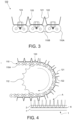
- FIG. 3 shows a detail of a chain 110 carrying rigid elongated elements 121 and 122 that form a plier unit, depicted in a closed configuration.
- the chain is a regular chain comprising links 110Aand 110B.
- Each link 110A carries a rigid trapezium like element 120, which element is bolted to the chain link of the type 110A by using bolt 123.
- the adjacent legs 121 and 122 of two neighbouring trapezium elements together form the jaws of a plier unit.
- the chain links are configured to form an angle of 180°, the adjacent legs are pushed together such that the plier unit is in a closed configuration.
- Figure 4 shows a detail of the chain of figure 3 , with the chain elements being guided over a sprocket 112 to create an open configuration for the plier unit.
- neighbouring chain links are configured under an angle of about 160°, which means that the legs 121 and 122 are no longer in contact and thus, the corresponding plier unit is in an open configuration.
- position A see also figure 2
- the plier units are still in an open configuration and thereby the free distal ends of the yarns of carpet tile 1 will be positioned in the jaws of the plier units.
- each plier unit will close by having the chain links in a 180° arrangement. This way, the yarns are grasped and the first layer is mechanically taken hold of.
- Figure 5 schematically shows in a front/side view a detail of the holding means for taking hold of the second layer.
- a few chain links of chain 115 and two parallel plate elements 130 and 131 connected to this chain link on opposite sides thereof (connection plates not shown).
- the front side of these plate elements 130 and 131 protrudes slightly from the front side of the chain links.
- needles 140 and 141 are provided respectively. These needles are connected to the plate like elements at their upstream end (with regard to the direction of transport T as indicated, see also figure 6 ). These needles are forced into the secondary carrier sheet at a back side of this sheet to mechanically take hold of this sheet.
- Figure 6 shows one of the plate like elements 130 of figure 5 in a side view in its spatial relationship with the second layer being taken hold of. It can be seen that the needle 140 is connected to the plate like element 130 at its upstream end (with respect to transport direction T). The needle is forced into the second layer 7 without extending through a front side of this layer. In this embodiment the needle extends in the layer 7 in a direction parallel to the plane in which the layer 7 extends.
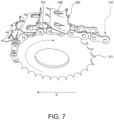
- FIG 7 schematically shows a grasping means for grasping yarns of a loop pile carpet.
- the arrangement of this means is comparable to that of the grasping means for a cut pile as indicated in figure 3 .
- the grasping means comprises an L-shaped plate 155 having grasping pegs 150 and three teeth 151 extending from its horizontal plane.
- the elements 155 are fed towards sprocket 111 (see figure 2 for the complete configuration).
- the teeth 151 When a loop pile carpet is fed underneath the sprocket 112 in the direction X, the teeth 151 are forced to extend (at least partly) through on more loops of the laminated textile product, hence grasping the yarns and thereby mechanically take hold of the first layer (primary carrier plus yarns) of the carpet.
- the teeth 151 hold down the carpet.
- the pegs 150 hold the loops over the teeth 151.
- the present method and system could be applied in situ where carpet or any other textile product is released from its surface to be recycled. It may be that the carpet or other textile product is first cut into appropriate pieces. It is also possible to perform the method on a more industrial scale remote from the actual places where the products have been used. For this, the carpet or other textile products are generally collected, gathered and then subjected to the current process.
- the latter embodiment has the advantage that the system can be adapted more easily to laminated products having large dimensions such as broadloom carpet, staircase runners etc.
Landscapes
- Engineering & Computer Science (AREA)
- Environmental & Geological Engineering (AREA)
- Mechanical Engineering (AREA)
- Carpets (AREA)
Claims (15)
- Verfahren zur Trennung von Schichten (2, 7) eines laminierten Textilprodukts (1), wobei das laminierte Textilprodukt eine erste Schicht (2) mit einem primären Trägerblatt, in das Fäden (4) eingenäht sind, wobei die Fäden einen Flor auf der Vorderseite dieses Blattes bilden, und eine zweite Schicht (7) mit einem sekundären Trägerblatt umfasst, das durch Verwendung einer einen thermoplastischen Klebstoff umfassenden Zwischenschicht (6) mit der Rückseite des primären Trägerblattes wirkverbunden ist, wobei das Verfahren das Erhitzen der Zwischenschicht auf eine Temperatur oberhalb einer Erweichungstemperatur des thermoplastischen Klebstoffes und anschließend mechanisches Greifen nach der ersten Schicht, während gleichzeitig nach der zweiten Schicht gegriffen wird, und das Ausüben von Kräften auf beide Schichten in auseinanderlaufenden Richtungen, um die erste Schicht von der zweiten Schicht zu trennen, umfasst, dadurch gekennzeichnet, dass nach der ersten Schicht gegriffen wird, indem wenigstens ein Teil der Fäden ergriffen wird.
- Verfahren nach Anspruch 1, wobei der Flor längliche Fäden umfasst, die ein freies entferntes Ende aufweisen, die von dem primären Trägerblatt abgewandt sind, dadurch gekennzeichnet, dass die Fäden unter Verwendung von mehreren Zangenvorrichtungen ergriffen werden, wobei jede Vorrichtung zwei getrennte starre längliche Elemente umfasst, die in Bezug zueinander auf eine solche Weise schwenkbar sind, dass sie zwischen einer ersten Anordnung, bei der die Elemente voneinander weg geschwenkt sind, und einer zweiten Anordnung, bei der die Elemente zueinander hin geschwenkt sind, um die Fäden zu ergreifen, angeordnet sind.
- Verfahren nach Anspruch 2, dadurch gekennzeichnet, dass die mehreren Zangenvorrichtungen seitlich dazu ausgelegt sind, eine Reihe zu bilden, die eine der Breite des Textilprodukts entsprechende Länge aufweist.
- Verfahren nach Anspruch 2 oder 3, dadurch gekennzeichnet, dass sich die starren länglichen Elemente an einem endlosen Träger befinden, der in einer Längsrichtung des Textilprodukts bewegt wird, um die starren länglichen Elemente dazu zu zwingen, die erste Anordnung einzunehmen, wenn nicht nach der ersten Schicht gegriffen werden muss, und die starren länglichen Elemente dazu zu zwingen, die zweite Anordnung einzunehmen, wenn nach der ersten Schicht gegriffen werden muss.
- Verfahren nach Anspruch 4, dadurch gekennzeichnet, dass es sich bei dem endlosen Träger um eine Kette handelt, die über ein Zahnrad geleitet wird, wobei jedes zangenähnliche Element dadurch gebildet ist, dass das erste starre längliche Element an einem ersten Kettenglied befestigt ist und das zweite starre längliche Element an einem angrenzenden Kettenglied befestigt ist.
- Verfahren nach Anspruch 1, wobei der Flor Schlingenfäden umfasst und wobei die Schlingen von dem primären Trägerblatt abgewandt sind, dadurch gekennzeichnet, dass die Fäden von mehreren Rasten ergriffen werden, die sich jeweils durch eine oder mehrere Schlingen des laminierten Textilprodukts erstrecken.
- Verfahren nach Anspruch 6, dadurch gekennzeichnet, dass sich die Rasten in eine Richtung erstrecken, die einen Winkel zwischen 0° und 45° zur Ebene des Textilprodukts bildet, wenn sich diese Rasten durch die entsprechende Schlinge erstrecken.
- Verfahren nach einem der vorhergehenden Ansprüche, dadurch gekennzeichnet, dass die Kräfte auf beide Schichten ausgeübt werden, indem bewirkt wird, dass die erste Schicht in einer ersten Richtung transportiert wird, während die zweite Schicht in einer Richtung transportiert wird, die im Wesentlichen senkrecht zu der ersten Richtung verläuft.
- Verfahren nach Anspruch 8, dadurch gekennzeichnet, dass die erste Richtung im Wesentlichen parallel zu der horizontalen Ebene verläuft, während die zweite Richtung im Wesentlichen parallel zur Schwerkraftrichtung und in der gleichen Richtung wie diese verläuft.
- Verfahren nach einem der vorhergehenden Ansprüche, wobei das sekundäre Trägerblatt eine Dicke von wenigstens 1 mm aufweist, dadurch gekennzeichnet, dass mechanisch nach der zweiten Schicht gegriffen wird, indem mehrere nadelähnliche Elemente in das sekundäre Trägerblatt auf einer Rückseite dieses Blattes gezwungen werden, ohne dass sich diese Elemente durch eine Vorderseite dieses Blattes erstrecken.
- Verfahren nach Anspruch 10, dadurch gekennzeichnet, dass sich die nadelähnlichen Elemente in der Schicht in einer Richtung parallel zu der Ebene erstrecken, in der sich das sekundäre Trägerblatt erstreckt.
- Verfahren nach einem der Ansprüche 10 oder 11, wobei das Verfahren das Transportieren des Textilprodukts während der Trennung der Schichten in einer Prozessrichtung umfasst, dadurch gekennzeichnet, dass die nadelähnlichen Elemente in einer Reihe ausgelegt sind, die sich in der Ebene des Textilprodukts und rechtwinklig zu der Prozessrichtung erstreckt.
- Verfahren nach Anspruch 12, dadurch gekennzeichnet, dass nach dem sekundären Blatt gegriffen wird, indem mehrere Reihen von nadelähnlichen Elementen verwendet werden, wobei die Reihen einen Mindestabstand von 50 cm in Bezug zueinander aufweisen.
- System (100) zur Trennung von Schichten (2, 7) eines laminierten Textilprodukts (1), wobei das laminierte Textilprodukt eine erste Schicht (2) mit einem primären Trägerblatt, in das Fäden (4) eingenäht sind, wobei die Fäden einen Flor auf der Vorderseite dieses Blattes bilden, und eine zweite Schicht (7) mit einem sekundären Trägerblatt umfasst, das durch Verwendung einer einen thermoplastischen Klebstoff umfassenden Zwischenschicht (6) mit der Rückseite des primären Trägerblattes wirkverbunden ist, wobei das System eine erste Station (101) umfasst, die ein Heizelement umfasst, wobei die Zwischenschicht auf eine Temperatur oberhalb einer Erweichungstemperatur des thermoplastischen Klebstoffes erhitzt werden kann, und stromabwärts davon eine zweite Station (110, 115) umfasst, die eine Greifstruktur (121, 122) umfasst, um nach der ersten Schicht zu greifen, indem wenigstens ein Teil der Fäden ergriffen wird, sowie eine Haltestruktur (130, 140) umfasst, um nach der zweiten Schicht zu greifen, wobei die Greifstruktur und die Haltestruktur in auseinanderlaufenden Richtung bewegbar sind.
- System nach Anspruch 14, dadurch gekennzeichnet, dass es sich bei dem Heizelement um ein Element handelt, das Mikrowellen erzeugt.
Applications Claiming Priority (2)
| Application Number | Priority Date | Filing Date | Title |
|---|---|---|---|
| EP17166191 | 2017-04-12 | ||
| PCT/EP2018/059409 WO2018189304A1 (en) | 2017-04-12 | 2018-04-12 | Method for separating layers of a laminated textile product and a system to apply this method |
Publications (3)
| Publication Number | Publication Date |
|---|---|
| EP3609705A1 EP3609705A1 (de) | 2020-02-19 |
| EP3609705C0 EP3609705C0 (de) | 2023-11-22 |
| EP3609705B1 true EP3609705B1 (de) | 2023-11-22 |
Family
ID=58548568
Family Applications (1)
| Application Number | Title | Priority Date | Filing Date |
|---|---|---|---|
| EP18718133.4A Active EP3609705B1 (de) | 2017-04-12 | 2018-04-12 | Verfahren zur trennung von schichten eines laminierten textilprodukts und system zur anwendung dieses verfahrens |
Country Status (2)
| Country | Link |
|---|---|
| EP (1) | EP3609705B1 (de) |
| WO (1) | WO2018189304A1 (de) |
Families Citing this family (2)
| Publication number | Priority date | Publication date | Assignee | Title |
|---|---|---|---|---|
| GB201919236D0 (en) * | 2019-12-23 | 2020-02-05 | Toothbrush Club Ltd | A method for recycling consumable items |
| CN114535267B (zh) * | 2022-01-18 | 2024-03-15 | 河南车邦汽车用品制造有限公司 | 一种高效网布与弹性基材剥离回收装置及方法 |
Family Cites Families (5)
| Publication number | Priority date | Publication date | Assignee | Title |
|---|---|---|---|---|
| JP4357939B2 (ja) | 2003-11-20 | 2009-11-04 | 株式会社タジマ | カーペットのリサイクル方法、カーペットの各構成材料を分離回収する方法及びその装置 |
| JP2006000433A (ja) | 2004-06-18 | 2006-01-05 | Michiyo Sato | カーペットからカーペット層(繊維層)と裏打ち層とをそれぞれの原型を維持した分離回収方法及び分離回収した原型をそのままの層として再利用するカーペットのリユース方法。 |
| JP2010069083A (ja) | 2008-09-19 | 2010-04-02 | Suminoe Textile Co Ltd | タイルカーペットの表皮層とバッキング樹脂層の分離方法。 |
| JP2015104439A (ja) | 2013-11-28 | 2015-06-08 | 株式会社資源化研究所 | 使用済みカーペットタイルの再生処理システム |
| KR20170115057A (ko) | 2015-02-09 | 2017-10-16 | 디에스엠 아이피 어셋츠 비.브이. | 적층된 텍스타일 제품의 제조 방법, 이 방법에 사용하기 위한 1차 배킹 및 이 1차 배킹의 제조 방법 |
-
2018
- 2018-04-12 EP EP18718133.4A patent/EP3609705B1/de active Active
- 2018-04-12 WO PCT/EP2018/059409 patent/WO2018189304A1/en not_active Ceased
Also Published As
| Publication number | Publication date |
|---|---|
| EP3609705A1 (de) | 2020-02-19 |
| WO2018189304A1 (en) | 2018-10-18 |
| EP3609705C0 (de) | 2023-11-22 |
Similar Documents
| Publication | Publication Date | Title |
|---|---|---|
| US5891547A (en) | Needle punch nonwoven component for refastenable fastening device | |
| US7115315B2 (en) | Reinforced secondary backing fabric and method of using the same | |
| EP0258015B1 (de) | Spangenverschlusselement mit Befestigungslager aus thermoplastischem Kunststoff | |
| US3859156A (en) | Method for laminating warp and weft of fibrous materials in a wet manner | |
| US20080241476A1 (en) | Asymmetric elastic film nonwoven laminate | |
| PT1838909E (pt) | Um material tecido que compreende trama e urdidura semelhante a fita, e um aparelho e método para tecer a mesma | |
| WO2018189304A1 (en) | Method for separating layers of a laminated textile product and a system to apply this method | |
| US5481786A (en) | Method of manufacturing a recyclable carpet | |
| US20070178273A1 (en) | Embossing loop materials | |
| WO1998052738A1 (en) | Method for the production of a transverse web | |
| EP0708610A4 (de) | Hitzestabilisiertes tuchgewebe | |
| US6827118B2 (en) | Device for the placement and fixing of a sheet of filaments for the production of scrims | |
| US3790426A (en) | Yarn separator | |
| WO2001040563A2 (en) | A tufted pile structure having binder concentrated beneath the backstitches | |
| CN120769799A (zh) | 用于制造复合织物的方法和系统 | |
| JP6011857B2 (ja) | 結束用ベルト | |
| JP7601865B2 (ja) | ポリエステル製輸送用カーペットおよびポリエステル製輸送用カーペットの製造方法 | |
| US3993105A (en) | Method of and a machine for manufacturing nap fabric strip closure devices | |
| NO141856B (no) | D skyttelloes baandvevemaskin for fremstilling av vevnadsbaan | |
| CN105899727A (zh) | 纺织品及其用途、用于生产这种纺织品的方法以及用于回收该产品的方法 | |
| US20240093428A1 (en) | Polyester carpet tile or carpet strip and method for manufacturing a polyester carpet tile or carpet strip | |
| WO2017077043A1 (en) | A method to manufacture a textile product, a use thereof, the product itself, and a device for applying the method | |
| CN110952214B (zh) | 一种加粘粘扣带及其织造工艺 | |
| US7169246B2 (en) | Process and device for the placement and fixing of a sheet of filaments for the production of scrims | |
| GB2108045A (en) | Laminated films |
Legal Events
| Date | Code | Title | Description |
|---|---|---|---|
| STAA | Information on the status of an ep patent application or granted ep patent |
Free format text: STATUS: UNKNOWN |
|
| STAA | Information on the status of an ep patent application or granted ep patent |
Free format text: STATUS: THE INTERNATIONAL PUBLICATION HAS BEEN MADE |
|
| PUAI | Public reference made under article 153(3) epc to a published international application that has entered the european phase |
Free format text: ORIGINAL CODE: 0009012 |
|
| STAA | Information on the status of an ep patent application or granted ep patent |
Free format text: STATUS: REQUEST FOR EXAMINATION WAS MADE |
|
| 17P | Request for examination filed |
Effective date: 20191030 |
|
| AK | Designated contracting states |
Kind code of ref document: A1 Designated state(s): AL AT BE BG CH CY CZ DE DK EE ES FI FR GB GR HR HU IE IS IT LI LT LU LV MC MK MT NL NO PL PT RO RS SE SI SK SM TR |
|
| AX | Request for extension of the european patent |
Extension state: BA ME |
|
| DAV | Request for validation of the european patent (deleted) | ||
| DAX | Request for extension of the european patent (deleted) | ||
| RAP1 | Party data changed (applicant data changed or rights of an application transferred) |
Owner name: COVESTRO (NETHERLANDS) B.V. |
|
| STAA | Information on the status of an ep patent application or granted ep patent |
Free format text: STATUS: EXAMINATION IS IN PROGRESS |
|
| 17Q | First examination report despatched |
Effective date: 20210927 |
|
| RAP3 | Party data changed (applicant data changed or rights of an application transferred) |
Owner name: COVESTRO (NETHERLANDS) B.V. |
|
| GRAP | Despatch of communication of intention to grant a patent |
Free format text: ORIGINAL CODE: EPIDOSNIGR1 |
|
| STAA | Information on the status of an ep patent application or granted ep patent |
Free format text: STATUS: GRANT OF PATENT IS INTENDED |
|
| INTG | Intention to grant announced |
Effective date: 20230621 |
|
| GRAS | Grant fee paid |
Free format text: ORIGINAL CODE: EPIDOSNIGR3 |
|
| GRAA | (expected) grant |
Free format text: ORIGINAL CODE: 0009210 |
|
| STAA | Information on the status of an ep patent application or granted ep patent |
Free format text: STATUS: THE PATENT HAS BEEN GRANTED |
|
| AK | Designated contracting states |
Kind code of ref document: B1 Designated state(s): AL AT BE BG CH CY CZ DE DK EE ES FI FR GB GR HR HU IE IS IT LI LT LU LV MC MK MT NL NO PL PT RO RS SE SI SK SM TR |
|
| REG | Reference to a national code |
Ref country code: GB Ref legal event code: FG4D |
|
| REG | Reference to a national code |
Ref country code: CH Ref legal event code: EP Ref country code: DE Ref legal event code: R096 Ref document number: 602018061400 Country of ref document: DE |
|
| REG | Reference to a national code |
Ref country code: IE Ref legal event code: FG4D |
|
| U01 | Request for unitary effect filed |
Effective date: 20231208 |
|
| U07 | Unitary effect registered |
Designated state(s): AT BE BG DE DK EE FI FR IT LT LU LV MT NL PT SE SI Effective date: 20231214 |
|
| PG25 | Lapsed in a contracting state [announced via postgrant information from national office to epo] |
Ref country code: GR Free format text: LAPSE BECAUSE OF FAILURE TO SUBMIT A TRANSLATION OF THE DESCRIPTION OR TO PAY THE FEE WITHIN THE PRESCRIBED TIME-LIMIT Effective date: 20240223 |
|
| PG25 | Lapsed in a contracting state [announced via postgrant information from national office to epo] |
Ref country code: IS Free format text: LAPSE BECAUSE OF FAILURE TO SUBMIT A TRANSLATION OF THE DESCRIPTION OR TO PAY THE FEE WITHIN THE PRESCRIBED TIME-LIMIT Effective date: 20240322 |
|
| U20 | Renewal fee for the european patent with unitary effect paid |
Year of fee payment: 7 Effective date: 20240320 |
|
| PG25 | Lapsed in a contracting state [announced via postgrant information from national office to epo] |
Ref country code: ES Free format text: LAPSE BECAUSE OF FAILURE TO SUBMIT A TRANSLATION OF THE DESCRIPTION OR TO PAY THE FEE WITHIN THE PRESCRIBED TIME-LIMIT Effective date: 20231122 |
|
| PG25 | Lapsed in a contracting state [announced via postgrant information from national office to epo] |
Ref country code: IS Free format text: LAPSE BECAUSE OF FAILURE TO SUBMIT A TRANSLATION OF THE DESCRIPTION OR TO PAY THE FEE WITHIN THE PRESCRIBED TIME-LIMIT Effective date: 20240322 Ref country code: GR Free format text: LAPSE BECAUSE OF FAILURE TO SUBMIT A TRANSLATION OF THE DESCRIPTION OR TO PAY THE FEE WITHIN THE PRESCRIBED TIME-LIMIT Effective date: 20240223 Ref country code: ES Free format text: LAPSE BECAUSE OF FAILURE TO SUBMIT A TRANSLATION OF THE DESCRIPTION OR TO PAY THE FEE WITHIN THE PRESCRIBED TIME-LIMIT Effective date: 20231122 |
|
| PG25 | Lapsed in a contracting state [announced via postgrant information from national office to epo] |
Ref country code: RS Free format text: LAPSE BECAUSE OF FAILURE TO SUBMIT A TRANSLATION OF THE DESCRIPTION OR TO PAY THE FEE WITHIN THE PRESCRIBED TIME-LIMIT Effective date: 20231122 Ref country code: PL Free format text: LAPSE BECAUSE OF FAILURE TO SUBMIT A TRANSLATION OF THE DESCRIPTION OR TO PAY THE FEE WITHIN THE PRESCRIBED TIME-LIMIT Effective date: 20231122 Ref country code: NO Free format text: LAPSE BECAUSE OF FAILURE TO SUBMIT A TRANSLATION OF THE DESCRIPTION OR TO PAY THE FEE WITHIN THE PRESCRIBED TIME-LIMIT Effective date: 20240222 Ref country code: HR Free format text: LAPSE BECAUSE OF FAILURE TO SUBMIT A TRANSLATION OF THE DESCRIPTION OR TO PAY THE FEE WITHIN THE PRESCRIBED TIME-LIMIT Effective date: 20231122 |
|
| PG25 | Lapsed in a contracting state [announced via postgrant information from national office to epo] |
Ref country code: CZ Free format text: LAPSE BECAUSE OF FAILURE TO SUBMIT A TRANSLATION OF THE DESCRIPTION OR TO PAY THE FEE WITHIN THE PRESCRIBED TIME-LIMIT Effective date: 20231122 |
|
| PG25 | Lapsed in a contracting state [announced via postgrant information from national office to epo] |
Ref country code: SK Free format text: LAPSE BECAUSE OF FAILURE TO SUBMIT A TRANSLATION OF THE DESCRIPTION OR TO PAY THE FEE WITHIN THE PRESCRIBED TIME-LIMIT Effective date: 20231122 |
|
| PG25 | Lapsed in a contracting state [announced via postgrant information from national office to epo] |
Ref country code: SM Free format text: LAPSE BECAUSE OF FAILURE TO SUBMIT A TRANSLATION OF THE DESCRIPTION OR TO PAY THE FEE WITHIN THE PRESCRIBED TIME-LIMIT Effective date: 20231122 Ref country code: SK Free format text: LAPSE BECAUSE OF FAILURE TO SUBMIT A TRANSLATION OF THE DESCRIPTION OR TO PAY THE FEE WITHIN THE PRESCRIBED TIME-LIMIT Effective date: 20231122 Ref country code: RO Free format text: LAPSE BECAUSE OF FAILURE TO SUBMIT A TRANSLATION OF THE DESCRIPTION OR TO PAY THE FEE WITHIN THE PRESCRIBED TIME-LIMIT Effective date: 20231122 Ref country code: CZ Free format text: LAPSE BECAUSE OF FAILURE TO SUBMIT A TRANSLATION OF THE DESCRIPTION OR TO PAY THE FEE WITHIN THE PRESCRIBED TIME-LIMIT Effective date: 20231122 |
|
| REG | Reference to a national code |
Ref country code: DE Ref legal event code: R097 Ref document number: 602018061400 Country of ref document: DE |
|
| PLBE | No opposition filed within time limit |
Free format text: ORIGINAL CODE: 0009261 |
|
| STAA | Information on the status of an ep patent application or granted ep patent |
Free format text: STATUS: NO OPPOSITION FILED WITHIN TIME LIMIT |
|
| 26N | No opposition filed |
Effective date: 20240823 |
|
| PG25 | Lapsed in a contracting state [announced via postgrant information from national office to epo] |
Ref country code: MC Free format text: LAPSE BECAUSE OF FAILURE TO SUBMIT A TRANSLATION OF THE DESCRIPTION OR TO PAY THE FEE WITHIN THE PRESCRIBED TIME-LIMIT Effective date: 20231122 |
|
| PG25 | Lapsed in a contracting state [announced via postgrant information from national office to epo] |
Ref country code: MC Free format text: LAPSE BECAUSE OF FAILURE TO SUBMIT A TRANSLATION OF THE DESCRIPTION OR TO PAY THE FEE WITHIN THE PRESCRIBED TIME-LIMIT Effective date: 20231122 |
|
| REG | Reference to a national code |
Ref country code: CH Ref legal event code: PL |
|
| GBPC | Gb: european patent ceased through non-payment of renewal fee |
Effective date: 20240412 |
|
| PG25 | Lapsed in a contracting state [announced via postgrant information from national office to epo] |
Ref country code: GB Free format text: LAPSE BECAUSE OF NON-PAYMENT OF DUE FEES Effective date: 20240412 |
|
| PG25 | Lapsed in a contracting state [announced via postgrant information from national office to epo] |
Ref country code: GB Free format text: LAPSE BECAUSE OF NON-PAYMENT OF DUE FEES Effective date: 20240412 Ref country code: CH Free format text: LAPSE BECAUSE OF NON-PAYMENT OF DUE FEES Effective date: 20240430 |
|
| PG25 | Lapsed in a contracting state [announced via postgrant information from national office to epo] |
Ref country code: IE Free format text: LAPSE BECAUSE OF NON-PAYMENT OF DUE FEES Effective date: 20240412 |
|
| U1K | Transfer of rights of the unitary patent after the registration of the unitary effect |
Owner name: OBJECT CARPET GMBH; DE |
|
| U1N | Appointed representative for the unitary patent procedure changed after the registration of the unitary effect |
Representative=s name: WITTE, WELLER & PARTNER PATENTANWAELTE MBB; DE |
|
| U20 | Renewal fee for the european patent with unitary effect paid |
Year of fee payment: 8 Effective date: 20250424 |
|
| PG25 | Lapsed in a contracting state [announced via postgrant information from national office to epo] |
Ref country code: CY Free format text: LAPSE BECAUSE OF FAILURE TO SUBMIT A TRANSLATION OF THE DESCRIPTION OR TO PAY THE FEE WITHIN THE PRESCRIBED TIME-LIMIT; INVALID AB INITIO Effective date: 20180412 |
|
| PG25 | Lapsed in a contracting state [announced via postgrant information from national office to epo] |
Ref country code: HU Free format text: LAPSE BECAUSE OF FAILURE TO SUBMIT A TRANSLATION OF THE DESCRIPTION OR TO PAY THE FEE WITHIN THE PRESCRIBED TIME-LIMIT; INVALID AB INITIO Effective date: 20180412 |