EP3608852B1 - Détermination d'une ou d'une pluralité de valeurs caractéristiques ainsi que simulation de la circulation pour un environnement praticable automatique - Google Patents
Détermination d'une ou d'une pluralité de valeurs caractéristiques ainsi que simulation de la circulation pour un environnement praticable automatique Download PDFInfo
- Publication number
- EP3608852B1 EP3608852B1 EP19190343.4A EP19190343A EP3608852B1 EP 3608852 B1 EP3608852 B1 EP 3608852B1 EP 19190343 A EP19190343 A EP 19190343A EP 3608852 B1 EP3608852 B1 EP 3608852B1
- Authority
- EP
- European Patent Office
- Prior art keywords
- simulation
- parameters
- vehicle
- environment
- simulated
- Prior art date
- Legal status (The legal status is an assumption and is not a legal conclusion. Google has not performed a legal analysis and makes no representation as to the accuracy of the status listed.)
- Active
Links
Images


Classifications
-
- G—PHYSICS
- G06—COMPUTING OR CALCULATING; COUNTING
- G06F—ELECTRIC DIGITAL DATA PROCESSING
- G06F30/00—Computer-aided design [CAD]
- G06F30/20—Design optimisation, verification or simulation
-
- G—PHYSICS
- G06—COMPUTING OR CALCULATING; COUNTING
- G06Q—INFORMATION AND COMMUNICATION TECHNOLOGY [ICT] SPECIALLY ADAPTED FOR ADMINISTRATIVE, COMMERCIAL, FINANCIAL, MANAGERIAL OR SUPERVISORY PURPOSES; SYSTEMS OR METHODS SPECIALLY ADAPTED FOR ADMINISTRATIVE, COMMERCIAL, FINANCIAL, MANAGERIAL OR SUPERVISORY PURPOSES, NOT OTHERWISE PROVIDED FOR
- G06Q10/00—Administration; Management
- G06Q10/08—Logistics, e.g. warehousing, loading or distribution; Inventory or stock management
-
- G—PHYSICS
- G05—CONTROLLING; REGULATING
- G05D—SYSTEMS FOR CONTROLLING OR REGULATING NON-ELECTRIC VARIABLES
- G05D1/00—Control of position, course, altitude or attitude of land, water, air or space vehicles, e.g. using automatic pilots
- G05D1/0088—Control of position, course, altitude or attitude of land, water, air or space vehicles, e.g. using automatic pilots characterized by the autonomous decision making process, e.g. artificial intelligence, predefined behaviours
Definitions
- the invention relates to a method for equipping a vehicle with vehicle parameters by determining one or more characteristic values for an environment that vehicles can drive through automatically.
- the invention also relates to a method for simulating traffic for an environment in which vehicles can drive automatically, in particular in or for a method of the type specified above.
- a warehouse can be thought of as an example of such an environment, within which driverless vehicles transport, pick up, set down, rearrange and bring into and out of the warehouse stored goods.
- the transport can be primarily in-plane (preferably horizontal and level, assuming the x-y plane), but can also be vertical (z-direction), such as by means of an automatic forklift or the like.
- Such properties can be comparatively large and have many 1,000 to some 10,000 square meters of floor space.
- Many automatically driving vehicles can be on the road in them.
- conventional human-driven vehicles and pedestrians can also be present.
- Another example is the movement of a robot or robotic arm in an environment.
- the robotic arm is then the vehicle, and the environment includes various other objects, such as a product to be manufactured, a small goods store, another (moving) robotic arm, one or more people, other stationary or moving obstacles and the like.
- FIG. 3 shows a possible constellation in plan view. Assumed is a storage room with a drivable area 36. Drive-through gates are indicated with 37a and 37b. With 38a and 38b doors for people are indicated. Structures 34a, 34b, 34c and 34d are stationary shelves for storing goods. 35 indicates an open storage area, i.e. areas on which goods can be freely deposited and which, depending on the occupancy status, can or cannot be driven on. 39 designates active and/or passive navigation aids, which are used for navigating and orienting the vehicles 32 driving automatically. They can be passive reflectors for optical detection or active sensors that can detect the environment in two or three dimensions and can transmit their detection results to a central computer 30 wirelessly or by wire.
- This computer 30 is in turn connected to the automatically driving vehicles 32 .
- the communication between navigation aids 39 and automatic vehicles 32 can also take place wirelessly.
- Passive navigational aids can be attached to obstacles (e.g. on shelves 34) or can also be trafficable markings on the ground.
- 3 shows four automatically driving vehicles 32a, 32b, 32c and 32d.
- Designated at 33 is a vehicle conventionally driven by a human, such as a forklift truck or a bicycle or the like.
- a human such as a forklift truck or a bicycle or the like.
- 31a-c people who can stay in the camp are marked with 31a-c.
- the automatically driving vehicles 32 bring goods from the outside into the warehouse and place them there on a shelf 34 or on the open space 35, and/or pick up goods from there and take them out of the warehouse, and/or carry out rearrangements within the warehouse or simple transits.
- the vehicles 32 are equipped with various sensors and other control devices. 4 shows this systematically.
- a central controller is indicated there by 43, which receives signals from sensors 46a, 46b and transmits them to actuators 44, 45.
- the controller 43 is connected to a wireless communication link 47 by means of which it can communicate with other vehicles or with a central computer 30 .
- the actuators can have the vehicle drive 44 and/or brakes 45 and/or steering and the like.
- the sensor system can have internal sensors (speed sensor, acceleration sensor, ...) and environment sensors that can scan and record the environment around the vehicle in two or three dimensions.
- the described environmental sensor system can be a spatially resolving distance sensor system that makes it possible to detect the environment using LIDAR (Light Detection and Ranging) or LADAR (Laser Detection and Ranging) or with RADAR to the extent that the spatial resolution of this sensor system can be comparatively fine and be in the range of a centimeter or less centimetres.
- LIDAR Light Detection and Ranging
- LADAR Laser Detection and Ranging
- RADAR Radio Detection and Ranging
- a plurality of these surroundings sensors are usually provided in order to be able to completely detect the surroundings of the vehicle on the one hand and to have redundancies in the event that one of the sensors fails and for cross checks on the other hand.
- Automatic driving in an environment takes place with reference to an electronically usable representation of the environment, which represents the environment in a spatially resolved or spatially resolved manner.
- a representation is also referred to below as a "card” or "electronic card”.
- To the situation of 3 such an environment representation/map/electronic map could at least save the floor plan of the room, the shelves 34 in it, the positions of the gates 37 and doors 38 and, if applicable, also the positions of the navigation aids 39.
- the local resolution of the map corresponds to the needs and can be in the centimeter or millimeter range.
- the surroundings of a robot arm can also be mapped as described.
- an initial state or an instantaneous state in the environment to be simulated can be taken and further calculated recursively/iteratively in many discrete-time steps.
- the current state can be described on the one hand by the electronic map and on the other hand by data describing the behavior of mobile objects and other objects in the environment. Namely, for each automated vehicle 32, guided vehicle 33, and pedestrian 31, there may be data tuples of position and orientation, linear velocity, angular velocity, linear acceleration, angular acceleration, size, and other data.
- a given situation can be further calculated into a final state after a certain period of time, whereby such a period of time can be comparatively short, about one second or one or more tenths of a second or even shorter.
- the simulation can be carried out iteratively, that is to the extent that a calculated final state is taken as the new initial state and calculations are continued from there until an internal or external termination criterion for the simulation is present.
- simulated interventions can occur, for example by changing simulated steering angles or by simulated detections indicating an approach to another object that requires intervention.
- the simulation captures the normal physical dynamics of moving bodies on the one hand, but also interventions that are necessary to carry out orders and to ensure the safety of automated driving on the other.
- the simulation also includes safety-relevant aspects such as collision prevention and thus also sensor simulation, actuator simulation and the like. All this, in turn, depends on various parameters.
- Robotic Forklifts by Kelen et al in ICIT 2010, pages 1465 to 1467 , describes the positioning and route planning of forklift trucks driving autonomously in a warehouse. The best solution of a routing algorithm is simulated.
- the object of the invention is to specify a method and a device for determining one or more characteristic values for an environment that can be driven on automatically, which enable the rapid and verifiable determination of such characteristic values in order to equip a vehicle with vehicle parameters.
- a method for determining one or more characteristic values of an environment that can be driven on automatically has the features of claim 1.
- An electronic card is first provided.
- parameters are provided that describe properties of vehicles to be simulated and summary properties of the total traffic to be simulated in the area to be simulated.
- the traffic in the area is simulated with reference to the map and the parameters.
- events of interest are captured and counted.
- the desired characteristic value(s), which is last stored and/or output, is/are determined on the basis of the counting results.
- the characteristic values determined are driving parameters for vehicles, such as parameter definitions such as e.g. B. protective and warning field definitions or hardware equipment of a vehicle, and / or changes to the electronic card, which can be understood as a suggestion to change the real environment.
- the parameters can also be an environmental rating.
- One way of determining characteristic values can be to generate, if necessary, location-resolving evaluation numbers that describe the environment, in order to have a characteristic for the environment. Counts alone may be sufficient for this. However, relative or related values can also be generated, such as the values mentioned related to a (simulated) year and a vehicle. If, for example, ten years of operation with 100 vehicles (i.e. 1,000 vehicle years) were simulated and three personal injuries were recorded, this leads to a key figure of 0.003 personal injuries per vehicle and year.
- the characteristic values for describing the environment that can be driven on automatically are then a data tuple of a plurality of numbers, which preferably represent relative characteristic values and which provide an absolutely usable and relatively easily comparable indication of the environmental properties thus represented.
- the simulation can be a discrete-time, step-by-step simulation of the motion of each object, including automated vehicles, driver-controlled vehicles, and pedestrians.
- the timing increment on the time axis
- the "acceleration" of the simulated traffic compared to real traffic depends heavily on the computer power involved and the size of the environment to be simulated or the number of vehicles/people to be simulated. However, it can be assumed that, for example, the simulation can be accelerated by a factor of 100,000 compared to reality. This means that a real day (of 86,400 seconds) can be simulated in less than a second and that, for example, a whole year of traffic can be simulated in around five minutes. Ten years of traffic can then be simulated in less than an hour. Statistically significant values can then be generated over such a long simulated period, namely in the simulation initially counted values of events of interest.
- Automated driving in the sense of this description can mean that a vehicle is driven by remote control, i.e. it receives its commands relating to the dynamics (brake, accelerate, steer, keep moving constantly, ...) from a remote location (e.g. central control). , preferably wirelessly and according to data that describe the current situation in the traveled environment in real time. This data may have been collected and forwarded by the vehicle itself and/or come from other data sources. It can also mean that a vehicle drives autonomously, i.e. drives to a destination independently and generates the commands required for this, relating to the dynamics, itself in accordance with the data mentioned. Automated driving can also be a hybrid of remote-controlled and autonomous driving. It can be leaderless or with a supervising person.
- Types can be, for example, unhindered traffic, slow-moving traffic, traffic jams, critical situations without damage, property damage, personal injury, protective field violation, warning field violation, the occurrence of pinch points, plan creation, plan changes and the like.
- Pinch points are locations where the distance between any part of the vehicle and a surrounding object is less than a certain predefined minimum (about 40 cm or 30 cm) such that if a person were there, a crushing situation would likely occur. They can be monitored in addition to and independently of protective and warning fields and counted as an event of interest when they occur.
- Unrestricted, slow-moving traffic or traffic jams can be differentiated using speed ranges, for example.
- the counting of events of interest can be event-controlled (e.g. when a simulated collision is detected as damage to property) or time-controlled (e.g. once per second) or route-controlled (e.g. once per meter) or also position-controlled.
- the events of interest are recorded in the simulation by suitable evaluation algorithms evaluating the respective data of the simulated movements.
- the counts are then incremented separately for each type of event of interest. Naturally, they can reach significantly different meter readings (unobstructed traffic high, slow-moving traffic, traffic jams less high, order creation high according to traffic volume, order change low, critical situation/near damage, vehicle damage, personal injury low).
- the counted values can then be further processed into the desired characteristic values or can serve as a termination criterion for a simulation and/or can be used to evaluate one or more parameters of the simulation.
- Vehicle parameters may include vehicle equipment parameters and vehicle dynamics parameters. All of these parameters go into the simulation by simulating their effects on vehicle motion.
- the equipment parameters of a vehicle can include sensor properties, possibly with associated error probabilities, in particular redundancy of the sensors and spatial resolution of the sensors, actuator properties, possibly with associated error probabilities, in particular steering behavior, braking behavior, acceleration behavior, control properties, optionally with associated error probability, in particular redundancy of the control, error frequency, Communication properties, possibly with associated error probabilities, in particular redundancy of the equipment, connection stability, connection quality, connection speed.
- sensor properties possibly with associated error probabilities, in particular redundancy of the sensors and spatial resolution of the sensors
- actuator properties possibly with associated error probabilities, in particular steering behavior, braking behavior, acceleration behavior, control properties, optionally with associated error probability, in particular redundancy of the control, error frequency
- Communication properties possibly with associated error probabilities, in particular redundancy of the equipment, connection stability, connection quality, connection speed.
- the breakdown of communication with other vehicles or with a central controller can lead to a (simulated) slowdown or change of plan or the like, for example to simulate fail-safe behavior.
- control errors can, for example
- Dynamic parameters of a vehicle can be set maximum speed values, set maximum acceleration values (both positive and negative - braking), distance values to moving and immovable objects while driving, and protective and warning fields.
- Driver-guided vehicles and pedestrians/cyclists can also be included in the simulation by means of suitable parameters (each, for example, with a specific frequency, specific typical/atypical start and end points or trajectories in between).
- the summary traffic parameters of the traffic to be simulated can include one or more of the following parameters: include types and respective number of automatically driving vehicles including statistical fluctuations and determined fluctuations (e.g. depending on the time of day), number of non-automatically driving vehicles (i.e. driver-guided vehicles ) and/or pedestrians in the area, again possibly with statistical and determined (e.g. time-of-day-dependent) fluctuations, preferred directions and/or preferred paths and/or preferred locations of the vehicles and/or pedestrians, again possibly with static and determined fluctuations, operating error probabilities (e.g. falling Goods), Map error probabilities, equipment of the area with active and/or passive navigation aids.
- statistical fluctuations and determined fluctuations e.g. depending on the time of day
- number of non-automatically driving vehicles i.e. driver-guided vehicles
- pedestrians in the area again possibly with statistical and determined (e.g. time-of-day-dependent) fluctuations, preferred directions and/or preferred paths and/or preferred locations of the vehicles and/or pedestrians, again possibly with static and determined fluctuations
- the parameters mentioned above can be included in the simulation, then generate individual simulated traffic and then lead to influencing the behavior of the dynamic objects (vehicles, pedestrians). This in turn can lead to the occurrence of said events of interest, which can then be counted and thus quantified.
- At least parts of the summary traffic parameters mentioned for the traffic to be simulated are set according to real observations or real target specifications for the real, mapped and then simulated environment.
- Such real parameters can be vehicle types and their respective parameters, number of the respective vehicles, possibly also fluctuating over time as mentioned, preferred paths (paths traveled often) and/or locations traveled to often, paths rarely traveled to, rarely traveled to locations.
- the simulation is set up in such a way that these real-world aligned parameters are met/realised, so that the simulation result corresponds well to real conditions.
- the simulation can also be macroscopically iterative in such a way that after a first part of the simulation has been carried out, input variables (parameters) relevant to the simulation are changed and a further part of the simulation is carried out on the basis of the changed variables. Events of interest are then counted separately for the simulation parts. The counter values belonging to the respective simulation parts are saved. The parameters on which the respective simulations are based are also stored in an assignable manner.
- a typical scenario can be something like the following: A simulation is run over a simulated year with a first set of parameters. This shows a comparatively high counter value for critical situations. Safety-relevant parameters are then changed, such as maximum speeds, distances, Protective fields, warning fields and the like. A simulation is run again on the basis of the changed parameter set.
- the parameter sets can be changed automatically according to predefined strategies or via another input device which, for. B. allows manual user intervention. In this respect, an input device can be provided to accept changed parameters or to cause given parameters to be changed.
- the repeated running of simulations with changed parameters can be carried out several times, and in this way several sets of counter values can arise. It is therefore possible for each part of the simulation to determine its own count values and characteristic values, and the parameters on which a suitable simulation is based can be selected as suitable.
- vehicle parameters that were used to simulate the movement of a vehicle during the simulation can then actually be used to equip and/or control the real vehicles in the real environment. This can be done for those vehicle parameters for which the resulting counts prove appropriate.
- the relevant simulation parameters can then be taken as the characteristic values for the environment automatically passable by vehicles.
- the permitted area for free storage 35 can also be changed. If a simulation run on the basis of the electronic map thus changed gives satisfactory count values, the map change thus checked can be taken as an index of the automatically vehicularable environment and understood as a suggestion for changing the real topology.
- counts can be viewed as to whether they are below or above a given threshold and, if appropriate, whether they are statistically significant. If several counts are collected for different types of events of interest, they can be considered or calculated selectively and/or weighted. In particular, counter values for critical situations and/or cases of damage (personal injury, damage to property) can be used as the sole assessment criteria and/or with high weighting become. As already explained, instead of considering the pure count values, derived values can also be considered during these checks, such as related/relative values, for example based on a standard period (e.g. year) or based on a vehicle or based on a location or similar.
- the characteristic values for an environment in which vehicles can drive automatically are thus determined with reference to the counting result for the events of interest during the simulation (possibly several types of events of interest with respective counting values).
- it can be the count values themselves or values derived from them, such as the related variables already mentioned.
- the characteristics may be parameters based on which a simulation has been run with satisfactory counts, which parameters can then be used for actual vehicle control.
- the characteristics can be map changes, which can be understood as suggestions for changes in the surrounding topology.
- Simulation results are saved.
- the data belonging to one another in particular simulation parameters and counter values, are stored so that they can be assigned to one another.
- the individual simulation steps themselves can also be saved for later or other parallel evaluation.
- the storage takes place in such a way that data belonging to one another (in particular data from a simulation part) are stored in a way that they can be assigned to one another.
- the simulation itself (simulation of the movement of the moving objects) can be carried out by one computer or by several networked computers. Capturing and counting of events of interest can be done by the same (simulating) computers or by other computers which then access outputs or stored values generated by the simulating computers.
- a simulation or part of a simulation can be aborted if either certain counted values (in particular critical counted values—critical situations or cases of damage) exceed or fall below certain limits in absolute or relative terms. It can also be aborted if, after a specified simulated period of time, no numbers of statistical significance arise for the counts of interest.
- the repeated execution of individual simulations i.e. carrying out several simulation parts
- events of interest can be captured and counted for just a single vehicle. However, they can also be counted for several vehicles for each vehicle individually or cumulatively across this vehicle group. They can also be counted individually for all vehicles or cumulatively for all simulated vehicles.
- the counting of events of interest and/or the determination of characteristic values can also take place in a location-resolving manner. This can be a count that is made in parallel with other counts (e.g. vehicle-related or cumulative). For example, a (virtual) grid of a suitable size (e.g. square with a grid constant of 0.5 m) can be laid over the electronic map and then events of interest (e.g. property damage, personal injury, traffic jams, viscous flow) can be counted for each resulting tile. In this way, spatially resolved information on the quality and safety of the traffic flow is generated in the respective area tiles under consideration. The totality of the resulting spatially resolved information (possibly again as absolute counted values or relative/related as described above) can also be understood as characteristic values for the environment that vehicles can drive on automatically.
- events of interest e.g. property damage, personal injury, traffic jams, viscous flow
- Simulating traffic may include, in a priori passable areas (36 in 3 ) temporary obstacles/static objects arise, such as vehicles queuing up or vehicles that have broken down/defective or objects that have been stored in a planned manner (e.g. in Freilager 35 or objects protruding from the shelf).
- the simulation can include generating further simulated objects that are included in the simulation. Such generated objects can be included in the simulation with their size and their position and orientation together with speed 0. On the other hand, if a dropped object has been removed, the associated simulated object can be removed from the simulation.
- the invention can contribute to the rapid definition of the fleet parameters of the vehicle fleet in an environment to be driven through automatically.
- the situation regularly arises that, for example, a warehouse needs to be equipped with a new transport system or parts thereof, for example new transport vehicles, precisely when switching from conventional operation with driver-controlled vehicles to automatic operation, preferably with driverless vehicles. It can then vehicle parameters are set and simulated in a simulation part and varied in the following simulation parts. Really observed parameters for the real prevailing traffic can also be determined and used in a simulation part.
- the effect of the variants on the event-of-interest counts is a measure of the quality of the (changed) parameter.
- parameters can be varied and their impact on the overall system can be evaluated. Appropriate parameters can then become the basis of a real implementation.
- a device for determining one or more characteristic values for an environment that can be driven on automatically by vehicles has an interface to a location-resolving, electronically usable representation of the environment, a memory for storing parameters that describe the properties of vehicles and the traffic in the environment, a simulation device for simulating the traffic in the environment referring to the electronically usable representation of the environment and referring to the provided parameters, a detection and counting device for detecting events of interest and counting them in the simulation, a determining means for determining the characteristic values referring to the counting result, and an output and storage device for outputting and/or storing the characteristic value.
- a device which is designed to carry out the specified method and has a computer or a computer network and suitable connection, input, output and storage devices.
- the features described above should also be understood as applicable to and for the movement of a robot or robot arm as a vehicle in its environment.
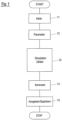
- step 11 shows a schematic of the method for determining one or more characteristic values for an environment that vehicles can drive on automatically.
- an electronically usable representation of the environment is called up by the simulating components (computer, computer network) or access to it is established. This may include taking a copy of the associated data.
- parameters are provided on the basis of which the simulation to be carried out is to be carried out.
- the parameters may include vehicle parameters and traffic parameters. Both can be based on real parameters or actually observed variables or reflect them.
- the provision can be made by creating/entering and/or retrieving and, if necessary, modifying stored variables.
- the simulation may include simulated use of the mapped environment.
- Typical uses can be simulated by recursively calculating them along the time axis, preferably in a time-discrete manner.
- the calculation can include the assumption of an initial state, the continuation of the same in a final state after a certain time step according to relevant parameters, the evaluation of the final state, the assumption of the final state as a new initial state and then the continuation is repeated.
- the time step can be short, e.g. B. less than 1 second, z. B. 0.2 seconds.
- the simulation includes filling the virtual mapped environment with virtual traffic, which can be recursively calculated as just described.
- the virtual traffic can include a number (many) virtual journeys of a number (many) virtual vehicles (including pedestrians, bicycles, ...), with a journey as a movement between the start and end point, possibly via one or more waypoints, possibly including stopping points and stopping times can be defined in the virtual environment.
- the specific route (trajectory) of the journey can also take place in the simulation along a predetermined path or can be decided ad hoc by a suitable (preferably one actually used) navigation algorithm that is also simulated.
- the parameters that describe summary properties of the traffic to be simulated in the area can correspond qualitatively (in terms of their type) and possibly also quantitatively to the real parameters or can be qualitatively and/or quantitatively changed compared to them.
- the real parameters describing reality are defined, ascertained and edited electronically, for example stored in a database, they serve as a basis for ascertaining the parameters that describe the summary properties of the traffic to be simulated in the area, and these serve in turn, the generation of the concrete simulated traffic during the concrete simulation by simulating uses, in particular journeys (also driver-guided) and pedestrians, in such a way that in the long term the simulated traffic shows the same or sufficiently similar parameters to those that were actually determined.
- the adjustment of the simulated traffic to the real traffic can be done, for example.
- B. for start, end and stop points including stop times are generated and then simulated/calculated.
- a small set of travel orders can be generated that conforms to the statistical parameters and is then used multiple times until the desired total number is reached.
- Changes to the orders can be made in the repetitions, which are randomly or quasi-randomly controlled around the set values.
- the start times of journeys according to travel orders can also be varied.
- step 13 the use/driving of the environment that can be driven on automatically is simulated.
- This may include "populating" the environment with the desired simulated traffic and the aforementioned iteration/recursion with many loops.
- the simulation includes setting individual virtual trips and movements, which can be defined as above, into the virtual situation and simulating the movement of the automatically navigating vehicles, as well as simulating the movement of other dynamic objects, such as pedestrians, cyclists and driver-controlled vehicles.
- the journeys and movements can be generated according to the deviation of the parameters of the simulated traffic from the real parameters in order to lead the former to the latter.
- the dynamic objects are not simulated individually in relation to the mapped environment, but also in relation to each other in order to be able to simulate effects such as traffic jams, right of way, errors, etc.
- the simulation can also include temporary static objects, such as a broken down vehicle or a parked object.
- the aim of the simulation can also be to simulate parameters that are modified compared to reality. This can affect vehicle parameters and/or traffic parameters.
- a modification algorithm can be provided here, which, according to predetermined criteria, modifies vehicle parameters and/or parameters into summary properties of the virtual traffic, which are then used as a basis for the following simulation part. For example, the traffic density (trips/movements per time) or the maximum speed of vehicles can be modified and these modified summary properties of the virtual traffic can be used as a basis for further simulation.
- the simulation also includes checking termination criteria of a simulation (of a simulation part) or a sequence of simulation parts.
- Abort criteria can be counter values and/or time values (simulated time).
- the characteristic values are determined by reference to the counting results when counting the events of interest.
- the counted values can be used directly (possibly selectively) or relative to a reference variable, or simulation parameters or values derived from them can be used as characteristic values, and the counted values serve as a criterion for stopping a simulation /a Simulation part or as an evaluation of the respective parameters used as characteristic values.
- step 14 parameters that were provided in step 12 can be taken as the desired characteristic values, or parameters other than the desired characteristic values can be determined based on the parameters provided in step 12 .
- counter values can be generated separately for each part and, if necessary, characteristic values can also be determined with reference to them. There are then several sets of count values and, if necessary, characteristic values, from which e.g. B. finally a suitable one, for example based on the count values, can be selected.
- step 15 the characteristic values are output and/or stored.
- the output can be an output to a storage device or to a display device, or it can also be the sending of specific data over a network.
- FIG 2 shows an embodiment of 1 .
- it shows an embodiment of the simulation to be carried out in step 13 of FIG 1 .
- a first recursive/iterative simulation part 21 is carried out, which in itself is a complete simulation. If a termination criterion (not shown) occurs, the simulation is terminated. It also stops detecting and counting the events of interest.
- step 22 It is then checked in step 22 whether a further part of the simulation should be carried out or not.
- This can be understood as a termination criterion for the overall simulation (consisting of several partial simulations). If the decision is "yes” here, the characteristic value determination in step 14 is continued. On the other hand, if the decision is "No", parameters can be changed in step 23 (particularly those previously obtained in step 12) and/or map data can be altered (particularly those previously obtained in step 11). With reference to parameters and/or map data changed in this way, a further simulation part 21 can be carried out, for which events of interest are recorded and counted separately. If a termination criterion (not shown) is reached here again, counter values and possibly other data that can be assigned to this simulation part are stored again, and it is checked again in step 22 whether a further simulation part is to be carried out.
- the termination decision in step 22 can be made with reference to the count values in the previous simulation part 21 or can be made on the basis of predetermined criteria. It can also be made according to data on an input device.
- 3 shows the topology to be simulated already described at the beginning. At least its fixed components are represented by an electronically usable representation.
- a stationary computer is shown at 30, which can be provided in the sense of a server and which is suitably connected to the necessary system components (other computers, vehicles, stationary sensors, etc.), either wired or wirelessly to the vehicles 32 (WLAN/WIFI, NFC , DECT, Bluetooth or similar).
- the system architecture can be a server-client structure or a peer-to-peer structure or a mixed form.
- the structure of the actually existing system including its real consequences (communication and its failure or delay, component errors, etc.) are also simulated in steps 13 and 21.
- FIG. 1 schematically shows an automatically navigating vehicle 32 in plan view. 42 are its wheels, 41 is the vehicle body. It is assumed that (in any case currently) in figure 5 at the top in the direction of travel.
- one or more protective fields 51 or warning fields 52, 53 can be defined relative to the vehicle, which are monitored (preferably inside the vehicle). In particular, it is monitored whether planned or unplanned objects are detected in one of the protective or warning fields. Depending on the recording result, different measures can be taken.
- Sensors 46 are used to scan the surroundings in two dimensions (usually in a plane) or three dimensions (sphere or hemisphere) with angle and distance resolution and to check for the presence of objects. These can be the already mentioned LIDAR, LADAR or RADAR sensors. But it can also be stereoscopic image processing sensors or the like. Finally, it is also conceivable that the detection of the surroundings, including the protective and warning fields 51, 52, 53 defined relative to a vehicle, are monitored from the outside (stationary sensors 39). The sensors shown can be redundant or can complement each other, for example cover different spatial areas (with little overlap).
- FIG 5 shows an example in which three nested protection zones 51, 52, 53 are defined relative to the vehicle 32.
- the inner zone 51 is a protective field
- 52 and 53 are warning fields. These are the data-technical definitions of virtual areas that are used for the check. Viewed in the direction of travel, the zones extend to different extents. In the example shown, they are shown as being approximately defined as rectangular. They can then be defined, for example, by corner points 51a, 51b, 51c and 51d of the protective field 51, with the edges defined in this way defining the protective field. The same applies to the more extensive warning fields 52 and 53.
- the vehicles to be simulated in the simulations described have protective field and warning field definitions like real vehicles. They are simulated together with their review and evaluation and the consequences drawn. Depending on the detection result of the sensors 46 together with the subsequent evaluation, results can be that an object was not detected in any of the protective/warning fields or that in one of the warning fields (about 53), or in several (52, i.e. also in 53). object was detected. This doesn't have to be wrong. When approaching a shelf, the vehicle 32 may deliberately push the smaller warning field 52 onto the shelf location. In this respect, the checking of the warning fields 52, 53 includes whether the detection of the presence of an object is planned or not. The simulation also includes this. The occurrence of pinch points, as described above, can also be monitored and counted in the simulation.
- the definition of the protective and warning fields can be part of the parameters that are provided in step 12 of the figure for the simulation to be carried out.
- the setting of protective field definitions can be the subject of the parameter change in step 23 of 2 be.
- Protective and warning field definitions that were used in a simulation or in a simulation part can be the subject of the characteristic value determination in step 14.
- protective and warning field definitions e.g. corner coordinates as in figure 5 shown
- corner coordinates as in figure 5 shown
- Planned and/or unplanned violations of protective and warning fields 51 - 53 can be defined as events of interest and counted, possibly separately for different protective/warning fields.
- protective and warning fields for automatically navigating vehicles has so far been carried out manually and is a complex and time-consuming task that has so far been carried out based on empirical values.
- a parameter set that has been recognized as suitable after a simulation or part of a simulation can be used for real vehicles, so that the generation of protective and warning field definitions is significantly accelerated.
- the system design can be such that protective and warning field definitions are recognized as suitable in the simulation were brought into a suitable data formatting (if they are not already in this formatting) in order to be usable in real vehicles, and may further include that the data formatted in this way is sent to suitable recipients, such as a specific server and/or the real vehicles to those that have been simulated and then used there.
- other equipment parameters of the vehicle can be determined as the desired characteristic values (and possibly set beforehand as simulation parameters), such as control parameters such as maximum speeds and accelerations, hardware parameters such as sensor quality (resolution), sensor number and sensor redundancy, and the like .
- step 14 characteristic values determined in step 14 are stored, possibly also map data obtained in step 11 and/or parameter data obtained in step 12 and possibly also individual steps of a simulation or part of a simulation.
- the traffic to be simulated in the environment under consideration can be generated based on real observations. Relevant here is the number of vehicles and people in the area, their frequency of use, trajectories, errors and the like. Simulated orders can be generated for traffic simulation, which in turn lead to simulated journeys.
- the simulated orders can be taken from a catalog of sample simulation orders. If necessary, they can be varied statistically. According to the simulated orders, trips to complete the orders in the area are then simulated.
- a simulated journey can cover a route of an automatically navigable vehicle from the entrance of the vehicle to encompass the observed environment up to the exit of the vehicle from the environment.
- the simulated orders or trips are set in such a way that empirically determined values or predicted values are adhered to.
- the simulation includes not only the simulation of the automatically navigating vehicles, but also the simulation of driver-guided vehicles and people. The latter are also introduced into the simulation as realistically as possible.
- the generation and/or modification of a virtual order can also be an event of interest to be counted, since these characterize the traffic.
- An order change can result from traffic jams or the inaccessibility of certain surrounding areas. Such plan changes can also be understood and counted as an event of interest.
- Fig. 12 shows schematically the detection of events of interest and the counting of them. It is assumed that n different types of events of interest (“Evl”) are checked, i.e. Evl1, EvI2, ... Evln. These events are checked one at a time in a series of queries 61a, 61b, ... 61n. Each individual check can be preceded by more complex evaluations, such as vehicle-person or vehicle-object collision check, protection/warning field violation, speed check and the like.
- a separate counter Z is kept for each type of event of interest (thus in steps 62a, 62b, . . . 62n counters Z 1 , Z 2 , . . . Z n ). If the respectively assigned event was recognized ("Yes" in query 61), the associated counter is incremented in step 62. When all events of interest have been retrieved, the presented method ends.
- the procedure of 6 can be carried out after each individual simulation step or after several individual simulation steps (e.g. simulates every second). Since the presence of one event of interest does not necessarily preclude another, to the extent that non-exclusion occurs, the flow is returned to the query flow after incrementing a counter. Otherwise, excluded queries can be skipped or skipped to the end of the procedure. Accordingly, if only one type of events of interest is defined, the method has only one query.
- a further query 63 can be made for a termination criterion. It is different from the query 22 in 2 . The latter asks whether another simulation is to be carried out or not, while query 63 in 6 Checks whether a specific currently running simulation (simulation part) is to be aborted.
- the query 63 can, for example, evaluate the different meter readings and/or can look at simulated or real runtimes of the simulation. If one of these criteria results in a simulation being aborted, the specific simulation is aborted and ended administratively (step 64, such as data storage and the like). Thereafter, to step 22 of 2 to be jumped. If, on the other hand, the simulation is not to be aborted ("No" in 63), the simulation is continued with a further simulation step.
- a device 70 for carrying out the method is in figure 7 shown schematically. It may have a computer or computer network (not shown) that performs and implements the necessary steps.
- connections or interfaces 73 to the necessary data sources (e.g. device 78 with interface 73a with map data) if they are not available internally, and can also have input devices, e.g. B. keyboard 74 with interface 73d or external memory connection 75 with interface 73b for external inputs, such as for the parameter sets.
- a screen 76 with interface 73e can be provided.
- the simulation itself and the recording and counting of events of interest and the determination of the characteristic values can take place in one or more devices 71 (processing units).
- the device can also have wired or wireless interfaces 73e, 73f for obtaining or outputting data via networks, such as the Internet 77.
- It has an internal memory 72 with different areas (fixed, volatile, data, programs).
- the internal connections are made with a bus 79 or the like, as far as an individual computer is concerned, otherwise (not shown) for example via LAN or wLAN or the like.
Landscapes
- Engineering & Computer Science (AREA)
- Physics & Mathematics (AREA)
- Business, Economics & Management (AREA)
- General Physics & Mathematics (AREA)
- Theoretical Computer Science (AREA)
- Evolutionary Computation (AREA)
- Economics (AREA)
- Game Theory and Decision Science (AREA)
- Health & Medical Sciences (AREA)
- Automation & Control Theory (AREA)
- Remote Sensing (AREA)
- Radar, Positioning & Navigation (AREA)
- Aviation & Aerospace Engineering (AREA)
- Medical Informatics (AREA)
- Artificial Intelligence (AREA)
- General Engineering & Computer Science (AREA)
- Computer Hardware Design (AREA)
- Geometry (AREA)
- Marketing (AREA)
- Quality & Reliability (AREA)
- Human Resources & Organizations (AREA)
- Development Economics (AREA)
- Entrepreneurship & Innovation (AREA)
- General Business, Economics & Management (AREA)
- Operations Research (AREA)
- Tourism & Hospitality (AREA)
- Strategic Management (AREA)
- Traffic Control Systems (AREA)
- Management, Administration, Business Operations System, And Electronic Commerce (AREA)
Claims (13)
- Procédé pour équiper un véhicule avec des paramètres de véhicule, comprenant une première étape de détermination d'une ou de plusieurs valeurs caractéristiques pour un environnement pouvant être parcouru automatiquement par des véhicules, comprenant les étapes suivantes qui sont toutes effectuées dans un dispositif conçu à cet effet et qui consistent à :• fournir (11) une représentation de l'environnement à résolution spatiale et exploitable électroniquement,• fournir (12) des paramètres qui décrivent les propriétés de véhicules et les propriétés sommaires du trafic à simuler dans l'environnement, les paramètres incluant la définition (51a-d) d'un ou de plusieurs champs de protection et/ou d'avertissement (51, 52, 53) autour du véhicule,• simuler (13) le trafic dans l'environnement en se référant à la représentation exploitable électroniquement de l'environnement et en se référant aux paramètres fournis,• lors de la simulation, détecter (61a-n) des événements d'intérêt et les compter (62a-n),• déterminer (14) la ou les valeurs caractéristiques en se référant au résultat du comptage, et• émettre et/ou stocker (15) la ou les valeurs caractéristiques,dans lequella ou les valeurs caractéristiques incluent un ou plusieurs paramètres d'un véhicule circulant automatiquement dans l'environnement, qui sont définis en se référant aux valeurs de comptage, pour lequel plusieurs types d'événements d'intérêt sont définis et le comptage des événements d'intérêt s'effectue séparément pour chacun desdits types, les événements d'intérêt incluant au moins des violations du champ de protection et/ou d'avertissement,un champ d'avertissement est une zone de l'environnement simulé du véhicule, qui est définie par rapport au véhicule simulé, et une violation du champ d'avertissement est la présence imprévue, simulée, reconnue lors de la simulation, d'un objet simulé dans le champ d'avertissement,et les paramètres de véhicule fournis pour la simulation et pris en compte lors de la simulation incluent∘ des propriétés de capteur d'un capteur du véhicule, le cas échéant avec des probabilités d'erreur de capteur, et/ou∘ des propriétés d'actionneur d'un actionneur du véhicule, le cas échéant avec des probabilités d'erreur d'actionneur, et/ou∘ des propriétés de commande d'une commande de véhicule, le cas échéant avec des probabilités d'erreur de commande,et dans lequel, après une première partie de simulation avec un premier jeu de paramètres, ses valeurs de comptage sont stockées, et une deuxième partie de simulation avec un deuxième jeu de paramètres est effectuée avec un comptage d'événement séparé, un ou plusieurs desdits paramètres étant modifiés dans le deuxième jeu de paramètres par rapport à ceux dans le premier jeu, après la deuxième partie de simulation, également ses valeurs de comptage sont stockées, et la valeur caractéristique est déterminée en se référant aux valeurs de comptage stockées desdites parties de simulation,et comprenant une deuxième étape de reconnaissance d'un paramètre de véhicule approprié à l'aide des valeurs de comptage respectives stockées, et comprenant une troisième étape d'utilisation du paramètre de véhicule, reconnu comme approprié, à titre de valeur caractéristique pour le véhicule.
- Procédé selon la revendication 1,
dans lequel les événements d'intérêt présentent un ou plusieurs des types suivants :• trafic non perturbé• trafic lent• embouteillage• situation critique/quasi-dommage• apparition de points d'écrasement,• dommages matériels/dommages au véhicule• dommages corporels. - Procédé selon la revendication 1 ou 2,
dans lequel la ou les valeurs caractéristiques incluent un ou plusieurs chiffres d'évaluation et/ou paramètres d'évaluation de l'environnement qui sont déterminés à l'aide des valeurs de comptage, de préférence en tant que valeurs relatives par rapport à une période de temps définie et/ou à un véhicule défini. - Procédé selon l'une des revendications précédentes,
dans lequel les valeurs caractéristiques incluent des paramètres d'équipement du véhicule, tels que des paramètres de commande tels que des vitesses maximales et des accélérations, et/ou des paramètres de matériels tels que la qualité de matériels, le nombre de matériels et la redondance de matériels, en particulier par rapport aux capteurs. - Procédé selon l'une des revendications précédentes,
dans lequel la ou les valeurs caractéristiques sont ou incluent une ou plusieurs modifications de la représentation exploitable électroniquement de l'environnement. - Procédé selon l'une des revendications précédentes,dans lequel les paramètres fournis pour la simulation incluent des paramètres de véhicule sélectionnables et des paramètres de trafic sommaires ajustables,les paramètres de véhicule peuvent inclure un ou plusieurs des paramètres suivants :• des paramètres d'équipement d'un véhicule, en particulier une ou plusieurs parmi
∘ les propriétés de communication, le cas échéant avec des probabilités d'erreur de communication,• des paramètres dynamiques d'un véhicule, en particulier un ou plusieurs parmi∘ les valeurs de vitesse,∘ les valeurs d'accélération,∘ les valeurs de distance,∘ les champs de protection,∘ les champs d'avertissement ;et dans lequel les paramètres de trafic sommaires peuvent inclure un ou plusieurs des paramètres suivants :• les types et le nombre respectif des véhicules circulant automatiquement dans l'environnement, le cas échéant avec des variations statistiques et déterminées,• le nombre de véhicules et/ou ne circulant pas automatiquement et/ou de piétons dans l'environnement, le cas échéant avec des variations statistiques et déterminées,• les directions préférentielles et/ou les chemins préférentiels et/ou les lieux préférentiels des véhicules et/ou des piétons, le cas échéant avec des variations statistiques et déterminées,• la probabilité d'erreur de fonctionnement (une charge qui tombe),• la probabilité d'erreur de carte,• l'équipement de l'environnement avec des aides à la navigation actives et/ou passives,dans lequel, en particulier, au moins une partie des paramètres de trafic sommaires sont fixés en fonction d'observations réelles dans l'environnement réel, en particulier un ou plusieurs parmi• les types de véhicules et leurs paramètres respectifs,• le nombre de véhicules, le cas échéant en fonction du temps,• les chemins et/ou lieux préférentiels,• les déplacements atypiques. - Procédé selon l'une des revendications précédentes,dans lequel, après une première partie de simulation, ses valeurs de comptage sont stockées, et une deuxième partie de simulation est effectuée sur la base d'une représentation de l'environnement exploitable électroniquement modifiée avec un comptage séparé des événements,après la deuxième partie de simulation, également ses valeurs de comptage sont stockées, etla valeur caractéristique est déterminée en se référant aux valeurs de comptage stockées des parties de simulation.
- Procédé selon la revendication 1 ou 7,
dans lequel la modification des paramètres et/ou de la représentation exploitable électroniquement s'effectue automatiquement, de préférence en fonction des valeurs de comptage déjà existantes, ou de l'extérieur via une interface d'entrée. - Procédé selon l'une des revendications précédentes,dans lequel, après une simulation ou après une partie de simulation, les paramètres sous-jacents sont stockés de manière à pouvoir être associés aux valeurs de comptage correspondantes, et/oula simulation est arrêtée lorsqu'une valeur de comptage a dépassé un certain seuil ou lorsque la simulation a simulé une certaine durée de temps.
- Procédé selon l'une des revendications précédentes,dans lequel le comptage des événements d'intérêt est effectué en étant commandé par les événements ou par le temps ou par la trajectoire ou par la position, et/oule comptage des événements d'intérêt est effectué pour un seul véhicule simulé ou de manière différenciée pour plusieurs ou tous les véhicules simulés ou globalement pour plusieurs ou tous les véhicules simulés, et/ou la détection et le comptage des événements d'intérêt et la détermination de valeurs caractéristiques s'effectuent avec une résolution spatiale, et/ou lors de la simulation, également des véhicules dirigés par un conducteur et/ou des piétons sont simulés à l'aide de jeux de paramètres respectifs.
- Procédé selon l'une des revendications précédentes,dans lequel la simulation inclut la génération automatique d'ordres de déplacement simulés et l'exécution simulée des déplacements ordonnés,en particulier, la génération automatique d'ordres de déplacement simulés se réfère à des ordres de déplacement simulés prédéfinis et s'effectue en se référant à des observations réelles.
- Procédé selon l'une des revendications précédentes,dans lequel, lors d'une simulation ou lors d'une partie de simulation, des objets statiques dans l'environnement sont créés et, le cas échéant, enlevés, et/oula détection et le comptage des événements d'intérêt s'effectuent pendant la simulation, et/oula simulation part d'un état initial défini, le prend en compte sur une période de temps définie, lors d'une étape de simulation, pour obtenir un état final en fonction de la représentation exploitable électroniquement et en fonction des paramètres fournis, et prend l'état final calculé comme nouvel état initial pour une autre étape de simulation, et/oules valeurs caractéristiques et les paramètres de simulation déterminés et, le cas échéant, également les résultats intermédiaires des différentes étapes de simulation sont stockés de manière à pouvoir être associés les uns aux autres.
- Procédé selon l'une des revendications précédentes,
dans lequel la fourniture (12) de paramètres décrivant les propriétés sommaires du trafic à simuler dans l'environnement comprend l'étape suivante consistant à :• saisir des paramètres réels qui décrivent un trafic sommairement réel dans un environnement réel, et• déduire des paramètres réels les paramètres qui décrivent les propriétés sommaires du trafic à simuler dans l'environnement.
Priority Applications (1)
| Application Number | Priority Date | Filing Date | Title |
|---|---|---|---|
| EP22211887.9A EP4163847B1 (fr) | 2018-08-09 | 2019-08-06 | Détermination d'une ou plusieurs caractéristiques ainsi que simulation de trafic pour un environnement pouvant être mis à l'échelle automatiquement |
Applications Claiming Priority (1)
| Application Number | Priority Date | Filing Date | Title |
|---|---|---|---|
| DE102018119397.1A DE102018119397A1 (de) | 2018-08-09 | 2018-08-09 | Ermittlung eines oder mehrerer kennwerte sowie simulation von verkehr für eine automatisch befahrbare umgebung |
Related Child Applications (2)
| Application Number | Title | Priority Date | Filing Date |
|---|---|---|---|
| EP22211887.9A Division EP4163847B1 (fr) | 2018-08-09 | 2019-08-06 | Détermination d'une ou plusieurs caractéristiques ainsi que simulation de trafic pour un environnement pouvant être mis à l'échelle automatiquement |
| EP22211887.9A Division-Into EP4163847B1 (fr) | 2018-08-09 | 2019-08-06 | Détermination d'une ou plusieurs caractéristiques ainsi que simulation de trafic pour un environnement pouvant être mis à l'échelle automatiquement |
Publications (2)
| Publication Number | Publication Date |
|---|---|
| EP3608852A1 EP3608852A1 (fr) | 2020-02-12 |
| EP3608852B1 true EP3608852B1 (fr) | 2023-03-01 |
Family
ID=67658489
Family Applications (2)
| Application Number | Title | Priority Date | Filing Date |
|---|---|---|---|
| EP22211887.9A Active EP4163847B1 (fr) | 2018-08-09 | 2019-08-06 | Détermination d'une ou plusieurs caractéristiques ainsi que simulation de trafic pour un environnement pouvant être mis à l'échelle automatiquement |
| EP19190343.4A Active EP3608852B1 (fr) | 2018-08-09 | 2019-08-06 | Détermination d'une ou d'une pluralité de valeurs caractéristiques ainsi que simulation de la circulation pour un environnement praticable automatique |
Family Applications Before (1)
| Application Number | Title | Priority Date | Filing Date |
|---|---|---|---|
| EP22211887.9A Active EP4163847B1 (fr) | 2018-08-09 | 2019-08-06 | Détermination d'une ou plusieurs caractéristiques ainsi que simulation de trafic pour un environnement pouvant être mis à l'échelle automatiquement |
Country Status (3)
| Country | Link |
|---|---|
| US (1) | US11507717B2 (fr) |
| EP (2) | EP4163847B1 (fr) |
| DE (1) | DE102018119397A1 (fr) |
Families Citing this family (14)
| Publication number | Priority date | Publication date | Assignee | Title |
|---|---|---|---|---|
| US12001764B2 (en) | 2018-11-30 | 2024-06-04 | BlueOwl, LLC | Systems and methods for facilitating virtual vehicle operation corresponding to real-world vehicle operation |
| US11593539B2 (en) * | 2018-11-30 | 2023-02-28 | BlueOwl, LLC | Systems and methods for facilitating virtual vehicle operation based on real-world vehicle operation data |
| WO2021150498A1 (fr) | 2020-01-20 | 2021-07-29 | BlueOwl, LLC | Systèmes et procédés d'apprentissage et d'application d'occurrences virtuelles et d'octroi de ressources dans un jeu à un personnage virtuel à l'aide de données télématiques d'un ou plusieurs trajets réels |
| EP4226229A1 (fr) * | 2020-10-05 | 2023-08-16 | Crown Equipment Corporation | Systèmes et procédés de détection de position relative et d'application sur le terrain de véhicules de manipulation de matériaux au moyen d'une technologie radio à bande ultralarge |
| US20250004475A1 (en) * | 2020-10-05 | 2025-01-02 | Crown Equipment Corporation | Systems and methods for relative pose sensing and field enforcement of materials handling vehicles using ultra-wideband radio technology |
| DE102021204326A1 (de) | 2021-04-30 | 2022-11-03 | Zf Friedrichshafen Ag | Verfahren sowie Server oder Steuergerät zum Ermitteln von in einem Fahrabschnitt benötigten Merkmalen eines Fahrsystems |
| CN113254336B (zh) * | 2021-05-24 | 2022-11-08 | 公安部道路交通安全研究中心 | 自动驾驶汽车交通法规符合性仿真测试方法及系统 |
| US20220382926A1 (en) * | 2021-05-28 | 2022-12-01 | Ford Global Technologies, Llc | Simulation-based corridor design for connected autonomous vehicles |
| US11969653B2 (en) | 2021-08-17 | 2024-04-30 | BlueOwl, LLC | Systems and methods for generating virtual characters for a virtual game |
| US11896903B2 (en) | 2021-08-17 | 2024-02-13 | BlueOwl, LLC | Systems and methods for generating virtual experiences for a virtual game |
| US12290751B2 (en) | 2021-08-17 | 2025-05-06 | Quanata, Llc | Systems and methods for generating virtual maps in virtual games |
| US11504622B1 (en) * | 2021-08-17 | 2022-11-22 | BlueOwl, LLC | Systems and methods for generating virtual encounters in virtual games |
| US11697069B1 (en) | 2021-08-17 | 2023-07-11 | BlueOwl, LLC | Systems and methods for presenting shared in-game objectives in virtual games |
| DE102022116562B3 (de) | 2022-07-04 | 2023-11-23 | Dr. Ing. H.C. F. Porsche Aktiengesellschaft | Verfahren und System zur Ermittlung eines Worst-Case-Fahrzeuges |
Family Cites Families (3)
| Publication number | Priority date | Publication date | Assignee | Title |
|---|---|---|---|---|
| DE102006059829A1 (de) | 2006-12-15 | 2008-06-19 | Slawomir Suchy | Universalcomputer |
| US9751210B2 (en) * | 2014-11-26 | 2017-09-05 | Irobot Corporation | Systems and methods for performing occlusion detection |
| WO2017218586A1 (fr) * | 2016-06-13 | 2017-12-21 | Gamma2Robotics | Procédés et systèmes pour réduire les fausses alarmes dans un dispositif robotique par fusion de capteurs |
-
2018
- 2018-08-09 DE DE102018119397.1A patent/DE102018119397A1/de not_active Ceased
-
2019
- 2019-08-06 EP EP22211887.9A patent/EP4163847B1/fr active Active
- 2019-08-06 EP EP19190343.4A patent/EP3608852B1/fr active Active
- 2019-08-08 US US16/535,363 patent/US11507717B2/en active Active
Also Published As
| Publication number | Publication date |
|---|---|
| EP4163847A1 (fr) | 2023-04-12 |
| US20200050719A1 (en) | 2020-02-13 |
| EP4163847B1 (fr) | 2024-01-31 |
| DE102018119397A1 (de) | 2020-02-13 |
| EP4163847C0 (fr) | 2024-01-31 |
| EP3608852A1 (fr) | 2020-02-12 |
| US11507717B2 (en) | 2022-11-22 |
Similar Documents
| Publication | Publication Date | Title |
|---|---|---|
| EP3608852B1 (fr) | Détermination d'une ou d'une pluralité de valeurs caractéristiques ainsi que simulation de la circulation pour un environnement praticable automatique | |
| EP3181423B1 (fr) | Procédé et système de commande automatique d'un véhicule suiveur comprenant un véhicule scout | |
| EP3181422B1 (fr) | Procédé et système de commande automatique d'un véhicule suiveur comprenant un véhicule scout | |
| DE102018222601A1 (de) | Verfahren und Fahrerassistenzsystem zum Unterstützen eines Fahrers eines Fahrzeugs beim Führen des Fahrzeugs | |
| DE102019002790B4 (de) | Verfahren zur Prädiktion einer Verkehrssituation für ein Fahrzeug | |
| DE112018003474T5 (de) | System und Verfahren zum Erfassen eines Schikanierens von autonomen Fahrzeugen beim Fahren | |
| EP3271231B1 (fr) | Procédé et dispositif pour surveiller une trajectoire de consigne à parcourir par un véhicule au sujet de l'absence de collision | |
| DE102019122027A1 (de) | Fahrzeugwegplanung | |
| DE112018001277T5 (de) | Informationsverarbeitungsvorrichtung und informationsverarbeitungsverfahren | |
| DE102020100024A1 (de) | Verwendung von geofences zur einschränkung des fahrzeugbetriebs | |
| DE112017006530T5 (de) | Rückmeldung für ein autonomes fahrzeug | |
| DE102020127855A1 (de) | Sicherheitssystem, automatisiertes fahrsystem und verfahren dafür | |
| EP3580737A1 (fr) | Procédé de coordination d'un trafic de plusieurs véhicules dans une zone d'infrastructure prédéterminée ainsi que dispositif serveur, véhicule automobile et système | |
| DE102018218922A1 (de) | Prädiktion eines voraussichtlichen Fahrverhaltens | |
| DE102020215545A1 (de) | Verfahren zur Ansteuerung eines Fahrzeugs | |
| DE102022110766A1 (de) | Verbessertes maschinelles lernen | |
| DE112021006490T5 (de) | Autonomer Fahrzeuglenkungs-Juke-Ereignisdetektor | |
| DE112022000970T5 (de) | Verarbeitungsvorrichtung, verarbeitungsverfahren, verarbeitungsprogramm und verarbeitungssystem | |
| DE102021201978A1 (de) | Sammeln von sensordaten von fahrzeugen | |
| EP3844664B1 (fr) | Procédé pour la prédiction d'au moins un vecteur de vitesse futur et/ou une pose future d'un piéton | |
| DE102020211477A1 (de) | Verfahren zum Bewerten eines Fahrverhaltens eines Kraftfahrzeugs | |
| EP2353958A2 (fr) | Procédé d'évaluation de données de capteur concernant l'environnement d'un véhicule automobile d'au moins un capteur d'environnement et véhicule automobile | |
| WO2023099066A1 (fr) | Simulation pour valider une fonction d'automatisation de la conduite d'un véhicule | |
| WO2018171991A1 (fr) | Procédé de télécommande de plusieurs systèmes automoteurs sans pilotes et poste de contrôle de télécommande des systèmes automoteurs et système | |
| EP3175255B1 (fr) | Procédé de détermination d'une position et/ou d'une orientation d'un capteur |
Legal Events
| Date | Code | Title | Description |
|---|---|---|---|
| PUAI | Public reference made under article 153(3) epc to a published international application that has entered the european phase |
Free format text: ORIGINAL CODE: 0009012 |
|
| STAA | Information on the status of an ep patent application or granted ep patent |
Free format text: STATUS: THE APPLICATION HAS BEEN PUBLISHED |
|
| AK | Designated contracting states |
Kind code of ref document: A1 Designated state(s): AL AT BE BG CH CY CZ DE DK EE ES FI FR GB GR HR HU IE IS IT LI LT LU LV MC MK MT NL NO PL PT RO RS SE SI SK SM TR |
|
| AX | Request for extension of the european patent |
Extension state: BA ME |
|
| RAP1 | Party data changed (applicant data changed or rights of an application transferred) |
Owner name: SICK AG |
|
| STAA | Information on the status of an ep patent application or granted ep patent |
Free format text: STATUS: REQUEST FOR EXAMINATION WAS MADE |
|
| 17P | Request for examination filed |
Effective date: 20200812 |
|
| RBV | Designated contracting states (corrected) |
Designated state(s): AL AT BE BG CH CY CZ DE DK EE ES FI FR GB GR HR HU IE IS IT LI LT LU LV MC MK MT NL NO PL PT RO RS SE SI SK SM TR |
|
| STAA | Information on the status of an ep patent application or granted ep patent |
Free format text: STATUS: EXAMINATION IS IN PROGRESS |
|
| 17Q | First examination report despatched |
Effective date: 20201014 |
|
| APBK | Appeal reference recorded |
Free format text: ORIGINAL CODE: EPIDOSNREFNE |
|
| APBN | Date of receipt of notice of appeal recorded |
Free format text: ORIGINAL CODE: EPIDOSNNOA2E |
|
| APBR | Date of receipt of statement of grounds of appeal recorded |
Free format text: ORIGINAL CODE: EPIDOSNNOA3E |
|
| APBV | Interlocutory revision of appeal recorded |
Free format text: ORIGINAL CODE: EPIDOSNIRAPE |
|
| GRAP | Despatch of communication of intention to grant a patent |
Free format text: ORIGINAL CODE: EPIDOSNIGR1 |
|
| STAA | Information on the status of an ep patent application or granted ep patent |
Free format text: STATUS: GRANT OF PATENT IS INTENDED |
|
| INTG | Intention to grant announced |
Effective date: 20221110 |
|
| GRAS | Grant fee paid |
Free format text: ORIGINAL CODE: EPIDOSNIGR3 |
|
| GRAA | (expected) grant |
Free format text: ORIGINAL CODE: 0009210 |
|
| STAA | Information on the status of an ep patent application or granted ep patent |
Free format text: STATUS: THE PATENT HAS BEEN GRANTED |
|
| AK | Designated contracting states |
Kind code of ref document: B1 Designated state(s): AL AT BE BG CH CY CZ DE DK EE ES FI FR GB GR HR HU IE IS IT LI LT LU LV MC MK MT NL NO PL PT RO RS SE SI SK SM TR |
|
| REG | Reference to a national code |
Ref country code: GB Ref legal event code: FG4D Free format text: NOT ENGLISH |
|
| REG | Reference to a national code |
Ref country code: CH Ref legal event code: EP Ref country code: AT Ref legal event code: REF Ref document number: 1551519 Country of ref document: AT Kind code of ref document: T Effective date: 20230315 |
|
| REG | Reference to a national code |
Ref country code: DE Ref legal event code: R096 Ref document number: 502019007072 Country of ref document: DE |
|
| REG | Reference to a national code |
Ref country code: IE Ref legal event code: FG4D Free format text: LANGUAGE OF EP DOCUMENT: GERMAN |
|
| REG | Reference to a national code |
Ref country code: SE Ref legal event code: TRGR |
|
| REG | Reference to a national code |
Ref country code: LT Ref legal event code: MG9D |
|
| REG | Reference to a national code |
Ref country code: NL Ref legal event code: MP Effective date: 20230301 |
|
| PG25 | Lapsed in a contracting state [announced via postgrant information from national office to epo] |
Ref country code: RS Free format text: LAPSE BECAUSE OF FAILURE TO SUBMIT A TRANSLATION OF THE DESCRIPTION OR TO PAY THE FEE WITHIN THE PRESCRIBED TIME-LIMIT Effective date: 20230301 Ref country code: NO Free format text: LAPSE BECAUSE OF FAILURE TO SUBMIT A TRANSLATION OF THE DESCRIPTION OR TO PAY THE FEE WITHIN THE PRESCRIBED TIME-LIMIT Effective date: 20230601 Ref country code: LV Free format text: LAPSE BECAUSE OF FAILURE TO SUBMIT A TRANSLATION OF THE DESCRIPTION OR TO PAY THE FEE WITHIN THE PRESCRIBED TIME-LIMIT Effective date: 20230301 Ref country code: LT Free format text: LAPSE BECAUSE OF FAILURE TO SUBMIT A TRANSLATION OF THE DESCRIPTION OR TO PAY THE FEE WITHIN THE PRESCRIBED TIME-LIMIT Effective date: 20230301 Ref country code: HR Free format text: LAPSE BECAUSE OF FAILURE TO SUBMIT A TRANSLATION OF THE DESCRIPTION OR TO PAY THE FEE WITHIN THE PRESCRIBED TIME-LIMIT Effective date: 20230301 Ref country code: ES Free format text: LAPSE BECAUSE OF FAILURE TO SUBMIT A TRANSLATION OF THE DESCRIPTION OR TO PAY THE FEE WITHIN THE PRESCRIBED TIME-LIMIT Effective date: 20230301 |
|
| PG25 | Lapsed in a contracting state [announced via postgrant information from national office to epo] |
Ref country code: PL Free format text: LAPSE BECAUSE OF FAILURE TO SUBMIT A TRANSLATION OF THE DESCRIPTION OR TO PAY THE FEE WITHIN THE PRESCRIBED TIME-LIMIT Effective date: 20230301 Ref country code: NL Free format text: LAPSE BECAUSE OF FAILURE TO SUBMIT A TRANSLATION OF THE DESCRIPTION OR TO PAY THE FEE WITHIN THE PRESCRIBED TIME-LIMIT Effective date: 20230301 Ref country code: GR Free format text: LAPSE BECAUSE OF FAILURE TO SUBMIT A TRANSLATION OF THE DESCRIPTION OR TO PAY THE FEE WITHIN THE PRESCRIBED TIME-LIMIT Effective date: 20230602 Ref country code: FI Free format text: LAPSE BECAUSE OF FAILURE TO SUBMIT A TRANSLATION OF THE DESCRIPTION OR TO PAY THE FEE WITHIN THE PRESCRIBED TIME-LIMIT Effective date: 20230301 |
|
| PG25 | Lapsed in a contracting state [announced via postgrant information from national office to epo] |
Ref country code: SM Free format text: LAPSE BECAUSE OF FAILURE TO SUBMIT A TRANSLATION OF THE DESCRIPTION OR TO PAY THE FEE WITHIN THE PRESCRIBED TIME-LIMIT Effective date: 20230301 Ref country code: RO Free format text: LAPSE BECAUSE OF FAILURE TO SUBMIT A TRANSLATION OF THE DESCRIPTION OR TO PAY THE FEE WITHIN THE PRESCRIBED TIME-LIMIT Effective date: 20230301 Ref country code: PT Free format text: LAPSE BECAUSE OF FAILURE TO SUBMIT A TRANSLATION OF THE DESCRIPTION OR TO PAY THE FEE WITHIN THE PRESCRIBED TIME-LIMIT Effective date: 20230703 Ref country code: EE Free format text: LAPSE BECAUSE OF FAILURE TO SUBMIT A TRANSLATION OF THE DESCRIPTION OR TO PAY THE FEE WITHIN THE PRESCRIBED TIME-LIMIT Effective date: 20230301 Ref country code: CZ Free format text: LAPSE BECAUSE OF FAILURE TO SUBMIT A TRANSLATION OF THE DESCRIPTION OR TO PAY THE FEE WITHIN THE PRESCRIBED TIME-LIMIT Effective date: 20230301 |
|
| PG25 | Lapsed in a contracting state [announced via postgrant information from national office to epo] |
Ref country code: SK Free format text: LAPSE BECAUSE OF FAILURE TO SUBMIT A TRANSLATION OF THE DESCRIPTION OR TO PAY THE FEE WITHIN THE PRESCRIBED TIME-LIMIT Effective date: 20230301 Ref country code: IS Free format text: LAPSE BECAUSE OF FAILURE TO SUBMIT A TRANSLATION OF THE DESCRIPTION OR TO PAY THE FEE WITHIN THE PRESCRIBED TIME-LIMIT Effective date: 20230701 |
|
| REG | Reference to a national code |
Ref country code: DE Ref legal event code: R097 Ref document number: 502019007072 Country of ref document: DE |
|
| PLBE | No opposition filed within time limit |
Free format text: ORIGINAL CODE: 0009261 |
|
| STAA | Information on the status of an ep patent application or granted ep patent |
Free format text: STATUS: NO OPPOSITION FILED WITHIN TIME LIMIT |
|
| PG25 | Lapsed in a contracting state [announced via postgrant information from national office to epo] |
Ref country code: SI Free format text: LAPSE BECAUSE OF FAILURE TO SUBMIT A TRANSLATION OF THE DESCRIPTION OR TO PAY THE FEE WITHIN THE PRESCRIBED TIME-LIMIT Effective date: 20230301 Ref country code: DK Free format text: LAPSE BECAUSE OF FAILURE TO SUBMIT A TRANSLATION OF THE DESCRIPTION OR TO PAY THE FEE WITHIN THE PRESCRIBED TIME-LIMIT Effective date: 20230301 |
|
| 26N | No opposition filed |
Effective date: 20231204 |
|
| PG25 | Lapsed in a contracting state [announced via postgrant information from national office to epo] |
Ref country code: MC Free format text: LAPSE BECAUSE OF FAILURE TO SUBMIT A TRANSLATION OF THE DESCRIPTION OR TO PAY THE FEE WITHIN THE PRESCRIBED TIME-LIMIT Effective date: 20230301 |
|
| PG25 | Lapsed in a contracting state [announced via postgrant information from national office to epo] |
Ref country code: MC Free format text: LAPSE BECAUSE OF FAILURE TO SUBMIT A TRANSLATION OF THE DESCRIPTION OR TO PAY THE FEE WITHIN THE PRESCRIBED TIME-LIMIT Effective date: 20230301 |
|
| PG25 | Lapsed in a contracting state [announced via postgrant information from national office to epo] |
Ref country code: LU Free format text: LAPSE BECAUSE OF NON-PAYMENT OF DUE FEES Effective date: 20230806 |
|
| PG25 | Lapsed in a contracting state [announced via postgrant information from national office to epo] |
Ref country code: LU Free format text: LAPSE BECAUSE OF NON-PAYMENT OF DUE FEES Effective date: 20230806 |
|
| REG | Reference to a national code |
Ref country code: BE Ref legal event code: MM Effective date: 20230831 |
|
| REG | Reference to a national code |
Ref country code: IE Ref legal event code: MM4A |
|
| PG25 | Lapsed in a contracting state [announced via postgrant information from national office to epo] |
Ref country code: IT Free format text: LAPSE BECAUSE OF FAILURE TO SUBMIT A TRANSLATION OF THE DESCRIPTION OR TO PAY THE FEE WITHIN THE PRESCRIBED TIME-LIMIT Effective date: 20230301 |
|
| PG25 | Lapsed in a contracting state [announced via postgrant information from national office to epo] |
Ref country code: IE Free format text: LAPSE BECAUSE OF NON-PAYMENT OF DUE FEES Effective date: 20230806 |
|
| PG25 | Lapsed in a contracting state [announced via postgrant information from national office to epo] |
Ref country code: IE Free format text: LAPSE BECAUSE OF NON-PAYMENT OF DUE FEES Effective date: 20230806 |
|
| PG25 | Lapsed in a contracting state [announced via postgrant information from national office to epo] |
Ref country code: BE Free format text: LAPSE BECAUSE OF NON-PAYMENT OF DUE FEES Effective date: 20230831 |
|
| PG25 | Lapsed in a contracting state [announced via postgrant information from national office to epo] |
Ref country code: BG Free format text: LAPSE BECAUSE OF FAILURE TO SUBMIT A TRANSLATION OF THE DESCRIPTION OR TO PAY THE FEE WITHIN THE PRESCRIBED TIME-LIMIT Effective date: 20230301 |
|
| PG25 | Lapsed in a contracting state [announced via postgrant information from national office to epo] |
Ref country code: BG Free format text: LAPSE BECAUSE OF FAILURE TO SUBMIT A TRANSLATION OF THE DESCRIPTION OR TO PAY THE FEE WITHIN THE PRESCRIBED TIME-LIMIT Effective date: 20230301 |
|
| PG25 | Lapsed in a contracting state [announced via postgrant information from national office to epo] |
Ref country code: CY Free format text: LAPSE BECAUSE OF FAILURE TO SUBMIT A TRANSLATION OF THE DESCRIPTION OR TO PAY THE FEE WITHIN THE PRESCRIBED TIME-LIMIT; INVALID AB INITIO Effective date: 20190806 |
|
| PG25 | Lapsed in a contracting state [announced via postgrant information from national office to epo] |
Ref country code: HU Free format text: LAPSE BECAUSE OF FAILURE TO SUBMIT A TRANSLATION OF THE DESCRIPTION OR TO PAY THE FEE WITHIN THE PRESCRIBED TIME-LIMIT; INVALID AB INITIO Effective date: 20190806 |
|
| PGFP | Annual fee paid to national office [announced via postgrant information from national office to epo] |
Ref country code: DE Payment date: 20250819 Year of fee payment: 7 |
|
| PGFP | Annual fee paid to national office [announced via postgrant information from national office to epo] |
Ref country code: GB Payment date: 20250818 Year of fee payment: 7 |
|
| PGFP | Annual fee paid to national office [announced via postgrant information from national office to epo] |
Ref country code: AT Payment date: 20250819 Year of fee payment: 7 Ref country code: FR Payment date: 20250821 Year of fee payment: 7 |
|
| PGFP | Annual fee paid to national office [announced via postgrant information from national office to epo] |
Ref country code: SE Payment date: 20250821 Year of fee payment: 7 Ref country code: CH Payment date: 20250901 Year of fee payment: 7 |
|
| PG25 | Lapsed in a contracting state [announced via postgrant information from national office to epo] |
Ref country code: TR Free format text: LAPSE BECAUSE OF FAILURE TO SUBMIT A TRANSLATION OF THE DESCRIPTION OR TO PAY THE FEE WITHIN THE PRESCRIBED TIME-LIMIT Effective date: 20230301 |